EP1808458A1 - Hydrogenated nitrile rubber composition - Google Patents
Hydrogenated nitrile rubber composition Download PDFInfo
- Publication number
- EP1808458A1 EP1808458A1 EP05805501A EP05805501A EP1808458A1 EP 1808458 A1 EP1808458 A1 EP 1808458A1 EP 05805501 A EP05805501 A EP 05805501A EP 05805501 A EP05805501 A EP 05805501A EP 1808458 A1 EP1808458 A1 EP 1808458A1
- Authority
- EP
- European Patent Office
- Prior art keywords
- nitrile rubber
- hydrogenated nitrile
- weight
- parts
- rubber composition
- Prior art date
- Legal status (The legal status is an assumption and is not a legal conclusion. Google has not performed a legal analysis and makes no representation as to the accuracy of the status listed.)
- Granted
Links
Images
Classifications
-
- C—CHEMISTRY; METALLURGY
- C08—ORGANIC MACROMOLECULAR COMPOUNDS; THEIR PREPARATION OR CHEMICAL WORKING-UP; COMPOSITIONS BASED THEREON
- C08K—Use of inorganic or non-macromolecular organic substances as compounding ingredients
- C08K7/00—Use of ingredients characterised by shape
- C08K7/02—Fibres or whiskers
- C08K7/04—Fibres or whiskers inorganic
- C08K7/06—Elements
-
- C—CHEMISTRY; METALLURGY
- C08—ORGANIC MACROMOLECULAR COMPOUNDS; THEIR PREPARATION OR CHEMICAL WORKING-UP; COMPOSITIONS BASED THEREON
- C08K—Use of inorganic or non-macromolecular organic substances as compounding ingredients
- C08K5/00—Use of organic ingredients
- C08K5/04—Oxygen-containing compounds
- C08K5/10—Esters; Ether-esters
- C08K5/101—Esters; Ether-esters of monocarboxylic acids
- C08K5/103—Esters; Ether-esters of monocarboxylic acids with polyalcohols
-
- C—CHEMISTRY; METALLURGY
- C08—ORGANIC MACROMOLECULAR COMPOUNDS; THEIR PREPARATION OR CHEMICAL WORKING-UP; COMPOSITIONS BASED THEREON
- C08K—Use of inorganic or non-macromolecular organic substances as compounding ingredients
- C08K3/00—Use of inorganic substances as compounding ingredients
- C08K3/02—Elements
- C08K3/04—Carbon
-
- C—CHEMISTRY; METALLURGY
- C08—ORGANIC MACROMOLECULAR COMPOUNDS; THEIR PREPARATION OR CHEMICAL WORKING-UP; COMPOSITIONS BASED THEREON
- C08L—COMPOSITIONS OF MACROMOLECULAR COMPOUNDS
- C08L15/00—Compositions of rubber derivatives
- C08L15/005—Hydrogenated nitrile rubber
-
- C—CHEMISTRY; METALLURGY
- C09—DYES; PAINTS; POLISHES; NATURAL RESINS; ADHESIVES; COMPOSITIONS NOT OTHERWISE PROVIDED FOR; APPLICATIONS OF MATERIALS NOT OTHERWISE PROVIDED FOR
- C09K—MATERIALS FOR MISCELLANEOUS APPLICATIONS, NOT PROVIDED FOR ELSEWHERE
- C09K3/00—Materials not provided for elsewhere
- C09K3/10—Materials in mouldable or extrudable form for sealing or packing joints or covers
-
- C—CHEMISTRY; METALLURGY
- C09—DYES; PAINTS; POLISHES; NATURAL RESINS; ADHESIVES; COMPOSITIONS NOT OTHERWISE PROVIDED FOR; APPLICATIONS OF MATERIALS NOT OTHERWISE PROVIDED FOR
- C09K—MATERIALS FOR MISCELLANEOUS APPLICATIONS, NOT PROVIDED FOR ELSEWHERE
- C09K2200/00—Chemical nature of materials in mouldable or extrudable form for sealing or packing joints or covers
- C09K2200/02—Inorganic compounds
- C09K2200/0278—Fibres
- C09K2200/0282—Carbon fibres
-
- C—CHEMISTRY; METALLURGY
- C09—DYES; PAINTS; POLISHES; NATURAL RESINS; ADHESIVES; COMPOSITIONS NOT OTHERWISE PROVIDED FOR; APPLICATIONS OF MATERIALS NOT OTHERWISE PROVIDED FOR
- C09K—MATERIALS FOR MISCELLANEOUS APPLICATIONS, NOT PROVIDED FOR ELSEWHERE
- C09K2200/00—Chemical nature of materials in mouldable or extrudable form for sealing or packing joints or covers
- C09K2200/06—Macromolecular organic compounds, e.g. prepolymers
- C09K2200/0607—Rubber or rubber derivatives
- C09K2200/0612—Butadiene-acrylonitrile rubber
Definitions
- the present invention relates to a hydrogenated nitrile rubber composition, and more particularly to a hydrogenated nitrile rubber composition for suitable use as a molding material for seal materials having a distinguished abrasion resistance.
- hydrogenated nitrile rubber compositions of higher loadings with carbon fibers one of the present inventors has so far proposed a hydrogenated nitrile rubber composition, which comprises 100 parts by weight of hydrogenated nitrile rubber having an acrylonitrile content of 30% or more, a polymer Mooney viscosity ML 1+4 (100°C) of 80 or less (center value) (according to JIS K6395) and an iodine value of 28 or less (center value) and 65- 200 parts by weight of carbon fibers, as a suitable one for a molding material etc.
- a hydrogenated nitrile rubber composition which comprises 100 parts by weight of hydrogenated nitrile rubber having an acrylonitrile content of 30% or more, a polymer Mooney viscosity ML 1+4 (100°C) of 80 or less (center value) (according to JIS K6395) and an iodine value of 28 or less (center value) and 65- 200 parts by weight of carbon fibers, as a suitable one for
- sealing materials capable of overcoming problems as to the kneadability or the moldability, and also improving the abrasion resistance, and has recommended using a polyfunctional unsaturated compound such as triallyl (iso)cyanurate, trimethylolpropane tri(meth)acrylate, triallyl trimellitate, butadiene oligomer, etc. in a proportion of about 1 to about 10 parts by weight, preferably about 2 to about 8 parts by weight, to 100 parts by weight of hydrogenated nitrile rubber, together with a organic peroxide cross-linking agent at the same time.
- a polyfunctional unsaturated compound such as triallyl (iso)cyanurate, trimethylolpropane tri(meth)acrylate, triallyl trimellitate, butadiene oligomer, etc. in a proportion of about 1 to about 10 parts by weight, preferably about 2 to about 8 parts by weight, to 100 parts by weight of hydrogenated nitrile rubber, together with a organic peroxide cross-linking
- the proposed hydrogenated nitrile rubber composition has solved the problem as desired, though actually there remains still a further improvement in the abrasion resistance.
- An object of the present invention is to provide a hydrogenated nitrile rubber composition capable of attaining higher loadings of carbon fibers without lowering the kneadability and molding processability, thereby improving the abrasion resistance of cross-linking molded seal materials.
- the object of the present invention can be attained by a hydrogenated nitrile rubber composition, which comprises 100 parts by weight of hydrogenated nitrile rubber having a Mooney viscosity ML 1+4 (100°C) of 100 or less, an acrylonitrile content of 30-50%, and an iodine value of 28 or less, 60-250 parts by weight of carbon fibers, and 12-70 parts by weight of a polyfunctional group-based cocross-linking agent having a molecular weight of 150-500, and a viscosity (20°C) of 3-120mPa ⁇ s.
- a hydrogenated nitrile rubber composition which comprises 100 parts by weight of hydrogenated nitrile rubber having a Mooney viscosity ML 1+4 (100°C) of 100 or less, an acrylonitrile content of 30-50%, and an iodine value of 28 or less, 60-250 parts by weight of carbon fibers, and 12-70 parts by weight of a polyfunctional group-based cocross-linking agent
- the present hydrogenated nitrile rubber composition can attain higher loadings of carbon fibers without lowering the kneadability and the molding processability by adding a polyfunctional group-based cocross-linking agent having a low viscosity, and can also thereby improve the abrasion resistance of cross-linking molded seal materials. Furthermore, addition of a large amount of the polyfunctional group-based cocross-linking agent can remarkably improve the normal state physical properties, particularly 10% modulus value, an extraction resistance to various fluids in contact with the seal materials, and an abrasion resistance which controls a sealability.
- seal materials having a high abrasion resistance suitable for sealing a fluid, while sliding along a hard material such as metals, etc. in a relative motion under severe conditions such as higher temperature, higher pressure, higher speed, etc. can be obtained by cross-linking molding the present hydrogenated nitrile rubber composition, where fluids in contact with the seal materials include, for example, oils such as engine oil, gear oil, transmission oil, etc.; water or liquids such as aqueous solutions containing water as the main component, for example, a long-life coolant ; refrigerant gases such as flon, etc.; and gases such as natural gas, nitrogen, oxygen, etc.
- Hydrogenated nitrile rubber for use in the present invention has a Mooney viscosity ML 1+4 (100°C) of 100 or less, preferably 50- 85 (according to JIS K6395), an acrylonitrile (AN) content of 30-50%, an iodine value of 0-28g/100g.
- Mooney viscosity is over 100, kneading of a large amount of carbon fibers will be hard to conduct, resulting in molding failure, and even if kneaded, flow failure will occur at the time of molding, resulting in failure in molding of products in a desired shape.
- AN contents can be selected, depending on the desired sealing, but an AN content of less than 30% will considerably increase a gas permeability, resulting in failure in functioning as a gas shielding material. An iodine value of more than 28 will deteriorate the heat resistance.
- Carbon fibers for use in the present invention include, for example, PAN-based carbon fibers, pitch-based carbon fibers, rayon-based carbon fibers, etc., which generally are about 1 to about 20 ⁇ m, preferably about 5 to about 15 ⁇ m in fiber diameter, and about 0.03 to about 1mm, preferably about 50 to about 500 ⁇ m in fiber length.
- the carbon fibers having such properties can be used in a proportion of about 60 to about 250 parts by weight, preferably about 60 to about 200 parts by weight, to 100 parts by weight of hydrogenated nitrile rubber.
- Fillers other than carbon fibers include, for example, carbon black, graphite, etc. and can be used together with carbon fibers.
- Any carbon black of e.g. SRF, GPF, FEF, HAF, IISAF, ISAF, SAF, etc., so long as can improve the abrasion resistance, can be used in a proportion of about 30- about 150 parts by weight to 100 parts by weight of hydrogenated nitrile rubber.
- Graphite can be used in a proportion of 0-60 parts by weight, preferably about 10 to about 60 parts by weight, to 100 parts by weight of hydrogenated nitrile rubber.
- the abrasion resistance can be further improved by simultaneous use of graphite, but sum total proportion of fillers including carbon fibers is set to about 90 to about 350 parts by weight, preferably about 120 to about 300 parts by weight, to 100 parts by weight of hydrogenated nitrile rubber. In a proportion of less than about 90 parts by weight of the fillers, no satisfactory abrasion resistance will be obtained, whereas in a proportion of more than 350 parts by weight the kneadability and molding processability will be deteriorated.
- a seal material having an abrasion resistance suitable for sealing a fluid under severe conditions such as higher temperature, higher pressure, and higher speed
- a liquid polyfunctional group-based cocross-linking agent is a liquid having a low viscosity at the time of kneading and molding processing, which can lower the viscosity of the composition, and can attain higher loadings of the fillers without deteriorating the kneadability, and also can be cross-linked at the time of rubber cross-linking, thereby improving the reinforcing effect and the extraction resistance to various fluids in contact with the seal materials at the same time.
- Polyfunctional group-based cocross-linking agent for use in the present invention includes, for example, a bifunctional group-based cross-linking agent such as ethylene glycol di(meth)acrylate, triethylene glycol di(meth)acrylate, 1,3-butylene glycol di(meth)acrylate, 1,6-hexanediol di(meth)acrylate, etc., and a trifunctional group-based cocross-linking agent such as trimethylolpropane tri(meth)acrylate, triallyl (iso)cyanurate, etc. which can be used alone or in mixture thereof.
- a bifunctional group-based cross-linking agent such as ethylene glycol di(meth)acrylate, triethylene glycol di(meth)acrylate, 1,3-butylene glycol di(meth)acrylate, 1,6-hexanediol di(meth)acrylate, etc.
- a trifunctional group-based cocross-linking agent such as trimethylolpropane tri
- (meth)acrylate means either acrylate or methacrylate
- (iso)cyanurate likewise means either cyanurate or isocyanurate.
- these polyfunctional group-based cocross-linking agents those which have a molecular weight of about 150 to about 500, and a viscosity (20°C; as measured by B type viscosimeter) of about 3 to about 120mPa ⁇ s, showing a liquid state at the ordinary temperature, can be used in a proportion of 12-70 parts by weight, preferably 12-50 parts by weight, to 100 parts by weight of hydrogenated nitrile rubber.
- a liquid oligomer such as liquid polybutadiene oligomer, etc. can be used as a polyfunctional group-based cocross-linking agent in a proportion of not more than 10 parts by weight, preferably 3- 6 parts by weight, to 100 parts by weight of hydrogenated nitrile rubber.
- the liquid polybutadiene oligomer has a high viscosity, for example, about 15,000 to about 35,000mPa ⁇ s (20°C) in the case of JSR product B 3000 as used in the following Examples and Comparative Examples, and thus it fails to act as an afore-mentioned low viscosity polyfunctional group-based cocross-linking agent, enabling higher loadings of fillers without lowering the kneadability and the moldability, though it can act as a cocross-linking agent.
- the present hydrogenated nitrile rubber composition comprising the afore-mentioned essential components can be generally peroxide cross-linked with an organic peroxide.
- Organic peroxide for use in the present invention includes, for example, di-t-butyl peroxide, dicumyl peroxide, t-butylcumyl peroxide, 1,1-di(t-butylperoxy)-3,3,5-trimethylsiloxane, 2,5-dimethyl-2,5-di(t-butylperoxy) hexane, 2,5-dimethyl-2,5-di(t-butylperoxy) hexine-3, 1,3-di(benzoylperoxy) hexane, t-butylperoxybenzoate, t-butylperoxy isopropyl carbonate, n-butyl-4,4' -di(t-butylperoxy) valerate, etc., and can be used in a
- the present composition can be further admixed, if necessary, with a processing aid, an acid acceptor such as divalent metal oxide or hydroxide, hydrotalcite, etc., an antioxidant, a plasticizer, etc., besides the afore-mentioned components, and kneaded by the ordinary kneading method using a kneader, a Banbury mixer, rolls, etc., and the kneaded composition can be cross-linking molded into desired shapes by primary cross-linking at about 160° to about 220°C for about 3 to about 10 minutes using a compression molding machine, an injection molding machine, etc., and if necessary, by secondary cross-linking at about 150° to 200°C for about 1 to about 30 hours.
- a processing aid an acid acceptor such as divalent metal oxide or hydroxide, hydrotalcite, etc., an antioxidant, a plasticizer, etc.
- the resulting seal material shows a good abrasion resistance, even if used as a seal material in sliding contact with a rotating shaft under the afore-mentioned severe conditions for a long time, and thus can fully show a desired sealing performance.
- Trimethylolpropane trimethacrylate (trifunctional group-based cocross-linking agent) (Mitsubishi Rayon product, Acryester TMP ; molecular weight: 338.41 ; viscosity (20°C) : 57.0mPa ⁇ s) 30 Liquid butadiene oligomer (JSR product, B 3000) 5
- the foregoing components were kneaded through a 3L kneader and 10-inch rolls, and then vulcanization molded into sheets, 2mm in thickness, using a compression molding machine under conditions of 180°C for 6 minutes. The sheets were then subjected to measurement or evaluation of the following test items.
- Kneadability evaluated by state of bagging occurrence at the time of kneading through 10-inch rolls, where bagging non-occurrence was evaluated as “ ⁇ ” , bleed generation by " ⁇ ", and bagging occurrence as “ ⁇ ”
- Moldability evaluated by flowability at the time of molding of 2mm-thickness sheets, where good flowability was evaluated as “ ⁇ ”, and poor flowability (failure to mold) as " ⁇ "
- Normal state physical properties owing to small elongation at break, 10% modulus was measured according to JIS K6251 (corresponding to ISO 37)
- Lubricating oil resistance dipped into lubricating oil to measure percent weight of extract according to JIS K6258 (corresponding to ISO 1817)
- Abrasion evaluation shaft lip seals (inner diameter : 12mm) were subjected to a shaft revolution test, using two kinds of fluids to be sealed, i.e.
- Example 1 the amount of trimethylolpropane trimethacrylate was changed to 15 parts by weight, and 15 parts by weight of triethylene glycol dimethacrylate (Mitsubishi Rayon product, Acryester 3ED ; molecular weight : 286.33 ; viscosity (20°C) : 10.2mPa ⁇ s) was additionally used as a bifunctional group-based cocross-linking agent.
- triethylene glycol dimethacrylate Mitsubishi Rayon product, Acryester 3ED ; molecular weight : 286.33 ; viscosity (20°C) : 10.2mPa ⁇ s
- Example 1 the same amount of triethylene glycol dimethacrylate (Acryester 3ED) was used in place of trimethylolpropane trimethacrylate.
- Example 1 no trimethylolpropane trimethacrylate was used.
- Example 1 the amount of trimethylolpropane trimethacrylate was changed to 8 parts by weight.
- Example 1 the amount of carbon fibers was changed to 45 parts by weight.
- Example 1 the same amount of dioctyl phthalate was used in place of trimethylolpropane trimethacrylate.
Landscapes
- Chemical & Material Sciences (AREA)
- Organic Chemistry (AREA)
- Health & Medical Sciences (AREA)
- Chemical Kinetics & Catalysis (AREA)
- Medicinal Chemistry (AREA)
- Polymers & Plastics (AREA)
- Engineering & Computer Science (AREA)
- Materials Engineering (AREA)
- Compositions Of Macromolecular Compounds (AREA)
- Sealing Material Composition (AREA)
- Gasket Seals (AREA)
Abstract
Description
- The present invention relates to a hydrogenated nitrile rubber composition, and more particularly to a hydrogenated nitrile rubber composition for suitable use as a molding material for seal materials having a distinguished abrasion resistance.
- As a result of the recent increasing requirements for higher performance of various industrial machines and devices, use circumstances of seal materials provided at the sliding parts of machines and devices have been under severe conditions such as higher temperatures, higher pressure, and higher speeds, so that a long durability such as higher heat resistance and higher pressure resistance, and a longer life has been required for the seal materials, and thus an improvement in the abrasion resistance is indispensable for maintaining to show a long-term seal performance.
- To solve such problems, molding materials containing various fillers such as carbon black, silica, carbon fibers, etc. in a higher loadings into a rubber or resin composition have been so far proposed. However, the abrasion resistance has not been fully obtained in many cases, depending on the use conditions of seal materials. Fillers, when contained in a higher loadings, will deteriorate the kneadability. When a large amount of a plasticizer is added thereto to prevent the deterioration, physical properties will be considerably lowered, in the case of plasticizer is extracted into oil, grease, water, etc.
- Patent Literature 1 :
JP-A-6-220286 - Patent Literature 2 :
JP-A-11-80481 - Patent Literature 3 :
JP-A-2002-80639 - Patent Literature 4 :
JP-A-2002-146342 - Patent Literature 5 :
JP-A-2002-194156 - Patent Literature 6 :
JP-A-2002-212361 - As to hydrogenated nitrile rubber compositions of higher loadings with carbon fibers, one of the present inventors has so far proposed a hydrogenated nitrile rubber composition, which comprises 100 parts by weight of hydrogenated nitrile rubber having an acrylonitrile content of 30% or more, a polymer Mooney viscosity ML1+4(100°C) of 80 or less (center value) (according to JIS K6395) and an iodine value of 28 or less (center value) and 65- 200 parts by weight of carbon fibers, as a suitable one for a molding material etc. of sealing materials, capable of overcoming problems as to the kneadability or the moldability, and also improving the abrasion resistance, and has recommended using a polyfunctional unsaturated compound such as triallyl (iso)cyanurate, trimethylolpropane tri(meth)acrylate, triallyl trimellitate, butadiene oligomer, etc. in a proportion of about 1 to about 10 parts by weight, preferably about 2 to about 8 parts by weight, to 100 parts by weight of hydrogenated nitrile rubber, together with a organic peroxide cross-linking agent at the same time.
- Patent Literature 7 :
JP-A-2004-217851 - The proposed hydrogenated nitrile rubber composition has solved the problem as desired, though actually there remains still a further improvement in the abrasion resistance.
- An object of the present invention is to provide a hydrogenated nitrile rubber composition capable of attaining higher loadings of carbon fibers without lowering the kneadability and molding processability, thereby improving the abrasion resistance of cross-linking molded seal materials.
- The object of the present invention can be attained by a hydrogenated nitrile rubber composition, which comprises 100 parts by weight of hydrogenated nitrile rubber having a Mooney viscosity ML1+4 (100°C) of 100 or less, an acrylonitrile content of 30-50%, and an iodine value of 28 or less, 60-250 parts by weight of carbon fibers, and 12-70 parts by weight of a polyfunctional group-based cocross-linking agent having a molecular weight of 150-500, and a viscosity (20°C) of 3-120mPa·s.
- The present hydrogenated nitrile rubber composition can attain higher loadings of carbon fibers without lowering the kneadability and the molding processability by adding a polyfunctional group-based cocross-linking agent having a low viscosity, and can also thereby improve the abrasion resistance of cross-linking molded seal materials. Furthermore, addition of a large amount of the polyfunctional group-based cocross-linking agent can remarkably improve the normal state physical properties, particularly 10% modulus value, an extraction resistance to various fluids in contact with the seal materials, and an abrasion resistance which controls a sealability.
- More specifically, seal materials having a high abrasion resistance suitable for sealing a fluid, while sliding along a hard material such as metals, etc. in a relative motion under severe conditions such as higher temperature, higher pressure, higher speed, etc. can be obtained by cross-linking molding the present hydrogenated nitrile rubber composition, where fluids in contact with the seal materials include, for example, oils such as engine oil, gear oil, transmission oil, etc.; water or liquids such as aqueous solutions containing water as the main component, for example, a long-life coolant ; refrigerant gases such as flon, etc.; and gases such as natural gas, nitrogen, oxygen, etc.
-
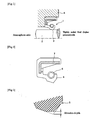
- [Fig. 1] a schematic view showing a lip seal mounting position of an abrasion-evaluating tester.
- [Fig. 2] a cross-sectional view of oil seal for abrasion-evaluating of lip seal.
- [Fig. 3] a schematic view showing an abrasion depth measurement part at the tip end of a lip seal.
-
- 1
- Test piece for abrasion-evaluating test (lip seal)
- 2
- Rotary shaft
- 3
- Sliding part
- 4
- Housing
- 5
- Rubber lip
- 6
- Spring
- 7
- Metallic ring
- Hydrogenated nitrile rubber for use in the present invention has a Mooney viscosity ML1+4(100°C) of 100 or less, preferably 50- 85 (according to JIS K6395), an acrylonitrile (AN) content of 30-50%, an iodine value of 0-28g/100g. When the Mooney viscosity is over 100, kneading of a large amount of carbon fibers will be hard to conduct, resulting in molding failure, and even if kneaded, flow failure will occur at the time of molding, resulting in failure in molding of products in a desired shape. Various AN contents can be selected, depending on the desired sealing, but an AN content of less than 30% will considerably increase a gas permeability, resulting in failure in functioning as a gas shielding material. An iodine value of more than 28 will deteriorate the heat resistance.
- Carbon fibers for use in the present invention include, for example, PAN-based carbon fibers, pitch-based carbon fibers, rayon-based carbon fibers, etc., which generally are about 1 to about 20 µm, preferably about 5 to about 15 µm in fiber diameter, and about 0.03 to about 1mm, preferably about 50 to about 500 µm in fiber length. The carbon fibers having such properties can be used in a proportion of about 60 to about 250 parts by weight, preferably about 60 to about 200 parts by weight, to 100 parts by weight of hydrogenated nitrile rubber. In a proportion of less than about 60 parts by weight, no satisfactory abrasion resistance will be obtained, whereas in a proportion of more than about 250 parts by weight the kneadability or molding processability will be deteriorated at the time of adding other carbon-based filler and the resulting seal materials will have no practical use at the time of adding other carbon-based filler.
- Fillers other than carbon fibers include, for example, carbon black, graphite, etc. and can be used together with carbon fibers. Any carbon black of e.g. SRF, GPF, FEF, HAF, IISAF, ISAF, SAF, etc., so long as can improve the abrasion resistance, can be used in a proportion of about 30- about 150 parts by weight to 100 parts by weight of hydrogenated nitrile rubber. Graphite can be used in a proportion of 0-60 parts by weight, preferably about 10 to about 60 parts by weight, to 100 parts by weight of hydrogenated nitrile rubber. The abrasion resistance can be further improved by simultaneous use of graphite, but sum total proportion of fillers including carbon fibers is set to about 90 to about 350 parts by weight, preferably about 120 to about 300 parts by weight, to 100 parts by weight of hydrogenated nitrile rubber. In a proportion of less than about 90 parts by weight of the fillers, no satisfactory abrasion resistance will be obtained, whereas in a proportion of more than 350 parts by weight the kneadability and molding processability will be deteriorated.
- To provide a seal material having an abrasion resistance suitable for sealing a fluid under severe conditions such as higher temperature, higher pressure, and higher speed, it is necessary that the normal state physical properties will not be lowered at elevated temperatures due to heat generation by sliding. From this point of view, it is selected to use hydrogenated nitrile rubber, and add carbon fibers and other fillers thereto to improve the abrasion resistance. Furthermore, it is added a liquid polyfunctional group-based cocross-linking agent thereto to overcome the deterioration of kneadability due to higher loadings of carbon fibers, and also to enable the carbon fiber fillers in a higher loadings. That is, a liquid polyfunctional group-based cocross-linking agent is a liquid having a low viscosity at the time of kneading and molding processing, which can lower the viscosity of the composition, and can attain higher loadings of the fillers without deteriorating the kneadability, and also can be cross-linked at the time of rubber cross-linking, thereby improving the reinforcing effect and the extraction resistance to various fluids in contact with the seal materials at the same time.
- Polyfunctional group-based cocross-linking agent for use in the present invention includes, for example, a bifunctional group-based cross-linking agent such as ethylene glycol di(meth)acrylate, triethylene glycol di(meth)acrylate, 1,3-butylene glycol di(meth)acrylate, 1,6-hexanediol di(meth)acrylate, etc., and a trifunctional group-based cocross-linking agent such as trimethylolpropane tri(meth)acrylate, triallyl (iso)cyanurate, etc. which can be used alone or in mixture thereof. The term "(meth)acrylate" means either acrylate or methacrylate, and the term "(iso)cyanurate" likewise means either cyanurate or isocyanurate. Among these polyfunctional group-based cocross-linking agents, those which have a molecular weight of about 150 to about 500, and a viscosity (20°C; as measured by B type viscosimeter) of about 3 to about 120mPa·s, showing a liquid state at the ordinary temperature, can be used in a proportion of 12-70 parts by weight, preferably 12-50 parts by weight, to 100 parts by weight of hydrogenated nitrile rubber. In a proportion of less than 12 parts by weight, neither improvements of kneadability or molding processability in case of using higher loadings of carbon fibers or reinforcing effect in case of using carbon fibers of higher loadings, nor improvements of extraction resistance to various fluids can be attained, whereas in a proportion of more than 70 parts by weight wrapping around rolls will be lowered due to bleed generation, resulting in deterioration of the kneadability.
- A liquid oligomer such as liquid polybutadiene oligomer, etc. can be used as a polyfunctional group-based cocross-linking agent in a proportion of not more than 10 parts by weight, preferably 3- 6 parts by weight, to 100 parts by weight of hydrogenated nitrile rubber. The liquid polybutadiene oligomer has a high viscosity, for example, about 15,000 to about 35,000mPa·s (20°C) in the case of JSR product B 3000 as used in the following Examples and Comparative Examples, and thus it fails to act as an afore-mentioned low viscosity polyfunctional group-based cocross-linking agent, enabling higher loadings of fillers without lowering the kneadability and the moldability, though it can act as a cocross-linking agent.
- The present hydrogenated nitrile rubber composition comprising the afore-mentioned essential components can be generally peroxide cross-linked with an organic peroxide. Organic peroxide for use in the present invention includes, for example, di-t-butyl peroxide, dicumyl peroxide, t-butylcumyl peroxide, 1,1-di(t-butylperoxy)-3,3,5-trimethylsiloxane, 2,5-dimethyl-2,5-di(t-butylperoxy) hexane, 2,5-dimethyl-2,5-di(t-butylperoxy) hexine-3, 1,3-di(benzoylperoxy) hexane, t-butylperoxybenzoate, t-butylperoxy isopropyl carbonate, n-butyl-4,4' -di(t-butylperoxy) valerate, etc., and can be used in a proportion of about 1 to about 10 parts by weight, preferably about 2 to about 8 parts by weight, to 100 parts by weight of hydrogenated nitrile rubber.
- The present composition can be further admixed, if necessary, with a processing aid, an acid acceptor such as divalent metal oxide or hydroxide, hydrotalcite, etc., an antioxidant, a plasticizer, etc., besides the afore-mentioned components, and kneaded by the ordinary kneading method using a kneader, a Banbury mixer, rolls, etc., and the kneaded composition can be cross-linking molded into desired shapes by primary cross-linking at about 160° to about 220°C for about 3 to about 10 minutes using a compression molding machine, an injection molding machine, etc., and if necessary, by secondary cross-linking at about 150° to 200°C for about 1 to about 30 hours. In the case of molding as a seal material, the resulting seal material shows a good abrasion resistance, even if used as a seal material in sliding contact with a rotating shaft under the afore-mentioned severe conditions for a long time, and thus can fully show a desired sealing performance.
- The present invention will be described in detail below, referring to Examples.
-
Parts by weight Hydrogenated NBR (Nippon Zeon product, Zetpol 2000; AN content: 36.2% ; Mooney viscosity ML1+4(100°C) : 85 ; iodine value : 7 or less) 100 SRF carbon black 100 Carbon fibers (Osaka Gas Chemical product, pitch-based carbon fibers ; fiber diameter : 10 µm ; fiber length : 0.06mm) 150 Graphite (Nichiden Carbon product, AO) 20 Antioxidant (Uniroyal product, #445) 3 Organic peroxide (NOF Corp. product, percumyl D) 5 Trimethylolpropane trimethacrylate (trifunctional group-based cocross-linking agent) (Mitsubishi Rayon product, Acryester TMP ; molecular weight: 338.41 ; viscosity (20°C) : 57.0mPa·s) 30 Liquid butadiene oligomer (JSR product, B 3000) 5
Kneadability : evaluated by state of bagging occurrence at the time of kneading through 10-inch rolls, where bagging non-occurrence was evaluated as "○" , bleed generation by "Δ", and bagging occurrence as "×"
Moldability : evaluated by flowability at the time of molding of 2mm-thickness sheets, where good flowability was evaluated as "○", and poor flowability (failure to mold) as " × "
Normal state physical properties : owing to small elongation at break, 10% modulus was measured according to JIS K6251 (corresponding to ISO 37)
Lubricating oil resistance : dipped into lubricating oil to measure percent weight of extract according to JIS K6258 (corresponding to ISO 1817)
Abrasion evaluation : shaft lip seals (inner diameter : 12mm) were subjected to a shaft revolution test, using two kinds of fluids to be sealed, i.e. engine oil (turbine oil VG 32) and water (ion-exchanged water), under conditions of peripheral speed : 5 m/sec. fluid pressure : 5MPa, fluid temperature : 150°C and testing time : 10 hours to measure lip part abrasion depth and leaked fluid weight (sealability) (see Figs. 1 to 3) - In Example 1, the amount of trimethylolpropane trimethacrylate was changed to 15 parts by weight, and 15 parts by weight of triethylene glycol dimethacrylate (Mitsubishi Rayon product, Acryester 3ED ; molecular weight : 286.33 ; viscosity (20°C) : 10.2mPa·s) was additionally used as a bifunctional group-based cocross-linking agent.
- In Example 1, the same amount of triethylene glycol dimethacrylate (Acryester 3ED) was used in place of trimethylolpropane trimethacrylate.
- In Example 1, no trimethylolpropane trimethacrylate was used.
- In Example 1, the amount of trimethylolpropane trimethacrylate was changed to 8 parts by weight.
- In Example 1, the amount of carbon fibers was changed to 45 parts by weight.
- In Example 1, the same amount of dioctyl phthalate was used in place of trimethylolpropane trimethacrylate.
- Results of measurement or evaluation in the foregoing Examples and Comparative Examples are shown in the following Table. In Comparative Example 1, the sign "-" shows that the evaluation was not made due to molding failure. It can be concluded from the results give in Table that:
- (1) Addition of a large amount of polyfunctional group-based cocross-linking agent enables higher loadings of carbon fibers without deteriorating the kneadability and the molding processability,
- (2) Increase in the amount of added carbon fibers enables the abrasion resistance of seal materials, and
- (3) Addition of polyfunctional group-based cocross-linking agent can improve 10% modulus and the lubricating oil resistance, the abrasion resistance remarkably.
| Measurement· Evaluation item | Example No. | Comp. Ex. No. | |||||
| 1 | 2 | 3 | 1 | 2 | 3 | 4 | |
| Kneadability | ○ | ○ | ○ | × | Δ | ○ | Δ |
| Moldability | ○ | ○ | ○ | × | ○ | ○ | ○ |
| 10% modulus (MPa) | 30 | 20 | 13 | - | 12 | 13 | 9 |
| Lubricating oil resistance (%) | 0.5 | 0.7 | 1.1 | - | 0.6 | 1.0 | 7 |
| Abrasion evaluation | |||||||
| Abrasion depth | |||||||
| Engine oil (mm) | 0.02 | 0.05 | 0.09 | - | 0.18 | 0.40 | 0.29 |
| Water (mm) | 0.05 | 0.10 | 0.19 | - | 0.30 | 0.62 | 0.40 |
| Amount of leaked fluid | |||||||
| Engine oil (g) | 0.010 | 0.008 | 0.011 | - | 0.080 | 0.18 | 0.14 |
| Water (g) | 0.015 | 0.010 | 0.019 | - | 0.011 | 0.20 | 0.16 |
Claims (20)
- A hydrogenated nitrile rubber composition, which comprises 100 parts by weight of hydrogenated nitrile rubber having a Mooney viscosity ML1+4(100°C) of 100 or less, an acrylonitrile content of 30-50%, and an iodine value of 28 or less, 60-250 parts by weight of carbon fibers, and 12-70 parts by weight of a polyfunctional group-based cocross-linking agent having a molecular weight of 150-500, and a viscosity (20°C) of 3-120mPa·s.
- A hydrogenated nitrile rubber composition according to Claim 1, wherein the hydrogenated nitrile rubber has a Mooney viscosity ML1+4-(100°C) of 50-80.
- A hydrogenated nitrile rubber composition according to Claim 1, wherein 30-150 parts by weight of carbon black is further contained.
- A hydrogenated nitrile rubber composition according to Claim 3, wherein sum total of the fillers is 90-350 parts by weight.
- A hydrogenated nitrile rubber composition according to Claim 1, wherein 60 parts by weight or less of graphite is further contained.
- A hydrogenated nitrile rubber composition according to Claim 5, wherein sum total of the fillers is 90-350 parts by weight.
- A hydrogenated nitrile rubber composition according to Claim 3, wherein 60 parts by weight or less of graphite is further contained.
- A hydrogenated nitrile rubber composition according to Claim 7, wherein sum total of the fillers is 90-350 parts by weight.
- A hydrogenated nitrile rubber composition according to Claim 1, for use as a molding material for seal materials.
- A hydrogenated nitrile rubber composition according to Claim 3, for use as a molding material for seal materials.
- A hydrogenated nitrile rubber composition according to Claim 5, for use as a molding material for seal materials.
- A hydrogenated nitrile rubber composition according to Claim 7, for use as a molding material for seal materials.
- A seal material cross-linking molded from a hydrogenated nitrile rubber composition according to Claim 9.
- A seal material cross-linking molded from a hydrogenated nitrile rubber composition according to Claim 10.
- A seal material cross-linking molded from a hydrogenated nitrile rubber composition according to Claim 11.
- A seal material cross-linking molded from a hydrogenated nitrile rubber composition according to Claim 12.
- A seal material according to Claim 13, for use to seal a fluid, while sliding along a metal in relative motion.
- A seal material according to Claim 14, for use to seal a fluid, while sliding along a metal in relative motion.
- A seal material according to Claim 15, for use to seal a fluid, while sliding along a metal in relative motion.
- A seal material according to Claim 16, for use to seal a fluid, while sliding along a metal in relative motion.
Applications Claiming Priority (2)
| Application Number | Priority Date | Filing Date | Title |
|---|---|---|---|
| JP2004320319A JP4779068B2 (en) | 2004-11-04 | 2004-11-04 | Hydrogenated nitrile rubber composition |
| PCT/JP2005/020206 WO2006049207A1 (en) | 2004-11-04 | 2005-11-02 | Hydrogenated nitrile rubber composition |
Publications (3)
| Publication Number | Publication Date |
|---|---|
| EP1808458A1 true EP1808458A1 (en) | 2007-07-18 |
| EP1808458A4 EP1808458A4 (en) | 2009-09-23 |
| EP1808458B1 EP1808458B1 (en) | 2011-02-23 |
Family
ID=36319212
Family Applications (1)
| Application Number | Title | Priority Date | Filing Date |
|---|---|---|---|
| EP05805501A Expired - Lifetime EP1808458B1 (en) | 2004-11-04 | 2005-11-02 | Hydrogenated nitrile rubber composition |
Country Status (7)
| Country | Link |
|---|---|
| US (1) | US20070299200A1 (en) |
| EP (1) | EP1808458B1 (en) |
| JP (1) | JP4779068B2 (en) |
| KR (1) | KR100854944B1 (en) |
| CN (1) | CN101052674A (en) |
| DE (1) | DE602005026550D1 (en) |
| WO (1) | WO2006049207A1 (en) |
Cited By (5)
| Publication number | Priority date | Publication date | Assignee | Title |
|---|---|---|---|---|
| WO2010030747A1 (en) * | 2008-09-12 | 2010-03-18 | Lanxess Corporation | Hnbr compositions with very high filler levels having excellent processability and resistance to aggressive fluids |
| US8815984B2 (en) | 2008-09-12 | 2014-08-26 | Lanxess Inc. | Elastomeric compositions with improved heat resistance, compression set, and processability |
| EP2700692A4 (en) * | 2011-09-13 | 2015-02-18 | Eagle Ind Co Ltd | HYDROGENATED NITRILE RUBBER COMPOSITION |
| EP2703650A4 (en) * | 2011-09-09 | 2015-03-25 | Eagle Ind Co Ltd | LIP SEAL FOR WATER PUMP |
| RU2522622C9 (en) * | 2008-09-12 | 2016-02-10 | Ленксесс Корпорейшн | Hnbr compositions with very high levels of content of filling agents, possessing excellent processability and resistance to aggressive liquids |
Families Citing this family (15)
| Publication number | Priority date | Publication date | Assignee | Title |
|---|---|---|---|---|
| WO2009011263A1 (en) * | 2007-07-13 | 2009-01-22 | Eagle Industry Co., Ltd. | Nitrile hydride rubber composition |
| JP5261735B2 (en) * | 2008-09-01 | 2013-08-14 | イーグル工業株式会社 | Rubber composition |
| JP5150920B2 (en) * | 2008-10-17 | 2013-02-27 | イーグル工業株式会社 | Rubber composition and sealing material |
| US20130277916A1 (en) * | 2010-11-26 | 2013-10-24 | Uchiyama Manufacturing Corp. | Seal Member Having Excellent Wear Resistance, and Seal Structure Using Same |
| JP5480191B2 (en) * | 2011-03-31 | 2014-04-23 | 古河電気工業株式会社 | Thermally conductive rubber composition and method for producing the same |
| CN104870546B (en) * | 2012-12-21 | 2017-06-13 | 日本瑞翁株式会社 | Rubber composition and formed body |
| CN104685271B (en) * | 2013-02-18 | 2017-10-31 | 伊格尔工业股份有限公司 | Lip seal for water pump |
| DE112014004312T5 (en) | 2013-09-20 | 2016-06-23 | Halliburton Energy Services, Inc. | Elastomeric and thermally conductive carbon fiber compositions for roller drill bit seals |
| EP3124534B1 (en) * | 2014-03-28 | 2018-05-09 | NOK Corporation | Hnbr composition and hnbr crosslinked body |
| JP6677967B2 (en) * | 2014-12-18 | 2020-04-08 | Nok株式会社 | Hydrogenated nitrile rubber composition and oil seal for drive train |
| JP6470050B2 (en) * | 2015-01-21 | 2019-02-13 | ニッタ株式会社 | Seal material and seal mechanism |
| JP6500053B2 (en) * | 2017-03-22 | 2019-04-10 | 三菱電線工業株式会社 | Sealing material |
| CN111349278B (en) * | 2018-12-24 | 2022-06-07 | 青岛高特佳橡塑研究院有限公司 | Sizing material for floating oil seal and preparation method thereof |
| CN115322412B (en) * | 2022-08-30 | 2023-09-26 | 西安向阳航天材料股份有限公司 | Rubber for flexible joint elastomer and preparation method thereof |
| KR20250061034A (en) | 2023-10-26 | 2025-05-08 | 신성켐텍㈜ | Seal rubber compositions for an electric automobile having excellent heat resistance and a seal molded article manufactured thereby |
Family Cites Families (9)
| Publication number | Priority date | Publication date | Assignee | Title |
|---|---|---|---|---|
| JPH0299533A (en) * | 1988-10-05 | 1990-04-11 | Nok Corp | Rubber composition |
| JPH0639544B2 (en) * | 1989-09-22 | 1994-05-25 | 株式会社阪上製作所 | Rubber composition for seals |
| JPH0693145A (en) * | 1992-09-09 | 1994-04-05 | Uchiyama Mfg Corp | Heat-resistant rubber composition |
| JP4221877B2 (en) * | 2000-04-28 | 2009-02-12 | 日本ゼオン株式会社 | Nitrile rubber composition, crosslinkable nitrile rubber composition and cross-linked product |
| JP2002020545A (en) * | 2000-07-13 | 2002-01-23 | Uchiyama Mfg Corp | Hydrogenated nbr composition |
| JP4502483B2 (en) * | 2000-09-05 | 2010-07-14 | Nok株式会社 | Hydrogenated nitrile rubber composition |
| JP4712960B2 (en) * | 2000-11-15 | 2011-06-29 | 三菱電線工業株式会社 | Sealing material |
| JP3950353B2 (en) * | 2002-03-19 | 2007-08-01 | 日本バルカー工業株式会社 | Low temperature fluorine elastomer composition |
| JP4124338B2 (en) * | 2003-01-17 | 2008-07-23 | Nok株式会社 | Hydrogenated nitrile rubber composition |
-
2004
- 2004-11-04 JP JP2004320319A patent/JP4779068B2/en not_active Expired - Lifetime
-
2005
- 2005-11-02 US US11/667,170 patent/US20070299200A1/en not_active Abandoned
- 2005-11-02 KR KR1020077008313A patent/KR100854944B1/en not_active Expired - Fee Related
- 2005-11-02 WO PCT/JP2005/020206 patent/WO2006049207A1/en not_active Ceased
- 2005-11-02 DE DE602005026550T patent/DE602005026550D1/en not_active Expired - Lifetime
- 2005-11-02 EP EP05805501A patent/EP1808458B1/en not_active Expired - Lifetime
- 2005-11-02 CN CNA2005800377261A patent/CN101052674A/en active Pending
Non-Patent Citations (2)
| Title |
|---|
| No further relevant documents disclosed * |
| See also references of WO2006049207A1 * |
Cited By (6)
| Publication number | Priority date | Publication date | Assignee | Title |
|---|---|---|---|---|
| WO2010030747A1 (en) * | 2008-09-12 | 2010-03-18 | Lanxess Corporation | Hnbr compositions with very high filler levels having excellent processability and resistance to aggressive fluids |
| RU2522622C2 (en) * | 2008-09-12 | 2014-07-20 | Ленксесс Корпорейшн | Hnbr compositions with very high levels of content of filling agents, possessing excellent processability and resistance to aggressive liquids |
| US8815984B2 (en) | 2008-09-12 | 2014-08-26 | Lanxess Inc. | Elastomeric compositions with improved heat resistance, compression set, and processability |
| RU2522622C9 (en) * | 2008-09-12 | 2016-02-10 | Ленксесс Корпорейшн | Hnbr compositions with very high levels of content of filling agents, possessing excellent processability and resistance to aggressive liquids |
| EP2703650A4 (en) * | 2011-09-09 | 2015-03-25 | Eagle Ind Co Ltd | LIP SEAL FOR WATER PUMP |
| EP2700692A4 (en) * | 2011-09-13 | 2015-02-18 | Eagle Ind Co Ltd | HYDROGENATED NITRILE RUBBER COMPOSITION |
Also Published As
| Publication number | Publication date |
|---|---|
| EP1808458B1 (en) | 2011-02-23 |
| CN101052674A (en) | 2007-10-10 |
| JP2006131700A (en) | 2006-05-25 |
| DE602005026550D1 (en) | 2011-04-07 |
| US20070299200A1 (en) | 2007-12-27 |
| JP4779068B2 (en) | 2011-09-21 |
| KR100854944B1 (en) | 2008-08-28 |
| EP1808458A4 (en) | 2009-09-23 |
| WO2006049207A1 (en) | 2006-05-11 |
| KR20070089124A (en) | 2007-08-30 |
Similar Documents
| Publication | Publication Date | Title |
|---|---|---|
| EP1808458B1 (en) | Hydrogenated nitrile rubber composition | |
| JP4124338B2 (en) | Hydrogenated nitrile rubber composition | |
| JP3982536B2 (en) | Hydrogenated nitrile rubber composition | |
| CN103688062A (en) | Lip seal for water pump | |
| JP4502483B2 (en) | Hydrogenated nitrile rubber composition | |
| WO2007094447A1 (en) | Hydrogenated nbr compositions | |
| EP2161301B1 (en) | EPDM rubber composition comprising Austin black | |
| JP2010095660A (en) | Rubber composition and sealant | |
| JP5464738B2 (en) | Hydrogenated nitrile rubber composition for lip seals | |
| JP2010059227A (en) | Rubber composition | |
| JP6856760B2 (en) | Static seal member for mechanical seal | |
| KR102445866B1 (en) | Nitrile rubber composition for O-rings with excellent elastic recovery properties | |
| KR100885412B1 (en) | Rubber composition for automotive engine oil seal with improved lubricity and sealing performance | |
| JP6515805B2 (en) | Gasoline engine seal | |
| KR20260031273A (en) | Rubber composition for O-ring of water pump | |
| JP4195673B2 (en) | Sealing device | |
| JP2021169557A (en) | Rubber composition and seal member |
Legal Events
| Date | Code | Title | Description |
|---|---|---|---|
| PUAI | Public reference made under article 153(3) epc to a published international application that has entered the european phase |
Free format text: ORIGINAL CODE: 0009012 |
|
| 17P | Request for examination filed |
Effective date: 20070508 |
|
| AK | Designated contracting states |
Kind code of ref document: A1 Designated state(s): DE FR GB IT |
|
| DAX | Request for extension of the european patent (deleted) | ||
| RBV | Designated contracting states (corrected) |
Designated state(s): DE FR GB IT |
|
| RAP1 | Party data changed (applicant data changed or rights of an application transferred) |
Owner name: EAGLE INDUSTRY CO., LTD. |
|
| RAP1 | Party data changed (applicant data changed or rights of an application transferred) |
Owner name: KABUSHIKI KAISHA TOYOTA JIDOSHOKKI |
|
| RAP1 | Party data changed (applicant data changed or rights of an application transferred) |
Owner name: KABUSHIKI KAISHA TOYOTA JIDOSHOKKI Owner name: EAGLE INDUSTRY CO., LTD. |
|
| RAP1 | Party data changed (applicant data changed or rights of an application transferred) |
Owner name: EAGLE INDUSTRY CO., LTD. Owner name: KABUSHIKI KAISHA TOYOTA JIDOSHOKKI |
|
| A4 | Supplementary search report drawn up and despatched |
Effective date: 20090820 |
|
| RAP1 | Party data changed (applicant data changed or rights of an application transferred) |
Owner name: EAGLE INDUSTRY CO., LTD. |
|
| GRAP | Despatch of communication of intention to grant a patent |
Free format text: ORIGINAL CODE: EPIDOSNIGR1 |
|
| GRAS | Grant fee paid |
Free format text: ORIGINAL CODE: EPIDOSNIGR3 |
|
| GRAA | (expected) grant |
Free format text: ORIGINAL CODE: 0009210 |
|
| AK | Designated contracting states |
Kind code of ref document: B1 Designated state(s): DE FR GB IT |
|
| REG | Reference to a national code |
Ref country code: GB Ref legal event code: FG4D |
|
| REF | Corresponds to: |
Ref document number: 602005026550 Country of ref document: DE Date of ref document: 20110407 Kind code of ref document: P |
|
| REG | Reference to a national code |
Ref country code: DE Ref legal event code: R096 Ref document number: 602005026550 Country of ref document: DE Effective date: 20110407 |
|
| PLBE | No opposition filed within time limit |
Free format text: ORIGINAL CODE: 0009261 |
|
| STAA | Information on the status of an ep patent application or granted ep patent |
Free format text: STATUS: NO OPPOSITION FILED WITHIN TIME LIMIT |
|
| 26N | No opposition filed |
Effective date: 20111124 |
|
| REG | Reference to a national code |
Ref country code: DE Ref legal event code: R097 Ref document number: 602005026550 Country of ref document: DE Effective date: 20111124 |
|
| PG25 | Lapsed in a contracting state [announced via postgrant information from national office to epo] |
Ref country code: IT Free format text: LAPSE BECAUSE OF FAILURE TO SUBMIT A TRANSLATION OF THE DESCRIPTION OR TO PAY THE FEE WITHIN THE PRESCRIBED TIME-LIMIT Effective date: 20110223 |
|
| GBPC | Gb: european patent ceased through non-payment of renewal fee |
Effective date: 20111102 |
|
| REG | Reference to a national code |
Ref country code: FR Ref legal event code: ST Effective date: 20120731 |
|
| PG25 | Lapsed in a contracting state [announced via postgrant information from national office to epo] |
Ref country code: GB Free format text: LAPSE BECAUSE OF NON-PAYMENT OF DUE FEES Effective date: 20111102 |
|
| PG25 | Lapsed in a contracting state [announced via postgrant information from national office to epo] |
Ref country code: FR Free format text: LAPSE BECAUSE OF NON-PAYMENT OF DUE FEES Effective date: 20111130 |
|
| PGFP | Annual fee paid to national office [announced via postgrant information from national office to epo] |
Ref country code: DE Payment date: 20220930 Year of fee payment: 18 |
|
| REG | Reference to a national code |
Ref country code: DE Ref legal event code: R119 Ref document number: 602005026550 Country of ref document: DE |
|
| PG25 | Lapsed in a contracting state [announced via postgrant information from national office to epo] |
Ref country code: DE Free format text: LAPSE BECAUSE OF NON-PAYMENT OF DUE FEES Effective date: 20240601 |
|
| PG25 | Lapsed in a contracting state [announced via postgrant information from national office to epo] |
Ref country code: DE Free format text: LAPSE BECAUSE OF NON-PAYMENT OF DUE FEES Effective date: 20240601 |