EP1806152B1 - Drug for external use and adhesive patch - Google Patents
Drug for external use and adhesive patch Download PDFInfo
- Publication number
- EP1806152B1 EP1806152B1 EP05806193A EP05806193A EP1806152B1 EP 1806152 B1 EP1806152 B1 EP 1806152B1 EP 05806193 A EP05806193 A EP 05806193A EP 05806193 A EP05806193 A EP 05806193A EP 1806152 B1 EP1806152 B1 EP 1806152B1
- Authority
- EP
- European Patent Office
- Prior art keywords
- external preparation
- fatty acid
- acid ester
- preparation according
- mentioned
- Prior art date
- Legal status (The legal status is an assumption and is not a legal conclusion. Google has not performed a legal analysis and makes no representation as to the accuracy of the status listed.)
- Expired - Lifetime
Links
Images


Classifications
-
- A—HUMAN NECESSITIES
- A61—MEDICAL OR VETERINARY SCIENCE; HYGIENE
- A61K—PREPARATIONS FOR MEDICAL, DENTAL OR TOILETRY PURPOSES
- A61K9/00—Medicinal preparations characterised by special physical form
- A61K9/70—Web, sheet or filament bases ; Films; Fibres of the matrix type containing drug
- A61K9/7023—Transdermal patches and similar drug-containing composite devices, e.g. cataplasms
- A61K9/703—Transdermal patches and similar drug-containing composite devices, e.g. cataplasms characterised by shape or structure; Details concerning release liner or backing; Refillable patches; User-activated patches
- A61K9/7038—Transdermal patches of the drug-in-adhesive type, i.e. comprising drug in the skin-adhesive layer
- A61K9/7046—Transdermal patches of the drug-in-adhesive type, i.e. comprising drug in the skin-adhesive layer the adhesive comprising macromolecular compounds
- A61K9/7053—Transdermal patches of the drug-in-adhesive type, i.e. comprising drug in the skin-adhesive layer the adhesive comprising macromolecular compounds obtained by reactions only involving carbon to carbon unsaturated bonds, e.g. polyvinyl, polyisobutylene, polystyrene
-
- A—HUMAN NECESSITIES
- A61—MEDICAL OR VETERINARY SCIENCE; HYGIENE
- A61K—PREPARATIONS FOR MEDICAL, DENTAL OR TOILETRY PURPOSES
- A61K31/00—Medicinal preparations containing organic active ingredients
- A61K31/185—Acids; Anhydrides, halides or salts thereof, e.g. sulfur acids, imidic, hydrazonic or hydroximic acids
- A61K31/19—Carboxylic acids, e.g. valproic acid
- A61K31/192—Carboxylic acids, e.g. valproic acid having aromatic groups, e.g. sulindac, 2-aryl-propionic acids, ethacrynic acid
-
- A—HUMAN NECESSITIES
- A61—MEDICAL OR VETERINARY SCIENCE; HYGIENE
- A61K—PREPARATIONS FOR MEDICAL, DENTAL OR TOILETRY PURPOSES
- A61K31/00—Medicinal preparations containing organic active ingredients
- A61K31/185—Acids; Anhydrides, halides or salts thereof, e.g. sulfur acids, imidic, hydrazonic or hydroximic acids
- A61K31/19—Carboxylic acids, e.g. valproic acid
- A61K31/195—Carboxylic acids, e.g. valproic acid having an amino group
- A61K31/196—Carboxylic acids, e.g. valproic acid having an amino group the amino group being directly attached to a ring, e.g. anthranilic acid, mefenamic acid, diclofenac, chlorambucil
-
- A—HUMAN NECESSITIES
- A61—MEDICAL OR VETERINARY SCIENCE; HYGIENE
- A61K—PREPARATIONS FOR MEDICAL, DENTAL OR TOILETRY PURPOSES
- A61K31/00—Medicinal preparations containing organic active ingredients
- A61K31/33—Heterocyclic compounds
- A61K31/38—Heterocyclic compounds having sulfur as a ring hetero atom
- A61K31/381—Heterocyclic compounds having sulfur as a ring hetero atom having five-membered rings
-
- A—HUMAN NECESSITIES
- A61—MEDICAL OR VETERINARY SCIENCE; HYGIENE
- A61K—PREPARATIONS FOR MEDICAL, DENTAL OR TOILETRY PURPOSES
- A61K31/00—Medicinal preparations containing organic active ingredients
- A61K31/33—Heterocyclic compounds
- A61K31/395—Heterocyclic compounds having nitrogen as a ring hetero atom, e.g. guanethidine or rifamycins
- A61K31/40—Heterocyclic compounds having nitrogen as a ring hetero atom, e.g. guanethidine or rifamycins having five-membered rings with one nitrogen as the only ring hetero atom, e.g. sulpiride, succinimide, tolmetin, buflomedil
- A61K31/403—Heterocyclic compounds having nitrogen as a ring hetero atom, e.g. guanethidine or rifamycins having five-membered rings with one nitrogen as the only ring hetero atom, e.g. sulpiride, succinimide, tolmetin, buflomedil condensed with carbocyclic rings, e.g. carbazole
- A61K31/404—Indoles, e.g. pindolol
- A61K31/405—Indole-alkanecarboxylic acids; Derivatives thereof, e.g. tryptophan, indomethacin
-
- A—HUMAN NECESSITIES
- A61—MEDICAL OR VETERINARY SCIENCE; HYGIENE
- A61K—PREPARATIONS FOR MEDICAL, DENTAL OR TOILETRY PURPOSES
- A61K31/00—Medicinal preparations containing organic active ingredients
- A61K31/33—Heterocyclic compounds
- A61K31/395—Heterocyclic compounds having nitrogen as a ring hetero atom, e.g. guanethidine or rifamycins
- A61K31/41—Heterocyclic compounds having nitrogen as a ring hetero atom, e.g. guanethidine or rifamycins having five-membered rings with two or more ring hetero atoms, at least one of which being nitrogen, e.g. tetrazole
- A61K31/415—1,2-Diazoles
-
- A—HUMAN NECESSITIES
- A61—MEDICAL OR VETERINARY SCIENCE; HYGIENE
- A61K—PREPARATIONS FOR MEDICAL, DENTAL OR TOILETRY PURPOSES
- A61K31/00—Medicinal preparations containing organic active ingredients
- A61K31/33—Heterocyclic compounds
- A61K31/395—Heterocyclic compounds having nitrogen as a ring hetero atom, e.g. guanethidine or rifamycins
- A61K31/41—Heterocyclic compounds having nitrogen as a ring hetero atom, e.g. guanethidine or rifamycins having five-membered rings with two or more ring hetero atoms, at least one of which being nitrogen, e.g. tetrazole
- A61K31/42—Oxazoles
-
- A—HUMAN NECESSITIES
- A61—MEDICAL OR VETERINARY SCIENCE; HYGIENE
- A61K—PREPARATIONS FOR MEDICAL, DENTAL OR TOILETRY PURPOSES
- A61K31/00—Medicinal preparations containing organic active ingredients
- A61K31/33—Heterocyclic compounds
- A61K31/395—Heterocyclic compounds having nitrogen as a ring hetero atom, e.g. guanethidine or rifamycins
- A61K31/54—Heterocyclic compounds having nitrogen as a ring hetero atom, e.g. guanethidine or rifamycins having six-membered rings with at least one nitrogen and one sulfur as the ring hetero atoms, e.g. sulthiame
- A61K31/5415—Heterocyclic compounds having nitrogen as a ring hetero atom, e.g. guanethidine or rifamycins having six-membered rings with at least one nitrogen and one sulfur as the ring hetero atoms, e.g. sulthiame ortho- or peri-condensed with carbocyclic ring systems, e.g. phenothiazine, chlorpromazine, piroxicam
-
- A—HUMAN NECESSITIES
- A61—MEDICAL OR VETERINARY SCIENCE; HYGIENE
- A61K—PREPARATIONS FOR MEDICAL, DENTAL OR TOILETRY PURPOSES
- A61K31/00—Medicinal preparations containing organic active ingredients
- A61K31/63—Compounds containing para-N-benzenesulfonyl-N-groups, e.g. sulfanilamide, p-nitrobenzenesulfonyl hydrazide
-
- A—HUMAN NECESSITIES
- A61—MEDICAL OR VETERINARY SCIENCE; HYGIENE
- A61K—PREPARATIONS FOR MEDICAL, DENTAL OR TOILETRY PURPOSES
- A61K33/00—Medicinal preparations containing inorganic active ingredients
- A61K33/06—Aluminium, calcium or magnesium; Compounds thereof, e.g. clay
- A61K33/08—Oxides; Hydroxides
-
- A—HUMAN NECESSITIES
- A61—MEDICAL OR VETERINARY SCIENCE; HYGIENE
- A61K—PREPARATIONS FOR MEDICAL, DENTAL OR TOILETRY PURPOSES
- A61K45/00—Medicinal preparations containing active ingredients not provided for in groups A61K31/00 - A61K41/00
- A61K45/06—Mixtures of active ingredients without chemical characterisation, e.g. antiphlogistics and cardiaca
-
- A—HUMAN NECESSITIES
- A61—MEDICAL OR VETERINARY SCIENCE; HYGIENE
- A61K—PREPARATIONS FOR MEDICAL, DENTAL OR TOILETRY PURPOSES
- A61K47/00—Medicinal preparations characterised by the non-active ingredients used, e.g. carriers or inert additives; Targeting or modifying agents chemically bound to the active ingredient
- A61K47/02—Inorganic compounds
-
- A—HUMAN NECESSITIES
- A61—MEDICAL OR VETERINARY SCIENCE; HYGIENE
- A61K—PREPARATIONS FOR MEDICAL, DENTAL OR TOILETRY PURPOSES
- A61K47/00—Medicinal preparations characterised by the non-active ingredients used, e.g. carriers or inert additives; Targeting or modifying agents chemically bound to the active ingredient
- A61K47/06—Organic compounds, e.g. natural or synthetic hydrocarbons, polyolefins, mineral oil, petrolatum or ozokerite
- A61K47/08—Organic compounds, e.g. natural or synthetic hydrocarbons, polyolefins, mineral oil, petrolatum or ozokerite containing oxygen, e.g. ethers, acetals, ketones, quinones, aldehydes, peroxides
- A61K47/14—Esters of carboxylic acids, e.g. fatty acid monoglycerides, medium-chain triglycerides, parabens or PEG fatty acid esters
-
- A—HUMAN NECESSITIES
- A61—MEDICAL OR VETERINARY SCIENCE; HYGIENE
- A61K—PREPARATIONS FOR MEDICAL, DENTAL OR TOILETRY PURPOSES
- A61K47/00—Medicinal preparations characterised by the non-active ingredients used, e.g. carriers or inert additives; Targeting or modifying agents chemically bound to the active ingredient
- A61K47/06—Organic compounds, e.g. natural or synthetic hydrocarbons, polyolefins, mineral oil, petrolatum or ozokerite
- A61K47/16—Organic compounds, e.g. natural or synthetic hydrocarbons, polyolefins, mineral oil, petrolatum or ozokerite containing nitrogen, e.g. nitro-, nitroso-, azo-compounds, nitriles, cyanates
- A61K47/18—Amines; Amides; Ureas; Quaternary ammonium compounds; Amino acids; Oligopeptides having up to five amino acids
- A61K47/183—Amino acids, e.g. glycine, EDTA or aspartame
-
- A—HUMAN NECESSITIES
- A61—MEDICAL OR VETERINARY SCIENCE; HYGIENE
- A61K—PREPARATIONS FOR MEDICAL, DENTAL OR TOILETRY PURPOSES
- A61K47/00—Medicinal preparations characterised by the non-active ingredients used, e.g. carriers or inert additives; Targeting or modifying agents chemically bound to the active ingredient
- A61K47/30—Macromolecular organic or inorganic compounds, e.g. inorganic polyphosphates
- A61K47/32—Macromolecular compounds obtained by reactions only involving carbon-to-carbon unsaturated bonds, e.g. carbomers, poly(meth)acrylates, or polyvinyl pyrrolidone
-
- A—HUMAN NECESSITIES
- A61—MEDICAL OR VETERINARY SCIENCE; HYGIENE
- A61K—PREPARATIONS FOR MEDICAL, DENTAL OR TOILETRY PURPOSES
- A61K47/00—Medicinal preparations characterised by the non-active ingredients used, e.g. carriers or inert additives; Targeting or modifying agents chemically bound to the active ingredient
- A61K47/30—Macromolecular organic or inorganic compounds, e.g. inorganic polyphosphates
- A61K47/34—Macromolecular compounds obtained otherwise than by reactions only involving carbon-to-carbon unsaturated bonds, e.g. polyesters, polyamino acids, polysiloxanes, polyphosphazines, copolymers of polyalkylene glycol or poloxamers
-
- A—HUMAN NECESSITIES
- A61—MEDICAL OR VETERINARY SCIENCE; HYGIENE
- A61P—SPECIFIC THERAPEUTIC ACTIVITY OF CHEMICAL COMPOUNDS OR MEDICINAL PREPARATIONS
- A61P17/00—Drugs for dermatological disorders
-
- A—HUMAN NECESSITIES
- A61—MEDICAL OR VETERINARY SCIENCE; HYGIENE
- A61P—SPECIFIC THERAPEUTIC ACTIVITY OF CHEMICAL COMPOUNDS OR MEDICINAL PREPARATIONS
- A61P29/00—Non-central analgesic, antipyretic or antiinflammatory agents, e.g. antirheumatic agents; Non-steroidal antiinflammatory drugs [NSAID]
Definitions
- the present invention relates to an external preparation and an adhesive patch comprising pharmacologically active components such as anti-inflammatory drugs as active ingredients.
- Hitherto known external preparations comprising anti-inflammatory drugs such as non-steroidal anti-inflammatory analgesics as active ingredients
- anti-inflammatory drugs such as non-steroidal anti-inflammatory analgesics as active ingredients
- adhesive patches of the type that contains an anti-inflammatory drug dissolved or dispersed in an aqueous base, in combination with a hydrophilic nonionic surfactant or the like to prevent precipitation of the anti-inflammatory drug
- Patent documents 1 and 2 include adhesive patches, of the type that contains an anti-inflammatory drug dissolved or dispersed in an aqueous base, in combination with a hydrophilic nonionic surfactant or the like to prevent precipitation of the anti-inflammatory drug
- Patent documents 3 and 4 In the fields of foods and cosmetics, polyglycerin fatty acid esters are used as surfactants with high emulsifying power (Patent documents 3 and 4). Their use has also become known in recent years in the field of external preparations, as solubilizing agents or emulsifying agents for dissolution or dispersion of drugs in aqueous bases, or as penetration accelerators for improved percutaneous absorption of drugs (Patent documents 5 and 6).
- Patent document 7 For adhesive patches containing indomethacin and L-menthol, a technique is known for including a component such as polyoxyalkylene glycol in order to reduce irritation to skin (Patent document 7).
- Patent document 1 Japanese Unexamined Patent Application Publication No. 2002-20274
- Patent document 2 European Patent Application No. 1170020
- Patent document 3 Japanese Patent No. 3549612
- Patent document 4 Japanese Unexamined Patent Application Publication No. 2004-175670
- Patent document 5 Japanese Unexamined Patent Application Publication No. 2001-131089
- Patent document 6 Japanese Unexamined Patent Application Publication No. 2004-250330
- Patent document 7 Japanese Patent No. 3542814
- a pharmacologically active component such as an anti-inflammatory drug as the active ingredient
- the external preparation of the invention is characterized by containing a pharmacologically active component and a lipophilic polyglycerin fatty acid ester.
- the pharmacologically active component is preferably an anti-inflammatory drug.
- Combination of the lipophilic polyglycerin fatty acid ester with the pharmacologically active component in the external preparation of the invention adequately inhibits skin rash. It has been known in the conventional art that using hydrophilic nonionic surfactants in anti-inflammatory drugs employing aqueous bases inhibits crystallization or precipitation of poorly water-soluble anti-inflammatory drugs. The present inventors have found, however, that using a lipophilic polyglycerin fatty acid ester as a skin irritation-reducing agent can inhibit skin rash caused by irritation by the pharmacologically active components such as anti-inflammatory drugs, and have completed the present invention on the basis of this finding.
- the HLB value of the polyglycerin fatty acid ester is preferably no greater than 9.
- a polyglycerin fatty acid ester having an HLB value within this range will have satisfactory hydrophilicity with the other components in the external preparation, thereby improving the physical properties of the preparation.
- the polyglycerin fatty acid ester is preferably an ester of a polyglycerin with an average polymerization degree of 2 to 14 and a C 14-24 fatty acid.
- the polyglycerin fatty acid ester is preferably an ester of a polyglycerin and a condensation product of hydroxyl group-containing fatty acids.
- a condensation product is obtained by condensing a plurality of hydroxyl group-containing fatty acids by ester bonding between the hydroxyl and the carboxyl groups, and it has carboxyl groups for ester bonding with the polyglycerin.
- the external preparation preferably contains the polyglycerin fatty acid ester at 0.01 to 10 wt% based on the total weight.
- the anti-inflammatory drug is preferably at least one selected from the group consisting of non-steroidal anti-inflammatory analgesics, disease modifying antirheumatic drugs and cytokine blockers.
- the non-steroidal anti-inflammatory analgesic is preferably at least one selected from the group consisting of indomethacin, ketoprofen, diclofenac, flurbiprofen, felbinac, ibuprofen, suprofen, tiaprofen, loxoprofen, celecoxib, rofecoxib, meloxicam and valdecoxib.
- the external preparation of the invention is particularly useful when using these non-steroidal anti-inflammatory analgesics.
- the external preparation of the invention preferably further comprises either or both an edetic acid salt and/or aluminum hydroxide. This will further increase the effect of preventing skin rash by a synergistic effect with the polyglycerin fatty acid ester.
- the external preparation of the invention preferably contains substantially no water. This will generally inhibit crystallization or precipitation of poorly water-soluble pharmacologically active components, thereby improving the shelf-life of the external preparation while also allowing a higher concentration of the pharmacologically active component in the external preparation.
- the external preparation of the invention preferably further comprises a base for dissolution or dispersion of the pharmacologically active component and polyglycerin fatty acid ester.
- the base preferably contains one or more substances selected from the group consisting of natural rubber, synthetic isoprene rubber, polyisobutylene, polyvinyl ether, polyurethane, polyisoprene, polybutadiene, styrene-butadiene copolymer, styrene-isoprene copolymer, styrene-isoprene-styrene block copolymer, acrylic pressure-sensitive adhesives and silicone-based pressure-sensitive adhesives. This can impart sufficient adhesion to the external preparation for prolonged attachment.
- the invention further provides an adhesive patch comprising: a pressure-sensitive adhesive layer including the external preparation; and a backing bearing the pressure-sensitive adhesive layer.
- the external preparation of the invention is particularly useful for an adhesive patch because an adhesive patch is usually in contact with affected areas for prolonged periods and tends to cause skin rash.
- an external preparation comprising a pharmacologically active component such as an anti-inflammatory drug as the active ingredient, whereby skin rash can be adequately prevented.
- Adhesive patch Adhesive patch
- 2 backing
- 3 pressure-sensitive adhesive layer
- 4 release liner
- the external preparation of the invention contains at least a pharmacologically active component and a lipophilic polyglycerin fatty acid ester.
- the pharmacologically active component is preferably an anti-inflammatory drug, and as anti-inflammatory drugs there may be mentioned non-steroidal anti-inflammatory analgesics, disease modifying antirheumatic drugs (DMARD) , cytokine blockers and the like.
- vasodilators As suitable pharmacologically active components other than anti-inflammatory drugs there may be mentioned vasodilators, anti-arrhythmia drugs, antihypertensive agents, antitussive expectorants, antidementia drugs, antianxiety drugs, dysuria treatment agents, antidepressants, neurosis drugs, antiplatelet drugs, antiviral agents, antitumor agents, local anesthetics, hormone agents, antihistamines, anti-coagulants, antispastic drugs, general anesthetics, hypnotic/analgesics, anti-epileptic agents, stimulant/analeptics, antimotion sickness agents, psychoneurotic drugs, skeletal muscle relaxants, autonomic nerve agents, anti-Parkinson drugs, diuretics, vasoconstrictors, respiratory stimulants, peptic ulcer agents, cholagogues, urogenital/anal agents, agents for parasitic skin diseases, emollients, vitamins, antifungal agents, inorganic formulations
- ketoprofen As non-steroidal anti-inflammatory analgesics there may be mentioned ketoprofen, loxoprofen, ibuprofen, flurbiprofen, tiaprofen, indomethacin, acemetacin, diclofenac, felbinac, sulindac, etodolac, tolmetin, piroxicam, meloxicam, ampiroxicam, naproxen, azapropazone, methyl salicylate, glycol salicylate, valdecoxib, celecoxib, rofecoxib and the like, any of which may be used alone or in combinations of different types.
- indomethacin ketoprofen, diclofenac, flurbiprofen, felbinac, ibuprofen, suprofen, tiaprofen and loxoprofen.
- disease modifying antirheumatic drugs there may be mentioned leflunomide and auranofin
- cytokine blockers there may be mentioned infliximab, etanercept, adalimubab and anakinra.
- vasodilators there may be mentioned diltiazem hydrochloride, pentaerythritol tetranitrate, isosorbide nitrate, trapidil, nicorandil, prenylamine lactate, molsidomine, aluminum nitrite, tolazoline hydrochloride and nifedipine.
- anti-arrhythmia drugs there may be mentioned procainamide hydrochloride, lidocaine hydrochloride, propranolol hydrochloride, alprenolol hydrochloride, atenolol, nadolol, metoprolol tartrate, ajmaline, disopyramide and mexiletine hydrochloride.
- antihypertensive agents there may be mentioned ecarazine hydrochloride, indapamide, clonidine hydrochloride, bisoprolol fumarate, bunitrolol hydrochloride, labetalol hydrochloride, capropril, guanabenz acetate, mebutamate and betanidine sulfate.
- antitussive expectorants there may be mentioned carbetapentane citrate, chloperastine, oxeladin tannate, clobutinol hydrochloride, clofedanol hydrochloride, noscapine hydrochloride, ephedrine hydrochloride, isoproterenol hydrochloride, clorprenaline hydrochloride, methoxyphenamine hydrochloride, procaterol hydrochloride, tulobuterol hydrochloride, clenbuterol hydrochloride and ketotifen fumarate.
- antidementia drugs there may be mentioned donepezil hydrochloride and the like.
- antianxiety drugs there may be mentioned tandospirone citrate and the like.
- dysuria treatment agents there may be mentioned oxybutynin hydrochloride and tamsulosin hydrochloride.
- antidepressants there may be mentioned fluvoxamine maleate , citalopram, fluoxetine, sertraline hydrochloride and paroxetine hydrochloride.
- neurosis drugs there may be mentioned pregabalin and the like.
- antiplatelet drugs there may be mentioned sarpogrelate hydrochloride and the like.
- antiviral agents there may be mentioned aciclovir and ganciclovir.
- antitumor agents there may be mentioned cyclophosphamide, fluorouracil, methotrexate, tegafur, mitomycin C, procarbazine hydrochloride, doxifluridine and ranimustine.
- local anesthetics there may be mentioned ethyl aminobenzoate, tetracaine hydrochloride, procaine hydrochloride, dibucaine hydrochloride, oxybuprocaine hydrochloride and protocaine hydrochloride.
- hormone agents there may be mentioned propylthiouracil, thiamazole, metolonone acetate, estradiol, estriol and progesterone.
- antihistamines there may be mentioned diphenhydramine hydrochloride, chlorpheniramine maleate, promethazine, cyproheptadine hydrochloride and diphenylpyraline hydrochloride.
- anti-coagulants there may be mentioned warfarin potassium and ticlopidine hydrochloride.
- antispastic drugs there may be mentioned atropine methylbromide and scopolamine.
- thiopental sodium and pentobarbital sodium As general anesthetics there may be mentioned bromvalerylurea, amobarbital and phenobarbital.
- anti-epileptic agents there may be mentioned phenytoin sodium and the like.
- methamphetamine hydrochloride As stimulant/analeptics there may be mentioned methamphetamine hydrochloride and the like. As antimotion sickness agents there may be mentioned diphenidol hydrochloride and betahistine mesylate. As psychoneurotic drugs there may be mentioned chlorpromazine hydrochloride, thioridazine, meprobamate, imipramine hydrochloride, chlordiazepoxide and diazepam. As skeletal muscle relaxants there may be mentioned suxamethonium hydrochloride and eperisone hydrochloride. As autonomic nerve agents there may be mentioned neostigmine bromide and bethanechol hydrochloride.
- anti-Parkinson drugs there may be mentioned amantadine hydrochloride, pergolide mesylate, bromocriptine mesylate, ropinirole and selegiline.
- diuretics there may be mentioned hydroflumethiazide, isosorbide and furosemide.
- vasoconstrictors there may be mentioned epinephrine and phenylephrine hydrochloride.
- respiratory stimulants there may be mentioned lobeline bromide, dimorpholamine and naloxone hydrochloride.
- peptic ulcer agents there may be mentioned glycopyrronium bromide, proglumide, cetraxate hydrochloride, cimetidine and spizofurone.
- ursodesoxycholic acid and osalmid As cholagogues there may be mentioned ursodesoxycholic acid and osalmid. As urogenital/anal agents there may be mentioned hexamine, sparteine, dinoprost and ritodrine hydrochloride. As agents for parasitic skin diseases there may be mentioned salicylic acid, ciclopiroxolamine and croconazole hydrochloride. As emollients there may be mentioned urea and the like. As vitamins there may be mentioned calcitriol, thiamine hydrochloride, riboflavin sodium phosphate, pyridoxine hydrochloride, nicotinic acid amide, panthenol and ascorbic acid.
- antifungal agents there may be mentioned bifonazole, clotrimazole, tioconazole, miconazole, econazole, isoconazole, itraconazole, sulconazole, oxiconazole, omoconazole, croconazole, ketoconazole, neticonazole, lanoconazole, fluconazole, terbinafine, naftifine, butenafine and amorolfine.
- inorganic formulations there may be mentioned calcium hydrochloride, potassium iodide and sodium iodide.
- hemostatic drugs there may be mentioned etamsylate and the like.
- hepatic disease drugs there may be mentioned tiopronin and the like.
- habitual addiction drugs there may be mentioned cyanamide and the like.
- gout treatment agents there may be mentioned colchicine, probenecid and sulfinpyrazone.
- diabetes treatment agents there may be mentioned tolbutamide, chlorpropamide, glymidine sodium, glipizole, buformin hydrochloride and insulin.
- antibiotics there may be mentioned benzylpenicillin potassium, propicillin potassium, cloxacillin sodium, ampicillin sodium, bacampicillin hydrochloride, carbenicillin sodium, cephaloridine, cephoxitin sodium, erythromycin, chloramphenicol, tetracycline, kanamycin sulfate and cycloserine.
- chemotherapeutic agents there may be mentioned isocyanide, pyrazinamide and ethionamide.
- narcotics there may be mentioned morphine hydrochloride, codeine phosphate, cocaine hydrochloride, pethidine hydrochloride and fentanyl citrate.
- smoking cessation aids there may be mentioned nicotine and the like.
- angina drugs there may be mentioned nitroglycerin and the like.
- pharmacologically active components listed above as examples that are free forms of compounds may also be used as pharmaceutically acceptable salts. Also, those listed as salts may be used in their corresponding pharmaceutically acceptable free forms or as other pharmaceutically acceptable salts.
- the polyglycerin fatty acid ester has an HLB value of preferably no greater than 9 and more preferably no greater than 7.
- the HLB value is also preferably 2 or greater.
- the polyglycerin fatty acid ester is also preferably an ester of a polyglycerin with an average polymerization degree of 2 to 14 and a C14-24 saturated or unsaturated fatty acid.
- the average polymerization degree of the polyglycerin is more preferably 8 to 10 and the number of carbon atoms of the saturated or unsaturated fatty acid is more preferably 18 to 22.
- the polyglycerin fatty acid ester is even more preferably formed by ester bonding between a polyglycerin and the condensation product of two hydroxyl group-containing fatty acids.
- hydroxyl group-containing fatty acids there may be mentioned ricinoleic acid and the like, and the product of ester bonding between a polyglycerin and the condensation product obtained by condensation of two ricinoleic acid molecules by ester bonding may be suitably used as the polyglycerin fatty acid ester.
- Such a polyglycerin fatty acid ester can be obtained by a process known in the conventional art such as polyglycerin and fatty acid esterification, and commercial products are also available.
- the content of the polyglycerin fatty acid ester in the external preparation is preferably 0.01 to 10 wt% and more preferably 1 to 3 wt% based on the total weight. If the polyglycerin fatty acid ester content is less than 0.01 wt% or greater than 10 wt%, the effect of preventing skin rash will tend to be reduced.
- the external preparation of the invention preferably further comprises an edetic acid salt, aluminum hydroxide or the like.
- the synergistic effect of these with the polyglycerin fatty acid ester can further increase the effect of preventing skin rash.
- edetic acid salts there are preferred one or more selected from the group consisting of disodium edetate, trisodium edetate and tetrasodium edetate.
- the content of edetic acid salts in the external preparation is preferably 0.01 to 5 wt% and more preferably 1 to 3 wt% based on the total weight.
- the content is preferably 0.01 to 10 wt% based on the total weight, from the viewpoint of the effect of reducing skin irritation.
- the external preparation of the invention is preferably an oilbased external preparation containing substantially no water. If the external preparation contains substantially no water, precipitation of pharmacologically active components such as poorly water-soluble non-steroidal anti-inflammatory analgesics will be inhibited, thereby stabilizing the properties of the external preparation.
- the phrase "contains substantially no water” as used herein means that the external preparation is composed essentially of non-aqueous components. However, the external preparation may contain the trace amount of water deriving from the starting materials or the production environment, so long as this produces no inhibition on the effect of the invention of preventing skin rash. More specifically, the water content of the external preparation is preferably no greater than 1.0 wt% based on the total weight of the external preparation.
- the external preparation of the invention preferably further contains a base for dissolution or dispersion of the pharmacologically active component (preferably anti-inflammatory drug) and the polyglycerin fatty acid ester.
- the base is not particularly restricted so long as it can uniformly disperse or dissolve the components including the pharmacologically active component and polyglycerin fatty acid ester, and for example, rubber bases, acrylic pressure-sensitive adhesives and silicone-based pressure-sensitive adhesives may be used.
- rubber-based pressure-sensitive adhesives there are preferred natural rubber, synthetic isoprene rubber, polyisobutylene, polyvinyl ether, polyurethane, polyisoprene, polybutadiene, styrene-butadiene copolymer, styrene-isoprene copolymer and styrene-isoprene-styrene block copolymer.
- acrylic pressure-sensitive adhesives there are preferred acrylic polymers that are homopolymers or copolymers of (meth)acrylic alkyl esters.
- the alkyl group of the (meth)acrylic acid ester is preferably C4-18.
- (meth)acrylic means "methacrylic or acrylic” (same hereunder).
- (meth)acrylic alkyl esters there may be mentioned butyl acrylate, isobutyl acrylate, hexyl acrylate, octyl acrylate, 2-ethylhexyl acrylate, isooctyl acrylate, decyl acrylate, isodecyl acrylate, lauryl acrylate, stearyl acrylate, methyl methacrylate, ethyl methacrylate, butyl methacrylate, isobutyl methacrylate, 2-ethylhexyl methacrylate, isooctyl methacrylate, decyl methacrylate, isodecyl methacrylate, lauryl methacrylate and lauryl methacrylate.
- the acrylic polymer may be a copolymer of the aforementioned (meth)acrylic alkyl ester with another monomer.
- suitable monomers include those with hydroxyl groups, carboxyl groups, amide groups, amino groups and pyrrolidone rings.
- monomers with hydroxyl groups there may be mentioned hydroxyalkyl (meth)acrylates such as 2-hydroxyethyl (meth)acrylate and hydroxypropyl (meth)acrylate.
- monomers with carboxyl groups there may be mentioned ⁇ , ⁇ -unsaturated carboxylic acids such as acrylic acid and methacrylic acid, monoalkyl maleic acid esters such as butyl maleate, and maleic acid, fumaric acid, crotonic acid and the like.
- maleic anhydride contributes the same copolymerizing component as maleic acid, it may also be used as a monomer.
- monomers with amide groups there may be mentioned alkyl(meth)acrylamides such as acrylamide, dimethylacrylamide and diethylacrylamide, N-alkoxymethyl(meth)acrylamides such as N-butoxymethylacrylamide and N-ethoxyethylacrylamide, and diacetoneacrylamide.
- monomers with amino groups there may be mentioned dimethylaminoethyl acrylate and the like.
- monomers with pyrrolidone rings there may be mentioned N-vinyl-2-pyrrolidone and the like.
- silicone-based pressure-sensitive adhesives there may be mentioned those composed mainly of polyorganosiloxanes such as polydimethylsiloxane.
- the external preparation of the invention may also contain, if necessary, pharmaceutically acceptable components other than those mentioned above, such as skin rash inhibitors, saccharides, metal oxides, hydrophilic polymers, humectants, refreshing agents, antioxidants, antiseptic agents, preservatives, aromatics and the like.
- pharmaceutically acceptable components such as skin rash inhibitors, saccharides, metal oxides, hydrophilic polymers, humectants, refreshing agents, antioxidants, antiseptic agents, preservatives, aromatics and the like.
- the dosage form of the external preparation of the invention is not particularly restricted and may be an adhesive patch, ointment, gel, cream, poultice, suppository, liniment, eye drop, aerosol or the like, but it is preferably an adhesive patch comprising: a pressure sensitive adhesive layer including the aforementioned base-containing external preparation; and a backing bearing the pressure-sensitive adhesive layer.
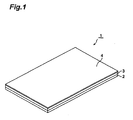
- Fig. 1 is a perspective view of an embodiment of an adhesive patch according to the invention.
- the adhesive patch 1 shown in Fig. 1 has a construction with a pressure-sensitive adhesive layer 3 composed of the external preparation and a release liner 4 laminated in that order on one side of a backing 2.
- the adhesive patch 1 is used by peeling off the release liner 4 and attaching it to skin with the pressure-sensitive adhesive layer 3 in contact with the skin.
- a tackifier, softening agent or the like may also be added to the pressure-sensitive adhesive layer 3.
- tackifiers there may be mentioned rosins and rosin derivatives obtained by hydrogenation, disproportionation, polymerization or esterification of rosins, terpene resins such as ⁇ -pinene and ⁇ -pinene, terpene-phenol resins, aliphatic, aromatic, alicyclic or copolymer petroleum resins, alkylphenol resins, and xylene resins.
- a softening agent is a component which plasticizes or softens the base polymer to maintain a suitable degree of adhesion onto skin, and as examples there may be mentioned polybutene, liquid paraffins, higher fatty acid esters such as isopropyl myristate, silicone oils, and vegetable oils such as almond oil, camellia oil, persic oil and peanut oil.
- the backing 2 used in the adhesive patch may be either elastic or non-elastic, and it is preferably one that allows efficient release of the pharmacologically active component.
- the backing 2 there may be suitably used a film or sheet formed of a synthetic resin such as polyethylene, polypropylene, polybutadiene, ethylene-vinyl acetate copolymer, polyvinyl chloride, polyester, nylon or polyurethane, or a laminate, porous film, foam, woven fabric or nonwoven fabric composed thereof, or a paper material.
- An adhesive patch of this type can be fabricated by a fabrication method known in the conventional art.
- a kneader, mixer or the like is used to combine the base with the other components, such as a softening agent and tackifier, preferably while heating to 120 to 160°C, and then the pharmacologically active component such as an anti-inflammatory drug is added and mixed therewith while heating to a degree that does not cause its thermal decomposition, to prepare a mixture for formation of a pressure-sensitive adhesive layer.
- the mixture is either directly spread onto a film support to form a pressure-sensitive adhesive layer, or it is spread onto a released-treated paper sheet or film to form a pressure-sensitive adhesive layer, and the backing placed thereover for contact transfer of the pressure-sensitive adhesive layer onto the backing.
- a coating solution comprising the base, pharmacologically active component, absorption accelerator, etc. dissolved or dispersed in a solvent may be directly coated onto the surface of the backing and then dried to form a pressure-sensitive adhesive layer.
- the solvent used in this case is preferably one that dissolves all of the constituent components including the base and pharmacologically active component, and for example, there may be mentioned aromatic hydrocarbons such as toluene, benzene and xylene, esters such as ethyl acetate, and halogenated hydrocarbons such as carbon tetrachloride, chloroform and methylene chloride.
- aromatic hydrocarbons such as toluene, benzene and xylene
- esters such as ethyl acetate
- halogenated hydrocarbons such as carbon tetrachloride, chloroform and methylene chloride.
- mixtures uniformly blended with the formulations (wt%) shown in Tables 1 and 2 were each spread onto a polyester film to a thickness of 100 ⁇ m using a spreader to form a pressure-sensitive adhesive layer, a backing was laminated therewith in a manner covering the pressure-sensitive adhesive layer, and the laminate was cut to a prescribed shape to fabricate an adhesive patch.
- polyglycerin fatty acid esters there were used: a polyglycerin fatty acid ester A with an HLB value of 3 which was an ester of a polyglycerin with an average polymerization degree of 10 and a C18 fatty acid for Examples 1 to 4, a polyglycerin fatty acid ester B with an HLB of 5 which was an ester of a polyglycerin with an average polymerization degree of 10 and a C22 fatty acid for Examples 5 to 12, and a hydrophilic polyglycerin fatty acid ester C with an HLB value of 17 which was an ester of a polyglycerin with an average polymerization degree of 10 and a C12 fatty acid for Comparative Examples 2 and 3.
- Comparative Example 4 there was prepared a conventional indomethacin-containing adhesive patch (indomethacin content: 3.75 wt%), as a reference example there was prepared a Japanese Pharmacopeia bandage, and as Comparative Example 5 there was prepared a conventional indomethacin-containing cream preparation (indomethacin content: 1.0 wt%, no polyglycerin fatty acid ester).
- Each adhesive patch was used for a 48 hour patch test with 15 healthy adult males, and the skin irritation was evaluated.
- the test was conducted by a method in which the adhesive patch (1.5 cm-diameter circle) was attached to the back of each person and the skin irritation index (SI value) after 48 hours was determined.
- SI value skin irritation index
- the skin irritation index was determined by the Sugai system (see " Skin", Vol. 27, No.4, August 1985 ). The results are shown in Tables 1 and 2.
- the adhesive patches of Examples 3, 7 and 9 and the cream preparation of Comparative Example 5 were subjected to the carrageenan foot edema test described below. First, they were applied onto the right hind legs of SD male rats (10 per group) each having a body weight of about 140 g, and the drug was removed 4 hours after application. The adhesive patches of Examples 3, 7 and 9 were 8 cm 2 in size, and the cream preparation of Comparative Example 5 was applied in an amount of 200 mg. Immediately after removal of the drug, 0.1 mL of a 1.5% carrageenan solution was subcutaneously injected into the footpad to provoke an inflammatory response. The foot volume was measured 3 hours after provoking inflammation, and the ratio with respect to the foot volume prior to injection was calculated as the edema ratio. A dummy application test was also carried out. The results are shown in Fig. 2 .
- the adhesive patches of Examples 3, 7 and 9 and the cream preparation of Comparative Example 5 were subjected to the yeast inflammation foot pain test described below. First, they were applied onto the right hind legs of SD male rats (12 per group) each having a body weight of about 130 g, and the drug was removed 4 hours after application. The adhesive patches of Examples 3, 7 and 9 were 8 cm 2 in size, and the cream preparation of Comparative Example 5 was applied in an amount of 200 mg. Immediately after removal of the drug, 0.2 mL of a 25% yeast solution was subcutaneously injected into the footpad to provoke an inflammatory response. The pain threshold was measured 3 hours after provoking inflammation. A dummy application test was also carried out. The results are shown in Fig. 3 .
- the adhesive patches of the examples produced lower skin irritation and prevented skin rash, compared to the comparative examples that contained no lipophilic polyglycerin fatty acid ester. It was therefore confirmed that the invention can provide an external preparation that adequately inhibits skin rash.
Landscapes
- Health & Medical Sciences (AREA)
- Chemical & Material Sciences (AREA)
- Life Sciences & Earth Sciences (AREA)
- General Health & Medical Sciences (AREA)
- Veterinary Medicine (AREA)
- Public Health (AREA)
- Medicinal Chemistry (AREA)
- Animal Behavior & Ethology (AREA)
- Pharmacology & Pharmacy (AREA)
- Epidemiology (AREA)
- Engineering & Computer Science (AREA)
- Inorganic Chemistry (AREA)
- Bioinformatics & Cheminformatics (AREA)
- General Chemical & Material Sciences (AREA)
- Chemical Kinetics & Catalysis (AREA)
- Dermatology (AREA)
- Proteomics, Peptides & Aminoacids (AREA)
- Oil, Petroleum & Natural Gas (AREA)
- Organic Chemistry (AREA)
- Nuclear Medicine, Radiotherapy & Molecular Imaging (AREA)
- Pain & Pain Management (AREA)
- Rheumatology (AREA)
- Medicinal Preparation (AREA)
- Acyclic And Carbocyclic Compounds In Medicinal Compositions (AREA)
- Pharmaceuticals Containing Other Organic And Inorganic Compounds (AREA)
- Medicines That Contain Protein Lipid Enzymes And Other Medicines (AREA)
Abstract
Description
- The present invention relates to an external preparation and an adhesive patch comprising pharmacologically active components such as anti-inflammatory drugs as active ingredients.
- Hitherto known external preparations comprising anti-inflammatory drugs such as non-steroidal anti-inflammatory analgesics as active ingredients include adhesive patches, of the type that contains an anti-inflammatory drug dissolved or dispersed in an aqueous base, in combination with a hydrophilic nonionic surfactant or the like to prevent precipitation of the anti-inflammatory drug (Patent documents 1 and 2).
- In the fields of foods and cosmetics, polyglycerin fatty acid esters are used as surfactants with high emulsifying power (
Patent documents 3 and 4). Their use has also become known in recent years in the field of external preparations, as solubilizing agents or emulsifying agents for dissolution or dispersion of drugs in aqueous bases, or as penetration accelerators for improved percutaneous absorption of drugs (Patent documents 5 and 6). - For adhesive patches containing indomethacin and L-menthol, a technique is known for including a component such as polyoxyalkylene glycol in order to reduce irritation to skin (Patent document 7).
[Patent document 1] Japanese Unexamined Patent Application Publication No.2002-20274
[Patent document 2] European Patent Application No.1170020
[Patent document 3] Japanese Patent No.3549612
[Patent document 4] Japanese Unexamined Patent Application Publication No.2004-175670
[Patent document 5] Japanese Unexamined Patent Application Publication No.2001-131089
[Patent document 6] Japanese Unexamined Patent Application Publication No.2004-250330
[Patent document 7] Japanese Patent No.3542814 - Conventional external preparations containing pharmacologically active components such as anti-inflammatory drugs, however, have been associated with inconveniences including skin rashes such as redness or edema due to irritation by the pharmacologically active components themselves. Prolonged skin contact by adhesive patches containing high concentrations of active ingredients has been a noted cause of skin rash.
- It is therefore an object of the present invention to provide an external preparation comprising a pharmacologically active component such as an anti-inflammatory drug as the active ingredient, whereby skin rash can be adequately prevented.
- In order to solve the problem described above, the external preparation of the invention is characterized by containing a pharmacologically active component and a lipophilic polyglycerin fatty acid ester. The pharmacologically active component is preferably an anti-inflammatory drug.
- Combination of the lipophilic polyglycerin fatty acid ester with the pharmacologically active component in the external preparation of the invention adequately inhibits skin rash. It has been known in the conventional art that using hydrophilic nonionic surfactants in anti-inflammatory drugs employing aqueous bases inhibits crystallization or precipitation of poorly water-soluble anti-inflammatory drugs. The present inventors have found, however, that using a lipophilic polyglycerin fatty acid ester as a skin irritation-reducing agent can inhibit skin rash caused by irritation by the pharmacologically active components such as anti-inflammatory drugs, and have completed the present invention on the basis of this finding.
- The HLB value of the polyglycerin fatty acid ester is preferably no greater than 9. A polyglycerin fatty acid ester having an HLB value within this range will have satisfactory hydrophilicity with the other components in the external preparation, thereby improving the physical properties of the preparation.
- In order to more effectively prevent skin rash, the polyglycerin fatty acid ester is preferably an ester of a polyglycerin with an average polymerization degree of 2 to 14 and a C 14-24 fatty acid.
- Alternatively, the polyglycerin fatty acid ester is preferably an ester of a polyglycerin and a condensation product of hydroxyl group-containing fatty acids. Such a condensation product is obtained by condensing a plurality of hydroxyl group-containing fatty acids by ester bonding between the hydroxyl and the carboxyl groups, and it has carboxyl groups for ester bonding with the polyglycerin.
- In order to more effectively prevent skin rash, the external preparation preferably contains the polyglycerin fatty acid ester at 0.01 to 10 wt% based on the total weight.
- The anti-inflammatory drug is preferably at least one selected from the group consisting of non-steroidal anti-inflammatory analgesics, disease modifying antirheumatic drugs and cytokine blockers. The non-steroidal anti-inflammatory analgesic is preferably at least one selected from the group consisting of indomethacin, ketoprofen, diclofenac, flurbiprofen, felbinac, ibuprofen, suprofen, tiaprofen, loxoprofen, celecoxib, rofecoxib, meloxicam and valdecoxib. The external preparation of the invention is particularly useful when using these non-steroidal anti-inflammatory analgesics.
- The external preparation of the invention preferably further comprises either or both an edetic acid salt and/or aluminum hydroxide. This will further increase the effect of preventing skin rash by a synergistic effect with the polyglycerin fatty acid ester.
- The external preparation of the invention preferably contains substantially no water. This will generally inhibit crystallization or precipitation of poorly water-soluble pharmacologically active components, thereby improving the shelf-life of the external preparation while also allowing a higher concentration of the pharmacologically active component in the external preparation.
- The external preparation of the invention preferably further comprises a base for dissolution or dispersion of the pharmacologically active component and polyglycerin fatty acid ester. The base preferably contains one or more substances selected from the group consisting of natural rubber, synthetic isoprene rubber, polyisobutylene, polyvinyl ether, polyurethane, polyisoprene, polybutadiene, styrene-butadiene copolymer, styrene-isoprene copolymer, styrene-isoprene-styrene block copolymer, acrylic pressure-sensitive adhesives and silicone-based pressure-sensitive adhesives. This can impart sufficient adhesion to the external preparation for prolonged attachment.
- The invention further provides an adhesive patch comprising: a pressure-sensitive adhesive layer including the external preparation; and a backing bearing the pressure-sensitive adhesive layer. The external preparation of the invention is particularly useful for an adhesive patch because an adhesive patch is usually in contact with affected areas for prolonged periods and tends to cause skin rash.
- According to the present invention there is provided an external preparation comprising a pharmacologically active component such as an anti-inflammatory drug as the active ingredient, whereby skin rash can be adequately prevented.
-
-
Fig. 1 is a perspective view of an embodiment of the adhesive patch of the invention. -
Fig. 2 is a graph showing the results of a carrageenan foot edema test carried out for the examples. -
Fig. 3 is a graph showing the results of a yeast inflammation foot pain test carried out for the examples. - 1: Adhesive patch, 2: backing, 3: pressure-sensitive adhesive layer, 4: release liner.
- Preferred embodiments of the invention will now be described in detail.
- The external preparation of the invention contains at least a pharmacologically active component and a lipophilic polyglycerin fatty acid ester. The pharmacologically active component is preferably an anti-inflammatory drug, and as anti-inflammatory drugs there may be mentioned non-steroidal anti-inflammatory analgesics, disease modifying antirheumatic drugs (DMARD), cytokine blockers and the like. As suitable pharmacologically active components other than anti-inflammatory drugs there may be mentioned vasodilators, anti-arrhythmia drugs, antihypertensive agents, antitussive expectorants, antidementia drugs, antianxiety drugs, dysuria treatment agents, antidepressants, neurosis drugs, antiplatelet drugs, antiviral agents, antitumor agents, local anesthetics, hormone agents, antihistamines, anti-coagulants, antispastic drugs, general anesthetics, hypnotic/analgesics, anti-epileptic agents, stimulant/analeptics, antimotion sickness agents, psychoneurotic drugs, skeletal muscle relaxants, autonomic nerve agents, anti-Parkinson drugs, diuretics, vasoconstrictors, respiratory stimulants, peptic ulcer agents, cholagogues, urogenital/anal agents, agents for parasitic skin diseases, emollients, vitamins, antifungal agents, inorganic formulations, hemostatic drugs, hepatic disease drugs, habitual addiction drugs, gout treatment agents, diabetes treatment agents, antibiotics, chemotherapeutic agents, narcotics, smoking cessation aids and angina drugs.
- As non-steroidal anti-inflammatory analgesics there may be mentioned ketoprofen, loxoprofen, ibuprofen, flurbiprofen, tiaprofen, indomethacin, acemetacin, diclofenac, felbinac, sulindac, etodolac, tolmetin, piroxicam, meloxicam, ampiroxicam, naproxen, azapropazone, methyl salicylate, glycol salicylate, valdecoxib, celecoxib, rofecoxib and the like, any of which may be used alone or in combinations of different types. Especially preferred among these from the viewpoint of superior pharmacological effects are indomethacin, ketoprofen, diclofenac, flurbiprofen, felbinac, ibuprofen, suprofen, tiaprofen and loxoprofen. As disease modifying antirheumatic drugs there may be mentioned leflunomide and auranofin, and as cytokine blockers there may be mentioned infliximab, etanercept, adalimubab and anakinra.
- As vasodilators there may be mentioned diltiazem hydrochloride, pentaerythritol tetranitrate, isosorbide nitrate, trapidil, nicorandil, prenylamine lactate, molsidomine, aluminum nitrite, tolazoline hydrochloride and nifedipine. As anti-arrhythmia drugs there may be mentioned procainamide hydrochloride, lidocaine hydrochloride, propranolol hydrochloride, alprenolol hydrochloride, atenolol, nadolol, metoprolol tartrate, ajmaline, disopyramide and mexiletine hydrochloride. As antihypertensive agents there may be mentioned ecarazine hydrochloride, indapamide, clonidine hydrochloride, bisoprolol fumarate, bunitrolol hydrochloride, labetalol hydrochloride, capropril, guanabenz acetate, mebutamate and betanidine sulfate. As antitussive expectorants there may be mentioned carbetapentane citrate, chloperastine, oxeladin tannate, clobutinol hydrochloride, clofedanol hydrochloride, noscapine hydrochloride, ephedrine hydrochloride, isoproterenol hydrochloride, clorprenaline hydrochloride, methoxyphenamine hydrochloride, procaterol hydrochloride, tulobuterol hydrochloride, clenbuterol hydrochloride and ketotifen fumarate. As antidementia drugs there may be mentioned donepezil hydrochloride and the like. As antianxiety drugs there may be mentioned tandospirone citrate and the like. As dysuria treatment agents there may be mentioned oxybutynin hydrochloride and tamsulosin hydrochloride. As antidepressants there may be mentioned fluvoxamine maleate, citalopram, fluoxetine, sertraline hydrochloride and paroxetine hydrochloride. As neurosis drugs there may be mentioned pregabalin and the like. As antiplatelet drugs there may be mentioned sarpogrelate hydrochloride and the like. As antiviral agents there may be mentioned aciclovir and ganciclovir. As antitumor agents there may be mentioned cyclophosphamide, fluorouracil, methotrexate, tegafur, mitomycin C, procarbazine hydrochloride, doxifluridine and ranimustine. As local anesthetics there may be mentioned ethyl aminobenzoate, tetracaine hydrochloride, procaine hydrochloride, dibucaine hydrochloride, oxybuprocaine hydrochloride and protocaine hydrochloride. As hormone agents there may be mentioned propylthiouracil, thiamazole, metolonone acetate, estradiol, estriol and progesterone. As antihistamines there may be mentioned diphenhydramine hydrochloride, chlorpheniramine maleate, promethazine, cyproheptadine hydrochloride and diphenylpyraline hydrochloride. As anti-coagulants there may be mentioned warfarin potassium and ticlopidine hydrochloride. As antispastic drugs there may be mentioned atropine methylbromide and scopolamine. As general anesthetics there may be mentioned thiopental sodium and pentobarbital sodium. As hypnotic/analgesics there may be mentioned bromvalerylurea, amobarbital and phenobarbital. As anti-epileptic agents there may be mentioned phenytoin sodium and the like. As stimulant/analeptics there may be mentioned methamphetamine hydrochloride and the like. As antimotion sickness agents there may be mentioned diphenidol hydrochloride and betahistine mesylate. As psychoneurotic drugs there may be mentioned chlorpromazine hydrochloride, thioridazine, meprobamate, imipramine hydrochloride, chlordiazepoxide and diazepam. As skeletal muscle relaxants there may be mentioned suxamethonium hydrochloride and eperisone hydrochloride. As autonomic nerve agents there may be mentioned neostigmine bromide and bethanechol hydrochloride. As anti-Parkinson drugs there may be mentioned amantadine hydrochloride, pergolide mesylate, bromocriptine mesylate, ropinirole and selegiline. As diuretics there may be mentioned hydroflumethiazide, isosorbide and furosemide. As vasoconstrictors there may be mentioned epinephrine and phenylephrine hydrochloride. As respiratory stimulants there may be mentioned lobeline bromide, dimorpholamine and naloxone hydrochloride. As peptic ulcer agents there may be mentioned glycopyrronium bromide, proglumide, cetraxate hydrochloride, cimetidine and spizofurone. As cholagogues there may be mentioned ursodesoxycholic acid and osalmid. As urogenital/anal agents there may be mentioned hexamine, sparteine, dinoprost and ritodrine hydrochloride. As agents for parasitic skin diseases there may be mentioned salicylic acid, ciclopiroxolamine and croconazole hydrochloride. As emollients there may be mentioned urea and the like. As vitamins there may be mentioned calcitriol, thiamine hydrochloride, riboflavin sodium phosphate, pyridoxine hydrochloride, nicotinic acid amide, panthenol and ascorbic acid. As antifungal agents there may be mentioned bifonazole, clotrimazole, tioconazole, miconazole, econazole, isoconazole, itraconazole, sulconazole, oxiconazole, omoconazole, croconazole, ketoconazole, neticonazole, lanoconazole, fluconazole, terbinafine, naftifine, butenafine and amorolfine. As inorganic formulations there may be mentioned calcium hydrochloride, potassium iodide and sodium iodide. As hemostatic drugs there may be mentioned etamsylate and the like. As hepatic disease drugs there may be mentioned tiopronin and the like. As habitual addiction drugs there may be mentioned cyanamide and the like. As gout treatment agents there may be mentioned colchicine, probenecid and sulfinpyrazone. As diabetes treatment agents there may be mentioned tolbutamide, chlorpropamide, glymidine sodium, glipizole, buformin hydrochloride and insulin. As antibiotics there may be mentioned benzylpenicillin potassium, propicillin potassium, cloxacillin sodium, ampicillin sodium, bacampicillin hydrochloride, carbenicillin sodium, cephaloridine, cephoxitin sodium, erythromycin, chloramphenicol, tetracycline, kanamycin sulfate and cycloserine. As chemotherapeutic agents there may be mentioned isocyanide, pyrazinamide and ethionamide. As narcotics there may be mentioned morphine hydrochloride, codeine phosphate, cocaine hydrochloride, pethidine hydrochloride and fentanyl citrate. As smoking cessation aids there may be mentioned nicotine and the like. As angina drugs there may be mentioned nitroglycerin and the like.
- The pharmacologically active components listed above as examples that are free forms of compounds may also be used as pharmaceutically acceptable salts. Also, those listed as salts may be used in their corresponding pharmaceutically acceptable free forms or as other pharmaceutically acceptable salts.
- The polyglycerin fatty acid ester has an HLB value of preferably no greater than 9 and more preferably no greater than 7. The HLB value is also preferably 2 or greater.
- The polyglycerin fatty acid ester is also preferably an ester of a polyglycerin with an average polymerization degree of 2 to 14 and a C14-24 saturated or unsaturated fatty acid. For further reduced skin irritation, the average polymerization degree of the polyglycerin is more preferably 8 to 10 and the number of carbon atoms of the saturated or unsaturated fatty acid is more preferably 18 to 22.
- The polyglycerin fatty acid ester is even more preferably formed by ester bonding between a polyglycerin and the condensation product of two hydroxyl group-containing fatty acids. As hydroxyl group-containing fatty acids there may be mentioned ricinoleic acid and the like, and the product of ester bonding between a polyglycerin and the condensation product obtained by condensation of two ricinoleic acid molecules by ester bonding may be suitably used as the polyglycerin fatty acid ester.
- Such a polyglycerin fatty acid ester can be obtained by a process known in the conventional art such as polyglycerin and fatty acid esterification, and commercial products are also available.
- The content of the polyglycerin fatty acid ester in the external preparation is preferably 0.01 to 10 wt% and more preferably 1 to 3 wt% based on the total weight. If the polyglycerin fatty acid ester content is less than 0.01 wt% or greater than 10 wt%, the effect of preventing skin rash will tend to be reduced.
- The external preparation of the invention preferably further comprises an edetic acid salt, aluminum hydroxide or the like. The synergistic effect of these with the polyglycerin fatty acid ester can further increase the effect of preventing skin rash.
- As edetic acid salts there are preferred one or more selected from the group consisting of disodium edetate, trisodium edetate and tetrasodium edetate. From the viewpoint of the effect of reducing skin irritation, the content of edetic acid salts in the external preparation is preferably 0.01 to 5 wt% and more preferably 1 to 3 wt% based on the total weight.
- When aluminum hydroxide is used, on the other hand, the content is preferably 0.01 to 10 wt% based on the total weight, from the viewpoint of the effect of reducing skin irritation.
- The external preparation of the invention is preferably an oilbased external preparation containing substantially no water. If the external preparation contains substantially no water, precipitation of pharmacologically active components such as poorly water-soluble non-steroidal anti-inflammatory analgesics will be inhibited, thereby stabilizing the properties of the external preparation. The phrase "contains substantially no water" as used herein means that the external preparation is composed essentially of non-aqueous components. However, the external preparation may contain the trace amount of water deriving from the starting materials or the production environment, so long as this produces no inhibition on the effect of the invention of preventing skin rash. More specifically, the water content of the external preparation is preferably no greater than 1.0 wt% based on the total weight of the external preparation.
- The external preparation of the invention preferably further contains a base for dissolution or dispersion of the pharmacologically active component (preferably anti-inflammatory drug) and the polyglycerin fatty acid ester.
- The base is not particularly restricted so long as it can uniformly disperse or dissolve the components including the pharmacologically active component and polyglycerin fatty acid ester, and for example, rubber bases, acrylic pressure-sensitive adhesives and silicone-based pressure-sensitive adhesives may be used.
- As rubber-based pressure-sensitive adhesives there are preferred natural rubber, synthetic isoprene rubber, polyisobutylene, polyvinyl ether, polyurethane, polyisoprene, polybutadiene, styrene-butadiene copolymer, styrene-isoprene copolymer and styrene-isoprene-styrene block copolymer.
- As acrylic pressure-sensitive adhesives there are preferred acrylic polymers that are homopolymers or copolymers of (meth)acrylic alkyl esters. The alkyl group of the (meth)acrylic acid ester is preferably C4-18. The term "(meth)acrylic" means "methacrylic or acrylic" (same hereunder).
- As specific (meth)acrylic alkyl esters there may be mentioned butyl acrylate, isobutyl acrylate, hexyl acrylate, octyl acrylate, 2-ethylhexyl acrylate, isooctyl acrylate, decyl acrylate, isodecyl acrylate, lauryl acrylate, stearyl acrylate, methyl methacrylate, ethyl methacrylate, butyl methacrylate, isobutyl methacrylate, 2-ethylhexyl methacrylate, isooctyl methacrylate, decyl methacrylate, isodecyl methacrylate, lauryl methacrylate and lauryl methacrylate.
- The acrylic polymer may be a copolymer of the aforementioned (meth)acrylic alkyl ester with another monomer. Other suitable monomers include those with hydroxyl groups, carboxyl groups, amide groups, amino groups and pyrrolidone rings. As examples of monomers with hydroxyl groups there may be mentioned hydroxyalkyl (meth)acrylates such as 2-hydroxyethyl (meth)acrylate and hydroxypropyl (meth)acrylate. As examples of monomers with carboxyl groups there may be mentioned α, β-unsaturated carboxylic acids such as acrylic acid and methacrylic acid, monoalkyl maleic acid esters such as butyl maleate, and maleic acid, fumaric acid, crotonic acid and the like. Since maleic anhydride contributes the same copolymerizing component as maleic acid, it may also be used as a monomer. As examples of monomers with amide groups there may be mentioned alkyl(meth)acrylamides such as acrylamide, dimethylacrylamide and diethylacrylamide, N-alkoxymethyl(meth)acrylamides such as N-butoxymethylacrylamide and N-ethoxyethylacrylamide, and diacetoneacrylamide. As monomers with amino groups there may be mentioned dimethylaminoethyl acrylate and the like. As monomers with pyrrolidone rings there may be mentioned N-vinyl-2-pyrrolidone and the like.
- As silicone-based pressure-sensitive adhesives there may be mentioned those composed mainly of polyorganosiloxanes such as polydimethylsiloxane.
- The external preparation of the invention may also contain, if necessary, pharmaceutically acceptable components other than those mentioned above, such as skin rash inhibitors, saccharides, metal oxides, hydrophilic polymers, humectants, refreshing agents, antioxidants, antiseptic agents, preservatives, aromatics and the like.
- The dosage form of the external preparation of the invention is not particularly restricted and may be an adhesive patch, ointment, gel, cream, poultice, suppository, liniment, eye drop, aerosol or the like, but it is preferably an adhesive patch comprising: a pressure sensitive adhesive layer including the aforementioned base-containing external preparation; and a backing bearing the pressure-sensitive adhesive layer.
-
Fig. 1 is a perspective view of an embodiment of an adhesive patch according to the invention. The adhesive patch 1 shown inFig. 1 has a construction with a pressure-sensitive adhesive layer 3 composed of the external preparation and arelease liner 4 laminated in that order on one side of abacking 2. The adhesive patch 1 is used by peeling off therelease liner 4 and attaching it to skin with the pressure-sensitive adhesive layer 3 in contact with the skin. - A tackifier, softening agent or the like may also be added to the pressure-
sensitive adhesive layer 3. As examples of tackifiers there may be mentioned rosins and rosin derivatives obtained by hydrogenation, disproportionation, polymerization or esterification of rosins, terpene resins such as α-pinene and β-pinene, terpene-phenol resins, aliphatic, aromatic, alicyclic or copolymer petroleum resins, alkylphenol resins, and xylene resins. A softening agent is a component which plasticizes or softens the base polymer to maintain a suitable degree of adhesion onto skin, and as examples there may be mentioned polybutene, liquid paraffins, higher fatty acid esters such as isopropyl myristate, silicone oils, and vegetable oils such as almond oil, camellia oil, persic oil and peanut oil. - The
backing 2 used in the adhesive patch may be either elastic or non-elastic, and it is preferably one that allows efficient release of the pharmacologically active component. Specifically, as thebacking 2 there may be suitably used a film or sheet formed of a synthetic resin such as polyethylene, polypropylene, polybutadiene, ethylene-vinyl acetate copolymer, polyvinyl chloride, polyester, nylon or polyurethane, or a laminate, porous film, foam, woven fabric or nonwoven fabric composed thereof, or a paper material. - An adhesive patch of this type can be fabricated by a fabrication method known in the conventional art. For example, in the case of a tape preparation employing a rubber-based pressure-sensitive adhesive as the base, first a kneader, mixer or the like is used to combine the base with the other components, such as a softening agent and tackifier, preferably while heating to 120 to 160°C, and then the pharmacologically active component such as an anti-inflammatory drug is added and mixed therewith while heating to a degree that does not cause its thermal decomposition, to prepare a mixture for formation of a pressure-sensitive adhesive layer. The mixture is either directly spread onto a film support to form a pressure-sensitive adhesive layer, or it is spread onto a released-treated paper sheet or film to form a pressure-sensitive adhesive layer, and the backing placed thereover for contact transfer of the pressure-sensitive adhesive layer onto the backing. For an acrylic tape preparation employing an acrylic pressure-sensitive adhesive as the base, a coating solution comprising the base, pharmacologically active component, absorption accelerator, etc. dissolved or dispersed in a solvent may be directly coated onto the surface of the backing and then dried to form a pressure-sensitive adhesive layer. The solvent used in this case is preferably one that dissolves all of the constituent components including the base and pharmacologically active component, and for example, there may be mentioned aromatic hydrocarbons such as toluene, benzene and xylene, esters such as ethyl acetate, and halogenated hydrocarbons such as carbon tetrachloride, chloroform and methylene chloride.
- The invention will now be explained in greater detail by working examples.
- As examples and comparative examples, mixtures uniformly blended with the formulations (wt%) shown in Tables 1 and 2 were each spread onto a polyester film to a thickness of 100 µm using a spreader to form a pressure-sensitive adhesive layer, a backing was laminated therewith in a manner covering the pressure-sensitive adhesive layer, and the laminate was cut to a prescribed shape to fabricate an adhesive patch. As polyglycerin fatty acid esters there were used: a polyglycerin fatty acid ester A with an HLB value of 3 which was an ester of a polyglycerin with an average polymerization degree of 10 and a C18 fatty acid for Examples 1 to 4, a polyglycerin fatty acid ester B with an HLB of 5 which was an ester of a polyglycerin with an average polymerization degree of 10 and a C22 fatty acid for Examples 5 to 12, and a hydrophilic polyglycerin fatty acid ester C with an HLB value of 17 which was an ester of a polyglycerin with an average polymerization degree of 10 and a C12 fatty acid for Comparative Examples 2 and 3.
For Comparative Example 4 there was prepared a conventional indomethacin-containing adhesive patch (indomethacin content: 3.75 wt%), as a reference example there was prepared a Japanese Pharmacopeia bandage, and as Comparative Example 5 there was prepared a conventional indomethacin-containing cream preparation (indomethacin content: 1.0 wt%, no polyglycerin fatty acid ester). -
[Table 1] Example 1 2 3 4 5 6 7 8 9 10 11 12 Indomethacin 5.00 5 00 3.50 I 3.50 I 5.00 5.00 3.50 3.50 3.50 3 50 3.50 3.50 L-menthol 5.00 00 5.00 3.50 3.50 5.00 5.00 3.50 3.50 3.50 3.50 3.50 3.50 Polyglycerin fatty acid ester A 1.00 3.00 1.00 3.00 3.00 - - - - - - - Polyglycerin fatty acid ester B - - - - 1.00 3.00 1.00 3.00 1.00 3.00 1.00 1.00 Aluminum hydroxide - - - - 1.50 1.50 1.50 1.50 1.50 1.50 1.50 1.50 Disodium ederate - - - - - - - - 0.80 0.80 - 0.80 Dibutylhydroxy Toluene 1.5 1.5 1.5 1.5 1.5 1.5 1.5 1.5 1.5 1.5 1.5 1.5 Styrene-isoptene -styrene block copolymer 19.0 19.0 19.0 19.0 19.0 19.0 19.0 19.0 19.0 19.0 19.0 19.0 Polyisobutylene 12.5 12.5 12.5 12.5 12.5 12.5 12.5 12.5 12.5 12.5 12.5 12.5 Alicyclic saturated h drocarbon resin 12.5 12.5 12.5 12.5 12.5 12.5 12.5 12.5 12.5 12.5 12.5 12.5 Titanium oxide 3.0 3.0 3.0 3.0 3.0 3.0 3.0 3.0 3.0 3.0 - - Liquid paraffin 40.5 38.5 43.5 41.5 39.0 37.0 42.0 40.0 41.2 39.2 45.0 44.2 Skin irritation index (SI value) 13.3 16.7 13.3 16.7 6.7 13.3 16.7 20.0 0 10.0 12.1 5.0 -
[Table 2] Comp. Ex. Reference Example 1 2 3 4 5 Indomethacin 5.00 3.50 3.50 Indomethacin-containing adhesive patch Indomethacin-containing cream preparation Japanese Pharmacopeia bandage L-menthol 5.00 3.50 3.50 Polyglycerin fatty acid ester C - 1.00 3.00 Aluminum hydroxide - 1.50 1.30 Disodium edetate - - - Dibutylhydroxy Toluene 1.5 1.5 1.5 Styrene-isoprene -styrene block copolymer 19.0 19.0 19.0 Polyisobutylene 12.5 12.5 12.5 Alicyclic saturated hydrocarbon resin 12.5 12.5 12.5 Titanium oxide 3.0 3.0 3.0 Liquid paratifin 41.5 42.0 40.0 Skin irritation index (S1 value) 33.3 26.6 30.0 40.0 - 6.7 - Each adhesive patch was used for a 48 hour patch test with 15 healthy adult males, and the skin irritation was evaluated. The test was conducted by a method in which the adhesive patch (1.5 cm-diameter circle) was attached to the back of each person and the skin irritation index (SI value) after 48 hours was determined. The skin irritation index was determined by the Sugai system (see "Skin", Vol. 27, No.4, August 1985). The results are shown in Tables 1 and 2.
- The adhesive patches of Examples 3, 7 and 9 and the cream preparation of Comparative Example 5 were subjected to the carrageenan foot edema test described below.
First, they were applied onto the right hind legs of SD male rats (10 per group) each having a body weight of about 140 g, and the drug was removed 4 hours after application. The adhesive patches of Examples 3, 7 and 9 were 8 cm2 in size, and the cream preparation of Comparative Example 5 was applied in an amount of 200 mg. Immediately after removal of the drug, 0.1 mL of a 1.5% carrageenan solution was subcutaneously injected into the footpad to provoke an inflammatory response. The foot volume was measured 3 hours after provoking inflammation, and the ratio with respect to the foot volume prior to injection was calculated as the edema ratio. A dummy application test was also carried out. The results are shown inFig. 2 . - The adhesive patches of Examples 3, 7 and 9 and the cream preparation of Comparative Example 5 were subjected to the yeast inflammation foot pain test described below.
First, they were applied onto the right hind legs of SD male rats (12 per group) each having a body weight of about 130 g, and the drug was removed 4 hours after application. The adhesive patches of Examples 3, 7 and 9 were 8 cm2 in size, and the cream preparation of Comparative Example 5 was applied in an amount of 200 mg. Immediately after removal of the drug, 0.2 mL of a 25% yeast solution was subcutaneously injected into the footpad to provoke an inflammatory response. The pain threshold was measured 3 hours after provoking inflammation. A dummy application test was also carried out. The results are shown inFig. 3 . - As shown in Table 1,
Fig. 2 andFig. 3 , the adhesive patches of the examples produced lower skin irritation and prevented skin rash, compared to the comparative examples that contained no lipophilic polyglycerin fatty acid ester. It was therefore confirmed that the invention can provide an external preparation that adequately inhibits skin rash.
Claims (10)
- An external preparation containing:an anti-inflammatory drug; anda lipophilic polyglycerin fatty acid ester,wherein the polyglycerin fatty acid ester is an ester of a polyglycerin with an average polymerization degree of 2 to 14 and a C14-24 fatty acid; andwherein the water content of the external preparation is no greater than 1.0 wt% based on the total weight of the external preparation.
- An external preparation according to claim 1,
wherein the HLB value of the polyglycerin fatty acid ester is no greater than 9. - An external preparation according to claim 1 or 2,
wherein the polyglycerin fatty acid ester is an ester of a polyglycerin and a condensation product of hydroxyl group-containing fatty acids. - An external preparation according to any one of claims 1 to 3,
which contains the polyglycerin fatty acid ester at 0.01 to 10 wt% based on the total weight. - An external preparation according to claim 1,
wherein the anti-inflammatory drug is at least one selected from the group consisting of non-steroidal anti-inflammatory analgesics, disease modifying antirheumatic drugs and cytokine blockers. - An external preparation according to claim 5,
wherein the non-steroidal anti-inflammatory analgesic is at least one selected from the group consisting of indomethacin, ketoprofen, diclofenac, flurbiprofen, felbinac, ibuprofen, suprofen, tiaprofen, loxoprofen, celecoxib, rofecoxib, meloxicam and valdecoxib. - An external preparation according to any one of claims 1 to 6.
which further contains either or both an edetic acid salt and/or aluminum hydroxide. - An external preparation according to any one of claims 1 to 7.
which further contains a base that dissolves or disperses the pharmacologically active component and polyglycerin fatty acid ester. - An external preparation according to claim 8,
wherein the base contains at least one substance selected from the group consisting of natural rubber, synthetic isoprene rubber, polyisobutylene, polyvinyl ether, polyurethane, polyisoprene, polybutadiene, styrene-butadiene copolymer, styrene-isoprene copolymer,
styrene-isoprene-styrene block copolymer, acrylic pressure-sensitive adhesives and silicone-based pressure-sensitive adhesives. - An adhesive patch comprising:a pressure-sensitive adhesive layer including an external preparation according to claim 8 or 9; anda backing bearing the pressure-sensitive adhesive layer.
Applications Claiming Priority (2)
| Application Number | Priority Date | Filing Date | Title |
|---|---|---|---|
| JP2004326948 | 2004-11-10 | ||
| PCT/JP2005/020545 WO2006051818A1 (en) | 2004-11-10 | 2005-11-09 | Drug for external use and adhesive patch |
Publications (3)
| Publication Number | Publication Date |
|---|---|
| EP1806152A1 EP1806152A1 (en) | 2007-07-11 |
| EP1806152A4 EP1806152A4 (en) | 2011-02-23 |
| EP1806152B1 true EP1806152B1 (en) | 2012-08-01 |
Family
ID=36336495
Family Applications (1)
| Application Number | Title | Priority Date | Filing Date |
|---|---|---|---|
| EP05806193A Expired - Lifetime EP1806152B1 (en) | 2004-11-10 | 2005-11-09 | Drug for external use and adhesive patch |
Country Status (6)
| Country | Link |
|---|---|
| US (1) | US20070298089A1 (en) |
| EP (1) | EP1806152B1 (en) |
| JP (1) | JP5025268B2 (en) |
| ES (1) | ES2389630T3 (en) |
| TW (1) | TW200631597A (en) |
| WO (1) | WO2006051818A1 (en) |
Cited By (5)
| Publication number | Priority date | Publication date | Assignee | Title |
|---|---|---|---|---|
| EP2926832A1 (en) | 2014-03-31 | 2015-10-07 | Sanovel Ilac Sanayi ve Ticaret A.S. | Pharmaceutical formulations of loxoprofen for topical use |
| EP2939666A1 (en) | 2014-04-29 | 2015-11-04 | Sanovel Ilac Sanayi ve Ticaret A.S. | Pharmaceutical formulations of loxoprofen |
| WO2016001133A1 (en) | 2014-06-30 | 2016-01-07 | Sanovel Ilac Sanayi Ve Ticaret A.S. | Loxoprofen and gamma-aminobutiric acid receptor agonist combinations |
| WO2016046189A1 (en) | 2014-09-24 | 2016-03-31 | Sanovel Ilac Sanayi Ve Ticaret A.S. | Loxoprofen and antispastic drug combinations |
| CN108078961A (en) * | 2018-01-31 | 2018-05-29 | 北京茗泽中和药物研究有限公司 | A kind of loxoprofen sodium patch |
Families Citing this family (27)
| Publication number | Priority date | Publication date | Assignee | Title |
|---|---|---|---|---|
| JP4392016B2 (en) * | 2006-11-22 | 2009-12-24 | 日東電工株式会社 | Patch preparation |
| US8633178B2 (en) | 2011-11-23 | 2014-01-21 | Therapeuticsmd, Inc. | Natural combination hormone replacement formulations and therapies |
| US9301920B2 (en) | 2012-06-18 | 2016-04-05 | Therapeuticsmd, Inc. | Natural combination hormone replacement formulations and therapies |
| US20130338122A1 (en) | 2012-06-18 | 2013-12-19 | Therapeuticsmd, Inc. | Transdermal hormone replacement therapies |
| US20150196640A1 (en) | 2012-06-18 | 2015-07-16 | Therapeuticsmd, Inc. | Progesterone formulations having a desirable pk profile |
| US10806697B2 (en) | 2012-12-21 | 2020-10-20 | Therapeuticsmd, Inc. | Vaginal inserted estradiol pharmaceutical compositions and methods |
| US10806740B2 (en) | 2012-06-18 | 2020-10-20 | Therapeuticsmd, Inc. | Natural combination hormone replacement formulations and therapies |
| US10471072B2 (en) | 2012-12-21 | 2019-11-12 | Therapeuticsmd, Inc. | Vaginal inserted estradiol pharmaceutical compositions and methods |
| US10568891B2 (en) | 2012-12-21 | 2020-02-25 | Therapeuticsmd, Inc. | Vaginal inserted estradiol pharmaceutical compositions and methods |
| US10537581B2 (en) | 2012-12-21 | 2020-01-21 | Therapeuticsmd, Inc. | Vaginal inserted estradiol pharmaceutical compositions and methods |
| US11266661B2 (en) | 2012-12-21 | 2022-03-08 | Therapeuticsmd, Inc. | Vaginal inserted estradiol pharmaceutical compositions and methods |
| US9180091B2 (en) | 2012-12-21 | 2015-11-10 | Therapeuticsmd, Inc. | Soluble estradiol capsule for vaginal insertion |
| US11246875B2 (en) | 2012-12-21 | 2022-02-15 | Therapeuticsmd, Inc. | Vaginal inserted estradiol pharmaceutical compositions and methods |
| CN105209084B (en) | 2013-03-13 | 2018-07-03 | 艾利丹尼森公司 | Improved bond properties |
| EP3145489A1 (en) | 2014-05-22 | 2017-03-29 | TherapeuticsMD, Inc. | Natural combination hormone replacement formulations and therapies |
| US10897978B2 (en) | 2014-10-21 | 2021-01-26 | The Procter & Gamble Company | Method of improving skin appearance |
| US10328087B2 (en) | 2015-07-23 | 2019-06-25 | Therapeuticsmd, Inc. | Formulations for solubilizing hormones |
| EP3365067B1 (en) | 2015-10-22 | 2019-11-20 | The Procter and Gamble Company | Barrier patch of a foamed film and methods of improving skin appearance |
| CN108135787B (en) | 2015-10-22 | 2022-05-17 | 宝洁公司 | Barrier patch of foam film and method for improving skin appearance |
| WO2017070078A1 (en) | 2015-10-22 | 2017-04-27 | The Procter & Gamble Company | Barrier patch of a foamed film and methods of improving skin appearance |
| WO2017173044A1 (en) | 2016-04-01 | 2017-10-05 | Therapeuticsmd Inc. | Steroid hormone compositions in medium chain oils |
| WO2017173071A1 (en) | 2016-04-01 | 2017-10-05 | Therapeuticsmd, Inc. | Steroid hormone pharmaceutical composition |
| US10857076B2 (en) | 2017-01-09 | 2020-12-08 | The Procter & Gamble Company | Barrier patch with soluble film and methods of improving skin appearance |
| US10751265B2 (en) | 2017-01-09 | 2020-08-25 | The Procter & Gamble | Barrier patch with soluble film and methods of improving skin appearance |
| CN110167642B (en) | 2017-01-09 | 2022-06-07 | 宝洁公司 | Barrier patch with dissolvable film and method of improving the appearance of skin |
| EP3641952B1 (en) | 2017-06-22 | 2023-08-02 | The Procter & Gamble Company | Beauty care films including a water-soluble layer and a vapor-deposited coating |
| US10751266B2 (en) | 2018-03-19 | 2020-08-25 | The Procter & Gamble Company | Method of making a barrier patch with soluble film |
Family Cites Families (41)
| Publication number | Priority date | Publication date | Assignee | Title |
|---|---|---|---|---|
| US4199576A (en) * | 1976-12-15 | 1980-04-22 | The Procter & Gamble Company | Analgesic and anti-inflammatory compositions for topical application |
| JPS5843368B2 (en) * | 1980-10-30 | 1983-09-27 | 日東電工株式会社 | Anti-inflammatory analgesic patch |
| JPS6112621A (en) * | 1984-06-27 | 1986-01-21 | Lion Corp | Cataplasma |
| US5300256A (en) * | 1989-08-11 | 1994-04-05 | Eastman Chemical Company | Solid-form additive systems dispersible in aqueous media |
| JP3542814B2 (en) | 1993-03-09 | 2004-07-14 | 積水化学工業株式会社 | Anti-inflammatory analgesic patch |
| US20020099067A1 (en) * | 1993-07-08 | 2002-07-25 | Ulrich Posanski | Pharmaceutical compositions for sparingly soluble therapeutic agents |
| JP3566739B2 (en) * | 1993-09-30 | 2004-09-15 | 三省製薬株式会社 | Stabilization method for skin external preparation |
| DE4412081B4 (en) | 1994-04-08 | 2006-10-19 | IFAC Institut für angewandte Colloidtechnologie GmbH & Co. KG | Polyglycerol ester-based emulsifier and sunscreen emulsion containing the same |
| JPH0812519A (en) * | 1994-06-24 | 1996-01-16 | Kao Corp | Skin external preparation composition |
| US5585506A (en) * | 1994-07-22 | 1996-12-17 | Lonza Inc. | One phase production of polyglycerol esters |
| DE19526864A1 (en) * | 1995-07-22 | 1997-01-23 | Labtec Gmbh | Hormone patches |
| JPH09263526A (en) * | 1996-03-29 | 1997-10-07 | Sunstar Inc | Cosmetic composition and medicinal composition containing extract of a plant in selaginella |
| EP0943330A4 (en) * | 1996-10-04 | 2001-08-16 | Saitama Daiichi Seiyaku Kabush | Patch |
| US6193986B1 (en) * | 1997-02-25 | 2001-02-27 | The Nisshin Oil Mills, Ltd. | Oily composition with increased stability and process for producing the same |
| JPH11171768A (en) * | 1997-10-15 | 1999-06-29 | Taisho Pharmaceut Co Ltd | Anti-inflammatory analgesic external preparation |
| JPH11349470A (en) * | 1998-06-05 | 1999-12-21 | Lion Corp | External preparation composition |
| JP4456679B2 (en) * | 1998-07-10 | 2010-04-28 | 久光製薬株式会社 | Steroid-containing cataplasm and method for producing the same |
| CA2349698A1 (en) * | 1998-11-03 | 2000-05-11 | Bristol-Myers Squibb Company | Skin moisturizer compositions containing a sebum control agent |
| KR100686527B1 (en) * | 1999-07-15 | 2007-02-27 | 히사미쓰 세이야꾸 가부시키가이샤 | Percutaneous Absorption |
| JP3841628B2 (en) | 1999-08-20 | 2006-11-01 | 武田薬品工業株式会社 | Transdermal absorbent |
| DE19950066A1 (en) * | 1999-10-16 | 2001-04-26 | Lohmann Therapie Syst Lts | Transdermal therapeutic system based on polyacrylate matrix carrier comprises tulobuterol hydrochloride |
| US6210335B1 (en) | 1999-12-08 | 2001-04-03 | General Electric Company | Acoustic flash to increase penetration |
| JP2001172155A (en) * | 1999-12-15 | 2001-06-26 | Lion Corp | External preparation for skin |
| WO2001047559A1 (en) * | 1999-12-27 | 2001-07-05 | Teikoku Seiyaku Co., Ltd | Patches for external use |
| DE10005556A1 (en) * | 2000-02-09 | 2001-08-23 | Cognis Deutschland Gmbh | Highly viscous microemulsions |
| JP2002020274A (en) | 2000-06-12 | 2002-01-23 | San-A Seiyaku Kk | Non-steroidal anti-inflammatory analgesic external patch and external patch |
| US6756051B1 (en) * | 2000-11-15 | 2004-06-29 | Li-Lan H. Chen | Bioadhesive, closed-cell foam film, sustained release, delivery devices and methods of making and using same |
| JP4822089B2 (en) * | 2000-12-27 | 2011-11-24 | 千葉製粉株式会社 | O / W emulsion composition |
| TWI308494B (en) * | 2001-08-13 | 2009-04-11 | Nisshin Oillio Group Ltd | Humectant and cosmetic and external agent comprising the same |
| US6638981B2 (en) * | 2001-08-17 | 2003-10-28 | Epicept Corporation | Topical compositions and methods for treating pain |
| JP2003104843A (en) * | 2001-09-28 | 2003-04-09 | Kanebo Ltd | Oily makeup cosmetics |
| WO2004082645A1 (en) * | 2003-03-19 | 2004-09-30 | Kanebo Cosmetics Inc. | Oily makeup cosmetics |
| JP4394888B2 (en) | 2002-02-14 | 2010-01-06 | 救急薬品工業株式会社 | Transdermal formulation |
| US20030175333A1 (en) * | 2002-03-06 | 2003-09-18 | Adi Shefer | Invisible patch for the controlled delivery of cosmetic, dermatological, and pharmaceutical active ingredients onto the skin |
| US20050020658A1 (en) * | 2002-11-21 | 2005-01-27 | Katsuyuki Inoo | Selective cyclooxygenase-2 inhibitor patch |
| JP3980468B2 (en) | 2002-11-22 | 2007-09-26 | 花王株式会社 | Oil-in-water emulsified cosmetic |
| TW200426136A (en) * | 2002-11-28 | 2004-12-01 | Daicel Chem | A polyglycerine, a fatty acid ester of a polyglycerine and process for the preparations thereof |
| US20040105894A1 (en) * | 2002-11-29 | 2004-06-03 | Gupta Shyam K. | Trace Metals synergized copper nucleotides and copper glycosides for anti-aging and antiviral compositions |
| JP2004300113A (en) * | 2003-04-01 | 2004-10-28 | Nichiban Co Ltd | Anti-inflammatory analgesic patch |
| JP2005320282A (en) * | 2004-05-10 | 2005-11-17 | Shiseido Co Ltd | Skin care preparation for external use for local anaesthesis |
| FR2870125B1 (en) * | 2004-05-12 | 2010-03-26 | Dermaconcept Jmc | FORMULATION OF THE SPOT-ON TYPE USEFUL IN COSMETOLOGY AND DERMATOLOGY |
-
2005
- 2005-11-09 WO PCT/JP2005/020545 patent/WO2006051818A1/en not_active Ceased
- 2005-11-09 JP JP2006544921A patent/JP5025268B2/en not_active Expired - Lifetime
- 2005-11-09 EP EP05806193A patent/EP1806152B1/en not_active Expired - Lifetime
- 2005-11-09 ES ES05806193T patent/ES2389630T3/en not_active Expired - Lifetime
- 2005-11-09 US US11/666,986 patent/US20070298089A1/en not_active Abandoned
- 2005-11-10 TW TW094139467A patent/TW200631597A/en unknown
Cited By (6)
| Publication number | Priority date | Publication date | Assignee | Title |
|---|---|---|---|---|
| EP2926832A1 (en) | 2014-03-31 | 2015-10-07 | Sanovel Ilac Sanayi ve Ticaret A.S. | Pharmaceutical formulations of loxoprofen for topical use |
| EP2939666A1 (en) | 2014-04-29 | 2015-11-04 | Sanovel Ilac Sanayi ve Ticaret A.S. | Pharmaceutical formulations of loxoprofen |
| WO2015165847A1 (en) | 2014-04-29 | 2015-11-05 | Sanovel Ilac Sanayi Ve Ticaret A.S. | Pharmaceutical formulations of loxoprofen |
| WO2016001133A1 (en) | 2014-06-30 | 2016-01-07 | Sanovel Ilac Sanayi Ve Ticaret A.S. | Loxoprofen and gamma-aminobutiric acid receptor agonist combinations |
| WO2016046189A1 (en) | 2014-09-24 | 2016-03-31 | Sanovel Ilac Sanayi Ve Ticaret A.S. | Loxoprofen and antispastic drug combinations |
| CN108078961A (en) * | 2018-01-31 | 2018-05-29 | 北京茗泽中和药物研究有限公司 | A kind of loxoprofen sodium patch |
Also Published As
| Publication number | Publication date |
|---|---|
| EP1806152A4 (en) | 2011-02-23 |
| JPWO2006051818A1 (en) | 2008-05-29 |
| TW200631597A (en) | 2006-09-16 |
| EP1806152A1 (en) | 2007-07-11 |
| TWI369214B (en) | 2012-08-01 |
| JP5025268B2 (en) | 2012-09-12 |
| WO2006051818A1 (en) | 2006-05-18 |
| ES2389630T3 (en) | 2012-10-29 |
| US20070298089A1 (en) | 2007-12-27 |
Similar Documents
| Publication | Publication Date | Title |
|---|---|---|
| EP1806152B1 (en) | Drug for external use and adhesive patch | |
| CN101500570B (en) | Novel tape preparation | |
| JP3184534B2 (en) | Medicinal compound comprising N-substituted-o-toluidine derivative and transdermal preparation | |
| JPWO1996011022A1 (en) | Medicinal combinations and transdermal preparations comprising N-substituted o-toluidine derivatives | |
| JPWO2001068061A1 (en) | UV-blocking patches | |
| CA2499093A1 (en) | Pharmaceutical composition for topical delivery of meloxicam comprising an amine or amine as penetration enhancer. | |
| TWI486180B (en) | Propynylaminohydroquinone percutaneous composition | |
| US20210062053A1 (en) | Adhesive sheet for skin patch | |
| AU2016244227A1 (en) | Once-a-day replacement transdermal administration of fentanyl | |
| EP1806151B1 (en) | Drug for external use and adhesive patch | |
| EP3040068A1 (en) | Adhesive sheet for application to the skin, and percutaneous absorption preparation using same | |
| JPH04217919A (en) | Percutaneously eperisone or tolperisone-absorbing preparation | |
| EP1925299B1 (en) | Adhesive patch less irritative to skin | |
| US10292941B2 (en) | Adhesive patch | |
| JP2016014052A (en) | Water-containing patch | |
| JPH1067652A (en) | Patch support and patch using the same | |
| JP2004256396A (en) | Lowly skin-irritating plaster | |
| JPH07116025B2 (en) | Patch | |
| JP6512905B2 (en) | Fentanyl-containing patch | |
| JP2019034905A (en) | Dehydroacetic acid-containing percutaneous absorption preparation | |
| HK1245121B (en) | Adhesive patch | |
| JPH08277229A (en) | Percutaneous absorbefacient and percutaneous absorbable type pharmaceutical preparation |
Legal Events
| Date | Code | Title | Description |
|---|---|---|---|
| PUAI | Public reference made under article 153(3) epc to a published international application that has entered the european phase |
Free format text: ORIGINAL CODE: 0009012 |
|
| 17P | Request for examination filed |
Effective date: 20070508 |
|
| AK | Designated contracting states |
Kind code of ref document: A1 Designated state(s): AT BE BG CH CY CZ DE DK EE ES FI FR GB GR HU IE IS IT LI LT LU LV MC NL PL PT RO SE SI SK TR |
|
| DAX | Request for extension of the european patent (deleted) | ||
| A4 | Supplementary search report drawn up and despatched |
Effective date: 20110125 |
|
| RIC1 | Information provided on ipc code assigned before grant |
Ipc: A61K 45/00 20060101ALI20110119BHEP Ipc: A61K 47/18 20060101ALI20110119BHEP Ipc: A61K 47/14 20060101ALI20110119BHEP Ipc: A61K 47/02 20060101ALI20110119BHEP Ipc: A61K 31/415 20060101ALI20110119BHEP Ipc: A61K 31/405 20060101ALI20110119BHEP Ipc: A61K 31/381 20060101ALI20110119BHEP Ipc: A61K 47/34 20060101AFI20061101BHEP Ipc: A61K 31/63 20060101ALI20110119BHEP Ipc: A61K 31/192 20060101ALI20110119BHEP Ipc: A61K 31/196 20060101ALI20110119BHEP Ipc: A61K 47/32 20060101ALI20110119BHEP Ipc: A61K 9/70 20060101ALI20110119BHEP Ipc: A61K 31/5415 20060101ALI20110119BHEP Ipc: A61K 31/42 20060101ALI20110119BHEP |
|
| GRAC | Information related to communication of intention to grant a patent modified |
Free format text: ORIGINAL CODE: EPIDOSCIGR1 |
|
| GRAP | Despatch of communication of intention to grant a patent |
Free format text: ORIGINAL CODE: EPIDOSNIGR1 |
|
| RTI1 | Title (correction) |
Free format text: DRUG FOR EXTERNAL USE AND ADHESIVE PATCH |
|
| RIN1 | Information on inventor provided before grant (corrected) |
Inventor name: SAEKI, MASAKAZU Inventor name: YOSHINAGA, TAKAAKI Inventor name: WAKAMATSU, MASATO |
|
| GRAS | Grant fee paid |
Free format text: ORIGINAL CODE: EPIDOSNIGR3 |
|
| 17Q | First examination report despatched |
Effective date: 20120329 |
|
| GRAA | (expected) grant |
Free format text: ORIGINAL CODE: 0009210 |
|
| AK | Designated contracting states |
Kind code of ref document: B1 Designated state(s): AT BE BG CH CY CZ DE DK EE ES FI FR GB GR HU IE IS IT LI LT LU LV MC NL PL PT RO SE SI SK TR |
|
| REG | Reference to a national code |
Ref country code: GB Ref legal event code: FG4D |
|
| REG | Reference to a national code |
Ref country code: CH Ref legal event code: EP Ref country code: AT Ref legal event code: REF Ref document number: 568297 Country of ref document: AT Kind code of ref document: T Effective date: 20120815 |
|
| REG | Reference to a national code |
Ref country code: IE Ref legal event code: FG4D |
|
| REG | Reference to a national code |
Ref country code: DE Ref legal event code: R096 Ref document number: 602005035443 Country of ref document: DE Effective date: 20121011 |
|
| REG | Reference to a national code |
Ref country code: ES Ref legal event code: FG2A Ref document number: 2389630 Country of ref document: ES Kind code of ref document: T3 Effective date: 20121029 |
|
| REG | Reference to a national code |
Ref country code: NL Ref legal event code: VDEP Effective date: 20120801 |
|
| REG | Reference to a national code |
Ref country code: AT Ref legal event code: MK05 Ref document number: 568297 Country of ref document: AT Kind code of ref document: T Effective date: 20120801 |
|
| REG | Reference to a national code |
Ref country code: LT Ref legal event code: MG4D Effective date: 20120801 |
|
| PG25 | Lapsed in a contracting state [announced via postgrant information from national office to epo] |
Ref country code: IS Free format text: LAPSE BECAUSE OF FAILURE TO SUBMIT A TRANSLATION OF THE DESCRIPTION OR TO PAY THE FEE WITHIN THE PRESCRIBED TIME-LIMIT Effective date: 20121201 Ref country code: FI Free format text: LAPSE BECAUSE OF FAILURE TO SUBMIT A TRANSLATION OF THE DESCRIPTION OR TO PAY THE FEE WITHIN THE PRESCRIBED TIME-LIMIT Effective date: 20120801 Ref country code: AT Free format text: LAPSE BECAUSE OF FAILURE TO SUBMIT A TRANSLATION OF THE DESCRIPTION OR TO PAY THE FEE WITHIN THE PRESCRIBED TIME-LIMIT Effective date: 20120801 Ref country code: CY Free format text: LAPSE BECAUSE OF FAILURE TO SUBMIT A TRANSLATION OF THE DESCRIPTION OR TO PAY THE FEE WITHIN THE PRESCRIBED TIME-LIMIT Effective date: 20120801 Ref country code: LT Free format text: LAPSE BECAUSE OF FAILURE TO SUBMIT A TRANSLATION OF THE DESCRIPTION OR TO PAY THE FEE WITHIN THE PRESCRIBED TIME-LIMIT Effective date: 20120801 |
|
| PG25 | Lapsed in a contracting state [announced via postgrant information from national office to epo] |
Ref country code: SE Free format text: LAPSE BECAUSE OF FAILURE TO SUBMIT A TRANSLATION OF THE DESCRIPTION OR TO PAY THE FEE WITHIN THE PRESCRIBED TIME-LIMIT Effective date: 20120801 Ref country code: GR Free format text: LAPSE BECAUSE OF FAILURE TO SUBMIT A TRANSLATION OF THE DESCRIPTION OR TO PAY THE FEE WITHIN THE PRESCRIBED TIME-LIMIT Effective date: 20121102 Ref country code: SI Free format text: LAPSE BECAUSE OF FAILURE TO SUBMIT A TRANSLATION OF THE DESCRIPTION OR TO PAY THE FEE WITHIN THE PRESCRIBED TIME-LIMIT Effective date: 20120801 Ref country code: PT Free format text: LAPSE BECAUSE OF FAILURE TO SUBMIT A TRANSLATION OF THE DESCRIPTION OR TO PAY THE FEE WITHIN THE PRESCRIBED TIME-LIMIT Effective date: 20121203 Ref country code: PL Free format text: LAPSE BECAUSE OF FAILURE TO SUBMIT A TRANSLATION OF THE DESCRIPTION OR TO PAY THE FEE WITHIN THE PRESCRIBED TIME-LIMIT Effective date: 20120801 Ref country code: LV Free format text: LAPSE BECAUSE OF FAILURE TO SUBMIT A TRANSLATION OF THE DESCRIPTION OR TO PAY THE FEE WITHIN THE PRESCRIBED TIME-LIMIT Effective date: 20120801 Ref country code: BE Free format text: LAPSE BECAUSE OF FAILURE TO SUBMIT A TRANSLATION OF THE DESCRIPTION OR TO PAY THE FEE WITHIN THE PRESCRIBED TIME-LIMIT Effective date: 20120801 |
|
| PG25 | Lapsed in a contracting state [announced via postgrant information from national office to epo] |
Ref country code: NL Free format text: LAPSE BECAUSE OF FAILURE TO SUBMIT A TRANSLATION OF THE DESCRIPTION OR TO PAY THE FEE WITHIN THE PRESCRIBED TIME-LIMIT Effective date: 20120801 |
|
| PG25 | Lapsed in a contracting state [announced via postgrant information from national office to epo] |
Ref country code: CZ Free format text: LAPSE BECAUSE OF FAILURE TO SUBMIT A TRANSLATION OF THE DESCRIPTION OR TO PAY THE FEE WITHIN THE PRESCRIBED TIME-LIMIT Effective date: 20120801 Ref country code: EE Free format text: LAPSE BECAUSE OF FAILURE TO SUBMIT A TRANSLATION OF THE DESCRIPTION OR TO PAY THE FEE WITHIN THE PRESCRIBED TIME-LIMIT Effective date: 20120801 Ref country code: RO Free format text: LAPSE BECAUSE OF FAILURE TO SUBMIT A TRANSLATION OF THE DESCRIPTION OR TO PAY THE FEE WITHIN THE PRESCRIBED TIME-LIMIT Effective date: 20120801 Ref country code: DK Free format text: LAPSE BECAUSE OF FAILURE TO SUBMIT A TRANSLATION OF THE DESCRIPTION OR TO PAY THE FEE WITHIN THE PRESCRIBED TIME-LIMIT Effective date: 20120801 |
|
| PG25 | Lapsed in a contracting state [announced via postgrant information from national office to epo] |
Ref country code: SK Free format text: LAPSE BECAUSE OF FAILURE TO SUBMIT A TRANSLATION OF THE DESCRIPTION OR TO PAY THE FEE WITHIN THE PRESCRIBED TIME-LIMIT Effective date: 20120801 |
|
| PLBE | No opposition filed within time limit |
Free format text: ORIGINAL CODE: 0009261 |
|
| STAA | Information on the status of an ep patent application or granted ep patent |
Free format text: STATUS: NO OPPOSITION FILED WITHIN TIME LIMIT |
|
| REG | Reference to a national code |
Ref country code: CH Ref legal event code: PL |
|
| 26N | No opposition filed |
Effective date: 20130503 |
|
| PG25 | Lapsed in a contracting state [announced via postgrant information from national office to epo] |
Ref country code: BG Free format text: LAPSE BECAUSE OF FAILURE TO SUBMIT A TRANSLATION OF THE DESCRIPTION OR TO PAY THE FEE WITHIN THE PRESCRIBED TIME-LIMIT Effective date: 20121101 Ref country code: LI Free format text: LAPSE BECAUSE OF NON-PAYMENT OF DUE FEES Effective date: 20121130 Ref country code: CH Free format text: LAPSE BECAUSE OF NON-PAYMENT OF DUE FEES Effective date: 20121130 |
|
| REG | Reference to a national code |
Ref country code: IE Ref legal event code: MM4A |
|
| REG | Reference to a national code |
Ref country code: DE Ref legal event code: R097 Ref document number: 602005035443 Country of ref document: DE Effective date: 20130503 |
|
| PG25 | Lapsed in a contracting state [announced via postgrant information from national office to epo] |
Ref country code: IE Free format text: LAPSE BECAUSE OF NON-PAYMENT OF DUE FEES Effective date: 20121109 |
|
| PG25 | Lapsed in a contracting state [announced via postgrant information from national office to epo] |
Ref country code: MC Free format text: LAPSE BECAUSE OF NON-PAYMENT OF DUE FEES Effective date: 20121130 Ref country code: TR Free format text: LAPSE BECAUSE OF FAILURE TO SUBMIT A TRANSLATION OF THE DESCRIPTION OR TO PAY THE FEE WITHIN THE PRESCRIBED TIME-LIMIT Effective date: 20120801 |
|
| PG25 | Lapsed in a contracting state [announced via postgrant information from national office to epo] |
Ref country code: LU Free format text: LAPSE BECAUSE OF NON-PAYMENT OF DUE FEES Effective date: 20121109 |
|
| PG25 | Lapsed in a contracting state [announced via postgrant information from national office to epo] |
Ref country code: HU Free format text: LAPSE BECAUSE OF FAILURE TO SUBMIT A TRANSLATION OF THE DESCRIPTION OR TO PAY THE FEE WITHIN THE PRESCRIBED TIME-LIMIT Effective date: 20051109 |
|
| REG | Reference to a national code |
Ref country code: FR Ref legal event code: PLFP Year of fee payment: 11 |
|
| REG | Reference to a national code |
Ref country code: FR Ref legal event code: PLFP Year of fee payment: 12 |
|
| REG | Reference to a national code |
Ref country code: FR Ref legal event code: PLFP Year of fee payment: 13 |
|
| REG | Reference to a national code |
Ref country code: FR Ref legal event code: PLFP Year of fee payment: 14 |
|
| P01 | Opt-out of the competence of the unified patent court (upc) registered |
Effective date: 20230522 |
|
| PGFP | Annual fee paid to national office [announced via postgrant information from national office to epo] |
Ref country code: DE Payment date: 20241001 Year of fee payment: 20 |
|
| PGFP | Annual fee paid to national office [announced via postgrant information from national office to epo] |
Ref country code: GB Payment date: 20241002 Year of fee payment: 20 |
|
| PGFP | Annual fee paid to national office [announced via postgrant information from national office to epo] |
Ref country code: FR Payment date: 20241001 Year of fee payment: 20 |
|
| PGFP | Annual fee paid to national office [announced via postgrant information from national office to epo] |
Ref country code: IT Payment date: 20241010 Year of fee payment: 20 Ref country code: ES Payment date: 20241204 Year of fee payment: 20 |
|
| REG | Reference to a national code |
Ref country code: DE Ref legal event code: R071 Ref document number: 602005035443 Country of ref document: DE |
|
| REG | Reference to a national code |
Ref country code: ES Ref legal event code: FD2A Effective date: 20251201 |
|
| REG | Reference to a national code |
Ref country code: GB Ref legal event code: PE20 Expiry date: 20251108 |
|
| PG25 | Lapsed in a contracting state [announced via postgrant information from national office to epo] |
Ref country code: ES Free format text: LAPSE BECAUSE OF EXPIRATION OF PROTECTION Effective date: 20251110 |