EP1803097B1 - Virtuelle endoskopie - Google Patents
Virtuelle endoskopie Download PDFInfo
- Publication number
- EP1803097B1 EP1803097B1 EP05743996A EP05743996A EP1803097B1 EP 1803097 B1 EP1803097 B1 EP 1803097B1 EP 05743996 A EP05743996 A EP 05743996A EP 05743996 A EP05743996 A EP 05743996A EP 1803097 B1 EP1803097 B1 EP 1803097B1
- Authority
- EP
- European Patent Office
- Prior art keywords
- ray casting
- lumen
- virtual endoscopy
- camera position
- set forth
- Prior art date
- Legal status (The legal status is an assumption and is not a legal conclusion. Google has not performed a legal analysis and makes no representation as to the accuracy of the status listed.)
- Expired - Lifetime
Links
Images




Classifications
-
- G—PHYSICS
- G06—COMPUTING OR CALCULATING; COUNTING
- G06T—IMAGE DATA PROCESSING OR GENERATION, IN GENERAL
- G06T15/00—3D [Three Dimensional] image rendering
- G06T15/08—Volume rendering
-
- G—PHYSICS
- G06—COMPUTING OR CALCULATING; COUNTING
- G06T—IMAGE DATA PROCESSING OR GENERATION, IN GENERAL
- G06T19/00—Manipulating 3D models or images for computer graphics
-
- G—PHYSICS
- G06—COMPUTING OR CALCULATING; COUNTING
- G06T—IMAGE DATA PROCESSING OR GENERATION, IN GENERAL
- G06T2210/00—Indexing scheme for image generation or computer graphics
- G06T2210/41—Medical
-
- G—PHYSICS
- G06—COMPUTING OR CALCULATING; COUNTING
- G06T—IMAGE DATA PROCESSING OR GENERATION, IN GENERAL
- G06T2215/00—Indexing scheme for image rendering
- G06T2215/06—Curved planar reformation of 3D line structures
Definitions
- the following relates to the medical imaging arts. It finds particular application in virtual colonoscopy employing volumetric images of the colon generated by computed tomography, magnetic resonance imaging, or the like, and will be described with particular reference thereto. More generally, it finds application in virtual endoscopy of substantially any lumen structure, such as the bladder, a blood vessel, a trachea, intestine, or other organ, and in virtual endoscopy of other confined spaces both organic and non-organic, and can employ volumetric images of the organ or confined space of interest generated by substantially any suitable imaging technique.
- Virtual endoscopy employs a medical imaging system such as a computed tomography scanner or a magnetic resonance scanner to acquire a three-dimensional image of a lumen-defining structure of interest, such as a colon.
- the virtual image is segmented to identify the lumen-defining surface, and processed to provide a perspective view of the lumen-defining surface from the vantage of a camera disposed inside the lumen.
- the virtual endoscope simulates the view which is provided by a physical endoscopic camera inserted into the lumen of the colon, and which is familiar to medical personnel who are used to performing colonoscopies with a physical endoscopic camera.
- virtual endoscopic processing can overcome some of the disadvantages of conventional endoscopy.
- One advantage is elimination of the physical endoscopic camera, whose insertion into body cavities of human patients can be discomforting.
- imaging by computed tomography, magnetic resonance imaging, or the like is used in place of the endoscopic camera.
- virtual endoscopy can probe lumen-defining structures in which the lumen is inaccessible from outside of the structure.
- virtual endoscopy can probe a lumen-defining structure in which the lumen contains a gas, liquid, or solid substance, where that substance is distinguishable from (that is, can be segmented from) the surrounding lumen-defining structure in the acquired volumetric image.
- the limited field of view provided by the perspective of a conventional endoscopic camera is addressed in some virtual endoscopy implementations by providing an unfolded view, sometimes called a "filet" view, of the colon lumen.
- the unfolded or filet view corresponds to slicing one side of the colon longitudinally and unwrapping or unrolling the colon at the cut to form a two-dimensional surface.
- Document EP 0 919 956 discloses subject-matter according to the preambles of claims 1, 20, 21 and 23.
- a virtual endoscopy method for performing virtual endoscopy on a volumetric image of a lumen-defining structure having an elongated lumen.
- An unfolding axis is determined that is substantially within the elongated lumen.
- a camera position is selected at a location along the unfolding axis.
- the unfolding axis is divided into axis segments.
- Ray casting directions are selected extending generally radially from the axis segments of the unfolding axis. At least some of the ray casting directions are tilted away from the camera position based on distance between the corresponding axis segment and the camera position.
- Ray casting is performed along the tilted ray casting directions to define pixel values.
- the pixel values are arranged into an unfolded view.
- a virtual endoscopy method for performing virtual endoscopy on a volumetric image of a lumen-defining structure.
- Ray casting directions are selected extending toward a lumen-defining surface of the lumen-defining structure.
- a statistical characteristic of voxels is computed over a preselected distance (d interval ) along each ray casting direction into the lumen-defining structure.
- a pixel value is determined for each ray casting direction based at least on the computed statistical characteristic.
- the pixel values are arranged into an endoscopic view of the lumen-defining structure.
- Another advantage resides in rendering distortion more intuitive so it can be used to advantage.
- Another advantage resides in providing depth information in the virtual endoscopic views.
- Another advantage resides in an improved user interface for inspecting suspected lesions, polyps, or other features of interest.
- Yet another advantage resides in reduces obscuring of features of interest by folds or other high relief morphology of the lumen-defining surface.
- a virtual endoscopy system includes a diagnostic imaging device, such as the illustrated computed tomography imaging scanner 10.
- the illustrated scanner 10 includes a cone-beam x-ray source 12 and a two-dimensional x-ray detector array 14 mounted on a rotating gantry 16 on opposite sides of an imaging region 20.
- the x-ray source 12, detector array 14, and rotating gantry 16 are exposed in FIGURE 1 for expository purposes; however, it will be appreciated that typically these components are enclosed in a stationary gantry housing).
- An endoscopy subject such as a patient to be examined for cancer or irregularities of the colon, bladder, blood vessel, trachea, or other lumen-defining structure, a patient undergoing a general physical that includes colon cancer screening, or the like, is disposed on a patient support 22 and moved into the' imaging region 20.
- Volumetric computed tomography data of the colon or other lumen-defining structure of interest are acquired using the scanner 10 and stored in a data memory 24.
- a reconstruction processor 26 employs filtered backprojection or another image reconstruction algorithm to reconstruct the acquired projection data into a volumetric image of the colon or other lumen-defining structure of interest, which is stored in a volumetric image memory 30.
- computed tomography scanner 10 is an example, and can be replaced by another volumetric imaging system that is suitable for imaging the organ of interest.
- a magnetic resonance imaging scanner may be suitably employed as the imager for certain virtual endoscopy procedures.
- the patient or other imaging subject optionally undergoes one or more preparatory procedures before or during the endoscopic procedure.
- the patient prior to a virtual colonoscopy procedure, the patient typically abstains from consumption of food and drink, and is given one or more medications that promote bowel movements, for a prescribed period prior to the virtual colonoscopy procedure, so as to substantially empty the large bowel of stool matter.
- a distention substance injector 34 fills the colon with a suitable distension substance that expands the colon during imaging. Suitable distension substances include, for example: room air administered via a tube inserted into the colon; pressure-controlled carbon dioxide; or water.
- the distention substance includes a suitable contrast agent that enhances image contrast between the distended colon walls and the colon lumen.
- a gadolinium-based contrast agent may be added to a water-based distension fluid for this purpose.
- Certain virtual endoscopy procedures disclosed herein provide statistical information about tissue in a depth interval beyond the walls of the organ of interest, which can be useful in various ways. For example, such information can be used in virtual colonoscopy to distinguish stool material from polyps or other features of the colon walls.
- an intravenous contrast agent injector 36 intravenously administers a contrast agent that enhances blood contrast; accordingly, wall-penetrating interval statistics provide information on the vasculature in the vicinity of the walls of the organ of interest, which can for example be useful in identifying and classifying certain malignant features.
- the volumetric image of the colon or other organ of interest stored in the volumetric image memory 30 is processed by a centerline processor 46 which segments the image to distinguish the lumen of the colon or other organ of interest, and determines a centerline of the lumen.
- a centerline processor 46 which segments the image to distinguish the lumen of the colon or other organ of interest, and determines a centerline of the lumen.
- voxels corresponding to the lumen are identified as voxels which are transparent to x-rays or which have low x-ray opacity, while voxels corresponding to surrounding tissue are identified as voxels of higher x-ray opacity.
- the centerline processor 46 analyzes the segmented volumetric image to identify a selected trajectory such as a centerline along the colon or other organ of interest.
- the centerline is defined using an ordered sequence of voxel positions that follow the centerline.
- the centerline is defined as an empirical equation or mathematical model fitted to the centerline of the segmented lumen. Information sufficient to define the centerline is stored in a centerline memory 48.
- a virtual endoscopy processor 50 operating in conjunction with a graphical user interface 52 provides interactive virtual endoscopic imaging of the walls of the colon or other organ of interest.
- the user interactively manipulates the virtual endoscopic image to locate and inspect suspected polyps or other regions of interest.
- the endoscopic imaging can employ a perspective image that approximates in virtual space the familiar view of a physical endoscope camera investigating the colon or other organ of interest.
- the endoscopic imaging employs an unfolded or filet view in which the colon or other generally tubular or elongated organ of interest is longitudinally severed and laid open using a mathematical process.
- the pixels in such images are generated by simulating light reflected from the inner walls of the lumen to the virtual camera, creating a familiar surface reflectance image.
- the endoscopic imaging includes wall-penetrating interval information.
- inspection of suspected polyps or other regions of interest is performed in perspective view respective to an inspection position remote from the virtual camera.
- the graphical user interface 52 also communicates with a scanner controller 54 by which the user can operate the computed tomography imaging scanner 10. In other embodiments, a separate user interface is employed for operating the scanner.
- a virtual endoscopic procedure such as a virtual colonoscopy, is typically performed to identify and inspect lesions, polyps, or other features whose presence and/or precise position or positions are unknown.
- the virtual endoscopy typically initially involves a survey of the lumen-defining surface. This survey is preferably performed using an unfolded or filet view.
- the unfolded view employs viewing rays distributed radially around and longitudinally along a straight or curved unfolding axis.
- the resulting image is converted to an unfolded representation of a portion of the lumen-defining surface.
- a perspective view of the feature of interest is constructed.
- the perspective view is from the vantage of an endoscopic camera looking at the feature of interest.
- a ray casting processor 66 determines a suitable pixel value corresponding to each ray casting direction.
- the pixel values are light-reflectance volume rendered values generated by a rendering processor 68.
- the volume rendering incorporates a virtual lighting direction, a viewing direction defined by the ray casting direction, opacity mapping of the volumetric image voxels, gradient information, and the like. Such renderings provide a structural representation indicative of variations in surface orientation.
- the pixel values are statistical pixel values generated by a depth interval processor 70.
- the interval pixel values provide a statistical characteristic of voxels along the ray casting direction over an interval starting at an intersection between the ray casting direction and the lumen-defining surface and terminating a preselected distance along the ray casting direction into the lumen-defining structure.
- the lumen-defining surface may either be extracted and stored explicitly, or, more conveniently, may be detected implicitly during the ray casting operation itself, for example by using a threshold operating on either the data sample values or the magnitude of the local data gradient around the sampling location.
- the statistical characteristic can be, for example, a maximum or average voxel value within the interval.
- the ray casting processor 66 can provide rendered pixel values from the rendering processor 68, statistical characteristic pixel values from the interval processor 70, or some selected combination thereof.
- the endoscopic image which may be either an unfolded image or a perspective image, and which may employ rendering, statistical pixel values, or a selected combination thereof, is stored in a virtual endoscopic memory 76, and can be displayed and manipulated through the graphical user interface 52 via a virtual endoscopy user interfacing processor 78.
- the virtual endoscopy user interfacing processor 78 includes user-selectable virtual endoscopy parameters 80.
- the user-selectable virtual endoscopy parameters 80 include a ray casting mode 82 that selects rendering values, interval statistical values, or some combination thereof
- An interval depth parameter 84 indicates the depth into the lumen-defining structure over which the interval processor 70 computes the statistical characteristic.
- a statistical characteristic function parameter 86 defines or indicates the statistical characteristic (for example, MIP or average pixel value).
- a view mode parameter 88 indicates whether unfolded or perspective endoscopic viewing is currently active.
- a camera position parameter 90 indicates a position of the camera in the perspective endoscopic imaging mode, and indicates a center of the unfolding axis in the unfolded or filet imaging mode.
- an unfold-straight-or-on-centerline parameter 92 indicates whether the unfolding axis is straight or curved to coincide with a centerline of the lumen.
- An unfolding viewport length span parameter 94 indicates the length (L) of the unfolded view in the direction of the centerline, and an unfolding viewport angle span parameter 96 indicates an angular dimension ( ⁇ m ) of the unfolded view in the unfolding direction.
- An unfolding perspective angle parameter 98 is also used in the unfolded or filet mode imaging disclosed herein.
- An inspection position parameter 99 relates to the position of a feature of interest in the image volume, and is used in certain perspective imaging modes disclosed herein.
- some of the user-selectable virtual endoscopy parameters 80 may be unused.
- the ray casting mode parameter 82 is set to pure rendering, then the statistical characteristic-related parameters 84, 86 are unused.
- the illustration herein of certain user-selectable parameters does not preclude inclusion of other user-selectable parameters.
- different or other user-selectable parameters may be used to perform the same functionality.
- the interval depth parameter 84 can be set to zero to indicate volume rendering, in which case the ray casting mode parameter 82 is suitably omitted.
- some user-selectable parameters may also have values set in an indirect or automated manner. For example, the camera position may be automatically incremented at a selected rate to provide automated fly-through imaging.
- the unfolded view is produced by defining an unfolding axis 100 disposed about a camera position 102 and selecting a plurality of ray casting directions 104 (indicated by arrows) extending generally radially from the unfolding axis toward a lumen-defining surface 106 of the lumen-defining structure.
- the lumen-defining surface 106 may be the interior surface of the colon as imaged by the computed tomography scanner 10.
- each ray casting direction 104 can be designated by an unfolding axis coordinate along the unfolding axis 100 suitably denoted by the corresponding axis segment 110, and by an angular view coordinate ⁇ (labeled in FIGURE 4A ) indicating the angular position of the ray casting direction around the unfolding axis 100.
- the lumen-defining surface 106 is undulating and includes folds that can partially or completely obscure lesions, polyps, or other features of interest for certain viewing angles.
- the folds 121, 123 obscure the features 120, 122 from being directly viewed along the ray casting directions 104 for the camera position 102.
- the ray casting directions 104 are tilted away from the camera position 102 based upon distance between the corresponding axis segment 110 and the camera position 102.
- the tilting generally increases with increasing distance of the axis segment 110 away from the camera position 102, and intuitively corresponds to a "close-up" view of the unfolded surface.
- the ray casting directions for a given axis segment 110 are all tilted the same amount, thus defining a cone of ray casting directions 104.
- the ray tilting approximates the lumen 106 being cut and flattened, and then inspected using a wide-angle camera with the camera position 102 at close proximity to the surface.
- the amount of ray tilting is determined by the unfolding perspective angle parameter 98 (see FIGURE 3 ) and roughly corresponds to the closeness of the proximity of the camera position 102 to the unfolded surface (see FIGURE 4F ).
- the unfolding or unrolling is performed from a starting angular coordinate of - ⁇ m /2 to a terminating angular coordinate - ⁇ m /2.
- the angular span (- ⁇ m /2, ⁇ m /2) can be made greater than 360°, so that there is some repetition of the unrolled surface at the ends in the angular coordinate direction.
- the angular width ⁇ m of the unfolded view may be 400°. This allows important structures, such as polyps, to appear undivided in the image even if they fall near the start or end of the unfolding angle range.
- FIGURE 4E shows a rendering of a portion of a colon surface using the unfolded or filet view.
- FIGURE 4F diagrammatically illustrates the perspective view simulated by the unfolding process including ray tilting described herein.
- the unfolded view lies within a close-up perspective viewport 140 spanning an angular view coordinate range (- ⁇ m /2, ⁇ m /2) and an unfolding axis view coordinate range (-L/2,L/2).
- the viewport 140 is indicated by dark lines).
- the unfolding centerline 100 and the camera position 102 are superimposed on the unfolded view of FIGURE 4E .
- the perspective angle parameter 98 controls the amount of tilting.
- the relationship between the amount of tilting and the perspective is illustrated in FIGURE 4F . Large amounts of tilting conceptually correspond to a close-up view of the surface (that is, camera position 102 close to the unfolding viewport 140), while lesser amounts of tilting conceptually correspond to a view of the surface from farther away (that is, camera position 102 far away from the unfolding viewport 140).
- the camera position 102 of FIGURE 4C is moved to a new camera position 102' displaced some distance from the camera position 102 along the lumen centerline.
- the feature 122 becomes visible in the unfolded view ( FIGURE 5B ) as the camera position is moved from camera position 102 to camera position 102'.
- the fold 121 still completely blocks view of the feature 120 at the camera position 102' , and indeed the feature 120 does not lie within the viewport of the unfolded view of FIGURE 5B .
- the camera position 102 of FIGURE 4C is moved to a new camera position 102" displaced some distance in the opposite direction from the camera position 102 along the lumen centerline.
- the length of the unfolding viewport 140 in the unfolding axis coordinate direction is substantially less than the total length of the colon or other lumen-defining structure, so as to provide a magnified view and so as to enable the camera position to be moved along the lumen centerline to shift the distortion of the unfolded lumen-defining surface.
- the length L in the unfolding axis coordinate direction is a few centimeters.
- the unfolding axis 100 is straight and is tangent to a lumen centerline 150 of the lumen-defining surface 106 at the camera position 102.
- the straight unfolding axis geometry is a low distortion geometry. At sharp bends in the centerline 150, the straight unfolding axis geometry may have a limited field of view.
- a curved unfolding axis 100' coincides a portion of with the centerline 150, which typically provides a larger field of view in the vicinity of sharp curves as compared with the straight unfolding axis geometry.
- the tilted ray casting directions may overlap.
- Such overlaps can produce artifacts such as inversions and double features in the unfolded view.
- some regions may be undersampled and appear artificially compressed.
- the relative tilting of adjacent ray casting directions 104 are adjusted to limit the relative angle between neighboring ray casting directions so as to prevent them from intersecting each other.
- the ray casting begins with ray casting directions at the center of the unfolding axis 100' near the camera position 102, and works outward away from the center.
- the ray casting directions are generally increasingly tilted with increasing distance from the camera position 102.
- the tilting is adjusted to prevent overlap of ray castings within a preselected maximum ray casting distance.
- this restriction causes the radial symmetry axis of the rays at sharp bends to become non-collinear with the centerline tangent. Away from the bend, the symmetry axis realigns itself with the centerline tangent.
- This feature of the algorithm allows distortion of the appearance of surface features at sharp bends to be controlled, preventing excessive surface warping regardless of the tortuousness of the centerline path.
- the maximum angle allowed between neighboring ray casting radial axis directions increases with the degree of perspective indicated by the unfolding perspective angle 98 and within the preselected maximum ray casting distance.
- the in the unfolded view mode the ray casting directions emanate from along the unfolding axis.
- the view mode 88 can also be set to perspective.
- the unfolded view mode is advantageous for performing a survey and identifying potential lesions or polyps, because: (i) the unfolded view mode provides a large field of view, and (ii) the distortion provided by the tilting of the ray casting lines provides a varying surface orientation as the camera position is moved along the lumen centerline, which can reveal features hidden by folds or other morphology of the lumen-defining surface. Once a feature of interest is identified, it is typically advantageous to switch over to perspective viewing mode.
- the perspective viewing mode reduces distortion and enables zooming in to see the feature more closely.
- a user operating in the unfolded viewing mode operates a pointer device such as a mouse, trackball, or the like, to point to and select one of the pixels of the unfolded view as an inspection position.
- the virtual endoscopy processor 50 then switches over to perspective mode by changing the setting of the view mode 88 .
- the camera position parameter 90 initially remains the same as in the unfolded viewing mode, and the inspection position parameter 99 is set to position of the user selected pixel.
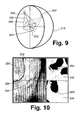
- a camera position 200 (stored in the camera position parameter 90) has a location and a viewing direction 202 directed toward an inspection position 204 (stored in the inspection position parameter 99). Additionally, the perspective view has a conical field of view 206 surrounding the viewing direction 202.
- the perspective view employs a cone of ray casting directions emanating from the camera position 200 and lying within the conical field of view 206.
- the ray casting processor 66 performs rendering along each ray casting direction to produce a perspective endoscopic view that is displayed.
- the user can use the pointing device or another interfacing tool operating in the perspective endoscopic view to rotate the camera position 200 about the inspection position 204.
- the user can rotate to an updated camera position 200' (drawn using dotted lines) where an updated perspective endoscopic view is constructed still looking with the inspection position 204 in the center of the field of view.
- the camera position remains on a spherical viewing surface 210 centered on the inspection position 204.
- the user can also zoom in or out, which corresponds to changing the radius of the spherical viewing surface 210.
- the user may have other viewing options, such as changing the size of the conical field of view 206, or limiting the portion of the volumetric image which is viewed so as to having the inspection point 204 obscured by an intervening portion of the lumen-defining surface.
- the user can selectively segment the volume data, e.g. around a sphere 212 (indicated by a dashed circle in FIGURE 9 ) or other shape. This permits the viewer to view the inspection position 204 from direction in which the lumen folds or other structure would otherwise obscure the viewing direction.
- the perspective endoscopic view is shown in a main window 220, along with dashed lines 222, 224 indicating two orthogonal oblique views.
- the oblique view corresponding to the dashed line 222 is shown in a first ancillary oblique view window 232, while the oblique view corresponding to the dashed line 224 is shown in a second ancillary oblique view window 234.
- Each oblique view is parallel with the view line 202 connecting the camera position 200 and the inspection position 204.
- the oblique views 232, 234 are also updated.
- the image can be generated by volume rendering along each ray casting direction performed by the rendering processor 68.
- the volume rendering suitably employs the ray casting direction as both the viewing direction and the illumination direction; alternatively, another illumination direction can be selected.
- the volume rendering also typically incorporates factors such as the opacity of the lumen-defining surface at the intersection with the ray casting direction, gradient information, and the like. Such renderings provide a structural representation indicative of variations in surface orientation.
- the user can select depth interval statistical pixel values through ray casting mode parameter 82 .
- the depth interval processor 70 computes a statistical characteristic of voxels 238 along the ray casting direction 104 over an interval starting at an intersection between the ray casting direction 104 and the lumen-defining surface 106 and terminating a preselected distance (d interval ) along the ray casting direction 104 into the lumen-defining structure.
- the statistical characteristic can be for example a maximum or average voxel value of the voxels 238 within the interval depth (d interval ). If the maximum pixel value is used as the statistical characteristic, then the effect is to compute a maximum intensity projection (MIP) over the distance d interval .
- the interval depth is user controlled by the interval depth parameter 84 (see FIGURE 3 ).
- the effect of the statistical characteristic is to provide internal information about the lumen-defining surface 106.
- rendering generally provides surface orientation information, but does not provide internal information.
- the internal information provided by the statistical characteristic depends upon the specific lumen-defining structure.
- one application of depth interval imaging is to image the vasculature underlying the lumen-defining surface.
- irregularities in the vasculature near the colon surface can be indicative of malignant polyps.
- the intravenous contrast agent injector 36 administers a suitable contrast agent to enhance blood contrast.
- FIGURE 13 shows an unfolded view of a contrast enhanced virtual colonoscopy employing MIP interval imaging. The vasculature appears as brighter regions 250 in the unfolded view. Darker streaks 252 correspond to folds of the colon surface.
- FIGURE 14A shows the lumen-defining surface, which over most of the lumen is defined by a colon wall 260. However, a portion of stool 262 remains on a portion of the colon wall 260. Arrows 266 indicate the depth (d interval ) over which the statistical characteristic is computed.
- the locations labeled "P1" and “P4" indicate the lateral extent of the stool 262 along the colon surface.
- the locations labeled "P2" and “P3” indicate the lateral extent of the stool region 262 over which the stool is at least as thick as the interval depth (d interval ).
- FIGURES 14B and 14C show the corresponding portion of the unfolded view using a statistical average ( FIGURE 14B ) and using a MIP ( FIGURE 14C ), assuming that the stool material has a lower intensity than the colon material.
- the pixel intensity varies from white for lowest intensity to black for highest intensity.
- the contrast smoothly varies over the entire region between "P1" and "P4" that contains at least some stool material 262.
- the smooth contrast variation corresponds to smoothly changing thickness of the stool material 262.
- the statistical characteristic when the statistical characteristic is a MIP, the contrast changes abruptly at the locations "P2" and "P3" where the interval depth is entirely contained within the stool 262.
- the MIP is performed entirely over voxels representing stool material.
- the MIP includes higher intensity voxels representing the colon wall, and so an abruptly higher MIP value results.
- the statistical characteristic function is stored in the statistical characteristic function parameter 86, which may contain a user-defined function.
- depth interval ray casting can also be used in the perspective endoscopic view.
- the illustrated examples of FIGURES 13 , 14B, and 14C plot depth interval ray casting values as grayscale pixel values, the information can be used in other ways.
- the depth interval ray casting information can be combined with volume rendering to provide an image containing both morphological (i.e., surface orientation) information and depth interval information.
- the rendering processor 68 performs volume rendering for each ray casting direction to produce rendered voxel values representative of the surface orientation of the intersected lumen-defining surface.
- Each rendered voxel value is adjusted based on a depth interval statistical characteristic computed by the depth interval processor 70 to incorporate depth information into the volume rendering.
- the volume rendering may be monochromatic in color, and the depth-based adjustment may adjust the voxel color of the rendered voxels based on the computed statistical characteristic.
Landscapes
- Engineering & Computer Science (AREA)
- Physics & Mathematics (AREA)
- Computer Graphics (AREA)
- Theoretical Computer Science (AREA)
- General Physics & Mathematics (AREA)
- General Engineering & Computer Science (AREA)
- Software Systems (AREA)
- Computer Hardware Design (AREA)
- Apparatus For Radiation Diagnosis (AREA)
- Endoscopes (AREA)
- Image Generation (AREA)
- Eye Examination Apparatus (AREA)
- Particle Accelerators (AREA)
- Gyroscopes (AREA)
Claims (23)
- Virtuelles Endoskopieverfahren zur Durchführung einer virtuellen Endoskopie an einem Volumenbild einer lumendefinierenden Struktur mit einem länglichen Lumen, dadurch gekennzeichnet, dass das Verfahren Folgendes umfasst:Ermitteln einer Entfaltungsachse (100, 100'), die im Wesentlichen innerhalb des länglichen Lumens liegt und im Allgemeinen an einer Kameraposition (102, 102', 102") angeordnet ist, wobei die Entfaltungsachse in Achsensegmente (110) unterteilt ist;Auswählen von Raycasting-Richtungen (104), die im Allgemeinen radial ausgehend von den Achsensegmenten der Entfaltungsachse verlaufen;Neigen von mindestens einigen der Raycasting-Richtungen weg von der Kameraposition basierend auf dem Abstand zwischen dem entsprechenden Achsensegment und der Kameraposition;Durchführen eines Raycasting entlang der geneigten Raycasting-Richtungen, um Pixelwerte zu definieren;
undAnordnen der Pixelwerte zu einer ungefalteten Ansicht. - Virtuelles Endoskopieverfahren nach Anspruch 1, wobei die jedem Achsensegment entsprechenden Raycasting-Richtungen radial symmetrisch um die Entfaltungsachse (100, 100') herum angeordnet ist.
- Virtuelles Endoskopieverfahren nach Anspruch 1, wobei das Neigen im Allgemeinen mit zunehmendem Abstand des Achsensegments von der Kameraposition zunimmt.
- Virtuelles Endoskopieverfahren nach Anspruch 1, wobei das Raycasting einen vorgewählten maximalen Raycasting-Abstand hat, und wobei das Neigen so eingestellt wird, dass eine Überlappung der Raycastings innerhalb des vorgewählten maximalen Raycasting-Abstands vermieden wird.
- Virtuelles Endoskopieverfahren nach Anspruch 1, wobei das Maß des Neigens durch einen vom Benutzer ausgewählten Entfaltungsperspektivenwinkelparameter (98) gesteuert wird.
- Virtuelles Endoskopieverfahren nach Anspruch 1, wobei für jedes Achsensegment (110) das Neigen der dem Achsensegment entsprechenden Raycasting-Richtungen identisch ist, wobei de geneigten Raycasting-Richtungen des Achsensegments einen Konus von Raycasting-Richtungen definieren.
- Virtuelles Endoskopieverfahren nach Anspruch 1, wobei die Entfaltungsachse (100) gerade und tangential zu einer Lumen-Mittellinie (150) bei der Kameraposition (102) verläuft.
- Virtuelles Endoskopieverfahren nach Anspruch 1, wobei die Entfaltungsachse (100') im Allgemeinen gekrümmt ist und im Wesentlichen mit einem Abschnitt einer Lumen-Mittellinie (150) zusammenfällt.
- Virtuelles Endoskopieverfahren nach Anspruch 1, das weiterhin Folgendes umfasst:Bewegen der Kameraposition (102) zu einer aktualisierten Kameraposition (102', 102"); undWiederholen des Ermittelns einer Entfaltungsachse (100, 100'), des Auswählens von Raycasting-Richtungen (104), des Neigens der Raycasting-Richtungen, des Durchführens des Raycastings und des Anordnens der Pixelwerte, um eine aktualisierte entfaltete Ansicht für die aktualisierte Kameraposition zu erzeugen.
- Virtuelles Endoskopieverfahren nach Anspruch 1, das weiterhin Folgendes umfasst:Definieren einer Untersuchungsposition (204), die einer interessierenden Struktur in der entfalteten Ansicht entspricht;Konstruieren einer perspektivischen endoskopischen Ansicht, die (i) die Kameraposition (102, 200) hat und (ii) auf die Untersuchungsposition (204) blickt;Festlegen der Untersuchungsposition (204) als Zentrum einer Kugel;in Reaktion auf eine Benutzereingabe Rotieren der Kameraposition entlang der Kugeloberfläche; undKonstruieren einer rotierten perspektivischen endoskopischen Ansicht, die (i) eine basierend auf der Benutzereingabe rotierte aktualisierte Kameraposition (200') hat und (ii) auf die Untersuchungsposition (204) blickt.
- Virtuelles Endoskopieverfahren nach Anspruch 10, wobei das Definieren einer Untersuchungsposition (204) Folgendes umfasst:Empfangen, über Benutzerinteraktion mit der entfalteten Ansicht, einer Benutzerauswahl von einem der Pixel der entfalteten Ansicht, wobei die Position des ausgewählten Pixels die Untersuchungsposition (204) ist.
- Virtuelles Endoskopieverfahren nach Anspruch 10, das weiterhin Folgendes umfasst:gleichzeitig mit der perspektivischen endoskopischen Ansicht Anzeigen von zwei orthogonalen schrägen Ansichten, wobei jede schräge Ansicht parallel zu einer Linie (202) liegt, die die Kamperaposition (200) mit der Untersuchungsposition (204) verbindet; undgleichzeitig mit der rotierten perspektivischen endoskopischen Ansicht Anzeigen von zwei aktualisierten orthogonalen schrägen Ansichten, wobei jede aktualisierte schräge Ansicht parallel zu einer Linie liegt, die die aktualisierte Kameraposition (200') mit der Untersuchungsposition (204) verbindet.
- Virtuelles Endoskopieverfahren nach Anspruch 10, wobei die perspektivischen endoskopischen Ansichten weniger als das gesamte Volumenbild umfassen, um ein Verdecken der Kameraansicht des Untersuchungspunktes (204) zu vermeiden.
- Virtuelles Endoskopieverfahren nach Anspruch 1, wobei das Durchführen des Raycastings entlang jeder Raycasting-Richtung (104) zum Definieren eines jeder Raycasting-Richtung entsprechenden Pixelwertes Folgendes umfasst:Durchführen von Volumenrendering entlang der Raycasting-Richtungen, wobei das Volumenrendering die Raycasting-Richtungen als Beleuchtungsrichtungsparameter nutzt.
- Virtuelles Endoskopieverfahren nach Anspruch 1, wobei das Durchführen des Raycastings Folgendes umfasst:Identifizieren eines Schnittpunktes der Raycasting-Richtung und einer lumendefinierenden Oberfläche (106) der lumendefinierenden Struktur; undBerechnen einer statistischen Eigenschaft von Voxeln (238) über einen vorgewählten Abstand (dinterval) entlang der Raycasting-Richtung in die lumendefinierende Struktur hinein.
- Virtuelles Endoskopieverfahren nach Anspruch 15, wobei die statistische Eigenschaft entweder eine Maximumintensitästsprojektion oder ein Mittelwert von Voxeln über den vorgewählten Abstand (dinterval) entlang der Raycasting-Richtung (104) in die lumendefinierende Struktur hinein ist.
- Virtuelles Endoskopieverfahren nach Anspruch 14, wobei das Durchführen des Raycastings entlang jeder Raycasting-Richtung (104) zum Definieren eines jeder Raycasting-Richtung entsprechenden Pixelwertes weiterhin Folgendes umfasst:Durchführen des Volumenrendering für die Raycasting-Richtungen, um dargestellte Voxelwerte zu erzeugen, die für die geschnittene lumendefinierende Oberfläche (106) repräsentativ sind; undJustieren der dargestellten Voxelwerte basierend auf den berechneten statistischen Eigenschaften.
- Virtuelles Endoskopieverfahren nach Anspruch 17, wobei das Justieren des dargestellten Voxelwertes die Farbjustierung der dargestellten Voxelwerte basierend auf den berechneten statistischen Eigenschaften umfasst.
- Virtuelles Endoskopieverfahren nach Anspruch 1, wobei das Volumenbild der lumendefinierenden Struktur ein volumetrisch berechnetes Tomographiebild eines Organs ist, das aus der Gruppe bestehend aus Dickdarm, Blase, Blutgefäß, Luftröhre und Dünndarm ausgewählt wurde.
- Virtueller Endoskopieprozessor (50), dadurch gekennzeichnet, dass er für die Durchführung des virtuellen Endoskopieverfahrens nach Anspruch 1 ausgelegt ist.
- Virtuelles Endoskopiesystem, das Folgendes umfasst:ein Bildgebungssystem (10, 26), das ein Volumenbild einer lumendefinierenden Struktur erzeugt; undeinen Prozessor (50), der dadurch gekennzeichnet ist, dass er für die Durchführung des virtuellen Endoskopieverfahrens nach Anspruch 1 ausgelegt ist.
- Virtuelles Endoskopiesystem nach Anspruch 21, wobei das Bildgebungssystem (10, 26) Folgendes umfasst:einen Computertomographie-Scanner (10) mit einer Röntgenquelle (12), die sich um eine Bildgebungsregion (20) dreht und Röntgenstrahlen in diese Region abstrahlt, und mit einem Detektorarray (14), das die Röntgenstrahlen nach dem Durchqueren der Bildgebungsregion detektiert, um volumetrisch berechnete Tomographie-Projektionsdaten zu erzeugen;einen Rekonstruktionsprozessor (26), der die volumetrisch berechneten Tomographie-Projektionsdaten zu dem Volumenbild der lumendefinierenden Struktur rekonstruiert.
- Virtuelles Endoskopiegerät zur Durchführung der virtuellen Endoskopie für ein Volumenbild einer lumendefinierenden Struktur mit einem länglichen Lumen, dadurch gekennzeichnet, dass das Gerät Folgendes umfasst.
ein Mittel zum Ermitteln einer Entfaltungsachse (100, 100'), die im Wesentlichen innerhalb des länglichen Lumens liegt und im Allgemeinen an einer Kameraposition (102, 102', 102") angeordnet ist, wobei die Entfaltungsachse in Achsensegmente (110) unterteilt ist;
ein Mittel zum Auswählen von Raycasting-Richtungen (104), die im Allgemeinen radial ausgehend von den Achsensegmenten der Entfaltungsachse verlaufen;
ein Mittel zum Neigen von mindestens einigen der Raycasting-Richtungen weg von der Kameraposition basierend auf dem Abstand zwischen dem entsprechenden Achsensegment und der Kameraposition;
ein Mittel zum Durchführen eines Raycasting entlang der geneigten Raycasting-Richtungen, um Pixelwerte zu definieren; und
ein Mittel zum Anordnen der Pixelwerte zu einer ungefalteten Ansicht.
Priority Applications (1)
| Application Number | Priority Date | Filing Date | Title |
|---|---|---|---|
| PL05743996T PL1803097T3 (pl) | 2004-06-23 | 2005-06-02 | Endoskopia wirtualna |
Applications Claiming Priority (4)
| Application Number | Priority Date | Filing Date | Title |
|---|---|---|---|
| US58212004P | 2004-06-23 | 2004-06-23 | |
| US58212204P | 2004-06-23 | 2004-06-23 | |
| US62058104P | 2004-10-20 | 2004-10-20 | |
| PCT/IB2005/051810 WO2006000925A2 (en) | 2004-06-23 | 2005-06-02 | Virtual endoscopy |
Publications (2)
| Publication Number | Publication Date |
|---|---|
| EP1803097A2 EP1803097A2 (de) | 2007-07-04 |
| EP1803097B1 true EP1803097B1 (de) | 2010-10-13 |
Family
ID=34969260
Family Applications (1)
| Application Number | Title | Priority Date | Filing Date |
|---|---|---|---|
| EP05743996A Expired - Lifetime EP1803097B1 (de) | 2004-06-23 | 2005-06-02 | Virtuelle endoskopie |
Country Status (7)
| Country | Link |
|---|---|
| US (2) | US7839402B2 (de) |
| EP (1) | EP1803097B1 (de) |
| CN (2) | CN101014983B (de) |
| AT (1) | ATE484811T1 (de) |
| DE (1) | DE602005024159D1 (de) |
| PL (1) | PL1803097T3 (de) |
| WO (1) | WO2006000925A2 (de) |
Families Citing this family (57)
| Publication number | Priority date | Publication date | Assignee | Title |
|---|---|---|---|---|
| US8872906B2 (en) | 2005-01-05 | 2014-10-28 | Avantis Medical Systems, Inc. | Endoscope assembly with a polarizing filter |
| US8289381B2 (en) | 2005-01-05 | 2012-10-16 | Avantis Medical Systems, Inc. | Endoscope with an imaging catheter assembly and method of configuring an endoscope |
| US8797392B2 (en) | 2005-01-05 | 2014-08-05 | Avantis Medical Sytems, Inc. | Endoscope assembly with a polarizing filter |
| US8000550B2 (en) * | 2005-11-30 | 2011-08-16 | The General Hospital Corporation | Adaptive density correction in computed tomographic images |
| WO2007087421A2 (en) | 2006-01-23 | 2007-08-02 | Avantis Medical Systems, Inc. | Endoscope |
| US8287446B2 (en) | 2006-04-18 | 2012-10-16 | Avantis Medical Systems, Inc. | Vibratory device, endoscope having such a device, method for configuring an endoscope, and method of reducing looping of an endoscope |
| EP2023795A2 (de) | 2006-05-19 | 2009-02-18 | Avantis Medical Systems, Inc. | Vorrichtung und verfahren zur verminderung der effekte von videoartefakten |
| US8023710B2 (en) * | 2007-02-12 | 2011-09-20 | The United States Of America As Represented By The Secretary Of The Department Of Health And Human Services | Virtual colonoscopy via wavelets |
| US8064666B2 (en) * | 2007-04-10 | 2011-11-22 | Avantis Medical Systems, Inc. | Method and device for examining or imaging an interior surface of a cavity |
| JP4909792B2 (ja) * | 2007-04-12 | 2012-04-04 | 富士フイルム株式会社 | 画像読影支援装置、方法、およびプログラム |
| JP4685826B2 (ja) * | 2007-04-12 | 2011-05-18 | 富士フイルム株式会社 | 投影画像生成装置、方法、およびプログラム |
| DE102008016655B3 (de) * | 2008-04-01 | 2009-07-09 | Siemens Aktiengesellschaft | Verfahren und Vorrichtung zur Visualisierung eines Bilddatensatzes eines einen Hohlraum umschließenden Organs, insbesondere eines CT-Bilddatensatzes eines Kolons |
| TW200948383A (en) * | 2008-05-19 | 2009-12-01 | Univ Nat Taiwan | System for determining function of intestinal barrier |
| US8508550B1 (en) * | 2008-06-10 | 2013-08-13 | Pixar | Selective rendering of objects |
| DE102008028945A1 (de) * | 2008-06-18 | 2009-12-31 | Siemens Aktiengesellschaft | Verfahren und Visualisierungsmodul zur Visualisierung von Unebenheiten der Innen-Oberfläche eines Hohlorgans, Bildbearbeitungseinrichtung und Tomographiesystem |
| JP2010131257A (ja) * | 2008-12-05 | 2010-06-17 | Ziosoft Inc | 医療用画像処理装置及び医療用画像処理プログラム |
| WO2010074058A1 (ja) * | 2008-12-25 | 2010-07-01 | 株式会社 日立メディコ | 医用画像表示装置及び方法 |
| JP5395538B2 (ja) * | 2009-06-30 | 2014-01-22 | 株式会社東芝 | 超音波診断装置及び画像データ表示用制御プログラム |
| EP2389113A4 (de) * | 2009-09-10 | 2014-04-30 | Infinitt Healthcare Co Ltd | Virtuelle endoskopievorrichtung, antriebsverfahren dafür sowie medizinisches untersuchungsgerät |
| EP2339538B1 (de) | 2009-12-23 | 2014-02-12 | Intrasense | Artefaktfreie Filet-Ansicht zur virtuellen Endoskopie von tubularen Strukturen |
| EP2528496A4 (de) * | 2010-01-28 | 2015-02-25 | Penn State Res Found | Auf eine bronchoskopieführung anwendbares bildbasiertes globales registrierungssystem und -verfahren |
| US8435033B2 (en) | 2010-07-19 | 2013-05-07 | Rainbow Medical Ltd. | Dental navigation techniques |
| WO2012037091A1 (en) * | 2010-09-17 | 2012-03-22 | Siemens Corporation | Feature preservation in colon unfolding |
| US20120170841A1 (en) * | 2011-01-05 | 2012-07-05 | Samsung Electronics Co., Ltd. | Image processing apparatus and method |
| JP6071070B2 (ja) * | 2011-01-14 | 2017-02-01 | コーニンクレッカ フィリップス エヌ ヴェKoninklijke Philips N.V. | ハイリスク構造強調機能を持つ仮想内視鏡撮像 |
| US8570320B2 (en) * | 2011-01-31 | 2013-10-29 | Microsoft Corporation | Using a three-dimensional environment model in gameplay |
| US8587583B2 (en) * | 2011-01-31 | 2013-11-19 | Microsoft Corporation | Three-dimensional environment reconstruction |
| US8942917B2 (en) | 2011-02-14 | 2015-01-27 | Microsoft Corporation | Change invariant scene recognition by an agent |
| WO2013010261A2 (en) * | 2011-07-18 | 2013-01-24 | Dog Microsystems Inc. | Method and system for performing rendering |
| JP5755122B2 (ja) * | 2011-11-30 | 2015-07-29 | 富士フイルム株式会社 | 画像処理装置、方法、及びプログラム |
| US10568586B2 (en) | 2012-10-05 | 2020-02-25 | Volcano Corporation | Systems for indicating parameters in an imaging data set and methods of use |
| US9860510B2 (en) * | 2013-03-15 | 2018-01-02 | Intuitive Surgical Operations, Inc. | Depth based modification of captured images |
| CN107799167B (zh) * | 2013-06-06 | 2022-03-25 | 上海联影医疗科技股份有限公司 | 一种医学图像处理方法 |
| JP6026357B2 (ja) * | 2013-06-13 | 2016-11-16 | 富士フイルム株式会社 | 仮想内視鏡画像生成装置および方法並びにプログラム |
| US10242488B1 (en) * | 2015-03-02 | 2019-03-26 | Kentucky Imaging Technologies, LLC | One-sided transparency: a novel visualization for tubular objects |
| US9659405B2 (en) * | 2015-04-01 | 2017-05-23 | Toshiba Medical Systems Corporation | Image processing method and apparatus |
| US9892506B2 (en) * | 2015-05-28 | 2018-02-13 | The Florida International University Board Of Trustees | Systems and methods for shape analysis using landmark-driven quasiconformal mapping |
| US11116465B2 (en) * | 2015-09-16 | 2021-09-14 | Koninklijke Philips N.V. | Dark-field enhanced virtual x-ray colonoscopy |
| CN105261052B (zh) | 2015-11-03 | 2018-09-18 | 沈阳东软医疗系统有限公司 | 管腔图像展开绘制方法及装置 |
| CN106815878B (zh) * | 2015-12-02 | 2021-02-05 | 北京航空航天大学 | 一种基于多视角多光谱层析成像的图像重建方法 |
| CN105338234A (zh) * | 2015-12-16 | 2016-02-17 | 北京博视中自科技有限公司 | 一种内窥式智能相机 |
| WO2017114479A1 (zh) | 2015-12-31 | 2017-07-06 | 上海联影医疗科技有限公司 | 图像处理的方法及系统 |
| US10417759B2 (en) * | 2016-03-14 | 2019-09-17 | Canon Medical Systems Corporation | Medical image data processing system and method |
| GB2555890B (en) * | 2016-07-14 | 2018-11-21 | Shanghai United Imaging Healthcare Co Ltd | System and method for magnetic resonance imaging |
| DE102016226336A1 (de) * | 2016-12-30 | 2018-07-05 | Siemens Healthcare Gmbh | Verfahren und Vorrichtung zur Erzeugung eines zweidimensionalen Projektionsbildes aus einem dreidimensionalen Bilddatensatz |
| EP3404622B1 (de) | 2017-05-19 | 2024-06-26 | Siemens Healthineers AG | Verarbeitung von medizinischen 3d-bilddaten eines rippenknochens |
| US11132830B2 (en) * | 2018-03-29 | 2021-09-28 | Biosense Webster (Israel) Ltd. | Static virtual camera positioning |
| EP3557588A1 (de) * | 2018-04-16 | 2019-10-23 | Siemens Healthcare GmbH | Integriertes verfahren zur krebsuntersuchung |
| TWI696145B (zh) * | 2018-06-01 | 2020-06-11 | 國立臺灣大學 | 大腸鏡影像電腦輔助辨識系統及方法 |
| CN110613510B (zh) * | 2018-06-19 | 2020-07-21 | 清华大学 | 一种自投影式内窥镜装置 |
| WO2020114806A1 (en) | 2018-12-06 | 2020-06-11 | Koninklijke Philips N.V. | 3-d virtual endoscopy rendering |
| US11151789B1 (en) | 2019-03-25 | 2021-10-19 | Kentucky Imaging Technologies | Fly-in visualization for virtual colonoscopy |
| US11521316B1 (en) | 2019-04-03 | 2022-12-06 | Kentucky Imaging Technologies | Automatic extraction of interdental gingiva regions |
| US11044400B1 (en) | 2019-04-03 | 2021-06-22 | Kentucky Imaging Technologies | Frame stitching in human oral cavity environment using intraoral camera |
| CN112132882A (zh) * | 2019-11-19 | 2020-12-25 | 苏州润迈德医疗科技有限公司 | 从冠状动脉二维造影图像中提取血管中心线的方法和装置 |
| EP4057233B1 (de) * | 2021-03-10 | 2025-10-22 | Siemens Healthineers AG | System und verfahren zur automatischen lichtanordnung zur medizinischen visualisierung |
| CN116211260B (zh) * | 2023-05-09 | 2023-07-21 | 西南医科大学附属医院 | 一种基于变焦扫描的肾结石形态三维成像系统及方法 |
Family Cites Families (21)
| Publication number | Priority date | Publication date | Assignee | Title |
|---|---|---|---|---|
| US5920319A (en) | 1994-10-27 | 1999-07-06 | Wake Forest University | Automatic analysis in virtual endoscopy |
| US6694163B1 (en) | 1994-10-27 | 2004-02-17 | Wake Forest University Health Sciences | Method and system for producing interactive, three-dimensional renderings of selected body organs having hollow lumens to enable simulated movement through the lumen |
| US5782762A (en) | 1994-10-27 | 1998-07-21 | Wake Forest University | Method and system for producing interactive, three-dimensional renderings of selected body organs having hollow lumens to enable simulated movement through the lumen |
| US5611025A (en) | 1994-11-23 | 1997-03-11 | General Electric Company | Virtual internal cavity inspection system |
| US6343936B1 (en) | 1996-09-16 | 2002-02-05 | The Research Foundation Of State University Of New York | System and method for performing a three-dimensional virtual examination, navigation and visualization |
| US6331116B1 (en) | 1996-09-16 | 2001-12-18 | The Research Foundation Of State University Of New York | System and method for performing a three-dimensional virtual segmentation and examination |
| US6369812B1 (en) | 1997-11-26 | 2002-04-09 | Philips Medical Systems, (Cleveland), Inc. | Inter-active viewing system for generating virtual endoscopy studies of medical diagnostic data with a continuous sequence of spherical panoramic views and viewing the studies over networks |
| US6928314B1 (en) * | 1998-01-23 | 2005-08-09 | Mayo Foundation For Medical Education And Research | System for two-dimensional and three-dimensional imaging of tubular structures in the human body |
| US6212420B1 (en) * | 1998-03-13 | 2001-04-03 | University Of Iowa Research Foundation | Curved cross-section based system and method for gastrointestinal tract unraveling |
| US6696263B1 (en) | 1999-09-23 | 2004-02-24 | Rigel Pharmaceuticals, Inc. | PCNA associated cell cycle proteins, compositions and methods of use |
| WO2003046811A1 (en) * | 2001-11-21 | 2003-06-05 | Viatronix Incorporated | Registration of scanning data acquired from different patient positions |
| EP1458292A2 (de) | 2001-12-14 | 2004-09-22 | Koninklijke Philips Electronics N.V. | Verfahren, system und computerprogramm zur visualisierung der oberflächentextur der wand eines hohlorgans aus seiner dreidimensionalen abtastung |
| US20030152897A1 (en) * | 2001-12-20 | 2003-08-14 | Bernhard Geiger | Automatic navigation for virtual endoscopy |
| AU2003218182B2 (en) * | 2002-03-14 | 2008-12-18 | Netkisr Inc. | System and method for analyzing and displaying computed tomography data |
| EP1543765A4 (de) * | 2002-08-30 | 2009-01-07 | Olympus Corp | Medizinisches behandlungssystem, endoskopsystem, bedienungsprogramm für endoskopeinsatz, und endoskopvorrichtung |
| US7211046B2 (en) * | 2002-12-19 | 2007-05-01 | Ge Medical Systems Global Technology Company Llc | Systems and methods for creating reformatted computed tomography images |
| US7081088B2 (en) * | 2003-01-30 | 2006-07-25 | Siemens Corporate Research, Inc. | Method and apparatus for automatic local path planning for virtual colonoscopy |
| US7349563B2 (en) * | 2003-06-25 | 2008-03-25 | Siemens Medical Solutions Usa, Inc. | System and method for polyp visualization |
| US7574247B2 (en) * | 2003-11-17 | 2009-08-11 | Siemens Medical Solutions Usa, Inc. | Automatic coronary isolation using a n-MIP ray casting technique |
| US20070276214A1 (en) * | 2003-11-26 | 2007-11-29 | Dachille Frank C | Systems and Methods for Automated Segmentation, Visualization and Analysis of Medical Images |
| US7609910B2 (en) * | 2004-04-09 | 2009-10-27 | Siemens Medical Solutions Usa, Inc. | System and method for creating a panoramic view of a volumetric image |
-
2005
- 2005-06-02 EP EP05743996A patent/EP1803097B1/de not_active Expired - Lifetime
- 2005-06-02 CN CN2005800286690A patent/CN101014983B/zh not_active Expired - Fee Related
- 2005-06-02 CN CN2010106031471A patent/CN102110309B/zh not_active Expired - Fee Related
- 2005-06-02 US US11/577,560 patent/US7839402B2/en not_active Expired - Fee Related
- 2005-06-02 AT AT05743996T patent/ATE484811T1/de not_active IP Right Cessation
- 2005-06-02 WO PCT/IB2005/051810 patent/WO2006000925A2/en not_active Ceased
- 2005-06-02 PL PL05743996T patent/PL1803097T3/pl unknown
- 2005-06-02 DE DE602005024159T patent/DE602005024159D1/de not_active Expired - Lifetime
-
2010
- 2010-10-14 US US12/904,483 patent/US8009167B2/en not_active Expired - Fee Related
Also Published As
| Publication number | Publication date |
|---|---|
| DE602005024159D1 (de) | 2010-11-25 |
| ATE484811T1 (de) | 2010-10-15 |
| CN101014983A (zh) | 2007-08-08 |
| WO2006000925A3 (en) | 2006-05-11 |
| EP1803097A2 (de) | 2007-07-04 |
| US7839402B2 (en) | 2010-11-23 |
| PL1803097T3 (pl) | 2011-04-29 |
| US20080055308A1 (en) | 2008-03-06 |
| CN102110309B (zh) | 2013-06-26 |
| WO2006000925A2 (en) | 2006-01-05 |
| CN101014983B (zh) | 2011-03-30 |
| CN102110309A (zh) | 2011-06-29 |
| US20110116692A1 (en) | 2011-05-19 |
| US8009167B2 (en) | 2011-08-30 |
Similar Documents
| Publication | Publication Date | Title |
|---|---|---|
| EP1803097B1 (de) | Virtuelle endoskopie | |
| JP5400326B2 (ja) | トモシンセシス画像を表示するための方法 | |
| US9036882B2 (en) | Diagnosis assisting apparatus, diagnosis assisting method, and recording medium having a diagnosis assisting program stored therein | |
| JP4088348B2 (ja) | 人体における管状構造の二次元的及び三次元的画像形成のためのシステム | |
| JP4450786B2 (ja) | 画像処理方法および画像処理プログラム | |
| CN101622648B (zh) | 图像观察窗 | |
| JP5750136B2 (ja) | レンダリング方法及び装置 | |
| JP2007537771A (ja) | 内腔組織スクリーニングのためのシステム及び方法 | |
| JP2007195970A (ja) | 断層撮影システムおよび断層撮影表示の可視化方法 | |
| US20080297509A1 (en) | Image processing method and image processing program | |
| JP4350226B2 (ja) | 三次元画像処理装置 | |
| US20060193510A1 (en) | Image processing method and image processing device | |
| US8259108B2 (en) | Method and apparatus for visualizing an image data record of an organ enclosing a cavity, in particular a CT image data record of a colon | |
| Silva et al. | Three-dimensional virtual dissection at CT colonography: unraveling the colon to search for lesions | |
| US7620224B2 (en) | Image display method and image display program | |
| RU2419882C2 (ru) | Способ визуализации секущих плоскостей для изогнутых продолговатых структур | |
| JP2010284405A (ja) | 医用画像処理装置、医用画像診断装置および医用画像処理プログラム | |
| CN1707523A (zh) | 医学图像显示和处理方法、ct设备、工作站及程序产品 | |
| JP2006506142A (ja) | ボリュームデータセット内に撮像された対象の表示方法 | |
| JP2007014483A (ja) | 医用診断装置及び診断支援装置 | |
| US20110285695A1 (en) | Pictorial Representation in Virtual Endoscopy | |
| Neri et al. | Multidetector-Row CT: Image-Processing Techniques and Clinical Applications | |
| Vos et al. | Virtual Colonoscopy |
Legal Events
| Date | Code | Title | Description |
|---|---|---|---|
| PUAI | Public reference made under article 153(3) epc to a published international application that has entered the european phase |
Free format text: ORIGINAL CODE: 0009012 |
|
| 17P | Request for examination filed |
Effective date: 20070509 |
|
| AK | Designated contracting states |
Kind code of ref document: A2 Designated state(s): AT BE BG CH CY CZ DE DK EE ES FI FR GB GR HU IE IS IT LI LT LU MC NL PL PT RO SE SI SK TR |
|
| DAX | Request for extension of the european patent (deleted) | ||
| GRAP | Despatch of communication of intention to grant a patent |
Free format text: ORIGINAL CODE: EPIDOSNIGR1 |
|
| GRAS | Grant fee paid |
Free format text: ORIGINAL CODE: EPIDOSNIGR3 |
|
| GRAA | (expected) grant |
Free format text: ORIGINAL CODE: 0009210 |
|
| AK | Designated contracting states |
Kind code of ref document: B1 Designated state(s): AT BE BG CH CY CZ DE DK EE ES FI FR GB GR HU IE IS IT LI LT LU MC NL PL PT RO SE SI SK TR |
|
| REG | Reference to a national code |
Ref country code: GB Ref legal event code: FG4D |
|
| REG | Reference to a national code |
Ref country code: CH Ref legal event code: EP |
|
| REG | Reference to a national code |
Ref country code: IE Ref legal event code: FG4D |
|
| REF | Corresponds to: |
Ref document number: 602005024159 Country of ref document: DE Date of ref document: 20101125 Kind code of ref document: P |
|
| REG | Reference to a national code |
Ref country code: NL Ref legal event code: VDEP Effective date: 20101013 |
|
| LTIE | Lt: invalidation of european patent or patent extension |
Effective date: 20101013 |
|
| PG25 | Lapsed in a contracting state [announced via postgrant information from national office to epo] |
Ref country code: LT Free format text: LAPSE BECAUSE OF FAILURE TO SUBMIT A TRANSLATION OF THE DESCRIPTION OR TO PAY THE FEE WITHIN THE PRESCRIBED TIME-LIMIT Effective date: 20101013 |
|
| REG | Reference to a national code |
Ref country code: PL Ref legal event code: T3 |
|
| PG25 | Lapsed in a contracting state [announced via postgrant information from national office to epo] |
Ref country code: SI Free format text: LAPSE BECAUSE OF FAILURE TO SUBMIT A TRANSLATION OF THE DESCRIPTION OR TO PAY THE FEE WITHIN THE PRESCRIBED TIME-LIMIT Effective date: 20101013 Ref country code: BG Free format text: LAPSE BECAUSE OF FAILURE TO SUBMIT A TRANSLATION OF THE DESCRIPTION OR TO PAY THE FEE WITHIN THE PRESCRIBED TIME-LIMIT Effective date: 20110113 Ref country code: NL Free format text: LAPSE BECAUSE OF FAILURE TO SUBMIT A TRANSLATION OF THE DESCRIPTION OR TO PAY THE FEE WITHIN THE PRESCRIBED TIME-LIMIT Effective date: 20101013 Ref country code: SE Free format text: LAPSE BECAUSE OF FAILURE TO SUBMIT A TRANSLATION OF THE DESCRIPTION OR TO PAY THE FEE WITHIN THE PRESCRIBED TIME-LIMIT Effective date: 20101013 Ref country code: PT Free format text: LAPSE BECAUSE OF FAILURE TO SUBMIT A TRANSLATION OF THE DESCRIPTION OR TO PAY THE FEE WITHIN THE PRESCRIBED TIME-LIMIT Effective date: 20110214 Ref country code: IS Free format text: LAPSE BECAUSE OF FAILURE TO SUBMIT A TRANSLATION OF THE DESCRIPTION OR TO PAY THE FEE WITHIN THE PRESCRIBED TIME-LIMIT Effective date: 20110213 Ref country code: FI Free format text: LAPSE BECAUSE OF FAILURE TO SUBMIT A TRANSLATION OF THE DESCRIPTION OR TO PAY THE FEE WITHIN THE PRESCRIBED TIME-LIMIT Effective date: 20101013 Ref country code: AT Free format text: LAPSE BECAUSE OF FAILURE TO SUBMIT A TRANSLATION OF THE DESCRIPTION OR TO PAY THE FEE WITHIN THE PRESCRIBED TIME-LIMIT Effective date: 20101013 |
|
| PG25 | Lapsed in a contracting state [announced via postgrant information from national office to epo] |
Ref country code: BE Free format text: LAPSE BECAUSE OF FAILURE TO SUBMIT A TRANSLATION OF THE DESCRIPTION OR TO PAY THE FEE WITHIN THE PRESCRIBED TIME-LIMIT Effective date: 20101013 |
|
| PG25 | Lapsed in a contracting state [announced via postgrant information from national office to epo] |
Ref country code: ES Free format text: LAPSE BECAUSE OF FAILURE TO SUBMIT A TRANSLATION OF THE DESCRIPTION OR TO PAY THE FEE WITHIN THE PRESCRIBED TIME-LIMIT Effective date: 20110124 Ref country code: CZ Free format text: LAPSE BECAUSE OF FAILURE TO SUBMIT A TRANSLATION OF THE DESCRIPTION OR TO PAY THE FEE WITHIN THE PRESCRIBED TIME-LIMIT Effective date: 20101013 Ref country code: EE Free format text: LAPSE BECAUSE OF FAILURE TO SUBMIT A TRANSLATION OF THE DESCRIPTION OR TO PAY THE FEE WITHIN THE PRESCRIBED TIME-LIMIT Effective date: 20101013 |
|
| PLBE | No opposition filed within time limit |
Free format text: ORIGINAL CODE: 0009261 |
|
| STAA | Information on the status of an ep patent application or granted ep patent |
Free format text: STATUS: NO OPPOSITION FILED WITHIN TIME LIMIT |
|
| PG25 | Lapsed in a contracting state [announced via postgrant information from national office to epo] |
Ref country code: SK Free format text: LAPSE BECAUSE OF FAILURE TO SUBMIT A TRANSLATION OF THE DESCRIPTION OR TO PAY THE FEE WITHIN THE PRESCRIBED TIME-LIMIT Effective date: 20101013 Ref country code: DK Free format text: LAPSE BECAUSE OF FAILURE TO SUBMIT A TRANSLATION OF THE DESCRIPTION OR TO PAY THE FEE WITHIN THE PRESCRIBED TIME-LIMIT Effective date: 20101013 Ref country code: RO Free format text: LAPSE BECAUSE OF FAILURE TO SUBMIT A TRANSLATION OF THE DESCRIPTION OR TO PAY THE FEE WITHIN THE PRESCRIBED TIME-LIMIT Effective date: 20101013 |
|
| 26N | No opposition filed |
Effective date: 20110714 |
|
| REG | Reference to a national code |
Ref country code: DE Ref legal event code: R097 Ref document number: 602005024159 Country of ref document: DE Effective date: 20110714 |
|
| PG25 | Lapsed in a contracting state [announced via postgrant information from national office to epo] |
Ref country code: IT Free format text: LAPSE BECAUSE OF FAILURE TO SUBMIT A TRANSLATION OF THE DESCRIPTION OR TO PAY THE FEE WITHIN THE PRESCRIBED TIME-LIMIT Effective date: 20101013 |
|
| REG | Reference to a national code |
Ref country code: CH Ref legal event code: PL |
|
| REG | Reference to a national code |
Ref country code: IE Ref legal event code: MM4A |
|
| PG25 | Lapsed in a contracting state [announced via postgrant information from national office to epo] |
Ref country code: IE Free format text: LAPSE BECAUSE OF NON-PAYMENT OF DUE FEES Effective date: 20110602 Ref country code: LI Free format text: LAPSE BECAUSE OF NON-PAYMENT OF DUE FEES Effective date: 20110630 Ref country code: CH Free format text: LAPSE BECAUSE OF NON-PAYMENT OF DUE FEES Effective date: 20110630 |
|
| PG25 | Lapsed in a contracting state [announced via postgrant information from national office to epo] |
Ref country code: MC Free format text: LAPSE BECAUSE OF NON-PAYMENT OF DUE FEES Effective date: 20110630 |
|
| PG25 | Lapsed in a contracting state [announced via postgrant information from national office to epo] |
Ref country code: LU Free format text: LAPSE BECAUSE OF NON-PAYMENT OF DUE FEES Effective date: 20110602 Ref country code: CY Free format text: LAPSE BECAUSE OF FAILURE TO SUBMIT A TRANSLATION OF THE DESCRIPTION OR TO PAY THE FEE WITHIN THE PRESCRIBED TIME-LIMIT Effective date: 20101013 |
|
| PG25 | Lapsed in a contracting state [announced via postgrant information from national office to epo] |
Ref country code: HU Free format text: LAPSE BECAUSE OF FAILURE TO SUBMIT A TRANSLATION OF THE DESCRIPTION OR TO PAY THE FEE WITHIN THE PRESCRIBED TIME-LIMIT Effective date: 20101013 |
|
| REG | Reference to a national code |
Ref country code: DE Ref legal event code: R082 Ref document number: 602005024159 Country of ref document: DE Representative=s name: MEISSNER, BOLTE & PARTNER GBR, DE |
|
| REG | Reference to a national code |
Ref country code: DE Ref legal event code: R081 Ref document number: 602005024159 Country of ref document: DE Owner name: KONINKLIJKE PHILIPS N.V., NL Free format text: FORMER OWNER: KONINKLIJKE PHILIPS ELECTRONICS N.V., EINDHOVEN, NL Effective date: 20140328 Ref country code: DE Ref legal event code: R082 Ref document number: 602005024159 Country of ref document: DE Representative=s name: MEISSNER, BOLTE & PARTNER GBR, DE Effective date: 20140328 Ref country code: DE Ref legal event code: R082 Ref document number: 602005024159 Country of ref document: DE Representative=s name: MEISSNER BOLTE PATENTANWAELTE RECHTSANWAELTE P, DE Effective date: 20140328 |
|
| REG | Reference to a national code |
Ref country code: FR Ref legal event code: CA Effective date: 20141126 Ref country code: FR Ref legal event code: CD Owner name: KONINKLIJKE PHILIPS ELECTRONICS N.V., NL Effective date: 20141126 |
|
| PGFP | Annual fee paid to national office [announced via postgrant information from national office to epo] |
Ref country code: TR Payment date: 20150528 Year of fee payment: 11 |
|
| PGFP | Annual fee paid to national office [announced via postgrant information from national office to epo] |
Ref country code: GR Payment date: 20150625 Year of fee payment: 11 Ref country code: PL Payment date: 20150527 Year of fee payment: 11 |
|
| REG | Reference to a national code |
Ref country code: GR Ref legal event code: EP Ref document number: 20110400055 Country of ref document: GR Effective date: 20110218 |
|
| REG | Reference to a national code |
Ref country code: FR Ref legal event code: PLFP Year of fee payment: 12 |
|
| REG | Reference to a national code |
Ref country code: GR Ref legal event code: ML Ref document number: 20110400055 Country of ref document: GR Effective date: 20170109 |
|
| PG25 | Lapsed in a contracting state [announced via postgrant information from national office to epo] |
Ref country code: GR Free format text: LAPSE BECAUSE OF NON-PAYMENT OF DUE FEES Effective date: 20170109 |
|
| REG | Reference to a national code |
Ref country code: FR Ref legal event code: PLFP Year of fee payment: 13 |
|
| PG25 | Lapsed in a contracting state [announced via postgrant information from national office to epo] |
Ref country code: PL Free format text: LAPSE BECAUSE OF NON-PAYMENT OF DUE FEES Effective date: 20160602 |
|
| REG | Reference to a national code |
Ref country code: FR Ref legal event code: PLFP Year of fee payment: 14 |
|
| PGFP | Annual fee paid to national office [announced via postgrant information from national office to epo] |
Ref country code: FR Payment date: 20190625 Year of fee payment: 15 |
|
| PGFP | Annual fee paid to national office [announced via postgrant information from national office to epo] |
Ref country code: GB Payment date: 20190627 Year of fee payment: 15 Ref country code: DE Payment date: 20190830 Year of fee payment: 15 |
|
| REG | Reference to a national code |
Ref country code: DE Ref legal event code: R119 Ref document number: 602005024159 Country of ref document: DE |
|
| GBPC | Gb: european patent ceased through non-payment of renewal fee |
Effective date: 20200602 |
|
| PG25 | Lapsed in a contracting state [announced via postgrant information from national office to epo] |
Ref country code: GB Free format text: LAPSE BECAUSE OF NON-PAYMENT OF DUE FEES Effective date: 20200602 Ref country code: FR Free format text: LAPSE BECAUSE OF NON-PAYMENT OF DUE FEES Effective date: 20200630 |
|
| PG25 | Lapsed in a contracting state [announced via postgrant information from national office to epo] |
Ref country code: DE Free format text: LAPSE BECAUSE OF NON-PAYMENT OF DUE FEES Effective date: 20210101 |
|
| PG25 | Lapsed in a contracting state [announced via postgrant information from national office to epo] |
Ref country code: TR Free format text: LAPSE BECAUSE OF NON-PAYMENT OF DUE FEES Effective date: 20160602 |