EP1802565B1 - Process for preparing hydroxy functional vegetable oils - Google Patents
Process for preparing hydroxy functional vegetable oils Download PDFInfo
- Publication number
- EP1802565B1 EP1802565B1 EP05791245.3A EP05791245A EP1802565B1 EP 1802565 B1 EP1802565 B1 EP 1802565B1 EP 05791245 A EP05791245 A EP 05791245A EP 1802565 B1 EP1802565 B1 EP 1802565B1
- Authority
- EP
- European Patent Office
- Prior art keywords
- vegetable oil
- acetic acid
- hydroxy functional
- water
- product
- Prior art date
- Legal status (The legal status is an assumption and is not a legal conclusion. Google has not performed a legal analysis and makes no representation as to the accuracy of the status listed.)
- Expired - Lifetime
Links
Images




Classifications
-
- C—CHEMISTRY; METALLURGY
- C07—ORGANIC CHEMISTRY
- C07C—ACYCLIC OR CARBOCYCLIC COMPOUNDS
- C07C67/00—Preparation of carboxylic acid esters
- C07C67/30—Preparation of carboxylic acid esters by modifying the acid moiety of the ester, such modification not being an introduction of an ester group
- C07C67/31—Preparation of carboxylic acid esters by modifying the acid moiety of the ester, such modification not being an introduction of an ester group by introduction of functional groups containing oxygen only in singly bound form
-
- C—CHEMISTRY; METALLURGY
- C11—ANIMAL OR VEGETABLE OILS, FATS, FATTY SUBSTANCES OR WAXES; FATTY ACIDS THEREFROM; DETERGENTS; CANDLES
- C11C—FATTY ACIDS FROM FATS, OILS OR WAXES; CANDLES; FATS, OILS OR FATTY ACIDS BY CHEMICAL MODIFICATION OF FATS, OILS, OR FATTY ACIDS OBTAINED THEREFROM
- C11C3/00—Fats, oils, or fatty acids by chemical modification of fats, oils, or fatty acids obtained therefrom
- C11C3/006—Fats, oils, or fatty acids by chemical modification of fats, oils, or fatty acids obtained therefrom by oxidation
-
- C—CHEMISTRY; METALLURGY
- C07—ORGANIC CHEMISTRY
- C07C—ACYCLIC OR CARBOCYCLIC COMPOUNDS
- C07C67/00—Preparation of carboxylic acid esters
- C07C67/30—Preparation of carboxylic acid esters by modifying the acid moiety of the ester, such modification not being an introduction of an ester group
-
- C—CHEMISTRY; METALLURGY
- C08—ORGANIC MACROMOLECULAR COMPOUNDS; THEIR PREPARATION OR CHEMICAL WORKING-UP; COMPOSITIONS BASED THEREON
- C08G—MACROMOLECULAR COMPOUNDS OBTAINED OTHERWISE THAN BY REACTIONS ONLY INVOLVING UNSATURATED CARBON-TO-CARBON BONDS
- C08G18/00—Polymeric products of isocyanates or isothiocyanates
- C08G18/06—Polymeric products of isocyanates or isothiocyanates with compounds having active hydrogen
- C08G18/28—Polymeric products of isocyanates or isothiocyanates with compounds having active hydrogen characterised by the compounds used containing active hydrogen
- C08G18/30—Low-molecular-weight compounds
- C08G18/36—Hydroxylated esters of higher fatty acids
Definitions
- the invention disclosed and claimed herein deals with a novel process of preparing hydroxy functional vegetable oils and the vegetable oils so prepared.
- Vegetable oils have been familiar to man since prehistoric times and for centuries, humans have used fats and oils for food and a variety of other uses. Humankind has over the years perfected the science surrounding the ability to produce oils from agriculture products for their own use. Today, millions of pounds of such oils are used in a variety of end use applications.
- Vegetable oils are made up principally of triglycerides containing both saturated and unsaturated moieties, wherein the predominant moiety is the unsaturated variety. Even though the triglycerides lend themselves to many end use applications, there are some needs for these materials to have functionalities different than those that are found in the raw vegetable oil.
- the triglycerides can be converted to hydroxy functional compounds and the hydroxy functional compounds can then be made useful, for example, in the formation of urethanes by reacting the hydroxy groups with isocyanates.
- Coatings, adhesives, elastomers, foams and composites can be made from elastomers using such hydroxy functional compounds.
- US 3,169,139 discloses a method of hydroxylating methyl ocetate comprising reacting methyl oleate, hydrogen peroxide and at least 0.01 mole of a lower aliphatic acid per mole of hydrogen peroxide in the presence of a cation exchange resin in its hydrogen form, said resin being the sulfonated copolymer of a monovinyl aromatic compound having about 1 to 6% of a polyvinyl aromatic hydrocarbon, said reaction being carried out at about 40° to 90°C.
- DE4332292 discloses a process for the direct hydroxylation of unsaturated carboxylic acids by reaction with performic acid and/or peracetic acid which have been formed in situ.
- US1926769 discloses a process for the manufacture and production of new oxidized oils which comprises heating a highly unsaturated vegetable or animal oil or a fatty acid thereof with a regulated propertion of a mild oxidzing agent and an acylating agent to effect peracylation, and subsequently sulphonating.
- US 2,073,011 discloses a process for the preparation of modified glycerides, which comprises heating to 100°C a mixture of 1.67 parts by weight of olive oil, 8.37 parts by weight of glacial acetic acid, and 1 part by weight of a 30% solution of hydrogen peroxide in water, allowing the mixture to cool and to stand for 24 hours at room temperature, then distilling off the acetic acid by heating at 200°C, and blowing with carbon dioxide.
- One aspect of the invention described and claimed herein deals with a process of preparing hydroxy functional vegetable oils.
- a process for preparing a hydroxy functional vegetable oil comprising:
- the invention comprises contacting a raw vegetable oil with hydrogen peroxide and an acetic acid in the presence of water for a sufficient period of time and at a sufficient pressure, and at a sufficient temperature to form a hydroxy ester from unsaturated moieties in the vegetable oil, and thereafter separating any volatiles from the hydroxy functional vegetable oil.
- a process of preparing a pure hydroxy functional vegetable oil comprising contacting a raw vegetable oil with acetic acid to form an organic phase; combining hydrogen peroxide and acetic acid in water to form an aqueous phase and adding the aqueous phase to the organic phase keeping the amount of hydrogen peroxide in the safe region of the hydrogen peroxide triangle; cooling the resulting materials to 50 to 90°C and allowing the organic phase and the aqueous phase to separate and separating the aqueous phase from the organic phase; moving the organic phase to a degasser (flash evaporator) that is heated to at least 50 to 90°C and 0.67 to 2.0 kPa (5 to 15 mm Hg) prior to the movement of the organic phase into the degasser; flashing off the majority of the residual acetic acid and aqueous phase; feeding the product to a first wiping film evaporator and subjecting the product to a first pass through the wiping film evaporator at about 0.67 to 2.7
- An embodiment of this invention is a process of preparing a hydroxy functional vegetable oil, the process comprising providing a pressure reactor that is capable of being sealed; adding raw vegetable oil to acetic acid in the pressure reactor to form an organic phase and an aqueous phase; sealing the reactor and heating to about 85 to 120°C with agitation; metering a 35 to 70% weight/weight of hydrogen peroxide/ water to the hot mixture; heating the reaction mixture to about 85 to 120°C under a pressure of about 12 - 45 psig for about 1.5 to 3 hours and then cooling the mixture to about 50 to 90°C without agitation; removing the aqueous phase from the pressure reactor; stripping off the bulk of the acetic acid, aqueous phase and other low boilers at 90 to 150°C and 0.67 to 8.0 kPa (5 to 60 mm Hg); applying a negative pressure of about 1.1 to 1.6 kPa (8 to 12 mm Hg) under a nitrogen sparge and heating the materials to about 220 to 260°C until the reaction
- Also described is a process of preparing a pure hydroxy functional vegetable oil comprising contacting a raw vegetable oil with acetic acid to form an organic phase; combining hydrogen peroxide and acetic acid in water to form an aqueous phase and adding the aqueous phase to the organic phase keeping the amount of hydrogen peroxide in the safe region; cooling the resulting materials to less than 50 to 90°C and allowing the organic phase and the aqueous phase to separate and separating the aqueous phase from the organic phase; moving the aqueous phase to a holding tank and then recycling the aqueous phase; moving the organic phase to a degasser that is heated to at least 50 to 90°C and 0.67 to 2 kPa (5 to 15 mm Hg) prior to the movement of the organic phase into the degasser; flashing off the majority of the residual acetic acid and aqueous phase and feeding the residual acetic acid and aqueous phase to a fractional distillation column for recovery and recycling; feeding the product to a
- Still another embodiment is a process of preparing a pure hydroxy functional vegetable oil, the process comprising providing a pressure reactor that is capable of being sealed; adding raw vegetable oil to acetic acid in the pressure reactor to form an organic phase and an aqueous phase; sealing the reactor and heating to about 85 to 120°C with agitation; metering a 35 to 70% weight/weight of hydrogen peroxide/ water to the hot mixture; heating the reaction mixture to about 85 to 120°C under a pressure of about 83 kPa to 310 kPa (12 to 45 psig) for about 1.5 to 3.0 hours and then quenching the mixture to about 50 to 90°C without agitation; separating the aqueous phase from the pressure reactor and moving to a distillation column for the recovery of the acetic acid; stripping off bulk of the acetic acid, aqueous phase and other low boilers from the product at 90 to 150°C and 0.67 to 8.0 kPa (5 to 60 mm Hg) and moving the acetic acid, aqueous
- Going to yet another embodiment of the invention is a process of preparing a pure hydroxy functional vegetable oil, the process comprising contacting a raw vegetable oil with hydrogen peroxide and an organic acid in the presence of water for a sufficient period of time, a sufficient temperature, and a sufficient pressure to form hydroxyl groups from unsaturated moieties in the vegetable oil; separating any volatiles from the hydroxylated functional vegetable oil at a temperature of less than about 90 to 150°C; charging the product to a distillation vessel equipped with a condenser and distillate receiver; start agitation of the product and provide a negative pressure of about 0.67 to 8.0 kPa (5 to 60 mm Hg) to the vessel; heat the vessel to about 90 to 140°C and hold at that temperature until the distillate ceases; provide a nitrogen sparge of about 0.057 to 0.23 cubic metres (2 to 8 standard cubic foot)/hour/ 45.4kg (100 pounds) of product and strip the volatiles; heat the product to 220 to 250°C while removing distillate until the acid number of
- Still another embodiment of this invention is a process of preparing a pure hydroxy functional vegetable oil, the process comprising contacting a vegetable oil with hydrogen peroxide and an organic acid in the presence of water for a sufficient period of time, a sufficient temperature and a sufficient pressure to form hydroxyl groups from unsaturated moieties in the vegetable oils.
- the weight of the caustic/gram of semi-pure product is then calculated along with an excess of from 1 to 15 % w/w and this amount is scaled up by calculation for the total vegetable oil product to be treated.
- a 0.1 to 1.0 N caustic alcohol solution is prepared based on the scaled up calculation and slowly added to the vegetable oil with turbulent mixing while maintaining a temperature of about 0°C to about 40°C.
- the alcohols being used in this step can be for example, methanol, ethanol, propanol, and butanol, and preferred is methanol and propanol and especially preferred is methanol.
- a vacuum of from 1.3 to 6.7 kPa (10 to 50 mm Hg) is applied to the neutralized materials and the temperature is slowly increased to at least 90 to 120°C and held for 0.5 to 1 hour.
- the alcohol and water of neutralization is then vacuum distilled leaving the acid free vegetable oil.
- a further purification step includes removing the surfactants (soaps) generated by the neutralization process, and includes any free anions or cations, remaining after the caustic addition. This is accomplished by charging distilled water to the neutralized product on a ratio of 1 : 1 w/w and heating the solution to about 60°C to 90°C with agitation.
- the agitation is shut down and the product allowed to separate into the organic phase and the aqueous phase and then decanting the aqueous phase from the organic phase.
- the remainder is vacuum distilled to remove residual water and the product is thereafter cooled.
- Antioxidants can now be added to the vegetable oil to extend the life of the final product if desired.
- the final product is normally aged with and stored under nitrogen.
- raw vegetable oil vegetable oil that has been obtained by normal processing techniques, without any modification to the chemistry of the oil itself.
- This vegetable oil can be crude, refined, bleached, deodorized, winterized, or modified, hybrids, and can be used as obtained from the producers.
- the vegetable oil is contacted with hydrogen peroxide and an organic acid in the presence of water.
- the vegetable oil can be selected from any available vegetable oil, among which are the more common vegetable oils, such as corn oil, palm oil, soybean oil, cottonseed oil, peanut oil, rapeseed oil, safflower oil, canola, rice bran oil, and sunflower oil.
- Preferred for this invention are corn oil, cottonseed oil, soybean oil, canola oil and palm oil, and most preferred are soybean oil and palm oil.
- the vegetable oil is contacted with hydrogen peroxide and an organic acid in the presence of water.
- the amount of hydrogen peroxide that is used ranges from about 0.1 to about 6.0 equivalents based on the amount of unsaturation that is in the vegetable oil. If a lesser amount of hydroxy functionality is desired, then smaller amounts of the peroxide should be used. As noted, about 6.0 equivalents will give a hydroxyl number of about 180 to 190. The effect of the use of larger amounts of the peroxide is illustrated in Figure 2 .
- the amount of organic acid that is used is based on the amount of raw vegetable oil that is used, in that, there is used on the order of about 1:0.45 to about 1:2.0 molar ratios of grams of soybean oil to glacial acetic acid used, as the organic acid also acts as a solvent and is used in the ring opening reaction.
- organic acids that are useable are those having from 1 to 3 carbon atoms. Such acids are, for example, formic, acetic and proprionic.
- the water in the reaction comes primarily from the peroxide that is used. At lower concentrations of hydrogen peroxide, more water is added to the system. As the molar equivalents of peroxide are increased, so does the amount of unsaturation converted to epoxide. The molar amount of peroxide used determines the molar amount of peracid formed. This, in turn, determines the amount of unsaturation converted to epoxide, then to hydroxyl compound.
- the viscosity of the final hydroxylated vegetable oil ranges from 300 to 32,000 mPa.s and can be controlled either by the controlled oxidation of crude soybean oil (CSO), or by the length of the carbon chain on the acid that becomes the ester portion of the molecule in the product.
- CSO crude soybean oil
- R in RCOOH becomes larger, the viscosity decreases at no cost to functionality of the resultant polyol.
- Any aprotic solvent may be used other than ethers, as they have been shown to form explosive peroxides.
- reaction time for this process ranges from about 1 hr. to about 24 hours.
- the temperatures that are useful for the reactions can range from room temperature to the reflux temperature of the mixture.
- the hydroxylated vegetable oils produced by this invention are pure polyols, in that, they have the following characteristics: they are freeze/thaw stable, low odor, color of less than 0.5, acid numbers of less than 1.0 mg KOH/g, no residual peroxygens, less than 0.01% w/w of water, less than 0.01 % w/w of organic acids used as the starting materials, using the AOCS Official Process CD-22-91 wherein the results are reported as % (A/A) and using the following standard processes of analysis: AOCS Official Process, Cd 3d-63 for acid value; AOCS Official Process, Cd 1 - 25 for Iodine value of fats and oils, Wijs Process; AOCS Official Process, Cd 13-60 for hydroxyl values, and AOCS Official Process, Cc 13c-50 color spectrophotometer process.
- Low odor for purposes of this invention means that the polyols have a rating of 7 or greater on the SAE J1351 test wherein the rating scale of the SAE J 1351 test is replaced by the GME 60276 rating scale.
- soy-based polyols Some commercially offered soy-based polyols have suffered from having an odor that is best described simply as being characteristic of soybean oil. This odor is easily detected by the human nose and has been compared to that of stale French fries or old, used cooking oil. The odor can be found in neat liquid soy polyol and transfers into any foam article made using such polyols. The odor inherent in previously known soy-based polyols has been one factor in such polyols not having widespread and long-running commercial success.
- the protocol for the odor testing was based on the Society of Automotive Engineers (SAE) test method SAE J1351-93.
- SAE Society of Automotive Engineers
- the test involves putting a small amount of sample into a metal one quart paint can, heating it up and letting people smell it and rate the odor on a numerical scale.
- An empty metal can and a can containing normal petroleum-based polyether polyol with a composition similar to the soy-based polyols were used as controls.
- Raw soybean oil itself is not freeze/thaw stable. Even simple cooling of the oil down to about 10°C will start the process of visible solids precipitating out of the oil. Actually freezing the oil only accelerates this process. After warming back up to ambient temperatures, the small, particulate solids driven out of the oil remain visible to the naked eye. With heat and stirring, the solids can be made to go into solution again. Unless specifically removed, or re-dissolved, these solids could be expected to present downstream handling problems such as filter, valve and orifice plugging. If oils can be produced that sustain freeze/thaw stability, then the handling problems set forth Supra could be essentially eliminated. For purposes of this invention, "freeze/thaw stability" means at least 5 cycles of freeze/thaw.
- One process is the vacuum-sparge-distillation process and consists of initially removing the principal solvent and other low boiling compounds by standard processes such as for example, atmospheric or vacuum distillation. It is important that the temperature during this step of the process is kept at less than 150°C and preferably 120°C to 140°C. If the temperature is allowed to rise above 150°C, the product will start to discolor. The longer that the temperature is at this level, the darker the product becomes and this is to be avoided in this invention. At this point, the product is a hydroxyl-functional vegetable oil.
- peracetic acid is generated and it is this oxidant that diffuses across the interfacial boundary of the organic phase and the aqueous phase, where it reacts with one of the hindered double bonds on the triglycerides, to form the polyol.
- This process repeats itself until the alkenes have been converted to hydroxyl groups, resulting in the functional polyols of this invention.
- reaction vessels used in these inventive processes have to be glass-lined, or manufactured from metal alloys that do not impart color to the product.
- the semi-pure polyol is charged into a distillation vessel for the remainder of this aspect of the invention and it is preferred that the vessel be maintained at about 85 to 90% by volume full.
- the semi-pure polyol is generally agitated and coolant is applied to the condenser of the distillation vessel and at this point, a vacuum is applied.
- the vessel is heated to about 90 to 150°C and held at that temperature until the distillate ceases.
- a nitrogen sparge of about 0.057 to 0.23 cubic metres (2 to 8 standard cubic foot)/hour per 45.4kg (100 pounds) of product is applied and the product is continued to be agitated. Finally, the product is heated up to about 220 to 230°C and the distillate is removed. When the distillate ceases, the reaction is finished.
- the second embodiment of this invention is called atmospheric reflux reaction with wiping film evaporator. In this process, the reaction takes place in a two phase system. The vegetable oil is dissolved in acetic acid forming the organic phase. The oxidant, that is, peracetic acid, is generated in situ by the addition of 35 to 70% w/w hydrogen peroxide. This gives rise to the aqueous phase. At room temperature the reaction between these components is not evident. Heating to about 85 to 110°C generates peracetic acid in situ, and aging at that temperature under reflux takes the reaction to completion.
- the oxidant is split in proportionately between the aqueous and organic phases, with the higher concentration found in the aqueous phase.
- the oxidant diffuses across the interfacial boundary separating the phases, where it finds and reacts with hindered double bonds in the vegetable oil to form the polyol. This process repeats itself until the alkenes have been converted to hydroxyl groups, resulting in the hydroxy functional polyol.
- the order of raw material addition in this reaction is important. The two primary reasons are viscosity and peroxidant concentration.
- the correct order of addition reduces the load on the agitator and keeps the hydrogen peroxide concentration within the safe region of the hydrogen peroxide triangle.
- Hydrogen peroxide solutions of high strength can be made to explode, but they are very insensitive and can only be initiated with difficulty.
- Mixtures of hydrogen peroxide and organics can also be explosive, and can be made with hydrogen peroxide of moderate strengths (lower limit is 45%). In contrast, high strength hydrogen peroxide/organic mixtures may be extremely sensitive.
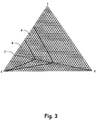
- the triangular graph shown in Figure 3 shows different regions for hydrogen peroxide/organic mixtures, wherein A is the explosive region, B is the detonation region, and C is the stoichiometric line. Also shown are the designations 1 for the organic apex, 2 for the hydrogen apex, and 3 for the water apex.
- the stoichiometric line joins the hydrogen peroxide/organic baseline with 100% water through the apex of the explosive area. Explosive power of the mixtures decreases as the composition moves away from the stoichiometric line.
- the mixture compositions can be determined by drawing a line between the concentration of the organic solvent and the initial concentration of the hydrogen peroxide.
- the Figure 4 shows the mixture concentration of 50% hydrogen peroxide initial concentration and an organic solvent of 100% concentration wherein A, B, C, 1, 2, and 3 are as designated just above. As shown this line passes through the explosive region and is potentially hazardous.
- the hydrogen peroxide is diluted from 50% concentration to 30% concentration by adding water first before it is mixed with organic solvents as shown in the Figure 5 wherein A, B, C, 1, 2, and 3 are as designated just above.
- the non-explosive regions as shown in the Figures are outside of the explosive regions and are the "safe" regions of this invention.
- the resulting mixture is then cooled to approximately 50 to 90°C for phase separation and the agitator shut off in order to avoid the formation of an emulsion.
- the lower aqueous phase is diverted to a holding tank for analysis. Approximately 80 to 85% w/w of this stream is recycled to the next reaction batch.
- the organic phase is transferred to the wiping film evaporator feed tank for purification.
- the first step in the purification is to flash off the bulk of the acetic acid and aqueous phase remaining in the product. This step leaves a small amount of acetic acid and water in the polyol.
- the condensate collected from this step is fed to the fractional distillation column feed tank for recovery.
- the polyol is then fed to a wiping film evaporator for a first pass at about 2.0 to 2.7 kPa (15 to 20 mm Hg), 60 to 140°C, wipe speed of 300 to 350 rpm and a feed flow rate of about 11.3 to 20.4 kg per hour (25 to 45 pounds per hour).
- the semi-pure product is then passed a second time through the wiping film evaporator at about 0.13 to 0.40 Pa (0.001 to 0.003 mm Hg), 220 to 250°C, wipe speed of 300 to 350 rpm and a feed flow rate of about 11.3 to 20.4 kg per hour (25 to 45 pounds/hour).
- the internal condenser temperature is maintained at 35 to 70°C and the fatty acid distillate is collected at this step.
- An embodiment of this invention is called the pressure reactor, vacuum sparge strip process and is conducted as described initially, in that, the vegetable oil is added to acetic acid, forming the organic layer and the aqueous layer.
- the reactor is sealed and the contents heated to 85 to 120°C with agitation.
- the oxidant is formed by the metered addition of the hydrogen peroxide to the reaction mixture that contains the acetic acid.
- the pressure in the vessel at this point is on the order of 0 to 172 kPa (0 to 25 psig).
- reaction mixture After all of the hydrogen peroxide has been added, the reaction mixture is heated to 125 to 135°C and controlled at that temperature with cooling, if necessary.
- the oxidant is split in proportionately between the aqueous and organic phases, with the higher concentration found in the aqueous phase during the reaction.
- the reaction is cooled to 50 to 90°C with minimal agitation in order to avoid the formation of an emulsion.
- the phases separate and the aqueous phase is diverted to a holding tank for peroxygen content analysis. This stream is then transferred to the feed tank of the distillation column for the recovery of acetic acid.
- the organic phase is then transferred to the vacuum strip vessel for purification or it is stripped in the reactor.
- the first step in the purification is to strip off the bulk of the acetic acid, aqueous phase and low boilers at 90 to 150°C and 0.67 to 8.0 kPa (5 to 60 mm Hg). At this vacuum level, coolant is required on the condenser and receiver in order to capture the distillates and ease the load on the vacuum pump that should be equipped with a low temperature trap. The condensate is collected and transferred to the fractional distillation column feed tank for acetic acid recovery.
- the vacuum level is raised to 1.1 to 1.6 kPa (8 to 12 mm Hg), while maintaining a small nitrogen sparge and heating the batch to about 220 to 250°C.
- the fatty acid distills off beginning at about 175 to 250°C.
- the product is cooled to 50 to 70°C, an antioxidant is added and the product is filtered via a 100 to 250 micron filter media before transferring to storage.
- Passivation consists of cleaning the stainless steel with distilled water and following with a distilled water detergent solution at 49 to 52°C. A 5% w/w solution of sodium hydroxide/water at room temperature is then added and the surface pickled for one hour. Then nitric acid is added (30 to 35 weight % aqueous) to the reactor and the reactor is aged for about 2 hours at room temperature with agitation. Then it is washed with distilled water, and then a solution of 5% hydrogen peroxide is added to the reactor and it is checked for degradation. If no degradation is observed, the hydrogen peroxide is removed and the reactor is ready for use. If the reactor is used for some other type of reaction, the passivation procedure has to be re-done.
- the hydroxylated vegetable oils of this invention are useful in the manufacture of a variety of polyurethane products.
- they are useful in the preparation of a variety of reactive, curable polyurethane systems, such as reaction injection molding and castable elastomers.
- Such products can be for example, foams that are rigid, flexible, or semi-rigid. They can be high density and low density foams.
- foams for example are useable for construction, such as insulation, and for the formation of articles, and for ornamental purposes, bun stock, molded articles, spray applied insulation, and pour-in-place applications.
- This mixture was heated to reflux for about 1 hour, at which time the reaction mixture was clear.
- the reaction mixture was cooled down enough to handle the materials and the materials were placed in a glass separatory funnel and the bottom layer, (mostly acetic acid) was removed.
- the top layer was washed with saturated sodium bisulfite, sodium bicarbonate (saturated solution) followed by saturated sodium chloride solution.
- the material was then transferred to an Erlenmeyer flask and dried over magnesium sulfate and then stripped of any solvent and volatiles by using a rotary evaporator.
- This example illustrates one embodiment of the invention.
- the reactor was purged with nitrogen.
- the agitator was started and the reactor was vented through the reflux condenser.
- a small amount of chilled water was introduced to the reflux condenser and a low volume nitrogen sweep was provided to the reactor.
- the reactor was charged with 7.3kg (16 pounds) of distilled water followed by 13.2kg (29 pounds) of 99% w/w glacial acetic acid and 25.9kg (57 pounds) of raw soybean oil. With turbulent agitation, the materials were allowed to mix for 10 minutes.
- the reaction was heated to 85 to 90°C. At this temperature, there is sufficient heat to overcome the reaction activation energy of the reactants. Once the reaction was initiated, there was an exotherm which raised the reaction mixture to its boiling point of approximately 110°C. Boiling was vigorous initially but tapered off within the first 30 to 45 minutes. Then, external heating was required to maintain a vigorous reflux at about 110°C and drive the reaction to completion. At the start of the reaction, the mass was yellow orange in appearance. It gradually faded to a beige colored, free flowing liquid as the reaction ended three hours later.
- the reaction mixture was cooled to 70 to 80°C and allowed to phase separate.
- the upper organic layer contained polyol/acetic acid and the lower aqueous phase contained water/acetic acid/polyol and some peroxygen.
- the organic layer was beige in color, had the appearance of an emulsion and was viscous at room temperature but very fluid at 70 to 80°C.
- the aqueous layer however, was virtually colorless, transparent and non- viscous.
- the interface between the two phases was distinct and without a rag edge.
- the organic layer containing the polyol was then transferred to a wiping film evaporator feed tank where it was pre-heated to 60°C.
- the polyol was then treated in the following manner. It was subjected to a flash evaporator (degasser) and two wiping film evaporators oriented in series with the polyol from the first unit feeding the second wiping film evaporator. Before feeding to the first wiping film evaporator, the organic phase of the reaction was fed to a flash evaporator to remove the bulk of the acetic acid and aqueous phase. A vacuum of about 1.7 kPa (14 mm Hg) and a temperature of about 115°C was used. The polyol rich stream leaving the flash evaporator was diverted to the first wiping film evaporator and the acetic acid/aqueous phase distillate was moved to a fractional distillation column feed tank.
- the feed for the first wiping film evaporator having a heated surface area of approximately 2.35 ft 2 was preheated with agitation. This unit was then evacuated using 1.7 kPa (14 mm Hg); the wall temperature raised to 115°C and the wiper speed adjusted to 320 rpm. Feed was then introduced to the unit at a rate of 14.2kg/hour (31.3 pounds/hour). The product and distillate streams were diverted to clean empty containers until steady state was achieved. Once the process reached equilibrium, the product was diverted to the feed tank for the second wiping film evaporator and the condensate was diverted to a fractional distillation column feed tank for the recovery of the acetic acid.
- the material leaving the first wiping film evaporator had an acid number of about 4 mg KOH/g, no peroxygens, less than 0.1% w/w water and less than 0.1% w/w acetic acid. This stream was the one fed to the second wiping film evaporator.
- the second wiping film evaporator was preheated to 60°C with agitation.
- the unit was then evacuated (0.13 Pa (0.001 mm Hg)), the wall temperature was raised to 240°C and the wiper speed adjusted to 320 rpm.
- the feed was then introduced to the unit at a rate of 11.50 kg per hour (25.35 pounds per hour).
- the product and distillate streams were diverted to clean empty containers until steady state was achieved. Once the process reaches equilibrium the product was collected in the product holding tank. The condensate was transferred to the fatty acid holding tank.
- the product had an acid number of less than 1, there were no peroxygens, less than 0.01 % w/w water and less than 0.01% w/w acetic acid.
- the aqueous phase isolated from the reaction contained recoverable quantities of acetic acid, water, hydrogen peroxide, polyol and peroxygen. After separation, the stream was analyzed for the components set forth above. The results were used to adjust the charge of pure hydrogen peroxide, acetic acid, and water to the next reaction. Approximately 80 to 85% w/w of the stream was recycled to the next batch. The remainder, about 15 to 20% w/w was quenched with sodium metabisulphite and transferred to the fractional distillation column for recovery of acetic acid.
- the distillate recovered from the wiping film evaporators was transferred to the fractional distillation column for purification.
- the still was gradually heated to 116°C.
- a water rich stream started to azeotrope from the vessel. This stream had an aromatic odor indicating the presence of low boiling light ends. This was continued until the still temperature reached 117.9°C and the overhead temperature reached 103.5°C.
- acetic acid rich stream was transferred to the recovered acetic acid holding tank.
- the purity of this material was about 97.4 and the standard recovery was 92.28%.
- the waste stream from this process was the bottoms from the fractional distillation column which consists primarily of water, light ends and discolored bottoms of the reaction.
- a 60 gallon 316L stainless steel reactor was passivated prior to being used in this process.
- a nitrogen purge was provided to the reactor.
- the agitator was started and the reactor was vented through the reflux condenser. Coolant was applied to the reflux condenser and a nitrogen sweep on the reactor was begun.
- reaction mixture was heated to 130°C and aged for forty five minutes. At this temperature, the reaction was mildly exothermic and the reactor pressure ranged between 40 and 45 psig. Coolant was applied to the reactor jacket as needed to control the batch temperature to about 130°C ⁇ 2°C.
- reaction mass at the start was viscous with a yellow to orange appearance. It then turned to an orange-red appearance early in the reaction, gradually fading to a beige colored, free flowing liquid at the end of the reaction.
- the batch is sampled and analyzed, using HPLC, for completion of the reaction.
- the reactor is then cooled to 40°C with minimal agitation to avoid formation of an emulsion.
- the upper organic layer contains polyol/acetic acid and the lower aqueous phase contains water/acetic acid/polyol/ fatty acid and peroxygen.
- the organic layer has the appearance of an emulsion and is viscous at 40°C but very fluid at 70 to 80°C.
- the aqueous layer is virtually colorless, transparent and non-viscous.
- the interface is distinct and with a rag edge.
- the phases are separated and the aqueous layer is transferred to a holding tank and sampled for analysis.
- the organic layer containing the polyol is transferred to the vacuum strip vessel for purification.
- the polyol is charged to a strip vessel and the unit was filled to about 85 to 90% w/w of its capacity.
- the vessel was equipped with a condenser and distillate receiver and coolant was applied to the condenser. Approximately 8.0 kPa (60 mm Hg) vacuum was applied to the vessel via the condenser. The vessel was heated to 140°C and held at that temperature until flow of distillate ceased.
- the pure product has an acid number of less than 0.5 mg KOH/g, it contained no peroxygen, had less than 0.01% w/w water and less than 0.01 % w/w acetic acid.
- This example was carried out to test the odor of the polyols produced by the process as set forth in Example 1. Tested were polyols of 2.0, 3.0, and 4.0 functionality.
- Polyol A is a nominal 2.0 functional, secondary hydroxyl containing soybean oil-based polyol.
- the product has excellent visual clarity.
- Polyol B is a nominal 3.0 functional, secondary hydroxyl containing soybean oil-based polyol. This product is visually clear in appearance.
- Polyol C is a nominal 4.0 functional, secondary hydroxyl containing soybean oil-based polyol. This product is visually clear.
- Arcol(R) LG- 168 a petroleum-based polyether triol made by the addition of propylene oxide to a glycerin-based initiator compound.
- the material is available from Bayer Material Science Corporation and has typical properties of 1000 molecular weight, water white color, visual clarity, characteristic polyether polyol odor, terminal secondary hydroxyls and a hydroxyl number in the range of 158 to 178 mg KOH/g.
- Soyol® R3-170E is a soybean oil-based product designed for use in a wide range of polyurethane applications. The material is available from the Urethane Soy Systems Company.
- Reported properties are: a functionality of 3, a hydroxyl number in the range of 160 to 180 mg KOH/g, an acid number in the range of 0.5 to 2.5 mg KOH/g and a 25°C viscosity in the range of 1000 to 1500 mPa s.
- the product is yellow in color, opaque to visible light and reveals an odor suggestive of crude soybean oil.
- SoyOyl® GC5N is a soybean oil-based product for semi-flexible and rigid foam applications from the Urethane Soy Systems Company.
- Typical reported properties include a functionality of 3, a hydroxyl number of 275 mg KOH/g and 25°C viscosity of 2700 mPa s.
- the product contains significant levels of added glycerin and sucrose.
- SoyOyl® P38N is a soybean oil-based product for flexible urethane applications offered by Urethane Soy Systems Company. Typical properties include a functionality of 2, a hydroxyl number of 53 mg KOH/g and 25°C viscosity of 2800 mPa s. The product is amber in color, visually clear and reveals a strong odor suggestive of raw soybean oil.
- the protocol for testing of inherent odor of a polyol was based on a combination of the SAE J1351 and General Motors GME 60276 odor testing procedures.
- the experimental conditions from the SAE procedure and the grading scale from the GME procedure were used.
- the test involved providing 10 grams of each candidate polyol each weighed into a separate new, cleaned and dried 1-quart metal can. The lids were placed in position, but not firmly sealed and the cans were placed in a 65°C air-circulating oven for one hour. One empty can was included as a control.
- the protocol for testing the freeze/thaw stability of a polyol begins by placing 80 grams of a neat polyol into a 120 milliliter wide-mouth, clear, glass jar. The lid is securely tightened and the glass jar is placed in a 0°C freezer for 4 hours. After the freezing period, the sample is removed from the freezer and allowed to warm up to ambient laboratory temperature (about 24°C) overnight. The following morning, the sample is visually inspected to check for the presence of precipitated particles, suspended particles, floating particles or a visible haze of any kind. The %T notation refers to the percent transmission of visible light through the sample. The process is then repeated for 5 separate freeze thaw cycles. The results of the freeze/thaw stability testing are presented in the following table.
- the Arcol LG-168 sample in the above table illustrates how a traditional petroleum-based polyol can be run through several freeze/thaw cycles without any obvious change in the product appearance.
- the next three samples demonstrate that three of the inventive polyols go through multiple freeze/thaw cycles without damage to the polyol quality.
- the next following two samples are prior art soy-based polyols that in their original form are opaque to visible light and already full of suspended solids. Subjecting these two products to a number of freeze/thaw cycles gave no evidence of further degradation.
- the SoyOyl P38N is a prior art polyol that begins with characteristics of visual clarity and no evidence of visible solids. With each successive freeze/thaw cycle, this material changes in visual clarity due to the formation of an increasing concentration of visible particles.
Landscapes
- Chemical & Material Sciences (AREA)
- Organic Chemistry (AREA)
- Chemical Kinetics & Catalysis (AREA)
- Wood Science & Technology (AREA)
- Engineering & Computer Science (AREA)
- Oil, Petroleum & Natural Gas (AREA)
- Life Sciences & Earth Sciences (AREA)
- General Chemical & Material Sciences (AREA)
- Health & Medical Sciences (AREA)
- Medicinal Chemistry (AREA)
- Polymers & Plastics (AREA)
- Organic Low-Molecular-Weight Compounds And Preparation Thereof (AREA)
- Fats And Perfumes (AREA)
- Polyurethanes Or Polyureas (AREA)
Description
- This application claims priority from
U.S. Utility Patent Application serial number 10/924,332, filed August 23, 200411/193,813, filed July 28, 2005 - The invention disclosed and claimed herein deals with a novel process of preparing hydroxy functional vegetable oils and the vegetable oils so prepared.
- The invention is defined by the claims in accordance with the protocol on the interpretation of Article 69EPC.
- Vegetable oils have been familiar to man since prehistoric times and for centuries, humans have used fats and oils for food and a variety of other uses. Humankind has over the years perfected the science surrounding the ability to produce oils from agriculture products for their own use. Today, millions of pounds of such oils are used in a variety of end use applications.
- Vegetable oils are made up principally of triglycerides containing both saturated and unsaturated moieties, wherein the predominant moiety is the unsaturated variety. Even though the triglycerides lend themselves to many end use applications, there are some needs for these materials to have functionalities different than those that are found in the raw vegetable oil.
- For example, the triglycerides can be converted to hydroxy functional compounds and the hydroxy functional compounds can then be made useful, for example, in the formation of urethanes by reacting the hydroxy groups with isocyanates. Coatings, adhesives, elastomers, foams and composites can be made from elastomers using such hydroxy functional compounds.
- Currently, triglycerides are hydrolyzed with water that is catalyzed by enzymes, acids, or metals to yield glycerol products, that is, where the ester groups are removed and replaced with carboxyl moities. Such molecules still have unsaturation in them even after such treatment.
Fringuelli, and co-workers, have reported on a process to convert alkenes into 1,2 - hydroxy groups using peroxy acids in deionized water. The process involves the epoxidation of the alkene, and then the epoxide ring is directly opened by organic acid and water, or via base hydrolysis to produce the hydroxy. It is stated by Fringuelli, et al that the synthesis does not require organic solvents. (Friguelli, F., Germani, R., Pizzo, F. and Savelli, G, ONE-POT TWO-STEP SYNTHESIS OF 1,2 DIOL, Synthetic Communications, 19(11 & 12), 1939-1943 (1989).
US 3,169,139 discloses a method of hydroxylating methyl ocetate comprising reacting methyl oleate, hydrogen peroxide and at least 0.01 mole of a lower aliphatic acid per mole of hydrogen peroxide in the presence of a cation exchange resin in its hydrogen form, said resin being the sulfonated copolymer of a monovinyl aromatic compound having about 1 to 6% of a polyvinyl aromatic hydrocarbon, said reaction being carried out at about 40° to 90°C.
DE4332292 discloses a process for the direct hydroxylation of unsaturated carboxylic acids by reaction with performic acid and/or peracetic acid which have been formed in situ.US1926769 discloses a process for the manufacture and production of new oxidized oils which comprises heating a highly unsaturated vegetable or animal oil or a fatty acid thereof with a regulated propertion of a mild oxidzing agent and an acylating agent to effect peracylation, and subsequently sulphonating.
US 2,073,011 discloses a process for the preparation of modified glycerides, which comprises heating to 100°C a mixture of 1.67 parts by weight of olive oil, 8.37 parts by weight of glacial acetic acid, and 1 part by weight of a 30% solution of hydrogen peroxide in water, allowing the mixture to cool and to stand for 24 hours at room temperature, then distilling off the acetic acid by heating at 200°C, and blowing with carbon dioxide. - What has been discovered herein is a simple, economical preparative process for the provision of hydroxyl functional polyols that are derived by converting the alkene groups of the unsaturated molecules that make up vegetable oils, into hydroxyl groups.
-
-
Figure 1 is a schematic of the proposed reaction scheme to prepare the products of this invention and consists ofparts -
Figure 2 is a graph of hydroxyl functionality versus the equivalents of peroxide used in the reaction to show the effect of excess peroxide. -
Figure 3 is a triangular graph showing different explodable regions for peroxide systems. -
Figure 4 is a triangular graph of 50% hydrogen peroxide and organic solvent with 100% concentration. -
Figure 5 is a triangular graph of 30% hydrogen peroxide and organic solvent with 100% concentration. - One aspect of the invention described and claimed herein deals with a process of preparing hydroxy functional vegetable oils.
- According to a first aspect of the invention there is provided a process for preparing a hydroxy functional vegetable oil, the process comprising:
- (A) providing a pressure reactor that is capable of being sealed;
- (B) adding raw vegetable oil to acetic acid in the pressure reactor to form an organic phase and an aqueous phase;
- (C) sealing the reactor and heating to 85 to 120°C with agitation;
- (D) metering a 35 to 70% weight/weight of hydrogen peroxide/water to the hot mixture of (C);
- (E) heating the reaction mixture in the range of 85°C to 120°C under a pressure of 83 kPa to 310 kPa (about 12 to about 45 psig) for about 1.5 to about 3 hours and then cooling the mixture to 50°C to 90°C without agitation;
- (F) removing the aqueous phase from the pressure reactor;
- (G) stripping off the bulk of the acetic acid, water and other low boilers from the product at 90°C to 150°C and 0.7 to 8.0 kPa (5 to 60 mm Hg);
- (H) applying a negative pressure of 1.1 to 1.6 kPa (8 to 12 mm Hg) under a nitrogen sparge and heating the materials to at least 220°C to 260°C until the reaction mixture tests for an acid number of 1.0 mg KOH/g or less.
- The invention comprises contacting a raw vegetable oil with hydrogen peroxide and an acetic acid in the presence of water for a sufficient period of time and at a sufficient pressure, and at a sufficient temperature to form a hydroxy ester from unsaturated moieties in the vegetable oil, and thereafter separating any volatiles from the hydroxy functional vegetable oil.
- Further described is a process of preparing a pure hydroxy functional vegetable oil, the process comprising contacting a raw vegetable oil with acetic acid to form an organic phase; combining hydrogen peroxide and acetic acid in water to form an aqueous phase and adding the aqueous phase to the organic phase keeping the amount of hydrogen peroxide in the safe region of the hydrogen peroxide triangle; cooling the resulting materials to 50 to 90°C and allowing the organic phase and the aqueous phase to separate and separating the aqueous phase from the organic phase; moving the organic phase to a degasser (flash evaporator) that is heated to at least 50 to 90°C and 0.67 to 2.0 kPa (5 to 15 mm Hg) prior to the movement of the organic phase into the degasser; flashing off the majority of the residual acetic acid and aqueous phase; feeding the product to a first wiping film evaporator and subjecting the product to a first pass through the wiping film evaporator at about 0.67 to 2.7 kPa (5 to 20 mm Hg), 60 to 140°C, wipe speed of about 300 to 350 rpm and a feed flow rate of about 11.3 to 20.4 kg per hour (25 to 45 pounds per hour) while maintaining the internal condenser temperature at about 0 to 12°C; feeding the product to a second wiping film evaporator for a pass at about 0.13 to 0.40 Pa (0.001 to 0.003 mmHg), 220 to 250°C, wipe speed at about 300 to 350 rpm and a feed flow rate of about 11.3 to 15.9 kg per hour (25 to 35 pounds per hour) while maintaining the internal condenser temperature at about 35 to 70°C; cooling the product and recovering the product.
- An embodiment of this invention is a process of preparing a hydroxy functional vegetable oil, the process comprising providing a pressure reactor that is capable of being sealed; adding raw vegetable oil to acetic acid in the pressure reactor to form an organic phase and an aqueous phase; sealing the reactor and heating to about 85 to 120°C with agitation; metering a 35 to 70% weight/weight of hydrogen peroxide/ water to the hot mixture; heating the reaction mixture to about 85 to 120°C under a pressure of about 12 - 45 psig for about 1.5 to 3 hours and then cooling the mixture to about 50 to 90°C without agitation; removing the aqueous phase from the pressure reactor; stripping off the bulk of the acetic acid, aqueous phase and other low boilers at 90 to 150°C and 0.67 to 8.0 kPa (5 to 60 mm Hg); applying a negative pressure of about 1.1 to 1.6 kPa (8 to 12 mm Hg) under a nitrogen sparge and heating the materials to about 220 to 260°C until the reaction mixture tests for an acid number of 0.5 mg KOH/g or less.
- Also described is a process of preparing a pure hydroxy functional vegetable oil, the process comprising contacting a raw vegetable oil with acetic acid to form an organic phase; combining hydrogen peroxide and acetic acid in water to form an aqueous phase and adding the aqueous phase to the organic phase keeping the amount of hydrogen peroxide in the safe region; cooling the resulting materials to less than 50 to 90°C and allowing the organic phase and the aqueous phase to separate and separating the aqueous phase from the organic phase; moving the aqueous phase to a holding tank and then recycling the aqueous phase; moving the organic phase to a degasser that is heated to at least 50 to 90°C and 0.67 to 2 kPa (5 to 15 mm Hg) prior to the movement of the organic phase into the degasser; flashing off the majority of the residual acetic acid and aqueous phase and feeding the residual acetic acid and aqueous phase to a fractional distillation column for recovery and recycling; feeding the product to a first wiping film evaporator and subjecting the product to a first pass through the wiping film evaporator at about 0.67 to 2.0 kPa (5 to 15 mmHg), 60 to 140°C, wipe speed of about 300 to 350 rpm and a feed flow rate of about 11.3 to 20.4 kg per hour (25 to 45 pounds per hour) while maintaining the internal condenser temperature at about 0 to 12°C; collecting the evaporate in an acid holding tank; feeding the product to a second wiping film evaporator for a pass at about 0.13 to 0.40 Pa (0.001 to 0.003 mmHg), 220 to 250°C, wipe speed at about 300 to 350 rpm and a feed flow rate of about 11.3 to 20.4kg per hour (25 to 45 pounds per hour) while maintaining the internal condenser temperature at about 35 to 70°C; collecting the evaporate in an acid holding tank; cooling the product and recovering the product.
- Still another embodiment is a process of preparing a pure hydroxy functional vegetable oil, the process comprising providing a pressure reactor that is capable of being sealed; adding raw vegetable oil to acetic acid in the pressure reactor to form an organic phase and an aqueous phase; sealing the reactor and heating to about 85 to 120°C with agitation; metering a 35 to 70% weight/weight of hydrogen peroxide/ water to the hot mixture; heating the reaction mixture to about 85 to 120°C under a pressure of about 83 kPa to 310 kPa (12 to 45 psig) for about 1.5 to 3.0 hours and then quenching the mixture to about 50 to 90°C without agitation; separating the aqueous phase from the pressure reactor and moving to a distillation column for the recovery of the acetic acid; stripping off bulk of the acetic acid, aqueous phase and other low boilers from the product at 90 to 150°C and 0.67 to 8.0 kPa (5 to 60 mm Hg) and moving the acetic acid, aqueous phase and other low boilers to a distillation column and recovering the acetic acid; applying a negative pressure of about 1.1 to 1.6 kPa (8 to 12 mm Hg) under a nitrogen sparge and heating the materials to about 220 to 260°C until the reaction mixture tests for an acid number of 0.5 mg KOH/g or less and collecting any acids removed from the product.
- Going to yet another embodiment of the invention is a process of preparing a pure hydroxy functional vegetable oil, the process comprising contacting a raw vegetable oil with hydrogen peroxide and an organic acid in the presence of water for a sufficient period of time, a sufficient temperature, and a sufficient pressure to form hydroxyl groups from unsaturated moieties in the vegetable oil; separating any volatiles from the hydroxylated functional vegetable oil at a temperature of less than about 90 to 150°C; charging the product to a distillation vessel equipped with a condenser and distillate receiver; start agitation of the product and provide a negative pressure of about 0.67 to 8.0 kPa (5 to 60 mm Hg) to the vessel; heat the vessel to about 90 to 140°C and hold at that temperature until the distillate ceases; provide a nitrogen sparge of about 0.057 to 0.23 cubic metres (2 to 8 standard cubic foot)/hour/ 45.4kg (100 pounds) of product and strip the volatiles; heat the product to 220 to 250°C while removing distillate until the acid number of the product is 0.5 mg KOH/g or less, wherein the organic acid found in the initial reaction has from 1 to 3 carbon atoms.
- Still another embodiment of this invention is a process of preparing a pure hydroxy functional vegetable oil, the process comprising contacting a vegetable oil with hydrogen peroxide and an organic acid in the presence of water for a sufficient period of time, a sufficient temperature and a sufficient pressure to form hydroxyl groups from unsaturated moieties in the vegetable oils.
- Thereafter, phase separating the reaction mass into an organic phase containing the hydroxylated vegetable oil, and a aqueous phase and removing volatiles from the organic phase at a temperature of less than 90 to 150°C and a pressure of 0.67 to 8.0 kPa (5 to 60 mm Hg) or less.
- Thereafter, heating the product to a temperature in the range of about 220°C to 250°C and moving the heated product downwardly through a packed column while forcing, under pressure, a material selected from the group consisting of steam and a gas nonreactive with the vegetable oil, up through the packed column to remove high boiling impurities and organic acids and thereafter collecting the hydroxylated vegetable oil.
- There is also described another process of purification of the semi-pure hydroxylated vegetable oils of this invention, said process comprising the neutralizing of the fatty acids with a base, such as KOH or NaOH. The process treats the vegetable oil by removing the acetic acid and aqueous phase by vacuum distillation from the organic layer of the hydroxylated staring material to give the semi-pure product that usually has an acid number in the range of about 14 to 20 mg KOH/gms of sample. A sample of the semi-pure product is taken and titrated with, for example 0.1 N potassium hydroxide dissolved in a 50:50 solution of isopropyl alcohol/water to an end point of pH 9 to determine the quantity of caustic needed to neutralize the residual fatty acids.
- The weight of the caustic/gram of semi-pure product is then calculated along with an excess of from 1 to 15 % w/w and this amount is scaled up by calculation for the total vegetable oil product to be treated.
- A 0.1 to 1.0 N caustic alcohol solution is prepared based on the scaled up calculation and slowly added to the vegetable oil with turbulent mixing while maintaining a temperature of about 0°C to about 40°C. The alcohols being used in this step can be for example, methanol, ethanol, propanol, and butanol, and preferred is methanol and propanol and especially preferred is methanol.
- Thereafter, a vacuum of from 1.3 to 6.7 kPa (10 to 50 mm Hg) is applied to the neutralized materials and the temperature is slowly increased to at least 90 to 120°C and held for 0.5 to 1 hour. The alcohol and water of neutralization is then vacuum distilled leaving the acid free vegetable oil.
- A further purification step includes removing the surfactants (soaps) generated by the neutralization process, and includes any free anions or cations, remaining after the caustic addition. This is accomplished by charging distilled water to the neutralized product on a ratio of 1 : 1 w/w and heating the solution to about 60°C to 90°C with agitation.
- Thereafter, the agitation is shut down and the product allowed to separate into the organic phase and the aqueous phase and then decanting the aqueous phase from the organic phase. The remainder is vacuum distilled to remove residual water and the product is thereafter cooled. Antioxidants can now be added to the vegetable oil to extend the life of the final product if desired. The final product is normally aged with and stored under nitrogen.
- What is meant by "raw" vegetable oil is vegetable oil that has been obtained by normal processing techniques, without any modification to the chemistry of the oil itself.
This vegetable oil can be crude, refined, bleached, deodorized, winterized, or modified, hybrids, and can be used as obtained from the producers. - The vegetable oil is contacted with hydrogen peroxide and an organic acid in the presence of water. For purposes of this invention, the vegetable oil can be selected from any available vegetable oil, among which are the more common vegetable oils, such as corn oil, palm oil, soybean oil, cottonseed oil, peanut oil, rapeseed oil, safflower oil, canola, rice bran oil, and sunflower oil. Preferred for this invention are corn oil, cottonseed oil, soybean oil, canola oil and palm oil, and most preferred are soybean oil and palm oil.
- In the process, the vegetable oil is contacted with hydrogen peroxide and an organic acid in the presence of water. The amount of hydrogen peroxide that is used ranges from about 0.1 to about 6.0 equivalents based on the amount of unsaturation that is in the vegetable oil. If a lesser amount of hydroxy functionality is desired, then smaller amounts of the peroxide should be used. As noted, about 6.0 equivalents will give a hydroxyl number of about 180 to 190. The effect of the use of larger amounts of the peroxide is illustrated in
Figure 2 . - The amount of organic acid that is used is based on the amount of raw vegetable oil that is used, in that, there is used on the order of about 1:0.45 to about 1:2.0 molar ratios of grams of soybean oil to glacial acetic acid used, as the organic acid also acts as a solvent and is used in the ring opening reaction. For this invention, examples of organic acids that are useable are those having from 1 to 3 carbon atoms. Such acids are, for example, formic, acetic and proprionic.
- The water in the reaction comes primarily from the peroxide that is used. At lower concentrations of hydrogen peroxide, more water is added to the system. As the molar equivalents of peroxide are increased, so does the amount of unsaturation converted to epoxide. The molar amount of peroxide used determines the molar amount of peracid formed. This, in turn, determines the amount of unsaturation converted to epoxide, then to hydroxyl compound.
- The viscosity of the final hydroxylated vegetable oil ranges from 300 to 32,000 mPa.s and can be controlled either by the controlled oxidation of crude soybean oil (CSO), or by the length of the carbon chain on the acid that becomes the ester portion of the molecule in the product. Thus, wherein as R in RCOOH becomes larger, the viscosity decreases at no cost to functionality of the resultant polyol.
- The inventors herein do not want to be held to such a theory, but the schematic reaction sequence illustrated in
Figure 1 demonstrates this point, wherein the designations R and R' are the various segments forming the remainder of the vegetable oil. An organic acid, for example, acetic acid forms a peracid in the presence of peroxide, such as hydrogen peroxide, with formation of by-produced water, i.e. reaction scheme 1 (Figure 1 ). Thereafter, the peracid reacts with the unsaturation in the vegetable oil to form the epoxide ring and a by-produced organic acid, as is shown in reaction scheme 2 (Figure 1 ). Thereafter, the epoxide ring is opened by the influence of an organic acid to form the hydroxy ester as is shown in reaction scheme 3 (Figure 1 ). - A variety of solvents may be used in this process. Any aprotic solvent may be used other than ethers, as they have been shown to form explosive peroxides.
- The reaction time for this process ranges from about 1 hr. to about 24 hours.
- The temperatures that are useful for the reactions can range from room temperature to the reflux temperature of the mixture.
- It is preferred to add the peroxide to the vegetable oil after the organic acid, but the order of addition can be changed.
- The hydroxylated vegetable oils produced by this invention are pure polyols, in that, they have the following characteristics: they are freeze/thaw stable, low odor, color of less than 0.5, acid numbers of less than 1.0 mg KOH/g, no residual peroxygens, less than 0.01% w/w of water, less than 0.01 % w/w of organic acids used as the starting materials, using the AOCS Official Process CD-22-91 wherein the results are reported as % (A/A) and using the following standard processes of analysis: AOCS Official Process, Cd 3d-63 for acid value; AOCS Official Process, Cd 1 - 25 for Iodine value of fats and oils, Wijs Process; AOCS Official Process, Cd 13-60 for hydroxyl values, and AOCS Official Process, Cc 13c-50 color spectrophotometer process.
- "Low odor" for purposes of this invention means that the polyols have a rating of 7 or greater on the SAE J1351 test wherein the rating scale of the SAE J 1351 test is replaced by the GME 60276 rating scale.
- Some commercially offered soy-based polyols have suffered from having an odor that is best described simply as being characteristic of soybean oil. This odor is easily detected by the human nose and has been compared to that of stale French fries or old, used cooking oil. The odor can be found in neat liquid soy polyol and transfers into any foam article made using such polyols. The odor inherent in previously known soy-based polyols has been one factor in such polyols not having widespread and long-running commercial success.
- The protocol for the odor testing was based on the Society of Automotive Engineers (SAE) test method SAE J1351-93.The test involves putting a small amount of sample into a metal one quart paint can, heating it up and letting people smell it and rate the odor on a numerical scale. An empty metal can and a can containing normal petroleum-based polyether polyol with a composition similar to the soy-based polyols were used as controls.
- Raw soybean oil itself is not freeze/thaw stable. Even simple cooling of the oil down to about 10°C will start the process of visible solids precipitating out of the oil. Actually freezing the oil only accelerates this process. After warming back up to ambient temperatures, the small, particulate solids driven out of the oil remain visible to the naked eye. With heat and stirring, the solids can be made to go into solution again. Unless specifically removed, or re-dissolved, these solids could be expected to present downstream handling problems such as filter, valve and orifice plugging. If oils can be produced that sustain freeze/thaw stability, then the handling problems set forth Supra could be essentially eliminated. For purposes of this invention, "freeze/thaw stability" means at least 5 cycles of freeze/thaw.
- Several processes can be used for purifying the vegetable oils after the hydroxylated version is formed. Such processes are disclosed in detail in the examples that follow, but generally, they consist of the use of bulk evaporation to remove a majority of the low boiling volatiles, distillation, wiping film evaporation, falling film, packed column, and the like, using negative pressures and elevated temperatures, with the negative pressures and elevated temperatures being closely controlled such that the oils do not end up with impurities and/or odors or color.
- One process is the vacuum-sparge-distillation process and consists of initially removing the principal solvent and other low boiling compounds by standard processes such as for example, atmospheric or vacuum distillation. It is important that the temperature during this step of the process is kept at less than 150°C and preferably 120°C to 140°C. If the temperature is allowed to rise above 150°C, the product will start to discolor. The longer that the temperature is at this level, the darker the product becomes and this is to be avoided in this invention. At this point, the product is a hydroxyl-functional vegetable oil. In this and the other processes of this invention, peracetic acid is generated and it is this oxidant that diffuses across the interfacial boundary of the organic phase and the aqueous phase, where it reacts with one of the hindered double bonds on the triglycerides, to form the polyol. This process repeats itself until the alkenes have been converted to hydroxyl groups, resulting in the functional polyols of this invention.
- The reaction vessels used in these inventive processes have to be glass-lined, or manufactured from metal alloys that do not impart color to the product.
- The semi-pure polyol is charged into a distillation vessel for the remainder of this aspect of the invention and it is preferred that the vessel be maintained at about 85 to 90% by volume full.
- The semi-pure polyol is generally agitated and coolant is applied to the condenser of the distillation vessel and at this point, a vacuum is applied. The vessel is heated to about 90 to 150°C and held at that temperature until the distillate ceases.
- A nitrogen sparge of about 0.057 to 0.23 cubic metres (2 to 8 standard cubic foot)/hour per 45.4kg (100 pounds) of product is applied and the product is continued to be agitated. Finally, the product is heated up to about 220 to 230°C and the distillate is removed. When the distillate ceases, the reaction is finished. The second embodiment of this invention is called atmospheric reflux reaction with wiping film evaporator. In this process, the reaction takes place in a two phase system. The vegetable oil is dissolved in acetic acid forming the organic phase. The oxidant, that is, peracetic acid, is generated in situ by the addition of 35 to 70% w/w hydrogen peroxide. This gives rise to the aqueous phase. At room temperature the reaction between these components is not evident. Heating to about 85 to 110°C generates peracetic acid in situ, and aging at that temperature under reflux takes the reaction to completion.
- The oxidant is split in proportionately between the aqueous and organic phases, with the higher concentration found in the aqueous phase. The oxidant diffuses across the interfacial boundary separating the phases, where it finds and reacts with hindered double bonds in the vegetable oil to form the polyol. This process repeats itself until the alkenes have been converted to hydroxyl groups, resulting in the hydroxy functional polyol.
- The order of raw material addition in this reaction is important. The two primary reasons are viscosity and peroxidant concentration. The correct order of addition reduces the load on the agitator and keeps the hydrogen peroxide concentration within the safe region of the hydrogen peroxide triangle.
- Hydrogen peroxide solutions of high strength (80% or greater) can be made to explode, but they are very insensitive and can only be initiated with difficulty. Mixtures of hydrogen peroxide and organics can also be explosive, and can be made with hydrogen peroxide of moderate strengths (lower limit is 45%). In contrast, high strength hydrogen peroxide/organic mixtures may be extremely sensitive.
- The triangular graph shown in
Figure 3 shows different regions for hydrogen peroxide/organic mixtures, wherein A is the explosive region, B is the detonation region, and C is the stoichiometric line. Also shown are thedesignations 1 for the organic apex, 2 for the hydrogen apex, and 3 for the water apex. The stoichiometric line joins the hydrogen peroxide/organic baseline with 100% water through the apex of the explosive area. Explosive power of the mixtures decreases as the composition moves away from the stoichiometric line. - The mixture compositions can be determined by drawing a line between the concentration of the organic solvent and the initial concentration of the hydrogen peroxide. The
Figure 4 shows the mixture concentration of 50% hydrogen peroxide initial concentration and an organic solvent of 100% concentration wherein A, B, C, 1, 2, and 3 are as designated just above. As shown this line passes through the explosive region and is potentially hazardous. To avoid potential explosive mixtures, the hydrogen peroxide is diluted from 50% concentration to 30% concentration by adding water first before it is mixed with organic solvents as shown in theFigure 5 wherein A, B, C, 1, 2, and 3 are as designated just above. - The non-explosive regions as shown in the Figures are outside of the explosive regions and are the "safe" regions of this invention.
- The resulting mixture is then cooled to approximately 50 to 90°C for phase separation and the agitator shut off in order to avoid the formation of an emulsion. The lower aqueous phase is diverted to a holding tank for analysis. Approximately 80 to 85% w/w of this stream is recycled to the next reaction batch. The organic phase is transferred to the wiping film evaporator feed tank for purification.
- The first step in the purification is to flash off the bulk of the acetic acid and aqueous phase remaining in the product. This step leaves a small amount of acetic acid and water in the polyol. The condensate collected from this step is fed to the fractional distillation column feed tank for recovery.
- The polyol is then fed to a wiping film evaporator for a first pass at about 2.0 to 2.7 kPa (15 to 20 mm Hg), 60 to 140°C, wipe speed of 300 to 350 rpm and a feed flow rate of about 11.3 to 20.4 kg per hour (25 to 45 pounds per hour). The semi-pure product is then passed a second time through the wiping film evaporator at about 0.13 to 0.40 Pa (0.001 to 0.003 mm Hg), 220 to 250°C, wipe speed of 300 to 350 rpm and a feed flow rate of about 11.3 to 20.4 kg per hour (25 to 45 pounds/hour). The internal condenser temperature is maintained at 35 to 70°C and the fatty acid distillate is collected at this step.
- An embodiment of this invention is called the pressure reactor, vacuum sparge strip process and is conducted as described initially, in that, the vegetable oil is added to acetic acid, forming the organic layer and the aqueous layer.
- The reactor is sealed and the contents heated to 85 to 120°C with agitation. The oxidant is formed by the metered addition of the hydrogen peroxide to the reaction mixture that contains the acetic acid. At room temperature, the reaction between these components is very slow or non-existent, however, with agitation and heating, they react to form the oxidant. The pressure in the vessel at this point is on the order of 0 to 172 kPa (0 to 25 psig).
- After all of the hydrogen peroxide has been added, the reaction mixture is heated to 125 to 135°C and controlled at that temperature with cooling, if necessary. The oxidant is split in proportionately between the aqueous and organic phases, with the higher concentration found in the aqueous phase during the reaction.
- After about 2 hours, at a temperature of about 125 to 135°C and pressure of about (15 to 35 psig), the reaction is cooled to 50 to 90°C with minimal agitation in order to avoid the formation of an emulsion. The phases separate and the aqueous phase is diverted to a holding tank for peroxygen content analysis. This stream is then transferred to the feed tank of the distillation column for the recovery of acetic acid. The organic phase is then transferred to the vacuum strip vessel for purification or it is stripped in the reactor.
- The first step in the purification is to strip off the bulk of the acetic acid, aqueous phase and low boilers at 90 to 150°C and 0.67 to 8.0 kPa (5 to 60 mm Hg). At this vacuum level, coolant is required on the condenser and receiver in order to capture the distillates and ease the load on the vacuum pump that should be equipped with a low temperature trap. The condensate is collected and transferred to the fractional distillation column feed tank for acetic acid recovery.
- This leaves the product polyol with trace amounts of acetic acid, water, high boilers and some small amount of fatty acids to be removed. The vacuum level is raised to 1.1 to 1.6 kPa (8 to 12 mm Hg), while maintaining a small nitrogen sparge and heating the batch to about 220 to 250°C. The fatty acid distills off beginning at about 175 to 250°C. After the acid number of 1.0 mg KOH/g or less is achieved, the product is cooled to 50 to 70°C, an antioxidant is added and the product is filtered via a 100 to 250 micron filter media before transferring to storage.
- It should be noted that these reactions and procedures need to be carried out in a glass lined reactor, or a metal alloy reactor that is not reactive with the hydrogen peroxide or acetic acid of the invention, such as 316L stainless steel. If a 304 or 316L stainless steel reactor is used, it must be passivated before use.
- Passivation consists of cleaning the stainless steel with distilled water and following with a distilled water detergent solution at 49 to 52°C. A 5% w/w solution of sodium hydroxide/water at room temperature is then added and the surface pickled for one hour. Then nitric acid is added (30 to 35 weight % aqueous) to the reactor and the reactor is aged for about 2 hours at room temperature with agitation. Then it is washed with distilled water, and then a solution of 5% hydrogen peroxide is added to the reactor and it is checked for degradation. If no degradation is observed, the hydrogen peroxide is removed and the reactor is ready for use. If the reactor is used for some other type of reaction, the passivation procedure has to be re-done.
- The hydroxylated vegetable oils of this invention are useful in the manufacture of a variety of polyurethane products. For example, they are useful in the preparation of a variety of reactive, curable polyurethane systems, such as reaction injection molding and castable elastomers. Such products can be for example, foams that are rigid, flexible, or semi-rigid. They can be high density and low density foams. Such foams, for example are useable for construction, such as insulation, and for the formation of articles, and for ornamental purposes, bun stock, molded articles, spray applied insulation, and pour-in-place applications.
- In the examples, 35% hydrogen peroxide was used as the source of peroxide, so a very large excess of water is present. An excess of peroxide is used in order to convert all of the alkenes to epoxides.
- Into a 500 ml. glass flask, there was added 20 gms. (19.52 mmoles) of solvent-free crude soybean oil. To the soybean oil at room temperature was added 40 ml. of glacial acetic acid and 10.71 ml of 35% hydrogen peroxide, for a ratio of peroxide to glacial acetic acid of 5:1.
- This mixture was heated to reflux for about 1 hour, at which time the reaction mixture was clear. The reaction mixture was cooled down enough to handle the materials and the materials were placed in a glass separatory funnel and the bottom layer, (mostly acetic acid) was removed. The top layer was washed with saturated sodium bisulfite, sodium bicarbonate (saturated solution) followed by saturated sodium chloride solution. The material was then transferred to an Erlenmeyer flask and dried over magnesium sulfate and then stripped of any solvent and volatiles by using a rotary evaporator.
- An FTIR analysis showed a large OH stretch at approximately 3300 cm-1 and a reduction in sp2 CH stretch at approximately 3050 cm-1 indicating that the unsaturation in the molecule had been converted to hydroxyl (Table III).
- For purposes of this invention, the functionality of the molecules was calculated in the following manner. There are approximately six double bond sites on a triglyceride derived from, for example, soybean oil. Due to steric hindrance, only four-point-six (4.6) of these can be accessed using the invention herein. The calculation of functionality is thus derived as follows:

- IV No. = Iodine Number = No. Alkene per mole (cg I2/g sample)
- IV No.s = Starting material (RBD soy oil) Iodine Number (cg I2/g sample)
- IV No.f = Finished material Iodine Number
- 4.6 = Number of accessible Alkenes on the Triglyceride
- A second run was made as in the first example, except there was used 4 equivalents of peroxide. There was used 20 gms. of crude soybean oil, 40 ml of glacial acetic acid, 6.7 ml of peroxide and the reaction was run at reflux for 1 hour. The FTIR analysis showed the formation of hydroxy compound, with a lesser reduction of sp2 CH stretch at 3050 cm-1 than showed in Example 1.
- A third run was made as in the first example, except there was used 3 equivalents of peroxide. There was used 20 gms. of crude soybean oil 40 ml. of glacial acetic, and 5.0 ml of peroxide. The reaction was run for 1 hour at reflux. The FTIR results were the same as Example 2,
- Four runs were made using (A) 2 equivalents, (B) 1 equivalent, (C) zero equivalent, and (D) 17 equivalents of peroxide. (A) consisted of 20 gms. of crude soybean oil, 40 ml. of glacial acetic acid, 3.3 ml of peroxide; (B) consisted of 20 gms. of crude soybean oil, 40 ml. of glacial acetic acid, 3.3 ml of peroxide; (B) consisted of 20 gms. of crude soybean oil, 40 ml. of glacial acetic acid, 1.7 ml of peroxide; (C) consisted of 20 gms. of crude soybean oil, 40 ml. of glacial acetic acid, zero ml of peroxide, and 10 ml of water, and (D) consisted of 20 gms. of crude soybean oil, 40 ml of glacial acetic acid, and 11.7 ml of peroxide. All were heated at reflux for 1 hour.
- Another run was carried out in which two formulations were prepared. (A) consisted of 1 equivalent of peroxide (18.06 mmole), 0.25 equivalents of crude soybean oil, 36 ml. of glacial acetic acid, and (B) consisted of 10 equivalents of peroxide, 0.25 equivalents of crude soybean oil, 36 ml. of glacial acetic acid. After heating for 1 hour at reflux the material cleared. The analytical results showed that there was complete clarity of sample B with no apparent sp2 CH stretch at 3005
cm -1 for the unsaturated group. FTIR showed that when 1 equivalent of peroxide was used, the majority of the product was unsaturated with only a small amount of hydroxylated compound. - Another run was carried out in which a combination of two acids was used. To a 1 liter roundbottomed glass flask was added 100 gms. of crude soybean oil, 17 ml of Glacial acetic acid and 35% hydrogen peroxide. To this mixture was added 11.1 ml of formic acid (a 1 : 1 ratio with the acetic acid). This mixture was allowed to heat at a low temperature (50°C). The reaction mixture exothermed over the next 186 min. to about 105°C. The reaction was then maintained at 105°C and allowed to stir for an additional 3 hours. After the reaction was complete, as was evidenced by the disappearance of the color of the reaction mixture, the acid was removed along with water to yield a quantitative conversion of alkene to epoxide, to hydroxy ester as shown by FTIR.
- This example illustrates one embodiment of the invention. Using a 15 gallon 316L stainless steel reactor that has been passivated, the reactor was purged with nitrogen. The agitator was started and the reactor was vented through the reflux condenser. A small amount of chilled water was introduced to the reflux condenser and a low volume nitrogen sweep was provided to the reactor. The reactor was charged with 7.3kg (16 pounds) of distilled water followed by 13.2kg (29 pounds) of 99% w/w glacial acetic acid and 25.9kg (57 pounds) of raw soybean oil. With turbulent agitation, the materials were allowed to mix for 10 minutes.
- To a day tank sized to hold sufficient 70% w/w of hydrogen peroxide for a single batch, there was charged 3.6kg (8 pounds) of the oxidant. From the day tank, 3.6kg (8 pounds) of hydrogen peroxide was metered to the reactor over 30 minutes, while maintaining turbulent agitation. The reactor was fitted with a reflux condenser and coolant was flowing through the condenser and available if needed for the reactor jacket. No reaction or exotherm was observed at this time.
- At the finish of the addition of the oxidant, the reaction was heated to 85 to 90°C. At this temperature, there is sufficient heat to overcome the reaction activation energy of the reactants. Once the reaction was initiated, there was an exotherm which raised the reaction mixture to its boiling point of approximately 110°C. Boiling was vigorous initially but tapered off within the first 30 to 45 minutes. Then, external heating was required to maintain a vigorous reflux at about 110°C and drive the reaction to completion. At the start of the reaction, the mass was yellow orange in appearance. It gradually faded to a beige colored, free flowing liquid as the reaction ended three hours later.
- The reaction mixture was cooled to 70 to 80°C and allowed to phase separate. The upper organic layer contained polyol/acetic acid and the lower aqueous phase contained water/acetic acid/polyol and some peroxygen. The organic layer was beige in color, had the appearance of an emulsion and was viscous at room temperature but very fluid at 70 to 80°C. The aqueous layer however, was virtually colorless, transparent and non- viscous. The interface between the two phases was distinct and without a rag edge.
- After standing for about 45 minutes, the phases were separated and the aqueous layer was transferred to a holding tank and sampled for analysis. Approximately 80 to 85% of this stream was recycled to the next batch of reactants. There were three components of interest from the analysis, namely, water, acetic acid and peroxygen. This information was used to adjust the charge of these three components to the next batch reaction. The remaining 15 to 20% of this stream was transferred to a fractional distillation column feed tank for acetic acid recovery.
- The organic layer containing the polyol was then transferred to a wiping film evaporator feed tank where it was pre-heated to 60°C. The polyol was then treated in the following manner. It was subjected to a flash evaporator (degasser) and two wiping film evaporators oriented in series with the polyol from the first unit feeding the second wiping film evaporator.
Before feeding to the first wiping film evaporator, the organic phase of the reaction was fed to a flash evaporator to remove the bulk of the acetic acid and aqueous phase. A vacuum of about 1.7 kPa (14 mm Hg) and a temperature of about 115°C was used. The polyol rich stream leaving the flash evaporator was diverted to the first wiping film evaporator and the acetic acid/aqueous phase distillate was moved to a fractional distillation column feed tank. - The feed for the first wiping film evaporator having a heated surface area of approximately 2.35 ft2 was preheated with agitation. This unit was then evacuated using 1.7 kPa (14 mm Hg); the wall temperature raised to 115°C and the wiper speed adjusted to 320 rpm. Feed was then introduced to the unit at a rate of 14.2kg/hour (31.3 pounds/hour). The product and distillate streams were diverted to clean empty containers until steady state was achieved. Once the process reached equilibrium, the product was diverted to the feed tank for the second wiping film evaporator and the condensate was diverted to a fractional distillation column feed tank for the recovery of the acetic acid.
- The material leaving the first wiping film evaporator had an acid number of about 4 mg KOH/g, no peroxygens, less than 0.1% w/w water and less than 0.1% w/w acetic acid. This stream was the one fed to the second wiping film evaporator.
- The second wiping film evaporator was preheated to 60°C with agitation. The unit was then evacuated (0.13 Pa (0.001 mm Hg)), the wall temperature was raised to 240°C and the wiper speed adjusted to 320 rpm. The feed was then introduced to the unit at a rate of 11.50 kg per hour (25.35 pounds per hour).
- The product and distillate streams were diverted to clean empty containers until steady state was achieved. Once the process reaches equilibrium the product was collected in the product holding tank. The condensate was transferred to the fatty acid holding tank.
- The product had an acid number of less than 1, there were no peroxygens, less than 0.01 % w/w water and less than 0.01% w/w acetic acid.
- Handling of the discharge streams from example 7
- There were four discharge streams of interest, namely, the aqueous phase from the reaction, the distillate from the degasser, the distillate from the first pass on the wiping film evaporator, the distillate from the second wiping film evaporator.
- The aqueous phase isolated from the reaction contained recoverable quantities of acetic acid, water, hydrogen peroxide, polyol and peroxygen. After separation, the stream was analyzed for the components set forth above. The results were used to adjust the charge of pure hydrogen peroxide, acetic acid, and water to the next reaction. Approximately 80 to 85% w/w of the stream was recycled to the next batch. The remainder, about 15 to 20% w/w was quenched with sodium metabisulphite and transferred to the fractional distillation column for recovery of acetic acid.
- The distillate recovered from the wiping film evaporators was transferred to the fractional distillation column for purification. The still was gradually heated to 116°C. At about 80°C overhead temperature, a water rich stream started to azeotrope from the vessel. This stream had an aromatic odor indicating the presence of low boiling light ends. This was continued until the still temperature reached 117.9°C and the overhead temperature reached 103.5°C. When the still temperature reached 120°C and the overhead temperature settled at 117°C, acetic acid rich stream was transferred to the recovered acetic acid holding tank. The purity of this material was about 97.4 and the standard recovery was 92.28%.
- The waste stream from this process was the bottoms from the fractional distillation column which consists primarily of water, light ends and discolored bottoms of the reaction.
- A 60 gallon 316L stainless steel reactor was passivated prior to being used in this process. A nitrogen purge was provided to the reactor. The agitator was started and the reactor was vented through the reflux condenser. Coolant was applied to the reflux condenser and a nitrogen sweep on the reactor was begun.
- To the reactor was charged 87.9kg (192 pounds) of raw RBD (refined, bleached deodorized) soybean oil followed by 46.5kg (102 pounds) of 99% w/w glacial acetic acid and 18.6kg (41 pounds) of distilled water. With turbulent agitation the reactants were allowed to mix for 15 minutes. The reactor was sealed and heated to 110°C with agitation that created a pressure of about 20 to 25 psig.
- To a day tank sized to hold sufficient oxidant for a single batch was charged 41 pounds of 70% w/w hydrogen peroxide.
- Forty one pounds of 70% hydrogen peroxide was metered from the day tank to the reactor over 120 minutes at a rate of 0.34 pounds/minute. The reactor pressure ranged between about 30 to 35 psig. Coolant was applied to the reactor jacket as needed to control the batch temperature at 110°C ±2°C during the hydrogen peroxide addition.
- After the hydrogen peroxide is charged, the reaction mixture was heated to 130°C and aged for forty five minutes. At this temperature, the reaction was mildly exothermic and the reactor pressure ranged between 40 and 45 psig. Coolant was applied to the reactor jacket as needed to control the batch temperature to about 130°C ±2°C.
- The reaction mass at the start was viscous with a yellow to orange appearance. It then turned to an orange-red appearance early in the reaction, gradually fading to a beige colored, free flowing liquid at the end of the reaction.
- Approximately one hour after the hydrogen peroxide addition, the batch is sampled and analyzed, using HPLC, for completion of the reaction. The reactor is then cooled to 40°C with minimal agitation to avoid formation of an emulsion.
- After the mixture phase separates, the upper organic layer contains polyol/acetic acid and the lower aqueous phase contains water/acetic acid/polyol/ fatty acid and peroxygen. The organic layer has the appearance of an emulsion and is viscous at 40°C but very fluid at 70 to 80°C. The aqueous layer is virtually colorless, transparent and non-viscous. The interface is distinct and with a rag edge.
- After approximately 120 minutes, the phases are separated and the aqueous layer is transferred to a holding tank and sampled for analysis. There are two options for handling the aqueous phase. There are three components of interest, namely, water, acetic acid and peroxygen. This information is used to adjust the charge of these three components to the next batch if the stream is being recycled. The remaining 15 to 20 % of this stream is transferred to the fractional distillation column feed tank for acetic acid recovery.
- The organic layer containing the polyol is transferred to the vacuum strip vessel for purification. The polyol is charged to a strip vessel and the unit was filled to about 85 to 90% w/w of its capacity. The vessel was equipped with a condenser and distillate receiver and coolant was applied to the condenser. Approximately 8.0 kPa (60 mm Hg) vacuum was applied to the vessel via the condenser. The vessel was heated to 140°C and held at that temperature until flow of distillate ceased.
- A nitrogen spare of 0.91 cubic metres (32 standard cubic foot)/hour per 45.4kg (100 pounds) of product was applied to the strip vessel while maintaining good agitation. The batch was heated to 230°C and at about 170°C a white vapor was observed leaving the surface of the liquid. This material was fatty acid. A sample was taken for fatty acid analysis every hour after the batch temperature reached 200°C. When the acid number fell below 0.5 mg KOH/g, the purification step was terminated.
- The pure product has an acid number of less than 0.5 mg KOH/g, it contained no peroxygen, had less than 0.01% w/w water and less than 0.01 % w/w acetic acid.
- There are three discharge steams of interest from this process, namely, the aqueous phase from the reaction, the distillate from the first distillation and the distillate from the second distillation step. The aqueous layer from the reaction and the distillate from the first distillation step were recycled. The distillate collected from the first distillation step was recovered by fractional distillation purification. This process is essentially the same as in example 8.
- This example was carried out to test the odor of the polyols produced by the process as set forth in Example 1. Tested were polyols of 2.0, 3.0, and 4.0 functionality.
- Polyol A is a nominal 2.0 functional, secondary hydroxyl containing soybean oil-based polyol. The product has excellent visual clarity. Polyol B is a nominal 3.0 functional, secondary hydroxyl containing soybean oil-based polyol. This product is visually clear in appearance. Polyol C is a nominal 4.0 functional, secondary hydroxyl containing soybean oil-based polyol. This product is visually clear.
- The above-mentioned polyols were compared against the following polyols. Arcol(R) LG- 168, a petroleum-based polyether triol made by the addition of propylene oxide to a glycerin-based initiator compound. The material is available from Bayer Material Science Corporation and has typical properties of 1000 molecular weight, water white color, visual clarity, characteristic polyether polyol odor, terminal secondary hydroxyls and a hydroxyl number in the range of 158 to 178 mg KOH/g.
Soyol® R3-170E, is a soybean oil-based product designed for use in a wide range of polyurethane applications. The material is available from the Urethane Soy Systems Company. Reported properties are: a functionality of 3, a hydroxyl number in the range of 160 to 180 mg KOH/g, an acid number in the range of 0.5 to 2.5 mg KOH/g and a 25°C viscosity in the range of 1000 to 1500 mPa s. The product is yellow in color, opaque to visible light and reveals an odor suggestive of crude soybean oil. SoyOyl® GC5N is a soybean oil-based product for semi-flexible and rigid foam applications from the Urethane Soy Systems Company. Typical reported properties include a functionality of 3, a hydroxyl number of 275 mg KOH/g and 25°C viscosity of 2700 mPa s. The product contains significant levels of added glycerin and sucrose. The product is amber in color, lacks visual clarity and reveals an odor suggestive of crude soybean oil.
SoyOyl® P38N is a soybean oil-based product for flexible urethane applications offered by Urethane Soy Systems Company. Typical properties include a functionality of 2, a hydroxyl number of 53 mg KOH/g and 25°C viscosity of 2800 mPa s. The product is amber in color, visually clear and reveals a strong odor suggestive of raw soybean oil. - The protocol for testing of inherent odor of a polyol was based on a combination of the SAE J1351 and General Motors GME 60276 odor testing procedures. The experimental conditions from the SAE procedure and the grading scale from the GME procedure were used. The test involved providing 10 grams of each candidate polyol each weighed into a separate new, cleaned and dried 1-quart metal can. The lids were placed in position, but not firmly sealed and the cans were placed in a 65°C air-circulating oven for one hour. One empty can was included as a control.
- Upon removal from the oven, each can was evaluated for odor by a panel of 3 trained and experienced people. To allow for more discrimination between samples the normal 1 to 5 rating scale of the SAE J1351 test was replaced by the following GME-based test ratings scale.
Odor Perception Score Odorless 10 Just Noticeable 9 Noticeable 8 Slight 7 Tolerable 6 Borderline Tolerable 5 Objectionable 4 Annoying 3 Very Annoying 2 Intolerable 1 The results: Sample Panelist Number Sample Rating Average Rating Empty Can 1 10 2 10 10 3 10 Arcol LG-168 1 8 2 8 8 3 7 Polyol A 1 7 2 7 7 3 7 Polyol B 1 8 2 7 8 3 8 Polyol C 1 7 2 8 7 3 7 Soyol R3-170- E 1 5 2 6 6 3 7 SoyOyl GC5N 1 7 2 6 6 3 6 SoyOyl P38N 1 3 2 3 4 3 6 - The data in the above table just above shows that the liquid polyol samples of this invention had a slight odor or better on the GME rating scale. Two of the samples, the petroleum-based polyol Arcol LG- 168 and the inventive soy Polyol B received a rating of 8 indicating that the panel was able to notice an odor but had no further comment about that. The inventive soy polyols Polyol A and C received the next highest rating of 7 indicating that an odor was noticeable but was not objectionable to any of the panelists.
- The protocol for testing the freeze/thaw stability of a polyol begins by placing 80 grams of a neat polyol into a 120 milliliter wide-mouth, clear, glass jar. The lid is securely tightened and the glass jar is placed in a 0°C freezer for 4 hours. After the freezing period, the sample is removed from the freezer and allowed to warm up to ambient laboratory temperature (about 24°C) overnight. The following morning, the sample is visually inspected to check for the presence of precipitated particles, suspended particles, floating particles or a visible haze of any kind. The %T notation refers to the percent transmission of visible light through the sample. The process is then repeated for 5 separate freeze thaw cycles. The results of the freeze/thaw stability testing are presented in the following table.
Table: Freeze/Thaw Stability Testing Results Sample Initial Appearance Number of Freeze/Thaw Cycles 1 2 3 4 5 Arcol LG-168 Water White No Change ✔ ✔ ✔ ✔ Visually Clear (100% T) No Change ✔ ✔ ✔ ✔ No Visible Solids No Change ✔ ✔ ✔ ✔ Polyol from Example 1 Light Amber Color No Change ✔ ✔ ✔ ✔ Visually Clear (100% T) No Change ✔ ✔ ✔ ✔ No Visible Solids No Change ✔ ✔ ✔ ✔ Polyol from Example 2 Light Amber Color No Change ✔ ✔ ✔ ✔ Visually Clear (100%T) No Change ✔ ✔ ✔ ✔ No Visible Solids No Change ✔ ✔ ✔ ✔ Polyol from Example 3 Light Amber Color No Change ✔ ✔ ✔ ✔ Visually Clear (100% T) No Change ✔ ✔ ✔ ✔ No Visible Solids No Change ✔ ✔ ✔ ✔ Soyol R3-170-E Yellow Color No Change ✔ ✔ ✔ ✔ Opaque (0%T) No Further Degradation ✔ ✔ Visible Suspended Solids No Further Degradation ✔ ✔ SoyOyl GC5N Amber Color No Change ✔ ✔ ✔ ✔ Opaque (0% T) No Further Degradation ✔ ✔ Visible Suspended Solids No Further Degradation ✔ ✔ SoyOyl P38N Amber Color No Change ✔ ✔ ✔ ✔ Visually Clear (100% T) 98% T 96%T 95%T 92%T 90%T No Visible Solids Just Visible ---→ Easily Visible -→ Prominent - The Arcol LG-168 sample in the above table illustrates how a traditional petroleum-based polyol can be run through several freeze/thaw cycles without any obvious change in the product appearance. The next three samples demonstrate that three of the inventive polyols go through multiple freeze/thaw cycles without damage to the polyol quality. The next following two samples are prior art soy-based polyols that in their original form are opaque to visible light and already full of suspended solids. Subjecting these two products to a number of freeze/thaw cycles gave no evidence of further degradation.
- The SoyOyl P38N is a prior art polyol that begins with characteristics of visual clarity and no evidence of visible solids. With each successive freeze/thaw cycle, this material changes in visual clarity due to the formation of an increasing concentration of visible particles.
| Acid No. (mg KOH) | Functionality | OH No. (mg KOH) | Color |
| 0.9489 | 1.99 | 117.296 | 1.2601 |
| Acid No. (mg KOH) | Functionality | OH No. (mg KOH) | Color |
| 0.4782 | 3.00 | 168.5733 | 6.6 x 10⁻² |
| Acid No. (mg KOH) | Functionality | OH No. (mg KOH) | Color |
| 0.9156 | 4.27 | 184.9066 | 0.808651 |
Claims (9)
- A process for preparing a hydroxy functional vegetable oil, the process comprising:(A) providing a pressure reactor that is capable of being sealed;(B) adding raw vegetable oil to acetic acid in the pressure reactor to form an organic phase and an aqueous phase;(C) sealing the reactor and heating to 85 to 120°C with agitation;(D) metering a 35 to 70% weight/weight of hydrogen peroxide/water to the hot mixture of (C);(E) heating the reaction mixture in the range of 85°C to 120°C under a pressure of 83 kPa to 310 kPa (about 12 to about 45 psig) for about 1.5 to about 3 hours and then cooling the mixture to 50°C to 90°C without agitation;(F) removing the aqueous phase from the pressure reactor;(G) stripping off the bulk of the acetic acid, water and other low boilers from the product at 90°C to 150°C and 0.7 to 8.0 kPa (5 to 60 mm Hg);(H) applying a negative pressure of 1.1 to 1.6 kPa (8 to 12 mm Hg) under a nitrogen sparge and heating the materials to at least 220°C to 260°C until the reaction mixture tests for an acid number of 1.0 mg KOH/g or less.
- The process as claimed in claim 1 wherein the hydroxy functional vegetable oil is aged and stored under an inert atmosphere.
- The process as claimed in claim 2 wherein the inert atmosphere is nitrogen.
- The process as claimed in claim 2 wherein the inert atmosphere is carbon dioxide.
- The process as claimed in claim 2 wherein, in addition, there is also present an antioxidant in the hydroxy functional vegetable oil.
- The process as claimed in claim 1 wherein the hydroxy functional vegetable oil is filtered to remove particles having a particle size greater than about 100 microns.
- The hydroxylated vegetable oil having an acid number of not more than 1.0 mg KOH/g, obtainable by the process of claim 1.
- The pure hydroxy functional vegetable oil according to claim 7 having an acid number of 1.0 mg KOH/g or less, essentially zero peroxygens, 0.01% w/w or less water, 0.01% w/w or less of acetic acid, low odor, and a colour of 0.5 or less.
- Use of a hydroxy functional vegetable oil as defined in claim 7 or 8 in the manufacture of a polyurethane.
Priority Applications (1)
| Application Number | Priority Date | Filing Date | Title |
|---|---|---|---|
| PL05791245T PL1802565T3 (en) | 2004-08-23 | 2005-08-22 | Process for preparing hydroxy functional vegetable oils |
Applications Claiming Priority (3)
| Application Number | Priority Date | Filing Date | Title |
|---|---|---|---|
| US10/924,332 US20060041155A1 (en) | 2004-08-23 | 2004-08-23 | Method of preparing a hydroxy functional vegetable oil |
| US11/193,813 US7893287B2 (en) | 2004-08-23 | 2005-07-28 | Methods of preparing hydroxy functional vegetable oils |
| PCT/US2005/029666 WO2006023798A2 (en) | 2004-08-23 | 2005-08-22 | Process for preparing hydroxy functional vegetable oils |
Publications (3)
| Publication Number | Publication Date |
|---|---|
| EP1802565A2 EP1802565A2 (en) | 2007-07-04 |
| EP1802565A4 EP1802565A4 (en) | 2009-12-02 |
| EP1802565B1 true EP1802565B1 (en) | 2018-12-05 |
Family
ID=35968238
Family Applications (1)
| Application Number | Title | Priority Date | Filing Date |
|---|---|---|---|
| EP05791245.3A Expired - Lifetime EP1802565B1 (en) | 2004-08-23 | 2005-08-22 | Process for preparing hydroxy functional vegetable oils |
Country Status (11)
| Country | Link |
|---|---|
| EP (1) | EP1802565B1 (en) |
| JP (1) | JP2008510876A (en) |
| KR (1) | KR20070047320A (en) |
| AR (1) | AR050605A1 (en) |
| AU (1) | AU2005277243A1 (en) |
| BR (1) | BRPI0513484B1 (en) |
| CA (1) | CA2555222C (en) |
| MX (1) | MXPA06008561A (en) |
| PL (1) | PL1802565T3 (en) |
| RU (1) | RU2006132486A (en) |
| WO (1) | WO2006023798A2 (en) |
Families Citing this family (6)
| Publication number | Priority date | Publication date | Assignee | Title |
|---|---|---|---|---|
| DE102005056432A1 (en) * | 2005-11-26 | 2007-05-31 | Bayer Materialscience Ag | Process for the preparation of polyols based on natural oils |
| US20070123597A1 (en) | 2005-11-29 | 2007-05-31 | Ford Global Technologies, Llc | Encapsulated flexible polyurethane foam and method for making polyol to form foam |
| BRPI0801209B1 (en) * | 2008-04-14 | 2017-07-04 | White Martins Gases Industriais Ltda. | ETHANOL FERMENTATION SYSTEM |
| US8476329B2 (en) | 2009-06-11 | 2013-07-02 | Basf Se | Bioresin composition for use in forming a rigid polyurethane foam article |
| KR101435297B1 (en) * | 2009-07-10 | 2014-08-27 | 바스프 에스이 | Method for producing polyols on the basis of renewable resources |
| CN115850065B (en) * | 2022-10-14 | 2024-12-20 | 水燃宝(北京)新能源有限公司 | Method for preparing R-3-hydroxybutyrate by catalyzing degradation of poly-3-hydroxybutyrate with sodium bisulfate as catalyst |
Family Cites Families (7)
| Publication number | Priority date | Publication date | Assignee | Title |
|---|---|---|---|---|
| US1926769A (en) | 1930-09-10 | 1933-09-12 | Ici Ltd | Sulphonated oil compound |
| US2073011A (en) * | 1934-08-23 | 1937-03-09 | Du Pont | Peracetylated oil |
| US2752376A (en) * | 1952-04-19 | 1956-06-26 | Glidden Co | Hydroxylation of vegetable oils and products thereof |
| US3169139A (en) * | 1960-01-20 | 1965-02-09 | Du Pont | Hydroxylation process for olefinic higher fatty acid and fatty acid ester |
| JPS63139993A (en) * | 1986-12-02 | 1988-06-11 | ミヨシ油脂株式会社 | Oils and fats derivative having antibacterial, insect control and surface active properties |
| DE4332292A1 (en) * | 1993-09-20 | 1995-03-23 | Brinckmann Harburger Fett | Process for the direct hydroxylation of unsaturated carboxylic acids |
| JP3906464B2 (en) * | 2002-12-10 | 2007-04-18 | アイカ工業株式会社 | Urethane resin composition |
-
2005
- 2005-08-12 AR ARP050103415A patent/AR050605A1/en unknown
- 2005-08-22 CA CA2555222A patent/CA2555222C/en not_active Expired - Lifetime
- 2005-08-22 WO PCT/US2005/029666 patent/WO2006023798A2/en not_active Ceased
- 2005-08-22 MX MXPA06008561A patent/MXPA06008561A/en active IP Right Grant
- 2005-08-22 RU RU2006132486/04A patent/RU2006132486A/en not_active Application Discontinuation
- 2005-08-22 PL PL05791245T patent/PL1802565T3/en unknown
- 2005-08-22 KR KR1020077004375A patent/KR20070047320A/en not_active Withdrawn
- 2005-08-22 AU AU2005277243A patent/AU2005277243A1/en not_active Abandoned
- 2005-08-22 JP JP2007529994A patent/JP2008510876A/en active Pending
- 2005-08-22 BR BRPI0513484A patent/BRPI0513484B1/en not_active IP Right Cessation
- 2005-08-22 EP EP05791245.3A patent/EP1802565B1/en not_active Expired - Lifetime
Non-Patent Citations (1)
| Title |
|---|
| None * |
Also Published As
| Publication number | Publication date |
|---|---|
| MXPA06008561A (en) | 2007-01-25 |
| BRPI0513484A (en) | 2008-05-06 |
| EP1802565A2 (en) | 2007-07-04 |
| JP2008510876A (en) | 2008-04-10 |
| EP1802565A4 (en) | 2009-12-02 |
| AU2005277243A1 (en) | 2006-03-02 |
| CA2555222A1 (en) | 2006-03-02 |
| WO2006023798A2 (en) | 2006-03-02 |
| WO2006023798A3 (en) | 2009-04-30 |
| RU2006132486A (en) | 2008-03-27 |
| BRPI0513484B1 (en) | 2016-03-15 |
| CA2555222C (en) | 2014-12-30 |
| KR20070047320A (en) | 2007-05-04 |
| AR050605A1 (en) | 2006-11-08 |
| PL1802565T3 (en) | 2019-03-29 |
Similar Documents
| Publication | Publication Date | Title |
|---|---|---|
| US7893287B2 (en) | Methods of preparing hydroxy functional vegetable oils | |
| US8350070B2 (en) | Methods of preparing hydroxy functional vegetable oils | |
| CA2336513C (en) | Process for producing fatty acid esters and fuels comprising fatty acid ester | |
| AU4734699A (en) | Method for preparing fatty acid esters and fuel comprising fatty acid esters | |
| JPH03197442A (en) | Synthesis of polyol fatty acid ester | |
| WO2000020541A1 (en) | Process for preparing alkyl esters of fatty acids from fats and oils | |
| JPS6035099A (en) | Manufacture of fatty acid ester of short chain fatty alcohol | |
| US7589222B2 (en) | Triglycerides and method of preparation thereof | |
| US4825004A (en) | Process for the production of alkane polyols | |
| HK1213283A1 (en) | Method for preparing fatty acid alkyl ester using fatty acid | |
| US5681939A (en) | Direct esterification of propoxylated glycerin | |
| CA2555222C (en) | Process of preparing hydroxy functional vegetable oils | |
| JP2009502812A (en) | Process for producing carboxylic acid alkyl ester | |
| CN1962601B (en) | Preparing method for polyhydroxy compound | |
| EP4053111A1 (en) | The method of producing epoxidised rapeseed oil and method of producing biopolyol using epoxidised rapeseed oil | |
| US9234159B2 (en) | Methods of preparing hydroxy functional animal fats | |
| AU711840B2 (en) | Method for purifying an inert gas while preparing lower alkyl esters | |
| USRE45868E1 (en) | Methods of preparing hydroxy functional vegetable oils | |
| Cvetković et al. | Preparation of 9-hydroxynonanoic acid methyl ester by ozonolysis of vegetable oils and its polycondensation | |
| US3878231A (en) | Acylation of symmetrical diglycerides with fatty acid anhydride | |
| JP4278302B2 (en) | Process for the production of monoglycerides based on glycerol degradation of methyl esters | |
| ZA200601185B (en) | Process for preparing purified fatty acids | |
| JP2938586B2 (en) | Method for producing α-sulfofatty acid ester | |
| WO2000075096A1 (en) | Process for the reduction of glycerin in transesterification operations | |
| HK1103069A1 (en) | Method of making alkyl esters using glycerin |
Legal Events
| Date | Code | Title | Description |
|---|---|---|---|
| PUAI | Public reference made under article 153(3) epc to a published international application that has entered the european phase |
Free format text: ORIGINAL CODE: 0009012 |
|
| 17P | Request for examination filed |
Effective date: 20061115 |
|
| AK | Designated contracting states |
Kind code of ref document: A2 Designated state(s): AT BE BG CH CY CZ DE DK EE ES FI FR GB GR HU IE IS IT LI LT LU LV MC NL PL PT RO SE SI SK TR |
|
| AX | Request for extension of the european patent |
Extension state: AL BA HR MK YU |
|
| REG | Reference to a national code |
Ref country code: HK Ref legal event code: DE Ref document number: 1101163 Country of ref document: HK |
|
| DAX | Request for extension of the european patent (deleted) | ||
| R17D | Deferred search report published (corrected) |
Effective date: 20090430 |
|
| RIC1 | Information provided on ipc code assigned before grant |
Ipc: C07C 51/16 20060101AFI20090513BHEP |
|
| A4 | Supplementary search report drawn up and despatched |
Effective date: 20091103 |
|
| RIC1 | Information provided on ipc code assigned before grant |
Ipc: C07C 69/675 20060101ALI20091027BHEP Ipc: C07C 51/16 20060101AFI20090513BHEP |
|
| 17Q | First examination report despatched |
Effective date: 20100622 |
|
| RAP1 | Party data changed (applicant data changed or rights of an application transferred) |
Owner name: BIOBASED TECHNOLOGIES LLC |
|
| REG | Reference to a national code |
Ref country code: HK Ref legal event code: WD Ref document number: 1101163 Country of ref document: HK |
|
| STAA | Information on the status of an ep patent application or granted ep patent |
Free format text: STATUS: EXAMINATION IS IN PROGRESS |
|
| RAP1 | Party data changed (applicant data changed or rights of an application transferred) |
Owner name: CARGILL, INCORPORATED |
|
| REG | Reference to a national code |
Ref country code: DE Ref legal event code: R079 Ref document number: 602005055108 Country of ref document: DE Free format text: PREVIOUS MAIN CLASS: C07C0067310000 Ipc: C11C0003000000 |
|
| GRAP | Despatch of communication of intention to grant a patent |
Free format text: ORIGINAL CODE: EPIDOSNIGR1 |
|
| STAA | Information on the status of an ep patent application or granted ep patent |
Free format text: STATUS: GRANT OF PATENT IS INTENDED |
|
| RIC1 | Information provided on ipc code assigned before grant |
Ipc: C11C 3/00 20060101AFI20180419BHEP Ipc: C11C 1/08 20060101ALI20180419BHEP |
|
| INTG | Intention to grant announced |
Effective date: 20180507 |
|
| GRAJ | Information related to disapproval of communication of intention to grant by the applicant or resumption of examination proceedings by the epo deleted |
Free format text: ORIGINAL CODE: EPIDOSDIGR1 |
|
| STAA | Information on the status of an ep patent application or granted ep patent |
Free format text: STATUS: EXAMINATION IS IN PROGRESS |
|
| INTC | Intention to grant announced (deleted) | ||
| GRAS | Grant fee paid |
Free format text: ORIGINAL CODE: EPIDOSNIGR3 |
|
| STAA | Information on the status of an ep patent application or granted ep patent |
Free format text: STATUS: GRANT OF PATENT IS INTENDED |
|
| GRAP | Despatch of communication of intention to grant a patent |
Free format text: ORIGINAL CODE: EPIDOSNIGR1 |
|
| GRAJ | Information related to disapproval of communication of intention to grant by the applicant or resumption of examination proceedings by the epo deleted |
Free format text: ORIGINAL CODE: EPIDOSDIGR1 |
|
| GRAL | Information related to payment of fee for publishing/printing deleted |
Free format text: ORIGINAL CODE: EPIDOSDIGR3 |
|
| STAA | Information on the status of an ep patent application or granted ep patent |
Free format text: STATUS: EXAMINATION IS IN PROGRESS |
|
| GRAR | Information related to intention to grant a patent recorded |
Free format text: ORIGINAL CODE: EPIDOSNIGR71 |
|
| STAA | Information on the status of an ep patent application or granted ep patent |
Free format text: STATUS: GRANT OF PATENT IS INTENDED |
|
| GRAA | (expected) grant |
Free format text: ORIGINAL CODE: 0009210 |
|
| INTG | Intention to grant announced |
Effective date: 20181011 |
|
| INTG | Intention to grant announced |
Effective date: 20181025 |
|
| GRAA | (expected) grant |
Free format text: ORIGINAL CODE: 0009210 |
|
| STAA | Information on the status of an ep patent application or granted ep patent |
Free format text: STATUS: THE PATENT HAS BEEN GRANTED |
|
| AK | Designated contracting states |
Kind code of ref document: B1 Designated state(s): AT BE BG CH CY CZ DE DK EE ES FI FR GB GR HU IE IS IT LI LT LU LV MC NL PL PT RO SE SI SK TR |
|
| REG | Reference to a national code |
Ref country code: GB Ref legal event code: FG4D |
|
| REG | Reference to a national code |
Ref country code: CH Ref legal event code: EP |
|
| REG | Reference to a national code |
Ref country code: AT Ref legal event code: REF Ref document number: 1073051 Country of ref document: AT Kind code of ref document: T Effective date: 20181215 |
|
| REG | Reference to a national code |
Ref country code: IE Ref legal event code: FG4D |
|
| REG | Reference to a national code |
Ref country code: DE Ref legal event code: R096 Ref document number: 602005055108 Country of ref document: DE |
|
| REG | Reference to a national code |
Ref country code: NL Ref legal event code: FP |
|
| REG | Reference to a national code |
Ref country code: AT Ref legal event code: MK05 Ref document number: 1073051 Country of ref document: AT Kind code of ref document: T Effective date: 20181205 |
|
| REG | Reference to a national code |
Ref country code: LT Ref legal event code: MG4D |
|
| PG25 | Lapsed in a contracting state [announced via postgrant information from national office to epo] |
Ref country code: FI Free format text: LAPSE BECAUSE OF FAILURE TO SUBMIT A TRANSLATION OF THE DESCRIPTION OR TO PAY THE FEE WITHIN THE PRESCRIBED TIME-LIMIT Effective date: 20181205 Ref country code: AT Free format text: LAPSE BECAUSE OF FAILURE TO SUBMIT A TRANSLATION OF THE DESCRIPTION OR TO PAY THE FEE WITHIN THE PRESCRIBED TIME-LIMIT Effective date: 20181205 Ref country code: LV Free format text: LAPSE BECAUSE OF FAILURE TO SUBMIT A TRANSLATION OF THE DESCRIPTION OR TO PAY THE FEE WITHIN THE PRESCRIBED TIME-LIMIT Effective date: 20181205 Ref country code: BG Free format text: LAPSE BECAUSE OF FAILURE TO SUBMIT A TRANSLATION OF THE DESCRIPTION OR TO PAY THE FEE WITHIN THE PRESCRIBED TIME-LIMIT Effective date: 20190305 Ref country code: ES Free format text: LAPSE BECAUSE OF FAILURE TO SUBMIT A TRANSLATION OF THE DESCRIPTION OR TO PAY THE FEE WITHIN THE PRESCRIBED TIME-LIMIT Effective date: 20181205 Ref country code: LT Free format text: LAPSE BECAUSE OF FAILURE TO SUBMIT A TRANSLATION OF THE DESCRIPTION OR TO PAY THE FEE WITHIN THE PRESCRIBED TIME-LIMIT Effective date: 20181205 |
|
| PG25 | Lapsed in a contracting state [announced via postgrant information from national office to epo] |
Ref country code: GR Free format text: LAPSE BECAUSE OF FAILURE TO SUBMIT A TRANSLATION OF THE DESCRIPTION OR TO PAY THE FEE WITHIN THE PRESCRIBED TIME-LIMIT Effective date: 20190306 Ref country code: SE Free format text: LAPSE BECAUSE OF FAILURE TO SUBMIT A TRANSLATION OF THE DESCRIPTION OR TO PAY THE FEE WITHIN THE PRESCRIBED TIME-LIMIT Effective date: 20181205 |
|
| PG25 | Lapsed in a contracting state [announced via postgrant information from national office to epo] |
Ref country code: CZ Free format text: LAPSE BECAUSE OF FAILURE TO SUBMIT A TRANSLATION OF THE DESCRIPTION OR TO PAY THE FEE WITHIN THE PRESCRIBED TIME-LIMIT Effective date: 20181205 Ref country code: PT Free format text: LAPSE BECAUSE OF FAILURE TO SUBMIT A TRANSLATION OF THE DESCRIPTION OR TO PAY THE FEE WITHIN THE PRESCRIBED TIME-LIMIT Effective date: 20190405 Ref country code: IT Free format text: LAPSE BECAUSE OF FAILURE TO SUBMIT A TRANSLATION OF THE DESCRIPTION OR TO PAY THE FEE WITHIN THE PRESCRIBED TIME-LIMIT Effective date: 20181205 |
|
| PG25 | Lapsed in a contracting state [announced via postgrant information from national office to epo] |
Ref country code: EE Free format text: LAPSE BECAUSE OF FAILURE TO SUBMIT A TRANSLATION OF THE DESCRIPTION OR TO PAY THE FEE WITHIN THE PRESCRIBED TIME-LIMIT Effective date: 20181205 Ref country code: RO Free format text: LAPSE BECAUSE OF FAILURE TO SUBMIT A TRANSLATION OF THE DESCRIPTION OR TO PAY THE FEE WITHIN THE PRESCRIBED TIME-LIMIT Effective date: 20181205 Ref country code: SK Free format text: LAPSE BECAUSE OF FAILURE TO SUBMIT A TRANSLATION OF THE DESCRIPTION OR TO PAY THE FEE WITHIN THE PRESCRIBED TIME-LIMIT Effective date: 20181205 Ref country code: IS Free format text: LAPSE BECAUSE OF FAILURE TO SUBMIT A TRANSLATION OF THE DESCRIPTION OR TO PAY THE FEE WITHIN THE PRESCRIBED TIME-LIMIT Effective date: 20190405 |
|
| REG | Reference to a national code |
Ref country code: DE Ref legal event code: R097 Ref document number: 602005055108 Country of ref document: DE |
|
| PLBE | No opposition filed within time limit |
Free format text: ORIGINAL CODE: 0009261 |
|
| STAA | Information on the status of an ep patent application or granted ep patent |
Free format text: STATUS: NO OPPOSITION FILED WITHIN TIME LIMIT |
|
| PG25 | Lapsed in a contracting state [announced via postgrant information from national office to epo] |
Ref country code: DK Free format text: LAPSE BECAUSE OF FAILURE TO SUBMIT A TRANSLATION OF THE DESCRIPTION OR TO PAY THE FEE WITHIN THE PRESCRIBED TIME-LIMIT Effective date: 20181205 Ref country code: SI Free format text: LAPSE BECAUSE OF FAILURE TO SUBMIT A TRANSLATION OF THE DESCRIPTION OR TO PAY THE FEE WITHIN THE PRESCRIBED TIME-LIMIT Effective date: 20181205 |
|
| 26N | No opposition filed |
Effective date: 20190906 |
|
| PG25 | Lapsed in a contracting state [announced via postgrant information from national office to epo] |
Ref country code: TR Free format text: LAPSE BECAUSE OF FAILURE TO SUBMIT A TRANSLATION OF THE DESCRIPTION OR TO PAY THE FEE WITHIN THE PRESCRIBED TIME-LIMIT Effective date: 20181205 |
|
| PG25 | Lapsed in a contracting state [announced via postgrant information from national office to epo] |
Ref country code: LU Free format text: LAPSE BECAUSE OF NON-PAYMENT OF DUE FEES Effective date: 20190822 Ref country code: MC Free format text: LAPSE BECAUSE OF FAILURE TO SUBMIT A TRANSLATION OF THE DESCRIPTION OR TO PAY THE FEE WITHIN THE PRESCRIBED TIME-LIMIT Effective date: 20181205 Ref country code: CH Free format text: LAPSE BECAUSE OF NON-PAYMENT OF DUE FEES Effective date: 20190831 Ref country code: LI Free format text: LAPSE BECAUSE OF NON-PAYMENT OF DUE FEES Effective date: 20190831 |
|
| PG25 | Lapsed in a contracting state [announced via postgrant information from national office to epo] |
Ref country code: IE Free format text: LAPSE BECAUSE OF NON-PAYMENT OF DUE FEES Effective date: 20190822 |
|
| PG25 | Lapsed in a contracting state [announced via postgrant information from national office to epo] |
Ref country code: CY Free format text: LAPSE BECAUSE OF FAILURE TO SUBMIT A TRANSLATION OF THE DESCRIPTION OR TO PAY THE FEE WITHIN THE PRESCRIBED TIME-LIMIT Effective date: 20181205 |
|
| PG25 | Lapsed in a contracting state [announced via postgrant information from national office to epo] |
Ref country code: HU Free format text: LAPSE BECAUSE OF FAILURE TO SUBMIT A TRANSLATION OF THE DESCRIPTION OR TO PAY THE FEE WITHIN THE PRESCRIBED TIME-LIMIT; INVALID AB INITIO Effective date: 20050822 |
|
| P01 | Opt-out of the competence of the unified patent court (upc) registered |
Effective date: 20230522 |
|
| PGFP | Annual fee paid to national office [announced via postgrant information from national office to epo] |
Ref country code: NL Payment date: 20230721 Year of fee payment: 19 |
|
| PGFP | Annual fee paid to national office [announced via postgrant information from national office to epo] |
Ref country code: GB Payment date: 20230720 Year of fee payment: 19 |
|
| PGFP | Annual fee paid to national office [announced via postgrant information from national office to epo] |
Ref country code: PL Payment date: 20230724 Year of fee payment: 19 Ref country code: FR Payment date: 20230720 Year of fee payment: 19 Ref country code: DE Payment date: 20230720 Year of fee payment: 19 Ref country code: BE Payment date: 20230720 Year of fee payment: 19 |
|
| REG | Reference to a national code |
Ref country code: DE Ref legal event code: R119 Ref document number: 602005055108 Country of ref document: DE |
|
| REG | Reference to a national code |
Ref country code: NL Ref legal event code: MM Effective date: 20240901 |
|
| GBPC | Gb: european patent ceased through non-payment of renewal fee |
Effective date: 20240822 |
|
| PG25 | Lapsed in a contracting state [announced via postgrant information from national office to epo] |
Ref country code: NL Free format text: LAPSE BECAUSE OF NON-PAYMENT OF DUE FEES Effective date: 20240901 |
|
| REG | Reference to a national code |
Ref country code: BE Ref legal event code: MM Effective date: 20240831 |
|
| PG25 | Lapsed in a contracting state [announced via postgrant information from national office to epo] |
Ref country code: DE Free format text: LAPSE BECAUSE OF NON-PAYMENT OF DUE FEES Effective date: 20250301 |
|
| PG25 | Lapsed in a contracting state [announced via postgrant information from national office to epo] |
Ref country code: GB Free format text: LAPSE BECAUSE OF NON-PAYMENT OF DUE FEES Effective date: 20240822 |
|
| PG25 | Lapsed in a contracting state [announced via postgrant information from national office to epo] |
Ref country code: BE Free format text: LAPSE BECAUSE OF NON-PAYMENT OF DUE FEES Effective date: 20240831 |
|
| PG25 | Lapsed in a contracting state [announced via postgrant information from national office to epo] |
Ref country code: FR Free format text: LAPSE BECAUSE OF NON-PAYMENT OF DUE FEES Effective date: 20240831 |
|
| PG25 | Lapsed in a contracting state [announced via postgrant information from national office to epo] |
Ref country code: PL Free format text: LAPSE BECAUSE OF NON-PAYMENT OF DUE FEES Effective date: 20240822 |