EP1790944A2 - Minimal-Vorspannungsschalter für faseroptische Gyroskope - Google Patents
Minimal-Vorspannungsschalter für faseroptische Gyroskope Download PDFInfo
- Publication number
- EP1790944A2 EP1790944A2 EP06124902A EP06124902A EP1790944A2 EP 1790944 A2 EP1790944 A2 EP 1790944A2 EP 06124902 A EP06124902 A EP 06124902A EP 06124902 A EP06124902 A EP 06124902A EP 1790944 A2 EP1790944 A2 EP 1790944A2
- Authority
- EP
- European Patent Office
- Prior art keywords
- reset
- voltage
- bias
- integrated
- bias voltage
- Prior art date
- Legal status (The legal status is an assumption and is not a legal conclusion. Google has not performed a legal analysis and makes no representation as to the accuracy of the status listed.)
- Withdrawn
Links
- 239000000835 fiber Substances 0.000 title claims abstract description 45
- 238000000034 method Methods 0.000 claims abstract description 41
- 230000007246 mechanism Effects 0.000 claims description 47
- 230000004044 response Effects 0.000 claims description 14
- 230000008859 change Effects 0.000 claims description 13
- 230000000694 effects Effects 0.000 claims description 4
- 230000010363 phase shift Effects 0.000 abstract description 29
- 238000005259 measurement Methods 0.000 abstract description 14
- 230000035945 sensitivity Effects 0.000 abstract description 8
- 230000003287 optical effect Effects 0.000 description 45
- 239000013307 optical fiber Substances 0.000 description 8
- 230000001419 dependent effect Effects 0.000 description 7
- 230000001902 propagating effect Effects 0.000 description 6
- 230000005855 radiation Effects 0.000 description 5
- GQYHUHYESMUTHG-UHFFFAOYSA-N lithium niobate Chemical compound [Li+].[O-][Nb](=O)=O GQYHUHYESMUTHG-UHFFFAOYSA-N 0.000 description 4
- 230000007613 environmental effect Effects 0.000 description 3
- 238000011156 evaluation Methods 0.000 description 3
- 239000000463 material Substances 0.000 description 3
- 230000005684 electric field Effects 0.000 description 2
- 230000000737 periodic effect Effects 0.000 description 2
- 229910003327 LiNbO3 Inorganic materials 0.000 description 1
- 238000010521 absorption reaction Methods 0.000 description 1
- 230000005540 biological transmission Effects 0.000 description 1
- 238000001514 detection method Methods 0.000 description 1
- 238000005516 engineering process Methods 0.000 description 1
- 238000002513 implantation Methods 0.000 description 1
- 238000012423 maintenance Methods 0.000 description 1
- 238000000691 measurement method Methods 0.000 description 1
- 238000012986 modification Methods 0.000 description 1
- 230000004048 modification Effects 0.000 description 1
- 230000008569 process Effects 0.000 description 1
- 229910052761 rare earth metal Inorganic materials 0.000 description 1
- 150000002910 rare earth metals Chemical class 0.000 description 1
- 239000004065 semiconductor Substances 0.000 description 1
- 230000035939 shock Effects 0.000 description 1
- 241000894007 species Species 0.000 description 1
- 238000012546 transfer Methods 0.000 description 1
- 230000001960 triggered effect Effects 0.000 description 1
- XLYOFNOQVPJJNP-UHFFFAOYSA-N water Substances O XLYOFNOQVPJJNP-UHFFFAOYSA-N 0.000 description 1
Images



Classifications
-
- G—PHYSICS
- G01—MEASURING; TESTING
- G01C—MEASURING DISTANCES, LEVELS OR BEARINGS; SURVEYING; NAVIGATION; GYROSCOPIC INSTRUMENTS; PHOTOGRAMMETRY OR VIDEOGRAMMETRY
- G01C19/00—Gyroscopes; Turn-sensitive devices using vibrating masses; Turn-sensitive devices without moving masses; Measuring angular rate using gyroscopic effects
- G01C19/58—Turn-sensitive devices without moving masses
- G01C19/64—Gyrometers using the Sagnac effect, i.e. rotation-induced shifts between counter-rotating electromagnetic beams
- G01C19/72—Gyrometers using the Sagnac effect, i.e. rotation-induced shifts between counter-rotating electromagnetic beams with counter-rotating light beams in a passive ring, e.g. fibre laser gyrometers
- G01C19/726—Phase nulling gyrometers, i.e. compensating the Sagnac phase shift in a closed loop system
Definitions
- This invention generally relates to fiber optic gyroscopes, and more specifically relates to feedback modulation in closed-loop fiber optic gyroscopes.
- Fiber optic gyroscopes are used to accurately sense rotation of an object supporting such a gyroscope.
- Fiber optic gyroscopes can be made quite small and can be constructed to withstand considerable mechanical shock, temperature change, and other environmental extremes. Due to the absence of moving parts, they can be nearly maintenance free. Furthermore, they can be highly sensitive to very low rotation rates that can be a problem in other kinds of optical gyroscopes
- a typical fiber optic gyroscope includes a coiled optical fiber wound on a core and about the axis around which rotation is to be sensed.
- the optical fiber provides a closed optical path in which an electromagnetic wave is introduced and split into a pair of waves that propagate in opposite directions and ultimately impinge on a photodetector.
- a rotation about the sensing axis of the core provides an effective optical path length increase in one rotational direction, and an optical path length decrease in the other rotational direction.
- the resulting path length difference results in a phase shift between the waves propagating in opposite directions. This result is generally referred to as the Sagnac effect.
- the phase shift resulting from the Sagnac effect is used to determine rotation around the axis.
- waves propagating in opposite directions interfere when recombined and impinge upon photodetector, which measure the intensity of the combined wave.
- the output of the photodetector which is a measure of the amount of interference, is used to determine the phase difference in the counter-propagating beams, and thus is used to determine rotation around the axis.
- the traveling electromagnetic waves are modulated by placing an optical phase modulator in the optical path on one or both sides of the coiled optical fiber.
- This modulation is used to overcome directional ambiguity by introducing a phase shift to the incoming and outgoing waves in the optical fiber.
- the phase modulation is achieved by applying a modulating signal across the electrodes of the optical phase modulator.
- the modulating signal is a square wave with a period equal to twice the transit time of the light through the coil.
- the modulating signal causes the photodetector to measure the intensity at two different points in the raised cosine interferogram. The rotation rate and direction can then be determined by the difference in the emitted intensity at the two different measured points.
- Some fiber optic gyroscopes operate in a closed loop manner.
- closed loop operation an additional phase shift, equal and opposite to the rotation-induced phase shift, is introduced in addition to the bias modulation.
- a servo introduces the feedback phase needed to keep the difference in the emitted intensity at the two different measured points zero.
- the rotation rate can then be determined by measuring the feedback phase shift needed to null the difference in the measured photodetector intensities.
- Closed loop operation has many advantages. For example, the output is more stable and linear compared to open loop operation. Additionally, since the rate is determined by measuring the feedback phase, the resulting output does not depend upon the measured total intensity at the photodetectors, and thus has less susceptibility to variations in intensity from temperature, radiation or vibration,
- phase shift needed to null the intensity difference can increase beyond the output range of the optical modulator.
- the phase shift needed to null the intensity difference would be a continually increasing ramp.
- the amount of modulation that can be provided is limited by the circuitry and the range of the optical modulator.
- a reset voltage is added or subtracted to the feedback modulation when the feedback modulation nears the optical modulator drive voltage limit
- a reset voltage corresponding to a phase change of 2 ⁇ can be added or subtracted from the feedback modulation voltage without generating a rate error. This periodic adjustment of the feedback modulation voltage is generally referred to as a 2 ⁇ reset.
- a key enabling technology to closed loop fiber optic gyroscopes is the optical waveguide device that converts an applied electric signal into an optical phase shift.
- a number of materials possess the ability to convert an electric field into an optical phase shift with lithium niobate (LiNbO 3 ) being a commonly used material.
- An electric field applied across a waveguide formed in the lithium niobate or other suitable material changes the index of refraction in the waveguide thus causing the phase of the optical wave to advance or retard depending on the direction of the applied field.
- V ⁇ is constant.
- V ⁇ can often depend upon many environmental factors such as temperature, radiation, and humidity.
- V ⁇ is typically measured using a variety of modulation techniques. Accurate knowledge of V ⁇ is needed to ensure perfect 2 ⁇ steps every time the feedback ramp resets. If the reset overshoots or undershoots 2 ⁇ , then a rate error is generated.
- V ⁇ can also depend upon the frequency of the applied voltage. Mechanisms for such frequency dependence include trapped charge in the lithium niobate or absorption of water in the lithium niobate surface. These mechanisms can be affected by humidity, temperature, pressure, radiation, and time.
- the present invention provides a system and method for reducing the sensitivity of the rotation rate measurement to the frequency dependence of the feedback modulator.
- the system and method uses a minimal bias switching technique to reduce rate errors associated with the low frequency 2 ⁇ resets in a closed loop fiber optic gyroscope with a phase modulator with a different phase shift associated to low and high frequencies.
- the minimal bias switching technique reduces the low frequency components of the feedback modulation drive by increasing the frequency of the 2 ⁇ resets.
- the system and method reduces the low frequency component of the feedback modulator drive to avoid errors that occur with the low frequency 2 ⁇ resets,
- the minimal bias switching technique performs a 2 ⁇ reset if such a reset is predicted to reduce the integrated voltage of the modulator drive, referred to as the modulator bias.
- the minimal bias technique predicts the integrated modulator bias for both with and without a 2 ⁇ reset. Then, the minimal bias technique selects the option that results in the integrated modulator bias being closest to zero. Thus, if a reset would reduce the magnitude of the integrated bias voltage then the reset is performed. If a reset would instead increase the magnitude, then it is not performed.
- the result of predicting the integrated bias voltage and selectively performing 2 ⁇ resets is that the 2 ⁇ resets are performed at a higher frequency selected to drive the integrated bias voltage closer to zero.
- the system and method reduces the sensitivity to errors associated with phase modulators that have a different response at low and high frequencies.
- the embodiments of the invention provide a system and method for reducing the sensitivity of the rotation rate measurement to the frequency dependence of the feedback modulator.
- the system and method uses a minimal bias switching technique to reduce rate errors associated with the low frequency 2 ⁇ resets in a closed loop fiber optic gyroscope with a phase modulator with a different phase shift associated to low and high frequencies.
- the minimal bias switching technique reduces the low frequency components of the feedback modulation drive by increasing the frequency of the 2 ⁇ resets.
- the system and method reduces the low frequency component of the feedback modulator drive to avoid errors that occur with the low frequency 2 ⁇ resets.
- the minimal bias switching technique performs a 2 ⁇ reset if such a reset is predicted to reduce the integrated voltage of the modulator drive, referred to as the modulator bias.
- the minimal bias technique predicts the integrated modulator bias for both with and without a 2 ⁇ reset. Then, the minimal bias technique selects the option that results in the integrated modulator bias being closest to zero. Thus, if a reset would reduce the magnitude of the integrated bias voltage then the reset is performed. If a reset would instead increase the magnitude, then it is not performed.
- the result of predicting the integrated bias voltage and selectively performing 2 ⁇ resets is that the 2 ⁇ resets are performed at a high frequency selected to drive the integrated bias voltage closer to zero.
- the IFOG 100 includes a light source 102, an optical coupler 104, an integrated optical chip 106, a fiber optic coil 108, a detector 110, loop closure electronics 112, and a phase modulator 114. Additionally, the IFOG 100 includes a bias switching mechanism 130 that performs 2 ⁇ resets when such a reset is predicted to reduce the integrated voltage of the modulator drive, thereby avoiding errors that could occur with low frequency 2 ⁇ resets. It should be noted that the IFOG 100 is merely exemplary of the type of IFOGs that the clock system can be implemented in, and that other suitable implantations can include other combinations of elements.
- the fiber optic coil 108 is typically wound around a core and about an axis around which rotation is sensed.
- the fiber optic coil 108 is typically long, on the order of between 50 and 2000 meters.
- the fiber optic coil provides the dosed optical path in which an electromagnetic wave is split and propagates in opposite directions, ultimately impinging on the detector 110. Rotation about the sensing axis in one direction causes an effective increase in the optical path length for one direction, and a decrease in the optical path length in the other direction.
- the path length difference introduces a phase shift between the waves, a result known as the Sagnac effect.
- the coiling of optical fiber in the fiber optic coil 108 is desirable because the amount of phase shift due to rotation is dependent on the length of the entire optical path through the coil traversed by the two waves traveling in opposite directions. Therefore, a large phase difference can be obtained in a long optical fiber that occupies a relatively small volume as a result of being coiled.
- the light source 102 provides the light that propagates through the IFOG 100.
- the light source 102 can be any suitable light source for propagating electromagnetic waves through the fiber optics system 100.
- the light source 102 can comprise pump laser that includes a semiconductor super luminescent diode.
- the light source can comprise a rare earth doped fiber light source.
- it is desirable that the light source provide a stable output of a selected wavelength with relatively high efficiency.
- the light source 102 is connected to the optical coupler 104 using a suitable optical path, typically comprising optical fibers.
- the optical coupler 104 Sometimes referred to as a fiber coupler, optical light beam coupler or wave combiner and splitter, has light transmission media which extend between four ports A, B, C and D. Port A is connected to the light source 102, port B is connected to the detector 110, and port C is coupled to the integrated optical chip 106.
- the optical coupler 104 when the optical coupler 104 receives electromagnetic waves at any of its ports, the optical coupler 104 transmits the waves such that approximately half of the transmitted light appears at each of the two ports on the opposite end of the incoming port at same time, substantially no electromagnetic waves are transmitted to the port which is at the same end as the incoming port. For example, light received at port A will be transmitted to ports C and D, but will not be substantially transmitted to port B. Similarly, waves received at port C will be transmitted to ports A and B, but not to port D, and so on.
- light source 102 transmits light to port A of the optical coupler 104.
- Optical coupler 104 splits the transmitted light and provides the light to ports C and D.
- the light transmitted to port C is further transmitted to the integrated optical chip 106 via optical fiber or other suitable mechanism.
- IFOG 100 illustrates the use of an optical coupler 104
- other embodiments of the invention could use different devices in place of the coupler 104.
- a circulator would be used instead of an optical coupler.
- the integrated optical chip 106 includes a Y-junction 120 and waveguides 122 and 124. Additionally, the integrated optical chip 106 includes optical phase modulator electrodes 126 integrated with the waveguides 122 and 124.
- IFOG 100 uses an integrated optical chip, that other embodiments of the invention could use other devices. For example, a separate Y-junction or coupler could be used along with a separate modulator.
- the light is further split at the Y-junction 120 and provided to waveguides 122 and 124.
- the light provided to wave guide 122 is transmitted to the fiber coil 108, where it propagates clockwise around the length of the fiber coil 108.
- This light referred to as the "cw wave”
- the light wave provided to wave guide 124 is transmitted to the fiber coil 108, where it propagates counter-clockwise around the length of the fiber coil 108.
- This light referred to as the "ccw wave” returns to wave guide 122 in the integrated optical chip 106 after propagating though the fiber coil 108.
- the cw and ccw waves are combined at the Y-junction 120 and propagate to port C of the optical coupler 104.
- the combined wave is then split and output at ports A and B.
- Port B is optically coupled to the detector 110 such that the cw and ccw waves are received at the detector 110.
- the detector 110 typically comprises a photodetector, such as an appropriate photodiode and a suitable amplifier. Of course, other suitable detectors can be used.
- the detector 110 provides an output signal proportional to the intensity of the two waves impinging on the photodetector 110.
- the output of the detector 110 is passed to the loop closure electronics 112.
- the loop closure electronics 112 receives the signal from the detector 110 and drives the integrated optical chip 106 with a feedback phase shift needed to keep the difference in intensity for two measurements of the interferometer zero.
- the rotation rate measurement can be calculated from the feedback phase and delivered as output 116.
- a graph 200 illustrates the cosine of the phase difference between two exemplary waves impinging on the detector.
- the pattern illustrated in graph 200 is generally referred to as an interferometer pattern. Since the cosine is an even function, such an output function does not give an indication as to the relative direction of the phase shift. Because of this, the phase difference between the two counter-propagating waves are typically modulated, a process generally referred to as bias modulation.
- the phase modulator 114 introduces a phase bias modulation by applying a phase shift to the incoming and outgoing waves in the integrated optical chip 106. This modulation is achieved by applying a modulating voltage across electrodes 126 around the wave guides 122 and 124. The application of voltage lengthens or shortens the effective optical path length, thereby introducing an optical phase shift proportional to the applied voltage. Typically, the phase modulator 114 applies a square with a half period equal to the transit time of the light through the coil.
- the bias modulation causes the detection points in the interferometer to shift, such that the detector 10 no longer measures the intensity at the top of the interferometer, but rather at two offset points.
- the loop closure electronics 112 drives the integrated optical chip 106 with a feedback phase to keep the difference in emitted intensity at the two offset measuring points zero.
- the rotation rate measurement can be calculated from the feedback phase and delivered as output 116.
- graph 500 illustrates how a feedback phase shift ⁇ FB , equal and opposite to the rotation-induced phase shift, is introduced to drive the difference in intensity at points 502 and 504 to zero.
- the rotation rate measurement can be calculated from the feedback phase shift ⁇ FB .
- the loop closure electronics can integrate the measured feedback phase shift ⁇ FB to obtain a value proportional to the rotated angle. The rotated angle can then calculated by multiplying the accumulated phase by a scaling factor.
- Closed loop operation has many advantages over open loop operation. For example, by biasing to the same place on the raised cosine interferometer the output is extraordinarily linear and stable. Additionally, because the output 116 is derived from a measurement of phase, the output does not depend on the total intensity of measurements at the detector, which could vary in response to changes in temperature, radiation, vibration and electronics gain.
- phase shift needed to null the intensity difference can increase beyond the output range of the IOC 106.
- the phase shift needed to null the intensity difference would be a continually increasing ramp.
- the amount of modulation that can be provided is limited by the range of the loop closure electronics 112 and the IOC 106.
- a reset voltage is added or subtracted to the feedback modulation when the feedback modulation nears the drive voltage limit.
- a reset voltage corresponding to a phase change of 2 ⁇ can be added or subtracted from the feedback modulation voltage without generating a rate error. This periodic adjustment of the feedback modulation voltage is generally referred to as a 2 ⁇ reset.
- a graph 600 illustrates an exemplary feedback voltage and a graph 700 illustrates exemplary measured rotation rate in a fiber optic gyroscope.
- graph 600 illustrates the actual feedirack modulation voltage in a typical fiber optic gyroscope, illustrated with a solid line, along with an ideal feedback modulation voltage, illustrated with a dashed line.
- graph 650 illustrates a measured rotation rate taken from the actual feedback voltage, illustrated with a solid line, along with an ideal measurement of rotation rate, illustrated with a dashed line.
- the fiber optic gyroscope is experiencing a constant rotation rate. The constant rotation rate is reflected by the increasing ramp of feedback modulation voltage.
- the feedback modulation voltage is increasing due to the rotation rate being experienced. As described above, a continuing rotation rate will eventually cause the modulation voltage to exceed the range of the loop closure electronics 112 and the IOC 106.
- a 2 ⁇ reset is performed at time T 2 .
- the 2 ⁇ reset corresponds to subtracting a voltage corresponding to a phase change of 2 ⁇ from the feedback modulation voltage. The feedback modulation voltage then continues to increase again until the next 2 ⁇ reset at time T 3 .
- V ⁇ is the electrical-to-optical gain of the modulator in the IOC 106.
- V ⁇ is the electrical-to-optical gain of the modulator in the IOC 106.
- rotation is based on the feedback voltage needed to null the induced phase shift
- the frequency dependence of V ⁇ introduces a rate error that can be significant for some applications.
- the frequency dependent nature of V ⁇ results in the actual feedback voltage being distorted. Specifically, instead of following an ideal saw-tooth pattern, the actual feedback voltage is curved downward at the 2 ⁇ by the frequency dependent nature of V ⁇ .
- the distortion of the feedback voltage results in an error in the measured rotation rate.
- the measured rotation rate is equal to the slope of the feedback voltage.
- the distortions in the feedback voltage cause an error in the measured rotation rate.
- graph 650 Again, in an ideal example, a constant rotation rate would cause an ideal saw-tooth pattern in the feedback voltage measured, and a constant measurement of rate. In graph 650 this is illustrated by the constant ideal rotation rate of approximately 10.0.
- the distortion in the feedback voltage causes errors in the rotation rate. As illustrated in graph 650, these errors manifest themselves as lower measured rotation rates at some times, and higher rates at others.
- the bias switching mechanism 130 provides a mechanism for reducing the sensitivity of the rotation rate measurement to the frequency dependence of the feedback modulator. Specifically, the bias switching mechanism 130 reduces rate errors associated with the low frequency 2 ⁇ resets. In general, the bias switching mechanism 130 reduces the low frequency components of the feedback modulation drive by increasing the frequency of the 2 ⁇ resets. Thus, the bias switching mechanism 130 reduces the low frequency component of the IOC 106 drive to avoid errors that occur with the low frequency 2 ⁇ resets.
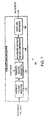
- the bias switching mechanism 700 includes a feedback voltage predictor 702, a feedback voltage integrator 704, an integrated feedback voltage comparator 706, and a switching mechanism 708.
- the bias switching mechanism 700 is exemplary of the type of mechanism that can be used in a closed-loop fiber-optic gyroscope such as gyroscope 100.
- the bias switching mechanism 700 receives feedback voltage from the loop closure electronics introduces a 2 ⁇ reset if such a reset is predicted to reduce the integrated voltage of the modulator bias.
- the feedback voltage predictor 702 receives the current feedback voltage and predicts a future feedback voltage for both with and without a 2 ⁇ reset.
- the predicted future feedback voltages are then passed to the feedback voltage integrator 704.
- the feedback voltage integrator 704 integrates the future feedback voltages and sums with past bias voltages to determine the integrated modulator bias for both with and without a 2 ⁇ reset.
- the integrated feedback voltage comparator 706 compares the integrated modulator bias for both with and without a 2 ⁇ reset.
- switching mechanism 708 selects the option that results in the integrated modulator bias being closest to zero. Specifically, the switching mechanism 708 introduces a 2 ⁇ reset if the 2 ⁇ reset will reduce the magnitude of the integrated bias voltage. If a 2 ⁇ reset would instead increase the magnitude, then the 2 ⁇ reset is not performed.
- the bias switching mechanism 700 will repeatedly receive the feedback voltage, evaluate whether a 2 ⁇ reset will reduce the integrated voltage of the modulator bias, and selectively introduce 2 ⁇ resets in such a way that integrated modulator bias minimized.
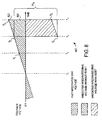
- a graph 800 illustrates one example of how the bias switching mechanism can predict the integrated modulator bias for both with and without a 2 ⁇ reset.
- the feedback voltage is an increasing ramp, crossing zero at time T 1 .
- the past modulator bias is defined as the summation of the past feedback voltage, with a predetermined level of bias defined as the zero level and bias below that level is integrated as negative.
- the bias switching mechanism predicts the integrated modulator bias for both with and without a 2 ⁇ reset. Specifically, the bias switching mechanism predicts the integrated modulator bias that will occur at time T 4 .
- That rate of change, or slope of the feedback voltage is then is then used to predict the feedback voltage V 3 at time T 4 without a 2 ⁇ reset Furthermore, by subtracting V ⁇ from that value it is also used to predict the feedback voltage V 5 with a 2 ⁇ reset.
- the predicted feedback voltages V 3 and V 5 can then be used to predict the future modulator bias for both with and without a 2 ⁇ reset.
- the future integrated modulator bias without a 2 ⁇ reset is predicted by determining the area under the feedback voltage between points V 2 and V 3 . This can be calculated by determining the area of the rectangle 820 and the area of the triangle 822. The area of the rectangle 820 is defined as: V 2 ⁇ T 4 - T 3 while the area of the triangle 822 is defined as: ( V 3 - V 2 ) T 4 - T 3 2
- the predicted future integrated modulator bias calculated, it is added to the past modulated bias to predict an overall integrated modulator bias without a 2 ⁇ reset.
- the same calculation can be used to predict an overall integrated modulator bias with a 2 ⁇ reset. Specifically, taking the predicted overall integrated modulator bias without 2 ⁇ reset and subtracting 2V ⁇ (T 4 -T 3 ) gives the prediction for the overall integrated modulator bias with a 2 ⁇ reset. By comparing the predictions of overall integrated modulator bias the bias switching mechanism can select the option that results in the integrated modulator bias being closest to zero. Thus, if a reset would reduce the magnitude of the integrated modulator bias then the reset is performed. If a reset would instead increase the magnitude, then it is not performed.
- the result of predicting the integrated bias voltage and selectively performing 2 ⁇ resets is that the 2 ⁇ resets are performed at a higher frequency selected to drive the integrated bias voltage closer to zero. For instance, if the bias voltage is ⁇ 5 ⁇ V ⁇ volts, then the minimal bias switching technique will cause the feedback voltage to be at ⁇ 5 ⁇ V ⁇ for 90% of the time and at - 9 ⁇ ⁇ 5 ⁇ V ⁇ for 10% of the time. At an integrated bias voltage of zero volts, no switching will occur, and at a bias voltage of the minimal bias switching technique will switch with a 50-50 duty cycle between and
- the bias switching mechanism will repeatedly evaluate whether a 2 ⁇ reset will reduce the integrated voltage of the modulator bias, and select the option that results in the integrated modulator bias being closest to zero.
- the maximum rate at which the evaluation occurs i.e. , the rate that a 2 ⁇ reset can be triggered, depends on the number of ⁇ used to demodulate the rate signal A faster evaluation rate is desired to increase the high frequency content of the feedback modulation drive signal
- the method of calculating the integrated bias would typically depend on the rate of bias modulation evaluations. For example to predict the integrated bias of a normal phase ramp for a predetermined timeframe in the future, the integrated bias history is added to the change in integrated bias during the previous predetermined timeframe plus the current bias value times the predetermined timeframe, This value is compared to the value obtained by adding or subtracting 2 V ⁇ times the predetermined timeframe to the normal phase ramp prediction, If the bias voltage is positive, then only a negative 2 ⁇ reset needs to be considered, and conversely for a negative bias voltage, only a positive 2 ⁇ reset needs to be considered.
- the bias switching mechanism evaluates the possibility of a 2 ⁇ reset once every 8 loop transit times, where the loop transit time is commonly referred to as ⁇ .
- the integrated bias history is added to the change in integrated bias during the previous 8 ⁇ and the current bias times 8. This value is compared to the value obtained by adding or subtracting 2 V ⁇ times 8 to the normal phase ramp prediction. Again, if the bias voltage is positive, then only a negative 2 ⁇ reset needs to be considered, and conversely for a negative bias voltage, only a positive 2 ⁇ reset needs to be considered. If the prediction with the lowest integrated bias is the prediction with the 2 ⁇ reset, then the modulator drive feedback voltage is changed by an additional 2V ⁇ .
- a graph 900 illustrates bow bias switching mechanism 130 reduces the low frequency components of the feedback modulation drive by increasing the frequency of the 2 ⁇ resets.
- the bias switching mechanism 130 performs a 2 ⁇ reset if such a reset is predicted to reduce the integrated voltage of the modulator bias.
- the bias switching mechanism 130 predicts the integrated modulator bias for both with and without a 2 ⁇ reset Then, the bias switching mechanism 130 selects the option that results in the integrated modulator bias being closest to zero.
- the bias switching mechanism 130 will thus repeatedly evaluate whether a 2 ⁇ reset will reduce the integrated voltage of the modulator bias, and select the option that results in the integrated modulator bias being closest to zero.
- the feedback voltage is illustrated to show how the bias switching mechanism 130 will perform multiple 2 ⁇ resets, in addition to those 2 ⁇ resets performed to prevent the voltage from exceeding the drive circuitry limits.
- graph 900 is simplified in that it does not illustrate other modulations in the feedback voltage, such as those that would be performed for bias modulation.
- the bias switching mechanism 130 repeatedly evaluates 2 ⁇ resets and selectively performs the resets. This results in resets occurring at each of the times T 1 -T 15 . Then, at time T 16 , a "normal" 2 ⁇ reset selected to prevent exceeding the drive circuitry limit occurs. Following time T 16 multiple 2 ⁇ resets for reducing the integrated modulator bias are again performed.
- the bias switching mechanism 130 greatly increases the number of 2 ⁇ resets that are performed, and thus increases the frequency of the feedback modulation.
- the minimal bias switching mechanism 130 Since the feedback voltage changes with rotation rate and the 2 ⁇ switching frequency changes with drive voltage, the net result is that the minimal bias switching mechanism 130 generates a feedback voltage with a significantly reduced rate-dependent low frequency component. As a consequence, the rotation rate errors associated to phase modulators with a difference in low and high frequency response are significantly reduced because resets no longer occur at low frequencies.
- phase modulator is often unstable, and dependent upon environmental factors such as temperature, radiation, humidity, and pressure.
- rate offset stability of the dosed-loop fiber optic gyroscope is improved.
- the high frequency response of phase modulators can also be unstable, but this does not present a problem as various V ⁇ measurement techniques can accurately track the changes in the high frequency V ⁇ value.
- Hysteresis is typically required in the traditional feedback modulation technique to prevent multiple 2 ⁇ resets occurring at the edge of the modulation voltage range.
- hysteresis is no longer necessary as 2 ⁇ resets can occur at all voltage levels.
- the minimal bias switching technique produces a symmetric modulator voltage range between positive and negative rotation rates. This symmetry in the bias modulation reduces scale factor asymmetries between positive and negative rotation rates.
- the minimal bias switching technique introduces high frequency 2 ⁇ stepping in the closed-loop feedback modulation to reduce errors associated with a phase modulator with a different response at low and high frequencies.
- the minimal bias switching technique reduces rate-dependent errors associated to 2 ⁇ resets, increases rate offset stability, and improves the scale factor symmetry between positive and negative rotation rates.
Landscapes
- Engineering & Computer Science (AREA)
- Physics & Mathematics (AREA)
- Power Engineering (AREA)
- Optics & Photonics (AREA)
- Electromagnetism (AREA)
- General Physics & Mathematics (AREA)
- Radar, Positioning & Navigation (AREA)
- Remote Sensing (AREA)
- Gyroscopes (AREA)
Applications Claiming Priority (1)
| Application Number | Priority Date | Filing Date | Title |
|---|---|---|---|
| US11/290,311 US7336364B2 (en) | 2005-11-29 | 2005-11-29 | Minimal bias switching for fiber optic gyroscopes |
Publications (2)
| Publication Number | Publication Date |
|---|---|
| EP1790944A2 true EP1790944A2 (de) | 2007-05-30 |
| EP1790944A3 EP1790944A3 (de) | 2008-11-12 |
Family
ID=37775290
Family Applications (1)
| Application Number | Title | Priority Date | Filing Date |
|---|---|---|---|
| EP06124902A Withdrawn EP1790944A3 (de) | 2005-11-29 | 2006-11-28 | Minimal-Vorspannungsschalter für faseroptische Gyroskope |
Country Status (3)
| Country | Link |
|---|---|
| US (1) | US7336364B2 (de) |
| EP (1) | EP1790944A3 (de) |
| JP (1) | JP2007147629A (de) |
Cited By (6)
| Publication number | Priority date | Publication date | Assignee | Title |
|---|---|---|---|---|
| US7817284B2 (en) | 2007-08-08 | 2010-10-19 | The Charles Stark Draper Laboratory, Inc. | Interferometric fiber optic gyroscope with off-frequency modulation signals |
| US7872758B2 (en) | 2007-01-22 | 2011-01-18 | The Charles Stark Draper Laboratory, Inc. | Determining and compensating for modulator dynamics in interferometric fiber-optic gyroscopes |
| CN103645592A (zh) * | 2013-12-13 | 2014-03-19 | 中国电子科技集团公司第四十一研究所 | 一种新型光纤陀螺用集成光波导器件 |
| US8717575B2 (en) | 2011-08-17 | 2014-05-06 | Honeywell International Inc. | Systems and methods for environmentally insensitive high-performance fiber-optic gyroscopes |
| CN104482931A (zh) * | 2014-12-10 | 2015-04-01 | 西安中科华芯测控有限公司 | 一种闭环光纤陀螺快速启动的方法 |
| WO2019200218A3 (en) * | 2018-04-12 | 2019-12-12 | Nufern | Large-dynamic-range fiber optic gyroscope |
Families Citing this family (13)
| Publication number | Priority date | Publication date | Assignee | Title |
|---|---|---|---|---|
| US7911619B2 (en) * | 2007-11-15 | 2011-03-22 | The Board Of Trustees Of The Leland Stanford Junior University | Low-noise fiber optic sensor utilizing a laser source |
| US8972032B2 (en) * | 2009-06-25 | 2015-03-03 | GM Global Technology Operations LLC | Method for overload protection of SMA device |
| RU2512598C1 (ru) * | 2012-10-24 | 2014-04-10 | Федеральное государственное унитарное предприятие "Центр эксплуатации объектов наземной космической инфраструктуры" | Способ уменьшения времени точностной готовности волоконно-оптического гироскопа |
| RU2527141C1 (ru) * | 2013-01-31 | 2014-08-27 | Федеральное государственное унитарное предприятие "Центр эксплуатации объектов наземной космической инфраструктуры" | Способ расширения диапазона измерения угловых скоростей волоконно-оптического гироскопа с закрытыми контурами обратной связи |
| US10578438B2 (en) * | 2016-02-12 | 2020-03-03 | Agency For Science, Technology And Research | Optical gyroscope, electro-optic system, and methods of forming the same |
| CN106338293B (zh) * | 2016-08-23 | 2019-03-05 | 湖北三江航天红峰控制有限公司 | 一种光纤陀螺自动调试方法 |
| WO2018071729A1 (en) * | 2016-10-12 | 2018-04-19 | Xiaotian Steve Yao | Non-interferometric optical gyroscope based on polarization sensing and implementations of closed loop control |
| US10094664B2 (en) * | 2016-11-23 | 2018-10-09 | Honeywell International Inc. | Apparatus and method for diminishing bias error in resonant fiber optic gyroscopes |
| CN108036783A (zh) * | 2017-10-11 | 2018-05-15 | 姚晓天 | 基于偏振感测技术的非干涉式光学陀螺仪及感测旋转方法 |
| CN109459012A (zh) * | 2018-12-29 | 2019-03-12 | 重庆华渝电气集团有限公司 | 一种光纤陀螺2π电压参数全数字伺服调整装置及方法 |
| CN110906920B (zh) * | 2019-12-10 | 2021-05-14 | 西安航天精密机电研究所 | 一种抑制数字闭环光纤陀螺复位误差的方法 |
| US10989535B1 (en) * | 2020-01-31 | 2021-04-27 | Northrop Grumman Systems Corporation | Calibration circuit to mitigate fiber-optic gyroscope (FOG) bias error |
| CN113916212B (zh) * | 2021-09-30 | 2022-07-29 | 北京航空航天大学 | 一种适用于轻小型光纤陀螺的第二闭环控制方法 |
Family Cites Families (4)
| Publication number | Priority date | Publication date | Assignee | Title |
|---|---|---|---|---|
| FR2566133B1 (fr) * | 1984-06-14 | 1986-08-29 | Thomson Csf | Dispositif de mesure d'un dephasage non reciproque engendre dans un interferometre en anneau |
| DE59000320D1 (de) * | 1990-01-03 | 1992-10-29 | Litef Gmbh | Faseroptisches sagnac-interferometer mit digitaler phasenrampenrueckstellung zur drehratenmessung. |
| US5371594A (en) * | 1993-01-22 | 1994-12-06 | The Charles Stark Draper Laboratory, Inc. | Sample and hold flyback phase control circuit for a null seeking fiber optic gyroscope |
| US5684589A (en) * | 1995-08-28 | 1997-11-04 | Litton Systems, Inc. | Loop controller for fiber optic gyro with distributed data processing |
-
2005
- 2005-11-29 US US11/290,311 patent/US7336364B2/en not_active Expired - Lifetime
-
2006
- 2006-11-28 EP EP06124902A patent/EP1790944A3/de not_active Withdrawn
- 2006-11-29 JP JP2006321760A patent/JP2007147629A/ja not_active Withdrawn
Cited By (9)
| Publication number | Priority date | Publication date | Assignee | Title |
|---|---|---|---|---|
| US7872758B2 (en) | 2007-01-22 | 2011-01-18 | The Charles Stark Draper Laboratory, Inc. | Determining and compensating for modulator dynamics in interferometric fiber-optic gyroscopes |
| US8102536B2 (en) | 2007-01-22 | 2012-01-24 | The Charles Stark Draper Laboratory, Inc. | Determining and compensating for modulator dynamics in interferometric fiber-optic gyroscopes |
| US7817284B2 (en) | 2007-08-08 | 2010-10-19 | The Charles Stark Draper Laboratory, Inc. | Interferometric fiber optic gyroscope with off-frequency modulation signals |
| US8717575B2 (en) | 2011-08-17 | 2014-05-06 | Honeywell International Inc. | Systems and methods for environmentally insensitive high-performance fiber-optic gyroscopes |
| CN103645592A (zh) * | 2013-12-13 | 2014-03-19 | 中国电子科技集团公司第四十一研究所 | 一种新型光纤陀螺用集成光波导器件 |
| CN103645592B (zh) * | 2013-12-13 | 2016-05-25 | 中国电子科技集团公司第四十一研究所 | 一种新型光纤陀螺用集成光波导器件 |
| CN104482931A (zh) * | 2014-12-10 | 2015-04-01 | 西安中科华芯测控有限公司 | 一种闭环光纤陀螺快速启动的方法 |
| WO2019200218A3 (en) * | 2018-04-12 | 2019-12-12 | Nufern | Large-dynamic-range fiber optic gyroscope |
| US10837778B2 (en) | 2018-04-12 | 2020-11-17 | Nufern | Large-dynamic-range fiber optic gyroscope |
Also Published As
| Publication number | Publication date |
|---|---|
| US7336364B2 (en) | 2008-02-26 |
| US20070121116A1 (en) | 2007-05-31 |
| EP1790944A3 (de) | 2008-11-12 |
| JP2007147629A (ja) | 2007-06-14 |
Similar Documents
| Publication | Publication Date | Title |
|---|---|---|
| US7336364B2 (en) | Minimal bias switching for fiber optic gyroscopes | |
| US10921125B2 (en) | Optical gyroscope | |
| JP4130730B2 (ja) | 光ファイバジャイロスコープ | |
| EP0749564B1 (de) | Kerr-effekt-fehlerverminderung für faseroptischen kreisel | |
| EP1171754B1 (de) | Kerreffektkompensation für einen interferometrischen faseroptischen kreisel | |
| EP0566757A1 (de) | Konfiguration einer optischen Grenzfläche für Drehratensensorgerät | |
| US20110037985A1 (en) | Resonator optical gyroscope having input beam modulation optimized for high sensitivity and low bias | |
| US5090810A (en) | Ring resonator gyroscope controlling two servo control loops based on the output of a single interference detector | |
| US5349441A (en) | Fiber optic gyroscope refractive index induced error compensation | |
| US6014217A (en) | Fiber optic gyroscope scattering error reduction | |
| EP0830570B1 (de) | Eigenfrequenznachlaufanordnung für faseroptische sensorspule | |
| US20120050745A1 (en) | Resonator fiber optic gyroscopes with reduced rotation rate instability from back reflections | |
| US7333209B2 (en) | Fiber optic gyroscope asynchronous demodulation | |
| Morris et al. | Optimization of the angular random walk in laser-driven fiber-optic gyroscopes | |
| US5018859A (en) | Fiber optic gyroscope balanced plural serrodyne modulators phase difference control | |
| US5384637A (en) | Fiber optic gyroscope modulation amplitude control | |
| US5137357A (en) | Interferometric signal analysis with modulation switching | |
| RU2160885C1 (ru) | Способ стабилизации масштабного коэффициента волоконно-оптического гироскопа | |
| US5018860A (en) | Fiber optic gyroscope balanced plural serrodyne generators combined signal phase difference control | |
| US5031988A (en) | Fiber optic gyro | |
| JP2909513B2 (ja) | リング共振ジャイロ | |
| US7102757B2 (en) | Current measurement method and device based on a fiber optic in-line Sagnac interferometer | |
| RU2146807C1 (ru) | Способ компенсации разности фаз саньяка в кольцевом интерферометре волоконно-оптического гироскопа | |
| US6516103B1 (en) | Optical interconnect capable of performing addition/subtraction |
Legal Events
| Date | Code | Title | Description |
|---|---|---|---|
| PUAI | Public reference made under article 153(3) epc to a published international application that has entered the european phase |
Free format text: ORIGINAL CODE: 0009012 |
|
| AK | Designated contracting states |
Kind code of ref document: A2 Designated state(s): AT BE BG CH CY CZ DE DK EE ES FI FR GB GR HU IE IS IT LI LT LU LV MC NL PL PT RO SE SI SK TR |
|
| AX | Request for extension of the european patent |
Extension state: AL BA HR MK YU |
|
| PUAL | Search report despatched |
Free format text: ORIGINAL CODE: 0009013 |
|
| AK | Designated contracting states |
Kind code of ref document: A3 Designated state(s): AT BE BG CH CY CZ DE DK EE ES FI FR GB GR HU IE IS IT LI LT LU LV MC NL PL PT RO SE SI SK TR |
|
| AX | Request for extension of the european patent |
Extension state: AL BA HR MK RS |
|
| 17P | Request for examination filed |
Effective date: 20090504 |
|
| AKX | Designation fees paid |
Designated state(s): DE FR |
|
| STAA | Information on the status of an ep patent application or granted ep patent |
Free format text: STATUS: THE APPLICATION IS DEEMED TO BE WITHDRAWN |
|
| 18D | Application deemed to be withdrawn |
Effective date: 20100601 |