EP1789601B1 - Reibmaterialien/tribowerkstoffe für radiale und axiale folienlager - Google Patents
Reibmaterialien/tribowerkstoffe für radiale und axiale folienlager Download PDFInfo
- Publication number
- EP1789601B1 EP1789601B1 EP05782972A EP05782972A EP1789601B1 EP 1789601 B1 EP1789601 B1 EP 1789601B1 EP 05782972 A EP05782972 A EP 05782972A EP 05782972 A EP05782972 A EP 05782972A EP 1789601 B1 EP1789601 B1 EP 1789601B1
- Authority
- EP
- European Patent Office
- Prior art keywords
- tribosystem
- preceeding
- structural component
- coating
- metallic
- Prior art date
- Legal status (The legal status is an assumption and is not a legal conclusion. Google has not performed a legal analysis and makes no representation as to the accuracy of the status listed.)
- Expired - Lifetime
Links
Images
Classifications
-
- C—CHEMISTRY; METALLURGY
- C23—COATING METALLIC MATERIAL; COATING MATERIAL WITH METALLIC MATERIAL; CHEMICAL SURFACE TREATMENT; DIFFUSION TREATMENT OF METALLIC MATERIAL; COATING BY VACUUM EVAPORATION, BY SPUTTERING, BY ION IMPLANTATION OR BY CHEMICAL VAPOUR DEPOSITION, IN GENERAL; INHIBITING CORROSION OF METALLIC MATERIAL OR INCRUSTATION IN GENERAL
- C23C—COATING METALLIC MATERIAL; COATING MATERIAL WITH METALLIC MATERIAL; SURFACE TREATMENT OF METALLIC MATERIAL BY DIFFUSION INTO THE SURFACE, BY CHEMICAL CONVERSION OR SUBSTITUTION; COATING BY VACUUM EVAPORATION, BY SPUTTERING, BY ION IMPLANTATION OR BY CHEMICAL VAPOUR DEPOSITION, IN GENERAL
- C23C30/00—Coating with metallic material characterised only by the composition of the metallic material, i.e. not characterised by the coating process
-
- C—CHEMISTRY; METALLURGY
- C23—COATING METALLIC MATERIAL; COATING MATERIAL WITH METALLIC MATERIAL; CHEMICAL SURFACE TREATMENT; DIFFUSION TREATMENT OF METALLIC MATERIAL; COATING BY VACUUM EVAPORATION, BY SPUTTERING, BY ION IMPLANTATION OR BY CHEMICAL VAPOUR DEPOSITION, IN GENERAL; INHIBITING CORROSION OF METALLIC MATERIAL OR INCRUSTATION IN GENERAL
- C23C—COATING METALLIC MATERIAL; COATING MATERIAL WITH METALLIC MATERIAL; SURFACE TREATMENT OF METALLIC MATERIAL BY DIFFUSION INTO THE SURFACE, BY CHEMICAL CONVERSION OR SUBSTITUTION; COATING BY VACUUM EVAPORATION, BY SPUTTERING, BY ION IMPLANTATION OR BY CHEMICAL VAPOUR DEPOSITION, IN GENERAL
- C23C4/00—Coating by spraying the coating material in the molten state, e.g. by flame, plasma or electric discharge
- C23C4/02—Pretreatment of the material to be coated, e.g. for coating on selected surface areas
-
- C—CHEMISTRY; METALLURGY
- C23—COATING METALLIC MATERIAL; COATING MATERIAL WITH METALLIC MATERIAL; CHEMICAL SURFACE TREATMENT; DIFFUSION TREATMENT OF METALLIC MATERIAL; COATING BY VACUUM EVAPORATION, BY SPUTTERING, BY ION IMPLANTATION OR BY CHEMICAL VAPOUR DEPOSITION, IN GENERAL; INHIBITING CORROSION OF METALLIC MATERIAL OR INCRUSTATION IN GENERAL
- C23C—COATING METALLIC MATERIAL; COATING MATERIAL WITH METALLIC MATERIAL; SURFACE TREATMENT OF METALLIC MATERIAL BY DIFFUSION INTO THE SURFACE, BY CHEMICAL CONVERSION OR SUBSTITUTION; COATING BY VACUUM EVAPORATION, BY SPUTTERING, BY ION IMPLANTATION OR BY CHEMICAL VAPOUR DEPOSITION, IN GENERAL
- C23C4/00—Coating by spraying the coating material in the molten state, e.g. by flame, plasma or electric discharge
- C23C4/04—Coating by spraying the coating material in the molten state, e.g. by flame, plasma or electric discharge characterised by the coating material
- C23C4/10—Oxides, borides, carbides, nitrides or silicides; Mixtures thereof
- C23C4/11—Oxides
-
- F—MECHANICAL ENGINEERING; LIGHTING; HEATING; WEAPONS; BLASTING
- F16—ENGINEERING ELEMENTS AND UNITS; GENERAL MEASURES FOR PRODUCING AND MAINTAINING EFFECTIVE FUNCTIONING OF MACHINES OR INSTALLATIONS; THERMAL INSULATION IN GENERAL
- F16C—SHAFTS; FLEXIBLE SHAFTS; ELEMENTS OR CRANKSHAFT MECHANISMS; ROTARY BODIES OTHER THAN GEARING ELEMENTS; BEARINGS
- F16C33/00—Parts of bearings; Special methods for making bearings or parts thereof
- F16C33/02—Parts of sliding-contact bearings
- F16C33/04—Brasses; Bushes; Linings
- F16C33/06—Sliding surface mainly made of metal
- F16C33/12—Structural composition; Use of special materials or surface treatments, e.g. for rust-proofing
-
- F—MECHANICAL ENGINEERING; LIGHTING; HEATING; WEAPONS; BLASTING
- F16—ENGINEERING ELEMENTS AND UNITS; GENERAL MEASURES FOR PRODUCING AND MAINTAINING EFFECTIVE FUNCTIONING OF MACHINES OR INSTALLATIONS; THERMAL INSULATION IN GENERAL
- F16C—SHAFTS; FLEXIBLE SHAFTS; ELEMENTS OR CRANKSHAFT MECHANISMS; ROTARY BODIES OTHER THAN GEARING ELEMENTS; BEARINGS
- F16C33/00—Parts of bearings; Special methods for making bearings or parts thereof
- F16C33/02—Parts of sliding-contact bearings
- F16C33/04—Brasses; Bushes; Linings
- F16C33/06—Sliding surface mainly made of metal
- F16C33/12—Structural composition; Use of special materials or surface treatments, e.g. for rust-proofing
- F16C33/121—Use of special materials
-
- Y—GENERAL TAGGING OF NEW TECHNOLOGICAL DEVELOPMENTS; GENERAL TAGGING OF CROSS-SECTIONAL TECHNOLOGIES SPANNING OVER SEVERAL SECTIONS OF THE IPC; TECHNICAL SUBJECTS COVERED BY FORMER USPC CROSS-REFERENCE ART COLLECTIONS [XRACs] AND DIGESTS
- Y10—TECHNICAL SUBJECTS COVERED BY FORMER USPC
- Y10S—TECHNICAL SUBJECTS COVERED BY FORMER USPC CROSS-REFERENCE ART COLLECTIONS [XRACs] AND DIGESTS
- Y10S384/00—Bearings
- Y10S384/90—Cooling or heating
- Y10S384/913—Metallic compounds
Definitions
- the invention relates to the use of sliding materials in axial and radial foil bearings.
- Leaf (garret) or bump-type bearings form self-supporting and compliant bearing surfaces. In normal operation, they carry the load on an air film.
- the general advantages are: reduced costs, higher speeds, lower weight, higher efficiency, and improved compensation of misalignment and wave deformations.
- high-speed dry-running conditions occur between the film and the shaft, causing wear on the film and shaft until an air film is formed.
- the take-off speed is dependent on design and diameter 8 m / s and 15 m / s. Reliable long-term applications with up to 100,000 start-stop processes therefore require wear-resistant coatings.
- the film thicknesses are less than 200 microns and allow a wear length of only 25% of the film thickness, otherwise change the damping properties. It is also necessary to coat the shaft in air-bearing foil bearings because shafts made of superalloys such as INX-750, René41, INC909 or MA956 tend to transfer material at 800 ° C (reference 1) if they slide against INX-750.
- the porosity of sintered PM212 is 22% by volume.
- the NASA coatings PS302 to PS321 represent a concept (41 to 60 wt .-% NiCr, ⁇ METCO 443) with a high binder content.
- the coefficient of wear of the pair INX-750 / PS304 is at 25 ° C and 500 ° C in a narrow range of 1.6 to 2.4 10 -4 mm 3 / Nm associated with PxV values of 0.11 to 0.22 MPaxm / s, which was approved by NASA determined in a Trust Washer Tribometer.
- the PV factor or PxV value is the product of the bearing pressure and surface velocity, which is usually expressed in (lb / in 2 ) x (ft / min) or in ISO units in Paxm / s. It describes the input of mechanical energy into the slide bearing as a design stress or the maximum stress that the friction materials can handle.
- the term ⁇ PV is identical to the generated heat in W / mm 2 . It describes the boundary between high and low wear areas as well as the upper PV limit at which the plain bearing fails. High PV values mean a large load capacity of the bearing.
- the worldwide wear coefficient in [mm 3 / Nm] describes the wear expectation of a pair under certain load conditions, but no material property. It is defined as the quotient of the wear volume divided by the load times the sliding path.
- the patent application DE 195 30 517 discloses a single-phase coating (carbide inserts) of (Ti, Mo) (C, N) deposited on steel cutting edges.
- a "steel” differs significantly from a nickel base or cobalt base superalloy.
- Patent applications to cermets of titanium carbide or titanium molybdenum carbonitride relate to cutting tools.
- Cutting tools form open tribosystems in which the cutting tool interacts continuously with the workpiece, the latter coming into contact substantially once or only once. Logically, the workpiece is not cermets.
- the foil bearing itself forms a closed tribosystem consisting of periodically interacting surfaces according to the meshing ratio, which is significantly different from an open tribosystem.
- the DE 195 48 718 describes coatings of self-lubricating oxides (Lubricious Oxides, LO) for tribologically stressed, lubricated surfaces in internal combustion engines.
- LO self-lubricating oxides
- These LOs can be deposited as coatings or formed by tribo-oxidation on substrates such as (Ti, Mo) (C, N). Certain binder types are not disclosed.
- These LOs are high pressure additives (EP) and wear protection additives (AW) as well as polymeric viscosity index improvers in liquid lubricants (engine oils) substitute. Consequently, these LOs run under mixed / boundary friction and / or hydrodynamic conditions and not under solid state friction (dry running) or at high temperatures such as in foil bearings.
- the US 6,020,072 and US 6,017,592 disclose dry-running spherical bearings for aerospace applications up to 1600 ° C, which obviously run at low speeds (v ⁇ 0.5 m / s) and consequently can not build an aerodynamic film.
- tribo-oxidation or static oxidation soft reaction layers form on certain materials, such as (Ti, Mo) (C, N), typically Magnéliphasen as substoichiometric oxides, which form defined planar oxygen defects.
- Composite substrates are SiC, HfC and C-SiC.
- the first and second friction element which forms the closed tribosystem consists of the disclosed coatings of the patent application. As a coating, Ti n-2 Cr 2 O 2n-1 is disclosed, but without information on the tribological behavior for sliding speeds above 1 m / s.
- the US 2004/113520 discloses (Ti, Mo) (C, N) + 8-20% Ni / Mo binder (TM8, 10.20 grades from Sandvik Hard Materials) for high performance piezoelectric motors or vibration motors.
- TM8, 10.20 grades from Sandvik Hard Materials for high performance piezoelectric motors or vibration motors.
- the tribosystems of these motors perform a linear, oscillating motion with vibration frequencies of less than 15 ⁇ m and vibration frequencies of 20-40 kHz.
- the outstanding difference to foil bearings consists in the 1,000 times greater generated friction of the dry running films and the fact that the piezo motors require friction numbers greater than 0.5. Piezomotors can not build an aerodynamic film.
- the DE 196 40 789 discloses coatings for liquid lubricated piston rings in internal combustion engines consisting of 50 to 95 vol .-% (Ti, Mo) (C, N) as the hard phase and binders of Ni, Co, Fe, which, for example, from powders with 59.6 wt .-% TiC 0.7 N 0.3 , 12.0 wt .-% Mo 2 C and 28.4 wt .-% Ni.
- Magnéli phase of (Ti, V) n O 2n-1 or (W, Mo) n O 3n-1 are unsuitable for ambient temperatures in air above 400-450 ° C as they reoxidize to stoichiometric compositions.
- Ti n-2 Cr 2 O 2n-1 where 6 ⁇ n ⁇ 9, this can be overcome since it is resistant to oxidation up to 1000 ° C and beyond.
- the PS30x coatings represent the prior art, the sliding materials in foil bearings, but they reveal to 10 -5 mm 3 / Nm limited wear coefficient.
- the object of the invention is therefore to improve the tribological systems consisting of a main body and a counter body, which are under unclean friction 'conditions in an interaction, ie without liquid lubricants and / or fats and / or solid lubricants, in a manner that allows to be operated reliably without difficulty with wear coefficients below 10 -6 mm 3 / Nm, also associated with PV values greater than 1 Mpaxm / s at high temperatures of up to 1000 ° C. under high-speed high-temperature conditions.
- a tribosystem for radial and axial foil bearings which contains a main body and a counterbody. Between the main body and the counter body a frictional contact under continuous sliding friction can be generated, which is the Training an air film allowed. It is essential for the wear-free operation of this tribosystem that the surface exposed to the frictional contact of at least one body, ie the main body, and / or the counter body, at least partially metallically bonded (Ti, Mo) (C, N), Ti n-2 Cr 2 O 2n-1 , with 6 ⁇ n ⁇ 9 and / or solid phase solutions of TiO 2 -Cr 2 O 3 contains.
- Ti, Mo metallically bonded
- a spray powder preferred for atmospheric plasma spraying consists essentially of Cr 2 Ti 8 O 15 and Cr 0.46 Ti 0.54 0 1.77 , whereby Cr 0.15 Ti 0.85 O 1.925 , CrTi 2 O 5 , Cr 2 Ti 2 O 7 and Cr 2 TiO 5 could be detected.
- the metallically bound (Ti, Mo) (C, N) preferably contains 1 to 20 at.% Chromium.
- the trace element chromium improves above 800 ° C the oxidation resistance of (Ti, Mo) (C, N) in continuous operation for long-term applications as Mo becomes volatile as MoO 2 and MoO 3 .
- the chromium content should not exceed 20 atomic% Cr (based on the cations Ti, Mo and chromium).
- the C: N ratio of the anions is between 9: 1 and 6: 4.
- Another preferred variant provides that 1 to 20 at .-% niobium are included.
- the metallic binder is preferably selected from the group consisting of nickel, chromium, cobalt, molybdenum and niobium.
- the binder can be contained in a weight range of 6 to 35%.
- one of the bodies that is to say the main body or the counterbody, can contain a monolithic material of (Ti, Mo) (C, N) or be constructed entirely from this.
- cermets made of (Ti, Mo) (C, N) can be formed directly into films at temperatures above 700 ° C by rolling, which prevents coatings.
- the mechanical properties of (Ti, Mo) (C, N) bonded with 15 to 30 wt .-% NiMo also allow the production of monolithic waves.
- Monolithic shafts and films combine as bifunctional elements with both tribological and mechanical properties.
- Those of (Ti, Mo) (C, N) depend on the binder content, but are virtually unaffected by the temperature with values of K ⁇ 3.90 [mm 2 / s] and are of the same order of magnitude. Consequently, the frictional heat flow is not affected by the coating.
- a further preferred variant of the tribological system according to the invention provides that the surface of the at least one body is a coating.
- this coating preferably contains Ti n-2 Cr 2 O 2n-1 with 6 ⁇ n ⁇ 9.
- the coating can also consist of a solution in solid phase of TiO 2 -Cr 2 O 3 .
- the coating preferably has a thickness of at least 1 ⁇ m.
- PVD physical vapor deposition
- CVD chemical vapor deposition
- APS thermal spraying
- a compensation layer for compensating for thermal stress can be arranged between the coated body and the coating.
- the corresponding body may be coated with alumina.
- the aluminum oxide preferably has a purity of more than 97% by weight and a particle size d 90 ⁇ 1 ⁇ m. Finely grained aluminum oxide runs against (Ti, Mo) (C, N) and Ti n-2 Cr 2 O 2n-1 with low wear coefficients. Due to anisotropies in the linear thermal expansion, the modulus of elasticity and the diffusivity as a function of the crystallographic orientation, polycrystals are particularly sensitive to residual stresses caused by heat fluxes (flow of frictional heat) when the grains are larger than 5 ⁇ m. This may be due to grain-fined alumina be avoided. Grain sizes smaller than 1 ⁇ m reduce in alumina the forces that can be generated by thermal expansion of one grain in one direction.
- the use of metallically bound (Ti, Mo) (C, N), Ti n-2 Cr 2 O 2n-1 with 6 ⁇ n ⁇ 9 and / or solid solution of TiO 2 -Cr 2 O 3 provided for increasing the wear resistance of radial and axial foil bearings.
- the materials mentioned can be used both for the monolithic production of the body and for its coating.
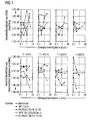
- Fig. 1 Separately represents for the stationary sample (bearing cup) and the rotating sample (shaft) the wear coefficients as a function of sliding speed (up to 7 m / s) at four different ambient temperatures compared to WC-CoCr and hard chrome.
- Ti n-2 Cr 2 O 2n-1 coating despite increased roughnesses of R pK ⁇ 0.61 microns, above 600 ° C and 1 m / s has low wear rates, associated with wear rates of Alumina below 10 -7 mm 3 / Nm.
- tungsten carbide coatings (WC with 14 wt% CoCr, WC-10Co4Cr, R pK ⁇ 0.13 ⁇ m) can not be used at 800 ° C due to excessive or excessive wear due to the formation of volatile WO 3 .
- a nickel-bonded (Ti, Mo) (C, N) -28Ni coating with R pK ⁇ 0.339 ⁇ m is more wear resistant than the cobalt bound (Ti, Mo) (C, N) -29 Co coating with R pK ⁇ 0.21 ⁇ m.
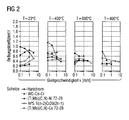
- the wear coefficients shown in Figure 2 can be further reduced by reducing the roughness of the rotating specimen (shaft) to R pK ⁇ 0.03 ⁇ m.
- the PV values given in Table 1 were determined by comparison with the in M. Woydt, K.-H. Habig, High temperature tribology of ceramics, Tribology International, Vol. 22, no. 2 (1989), pp. 75-88 described tribometer calculated results and in Fig. 1 shown.
- the individual PV values of the (Ti, Mo) (C, N) coatings depend on the sliding speed. It follows that the ranges of PV values given in Table 1 at each temperature cover the sliding speeds of 0.03 m / s ⁇ v ⁇ 6 m / s.
- Fig. 1 emphasizes, based on the wear results measured over two orders of magnitude of sliding speed, that a material can be unsuitable for low sliding speeds (v ⁇ 0.3 m / s), although at high sliding speeds (v> 3 m / s) it is less worn and vice versa.
- the breakaway torque of the rotor represents another selection criterion for the sliding pairings, which is determined by the coefficient of friction at a given temperature.
- the maximum permissible coefficient of friction of the sliding pairings depends on the construction and the dimensions and should be less than 0.4, preferably less than 0.3.
- Fig. 2 shows the friction coefficients under dry, unlubricated conditions according to the wear rates in Fig. 1 .
- the coatings of (Ti, Mo) (C, N) show a preferred friction behavior. It is emphasized that the prior art relating to cutting tools does not cite friction data.
Landscapes
- Engineering & Computer Science (AREA)
- Chemical & Material Sciences (AREA)
- Mechanical Engineering (AREA)
- General Engineering & Computer Science (AREA)
- Materials Engineering (AREA)
- Metallurgy (AREA)
- Organic Chemistry (AREA)
- Chemical Kinetics & Catalysis (AREA)
- Physics & Mathematics (AREA)
- Plasma & Fusion (AREA)
- Sliding-Contact Bearings (AREA)
- Lubricants (AREA)
- Coating By Spraying Or Casting (AREA)
- Laminated Bodies (AREA)
Description
- Die Erfindung betrifft die Anwendung von Gleitwerkstoffen in axialen und radialen Folienlagern.
- Leaf- ("Garret"-Lager) oder Mehrgleitflächenlager (bump-type) bilden selbsttragende und nachgiebige Lageroberflächen aus. Im Normalbetrieb tragen sie auf einem Luftfilm die Last. Als generelle Vorteile sind zu nennen: reduzierte Kosten, höhere Geschwindigkeiten, geringeres Gewicht, höherer Wirkungsgrad, und verbesserte Kompensierung von Schiefstellung und Wellenverformungen. Während des Hoch- und Herunterfahrens treten bei hohen Gleitgeschwindigkeiten Trockenlaufzustände zwischen Folie und Welle auf, welche Verschleiß an der Folie und der Welle verursachen, bis ein Luftfilm ausgebildet ist. Die Abhebedrehzahl liegt abhängig von Konstruktion und Durchmesser zwischen 8 m/s und 15 m/s. Zuverlässige Langzeitanwendungen mit bis zu 100.000 Start-Stop-Vorgängen erfordern deshalb verschleißbeständige Beschichtungen.
- Die Foliendicken sind kleiner als 200 µm und lassen eine Verschleißlänge von nur 25% der Foliendicke zu, da sich sonst die Dämpfungseigenschaften verändern. Eine Beschichtung der Welle in luftgelagerten Folienlagern wird auch deshalb notwendig, da Wellen aus Superlegierungen wie INX-750, René41, INC909 oder MA956 bei 800°C zum adhäsiven Materialübertrag neigen (Literaturstelle 1), wenn sie gegen INX-750 gleiten.
- Die Substitution von Chromcarbid (
US 5,034,187 ) in den selbstschmierenden NASA PS200-Beschichtungen, bestehend aus 30% bis 70% Chromcarbid, 5% bis 20% weichen Edelmetallen (Ag), 5% bis 20% Fluoriden und 20% bis 60% metallischem Binder durch Chromoxid führte zu den NASA PS300-Beschichtungen (US 5,866,518 ) allgemein bestehend aus 60 bis 80% Cr2O3, Fluoriden der Gruppe I und II, Ag, Au, Pt, Pd, Rh oder Cu und einem NiCr-Binder und war durch Kosten- und Prozessgesichtspunkte bedingt. Die Porosität von gesinterem PM212 beträgt 22 Vol.-%. Die NASA-Beschichtungen PS302 bis PS321 stellen ein Konzept (41 bis 60 Gew.-% NiCr, ∼METCO 443) mit hohem Binderanteil dar. - Die Verwendung von selbstschmierenden Beschichtungen bestehend aus 20 bis 23% BaF2, 13 bis 15% CaF2, 33 bis 38% Cr2O3 und 25 bis 33% Ag mit einem wärmebeständigen Ni-Binder 23,5 Ni17Co12,5Cr0,5Al wurde zuerst von S. Niizekiet et al. in Literaturstelle 3 S. Niizeki, T. Yoshioka, H. Mizutani, H. Toyota und T. Hashimoto, Development of solid lubricants for high temperature rolling ceramic bearings (part I): Various solid lubricants based on fluoride compounds, Japanese Journal of Tribology, Vol. 40, No. 12, 1995, S. 1277-1287, vorgestellt.
- Der Verschleißkoeffizient des Paares INX-750/PS304 liegt bei 25°C und 500°C in einem engen Bereich von 1.6 bis 2.4 10-4 mm3/Nm verbunden mit PxV-Werten von 0.11 bis 0.22 MPaxm/s, welche von der NASA in einem Trust-Washer-Tribometer bestimmt wurden.
- Der PV-Faktor oder PxV-Wert ist das Produkt aus der dem Lagerdruck und der Oberflächengeschwindigkeit, die normalerweise in (lb/in2)x(ft/min) oder in ISO-Einheiten in Paxm/s angegeben wird. Er beschreibt den Eintrag an mechanischer Energie in das Gleitlager als eine konstruktionsbedingte Beanspruchung oder die maximale Beanspruchung, welche die Reibmaterialien vertragen. Der Term µPV ist identisch mit der erzeugten Wärme in W/mm2. Er beschreibt die Grenze zwischen hohen und niedrigen Verschleißbereichen sowie den oberen PV-Grenzwert, an dem das Gleitlager versagt. Hohe PV-Werte bedeuten ein großes Lastaufnahmevermögen des Lagers.
- Der weltweit gebräuchliche Verschleißkoeffizient in [mm3/Nm] beschreibt die Verschleißerwartung eines Paares unter bestimmten Beanspruchungsbedingungen, jedoch keine Materialeigenschaft. Er ist definiert als Quotient aus dem Verschleißvolumen geteilt durch Last mal Gleitweg.
- Für die Definitionen des Verschleißkoeffizienten und des PxV-Wertes, siehe: ASM handbook "Friction, Lubrication and Wear Technology", Volume 18, October 1992, ISBN 0-87170-380-7 oder ASTM G40-01 "Standard Terminology Relating to Wear and Erosion".
- Die Patentanmeldung
US 5,370,719 bezieht sich auf Schneideinsätze. Diese bilden offene Tribosysteme. Da die Normalkraft an der Schneidkante unbekannt ist, können aus der Verschleißmarkenbreite keine Verschleißkoeffizienten berechnet werden. - Die Patentanmeldung
DE 195 30 517 offenbart eine einphasige, mit auf Schneidkanten aus Stahl abgeschiedener Beschichtung (Hartmetalleinsätze) aus (Ti, Mo)(C, N). Im allgemeinen Verständnis eines Metallurgen unterscheidet sich ein "Stahl" signifikant von einer Superlegierung auf Nickelbasis oder Cobaltbasis. - Die Patentanmeldungen zu Cermets aus Titancarbid oder Titanmolybdäncarbonitrid beziehen sich auf Schneidwerkzeuge. Schneidwerkzeuge bilden offene Tribosysteme, in denen das Schneidwerkzeug kontinuierlich mit dem Werkstück in Wechselwirkung steht, wobei letzteres im Wesentlichen einmal oder nur einmal in Kontakt kommt. Logischerweise besteht das Werkstück nicht aus Cermets.
- Das Folienlager selbst bildet ein geschlossenes Tribosystem bestehend aus periodisch, entsprechend dem Eingriffsverhältnis wechselwirkenden Oberflächen, welches sich von einem offenen Tribosystem signifikant unterscheidet.
- Die
DE 195 48 718 beschreibt Beschichtungen aus selbstschmierenden Oxiden (Lubricious Oxides, LO) für tribologisch beanspruchte, flüssig geschmierte Oberflächen in Verbrennungsmotoren. Diese LOs können als Beschichtungen abgeschieden werden oder sich durch Tribooxidation auf Substraten bilden, wie (Ti, Mo)(C, N). Bestimmte Binderarten werden nicht offenbart. Diese LOs sollen Hochdruckadditive (EP) und Verschleißschutzadditive (AW) sowie polymere Viskositätsindexverbesserer in flüssigen Schmierstoffen (Motorenöle) substituieren. Folglich laufen diese LOs unter Misch-/Grenzreibung und/oder hydrodynamischen Bedingungen und nicht unter Festkörperreibung (Trockenlauf) oder bei hohen Temperaturen wie in Folienlagern. - Die
US 6,020,072 undUS 6,017,592 offenbaren trockenlaufende Gelenklager für Luft- und Raumfahrtanwendungen bis zu 1600°C, welche naheliegenderweise bei kleinen Geschwindigkeiten (v< 0,5 m/s) laufen und folglich auch keinen aerodynamischen Film aufbauen können. Durch Tribooxidation oder statische Oxidation bilden sich weiche Reaktionsschichten auf bestimmten Materialien aus, wie (Ti, Mo)(C, N), typischerweise Magnéliphasen als unterstöchiometrische Oxide, welche definierte planare Sauerstoffdefekte ausbilden. Für thermisch gespritzte Schichten werden keine Binder offenbart. Die Substrate aus Verbundwerkstoffen bestehen aus SiC, HfC and C-SiC. Das erste und zweite Reibelement, welches das geschlossene Tribosystem (Gelenklager) ausbildet, besteht aus den offenbarten Beschichtungen der Patentanmeldung. Als Beschichtung wird auch Tin-2Cr2O2n-1 offenbart, allerdings ohne Angaben zum tribologischen Verhalten für Gleitgeschwindigkeiten oberhalb von 1 m/s. - Die
US 2004/113520 offenbart (Ti,Mo)(C,N)+8-20% Ni/Mo-Binder (TM8,10,20-Güten von Sandvik Hard Materials) für piezoelektrische Hochleistungsmotoren oder Vibrationsmotoren. Die Tribosysteme dieser Motoren führen naturgemäß eine lineare, oszillierende Bewegung bei Schwingweiten kleiner als 15 µm und Schwingungsfrequenzen von 20-40 kHz aus. Der herausragende Unterschied zu Folienlagern besteht in der 1.000 mal größeren erzeugten Reibleistung der trockenlaufenden Folien und der Tatsache, dass die Piezomotoren Reibungszahlen von größer als 0,5 erfordern. Piezomotoren können keinen aerodynamischen Film aufzubauen. - Die
DE 196 40 789 offenbart Beschichtungen für flüssiggeschmierte Kolbenringe in Verbrennungskraftmaschinen bestehend aus 50 bis 95 Vol.-% (Ti,Mo)(C,N) als harte Phase und Bindern aus Ni, Co, Fe, welche beispielsweise aus Pulvern mit 59,6 Gew.-% TiC0,7N0,3, 12,0 Gew.-% Mo2C und 28,4 Gew.-% Ni bestehen. - Die in L.-M. Berger et al, Hartmetallähnliche Schichten gegen Verschleiß und Korrosion, Maschinenmarkt Nr. 8, 1996 dargestellten Ergebnisse zum abrasiven Verschleißwiderstand gemäß ASTM G-65-85 von Cermets und Hartmetallen an einem offenen Tribosystem können nicht auf Folienlager übertragen werden, da diese keine dritten Körper (Abrasivstoffe) oder in Oberflächen des Folienlagers einschlagende Abrasivstoffe vertragen und dürfen demzufolge dort nicht vorhanden sein, insbesondere deshalb weil Partikel in der Größe des Lagerspaltes das Lager blockieren.
- Die Ergebnisse aus Skopp, A. und M. Woydt, Ceramic and Ceramic Composite Materials with Improved Friction and Wear Properties, Tribology Transactions, Vol. 38 (2), 1995, S. 233-242 und Woydt, M., A. Skopp, I. Dörfel und K. Wittke, Wear engineering oxides/Anti-wear oxdies, Tribology Transactions Vol. 42, 1999, No. 1, S. 21- 31 und WEAR 218 (1998) 84-95 mit ungeschmierten, artgleichen Gleitpaarungen aus TM10 (RPK der glatten Scheiben ∼ 0,025 µm) bis zu 800°C und 3,68 m/s können nicht in Betracht gezogen werden, da sie mit monolithischen (Ti, Mo)(C, N) mit einem Binder aus 13 Gew.-% Ni und 2 Gew.-% Mo erzielt wurden.
- Magnéli-Phase aus (Ti,V)nO2n-1 oder (W,Mo)nO3n-1 sind für Umgebungstemperaturen in Luft oberhalb von 400-450°C ungeeignet, da sie hin zu stöchiometrischen Zusammensetzungen rückoxidieren. Durch Tin-2Cr2O2n-1, mit 6 ≤ n ≤ 9, kann dies überwunden werden, da es bis 1000°C und darüber hinaus oxidationbeständig ist.
- Die PS30x-Beschichtungen stellen den Stand der Technik der Gleitmaterialien in Folienlagern dar, jedoch offenbaren sie auf 10-5 mm3/Nm begrenzte Verschleißkoeffizienten.
- Aufgabe der Erfindung ist daher die Verbesserung der Tribosysteme bestehend aus einem Grundkörper und einem Gegenkörper, die unter ungeschmierten Reibungs-' bedigungen in einer Wechselwirkung stehen, d.h. ohne flüssige Schmierstoffe und/oder Fette und/oder Festschmierstoffe, und zwar auf eine Weise, die zulässt, zuverlässig ohne Schwierigkeiten mit Verschleißkoeffizienten unter 10-6 mm3/Nm auch verbunden mit PV-Werten größer als 1 Mpaxm/s bei hohen Temperaturen von bis zu 1000°C unter Hochgeschwingkeits-Hochtemperaturbedingungen betrieben zu werden.
- Diese Aufgabe wird durch das gattungsgemäße Tribosystem mit den kennzeichnenden Merkmalen des Anspruchs 1 und die Verwendung gemäß den Merkmalen des Anspruchs 20 gelöst. Die weiteren abhängigen Ansprüche zeigen vorteilhafte Weiterbildungen.
- Erfindungsgemäß wird ein Tribosystem für radiale und axiale Folienlager bereitgestellt, das einen Grundkörper und einen Gegenkörper enthält. Zwischen Grundkörper und Gegenkörper kann ein Reibkontakt unter kontinuierlicher Gleitreibung erzeugt werden, der die Ausbildung eines Luftfilms erlaubt. Wesentlich für den verschleißfreien Betrieb dieses Tribosystems ist es nun, dass die dem Reibkontakt ausgesetzte Oberfläche mindestens eines Körpers, also des Grundkörpers, und/oder des Gegenkörpers, zumindest bereichsweise metallisch gebundenes (Ti, Mo) (C, N), Tin-2Cr2O2n-1, mit 6≤n ≤9 und/oder Lösungen in fester Phase aus TiO2-Cr2O3 enthält.
Tin-2Cr2O2n-1, mit 6≤n ≤9, bildet diskrete Phase mit planaren Sauerstoffdefekten aus und stellt eine Lösung fester Phasen von unterstöchiometrischem TiO2 als auch Cr2O3 dar und ist keine Mischung aus zwei Phasen/Komponenten. Eine für das atmospärischen Plasmaspritzens (APS) bevorzugte Spritzpulver besteht im wesentlichen aus Cr2Ti8O15 und Cr0,46Ti0,5401,77, wobei auch Cr0.15Ti0.85O1.925, CrTi2O5, Cr2Ti2O7 and Cr2TiO5 nachgewiesen werden konnten. - Vorzugsweise enthält das metallisch gebundene (Ti, Mo) (C, N) 1 bis 20 at.-% Chrom. Das Spurenelement Chrom verbessert oberhalb von 800°C die Oxidationsbeständigkeit des (Ti, Mo)(C, N) im Dauerbetrieb für Langzeitanwendungen da Mo als MoO2 und MoO3 flüchtig wird. Der Chromgehalt sollte nicht 20 Atom.-% Cr übersteigen (bezogen auf die Kationen Ti, Mo und Chrom). Das C:N-Verhältnis der Anionen liegt zwischen 9:1 und 6:4.
- Eine andere bevorzugte Variante sieht vor, dass 1 bis 20 at.-% Niob enthalten sind.
- Der metallische Binder ist vorzugsweise ausgewählt aus der Gruppe bestehend aus Nickel, Chrom, Kobalt, Molybdän und Niob. Der Binder kann dabei in einem Gewichtsbereich von 6 bis 35 % enthalten sein. Vorzugsweise kann einer der Körper, also der Grundkörper oder der Gegenkörper einen monolithischen Werkstoff aus (Ti, Mo) (C, N) enthalten oder vollständig aus diesem aufgebaut sein.
- So können beispielsweise Cermets aus (Ti,Mo)(C,N) bei Temperaturen oberhalb von 700°C durch Walzen direkt zu Folien umgeformt werden, wodurch Beschichtungen vermieden werden können. Die mechanischen Eigenschaften von (Ti, Mo)(C, N) gebunden mit 15 bis 30 Gew.-% NiMo erlauben auch die Fertigung von monolithischen Wellen. Monolithische Wellen und Folien verbinden als bifunktionale Elemente mit sowohl tribologischen als auch mechanischen Eigenschaften.
- Die thermische Diffusivität K von Legierungen auf Nickelbasis beträgt bei Raumtemperatur KRT= 2,7 [mm2/s] und steigt auf K800= 4,5 [mm2/s] bei 800°C an. Diejenigen von (Ti, Mo)(C, N) hängen vom Bindergehalt ab, bleiben jedoch quasi von der Temperatur mit Werten von K ∼3,90 [mm2/s] unbeeinflusst und befinden sich in derselben Größenordnung. Folglich wird der durch Reibung erzeugte Wärmestrom nicht von der Beschichtung beeinträchtigt.
- Die zukünftige Anwendungen von Legierungen auf Kobaltbasis bei 816°C, wie Haynes 188 (UNS R30188; UNS= Unified Numbering System) mit 31 bis 36,5% Kobalt oder Haynes HS25 (UNS R30605; ∼2.4964) mit 46 bis 52% Kobalt, würden kobaltgebundene (Ti, Mo) (C, N) begünstigen, um eine direkte metallurgische Bindung der thermisch gespritzten Schichten am Substrat zu erzielen.
- Eine weitere bevorzugte Variante des erfindungsgemäßen Tribosystems sieht vor, dass die Oberfläche des mindestens einen Körpers eine Beschichtung ist. Diese Beschichtung enthält dabei bevorzugt Tin-2Cr2O2n-1 mit 6 ≤ n≤ 9. Alternativ kann die Beschichtung auch aus einer Lösung in fester Phase aus TiO2-Cr2O3 bestehen. Die Beschichtung weist dabei bevorzugt eine Dicke von mindestens 1 µm auf.
- Hinsichtlich der Aufbringung der Beschichtung bestehen keinerlei Beschränkungen, so dass alle hierfür aus dem Stand der Technik bekannten und geeigneten Verfahren angewendet werden können. Nur beispielhaft seien hier die physikalische Dampfabscheidung (PVD), die chemische Dampfabscheidung (CVD) oder das thermische Spritzen (APS) genannt.
- In einer weiteren bevorzugten Weiterbildung kann zwischen dem beschichteten Körper und der Beschichtung eine Kompensationsschicht zum Ausgleich thermischer Spannung angeordnet sein.
- Wenn einer der Körper mit den vorbeschriebenen Materialien beschichtet ist oder einer der Körper monolithisch aus diesem Material aufgebaut ist, kann der korrespondierende Körper mit Aluminiumoxid beschichtet sein. Das Aluminiumoxid weist dabei vorzugsweise eine Reinheit von mehr als 97 Gew.-% und eine Korngröße d90 < 1 µm auf.
Feingekörntes Aluminiumoxid läuft mit geringen Verschleißkoeffizienten gegen (Ti, Mo)(C, N) und Tin-2Cr2O2n-1. Bedingt durch Anisotropien in der linearen Wärmedehnung, dem Elastizitätsmodul und der Diffusivität als Funktion der kristallographischen Orientierung, sind Polykristalle besonders empfindlich gegen durch Wärmeströme (Fluss der Reibungswärme) hervorgerufene Eigenspannungen, wenn die Körner größer als 5 µm sind. Dies kann durch korngefeintes Aluminiumoxid vermieden werden. Korngrößen kleiner als 1 µm verringern in Aluminiumoxid die Kräfte, welche durch Wärmedehnung von einem Korn in einer Richtung erzeugt werden können. - Erfindungsgemäß wird ebenso die Verwendung von metallisch gebundenem (Ti, Mo) (C, N), Tin-2Cr2O2n-1 mit 6 ≤ n ≤ 9 und/oder Lösung in fester Phase aus TiO2-Cr2O3 zur Erhöhung der Verschleißfestigkeit von radialen und axialen Folienlagern bereitgestellt. Hierbei können die genannten Materialien sowohl für die monolithische Herstellung der Körper als auch für deren Beschichtung verwendet werden.
- Anhand des nachfolgenden Beispiels und der nachfolgenden Figuren soll der erfindungsgemäße Gegenstand detaillierter erläutert werden, ohne diesen auf die hier beschriebenen speziellen Ausführungsformen einschränken zu wollen.
-
Fig. 1 zeigt anhand von Diagrammen für unterschiedliche Temperaturen den Verschleißkoeffizienten von thermisch gespritzten rotierenden Scheiben gegen stationäre Proben aus gesintertem Aluminiumoxid (99,7 %) unter ungeschmierten Bedingungen (FN = 10 N und s = 5.000 m). -
Fig. 2 stellt anhand von Diagrammen die Reibungszahlen von thermisch gespritzten rotierenden Scheiben gegen stationäre Proben aus gesintertem Aluminiumoxid (99,7 %) unter ungeschmierten Bedingungen (FN = 10 N und s = 5.000 m) dar. - Die Wahl zwischen (Ti, Mo) (C, N) and Tin-2Cr2O2n-1 nach tribologischen Gesichtspunkten hängt von den Betriebsbedingungen des Folienlagers ab. Die Ergebnisse in
Fig. 1 wurden mit dem an M. Woydt, K.-H. Habig, High temperature tribology of ceramics, Tribology International, Vol. 22, No. 2 (1989), S. 75-88 beschriebenem Tribometer erzielt.Fig. 1 stellt getrennt für die stationäre Probe (Lagerschale) und die rotierende Probe (Welle) die Verschleißkoeffizienten als Funktion der Gleitgeschwindigkeit (bis zu 7 m/s) bei vier verschiedenen Umgebungstemperaturen im Vergleich zu WC-CoCr und Hartchrom dar. - Es wird klar deutlich, dass die Tin-2Cr2O2n-1-Beschichtung, trotz erhöhter Rauheiten von RpK ∼ 0,61 µm, oberhalb von 600°C und 1 m/s geringe Verschleißraten aufweist, verbunden mit Verschleißraten vom Aluminiumoxid unterhalb von 10-7 mm3/Nm. In jedem Fall können Wolframcarbidbeschichtungen (WC mit 14 wt.-% CoCr, WC-10Co4Cr, RpK ∼ 0,13 µm) bei 800°C durch übermäßigen oder zu hohen Verschleiß infolge der Bildung von flüchtigem WO3 nicht eingesetzt werden. Eine nickelgebundene (Ti, Mo) (C, N)-28Ni-Beschichtung mit RpK ∼ 0,339 µm ist verschleißbeständiger als die kobaltgebundene (Ti, Mo) (C, N)-29Co-Beschichtung mit RpK ∼ 0,21 µm. Die in Bild 2 dargestellten Verschleißkoeffizienten können durch eine Absenkung der Rauheit der rotierenden Proben (Welle) auf RpK < 0,03 µm weiter reduziert werden.
- Die in Tabelle 1 wiedergegebenen PV-Werte wurden anhand der mit dem in M. Woydt, K.-H. Habig, High temperature tribology of ceramics, Tribology International, Vol. 22, No. 2 (1989), S. 75-88 beschriebenen Tribometer bestimmten Ergebnisse berechnet und in
Fig. 1 dargestellt. Die einzelnen PV-Werte der (Ti,Mo)(C,N)-Beschichtungen hängen von der Gleitgeschwindigkeit ab. Daraus folgt, dass die in Tabelle 1 angegebenen Bereiche der PV-Werte bei jeder Temperatur die Gleitgeschwindigkeiten von 0,03 m/s ≤ v ≤ 6 m/s abdecken.Tabelle 1: Gleitpaarung PxV-Wert [MPaxm/s] für 0.03 m/s ≤ v ≤ 6 m/s Stationär (Schale; ε =100%) Rotierend (Welle; ε <<100%) 22°C 400°C 800°C Al2O3 (99.7% rein) (Ti, Mo) (C, N) -29Co (HVOF) 40-120 20-60 (Ti, Mo) (C, N) - 15NiMo (TM10) (Ti, Mo) (C,N)-15NiMo (TM10) • RpK ∼ 0, 025 µm 4-50 1-35 10-100 INX-750 PS304 1,7 2,94* 0,63 Al2O3 (99.4% rein) PS300 2,88 3,25 11,6+ *500°C; +650°C; Daten aus C. Dellacorte, The effect of counterface on the tribological performance of a high temperature solid lubricant composite from 22 to 650°C, NASA TM-107183, 1996 für PS30x berechnet aus Ergebnissen der NASA mit 4,91N und 1 m/s;
• Skopp, A. und M. Woydt, Ceramic and Ceramic Composite Materials with Improved Friction and Wear Properties, Tribology Transactions, Vol. 38 (2), 1995, S. 233-242 und Woydt, M., A. Skopp, I. Dörfel und K. Wittke, Wear engineering oxides/Anti-wear oxdies, Tribology Transactions Vol. 42, 1999, No. 1, S. 21- 31 und WEAR 218 (1998) 84-95 -
Fig. 1 unterstreicht anhand der Verschleißergebnisse, die über zwei Zehnerpotenzen der Gleitgeschwindigkeit gemessen wurden, dass ein Material für geringe Gleitgeschwindigkeiten (v < 0,3 m/s) ungeeignet sein kann, obwohl es bei hohen Gleitgeschwindigkeiten (v> 3 m/s) einen geringen Verschleiß aufweist und umgekehrt. Das Losbrechmoment des Rotors stellt ein weiteres Auswahlkriterium für die Gleitpaarungen dar, welches durch die Reibungszahl bei gegebener Temperatur bestimmt wird. Die maximal zulässige Reibungszahl der Gleitpaarungen hängt von der Konstruktion und den Abmessungen ab und sollte kleiner als 0,4, bevorzugt kleiner als 0,3 sein. -
Fig. 2 zeigt die Reibungszahlen unter trockenen, ungeschmierten Bedingungen entsprechend den Verschleißraten inFig. 1 . Die Beschichtungen aus (Ti, Mo)(C,N) zeigen ein bevorzugtes Reibungsverhalten. Es wird betont, dass der Schneidwerkzeuge betreffende Stand der Technik keine Reibungsdaten nennt.
Claims (21)
- Tribosystem für radiale und axiale Folienlager enthaltend einen Grundkörper und einen Gegenkörper, wobei zwischen Grundkörper und Gegenkörper ein Reibkontakt unter kontinuierlicher Gleitreibung bis zur Ausbildung eines Luftfilms ausbildbar ist,
dadurch gekennzeichnet,
dass die dem Reibkontakt ausgesetzte Oberfläche mindestens eines Körpers zumindest bereichsweise metallisch gebundenes (Ti, Mo)(C,N), Tin-2Cr2O2n-1 mit 6 ≤ n ≤ 9 und/oder Lösung in fester Phase aus TiO2-Cr2O3 enthält. - Tribosystem nach Anspruch 1,
dadurch gekennzeichnet, dass das metallisch gebundene (Ti, Mo)(C,N) 1 bis 20 Atom-% Chrom enthält. - Tribosystem nach einem der vorhergehenden Ansprüche,
dadurch gekennzeichnet, dass das metallisch gebundene (Ti, Mo)(C,N) 1 bis 20 Atom-% Niob enthält. - Tribosystem nach einem der Ansprüche 1 bis 3, dadurch gekennzeichnet, dass der metallische Binder ausgewählt ist aus der Gruppe bestehend aus Nickel, Chrom, Kobalt, Molybdän und Niob.
- Tribosystem nach einem der vorhergehenden Ansprüche,
dadurch gekennzeichnet, dass von 6 bis 35 Gew.-% des metallischen Binders enthalten sind. - Tribosystem nach einem der vorhergehenden Ansprüche,
dadurch gekennzeichnet, dass mindestens einer der Körper einen monolithischen Werkstoff aus metallisch gebundenem (Ti, Mo)(C,N) enthält oder aus diesem besteht. - Tribosystem nach einem der vorhergehenden Ansprüche,
dadurch gekennzeichnet, dass die Oberfläche des mindestens einen Körpers eine Beschichtung ist. - Tribosystem nach dem vorhergehenden Anspruch,
dadurch gekennzeichnet, dass die Beschichtung Tin-2Cr2O2n-1 mit 6 ≤ n ≤ 9 enthält. - Tribosystem nach Anspruch 8,
dadurch gekennzeichnet, dass die Beschichtung eine Lösung in fester Phase aus TiO2-Cr2O3 enthält. - Tribosystem nach einem der Ansprüche 7 bis 9,
dadurch gekennzeichnet, dass die Beschichtung eine Dicke von mindestens 1 µm aufweist. - Tribosystem nach einem der Ansprüche 7 bis 10,
dadurch gekennzeichnet, dass die Beschichtung durch physikalische Dampfabscheidung (PVD), chemische Dampfabscheidung (CVD), thermisches Spritzen (APS) oder HVOF abgeschieden ist. - Tribosystem nach einem der Ansprüche 7 bis 11,
dadurch gekennzeichnet, dass zwischen beschichtetem Körper und der Beschichtung eine Kompensationsschicht zum Ausgleich thermischer Spannungen angeordnet ist. - Tribosystem nach einem der vorhergehenden Ansprüche,
dadurch gekennzeichnet, dass einer der Körper mit Tin-2Cr2O2n-1 mit 6 ≤ n ≤ 9 und/oder der Lösung in fester Phase aus TiO2-Cr2O3 beschichtet ist und der andere Körper monolithisch aus metallisch gebundenem (Ti, Mo)(C,N) besteht. - Tribosystem nach einem der vorhergehenden Ansprüche,
dadurch gekennzeichnet, dass einer der Körper mit Aluminiumoxid beschichtet ist. - Tribosystem nach dem vorhergehenden Anspruch,
dadurch gekennzeichnet, dass das Aluminiumoxid eine Reinheit von > 97 Gew.-% aufweist. - Tribosystem nach einem der Ansprüche 13 oder 14,
dadurch gekennzeichnet, dass das Aluminiumoxid eine Korngröße d90 von < 1 µm aufweist. - Tribosystem nach einem der vorhergehenden Ansprüche,
dadurch gekennzeichnet, dass der Grundkörper eine Lagerschale ist. - Tribosystem nach einem der vorhergehenden Ansprüche ,
dadurch gekennzeichnet, dass der Grundkörper eine Folie ist. - Tribosystem nach einem der vorhergehenden Ansprüche ,
dadurch gekennzeichnet, dass der Gegenkörper eine Lagerwelle ist. - Verwendung von metallisch gebundenem (Ti,
Mo) (C,N), Tin-2Cr2O2n-1 mit 6 ≤ n ≤ 9 und/oder einer Lösung in fester Phase aus TiO2-Cr2O3 zur Erhöhung der Verschleißfestigkeit von radialen und axialen Folienlagern. - Verwendung nach Anspruch 20,
dadurch gekennzeichnet, dass die dem Reibkontakt ausgesetzten Körper aus metallisch gebundenem (Ti, Mo) (C,N), Tin-2Cr2O2n-1 mit 6 ≤ n ≤ 9 und/oder einer Lösung in fester Phase aus TiO2-Cr2O3 gefertigt sind und/oder mit diesen beschichtet sind.
Applications Claiming Priority (2)
| Application Number | Priority Date | Filing Date | Title |
|---|---|---|---|
| DE102004046320A DE102004046320A1 (de) | 2004-09-17 | 2004-09-17 | Reibmaterialien/Tribowerkstoffe für radiale und axiale Folienlager |
| PCT/EP2005/009847 WO2006029827A1 (de) | 2004-09-17 | 2005-09-09 | Reibmaterialien/tribowerkstoffe für radiale und axiale folienlager |
Publications (2)
| Publication Number | Publication Date |
|---|---|
| EP1789601A1 EP1789601A1 (de) | 2007-05-30 |
| EP1789601B1 true EP1789601B1 (de) | 2008-11-26 |
Family
ID=35706456
Family Applications (1)
| Application Number | Title | Priority Date | Filing Date |
|---|---|---|---|
| EP05782972A Expired - Lifetime EP1789601B1 (de) | 2004-09-17 | 2005-09-09 | Reibmaterialien/tribowerkstoffe für radiale und axiale folienlager |
Country Status (6)
| Country | Link |
|---|---|
| US (1) | US8002469B2 (de) |
| EP (1) | EP1789601B1 (de) |
| AT (1) | ATE415501T1 (de) |
| DE (2) | DE102004046320A1 (de) |
| ES (1) | ES2318528T3 (de) |
| WO (1) | WO2006029827A1 (de) |
Cited By (1)
| Publication number | Priority date | Publication date | Assignee | Title |
|---|---|---|---|---|
| DE102015211319A1 (de) | 2015-06-19 | 2016-12-22 | Technische Universität Ilmenau | Fluiddynamisches Lager |
Families Citing this family (4)
| Publication number | Priority date | Publication date | Assignee | Title |
|---|---|---|---|---|
| FR3014450B1 (fr) | 2013-12-05 | 2020-03-13 | Liebherr-Aerospace Toulouse Sas | Materiau de revetement autolubrifiant pour une utilisation a haute temperature et une piece revetue d'un tel materiau |
| DE102014215784A1 (de) * | 2014-08-08 | 2016-02-25 | Mahle International Gmbh | Verfahren zur Herstellung eines Gleitstößels |
| US10533606B2 (en) | 2018-04-13 | 2020-01-14 | Hamilton Sundstrand Corporation | Air bearing shaft assembly with surface layer |
| DE102018132678A1 (de) | 2018-12-18 | 2020-06-18 | Technische Universität Darmstadt | Gaslager und ein Verfahren zu dessen Herstellung |
Family Cites Families (12)
| Publication number | Priority date | Publication date | Assignee | Title |
|---|---|---|---|---|
| JPS5818988B2 (ja) * | 1979-01-16 | 1983-04-15 | 住友電気工業株式会社 | 工具用焼結体およびその製造方法 |
| JPS596906B2 (ja) * | 1979-04-07 | 1984-02-15 | 住友電気工業株式会社 | 工具用焼結体 |
| US4435839A (en) * | 1982-09-21 | 1984-03-06 | The Garrett Corporation | Foil bearing rubbing surface coating application methods |
| US4902535A (en) * | 1987-12-31 | 1990-02-20 | Air Products And Chemicals, Inc. | Method for depositing hard coatings on titanium or titanium alloys |
| DE69205866D1 (de) * | 1991-03-27 | 1995-12-14 | Hitachi Metals Ltd | Verbundkörper auf Titankarbidbasis. |
| US5468278A (en) * | 1992-11-11 | 1995-11-21 | Hitachi Metals, Ltd. | Cermet alloy |
| US6126793A (en) * | 1995-10-17 | 2000-10-03 | Citizen Watch Co., Ltd. | Method of forming films over inner surface of cylindrical member |
| DE19637450C1 (de) * | 1996-09-13 | 1998-01-15 | Fraunhofer Ges Forschung | Verschleißbeständiger, mechanisch hochbelastbarer und reibungsarmer Randschichtaufbau für Titan und dessen Legierungen sowie Verfahren zu seiner Herstellung |
| DE19640787C1 (de) * | 1996-10-02 | 1998-04-16 | Fraunhofer Ges Forschung | Verschleißfeste Teile für Prozeßventile |
| DE19651094C2 (de) | 1996-12-09 | 2002-01-31 | Man Technologie Gmbh | Tribosystem |
| DE10110448A1 (de) | 2001-03-05 | 2002-09-19 | Fraunhofer Ges Forschung | Beschichtungspulver auf der Basis von chemisch modifizierten Titansuboxiden |
| FR2844933B1 (fr) * | 2002-09-20 | 2004-11-26 | Sagem | Perfectionnements aux moteurs hautes puissances. |
-
2004
- 2004-09-17 DE DE102004046320A patent/DE102004046320A1/de not_active Withdrawn
-
2005
- 2005-09-09 WO PCT/EP2005/009847 patent/WO2006029827A1/de not_active Ceased
- 2005-09-09 EP EP05782972A patent/EP1789601B1/de not_active Expired - Lifetime
- 2005-09-09 DE DE502005006088T patent/DE502005006088D1/de not_active Expired - Lifetime
- 2005-09-09 ES ES05782972T patent/ES2318528T3/es not_active Expired - Lifetime
- 2005-09-09 AT AT05782972T patent/ATE415501T1/de not_active IP Right Cessation
- 2005-09-09 US US11/575,443 patent/US8002469B2/en not_active Expired - Fee Related
Cited By (2)
| Publication number | Priority date | Publication date | Assignee | Title |
|---|---|---|---|---|
| DE102015211319A1 (de) | 2015-06-19 | 2016-12-22 | Technische Universität Ilmenau | Fluiddynamisches Lager |
| DE102015211319B4 (de) | 2015-06-19 | 2019-08-08 | Technische Universität Ilmenau | Fluiddynamisches Lager |
Also Published As
| Publication number | Publication date |
|---|---|
| ES2318528T3 (es) | 2009-05-01 |
| DE502005006088D1 (de) | 2009-01-08 |
| ATE415501T1 (de) | 2008-12-15 |
| WO2006029827A1 (de) | 2006-03-23 |
| DE102004046320A1 (de) | 2006-05-11 |
| EP1789601A1 (de) | 2007-05-30 |
| US8002469B2 (en) | 2011-08-23 |
| US20070292056A1 (en) | 2007-12-20 |
Similar Documents
| Publication | Publication Date | Title |
|---|---|---|
| Ouyang et al. | High-temperature solid lubricants and self-lubricating composites: A critical review | |
| US7553564B2 (en) | Ternary carbide and nitride materials having tribological applications and methods of making same | |
| Liu et al. | Tribological properties of adaptive Ni-based composites with addition of lubricious Ag2MoO4 at elevated temperatures | |
| EP0123952B1 (de) | Verschleissfeste Beschichtung | |
| Aouadi et al. | Lubricious oxide coatings for extreme temperature applications: A review | |
| Kustas et al. | Nanocoatings on cutting tools for dry machining | |
| US9090965B2 (en) | Slide part | |
| CN104032257A (zh) | 用于工件的耐磨硬涂层及其制备方法 | |
| US20110312860A1 (en) | Wear-resistant and low-friction coatings and articles coated therewith | |
| EP1475449B1 (de) | Aluminiumknetlegierung | |
| EP0170763B1 (de) | Verschleissfeste Beschichtung | |
| US6858333B2 (en) | Tool with wear resistant low friction coating and method of making the same | |
| EP2209927A2 (de) | Korrosionsfeste beschichtung sowie herstellverfahren hierfür | |
| Ren et al. | High-temperature wear behavior of cobalt matrix composites reinforced by LaF3 and CeO2 | |
| EP1789601B1 (de) | Reibmaterialien/tribowerkstoffe für radiale und axiale folienlager | |
| US20040131894A1 (en) | Hard and low friction nitride coatings and methods for forming the same | |
| Mittal et al. | Thermal characteristics and tribological performances of solid lubricants: A mini review | |
| Arslan et al. | The structural and tribological properties of MoS2-Ti composite solid lubricants | |
| Liu et al. | Effect of the synergetic action on tribological characteristics of Ni-based composites containing multiple-lubricants | |
| Ouyang et al. | High-Temperature Solid Lubricants and Self-Lubricating Composites: A Critical Review. Lubricants 2022, 10, 177 | |
| Gautam et al. | Synergistic Effect of MoS2 and Ag on High-Temperature Tribology of Self-Lubricating Ni-Based Composite Coatings by Cold Spray Deposition | |
| Voumard et al. | Advances in solid lubrication with MoS2 multilayered coatings | |
| DE10308561B4 (de) | Verschleißschutzbeschichtung, ihre Verwendung auf einem Kolben oder Kolbenring und ihr Herstellungsverfahren | |
| EP4284965A1 (de) | Mehrschichtgleitlagerelement | |
| WO2004035864A2 (de) | Werkzeug oder bauteil mit niedrigem reibwert |
Legal Events
| Date | Code | Title | Description |
|---|---|---|---|
| PUAI | Public reference made under article 153(3) epc to a published international application that has entered the european phase |
Free format text: ORIGINAL CODE: 0009012 |
|
| 17P | Request for examination filed |
Effective date: 20070316 |
|
| AK | Designated contracting states |
Kind code of ref document: A1 Designated state(s): AT BE BG CH CY CZ DE DK EE ES FI FR GB GR HU IE IS IT LI LT LU LV MC NL PL PT RO SE SI SK TR |
|
| DAX | Request for extension of the european patent (deleted) | ||
| 17Q | First examination report despatched |
Effective date: 20080311 |
|
| GRAP | Despatch of communication of intention to grant a patent |
Free format text: ORIGINAL CODE: EPIDOSNIGR1 |
|
| GRAS | Grant fee paid |
Free format text: ORIGINAL CODE: EPIDOSNIGR3 |
|
| GRAA | (expected) grant |
Free format text: ORIGINAL CODE: 0009210 |
|
| AK | Designated contracting states |
Kind code of ref document: B1 Designated state(s): AT BE BG CH CY CZ DE DK EE ES FI FR GB GR HU IE IS IT LI LT LU LV MC NL PL PT RO SE SI SK TR |
|
| REG | Reference to a national code |
Ref country code: GB Ref legal event code: FG4D Free format text: NOT ENGLISH |
|
| REG | Reference to a national code |
Ref country code: CH Ref legal event code: EP |
|
| REG | Reference to a national code |
Ref country code: IE Ref legal event code: FG4D Free format text: LANGUAGE OF EP DOCUMENT: GERMAN |
|
| REF | Corresponds to: |
Ref document number: 502005006088 Country of ref document: DE Date of ref document: 20090108 Kind code of ref document: P |
|
| REG | Reference to a national code |
Ref country code: CH Ref legal event code: NV Representative=s name: TROESCH SCHEIDEGGER WERNER AG |
|
| REG | Reference to a national code |
Ref country code: SE Ref legal event code: TRGR |
|
| PG25 | Lapsed in a contracting state [announced via postgrant information from national office to epo] |
Ref country code: LT Free format text: LAPSE BECAUSE OF FAILURE TO SUBMIT A TRANSLATION OF THE DESCRIPTION OR TO PAY THE FEE WITHIN THE PRESCRIBED TIME-LIMIT Effective date: 20081126 |
|
| REG | Reference to a national code |
Ref country code: ES Ref legal event code: FG2A Ref document number: 2318528 Country of ref document: ES Kind code of ref document: T3 |
|
| NLV1 | Nl: lapsed or annulled due to failure to fulfill the requirements of art. 29p and 29m of the patents act | ||
| PG25 | Lapsed in a contracting state [announced via postgrant information from national office to epo] |
Ref country code: SI Free format text: LAPSE BECAUSE OF FAILURE TO SUBMIT A TRANSLATION OF THE DESCRIPTION OR TO PAY THE FEE WITHIN THE PRESCRIBED TIME-LIMIT Effective date: 20081126 Ref country code: NL Free format text: LAPSE BECAUSE OF FAILURE TO SUBMIT A TRANSLATION OF THE DESCRIPTION OR TO PAY THE FEE WITHIN THE PRESCRIBED TIME-LIMIT Effective date: 20081126 Ref country code: IS Free format text: LAPSE BECAUSE OF FAILURE TO SUBMIT A TRANSLATION OF THE DESCRIPTION OR TO PAY THE FEE WITHIN THE PRESCRIBED TIME-LIMIT Effective date: 20090326 Ref country code: LV Free format text: LAPSE BECAUSE OF FAILURE TO SUBMIT A TRANSLATION OF THE DESCRIPTION OR TO PAY THE FEE WITHIN THE PRESCRIBED TIME-LIMIT Effective date: 20081126 Ref country code: FI Free format text: LAPSE BECAUSE OF FAILURE TO SUBMIT A TRANSLATION OF THE DESCRIPTION OR TO PAY THE FEE WITHIN THE PRESCRIBED TIME-LIMIT Effective date: 20081126 Ref country code: PL Free format text: LAPSE BECAUSE OF FAILURE TO SUBMIT A TRANSLATION OF THE DESCRIPTION OR TO PAY THE FEE WITHIN THE PRESCRIBED TIME-LIMIT Effective date: 20081126 |
|
| REG | Reference to a national code |
Ref country code: IE Ref legal event code: FD4D |
|
| PG25 | Lapsed in a contracting state [announced via postgrant information from national office to epo] |
Ref country code: BG Free format text: LAPSE BECAUSE OF FAILURE TO SUBMIT A TRANSLATION OF THE DESCRIPTION OR TO PAY THE FEE WITHIN THE PRESCRIBED TIME-LIMIT Effective date: 20090226 Ref country code: DK Free format text: LAPSE BECAUSE OF FAILURE TO SUBMIT A TRANSLATION OF THE DESCRIPTION OR TO PAY THE FEE WITHIN THE PRESCRIBED TIME-LIMIT Effective date: 20081126 Ref country code: RO Free format text: LAPSE BECAUSE OF FAILURE TO SUBMIT A TRANSLATION OF THE DESCRIPTION OR TO PAY THE FEE WITHIN THE PRESCRIBED TIME-LIMIT Effective date: 20081126 Ref country code: IE Free format text: LAPSE BECAUSE OF FAILURE TO SUBMIT A TRANSLATION OF THE DESCRIPTION OR TO PAY THE FEE WITHIN THE PRESCRIBED TIME-LIMIT Effective date: 20081126 Ref country code: EE Free format text: LAPSE BECAUSE OF FAILURE TO SUBMIT A TRANSLATION OF THE DESCRIPTION OR TO PAY THE FEE WITHIN THE PRESCRIBED TIME-LIMIT Effective date: 20081126 |
|
| PG25 | Lapsed in a contracting state [announced via postgrant information from national office to epo] |
Ref country code: PT Free format text: LAPSE BECAUSE OF FAILURE TO SUBMIT A TRANSLATION OF THE DESCRIPTION OR TO PAY THE FEE WITHIN THE PRESCRIBED TIME-LIMIT Effective date: 20090427 |
|
| PG25 | Lapsed in a contracting state [announced via postgrant information from national office to epo] |
Ref country code: SK Free format text: LAPSE BECAUSE OF FAILURE TO SUBMIT A TRANSLATION OF THE DESCRIPTION OR TO PAY THE FEE WITHIN THE PRESCRIBED TIME-LIMIT Effective date: 20081126 |
|
| PLBE | No opposition filed within time limit |
Free format text: ORIGINAL CODE: 0009261 |
|
| STAA | Information on the status of an ep patent application or granted ep patent |
Free format text: STATUS: NO OPPOSITION FILED WITHIN TIME LIMIT |
|
| 26N | No opposition filed |
Effective date: 20090827 |
|
| BERE | Be: lapsed |
Owner name: BAM BUNDESANSTALT FUR MATERIALFORSCHUNG UND- PRUF Effective date: 20090930 |
|
| PG25 | Lapsed in a contracting state [announced via postgrant information from national office to epo] |
Ref country code: MC Free format text: LAPSE BECAUSE OF NON-PAYMENT OF DUE FEES Effective date: 20090930 |
|
| GBPC | Gb: european patent ceased through non-payment of renewal fee |
Effective date: 20090909 |
|
| PG25 | Lapsed in a contracting state [announced via postgrant information from national office to epo] |
Ref country code: BE Free format text: LAPSE BECAUSE OF NON-PAYMENT OF DUE FEES Effective date: 20090930 |
|
| PG25 | Lapsed in a contracting state [announced via postgrant information from national office to epo] |
Ref country code: GR Free format text: LAPSE BECAUSE OF FAILURE TO SUBMIT A TRANSLATION OF THE DESCRIPTION OR TO PAY THE FEE WITHIN THE PRESCRIBED TIME-LIMIT Effective date: 20090227 |
|
| PG25 | Lapsed in a contracting state [announced via postgrant information from national office to epo] |
Ref country code: GB Free format text: LAPSE BECAUSE OF NON-PAYMENT OF DUE FEES Effective date: 20090909 Ref country code: AT Free format text: LAPSE BECAUSE OF NON-PAYMENT OF DUE FEES Effective date: 20090909 |
|
| PG25 | Lapsed in a contracting state [announced via postgrant information from national office to epo] |
Ref country code: LU Free format text: LAPSE BECAUSE OF NON-PAYMENT OF DUE FEES Effective date: 20090909 |
|
| PG25 | Lapsed in a contracting state [announced via postgrant information from national office to epo] |
Ref country code: HU Free format text: LAPSE BECAUSE OF FAILURE TO SUBMIT A TRANSLATION OF THE DESCRIPTION OR TO PAY THE FEE WITHIN THE PRESCRIBED TIME-LIMIT Effective date: 20090527 |
|
| PG25 | Lapsed in a contracting state [announced via postgrant information from national office to epo] |
Ref country code: TR Free format text: LAPSE BECAUSE OF FAILURE TO SUBMIT A TRANSLATION OF THE DESCRIPTION OR TO PAY THE FEE WITHIN THE PRESCRIBED TIME-LIMIT Effective date: 20081126 |
|
| PG25 | Lapsed in a contracting state [announced via postgrant information from national office to epo] |
Ref country code: CY Free format text: LAPSE BECAUSE OF FAILURE TO SUBMIT A TRANSLATION OF THE DESCRIPTION OR TO PAY THE FEE WITHIN THE PRESCRIBED TIME-LIMIT Effective date: 20081126 |
|
| PGFP | Annual fee paid to national office [announced via postgrant information from national office to epo] |
Ref country code: CH Payment date: 20110923 Year of fee payment: 7 |
|
| PGFP | Annual fee paid to national office [announced via postgrant information from national office to epo] |
Ref country code: CZ Payment date: 20110907 Year of fee payment: 7 |
|
| PGFP | Annual fee paid to national office [announced via postgrant information from national office to epo] |
Ref country code: IT Payment date: 20110926 Year of fee payment: 7 |
|
| REG | Reference to a national code |
Ref country code: DE Ref legal event code: R082 Ref document number: 502005006088 Country of ref document: DE Representative=s name: ZIMMERMANN & PARTNER, DE |
|
| PGFP | Annual fee paid to national office [announced via postgrant information from national office to epo] |
Ref country code: SE Payment date: 20120919 Year of fee payment: 8 |
|
| PGFP | Annual fee paid to national office [announced via postgrant information from national office to epo] |
Ref country code: ES Payment date: 20120926 Year of fee payment: 8 Ref country code: DE Payment date: 20120928 Year of fee payment: 8 |
|
| PGFP | Annual fee paid to national office [announced via postgrant information from national office to epo] |
Ref country code: FR Payment date: 20121010 Year of fee payment: 8 |
|
| PG25 | Lapsed in a contracting state [announced via postgrant information from national office to epo] |
Ref country code: IT Free format text: LAPSE BECAUSE OF NON-PAYMENT OF DUE FEES Effective date: 20120909 |
|
| REG | Reference to a national code |
Ref country code: SE Ref legal event code: EUG |
|
| PG25 | Lapsed in a contracting state [announced via postgrant information from national office to epo] |
Ref country code: CZ Free format text: LAPSE BECAUSE OF NON-PAYMENT OF DUE FEES Effective date: 20130909 Ref country code: SE Free format text: LAPSE BECAUSE OF NON-PAYMENT OF DUE FEES Effective date: 20130910 |
|
| REG | Reference to a national code |
Ref country code: CH Ref legal event code: PL |
|
| REG | Reference to a national code |
Ref country code: FR Ref legal event code: ST Effective date: 20140530 |
|
| REG | Reference to a national code |
Ref country code: DE Ref legal event code: R119 Ref document number: 502005006088 Country of ref document: DE Effective date: 20140401 |
|
| PG25 | Lapsed in a contracting state [announced via postgrant information from national office to epo] |
Ref country code: CH Free format text: LAPSE BECAUSE OF NON-PAYMENT OF DUE FEES Effective date: 20130930 Ref country code: LI Free format text: LAPSE BECAUSE OF NON-PAYMENT OF DUE FEES Effective date: 20130930 |
|
| PG25 | Lapsed in a contracting state [announced via postgrant information from national office to epo] |
Ref country code: FR Free format text: LAPSE BECAUSE OF NON-PAYMENT OF DUE FEES Effective date: 20130930 Ref country code: DE Free format text: LAPSE BECAUSE OF NON-PAYMENT OF DUE FEES Effective date: 20140401 |
|
| REG | Reference to a national code |
Ref country code: ES Ref legal event code: FD2A Effective date: 20141007 |
|
| PG25 | Lapsed in a contracting state [announced via postgrant information from national office to epo] |
Ref country code: ES Free format text: LAPSE BECAUSE OF NON-PAYMENT OF DUE FEES Effective date: 20130910 |