EP1783240A1 - High-nitrogen austentic stainless steel - Google Patents
High-nitrogen austentic stainless steel Download PDFInfo
- Publication number
- EP1783240A1 EP1783240A1 EP06123231A EP06123231A EP1783240A1 EP 1783240 A1 EP1783240 A1 EP 1783240A1 EP 06123231 A EP06123231 A EP 06123231A EP 06123231 A EP06123231 A EP 06123231A EP 1783240 A1 EP1783240 A1 EP 1783240A1
- Authority
- EP
- European Patent Office
- Prior art keywords
- mass
- less
- stainless steel
- solution treatment
- austenitic stainless
- Prior art date
- Legal status (The legal status is an assumption and is not a legal conclusion. Google has not performed a legal analysis and makes no representation as to the accuracy of the status listed.)
- Granted
Links
- IJGRMHOSHXDMSA-UHFFFAOYSA-N nitrogen Substances N#N IJGRMHOSHXDMSA-UHFFFAOYSA-N 0.000 title claims abstract description 50
- 229910052757 nitrogen Inorganic materials 0.000 title claims abstract description 49
- 229910001220 stainless steel Inorganic materials 0.000 title description 14
- 239000010935 stainless steel Substances 0.000 title description 14
- 229910000963 austenitic stainless steel Inorganic materials 0.000 claims abstract description 41
- 239000012535 impurity Substances 0.000 claims abstract description 4
- 238000005482 strain hardening Methods 0.000 claims description 24
- 229910001566 austenite Inorganic materials 0.000 claims description 22
- 238000005260 corrosion Methods 0.000 description 66
- 230000007797 corrosion Effects 0.000 description 65
- 239000000243 solution Substances 0.000 description 45
- 150000004767 nitrides Chemical class 0.000 description 30
- 230000000052 comparative effect Effects 0.000 description 19
- 229910000831 Steel Inorganic materials 0.000 description 18
- 239000010959 steel Substances 0.000 description 18
- 239000013535 sea water Substances 0.000 description 16
- 238000012360 testing method Methods 0.000 description 13
- 229910045601 alloy Inorganic materials 0.000 description 12
- 239000000956 alloy Substances 0.000 description 12
- 239000000654 additive Substances 0.000 description 10
- 230000000996 additive effect Effects 0.000 description 10
- 230000001965 increasing effect Effects 0.000 description 10
- 239000000203 mixture Substances 0.000 description 10
- 238000005242 forging Methods 0.000 description 9
- 229910052804 chromium Inorganic materials 0.000 description 8
- 238000004519 manufacturing process Methods 0.000 description 8
- 230000006866 deterioration Effects 0.000 description 7
- 229910052750 molybdenum Inorganic materials 0.000 description 7
- 230000015572 biosynthetic process Effects 0.000 description 6
- 238000011156 evaluation Methods 0.000 description 6
- 238000005728 strengthening Methods 0.000 description 6
- 229910052759 nickel Inorganic materials 0.000 description 5
- 239000006104 solid solution Substances 0.000 description 5
- 230000006641 stabilisation Effects 0.000 description 5
- 238000011105 stabilization Methods 0.000 description 5
- 229910001039 duplex stainless steel Inorganic materials 0.000 description 4
- 239000007943 implant Substances 0.000 description 4
- 229910052748 manganese Inorganic materials 0.000 description 4
- 238000007670 refining Methods 0.000 description 4
- 229910000851 Alloy steel Inorganic materials 0.000 description 3
- 229910001069 Ti alloy Inorganic materials 0.000 description 3
- 230000001627 detrimental effect Effects 0.000 description 3
- 239000000463 material Substances 0.000 description 3
- 229910052758 niobium Inorganic materials 0.000 description 3
- 230000001629 suppression Effects 0.000 description 3
- 229910052719 titanium Inorganic materials 0.000 description 3
- 229910000859 α-Fe Inorganic materials 0.000 description 3
- FAPWRFPIFSIZLT-UHFFFAOYSA-M Sodium chloride Chemical compound [Na+].[Cl-] FAPWRFPIFSIZLT-UHFFFAOYSA-M 0.000 description 2
- 229910052782 aluminium Inorganic materials 0.000 description 2
- 239000007864 aqueous solution Substances 0.000 description 2
- 229910052802 copper Inorganic materials 0.000 description 2
- 238000004090 dissolution Methods 0.000 description 2
- 239000003814 drug Substances 0.000 description 2
- 238000010438 heat treatment Methods 0.000 description 2
- 238000005098 hot rolling Methods 0.000 description 2
- 229910001119 inconels 625 Inorganic materials 0.000 description 2
- 230000001939 inductive effect Effects 0.000 description 2
- 239000000126 substance Substances 0.000 description 2
- 229910052720 vanadium Inorganic materials 0.000 description 2
- 230000000007 visual effect Effects 0.000 description 2
- 241000251468 Actinopterygii Species 0.000 description 1
- 239000002028 Biomass Substances 0.000 description 1
- -1 Hastelloy-C276 Inorganic materials 0.000 description 1
- 206010020751 Hypersensitivity Diseases 0.000 description 1
- 230000006978 adaptation Effects 0.000 description 1
- 208000026935 allergic disease Diseases 0.000 description 1
- 230000007815 allergy Effects 0.000 description 1
- 238000009360 aquaculture Methods 0.000 description 1
- 244000144974 aquaculture Species 0.000 description 1
- 239000012620 biological material Substances 0.000 description 1
- 210000000988 bone and bone Anatomy 0.000 description 1
- 229910052799 carbon Inorganic materials 0.000 description 1
- 230000003749 cleanliness Effects 0.000 description 1
- 239000011248 coating agent Substances 0.000 description 1
- 238000000576 coating method Methods 0.000 description 1
- 238000012790 confirmation Methods 0.000 description 1
- 238000012937 correction Methods 0.000 description 1
- 230000007547 defect Effects 0.000 description 1
- 239000005548 dental material Substances 0.000 description 1
- 238000010612 desalination reaction Methods 0.000 description 1
- 230000003009 desulfurizing effect Effects 0.000 description 1
- 238000011161 development Methods 0.000 description 1
- 238000007598 dipping method Methods 0.000 description 1
- 238000005553 drilling Methods 0.000 description 1
- 230000000694 effects Effects 0.000 description 1
- 238000010828 elution Methods 0.000 description 1
- 230000007613 environmental effect Effects 0.000 description 1
- 239000007789 gas Substances 0.000 description 1
- 150000004820 halides Chemical class 0.000 description 1
- 229910052736 halogen Inorganic materials 0.000 description 1
- 230000006698 induction Effects 0.000 description 1
- 238000002347 injection Methods 0.000 description 1
- 239000007924 injection Substances 0.000 description 1
- 150000001247 metal acetylides Chemical class 0.000 description 1
- 238000012986 modification Methods 0.000 description 1
- 230000004048 modification Effects 0.000 description 1
- 230000003287 optical effect Effects 0.000 description 1
- 238000005457 optimization Methods 0.000 description 1
- 229910052760 oxygen Inorganic materials 0.000 description 1
- 238000005504 petroleum refining Methods 0.000 description 1
- 229910052698 phosphorus Inorganic materials 0.000 description 1
- 238000001556 precipitation Methods 0.000 description 1
- 238000002360 preparation method Methods 0.000 description 1
- 230000002265 prevention Effects 0.000 description 1
- 238000005096 rolling process Methods 0.000 description 1
- 239000004065 semiconductor Substances 0.000 description 1
- 239000011780 sodium chloride Substances 0.000 description 1
- 230000002269 spontaneous effect Effects 0.000 description 1
- XLYOFNOQVPJJNP-UHFFFAOYSA-N water Substances O XLYOFNOQVPJJNP-UHFFFAOYSA-N 0.000 description 1
Images
Classifications
-
- C—CHEMISTRY; METALLURGY
- C22—METALLURGY; FERROUS OR NON-FERROUS ALLOYS; TREATMENT OF ALLOYS OR NON-FERROUS METALS
- C22C—ALLOYS
- C22C38/00—Ferrous alloys, e.g. steel alloys
- C22C38/18—Ferrous alloys, e.g. steel alloys containing chromium
- C22C38/40—Ferrous alloys, e.g. steel alloys containing chromium with nickel
- C22C38/58—Ferrous alloys, e.g. steel alloys containing chromium with nickel with more than 1.5% by weight of manganese
-
- C—CHEMISTRY; METALLURGY
- C22—METALLURGY; FERROUS OR NON-FERROUS ALLOYS; TREATMENT OF ALLOYS OR NON-FERROUS METALS
- C22C—ALLOYS
- C22C38/00—Ferrous alloys, e.g. steel alloys
- C22C38/001—Ferrous alloys, e.g. steel alloys containing N
-
- C—CHEMISTRY; METALLURGY
- C22—METALLURGY; FERROUS OR NON-FERROUS ALLOYS; TREATMENT OF ALLOYS OR NON-FERROUS METALS
- C22C—ALLOYS
- C22C38/00—Ferrous alloys, e.g. steel alloys
- C22C38/002—Ferrous alloys, e.g. steel alloys containing In, Mg, or other elements not provided for in one single group C22C38/001 - C22C38/60
-
- C—CHEMISTRY; METALLURGY
- C22—METALLURGY; FERROUS OR NON-FERROUS ALLOYS; TREATMENT OF ALLOYS OR NON-FERROUS METALS
- C22C—ALLOYS
- C22C38/00—Ferrous alloys, e.g. steel alloys
- C22C38/02—Ferrous alloys, e.g. steel alloys containing silicon
-
- C—CHEMISTRY; METALLURGY
- C22—METALLURGY; FERROUS OR NON-FERROUS ALLOYS; TREATMENT OF ALLOYS OR NON-FERROUS METALS
- C22C—ALLOYS
- C22C38/00—Ferrous alloys, e.g. steel alloys
- C22C38/18—Ferrous alloys, e.g. steel alloys containing chromium
- C22C38/40—Ferrous alloys, e.g. steel alloys containing chromium with nickel
- C22C38/42—Ferrous alloys, e.g. steel alloys containing chromium with nickel with copper
-
- C—CHEMISTRY; METALLURGY
- C22—METALLURGY; FERROUS OR NON-FERROUS ALLOYS; TREATMENT OF ALLOYS OR NON-FERROUS METALS
- C22C—ALLOYS
- C22C38/00—Ferrous alloys, e.g. steel alloys
- C22C38/18—Ferrous alloys, e.g. steel alloys containing chromium
- C22C38/40—Ferrous alloys, e.g. steel alloys containing chromium with nickel
- C22C38/44—Ferrous alloys, e.g. steel alloys containing chromium with nickel with molybdenum or tungsten
-
- C—CHEMISTRY; METALLURGY
- C22—METALLURGY; FERROUS OR NON-FERROUS ALLOYS; TREATMENT OF ALLOYS OR NON-FERROUS METALS
- C22C—ALLOYS
- C22C38/00—Ferrous alloys, e.g. steel alloys
- C22C38/18—Ferrous alloys, e.g. steel alloys containing chromium
- C22C38/40—Ferrous alloys, e.g. steel alloys containing chromium with nickel
- C22C38/46—Ferrous alloys, e.g. steel alloys containing chromium with nickel with vanadium
-
- C—CHEMISTRY; METALLURGY
- C22—METALLURGY; FERROUS OR NON-FERROUS ALLOYS; TREATMENT OF ALLOYS OR NON-FERROUS METALS
- C22C—ALLOYS
- C22C38/00—Ferrous alloys, e.g. steel alloys
- C22C38/18—Ferrous alloys, e.g. steel alloys containing chromium
- C22C38/40—Ferrous alloys, e.g. steel alloys containing chromium with nickel
- C22C38/48—Ferrous alloys, e.g. steel alloys containing chromium with nickel with niobium or tantalum
-
- C—CHEMISTRY; METALLURGY
- C22—METALLURGY; FERROUS OR NON-FERROUS ALLOYS; TREATMENT OF ALLOYS OR NON-FERROUS METALS
- C22C—ALLOYS
- C22C38/00—Ferrous alloys, e.g. steel alloys
- C22C38/18—Ferrous alloys, e.g. steel alloys containing chromium
- C22C38/40—Ferrous alloys, e.g. steel alloys containing chromium with nickel
- C22C38/52—Ferrous alloys, e.g. steel alloys containing chromium with nickel with cobalt
-
- C—CHEMISTRY; METALLURGY
- C22—METALLURGY; FERROUS OR NON-FERROUS ALLOYS; TREATMENT OF ALLOYS OR NON-FERROUS METALS
- C22C—ALLOYS
- C22C38/00—Ferrous alloys, e.g. steel alloys
- C22C38/60—Ferrous alloys, e.g. steel alloys containing lead, selenium, tellurium, or antimony, or more than 0.04% by weight of sulfur
Definitions
- the present invention relates to high-nitrogen austenitic stainless steel and, more specifically, high-nitrogen austenitic stainless steel which is excellent in seawater corrosion resistance and strength, and nonmagnetic.
- Austenitic stainless steel is generally excellent in corrosion resistance, but may cause corrosion depending on its using environment. For example, it is known that, when austenitic stainless steel is dipped in a halide aqueous solution, the passive film is broken by a halogen ion such as Cl - or Br - , causing local corrosion (pitting, crevice corrosion). For prevention of such a local corrosion, the following are known to be effective:
- the super stainless steel is excellent in seawater corrosion resistance, however, it is hard to say that it has sufficient strength.
- the application of Ni-based alloy and Ti alloy has also been examined for a portion requiring strength and corrosion resistance, however, the Ni-based alloy and Ti alloy are expensive and of excessive quality. Accordingly, development of inexpensive and reliable stainless steel is requested, and various proposals have been conventionally made.
- Patent Reference 1 Japanese Patent Application Laid-Open No. 10-183303
- an austenitic steel alloy containing 17.5%Cr-4%Mo-11%Mn-0.02%C-0.88%N-0.01%Ni, and the balance Fe
- an austenitic steel alloy containing 14%Cr-6%Mo-12%Mn-0.9%N, and the balance Fe. It is described inx the same reference that corrosion resistance as high as that of super austenite can be ensured by adopting such a composition.
- Patent Reference 2 Japanese Patent Application Laid-Open No. 2000-309857
- a stainless steel containing C:0.003-0.012 wt%, Cr: 15 . 08-25 . 02 wt%, Mn:0.01-0.16 wt%, Mo: 1 . 03-9. 21 wt%, Ni :2 . 05-23 . 41 wt%, N: 0 . 31-1 .
- Patent Reference 3 Japanese Patent Application Laid-Open No. 2002-235153
- a high-strength, high-corrosive resistance nonmagnetic stainless steel containing C: not more than 0.15%, Si: not more than 1.0%, Mn : 3.0-12.0%, P: not more than 0.030%, Ni: not more than 0.50%, Cr:15.0-21.0%, N:0.70-1.50%, Al: not more than 0.020%, 0: not more than 0.020%, and the balance Fe.
- Ni allergy resulted from elution of Ni can be suppressed by controlling the amount of Ni to not more than 0.5%; increased strength and nonmagnetic property can be attained by increasing the amount of N instead of Ni; and excellent corrosion resistance can be ensured by reducing the amount of Mn.
- non-dissolved Cr nitrides may be left depending on temperature restrictions on existing solution treatment facilities, and sufficient seawater corrosion resistance cannot be obtained.
- the high-strength, high-corrosion resistant nonmagnetic stainless steel disclosed in Patent Reference 3 is improved in corrosion resistance because a large amount of N is included, and the amount of Mn is suppressed; and has properly high strength. Further, this stainless steel can be used also for accessories, biomedical implants and the like, because it is nonmagnetic and safe for human body. However, further improvement in strength and corrosion resistance is demanded for the use in more severe conditions.
- a further object of the present invention is to provide a high-nitrogen austenitic stainless steel having strength equal to or more than that of Ni-based alloy or Ti-based alloy by performing cold working to such a high-nitrogen austenitic stainless steel. Further, an additional object of the present invention is to provide a high-nitrogen austenitic stainless steel which is nonmagnetic.
- the high-nitrogen austenitic stainless steel according to the present invention comprises:
- each component element When the content of each component element is optimized so that the PRE and the CRE are within predetermined ranges, high strength can be obtained in addition to improvement in seawater corrosion resistance.
- the optimization of the content of each component element enables dissolution of Cr nitrides with diameter of not less than 2 ⁇ m by the solution treatment of 1050 to 1250°C.
- the content of each component is optimized so that the index of stability of austenite phase: Ni eq -Cr eq is not less than 0, high-nitrogen austenitic stainless steel which is nonmagnetic even after strong cold working can be obtained. Further, when the high-nitrogen austenitic stainless steel having such a component is subjected to cold working, high strength equal to or more than that of Ni-based alloy or Ti-based alloy can be obtained.
- the high-nitrogen austenitic stainless steel according to the present invention includes elements described below, and the balance substantially containing Fe and inevitable impurities.
- the kinds and component ranges of additive elements and the limitation reasons thereof are as follows.
- “MPa” is a unit, and 1 MPa equals to 1 ⁇ 10 6 N/m 2 .[KK2]
- C is an austenite forming element, which is contributable to stabilization of austenite phase and effective for suppression of nitrogen blow. It also contributes to improvement in strength because it is an interstitial element.
- addition of C exceeding 0 .25 mass% reduces the [KK3] solubility of N, and also reduces dissolved-Cr in a base phase by formation of Cr carbides, causing deterioration of corrosion resistance.
- the addition amount of C is set preferably to from not less than 0.005 mass% to not more than 0.25 mass%, more preferably to from not less than 0.005 mass% to not more than 0.20 mass%, and even more preferably to from not less than 0.01 mass% to not more than 0.15 mass%.
- the addition amount of Cr is set preferably to from not less than 15.0 mass% to not more than 35.0 mass%, more preferably to from more than 21.0 mass% to not more than 32.0 mass%, and even more preferably to from more than 24.0 mass% to not more than 30.0 mass%.
- Mn is an austenite forming element, which contributes to stabilization of austenite phase. It remarkably increases the solubility of N, therefore, it is effective for suppression of nitrogen blow. Further, it reduces the temperature at which below-mentioned Cr nitride dissolves[KK4]. It is effective also as a deoxidizing or desulfurizing element. On the other hand, excessive addition of Mn causes deterioration of pitting resistance. Therefore, the addition amount of Mn is set preferably to from more than 0.2 mass% to less than 10.0 mass%, more preferably to from more than 0.2 mass% to not more than 8.0 mass%, and even more preferably to from not less than 2.0 mass% to not more than 7.0 mass%.
- the addition amount of Mo is set preferably to from not less than 0.05 mass% to not more than 8.0 mass%, more preferably to from not less than 0.05 mass% to not more than 2.5 mass%, and even more preferably to from not less than 0.10 mass% to less than 2.5 mass%.
- Cu is an austenite forming element, which contributes to stabilization of austenite phase. It also contributes to improvement in crevice corrosion resistance.
- the addition amount of Cu is set preferably to from not less than 0.01 mass% to not more than 4.0 mass%, more preferably to from not less than 0.02 mass% to not more than 2.0 mass%, and even more preferably to from not less than 0.05 mass% to not more than 1.5 mass%.
- Ni is an austenite forming element, which contributes to stabilization of austenite phase.
- the addition amount of Ni is set preferably to from not less than 0.01 mass% to less than 5.0 mass%, more preferably to from not less than 0.01 mass% to less than 3.0 mass%, and even more preferably to from more than 0.5 mass% to less than 3.0 mass%.
- N is one of the most important elements in the present invention.
- N is an interstitial element, which is very effective for improvement in strength, for stabilization of austenite phase, and for improvement in corrosion resistance.
- excessive addition of N induces generation of N blow and also makes a large amount of non-dissolved Cr nitrides or large amounts of Ti, Nb, and V nitrides remain in steel in solution treatment, causing remarkable reduction in corrosion resistance. Therefore, the addition amount of N is set preferably to from more than 0.8 mass% to not more than 1.8 mass%, and more preferably to from more than 0.8 mass% to not more than 1.5 mass%.
- Si is more effective than Si as a deoxidizing element for general steel, excessive addition of Al in high-nitrogen steel causes formation of AlN which leads to remarkable reduction in corrosion resistance, toughness and ductility. Therefore, as an main deoxidizing element, it is preferable to use Si with an essential element Mn. Since Si is a ferrite forming element, excessive addition thereof makes austenite phase unstable, inducing N blow, and also makes it difficult to ensure the nonmagnetic property. Further, the excessive addition is not only detrimental to forging, but also it remarkably deteriorates the toughness and ductility of steel. The residual amount of non-dissolved Cr nitrides after solution treatment is also increased, causing remarkable reduction in corrosion resistance. Therefore, the addition amount of Si is set preferably to not more than 2.0 mass%, more preferably to from not less than 0.01 mass% to not more than 1.0 mass%, and even more preferably to from not less than 0.01 mass% to not more than 0.50 mass%.
- the content of P is preferably set to not more than 0.03 mass%.
- S is effective for improvement in machinability, excessive addition thereof causes reduction in hot workability and causes deterioration of corrosion resistance by formation of MnS. On the other hand, excessive reduction of S causes a rise of manufacturing cost. Therefore, the content of S is set preferably to not more than 0.05 mass%, and more preferably to not more than 0.01 mass%.
- Al ⁇ 0.030 mass% Al is very effective as a deoxidizing element similarly to Si and Mn. In this steel, however, if the addition amount of Al is more than 0.03 mass%, formation of AlN progresses, causing remarkable reduction in corrosion resistance, toughness and ductility. Therefore, the addition amount of Al is set preferably to not more than 0.030 mass%, more preferably to not more than 0.025 mass%, and even more preferably to not more than 0.020 mass%. (12) 0 ⁇ 0.020 mass% Addition of O exceeding 0.020 mass% reduces the cleanliness of steel, causing remarkable deterioration of corrosion resistance. Therefore, the content of 0 is set preferably to not more than 0.020 mass%, more preferably to not more than 0.015 mass%, and even more preferably to not more than 0.010 mass%.
- the high-nitrogen austenitic stainless steel according to the present invention is characterized in that PRE is not less than 5 and CRE is not less than 27, in addition to that various additive elements are within the above-mentioned ranges.
- the "PRE” means a pitting resistance equivalent[KK5], which is a value represented by the following equation (1).
- N, Cr and Mo are used as elements which improve the pitting resistance and Mn is used as element which deteriorates the pitting resistance.
- PRE Cr + 3.3 ⁇ Mo + 16 ⁇ N / Mn mass %
- the PRE is more preferably not less than 7.
- the "CRE” means a crevice corrosion resistance equivalent[KK6], which is a value represented by the following equation (2).
- Cr, Mo, N and Cu are used as elements which reduce a critical pH.
- CRE Cr + 1.5 ⁇ Mo + 2 ⁇ N + Cu ( mass % )
- a crevice corrosion resistance equal to or more than that of super stainless steel e.g., SUS836L
- the CRE is preferably not less than 30.
- the high-nitrogen austenitic stainless steel according to the present invention may contain, further, one or more second additive elements as described below, in addition to the various elements described above.
- the component range of each element and the limitation reason thereof are as follows. (13) 0.01 mass% ⁇ W ⁇ 8.0 mass% W contributes to improvement in corrosion resistance similarly to Mo, and also contributes to improvement in strength as a solid-solution strengthening element.
- excessive addition of W causes reduction in toughness and ductility by formation of a brittle phase similarly to Mo, and is also detrimental to forging.
- the amount of non-dissolved Cr nitrides in solution treatment is also increased, causing remarkable reduction in corrosion resistance.
- the addition amount of W is set preferably to from not less than 0.01 mass% to not more than 8.0 mass%, and more preferably to from not less than 0.05 mass% to not more than 1.5 mass%.
- 0.01 mass% ⁇ Co ⁇ 5.0 mass% Co contributes to improvement in corrosion resistance and to improvement in strength.
- excessive addition of Co leads to rise of cost, and it increases the amount of non-dissolved Cr nitrides in solution treatment, causing remarkable reduction in corrosion resistance. Therefore, the addition amount of Co is set preferably to from not less than 0.01 mass% to not more than 5.0 mass%, more preferably to from not less than 0.05 mass% to not more than 4.5 mass%, and even more preferably to from not less than 0.1 mass% to not more than 4.0 mass%.
- the high-nitrogen austenitic stainless steel according to the present invention may further contain one or more third additive elements as described below, in addition to the above-mentioned various elements or instead of the above-mentioned second additive elements.
- the component range of each element and the limitation reason thereof are as follows. (15) 0.01 mass% ⁇ Ti ⁇ 0.5 mass% Ti bonds to C and/or N to contribute to improvement in strength and to grain refining. On the other hand, excessive addition of Ti makes large amounts of oxides and/or nitrides remain in steel, causing reduction in corrosion resistance. It also reduces the effective amount of dissolved N, causing reduction in strength.
- the addition amount of Ti is set preferably to from not less than 0.01 mass% to not more than 0.5 mass%, more preferably to from not less than 0.02 mass% to not more than 0.4 mass%, and even more preferably to from not less than 0.03 mass% to not more than 0.3 mass%.
- Nb bonds to C and/or N similarly to Ti to contribute to improvement in strength and to grain refining.
- excessive addition of Nb makes large amounts of oxides and/or nitrides remain in steel, causing reduction in corrosion resistance. It also reduces the effective amount of dissolved N, causing reduction in strength. Therefore, the addition amount of Nb is set preferably to from not less than 0.01 mass% to not more than 0.5 mass%, more preferably to from not less than 0.02 mass% to not more than 0.4 mass%, and even more preferably to from not less than 0.03 mass% to not more than 0.3 mass%.
- the addition amount of V is set preferably to from not less than 0.01 mass% to less than 1.0 mass%, more preferably to from not less than 0.02 mass% to not more than 0.9 mass%, and even more preferably to from not less than 0.03 mass% to not more than 0.8 mass%.
- the addition amount of Ta is set preferably to from not less than 0.01 mass% to not more than 0.5 mass%, more preferably to from not less than 0.02 mass% to not more than 0 .4 mass%, and even more preferably to from not less than 0.03 mass% to not more than 0.3 mass%.
- the addition amount of Zr is set preferably to from not less than 0.01 mass% to not more than 0 . 5 mass%, more preferably to from not less than 0.03 mass% to not more than 0.4 mass%, and even more preferably to from not less than 0.05 mass% to not more than 0.3 mass%.
- the high-nitrogen austenitic stainless steel according to the present invention may further contain one or more fourth additive elements as described below, in addition to the above-mentioned various elements or instead of the above-mentioned second and/or third additive elements.
- the component range of each element and the limitation reason thereof are as follows. (20) 0.001 mass% ⁇ B ⁇ 0.01 mass% B is effective for improvement in strength and for improvement in hot workability. On the other hand, excessive addition of B rather impairs the hot workability, and deteriorates corrosion resistance.
- the addition amount of B is set preferably to from not less than 0.001 mass% to not more than 0.01 mass%, more preferably to from not less than 0.001 mass% to not more than 0.008 mass%, and even more preferably to from not less than 0.001 mass% to not more than 0.005 mass%.
- the addition amounts of Ca and Mg are set, respectively, preferably to not less than 0.001 mass% to not more than 0.01 mass%, more preferably to from not less than 0.001 mass% to not more than 0.008 mass%, and even more preferably to from not less than 0.001 mass% to not more than 0.005 mass%.
- the high-nitrogen austenitic stainless steel according to the present invention may further contain one or more fifth additive elements as described below, in addition to the above-mentioned various elements, or instead of the above-mentioned second, third and/or fourth additive elements.
- the component range of each element and the limitation reason thereof are as follows. (23) 0.005 mass% ⁇ Te ⁇ 0.05 mass% Te contributes to improvement in machinability. On the other hand, excessive addition of Te deteriorates corrosion resistance, toughness, ductility, and hot workability. Therefore, the addition amount of Te is set preferably to from not less than 0.005 mass% to not more than 0.05 mass%, and more preferably to from not less than 0.01 mass% to not more than 0.04 mass%.
- the addition amount of Se is set preferably to from not less than 0.01 mass% to not more than 0.20 mass%, more preferably to from not less than 0.02 mass% to not more than 0.18 mass%, and even more preferably to from not less than 0.05 mass% to not more than 0.15 mass%.
- Ni eq -Cr eq means an index of stability of austenite phase, which is represented by using contents of main austenite forming elements and contents of main ferrite forming elements.
- the "Ni eq " and the “Cr eq " mean values represented by the following equations, respectively.
- the high-nitrogen austenitic stainless steel according to the present invention has, particularly, a composition which can make the diameter of Cr nitrides to not more than 2 ⁇ m by solution treatment of 1050 to 1250°C among the above-mentioned compositions.
- the high-nitrogen austenitic stainless steel according to the present invention is subjected, after forging or rolling, to solution treatment for 0.1 to 2 hours at such a heat treatment temperature as to be suitable for the composition of steel for the purpose of ensuring corrosion resistance.
- the solution treatment is carried out in order to dissolve Cr nitrides and to uniform microstructure.
- compositions which can make the diameter of non-dissolved Cr nitrides to not more than 2 ⁇ m by solution treatment of 1050 to 1250°C is particularly preferred.
- the high-nitrogen austenitic stainless steel of the present invention is such that a large amount of N is dissolved to make elements such as Cr, Mn, Mo, Ni, Cu and the like to be proper, and the content of each component element is optimized so that the pitting resistance equivalent PRE and the crevice corrosion resistance equivalent CRE are within predetermined ranges. Therefore, seawater corrosion resistance as high as that of austenitic super stainless steel and high strength equivalent to that of duplex stainless steel are obtained.
- the addition amount of each component element is optimized, rough Cr nitrides harmful to corrosion resistance can be reduced by solution treatment in a practical temperature range of 1050 to 1250°C.
- the solution treatment can be performed at a relatively low temperature, increase in manufacturing cost can be suppressed.
- the content of each component element is optimized so that the index of stability of austenite phase: Ni eq -Cr eq is not less than 0, the austenite phase can be stably kept even after strong cold working. Therefore, high-nitrogen austenitic stainless steel which is nonmagnetic can be obtained.
- the tensile strength after solution treatment becomes 1000 MPa or more by solid-solution strengthening of N.
- Cr nitrides with diameter of 2 ⁇ m or more are dissolved by solution treatment of 1050 to 1250°C, and cold working is performed, then the tensile strength after solution treatment and cold working is increased by solid-solution strengthening and work hardening by N, and high strength equivalent to or more than that of Ni-based alloy or Ti-based alloy can be obtained. Further, the strength after cold working rises in accordance with a reduction ratio.
- the tensile strength after solution treatment and cold working becomes 1800 MPa or more.
- Cr nitrides with diameter of 2 ⁇ m or more are dissolved by solution treatment of 1050 to 1250°C, and the cold working condition is optimized, then the tensile strength after solution treatment and cold working becomes 2000 MPa or more by solid-solution strengthening and work hardening by N. Even in such a high strength state, an elongation of not less than 10% can be ensured.
- Examples 1 to 18 and Comparative Examples 1 to 23 [Examples 1 to 18 and Comparative Examples 1 to 23] [1. Preparation of Samples] Each of alloys having chemical components shown in Tables 1 and 2 was melted and cast in a pressurized induction furnace, whereby 50 kg of ingot was obtained. The ingot was homogenized, and made to a round bar with ⁇ 24 by hot forging. The resulting round bar was subjected to solution treatment. As the solution treatment condition, the bar was held at 1050 to 1300°C for 1 hour, and then cooled with water.
- the solution treatment temperature was within the range of from 1050 to 1250°C. Further, the tensile strength after solution treatment was 1000 MPa or more in each case, and extremely satisfactory corrosion resistance was shown. The Ni eq -Cr eq was not less than 0 in each case.
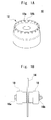
- the cylindrical projection 12 includes grooves 12a having a width of 1 mm and a depth of 0.5 mm so as to form a total of twenty crevice forming parts 12b.
- a crevice forming tool 10 was fixed to both sides of a test piece 14 by a Ti-made bolt 16a and nut 16b, as shown in Fig. 1B. Namely, a total of forty crevices were formed per one test piece. Three test pieces were suspended in a place 1 m below the sea level and dipped therein for one year. After the test was ended, the number of corroded crevices among a total of one hundred and twenty crevices was measured to determine a crevice corrosion generation rate. The result is shown in Table 4.
- the high-nitrogen austenitic stainless steel according to the invention can be used in applications requiring seawater resistance, for example, for marine-related equipment, seashore environmental members, structural members for marine structures, seawater-desalination plant members, seawater heat exchanger members, submarine cables, structural members for submarine structures, mooring ropes, aquaculture fish nets, bridge wires for seashore section, seawater pumps, shafts, fastening members such as bolt, nut and screw, and the like.
- This high-nitrogen austenitic stainless steel can be used also for general high-strength, high-corrosive member such as bolts, nuts, cylinder liners, shafts, hubs, connectors, bearings, races, rails, gears, pins, screws, rolls, turbine blades, molds, dies, drills, valves, valve seats, cutters, nozzles, gaskets, rings, springs, industrial furnace members, chemical plant members, medicine producing members, food producing plant members, food producing device members, oil drilling members, petroleum refining plant members, refuse incinerator members, steam turbine members, gas turbine members, reactor members, aircraft members, biomass plant members, and the like.
- high-corrosive member such as bolts, nuts, cylinder liners, shafts, hubs, connectors, bearings, races, rails, gears, pins, screws, rolls, turbine blades, molds, dies, drills, valves, valve seats, cutters, nozzles, gaskets, rings, springs, industrial furnace members, chemical plant
- steel products reduced in content of Ni are particularly applicable to biological materials and accessories, and can be used, for example, for:
- steel products sufficiently ensuring stability of austenite phase can be used as nonmagnetic, high-strength, and high-corrosive resistance materials for:
Landscapes
- Chemical & Material Sciences (AREA)
- Engineering & Computer Science (AREA)
- Materials Engineering (AREA)
- Mechanical Engineering (AREA)
- Metallurgy (AREA)
- Organic Chemistry (AREA)
- Heat Treatment Of Steel (AREA)
- Dental Preparations (AREA)
Abstract
Description
- The present invention relates to high-nitrogen austenitic stainless steel and, more specifically, high-nitrogen austenitic stainless steel which is excellent in seawater corrosion resistance and strength, and nonmagnetic.
- Austenitic stainless steel is generally excellent in corrosion resistance, but may cause corrosion depending on its using environment. For example, it is known that, when austenitic stainless steel is dipped in a halide aqueous solution, the passive film is broken by a halogen ion such as Cl- or Br-, causing local corrosion (pitting, crevice corrosion). For prevention of such a local corrosion, the following are known to be effective:
- (1) Strengthening of passive film by increasing the amount of Cr
- (2) Reduction of active dissolution by addition of Mo, increase in amount of Ni, or the like
- (3) Addition of N.
- Therefore, for application in seawater or in marine environment, materials described below, for example, have been used, or uses thereof have been examined:
- (1) Austenitic stainless steel improved in corrosion resistance by addition of Cr and/or Mo (e.g., SUS316)
- (2) Duplex stainless steel rich in Cr and Mo which are effective for corrosion resistance and adjusted in components so that the ratio of austenite phase is about 50% (e.g., SUS329J1, SUS329J4L, etc.)
- (3) Austenitic stainless steel largely increased in amounts of Cr and Mo, with Cr (wt%) +3Mo (wt%) +10N (wt%)≥38 (so-called super stainless steel, e.g., SUS836L)
- (4) Ni-based alloy (e.g., Hastelloy-C276, Inconel 625, etc.)
- (5) Ti alloy.
- The super stainless steel is excellent in seawater corrosion resistance, however, it is hard to say that it has sufficient strength. On the other hand, the application of Ni-based alloy and Ti alloy has also been examined for a portion requiring strength and corrosion resistance, however, the Ni-based alloy and Ti alloy are expensive and of excessive quality. Accordingly, development of inexpensive and reliable stainless steel is requested, and various proposals have been conventionally made.
- For example, there is disclosed in Patent Reference 1 (
Japanese Patent Application Laid-Open No. 10-183303 - Further, there is disclosed in Patent Reference 2 (
Japanese Patent Application Laid-Open No. 2000-309857 - Further, there is disclosed in Patent Reference 3 (
Japanese Patent Application Laid-Open No. 2002-235153 -
- [Patent Reference 1]
Japanese Patent Application Laid-Open No. 10-183303 - [Patent Reference 2]
Japanese Patent Application Laid-Open No. 2000-309857 - [Patent Reference 3]
Japanese Patent Application Laid-Open No. 2002-235153 - In the austenitic steel alloy disclosed in Patent Reference 1, 11-12% of Mn is added in order to enhance the nitrogen solbility. However, it is hard to say that adaptation of such a composition with high Mn can provide sufficient corrosion resistance (particularly, pitting resistance) in seawater.
In the stainless steel disclosed in Patent Reference 2, Mn is hardly added, in order to enhance the corrosion resistance in seawater, while Ni is further added. However, in such a component range for perfectly dissolving Cr nitrides which are harmful to seawater corrosion resistance, solution treatment at an extremely high temperature is needed. Solution treatment at a temperature exceeding 1250°C is disadvantageous for actual manufacture of a product in respect of grain coarsening and increase in manufacturing cost. Further, non-dissolved Cr nitrides may be left depending on temperature restrictions on existing solution treatment facilities, and sufficient seawater corrosion resistance cannot be obtained.
On the other hand, the high-strength, high-corrosion resistant nonmagnetic stainless steel disclosed in Patent Reference 3 is improved in corrosion resistance because a large amount of N is included, and the amount of Mn is suppressed; and has properly high strength. Further, this stainless steel can be used also for accessories, biomedical implants and the like, because it is nonmagnetic and safe for human body. However, further improvement in strength and corrosion resistance is demanded for the use in more severe conditions. - An object of the present invention is to provide a high-nitrogen austenitic stainless steel having seawater corrosion resistance as high as that of austenitic super stainless steel and strength as high as that of duplex stainless steel.
Another object of the present invention is to provide a high-nitrogen austenitic stainless steel capable of reducing Cr nitrides which are harmful to corrosion resistance without increasing the manufacturing cost by performing solution treatment in a practical temperature range of from 1050 to 1250°C.
A further object of the present invention is to provide a high-nitrogen austenitic stainless steel having strength equal to or more than that of Ni-based alloy or Ti-based alloy by performing cold working to such a high-nitrogen austenitic stainless steel.
Further, an additional object of the present invention is to provide a high-nitrogen austenitic stainless steel which is nonmagnetic. - In order to overcome the above-mentioned problems, the high-nitrogen austenitic stainless steel according to the present invention comprises:
- 0.005 mass%≤C≤0.25 mass%;
- 15.0 mass%≤Cr≤35.0 mass%;
- 0.2 mass%<Mn<10.0 mass%;
- 0.05 mass%≤Mo≤8.0 mass%;
- 0.01 mass%≤Cu≤4.0 mass%;
- 0.01 mass%≤Ni≤5.0 mass%;
- 0.8 mass%≤N≤1.8 mass%;
- Si≤2.0 mass%;
- P≤0.03 mass%;
- S≤0.05 mass%;
- Al≤0.030 mass%;
- 0≤0.020 mass%; and
- PRE represented by the equation (1) and of not less than 5,

- CRE represented by the equation (2) and of not less than 27,

- When the content of each component element is optimized so that the PRE and the CRE are within predetermined ranges, high strength can be obtained in addition to improvement in seawater corrosion resistance. The optimization of the content of each component element enables dissolution of Cr nitrides with diameter of not less than 2 µm by the solution treatment of 1050 to 1250°C. When the content of each component is optimized so that the index of stability of austenite phase: Nieq-Creq is not less than 0, high-nitrogen austenitic stainless steel which is nonmagnetic even after strong cold working can be obtained. Further, when the high-nitrogen austenitic stainless steel having such a component is subjected to cold working, high strength equal to or more than that of Ni-based alloy or Ti-based alloy can be obtained.
-
- Fig. 1A is a view schematically showing a crevice forming tool; and
- Fig. 1B is a view schematically showing a test piece with the crevice forming tool fixed thereto.
- One embodiment of the present invention will be then described in detail.
The high-nitrogen austenitic stainless steel according to the present invention includes elements described below, and the balance substantially containing Fe and inevitable impurities. The kinds and component ranges of additive elements and the limitation reasons thereof are as follows.
In this specification, "mass%" means "mass percent," which is defined by the equation (A):
Further, "MPa" is a unit, and 1 MPa equals to 1 × 10⁶ N/m2.[KK2] - (1) 0.005 mass%≤C≤0.25 mass%
C is an austenite forming element, which is contributable to stabilization of austenite phase and effective for suppression of nitrogen blow. It also contributes to improvement in strength because it is an interstitial element. On the other hand, addition of C exceeding 0 .25 mass% reduces the [KK3] solubility of N, and also reduces dissolved-Cr in a base phase by formation of Cr carbides, causing deterioration of corrosion resistance. Therefore, the addition amount of C is set preferably to from not less than 0.005 mass% to not more than 0.25 mass%, more preferably to from not less than 0.005 mass% to not more than 0.20 mass%, and even more preferably to from not less than 0.01 mass% to not more than 0.15 mass%. - (2) 15.0 mass%≤Cr≤35.0 mass%
Cr remarkably increases the solubility of N, thus, it is not only effective for suppression of nitrogen blow but also largely contributable to improvement in corrosion resistance and strength. Namely, Cr is an important element. Cr is a ferrite forming element, therefore, excessive addition thereof makes austenite phase unstable, so that nonmagnetic property cannot be kept. Further, the residual amount of non-dissolved Cr nitrides in solution treatment is increased, causing remarkable reduction in corrosion resistance. Further, precipitation of σ-phase which causes deterioration of toughness and ductility is promoted. Therefore, the addition amount of Cr is set preferably to from not less than 15.0 mass% to not more than 35.0 mass%, more preferably to from more than 21.0 mass% to not more than 32.0 mass%, and even more preferably to from more than 24.0 mass% to not more than 30.0 mass%. - (3) 0.2 mass%<Mn<10.0 mass%
Mn is an austenite forming element, which contributes to stabilization of austenite phase. It remarkably increases the solubility of N, therefore, it is effective for suppression of nitrogen blow. Further, it reduces the temperature at which below-mentioned Cr nitride dissolves[KK4]. It is effective also as a deoxidizing or desulfurizing element. On the other hand, excessive addition of Mn causes deterioration of pitting resistance. Therefore, the addition amount of Mn is set preferably to from more than 0.2 mass% to less than 10.0 mass%, more preferably to from more than 0.2 mass% to not more than 8.0 mass%, and even more preferably to from not less than 2.0 mass% to not more than 7.0 mass%. - (4) 0.05 mass%≤Mo≤8.0 mass%
Mo increases the solubility of N and remarkably improves corrosion resistance. It also improves strength as a solid-solution strengthening element. On the other hand, excessive addition of Mo makes austenite phase unstable, inducing N blow, and also makes it difficult to ensure the nonmagnetic property. Further, the excessive addition causes formation of a brittle phase and it causes reduction in toughness and ductility, these are also detrimental to forging. Further, the amount of non-dissolved Cr nitrides in solution treatment is increased, causing remarkable reduction in corrosion resistance. Therefore, the addition amount of Mo is set preferably to from not less than 0.05 mass% to not more than 8.0 mass%, more preferably to from not less than 0.05 mass% to not more than 2.5 mass%, and even more preferably to from not less than 0.10 mass% to less than 2.5 mass%. - (5) 0.01 mass%≤Cu≤4.0 mass%
Cu is an austenite forming element, which contributes to stabilization of austenite phase. It also contributes to improvement in crevice corrosion resistance. On the other hand, excessive addition of Cu increases the amount of non-dissolved Cr nitrides in solution treatment, causing deterioration of corrosion resistance and reduction in hot workability. Therefore, the addition amount of Cu is set preferably to from not less than 0.01 mass% to not more than 4.0 mass%, more preferably to from not less than 0.02 mass% to not more than 2.0 mass%, and even more preferably to from not less than 0.05 mass% to not more than 1.5 mass%. - (6) 0.01 mass%≤Ni<5.0 mass%
Ni is an austenite forming element, which contributes to stabilization of austenite phase. On the other hand, excessive addition of Ni increases the amount of non-dissolved Cr nitrides in solution treatment, causing deterioration of corrosion resistance. Therefore, the addition amount of Ni is set preferably to from not less than 0.01 mass% to less than 5.0 mass%, more preferably to from not less than 0.01 mass% to less than 3.0 mass%, and even more preferably to from more than 0.5 mass% to less than 3.0 mass%. - (7) 0.8 mass%≤N≤1.8 mass%
N is one of the most important elements in the present invention. N is an interstitial element, which is very effective for improvement in strength, for stabilization of austenite phase, and for improvement in corrosion resistance. On the other hand, excessive addition of N induces generation of N blow and also makes a large amount of non-dissolved Cr nitrides or large amounts of Ti, Nb, and V nitrides remain in steel in solution treatment, causing remarkable reduction in corrosion resistance. Therefore, the addition amount of N is set preferably to from more than 0.8 mass% to not more than 1.8 mass%, and more preferably to from more than 0.8 mass% to not more than 1.5 mass%. - (8) Si≤2.0 mass%
Although Al is more effective than Si as a deoxidizing element for general steel, excessive addition of Al in high-nitrogen steel causes formation of AlN which leads to remarkable reduction in corrosion resistance, toughness and ductility. Therefore, as an main deoxidizing element, it is preferable to use Si with an essential element Mn. Since Si is a ferrite forming element, excessive addition thereof makes austenite phase unstable, inducing N blow, and also makes it difficult to ensure the nonmagnetic property. Further, the excessive addition is not only detrimental to forging, but also it remarkably deteriorates the toughness and ductility of steel. The residual amount of non-dissolved Cr nitrides after solution treatment is also increased, causing remarkable reduction in corrosion resistance. Therefore, the addition amount of Si is set preferably to not more than 2.0 mass%, more preferably to from not less than 0.01 mass% to not more than 1.0 mass%, and even more preferably to from not less than 0.01 mass% to not more than 0.50 mass%. - (9) P≤0.03 mass%
Excessive addition of P causes reduction in hot workability, grain boundary strength, toughness and ductility, while excessive reduction of P causes a rise of manufacturing cost. Therefore, the content of P is preferably set to not more than 0.03 mass%.
(10) S≤0.05 mass%
Although S is effective for improvement in machinability, excessive addition thereof causes reduction in hot workability and causes deterioration of corrosion resistance by formation of MnS. On the other hand, excessive reduction of S causes a rise of manufacturing cost. Therefore, the content of S is set preferably to not more than 0.05 mass%, and more preferably to not more than 0.01 mass%. - (11) Al≤0.030 mass%
Al is very effective as a deoxidizing element similarly to Si and Mn. In this steel, however, if the addition amount of Al is more than 0.03 mass%, formation of AlN progresses, causing remarkable reduction in corrosion resistance, toughness and ductility. Therefore, the addition amount of Al is set preferably to not more than 0.030 mass%, more preferably to not more than 0.025 mass%, and even more preferably to not more than 0.020 mass%.
(12) 0≤0.020 mass%
Addition of O exceeding 0.020 mass% reduces the cleanliness of steel, causing remarkable deterioration of corrosion resistance. Therefore, the content of 0 is set preferably to not more than 0.020 mass%, more preferably to not more than 0.015 mass%, and even more preferably to not more than 0.010 mass%. - The high-nitrogen austenitic stainless steel according to the present invention is characterized in that PRE is not less than 5 and CRE is not less than 27, in addition to that various additive elements are within the above-mentioned ranges.
The "PRE" means a pitting resistance equivalent[KK5], which is a value represented by the following equation (1). In the equation (1), N, Cr and Mo are used as elements which improve the pitting resistance and Mn is used as element which deteriorates the pitting resistance.
When the PRE is not less than 5, a pitting resistance equal to or more than that of super stainless steel (e.g., SUS836L) is obtained. The PRE is more preferably not less than 7.
The "CRE" means a crevice corrosion resistance equivalent[KK6], which is a value represented by the following equation (2). In the equation (2), Cr, Mo, N and Cu are used as elements which reduce a critical pH.
When the CRE is not less than 27, a crevice corrosion resistance equal to or more than that of super stainless steel (e.g., SUS836L) is obtained. The CRE is preferably not less than 30. - The high-nitrogen austenitic stainless steel according to the present invention may contain, further, one or more second additive elements as described below, in addition to the various elements described above. The component range of each element and the limitation reason thereof are as follows.
(13) 0.01 mass%≤W≤8.0 mass%
W contributes to improvement in corrosion resistance similarly to Mo, and also contributes to improvement in strength as a solid-solution strengthening element. On the other hand, excessive addition of W causes reduction in toughness and ductility by formation of a brittle phase similarly to Mo, and is also detrimental to forging. The amount of non-dissolved Cr nitrides in solution treatment is also increased, causing remarkable reduction in corrosion resistance. Therefore, the addition amount of W is set preferably to from not less than 0.01 mass% to not more than 8.0 mass%, and more preferably to from not less than 0.05 mass% to not more than 1.5 mass%.
(14) 0.01 mass%≤Co≤5.0 mass%
Co contributes to improvement in corrosion resistance and to improvement in strength. On the other hand, excessive addition of Co leads to rise of cost, and it increases the amount of non-dissolved Cr nitrides in solution treatment, causing remarkable reduction in corrosion resistance. Therefore, the addition amount of Co is set preferably to from not less than 0.01 mass% to not more than 5.0 mass%, more preferably to from not less than 0.05 mass% to not more than 4.5 mass%, and even more preferably to from not less than 0.1 mass% to not more than 4.0 mass%. - The high-nitrogen austenitic stainless steel according to the present invention may further contain one or more third additive elements as described below, in addition to the above-mentioned various elements or instead of the above-mentioned second additive elements. The component range of each element and the limitation reason thereof are as follows.
(15) 0.01 mass%≤Ti≤0.5 mass%
Ti bonds to C and/or N to contribute to improvement in strength and to grain refining. On the other hand, excessive addition of Ti makes large amounts of oxides and/or nitrides remain in steel, causing reduction in corrosion resistance. It also reduces the effective amount of dissolved N, causing reduction in strength. Therefore, the addition amount of Ti is set preferably to from not less than 0.01 mass% to not more than 0.5 mass%, more preferably to from not less than 0.02 mass% to not more than 0.4 mass%, and even more preferably to from not less than 0.03 mass% to not more than 0.3 mass%. - (16) 0.01 mass%≤Nb≤0.5 mass%
Nb bonds to C and/or N similarly to Ti to contribute to improvement in strength and to grain refining. On the other hand, excessive addition of Nb makes large amounts of oxides and/or nitrides remain in steel, causing reduction in corrosion resistance. It also reduces the effective amount of dissolved N, causing reduction in strength. Therefore, the addition amount of Nb is set preferably to from not less than 0.01 mass% to not more than 0.5 mass%, more preferably to from not less than 0.02 mass% to not more than 0.4 mass%, and even more preferably to from not less than 0.03 mass% to not more than 0.3 mass%. - (17) 0.01 mass%≤V<1.0 mass%
V bonds to C and/or N similarly to Ti and Nb to contribute to improvement in strength and to grain refining. On the other hand, excessive addition of V makes large amounts of oxides and/or nitrides remain in steel, causing reduction in corrosion resistance. It also reduces the effective amount of dissolved N, causing reduction in strength. Therefore, the addition amount of V is set preferably to from not less than 0.01 mass% to less than 1.0 mass%, more preferably to from not less than 0.02 mass% to not more than 0.9 mass%, and even more preferably to from not less than 0.03 mass% to not more than 0.8 mass%. - (18) 0.01 mass%≤Ta≤0.5 mass%
Ta bonds to C and/or N similarly to Ti, Nb and V to contribute to improvement in strength and to grain refining. On the other hand, excessive addition of Ta makes large amounts of oxides and/or nitrides remain in steel, causing reduction in corrosion resistance. It also reduces the effective amount of dissolved N, causing reduction in strength. Therefore, the addition amount of Ta is set preferably to from not less than 0.01 mass% to not more than 0.5 mass%, more preferably to from not less than 0.02 mass% to not more than 0 .4 mass%, and even more preferably to from not less than 0.03 mass% to not more than 0.3 mass%. - (19) 0.01 mass%≤Zr≤0.5 mass%
Zr contributes to improvement in strength. On the other hand, excessive addition of Zr leads to reduction in toughness and ductility. Therefore, the addition amount of Zr is set preferably to from not less than 0.01 mass% to not more than 0 . 5 mass%, more preferably to from not less than 0.03 mass% to not more than 0.4 mass%, and even more preferably to from not less than 0.05 mass% to not more than 0.3 mass%. - The high-nitrogen austenitic stainless steel according to the present invention may further contain one or more fourth additive elements as described below, in addition to the above-mentioned various elements or instead of the above-mentioned second and/or third additive elements. The component range of each element and the limitation reason thereof are as follows.
(20) 0.001 mass%≤B≤0.01 mass%
B is effective for improvement in strength and for improvement in hot workability. On the other hand, excessive addition of B rather impairs the hot workability, and deteriorates corrosion resistance. Therefore, the addition amount of B is set preferably to from not less than 0.001 mass% to not more than 0.01 mass%, more preferably to from not less than 0.001 mass% to not more than 0.008 mass%, and even more preferably to from not less than 0.001 mass% to not more than 0.005 mass%. - (21) 0.001 mass%≤Ca≤0.01 mass%
(22) 0.001 mass%≤Mg≤0.01 mass%
Ca and Mg are effective for improving hot workability. Ca is also effective for improving machinability. On the other hand, excessive addition of Ca and Mg rather impairs the hot workability. Therefore, the addition amounts of Ca and Mg are set, respectively, preferably to not less than 0.001 mass% to not more than 0.01 mass%, more preferably to from not less than 0.001 mass% to not more than 0.008 mass%, and even more preferably to from not less than 0.001 mass% to not more than 0.005 mass%. - The high-nitrogen austenitic stainless steel according to the present invention may further contain one or more fifth additive elements as described below, in addition to the above-mentioned various elements, or instead of the above-mentioned second, third and/or fourth additive elements. The component range of each element and the limitation reason thereof are as follows. (23) 0.005 mass%≤Te≤0.05 mass%
Te contributes to improvement in machinability. On the other hand, excessive addition of Te deteriorates corrosion resistance, toughness, ductility, and hot workability. Therefore, the addition amount of Te is set preferably to from not less than 0.005 mass% to not more than 0.05 mass%, and more preferably to from not less than 0.01 mass% to not more than 0.04 mass%.
(24) 0.01 mass%≤Se≤0.20 mass%
Se contributes to improvement in machinability. On the other hand, excessive addition of Se deteriorates corrosion resistance, toughness, ductility, and hot workability. Therefore, the addition amount of Se is set preferably to from not less than 0.01 mass% to not more than 0.20 mass%, more preferably to from not less than 0.02 mass% to not more than 0.18 mass%, and even more preferably to from not less than 0.05 mass% to not more than 0.15 mass%. - In the high-nitrogen austenitic stainless steel according to the present invention, it is desirable that Nieq-Creq is not less than 0 in addition that the additive elements are within the above-mentioned ranges.
The "Nieq-Creq" means an index of stability of austenite phase, which is represented by using contents of main austenite forming elements and contents of main ferrite forming elements. The "Nieq" and the "Creq" mean values represented by the following equations, respectively.
Nieq = Ni+Co+0.5Mn+0.3Cu+25N+30C
Creq= Cr+2Si+1.5Mo+5V+5.5A1+1.75Nb+1.5Ti+0.75W.
When the Nieq-Creq is not less than 0, the austenite phase can be stably kept even after strong cold working. - Further, it is preferable that the high-nitrogen austenitic stainless steel according to the present invention has, particularly, a composition which can make the diameter of Cr nitrides to not more than 2 µm by solution treatment of 1050 to 1250°C among the above-mentioned compositions.
The high-nitrogen austenitic stainless steel according to the present invention is subjected, after forging or rolling, to solution treatment for 0.1 to 2 hours at such a heat treatment temperature as to be suitable for the composition of steel for the purpose of ensuring corrosion resistance. The solution treatment is carried out in order to dissolve Cr nitrides and to uniform microstructure. In this case, extinguishment of Cr nitrides with diameter exceeding 2 µm cannot always be attained in steel having any composition by performing solution treatment at a fixed temperature. Therefore, it is necessary to select an optimum solution treatment temperature according to the composition of the steel.
When the solution treatment temperature is excessively low, non-dissolved Cr nitrides with diameter exceeding 2 µm are generally left after solution treatment. Rough Cr nitrides cause reduction in seawater corrosion resistance. On the other hand, an excessively high solution-treatment temperature causes grain coarsening and/or increase in facility cost.
In order to suppress the grain coarsening and/or the increase in facility cost while ensuring excellent seawater corrosion resistance, among the above-mentioned compositions, a composition which can make the diameter of non-dissolved Cr nitrides to not more than 2 µm by solution treatment of 1050 to 1250°C is particularly preferred. - The effect of the high-nitrogen austenitic stainless steel according to the present invention will be then described.
The high-nitrogen austenitic stainless steel of the present invention is such that a large amount of N is dissolved to make elements such as Cr, Mn, Mo, Ni, Cu and the like to be proper, and the content of each component element is optimized so that the pitting resistance equivalent PRE and the crevice corrosion resistance equivalent CRE are within predetermined ranges. Therefore, seawater corrosion resistance as high as that of austenitic super stainless steel and high strength equivalent to that of duplex stainless steel are obtained.
When the addition amount of each component element is optimized, rough Cr nitrides harmful to corrosion resistance can be reduced by solution treatment in a practical temperature range of 1050 to 1250°C. Since the solution treatment can be performed at a relatively low temperature, increase in manufacturing cost can be suppressed.
When the content of each component element is optimized so that the index of stability of austenite phase: Nieq-Creq is not less than 0, the austenite phase can be stably kept even after strong cold working. Therefore, high-nitrogen austenitic stainless steel which is nonmagnetic can be obtained. - Further, when the content of each component element is optimized, and Cr nitrides with diameter of 2 µm or more are dissolved by solution treatment of 1050 to 1250 °C, the tensile strength after solution treatment becomes 1000 MPa or more by solid-solution strengthening of N.
When the content of each component element is optimized, Cr nitrides with diameter of 2 µm or more are dissolved by solution treatment of 1050 to 1250°C, and cold working is performed, then the tensile strength after solution treatment and cold working is increased by solid-solution strengthening and work hardening by N, and high strength equivalent to or more than that of Ni-based alloy or Ti-based alloy can be obtained. Further, the strength after cold working rises in accordance with a reduction ratio. Therefore, if the cold working condition is optimized, the tensile strength after solution treatment and cold working becomes 1800 MPa or more.
Further, when the content of each component element is optimized, Cr nitrides with diameter of 2 µm or more are dissolved by solution treatment of 1050 to 1250°C, and the cold working condition is optimized, then the tensile strength after solution treatment and cold working becomes 2000 MPa or more by solid-solution strengthening and work hardening by N. Even in such a high strength state, an elongation of not less than 10% can be ensured. - [Examples 1 to 18 and Comparative Examples 1 to 23] [1. Preparation of Samples]
Each of alloys having chemical components shown in Tables 1 and 2 was melted and cast in a pressurized induction furnace, whereby 50 kg of ingot was obtained. The ingot was homogenized, and made to a round bar with φ24 by hot forging. The resulting round bar was subjected to solution treatment. As the solution treatment condition, the bar was held at 1050 to 1300°C for 1 hour, and then cooled with water.
The same test was carried out with respect to super stainless steel: SUS836L (Comparative Example 14), duplex stainless steel: SUS329J4L (Comparative Example 15), austenitic stainless steel: SUS316 (Comparative Example 16), Ni-based alloy: Inconel 625 (Comparative Example 17), and Ti (Comparative Example 18) as representatives of existing steel products. The heat treatment was performed in a generally adapted temperature condition. -

-

- [2.Evaluation (1)]
The resulting ingots and round bars were evaluated as follows. - (1) Existence of nitrogen blow:
- A test piece was cut out from a bottom portion of each ingot, and visual confirmation of nitrogen blow holes was performed therefor.
- (2) Selection of the solution treatment temperature:
- The round bar after hot forging was subjected to solution treatment at various temperatures, after that, optional five visual fields thereof were observed by an optical microscope at 400-fold. Thereby, the lowest temperature at which the circle-converted diameter of Cr-based nitrides becomes 2 µm or less was determined. This lowest temperature was selected as the solution treatment temperature.
- (3) Tensile strength, critical pitting temperature (CPT) and depassivation pH:
- A test piece was sampled from each round bar heat-treated at the selected solution treatment temperature, and a tensile strength, a critical pitting temperature (CPT) and a depassivation pH thereof were measured.
- The tensile strength was measured in accordance with JIS Z2241. The critical pitting temperature (CPT) was measured in accordance with JIS G0578.
- Further, with respect to the depassivation pH, the test piece was dipped in a 4.9% NaCl aqueous solution the pH of which is adjusted with HCl. A spontaneous potential thereof after the lapse of 24 hours was measured, the pH at the time when the potential transits from the active area to the passive area was determined and taken as the depassivation pH. The depassivation pH is correlative with crevice corrosion resistance, and the crevice corrosion resistance is more excellent as the depassivation pH is smaller.
- The evaluation results of each sample are shown in Table 3.
In Comparative Examples 1, 2 and 9, the CPT was reduced, while the depassivation pH was raised because of excessive O, Al and C. In Comparative Examples 3, 4 and 5, the solution treatment temperature exceeded 1250°C because of excessive Mo, Cr and Ni. In Comparative Example 6, forging crack was caused because of excessive Cu. In Comparative Examples 7 and 8, the CPT was reduced, while the depassivation pH was raised because of excessive Mn and insufficient N. In Comparative Examples 11, 12 and 13, the CPT was reduced, or the depassivation pH was raised because of low PRE or CRE. In Comparative Example 10, N blow was caused in the ingot because of excessive N.
In contrast to this, in Examples 1 to 23, no N blow was caused. The solution treatment temperature was within the range of from 1050 to 1250°C. Further, the tensile strength after solution treatment was 1000 MPa or more in each case, and extremely satisfactory corrosion resistance was shown. The Nieq-Creq was not less than 0 in each case. -

- [3.Evaluation (2)]
With respect to Examples 5, 7, 15 and 16, 50 kg of each ingot was homogenized, and then made into a sheet stock 5 mm in thickness by hot forging and hot rolling. The solution treatment was then performed thereto at a solution treatment temperature selected in Evaluation (1). A test piece was cut out from the resulting sheet stock, and a crevice corrosion dipping test in real seawater for one year was performed. The same test was carried out also with respect to Comparative examples 14, 15, 16 and 18.
A crevice forming tool is shown in Figs. 1A and 1B. Thecrevice forming tool 10 includes acylindrical projection 12 having an outside diameter of 23 mm and an inside diameter of 20.5 mm at the tip thereof, as shown in Fig. 1A. Thecylindrical projection 12 includesgrooves 12a having a width of 1 mm and a depth of 0.5 mm so as to form a total of twentycrevice forming parts 12b. Such acrevice forming tool 10 was fixed to both sides of atest piece 14 by a Ti-madebolt 16a andnut 16b, as shown in Fig. 1B. Namely, a total of forty crevices were formed per one test piece. Three test pieces were suspended in a place 1 m below the sea level and dipped therein for one year. After the test was ended, the number of corroded crevices among a total of one hundred and twenty crevices was measured to determine a crevice corrosion generation rate. The result is shown in Table 4. -
[Table 4] Crevice Corrosion Generation rate (%) Remarks Example 5 0 Example 7 0 Example 15 0 Example 16 0 Comparative example 14 0 SUS836L Comparative example 15 8 SUS329J4L Comparative example 16 62 SUS316 Comparative example 18 0 Ti - In Comparative Examples 15 (corresponding to SUS329J4L) and 16 (corresponding to SUS316), the crevice corrosion generation rates were 8% and 62%, respectively. In Examples 5, 7, 15 and 16, the crevice corrosion generation rate was 0%, and the crevice corrosion resistances were equivalent to those in Comparative Examples 14 (corresponding to SUS836L) and 18 (Ti).
- [4. Evaluation (3)]
For Examples 5, 7 and 15, 50 kg of each ingot was homogenized and made into a wire rod of φ12.5 by hot forging and hot rolling. Then, solution treatment was performed thereto at a solution treatment temperature selected in Evaluation (1). Further, the wire rod was made into a wire rod of φ8.8 by cold working with a reduction ratio of 50%. A test piece was cut out from the resulting wire rod, and a tensile strength and an elongation thereof were measured. The tensile strength and the elongation were measured in accordance with JIS Z2241. The results are shown in Table 5.
As is apparent from Table 5, each of the steel stocks has a tensile strength after cold working of not less than 2000 MPa, and an elongation of not less than 10%. -
[Table 5] Tensile strength after 50%-Cold working (MPa) Elongation after 50%-Cold working (%) Example 5 2235 12.1 Example 7 2254 11.0 Example 15 2273 10.2 - The embodiment of the present invention was described above in detail, but the present invention is never limited to the above-mentioned embodiment, and various modifications can be made within the scope not deviating from the gist of the present invention.
- The high-nitrogen austenitic stainless steel according to the invention can be used in applications requiring seawater resistance, for example, for marine-related equipment, seashore environmental members, structural members for marine structures, seawater-desalination plant members, seawater heat exchanger members, submarine cables, structural members for submarine structures, mooring ropes, aquaculture fish nets, bridge wires for seashore section, seawater pumps, shafts, fastening members such as bolt, nut and screw, and the like.
This high-nitrogen austenitic stainless steel can be used also for general high-strength, high-corrosive member such as bolts, nuts, cylinder liners, shafts, hubs, connectors, bearings, races, rails, gears, pins, screws, rolls, turbine blades, molds, dies, drills, valves, valve seats, cutters, nozzles, gaskets, rings, springs, industrial furnace members, chemical plant members, medicine producing members, food producing plant members, food producing device members, oil drilling members, petroleum refining plant members, refuse incinerator members, steam turbine members, gas turbine members, reactor members, aircraft members, biomass plant members, and the like. - Further, steel products reduced in content of Ni are particularly applicable to biological materials and accessories, and can be used, for example, for:
- (1) accessories such as necklaces, pierces or rings, back lids for watches, watch bands, eyeglass frames, interdental brushes and the like, which directly touch human bodies;
- (2) dental materials such as artificial roots and correction wires, which are used within living bodies;
- (3) implant materials such as plates, bolts, nuts, springs, screws, wires, electrodes, artificial bones, and artificial joints;
- (4) medical instruments such as injection needles, knives, surgical knives, scissors, forceps, and drills.
- Further, steel products sufficiently ensuring stability of austenite phase can be used as nonmagnetic, high-strength, and high-corrosive resistance materials for:
- (1) springs, shafts, bearings, races, pins, dies, and rails for precision electronic parts;
- (2) wires and meshes for printed board manufacturing parts;
- (3) biological implant electrodes, MRI parts, and MRI-responding biological implant members; and
- (4) medicine producing members, hanger members, linear motor car members, semiconductor manufacturing device parts, pincettes, bearing, scissors, cutters, and the like.
The high-nitrogen austenitic stainless steel preferably has an index of stability of austenitic phase: Nieq-Creq of not less than 0, wherein
Nieq = Ni+Co+0.5Mn+0.3Cu+25N+30C
Creq = Cr+2Si+1.5Mo+5V+5.5Al+1.75Nb+1.5Ti+0.75W.
Claims (9)
- A high-nitrogen austenitic stainless steel, comprising:0.005 mass%≤C≤0.25 mass%;15.0 mass%≤Cr≤35.0 mass%;0.2 mass%<Mn<10.0 mass%;0.05 mass%≤Mo≤8.0 mass%;0.01 mass%≤Cu≤4.0 mass%;0.01 mass%≤Ni≤5.0 mass%;0.8 mass%<N≤1.8 mass%;Si≤2.0 mass%;P≤0.03 mass%;S≤0.05 mass%;Al≤0.030 mass%;O≤0.020 mass%, andhaving:PRE represented by an equation (1) and of not less than 5,
 CRE represented by an equation (2) and of not less than 27,further optionally containing one or more elements selected from the group consisting of:
 at least one of:0.01 mass%≤W≤8.0 mass%; and0.01 mass%≤Co≤5.0 mass%;at least one of:0.01 mass%≤Ti≤0.5 mass%;0.01 mass%≤Nb≤0.5 mass%;0.01 mass%≤V≤1.0 mass%;0.01 mass%≤Ta≤0.5 mass%; and0.01 mass%≤Zr≤0.5 mass%;at least one of:0.001 mass%≤B≤0.01 mass%;0.001 mass%≤Ca≤0.01 mass%; and0.001 mass%≤Mg≤0.01 mass%;at least one of:the balance substantially containing Fe and impurities.0.005 mass%≤Te≤0.05 mass%; and0.01 mass%≤Se≤0.20 mass%; and
 - The high-nitrogen austenitic stainless steel according to claim 1, wherein an index of stability of austenite phase: Nieq-Creq is not less than 0, whereinNieq = Ni+Co+0.5Mn+0.3Cu+25N+30CCreq = Cr+2Si+1.5Mo+5V+5.5A1+1.75Nb+1.5Ti+0.75W.
- The high-nitrogen austenitic stainless steel according to claim 1 or 2, wherein tensile strength in a solution-treated state is not less than 1000 MPa.
- The high-nitrogen austenitic stainless steel according to claim 1 or 2, wherein tensile strength after solution treatment and cold working is not less than 1800 MPa.
- The high-nitrogen austenitic stainless steel according to claim 1 or 2, wherein tensile strength after solution treatment and cold working is not less than 2000 MPa, and elongation is not less than 10%.
- The high-nitrogen austenitic stainless steel according to claim 3, wherein tensile strength after solution treatment and cold working is not less than 1800 MPa.
- The high-nitrogen austenitic stainless steel according to claim 3, wherein tensile strength after solution treatment and cold working is not less than 2000 MPa, and elongation is not less than 10%.
- The high-nitrogen austenitic stainless steel according to claim 4, wherein tensile strength after solution treatment and cold working is not less than 2000 MPa, and elongation is not less than 10%.
- The high-nitrogen austenitic stainless steel according to claim 6, wherein tensile strength after solution treatment and cold working is not less than 2000 MPa, and elongation is not less than 10%.
Applications Claiming Priority (2)
| Application Number | Priority Date | Filing Date | Title |
|---|---|---|---|
| JP2005320230 | 2005-11-03 | ||
| JP2006280918A JP4915202B2 (en) | 2005-11-03 | 2006-10-16 | High nitrogen austenitic stainless steel |
Publications (2)
| Publication Number | Publication Date |
|---|---|
| EP1783240A1 true EP1783240A1 (en) | 2007-05-09 |
| EP1783240B1 EP1783240B1 (en) | 2015-04-08 |
Family
ID=37734782
Family Applications (1)
| Application Number | Title | Priority Date | Filing Date |
|---|---|---|---|
| EP06123231.0A Not-in-force EP1783240B1 (en) | 2005-11-03 | 2006-10-31 | High-nitrogen austentic stainless steel |
Country Status (3)
| Country | Link |
|---|---|
| US (1) | US20070098588A1 (en) |
| EP (1) | EP1783240B1 (en) |
| JP (1) | JP4915202B2 (en) |
Cited By (4)
| Publication number | Priority date | Publication date | Assignee | Title |
|---|---|---|---|---|
| EP2728028A1 (en) * | 2012-11-02 | 2014-05-07 | The Swatch Group Research and Development Ltd. | Edelstahllegierung ohne Nickel |
| RU2608251C1 (en) * | 2015-11-18 | 2017-01-17 | Федеральное государственное автономное образовательное учреждение высшего образования "Белгородский государственный национальный исследовательский университет" (НИУ "БелГУ") | Cold-resistant austenitic high-strength steel |
| WO2017058456A1 (en) * | 2015-09-29 | 2017-04-06 | Exxonmobil Research And Engineering Company | Corrosion and cracking resistant high manganese austenitic steels containing passivating elements |
| CN111618668A (en) * | 2020-06-16 | 2020-09-04 | 岳阳凯美特电子特种稀有气体有限公司 | Treatment method for inner wall of steel cylinder filled with high-purity halogen mixed gas and used polishing agent |
Families Citing this family (35)
| Publication number | Priority date | Publication date | Assignee | Title |
|---|---|---|---|---|
| US7837812B2 (en) | 2004-05-21 | 2010-11-23 | Ati Properties, Inc. | Metastable beta-titanium alloys and methods of processing the same by direct aging |
| JP2009142594A (en) * | 2007-12-18 | 2009-07-02 | Adachi Kogyo:Kk | Method for manufacturing finger ring member for scissors formed by metal powder injection molding method |
| JP5217576B2 (en) * | 2008-04-02 | 2013-06-19 | 大同特殊鋼株式会社 | Austenitic stainless steel for heat-resistant parts and heat-resistant parts using the same |
| US9255316B2 (en) | 2010-07-19 | 2016-02-09 | Ati Properties, Inc. | Processing of α+β titanium alloys |
| US8613818B2 (en) | 2010-09-15 | 2013-12-24 | Ati Properties, Inc. | Processing routes for titanium and titanium alloys |
| US10513755B2 (en) | 2010-09-23 | 2019-12-24 | Ati Properties Llc | High strength alpha/beta titanium alloy fasteners and fastener stock |
| EP2644734B1 (en) * | 2010-11-26 | 2018-03-28 | National Institute for Materials Science | Nickel-free stainless steel stent |
| CN102011066A (en) * | 2010-12-14 | 2011-04-13 | 江苏大学 | Creep-resistant and oxidation-resistant austenitic stainless steel |
| JP2014515436A (en) * | 2011-05-26 | 2014-06-30 | ユナイテッド・パイプラインズ・アジア・パシフィック・プライベイト・リミテッド | Austenitic stainless steel |
| US8652400B2 (en) | 2011-06-01 | 2014-02-18 | Ati Properties, Inc. | Thermo-mechanical processing of nickel-base alloys |
| JP5616299B2 (en) * | 2011-08-09 | 2014-10-29 | ガウス株式会社 | Nickel- and manganese-free high N austenitic stainless steel sintering powder for biomedical or medical equipment, and biomedical or medical sintered equipment using the powder |
| CN102962534A (en) * | 2012-11-07 | 2013-03-13 | 韶关市新世科壳型铸造有限公司 | Manufacture method of threading die for processing aluminum bronze thread |
| CN103205656A (en) * | 2013-01-18 | 2013-07-17 | 沈阳航空航天大学 | Leadless super free cutting austenitic stainless steel and manufacturing method thereof |
| US9869003B2 (en) | 2013-02-26 | 2018-01-16 | Ati Properties Llc | Methods for processing alloys |
| US9192981B2 (en) | 2013-03-11 | 2015-11-24 | Ati Properties, Inc. | Thermomechanical processing of high strength non-magnetic corrosion resistant material |
| US9777361B2 (en) | 2013-03-15 | 2017-10-03 | Ati Properties Llc | Thermomechanical processing of alpha-beta titanium alloys |
| US11111552B2 (en) * | 2013-11-12 | 2021-09-07 | Ati Properties Llc | Methods for processing metal alloys |
| WO2015169572A1 (en) * | 2014-05-06 | 2015-11-12 | Nv Bekaert Sa | Aquaculture net with coated steel wires |
| US10094003B2 (en) | 2015-01-12 | 2018-10-09 | Ati Properties Llc | Titanium alloy |
| US10502252B2 (en) | 2015-11-23 | 2019-12-10 | Ati Properties Llc | Processing of alpha-beta titanium alloys |
| JP6631860B2 (en) * | 2016-03-04 | 2020-01-15 | 日立金属株式会社 | Method for producing martensitic stainless steel member, and martensitic stainless steel component and method for producing same |
| EP3249059A1 (en) * | 2016-05-27 | 2017-11-29 | The Swatch Group Research and Development Ltd. | Method for thermal treatment of austenitic steels and austenitic steels thus obtained |
| JP6955890B2 (en) * | 2017-04-19 | 2021-10-27 | 株式会社本山製作所 | Safety valve and nozzles and discs used for it |
| CN109837470B (en) * | 2017-11-29 | 2022-04-01 | 宝钢德盛不锈钢有限公司 | High-strength nitrogen-containing economical austenitic stainless steel and manufacturing method thereof |
| CN108411198A (en) * | 2018-03-28 | 2018-08-17 | 浙江益宏不锈钢有限公司 | A kind of high-performance stainless steel and seamless steel pipe and its manufacturing method |
| WO2021026778A1 (en) * | 2019-08-13 | 2021-02-18 | 采纳科技股份有限公司 | Stainless steel material capable of improving the rigidity and toughness of injection needle |
| CN111270125B (en) * | 2019-12-14 | 2022-01-04 | 张家港广大特材股份有限公司 | Melting control method for boron element content of heat-resistant steel ingot for steam turbine |
| CN111197144A (en) * | 2020-02-21 | 2020-05-26 | 青岛三庆金属有限公司 | High-temperature-resistant stainless steel composition for food heating container |
| CN113249655B (en) * | 2021-05-13 | 2021-09-24 | 北京中科领德健康科技有限公司 | High nitrogen nickel free low manganese antibacterial alloy and preparation method thereof, medical device product |
| CN113528964A (en) * | 2021-07-16 | 2021-10-22 | 浙江青山钢铁有限公司 | Free-cutting high-surface-quality austenitic stainless steel wire and preparation method thereof |
| CN114032461B (en) | 2021-11-04 | 2022-05-27 | 华北理工大学 | High-nitrogen steel with high strength, low yield ratio and high corrosion resistance for marine engineering and preparation method thereof |
| US12188112B2 (en) * | 2021-12-17 | 2025-01-07 | Carpenter Technology Corporation | Articles fabricated from cold-worked and case- hardened essentially co-free stainless steel alloys and methods of fabrication thereof |
| JP7267495B1 (en) * | 2022-11-29 | 2023-05-01 | 株式会社ナカニシ | Turbine rotors, cartridges and medical cutting instruments |
| CN116377335B (en) * | 2023-04-28 | 2025-06-24 | 石钢京诚装备技术有限公司 | A large-size seawater corrosion-resistant high-aluminum steel continuous casting billet and its production method |
| US12344918B2 (en) | 2023-07-12 | 2025-07-01 | Ati Properties Llc | Titanium alloys |
Citations (13)
| Publication number | Priority date | Publication date | Assignee | Title |
|---|---|---|---|---|
| US3904401A (en) * | 1974-03-21 | 1975-09-09 | Carpenter Technology Corp | Corrosion resistant austenitic stainless steel |
| US4116683A (en) * | 1973-04-11 | 1978-09-26 | Institute Po Metaloznanie I Technologia Na Metalite | Nickel-free austenitic corrosion-resistant steel |
| GB2055122A (en) * | 1979-06-27 | 1981-02-25 | Inst Po Metalloznanie I Tekno | Austenitic corrosion-resistant steels |
| WO1991016469A1 (en) * | 1990-04-12 | 1991-10-31 | Carpenter Technology Corporation | Austenitic, non-magnetic, stainless steel alloy and articles made therefrom |
| DE19607828A1 (en) * | 1995-04-15 | 1996-10-17 | Vsg En & Schmiedetechnik Gmbh | High strength austenitic steel |
| CH688862A5 (en) * | 1995-01-03 | 1998-04-30 | Basf Ag | Corrosion-resistant alloy for use as a material for objects used on or in the human body, in particular to avoid nickel allergy. |
| CH688914A5 (en) * | 1995-01-12 | 1998-05-29 | Basf Ag | Stainless steel with very low nickel@ content and homogeneous austenitic structure |
| JPH10183303A (en) * | 1995-04-08 | 1998-07-14 | Vsg Energ & Schmiedetechnik Gmbh | Austenitic steel alloy, method for producing the same, and article using the steel alloy |
| JP2000309857A (en) * | 1999-02-25 | 2000-11-07 | Natl Res Inst For Metals | Stainless steel |
| EP1229142A1 (en) * | 2001-02-05 | 2002-08-07 | Daido Tokushuko Kabushiki Kaisha | High strength, high corrosion-resistant and non-magnetic stainless steel |
| US6682581B1 (en) * | 1999-05-26 | 2004-01-27 | Basf Aktiengesellschaft | Nickel-poor austenitic steel |
| US6682582B1 (en) * | 1999-06-24 | 2004-01-27 | Basf Aktiengesellschaft | Nickel-poor austenitic steel |
| EP1626101A1 (en) * | 2004-08-13 | 2006-02-15 | Daido Tokushuko Kabushiki Kaisha | High-nitrogen austenitic stainless steel |
-
2006
- 2006-10-16 JP JP2006280918A patent/JP4915202B2/en not_active Expired - Fee Related
- 2006-10-30 US US11/589,662 patent/US20070098588A1/en not_active Abandoned
- 2006-10-31 EP EP06123231.0A patent/EP1783240B1/en not_active Not-in-force
Patent Citations (13)
| Publication number | Priority date | Publication date | Assignee | Title |
|---|---|---|---|---|
| US4116683A (en) * | 1973-04-11 | 1978-09-26 | Institute Po Metaloznanie I Technologia Na Metalite | Nickel-free austenitic corrosion-resistant steel |
| US3904401A (en) * | 1974-03-21 | 1975-09-09 | Carpenter Technology Corp | Corrosion resistant austenitic stainless steel |
| GB2055122A (en) * | 1979-06-27 | 1981-02-25 | Inst Po Metalloznanie I Tekno | Austenitic corrosion-resistant steels |
| WO1991016469A1 (en) * | 1990-04-12 | 1991-10-31 | Carpenter Technology Corporation | Austenitic, non-magnetic, stainless steel alloy and articles made therefrom |
| CH688862A5 (en) * | 1995-01-03 | 1998-04-30 | Basf Ag | Corrosion-resistant alloy for use as a material for objects used on or in the human body, in particular to avoid nickel allergy. |
| CH688914A5 (en) * | 1995-01-12 | 1998-05-29 | Basf Ag | Stainless steel with very low nickel@ content and homogeneous austenitic structure |
| JPH10183303A (en) * | 1995-04-08 | 1998-07-14 | Vsg Energ & Schmiedetechnik Gmbh | Austenitic steel alloy, method for producing the same, and article using the steel alloy |
| DE19607828A1 (en) * | 1995-04-15 | 1996-10-17 | Vsg En & Schmiedetechnik Gmbh | High strength austenitic steel |
| JP2000309857A (en) * | 1999-02-25 | 2000-11-07 | Natl Res Inst For Metals | Stainless steel |
| US6682581B1 (en) * | 1999-05-26 | 2004-01-27 | Basf Aktiengesellschaft | Nickel-poor austenitic steel |
| US6682582B1 (en) * | 1999-06-24 | 2004-01-27 | Basf Aktiengesellschaft | Nickel-poor austenitic steel |
| EP1229142A1 (en) * | 2001-02-05 | 2002-08-07 | Daido Tokushuko Kabushiki Kaisha | High strength, high corrosion-resistant and non-magnetic stainless steel |
| EP1626101A1 (en) * | 2004-08-13 | 2006-02-15 | Daido Tokushuko Kabushiki Kaisha | High-nitrogen austenitic stainless steel |
Cited By (8)
| Publication number | Priority date | Publication date | Assignee | Title |
|---|---|---|---|---|
| EP2728028A1 (en) * | 2012-11-02 | 2014-05-07 | The Swatch Group Research and Development Ltd. | Edelstahllegierung ohne Nickel |
| WO2014067795A1 (en) * | 2012-11-02 | 2014-05-08 | The Swatch Group Research And Development Ltd | Nickel-free stainless steel alloy |
| CN104769145A (en) * | 2012-11-02 | 2015-07-08 | 斯沃奇集团研究和开发有限公司 | Nickel-free stainless steel alloy |
| RU2625363C2 (en) * | 2012-11-02 | 2017-07-13 | Те Свотч Груп Рисерч Энд Дивелопмент Лтд | Stainless steel free of nickel |
| WO2017058456A1 (en) * | 2015-09-29 | 2017-04-06 | Exxonmobil Research And Engineering Company | Corrosion and cracking resistant high manganese austenitic steels containing passivating elements |
| CN108026624A (en) * | 2015-09-29 | 2018-05-11 | 埃克森美孚研究工程公司 | Corrosion-resistant and crack-resistant high-manganese austenitic steel containing passivating elements |
| RU2608251C1 (en) * | 2015-11-18 | 2017-01-17 | Федеральное государственное автономное образовательное учреждение высшего образования "Белгородский государственный национальный исследовательский университет" (НИУ "БелГУ") | Cold-resistant austenitic high-strength steel |
| CN111618668A (en) * | 2020-06-16 | 2020-09-04 | 岳阳凯美特电子特种稀有气体有限公司 | Treatment method for inner wall of steel cylinder filled with high-purity halogen mixed gas and used polishing agent |
Also Published As
| Publication number | Publication date |
|---|---|
| EP1783240B1 (en) | 2015-04-08 |
| US20070098588A1 (en) | 2007-05-03 |
| JP2007146287A (en) | 2007-06-14 |
| JP4915202B2 (en) | 2012-04-11 |
Similar Documents
| Publication | Publication Date | Title |
|---|---|---|
| EP1783240B1 (en) | High-nitrogen austentic stainless steel | |
| JP4379804B2 (en) | High nitrogen austenitic stainless steel | |
| Nouri et al. | Stainless steels in orthopedics | |
| JP5217576B2 (en) | Austenitic stainless steel for heat-resistant parts and heat-resistant parts using the same | |
| CA2488965C (en) | Corrosion-resistant austenitic steel alloy | |
| JP4427790B2 (en) | Martensitic stainless steel | |
| KR20050044557A (en) | Super-austenitic stainless steel | |
| EP2060644A1 (en) | Martensitic stainless steel | |
| CN109642291A (en) | Austenitic stainless steel | |
| KR20190065352A (en) | NiCrFe alloy | |
| JP2006274443A (en) | Non-magnetic high hardness alloy | |
| US6756011B2 (en) | High-strength, high corrosion-resistant and non-magnetic stainless steel | |
| JP2005248263A (en) | Martensitic stainless steel | |
| Andersen | Stainless steels | |
| KR20060129244A (en) | Martensitic chromium-nitrogen steel and its use | |
| EA009108B1 (en) | Duplex stainless steel alloy for use in seawater applications | |
| TWI434941B (en) | Steel | |
| CN109689911A (en) | The manufacturing method of case-hardened steel and its manufacturing method and geared parts | |
| JP2008127590A (en) | Austenitic stainless steel | |
| CZ20013225A3 (en) | Stainless steel for critical applications hardenable by precipitation and exhibiting improved mach inability | |
| JP2015147975A (en) | Precipitation hardening stainless steel and component for sensor | |
| JP2023058152A (en) | martensitic stainless steel | |
| JP5035831B2 (en) | High nitrogen austenitic stainless steel | |
| JP2007063658A (en) | Martensitic stainless steel | |
| JP2005298840A (en) | High-strength precipitation-hardening type martensitic stainless steel superior in toughness |
Legal Events
| Date | Code | Title | Description |
|---|---|---|---|
| PUAI | Public reference made under article 153(3) epc to a published international application that has entered the european phase |
Free format text: ORIGINAL CODE: 0009012 |
|
| AK | Designated contracting states |
Kind code of ref document: A1 Designated state(s): AT BE BG CH CY CZ DE DK EE ES FI FR GB GR HU IE IS IT LI LT LU LV MC NL PL PT RO SE SI SK TR |
|
| AX | Request for extension of the european patent |
Extension state: AL BA HR MK YU |
|
| 17P | Request for examination filed |
Effective date: 20071107 |
|
| AKX | Designation fees paid |
Designated state(s): AT DE FR SE |
|
| 17Q | First examination report despatched |
Effective date: 20120702 |
|
| REG | Reference to a national code |
Ref country code: DE Ref legal event code: R079 Ref document number: 602006045010 Country of ref document: DE Free format text: PREVIOUS MAIN CLASS: C22C0038580000 Ipc: C22C0038000000 |
|
| RIC1 | Information provided on ipc code assigned before grant |
Ipc: C22C 38/42 20060101ALI20140929BHEP Ipc: C22C 38/58 20060101ALI20140929BHEP Ipc: C22C 38/52 20060101ALI20140929BHEP Ipc: C22C 38/44 20060101ALI20140929BHEP Ipc: C22C 38/60 20060101ALI20140929BHEP Ipc: C22C 38/00 20060101AFI20140929BHEP Ipc: C22C 38/46 20060101ALI20140929BHEP Ipc: C22C 38/48 20060101ALI20140929BHEP Ipc: C22C 38/02 20060101ALI20140929BHEP |
|
| GRAP | Despatch of communication of intention to grant a patent |
Free format text: ORIGINAL CODE: EPIDOSNIGR1 |
|
| INTG | Intention to grant announced |
Effective date: 20141107 |
|
| RIN1 | Information on inventor provided before grant (corrected) |
Inventor name: SHIMIZU, TETSUYA C/O DAIDO STEEL CO., LTD. Inventor name: HAMANO, SHUJI C/O DAIDO STEEL CO., LTD. Inventor name: NODA, TOSHIHARU C/O DAIDO STEEL CO., LTD. Inventor name: NARITA, SHUJI C/O DAIDO STEEL CO., LTD |
|
| GRAS | Grant fee paid |
Free format text: ORIGINAL CODE: EPIDOSNIGR3 |
|
| GRAA | (expected) grant |
Free format text: ORIGINAL CODE: 0009210 |
|
| AK | Designated contracting states |
Kind code of ref document: B1 Designated state(s): AT DE FR SE |
|
| REG | Reference to a national code |
Ref country code: AT Ref legal event code: REF Ref document number: 720653 Country of ref document: AT Kind code of ref document: T Effective date: 20150515 |
|
| REG | Reference to a national code |
Ref country code: DE Ref legal event code: R096 Ref document number: 602006045010 Country of ref document: DE Effective date: 20150521 |
|
| REG | Reference to a national code |
Ref country code: SE Ref legal event code: TRGR |
|
| REG | Reference to a national code |
Ref country code: DE Ref legal event code: R097 Ref document number: 602006045010 Country of ref document: DE |
|
| PLBE | No opposition filed within time limit |
Free format text: ORIGINAL CODE: 0009261 |
|
| STAA | Information on the status of an ep patent application or granted ep patent |
Free format text: STATUS: NO OPPOSITION FILED WITHIN TIME LIMIT |
|
| 26N | No opposition filed |
Effective date: 20160111 |
|
| REG | Reference to a national code |
Ref country code: FR Ref legal event code: PLFP Year of fee payment: 11 |
|
| PGFP | Annual fee paid to national office [announced via postgrant information from national office to epo] |
Ref country code: FR Payment date: 20160919 Year of fee payment: 11 |
|
| PGFP | Annual fee paid to national office [announced via postgrant information from national office to epo] |
Ref country code: DE Payment date: 20161025 Year of fee payment: 11 |
|
| PGFP | Annual fee paid to national office [announced via postgrant information from national office to epo] |
Ref country code: SE Payment date: 20161011 Year of fee payment: 11 Ref country code: AT Payment date: 20160928 Year of fee payment: 11 |
|
| REG | Reference to a national code |
Ref country code: AT Ref legal event code: UEP Ref document number: 720653 Country of ref document: AT Kind code of ref document: T Effective date: 20150408 |
|
| REG | Reference to a national code |
Ref country code: DE Ref legal event code: R119 Ref document number: 602006045010 Country of ref document: DE |
|
| REG | Reference to a national code |
Ref country code: AT Ref legal event code: MM01 Ref document number: 720653 Country of ref document: AT Kind code of ref document: T Effective date: 20171031 |
|
| REG | Reference to a national code |
Ref country code: SE Ref legal event code: EUG |
|
| REG | Reference to a national code |
Ref country code: FR Ref legal event code: ST Effective date: 20180629 |
|
| PG25 | Lapsed in a contracting state [announced via postgrant information from national office to epo] |
Ref country code: DE Free format text: LAPSE BECAUSE OF NON-PAYMENT OF DUE FEES Effective date: 20180501 |
|
| PG25 | Lapsed in a contracting state [announced via postgrant information from national office to epo] |
Ref country code: FR Free format text: LAPSE BECAUSE OF NON-PAYMENT OF DUE FEES Effective date: 20171031 Ref country code: SE Free format text: LAPSE BECAUSE OF NON-PAYMENT OF DUE FEES Effective date: 20171101 Ref country code: AT Free format text: LAPSE BECAUSE OF NON-PAYMENT OF DUE FEES Effective date: 20171031 |