EP1780950A2 - Systeme und Verfahren zur Arbitration von Mehrfachkommunikationen - Google Patents
Systeme und Verfahren zur Arbitration von Mehrfachkommunikationen Download PDFInfo
- Publication number
- EP1780950A2 EP1780950A2 EP06020723A EP06020723A EP1780950A2 EP 1780950 A2 EP1780950 A2 EP 1780950A2 EP 06020723 A EP06020723 A EP 06020723A EP 06020723 A EP06020723 A EP 06020723A EP 1780950 A2 EP1780950 A2 EP 1780950A2
- Authority
- EP
- European Patent Office
- Prior art keywords
- wireless communications
- communications
- wireless
- determining
- bluetooth
- Prior art date
- Legal status (The legal status is an assumption and is not a legal conclusion. Google has not performed a legal analysis and makes no representation as to the accuracy of the status listed.)
- Withdrawn
Links
- 238000000034 method Methods 0.000 title claims abstract description 23
- 230000005540 biological transmission Effects 0.000 claims abstract description 18
- 238000010586 diagram Methods 0.000 description 7
- 230000006870 function Effects 0.000 description 2
- 238000012913 prioritisation Methods 0.000 description 2
- 210000004556 brain Anatomy 0.000 description 1
- 238000004590 computer program Methods 0.000 description 1
- 230000000694 effects Effects 0.000 description 1
- 230000002452 interceptive effect Effects 0.000 description 1
- 230000003287 optical effect Effects 0.000 description 1
- 230000002093 peripheral effect Effects 0.000 description 1
- 230000005236 sound signal Effects 0.000 description 1
Images


Classifications
-
- H—ELECTRICITY
- H04—ELECTRIC COMMUNICATION TECHNIQUE
- H04L—TRANSMISSION OF DIGITAL INFORMATION, e.g. TELEGRAPHIC COMMUNICATION
- H04L47/00—Traffic control in data switching networks
- H04L47/10—Flow control; Congestion control
-
- H—ELECTRICITY
- H04—ELECTRIC COMMUNICATION TECHNIQUE
- H04L—TRANSMISSION OF DIGITAL INFORMATION, e.g. TELEGRAPHIC COMMUNICATION
- H04L47/00—Traffic control in data switching networks
- H04L47/10—Flow control; Congestion control
- H04L47/24—Traffic characterised by specific attributes, e.g. priority or QoS
- H04L47/2425—Traffic characterised by specific attributes, e.g. priority or QoS for supporting services specification, e.g. SLA
- H04L47/2433—Allocation of priorities to traffic types
-
- H—ELECTRICITY
- H04—ELECTRIC COMMUNICATION TECHNIQUE
- H04W—WIRELESS COMMUNICATION NETWORKS
- H04W28/00—Network traffic management; Network resource management
- H04W28/02—Traffic management, e.g. flow control or congestion control
-
- H—ELECTRICITY
- H04—ELECTRIC COMMUNICATION TECHNIQUE
- H04W—WIRELESS COMMUNICATION NETWORKS
- H04W72/00—Local resource management
- H04W72/50—Allocation or scheduling criteria for wireless resources
- H04W72/56—Allocation or scheduling criteria for wireless resources based on priority criteria
- H04W72/566—Allocation or scheduling criteria for wireless resources based on priority criteria of the information or information source or recipient
- H04W72/569—Allocation or scheduling criteria for wireless resources based on priority criteria of the information or information source or recipient of the traffic information
-
- H—ELECTRICITY
- H04—ELECTRIC COMMUNICATION TECHNIQUE
- H04W—WIRELESS COMMUNICATION NETWORKS
- H04W8/00—Network data management
- H04W8/02—Processing of mobility data, e.g. registration information at HLR [Home Location Register] or VLR [Visitor Location Register]; Transfer of mobility data, e.g. between HLR, VLR or external networks
- H04W8/04—Registration at HLR or HSS [Home Subscriber Server]
-
- H—ELECTRICITY
- H04—ELECTRIC COMMUNICATION TECHNIQUE
- H04W—WIRELESS COMMUNICATION NETWORKS
- H04W88/00—Devices specially adapted for wireless communication networks, e.g. terminals, base stations or access point devices
- H04W88/02—Terminal devices
- H04W88/06—Terminal devices adapted for operation in multiple networks or having at least two operational modes, e.g. multi-mode terminals
Definitions
- Modem computing devices are often configured for wireless communications.
- a notebook computer may be configured to connect to a local area network (LAN) through a wireless connection via an Institute of Electrical and Electronics Engineers (IEEE) 802.11 protocol.
- IEEE Institute of Electrical and Electronics Engineers
- many computing devices are configured to communicate with peripheral devices via wireless communications, for instance using the Bluetooth protocol.
- one or more user interface devices such as a keyboard, mouse, or headset, may wirelessly communicate with the computing device.
- the frequencies over which such wireless communications are transmitted may coincide for two or more components in a given computer system.
- the frequency band used by a wireless network card of the computing device may be the same as, or overlap with, one used by one or more wireless user interface devices.
- interference may occur.
- wireless communications of one component over a particular frequency range may interfere with wireless communications of another component operating over the same or an overlapping frequency range.
- arbitration is performed to separate the communications in time to avoid signal corruption.
- the order and duration of the transmissions of two or more components are controlled to enable all of the components to transmit their data over their respective frequency ranges.
- component transmissions are enabled in an alternating manner so that all or portions of a given frequency range can be shared.
- wireless communications are prioritized according to the packet type used in the transmissions. For instance, "data" packets may be assigned a first priority and media packets may be assigned a second priority.
- the intended reason for assigning different priorities to the transmissions is to ensure that more important data is transmitted more rapidly than less important data. For example, multimedia communications may be given higher priority over data communications to ensure that a multimedia communication, such as streaming video and/or audio, is not interrupted.
- Prioritizing according to packet type can be disadvantageous from the user's perspective, however, given that the importance of the wireless communication to the user may not correlate to the type of packets used to transmit the data. For example, if media is transmitted using "data" packets, such as asynchronous connection-oriented (ACL) packets, the communication may not be accorded the priority that is required to ensure an uninterrupted media transmission. Therefore, if a user were wirelessly downloading a large file over the LAN while concurrently listening to music played by the computer on wireless headphones, it would be possible for the audio transmission to the headphones to be interrupted in favor of more quickly downloading the file over the LAN, which file may be less important to the user. To cite another example, if the user were instead writing a document using a wireless keyboard during the wireless download of the file, unacceptable delay between keystroke entry and appearance of the characters on screen could result.
- ACL asynchronous connection-oriented
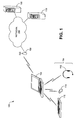
- FIG. 1 is a schematic view of an embodiment of a system with which wireless communication arbitration can be performed.
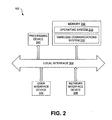
- FIG. 2 is a block diagram of an embodiment of a computing device shown in FIG. 1.
- FIG. 3 is a block diagram of an embodiment of a wireless communications system shown in FIG. 2.
- FIG. 4 is a flow diagram that illustrates a first embodiment of a method arbitrating multiple wireless communications.
- FIG. 5 is a flow diagram that illustrates a second embodiment of a method arbitrating multiple wireless communications.
- prioritizing wireless communications according to packet type can be disadvantageous given that the importance of a wireless communication may not correlate to the type of packets used to transmit the data.
- advantageous results can be obtained by automatically prioritizing the communications based upon the nature of the communications.
- higher-priority communications such as a multimedia stream or user input
- lower-priority communications such as downloading data and/or files from a network.
- communications having lower-latency tolerance can be prioritized over communications having higher-latency tolerance.
- FIG. 1 illustrates an example system 100 in which wireless communication arbitration can be performed.
- the system 100 generally comprises a user computing device 102 and one or more wireless user interface devices 104.
- the computing device 102 can communicate with a network 106, such as a wireless local area network (WLAN) wide area network (WAN) (e.g., the Internet) via wireless communications through a wireless access point (WAP) or base station 108 that is connected to the network.
- WLAN wireless local area network
- WAN wide area network
- WAP wireless access point
- server computers 110 which comprise data available for download to the computing device 102.
- the computing device 102 is a notebook, or "laptop,” computer.
- the computing device 102 need not comprise a notebook computer, such portable computers are often configured for wireless communications, particularly with local area networks (LANs) that incorporate an access point, such as the WAP 108.
- LANs local area networks
- Other examples of computing devices that may be used in the system 100 include, but are not limited to, desktop computers and handheld computers, such personal digital assistants (PDAs), tablets, gaming devices, and mobile telephones.
- the example wireless user interface devices 104 include a wireless keyboard 112, a wireless mouse 114, and a wireless headset 116.
- the wireless headset 116 can be configured to receive and/or transmit audio signals from and to the computing device 102.
- Other example wireless user interface devices may include, but are not limited to, wireless video headsets and wireless stereo headphones.
- Communications between the computing device 102 and the wireless user interface devices 104 may be via any available or yet to be created wireless protocol.
- the Bluetooth (IEEE 802.15) protocol may be used to facilitate communications between the computing device 102 and the wireless user interface devices 104.
- Communications between the computing device 102 and the WAP 108 i.e., LAN communications
- the IEEE 802.11b or 802.11g protocol may be used.
- the WAP may comprise a network communication device, such as digital subscriber line (DSL) or cable modem. Alternatively, a separate network communication device may be used.
- DSL digital subscriber line
- cable modem Alternatively, a separate network communication device may be used.
- FIG. 2 is a block diagram illustrating an example architecture for the computing device 102 shown in FIG. 1.
- the computing device 102 comprises a processing device 200, memory 202, at least one user interface device 204, and at least one network interface device 206. Each of those components is connected to a local interface 208, such as an internal bus.
- the "wireless communications system” can be considered as comprising the software of the system 212 as well as portions of the user network interface 204 and the network interface device 208.
- the processing device 200 is adapted to execute commands stored in memory 202 and can comprise a general-purpose processor such as a microprocessor, one or more application-specific integrated circuits (ASICs), a plurality of suitably-configured digital logic gates, or other components comprised of discrete devices that coordinate the overall operation of the computing device 102.
- the memory 202 comprises any one or a combination of volatile memory elements (e.g., random access memory (RAM)) and nonvolatile memory elements (e.g., read-only memory (ROM), Flash memory, hard disk, etc.).
- the one or more user interface devices 204 comprise the components that enable communication with the user, and more particularly, with the wireless user interface devices 104 (FIG. 1).
- the user interface devices 204 comprise one or more wireless device cards that are configured to wirelessly communicate with the wireless user interface devices 104, for instance, over radio frequency (RF).
- RF radio frequency
- the one or more network interface devices 206 facilitate communications between the computing device 102 and the WAP 108 (FIG. 1). These devices 206 can comprise a wireless network card that communicates over a wireless frequency (e.g., RF).
- a wireless frequency e.g., RF
- the memory 202 includes various programs including an operating system 210 and the wireless communications system 212 that generally controls wireless communications involving the computing device and, more particularly, arbitrates over interfering wireless communications of two more wireless components.
- the configuration and operation of the wireless communications system 212 is discussed in greater detail in relation to FIGS. 3 -5 below.
- a computer-readable medium is an electronic, magnetic, optical, or other physical device or means that contains or stores a computer program for use by or in connection with a computer-related system or method.
- These programs can be embodied in any computer-readable medium for use by or in connection with an instruction execution system, apparatus, or device, such as a computer-based system, processor-containing system, or other system that can fetch the instructions from the instruction execution system, apparatus, or device and execute the instructions.
- the example system 212 is configured for both Bluetooth and IEEE 802.11 communications.
- the example system 212 includes a Bluetooth system that comprises a Bluetooth protocol stack 300.
- the Bluetooth protocol stack comprises the high-level software used in Bluetooth-based communications, such as communications between the computing device 102 and the wireless user interface devices 104 (FIG. 1).
- the Bluetooth protocol stack 300 enables wireless devices to locate each other and establish a connection through which the devices can exchange data and interact with one another through various applications.
- a host command interface (HCI) 302 a layer of software and, associated hardware, that acts as an interface between the stack and a Bluetooth link manager 304.
- the Bluetooth link manager 304 comprises the low-level software, and associated hardware, that acts as a controller over Bluetooth-based communications of the computing device 102.
- the link manager 304 carries out link setup, authentication, link configuration and other protocols.
- the link manager 304 further discovers other remote link managers and communicates with them via a link manager protocol (LMP).
- LMP comprises a number of protocol data units (PDUs), which are sent from one device to another.
- the wireless communications system 212 also includes an 802.11 media access controller (MAC) 306 that controls IEEE 802.11 communications of the computing device 102.
- MAC media access controller
- the MAC 306 manages and maintains communications between 802.11 stations (e.g., network cards and wireless access points) by coordinating access to a shared radio channel, and utilizes protocols that enhance communications over a wireless medium.
- the MAC 306 can be considered the "brains" behind 802.11 communications as the MAC uses an 802.11 physical (PHY) layer to perform the tasks of carrier sensing, transmission, and reception of 802.11 frames.
- PHY physical
- communications control logic 308 In communication with both the Bluetooth link manager 304 and the 802.11 MAC 306 is communications control logic 308 that is used to control arbitration of wireless communications via Bluetooth and 802.11.
- the communications control logic 308 comprises software and hardware that controls wireless communications in accordance with IEEE 802.115.2 Clause 5.
- arbitration according to that standard involves assigning priority to wireless communications in accordance with the packet type used to transmit data of the communications.
- the wireless communications system 212 includes an arbitration control manager 310 that controls the system such that priority is instead assigned based upon the nature of the communications.
- the arbitration control manager 310 is associated with the Bluetooth protocol stack 300. With such a configuration, control over communication prioritization can be achieved through commands sent by the arbitration control manager 310 to the communications control logic 308, for instance via the Bluetooth protocol stack 300.
- the nature of one or more applications 312 can be determined by the arbitration control manager 310, which then provides commands to the Bluetooth protocol stack 300, which are then routed, via the HCI 302, to the Bluetooth link manager 304, and then to the communications control logic 308.
- the applications 312 can comprise any form of wireless communications.
- the "applications" 312 may comprise an actual software application (e.g., a wireless audio player) that controls or is associated with a given wireless communication or may comprise an application of a particular wireless application or a wireless use scenario (e.g., communication of wireless audio).
- the packet type-based arbitration normally performed by the communications control logic 308 can, in essence, be overridden to ensure that lower latency-tolerant communications are prioritized over higher latency-tolerant communications, irrespective of the packet types that are used.
- the arbitration control manager 310 is shown as communicating with the Bluetooth protocol stack 300, the manager could instead or in addition communicate with an 802.11 device driver associated with the 802.11 MAC to similarly control the communications control logic 308. Furthermore, the arbitration control manager 310 can be integrated, in whole or in part, into one or more of the Bluetooth protocol stack 300, the 802.11 MAC device driver, or the communications control logic 308. In some embodiments, the arbitration control manager software can be distributed within the wireless communications system 212. The actual location of the arbitration control manager 310 is, however, secondary to the functionality it provides.
- FIG. 4 illustrates an example method embodiment for automatically arbitrating wireless communications that provides an overview of operation of an arbitration control manager 310.
- the manager 310 determines the nature of one or more wireless communications. In some cases, there may be multiple wireless communications that are occurring and/or are about to occur. In terms of "nature,” at issue is the type of the communication in terms of the information that is being transmitted in the communication.
- Types of information may comprise "data” being downloaded to the computing device from a given source (e.g., LAN), such as files, Web pages, email messages, and the like.
- Another type of information includes “media” that is being transmitted to or from the computing device, such as audio and/or video data.
- a further type of information includes "user inputs", such as keystrokes, mouse movements and clicks, user speech input, and so forth.
- examples include communications between the computing device and a WAP, or between the computing device and one or more user interface devices, such as a wireless keyboard, wireless mouse, wireless audio headset, wireless video headset (e.g., head-worn display), wireless stereo headphones, etc.
- the nature of the wireless communications is determined from the implicated applications. Again, these applications may comprise actual software applications that are used in the wireless communications, or may comprise use scenarios that are recognized by the arbitration control manager 310.
- the arbitration control manager 310 determines the priorities of the wireless communications relative to the determined nature, as is indicated in block 402.
- the priorities can be assigned according to a default setting that associates a given priority to the various different types of wireless communications. For example, data communications may be assigned a first priority, media communications may be assigned a second priority, and user inputs may be assigned a third priority. These priorities may all be different, or one or more of the priorities may be the same. Moreover, certain kinds of communications within each type may be assigned different priorities. For example, video media communications may be assigned a different priority than audio media communications.
- the priorities may be user-selectable, for instance through use of a user interface associated with the arbitration control manager 310.
- the priorities may affect one or more of the timing of the transmissions and their duration. For example, a high priority may be associated with longer and/or more frequent transmissions such that high-priority transmissions may use a given frequency range the majority of a given time period during which multiple, overlapping wireless communications take place. For instance, media communications and/or user input communications may dominate over data communications. Notably, the actual timing and duration associated with any given priority level may be selected, either as a default or by the user, to suit the particular use scenario that is at issue.
- the arbitration control manager 310 sends a command to the communications control logic 308 (FIG. 3) to control communication priority according to the priority determined in block 402.
- a command may be routed to the communications control logic 308 via a Bluetooth, IEEE 802.11, or other system, depending upon the particular configuration that is implemented.
- the logic arbitrates the wireless communications in accordance with the priorities specified in the command.
- FIG. 5 describes a further method embodiment for automatically arbitrating wireless communications.
- arbitration of both Bluetooth and IEEE 802.11 communications is controlled using the Bluetooth system. This improvement is consistent with current collaborative systems in which Bluetooth hardware is used to control transmissions for computing devices that are enabled for both IEEE 802.11 and Bluetooth communications. In this solution, priority is determined through reference to an operating Bluetooth protocol of one or more communications.
- the arbitration control manager 310 determines the operating Bluetooth profile for one or more wireless communications.
- each Bluetooth communication is assigned such a profile that indicates the nature of the wireless communication.
- Example profiles include advanced audio distribution profile (A2DP) used for audio data, and human interface device (HID) profile used for user inputs.
- A2DP advanced audio distribution profile
- HID human interface device
- identification of one of those profiles equates to identification of a high-priority communication, or low latency tolerance communication, that will take priority over a data communication that is transmitted via IEEE 802.11.
- the arbitration control manager 310 makes a priority determination in regard to the determined profile(s), as is indicated in block 502. This priority determination can be made with reference to a lookup table that links a given priority to each of various Bluetooth profiles. As is described above, those priorities can, in some embodiments, be selected by the user using a user interface associated with the arbitration control manager 310.
- the manager 310 generates a control command for the communications control logic 308 (FIG. 3), as is indicated in block 504.
- the control command causes the Link Manager to control the communications control logic 308 as is necessary to effect the desired priority. If the communications control logic 308 uses 802.15.2 Clause 5, the communications control logic is programmed for control by the link manager 304.
- the arbitration control manager 310 transmits the command to the Bluetooth stack protocol 300, as is indicated in block 506.
- the Bluetooth stack protocol 300 transmits the command, via the HCl 302, to its link manager 304, which then transmits the command to the communications control logic 308.
- the communications control logic 308 implements the command to arbitrate all wireless communications, whether they be Bluetooth, IEEE 802.11, or otherwise, so that the intended priorities are honored.
- the communications control logic 308 performs this arbitration in similar manner to that of known systems with the exception that priority is applied relative to the determined Bluetooth profile(s) instead of packet types.
- prioritization can be based on, for example, the IEEE 802.11e standard, which prioritizes WLAN traffic based on data type (e.g., voice, video, best effort, low priority data, etc.) between multiple WLAN devices in an area around an access point.
- data type e.g., voice, video, best effort, low priority data, etc.
- the MAC of each 802.11 device is cognizant of the data type information and could use it in a similar manner to the Bluetooth profile method described above.
- the 802.11 MAC could control the communications control logic based on the data type provided by the 802.11e standard.
- an arbiter preferably in the communications control logic decides which wireless device is assigned an upcoming time slot to transmit or receive.
- arbitration of multiple wireless communications can be achieved in relation to the nature of the communication and its importance to the user, as opposed to the types of packets that are used to transmit data of the communications.
- this form of arbitration can be used to arbitrate between communications using different protocols, such as Bluetooth and IEEE 802.11, as well as between communications transmitted using the same protocol.
- the disclosed arbitration can be used to establish priorities as between two different Bluetooth communications.
Landscapes
- Engineering & Computer Science (AREA)
- Computer Networks & Wireless Communication (AREA)
- Signal Processing (AREA)
- Databases & Information Systems (AREA)
- Mobile Radio Communication Systems (AREA)
- Small-Scale Networks (AREA)
- Communication Control (AREA)
Applications Claiming Priority (1)
| Application Number | Priority Date | Filing Date | Title |
|---|---|---|---|
| US11/263,506 US20070098004A1 (en) | 2005-10-31 | 2005-10-31 | Systems and methods for arbitrating multiple communications |
Publications (1)
| Publication Number | Publication Date |
|---|---|
| EP1780950A2 true EP1780950A2 (de) | 2007-05-02 |
Family
ID=37613923
Family Applications (1)
| Application Number | Title | Priority Date | Filing Date |
|---|---|---|---|
| EP06020723A Withdrawn EP1780950A2 (de) | 2005-10-31 | 2006-10-02 | Systeme und Verfahren zur Arbitration von Mehrfachkommunikationen |
Country Status (5)
| Country | Link |
|---|---|
| US (1) | US20070098004A1 (de) |
| EP (1) | EP1780950A2 (de) |
| JP (1) | JP2007129711A (de) |
| CN (1) | CN1972147A (de) |
| TW (1) | TW200723808A (de) |
Cited By (1)
| Publication number | Priority date | Publication date | Assignee | Title |
|---|---|---|---|---|
| WO2015195966A1 (en) | 2014-06-18 | 2015-12-23 | Texas Instruments Incorporated | Audio stream identification by a wireless network controller |
Families Citing this family (23)
| Publication number | Priority date | Publication date | Assignee | Title |
|---|---|---|---|---|
| US7555585B2 (en) * | 2006-06-30 | 2009-06-30 | Broadcom Corporation | Optimized performance and power access to a shared resource in a multiclock frequency system on a chip application |
| US7707273B2 (en) * | 2006-09-11 | 2010-04-27 | Apple Inc. | Management and prioritization of media item downloading |
| US8631413B2 (en) * | 2007-01-26 | 2014-01-14 | Kyocera Corporation | Determining the termination priority of applications based on capability of applications to retain operation state information |
| US20080274695A1 (en) * | 2007-05-02 | 2008-11-06 | Broadcom Corporation | Bluetooth-enabled system and related method |
| US7966037B2 (en) * | 2007-05-16 | 2011-06-21 | Intel Corporation | Method and apparatus for multi-radio traffic arbitration in wireless communication protocols |
| US8165153B2 (en) * | 2007-05-16 | 2012-04-24 | Oren Kaidar | Method and apparatus for concurrent operation of wireless communication protocols |
| JP4459253B2 (ja) * | 2007-05-29 | 2010-04-28 | 株式会社東芝 | 通信端末 |
| US7546404B2 (en) * | 2007-08-30 | 2009-06-09 | Mediatek Inc. | Method and apparatus for arbitration in a wireless device |
| US8135344B2 (en) * | 2008-02-13 | 2012-03-13 | Apple Inc. | Method for using bluetooth module to process non-bluetooth signals |
| US9155103B2 (en) | 2009-06-01 | 2015-10-06 | Qualcomm Incorporated | Coexistence manager for controlling operation of multiple radios |
| US8594056B2 (en) * | 2009-06-16 | 2013-11-26 | Qualcomm Incorporated | Method and apparatus for dynamic and dual antenna bluetooth (BT)/WLAN coexistence |
| US9161232B2 (en) | 2009-06-29 | 2015-10-13 | Qualcomm Incorporated | Decentralized coexistence manager for controlling operation of multiple radios |
| US9185718B2 (en) | 2009-06-29 | 2015-11-10 | Qualcomm Incorporated | Centralized coexistence manager for controlling operation of multiple radios |
| US9135197B2 (en) | 2009-07-29 | 2015-09-15 | Qualcomm Incorporated | Asynchronous interface for multi-radio coexistence manager |
| US9185719B2 (en) | 2009-08-18 | 2015-11-10 | Qualcomm Incorporated | Method and apparatus for mapping applications to radios in a wireless communication device |
| US8903314B2 (en) | 2009-10-29 | 2014-12-02 | Qualcomm Incorporated | Bluetooth introduction sequence that replaces frequencies unusable due to other wireless technology co-resident on a bluetooth-capable device |
| US8489024B1 (en) * | 2010-08-19 | 2013-07-16 | Qualcomm Incorporated | Determining chain configuration for a wireless protocol in a wireless device supporting multiple wireless protocols |
| US9130656B2 (en) | 2010-10-13 | 2015-09-08 | Qualcomm Incorporated | Multi-radio coexistence |
| KR102005918B1 (ko) * | 2011-02-03 | 2019-07-31 | 트리아 뷰티, 인코포레이티드 | 방사선-계 피부치료 장치 |
| US8989667B2 (en) * | 2012-03-28 | 2015-03-24 | Debanjan Mukherjee | Apparatus and methods for a bandwidth efficient scheduler |
| US10237193B2 (en) * | 2015-09-30 | 2019-03-19 | Apple Inc. | Prioritizing short-range wireless packets for time-sensitive applications |
| JP2018007141A (ja) * | 2016-07-06 | 2018-01-11 | アルプス電気株式会社 | 通信装置 |
| CN106338128B (zh) * | 2016-09-20 | 2018-04-17 | 珠海格力电器股份有限公司 | 空调器的通讯方法和装置 |
Family Cites Families (13)
| Publication number | Priority date | Publication date | Assignee | Title |
|---|---|---|---|---|
| US6373817B1 (en) * | 1999-12-30 | 2002-04-16 | At&T Corp. | Chase me system |
| US20020101848A1 (en) * | 2000-12-05 | 2002-08-01 | Ivan Lee | Systems and methods for on-location, wireless access of web content |
| US7002985B2 (en) * | 2001-01-16 | 2006-02-21 | Motorola, Inc. | Method and apparatus for organizing and scheduling multimedia data transfers over a wireless channel |
| US6810436B2 (en) * | 2001-10-30 | 2004-10-26 | Topseed Technology Corp. | Wireless receiving device and method jointly used by computer peripherals |
| JP3922070B2 (ja) * | 2002-03-29 | 2007-05-30 | 株式会社デンソー | 分散制御方法及び装置 |
| WO2003105418A2 (en) * | 2002-06-07 | 2003-12-18 | Koninklijke Philips Electronics N.V. | Wireless technology co-existence |
| US7177274B2 (en) * | 2002-06-19 | 2007-02-13 | Telefonaktiebolaget Lm Ericsson (Publ) | Methods of transmitting data packets without exceeding a maximum queue time period and related devices |
| US7164919B2 (en) * | 2002-07-01 | 2007-01-16 | Qualcomm Incorporated | Scheduling of data transmission for terminals with variable scheduling delays |
| JP2004112225A (ja) * | 2002-09-17 | 2004-04-08 | Ricoh Co Ltd | 情報通信装置 |
| US7349422B2 (en) * | 2003-06-03 | 2008-03-25 | Microsoft Corporation | Providing contention free quality of service to time constrained data |
| US7146133B2 (en) * | 2003-06-19 | 2006-12-05 | Microsoft Corporation | Wireless transmission interference avoidance on a device capable of carrying out wireless network communications |
| JP4228886B2 (ja) * | 2003-11-18 | 2009-02-25 | 日本電気株式会社 | 通信システムおよび通信方法 |
| EP1569384B1 (de) * | 2004-02-25 | 2007-05-23 | Sony Deutschland GmbH | Verfahren zur drahtlosen Datenübertragung |
-
2005
- 2005-10-31 US US11/263,506 patent/US20070098004A1/en not_active Abandoned
-
2006
- 2006-10-02 EP EP06020723A patent/EP1780950A2/de not_active Withdrawn
- 2006-10-02 TW TW095136547A patent/TW200723808A/zh unknown
- 2006-10-27 JP JP2006292488A patent/JP2007129711A/ja active Pending
- 2006-10-30 CN CNA2006101425875A patent/CN1972147A/zh active Pending
Cited By (6)
| Publication number | Priority date | Publication date | Assignee | Title |
|---|---|---|---|---|
| WO2015195966A1 (en) | 2014-06-18 | 2015-12-23 | Texas Instruments Incorporated | Audio stream identification by a wireless network controller |
| CN106465187A (zh) * | 2014-06-18 | 2017-02-22 | 德克萨斯仪器股份有限公司 | 通过无线网络控制器进行的音频流识别 |
| EP3158794A4 (de) * | 2014-06-18 | 2018-02-21 | Texas Instruments Incorporated | Audio-stream-identifizierung durch ein drahtlosnetzwerksteuergerät |
| US11166167B2 (en) | 2014-06-18 | 2021-11-02 | Texas Instruments Incorporated | Audio stream identification by a wireless network controller |
| US11678199B2 (en) | 2014-06-18 | 2023-06-13 | Texas Instruments Incorporated | Audio stream identification by a wireless network controller |
| US12200504B2 (en) | 2014-06-18 | 2025-01-14 | Texas Instruments Incorporated | Audio stream identification by a wireless network controller |
Also Published As
| Publication number | Publication date |
|---|---|
| TW200723808A (en) | 2007-06-16 |
| US20070098004A1 (en) | 2007-05-03 |
| JP2007129711A (ja) | 2007-05-24 |
| CN1972147A (zh) | 2007-05-30 |
Similar Documents
| Publication | Publication Date | Title |
|---|---|---|
| EP1780950A2 (de) | Systeme und Verfahren zur Arbitration von Mehrfachkommunikationen | |
| US10237193B2 (en) | Prioritizing short-range wireless packets for time-sensitive applications | |
| EP1489788B1 (de) | Interferenzunterdrückung bei drahtloser Übertragung mit einem Gerät für drahtlose Netzkommunikation | |
| US7561904B2 (en) | Systems and methods for managing antenna use | |
| JP5615888B2 (ja) | ブルーツースモジュールを使用して非ブルーツース信号を処理する方法 | |
| EP1589781A2 (de) | Auswahl einer Funknetzwerktechnologie aus einer Anzahl von Funknetzwerktechnologien durch ein Endgerät | |
| US20080233875A1 (en) | Method and System for Collaborative Coexistence of Bluetooth and WIMAX | |
| AU2019316839B2 (en) | Determination method, terminal and network device | |
| WO2011006125A1 (en) | Method and apparatus for event prioritization and arbitration in a multi-radio device | |
| JP7719228B2 (ja) | リソース決定方法、リソース指示方法及び通信機器 | |
| JP2022522207A (ja) | 伝送リソース指示方法、伝送方法、ネットワーク機器及び端末 | |
| US20080062957A1 (en) | Method and apparatus for aligned transmissions in a wireless network | |
| KR20230162690A (ko) | 업링크 비스케줄링 pusch의 오픈 루프 전력 제어 방법, 장치 및 저장 매체 | |
| WO2021204203A1 (zh) | 传输优先级的处理方法、终端及网络侧设备 | |
| CN110830157B (zh) | 传输控制信息的方法和装置 | |
| CN108605341B (zh) | 一种上行信道接入方法及相关设备 | |
| KR102771975B1 (ko) | 데이터 프레임 전송 방법, 데이터 프레임 전송 장치 및 저장 매체(data frame transmission method, data frame transmission device, and storage medium) | |
| CN101112050A (zh) | 改进的移动通信终端和方法 | |
| CN111629447B (zh) | 一种配置方法、信道接入方法、网络设备及终端 | |
| CN119183683A (zh) | 处理方法、通信设备及存储介质 | |
| CN115865260A (zh) | 封闭环境的干扰信号消除方法、无线通信系统及存储介质 | |
| HK1149159B (en) | Method for using bluetooth module to process non-bluetooth signals |
Legal Events
| Date | Code | Title | Description |
|---|---|---|---|
| PUAI | Public reference made under article 153(3) epc to a published international application that has entered the european phase |
Free format text: ORIGINAL CODE: 0009012 |
|
| AK | Designated contracting states |
Kind code of ref document: A2 Designated state(s): AT BE BG CH CY CZ DE DK EE ES FI FR GB GR HU IE IS IT LI LT LU LV MC NL PL PT RO SE SI SK TR |
|
| AX | Request for extension of the european patent |
Extension state: AL BA HR MK YU |
|
| STAA | Information on the status of an ep patent application or granted ep patent |
Free format text: STATUS: THE APPLICATION IS DEEMED TO BE WITHDRAWN |
|
| 18D | Application deemed to be withdrawn |
Effective date: 20110403 |