EP1777199A1 - Verfahren zur Aufarbeitung von organischen Abfallstoffen in einem Gärungsraum - Google Patents
Verfahren zur Aufarbeitung von organischen Abfallstoffen in einem Gärungsraum Download PDFInfo
- Publication number
- EP1777199A1 EP1777199A1 EP20060013597 EP06013597A EP1777199A1 EP 1777199 A1 EP1777199 A1 EP 1777199A1 EP 20060013597 EP20060013597 EP 20060013597 EP 06013597 A EP06013597 A EP 06013597A EP 1777199 A1 EP1777199 A1 EP 1777199A1
- Authority
- EP
- European Patent Office
- Prior art keywords
- waste matter
- organic waste
- container
- fermentation container
- matter
- Prior art date
- Legal status (The legal status is an assumption and is not a legal conclusion. Google has not performed a legal analysis and makes no representation as to the accuracy of the status listed.)
- Withdrawn
Links
- 238000000855 fermentation Methods 0.000 title claims abstract description 46
- 239000010815 organic waste Substances 0.000 title claims abstract description 46
- 230000004151 fermentation Effects 0.000 title claims abstract description 45
- 238000000034 method Methods 0.000 title claims abstract description 14
- 239000000463 material Substances 0.000 claims abstract description 22
- 238000000151 deposition Methods 0.000 claims abstract description 11
- 239000000835 fiber Substances 0.000 claims abstract description 4
- 239000007788 liquid Substances 0.000 claims description 3
- 239000002910 solid waste Substances 0.000 abstract description 4
- 239000002699 waste material Substances 0.000 description 14
- 210000003608 fece Anatomy 0.000 description 11
- 239000010871 livestock manure Substances 0.000 description 9
- 241000196324 Embryophyta Species 0.000 description 8
- 239000010789 controlled waste Substances 0.000 description 7
- 239000010802 sludge Substances 0.000 description 7
- XLYOFNOQVPJJNP-UHFFFAOYSA-N water Substances O XLYOFNOQVPJJNP-UHFFFAOYSA-N 0.000 description 6
- 239000002361 compost Substances 0.000 description 5
- 230000003203 everyday effect Effects 0.000 description 5
- 244000144977 poultry Species 0.000 description 5
- 241000282898 Sus scrofa Species 0.000 description 4
- 230000008021 deposition Effects 0.000 description 4
- 238000002474 experimental method Methods 0.000 description 4
- 231100001261 hazardous Toxicity 0.000 description 4
- 239000000203 mixture Substances 0.000 description 4
- 239000010813 municipal solid waste Substances 0.000 description 3
- 210000002700 urine Anatomy 0.000 description 3
- 235000013305 food Nutrition 0.000 description 2
- 229910001385 heavy metal Inorganic materials 0.000 description 2
- QSHDDOUJBYECFT-UHFFFAOYSA-N mercury Chemical compound [Hg] QSHDDOUJBYECFT-UHFFFAOYSA-N 0.000 description 2
- 229910052753 mercury Inorganic materials 0.000 description 2
- 229910052751 metal Inorganic materials 0.000 description 2
- 239000002184 metal Substances 0.000 description 2
- 150000002739 metals Chemical class 0.000 description 2
- 238000002156 mixing Methods 0.000 description 2
- 239000007787 solid Substances 0.000 description 2
- 239000002351 wastewater Substances 0.000 description 2
- HGUFODBRKLSHSI-UHFFFAOYSA-N 2,3,7,8-tetrachloro-dibenzo-p-dioxin Chemical compound O1C2=CC(Cl)=C(Cl)C=C2OC2=C1C=C(Cl)C(Cl)=C2 HGUFODBRKLSHSI-UHFFFAOYSA-N 0.000 description 1
- 229910052793 cadmium Inorganic materials 0.000 description 1
- BDOSMKKIYDKNTQ-UHFFFAOYSA-N cadmium atom Chemical compound [Cd] BDOSMKKIYDKNTQ-UHFFFAOYSA-N 0.000 description 1
- 229940065285 cadmium compound Drugs 0.000 description 1
- 150000001662 cadmium compounds Chemical class 0.000 description 1
- JOPOVCBBYLSVDA-UHFFFAOYSA-N chromium(6+) Chemical class [Cr+6] JOPOVCBBYLSVDA-UHFFFAOYSA-N 0.000 description 1
- 150000001875 compounds Chemical class 0.000 description 1
- 238000011109 contamination Methods 0.000 description 1
- 230000000694 effects Effects 0.000 description 1
- 230000008030 elimination Effects 0.000 description 1
- 238000003379 elimination reaction Methods 0.000 description 1
- 230000007613 environmental effect Effects 0.000 description 1
- 238000012851 eutrophication Methods 0.000 description 1
- 239000008187 granular material Substances 0.000 description 1
- 238000003895 groundwater pollution Methods 0.000 description 1
- 229940088597 hormone Drugs 0.000 description 1
- 239000005556 hormone Substances 0.000 description 1
- 239000010903 husk Substances 0.000 description 1
- 239000010805 inorganic waste Substances 0.000 description 1
- 150000002611 lead compounds Chemical class 0.000 description 1
- 235000013372 meat Nutrition 0.000 description 1
- 238000002844 melting Methods 0.000 description 1
- 150000002903 organophosphorus compounds Chemical class 0.000 description 1
- 238000000746 purification Methods 0.000 description 1
- 239000002994 raw material Substances 0.000 description 1
- 239000010865 sewage Substances 0.000 description 1
- 239000002689 soil Substances 0.000 description 1
- 238000003756 stirring Methods 0.000 description 1
Images


Classifications
-
- C—CHEMISTRY; METALLURGY
- C02—TREATMENT OF WATER, WASTE WATER, SEWAGE, OR SLUDGE
- C02F—TREATMENT OF WATER, WASTE WATER, SEWAGE, OR SLUDGE
- C02F11/00—Treatment of sludge; Devices therefor
- C02F11/02—Biological treatment
-
- C—CHEMISTRY; METALLURGY
- C05—FERTILISERS; MANUFACTURE THEREOF
- C05F—ORGANIC FERTILISERS NOT COVERED BY SUBCLASSES C05B, C05C, e.g. FERTILISERS FROM WASTE OR REFUSE
- C05F17/00—Preparation of fertilisers characterised by biological or biochemical treatment steps, e.g. composting or fermentation
- C05F17/10—Addition or removal of substances other than water or air to or from the material during the treatment
-
- C—CHEMISTRY; METALLURGY
- C05—FERTILISERS; MANUFACTURE THEREOF
- C05F—ORGANIC FERTILISERS NOT COVERED BY SUBCLASSES C05B, C05C, e.g. FERTILISERS FROM WASTE OR REFUSE
- C05F17/00—Preparation of fertilisers characterised by biological or biochemical treatment steps, e.g. composting or fermentation
- C05F17/90—Apparatus therefor
- C05F17/921—Devices in which the material is conveyed essentially horizontally between inlet and discharge means
- C05F17/939—Means for mixing or moving with predetermined or fixed paths, e.g. rails or cables
-
- C—CHEMISTRY; METALLURGY
- C05—FERTILISERS; MANUFACTURE THEREOF
- C05F—ORGANIC FERTILISERS NOT COVERED BY SUBCLASSES C05B, C05C, e.g. FERTILISERS FROM WASTE OR REFUSE
- C05F17/00—Preparation of fertilisers characterised by biological or biochemical treatment steps, e.g. composting or fermentation
- C05F17/90—Apparatus therefor
- C05F17/921—Devices in which the material is conveyed essentially horizontally between inlet and discharge means
- C05F17/943—Means for combined mixing and conveying
-
- Y—GENERAL TAGGING OF NEW TECHNOLOGICAL DEVELOPMENTS; GENERAL TAGGING OF CROSS-SECTIONAL TECHNOLOGIES SPANNING OVER SEVERAL SECTIONS OF THE IPC; TECHNICAL SUBJECTS COVERED BY FORMER USPC CROSS-REFERENCE ART COLLECTIONS [XRACs] AND DIGESTS
- Y02—TECHNOLOGIES OR APPLICATIONS FOR MITIGATION OR ADAPTATION AGAINST CLIMATE CHANGE
- Y02P—CLIMATE CHANGE MITIGATION TECHNOLOGIES IN THE PRODUCTION OR PROCESSING OF GOODS
- Y02P20/00—Technologies relating to chemical industry
- Y02P20/141—Feedstock
- Y02P20/145—Feedstock the feedstock being materials of biological origin
-
- Y—GENERAL TAGGING OF NEW TECHNOLOGICAL DEVELOPMENTS; GENERAL TAGGING OF CROSS-SECTIONAL TECHNOLOGIES SPANNING OVER SEVERAL SECTIONS OF THE IPC; TECHNICAL SUBJECTS COVERED BY FORMER USPC CROSS-REFERENCE ART COLLECTIONS [XRACs] AND DIGESTS
- Y02—TECHNOLOGIES OR APPLICATIONS FOR MITIGATION OR ADAPTATION AGAINST CLIMATE CHANGE
- Y02W—CLIMATE CHANGE MITIGATION TECHNOLOGIES RELATED TO WASTEWATER TREATMENT OR WASTE MANAGEMENT
- Y02W10/00—Technologies for wastewater treatment
- Y02W10/20—Sludge processing
-
- Y—GENERAL TAGGING OF NEW TECHNOLOGICAL DEVELOPMENTS; GENERAL TAGGING OF CROSS-SECTIONAL TECHNOLOGIES SPANNING OVER SEVERAL SECTIONS OF THE IPC; TECHNICAL SUBJECTS COVERED BY FORMER USPC CROSS-REFERENCE ART COLLECTIONS [XRACs] AND DIGESTS
- Y02—TECHNOLOGIES OR APPLICATIONS FOR MITIGATION OR ADAPTATION AGAINST CLIMATE CHANGE
- Y02W—CLIMATE CHANGE MITIGATION TECHNOLOGIES RELATED TO WASTEWATER TREATMENT OR WASTE MANAGEMENT
- Y02W30/00—Technologies for solid waste management
- Y02W30/40—Bio-organic fraction processing; Production of fertilisers from the organic fraction of waste or refuse
Definitions
- the present invention relates to a method for treating organic waste matter.
- the method is effective in reducing the organic waste matter in a shorter period of time and thus contributes to the so-called pollution control.
- Organic waste matter such as sludge, garbage and residues is one of today's major problems. It causes marine pollution, groundwater pollution, and eutrophication in rivers and lakes, as well as contamination of air and soil by environmental hormones such as dioxin, etc.
- sludge treatment systems include, for example, the dehydration-drying-incineration system, the dehydration-drying-melting system or the dehydration-fermentation system.
- all of these systems leave residues such as incinerated ash, melted residues and/or residues containing hazardous heavy metals. Accordingly, a method for treating these final products has been required.
- the object of the invention is to provide a method for treating organic waste matter which does not require post-treatment of treatment residues.
- the present inventor has now found an effective method for treating organic waste matter to solve the above-mentioned problems.
- a method for treating organic waste matter in a fermentation container having a shoveling conveyor includes the steps of a) depositing or showering organic waste matter into an entry port of the fermentation container which contains at least one of crushed wooden materials and natural fibers, and incinerated ash thereof; b) transporting the organic waste matter toward an exit port of the fermentation container by the shoveling conveyor; c) unloading the treated matter from the container at the exit port; and d) redepositing the treated matter into the container at the entry port together with untreated organic waste matter.
- the organic waste matter when in a liquid form, it is showered in the vicinity of the center of the fermentation container.
- crushed wooden materials such as trimmed-off twigs, bark, sawdust, pulled-out roots, driftwood and husk, crushed natural fibers, and/or incinerated ash thereof are deposited into the fermentation container 1 to make an organic bed.
- a shoveling conveyer 9a travels from the exit port 1b to the entry port 1a of the fermentation container 1 to treat the deposited (stacked) materials within the container 1. Thereafter, the treated materials are unloaded at the exit port 1b and redeposited into the fermentation container 1 at the entry port 1a together with untreated organic waste matter.
- the phrase "(re)deposit the treated materials together with untreated organic waste matter” means that the treated materials (i.e., final products) and untreated organic waste matter may be premixed before depositing them into the fermentation container 1, or that they may be deposited simultaneously and then mixed in the fermentation container 1.
- the organic waste matter is in a liquid form (e.g., urine), it is preferably showered directly in the vicinity of the center of the fermentation container 1.
- a liquid form e.g., urine
- the deposition is preferably performed once a day, though it is within one's discretion to select the number of deposition per day depending on the type and amount of the waste matter to be deposited.
- the shoveling conveyor 9 is operated to transport the organic waste matter from the entry port 1a to the exit port 1b in order to enhance the fermentation and decomposing activities.
- shoveling refers to mixing the contents in the fermentation container 1 by shifting the waste matter in the lower portion to the upper portion of the container 1, or by stirring them.
- the contents unloaded at the exit port 1b are redeposited into the container 1 at the entry port 1a together with untreated organic waste matter.
- the present invention is characterized by repeating the entire cycle described above.
- Depositing, unloading, or redepositing may be performed manually or by using a machine such as a conveyor.
- untreated organic waste matter is fermented and decomposed into CO 2 and water within the fermentation container 1. Since the resulting water is vaporized and dispersed with the resulting CO 2 in the air, the organic waste matter may eventually disappear.
- organic waste matter can be treated by simply depositing untreated organic waste matter into the fermentation container 1 everyday. After the deposition, the organic waste matter is incorporated into the treatment cycle, whereby it disappears or diminishes. The remaining treated matter, if any, is inorganic waste matter.
- a treatment cycle refers to a cycle of treating waste matter including the steps of depositing the waste matter at the entry port 1a, conveying the waste matter towards the exit port 1b, unloading the treated waste from the exit port 1b, and redepositing the treated waste at the entry port 1a together with untreated waste matter.
- “Hazaka Plant” will be explained below as an example of fermentation containers used with the present invention.
- the “Hazaka Plant” was developed by the present inventor with a grant from the Ministry of Agriculture, Forestry and Fisheries.
- form-controlled waste matter refers to a mixture whose moisture content is controlled by mixing the recyclable bed material such as wooden materials pre-treated in the container 1 with untreated organic waste matter so that the mixture forms into granules or aggregates.
- the fermentation container 1 has a predetermined length between the entry port 1a and the exit port 1b.
- a bottom surface 2 is provided with a vent pipe 4 through which surface spit holes 3 are punched substantially along its longitudinal axis.
- the vent pipe 4 is connected to fans 5 with compressors.
- the fermentation container 1 is also provided with a shoveling conveyor 9 which conveys the form-controlled waste matter in the fermentation container 1 toward the exit port 1b while shoveling the form-controlled waste matter.
- the shoveling conveyor 9 is transported by a truck 12 which travels along a traffic lane such as rails or grooves which may be provided along the longitudinal rims of the fermentation container 1.
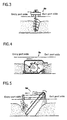
- the shoveling conveyor 9 may be, for example, a travelling chain scoop type shoveling conveyor 9a (Fig. 1), a travelling screw scoop type shoveling conveyor 9b (Fig. 3), a travelling drum scoop type shoveling conveyor 9c (Fig. 4), or a travelling rotary crusher type shoveling conveyor 9d (Fig. 5).
- the shoveling conveyor 9a is provided with the bladed endless chain belt 11 and the truck 12 for supporting and transporting the bladed endless chain belt 11.
- the shoveling conveyor 9a shovels the form-controlled waste matter in the fermentation container 1 by revolving the bladed endless chain belt 11 which slopes from the bottom to the top of the container. As a result, the form-controlled waste matter is gradually transported from the entry port 1a to the exit port 1b.
- the shoveling conveyor 9a shovels and conveys the form-controlled waste matter towards the exit port 1b by travelling from the exit port 1b toward the entry port 1a.
- the "prescribed length" of the fermentation container 1 may be given by multiplying the days required for fermenting and decomposing the organic waste matter by the distance the shoveling conveyor 9 travels per day.
- a suitable amount of wooden materials and the like are deposited into an empty fermentation container 1 to make an organic bed.
- the suitable amount of wooden materials is the amount such that the water content of the entire materials deposited is 85 % or less.
- the total length of the fermentation container 1 is 100 m, and the shoveling conveyor 9 travels 4 m/day toward the entry port 1a (towards left as indicated by an arrow X in Fig. 1), i.e., the conveyor 9 travels from the exit port 1b to the entry port 1a in 25 days.
- the organic bed material (made from wooden materials and the like) is unloaded from the exit port 1b, and deposited again at entry port 1a as a form-controlling material together with untreated organic waste matter.
- the organic waste matter is deposited everyday.
- the form-controlling material helps to reduce the moisture content of the waste matter.
- waste matter with the moisture content of 70-80% at the entry port 1a may have a reduced moisture content of 60% or less in about 2 days.
- form-controlled waste matter i.e., the mixture of the organic waste matter and wooden material
- This unloaded matter is deposited again at the entry port 1a together with untreated organic waste matter.
- mixture of 10 m 3 of organic waste matter and 10 m 3 of form-controlling material (total of 20 m 3 ) deposited at the entry port 1a may be reduced to 10 m 3 by the time it reaches the exit port 1b.
- organic waste matter includes sludge or wastewater containing hazardous metals from sewerage facilities, manure handling facilities, wastewater disposal facilities and purification containers; livestock manure; fishery product waste matter; remainder waste matter from meat or food processing factories, brewing industries, etc.; garbage from households, schools (esp. from school lunch), restaurants, hotels, supermarkets, department stores, etc.
- hazardous metals include mercury or compounds thereof, cadmium compounds, lead compounds, organic phosphorous compounds and hexavalent chromium compounds.
- Hazaka plant is employed in the examples described herein, the present invention is not limited to “Hazaka plant” and any other fermentation container may be used with the invention as long as the employed fermentation container has the fermenting function equivalent to the "Hazaka plant”.
- the fermentation container 1 shown in Fig. 1 was used for a swine manure treating experiment at Sato swine housing, Ltd. (Miyagi, Japan).
- the fermentation container 1 according to the invention decomposed raw feces and urine into gas through the treatment cycles, leaving small amount of organic solid.
- a poultry manure treating experiment was conducted likewise as Example 1, at Akita Poulterer, Ltd. (Akita, Japan).
- raw materials such as garbage from food factories, branches trimmed off from roadside trees, weeds from riverbed, etc. were fermented for producing a bed.
- the waste matter was decomposed into gas through the fermentation cycles.
- organic solid waste matter does not overflow the container. Accordingly, there is no need of post-treatment of organic solid waste matter.
Landscapes
- Chemical & Material Sciences (AREA)
- Life Sciences & Earth Sciences (AREA)
- Molecular Biology (AREA)
- Engineering & Computer Science (AREA)
- Health & Medical Sciences (AREA)
- Organic Chemistry (AREA)
- Biochemistry (AREA)
- Biotechnology (AREA)
- Chemical Kinetics & Catalysis (AREA)
- General Chemical & Material Sciences (AREA)
- Microbiology (AREA)
- Hydrology & Water Resources (AREA)
- Environmental & Geological Engineering (AREA)
- Water Supply & Treatment (AREA)
- Processing Of Solid Wastes (AREA)
Priority Applications (1)
| Application Number | Priority Date | Filing Date | Title |
|---|---|---|---|
| EP20060013597 EP1777199A1 (de) | 2000-03-14 | 2000-03-14 | Verfahren zur Aufarbeitung von organischen Abfallstoffen in einem Gärungsraum |
Applications Claiming Priority (2)
| Application Number | Priority Date | Filing Date | Title |
|---|---|---|---|
| EP20000302056 EP1134196A1 (de) | 2000-03-14 | 2000-03-14 | Verfahren zur Aufarbeitung von organischen Abfallstoffen in einem Gärungsraum |
| EP20060013597 EP1777199A1 (de) | 2000-03-14 | 2000-03-14 | Verfahren zur Aufarbeitung von organischen Abfallstoffen in einem Gärungsraum |
Related Parent Applications (1)
| Application Number | Title | Priority Date | Filing Date |
|---|---|---|---|
| EP20000302056 Division EP1134196A1 (de) | 2000-03-14 | 2000-03-14 | Verfahren zur Aufarbeitung von organischen Abfallstoffen in einem Gärungsraum |
Publications (1)
| Publication Number | Publication Date |
|---|---|
| EP1777199A1 true EP1777199A1 (de) | 2007-04-25 |
Family
ID=8172791
Family Applications (2)
| Application Number | Title | Priority Date | Filing Date |
|---|---|---|---|
| EP20060013597 Withdrawn EP1777199A1 (de) | 2000-03-14 | 2000-03-14 | Verfahren zur Aufarbeitung von organischen Abfallstoffen in einem Gärungsraum |
| EP20000302056 Ceased EP1134196A1 (de) | 2000-03-14 | 2000-03-14 | Verfahren zur Aufarbeitung von organischen Abfallstoffen in einem Gärungsraum |
Family Applications After (1)
| Application Number | Title | Priority Date | Filing Date |
|---|---|---|---|
| EP20000302056 Ceased EP1134196A1 (de) | 2000-03-14 | 2000-03-14 | Verfahren zur Aufarbeitung von organischen Abfallstoffen in einem Gärungsraum |
Country Status (1)
| Country | Link |
|---|---|
| EP (2) | EP1777199A1 (de) |
Families Citing this family (1)
| Publication number | Priority date | Publication date | Assignee | Title |
|---|---|---|---|---|
| CN105331524A (zh) * | 2015-12-07 | 2016-02-17 | 刘青玉 | 城市可发酵垃圾沼气池底部进出料搅拌装置 |
Citations (5)
| Publication number | Priority date | Publication date | Assignee | Title |
|---|---|---|---|---|
| EP0112996A2 (de) * | 1982-11-05 | 1984-07-11 | IPLA - ISTITUTO PER LE PIANTE DA LEGNO E L'AMBIENTE S.p.A. | Verfahren zur Herstellung eines organischen Düngemittels für die Landwirtschaft und nach diesem Verfahren erhaltenes Düngemittel |
| EP0458738A2 (de) * | 1990-04-26 | 1991-11-27 | Wheelabrator Clean Water Systems Inc. | Verfahren zum Kompostieren von mit Schadstoffen kontaminierten Abwasserschlamm und Abfallholz durch aerobes Verrotten sowie eine Anwendung |
| JPH07133177A (ja) * | 1994-04-14 | 1995-05-23 | Masaru Hasaka | 有機性廃棄物の発酵堆肥化装置 |
| JPH08744B2 (ja) | 1986-12-10 | 1996-01-10 | 勝 葉坂 | 有機性廃棄物の高速堆肥化処理法 |
| JPH09208354A (ja) * | 1996-01-31 | 1997-08-12 | Mitsubishi Nagasaki Mach Co Ltd | 酸化・分解促進媒介物を利用した早期堆肥化方法 |
-
2000
- 2000-03-14 EP EP20060013597 patent/EP1777199A1/de not_active Withdrawn
- 2000-03-14 EP EP20000302056 patent/EP1134196A1/de not_active Ceased
Patent Citations (5)
| Publication number | Priority date | Publication date | Assignee | Title |
|---|---|---|---|---|
| EP0112996A2 (de) * | 1982-11-05 | 1984-07-11 | IPLA - ISTITUTO PER LE PIANTE DA LEGNO E L'AMBIENTE S.p.A. | Verfahren zur Herstellung eines organischen Düngemittels für die Landwirtschaft und nach diesem Verfahren erhaltenes Düngemittel |
| JPH08744B2 (ja) | 1986-12-10 | 1996-01-10 | 勝 葉坂 | 有機性廃棄物の高速堆肥化処理法 |
| EP0458738A2 (de) * | 1990-04-26 | 1991-11-27 | Wheelabrator Clean Water Systems Inc. | Verfahren zum Kompostieren von mit Schadstoffen kontaminierten Abwasserschlamm und Abfallholz durch aerobes Verrotten sowie eine Anwendung |
| JPH07133177A (ja) * | 1994-04-14 | 1995-05-23 | Masaru Hasaka | 有機性廃棄物の発酵堆肥化装置 |
| JPH09208354A (ja) * | 1996-01-31 | 1997-08-12 | Mitsubishi Nagasaki Mach Co Ltd | 酸化・分解促進媒介物を利用した早期堆肥化方法 |
Non-Patent Citations (2)
| Title |
|---|
| PATENT ABSTRACTS OF JAPAN vol. 1995, no. 08 29 September 1995 (1995-09-29) * |
| PATENT ABSTRACTS OF JAPAN vol. 1997, no. 12 25 December 1997 (1997-12-25) * |
Also Published As
| Publication number | Publication date |
|---|---|
| EP1134196A1 (de) | 2001-09-19 |
Similar Documents
| Publication | Publication Date | Title |
|---|---|---|
| US7070693B2 (en) | Process for treating septage | |
| US4276164A (en) | Effluent treatment system | |
| Alkhalidi et al. | Recommendations for olive mills waste treatment in hot and dry climate | |
| Arundel | Sewage and industrial effluent treatment | |
| Tay et al. | Seafood processing wastewater treatment | |
| US6554998B1 (en) | Apparatus for lagoon remediation | |
| Bastian et al. | Design and management of successful land application systems | |
| Kerri | Operation of wastewater treatment plants: a field study training program | |
| US6316246B1 (en) | Method for treating organic waste matter | |
| Kinigopoulou et al. | Utilization of biobed for the efficient treatment of olive oil mill wastewater | |
| EP1777199A1 (de) | Verfahren zur Aufarbeitung von organischen Abfallstoffen in einem Gärungsraum | |
| US4012219A (en) | Method for reclaiming variegated wastes | |
| HK1039313A1 (en) | Method for processing organic waste in fermentation vessel | |
| Brown et al. | Sludge disposal | |
| Abdelmegeed | Optimisation of Sludge Management in EThekwini Municipality | |
| Nielsen | Treatment and disposal of processing wastes | |
| Cooper et al. | Septage treatment and disposal | |
| Bonifazi et al. | A novel waste water treatment plant for the disposal of organic waste from mobile toilets | |
| KR100607524B1 (ko) | 공동주택지역의 음식물 쓰레기 처리방법 | |
| Otwell | Waste Treatment and Utilization | |
| Bashirov et al. | Peculiarities of the technological process of the dung mass utilization at the former poultry factory “Snezhnaya” | |
| Libelo | Characterization, utilization and treatment of mechanized clam processing wastes | |
| Wood | Sewage sludge disposal options | |
| Marriott et al. | Waste Product Handling | |
| Marriott et al. | Waste disposal |
Legal Events
| Date | Code | Title | Description |
|---|---|---|---|
| PUAI | Public reference made under article 153(3) epc to a published international application that has entered the european phase |
Free format text: ORIGINAL CODE: 0009012 |
|
| 17P | Request for examination filed |
Effective date: 20060630 |
|
| AC | Divisional application: reference to earlier application |
Ref document number: 1134196 Country of ref document: EP Kind code of ref document: P |
|
| AK | Designated contracting states |
Kind code of ref document: A1 Designated state(s): AT BE CH CY DE DK ES FI FR GB GR IE IT LI LU MC NL PT SE |
|
| AKX | Designation fees paid |
Designated state(s): AT BE CH CY DE DK ES FI FR GB GR IE IT LI LU MC NL PT SE |
|
| STAA | Information on the status of an ep patent application or granted ep patent |
Free format text: STATUS: THE APPLICATION IS DEEMED TO BE WITHDRAWN |
|
| 18D | Application deemed to be withdrawn |
Effective date: 20071026 |