EP1765267B1 - Phenylpropandiol-farbstoffvorprodukte - Google Patents
Phenylpropandiol-farbstoffvorprodukte Download PDFInfo
- Publication number
- EP1765267B1 EP1765267B1 EP05739681A EP05739681A EP1765267B1 EP 1765267 B1 EP1765267 B1 EP 1765267B1 EP 05739681 A EP05739681 A EP 05739681A EP 05739681 A EP05739681 A EP 05739681A EP 1765267 B1 EP1765267 B1 EP 1765267B1
- Authority
- EP
- European Patent Office
- Prior art keywords
- agent according
- general formula
- alkyl
- derivative
- diol
- Prior art date
- Legal status (The legal status is an assumption and is not a legal conclusion. Google has not performed a legal analysis and makes no representation as to the accuracy of the status listed.)
- Revoked
Links
- BPBDZXFJDMJLIB-UHFFFAOYSA-N 2-phenylpropane-1,3-diol Chemical compound OCC(CO)C1=CC=CC=C1 BPBDZXFJDMJLIB-UHFFFAOYSA-N 0.000 title 1
- 210000004209 hair Anatomy 0.000 claims abstract description 32
- 239000003795 chemical substances by application Substances 0.000 claims abstract description 30
- 238000004043 dyeing Methods 0.000 claims abstract description 18
- 239000000835 fiber Substances 0.000 claims abstract description 18
- MNAHQWDCXOHBHK-UHFFFAOYSA-N 1-phenylpropane-1,1-diol Chemical group CCC(O)(O)C1=CC=CC=C1 MNAHQWDCXOHBHK-UHFFFAOYSA-N 0.000 claims abstract description 11
- 239000000975 dye Substances 0.000 claims description 32
- 229910052739 hydrogen Inorganic materials 0.000 claims description 26
- 239000001257 hydrogen Substances 0.000 claims description 25
- 239000002243 precursor Substances 0.000 claims description 21
- UFHFLCQGNIYNRP-UHFFFAOYSA-N Hydrogen Chemical compound [H][H] UFHFLCQGNIYNRP-UHFFFAOYSA-N 0.000 claims description 20
- 239000000982 direct dye Substances 0.000 claims description 14
- 229910052736 halogen Inorganic materials 0.000 claims description 11
- 150000002367 halogens Chemical class 0.000 claims description 11
- 125000002887 hydroxy group Chemical group [H]O* 0.000 claims description 11
- 125000002091 cationic group Chemical group 0.000 claims description 8
- 238000000034 method Methods 0.000 claims description 8
- 238000003786 synthesis reaction Methods 0.000 claims description 7
- VUPATLLHDXBZFT-UHFFFAOYSA-N 2-(5-ethoxy-2,4-dinitrophenyl)propane-1,3-diol Chemical compound CCOC1=CC(C(CO)CO)=C([N+]([O-])=O)C=C1[N+]([O-])=O VUPATLLHDXBZFT-UHFFFAOYSA-N 0.000 claims description 6
- YOXABFANYKSDKM-UHFFFAOYSA-N 2-(5-methoxy-2,4-dinitrophenyl)propane-1,3-diol Chemical compound COC1=CC(C(CO)CO)=C([N+]([O-])=O)C=C1[N+]([O-])=O YOXABFANYKSDKM-UHFFFAOYSA-N 0.000 claims description 6
- 125000002853 C1-C4 hydroxyalkyl group Chemical group 0.000 claims description 6
- 125000006577 C1-C6 hydroxyalkyl group Chemical group 0.000 claims description 6
- 125000000882 C2-C6 alkenyl group Chemical class 0.000 claims description 6
- 125000004178 (C1-C4) alkyl group Chemical group 0.000 claims description 5
- 125000006700 (C1-C6) alkylthio group Chemical group 0.000 claims description 5
- 230000015572 biosynthetic process Effects 0.000 claims description 5
- 125000004191 (C1-C6) alkoxy group Chemical group 0.000 claims description 4
- 125000004169 (C1-C6) alkyl group Chemical group 0.000 claims description 4
- 125000004890 (C1-C6) alkylamino group Chemical group 0.000 claims description 4
- 125000004754 (C2-C12) dialkylamino group Chemical group 0.000 claims description 4
- MHYIZTCDYNESNT-UHFFFAOYSA-N 2-[3-(2-hydroxyethyl)-2,4-dinitrophenyl]propane-1,3-diol Chemical compound OCCC1=C([N+]([O-])=O)C=CC(C(CO)CO)=C1[N+]([O-])=O MHYIZTCDYNESNT-UHFFFAOYSA-N 0.000 claims description 4
- 125000004183 alkoxy alkyl group Chemical group 0.000 claims description 4
- 125000000278 alkyl amino alkyl group Chemical group 0.000 claims description 4
- 125000004103 aminoalkyl group Chemical group 0.000 claims description 4
- 150000002431 hydrogen Chemical class 0.000 claims description 4
- 125000001188 haloalkyl group Chemical group 0.000 claims description 3
- JCXJVPUVTGWSNB-UHFFFAOYSA-N Nitrogen dioxide Chemical compound O=[N]=O JCXJVPUVTGWSNB-UHFFFAOYSA-N 0.000 claims description 2
- MDFFNEOEWAXZRQ-UHFFFAOYSA-N aminyl Chemical compound [NH2] MDFFNEOEWAXZRQ-UHFFFAOYSA-N 0.000 claims description 2
- 125000003178 carboxy group Chemical group [H]OC(*)=O 0.000 claims description 2
- 125000000229 (C1-C4)alkoxy group Chemical group 0.000 claims 1
- 125000004435 hydrogen atom Chemical group [H]* 0.000 claims 1
- 102000011782 Keratins Human genes 0.000 abstract description 3
- 108010076876 Keratins Proteins 0.000 abstract description 3
- -1 heterocyclic hydrazones Chemical class 0.000 description 35
- 239000000243 solution Substances 0.000 description 31
- 238000002360 preparation method Methods 0.000 description 28
- XLYOFNOQVPJJNP-UHFFFAOYSA-N water Substances O XLYOFNOQVPJJNP-UHFFFAOYSA-N 0.000 description 25
- OKKJLVBELUTLKV-UHFFFAOYSA-N Methanol Chemical compound OC OKKJLVBELUTLKV-UHFFFAOYSA-N 0.000 description 24
- VEXZGXHMUGYJMC-UHFFFAOYSA-N Hydrochloric acid Chemical compound Cl VEXZGXHMUGYJMC-UHFFFAOYSA-N 0.000 description 23
- 150000001875 compounds Chemical class 0.000 description 23
- IAZDPXIOMUYVGZ-UHFFFAOYSA-N Dimethylsulphoxide Chemical compound CS(C)=O IAZDPXIOMUYVGZ-UHFFFAOYSA-N 0.000 description 21
- 125000000217 alkyl group Chemical group 0.000 description 21
- WSFSSNUMVMOOMR-UHFFFAOYSA-N Formaldehyde Chemical compound O=C WSFSSNUMVMOOMR-UHFFFAOYSA-N 0.000 description 17
- 239000000203 mixture Substances 0.000 description 17
- 239000003086 colorant Substances 0.000 description 16
- 238000007254 oxidation reaction Methods 0.000 description 16
- LFQSCWFLJHTTHZ-UHFFFAOYSA-N Ethanol Chemical compound CCO LFQSCWFLJHTTHZ-UHFFFAOYSA-N 0.000 description 15
- 230000003647 oxidation Effects 0.000 description 15
- 239000000126 substance Substances 0.000 description 15
- 238000005160 1H NMR spectroscopy Methods 0.000 description 14
- RTZKZFJDLAIYFH-UHFFFAOYSA-N ether Substances CCOCC RTZKZFJDLAIYFH-UHFFFAOYSA-N 0.000 description 13
- 150000003254 radicals Chemical class 0.000 description 13
- HEMHJVSKTPXQMS-UHFFFAOYSA-M Sodium hydroxide Chemical compound [OH-].[Na+] HEMHJVSKTPXQMS-UHFFFAOYSA-M 0.000 description 12
- 239000003054 catalyst Substances 0.000 description 12
- 238000006243 chemical reaction Methods 0.000 description 12
- 239000000047 product Substances 0.000 description 12
- GHMLBKRAJCXXBS-UHFFFAOYSA-N resorcinol Chemical compound OC1=CC=CC(O)=C1 GHMLBKRAJCXXBS-UHFFFAOYSA-N 0.000 description 12
- PLIKAWJENQZMHA-UHFFFAOYSA-N 4-aminophenol Chemical compound NC1=CC=C(O)C=C1 PLIKAWJENQZMHA-UHFFFAOYSA-N 0.000 description 11
- 125000003277 amino group Chemical group 0.000 description 11
- 125000004432 carbon atom Chemical group C* 0.000 description 11
- 150000003839 salts Chemical class 0.000 description 11
- HIXDQWDOVZUNNA-UHFFFAOYSA-N 2-(3,4-dimethoxyphenyl)-5-hydroxy-7-methoxychromen-4-one Chemical compound C=1C(OC)=CC(O)=C(C(C=2)=O)C=1OC=2C1=CC=C(OC)C(OC)=C1 HIXDQWDOVZUNNA-UHFFFAOYSA-N 0.000 description 10
- 239000007787 solid Substances 0.000 description 10
- KWYUFKZDYYNOTN-UHFFFAOYSA-M Potassium hydroxide Chemical compound [OH-].[K+] KWYUFKZDYYNOTN-UHFFFAOYSA-M 0.000 description 9
- 239000000118 hair dye Substances 0.000 description 9
- 239000004094 surface-active agent Substances 0.000 description 9
- IAYPIBMASNFSPL-UHFFFAOYSA-N Ethylene oxide Chemical compound C1CO1 IAYPIBMASNFSPL-UHFFFAOYSA-N 0.000 description 8
- 238000004040 coloring Methods 0.000 description 8
- 239000006071 cream Substances 0.000 description 8
- 239000003921 oil Substances 0.000 description 8
- CWLKGDAVCFYWJK-UHFFFAOYSA-N 3-aminophenol Chemical class NC1=CC=CC(O)=C1 CWLKGDAVCFYWJK-UHFFFAOYSA-N 0.000 description 7
- PMZURENOXWZQFD-UHFFFAOYSA-L Sodium Sulfate Chemical compound [Na+].[Na+].[O-]S([O-])(=O)=O PMZURENOXWZQFD-UHFFFAOYSA-L 0.000 description 7
- KJCVRFUGPWSIIH-UHFFFAOYSA-N 1-naphthol Chemical compound C1=CC=C2C(O)=CC=CC2=C1 KJCVRFUGPWSIIH-UHFFFAOYSA-N 0.000 description 6
- GQHTUMJGOHRCHB-UHFFFAOYSA-N 2,3,4,6,7,8,9,10-octahydropyrimido[1,2-a]azepine Chemical compound C1CCCCN2CCCN=C21 GQHTUMJGOHRCHB-UHFFFAOYSA-N 0.000 description 6
- LWKBKPISCXPXGN-UHFFFAOYSA-N 2-(4-methoxy-2-nitrophenyl)propane-1,3-diol Chemical compound COC1=CC=C(C(CO)CO)C([N+]([O-])=O)=C1 LWKBKPISCXPXGN-UHFFFAOYSA-N 0.000 description 6
- IAZDPXIOMUYVGZ-WFGJKAKNSA-N Dimethyl sulfoxide Chemical compound [2H]C([2H])([2H])S(=O)C([2H])([2H])[2H] IAZDPXIOMUYVGZ-WFGJKAKNSA-N 0.000 description 6
- SIKJAQJRHWYJAI-UHFFFAOYSA-N Indole Chemical compound C1=CC=C2NC=CC2=C1 SIKJAQJRHWYJAI-UHFFFAOYSA-N 0.000 description 6
- 125000003545 alkoxy group Chemical group 0.000 description 6
- 150000002191 fatty alcohols Chemical class 0.000 description 6
- 229910052757 nitrogen Inorganic materials 0.000 description 6
- OIPPWFOQEKKFEE-UHFFFAOYSA-N orcinol Chemical compound CC1=CC(O)=CC(O)=C1 OIPPWFOQEKKFEE-UHFFFAOYSA-N 0.000 description 6
- 239000007800 oxidant agent Substances 0.000 description 6
- 235000000346 sugar Nutrition 0.000 description 6
- GZBFNAIWTXAHCC-UHFFFAOYSA-N 2-(2,4-diamino-5-ethoxyphenyl)propane-1,3-diol Chemical compound CCOC1=CC(C(CO)CO)=C(N)C=C1N GZBFNAIWTXAHCC-UHFFFAOYSA-N 0.000 description 5
- GOSPXAMEOKLSFZ-UHFFFAOYSA-N 2-(2,4-diamino-5-methoxyphenyl)propane-1,3-diol Chemical compound COC1=CC(C(CO)CO)=C(N)C=C1N GOSPXAMEOKLSFZ-UHFFFAOYSA-N 0.000 description 5
- KWSVXCAQFTWTEF-UHFFFAOYSA-N 2-(2,5-diaminophenyl)ethanol Chemical compound NC1=CC=C(N)C(CCO)=C1 KWSVXCAQFTWTEF-UHFFFAOYSA-N 0.000 description 5
- QGNGOGOOPUYKMC-UHFFFAOYSA-N 4-hydroxy-6-methylaniline Chemical compound CC1=CC(O)=CC=C1N QGNGOGOOPUYKMC-UHFFFAOYSA-N 0.000 description 5
- WQZGKKKJIJFFOK-QTVWNMPRSA-N D-mannopyranose Chemical compound OC[C@H]1OC(O)[C@@H](O)[C@@H](O)[C@@H]1O WQZGKKKJIJFFOK-QTVWNMPRSA-N 0.000 description 5
- PEDCQBHIVMGVHV-UHFFFAOYSA-N Glycerine Chemical compound OCC(O)CO PEDCQBHIVMGVHV-UHFFFAOYSA-N 0.000 description 5
- 239000004480 active ingredient Substances 0.000 description 5
- 235000014113 dietary fatty acids Nutrition 0.000 description 5
- 238000009826 distribution Methods 0.000 description 5
- 229930195729 fatty acid Natural products 0.000 description 5
- 239000000194 fatty acid Substances 0.000 description 5
- 150000004665 fatty acids Chemical class 0.000 description 5
- 230000001590 oxidative effect Effects 0.000 description 5
- 239000011541 reaction mixture Substances 0.000 description 5
- 229910052938 sodium sulfate Inorganic materials 0.000 description 5
- 235000011152 sodium sulphate Nutrition 0.000 description 5
- 238000003756 stirring Methods 0.000 description 5
- 239000000725 suspension Substances 0.000 description 5
- 239000002888 zwitterionic surfactant Substances 0.000 description 5
- QJHUPTKKZHNOTK-UHFFFAOYSA-N 1-ethoxy-5-methyl-2,4-dinitrobenzene Chemical compound CCOC1=CC(C)=C([N+]([O-])=O)C=C1[N+]([O-])=O QJHUPTKKZHNOTK-UHFFFAOYSA-N 0.000 description 4
- CMIMRMOSIVTUAA-UHFFFAOYSA-N 1-fluoro-5-methyl-2,4-dinitrobenzene Chemical compound CC1=CC(F)=C([N+]([O-])=O)C=C1[N+]([O-])=O CMIMRMOSIVTUAA-UHFFFAOYSA-N 0.000 description 4
- XLPFUGPSJUAQSY-UHFFFAOYSA-N 1-methoxy-5-methyl-2,4-dinitrobenzene Chemical compound COC1=CC(C)=C([N+]([O-])=O)C=C1[N+]([O-])=O XLPFUGPSJUAQSY-UHFFFAOYSA-N 0.000 description 4
- SIIMATIZGLCWHJ-UHFFFAOYSA-N 2-(2,5-diamino-4-methoxyphenyl)propane-1,3-diol Chemical compound COC1=CC(N)=C(C(CO)CO)C=C1N SIIMATIZGLCWHJ-UHFFFAOYSA-N 0.000 description 4
- KDBUTNSQYYLYOY-UHFFFAOYSA-N 2-(4,5-diaminopyrazol-1-yl)ethanol Chemical compound NC=1C=NN(CCO)C=1N KDBUTNSQYYLYOY-UHFFFAOYSA-N 0.000 description 4
- QHYHBXGVPDXPGQ-UHFFFAOYSA-N 2-[2,4-diamino-3-(2-hydroxyethyl)phenyl]propane-1,3-diol Chemical compound NC1=CC=C(C(CO)CO)C(N)=C1CCO QHYHBXGVPDXPGQ-UHFFFAOYSA-N 0.000 description 4
- OBCSAIDCZQSFQH-UHFFFAOYSA-N 2-methyl-1,4-phenylenediamine Chemical compound CC1=CC(N)=CC=C1N OBCSAIDCZQSFQH-UHFFFAOYSA-N 0.000 description 4
- JBORNNNGTJSTLC-UHFFFAOYSA-N 4-methoxy-1-methyl-2-nitrobenzene Chemical compound COC1=CC=C(C)C([N+]([O-])=O)=C1 JBORNNNGTJSTLC-UHFFFAOYSA-N 0.000 description 4
- DBFYESDCPWWCHN-UHFFFAOYSA-N 5-amino-2-methylphenol Chemical compound CC1=CC=C(N)C=C1O DBFYESDCPWWCHN-UHFFFAOYSA-N 0.000 description 4
- QGZKDVFQNNGYKY-UHFFFAOYSA-N Ammonia Chemical compound N QGZKDVFQNNGYKY-UHFFFAOYSA-N 0.000 description 4
- BZLVMXJERCGZMT-UHFFFAOYSA-N Methyl tert-butyl ether Chemical compound COC(C)(C)C BZLVMXJERCGZMT-UHFFFAOYSA-N 0.000 description 4
- ISWSIDIOOBJBQZ-UHFFFAOYSA-N Phenol Chemical compound OC1=CC=CC=C1 ISWSIDIOOBJBQZ-UHFFFAOYSA-N 0.000 description 4
- GOOHAUXETOMSMM-UHFFFAOYSA-N Propylene oxide Chemical compound CC1CO1 GOOHAUXETOMSMM-UHFFFAOYSA-N 0.000 description 4
- FAPWRFPIFSIZLT-UHFFFAOYSA-M Sodium chloride Chemical compound [Na+].[Cl-] FAPWRFPIFSIZLT-UHFFFAOYSA-M 0.000 description 4
- QAOWNCQODCNURD-UHFFFAOYSA-N Sulfuric acid Chemical compound OS(O)(=O)=O QAOWNCQODCNURD-UHFFFAOYSA-N 0.000 description 4
- 239000003945 anionic surfactant Substances 0.000 description 4
- 239000002585 base Substances 0.000 description 4
- 239000003093 cationic surfactant Substances 0.000 description 4
- 150000002475 indoles Chemical class 0.000 description 4
- 150000002476 indolines Chemical class 0.000 description 4
- 239000002563 ionic surfactant Substances 0.000 description 4
- 239000002736 nonionic surfactant Substances 0.000 description 4
- 239000002244 precipitate Substances 0.000 description 4
- 230000008569 process Effects 0.000 description 4
- ULWHHBHJGPPBCO-UHFFFAOYSA-N propane-1,1-diol Chemical compound CCC(O)O ULWHHBHJGPPBCO-UHFFFAOYSA-N 0.000 description 4
- PZRKPUQWIFJRKZ-UHFFFAOYSA-N pyrimidine-2,4,5,6-tetramine Chemical compound NC1=NC(N)=C(N)C(N)=N1 PZRKPUQWIFJRKZ-UHFFFAOYSA-N 0.000 description 4
- 231100000027 toxicology Toxicity 0.000 description 4
- 0 *c1c(*)c(*)c(C(CO*)CO*)c(*)c1* Chemical compound *c1c(*)c(*)c(C(CO*)CO*)c(*)c1* 0.000 description 3
- XUUSVHGZGPBZLS-UHFFFAOYSA-N 1,3-dimethyl-2,4-dinitrobenzene Chemical compound CC1=CC=C([N+]([O-])=O)C(C)=C1[N+]([O-])=O XUUSVHGZGPBZLS-UHFFFAOYSA-N 0.000 description 3
- HDFQKJQEWGVKCQ-UHFFFAOYSA-N 1,3-dimethyl-2-nitrobenzene Chemical group CC1=CC=CC(C)=C1[N+]([O-])=O HDFQKJQEWGVKCQ-UHFFFAOYSA-N 0.000 description 3
- YLNJLYNMJGGSPQ-UHFFFAOYSA-N 2-(4-methoxy-2-nitrophenyl)ethanol Chemical compound COC1=CC=C(CCO)C([N+]([O-])=O)=C1 YLNJLYNMJGGSPQ-UHFFFAOYSA-N 0.000 description 3
- OSCJHTSDLYVCQC-UHFFFAOYSA-N 2-ethylhexyl 4-[[4-[4-(tert-butylcarbamoyl)anilino]-6-[4-(2-ethylhexoxycarbonyl)anilino]-1,3,5-triazin-2-yl]amino]benzoate Chemical compound C1=CC(C(=O)OCC(CC)CCCC)=CC=C1NC1=NC(NC=2C=CC(=CC=2)C(=O)NC(C)(C)C)=NC(NC=2C=CC(=CC=2)C(=O)OCC(CC)CCCC)=N1 OSCJHTSDLYVCQC-UHFFFAOYSA-N 0.000 description 3
- 125000000954 2-hydroxyethyl group Chemical group [H]C([*])([H])C([H])([H])O[H] 0.000 description 3
- ZTMADXFOCUXMJE-UHFFFAOYSA-N 2-methylbenzene-1,3-diol Chemical compound CC1=C(O)C=CC=C1O ZTMADXFOCUXMJE-UHFFFAOYSA-N 0.000 description 3
- XYRDGCCCBJITBH-UHFFFAOYSA-N 3-amino-2-chloro-6-methylphenol Chemical compound CC1=CC=C(N)C(Cl)=C1O XYRDGCCCBJITBH-UHFFFAOYSA-N 0.000 description 3
- 229940018563 3-aminophenol Drugs 0.000 description 3
- HLIGKHFHQXRAOX-UHFFFAOYSA-N 4-amino-2-[(5-amino-2-hydroxyphenyl)methyl]phenol Chemical compound NC1=CC=C(O)C(CC=2C(=CC=C(N)C=2)O)=C1 HLIGKHFHQXRAOX-UHFFFAOYSA-N 0.000 description 3
- JQVAPEJNIZULEK-UHFFFAOYSA-N 4-chlorobenzene-1,3-diol Chemical compound OC1=CC=C(Cl)C(O)=C1 JQVAPEJNIZULEK-UHFFFAOYSA-N 0.000 description 3
- VEXZGXHMUGYJMC-UHFFFAOYSA-M Chloride anion Chemical compound [Cl-] VEXZGXHMUGYJMC-UHFFFAOYSA-M 0.000 description 3
- XEKOWRVHYACXOJ-UHFFFAOYSA-N Ethyl acetate Chemical compound CCOC(C)=O XEKOWRVHYACXOJ-UHFFFAOYSA-N 0.000 description 3
- DBVJJBKOTRCVKF-UHFFFAOYSA-N Etidronic acid Chemical compound OP(=O)(O)C(O)(C)P(O)(O)=O DBVJJBKOTRCVKF-UHFFFAOYSA-N 0.000 description 3
- WQZGKKKJIJFFOK-GASJEMHNSA-N Glucose Natural products OC[C@H]1OC(O)[C@H](O)[C@@H](O)[C@@H]1O WQZGKKKJIJFFOK-GASJEMHNSA-N 0.000 description 3
- MHAJPDPJQMAIIY-UHFFFAOYSA-N Hydrogen peroxide Chemical compound OO MHAJPDPJQMAIIY-UHFFFAOYSA-N 0.000 description 3
- 244000208060 Lawsonia inermis Species 0.000 description 3
- 125000000129 anionic group Chemical group 0.000 description 3
- PYMYPHUHKUWMLA-UHFFFAOYSA-N arabinose Natural products OCC(O)C(O)C(O)C=O PYMYPHUHKUWMLA-UHFFFAOYSA-N 0.000 description 3
- 125000003118 aryl group Chemical group 0.000 description 3
- QVGXLLKOCUKJST-UHFFFAOYSA-N atomic oxygen Chemical compound [O] QVGXLLKOCUKJST-UHFFFAOYSA-N 0.000 description 3
- SRBFZHDQGSBBOR-UHFFFAOYSA-N beta-D-Pyranose-Lyxose Natural products OC1COC(O)C(O)C1O SRBFZHDQGSBBOR-UHFFFAOYSA-N 0.000 description 3
- WQZGKKKJIJFFOK-VFUOTHLCSA-N beta-D-glucose Chemical compound OC[C@H]1O[C@@H](O)[C@H](O)[C@@H](O)[C@@H]1O WQZGKKKJIJFFOK-VFUOTHLCSA-N 0.000 description 3
- 230000008878 coupling Effects 0.000 description 3
- 238000010168 coupling process Methods 0.000 description 3
- 238000005859 coupling reaction Methods 0.000 description 3
- 239000012954 diazonium Substances 0.000 description 3
- IJGRMHOSHXDMSA-UHFFFAOYSA-O diazynium Chemical compound [NH+]#N IJGRMHOSHXDMSA-UHFFFAOYSA-O 0.000 description 3
- MTHSVFCYNBDYFN-UHFFFAOYSA-N diethylene glycol Chemical group OCCOCCO MTHSVFCYNBDYFN-UHFFFAOYSA-N 0.000 description 3
- 239000012153 distilled water Substances 0.000 description 3
- 230000000694 effects Effects 0.000 description 3
- 239000000839 emulsion Substances 0.000 description 3
- 239000008103 glucose Substances 0.000 description 3
- 150000003840 hydrochlorides Chemical class 0.000 description 3
- 125000004356 hydroxy functional group Chemical group O* 0.000 description 3
- 238000004519 manufacturing process Methods 0.000 description 3
- ZUVBIBLYOCVYJU-UHFFFAOYSA-N naphthalene-1,7-diol Chemical compound C1=CC=C(O)C2=CC(O)=CC=C21 ZUVBIBLYOCVYJU-UHFFFAOYSA-N 0.000 description 3
- 125000004433 nitrogen atom Chemical group N* 0.000 description 3
- 239000001301 oxygen Substances 0.000 description 3
- 229910052760 oxygen Inorganic materials 0.000 description 3
- 125000004430 oxygen atom Chemical group O* 0.000 description 3
- 150000004989 p-phenylenediamines Chemical class 0.000 description 3
- 229920000151 polyglycol Polymers 0.000 description 3
- 239000010695 polyglycol Substances 0.000 description 3
- 239000000843 powder Substances 0.000 description 3
- 239000002994 raw material Substances 0.000 description 3
- 229920006395 saturated elastomer Polymers 0.000 description 3
- 239000002453 shampoo Substances 0.000 description 3
- 229940057950 sodium laureth sulfate Drugs 0.000 description 3
- SXHLENDCVBIJFO-UHFFFAOYSA-M sodium;2-[2-(2-dodecoxyethoxy)ethoxy]ethyl sulfate Chemical compound [Na+].CCCCCCCCCCCCOCCOCCOCCOS([O-])(=O)=O SXHLENDCVBIJFO-UHFFFAOYSA-M 0.000 description 3
- 125000001424 substituent group Chemical group 0.000 description 3
- 150000003467 sulfuric acid derivatives Chemical class 0.000 description 3
- 150000005207 1,3-dihydroxybenzenes Chemical class 0.000 description 2
- WZCQRUWWHSTZEM-UHFFFAOYSA-N 1,3-phenylenediamine Chemical compound NC1=CC=CC(N)=C1 WZCQRUWWHSTZEM-UHFFFAOYSA-N 0.000 description 2
- CBCKQZAAMUWICA-UHFFFAOYSA-N 1,4-phenylenediamine Chemical compound NC1=CC=C(N)C=C1 CBCKQZAAMUWICA-UHFFFAOYSA-N 0.000 description 2
- BTQZKHUEUDPRST-UHFFFAOYSA-N 1-fluoro-3-methylbenzene Chemical compound CC1=CC=CC(F)=C1 BTQZKHUEUDPRST-UHFFFAOYSA-N 0.000 description 2
- XDOFQFKRPWOURC-UHFFFAOYSA-N 16-methylheptadecanoic acid Chemical compound CC(C)CCCCCCCCCCCCCCC(O)=O XDOFQFKRPWOURC-UHFFFAOYSA-N 0.000 description 2
- SYEYEGBZVSWYPK-UHFFFAOYSA-N 2,5,6-triamino-4-hydroxypyrimidine Chemical compound NC1=NC(N)=C(N)C(O)=N1 SYEYEGBZVSWYPK-UHFFFAOYSA-N 0.000 description 2
- HOLOMXUEMBUEKK-UHFFFAOYSA-N 2-(2-amino-4-methoxyphenyl)propane-1,3-diol Chemical compound COC1=CC=C(C(CO)CO)C(N)=C1 HOLOMXUEMBUEKK-UHFFFAOYSA-N 0.000 description 2
- CDAWCLOXVUBKRW-UHFFFAOYSA-N 2-aminophenol Chemical compound NC1=CC=CC=C1O CDAWCLOXVUBKRW-UHFFFAOYSA-N 0.000 description 2
- BMTSZVZQNMNPCT-UHFFFAOYSA-N 2-aminopyridin-3-ol Chemical compound NC1=NC=CC=C1O BMTSZVZQNMNPCT-UHFFFAOYSA-N 0.000 description 2
- SWZVJOLLQTWFCW-UHFFFAOYSA-N 2-chlorobenzene-1,3-diol Chemical compound OC1=CC=CC(O)=C1Cl SWZVJOLLQTWFCW-UHFFFAOYSA-N 0.000 description 2
- SYRZWFBWUASJJI-UHFFFAOYSA-N 3-amino-2,4-dichlorophenol Chemical compound NC1=C(Cl)C=CC(O)=C1Cl SYRZWFBWUASJJI-UHFFFAOYSA-N 0.000 description 2
- ZQBHGSSAKLGUBH-UHFFFAOYSA-N 4,5,6-triamino-1h-pyrimidin-2-one Chemical compound NC1=NC(=O)NC(N)=C1N ZQBHGSSAKLGUBH-UHFFFAOYSA-N 0.000 description 2
- AXDJCCTWPBKUKL-UHFFFAOYSA-N 4-[(4-aminophenyl)-(4-imino-3-methylcyclohexa-2,5-dien-1-ylidene)methyl]aniline;hydron;chloride Chemical compound Cl.C1=CC(=N)C(C)=CC1=C(C=1C=CC(N)=CC=1)C1=CC=C(N)C=C1 AXDJCCTWPBKUKL-UHFFFAOYSA-N 0.000 description 2
- MWKPYVXITDAZLL-UHFFFAOYSA-N 4-[3-(2,4-diaminophenoxy)propoxy]benzene-1,3-diamine Chemical compound NC1=CC(N)=CC=C1OCCCOC1=CC=C(N)C=C1N MWKPYVXITDAZLL-UHFFFAOYSA-N 0.000 description 2
- OFSNMACBEHKBAI-UHFFFAOYSA-N 4-[[4-amino-5-(1,3-dihydroxypropan-2-yl)-2-methoxyphenyl]diazenyl]benzenesulfonic acid Chemical compound COC1=CC(N)=C(C(CO)CO)C=C1N=NC1=CC=C(S(O)(=O)=O)C=C1 OFSNMACBEHKBAI-UHFFFAOYSA-N 0.000 description 2
- PZKNKZNLQYKXFV-UHFFFAOYSA-N 4-amino-2-(aminomethyl)phenol Chemical compound NCC1=CC(N)=CC=C1O PZKNKZNLQYKXFV-UHFFFAOYSA-N 0.000 description 2
- BBTNLADSUVOPPN-UHFFFAOYSA-N 5,6-diaminouracil Chemical compound NC=1NC(=O)NC(=O)C=1N BBTNLADSUVOPPN-UHFFFAOYSA-N 0.000 description 2
- WDQMXRWYXILWPT-UHFFFAOYSA-N 5-amino-4-chloro-2-methylphenol Chemical compound CC1=CC(Cl)=C(N)C=C1O WDQMXRWYXILWPT-UHFFFAOYSA-N 0.000 description 2
- 239000004475 Arginine Substances 0.000 description 2
- GHVHDYYKJYXFGU-UHFFFAOYSA-N Beta-Orcinol Chemical compound CC1=CC(O)=C(C)C(O)=C1 GHVHDYYKJYXFGU-UHFFFAOYSA-N 0.000 description 2
- ZAMOUSCENKQFHK-UHFFFAOYSA-N Chlorine atom Chemical compound [Cl] ZAMOUSCENKQFHK-UHFFFAOYSA-N 0.000 description 2
- SRBFZHDQGSBBOR-IOVATXLUSA-N D-xylopyranose Chemical compound O[C@@H]1COC(O)[C@H](O)[C@H]1O SRBFZHDQGSBBOR-IOVATXLUSA-N 0.000 description 2
- LYCAIKOWRPUZTN-UHFFFAOYSA-N Ethylene glycol Chemical compound OCCO LYCAIKOWRPUZTN-UHFFFAOYSA-N 0.000 description 2
- 229930091371 Fructose Natural products 0.000 description 2
- RFSUNEUAIZKAJO-ARQDHWQXSA-N Fructose Chemical compound OC[C@H]1O[C@](O)(CO)[C@@H](O)[C@@H]1O RFSUNEUAIZKAJO-ARQDHWQXSA-N 0.000 description 2
- 239000005715 Fructose Substances 0.000 description 2
- CPELXLSAUQHCOX-UHFFFAOYSA-N Hydrogen bromide Chemical class Br CPELXLSAUQHCOX-UHFFFAOYSA-N 0.000 description 2
- KFZMGEQAYNKOFK-UHFFFAOYSA-N Isopropanol Chemical compound CC(C)O KFZMGEQAYNKOFK-UHFFFAOYSA-N 0.000 description 2
- ODKSFYDXXFIFQN-BYPYZUCNSA-P L-argininium(2+) Chemical compound NC(=[NH2+])NCCC[C@H]([NH3+])C(O)=O ODKSFYDXXFIFQN-BYPYZUCNSA-P 0.000 description 2
- DNIAPMSPPWPWGF-UHFFFAOYSA-N Propylene glycol Chemical compound CC(O)CO DNIAPMSPPWPWGF-UHFFFAOYSA-N 0.000 description 2
- JUJWROOIHBZHMG-UHFFFAOYSA-N Pyridine Chemical compound C1=CC=NC=C1 JUJWROOIHBZHMG-UHFFFAOYSA-N 0.000 description 2
- CZMRCDWAGMRECN-UGDNZRGBSA-N Sucrose Chemical compound O[C@H]1[C@H](O)[C@@H](CO)O[C@@]1(CO)O[C@@H]1[C@H](O)[C@@H](O)[C@H](O)[C@@H](CO)O1 CZMRCDWAGMRECN-UGDNZRGBSA-N 0.000 description 2
- 229930006000 Sucrose Natural products 0.000 description 2
- XSQUKJJJFZCRTK-UHFFFAOYSA-N Urea Chemical compound NC(N)=O XSQUKJJJFZCRTK-UHFFFAOYSA-N 0.000 description 2
- RFQSMLBZXQOMKK-UHFFFAOYSA-N [3-[(4,8-diamino-6-bromo-1,5-dioxonaphthalen-2-yl)amino]phenyl]-trimethylazanium;chloride Chemical compound [Cl-].C[N+](C)(C)C1=CC=CC(NC=2C(C3=C(N)C=C(Br)C(=O)C3=C(N)C=2)=O)=C1 RFQSMLBZXQOMKK-UHFFFAOYSA-N 0.000 description 2
- HSWXSHNPRUMJKI-UHFFFAOYSA-N [8-[(2-methoxyphenyl)hydrazinylidene]-7-oxonaphthalen-2-yl]-trimethylazanium;chloride Chemical compound [Cl-].COC1=CC=CC=C1N\N=C/1C2=CC([N+](C)(C)C)=CC=C2C=CC\1=O HSWXSHNPRUMJKI-UHFFFAOYSA-N 0.000 description 2
- CMPPYVDBIJWGCB-UHFFFAOYSA-N [8-[(4-amino-3-nitrophenyl)hydrazinylidene]-7-oxonaphthalen-2-yl]-trimethylazanium;chloride Chemical compound [Cl-].C12=CC([N+](C)(C)C)=CC=C2C=CC(=O)\C1=N\NC1=CC=C(N)C([N+]([O-])=O)=C1 CMPPYVDBIJWGCB-UHFFFAOYSA-N 0.000 description 2
- UXEAWNJALIUYRH-UHFFFAOYSA-N [8-[(4-aminophenyl)hydrazinylidene]-7-oxonaphthalen-2-yl]-trimethylazanium;chloride Chemical compound [Cl-].C12=CC([N+](C)(C)C)=CC=C2C=CC(=O)\C1=N/NC1=CC=C(N)C=C1 UXEAWNJALIUYRH-UHFFFAOYSA-N 0.000 description 2
- 239000000654 additive Substances 0.000 description 2
- 229910052783 alkali metal Inorganic materials 0.000 description 2
- 150000001340 alkali metals Chemical class 0.000 description 2
- WQZGKKKJIJFFOK-PHYPRBDBSA-N alpha-D-galactose Chemical compound OC[C@H]1O[C@H](O)[C@H](O)[C@@H](O)[C@H]1O WQZGKKKJIJFFOK-PHYPRBDBSA-N 0.000 description 2
- 235000008206 alpha-amino acids Nutrition 0.000 description 2
- 235000001014 amino acid Nutrition 0.000 description 2
- 150000001413 amino acids Chemical class 0.000 description 2
- 229910021529 ammonia Inorganic materials 0.000 description 2
- 229940051880 analgesics and antipyretics pyrazolones Drugs 0.000 description 2
- 239000007864 aqueous solution Substances 0.000 description 2
- PYMYPHUHKUWMLA-WDCZJNDASA-N arabinose Chemical compound OC[C@@H](O)[C@@H](O)[C@H](O)C=O PYMYPHUHKUWMLA-WDCZJNDASA-N 0.000 description 2
- ODKSFYDXXFIFQN-UHFFFAOYSA-N arginine Natural products OC(=O)C(N)CCCNC(N)=N ODKSFYDXXFIFQN-UHFFFAOYSA-N 0.000 description 2
- 125000003710 aryl alkyl group Chemical group 0.000 description 2
- 150000001555 benzenes Chemical class 0.000 description 2
- 229910052799 carbon Inorganic materials 0.000 description 2
- 239000004359 castor oil Substances 0.000 description 2
- 235000019438 castor oil Nutrition 0.000 description 2
- 239000000460 chlorine Substances 0.000 description 2
- 229910052801 chlorine Inorganic materials 0.000 description 2
- MRUAUOIMASANKQ-UHFFFAOYSA-N cocamidopropyl betaine Chemical compound CCCCCCCCCCCC(=O)NCCC[N+](C)(C)CC([O-])=O MRUAUOIMASANKQ-UHFFFAOYSA-N 0.000 description 2
- 229940073507 cocamidopropyl betaine Drugs 0.000 description 2
- 239000000470 constituent Substances 0.000 description 2
- 238000001816 cooling Methods 0.000 description 2
- 239000002537 cosmetic Substances 0.000 description 2
- UKPBEPCQTDRZSE-UHFFFAOYSA-N cyclizine hydrochloride Chemical compound Cl.C1CN(C)CCN1C(C=1C=CC=CC=1)C1=CC=CC=C1 UKPBEPCQTDRZSE-UHFFFAOYSA-N 0.000 description 2
- 125000004985 dialkyl amino alkyl group Chemical group 0.000 description 2
- SMVRDGHCVNAOIN-UHFFFAOYSA-L disodium;1-dodecoxydodecane;sulfate Chemical compound [Na+].[Na+].[O-]S([O-])(=O)=O.CCCCCCCCCCCCOCCCCCCCCCCCC SMVRDGHCVNAOIN-UHFFFAOYSA-L 0.000 description 2
- 239000003814 drug Substances 0.000 description 2
- QELUYTUMUWHWMC-UHFFFAOYSA-N edaravone Chemical compound O=C1CC(C)=NN1C1=CC=CC=C1 QELUYTUMUWHWMC-UHFFFAOYSA-N 0.000 description 2
- 239000003995 emulsifying agent Substances 0.000 description 2
- 150000002148 esters Chemical class 0.000 description 2
- 125000001033 ether group Chemical group 0.000 description 2
- 125000001495 ethyl group Chemical group [H]C([H])([H])C([H])([H])* 0.000 description 2
- 238000002474 experimental method Methods 0.000 description 2
- 229930182830 galactose Natural products 0.000 description 2
- 235000011187 glycerol Nutrition 0.000 description 2
- ZEMPKEQAKRGZGQ-XOQCFJPHSA-N glycerol triricinoleate Natural products CCCCCC[C@@H](O)CC=CCCCCCCCC(=O)OC[C@@H](COC(=O)CCCCCCCC=CC[C@@H](O)CCCCCC)OC(=O)CCCCCCCC=CC[C@H](O)CCCCCC ZEMPKEQAKRGZGQ-XOQCFJPHSA-N 0.000 description 2
- 229930182470 glycoside Natural products 0.000 description 2
- 230000037308 hair color Effects 0.000 description 2
- 125000000623 heterocyclic group Chemical group 0.000 description 2
- IPCSVZSSVZVIGE-UHFFFAOYSA-N hexadecanoic acid Chemical compound CCCCCCCCCCCCCCCC(O)=O IPCSVZSSVZVIGE-UHFFFAOYSA-N 0.000 description 2
- PZOUSPYUWWUPPK-UHFFFAOYSA-N indole Natural products CC1=CC=CC2=C1C=CN2 PZOUSPYUWWUPPK-UHFFFAOYSA-N 0.000 description 2
- RKJUIXBNRJVNHR-UHFFFAOYSA-N indolenine Natural products C1=CC=C2CC=NC2=C1 RKJUIXBNRJVNHR-UHFFFAOYSA-N 0.000 description 2
- CSFWPUWCSPOLJW-UHFFFAOYSA-N lawsone Chemical compound C1=CC=C2C(=O)C(O)=CC(=O)C2=C1 CSFWPUWCSPOLJW-UHFFFAOYSA-N 0.000 description 2
- 229940018564 m-phenylenediamine Drugs 0.000 description 2
- 150000004988 m-phenylenediamines Chemical class 0.000 description 2
- VNWKTOKETHGBQD-UHFFFAOYSA-N methane Chemical compound C VNWKTOKETHGBQD-UHFFFAOYSA-N 0.000 description 2
- HZVOZRGWRWCICA-UHFFFAOYSA-N methanediyl Chemical group [CH2] HZVOZRGWRWCICA-UHFFFAOYSA-N 0.000 description 2
- 125000002496 methyl group Chemical group [H]C([H])([H])* 0.000 description 2
- 238000002156 mixing Methods 0.000 description 2
- 125000000896 monocarboxylic acid group Chemical group 0.000 description 2
- 150000004780 naphthols Chemical class 0.000 description 2
- IPSIPYMEZZPCPY-UHFFFAOYSA-N new fuchsin Chemical compound [Cl-].C1=CC(=[NH2+])C(C)=CC1=C(C=1C=C(C)C(N)=CC=1)C1=CC=C(N)C(C)=C1 IPSIPYMEZZPCPY-UHFFFAOYSA-N 0.000 description 2
- 125000000449 nitro group Chemical group [O-][N+](*)=O 0.000 description 2
- 229920001542 oligosaccharide Polymers 0.000 description 2
- 150000002482 oligosaccharides Chemical class 0.000 description 2
- 239000003960 organic solvent Substances 0.000 description 2
- UUEVFMOUBSLVJW-UHFFFAOYSA-N oxo-[[1-[2-[2-[2-[4-(oxoazaniumylmethylidene)pyridin-1-yl]ethoxy]ethoxy]ethyl]pyridin-4-ylidene]methyl]azanium;dibromide Chemical class [Br-].[Br-].C1=CC(=C[NH+]=O)C=CN1CCOCCOCCN1C=CC(=C[NH+]=O)C=C1 UUEVFMOUBSLVJW-UHFFFAOYSA-N 0.000 description 2
- 239000002304 perfume Substances 0.000 description 2
- JRKICGRDRMAZLK-UHFFFAOYSA-L persulfate group Chemical group S(=O)(=O)([O-])OOS(=O)(=O)[O-] JRKICGRDRMAZLK-UHFFFAOYSA-L 0.000 description 2
- 229920000435 poly(dimethylsiloxane) Polymers 0.000 description 2
- 150000003077 polyols Chemical group 0.000 description 2
- 125000002924 primary amino group Chemical group [H]N([H])* 0.000 description 2
- 150000003142 primary aromatic amines Chemical class 0.000 description 2
- JEXVQSWXXUJEMA-UHFFFAOYSA-N pyrazol-3-one Chemical class O=C1C=CN=N1 JEXVQSWXXUJEMA-UHFFFAOYSA-N 0.000 description 2
- ZZYXNRREDYWPLN-UHFFFAOYSA-N pyridine-2,3-diamine Chemical class NC1=CC=CN=C1N ZZYXNRREDYWPLN-UHFFFAOYSA-N 0.000 description 2
- 125000001453 quaternary ammonium group Chemical group 0.000 description 2
- 239000010979 ruby Substances 0.000 description 2
- 229910001750 ruby Inorganic materials 0.000 description 2
- 239000011780 sodium chloride Substances 0.000 description 2
- LPXPTNMVRIOKMN-UHFFFAOYSA-M sodium nitrite Chemical compound [Na+].[O-]N=O LPXPTNMVRIOKMN-UHFFFAOYSA-M 0.000 description 2
- 239000002904 solvent Substances 0.000 description 2
- 238000010186 staining Methods 0.000 description 2
- 239000007858 starting material Substances 0.000 description 2
- 239000005720 sucrose Substances 0.000 description 2
- 150000008163 sugars Chemical class 0.000 description 2
- 230000002110 toxicologic effect Effects 0.000 description 2
- DWKARHJHPSUOBW-UHFFFAOYSA-N trimethyl-[3-[(2e)-2-(3-methyl-5-oxo-1-phenylpyrazol-4-ylidene)hydrazinyl]phenyl]azanium;chloride Chemical compound [Cl-].CC1=NN(C=2C=CC=CC=2)C(O)=C1N=NC1=CC=CC([N+](C)(C)C)=C1 DWKARHJHPSUOBW-UHFFFAOYSA-N 0.000 description 2
- LLWJPGAKXJBKKA-UHFFFAOYSA-N victoria blue B Chemical compound [Cl-].C1=CC(N(C)C)=CC=C1C(C=1C=CC(=CC=1)N(C)C)=C(C=C1)C2=CC=CC=C2C1=[NH+]C1=CC=CC=C1 LLWJPGAKXJBKKA-UHFFFAOYSA-N 0.000 description 2
- ROVRRJSRRSGUOL-UHFFFAOYSA-N victoria blue bo Chemical compound [Cl-].C12=CC=CC=C2C(NCC)=CC=C1C(C=1C=CC(=CC=1)N(CC)CC)=C1C=CC(=[N+](CC)CC)C=C1 ROVRRJSRRSGUOL-UHFFFAOYSA-N 0.000 description 2
- VOLGAXAGEUPBDM-UHFFFAOYSA-N $l^{1}-oxidanylethane Chemical compound CC[O] VOLGAXAGEUPBDM-UHFFFAOYSA-N 0.000 description 1
- PFTAWBLQPZVEMU-DZGCQCFKSA-N (+)-catechin Chemical compound C1([C@H]2OC3=CC(O)=CC(O)=C3C[C@@H]2O)=CC=C(O)C(O)=C1 PFTAWBLQPZVEMU-DZGCQCFKSA-N 0.000 description 1
- MTCFGRXMJLQNBG-REOHCLBHSA-N (2S)-2-Amino-3-hydroxypropansäure Chemical compound OC[C@H](N)C(O)=O MTCFGRXMJLQNBG-REOHCLBHSA-N 0.000 description 1
- RQKQKYICHBSFNX-UHFFFAOYSA-N (4,5-diamino-1-ethylpyrazol-3-yl)methanol Chemical compound CCN1N=C(CO)C(N)=C1N RQKQKYICHBSFNX-UHFFFAOYSA-N 0.000 description 1
- LHGUPKWTLOUVPW-UHFFFAOYSA-N (4,5-diamino-1-methylpyrazol-3-yl)methanol Chemical compound CN1N=C(CO)C(N)=C1N LHGUPKWTLOUVPW-UHFFFAOYSA-N 0.000 description 1
- DPTWQNJCRFZYPL-UHFFFAOYSA-N (4,5-diamino-1-propan-2-ylpyrazol-3-yl)methanol Chemical compound CC(C)N1N=C(CO)C(N)=C1N DPTWQNJCRFZYPL-UHFFFAOYSA-N 0.000 description 1
- WRIDQFICGBMAFQ-UHFFFAOYSA-N (E)-8-Octadecenoic acid Natural products CCCCCCCCCC=CCCCCCCC(O)=O WRIDQFICGBMAFQ-UHFFFAOYSA-N 0.000 description 1
- BNQJVRXJLZUDMV-UHFFFAOYSA-N 1,1-diamino-1-(4-aminophenyl)propan-2-ol Chemical compound CC(O)C(N)(N)C1=CC=C(N)C=C1 BNQJVRXJLZUDMV-UHFFFAOYSA-N 0.000 description 1
- MHANKXPPKNGTID-UHFFFAOYSA-N 1,3-bis(2,5-diaminophenoxy)propan-2-ol Chemical compound NC1=CC=C(N)C(OCC(O)COC=2C(=CC=C(N)C=2)N)=C1 MHANKXPPKNGTID-UHFFFAOYSA-N 0.000 description 1
- VIXBPSTZNCRCJE-UHFFFAOYSA-N 1,3-bis[4-amino-n-(2-hydroxyethyl)anilino]propan-2-ol Chemical compound C1=CC(N)=CC=C1N(CCO)CC(O)CN(CCO)C1=CC=C(N)C=C1 VIXBPSTZNCRCJE-UHFFFAOYSA-N 0.000 description 1
- FBMQNRKSAWNXBT-UHFFFAOYSA-N 1,4-diaminoanthracene-9,10-dione Chemical compound O=C1C2=CC=CC=C2C(=O)C2=C1C(N)=CC=C2N FBMQNRKSAWNXBT-UHFFFAOYSA-N 0.000 description 1
- OQWWMUWGSBRNMA-UHFFFAOYSA-N 1-(2,4-diaminophenoxy)ethanol Chemical compound CC(O)OC1=CC=C(N)C=C1N OQWWMUWGSBRNMA-UHFFFAOYSA-N 0.000 description 1
- IYNWDOLJDNUWPD-UHFFFAOYSA-N 1-(2,5-diaminophenyl)ethane-1,2-diol Chemical compound NC1=CC=C(N)C(C(O)CO)=C1 IYNWDOLJDNUWPD-UHFFFAOYSA-N 0.000 description 1
- NLXFWUZKOOWWFD-UHFFFAOYSA-N 1-(2-hydroxyethylamino)-4-(methylamino)anthracene-9,10-dione Chemical compound O=C1C2=CC=CC=C2C(=O)C2=C1C(NCCO)=CC=C2NC NLXFWUZKOOWWFD-UHFFFAOYSA-N 0.000 description 1
- ICVRBKCRXNVOJC-UHFFFAOYSA-N 1-amino-4-(methylamino)anthracene-9,10-dione Chemical compound O=C1C2=CC=CC=C2C(=O)C2=C1C(N)=CC=C2NC ICVRBKCRXNVOJC-UHFFFAOYSA-N 0.000 description 1
- QFFLWFJPXWCDFQ-UHFFFAOYSA-N 1-butyl-2,3-dihydroindole-5,6-diol Chemical compound OC1=C(O)C=C2N(CCCC)CCC2=C1 QFFLWFJPXWCDFQ-UHFFFAOYSA-N 0.000 description 1
- ODEFWHTWLAESJT-UHFFFAOYSA-N 1-butylindole-5,6-diol Chemical compound OC1=C(O)C=C2N(CCCC)C=CC2=C1 ODEFWHTWLAESJT-UHFFFAOYSA-N 0.000 description 1
- FKKAGFLIPSSCHT-UHFFFAOYSA-N 1-dodecoxydodecane;sulfuric acid Chemical compound OS(O)(=O)=O.CCCCCCCCCCCCOCCCCCCCCCCCC FKKAGFLIPSSCHT-UHFFFAOYSA-N 0.000 description 1
- YWVXDPWCLPPBSF-UHFFFAOYSA-N 1-ethyl-2,3-dihydroindole-5,6-diol Chemical compound OC1=C(O)C=C2N(CC)CCC2=C1 YWVXDPWCLPPBSF-UHFFFAOYSA-N 0.000 description 1
- IWQLRGUKRBIQOV-UHFFFAOYSA-N 1-ethylindole-5,6-diol Chemical compound OC1=C(O)C=C2N(CC)C=CC2=C1 IWQLRGUKRBIQOV-UHFFFAOYSA-N 0.000 description 1
- OREUKLHWMRALGC-UHFFFAOYSA-N 1-methyl-2,3-dihydroindole-5,6-diol Chemical compound OC1=C(O)C=C2N(C)CCC2=C1 OREUKLHWMRALGC-UHFFFAOYSA-N 0.000 description 1
- YMRBWWVXSSYSGH-UHFFFAOYSA-N 1-methylpyrazole-3,4,5-triamine Chemical compound CN1N=C(N)C(N)=C1N YMRBWWVXSSYSGH-UHFFFAOYSA-N 0.000 description 1
- SVCXUHURTDIETO-UHFFFAOYSA-N 1-propyl-2,3-dihydroindole-5,6-diol Chemical compound OC1=C(O)C=C2N(CCC)CCC2=C1 SVCXUHURTDIETO-UHFFFAOYSA-N 0.000 description 1
- KGZSAZJZJMJKRX-UHFFFAOYSA-N 1-propylindole-5,6-diol Chemical compound OC1=C(O)C=C2N(CCC)C=CC2=C1 KGZSAZJZJMJKRX-UHFFFAOYSA-N 0.000 description 1
- MIMYTSWNVBMNRH-UHFFFAOYSA-N 1h-indol-6-amine Chemical compound NC1=CC=C2C=CNC2=C1 MIMYTSWNVBMNRH-UHFFFAOYSA-N 0.000 description 1
- XAWPKHNOFIWWNZ-UHFFFAOYSA-N 1h-indol-6-ol Chemical compound OC1=CC=C2C=CNC2=C1 XAWPKHNOFIWWNZ-UHFFFAOYSA-N 0.000 description 1
- AXINVSXSGNSVLV-UHFFFAOYSA-N 1h-pyrazol-4-amine Chemical class NC=1C=NNC=1 AXINVSXSGNSVLV-UHFFFAOYSA-N 0.000 description 1
- WXFKWEVAPSWLOI-UHFFFAOYSA-N 1h-pyrazole-3,4,5-triamine Chemical compound NC1=NNC(N)=C1N WXFKWEVAPSWLOI-UHFFFAOYSA-N 0.000 description 1
- LHGQFZQWSOXLEW-UHFFFAOYSA-N 1h-pyrazole-4,5-diamine Chemical compound NC=1C=NNC=1N LHGQFZQWSOXLEW-UHFFFAOYSA-N 0.000 description 1
- KEUDMLLLHGLIGH-UHFFFAOYSA-N 1h-pyrazole;pyrimidine Chemical class C=1C=NNC=1.C1=CN=CN=C1 KEUDMLLLHGLIGH-UHFFFAOYSA-N 0.000 description 1
- MXXKDNVTCQXXHU-UHFFFAOYSA-N 2,3-dihydro-1h-indol-4-amine Chemical compound NC1=CC=CC2=C1CCN2 MXXKDNVTCQXXHU-UHFFFAOYSA-N 0.000 description 1
- UMXPKGQJQAQXLU-UHFFFAOYSA-N 2,3-dihydro-1h-indol-6-amine Chemical compound NC1=CC=C2CCNC2=C1 UMXPKGQJQAQXLU-UHFFFAOYSA-N 0.000 description 1
- JWLQULBRUJIEHY-UHFFFAOYSA-N 2,3-dihydro-1h-indol-6-ol Chemical compound OC1=CC=C2CCNC2=C1 JWLQULBRUJIEHY-UHFFFAOYSA-N 0.000 description 1
- 229940113489 2,4-diaminophenoxyethanol Drugs 0.000 description 1
- BRMHZFZMBVIHMO-UHFFFAOYSA-N 2,5-dimethylpyrazole-3,4-diamine Chemical compound CC1=NN(C)C(N)=C1N BRMHZFZMBVIHMO-UHFFFAOYSA-N 0.000 description 1
- DJXVKYNSWAXPLW-UHFFFAOYSA-N 2-(2,3-diaminophenyl)propane-1,3-diol Chemical class NC=1C(=C(C=CC=1)C(CO)CO)N DJXVKYNSWAXPLW-UHFFFAOYSA-N 0.000 description 1
- ZEXQZDBPFALETL-UHFFFAOYSA-N 2-(2,4-diamino-6-chloro-3-nitrophenyl)ethanol Chemical compound NC1=CC(Cl)=C(CCO)C(N)=C1[N+]([O-])=O ZEXQZDBPFALETL-UHFFFAOYSA-N 0.000 description 1
- KULOFVMDAJSPOK-UHFFFAOYSA-N 2-(2,5-diaminophenoxy)ethanol Chemical compound NC1=CC=C(N)C(OCCO)=C1 KULOFVMDAJSPOK-UHFFFAOYSA-N 0.000 description 1
- STNOBKHYSBEHCH-UHFFFAOYSA-N 2-(2-amino-4-nitrophenyl)ethylurea Chemical compound NC(=O)NCCC1=CC=C([N+]([O-])=O)C=C1N STNOBKHYSBEHCH-UHFFFAOYSA-N 0.000 description 1
- SLRIOXRBAPBGEI-UHFFFAOYSA-N 2-(2-nitrophenyl)ethanol Chemical compound OCCC1=CC=CC=C1[N+]([O-])=O SLRIOXRBAPBGEI-UHFFFAOYSA-N 0.000 description 1
- KZJIJJUXIGOECZ-UHFFFAOYSA-N 2-(2-nitrophenyl)propane-1,3-diol Chemical compound OCC(CO)C1=CC=CC=C1[N+]([O-])=O KZJIJJUXIGOECZ-UHFFFAOYSA-N 0.000 description 1
- JILWUYWXYQTKLL-UHFFFAOYSA-N 2-(3-amino-4-methyl-2-nitrophenyl)ethanol Chemical compound CC1=CC=C(CCO)C([N+]([O-])=O)=C1N JILWUYWXYQTKLL-UHFFFAOYSA-N 0.000 description 1
- QBOQGVXXIUOJRM-UHFFFAOYSA-N 2-(4,5-diamino-3-methylpyrazol-1-yl)ethanol Chemical compound CC1=NN(CCO)C(N)=C1N QBOQGVXXIUOJRM-UHFFFAOYSA-N 0.000 description 1
- LGZSBRSLVPLNTM-UHFFFAOYSA-N 2-(4-amino-2-methyl-5-nitroanilino)ethanol Chemical compound CC1=CC(N)=C([N+]([O-])=O)C=C1NCCO LGZSBRSLVPLNTM-UHFFFAOYSA-N 0.000 description 1
- YESOPQNVGIQNEV-UHFFFAOYSA-N 2-(4-amino-2-nitroanilino)benzoic acid Chemical compound [O-][N+](=O)C1=CC(N)=CC=C1NC1=CC=CC=C1C(O)=O YESOPQNVGIQNEV-UHFFFAOYSA-N 0.000 description 1
- LGGKGPQFSCBUOR-UHFFFAOYSA-N 2-(4-chloro-2-nitroanilino)ethanol Chemical compound OCCNC1=CC=C(Cl)C=C1[N+]([O-])=O LGGKGPQFSCBUOR-UHFFFAOYSA-N 0.000 description 1
- GEDBTTQRNHWAQC-UHFFFAOYSA-N 2-(4-methoxyphenyl)pyridine-3,4-diamine Chemical compound C1=CC(OC)=CC=C1C1=NC=CC(N)=C1N GEDBTTQRNHWAQC-UHFFFAOYSA-N 0.000 description 1
- VLZVIIYRNMWPSN-UHFFFAOYSA-N 2-Amino-4-nitrophenol Chemical compound NC1=CC([N+]([O-])=O)=CC=C1O VLZVIIYRNMWPSN-UHFFFAOYSA-N 0.000 description 1
- DEZOGYCXWGTILF-UHFFFAOYSA-N 2-[(4-chlorophenyl)methyl]pyrazole-3,4-diamine Chemical compound NC1=C(N)C=NN1CC1=CC=C(Cl)C=C1 DEZOGYCXWGTILF-UHFFFAOYSA-N 0.000 description 1
- DMUXRIHPNREBPF-UHFFFAOYSA-N 2-[2-[2-[2-(2,5-diaminophenoxy)ethoxy]ethoxy]ethoxy]benzene-1,4-diamine Chemical compound NC1=CC=C(N)C(OCCOCCOCCOC=2C(=CC=C(N)C=2)N)=C1 DMUXRIHPNREBPF-UHFFFAOYSA-N 0.000 description 1
- FHHDPRNJLKDPEV-UHFFFAOYSA-N 2-[2-amino-4-(2-hydroxyethyl)-3-nitrophenyl]ethanol Chemical compound NC1=C(CCO)C=CC(CCO)=C1[N+]([O-])=O FHHDPRNJLKDPEV-UHFFFAOYSA-N 0.000 description 1
- NZKTVPCPQIEVQT-UHFFFAOYSA-N 2-[4-[(4-aminophenyl)diazenyl]-n-(2-hydroxyethyl)anilino]ethanol Chemical compound C1=CC(N)=CC=C1N=NC1=CC=C(N(CCO)CCO)C=C1 NZKTVPCPQIEVQT-UHFFFAOYSA-N 0.000 description 1
- ISCYHXYLVTWDJT-UHFFFAOYSA-N 2-[4-amino-n-(2-hydroxyethyl)anilino]ethanol Chemical compound NC1=CC=C(N(CCO)CCO)C=C1 ISCYHXYLVTWDJT-UHFFFAOYSA-N 0.000 description 1
- MPGFDYDCTBHZQG-UHFFFAOYSA-N 2-amino-4-(2-hydroxyethyl)-3-nitrophenol Chemical compound NC1=C(O)C=CC(CCO)=C1[N+]([O-])=O MPGFDYDCTBHZQG-UHFFFAOYSA-N 0.000 description 1
- SWFNPENEBHAHEB-UHFFFAOYSA-N 2-amino-4-chlorophenol Chemical compound NC1=CC(Cl)=CC=C1O SWFNPENEBHAHEB-UHFFFAOYSA-N 0.000 description 1
- HCPJEHJGFKWRFM-UHFFFAOYSA-N 2-amino-5-methylphenol Chemical compound CC1=CC=C(N)C(O)=C1 HCPJEHJGFKWRFM-UHFFFAOYSA-N 0.000 description 1
- ZMXYNJXDULEQCK-UHFFFAOYSA-N 2-amino-p-cresol Chemical compound CC1=CC=C(O)C(N)=C1 ZMXYNJXDULEQCK-UHFFFAOYSA-N 0.000 description 1
- PUAQLLVFLMYYJJ-UHFFFAOYSA-N 2-aminopropiophenone Chemical compound CC(N)C(=O)C1=CC=CC=C1 PUAQLLVFLMYYJJ-UHFFFAOYSA-N 0.000 description 1
- AJZRIOLJTXDFDY-UHFFFAOYSA-N 2-benzyl-5-methylpyrazole-3,4-diamine Chemical compound NC1=C(N)C(C)=NN1CC1=CC=CC=C1 AJZRIOLJTXDFDY-UHFFFAOYSA-N 0.000 description 1
- CDFNUSAXZDSXKF-UHFFFAOYSA-N 2-chloro-6-(ethylamino)-4-nitrophenol Chemical compound CCNC1=CC([N+]([O-])=O)=CC(Cl)=C1O CDFNUSAXZDSXKF-UHFFFAOYSA-N 0.000 description 1
- LRFYRWUMJLXTJH-UHFFFAOYSA-N 2-ethyl-5-(4-methoxyphenyl)pyrazole-3,4-diamine Chemical compound NC1=C(N)N(CC)N=C1C1=CC=C(OC)C=C1 LRFYRWUMJLXTJH-UHFFFAOYSA-N 0.000 description 1
- MEKRUGGNBTYVRV-UHFFFAOYSA-N 2-ethyl-5-methylpyrazole-3,4-diamine Chemical compound CCN1N=C(C)C(N)=C1N MEKRUGGNBTYVRV-UHFFFAOYSA-N 0.000 description 1
- MXCDRFGKHNFKIP-UHFFFAOYSA-N 2-hydroxy-5-[(4-sulfophenyl)diazenyl]benzoic acid Chemical compound C1=C(O)C(C(=O)O)=CC(N=NC=2C=CC(=CC=2)S(O)(=O)=O)=C1 MXCDRFGKHNFKIP-UHFFFAOYSA-N 0.000 description 1
- RFVNOJDQRGSOEL-UHFFFAOYSA-N 2-hydroxyethyl octadecanoate Chemical compound CCCCCCCCCCCCCCCCCC(=O)OCCO RFVNOJDQRGSOEL-UHFFFAOYSA-N 0.000 description 1
- LYEBIHUMFJCIMG-UHFFFAOYSA-N 2-methyl-5-phenylpyrazole-3,4-diamine Chemical compound NC1=C(N)N(C)N=C1C1=CC=CC=C1 LYEBIHUMFJCIMG-UHFFFAOYSA-N 0.000 description 1
- XOAXOKSJNVLLHZ-UHFFFAOYSA-N 2-methylpyrazole-3,4-diamine Chemical compound CN1N=CC(N)=C1N XOAXOKSJNVLLHZ-UHFFFAOYSA-N 0.000 description 1
- GFKHZYMALAAJBX-UHFFFAOYSA-N 2-n,2-n-dimethylpyrimidine-2,4,5,6-tetramine Chemical compound CN(C)C1=NC(N)=C(N)C(N)=N1 GFKHZYMALAAJBX-UHFFFAOYSA-N 0.000 description 1
- HVHNMNGARPCGGD-UHFFFAOYSA-N 2-nitro-p-phenylenediamine Chemical compound NC1=CC=C(N)C([N+]([O-])=O)=C1 HVHNMNGARPCGGD-UHFFFAOYSA-N 0.000 description 1
- HLTDBMHJSBSAOM-UHFFFAOYSA-N 2-nitropyridine Chemical class [O-][N+](=O)C1=CC=CC=N1 HLTDBMHJSBSAOM-UHFFFAOYSA-N 0.000 description 1
- KOZZOZYINRDZOU-UHFFFAOYSA-N 2-octadecoxyethyl 2-methylprop-2-enoate Chemical compound CCCCCCCCCCCCCCCCCCOCCOC(=O)C(C)=C KOZZOZYINRDZOU-UHFFFAOYSA-N 0.000 description 1
- CTGVWWNOCSCKKI-UHFFFAOYSA-N 2-tert-butyl-5-methylpyrazole-3,4-diamine Chemical compound CC1=NN(C(C)(C)C)C(N)=C1N CTGVWWNOCSCKKI-UHFFFAOYSA-N 0.000 description 1
- LQJBNNIYVWPHFW-UHFFFAOYSA-N 20:1omega9c fatty acid Natural products CCCCCCCCCCC=CCCCCCCCC(O)=O LQJBNNIYVWPHFW-UHFFFAOYSA-N 0.000 description 1
- XDHQHBSDKYPJRG-UHFFFAOYSA-N 3-[2-nitro-4-(trifluoromethyl)anilino]propane-1,2-diol Chemical compound OCC(O)CNC1=CC=C(C(F)(F)F)C=C1[N+]([O-])=O XDHQHBSDKYPJRG-UHFFFAOYSA-N 0.000 description 1
- SIYKOUNMJAUPEV-UHFFFAOYSA-N 3-amino-2-(2-hydroxyethyl)-4,6-dinitrophenol Chemical compound NC1=C(CCO)C(O)=C([N+]([O-])=O)C=C1[N+]([O-])=O SIYKOUNMJAUPEV-UHFFFAOYSA-N 0.000 description 1
- QOXOZONBQWIKDA-UHFFFAOYSA-N 3-hydroxypropyl Chemical group [CH2]CCO QOXOZONBQWIKDA-UHFFFAOYSA-N 0.000 description 1
- JSGVZVOGOQILFM-UHFFFAOYSA-N 3-methoxy-1-butanol Chemical compound COC(C)CCO JSGVZVOGOQILFM-UHFFFAOYSA-N 0.000 description 1
- ASHGTJPOSUFTGB-UHFFFAOYSA-N 3-methoxyphenol Chemical compound COC1=CC=CC(O)=C1 ASHGTJPOSUFTGB-UHFFFAOYSA-N 0.000 description 1
- VTXBLQLZQLHDIL-UHFFFAOYSA-N 4-(3-hydroxypropylamino)-3-nitrophenol Chemical compound OCCCNC1=CC=C(O)C=C1[N+]([O-])=O VTXBLQLZQLHDIL-UHFFFAOYSA-N 0.000 description 1
- UNBOSJFEZZJZLR-UHFFFAOYSA-N 4-(4-nitrophenylazo)aniline Chemical compound C1=CC(N)=CC=C1N=NC1=CC=C([N+]([O-])=O)C=C1 UNBOSJFEZZJZLR-UHFFFAOYSA-N 0.000 description 1
- XPLTXYDVYDWSSO-UHFFFAOYSA-N 4-(ethylamino)-3-nitrobenzoic acid Chemical compound CCNC1=CC=C(C(O)=O)C=C1[N+]([O-])=O XPLTXYDVYDWSSO-UHFFFAOYSA-N 0.000 description 1
- LUNUNJFSHKSXGQ-UHFFFAOYSA-N 4-Aminoindole Chemical compound NC1=CC=CC2=C1C=CN2 LUNUNJFSHKSXGQ-UHFFFAOYSA-N 0.000 description 1
- NZDXSXLYLMHYJA-UHFFFAOYSA-M 4-[(1,3-dimethylimidazol-1-ium-2-yl)diazenyl]-n,n-dimethylaniline;chloride Chemical compound [Cl-].C1=CC(N(C)C)=CC=C1N=NC1=[N+](C)C=CN1C NZDXSXLYLMHYJA-UHFFFAOYSA-M 0.000 description 1
- KEVCVWPVGPWWOI-UHFFFAOYSA-N 4-[(1,3-dimethylimidazol-1-ium-2-yl)diazenyl]aniline;chloride Chemical compound [Cl-].CN1C=C[N+](C)=C1N=NC1=CC=C(N)C=C1 KEVCVWPVGPWWOI-UHFFFAOYSA-N 0.000 description 1
- YVHADNHJPSBNRQ-UHFFFAOYSA-N 4-[4-(4-aminophenyl)-1,4-diazepan-1-yl]aniline Chemical compound C1=CC(N)=CC=C1N1CCN(C=2C=CC(N)=CC=2)CCC1 YVHADNHJPSBNRQ-UHFFFAOYSA-N 0.000 description 1
- IQXUIDYRTHQTET-UHFFFAOYSA-N 4-amino-3-nitrophenol Chemical compound NC1=CC=C(O)C=C1[N+]([O-])=O IQXUIDYRTHQTET-UHFFFAOYSA-N 0.000 description 1
- HVBSAKJJOYLTQU-UHFFFAOYSA-N 4-aminobenzenesulfonic acid Chemical compound NC1=CC=C(S(O)(=O)=O)C=C1 HVBSAKJJOYLTQU-UHFFFAOYSA-N 0.000 description 1
- XSFKCGABINPZRK-UHFFFAOYSA-N 4-aminopyrazol-3-one Chemical class NC1=CN=NC1=O XSFKCGABINPZRK-UHFFFAOYSA-N 0.000 description 1
- VGNTUDBFWCGMGV-UHFFFAOYSA-N 4-n,1-dimethylpyrazole-3,4,5-triamine Chemical compound CNC=1C(N)=NN(C)C=1N VGNTUDBFWCGMGV-UHFFFAOYSA-N 0.000 description 1
- JDWYRSDDJVCWPB-UHFFFAOYSA-N 5,6-dihydroxy-2,3-dihydro-1h-indole-2-carboxylic acid Chemical compound OC1=C(O)C=C2NC(C(=O)O)CC2=C1 JDWYRSDDJVCWPB-UHFFFAOYSA-N 0.000 description 1
- SGNZYJXNUURYCH-UHFFFAOYSA-N 5,6-dihydroxyindole Chemical compound C1=C(O)C(O)=CC2=C1NC=C2 SGNZYJXNUURYCH-UHFFFAOYSA-N 0.000 description 1
- YFTGOBNOJKXZJC-UHFFFAOYSA-N 5,6-dihydroxyindole-2-carboxylic acid Chemical compound OC1=C(O)C=C2NC(C(=O)O)=CC2=C1 YFTGOBNOJKXZJC-UHFFFAOYSA-N 0.000 description 1
- RGJZYQQJISIEFA-UHFFFAOYSA-N 5-(2-aminoethyl)-1,3-dimethyl-3h-pyrazole-2,4-diamine Chemical compound CC1N(N)N(C)C(CCN)=C1N RGJZYQQJISIEFA-UHFFFAOYSA-N 0.000 description 1
- UNMYHYODJHKLOC-UHFFFAOYSA-N 5-Nitroisatin Chemical compound [O-][N+](=O)C1=CC=C2NC(=O)C(=O)C2=C1 UNMYHYODJHKLOC-UHFFFAOYSA-N 0.000 description 1
- CMYXTZPTHYRATM-UHFFFAOYSA-N 5-hydrazinyl-1,3-dimethylpyrazol-4-amine Chemical compound CC1=NN(C)C(NN)=C1N CMYXTZPTHYRATM-UHFFFAOYSA-N 0.000 description 1
- JSVCLRZBHIRDNZ-UHFFFAOYSA-N 5-methyl-2-phenylpyrazole-3,4-diamine Chemical compound NC1=C(N)C(C)=NN1C1=CC=CC=C1 JSVCLRZBHIRDNZ-UHFFFAOYSA-N 0.000 description 1
- CGTQMHXEGLHVFE-UHFFFAOYSA-N 5-methyl-2-propan-2-ylpyrazole-3,4-diamine Chemical compound CC(C)N1N=C(C)C(N)=C1N CGTQMHXEGLHVFE-UHFFFAOYSA-N 0.000 description 1
- NYEINRQDXMWWDE-UHFFFAOYSA-N 5-tert-butyl-2-methylpyrazole-3,4-diamine Chemical compound CN1N=C(C(C)(C)C)C(N)=C1N NYEINRQDXMWWDE-UHFFFAOYSA-N 0.000 description 1
- KIEGFAYDOKCBOK-UHFFFAOYSA-N 6-hydroxy-4,5-dimethyl-1h-pyridin-2-one Chemical compound CC1=CC(=O)NC(O)=C1C KIEGFAYDOKCBOK-UHFFFAOYSA-N 0.000 description 1
- ATNZJTUJPNJYQS-UHFFFAOYSA-N 6-methoxy-2-(2-methoxyethyl)pyridine-3,4-diamine Chemical compound COCCC1=NC(OC)=CC(N)=C1N ATNZJTUJPNJYQS-UHFFFAOYSA-N 0.000 description 1
- ATCBPVDYYNJHSG-UHFFFAOYSA-N 6-methoxy-2-n-methylpyridine-2,3-diamine Chemical compound CNC1=NC(OC)=CC=C1N ATCBPVDYYNJHSG-UHFFFAOYSA-N 0.000 description 1
- WEPOCTWSRWLQLL-UHFFFAOYSA-N 6-methoxypyridine-2,3-diamine Chemical compound COC1=CC=C(N)C(N)=N1 WEPOCTWSRWLQLL-UHFFFAOYSA-N 0.000 description 1
- ZVDCYZVYRXZJQF-UHFFFAOYSA-N 6-nitro-1,2,3,4-tetrahydroquinoxaline Chemical compound N1CCNC2=CC([N+](=O)[O-])=CC=C21 ZVDCYZVYRXZJQF-UHFFFAOYSA-N 0.000 description 1
- TWLMSPNQBKSXOP-UHFFFAOYSA-N 6358-09-4 Chemical compound NC1=CC([N+]([O-])=O)=CC(Cl)=C1O TWLMSPNQBKSXOP-UHFFFAOYSA-N 0.000 description 1
- QSBYPNXLFMSGKH-UHFFFAOYSA-N 9-Heptadecensaeure Natural products CCCCCCCC=CCCCCCCCC(O)=O QSBYPNXLFMSGKH-UHFFFAOYSA-N 0.000 description 1
- 244000235603 Acacia catechu Species 0.000 description 1
- CQPFMGBJSMSXLP-ZAGWXBKKSA-M Acid orange 7 Chemical compound OC1=C(C2=CC=CC=C2C=C1)/N=N/C1=CC=C(C=C1)S(=O)(=O)[O-].[Na+] CQPFMGBJSMSXLP-ZAGWXBKKSA-M 0.000 description 1
- AOMZHDJXSYHPKS-DROYEMJCSA-L Amido Black 10B Chemical compound [Na+].[Na+].[O-]S(=O)(=O)C1=CC2=CC(S([O-])(=O)=O)=C(\N=N\C=3C=CC=CC=3)C(O)=C2C(N)=C1\N=N\C1=CC=C(N(=O)=O)C=C1 AOMZHDJXSYHPKS-DROYEMJCSA-L 0.000 description 1
- QGZKDVFQNNGYKY-UHFFFAOYSA-O Ammonium Chemical compound [NH4+] QGZKDVFQNNGYKY-UHFFFAOYSA-O 0.000 description 1
- NLXLAEXVIDQMFP-UHFFFAOYSA-N Ammonium chloride Substances [NH4+].[Cl-] NLXLAEXVIDQMFP-UHFFFAOYSA-N 0.000 description 1
- VHUUQVKOLVNVRT-UHFFFAOYSA-N Ammonium hydroxide Chemical compound [NH4+].[OH-] VHUUQVKOLVNVRT-UHFFFAOYSA-N 0.000 description 1
- 235000006226 Areca catechu Nutrition 0.000 description 1
- WKBOTKDWSSQWDR-UHFFFAOYSA-N Bromine atom Chemical compound [Br] WKBOTKDWSSQWDR-UHFFFAOYSA-N 0.000 description 1
- WEKZIFVAWCTEBM-LFIBNONCSA-O CN(c(cc1)ccc1OC)/N=C/c1cc[nH+]cc1 Chemical compound CN(c(cc1)ccc1OC)/N=C/c1cc[nH+]cc1 WEKZIFVAWCTEBM-LFIBNONCSA-O 0.000 description 1
- GAWIXWVDTYZWAW-UHFFFAOYSA-N C[CH]O Chemical group C[CH]O GAWIXWVDTYZWAW-UHFFFAOYSA-N 0.000 description 1
- 235000007866 Chamaemelum nobile Nutrition 0.000 description 1
- 244000147935 Condalia obovata Species 0.000 description 1
- 235000008317 Condalia obovata Nutrition 0.000 description 1
- WQZGKKKJIJFFOK-CBPJZXOFSA-N D-Gulose Chemical compound OC[C@H]1OC(O)[C@H](O)[C@H](O)[C@H]1O WQZGKKKJIJFFOK-CBPJZXOFSA-N 0.000 description 1
- WQZGKKKJIJFFOK-WHZQZERISA-N D-aldose Chemical compound OC[C@H]1OC(O)[C@@H](O)[C@@H](O)[C@H]1O WQZGKKKJIJFFOK-WHZQZERISA-N 0.000 description 1
- WQZGKKKJIJFFOK-IVMDWMLBSA-N D-allopyranose Chemical compound OC[C@H]1OC(O)[C@H](O)[C@H](O)[C@@H]1O WQZGKKKJIJFFOK-IVMDWMLBSA-N 0.000 description 1
- HMFHBZSHGGEWLO-SOOFDHNKSA-N D-ribofuranose Chemical compound OC[C@H]1OC(O)[C@H](O)[C@@H]1O HMFHBZSHGGEWLO-SOOFDHNKSA-N 0.000 description 1
- 108090000790 Enzymes Proteins 0.000 description 1
- 102000004190 Enzymes Human genes 0.000 description 1
- VGGSQFUCUMXWEO-UHFFFAOYSA-N Ethene Chemical compound C=C VGGSQFUCUMXWEO-UHFFFAOYSA-N 0.000 description 1
- PXGOKWXKJXAPGV-UHFFFAOYSA-N Fluorine Chemical compound FF PXGOKWXKJXAPGV-UHFFFAOYSA-N 0.000 description 1
- MIWUTEVJIISHCP-UHFFFAOYSA-N HC Blue No. 2 Chemical compound OCCNC1=CC=C(N(CCO)CCO)C=C1[N+]([O-])=O MIWUTEVJIISHCP-UHFFFAOYSA-N 0.000 description 1
- GZGZVOLBULPDFD-UHFFFAOYSA-N HC Red No. 3 Chemical compound NC1=CC=C(NCCO)C([N+]([O-])=O)=C1 GZGZVOLBULPDFD-UHFFFAOYSA-N 0.000 description 1
- PNENOUKIPPERMY-UHFFFAOYSA-N HC Yellow No. 4 Chemical compound OCCNC1=CC=C([N+]([O-])=O)C=C1OCCO PNENOUKIPPERMY-UHFFFAOYSA-N 0.000 description 1
- DGAQECJNVWCQMB-PUAWFVPOSA-M Ilexoside XXIX Chemical compound C[C@@H]1CC[C@@]2(CC[C@@]3(C(=CC[C@H]4[C@]3(CC[C@@H]5[C@@]4(CC[C@@H](C5(C)C)OS(=O)(=O)[O-])C)C)[C@@H]2[C@]1(C)O)C)C(=O)O[C@H]6[C@@H]([C@H]([C@@H]([C@H](O6)CO)O)O)O.[Na+] DGAQECJNVWCQMB-PUAWFVPOSA-M 0.000 description 1
- AHLPHDHHMVZTML-BYPYZUCNSA-N L-Ornithine Chemical compound NCCC[C@H](N)C(O)=O AHLPHDHHMVZTML-BYPYZUCNSA-N 0.000 description 1
- WQZGKKKJIJFFOK-VSOAQEOCSA-N L-altropyranose Chemical compound OC[C@@H]1OC(O)[C@H](O)[C@@H](O)[C@H]1O WQZGKKKJIJFFOK-VSOAQEOCSA-N 0.000 description 1
- HNDVDQJCIGZPNO-YFKPBYRVSA-N L-histidine Chemical compound OC(=O)[C@@H](N)CC1=CN=CN1 HNDVDQJCIGZPNO-YFKPBYRVSA-N 0.000 description 1
- KDXKERNSBIXSRK-YFKPBYRVSA-N L-lysine Chemical compound NCCCC[C@H](N)C(O)=O KDXKERNSBIXSRK-YFKPBYRVSA-N 0.000 description 1
- 229920002011 Lauryl methyl gluceth-10 hydroxypropyl dimonium chloride Polymers 0.000 description 1
- KDXKERNSBIXSRK-UHFFFAOYSA-N Lysine Natural products NCCCCC(N)C(O)=O KDXKERNSBIXSRK-UHFFFAOYSA-N 0.000 description 1
- 239000004472 Lysine Substances 0.000 description 1
- 244000042664 Matricaria chamomilla Species 0.000 description 1
- 235000007232 Matricaria chamomilla Nutrition 0.000 description 1
- 229920000877 Melamine resin Polymers 0.000 description 1
- 241001465754 Metazoa Species 0.000 description 1
- MMBILEWCGWTAOV-UHFFFAOYSA-N N-(2-Hydroxypropyl)dodecanamide Chemical compound CCCCCCCCCCCC(=O)NCC(C)O MMBILEWCGWTAOV-UHFFFAOYSA-N 0.000 description 1
- VXOSJAYSAUDUOR-UHFFFAOYSA-N N-methyl-5,6-dihydroxyindole Chemical compound OC1=C(O)C=C2N(C)C=CC2=C1 VXOSJAYSAUDUOR-UHFFFAOYSA-N 0.000 description 1
- SFEJLGXFERZHIP-UHFFFAOYSA-N NC1N(N(C(=C1CCO)N)C)N Chemical compound NC1N(N(C(=C1CCO)N)C)N SFEJLGXFERZHIP-UHFFFAOYSA-N 0.000 description 1
- 238000005481 NMR spectroscopy Methods 0.000 description 1
- GRYLNZFGIOXLOG-UHFFFAOYSA-N Nitric acid Chemical compound O[N+]([O-])=O GRYLNZFGIOXLOG-UHFFFAOYSA-N 0.000 description 1
- 241000123069 Ocyurus chrysurus Species 0.000 description 1
- 240000007817 Olea europaea Species 0.000 description 1
- 239000005642 Oleic acid Substances 0.000 description 1
- ZQPPMHVWECSIRJ-UHFFFAOYSA-N Oleic acid Natural products CCCCCCCCC=CCCCCCCCC(O)=O ZQPPMHVWECSIRJ-UHFFFAOYSA-N 0.000 description 1
- 102000015636 Oligopeptides Human genes 0.000 description 1
- 108010038807 Oligopeptides Proteins 0.000 description 1
- AHLPHDHHMVZTML-UHFFFAOYSA-N Orn-delta-NH2 Natural products NCCCC(N)C(O)=O AHLPHDHHMVZTML-UHFFFAOYSA-N 0.000 description 1
- UTJLXEIPEHZYQJ-UHFFFAOYSA-N Ornithine Natural products OC(=O)C(C)CCCN UTJLXEIPEHZYQJ-UHFFFAOYSA-N 0.000 description 1
- 229910019142 PO4 Inorganic materials 0.000 description 1
- 235000021314 Palmitic acid Nutrition 0.000 description 1
- XBDQKXXYIPTUBI-UHFFFAOYSA-N Propionic acid Chemical class CCC(O)=O XBDQKXXYIPTUBI-UHFFFAOYSA-N 0.000 description 1
- 108010009736 Protein Hydrolysates Proteins 0.000 description 1
- WTKZEGDFNFYCGP-UHFFFAOYSA-N Pyrazole Chemical compound C=1C=NNC=1 WTKZEGDFNFYCGP-UHFFFAOYSA-N 0.000 description 1
- CZPWVGJYEJSRLH-UHFFFAOYSA-N Pyrimidine Chemical compound C1=CN=CN=C1 CZPWVGJYEJSRLH-UHFFFAOYSA-N 0.000 description 1
- 241000219100 Rhamnaceae Species 0.000 description 1
- PYMYPHUHKUWMLA-LMVFSUKVSA-N Ribose Natural products OC[C@@H](O)[C@@H](O)[C@@H](O)C=O PYMYPHUHKUWMLA-LMVFSUKVSA-N 0.000 description 1
- 240000000513 Santalum album Species 0.000 description 1
- 235000008632 Santalum album Nutrition 0.000 description 1
- MTCFGRXMJLQNBG-UHFFFAOYSA-N Serine Natural products OCC(N)C(O)=O MTCFGRXMJLQNBG-UHFFFAOYSA-N 0.000 description 1
- DBMJMQXJHONAFJ-UHFFFAOYSA-M Sodium laurylsulphate Chemical compound [Na+].CCCCCCCCCCCCOS([O-])(=O)=O DBMJMQXJHONAFJ-UHFFFAOYSA-M 0.000 description 1
- 229920002125 Sokalan® Polymers 0.000 description 1
- 244000061458 Solanum melongena Species 0.000 description 1
- 235000021355 Stearic acid Nutrition 0.000 description 1
- QAOWNCQODCNURD-UHFFFAOYSA-L Sulfate Chemical compound [O-]S([O-])(=O)=O QAOWNCQODCNURD-UHFFFAOYSA-L 0.000 description 1
- 244000269722 Thea sinensis Species 0.000 description 1
- 235000006468 Thea sinensis Nutrition 0.000 description 1
- GSEJCLTVZPLZKY-UHFFFAOYSA-N Triethanolamine Chemical group OCCN(CCO)CCO GSEJCLTVZPLZKY-UHFFFAOYSA-N 0.000 description 1
- 229920004482 WACKER® Polymers 0.000 description 1
- 150000001242 acetic acid derivatives Chemical class 0.000 description 1
- 239000002253 acid Substances 0.000 description 1
- 229940019789 acid black 52 Drugs 0.000 description 1
- 229940099540 acid violet 43 Drugs 0.000 description 1
- 150000001252 acrylic acid derivatives Chemical class 0.000 description 1
- 230000009471 action Effects 0.000 description 1
- 239000013543 active substance Substances 0.000 description 1
- 125000002252 acyl group Chemical group 0.000 description 1
- 230000002411 adverse Effects 0.000 description 1
- 239000000443 aerosol Substances 0.000 description 1
- 239000003905 agrochemical Substances 0.000 description 1
- 150000008044 alkali metal hydroxides Chemical class 0.000 description 1
- 229910052784 alkaline earth metal Inorganic materials 0.000 description 1
- 229910001860 alkaline earth metal hydroxide Inorganic materials 0.000 description 1
- 229910000287 alkaline earth metal oxide Inorganic materials 0.000 description 1
- 125000003282 alkyl amino group Chemical group 0.000 description 1
- 150000008051 alkyl sulfates Chemical class 0.000 description 1
- 230000029936 alkylation Effects 0.000 description 1
- 238000005804 alkylation reaction Methods 0.000 description 1
- 125000002947 alkylene group Chemical group 0.000 description 1
- HMFHBZSHGGEWLO-UHFFFAOYSA-N alpha-D-Furanose-Ribose Natural products OCC1OC(O)C(O)C1O HMFHBZSHGGEWLO-UHFFFAOYSA-N 0.000 description 1
- SRBFZHDQGSBBOR-STGXQOJASA-N alpha-D-lyxopyranose Chemical compound O[C@@H]1CO[C@H](O)[C@@H](O)[C@H]1O SRBFZHDQGSBBOR-STGXQOJASA-N 0.000 description 1
- 150000001370 alpha-amino acid derivatives Chemical class 0.000 description 1
- 150000001371 alpha-amino acids Chemical class 0.000 description 1
- 230000009435 amidation Effects 0.000 description 1
- 238000007112 amidation reaction Methods 0.000 description 1
- 125000003368 amide group Chemical group 0.000 description 1
- OYTKINVCDFNREN-UHFFFAOYSA-N amifampridine Chemical compound NC1=CC=NC=C1N OYTKINVCDFNREN-UHFFFAOYSA-N 0.000 description 1
- 229960004012 amifampridine Drugs 0.000 description 1
- 235000011114 ammonium hydroxide Nutrition 0.000 description 1
- 150000004056 anthraquinones Chemical class 0.000 description 1
- 229940054051 antipsychotic indole derivative Drugs 0.000 description 1
- 150000001491 aromatic compounds Chemical class 0.000 description 1
- 239000000987 azo dye Substances 0.000 description 1
- 235000020279 black tea Nutrition 0.000 description 1
- 238000004061 bleaching Methods 0.000 description 1
- 229910021538 borax Inorganic materials 0.000 description 1
- GDTBXPJZTBHREO-UHFFFAOYSA-N bromine Substances BrBr GDTBXPJZTBHREO-UHFFFAOYSA-N 0.000 description 1
- 229910052794 bromium Inorganic materials 0.000 description 1
- 239000006172 buffering agent Substances 0.000 description 1
- 125000000484 butyl group Chemical group [H]C([*])([H])C([H])([H])C([H])([H])C([H])([H])[H] 0.000 description 1
- 239000004202 carbamide Substances 0.000 description 1
- 150000007942 carboxylates Chemical class 0.000 description 1
- 150000001735 carboxylic acids Chemical class 0.000 description 1
- 239000000969 carrier Substances 0.000 description 1
- 229940073669 ceteareth 20 Drugs 0.000 description 1
- 229940081733 cetearyl alcohol Drugs 0.000 description 1
- ONTQJDKFANPPKK-UHFFFAOYSA-L chembl3185981 Chemical compound [Na+].[Na+].CC1=CC(C)=C(S([O-])(=O)=O)C=C1N=NC1=CC(S([O-])(=O)=O)=C(C=CC=C2)C2=C1O ONTQJDKFANPPKK-UHFFFAOYSA-L 0.000 description 1
- 239000003638 chemical reducing agent Substances 0.000 description 1
- QBWCMBCROVPCKQ-UHFFFAOYSA-N chlorous acid Chemical class OCl=O QBWCMBCROVPCKQ-UHFFFAOYSA-N 0.000 description 1
- 150000001860 citric acid derivatives Chemical class 0.000 description 1
- 229940096386 coconut alcohol Drugs 0.000 description 1
- 230000000536 complexating effect Effects 0.000 description 1
- 238000010411 cooking Methods 0.000 description 1
- 239000004064 cosurfactant Substances 0.000 description 1
- 239000012043 crude product Substances 0.000 description 1
- 239000013078 crystal Substances 0.000 description 1
- 150000005690 diesters Chemical class 0.000 description 1
- 125000001664 diethylamino group Chemical group [H]C([H])([H])C([H])([H])N(*)C([H])([H])C([H])([H])[H] 0.000 description 1
- 125000004990 dihydroxyalkyl group Chemical group 0.000 description 1
- 235000013870 dimethyl polysiloxane Nutrition 0.000 description 1
- 125000002147 dimethylamino group Chemical group [H]C([H])([H])N(*)C([H])([H])[H] 0.000 description 1
- LQJVOKWHGUAUHK-UHFFFAOYSA-L disodium 5-amino-4-hydroxy-3-phenyldiazenylnaphthalene-2,7-disulfonate Chemical compound [Na+].[Na+].OC1=C2C(N)=CC(S([O-])(=O)=O)=CC2=CC(S([O-])(=O)=O)=C1N=NC1=CC=CC=C1 LQJVOKWHGUAUHK-UHFFFAOYSA-L 0.000 description 1
- 238000004821 distillation Methods 0.000 description 1
- LQZZUXJYWNFBMV-UHFFFAOYSA-N dodecan-1-ol Chemical compound CCCCCCCCCCCCO LQZZUXJYWNFBMV-UHFFFAOYSA-N 0.000 description 1
- 230000032050 esterification Effects 0.000 description 1
- 238000005886 esterification reaction Methods 0.000 description 1
- 238000006266 etherification reaction Methods 0.000 description 1
- 125000000031 ethylamino group Chemical group [H]C([H])([H])C([H])([H])N([H])[*] 0.000 description 1
- 239000003925 fat Substances 0.000 description 1
- 210000003746 feather Anatomy 0.000 description 1
- 238000011049 filling Methods 0.000 description 1
- 239000000706 filtrate Substances 0.000 description 1
- 229910052731 fluorine Inorganic materials 0.000 description 1
- 239000011737 fluorine Substances 0.000 description 1
- 239000006260 foam Substances 0.000 description 1
- 238000005187 foaming Methods 0.000 description 1
- 238000009472 formulation Methods 0.000 description 1
- 239000003205 fragrance Substances 0.000 description 1
- 239000000499 gel Substances 0.000 description 1
- 239000011521 glass Substances 0.000 description 1
- 229940100242 glycol stearate Drugs 0.000 description 1
- 235000012701 green S Nutrition 0.000 description 1
- WDPIZEKLJKBSOZ-UHFFFAOYSA-M green s Chemical compound [Na+].C1=CC(N(C)C)=CC=C1C(C=1C2=CC=C(C=C2C=C(C=1O)S([O-])(=O)=O)S([O-])(=O)=O)=C1C=CC(=[N+](C)C)C=C1 WDPIZEKLJKBSOZ-UHFFFAOYSA-M 0.000 description 1
- 230000036541 health Effects 0.000 description 1
- 238000010438 heat treatment Methods 0.000 description 1
- UBHWBODXJBSFLH-UHFFFAOYSA-N hexadecan-1-ol;octadecan-1-ol Chemical compound CCCCCCCCCCCCCCCCO.CCCCCCCCCCCCCCCCCCO UBHWBODXJBSFLH-UHFFFAOYSA-N 0.000 description 1
- 125000004051 hexyl group Chemical group [H]C([H])([H])C([H])([H])C([H])([H])C([H])([H])C([H])([H])C([H])([H])* 0.000 description 1
- HNDVDQJCIGZPNO-UHFFFAOYSA-N histidine Natural products OC(=O)C(N)CC1=CN=CN1 HNDVDQJCIGZPNO-UHFFFAOYSA-N 0.000 description 1
- 150000004679 hydroxides Chemical class 0.000 description 1
- WGCNASOHLSPBMP-UHFFFAOYSA-N hydroxyacetaldehyde Natural products OCC=O WGCNASOHLSPBMP-UHFFFAOYSA-N 0.000 description 1
- 125000002768 hydroxyalkyl group Chemical group 0.000 description 1
- 125000004029 hydroxymethyl group Chemical group [H]OC([H])([H])* 0.000 description 1
- 125000002951 idosyl group Chemical class C1([C@@H](O)[C@H](O)[C@@H](O)[C@H](O1)CO)* 0.000 description 1
- 239000012535 impurity Substances 0.000 description 1
- 239000004615 ingredient Substances 0.000 description 1
- 150000004694 iodide salts Chemical class 0.000 description 1
- QXJSBBXBKPUZAA-UHFFFAOYSA-N isooleic acid Natural products CCCCCCCC=CCCCCCCCCC(O)=O QXJSBBXBKPUZAA-UHFFFAOYSA-N 0.000 description 1
- 125000001449 isopropyl group Chemical group [H]C([H])([H])C([H])(*)C([H])([H])[H] 0.000 description 1
- 150000003893 lactate salts Chemical class 0.000 description 1
- 229940031726 laureth-10 Drugs 0.000 description 1
- VGSVNUGKHOVSPK-UHFFFAOYSA-N leukoaminochrome Chemical compound C1=C(O)C(O)=CC2=C1NCC2 VGSVNUGKHOVSPK-UHFFFAOYSA-N 0.000 description 1
- 239000007788 liquid Substances 0.000 description 1
- SXQCTESRRZBPHJ-UHFFFAOYSA-M lissamine rhodamine Chemical compound [Na+].C=12C=CC(=[N+](CC)CC)C=C2OC2=CC(N(CC)CC)=CC=C2C=1C1=CC=C(S([O-])(=O)=O)C=C1S([O-])(=O)=O SXQCTESRRZBPHJ-UHFFFAOYSA-M 0.000 description 1
- JDSHMPZPIAZGSV-UHFFFAOYSA-N melamine Chemical compound NC1=NC(N)=NC(N)=N1 JDSHMPZPIAZGSV-UHFFFAOYSA-N 0.000 description 1
- 229910021645 metal ion Inorganic materials 0.000 description 1
- NYGZLYXAPMMJTE-UHFFFAOYSA-M metanil yellow Chemical compound [Na+].[O-]S(=O)(=O)C1=CC=CC(N=NC=2C=CC(NC=3C=CC=CC=3)=CC=2)=C1 NYGZLYXAPMMJTE-UHFFFAOYSA-M 0.000 description 1
- 125000000250 methylamino group Chemical group [H]N(*)C([H])([H])[H] 0.000 description 1
- 125000000325 methylidene group Chemical group [H]C([H])=* 0.000 description 1
- GRVDJDISBSALJP-UHFFFAOYSA-N methyloxidanyl Chemical compound [O]C GRVDJDISBSALJP-UHFFFAOYSA-N 0.000 description 1
- 125000002816 methylsulfanyl group Chemical group [H]C([H])([H])S[*] 0.000 description 1
- 239000002480 mineral oil Substances 0.000 description 1
- 150000007522 mineralic acids Chemical class 0.000 description 1
- 150000002772 monosaccharides Chemical class 0.000 description 1
- 239000012452 mother liquor Substances 0.000 description 1
- FYTRVVJHEWUARG-UHFFFAOYSA-N n-(2-aminophenyl)nitramide Chemical class NC1=CC=CC=C1N[N+]([O-])=O FYTRVVJHEWUARG-UHFFFAOYSA-N 0.000 description 1
- DZQXQAXLDXJEAG-UHFFFAOYSA-N n-(2-hydroxyphenyl)nitramide Chemical class OC1=CC=CC=C1N[N+]([O-])=O DZQXQAXLDXJEAG-UHFFFAOYSA-N 0.000 description 1
- 229940049292 n-(3-(dimethylamino)propyl)octadecanamide Drugs 0.000 description 1
- WQEPLUUGTLDZJY-UHFFFAOYSA-N n-Pentadecanoic acid Natural products CCCCCCCCCCCCCCC(O)=O WQEPLUUGTLDZJY-UHFFFAOYSA-N 0.000 description 1
- WWVIUVHFPSALDO-UHFFFAOYSA-N n-[3-(dimethylamino)propyl]octadecanamide Chemical compound CCCCCCCCCCCCCCCCCC(=O)NCCCN(C)C WWVIUVHFPSALDO-UHFFFAOYSA-N 0.000 description 1
- LLLILZLFKGJCCV-UHFFFAOYSA-M n-methyl-n-[(1-methylpyridin-1-ium-4-yl)methylideneamino]aniline;methyl sulfate Chemical compound COS([O-])(=O)=O.C=1C=CC=CC=1N(C)\N=C\C1=CC=[N+](C)C=C1 LLLILZLFKGJCCV-UHFFFAOYSA-M 0.000 description 1
- CTIQLGJVGNGFEW-UHFFFAOYSA-L naphthol yellow S Chemical compound [Na+].[Na+].C1=C(S([O-])(=O)=O)C=C2C([O-])=C([N+]([O-])=O)C=C([N+]([O-])=O)C2=C1 CTIQLGJVGNGFEW-UHFFFAOYSA-L 0.000 description 1
- 230000007935 neutral effect Effects 0.000 description 1
- 229910017604 nitric acid Inorganic materials 0.000 description 1
- QJGQUHMNIGDVPM-UHFFFAOYSA-N nitrogen group Chemical group [N] QJGQUHMNIGDVPM-UHFFFAOYSA-N 0.000 description 1
- 125000006501 nitrophenyl group Chemical group 0.000 description 1
- 235000015145 nougat Nutrition 0.000 description 1
- 125000001209 o-nitrophenyl group Chemical group [H]C1=C([H])C(*)=C(C([H])=C1[H])[N+]([O-])=O 0.000 description 1
- QIQXTHQIDYTFRH-UHFFFAOYSA-N octadecanoic acid Chemical compound CCCCCCCCCCCCCCCCCC(O)=O QIQXTHQIDYTFRH-UHFFFAOYSA-N 0.000 description 1
- OQCDKBAXFALNLD-UHFFFAOYSA-N octadecanoic acid Natural products CCCCCCCC(C)CCCCCCCCC(O)=O OQCDKBAXFALNLD-UHFFFAOYSA-N 0.000 description 1
- ZQPPMHVWECSIRJ-KTKRTIGZSA-N oleic acid Chemical compound CCCCCCCC\C=C/CCCCCCCC(O)=O ZQPPMHVWECSIRJ-KTKRTIGZSA-N 0.000 description 1
- 150000007524 organic acids Chemical class 0.000 description 1
- 235000005985 organic acids Nutrition 0.000 description 1
- 229960003104 ornithine Drugs 0.000 description 1
- 238000005691 oxidative coupling reaction Methods 0.000 description 1
- 230000035515 penetration Effects 0.000 description 1
- 125000001147 pentyl group Chemical group C(CCCC)* 0.000 description 1
- 239000000546 pharmaceutical excipient Substances 0.000 description 1
- 125000001997 phenyl group Chemical group [H]C1=C([H])C([H])=C(*)C([H])=C1[H] 0.000 description 1
- WVDDGKGOMKODPV-ZQBYOMGUSA-N phenyl(114C)methanol Chemical compound O[14CH2]C1=CC=CC=C1 WVDDGKGOMKODPV-ZQBYOMGUSA-N 0.000 description 1
- 235000021317 phosphate Nutrition 0.000 description 1
- 125000002467 phosphate group Chemical group [H]OP(=O)(O[H])O[*] 0.000 description 1
- 150000003013 phosphoric acid derivatives Chemical class 0.000 description 1
- QXYMVUZOGFVPGH-UHFFFAOYSA-N picramic acid Chemical compound NC1=CC([N+]([O-])=O)=CC([N+]([O-])=O)=C1O QXYMVUZOGFVPGH-UHFFFAOYSA-N 0.000 description 1
- 239000000049 pigment Substances 0.000 description 1
- 229920000058 polyacrylate Polymers 0.000 description 1
- 229920001521 polyalkylene glycol ether Polymers 0.000 description 1
- 229920000059 polyethylene glycol stearate Polymers 0.000 description 1
- 229920000642 polymer Polymers 0.000 description 1
- 229920005862 polyol Polymers 0.000 description 1
- 229920001296 polysiloxane Polymers 0.000 description 1
- 125000001436 propyl group Chemical group [H]C([*])([H])C([H])([H])C([H])([H])[H] 0.000 description 1
- 239000003531 protein hydrolysate Substances 0.000 description 1
- 150000003217 pyrazoles Chemical class 0.000 description 1
- UMJSCPRVCHMLSP-UHFFFAOYSA-N pyridine Natural products COC1=CC=CN=C1 UMJSCPRVCHMLSP-UHFFFAOYSA-N 0.000 description 1
- MIROPXUFDXCYLG-UHFFFAOYSA-N pyridine-2,5-diamine Chemical compound NC1=CC=C(N)N=C1 MIROPXUFDXCYLG-UHFFFAOYSA-N 0.000 description 1
- 150000003222 pyridines Chemical class 0.000 description 1
- 229940083082 pyrimidine derivative acting on arteriolar smooth muscle Drugs 0.000 description 1
- CSNFMBGHUOSBFU-UHFFFAOYSA-N pyrimidine-2,4,5-triamine Chemical compound NC1=NC=C(N)C(N)=N1 CSNFMBGHUOSBFU-UHFFFAOYSA-N 0.000 description 1
- 150000003230 pyrimidines Chemical class 0.000 description 1
- 150000003856 quaternary ammonium compounds Chemical class 0.000 description 1
- 150000004053 quinones Chemical class 0.000 description 1
- 230000035484 reaction time Effects 0.000 description 1
- 230000009467 reduction Effects 0.000 description 1
- 235000002020 sage Nutrition 0.000 description 1
- 239000011833 salt mixture Substances 0.000 description 1
- 210000004761 scalp Anatomy 0.000 description 1
- 229920002545 silicone oil Polymers 0.000 description 1
- 229910052708 sodium Inorganic materials 0.000 description 1
- 239000011734 sodium Substances 0.000 description 1
- FQENQNTWSFEDLI-UHFFFAOYSA-J sodium diphosphate Chemical compound [Na+].[Na+].[Na+].[Na+].[O-]P([O-])(=O)OP([O-])([O-])=O FQENQNTWSFEDLI-UHFFFAOYSA-J 0.000 description 1
- 235000019333 sodium laurylsulphate Nutrition 0.000 description 1
- 235000010288 sodium nitrite Nutrition 0.000 description 1
- 229940048086 sodium pyrophosphate Drugs 0.000 description 1
- 159000000000 sodium salts Chemical class 0.000 description 1
- 235000010339 sodium tetraborate Nutrition 0.000 description 1
- GTKIEPUIFBBXJQ-UHFFFAOYSA-M sodium;2-[(4-hydroxy-9,10-dioxoanthracen-1-yl)amino]-5-methylbenzenesulfonate Chemical compound [Na+].[O-]S(=O)(=O)C1=CC(C)=CC=C1NC1=CC=C(O)C2=C1C(=O)C1=CC=CC=C1C2=O GTKIEPUIFBBXJQ-UHFFFAOYSA-M 0.000 description 1
- FTUYQIPAPWPHNC-UHFFFAOYSA-M sodium;4-[[4-[benzyl(ethyl)amino]phenyl]-[4-[benzyl(ethyl)azaniumylidene]cyclohexa-2,5-dien-1-ylidene]methyl]benzene-1,3-disulfonate Chemical compound [Na+].C=1C=C(C(=C2C=CC(C=C2)=[N+](CC)CC=2C=CC=CC=2)C=2C(=CC(=CC=2)S([O-])(=O)=O)S([O-])(=O)=O)C=CC=1N(CC)CC1=CC=CC=C1 FTUYQIPAPWPHNC-UHFFFAOYSA-M 0.000 description 1
- 238000001228 spectrum Methods 0.000 description 1
- 229940073743 steareth-20 methacrylate Drugs 0.000 description 1
- 239000008117 stearic acid Substances 0.000 description 1
- 229950000244 sulfanilic acid Drugs 0.000 description 1
- BDHFUVZGWQCTTF-UHFFFAOYSA-M sulfonate Chemical compound [O-]S(=O)=O BDHFUVZGWQCTTF-UHFFFAOYSA-M 0.000 description 1
- 210000004243 sweat Anatomy 0.000 description 1
- UJMBCXLDXJUMFB-GLCFPVLVSA-K tartrazine Chemical compound [Na+].[Na+].[Na+].[O-]C(=O)C1=NN(C=2C=CC(=CC=2)S([O-])(=O)=O)C(=O)C1\N=N\C1=CC=C(S([O-])(=O)=O)C=C1 UJMBCXLDXJUMFB-GLCFPVLVSA-K 0.000 description 1
- 235000012756 tartrazine Nutrition 0.000 description 1
- 239000004149 tartrazine Substances 0.000 description 1
- 235000019818 tetrasodium diphosphate Nutrition 0.000 description 1
- 239000001577 tetrasodium phosphonato phosphate Substances 0.000 description 1
- OULAJFUGPPVRBK-UHFFFAOYSA-N tetratriacontan-1-ol Chemical compound CCCCCCCCCCCCCCCCCCCCCCCCCCCCCCCCCCO OULAJFUGPPVRBK-UHFFFAOYSA-N 0.000 description 1
- AAAQKTZKLRYKHR-UHFFFAOYSA-N triphenylmethane Chemical compound C1=CC=CC=C1C(C=1C=CC=CC=1)C1=CC=CC=C1 AAAQKTZKLRYKHR-UHFFFAOYSA-N 0.000 description 1
- BSVBQGMMJUBVOD-UHFFFAOYSA-N trisodium borate Chemical compound [Na+].[Na+].[Na+].[O-]B([O-])[O-] BSVBQGMMJUBVOD-UHFFFAOYSA-N 0.000 description 1
- UJMBCXLDXJUMFB-UHFFFAOYSA-K trisodium;5-oxo-1-(4-sulfonatophenyl)-4-[(4-sulfonatophenyl)diazenyl]-4h-pyrazole-3-carboxylate Chemical compound [Na+].[Na+].[Na+].[O-]C(=O)C1=NN(C=2C=CC(=CC=2)S([O-])(=O)=O)C(=O)C1N=NC1=CC=C(S([O-])(=O)=O)C=C1 UJMBCXLDXJUMFB-UHFFFAOYSA-K 0.000 description 1
- 235000013311 vegetables Nutrition 0.000 description 1
- 238000005406 washing Methods 0.000 description 1
- 230000002087 whitening effect Effects 0.000 description 1
- 210000002268 wool Anatomy 0.000 description 1
- 238000010626 work up procedure Methods 0.000 description 1
Classifications
-
- C—CHEMISTRY; METALLURGY
- C07—ORGANIC CHEMISTRY
- C07C—ACYCLIC OR CARBOCYCLIC COMPOUNDS
- C07C205/00—Compounds containing nitro groups bound to a carbon skeleton
- C07C205/13—Compounds containing nitro groups bound to a carbon skeleton the carbon skeleton being further substituted by hydroxy groups
- C07C205/19—Compounds containing nitro groups bound to a carbon skeleton the carbon skeleton being further substituted by hydroxy groups having nitro groups bound to carbon atoms of six-membered aromatic rings and hydroxy groups bound to acyclic carbon atoms
-
- A—HUMAN NECESSITIES
- A61—MEDICAL OR VETERINARY SCIENCE; HYGIENE
- A61K—PREPARATIONS FOR MEDICAL, DENTAL OR TOILETRY PURPOSES
- A61K8/00—Cosmetics or similar toiletry preparations
- A61K8/18—Cosmetics or similar toiletry preparations characterised by the composition
- A61K8/30—Cosmetics or similar toiletry preparations characterised by the composition containing organic compounds
- A61K8/40—Cosmetics or similar toiletry preparations characterised by the composition containing organic compounds containing nitrogen
- A61K8/41—Amines
- A61K8/411—Aromatic amines, i.e. where the amino group is directly linked to the aromatic nucleus
-
- A—HUMAN NECESSITIES
- A61—MEDICAL OR VETERINARY SCIENCE; HYGIENE
- A61Q—SPECIFIC USE OF COSMETICS OR SIMILAR TOILETRY PREPARATIONS
- A61Q5/00—Preparations for care of the hair
- A61Q5/10—Preparations for permanently dyeing the hair
-
- C—CHEMISTRY; METALLURGY
- C07—ORGANIC CHEMISTRY
- C07C—ACYCLIC OR CARBOCYCLIC COMPOUNDS
- C07C205/00—Compounds containing nitro groups bound to a carbon skeleton
- C07C205/06—Compounds containing nitro groups bound to a carbon skeleton having nitro groups bound to carbon atoms of six-membered aromatic rings
-
- C—CHEMISTRY; METALLURGY
- C07—ORGANIC CHEMISTRY
- C07C—ACYCLIC OR CARBOCYCLIC COMPOUNDS
- C07C205/00—Compounds containing nitro groups bound to a carbon skeleton
- C07C205/07—Compounds containing nitro groups bound to a carbon skeleton the carbon skeleton being further substituted by halogen atoms
- C07C205/11—Compounds containing nitro groups bound to a carbon skeleton the carbon skeleton being further substituted by halogen atoms having nitro groups bound to carbon atoms of six-membered aromatic rings
- C07C205/12—Compounds containing nitro groups bound to a carbon skeleton the carbon skeleton being further substituted by halogen atoms having nitro groups bound to carbon atoms of six-membered aromatic rings the six-membered aromatic ring or a condensed ring system containing that ring being substituted by halogen atoms
-
- C—CHEMISTRY; METALLURGY
- C07—ORGANIC CHEMISTRY
- C07C—ACYCLIC OR CARBOCYCLIC COMPOUNDS
- C07C205/00—Compounds containing nitro groups bound to a carbon skeleton
- C07C205/27—Compounds containing nitro groups bound to a carbon skeleton the carbon skeleton being further substituted by etherified hydroxy groups
- C07C205/35—Compounds containing nitro groups bound to a carbon skeleton the carbon skeleton being further substituted by etherified hydroxy groups having nitro groups and etherified hydroxy groups bound to carbon atoms of six-membered aromatic rings of the carbon skeleton
- C07C205/36—Compounds containing nitro groups bound to a carbon skeleton the carbon skeleton being further substituted by etherified hydroxy groups having nitro groups and etherified hydroxy groups bound to carbon atoms of six-membered aromatic rings of the carbon skeleton to carbon atoms of the same non-condensed six-membered aromatic ring or to carbon atoms of six-membered aromatic rings being part of the same condensed ring system
- C07C205/37—Compounds containing nitro groups bound to a carbon skeleton the carbon skeleton being further substituted by etherified hydroxy groups having nitro groups and etherified hydroxy groups bound to carbon atoms of six-membered aromatic rings of the carbon skeleton to carbon atoms of the same non-condensed six-membered aromatic ring or to carbon atoms of six-membered aromatic rings being part of the same condensed ring system the oxygen atom of at least one of the etherified hydroxy groups being further bound to an acyclic carbon atom
-
- C—CHEMISTRY; METALLURGY
- C07—ORGANIC CHEMISTRY
- C07C—ACYCLIC OR CARBOCYCLIC COMPOUNDS
- C07C215/00—Compounds containing amino and hydroxy groups bound to the same carbon skeleton
- C07C215/68—Compounds containing amino and hydroxy groups bound to the same carbon skeleton having amino groups bound to carbon atoms of six-membered aromatic rings and hydroxy groups bound to acyclic carbon atoms or to carbon atoms of rings other than six-membered aromatic rings of the same carbon skeleton
-
- C—CHEMISTRY; METALLURGY
- C07—ORGANIC CHEMISTRY
- C07C—ACYCLIC OR CARBOCYCLIC COMPOUNDS
- C07C217/00—Compounds containing amino and etherified hydroxy groups bound to the same carbon skeleton
- C07C217/78—Compounds containing amino and etherified hydroxy groups bound to the same carbon skeleton having amino groups and etherified hydroxy groups bound to carbon atoms of six-membered aromatic rings of the same carbon skeleton
- C07C217/80—Compounds containing amino and etherified hydroxy groups bound to the same carbon skeleton having amino groups and etherified hydroxy groups bound to carbon atoms of six-membered aromatic rings of the same carbon skeleton having amino groups and etherified hydroxy groups bound to carbon atoms of non-condensed six-membered aromatic rings
- C07C217/82—Compounds containing amino and etherified hydroxy groups bound to the same carbon skeleton having amino groups and etherified hydroxy groups bound to carbon atoms of six-membered aromatic rings of the same carbon skeleton having amino groups and etherified hydroxy groups bound to carbon atoms of non-condensed six-membered aromatic rings of the same non-condensed six-membered aromatic ring
- C07C217/84—Compounds containing amino and etherified hydroxy groups bound to the same carbon skeleton having amino groups and etherified hydroxy groups bound to carbon atoms of six-membered aromatic rings of the same carbon skeleton having amino groups and etherified hydroxy groups bound to carbon atoms of non-condensed six-membered aromatic rings of the same non-condensed six-membered aromatic ring the oxygen atom of at least one of the etherified hydroxy groups being further bound to an acyclic carbon atom
Definitions
- the present invention relates to agents for coloring keratinic fibers containing specific phenylpropanediol derivatives and to a method of coloring hair with these agents.
- oxidation dyes play a preferred role because of their intense colors and good fastness properties.
- colorants contain oxidation dye precursors, so-called developer components and coupler components.
- developer components form under the influence of oxidizing agents or of atmospheric oxygen with one another or with coupling with one or more coupler components, the actual dyes.
- the developer components are usually primary aromatic amines having a further, in the para or ortho position, free or substituted hydroxy or amino group, diaminopyridine derivatives, heterocyclic hydrazones, 4-aminopyrazolone derivatives and 2,4,5,6-tetraaminopyrimidine and its derivatives ,
- coupler components m-phenylenediamine derivatives, naphthols, resorcinol and resorcinol derivatives, pyrazolones and m-aminophenols are generally used.
- Suitable coupler substances are, in particular, 1-naphthol, 1,5-, 2,7- and 1,7-dihydroxynaphthalene, 5-amino-2-methylphenol, m-aminophenol, resorcinol, resorcinomonomethyl ether, m-phenylenediamine, 1-phenyl-3 -methylpyrazolone-5, 2,4-dichloro-3-aminophenol, 1,3-bis (2,4-diaminophenoxy) -propane, 2-chlororesorcinol, 4-chlororesorcinol, 2-chloro-6-methyl-3-aminophenol , 2-methylresorcinol, 5-methylresorcinol and 2-methyl-4-chloro-5-aminophenol.
- 1- (2,5-diaminophenyl) ethylene glycol is as a developing agent for oxidation hair dye from the EP-A-0 999 203 known.
- the production takes place starting of 5-nitroisatin by reaction with sodium hydroxide and subsequent reduction.
- the document DE-A1-102 37 816 relates to hair colorants which may contain p-phenylenediamine derivatives as developers, which may carry a radical bound to an amino group -XC (OR) (OR '), wherein X may have, inter alia, the meaning of methylene.
- Oxidative hair dyes which contain, in addition to any developer substance / coupler substance combination, additionally at least one nitrophenyl derivative or nitropyridine derivative.
- JP-A-63 211 264 discloses phenylpropanediol derivatives of the formula (I) as a synthetic intermediate for the preparation of medicaments and agrochemicals.
- Aromatic compounds having nitro groups and dihydroxyalkyl radicals are also known. So concerns EP-A-0 601 138 respectively. DE-A-4 219 755 a process for the preparation of 5-alkoxy-2,4-dinitroalkylbenzenes.
- the alkoxy radical may additionally carry one or two hydroxyl groups.
- the aromatic nucleus has another alkyl substituent.
- DT-A-23 27 961 relates to a process for the preparation of 2- (o-nitrophenyl) -1,3-propanediol by reaction of 2- (o-nitrophenyl) ethanol with formaldehyde with the addition of a strong base. Applications for the product are not specified.
- DE-A-30 20 236 relates to a process for the preparation of o- and p-nitrophenyl alcohols, which may contain up to two nitro groups and up to three hydroxyl groups.
- Good oxidation dye precursors are to form the desired color shades in sufficient intensity and fastness in the oxidative coupling. They should also have a good AufziehFab on the fiber, in particular in human hair no significant differences between strained and freshly regrown hair should exist (leveling). They should be resistant to light, heat, sweat, friction and the influence of chemical reducing agents, e.g. Perm liquids. Finally, if applied as a hair dye, they should not stain the scalp too much and above all they should be safe in terms of toxicology and dermatology. Furthermore, the coloring achieved by bleaching should be easily removed from the hair, if it does not meet the individual wishes of each person and should be reversed.
- Object of the present invention was therefore, new.
- the invention particularly relates to agents for the oxidative dyeing of keratinic fibers which contain at least one dye precursor of the general formula (I).
- keratinic fibers are understood to mean furs, wool, feathers and, in particular, human hair.
- the oxidation dyes according to the invention are primarily suitable for dyeing keratin fibers, in principle, there is nothing to prevent their use in other fields, in particular in color photography.
- the dye precursors of the general formula (I) are characterized by a radical derived from propanediol and two radicals derived from amino groups which are covalently bound to a benzene nucleus. An amino group is present in the o-position to the propanediol group.
- the compounds of the general formula (I) are coupler components or developer components which are used in oxidative hair dyeing.
- the compounds of the general formulas (Ia) and (Ib) are coupler components, while the compounds of the general formulas (Ic) and (Id) are developer components.
- the coupler components have at least one position on the benzene nucleus where the coupling can take place. This position is defined, for example, by the radical R 6 as defined for R 6 is hydrogen or a leaving group selected from halogen, C 1-6 alkoxy and C 1-6 alkylthio. If one or more of the radicals R 5 also signify hydrogen or a leaving group, a coupling can also take place at these positions.
- radicals R 5 may also be different from hydrogen or leaving groups. Coupler components and developer components combine the presence of two amino groups and one propanediol group or groups derived therefrom, one of the amino groups being in the ortho position to the propanediol group.
- Each of the radicals indicated may have a different meaning in each of the indicated positions. However, it is also possible that the radicals have the same meanings.
- one or two radicals R 5 or R 6 other than hydrogen are preferably present. Particular preference is given to a radical R 5 or R 6 which is different from hydrogen.
- the dye precursor has the general formula (Ie)
- R 1 to R 4 are preferably hydrogen at all positions.
- R 6 is particularly preferably a C 1-4 alkoxy radical, in particular a methoxy radical or ethoxy radical, or R 6 is hydrogen.
- R 5 is more preferably hydrogen or a C 1-4 hydroxyalkyl radical, especially a CH 2 CH 2 OH radical.
- the derivatives according to the invention are amino compounds
- the known acid addition salts can be prepared therefrom in the customary manner.
- the invention therefore relates both to the free form present compounds as well as their water-soluble, physiologically acceptable salts.
- examples of such salts are the hydrochlorides, the hydrobromides, the sulfates, the phosphates, the acetates, the propionates, the citrates and the lactates.
- the hydrochlorides and the sulfates are particularly preferred.
- C 1 - to C 6 alkyl groups preferably C 1 -C 4 alkyl groups which may be linear or branched, are the groups methyl, ethyl, propyl, isopropyl, butyl, pentyl and hexyl. Ethyl and methyl are preferred alkyl groups.
- the preferred C 1 to C 6 (mono) hydroxyalkyl group there may be mentioned a hydroxymethyl, a 2-hydroxyethyl, a 3-hydroxypropyl or a 4-hydroxybutyl group. A 2-hydroxyethyl group is particularly preferred.
- C 2-6 Alkoxyalkylreste have a total of 2 to 6 carbon atoms, which are distributed over the alkoxy and the alkyl radical. It can thus be present in the alkoxy or alkyl radical in each case up to 5 carbon atoms. It is preferably a C 1-3 -alkoxy-C 1-3 -alkyl radical, particularly preferably C 1-2 -alkoxy-C 1-2 -alkyl radical. Both the alkoxy and the alkyl moiety may be linear or branched. They are preferably linear.
- C 1-6 -aminoalkyl radicals preferably C 1-4 -aminoalkyl radicals, C 2-10 -alkylaminoalkyl radicals, preferably C 2-6 -alkylaminoalkyl radicals and C 3-12 -dialkylaminoalkyl radicals, preferably C 3-9 -dialkylaminoalkyl radicals, may each be linear or branched alkyl radicals exhibit.
- Each individual alkyl group preferably has 1 to 3 carbon atoms.
- the alkyl radicals present in the respective groups are preferably as defined above for the pure alkyl radicals.
- Arylalkyl radicals are preferably phenyl-C 1-4 -alkyl radicals.
- Halogen is preferably fluorine, chlorine or bromine, in particular chlorine.
- C 1-6 -alkylthio is preferably C 1-4 -alkylthio, in particular methylthio.
- C 1-6 -alkylamino is more preferably C 1-4 -alkylamino, especially methylamino or ethylamino.
- C 2-12 dialkylamino is preferably di-C 1-4 alkylamino, especially dimethylamino or diethylamino.
- R 1 and R 2 together form a C 1-3 -alkylene radical, it is preferably a methylene radical or ethylene radical, especially a methylene radical. This may be substituted as indicated, but is preferably unsubstituted.
- a derivative of the general formula (I) has a total of at most four OH groups, preferably a maximum of three OH groups. There are preferably at most four nitrogen atoms in the derivative of general formula (I), preferably two nitrogen atoms. Overall, apart from the hydroxyl groups, in the derivative of the general formula (I) a maximum of four further oxygen atoms, preferably a maximum of two further oxygen atoms, in particular at most one further oxygen atom before.
- R 1 , R 2 , R 3 , R 4 are independently hydrogen, C 1-4 alkyl or C 1-4 hydroxyalkyl.
- R 1 and R 2 particularly preferably denote hydrogen and R 3 and R 4 denote hydrogen or C 1-4 -hydroxyalkyl.
- R 1 to R 4 are hydrogen.
- R represents C 5 are independently hydrogen, 1-4 alkyl or C 1-4 hydroxyalkyl.
- m is 0 or 1.
- R 6 is hydrogen or C 1-4 alkoxy.
- composition of the invention may contain one or more, for example at least two different derivatives of the general formula (I).
- compositions according to the invention can contain both couplers and developers which correspond to the general formula (I).
- the agents preferably contain either developers or couplers which correspond to the general formula (I). Particularly preferred are couplers of the general formulas (Ia), (Ib) and (Ie).
- the couplers of the invention give very intense colorations in the blue range, which are characterized by good fastness properties.
- the derivatives of formula (I) can be prepared by conventional organic methods. For example, reference is made at this point to the experimental procedures in the context of the embodiments.
- compositions according to the invention for, in particular oxidative, coloring keratinic fibers preferably contain at least one derivative of the general formula (I) in an amount of 0.01 to 10 wt .-%, particularly preferably 0.1 to 3 wt .-%, based on the finished agent.
- the agent for coloring keratinous fibers can be selected from any suitable agents that are particularly suitable for dyeing human hair.
- a cosmetically acceptable carrier used is in particular an otherwise customary carrier of agents for dyeing human hair.
- the colorants according to the invention may be composed according to known colorants or contain constituents customary for these. Examples of further suitable and inventively preferred ingredients are given below.
- a general composition is given below: developer 0.05-5% pimp 0.05-5% Surfactants, emulsifiers 0.1 - 20% Fatty alcohols and others 0.5-20% emulsifier complexing 0.05-10% buffering agents 0.1-1.0% Solubilizer + solvent 0,5 - 15% pH adjusters Upon need perfume oils 0.1 - 0.6% polymers 0.1 - 5% water 50 - 98%
- Suitable colorant compositions are, for example, in DE-U1-299 11 819 .
- the colorants according to the invention may further comprise at least one further developer component.
- the developer components are usually primary aromatic amines having a further, in the para or ortho position, free or substituted hydroxy or amino group, diaminopyridine derivatives, heterocyclic hydrazones, 4-aminopyrazole derivatives and 2,4,5,6-tetraaminopyrimidine and its derivatives ,
- P-phenylenediamine derivatives which are very particularly preferably used according to the invention are p-phenylenediamine, p-toluenedylenediamine, 2- ( ⁇ -hydroxyethyl) -p-phenylenediamine, 2- ( ⁇ , ⁇ -dihydroxyethyl) -p-phenylenediamine and N, N-bis- ⁇ hydroxyethyl) -p-phenylenediamine.
- developer component in addition
- compounds which contain at least two aromatic nuclei which are substituted by amino and / or hydroxyl groups.
- Very particularly preferred binuclear developer components are N, N'-bis ( ⁇ -hydroxyethyl) -N, N'-bis (4'-aminophenyl) -1,3-diamino-propan-2-ol, bis (2-bis) hydroxy-5-aminophenyl) methane, 1,3-bis (2,5-diaminophenoxy) -propan-2-ol, N, N'-bis (4'-aminophenyl) -1,4-diazacycloheptane and 1 , 10-bis (2 ', 5'-diaminophenyl) -1,4,7,10-tetraoxadecane or one of its physiologically tolerable salts.
- the (additional) developer component a p-aminophenol derivative or one of its physiologically tolerable salts.
- Very particularly preferred compounds are p-aminophenol, 4-amino-3-methylphenol, 4-amino-2-aminomethylphenol, 4-amino-2- ( ⁇ , ⁇ -dihydroxyethyl) phenol and 4-amino-2- (diethyl) aminomethyl) phenol.
- the (additional) developer component may be selected from o-aminophenol and its derivatives such as 2-amino-4-methylphenol, 2-amino-5-methylphenol or 2-amino-4-chlorophenol.
- the (additional) developer component may be selected from heterocyclic developer components, such as the pyridine, pyrimidine, pyrazole, pyrazole pyrimidine derivatives and their physiologically acceptable salts.
- Preferred pyridine derivatives are in particular the compounds described in the patents GB 1 026 978 and GB 1 153 196 such as 2,5-diamino-pyridine, 2- (4'-methoxyphenyl) amino-3-amino-pyridine, 2,3-diamino-6-methoxy-pyridine, 2- ( ⁇ -methoxyethyl) -amino 3-amino-6-methoxy-pyridine and 3,4-diamino-pyridine.
- Preferred pyrimidine derivatives are in particular the compounds described in the German patent DE 2 359 399 , the Japanese Patent Application JP 02019576 A2 or in the published patent application WO 96/15765 such as 2,4,5,6-tetraaminopyrimidine, 4-hydroxy-2,5,6-triaminopyrimidine, 2-hydroxy-4,5,6-triaminopyrimidine, 2-dimethylamino-4,5,6-triaminopyrimidine, 2,4-dihydroxy-5,6-diaminopyrimidine and 2,5,6-triaminopyrimidine.
- Preferred pyrazole derivatives are in particular the compounds described in the patents DE 3 843 892 . DE 4 133 957 and patent applications WO 94/08969 . WO 94/08970 .
- EP-740 931 and DE 195 43 988 such as 4,5-diamino-1-methylpyrazole, 4,5-diamino-1- ( ⁇ -hydroxyethyl) pyrazole, 3,4-diaminopyrazole, 4,5-diamino-1- (4'-chlorobenzyl) pyrazole,.
- the colorants of the invention comprise at least one or at least one further coupler component.
- coupler components m-phenylenediamine derivatives, naphthols, resorcinol and resorcinol derivatives, pyrazolones and m-aminophenol derivatives are generally used.
- Suitable coupler substances are in particular 1-naphthol, 1,5-, 2,7- and 1,7-dihydroxynaphthalene, 5-amino-2-methylphenol, m-aminophenol, resorcinol, resorcinol monomethyl ether, m-phenylenediamine, 1-phenyl-3 -methyl-pyrazolone-5, 2,4-dichloro-3-aminophenol, 1,3-bis (2 ', 4'-diaminophenoxy) -propane, 2-chloro-resorcinol, 4-chloro-resorcinol, 2-chloro 6-methyl-3-aminophenol, 2-amino-3-hydroxypyridine, 2-methylresorcinol, 5-methylresorcinol,
- Particularly preferred (further) coupler components according to the invention are 1-naphthol, 1,5-, 2,7- and 1,7-dihydroxynaphthalene, 3-aminophenol, 5-amino-2-methylphenol, 2-amino-3-hydroxypyridine, resorcinol, 4-chlororesorcinol, 2-chloro-6-methyl-3-aminophenol, 2-methylresorcinol, 5-methylresorcinol, 2,5-dimethylresorcinol and 2,6-dihydroxy-3,4-dimethylpyridine.
- the colorants may contain at least one precursor of a naturally-analogous dye.
- precursors of naturally-analogous dyes such indoles and indolines are preferably used which have at least one hydroxy or amino group, preferably as a substituent on the six-membered ring. These groups may carry further substituents, e.g. Example in the form of etherification or esterification of the hydroxy group or alkylation of the amino group.
- the colorants contain at least one indole and / or indoline derivative.
- Particularly preferred derivatives of indoline are 5,6-dihydroxyindoline, N-methyl-5,6-dihydroxyindoline, N-ethyl-5,6-dihydroxyindoline, N-propyl-5,6-dihydroxyindoline, N-butyl-5,6 dihydroxyindoline, 5,6-dihydroxyindoline-2-carboxylic acid and 6-hydroxyindoline, 6-aminoindoline and 4-aminoindoline.
- Particularly preferred derivatives of indole are 5,6-dihydroxyindole, N-methyl-5,6-dihydroxyindole, N-ethyl-5,6-dihydroxyindole, N-propyl-5,6-dihydroxyindole, N-butyl-5,6- dihydroxyindole, 5,6-dihydroxyindole-2-carboxylic acid, 6-hydroxyindole, 6-aminoindole and 4-aminoindole.
- the indoline and indole derivatives can be used in the colorants of the invention both as free bases and in the form of their physiologically acceptable salts with inorganic or organic acids, for.
- hydrochlorides sulfates and hydrobromides are used.
- the indole or indoline derivatives are contained therein usually in amounts of 0.05-10 wt .-%, preferably 0.2-5 wt .-%.
- the indoline or indole derivative in colorants in combination with at least one amino acid or an oligopeptide.
- the amino acid is advantageously an ⁇ -amino acid;
- Very particularly preferred ⁇ -amino acids are arginine, ornithine, lysine, serine and histidine, in particular arginine.
- Preferred cationic substantive dyes of group (c) are in particular the following compounds: CH 3 SO 4
- the compounds of the formulas (DZ1), (DZ3) and (DZ5), which are also known by the names Basic Yellow 87, Basic Orange 31 and Basic Red 51, are very particularly preferred cationic substantive dyes of group (c).
- the cationic direct dyes which are sold under the brand Arianor® ®, are according to the invention also very particularly preferred cationic direct dyes.
- the agents according to the invention according to this embodiment preferably contain the substantive dyes in an amount of from 0.01 to 20% by weight, based on the total colorant.
- preparations of the invention may also naturally occurring dyes such as henna red, henna neutral, henna black, chamomile, sandalwood, black tea, buckthorn bark, sage, bluewood, madder root, Catechu, Sedre and alkano root are included.
- oxidation dye precursors or the direct dyes it is not necessary for the oxidation dye precursors or the direct dyes to be in each case homogeneous compounds. Rather, in the hair colorants according to the invention, due to the production process for the individual dyes, in minor amounts, further components may be included, as far as they do not adversely affect the dyeing result or for other reasons, e.g. toxicological, must be excluded.
- the colorants of the invention may further contain all known for such preparations active ingredients, additives and excipients.
- the colorants contain at least one surfactant, wherein in principle both anionic and zwitterionic, ampholytic, nonionic and cationic surfactants are suitable. In many cases, however, it has proved to be advantageous to select the surfactants from anionic, zwitterionic or nonionic surfactants.
- Suitable anionic surfactants in preparations according to the invention are all anionic surfactants suitable for use on the human body. These are characterized by a wasserlöslichmumbleende, anionic group such. Example, a carboxylate, sulfate, sulfonate or phosphate group and a lipophilic alkyl group having about 10 to 22 carbon atoms. In addition, glycol or polyglycol ether groups, ester, ether and amide groups and hydroxyl groups may be present in the molecule.
- Preferred anionic surfactants are alkyl sulfates, alkyl polyglycol ether sulfates and ether carboxylic acids having 10 to 18 carbon atoms in the alkyl group and up to 12 glycol ether groups in the molecule and in particular salts of saturated and in particular unsaturated C 8 -C 22 carboxylic acids, such as oleic acid, stearic acid, isostearic acid and palmitic acid ,
- Preferred nonionic surfactants are alkyl polyglycosides of the general formula R 1 O- (Z) x . These connections are identified by the following parameters.
- the alkyl radical R 1 contains 6 to 22 carbon atoms and may be both linear and branched. Preference is given to primary linear and methyl-branched in the 2-position aliphatic radicals.
- Such alkyl radicals are, for example, 1-octyl, 1-decyl, 1-lauryl, 1-myristyl, 1-cetyl and 1-stearyl. Particularly preferred are 1-octyl, 1-decyl, 1-lauryl, 1-myristyl.
- the alkyl polyglycosides which can be used according to the invention can contain, for example, only one particular alkyl radical R 1 .
- these compounds are prepared starting from natural fats and oils or mineral oils.
- the alkyl radicals R are mixtures corresponding to the starting compounds or corresponding to the particular work-up of these compounds.
- sugar building block Z it is possible to use any desired mono- or oligosaccharides.
- sugars with 5 or 6 carbon atoms and the corresponding oligosaccharides are used.
- Such sugars are, for example, glucose, fructose, galactose, arabinose, ribose, xylose, lyxose, allose, altrose, mannose, gulose, idose, talose and sucrose.
- Preferred sugar building blocks are glucose, fructose, galactose, arabinose and sucrose; Glucose is particularly preferred.
- alkyl polyglycosides which can be used according to the invention contain on average from 1.1 to 5 sugar units. Alkyl polyglycosides having x values of 1.1 to 1.6 are preferred. Very particular preference is given to alkyl glycosides in which x is 1.1 to 1.4.
- the alkyl glycosides can also serve to improve the fixation of fragrance components on the hair.
- this substance class as a further constituent of the preparations according to the invention in the event that an effect of the perfume oil on the hair which exceeds the duration of the hair treatment is desired.
- alkoxylated homologs of said alkyl polyglycosides can also be used according to the invention. These homologs may contain on average up to 10 ethylene oxide and / or propylene oxide units per alkyl glycoside unit.
- zwitterionic surfactants can be used, in particular as cosurfactants.
- Zwitterionic surfactants are surface-active compounds are referred to, the at least one quaternary ammonium group and at least one -COO within the molecule (-) - or -SO3 (-) carry group.
- a preferred zwitterionic surfactant is the fatty acid amide derivative known by the INCI name Cocamidopropyl Betaine.
- ampholytic surfactants are understood as meaning those surface-active compounds which, apart from a C 8 -C 18 -alkyl or acyl group in the molecule, contain at least one free amino group and at least one -COOH or -SO 3 H group and are capable of forming internal salts.
- ampholytic surfactants are N-cocoalkylaminopropionate, cocoacylaminoethylaminopropionate and C 12-18 acylsarcosine.
- the cationic surfactants used may in particular be those of the quaternary ammonium compounds, esterquats and amidoamines type.
- Esterquats are known substances which contain both at least one ester function and at least one quaternary ammonium group as a structural element.
- the alkylamidoamines are usually prepared by amidation of natural or synthetic fatty acids and fatty acid cuts with dialkylaminoamines.
- An inventively particularly suitable compound from this group of substances under the trade name Tegoamid ® S 18 commercial stearamidopropyl dimethylamine is.
- cationic surfactants which can be used according to the invention are the quaternized protein hydrolysates.
- cationic silicone oils such as the commercially available products Q2-7224 (manufactured by Dow Corning, a stabilized trimethylsilylamodimethicone), Dow Corning 929 emulsion (containing a hydroxylamino-modified silicone, also referred to as amodimethicones), SM-2059 (manufacturer: General Electric), SLM-55067 (manufacturer: Wacker) and Abil ® quat 3270 and 3272 (manufacturer: Th Goldschmidt; diquaternary polydimethylsiloxanes, quaternium-80.).
- Glucquat ® 100 is, according to INCI nomenclature a "lauryl methyl Gluceth-10 Hydroxypropyl Dimonium Chloride”.
- the compounds used as surfactant with alkyl groups may each be uniform substances. However, it is generally preferred to use native vegetable or animal raw materials in the production of these substances, so that substance mixtures having different alkyl chain lengths depending on the respective raw material are obtained.
- both products with a "normal” homolog distribution and those with a narrow homolog distribution can be used.
- normal homolog distribution are meant mixtures of homologs obtained in the reaction of fatty alcohol and alkylene oxide using alkali metals, alkali metal hydroxides or alkali metal alcoholates as catalysts. Narrowed homolog distributions, on the other hand, are obtained when, for example, hydrotalcites, alkaline earth metal salts of ether carboxylic acids, alkaline earth metal oxides, hydroxides or alcoholates are used as catalysts.
- the use of products with narrow homolog distribution may be preferred.
- the agents according to the invention preferably contain the dye precursors in a suitable aqueous, alcoholic or aqueous-alcoholic carrier.
- aqueous-alcoholic solutions are to be understood as meaning aqueous solutions containing from 3 to 70% by weight of a C 1 -C 4 -alcohol, in particular ethanol or isopropanol.
- the compositions according to the invention may additionally contain further organic solvents, for example methoxybutanol, benzyl alcohol, ethyl diglycol or 1,2-propylene glycol. Preference is given to all water-soluble organic solvents.
- the actual oxidative coloring of the fibers can be done basically with atmospheric oxygen.
- a chemical oxidizing agent is used, especially when, in addition to the coloration, a whitening effect on human Hair is desired.
- Suitable oxidizing agents are persulfates, chlorites and in particular hydrogen peroxide or its addition products of urea, melamine and sodium borate.
- the oxidation dye can also be applied to the hair together with a catalyst which activates the oxidation of the dye precursors, for example by atmospheric oxygen.
- catalysts are, for example, metal ions, iodides, quinones or certain enzymes.
- the actual hair dye is expediently prepared immediately before use by mixing the preparation of the oxidizing agent with the preparation containing the dye precursors.
- the resulting ready-to-use hair dye preparation should preferably have a pH in the range of 6 to 12. Particularly preferred is the use of the hair dye in a weakly alkaline medium.
- the application temperatures can range between 15 and 40 ° C.
- the hair dye is removed by rinsing of the hair to be dyed.
- the washing with a shampoo is omitted if a strong surfactant-containing carrier, e.g. a dyeing shampoo was used.
- the preparation with the dye precursors can also be applied to the hair without prior mixing with the oxidation component.
- the oxidation component is then applied, if appropriate after an intermediate rinse.
- the corresponding agent is adjusted to a pH of about 4 to 7.
- an air oxidation is initially desired, wherein the applied agent preferably has a pH of 7 to 10.
- the use of acidified peroxydisulfate solutions may be preferred as the oxidizing agent.
- a second subject of the present application is the use of the derivatives according to the invention for dyeing keratinic fibers.
- a third object of the present invention is a process for coloring keratinic fibers, in which a hair colorant according to the invention is applied to the fibers and rinsed off again after a contact time.
- a fifth subject of the present invention is a synthetic intermediate selected from the group formed by 2- (5-ethoxy-2,4-dinitrophenyl) propane-1,3-diol, 2- (5-methoxy-2,4-dinitrophenyl ) propane-1,3-diol, 2- (3- (2-hydroxyethyl) -2,4-dinitrophenyl] propane-1,3-diol.
- the combined MTBE phases were dried with sodium sulfate and completely concentrated on a rotary evaporator.
- the 24.0 g of the second fraction was dissolved together with 14.2 g (449 mmol) of p-formaldehyde in 200 mL of DMSO. With stirring, 1.1 g (19.6 mmol) KOH powder was added and stirred for 23 hours at RT. Subsequently, the reaction solution was added to 600 ml of water, neutralized with a little dilute hydrochloric acid and saturated with sodium chloride. The resulting solution was extracted three times with 400mL MTBE, dried the combined MTBE phases with sodium sulfate and concentrated on a rotary evaporator.
- a cream base For the preparation of the staining cream, 50 g of a cream base were weighed into a 250 ml beaker and melted at 80 ° C.
- the cream base used had the following composition: Hydrenol D ® 1 17.0% by weight Lorol® ® tech.
- the dissolved dye precursors were incorporated successively into the hot cream. It was then made up to 97 g with distilled water and adjusted to a pH of 9.5 with ammonia. After filling with distilled water to 100 g, the mixture was stirred cold ( ⁇ 30 ° C), resulting in a homogeneous cream.
- lauryl ether sulfate sodium salt with special additives about 34 to 37% active ingredient content, INCl designation: sodium lauryl sulfate, sodium laureth sulfate, lauramide MIPA, cocamide MEA, glycol stearate, laureth-10) (Cognis)
Landscapes
- Organic Chemistry (AREA)
- Chemical & Material Sciences (AREA)
- Health & Medical Sciences (AREA)
- Life Sciences & Earth Sciences (AREA)
- Veterinary Medicine (AREA)
- Animal Behavior & Ethology (AREA)
- General Health & Medical Sciences (AREA)
- Public Health (AREA)
- Epidemiology (AREA)
- Birds (AREA)
- Cosmetics (AREA)
- Luminescent Compositions (AREA)
- Heat Sensitive Colour Forming Recording (AREA)
- Organic Low-Molecular-Weight Compounds And Preparation Thereof (AREA)
Description
- Die vorliegende Erfindung betrifft Mittel zur Färbung keratinischer Fasern, die spezielle Phenylpropandiol-Derivate enthalten sowie ein Verfahren zur Färbung von Haaren mit diesen Mitteln.
- Für das Färben von Keratinfasern, insbesondere menschlichen Haaren, spielen die so genannten Oxidationsfärbemittel wegen ihrer intensiven Farben und guten Echtheitseigenschaften eine bevorzugte Rolle. Solche Färbemittel enthalten Oxidationsfarbstoffvorprodukte, so genannte Entwicklerkomponenten und Kupplerkomponenten. Die Entwicklerkomponenten bilden unter dem Einfluss von Oxidationsmitteln oder von Luftsauerstoff untereinander oder unter Kupplung mit einer oder mehreren Kupplerkomponenten die eigentlichen Farbstoffe aus.
- Als Entwicklerkomponenten werden üblicherweise primäre aromatische Amine mit einer weiteren, in para- oder ortho-Position befindlichen, freien oder substituierten Hydroxy- oder Aminogruppe, Diaminopyridinderivate, heterocyclische Hydrazone, 4-Aminopyrazolonderivate sowie 2,4,5,6-Tetraaminopyrimidin und dessen Derivate eingesetzt.
- Spezielle Vertreter sind beispielsweise p-Phenylendiamin, p-Toluylendiamin, 2,4,5,6-Tetraaminopyrimidin, p-Aminöphenol, N,N-Bis(2-hydroxyethyl)-p-phenylendiamin, 2-(2,5-Diaminophenyl)-ethanol, 2-(2,5-Diaminophenoxy)-ethanol, 1-Phenyl-3-carboxyamido-4-amino-pyrazolon-5, 4-Amino-3-methylphenol, 2-Aminomethyl-4-aminophenol, 2-Hydroxy-4,5,6-triaminopyrimidin, 2,4-Dihydroxy-5,6-diaminopyrimidin, 2,5,6-Triamino-4-hydroxypyrimidin und 1,3-N,N'-Bis(2-hydroxyethyl)-N,N'-bis(4-aminophenyl)-diamino-propan-2-ol.
- Als Kupplerkomponenten werden in der Regel m-Phenylendiaminderivate, Naphthole, Resorcin und Resorcinderivate, Pyrazolone und m-Aminophenole verwendet. Als Kupplersubstanzen eignen sich insbesondere 1-naphthol, 1,5-, 2,7- und 1,7-Dihydroxynaphthalin, 5-Amino-2-methylphenol, m-Aminophenol, Resorcin, Resorcinmonomethylether, m-Phenylendiamin, 1-Phenyl-3-methylpyrazolon-5, 2,4-Dichlor-3-aminophenol, 1,3-Bis-(2,4-diaminophenoxy)-propan, 2-Chlorresorcin, 4-Chlorresorcin, 2-Chlor-6-methyl-3-aminophenol, 2-Methylresorcin, 5-Methylresorcin und 2-Methyl-4-chlor-5-aminophenol.
- 1-(2,5-Diaminophenyl)ethylenglykol ist als Entwicklersubstanz für Oxidationshaarfärbemittel aus der
EP-A-0 999 203 bekannt. Die Herstellung erfolgt ausgehend von 5-Nitroisatin durch Umsetzung mit Natriumhydroxid und nachfolgende Reduktion. - Das Dokument
DE-A1-102 37 816 betrifft Haarfärbemittel, die p-Phenylendiaminderivate als Entwickler enthalten können, welche einen an einer Aminogruppe gebundenen Rest -X-C(OR)(OR') tragen können, worin X unter anderem die Bedeutung Methylen aufweisen kann. - Aus Dokument
DE-A1-198 13 937 sind oxidative Haarfärbemittel bekannt, die neben einer beliebigen Entwicklersubstanz/Kupplersubstanz-Kombination, zusätzlich mindestens ein Nitrophenylderivat oder Nitropyridinderivat enthalten. - Dokument
JP-A-63 211 264 - Aromatische Verbindungen, die Nitrogruppen und Dihydroxyalkylreste aufweisen, sind ebenfalls bekannt. So betrifft
EP-A-0 601 138 bzw.DE-A-4 219 755 ein Verfahren zur Herstellung von 5-Alkoxy-2,4-dinitroalkylbenzolen. Der Alkoxyrest kann auch eine oder zwei Hydroxylgruppen zusätzlich tragen. Zudem weist der aromatische Kern einen weiteren Alkylsubstituenten auf. - DT-A-23 27 961 betrifft ein Verfahren zur Herstellung von 2-(o-Nitrophenyl)-1,3-propandiol durch Umsetzung von 2-(o-Nitrophenyl)ethanol mit Formaldehyd unter Zusatz einer starken Base. Anwendungen für das Produkt sind nicht angegeben.
DE-A-30 20 236 betrifft ein Verfahren zur Herstellung von o- und p-Nitrophenylalkoholen, die bis zu zwei Nitrogruppen und bis zu drei Hydroxylgruppen enthalten können. - Die vorstehenden 3 Literaturstellen stehen nicht in direktem Bezug zur Haarfärbung.
- Gute Oxidationsfarbstoffvorprodukte sollen bei der oxidativen Kupplung die gewünschten Farbnuancen in ausreichender Intensität und Echtheit ausbilden. Sie sollen ferner ein gutes Aufziehvermögen auf die Faser besitzen, wobei insbesondere bei menschlichen Haaren keine merklichen Unterschiede zwischen strapaziertem und frisch nachgewachsenem Haar bestehen sollen (Egalisiervermögen). Sie sollen beständig sein gegen Licht, Wärme, Schweiß, Reibung und den Einfluss chemischer Reduktionsmittel, z.B. Dauerwellenflüssigkeiten. Schließlich sollen sie - falls als Haarfärbemittel zur Anwendung kommend - die Kopfhaut nicht zu sehr anfärben, und vor allem sollen sie in toxikologischer und dermatologischer Hinsicht unbedenklich sein. Weiterhin soll die erzielte Färbung durch Blondierung leicht wieder aus dem Haar entfernt werden können, falls sie doch nicht den individuellen Wünschen der einzelnen Person entspricht und rückgängig gemacht werden soll.
- Allein mit einer Entwicklerkomponente bzw. Kupplerkomponente oder einer speziellen Kuppler/Entwicklerkombination gelingt es in der Regel nicht, eine auf dem Haar natürlich wirkende Farbnuance zu erhalten. In der Praxis werden daher üblicherweise Kombinationen verschiedener Entwickler- und/oder Kupplerkomponenten eingesetzt. Es besteht daher ständig Bedarf an neuen, verbesserten Farbstoffkomponenten, die das vorstehende Eigenschaftsprofil zeigen und die auch in toxikologischer und dermatologischer Hinsicht unproblematisch sind.
- Aufgabe der vorliegenden Erfindung war es daher, neue. Farbstoffvorprodukte bzw. Oxidationsfarbstoffvorprodukte, insbesondere Kupplerkomponenten und Entwicklerkomponenten zu entwickeln, die die an Oxidationsfarbstoffvorprodukte gestellten Anforderungen, auch hinsichtlich der toxikologischen und dermatologischen Eigenschaften, erfüllen und Färbungen in einem breiten Farbspektrum mit guten Echtheitseigenschaften ermöglichen.
- Es wurde erfindungsgemäß gefunden, dass spezielle Phenylpropandiol-Derivate, insbesondere 2-(Diaminophenyl)propan-1,3-diol-Derivate, den an Oxidationsfarbstoffvorprodukte, insbesondere an Entwickler- und Kupplerkomponenten gestellten Anforderungen in einem hohen Maße genügen. Sie erlauben insbesondere hohe Farbintensitäten, eine gute Egalisierung sowie gute Echtheiten.
- Ein erster Gegenstand der Erfindung sind daher Mittel zur Färbung keratinischer Fasern, insbesondere menschlicher Haare, enthaltend in einem kosmetisch akzeptablen Träger als Farbstoffvorprodukt mindestens ein Phenylpropandiol-Derivat der allgemeinen Formel (I)

- R1, R2, R3, R4
- unabhängig voneinander H, C1-6-Alkyl, C1-6- Hydroxyalkyl, C2-6-Dihydroxyalkyl, C7-12-Arylalkyl, C2-6- Polyhydroxyalkyl, C2-6-Alkoxyalkyl, C1-6-Aminoalkyl, C2- 10-Alkylaminoalkyl, C3-12-Dialkylaminoalkyl, wobei R1 und R2 auch gemeinsam einen C1-3-Alkylenrest bilden können, der durch Halogen, Hydroxy oder C1-4-Alkyl substituiert sein kann, Halogenalkyl, gegebenenfalls substituierter aromatischer Rest, C2-6-Alkenyl,
- R5
- unabhängig voneinander H, OH, Halogen, NH2, C1-6- Alkylamino, C2-12-Dialkylamino, NO2, COOH, CN, C1-6- Alkyl, C1-6-Hydroxyalkyl, C2-6-Polyhydroxyalkyl, C7-12- Arylalkyl, C2-6-Alkoxyalkyl, C1-6-Aminoalkyl, C2-10- Alkylaminoalkyl, C3-12-Dialkylaminoalkyl, C1-6-Alkoxy, gegebenenfalls substituierter aromatischer Rest, C2-6- Alkenyl,
- R6
- H, Halogen, C1-6-Alkoxy, C1-6-Alkylthio,
- m
- 0 oder 1,
- n
- ganze Zahl von 0 bis (3-m),
- Die Erfindung betrifft insbesondere Mittel zur oxidativen Färbung keratinischer Fasern, die mindestens ein Farbstoffvorprodukt der allgemeinen Formel (I) enthalten. Unter keratinischen Fasern sind dabei erfindungsgemäß Pelze, Wolle, Federn und insbesondere menschliche Haare zu verstehen. Obwohl die erfindungsgemäßen Oxidationsfärbemittel in erster Linie zum Färben von Keratinfasern geeignet sind, steht prinzipiell einer Verwendung auch auf anderen Gebieten, insbesondere in der Farbphotographie, nichts entgegen.
- Die Farbstoffvorprodukte der allgemeinen Formel (I) sind gekennzeichnet durch einen von Propandiol abgeleiteten Rest und zwei von Aminogruppen abgeleitete Reste, die an einen Benzolkern kovalent gebunden sind. Eine Aminogruppe liegt dabei in o-Stellung zur Propandiolgruppe vor.
- Abhängig von der Stellung der zweiten Aminogruppe handelt es sich bei den Verbindungen der allgemeinen Formel (I) um Kupplerkomponenten oder Entwicklerkomponenten, die in der oxidativen Haarfärbung eingesetzt werden. Die Verbindungen der allgemeinen Formeln (la) und (Ib) sind Kupplerkomponenten, während die Verbindungen der allgemeinen Formeln (Ic) und (Id) Entwicklerkomponenten sind. Die Kupplerkomponenten weisen mindestens eine Position am Benzolkern auf, an dem die Kupplung erfolgen kann. Diese Position ist beispielsweise durch den Rest R6 definiert, da R6 Wasserstoff oder eine Abgangsgruppe, ausgewählt aus Halogen, C1-6-Alkoxy und C1-6-Alkylthio definiert. Sofern einer oder mehrere der Reste R5 ebenfalls Wasserstoff oder eine Abgangsgruppe bedeuten, kann auch an diesen Positionen eine Kupplung erfolgen. In den Entwicklerkomponenten ist keine derartige Position am Benzolkern notwendig, so dass alle Reste R5 auch von Wasserstoff oder Abgangsgruppen verschieden sein können. Kupplerkomponenten und Entwicklerkomponenten verbindet das Vorliegen zweier Aminogruppen und einer Propandiolgruppe bzw. von diesen abgeleiteter Gruppen, wobei eine der Aminogruppen in o-Stellung zur Propandiolgruppe vorliegt. Jeder der angegebenen Reste kann in jeder der angegebenen Positionen eine unterschiedliche Bedeutung aufweisen. Es ist jedoch auch möglich, dass die Reste gleiche Bedeutungen haben. In den Verbindungen der allgemeinen Formel (I) liegen vorzugsweise ein oder zwei von Wasserstoff verschiedene Reste R5 bzw. R6 vor. Besonders bevorzugt liegt ein von Wasserstoff verschiedener Rest R5 bzw. R6 vor.
- Gemäß einer bevorzugten Ausführungsform weist das Farbstoffvorprodukt die allgemeine Formel (Ie) auf

- Dabei ist besonders bevorzugt maximal einer der Reste R5 und R6 von Wasserstoff verschieden. R1 bis R4 sind vorzugsweise an allen Positionen Wasserstoff. R6 ist besonders bevorzugt ein C1-4-Alkoxyrest, insbesondere ein Methoxyrest oder Ethoxyrest, oder R6 ist Wasserstoff.
- R5 ist besonders bevorzugt Wasserstoff oder ein C1-4-Hydroxyalkylrest, speziell ein Rest-CH2CH2OH.
- Da es sich bei den erfindungsgemäßen Derivaten um Amino-Verbindungen handelt, lassen sich aus diesen in üblicher Weise die bekannten Säureadditionssalze herstellen. Die Erfindung bezieht sich daher sowohl auf die in freier Form vorliegenden Verbindungen als auch auf deren wasserlösliche, physiologisch verträglichen Salze. Beispiele für solche Salze sind die Hydrochloride, die Hydrobromide, die Sulfate, die Phosphate, die Acetate, die Propionate, die Citrate und die Lactate. Die Hydrochloride und die Sulfate sind dabei besonders bevorzugt.
- Beispiele für die als Substituenten in den erfindungsgemäßen Verbindungen genannten C1- bis C6-Alkylgruppen, vorzugsweise C1-C4-Alkylgruppen, die linear oder verzweigt sein können, sind die Gruppen Methyl, Ethyl, Propyl, Isopropyl, Butyl, Pentyl und Hexyl. Ethyl und Methyl sind bevorzugte Alkylgruppen. Als bevorzugte C1- bis C6-(Mono)hydroxyalkylgruppe können eine Hydroxymethyl-, eine 2-Hydroxyethyl-, eine 3-Hydroxypropyl- oder eine 4-Hydroxybutylgruppe genannt werden. Eine 2-Hydroxyethylgruppe ist besonders bevorzugt. C2-6-Alkoxyalkylreste weisen insgesamt 2 bis 6 C-Atome auf, die sich auf den Alkoxy- und den Alkylrest verteilen. Es können damit im Alkoxy- bzw. Alkylrest jeweils bis zu 5 C-Atome vorliegen. Bevorzugt handelt es sich um einen C1-3-Alkoxy-C1-3-Alkylrest, besonders bevorzugt C1-2-Alkoxy-C1-2-Alkylrest. Sowohl der Alkoxy- als auch der Alkylrest können linear oder verzweigt sein. Sie sind vorzugsweise linear. C1-6-Aminoalkylreste, vorzugsweise C1-4-Aminoalkylreste, C2-10-Alkylaminoalkylreste, vorzugsweise C2-6-Alkylaminoalkylreste und C3-12-Dialkylaminoalkylreste, vorzugsweise C3-9-Dialkylaminoalkylreste können jeweils lineare oder verzweigte Alkylreste aufweisen. Jede einzelne Alkylgruppe weist dabei vorzugsweise 1 bis 3 C-Atome auf. Die in den jeweiligen Gruppen vorliegenden Alkylreste sind vorzugsweise wie vorstehend bei den reinen Alkylresten definiert. Arylalkylreste sind bevorzugt Phenyl-C1-4-Alkylreste. Halogen bedeutet vorzugsweise Fluor, Chlor oder Brom, insbesondere Chlor. C1-6-Alkylthio ist bevorzugt C1-4-Alkylthio, insbesondere Methylthio. C1-6-Alkylamino ist besonders bevorzugt C1-4-Alkylamino, insbesondere Methylamino oder Ethylamino. C2-12-Dialkylamino ist bevorzugt Di-C1-4-Alkylamino, insbesondere Dimethylamino oder Diethylamino.
- Sofern R1 und R2 gemeinsam einen C1-3-Alkylenrest bilden, handelt es sich bevorzugt um einen Methylenrest oder Ethylenrest, speziell einen Methylenrest. Dieser kann wie angegeben substituiert sein, ist jedoch bevorzugt nicht substituiert.
- Besonders bevorzugt weist ein Derivat der allgemeinen Formel (I) insgesamt maximal vier OH-Gruppen, vorzugsweise maximal drei OH-Gruppen auf. Es liegen im Derivat der allgemeinen Formel (I) vorzugsweise maximal vier Stickstoffatome besonders bevorzugt zwei Stickstoffatome vor. Insgesamt liegen, abgesehen von den Hydroxylgruppen, im Derivat der allgemeinen Formel (I) maximal weitere vier Sauerstoffatome, vorzugsweise maximal weitere zwei Sauerstoffatome, insbesondere maximal ein weiteres Sauerstoffatom vor.
- Bevorzugte Bedeutungen der Reste werden nachstehend aufgeführt.
- Gemäß einer bevorzugten Ausführungsform sind R1, R2, R3, R4 unabhängig voneinander Wasserstoff, C1-4-Alkyl oder C1-4-Hydroxyalkyl. Dabei bedeuten besonders bevorzugt R1 und R2 Wasserstoff und R3 und R4 Wasserstoff oder C1-4-Hydroxyalkyl.
- Besonders bevorzugt bedeuten R1 bis R4 Wasserstoff.
- Gemäß einer Ausführungsform der Erfindung bedeutet R5 unabhängig voneinander Wasserstoff, C1-4-Alkyl oder C1-4-Hydroxyalkyl.
- Besonders bevorzugt bedeutet m 0 oder 1.
- Gemäß einer weiteren besonders bevorzugten Ausführungsform der Erfindung bedeutet R6 Wasserstoff oder C1-4-Alkoxy.
- Das erfindungsgemäße Mittel kann ein oder mehrere, beispielsweise mindestens zwei unterschiedliche Derivate der allgemeinen Formel (I) enthalten.
- Die erfindungsgemäßen Mittel können sowohl Kuppler als auch Entwickler enthalten, die der allgemeinen Formel (I) entsprechen. Bevorzugt enthalten die Mittel entweder Entwickler oder Kuppler, die der allgemeinen Formel (I) entsprechen. Besonders bevorzugt sind Kuppler der allgemeinen Formeln (la), (Ib) und (Ie).
- Die erfindungsgemäßen Kuppler ergeben sehr intensive Färbungen im Blaubereich, die sich durch gute Echtheiten auszeichnen.
- Die Derivate der Formel (I) lassen sich mit Hilfe herkömmlicher organischer Methoden herstellen. Beispielhaft sei an dieser Stelle auf die Versuchsdurchführungen im Rahmen der Ausführungsbeispiele verwiesen.
- Die erfindungsgemäßen Mittel zur, insbesondere oxidativen, Färbung keratinischer Fasern enthalten mindestens ein Derivat der allgemeinen Formel (I) vorzugsweise in einer Menge von 0,01 bis 10 Gew.-%, besonders bevorzugt 0,1 bis 3 Gew.-%, bezogen auf das fertige Mittel.
- Das Mittel zur Färbung keratinischer Fasern kann dabei aus beliebigen geeigneten Mitteln ausgewählt werden, die insbesondere zur Färbung menschlicher Haare geeignet sind. Als kosmetisch akzeptabler Träger wird dabei insbesondere ein ansonsten üblicher Träger von Mitteln zur Färbung menschlicher Haare eingesetzt. Die erfindungsgemäßen Färbemittel können dabei, abgesehen von den Derivaten der allgemeinen Formel (I) entsprechend bekannter Färbemittel zusammengesetzt sein bzw. die für diese üblichen inhaltsstoffe enthalten. Beispiele weiterer geeigneter und erfindungsgemäß bevorzugter Inhaltsstoffe sind nachstehend angegeben.
- Eine allgemeine Zusammensetzung ist nachstehend angegeben:
Entwickler 0,05-5% Kuppler 0,05-5% Tenside, Emulgatoren 0,1 - 20 % Fettalkohole und andere 0,5-20% Emulsionsbildner Komplexierungsmittel 0,05-10% Puffermittel 0,1-1,0% Löslichkeitsvermittler + Lösungsmittel 0,5 - 15% pH-Stellmittel Nach Bedarf Parfümöle 0,1 - 0,6% Polymere 0,1 - 5% Wasser 50 - 98% - Geeignete Färbemittel-Zusammensetzungen sind beispielsweise in
DE-U1-299 11 819 ,DE-A-101 25 451 ,DE-U1-201 11 036 , Kosmetik, Hrsg. W. Umbach, 2. Aufl. 1995, G. Thieme Verlag Stuttgart, New York beschrieben. - Neben den Derivaten der Formel (I) können die erfindungsgemäßen Färbemittel ferner mindestens eine weitere Entwicklerkomponente enthalten.
- Als Entwicklerkomponenten werden üblicherweise primäre aromatische Amine mit einer weiteren, in para- oder ortho-Position befindlichen, freien oder substituierten Hydroxy- oder Aminogruppe, Diaminopyridinderivate, heterocyclische Hydrazone, 4-Aminopyrazolderivate sowie 2,4,5,6-Tetraaminopyrimidin und dessen Derivate eingesetzt.
- Es kann erfindungsgemäß bevorzugt sein, als Entwicklerkomponente (zusätzlich) ein p-Phenylendiaminderivat oder eines seiner physiologisch verträglichen Salze einzusetzen.
- Erfindungsgemäß ganz besonders bevorzugt eingesetzte p-Phenylendiaminderivate sind p-Phenylendiamin, p-Toluylendianiin, 2-(β-Hydroxyethyl)-p-phenylendiamin, 2-(α,β-Dihydroxyethyl)-p-phenylendiamin und N,N-Bis-β-hydroxyethyl)-p-phenylendiamin.
- Es kann erfindungsgemäß weiterhin bevorzugt sein, als Entwicklerkomponente (zusätzlich) Verbindungen einzusetzen, die mindestens zwei aromatische Kerne enthalten, die mit Amino- und/oder Hydroxylgruppen substituiert sind.
- Ganz besonders bevorzugte zweikernige Entwicklerkomponenten sind N,N'-Bis-(β-hydroxyethyl)-N,N'-bis-(4'-aminophenyl)-1,3-diamino-propan-2-ol, Bis-(2-hydroxy-5-aminophenyl)-methan, 1,3-Bis-(2,5-diaminophenoxy)-propan-2-ol, N,N'-Bis-(4'-aminophenyl)-1,4-diazacycloheptan und 1,10-Bis-(2',5'-diaminophenyl)-1,4,7,10-tetraoxadecan oder eines ihrer physiologisch erträglichen Salze.
- Weiterhin kann es erfindungsgemäß bevorzugt sein, als (zusätzliche) Entwicklerkomponente ein p-Aminophenolderivat oder eines seiner physiologisch verträglichen Salze einzusetzen.
- Ganz besonders bevorzugte Verbindungen sind p-Aminophenol, 4-Amino-3-methylphenol, 4-Amino-2-aminomethylphenol, 4-Amino-2-(α,β-dihydroxyethyl)-phenol und 4-Amino-2-(diethyl-aminomethyl)-phenol.
- Ferner kann die (zusätzliche) Entwicklerkomponente ausgewählt sein aus o-Aminophenol und seinen Derivaten, wie beispielsweise 2-Amino-4-methylphenol, 2-Amino-5-methylphenol oder 2-Amino-4-chlorphenol.
- Weiterhin kann die (zusätzliche) Entwicklerkomponente ausgewählt sein aus heterocyclischen Entwicklerkomponenten, wie beispielsweise den Pyridin-, Pyrimidin-, Pyrazol-, Pyrazol-Pyrimidin-Derivaten und ihren physiologisch verträglichen Salzen.
- Bevorzugte Pyridin-Derivate sind insbesondere die Verbindungen, die in den Patenten
GB 1 026 978 GB 1 153 196 - Bevorzugte Pyrimidin-Derivate sind insbesondere die Verbindungen, die im deutschen Patent
DE 2 359 399 , der japanischen OffenlegungsschriftJP 02019576 A2 WO 96/15765 - Bevorzugte Pyrazol-Derivate sind insbesondere die Verbindungen, die in den Patenten
DE 3 843 892 ,DE 4 133 957 und PatentanmeldungenWO 94/08969 WO 94/08970 EP-740 931 DE 195 43 988 beschrieben werden, wie 4,5-Diamino-1-methylpyrazol, 4,5-Diamino-1-(β-hydroxyethyl)-pyrazol, 3,4-Diaminopyrazol, 4,5-Diamino-1-(4'-chlorbenzyl)-pyrazol, . 4,5-Diamino-1,3-dimethylpyrazol, 4,5-Diamino-3-methyl-1-phenylpyrazol, 4,5-Diamino-1-methyl-3-phenylpyrazol, 4-Amino-1,3-dimethyl-5-hydrazinopyrazol, 1-Benzyl-4,5-diamino-3-methylpyrazol, 4,5-Diamino-3-tert.-butyl-1-methylpyrazol, 4,5-Diamino-1-tert.-butyl-3-methylpyrazol, 4,5-Diamino-1-(β-hydroxyethyl)-3-methylpyrazol, 4,5-Diamino-1-ethyl-3-methylpyrazol, 4,5-Diamino-1-ethyl-3-(4'-methoxyphenyl)-pyrazol, 4,5-Diamino-1-ethyl-3-hydroxymethylpyrazol, 4,5-Diamino-3-hydroxymethyl-1-methylpyrazol, 4,5-Diamino-3-hydroxymethyl-1-isopropylpyrazol, 4,5-Diamino-3-methyl-1-isopropylpyrazol, 4-Amino-5-(β-aminoethyl)-amino-1,3-dimethylpyrazol, 3,4,5-Triaminopyrazol, 1-Methyl-3,4,5-triaminopyrazol, 3,5-Diamino-1-methyl-4-methylaminopyrazol und 3,5-Diamino-4-(β-hydroxyethyl)-amino-1-methylpyrazol. - In einer weiteren bevorzugten Ausführungsform enthalten die erfindungsgemäßen Färbemittel mindestens eine bzw. mindestens eine weitere Kupplerkomponente.
- Als (weitere) Kupplerkomponenten werden in der Regel m-Phenylendiaminderivate, Naphthole, Resorcin und Resorcinderivate, Pyrazolone und m-Aminophenolderivate verwendet. Als Kupplersubstanzen eignen sich insbesondere 1-Naphthol, 1,5-, 2,7- und 1,7-Dihydroxynaphthalin, 5-Amino-2-methylphenol, m-Aminophenol, Resorcin, Resorcinmonomethylether, m-Phenylendiamin, 1-Phenyl-3-methyl-pyrazolon-5, 2,4-Dichlor-3-aminophenol, 1,3-Bis-(2',4'-diaminophenoxy)-propan, 2-Chlor-resorcin, 4-Chlor-resorcin, 2-Chlor-6-methyl-3-aminophenol, 2-Amino-3-hydroxypyridin, 2-Methylresorcin, 5-Methylresorcin und 2-Methyl-4-chlor-5-aminophenol.
- Erfindungsgemäß besonders bevorzugte (weitere) Kupplerkomponenten sind 1-Naphthol, 1,5-, 2,7- und 1,7-Dihydroxynaphthalin, 3-Aminophenol, 5-Amino-2-methylphenol, 2-Amino-3-hydroxypyridin, Resorcin, 4-Chlorresorcin, 2-Chlor-6-methyl-3-aminophenol, 2-Methylresorcin, 5-Methylresorcin, 2,5-Dimethylresorcin und 2,6-Dihydroxy-3,4-dimethylpyridin.
- In einer weiteren Ausführungsform der vorliegenden Erfindung können die Färbemittel mindestens eine Vorstufe eines naturanalogen Farbstoffs enthalten. Als Vorstufen naturanaloger Farbstoffe werden bevorzugt solche Indole und Indoline eingesetzt, die mindestens eine Hydroxy- oder Aminogruppe, bevorzugt als Substituent am Sechsring, aufweisen. Diese Gruppen können weitere Substituenten tragen, z. B. in Form einer Veretherung oder Veresterung der Hydroxygruppe oder eine Alkylierung der Aminogruppe. In einer zweiten bevorzugten Ausführungsform enthalten die Färbemittel mindestens ein Indol- und/oder Indolinderivat.
- Besonders bevorzugte Derivate des Indolins sind das 5,6-Dihydroxyindolin, N-Methyl-5,6-dihydroxyindolin, N-Ethyl-5,6-dihydroxyindolin, N-Propyl-5,6-dihydroxyindolin, N-Butyl-5,6-dihydroxyindolin, 5,6-Dihydroxyindolin-2-carbonsäure sowie das 6-Hydroxyindolin, das 6-Aminoindolin und das 4-Aminoindolin. Besonders bevorzugte Derivate des Indols sind 5,6-Dihydroxyindol, N-Methyl-5,6-dihydroxyindol, N-Ethyl-5,6-dihydroxyindol, N-Propyl-5,6-dihydroxyindol, N-Butyl-5,6-dihydroxyindol, 5,6-Dihydroxyindol-2-carbonsäure, 6-Hydroxyindol, 6-Aminoindol und 4-Aminoindol. Die Indolin- und Indol-Derivate können in den erfindungsgemäßen Färbemitteln sowohl als freie Basen als auch in Form ihrer physiologisch verträglichen Salze mit anorganischen oder organischen Säuren, z. B. der Hydrochloride, der Sulfate und Hydrobromide, eingesetzt werden. Die Indol- oder Indolin-Derivate sind in diesen üblicherweise in Mengen von 0,05-10 Gew.-%, vorzugsweise 0,2-5 Gew.-% enthalten.
- In einer weiteren Ausführungsform kann es erfindungsgemäß bevorzugt sein, das Indolin- oder Indolderivat in Färbemitteln in Kombination mit mindestens einer Aminosäure oder einem Oligopeptid einzusetzen. Die Aminosäure ist vorteilhafterweise eine α-Aminosäure; ganz besonders bevorzugte α-Aminosäuren sind Arginin, Ornithin, Lysin, Serin und Histidin, insbesondere Arginin.
- Neben den erfindungsgemäßen Derivaten der Formel (I) können die erfindungsgemäßen Färbemittel in einer weiteren bevorzugten Ausführungsform der vorliegenden Erfindung zur Nuancierung einen oder mehrere direktziehende Farbstoffe enthalten. Direktziehende Farbstoffe sind üblicherweise Nitrophenylendiamine, Nitroaminophenole, Azofarbstoffe, Anthrachinone oder Indophenole. Bevorzugte direktziehende Farbstoffe sind die unter den internationalen Bezeichnungen bzw. Handelsnamen HC Yellow 2, HC Yellow 4, HC Yellow 5, HC Yellow 6, HC Yellow 12, Acid Yellow 1, Acid Yellow 10, Acid Yellow 23, Acid Yellow 36, HC Orange 1, Disperse Orange 3, Acid Orange 7, HC Red 1, HC Red 3, HC Red 10, HC Red 11, HC Red 13, Acid Red 33, Acid Red 52, HC Red BN, Pigment Red 57:1, HC Blue 2, HC Blue 12, Disperse Blue 3, Acid Blue 7, Acid Green 50, HC Violet 1, Disperse Violet 1, Disperse Violet 4, Acid Violet 43, Disperse Black 9, Acid Black 1, und Acid Black 52 bekannten Verbindungen sowie 1,4-Diamino-2-nitrobenzol, 2-Amino-4-nitrophenol, 1,4-Bis-(β-hydroxyethyl)-amino-2-nitrobenzol, 3-Nitro-4-(β-hydroxyethyl)-aminophenol, 2-(2'-Hydroxyethyl)amino-4,6-dinitrophenol, 1-(2'-Hydroxyethyl)amino-4-methyl-2-nitrobenzol, 1-Amino-4-(2'-hydroxyethyl)-amino-5-chlor-2-nitrobenzol, 4-Amino-3-nitrophenol, 1-(2'-Ureidoethyl)amino-4-nitrobenzol, 4-Amino-2-nitrodiphenylamin-2'-carbonsäure, 6-Nitro-1,2,3,4-tetrahydrochinoxalin, 2-Hydroxy-1,4-naphthochinon, Pikraminsäure und deren Salze, 2-Amino-6-chloro-4-nitrophenol, 4-Ethylamino-3-nitrobenzoesäure und 2-Chloro-6-ethylamino-1-hydroxy-4-nitrobenzol. Ferner können die erfindungsgemäßen Mittel einen kationischen direktziehenden Farbstoff enthalten. Besonders bevorzugt sind dabei
- (a) kationische Triphenylmethanfarbstoffe, wie beispielsweise Basic Blue 7, Basic Blue 26, Basic Violet 2 und Basic Violet 14,
- (b) aromatische Systeme, die mit einer quaternären Stickstoffgruppe substituiert sind, wie beispielsweise Basic Yellow 57, Basic Red 76, Basic Blue 99, Basic Brown 16 und Basic Brown 17, sowie
- (c) direktziehende Farbstoffe, die einen Heterocyclus enthalten, der mindestens ein quaternäres Stickstoffatom aufweist, wie sie beispielsweise in der
EP-A2-998 908 - Bevorzugte kationische direktziehende Farbstoffe der Gruppe (c) sind insbesondere die folgenden Verbindungen:

CH3SO4


- Die kationischen direktziehenden Farbstoffe, die unter der Marke Arianor® vertrieben werden, sind erfindungsgemäß ebenfalls ganz besonders bevorzugte kationische direktziehende Farbstoffe.
- Die erfindungsgemäßen Mittel gemäß dieser Ausführungsform enthalten die direktziehenden Farbstoffe bevorzugt in einer Menge von 0,01 bis 20 Gew.-%, bezogen auf das gesamte Färbemittel.
- Weiterhin können die erfindungsgemäßen Zubereitungen auch in der Natur vorkommende Farbstoffe wie sie beispielsweise in Henna rot, Henna neutral, Henna schwarz, Kamillenblüte, Sandelholz, schwarzem Tee, Faulbaumrinde, Salbei, Blauholz, Krappwurzel, Catechu, Sedre und Alkannawurzel enthalten sind, enthalten.
- Es ist nicht erforderlich, dass die Oxidationsfarbstoffvorprodukte oder die direktziehenden Farbstoffe jeweils einheitliche Verbindungen darstellen. Vielmehr können in den erfindungsgemäßen Haarfärbemitteln, bedingt durch die Herstellungsverfahren für die einzelnen Farbstoffe, in untergeordneten Mengen noch weitere Komponenten enthalten sein, soweit diese nicht das Färbeergebnis nachteilig beeinflussen oder aus anderen Gründen, z.B. toxikologischen, ausgeschlossen werden müssen.
- Bezüglich der in den erfindungsgemäßen Haarfärbe- und -tönungsmitteln einsetzbaren Farbstoffe wird weiterhin ausdrücklich auf die Monographie Ch. Zviak, The Science of Hair Care, Kapitel 7 (Seiten 248-250; direktziehende Farbstoffe) sowie Kapitel 8, Seiten 264-267; Oxidationsfarbstoffvorprodukte), erschienen als Band 7 der Reihe "Dermatology" (Hrg.: Ch., Culnan und H. Maibach), Verlag Marcel Dekker Inc., New York, Basel, 1986, sowie das "Europäische Inventar der Kosmetik-Rohstoffe", herausgegeben von der Europäischen Gemeinschaft, erhältlich in Diskettenform vom Bundesverband Deutscher Industrie- und Handelsunternehmen für Arzneimittel, Reformwaren und Körperpflegemittel e.V., Mannheim, Bezug genommen.
- Die erfindungsgemäßen Färbemittel können weiterhin alle für solche Zubereitungen bekannten Wirk-, Zusatz- und Hilfsstoffe enthalten. In vielen Fällen enthalten die Färbemittel mindestens ein Tensid, wobei prinzipiell sowohl anionische als auch zwitterionische, ampholytische, nichtionische und kationische Tenside geeignet sind. In vielen Fällen hat es sich aber als vorteilhaft erwiesen, die Tenside aus anionischen, zwitterionischen oder nichtionischen Tensiden auszuwählen.
- Als anionische Tenside eignen sich in erfindungsgemäßen Zubereitungen alle für die Verwendung am menschlichen Körper geeigneten anionischen oberflächenaktiven Stoffe. Diese sind gekennzeichnet durch eine wasserlöslichmächende, anionische Gruppe wie z. B. eine Carboxylat-, Sulfat-, Sulfonat- oder Phosphat-Gruppe und eine lipophile Alkylgruppe mit etwa 10 bis 22 C-Atomen. Zusätzlich können im Molekül Glykol- oder Polyglykolether-Gruppen, Ester-, Ether- und Amidgruppen sowie Hydroxylgruppen enthalten sein.
- Bevorzugte anionische Tenside sind Alkylsulfate, Alkylpolyglykolethersulfate und Ethercarbonsäuren mit 10 bis 18 C-Atomen in der Alkylgruppe und bis zu 12 Glykolethergruppen im Molekül sowie insbesondere Salze von gesättigten und insbesondere ungesättigten C8-C22-Carbonsäuren, wie Ölsäure, Stearinsäure, Isostearinsäure und Palmitinsäure.
- Nichtionogene Tenside enthalten als hydrophile Gruppe z. B. eine Polyolgruppe, eine Polyalkylenglykolethergruppe oder eine Kombination aus Polyol- und Polyglykolethergruppe. Solche Verbindungen sind beilspielsweise
- Anlagerungsprodukte von 2 bis 30 Mol Ethylenoxid und/oder 0 bis 5 Mol Propylenoxid an lineare Fettalkohole mit 8 bis 22 C-Atomen, an Fettsäuren mit 12 bis 22 C-Atomen und an Alkylphenole mit 8 bis 15 C-Atomen in der Alkylgruppe,
- C12-C22-Fettsäuremono- und -diester von Anlagerungsprodukten von 1 bis 30 Mol Ethylenoxid an Glycerin,
- C8-C22-Alkylmono- und -oligoglycoside und deren ethoxylierte Analoga sowie
- Anlagerungsprodukte von 5 bis 60 Mol Ethylenoxid an Rizinusöl und gehärtetes Rizinusöl.
- Bevorzugte nichtionische Tenside sind Alkylpolyglykoside der allgemeinen Formel R1O-(Z)x. Diese Verbindungen sind durch die folgenden Parameter gekennzeichnet.
- Der Alkylrest R1 enthält 6 bis 22 Kohlenstoffatome und kann sowohl linear als auch verzweigt sein. Bevorzugt sind primäre lineare und in 2-Stellung methylverzweigte aliphatische Reste. Solche Alkylreste sind beispielsweise 1-Octyl, 1-Decyl, 1-Lauryl, 1-Myristyl, 1-Cetyl und 1-Stearyl. Besonders bevorzugt sind 1-Octyl, 1-Decyl, 1-Lauryl, 1-Myristyl. Bei Verwendung sogenannter "OxoAlkohole" als Ausgangsstoffe überwiegen Verbindungen mit einer ungeraden Anzahl von Kohlenstoffatomen in der Alkylkette.
- Die erfindungsgemäß verwendbaren Alkylpolyglykoside können beispielsweise nur einen bestimmten Alkylrest R1 enthalten. Üblicherweise werden diese Verbindungen aber ausgehend von natürlichen Fetten und Ölen oder Mineralölen hergestellt. In diesem Fall liegen als Alkylreste R Mischungen entsprechend den Ausgangsverbindungen bzw. entsprechend der jeweiligen Aufarbeitung dieser Verbindungen vor.
- Besonders bevorzugt sind solche Alkylpolyglykoside, bei denen R1
- im Wesentlichen aus C8- und C10-Alkylgruppen,
- im Wesentlichen aus C12- und C14-Alkylgruppen,
- im Wesentlichen aus C8- bis C16-Alkylgruppen oder
- im Wesentlichen aus C12- bis C16-Alkylgruppen besteht.
- Als Zuckerbaustein Z können beliebige Mono- oder Oligosaccharide eingesetzt werden. Üblicherweise werden Zucker mit 5 bzw. 6 Kohlenstoffatomen sowie die entsprechenden Oligosaccharide eingesetzt. Solche Zucker sind beispielsweise Glucose, Fructose, Galactose, Arabinose, Ribose, Xylose, Lyxose, Allose, Altrose, Mannose, Gulose, Idose, Talose und Sucrose. Bevorzugte Zuckerbausteine sind Glucose, Fructose, Galactose, Arabinose und Sucrose; Glucose ist besonders bevorzugt.
- Die erfindungsgemäß verwendbaren Alkylpolyglykoside enthalten im Schnitt 1,1 bis 5 Zuckereinheiten. Alkylpolyglykoside mit x-Werten von 1,1 bis 1,6 sind bevorzugt. Ganz besonders bevorzugt sind Alkylglykoside, bei denen x 1,1 bis 1,4 beträgt.
- Die Alkylglykoside können neben ihrer Tensidwirkung auch dazu dienen, die Fixierung von Duftkomponenten auf dem Haar zu verbessern. Der Fachmann wird also für den Fall, dass eine über die Dauer der Haarbehandlung hinausgehende Wirkung des Parfümöles auf dem Haar gewünscht wird, bevorzugt zu dieser Substanzklasse als weiterem Inhaltsstoff der erfindungsgemäßen Zubereitungen zurückgreifen.
- Auch die alkoxylierten Homologen der genannten Alkylpolyglykoside können erfindungsgemäß eingesetzt werden. Diese Homologen können durchschnittlich bis zu 10 Ethylenoxid- und/oder Propylenoxideinheiten pro Alkylglykosideinheit enthalten.
- Weiterhin können, insbesondere als Co-Tenside, zwitterionische Tenside verwendet werden. Als zwitterionische Tenside werden solche oberflächenaktive Verbindungen bezeichnet, die im Molekül mindestens eine quartäre Ammoniumgruppe und mindestens eine -COO(-)- oder -SO3 (-)-Gruppe tragen. Ein bevorzugtes zwitterionisches Tensid ist das unter der INCI-Bezeichnung Cocamidopropyl Betaine bekannte Fettsäureamid-Derivat.
- Ebenfalls insbesondere als Co-Tenside geeignet sind ampholytische Tenside. Unter ampholytischen Tensiden werden solche oberflächenaktiven Verbindungen verstanden, die außer einer C8-C18-Alkyl- oder Acylgruppe im Molekül mindestens eine freie Aminogruppe und mindestens eine -COOH- oder -SO3H-Gruppe enthalten und zur Ausbildung innerer Salze befähigt sind. Besonders bevorzugte ampholytische Tenside sind das N-Kokosalkylaminopropionat, das Kokosacylaminoethylaminopropionat und das C12-18-Acylsarcosin. Erfindungsgemäß können als kationische Tenside insbesondere solche vom Typ der quartären Ammoniumverbindungen, der Esterquats und der Amidoamine eingesetzt werden.
- Bei Esterquats handelt es sich um bekannte Stoffe, die sowohl mindestens eine Esterfunktion als auch mindestens eine quartäre Ammoniumgruppe als Strukturelement enthalten.
- Die Alkylamidoamine werden üblicherweise durch Amidierung natürlicher oder synthetischer Fettsäuren und Fettsäureschnitte mit Dialkylaminoaminen hergestellt. Eine erfindungsgemäß besonders geeignete Verbindung aus dieser Substanzgruppe stellt das unter der Marke Tegoamid® S 18 im Handel erhältliche Stearamidopropyl-dimethylamin dar.
- Weitere erfindungsgemäß verwendbare kationische Tenside stellen die quaternisierten Proteinhydrolysate dar.
- Erfindungsgemäß ebenfalls geeignet sind kationische Silikonöle wie beispielsweise die im Handel erhältlichen Produkte Q2-7224 (Hersteller: Dow Corning; ein stabilisiertes Trimethylsilylamodimethicon), Dow Corning 929 Emulsion (enthaltend ein hydroxylamino-modifiziertes Silicon, das auch als Amodimethicone bezeichnet wird), SM-2059 (Hersteller: General Electric), SLM-55067 (Hersteller: Wacker) sowie Abil®-Quat 3270 und 3272 (Hersteller: Th. Goldschmidt; diquaternäre Polydimethylsiloxane, Quaternium-80).
- Ein Beispiel für ein als kationisches Tensid einsetzbares quaternäres Zuckerderivat stellt das Handelsprodukt Glucquat®100 dar, gemäß INCI-Nomenklatur ein "Lauryl Methyl Gluceth-10 Hydroxypropyl Dimonium Chloride".
- Bei den als Tensid eingesetzten Verbindungen mit Alkylgruppen kann es sich jeweils um einheitliche Substanzen handeln. Es ist jedoch in der Regel bevorzugt, bei der Herstellung dieser Stoffe von nativen pflanzlichen oder tierischen Rohstoffen auszugehen, so dass man Substanzgemische mit unterschiedlichen, vom jeweiligen Rohstoff abhängigen Alkylkettenlängen erhält.
- Bei den Tensiden, die Anlagerungsprodukte von Ethylen- und/oder Propylenoxid an Fettalkohole oder Derivate dieser Anlagerungsprodukte darstellen, können sowohl Produkte mit einer "normalen" Homologenverteilung als auch solche mit einer eingeengten Homologenverteilung verwendet werden. Unter "normaler" Homologenverteilung werden dabei Mischungen von Homologen verstanden, die man bei der Umsetzung von Fettalkohol und Alkylenoxid unter Verwendung von Alkalimetallen, Alkalimetallhydroxiden oder Alkalimetallalkoholaten als Katalysatoren erhält. Eingeengte Homologenverteilungen werden dagegen erhalten, wenn beispielsweise Hydrotalcite, Erdalkalimetallsalze von Ethercarbonsäuren, Erdalkalimetalloxide, -hydroxide oder -alkoholate als Katalysatoren verwendet werden. Die Verwendung von Produkten mit eingeengter Homologenverteilung kann bevorzugt sein.
- Bezüglich weiterer fakultativer Komponenten sowie die eingesetzten Mengen dieser Komponenten wird ausdrücklich auf die dem Fachmann bekannten einschlägigen Handbücher, z. B. Kh. Schrader, Grundlagen und Rezepturen der Kosmetika, 2. Auflage, Hüthig Buch Verlag, Heidelberg, 1989, verwiesen.
- Die erfindungsgemäßen Mittel enthalten die Farbstoffvorprodukte bevorzugt in einem geeigneten wässrigen, alkoholischen oder wässrig-alkoholischen Träger. Zum Zwecke der Haarfärbung sind solche Träger beispielsweise Cremes, Emulsionen, Gele oder auch tensidhaltige schäumende Lösungen, wie beispielsweise Shampoos, Schaumaerosole oder andere Zubereitungen, die für die Anwendung auf dem Haar geeignet sind. Es ist aber auch denkbar, die Farbstoffvorprodukte in eine pulverförmige oder auch Tabletten-förmige Formulierung zu integrieren. Unter wässrig-alkoholischen Lösungen sind im Sinne der vorliegenden Erfindung wässrige Lösungen enthaltend 3 bis 70 Gew.-% eines C1-C4-Alkohols, insbesondere Ethanol bzw. Isopropanol, zu verstehen. Die erfindungsgemäßen Mittel können zusätzlich weitere organische Lösemittel, wie beispielsweise Methoxybutanol, Benzylalkohol, Ethyldiglykol oder 1,2-Propylenglykol, enthalten. Bevorzugt sind dabei alle wasserlöslichen organischen Lösemittel.
- Die eigentliche oxidative Färbung der Fasern kann grundsätzlich mit Luftsauerstoff erfolgen. Bevorzugt wird jedoch ein chemisches Oxidationsmittel eingesetzt, besonders dann, wenn neben der Färbung ein Aufhelleffekt an menschlichem Haar gewünscht ist. Als Oxidationsmittel kommen Persulfate, Chlorite und insbesondere Wasserstoffperoxid oder dessen Anlagerungsprodukte an Harnstoff, Melamin sowie Natriumborat in Frage. Erfindungsgemäß kann aber das Oxidationsfärbemittel auch zusammen mit einem Katalysator auf das Haar aufgebracht werden, der die Oxidation der Farbstoffvorprodukte, z.B. durch Luftsauerstoff, aktiviert. Solche Katalysatoren sind z.B. Metallionen, Iodide, Chinone oder bestimmte Enzyme.
- Das eigentliche Haarfärbemittel wird zweckmäßigerweise unmittelbar vor der Anwendung durch Mischung der Zubereitung des Oxidationsmittels mit der Zubereitung, enthaltend die Farbstoffvorprodukte, hergestellt. Das dabei entstehende gebrauchsfertige Haarfärbepräparat sollte bevorzugt einen pH-Wert im Bereich von 6 bis 12 aufweisen. Besonders bevorzugt ist die Anwendung der Haarfärbemittel in einem schwach alkalischen Milieu. Die Anwendungstemperaturen können in einem Bereich zwischen 15 und 40 °C liegen. Nach einer Einwirkungszeit von in der Regel 5 bis 45 Minuten wird das Haarfärbemittel durch Ausspülen von dem zu färbenden Haar entfernt. Das Nachwaschen mit einem Shampoo entfällt, wenn ein stark tensidhaltiger Träger, z.B. ein Färbeshampoo, verwendet wurde.
- Insbesondere bei schwer färbbarem Haar kann die Zubereitung mit den Farbstoffvorprodukten aber auch ohne vorherige Vermischung mit der Oxidationskomponente auf das Haar aufgebracht werden. Nach einer Einwirkdauer von 20 bis 30 Minuten wird dann - gegebenenfalls nach einer Zwischenspülung - die Oxidationskomponente aufgebracht. Nach einer weiteren Einwirkdauer von 10 bis 20 Minuten wird dann gespült und gewünschtenfalls nachshampooniert. Bei dieser Ausführungsform wird gemäß einer ersten Variante, bei der das vorherige Aufbringen der Farbstoffvorprodukte eine bessere Penetration in das Haar bewirken soll, das entsprechende Mittel auf einen pH-Wert von etwa 4 bis 7 eingestellt. Gemäß einer zweiten Variante wird zunächst eine Luftoxidation angestrebt, wobei das aufgebrachte Mittel bevorzugt einen pH-Wert von 7 bis 10 aufweist. Bei der anschließenden beschleunigten Nachoxidation kann die Verwendung von sauer eingestellten Peroxidisulfat-Lösungen als Oxidationsmittel bevorzugt sein.
- Ein zweiter Gegenstand der vorliegenden Anmeldung ist die Verwendung der erfindungsgemäßen Derivate zum Färben keratinischer Fasern.
- Ein dritter Gegenstand der vorliegenden Erfindung ist ein Verfahren zur Färbung keratinischer Fasern, bei dem ein erfindungsgemäßes Haarfärbemittel auf die Fasern aufgetragen wird und nach einer Einwirkzeit wieder abgespült wird.
- Ein fünfter Gegenstand der vorliegenden Erfindung ist eine Synthesezwischenstufe, ausgewählt aus der Gruppe, gebildet von 2-(5-Ethoxy-2,4-dinitrophenyl)propan-1,3-diol, 2-(5-Methoxy-2,4-dinitrophenyl)propan-1,3-diol, 2-(3-(2-Hydroxyethyl)-2,4-dinitrophenyl]propan-1,3-diol.
- Die Erfindung wird durch die nachstehenden Beispiele näher erläutert.
-
- 1. 2-(2,4-Diamino-3-(2-hydroxyethyl)phenyl]propan-1,3-diol, Dihydrochlorid Die Substanz wurde analog der folgenden dreistufigen Reaktionssequenz ausgehend von 2-Nitro-m-xylol dargestellt: 1. Stufe:

- 2. Stufe:
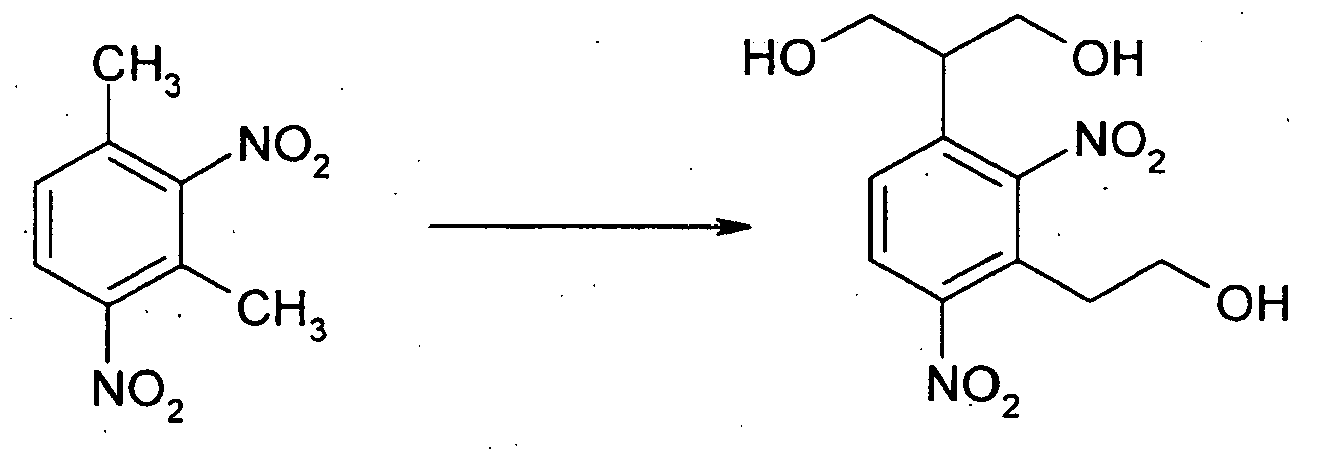
- 3. Stufe:

- 1. Stufe: Darstellung von 2,4-Dimethyl-1,3-dinitrobenzol
In 73 ml Schwefelsäure (konz.) wurden unter Kühlung bei 15°C 25 g (165 mmol) 2-Nitro-m-xylol gelöst. Zu der resultierenden dunkelgelben, klaren Lösung wurde anschließend bei 15°C vorsichtig ein Gemisch aus 11,9 ml Salpetersäure (konz.) und 18,3 ml Schwefelsäure (konz.) getropft. Man erhielt eine gelbe, schaumige Suspension, die für eine Stunde bei Raumtemperatur gerührt wurde. Anschließend goss man das Reaktionsgemisch auf ca. 210 g Eis, filtrierte den Niederschlag ab und wusch diesen bis zur Neutralität mit reichlich Wasser. Das erhaltene Rohprodukt wurde im Vakuum getrocknet und danach aus Ethanol umkristallisiert. Man erhielt weiß-gelbe Kristalle, die im Vakuum bei 50°C getrocknet wurden.
Ausbeute: 28,1 g (87%)
Schmp.: 84°C
1H-NMR (400 MHz, CDCl3): δ = 2,35 (s, 3H); 2,45 (s, 3H); 7,30 (d, 1H), 7,90 (d, 1H). - 2. Stufe: Darstellung von 2-[3-(2-Hydroxyethyl)-2,4-dinitrophenyl]propan-1,3-diol In 160 ml DMSO wurden 16 g (81,5 mmol) 2,4-Dimethyl-1,3-dinitrobenzol aus Stufe 1 und 27,2 ml Formalin (35 %ig) vorgelegt. Zu dieser Lösung wurden 0,9 g (16 mmol) Kaliumhydroxid gelöst in 7 ml Formalin (35 % ig) zugetropft. Das Reaktionsgemisch wurde für 30 Minuten gerührt, wobei die einsetzende, zunächst leicht exotherme Reaktion durch Eiskühlung auf Raumtemperatur gehalten wurde. Anschließend wurde auf 480 ml Wasser gegossen, mit wenig Salzsäure neutralisiert und sechsmal mit jeweils 250 ml Ether extrahiert. Die vereinigten Etherphasen wurden mit Natriumsulfat getrocknet, filtriert und im Vakuum bis zur Trockene eingeengt. Es resultierte ein gelbes Öl, welches im Vakuum getrocknet wurde.
Ausbeute: 11,6 g (50%)- 1H-NMR (400 MHz, DMSO-d6):
- δ = 2,75 (m, 1H); 2,85 (t, 2H); 3,60 (t, 2H); 3,70 (m, 4H); 4,80 (t, 2H,OH); 4,90 (t, 1H, OH) 7,70 (d, 1H); 8,10 (d, 1H).
- 3. Stufe: Darstellung von 2-[2,4-Diamino-3-(2-hydroxyethyl)phenyl]propan-1,3-diol,
Dihydrochlorid
11,6 g (40,5 mmol) 2-[3-(2-hydroxyethyl)-2,4-dinitrophenyl]propan-1,3-diol aus Stufe 2 wurden in 450 ml Ethanol und 50 ml Wasser in Gegenwart von 0,5 g Katalysator (Pd/C) bei 50°C und 50 bar Wasserstoff im Autoklaven hydriert. Nach beendeter Wasserstoffaufnahme wurde die erhaltene Lösung mit Salzsäure (10%ig) angesäuert, vom Katalysator abfiltriert und zur Trockene eingeengt. Man erhielt ein grau-braunes Pulver, welches im Vakuum getrocknet wurde.
Ausbeute: 7,6 g = 63%,
1H-NMR (400 MHz, D2O): δ = 2,95 (m, 2H); 3,25 (m, 1H); 3,70-3,95 (m, 6H); 7,00 (d, 1H); 7,30 (d, 1H) - Die Substanz wurde analog der folgenden vierstufigen Reaktionssequenz ausgehend von 3-Fluortoluol dargestellt:

- 1. Stufe: Synthese von 5-Fluor-1-methyl-2,4-dinitrobenzol gemäß
Egawa et. al., J. Heterocycl. Chem. 1987, 24, 181-185. - 2. Stufe: Darstellung des 5-Ethoxy-1-methyl-2,4-dinitrobenzol gemäß
DE 4219755 A1, Wella AG. - 3. Stufe: Darstellung von 2-(5-Ethoxy-2,4-dinitrophenyl)propan-1,3-diol
In 275 ml DMSO wurden 31 g (137 mmol) 5-Ethoxy-1-methyl-2,4-dinitrobenzol aus Stufe 2 und 29 ml Formalin (35 %ig) vorgelegt. Zu dieser Lösung wurden 2 g (13 mmol) 1,8-Diazabicyclo[5.4.0]undec-7-en gegeben.
Das Reaktionsgemisch wurde für zwei Stunden bei Raumtemperatur gerührt und dann auf 800 ml Wasser gegeben, mit wenig Salzsäure neutralisiert und sechsmal mit jeweils 200 ml Ether extrahiert. Die vereinigten Etherphasen wurden mit Natriumsulfat getrocknet, filtriert und im Vakuum bis zur Trockene eingeengt. Das zunächst resultierende Öl wurde aus wenig Essigsäure-ethylester kristallisiert. Man erhielt einen weißen Feststoff.
Ausbeute: 13,2 g (34%)
Schmp.: 88 °C- 1H-NMR (400 MHz, DMSO-d6):
- δ = 1,35 (t, 3H); 3,35 (m, 1H); 3,75 (m, 4H); 4,35 (q, 2H); 4,80 (t, 2H, OH); 7,40 (s, 1H); 8,45 (s, 1H).
- 4. Stufe: Darstellung von 2-(2,4-Diamino-5-ethoxyphenyl)propan-1,3-diol, Dihydrochlorid
13,1g (45,8 mmol) 2-(5-Ethoxy-2,4-dinitrophenyl)propan-1,3-diol aus Stufe 3 werden in 450 ml Ethanol und 50 ml Wasser in Gegenwart von 0,5 g Katalysator bei Raumtemperatur unter Normaldruck hydriert. Nach beendeter Wasserstoffaufnahme wurde die erhaltene Lösung mit Salzsäure (10%ig) angesäuert, vom Katalysator abfiltriert und zur Trockene eingeengt. Man erhielt einen hellen, grau-braunen Feststoff.
Ausbeute: 11,4 g = 83%- 1H-NMR (400 MHz, D2O):
- δ = 1,45 (t, 3H); 3,35 (m, 1H); 3,75 (m, 2H); 3,95 (m, 2H); 4,20 (q, 2H); 7,10 (s, 1H); 7,20 (s, 1H).
-

- Die Substanz wurde analog der folgenden vierstufigen Reaktionssequenz ausgehend von 3-Fluortoluol dargestellt:
- 1. Stufe: Synthese von 5-Fluor-1-methyl-2,4-dinitrobenzol gemäß Literaturvorschrift:
Egawa et. al., J. Heterocycl. Chem. 1987, 24, 181-185. - 2. Stufe: Darstellung des 5-Methoxy-1-methyl-2,4-dinitrobenzol gemäß Patentschrift:
DE 4219755 A1, Wella AG. - 3. Stufe: Darstellung von 2-(5-Methoxy-2,4-dinitrophenyl)propan-1,3-diol
In 140 ml DMSO wurden 15 g (137 mmol) 5-Methoxy-1-methyl-2,4-dinitrobenzol aus Stufe 2 und 15,8g Formalin (35 %ig) vorgelegt. Zu dieser Lösung werden 1 g (6,5 mmol) 1,8-Diazabicyclo[5.4.0]undec-7-en gegeben.
Das Reaktionsgemisch wurde für drei Stunden bei Raumtemperatur gerührt und dann auf 400 ml Wasser gegeben, mit wenig Salzsäure neutralisiert und dreimal mit jeweils 300 ml Ether extrahiert. Die vereinigten Etherphasen wurden mit Natriumsulfat getrocknet, filtriert und im Vakuum bis zur Trockene eingeengt. Man erhielt ein gelbes Öl.
Ausbeute: 14,8 g (86%)
1H-NMR (400 MHz, DMSO-d6): δ = 3,55 (m, 1H); 3,75 (m, 4H); 4,05 (s, 3H); 4,80 (t, 2H, OH); 7,40 (s, 1H); 8,50 (s, 1H). - 4. Stufe: Darstellung von 2-(2,4-Diamino-5-methoxyphenyl)propan-1,3-diol, Dihydrochlorid
14,4g (59,4 mmol) 2-(5-Methoxy-2,4-dinitrophenyl)propan-1,3-diol aus Stufe 3 wurden in 250 ml Methanol in Gegenwart von 0,3 g Katalysator bei Raumtemperatur unter Normaldruck hydriert. Nach beendeter Wasserstoffaufnahme wurde die erhaltene Lösung mit Salzsäure (10%ig) angesäuert, vom Katalysator abfiltriert und zur Trockene eingeengt. Man erhielt einen hellen, grau-braunen Feststoff.
Ausbeute: 11,4 g = 67 %
1H-NMR (400 MHz, D2O): δ = 3,35 (m, 1H); 3,85 (m, 2H); 4,05 (m, 5H); 7,20 (s, 1H); 7,45 (s, 1H). -

- Die Substanz wurde analog der folgenden fünfstufigen Reaktionssequenz ausgehend von 4-Methyl-3-nitroanisol dargestellt:
- Synthese von 2-(4-Methoxy-2-nitrophenyl)ethanol & Darstellung des 2-(4-Methoxy-2-nitrophenyl)propan-1,3-diol:
- Zu einer Lösung von 26,7g (160mmol) 4-Methyl-3-nitroanisol und 27,6g (873mmol) p-Formaldehyd in 300mL DMSO, wurden unter Rühren bei Raumtemperatur 1,7g (30,3mmol) KOH-Pulver zugegeben. Die resultierende gelbe Suspension wurde für 24 Stunden bei Raumtemperatur gerührt. Danach wurde die Reaktionslösung auf 600mL Wasser gegeben, mit wenig verdünnter Salzsäure neutralisiert und auf 4°C abgekühlt. Der ausgefallene Niederschlag wurde abfiltriert und verworfen. Die verbliebene Mutterlauge wurde mit Natriumchlorid gesättigt und dann sechsmal mit je 400mL MTBE extrahiert.
- Die vereinigten MTBE-Phasen wurden mit Natriumsulfat getrocknet und am Rotationsverdampfer komplett eingeengt.
- Der Rückstand wurde im Ölpumpenvakuum bei 50°C getrocknet und dann im Kugelrohr destilliert (Pumpe: IImvac, 1 *10-5mbar). Man erhielt zwei Fraktionen:
- 1. Fraktion, <180°C: 4-Methyl-3-nitroanisol
- 2. Fraktion, 180-214°C: 24,0 g Gemisch aus 2-(4-Methoxy-2-nitrophenyl)ethanol & 2-(4-Methoxy-2-nitrophenyl)propan-1,3-diol (orange-gelbes Öl)
Sumpf: 3,3 g = 9% 2-(4-Methoxy-2-nitrophenyl)propan-1,3-diol (gelber Feststoff;
Schmp.: 67-72°C) - Die 24,0g der zweiten Fraktion wurden gemeinsam mit 14,2g (449 mmol) p-Formaldehyd in 200mL DMSO gelöst. Unter Rühren wurden 1,1 g (19,6 mmol) KOH-Pulver zugesetzt und für 23 Stunden bei RT gerührt. Anschließend wurde die Reaktionslösung auf 600mL Wasser gegeben, mit wenig verd. Salzsäure neutralisiert und mit Natriumchlorid gesättigt. Die erhaltene Lösung wurde dreimal mit je 400mL MTBE extrahiert, die vereinigten MTBE-Phasen mit Natriumsulfat getrocknet und am Rotationsverdampfer eingeengt. Der erhaltene Rückstand wurde dann im Kugelrohr destilliert (Pumpe: IImvac, 1*10-5mbar), wobei bis 190°C verbliebene Verunreinigungen abdestilliert wurden. Es verblieben 15,5g = 42,3 % reinen Produktes als Destillationssumpf zurück.
Gesamtausbeute: 18,8g = 52% gelber Feststoff; 67-72°C
1H-NMR (400 MHz, DMSO-d6): δ = 3,15 (m, 1H); 3,60 (m, 2H); 3,70 (m, 2H); 3,82 (s, 3H); 4,68 (t, 2H, OH); 7,18 (dd, 1H); 7,30 (d, 1H); 7,45 (d, 1H). - 19,1 g (84,1mmol) des 2-(4-Methoxy-2-nitrophenyl)propan-1,3-diol aus Stufe 2 wurden in 400 ml Methanol in Gegenwart von 0,5 g Katalysator (Pd 5% auf C) bei Raumtemperatur unter Normaldruck hydriert. Nach beendeter Wasserstoffaufnahme wurde die erhaltene Lösung vom Katalysator abfiltriert, fast zur Trockene eingeengt und bei 4°C gelagert. Der ausgefallene Niederschlag wurde abfiltriert, mit wenig Methanol gewaschen und dann bei 50°C im Vakuum getrocknet.
Ausbeute: 11,4g = 69%, gelber Feststoff (Schmp.: 98-103)
1H-NMR (400 MHz, DMSO-d6): δ = 2,80 (m, 1H); 3,50 (m, 2H); 3,65 (m, 5H); 4,50 (t, 2H, OH); 4,80 (s, 2H, NH2); 6,10 (dd, 1H); 6,20 (d, 1H); 6,80 (d, 1H). - Zur Herstellung der Diazoniumchlorid-Lsg wurden 16,3g (94,1 mmol) Sulfanilsäure in 47mL (2M) Natronlauge gegeben. Zu dieser Suspension wurde eine Lösung von 6,5g (94,2mmol) Natriumnitrit in 90mL Wasser gegeben und man erhielt eine hell-orarige-farbene Lösung. Diese wurde auf 0-5°C gekühlt (Eis/-Kochsalz-Mischung) und mit 81mL 10%ige Salzsäure versetzt. Die erhaltene hell-orangefarbene Diazonium-chlorid-Suspension wurde auf 0-5°C abgekühlt und wie im Folgenden beschrieben verwendet.
- Zu 17,1 g (86,7mmol) 2-(2-amino-4-methoxyphenyl)propane-1,3-diol wurden 87mL 1 molare Salzsäure gegeben. Die resultierende Emulsion wurde ebenfalls auf 5-10°C gekühlt und dann langsam mit der oben beschriebenen Diazoniumchlorid-Suspension versetzt. Die Reaktionslösung verfärbte sich während des Rührens schon nach kurzer Zeit rot. Nach 5 Stunden rühren bei 5-10°C wurde die Temperatur langsam auf Raumtemperatur erhöht. Anschließend wurde mit Natronlauge (10%ig) neutralisiert, die Reaktionslösung am Rotationsverdampfer komplett eingeengt und der Rückstand in 150mL Methanol aufgeschlämmt und filtriert. Danach wurde die verbliebene Lösung noch zweimal mit je 50mL Methanol gewaschen und die komplette Methanollösung am Rotationsverdampfer eingeengt. Der orange rote Rückstand wurde bei 50°C im Vakuum getrocknet.
Ausbeute: 23,4g =71% orangeroter Feststoff
1H-NMR (400 MHz, DMSO-d6): δ = 3,00 (m, 1H); 3,60-3,70 (m, 4H); 3,90 (s, 3H); 6,50 (s, 1H); 7,70 (m, 5H). - In eine Lösung von 14,6g (38,3mol) 4-({4-Amino-5-[2-hydroxy-1-(hydroxymethyl)ethyl]-2-methoxyphenyl}diazenyl)benzolsulfonsäure in 350mL Wasser, wurden bei Raumtemperatur 16,8g (107mmol) Natriumditionit eingetragen. Nach weiteren 45 Minuten rühren bei Raumtemperatur wurde das Reaktionsgemisch für 3 Stunden auf 80°C erhitzt. Danach wurde die erhaltene klare, gelbe Lösung auf Raumtemperatur abgekühlt und mit 130 mL verdünnter Salzsäure versetzt. Der resultierende Niederschlag wurde abfiltriert und die verbliebene Lösung am Rotationsverdampfer vollständig eingeengt. Der Rückstand wurde in 100mL Methanol aufgenommen, die unlöslichen Anteile abfiltriert und das Filtrat am Rotationsverdampfer vollständig eingeengt. Der verbliebene Feststoff wurde im Vakuum bei 40°C getrocknet.
Ausbeute: 8,1g = 100 % hell-beiger Feststoff
1H-NMR (400 MHz, DMSO-d6/D2O): δ = 2,95 (m, 1H); 3,55 (m, 2H); 3,70 (m, 2H); 3,80 (s, 3H); 6,60 (s, 1H); 7,00 (s, 1H). - Für die Herstellung der Färbecreme wurden 50g einer Cremebasis in einem 250ml Becherglas eingewogen und bei 80°C geschmolzen. Die verwendete Cremebasis hatte die folgende Zusammensetzung:
Hydrenol® D1 17,0 Gew.-% Lorol® tech.2 4,0 Gew.-% Texapon® NSO3 40,0 Gew.-% Dehyton® K4 25,0 Gew.-% Eumulgin® B25 1,5 Gew.-% Wasser 12,5 Gew.-% 1C6-18-Fettalkohol (INCl-Bezeichnung: Cetearyl alcohol) (Cognis)
2C12-18-Fettalkohol (INCl-Bezeichnung: Coconut alcohol) (Cognis)
3Laurylethersulfat, Natriumsalz (ca. 27,5% Aktivsubstanz; INCl-Bezeichnung: Sodium Laureth Sulfate) (Cognis)
4 N,N-Dimethyl-N-(C8-18-kokosamidopropyl)ammoniumacetobetain (ca. 30% Aktivsubstanz; INCl-Bezeichnung: Aqua (Water), Cocamidopropyl Betaine) (Cognis)
5Cetylstearylalkohol mit ca. 20 EO-Einheiten (INCl-Bezeichnung: Ceteareth-20) (Cognis) - Es wurden jeweils 1/400 Mol der Entwickler- bzw. Kupplerkomponente getrennt in destilliertem Wasser suspendiert bzw. unter Erwärmen gelöst. Anschließend wurde Ammoniak (<1 ml; 25%ige Ammoniaklösung) zugegeben, bis der pH-Wert zwischen 9 und 10 lag.
- Die gelösten Farbstoffvorprodukte wurden nacheinander in die heiße Creme eingearbeitet. Anschließend wurde mit destilliertem Wasser auf 97g aufgefüllt und mit Ammoniak ein pH-Wert von 9,5 eingestellt. Nach Auffüllen mit destilliertem Wasser auf 100 g wurde der Ansatz kaltgerührt (< 30°C), wobei eine homogene Creme entstand.
- Für die Ausfärbungen wurden (soweit nichts anderes vermerkt ist) jeweils 25 g Färbecreme mit 25 g der folgenden Oxidationsmittelzubereitung vermischt.
Dipicolinsäure 0,1 Gew.-% Natriumpyrophosphat 0,03 Gew.-% Turpinal® SL6 1,50 Gew.-% Texapon® N287 2,00 Gew.-% Acrysol® 228 0,60 Gew.-% Wasserstoffperoxid, 50 %ig 12,0 Gew.-% Natronlauge, 45%ig 0,80 Gew.-% Wasser ad 100 6 1-Hydroxyethan-1,1-diphosphonsäure (ca. 58 - 61% Aktivsubstanzgehalt; INCl-Bezeichnung: Etidronic Acid, Aqua (Water)) (Solutia)
7 Laurylethersulfat-Natrium-Salz (mind. 26,5 % Aktivsubstanzgehalt; INCl-Bezeichnung: Sodium Laureth Sulfate) (Cognis)
8 Acrylpolymer (ca. 29.5 - 30.5% Festkörper in Wasser; INCI-Bezeichnung: Acrylates/Steareth-20 Methacrylate Copolyme)
In jede der so erhaltenen Mischungen wurde eine Haarsträhne (80 % ergraut; 330 mg bis 370 mg schwer) gegeben. Anschließend wurden die Mischungen und die Haarsträhnen auf jeweils ein Uhrglas gegeben und die Haarsträhnen in die Färbecremes gut eingebettet. Nach 30 Minuten (±1 Minute) Einwirkzeit bei 32 °C wurden die Haarsträhnen entnommen und mit einer wässrigen Texapon® EVR-Lösung9 so oft gewaschen, bis der Farbüberschuß entfernt war. Die Haarsträhnen wurden an der Luft getrocknet, und ihr Farbton wurde unter der Tageslichtlampe (Farbprüfgerät HE240A) bestimmt und notiert (Taschenlexikon der Farben, A. Kornerup u. J.H. Wanscher, 3. unveränderte Auflage 1981, MUSTER-SCHMIDT Verlag; Zürich, Göttingen).
9 Laurylethersulfat-Natrium-Salz mit speziellen Zusätzen (ca. 34 bis 37% Aktivsubstanzgehalt; INCl-Bezeichnung: Sodium Lauryl Sulfate, Sodium Laureth Sulfate, Lauramide MIPA, Cocamide MEA, Glycol Stearate, Laureth-10) (Cognis) - Die bei den Ausfärbungs-Untersuchungen erhaltenen Ergebnisse sind in den nachstehenden Tabellen aufgeführt.
-
Beispiel Entwickler Kuppler erhaltene Nuance 1 p-Toluylendiamin K1 schwarzblau 2 2,4,5,6-Tetraaminopyrimidin K1 oliv 3 p-Aminophenol K1 violettbraun 4 2-(β-Hydroxyethyl)-p-phenylendiamin K1 dunkelblau 5 4-Amino-3-methylphenol K1 rotbraun 6 Bis-(2-hydroxy-5-aminophenyl)methan K1 rotbraun 7 4,5-Diamino-1-(2-hydroxyethyl)-pyrazol K1 dunkelmagenta K1 : 2-[2,4-Diamino-3-(2-hydroxyethyl)phenyl]propan-1,3-diol, Dihydrochlorid -
Beispiel Entwickler Kuppler erhaltene Nuance 1 p-Toluylendiamin K2 schwarzblau 2 2,4,5,6-Tetraaminopyrimidin K2 fahl 3 p-Aminophenol K2 mattrot 4 2-(ß-Hydroxyethyl)-p-phenylendiamin K2 schwarzblau 5 4-Amino-3-methylphenol K2 nougatfarbig 6 Bis-(2-hydroxy-5-aminophenyl)methan K2 dunkelblond 7 4,5-Diamino-1-(2-hydroxyethyl)-pyrazol K2 graurubin K2 : 2-(2,4-Diamino-5-ethoxyphenyl)propan-1,3-diol, Dihydrochlorid, aus Beispiel -
Beispiel Entwickler Kuppler erhaltene Nuance 1 p-Toluylendiamin K3 schwarzblau 2 2,4,5,6-Tetraaminopyrimidin K3 mattgrün 3 p-Aminophenol K3 violettbraun 4 2-(ß-Hydroxyethyl)-p-phenylendiamin K3 schwarzblau 5 4-Amino-3-methylphenol K3 violettbraun 6 Bis-(2-hydroxy-5-aminophenyl)methan K3 rotbraun 7 4,5-Diamino-1-(2-hydroxyethyl)-pyrazol K3 rubin K3: 2-(2,4-Diamino-5-methoxyphenyl)propan-1,3-diol, Dihydrochlorid, aus Beispiel III -
Beispiel Kuppler Entwickler erhaltene Nuance 1 Resorcin E1 aubergine 2 3-Amino-6-methoxy-2-methylaminopyridin E1 schiefergrau 3 2,4-Diaminophenoxyethanol E1 schwarzblau 4 4-Amino-2-hydroxytoluol E1 dunkelviolett E1: 2-(2,5-Diamino-4-methoxyphenyl)propan-1,3-diol, Dihydrochlorid, aus Beispiel IV


Claims (15)
- Mittel zur Färbung keratinischer Fasern, insbesondere menschlicher Haare, enthaltend in einem kosmetisch akzeptablen Träger als Farbstoffvorprodukt mindestens ein Phenylpropandiol-Derivat der allgemeinen Formel (I)
 R1, R2 R3 R4 unabhängig voneinander H, C1-6-Alkyl, C1-6-Hydroxyalkyl, C2-6- Polyhydroxyalkyl, C7-12Arylalkyl, C2-6-Alkoxyalkyl, C1-6- Aminoalkyl, C2-10-Alkylaminoalkyl, C3-12-Dialkylaminoalkyl, wobei R1 und R2 auch gemeinsam einen C1-3-Alkylenrest bilden können, der durch Halogen, Hydroxy oder C1-4-Alkyl substituiert sein kann, Halogenalkyl, gegebenenfalls substituierter aromatischer Rest, C2-6-Alkenyl,R5 unabhängig voneinander H, OH, Halogen, NH2, C1-6-Alkylamino, C2-12-Dialkylamino, NO2, COOH, CN, C1-6-Alkyl, C1-6-Hydroxyalkyl, C2-6-Polyhydroxyalkyl, C7-2-Arylalkyl, C2-6-Alkoxyalkyl, C1-6- Aminoalkyl, C2-10-Alkylaminoalkyl, C3-12-Dialkylaminoalkyl, C1-6- Alkoxy, gegebenenfalls substituierter aromatischer Rest, C2-6- Alkenyl,R6 H, Halogen, C1-6-Alkoxy, C1-6-Alkylthio,m 0 oder 1,n ganze Zahl von 0 bis (3-m),ausgewählt aus Phenylpropandiol-Derivaten der allgemeinen Formeln (Ia) bis (Id)

- Mittel nach Anspruch 1, dadurch gekennzeichnet, dass im Derivat der allgemeinen Formel (I) R1, R2, R3, R4 unabhängig voneinander H, C1-4-Alkyl oder C1-4-Hydroxylalkyl bedeuten.
- Mittel nach Anspruch 2, dadurch gekennzeichnet, dass im Derivat der allgemeinen Formel (I) R1 und R2 Wasserstoff und R3 und R4 Wasserstoff oder C1-4-Hydroxyalkyl bedeuten.
- Mittel nach Anspruch 3, dadurch gekennzeichnet, dass im Derivat der allgemeinen Formel (I) R1 bis R4 Wasserstoff bedeuten.
- Mittel nach einem der Ansprüche 1 bis 4, dadurch gekennzeichnet, dass im Derivat der allgemeinen Formel (I) R5 unabhängig voneinander Wasserstoff, C1-4-Alkyl oder C1-4-Hydroxyalkyl bedeutet.
- Mittel nach Anspruch 5, dadurch gekennzeichnet, dass im Derivat der allgemeinen Formel (I) m 0 oder 1 bedeutet.
- Mittel nach Anspruch 6, dadurch gekennzeichnet, dass im Derivat der allgemeinen Formel (I) R6 Wasserstoff oder C1-4-Alkoxy bedeutet.
- Mittel nach einem der Ansprüche 1 bis 7, dadurch gekennzeichnet, dass das Phenylpropandiol-Derivat die allgemeine Formel (Ie) aufweist

- Mittel nach einem der Ansprüche 1 bis 8, dadurch gekennzeichnet, dass es mindestens eine (weitere) Entwicklerkomponente enthält.
- Mittel nach einem der Ansprüche 1 bis 9, dadurch gekennzeichnet, dass es mindestens eine (weitere) Kupplerkomponente enthält.
- Mittel nach einem der Ansprüche 1 bis 10, dadurch gekennzeichnet, dass es weiterhin mindestens einen direktziehenden Farbstoff enthält.
- Mittel nach Anspruch 11, dadurch gekennzeichnet, dass der direktziehende Farbstoff kationisch ist.
- Verfahren zur Färbung keratinischer Fasern, bei dem ein Mittel nach einem der Ansprüche 1 bis 12 auf die Fasern aufgetragen wird und nach einer Einwirkzeit wieder abgespült wird.
- Verwendung von Phenylpropandiol-Derivaten der allgemeinen Formel (I), wie sie in einem der Ansprüche 1 bis 8 definiert sind, zur Färbung keratinischer Fasern, insbesondere menschlicher Haare.
- Synthesezwischenstufe, ausgewählt aus der Gruppe, gebildet von 2-(5-Ethoxy-2,4-dinitrophenyl)propan-1,3-diol, 2-(5-Methoxy-2,4-dinitrophenyl)propan-1,3-diol, 2-(3-(2-Hydroxyethyl)-2,4-dinitrophenyl]propan-1,3-diol.
Applications Claiming Priority (2)
| Application Number | Priority Date | Filing Date | Title |
|---|---|---|---|
| DE102004031590A DE102004031590A1 (de) | 2004-06-30 | 2004-06-30 | Phenylpropandiol-Farbstoffprodukte |
| PCT/EP2005/005142 WO2006002712A1 (de) | 2004-06-30 | 2005-05-12 | Phenylpropandiol-farbstoffvorprodukte |
Publications (2)
| Publication Number | Publication Date |
|---|---|
| EP1765267A1 EP1765267A1 (de) | 2007-03-28 |
| EP1765267B1 true EP1765267B1 (de) | 2010-01-06 |
Family
ID=35115826
Family Applications (1)
| Application Number | Title | Priority Date | Filing Date |
|---|---|---|---|
| EP05739681A Revoked EP1765267B1 (de) | 2004-06-30 | 2005-05-12 | Phenylpropandiol-farbstoffvorprodukte |
Country Status (4)
| Country | Link |
|---|---|
| EP (1) | EP1765267B1 (de) |
| AT (1) | ATE454127T1 (de) |
| DE (2) | DE102004031590A1 (de) |
| WO (1) | WO2006002712A1 (de) |
Cited By (10)
| Publication number | Priority date | Publication date | Assignee | Title |
|---|---|---|---|---|
| US8529637B2 (en) | 2011-09-30 | 2013-09-10 | The Procter & Gamble Company | Foam oxidative hair colorant composition with the free-base of 1,4-diamino-2-methoxymethyl benzene |
| US8618326B2 (en) | 2010-09-29 | 2013-12-31 | The Procter & Gamble Company | Methods of synthesizing 2-substituted-1,4-benzenediamine |
| US8663341B2 (en) | 2012-06-25 | 2014-03-04 | The Procter & Gamble Company | Hair colorant compositions comprising 2-Methoxymethy1-1,4-diaminobenzene, methods, and kits comprising the compositions |
| US9012691B2 (en) | 2012-10-26 | 2015-04-21 | The Procter & Gamble Company | Process for preparing primary intermediates for dyeing keratin fibers |
| US9309185B2 (en) | 2012-10-26 | 2016-04-12 | The Procter & Gamble Company | Process for preparing primary intermediates for dyeing keratin fibers |
| US9539192B2 (en) | 2014-04-02 | 2017-01-10 | Noxell Corporation | Hair colouring compositions, kits, method, and use thereof |
| US9587116B2 (en) | 2014-11-04 | 2017-03-07 | Noxell Corporation | Azo direct dyes and method for dyeing hair using these dyes |
| US9688609B2 (en) | 2014-11-04 | 2017-06-27 | Noxell Corporation | Telescoping synthesis of 2-methoxymethyl-P-phenylenediamine |
| US9695109B2 (en) | 2014-11-04 | 2017-07-04 | Noxell Corporation | Telescoping synthesis of 2-methoxymethyl-p-phenylenediamine |
| US9758469B2 (en) | 2014-11-04 | 2017-09-12 | Noxell Corporation | Process for the preparation of 2-substituted-1,4-benzenediamines and salts thereof |
Citations (1)
| Publication number | Priority date | Publication date | Assignee | Title |
|---|---|---|---|---|
| JPS63211264A (ja) * | 1987-02-27 | 1988-09-02 | Nippon Kayaku Co Ltd | インドリン類の製造法 |
Family Cites Families (5)
| Publication number | Priority date | Publication date | Assignee | Title |
|---|---|---|---|---|
| HU177886B (en) * | 1979-05-29 | 1982-01-28 | Reanal Finomvegyszergyar | Process for the selective hydroxymethylation of nitro-toluenes |
| DE4219755A1 (de) * | 1992-06-17 | 1993-12-23 | Wella Ag | Verfahren zur Herstellung von 5-Alkoxy-2,4-dinitro-alkylbenzolen |
| DE19813937C1 (de) * | 1998-03-28 | 1999-09-16 | Wella Ag | Haarfärbemittel |
| US6228130B1 (en) * | 1998-11-03 | 2001-05-08 | Bristol-Myers Squibb Company | Primary intermediate in oxidative hair dyeing |
| DE10237816A1 (de) * | 2002-08-14 | 2004-02-26 | Henkel Kgaa | Neue Entwicklerkomponenten |
-
2004
- 2004-06-30 DE DE102004031590A patent/DE102004031590A1/de not_active Withdrawn
-
2005
- 2005-05-12 WO PCT/EP2005/005142 patent/WO2006002712A1/de not_active Ceased
- 2005-05-12 AT AT05739681T patent/ATE454127T1/de not_active IP Right Cessation
- 2005-05-12 DE DE502005008834T patent/DE502005008834D1/de not_active Expired - Fee Related
- 2005-05-12 EP EP05739681A patent/EP1765267B1/de not_active Revoked
Patent Citations (1)
| Publication number | Priority date | Publication date | Assignee | Title |
|---|---|---|---|---|
| JPS63211264A (ja) * | 1987-02-27 | 1988-09-02 | Nippon Kayaku Co Ltd | インドリン類の製造法 |
Cited By (13)
| Publication number | Priority date | Publication date | Assignee | Title |
|---|---|---|---|---|
| US8618326B2 (en) | 2010-09-29 | 2013-12-31 | The Procter & Gamble Company | Methods of synthesizing 2-substituted-1,4-benzenediamine |
| US9216945B2 (en) | 2010-09-29 | 2015-12-22 | The Procter & Gamble Company | Methods of synthesizing 2-substituted-1,4-benzenediamine |
| US8529637B2 (en) | 2011-09-30 | 2013-09-10 | The Procter & Gamble Company | Foam oxidative hair colorant composition with the free-base of 1,4-diamino-2-methoxymethyl benzene |
| US8702814B2 (en) | 2012-06-25 | 2014-04-22 | The Procter & Gamble Company | Hair colorant compositions comprising 2-methoxymethyl-1,4-diaminobenzene and 2,6-diaminopyridine, methods, and kits comprising the compositions |
| US8709100B2 (en) | 2012-06-25 | 2014-04-29 | The Procter & Gamble Company | Hair colorant compositions comprising 2-methoxymethyl-1,4-diaminobenzene and 5-amino-4-chloro-o-cresol, methods, and kits comprising the compositions |
| US8663341B2 (en) | 2012-06-25 | 2014-03-04 | The Procter & Gamble Company | Hair colorant compositions comprising 2-Methoxymethy1-1,4-diaminobenzene, methods, and kits comprising the compositions |
| US9012691B2 (en) | 2012-10-26 | 2015-04-21 | The Procter & Gamble Company | Process for preparing primary intermediates for dyeing keratin fibers |
| US9309185B2 (en) | 2012-10-26 | 2016-04-12 | The Procter & Gamble Company | Process for preparing primary intermediates for dyeing keratin fibers |
| US9539192B2 (en) | 2014-04-02 | 2017-01-10 | Noxell Corporation | Hair colouring compositions, kits, method, and use thereof |
| US9587116B2 (en) | 2014-11-04 | 2017-03-07 | Noxell Corporation | Azo direct dyes and method for dyeing hair using these dyes |
| US9688609B2 (en) | 2014-11-04 | 2017-06-27 | Noxell Corporation | Telescoping synthesis of 2-methoxymethyl-P-phenylenediamine |
| US9695109B2 (en) | 2014-11-04 | 2017-07-04 | Noxell Corporation | Telescoping synthesis of 2-methoxymethyl-p-phenylenediamine |
| US9758469B2 (en) | 2014-11-04 | 2017-09-12 | Noxell Corporation | Process for the preparation of 2-substituted-1,4-benzenediamines and salts thereof |
Also Published As
| Publication number | Publication date |
|---|---|
| DE102004031590A1 (de) | 2006-02-16 |
| WO2006002712A1 (de) | 2006-01-12 |
| ATE454127T1 (de) | 2010-01-15 |
| EP1765267A1 (de) | 2007-03-28 |
| DE502005008834D1 (de) | 2010-02-25 |
Similar Documents
| Publication | Publication Date | Title |
|---|---|---|
| EP0792139B1 (de) | Oxidationsfärbemittel | |
| EP0966449B1 (de) | 1,4-diazacycloheptan-derivate und deren verwendung in oxidationshaarfärbemitteln | |
| EP1583511B1 (de) | Neue kupplerkomponenten | |
| EP1438294B1 (de) | Entwicklerkomponenten und deren verwendung zur färbung keratinischer fasern | |
| EP1455741A2 (de) | Neue entwicklerkomponenten | |
| DE102004031590A1 (de) | Phenylpropandiol-Farbstoffprodukte | |
| EP1795179A1 (de) | Farbstoffvorproduktkombinationen enthaltend ein Diaminopyrazolderivat, ein m-Aminophenolderivat und ein Pyrimidinderivat | |
| EP1795178A2 (de) | Farbstoffvorproduktkombinationen enthaltend ein Diaminopyrazolderivat, ein m-Aminophenolderivat und ein Pyridinderivat | |
| EP1797863A1 (de) | Farbstoffvorproduktkombinationen enthaltend ein Diaminopyrazolderivat, ein m-Aminophenolderivat und ein m-Phenylendiaminderivat | |
| DE102004055074A1 (de) | Neue Kupplerkomponenten | |
| DE102004036688A1 (de) | Kationische Azoverbindungen als direktziehende Farbstoffe zur Färbung keratinischer Fasern | |
| EP0873987B1 (de) | Perfluoracylierte 3-Aminophenol-Derivate und deren Verwendung in Haarfärbemitteln | |
| EP1787685B1 (de) | Farbstoffvorproduktkombinationen | |
| EP1496046A1 (de) | Neue Kupplerkomponenten | |
| DE10260820A1 (de) | Neue Kupplerkomponenten | |
| DE102004026733A1 (de) | m-Phenylendiamin-Kupplerkomponenten | |
| DE202004017949U1 (de) | Mittel zur Färbung keratinischer Fasern | |
| DE10237816A1 (de) | Neue Entwicklerkomponenten | |
| DE10237932A1 (de) | Neue Entwicklerkomponenten | |
| DE102004026732A1 (de) | m-Phenylendiamin-Kupplerkomponenten | |
| DE102005052912A1 (de) | Mittel zum Färben keratinhaltiger Fasern | |
| DE102004026719A1 (de) | 4,5,6-substituierte m-Phenylendiamin-Kupplerkomponenten | |
| EP1787684A2 (de) | Neue Kupplerkomponenten | |
| DE102005046001A1 (de) | Neue Kupplerkomponenten | |
| DE10260821A1 (de) | Neue Entwicklerkomponenten |
Legal Events
| Date | Code | Title | Description |
|---|---|---|---|
| PUAI | Public reference made under article 153(3) epc to a published international application that has entered the european phase |
Free format text: ORIGINAL CODE: 0009012 |
|
| 17P | Request for examination filed |
Effective date: 20060913 |
|
| AK | Designated contracting states |
Kind code of ref document: A1 Designated state(s): AT BE BG CH CY CZ DE DK EE ES FI FR GB GR HU IE IS IT LI LT LU MC NL PL PT RO SE SI SK TR |
|
| DAX | Request for extension of the european patent (deleted) | ||
| 17Q | First examination report despatched |
Effective date: 20071106 |
|
| RAP1 | Party data changed (applicant data changed or rights of an application transferred) |
Owner name: HENKEL AG & CO. KGAA |
|
| RIC1 | Information provided on ipc code assigned before grant |
Ipc: C07C 215/68 20060101ALI20090324BHEP Ipc: C07C 205/12 20060101ALI20090324BHEP Ipc: C07C 217/84 20060101ALI20090324BHEP Ipc: C07C 205/06 20060101ALI20090324BHEP Ipc: A61K 8/41 20060101AFI20090324BHEP Ipc: C07C 205/19 20060101ALI20090324BHEP Ipc: A61Q 5/10 20060101ALI20090324BHEP Ipc: C07C 205/37 20060101ALI20090324BHEP |
|
| GRAP | Despatch of communication of intention to grant a patent |
Free format text: ORIGINAL CODE: EPIDOSNIGR1 |
|
| RIC1 | Information provided on ipc code assigned before grant |
Ipc: C07C 205/37 20060101ALI20090622BHEP Ipc: A61K 8/41 20060101AFI20090622BHEP Ipc: C07C 205/12 20060101ALI20090622BHEP Ipc: C07C 205/06 20060101ALI20090622BHEP Ipc: C07C 215/68 20060101ALI20090622BHEP Ipc: C07C 205/19 20060101ALI20090622BHEP Ipc: C07C 217/84 20060101ALI20090622BHEP Ipc: A61Q 5/10 20060101ALI20090622BHEP |
|
| GRAS | Grant fee paid |
Free format text: ORIGINAL CODE: EPIDOSNIGR3 |
|
| GRAA | (expected) grant |
Free format text: ORIGINAL CODE: 0009210 |
|
| AK | Designated contracting states |
Kind code of ref document: B1 Designated state(s): AT BE BG CH CY CZ DE DK EE ES FI FR GB GR HU IE IS IT LI LT LU MC NL PL PT RO SE SI SK TR |
|
| REG | Reference to a national code |
Ref country code: GB Ref legal event code: FG4D Free format text: NOT ENGLISH |
|
| REG | Reference to a national code |
Ref country code: CH Ref legal event code: EP |
|
| REG | Reference to a national code |
Ref country code: IE Ref legal event code: FG4D |
|
| REF | Corresponds to: |
Ref document number: 502005008834 Country of ref document: DE Date of ref document: 20100225 Kind code of ref document: P |
|
| REG | Reference to a national code |
Ref country code: NL Ref legal event code: VDEP Effective date: 20100106 |
|
| PG25 | Lapsed in a contracting state [announced via postgrant information from national office to epo] |
Ref country code: SI Free format text: LAPSE BECAUSE OF FAILURE TO SUBMIT A TRANSLATION OF THE DESCRIPTION OR TO PAY THE FEE WITHIN THE PRESCRIBED TIME-LIMIT Effective date: 20100106 |
|
| LTIE | Lt: invalidation of european patent or patent extension |
Effective date: 20100106 |
|
| PG25 | Lapsed in a contracting state [announced via postgrant information from national office to epo] |
Ref country code: PT Free format text: LAPSE BECAUSE OF FAILURE TO SUBMIT A TRANSLATION OF THE DESCRIPTION OR TO PAY THE FEE WITHIN THE PRESCRIBED TIME-LIMIT Effective date: 20100506 Ref country code: NL Free format text: LAPSE BECAUSE OF FAILURE TO SUBMIT A TRANSLATION OF THE DESCRIPTION OR TO PAY THE FEE WITHIN THE PRESCRIBED TIME-LIMIT Effective date: 20100106 Ref country code: IS Free format text: LAPSE BECAUSE OF FAILURE TO SUBMIT A TRANSLATION OF THE DESCRIPTION OR TO PAY THE FEE WITHIN THE PRESCRIBED TIME-LIMIT Effective date: 20100506 Ref country code: LT Free format text: LAPSE BECAUSE OF FAILURE TO SUBMIT A TRANSLATION OF THE DESCRIPTION OR TO PAY THE FEE WITHIN THE PRESCRIBED TIME-LIMIT Effective date: 20100106 Ref country code: ES Free format text: LAPSE BECAUSE OF FAILURE TO SUBMIT A TRANSLATION OF THE DESCRIPTION OR TO PAY THE FEE WITHIN THE PRESCRIBED TIME-LIMIT Effective date: 20100417 |
|
| REG | Reference to a national code |
Ref country code: IE Ref legal event code: FD4D |
|
| PG25 | Lapsed in a contracting state [announced via postgrant information from national office to epo] |
Ref country code: PL Free format text: LAPSE BECAUSE OF FAILURE TO SUBMIT A TRANSLATION OF THE DESCRIPTION OR TO PAY THE FEE WITHIN THE PRESCRIBED TIME-LIMIT Effective date: 20100106 Ref country code: FI Free format text: LAPSE BECAUSE OF FAILURE TO SUBMIT A TRANSLATION OF THE DESCRIPTION OR TO PAY THE FEE WITHIN THE PRESCRIBED TIME-LIMIT Effective date: 20100106 |
|
| PLBI | Opposition filed |
Free format text: ORIGINAL CODE: 0009260 |
|
| PG25 | Lapsed in a contracting state [announced via postgrant information from national office to epo] |
Ref country code: EE Free format text: LAPSE BECAUSE OF FAILURE TO SUBMIT A TRANSLATION OF THE DESCRIPTION OR TO PAY THE FEE WITHIN THE PRESCRIBED TIME-LIMIT Effective date: 20100106 Ref country code: CY Free format text: LAPSE BECAUSE OF FAILURE TO SUBMIT A TRANSLATION OF THE DESCRIPTION OR TO PAY THE FEE WITHIN THE PRESCRIBED TIME-LIMIT Effective date: 20100106 Ref country code: GR Free format text: LAPSE BECAUSE OF FAILURE TO SUBMIT A TRANSLATION OF THE DESCRIPTION OR TO PAY THE FEE WITHIN THE PRESCRIBED TIME-LIMIT Effective date: 20100407 Ref country code: SE Free format text: LAPSE BECAUSE OF FAILURE TO SUBMIT A TRANSLATION OF THE DESCRIPTION OR TO PAY THE FEE WITHIN THE PRESCRIBED TIME-LIMIT Effective date: 20100106 Ref country code: RO Free format text: LAPSE BECAUSE OF FAILURE TO SUBMIT A TRANSLATION OF THE DESCRIPTION OR TO PAY THE FEE WITHIN THE PRESCRIBED TIME-LIMIT Effective date: 20100106 Ref country code: IE Free format text: LAPSE BECAUSE OF FAILURE TO SUBMIT A TRANSLATION OF THE DESCRIPTION OR TO PAY THE FEE WITHIN THE PRESCRIBED TIME-LIMIT Effective date: 20100106 |
|
| PLAX | Notice of opposition and request to file observation + time limit sent |
Free format text: ORIGINAL CODE: EPIDOSNOBS2 |
|
| 26 | Opposition filed |
Opponent name: THE PROCTER & GAMBLE COMPANY Effective date: 20101006 |
|
| BERE | Be: lapsed |
Owner name: HENKEL A.G. & CO. KGAA Effective date: 20100531 |
|
| PG25 | Lapsed in a contracting state [announced via postgrant information from national office to epo] |
Ref country code: BG Free format text: LAPSE BECAUSE OF FAILURE TO SUBMIT A TRANSLATION OF THE DESCRIPTION OR TO PAY THE FEE WITHIN THE PRESCRIBED TIME-LIMIT Effective date: 20100406 Ref country code: SK Free format text: LAPSE BECAUSE OF FAILURE TO SUBMIT A TRANSLATION OF THE DESCRIPTION OR TO PAY THE FEE WITHIN THE PRESCRIBED TIME-LIMIT Effective date: 20100106 Ref country code: CZ Free format text: LAPSE BECAUSE OF FAILURE TO SUBMIT A TRANSLATION OF THE DESCRIPTION OR TO PAY THE FEE WITHIN THE PRESCRIBED TIME-LIMIT Effective date: 20100106 |
|
| PG25 | Lapsed in a contracting state [announced via postgrant information from national office to epo] |
Ref country code: MC Free format text: LAPSE BECAUSE OF NON-PAYMENT OF DUE FEES Effective date: 20100531 |
|
| REG | Reference to a national code |
Ref country code: CH Ref legal event code: PL |
|
| GBPC | Gb: european patent ceased through non-payment of renewal fee |
Effective date: 20100512 |
|
| PG25 | Lapsed in a contracting state [announced via postgrant information from national office to epo] |
Ref country code: DK Free format text: LAPSE BECAUSE OF FAILURE TO SUBMIT A TRANSLATION OF THE DESCRIPTION OR TO PAY THE FEE WITHIN THE PRESCRIBED TIME-LIMIT Effective date: 20100106 |
|
| REG | Reference to a national code |
Ref country code: FR Ref legal event code: ST Effective date: 20110131 |
|
| PG25 | Lapsed in a contracting state [announced via postgrant information from national office to epo] |
Ref country code: LI Free format text: LAPSE BECAUSE OF NON-PAYMENT OF DUE FEES Effective date: 20100531 Ref country code: CH Free format text: LAPSE BECAUSE OF NON-PAYMENT OF DUE FEES Effective date: 20100531 |
|
| PG25 | Lapsed in a contracting state [announced via postgrant information from national office to epo] |
Ref country code: IT Free format text: LAPSE BECAUSE OF FAILURE TO SUBMIT A TRANSLATION OF THE DESCRIPTION OR TO PAY THE FEE WITHIN THE PRESCRIBED TIME-LIMIT Effective date: 20100106 Ref country code: BE Free format text: LAPSE BECAUSE OF NON-PAYMENT OF DUE FEES Effective date: 20100531 |
|
| PG25 | Lapsed in a contracting state [announced via postgrant information from national office to epo] |
Ref country code: DE Free format text: LAPSE BECAUSE OF NON-PAYMENT OF DUE FEES Effective date: 20101201 |
|
| PG25 | Lapsed in a contracting state [announced via postgrant information from national office to epo] |
Ref country code: FR Free format text: LAPSE BECAUSE OF NON-PAYMENT OF DUE FEES Effective date: 20100531 |
|
| PG25 | Lapsed in a contracting state [announced via postgrant information from national office to epo] |
Ref country code: GB Free format text: LAPSE BECAUSE OF NON-PAYMENT OF DUE FEES Effective date: 20100512 |
|
| PG25 | Lapsed in a contracting state [announced via postgrant information from national office to epo] |
Ref country code: AT Free format text: LAPSE BECAUSE OF NON-PAYMENT OF DUE FEES Effective date: 20100512 |
|
| RDAF | Communication despatched that patent is revoked |
Free format text: ORIGINAL CODE: EPIDOSNREV1 |
|
| RDAG | Patent revoked |
Free format text: ORIGINAL CODE: 0009271 |
|
| STAA | Information on the status of an ep patent application or granted ep patent |
Free format text: STATUS: PATENT REVOKED |
|
| 27W | Patent revoked |
Effective date: 20111017 |
|
| REG | Reference to a national code |
Ref country code: AT Ref legal event code: MA03 Ref document number: 454127 Country of ref document: AT Kind code of ref document: T Effective date: 20111017 |
|
| PG25 | Lapsed in a contracting state [announced via postgrant information from national office to epo] |
Ref country code: LU Free format text: LAPSE BECAUSE OF REVOCATION BY EPO Effective date: 20100512 Ref country code: HU Free format text: LAPSE BECAUSE OF FAILURE TO SUBMIT A TRANSLATION OF THE DESCRIPTION OR TO PAY THE FEE WITHIN THE PRESCRIBED TIME-LIMIT Effective date: 20100707 |