EP0999203A1 - Novel developer in oxidative hair dyeing - Google Patents
Novel developer in oxidative hair dyeing Download PDFInfo
- Publication number
- EP0999203A1 EP0999203A1 EP99203596A EP99203596A EP0999203A1 EP 0999203 A1 EP0999203 A1 EP 0999203A1 EP 99203596 A EP99203596 A EP 99203596A EP 99203596 A EP99203596 A EP 99203596A EP 0999203 A1 EP0999203 A1 EP 0999203A1
- Authority
- EP
- European Patent Office
- Prior art keywords
- diaminophenyl
- phenylenediamine
- ethylene glycol
- oxidative hair
- metaphenylenediamine
- Prior art date
- Legal status (The legal status is an assumption and is not a legal conclusion. Google has not performed a legal analysis and makes no representation as to the accuracy of the status listed.)
- Granted
Links
Classifications
-
- A—HUMAN NECESSITIES
- A61—MEDICAL OR VETERINARY SCIENCE; HYGIENE
- A61Q—SPECIFIC USE OF COSMETICS OR SIMILAR TOILETRY PREPARATIONS
- A61Q5/00—Preparations for care of the hair
- A61Q5/10—Preparations for permanently dyeing the hair
-
- A—HUMAN NECESSITIES
- A61—MEDICAL OR VETERINARY SCIENCE; HYGIENE
- A61K—PREPARATIONS FOR MEDICAL, DENTAL OR TOILETRY PURPOSES
- A61K8/00—Cosmetics or similar toiletry preparations
- A61K8/18—Cosmetics or similar toiletry preparations characterised by the composition
- A61K8/30—Cosmetics or similar toiletry preparations characterised by the composition containing organic compounds
- A61K8/40—Cosmetics or similar toiletry preparations characterised by the composition containing organic compounds containing nitrogen
- A61K8/41—Amines
- A61K8/411—Aromatic amines, i.e. where the amino group is directly linked to the aromatic nucleus
-
- C—CHEMISTRY; METALLURGY
- C07—ORGANIC CHEMISTRY
- C07C—ACYCLIC OR CARBOCYCLIC COMPOUNDS
- C07C215/00—Compounds containing amino and hydroxy groups bound to the same carbon skeleton
- C07C215/68—Compounds containing amino and hydroxy groups bound to the same carbon skeleton having amino groups bound to carbon atoms of six-membered aromatic rings and hydroxy groups bound to acyclic carbon atoms or to carbon atoms of rings other than six-membered aromatic rings of the same carbon skeleton
Definitions
- the invention relates to 1-(2,5-diaminophenyl)ethylene glycol (1), to a process for preparing same and to its use in compositions for dyeing human hair.
- compositions for the oxidative dyeing of hair comprise primary intermediates (such as p-phenylenediamine, p-toluenediamine, p-aminophenol, 4-amino-3-methylphenol) and couplers (such as resorcinol, 2-methylresorcinol, 3-aminophenol, 5-amino-2-methylphenol).
- primary intermediates such as p-phenylenediamine, p-toluenediamine, p-aminophenol, 4-amino-3-methylphenol
- couplers such as resorcinol, 2-methylresorcinol, 3-aminophenol, 5-amino-2-methylphenol.
- EP 400,330 B1 (GB 2,239,265 A) describes the use of 2-(2-hydroxyethyl)-p-phenylenediamine as a replacement for p-phenylenediamine.
- US 5,421,833 discloses hair dye compositions asserted to be without sensitizing potential.
- the dye compositions are disclosed to possess improved dyeing properties for all shades.
- the compositions comprise only 2-(2'-hydroxyethyl)amino-5-aminotoluene in combination with the usual coupling agents (with the exclusion of 1-methoxy-2,4-diaminobenzene and 1-ethoxy-2,4-diaminobenzene).
- the object of the present invention was to develop a p-phenylenediamine alternative having less sensitization potential. This proved to be a difficult task. Since the structure-sensitization relationship is not known, it is difficult to predict whether a hair dye molecule will exhibit much lower potential for sensitization than p-phenylenediamine. Surprisingly and unexpectedly, we have found that 1-(2,5-diaminophenyl)ethylene glycol is a much weaker sensitizer than p-phenylenediamine.
- the present invention provides the novel compound, 1-(2,5-diaminophenyl)ethylene glycol, a process for preparing same, its use as a primary intermediate in oxidative hair dyeing, and hair dye compositions containing same.
- the present invention enables one skilled in the art to formulate a natural black shade and dark red shade through the use of 1-(2,5-diaminophenyl)ethylene glycol without relying on p-phenylenediamine (see Table 2).
- the shades obtained through use of 1-(2,5-diaminophenyl)ethylene glycol have good wash and light fastness.
- the process for the preparation of the 1-(2,5-diaminophenyl)ethylene glycol is new and commercially feasible.
- the synthesis of the compound 1 requires three steps: (1) ring-opening of 5-nitroisatin with sodium hydroxide, (2) borane reduction of the keto acid, and (3) hydrogenation.
- 1-(2,5-Diaminophenyl)ethylene glycol has excellent solubility in water.
- Four grams of 1-(2,5-diaminophenyl)ethylene glycol sulfate salt completely dissolves in 100 ml of water at room temperature.
- the p-toluenediamine sulfate salt is partially soluble under the same conditions. Water solubility is important because hair dye formulations employed for hair coloring are in large part water.
- Dye compositions containing 1-(2,5-diaminophenyl)ethylene glycol can also contain other primary intermediates and couplers.
- meta diamines include m-phenylenediamine, 2,4-diaminophenoxyethanol and 4,6-bis(2-hydroxyethoxy)-m-phenylenediamine.
- Suitable primary intermediates include :
- Suitable couplers include :
- Preferred primary intermediates include :
- Preferred couplers include :
- Couplers include :
- Preferred combinations employing 1-(2,5-diaminophenyl) ethane-1,2-diol as a p-phenylenediamine replacement include combinations 1-24 set forth in Table 1 which follows:
- Combination 1 of Table 1 is a mixture of 1-(2,5-diaminophenyl) ethane-1,2-diol; 2-[(4-aminophenyl)-(2-hydroxy-ethyl)-amino]-ethanol; 2-amino-phenol; benzene-1,3-diol; naphthalen-1-ol; 3-amino-phenol; and 4-amino-phenol.
- composition of each of the remaining combinations is similarly determined.
- test composition (according to Table 2 and Table 3) is mixed with 100 g of 20 volume hydrogen peroxide. The resulting mixture is applied on gray hair and permitted to remain in contact with the hair for 30 minutes. The dyed hair is then shampooed and rinsed with water and dried.
Landscapes
- Health & Medical Sciences (AREA)
- Life Sciences & Earth Sciences (AREA)
- Chemical & Material Sciences (AREA)
- Organic Chemistry (AREA)
- Animal Behavior & Ethology (AREA)
- General Health & Medical Sciences (AREA)
- Public Health (AREA)
- Veterinary Medicine (AREA)
- Birds (AREA)
- Epidemiology (AREA)
- Cosmetics (AREA)
- Organic Low-Molecular-Weight Compounds And Preparation Thereof (AREA)
Abstract
Description
- The invention relates to 1-(2,5-diaminophenyl)ethylene glycol (1), to a process for preparing same and to its use in compositions for dyeing human hair.
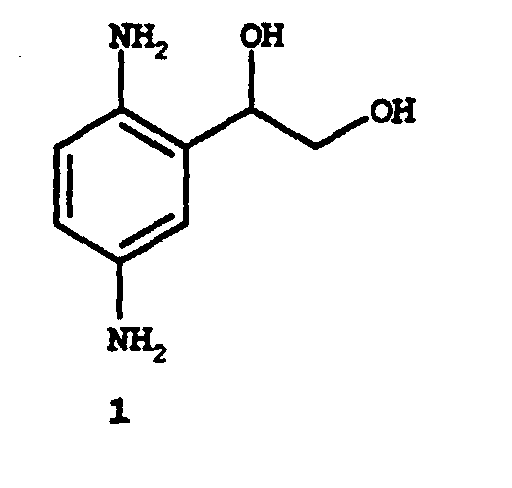
- Compositions for the oxidative dyeing of hair comprise primary intermediates (such as p-phenylenediamine, p-toluenediamine, p-aminophenol, 4-amino-3-methylphenol) and couplers (such as resorcinol, 2-methylresorcinol, 3-aminophenol, 5-amino-2-methylphenol). A majority of shades have been produced with dyes based on p-phenylenediamine. However, as noted in U. S. Patents 5,599,353 and 5,538,516, the use of p-phenylenediamine is being questioned for toxicological reasons, mainly due to its sensitization potential.
- Because of the supposed toxicological issues attendant to its use, the art has been looking for substitutes for p-phenylenediamine.
- EP 400,330 B1 (GB 2,239,265 A) describes the use of 2-(2-hydroxyethyl)-p-phenylenediamine as a replacement for p-phenylenediamine.
- Pyrimidine derivatives, such as tetraaminopyrimidine, have been also suggested as alternatives to p-phenylenediamine (see US Re. 30,199 [US 4,003,699]). However, GB 2,239,265 A, points out that although the use of pyrimidine derivatives as developers has reduced toxicological problems, the pyrimidine derivatives are not completely satisfactory with respect to coloring performance.
- US 5,421,833 discloses hair dye compositions asserted to be without sensitizing potential. The dye compositions are disclosed to possess improved dyeing properties for all shades. The compositions comprise only 2-(2'-hydroxyethyl)amino-5-aminotoluene in combination with the usual coupling agents (with the exclusion of 1-methoxy-2,4-diaminobenzene and 1-ethoxy-2,4-diaminobenzene).
- The object of the present invention was to develop a p-phenylenediamine alternative having less sensitization potential. This proved to be a difficult task. Since the structure-sensitization relationship is not known, it is difficult to predict whether a hair dye molecule will exhibit much lower potential for sensitization than p-phenylenediamine. Surprisingly and unexpectedly, we have found that 1-(2,5-diaminophenyl)ethylene glycol is a much weaker sensitizer than p-phenylenediamine.
- The present invention provides the novel compound, 1-(2,5-diaminophenyl)ethylene glycol, a process for preparing same, its use as a primary intermediate in oxidative hair dyeing, and hair dye compositions containing same.
- In contrast to p-phenylenediamine 1-(2,5-diaminophenyl)ethylene glycol was surprisingly found to be a weak sensitizer.
- Current technology generally requires p-phenylenediamine or p-toluenediamine for producing red and black shades (see US 5,538,516).
- The present invention enables one skilled in the art to formulate a natural black shade and dark red shade through the use of 1-(2,5-diaminophenyl)ethylene glycol without relying on p-phenylenediamine (see Table 2).
- Advantageously, the shades obtained through use of 1-(2,5-diaminophenyl)ethylene glycol have good wash and light fastness.
- The process for the preparation of the 1-(2,5-diaminophenyl)ethylene glycol is new and commercially feasible. The synthesis of the compound 1 requires three steps: (1) ring-opening of 5-nitroisatin with sodium hydroxide, (2) borane reduction of the keto acid, and (3) hydrogenation.
- 1-(2,5-Diaminophenyl)ethylene glycol has excellent solubility in water. Four grams of 1-(2,5-diaminophenyl)ethylene glycol sulfate salt completely dissolves in 100 ml of water at room temperature. The p-toluenediamine sulfate salt is partially soluble under the same conditions. Water solubility is important because hair dye formulations employed for hair coloring are in large part water.
- The following examples are intended to illustrate the present invention and not to limit same in any respect. It should be noted that where percentage is employed, unless indicated to the contrary, it is percent by weight and is based on total weight.
- The synthesis of compound 1 was carried out according to the following scheme.
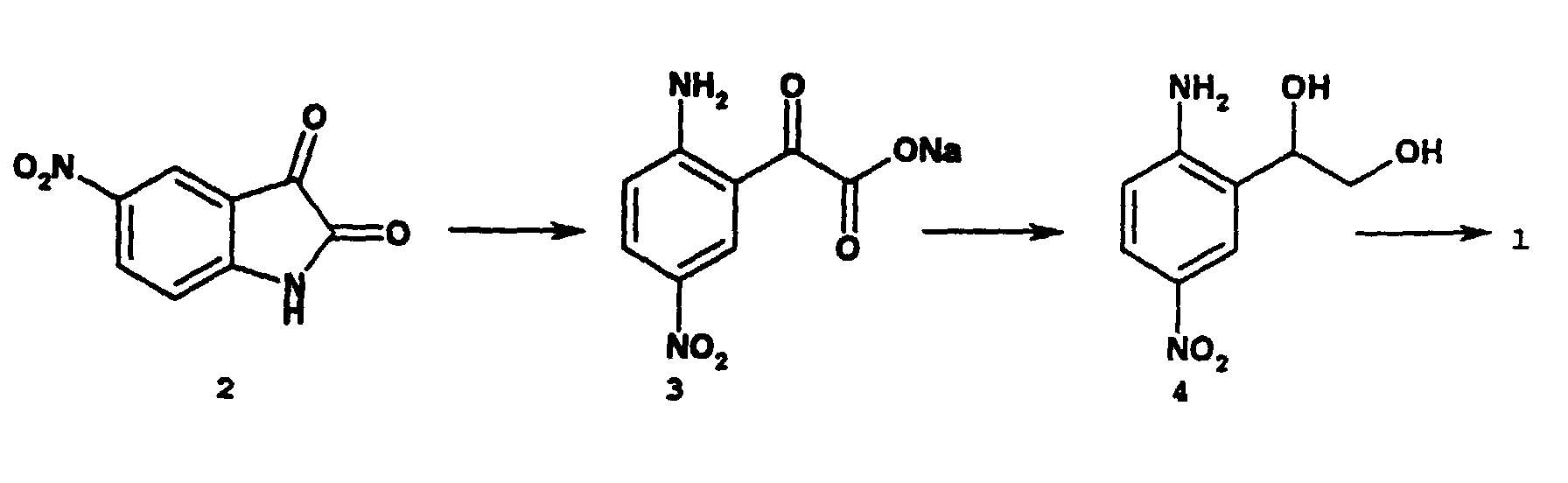
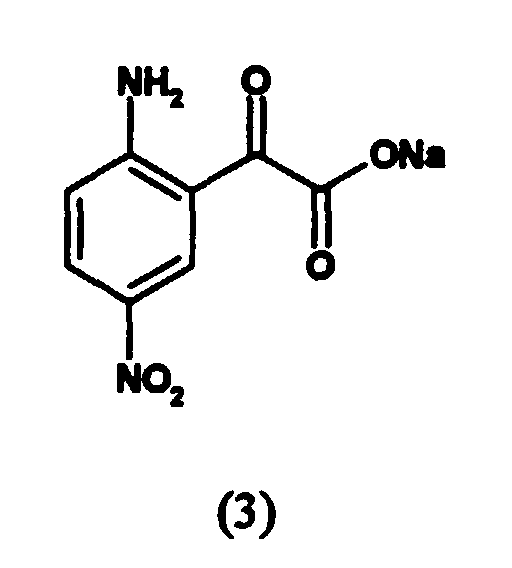
- A solution of 5-nitroisatin, compound 2, (96.07 g, 500 mmole) with sodium hydroxide solution (200 mL, 5.5 M solution) in ethanol (200 mL) was stirred at room temperature for 1 hour. The resulting solid was collected and washed with acetone to give compound 3 (116.71 g, 100% yield): mp 281 °C decomposed; 1H NMR (300 MHz, DMSO-d6) δ 6.80 (d, 1H, J = 9.3 Hz), 8.01 (dd, 1H, J = 9.3, 2.7 Hz), 8.46 (d, 1H, J = 2.7 Hz), 8.75 (bs, 2H).
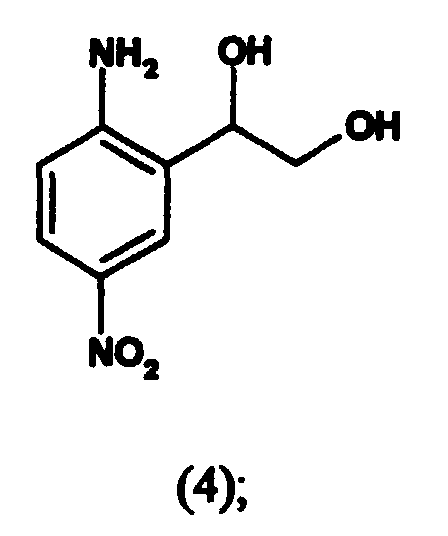
- Borane-THF (1.0M, 1.2L) was added dropwise over a period of 2.5 hours to a stirred suspension of the α-keto acid sodium salt (3) (92.86 g, 400 mmole) in 400 mL tetrahydrofurane (THF) at 4 °C. After the borane addition was complete, the reaction mixture was warmed to ambient temperature and stirred for 16 hours. The excess borane was quenched at 4 ° C with methanol and the reaction mixture was evaporated under vacuum. The residue was dissolved in 400 mL water and acidified to pH 2-3 with concentrated hydrochloric acid. The resulting precipitate was collected and air-dried to afford compound 4 (78.15 g, 98.6 % yield): mp 154-156 °C: 1H NMR (300 MHz, DMSO-d6) δ 3.44 (m, 2H), 4.65 (q, 1H, J = 10, 4.8 Hz), 4.70 (t, 1H, J = 6.0 Hz), 5.47 (d, 1H, J = 4.2 Hz), 6.47 (s, 2H), 6.62 (d, 1H, J = 9.0 Hz), 7.84 (dd, 1H, J = 9.0, 2.7 Hz), 8.04 (d, 1H, J = 2.7 Hz); MS m/z 198 (M+).
- A mixture of compound 4 (21.80 g 110 mmole) and 10 % Pd/C (2.2 g) in CH3OH/acetic acid (150/15 mL) was hydrogenated at 60 psi for 2.5 hours. The mixture was filtered over a layer of Celite and washed with methanol. The combined filtrate was neutralized with concentrated ammonium hydroxide. The resulting precipitate was filtered to give the compound 1 (15.11 g, 81.8 % yield): mp 153-154 °C; 1H NMR (300 MHz, DMSO-d6) δ 3.40 (m, 2H), 4.12 (s, 2H), 4.17 (s, 2H), 4.49 (t, 1H, J = 6 Hz), 4.60 (s, 1H), 5.05 (s, 1H), 6.24 (dd, 1H, J = 8.1, 2.7 Hz), 6.35 (d, 1H, J = 8.1 Hz), 6.44 (d, 1H, J = 2.4 Hz); MS m/z 168 (M+).
- Dye compositions containing 1-(2,5-diaminophenyl)ethylene glycol can also contain other primary intermediates and couplers.
- It should be noted that for certain dark shades, including dark brown and black shades, it is desirable to include a meta diamine as one of the couplers. Suitable meta diamines include m-phenylenediamine, 2,4-diaminophenoxyethanol and 4,6-bis(2-hydroxyethoxy)-m-phenylenediamine.
-
- p-Phenylenediamine derivatives such as: p-toluenediamine; p-phenylenediamine; 2-chloro-p-phenylenediamine; N-phenyl-p-phenylenediamine; N-2-methoxyethyl-p-phenylenediamine; N,N-bis(2-hydroxyethyl)-p-phenylenediamine; 2-hydroxymethyl-p-phenylenediamine; 2-hydroxyethyl-p-phenylenediamine; 4,4'-diaminodiphenylamine; 2,6-dimethyl-p-phenylenediamine; 2-isopropyl-p-phenylenediamine; N-(2-hydroxypropyl)-p-phenylenediamine; 2-propyl-p-phenylenediamine; 1,3-bis(N-hydroxyethyl)-N-(4-aminophenyl)amino-2-propanol and 2-methyl-4-dimethylaminoaniline;
- p-Aminophenol derivatives such as: p-aminophenol; p-methylaminophenol; 3-methyl-p-aminophenol; 2-hydroxymethyl-p-aminophenol; 2-methyl-p-aminophenol; 2-(2'-hydroxyethylaminomethyl)-p-aminophenol; 2-methoxymethyl-p-aminophenol; 5-aminosalicylic acid and 1-(4-amino-2-hydroxyphenyl)-ethane-1,2-diol;
- Ortho-developers such as: catechol; pyrogallol; o-aminophenol; 2,4-diaminophenol; 2,4,5-trihydroxytoluene; 1,2,4-trihydroxybenzene; 2,3-dihydroxynaphthalene; 5-methyl-o-aminophenol; 6-methyl-o-aminophenol and 2-amino-5-acetaminophenol and;
- Heterocyclic derivatives such as: 2,4,5,6-tetra-aminopyrimidine; 4,5-diamino-1-methyl-pyrazole and 2-dimethylamino-5-aminopyridine;
-
-
- Phenols, resorcinol and naphthol derivatives such as: 1,7-dihydroxynaphthalene; resorcinol 4-chlororesorcinol; 1-naphthol; 2-methyl-1-naphthol; 1-acetoxy-2-methyl naphthalene; 1,5-dihydroxynaphthalene; 2,7-dihydroxynaphthalene; hydroquinone; 2-methylresorcinol 1-hydroxy-6-aminonaphthalene-3-sulfonic acid; thymol (2-isopropyl-5-methylphenol); 1,5-dihydroxy-1,2,3,4-tetrahydronaphthalene; 2-chlororesorcinol; 2,3-dihydroxy-1,4-naphthoquinone and 1-naphthol-4-sulfonic acid;
- m-Phenylenediamines such as: m-phenylenediamine; 2,4-diaminophenoxyethanol; N,N-bis(2-hydroxyethyl)-m-phenylenediamine; 2,6-diaminotoluene; 2-N,N-bis(hydroxyethyl)-2,4-diaminophenetole; bis(2,4-diaminophenoxy)-1,3-propane; 1-hydroxyethyl-2,4-diaminobenzene; 2-amino-4-hydroxyethylaminoanisole; 1-aminoethoxy-2,4-diaminobenzene; 2,4-diaminophenoxyacetic acid; 4,6-bis(hydroxyethoxy)-m-phenylenediamine; 2,4-diamino-5-methylphenetole; 2,4-diamino-5-hydroxyethoxytoluene; 2,4-dimethoxy-1,3-diaminobenzene and 2,6-bis(hydroxyethylamino)-toluene;
- m-Aminophenols such as: m-aminophenol 2-hydroxy-4-carbamoylmethylamino toluene; m-carbamoylmethylaminophenol; 6-hydroxybenzomorpholine; 2-hydroxy-4-aminotoluene; 2-hydroxy-4-hydroxyethylaminotoluene; 4,6-dichloro-m-aminophenol; 2-methyl-m-aminophenol; 2-chloro-6-methyl-m-aminophenol; 2-hydroxyethoxy-5-aminophenol; 2-chloro-5-trifluoroethylaminophenol; 4-chloro-6-methyl-m-aminophenol; N-cyclopentyl-3-aminophenol; N-hydroxyethyl-4-methoxy-2-methyl-m-aminophenol and 5-amino-4-methoxy-2-methylphenol and
- Heterocyclic derivatives such as: 1-phenyl-3-methyl-5-pyrazolone; 6-methoxy-8-aminoquinoline; 2,6-dihydroxy-4-methylpyridine; 5-hydroxy-1,4-benzodioxane; 3,4-methylenedioxyphenol; 4-hydroxyethylamino-1,2-methylenedioxybenzene; 2,6-dihydroxy-3,4-dimethylpyridine; 5-chloro-2,3-dihydroxypyridine; 3,5-diamino-2,6-dimethoxypyridine; 2-hydroxyethylamino-6-methoxy-3-aminopyridine; 3,4-methylenedioxyaniline; 2,6-bis(2-hydroxyethoxy)-3,5-diaminopyridine; 4-hydroxyindole; 3-amino-5-hydroxy-2,6-dimethoxypyridine; 5,6-dihydroxyindole; 7-hydroxyindole; 5-hydroxyindole; 2-bromo-4,5-methylenedioxyphenol 6-hydroxyindole; 3-amino-2-methylamino-6-methoxypyridine; 2-amino-3-hydroxypyridine; 2,6-diaminopyridine; 5-(3,5-diamino-2-pyridyloxy)-1,3-dihydroxypentane; 3-(3,5-diamino-2-pyridyloxy)-2-hydroxypropanol and 4-hydroxy-2,5,6-triaminopyrimidine.
-
-
- p-Phenylenediamine derivatives such as: p-toluenediamine; p-phenylenediamine; N-2-methoxyethyl-p-phenylenediamine; N,N-bis(2-hydroxyethyl)-p-phenylenediamine; 2-hydroxyethyl-p-phenylenediamine;
- p-Aminophenol derivatives such as: p-aminophenol; p-methylaminophenol; 3-methyl-p-aminophenol; 2-methoxymethyl-p-aminophenol and 1-(5-amino-2-hydrxyphenyl)-ethane-1,2-diol;
- Ortho-developers such as: o-aminophenol; 1,2,4-trihydroxybenzene; 2-ethylamino-p-cresol; 5-methyl-2-aminophenol; 6-methyl-2-aminophenol and 2-amino-5-acetaminophenol and
- Heterocyclic derivatives such as: 2,4,5,6-tetra-aminopyrimidine and 4,5-diamino-1-methylpyrazole.
-
-
- Phenols, resorcinol and naphthol derivatives such as: 2-methyl-1-naphthol; 1-acetoxy-2-methylnaphthalene; 1,7-dihydroxynaphthalene; resorcinol; 4-chlororesorcinol; 1-naphthol 1,5-dihydroxynaphthalene; 2,7-dihydroxynaphthalene; hydroquinone; 2-methylresorcinol and thymol (2-isopropyl-5-methylphenol);
- m-Phenylenediamines such as: m-phenylenediamine; 2,4-diaminophenoxyethanol; 1,3-bis(2,4-diaminophenoxy)propane; 2-amino-4-hydroxyethylamino anisole and 4,6-bis(hydroxyethoxy)-m-phenylenediamine;
- m-Aminophenols such as: m-aminophenol; 6-hydroxybenzomorpholine; 2-hydroxy-4-aminotoluene; 2-hydroxy-4-hydroxyethyleminotoluene and 2-methyl-m-aminophenol and
- Heterocyclic derivatives such as: 4,5-diamino-1-methyl-pyrazole; 2-dimethylamino-5-aminopyridine; 1-phenyl-3-methyl-5-pyrazolone; 3,4-methylenedioxyphenol; 3,4-methylenedioxyaniline; 4-hydroxyindole; 5,6-dihydroxyindole; 7-hydroxyindole; 5-hydroxyindole; 6-hydroxyindole; 2,6-diaminopyridine and 2-amino-3-hydroxypyridine.
-
-
- p-Phenylenediamine derivatives such as: p-toluenediamine; p-phenylenediamine; N,N-bis(2-hydroxyethyl)-p-phenylenediamine and 2-hydroxyethyl-p-phenylenediamine;
- p-Aminophenol derivatives such as: p-aminophenol; p-methylaminophenol; 3-methyl-p-aminophenol and 1-(5-amino-2-hydroxphenyl)-ethane-1,2-diol;
- Ortho-developers such as: o-aminophenol; 1,2,4-trihydroxybenzene; 2-ethylamino-p-cresol; 5-methyl-2-aminophenol; 6-methyl-2-aminophenol and 2-amino-5-acetaminophenol.
-
-
- Phenols, resorcinol and naphthol derivatives such as: 2-methyl-1-naphthol; 1-acetoxy-2-methylnaphthalene; resorcinol; 4-chlororesorcinol; 1-naphthol and 2-methylresorcinol;
- m-Phenylenediamines such as: 2,4-diaminophenoxyethanol; 2-amino-4-hydroxyethylamino anisole and 4,6-bis(2-hydroxyethoxy)-m-phenylenediamine; and
- Heterocyclic derivatives such as: 4,5-diamino-1-methyl-pyrazole: 1-phenyl-3-methyl-5-pyrazolone; 2-amino-3-hydroxypyridine and 6-hydroxyindole.
-
- Preferred combinations employing 1-(2,5-diaminophenyl) ethane-1,2-diol as a p-phenylenediamine replacement include combinations 1-24 set forth in Table 1 which follows:
- Combination 1 of Table 1 is a mixture of 1-(2,5-diaminophenyl) ethane-1,2-diol; 2-[(4-aminophenyl)-(2-hydroxy-ethyl)-amino]-ethanol; 2-amino-phenol; benzene-1,3-diol; naphthalen-1-ol; 3-amino-phenol; and 4-amino-phenol.
- In reading Table 1, reading down the column headed 2, the components of combination 2 are indicated by x'es.
- The composition of each of the remaining combinations is similarly determined.


- The test composition (according to Table 2 and Table 3) is mixed with 100 g of 20 volume hydrogen peroxide. The resulting mixture is applied on gray hair and permitted to remain in contact with the hair for 30 minutes. The dyed hair is then shampooed and rinsed with water and dried.
Composition for Dyeing Hair Red Example 1 Example 2 Example 3 Example 4 Example 5 Ingredients WT% WT% WT% WT% WT% Cocamidopropyl betaine 17.00 17.00 17.00 17.00 17.00 Ethanolamine 2.00 2.00 2.00 2.00 2.00 Oleic acid 0.75 0.75 0.75 0.75 0.75 Citric acid 0.10 0.10 0.10 0.10 0.10 Ammonium hydroxide 5.00 5.00 5.00 5.00 5.00 Behentrimonium chloride 0.50 0.50 0.50 0.50 0.50 Sodium sulfite 0.10 0.10 0.10 0.10 0.10 EDTA 0.10 0.10 0.10 0.10 0.10 Erythorbic acid 0.40 0.40 0.40 0.40 0.40 1-(2,5-Diaminophenyl) ethane-1,2-diol 2.66 2.66 2.00 0.50 0.50 4-Aminophenol 0.92 2.50 2.50 3-Methyl-p-aminophenol 1.20 2-Methyl-p-aminophenol 1.75 2-Methyl-5-aminophenol 1.54 1.60 1.00 1.00 2-Methyl-5-hydroxethyl aminophenol 0.75 2-Amino-5-methylphenol 0.10 1-Naphthol 1.50 2-Methyl-1-naphthol 1.50 Water qs to 100 qs to 100 qs to 100 qs to 100 qs to 100 Color obtained on gray hair: Dark Red Burgundy Red Bright Red Bright Red Bright Red Composition for Dyeing Hair Black to Brown Example 6 Example 7 Example 8 Example 9 Example 10 Ingredients WT% WT% WT% WT% WT% Cocamidopropyl betaine 17.00 17.00 17.00 17.00 17.00 Ethanolamine 2.00 2.00 2.00 2.00 2.00 Oleic acid 0.75 0.75 0.75 0.75 0.75 Citric acid 0.10 0.10 0.10 0.10 0.10 Ammonium hydroxide 5.00 5.00 5.00 5.00 5.00 Behentrimonium chloride 0.50 0.50 0.50 0.50 0.50 Sodium sulfite 0.10 0.10 0.10 0.10 0.10 EDTA 0.10 0.10 0.10 0.10 0.10 Erythorbic acid 0.40 0.40 0.40 0.40 0.40 1-(2,5-Diaminophenyl)ethane- 3.00 1.00 2.00 0.05 0.05 1,2-diol N,N-Bis(2-hydroxyethyl)-p-phenylenediamine 1.00 1.00 .75 0.05 1-(4-Aminophenyl)pyrrolidine 1.00 4-Aminophenol 0.10 0.05 2-Aminophenol 0.10 0.10 Resorcinol 2.00 2.00 2-Methylresorcinol 1.00 0.20 0.20 m-Aminophenol 1.50 0.80 0.80 0.05 0.10 2,4-Diaminophenoxyethanol hydrochloride 0.50 4,6-Bis(2-hydroxyethoxy)-m-phenylenediamine 2.00 2-Amino-3-hydroxypyridine 0.50 1-Naphthol 1.00 0.03 0.02 2-Methyl-1-naphthol 0.25 Water qs to 100 qs to 100 qs to 100 qs to 100 qs to 100 Color obtained on gray hair: Black Dark Brown Medium Brown Golden Blonde Ash Blonde
Claims (13)
Applications Claiming Priority (2)
| Application Number | Priority Date | Filing Date | Title |
|---|---|---|---|
| US09/185,019 US6228130B1 (en) | 1998-11-03 | 1998-11-03 | Primary intermediate in oxidative hair dyeing |
| US185019 | 1998-11-03 |
Publications (2)
| Publication Number | Publication Date |
|---|---|
| EP0999203A1 true EP0999203A1 (en) | 2000-05-10 |
| EP0999203B1 EP0999203B1 (en) | 2003-02-26 |
Family
ID=22679221
Family Applications (1)
| Application Number | Title | Priority Date | Filing Date |
|---|---|---|---|
| EP99203596A Expired - Lifetime EP0999203B1 (en) | 1998-11-03 | 1999-11-01 | Novel developer in oxidative hair dyeing |
Country Status (5)
| Country | Link |
|---|---|
| US (1) | US6228130B1 (en) |
| EP (1) | EP0999203B1 (en) |
| JP (1) | JP2000143592A (en) |
| CA (1) | CA2287821A1 (en) |
| DE (1) | DE69905537T2 (en) |
Cited By (6)
| Publication number | Priority date | Publication date | Assignee | Title |
|---|---|---|---|---|
| GB2361247A (en) * | 2000-04-14 | 2001-10-17 | Bristol Myers Squibb Co | Aqueous oxidative hair dye compositions characterised by particular hydrophilic-lipophilic balance, primary intermediates and coupler |
| WO2002026200A1 (en) * | 2000-09-29 | 2002-04-04 | Henkel Kommanditgesellschaft Auf Aktien | Oxidation dyes with 2-amino-5-methylphenol |
| US6565615B1 (en) | 1997-11-19 | 2003-05-20 | Clairol Incorporated | Dye compositions |
| EP1359887A4 (en) * | 2001-01-23 | 2004-08-18 | P & G Clairol Inc | Primary intermediates for oxidative coloration of hair |
| WO2006002712A1 (en) * | 2004-06-30 | 2006-01-12 | Henkel Kommanditgesellschaft Auf Aktien | Initial phenylpropanediol dye products |
| WO2026058282A1 (en) * | 2024-09-11 | 2026-03-19 | Godrej Consumer Products Ltd. | Hair dye compositions based on derivative of para-phenylenediamine |
Families Citing this family (1)
| Publication number | Priority date | Publication date | Assignee | Title |
|---|---|---|---|---|
| FR2974509B1 (en) * | 2011-04-29 | 2013-10-11 | Oreal | COLORING COMPOSITION USING A PARTICULAR PHENOLIC COUPLER IN BODY-RICH MEDIA, METHODS AND DEVICE |
Citations (2)
| Publication number | Priority date | Publication date | Assignee | Title |
|---|---|---|---|---|
| WO1990014818A1 (en) * | 1989-05-27 | 1990-12-13 | Wella Aktiengesellschaft | Oxidation hair colorant |
| US5538516A (en) * | 1994-01-24 | 1996-07-23 | L'oreal | Composition for the oxidation dyeing of keratinous fibres, comprising a para-phenylenediamine derivative and a meta-aminophenol derivative, and dyeing process using such a composition |
Family Cites Families (16)
| Publication number | Priority date | Publication date | Assignee | Title |
|---|---|---|---|---|
| USRE30199E (en) | 1973-11-29 | 1980-01-29 | Henkel Kommanditgesellschaft Auf Aktien (Henkel Kgaa) | Oxidation hair dyes based upon tetraaminopyrimidine developers |
| DE4301663C1 (en) | 1993-01-22 | 1994-02-24 | Goldwell Ag | Oxidn. hair dye compsns. - contg. 2-(2-hydroxyethylamino)-5-amino-toluene as developer. |
| DE4335623A1 (en) | 1993-10-19 | 1995-04-20 | Henkel Kgaa | Indolinone derivatives for dyeing keratin-containing fibres |
| DE4335625A1 (en) | 1993-10-19 | 1995-04-20 | Henkel Kgaa | Ethandione for dyeing keratin fibers |
| FR2715298B1 (en) | 1994-01-24 | 1996-02-23 | Oreal | Composition for dyeing oxidation of keratin fibers comprising a derivative of paraphenylenediamine and 5-amino 2-methyl phenol, and dyeing process using such a composition. |
| FR2717383B1 (en) | 1994-03-21 | 1996-04-19 | Oreal | Composition for dyeing oxidation of keratin fibers comprising a derivative of paraphenylenediamine and a cationic or amphoteric substantive polymer and use. |
| FR2720275B1 (en) | 1994-05-26 | 1996-07-05 | Oreal | Keratin fiber oxidation dyeing composition comprising a paraphenylenediamine derivative and a 6-hydroxy 1,4-benzoxazine, and dyeing process using such a composition. |
| FR2720633B1 (en) | 1994-06-06 | 1996-07-05 | Oreal | Keratin fiber oxidation dyeing composition comprising 2- (BETHA-hydroxyethyl) paraphenylenediamine, 2-methylresorcin and 3-aminophenol, and dyeing process using such a composition. |
| DE4434494A1 (en) | 1994-09-27 | 1996-03-28 | Henkel Kgaa | 2-Hydroxy-1-ethanone derivatives for dyeing keratin fibers |
| FR2725368B1 (en) | 1994-10-07 | 1997-04-04 | Oreal | KERATINIC FIBER OXIDIZING DYE COMPOSITIONS CONTAINING A COMBINATION OF AT LEAST TWO PARTICULAR PARAPHENYLENEDIAMINE DERIVATIVES, AND USE |
| DE4436743A1 (en) | 1994-10-14 | 1996-04-18 | Wella Ag | Oxidation hair dye |
| DE19505634C2 (en) | 1995-02-18 | 1998-04-16 | Wella Ag | Means and methods for oxidative coloring of hair |
| FR2730926B1 (en) | 1995-02-27 | 1997-04-04 | Oreal | KERATINIC FIBER OXIDATION DYE COMPOSITION AND DYEING METHOD USING THE SAME |
| FR2730922B1 (en) | 1995-02-27 | 1997-04-04 | Oreal | COMPOSITION FOR OXIDATION DYEING OF KERATINIC FIBERS COMPRISING AT LEAST TWO OXIDATION BASES AND AN INDOLIC COUPLER, AND DYEING METHOD |
| FR2739025B1 (en) * | 1995-09-25 | 1997-10-31 | Oreal | KERATINIC FIBER OXIDATION DYE COMPOSITION AND DYEING METHOD USING THE SAME |
| US5980584A (en) * | 1998-11-03 | 1999-11-09 | Bristol-Myers Squibb Company | Substituted p-aminophenol, process of preparation and use in dyeing hair |
-
1998
- 1998-11-03 US US09/185,019 patent/US6228130B1/en not_active Expired - Lifetime
-
1999
- 1999-10-22 CA CA002287821A patent/CA2287821A1/en not_active Abandoned
- 1999-11-01 EP EP99203596A patent/EP0999203B1/en not_active Expired - Lifetime
- 1999-11-01 DE DE69905537T patent/DE69905537T2/en not_active Expired - Fee Related
- 1999-11-02 JP JP11311839A patent/JP2000143592A/en active Pending
Patent Citations (2)
| Publication number | Priority date | Publication date | Assignee | Title |
|---|---|---|---|---|
| WO1990014818A1 (en) * | 1989-05-27 | 1990-12-13 | Wella Aktiengesellschaft | Oxidation hair colorant |
| US5538516A (en) * | 1994-01-24 | 1996-07-23 | L'oreal | Composition for the oxidation dyeing of keratinous fibres, comprising a para-phenylenediamine derivative and a meta-aminophenol derivative, and dyeing process using such a composition |
Cited By (6)
| Publication number | Priority date | Publication date | Assignee | Title |
|---|---|---|---|---|
| US6565615B1 (en) | 1997-11-19 | 2003-05-20 | Clairol Incorporated | Dye compositions |
| GB2361247A (en) * | 2000-04-14 | 2001-10-17 | Bristol Myers Squibb Co | Aqueous oxidative hair dye compositions characterised by particular hydrophilic-lipophilic balance, primary intermediates and coupler |
| WO2002026200A1 (en) * | 2000-09-29 | 2002-04-04 | Henkel Kommanditgesellschaft Auf Aktien | Oxidation dyes with 2-amino-5-methylphenol |
| EP1359887A4 (en) * | 2001-01-23 | 2004-08-18 | P & G Clairol Inc | Primary intermediates for oxidative coloration of hair |
| WO2006002712A1 (en) * | 2004-06-30 | 2006-01-12 | Henkel Kommanditgesellschaft Auf Aktien | Initial phenylpropanediol dye products |
| WO2026058282A1 (en) * | 2024-09-11 | 2026-03-19 | Godrej Consumer Products Ltd. | Hair dye compositions based on derivative of para-phenylenediamine |
Also Published As
| Publication number | Publication date |
|---|---|
| EP0999203B1 (en) | 2003-02-26 |
| DE69905537T2 (en) | 2004-04-01 |
| JP2000143592A (en) | 2000-05-23 |
| DE69905537D1 (en) | 2003-04-03 |
| US6228130B1 (en) | 2001-05-08 |
| CA2287821A1 (en) | 2000-05-03 |
Similar Documents
| Publication | Publication Date | Title |
|---|---|---|
| US6342079B1 (en) | Primary intermediate for use in oxidative hair dyeing | |
| RU2354349C2 (en) | New chromogenic components | |
| US4954131A (en) | Substituted metaaminophenols, a process for their preparation, hair-dyeing compositions containing them and a hair-dyeing process | |
| EP1006104B1 (en) | P-aminophenol substitute and its use in oxidation dye formulations | |
| EP0999203B1 (en) | Novel developer in oxidative hair dyeing | |
| CA2253981C (en) | Novel bis-(2,4-diaminophenoxy) benzenes and their use as coupling components in oxidative hair coloring compositions and methods | |
| JP3130045B2 (en) | Agent for oxidation dyeing of hair and novel 5-halogen-2,4-bis (alkylamino) -1-alkylbenzene | |
| WO2002003938A1 (en) | Iodo-containing organic couplers for use in oxidative hair dyeing | |
| US20040199018A1 (en) | Bridged p-phenylenediamines | |
| US6200353B1 (en) | Coupler for use in oxidative hair dyeing | |
| US7033401B2 (en) | 3-Aminophenol derivatives substituted in the 2-position, and dyes containing these compounds | |
| US5865856A (en) | 2, 5-diaminobenzonitrile compounds and oxidation hair dye compositions containing same | |
| MXPA99009955A (en) | Novedos primary intermediaries in the oxidative coloration of the p | |
| EP1292578A1 (en) | Para-aminophenol derivatives and their use as developers for producing oxidation colorations | |
| WO2002096382A1 (en) | Developer components for oxidation hair dyes | |
| US6540793B1 (en) | Coupler for use in oxidative hair dyeing | |
| EP1309540A1 (en) | Oxidizing colorant | |
| EP1739074B1 (en) | Novel double para-phenylenediamines joined by a branched aliphatic group and use in dyeing | |
| DE10112506B4 (en) | 1,4-diamino-2- (2-aminoethyl) benzene derivatives and colorants containing these compounds | |
| EP1739075A1 (en) | Novel double para-phenylenediamines joined by a linker arm substituted with one or more hydroxyl, alkoxy and/or amino groups and use in dyeing |
Legal Events
| Date | Code | Title | Description |
|---|---|---|---|
| PUAI | Public reference made under article 153(3) epc to a published international application that has entered the european phase |
Free format text: ORIGINAL CODE: 0009012 |
|
| AK | Designated contracting states |
Kind code of ref document: A1 Designated state(s): DE FR GB IT SE |
|
| AX | Request for extension of the european patent |
Free format text: AL;LT;LV;MK;RO;SI |
|
| 17P | Request for examination filed |
Effective date: 20001110 |
|
| AKX | Designation fees paid |
Free format text: DE FR GB IT SE |
|
| 17Q | First examination report despatched |
Effective date: 20010726 |
|
| GRAG | Despatch of communication of intention to grant |
Free format text: ORIGINAL CODE: EPIDOS AGRA |
|
| RIN1 | Information on inventor provided before grant (corrected) |
Inventor name: WONG, MICHAEL Y. M. Inventor name: PAN, YUH-GUO Inventor name: STASAITIS, LINAS R. Inventor name: LIM, MU-ILL |
|
| RAP1 | Party data changed (applicant data changed or rights of an application transferred) |
Owner name: CLAIROL INCORPORATED |
|
| GRAG | Despatch of communication of intention to grant |
Free format text: ORIGINAL CODE: EPIDOS AGRA |
|
| GRAH | Despatch of communication of intention to grant a patent |
Free format text: ORIGINAL CODE: EPIDOS IGRA |
|
| GRAH | Despatch of communication of intention to grant a patent |
Free format text: ORIGINAL CODE: EPIDOS IGRA |
|
| GRAA | (expected) grant |
Free format text: ORIGINAL CODE: 0009210 |
|
| AK | Designated contracting states |
Designated state(s): DE FR GB IT SE |
|
| REG | Reference to a national code |
Ref country code: GB Ref legal event code: FG4D |
|
| REF | Corresponds to: |
Ref document number: 69905537 Country of ref document: DE Date of ref document: 20030403 Kind code of ref document: P |
|
| REG | Reference to a national code |
Ref country code: SE Ref legal event code: TRGR |
|
| ET | Fr: translation filed | ||
| PLBE | No opposition filed within time limit |
Free format text: ORIGINAL CODE: 0009261 |
|
| STAA | Information on the status of an ep patent application or granted ep patent |
Free format text: STATUS: NO OPPOSITION FILED WITHIN TIME LIMIT |
|
| 26N | No opposition filed |
Effective date: 20031127 |
|
| PGFP | Annual fee paid to national office [announced via postgrant information from national office to epo] |
Ref country code: DE Payment date: 20071130 Year of fee payment: 9 |
|
| PGFP | Annual fee paid to national office [announced via postgrant information from national office to epo] |
Ref country code: IT Payment date: 20071119 Year of fee payment: 9 |
|
| PGFP | Annual fee paid to national office [announced via postgrant information from national office to epo] |
Ref country code: SE Payment date: 20071105 Year of fee payment: 9 |
|
| PGFP | Annual fee paid to national office [announced via postgrant information from national office to epo] |
Ref country code: GB Payment date: 20071005 Year of fee payment: 9 Ref country code: FR Payment date: 20071105 Year of fee payment: 9 |
|
| EUG | Se: european patent has lapsed | ||
| GBPC | Gb: european patent ceased through non-payment of renewal fee |
Effective date: 20081101 |
|
| PG25 | Lapsed in a contracting state [announced via postgrant information from national office to epo] |
Ref country code: IT Free format text: LAPSE BECAUSE OF NON-PAYMENT OF DUE FEES Effective date: 20081101 |
|
| REG | Reference to a national code |
Ref country code: FR Ref legal event code: ST Effective date: 20090731 |
|
| PG25 | Lapsed in a contracting state [announced via postgrant information from national office to epo] |
Ref country code: DE Free format text: LAPSE BECAUSE OF NON-PAYMENT OF DUE FEES Effective date: 20090603 |
|
| PG25 | Lapsed in a contracting state [announced via postgrant information from national office to epo] |
Ref country code: GB Free format text: LAPSE BECAUSE OF NON-PAYMENT OF DUE FEES Effective date: 20081101 |
|
| PG25 | Lapsed in a contracting state [announced via postgrant information from national office to epo] |
Ref country code: SE Free format text: LAPSE BECAUSE OF NON-PAYMENT OF DUE FEES Effective date: 20081102 |
|
| PG25 | Lapsed in a contracting state [announced via postgrant information from national office to epo] |
Ref country code: FR Free format text: LAPSE BECAUSE OF NON-PAYMENT OF DUE FEES Effective date: 20081130 |