EP1762050B1 - Verfahren und anordnungen zur verbindungsbestimmung in einem virtuellen privaten netzwerk mit mehreren domänen - Google Patents
Verfahren und anordnungen zur verbindungsbestimmung in einem virtuellen privaten netzwerk mit mehreren domänen Download PDFInfo
- Publication number
- EP1762050B1 EP1762050B1 EP05754831.5A EP05754831A EP1762050B1 EP 1762050 B1 EP1762050 B1 EP 1762050B1 EP 05754831 A EP05754831 A EP 05754831A EP 1762050 B1 EP1762050 B1 EP 1762050B1
- Authority
- EP
- European Patent Office
- Prior art keywords
- information
- vpn
- domain
- vpns
- domains
- Prior art date
- Legal status (The legal status is an assumption and is not a legal conclusion. Google has not performed a legal analysis and makes no representation as to the accuracy of the status listed.)
- Expired - Lifetime
Links
Images




Classifications
-
- H—ELECTRICITY
- H04—ELECTRIC COMMUNICATION TECHNIQUE
- H04L—TRANSMISSION OF DIGITAL INFORMATION, e.g. TELEGRAPHIC COMMUNICATION
- H04L12/00—Data switching networks
- H04L12/28—Data switching networks characterised by path configuration, e.g. LAN [Local Area Networks] or WAN [Wide Area Networks]
-
- H—ELECTRICITY
- H04—ELECTRIC COMMUNICATION TECHNIQUE
- H04L—TRANSMISSION OF DIGITAL INFORMATION, e.g. TELEGRAPHIC COMMUNICATION
- H04L63/00—Network architectures or network communication protocols for network security
- H04L63/02—Network architectures or network communication protocols for network security for separating internal from external traffic, e.g. firewalls
- H04L63/0272—Virtual private networks
-
- H—ELECTRICITY
- H04—ELECTRIC COMMUNICATION TECHNIQUE
- H04L—TRANSMISSION OF DIGITAL INFORMATION, e.g. TELEGRAPHIC COMMUNICATION
- H04L12/00—Data switching networks
- H04L12/28—Data switching networks characterised by path configuration, e.g. LAN [Local Area Networks] or WAN [Wide Area Networks]
- H04L12/46—Interconnection of networks
- H04L12/4641—Virtual LANs, VLANs, e.g. virtual private networks [VPN]
Definitions
- the present invention relates in general to virtual private networks in communications systems and in particular to determination of suitable connection paths to virtual private networks in multi-domain communications systems.
- VPN Virtual Private Network
- a company or other customer that wanted to build a wide-area network had to provide for its own dedicated lines between each node to provide the connectivity.
- Such solutions are, however, generally expensive and inflexible.
- VPNs offer a solution, where a communications network is shared between many customers, but where the communication of each customer is virtually separated.
- VPN technology is often based on the idea of tunnelling.
- Network tunnelling involves establishing and maintaining a logical network connection. On this connection, packets are encapsulated within some other base or carrier protocol. They are then transmitted between VPN client and server and eventually de-encapsulated on the receiver side. Authentication and encryption assists in providing security.
- a tendency is that the number of network nodes that form a VPN grows fast, which results in large complex network structures and topology. This is caused, partly because of the increasing traffic on VPNs and partly on that the VPNs are requested to cover larger and larger geographical areas. Communication networks providing VPNs having nodes at all continents are present today. However, the more nodes and the more traffic that is to be transmitted, the more complex the configuration of VPNs becomes.
- a VPN is created according to an agreement between a network operator and a customer.
- the location of the nodes, the quality of service and other conditions are agreed on and a programmer at the operator sets up the configuration manually or by consulting configuration aid tools.
- configuration becomes more and more complex and time consuming.
- connections spanning over several domains there are typically a number of alternative connection paths. Information from several domains then has to be collected and compiled in an appropriate manner.
- a customer wants to modify its VPN the entire procedure has to be repeated.
- a general problem of prior-art solutions is thus that communications networks providing virtual private networks having a large geographical coverage and/or having large traffic become very complex.
- a further problem is that configuration of new VPNs or modifications of already existing VPNs become complex and time consuming.
- a further problem is that communication resources of network operators covering smaller geographical areas cannot be generally utilised for wide-area VPNs.
- Yet a further problem is that collection and compiling of VPN information from different domains is both time consuming and complex.
- a general object of the present invention is thus to improve methods for finding suitable connection paths of VPNs as well as providing systems and arrangements implementing such methods.
- a further object of the present invention is to provide methods for finding connection paths for VPNs utilising more than one network domain.
- Another further object of the present invention is to provide methods for finding connection paths for VPNs that are basically independent on the actual VPN technology used in the different domains.
- Yet a further object of the present invention is to provide a method enabling optimum or near-optimum configuration of a VPN.
- information about VPNs in a communications network having at least two interconnected domains is collected in a first domain by a push mechanism.
- the information about the VPNs comprises at least domain ID of domains in which the different VPNs currently are available.
- Domain VPN information is collected in each domain.
- the provision of domain VPN information can be performed in different ways, e.g. collection of data in a centralised or distributed manner, or by retrieving stored data.
- a distributed VPN control node is in particular embodiments localised to border nodes of a domain.
- the domain VPN information is in particular embodiments collected from the edge nodes of the domain.
- the collection can be triggered by an external event, such as a change in VPN information.
- the provided domain VPN information is spread to other domains, preferably under constrictions put by SLAs between domain operators.
- the domain VPN information is spread to adjacent domains, which modifies its own domain VPN information and thereby forwards also the received VPN information to further adjacent domains. In such a cascaded manner, the entire available domain VPN information is spread to all domains.
- the collected information about the VPNs is evaluated in order to find suitable connection paths. In one embodiment, an evaluation according to a quality measure is performed and an optimum connection path is selected accordingly. In a preferred embodiment, an evaluation is performed and all connection paths exceeding a predetermined threshold are configured. A statistical evaluation of the practical need can then be performed after some initial operation time.
- the present invention provides a simple and stable platform on which operators of different domains can cooperate.
- the domain VPN information is made available for supporting VPN configuration in essentially all domains of a multi-domain system.
- the inventive approach provides a means to ensure that an optimum or near-optimum connection path is possible to find according to present domain conditions.
- the invention is particularly well suited to be implemented in communication networks having a relatively stable configuration and topology.
- FIG. 1 An embodiment of a general VPN provider architecture 1 is illustrated in Fig. 1 .
- this VPN Provider Architecture there are five VPN Provider Domains 10A-E present, which are attached to each other by interdomain data connections 12A-G.
- One operator may control one or more of these domains 10A-E, or they can all be controlled by separate operators.
- the relation between the domains 10A-E, i.e. the control of the interdomain data connections 12A-G are typically regulated according to agreements between the involved operators, e.g. a VPN Service Level Agreement (SLA).
- SLA VPN Service Level Agreement
- Each VPN provider domain 10A comprises VPN edge nodes 14 and core nodes 16, which can be VPN aware or VPN unaware, of which only a few are provided with reference numbers.
- the VPN edge nodes 14 are nodes through which customer sites 20 of different customers are connected to different VPN's in the architecture 1.
- VPN unaware nodes 16 are just intermediate nodes within a domain and is only used for forwarding messages and data between VPN edge nodes 14. The customers are unaware of which VPN unaware nodes that are used for the communication. The only important matter is the starting and ending VPN edge node 14.
- a VPN connected in a domain can thus be represented by a direct line between VPN edge nodes 14, even if the actual communication may take place via one or several VPN unaware nodes 16.
- the existence of VPN unaware nodes will in general be neglected, since the basic procedural steps according to the present invention are not directly dependent on the existence of any VPN unaware nodes 16 or not. In the practical implementation, it is, however, likely that VPN unaware nodes 16 are used for providing the actual connectivity.
- the VPN provider domains 10A-E are connected in a data plane via VPN border nodes 18, i.e. the interdomain data connections 12A-G start and end in a VPN border node 18.
- the VPN border node 18 may or may not at the same time also act as a VPN edge node 14.
- a customer site 20 is connected to one of the VPN edge nodes 14.
- Customer sites 20 of the same customer may then be connected through the VPN provider domains 10A-E by a VPN 22A-C.
- One customer may have customer sites 20 connected to different VPN's 22A-C.
- more than one customer site 20 can be connected to the same VPN edge node 14, but will be unaware of the existence of the other customer site 20 as well as of the VPN to which the other customer site 20 is connected.
- VPN's 22A-C are illustrated. However, anyone skilled in the art realises that the number of VPN's in a real system typically is much higher.
- a first VPN 22A illustrated by broken lines, is extended over three domains 10A, 10C, 10D and connects customer sites 20 in all of these domains.
- a second VPN 22B illustrated by dotted lines, is extended over all domains 10A-E of the present embodiment.
- a third VPN 22C illustrated by a dash-dotted line, connects customer sites 20 only within the domain 10B.
- Each customer site 20 is unaware of the existence of customer sites 20 of other customers as well as of the existence of any VPN's except the one it is connected to. In such a manner, the privacy character of the VPN's is preserved, although they all share the same basic communications resources. This is the scenario in which the present invention preferably operates.
- One basic idea of the present invention concerns provision of domain VPN information, comprising VPN identity of VPNs available in the respective domain.
- the domain VPN information stored in each VPN edge node 14, or at least parts thereof is collected by each border node 18 in the same domain 10A-E.
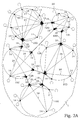
- This is visualised in Fig. 2A as arrows, of which some are provided with reference number 24.
- the collective domain node information for the own domain is available in each VPN border node 18 of each domain 10A-E.
- One alternative for the communication is to use a communication protocol similar to BGP (Border Gateway Protocol), spreading the information all over the domain without any particular knowledge about where the need for information is.
- the border nodes may then pick up all necessary information. This is an example of a push mechanism for distributing domain VPN information.
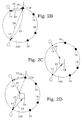
- Fig. 2B illustrates another embodiment for providing domain VPN information, now concentrated to one domain 10C.
- the VPN border nodes 18 can simply request 23 any VPN edge node 14 to return its domain node information 24.
- the request itself could be a question if the VPN edge node 14 is associated to a certain VPN or not, e.g. received by the domain interconnection 12F.
- An acknowledgement message will in such a case not comprise any information as such, but will implicitly transfer information of this particular VPN at that particular VPN edge node. This is an example of a pull mechanism for distributing domain VPN information.
- the domain VPN information can also be collected with different timing.
- One alternative is to continuously or at least regularly collect such information to the border nodes in order to assure that the available information always is updated.
- the information is preferably stored in the border nodes or in any other node where it is retrievable from the border node, see embodiments described further below.
- Another alternative is that the information collection is triggered by some event. This event could e.g. be a broadcasting message from an edge node that there is a change of some kind or, as being described above, a request for finding a particular VPN. If all edge nodes have knowledge about which border nodes that are available in the domain, the information could also be sent directly to all border nodes when such a change occurs. In case the information is searched as triggered by a request to find a certain VPN, the collected information may be restricted to that VPN and may not even necessarily be stored for later use.
- Fig. 2C illustrates an embodiment, where the domain VPN information is collected in a centralised manner.
- a storage 54 is provided to store all domain VPN information 24 provided by the different edge nodes 14. Any functionality using such domain VPN information can the retrieve this information from the central storage 54.
- Fig. 2D illustrates another embodiment based on a centralised collection of domain VPN data.
- a request 23 or other external signal can initialise the provision of VPN data 24 to the storage 54.
- This request 23 does not necessarily have to come from the storage itself 54.
- the domain VPN information may instead be provided by retrieving data from a data storage.
- This stored data could e.g. be the result of a previous collection of data according to the procedures above, or could be provided from elsewhere.
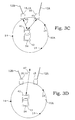
- the border nodes 18 are responsible for the data traffic to and from other domains by the data connections 12A and 12B.
- the border nodes 18 comprise in this particular embodiment means 41 for collecting domain VPN information, in the form of e.g. software functionality in the processors of the border node 18.
- the domain VPN information can be stored in a storage 54.
- a VPN control node 43 for handling domain VPN information regarding the domain as a whole is thus in this particular embodiment implemented as a distribution of local means 41 at every border node 18.
- a distributed VPN control node 43 comprises in this particular embodiment means 41 for providing domain VPN information situated in or in connection with the border nodes 18 and a central database 54.
- the central database 54 the actual updated and preferably also historical VPN information is stored.
- the VPN control node 43 is centralised and comprises the means 41 for providing domain VPN information and the central database 54 basically provided at the same location.
- the border nodes 18 are in this particular embodiment merely used for handling communications 45 between the VPN control node and neighbouring domains. Functionalities in the border nodes 18 regarding control signalling associated with the actual data traffic can in such a way be utilised also to signal control messages concerning VPN configuration.
- Fig. 3D an embodiment having a VPN control node 43 that is virtually separated from the border nodes in the system is illustrated.
- the VPN control node 43 is in such an embodiment connected to VPN control nodes in other domains by dedicated VPN control signal connections 47, creating a high-level network of its own.
- the provided domain VPN information can be transferred within the system, i.e. between the different domains.
- the first step is provision of VPN information within each domain. This is performed by a VPN control node 43 in each domain.
- the configuration of the VPN control nodes 43 may differ between the different domains.
- domain 10A has a VPN control node 43 similar to the example shown in Fig. 3A
- domain 10C has a VPN control node 43 similar to the example shown in Fig. 3B
- domains 10B, 10D and 10E have VPN control nodes 43 similar to the example shown in Fig. 3C .
- each SLA regulating the traffic between the different domains at least a part of the available domain VPN information in each VPN control node 43 is in this embodiment transferred to the counteracting VPN control node in the neighbouring domains.
- Arrows 28 illustrate this interdomain transfer of information.
- the SLA may comprise agreements about how much of the available information that should be made available for the neighbouring domain.
- the VPN control node processes available intradomain VPN information into compiled or processed VPN information that is suitable to forward to neighbouring domains. If the domains are closely related, e.g. belonging to the same operator, the SLA could involve a total transparency in exchanging domain VPN information.
- the processed information 28 that is transferred between the VPN control nodes 43 may be compiled VPN information, only revealing very basic fact about the individual domain VPNs.
- the information that has to be sent over the interdomain connections 12A-G in the present embodiment comprises at least the identities of the VPN's that are available somewhere beyond the border node that sends the information.
- the information about VPNs comprises at least domain ID of domains in which the VPNs currently are available.
- the information about VPNs also comprises further data, such as but not limited to properties of the VPNs, link qualities of links currently used by the VPNs, link qualities of links available for extending the VPNs, node ID of nodes at which the VPNs are available, and information about which domains that has to be transited to reach a domain in which the VPNs are available.
- the properties of the VPNs may comprise e.g. quality of service properties, encryption properties, transparency layer properties, tunnelling properties; and topology properties.
- the information 28 sent on the interdomain connections 12A-G causes an update of the total available VPN information situation at the receiving VPN control node.
- This VPN control node now also has information e.g. of what VPN's that are available via the interdomain connections. If more thorough information is available, the VPN control node may also determine e.g. edge node identities at which these different VPN's are available, VPN quality of service etc.
- the so achieved VPN information is now a property of the neighbour domain and can, if allowed by the SLA, be used for activities in that domain.
- the information stored in the storage 54 of the VPN control node 43 could be identical to the information received from the neighbouring domain or a processed version thereof, adding, removing or modifying the received information. For instance, the information could be labelled with an indication from what domain it originated from.
- This information distribution may continue in many successive steps, in some cases applying further modification of the information before forwarded to another domain, in analogy with the first transfer.
- all VPN control nodes in the entire VPN provider architecture 1 have at least a processed version of all domain VPN information available in the system.
- the information may be processed according to the SLA that is valid for the associated interdomain connection to be used.
- the exchange of domain VPN information can be performed with different timing.
- One alternative is to continuously or at least regularly exchange such information in order to assure that the available information always is updated.
- the information is preferably stored in the VPN control nodes or in any other node, where it is retrievable by the VPN control node.
- this alternative is a typical push mechanism for data distribution.
- Another alternative is that the information exchange is triggered by some event. This event could e.g. be that a change of some kind has occurred in a domain.
- the spreading of VPN information is also associated with an acknowledgement procedure.
- an acknowledgement message is returned in order to inform the domain providing the VPN information that the information now is available in the domain.
- received acknowledgements that are associated with forwarded VPN information are forwarded to the domain from which the VPN information came in the first place. In other words, VPN information is forwarded in one direction and corresponding acknowledgement messages are forwarded in return.
- the control node 43 identifies that a new customer site 20' is connected and investigates which VPN it is intended for. According to the present invention means are provided for finding information about the intended VPN and according to a quality measure finding suitable connection paths thereto.
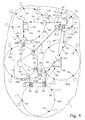
- a VPN control node 43 When a VPN control node 43 initiates a VPN connection request, it compares the requested VPN to the stored information about VPN's that is available through its interdomain connections. Information about in which domain the VPN exists and through which interdomain connections the VPN is reachable is available. In Fig. 4 , the requested VPN is the VPN 22A of Fig. 1 .
- VPN control node 43 of domain 10E has information about that VPN 22A is available through border node 18:1 according to two different paths.
- One alternative to reach VPN 22A is over interdomain connection 12D, through domain 10B and over interdomain connection 12A. The VPN 22A is then present within domain 10A.
- Another alternative to reach VPN 22A is over interdomain connection 12D, through domain 10B and over interdomain connection 12C.
- the VPN 22A is then present within domain 10C.
- the VPN control node 43 of domain 10E has also information about VPN 22A via another border node 18.
- the requested VPN 22A is reachable over interdomain connection 12E, since VPN 22A is available in domain 10C.
- the requested VPN 22A is reachable over interdomain connection 12G, since VPN 22A is available also in domain 10D.
- the VPN control node 43 has thus all necessary information for finding the requested VPN.
- the VPN control node 43 evaluates the available information about the required VPN, by determining a quality measure for each possible connection path.
- a quality measure may be based on e.g. the number of new links to be established, the number of domains to pass before reaching the required VPN, how central the node, at which the VPN is reached, is situated within the required VPN, minimum quality of service properties of links to be established etc.
- the route over interdomain connection 12E seems most simple to use, but e.g. available quality of service levels may change such decisions.
- connection paths could be performed according to different principles.
- One possibility is to have an acceptance threshold and only connection paths having a quality measure exceeding the acceptance threshold will be considered at all.
- connection paths having a quality measure exceeding the acceptance threshold will be considered at all.
- the provided domain VPN information is spread to all VPN control nodes 43 of the entire system 1. In such a way, a request for finding a suitable VPN can be put directly to a VPN control node 43 of the "home" domain.
- the provision and exchanging of VPN information can as indicated before be performed continuously, regularly or even trigged by the request itself.
- a communications network 1 comprises five domains 10A-E.
- domain 10E a VPN 22A is available.
- Domain 10E performs an internal updating of the VPN information and sends updated VPN information to its sole adjacent domain 10A.
- the domain 10A updates its own database and forwards the VPN information to domain 10B.
- domain 10B Also in domain 10B the information about VPN 22A is updated. The update information is then forwarded to the further adjacent domains 10C and 10D. The procedure is repeated also in these domains and another forwarding of the VPN information is performed. Domain 10C sends the information to the domain 10D and the domain 10D sends the same information to the domain 10C. The procedure continues, and an endless loop of VPN information will circulate between domains 10B-D.
- means for prohibiting the information requests to be forwarded in endless loops are provided. Such means for prohibiting looping of information requests are preferably provided in connection with sending or receiving of such information requests, i.e. they are arranged either to prohibit the actual forwarding to a new adjacent domain or to prohibit the acceptance of a received information request.
- each VPN information message is provided with an identity.
- This identity could e.g. be a separate field having a certain unique identity number, or the identity could be based on the actual information it carries. If separate identities of VPN information messages are used, received and accepted VPN information messages are preferably stored in a storage. When a new VPN information message arrives, a comparison is made with the stored data to reveal if the information request already has been received before. In such a case, the request is neglected. Otherwise the request is accepted and the identity is added to the storage.
- the comparison could also be performed in connection with the actual forwarding of the VPN information.
- the message identity could be stored in the storage and an extra condition for forwarding the request could be that there should not be two identical message identities within the database.
- Another embodiment for loop prohibiting is based on information about forwarding paths.
- a receiving domain can easily search for its own identity among this information. If the own identity is present, the information is neglected. Otherwise, the own identity is added and the information can be forwarded.
- the comparison can also be made at the sending side. Before forwarding a VPN information message to a domain, the sending domain searches the forwarding path information for the identities of its adjacent domains. For domains which already are present in the forwarding path, forwarding is prohibited.
- a certain life-time can be set when creating the original VPN information update, e.g. by fixing a validity expiration time. When receiving and/or forwarding such information, this validity expiration time is checked against e.g. a system time, and when the validity is expired, no more forwarding is performed.
- a variation of the lime-time concept is to set a remaining life-time, which then is reduced in connection to each forwarding. When the remaining life-time vanishes, no more forwardings are performed. This approach can then also be used, utilising the number of forwardings as a measure of "time", i.e. it is stated from the initialisation that a maximum number of forwardings is allowed. For each forwarding, the remaining number is reduced by one unit.
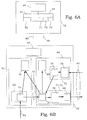
- Fig. 6A illustrates a block scheme of a particular embodiment of a relatively general VPN control node 43 according to the present invention providing the connection path determination arrangement.
- the VPN control node 43 comprises means 52 for providing domain VPN information. This information may be provided by other nodes in the domain by connections 62.
- a main control communication interface 40 is provided for communication with other domains. This interface 40 may be arranged in combination with the intra-domain connections 62.
- An evaluation unit 49 investigating if an identity of a requested VPN matches with domain VPN information is provided.
- the evaluation unit 49 is further arranged for performing the above discussed evaluation of the information about the requested VPN according to a quality measure for finding suitable connection paths.
- the VPN request can be received from another node of the own domain or can be initiated within the VPN control node.
- An external VPN handling section 44 is responsible for handling interdomain VPN configuration.
- the external VPN handling section 44 comprises means for spreading 71 the information about VPNs available in the own domain to adjacent domains.
- the external VPN handling section 44 further comprises means for receiving 73 information about VPNs from adjacent domains and means for distributing 72 information based on received information about VPNs from adjacent domains to other adjacent domains.
- the means 71-73, and in particular means 71-72, can preferably be arranged in an integrated manner, since there are many common part functionalities of the different means. However, in other embodiments, separate units can be provided.
- An internal VPN handling section 41 has functionalities for configuring internal connections within the own domain and comprises preferably the means for collecting information about VPNs available in the own domain, i.e. the means 52 for providing domain VPN information.
- Fig. 6B illustrates a block scheme of another particular embodiment of a VPN control node 43 according to the present invention.
- Domain VPN information regarding the own domain is provided by an internal VPN handling section 41, comprising means for collecting 52 information about VPNs.
- the internal domain VPN information is in this particular embodiment stored in a data memory 74. This information is in this particular embodiment provided, as illustrated by the arrow 62, by communication with other nodes within the domain. In other embodiments, this information can be obtained in other ways.
- the internal domain VPN information is also forwarded to a total VPN information database 54 in an external VPN handling section 44.
- the internal VPN handling section 41 also comprises an internal configuration machine 46, having functionalities for configuring internal connections within the own domain.
- the internal VPN handling section 41 is provided with internal domain VPN information, as well as information from the database 54. Communications regarding internal domain matters are thus performed over a connection 42 between the internal VPN handling section 41 and the external VPN handling section 44.
- the VPN control node 43 has a main control communication interface 40 with other domains over an interdomain connection. Domain VPN information from other domains are received by the interface 40, and an input processing unit 56 extracts useful information from the received data and stores this external information in an input database 58. In this input database 58, additional information as from which domain the external data was received is also stored.
- the input processing unit 56 and the input database 58 are in this embodiment comprised in the means for receiving 73 information about VPNs from adjacent domains.
- the input database 58 updates the total VPN information database 54 when appropriate.
- the external VPN handling section 44 also comprises an external configuration machine 60, having functionalities for configuring parts of interdomain connections that are relevant for the domain. This functionality will be described more in detail below.
- the external VPN handling section 44 also provides information to other domains.
- Domain VPN information associated with the own domain and/or with other domains is extracted from the database 54 and provided to an output data processing unit 50.
- the retrieved information is processed according to SLAs associated with the different neighbour domains and stored in an output database 48.
- the SLAs thereby determines what information is allowed to be spread to the different neighbouring domains. Domain operators having a close relationship may allow for more transparent exchange of information, whereas domains belonging to non-related operators may apply a more restrictive information exchange.
- Information about VPN's is transmitted on the interface 40, when suitable.
- the database 54, the output data processing unit 50 and the output database 48 are in the present embodiments comprised in a common unit 71, 72 for spreading the information about VPNs available in the own domain and for distributing information based on received information about VPNs from adjacent domains.
- FIG. 7 An example, illustrated in Fig. 7 , shows how a subsequent configuration of an interdomain VPN can be automated.
- a new customer site 20' in the domain 10E shall be connected to VPN 22A. It is assumed that VPN tunnels are used for VPN connections both inside domains and between domains. The following steps are taken.
- the VPN control node in domain 10E gets a request, in some way, from the customer to connect to VPN 22A. Since the VPN database of domain 10E shows that the VPN 22A is not present in domain 10E, the VPN control node in domain 10E cannot connect customer site 20' directly to the VPN 22A inside domain 10E. However, VPN information originated from other domains is available showing that a connection path to VPN 22A can be found at "nexthop" 10B, 10C and 10D.
- the VPN control node in domain 10E chooses to set up the VPN via the "nexthop" 10B only, according to the evaluation of the quality measure discussed above. It sets up a VPN tunnel 71 for VPN 22A from the edge node 14' where the customer site 20' is connected, to the border node 18:1, which is connected to domain 10B via link 12D.
- the VPN control node in domain 10E initiates communication with the VPN control node in domain 10B and sets up a VPN tunnel 72 for VPN 22A over the link 12D to border node 18:2.
- the VPN control node in domain 10B sets up the VPN via the "nexthop" 10A. It sets up a VPN transit tunnel 73 for VPN 22A from the border node 18:2, which is connected to domain 10B via link 12D, to the border node 18:3, which is connected to domain 10A via link 12A.
- the VPN control node in domain 10B initiates communication with the control node in domain 10A and sets up a VPN tunnel 74 over the link 12A to border node 18:4. Since VPN 22A is present in domain 10A, the control node in domain 10A can set up an internal tunnel 75 from the border node, which is connected to domain 10B via link 12A, to the border node 18:5, which is connected to the VPN 22A.
- the updated VPN databases will be available for the next round of collecting VPN information.
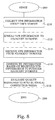
- Fig. 8 The basic steps of an embodiment of a method according to the present invention are illustrated in Fig. 8 .
- the procedure starts in step 200.
- step 210 information about VPNs available in each domain is collected in respective domain.
- step 212 the information about VPNs is spread to adjacent domains.
- step 214 information about VPNs from adjacent domains is received. Based on the received information about VPNs from adjacent domains, information is distributed to other adjacent domains in step 216, with or without any intermediate processing. From the total information about VPNs, an evaluation of quality measures is made in step 218 to find suitable connection paths.
- the procedure ends in step 299.
Landscapes
- Engineering & Computer Science (AREA)
- Computer Networks & Wireless Communication (AREA)
- Signal Processing (AREA)
- Computer Security & Cryptography (AREA)
- Computer Hardware Design (AREA)
- Computing Systems (AREA)
- General Engineering & Computer Science (AREA)
- Data Exchanges In Wide-Area Networks (AREA)
- Telephonic Communication Services (AREA)
- Small-Scale Networks (AREA)
- Communication Control (AREA)
- Mobile Radio Communication Systems (AREA)
Claims (18)
- Verfahren zum Bestimmen eines Verbindungswegs in einem virtuellen privaten Netzwerk - VPV - mit mehreren Domänen (22 A-B) innerhalb eines Kommunikationsnetzwerks mit mindestens zwei zusammengeschalteten Domänen (10 A-E) zwischen einem ersten Knoten in einer ersten Domäne und einem ersten VPN, umfassend die folgenden Schritte:Erfassen (210), in jeder Domäne, von Informationen über VPNs, die in jeder der Domänen verfügbar sind;Verbreiten (212) der Informationen über VPNs an angrenzende Domänen;Empfangen (214) von Informationen über VPNs von angrenzenden Domänen;Verteilen (216) von Informationen basierend auf empfangenen Informationen über VPNs von angrenzenden Domänen an andere angrenzende Domänen;wobei die Informationen über VPNs mindestens die Domänen-ID von Domänen, in denen die VPNs gegenwärtig verfügbar sind, umfassen; undBewerten (218) von Informationen über die erste VPN gemäß einem Qualitätsmaß zum Finden geeigneter Verbindungswege zwischen dem ersten Knoten in der ersten Domäne und dem ersten VPN.
- Verfahren nach Anspruch 1, wobei der Schritt des Verbreitens hin zu allen angrenzenden Domänen durchgeführt wird und der Schritt des Verteilens hin zu allen angrenzenden Domänen außer der angrenzenden Domäne, die die empfangenden Informationen über VPNs bereitstellt, durchgeführt wird.
- Verfahren nach Anspruch 1 oder 2, wobei mindestens einer des Schritts des Verbreitens und des Schritts des Verteilens regelmäßig durchgeführt wird.
- Verfahren nach Anspruch 1 oder 2, wobei mindestens einer des Schritts des Verbreitens und des Schritts des Verteilens bei Auslösung durch ein Ereignis durchgeführt wird.
- Verfahren nach Anspruch 4, wobei das Ereignis eine Veränderung in den Informationen über VPNs, die in jeder der Domänen verfügbar sind, ist.
- Verfahren nach Anspruch 4, wobei das Ereignis ein Empfang von Informationen über VPNs von einer angrenzenden Domäne ist.
- Verfahren nach einem der Ansprüche 1 bis 6, umfassend die folgenden ferneren Schritte:Zurücksenden einer Bestätigungsnachricht an angrenzende Domänen, von denen Informationen über VPNs erlangt werden;Empfangen von Bestätigungsnachrichten von angrenzenden Domänen; undWeiterleiten empfangener Bestätigungsnachrichten für die verteilten Informationen basierend auf empfangenen Informationen über VPNs von angrenzenden Domänen an die angrenzende Domäne, von der die Informationen über VPNs empfangen wurden.
- Verfahren nach einem der Ansprüche 1 bis 7, umfassend den ferneren Schritt des Unterbindens, dass die Informationen über VPNs in Endlosschleifen innerhalb des Kommunikationsnetzwerks weitergeleitet werden.
- Verfahren zum Bestimmen eines Verbindungswegs nach Anspruch 8, wobei der Schritt des Unterbindens vor dem Verteilen der Informationen über VPNs an eine angrenzende Domäne durchgeführt wird.
- Verfahren zum Bestimmen eines Verbindungswegs nach Anspruch 8, wobei der Schritt des Unterbindens vor dem Annehmen empfangener Informationen über VPNs von einer anderen Domäne durchgeführt wird.
- Verfahren zum Bestimmen eines Verbindungswegs nach einem der Ansprüche 8 bis 10, wobei der Schritt des Unterbindens auf einem Vergleich zwischen den gegenwärtig empfangenen Informationen über VPNs und einer Speicherung von Daten, die früher empfangene Informationen über VPNs repräsentieren, basiert.
- Verfahren zum Bestimmen eines Verbindungswegs nach einem der Ansprüche 8 bis 10, wobei der Schritt des Unterbindens auf einem Vergleich zwischen Domänen-Identitäten und Daten, die Domänen repräsentieren, die die empfangenen Informationen über VPNs durchlaufen haben, enthalten in den Informationen über VPNs, basiert.
- Verfahren zum Bestimmen eines Verbindungswegs nach einem der Ansprüche 8 bis 10, wobei der Schritt des Unterbindens auf einer Lebensdauer der Informationen über VPNs basiert.
- Verfahren nach einem der Ansprüche 1 bis 13, wobei die Informationen über die VPNs mindestens eines von Folgendem zusätzlich umfassen:Eigenschaften des ersten VPN;Verbindungsqualitäten von Verbindungen, die gegenwärtig von dem ersten VPN verwendet werden;Verbindungsqualitäten von Verbindungen, die zum Erweitern des ersten VPN verfügbar sind;Knoten-ID von Knoten, an denen die VPNs verfügbar sind; undInformationen darüber, welche Domänen passiert werden müssen, um eine Domäne zu erreichen, in der die VPNs verfügbar sind.
- Verfahren nach Anspruch 14, wobei Eigenschaften des ersten VPN mindestens eines von Folgendem umfassen:Dienstgüte-Eigenschaften;Verschlüsselungseigenschaften;Transparenzschicht-Eigenschaften;Durchtunnelung-Eigenschaften; undTopologie-Eigenschaften.
- Kommunikationsnetzwerk-Domänenanordnung, umfassend:Mittel (52) zum Erfassen von Informationen über virtuelle private Netzwerke - VPNs -, die in einer Domäne der Kommunikationsnetzwerk-Domänenanordnung verfügbar sind;Mittel (71) zum Verbreiten der Informationen über VPNs an angrenzende Domänen in einem Kommunikationsnetzwerk, das mindestens zwei Domänen aufweist;Mittel (73) zum Empfangen von Informationen über VPNs von angrenzenden Domänen in dem Kommunikationsnetzwerk;gekennzeichnet durch:Mittel (72) zum Verteilen von Informationen basierend auf empfangenen Informationen über VPNs von angrenzenden Domänen an andere angrenzende Domänen;wobei die Informationen über den ersten VPN mindestens die Domänen-ID von Domänen, in denen VPNs gegenwärtig verfügbar sind, umfassen; undMittel (49) zum Bewerten der Informationen über VPNs gemäß einem Qualitätsmaß zum Finden geeigneter Verbindungswege von Knoten der Domäne zu einem ersten VPN.
- Kommunikationsnetzwerk-Domänenanordnung nach Anspruch 16, wobei das Mittel zum Verbreiten angeordnet ist, die Informationen über VPNs an alle angrenzenden Domänen zu verbreiten, und das Mittel zum Verteilen angeordnet ist, die empfangenen Informationen über VPNs an alle angrenzenden Domänen außer der angrenzenden Domäne, die die empfangenden Informationen über VPNs bereitstellt, zu verteilen.
- Kommunikationsnetzwerk-Domänenanordnung nach Anspruch 16 oder 17, umfassend:Mittel zum Zurücksenden einer Bestätigungsnachricht an angrenzende Domänen, von denen Informationen über VPNs erlangt werden;Mittel zum Empfangen von Bestätigungsnachrichten von angrenzenden Domänen; undMittel zum Weiterleiten empfangener Bestätigungsnachrichten für die verteilten Informationen basierend auf empfangenen Informationen über VPNs von angrenzenden Domänen an die angrenzende Domäne, von der die Informationen über VPNs empfangen wurden.
Applications Claiming Priority (2)
| Application Number | Priority Date | Filing Date | Title |
|---|---|---|---|
| PCT/SE2004/001065 WO2006004461A1 (en) | 2004-06-30 | 2004-06-30 | Method and system for multi-domain virtual private network configuration |
| PCT/SE2005/001006 WO2006004501A1 (en) | 2004-06-30 | 2005-06-23 | Methods and arrangements for connection determination in multi-domain virtual private network |
Publications (2)
| Publication Number | Publication Date |
|---|---|
| EP1762050A1 EP1762050A1 (de) | 2007-03-14 |
| EP1762050B1 true EP1762050B1 (de) | 2014-09-03 |
Family
ID=35783161
Family Applications (3)
| Application Number | Title | Priority Date | Filing Date |
|---|---|---|---|
| EP04749103A Expired - Lifetime EP1762048B1 (de) | 2004-06-30 | 2004-06-30 | Verfahren und system zur konfiguration eines virtuellen privaten netzwerks mit mehreren domänen |
| EP05753842.3A Expired - Lifetime EP1762049B1 (de) | 2004-06-30 | 2005-06-23 | Verfahren zur schnellen bestimmung von verbindungswegen in virtuellen privaten netzwerken mit mehreren domänen |
| EP05754831.5A Expired - Lifetime EP1762050B1 (de) | 2004-06-30 | 2005-06-23 | Verfahren und anordnungen zur verbindungsbestimmung in einem virtuellen privaten netzwerk mit mehreren domänen |
Family Applications Before (2)
| Application Number | Title | Priority Date | Filing Date |
|---|---|---|---|
| EP04749103A Expired - Lifetime EP1762048B1 (de) | 2004-06-30 | 2004-06-30 | Verfahren und system zur konfiguration eines virtuellen privaten netzwerks mit mehreren domänen |
| EP05753842.3A Expired - Lifetime EP1762049B1 (de) | 2004-06-30 | 2005-06-23 | Verfahren zur schnellen bestimmung von verbindungswegen in virtuellen privaten netzwerken mit mehreren domänen |
Country Status (13)
| Country | Link |
|---|---|
| US (1) | US7869447B2 (de) |
| EP (3) | EP1762048B1 (de) |
| JP (3) | JP4584998B2 (de) |
| KR (2) | KR101063049B1 (de) |
| CN (3) | CN100583798C (de) |
| AT (1) | ATE528886T1 (de) |
| AU (3) | AU2004321282B2 (de) |
| BR (3) | BRPI0418936B1 (de) |
| CA (1) | CA2565896A1 (de) |
| ES (1) | ES2372389T3 (de) |
| TW (1) | TWI372537B (de) |
| WO (3) | WO2006004461A1 (de) |
| ZA (1) | ZA200700803B (de) |
Families Citing this family (22)
| Publication number | Priority date | Publication date | Assignee | Title |
|---|---|---|---|---|
| US7593478B2 (en) * | 2004-04-26 | 2009-09-22 | Qualcomm Incorporated | Low peak to average ratio search algorithm |
| US7483996B2 (en) * | 2004-11-29 | 2009-01-27 | Cisco Technology, Inc. | Techniques for migrating a point to point protocol to a protocol for an access network |
| US7778199B2 (en) * | 2005-02-19 | 2010-08-17 | Cisco Technology, Inc. | Techniques for customer self-provisioning of edge nodes for a virtual private network |
| US7769037B2 (en) * | 2005-02-19 | 2010-08-03 | Cisco Technology, Inc. | Techniques for using first sign of life at edge nodes for a virtual private network |
| US7535856B2 (en) * | 2005-02-19 | 2009-05-19 | Cisco Technology, Inc. | Techniques for zero touch provisioning of edge nodes for a virtual private network |
| EP1856861B1 (de) * | 2005-02-19 | 2013-09-18 | Cisco Technology, Inc. | Verfahren zur überzeichnung von randknoten für virtuelle private netzwerke |
| US7420933B2 (en) * | 2005-02-19 | 2008-09-02 | Cisco Technology, Inc. | Techniques for zero touch provisioning of edge nodes for a virtual private network by pushing configuration from a server |
| US8059527B2 (en) * | 2005-02-19 | 2011-11-15 | Cisco Technology, Inc. | Techniques for oversubscribing edge nodes for virtual private networks |
| KR100789425B1 (ko) * | 2006-04-10 | 2007-12-28 | 삼성전자주식회사 | 디.엘.엔.에이 네트워크를 이용한 컨텐츠 공유 방법 |
| CN101047636B (zh) * | 2006-06-07 | 2010-11-10 | 华为技术有限公司 | 端到端伪线仿真虚拟租用线接入虚拟专用网的方法及系统 |
| US7773557B2 (en) | 2006-06-08 | 2010-08-10 | Telefonaktiebolaget Lm Ericsson (Publ) | Downlink signaling of transmitter configuration for CQI estimation |
| JP4602950B2 (ja) * | 2006-08-08 | 2010-12-22 | 日本電信電話株式会社 | Vpnサービス管理方法 |
| EA020186B1 (ru) | 2006-12-28 | 2014-09-30 | Шарп Кабусики Кайся | Устройство радиопередачи, управляющее устройство, система радиосвязи и способ связи |
| US8713669B2 (en) * | 2007-03-02 | 2014-04-29 | Cisco Technology, Inc. | Multi-domain dynamic group virtual private networks |
| JP6191703B2 (ja) * | 2014-02-05 | 2017-09-06 | 日本電気株式会社 | 通信制御システム、通信制御方法および通信制御プログラム |
| FR3018213B1 (fr) | 2014-03-06 | 2016-10-21 | Constellium France | Tole de brasage a placages multiples |
| US9918346B2 (en) * | 2015-04-17 | 2018-03-13 | Barracuda Networks, Inc. | System for connecting, securing and managing network devices with a dedicated private virtual network |
| CN111130980B (zh) * | 2016-06-29 | 2021-06-29 | 华为技术有限公司 | 用于实现组合虚拟专用网vpn的方法与装置 |
| US10476836B1 (en) * | 2017-04-12 | 2019-11-12 | Verisign, Inc. | Systems, devices, and methods for providing improved RDAP operations |
| CN112020343B (zh) | 2018-03-30 | 2023-09-19 | 维布兰特公司 | 包括振动胶囊的胃肠治疗系统以及其使用方法 |
| US10659255B1 (en) * | 2018-11-06 | 2020-05-19 | At&T Intellectual Property I, L.P. | Identity-based virtual private network tunneling |
| US11979284B2 (en) * | 2021-08-31 | 2024-05-07 | Cisco Technology, Inc. | Orchestrated reconnect for client-unaware rolling of network nodes |
Family Cites Families (15)
| Publication number | Priority date | Publication date | Assignee | Title |
|---|---|---|---|---|
| US6609153B1 (en) * | 1998-12-24 | 2003-08-19 | Redback Networks Inc. | Domain isolation through virtual network machines |
| CN100399763C (zh) * | 1999-02-23 | 2008-07-02 | 阿尔卡塔尔互联网运行公司 | 具有自动保护交换的多业务网络交换机及其保护交换方法 |
| JP4110671B2 (ja) * | 1999-05-27 | 2008-07-02 | 株式会社日立製作所 | データ転送装置 |
| JP2001326692A (ja) * | 2000-05-16 | 2001-11-22 | Hitachi Ltd | 相互接続装置及びこれを用いたネットワークシステム |
| JP2001326693A (ja) * | 2000-05-17 | 2001-11-22 | Nec Corp | 通信装置及び通信制御方法並びに制御プログラム記録媒体 |
| US7403980B2 (en) * | 2000-11-08 | 2008-07-22 | Sri International | Methods and apparatus for scalable, distributed management of virtual private networks |
| JP2002335274A (ja) * | 2001-03-06 | 2002-11-22 | Fujitsu Ltd | パケット中継装置およびパケット中継方法 |
| EP1331766A1 (de) * | 2001-12-20 | 2003-07-30 | Alcatel | Système de télécommunications utilisant l'architecture d'un réseau de service virtuel |
| CN1125545C (zh) * | 2001-12-31 | 2003-10-22 | 刘军民 | 实现局域网虚通道传送的数据转发方法 |
| JP3868815B2 (ja) * | 2002-01-10 | 2007-01-17 | 富士通株式会社 | 通信システム |
| US20040034702A1 (en) | 2002-08-16 | 2004-02-19 | Nortel Networks Limited | Method and apparatus for exchanging intra-domain routing information between VPN sites |
| JP3878106B2 (ja) * | 2002-11-05 | 2007-02-07 | 日本電信電話株式会社 | Vpnシステムおよびエッジノードおよびvpn構成方法 |
| CN100502343C (zh) * | 2003-05-22 | 2009-06-17 | 华为技术有限公司 | 多协议标签交换虚拟专用网相互通信的方法 |
| US7389534B1 (en) * | 2003-06-27 | 2008-06-17 | Nortel Networks Ltd | Method and apparatus for establishing virtual private network tunnels in a wireless network |
| US7561586B2 (en) * | 2003-09-19 | 2009-07-14 | Nortel Networks Limited | Method and apparatus for providing network VPN services on demand |
-
2004
- 2004-06-30 AT AT04749103T patent/ATE528886T1/de not_active IP Right Cessation
- 2004-06-30 WO PCT/SE2004/001065 patent/WO2006004461A1/en not_active Ceased
- 2004-06-30 CA CA002565896A patent/CA2565896A1/en not_active Abandoned
- 2004-06-30 KR KR1020067026304A patent/KR101063049B1/ko not_active Expired - Lifetime
- 2004-06-30 BR BRPI0418936-1A patent/BRPI0418936B1/pt active IP Right Grant
- 2004-06-30 JP JP2007519144A patent/JP4584998B2/ja not_active Expired - Lifetime
- 2004-06-30 EP EP04749103A patent/EP1762048B1/de not_active Expired - Lifetime
- 2004-06-30 CN CN200480043507A patent/CN100583798C/zh not_active Expired - Lifetime
- 2004-06-30 ES ES04749103T patent/ES2372389T3/es not_active Expired - Lifetime
- 2004-06-30 AU AU2004321282A patent/AU2004321282B2/en not_active Ceased
-
2005
- 2005-06-15 TW TW094119826A patent/TWI372537B/zh not_active IP Right Cessation
- 2005-06-23 KR KR1020067027078A patent/KR101145587B1/ko not_active Expired - Fee Related
- 2005-06-23 CN CNB2005800221817A patent/CN100544301C/zh not_active Expired - Fee Related
- 2005-06-23 JP JP2007519159A patent/JP4564057B2/ja not_active Expired - Fee Related
- 2005-06-23 WO PCT/SE2005/001004 patent/WO2006004500A1/en not_active Ceased
- 2005-06-23 JP JP2007519160A patent/JP4555337B2/ja not_active Expired - Fee Related
- 2005-06-23 BR BRPI0512851-0A patent/BRPI0512851A/pt not_active IP Right Cessation
- 2005-06-23 ZA ZA200700803A patent/ZA200700803B/en unknown
- 2005-06-23 BR BRPI0512909-5A patent/BRPI0512909B1/pt not_active IP Right Cessation
- 2005-06-23 AU AU2005260198A patent/AU2005260198B2/en not_active Ceased
- 2005-06-23 EP EP05753842.3A patent/EP1762049B1/de not_active Expired - Lifetime
- 2005-06-23 AU AU2005260197A patent/AU2005260197B2/en not_active Ceased
- 2005-06-23 EP EP05754831.5A patent/EP1762050B1/de not_active Expired - Lifetime
- 2005-06-23 CN CN2005800223386A patent/CN1981488B/zh not_active Expired - Lifetime
- 2005-06-23 WO PCT/SE2005/001006 patent/WO2006004501A1/en not_active Ceased
- 2005-06-30 US US11/170,185 patent/US7869447B2/en active Active
Also Published As
Similar Documents
| Publication | Publication Date | Title |
|---|---|---|
| EP1762050B1 (de) | Verfahren und anordnungen zur verbindungsbestimmung in einem virtuellen privaten netzwerk mit mehreren domänen | |
| CN103168445A (zh) | 用于虚拟网络中的可靠性和可用性设定的控制机制 | |
| CN107637037A (zh) | 用于全局虚拟网络中的虚拟接口和高级智能路由的系统和方法 | |
| Alotaibi et al. | Multidomain SDN‐Based Gateways and Border Gateway Protocol | |
| CN104038427A (zh) | 路由更新方法和路由更新装置 | |
| Chiesa et al. | PrIXP: Preserving the privacy of routing policies at Internet eXchange Points | |
| US20250330447A1 (en) | System and method for application-based micro-segmentation | |
| KR101145575B1 (ko) | 멀티도메인 가상 사설 네트워크에서 접속 결정을 위한 방법및 장치 | |
| Hasija et al. | Domain federation via MPLS and SDN for dynamic, real-time end-to-end QoS support | |
| Atalay et al. | Towards establishing a systematic security framework for next generation cellular networks | |
| HK1107204B (en) | Methods and arrangements for connection determination in multi-domain virtual private network | |
| Kerrouche | Routing named data in information-centric networks |
Legal Events
| Date | Code | Title | Description |
|---|---|---|---|
| PUAI | Public reference made under article 153(3) epc to a published international application that has entered the european phase |
Free format text: ORIGINAL CODE: 0009012 |
|
| 17P | Request for examination filed |
Effective date: 20061208 |
|
| AK | Designated contracting states |
Kind code of ref document: A1 Designated state(s): AT BE BG CH CY CZ DE DK EE ES FI FR GB GR HU IE IS IT LI LT LU MC NL PL PT RO SE SI SK TR |
|
| DAX | Request for extension of the european patent (deleted) | ||
| 17Q | First examination report despatched |
Effective date: 20130904 |
|
| RIC1 | Information provided on ipc code assigned before grant |
Ipc: H04L 12/46 20060101AFI20140304BHEP Ipc: H04L 29/06 20060101ALI20140304BHEP |
|
| GRAP | Despatch of communication of intention to grant a patent |
Free format text: ORIGINAL CODE: EPIDOSNIGR1 |
|
| INTG | Intention to grant announced |
Effective date: 20140502 |
|
| GRAS | Grant fee paid |
Free format text: ORIGINAL CODE: EPIDOSNIGR3 |
|
| GRAA | (expected) grant |
Free format text: ORIGINAL CODE: 0009210 |
|
| RAP1 | Party data changed (applicant data changed or rights of an application transferred) |
Owner name: TELEFONAKTIEBOLAGET L M ERICSSON (PUBL) |
|
| AK | Designated contracting states |
Kind code of ref document: B1 Designated state(s): AT BE BG CH CY CZ DE DK EE ES FI FR GB GR HU IE IS IT LI LT LU MC NL PL PT RO SE SI SK TR |
|
| REG | Reference to a national code |
Ref country code: GB Ref legal event code: FG4D |
|
| REG | Reference to a national code |
Ref country code: CH Ref legal event code: EP Ref country code: AT Ref legal event code: REF Ref document number: 686091 Country of ref document: AT Kind code of ref document: T Effective date: 20140915 |
|
| REG | Reference to a national code |
Ref country code: IE Ref legal event code: FG4D |
|
| REG | Reference to a national code |
Ref country code: DE Ref legal event code: R096 Ref document number: 602005044640 Country of ref document: DE Effective date: 20141016 |
|
| REG | Reference to a national code |
Ref country code: AT Ref legal event code: MK05 Ref document number: 686091 Country of ref document: AT Kind code of ref document: T Effective date: 20140903 |
|
| PG25 | Lapsed in a contracting state [announced via postgrant information from national office to epo] |
Ref country code: LT Free format text: LAPSE BECAUSE OF FAILURE TO SUBMIT A TRANSLATION OF THE DESCRIPTION OR TO PAY THE FEE WITHIN THE PRESCRIBED TIME-LIMIT Effective date: 20140903 Ref country code: SE Free format text: LAPSE BECAUSE OF FAILURE TO SUBMIT A TRANSLATION OF THE DESCRIPTION OR TO PAY THE FEE WITHIN THE PRESCRIBED TIME-LIMIT Effective date: 20140903 Ref country code: ES Free format text: LAPSE BECAUSE OF FAILURE TO SUBMIT A TRANSLATION OF THE DESCRIPTION OR TO PAY THE FEE WITHIN THE PRESCRIBED TIME-LIMIT Effective date: 20140903 Ref country code: FI Free format text: LAPSE BECAUSE OF FAILURE TO SUBMIT A TRANSLATION OF THE DESCRIPTION OR TO PAY THE FEE WITHIN THE PRESCRIBED TIME-LIMIT Effective date: 20140903 Ref country code: GR Free format text: LAPSE BECAUSE OF FAILURE TO SUBMIT A TRANSLATION OF THE DESCRIPTION OR TO PAY THE FEE WITHIN THE PRESCRIBED TIME-LIMIT Effective date: 20141204 |
|
| REG | Reference to a national code |
Ref country code: NL Ref legal event code: VDEP Effective date: 20140903 |
|
| REG | Reference to a national code |
Ref country code: LT Ref legal event code: MG4D |
|
| PG25 | Lapsed in a contracting state [announced via postgrant information from national office to epo] |
Ref country code: AT Free format text: LAPSE BECAUSE OF FAILURE TO SUBMIT A TRANSLATION OF THE DESCRIPTION OR TO PAY THE FEE WITHIN THE PRESCRIBED TIME-LIMIT Effective date: 20140903 Ref country code: CY Free format text: LAPSE BECAUSE OF FAILURE TO SUBMIT A TRANSLATION OF THE DESCRIPTION OR TO PAY THE FEE WITHIN THE PRESCRIBED TIME-LIMIT Effective date: 20140903 |
|
| PG25 | Lapsed in a contracting state [announced via postgrant information from national office to epo] |
Ref country code: NL Free format text: LAPSE BECAUSE OF FAILURE TO SUBMIT A TRANSLATION OF THE DESCRIPTION OR TO PAY THE FEE WITHIN THE PRESCRIBED TIME-LIMIT Effective date: 20140903 |
|
| PG25 | Lapsed in a contracting state [announced via postgrant information from national office to epo] |
Ref country code: EE Free format text: LAPSE BECAUSE OF FAILURE TO SUBMIT A TRANSLATION OF THE DESCRIPTION OR TO PAY THE FEE WITHIN THE PRESCRIBED TIME-LIMIT Effective date: 20140903 Ref country code: IS Free format text: LAPSE BECAUSE OF FAILURE TO SUBMIT A TRANSLATION OF THE DESCRIPTION OR TO PAY THE FEE WITHIN THE PRESCRIBED TIME-LIMIT Effective date: 20150103 Ref country code: CZ Free format text: LAPSE BECAUSE OF FAILURE TO SUBMIT A TRANSLATION OF THE DESCRIPTION OR TO PAY THE FEE WITHIN THE PRESCRIBED TIME-LIMIT Effective date: 20140903 Ref country code: RO Free format text: LAPSE BECAUSE OF FAILURE TO SUBMIT A TRANSLATION OF THE DESCRIPTION OR TO PAY THE FEE WITHIN THE PRESCRIBED TIME-LIMIT Effective date: 20140903 Ref country code: SK Free format text: LAPSE BECAUSE OF FAILURE TO SUBMIT A TRANSLATION OF THE DESCRIPTION OR TO PAY THE FEE WITHIN THE PRESCRIBED TIME-LIMIT Effective date: 20140903 Ref country code: PT Free format text: LAPSE BECAUSE OF FAILURE TO SUBMIT A TRANSLATION OF THE DESCRIPTION OR TO PAY THE FEE WITHIN THE PRESCRIBED TIME-LIMIT Effective date: 20150105 |
|
| PG25 | Lapsed in a contracting state [announced via postgrant information from national office to epo] |
Ref country code: PL Free format text: LAPSE BECAUSE OF FAILURE TO SUBMIT A TRANSLATION OF THE DESCRIPTION OR TO PAY THE FEE WITHIN THE PRESCRIBED TIME-LIMIT Effective date: 20140903 |
|
| REG | Reference to a national code |
Ref country code: DE Ref legal event code: R097 Ref document number: 602005044640 Country of ref document: DE |
|
| PLBE | No opposition filed within time limit |
Free format text: ORIGINAL CODE: 0009261 |
|
| STAA | Information on the status of an ep patent application or granted ep patent |
Free format text: STATUS: NO OPPOSITION FILED WITHIN TIME LIMIT |
|
| PG25 | Lapsed in a contracting state [announced via postgrant information from national office to epo] |
Ref country code: DK Free format text: LAPSE BECAUSE OF FAILURE TO SUBMIT A TRANSLATION OF THE DESCRIPTION OR TO PAY THE FEE WITHIN THE PRESCRIBED TIME-LIMIT Effective date: 20140903 |
|
| 26N | No opposition filed |
Effective date: 20150604 |
|
| PG25 | Lapsed in a contracting state [announced via postgrant information from national office to epo] |
Ref country code: IT Free format text: LAPSE BECAUSE OF FAILURE TO SUBMIT A TRANSLATION OF THE DESCRIPTION OR TO PAY THE FEE WITHIN THE PRESCRIBED TIME-LIMIT Effective date: 20140903 |
|
| PG25 | Lapsed in a contracting state [announced via postgrant information from national office to epo] |
Ref country code: SI Free format text: LAPSE BECAUSE OF FAILURE TO SUBMIT A TRANSLATION OF THE DESCRIPTION OR TO PAY THE FEE WITHIN THE PRESCRIBED TIME-LIMIT Effective date: 20140903 |
|
| PG25 | Lapsed in a contracting state [announced via postgrant information from national office to epo] |
Ref country code: MC Free format text: LAPSE BECAUSE OF FAILURE TO SUBMIT A TRANSLATION OF THE DESCRIPTION OR TO PAY THE FEE WITHIN THE PRESCRIBED TIME-LIMIT Effective date: 20140903 |
|
| REG | Reference to a national code |
Ref country code: CH Ref legal event code: PL |
|
| PG25 | Lapsed in a contracting state [announced via postgrant information from national office to epo] |
Ref country code: LU Free format text: LAPSE BECAUSE OF FAILURE TO SUBMIT A TRANSLATION OF THE DESCRIPTION OR TO PAY THE FEE WITHIN THE PRESCRIBED TIME-LIMIT Effective date: 20150623 |
|
| REG | Reference to a national code |
Ref country code: IE Ref legal event code: MM4A |
|
| PG25 | Lapsed in a contracting state [announced via postgrant information from national office to epo] |
Ref country code: CH Free format text: LAPSE BECAUSE OF NON-PAYMENT OF DUE FEES Effective date: 20150630 Ref country code: LI Free format text: LAPSE BECAUSE OF NON-PAYMENT OF DUE FEES Effective date: 20150630 Ref country code: IE Free format text: LAPSE BECAUSE OF NON-PAYMENT OF DUE FEES Effective date: 20150623 |
|
| REG | Reference to a national code |
Ref country code: FR Ref legal event code: PLFP Year of fee payment: 12 |
|
| PG25 | Lapsed in a contracting state [announced via postgrant information from national office to epo] |
Ref country code: BE Free format text: LAPSE BECAUSE OF FAILURE TO SUBMIT A TRANSLATION OF THE DESCRIPTION OR TO PAY THE FEE WITHIN THE PRESCRIBED TIME-LIMIT Effective date: 20140903 |
|
| PGFP | Annual fee paid to national office [announced via postgrant information from national office to epo] |
Ref country code: GB Payment date: 20160627 Year of fee payment: 12 |
|
| PGFP | Annual fee paid to national office [announced via postgrant information from national office to epo] |
Ref country code: FR Payment date: 20160628 Year of fee payment: 12 |
|
| PG25 | Lapsed in a contracting state [announced via postgrant information from national office to epo] |
Ref country code: HU Free format text: LAPSE BECAUSE OF FAILURE TO SUBMIT A TRANSLATION OF THE DESCRIPTION OR TO PAY THE FEE WITHIN THE PRESCRIBED TIME-LIMIT; INVALID AB INITIO Effective date: 20050623 Ref country code: BG Free format text: LAPSE BECAUSE OF FAILURE TO SUBMIT A TRANSLATION OF THE DESCRIPTION OR TO PAY THE FEE WITHIN THE PRESCRIBED TIME-LIMIT Effective date: 20140903 |
|
| PG25 | Lapsed in a contracting state [announced via postgrant information from national office to epo] |
Ref country code: TR Free format text: LAPSE BECAUSE OF FAILURE TO SUBMIT A TRANSLATION OF THE DESCRIPTION OR TO PAY THE FEE WITHIN THE PRESCRIBED TIME-LIMIT Effective date: 20140903 |
|
| GBPC | Gb: european patent ceased through non-payment of renewal fee |
Effective date: 20170623 |
|
| REG | Reference to a national code |
Ref country code: FR Ref legal event code: ST Effective date: 20180228 |
|
| PG25 | Lapsed in a contracting state [announced via postgrant information from national office to epo] |
Ref country code: GB Free format text: LAPSE BECAUSE OF NON-PAYMENT OF DUE FEES Effective date: 20170623 |
|
| PG25 | Lapsed in a contracting state [announced via postgrant information from national office to epo] |
Ref country code: FR Free format text: LAPSE BECAUSE OF NON-PAYMENT OF DUE FEES Effective date: 20170630 |
|
| P01 | Opt-out of the competence of the unified patent court (upc) registered |
Effective date: 20230523 |
|
| PGFP | Annual fee paid to national office [announced via postgrant information from national office to epo] |
Ref country code: DE Payment date: 20230626 Year of fee payment: 19 |
|
| REG | Reference to a national code |
Ref country code: DE Ref legal event code: R119 Ref document number: 602005044640 Country of ref document: DE |
|
| PG25 | Lapsed in a contracting state [announced via postgrant information from national office to epo] |
Ref country code: DE Free format text: LAPSE BECAUSE OF NON-PAYMENT OF DUE FEES Effective date: 20250101 |