EP1757981A1 - Photopolymer printing plate precursor - Google Patents
Photopolymer printing plate precursor Download PDFInfo
- Publication number
- EP1757981A1 EP1757981A1 EP05107827A EP05107827A EP1757981A1 EP 1757981 A1 EP1757981 A1 EP 1757981A1 EP 05107827 A EP05107827 A EP 05107827A EP 05107827 A EP05107827 A EP 05107827A EP 1757981 A1 EP1757981 A1 EP 1757981A1
- Authority
- EP
- European Patent Office
- Prior art keywords
- printing plate
- plate precursor
- group
- photopolymer printing
- precursor according
- Prior art date
- Legal status (The legal status is an assumption and is not a legal conclusion. Google has not performed a legal analysis and makes no representation as to the accuracy of the status listed.)
- Granted
Links
- 238000007639 printing Methods 0.000 title claims abstract description 70
- 239000002243 precursor Substances 0.000 title claims abstract description 49
- 239000000203 mixture Substances 0.000 claims abstract description 78
- 150000001875 compounds Chemical class 0.000 claims abstract description 65
- 239000011230 binding agent Substances 0.000 claims abstract description 47
- 229920001577 copolymer Polymers 0.000 claims abstract description 30
- 239000011248 coating agent Substances 0.000 claims abstract description 18
- 238000000576 coating method Methods 0.000 claims abstract description 18
- 230000002378 acidificating effect Effects 0.000 claims abstract description 11
- 230000031700 light absorption Effects 0.000 claims abstract description 4
- -1 acrylate compound Chemical class 0.000 claims description 59
- 238000000034 method Methods 0.000 claims description 22
- 125000004435 hydrogen atom Chemical class [H]* 0.000 claims description 19
- 125000000217 alkyl group Chemical group 0.000 claims description 17
- 125000003545 alkoxy group Chemical group 0.000 claims description 16
- ZWEHNKRNPOVVGH-UHFFFAOYSA-N 2-Butanone Chemical compound CCC(C)=O ZWEHNKRNPOVVGH-UHFFFAOYSA-N 0.000 claims description 15
- 239000011241 protective layer Substances 0.000 claims description 12
- 238000004519 manufacturing process Methods 0.000 claims description 11
- 230000003287 optical effect Effects 0.000 claims description 11
- 230000015572 biosynthetic process Effects 0.000 claims description 9
- 239000003795 chemical substances by application Substances 0.000 claims description 8
- 238000012545 processing Methods 0.000 claims description 8
- XSQUKJJJFZCRTK-UHFFFAOYSA-N urea group Chemical group NC(=O)N XSQUKJJJFZCRTK-UHFFFAOYSA-N 0.000 claims description 8
- 125000003178 carboxy group Chemical group [H]OC(*)=O 0.000 claims description 6
- ISWSIDIOOBJBQZ-UHFFFAOYSA-N phenol group Chemical group C1(=CC=CC=C1)O ISWSIDIOOBJBQZ-UHFFFAOYSA-N 0.000 claims description 5
- JOYRKODLDBILNP-UHFFFAOYSA-N Ethyl urethane Chemical compound CCOC(N)=O JOYRKODLDBILNP-UHFFFAOYSA-N 0.000 claims description 4
- 238000005282 brightening Methods 0.000 claims description 4
- 125000002843 carboxylic acid group Chemical group 0.000 claims description 4
- 239000012986 chain transfer agent Substances 0.000 claims description 4
- 229910052717 sulfur Inorganic materials 0.000 claims description 4
- NINIDFKCEFEMDL-UHFFFAOYSA-N Sulfur Chemical group [S] NINIDFKCEFEMDL-UHFFFAOYSA-N 0.000 claims description 3
- 125000004397 aminosulfonyl group Chemical group NS(=O)(=O)* 0.000 claims description 3
- 125000004429 atom Chemical group 0.000 claims description 3
- 125000001302 tertiary amino group Chemical group 0.000 claims description 3
- 229910006069 SO3H Inorganic materials 0.000 claims description 2
- 125000004423 acyloxy group Chemical group 0.000 claims description 2
- 125000004453 alkoxycarbonyl group Chemical group 0.000 claims description 2
- 125000004448 alkyl carbonyl group Chemical group 0.000 claims description 2
- 125000004390 alkyl sulfonyl group Chemical group 0.000 claims description 2
- 150000001244 carboxylic acid anhydrides Chemical group 0.000 claims description 2
- 239000003431 cross linking reagent Substances 0.000 claims description 2
- 239000001257 hydrogen Substances 0.000 claims description 2
- 229910052739 hydrogen Inorganic materials 0.000 claims description 2
- 150000002825 nitriles Chemical class 0.000 claims description 2
- 125000001476 phosphono group Chemical group [H]OP(*)(=O)O[H] 0.000 claims description 2
- 125000000020 sulfo group Chemical group O=S(=O)([*])O[H] 0.000 claims description 2
- 125000005420 sulfonamido group Chemical group S(=O)(=O)(N*)* 0.000 claims description 2
- 239000011593 sulfur Substances 0.000 claims description 2
- 150000007934 α,β-unsaturated carboxylic acids Chemical class 0.000 claims description 2
- 150000001990 dicarboxylic acid derivatives Chemical class 0.000 claims 1
- 230000035945 sensitivity Effects 0.000 abstract description 18
- 229920002451 polyvinyl alcohol Polymers 0.000 description 34
- 150000003254 radicals Chemical class 0.000 description 26
- 231100000489 sensitizer Toxicity 0.000 description 23
- 125000004432 carbon atom Chemical group C* 0.000 description 22
- XLYOFNOQVPJJNP-UHFFFAOYSA-N water Substances O XLYOFNOQVPJJNP-UHFFFAOYSA-N 0.000 description 22
- 239000000243 solution Substances 0.000 description 21
- 239000010410 layer Substances 0.000 description 19
- 238000007127 saponification reaction Methods 0.000 description 18
- 125000002496 methyl group Chemical group [H]C([H])([H])* 0.000 description 15
- 230000001681 protective effect Effects 0.000 description 12
- 238000011161 development Methods 0.000 description 11
- 150000002148 esters Chemical class 0.000 description 10
- 239000000178 monomer Substances 0.000 description 9
- 229920000642 polymer Polymers 0.000 description 9
- NIXOWILDQLNWCW-UHFFFAOYSA-M Acrylate Chemical compound [O-]C(=O)C=C NIXOWILDQLNWCW-UHFFFAOYSA-M 0.000 description 8
- 125000002887 hydroxy group Chemical group [H]O* 0.000 description 8
- 125000000956 methoxy group Chemical group [H]C([H])([H])O* 0.000 description 8
- 239000003381 stabilizer Substances 0.000 description 8
- 150000001252 acrylic acid derivatives Chemical class 0.000 description 7
- 125000003118 aryl group Chemical group 0.000 description 7
- 239000000975 dye Substances 0.000 description 7
- 150000002430 hydrocarbons Chemical group 0.000 description 7
- 238000003384 imaging method Methods 0.000 description 7
- 230000008569 process Effects 0.000 description 7
- IJGRMHOSHXDMSA-UHFFFAOYSA-N Atomic nitrogen Chemical compound N#N IJGRMHOSHXDMSA-UHFFFAOYSA-N 0.000 description 6
- OKKJLVBELUTLKV-UHFFFAOYSA-N Methanol Chemical compound OC OKKJLVBELUTLKV-UHFFFAOYSA-N 0.000 description 6
- 230000008901 benefit Effects 0.000 description 6
- 125000000623 heterocyclic group Chemical group 0.000 description 6
- 239000000047 product Substances 0.000 description 6
- 238000003786 synthesis reaction Methods 0.000 description 6
- 125000004169 (C1-C6) alkyl group Chemical group 0.000 description 5
- NIXOWILDQLNWCW-UHFFFAOYSA-N 2-Propenoic acid Natural products OC(=O)C=C NIXOWILDQLNWCW-UHFFFAOYSA-N 0.000 description 5
- CERQOIWHTDAKMF-UHFFFAOYSA-N Methacrylic acid Chemical compound CC(=C)C(O)=O CERQOIWHTDAKMF-UHFFFAOYSA-N 0.000 description 5
- 125000001931 aliphatic group Chemical group 0.000 description 5
- 229910052782 aluminium Inorganic materials 0.000 description 5
- XAGFODPZIPBFFR-UHFFFAOYSA-N aluminium Chemical compound [Al] XAGFODPZIPBFFR-UHFFFAOYSA-N 0.000 description 5
- 239000007864 aqueous solution Substances 0.000 description 5
- 238000006243 chemical reaction Methods 0.000 description 5
- 239000007795 chemical reaction product Substances 0.000 description 5
- 125000005442 diisocyanate group Chemical group 0.000 description 5
- 230000007062 hydrolysis Effects 0.000 description 5
- 238000006460 hydrolysis reaction Methods 0.000 description 5
- 125000002768 hydroxyalkyl group Chemical group 0.000 description 5
- 239000004615 ingredient Substances 0.000 description 5
- 239000000463 material Substances 0.000 description 5
- 125000001570 methylene group Chemical group [H]C([H])([*:1])[*:2] 0.000 description 5
- 229910052757 nitrogen Inorganic materials 0.000 description 5
- 125000004433 nitrogen atom Chemical group N* 0.000 description 5
- 125000004430 oxygen atom Chemical group O* 0.000 description 5
- 239000000049 pigment Substances 0.000 description 5
- 229920006395 saturated elastomer Polymers 0.000 description 5
- 229930195734 saturated hydrocarbon Natural products 0.000 description 5
- 239000000126 substance Substances 0.000 description 5
- YXIWHUQXZSMYRE-UHFFFAOYSA-N 1,3-benzothiazole-2-thiol Chemical compound C1=CC=C2SC(S)=NC2=C1 YXIWHUQXZSMYRE-UHFFFAOYSA-N 0.000 description 4
- LHENQXAPVKABON-UHFFFAOYSA-N 1-methoxypropan-1-ol Chemical compound CCC(O)OC LHENQXAPVKABON-UHFFFAOYSA-N 0.000 description 4
- 241001479434 Agfa Species 0.000 description 4
- ZURHBENZJDSCRG-UHFFFAOYSA-N [4-(phosphonomethyl)phenyl]methylphosphonic acid Chemical compound OP(O)(=O)CC1=CC=C(CP(O)(O)=O)C=C1 ZURHBENZJDSCRG-UHFFFAOYSA-N 0.000 description 4
- 229910052799 carbon Inorganic materials 0.000 description 4
- 238000010438 heat treatment Methods 0.000 description 4
- RAXXELZNTBOGNW-UHFFFAOYSA-N imidazole Substances C1=CNC=N1 RAXXELZNTBOGNW-UHFFFAOYSA-N 0.000 description 4
- 229910052751 metal Inorganic materials 0.000 description 4
- 239000002184 metal Substances 0.000 description 4
- BWHMMNNQKKPAPP-UHFFFAOYSA-L potassium carbonate Chemical compound [K+].[K+].[O-]C([O-])=O BWHMMNNQKKPAPP-UHFFFAOYSA-L 0.000 description 4
- 238000002360 preparation method Methods 0.000 description 4
- 239000004094 surface-active agent Substances 0.000 description 4
- 229920002818 (Hydroxyethyl)methacrylate Polymers 0.000 description 3
- ATOUXIOKEJWULN-UHFFFAOYSA-N 1,6-diisocyanato-2,2,4-trimethylhexane Chemical compound O=C=NCCC(C)CC(C)(C)CN=C=O ATOUXIOKEJWULN-UHFFFAOYSA-N 0.000 description 3
- 229910000838 Al alloy Inorganic materials 0.000 description 3
- IAZDPXIOMUYVGZ-UHFFFAOYSA-N Dimethylsulphoxide Chemical compound CS(C)=O IAZDPXIOMUYVGZ-UHFFFAOYSA-N 0.000 description 3
- IMROMDMJAWUWLK-UHFFFAOYSA-N Ethenol Chemical compound OC=C IMROMDMJAWUWLK-UHFFFAOYSA-N 0.000 description 3
- WOBHKFSMXKNTIM-UHFFFAOYSA-N Hydroxyethyl methacrylate Chemical compound CC(=C)C(=O)OCCO WOBHKFSMXKNTIM-UHFFFAOYSA-N 0.000 description 3
- BZLVMXJERCGZMT-UHFFFAOYSA-N Methyl tert-butyl ether Chemical compound COC(C)(C)C BZLVMXJERCGZMT-UHFFFAOYSA-N 0.000 description 3
- 239000004372 Polyvinyl alcohol Substances 0.000 description 3
- OFOBLEOULBTSOW-UHFFFAOYSA-N Propanedioic acid Natural products OC(=O)CC(O)=O OFOBLEOULBTSOW-UHFFFAOYSA-N 0.000 description 3
- 239000002253 acid Substances 0.000 description 3
- 239000003513 alkali Substances 0.000 description 3
- 239000004411 aluminium Substances 0.000 description 3
- 150000001412 amines Chemical class 0.000 description 3
- QVGXLLKOCUKJST-UHFFFAOYSA-N atomic oxygen Chemical compound [O] QVGXLLKOCUKJST-UHFFFAOYSA-N 0.000 description 3
- 125000001309 chloro group Chemical group Cl* 0.000 description 3
- 125000001664 diethylamino group Chemical group [H]C([H])([H])C([H])([H])N(*)C([H])([H])C([H])([H])[H] 0.000 description 3
- 239000006185 dispersion Substances 0.000 description 3
- 229910052736 halogen Inorganic materials 0.000 description 3
- 239000012948 isocyanate Substances 0.000 description 3
- 150000002513 isocyanates Chemical class 0.000 description 3
- VZCYOOQTPOCHFL-UPHRSURJSA-N maleic acid Chemical compound OC(=O)\C=C/C(O)=O VZCYOOQTPOCHFL-UPHRSURJSA-N 0.000 description 3
- 239000011976 maleic acid Substances 0.000 description 3
- FPYJFEHAWHCUMM-UHFFFAOYSA-N maleic anhydride Chemical group O=C1OC(=O)C=C1 FPYJFEHAWHCUMM-UHFFFAOYSA-N 0.000 description 3
- 230000007246 mechanism Effects 0.000 description 3
- 229910052760 oxygen Inorganic materials 0.000 description 3
- 239000001301 oxygen Substances 0.000 description 3
- 125000001997 phenyl group Chemical group [H]C1=C([H])C([H])=C(*)C([H])=C1[H] 0.000 description 3
- IEQIEDJGQAUEQZ-UHFFFAOYSA-N phthalocyanine Chemical compound N1C(N=C2C3=CC=CC=C3C(N=C3C4=CC=CC=C4C(=N4)N3)=N2)=C(C=CC=C2)C2=C1N=C1C2=CC=CC=C2C4=N1 IEQIEDJGQAUEQZ-UHFFFAOYSA-N 0.000 description 3
- 238000006116 polymerization reaction Methods 0.000 description 3
- 235000019422 polyvinyl alcohol Nutrition 0.000 description 3
- NLKNQRATVPKPDG-UHFFFAOYSA-M potassium iodide Chemical compound [K+].[I-] NLKNQRATVPKPDG-UHFFFAOYSA-M 0.000 description 3
- 230000001235 sensitizing effect Effects 0.000 description 3
- 239000007787 solid Substances 0.000 description 3
- 239000002904 solvent Substances 0.000 description 3
- 125000004434 sulfur atom Chemical group 0.000 description 3
- 125000004149 thio group Chemical group *S* 0.000 description 3
- VZCYOOQTPOCHFL-UHFFFAOYSA-N trans-butenedioic acid Natural products OC(=O)C=CC(O)=O VZCYOOQTPOCHFL-UHFFFAOYSA-N 0.000 description 3
- CDMDQYCEEKCBGR-UHFFFAOYSA-N 1,4-diisocyanatocyclohexane Chemical compound O=C=NC1CCC(N=C=O)CC1 CDMDQYCEEKCBGR-UHFFFAOYSA-N 0.000 description 2
- 125000001140 1,4-phenylene group Chemical group [H]C1=C([H])C([*:2])=C([H])C([H])=C1[*:1] 0.000 description 2
- ARXJGSRGQADJSQ-UHFFFAOYSA-N 1-methoxypropan-2-ol Chemical compound COCC(C)O ARXJGSRGQADJSQ-UHFFFAOYSA-N 0.000 description 2
- GMIUUCWUOPOETN-UHFFFAOYSA-N 2,4,5-triphenyl-1-(2,4,5-triphenylimidazol-2-yl)imidazole Chemical compound C1=CC=CC=C1C1=NC(N2C(=C(N=C2C=2C=CC=CC=2)C=2C=CC=CC=2)C=2C=CC=CC=2)(C=2C=CC=CC=2)N=C1C1=CC=CC=C1 GMIUUCWUOPOETN-UHFFFAOYSA-N 0.000 description 2
- AZUHIVLOSAPWDM-UHFFFAOYSA-N 2-(1h-imidazol-2-yl)-1h-imidazole Chemical compound C1=CNC(C=2NC=CN=2)=N1 AZUHIVLOSAPWDM-UHFFFAOYSA-N 0.000 description 2
- JAHNSTQSQJOJLO-UHFFFAOYSA-N 2-(3-fluorophenyl)-1h-imidazole Chemical compound FC1=CC=CC(C=2NC=CN=2)=C1 JAHNSTQSQJOJLO-UHFFFAOYSA-N 0.000 description 2
- UPSXAPQYNGXVBF-UHFFFAOYSA-N 2-bromobutane Chemical compound CCC(C)Br UPSXAPQYNGXVBF-UHFFFAOYSA-N 0.000 description 2
- 244000215068 Acacia senegal Species 0.000 description 2
- CIWBSHSKHKDKBQ-JLAZNSOCSA-N Ascorbic acid Chemical group OC[C@H](O)[C@H]1OC(=O)C(O)=C1O CIWBSHSKHKDKBQ-JLAZNSOCSA-N 0.000 description 2
- OKTJSMMVPCPJKN-UHFFFAOYSA-N Carbon Chemical group [C] OKTJSMMVPCPJKN-UHFFFAOYSA-N 0.000 description 2
- RYGMFSIKBFXOCR-UHFFFAOYSA-N Copper Chemical compound [Cu] RYGMFSIKBFXOCR-UHFFFAOYSA-N 0.000 description 2
- RTZKZFJDLAIYFH-UHFFFAOYSA-N Diethyl ether Chemical compound CCOCC RTZKZFJDLAIYFH-UHFFFAOYSA-N 0.000 description 2
- 229920000084 Gum arabic Polymers 0.000 description 2
- XEEYBQQBJWHFJM-UHFFFAOYSA-N Iron Chemical compound [Fe] XEEYBQQBJWHFJM-UHFFFAOYSA-N 0.000 description 2
- ABLZXFCXXLZCGV-UHFFFAOYSA-N Phosphorous acid Chemical compound OP(O)=O ABLZXFCXXLZCGV-UHFFFAOYSA-N 0.000 description 2
- GLUUGHFHXGJENI-UHFFFAOYSA-N Piperazine Chemical compound C1CNCCN1 GLUUGHFHXGJENI-UHFFFAOYSA-N 0.000 description 2
- FAPWRFPIFSIZLT-UHFFFAOYSA-M Sodium chloride Chemical compound [Na+].[Cl-] FAPWRFPIFSIZLT-UHFFFAOYSA-M 0.000 description 2
- 229920002125 Sokalan® Polymers 0.000 description 2
- PPBRXRYQALVLMV-UHFFFAOYSA-N Styrene Chemical group C=CC1=CC=CC=C1 PPBRXRYQALVLMV-UHFFFAOYSA-N 0.000 description 2
- XTXRWKRVRITETP-UHFFFAOYSA-N Vinyl acetate Chemical compound CC(=O)OC=C XTXRWKRVRITETP-UHFFFAOYSA-N 0.000 description 2
- 239000000205 acacia gum Substances 0.000 description 2
- 235000010489 acacia gum Nutrition 0.000 description 2
- 239000000654 additive Substances 0.000 description 2
- 150000001298 alcohols Chemical class 0.000 description 2
- XXROGKLTLUQVRX-UHFFFAOYSA-N allyl alcohol Chemical compound OCC=C XXROGKLTLUQVRX-UHFFFAOYSA-N 0.000 description 2
- 125000006615 aromatic heterocyclic group Chemical group 0.000 description 2
- 150000008365 aromatic ketones Chemical class 0.000 description 2
- 125000005235 azinium group Chemical group 0.000 description 2
- 150000001642 boronic acid derivatives Chemical class 0.000 description 2
- 150000001721 carbon Chemical group 0.000 description 2
- 238000001460 carbon-13 nuclear magnetic resonance spectrum Methods 0.000 description 2
- 125000002057 carboxymethyl group Chemical group [H]OC(=O)C([H])([H])[*] 0.000 description 2
- 239000001913 cellulose Substances 0.000 description 2
- 229920002678 cellulose Polymers 0.000 description 2
- 229910052801 chlorine Inorganic materials 0.000 description 2
- 239000003086 colorant Substances 0.000 description 2
- 238000001816 cooling Methods 0.000 description 2
- 229910052802 copper Inorganic materials 0.000 description 2
- 239000010949 copper Substances 0.000 description 2
- 238000004132 cross linking Methods 0.000 description 2
- LDHQCZJRKDOVOX-NSCUHMNNSA-N crotonic acid Chemical compound C\C=C\C(O)=O LDHQCZJRKDOVOX-NSCUHMNNSA-N 0.000 description 2
- 125000004093 cyano group Chemical group *C#N 0.000 description 2
- 230000001419 dependent effect Effects 0.000 description 2
- ZBCBWPMODOFKDW-UHFFFAOYSA-N diethanolamine Chemical compound OCCNCCO ZBCBWPMODOFKDW-UHFFFAOYSA-N 0.000 description 2
- 238000000113 differential scanning calorimetry Methods 0.000 description 2
- 238000009792 diffusion process Methods 0.000 description 2
- 238000001035 drying Methods 0.000 description 2
- 150000002170 ethers Chemical class 0.000 description 2
- 229940052303 ethers for general anesthesia Drugs 0.000 description 2
- 125000001495 ethyl group Chemical group [H]C([H])([H])C([H])([H])* 0.000 description 2
- 229910052731 fluorine Inorganic materials 0.000 description 2
- 125000001153 fluoro group Chemical group F* 0.000 description 2
- 230000009477 glass transition Effects 0.000 description 2
- 125000005843 halogen group Chemical group 0.000 description 2
- 229920001477 hydrophilic polymer Polymers 0.000 description 2
- 229920001600 hydrophobic polymer Polymers 0.000 description 2
- 150000002443 hydroxylamines Chemical class 0.000 description 2
- 239000003999 initiator Substances 0.000 description 2
- 239000004816 latex Substances 0.000 description 2
- 229920000126 latex Polymers 0.000 description 2
- LVHBHZANLOWSRM-UHFFFAOYSA-N methylenebutanedioic acid Natural products OC(=O)CC(=C)C(O)=O LVHBHZANLOWSRM-UHFFFAOYSA-N 0.000 description 2
- 238000002156 mixing Methods 0.000 description 2
- 150000001451 organic peroxides Chemical class 0.000 description 2
- 239000003960 organic solvent Substances 0.000 description 2
- 239000003791 organic solvent mixture Substances 0.000 description 2
- AQSJGOWTSHOLKH-UHFFFAOYSA-N phosphite(3-) Chemical class [O-]P([O-])[O-] AQSJGOWTSHOLKH-UHFFFAOYSA-N 0.000 description 2
- XRBCRPZXSCBRTK-UHFFFAOYSA-N phosphonous acid Chemical class OPO XRBCRPZXSCBRTK-UHFFFAOYSA-N 0.000 description 2
- 229920003023 plastic Polymers 0.000 description 2
- 239000004033 plastic Substances 0.000 description 2
- 239000004584 polyacrylic acid Substances 0.000 description 2
- 229920000139 polyethylene terephthalate Polymers 0.000 description 2
- 239000005020 polyethylene terephthalate Substances 0.000 description 2
- 229910000027 potassium carbonate Inorganic materials 0.000 description 2
- 230000005855 radiation Effects 0.000 description 2
- 239000011541 reaction mixture Substances 0.000 description 2
- 150000003839 salts Chemical class 0.000 description 2
- 238000005507 spraying Methods 0.000 description 2
- 239000007858 starting material Substances 0.000 description 2
- KCDXJAYRVLXPFO-UHFFFAOYSA-N syringaldehyde Chemical compound COC1=CC(C=O)=CC(OC)=C1O KCDXJAYRVLXPFO-UHFFFAOYSA-N 0.000 description 2
- 125000000999 tert-butyl group Chemical group [H]C([H])([H])C(*)(C([H])([H])[H])C([H])([H])[H] 0.000 description 2
- 150000003568 thioethers Chemical class 0.000 description 2
- UMGDCJDMYOKAJW-UHFFFAOYSA-N thiourea Chemical group NC(N)=S UMGDCJDMYOKAJW-UHFFFAOYSA-N 0.000 description 2
- LDHQCZJRKDOVOX-UHFFFAOYSA-N trans-crotonic acid Natural products CC=CC(O)=O LDHQCZJRKDOVOX-UHFFFAOYSA-N 0.000 description 2
- 238000012546 transfer Methods 0.000 description 2
- 229920001567 vinyl ester resin Polymers 0.000 description 2
- 125000000391 vinyl group Chemical group [H]C([*])=C([H])[H] 0.000 description 2
- 229920002554 vinyl polymer Polymers 0.000 description 2
- 229920003169 water-soluble polymer Polymers 0.000 description 2
- KZKRRZFCAYOXQE-UHFFFAOYSA-N 1$l^{2}-azinane Chemical group C1CC[N]CC1 KZKRRZFCAYOXQE-UHFFFAOYSA-N 0.000 description 1
- POIHBQZRXFDOPO-UHFFFAOYSA-N 1,2-bis(ethenyl)-9h-fluorene Chemical class C1=CC=C2C3=CC=C(C=C)C(C=C)=C3CC2=C1 POIHBQZRXFDOPO-UHFFFAOYSA-N 0.000 description 1
- 150000000180 1,2-diols Chemical group 0.000 description 1
- XCMDVRAWAIYDEE-UHFFFAOYSA-N 1,2-diphenyl-3h-pyrazole Chemical class C1C=CN(C=2C=CC=CC=2)N1C1=CC=CC=C1 XCMDVRAWAIYDEE-UHFFFAOYSA-N 0.000 description 1
- 125000002030 1,2-phenylene group Chemical group [H]C1=C([H])C([*:1])=C([*:2])C([H])=C1[H] 0.000 description 1
- 150000000183 1,3-benzoxazoles Chemical class 0.000 description 1
- YHMYGUUIMTVXNW-UHFFFAOYSA-N 1,3-dihydrobenzimidazole-2-thione Chemical compound C1=CC=C2NC(S)=NC2=C1 YHMYGUUIMTVXNW-UHFFFAOYSA-N 0.000 description 1
- 150000000185 1,3-diols Chemical group 0.000 description 1
- 125000001989 1,3-phenylene group Chemical group [H]C1=C([H])C([*:1])=C([H])C([*:2])=C1[H] 0.000 description 1
- BFIAIMMAHAIVFT-UHFFFAOYSA-N 1-[bis(2-hydroxybutyl)amino]butan-2-ol Chemical compound CCC(O)CN(CC(O)CC)CC(O)CC BFIAIMMAHAIVFT-UHFFFAOYSA-N 0.000 description 1
- 238000001644 13C nuclear magnetic resonance spectroscopy Methods 0.000 description 1
- 238000005160 1H NMR spectroscopy Methods 0.000 description 1
- SMZOUWXMTYCWNB-UHFFFAOYSA-N 2-(2-methoxy-5-methylphenyl)ethanamine Chemical compound COC1=CC=C(C)C=C1CCN SMZOUWXMTYCWNB-UHFFFAOYSA-N 0.000 description 1
- IZBVPPRIBFECNZ-UHFFFAOYSA-N 2-(4-phenylphenyl)-4,6-bis(trichloromethyl)-1,3,5-triazine Chemical compound ClC(Cl)(Cl)C1=NC(C(Cl)(Cl)Cl)=NC(C=2C=CC(=CC=2)C=2C=CC=CC=2)=N1 IZBVPPRIBFECNZ-UHFFFAOYSA-N 0.000 description 1
- GLIKXZUJKIVGIE-UHFFFAOYSA-N 2-[2-(2-phenylethenyl)phenyl]-1,3-benzoxazole Chemical class C=1C=CC=C(C=2OC3=CC=CC=C3N=2)C=1C=CC1=CC=CC=C1 GLIKXZUJKIVGIE-UHFFFAOYSA-N 0.000 description 1
- TXBCBTDQIULDIA-UHFFFAOYSA-N 2-[[3-hydroxy-2,2-bis(hydroxymethyl)propoxy]methyl]-2-(hydroxymethyl)propane-1,3-diol Chemical compound OCC(CO)(CO)COCC(CO)(CO)CO TXBCBTDQIULDIA-UHFFFAOYSA-N 0.000 description 1
- KMXHXOLGIVLMMR-UHFFFAOYSA-N 2-butan-2-yloxy-5-[2-[4-[2-(4-butan-2-yloxy-3,5-dimethoxyphenyl)ethenyl]phenyl]ethenyl]-1,3-dimethoxybenzene Chemical compound C1=C(OC)C(OC(C)CC)=C(OC)C=C1C=CC(C=C1)=CC=C1C=CC1=CC(OC)=C(OC(C)CC)C(OC)=C1 KMXHXOLGIVLMMR-UHFFFAOYSA-N 0.000 description 1
- 125000000954 2-hydroxyethyl group Chemical group [H]C([*])([H])C([H])([H])O[H] 0.000 description 1
- FLFWJIBUZQARMD-UHFFFAOYSA-N 2-mercapto-1,3-benzoxazole Chemical compound C1=CC=C2OC(S)=NC2=C1 FLFWJIBUZQARMD-UHFFFAOYSA-N 0.000 description 1
- XLLXMBCBJGATSP-UHFFFAOYSA-N 2-phenylethenol Chemical compound OC=CC1=CC=CC=C1 XLLXMBCBJGATSP-UHFFFAOYSA-N 0.000 description 1
- 125000003903 2-propenyl group Chemical group [H]C([*])([H])C([H])=C([H])[H] 0.000 description 1
- 125000005809 3,4,5-trimethoxyphenyl group Chemical group [H]C1=C(OC([H])([H])[H])C(OC([H])([H])[H])=C(OC([H])([H])[H])C([H])=C1* 0.000 description 1
- ACZGCWSMSTYWDQ-UHFFFAOYSA-N 3h-1-benzofuran-2-one Chemical class C1=CC=C2OC(=O)CC2=C1 ACZGCWSMSTYWDQ-UHFFFAOYSA-N 0.000 description 1
- YOPJQOLALJLPBS-UHFFFAOYSA-N 4,5-diphenyloxadiazole Chemical class C1=CC=CC=C1C1=C(C=2C=CC=CC=2)ON=N1 YOPJQOLALJLPBS-UHFFFAOYSA-N 0.000 description 1
- MPIFMUARWKUNQZ-UHFFFAOYSA-N 4-[2-(2-phenylethenyl)phenyl]-2h-benzo[e]benzotriazole Chemical class C=1C=CC=C(C=2C=3N=NNC=3C3=CC=CC=C3C=2)C=1C=CC1=CC=CC=C1 MPIFMUARWKUNQZ-UHFFFAOYSA-N 0.000 description 1
- DIOHCNXUEBUYCM-UHFFFAOYSA-N 4-[2-(2-phenylethenyl)phenyl]-2h-triazole Chemical class C=1C=CC=CC=1C=CC1=CC=CC=C1C1=CNN=N1 DIOHCNXUEBUYCM-UHFFFAOYSA-N 0.000 description 1
- JRSLDSNZKFSCGW-UHFFFAOYSA-N 4-phenylhexa-1,3,5-trien-3-ylbenzene Chemical class C=1C=CC=CC=1C(C=C)=C(C=C)C1=CC=CC=C1 JRSLDSNZKFSCGW-UHFFFAOYSA-N 0.000 description 1
- 125000002373 5 membered heterocyclic group Chemical group 0.000 description 1
- 125000004070 6 membered heterocyclic group Chemical group 0.000 description 1
- NLHHRLWOUZZQLW-UHFFFAOYSA-N Acrylonitrile Chemical compound C=CC#N NLHHRLWOUZZQLW-UHFFFAOYSA-N 0.000 description 1
- BVKZGUZCCUSVTD-UHFFFAOYSA-M Bicarbonate Chemical class OC([O-])=O BVKZGUZCCUSVTD-UHFFFAOYSA-M 0.000 description 1
- 125000005915 C6-C14 aryl group Chemical group 0.000 description 1
- GAWIXWVDTYZWAW-UHFFFAOYSA-N C[CH]O Chemical group C[CH]O GAWIXWVDTYZWAW-UHFFFAOYSA-N 0.000 description 1
- 239000004215 Carbon black (E152) Substances 0.000 description 1
- IAYPIBMASNFSPL-UHFFFAOYSA-N Ethylene oxide Chemical compound C1CO1 IAYPIBMASNFSPL-UHFFFAOYSA-N 0.000 description 1
- 108010010803 Gelatin Proteins 0.000 description 1
- CTKINSOISVBQLD-UHFFFAOYSA-N Glycidol Chemical class OCC1CO1 CTKINSOISVBQLD-UHFFFAOYSA-N 0.000 description 1
- 239000005057 Hexamethylene diisocyanate Substances 0.000 description 1
- 229920000663 Hydroxyethyl cellulose Polymers 0.000 description 1
- 239000004354 Hydroxyethyl cellulose Substances 0.000 description 1
- 241001082241 Lythrum hyssopifolia Species 0.000 description 1
- CERQOIWHTDAKMF-UHFFFAOYSA-M Methacrylate Chemical compound CC(=C)C([O-])=O CERQOIWHTDAKMF-UHFFFAOYSA-M 0.000 description 1
- KWYHDKDOAIKMQN-UHFFFAOYSA-N N,N,N',N'-tetramethylethylenediamine Chemical compound CN(C)CCN(C)C KWYHDKDOAIKMQN-UHFFFAOYSA-N 0.000 description 1
- NPKSPKHJBVJUKB-UHFFFAOYSA-N N-phenylglycine Chemical group OC(=O)CNC1=CC=CC=C1 NPKSPKHJBVJUKB-UHFFFAOYSA-N 0.000 description 1
- 229920002292 Nylon 6 Polymers 0.000 description 1
- ZCQWOFVYLHDMMC-UHFFFAOYSA-N Oxazole Chemical group C1=COC=N1 ZCQWOFVYLHDMMC-UHFFFAOYSA-N 0.000 description 1
- 229910019142 PO4 Inorganic materials 0.000 description 1
- 206010034960 Photophobia Diseases 0.000 description 1
- 229920003171 Poly (ethylene oxide) Polymers 0.000 description 1
- 229920002873 Polyethylenimine Polymers 0.000 description 1
- 229910006074 SO2NH2 Inorganic materials 0.000 description 1
- BQCADISMDOOEFD-UHFFFAOYSA-N Silver Chemical compound [Ag] BQCADISMDOOEFD-UHFFFAOYSA-N 0.000 description 1
- DBMJMQXJHONAFJ-UHFFFAOYSA-M Sodium laurylsulphate Chemical compound [Na+].CCCCCCCCCCCCOS([O-])(=O)=O DBMJMQXJHONAFJ-UHFFFAOYSA-M 0.000 description 1
- 229910000831 Steel Inorganic materials 0.000 description 1
- 206010057040 Temperature intolerance Diseases 0.000 description 1
- FZWLAAWBMGSTSO-UHFFFAOYSA-N Thiazole Chemical group C1=CSC=N1 FZWLAAWBMGSTSO-UHFFFAOYSA-N 0.000 description 1
- GSEJCLTVZPLZKY-UHFFFAOYSA-N Triethanolamine Chemical compound OCCN(CCO)CCO GSEJCLTVZPLZKY-UHFFFAOYSA-N 0.000 description 1
- SLINHMUFWFWBMU-UHFFFAOYSA-N Triisopropanolamine Chemical compound CC(O)CN(CC(C)O)CC(C)O SLINHMUFWFWBMU-UHFFFAOYSA-N 0.000 description 1
- ZJCCRDAZUWHFQH-UHFFFAOYSA-N Trimethylolpropane Chemical compound CCC(CO)(CO)CO ZJCCRDAZUWHFQH-UHFFFAOYSA-N 0.000 description 1
- 239000007983 Tris buffer Substances 0.000 description 1
- QYKIQEUNHZKYBP-UHFFFAOYSA-N Vinyl ether Chemical class C=COC=C QYKIQEUNHZKYBP-UHFFFAOYSA-N 0.000 description 1
- HCHKCACWOHOZIP-UHFFFAOYSA-N Zinc Chemical compound [Zn] HCHKCACWOHOZIP-UHFFFAOYSA-N 0.000 description 1
- FRYDSOYOHWGSMD-UHFFFAOYSA-N [C].O Chemical class [C].O FRYDSOYOHWGSMD-UHFFFAOYSA-N 0.000 description 1
- 239000006096 absorbing agent Substances 0.000 description 1
- 238000010521 absorption reaction Methods 0.000 description 1
- 125000002723 alicyclic group Chemical group 0.000 description 1
- 150000001335 aliphatic alkanes Chemical class 0.000 description 1
- 150000001338 aliphatic hydrocarbons Chemical class 0.000 description 1
- 229910001854 alkali hydroxide Inorganic materials 0.000 description 1
- 150000008044 alkali metal hydroxides Chemical class 0.000 description 1
- 229910052910 alkali metal silicate Inorganic materials 0.000 description 1
- 239000012670 alkaline solution Substances 0.000 description 1
- 125000004183 alkoxy alkyl group Chemical group 0.000 description 1
- 125000005263 alkylenediamine group Chemical group 0.000 description 1
- 125000005529 alkyleneoxy group Chemical group 0.000 description 1
- 150000001408 amides Chemical class 0.000 description 1
- 150000008064 anhydrides Chemical class 0.000 description 1
- 125000000129 anionic group Chemical group 0.000 description 1
- 239000003963 antioxidant agent Substances 0.000 description 1
- 235000006708 antioxidants Nutrition 0.000 description 1
- 150000004982 aromatic amines Chemical class 0.000 description 1
- 150000005840 aryl radicals Chemical class 0.000 description 1
- 235000010323 ascorbic acid Nutrition 0.000 description 1
- 239000011668 ascorbic acid Chemical group 0.000 description 1
- 229960005070 ascorbic acid Drugs 0.000 description 1
- SRSXLGNVWSONIS-UHFFFAOYSA-N benzenesulfonic acid Chemical group OS(=O)(=O)C1=CC=CC=C1 SRSXLGNVWSONIS-UHFFFAOYSA-N 0.000 description 1
- 150000008107 benzenesulfonic acids Chemical group 0.000 description 1
- ZYGHJZDHTFUPRJ-UHFFFAOYSA-N benzo-alpha-pyrone Natural products C1=CC=C2OC(=O)C=CC2=C1 ZYGHJZDHTFUPRJ-UHFFFAOYSA-N 0.000 description 1
- XJHABGPPCLHLLV-UHFFFAOYSA-N benzo[de]isoquinoline-1,3-dione Chemical class C1=CC(C(=O)NC2=O)=C3C2=CC=CC3=C1 XJHABGPPCLHLLV-UHFFFAOYSA-N 0.000 description 1
- 125000002619 bicyclic group Chemical group 0.000 description 1
- 239000003139 biocide Substances 0.000 description 1
- 230000005540 biological transmission Effects 0.000 description 1
- OHJMTUPIZMNBFR-UHFFFAOYSA-N biuret Chemical group NC(=O)NC(N)=O OHJMTUPIZMNBFR-UHFFFAOYSA-N 0.000 description 1
- 229920001400 block copolymer Polymers 0.000 description 1
- 239000006172 buffering agent Substances 0.000 description 1
- 239000004202 carbamide Substances 0.000 description 1
- 125000003917 carbamoyl group Chemical group [H]N([H])C(*)=O 0.000 description 1
- 125000002837 carbocyclic group Chemical group 0.000 description 1
- 150000004649 carbonic acid derivatives Chemical class 0.000 description 1
- 150000001735 carboxylic acids Chemical class 0.000 description 1
- 125000002091 cationic group Chemical group 0.000 description 1
- 229920002301 cellulose acetate Polymers 0.000 description 1
- 239000000460 chlorine Substances 0.000 description 1
- 239000000470 constituent Substances 0.000 description 1
- 239000012084 conversion product Substances 0.000 description 1
- 235000001671 coumarin Nutrition 0.000 description 1
- 125000000332 coumarinyl group Chemical class O1C(=O)C(=CC2=CC=CC=C12)* 0.000 description 1
- 150000001907 coumarones Chemical class 0.000 description 1
- 125000004122 cyclic group Chemical group 0.000 description 1
- 238000013500 data storage Methods 0.000 description 1
- 230000003247 decreasing effect Effects 0.000 description 1
- 150000001991 dicarboxylic acids Chemical class 0.000 description 1
- 239000000539 dimer Substances 0.000 description 1
- 238000004821 distillation Methods 0.000 description 1
- 238000009826 distribution Methods 0.000 description 1
- 238000004043 dyeing Methods 0.000 description 1
- 125000002587 enol group Chemical group 0.000 description 1
- 125000003700 epoxy group Chemical group 0.000 description 1
- 239000003822 epoxy resin Substances 0.000 description 1
- 230000032050 esterification Effects 0.000 description 1
- 238000005886 esterification reaction Methods 0.000 description 1
- 125000001033 ether group Chemical group 0.000 description 1
- 239000006081 fluorescent whitening agent Substances 0.000 description 1
- 125000003709 fluoroalkyl group Chemical group 0.000 description 1
- 239000011888 foil Substances 0.000 description 1
- 125000004005 formimidoyl group Chemical group [H]\N=C(/[H])* 0.000 description 1
- 150000002240 furans Chemical class 0.000 description 1
- 229920000159 gelatin Polymers 0.000 description 1
- 239000008273 gelatin Substances 0.000 description 1
- 235000019322 gelatine Nutrition 0.000 description 1
- 235000011852 gelatine desserts Nutrition 0.000 description 1
- 150000004820 halides Chemical class 0.000 description 1
- 150000002367 halogens Chemical class 0.000 description 1
- LNEPOXFFQSENCJ-UHFFFAOYSA-N haloperidol Chemical compound C1CC(O)(C=2C=CC(Cl)=CC=2)CCN1CCCC(=O)C1=CC=C(F)C=C1 LNEPOXFFQSENCJ-UHFFFAOYSA-N 0.000 description 1
- 230000008543 heat sensitivity Effects 0.000 description 1
- RRAMGCGOFNQTLD-UHFFFAOYSA-N hexamethylene diisocyanate Chemical compound O=C=NCCCCCCN=C=O RRAMGCGOFNQTLD-UHFFFAOYSA-N 0.000 description 1
- 229920001519 homopolymer Polymers 0.000 description 1
- 229930195733 hydrocarbon Natural products 0.000 description 1
- 239000000852 hydrogen donor Substances 0.000 description 1
- 230000002209 hydrophobic effect Effects 0.000 description 1
- 125000005191 hydroxyalkylamino group Chemical group 0.000 description 1
- 229940071826 hydroxyethyl cellulose Drugs 0.000 description 1
- 235000019447 hydroxyethyl cellulose Nutrition 0.000 description 1
- 238000007654 immersion Methods 0.000 description 1
- 230000006872 improvement Effects 0.000 description 1
- QNXSIUBBGPHDDE-UHFFFAOYSA-N indan-1-one Chemical class C1=CC=C2C(=O)CCC2=C1 QNXSIUBBGPHDDE-UHFFFAOYSA-N 0.000 description 1
- 239000003112 inhibitor Substances 0.000 description 1
- 230000000977 initiatory effect Effects 0.000 description 1
- 229910052742 iron Inorganic materials 0.000 description 1
- IQPQWNKOIGAROB-UHFFFAOYSA-N isocyanate group Chemical group [N-]=C=O IQPQWNKOIGAROB-UHFFFAOYSA-N 0.000 description 1
- NIMLQBUJDJZYEJ-UHFFFAOYSA-N isophorone diisocyanate Chemical compound CC1(C)CC(N=C=O)CC(C)(CN=C=O)C1 NIMLQBUJDJZYEJ-UHFFFAOYSA-N 0.000 description 1
- 150000002596 lactones Chemical class 0.000 description 1
- 208000013469 light sensitivity Diseases 0.000 description 1
- 239000007788 liquid Substances 0.000 description 1
- 239000011159 matrix material Substances 0.000 description 1
- 238000002844 melting Methods 0.000 description 1
- 230000008018 melting Effects 0.000 description 1
- 150000002739 metals Chemical class 0.000 description 1
- 229940117841 methacrylic acid copolymer Drugs 0.000 description 1
- 229920003145 methacrylic acid copolymer Polymers 0.000 description 1
- XJRBAMWJDBPFIM-UHFFFAOYSA-N methyl vinyl ether Chemical compound COC=C XJRBAMWJDBPFIM-UHFFFAOYSA-N 0.000 description 1
- JESXATFQYMPTNL-UHFFFAOYSA-N mono-hydroxyphenyl-ethylene Natural products OC1=CC=CC=C1C=C JESXATFQYMPTNL-UHFFFAOYSA-N 0.000 description 1
- 150000002762 monocarboxylic acid derivatives Chemical class 0.000 description 1
- 229920003986 novolac Polymers 0.000 description 1
- 238000005457 optimization Methods 0.000 description 1
- 150000002894 organic compounds Chemical class 0.000 description 1
- 239000012074 organic phase Substances 0.000 description 1
- 229920000620 organic polymer Polymers 0.000 description 1
- WXZMFSXDPGVJKK-UHFFFAOYSA-N pentaerythritol Chemical compound OCC(CO)(CO)CO WXZMFSXDPGVJKK-UHFFFAOYSA-N 0.000 description 1
- 235000021317 phosphate Nutrition 0.000 description 1
- 125000002467 phosphate group Chemical class [H]OP(=O)(O[H])O[*] 0.000 description 1
- 229920002120 photoresistant polymer Polymers 0.000 description 1
- 150000004885 piperazines Chemical class 0.000 description 1
- 239000004014 plasticizer Substances 0.000 description 1
- 229920002502 poly(methyl methacrylate-co-methacrylic acid) Polymers 0.000 description 1
- 229920000647 polyepoxide Polymers 0.000 description 1
- 229920000728 polyester Polymers 0.000 description 1
- 229920001223 polyethylene glycol Polymers 0.000 description 1
- ARJOQCYCJMAIFR-UHFFFAOYSA-N prop-2-enoyl prop-2-enoate Chemical compound C=CC(=O)OC(=O)C=C ARJOQCYCJMAIFR-UHFFFAOYSA-N 0.000 description 1
- 230000001902 propagating effect Effects 0.000 description 1
- 238000000746 purification Methods 0.000 description 1
- 150000003220 pyrenes Chemical class 0.000 description 1
- 239000002516 radical scavenger Substances 0.000 description 1
- 238000010992 reflux Methods 0.000 description 1
- 239000011342 resin composition Substances 0.000 description 1
- 238000007650 screen-printing Methods 0.000 description 1
- 238000012216 screening Methods 0.000 description 1
- DUIOPKIIICUYRZ-UHFFFAOYSA-N semicarbazide Chemical compound NNC(N)=O DUIOPKIIICUYRZ-UHFFFAOYSA-N 0.000 description 1
- 239000004065 semiconductor Substances 0.000 description 1
- 238000000926 separation method Methods 0.000 description 1
- 229910052709 silver Inorganic materials 0.000 description 1
- 239000004332 silver Substances 0.000 description 1
- 238000002791 soaking Methods 0.000 description 1
- 239000011734 sodium Substances 0.000 description 1
- 229910052708 sodium Inorganic materials 0.000 description 1
- 239000011780 sodium chloride Substances 0.000 description 1
- 229940083575 sodium dodecyl sulfate Drugs 0.000 description 1
- 235000019333 sodium laurylsulphate Nutrition 0.000 description 1
- GGCZERPQGJTIQP-UHFFFAOYSA-N sodium;9,10-dioxoanthracene-2-sulfonic acid Chemical compound [Na+].C1=CC=C2C(=O)C3=CC(S(=O)(=O)O)=CC=C3C(=O)C2=C1 GGCZERPQGJTIQP-UHFFFAOYSA-N 0.000 description 1
- 241000894007 species Species 0.000 description 1
- 230000003595 spectral effect Effects 0.000 description 1
- 239000010959 steel Substances 0.000 description 1
- 150000001629 stilbenes Chemical class 0.000 description 1
- 235000021286 stilbenes Nutrition 0.000 description 1
- 125000001424 substituent group Chemical group 0.000 description 1
- 125000000547 substituted alkyl group Chemical group 0.000 description 1
- HXJUTPCZVOIRIF-UHFFFAOYSA-N sulfolane Chemical compound O=S1(=O)CCCC1 HXJUTPCZVOIRIF-UHFFFAOYSA-N 0.000 description 1
- 150000003464 sulfur compounds Chemical class 0.000 description 1
- COBXDAOIDYGHGK-UHFFFAOYSA-N syringaldehyde Natural products COC1=CC=C(C=O)C(OC)=C1O COBXDAOIDYGHGK-UHFFFAOYSA-N 0.000 description 1
- 238000012360 testing method Methods 0.000 description 1
- 238000012719 thermal polymerization Methods 0.000 description 1
- 150000007970 thio esters Chemical class 0.000 description 1
- 150000003573 thiols Chemical class 0.000 description 1
- 238000005809 transesterification reaction Methods 0.000 description 1
- 230000001960 triggered effect Effects 0.000 description 1
- QXJQHYBHAIHNGG-UHFFFAOYSA-N trimethylolethane Chemical compound OCC(C)(CO)CO QXJQHYBHAIHNGG-UHFFFAOYSA-N 0.000 description 1
- 238000010792 warming Methods 0.000 description 1
- 238000009736 wetting Methods 0.000 description 1
- 239000000080 wetting agent Substances 0.000 description 1
- 125000001834 xanthenyl group Chemical class C1=CC=CC=2OC3=CC=CC=C3C(C12)* 0.000 description 1
- 229910052725 zinc Inorganic materials 0.000 description 1
- 239000011701 zinc Substances 0.000 description 1
Classifications
-
- G—PHYSICS
- G03—PHOTOGRAPHY; CINEMATOGRAPHY; ANALOGOUS TECHNIQUES USING WAVES OTHER THAN OPTICAL WAVES; ELECTROGRAPHY; HOLOGRAPHY
- G03F—PHOTOMECHANICAL PRODUCTION OF TEXTURED OR PATTERNED SURFACES, e.g. FOR PRINTING, FOR PROCESSING OF SEMICONDUCTOR DEVICES; MATERIALS THEREFOR; ORIGINALS THEREFOR; APPARATUS SPECIALLY ADAPTED THEREFOR
- G03F7/00—Photomechanical, e.g. photolithographic, production of textured or patterned surfaces, e.g. printing surfaces; Materials therefor, e.g. comprising photoresists; Apparatus specially adapted therefor
- G03F7/004—Photosensitive materials
- G03F7/027—Non-macromolecular photopolymerisable compounds having carbon-to-carbon double bonds, e.g. ethylenic compounds
- G03F7/032—Non-macromolecular photopolymerisable compounds having carbon-to-carbon double bonds, e.g. ethylenic compounds with binders
- G03F7/033—Non-macromolecular photopolymerisable compounds having carbon-to-carbon double bonds, e.g. ethylenic compounds with binders the binders being polymers obtained by reactions only involving carbon-to-carbon unsaturated bonds, e.g. vinyl polymers
-
- G—PHYSICS
- G03—PHOTOGRAPHY; CINEMATOGRAPHY; ANALOGOUS TECHNIQUES USING WAVES OTHER THAN OPTICAL WAVES; ELECTROGRAPHY; HOLOGRAPHY
- G03F—PHOTOMECHANICAL PRODUCTION OF TEXTURED OR PATTERNED SURFACES, e.g. FOR PRINTING, FOR PROCESSING OF SEMICONDUCTOR DEVICES; MATERIALS THEREFOR; ORIGINALS THEREFOR; APPARATUS SPECIALLY ADAPTED THEREFOR
- G03F7/00—Photomechanical, e.g. photolithographic, production of textured or patterned surfaces, e.g. printing surfaces; Materials therefor, e.g. comprising photoresists; Apparatus specially adapted therefor
- G03F7/004—Photosensitive materials
- G03F7/027—Non-macromolecular photopolymerisable compounds having carbon-to-carbon double bonds, e.g. ethylenic compounds
- G03F7/028—Non-macromolecular photopolymerisable compounds having carbon-to-carbon double bonds, e.g. ethylenic compounds with photosensitivity-increasing substances, e.g. photoinitiators
- G03F7/031—Organic compounds not covered by group G03F7/029
-
- B—PERFORMING OPERATIONS; TRANSPORTING
- B41—PRINTING; LINING MACHINES; TYPEWRITERS; STAMPS
- B41C—PROCESSES FOR THE MANUFACTURE OR REPRODUCTION OF PRINTING SURFACES
- B41C1/00—Forme preparation
- B41C1/10—Forme preparation for lithographic printing; Master sheets for transferring a lithographic image to the forme
- B41C1/1008—Forme preparation for lithographic printing; Master sheets for transferring a lithographic image to the forme by removal or destruction of lithographic material on the lithographic support, e.g. by laser or spark ablation; by the use of materials rendered soluble or insoluble by heat exposure, e.g. by heat produced from a light to heat transforming system; by on-the-press exposure or on-the-press development, e.g. by the fountain of photolithographic materials
-
- B—PERFORMING OPERATIONS; TRANSPORTING
- B41—PRINTING; LINING MACHINES; TYPEWRITERS; STAMPS
- B41C—PROCESSES FOR THE MANUFACTURE OR REPRODUCTION OF PRINTING SURFACES
- B41C1/00—Forme preparation
- B41C1/10—Forme preparation for lithographic printing; Master sheets for transferring a lithographic image to the forme
- B41C1/1008—Forme preparation for lithographic printing; Master sheets for transferring a lithographic image to the forme by removal or destruction of lithographic material on the lithographic support, e.g. by laser or spark ablation; by the use of materials rendered soluble or insoluble by heat exposure, e.g. by heat produced from a light to heat transforming system; by on-the-press exposure or on-the-press development, e.g. by the fountain of photolithographic materials
- B41C1/1016—Forme preparation for lithographic printing; Master sheets for transferring a lithographic image to the forme by removal or destruction of lithographic material on the lithographic support, e.g. by laser or spark ablation; by the use of materials rendered soluble or insoluble by heat exposure, e.g. by heat produced from a light to heat transforming system; by on-the-press exposure or on-the-press development, e.g. by the fountain of photolithographic materials characterised by structural details, e.g. protective layers, backcoat layers or several imaging layers
-
- B—PERFORMING OPERATIONS; TRANSPORTING
- B41—PRINTING; LINING MACHINES; TYPEWRITERS; STAMPS
- B41C—PROCESSES FOR THE MANUFACTURE OR REPRODUCTION OF PRINTING SURFACES
- B41C2201/00—Location, type or constituents of the non-imaging layers in lithographic printing formes
- B41C2201/02—Cover layers; Protective layers
-
- B—PERFORMING OPERATIONS; TRANSPORTING
- B41—PRINTING; LINING MACHINES; TYPEWRITERS; STAMPS
- B41C—PROCESSES FOR THE MANUFACTURE OR REPRODUCTION OF PRINTING SURFACES
- B41C2201/00—Location, type or constituents of the non-imaging layers in lithographic printing formes
- B41C2201/14—Location, type or constituents of the non-imaging layers in lithographic printing formes characterised by macromolecular organic compounds, e.g. binder, adhesives
-
- B—PERFORMING OPERATIONS; TRANSPORTING
- B41—PRINTING; LINING MACHINES; TYPEWRITERS; STAMPS
- B41C—PROCESSES FOR THE MANUFACTURE OR REPRODUCTION OF PRINTING SURFACES
- B41C2210/00—Preparation or type or constituents of the imaging layers, in relation to lithographic printing forme preparation
- B41C2210/04—Negative working, i.e. the non-exposed (non-imaged) areas are removed
-
- B—PERFORMING OPERATIONS; TRANSPORTING
- B41—PRINTING; LINING MACHINES; TYPEWRITERS; STAMPS
- B41C—PROCESSES FOR THE MANUFACTURE OR REPRODUCTION OF PRINTING SURFACES
- B41C2210/00—Preparation or type or constituents of the imaging layers, in relation to lithographic printing forme preparation
- B41C2210/06—Developable by an alkaline solution
-
- B—PERFORMING OPERATIONS; TRANSPORTING
- B41—PRINTING; LINING MACHINES; TYPEWRITERS; STAMPS
- B41C—PROCESSES FOR THE MANUFACTURE OR REPRODUCTION OF PRINTING SURFACES
- B41C2210/00—Preparation or type or constituents of the imaging layers, in relation to lithographic printing forme preparation
- B41C2210/22—Preparation or type or constituents of the imaging layers, in relation to lithographic printing forme preparation characterised by organic non-macromolecular additives, e.g. dyes, UV-absorbers, plasticisers
-
- B—PERFORMING OPERATIONS; TRANSPORTING
- B41—PRINTING; LINING MACHINES; TYPEWRITERS; STAMPS
- B41C—PROCESSES FOR THE MANUFACTURE OR REPRODUCTION OF PRINTING SURFACES
- B41C2210/00—Preparation or type or constituents of the imaging layers, in relation to lithographic printing forme preparation
- B41C2210/24—Preparation or type or constituents of the imaging layers, in relation to lithographic printing forme preparation characterised by a macromolecular compound or binder obtained by reactions involving carbon-to-carbon unsaturated bonds, e.g. acrylics, vinyl polymers
Definitions
- the present invention relates to a photopolymer printing plate precursor comprising a photosensitive coating on a support, wherein said photosensitive coating comprises a composition that is photopolymerizable upon absorption of light, said composition comprising a binder, a polymerizable compound, a sensitizer and a photoinitiator.
- the invention also relates to a method of making a lithographic printing plate therewith.
- a so-called printing master such as a printing plate is mounted on a cylinder of the printing press.
- the master carries a lithographic image on its surface and a printed copy is obtained by applying ink to said image and then transferring the ink from the master onto a receiver material, which is typically paper.
- ink as well as an aqueous fountain solution also called dampening liquid
- dampening liquid are supplied to the lithographic image which consists of oleophilic (or hydrophobic, i.e. ink-accepting, water-repelling) areas as well as hydrophilic (or oleophobic, i.e. water-accepting, ink-repelling) areas.
- the lithographic image consists of ink-accepting and ink-abhesive (ink-repelling) areas and during driographic printing, only ink is supplied to the master.
- the lithographic image usually is made by exposing an image to a photopolymerizable composition coated on a support and developing said image.
- photopolymerizable compositions are well known in the art and are not only used for printing plate precursors, but also e.g. as photoresists for printed electronic circuits.
- Said photosensitive compositions usually comprise a polymeric binder, an unsaturated polymerizable compound and a photoinitiator and often are of low sensitivity, so that exposure has to be done by continuous high intensity lamps for seconds up to minutes.
- compositions of low sensitivity are known from DE 2 064 080 OS , wherein the binder polymer comprises specific methacrylic acid / long chain alkyl methacrylic acid ester copolymers, that preferably have an acid number from 100 to 250.
- Such compositions are disclosed to enhance adhesion to metal supports of any kind, in particular to copper surfaces, and hardened layers comprising such copolymers are described to have a good resistence against developers.
- the photosensitive resin composition according to EP 398 325 A comprises as a binder a mixture of a hydrophobic polymer and a hydrophilic polymer, wherein the hydrophilic polymer comprises hydrophilic groups like carboxy groups and the hydrophobic polymer preferably comprises chlorine substituents and has a glass transition temperature (Tg) not higher than 5 °C.
- Tg glass transition temperature
- the photopolymerizable compositions disclosed therein comprising a polymeric binder, a polymerizable compound, a photoinitiator and a leuco dye, have advantages e.g. in sensitivity and contrast.
- Example 1 are demonstrated in every case dry resist films and exposure is done by means of an iron doped 5 kW halide lampe at short distance.
- a photopolymerizable composition comprising a specific photoinitiator system and optionally a polymeric binder is disclosed in GB 1 576 217 to have good light-sensitivity in combination with a high cross-linking density. According to the examples exposure has to be done with high-energy lamps, e.g. a 8 kW "Xenokop" spot arc lamp, for a coated copper circuit plate.
- high-energy lamps e.g. a 8 kW "Xenokop" spot arc lamp
- Photosensitive compositions with binder copolymers comprising specific polymeric block units are known e.g. from EP 718 695 A to result in a granular copolymer; from US 5 348 844 , wherein a linear block copolymer of specific composition is mixed with a latex copolymer to give a water developable composition; from US 5,212,049 in combination with a specific polymerizable compound; from EP 480 335 A to result in amphiphilic elastomeric binders; from US 4 248 960 , wherein the copolymer is placed in a separate lamina; from US 6 326 126 for specific tercopolymer binders; from US 6 017 678 for binder polymers with at least 4 different blocks; and from US 6 780 566 from compositions comprising a mixture of specific copolymers.
- Printing masters can e.g. be obtained by the so-called computer-to-film (CtF) method, wherein various pre-press steps such as typeface selection, scanning, color separation, screening, trapping, layout and imposition are accomplished digitally and each color selection is transferred to graphic arts film using an imagesetter.
- CtF computer-to-film
- the film can be used as a mask for the exposure of an imaging material called plate precursor and after plate processing, a printing plate is obtained which can be used as a master.
- CtP computer-to-plate'
- photopolymerizable compositions that are sensitive enough to be directly exposed with a laser beam and therefore short pixel times.
- pixel time is meant in the context of the present invention the effective time each part of the printing plate is exposed by the scanning laser beam.
- Digital plates can roughly be divided in three categories : (i) silver plates, which work according to the silver salt diffusion transfer mechanism; (ii) UV/VIS photopolymer plates which contain a photopolymerizable composition that hardens upon exposure to light and (iii) thermal (including IR photopolymer, Novolak and latex-based) plates of which the imaging mechanism is triggered by heat or by light-to-heat conversion.
- Thermal plates are mainly sensitized for infrared lasers emitting at 830 nm or 1064 nm.
- Typical photopolymer plates are sensitized for visible light, mainly for exposure by an Ar laser (488 nm) or a FD-YAG laser (532 nm).
- EP 1 403 043 From EP 1 403 043 are known IR sensitive layers comprising a polyacrylic acid ester or polyacrylic acid amide binder having at least one free carboxylic acid group in each repeating unit.
- the binder is disclosed to be a homopolymer or a copolymer and preferably has a Tg from 70 to 300 °C.
- Similar binders are also disclosed in EP 1 403 042 , EP 1 403 041 and EP 1 176 467 .
- EP 1 349 006 are known photopolymerizable compositions with high sensitivity for UV, violet and blue light, that comprise specific sensitizers, and wherein the binder used in the examples is a methacrylate/methacrylic acid copolymer having a Tg of over 100 °C.
- pre-heat step usually is done directly after light exposure, in particular when using visible or UV lasers, and typically consists of heating the printing plate precursor for 10 seconds to 1 minute to temperatures in the range of 90 °C to 150 °C to promote polymerization before the development step. This step is unfavourable as it requires special equipment and extra time for the manufacturing process.
- pre-heat step may cause artefacts in the printed image like so called asteroids that can be avoided by the present invention.
- the object of the present invention can be achieved by a photopolymer printing plate precursor with a photopolymerizable composition comprising at least one binder, a polymerizable compound, a sensitizer and a photoinitiator, wherein said binder is a copolymer that has a Tg of less than 70 °C and wherein 1 to 50 mol-% of the monomeric units of said copolymer contain at least one acidic group.
- the printing plate precursor of the present invention is a flexographic or lithographic printing plate precursor, the latter being highly preferred.
- the object of the present invention can be achieved by a method of making a lithographic printing plate comprising the steps of providing a photopolymer printing plate precursor as defined in any of the preceding claims, exposing said printing plate precursor with a laser and processing the printing plate precursor in an aqueous alkaline developer.
- the present invention relates to a photopolymer printing plate precursor comprising a photosensitive coating on a support, wherein said photosensitive coating comprises a composition that is photopolymerizable upon absorption of light, said composition comprising at least one binder, a polymerizable compound, a sensitizer and a photoinitiator, characterized in that said binder is a copolymer that has a Tg of less than 70 °C and wherein 1 to 50 mol-% of the monomeric units of said copolymer contain at least one acidic group.
- the glass transition temperature (Tg) according to the present invention is determined by differential scanning calorimetry (DSC).
- the photopolymer printing plate precursor of the present invention can also advantageously be used for high-intensity exposure and also when using a pre-heat step, the advantages of the present invention are particularly pronounced for laser exposure with medium to low energy and no pre-heat step, in particular when using UV or visible light.
- the low Tg binder results in a lower overall Tg for the photolayer, which might allow easier diffusion of the initiating species and the propagating monomers through the photopolymerising matrix, which results in a greater degree of polymerisation without the need to use pre-heat to raise the temperature of the photolayer above the Tg.
- the advantage of a low Tg binder may be more pronounced for visible light-sensitive systems than for IR sensitive systems in which heat is produced during irradiation.
- the photopolymerizable composition is sensitive to wavelengths between 300 and 1200 nm, in particular between 300 and 600 nm, and particularly preferred between 350 and 450 nm. It is preferred, that the photopolymerizable composition has a high sensitivity, in particular that the minimum exposure necessary for image formation, measured on the surface of the plate, is 100 ⁇ J/cm 2 or less.
- the binder of the present invention can be selected from a wide series of organic copolymers as presently claimed.
- the copolymer can be polymerized from two, three, four or more different mixed monomers and preferably contains two or three different monomers.
- different monomers means monomers of different chemical structure.
- the different monomers can be distributed in the binder copolymer of the present invention in any way, e.g. randomly or as blocks. In a preferred embodiment of the present invention the different monomers are distributed randomly and/or comprise blocks with an average length of less than 20 monomeric units.
- the binder of the present invention can also be a composition of different copolymers, as long as the average Tg of the composition is less than 70 °C and 1 to 50 mol-% of the monomeric units in said composition contain at least one acidic group.
- the Tg of the binder according to the present invention preferably is less than 60 °C, in particular less than 50 °C and particularly preferred less than 30 °C.
- this value is dependent on the amount of binder used in the photolayer. For example, when a larger amount of binder is used, it becomes more important that the Tg is low, than when a lower amount of binder is used, due to the fact that a small amount of binder will have less influence on the overall Tg of the photolayer than a large amount of binder.
- the amount of binder(s) generally ranges from 10 to 90 % by weight, preferably 20 to 80 % by weight, relative to the total weight of the non-volatile components of the composition.
- binders of the present invention are copolymers comprising carboxylic acid groups as acidic group, in particular copolymers containing monomeric units of ⁇ , ⁇ -unsaturated carboxylic acids and/or monomeric units of ⁇ , ⁇ -unsaturated dicarboxylic acids, preferably acrylic acid, methacrylic acid, crotonic acid, , maleic acid or itaconic acid.
- copolymers are those containing units of (meth)acrylic acid, itaconic acid and /or crotonic acid together with units of alkyl (meth)acrylates, substituted alkyl (meth)acrylates (such as hydroxyethylmethacrylate), fluoroalkyl (meth)acrylates, allyl (meth)acrylates and/or (meth)acrylonitrile.
- copolymers containing units of maleic anhydride, maleic acid or maleic acid monoalkyl, alkyleneoxy or aminoalkyleneoxy esters are, for example, copolymers containing units of maleic anhydride and styrene, unsaturated ethers or esters or unsaturated aliphatic hydrocarbons and the esterification products obtained from such copolymers.
- binders are products obtainable from the reaction of hydroxyl-containing polymers with intramolecular dicarboxylic anhydrides, such as maleic anhydride or (meth)acrylic anhydride.
- Further useful binders are polymers in which groups with acidic hydrogen atoms are present, which have been modified by reaction of -CO 2 H, -OH or -NH 2 groups with, for example isocyanate, hydroxy, carboxy or epoxy group containing compounds.
- polymers with aliphatic or aromatic hydroxyl groups for example copolymers containing units of hydroxyalkyl (meth)acrylates, allyl alcohol, hydroxystyrene or vinyl alcohol, as well as epoxy resins, provided they carry a sufficient number of free OH groups.
- the organic polymers used as binders have a typical mean molecular weight M w between 600 and 2000000, preferably between 1000 and 500000. Preference is further given to polymers having an acid number between 10 to 250, preferably 20 to 200, or a hydroxyl number between 50 and 750, preferably between 100 and 500.
- the photopolymerizable composition comprises a radical stabilizer.
- Said radical stabilizer can be selected from known radical stabilizers.
- Compounds useful as radical stabilizers of the present invention are also known as antioxidants or radical scavengers that are used as additives for e.g. polymers.
- the radical stabilizer used in the present invention is a compound selected from the group consisting of phenoles, organic phosphites, organic phosphonites, amines, hydroxylamines, lactones, hydrochinones, divalent sulfur compounds like thioethers and thioesters, metal complexants, wherein phenoles comprise mono-, di- and trihydroxyphenyl compounds, and in particular the radical stabilizer used in the present invention is a compound selected from the group consisting of hindered phenoles, O-alkylated hydrochinones, organic phosphites, organic phosphonites, aromatic amines, hindered amines, dialkyl hydroxylamines, benzofuranones and dialkyl thiodipropionates.
- the radical stabilizers are preferably incorporated in the photopolymerizable composition of the present invention in an amount of 0.01 to 5 wt.%, in particular from 0.015 to 3 wt.%, with respect to the total weight of the non-volatile compounds of the photopolymerizable composition.
- a sensitizing dye (sensitizer) preferably used in the present invention when incorporated in the photopolymerizable composition, has an absorption wavelength ranging from 300 to 1200 nm, preferably from 300 to 600 nm and particularly preferred from 350 to 450 nm, and makes the photopolymer printing plate sensitive to light within said wavelength ranges.
- a sensitizer having a solubility in methyl ethyl ketone of at least 15 g/kg, preferably from 15 to 250 g/kg, measured at 20°C is used.
- the known sensitizing dyes can be used in the composition of the present invention.
- Suitable classes include dialkylaminobenzene compounds like (Ia) and (Ib) wherein each of R 1 to R 4 , which are independent of one another, is an alkyl group having 1 to 6 carbon atoms (C 1-6 alkyl group), and each of R 5 to R 8 is a hydrogen atom or a C 1-6 alkyl group, provided that R 1 and R 2 , R 3 and R 4 , R 1 and R 5 , R 2 and R 6 , R 3 and R 7 , or R 4 and R 8 , may be bonded to each other to form a ring; wherein each of R 9 and R 10 , which are independent of each other, is a C 1-6 alkyl group, each of R 11 and R 12 , which are independent of each other, is a hydrogen atom or a C 1-6 alkyl group, Y is a sulfur atom, an oxygen atom, dialkylmethylene or -N(
- an optical brightening agent as a sensitizer is preferred.
- a typical optical brightener also known as "fluorescent whitening agent” is a colorless to weakly colored organic compound that is capable of absorbing light having a wavelength in the range from 300 to 450 nm and of emitting the absorbed energy as fluorescent light having a wavelength in the range between 400 and 500 nm.
- fluorescent whitening agent is a colorless to weakly colored organic compound that is capable of absorbing light having a wavelength in the range from 300 to 450 nm and of emitting the absorbed energy as fluorescent light having a wavelength in the range between 400 and 500 nm.
- suitable optical brightener contain ⁇ -electron systems comprising a carbocyclic or a heterocyclic nucleus. Suitable representatives of these compounds are e. g.
- stilbenes distyrylbenzenes, distyrylbiphenyls, divinylstilbenes, triazinylaminostilbenes, stilbenyltriazoles, stilbenylnaphthotriazoles, bis-triazolstilbenes, benzoxazoles, bisphenylbenzoxazoles, stilbenylbenzoxazoles, bis-benzoxazoles, furans, benzofurans, bis-benzimidazoles, diphenylpyrazolines, diphenyloxadiazoles, coumarins, naphthalimides, xanthenes, carbostyrils, pyrenes and 1,3,5-triazinyl-derivatives, and divinylfluorene compounds.
- optical brightening agent having a structure according to one of the following formulae are suitable as sensitizer for use in the composition of the present invention : wherein Z mutually independently means non-hydrogen, non-metallic atoms, wherein X is one of the following groups, * denoting the position of attachment in the above formulae: and wherein one or more of the nuclei in each of the above formulae (III) to (XIX) may be independently substituted by one or more groups selected from alkyl, alkoxy, alkylcarbonyl, alkoxycarbonyl, acyloxy, carboxyl, nitrile, amino, hydroxyl, alkylsulfonyl and aminosulfonyl.
- optical brighteners are compounds, which are able to be dissolved in organic solvents.
- the optical brighteners can be used as single compound or as mixture of several materials.
- the overall amount of these compounds range from 0.1 to 10 % by weight, preferably 0.5 to 8 % by weight with respect to the total weight of the non-volatile compounds in the photopolymerizable composition.
- Highly preferred optical brighteners include compounds of formula (III-A) to (XII-A) and (XIV-A) to (XVII-A) : wherein
- R 1 to R 14 in dependently represent a hydrogen atom, an alkyl group, an alkoxy group, a cyano group or a halogen atom, and at least one of R 1 to R 10 represents an alkoxy group having more than 1 carbon atom; wherein R 15 to R 32 independently represent a hydrogen atom, an alkyl group, an alkoxy group, a cyano group or a halogen atom, and at least one of R 15 to R 24 represents an alkoxy group having more than 1 carbon atom.
- the alkyl and alkoxy groups of the present invention can be optionally substituted and their substituent can be selected to adjust the solubility of the sensitizer and may be, for example, halogen, ester, ether, thioether or hydroxy.
- the alkyl or alkoxy groups may be straight chain or cyclic, but a branched chain is preferred for the sensitizers of formulae (IIIa) and (IVa).
- sensitizers of formulae (IIIa) as disclosed above wherein R 2 , R 4 , R 7 , R 9 independently represent a methoxy group and R 3 and R 8 independently are branched alkoxy groups having 3 to 15 carbon atoms.
- sensitizers of formulae (IVa) as disclosed above wherein R 16 , R 18 , R 21 , R 23 independently represent a methoxy group and R 17 and R 22 independently are branched alkoxy groups having 3 to 15 carbon atoms.
- sensitizers of the present invention are examples of preferred sensitizers of the present invention and their solubility S is given in brackets as g sensitizer/kg methyl ethyl ketone measured at 20°C.
- sensitizers useful for the present invention can be synthesised by known methods and the synthesis of the highly preferred sensitizers of formulae (IIIa) and (IVa) can be done in analogy to the synthesis of sensitizer (III-1) as disclosed in the following.
- the organic phase is consecutively a) two times washed with 6.0 L of a 7.5 wt.% K 2 CO 3 solution in water respectively, b) two times washed with 13.5 L of pure water respectively and finally, c) two times washed with 4.5 kg of a 20 wt.% NaCl solution in water respectively.
- the solvent (MTBE) is removed by distillation under reduced pressure of 50 mBar at 75°C and thereby are obtained 7.845 kg (theoretical yield of 75 %) of the crude intermediate (C-3) as a yellow oil, that is used in the synthesis of (III-1) without further purification.
- C-4 p-xylylene-bis-phosphonate
- the photopolymerizable composition according to the present invention preferably comprises a hexaarylbisimidazole (HABI; dimer of triaryl-imidazole) compound as a photopolymerization initiator (photoinitiator).
- HABI hexaarylbisimidazole
- photoinitiator a photopolymerization initiator
- Hexaarylbisimidazole compounds can be used as photoinitiators either alone or in combination with further photoinitiators.
- the known photopolymerization initiators can be used in the composition of the present invention in combination with hexarylbisimidazole compounds.
- Suitable classes include aromatic ketones, aromatic onium salts, organic peroxides, thio compounds, ketooxime ester compounds, borate compounds, azinium compounds, metallocene compounds, active ester compounds and compounds having a carbon-halogen bond.
- Many specific examples of such photoinitiators can be found in EP-A 1091247 .
- hexaarylbisimidazole compounds are used alone or in combination with aromatic ketones, aromatic onium salts, organic peroxides, thio compounds, ketoxime ester compounds, borate compounds, azinium compounds, active ester compounds or compounds having a carbon halogen bond.
- the hexaarylbisimidazole compounds make more than 50 mol-%, preferably at least 80 mol-% and particularly preferred at least 90 mol-% of all the photoinitiators used in the photopolymerizable composition of the present invention.
- the polymerizable compound can be selected from a wide series of photo-oxidizable compounds. Suitable compounds contain primary, secondary and in particular tertiary amino groups. Radically polymerizable compounds containing at least one urethane and/or urea group and/or a tertiary amino group are particularly preferred.
- urea group has to be understood in the context of the present invention a group of the formula >N-CO-N ⁇ , wherein the valences on the nitrogen atoms are saturated by hydrogen atoms and hydrocarbon radicals (with the proviso that not more than one valence on either of the two nitrogen atoms is saturated by one hydrogen atom).
- urea group has to be understood in the context of the present invention a group of the formula >N-CO-N ⁇ , wherein the valences on the nitrogen atoms are saturated by hydrogen atoms and hydrocarbon radicals (with the proviso that not more than one valence on either of the two nitrogen atoms is saturated by one hydrogen atom).
- Photo-oxidizable amino, urea or thio group which may be also be a constituent of a heterocyclic ring.
- Compounds containing photo-oxidizable enol groups can also be used.
- Specific examples of photo-oxidizable groups are triethanolamino, triphenylamino, thiourea, imidazole, oxazole, thiazole, acetylacetonyl, N-phenylglycine and ascorbic acid groups.
- a compound of general formula (PC-I) contains several radicals R or several radicals according to the structure indicated between square brackets, i. e. if (n-m) > 1 and n>1, these radicals can be identical or different from one another.
- all radicals contain polymerizable groups.
- the index a is 1; if several radicals are present, a cannot be 0 in more than one radical.
- R is an alkyl or hydroxyalkyl group, R generally contains 2 to 6, particularly 2 to 4 carbon atoms.
- Aryl radicals R are in general mononuclear or binuclear, preferably however mononuclear, and may be substituted with (C 1 -C 5 ) alkyl or (C 1 -C 5 ) alkoxy groups. If R 1 and R 2 are alkyl or alkoxy groups, they preferably contain 1 to 5 carbon atoms. R 3 is preferably a hydrogen atom or a methyl group. X 1 is preferably a straight-chained or branched aliphatic and/or cycloaliphatic radical of preferably 4 to 10 carbon atoms.
- X 2 contains 2 to 15 carbon atoms and is in particular a saturated, straight-chained or branched aliphatic and/or cycloaliphatic radical containing this amount of carbon atoms. Up to 5 methylene groups in these radicals may have been replaced by oxygen atoms; in the case of X 2 being composed of pure carbon chains, the radical generally has 2 to 12 carbon atoms, preferably 2 to 6 carbon atoms. X 2 can also be a cycloaliphatic group of 5 to 10 carbon atoms, in particular a cyclohexane diyl group.
- the saturated heterocyclic ring formed by D 1 , D 2 and both nitrogen atoms generally has 5 to 10 ring members in particular 6 ring members.
- the heterocyclic ring is preferably a piperazine and the radical derived therefrom a piperazine-1,4-diyl radical.
- radical E is an alkane diyl group which normally contains about 2 to 6 carbon atoms.
- the divalent 5- to 7-membered, saturated, isocyclic group E is a cyclohexane diyl group, in particular a cyclohexane-1,4-diyl group.
- the divalent, isocyclic, aromatic group E is preferably an ortho-, meta- or para-phenylene group.
- the divalent 5- or 6-membered aromatic heterocyclic group E contains preferably nitrogen and/or sulphur atoms in the heterocyclic ring.
- c is preferably 1, i. e. each radical in the square bracket generally contains only one polymerizable group, in particular only one (meth)acryloyloxy-group.
- hydroxyalkylamine starting materials are diethanolamine, triethanolamine, tris(2-hydroxypropyl)amine, tris(2-hydroxybutyl)amine and alkyl-bis-hydroxyalkylamines.
- the hydroxy-containing esters used are preferably hydroxyethyl (meth)acrylate, hydroxypropyl (meth)acrylate and hydroxyisopropyl (meth)acrylate.
- a preferred isocyanate-containing ester is isocyanoto-ethyl (meth)acrylate.
- PC-II photooxidisable compounds
- R (m-n) Q[(-CH 2 -CR 1 R 2 -O) a' -(CH 2 -CH[CH 2 -O-CO-CR 3 CH 2 ]-O) b' -H] n
- PC-II wherein a' and b' independently represent integers from 1 to 4 and Q, R 1 , R 2 , R 3 , n and m have the same meaning as above and Q can also be a group of the formula >N-E'-N ⁇ wherein the radical E' corresponds to the following formula (PC-III): -CH 2 -CH (OH) -CH 2 - [O- (p) C 6 H 4 -C (CH 3 ) 2 -(p) C 6 H 4 -CH 2 -CH(OH) -CH 2 -] c (PC-III) wherein c has the following formula (PC-III): -CH 2 -CH (OH) -CH 2
- the compounds of formula (PC-II) can be prepared analogously to those of formula (PC-I), except that the conversion products of hydroxyalkyl acrylates or alkacrylates and diisocyanates are replaced by the corresponding acrylic and alkacrylic glycide esters.
- Compounds of formula (PC-III) and processes to their preparation are disclosed in EP 316 706 .
- index a is preferably 0 or 1 and i preferably represents a number between 2 and 10.
- polymerizable compounds are reaction products of mono- or diisocyanates with multifunctional alcohols, in which the hydroxy groups are partly or completely esterified with (meth)acrylic acid.
- Preferred compounds are materials, which are synthesized by the reaction of hydroxyalkyl-(meth)acrylates with diisocyanates. Such compounds are basically known and for instance described in DE 28 22 190 and DE 20 64 079 .
- the amount of polymerizable compound comprising photooxidisable groups generally ranges from 5 to 75 % by weight, preferably from 10 to 65 % by weight, relative to the total weight of the non volatile compounds of the photopolymerizable composition.
- the composition can contain polyfunctional (meth)acrylate or alkyl(meth)acrylate compounds as crosslinking agents.
- Such compounds contain more than 2, preferably between 3 and 6 (meth)acrylate and/or alkyl(meth)acrylate groups and include in particular (meth)acrylates of saturated aliphatic or alicyclic trivalent or polyvalent alcohols such as trimethylol ethane, trimethylol propane, pentaerythritol or dipentaerythritol.
- the total amount of polymerizable compounds generally ranges from about 10 to 90 % by weight, preferably from about 20 to 80 % by weight, relative to the total weight of the non volatile components of the photopolymerizable composition of the present invention.
- a radical chain transfer agent as described in EP 107 792 to the photopolymerizable composition of the present invention.
- the preferred chain transfer agents are sulfur containing compounds, especially thiols like e. g. 2-mercaptobenzothiazole, 2-mercaptobenzoxazole or 2-mercapto-benzimidazole.
- the amount of chain transfer agent generally ranges from 0.01 to 10 % by weight, preferably from 0.1 to 2 % by weight, relative to the total weight of the non volatile components of the photopolymerizable composition.
- pigments e.g. predispersed phthalocyanine pigments
- Their amount generally ranges from about 1 to 20 % by weight, preferably from 2 to 15 % by weight and particularly preferred from about 2 to 10 % by weight related to the total weight of the non volatile components of the composition.
- Particularly suitable predispersed phthalocyanine pigments are disclosed in DE 199 15 717 and DE 199 33 139 . Preference is given to metal-free phthalocyanine pigments.
- thermal inhibitors or stabilizers for preventing thermal polymerization may be added.
- additional hydrogen donors, dyes, colored or colorless pigments, color formers, indicators and plasticisers may be present. These additives are conveniently selected so that they absorb as little as possible in the actinic range of the imagewise applied radiation.
- the photopolymerizable composition according to the present invention is applied to the support by processes which are known per se to the person skilled in the art.
- the components of the photopolymerizable composition are dissolved or dispersed in an organic solvent or solvent mixture, the solution or dispersion is applied to the intended support by pouring on, spraying on, immersion, roll application or in a similar and the solvents are removed during the subsequent drying.
- the known supports can be used for the photopolymer printing plate of the present invention, like e. g. foils, tapes or plates made of metal or plastics and in the case of screen-printing also of Perlon gauze.
- Preferred metals are aluminium, aluminium alloys, steel and zinc, aluminium and aluminium alloys being particularly preferred.
- Preferred plastics are polyester and cellulose acetates, polyethyleneterephthalate (PET) being particularly preferred.
- the most preferred support to be used for the present invention is made of aluminium or an aluminium alloy, its surface is electrochemically roughened, thereafter anodized and optionally treated with a hydrophilizing agent like e. g. poly(vinylphosphonic acid) .
- a protective layer (protective overcoat) is arranged on top of the photosensitive coating.
- the protective layer has a dry coating weight of less than 3.0 g/m2, in particular less than 2.5 g/m 2 , and particularly preferred from more than 0.25 g/m 2 to less than 2.5 g/m 2 .
- the protective overcoat preferably comprises at least one type of poly(vinyl alcohol), in particular a poly(vinyl alcohol) wherein the mean degree of saponification is less than 93 mol-%.
- the degree of saponification is related to the production of poly(vinyl alcohols).
- vinyl alcohol As the monomer of poly(vinyl alcohol), vinyl alcohol, is nonexistent, only indirect methods are available for the production of poly(vinyl alcohol).
- the most important manufacturing process for poly(vinyl alcohol) is the polymerization of vinyl esters or ethers, with subsequent saponification or transesterification.
- the preferred starting material for the poly (vinyl alcohol) of the present invention is a vinyl alcohol esterified by a mono carboxylic acid and in particular vinyl acetate, but derivatives of vinyl acetate, vinyl esters of di carboxylic acids, vinyl ethers and the like can also be used.
- the degree of saponification as defined for the present invention is the molar degree of hydrolysis irrespective of the process used for the hydrolysis.
- Pure poly(vinyl alcohol) has e. g. a degree of saponification of 100 mol-%, but commercial products often have a degree of saponification of 98 mol-%.
- the poly(vinyl alcohols) as used for the present invention contain mainly 1,3-diol units, but may also contain small amounts of 1,2-diol units.
- the ester or the ether group can be distributed statistically or blockwise.
- Preferred partially saponified poly(vinyl alcohols) of the present invention have a viscosity of a 4 % aqueous solution at 20°C of 4 to 60 mPa•s, preferably of 4 to 20 mPa•s and in particular of 4 to 10 mPa•s.
- Mowiol 8 - 88 or Mowiol 8/88 mean a poly(vinyl alcohol) having as 4 % aqueous solution at 20°C a viscosity of ca 8 mPa ⁇ s and a degree of saponification of 88 mol-%.
- poly(vinyl alcohol) differing in viscosity as defined above and/or in saponification degree are combined.
- Particularly preferred are mixture of poly(vinyl alcohols) that differ in viscosity of their 4 % aqueous solutions at 20°C for at least 2 mPa•s or that differ in saponification degree for at least 5 mol-%.
- mixtures comprising at least 3 types of poly(vinyl alcohols), wherein at least two compounds differ in viscosity as defined above for at least 2 mPa ⁇ s and at least two compounds differ in saponification degree for at least 5 mol-%.
- the overall mean saponification degree of all poly(vinyl alcohols) used in the protective layer has to be less than 93 mol-%.
- said overall mean saponification degree ranges from 71 mol-% to less than 93 mol-% and in particular from 80 mol-% to 92,9 mol-%.
- one of the poly(vinyl alcohols) used in a mixture can have a mean saponification degree of more than 93 mol-% and even up to 100 mol-%.
- the overall mean saponification degree of the poly(vinyl alcohols) used in the protective overcoat of a printing plate precursor can be determined experimentally via 13 C-NMR.
- 13 C-NMR spectra approximately 200 mg of the protective overcoat are dissolved in 1.0 ml DMSO and from this solution a 75 MHz 13 C-NMR spectrum is taken, whose resonances can easily be interpreted and allow to calculate the degree of saponification.
- Such values are listed in the Examples, in Table 3, as experimental values.
- a good correlation is obtained between said experimental values and the values known from the product specification of the poly(vinyl alcohols).
- the latter values are hereinafter called theoretical values of the mean saponification degree and can easily be calculated, when mixture of poly(vinyl alcohols) are used.
- poly(vinyl alcohol)s are used for the present invention in 50 to 99.9 weight percent (wt.%) relative to the total weight of the non-volatile compounds of the protective overcoat.
- poly(vinyl alcohol)s other water soluble polymers can be added to the layer such as poly(vinyl pyrrolidone), poly(ethylene oxide), gelatin, gum arabic, oxygen binding polymers with aliphatic amine groups known from EP 352 630 B1 , methyl vinylether/maleic anhydride copolymers, poly(carboxylic acids), copolymers of ethylene oxide and poly(vinyl alcohol), carbon hydrates, hydroxy ethyl cellulose, acidic cellulose, cellulose, poly(arylic acid)and mixtures of these polymers.
- poly(vinyl alcohol)s other water soluble polymers can be added to the layer such as poly(vinyl pyrrolidone), poly(ethylene oxide), gelatin, gum arabic, oxygen binding polymers with aliphatic amine groups known from EP 352 630 B1 , methyl vinylether/maleic anhydride copolymers, poly(carboxylic acids), copolymers of ethylene oxide and poly(vinyl alcohol
- poly(vinyl pyrrolidone) is only used in small quantities compared to the poly(vinyl alcohol).
- poly(vinyl pyrrolidone) is used from 0 to 10 parts by weight of the poly(vinyl alcohol) used, from 0 to 3 parts by weight being particularly preferred. Most preferred no poly(vinyl pyrrolidone)compounds are used.
- the known ingredients of protective layers can be used.
- ingredients suitable for the protective layer of the present invention are surface wetting agents, coloring agents, complexants, polyethylenimines and biocides.
- the protective layer has to be transparent for actinic light. Preferably it is homogeneous, substantially impermeable to oxygen, waterpermeable, and can be washed off preferably with the conventional developer solutions used to form a printing relief after imagewise exposure of the photosensitive layer. Said photosensitive layer is removed imagewise, whereas the protective layer is removable over the entire area of the element created. The wash-off of the protective layer can be done in a separate step, but can be done during the development step as well.
- the protective layer can be coated on the photosensitive layer with known techniques and the coating solution preferably contains water or a mixture of water and an organic solvent. To allow a better wetting, the coating solution preferably contains, related to the solid content, up to 10 wt.%, and particular preferred up to 5 wt.% of a surface active agent.
- Suitable representatives of surface active agents comprise anionic, cationic and nonionic surface active agents like sodium alkylsulfates and -sulfonates having 12 to 18 carbon atoms, an example of which is sodium dodecylsulfate, N-cetyl- and C-cetyl betaine, alkylaminocarboxylate and -dicarboxylate, and polyethylene glycols with a mean molar weight up to 400.
- a coloring agent e. g. a water-soluble dye
- This principle can easily be varied for different wavelengths to adjust the effective spectral sensitivity distribution of the printing plate precursor as needed.
- the present invention also relates to a method of making a lithographic printing plate comprising the steps of providing a photopolymer printing plate precursor as defined above, exposing said printing plate precursor, and processing the printing plate precursor in an aqueous alkaline developer.
- the exposure is done with a laser having an emission wavelength in the range from 300 to 1200 nm, in particular in the range from 300 to 600 nm, and particularly preferred in the range from 350 to 450 nm, and the exposure preferably is carried out at an energy density, measured on the surface of the plate, of 100 ⁇ J/cm 2 or less.
- the processing of the printing plate precursor of the present invention is done in the usual manner. After image-wise exposure a pre-heat step can be performed to improve the crosslinking of the photosensitive layer, but preferably no pre-heat step is carried out. Then usually follows the development step, wherein the optional overcoat layer and the unexposed part of the photosensitive layer are removed.
- the removal (wash-off) of the overcoat layer and the development of the photosensitive layer can be done in two separate steps in this order, but can also be done in one step simultaneously.
- the overcoat layer is washed-off with water before the development step.
- the wash-off can be done with cold water, but it is preferred to use hot water to accelerate the process.
- the developer solution used for the development of the exposed printing plate precursors of the present invention preferably is an aqueous alkaline solution having a pH of at least 11, a pH from 11.5 to 13.5 being particularly preferred.
- the developer solution can contain a small percentage, preferably less than 5 wt.%, of an organic, water-miscible solvent.
- an alkali hydroxide is preferably used.
- additional ingredients of the developer solution comprise alone or in combination alkali phosphates, alkali carbonates, alkali bicarbonates, an organic amine compound, alkali silicates, buffering agents, complexants, defoamers, surface active agents and dyes, but the suitable ingredients are not limited to the preferred examples and further ingredients can be used.
- the method of development employed is not particularly limited, and may be conducted by soaking and shaking the plate in a developer, physically removing non-image portions while being dissolved in a developer by means of e. g. a brush, or spraying a developer onto the plate so as to remove non-image portions.
- the time for development is selected depending upon the above method used so that the non-image portions can adequately by removed, and is optionally selected within a range of 5 seconds to 10 minutes.
- the plate After the development, the plate my be subjected to a hydrophilic treatment by means of, e. g., gum arabic optionally applied to the printing plate as the case requires (gumming step).
- a hydrophilic treatment by means of, e. g., gum arabic optionally applied to the printing plate as the case requires (gumming step).
- a composition such as this was divided equally into portions of 24.61 g, and to each portion was added 1.608 g of a 33.0 wt.% solution in 2-butanone of the binder according to table 2.
- the resulting composition was coated on an electrochemically roughened and anodically oxidized aluminum sheet, the surface of which had been rendered hydrophilic by treatment with an aqueous solution of polyvinyl phosphonic acid (oxide weight 3 g/m 2 ) and was dried for 1 minute at 120 °C (circulation oven).
- the resulting thickness of the layer was 1.5 g/m 2 .
- Table 1 Component Parts per weight (g) A solution containing 88.2 wt.% of a reaction product from 1 mole of 2,2,4-trimethyl-hexamethylenediisocyanate and 2 moles of hydroxyethylmethacrylate (viscosity 3.30 mm 2 /s at 25°C) 14.538 Heliogene blue D 7490® dispersion (9.9 wt.%, viscosity 7.0 mm 2 /s at 25 °C), trade name of BASF AG 17.900 2,2'-bis(2-chlorophenyl)-4,4',5,5'-tetraphenyl-1,2-bisimidazole 1.448 1,4-di[3,5-dimethoxy-4-(1-methylpropoxy)styryl]benzene (III-1) 0.958 Edaplan LA 411® (1 % in Dowanol PM®, trade mark of Dow Chemical Company) 2.250 MBT (mercaptobenzthiazole) 0.068 2-but
- Table 3 Component Parts by Weight (g) partially hydrolyzed polyvinylalcohol (degree of hydrolysis 88 %, viscosity 4 mPa•s in a solution of 4 wt.% at 20 °C). 17.03 partially hydrolyzed polyvinylalcohol (degree of hydrolysis 88 %, viscosity 8 mPa•s in a solution of 4 wt.% at 20 °C).
- the so-formed protective overcoat had a dry thickness of 2.0 g/m 2 .
- the imaging was carried out with a Polaris violet platesetter device (flat bed system) equipped with a violet laser diode emitting between 392 and 417 nm.
- the following imaging conditions were used:
- the plate was processed in an Agfa VSP85 processor at a speed of 1.2 m/min. Before the processing the plate was optionally heated by passing through the pre-heat section of the processor at 110°C (pre-heat step), next the protective overcoat was washed off and the photolayer was processed in a water based alkaline developer (Agfa PD91) at 28 °C. After a water rinsing and gumming step the printing plate was ready. A 13-step exposure wedge with density increments of 0.15 was used to determine sensitivity of the plate.
- a water based alkaline developer Agfa PD91
- a composition such as this was divided into two portions of 78.84 g, and to each portion was added 8.61 g of a 33.0wt.% solution in methylethyl ketone of the binder according to table 2.
- the resulting composition was coated on an electrochemically roughened and anodically oxidized aluminum sheet, the surface of which has been rendered hydrophilic by treatment with an aqueous solution of polyvinyl phosphonic acid (oxide weight 3 g/m 2 ) and was dried for 1 minute at 120 °C (circulation oven).
- the resulting thickness of the layer was 1.5 g/m 2 .
- Table 5 Component Parts per weight (g) a solution containing 88.2 wt.% of a reaction product from 1 mole of 2,2,4-trimethyl-hexamethylenediisocyanate and 2 moles of hydroxyethylmethacrylate (viscosity 3.30 mm 2 /s at 25°C) 7.44 Heliogene blue D 7490® dispersion (9.9 wt.%, viscosity 7.0 mm 2 /s at 25 °C), trade name of BASF AG 15.35 2-[1,1'-biphenyl]-4-yl-4,6-bis(trichloromethyl)-1,3,5-triazine 0.891 Infrared Absorber IR-1 0.357 Edaplan LA 411® (10 % in Dowanol PM®, trade mark of Dow Chemical Company) 0.149 2-butanone 43.50 propyleneglycol-monomethylether (Dowanol PM®, trade mark of Dow Chemical Company) 89.99
- the so-formed protective overcoat had a dry thickness of 2.0 g/m 2 .
- the imaging was carried out with a Creo X36 platesetter equipped with an IR laser diode emitting at 830 nm.
- the energy received by the plate was varied between 35 and 200 mJ/cm2 and the sensitivity of the plate was defined by the energy at which 53% solid density was obtained on a 50% screen.
- the plate was processed in an Agfa VSP85 processor at a speed of 1.2 m/min. Before the processing the plate was optionally heated by passing through the pre-heat section of the processor at 110°C (pre-heat step), next the protective overcoat was washed off and the photolayer was processed in a water based alkaline developer (Agfa PD91) at 28 °C. After a water rinsing and gumming step the printing plate was ready.
- a water based alkaline developer Agfa PD91
Landscapes
- Physics & Mathematics (AREA)
- Spectroscopy & Molecular Physics (AREA)
- General Physics & Mathematics (AREA)
- Chemical & Material Sciences (AREA)
- Chemical Kinetics & Catalysis (AREA)
- Materials For Photolithography (AREA)
- Photosensitive Polymer And Photoresist Processing (AREA)
- Polymerisation Methods In General (AREA)
Abstract
Description
- The present invention relates to a photopolymer printing plate precursor comprising a photosensitive coating on a support, wherein said photosensitive coating comprises a composition that is photopolymerizable upon absorption of light, said composition comprising a binder, a polymerizable compound, a sensitizer and a photoinitiator.
- The invention also relates to a method of making a lithographic printing plate therewith.
- In lithographic printing, a so-called printing master such as a printing plate is mounted on a cylinder of the printing press. The master carries a lithographic image on its surface and a printed copy is obtained by applying ink to said image and then transferring the ink from the master onto a receiver material, which is typically paper. In conventional, so-called "wet" lithographic printing, ink as well as an aqueous fountain solution (also called dampening liquid) are supplied to the lithographic image which consists of oleophilic (or hydrophobic, i.e. ink-accepting, water-repelling) areas as well as hydrophilic (or oleophobic, i.e. water-accepting, ink-repelling) areas. In so-called "driographic" printing, the lithographic image consists of ink-accepting and ink-abhesive (ink-repelling) areas and during driographic printing, only ink is supplied to the master. The lithographic image usually is made by exposing an image to a photopolymerizable composition coated on a support and developing said image. Such photopolymerizable compositions are well known in the art and are not only used for printing plate precursors, but also e.g. as photoresists for printed electronic circuits.
- Said photosensitive compositions usually comprise a polymeric binder, an unsaturated polymerizable compound and a photoinitiator and often are of low sensitivity, so that exposure has to be done by continuous high intensity lamps for seconds up to minutes.
- As an example such photopolymerizable compositions of low sensitivity are known from
DE 2 064 080 OS , wherein the binder polymer comprises specific methacrylic acid / long chain alkyl methacrylic acid ester copolymers, that preferably have an acid number from 100 to 250. Such compositions are disclosed to enhance adhesion to metal supports of any kind, in particular to copper surfaces, and hardened layers comprising such copolymers are described to have a good resistence against developers. - The photosensitive resin composition according to
EP 398 325 A - According to
US 4,780,393 andUS 4,940,647 the photopolymerizable compositions disclosed therein comprising a polymeric binder, a polymerizable compound, a photoinitiator and a leuco dye, have advantages e.g. in sensitivity and contrast. In Example 1 are demonstrated in every case dry resist films and exposure is done by means of an iron doped 5 kW halide lampe at short distance. - A photopolymerizable composition comprising a specific photoinitiator system and optionally a polymeric binder is disclosed in
GB 1 576 217 - Photosensitive compositions with binder copolymers comprising specific polymeric block units are known e.g. from
EP 718 695 A US 5 348 844 , wherein a linear block copolymer of specific composition is mixed with a latex copolymer to give a water developable composition; fromUS 5,212,049 in combination with a specific polymerizable compound; fromEP 480 335 A US 4 248 960 , wherein the copolymer is placed in a separate lamina; fromUS 6 326 126 for specific tercopolymer binders; fromUS 6 017 678 for binder polymers with at least 4 different blocks; and fromUS 6 780 566 from compositions comprising a mixture of specific copolymers. - Printing masters can e.g. be obtained by the so-called computer-to-film (CtF) method, wherein various pre-press steps such as typeface selection, scanning, color separation, screening, trapping, layout and imposition are accomplished digitally and each color selection is transferred to graphic arts film using an imagesetter. After processing, the film can be used as a mask for the exposure of an imaging material called plate precursor and after plate processing, a printing plate is obtained which can be used as a master.
- Since about 1995, the so-called 'computer-to-plate' (CtP) method has gained a lot of interest. This method, also called 'direct-to-plate', bypasses the creation of film because the digital document is transferred directly to a printing plate precursor by means of a so-called plate-setter. A printing plate precursor for CtP is often called a digital plate.
- To allow the direct output of digital images to printing plate precursors, there have been developed photopolymerizable compositions that are sensitive enough to be directly exposed with a laser beam and therefore short pixel times. As pixel time is meant in the context of the present invention the effective time each part of the printing plate is exposed by the scanning laser beam.
- Digital plates can roughly be divided in three categories : (i) silver plates, which work according to the silver salt diffusion transfer mechanism; (ii) UV/VIS photopolymer plates which contain a photopolymerizable composition that hardens upon exposure to light and (iii) thermal (including IR photopolymer, Novolak and latex-based) plates of which the imaging mechanism is triggered by heat or by light-to-heat conversion. Thermal plates are mainly sensitized for infrared lasers emitting at 830 nm or 1064 nm. Typical photopolymer plates are sensitized for visible light, mainly for exposure by an Ar laser (488 nm) or a FD-YAG laser (532 nm). The wide-scale availability of low cost blue or violet laser diodes, originally developed for data storage by means of DVD, has enabled the production of plate-setters operating at shorter wavelength. More specifically, semiconductor lasers emitting from 350 to 450 nm have been realized using an InGaN material.
- From
EP 1 403 043 are known IR sensitive layers comprising a polyacrylic acid ester or polyacrylic acid amide binder having at least one free carboxylic acid group in each repeating unit. The binder is disclosed to be a homopolymer or a copolymer and preferably has a Tg from 70 to 300 °C. Similar binders are also disclosed inEP 1 403 042 ,EP 1 403 041 andEP 1 176 467 . - From
EP 1 349 006 are known photopolymerizable compositions with high sensitivity for UV, violet and blue light, that comprise specific sensitizers, and wherein the binder used in the examples is a methacrylate/methacrylic acid copolymer having a Tg of over 100 °C. - In known photopolymer plates, in particular in plates of high sensitivity, it has been observed, that the process of polymerization during exposure often comes to an end, before all of the exposed areas have enough resistance to not be dissolved by an aqueous developer. It has been found, that this point, where little or no further polymerisation occurs, can be overcome by a so called pre-heat step. The pre-heat step usually is done directly after light exposure, in particular when using visible or UV lasers, and typically consists of heating the printing plate precursor for 10 seconds to 1 minute to temperatures in the range of 90 °C to 150 °C to promote polymerization before the development step. This step is unfavourable as it requires special equipment and extra time for the manufacturing process. In addition the pre-heat step may cause artefacts in the printed image like so called asteroids that can be avoided by the present invention.
- It is an object of the present invention to provide a photopolymer printing plate precursor that can be exposed by a low intensity laser, and that has sufficient resistence of the imagewise hardened composition, even if no pre-heat step is done between exposure and development, and that can be processed by alkaline developers without loosing parts of the image.
- Surprisingly the object of the present invention can be achieved by a photopolymer printing plate precursor with a photopolymerizable composition comprising at least one binder, a polymerizable compound, a sensitizer and a photoinitiator, wherein said binder is a copolymer that has a Tg of less than 70 °C and wherein 1 to 50 mol-% of the monomeric units of said copolymer contain at least one acidic group. The printing plate precursor of the present invention is a flexographic or lithographic printing plate precursor, the latter being highly preferred.
- In particular the object of the present invention can be achieved by a method of making a lithographic printing plate comprising the steps of providing a photopolymer printing plate precursor as defined in any of the preceding claims, exposing said printing plate precursor with a laser and processing the printing plate precursor in an aqueous alkaline developer.
- Preferred embodiments of the printing plate precursor and of the method of making a lithographic printing plate therewith are defined in the dependent claims.
- The present invention relates to a photopolymer printing plate precursor comprising a photosensitive coating on a support, wherein said photosensitive coating comprises a composition that is photopolymerizable upon absorption of light, said composition comprising at least one binder, a polymerizable compound, a sensitizer and a photoinitiator, characterized in that said binder is a copolymer that has a Tg of less than 70 °C and wherein 1 to 50 mol-% of the monomeric units of said copolymer contain at least one acidic group.
- The glass transition temperature (Tg) according to the present invention is determined by differential scanning calorimetry (DSC).
- Although the photopolymer printing plate precursor of the present invention can also advantageously be used for high-intensity exposure and also when using a pre-heat step, the advantages of the present invention are particularly pronounced for laser exposure with medium to low energy and no pre-heat step, in particular when using UV or visible light.
- Not knowing the underlying mechanism, the low Tg binder results in a lower overall Tg for the photolayer, which might allow easier diffusion of the initiating species and the propagating monomers through the photopolymerising matrix, which results in a greater degree of polymerisation without the need to use pre-heat to raise the temperature of the photolayer above the Tg. Possibly, because irradiation with a visible laser produces little heat, the advantage of a low Tg binder may be more pronounced for visible light-sensitive systems than for IR sensitive systems in which heat is produced during irradiation.
- In a preferred embodiment of the present invention the photopolymerizable composition is sensitive to wavelengths between 300 and 1200 nm, in particular between 300 and 600 nm, and particularly preferred between 350 and 450 nm. It is preferred, that the photopolymerizable composition has a high sensitivity, in particular that the minimum exposure necessary for image formation, measured on the surface of the plate, is 100 µJ/cm2 or less.
- The binder of the present invention can be selected from a wide series of organic copolymers as presently claimed. The copolymer can be polymerized from two, three, four or more different mixed monomers and preferably contains two or three different monomers. In the context of the present invention different monomers means monomers of different chemical structure. The different monomers can be distributed in the binder copolymer of the present invention in any way, e.g. randomly or as blocks. In a preferred embodiment of the present invention the different monomers are distributed randomly and/or comprise blocks with an average length of less than 20 monomeric units.
- The binder of the present invention can also be a composition of different copolymers, as long as the average Tg of the composition is less than 70 °C and 1 to 50 mol-% of the monomeric units in said composition contain at least one acidic group.
- The Tg of the binder according to the present invention preferably is less than 60 °C, in particular less than 50 °C and particularly preferred less than 30 °C. However, this value is dependent on the amount of binder used in the photolayer. For example, when a larger amount of binder is used, it becomes more important that the Tg is low, than when a lower amount of binder is used, due to the fact that a small amount of binder will have less influence on the overall Tg of the photolayer than a large amount of binder. The amount of binder(s) generally ranges from 10 to 90 % by weight, preferably 20 to 80 % by weight, relative to the total weight of the non-volatile components of the composition.
- In a preferred embodiment of the present invention from 2 to 30 mol-% and particularly preferred from 5 to 25 mol-% of the monomeric units of said copolymer contain at least one acidic group.
- The acidic group according to the present invention preferably is a carboxylic acid group (-COOH), a carboxylic anhydride group (-(CO)O(CO)-), a sulfo group (-SO3H), an imido group (HN=), a phosphono group (-PO(OH)2), a N-acyl sulfonamido group (-SO2NH-COR), or a phenolic hydroxy group (-phenyl-OH).
- Particularly preferred as binders of the present invention are copolymers comprising carboxylic acid groups as acidic group, in particular copolymers containing monomeric units of α,β-unsaturated carboxylic acids and/or monomeric units of α,β-unsaturated dicarboxylic acids, preferably acrylic acid, methacrylic acid, crotonic acid, , maleic acid or itaconic acid.
- Particular useful examples of copolymers are those containing units of (meth)acrylic acid, itaconic acid and /or crotonic acid together with units of alkyl (meth)acrylates, substituted alkyl (meth)acrylates (such as hydroxyethylmethacrylate), fluoroalkyl (meth)acrylates, allyl (meth)acrylates and/or (meth)acrylonitrile. Also suitable are copolymers containing units of maleic anhydride, maleic acid or maleic acid monoalkyl, alkyleneoxy or aminoalkyleneoxy esters. Among those are, for example, copolymers containing units of maleic anhydride and styrene, unsaturated ethers or esters or unsaturated aliphatic hydrocarbons and the esterification products obtained from such copolymers.
- Further suitable binders are products obtainable from the reaction of hydroxyl-containing polymers with intramolecular dicarboxylic anhydrides, such as maleic anhydride or (meth)acrylic anhydride. Further useful binders are polymers in which groups with acidic hydrogen atoms are present, which have been modified by reaction of -CO2H, -OH or -NH2 groups with, for example isocyanate, hydroxy, carboxy or epoxy group containing compounds. Also suitable are polymers with aliphatic or aromatic hydroxyl groups, for example copolymers containing units of hydroxyalkyl (meth)acrylates, allyl alcohol, hydroxystyrene or vinyl alcohol, as well as epoxy resins, provided they carry a sufficient number of free OH groups.
- The organic polymers used as binders have a typical mean molecular weight Mw between 600 and 2000000, preferably between 1000 and 500000. Preference is further given to polymers having an acid number between 10 to 250, preferably 20 to 200, or a hydroxyl number between 50 and 750, preferably between 100 and 500.
- In a preferred embodiment of the present invention the photopolymerizable composition comprises a radical stabilizer. Said radical stabilizer can be selected from known radical stabilizers. Compounds useful as radical stabilizers of the present invention are also known as antioxidants or radical scavengers that are used as additives for e.g. polymers. Preferably the radical stabilizer used in the present invention is a compound selected from the group consisting of phenoles, organic phosphites, organic phosphonites, amines, hydroxylamines, lactones, hydrochinones, divalent sulfur compounds like thioethers and thioesters, metal complexants, wherein phenoles comprise mono-, di- and trihydroxyphenyl compounds, and in particular the radical stabilizer used in the present invention is a compound selected from the group consisting of hindered phenoles, O-alkylated hydrochinones, organic phosphites, organic phosphonites, aromatic amines, hindered amines, dialkyl hydroxylamines, benzofuranones and dialkyl thiodipropionates.
- The radical stabilizers are preferably incorporated in the photopolymerizable composition of the present invention in an amount of 0.01 to 5 wt.%, in particular from 0.015 to 3 wt.%, with respect to the total weight of the non-volatile compounds of the photopolymerizable composition.
- A sensitizing dye (sensitizer) preferably used in the present invention, when incorporated in the photopolymerizable composition, has an absorption wavelength ranging from 300 to 1200 nm, preferably from 300 to 600 nm and particularly preferred from 350 to 450 nm, and makes the photopolymer printing plate sensitive to light within said wavelength ranges.
- In a preferred embodiment of the present invention, a sensitizer having a solubility in methyl ethyl ketone of at least 15 g/kg, preferably from 15 to 250 g/kg, measured at 20°C is used.
- The known sensitizing dyes can be used in the composition of the present invention. Suitable classes include dialkylaminobenzene compounds like (Ia) and (Ib)


EP 1 148 387 A1 ; compounds according to formula (II)
EP 1 280 006 A2 ; 1,3-dihydro-1-oxo-2H-indene compounds as disclosed inEP 1 035 435 A2 ; the sensitizing dyes disclosed inEP 1 048 982 A1 ,EP 985 683 A1 EP 1 070 990 A1 andEP 1 091 247 A2 ; and / or an optical brightening agent. - To achieve a very high sensitivity, an optical brightening agent as a sensitizer is preferred. A typical optical brightener, also known as "fluorescent whitening agent", is a colorless to weakly colored organic compound that is capable of absorbing light having a wavelength in the range from 300 to 450 nm and of emitting the absorbed energy as fluorescent light having a wavelength in the range between 400 and 500 nm. A description of the physical principle and the chemistry of optical brighteners is given in Ullmann's Encyclopedia of Industrial Chemistry, Sixth Edition, Electronic Release, Wiley-VCH 1998. Basically, suitable optical brightener contain π-electron systems comprising a carbocyclic or a heterocyclic nucleus. Suitable representatives of these compounds are e. g. stilbenes, distyrylbenzenes, distyrylbiphenyls, divinylstilbenes, triazinylaminostilbenes, stilbenyltriazoles, stilbenylnaphthotriazoles, bis-triazolstilbenes, benzoxazoles, bisphenylbenzoxazoles, stilbenylbenzoxazoles, bis-benzoxazoles, furans, benzofurans, bis-benzimidazoles, diphenylpyrazolines, diphenyloxadiazoles, coumarins, naphthalimides, xanthenes, carbostyrils, pyrenes and 1,3,5-triazinyl-derivatives, and divinylfluorene compounds.
- More specifically, optical brightening agent having a structure according to one of the following formulae are suitable as sensitizer for use in the composition of the present invention :


- Especially suitable optical brighteners are compounds, which are able to be dissolved in organic solvents. The optical brighteners can be used as single compound or as mixture of several materials. The overall amount of these compounds range from 0.1 to 10 % by weight, preferably 0.5 to 8 % by weight with respect to the total weight of the non-volatile compounds in the photopolymerizable composition.
- Highly preferred optical brighteners include compounds of formula (III-A) to (XII-A) and (XIV-A) to (XVII-A) :

- a) R1 represents methyl, and R2 to R5 each represent H,
- b) R2 to R4 represent methoxy, and R1 and R5 represent H,
- c) R1 represents CN, and R2 to R5 each represent H or
- d) R3 represents CN, and R1, R2, R4 and R5 each represent H;
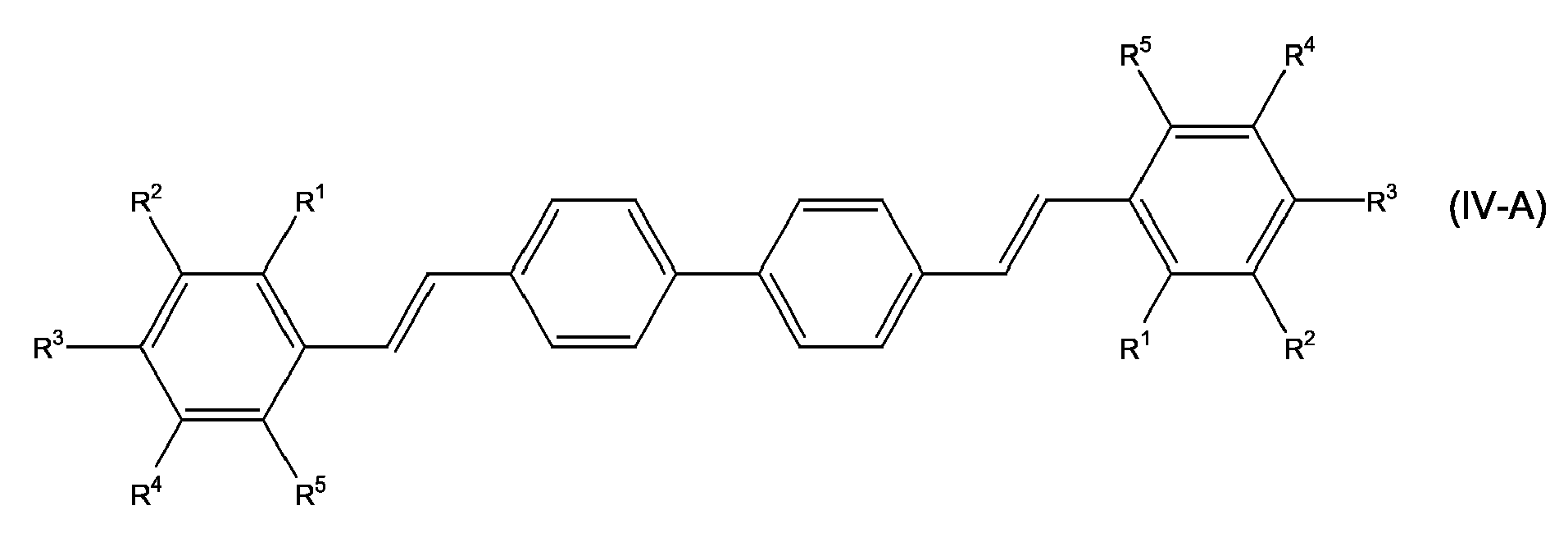
- a) R1 to R10 each represent H,
- b) R1, R2 and R4 to R10 each represent H, and R3 represents methoxy or
- c) R1, R2, R4 to R7, R9 and R10 each represent H, and R3 and R8 each represent methoxy;

- a) R1 and R3 represent H, and R2 represents phenylsulfonic acid or phenylsulfonic acid salts or
- b) R1 represents H, R2 represents CN and R3 represents Cl;

- a) R1 represents t-butyl, R2 represents H and R3 represents phenyl,
- b) R1 represents methyl, R2 represents H, and R3 represents carboxymethyl or
- c) R1 represents H, R2 represents H, and R3 represents 2-(4-methyl-oxa-3,3-diazole);

- a) X represents 4,4'-stilbenediyl, and R1 and R2 each represent H,
- b) X represents 2,5-thiophenediyl, and R1 and R2 each represent t-butyl,
- c) X represents 1,4-naphthalenediyl, and R1 and R2 each represent H or
- d) X represents 1,1-ethenediyl, and R1 and R2 each represent methyl;

- a) R1 and R2 each represent H, and R3 represents SO2NH2,
- b) R1 and R2 each represent H, and R3 represents SO2CH2CH2OCH2CH2N (CH3)2,
- c) R1 and R2 each represent H, and R3 represents SO2CH2CH2OCH (CH3) CH2N (CH3)2,
- d) R1 and R2 each represent H, and R3 represents SO2CH3 or
- e) R1 and R2 each represent H, and R3 represents SO2CH2CH2OH;

- a) R1 represents H, R2 represents Me, and R3 represents diethylamino,
- b) R1 represents phenyl, R2 represents H, and
R3 represents 2-N-naphthatriazolyl, - c) R1 represents H, R2 represents methyl, and R3 represents OH,
- d) R1 represents phenyl, R2 represents H,
and R3 represents NH-(4,6-dichloro)-(1,3,5)-triazine or - e) R1 represents Ph, R2 represents H, and
R3 represents 1-(3-methylpyrazolinyl);
- a) R1 represents H, R2 represents methoxy, and R3 represents methyl; or
- b) R1 and R2 each represent OEt, and R3 represents methyl;

- a) R1 and R2 each represent methyl, and R3 represents H or
- b) R1 and R2 each represent methyl, and R3 represents carboxymethyl;
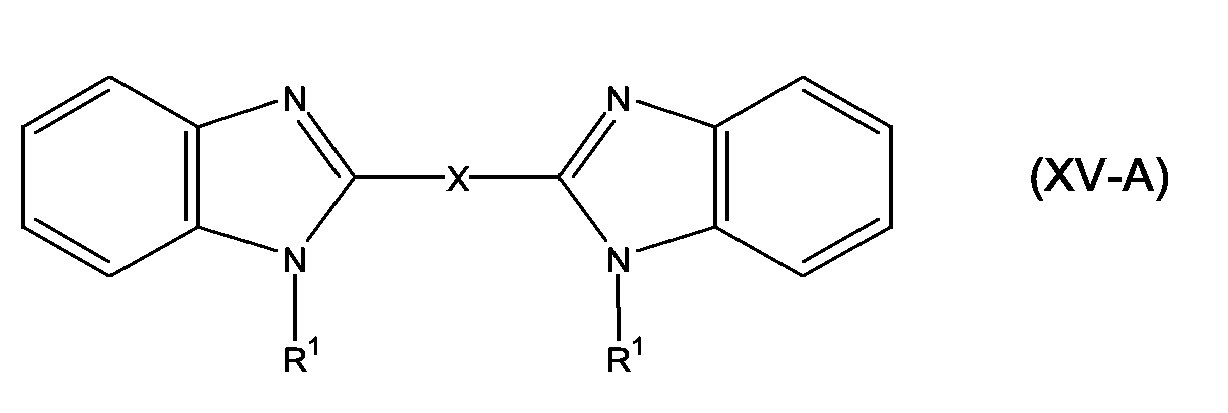
- a) X represents 1,2-ethenediyl, and R1 represents Me or
- b) X represents 4,4'-stilbenediyl, and R1 represents methyl;

- From those sensitizers, the following compounds of formulae (IIIa) and/or (IVa) are particularly preferred:

R1 to R14 in dependently represent a hydrogen atom, an alkyl group, an alkoxy group, a cyano group or a halogen atom,
and at least one of R1 to R10 represents an alkoxy group having more than 1 carbon atom;
R15 to R32 independently represent a hydrogen atom, an alkyl group, an alkoxy group, a cyano group or a halogen atom,
and at least one of R15 to R24 represents an alkoxy group having more than 1 carbon atom. The alkyl and alkoxy groups of the present invention can be optionally substituted and their substituent can be selected to adjust the solubility of the sensitizer and may be, for example, halogen, ester, ether, thioether or hydroxy. The alkyl or alkoxy groups may be straight chain or cyclic, but a branched chain is preferred for the sensitizers of formulae (IIIa) and (IVa). - Particular advantages are achieved with sensitisers of formula (IIIa), wherein R1, R5, R6, R10, R11, R12, R13 and R14 independently represent a hydrogen atom, a fluorine atom or a chlorine atom, in particular R1, R5, R6, and R10 being a hydrogen atom; R2 to R4, R7 to R9, independently are alkoxy groups; and at least two of the alkoxy groups are branched and have from 3 to 15 carbon atoms. Especially preferred for the present invention are sensitizers of formulae (IIIa) as disclosed above, wherein R2, R4, R7, R9 independently represent a methoxy group and R3 and R8 independently are branched alkoxy groups having 3 to 15 carbon atoms.
- Particular advantages are also achieved with sensitisers of formula (IVa), wherein R15, R19, R20, R24, R25 to R32, independently represent a hydrogen atom, a fluorine atom or a chlorine atom, in particular R15, R19, R20, R24 being a hydrogen atom; R16 to R18, R21 to R23, independently are alkoxy groups; and at least two of the alkoxy groups are branched and have from 3 to 15 carbon atoms. Especially preferred for the present invention are sensitizers of formulae (IVa) as disclosed above, wherein R16, R18, R21, R23 independently represent a methoxy group and R17 and R22 independently are branched alkoxy groups having 3 to 15 carbon atoms.
- The following structures are examples of preferred sensitizers of the present invention and their solubility S is given in brackets as g sensitizer/kg methyl ethyl ketone measured at 20°C.


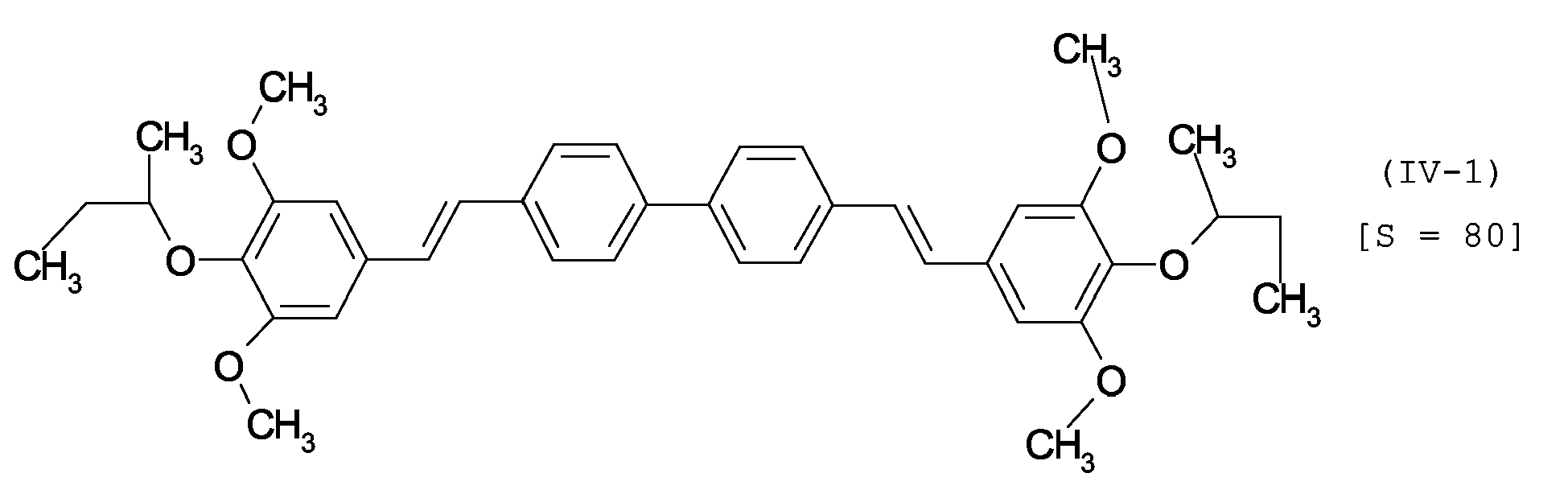

- Most sensitizers useful for the present invention can be synthesised by known methods and the synthesis of the highly preferred sensitizers of formulae (IIIa) and (IVa) can be done in analogy to the synthesis of sensitizer (III-1) as disclosed in the following.
-

- To a mixture of 8.365 kg (45.0 mol) syringaldehyde (C-1) and 1.494 kg (9.0 mol) potassium iodide is added 20.25 L sulfolane at room temperature. After heating up this mixture to 30°C under nitrogen, 3.12 kg (47.25 mol) of KOH in water and 2.80 kg (20.25 mol) K2CO3 are added. After warming the reaction mixture to 75°C, 12.78 kg (90.0 mol) 2-bromo butane (C-2) is added over a period of 30 minutes. Heating at 75°C is continued for 24 hours, followed by cooling to 25°C. Then 25 L Water is added and the reaction product is extracted with 18 L methyl t-butyl ether (MTBE). The organic phase is consecutively a) two times washed with 6.0 L of a 7.5 wt.% K2CO3 solution in water respectively, b) two times washed with 13.5 L of pure water respectively and finally, c) two times washed with 4.5 kg of a 20 wt.% NaCl solution in water respectively. The solvent (MTBE) is removed by distillation under reduced pressure of 50 mBar at 75°C and thereby are obtained 7.845 kg (theoretical yield of 75 %) of the crude intermediate (C-3) as a yellow oil, that is used in the synthesis of (III-1) without further purification.
-

- To a mixture of 9.63 kg (25.46 mol) p-xylylene-bis-phosphonate (C-4) and 12.13 kg (50.92 mol) of the crude intermediate (C-3) in 20 L THF, 4.70 kg (71.3 mol) of KOH is added at room temperature. After heating the stirred reaction mixture at reflux for 3.5 hours, the reaction product is precipitated by adding a mixture of 25.2 kg methanol and 9.9 kg water, followed by further cooling to 20°C. The crystalline product (III-1) is filtered off, washed with several portions of methanol/water on the filter and dried at 50°C. The yield is 9.05 kg (theoretical yield of 67 %) of (III-1) having a melting point of 154°C.
- A suitable synthesis for the p-xylylene-bis-phosphonate (C-4) is known from the literature, e.g. from B.P. Lugovkin and B.A. Arbuzov, Doklady Akademii Nauk SSSR (1948), 59, pages 1301 to 1304.
- The photopolymerizable composition according to the present invention preferably comprises a hexaarylbisimidazole (HABI; dimer of triaryl-imidazole) compound as a photopolymerization initiator (photoinitiator).
- A procedure for the preparation of hexaarylbisimidazoles is described in
DE 1470 154 and their use in photopolymerizable compositions is documented inEP 24 629 EP 107 792 US 4 410 621 ,EP 215 453 DE 3 211 312 . Preferred derivatives are e. g. 2,4,5,2',4',5'-hexaphenylbisimidazole, 2,2'-bis(2-chlorophenyl)-4,5,4',5'-tetraphenylbisimidazole, 2,2'-bis(2-bromophenyl)-4,5,4',5'-tetraphenylbisimidazole, 2,2'-bis(2,4-dichlorophenyl)-4,5,4',5'-tetraphenylbisimidazole, 2,2'-bis(2-chlorophenyl)-4,5,4',5'-tetrakis(3-methoxyphenyl)bisimidazole, 2,2'-bis(2-chlorophenyl)-4,5,4',5'-tetrakis(3,4,5-trimethoxyphenyl)-bisimidazole, 2,5,2',5'-tetrakis(2-chlorophenyl)-4,4'-bis(3,4-dimethoxyphenyl)bisimidazole, 2,2'-bis(2,6-dichlorophenyl)-4,5,4',5'-tetraphenylbisimidazole, 2,2'-bis(2-nitrophenyl)-4,5,4',5'-tetraphenylbisimidazole, 2,2'-di-o-tolyl-4,5,4',5'-tetraphenylbisimidazole, 2,2'-bis(2-ethoxyphenyl)-4,5,4',5'-tetraphenylbisimidazole and 2,2'-bis(2,6-difluorophenyl)-4,5,4',5'-tetraphenylbisimidazole. The amount of the HABI photoinitiator typically ranges from 0.01 to 30 % by weight, preferably from 0.5 to 20 % by weight, relative to the total weight of the non volatile components of the photopolymerizable composition. - The best results, in particular the highest sensitivity, can be obtained by the combination of an optical brightener as sensitizer and a hexaarylbisimidazole as photoinitiator, sensitizers of formulae (III) and (IV) being particularly preferred.
- Hexaarylbisimidazole compounds can be used as photoinitiators either alone or in combination with further photoinitiators. The known photopolymerization initiators can be used in the composition of the present invention in combination with hexarylbisimidazole compounds. Suitable classes include aromatic ketones, aromatic onium salts, organic peroxides, thio compounds, ketooxime ester compounds, borate compounds, azinium compounds, metallocene compounds, active ester compounds and compounds having a carbon-halogen bond. Many specific examples of such photoinitiators can be found in
EP-A 1091247 . - Preferably hexaarylbisimidazole compounds are used alone or in combination with aromatic ketones, aromatic onium salts, organic peroxides, thio compounds, ketoxime ester compounds, borate compounds, azinium compounds, active ester compounds or compounds having a carbon halogen bond.
- In a preferred embodiment of the present invention the hexaarylbisimidazole compounds make more than 50 mol-%, preferably at least 80 mol-% and particularly preferred at least 90 mol-% of all the photoinitiators used in the photopolymerizable composition of the present invention.
- The polymerizable compound can be selected from a wide series of photo-oxidizable compounds. Suitable compounds contain primary, secondary and in particular tertiary amino groups. Radically polymerizable compounds containing at least one urethane and/or urea group and/or a tertiary amino group are particularly preferred. By the term "urea group" has to be understood in the context of the present invention a group of the formula >N-CO-N<, wherein the valences on the nitrogen atoms are saturated by hydrogen atoms and hydrocarbon radicals (with the proviso that not more than one valence on either of the two nitrogen atoms is saturated by one hydrogen atom). However, it is also possible for one valence on one nitrogen atom to be bonded to a carbamoyl (-CO-NH-) group, producing a biuret structure.
- Also suitable are compounds containing a photo-oxidizable amino, urea or thio group, which may be also be a constituent of a heterocyclic ring. Compounds containing photo-oxidizable enol groups can also be used. Specific examples of photo-oxidizable groups are triethanolamino, triphenylamino, thiourea, imidazole, oxazole, thiazole, acetylacetonyl, N-phenylglycine and ascorbic acid groups. Particularly suitable compounds are monomers containing photo-oxidizable groups corresponding to the following formula (PC-I):
R(m-n)Q[(-CH2-CR1R2-O)a-CO-NH-(X1-NH-CO-O)b-X2-(O-CO-CR3=CH2)c]n (PC-I)
wherein - R
- represents an alkyl group having 2 to 8 carbon atoms ((C2-C8) alkyl group), a (C2-C8) hydroxyalkyl group or a (C6-C14) aryl group,
Q represents -S-,
E represents a divalent saturated hydrocarbon group of 2 to 12 carbon atoms, a divalent 5- to 7-membered, saturated iso- or heterocyclic group, which may contain up to 2 nitrogen, oxygen and/or sulfur atoms in the ring, a divalent aromatic mono- or bicyclic isocyclic group of 6 to 12 carbon atoms or a divalent 5- or 6-membered aromatic heterocyclic group; and
D1 and D2 independently represent a saturated hydrocarbon group of 1 to 5 carbon atoms, - R1 and R2
- independently represent a hydrogen atom, an alkyl or alkoxyalkyl group,
- R3
- represents a hydrogen atom, a methyl or ethyl group,
- X1
- represents a straight-chained or branched saturated hydrocarbon group of 1 to 12 carbon atoms,
- X2
- represents a (c+1)-valent hydrocarbon group in which up to 5 methylene groups may have been replaced by oxygen atoms,
- a
- is an integer from 0 to 4,
- b
- is 0 or 1,
- c
- is an integer from 1 to 3,
- m
- is an integer from 2 to 4 and
- n
- is an integer from 1 to m.
- Compounds of this nature and processes for their preparation are described in
EP 287 818 - The compounds of formula (PC-I) wherein b = 1, which accordingly contain two urethane groups in each of the radicals indicated in the square brackets, can be produced in a known way by conversion of acrylic esters or alkacrylic esters which contain free hydroxyl groups with equimolar amounts of diisocyanates. Excess isocyanate groups are then, for example, reacted with tris(hydroxyalkyl)amines, N,N'-bis(hydroxyalkyl) piperazines or N,N,N',N'-tetrakis(hydroxyalkyl)alkylenediamines, in each of which individual hydroxyalkyl groups may have been replaced by alkyl or aryl groups R. If a = 0, the result is a urea grouping. Examples of the hydroxyalkylamine starting materials are diethanolamine, triethanolamine, tris(2-hydroxypropyl)amine, tris(2-hydroxybutyl)amine and alkyl-bis-hydroxyalkylamines. Examples of suitable diisocyanates are hexamethylene diisocyanate, 2,2,4-trimethylhexamethylene diisocyanate, 1,4-cyclohexylene diisocyanate (= 1,4-diisocyanatocyclohexane) and 1,1,3-trimethyl-3-isocyanatomethyl-5-isocyanatocyclohexane. The hydroxy-containing esters used are preferably hydroxyethyl (meth)acrylate, hydroxypropyl (meth)acrylate and hydroxyisopropyl (meth)acrylate.
- The polymerizable compounds of formula (PC-I) wherein b = 0 are prepared converting the above-described hydroxyalkylamino compounds with isocyanate-containing acrylic or alkacrylic esters. A preferred isocyanate-containing ester is isocyanoto-ethyl (meth)acrylate.
- Further polymerizable compounds comprising photooxidisable groups suitable for the purpose of the invention are compounds according to the following formula (PC-II):
R(m-n)Q[(-CH2-CR1R2-O)a'-(CH2-CH[CH2-O-CO-CR3=CH2]-O)b'-H]n (PC-II)
wherein a' and b' independently represent integers from 1 to 4 and Q, R1, R2, R3, n and m have the same meaning as above and Q can also be a group of the formula >N-E'-N< wherein the radical E' corresponds to the following formula (PC-III):
-CH2-CH (OH) -CH2- [O- (p) C6H4-C (CH3)2-(p) C6H4-CH2-CH(OH) -CH2-]c (PC-III)
wherein c has the same meaning as in formula (I) and (p)C6H4 represents para-phenylene. - The compounds of formula (PC-II) can be prepared analogously to those of formula (PC-I), except that the conversion products of hydroxyalkyl acrylates or alkacrylates and diisocyanates are replaced by the corresponding acrylic and alkacrylic glycide esters. Compounds of formula (PC-III) and processes to their preparation are disclosed in
EP 316 706 - Further useful polymerizable compounds containing photooxidisable groups are acrylic and alkacrylic esters of the following formula (PC-IV):
Q' [(-X1'-CH2-O)a-CO-NH(-X1-NH-CO-O)b-X2-O-CO-CR3=CH2]n (PC-IV)
wherein
Q' represents
X1' represents -CiH2i- or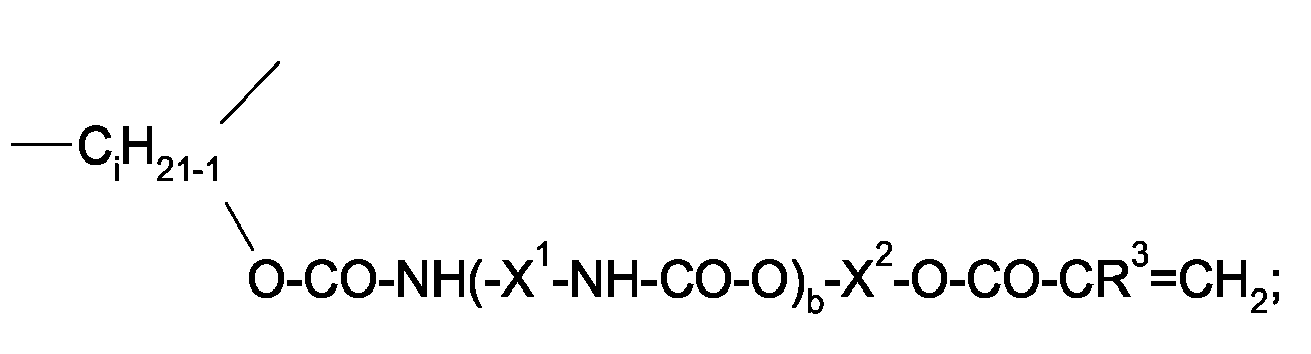
i,k independently represent integers from 1 to 12;
n' represents an integer from 1 to 3; and
a is 0 or 1; provided that a is 0 in at least one of the radicals bonded to Q;
X1, R3, a and b have the same meaning as given in the above formula (PC-I); and
X2 represents a divalent hydrocarbon group in which up to 5 methylene groups may be replaced by oxygen atoms. - In formula (PC-IV) index a is preferably 0 or 1 and i preferably represents a number between 2 and 10. Preferred radicals Q are piperazine-1,4-diyl (D1 = D2 = CH2-CR2), piperidine-1-yl (D3 = (CH2)5, Z = H) and 2-(2-hydroxyethyl)-piperidine-1-yl (D3 = (CH2)5, Z = CH2CH2OH).
- Of the compounds of formula (PC-IV), those which apart from a urea group contain at least one urethane group are preferred. Here again, by the term "urea group" has to be understood the group of formula >N-CO-N< already mentioned above. Compounds of formula (PC-IV) and processes for their preparation are disclosed in
EP 355 387 - Also suitable polymerizable compounds are reaction products of mono- or diisocyanates with multifunctional alcohols, in which the hydroxy groups are partly or completely esterified with (meth)acrylic acid. Preferred compounds are materials, which are synthesized by the reaction of hydroxyalkyl-(meth)acrylates with diisocyanates. Such compounds are basically known and for instance described in
DE 28 22 190 andDE 20 64 079 . - The amount of polymerizable compound comprising photooxidisable groups generally ranges from 5 to 75 % by weight, preferably from 10 to 65 % by weight, relative to the total weight of the non volatile compounds of the photopolymerizable composition.
- Moreover, the composition can contain polyfunctional (meth)acrylate or alkyl(meth)acrylate compounds as crosslinking agents. Such compounds contain more than 2, preferably between 3 and 6 (meth)acrylate and/or alkyl(meth)acrylate groups and include in particular (meth)acrylates of saturated aliphatic or alicyclic trivalent or polyvalent alcohols such as trimethylol ethane, trimethylol propane, pentaerythritol or dipentaerythritol.
- The total amount of polymerizable compounds generally ranges from about 10 to 90 % by weight, preferably from about 20 to 80 % by weight, relative to the total weight of the non volatile components of the photopolymerizable composition of the present invention.
- The following specific example is a prefered polymerizable compound:

- In order to achieve a high sensitivity, it is advantageous to add a radical chain transfer agent as described in
EP 107 792 - Optionally pigments, e.g. predispersed phthalocyanine pigments, can be added to the composition of the present invention for dyeing the composition and the layers produced therewith. Their amount generally ranges from about 1 to 20 % by weight, preferably from 2 to 15 % by weight and particularly preferred from about 2 to 10 % by weight related to the total weight of the non volatile components of the composition. Particularly suitable predispersed phthalocyanine pigments are disclosed in
DE 199 15 717 andDE 199 33 139 . Preference is given to metal-free phthalocyanine pigments. - In order to adjust the photopolymerizable composition according to the present invention to specific needs, thermal inhibitors or stabilizers for preventing thermal polymerization may be added. Furthermore additional hydrogen donors, dyes, colored or colorless pigments, color formers, indicators and plasticisers may be present. These additives are conveniently selected so that they absorb as little as possible in the actinic range of the imagewise applied radiation.
- The photopolymerizable composition according to the present invention is applied to the support by processes which are known per se to the person skilled in the art. In general, the components of the photopolymerizable composition are dissolved or dispersed in an organic solvent or solvent mixture, the solution or dispersion is applied to the intended support by pouring on, spraying on, immersion, roll application or in a similar and the solvents are removed during the subsequent drying.
- The known supports can be used for the photopolymer printing plate of the present invention, like e. g. foils, tapes or plates made of metal or plastics and in the case of screen-printing also of Perlon gauze. Preferred metals are aluminium, aluminium alloys, steel and zinc, aluminium and aluminium alloys being particularly preferred. Preferred plastics are polyester and cellulose acetates, polyethyleneterephthalate (PET) being particularly preferred.
- In most cases it is preferred, to treat the surface of the support mechanically and/or chemically and/or electrochemically to optimally adjust the adherence between the support and the photosensitive coating and/or to reduce the reflection of the imagewise exposed radiation on the surface of the support (antihalation).
- The most preferred support to be used for the present invention is made of aluminium or an aluminium alloy, its surface is electrochemically roughened, thereafter anodized and optionally treated with a hydrophilizing agent like e. g. poly(vinylphosphonic acid) .
- In a preferred embodiment of the present invention a protective layer (protective overcoat) is arranged on top of the photosensitive coating. Preferably the protective layer has a dry coating weight of less than 3.0 g/m2, in particular less than 2.5 g/m2, and particularly preferred from more than 0.25 g/m2 to less than 2.5 g/m2.
- The protective overcoat preferably comprises at least one type of poly(vinyl alcohol), in particular a poly(vinyl alcohol) wherein the mean degree of saponification is less than 93 mol-%.
- The degree of saponification is related to the production of poly(vinyl alcohols). As the monomer of poly(vinyl alcohol), vinyl alcohol, is nonexistent, only indirect methods are available for the production of poly(vinyl alcohol). The most important manufacturing process for poly(vinyl alcohol) is the polymerization of vinyl esters or ethers, with subsequent saponification or transesterification. The preferred starting material for the poly (vinyl alcohol) of the present invention is a vinyl alcohol esterified by a mono carboxylic acid and in particular vinyl acetate, but derivatives of vinyl acetate, vinyl esters of di carboxylic acids, vinyl ethers and the like can also be used. The degree of saponification as defined for the present invention is the molar degree of hydrolysis irrespective of the process used for the hydrolysis. Pure poly(vinyl alcohol) has e. g. a degree of saponification of 100 mol-%, but commercial products often have a degree of saponification of 98 mol-%. The poly(vinyl alcohols) as used for the present invention contain mainly 1,3-diol units, but may also contain small amounts of 1,2-diol units. In the partially saponified poly(vinyl alcohols) the ester or the ether group can be distributed statistically or blockwise. Preferred partially saponified poly(vinyl alcohols) of the present invention have a viscosity of a 4 % aqueous solution at 20°C of 4 to 60 mPa•s, preferably of 4 to 20 mPa•s and in particular of 4 to 10 mPa•s.
- Poly(vinyl alcohols) preferred for the present invention are commercially available e. g. under the tradename Mowiol. Those products are characterised by two appended numbers, meaning the viscosity and the degree of saponification. For example, Mowiol 8 - 88 or Mowiol 8/88 mean a poly(vinyl alcohol) having as 4 % aqueous solution at 20°C a viscosity of ca 8 mPa·s and a degree of saponification of 88 mol-%. Although the use of only one type of poly(vinyl alcohol) is sufficient to achieve an advantage, it is preferred to use a mixture of two or more compounds, because this allows a more accurate adjustment and a better optimization of further properties of the printing plate precursor. Preferably poly(vinyl alcohols) differing in viscosity as defined above and/or in saponification degree are combined. Particularly preferred are mixture of poly(vinyl alcohols) that differ in viscosity of their 4 % aqueous solutions at 20°C for at least 2 mPa•s or that differ in saponification degree for at least 5 mol-%. Most preferred are mixtures comprising at least 3 types of poly(vinyl alcohols), wherein at least two compounds differ in viscosity as defined above for at least 2 mPa·s and at least two compounds differ in saponification degree for at least 5 mol-%.
- According to a preferred embodiment of the present invention the overall mean saponification degree of all poly(vinyl alcohols) used in the protective layer has to be less than 93 mol-%. In a particular preferred embodimend of the present invention said overall mean saponification degree ranges from 71 mol-% to less than 93 mol-% and in particular from 80 mol-% to 92,9 mol-%.
- As long as said mean overall saponification limit of 93 mol-% is not reached, one of the poly(vinyl alcohols) used in a mixture can have a mean saponification degree of more than 93 mol-% and even up to 100 mol-%.
- The overall mean saponification degree of the poly(vinyl alcohols) used in the protective overcoat of a printing plate precursor can be determined experimentally via 13C-NMR. To measure the 13C-NMR spectra, approximately 200 mg of the protective overcoat are dissolved in 1.0 ml DMSO and from this solution a 75 MHz 13C-NMR spectrum is taken, whose resonances can easily be interpreted and allow to calculate the degree of saponification. Such values are listed in the Examples, in Table 3, as experimental values. A good correlation is obtained between said experimental values and the values known from the product specification of the poly(vinyl alcohols). The latter values are hereinafter called theoretical values of the mean saponification degree and can easily be calculated, when mixture of poly(vinyl alcohols) are used.
- Preferably poly(vinyl alcohol)s are used for the present invention in 50 to 99.9 weight percent (wt.%) relative to the total weight of the non-volatile compounds of the protective overcoat.
- Apart from poly(vinyl alcohol)s other water soluble polymers can be added to the layer such as poly(vinyl pyrrolidone), poly(ethylene oxide), gelatin, gum arabic, oxygen binding polymers with aliphatic amine groups known from
EP 352 630 B1 - Preferably the poly(vinyl pyrrolidone) is only used in small quantities compared to the poly(vinyl alcohol). In a preferred embodiment of the present invention poly(vinyl pyrrolidone) is used from 0 to 10 parts by weight of the poly(vinyl alcohol) used, from 0 to 3 parts by weight being particularly preferred. Most preferred no poly(vinyl pyrrolidone)compounds are used.
- In addition to the poly(vinyl alcohol) of the present invention and the optional water soluble polymers disclosed above, the known ingredients of protective layers can be used.
- Examples of known ingredients suitable for the protective layer of the present invention are surface wetting agents, coloring agents, complexants, polyethylenimines and biocides.
- The protective layer has to be transparent for actinic light. Preferably it is homogeneous, substantially impermeable to oxygen, waterpermeable, and can be washed off preferably with the conventional developer solutions used to form a printing relief after imagewise exposure of the photosensitive layer. Said photosensitive layer is removed imagewise, whereas the protective layer is removable over the entire area of the element created. The wash-off of the protective layer can be done in a separate step, but can be done during the development step as well.
- The dry coating weight of the protective overcoat can be measured by the following procedure. A plate is exposed for 4 hours to daylight. Next the plate is pre-heated between 104°C and 127°C (temperature measured via a thermostrip (THERMAX commercially available from TMC) at the back of the plate). The plate is cut to a size of 100 mm X 100 mm and weighted on an analytical balance with 0.01 mg accuracy (=Weight A). Next the protective overcoat is washed off with water (25°C) for 2 minutes. Than the plate is rinsed with demineralised water and dried in an oven at 100°C. After drying the plate is allowed to cool down to room temperature, and the weight is determined using the same analytical balance as described earlier (=Weight B). The dry coating weight in g/m2 of the protective overcoat is calculated using the formula below :

- The protective layer can be coated on the photosensitive layer with known techniques and the coating solution preferably contains water or a mixture of water and an organic solvent. To allow a better wetting, the coating solution preferably contains, related to the solid content, up to 10 wt.%, and particular preferred up to 5 wt.% of a surface active agent. Suitable representatives of surface active agents comprise anionic, cationic and nonionic surface active agents like sodium alkylsulfates and -sulfonates having 12 to 18 carbon atoms, an example of which is sodium dodecylsulfate, N-cetyl- and C-cetyl betaine, alkylaminocarboxylate and -dicarboxylate, and polyethylene glycols with a mean molar weight up to 400.
- In addition, further functions can be added to the protective layer. For example, it can be possible to improve the safelight suitability without decreasing the sensitivity of the layer by adding a coloring agent, e. g. a water-soluble dye, that has excellent transmission to the light having a wavelength of 300 to 450 nm and that absorbs the light having a wavelength of 500 nm or more. This principle can easily be varied for different wavelengths to adjust the effective spectral sensitivity distribution of the printing plate precursor as needed.
- The present invention also relates to a method of making a lithographic printing plate comprising the steps of providing a photopolymer printing plate precursor as defined above, exposing said printing plate precursor, and processing the printing plate precursor in an aqueous alkaline developer.
- In a preferred embodiment of the method of the present invention the exposure is done with a laser having an emission wavelength in the range from 300 to 1200 nm, in particular in the range from 300 to 600 nm, and particularly preferred in the range from 350 to 450 nm, and the exposure preferably is carried out at an energy density, measured on the surface of the plate, of 100 µJ/cm2 or less.
- The processing of the printing plate precursor of the present invention is done in the usual manner. After image-wise exposure a pre-heat step can be performed to improve the crosslinking of the photosensitive layer, but preferably no pre-heat step is carried out. Then usually follows the development step, wherein the optional overcoat layer and the unexposed part of the photosensitive layer are removed. The removal (wash-off) of the overcoat layer and the development of the photosensitive layer can be done in two separate steps in this order, but can also be done in one step simultaneously. Preferably the overcoat layer is washed-off with water before the development step. The wash-off can be done with cold water, but it is preferred to use hot water to accelerate the process. What remains on the support after the development step are the exposed and thereby photopolymerized parts of the photosensitive layer. The developer solution used for the development of the exposed printing plate precursors of the present invention preferably is an aqueous alkaline solution having a pH of at least 11, a pH from 11.5 to 13.5 being particularly preferred. The developer solution can contain a small percentage, preferably less than 5 wt.%, of an organic, water-miscible solvent. To adjust the pH of the solution, an alkali hydroxide is preferably used.
- Examples of preferred, additional ingredients of the developer solution comprise alone or in combination alkali phosphates, alkali carbonates, alkali bicarbonates, an organic amine compound, alkali silicates, buffering agents, complexants, defoamers, surface active agents and dyes, but the suitable ingredients are not limited to the preferred examples and further ingredients can be used.
- The method of development employed is not particularly limited, and may be conducted by soaking and shaking the plate in a developer, physically removing non-image portions while being dissolved in a developer by means of e. g. a brush, or spraying a developer onto the plate so as to remove non-image portions. The time for development is selected depending upon the above method used so that the non-image portions can adequately by removed, and is optionally selected within a range of 5 seconds to 10 minutes.
- After the development, the plate my be subjected to a hydrophilic treatment by means of, e. g., gum arabic optionally applied to the printing plate as the case requires (gumming step).
- A composition was prepared (pw = parts per weight; wt.% = weight percentage) by mixing the components as specified in table 1. A composition such as this was divided equally into portions of 24.61 g, and to each portion was added 1.608 g of a 33.0 wt.% solution in 2-butanone of the binder according to table 2. The resulting composition was coated on an electrochemically roughened and anodically oxidized aluminum sheet, the surface of which had been rendered hydrophilic by treatment with an aqueous solution of polyvinyl phosphonic acid (oxide weight 3 g/m2) and was dried for 1 minute at 120 °C (circulation oven). The resulting thickness of the layer was 1.5 g/m2.
Table 1 Component Parts per weight (g) A solution containing 88.2 wt.% of a reaction product from 1 mole of 2,2,4-trimethyl-hexamethylenediisocyanate and 2 moles of hydroxyethylmethacrylate (viscosity 3.30 mm2/s at 25°C) 14.538 Heliogene blue D 7490® dispersion (9.9 wt.%, viscosity 7.0 mm2/s at 25 °C), trade name of BASF AG 17.900 2,2'-bis(2-chlorophenyl)-4,4',5,5'-tetraphenyl-1,2-bisimidazole 1.448 1,4-di[3,5-dimethoxy-4-(1-methylpropoxy)styryl]benzene (III-1) 0.958 Edaplan LA 411® (1 % in Dowanol PM®, trade mark of Dow Chemical Company) 2.250 MBT (mercaptobenzthiazole) 0.068 2-butanone 78.538 propyleneglycol-monomethylether (Dowanol PM®, trade mark of Dow Chemical Company) 130.358 Table 2 Exp. Type of Binder Weight average Mw (GPC) Ratio (meth)acrylate: (meth)acrylic acid (1H NMR) Tg °C (measured by DSC) 1 Poly(methylmethacrylate -co-methacrylic acid) 27386 82:18 127.8 2 Poly(methylacrylate-co-acrylic acid) 15205 87:13 24.0 3 Poly(n-butylmethacrylate-co-acrylic acid) 50928 81:19 32.1 4 Poly(n-butylmethacrylate-co-methacrylic acid) 65123 77:23 67.3 5 Poly (benzylacrylate-co-acrylic acid) 15571 89:11 -7.5 6 Poly(benzylacrylate-co-methacrylic acid) 18412 86:14 12.9 - On top of the photosensitive layer a solution in water with the composition as defined in table 3 was coated and was dried at 110°C for 2 minutes.
Table 3 Component Parts by Weight (g) partially hydrolyzed polyvinylalcohol (degree of hydrolysis 88 %, viscosity 4 mPa•s in a solution of 4 wt.% at 20 °C). 17.03 partially hydrolyzed polyvinylalcohol (degree of hydrolysis 88 %, viscosity 8 mPa•s in a solution of 4 wt.% at 20 °C). 7.43 fully hydrolyzed polyvinylalcohol (degree of hydrolysis 98 %, viscosity 6 mPa•s in a solution of 4 wt.% at 20 °C). 14.87 CA 24 E 0.26 Metolat FC 355 0.38 Lutensol A8 (90%) 0.032 Water 960 - The so-formed protective overcoat had a dry thickness of 2.0 g/m2.
- The imaging was carried out with a Polaris violet platesetter device (flat bed system) equipped with a violet laser diode emitting between 392 and 417 nm. The following imaging conditions were used:
- Scanning speed : 600 or 1000 m/sec
- Variable image plane power : 0 to 25 mW
- Spot diameter : 20 µm
- Addressability : 1270 dpi
- After imaging the plate was processed in an Agfa VSP85 processor at a speed of 1.2 m/min. Before the processing the plate was optionally heated by passing through the pre-heat section of the processor at 110°C (pre-heat step), next the protective overcoat was washed off and the photolayer was processed in a water based alkaline developer (Agfa PD91) at 28 °C. After a water rinsing and gumming step the printing plate was ready. A 13-step exposure wedge with density increments of 0.15 was used to determine sensitivity of the plate.
- The results of the exposure tests are shown in table 4 as the sum of the density of the UGRA step wedges measured by a Gretag Macbeth D19C densitometer (cyan setting). One fully hardened step = 1.00. Higher values indicate higher sensitivity of the plate.
Table 4. Binder Laser energy (µJ/cm2) UGRA sum. No Pre-heat UGRA sum. With Pre-heat 1 86 No image 3.66 Comparison 1 192 0 / Comparison 2 86 1.57 3.79 Invention 2 192 3.49 / Invention 3 86 1.12 1.76 Invention 3 192 3.62 / Invention 4 86 0.87 2.77 Invention 4 192 5.58 / Invention 5 86 2.01 3.17 Invention 5 192 4.31 / Invention 6 86 2.18 3.54 Invention 6 192 4.48 / Invention - It can be clearly seen that binders with a Tg below 70°C give rise to the formation of a good image without the need for a pre-heat step. The image is even stronger when a higher laser energy is used.
- A composition was prepared (pw = parts per weight; wt.% = weight percentage) by mixing the components as specified in table 5. A composition such as this was divided into two portions of 78.84 g, and to each portion was added 8.61 g of a 33.0wt.% solution in methylethyl ketone of the binder according to table 2. The resulting composition was coated on an electrochemically roughened and anodically oxidized aluminum sheet, the surface of which has been rendered hydrophilic by treatment with an aqueous solution of polyvinyl phosphonic acid (oxide weight 3 g/m2) and was dried for 1 minute at 120 °C (circulation oven). The resulting thickness of the layer was 1.5 g/m2.
Table 5 Component Parts per weight (g) a solution containing 88.2 wt.% of a reaction product from 1 mole of 2,2,4-trimethyl-hexamethylenediisocyanate and 2 moles of hydroxyethylmethacrylate (viscosity 3.30 mm2/s at 25°C) 7.44 Heliogene blue D 7490® dispersion (9.9 wt.%, viscosity 7.0 mm2/s at 25 °C), trade name of BASF AG 15.35 2-[1,1'-biphenyl]-4-yl-4,6-bis(trichloromethyl)-1,3,5-triazine 0.891 Infrared Absorber IR-1 0.357 Edaplan LA 411® (10 % in Dowanol PM®, trade mark of Dow Chemical Company) 0.149 2-butanone 43.50 propyleneglycol-monomethylether (Dowanol PM®, trade mark of Dow Chemical Company) 89.99 - On top of the photosensitive layer a solution in water with the composition as defined in table 3 was coated and was dried at 110°C for 2 minutes.
- The so-formed protective overcoat had a dry thickness of 2.0 g/m2.
- The imaging was carried out with a Creo X36 platesetter equipped with an IR laser diode emitting at 830 nm. The energy received by the plate was varied between 35 and 200 mJ/cm2 and the sensitivity of the plate was defined by the energy at which 53% solid density was obtained on a 50% screen.
- After imaging the plate was processed in an Agfa VSP85 processor at a speed of 1.2 m/min. Before the processing the plate was optionally heated by passing through the pre-heat section of the processor at 110°C (pre-heat step), next the protective overcoat was washed off and the photolayer was processed in a water based alkaline developer (Agfa PD91) at 28 °C. After a water rinsing and gumming step the printing plate was ready.
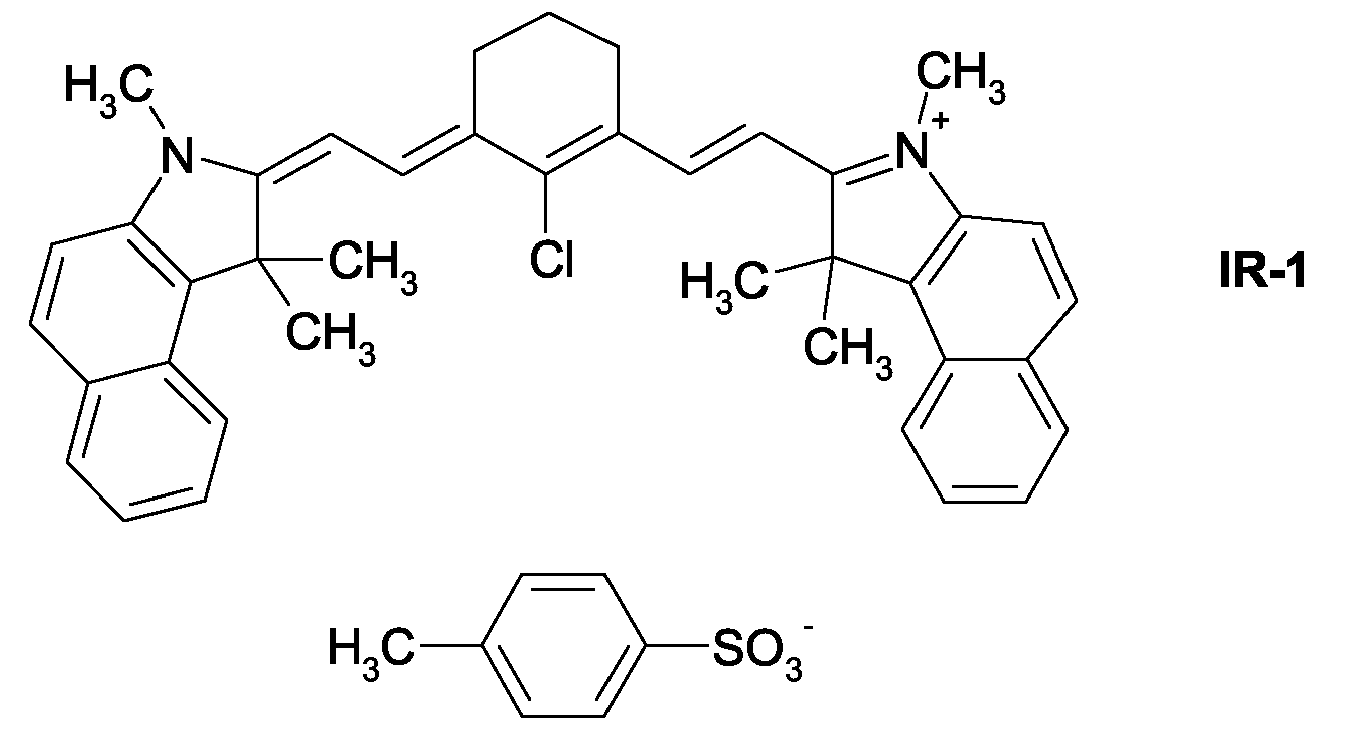
- The results are shown in Table 6 and the sensitivities were measured by the energy at which 53% solid density was achieved on a 50% screen.
Table 6 Binder Sensitivity (mJ/cm2) No pre-heat Sensitivity (mJ/cm2) With pre-heat. 1 No image 46 Comparison 2 145 45 Invention - The results clearly show an improvement in sensitivity when the low Tg binder is used relative to the standard binder 1.


Claims (21)
- A photopolymer printing plate precursor comprising a photosensitive coating on a support, wherein said photosensitive coating comprises a composition that is photopolymerizable upon absorption of light, said composition comprising at least one binder, a polymerizable compound, a sensitizer and a photoinitiator, characterized in that said binder is a copolymer that has a Tg of less than 70 °C, and wherein 1 to 50 mol-% of the monomeric units of said copolymer contain at least one acidic group.
- A photopolymer printing plate precursor according to claim 1, wherein the acidic group is selected from carboxylic acid group (-COOH), a carboxylic anhydride group (-(CO)O(CO)-), a sulfo group (-SO3H), an imido group (HN=), a phosphono group (-PO(OH)2), a N-acyl sulfonamido group (-SO2NH-COR), or a phenolic hydroxy group (-phenyl-OH).
- A photopolymer printing plate precursor according to any of the preceding claims, wherein the binder is present in an amount from 10 to 90 % by weight relative to the total weight of the non-volatile components of the photopolymerizable composition.
- A photopolymer printing plate precursor according to claim 1, wherein said photoinitiator is a hexaaryl-bisimidazole compound.
- A photopolymer printing plate precursor according to any of the preceding claims, comprising a protective layer on top of the photosensitive coating.
- A photopolymer printing plate precursor according to claim 5, wherein the protective layer has a dry coating weight from more than 0.25 g/m2 to less than 2.5 g/m2.
- A photopolymer printing plate precursor according to any of the preceding claims, wherein the photopolymerizable composition is sensitive to wavelengths between 300 and 600 nm.
- A photopolymer printing plate precursor according to any of the preceding claims, wherein the minimum exposure for image formation, measured on the surface of the plate, is 100 µJ/cm2 or less.
- A photopolymer printing plate precursor according to any of the preceding claims, wherein the binder is a copolymer containing monomeric units of an α,β-unsaturated carboxylic acid and/or an α,β-unsaturated dicarboxylic acid.
- A photopolymer printing plate precursor according to any of the preceding claims further comprising a polyfunctional (meth)acrylate compound as a crosslinking agent.
- A photopolymer printing plate precursor according to any of the preceding claims, wherein the polymerizable compound contains an urethane and/or urea group and/or a tertiary amino group.
- A photopolymer printing plate precursor according to any of the preceding claims further comprising a radical chain transfer agent.
- A photopolymer printing plate precursor according to claim 12, wherein the radical chain transfer agent is a sulfur containing compound.
- A photopolymer printing plate precursor according to any of the preceding claims, wherein the sensitizer has a solubility in methyl ethyl ketone of at least 15 g/kg.
- A photopolymer printing plate precursor according to any of the preceding claims, wherein the sensitizer is an optical brightening agent.
- A photopolymer printing plate precursor according to any of the preceding claims, wherein the sensitizer has a structure according to one of the following formulae:


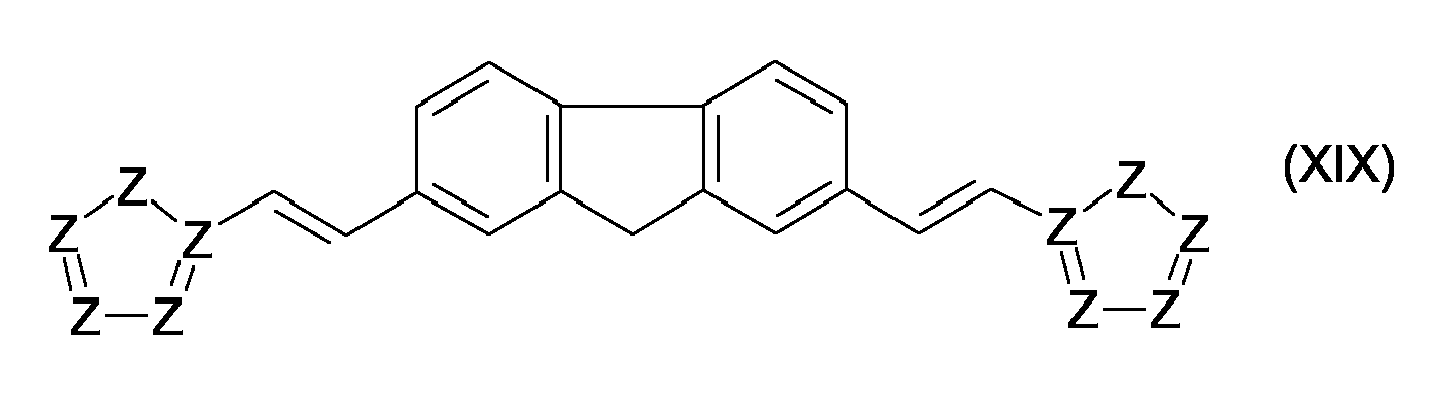


- A method of making a lithographic printing plate comprising the steps of providing a photopolymer printing plate precursor as defined in any of the preceding claims, exposing said printing plate precursor with a laser and processing the printing plate precursor in an aqueous alkaline developer.
- A method according to claim 17, wherein the laser has an emission wavelength in the range from 300 to 600 nm.
- A method according to claim 18, wherein the laser has an emission wavelength in the range from 350 to 450 nm.
- A method according to any of the claims 17 to 19, wherein the exposure of the printing plate precursor is carried out at an energy density, measured on the surface of the plate, of 100 µJ/cm2 or less.
- A method according to any of the claims 17 to 20, wherein no pre-heat step is carried out.
Priority Applications (8)
| Application Number | Priority Date | Filing Date | Title |
|---|---|---|---|
| EP05107827A EP1757981B1 (en) | 2005-08-26 | 2005-08-26 | Photopolymer printing plate precursor |
| ES05107827T ES2333442T3 (en) | 2005-08-26 | 2005-08-26 | PHOTOPOLIMERIC PRINT PLATE PRECURSOR. |
| DE602005017147T DE602005017147D1 (en) | 2005-08-26 | 2005-08-26 | photopolymer printing plate precursor |
| AT05107827T ATE445861T1 (en) | 2005-08-26 | 2005-08-26 | PHOTOPOLYMER PRINTING PLATE PRECURSOR |
| CN200680031272.1A CN101253450B (en) | 2005-08-26 | 2006-08-18 | Photopolymer Printing Plate Precursors |
| PCT/EP2006/065436 WO2007023133A2 (en) | 2005-08-26 | 2006-08-18 | Photopolymer printing plate precursor. |
| BRPI0615229-5A BRPI0615229A2 (en) | 2005-08-26 | 2006-08-18 | photopolymer printing plate precursor and method for producing a lithographic printing plate |
| US12/064,466 US20080311509A1 (en) | 2005-08-26 | 2006-08-18 | Photopolymer Printing Plate Precursor |
Applications Claiming Priority (1)
| Application Number | Priority Date | Filing Date | Title |
|---|---|---|---|
| EP05107827A EP1757981B1 (en) | 2005-08-26 | 2005-08-26 | Photopolymer printing plate precursor |
Publications (2)
| Publication Number | Publication Date |
|---|---|
| EP1757981A1 true EP1757981A1 (en) | 2007-02-28 |
| EP1757981B1 EP1757981B1 (en) | 2009-10-14 |
Family
ID=35610185
Family Applications (1)
| Application Number | Title | Priority Date | Filing Date |
|---|---|---|---|
| EP05107827A Expired - Lifetime EP1757981B1 (en) | 2005-08-26 | 2005-08-26 | Photopolymer printing plate precursor |
Country Status (8)
| Country | Link |
|---|---|
| US (1) | US20080311509A1 (en) |
| EP (1) | EP1757981B1 (en) |
| CN (1) | CN101253450B (en) |
| AT (1) | ATE445861T1 (en) |
| BR (1) | BRPI0615229A2 (en) |
| DE (1) | DE602005017147D1 (en) |
| ES (1) | ES2333442T3 (en) |
| WO (1) | WO2007023133A2 (en) |
Cited By (6)
| Publication number | Priority date | Publication date | Assignee | Title |
|---|---|---|---|---|
| EP2105799A1 (en) | 2008-03-26 | 2009-09-30 | Agfa Graphics N.V. | A method for preparing lithographic printing plates |
| EP2107422A1 (en) * | 2008-03-31 | 2009-10-07 | FUJIFILM Corporation | Method for preparing lithographic printing plate |
| US7732118B2 (en) | 2007-05-10 | 2010-06-08 | Eastman Kodak Company | Negative-working imageable elements and methods of use |
| EP2329951A1 (en) * | 2009-12-04 | 2011-06-08 | AGFA Graphics NV | A lithographic printing plate precursor |
| EP2894515A4 (en) * | 2012-08-29 | 2016-02-17 | Toyo Boseki | PHOTOSENSITIVE RESIN COMPOSITION FOR AN ORIGINAL PLATE OF FLEXOGRAPHIC PRINTING |
| EP3392709A1 (en) | 2017-04-21 | 2018-10-24 | Agfa Nv | A lithographic printing plate precursor |
Families Citing this family (8)
| Publication number | Priority date | Publication date | Assignee | Title |
|---|---|---|---|---|
| CN101681105B (en) * | 2007-05-25 | 2012-12-05 | 爱克发印艺公司 | A lithographic printing plate precursor |
| US8445176B2 (en) | 2007-05-25 | 2013-05-21 | Agfa Graphics Nv | Lithographic printing plate precursor |
| US8877298B2 (en) * | 2008-05-27 | 2014-11-04 | The Hong Kong University Of Science And Technology | Printing using a structure coated with ultraviolet radiation responsive material |
| AU2009297598A1 (en) * | 2008-09-24 | 2010-04-01 | Fujifilm Corporation | Process for producing lithographic printing plate |
| JP5433362B2 (en) * | 2009-09-29 | 2014-03-05 | 富士フイルム株式会社 | Planographic printing plate precursor and lithographic printing plate making method |
| US20130298792A1 (en) * | 2011-01-25 | 2013-11-14 | Agfa Graphics Nv | Lithographic printing plate precursor |
| CN104662474B (en) * | 2012-09-28 | 2019-07-02 | 富士胶片株式会社 | Photosensitive resin composition, the manufacturing method of cured film, cured film, organic EL display device, and liquid crystal display device |
| EP3928983B1 (en) * | 2020-06-24 | 2023-09-27 | Eco3 Bv | A lithographic printing plate precursor |
Citations (39)
| Publication number | Priority date | Publication date | Assignee | Title |
|---|---|---|---|---|
| DE1470154A1 (en) | 1962-03-21 | 1972-01-20 | Du Pont | Process for the preparation of new diimidazole compounds |
| DE2064080A1 (en) | 1970-12-28 | 1972-07-06 | Kalle Ag, 6202 Wiesbaden-Biebrich | Photopolymerizable copying compound |
| DE2064079A1 (en) | 1970-12-28 | 1972-07-13 | Kalle Ag, 6202 Wiesbaden-Biebrich | Photopolymerizable copying compound |
| DE2822190A1 (en) | 1978-05-20 | 1979-11-22 | Hoechst Ag | PHOTOPOLYMERIZABLE MIXTURE |
| GB1576217A (en) | 1975-12-27 | 1980-10-01 | Hoechst Ag | Light-sensitive compositions |
| US4248960A (en) | 1978-01-23 | 1981-02-03 | W. R. Grace & Co. | Radiation responsive relief imageable plastic laminate |
| EP0024629A2 (en) | 1979-08-14 | 1981-03-11 | E.I. Du Pont De Nemours And Company | Photoimaging composition comprising a 2,4,5-triphenylimidazolyl dimer and at least one compound selected from the group consisting of a leuco dye and a polymerizable ethylenically unsaturated monomer |
| DE3211312A1 (en) | 1981-03-27 | 1982-10-21 | Toyo Boseki K.K., Osaka | PHOTO-SENSITIVE RESIN COMPOSITION |
| US4410621A (en) | 1981-04-03 | 1983-10-18 | Toyo Boseki Kabushiki Kaisha | Photosensitive resin containing a combination of diphenyl-imiazolyl dimer and a heterocyclic mercaptan |
| EP0107792A1 (en) | 1982-09-27 | 1984-05-09 | Mitsubishi Kasei Corporation | Photopolymerizable compositions |
| EP0215453A2 (en) | 1985-09-16 | 1987-03-25 | E.I. Du Pont De Nemours And Company | Photoimaging composition containing admixture of leuco dye and 2,4,5-triphenylimidazolyl dimer |
| US4780393A (en) | 1986-01-25 | 1988-10-25 | Hoechst Aktiengesellschaft | Photopolymerizable composition and photopolymerizable recording material containing same |
| EP0287818A2 (en) | 1987-03-28 | 1988-10-26 | Hoechst Aktiengesellschaft | Polymerisable compounds and mixture containing them polymerisable by radiation |
| EP0316706A2 (en) | 1987-11-16 | 1989-05-24 | Hoechst Aktiengesellschaft | Polymerizable compounds and mixture polymerizable by radiation containing them |
| EP0355387A2 (en) | 1988-07-22 | 1990-02-28 | Hoechst Aktiengesellschaft | Photopolymerisable mixture and recording material manufactured therefrom |
| US4940647A (en) | 1987-10-16 | 1990-07-10 | Hoechst Aktiengesellschaft | Photopolymerizable compositions a leuco dye and a leuco dye stabilizer |
| EP0398325A2 (en) | 1989-05-18 | 1990-11-22 | Toyo Boseki Kabushiki Kaisha | Photosensitive resin composition |
| EP0480335A2 (en) | 1990-10-11 | 1992-04-15 | Hoechst Aktiengesellschaft | Light curable elastomer composition and recording material obtained therefrom for the production of relief printing plates |
| US5212049A (en) | 1990-01-19 | 1993-05-18 | Hoechst Aktiengesellschaft | Radiation-sensitive mixture and recording material based on oligomeric maleates and fumarates |
| EP0352630B1 (en) | 1988-07-29 | 1994-08-17 | Hoechst Aktiengesellschaft | Photopolymerisable registration material |
| US5348844A (en) | 1990-12-03 | 1994-09-20 | Napp Systems, Inc. | Photosensitive polymeric printing medium and water developable printing plates |
| EP0718695A2 (en) | 1994-12-09 | 1996-06-26 | Nippon Paint Co., Ltd. | Water-developable photosensitive resin composition |
| US6017678A (en) | 1992-04-04 | 2000-01-25 | Agfa-Gevaert N.V. | Photocurable elastomeric mixture and recording material obtained therefrom for the production of relief printing plates |
| EP0985683A1 (en) | 1998-09-09 | 2000-03-15 | Fuji Photo Film Co., Ltd. | Photosensitive composition and method for manufacturing lithographic printing plate |
| EP1035435A2 (en) | 1999-03-09 | 2000-09-13 | Fuji Photo Film Co., Ltd. | Photosensitive composition and 1,3-dihydro-1-oxo-2H-indene derivative |
| DE19915717A1 (en) | 1999-04-08 | 2000-10-12 | Agfa Gevaert Ag | Recording material with pigment-colored radiation-sensitive layer |
| EP1048982A1 (en) | 1999-04-27 | 2000-11-02 | Fuji Photo Film Co., Ltd. | Photopolymerizable composition for short wavelenght semiconductor laser exposure, photosensitive composition and method for polymerizing photosensitive composition |
| EP1070990A1 (en) | 1999-07-23 | 2001-01-24 | Fuji Photo Film Co., Ltd. | Photosensitive composition and method of making lithographic printing plate |
| DE19933139A1 (en) | 1999-07-19 | 2001-01-25 | Agfa Gevaert Ag | Stable pigment dispersion and radiation-sensitive recording material made with it |
| EP1091247A2 (en) | 1999-09-22 | 2001-04-11 | Fuji Photo Film Co., Ltd. | Photopolymerizable composition |
| EP1148387A1 (en) | 2000-04-19 | 2001-10-24 | Mitsubishi Chemical Corporation | Photosensitive lithographic printing plate and method for making the printing plate |
| US6326126B1 (en) | 1992-04-04 | 2001-12-04 | Agfa-Gevaert | Photocurable elastomeric mixture and recording material obtained therefrom for the production of relief printing plates |
| EP1176467A1 (en) | 2000-07-28 | 2002-01-30 | Fuji Photo Film Co., Ltd. | Negative working photosensitive lithographic printing plate |
| EP1280006A2 (en) | 2001-07-26 | 2003-01-29 | Fuji Photo Film Co., Ltd. | Method for making lithographic printing plate |
| EP1349006A1 (en) | 2002-03-28 | 2003-10-01 | AGFA-GEVAERT naamloze vennootschap | Photopolymerizable composition sensitized for the wavelength range from 300 to 450 nm. |
| EP1403043A2 (en) | 2002-09-30 | 2004-03-31 | Fuji Photo Film Co., Ltd. | Polymerizable composition and planographic printing plate precursor |
| EP1403042A2 (en) | 2002-09-30 | 2004-03-31 | Fuji Photo Film Co., Ltd. | Planographic printing plate precursor |
| EP1403041A2 (en) | 2002-09-30 | 2004-03-31 | Fuji Photo Film Co., Ltd. | Infrared-sensitive composition |
| US6780566B2 (en) | 2001-03-30 | 2004-08-24 | Napp Systems, Inc. | High performance, photoimageable resin compositions and printing plates prepared therefrom |
Family Cites Families (9)
| Publication number | Priority date | Publication date | Assignee | Title |
|---|---|---|---|---|
| US4353978A (en) * | 1979-08-14 | 1982-10-12 | E. I. Du Pont De Nemours And Company | Polymeric binders for aqueous processable photopolymer compositions |
| US4942112A (en) * | 1988-01-15 | 1990-07-17 | E. I. Du Pont De Nemours And Company | Photopolymerizable compositions and elements for refractive index imaging |
| US5001036A (en) * | 1989-03-03 | 1991-03-19 | E. I. Du Pont De Nemours And Company | Multi-layer peel-apart photosensitive reproduction element containing a photorelease layer |
| KR0150344B1 (en) * | 1995-12-21 | 1998-10-01 | 이웅열 | Photosensitive resin composition |
| SG97168A1 (en) * | 1999-12-15 | 2003-07-18 | Ciba Sc Holding Ag | Photosensitive resin composition |
| EP1152294B1 (en) * | 2000-04-18 | 2012-06-13 | FUJIFILM Corporation | Photosensitive image-recording material |
| US6899994B2 (en) * | 2001-04-04 | 2005-05-31 | Kodak Polychrome Graphics Llc | On-press developable IR sensitive printing plates using binder resins having polyethylene oxide segments |
| JP2003021901A (en) * | 2001-07-05 | 2003-01-24 | Fuji Photo Film Co Ltd | Method for photopolymerizing photosensitive lithographic printing plate |
| JP5089866B2 (en) * | 2004-09-10 | 2012-12-05 | 富士フイルム株式会社 | Planographic printing method |
-
2005
- 2005-08-26 ES ES05107827T patent/ES2333442T3/en not_active Expired - Lifetime
- 2005-08-26 DE DE602005017147T patent/DE602005017147D1/en not_active Expired - Lifetime
- 2005-08-26 AT AT05107827T patent/ATE445861T1/en not_active IP Right Cessation
- 2005-08-26 EP EP05107827A patent/EP1757981B1/en not_active Expired - Lifetime
-
2006
- 2006-08-18 US US12/064,466 patent/US20080311509A1/en not_active Abandoned
- 2006-08-18 WO PCT/EP2006/065436 patent/WO2007023133A2/en not_active Ceased
- 2006-08-18 CN CN200680031272.1A patent/CN101253450B/en not_active Expired - Fee Related
- 2006-08-18 BR BRPI0615229-5A patent/BRPI0615229A2/en not_active Application Discontinuation
Patent Citations (39)
| Publication number | Priority date | Publication date | Assignee | Title |
|---|---|---|---|---|
| DE1470154A1 (en) | 1962-03-21 | 1972-01-20 | Du Pont | Process for the preparation of new diimidazole compounds |
| DE2064080A1 (en) | 1970-12-28 | 1972-07-06 | Kalle Ag, 6202 Wiesbaden-Biebrich | Photopolymerizable copying compound |
| DE2064079A1 (en) | 1970-12-28 | 1972-07-13 | Kalle Ag, 6202 Wiesbaden-Biebrich | Photopolymerizable copying compound |
| GB1576217A (en) | 1975-12-27 | 1980-10-01 | Hoechst Ag | Light-sensitive compositions |
| US4248960A (en) | 1978-01-23 | 1981-02-03 | W. R. Grace & Co. | Radiation responsive relief imageable plastic laminate |
| DE2822190A1 (en) | 1978-05-20 | 1979-11-22 | Hoechst Ag | PHOTOPOLYMERIZABLE MIXTURE |
| EP0024629A2 (en) | 1979-08-14 | 1981-03-11 | E.I. Du Pont De Nemours And Company | Photoimaging composition comprising a 2,4,5-triphenylimidazolyl dimer and at least one compound selected from the group consisting of a leuco dye and a polymerizable ethylenically unsaturated monomer |
| DE3211312A1 (en) | 1981-03-27 | 1982-10-21 | Toyo Boseki K.K., Osaka | PHOTO-SENSITIVE RESIN COMPOSITION |
| US4410621A (en) | 1981-04-03 | 1983-10-18 | Toyo Boseki Kabushiki Kaisha | Photosensitive resin containing a combination of diphenyl-imiazolyl dimer and a heterocyclic mercaptan |
| EP0107792A1 (en) | 1982-09-27 | 1984-05-09 | Mitsubishi Kasei Corporation | Photopolymerizable compositions |
| EP0215453A2 (en) | 1985-09-16 | 1987-03-25 | E.I. Du Pont De Nemours And Company | Photoimaging composition containing admixture of leuco dye and 2,4,5-triphenylimidazolyl dimer |
| US4780393A (en) | 1986-01-25 | 1988-10-25 | Hoechst Aktiengesellschaft | Photopolymerizable composition and photopolymerizable recording material containing same |
| EP0287818A2 (en) | 1987-03-28 | 1988-10-26 | Hoechst Aktiengesellschaft | Polymerisable compounds and mixture containing them polymerisable by radiation |
| US4940647A (en) | 1987-10-16 | 1990-07-10 | Hoechst Aktiengesellschaft | Photopolymerizable compositions a leuco dye and a leuco dye stabilizer |
| EP0316706A2 (en) | 1987-11-16 | 1989-05-24 | Hoechst Aktiengesellschaft | Polymerizable compounds and mixture polymerizable by radiation containing them |
| EP0355387A2 (en) | 1988-07-22 | 1990-02-28 | Hoechst Aktiengesellschaft | Photopolymerisable mixture and recording material manufactured therefrom |
| EP0352630B1 (en) | 1988-07-29 | 1994-08-17 | Hoechst Aktiengesellschaft | Photopolymerisable registration material |
| EP0398325A2 (en) | 1989-05-18 | 1990-11-22 | Toyo Boseki Kabushiki Kaisha | Photosensitive resin composition |
| US5212049A (en) | 1990-01-19 | 1993-05-18 | Hoechst Aktiengesellschaft | Radiation-sensitive mixture and recording material based on oligomeric maleates and fumarates |
| EP0480335A2 (en) | 1990-10-11 | 1992-04-15 | Hoechst Aktiengesellschaft | Light curable elastomer composition and recording material obtained therefrom for the production of relief printing plates |
| US5348844A (en) | 1990-12-03 | 1994-09-20 | Napp Systems, Inc. | Photosensitive polymeric printing medium and water developable printing plates |
| US6326126B1 (en) | 1992-04-04 | 2001-12-04 | Agfa-Gevaert | Photocurable elastomeric mixture and recording material obtained therefrom for the production of relief printing plates |
| US6017678A (en) | 1992-04-04 | 2000-01-25 | Agfa-Gevaert N.V. | Photocurable elastomeric mixture and recording material obtained therefrom for the production of relief printing plates |
| EP0718695A2 (en) | 1994-12-09 | 1996-06-26 | Nippon Paint Co., Ltd. | Water-developable photosensitive resin composition |
| EP0985683A1 (en) | 1998-09-09 | 2000-03-15 | Fuji Photo Film Co., Ltd. | Photosensitive composition and method for manufacturing lithographic printing plate |
| EP1035435A2 (en) | 1999-03-09 | 2000-09-13 | Fuji Photo Film Co., Ltd. | Photosensitive composition and 1,3-dihydro-1-oxo-2H-indene derivative |
| DE19915717A1 (en) | 1999-04-08 | 2000-10-12 | Agfa Gevaert Ag | Recording material with pigment-colored radiation-sensitive layer |
| EP1048982A1 (en) | 1999-04-27 | 2000-11-02 | Fuji Photo Film Co., Ltd. | Photopolymerizable composition for short wavelenght semiconductor laser exposure, photosensitive composition and method for polymerizing photosensitive composition |
| DE19933139A1 (en) | 1999-07-19 | 2001-01-25 | Agfa Gevaert Ag | Stable pigment dispersion and radiation-sensitive recording material made with it |
| EP1070990A1 (en) | 1999-07-23 | 2001-01-24 | Fuji Photo Film Co., Ltd. | Photosensitive composition and method of making lithographic printing plate |
| EP1091247A2 (en) | 1999-09-22 | 2001-04-11 | Fuji Photo Film Co., Ltd. | Photopolymerizable composition |
| EP1148387A1 (en) | 2000-04-19 | 2001-10-24 | Mitsubishi Chemical Corporation | Photosensitive lithographic printing plate and method for making the printing plate |
| EP1176467A1 (en) | 2000-07-28 | 2002-01-30 | Fuji Photo Film Co., Ltd. | Negative working photosensitive lithographic printing plate |
| US6780566B2 (en) | 2001-03-30 | 2004-08-24 | Napp Systems, Inc. | High performance, photoimageable resin compositions and printing plates prepared therefrom |
| EP1280006A2 (en) | 2001-07-26 | 2003-01-29 | Fuji Photo Film Co., Ltd. | Method for making lithographic printing plate |
| EP1349006A1 (en) | 2002-03-28 | 2003-10-01 | AGFA-GEVAERT naamloze vennootschap | Photopolymerizable composition sensitized for the wavelength range from 300 to 450 nm. |
| EP1403043A2 (en) | 2002-09-30 | 2004-03-31 | Fuji Photo Film Co., Ltd. | Polymerizable composition and planographic printing plate precursor |
| EP1403042A2 (en) | 2002-09-30 | 2004-03-31 | Fuji Photo Film Co., Ltd. | Planographic printing plate precursor |
| EP1403041A2 (en) | 2002-09-30 | 2004-03-31 | Fuji Photo Film Co., Ltd. | Infrared-sensitive composition |
Non-Patent Citations (2)
| Title |
|---|
| "ULLMANN'S ENCYCLOPEDIA OF INDUSTRIAL CHEMISTRY", 1998, WILEY -VCH |
| B. P. LUGOVKIN; B. A. ARBUZOV, DOKLADY AKADEMII NAUK SSSR, vol. 59, 1948, pages 1301 - 1304 |
Cited By (9)
| Publication number | Priority date | Publication date | Assignee | Title |
|---|---|---|---|---|
| US7732118B2 (en) | 2007-05-10 | 2010-06-08 | Eastman Kodak Company | Negative-working imageable elements and methods of use |
| EP2105799A1 (en) | 2008-03-26 | 2009-09-30 | Agfa Graphics N.V. | A method for preparing lithographic printing plates |
| EP2107422A1 (en) * | 2008-03-31 | 2009-10-07 | FUJIFILM Corporation | Method for preparing lithographic printing plate |
| EP2329951A1 (en) * | 2009-12-04 | 2011-06-08 | AGFA Graphics NV | A lithographic printing plate precursor |
| WO2011067382A1 (en) | 2009-12-04 | 2011-06-09 | Agfa Graphics Nv | A lithographic printing plate precursor |
| US9738064B2 (en) | 2009-12-04 | 2017-08-22 | Agfa Graphics N.V. | Lithographic printing plate precursor |
| EP2894515A4 (en) * | 2012-08-29 | 2016-02-17 | Toyo Boseki | PHOTOSENSITIVE RESIN COMPOSITION FOR AN ORIGINAL PLATE OF FLEXOGRAPHIC PRINTING |
| EP3392709A1 (en) | 2017-04-21 | 2018-10-24 | Agfa Nv | A lithographic printing plate precursor |
| WO2018192932A1 (en) | 2017-04-21 | 2018-10-25 | Agfa Nv | A lithographic printing plate precursor |
Also Published As
| Publication number | Publication date |
|---|---|
| US20080311509A1 (en) | 2008-12-18 |
| WO2007023133A2 (en) | 2007-03-01 |
| CN101253450A (en) | 2008-08-27 |
| ATE445861T1 (en) | 2009-10-15 |
| CN101253450B (en) | 2014-10-22 |
| DE602005017147D1 (en) | 2009-11-26 |
| WO2007023133A3 (en) | 2007-11-08 |
| EP1757981B1 (en) | 2009-10-14 |
| BRPI0615229A2 (en) | 2011-05-10 |
| ES2333442T3 (en) | 2010-02-22 |
Similar Documents
| Publication | Publication Date | Title |
|---|---|---|
| EP1749240B1 (en) | Photopolymer printing plate precursor. | |
| EP1668417B1 (en) | Photopolymerizable composition. | |
| US20080160447A1 (en) | Photopolymer Printing Plate Precursor | |
| EP1810081B1 (en) | Photopolymerizable composition | |
| EP1349006B1 (en) | Photopolymerizable composition sensitized for the wavelength range from 300 to 450 nm. | |
| EP1810082B1 (en) | Photopolymerizable composition | |
| US20030186165A1 (en) | Photopolymerizable composition sensitized for the wavelength range from 300 to 450 nm | |
| US7241557B2 (en) | Photopolymerizable composition | |
| EP0563925B1 (en) | Photopolymerizable composition | |
| EP1757981B1 (en) | Photopolymer printing plate precursor | |
| EP1621598B1 (en) | Divinylfluorenes. | |
| EP1621928B1 (en) | Photopolymerizable composition. |
Legal Events
| Date | Code | Title | Description |
|---|---|---|---|
| PUAI | Public reference made under article 153(3) epc to a published international application that has entered the european phase |
Free format text: ORIGINAL CODE: 0009012 |
|
| AK | Designated contracting states |
Kind code of ref document: A1 Designated state(s): AT BE BG CH CY CZ DE DK EE ES FI FR GB GR HU IE IS IT LI LT LU LV MC NL PL PT RO SE SI SK TR |
|
| AX | Request for extension of the european patent |
Extension state: AL BA HR MK YU |
|
| 17P | Request for examination filed |
Effective date: 20070828 |
|
| 17Q | First examination report despatched |
Effective date: 20070926 |
|
| AKX | Designation fees paid |
Designated state(s): AT BE BG CH CY CZ DE DK EE ES FI FR GB GR HU IE IS IT LI LT LU LV MC NL PL PT RO SE SI SK TR |
|
| GRAP | Despatch of communication of intention to grant a patent |
Free format text: ORIGINAL CODE: EPIDOSNIGR1 |
|
| GRAS | Grant fee paid |
Free format text: ORIGINAL CODE: EPIDOSNIGR3 |
|
| GRAA | (expected) grant |
Free format text: ORIGINAL CODE: 0009210 |
|
| AK | Designated contracting states |
Kind code of ref document: B1 Designated state(s): AT BE BG CH CY CZ DE DK EE ES FI FR GB GR HU IE IS IT LI LT LU LV MC NL PL PT RO SE SI SK TR |
|
| REG | Reference to a national code |
Ref country code: GB Ref legal event code: FG4D |
|
| REG | Reference to a national code |
Ref country code: CH Ref legal event code: EP |
|
| REG | Reference to a national code |
Ref country code: IE Ref legal event code: FG4D |
|
| REF | Corresponds to: |
Ref document number: 602005017147 Country of ref document: DE Date of ref document: 20091126 Kind code of ref document: P |
|
| REG | Reference to a national code |
Ref country code: ES Ref legal event code: FG2A Ref document number: 2333442 Country of ref document: ES Kind code of ref document: T3 |
|
| LTIE | Lt: invalidation of european patent or patent extension |
Effective date: 20091014 |
|
| PG25 | Lapsed in a contracting state [announced via postgrant information from national office to epo] |
Ref country code: SE Free format text: LAPSE BECAUSE OF FAILURE TO SUBMIT A TRANSLATION OF THE DESCRIPTION OR TO PAY THE FEE WITHIN THE PRESCRIBED TIME-LIMIT Effective date: 20091014 Ref country code: PT Free format text: LAPSE BECAUSE OF FAILURE TO SUBMIT A TRANSLATION OF THE DESCRIPTION OR TO PAY THE FEE WITHIN THE PRESCRIBED TIME-LIMIT Effective date: 20100215 Ref country code: IS Free format text: LAPSE BECAUSE OF FAILURE TO SUBMIT A TRANSLATION OF THE DESCRIPTION OR TO PAY THE FEE WITHIN THE PRESCRIBED TIME-LIMIT Effective date: 20100214 Ref country code: FI Free format text: LAPSE BECAUSE OF FAILURE TO SUBMIT A TRANSLATION OF THE DESCRIPTION OR TO PAY THE FEE WITHIN THE PRESCRIBED TIME-LIMIT Effective date: 20091014 Ref country code: LT Free format text: LAPSE BECAUSE OF FAILURE TO SUBMIT A TRANSLATION OF THE DESCRIPTION OR TO PAY THE FEE WITHIN THE PRESCRIBED TIME-LIMIT Effective date: 20091014 |
|
| PG25 | Lapsed in a contracting state [announced via postgrant information from national office to epo] |
Ref country code: PL Free format text: LAPSE BECAUSE OF FAILURE TO SUBMIT A TRANSLATION OF THE DESCRIPTION OR TO PAY THE FEE WITHIN THE PRESCRIBED TIME-LIMIT Effective date: 20091014 Ref country code: LV Free format text: LAPSE BECAUSE OF FAILURE TO SUBMIT A TRANSLATION OF THE DESCRIPTION OR TO PAY THE FEE WITHIN THE PRESCRIBED TIME-LIMIT Effective date: 20091014 Ref country code: SI Free format text: LAPSE BECAUSE OF FAILURE TO SUBMIT A TRANSLATION OF THE DESCRIPTION OR TO PAY THE FEE WITHIN THE PRESCRIBED TIME-LIMIT Effective date: 20091014 |
|
| PG25 | Lapsed in a contracting state [announced via postgrant information from national office to epo] |
Ref country code: BE Free format text: LAPSE BECAUSE OF FAILURE TO SUBMIT A TRANSLATION OF THE DESCRIPTION OR TO PAY THE FEE WITHIN THE PRESCRIBED TIME-LIMIT Effective date: 20091014 Ref country code: AT Free format text: LAPSE BECAUSE OF FAILURE TO SUBMIT A TRANSLATION OF THE DESCRIPTION OR TO PAY THE FEE WITHIN THE PRESCRIBED TIME-LIMIT Effective date: 20091014 |
|
| PG25 | Lapsed in a contracting state [announced via postgrant information from national office to epo] |
Ref country code: EE Free format text: LAPSE BECAUSE OF FAILURE TO SUBMIT A TRANSLATION OF THE DESCRIPTION OR TO PAY THE FEE WITHIN THE PRESCRIBED TIME-LIMIT Effective date: 20091014 Ref country code: DK Free format text: LAPSE BECAUSE OF FAILURE TO SUBMIT A TRANSLATION OF THE DESCRIPTION OR TO PAY THE FEE WITHIN THE PRESCRIBED TIME-LIMIT Effective date: 20091014 Ref country code: BG Free format text: LAPSE BECAUSE OF FAILURE TO SUBMIT A TRANSLATION OF THE DESCRIPTION OR TO PAY THE FEE WITHIN THE PRESCRIBED TIME-LIMIT Effective date: 20100114 Ref country code: RO Free format text: LAPSE BECAUSE OF FAILURE TO SUBMIT A TRANSLATION OF THE DESCRIPTION OR TO PAY THE FEE WITHIN THE PRESCRIBED TIME-LIMIT Effective date: 20091014 |
|
| PLBE | No opposition filed within time limit |
Free format text: ORIGINAL CODE: 0009261 |
|
| STAA | Information on the status of an ep patent application or granted ep patent |
Free format text: STATUS: NO OPPOSITION FILED WITHIN TIME LIMIT |
|
| PG25 | Lapsed in a contracting state [announced via postgrant information from national office to epo] |
Ref country code: SK Free format text: LAPSE BECAUSE OF FAILURE TO SUBMIT A TRANSLATION OF THE DESCRIPTION OR TO PAY THE FEE WITHIN THE PRESCRIBED TIME-LIMIT Effective date: 20091014 Ref country code: CZ Free format text: LAPSE BECAUSE OF FAILURE TO SUBMIT A TRANSLATION OF THE DESCRIPTION OR TO PAY THE FEE WITHIN THE PRESCRIBED TIME-LIMIT Effective date: 20091014 |
|
| 26N | No opposition filed |
Effective date: 20100715 |
|
| PG25 | Lapsed in a contracting state [announced via postgrant information from national office to epo] |
Ref country code: GR Free format text: LAPSE BECAUSE OF FAILURE TO SUBMIT A TRANSLATION OF THE DESCRIPTION OR TO PAY THE FEE WITHIN THE PRESCRIBED TIME-LIMIT Effective date: 20100115 |
|
| PG25 | Lapsed in a contracting state [announced via postgrant information from national office to epo] |
Ref country code: MC Free format text: LAPSE BECAUSE OF NON-PAYMENT OF DUE FEES Effective date: 20100831 |
|
| REG | Reference to a national code |
Ref country code: CH Ref legal event code: PL |
|
| PG25 | Lapsed in a contracting state [announced via postgrant information from national office to epo] |
Ref country code: LI Free format text: LAPSE BECAUSE OF NON-PAYMENT OF DUE FEES Effective date: 20100831 Ref country code: CH Free format text: LAPSE BECAUSE OF NON-PAYMENT OF DUE FEES Effective date: 20100831 |
|
| PG25 | Lapsed in a contracting state [announced via postgrant information from national office to epo] |
Ref country code: IE Free format text: LAPSE BECAUSE OF NON-PAYMENT OF DUE FEES Effective date: 20100826 |
|
| PG25 | Lapsed in a contracting state [announced via postgrant information from national office to epo] |
Ref country code: CY Free format text: LAPSE BECAUSE OF FAILURE TO SUBMIT A TRANSLATION OF THE DESCRIPTION OR TO PAY THE FEE WITHIN THE PRESCRIBED TIME-LIMIT Effective date: 20091014 |
|
| PG25 | Lapsed in a contracting state [announced via postgrant information from national office to epo] |
Ref country code: LU Free format text: LAPSE BECAUSE OF NON-PAYMENT OF DUE FEES Effective date: 20100826 Ref country code: HU Free format text: LAPSE BECAUSE OF FAILURE TO SUBMIT A TRANSLATION OF THE DESCRIPTION OR TO PAY THE FEE WITHIN THE PRESCRIBED TIME-LIMIT Effective date: 20100415 |
|
| PG25 | Lapsed in a contracting state [announced via postgrant information from national office to epo] |
Ref country code: TR Free format text: LAPSE BECAUSE OF FAILURE TO SUBMIT A TRANSLATION OF THE DESCRIPTION OR TO PAY THE FEE WITHIN THE PRESCRIBED TIME-LIMIT Effective date: 20091014 |
|
| REG | Reference to a national code |
Ref country code: FR Ref legal event code: PLFP Year of fee payment: 12 |
|
| REG | Reference to a national code |
Ref country code: FR Ref legal event code: PLFP Year of fee payment: 13 |
|
| REG | Reference to a national code |
Ref country code: DE Ref legal event code: R081 Ref document number: 602005017147 Country of ref document: DE Owner name: AGFA NV, BE Free format text: FORMER OWNER: AGFA GRAPHICS N.V., MORTSEL, BE |
|
| REG | Reference to a national code |
Ref country code: ES Ref legal event code: PC2A Owner name: AGFA NV Effective date: 20180308 |
|
| REG | Reference to a national code |
Ref country code: NL Ref legal event code: HC Owner name: AGFA NV; BE Free format text: DETAILS ASSIGNMENT: CHANGE OF OWNER(S), CHANGE OF OWNER(S) NAME; FORMER OWNER NAME: AGFA GRAPHICS N.V. Effective date: 20180126 |
|
| REG | Reference to a national code |
Ref country code: FR Ref legal event code: PLFP Year of fee payment: 14 |
|
| REG | Reference to a national code |
Ref country code: FR Ref legal event code: CD Owner name: AGFA NV, BE Effective date: 20180628 |
|
| PGFP | Annual fee paid to national office [announced via postgrant information from national office to epo] |
Ref country code: FR Payment date: 20200609 Year of fee payment: 16 |
|
| PGFP | Annual fee paid to national office [announced via postgrant information from national office to epo] |
Ref country code: NL Payment date: 20200609 Year of fee payment: 16 Ref country code: GB Payment date: 20200609 Year of fee payment: 16 |
|
| PGFP | Annual fee paid to national office [announced via postgrant information from national office to epo] |
Ref country code: ES Payment date: 20200917 Year of fee payment: 16 Ref country code: DE Payment date: 20200608 Year of fee payment: 16 |
|
| PGFP | Annual fee paid to national office [announced via postgrant information from national office to epo] |
Ref country code: IT Payment date: 20200831 Year of fee payment: 16 |
|
| REG | Reference to a national code |
Ref country code: DE Ref legal event code: R119 Ref document number: 602005017147 Country of ref document: DE |
|
| REG | Reference to a national code |
Ref country code: NL Ref legal event code: MM Effective date: 20210901 |
|
| GBPC | Gb: european patent ceased through non-payment of renewal fee |
Effective date: 20210826 |
|
| PG25 | Lapsed in a contracting state [announced via postgrant information from national office to epo] |
Ref country code: NL Free format text: LAPSE BECAUSE OF NON-PAYMENT OF DUE FEES Effective date: 20210901 |
|
| PG25 | Lapsed in a contracting state [announced via postgrant information from national office to epo] |
Ref country code: IT Free format text: LAPSE BECAUSE OF NON-PAYMENT OF DUE FEES Effective date: 20210826 Ref country code: GB Free format text: LAPSE BECAUSE OF NON-PAYMENT OF DUE FEES Effective date: 20210826 Ref country code: FR Free format text: LAPSE BECAUSE OF NON-PAYMENT OF DUE FEES Effective date: 20210831 Ref country code: DE Free format text: LAPSE BECAUSE OF NON-PAYMENT OF DUE FEES Effective date: 20220301 |
|
| REG | Reference to a national code |
Ref country code: ES Ref legal event code: FD2A Effective date: 20220930 |
|
| PG25 | Lapsed in a contracting state [announced via postgrant information from national office to epo] |
Ref country code: ES Free format text: LAPSE BECAUSE OF NON-PAYMENT OF DUE FEES Effective date: 20210827 |