EP1757980A1 - Radiation sensitive resin composition - Google Patents
Radiation sensitive resin composition Download PDFInfo
- Publication number
- EP1757980A1 EP1757980A1 EP06118863A EP06118863A EP1757980A1 EP 1757980 A1 EP1757980 A1 EP 1757980A1 EP 06118863 A EP06118863 A EP 06118863A EP 06118863 A EP06118863 A EP 06118863A EP 1757980 A1 EP1757980 A1 EP 1757980A1
- Authority
- EP
- European Patent Office
- Prior art keywords
- group
- radiation
- acid
- parts
- resin composition
- Prior art date
- Legal status (The legal status is an assumption and is not a legal conclusion. Google has not performed a legal analysis and makes no representation as to the accuracy of the status listed.)
- Withdrawn
Links
- 230000005855 radiation Effects 0.000 title claims abstract description 107
- 239000011342 resin composition Substances 0.000 title claims abstract description 86
- 239000002253 acid Substances 0.000 claims abstract description 103
- 239000000654 additive Substances 0.000 claims abstract description 67
- 229920000642 polymer Polymers 0.000 claims abstract description 56
- 230000000996 additive effect Effects 0.000 claims abstract description 51
- 125000002496 methyl group Chemical group [H]C([H])([H])* 0.000 claims abstract description 25
- 125000002723 alicyclic group Chemical group 0.000 claims abstract description 23
- 230000009471 action Effects 0.000 claims abstract description 12
- 125000003367 polycyclic group Chemical group 0.000 claims abstract description 11
- 125000002887 hydroxy group Chemical group [H]O* 0.000 claims abstract description 10
- -1 sulfonium salt compound Chemical class 0.000 claims description 104
- 150000001875 compounds Chemical class 0.000 claims description 42
- 238000000034 method Methods 0.000 claims description 35
- 125000004432 carbon atom Chemical group C* 0.000 claims description 32
- 238000009792 diffusion process Methods 0.000 claims description 26
- 125000004435 hydrogen atom Chemical group [H]* 0.000 claims description 23
- 125000002023 trifluoromethyl group Chemical group FC(F)(F)* 0.000 claims description 16
- 239000007788 liquid Substances 0.000 claims description 14
- 238000007654 immersion Methods 0.000 claims description 10
- 125000000217 alkyl group Chemical group 0.000 claims description 9
- 125000000962 organic group Chemical group 0.000 claims description 5
- 125000003368 amide group Chemical group 0.000 claims description 4
- 125000002947 alkylene group Chemical group 0.000 claims description 3
- 125000001570 methylene group Chemical group [H]C([H])([*:1])[*:2] 0.000 claims description 3
- 125000005073 adamantyl group Chemical group C12(CC3CC(CC(C1)C3)C2)* 0.000 claims description 2
- 125000005119 alkyl cycloalkyl group Chemical group 0.000 claims description 2
- 230000001678 irradiating effect Effects 0.000 claims description 2
- 125000000686 lactone group Chemical group 0.000 claims 2
- 238000009313 farming Methods 0.000 claims 1
- 230000035945 sensitivity Effects 0.000 abstract description 24
- 230000002401 inhibitory effect Effects 0.000 abstract description 8
- NIXOWILDQLNWCW-UHFFFAOYSA-M Acrylate Chemical compound [O-]C(=O)C=C NIXOWILDQLNWCW-UHFFFAOYSA-M 0.000 description 74
- 239000002904 solvent Substances 0.000 description 36
- 239000000243 solution Substances 0.000 description 35
- 239000011347 resin Substances 0.000 description 32
- 229920005989 resin Polymers 0.000 description 32
- OKKJLVBELUTLKV-UHFFFAOYSA-N Methanol Chemical compound OC OKKJLVBELUTLKV-UHFFFAOYSA-N 0.000 description 24
- 239000000178 monomer Substances 0.000 description 22
- IJGRMHOSHXDMSA-UHFFFAOYSA-N Atomic nitrogen Chemical compound N#N IJGRMHOSHXDMSA-UHFFFAOYSA-N 0.000 description 21
- 238000006116 polymerization reaction Methods 0.000 description 18
- 230000000052 comparative effect Effects 0.000 description 17
- 239000000203 mixture Substances 0.000 description 16
- 239000000843 powder Substances 0.000 description 12
- XLYOFNOQVPJJNP-UHFFFAOYSA-N water Substances O XLYOFNOQVPJJNP-UHFFFAOYSA-N 0.000 description 12
- ZWEHNKRNPOVVGH-UHFFFAOYSA-N 2-Butanone Chemical compound CCC(C)=O ZWEHNKRNPOVVGH-UHFFFAOYSA-N 0.000 description 11
- 238000000576 coating method Methods 0.000 description 11
- 229910052757 nitrogen Inorganic materials 0.000 description 11
- 239000011248 coating agent Substances 0.000 description 10
- 238000001914 filtration Methods 0.000 description 10
- 230000015572 biosynthetic process Effects 0.000 description 9
- 239000012986 chain transfer agent Substances 0.000 description 9
- 125000004185 ester group Chemical group 0.000 description 9
- YFSUTJLHUFNCNZ-UHFFFAOYSA-N perfluorooctane-1-sulfonic acid Chemical compound OS(=O)(=O)C(F)(F)C(F)(F)C(F)(F)C(F)(F)C(F)(F)C(F)(F)C(F)(F)C(F)(F)F YFSUTJLHUFNCNZ-UHFFFAOYSA-N 0.000 description 9
- 239000007870 radical polymerization initiator Substances 0.000 description 9
- XUIMIQQOPSSXEZ-UHFFFAOYSA-N Silicon Chemical compound [Si] XUIMIQQOPSSXEZ-UHFFFAOYSA-N 0.000 description 8
- 239000007864 aqueous solution Substances 0.000 description 8
- JHIVVAPYMSGYDF-UHFFFAOYSA-N cyclohexanone Chemical compound O=C1CCCCC1 JHIVVAPYMSGYDF-UHFFFAOYSA-N 0.000 description 8
- 238000011161 development Methods 0.000 description 8
- 230000018109 developmental process Effects 0.000 description 8
- 150000002596 lactones Chemical group 0.000 description 8
- 238000002156 mixing Methods 0.000 description 8
- 229910052710 silicon Inorganic materials 0.000 description 8
- 239000010703 silicon Substances 0.000 description 8
- 239000000758 substrate Substances 0.000 description 8
- 125000000999 tert-butyl group Chemical group [H]C([H])([H])C(*)(C([H])([H])[H])C([H])([H])[H] 0.000 description 8
- ORILYTVJVMAKLC-UHFFFAOYSA-N adamantane Chemical compound C1C(C2)CC3CC1CC2C3 ORILYTVJVMAKLC-UHFFFAOYSA-N 0.000 description 7
- 230000003247 decreasing effect Effects 0.000 description 7
- 229940009976 deoxycholate Drugs 0.000 description 7
- 238000011156 evaluation Methods 0.000 description 7
- 238000005227 gel permeation chromatography Methods 0.000 description 7
- 229910021642 ultra pure water Inorganic materials 0.000 description 7
- 239000012498 ultrapure water Substances 0.000 description 7
- YEJRWHAVMIAJKC-UHFFFAOYSA-N 4-Butyrolactone Chemical compound O=C1CCCO1 YEJRWHAVMIAJKC-UHFFFAOYSA-N 0.000 description 6
- XEKOWRVHYACXOJ-UHFFFAOYSA-N Ethyl acetate Chemical compound CCOC(C)=O XEKOWRVHYACXOJ-UHFFFAOYSA-N 0.000 description 6
- ZMXDDKWLCZADIW-UHFFFAOYSA-N N,N-Dimethylformamide Chemical compound CN(C)C=O ZMXDDKWLCZADIW-UHFFFAOYSA-N 0.000 description 6
- 239000003513 alkali Substances 0.000 description 6
- SNRUBQQJIBEYMU-UHFFFAOYSA-N dodecane Chemical compound CCCCCCCCCCCC SNRUBQQJIBEYMU-UHFFFAOYSA-N 0.000 description 6
- 238000010828 elution Methods 0.000 description 6
- 125000001495 ethyl group Chemical group [H]C([H])([H])C([H])([H])* 0.000 description 6
- CATSNJVOTSVZJV-UHFFFAOYSA-N heptan-2-one Chemical compound CCCCCC(C)=O CATSNJVOTSVZJV-UHFFFAOYSA-N 0.000 description 6
- 239000003504 photosensitizing agent Substances 0.000 description 6
- 239000004094 surface-active agent Substances 0.000 description 6
- 238000003786 synthesis reaction Methods 0.000 description 6
- WGTYBPLFGIVFAS-UHFFFAOYSA-M tetramethylammonium hydroxide Chemical compound [OH-].C[N+](C)(C)C WGTYBPLFGIVFAS-UHFFFAOYSA-M 0.000 description 6
- CSCPPACGZOOCGX-UHFFFAOYSA-N Acetone Chemical compound CC(C)=O CSCPPACGZOOCGX-UHFFFAOYSA-N 0.000 description 5
- 229920001577 copolymer Polymers 0.000 description 5
- 238000004090 dissolution Methods 0.000 description 5
- 125000001449 isopropyl group Chemical group [H]C([H])([H])C([H])(*)C([H])([H])[H] 0.000 description 5
- 229910052751 metal Inorganic materials 0.000 description 5
- 239000002184 metal Substances 0.000 description 5
- 150000002739 metals Chemical class 0.000 description 5
- 125000004108 n-butyl group Chemical group [H]C([H])([H])C([H])([H])C([H])([H])C([H])([H])* 0.000 description 5
- 125000004123 n-propyl group Chemical group [H]C([H])([H])C([H])([H])C([H])([H])* 0.000 description 5
- 125000001624 naphthyl group Chemical group 0.000 description 5
- 239000002002 slurry Substances 0.000 description 5
- KJCVRFUGPWSIIH-UHFFFAOYSA-N 1-naphthol Chemical compound C1=CC=C2C(O)=CC=CC2=C1 KJCVRFUGPWSIIH-UHFFFAOYSA-N 0.000 description 4
- WYURNTSHIVDZCO-UHFFFAOYSA-N Tetrahydrofuran Chemical compound C1CCOC1 WYURNTSHIVDZCO-UHFFFAOYSA-N 0.000 description 4
- 239000012298 atmosphere Substances 0.000 description 4
- DKPFZGUDAPQIHT-UHFFFAOYSA-N butyl acetate Chemical compound CCCCOC(C)=O DKPFZGUDAPQIHT-UHFFFAOYSA-N 0.000 description 4
- 238000010894 electron beam technology Methods 0.000 description 4
- LZCLXQDLBQLTDK-UHFFFAOYSA-N ethyl 2-hydroxypropanoate Chemical compound CCOC(=O)C(C)O LZCLXQDLBQLTDK-UHFFFAOYSA-N 0.000 description 4
- 230000000977 initiatory effect Effects 0.000 description 4
- 125000000959 isobutyl group Chemical group [H]C([H])([H])C([H])(C([H])([H])[H])C([H])([H])* 0.000 description 4
- UFWIBTONFRDIAS-UHFFFAOYSA-N naphthalene-acid Natural products C1=CC=CC2=CC=CC=C21 UFWIBTONFRDIAS-UHFFFAOYSA-N 0.000 description 4
- UMRZSTCPUPJPOJ-KNVOCYPGSA-N norbornane Chemical group C1C[C@H]2CC[C@@H]1C2 UMRZSTCPUPJPOJ-KNVOCYPGSA-N 0.000 description 4
- 239000002245 particle Substances 0.000 description 4
- 239000002244 precipitate Substances 0.000 description 4
- LLHKCFNBLRBOGN-UHFFFAOYSA-N propylene glycol methyl ether acetate Chemical compound COCC(C)OC(C)=O LLHKCFNBLRBOGN-UHFFFAOYSA-N 0.000 description 4
- 238000010926 purge Methods 0.000 description 4
- 230000002829 reductive effect Effects 0.000 description 4
- 125000002914 sec-butyl group Chemical group [H]C([H])([H])C([H])([H])C([H])(*)C([H])([H])[H] 0.000 description 4
- 238000003756 stirring Methods 0.000 description 4
- LPQZERIRKRYGGM-UHFFFAOYSA-N tert-butyl pyrrolidine-1-carboxylate Chemical compound CC(C)(C)OC(=O)N1CCCC1 LPQZERIRKRYGGM-UHFFFAOYSA-N 0.000 description 4
- RAOIDOHSFRTOEL-UHFFFAOYSA-O thiolan-1-ium Chemical compound C1CC[SH+]C1 RAOIDOHSFRTOEL-UHFFFAOYSA-O 0.000 description 4
- VLLPVDKADBYKLM-UHFFFAOYSA-M 1,1,2,2,3,3,4,4,4-nonafluorobutane-1-sulfonate;triphenylsulfanium Chemical compound [O-]S(=O)(=O)C(F)(F)C(F)(F)C(F)(F)C(F)(F)F.C1=CC=CC=C1[S+](C=1C=CC=CC=1)C1=CC=CC=C1 VLLPVDKADBYKLM-UHFFFAOYSA-M 0.000 description 3
- RBITXBWPKRSPEO-UHFFFAOYSA-N 1-butoxynaphthalene Chemical compound C1=CC=C2C(OCCCC)=CC=CC2=C1 RBITXBWPKRSPEO-UHFFFAOYSA-N 0.000 description 3
- OZAIFHULBGXAKX-UHFFFAOYSA-N 2-(2-cyanopropan-2-yldiazenyl)-2-methylpropanenitrile Chemical compound N#CC(C)(C)N=NC(C)(C)C#N OZAIFHULBGXAKX-UHFFFAOYSA-N 0.000 description 3
- 101100434207 Arabidopsis thaliana ACT8 gene Proteins 0.000 description 3
- UHOVQNZJYSORNB-UHFFFAOYSA-N Benzene Chemical compound C1=CC=CC=C1 UHOVQNZJYSORNB-UHFFFAOYSA-N 0.000 description 3
- MUBZPKHOEPUJKR-UHFFFAOYSA-N Oxalic acid Chemical compound OC(=O)C(O)=O MUBZPKHOEPUJKR-UHFFFAOYSA-N 0.000 description 3
- 239000004793 Polystyrene Substances 0.000 description 3
- RWRDLPDLKQPQOW-UHFFFAOYSA-N Pyrrolidine Chemical compound C1CCNC1 RWRDLPDLKQPQOW-UHFFFAOYSA-N 0.000 description 3
- YXFVVABEGXRONW-UHFFFAOYSA-N Toluene Chemical compound CC1=CC=CC=C1 YXFVVABEGXRONW-UHFFFAOYSA-N 0.000 description 3
- ZMANZCXQSJIPKH-UHFFFAOYSA-N Triethylamine Chemical compound CCN(CC)CC ZMANZCXQSJIPKH-UHFFFAOYSA-N 0.000 description 3
- 239000000538 analytical sample Substances 0.000 description 3
- 239000003849 aromatic solvent Substances 0.000 description 3
- GPRLTFBKWDERLU-UHFFFAOYSA-N bicyclo[2.2.2]octane Chemical compound C1CC2CCC1CC2 GPRLTFBKWDERLU-UHFFFAOYSA-N 0.000 description 3
- 238000001312 dry etching Methods 0.000 description 3
- RTZKZFJDLAIYFH-UHFFFAOYSA-N ether Substances CCOCC RTZKZFJDLAIYFH-UHFFFAOYSA-N 0.000 description 3
- DMEGYFMYUHOHGS-UHFFFAOYSA-N heptamethylene Natural products C1CCCCCC1 DMEGYFMYUHOHGS-UHFFFAOYSA-N 0.000 description 3
- RAXXELZNTBOGNW-UHFFFAOYSA-N imidazole Natural products C1=CNC=N1 RAXXELZNTBOGNW-UHFFFAOYSA-N 0.000 description 3
- 150000002576 ketones Chemical class 0.000 description 3
- ZQMHJBXHRFJKOT-UHFFFAOYSA-N methyl 2-[(1-methoxy-2-methyl-1-oxopropan-2-yl)diazenyl]-2-methylpropanoate Chemical compound COC(=O)C(C)(C)N=NC(C)(C)C(=O)OC ZQMHJBXHRFJKOT-UHFFFAOYSA-N 0.000 description 3
- VLKZOEOYAKHREP-UHFFFAOYSA-N n-Hexane Chemical compound CCCCCC VLKZOEOYAKHREP-UHFFFAOYSA-N 0.000 description 3
- 239000003960 organic solvent Substances 0.000 description 3
- 239000003505 polymerization initiator Substances 0.000 description 3
- 229920002223 polystyrene Polymers 0.000 description 3
- 238000000746 purification Methods 0.000 description 3
- 239000004065 semiconductor Substances 0.000 description 3
- 238000004528 spin coating Methods 0.000 description 3
- 125000001424 substituent group Chemical group 0.000 description 3
- 230000005469 synchrotron radiation Effects 0.000 description 3
- PWQLFIKTGRINFF-UHFFFAOYSA-N tert-butyl 4-hydroxypiperidine-1-carboxylate Chemical compound CC(C)(C)OC(=O)N1CCC(O)CC1 PWQLFIKTGRINFF-UHFFFAOYSA-N 0.000 description 3
- LPSXSORODABQKT-UHFFFAOYSA-N tetrahydrodicyclopentadiene Chemical compound C1C2CCC1C1C2CCC1 LPSXSORODABQKT-UHFFFAOYSA-N 0.000 description 3
- WLOQLWBIJZDHET-UHFFFAOYSA-N triphenylsulfonium Chemical compound C1=CC=CC=C1[S+](C=1C=CC=CC=1)C1=CC=CC=C1 WLOQLWBIJZDHET-UHFFFAOYSA-N 0.000 description 3
- 239000012953 triphenylsulfonium Substances 0.000 description 3
- 238000005406 washing Methods 0.000 description 3
- JYVXNLLUYHCIIH-UHFFFAOYSA-N (+/-)-mevalonolactone Natural products CC1(O)CCOC(=O)C1 JYVXNLLUYHCIIH-UHFFFAOYSA-N 0.000 description 2
- XNUYPROIFFCXAE-UHFFFAOYSA-N (4-cyclohexylphenyl)-diphenylsulfanium Chemical compound C1CCCCC1C1=CC=C([S+](C=2C=CC=CC=2)C=2C=CC=CC=2)C=C1 XNUYPROIFFCXAE-UHFFFAOYSA-N 0.000 description 2
- UFADEYDBOXASBQ-UHFFFAOYSA-M (4-cyclohexylphenyl)-diphenylsulfanium;1,1,2,2,3,3,4,4,4-nonafluorobutane-1-sulfonate Chemical compound [O-]S(=O)(=O)C(F)(F)C(F)(F)C(F)(F)C(F)(F)F.C1CCCCC1C1=CC=C([S+](C=2C=CC=CC=2)C=2C=CC=CC=2)C=C1 UFADEYDBOXASBQ-UHFFFAOYSA-M 0.000 description 2
- HQGTWZUOVIZAKX-UHFFFAOYSA-N (4-methylsulfonylphenyl)-diphenylsulfanium Chemical compound C1=CC(S(=O)(=O)C)=CC=C1[S+](C=1C=CC=CC=1)C1=CC=CC=C1 HQGTWZUOVIZAKX-UHFFFAOYSA-N 0.000 description 2
- RXYPXQSKLGGKOL-UHFFFAOYSA-N 1,4-dimethylpiperazine Chemical compound CN1CCN(C)CC1 RXYPXQSKLGGKOL-UHFFFAOYSA-N 0.000 description 2
- CEZIJESLKIMKNL-UHFFFAOYSA-N 1-(4-butoxynaphthalen-1-yl)thiolan-1-ium Chemical compound C12=CC=CC=C2C(OCCCC)=CC=C1[S+]1CCCC1 CEZIJESLKIMKNL-UHFFFAOYSA-N 0.000 description 2
- WNDABSCBNOUSTE-UHFFFAOYSA-M 1-(4-butoxynaphthalen-1-yl)thiolan-1-ium;1,1,2,2,3,3,4,4,4-nonafluorobutane-1-sulfonate Chemical compound [O-]S(=O)(=O)C(F)(F)C(F)(F)C(F)(F)C(F)(F)F.C12=CC=CC=C2C(OCCCC)=CC=C1[S+]1CCCC1 WNDABSCBNOUSTE-UHFFFAOYSA-M 0.000 description 2
- WXWSNMWMJAFDLG-UHFFFAOYSA-N 1-(6-butoxynaphthalen-2-yl)thiolan-1-ium Chemical compound C1=CC2=CC(OCCCC)=CC=C2C=C1[S+]1CCCC1 WXWSNMWMJAFDLG-UHFFFAOYSA-N 0.000 description 2
- ARXJGSRGQADJSQ-UHFFFAOYSA-N 1-methoxypropan-2-ol Chemical compound COCC(C)O ARXJGSRGQADJSQ-UHFFFAOYSA-N 0.000 description 2
- LNETULKMXZVUST-UHFFFAOYSA-N 1-naphthoic acid Chemical compound C1=CC=C2C(C(=O)O)=CC=CC2=C1 LNETULKMXZVUST-UHFFFAOYSA-N 0.000 description 2
- UFGZGLKPLNLEJT-UHFFFAOYSA-N 2,3,4-tritert-butylbenzenethiol Chemical compound CC(C)(C)C1=CC=C(S)C(C(C)(C)C)=C1C(C)(C)C UFGZGLKPLNLEJT-UHFFFAOYSA-N 0.000 description 2
- AHFWIRXJWWWORD-UHFFFAOYSA-N 2-(3-bicyclo[2.2.1]heptanyl)-1,1,2,2-tetrafluoroethanesulfonic acid Chemical compound C1CC2C(C(F)(F)C(F)(F)S(=O)(=O)O)CC1C2 AHFWIRXJWWWORD-UHFFFAOYSA-N 0.000 description 2
- QQZOPKMRPOGIEB-UHFFFAOYSA-N 2-Oxohexane Chemical compound CCCCC(C)=O QQZOPKMRPOGIEB-UHFFFAOYSA-N 0.000 description 2
- UOBYKYZJUGYBDK-UHFFFAOYSA-N 2-naphthoic acid Chemical compound C1=CC=CC2=CC(C(=O)O)=CC=C21 UOBYKYZJUGYBDK-UHFFFAOYSA-N 0.000 description 2
- JWAZRIHNYRIHIV-UHFFFAOYSA-N 2-naphthol Chemical compound C1=CC=CC2=CC(O)=CC=C21 JWAZRIHNYRIHIV-UHFFFAOYSA-N 0.000 description 2
- ZPVFWPFBNIEHGJ-UHFFFAOYSA-N 2-octanone Chemical compound CCCCCCC(C)=O ZPVFWPFBNIEHGJ-UHFFFAOYSA-N 0.000 description 2
- DWYHDSLIWMUSOO-UHFFFAOYSA-N 2-phenyl-1h-benzimidazole Chemical compound C1=CC=CC=C1C1=NC2=CC=CC=C2N1 DWYHDSLIWMUSOO-UHFFFAOYSA-N 0.000 description 2
- UEXFDEKTELCPNF-UHFFFAOYSA-N 2-propoxynaphthalene Chemical compound C1=CC=CC2=CC(OCCC)=CC=C21 UEXFDEKTELCPNF-UHFFFAOYSA-N 0.000 description 2
- XLSZMDLNRCVEIJ-UHFFFAOYSA-N 4-methylimidazole Chemical compound CC1=CNC=N1 XLSZMDLNRCVEIJ-UHFFFAOYSA-N 0.000 description 2
- KDCGOANMDULRCW-UHFFFAOYSA-N 7H-purine Chemical compound N1=CNC2=NC=NC2=C1 KDCGOANMDULRCW-UHFFFAOYSA-N 0.000 description 2
- DLFVBJFMPXGRIB-UHFFFAOYSA-N Acetamide Chemical compound CC(N)=O DLFVBJFMPXGRIB-UHFFFAOYSA-N 0.000 description 2
- XKRFYHLGVUSROY-UHFFFAOYSA-N Argon Chemical compound [Ar] XKRFYHLGVUSROY-UHFFFAOYSA-N 0.000 description 2
- KXDAEFPNCMNJSK-UHFFFAOYSA-N Benzamide Chemical compound NC(=O)C1=CC=CC=C1 KXDAEFPNCMNJSK-UHFFFAOYSA-N 0.000 description 2
- XDTMQSROBMDMFD-UHFFFAOYSA-N Cyclohexane Chemical compound C1CCCCC1 XDTMQSROBMDMFD-UHFFFAOYSA-N 0.000 description 2
- RGSFGYAAUTVSQA-UHFFFAOYSA-N Cyclopentane Chemical compound C1CCCC1 RGSFGYAAUTVSQA-UHFFFAOYSA-N 0.000 description 2
- IAZDPXIOMUYVGZ-UHFFFAOYSA-N Dimethylsulphoxide Chemical compound CS(C)=O IAZDPXIOMUYVGZ-UHFFFAOYSA-N 0.000 description 2
- YNQLUTRBYVCPMQ-UHFFFAOYSA-N Ethylbenzene Chemical compound CCC1=CC=CC=C1 YNQLUTRBYVCPMQ-UHFFFAOYSA-N 0.000 description 2
- ZHNUHDYFZUAESO-UHFFFAOYSA-N Formamide Chemical compound NC=O ZHNUHDYFZUAESO-UHFFFAOYSA-N 0.000 description 2
- YNAVUWVOSKDBBP-UHFFFAOYSA-N Morpholine Chemical compound C1COCCN1 YNAVUWVOSKDBBP-UHFFFAOYSA-N 0.000 description 2
- KWYHDKDOAIKMQN-UHFFFAOYSA-N N,N,N',N'-tetramethylethylenediamine Chemical compound CN(C)CCN(C)C KWYHDKDOAIKMQN-UHFFFAOYSA-N 0.000 description 2
- ATHHXGZTWNVVOU-UHFFFAOYSA-N N-methylformamide Chemical compound CNC=O ATHHXGZTWNVVOU-UHFFFAOYSA-N 0.000 description 2
- GLUUGHFHXGJENI-UHFFFAOYSA-N Piperazine Chemical compound C1CNCCN1 GLUUGHFHXGJENI-UHFFFAOYSA-N 0.000 description 2
- 229920003171 Poly (ethylene oxide) Polymers 0.000 description 2
- 239000002202 Polyethylene glycol Substances 0.000 description 2
- KYQCOXFCLRTKLS-UHFFFAOYSA-N Pyrazine Chemical compound C1=CN=CC=N1 KYQCOXFCLRTKLS-UHFFFAOYSA-N 0.000 description 2
- JYVXNLLUYHCIIH-ZCFIWIBFSA-N R-mevalonolactone, (-)- Chemical compound C[C@@]1(O)CCOC(=O)C1 JYVXNLLUYHCIIH-ZCFIWIBFSA-N 0.000 description 2
- 125000001931 aliphatic group Chemical group 0.000 description 2
- 125000003545 alkoxy group Chemical group 0.000 description 2
- 150000003973 alkyl amines Chemical class 0.000 description 2
- 239000000908 ammonium hydroxide Substances 0.000 description 2
- DNFSNYQTQMVTOK-UHFFFAOYSA-N bis(4-tert-butylphenyl)iodanium Chemical compound C1=CC(C(C)(C)C)=CC=C1[I+]C1=CC=C(C(C)(C)C)C=C1 DNFSNYQTQMVTOK-UHFFFAOYSA-N 0.000 description 2
- 238000011088 calibration curve Methods 0.000 description 2
- 229910052799 carbon Inorganic materials 0.000 description 2
- 125000002915 carbonyl group Chemical group [*:2]C([*:1])=O 0.000 description 2
- 125000003178 carboxy group Chemical group [H]OC(*)=O 0.000 description 2
- 230000008859 change Effects 0.000 description 2
- 238000006243 chemical reaction Methods 0.000 description 2
- MVPPADPHJFYWMZ-UHFFFAOYSA-N chlorobenzene Chemical compound ClC1=CC=CC=C1 MVPPADPHJFYWMZ-UHFFFAOYSA-N 0.000 description 2
- RWGFKTVRMDUZSP-UHFFFAOYSA-N cumene Chemical compound CC(C)C1=CC=CC=C1 RWGFKTVRMDUZSP-UHFFFAOYSA-N 0.000 description 2
- 150000001924 cycloalkanes Chemical class 0.000 description 2
- BGTOWKSIORTVQH-UHFFFAOYSA-N cyclopentanone Chemical compound O=C1CCCC1 BGTOWKSIORTVQH-UHFFFAOYSA-N 0.000 description 2
- OZLBDYMWFAHSOQ-UHFFFAOYSA-N diphenyliodanium Chemical compound C=1C=CC=CC=1[I+]C1=CC=CC=C1 OZLBDYMWFAHSOQ-UHFFFAOYSA-N 0.000 description 2
- 238000007598 dipping method Methods 0.000 description 2
- 230000000694 effects Effects 0.000 description 2
- 229920001971 elastomer Polymers 0.000 description 2
- 150000002148 esters Chemical class 0.000 description 2
- 125000001033 ether group Chemical group 0.000 description 2
- 150000002170 ethers Chemical class 0.000 description 2
- BHXIWUJLHYHGSJ-UHFFFAOYSA-N ethyl 3-ethoxypropanoate Chemical compound CCOCCC(=O)OCC BHXIWUJLHYHGSJ-UHFFFAOYSA-N 0.000 description 2
- XLLIQLLCWZCATF-UHFFFAOYSA-N ethylene glycol monomethyl ether acetate Natural products COCCOC(C)=O XLLIQLLCWZCATF-UHFFFAOYSA-N 0.000 description 2
- 230000005281 excited state Effects 0.000 description 2
- 230000001747 exhibiting effect Effects 0.000 description 2
- 238000002474 experimental method Methods 0.000 description 2
- 230000006870 function Effects 0.000 description 2
- 125000000524 functional group Chemical group 0.000 description 2
- 238000010438 heat treatment Methods 0.000 description 2
- 150000002430 hydrocarbons Chemical group 0.000 description 2
- 239000012535 impurity Substances 0.000 description 2
- 239000011261 inert gas Substances 0.000 description 2
- GJRQTCIYDGXPES-UHFFFAOYSA-N isobutyl acetate Chemical compound CC(C)COC(C)=O GJRQTCIYDGXPES-UHFFFAOYSA-N 0.000 description 2
- 238000005259 measurement Methods 0.000 description 2
- BDAGIHXWWSANSR-UHFFFAOYSA-N methanoic acid Natural products OC=O BDAGIHXWWSANSR-UHFFFAOYSA-N 0.000 description 2
- LPEKGGXMPWTOCB-UHFFFAOYSA-N methyl 2-hydroxypropionate Chemical compound COC(=O)C(C)O LPEKGGXMPWTOCB-UHFFFAOYSA-N 0.000 description 2
- 229940057061 mevalonolactone Drugs 0.000 description 2
- DNIAPMSPPWPWGF-UHFFFAOYSA-N monopropylene glycol Natural products CC(O)CO DNIAPMSPPWPWGF-UHFFFAOYSA-N 0.000 description 2
- OENHRRVNRZBNNS-UHFFFAOYSA-N naphthalene-1,8-diol Chemical compound C1=CC(O)=C2C(O)=CC=CC2=C1 OENHRRVNRZBNNS-UHFFFAOYSA-N 0.000 description 2
- XNLICIUVMPYHGG-UHFFFAOYSA-N pentan-2-one Chemical compound CCCC(C)=O XNLICIUVMPYHGG-UHFFFAOYSA-N 0.000 description 2
- 239000002798 polar solvent Substances 0.000 description 2
- 229920001223 polyethylene glycol Polymers 0.000 description 2
- BWHMMNNQKKPAPP-UHFFFAOYSA-L potassium carbonate Chemical compound [K+].[K+].[O-]C([O-])=O BWHMMNNQKKPAPP-UHFFFAOYSA-L 0.000 description 2
- 230000008569 process Effects 0.000 description 2
- 239000000047 product Substances 0.000 description 2
- 125000001453 quaternary ammonium group Chemical group 0.000 description 2
- XSCHRSMBECNVNS-UHFFFAOYSA-N quinoxaline Chemical compound N1=CC=NC2=CC=CC=C21 XSCHRSMBECNVNS-UHFFFAOYSA-N 0.000 description 2
- 150000003254 radicals Chemical class 0.000 description 2
- 230000009467 reduction Effects 0.000 description 2
- 238000001226 reprecipitation Methods 0.000 description 2
- 229920002379 silicone rubber Polymers 0.000 description 2
- 239000004945 silicone rubber Substances 0.000 description 2
- 239000007787 solid Substances 0.000 description 2
- 238000003860 storage Methods 0.000 description 2
- 239000000126 substance Substances 0.000 description 2
- HYDUSQWZTZPUHB-UHFFFAOYSA-N tert-butyl 2-naphthalen-1-yloxyacetate Chemical compound C1=CC=C2C(OCC(=O)OC(C)(C)C)=CC=CC2=C1 HYDUSQWZTZPUHB-UHFFFAOYSA-N 0.000 description 2
- 150000005622 tetraalkylammonium hydroxides Chemical class 0.000 description 2
- YLQBMQCUIZJEEH-UHFFFAOYSA-N tetrahydrofuran Natural products C=1C=COC=1 YLQBMQCUIZJEEH-UHFFFAOYSA-N 0.000 description 2
- OSGLYXOXYHSXFI-UHFFFAOYSA-N (2,3,4-tritert-butylphenyl)sulfanium;trifluoromethanesulfonate Chemical compound [O-]S(=O)(=O)C(F)(F)F.CC(C)(C)C1=CC=C([SH2+])C(C(C)(C)C)=C1C(C)(C)C OSGLYXOXYHSXFI-UHFFFAOYSA-N 0.000 description 1
- RUDFKNNFTLQMGW-UHFFFAOYSA-M (4-cyclohexylphenyl)-diphenylsulfanium;(7,7-dimethyl-3-oxo-4-bicyclo[2.2.1]heptanyl)methanesulfonate Chemical compound C1CC2(CS([O-])(=O)=O)C(=O)CC1C2(C)C.C1CCCCC1C1=CC=C([S+](C=2C=CC=CC=2)C=2C=CC=CC=2)C=C1 RUDFKNNFTLQMGW-UHFFFAOYSA-M 0.000 description 1
- QEYKXSMQZGHJSX-UHFFFAOYSA-M (4-cyclohexylphenyl)-diphenylsulfanium;trifluoromethanesulfonate Chemical compound [O-]S(=O)(=O)C(F)(F)F.C1CCCCC1C1=CC=C([S+](C=2C=CC=CC=2)C=2C=CC=CC=2)C=C1 QEYKXSMQZGHJSX-UHFFFAOYSA-M 0.000 description 1
- VKOHBZXAXOVWQU-UHFFFAOYSA-M (4-methylsulfonylphenyl)-diphenylsulfanium;1,1,2,2,3,3,4,4,4-nonafluorobutane-1-sulfonate Chemical compound [O-]S(=O)(=O)C(F)(F)C(F)(F)C(F)(F)C(F)(F)F.C1=CC(S(=O)(=O)C)=CC=C1[S+](C=1C=CC=CC=1)C1=CC=CC=C1 VKOHBZXAXOVWQU-UHFFFAOYSA-M 0.000 description 1
- CFRRWRASBDSKBI-UHFFFAOYSA-M (4-methylsulfonylphenyl)-diphenylsulfanium;trifluoromethanesulfonate Chemical compound [O-]S(=O)(=O)C(F)(F)F.C1=CC(S(=O)(=O)C)=CC=C1[S+](C=1C=CC=CC=1)C1=CC=CC=C1 CFRRWRASBDSKBI-UHFFFAOYSA-M 0.000 description 1
- KOSKDXNPSDKUTM-UHFFFAOYSA-N (7,7-dimethyl-3-oxo-4-bicyclo[2.2.1]heptanyl)methanesulfonate;(2,3,4-tritert-butylphenyl)sulfanium Chemical compound C1CC2(CS([O-])(=O)=O)C(=O)CC1C2(C)C.CC(C)(C)C1=CC=C([SH2+])C(C(C)(C)C)=C1C(C)(C)C KOSKDXNPSDKUTM-UHFFFAOYSA-N 0.000 description 1
- PQONLZARMHVIPW-UHFFFAOYSA-N (7,7-dimethyl-3-oxo-4-bicyclo[2.2.1]heptanyl)methanesulfonate;2,6-dimethyl-4-(thiolan-1-ium-1-yl)phenol Chemical compound CC1=C(O)C(C)=CC([S+]2CCCC2)=C1.C1CC2(CS([O-])(=O)=O)C(=O)CC1C2(C)C PQONLZARMHVIPW-UHFFFAOYSA-N 0.000 description 1
- HHYVKZVPYXHHCG-UHFFFAOYSA-M (7,7-dimethyl-3-oxo-4-bicyclo[2.2.1]heptanyl)methanesulfonate;diphenyliodanium Chemical compound C=1C=CC=CC=1[I+]C1=CC=CC=C1.C1CC2(CS([O-])(=O)=O)C(=O)CC1C2(C)C HHYVKZVPYXHHCG-UHFFFAOYSA-M 0.000 description 1
- FJALTVCJBKZXKY-UHFFFAOYSA-M (7,7-dimethyl-3-oxo-4-bicyclo[2.2.1]heptanyl)methanesulfonate;triphenylsulfanium Chemical compound C1CC2(CS([O-])(=O)=O)C(=O)CC1C2(C)C.C1=CC=CC=C1[S+](C=1C=CC=CC=1)C1=CC=CC=C1 FJALTVCJBKZXKY-UHFFFAOYSA-M 0.000 description 1
- FFJCNSLCJOQHKM-CLFAGFIQSA-N (z)-1-[(z)-octadec-9-enoxy]octadec-9-ene Chemical compound CCCCCCCC\C=C/CCCCCCCCOCCCCCCCC\C=C/CCCCCCCC FFJCNSLCJOQHKM-CLFAGFIQSA-N 0.000 description 1
- FUBPUCUFOIWVKG-UHFFFAOYSA-N 1,1,2,2,3,3,4,4,4-nonafluorobutane-1-sulfonate;(2,3,4-tritert-butylphenyl)sulfanium Chemical compound [O-]S(=O)(=O)C(F)(F)C(F)(F)C(F)(F)C(F)(F)F.CC(C)(C)C1=CC=C([SH2+])C(C(C)(C)C)=C1C(C)(C)C FUBPUCUFOIWVKG-UHFFFAOYSA-N 0.000 description 1
- RYHBNJHYFVUHQT-UHFFFAOYSA-N 1,4-Dioxane Chemical compound C1COCCO1 RYHBNJHYFVUHQT-UHFFFAOYSA-N 0.000 description 1
- SGUVLZREKBPKCE-UHFFFAOYSA-N 1,5-diazabicyclo[4.3.0]-non-5-ene Chemical compound C1CCN=C2CCCN21 SGUVLZREKBPKCE-UHFFFAOYSA-N 0.000 description 1
- BXGYVRIBHDBIJQ-UHFFFAOYSA-M 1-(4-butoxynaphthalen-1-yl)thiolan-1-ium;(7,7-dimethyl-3-oxo-4-bicyclo[2.2.1]heptanyl)methanesulfonate Chemical compound C1CC2(CS([O-])(=O)=O)C(=O)CC1C2(C)C.C12=CC=CC=C2C(OCCCC)=CC=C1[S+]1CCCC1 BXGYVRIBHDBIJQ-UHFFFAOYSA-M 0.000 description 1
- JQIQJUCEFIYYOJ-UHFFFAOYSA-M 1-(4-butoxynaphthalen-1-yl)thiolan-1-ium;trifluoromethanesulfonate Chemical compound [O-]S(=O)(=O)C(F)(F)F.C12=CC=CC=C2C(OCCCC)=CC=C1[S+]1CCCC1 JQIQJUCEFIYYOJ-UHFFFAOYSA-M 0.000 description 1
- PIUKSJQPBWVFHQ-UHFFFAOYSA-M 1-(6-butoxynaphthalen-2-yl)thiolan-1-ium;(7,7-dimethyl-3-oxo-4-bicyclo[2.2.1]heptanyl)methanesulfonate Chemical compound C1CC2(CS([O-])(=O)=O)C(=O)CC1C2(C)C.C1=CC2=CC(OCCCC)=CC=C2C=C1[S+]1CCCC1 PIUKSJQPBWVFHQ-UHFFFAOYSA-M 0.000 description 1
- WFZZYWQSLJQVOT-UHFFFAOYSA-M 1-(6-butoxynaphthalen-2-yl)thiolan-1-ium;trifluoromethanesulfonate Chemical compound [O-]S(=O)(=O)C(F)(F)F.C1=CC2=CC(OCCCC)=CC=C2C=C1[S+]1CCCC1 WFZZYWQSLJQVOT-UHFFFAOYSA-M 0.000 description 1
- WEDYOUBWOFIVQD-UHFFFAOYSA-N 1-[2-[(2-methylpropan-2-yl)oxy]ethoxy]naphthalene Chemical compound C1=CC=C2C(OCCOC(C)(C)C)=CC=CC2=C1 WEDYOUBWOFIVQD-UHFFFAOYSA-N 0.000 description 1
- FBHPRUXJQNWTEW-UHFFFAOYSA-N 1-benzyl-2-methylimidazole Chemical compound CC1=NC=CN1CC1=CC=CC=C1 FBHPRUXJQNWTEW-UHFFFAOYSA-N 0.000 description 1
- RRQYJINTUHWNHW-UHFFFAOYSA-N 1-ethoxy-2-(2-ethoxyethoxy)ethane Chemical compound CCOCCOCCOCC RRQYJINTUHWNHW-UHFFFAOYSA-N 0.000 description 1
- APWZAIZNWQFZBK-UHFFFAOYSA-N 1-ethoxynaphthalene Chemical compound C1=CC=C2C(OCC)=CC=CC2=C1 APWZAIZNWQFZBK-UHFFFAOYSA-N 0.000 description 1
- JOLQKTGDSGKSKJ-UHFFFAOYSA-N 1-ethoxypropan-2-ol Chemical compound CCOCC(C)O JOLQKTGDSGKSKJ-UHFFFAOYSA-N 0.000 description 1
- LIPRQQHINVWJCH-UHFFFAOYSA-N 1-ethoxypropan-2-yl acetate Chemical compound CCOCC(C)OC(C)=O LIPRQQHINVWJCH-UHFFFAOYSA-N 0.000 description 1
- JOGFTFKRKDIQEK-UHFFFAOYSA-N 1-propoxynaphthalene Chemical compound C1=CC=C2C(OCCC)=CC=CC2=C1 JOGFTFKRKDIQEK-UHFFFAOYSA-N 0.000 description 1
- HYZJCKYKOHLVJF-UHFFFAOYSA-N 1H-benzimidazole Chemical compound C1=CC=C2NC=NC2=C1 HYZJCKYKOHLVJF-UHFFFAOYSA-N 0.000 description 1
- GQHTUMJGOHRCHB-UHFFFAOYSA-N 2,3,4,6,7,8,9,10-octahydropyrimido[1,2-a]azepine Chemical compound C1CCCCN2CCCN=C21 GQHTUMJGOHRCHB-UHFFFAOYSA-N 0.000 description 1
- WFQNMENFJSZTGD-UHFFFAOYSA-O 2,6-dimethyl-4-(thiolan-1-ium-1-yl)phenol Chemical compound CC1=C(O)C(C)=CC([S+]2CCCC2)=C1 WFQNMENFJSZTGD-UHFFFAOYSA-O 0.000 description 1
- WOMLGIXDMTZEML-UHFFFAOYSA-N 2-(3-bicyclo[2.2.1]heptanyl)-1,1,2,2-tetrafluoroethanesulfonate;(2,3,4-tritert-butylphenyl)sulfanium Chemical compound C1CC2C(C(F)(F)C(F)(F)S(=O)(=O)[O-])CC1C2.CC(C)(C)C1=CC=C([SH2+])C(C(C)(C)C)=C1C(C)(C)C WOMLGIXDMTZEML-UHFFFAOYSA-N 0.000 description 1
- ZDVZUTSFCLMPMB-UHFFFAOYSA-M 2-(3-bicyclo[2.2.1]heptanyl)-1,1,2,2-tetrafluoroethanesulfonate;(4-cyclohexylphenyl)-diphenylsulfanium Chemical compound C1CC2C(C(F)(F)C(F)(F)S(=O)(=O)[O-])CC1C2.C1CCCCC1C1=CC=C([S+](C=2C=CC=CC=2)C=2C=CC=CC=2)C=C1 ZDVZUTSFCLMPMB-UHFFFAOYSA-M 0.000 description 1
- CIEPNGYYAZJVPI-UHFFFAOYSA-M 2-(3-bicyclo[2.2.1]heptanyl)-1,1,2,2-tetrafluoroethanesulfonate;(4-methylsulfonylphenyl)-diphenylsulfanium Chemical compound C1CC2C(C(F)(F)C(F)(F)S(=O)(=O)[O-])CC1C2.C1=CC(S(=O)(=O)C)=CC=C1[S+](C=1C=CC=CC=1)C1=CC=CC=C1 CIEPNGYYAZJVPI-UHFFFAOYSA-M 0.000 description 1
- JDUWLFYXEJGUET-UHFFFAOYSA-N 2-(3-bicyclo[2.2.1]heptanyl)-1,1,2,2-tetrafluoroethanesulfonate;2,6-dimethyl-4-(thiolan-1-ium-1-yl)phenol Chemical compound CC1=C(O)C(C)=CC([S+]2CCCC2)=C1.C1CC2C(C(F)(F)C(F)(F)S(=O)(=O)[O-])CC1C2 JDUWLFYXEJGUET-UHFFFAOYSA-N 0.000 description 1
- NIKOMHHZILSBRS-UHFFFAOYSA-M 2-(3-bicyclo[2.2.1]heptanyl)-1,1,2,2-tetrafluoroethanesulfonate;bis(4-tert-butylphenyl)iodanium Chemical compound C1CC2C(C(F)(F)C(F)(F)S(=O)(=O)[O-])CC1C2.C1=CC(C(C)(C)C)=CC=C1[I+]C1=CC=C(C(C)(C)C)C=C1 NIKOMHHZILSBRS-UHFFFAOYSA-M 0.000 description 1
- SPBNQWDOUKTPIC-UHFFFAOYSA-M 2-(3-bicyclo[2.2.1]heptanyl)-1,1,2,2-tetrafluoroethanesulfonate;triphenylsulfanium Chemical compound C1CC2C(C(F)(F)C(F)(F)S(=O)(=O)[O-])CC1C2.C1=CC=CC=C1[S+](C=1C=CC=CC=1)C1=CC=CC=C1 SPBNQWDOUKTPIC-UHFFFAOYSA-M 0.000 description 1
- GUMOJENFFHZAFP-UHFFFAOYSA-N 2-Ethoxynaphthalene Chemical compound C1=CC=CC2=CC(OCC)=CC=C21 GUMOJENFFHZAFP-UHFFFAOYSA-N 0.000 description 1
- XNWFRZJHXBZDAG-UHFFFAOYSA-N 2-METHOXYETHANOL Chemical compound COCCO XNWFRZJHXBZDAG-UHFFFAOYSA-N 0.000 description 1
- LUZDYPLAQQGJEA-UHFFFAOYSA-N 2-Methoxynaphthalene Chemical compound C1=CC=CC2=CC(OC)=CC=C21 LUZDYPLAQQGJEA-UHFFFAOYSA-N 0.000 description 1
- MELCWEWUZODSIS-UHFFFAOYSA-N 2-[2-(diethylamino)ethoxy]-n,n-diethylethanamine Chemical compound CCN(CC)CCOCCN(CC)CC MELCWEWUZODSIS-UHFFFAOYSA-N 0.000 description 1
- GTEXIOINCJRBIO-UHFFFAOYSA-N 2-[2-(dimethylamino)ethoxy]-n,n-dimethylethanamine Chemical compound CN(C)CCOCCN(C)C GTEXIOINCJRBIO-UHFFFAOYSA-N 0.000 description 1
- OJPDDQSCZGTACX-UHFFFAOYSA-N 2-[n-(2-hydroxyethyl)anilino]ethanol Chemical compound OCCN(CCO)C1=CC=CC=C1 OJPDDQSCZGTACX-UHFFFAOYSA-N 0.000 description 1
- APWRLAZEMYLHKZ-UHFFFAOYSA-N 2-amino-5,6-dimethyl-1h-pyrimidin-4-one Chemical compound CC=1NC(N)=NC(=O)C=1C APWRLAZEMYLHKZ-UHFFFAOYSA-N 0.000 description 1
- CDMIQAIIIBPTRK-UHFFFAOYSA-N 2-butoxynaphthalene Chemical compound C1=CC=CC2=CC(OCCCC)=CC=C21 CDMIQAIIIBPTRK-UHFFFAOYSA-N 0.000 description 1
- ZVUNTIMPQCQCAQ-UHFFFAOYSA-N 2-dodecanoyloxyethyl dodecanoate Chemical compound CCCCCCCCCCCC(=O)OCCOC(=O)CCCCCCCCCCC ZVUNTIMPQCQCAQ-UHFFFAOYSA-N 0.000 description 1
- ZNQVEEAIQZEUHB-UHFFFAOYSA-N 2-ethoxyethanol Chemical compound CCOCCO ZNQVEEAIQZEUHB-UHFFFAOYSA-N 0.000 description 1
- SVONRAPFKPVNKG-UHFFFAOYSA-N 2-ethoxyethyl acetate Chemical compound CCOCCOC(C)=O SVONRAPFKPVNKG-UHFFFAOYSA-N 0.000 description 1
- WFCSWCVEJLETKA-UHFFFAOYSA-N 2-piperazin-1-ylethanol Chemical compound OCCN1CCNCC1 WFCSWCVEJLETKA-UHFFFAOYSA-N 0.000 description 1
- KFZMGEQAYNKOFK-UHFFFAOYSA-N 2-propanol Substances CC(C)O KFZMGEQAYNKOFK-UHFFFAOYSA-N 0.000 description 1
- HIYRIYOUSQLJHP-UHFFFAOYSA-N 3-[2-(4-aminophenyl)propan-2-yl]aniline Chemical compound C=1C=CC(N)=CC=1C(C)(C)C1=CC=C(N)C=C1 HIYRIYOUSQLJHP-UHFFFAOYSA-N 0.000 description 1
- COPUOMGHQGSBQO-UHFFFAOYSA-N 3-[2-(4-aminophenyl)propan-2-yl]phenol Chemical compound C=1C=CC(O)=CC=1C(C)(C)C1=CC=C(N)C=C1 COPUOMGHQGSBQO-UHFFFAOYSA-N 0.000 description 1
- ZOMPBXWFMAJRRU-UHFFFAOYSA-N 3-ethyloxiran-2-one Chemical compound CCC1OC1=O ZOMPBXWFMAJRRU-UHFFFAOYSA-N 0.000 description 1
- MECNWXGGNCJFQJ-UHFFFAOYSA-N 3-piperidin-1-ylpropane-1,2-diol Chemical compound OCC(O)CN1CCCCC1 MECNWXGGNCJFQJ-UHFFFAOYSA-N 0.000 description 1
- OSWFIVFLDKOXQC-UHFFFAOYSA-N 4-(3-methoxyphenyl)aniline Chemical compound COC1=CC=CC(C=2C=CC(N)=CC=2)=C1 OSWFIVFLDKOXQC-UHFFFAOYSA-N 0.000 description 1
- ZYEDGEXYGKWJPB-UHFFFAOYSA-N 4-[2-(4-aminophenyl)propan-2-yl]aniline Chemical compound C=1C=C(N)C=CC=1C(C)(C)C1=CC=C(N)C=C1 ZYEDGEXYGKWJPB-UHFFFAOYSA-N 0.000 description 1
- NFGPNZVXBBBZNF-UHFFFAOYSA-N 4-[2-(4-aminophenyl)propan-2-yl]phenol Chemical compound C=1C=C(O)C=CC=1C(C)(C)C1=CC=C(N)C=C1 NFGPNZVXBBBZNF-UHFFFAOYSA-N 0.000 description 1
- KWOIWTRRPFHBSI-UHFFFAOYSA-N 4-[2-[3-[2-(4-aminophenyl)propan-2-yl]phenyl]propan-2-yl]aniline Chemical compound C=1C=CC(C(C)(C)C=2C=CC(N)=CC=2)=CC=1C(C)(C)C1=CC=C(N)C=C1 KWOIWTRRPFHBSI-UHFFFAOYSA-N 0.000 description 1
- HESXPOICBNWMPI-UHFFFAOYSA-N 4-[2-[4-[2-(4-aminophenyl)propan-2-yl]phenyl]propan-2-yl]aniline Chemical compound C=1C=C(C(C)(C)C=2C=CC(N)=CC=2)C=CC=1C(C)(C)C1=CC=C(N)C=C1 HESXPOICBNWMPI-UHFFFAOYSA-N 0.000 description 1
- TYOXIFXYEIILLY-UHFFFAOYSA-N 5-methyl-2-phenyl-1h-imidazole Chemical compound N1C(C)=CN=C1C1=CC=CC=C1 TYOXIFXYEIILLY-UHFFFAOYSA-N 0.000 description 1
- OZAIFHULBGXAKX-VAWYXSNFSA-N AIBN Substances N#CC(C)(C)\N=N\C(C)(C)C#N OZAIFHULBGXAKX-VAWYXSNFSA-N 0.000 description 1
- VHUUQVKOLVNVRT-UHFFFAOYSA-N Ammonium hydroxide Chemical compound [NH4+].[OH-] VHUUQVKOLVNVRT-UHFFFAOYSA-N 0.000 description 1
- 241000180579 Arca Species 0.000 description 1
- 239000004342 Benzoyl peroxide Substances 0.000 description 1
- OMPJBNCRMGITSC-UHFFFAOYSA-N Benzoylperoxide Chemical compound C=1C=CC=CC=1C(=O)OOC(=O)C1=CC=CC=C1 OMPJBNCRMGITSC-UHFFFAOYSA-N 0.000 description 1
- LSNNMFCWUKXFEE-UHFFFAOYSA-M Bisulfite Chemical compound OS([O-])=O LSNNMFCWUKXFEE-UHFFFAOYSA-M 0.000 description 1
- PMPVIKIVABFJJI-UHFFFAOYSA-N Cyclobutane Chemical compound C1CCC1 PMPVIKIVABFJJI-UHFFFAOYSA-N 0.000 description 1
- XTJFFFGAUHQWII-UHFFFAOYSA-N Dibutyl adipate Chemical compound CCCCOC(=O)CCCCC(=O)OCCCC XTJFFFGAUHQWII-UHFFFAOYSA-N 0.000 description 1
- VIZORQUEIQEFRT-UHFFFAOYSA-N Diethyl adipate Chemical compound CCOC(=O)CCCCC(=O)OCC VIZORQUEIQEFRT-UHFFFAOYSA-N 0.000 description 1
- RWSOTUBLDIXVET-UHFFFAOYSA-N Dihydrogen sulfide Chemical class S RWSOTUBLDIXVET-UHFFFAOYSA-N 0.000 description 1
- UDSFAEKRVUSQDD-UHFFFAOYSA-N Dimethyl adipate Chemical compound COC(=O)CCCCC(=O)OC UDSFAEKRVUSQDD-UHFFFAOYSA-N 0.000 description 1
- XXRCUYVCPSWGCC-UHFFFAOYSA-N Ethyl pyruvate Chemical compound CCOC(=O)C(C)=O XXRCUYVCPSWGCC-UHFFFAOYSA-N 0.000 description 1
- FPVVYTCTZKCSOJ-UHFFFAOYSA-N Ethylene glycol distearate Chemical compound CCCCCCCCCCCCCCCCCC(=O)OCCOC(=O)CCCCCCCCCCCCCCCCC FPVVYTCTZKCSOJ-UHFFFAOYSA-N 0.000 description 1
- 206010073306 Exposure to radiation Diseases 0.000 description 1
- YCKRFDGAMUMZLT-UHFFFAOYSA-N Fluorine atom Chemical compound [F] YCKRFDGAMUMZLT-UHFFFAOYSA-N 0.000 description 1
- NTIZESTWPVYFNL-UHFFFAOYSA-N Methyl isobutyl ketone Chemical compound CC(C)CC(C)=O NTIZESTWPVYFNL-UHFFFAOYSA-N 0.000 description 1
- UIHCLUNTQKBZGK-UHFFFAOYSA-N Methyl isobutyl ketone Natural products CCC(C)C(C)=O UIHCLUNTQKBZGK-UHFFFAOYSA-N 0.000 description 1
- RJUFJBKOKNCXHH-UHFFFAOYSA-N Methyl propionate Chemical compound CCC(=O)OC RJUFJBKOKNCXHH-UHFFFAOYSA-N 0.000 description 1
- FXHOOIRPVKKKFG-UHFFFAOYSA-N N,N-Dimethylacetamide Chemical compound CN(C)C(C)=O FXHOOIRPVKKKFG-UHFFFAOYSA-N 0.000 description 1
- SVYKKECYCPFKGB-UHFFFAOYSA-N N,N-dimethylcyclohexylamine Chemical compound CN(C)C1CCCCC1 SVYKKECYCPFKGB-UHFFFAOYSA-N 0.000 description 1
- SECXISVLQFMRJM-UHFFFAOYSA-N N-Methylpyrrolidone Chemical compound CN1CCCC1=O SECXISVLQFMRJM-UHFFFAOYSA-N 0.000 description 1
- OHLUUHNLEMFGTQ-UHFFFAOYSA-N N-methylacetamide Chemical compound CNC(C)=O OHLUUHNLEMFGTQ-UHFFFAOYSA-N 0.000 description 1
- CTQNGGLPUBDAKN-UHFFFAOYSA-N O-Xylene Chemical compound CC1=CC=CC=C1C CTQNGGLPUBDAKN-UHFFFAOYSA-N 0.000 description 1
- PCNDJXKNXGMECE-UHFFFAOYSA-N Phenazine Natural products C1=CC=CC2=NC3=CC=CC=C3N=C21 PCNDJXKNXGMECE-UHFFFAOYSA-N 0.000 description 1
- XBDQKXXYIPTUBI-UHFFFAOYSA-M Propionate Chemical compound CCC([O-])=O XBDQKXXYIPTUBI-UHFFFAOYSA-M 0.000 description 1
- WTKZEGDFNFYCGP-UHFFFAOYSA-N Pyrazole Chemical compound C=1C=NNC=1 WTKZEGDFNFYCGP-UHFFFAOYSA-N 0.000 description 1
- 206010070834 Sensitisation Diseases 0.000 description 1
- NSOXQYCFHDMMGV-UHFFFAOYSA-N Tetrakis(2-hydroxypropyl)ethylenediamine Chemical compound CC(O)CN(CC(C)O)CCN(CC(C)O)CC(C)O NSOXQYCFHDMMGV-UHFFFAOYSA-N 0.000 description 1
- GSEJCLTVZPLZKY-UHFFFAOYSA-N Triethanolamine Chemical compound OCCN(CCO)CCO GSEJCLTVZPLZKY-UHFFFAOYSA-N 0.000 description 1
- ODVJWDNEYZAEPA-UHFFFAOYSA-N [2-[(2-methylpropan-2-yl)oxy]-2-oxoethyl] 2-(1-adamantyl)acetate Chemical compound C1C(C2)CC3CC2CC1(CC(=O)OCC(=O)OC(C)(C)C)C3 ODVJWDNEYZAEPA-UHFFFAOYSA-N 0.000 description 1
- PLTGPDVFFXYTQW-UHFFFAOYSA-N [2-[(2-methylpropan-2-yl)oxy]-2-oxoethyl] adamantane-1-carboxylate Chemical compound C1C(C2)CC3CC2CC1(C(=O)OCC(=O)OC(C)(C)C)C3 PLTGPDVFFXYTQW-UHFFFAOYSA-N 0.000 description 1
- GWZVCOSOULUNTE-UHFFFAOYSA-N [5-(adamantane-1-carbonyloxy)-2,5-dimethylhexan-2-yl] adamantane-1-carboxylate Chemical compound C1C(C2)CC(C3)CC2CC13C(=O)OC(C)(C)CCC(C)(C)OC(=O)C1(C2)CC(C3)CC2CC3C1 GWZVCOSOULUNTE-UHFFFAOYSA-N 0.000 description 1
- NVJPBZCLWGTJKD-UHFFFAOYSA-N [bis(4-tert-butylphenyl)-lambda3-iodanyl] trifluoromethanesulfonate Chemical compound CC(C)(C)c1ccc(cc1)[I](OS(=O)(=O)C(F)(F)F)c1ccc(cc1)C(C)(C)C NVJPBZCLWGTJKD-UHFFFAOYSA-N 0.000 description 1
- KYIKRXIYLAGAKQ-UHFFFAOYSA-N abcn Chemical compound C1CCCCC1(C#N)N=NC1(C#N)CCCCC1 KYIKRXIYLAGAKQ-UHFFFAOYSA-N 0.000 description 1
- 238000010521 absorption reaction Methods 0.000 description 1
- YXXKMTIGKAVJTA-UHFFFAOYSA-N ac1l3htk Chemical group C1C(C2)CC3[CH]C1CC2C3 YXXKMTIGKAVJTA-UHFFFAOYSA-N 0.000 description 1
- KXKVLQRXCPHEJC-UHFFFAOYSA-N acetic acid trimethyl ester Natural products COC(C)=O KXKVLQRXCPHEJC-UHFFFAOYSA-N 0.000 description 1
- 230000002378 acidificating effect Effects 0.000 description 1
- 239000002318 adhesion promoter Substances 0.000 description 1
- 125000002877 alkyl aryl group Chemical group 0.000 description 1
- 125000005599 alkyl carboxylate group Chemical group 0.000 description 1
- 150000001356 alkyl thiols Chemical class 0.000 description 1
- 229910052782 aluminium Inorganic materials 0.000 description 1
- XAGFODPZIPBFFR-UHFFFAOYSA-N aluminium Chemical compound [Al] XAGFODPZIPBFFR-UHFFFAOYSA-N 0.000 description 1
- QGZKDVFQNNGYKY-UHFFFAOYSA-N ammonia Natural products N QGZKDVFQNNGYKY-UHFFFAOYSA-N 0.000 description 1
- 230000003321 amplification Effects 0.000 description 1
- 150000001454 anthracenes Chemical class 0.000 description 1
- 230000003466 anti-cipated effect Effects 0.000 description 1
- 239000002518 antifoaming agent Substances 0.000 description 1
- 229910052786 argon Inorganic materials 0.000 description 1
- 125000003118 aryl group Chemical group 0.000 description 1
- XMQFTWRPUQYINF-UHFFFAOYSA-N bensulfuron-methyl Chemical compound COC(=O)C1=CC=CC=C1CS(=O)(=O)NC(=O)NC1=NC(OC)=CC(OC)=N1 XMQFTWRPUQYINF-UHFFFAOYSA-N 0.000 description 1
- 239000012965 benzophenone Substances 0.000 description 1
- 150000008366 benzophenones Chemical class 0.000 description 1
- 235000019400 benzoyl peroxide Nutrition 0.000 description 1
- 229950011260 betanaphthol Drugs 0.000 description 1
- MDUKBVGQQFOMPC-UHFFFAOYSA-M bis(4-tert-butylphenyl)iodanium;(7,7-dimethyl-3-oxo-4-bicyclo[2.2.1]heptanyl)methanesulfonate Chemical compound C1CC2(CS([O-])(=O)=O)C(=O)CC1C2(C)C.C1=CC(C(C)(C)C)=CC=C1[I+]C1=CC=C(C(C)(C)C)C=C1 MDUKBVGQQFOMPC-UHFFFAOYSA-M 0.000 description 1
- MIOPJNTWMNEORI-UHFFFAOYSA-N camphorsulfonic acid Chemical compound C1CC2(CS(O)(=O)=O)C(=O)CC1C2(C)C MIOPJNTWMNEORI-UHFFFAOYSA-N 0.000 description 1
- 210000000692 cap cell Anatomy 0.000 description 1
- 150000001716 carbazoles Chemical class 0.000 description 1
- 239000013522 chelant Substances 0.000 description 1
- OEYIOHPDSNJKLS-UHFFFAOYSA-N choline Chemical compound C[N+](C)(C)CCO OEYIOHPDSNJKLS-UHFFFAOYSA-N 0.000 description 1
- 229960001231 choline Drugs 0.000 description 1
- 238000005859 coupling reaction Methods 0.000 description 1
- 125000006165 cyclic alkyl group Chemical group 0.000 description 1
- 150000003997 cyclic ketones Chemical class 0.000 description 1
- 125000001995 cyclobutyl group Chemical group [H]C1([H])C([H])([H])C([H])(*)C1([H])[H] 0.000 description 1
- 125000000582 cycloheptyl group Chemical group [H]C1([H])C([H])([H])C([H])([H])C([H])([H])C([H])(*)C([H])([H])C1([H])[H] 0.000 description 1
- 125000000113 cyclohexyl group Chemical group [H]C1([H])C([H])([H])C([H])([H])C([H])(*)C([H])([H])C1([H])[H] 0.000 description 1
- WJTCGQSWYFHTAC-UHFFFAOYSA-N cyclooctane Chemical compound C1CCCCCCC1 WJTCGQSWYFHTAC-UHFFFAOYSA-N 0.000 description 1
- 239000004914 cyclooctane Substances 0.000 description 1
- 125000000640 cyclooctyl group Chemical group [H]C1([H])C([H])([H])C([H])([H])C([H])([H])C([H])(*)C([H])([H])C([H])([H])C1([H])[H] 0.000 description 1
- 125000001511 cyclopentyl group Chemical group [H]C1([H])C([H])([H])C([H])([H])C([H])(*)C1([H])[H] 0.000 description 1
- 125000001559 cyclopropyl group Chemical group [H]C1([H])C([H])([H])C1([H])* 0.000 description 1
- KXGVEGMKQFWNSR-LLQZFEROSA-M deoxycholate Chemical compound C([C@H]1CC2)[C@H](O)CC[C@]1(C)[C@@H]1[C@@H]2[C@@H]2CC[C@H]([C@@H](CCC([O-])=O)C)[C@@]2(C)[C@@H](O)C1 KXGVEGMKQFWNSR-LLQZFEROSA-M 0.000 description 1
- 238000013461 design Methods 0.000 description 1
- 229940019778 diethylene glycol diethyl ether Drugs 0.000 description 1
- SBZXBUIDTXKZTM-UHFFFAOYSA-N diglyme Chemical compound COCCOCCOC SBZXBUIDTXKZTM-UHFFFAOYSA-N 0.000 description 1
- 229910001873 dinitrogen Inorganic materials 0.000 description 1
- USIUVYZYUHIAEV-UHFFFAOYSA-N diphenyl ether Chemical compound C=1C=CC=CC=1OC1=CC=CC=C1 USIUVYZYUHIAEV-UHFFFAOYSA-N 0.000 description 1
- ORPDKMPYOLFUBA-UHFFFAOYSA-M diphenyliodanium;1,1,2,2,3,3,4,4,4-nonafluorobutane-1-sulfonate Chemical compound C=1C=CC=CC=1[I+]C1=CC=CC=C1.[O-]S(=O)(=O)C(F)(F)C(F)(F)C(F)(F)C(F)(F)F ORPDKMPYOLFUBA-UHFFFAOYSA-M 0.000 description 1
- SBQIJPBUMNWUKN-UHFFFAOYSA-M diphenyliodanium;trifluoromethanesulfonate Chemical compound [O-]S(=O)(=O)C(F)(F)F.C=1C=CC=CC=1[I+]C1=CC=CC=C1 SBQIJPBUMNWUKN-UHFFFAOYSA-M 0.000 description 1
- 238000009826 distribution Methods 0.000 description 1
- HWMSLBURLAFGAO-UHFFFAOYSA-N ditert-butyl adamantane-1,3-dicarboxylate Chemical compound C1C(C2)CC3CC1(C(=O)OC(C)(C)C)CC2(C(=O)OC(C)(C)C)C3 HWMSLBURLAFGAO-UHFFFAOYSA-N 0.000 description 1
- QSVAYRBPFFOQMK-UHFFFAOYSA-N ditert-butyl hexanedioate Chemical compound CC(C)(C)OC(=O)CCCCC(=O)OC(C)(C)C QSVAYRBPFFOQMK-UHFFFAOYSA-N 0.000 description 1
- 229940052761 dopaminergic adamantane derivative Drugs 0.000 description 1
- 238000005516 engineering process Methods 0.000 description 1
- IJUHLFUALMUWOM-UHFFFAOYSA-N ethyl 3-methoxypropanoate Chemical compound CCOC(=O)CCOC IJUHLFUALMUWOM-UHFFFAOYSA-N 0.000 description 1
- 125000004494 ethyl ester group Chemical group 0.000 description 1
- 229940117360 ethyl pyruvate Drugs 0.000 description 1
- 229910052731 fluorine Inorganic materials 0.000 description 1
- 239000011737 fluorine Substances 0.000 description 1
- 125000003709 fluoroalkyl group Chemical group 0.000 description 1
- 235000019253 formic acid Nutrition 0.000 description 1
- 239000011521 glass Substances 0.000 description 1
- 229940100608 glycol distearate Drugs 0.000 description 1
- FFUAGWLWBBFQJT-UHFFFAOYSA-N hexamethyldisilazane Chemical compound C[Si](C)(C)N[Si](C)(C)C FFUAGWLWBBFQJT-UHFFFAOYSA-N 0.000 description 1
- 238000004128 high performance liquid chromatography Methods 0.000 description 1
- XMBWDFGMSWQBCA-UHFFFAOYSA-N hydrogen iodide Chemical class I XMBWDFGMSWQBCA-UHFFFAOYSA-N 0.000 description 1
- 150000002460 imidazoles Chemical class 0.000 description 1
- 239000003112 inhibitor Substances 0.000 description 1
- 239000003999 initiator Substances 0.000 description 1
- 230000010354 integration Effects 0.000 description 1
- 238000004895 liquid chromatography mass spectrometry Methods 0.000 description 1
- 238000000622 liquid--liquid extraction Methods 0.000 description 1
- SMEROWZSTRWXGI-HVATVPOCSA-N lithocholic acid Chemical compound C([C@H]1CC2)[C@H](O)CC[C@]1(C)[C@@H]1[C@@H]2[C@@H]2CC[C@H]([C@@H](CCC(O)=O)C)[C@@]2(C)CC1 SMEROWZSTRWXGI-HVATVPOCSA-N 0.000 description 1
- 238000004519 manufacturing process Methods 0.000 description 1
- QSHDDOUJBYECFT-UHFFFAOYSA-N mercury Chemical compound [Hg] QSHDDOUJBYECFT-UHFFFAOYSA-N 0.000 description 1
- 229910052753 mercury Inorganic materials 0.000 description 1
- 229910000000 metal hydroxide Inorganic materials 0.000 description 1
- 150000004692 metal hydroxides Chemical class 0.000 description 1
- GBMDVOWEEQVZKZ-UHFFFAOYSA-N methanol;hydrate Chemical compound O.OC GBMDVOWEEQVZKZ-UHFFFAOYSA-N 0.000 description 1
- NSPJNIDYTSSIIY-UHFFFAOYSA-N methoxy(methoxymethoxy)methane Chemical compound COCOCOC NSPJNIDYTSSIIY-UHFFFAOYSA-N 0.000 description 1
- LDPICKNRMIPLLJ-UHFFFAOYSA-N methyl 2-naphthalen-1-yloxyacetate Chemical compound C1=CC=C2C(OCC(=O)OC)=CC=CC2=C1 LDPICKNRMIPLLJ-UHFFFAOYSA-N 0.000 description 1
- HSDFKDZBJMDHFF-UHFFFAOYSA-N methyl 3-ethoxypropanoate Chemical compound CCOCCC(=O)OC HSDFKDZBJMDHFF-UHFFFAOYSA-N 0.000 description 1
- BDJSOPWXYLFTNW-UHFFFAOYSA-N methyl 3-methoxypropanoate Chemical compound COCCC(=O)OC BDJSOPWXYLFTNW-UHFFFAOYSA-N 0.000 description 1
- 125000004492 methyl ester group Chemical group 0.000 description 1
- HMRROBKAACRWBP-UHFFFAOYSA-N methyl naphthalene-1-carboxylate Chemical compound C1=CC=C2C(C(=O)OC)=CC=CC2=C1 HMRROBKAACRWBP-UHFFFAOYSA-N 0.000 description 1
- 229940017219 methyl propionate Drugs 0.000 description 1
- CWKLZLBVOJRSOM-UHFFFAOYSA-N methyl pyruvate Chemical compound COC(=O)C(C)=O CWKLZLBVOJRSOM-UHFFFAOYSA-N 0.000 description 1
- 238000012986 modification Methods 0.000 description 1
- 230000004048 modification Effects 0.000 description 1
- FRQONEWDWWHIPM-UHFFFAOYSA-N n,n-dicyclohexylcyclohexanamine Chemical compound C1CCCCC1N(C1CCCCC1)C1CCCCC1 FRQONEWDWWHIPM-UHFFFAOYSA-N 0.000 description 1
- CLZGJKHEVKJLLS-UHFFFAOYSA-N n,n-diheptylheptan-1-amine Chemical compound CCCCCCCN(CCCCCCC)CCCCCCC CLZGJKHEVKJLLS-UHFFFAOYSA-N 0.000 description 1
- DIAIBWNEUYXDNL-UHFFFAOYSA-N n,n-dihexylhexan-1-amine Chemical compound CCCCCCN(CCCCCC)CCCCCC DIAIBWNEUYXDNL-UHFFFAOYSA-N 0.000 description 1
- XTAZYLNFDRKIHJ-UHFFFAOYSA-N n,n-dioctyloctan-1-amine Chemical compound CCCCCCCCN(CCCCCCCC)CCCCCCCC XTAZYLNFDRKIHJ-UHFFFAOYSA-N 0.000 description 1
- OOHAUGDGCWURIT-UHFFFAOYSA-N n,n-dipentylpentan-1-amine Chemical compound CCCCCN(CCCCC)CCCCC OOHAUGDGCWURIT-UHFFFAOYSA-N 0.000 description 1
- 239000002736 nonionic surfactant Substances 0.000 description 1
- 238000003199 nucleic acid amplification method Methods 0.000 description 1
- 235000006408 oxalic acid Nutrition 0.000 description 1
- 150000002978 peroxides Chemical class 0.000 description 1
- 150000002989 phenols Chemical class 0.000 description 1
- 229920002120 photoresistant polymer Polymers 0.000 description 1
- 150000004885 piperazines Chemical class 0.000 description 1
- 150000003053 piperidines Chemical class 0.000 description 1
- 229920000259 polyoxyethylene lauryl ether Polymers 0.000 description 1
- 229920001296 polysiloxane Polymers 0.000 description 1
- 239000011148 porous material Substances 0.000 description 1
- 229910000027 potassium carbonate Inorganic materials 0.000 description 1
- 125000002924 primary amino group Chemical group [H]N([H])* 0.000 description 1
- 238000012545 processing Methods 0.000 description 1
- QLNJFJADRCOGBJ-UHFFFAOYSA-N propionamide Chemical compound CCC(N)=O QLNJFJADRCOGBJ-UHFFFAOYSA-N 0.000 description 1
- 229940080818 propionamide Drugs 0.000 description 1
- 125000006239 protecting group Chemical group 0.000 description 1
- 150000003217 pyrazoles Chemical class 0.000 description 1
- PBMFSQRYOILNGV-UHFFFAOYSA-N pyridazine Chemical compound C1=CC=NN=C1 PBMFSQRYOILNGV-UHFFFAOYSA-N 0.000 description 1
- HNJBEVLQSNELDL-UHFFFAOYSA-N pyrrolidin-2-one Chemical compound O=C1CCCN1 HNJBEVLQSNELDL-UHFFFAOYSA-N 0.000 description 1
- 239000011541 reaction mixture Substances 0.000 description 1
- 238000011084 recovery Methods 0.000 description 1
- 238000007717 redox polymerization reaction Methods 0.000 description 1
- 239000012925 reference material Substances 0.000 description 1
- 238000010992 reflux Methods 0.000 description 1
- 230000007261 regionalization Effects 0.000 description 1
- 229930187593 rose bengal Natural products 0.000 description 1
- 239000000523 sample Substances 0.000 description 1
- 230000008313 sensitization Effects 0.000 description 1
- 238000000638 solvent extraction Methods 0.000 description 1
- 238000001228 spectrum Methods 0.000 description 1
- 239000003381 stabilizer Substances 0.000 description 1
- 230000003746 surface roughness Effects 0.000 description 1
- TZYLURLWRGSAQJ-UHFFFAOYSA-N tert-butyl 2-(1-adamantyl)acetate Chemical compound C1C(C2)CC3CC2CC1(CC(=O)OC(C)(C)C)C3 TZYLURLWRGSAQJ-UHFFFAOYSA-N 0.000 description 1
- IYIROTRZVUOXDK-UHFFFAOYSA-N tert-butyl 2-[3-[2-[(2-methylpropan-2-yl)oxy]-2-oxoethyl]-1-adamantyl]acetate Chemical compound C1C(C2)CC3CC1(CC(=O)OC(C)(C)C)CC2(CC(=O)OC(C)(C)C)C3 IYIROTRZVUOXDK-UHFFFAOYSA-N 0.000 description 1
- BNWCETAHAJSBFG-UHFFFAOYSA-N tert-butyl 2-bromoacetate Chemical compound CC(C)(C)OC(=O)CBr BNWCETAHAJSBFG-UHFFFAOYSA-N 0.000 description 1
- MXSWGQZBRWJKLR-UHFFFAOYSA-N tert-butyl 2-methylbenzimidazole-1-carboxylate Chemical compound C1=CC=C2N(C(=O)OC(C)(C)C)C(C)=NC2=C1 MXSWGQZBRWJKLR-UHFFFAOYSA-N 0.000 description 1
- NZNVBGIQMWGYRR-UHFFFAOYSA-N tert-butyl 2-phenylbenzimidazole-1-carboxylate Chemical compound N=1C2=CC=CC=C2N(C(=O)OC(C)(C)C)C=1C1=CC=CC=C1 NZNVBGIQMWGYRR-UHFFFAOYSA-N 0.000 description 1
- QBOVXIMGMVOPQK-UHFFFAOYSA-N tert-butyl adamantane-1-carboxylate Chemical compound C1C(C2)CC3CC2CC1(C(=O)OC(C)(C)C)C3 QBOVXIMGMVOPQK-UHFFFAOYSA-N 0.000 description 1
- GJBRNHKUVLOCEB-UHFFFAOYSA-N tert-butyl benzenecarboperoxoate Chemical compound CC(C)(C)OOC(=O)C1=CC=CC=C1 GJBRNHKUVLOCEB-UHFFFAOYSA-N 0.000 description 1
- CROWJIMGVQLMPG-UHFFFAOYSA-N tert-butyl benzimidazole-1-carboxylate Chemical compound C1=CC=C2N(C(=O)OC(C)(C)C)C=NC2=C1 CROWJIMGVQLMPG-UHFFFAOYSA-N 0.000 description 1
- DZVKAPXYYZSGIN-UHFFFAOYSA-N tert-butyl n,n-di(nonyl)carbamate Chemical compound CCCCCCCCCN(C(=O)OC(C)(C)C)CCCCCCCCC DZVKAPXYYZSGIN-UHFFFAOYSA-N 0.000 description 1
- WIURVMHVEPTKHB-UHFFFAOYSA-N tert-butyl n,n-dicyclohexylcarbamate Chemical compound C1CCCCC1N(C(=O)OC(C)(C)C)C1CCCCC1 WIURVMHVEPTKHB-UHFFFAOYSA-N 0.000 description 1
- ZKYNVKRZINVLIU-UHFFFAOYSA-N tert-butyl n,n-didecylcarbamate Chemical compound CCCCCCCCCCN(C(=O)OC(C)(C)C)CCCCCCCCCC ZKYNVKRZINVLIU-UHFFFAOYSA-N 0.000 description 1
- UQEXYHWLLMPVRB-UHFFFAOYSA-N tert-butyl n,n-dioctylcarbamate Chemical compound CCCCCCCCN(C(=O)OC(C)(C)C)CCCCCCCC UQEXYHWLLMPVRB-UHFFFAOYSA-N 0.000 description 1
- VKUZRUNYENZANE-UHFFFAOYSA-N tert-butyl n-(1-adamantyl)-n-[(2-methylpropan-2-yl)oxycarbonyl]carbamate Chemical compound C1C(C2)CC3CC2CC1(N(C(=O)OC(C)(C)C)C(=O)OC(C)(C)C)C3 VKUZRUNYENZANE-UHFFFAOYSA-N 0.000 description 1
- RNKPTQBWGGBMEZ-UHFFFAOYSA-N tert-butyl n-(1-adamantyl)-n-methylcarbamate Chemical compound C1C(C2)CC3CC2CC1(N(C(=O)OC(C)(C)C)C)C3 RNKPTQBWGGBMEZ-UHFFFAOYSA-N 0.000 description 1
- LSVGBVIPHLXQPG-UHFFFAOYSA-N tert-butyl n-(1-adamantyl)carbamate Chemical compound C1C(C2)CC3CC2CC1(NC(=O)OC(C)(C)C)C3 LSVGBVIPHLXQPG-UHFFFAOYSA-N 0.000 description 1
- WFLZPBIWJSIELX-UHFFFAOYSA-N tert-butyl n-[10-[(2-methylpropan-2-yl)oxycarbonylamino]decyl]carbamate Chemical compound CC(C)(C)OC(=O)NCCCCCCCCCCNC(=O)OC(C)(C)C WFLZPBIWJSIELX-UHFFFAOYSA-N 0.000 description 1
- HXINNZFJKZMJJJ-UHFFFAOYSA-N tert-butyl n-[12-[(2-methylpropan-2-yl)oxycarbonylamino]dodecyl]carbamate Chemical compound CC(C)(C)OC(=O)NCCCCCCCCCCCCNC(=O)OC(C)(C)C HXINNZFJKZMJJJ-UHFFFAOYSA-N 0.000 description 1
- VDSMPNIBLRKWEG-UHFFFAOYSA-N tert-butyl n-[6-[(2-methylpropan-2-yl)oxycarbonylamino]hexyl]carbamate Chemical compound CC(C)(C)OC(=O)NCCCCCCNC(=O)OC(C)(C)C VDSMPNIBLRKWEG-UHFFFAOYSA-N 0.000 description 1
- IIFWKESXODIKGX-UHFFFAOYSA-N tert-butyl n-[9-[(2-methylpropan-2-yl)oxycarbonylamino]nonyl]carbamate;tert-butyl n-[8-[(2-methylpropan-2-yl)oxycarbonylamino]octyl]carbamate Chemical compound CC(C)(C)OC(=O)NCCCCCCCCNC(=O)OC(C)(C)C.CC(C)(C)OC(=O)NCCCCCCCCCNC(=O)OC(C)(C)C IIFWKESXODIKGX-UHFFFAOYSA-N 0.000 description 1
- XXKNPBDPZLPLFF-UHFFFAOYSA-N tert-butyl naphthalene-1-carboxylate Chemical compound C1=CC=C2C(C(=O)OC(C)(C)C)=CC=CC2=C1 XXKNPBDPZLPLFF-UHFFFAOYSA-N 0.000 description 1
- RQCNHUCCQJMSRG-UHFFFAOYSA-N tert-butyl piperidine-1-carboxylate Chemical compound CC(C)(C)OC(=O)N1CCCCC1 RQCNHUCCQJMSRG-UHFFFAOYSA-N 0.000 description 1
- CIHOLLKRGTVIJN-UHFFFAOYSA-N tert‐butyl hydroperoxide Chemical compound CC(C)(C)OO CIHOLLKRGTVIJN-UHFFFAOYSA-N 0.000 description 1
- VDZOOKBUILJEDG-UHFFFAOYSA-M tetrabutylammonium hydroxide Chemical compound [OH-].CCCC[N+](CCCC)(CCCC)CCCC VDZOOKBUILJEDG-UHFFFAOYSA-M 0.000 description 1
- 229940073455 tetraethylammonium hydroxide Drugs 0.000 description 1
- LRGJRHZIDJQFCL-UHFFFAOYSA-M tetraethylazanium;hydroxide Chemical compound [OH-].CC[N+](CC)(CC)CC LRGJRHZIDJQFCL-UHFFFAOYSA-M 0.000 description 1
- LPSKDVINWQNWFE-UHFFFAOYSA-M tetrapropylazanium;hydroxide Chemical compound [OH-].CCC[N+](CCC)(CCC)CCC LPSKDVINWQNWFE-UHFFFAOYSA-M 0.000 description 1
- 238000012719 thermal polymerization Methods 0.000 description 1
- 230000001131 transforming effect Effects 0.000 description 1
- IMFACGCPASFAPR-UHFFFAOYSA-N tributylamine Chemical compound CCCCN(CCCC)CCCC IMFACGCPASFAPR-UHFFFAOYSA-N 0.000 description 1
- IMNIMPAHZVJRPE-UHFFFAOYSA-N triethylenediamine Chemical compound C1CN2CCN1CC2 IMNIMPAHZVJRPE-UHFFFAOYSA-N 0.000 description 1
- ITMCEJHCFYSIIV-UHFFFAOYSA-M triflate Chemical compound [O-]S(=O)(=O)C(F)(F)F ITMCEJHCFYSIIV-UHFFFAOYSA-M 0.000 description 1
- FAYMLNNRGCYLSR-UHFFFAOYSA-M triphenylsulfonium triflate Chemical compound [O-]S(=O)(=O)C(F)(F)F.C1=CC=CC=C1[S+](C=1C=CC=CC=1)C1=CC=CC=C1 FAYMLNNRGCYLSR-UHFFFAOYSA-M 0.000 description 1
- YFTHZRPMJXBUME-UHFFFAOYSA-N tripropylamine Chemical compound CCCN(CCC)CCC YFTHZRPMJXBUME-UHFFFAOYSA-N 0.000 description 1
- 238000000108 ultra-filtration Methods 0.000 description 1
- 238000012795 verification Methods 0.000 description 1
- 239000008096 xylene Substances 0.000 description 1
Classifications
-
- G—PHYSICS
- G03—PHOTOGRAPHY; CINEMATOGRAPHY; ANALOGOUS TECHNIQUES USING WAVES OTHER THAN OPTICAL WAVES; ELECTROGRAPHY; HOLOGRAPHY
- G03F—PHOTOMECHANICAL PRODUCTION OF TEXTURED OR PATTERNED SURFACES, e.g. FOR PRINTING, FOR PROCESSING OF SEMICONDUCTOR DEVICES; MATERIALS THEREFOR; ORIGINALS THEREFOR; APPARATUS SPECIALLY ADAPTED THEREFOR
- G03F7/00—Photomechanical, e.g. photolithographic, production of textured or patterned surfaces, e.g. printing surfaces; Materials therefor, e.g. comprising photoresists; Apparatus specially adapted therefor
- G03F7/004—Photosensitive materials
- G03F7/039—Macromolecular compounds which are photodegradable, e.g. positive electron resists
- G03F7/0392—Macromolecular compounds which are photodegradable, e.g. positive electron resists the macromolecular compound being present in a chemically amplified positive photoresist composition
- G03F7/0397—Macromolecular compounds which are photodegradable, e.g. positive electron resists the macromolecular compound being present in a chemically amplified positive photoresist composition the macromolecular compound having an alicyclic moiety in a side chain
-
- G—PHYSICS
- G03—PHOTOGRAPHY; CINEMATOGRAPHY; ANALOGOUS TECHNIQUES USING WAVES OTHER THAN OPTICAL WAVES; ELECTROGRAPHY; HOLOGRAPHY
- G03F—PHOTOMECHANICAL PRODUCTION OF TEXTURED OR PATTERNED SURFACES, e.g. FOR PRINTING, FOR PROCESSING OF SEMICONDUCTOR DEVICES; MATERIALS THEREFOR; ORIGINALS THEREFOR; APPARATUS SPECIALLY ADAPTED THEREFOR
- G03F7/00—Photomechanical, e.g. photolithographic, production of textured or patterned surfaces, e.g. printing surfaces; Materials therefor, e.g. comprising photoresists; Apparatus specially adapted therefor
- G03F7/004—Photosensitive materials
- G03F7/0045—Photosensitive materials with organic non-macromolecular light-sensitive compounds not otherwise provided for, e.g. dissolution inhibitors
-
- G—PHYSICS
- G03—PHOTOGRAPHY; CINEMATOGRAPHY; ANALOGOUS TECHNIQUES USING WAVES OTHER THAN OPTICAL WAVES; ELECTROGRAPHY; HOLOGRAPHY
- G03F—PHOTOMECHANICAL PRODUCTION OF TEXTURED OR PATTERNED SURFACES, e.g. FOR PRINTING, FOR PROCESSING OF SEMICONDUCTOR DEVICES; MATERIALS THEREFOR; ORIGINALS THEREFOR; APPARATUS SPECIALLY ADAPTED THEREFOR
- G03F7/00—Photomechanical, e.g. photolithographic, production of textured or patterned surfaces, e.g. printing surfaces; Materials therefor, e.g. comprising photoresists; Apparatus specially adapted therefor
- G03F7/004—Photosensitive materials
- G03F7/039—Macromolecular compounds which are photodegradable, e.g. positive electron resists
- G03F7/0392—Macromolecular compounds which are photodegradable, e.g. positive electron resists the macromolecular compound being present in a chemically amplified positive photoresist composition
-
- G—PHYSICS
- G03—PHOTOGRAPHY; CINEMATOGRAPHY; ANALOGOUS TECHNIQUES USING WAVES OTHER THAN OPTICAL WAVES; ELECTROGRAPHY; HOLOGRAPHY
- G03F—PHOTOMECHANICAL PRODUCTION OF TEXTURED OR PATTERNED SURFACES, e.g. FOR PRINTING, FOR PROCESSING OF SEMICONDUCTOR DEVICES; MATERIALS THEREFOR; ORIGINALS THEREFOR; APPARATUS SPECIALLY ADAPTED THEREFOR
- G03F7/00—Photomechanical, e.g. photolithographic, production of textured or patterned surfaces, e.g. printing surfaces; Materials therefor, e.g. comprising photoresists; Apparatus specially adapted therefor
- G03F7/20—Exposure; Apparatus therefor
- G03F7/2041—Exposure; Apparatus therefor in the presence of a fluid, e.g. immersion; using fluid cooling means
Definitions
- the present invention relates to a radiation-sensitive resin composition and, more particularly, to a radiation-sensitive resin composition suitable as a chemically-amplified resist useful for microfabrication utilizing various types of radiation, for example, deep ultraviolet rays such as a KrF excimer laser orArF excimer laser, X-rays such as synchrotron radiation, or charged particle rays such as electron beams.
- deep ultraviolet rays such as a KrF excimer laser orArF excimer laser
- X-rays such as synchrotron radiation
- charged particle rays such as electron beams.
- Patent Documents 1 and 2 For example, a high molecular compound for a photoresist containing a polymer having a specific structure, which contains a monomer unit with a norbornane ring derivative, as a resin component, has been known (refer to Patent Documents 1 and 2).
- a radiation-sensitive resin composition prepared by adding an optically active compound to a composition comprising a component having an acid-dissociable functional group and an acid generator in order to promote sensitivity and resolution has been disclosed (refer to Patent Document 3).
- a liquid immersion lithographic method has been reported.
- a layer of a liquid refractive-index medium (a dipping liquid) with a predetermined thickness such as pure water or a fluorine-containing inert liquid, is caused to be present between a lens and a resist film on a substrate, at least on the surface of the resist film at the time of exposure.
- a conventionally used inert gas atmosphere in the light-path space such as air and nitrogen
- a liquid with a larger refractive index (n) for example, pure water
- n refractive index
- a resist pattern with a higher resolution excelling in focal depth can be formed at a low cost using the lens mounted in existing apparatuses by using the liquid immersion lithographic method, the method have gotten a great deal of attention.
- Patent Document 1 JP-A-2002-201232
- Patent Document 2 JP-A-2002-145955
- Patent Document 3 JP-A-2002-363123
- Patent Document 4 WO 2004/068242
- Patent Document 5 JP-A-2005-173474
- An object of the present invention is to provide a radiation-sensitive resin composition which is a chemically-amplified resist having excellent sensitivity and resolution, exhibiting only a small degree of line edge roughness of patterns, capable of inhibiting pattern collapsing, and capable of maintaining excellent pattern profile, particularly a radiation-sensitive resin composition having superior sensitivity and pattern collapsing inhibiting capability when a liquid immersion lithographic method is employed.
- the present invention provides the following radiation-sensitive resin compositions solving the above problems.
- a radiation-sensitive resin composition comprising: (A) an acid-dissociable group-containing polymer having a recurring unit of the following formula (1-1) and a recurring unit having an acid-dissociable group of the following formula (1-2), (B) an additive of the following formula (1-3), and (C) an acid generator which generates an acid by being irradiated with radiation.
- R 1 represents a hydrogen atom, a methyl group, or a trifluoromethyl group and X represents a substituted or unsubstituted polycyclic alicyclic hydrocarbon group having 4-20 carbon atoms or a group having a lactone skeleton, in the formula (1-2), R 1 represents a hydrogen atom, a methyl group, or a trifluoromethyl group and Z represents an acid-dissociable group which is dissociable by the action of an acid, and in the formula (1-3), n is an integer from 1-8 and A individually represents a hydroxyl group and/or a monovalent organic group.
- X in the formula (1-1) is a polycyclic alicyclic hydrocarbon group having 4-20 carbon atoms, which does not contain any polar group and consists only of carbon atoms and hydrogen atoms, an adamantyl group containing a hydroxyl group in the side chain, or a group having a lactone skeleton.
- the radiation-sensitive resin composition according to [1], wherein the acid generator which generates an acid by being irradiated with radiation is a sulfonium salt compound.
- J indicates a single bond, a methylene group, or a linear or branched alkylene group having 2-10 carbon atoms
- Q represents an acid-dissociable group which is dissociable by the action of an acid
- a method for forming a pattern comprising irradiating the radiation-sensitive resin composition according to [1] with radiation by means of a liquid immersion lithographic method.
- the radiation-sensitive resin composition of the present invention not only possesses excellently balanced characteristics such as sensitivity and resolution as a chemically-amplified resist responsive to active radiations, particularly to deep ultraviolet rays represented by an ArF excimer laser (wavelength: 193 nm), but also can inhibit pattern collapsing phenomenon by increasing adhesion to a substrate, produce excellent resist pattern profile after development, and reduce line edge roughness of patterns.
- the radiation-sensitive resin composition of this embodiment comprises: (A) an acid-dissociable group-containing polymer (hereinafter referred to from time to time as "polymer (A)") having a recurring unit of the following formula (1-1) and a recurring unit having an acid-dissociable group of the following formula (1-2), which is insoluble or scarcely soluble in alkali, but becoming alkali soluble by the action of an acid, (B) an additive shown by the following formula (1-3) (hereinafter referred to from time to time as “additive (B)”), and (C) an acid generator which generates an acid by being irradiated with radiation (hereinafter referred to from time to time as "acid generator (C)").
- polymer (A) an acid-dissociable group-containing polymer having a recurring unit of the following formula (1-1) and a recurring unit having an acid-dissociable group of the following formula (1-2), which is insoluble or scarcely soluble in alkali, but
- R 1 represents a hydrogen atom, a methyl group, or a trifluoromethyl group and X represents a substituted or unsubstituted polycyclic alicyclic hydrocarbon group having 4-20 carbon atoms or a group having a lactone skeleton, in the formula (1-2), R 1 represents a hydrogen atom, a methyl group, or a trifluoromethyl group and Z represents an acid-dissociable group which is dissociable by the action of an acid, and in the formula (1-3), n is an integer of 1 to 8 and A individually represents a hydroxyl group and/or a a monovalent organic group.
- the radiation-sensitive resin composition ofthis embodiment contains the additive (B) and the acid generator (C) as mentioned above, an acid is effectively generated from the acid generator (C) when the resin composition is used as a chemically-amplified resist and irradiated with light by having the additive (B) function as a sensitizer.
- the acid can be generated uniformly all over the resist.
- the additive (B) increases adhesion of the resist to a substrate, collapsing of patterns can be inhibited.
- pattern collapsing refers to a phenomenon in which line patterns collapse due to miniaturization.
- the polymer (A) forming the radiation-sensitive resin composition of this embodiment is a copolymer having a recurring unit of the above formula (1-1) (hereinafter referred to from time to time as "recurring unit (1-1)”) and a recurring unit having an acid-dissociable group of the above formula (1-2) (hereinafter referred to from time to time as "recurring unit (1-2)").
- the recurring unit (1-2) is an alkali-insoluble or scarcely alkali soluble unit, this unit has an acid-dissociable group and dissociates the acid-dissociable group by the action of an acid, thereby becoming soluble in alkali.
- the acid-dissociable group is a carboxyl group protected by a protective group Z.
- alkali-insoluble or “scarcely alkali-soluble” used herein indicates the following properties of a polymer.
- the term “alkali-insoluble” or “scarcely alkali-soluble” refers to properties in which 50% or more of the initial thickness of the film remains after development. The same is applied to in the following description.
- R 1 represents a hydrogen atom, a methyl group, or a trifluoromethyl group and X represents a substituted or unsubstituted polycyclic alicyclic hydrocarbon group having 4-20 carbon atoms or a group having a lactone skeleton.
- polycyclic alicyclic hydrocarbon group examples include alicyclic hydrocarbon groups originating from cycloalkanes such as bicyclo[2.2.1]heptane (1a), bicyclo[2.2.2]octane (1b), tricyclo[5.2.1.0 2,6 ]decane (1c), tetracyclo[4.4.0.1 2,5 .1 7,10 ]dodecane (1d), and adamantane (1e), as shown in the following formulas (1a) to (1e), can be given.
- cycloalkanes such as bicyclo[2.2.1]heptane (1a), bicyclo[2.2.2]octane (1b), tricyclo[5.2.1.0 2,6 ]decane (1c), tetracyclo[4.4.0.1 2,5 .1 7,10 ]dodecane (1d), and adamantane (1e), as shown in the following formulas (1a) to (1e), can be given.
- These alicyclic groups originating from cycloalkanes may have a substituent.
- substituents linear, branched, or cyclic alkyl groups having 1-4 carbon atoms such as a methyl group, ethyl group, n-propyl group, i-propyl group, n-butyl group, 2-methylpropyl group, 1-methylpropyl group, and t-butyl group can be given.
- An alicyclic ring having one or more these groups as a substituent is also preferable. Specific examples include, but are not limited to, groups shown by the following formulas (1f) to (11). These groups may be used either individually or in combination of two or more.
- recurring units shown by the general formula (1-I) having other polycyclic alicyclic hydrocarbon groups recurring units shown by the following formulas (3a-i) to (3a-iv) can be given.
- Possession of the recurring unit shown by the formula (3a) by the acid-dissociable group-containing resin increases dry etching resistance of the resist resulting from the radiation-sensitive resin composition of the present invention, and particularly ensures an extremely smooth resist surface after dry etching.
- pattern surface roughness can be improved.
- R 1 represents a hydrogen atom, a methyl group, or a trifluoromethyl group
- p is an integer of 1 to 3.
- the recurring units represented by the formula (3 a) are particularly preferable.
- R 1 represents a hydrogen atom, a methyl group, or a trifluoromethyl group.
- lactone skeleton-containing recurring units of the following formulas (3b-i) to (3b-viii) can be given as examples of the recurring unit (1-1).
- R 3 represents a hydrogen atom, a methyl group, or a trifluoromethyl group and R 4 individually represents a hydrogen atom, a linear or branched alkyl group having 1-4 carbon atoms, a linear or branched alkoxy group having 1-4 carbon-atoms, or a linear or branched fluoroalkyl group having 1-4 carbon-atoms.
- n is an integer of 0-3.
- lactone skeleton-containing recurring units represented by the above formula (3b) particularly preferable lactone skeleton-containing recurring units are structures shown by the following formulas (3b-1) to (3b-3).
- R 3 represents a hydrogen atom, a methyl group, or a trifluoromethyl group.
- Preferable examples of the monomer providing the recurring unit (1-1) include: bicyclo[2.2.1]hept-2-yl (meth)acrylate, bicyclo[2.2.2]oct-2-yl (meth)acrylate, tricyclo[5.2.1.0 2,6 ]dec-7-yl (meth)acrylate, tetracyclo[6.2.1.1 3,6 .0 2,7 ]dodec-9-yl (meth)acrylate, tricyclo[3.3.1.1 3,7 ]dec-1-yl (meth)acrylate, tricyclo[3.3.1.1 3,7 ]dec-2-yl (meth)acrylate, 3-hydroxyadamantane-1-ylmethyl (meth)acrylate, 3,5-dihydroxyadamantane-1-ylmethyl (meth)acrylate, 3-carboxyladamantane-1-ylmethyl (meth)acrylate, 3-hydroxy-5-methyladamantane-1-yl (meth)acrylate, 3,5-dihydroxy-7
- R 1 is a hydrogen atom, methyl group, or trifluoromethyl group
- Z is an acid-dissociable group which dissociates by the action of an acid.
- the recurring unit comprising the acid-dissociable group shown by the formula (1-2) the recurring units of the following formulas (4) and (5) are preferable.
- R 5 and R 9 individually represent a hydrogen atom, methyl group, or trifluoromethyl group
- R 6 , R 7 , and R 8 individually represent a linear or branched alkyl group having 1-4 carbon atoms or an alicyclic hydrocarbon group having 4-20 carbon atoms
- any two of the R 6 , R 7 , and R 8 groups may combine to form a polycyclic aliphatic hydrocarbon group having 6-20 carbon atoms
- R 10 is a linear or branched alkyl group having 1-4 carbon atoms
- R 11 and R 12 individually represent a hydrogen atom or a linear or branched alkyl group having 1-4 carbon atoms
- n is an integer from 3 to 7.
- a methyl group, ethyl group, n-propyl group, i-propyl group, n-butyl group, 2-methylpropyl group, 1-methylpropyl group, and t-butyl group can be given.
- alicyclic hydrocarbon group having 4-20 carbon atoms examples include cyclobutane, cyclopentane, cyclohexane, cycloheptane, cyclooctane, bicyclo[2.2.1]heptane, bicyclo[2.2.2]octane, tricyclo[5.2.1.0 2,6 ]decane, tetracyclo[4.4.0.1 2,5 .1 7,10 ]dodecane, adamantane, or hydrocarbon groups originating from derivatives of these compounds can be given.
- R 5 include a hydrogen atom, methyl group, and trifluoromethyl group.
- polycyclic aliphatic hydrocarbon having 6-20 carbon atoms formed from any two of the R 6 , R 7 , and R 8 groups examples of the polycyclic aliphatic hydrocarbon having 6-20 carbon atoms formed from any two of the R 6 , R 7 , and R 8 groups.
- bicyclo[2.2.1]heptane, bicyclo[2.2.2]octane, tricyclo[5.2.1.0 2,6 ]decane, tetracyclo[4.4.0.1 2,5 .1 7,10 ]dodecane, adamantane, or hydrocarbon groups originating from derivatives of these compounds can be given.
- R 10 in the formula (5) a methyl group, ethyl group, n-propyl group, i-propyl group, n-butyl group, 2-methylpropyl group, 1-methylpropyl group, and t-butyl group can be given.
- R 11 and R 12 a hydrogen atom, methyl group, ethyl group, n-propyl group, i-propyl group, n-butyl group, 2-methylpropyl group, 1-methylpropyl group, and t-butyl group can be given.
- R 9 includes a hydrogen atom, methyl group, or trifluoromethyl group.
- R 10 is a methyl group or ethyl group
- R 11 and R 12 is a hydrogen atom
- n is 4 or 5.
- the following formulas (5-1) to (5-4) can be given as particularly preferable examples.
- R individually represents a hydrogen atom, methyl group, or trifluoromethyl group.
- Preferable examples of the monomer providing the recurring unit (1-2) include: t-butyl (meth)acrylate, 2-methyladamantane-2-yl (meth)acrylate, 2-methyl-3-hydroxyadamantane-2-yl (meth)acrylate, 2-ethyladamantane-2-yl (moth)acrylate, 2-ethyl-3-hydroxyadamantane-2-yl (meth)acrylate, 2-n-propyladamantane-2-yl (meth)acrylate, 2-isopropyladarnantane-2-yl (meth)acrylate, 2-methylbicyclo[2,2,1]hept-2-yl (meth)acrylate, 2-ethylbicyclo[2.2.1]hept-2-yl (meth)acrylate, 8-methyltricyclo[5.2.1.0 2,6 ]decan-8-yl (meth)acrylate, 8-ethyltricyclo[5.2,1.0 2,6 ]decan-8-y
- t-butyl (meth)acrylate 2-methyladamantane-2-yl (meth)acrylate, 2-ethyladamantane-2-yl (meth)acrylate, 2-methylbicyclo[2.2.1]hept-2-yl (meth)acrylate, 2-ethylbicyclo[2.2.1]hept-2-yl (meth)acrylate, 1-(bicyclo[2,2.1]hept-2-yl)-1-methylethyl (meth)acrylate, 1-(adamantane-1-yl)-1-methylethyl (meth)acrylate.
- 1-methyl-1-cyclopentyl (meth)acrylate, 1-ethyl-1-cyclopentyl (meth)acrylate, 1-methyl-1-cyclohexyl (meth)acrylate, and 1-ethyl-1-ayclohexyl (meth)acrylate are particularly preferable.
- Either one type or two or more types of the recurring units (1-2) may be present in the polymer (A).
- the mol ratio of the recurring unit (1-1) and recurring unit (1-2), (1-1):(1-2), in the polymer (A) is preferably 10:90 to 90:10 and particularly preferably 30:70 to 70:30.
- the above range makes it possible to obtain a dissolution contrast suitable for pattern formation, good resolution, LER, pattern profile, and the like. If the amount of the recurring unit (1-1) is too small (the amount of the recurring unit (1-2) is too great), a suitable dissolution contrast cannot be obtained, which may result in decreased resolution, and if the amount of the recurring unit (1-1) is too great (the amount of the recurring unit (1-2) is too small), a suitable pattern profile cannot be obtained due to low dissolution contrast during developing.
- either one type of the polymer (A) can be used alone or two or more polymers (A) can be used in combination.
- the polymer (A) is usually insoluble or scarcely soluble in alkali, but becomes easily soluble in alkali by the action of an acid.
- the additive (B) used in the radiation-sensitive resin composition of the present invention is a compound having a naphthalene skeleton shown by the above formula (1-3).
- n is an integer from 1 to 8 and A individually represents a hydroxyl group and/or a monovalent organic group.
- the monovalent organic group represented by A is preferably at least one group selected from the group consisting of a carboxyl group, ether group, and ester group.
- A is an ester group
- the carbonyl group (carbon atom) side of the ester group is preferably bonded to naphthalene.
- A is preferably bonded to the naphthalene skeleton at the first or second position.
- A is preferably a group -O-R 2 , wherein R 2 represents a hydrogen atom or a linear or branched alkyl group having 1-10 carbon atoms or an alicyclic substituent having 1-10 carbon atoms.
- R 2 represents a hydrogen atom or a linear or branched alkyl group having 1-10 carbon atoms or an alicyclic substituent having 1-10 carbon atoms.
- the alicyclic substituent having 1-10 carbon atoms a cyclopropyl group, cyclobutyl group, cyclopentyl group, cyclohexyl group, cycloheptyl group, cyclooctyl group, and the like can be given.
- A is preferably a methyl ester group, ethyl ester group, n-propyl ester group, i-propyl ester group, n-butyl ester group, t-butyl ester group, or the like, provided that the carbon atom of the carbonyl group forming the ester group is preferably bonded to naphthalene.
- the naphthalene skeleton of the additive (B) absorbs light (radiation) energy and is excited.
- the excited energy can be used for generation of an acid by the acid generator (C).
- the acid generator (C) absorbs the excited energy from the additive (B) in an excited state and becomes excited.
- the acid is generated by the acid generator (C) which absorbs energy from the additive (B) excited by the above effect.
- radicals are thought to be produced from the additive (B) brought to an excited state and transferred to the acid generator, whereby an acid is also generated.
- the entire irradiated area can effectively and uniformly produce acid.
- the acid-dissociable group of the polymer (A) in the irradiated area can be uniformly dissociated, line edge roughness of the pattern after development can be decreased in particular and pattern collapsing can be inhibited.
- the group of the following formula (2) is also preferable.
- J is a single bond, a methylene group, or a linear or branched alkylene group having 2-10 carbon atoms and Q is an acid-dissociable group which dissociates by the action of an acid.
- Q a t-butyl group, methylcyclopentyl group, ethylcyclopentyl group, methylcyclohexyl group, ethylcyclohexyl group, methyladamantyl group, ethyladamantyl group, and the like can be given.
- Such a structure A ensures an improved dissolution contrast and high resolution of a resist when the radiation-sensitive resin composition of the present embodiment is used as a chemically-amplified resist.
- either one type of the additive (B) can be used alone or two or more types may be used in combination.
- the additive (B) is preferably used in an amount of 0.5 to 10 parts by mass and particularly preferably 1 to 5 parts by mass for 100 parts by mass of the polymer (A). If the additive (B) is used in an amount less than 0.5 part by mass, decrease in line edge roughness and control of pattern collapsing may not be sufficient, and if used in an amount exceeding 10 parts by mass, a good pattern profile may not be obtained due to absorption by the additive.
- onium salt compounds such as sulfonium salts and iodonium salts, organo halide compounds, sulfone compounds such as disulfones and diazomethane sulfones, and the like can be given.
- triphenylsulfonium salt compounds such as triphenylsulfonium trifluoromethanesulfonate, triphenylsulfonium nonafluoro-n-butanesulfonate, triphenylsulfonium perfluoro-n-octanesulfonate, triphenylsulfonium 2-bicyclo[2.2.1]hept-2-yl-1,1,2,2-tetrafluoroethanesulfonate, triphenylsulfonium camphorsulfonate, and triphenylsulfonium 2-(bicyclo[2.2.1]hept-2'-yl)-1,1-difluoroethanesulfonate;
- 4-cyclohexylphenyldiphenylsulfonium salt compounds such as 4-cyclohexylphenyldiphenylsulfonium trifluoromethanesulfonate, 4-cyclohexylphenyldiphenylsulfonium nonafluoro-n-butanesulfonate, 4-cyclohexylphenyldiphenylsulfonium perfluoro-n-octanesulfonate, 4-cyclohexylphenyldiphenylsulfonium 2-bicyclo[2.2.1]hept-2-yl-1,1,2,2-tetrafluoroethanesulfonate, 4-cyclohexylphenyldiphenylsulfonium camphorsulfonate, and 4-cyclohexylphenyl-diphenylsulfonium 2-(bicyclo[2.2.1]hept-2'-yl)-1,1-difluoroethan
- tri-t-butylphenylsulfonium salt compounds such as tri-t-butylphenylsulfonium trifluoromethanesulfonate, tri-t-butylphenylsulfonium nonafluoro-n-butanesulfonate, tri-t-butylphenylsulfonium perfluoro-n-octanesulfonate, tri-t-butylphenylsulfonium 2-bicyclo[2.2.1]hept-2-yl-1,1,2,2-tetrafluoroethanesulfonate, tri-t-butylphenylsulfonium camphorsulfonate, and tri-t-butylphenylsulfonium 2-(bicyclo[2,2.1]hept-2'-yl)-1, 1-difluoroethanesulfonate;
- 4-methanesulfonylphenyldiphenylsulfonium salt compounds such as 4-methanesulfonylphenyldiphenylsulfonium trifluoromethanesulfonate, 4-methanesulfonylphenyldiphenylsulfonium nonafluoro-n-butanesulfonate, 4-methanesulfonylphenyldiphenylsulfonium perfluoro-n-octanesulfonate, 4-methanesulfonylphenyldiphenylsulfonium 2-bicyclo[2.2.1]hept-2-yl-1,1,2,2-tetrafluoroethanesulfonate, 4-methanesulfanylphenyldiphenylsulfanium camphorsulfonate, and 4-methanesulfonylphenyldiphenylsulfonium 2-(bicyclo[2.2.1]h
- diphenyliodonium salt compounds such as diphenyliodonium trifluoromethanesulfonate, diphenyliodonium nonafluoro-n-butanesulfonate, diphenyliodonium perfluoro-n-octanesulfonate, diphenyliodonium 2-bicyclo[2.2.1]hept-2-yl-1,1,2,2-tetrafluoroethanesuffonate, and diphenyliodonium camphorsulfonate;
- bis(4-t-butylphenyl)iodonium salt compounds such as bis(4-t-butylphenyl)iodonium trifluoromethanesulfonate, bis(4-t-butylphenyl)iodonium nonafluoro-n-butancsulfonate, bis(4-t-butylphenyl)iodonium perfluoro-n-octanesulfonate, bis(4-t-butylphenyl)iodonium 2-bicyclo[2.2.1]hept-2-yl-1,1,2,2-tetrafluoroethanesulfonate, and bis(4-t-butylphenyl)iodonium camphorsulfonate;
- 1-(4-n-butoxynaphthalen-1-yl)tetrahydrothiophenium salt compounds such as 1-(4-n-butoxynaphthalen-1-yl)tetrahydrothiophenium trifluoromethanesulfonate, 1-(4-n-butoxynaphthalen-1-yl)tetrahydrothiophenium nonafluoro-n-butanesulfonate, 1-(4-n-butoxynaphthalen-1-yl)tetrahydrothiophenium perfluoro-n-octanesulfonate, 1-(4-n-butoxynaphtbalen-1-yl)tetrahydrothiophenium 2-bicyclo[2.2.1]hept-2-yl-1,1,2,2-tetrafluoroethanesulfonate, and 1-(4-n-butoxynaphthalen-1-yl)tetrahydrothiophenium camphorsulfonate;
- 1-(6-n-butoxynaphthaten-2-yl)tetrahydrothiophenium salt compounds such as 1-(6-n-butoxynaphthalen-2-yl)tetrahydrothiophenium trifluoromethanesulfonate, 1-(6-n-butoxynaphthalen-2-yl)tetrahydrothiophenium nonafluoro-n-butanesuffanate, 1-(6-n-butoxynaphthalen-2-yl)tetrahydrothiophenium perfluoro-n-octanesulfonate, 1-(6-n-butoxynaphthalen-Z-yl)tetrahydrothiophenium 2-bicyclo[2.2.1]hept-2-yl-1,1,2,2-tetrafluoroethanesulfonate, and 1-(6-n-butoxynaphthalen-2-yl)tetrahydrothiophenium camphorsulfonate;
- 1-(3,5-dimethyl-4-hydroxyphenyl)tetrahydrothiophenium salt compounds such as 1-(3,5-dimethyl-4-hydroxyphonyl)tetrahydrothiophenium trifluoromethanesulfonate, 1-(3,5-dimethyl-4-hydroxypheayl)tetrahydrothiophenium nonafluoro-n-butanesulfonate, 1-(3,5-dimethyl-4-hydroxyphenyl)tetrahydrothiophenium perfluoro-n-octanesulfonate, 1-(3,5-dimethyl-4-hydroxyphenyl)tetrahydrothiophenium 2-bicyclo[2.2.1]hept-2-yl-1,1,2,2-tetrafluoroethanesulfonate and 1-(3,5-dimethyl-4-hydroxyphenyl)tetrahydrothiophenium camphorsulfonate;
- bicyclo[2.2.1]hept-5-ene-2,3-dicarboxyimide compounds such as N-(trifluoromethanesulfonyloxy)bicyclo[2.2.1]hept-5-ene-2,3-dicarboxyimide, N-(nonafluoro-n-butanesulfonyloxy)bicyclo[2.2.1]hept-5-ene-2,3-dicarboxymide, N-(perfluoro-n-octanesulfonyloxy)bicyclo[2.2.1]hept-5-ene-2,3-dicarboxyimide, N-(2-bicyclo[2.2,1]hept-2-yl-1,1,2,2-tetrafluoroethanesulfonyloxy)bicydo[2.2.1]hept-5-ene-2,3-dicarboxyimide, N-(2-(3-tetracyclo[4.4.0.1 2,5 .1 7,10 ]dodecany
- These acid generators can be used either individually or in combination of two or more.
- the acid generators (C) can be used either individually or in combination of two or more.
- the amount of the acid generator (C) to be used is preferably 0.1 to 30 parts by mass, and more preferably 0.1 to 20 parts by mass for 100 parts by mass of the polymer (A) from the viewpoint of ensuring sensitivity and developability as a resist. If the amount of the acid generator is less than 0.1 part by mass, sensitivity and developability may be decreased, If the amount exceeds 30 parts by mass, a rectangular resist pattern may not be obtained due to decreased transparency to radiation.
- additives such as acid diffusion controllers, alicyclic additives having an acid-dissociable group, alicyclic additives having no acid-dissociable group, surfactants, and sensitizers may optionally be added to the radiation-sensitive resin composition of the present invention.
- the acid diffusion controller s control diffusion of an acid generated from the acid generator (C) upon irradiation in the resist film to suppress undesired chemical reactions in the non-irradiated area. Addition of the acid diffusion controller further improves storage stability of the resulting radiation-sensitive resin composition and resolution of the resist. Moreover, the addition of the acid diffusion controller prevents the line width of the resist pattern from changing due to changes in the post-exposure delay (FED) between irradiation and development, whereby a composition with remarkably superior process stability can be obtained.
- FED post-exposure delay
- nitrogen-containing organic compounds of which the basicity does not change during irradiation or heating when forming a resist pattern are preferable.
- nitrogen-containing organic compound tertiary amine compounds, amide group-containing compounds, quaternary ammonium hydroxide compounds, and nitrogen-containing heterocyclic compounds can be given.
- tertiary amine compound examples include tri(cyclo)alkylamines such as triethylamine, tri-n-propylamine, tri-n-butylamine, tri-n-pentylamine, tri-n-hexylamine, tri-n-heptylamine, tri-n-octylamine, cyclohexyldimethylamine, and tricyclohexylamine; alkanolamines such as triethanolamine and diethanolaniline; N,N,N',N'-tetramethylethylenediamine, N,N,N',N'-tetrakis(2-hydroxypropyl)ethylenediamine, 1,3-bis[1-(4-aminophenyl)-1-methylethyl]benzenetetramethylenediamine, 2,2-bis(4-aminophenyl)propane, 2-(3-aminophenyl)-2-(4-aminophenyl)propane, 2-(
- N-t-butoxycarbonyl group-containing amino compounds such as N-t-butoxycarbonyldi-n-octylamine, N-t-butoxycarbonyldi-n-nonylamine, N-t-butoxycarbonyldi-n-decylamine, N-t-butoxycarbonyldicyclohexylamine, N-t-butoxycarbonyl-1-adamantylamine, N-t-butoxycarbonyl-N-methyl-1-adamantylamine, N,N-di-t-butoxycarbonyl-1-adamantylamine, N,N-di-t-butoxycarbonyl-N-methyl-1-adamantylamine, N-t-butoxycarbonyl-4,4'-diaminodiphenylmethane, N,N'-di-t-butoxycarbonylhexamethylenediamine, N,N,
- quaternary ammonium hydroxide compound tetramethylammonium hydroxide, tetraethylammonium hydroxide, tetra-n-propylammonium hydroxide, tetra-n-butylammonium hydroxide, and the like can be given.
- nitrogen-containing heterocyclic compound examples include: in addition to imidazoles such as imidazole, 4-methylimidazole, 1-benzyl-2-methylimidazole, 4-methyl-2-phenylimidazole, benzimidazole, and 2-phenylbenzimidazole and piperazines such as piperazine, 1-(2-hydroxyethyl)piperazine; pyrazine, pyrazole, pyridazine, quinoxaline, purine; pyrrolidine such as t-butyl-1-pyrrolidine carboxylate; piperidines such as t-butyl-4-hydroxy-1-piperidine carboxylate; 3-piperidino-1,2-propanediol, morpholine, 4-methylmorphaliae, 1,4-dimethylpiperazine, and 1,4-diazabicyclo[2.2.2]octane.
- imidazoles such as imidazole, 4-methylimidazole, 1-benzyl-2-methylimidazole
- the acid diffusion controller may be used either individually or in combination of two or more.
- the acid diffusion controller is preferably used in an amount of 0.001 to 15 parts by mass, particularly preferably 0.01 to 10 parts by mass, and even more preferably 0.1 to 5 parts by mass for 100 parts by mass of the polymer (A). If the amount of the acid diffusion controller exceeds 15 parts by mass, sensitivity as a resist and developability of the irradiated area tend to decrease. If the amount is less than 0.001 part by mass, the pattern configuration or dimensional accuracy as a resist may decrease depending on the processing conditions.
- the alicyclic additives having an acid-dissociable group and alicyclic additives having no acid-dissociable group improve dry etching resistance, pattern configuration, adhesion to the substrate, and the like.
- adamantane derivatives such as t-butyl 1-adamantanecarboxylate, t-butoxycarbonylmethyl 1-adamantanecarboxylate, ⁇ -butyrolactone 1-admnantanecarboxylate, di-t-butyl 1,3-adamantanedicarboxylate, t-butyl 1-adamantaneacetate, t-butoxycarbonylmethyl 1-adamantaneacetate, di-t-butyl 1,3-adamantanediacetate, and 2,5-dimethyl-2,5-di(adamantylcarbonyloxy)hexane; deoxycholates such as t-butyl deoxycholate, t-butoxycarbonylmethyl deoxycholate, 2-ethoxyethyl deoxycholate, 2-cyclohexyloxyethyl deoxycholate, 3-oxocyclohexyl deoxycholate,
- alicyclic additives may be used either individually or in combination of two or more.
- the alicyclic additives are preferably used in an amount of 50 parts by mass or less and particularly preferably 30 parts by mass or less for 100 parts by mass of the polymer (A). If the amount of the alicyclic additives exceeds 50 parts by mass, heat resistance as a resist tends to decrease.
- the surfactants as an additive improve applicability, striation, developability, and the like.
- nonionic surfactants such as polyoxyethylene lauryl ether, polyoxyethylene stearyl ether, polyoxyethylene oleyl ether, polyoxyethylene n-octyl phenyl ether, polyoxyethylene n-naztyl phenyl ether, polyethylene glycol dilaurate, and polyethylene glycol distearate; and commercially available products such as KP341 (manufactured by Shin-Etsu Chemical Co., Ltd.), POLYFLOW No. 75, No.
- the surfactants may be used either individually or in combination of two or more.
- the surfactants are preferably used in an amount of 2 parts by mass or less for 100 parts by mass of the acid-dissociable group containing polymer.
- the radiation-sensitive resin composition of the present embodiment may comprise other photosensitizers as other additives.
- the other photosensitizers in the same manner as the additives (B), absorb radiation energy and transmit the energy to the acid generator, thereby increasing the amount of the generated acid and improving apparent sensitivity of the radiation-sensitive resin composition.
- the other photosensitizers carbazoles, benzophenones, rose bengals, anthracenes, phenols, and the like can be given. These other photosensitizers may be used either individually or in combination of two or more.
- the other photosensitizers are preferably used in an amount of 50 parts by mass or less for 100 parts by mass of the polymer (A).
- halation inhibitors As examples of other additives, halation inhibitors, adhesion promoters, storage stabilizers, anti-foaming agents, and the like can be given.
- the polymer can be prepared by, for example, causing polymerizable unsaturated monomers corresponding to the recurring units for forming a desired molecular composition to polymerize in a suitable solvent in the presence of a radical polymerization initiator, chain transfer agent, and the like.
- the radical polymerization initiator is preferably added at a sufficiently high concentration.
- the mol ratio of the radical polymerization initiator to the chain transfer agent is preferably 1:1 to 0.005:1.
- radical polymerization initiator a thermal polymerization initiator, redox polymerization initiator, and photo-polymerization initiator can be given as examples.
- initiators such as peroxides and azo compounds can be given.
- More specific radical polymerization initiators include, t-butyl hydroperoxide, t-butyl perbenzoate, benzoyl peroxide, 2.2'-azobis(2,4-dimethylvaleronitrile), 2,2'-azobisisobutyronitrile (AIBN), 1,1'-azobis(cyclohexanecarbonitrile), dimethyl 2,2'-azobisisobutyrate (MAIB), and the like.
- chain transfer agent pyrazole derivatives, alkyl thiols, and the like can be given.
- polymerization commonly used batch polymerization, dripping polymerization, and the like can be given.
- specific monomers corresponding to the above recurring unit (1-1), recurring unit (1-2), and other recurring units are dissolved in an organic solvent in a necessary amount and polymerization is conducted in the presence of a radical polymerization initiator and chain transfer agent to obtain the polymer (A).
- An organic solvent capable of dissolving the monomers, radical polymerization initiator, and chain transfer agent is generally used as the polymerization solvent.
- the organic solvent ketones, ethers, aprotic polar solvents, esters, aromatic solvents, and linear or cyclic aliphatic solvents can be given.
- ketones include methyl ethyl ketone, acetone, 4-methyl-2-pentanone, 2-heptanone, and the like.
- ethers include alkoxyalkyl ether, such as methoxymethyl ether, ethyl ether, tetrahydrofuran, and 1,4-dioxane.
- aprotic polar solvents include dimethylformamide, dimethyl sulfoxide, and the like.
- esters include alkyl acetates such as ethyl acetate, methyl acetate, n-butyl acetate, i-butyl acetate, methyl propionate, and the like.
- aromatic solvents examples include benzene, alkylaryl solvent, for example, toluene, xylene, ethylbenzene, cumene, and halogenated aromatic solvents such as chlorobenzene.
- aliphatic solvents examples include hexane, cyclohexane, and the like. These solvents may be used either individually or in combination of two or more.
- the polymerization temperature is usually 40 to 150°C, preferably 50 to 120°C, and still more preferably 60 to 120°C. Although polymerization may also be conducted in a normal atmosphere, polymerization is preferably conducted in an inert gas atmosphere such as nitrogen and argon.
- the molecular weight of the polymer (A) can be adjusted by controlling the ratio of the monomers and the chain transfer agent.
- the polymerization time is usually 0.5 to 144 hours, preferably 1 to 72 hours, and still more preferably 2 to 24 hours.
- the polymer (A) may or may not have a residue originating from a chain transfer agent in the melccular chain end, or may have only a part of the chain transfer agent residue in the molecular chain end.
- the content of residual monomers and oligomer components in the polymer Abe not more than a specified amount, for example, 0.1 mass% or less when measured by HPLC. This not only further improves sensitivity, resolution, process stability, pattern configuration, and the like as a resist, but also enables provision of a radiation-sensitive resin composition usable as a resist having little foreign matter in the solution and showing little change in sensitivity over time.
- the fallowing methods can be given.
- a method for removing impurities such as metals a method of adsorbing metals in the polymer (A) solution using a zeta-potential filter, a method of transforming the metals into a chelate state by washing the polymer (A) solution with an acidic aqueous solution such as oxalic acid or sulfonic acid and removing the metals, and the like can be given.
- a liquid-liquid extraction method in which the residual monomers and oligomer components are removed by combining washing with water and a suitable solvent, a purification method in a solution state such as ultrafiltration in which only the components having a specific molecular weight or less are extracted and removed, a reprecipitation method in which the residual monomers and the like are removed by adding the polymer (A) solution to a poor solvent dropwise, thereby causing the polymer (A) to coagulate in the poor solvent, a purification method in a solid state in which the polymer slurry separated by filtration is washed with a poor solvent, and the like can be given.
- the type of the poor solvent used in the reprecipitation method varies depending on the properties of the polymer (A) to be purified and the like. A person skilled in the art can suitably select the type of poor solvent based on the properties of the polymer.
- the polystyrene-reduced weight average molecular weight (hereinafter referred to as "Mw") of the polymer (A) determined by gel permeation chromatography (GPC) is usually from 1,000 to 300,000, preferably from 2,000 to 300,000, and particularly preferably from 2,000 to 12,000. If the Mw of the polymer (A) is less than 1,000, heat resistance as a resist may be decreased. If the Mw exceeds 300,000, developability as a resist may be decreased.
- the ratio of Mw to the polystyrene-reduced number average molecular weight (hereinafter referred to as "Mn") determined by gel permeation chromatography (GPC) (Mw/Mn) of the polymer (A) is preferably from 1 to 5, particularly preferably from 1 to 3, and even more preferably from 1 to 1.6.
- the radiation-sensitive resin composition of the present invention is usually made into a composition solution by dissolving the composition in a solvent so that the total solid content is usually from 3 to 50 mass%, and preferably from 5 to 25 mass%, and filtering the solution using a filter with a pore diameter of about 0.2 ⁇ m, for example.
- solvents used for preparing the radiation-sensitive resin composition solution in addition to linear or branched ketones such as 2-pentanone, 2-hexanone, 2-heptanone, and 2-octanone; cyclic ketones such as cyclopentanone and cyclohexanone; propylene glycol monoalkyl ether acetates such as propylene glycol monomethyl ether acetate and propylene glycol monoethyl ether acetate; alkyl 2-hydroxypropionates such as methyl 2-hydroxypropionate and ethyl 2-hydroxypropionate; and alkyl 3-alkoxypropionates such as methyl 3-methoxypropionate, ethyl 3-methoxypropionate, methyl 3-ethoxypropionate, and ethyl 3-ethoxypropionate; ethylene glycol monomethyl ether, ethylene glycol monoethyl ether, diethylene glycol dimethyl ether, diethylene glycol diethyl ether, ethylene glyco
- solvents may be used either individually or in combination of two or more, inclusion of at least one of the solvents selected from propylene glycol monomethyl ether acetate, propylene glycol monomethyl ether, 2-heptanone, cyclohexanone, ⁇ -butyrolactone, ethyl 2-hydroxypropionate, and ethyl 3-ethoxypropionate is preferable.
- a resist pattern is farmed from the radiation-sensitive resin composition of the present invention by applying the composition solution thus prepared to, for example, substrates such as a silicon wafer or a wafer coated with aluminum using an appropriate application method such as rotational coating, cast coating, and roll coating to form a resist film. Then, after optional heat treatment (hereinafter referred to as "PB"), the resist film is exposed to radiation through a mask with a prescribed pattern.
- PB optional heat treatment
- a liquid immersion lithographic method may be used as the exposure here.
- deep ultraviolet rays such as a bright line spectrum of a mercury lamp (wavelength: 254 nm), KrF excimer laser (wavelength: 248 nm), ArF excimer laser (wavelength; 193 nm), F 2 excimer laser (wavelength: 157 nm), and EUV (wavelength: 13 nm);
- X-rays such as synchrotron radiation, charged particle rays such as electron beams, and the like can be used according to the types of acid generator (A), with deep ultraviolet rays and charged particle rays being preferable and KrF excimer laser (wavelength: 248 um), ArF excimer laser (wavelength: 193 nm), and electron beams being particularly preferable.
- the exposure conditions such as the dose of radiation are appropriately determined according to the composition of the radiation-sensitive resin composition, types of additives, and the like.
- the coatings are preferably post-baked after exposure to radiation (hereinafter referred to as "PEB") to increase the apparent sensitivity of the resist.
- PEB is performed at a temperature of 3 0 to 200°C, and preferably 50 to 150°C, although the temperature varies depending on the composition of the radiation-sensitive resin composition, types of additives, and the like.
- the resist film after exposure is developed in an alkaline developer to form a predetermined resist pattern.
- an alkaline aqueous solution in which one or more alkaline compounds such as an alkaline metal hydroxide, aqueous ammonia, alkylamines, alkanolamines, heterocyclic amines, tetraalkylammonium hydroxides, choline, 1,8-diazabicyclo[5.4.0]-7-undecene, and 1,5-diazabicyclo[4.3.0]-5-nonene are dissolved is used.
- An aqueous solution of tetraalkylammonium hydroxide is a particularly preferable alkaline developer.
- the concentration of the alkaline aqueous solution is preferably 10 mass% or less, more preferably 1 to 10 mass%, and particularly preferably 2 to 5 mass%.
- concentration of the alkaline aqueous solution not greater than 10 mass% prevents dissolution of an unexposed area in the developer.
- the addition of an appropriate amount of a surfactant and the like to the alkaline developer is desirable to increase wettability of the resist to the developer.
- the resist film is generally washed with water and dried after development using the alkaline developer.
- Mw was measured by gel permeation chromatography (GPC) using GPC columns (manufactured by Tosoh Corp., G2000HXL ⁇ 2, G3000HXL ⁇ 1, G4000HXL ⁇ 1) under the following conditions. Flow rate: 1.0 ml/minute, eluate: tetrahydrofuran, column temperature: 40°C, standard reference material: monodispersed polystyrene
- composition solution was applied to a silicon wafer with a 780 ⁇ -thick ARC29 film (manufactured by Brewer Science Corp.) coated on the surface by spin coating and pre-baked (PB) on a hot plate under the conditions shown in Table 2 to obtain a resist coating with a thickness of 0.20 ⁇ m.
- the coating was exposed to a radiation through a mask pattern using an ArF excimer laser exposure apparatus (manufactured by Nikon Corp., lens numerical aperture: 0.75).
- the resist films were developed in a 2.38 mass% tetramethylammonium hydroxide aqueous solution at 25°C, washed with water, and dried to form a positive-tone resist pattern.
- An optimum dose at which a line-and-space (1L1S) pattern with a line width of 0.090 ⁇ m was formed was taken as sensitivity.
- Line widths of 90 nm (1L1S) patterns resolved at an optimum exposure dose were observed from upside using SEM “S9220” manufactured by Hitachi Ltd, at optional points and variations were expressed by 3-Sigma.
- the LER was judged as “Bad” if the value was 10 nm or more, and as “Good” if the value was less than 10 nm.
- a 1,000 ml eggplant-like flask equipped with a stirrer and a reflux condenser was charged with 10 g of 1-hydroxynaphthalene, 20 g of t-butyl bromoacetate, 15 g of potassium carbonate, and 500 g of acetone.
- the mixture was reacted for 10 hours at 40°C in a nitrogen gas atmosphere.
- the reaction mixture was added to a separating funnel together with 500 g of ethyl acetate and washed three times with 500 g of water. After washing, the resulting solution was concentrated and dried at 50°C for 17 hours to obtain 14 g of 1- t-butoxycarbonylmethoxynaphthalene of the following formula (7).
- a monomer solution was prepared by dissolving 35.88 g (35 mol%) of the compound (S1-1), 15.51 g (15 mol%) of the compound (S1-2), and 48.61 g (50 mol%) of the compound (S1-3) in 200 g of 2-butanone and adding 4.03 g of dimethyl 2,2'-azobis(2-methylpropionate) to the solution.
- a 1,000 ml three-neck flask charged with 100 g of 2-butanone was purged with nitrogen for 30 minutes. After nitrogen purge, the flask was heated to 80°C and the above monomer solution was added dropwise with stirring using a dripping funnel at a rate of 10 ml/5 min. The polymerization reaction was carried out for six hours after initiation of dripping.
- the polymer solution was cooled with water to 30°C or lower and poured into 2,000 g of methanol.
- White precipitate powder produced was collected by filtration.
- the white powder collected by filtration was washed twice with 400 g of methanol in a slurry state, again filtered, and dried at 50°C for 17 hours to obtain a white resin powder (74 g, yield: 74%).
- the resin was found to have a molecular weight of 9,800 and to be a copolymer containing recurring units of the compound (S1-1), the compound (S1-2), and the compound (S1-3) at a ratio of 35.8:13.2:51.0(mol%).
- This resin is called a "resin (A-1)".
- a monomer solution was prepared by dissolving 10.70 g (13 mol%) of the compound (S2-1), 39.14 g (37 mol%) of the compound (S2-2), and 50.16 g (50 mol%) of the compound (S2-3) in 200 g of 2-butanone and adding 1.52 g of 2,2'-azobisisobutylonitrile to the solution.
- a 1,000 ml three-neck flask charged with 100 g of 2-butanone was purged with nitrogen for 30 minutes. After nitrogen purge, the flask was heated to 80°C and the above monomer solution was added dropwise with stirring using a dripping funnel at a rate of 10 ml/5 min. The polymerization reaction was carried out for six hours after initiation of dripping.
- the polymer solution was cooled with water to 30°C or lower and poured into 2,000 g of methanol.
- White precipitate powder produced was collected by filtration.
- the white powder collected by filtration was washed twice with 400 g of methanol in a slurry state, again filtered, and dried at 50°C for 17 hours to obtain a white resin powder (78 g, yield: 78%).
- the resin was found to have a molecular weight of 8,700 and to be a copolymer containing recurring units of the compound (S2-1), the compound (S2-2), and the compound (S2-3) at a ratio of 14.7:34.2:51.1 (mol%).
- This resin is referred to as a "resin (A-2)".
- a monomer solution was prepared by dissolving 35.38 g (40 mol%) of the compound (S3-1), 10.69 g (10 mol%) of the compound (S3-2), and 53.93 g (50 mol%) of the compound (S3-3) in 200 g of 2-butanone and adding 5.59 g of dimethyl 2,2'-azobis(2-methylpropionate) to the solution.
- a 1,000 ml three-neck flask charged with 100 g of 2-butanone was purged with nitrogen for 30 minutes. After nitrogen purge, the flask was heated to 80°C and the above monomer solution was added dropwise with stirring using a dripping funnel at a rate of 10 ml/5 min.
- the polymerization reaction was carried out for six hours after initiation of dripping. After completion of polymerization, the polymer solution was cooled with water to 30°C or lower and poured into 2,000 g of methanol. White precipitate powder produced was collected by filtration. The white powder collected by filtration was washed twice with 400 g of methanol in a slurry state, again filtered, and dried at 50°C for 17 hours to obtain a white resin powder (81 g, yield: 81 %).
- the resin was found to have a molecular weight of 6,600 and to be a copolymer containing recurring units of the compound (S3-1), the compound (S3-2), and the compound (S3-3) at a ratio of 39.8:7.7:52.5 (mol%).
- This resin is called a "resin (A-3)".
- Radiation-sensitive resin composition solutions shown in Examples 1-8 and Comparative Example 1 were prepared.
- the components other than the resins (A-1) to (A-3) were as follows. Compositions of the radiation-sensitive resin composition solutions are shown in Table 1.
- a radiation-sensitive resin composition was prepared by mixing 100 parts of resin (A-1), 2 parts of additive (B-1), 1 part of acid generator (C-1), 4 parts of acid generator (C-2), 2 parts of acid generator (C-3), 0.75 part of acid diffusion controller (D-1), 870 parts of solvent (E-1), and 30 parts of solvent (E-2).
- a radiation-sensitive resin composition was prepared in same manner as in Example 1, except for using additive (B-2) instead of the additive (B-1).
- a radiation-sensitive resin composition was prepared by mixing 100 parts of resin (A-2), 2 parts of additive (B-1), 4 parts of additive (B-5), 4 parts of acid generator (C-3), I part of acid generator (C-4), 0.50 part of acid diffusion controller (D-2), 630 parts of solvent (E-1), and 270 parts of solvent (E-2).
- a radiation-sensitive resin composition was prepared in same manner as in Example 3, except for using additive (B-2) instead of the additive (B-1).
- a radiation-sensitive resin composition was prepared in same manner as in Example 3, except for using additive (B-3) instead of the additive (B-1).
- a radiation-sensitive resin composition was prepared in same manner as in Example 3, except for using additive (B-4) instead of the additive (B-1).
- a radiation-sensitive resin composition was prepared by mixing 100 parts of resin (A-3), 2 parts of additive (B-1), 2 parts of acid generator (B-6), 2.5 parts of acid generator (C-1), 2 parts of acid generator (C-2), 0.60 part of acid diffusion controller (D-3), 870 parts of solvent (E-1), and 30 parts of solvent (E-2).
- a radiation-sensitive resin composition was prepared in same manner as in Example 7, except for using additive (B-2) instead of the additive (B-1).
- a radiation-sensitive resin composition was prepared in same manner as in Example 1, except for not using additive (B-1) and using 0.60 part of the acid diffusion controller (D-1).
- the radiation-sensitive resin composition solutions prepared were subjected to various evaluations. The evaluation results are shown in Table 3.
- composition solution was applied to a silicon wafer with a 770 ⁇ thick ARC29 film (manufactured by Brewer Science Corp.) coated on the surface by spin coating and pre-baked (PB) on a hot plate under the conditions shown in Table 5 to obtain a resist coating with a thickness of 0.12 ⁇ m.
- the resist films were developed in a 2.38 mass% tetramethylammonium hydroxide aqueous solution at 25°C, washed with water, and dried to form a positive-tone resist pattern.
- An optimum dose at which a line-and-space (1L1S) pattern with a line width of 0.075 ⁇ m was formed was taken as sensitivity.
- A30 cm ⁇ 30 cm square silicone rubber sheet with a thickness of 1.0 mm (manufactured by Kureha Elastomer Co., Ltd.), from the center of which a disk with a diameter of 11.3 cm was cut out, was superposed on an 8 inch silicon wafer which was previously treated with HMDS (at 100°C for 60 seconds) using "CLEAN TRACK ACT8" (manufactured by Tokyo Electron, Ltd.), with the center of the silicone wafer being located at the center of the rubber sheet.
- a lower layer antireflection ARC29A film (manufactured by Brewer Science Corp.) was spin-coated on another 8 inch silicon wafer using "CLEAN TRACK ACT8" (manufactured by Tokyo Electron, Ltd.) and pre-baked (PB) at 205°C for 60 seconds to form a coating with a thickness of 77 nm.
- the composition solution to be evaluated was then applied by spin-coating to the substrate using "CLEAN TRACK ACT8" (manufactured by Tokyo Electron, Ltd.) and pre-baked (PB) on a hot plate under the conditions shown in Table 5 to form a resist film with a thickness of 0.12 ⁇ m.
- This latter 8 inch silicon wafer with a resist film formed thereon was placed on the former 8 inch silicon wafer with ultra-pure water being filled in the above cut-out area in a manner such that the resist coating may come in contact with the ultra-pure water (i.e. the surface of the resist coating may face the surface of the ultra-pure water vis-à-vis).
- This state was maintained for 10 seconds timed by a stopwatch, whereupon the silicon wafer was removed.
- the ultra-pure water was collected using a glass injector for use as the analytical sample. The recovery rate of the ultra-pure water after completion of the experiment was 95% or more.
- the photoacid generator eluted into the ultra-pure water (analytical sample) by the above-mentioned operation was analyzed by the following method. Specifically, the peak strength of the photoacid generator in the analytical sample was measured using an LC-MS system (LC section: “SERIES1100” manufactured by AGILENT, MS section: “Mariner” manufactured by Perseptive Biosystems, Inc.) and a column "CAPCELL PAK MG” ⁇ 1, manufactured by Shiseido Co., Ltd. using a 3:7 water-methanol mixture with 0.1 mass% of formic acid being added as an eluant at a flow rate of 0.2 ml/min at 35°C.
- LC-MS system LC section: "SERIES1100” manufactured by AGILENT, MS section: “Mariner” manufactured by Perseptive Biosystems, Inc.
- a calibration curve was prepared by measuring the peak strength of 1 ppb, 10 ppb, and 100 ppb aqueous solutions of photoacid generators from the radiation-sensitive resin compositions under the above conditions. The eluted amount was calculated from the above peak strength using this calibration curve. If the eluted amount was less than 5.0 ⁇ 10 -12 /cm 2 /sec, the sample was rated as "Good”; and as "Bad” if 5.0 ⁇ 10 -12 /cm 2 /sec or more. A smaller amount of elution is preferred for the liquid immersion lithographic method.
- a monomer solution was prepared by dissolving 10.70 g (13 mol%) of the compound (S4-1), 39.14 g (37 mol%) of the compound (S4-2), and 50.16 g (50 mol%) of the compound (S4-3) in 200 g of 2-butanone and adding 1.52 g of 2,2'-azobisisobutylonitrile to the solution.
- a 1,000 ml three-neck flask charged with 100 g of 2-butanone was purged with nitrogen for 30 minutes. After nitrogen purge, the flask was heated to 80°C and the above monomer solution was added dropwise with stirring using a dripping funnel at a rate of 10 ml/5 min. The polymerization reaction was carried out for six hours after initiation of dripping.
- the polymer solution was cooled with water to 30°C or lower and poured into 2,000 g of methanol.
- White precipitate powder produced was collected by filtration.
- the white powder collected by filtration was washed twice with 400 g of methanol in a slurry state, again filtered, and dried at 50°C for 17 hours to obtain a white resin powder (78 g, yield: 78%).
- the resin was found to have a molecular weight of 8,700 and to be a copolymer containing recurring units of the compound (S4-1), the compound (S4-2), and the compound (S4-3) at a ratio of 14.7:34.2:51.1 (mol%).
- This resin is called a "resin (A-4)".
- Components other than the resins (A-2) to (A-4) were as follows. Compositions of the radiation-sensitive resin composition solutions are shown in Table 4.
- a radiation-sensitive resin composition was prepared by mixing 100 parts of resin (A-4), 5 parts of additive (B-1), 5 parts of acid generator (C-1), 0,45 part of acid diffusion controller (D-2), 1,260 parts of solvent (E-1), and 540 parts of solvent (E-2).
- a radiation-sensitive resin composition was prepared by mixing 100 parts of resin (A-4), 5 parts of additive (B-1), 5 parts of acid generator (C-5), 0.45 part of acid diffusion controller (D-2), 1,260 parts of solvent (E-1), and 540 parts of solvent (E-2).
- a radiation-sensitive resin composition was prepared by mixing 100 parts of resin (A-4), 5 parts of additive (B-1), 5 parts of acid generator (C-6), 0.25 part of acid diffusion controller (D-2), 1,260 parts of solvent (E-1), and 540 parts of solvent (E-2).
- a radiation-sensitive resin composition was prepared by mixing 100 parts of resin (A-2), 5 parts of additive (B-1), 5 parts of acid generator (C-5), 0.45 part of acid diffusion controller (D-2), 1,260 parts of solvent (E-1), and 540 parts of solvent (B-2).
- a radiation-sensitive resin composition was prepared by mixing 100 parts of resin (A-3), 5 parts of additive (B-1), 5 parts of acid generator (C-5), 0.55 part of acid diffusion controller (D-2), 1,260 parts of solvent (E-1), and 540 parts of solvent (B-2).
- a radiation-sensitive resin composition was prepared in same manner as in Example 10, except for not using additive (B-1).
- a radiation-sensitive resin composition was prepared in same manner as in Example 10, except for not using additive (B-1) and using 7 parts of acid generator (C-5).
- the radiation-sensitive resin composition solutions prepared were subjected to evaluations of sensitivity, adhesiveness, and elution. The evaluation results are shown in Table 6.
- the radiation-sensitive resin composition of the present invention can be used as a chemically-amplified resist useful for microfabrication utilizing various types of radiation represented by deep ultraviolet rays such as a KrF excimer laser and ArF excimer laser, X-rays such as synchrotron radiation, and charged particle rays such as electron beams and is a very suitable for use in semiconductor devices which are anticipated to be further miniaturized in the future.
- Aradiation-sensitive resin composition which is a resist having properties such as excellent sensitivity, a small degree of line edge roughness of patterns, capability of inhibiting pattern collapsing, and the like is provided.
- the radiation-sensitive resin composition comprises an acid-dissociable group-containing polymer having recurring units of the following formulas (1-1) and (1-2), an additive of the following formula (1-3), and an acid generator, in the formula (1-1), R 1 represents a methyl group and the like and X represents a specific polycyclic alicyclic hydrocarbon group and the like, in the formula (1-2), R 1 represents a methyl group and the like and Z represents an acid-dissociable group which is dissociable by the action of an acid, and in the formula (1-3), n is an integer from 1-8 and A individually represents a hydroxyl group and the like.
Landscapes
- Physics & Mathematics (AREA)
- Spectroscopy & Molecular Physics (AREA)
- General Physics & Mathematics (AREA)
- Materials For Photolithography (AREA)
- Exposure And Positioning Against Photoresist Photosensitive Materials (AREA)
- Addition Polymer Or Copolymer, Post-Treatments, Or Chemical Modifications (AREA)
Abstract

Description
- Field of the Invention
- The present invention relates to a radiation-sensitive resin composition and, more particularly, to a radiation-sensitive resin composition suitable as a chemically-amplified resist useful for microfabrication utilizing various types of radiation, for example, deep ultraviolet rays such as a KrF excimer laser orArF excimer laser, X-rays such as synchrotron radiation, or charged particle rays such as electron beams.
- Background Art
- In the field of microfabrication represented by fabrication of integrated circuit devices, a photolithographic technology enabling microfabrication with a line width of about 100 nm or less using an ArF excimer laser (wavelength: 193 nm). F2 excimer laser (wavelength: 157 nm), and the like has been demanded in recent years in order to achieve a higher degree of integration. As a radiation-sensitive resin composition applicable to the excimer laser radiation, a number of chemically-amplified radiation-sensitive compositions utilizing a chemical amplification effect by a component having an acid-dissociable functional group and a photoacid generator which is a component generating an acid upon irradiation have been proposed. For example, a high molecular compound for a photoresist containing a polymer having a specific structure, which contains a monomer unit with a norbornane ring derivative, as a resin component, has been known (refer to Patent Documents 1 and 2). In addition, a radiation-sensitive resin composition prepared by adding an optically active compound to a composition comprising a component having an acid-dissociable functional group and an acid generator in order to promote sensitivity and resolution has been disclosed (refer to Patent Document 3).
- However, a higher sensitivity and resolution are required for radiation-sensitive resin compositions used as a resist due to a demand of higher integrity in the semiconductor field. At the same time, demands for reducing line edge roughness (LER) of patterns, inhibiting pattern collapsing, and maintaining excellent pattern profile have increased as miniaturization proceeds. Along with progress of miniaturization in the semiconductor industry, development of a radiation-sensitive resin composition having excellent sensitivity and resolution, exhibiting only a small degree of line edge roughness of patterns, capable of inhibiting pattern collapsing, and capable of maintaining excellent pattern profile is a subject of an urgent need.
- More recently, a liquid immersion lithographic method has been reported. In this method, a layer of a liquid refractive-index medium (a dipping liquid) with a predetermined thickness, such as pure water or a fluorine-containing inert liquid, is caused to be present between a lens and a resist film on a substrate, at least on the surface of the resist film at the time of exposure. According to this method, a conventionally used inert gas atmosphere in the light-path space, such as air and nitrogen, is replaced by a liquid with a larger refractive index (n), for example, pure water, whereby resolution can be increased without a decrease in focal depth by using a light source with a given wavelength to the same degree as in the case in which a light source with a shorter wavelength is used or the case in which a higher NA lens is used. Since a resist pattern with a higher resolution excelling in focal depth can be formed at a low cost using the lens mounted in existing apparatuses by using the liquid immersion lithographic method, the method have gotten a great deal of attention.
- Even in the liquid immersion lithographic method excelling in resolution and other performance, the demand for inhibiting pattern collapsing remains, but rather increases along with progress of miniaturization. Although several resins for the resist used in a liquid immersion lithographic apparatus have been proposed (for example, Patent Documents 4 and 5), any resins cannot effectively inhibit pattern collapsing. Further reduction of pattern collapsing has been strongly desired.
[Patent Document 1]JP-A-2002-201232
[Patent Document 2]JP-A-2002-145955
[Patent Document 3]JP-A-2002-363123
[Patent Document 4]WO 2004/068242
[Patent Document 5]JP-A-2005-173474 - An object of the present invention is to provide a radiation-sensitive resin composition which is a chemically-amplified resist having excellent sensitivity and resolution, exhibiting only a small degree of line edge roughness of patterns, capable of inhibiting pattern collapsing, and capable of maintaining excellent pattern profile, particularly a radiation-sensitive resin composition having superior sensitivity and pattern collapsing inhibiting capability when a liquid immersion lithographic method is employed.
- The present invention provides the following radiation-sensitive resin compositions solving the above problems.
- [1] A radiation-sensitive resin composition comprising: (A) an acid-dissociable group-containing polymer having a recurring unit of the following formula (1-1) and a recurring unit having an acid-dissociable group of the following formula (1-2), (B) an additive of the following formula (1-3), and (C) an acid generator which generates an acid by being irradiated with radiation.
-

-

- in the formula (1-1), R1 represents a hydrogen atom, a methyl group, or a trifluoromethyl group and X represents a substituted or unsubstituted polycyclic alicyclic hydrocarbon group having 4-20 carbon atoms or a group having a lactone skeleton, in the formula (1-2), R1 represents a hydrogen atom, a methyl group, or a trifluoromethyl group and Z represents an acid-dissociable group which is dissociable by the action of an acid, and in the formula (1-3), n is an integer from 1-8 and A individually represents a hydroxyl group and/or a monovalent organic group.
- [2] The radiation-sensitive resin composition according to [1], wherein X in the formula (1-1) is a polycyclic alicyclic hydrocarbon group having 4-20 carbon atoms, which does not contain any polar group and consists only of carbon atoms and hydrogen atoms, an adamantyl group containing a hydroxyl group in the side chain, or a group having a lactone skeleton.
- [3] The radiation-sensitive resin composition according to [1], wherein Z in the formula (1-2) is a trialkylmethyl group, an alkylcycloalkyl group, or an alkyladamantyl group.
- [4] The radiation-sensitive resin composition according to [1], wherein the acid generator which generates an acid by being irradiated with radiation is a sulfonium salt compound.
- [5] The radiation-sensitive resin composition according to [4], wherein the acid generator which generates an acid by being irradiated with radiation is contained in an amount of 0.1 to 30 parts by mass per 100 parts by mass of the polymer.
- [6] The radiation-sensitive resin composition according to [4], further comprising an acid diffusion controller.
- [7] The radiation-sensitive resin composition according to [6], wherein the acid diffusion controller is a compound containing an amide group.
- [8] The radiation-sensitive resin composition according to [1], wherein at least one group represented by A in the formula (1-3) is a hydroxyl group or a group represented by ―O-R2, wherein R2 represents a linear or branched alkyl group having 1-10 carbon atoms or an alicyclic substituent having 1-10 carbon atoms.
- [9] The radiation-sensitive resin composition according to [1], wherein at least one group represented by A in the formula (1-3) is a group represented by the following formula (2),
-

- wherein J indicates a single bond, a methylene group, or a linear or branched alkylene group having 2-10 carbon atoms, and Q represents an acid-dissociable group which is dissociable by the action of an acid.
- [10] The radiation-sensitive resin composition according to [1], wherein the additive represented by the formula (1-3) is contained in an amount of 0.5 to 10 parts by mass per 100 parts by mass of the polymer.
- [11] A method for forming a pattern, comprising irradiating the radiation-sensitive resin composition according to [1] with radiation by means of a liquid immersion lithographic method.
- The radiation-sensitive resin composition of the present invention not only possesses excellently balanced characteristics such as sensitivity and resolution as a chemically-amplified resist responsive to active radiations, particularly to deep ultraviolet rays represented by an ArF excimer laser (wavelength: 193 nm), but also can inhibit pattern collapsing phenomenon by increasing adhesion to a substrate, produce excellent resist pattern profile after development, and reduce line edge roughness of patterns.
- A best mode for carrying out the present invention (hereinafter referred to as "embodiment") will be described below. However, it should be understood that the present invention is not limited to the following embodiment, and various modifications and improvements of the design may be made within the scope of the present invention based on the knowledge of a person having an ordinary skill in the art.
- The radiation-sensitive resin composition of this embodiment comprises: (A) an acid-dissociable group-containing polymer (hereinafter referred to from time to time as "polymer (A)") having a recurring unit of the following formula (1-1) and a recurring unit having an acid-dissociable group of the following formula (1-2), which is insoluble or scarcely soluble in alkali, but becoming alkali soluble by the action of an acid, (B) an additive shown by the following formula (1-3) (hereinafter referred to from time to time as "additive (B)"), and (C) an acid generator which generates an acid by being irradiated with radiation (hereinafter referred to from time to time as "acid generator (C)").
-

-

- In the formula (1-1), R1 represents a hydrogen atom, a methyl group, or a trifluoromethyl group and X represents a substituted or unsubstituted polycyclic alicyclic hydrocarbon group having 4-20 carbon atoms or a group having a lactone skeleton, in the formula (1-2), R1 represents a hydrogen atom, a methyl group, or a trifluoromethyl group and Z represents an acid-dissociable group which is dissociable by the action of an acid, and in the formula (1-3), n is an integer of 1 to 8 and A individually represents a hydroxyl group and/or a a monovalent organic group.
- Because the radiation-sensitive resin composition ofthis embodiment contains the additive (B) and the acid generator (C) as mentioned above, an acid is effectively generated from the acid generator (C) when the resin composition is used as a chemically-amplified resist and irradiated with light by having the additive (B) function as a sensitizer. As a result, the acid can be generated uniformly all over the resist. By causing the acid to be generated uniformly all over the resist in this manner, it is possible to cause the acid-dissociable group possessed by the polymer (A) to homogeneously dissociate all over the resist, resulting particularly in reduction of line edge roughness of patterns after development. In addition, because the additive (B) increases adhesion of the resist to a substrate, collapsing of patterns can be inhibited. Here, pattern collapsing refers to a phenomenon in which line patterns collapse due to miniaturization.
- The polymer (A) forming the radiation-sensitive resin composition of this embodiment is a copolymer having a recurring unit of the above formula (1-1) (hereinafter referred to from time to time as "recurring unit (1-1)") and a recurring unit having an acid-dissociable group of the above formula (1-2) (hereinafter referred to from time to time as "recurring unit (1-2)"). Although the recurring unit (1-2) is an alkali-insoluble or scarcely alkali soluble unit, this unit has an acid-dissociable group and dissociates the acid-dissociable group by the action of an acid, thereby becoming soluble in alkali. In the above formula (1-2), the acid-dissociable group is a carboxyl group protected by a protective group Z. The term "alkali-insoluble" or "scarcely alkali-soluble" used herein indicates the following properties of a polymer. In the case of developing a film using only the polymer (A) instead of a resist film formed from the radiation-sensitive resin composition containing the polymer (A) under alkaline development conditions employed when forming a resist pattern using the resist film, the term "alkali-insoluble" or "scarcely alkali-soluble" refers to properties in which 50% or more of the initial thickness of the film remains after development. The same is applied to in the following description.
- In the formula (1-1), R1 represents a hydrogen atom, a methyl group, or a trifluoromethyl group and X represents a substituted or unsubstituted polycyclic alicyclic hydrocarbon group having 4-20 carbon atoms or a group having a lactone skeleton. As examples of the polycyclic alicyclic hydrocarbon group, alicyclic hydrocarbon groups originating from cycloalkanes such as bicyclo[2.2.1]heptane (1a), bicyclo[2.2.2]octane (1b), tricyclo[5.2.1.02,6]decane (1c), tetracyclo[4.4.0.12,5.17,10]dodecane (1d), and adamantane (1e), as shown in the following formulas (1a) to (1e), can be given.
-

- These alicyclic groups originating from cycloalkanes may have a substituent. As preferable substituents, linear, branched, or cyclic alkyl groups having 1-4 carbon atoms such as a methyl group, ethyl group, n-propyl group, i-propyl group, n-butyl group, 2-methylpropyl group, 1-methylpropyl group, and t-butyl group can be given. An alicyclic ring having one or more these groups as a substituent is also preferable. Specific examples include, but are not limited to, groups shown by the following formulas (1f) to (11). These groups may be used either individually or in combination of two or more.
-

- As examples of the recurring units shown by the general formula (1-I) having other polycyclic alicyclic hydrocarbon groups, recurring units shown by the following formulas (3a-i) to (3a-iv) can be given. Possession of the recurring unit shown by the formula (3a) by the acid-dissociable group-containing resin increases dry etching resistance of the resist resulting from the radiation-sensitive resin composition of the present invention, and particularly ensures an extremely smooth resist surface after dry etching. In addition, because the acid generated by irradiation with light moderately diffuses, pattern surface roughness can be improved.
-

- In the formulas (3a-i) to (3a-iv), R1 represents a hydrogen atom, a methyl group, or a trifluoromethyl group, and p is an integer of 1 to 3.
- As the recurring units represented by the formula (3 a), the units shown by the following formulas (3a-1) and (3a-2) are particularly preferable.
-

- In the formulas (3a-1) and (3a-2), R1 represents a hydrogen atom, a methyl group, or a trifluoromethyl group.
- When X in the above formula (1-1) is a group having a lactone skeleton, lactone skeleton-containing recurring units of the following formulas (3b-i) to (3b-viii) can be given as examples of the recurring unit (1-1).
-
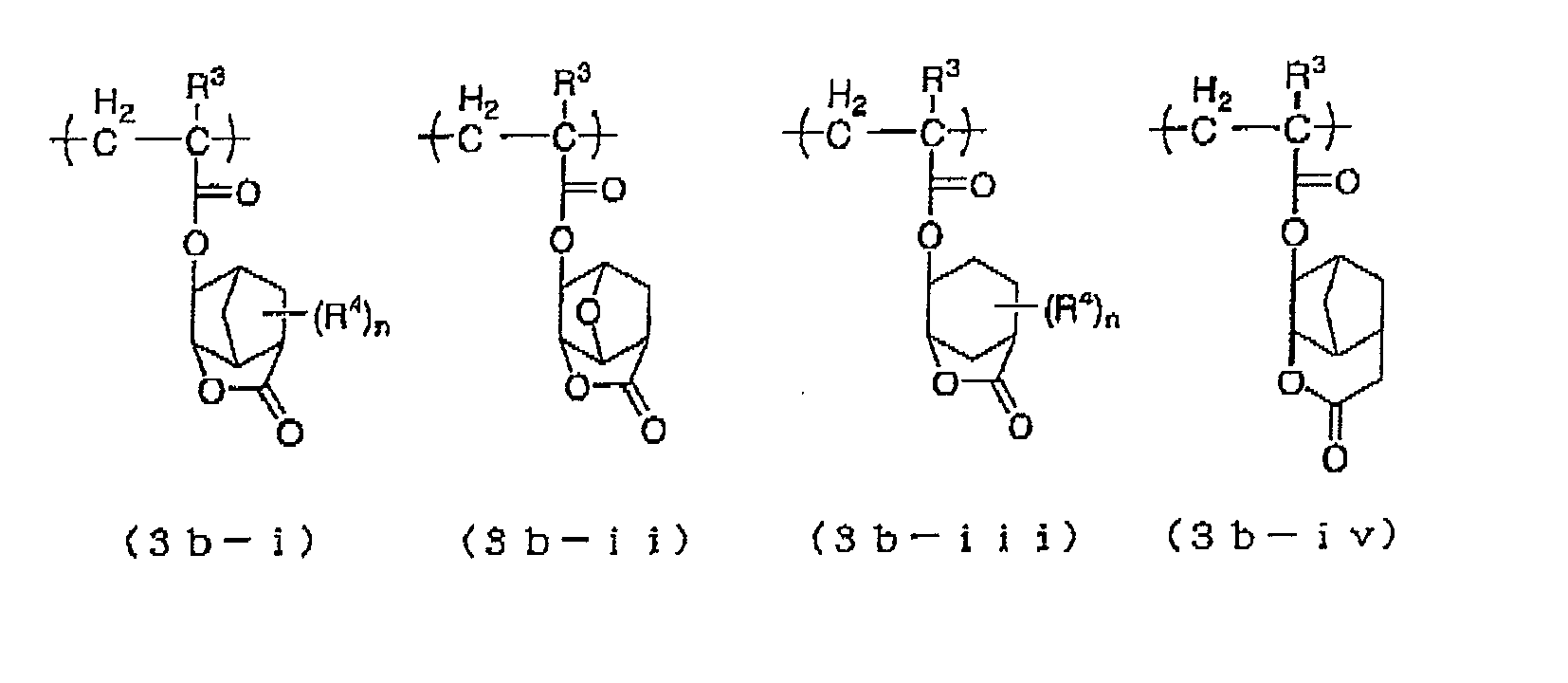

- In the formulas (3b-i) to (3b-viii), R3 represents a hydrogen atom, a methyl group, or a trifluoromethyl group and R4 individually represents a hydrogen atom, a linear or branched alkyl group having 1-4 carbon atoms, a linear or branched alkoxy group having 1-4 carbon-atoms, or a linear or branched fluoroalkyl group having 1-4 carbon-atoms. n is an integer of 0-3.
- Among the lactone skeleton-containing recurring units represented by the above formula (3b), particularly preferable lactone skeleton-containing recurring units are structures shown by the following formulas (3b-1) to (3b-3).
-

- In the formulas (3b-1) to (3b-3), R3 represents a hydrogen atom, a methyl group, or a trifluoromethyl group.
- Preferable examples of the monomer providing the recurring unit (1-1) include: bicyclo[2.2.1]hept-2-yl (meth)acrylate, bicyclo[2.2.2]oct-2-yl (meth)acrylate, tricyclo[5.2.1.02,6]dec-7-yl (meth)acrylate, tetracyclo[6.2.1.13,6.02,7]dodec-9-yl (meth)acrylate, tricyclo[3.3.1.13,7]dec-1-yl (meth)acrylate, tricyclo[3.3.1.13,7]dec-2-yl (meth)acrylate, 3-hydroxyadamantane-1-ylmethyl (meth)acrylate, 3,5-dihydroxyadamantane-1-ylmethyl (meth)acrylate, 3-carboxyladamantane-1-ylmethyl (meth)acrylate, 3-hydroxy-5-methyladamantane-1-yl (meth)acrylate, 3,5-dihydroxy-7-methyladamantane-1-yl (meth)acrylate, 3-hydroxy-5,7-dimethyladamantane-1-yl (meth)acrylate, 3-carboxyl-5,7-dimethyladamantane-1-yl (meth)acrylate, 3-hydroxy-5,7-dimethyladamantane-1-ylmethyl (meth)acrylate, 5-oxo-4-oxatricyclo[4.2.1.03,7]non-2-yl (meth)acrylate, 9-methoxycarbonyl-5-oxo-4-oxatricyclo[4.2.1.03,7]non-2-yl (meth)acrylate, 5-oxo-4-oxatricyclo[5.2.1.03,8]dec-2-yl (meth)acrylate, 10-methoxycarbonyl-5-oxo-4-oxatricyclo[5.2.1.03,8]non-2-yl (meth)acrylate, 6-oxo-7-oxabicyclo[3.2.1]oct-2-yl (meth)acrylate, 4-methoxycarbonyl-6-oxo-7-oxabicyclo[3,2,1]oct-2-yl (meth)acrylate, 7-oxo-8-oxabicyclo[3.3.1]oct-2-yl (meth)acrylate, 4-methoxycarbonyl-7-oxo-8-oxabicyclo[3.3.1]oct-2-yl (meth)acrylate, 2-oxotetrahydropyrarl-4-yl (meth)acrylate, 4-methyl-2-oxotetrahydropyran-4-yl (meth)acrylate, 4-ethyl-2-oxotetrahydropyran-4-yl (meth)acrylate, 4-propyl-2-oxotetrahydropyran-4-yl (meth)acrylate, 5-oxotetrahydrofuran-3-yl (meth)acrylate, 2,2-dimethyl-5-oxotetetrahydrofuran-3-yl (meth)acrylate, 4,4-dimethyl-5-oxotetetrahydrofuran-3-yl (meth)acrylate, 2-oxotetrahydrofuran-3-yl (meth)acrylate, 4,4-dimethyl-2-oxotetetrahydrofuran-3-yl (meth)acrylate, 5,5-dimethyl-2-oxotetetrahydrofuran-3-yl (meth)acrylate, 2-oxotetrahydrofuran-3-yl (meth)acrylate, 5-oxotetetrahydrofuran-2-ylmethyl (meth)acrylate, 3,3-dimethyl-5-oxotetetrahydrofuran-2-ylmethyl (meth)acrylate, 4,4-dimethyl-5-oxotetetrahydrofuran-2-ylmethyl (meth)acrylate, and the like. Either one type or two or more types of the recurring units originating from these monomers may be present in the polymer (A).
- In the above formula (1-2), R1 is a hydrogen atom, methyl group, or trifluoromethyl group, and Z is an acid-dissociable group which dissociates by the action of an acid. As the recurring unit comprising the acid-dissociable group shown by the formula (1-2), the recurring units of the following formulas (4) and (5) are preferable.
-

- wherein R5 and R9 individually represent a hydrogen atom, methyl group, or trifluoromethyl group, R6, R7, and R8 individually represent a linear or branched alkyl group having 1-4 carbon atoms or an alicyclic hydrocarbon group having 4-20 carbon atoms, any two of the R6, R7, and R8 groups may combine to form a polycyclic aliphatic hydrocarbon group having 6-20 carbon atoms, R10 is a linear or branched alkyl group having 1-4 carbon atoms, R11 and R12 individually represent a hydrogen atom or a linear or branched alkyl group having 1-4 carbon atoms, and n is an integer from 3 to 7.
- As examples of the linear or branched alkyl group having 1-4 carbon atoms represented by R6, R7, and R8, a methyl group, ethyl group, n-propyl group, i-propyl group, n-butyl group, 2-methylpropyl group, 1-methylpropyl group, and t-butyl group can be given. As examples of the alicyclic hydrocarbon group having 4-20 carbon atoms, cyclobutane, cyclopentane, cyclohexane, cycloheptane, cyclooctane, bicyclo[2.2.1]heptane, bicyclo[2.2.2]octane, tricyclo[5.2.1.02,6]decane, tetracyclo[4.4.0.12,5.17,10]dodecane, adamantane, or hydrocarbon groups originating from derivatives of these compounds can be given. Examples of R5 include a hydrogen atom, methyl group, and trifluoromethyl group.
- As examples of the polycyclic aliphatic hydrocarbon having 6-20 carbon atoms formed from any two of the R6, R7, and R8 groups, bicyclo[2.2.1]heptane, bicyclo[2.2.2]octane, tricyclo[5.2.1.02,6]decane, tetracyclo[4.4.0.12,5.17,10]dodecane, adamantane, or hydrocarbon groups originating from derivatives of these compounds can be given.
- As examples of R10 in the formula (5), a methyl group, ethyl group, n-propyl group, i-propyl group, n-butyl group, 2-methylpropyl group, 1-methylpropyl group, and t-butyl group can be given. As examples of R11 and R12, a hydrogen atom, methyl group, ethyl group, n-propyl group, i-propyl group, n-butyl group, 2-methylpropyl group, 1-methylpropyl group, and t-butyl group can be given. Examples of R9 includes a hydrogen atom, methyl group, or trifluoromethyl group.
- In the formula (5), it is particularly preferable that R10 is a methyl group or ethyl group, R11 and R12 is a hydrogen atom, and n is 4 or 5. The following formulas (5-1) to (5-4) can be given as particularly preferable examples.
-

- wherein R individually represents a hydrogen atom, methyl group, or trifluoromethyl group.
- Preferable examples of the monomer providing the recurring unit (1-2) include: t-butyl (meth)acrylate, 2-methyladamantane-2-yl (meth)acrylate, 2-methyl-3-hydroxyadamantane-2-yl (meth)acrylate, 2-ethyladamantane-2-yl (moth)acrylate, 2-ethyl-3-hydroxyadamantane-2-yl (meth)acrylate, 2-n-propyladamantane-2-yl (meth)acrylate, 2-isopropyladarnantane-2-yl (meth)acrylate, 2-methylbicyclo[2,2,1]hept-2-yl (meth)acrylate, 2-ethylbicyclo[2.2.1]hept-2-yl (meth)acrylate, 8-methyltricyclo[5.2.1.02,6]decan-8-yl (meth)acrylate, 8-ethyltricyclo[5.2,1.02,6]decan-8-yl (meth)acrylate, 4-methyltetracyclo[6.2.13,5.02,7]dodecan-4-yl (meth)acrylate, 4-ethyltetracyclo[6.2.13,6.02,7]dodecan-4-yl (meth)acrylate, 1-(bicyclo[2.2.1]hept-2-yl)-1-methylethyl (meth)acrylate, 1-(tricyclo[5.2.1.02,6decan-8-yl)-1-methylethyl (meth)acrylate, 1-(tetracyclo[6.2.13,6.02,7]dodecan-4-yl)-1-methylethyl (meth)acrylate, 1-(adamantane-1-yl)-1-methylethyl (meth)acrylate, 1-(3-hydroxyadanmtane-1-yl)-1-methylethyl (meth)acrylate, 1,1-dicyclohexylethyl (meth)acrylate, 1,1-di(bicyclo[2.2.1]hept-2-yl)ethyl (meth)acrylate, 1, 1-di(tricyclo[5.2.1.02,6]decan-8-yl)ethyl (meth)acrylate, 1, 1-di(tetracyclo[6.2.13,6.02,7]dodecan-4-yl)ethyl (meth)acrylate, 1,1-di(adamantane-1-yl)ethyl (meth)acrylate, 1-methyl-1-cyclopentyl (meth)acrylate, 1-ethyl-1-cyclopentyl (meth)acrylate, 1-methyl-1-cyclohexyl (meth)acrylate, 1-ethyl-1-cyclohoxyl (meth)acrylate, and the like. Either one type or two or more types of recurring units originating from these monomers may be present in the polymer (A).
- Of these monomers, t-butyl (meth)acrylate, 2-methyladamantane-2-yl (meth)acrylate, 2-ethyladamantane-2-yl (meth)acrylate, 2-methylbicyclo[2.2.1]hept-2-yl (meth)acrylate, 2-ethylbicyclo[2.2.1]hept-2-yl (meth)acrylate, 1-(bicyclo[2,2.1]hept-2-yl)-1-methylethyl (meth)acrylate, 1-(adamantane-1-yl)-1-methylethyl (meth)acrylate. 1-methyl-1-cyclopentyl (meth)acrylate, 1-ethyl-1-cyclopentyl (meth)acrylate, 1-methyl-1-cyclohexyl (meth)acrylate, and 1-ethyl-1-ayclohexyl (meth)acrylate are particularly preferable. Either one type or two or more types of the recurring units (1-2) may be present in the polymer (A).
- The mol ratio of the recurring unit (1-1) and recurring unit (1-2), (1-1):(1-2), in the polymer (A) is preferably 10:90 to 90:10 and particularly preferably 30:70 to 70:30. The above range makes it possible to obtain a dissolution contrast suitable for pattern formation, good resolution, LER, pattern profile, and the like. If the amount of the recurring unit (1-1) is too small (the amount of the recurring unit (1-2) is too great), a suitable dissolution contrast cannot be obtained, which may result in decreased resolution, and if the amount of the recurring unit (1-1) is too great (the amount of the recurring unit (1-2) is too small), a suitable pattern profile cannot be obtained due to low dissolution contrast during developing.
- In the present embodiment, either one type of the polymer (A) can be used alone or two or more polymers (A) can be used in combination. The polymer (A) is usually insoluble or scarcely soluble in alkali, but becomes easily soluble in alkali by the action of an acid.
- The additive (B) used in the radiation-sensitive resin composition of the present invention is a compound having a naphthalene skeleton shown by the above formula (1-3). In the formula (1-3), n is an integer from 1 to 8 and A individually represents a hydroxyl group and/or a monovalent organic group. The monovalent organic group represented by A is preferably at least one group selected from the group consisting of a carboxyl group, ether group, and ester group. When A is an ester group, the carbonyl group (carbon atom) side of the ester group is preferably bonded to naphthalene. In addition, A is preferably bonded to the naphthalene skeleton at the first or second position.
- When A is an ether group, A is preferably a group -O-R2, wherein R2 represents a hydrogen atom or a linear or branched alkyl group having 1-10 carbon atoms or an alicyclic substituent having 1-10 carbon atoms. As examples of the alicyclic substituent having 1-10 carbon atoms, a cyclopropyl group, cyclobutyl group, cyclopentyl group, cyclohexyl group, cycloheptyl group, cyclooctyl group, and the like can be given. When A is an ester group, A is preferably a methyl ester group, ethyl ester group, n-propyl ester group, i-propyl ester group, n-butyl ester group, t-butyl ester group, or the like, provided that the carbon atom of the carbonyl group forming the ester group is preferably bonded to naphthalene.
- When the radiation-sensitive resin composition comprising the above additive (B) of the present invention is used as a chemically-amplified resist and irradiated, the naphthalene skeleton of the additive (B) absorbs light (radiation) energy and is excited. The excited energy can be used for generation of an acid by the acid generator (C). The acid generator (C) absorbs the excited energy from the additive (B) in an excited state and becomes excited. In the irradiated area, in addition to the acid produced by conventional radiation, the acid is generated by the acid generator (C) which absorbs energy from the additive (B) excited by the above effect. In addition, radicals are thought to be produced from the additive (B) brought to an excited state and transferred to the acid generator, whereby an acid is also generated. As a result of this sensitization, the entire irradiated area can effectively and uniformly produce acid. As a result, since the acid-dissociable group of the polymer (A) in the irradiated area can be uniformly dissociated, line edge roughness of the pattern after development can be decreased in particular and pattern collapsing can be inhibited.
- As the A of the additive (B), the group of the following formula (2) is also preferable.
-

- wherein J is a single bond, a methylene group, or a linear or branched alkylene group having 2-10 carbon atoms and Q is an acid-dissociable group which dissociates by the action of an acid. As examples of Q, a t-butyl group, methylcyclopentyl group, ethylcyclopentyl group, methylcyclohexyl group, ethylcyclohexyl group, methyladamantyl group, ethyladamantyl group, and the like can be given. Such a structure A ensures an improved dissolution contrast and high resolution of a resist when the radiation-sensitive resin composition of the present embodiment is used as a chemically-amplified resist.
- As preferable examples of the compound shown by the formula (1-3), 1-naphthol, 2-naphthol, 1,8-naphthalenediol, 1-naphthalenecarboxylic acid, 2-naphthalenecarboxylic acid, 1,8-naphthaIenedicarboxylic acid, 1-nnethoxynaphthalene, 2-methoxynaphthalene, 1-ethoxynaphthalene, 2-ethoxynaphthalene, 1-n-propoxynaphthatene, 2-n-propoxynaphthalene, 1-i-propoxynaphthalene, 2-i-propoxynaphthalene, 1-n-butoxynaphthalene, 2-n-butoxynaphthalene, 1-methoxycarbonylnaphthalene, 1-t-butoxycarbonylnaphthalene, 1-(methoxycarbonylmethoxy)naphthalene, and 1-(t-butoxycarbonylmethoxy)naphthalene can be given. As particularly preferable examples of the compound shown by the formula (1-3), the compounds of the following formulas (1-3a) to (1-3e) can be given.
-

- In the present embodiment, either one type of the additive (B) can be used alone or two or more types may be used in combination. In view of decreasing line edge roughness and inhibiting pattern collapsing, the additive (B) is preferably used in an amount of 0.5 to 10 parts by mass and particularly preferably 1 to 5 parts by mass for 100 parts by mass of the polymer (A). If the additive (B) is used in an amount less than 0.5 part by mass, decrease in line edge roughness and control of pattern collapsing may not be sufficient, and if used in an amount exceeding 10 parts by mass, a good pattern profile may not be obtained due to absorption by the additive.
- As the acid generator (C) of the radiation-sensitive resin composition of the present embodiment, onium salt compounds such as sulfonium salts and iodonium salts, organo halide compounds, sulfone compounds such as disulfones and diazomethane sulfones, and the like can be given.
- As preferable specific examples of the acid generator (C), triphenylsulfonium salt compounds such as triphenylsulfonium trifluoromethanesulfonate, triphenylsulfonium nonafluoro-n-butanesulfonate, triphenylsulfonium perfluoro-n-octanesulfonate, triphenylsulfonium 2-bicyclo[2.2.1]hept-2-yl-1,1,2,2-tetrafluoroethanesulfonate, triphenylsulfonium camphorsulfonate, and triphenylsulfonium 2-(bicyclo[2.2.1]hept-2'-yl)-1,1-difluoroethanesulfonate;
- 4-cyclohexylphenyldiphenylsulfonium salt compounds such as 4-cyclohexylphenyldiphenylsulfonium trifluoromethanesulfonate, 4-cyclohexylphenyldiphenylsulfonium nonafluoro-n-butanesulfonate, 4-cyclohexylphenyldiphenylsulfonium perfluoro-n-octanesulfonate, 4-cyclohexylphenyldiphenylsulfonium 2-bicyclo[2.2.1]hept-2-yl-1,1,2,2-tetrafluoroethanesulfonate, 4-cyclohexylphenyldiphenylsulfonium camphorsulfonate, and 4-cyclohexylphenyl-diphenylsulfonium 2-(bicyclo[2.2.1]hept-2'-yl)-1,1-difluoroethanesulfonate;
- tri-t-butylphenylsulfonium salt compounds such as tri-t-butylphenylsulfonium trifluoromethanesulfonate, tri-t-butylphenylsulfonium nonafluoro-n-butanesulfonate, tri-t-butylphenylsulfonium perfluoro-n-octanesulfonate, tri-t-butylphenylsulfonium 2-bicyclo[2.2.1]hept-2-yl-1,1,2,2-tetrafluoroethanesulfonate, tri-t-butylphenylsulfonium camphorsulfonate, and tri-t-butylphenylsulfonium 2-(bicyclo[2,2.1]hept-2'-yl)-1, 1-difluoroethanesulfonate;
- 4-methanesulfonylphenyldiphenylsulfonium salt compounds such as 4-methanesulfonylphenyldiphenylsulfonium trifluoromethanesulfonate, 4-methanesulfonylphenyldiphenylsulfonium nonafluoro-n-butanesulfonate, 4-methanesulfonylphenyldiphenylsulfonium perfluoro-n-octanesulfonate, 4-methanesulfonylphenyldiphenylsulfonium 2-bicyclo[2.2.1]hept-2-yl-1,1,2,2-tetrafluoroethanesulfonate, 4-methanesulfanylphenyldiphenylsulfanium camphorsulfonate, and 4-methanesulfonylphenyldiphenylsulfonium 2-(bicyclo[2.2.1]hept-2'-yl)-1,1-difluoroethanesulfonate;
- diphenyliodonium salt compounds such as diphenyliodonium trifluoromethanesulfonate, diphenyliodonium nonafluoro-n-butanesulfonate, diphenyliodonium perfluoro-n-octanesulfonate, diphenyliodonium 2-bicyclo[2.2.1]hept-2-yl-1,1,2,2-tetrafluoroethanesuffonate, and diphenyliodonium camphorsulfonate;
- bis(4-t-butylphenyl)iodonium salt compounds such as bis(4-t-butylphenyl)iodonium trifluoromethanesulfonate, bis(4-t-butylphenyl)iodonium nonafluoro-n-butancsulfonate, bis(4-t-butylphenyl)iodonium perfluoro-n-octanesulfonate, bis(4-t-butylphenyl)iodonium 2-bicyclo[2.2.1]hept-2-yl-1,1,2,2-tetrafluoroethanesulfonate, and bis(4-t-butylphenyl)iodonium camphorsulfonate;
- 1-(4-n-butoxynaphthalen-1-yl)tetrahydrothiophenium salt compounds such as 1-(4-n-butoxynaphthalen-1-yl)tetrahydrothiophenium trifluoromethanesulfonate, 1-(4-n-butoxynaphthalen-1-yl)tetrahydrothiophenium nonafluoro-n-butanesulfonate, 1-(4-n-butoxynaphthalen-1-yl)tetrahydrothiophenium perfluoro-n-octanesulfonate, 1-(4-n-butoxynaphtbalen-1-yl)tetrahydrothiophenium 2-bicyclo[2.2.1]hept-2-yl-1,1,2,2-tetrafluoroethanesulfonate, and 1-(4-n-butoxynaphthalen-1-yl)tetrahydrothiophenium camphorsulfonate;
- 1-(6-n-butoxynaphthaten-2-yl)tetrahydrothiophenium salt compounds such as 1-(6-n-butoxynaphthalen-2-yl)tetrahydrothiophenium trifluoromethanesulfonate, 1-(6-n-butoxynaphthalen-2-yl)tetrahydrothiophenium nonafluoro-n-butanesuffanate, 1-(6-n-butoxynaphthalen-2-yl)tetrahydrothiophenium perfluoro-n-octanesulfonate, 1-(6-n-butoxynaphthalen-Z-yl)tetrahydrothiophenium 2-bicyclo[2.2.1]hept-2-yl-1,1,2,2-tetrafluoroethanesulfonate, and 1-(6-n-butoxynaphthalen-2-yl)tetrahydrothiophenium camphorsulfonate;
- 1-(3,5-dimethyl-4-hydroxyphenyl)tetrahydrothiophenium salt compounds such as 1-(3,5-dimethyl-4-hydroxyphonyl)tetrahydrothiophenium trifluoromethanesulfonate, 1-(3,5-dimethyl-4-hydroxypheayl)tetrahydrothiophenium nonafluoro-n-butanesulfonate, 1-(3,5-dimethyl-4-hydroxyphenyl)tetrahydrothiophenium perfluoro-n-octanesulfonate, 1-(3,5-dimethyl-4-hydroxyphenyl)tetrahydrothiophenium 2-bicyclo[2.2.1]hept-2-yl-1,1,2,2-tetrafluoroethanesulfonate and 1-(3,5-dimethyl-4-hydroxyphenyl)tetrahydrothiophenium camphorsulfonate;
- bicyclo[2.2.1]hept-5-ene-2,3-dicarboxyimide compounds such as N-(trifluoromethanesulfonyloxy)bicyclo[2.2.1]hept-5-ene-2,3-dicarboxyimide, N-(nonafluoro-n-butanesulfonyloxy)bicyclo[2.2.1]hept-5-ene-2,3-dicarboxymide, N-(perfluoro-n-octanesulfonyloxy)bicyclo[2.2.1]hept-5-ene-2,3-dicarboxyimide, N-(2-bicyclo[2.2,1]hept-2-yl-1,1,2,2-tetrafluoroethanesulfonyloxy)bicydo[2.2.1]hept-5-ene-2,3-dicarboxyimide, N-(2-(3-tetracyclo[4.4.0.12,5.17,10]dodecanyl)-1,1-difluoroethanesulfonyloxy)bicyclo [2.2.1]hept-5-ene-2,3-dicarboxyimide, and N-(camphorsulfonyloxy)bicyclo[2.2.1]hept-5-ene-2,3-dicarboxyimide; and the like can be given.
- Other specific preferable examples of the acid generator include compounds of the following formulas B1 to B15.
-

-

-

-

-

-

-

- These acid generators can be used either individually or in combination of two or more.
- In the present embodiment, the acid generators (C) can be used either individually or in combination of two or more. The amount of the acid generator (C) to be used is preferably 0.1 to 30 parts by mass, and more preferably 0.1 to 20 parts by mass for 100 parts by mass of the polymer (A) from the viewpoint of ensuring sensitivity and developability as a resist. If the amount of the acid generator is less than 0.1 part by mass, sensitivity and developability may be decreased, If the amount exceeds 30 parts by mass, a rectangular resist pattern may not be obtained due to decreased transparency to radiation.
- Various types of additives such as acid diffusion controllers, alicyclic additives having an acid-dissociable group, alicyclic additives having no acid-dissociable group, surfactants, and sensitizers may optionally be added to the radiation-sensitive resin composition of the present invention.
- The acid diffusion controllers control diffusion of an acid generated from the acid generator (C) upon irradiation in the resist film to suppress undesired chemical reactions in the non-irradiated area. Addition of the acid diffusion controller further improves storage stability of the resulting radiation-sensitive resin composition and resolution of the resist. Moreover, the addition of the acid diffusion controller prevents the line width of the resist pattern from changing due to changes in the post-exposure delay (FED) between irradiation and development, whereby a composition with remarkably superior process stability can be obtained. As the acid diffusion controller, nitrogen-containing organic compounds of which the basicity does not change during irradiation or heating when forming a resist pattern are preferable.
- As preferable examples of the nitrogen-containing organic compound, tertiary amine compounds, amide group-containing compounds, quaternary ammonium hydroxide compounds, and nitrogen-containing heterocyclic compounds can be given.
- Examples of the tertiary amine compound include tri(cyclo)alkylamines such as triethylamine, tri-n-propylamine, tri-n-butylamine, tri-n-pentylamine, tri-n-hexylamine, tri-n-heptylamine, tri-n-octylamine, cyclohexyldimethylamine, and tricyclohexylamine; alkanolamines such as triethanolamine and diethanolaniline; N,N,N',N'-tetramethylethylenediamine, N,N,N',N'-tetrakis(2-hydroxypropyl)ethylenediamine, 1,3-bis[1-(4-aminophenyl)-1-methylethyl]benzenetetramethylenediamine, 2,2-bis(4-aminophenyl)propane, 2-(3-aminophenyl)-2-(4-aminophenyl)propane, 2-(4-aminophenyl)-2-(3-hydroxyphenyl)propane, 2-(4-aminophenyl)-2-(4-hydroxyphenyl)propane, 1,4-bis[1-(4-aminophenyl)-1-methylethyl]benzene, 1,3-bis[1-(4-aminophenyl)-1-methylethyl]benzene, bis(2-dimethylaminoethyl) ether, bis(2-diethylaminoethyl) ether, and the like.
- As preferable examples of the amide group-containing compounds, in addition to N-t-butoxycarbonyl group-containing amino compounds such as N-t-butoxycarbonyldi-n-octylamine, N-t-butoxycarbonyldi-n-nonylamine, N-t-butoxycarbonyldi-n-decylamine, N-t-butoxycarbonyldicyclohexylamine, N-t-butoxycarbonyl-1-adamantylamine, N-t-butoxycarbonyl-N-methyl-1-adamantylamine, N,N-di-t-butoxycarbonyl-1-adamantylamine, N,N-di-t-butoxycarbonyl-N-methyl-1-adamantylamine, N-t-butoxycarbonyl-4,4'-diaminodiphenylmethane, N,N'-di-t-butoxycarbonylhexamethylenediamine, N,N,N'N'-tetra-t-butoxycarbonylhexamethylenediamine, NN'-di-t-butoxycarbonyl-1,7-diaminoheptane, N,N'-di-t-butoxycarbonyl-1,8-diaminooctane N,N'-di-t-butoxycarbonyl-1,9-diaminononane, N,N'-di-t-butoxycarbonyl-1,10-diaminodecane, N,N'-di-t-butoxycarbonyl-1,12-diaminododecane, N,N'-di-t-butoxycarbonyl-4,4'-dianinodiphenylmethane, N-t-butoxycarbonylbenzimidazole, N-t-butoxycarbonyl-2-methylbenzimidazole, N-t-butoxycarbonyl-2-phenylbenzimidazole, N-t-butoxycarbonylpyrrolidine, N-t-butoxycarbonylpiperidine, N-t-butoxycarbonyl-4-hydroxypiperidine, and N-t-butoxycarbonylmoxpholine, formamide, N-methylformamide, N,N-dimethylformamide, acetamide, N-methylacetamide, N,N-dimethylacetamide, propionamide, benzamide, pyrrolidone, N-methylpyrrolidone, and the like can be given.
- As preferable examples of the quaternary ammonium hydroxide compound, tetramethylammonium hydroxide, tetraethylammonium hydroxide, tetra-n-propylammonium hydroxide, tetra-n-butylammonium hydroxide, and the like can be given.
- Preferable examples of the nitrogen-containing heterocyclic compound include: in addition to imidazoles such as imidazole, 4-methylimidazole, 1-benzyl-2-methylimidazole, 4-methyl-2-phenylimidazole, benzimidazole, and 2-phenylbenzimidazole and piperazines such as piperazine, 1-(2-hydroxyethyl)piperazine; pyrazine, pyrazole, pyridazine, quinoxaline, purine; pyrrolidine such as t-butyl-1-pyrrolidine carboxylate; piperidines such as t-butyl-4-hydroxy-1-piperidine carboxylate; 3-piperidino-1,2-propanediol, morpholine, 4-methylmorphaliae, 1,4-dimethylpiperazine, and 1,4-diazabicyclo[2.2.2]octane.
- The acid diffusion controller may be used either individually or in combination of two or more. The acid diffusion controller is preferably used in an amount of 0.001 to 15 parts by mass, particularly preferably 0.01 to 10 parts by mass, and even more preferably 0.1 to 5 parts by mass for 100 parts by mass of the polymer (A). If the amount of the acid diffusion controller exceeds 15 parts by mass, sensitivity as a resist and developability of the irradiated area tend to decrease. If the amount is less than 0.001 part by mass, the pattern configuration or dimensional accuracy as a resist may decrease depending on the processing conditions.
- The alicyclic additives having an acid-dissociable group and alicyclic additives having no acid-dissociable group improve dry etching resistance, pattern configuration, adhesion to the substrate, and the like.
- As examples of such alicyclic additives, adamantane derivatives such as t-butyl 1-adamantanecarboxylate, t-butoxycarbonylmethyl 1-adamantanecarboxylate, α-butyrolactone 1-admnantanecarboxylate, di-t-butyl 1,3-adamantanedicarboxylate, t-butyl 1-adamantaneacetate, t-butoxycarbonylmethyl 1-adamantaneacetate, di-t-butyl 1,3-adamantanediacetate, and 2,5-dimethyl-2,5-di(adamantylcarbonyloxy)hexane; deoxycholates such as t-butyl deoxycholate, t-butoxycarbonylmethyl deoxycholate, 2-ethoxyethyl deoxycholate, 2-cyclohexyloxyethyl deoxycholate, 3-oxocyclohexyl deoxycholate, tetrahydropyranyl deoxycholate, and mevalonolactone deoxycholate; lithocholates such as t-butyl lithocholate, t-butoxycarbonylmethyl lithocholate, 2-ethoxyethyl lithocholate, 2-cyclohexyloxyethyl lithocholate, 3-oxocyclohexyl lithocholate, tetrahydropyranyl lithocholate, and mevalonolactone lithocholate; alkylcarboxylates such as dimethyl adipate, diethyl adipate, dipropyl adipate, di-n-butyl adipate, and di-t-butyl adipate; and the like can be given. These alicyclic additives may be used either individually or in combination of two or more. The alicyclic additives are preferably used in an amount of 50 parts by mass or less and particularly preferably 30 parts by mass or less for 100 parts by mass of the polymer (A). If the amount of the alicyclic additives exceeds 50 parts by mass, heat resistance as a resist tends to decrease.
- The surfactants as an additive improve applicability, striation, developability, and the like. As examples of the surfactant, nonionic surfactants such as polyoxyethylene lauryl ether, polyoxyethylene stearyl ether, polyoxyethylene oleyl ether, polyoxyethylene n-octyl phenyl ether, polyoxyethylene n-naztyl phenyl ether, polyethylene glycol dilaurate, and polyethylene glycol distearate; and commercially available products such as KP341 (manufactured by Shin-Etsu Chemical Co., Ltd.), POLYFLOW No. 75, No. 95 (manufactured by Kyoeisha Chemical Co., Ltd.), FTOP EP301, EF303, EF352 (manufactured by Tohkem Products Corporation), MEGAFAC F171, F173 (manufactured by Dainippon Ink and Chemicals, Inc.), Fluorad FC430, FC431 (manufactured by Sumitomo 3M Ltd.), Asahi Guard AG710, and Surflon S-382, SC-101, SC-102, SC-103, SC-104, SC-105, SC-106 (manufactured by Asahi Glass Co., Ltd.) can be given. The surfactants may be used either individually or in combination of two or more. The surfactants are preferably used in an amount of 2 parts by mass or less for 100 parts by mass of the acid-dissociable group containing polymer.
- Although the additives (B) function as a photosensitizer, the radiation-sensitive resin composition of the present embodiment may comprise other photosensitizers as other additives. The other photosensitizers, in the same manner as the additives (B), absorb radiation energy and transmit the energy to the acid generator, thereby increasing the amount of the generated acid and improving apparent sensitivity of the radiation-sensitive resin composition. As examples of the other photosensitizers, carbazoles, benzophenones, rose bengals, anthracenes, phenols, and the like can be given. These other photosensitizers may be used either individually or in combination of two or more. The other photosensitizers are preferably used in an amount of 50 parts by mass or less for 100 parts by mass of the polymer (A).
- As examples of other additives, halation inhibitors, adhesion promoters, storage stabilizers, anti-foaming agents, and the like can be given.
- Although there are no limitations to the method for preparing the polymer (A) of the radiation-sensitive resin composition of the present invention, the polymer can be prepared by, for example, causing polymerizable unsaturated monomers corresponding to the recurring units for forming a desired molecular composition to polymerize in a suitable solvent in the presence of a radical polymerization initiator, chain transfer agent, and the like. In order to realize a sufficient rate of polymerization, the radical polymerization initiator is preferably added at a sufficiently high concentration. However, if the amount of the radical polymerization initiator is too great in relation to the amount of the chain transfer agent, a radical-radical coupling reaction occurs, resulting in the formation of an undesirable non-livitng radical polymer, which causes a part of the obtained polymer to have uncontrolled polymer characteristics such as molecular weight and molecular weight distribution. The mol ratio of the radical polymerization initiator to the chain transfer agent is preferably 1:1 to 0.005:1.
- Although there are no limitations to the above radical polymerization initiator, a thermal polymerization initiator, redox polymerization initiator, and photo-polymerization initiator can be given as examples. As specific examples of the radical polymerization initiator, initiators such as peroxides and azo compounds can be given. More specific radical polymerization initiators include, t-butyl hydroperoxide, t-butyl perbenzoate, benzoyl peroxide, 2.2'-azobis(2,4-dimethylvaleronitrile), 2,2'-azobisisobutyronitrile (AIBN), 1,1'-azobis(cyclohexanecarbonitrile), dimethyl 2,2'-azobisisobutyrate (MAIB), and the like.
- As the chain transfer agent, pyrazole derivatives, alkyl thiols, and the like can be given.
- As the method of polymerization, commonly used batch polymerization, dripping polymerization, and the like can be given. For example, specific monomers corresponding to the above recurring unit (1-1), recurring unit (1-2), and other recurring units are dissolved in an organic solvent in a necessary amount and polymerization is conducted in the presence of a radical polymerization initiator and chain transfer agent to obtain the polymer (A). An organic solvent capable of dissolving the monomers, radical polymerization initiator, and chain transfer agent is generally used as the polymerization solvent. As examples of the organic solvent, ketones, ethers, aprotic polar solvents, esters, aromatic solvents, and linear or cyclic aliphatic solvents can be given. Specific examples of the ketones include methyl ethyl ketone, acetone, 4-methyl-2-pentanone, 2-heptanone, and the like. Examples of the ethers include alkoxyalkyl ether, such as methoxymethyl ether, ethyl ether, tetrahydrofuran, and 1,4-dioxane. Examples of the aprotic polar solvents include dimethylformamide, dimethyl sulfoxide, and the like. Examples of the esters include alkyl acetates such as ethyl acetate, methyl acetate, n-butyl acetate, i-butyl acetate, methyl propionate, and the like. Examples of the aromatic solvents include benzene, alkylaryl solvent, for example, toluene, xylene, ethylbenzene, cumene, and halogenated aromatic solvents such as chlorobenzene. Examples of the aliphatic solvents include hexane, cyclohexane, and the like. These solvents may be used either individually or in combination of two or more.
- The polymerization temperature is usually 40 to 150°C, preferably 50 to 120°C, and still more preferably 60 to 120°C. Although polymerization may also be conducted in a normal atmosphere, polymerization is preferably conducted in an inert gas atmosphere such as nitrogen and argon. The molecular weight of the polymer (A) can be adjusted by controlling the ratio of the monomers and the chain transfer agent. The polymerization time is usually 0.5 to 144 hours, preferably 1 to 72 hours, and still more preferably 2 to 24 hours.
- The polymer (A) may or may not have a residue originating from a chain transfer agent in the melccular chain end, or may have only a part of the chain transfer agent residue in the molecular chain end.
- Needless to mention of a content of impurities such as metals, it is desirable that the content of residual monomers and oligomer components in the polymer Abe not more than a specified amount, for example, 0.1 mass% or less when measured by HPLC. This not only further improves sensitivity, resolution, process stability, pattern configuration, and the like as a resist, but also enables provision of a radiation-sensitive resin composition usable as a resist having little foreign matter in the solution and showing little change in sensitivity over time.
- As examples of the purification method for the polymer (A), the fallowing methods can be given. As a method for removing impurities such as metals, a method of adsorbing metals in the polymer (A) solution using a zeta-potential filter, a method of transforming the metals into a chelate state by washing the polymer (A) solution with an acidic aqueous solution such as oxalic acid or sulfonic acid and removing the metals, and the like can be given. As a method for removing the residual monomers and oligomer components to reduce the content of these components to a specific value or less, a liquid-liquid extraction method in which the residual monomers and oligomer components are removed by combining washing with water and a suitable solvent, a purification method in a solution state such as ultrafiltration in which only the components having a specific molecular weight or less are extracted and removed, a reprecipitation method in which the residual monomers and the like are removed by adding the polymer (A) solution to a poor solvent dropwise, thereby causing the polymer (A) to coagulate in the poor solvent, a purification method in a solid state in which the polymer slurry separated by filtration is washed with a poor solvent, and the like can be given. These methods may be used in combination. The type of the poor solvent used in the reprecipitation method varies depending on the properties of the polymer (A) to be purified and the like. A person skilled in the art can suitably select the type of poor solvent based on the properties of the polymer.
- The polystyrene-reduced weight average molecular weight (hereinafter referred to as "Mw") of the polymer (A) determined by gel permeation chromatography (GPC) is usually from 1,000 to 300,000, preferably from 2,000 to 300,000, and particularly preferably from 2,000 to 12,000. If the Mw of the polymer (A) is less than 1,000, heat resistance as a resist may be decreased. If the Mw exceeds 300,000, developability as a resist may be decreased.
- The ratio of Mw to the polystyrene-reduced number average molecular weight (hereinafter referred to as "Mn") determined by gel permeation chromatography (GPC) (Mw/Mn) of the polymer (A) is preferably from 1 to 5, particularly preferably from 1 to 3, and even more preferably from 1 to 1.6.
- Based on the intended use, the radiation-sensitive resin composition of the present invention is usually made into a composition solution by dissolving the composition in a solvent so that the total solid content is usually from 3 to 50 mass%, and preferably from 5 to 25 mass%, and filtering the solution using a filter with a pore diameter of about 0.2 µm, for example. As solvents used for preparing the radiation-sensitive resin composition solution, in addition to linear or branched ketones such as 2-pentanone, 2-hexanone, 2-heptanone, and 2-octanone; cyclic ketones such as cyclopentanone and cyclohexanone; propylene glycol monoalkyl ether acetates such as propylene glycol monomethyl ether acetate and propylene glycol monoethyl ether acetate; alkyl 2-hydroxypropionates such as methyl 2-hydroxypropionate and ethyl 2-hydroxypropionate; and alkyl 3-alkoxypropionates such as methyl 3-methoxypropionate, ethyl 3-methoxypropionate, methyl 3-ethoxypropionate, and ethyl 3-ethoxypropionate; ethylene glycol monomethyl ether, ethylene glycol monoethyl ether, diethylene glycol dimethyl ether, diethylene glycol diethyl ether, ethylene glycol monomethyl ether acetate, ethylene glycol monoethyl ether acetate, propylene glycol monomethyl ether, propylene glycol monoethyl ether, n-butyl acetate, methyl pyruvate, ethyl pyruvate, N-mcthylpyrrolidonc, γ-butyrolactone, and the like can be given.
- Although these solvents may be used either individually or in combination of two or more, inclusion of at least one of the solvents selected from propylene glycol monomethyl ether acetate, propylene glycol monomethyl ether, 2-heptanone, cyclohexanone, γ-butyrolactone, ethyl 2-hydroxypropionate, and ethyl 3-ethoxypropionate is preferable.
- A resist pattern is farmed from the radiation-sensitive resin composition of the present invention by applying the composition solution thus prepared to, for example, substrates such as a silicon wafer or a wafer coated with aluminum using an appropriate application method such as rotational coating, cast coating, and roll coating to form a resist film. Then, after optional heat treatment (hereinafter referred to as "PB"), the resist film is exposed to radiation through a mask with a prescribed pattern. A liquid immersion lithographic method may be used as the exposure here.
- As a radiation that can be used here, deep ultraviolet rays such as a bright line spectrum of a mercury lamp (wavelength: 254 nm), KrF excimer laser (wavelength: 248 nm), ArF excimer laser (wavelength; 193 nm), F2 excimer laser (wavelength: 157 nm), and EUV (wavelength: 13 nm); X-rays such as synchrotron radiation, charged particle rays such as electron beams, and the like can be used according to the types of acid generator (A), with deep ultraviolet rays and charged particle rays being preferable and KrF excimer laser (wavelength: 248 um), ArF excimer laser (wavelength: 193 nm), and electron beams being particularly preferable. The exposure conditions such as the dose of radiation are appropriately determined according to the composition of the radiation-sensitive resin composition, types of additives, and the like.
- In the formation of the resist pattern, the coatings are preferably post-baked after exposure to radiation (hereinafter referred to as "PEB") to increase the apparent sensitivity of the resist. PEB is performed at a temperature of 3 0 to 200°C, and preferably 50 to 150°C, although the temperature varies depending on the composition of the radiation-sensitive resin composition, types of additives, and the like.
- The resist film after exposure is developed in an alkaline developer to form a predetermined resist pattern. As the alkaline developer, an alkaline aqueous solution in which one or more alkaline compounds such as an alkaline metal hydroxide, aqueous ammonia, alkylamines, alkanolamines, heterocyclic amines, tetraalkylammonium hydroxides, choline, 1,8-diazabicyclo[5.4.0]-7-undecene, and 1,5-diazabicyclo[4.3.0]-5-nonene are dissolved is used. An aqueous solution of tetraalkylammonium hydroxide is a particularly preferable alkaline developer. The concentration of the alkaline aqueous solution is preferably 10 mass% or less, more preferably 1 to 10 mass%, and particularly preferably 2 to 5 mass%. The concentration of the alkaline aqueous solution not greater than 10 mass% prevents dissolution of an unexposed area in the developer. The addition of an appropriate amount of a surfactant and the like to the alkaline developer is desirable to increase wettability of the resist to the developer. The resist film is generally washed with water and dried after development using the alkaline developer.
- The present invention will be described below in more detail by way of examples. The present invention, however, is not limited to the following examples. In the examples, "part" refers to "part by mass" unless otherwise indicated.
- Measurement and evaluation in the examples and comparative examples were carried out according to the following procedures.
- Mw was measured by gel permeation chromatography (GPC) using GPC columns (manufactured by Tosoh Corp., G2000HXL × 2, G3000HXL × 1, G4000HXL × 1) under the following conditions. Flow rate: 1.0 ml/minute, eluate: tetrahydrofuran, column temperature: 40°C, standard reference material: monodispersed polystyrene
- Each composition solution was applied to a silicon wafer with a 780 Å-thick ARC29 film (manufactured by Brewer Science Corp.) coated on the surface by spin coating and pre-baked (PB) on a hot plate under the conditions shown in Table 2 to obtain a resist coating with a thickness of 0.20 µm. The coating was exposed to a radiation through a mask pattern using an ArF excimer laser exposure apparatus (manufactured by Nikon Corp., lens numerical aperture: 0.75). After PEB under the conditions shown in Table 2, the resist films were developed in a 2.38 mass% tetramethylammonium hydroxide aqueous solution at 25°C, washed with water, and dried to form a positive-tone resist pattern. An optimum dose at which a line-and-space (1L1S) pattern with a line width of 0.090 µm was formed was taken as sensitivity.
- Minimum dimensions of the resist pattern resolved at the optimum dose were taken as the resolution.
- The dimensions of the lower side Lb and the upper side La of the rectangular cross section of a line and space pattern (1L1 S) with a line width of 0.090 µm were measured using a scanning electron microscope. A pattern shape which satisfied the formula 0.85 ≤La/Lb ≤ 1 and was straight with no extended skirt was evaluated as "Good". When 0.85 > La/Lb was satisfied, the pattern shape was evaluated as "Bad".
- Line widths of 90 nm (1L1S) patterns resolved at an optimum exposure dose were observed from upside using SEM "S9220" manufactured by Hitachi Ltd, at optional points and variations were expressed by 3-Sigma. The LER was judged as "Bad" if the value was 10 nm or more, and as "Good" if the value was less than 10 nm.
- 90 nm (1L1S) patterns were inspected as the line width was progressively reduced by increasing the exposure dose starting from the optimum exposure dose. The adhesion was judged as "Good" if the line width immediately before pattern collapsing was less than 75 nm, and as "Bad" if 75 nm or more.
- A 1,000 ml eggplant-like flask equipped with a stirrer and a reflux condenser was charged with 10 g of 1-hydroxynaphthalene, 20 g of t-butyl bromoacetate, 15 g of potassium carbonate, and 500 g of acetone. The mixture was reacted for 10 hours at 40°C in a nitrogen gas atmosphere. After the reaction, the reaction mixture was added to a separating funnel together with 500 g of ethyl acetate and washed three times with 500 g of water. After washing, the resulting solution was concentrated and dried at 50°C for 17 hours to obtain 14 g of 1- t-butoxycarbonylmethoxynaphthalene of the following formula (7).
-

-

- A monomer solution was prepared by dissolving 35.88 g (35 mol%) of the compound (S1-1), 15.51 g (15 mol%) of the compound (S1-2), and 48.61 g (50 mol%) of the compound (S1-3) in 200 g of 2-butanone and adding 4.03 g of dimethyl 2,2'-azobis(2-methylpropionate) to the solution. A 1,000 ml three-neck flask charged with 100 g of 2-butanone was purged with nitrogen for 30 minutes. After nitrogen purge, the flask was heated to 80°C and the above monomer solution was added dropwise with stirring using a dripping funnel at a rate of 10 ml/5 min. The polymerization reaction was carried out for six hours after initiation of dripping. After completion of polymerization, the polymer solution was cooled with water to 30°C or lower and poured into 2,000 g of methanol. White precipitate powder produced was collected by filtration. The white powder collected by filtration was washed twice with 400 g of methanol in a slurry state, again filtered, and dried at 50°C for 17 hours to obtain a white resin powder (74 g, yield: 74%). The resin was found to have a molecular weight of 9,800 and to be a copolymer containing recurring units of the compound (S1-1), the compound (S1-2), and the compound (S1-3) at a ratio of 35.8:13.2:51.0(mol%). This resin is called a "resin (A-1)".
-

- A monomer solution was prepared by dissolving 10.70 g (13 mol%) of the compound (S2-1), 39.14 g (37 mol%) of the compound (S2-2), and 50.16 g (50 mol%) of the compound (S2-3) in 200 g of 2-butanone and adding 1.52 g of 2,2'-azobisisobutylonitrile to the solution. A 1,000 ml three-neck flask charged with 100 g of 2-butanone was purged with nitrogen for 30 minutes. After nitrogen purge, the flask was heated to 80°C and the above monomer solution was added dropwise with stirring using a dripping funnel at a rate of 10 ml/5 min. The polymerization reaction was carried out for six hours after initiation of dripping. After completion of polymerization, the polymer solution was cooled with water to 30°C or lower and poured into 2,000 g of methanol. White precipitate powder produced was collected by filtration. The white powder collected by filtration was washed twice with 400 g of methanol in a slurry state, again filtered, and dried at 50°C for 17 hours to obtain a white resin powder (78 g, yield: 78%). The resin was found to have a molecular weight of 8,700 and to be a copolymer containing recurring units of the compound (S2-1), the compound (S2-2), and the compound (S2-3) at a ratio of 14.7:34.2:51.1 (mol%). This resin is referred to as a "resin (A-2)".
-

- A monomer solution was prepared by dissolving 35.38 g (40 mol%) of the compound (S3-1), 10.69 g (10 mol%) of the compound (S3-2), and 53.93 g (50 mol%) of the compound (S3-3) in 200 g of 2-butanone and adding 5.59 g of dimethyl 2,2'-azobis(2-methylpropionate) to the solution. A 1,000 ml three-neck flask charged with 100 g of 2-butanone was purged with nitrogen for 30 minutes. After nitrogen purge, the flask was heated to 80°C and the above monomer solution was added dropwise with stirring using a dripping funnel at a rate of 10 ml/5 min. The polymerization reaction was carried out for six hours after initiation of dripping. After completion of polymerization, the polymer solution was cooled with water to 30°C or lower and poured into 2,000 g of methanol. White precipitate powder produced was collected by filtration. The white powder collected by filtration was washed twice with 400 g of methanol in a slurry state, again filtered, and dried at 50°C for 17 hours to obtain a white resin powder (81 g, yield: 81 %). The resin was found to have a molecular weight of 6,600 and to be a copolymer containing recurring units of the compound (S3-1), the compound (S3-2), and the compound (S3-3) at a ratio of 39.8:7.7:52.5 (mol%). This resin is called a "resin (A-3)".
- Radiation-sensitive resin composition solutions shown in Examples 1-8 and Comparative Example 1 were prepared. The components other than the resins (A-1) to (A-3) were as follows. Compositions of the radiation-sensitive resin composition solutions are shown in Table 1.
-
- (B-1): 1-butoxynaphthalene
- (B-2): 1-t-butoxycarbanylmethoxynaphthalene
- (B-3): 1,5-hydroxynaphthalene
- (B-4): 2-naphthoic acid
- (B-5): t-butoxycarbonylmethyl lithocholate
- (B-6): 1,1,1,3,3,3-hexafluoro-2-(tetracyclo[6.2.1.13,602,7]dodecan-4-ylmethyl)-2-propanol,
-
- (C-1): triphenylsulfonium nonafluoro-n-butanesulfonate
- (C-2): 1-(4-n-butoxynaphthalene-1-yl)tetrahydrothiophenium nonafluoro-n-butanesulfonate
- (C-3): 1-(4-n-butoxynaphthalene-1-yl)tetrahydrothiophenium 2-norbornanetetrafluoroethanesulfonate
- (C-4): 4-cyclohexylphenyldiphenylsulfonium nonafluorobutanesulfonate
-
- (D-1): 2-phenylbenzimidazole
- (D-2): t-butyl 1-pyrrolidinecarboxylate
- (D-3): t-butyl 4-hydroxy-1-piperidinecarboxylate
-
- (E-1): propylene glycol monomethyl ether acetate
- (E-2): cyclohexanone
- E-3: γ-butyrolactone
- A radiation-sensitive resin composition was prepared by mixing 100 parts of resin (A-1), 2 parts of additive (B-1), 1 part of acid generator (C-1), 4 parts of acid generator (C-2), 2 parts of acid generator (C-3), 0.75 part of acid diffusion controller (D-1), 870 parts of solvent (E-1), and 30 parts of solvent (E-2).
- A radiation-sensitive resin composition was prepared in same manner as in Example 1, except for using additive (B-2) instead of the additive (B-1).
- A radiation-sensitive resin composition was prepared by mixing 100 parts of resin (A-2), 2 parts of additive (B-1), 4 parts of additive (B-5), 4 parts of acid generator (C-3), I part of acid generator (C-4), 0.50 part of acid diffusion controller (D-2), 630 parts of solvent (E-1), and 270 parts of solvent (E-2).
- A radiation-sensitive resin composition was prepared in same manner as in Example 3, except for using additive (B-2) instead of the additive (B-1).
- A radiation-sensitive resin composition was prepared in same manner as in Example 3, except for using additive (B-3) instead of the additive (B-1).
- A radiation-sensitive resin composition was prepared in same manner as in Example 3, except for using additive (B-4) instead of the additive (B-1).
- A radiation-sensitive resin composition was prepared by mixing 100 parts of resin (A-3), 2 parts of additive (B-1), 2 parts of acid generator (B-6), 2.5 parts of acid generator (C-1), 2 parts of acid generator (C-2), 0.60 part of acid diffusion controller (D-3), 870 parts of solvent (E-1), and 30 parts of solvent (E-2).
- A radiation-sensitive resin composition was prepared in same manner as in Example 7, except for using additive (B-2) instead of the additive (B-1).
- A radiation-sensitive resin composition was prepared in same manner as in Example 1, except for not using additive (B-1) and using 0.60 part of the acid diffusion controller (D-1).
- The radiation-sensitive resin composition solutions prepared were subjected to various evaluations. The evaluation results are shown in Table 3.
-
Table 1 Resin (A) Additive (B) Acid generator (C) Acid diffusion controller (D) Solvent (E) Example 1 A-1 (100 parts) B-1 (2 parts) C-1 (1 part)
C-2 (4 parts)
C-3 (2 parts)D-1 (0.75 part) E-1 (870 parts)
E-3 (30 parts)Example 2 A-1 (100 parts) B-2 (2 parts) C-1 (1 part)
C-2 (4 parts)
C-3 (2 parts)D-1 (0.75 part) E-1 (870 parts)
E-3 (30 parts)Comparative Example 1 A-1 (100 parts) None C-1 (1 part)
C-2 (4 parts)
C-3 (2 parts)D-1 (0.60 part) E-1 (870 parts)
E-3 (30 parts)Example 3 A-2 (100 parts) B-1 (2 parts)
B-5 (4 parts)C-3 (4 parts)
C-4 (1 part)D-2 (0.50 part) E-1 (630 parts)
E-2 (270 parts)Example 4 A-2 (100 parts) B-2 (2 parts)
B-5 (4 parts)C-3 (4 parts)
C-4 (1 part)D-2 (0.50 part) E-1 (630 parts)
E-2 (270 parts)Example 5 A-2 (100 parts) B-3 (2 parts)
B-5 (4 parts)C-3 (4 parts)
C-4 (1 part)D-2 (0.50 part) E-1 (630 parts)
E-2 (270 parts)Example 6 A-2 (100 parts) B-4 (2 parts)
B-5 (4 parts)C-3 (4 parts)
C-4 (1 part)D-2 (0.50 part) E-1 (630 parts)
E-2 (270 parts)Example 7 A-3 (100 parts) B-1 (2 parts)
B-6 (2 parts)C-1 (2.5 parts)
C-2 (2 parts)D-3 (0.60 part) E-1 (870 parts)
E-3 (30 parts)Example 8 A-3 (100 parts) B-2 (2 parts)
B-6 (2 parts)C-1 (2.5 parts)
C-2 (2 parts)D-3 (0.60 part) E-1 (870 parts)
E-3 (30 parts) -
Table 2 Thickness (µm) Substrate PB condition PEB condition Example 1 0.2 ARC29 130°C - 90 sec 130°C - 90 sec Example 2 0.2 ARC29 130°C - 90 sec 130°C - 90 sec Comparative Example 1 0.2 ARC29 130°C - 90 sec 130°C - 90 sec Example 3 0.2 ARC29 120°C - 60 sec 110°C - 60 sec Example 4 0.2 ARC29 120°C - 60 sec 110°C - 60 sec Example 5 0.2 ARC29 120°C - 60 sec 110°C - 60 sec Example 6 0.2 ARC29 120°C - 60 sec 110°C - 60 see Example 7 0.2 ARC29 110°C - 90 sec 110°C - 90 sec Example 8 0.2 ARC29 110°C - 90 sec- 110°C - 90 sec -
Table 3 Sensitivity (J/m2) Resolution (nm) Pattern profile Adhesion LER Example 1 330 85.00 Good Good Good Example 2 330 85.00 Good Good Good Comparative Example 1 330 90.00 Bad Bad Bad Example 3 410 80.00 Good Good Good Example 4 410 80.00 Good Good Good Example 5 410 80.00 Good Good Good Example 6 410 80.00 Good Good Good Example 7 320 80.00 Good Good Good Example 8 320 80.00 Good Good Good - It can be seen from Table 3 that the radiation-sensitive resin compositions of Examples 1-8 exhibit excellent line edge roughness (LER), adhesion, pattern profile, resolution, and sensitivity. In contrast, the radiation-sensitive resin composition of Comparative Example 1, which does not contain the additive (B), showed inferior in all of these characteristics except for sensitivity.
- Measurement and evaluation in the following examples and comparative examples were carried out according to the following procedures.
- Each composition solution was applied to a silicon wafer with a 770Å thick ARC29 film (manufactured by Brewer Science Corp.) coated on the surface by spin coating and pre-baked (PB) on a hot plate under the conditions shown in Table 5 to obtain a resist coating with a thickness of 0.12 µm. The coating was exposed to radiation through a mask pattern by a liquid immersion lithographic method using water as a dipping solution and using an ArF excimer laser exposure apparatus ("TWIN SCAN XT1250i" manufactured by ASML, Ltd., verification conditions: NA = 0.85, Sigma = 0.93/0.69). After PEB under the conditions shown in Table 5, the resist films were developed in a 2.38 mass% tetramethylammonium hydroxide aqueous solution at 25°C, washed with water, and dried to form a positive-tone resist pattern. An optimum dose at which a line-and-space (1L1S) pattern with a line width of 0.075 µm was formed was taken as sensitivity.
- 75 nm (1LIS) patterns were inspected as the line width was progressively reduced by increasing the exposure dose starting from the optimum exposure dose. The adhesion was judged as "Good" if the line width immediately before pattern collapse was less than 50 nm, and as "Bad" if 50 nm or more.
- A30 cm × 30 cm square silicone rubber sheet with a thickness of 1.0 mm (manufactured by Kureha Elastomer Co., Ltd.), from the center of which a disk with a diameter of 11.3 cm was cut out, was superposed on an 8 inch silicon wafer which was previously treated with HMDS (at 100°C for 60 seconds) using "CLEAN TRACK ACT8" (manufactured by Tokyo Electron, Ltd.), with the center of the silicone wafer being located at the center of the rubber sheet. The circular arca of the center of the silicone rubber sheet, from which a disk has been removed, was filled with 10 ml of ultra-pure water using a 10 ml whole pipette. A lower layer antireflection ARC29A film (manufactured by Brewer Science Corp.) was spin-coated on another 8 inch silicon wafer using "CLEAN TRACK ACT8" (manufactured by Tokyo Electron, Ltd.) and pre-baked (PB) at 205°C for 60 seconds to form a coating with a thickness of 77 nm. The composition solution to be evaluated was then applied by spin-coating to the substrate using "CLEAN TRACK ACT8" (manufactured by Tokyo Electron, Ltd.) and pre-baked (PB) on a hot plate under the conditions shown in Table 5 to form a resist film with a thickness of 0.12 µm. This latter 8 inch silicon wafer with a resist film formed thereon was placed on the former 8 inch silicon wafer with ultra-pure water being filled in the above cut-out area in a manner such that the resist coating may come in contact with the ultra-pure water (i.e. the surface of the resist coating may face the surface of the ultra-pure water vis-à-vis). This state was maintained for 10 seconds timed by a stopwatch, whereupon the silicon wafer was removed. After completion of the experiment, the ultra-pure water was collected using a glass injector for use as the analytical sample. The recovery rate of the ultra-pure water after completion of the experiment was 95% or more.
- The photoacid generator eluted into the ultra-pure water (analytical sample) by the above-mentioned operation was analyzed by the following method. Specifically, the peak strength of the photoacid generator in the analytical sample was measured using an LC-MS system (LC section: "SERIES1100" manufactured by AGILENT, MS section: "Mariner" manufactured by Perseptive Biosystems, Inc.) and a column "CAPCELL PAK MG" × 1, manufactured by Shiseido Co., Ltd. using a 3:7 water-methanol mixture with 0.1 mass% of formic acid being added as an eluant at a flow rate of 0.2 ml/min at 35°C. A calibration curve was prepared by measuring the peak strength of 1 ppb, 10 ppb, and 100 ppb aqueous solutions of photoacid generators from the radiation-sensitive resin compositions under the above conditions. The eluted amount was calculated from the above peak strength using this calibration curve. If the eluted amount was less than 5.0 × 10⁻¹²/cm2/sec, the sample was rated as "Good"; and as "Bad" if 5.0 × 10⁻¹²/cm2/sec or more. A smaller amount of elution is preferred for the liquid immersion lithographic method.
-

- A monomer solution was prepared by dissolving 10.70 g (13 mol%) of the compound (S4-1), 39.14 g (37 mol%) of the compound (S4-2), and 50.16 g (50 mol%) of the compound (S4-3) in 200 g of 2-butanone and adding 1.52 g of 2,2'-azobisisobutylonitrile to the solution. A 1,000 ml three-neck flask charged with 100 g of 2-butanone was purged with nitrogen for 30 minutes. After nitrogen purge, the flask was heated to 80°C and the above monomer solution was added dropwise with stirring using a dripping funnel at a rate of 10 ml/5 min. The polymerization reaction was carried out for six hours after initiation of dripping. After completion of polymerization, the polymer solution was cooled with water to 30°C or lower and poured into 2,000 g of methanol. White precipitate powder produced was collected by filtration. The white powder collected by filtration was washed twice with 400 g of methanol in a slurry state, again filtered, and dried at 50°C for 17 hours to obtain a white resin powder (78 g, yield: 78%). The resin was found to have a molecular weight of 8,700 and to be a copolymer containing recurring units of the compound (S4-1), the compound (S4-2), and the compound (S4-3) at a ratio of 14.7:34.2:51.1 (mol%). This resin is called a "resin (A-4)".
- Components other than the resins (A-2) to (A-4) were as follows. Compositions of the radiation-sensitive resin composition solutions are shown in Table 4.
-
- (B-1): 1-butoxynaphthalene
-
- (C-1); triphenylsulfonium nonafluoro-n-butanesulfonate
- (C-5): triphenylsulfonium 2-norbornanetetrafluoroethanesulfonate
- (C-6): compound of the above formula "B3"
-
- (D-2): t-butyl 1-pyrrolidinecarboxylate
-
- (E-1): propylene glycol monomethyl ether acetate
- (E-2): cyclohexanone
- A radiation-sensitive resin composition was prepared by mixing 100 parts of resin (A-4), 5 parts of additive (B-1), 5 parts of acid generator (C-1), 0,45 part of acid diffusion controller (D-2), 1,260 parts of solvent (E-1), and 540 parts of solvent (E-2).
- A radiation-sensitive resin composition was prepared by mixing 100 parts of resin (A-4), 5 parts of additive (B-1), 5 parts of acid generator (C-5), 0.45 part of acid diffusion controller (D-2), 1,260 parts of solvent (E-1), and 540 parts of solvent (E-2).
- A radiation-sensitive resin composition was prepared by mixing 100 parts of resin (A-4), 5 parts of additive (B-1), 5 parts of acid generator (C-6), 0.25 part of acid diffusion controller (D-2), 1,260 parts of solvent (E-1), and 540 parts of solvent (E-2).
- A radiation-sensitive resin composition was prepared by mixing 100 parts of resin (A-2), 5 parts of additive (B-1), 5 parts of acid generator (C-5), 0.45 part of acid diffusion controller (D-2), 1,260 parts of solvent (E-1), and 540 parts of solvent (B-2).
- A radiation-sensitive resin composition was prepared by mixing 100 parts of resin (A-3), 5 parts of additive (B-1), 5 parts of acid generator (C-5), 0.55 part of acid diffusion controller (D-2), 1,260 parts of solvent (E-1), and 540 parts of solvent (B-2).
- A radiation-sensitive resin composition was prepared in same manner as in Example 10, except for not using additive (B-1).
- A radiation-sensitive resin composition was prepared in same manner as in Example 10, except for not using additive (B-1) and using 7 parts of acid generator (C-5).
- The radiation-sensitive resin composition solutions prepared were subjected to evaluations of sensitivity, adhesiveness, and elution. The evaluation results are shown in Table 6.
-
Table 4 Resin (A) Additive (B) Acid generator (C) Acid diffusion controller (D) Solvent (E) Example 9 A-4 (100 parte) B-1 (5 parts) C-1 (5 parts) D-1 (0.75 part) E-1 (1260 parts)
E-2 (540 parts)Example 10 A-4 (100 parts) B-1 (5 parts) C-5 (5 parts) D-1 (0.75 part) E-1 (1260 parts)
E-2 (540 parts)Example 11 A-4 (100 parts) B-1 (5 parts) C-6 (5 parts) D-1 (0.75 part) E-1 (1260 parts)
E-2 (540 parts)Example 12 A-2 (100 parts) B-1 (5 parts) C-5 (5 parts) D-1 (0.75 part) E-1 (1260 parts)
E-2 (540 parts)Example 13 A-3 (100 parts) B-1 (5 parts) C-5 (5 parts) D-1 (0.75 part) E-1 (1260 parts)
E-2 (540 parts)Comparative Example 2 A-4 (100 parts) None C-5 (5 parts) D-1 (0.75 part) E-1 (1260 parts)
E-2 (540 parts)Comparative Example 3 A-4 (100 parts) None C-5 (7 parts) D-1 (0.75 part) E-1 (1260 parts)
E-2 (540 parts) -
Table 5 Thickness (µm) Substrate PB condition PEB condition Example 9 0.12 ARC29 120°C - 90 sec 115°C - 90 sec Example 10 0.12 ARC29 120°C - 90 sec 115°C - 90 sec Example 11 0.12 ARC29 120°C - 90 sec 115°C - 90 sec Example 12 0.12 ARC29 ' 120°C - 90 sec 115°C - 90 sec Example 13 0.12 ARC29 120°C - 90 sec 115°C - 90 sec Comparative Example 2 0.12 ARC29 120°C-90 sec 115°C - 90 sec Comparative Example 3 0.12 ARC29 120°C - 90 sec 115°C - 90 sec -
Table 6 Sensitivity (J/m2) Adhesion Elution Example 9 380 Good Good Example 10 380 Good Good Example 11 380 Good Good Example 12 380 Good Good Example 13 380 Good Good Comparative Example 2 420 Ead Good Comparative Example 3 350 Good Ead - It can be seen from Table 6 that the radiation-sensitive resin compositions of Examples 9-13 showed excellent results in adhesion and elution evaluations. On the other hand, either one of adhesion performance or elution performance was poor in the radiation-sensitive resin compositions of Comparative Examples 2 and 3.
- INDUSTRIAL APPLICABILITY
- The radiation-sensitive resin composition of the present invention can be used as a chemically-amplified resist useful for microfabrication utilizing various types of radiation represented by deep ultraviolet rays such as a KrF excimer laser and ArF excimer laser, X-rays such as synchrotron radiation, and charged particle rays such as electron beams and is a very suitable for use in semiconductor devices which are anticipated to be further miniaturized in the future.
Aradiation-sensitive resin composition which is a resist having properties such as excellent sensitivity, a small degree of line edge roughness of patterns, capability of inhibiting pattern collapsing, and the like is provided. The radiation-sensitive resin composition comprises an acid-dissociable group-containing polymer having recurring units of the following formulas (1-1) and (1-2), an additive of the following formula (1-3), and an acid generator,
Claims (11)
- A radiation-sensitive resin composition comprising: (A) an acid-dissociable group-containing polymer having a recurring unit of the following formula (1-1) and a recurring unit having an acid-dissociable group of the following formula (1-2), (B) an additive of the following formula (1-3), and (C) an acid generator which generates an acid by being irradiated with radiation,


- The radiation-sensitive resin composition according to claim 1, wherein X in the formula (1-1) is a polycyclic alicyclic hydrocarbon group having 4-20 carbon atoms, which does not contain any polar group and consists only of carbon atoms and hydrogen atoms, an adamantyl group containing a hydroxyl group in the side chain, or a group having a lactone skeleton.
- The radiation-sensitive resin composition according to claim 1, wherein Z in the formula (1-2) is a trialkylmethyl group, an alkylcycloalkyl group, or an alkyladamantyl group.
- The radiation-sensitive resin composition according to claim 1, wherein the acid generator which generates an acid by being irradiated with radiation is a sulfonium salt compound.
- The radiation-sensitive resin composition according to claim 4, wherein the acid generator which generates an acid by being irradiated with radiation is contained in an amount of 0.1 to 3 0 parts by mass per 100 parts by mass of the polymer.
- The radiation-sensitive resin composition according to claim 4, further comprising an acid diffusion controller.
- The radiation-sensitive resin composition according to claim 6, wherein the acid diffusion controller is a compound containing an amide group.
- The radiation-sensitive resin composition according to claim 1, wherein at least one group represented by A in the formula (1-3) is a hydroxyl group or a group represented by -O-R2, wherein R2 represents a linear or branched alkyl group having 1-10 carbon atoms or an alicyclic substituent having 1-10 carbon atoms.
- The radiation-sensitive resin composition according to claim 1, wherein at least one group represented by A in the formula (1-3) is a group represented by the following formula (2),

- The radiation-sensitive resin composition according to claim 1, wherein the additive represented by the formula (1-3) is contained in an amount of 0.5 to 10 parts by mass per 100 parts by mass of the polymer.
- A method for farming a pattern comprising irradiating the radiation-sensitive resin composition according to claim 1 with radiation by means of a liquid immersion lithographic method.
Applications Claiming Priority (2)
| Application Number | Priority Date | Filing Date | Title |
|---|---|---|---|
| JP2005236523 | 2005-08-17 | ||
| JP2006189133A JP2007079552A (en) | 2005-08-17 | 2006-07-10 | Radiation sensitive resin composition |
Publications (1)
| Publication Number | Publication Date |
|---|---|
| EP1757980A1 true EP1757980A1 (en) | 2007-02-28 |
Family
ID=37507424
Family Applications (1)
| Application Number | Title | Priority Date | Filing Date |
|---|---|---|---|
| EP06118863A Withdrawn EP1757980A1 (en) | 2005-08-17 | 2006-08-14 | Radiation sensitive resin composition |
Country Status (4)
| Country | Link |
|---|---|
| US (1) | US20070042292A1 (en) |
| EP (1) | EP1757980A1 (en) |
| JP (1) | JP2007079552A (en) |
| TW (1) | TW200728912A (en) |
Cited By (2)
| Publication number | Priority date | Publication date | Assignee | Title |
|---|---|---|---|---|
| EP1906258A1 (en) * | 2006-09-27 | 2008-04-02 | Interuniversitair Microelektronica Centrum | Watermark defect reduction in immersion lithographic processing by resist optimisation |
| US8722306B2 (en) | 2007-06-05 | 2014-05-13 | Jsr Corporation | Radiation-sensitive resin composition |
Families Citing this family (12)
| Publication number | Priority date | Publication date | Assignee | Title |
|---|---|---|---|---|
| TWI477909B (en) | 2006-01-24 | 2015-03-21 | Fujifilm Corp | Positive photosensitive composition and method of forming pattern using the same |
| JP4991326B2 (en) * | 2006-01-24 | 2012-08-01 | 富士フイルム株式会社 | Positive photosensitive composition and pattern forming method using the same |
| JP5588706B2 (en) * | 2010-03-12 | 2014-09-10 | 富士フイルム株式会社 | Actinic ray-sensitive or radiation-sensitive resin composition, and resist film and pattern forming method using the same |
| JP5776580B2 (en) | 2011-02-25 | 2015-09-09 | 信越化学工業株式会社 | Positive resist material and pattern forming method using the same |
| JP5698184B2 (en) | 2011-09-02 | 2015-04-08 | 信越化学工業株式会社 | Positive resist material and pattern forming method |
| JP5698185B2 (en) | 2011-09-06 | 2015-04-08 | 信越化学工業株式会社 | Positive resist material and pattern forming method |
| JP5740287B2 (en) * | 2011-11-09 | 2015-06-24 | 富士フイルム株式会社 | Pattern forming method and electronic device manufacturing method |
| JP6458799B2 (en) * | 2014-03-24 | 2019-01-30 | Jsr株式会社 | Pattern formation method |
| JP6512269B2 (en) * | 2017-11-27 | 2019-05-15 | Jsr株式会社 | Polymer |
| JP7156205B2 (en) * | 2018-08-29 | 2022-10-19 | 信越化学工業株式会社 | Resist material and pattern forming method |
| JP7318338B2 (en) * | 2019-06-17 | 2023-08-01 | Jsr株式会社 | Radiation-sensitive resin composition, resist pattern forming method, acid diffusion control agent and compound |
| JP7656485B2 (en) * | 2021-05-13 | 2025-04-03 | 信越化学工業株式会社 | Method for producing polymer compound |
Citations (10)
| Publication number | Priority date | Publication date | Assignee | Title |
|---|---|---|---|---|
| JP2002145955A (en) | 2000-09-01 | 2002-05-22 | Daicel Chem Ind Ltd | Polymer compound for photoresist and resin composition for photoresist |
| JP2002201232A (en) | 2000-10-27 | 2002-07-19 | Daicel Chem Ind Ltd | Polymer compound for photoresist and resin composition for photoresist |
| JP2002251011A (en) * | 2001-02-23 | 2002-09-06 | Fuji Photo Film Co Ltd | Positive photoresist composition for exposure with far ultraviolet ray |
| JP2002363123A (en) | 2001-03-29 | 2002-12-18 | Kansai Research Institute | Photoactive compound and photosensitive resin composition |
| US20030031950A1 (en) * | 2001-03-30 | 2003-02-13 | Fuji Photo Film Co., Ltd | Positive photoresist composition |
| JP2004126013A (en) * | 2002-09-30 | 2004-04-22 | Fuji Photo Film Co Ltd | Positive resist composition |
| WO2004068242A1 (en) | 2003-01-31 | 2004-08-12 | Tokyo Ohka Kogyo Co., Ltd. | Resist composition |
| EP1505439A2 (en) * | 2003-07-24 | 2005-02-09 | Fuji Photo Film Co., Ltd. | Positive photosensitive composition and method of forming resist pattern |
| JP2005173474A (en) | 2003-12-15 | 2005-06-30 | Tokyo Ohka Kogyo Co Ltd | Resist composition for liquid immersion exposure process and method for forming resist pattern by using the resist material |
| EP1557718A1 (en) * | 2002-10-29 | 2005-07-27 | JSR Corporation | Radiation-sensitive resin composition |
Family Cites Families (8)
| Publication number | Priority date | Publication date | Assignee | Title |
|---|---|---|---|---|
| JP3433017B2 (en) * | 1995-08-31 | 2003-08-04 | 株式会社東芝 | Photosensitive composition |
| JP3607432B2 (en) * | 1995-10-12 | 2005-01-05 | 株式会社東芝 | Photosensitive composition |
| JP3743986B2 (en) * | 1996-04-09 | 2006-02-08 | Jsr株式会社 | Radiation sensitive resin composition |
| TW399164B (en) * | 1997-06-21 | 2000-07-21 | Everlight Chem Ind Corp | Naphthalene-containing derivative photoresist composition |
| JP3824288B2 (en) * | 1998-05-26 | 2006-09-20 | 富士写真フイルム株式会社 | Positive photosensitive resin composition |
| JP2000029219A (en) * | 1998-07-13 | 2000-01-28 | Fuji Photo Film Co Ltd | Positive type resist composition |
| JP4036986B2 (en) * | 1998-10-15 | 2008-01-23 | 富士フイルム株式会社 | Positive photoresist composition for deep ultraviolet exposure |
| JP2001215709A (en) * | 2000-02-07 | 2001-08-10 | Fuji Photo Film Co Ltd | Positive resist composition |
-
2006
- 2006-07-10 JP JP2006189133A patent/JP2007079552A/en active Pending
- 2006-08-14 EP EP06118863A patent/EP1757980A1/en not_active Withdrawn
- 2006-08-16 US US11/504,809 patent/US20070042292A1/en not_active Abandoned
- 2006-08-16 TW TW095130088A patent/TW200728912A/en unknown
Patent Citations (11)
| Publication number | Priority date | Publication date | Assignee | Title |
|---|---|---|---|---|
| JP2002145955A (en) | 2000-09-01 | 2002-05-22 | Daicel Chem Ind Ltd | Polymer compound for photoresist and resin composition for photoresist |
| JP2002201232A (en) | 2000-10-27 | 2002-07-19 | Daicel Chem Ind Ltd | Polymer compound for photoresist and resin composition for photoresist |
| JP2002251011A (en) * | 2001-02-23 | 2002-09-06 | Fuji Photo Film Co Ltd | Positive photoresist composition for exposure with far ultraviolet ray |
| JP2002363123A (en) | 2001-03-29 | 2002-12-18 | Kansai Research Institute | Photoactive compound and photosensitive resin composition |
| US20030031950A1 (en) * | 2001-03-30 | 2003-02-13 | Fuji Photo Film Co., Ltd | Positive photoresist composition |
| JP2004126013A (en) * | 2002-09-30 | 2004-04-22 | Fuji Photo Film Co Ltd | Positive resist composition |
| EP1557718A1 (en) * | 2002-10-29 | 2005-07-27 | JSR Corporation | Radiation-sensitive resin composition |
| WO2004068242A1 (en) | 2003-01-31 | 2004-08-12 | Tokyo Ohka Kogyo Co., Ltd. | Resist composition |
| EP1589375A1 (en) * | 2003-01-31 | 2005-10-26 | Tokyo Ohka Kogyo Co., Ltd. | Resist composition |
| EP1505439A2 (en) * | 2003-07-24 | 2005-02-09 | Fuji Photo Film Co., Ltd. | Positive photosensitive composition and method of forming resist pattern |
| JP2005173474A (en) | 2003-12-15 | 2005-06-30 | Tokyo Ohka Kogyo Co Ltd | Resist composition for liquid immersion exposure process and method for forming resist pattern by using the resist material |
Cited By (2)
| Publication number | Priority date | Publication date | Assignee | Title |
|---|---|---|---|---|
| EP1906258A1 (en) * | 2006-09-27 | 2008-04-02 | Interuniversitair Microelektronica Centrum | Watermark defect reduction in immersion lithographic processing by resist optimisation |
| US8722306B2 (en) | 2007-06-05 | 2014-05-13 | Jsr Corporation | Radiation-sensitive resin composition |
Also Published As
| Publication number | Publication date |
|---|---|
| JP2007079552A (en) | 2007-03-29 |
| US20070042292A1 (en) | 2007-02-22 |
| TW200728912A (en) | 2007-08-01 |
Similar Documents
| Publication | Publication Date | Title |
|---|---|---|
| US8431324B2 (en) | Radiation-sensitive resin composition | |
| JP3952946B2 (en) | (Meth) acrylic polymer and radiation-sensitive resin composition | |
| WO2011115190A1 (en) | Radiation-sensitive resin composition | |
| JP5565443B2 (en) | Acrylic copolymer and radiation-sensitive resin composition | |
| US20120183902A1 (en) | Radiation-sensitive resin composition | |
| JP2005156726A (en) | Radiation sensitive resin composition | |
| US20070042292A1 (en) | Radiation sensitive resin composition | |
| KR101585274B1 (en) | Radiosensitive resin composition | |
| JP5696352B2 (en) | Radiation sensitive resin composition and polymer used therefor | |
| JP2010276624A (en) | Radiation sensitive resin composition | |
| EP1953595A1 (en) | Radiation-sensitive resin composition | |
| JP2004300403A (en) | (Meth) acrylic polymer and radiation-sensitive resin composition | |
| JP2005023234A (en) | Acrylic polymer and radiation-sensitive resin composition | |
| US8084188B2 (en) | Radiation-sensitive resin composition | |
| US7704669B2 (en) | Acrylic polymer and radiation-sensitive resin composition | |
| JP2004176049A (en) | Acrylic copolymer and radiation-sensitive resin composition | |
| JP2007052182A (en) | Radiation sensitive resin composition | |
| JP2005002248A (en) | Acrylic polymer and radiation-sensitive resin composition | |
| JP2004210910A (en) | (Meth) acrylic polymer and radiation-sensitive resin composition | |
| JP2004203898A (en) | Acrylic polymer and radiation-sensitive resin composition | |
| JP2009025684A (en) | Radiation sensitive resin composition | |
| KR20070021082A (en) | Radiation-sensitive resin composition | |
| JP2008052102A (en) | Radiation-sensitive resin composition for immersion exposure and resist pattern forming method | |
| JP2011075750A (en) | Radiation sensitive resin composition for chemically amplified resist and polymer | |
| JP2009020248A (en) | Radiation sensitive resin composition |
Legal Events
| Date | Code | Title | Description |
|---|---|---|---|
| PUAI | Public reference made under article 153(3) epc to a published international application that has entered the european phase |
Free format text: ORIGINAL CODE: 0009012 |
|
| AK | Designated contracting states |
Kind code of ref document: A1 Designated state(s): AT BE BG CH CY CZ DE DK EE ES FI FR GB GR HU IE IS IT LI LT LU LV MC NL PL PT RO SE SI SK TR |
|
| AX | Request for extension of the european patent |
Extension state: AL BA HR MK YU |
|
| 17P | Request for examination filed |
Effective date: 20070625 |
|
| AKX | Designation fees paid |
Designated state(s): AT BE BG CH CY CZ DE DK EE ES FI FR GB GR HU IE IS IT LI LT LU LV MC NL PL PT RO SE SI SK TR |
|
| 17Q | First examination report despatched |
Effective date: 20121219 |
|
| STAA | Information on the status of an ep patent application or granted ep patent |
Free format text: STATUS: THE APPLICATION IS DEEMED TO BE WITHDRAWN |
|
| 18D | Application deemed to be withdrawn |
Effective date: 20130430 |