EP1753677B1 - Waste disposal receptacle - Google Patents
Waste disposal receptacle Download PDFInfo
- Publication number
- EP1753677B1 EP1753677B1 EP05747520.4A EP05747520A EP1753677B1 EP 1753677 B1 EP1753677 B1 EP 1753677B1 EP 05747520 A EP05747520 A EP 05747520A EP 1753677 B1 EP1753677 B1 EP 1753677B1
- Authority
- EP
- European Patent Office
- Prior art keywords
- receptacle
- lid
- aperture
- base
- support means
- Prior art date
- Legal status (The legal status is an assumption and is not a legal conclusion. Google has not performed a legal analysis and makes no representation as to the accuracy of the status listed.)
- Expired - Lifetime
Links
Images

Classifications
-
- B—PERFORMING OPERATIONS; TRANSPORTING
- B65—CONVEYING; PACKING; STORING; HANDLING THIN OR FILAMENTARY MATERIAL
- B65F—GATHERING OR REMOVAL OF DOMESTIC OR LIKE REFUSE
- B65F1/00—Refuse receptacles; Accessories therefor
- B65F1/14—Other constructional features; Accessories
- B65F1/16—Lids or covers
- B65F1/1607—Lids or covers with filling openings
-
- B—PERFORMING OPERATIONS; TRANSPORTING
- B65—CONVEYING; PACKING; STORING; HANDLING THIN OR FILAMENTARY MATERIAL
- B65F—GATHERING OR REMOVAL OF DOMESTIC OR LIKE REFUSE
- B65F1/00—Refuse receptacles; Accessories therefor
- B65F1/10—Refuse receptacles; Accessories therefor with refuse filling means, e.g. air-locks
-
- B—PERFORMING OPERATIONS; TRANSPORTING
- B65—CONVEYING; PACKING; STORING; HANDLING THIN OR FILAMENTARY MATERIAL
- B65F—GATHERING OR REMOVAL OF DOMESTIC OR LIKE REFUSE
- B65F1/00—Refuse receptacles; Accessories therefor
- B65F1/14—Other constructional features; Accessories
- B65F1/141—Supports, racks, stands, posts or the like for holding refuse receptacles
-
- B—PERFORMING OPERATIONS; TRANSPORTING
- B65—CONVEYING; PACKING; STORING; HANDLING THIN OR FILAMENTARY MATERIAL
- B65F—GATHERING OR REMOVAL OF DOMESTIC OR LIKE REFUSE
- B65F1/00—Refuse receptacles; Accessories therefor
- B65F1/14—Other constructional features; Accessories
- B65F1/16—Lids or covers
-
- B—PERFORMING OPERATIONS; TRANSPORTING
- B65—CONVEYING; PACKING; STORING; HANDLING THIN OR FILAMENTARY MATERIAL
- B65F—GATHERING OR REMOVAL OF DOMESTIC OR LIKE REFUSE
- B65F1/00—Refuse receptacles; Accessories therefor
- B65F1/14—Other constructional features; Accessories
- B65F1/16—Lids or covers
- B65F1/1623—Lids or covers with means for assisting the opening or closing thereof, e.g. springs
Definitions
- the present invention relates to a waste disposal receptacle according to the preamble of claim 1 and known from US-A-5 082 132 , for the disposal of rubbish or sanitary waste.
- waste disposal receptacles are available, particularly receptacles that are designed for the disposal of women's sanitary products. Such bins are not generally emptied on site, but are taken away and replaced with a fresh bin, due to the hazardous nature of the waste.
- Sanitary bins are usually accessed via a flap which allows waste material to be placed into the receptacle. This requires that the user handles the bin around the area of access to the bin to expose the flap. This can also accumulate waste material in an area around the access to the receptacle which can be unsightly, and potentially a health hazard.
- EP 0853051 discloses a container for dispensing material held within it. It has an outer casing and a lid that can be slid in and out of the casing to reveal a slit that is large enough for the contents of the container to be removed through it.
- GB 2165530 discloses a child resistant closure device for a container.
- the closure device when unlocked, can be lifted to allow the contents of the container to be dispensed through an opening in the closure.
- US 5082132 discloses a sanitary waste bin having two symmetrically arranged barrels disposed immediately on each side of a main container.
- the barrels are covered with lids and an opening is provided in each barrel that appears to be closed when the barrels are covered with the lids.
- the lids can be lifted to open the openings.
- a waste disposal receptacle as defined in independent claim 1;
- the receptacle includes a body and a lid; wherein the body is defined by a base, a side and an open top; and the lid is defined by a side, a top and an open base and includes an aperture in the side through which material can be deposited into the receptacle; the material when placed into the receptacle via the aperture falls through the open base of the lid and into the body; wherein the body and lid are cylindrical.
- the interaction between the lid side and the body side forms a substantially airtight seal
- the side of the lid is adapted to be received within the body and is reversibly and telescopically movable between an open and closed position such that when the lid is in the closed position the aperture is covered by said body side and when the lid is in the open position, the aperture is exposed;
- the lid is rotatable on the base to at least a limited extent; and, wherein the body includes a retention mechanism which prevents the lid from being readily removed from within the body.
- the receptacle includes an opening means to assist a user in moving the lid from the closed to the open position.
- the opening means is a handle attached to the lid.
- the lid includes a lip which prevents the top of the lid from moving past the open top of the body.
- the body further includes an external support flange.
- the base of the body includes a domed or flat external surface.
- the flat external surface is adapted to support the receptacle in a free standing manner.
- the lid includes fastening means attached to the inside of the lid wall, the fastening means being adapted to allow attachment of freshness products inside the receptacle.
- the lid includes a lip situated above the aperture, the lip being adapted, when the receptacle is in the closed position, to abut the top of the body wall and to allow the aperture to be covered by the body wall.
- the lip is circumferential about the lid side.
- the lip is not circumferential but extends sufficiently about the lid side to extend at least the length of the aperture.
- a receptacle is provided together with a support means, wherein the receptacle further includes an external support flange, and the support means is adapted to interact with the external support flange to removably attach the receptacle to the support means.
- the support means is also attachable to a mounting surface.
- the mounting surface is a wall.
- the support means is a pedestal.
- the invention in broad terms, provides a waste disposal receptacle for containing waste material.
- the receptacle may be especially suitable for use in rest rooms for the disposal of sanitary waste.
- the receptacle may also be used for the disposal of other types of rubbish including food scraps or other perishable wastes.
- the receptacle is adapted to be able to receive waste material with a reduced amount of contact between the user and the access to the receptacle, and is also adapted to be removed as a complete unit for later disposal of the waste material contained therein.
- a receptacle 1 is made up of a body 20 and a lid 30.
- the body 20 is defined by a base 21 and a side 22.
- the body as shown in these Figures is cylindrical in shape thus including one continuous side.
- the base 21 is convex in shape when viewed from the outside of the receptacle 1.
- the body 20 has an open top 23 (best seen in Figure 2 ).
- the lid 30 is defined by a lid side 31 (again cylindrical as shown in the Figures) and a top 32.
- the lid has an open base 33 (best seen in Figure 2 ).
- the lid 30 includes an aperture 35 located in the side 31.
- the lid side 31 is adapted to fit snugly within and adjacent the body side 23 while allowing movement of the lid 30 relative to the body 20 between an open and closed position.
- the interaction between the lid 30 and the body 20 is telescopic in nature with the lid 30 being reciprocally movable as a whole in relation to the body 20.
- the body side 22 and the lid side 31 lie adjacent each other in a manner that allows telescopic movement (or reciprocal movement) of the lid 30 relative to the body 20.
- Figures 1 and 2 shows the lid 30 in the open position.
- waste material can be deposited into the receptacle 1 through aperture 35.
- the waste material (not shown) is placed into the receptacle 1 via aperture 35 and falls through the open base 33 of the lid 30 and into the body 20 coming to rest at/or adjacent to the closed base 21 of the body 20.
- any waste material that may adhere or otherwise become attached around, or to, the aperture 35 is held within the body 20. This is important from a visual and hygiene aspect. Visually, it is unattractive to see waste material on the outside of the receptacle. Hygienically, the presence of such waste material is a problem as users could come into contact with that waste material, with consequent health risks. If the lid 30 plus aperture 35 was held outside body 20, then the unattractive visual and unhygienic aspects can readily occur.
- the lid 30 includes a handle 34 at its apex.
- This handle 34 assists the user to move the lid 30 to an open position from a closed position.
- the handle 34 may be substituted by a variety of types of opening means which extend from the lid, such as loops, toggles or other such means.
- the handle 34 (or other forms of opening means) will be positioned away from the aperture 35 to minimise contact with the aperture by the operator when exposing the aperture 35. This allows for hygienic disposable of waste material without the operator coming into contact with any residual waste material which may have been left on the edges of or about the aperture by previous users. It also provides less surfaces which may be subject to soiling by waste material when waste is deposited.
- the handle 34 may be adapted to include a removable cover (not shown) for protection to impact or wear and tear during transport.
- the cover would preferably be snap-on to eliminate the need for fasteners or adhesives that would need replacing.
- the handle 34 may also be a variety of other shapes as will be appreciated by the skilled person.
- the handle 34 could be replaced by a hands-free design, such as a foot pedal, or sensor operated touch-free system that would allow the user to move the lid to the open position without needing to contact the lid in any way.
- a hands-free design such as a foot pedal, or sensor operated touch-free system that would allow the user to move the lid to the open position without needing to contact the lid in any way.
- substantially airtight seal (not shown) between the lid side 31 and the body side 22.
- This substantial airtight seal formed by interaction between the lid side 31 and the body side 22, allows movement, but minimises the air flow, between the lid side 31 and body side 22.
- the substantially airtight seal may be formed by any suitable seal type such as frictional, or of a brushing or gasket type, as would be appreciated by persons skilled in the art.
- the base 21 and lid 30 together form a substantially cylindrical shape having one continuous side in each, and the base 21 is substantially convex when viewed from the outside of the receptacle 1.
- the cylindrical shape of the lid 30 and body 20 and the convex shape of the base 21 is the preferred configuration because there are no corners or recesses and it allows easy alignment when placing the receptacle within the support means.
- the telescopic nature of the relationship between the lid 30 and the body 20 also minimises the existence of corners or recesses that occur with hinged lid systems and like options. This allows easier cleaning of the inside of the receptacle, and quicker more thorough and therefore more hygienic drying. With sanitary bins particularly such hygiene issues are extremely important.
- the body 20 is of a generally elongate shape. This allows a more ergonomic access to the receptacle 1 from either a standing or seated position.
- the length and cylindrical shape of the body 20 also allows for greater compaction of the waste material contents of the receptacle 1 under its own weight.
- the length of the receptacle 1 could be adjusted as would be known by people skilled in the art, to accommodate varying environments for the receptacle to be used in, different applications of the receptacle and variations in servicing of the receptacle 1 including frequency of servicing. While preferred, the elongate shape is not essential.
- the receptacle 1 as shown in Figures 1 and 2 the body 20 includes an external support flange 24.
- the flange 24 preferably extends from the sides 22 of the body 20, and is positioned adjacent to the open top 23.
- the flange 24 includes a concave shape to the underside 26 of the flange 24.
- the flange 24 encircles the body 20 of receptacle 1.
- the flange 24 need not be continuous and need not completely encircle the receptacle 1.
- the flange 24 is also adapted to interact with a support means 60 to allow secure stowage of the receptacle.
- a support means 60 a wall mounted support means
- the support means 60 includes at least one wall mounted base 61 attachable to a wall or other surface (not shown).
- a projection 62 extends from wall-mounted base 61.
- a rail 63 (best seen in Figure 2 ) is connected to the projection 62 and is adapted to releasably support the receptacle 1.
- the receptacle 1 fits inside the rail 63 and the rail 63 abuts the concave side 26 of the external support flange 24 thus holding receptacle 1 in position.
- the flange 24 could further be adapted to include a snap on protecting ring that could be used to reduce the effect of impacts or other damaging actions that can occur on transport of the receptacle.
- the receptacle 1 is easily removed from the support means 60 by lifting and can be simply swapped for a clean receptacle.
- the preferred elevated mounting of the receptacle 1 on the wall also provides more ergonomic access for the user from either a standing or seated position. It also creates an uncluttered and pleasing usual effect of the receptacle floating in space above the floor.
- the height of the supporting means 60 on the wall or other appropriate surface can be positioned to suit the installation requirements of the receptacle 1.
- the flange 24 also preferably includes a locking mechanism 27 (best shown in Figure 2 ) which interacts with the projection 62 to hold the receptacle 1 securely in place on the support means 60.
- the locking mechanism 27 may simply be a slot or groove in the flange 24 that fits releasably around the projection 62 thus preventing movement of the receptacle 1 around the rail 63.
- a preferred embodiment of the locking mechanism 27 is best seen in Figure 5 .
- the locking mechanism 27 could also include a device to prevent the receptacle from being lifted off the support means 60 if needed. Such devices would be known to a skilled person.
- flange 24 is represented in the Figures as being substantially circumferential, it is to be appreciated that the flange 24 need not extend around the full circumference and may include two or more spaced apart flanges, for example.
- the second support means 64 is adapted to hold the receptacle 1 in place to prevent undue movement.
- the receptacle 1 is shown with the lid 30 in the closed position.
- the sides 31 (obscured in Figure 3 ) of the lid 30 are positioned below the open top 23 of the body 20.
- the aperture 35 is therefore also below the open top 23 of body 20 and lies adjacent to the sides 22 of the body.
- This visual effect is important as it maintains the clean lines of the receptacle as a whole.
- the aperture 35 is within the body 20, any waste material that may be visible about the aperture 35 is held within the body 20.
- the receptacle is therefore more hygienic as waste material is within the receptacle body 20, rather than on the outside of the receptacle body 20 as would occur if the lid was positioned outside the body 20.
- the support means 60 is a pedestal arrangement which includes of a base 65 adapted to sit on the floor or other such surface.
- the base will preferably be of any suitable heavy material to provide a low centre of gravity and thus provide stability.
- the base 65 may sit flat on the floor, or may include a plurality of feet (not shown). The feet would be in a configuration and number to maximise the stability of the receptacle 1.
- An elongate extension 66 is engageable with the base 65 at one end and engageable with a projection 62 at the other.
- the projection is attached to a rail 63 as described in Figures 1 and 2 .
- the receptacle 1 fits inside the rail 63 and the rail 63 abuts the concave side 26 of the external support flange 24 thus holding receptacle 1 in position also as described in Figures 1 and 2 .
- the elongate extension 66 would be of a sufficient length to allow the length of the receptacle to be supported above the base 65 when the flange is supported by the rail 63.
- the elongate extension 66 may also be of sufficient height to leave space between the base 21 of the body 20, and the top of the base 65 of the supporting means 60 to allow easy cleaning of the base 65 and the area around this.
- the elongate extension 66 can be of any shape or size as required, including for aesthetic requirements, as would be appreciated by persons skilled in the art.
- the elongate extension 66 is shown as a concave sheet which mirrors the shape of the body 20.
- the elongate extension 66 may preferably be of another configuration, for example a round pole (see also Figure 6 ) or a substantially rectangular shape.
- Figure 4 shows detail of the receptacle 1 with the lid 30 in the open position.
- the body 20 may also include a protrusion 28 which acts as a retention mechanism that prevents the lid 30 from being completely removed from the body 20 when moved into the open position.
- the protrusion 28 is positioned at the upper portion of the body side 22.
- the lid 30 is initially fitted into body 20 by pressure exerted in the direction of base 21 of the body 20. This forces the lid side 31 to ride over the protrusion 28.
- the protrusion 28 sits within the aperture 35 as shown in Figure 4 .
- the bottom edge 38 of the aperture 35 catches on the protrusion 28, preventing the lid 30 from being easily removed from the body 20.
- the sides of aperture 35 prevent excess rotational movement.
- the lid wall 31 beneath the aperture 35 could include a channel (not shown) adapted to receive the protrusion 28.
- the channel would increase the ease by which the lid 30 could be inserted into body 20 over the protrusion 28.
- the channel may include a barrier to prevent the lid 30 from simply sliding out of the body 20 via the channel.
- the lid 30 could simply be rotated within the body 30 to take protrusion 28 out of line with the channel.
- the rotation of the lid 30 also allows the position of the aperture 35 to be placed at an angle accessible to the position of the user.
- the ability to rotate the lid thus allowing the user to adjust the position of the aperture 35 is a distinct advantage over the use of hinged or otherwise fixed lids. This allows greater utilisation of space while allowing ergonomic access to the aperture 35 by the user from either a seated or standing position.
- the rotation also ensures that the aperture 35 is easily accessible to the user when the lid 30 is in the open position, allowing for easy access of the waste into the receptacle 1, while also ensuring that sight into the receptacle 1 is minimised.
- the ability to rotate the lid 30 to at least a limited extent will be restricted to those receptacles that are cylindrical or otherwise circular in shape such as shown in the preferred embodiments of the Figures. This at least partial rotatability is why the cylindrical option is a very much preferred option. It may also be an option however, to have top portion of the lid 30 rotatable while the lower sides of the lid are not.
- the lid 30 may include a circumferential lip 36 (also indicated in Figure 2 ) which extends from the lid 30 and is positioned above the aperture 35.
- the lip 36 is preferably shaped to readily fit with the shape of flange 24.
- the lip 36 is positioned high enough so that the aperture 35 is inaccessible when the lid 30 is in the closed position. This ensures that no waste material can escape, and that the receptacle 1 is sealed when not in use to limit the extent of odours being released.
- the optional presence of lip 36 can further increase the hygienic advantages of the receptacle 1.
- the lip 36 need not be completely circumferential. Other options to prevent lid 30 movement into the body 20 may also be used.
- the lid 30 may also include on the inside surface, for example at 37 in Figure 4 , a hook or other such fastening means to allow the attachment of freshness products.
- a hook or other such fastening means for example antibacterial scented quills which would allow a fresh scent to escape when the lid 30 is moved into the open position.
- antibacterial scented quills which would allow a fresh scent to escape when the lid 30 is moved into the open position.
- Such options were only able to be readily provided by placing freshness products in the base of the receptacle. This had the disadvantage that waste products would cover the freshness products limiting and interfering with the scent over time.
- the present invention allows the option of overcoming this distinct disadvantage.
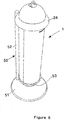
- Figure 6 shows the receptacle 1 in a closed position held by an alternative form of support means 50.
- the support means is in the form of a pedestal having a wide and preferably weighted base 51 together with a stand 52.
- the stand 52 has a loop (obscured in Figure 6 ), that could be a partial loop or a complete loop, which is adapted to fit under the flange 24 and hold the receptacle 1 in place.
- the base 51 includes a recess (obscured in Figure 6 ) that is adapted to receive the domed shaped bottom 53 (partially obscured in Figure 6 ) of receptacle 1.
- This support means 50 is therefore a stable and secure support option for the receptacle 1 in its preferred form having a domed bottom.
- Such support means also forming part of the invention to which the application is directed.
- the concave nature of the underside 26 of the flange 24 can assist in ease of carrying the bin.
- the flange 24 may also be adapted for use in storing the receptacles, or in stowing them for transport (not shown).
- a series of racks may be provided, for example in a truck or in a stand alone unit, which may allow the receptacles to be suspended from the racks via the flange 24.
- the racks may be substantially horizontal, and in contact with opposite sides of the receptacle via the flange.
- individual support means may be provided, which are adapted to receive the receptacles in a similar manner to the support means described above.
- Other options for stowage may be used as would be known in the art.
- the stowage options may take advantage of the locking mechanism 27 if required, for example in truck transportation where the loads in the truck may be required to be kept secure.
- the supporting means may be a claw shaped support which extends from the wall in which the receptacle may fit.
- the mounting surface to which the receptacle is attached is preferably a vertical wall.
- the apparatus could be attached to surfaces having curved or other angular aspects if needed.
- the combination of receptacle plus means support capable of being a kit.
- the receptacle may fit into an opening in a bench top so that the flange 24 abuts the bench top surface around the opening, thereby holding the upper portion of the receptacle 1 in an accessible position above the bench top.
- the lower portion of the receptacle 1 could be obscured below the bench top, for example by means of a cupboard or wall.
- Such alternative support means which exploit flange 24 and/or the shape of the receptacle 1 would be appreciated by persons skilled in the art.
- the base 21 of the receptacle 1 may be substantially flat, allowing the receptacle 1 to sit independently of a support means on the floor or other such surface.
- the domed shape of the base as shown in the Figures is however, preferred.
- the receptacle 1 may also be made of any suitable material and by manufacturing methods that would be well known in the art. When the receptacle is made of plastics material, these manufacturing methods would include blow or injection moulding techniques for example.
Landscapes
- Engineering & Computer Science (AREA)
- Mechanical Engineering (AREA)
- Refuse Receptacles (AREA)
- Closures For Containers (AREA)
Description
- The present invention relates to a waste disposal receptacle according to the preamble of
claim 1 and known fromUS-A-5 082 132 , for the disposal of rubbish or sanitary waste. - Many types of waste disposal receptacles are available, particularly receptacles that are designed for the disposal of women's sanitary products. Such bins are not generally emptied on site, but are taken away and replaced with a fresh bin, due to the hazardous nature of the waste.
- Sanitary bins are usually accessed via a flap which allows waste material to be placed into the receptacle. This requires that the user handles the bin around the area of access to the bin to expose the flap. This can also accumulate waste material in an area around the access to the receptacle which can be unsightly, and potentially a health hazard.
- Other types of receptacles are also available for disposal of food scraps and other such waste. Similar issues arise with these products as with sanitary bins, as food and other waste material can build up around the access area causing health issues for example.
- It is an object of the invention to provide a receptacle which overcomes or at least reduces some of the disadvantages of presently available receptacles or which at least provides the public with the useful alternative.
- Other objects of the invention may become apparent from the following description, which is given by way of example only.
-
EP 0853051 discloses a container for dispensing material held within it. It has an outer casing and a lid that can be slid in and out of the casing to reveal a slit that is large enough for the contents of the container to be removed through it. -
GB 2165530 -
US 5082132 discloses a sanitary waste bin having two symmetrically arranged barrels disposed immediately on each side of a main container. The barrels are covered with lids and an opening is provided in each barrel that appears to be closed when the barrels are covered with the lids. The lids can be lifted to open the openings. - According to this invention there is provided a waste disposal receptacle as defined in
independent claim 1; the receptacle includes a body and a lid; wherein the body is defined by a base, a side and an open top; and the lid is defined by a side, a top and an open base and includes an aperture in the side through which material can be deposited into the receptacle; the material when placed into the receptacle via the aperture falls through the open base of the lid and into the body; wherein the body and lid are cylindrical. According to the invention the interaction between the lid side and the body side forms a substantially airtight seal, wherein the side of the lid is adapted to be received within the body and is reversibly and telescopically movable between an open and closed position such that when the lid is in the closed position the aperture is covered by said body side and when the lid is in the open position, the aperture is exposed; wherein the lid is rotatable on the base to at least a limited extent; and, wherein the body includes a retention mechanism which prevents the lid from being readily removed from within the body. - Preferably the receptacle includes an opening means to assist a user in moving the lid from the closed to the open position.
- Preferably the opening means is a handle attached to the lid.
- Preferably the lid includes a lip which prevents the top of the lid from moving past the open top of the body.
- Preferably the body further includes an external support flange.
- Preferably the base of the body includes a domed or flat external surface.
- Preferably the flat external surface is adapted to support the receptacle in a free standing manner.
- Preferably the lid includes fastening means attached to the inside of the lid wall, the fastening means being adapted to allow attachment of freshness products inside the receptacle.
- Preferably the lid includes a lip situated above the aperture, the lip being adapted, when the receptacle is in the closed position, to abut the top of the body wall and to allow the aperture to be covered by the body wall.
- Preferably the lip is circumferential about the lid side.
- Preferably the lip is not circumferential but extends sufficiently about the lid side to extend at least the length of the aperture.
- According to another aspect of the present invention, a receptacle is provided together with a support means, wherein the receptacle further includes an external support flange, and the support means is adapted to interact with the external support flange to removably attach the receptacle to the support means.
- Preferably the support means is also attachable to a mounting surface.
- Preferably the mounting surface is a wall.
- Preferably the support means is a pedestal.
- This invention may be better understood with reference to the following Figures which illustrate preferred embodiments, in which:
- Figure 1:
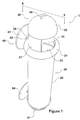
- shows a preferred embodiment of the invention in the open position with a first supporting means option.
- Figure 2:
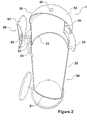
- shows a cross section through the axis X-X of the embodiment shown in
Figure 1 . - Figure 3:
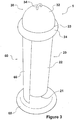
- shows the preferred embodiment of
Figure 1 in the closed position with a second supporting means option. - Figure 4:
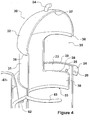
- shows an exploded and rotated cross section through the axis X-X of the embodiment shown in
Figure 1 . - Figure 5:
-
Figure 5 shows the preferred embodiment ofFigure 1 in the closed position during one form of transport. - Figure 6:
-
Figure 6 shows a preferred form of the invention together with an alternative support means. - The invention, in broad terms, provides a waste disposal receptacle for containing waste material. The receptacle may be especially suitable for use in rest rooms for the disposal of sanitary waste. The receptacle may also be used for the disposal of other types of rubbish including food scraps or other perishable wastes. The receptacle is adapted to be able to receive waste material with a reduced amount of contact between the user and the access to the receptacle, and is also adapted to be removed as a complete unit for later disposal of the waste material contained therein.
- A preferred embodiment of the invention is shown in
Figures 1 and2 . Areceptacle 1 is made up of abody 20 and alid 30. - The
body 20 is defined by abase 21 and aside 22. The body as shown in these Figures is cylindrical in shape thus including one continuous side. Thebase 21 is convex in shape when viewed from the outside of thereceptacle 1. Thebody 20 has an open top 23 (best seen inFigure 2 ). - The
lid 30 is defined by a lid side 31 (again cylindrical as shown in the Figures) and atop 32. The lid has an open base 33 (best seen inFigure 2 ). Thelid 30 includes anaperture 35 located in theside 31. Thelid side 31 is adapted to fit snugly within and adjacent thebody side 23 while allowing movement of thelid 30 relative to thebody 20 between an open and closed position. The interaction between thelid 30 and thebody 20 is telescopic in nature with thelid 30 being reciprocally movable as a whole in relation to thebody 20. Thebody side 22 and thelid side 31 lie adjacent each other in a manner that allows telescopic movement (or reciprocal movement) of thelid 30 relative to thebody 20.Figures 1 and2 shows thelid 30 in the open position. - When the
lid 30 is in the open position (as seen inFigures 1 and2 ), waste material can be deposited into thereceptacle 1 throughaperture 35. The waste material (not shown) is placed into thereceptacle 1 viaaperture 35 and falls through theopen base 33 of thelid 30 and into thebody 20 coming to rest at/or adjacent to theclosed base 21 of thebody 20. - As the
lid 30 is movable withinbody 20, any waste material that may adhere or otherwise become attached around, or to, theaperture 35 is held within thebody 20. This is important from a visual and hygiene aspect. Visually, it is unattractive to see waste material on the outside of the receptacle. Hygienically, the presence of such waste material is a problem as users could come into contact with that waste material, with consequent health risks. If thelid 30 plusaperture 35 was held outsidebody 20, then the unattractive visual and unhygienic aspects can readily occur. - The
lid 30 includes ahandle 34 at its apex. This handle 34 assists the user to move thelid 30 to an open position from a closed position. As will be readily apparent, thehandle 34 may be substituted by a variety of types of opening means which extend from the lid, such as loops, toggles or other such means. Preferably the handle 34 (or other forms of opening means) will be positioned away from theaperture 35 to minimise contact with the aperture by the operator when exposing theaperture 35. This allows for hygienic disposable of waste material without the operator coming into contact with any residual waste material which may have been left on the edges of or about the aperture by previous users. It also provides less surfaces which may be subject to soiling by waste material when waste is deposited. - The
handle 34 may be adapted to include a removable cover (not shown) for protection to impact or wear and tear during transport. The cover would preferably be snap-on to eliminate the need for fasteners or adhesives that would need replacing. Thehandle 34 may also be a variety of other shapes as will be appreciated by the skilled person. - Alternatively the
handle 34 could be replaced by a hands-free design, such as a foot pedal, or sensor operated touch-free system that would allow the user to move the lid to the open position without needing to contact the lid in any way. These options may be incorporated into the invention in a manner that would be well understood by persons skilled in the art. - As would be apparent to the skilled person there is a benefit in maintaining a substantially airtight seal (not shown) between the
lid side 31 and thebody side 22. This substantial airtight seal, formed by interaction between thelid side 31 and thebody side 22, allows movement, but minimises the air flow, between thelid side 31 andbody side 22. The substantially airtight seal may be formed by any suitable seal type such as frictional, or of a brushing or gasket type, as would be appreciated by persons skilled in the art. - The
base 21 andlid 30 together form a substantially cylindrical shape having one continuous side in each, and thebase 21 is substantially convex when viewed from the outside of thereceptacle 1. - The cylindrical shape of the
lid 30 andbody 20 and the convex shape of thebase 21 is the preferred configuration because there are no corners or recesses and it allows easy alignment when placing the receptacle within the support means. The telescopic nature of the relationship between thelid 30 and thebody 20 also minimises the existence of corners or recesses that occur with hinged lid systems and like options. This allows easier cleaning of the inside of the receptacle, and quicker more thorough and therefore more hygienic drying. With sanitary bins particularly such hygiene issues are extremely important. - Preferably the
body 20 is of a generally elongate shape. This allows a more ergonomic access to thereceptacle 1 from either a standing or seated position. The length and cylindrical shape of thebody 20 also allows for greater compaction of the waste material contents of thereceptacle 1 under its own weight. There are also a number of other advantages arising from the elongate shape, including a reduced visibility of the bottom portion of the receptacle and its contents, better utilisation of space. - As would be appreciated, the length of the
receptacle 1 could be adjusted as would be known by people skilled in the art, to accommodate varying environments for the receptacle to be used in, different applications of the receptacle and variations in servicing of thereceptacle 1 including frequency of servicing. While preferred, the elongate shape is not essential. - The
receptacle 1 as shown inFigures 1 and2 thebody 20 includes anexternal support flange 24. Theflange 24 preferably extends from thesides 22 of thebody 20, and is positioned adjacent to the open top 23. As best seen inFigure 2 , theflange 24 includes a concave shape to theunderside 26 of theflange 24. Theflange 24 encircles thebody 20 ofreceptacle 1. As will be appreciated theflange 24 need not be continuous and need not completely encircle thereceptacle 1. - The
flange 24 is also adapted to interact with a support means 60 to allow secure stowage of the receptacle. One option for a support means 60, a wall mounted support means, is shown inFigures 1 and2 . In this option, the support means 60 includes at least one wall mountedbase 61 attachable to a wall or other surface (not shown). Aprojection 62 extends from wall-mountedbase 61. A rail 63 (best seen inFigure 2 ) is connected to theprojection 62 and is adapted to releasably support thereceptacle 1. Thereceptacle 1 fits inside therail 63 and therail 63 abuts theconcave side 26 of theexternal support flange 24 thus holdingreceptacle 1 in position. As an additional option, theflange 24 could further be adapted to include a snap on protecting ring that could be used to reduce the effect of impacts or other damaging actions that can occur on transport of the receptacle. - The
receptacle 1 is easily removed from the support means 60 by lifting and can be simply swapped for a clean receptacle. The preferred elevated mounting of thereceptacle 1 on the wall also provides more ergonomic access for the user from either a standing or seated position. It also creates an uncluttered and pleasing usual effect of the receptacle floating in space above the floor. The height of the supportingmeans 60 on the wall or other appropriate surface can be positioned to suit the installation requirements of thereceptacle 1. - The
flange 24 also preferably includes a locking mechanism 27 (best shown inFigure 2 ) which interacts with theprojection 62 to hold thereceptacle 1 securely in place on the support means 60. Thelocking mechanism 27 may simply be a slot or groove in theflange 24 that fits releasably around theprojection 62 thus preventing movement of thereceptacle 1 around therail 63. A preferred embodiment of thelocking mechanism 27 is best seen inFigure 5 . Thelocking mechanism 27 could also include a device to prevent the receptacle from being lifted off the support means 60 if needed. Such devices would be known to a skilled person. - While the
flange 24 is represented in the Figures as being substantially circumferential, it is to be appreciated that theflange 24 need not extend around the full circumference and may include two or more spaced apart flanges, for example. - As seen in
Figures 1 and2 , there may also be more than one support means 60 used. The second support means 64 is adapted to hold thereceptacle 1 in place to prevent undue movement. - In
Figure 3 thereceptacle 1 is shown with thelid 30 in the closed position. In this position, the sides 31 (obscured inFigure 3 ) of thelid 30 are positioned below theopen top 23 of thebody 20. Theaperture 35 is therefore also below theopen top 23 ofbody 20 and lies adjacent to thesides 22 of the body. As aresult aperture 35 is inaccessible and not visible from the outside of the receptacle. This visual effect is important as it maintains the clean lines of the receptacle as a whole. In addition, as discussed earlier, theaperture 35 is within thebody 20, any waste material that may be visible about theaperture 35 is held within thebody 20. The receptacle is therefore more hygienic as waste material is within thereceptacle body 20, rather than on the outside of thereceptacle body 20 as would occur if the lid was positioned outside thebody 20. - An alternative option for support means is also shown in
Figure 3 . In this option, the support means 60 is a pedestal arrangement which includes of a base 65 adapted to sit on the floor or other such surface. The base will preferably be of any suitable heavy material to provide a low centre of gravity and thus provide stability. The base 65 may sit flat on the floor, or may include a plurality of feet (not shown). The feet would be in a configuration and number to maximise the stability of thereceptacle 1. - An
elongate extension 66 is engageable with the base 65 at one end and engageable with aprojection 62 at the other. The projection is attached to arail 63 as described inFigures 1 and2 . Thereceptacle 1 fits inside therail 63 and therail 63 abuts theconcave side 26 of theexternal support flange 24 thus holdingreceptacle 1 in position also as described inFigures 1 and2 . As will be appreciated, theelongate extension 66 would be of a sufficient length to allow the length of the receptacle to be supported above thebase 65 when the flange is supported by therail 63. Theelongate extension 66 may also be of sufficient height to leave space between the base 21 of thebody 20, and the top of thebase 65 of the supportingmeans 60 to allow easy cleaning of thebase 65 and the area around this. - The
elongate extension 66 can be of any shape or size as required, including for aesthetic requirements, as would be appreciated by persons skilled in the art. InFigure 3 , theelongate extension 66 is shown as a concave sheet which mirrors the shape of thebody 20. Theelongate extension 66 may preferably be of another configuration, for example a round pole (see alsoFigure 6 ) or a substantially rectangular shape. -
Figure 4 shows detail of thereceptacle 1 with thelid 30 in the open position. As can be seen, thebody 20 may also include aprotrusion 28 which acts as a retention mechanism that prevents thelid 30 from being completely removed from thebody 20 when moved into the open position. - In a preferred embodiment of the invention, the
protrusion 28 is positioned at the upper portion of thebody side 22. When thelid 30 is initially fitted intobody 20, thelid 30 is forced into position within thebody 20 by pressure exerted in the direction ofbase 21 of thebody 20. This forces thelid side 31 to ride over theprotrusion 28. Once thelid 30 is fitted into thebody 20, theprotrusion 28 sits within theaperture 35 as shown inFigure 4 . Thebottom edge 38 of theaperture 35 catches on theprotrusion 28, preventing thelid 30 from being easily removed from thebody 20. The sides ofaperture 35 prevent excess rotational movement. - As an alternative, the
lid wall 31 beneath the aperture 35 (shown at 39 onFigure 4 ) could include a channel (not shown) adapted to receive theprotrusion 28. The channel would increase the ease by which thelid 30 could be inserted intobody 20 over theprotrusion 28. As would be apparent to the skilled person, the channel may include a barrier to prevent thelid 30 from simply sliding out of thebody 20 via the channel. Alternatively thelid 30 could simply be rotated within thebody 30 to takeprotrusion 28 out of line with the channel. - The rotation of the
lid 30 also allows the position of theaperture 35 to be placed at an angle accessible to the position of the user. This is an additional distinct advantage of the telescopic nature of thereceptacle lid 30. In addition to advantages from a minimisation of corners and crevices resulting in hygiene advantages, the ability to rotate the lid thus allowing the user to adjust the position of theaperture 35 is a distinct advantage over the use of hinged or otherwise fixed lids. This allows greater utilisation of space while allowing ergonomic access to theaperture 35 by the user from either a seated or standing position. The rotation also ensures that theaperture 35 is easily accessible to the user when thelid 30 is in the open position, allowing for easy access of the waste into thereceptacle 1, while also ensuring that sight into thereceptacle 1 is minimised. As will be readily apparent, the ability to rotate thelid 30 to at least a limited extent will be restricted to those receptacles that are cylindrical or otherwise circular in shape such as shown in the preferred embodiments of the Figures. This at least partial rotatability is why the cylindrical option is a very much preferred option. It may also be an option however, to have top portion of thelid 30 rotatable while the lower sides of the lid are not. This may be an option in multisided receptacles but it is not preferred as, again, it will increase the amount of crevices in the device and will also add to cost. It is also a preferred option to have thelid 30 being rotatable only when in open position. - Also as seen in
Figure 4 , thelid 30 may include a circumferential lip 36 (also indicated inFigure 2 ) which extends from thelid 30 and is positioned above theaperture 35. When thelid 30 is in a closed position, thelip 36 abuts the body sides 22 to prevent thelid 30 from moving too far into thebody 20. Thelip 36 is preferably shaped to readily fit with the shape offlange 24. Thelip 36 is positioned high enough so that theaperture 35 is inaccessible when thelid 30 is in the closed position. This ensures that no waste material can escape, and that thereceptacle 1 is sealed when not in use to limit the extent of odours being released. The optional presence oflip 36 can further increase the hygienic advantages of thereceptacle 1. As will be appreciated, thelip 36 need not be completely circumferential. Other options to preventlid 30 movement into thebody 20 may also be used. - The
lid 30 may also include on the inside surface, for example at 37 inFigure 4 , a hook or other such fastening means to allow the attachment of freshness products. For example antibacterial scented quills which would allow a fresh scent to escape when thelid 30 is moved into the open position. Previously, such options were only able to be readily provided by placing freshness products in the base of the receptacle. This had the disadvantage that waste products would cover the freshness products limiting and interfering with the scent over time. The present invention allows the option of overcoming this distinct disadvantage. -
Figure 6 shows thereceptacle 1 in a closed position held by an alternative form of support means 50. The support means is in the form of a pedestal having a wide and preferably weightedbase 51 together with astand 52. Thestand 52 has a loop (obscured inFigure 6 ), that could be a partial loop or a complete loop, which is adapted to fit under theflange 24 and hold thereceptacle 1 in place. Thebase 51 includes a recess (obscured inFigure 6 ) that is adapted to receive the domed shaped bottom 53 (partially obscured inFigure 6 ) ofreceptacle 1. This support means 50 is therefore a stable and secure support option for thereceptacle 1 in its preferred form having a domed bottom. Such support means also forming part of the invention to which the application is directed. - With reference to
Figure 5 , the concave nature of theunderside 26 of theflange 24 can assist in ease of carrying the bin. Theflange 24 may also be adapted for use in storing the receptacles, or in stowing them for transport (not shown). A series of racks may be provided, for example in a truck or in a stand alone unit, which may allow the receptacles to be suspended from the racks via theflange 24. The racks may be substantially horizontal, and in contact with opposite sides of the receptacle via the flange. Alternatively, individual support means may be provided, which are adapted to receive the receptacles in a similar manner to the support means described above. Other options for stowage may be used as would be known in the art. The stowage options may take advantage of thelocking mechanism 27 if required, for example in truck transportation where the loads in the truck may be required to be kept secure. - While the above description describes preferred support means, alternatives may also be used. For example, the supporting means may be a claw shaped support which extends from the wall in which the receptacle may fit. As will be apparent the mounting surface to which the receptacle is attached is preferably a vertical wall. However the apparatus could be attached to surfaces having curved or other angular aspects if needed. The combination of receptacle plus means support capable of being a kit. Alternatively, the receptacle may fit into an opening in a bench top so that the
flange 24 abuts the bench top surface around the opening, thereby holding the upper portion of thereceptacle 1 in an accessible position above the bench top. The lower portion of thereceptacle 1 could be obscured below the bench top, for example by means of a cupboard or wall. Such alternative support means which exploitflange 24 and/or the shape of thereceptacle 1 would be appreciated by persons skilled in the art. - It would also be appreciated, that while less preferred, the
base 21 of thereceptacle 1 may be substantially flat, allowing thereceptacle 1 to sit independently of a support means on the floor or other such surface. The domed shape of the base as shown in the Figures is however, preferred. - The
receptacle 1 may also be made of any suitable material and by manufacturing methods that would be well known in the art. When the receptacle is made of plastics material, these manufacturing methods would include blow or injection moulding techniques for example. - Where the foregoing description there has been made reference to specific components or integers of the invention having known equivalents, then such equivalents are herein incorporated as if individually set forth.
- Although this invention has been described by way of example only and with reference to possible embodiments thereof, it is to be understood that modifications or improvements may be made without departing from the scope of the invention as defined in the attached claims.
Claims (14)
- A waste disposal receptacle (1) comprising a body (20) and a lid (30);wherein the body (20) is defined by a base (21), a side (22) and an open top (23); andthe lid (30) is defined by a side (31), a top (32) and an open base (33) and includes an aperture (35) in the side (31) through which material can be deposited into the receptacle (1); the material when placed into the receptacle (1) via the aperture (35) falls through the open base (33) of the lid (30) and into the body (20); and wherein the body (20) and lid (30) are cylindrical;characterised in that:the interaction between the lid side (31) and the body side (22) forms a substantially airtight seal;wherein the side of the lid (30) is adapted to be received within the body (20) and is reversibly and telescopically movable between an open and closed position such that when the lid (30) is in the closed position the aperture (35) is covered by said body side (22) and when the lid (30) is in the open position, the aperture (35) is exposed, wherein the lid (30) is rotatable on the base (21) to at least a limited extent; and, wherein the body (20) includes a retention mechanism which prevents the lid (30) from being readily removed from within the body (20).
- The receptacle (1) according to claim 1 including an opening means (34) to assist a user in moving the lid (30) from the closed to the open position.
- The receptacle (1) according to claim 2 wherein the opening means (34) is a handle attached to the lid (30).
- The receptacle (1) according to claim 1 wherein the lid (30) includes a lip (36) which prevents the top (32) of the lid (30) from moving past the open top (23) of the body (20) when the receptacle (1) is in the closed position.
- The receptacle (1) according to any one of the previous claims wherein the body (20) further includes an external support flange (24).
- The receptacle (1) according to any one of the previous claims wherein the base (21) of the body (20) includes a domed or flat external surface.
- The receptacle (1) according to claim 6 wherein the base (21) of the body (20) is flat and is adapted to support the receptacle (1) in a free standing manner.
- The receptacle (1) according to any one of the previous claims wherein the lid (30) includes fastening means attached to the inside of the lid side (31), the fastening means being adapted to allow attachment of freshness products inside the receptacle (1).
- The receptacle (1) according to claim 4 wherein the lip (36) is circumferential about the lid side (31).
- The receptacle (1) according to claim 4 wherein the lip (36) is not circumferential but extends sufficiently about the lid side (31) to extend at least the length of the aperture (35).
- The receptacle (1) according to any one of the previous claims together with a support means (60), wherein the receptacle body (20) further includes an external support flange (24), and the support means (60) is adapted to interact with the external support flange (24) to removably attach the receptacle (1) to the support means (60).
- The receptacle (1) according to claim 11 wherein the support means (60) is also attachable to a mounting surface.
- The receptacle (1) according to claim 11 wherein the support means (60) is a pedestal.
- The receptacle (1) according to claim 12 wherein the mounting surface is a wall.
Applications Claiming Priority (2)
| Application Number | Priority Date | Filing Date | Title |
|---|---|---|---|
| NZ533197A NZ533197A (en) | 2004-05-28 | 2004-05-28 | Waste disposal receptacle |
| PCT/NZ2005/000107 WO2005115882A1 (en) | 2004-05-28 | 2005-05-30 | Waste disposal receptacle |
Publications (3)
| Publication Number | Publication Date |
|---|---|
| EP1753677A1 EP1753677A1 (en) | 2007-02-21 |
| EP1753677A4 EP1753677A4 (en) | 2009-03-18 |
| EP1753677B1 true EP1753677B1 (en) | 2020-02-19 |
Family
ID=35450772
Family Applications (1)
| Application Number | Title | Priority Date | Filing Date |
|---|---|---|---|
| EP05747520.4A Expired - Lifetime EP1753677B1 (en) | 2004-05-28 | 2005-05-30 | Waste disposal receptacle |
Country Status (8)
| Country | Link |
|---|---|
| US (1) | US7798358B2 (en) |
| EP (1) | EP1753677B1 (en) |
| CN (1) | CN1906100A (en) |
| AU (1) | AU2005247828B2 (en) |
| CA (1) | CA2568424C (en) |
| NZ (1) | NZ533197A (en) |
| WO (1) | WO2005115882A1 (en) |
| ZA (1) | ZA200610709B (en) |
Families Citing this family (11)
| Publication number | Priority date | Publication date | Assignee | Title |
|---|---|---|---|---|
| EP2316285B1 (en) * | 2009-10-29 | 2013-05-01 | Quadria | Post acting as a container for small pieces of waste, in particular cigarette butts |
| US11142395B2 (en) * | 2013-06-04 | 2021-10-12 | Butler Concepts Limited | Sanitary containers |
| US9549616B2 (en) * | 2015-06-09 | 2017-01-24 | Schilligo Jerry F | Accessory holder |
| CN105501749B (en) * | 2016-01-07 | 2017-06-23 | 安庆市兴龙印业有限责任公司 | A kind of lavatory waste paper case |
| US11173098B1 (en) * | 2016-02-05 | 2021-11-16 | Gram Tactical Llc | Magazines for tactical medicine dispensers |
| GB2557672B (en) * | 2016-12-15 | 2019-10-16 | Woosh Washrooms | Sanitary apparatus |
| USD837473S1 (en) | 2017-04-11 | 2019-01-01 | Magnuson Group, Inc. | Waste receptacle |
| US10543982B2 (en) | 2017-05-23 | 2020-01-28 | Magnuson Group Inc. | Waste receptacle |
| EP3644887B1 (en) | 2017-06-30 | 2023-07-26 | Stryker Corporation | Waste disposal system and waste receiver for receiving and disposing of pharmaceutical waste material |
| WO2020139946A1 (en) | 2018-12-27 | 2020-07-02 | Stryker Corporation | Method of disposing of waste receiver, waste receiver for pharmaceutical waste and method of assembling the waste receiver |
| USD893821S1 (en) * | 2017-08-02 | 2020-08-18 | Woosh Washrooms | Sanitary bin |
Family Cites Families (33)
| Publication number | Priority date | Publication date | Assignee | Title |
|---|---|---|---|---|
| US575621A (en) * | 1897-01-19 | smith | ||
| US1023276A (en) * | 1911-04-24 | 1912-04-16 | Frank L Rouse | Trick cigar-case. |
| US1506273A (en) * | 1923-05-04 | 1924-08-26 | Herbert E Smith | Sliver can |
| US2214437A (en) * | 1939-10-04 | 1940-09-10 | Continental Can Co | Dispensing container |
| US2367019A (en) * | 1944-06-02 | 1945-01-09 | Charles J Haag | Dispensing package |
| US2763395A (en) * | 1952-06-06 | 1956-09-18 | Airkem Inc | Diffuser devices |
| US2759625A (en) * | 1954-06-17 | 1956-08-21 | Ritter John | Refuse container |
| US3105592A (en) * | 1961-05-18 | 1963-10-01 | Cohen William | Telescopic form containers and dispensers |
| US3286872A (en) * | 1964-03-06 | 1966-11-22 | Jr Ralph V Burdick | Expandable box with non-removable cover |
| US3286717A (en) * | 1965-10-13 | 1966-11-22 | Lester A Teegardin | Coin holder |
| US3762539A (en) * | 1971-07-22 | 1973-10-02 | G Kerr | Pill dispenser |
| US3791514A (en) * | 1972-01-24 | 1974-02-12 | Designers Q Inc | Container for film magazine |
| US4234093A (en) * | 1979-05-21 | 1980-11-18 | Tyson Raymond K | Pill dispenser with safety features |
| US4261461A (en) * | 1979-09-10 | 1981-04-14 | Mateflex/Mele Corporation | Shadow box shipping/display container |
| US4353379A (en) * | 1981-03-06 | 1982-10-12 | Rafael Castellanos | Portable personal ash receiver |
| GB8422881D0 (en) * | 1984-09-11 | 1984-10-17 | Chudzikowski R J | Closure device |
| US4618444A (en) * | 1984-09-17 | 1986-10-21 | Purex Corporation | Household laundry detergent with dual strength bleach |
| US4544063A (en) * | 1984-10-05 | 1985-10-01 | Neward Lance M | Closure for receptacle |
| US5082132A (en) * | 1989-12-15 | 1992-01-21 | Tsai Wei C | Sanitary trash bin |
| US5213294A (en) * | 1992-03-18 | 1993-05-25 | Debord Walter J | Locking support for refuse can |
| US5651231A (en) * | 1994-08-26 | 1997-07-29 | Garland; Thomas A. | Valving |
| JPH08157004A (en) | 1994-12-02 | 1996-06-18 | Matsushita Electric Ind Co Ltd | Waste container |
| US5620109A (en) * | 1995-06-26 | 1997-04-15 | Madden; Mark L. | Asymmetrical portable dispenser |
| US5608940A (en) * | 1995-08-07 | 1997-03-11 | L.A.P. Innovations, Inc. | Combination toothbrush and storage/dispenser apparatus and method of making the same thereof |
| DE19700822A1 (en) * | 1997-01-13 | 1998-07-16 | 4 P Nicolaus Kempten Gmbh | container |
| US5915560A (en) * | 1997-05-03 | 1999-06-29 | George; Donald C. | Compartmentalized pill dispenser |
| US6267461B1 (en) * | 1998-06-23 | 2001-07-31 | James L. Dunagan | Sport ball storage apparatus and method for storing and dispensing a sport ball |
| DE10108884A1 (en) | 2001-02-15 | 2002-09-05 | Christoph Obst | Waste bin has lid with opening which is closed by flap which rotates about axis which is at angle to vertical |
| US6364147B1 (en) * | 2001-05-04 | 2002-04-02 | Creative Bath Products, Inc | Waste can with concealed waste bag and swing-open lid |
| US20040026420A1 (en) * | 2002-08-01 | 2004-02-12 | Huhtamaki Consumer Packaging, Inc. | Rotatable dispenser closure for use with a container |
| US7007818B2 (en) * | 2002-12-09 | 2006-03-07 | Laura Ann Martin | Container assembly |
| USD495250S1 (en) * | 2003-02-27 | 2004-08-31 | Historic Originals Limited | Elliptical box |
| EP1500613A1 (en) | 2003-07-21 | 2005-01-26 | PHF Creation, Société à Responsabilité Limitée | Refuse receptacle, particularly for use in public areas |
-
2004
- 2004-05-28 NZ NZ533197A patent/NZ533197A/en not_active IP Right Cessation
-
2005
- 2005-05-30 AU AU2005247828A patent/AU2005247828B2/en not_active Ceased
- 2005-05-30 WO PCT/NZ2005/000107 patent/WO2005115882A1/en not_active Ceased
- 2005-05-30 US US11/597,788 patent/US7798358B2/en not_active Expired - Lifetime
- 2005-05-30 CA CA2568424A patent/CA2568424C/en not_active Expired - Lifetime
- 2005-05-30 EP EP05747520.4A patent/EP1753677B1/en not_active Expired - Lifetime
- 2005-05-30 CN CNA2005800017533A patent/CN1906100A/en active Pending
-
2006
- 2006-12-19 ZA ZA2006/10709A patent/ZA200610709B/en unknown
Non-Patent Citations (1)
| Title |
|---|
| None * |
Also Published As
| Publication number | Publication date |
|---|---|
| WO2005115882A1 (en) | 2005-12-08 |
| EP1753677A1 (en) | 2007-02-21 |
| ZA200610709B (en) | 2008-05-28 |
| US20080087668A1 (en) | 2008-04-17 |
| CA2568424A1 (en) | 2005-12-08 |
| CA2568424C (en) | 2013-07-30 |
| AU2005247828B2 (en) | 2011-06-23 |
| AU2005247828A1 (en) | 2005-12-08 |
| US7798358B2 (en) | 2010-09-21 |
| NZ533197A (en) | 2006-10-27 |
| CN1906100A (en) | 2007-01-31 |
| EP1753677A4 (en) | 2009-03-18 |
Similar Documents
| Publication | Publication Date | Title |
|---|---|---|
| US5718168A (en) | Trash and recycling center | |
| US6705575B1 (en) | Disposable bag with stand | |
| US6199714B1 (en) | Waste receptacle with swept debris pick up and features to maximize convenient use of receptacle liners | |
| US6179151B1 (en) | Garbage container | |
| US5163579A (en) | Trash receptacle with retractable foot pedal | |
| US7086569B2 (en) | All-purpose dispenser | |
| US7798358B2 (en) | Waste disposal receptacle | |
| JP3459802B2 (en) | Container with dispensing assembly | |
| US4655373A (en) | Water pitcher | |
| CA2624663C (en) | Refuse container | |
| US20080173648A1 (en) | Trash receptacle with bag retention system | |
| US4893719A (en) | Compartmentalized separating container | |
| EP1923333A1 (en) | Trash can assembly | |
| MX2008002714A (en) | Dispensing and disposal container. | |
| US20200290798A1 (en) | Receptacle and its method of manufacture | |
| GB2145617A (en) | Refuse receptacle | |
| US3643266A (en) | Portable waste receptacle | |
| US20110220654A1 (en) | Trash can with an adjustable draft compartment apparatus | |
| US3075692A (en) | Wall hung trash receptacle | |
| EP2768748B1 (en) | Vented receptacle for storing a plurality of waste types | |
| CA2476169A1 (en) | Garbage tray for countertop | |
| BE1032305B1 (en) | Bin | |
| KR100892076B1 (en) | Kitchen waste bins | |
| CA1272706A (en) | Counter top waste disposal unit | |
| CA2331938A1 (en) | Collapsible bag holder |
Legal Events
| Date | Code | Title | Description |
|---|---|---|---|
| PUAI | Public reference made under article 153(3) epc to a published international application that has entered the european phase |
Free format text: ORIGINAL CODE: 0009012 |
|
| 17P | Request for examination filed |
Effective date: 20061227 |
|
| AK | Designated contracting states |
Kind code of ref document: A1 Designated state(s): AT BE BG CH CY CZ DE DK EE ES FI FR GB GR HU IE IS IT LI LT LU MC NL PL PT RO SE SI SK TR |
|
| DAX | Request for extension of the european patent (deleted) | ||
| REG | Reference to a national code |
Ref country code: HK Ref legal event code: DE Ref document number: 1100918 Country of ref document: HK |
|
| RAP1 | Party data changed (applicant data changed or rights of an application transferred) |
Owner name: FUMACARE LIMITED |
|
| A4 | Supplementary search report drawn up and despatched |
Effective date: 20090212 |
|
| 17Q | First examination report despatched |
Effective date: 20110512 |
|
| RAP1 | Party data changed (applicant data changed or rights of an application transferred) |
Owner name: BUTLER CONCEPTS LIMITED |
|
| STAA | Information on the status of an ep patent application or granted ep patent |
Free format text: STATUS: EXAMINATION IS IN PROGRESS |
|
| GRAP | Despatch of communication of intention to grant a patent |
Free format text: ORIGINAL CODE: EPIDOSNIGR1 |
|
| STAA | Information on the status of an ep patent application or granted ep patent |
Free format text: STATUS: GRANT OF PATENT IS INTENDED |
|
| INTG | Intention to grant announced |
Effective date: 20190717 |
|
| GRAJ | Information related to disapproval of communication of intention to grant by the applicant or resumption of examination proceedings by the epo deleted |
Free format text: ORIGINAL CODE: EPIDOSDIGR1 |
|
| GRAL | Information related to payment of fee for publishing/printing deleted |
Free format text: ORIGINAL CODE: EPIDOSDIGR3 |
|
| STAA | Information on the status of an ep patent application or granted ep patent |
Free format text: STATUS: EXAMINATION IS IN PROGRESS |
|
| GRAS | Grant fee paid |
Free format text: ORIGINAL CODE: EPIDOSNIGR3 |
|
| GRAR | Information related to intention to grant a patent recorded |
Free format text: ORIGINAL CODE: EPIDOSNIGR71 |
|
| STAA | Information on the status of an ep patent application or granted ep patent |
Free format text: STATUS: GRANT OF PATENT IS INTENDED |
|
| INTC | Intention to grant announced (deleted) | ||
| GRAA | (expected) grant |
Free format text: ORIGINAL CODE: 0009210 |
|
| STAA | Information on the status of an ep patent application or granted ep patent |
Free format text: STATUS: THE PATENT HAS BEEN GRANTED |
|
| INTG | Intention to grant announced |
Effective date: 20200106 |
|
| AK | Designated contracting states |
Kind code of ref document: B1 Designated state(s): AT BE BG CH CY CZ DE DK EE ES FI FR GB GR HU IE IS IT LI LT LU MC NL PL PT RO SE SI SK TR |
|
| REG | Reference to a national code |
Ref country code: GB Ref legal event code: FG4D |
|
| REG | Reference to a national code |
Ref country code: CH Ref legal event code: EP |
|
| REG | Reference to a national code |
Ref country code: DE Ref legal event code: R096 Ref document number: 602005056630 Country of ref document: DE |
|
| REG | Reference to a national code |
Ref country code: AT Ref legal event code: REF Ref document number: 1234717 Country of ref document: AT Kind code of ref document: T Effective date: 20200315 |
|
| REG | Reference to a national code |
Ref country code: IE Ref legal event code: FG4D |
|
| REG | Reference to a national code |
Ref country code: NL Ref legal event code: MP Effective date: 20200219 |
|
| PG25 | Lapsed in a contracting state [announced via postgrant information from national office to epo] |
Ref country code: FI Free format text: LAPSE BECAUSE OF FAILURE TO SUBMIT A TRANSLATION OF THE DESCRIPTION OR TO PAY THE FEE WITHIN THE PRESCRIBED TIME-LIMIT Effective date: 20200219 |
|
| REG | Reference to a national code |
Ref country code: LT Ref legal event code: MG4D |
|
| PG25 | Lapsed in a contracting state [announced via postgrant information from national office to epo] |
Ref country code: IS Free format text: LAPSE BECAUSE OF FAILURE TO SUBMIT A TRANSLATION OF THE DESCRIPTION OR TO PAY THE FEE WITHIN THE PRESCRIBED TIME-LIMIT Effective date: 20200619 Ref country code: BG Free format text: LAPSE BECAUSE OF FAILURE TO SUBMIT A TRANSLATION OF THE DESCRIPTION OR TO PAY THE FEE WITHIN THE PRESCRIBED TIME-LIMIT Effective date: 20200519 Ref country code: GR Free format text: LAPSE BECAUSE OF FAILURE TO SUBMIT A TRANSLATION OF THE DESCRIPTION OR TO PAY THE FEE WITHIN THE PRESCRIBED TIME-LIMIT Effective date: 20200520 Ref country code: SE Free format text: LAPSE BECAUSE OF FAILURE TO SUBMIT A TRANSLATION OF THE DESCRIPTION OR TO PAY THE FEE WITHIN THE PRESCRIBED TIME-LIMIT Effective date: 20200219 |
|
| PG25 | Lapsed in a contracting state [announced via postgrant information from national office to epo] |
Ref country code: NL Free format text: LAPSE BECAUSE OF FAILURE TO SUBMIT A TRANSLATION OF THE DESCRIPTION OR TO PAY THE FEE WITHIN THE PRESCRIBED TIME-LIMIT Effective date: 20200219 |
|
| PG25 | Lapsed in a contracting state [announced via postgrant information from national office to epo] |
Ref country code: DK Free format text: LAPSE BECAUSE OF FAILURE TO SUBMIT A TRANSLATION OF THE DESCRIPTION OR TO PAY THE FEE WITHIN THE PRESCRIBED TIME-LIMIT Effective date: 20200219 Ref country code: EE Free format text: LAPSE BECAUSE OF FAILURE TO SUBMIT A TRANSLATION OF THE DESCRIPTION OR TO PAY THE FEE WITHIN THE PRESCRIBED TIME-LIMIT Effective date: 20200219 Ref country code: SK Free format text: LAPSE BECAUSE OF FAILURE TO SUBMIT A TRANSLATION OF THE DESCRIPTION OR TO PAY THE FEE WITHIN THE PRESCRIBED TIME-LIMIT Effective date: 20200219 Ref country code: PT Free format text: LAPSE BECAUSE OF FAILURE TO SUBMIT A TRANSLATION OF THE DESCRIPTION OR TO PAY THE FEE WITHIN THE PRESCRIBED TIME-LIMIT Effective date: 20200712 Ref country code: CZ Free format text: LAPSE BECAUSE OF FAILURE TO SUBMIT A TRANSLATION OF THE DESCRIPTION OR TO PAY THE FEE WITHIN THE PRESCRIBED TIME-LIMIT Effective date: 20200219 Ref country code: ES Free format text: LAPSE BECAUSE OF FAILURE TO SUBMIT A TRANSLATION OF THE DESCRIPTION OR TO PAY THE FEE WITHIN THE PRESCRIBED TIME-LIMIT Effective date: 20200219 Ref country code: RO Free format text: LAPSE BECAUSE OF FAILURE TO SUBMIT A TRANSLATION OF THE DESCRIPTION OR TO PAY THE FEE WITHIN THE PRESCRIBED TIME-LIMIT Effective date: 20200219 Ref country code: LT Free format text: LAPSE BECAUSE OF FAILURE TO SUBMIT A TRANSLATION OF THE DESCRIPTION OR TO PAY THE FEE WITHIN THE PRESCRIBED TIME-LIMIT Effective date: 20200219 |
|
| REG | Reference to a national code |
Ref country code: AT Ref legal event code: MK05 Ref document number: 1234717 Country of ref document: AT Kind code of ref document: T Effective date: 20200219 |
|
| REG | Reference to a national code |
Ref country code: DE Ref legal event code: R097 Ref document number: 602005056630 Country of ref document: DE |
|
| REG | Reference to a national code |
Ref country code: DE Ref legal event code: R119 Ref document number: 602005056630 Country of ref document: DE |
|
| PLBE | No opposition filed within time limit |
Free format text: ORIGINAL CODE: 0009261 |
|
| STAA | Information on the status of an ep patent application or granted ep patent |
Free format text: STATUS: NO OPPOSITION FILED WITHIN TIME LIMIT |
|
| REG | Reference to a national code |
Ref country code: HK Ref legal event code: WD Ref document number: 1100918 Country of ref document: HK |
|
| 26N | No opposition filed |
Effective date: 20201120 |
|
| PG25 | Lapsed in a contracting state [announced via postgrant information from national office to epo] |
Ref country code: MC Free format text: LAPSE BECAUSE OF FAILURE TO SUBMIT A TRANSLATION OF THE DESCRIPTION OR TO PAY THE FEE WITHIN THE PRESCRIBED TIME-LIMIT Effective date: 20200219 Ref country code: IT Free format text: LAPSE BECAUSE OF FAILURE TO SUBMIT A TRANSLATION OF THE DESCRIPTION OR TO PAY THE FEE WITHIN THE PRESCRIBED TIME-LIMIT Effective date: 20200219 Ref country code: CH Free format text: LAPSE BECAUSE OF NON-PAYMENT OF DUE FEES Effective date: 20200531 Ref country code: LI Free format text: LAPSE BECAUSE OF NON-PAYMENT OF DUE FEES Effective date: 20200531 Ref country code: AT Free format text: LAPSE BECAUSE OF FAILURE TO SUBMIT A TRANSLATION OF THE DESCRIPTION OR TO PAY THE FEE WITHIN THE PRESCRIBED TIME-LIMIT Effective date: 20200219 |
|
| PG25 | Lapsed in a contracting state [announced via postgrant information from national office to epo] |
Ref country code: SI Free format text: LAPSE BECAUSE OF FAILURE TO SUBMIT A TRANSLATION OF THE DESCRIPTION OR TO PAY THE FEE WITHIN THE PRESCRIBED TIME-LIMIT Effective date: 20200219 Ref country code: PL Free format text: LAPSE BECAUSE OF FAILURE TO SUBMIT A TRANSLATION OF THE DESCRIPTION OR TO PAY THE FEE WITHIN THE PRESCRIBED TIME-LIMIT Effective date: 20200219 |
|
| REG | Reference to a national code |
Ref country code: BE Ref legal event code: MM Effective date: 20200531 |
|
| PG25 | Lapsed in a contracting state [announced via postgrant information from national office to epo] |
Ref country code: LU Free format text: LAPSE BECAUSE OF NON-PAYMENT OF DUE FEES Effective date: 20200530 |
|
| PG25 | Lapsed in a contracting state [announced via postgrant information from national office to epo] |
Ref country code: IE Free format text: LAPSE BECAUSE OF NON-PAYMENT OF DUE FEES Effective date: 20200530 Ref country code: FR Free format text: LAPSE BECAUSE OF NON-PAYMENT OF DUE FEES Effective date: 20200531 |
|
| PG25 | Lapsed in a contracting state [announced via postgrant information from national office to epo] |
Ref country code: BE Free format text: LAPSE BECAUSE OF NON-PAYMENT OF DUE FEES Effective date: 20200531 Ref country code: DE Free format text: LAPSE BECAUSE OF NON-PAYMENT OF DUE FEES Effective date: 20201201 |
|
| PG25 | Lapsed in a contracting state [announced via postgrant information from national office to epo] |
Ref country code: TR Free format text: LAPSE BECAUSE OF FAILURE TO SUBMIT A TRANSLATION OF THE DESCRIPTION OR TO PAY THE FEE WITHIN THE PRESCRIBED TIME-LIMIT Effective date: 20200219 Ref country code: CY Free format text: LAPSE BECAUSE OF FAILURE TO SUBMIT A TRANSLATION OF THE DESCRIPTION OR TO PAY THE FEE WITHIN THE PRESCRIBED TIME-LIMIT Effective date: 20200219 |
|
| PGFP | Annual fee paid to national office [announced via postgrant information from national office to epo] |
Ref country code: GB Payment date: 20240502 Year of fee payment: 20 |
|
| REG | Reference to a national code |
Ref country code: GB Ref legal event code: PE20 Expiry date: 20250529 |
|
| PG25 | Lapsed in a contracting state [announced via postgrant information from national office to epo] |
Ref country code: GB Free format text: LAPSE BECAUSE OF EXPIRATION OF PROTECTION Effective date: 20250529 |