EP1753264B1 - Hörvorrichtung und Verfahren zum Bestimmen einer Raumakustik - Google Patents
Hörvorrichtung und Verfahren zum Bestimmen einer Raumakustik Download PDFInfo
- Publication number
- EP1753264B1 EP1753264B1 EP06118364A EP06118364A EP1753264B1 EP 1753264 B1 EP1753264 B1 EP 1753264B1 EP 06118364 A EP06118364 A EP 06118364A EP 06118364 A EP06118364 A EP 06118364A EP 1753264 B1 EP1753264 B1 EP 1753264B1
- Authority
- EP
- European Patent Office
- Prior art keywords
- hearing aid
- room
- sound
- hearing
- acoustics
- Prior art date
- Legal status (The legal status is an assumption and is not a legal conclusion. Google has not performed a legal analysis and makes no representation as to the accuracy of the status listed.)
- Not-in-force
Links
Images
Classifications
-
- H—ELECTRICITY
- H04—ELECTRIC COMMUNICATION TECHNIQUE
- H04R—LOUDSPEAKERS, MICROPHONES, GRAMOPHONE PICK-UPS OR LIKE ACOUSTIC ELECTROMECHANICAL TRANSDUCERS; ELECTRIC HEARING AIDS; PUBLIC ADDRESS SYSTEMS
- H04R25/00—Electric hearing aids
- H04R25/70—Adaptation of deaf aid to hearing loss, e.g. initial electronic fitting
-
- H—ELECTRICITY
- H04—ELECTRIC COMMUNICATION TECHNIQUE
- H04R—LOUDSPEAKERS, MICROPHONES, GRAMOPHONE PICK-UPS OR LIKE ACOUSTIC ELECTROMECHANICAL TRANSDUCERS; ELECTRIC HEARING AIDS; PUBLIC ADDRESS SYSTEMS
- H04R2225/00—Details of deaf aids covered by H04R25/00, not provided for in any of its subgroups
- H04R2225/41—Detection or adaptation of hearing aid parameters or programs to listening situation, e.g. pub, forest
Definitions
- the present invention relates to a hearing aid with a sound output device for sonicating a user's hearing. Moreover, the present invention relates to a method for adjusting the hearing aid.
- test mode it measures the transfer function of the human ear by means of an acoustic test program and then adjusts its own transfer function so that it takes into account the measured values.
- normal operation the adapted transfer function attempts to compensate for the weaknesses of its wearer's hearing.
- a disadvantage is that an adaptation to the surrounding room acoustics does not take place.
- the publication WO 2004/097350 A2 describes a method for determining a dimension, volume or absorption coefficient of a room using an acoustic signal emitted from a specific source in the room. This requires complex optimization methods such as simulated annealing and genetic algorithms. These algorithms run in a separate system and the resulting results are optionally transmitted to the hearing aid for adjustment.
- test mode the position of the unit with respect to the subject is determined via an ultrasonic transmission path.
- normal operation signals of variable frequency and intensity are transmitted to the subject via an acoustic path in the audible range, which returns an evaluation of the signals heard.
- the object of the present invention is therefore to provide a hearing aid whose signal processing properties can be adapted to the respective room acoustics.
- a corresponding method for adapting a hearing aid to the room acoustics should be provided.
- a hearing device comprising a first sound output device for sonicating a user, a second sound output device, which differs from the first sound output device, for outputting a test sound into a room in which the hearing device is located, the test sound is generated in the ultrasonic range, and a receiving device for receiving a response to the test sound from the room.
- the hearing device further has an analysis device for determining a room acoustics or a corresponding room acoustics information as a function of the reception device received response.
- This room acoustics information can be used internally or transmitted to the outside.
- the signal processing device of the hearing device is also adjustable by the analysis device according to the determined room acoustics information.
- the signal processing can be better adapted to the current acoustic situation for the hearing impaired.
- a method for adapting a hearing device to room acoustics by outputting a test sound through a hearing device into a room in which the hearing device is located, the test sound being generated in the ultrasound area, receiving a response to the test sound from the room the hearing aid and determining information about the room acoustics from the answer.
- the information about the room acoustics is determined internally by the hearing aid and based on this information, the signal processing of the hearing aid is set.
- information about the room acoustics can thus be obtained by the hearing device. This can then be further processed internally or externally.
- the hearing aid according to the invention has a signal generator for generating a test sound.
- the test sound does not have to be generated by the usual signal processing device that is present in each hearing aid, so that processing capacity can be saved.
- the signal generator may be arranged together with the signal processing device of the hearing device on a single electronic chip. This reduces the manufacturing costs for electronics of the entire hearing aid.
- the generation of the test sound in the ultrasonic range has the advantage that for measuring the room acoustics no audible sound is used, which can be perceived by the user of the hearing aid.
- the second sound output device of the hearing device according to the invention may have a membrane speaker.
- a standard component element can be used to generate the test sound.
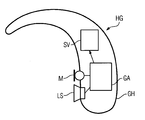
- the illustrated hearing aid HG has a signal generator and signal analyzer GA.
- a loudspeaker LS is connected, which is arranged on the surface of the hearing aid housing GH.
- the signal generator GA and the loudspeaker LS thus constitute an acoustic signal transmitter, which is installed in the hearing device or its housing GH and is suitable for emitting an acoustic test signal in the ultrasonic range.
- the sound emitted by the loudspeaker LS reflects on the walls and objects of a room and thus transforms into a room response which can be recorded by a microphone M of the hearing aid HG.
- This microphone M may be a conventional hearing aid microphone, but also a microphone provided specifically for recording room responses for determining the room acoustics.
- the recorded spatial response is electrically converted in the microphone M and sent to the signal generator and analyzer GA. There it is examined in terms of room acoustics peculiarities, for example, whether the room is very echoing. The analysis then leads to room acoustics information, with which different room acoustics can be divided into different classes.
- the hearing aid-internal signal processing SV is activated. This means that the signal processing algorithm is set according to the room acoustics. Consequently, the signal processing in the hearing aid HG is optimized for the current room acoustics. This increases the quality of the automatic adjustment of the hearing aid.
- the acquisition of the room acoustics information and an automatic adaptation based thereon can be used not only for hearing aids but also for other hearing devices such as, for example, headsets, headphones and the like (which, however, is not claimed here).
Landscapes
- Health & Medical Sciences (AREA)
- General Health & Medical Sciences (AREA)
- Neurosurgery (AREA)
- Otolaryngology (AREA)
- Physics & Mathematics (AREA)
- Engineering & Computer Science (AREA)
- Acoustics & Sound (AREA)
- Signal Processing (AREA)
- Circuit For Audible Band Transducer (AREA)
- Measurement Of The Respiration, Hearing Ability, Form, And Blood Characteristics Of Living Organisms (AREA)
- Measuring Pulse, Heart Rate, Blood Pressure Or Blood Flow (AREA)
- Stereophonic System (AREA)
Description
- Die vorliegende Erfindung betrifft ein Hörgerät, mit einer Schallausgabeeinrichtung zum Beschallen des Gehörs eines Nutzers. Darüber hinaus betrifft die vorliegende Erfindung ein Verfahren zur Anpassung des Hörgeräts.
- Räumlichkeiten, in denen sich ein Schwerhöriger befindet, haben sehr häufig einen wichtigen Einfluss auf den Nutzen von Hörgeräten. So kann ein Hörgeräteträger beispielsweise in einem hallenden Raum von bestimmten Signalverarbeitungsalgorithmen stärker profitieren, als in einem sehr kleinen Raum. Das Problem liegt also darin, die für eine bestimmte Raumakustik am besten geeignete Signalverarbeitung auszuwählen.
- So weit wie möglich wird bisweilen dieses Problem beispielsweise durch den Einsatz eines Klassifikators gelöst. Dabei wird allerdings nur die akustische Situation, also z. B. Musik oder Sprache in Störlärm, ausgewertet. Die Raumakustik als solche wird hierbei nicht berücksichtigt. Es besteht jedoch ein fundamentaler Unterschied, ob beispielsweise Musik in einem kleinen Raum oder in einer großen Halle gehört wird.
- Die Druckschrift
US-A-4 471 171 beschreibt ein adaptives Hörgerät. Dieses hat zwei Arbeitsmodi: Test- und Normal-Betrieb. Im Testbetrieb vermisst es die Übertragungsfunktion des menschlichen Ohrs mittels eines akustischen Testprogramms und passt anschließend die eigene Übertragungsfunktion so an, dass es den gemessenen Werten Rechnung trägt. Im Normalbetrieb versucht die angepasste Übertragungsfunktion die Schwächen des Gehörs seines Trägers zu kompensieren. Ein Nachteil ist, dass eine Anpassung an die umgebende Raumakustik nicht statt findet. - Die Druckschrift
WO 2004/097350 A2 beschreibt ein Verfahren zur Ermittlung einer Dimension, eines Volumens oder eines Absorptionskoeffizienten eines Raums mithilfe eines akustischen Signals, das von einer speziellen Quelle in dem Raum ausgesandt wird. Dazu sind komplexe Optimierungsmethoden wie Simulated Annealing und Genetische Algorithmen erforderlich. Diese Algorithmen laufen in einem separaten System ab und die resultierenden Ergebnisse werden gegebenenfalls zur Einstellung eines Hörgeräts an dieses übertragen. - Die Druckschrift
WO 01/022777 A1 - Die Aufgabe der vorliegenden Erfindung besteht somit darin, ein Hörgerät bereitzustellen, dessen dessen Signalverarbeitungseigenschaften an die jeweilige Raumakustik anpassbar sind. Darüber hinaus soll ein entsprechendes Verfahren zur Anpassung eines Hörgeräts an die Raumakustik bereitgestellt werden.
- Erfindungsgemäß wird diese Aufgabe gelöst durch ein Hörgerät, umfassend eine erste Schallausgabeeinrichtung zum Beschallen des Gehörs eines Nutzers, eine zweite Schallausgabeeinrichtung, die sich von der ersten Schallausgabeeinrichtung unterscheidet, zum Ausgeben eines Testschalls in einen Raum, in dem sich das Hörgerät befindet, wobei der Testschall im Ultraschallbereich erzeugt wird, und eine Empfangseinrichtung zum Empfangen einer Antwort auf den Testschall aus dem Raum.
- Das Hörgerät weist ferner eine Analyseeinrichtung zum Ermitteln einer Raumakustik bzw. einer entsprechenden Raumakustikinformation in Abhängigkeit von der in der Empfangseinrichtung empfangenen Antwort auf. Diese Raumakustikinformation kann intern genutzt oder nach außen übertragen werden. Die Signalverarbeitungseinrichtung des Hörgeräts ist darüber hinaus durch die Analyseeinrichtung entsprechend der ermittelten Raumakustikinformation einstellbar. In vorteilhafter Weise kann somit die Signalverarbeitung besser an die aktuelle akustische Situation für den Schwerhörigen angepasst werden.
- Des Weiteren wird erfindungsgemäß ein Verfahren bereitgestellt zur Anpassung eines Hörgeräts an die Raumakustik mittels Ausgeben eines Testschalls durch ein Hörgerät in einen Raum, in dem sich das Hörgerät befindet, wobei der Testschall im Ultraschallbereich erzeugt wird, Empfangen einer Antwort auf den Testschall aus dem Raum durch das Hörgerät und Bestimmen einer Information über die Raumakustik aus der Antwort. Die Information über die Raumakustik wird durch das Hörgerät intern bestimmt und aufgrund dieser Information wird die Signalverarbeitung des Hörgeräts eingestellt.
- In vorteilhafter Weise kann somit durch das Hörgerät eine Information über die Raumakustik gewonnen werden. Diese lässt sich dann intern oder extern weiterverarbeiten.
- Vorzugsweise besitzt das erfindungsgemäße Hörgerät einen Signalgenerator zum Erzeugen eines Testschalls. Damit muss der Testschall nicht über die übliche Signalverarbeitungseinrichtung, die in jedem Hörgerät vorhanden ist, erzeugt werden, so dass Verarbeitungskapazität eingespart werden kann.
- Der Signalgenerator kann zusammen mit der Signalverarbeitungseinrichtung des Hörgeräts auf einem einzigen Elektronikchip angeordnet sein. Dadurch mindern sich die Herstellungskosten für Elektronik des gesamten Hörgeräts.
- Das Erzeugen des Testschalls im Ultraschallbereich hat den Vorteil, dass zum Ausmessen der Raumakustik kein hörbarer Schall verwendet wird, der vom Nutzer des Hörgeräts wahrgenommen werden kann.
- Die zweite Schallausgabeeinrichtung des erfindungsgemäßen Hörgeräts kann einen Membranlautsprecher aufweisen. Damit kann zur Erzeugung des Testschalls ein Standardbauteilelement verwendet werden.
- Die vorliegende Erfindung wird nun anhand der beigefügten Zeichnung näher erläutert, die ein Prinzipschaltbild eines erfindungsgemäßen Hörgeräts zeigt.
- Das nachfolgend näher geschilderte Ausführungsbeispiel stellt eine bevorzugte Ausführungsform der vorliegenden Erfindung dar.
- Gemäß der schematischen Skizze der beigefügten FIG weist das dargestellte Hörgerät HG einen Signalgenerator und Signalanalysator GA auf. An diesen Signalgenerator und -analysator GA ist ein Lautsprecher LS angeschlossen, der an der Oberfläche des Hörgerätegehäuses GH angeordnet ist. Der Signalgenerator GA und der Lautsprecher LS stellen somit einen akustischen Signalgeber dar, der in das Hörgerät bzw. dessen Gehäuse GH eingebaut ist und sich zur Abgabe eines akustischen Testsignals im Ultraschallbereich eignet.
- Der vom Lautsprecher LS abgestrahlte Schall reflektiert an den Wänden und Gegenständen eines Raums und wandelt sich so zu einer Raumantwort, die von einem Mikrofon M des Hörgeräts HG aufgenommen werden kann. Dieses Mikrofon M kann ein übliches Hörgerätemikrofon, aber auch ein speziell für die Aufnahme von Raumantworten zur Bestimmung der Raumakustik bereitgestelltes Mikrofon sein. Die aufgenommene Raumantwort wird in dem Mikrofon M elektrisch gewandelt und zu dem Signalgenerator und -analysator GA geschickt. Dort wird sie im Hinblick auf raumakustische Besonderheiten, beispielsweise dahingehend, ob der Raum sehr hallend ist, untersucht. Die Analyse führt dann zu einer Raumakustikinformation, mit der sich verschiedene Raumakustiken gegebenenfalls in verschiedene Klassen einteilen lassen.
- Mit der gewonnen Raumakustikinformation bzw. Raumakustikklasse wird die hörgeräteinterne Signalverarbeitung SV angesteuert. Dies bedeutet, dass der Signalverarbeitungsalgorithmus entsprechend der Raumakustik eingestellt wird. Folglich wird die Signalverarbeitung im Hörgerät HG für die aktuelle Raumakustik optimiert. Dadurch steigert sich die Qualität der automatischen Anpassung des Hörgeräts.
- Die Gewinnung der Raumakustikinformation und eine darauf basierende automatische Anpassung kann nicht nur für Hörgeräte, sondern auch für andere Hörvorrichtungen wie beispielsweise Headsets, Kopfhörer und dergleichen verwendet werden (was hier jedoch nicht beansprucht wird).
Claims (5)
- Hörgerät (HG) umfassend- eine ersten Schallausgabeeinrichtung zum Beschallen des Gehörs eines Nutzers,- eine zweiten Schallausgabeeinrichtung (GA, LS), die sich von der ersten Schallausgabeeinrichtung unterscheidet, zum Ausgeben eines Testschalls in einen Raum, in dem sich das Hörgerät befindet, wobei der Testschall im Ultraschallbereich erzeugt wird,- eine Empfangseinrichtung (M) zum Empfangen einer Antwort auf den Testschall aus dem Raum und- eine Analyseeinrichtung (GA) zum Ermitteln einer Information über eine Raumakustik in Abhängigkeit von der in der Empfangseinrichtung (M) empfangenen Antwort, wobei- mit der Analyseeinrichtung (GA) die Signalverarbeitungseinrichtung (SV) des Hörgeräts entsprechend der ermittelten Information einstellbar ist.
- Hörgerät nach Anspruch 1, das einen Signalgenerator (GA) zum Erzeugen eines Testschalls aufweist.
- Hörgerät nach Anspruch 2, wobei der Signalgenerator (GA) zusammen mit einer Signalverarbeitungseinrichtung (SV) des Hörgeräts auf einem Elektronikchip angeordnet ist.
- Hörgerät nach einem der vorhergehenden Ansprüche, wobei die zweite Schallausgabeeinrichtung (GA, LS) einen Membranlautsprecher umfasst.
- Verfahren zur Anpassung eines Hörgeräts an eine Raumakustik mittels- Ausgeben eines Testschalls durch ein Hörgerät (HG), in einen Raum, in dem sich das Hörgerät befindet, wobei der Testschall im Ultraschallbereich erzeugt wird,- Empfangen einer Antwort auf den Testschall aus dem Raum durch das Hörgerät und- Bestimmen einer Information über die Raumakustik aus der Antwort, wobei- die Information über die Raumakustik durch das Hörgerät intern bestimmt wird und- aufgrund der Information über die Raumakustik die Signalverarbeitung des Hörgeräts eingestellt wird.
Applications Claiming Priority (1)
| Application Number | Priority Date | Filing Date | Title |
|---|---|---|---|
| DE102005037895A DE102005037895B3 (de) | 2005-08-10 | 2005-08-10 | Hörvorrichtung und Verfahren zum Bestimmen einer Information über eine Raumakustik |
Publications (2)
| Publication Number | Publication Date |
|---|---|
| EP1753264A1 EP1753264A1 (de) | 2007-02-14 |
| EP1753264B1 true EP1753264B1 (de) | 2008-10-08 |
Family
ID=37081405
Family Applications (1)
| Application Number | Title | Priority Date | Filing Date |
|---|---|---|---|
| EP06118364A Not-in-force EP1753264B1 (de) | 2005-08-10 | 2006-08-03 | Hörvorrichtung und Verfahren zum Bestimmen einer Raumakustik |
Country Status (5)
| Country | Link |
|---|---|
| US (1) | US7916881B2 (de) |
| EP (1) | EP1753264B1 (de) |
| AT (1) | ATE410903T1 (de) |
| DE (2) | DE102005037895B3 (de) |
| DK (1) | DK1753264T3 (de) |
Cited By (1)
| Publication number | Priority date | Publication date | Assignee | Title |
|---|---|---|---|---|
| DE102018208502B3 (de) * | 2018-05-29 | 2019-11-21 | Sivantos Pte. Ltd. | Anpassung von Hörgeräteparametern mittels Ultraschall-Signalgeber |
Families Citing this family (8)
| Publication number | Priority date | Publication date | Assignee | Title |
|---|---|---|---|---|
| DE102008036803B3 (de) * | 2008-08-07 | 2009-12-17 | Siemens Medical Instruments Pte. Ltd. | Anordnung und Verfahren zur Regelung einer Rückkopplungsunterdrückung bei Hörvorrichtungen |
| DE102008055920B3 (de) * | 2008-11-05 | 2010-04-01 | Siemens Medical Instruments Pte. Ltd. | Hörgerätesystem und Verfahren zur Ermittlung einer Raumakustik |
| US20110183629A1 (en) * | 2010-01-26 | 2011-07-28 | Broadcom Corporation | Mobile Communication Devices Having Adaptable Features and Methods for Implementation |
| EP2381700B1 (de) | 2010-04-20 | 2015-03-11 | Oticon A/S | Signalhallunterdrückung mittels Umgebungsinformationen |
| EP2596647B1 (de) | 2010-07-23 | 2016-01-06 | Sonova AG | Hörsystem und verfahren zum betreiben eines hörsystems |
| DE102017200597B4 (de) * | 2017-01-16 | 2020-03-26 | Sivantos Pte. Ltd. | Verfahren zum Betrieb eines Hörsystems und Hörsystem |
| DK3664470T3 (da) * | 2018-12-05 | 2021-04-19 | Sonova Ag | Fremskaffelse af feedback om lydstyrken af egen stemme for en bruger af et høreapparat |
| DE102021204939A1 (de) | 2021-05-17 | 2022-11-17 | Robert Bosch Gesellschaft mit beschränkter Haftung | Verfahren und Vorrichtung zur Erkennung der Passgenauigkeit von Kopfhörern |
Family Cites Families (12)
| Publication number | Priority date | Publication date | Assignee | Title |
|---|---|---|---|---|
| DE3205685A1 (de) * | 1982-02-17 | 1983-08-25 | Robert Bosch Gmbh, 7000 Stuttgart | Hoergeraet |
| DD269905A1 (de) * | 1987-12-30 | 1989-07-12 | Post Rundfunk Fernsehtech | Verfahren und vorrichtung zur einmessung von beschallungsanlagen |
| DE19611705B4 (de) | 1996-03-25 | 2005-01-27 | Siemens Ag | Röntgenaufnahmeeinrichtung |
| EP1198974B1 (de) * | 1999-08-03 | 2003-06-04 | Widex A/S | Hörgerät mit adaptiver anpassung von mikrofonen |
| US7016504B1 (en) * | 1999-09-21 | 2006-03-21 | Insonus Medical, Inc. | Personal hearing evaluator |
| US7058182B2 (en) * | 1999-10-06 | 2006-06-06 | Gn Resound A/S | Apparatus and methods for hearing aid performance measurement, fitting, and initialization |
| DE10138949B4 (de) * | 2001-08-02 | 2010-12-02 | Gjon Radovani | Verfahren zur Beeinflussung von Raumklang sowie Verwendung eines elektronischen Steuergerätes |
| WO2004097350A2 (en) * | 2003-04-28 | 2004-11-11 | The Board Of Trustees Of The University Of Illinois | Room volume and room dimension estimation |
| US7062056B2 (en) * | 2003-09-10 | 2006-06-13 | Etymonic Design Incorporated | Directional hearing aid tester |
| US20050226446A1 (en) * | 2004-04-08 | 2005-10-13 | Unitron Hearing Ltd. | Intelligent hearing aid |
| US7463745B2 (en) * | 2004-04-09 | 2008-12-09 | Otologic, Llc | Phase based feedback oscillation prevention in hearing aids |
| DE602004006912T2 (de) * | 2004-04-30 | 2008-02-28 | Phonak Ag | Verfahren zur Verarbeitung eines akustischen Signals und ein Hörgerät |
-
2005
- 2005-08-10 DE DE102005037895A patent/DE102005037895B3/de not_active Expired - Fee Related
-
2006
- 2006-08-03 EP EP06118364A patent/EP1753264B1/de not_active Not-in-force
- 2006-08-03 DK DK06118364T patent/DK1753264T3/da active
- 2006-08-03 DE DE502006001722T patent/DE502006001722D1/de active Active
- 2006-08-03 AT AT06118364T patent/ATE410903T1/de not_active IP Right Cessation
- 2006-08-10 US US11/501,962 patent/US7916881B2/en not_active Expired - Fee Related
Cited By (1)
| Publication number | Priority date | Publication date | Assignee | Title |
|---|---|---|---|---|
| DE102018208502B3 (de) * | 2018-05-29 | 2019-11-21 | Sivantos Pte. Ltd. | Anpassung von Hörgeräteparametern mittels Ultraschall-Signalgeber |
Also Published As
| Publication number | Publication date |
|---|---|
| DK1753264T3 (da) | 2009-01-26 |
| US20070036365A1 (en) | 2007-02-15 |
| DE102005037895B3 (de) | 2007-03-29 |
| US7916881B2 (en) | 2011-03-29 |
| EP1753264A1 (de) | 2007-02-14 |
| ATE410903T1 (de) | 2008-10-15 |
| DE502006001722D1 (de) | 2008-11-20 |
Similar Documents
| Publication | Publication Date | Title |
|---|---|---|
| CN112995876B (zh) | 听力装置中的信号处理 | |
| EP2603018B1 (de) | Hörvorrichtung mit Sprecheraktivitätserkennung und Verfahren zum Betreiben einer Hörvorrichtung | |
| EP2180726B2 (de) | Richtungshören bei binauraler Hörgeräteversorgung | |
| EP1489885B1 (de) | Verfahren zum Betrieb eines Hörhilfegerätes sowie Hörhilfegerät mit einem Mikrofonsystem, bei dem unterschiedliche Richtcharakteristiken einstellbar sind | |
| DE10331956C5 (de) | Hörhilfegerät sowie Verfahren zum Betrieb eines Hörhilfegerätes mit einem Mikrofonsystem, bei dem unterschiedliche Richtcharakteistiken einstellbar sind | |
| DE202018107151U1 (de) | Audiovorrichtung mit Ventilzustandsverwaltung | |
| EP1737270B2 (de) | Hörhilfegerät mit Mitteln zur Rückkopplungskompensation | |
| DE102013221754A1 (de) | Kopfhörer und verfahren zum herstellen eines kopfhörers | |
| EP2114089A1 (de) | Verfahren und Vorrichtung zur Bestimmung eines Verschlussgrads bei Hörgeräten | |
| DE102009012166B4 (de) | Hörvorrichtung und Verfahren zum Reduzieren eines Störgeräuschs für eine Hörvorrichtung | |
| EP1753264B1 (de) | Hörvorrichtung und Verfahren zum Bestimmen einer Raumakustik | |
| DE102010015400B4 (de) | Mikrofon für eine Hörvorrichtung sowie Verfahren zum Ermitteln eines Luftschalls und eines Körperschalls | |
| EP1489882A2 (de) | Verfahren zum Betrieb eines Hörhilfegerätes, sowie Hörhilfegerät mit einem Mikrofonsystem, bei dem unterschiedliche Richtcharakteristiken einstellbar sind | |
| EP1503612B1 (de) | Hörhilfegerät sowie Verfahren zum Betrieb eines Hörhilfegerätes mit einem Mikrofonsystem, bei dem unterschiedliche Richtcharakteristiken einstellbar sind | |
| EP2053877A1 (de) | Verfahren und Vorrichtung zur Anpassung eines Hörgeräts mittels DPOAE | |
| EP2822300B1 (de) | Erkennen von Hörsituationen mit unterschiedlichen Signalquellen | |
| DE10142347C1 (de) | Automatische Adaption von Hörgeräten an unterschiedliche Hörsituationen | |
| EP2897383B1 (de) | Verfahren und Vorrichtung zur Analyse von Hörhilfeeinstellungen | |
| EP1516584B1 (de) | Vorrichtung und Verfahren zur Bestimmung eines Hörbereichs | |
| EP3913618A1 (de) | Verfahren zum betrieb eines hörgeräts und hörgerät | |
| DE102021210098A1 (de) | Verfahren zum Betrieb eines Hörgeräts | |
| DE102008055920B3 (de) | Hörgerätesystem und Verfahren zur Ermittlung einer Raumakustik | |
| DE102007030067B4 (de) | Hörgerät mit passiver, eingangspegelabhängiger Geräuschreduktion und Verfahren | |
| DE102023200412B3 (de) | Verfahren zum Betrieb eines Hörgeräts | |
| EP0723381B2 (de) | Vorrichtung zur Hörunterstützung |
Legal Events
| Date | Code | Title | Description |
|---|---|---|---|
| PUAI | Public reference made under article 153(3) epc to a published international application that has entered the european phase |
Free format text: ORIGINAL CODE: 0009012 |
|
| AK | Designated contracting states |
Kind code of ref document: A1 Designated state(s): AT BE BG CH CY CZ DE DK EE ES FI FR GB GR HU IE IS IT LI LT LU LV MC NL PL PT RO SE SI SK TR |
|
| AX | Request for extension of the european patent |
Extension state: AL BA HR MK YU |
|
| 17P | Request for examination filed |
Effective date: 20070322 |
|
| 17Q | First examination report despatched |
Effective date: 20070504 |
|
| AKX | Designation fees paid |
Designated state(s): AT BE BG CH CY CZ DE DK EE ES FI FR GB GR HU IE IS IT LI LT LU LV MC NL PL PT RO SE SI SK TR |
|
| GRAP | Despatch of communication of intention to grant a patent |
Free format text: ORIGINAL CODE: EPIDOSNIGR1 |
|
| RTI1 | Title (correction) |
Free format text: HEARING DEVICE AND METHOD FOR THE DETERMINATION OF ROOM ACOUSTICS |
|
| GRAS | Grant fee paid |
Free format text: ORIGINAL CODE: EPIDOSNIGR3 |
|
| GRAA | (expected) grant |
Free format text: ORIGINAL CODE: 0009210 |
|
| AK | Designated contracting states |
Kind code of ref document: B1 Designated state(s): AT BE BG CH CY CZ DE DK EE ES FI FR GB GR HU IE IS IT LI LT LU LV MC NL PL PT RO SE SI SK TR |
|
| REG | Reference to a national code |
Ref country code: GB Ref legal event code: FG4D Free format text: NOT ENGLISH |
|
| REG | Reference to a national code |
Ref country code: CH Ref legal event code: NV Representative=s name: SIEMENS SCHWEIZ AG Ref country code: CH Ref legal event code: EP |
|
| REG | Reference to a national code |
Ref country code: IE Ref legal event code: FG4D Free format text: LANGUAGE OF EP DOCUMENT: GERMAN |
|
| REF | Corresponds to: |
Ref document number: 502006001722 Country of ref document: DE Date of ref document: 20081120 Kind code of ref document: P |
|
| REG | Reference to a national code |
Ref country code: DK Ref legal event code: T3 |
|
| PG25 | Lapsed in a contracting state [announced via postgrant information from national office to epo] |
Ref country code: SI Free format text: LAPSE BECAUSE OF FAILURE TO SUBMIT A TRANSLATION OF THE DESCRIPTION OR TO PAY THE FEE WITHIN THE PRESCRIBED TIME-LIMIT Effective date: 20081008 |
|
| REG | Reference to a national code |
Ref country code: CH Ref legal event code: PCAR Free format text: SIEMENS SCHWEIZ AG;INTELLECTUAL PROPERTY FREILAGERSTRASSE 40;8047 ZUERICH (CH) |
|
| NLV1 | Nl: lapsed or annulled due to failure to fulfill the requirements of art. 29p and 29m of the patents act | ||
| PG25 | Lapsed in a contracting state [announced via postgrant information from national office to epo] |
Ref country code: ES Free format text: LAPSE BECAUSE OF FAILURE TO SUBMIT A TRANSLATION OF THE DESCRIPTION OR TO PAY THE FEE WITHIN THE PRESCRIBED TIME-LIMIT Effective date: 20090119 Ref country code: BG Free format text: LAPSE BECAUSE OF FAILURE TO SUBMIT A TRANSLATION OF THE DESCRIPTION OR TO PAY THE FEE WITHIN THE PRESCRIBED TIME-LIMIT Effective date: 20090108 Ref country code: LT Free format text: LAPSE BECAUSE OF FAILURE TO SUBMIT A TRANSLATION OF THE DESCRIPTION OR TO PAY THE FEE WITHIN THE PRESCRIBED TIME-LIMIT Effective date: 20081008 |
|
| PG25 | Lapsed in a contracting state [announced via postgrant information from national office to epo] |
Ref country code: PT Free format text: LAPSE BECAUSE OF FAILURE TO SUBMIT A TRANSLATION OF THE DESCRIPTION OR TO PAY THE FEE WITHIN THE PRESCRIBED TIME-LIMIT Effective date: 20090218 Ref country code: IS Free format text: LAPSE BECAUSE OF FAILURE TO SUBMIT A TRANSLATION OF THE DESCRIPTION OR TO PAY THE FEE WITHIN THE PRESCRIBED TIME-LIMIT Effective date: 20090208 Ref country code: PL Free format text: LAPSE BECAUSE OF FAILURE TO SUBMIT A TRANSLATION OF THE DESCRIPTION OR TO PAY THE FEE WITHIN THE PRESCRIBED TIME-LIMIT Effective date: 20081008 Ref country code: LV Free format text: LAPSE BECAUSE OF FAILURE TO SUBMIT A TRANSLATION OF THE DESCRIPTION OR TO PAY THE FEE WITHIN THE PRESCRIBED TIME-LIMIT Effective date: 20081008 Ref country code: NL Free format text: LAPSE BECAUSE OF FAILURE TO SUBMIT A TRANSLATION OF THE DESCRIPTION OR TO PAY THE FEE WITHIN THE PRESCRIBED TIME-LIMIT Effective date: 20081008 Ref country code: FI Free format text: LAPSE BECAUSE OF FAILURE TO SUBMIT A TRANSLATION OF THE DESCRIPTION OR TO PAY THE FEE WITHIN THE PRESCRIBED TIME-LIMIT Effective date: 20081008 |
|
| REG | Reference to a national code |
Ref country code: IE Ref legal event code: FD4D |
|
| PG25 | Lapsed in a contracting state [announced via postgrant information from national office to epo] |
Ref country code: EE Free format text: LAPSE BECAUSE OF FAILURE TO SUBMIT A TRANSLATION OF THE DESCRIPTION OR TO PAY THE FEE WITHIN THE PRESCRIBED TIME-LIMIT Effective date: 20081008 Ref country code: RO Free format text: LAPSE BECAUSE OF FAILURE TO SUBMIT A TRANSLATION OF THE DESCRIPTION OR TO PAY THE FEE WITHIN THE PRESCRIBED TIME-LIMIT Effective date: 20081008 Ref country code: IE Free format text: LAPSE BECAUSE OF FAILURE TO SUBMIT A TRANSLATION OF THE DESCRIPTION OR TO PAY THE FEE WITHIN THE PRESCRIBED TIME-LIMIT Effective date: 20081008 |
|
| PLBE | No opposition filed within time limit |
Free format text: ORIGINAL CODE: 0009261 |
|
| STAA | Information on the status of an ep patent application or granted ep patent |
Free format text: STATUS: NO OPPOSITION FILED WITHIN TIME LIMIT |
|
| PG25 | Lapsed in a contracting state [announced via postgrant information from national office to epo] |
Ref country code: CZ Free format text: LAPSE BECAUSE OF FAILURE TO SUBMIT A TRANSLATION OF THE DESCRIPTION OR TO PAY THE FEE WITHIN THE PRESCRIBED TIME-LIMIT Effective date: 20081008 Ref country code: SE Free format text: LAPSE BECAUSE OF FAILURE TO SUBMIT A TRANSLATION OF THE DESCRIPTION OR TO PAY THE FEE WITHIN THE PRESCRIBED TIME-LIMIT Effective date: 20090108 |
|
| 26N | No opposition filed |
Effective date: 20090709 |
|
| PG25 | Lapsed in a contracting state [announced via postgrant information from national office to epo] |
Ref country code: SK Free format text: LAPSE BECAUSE OF FAILURE TO SUBMIT A TRANSLATION OF THE DESCRIPTION OR TO PAY THE FEE WITHIN THE PRESCRIBED TIME-LIMIT Effective date: 20081008 |
|
| BERE | Be: lapsed |
Owner name: SIEMENS AUDIOLOGISCHE TECHNIK G.M.B.H. Effective date: 20090831 |
|
| PG25 | Lapsed in a contracting state [announced via postgrant information from national office to epo] |
Ref country code: MC Free format text: LAPSE BECAUSE OF NON-PAYMENT OF DUE FEES Effective date: 20090831 |
|
| PGFP | Annual fee paid to national office [announced via postgrant information from national office to epo] |
Ref country code: IT Payment date: 20090831 Year of fee payment: 4 |
|
| PG25 | Lapsed in a contracting state [announced via postgrant information from national office to epo] |
Ref country code: BE Free format text: LAPSE BECAUSE OF NON-PAYMENT OF DUE FEES Effective date: 20090831 |
|
| PG25 | Lapsed in a contracting state [announced via postgrant information from national office to epo] |
Ref country code: GR Free format text: LAPSE BECAUSE OF FAILURE TO SUBMIT A TRANSLATION OF THE DESCRIPTION OR TO PAY THE FEE WITHIN THE PRESCRIBED TIME-LIMIT Effective date: 20090109 |
|
| PG25 | Lapsed in a contracting state [announced via postgrant information from national office to epo] |
Ref country code: AT Free format text: LAPSE BECAUSE OF NON-PAYMENT OF DUE FEES Effective date: 20090803 |
|
| PG25 | Lapsed in a contracting state [announced via postgrant information from national office to epo] |
Ref country code: LU Free format text: LAPSE BECAUSE OF NON-PAYMENT OF DUE FEES Effective date: 20090803 |
|
| PG25 | Lapsed in a contracting state [announced via postgrant information from national office to epo] |
Ref country code: IT Free format text: LAPSE BECAUSE OF NON-PAYMENT OF DUE FEES Effective date: 20100803 |
|
| PG25 | Lapsed in a contracting state [announced via postgrant information from national office to epo] |
Ref country code: HU Free format text: LAPSE BECAUSE OF FAILURE TO SUBMIT A TRANSLATION OF THE DESCRIPTION OR TO PAY THE FEE WITHIN THE PRESCRIBED TIME-LIMIT Effective date: 20090409 |
|
| PG25 | Lapsed in a contracting state [announced via postgrant information from national office to epo] |
Ref country code: TR Free format text: LAPSE BECAUSE OF FAILURE TO SUBMIT A TRANSLATION OF THE DESCRIPTION OR TO PAY THE FEE WITHIN THE PRESCRIBED TIME-LIMIT Effective date: 20081008 |
|
| PG25 | Lapsed in a contracting state [announced via postgrant information from national office to epo] |
Ref country code: CY Free format text: LAPSE BECAUSE OF FAILURE TO SUBMIT A TRANSLATION OF THE DESCRIPTION OR TO PAY THE FEE WITHIN THE PRESCRIBED TIME-LIMIT Effective date: 20081008 |
|
| PGFP | Annual fee paid to national office [announced via postgrant information from national office to epo] |
Ref country code: DK Payment date: 20110822 Year of fee payment: 6 |
|
| PGFP | Annual fee paid to national office [announced via postgrant information from national office to epo] |
Ref country code: GB Payment date: 20120809 Year of fee payment: 7 |
|
| PGFP | Annual fee paid to national office [announced via postgrant information from national office to epo] |
Ref country code: FR Payment date: 20120823 Year of fee payment: 7 |
|
| PGFP | Annual fee paid to national office [announced via postgrant information from national office to epo] |
Ref country code: CH Payment date: 20121113 Year of fee payment: 7 Ref country code: DE Payment date: 20121019 Year of fee payment: 7 |
|
| REG | Reference to a national code |
Ref country code: DK Ref legal event code: EBP Effective date: 20130831 Ref country code: CH Ref legal event code: PL |
|
| GBPC | Gb: european patent ceased through non-payment of renewal fee |
Effective date: 20130803 |
|
| PG25 | Lapsed in a contracting state [announced via postgrant information from national office to epo] |
Ref country code: DE Free format text: LAPSE BECAUSE OF NON-PAYMENT OF DUE FEES Effective date: 20140301 Ref country code: CH Free format text: LAPSE BECAUSE OF NON-PAYMENT OF DUE FEES Effective date: 20130831 Ref country code: LI Free format text: LAPSE BECAUSE OF NON-PAYMENT OF DUE FEES Effective date: 20130831 |
|
| REG | Reference to a national code |
Ref country code: FR Ref legal event code: ST Effective date: 20140430 |
|
| REG | Reference to a national code |
Ref country code: DE Ref legal event code: R119 Ref document number: 502006001722 Country of ref document: DE Effective date: 20140301 |
|
| PG25 | Lapsed in a contracting state [announced via postgrant information from national office to epo] |
Ref country code: GB Free format text: LAPSE BECAUSE OF NON-PAYMENT OF DUE FEES Effective date: 20130803 |
|
| PG25 | Lapsed in a contracting state [announced via postgrant information from national office to epo] |
Ref country code: FR Free format text: LAPSE BECAUSE OF NON-PAYMENT OF DUE FEES Effective date: 20130902 |
|
| PG25 | Lapsed in a contracting state [announced via postgrant information from national office to epo] |
Ref country code: DK Free format text: LAPSE BECAUSE OF NON-PAYMENT OF DUE FEES Effective date: 20130831 |