EP1752519A1 - Slide member and method of producing slide member - Google Patents
Slide member and method of producing slide member Download PDFInfo
- Publication number
- EP1752519A1 EP1752519A1 EP05739172A EP05739172A EP1752519A1 EP 1752519 A1 EP1752519 A1 EP 1752519A1 EP 05739172 A EP05739172 A EP 05739172A EP 05739172 A EP05739172 A EP 05739172A EP 1752519 A1 EP1752519 A1 EP 1752519A1
- Authority
- EP
- European Patent Office
- Prior art keywords
- layer
- substrate
- powder
- slide member
- sliding
- Prior art date
- Legal status (The legal status is an assumption and is not a legal conclusion. Google has not performed a legal analysis and makes no representation as to the accuracy of the status listed.)
- Withdrawn
Links
- 238000000034 method Methods 0.000 title description 14
- 239000000843 powder Substances 0.000 claims abstract description 205
- 239000010410 layer Substances 0.000 claims abstract description 151
- 239000012791 sliding layer Substances 0.000 claims abstract description 146
- 239000000758 substrate Substances 0.000 claims abstract description 142
- 238000005245 sintering Methods 0.000 claims abstract description 65
- 239000002184 metal Substances 0.000 claims abstract description 63
- 229910052751 metal Inorganic materials 0.000 claims abstract description 62
- 239000000314 lubricant Substances 0.000 claims abstract description 57
- 238000010030 laminating Methods 0.000 claims abstract description 24
- 238000004519 manufacturing process Methods 0.000 claims abstract description 22
- OKTJSMMVPCPJKN-UHFFFAOYSA-N Carbon Chemical compound [C] OKTJSMMVPCPJKN-UHFFFAOYSA-N 0.000 claims description 16
- 239000004696 Poly ether ether ketone Substances 0.000 claims description 15
- 229920002530 polyetherether ketone Polymers 0.000 claims description 15
- 239000000203 mixture Substances 0.000 claims description 14
- XAGFODPZIPBFFR-UHFFFAOYSA-N aluminium Chemical compound [Al] XAGFODPZIPBFFR-UHFFFAOYSA-N 0.000 claims description 13
- RYGMFSIKBFXOCR-UHFFFAOYSA-N Copper Chemical compound [Cu] RYGMFSIKBFXOCR-UHFFFAOYSA-N 0.000 claims description 12
- 239000000463 material Substances 0.000 claims description 12
- 239000004642 Polyimide Substances 0.000 claims description 6
- 229910052802 copper Inorganic materials 0.000 claims description 6
- 239000010949 copper Substances 0.000 claims description 6
- 229920002312 polyamide-imide Polymers 0.000 claims description 6
- 229920001721 polyimide Polymers 0.000 claims description 6
- 239000004962 Polyamide-imide Substances 0.000 claims description 5
- 229910052782 aluminium Inorganic materials 0.000 claims description 5
- CWQXQMHSOZUFJS-UHFFFAOYSA-N molybdenum disulfide Chemical compound S=[Mo]=S CWQXQMHSOZUFJS-UHFFFAOYSA-N 0.000 claims description 5
- 229910052982 molybdenum disulfide Inorganic materials 0.000 claims description 5
- XEEYBQQBJWHFJM-UHFFFAOYSA-N Iron Chemical compound [Fe] XEEYBQQBJWHFJM-UHFFFAOYSA-N 0.000 claims description 4
- 229910052749 magnesium Inorganic materials 0.000 claims description 3
- 239000011777 magnesium Substances 0.000 claims description 3
- FYYHWMGAXLPEAU-UHFFFAOYSA-N Magnesium Chemical compound [Mg] FYYHWMGAXLPEAU-UHFFFAOYSA-N 0.000 claims description 2
- 150000002222 fluorine compounds Chemical class 0.000 claims description 2
- 229920006015 heat resistant resin Polymers 0.000 claims description 2
- 229910052742 iron Inorganic materials 0.000 claims description 2
- 239000003795 chemical substances by application Substances 0.000 description 28
- 238000011282 treatment Methods 0.000 description 23
- 239000002994 raw material Substances 0.000 description 19
- 229910000838 Al alloy Inorganic materials 0.000 description 17
- 238000012360 testing method Methods 0.000 description 16
- 239000010439 graphite Substances 0.000 description 15
- 229910002804 graphite Inorganic materials 0.000 description 15
- 229920005989 resin Polymers 0.000 description 14
- 239000011347 resin Substances 0.000 description 14
- 238000007254 oxidation reaction Methods 0.000 description 12
- 239000000126 substance Substances 0.000 description 12
- 230000003647 oxidation Effects 0.000 description 10
- 230000002265 prevention Effects 0.000 description 10
- 239000011164 primary particle Substances 0.000 description 10
- 239000002245 particle Substances 0.000 description 9
- 239000000654 additive Substances 0.000 description 8
- 230000000996 additive effect Effects 0.000 description 8
- 239000011248 coating agent Substances 0.000 description 8
- 238000000576 coating method Methods 0.000 description 8
- 238000007747 plating Methods 0.000 description 7
- 238000010586 diagram Methods 0.000 description 6
- 239000003381 stabilizer Substances 0.000 description 6
- 238000007751 thermal spraying Methods 0.000 description 6
- 229910000881 Cu alloy Inorganic materials 0.000 description 5
- 239000002904 solvent Substances 0.000 description 5
- 239000004094 surface-active agent Substances 0.000 description 4
- 238000005266 casting Methods 0.000 description 3
- 239000008199 coating composition Substances 0.000 description 3
- 238000001035 drying Methods 0.000 description 3
- 229910044991 metal oxide Inorganic materials 0.000 description 3
- 238000002156 mixing Methods 0.000 description 3
- 229920001343 polytetrafluoroethylene Polymers 0.000 description 3
- 239000004810 polytetrafluoroethylene Substances 0.000 description 3
- 238000012545 processing Methods 0.000 description 3
- 239000007787 solid Substances 0.000 description 3
- 238000004381 surface treatment Methods 0.000 description 3
- HXIQYSLFEXIOAV-UHFFFAOYSA-N 2-tert-butyl-4-(5-tert-butyl-4-hydroxy-2-methylphenyl)sulfanyl-5-methylphenol Chemical compound CC1=CC(O)=C(C(C)(C)C)C=C1SC1=CC(C(C)(C)C)=C(O)C=C1C HXIQYSLFEXIOAV-UHFFFAOYSA-N 0.000 description 2
- PFANXOISJYKQRP-UHFFFAOYSA-N 2-tert-butyl-4-[1-(5-tert-butyl-4-hydroxy-2-methylphenyl)butyl]-5-methylphenol Chemical compound C=1C(C(C)(C)C)=C(O)C=C(C)C=1C(CCC)C1=CC(C(C)(C)C)=C(O)C=C1C PFANXOISJYKQRP-UHFFFAOYSA-N 0.000 description 2
- MSXXDBCLAKQJQT-UHFFFAOYSA-N 2-tert-butyl-6-methyl-4-[3-(2,4,8,10-tetratert-butylbenzo[d][1,3,2]benzodioxaphosphepin-6-yl)oxypropyl]phenol Chemical compound CC(C)(C)C1=C(O)C(C)=CC(CCCOP2OC3=C(C=C(C=C3C=3C=C(C=C(C=3O2)C(C)(C)C)C(C)(C)C)C(C)(C)C)C(C)(C)C)=C1 MSXXDBCLAKQJQT-UHFFFAOYSA-N 0.000 description 2
- VYPSYNLAJGMNEJ-UHFFFAOYSA-N Silicium dioxide Chemical compound O=[Si]=O VYPSYNLAJGMNEJ-UHFFFAOYSA-N 0.000 description 2
- 229910000831 Steel Inorganic materials 0.000 description 2
- 239000005083 Zinc sulfide Substances 0.000 description 2
- IORUEKDKNHHQAL-UHFFFAOYSA-N [2-tert-butyl-6-[(3-tert-butyl-2-hydroxy-5-methylphenyl)methyl]-4-methylphenyl] prop-2-enoate Chemical compound CC(C)(C)C1=CC(C)=CC(CC=2C(=C(C=C(C)C=2)C(C)(C)C)OC(=O)C=C)=C1O IORUEKDKNHHQAL-UHFFFAOYSA-N 0.000 description 2
- -1 and the like Inorganic materials 0.000 description 2
- 238000001354 calcination Methods 0.000 description 2
- 238000006243 chemical reaction Methods 0.000 description 2
- ZCDOYSPFYFSLEW-UHFFFAOYSA-N chromate(2-) Chemical compound [O-][Cr]([O-])(=O)=O ZCDOYSPFYFSLEW-UHFFFAOYSA-N 0.000 description 2
- 150000001875 compounds Chemical class 0.000 description 2
- 230000006835 compression Effects 0.000 description 2
- 238000007906 compression Methods 0.000 description 2
- 238000000748 compression moulding Methods 0.000 description 2
- 229910052748 manganese Inorganic materials 0.000 description 2
- 239000000155 melt Substances 0.000 description 2
- 238000002844 melting Methods 0.000 description 2
- 230000008018 melting Effects 0.000 description 2
- 150000002739 metals Chemical class 0.000 description 2
- 238000005507 spraying Methods 0.000 description 2
- 239000010959 steel Substances 0.000 description 2
- RSJKGSCJYJTIGS-UHFFFAOYSA-N undecane Chemical compound CCCCCCCCCCC RSJKGSCJYJTIGS-UHFFFAOYSA-N 0.000 description 2
- 229910052725 zinc Inorganic materials 0.000 description 2
- 239000011701 zinc Substances 0.000 description 2
- 229910052984 zinc sulfide Inorganic materials 0.000 description 2
- YHMYGUUIMTVXNW-UHFFFAOYSA-N 1,3-dihydrobenzimidazole-2-thione Chemical compound C1=CC=C2NC(S)=NC2=C1 YHMYGUUIMTVXNW-UHFFFAOYSA-N 0.000 description 1
- IKEHOXWJQXIQAG-UHFFFAOYSA-N 2-tert-butyl-4-methylphenol Chemical compound CC1=CC=C(O)C(C(C)(C)C)=C1 IKEHOXWJQXIQAG-UHFFFAOYSA-N 0.000 description 1
- SSADPHQCUURWSW-UHFFFAOYSA-N 3,9-bis(2,6-ditert-butyl-4-methylphenoxy)-2,4,8,10-tetraoxa-3,9-diphosphaspiro[5.5]undecane Chemical compound CC(C)(C)C1=CC(C)=CC(C(C)(C)C)=C1OP1OCC2(COP(OC=3C(=CC(C)=CC=3C(C)(C)C)C(C)(C)C)OC2)CO1 SSADPHQCUURWSW-UHFFFAOYSA-N 0.000 description 1
- 229910052581 Si3N4 Inorganic materials 0.000 description 1
- NINIDFKCEFEMDL-UHFFFAOYSA-N Sulfur Chemical compound [S] NINIDFKCEFEMDL-UHFFFAOYSA-N 0.000 description 1
- STLLXWLDRUVCHL-UHFFFAOYSA-N [2-[1-[2-hydroxy-3,5-bis(2-methylbutan-2-yl)phenyl]ethyl]-4,6-bis(2-methylbutan-2-yl)phenyl] prop-2-enoate Chemical compound CCC(C)(C)C1=CC(C(C)(C)CC)=CC(C(C)C=2C(=C(C=C(C=2)C(C)(C)CC)C(C)(C)CC)OC(=O)C=C)=C1O STLLXWLDRUVCHL-UHFFFAOYSA-N 0.000 description 1
- CGRTZESQZZGAAU-UHFFFAOYSA-N [2-[3-[1-[3-(3-tert-butyl-4-hydroxy-5-methylphenyl)propanoyloxy]-2-methylpropan-2-yl]-2,4,8,10-tetraoxaspiro[5.5]undecan-9-yl]-2-methylpropyl] 3-(3-tert-butyl-4-hydroxy-5-methylphenyl)propanoate Chemical compound CC(C)(C)C1=C(O)C(C)=CC(CCC(=O)OCC(C)(C)C2OCC3(CO2)COC(OC3)C(C)(C)COC(=O)CCC=2C=C(C(O)=C(C)C=2)C(C)(C)C)=C1 CGRTZESQZZGAAU-UHFFFAOYSA-N 0.000 description 1
- 229910045601 alloy Inorganic materials 0.000 description 1
- 239000000956 alloy Substances 0.000 description 1
- PNEYBMLMFCGWSK-UHFFFAOYSA-N aluminium oxide Inorganic materials [O-2].[O-2].[O-2].[Al+3].[Al+3] PNEYBMLMFCGWSK-UHFFFAOYSA-N 0.000 description 1
- 239000012298 atmosphere Substances 0.000 description 1
- 230000015572 biosynthetic process Effects 0.000 description 1
- IISBACLAFKSPIT-UHFFFAOYSA-N bisphenol A Chemical class C=1C=C(O)C=CC=1C(C)(C)C1=CC=C(O)C=C1 IISBACLAFKSPIT-UHFFFAOYSA-N 0.000 description 1
- 238000005422 blasting Methods 0.000 description 1
- 230000000052 comparative effect Effects 0.000 description 1
- 238000010276 construction Methods 0.000 description 1
- 238000007796 conventional method Methods 0.000 description 1
- DMBHHRLKUKUOEG-UHFFFAOYSA-N diphenylamine Chemical class C=1C=CC=CC=1NC1=CC=CC=C1 DMBHHRLKUKUOEG-UHFFFAOYSA-N 0.000 description 1
- 238000009826 distribution Methods 0.000 description 1
- 230000000694 effects Effects 0.000 description 1
- 230000007613 environmental effect Effects 0.000 description 1
- 238000005530 etching Methods 0.000 description 1
- 238000011156 evaluation Methods 0.000 description 1
- 239000010408 film Substances 0.000 description 1
- 239000007789 gas Substances 0.000 description 1
- 238000009499 grossing Methods 0.000 description 1
- 238000010438 heat treatment Methods 0.000 description 1
- 238000007731 hot pressing Methods 0.000 description 1
- 239000011261 inert gas Substances 0.000 description 1
- 229910052745 lead Inorganic materials 0.000 description 1
- 238000005461 lubrication Methods 0.000 description 1
- 235000012054 meals Nutrition 0.000 description 1
- 238000012986 modification Methods 0.000 description 1
- 230000004048 modification Effects 0.000 description 1
- 239000003921 oil Substances 0.000 description 1
- 238000003825 pressing Methods 0.000 description 1
- 238000000926 separation method Methods 0.000 description 1
- 229910052710 silicon Inorganic materials 0.000 description 1
- HBMJWWWQQXIZIP-UHFFFAOYSA-N silicon carbide Chemical compound [Si+]#[C-] HBMJWWWQQXIZIP-UHFFFAOYSA-N 0.000 description 1
- 229910010271 silicon carbide Inorganic materials 0.000 description 1
- 239000000377 silicon dioxide Substances 0.000 description 1
- HQVNEWCFYHHQES-UHFFFAOYSA-N silicon nitride Chemical compound N12[Si]34N5[Si]62N3[Si]51N64 HQVNEWCFYHHQES-UHFFFAOYSA-N 0.000 description 1
- 229910052709 silver Inorganic materials 0.000 description 1
- FSJWWSXPIWGYKC-UHFFFAOYSA-M silver;silver;sulfanide Chemical compound [SH-].[Ag].[Ag+] FSJWWSXPIWGYKC-UHFFFAOYSA-M 0.000 description 1
- 238000003756 stirring Methods 0.000 description 1
- 239000011593 sulfur Substances 0.000 description 1
- 229910052717 sulfur Inorganic materials 0.000 description 1
- 239000000454 talc Substances 0.000 description 1
- 229910052623 talc Inorganic materials 0.000 description 1
- 229920001187 thermosetting polymer Polymers 0.000 description 1
- 239000010409 thin film Substances 0.000 description 1
- 229910052718 tin Inorganic materials 0.000 description 1
- 239000002966 varnish Substances 0.000 description 1
- LRXTYHSAJDENHV-UHFFFAOYSA-H zinc phosphate Chemical compound [Zn+2].[Zn+2].[Zn+2].[O-]P([O-])([O-])=O.[O-]P([O-])([O-])=O LRXTYHSAJDENHV-UHFFFAOYSA-H 0.000 description 1
- 229910000165 zinc phosphate Inorganic materials 0.000 description 1
- DRDVZXDWVBGGMH-UHFFFAOYSA-N zinc;sulfide Chemical compound [S-2].[Zn+2] DRDVZXDWVBGGMH-UHFFFAOYSA-N 0.000 description 1
Images

Classifications
-
- C—CHEMISTRY; METALLURGY
- C10—PETROLEUM, GAS OR COKE INDUSTRIES; TECHNICAL GASES CONTAINING CARBON MONOXIDE; FUELS; LUBRICANTS; PEAT
- C10M—LUBRICATING COMPOSITIONS; USE OF CHEMICAL SUBSTANCES EITHER ALONE OR AS LUBRICATING INGREDIENTS IN A LUBRICATING COMPOSITION
- C10M103/00—Lubricating compositions characterised by the base-material being an inorganic material
-
- C—CHEMISTRY; METALLURGY
- C10—PETROLEUM, GAS OR COKE INDUSTRIES; TECHNICAL GASES CONTAINING CARBON MONOXIDE; FUELS; LUBRICANTS; PEAT
- C10M—LUBRICATING COMPOSITIONS; USE OF CHEMICAL SUBSTANCES EITHER ALONE OR AS LUBRICATING INGREDIENTS IN A LUBRICATING COMPOSITION
- C10M125/00—Lubricating compositions characterised by the additive being an inorganic material
-
- F—MECHANICAL ENGINEERING; LIGHTING; HEATING; WEAPONS; BLASTING
- F04—POSITIVE - DISPLACEMENT MACHINES FOR LIQUIDS; PUMPS FOR LIQUIDS OR ELASTIC FLUIDS
- F04B—POSITIVE-DISPLACEMENT MACHINES FOR LIQUIDS; PUMPS
- F04B27/00—Multi-cylinder pumps specially adapted for elastic fluids and characterised by number or arrangement of cylinders
- F04B27/08—Multi-cylinder pumps specially adapted for elastic fluids and characterised by number or arrangement of cylinders having cylinders coaxial with, or parallel or inclined to, main shaft axis
- F04B27/0873—Component parts, e.g. sealings; Manufacturing or assembly thereof
- F04B27/0878—Pistons
-
- F—MECHANICAL ENGINEERING; LIGHTING; HEATING; WEAPONS; BLASTING
- F04—POSITIVE - DISPLACEMENT MACHINES FOR LIQUIDS; PUMPS FOR LIQUIDS OR ELASTIC FLUIDS
- F04B—POSITIVE-DISPLACEMENT MACHINES FOR LIQUIDS; PUMPS
- F04B39/00—Component parts, details, or accessories, of pumps or pumping systems specially adapted for elastic fluids, not otherwise provided for in, or of interest apart from, groups F04B25/00 - F04B37/00
- F04B39/0005—Component parts, details, or accessories, of pumps or pumping systems specially adapted for elastic fluids, not otherwise provided for in, or of interest apart from, groups F04B25/00 - F04B37/00 adaptations of pistons
-
- C—CHEMISTRY; METALLURGY
- C10—PETROLEUM, GAS OR COKE INDUSTRIES; TECHNICAL GASES CONTAINING CARBON MONOXIDE; FUELS; LUBRICANTS; PEAT
- C10M—LUBRICATING COMPOSITIONS; USE OF CHEMICAL SUBSTANCES EITHER ALONE OR AS LUBRICATING INGREDIENTS IN A LUBRICATING COMPOSITION
- C10M2201/00—Inorganic compounds or elements as ingredients in lubricant compositions
- C10M2201/04—Elements
- C10M2201/041—Carbon; Graphite; Carbon black
-
- C—CHEMISTRY; METALLURGY
- C10—PETROLEUM, GAS OR COKE INDUSTRIES; TECHNICAL GASES CONTAINING CARBON MONOXIDE; FUELS; LUBRICANTS; PEAT
- C10M—LUBRICATING COMPOSITIONS; USE OF CHEMICAL SUBSTANCES EITHER ALONE OR AS LUBRICATING INGREDIENTS IN A LUBRICATING COMPOSITION
- C10M2201/00—Inorganic compounds or elements as ingredients in lubricant compositions
- C10M2201/04—Elements
- C10M2201/041—Carbon; Graphite; Carbon black
- C10M2201/0413—Carbon; Graphite; Carbon black used as base material
-
- C—CHEMISTRY; METALLURGY
- C10—PETROLEUM, GAS OR COKE INDUSTRIES; TECHNICAL GASES CONTAINING CARBON MONOXIDE; FUELS; LUBRICANTS; PEAT
- C10M—LUBRICATING COMPOSITIONS; USE OF CHEMICAL SUBSTANCES EITHER ALONE OR AS LUBRICATING INGREDIENTS IN A LUBRICATING COMPOSITION
- C10M2201/00—Inorganic compounds or elements as ingredients in lubricant compositions
- C10M2201/06—Metal compounds
- C10M2201/065—Sulfides; Selenides; Tellurides
- C10M2201/066—Molybdenum sulfide
-
- C—CHEMISTRY; METALLURGY
- C10—PETROLEUM, GAS OR COKE INDUSTRIES; TECHNICAL GASES CONTAINING CARBON MONOXIDE; FUELS; LUBRICANTS; PEAT
- C10M—LUBRICATING COMPOSITIONS; USE OF CHEMICAL SUBSTANCES EITHER ALONE OR AS LUBRICATING INGREDIENTS IN A LUBRICATING COMPOSITION
- C10M2201/00—Inorganic compounds or elements as ingredients in lubricant compositions
- C10M2201/06—Metal compounds
- C10M2201/065—Sulfides; Selenides; Tellurides
- C10M2201/066—Molybdenum sulfide
- C10M2201/0663—Molybdenum sulfide used as base material
-
- C—CHEMISTRY; METALLURGY
- C10—PETROLEUM, GAS OR COKE INDUSTRIES; TECHNICAL GASES CONTAINING CARBON MONOXIDE; FUELS; LUBRICANTS; PEAT
- C10N—INDEXING SCHEME ASSOCIATED WITH SUBCLASS C10M RELATING TO LUBRICATING COMPOSITIONS
- C10N2050/00—Form in which the lubricant is applied to the material being lubricated
- C10N2050/023—Multi-layer lubricant coatings
-
- C—CHEMISTRY; METALLURGY
- C10—PETROLEUM, GAS OR COKE INDUSTRIES; TECHNICAL GASES CONTAINING CARBON MONOXIDE; FUELS; LUBRICANTS; PEAT
- C10N—INDEXING SCHEME ASSOCIATED WITH SUBCLASS C10M RELATING TO LUBRICATING COMPOSITIONS
- C10N2050/00—Form in which the lubricant is applied to the material being lubricated
- C10N2050/023—Multi-layer lubricant coatings
- C10N2050/025—Multi-layer lubricant coatings in the form of films or sheets
-
- C—CHEMISTRY; METALLURGY
- C10—PETROLEUM, GAS OR COKE INDUSTRIES; TECHNICAL GASES CONTAINING CARBON MONOXIDE; FUELS; LUBRICANTS; PEAT
- C10N—INDEXING SCHEME ASSOCIATED WITH SUBCLASS C10M RELATING TO LUBRICATING COMPOSITIONS
- C10N2050/00—Form in which the lubricant is applied to the material being lubricated
- C10N2050/14—Composite materials or sliding materials in which lubricants are integrally molded
-
- F—MECHANICAL ENGINEERING; LIGHTING; HEATING; WEAPONS; BLASTING
- F04—POSITIVE - DISPLACEMENT MACHINES FOR LIQUIDS; PUMPS FOR LIQUIDS OR ELASTIC FLUIDS
- F04C—ROTARY-PISTON, OR OSCILLATING-PISTON, POSITIVE-DISPLACEMENT MACHINES FOR LIQUIDS; ROTARY-PISTON, OR OSCILLATING-PISTON, POSITIVE-DISPLACEMENT PUMPS
- F04C2230/00—Manufacture
- F04C2230/20—Manufacture essentially without removing material
- F04C2230/22—Manufacture essentially without removing material by sintering
-
- F—MECHANICAL ENGINEERING; LIGHTING; HEATING; WEAPONS; BLASTING
- F05—INDEXING SCHEMES RELATING TO ENGINES OR PUMPS IN VARIOUS SUBCLASSES OF CLASSES F01-F04
- F05C—INDEXING SCHEME RELATING TO MATERIALS, MATERIAL PROPERTIES OR MATERIAL CHARACTERISTICS FOR MACHINES, ENGINES OR PUMPS OTHER THAN NON-POSITIVE-DISPLACEMENT MACHINES OR ENGINES
- F05C2251/00—Material properties
- F05C2251/14—Self lubricating materials; Solid lubricants
-
- F—MECHANICAL ENGINEERING; LIGHTING; HEATING; WEAPONS; BLASTING
- F05—INDEXING SCHEMES RELATING TO ENGINES OR PUMPS IN VARIOUS SUBCLASSES OF CLASSES F01-F04
- F05C—INDEXING SCHEME RELATING TO MATERIALS, MATERIAL PROPERTIES OR MATERIAL CHARACTERISTICS FOR MACHINES, ENGINES OR PUMPS OTHER THAN NON-POSITIVE-DISPLACEMENT MACHINES OR ENGINES
- F05C2253/00—Other material characteristics; Treatment of material
- F05C2253/12—Coating
-
- F—MECHANICAL ENGINEERING; LIGHTING; HEATING; WEAPONS; BLASTING
- F05—INDEXING SCHEMES RELATING TO ENGINES OR PUMPS IN VARIOUS SUBCLASSES OF CLASSES F01-F04
- F05C—INDEXING SCHEME RELATING TO MATERIALS, MATERIAL PROPERTIES OR MATERIAL CHARACTERISTICS FOR MACHINES, ENGINES OR PUMPS OTHER THAN NON-POSITIVE-DISPLACEMENT MACHINES OR ENGINES
- F05C2253/00—Other material characteristics; Treatment of material
- F05C2253/20—Resin
Definitions
- the present invention relates to a slide member, which is used for the sliding portion of various apparatuses, and a production process for the same.
- a slide member which is used for a compressor, and the like, comprises a substrate made of a metal, and a sliding layer made of a resin, which is formed on its sliding surface; and the sliding performance of the slide member is improved by means of the sliding layer.
- the sliding layer is formed by means of coating a film made of a resin; for example, in Japanese Unexamined Patent Publication (KOKAI) No. 11-13, 638 , a sliding layer is obtained via drying and calcining after a thermosetting resin, which is solved in a solvent, is applied onto a substrate made of a metal by means of spray coating, and so forth.
- the adhesiveness between both of the layers is secured by means of forming a layer, which includes a metal and a resin simultaneously, between the layer, which is composed of a metal alone, and a layer, which is composed of a resin alone. Namely, it is not easy to form a sliding layer, which is made of a resin, on a substrate, which is made of a metal, by means of sintering.
- the present inventors found out a noble construction, which can secure the adhesiveness between a substrate layer and a sliding layer even by means of sintering.
- the present invention is a slide member, which can be obtained by means of sintering, and is such that it is an object to provide a slide member, whose adhesiveness between a substrate and a sliding layer is high and which is suitable for sliding portions, and a production process for the slide member.
- a slide member of the present invention which solves the aforementioned problems, is a slide member having a substrate made of a metal; and a sliding layer of a resinous powder being sintered integrally on at least one of the surfaces of the substrate, and is characterized in that it includes a solid-lubricant powder in said sliding layer.
- the difference between the linear expansion coefficients of the substrate and sliding layer becomes smaller.
- the adhesiveness between the substrate made of a metal and the sliding layer made of a resin adhesiveness which has not been obtainable by sintering so far.
- the sliding layer is formed by means of solidifying after the resinous powder is melted by means of sintering, it is good in terms of the adhesiveness to the substrate.
- the resinous powder melts and then solidifies in such a state that it is pressurized, it is furthermore good in terms of the adhesiveness.
- Said substrate can preferably be a bulk body, or a sintered body, which is composed of a metal powder being sintered integrally with said sliding layer.
- “bulk” means “mass,” and is usually referred to those other than thin films and wire rods.
- sintered bodies which are composed of metal powders, not being those which are sintered integrally with the sliding layer, in other words sintered bodies which are formed by means of sintering in advance before sintering the sliding layer are included as well, in addition to metallic members which are processed by means of casting, and the like.
- Said sliding layer can preferably be a functionally-gradient-material layer in which a volume fraction of said solid-lubricant powder on its substrate side is lower than on an opposite substrate side.
- said functionally-gradient-material layer can preferably be a layer in which the proportion of said solid-lubricant powder changes continuously or stepwise from said substrate side to said opposite substrate side.
- said intermediate layer can preferably be an intermediate sintered-body layer, which is composed of a metal powder being sintered integrally with said substrate and said sliding layer.
- a production process of the present invention for a slide member is characterized in that it has: a laminating step of forming a powdery sliding layer, which is composed of a resinous powder and a solid-lubricant powder at least, on at least one of the surfaces of a substrate layer, which is composed of a metal; and a sintering step of sintering the substrate layer with the powdery sliding layer integrally.
- the substrate layer and powdery sliding layer, which are formed in the laminating step, are sintered integrally in the sintering step, it is possible to form a slide member through the reduced number of steps.
- the powdery sliding layer includes a solid-lubricant powder, the difference between the linear expansion coefficients of the after-sintering substrate layer and powdery sliding layer becomes smaller. As a result, no coming-off occurs from the interface between the after-sintering substrate layer and powdery sliding layer. Further, since sintering is used, no solvent, which is essential in coating, is needed; and, moreover, even when being a sliding layer which is composed of a resinous powder being less likely to solve into a solvent, the formation is made possible. Moreover, by means of forming the substrate layer and powdery slide member with compression in the laminating step, or sintering while pressurizing them, a slide member, which is good in terms of the adhesiveness, can be obtained.
- Said substrate layer can desirably be a powdery substrate layer, which is composed of a metal powder, or a bulk body.
- the substrate layer being a bulk body
- metallic sintered bodies which are formed by sintering a metal powder in another step being independent of the aforementioned sintering step, are included.
- the substrate layer is adapted to a powdery substrate layer, it becomes possible to obtain a slide member by sintering a substrate and a sliding layer simultaneously.
- the laminating step when forming a powdery intermediate layer, which is composed of a metal powder, it becomes possible to obtain a slide member in which a substrate layer, an intermediate layer and a sliding layer are sintered simultaneously to form it.
- said laminating step prior to said laminating step, it can desirably have a powder preparing step of preparing two members or more mixture powders in which the volume fractions between said resinous powder and said solid-lubricant powder at least differ; and, in said laminating step, said powdery sliding layer can desirably be formed by laminating said two members or more mixture powders sequentially so that a volume fraction of said solid-lubricant powder on its substrate-layer side becomes lower than on an opposite substrate-layer side, and thereby a functionally-gradient-material layer can be obtained with ease.
- Fig. 1, Fig. 2 and Fig. 3 are cross-sectional diagrams for schematically illustrating an example of a slide member of the present invention.
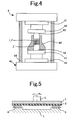
- Fig. 4 is a cross-sectional diagram for schematically illustrating a sintering apparatus, which is used in plasma electrical discharge sintering.
- Fig. 5 is a schematic diagram for illustrating a seizure test.
- Fig. 1, Fig. 2 and Fig. 3 are cross-sectional diagrams for schematically illustrating an example of a slide member of the present invention.
- a slide member of the present invention is a slide member, which has a substrate made of a metal; and a sliding layer of a resinous powder being sintered integrally on at least one of the surfaces of the substrate. And, the sliding layer includes a solid-lubricant powder.
- the substrate is such that its size and configuration are not limited particularly, and can preferably be a bulk body, or a sintered body, which is composed of a metal powder being sintered integrally with the sliding layer.
- sintered bodies which are composed of metal powders, not being those which are sintered integrally with the sliding layer, that is, sintered bodies, which are formed by means of sintering in advance before the resinous powder and the solid-lubricant powder are sintered, are included as well, in addition to metallic members, which are processed by means of casting, and the like.
- the substrate is such that it is not limited as far as it is made of a metal, and can preferably include at least one member of iron, aluminum, copper and magnesium.
- the substrate when being an alloy, steels, aluminum alloys which include Mg, Cu, Zn, Si, Mn, and the like, and copper alloys which include Zn, Al, Sn, Mn, and so forth, and so on, are preferable.
- the particle diameters of the metal powder can preferably be such that an average primary particle diameter is 10-200 ⁇ m, and further preferably 10-150 ⁇ m.
- the substrate which has sufficient strength, can be obtained.
- a surface treatment such as plating treatments, thermal-spraying treatments, anodic-oxidation treatments, chemical-conversion treatments or rough-surface-forming treatments, can be done to the interface between it and the sliding layer.
- the plating treatments can be tin-plating treatments, Ni-plating treatments, Cu-plating treatments, and the like, for example.
- the thermal-spraying treatments can be Cu-thermal-spraying treatments, Al-Si-thermal-spraying treatments, and so forth, for instance.
- the anoidic-oxidation treatments when the substrate is made of a material, which includes aluminummainly, can be alumite treatments, and so on, for example.
- the chemical-conversion treatments can be chromate treatments, non-chromate treatments, zinc phosphate treatments, and the like.
- the rough-surface-forming treatments can be shot blasting, etching, and so forth, for instance. Note that, by means of the aforementioned surface treatments, it is possible to form a later-described intermediate layer.
- the sliding layer is composed of a resinous powder, which is sintered integrally on at least one of the surfaces of the substrate, and includes a solid-lubricant powder.
- a raw material powder of the sliding layer (hereinafter being set forth as a raw material powder for the sliding layer) is composed of a resinous powder and a solid-lubricant powder at least, by means of sintering this raw material powder for the sliding layer, the sliding layer, which includes the sintered resinous powder and the solid lubricant powder, is formed.
- a raw material powder of the sliding layer (hereinafter being set forth as a raw material powder for the sliding layer) is composed of a resinous powder and a solid-lubricant powder at least, by means of sintering this raw material powder for the sliding layer, the sliding layer, which includes the sintered resinous powder and the solid lubricant powder, is formed.
- at least one of the surfaces of the substrate can be a surface, which is equivalent to the sliding-surface side of the substrate.
- a sliding surface is such that it is not limited as far as it is a configuration, which fits for sliding, and can be a sliding surface, which comprises a curved surface, such as a spherical surface, in addition to a flat surface.
- the slide member of the present invention is such that, by means of having used a solid-lubricant powder in the sliding layer, the difference between the linear expansion coefficients of the substrate, which is made of a metal, and the sliding layer, which is made of a resin, becomes smaller, and accordingly it is possible to secure the adhesiveness between the substrate and the sliding layer.
- the seizure resistance or wear resistance of an opposite substrate side improves, and makes a slide member, which is suitable as a sliding portion.
- the sliding layer is such that, when heat is given to it by means of sintering, a resinous powder melts and then solidifies to form it, it is better in terms of the adhesiveness to the substrate than sliding layers which are formed by means of coating.
- the adhesiveness improves furthermore.
- the sliding layer is such that its layer thickness is not limited in particular, but can preferably be 3-500 ⁇ m, especially preferably be 6-50 ⁇ m.
- layer thickness of the sliding layer falls in the aforementioned ranges, it makes a slide member, which has satisfactory adhesiveness and sliding characteristics.
- the sliding layer in addition to a sliding layer 20 which is sintered in such a state that the distribution of a solid-lubricant powder is uniform as illustrated schematically in Fig. 1, can be a sliding layer which is sintered while making the amount of a solid-lubricant powder at least gradient.
- the sliding layer 20 can be a functionally-gradient-material layer in which the volume fraction of a solid-lubricant powder is lower on a substrate side (21) of the sliding layer than on an opposite substrate side (23).
- This functionally-gradient-material layer can be a layer in which the proportion of a solid-lubricant powder changes continuously or stepwise (see Fig. 2) from a substrate side to an opposite substrate side. The details will be described later in the section of [Production Process for Slide Member].
- the solid-lubricant powder is such that there is not any limitation on its amount; and, even when being an extremely small amount, can secure the adhesiveness between the substrate and the sliding layer; but it is preferable that, when a raw material powder for the sliding layer is taken as 100 Vol. %, the proportion of the solid-lubricant powder can be 20-80 Vol. %. When the proportion of the solid-lubricant powder falls within the aforementioned range, the adhesiveness between the substrate and the sliding layer becomes satisfactory.
- the proportion of a metal powder which is composed of a metal or metallic oxide, or, among metals, especially, the proportion of the same kind of a metal powder as that of a metal, which constitutes the substrate or a later-described intermediate layer, gradient in the sliding layer.
- the proportion of a metal powder is such that, by making it gradient so that it is higher on an substrate side of the slider layer than on an opposite substrate side, the adhesiveness between the substrate or intermediate layer and the sliding surface improves furthermore.
- the solid-lubricant powders can be those, which have been used usually, such as a lamellar structural substance such as graphite or talc, a soft metal, such as Pb, Ag or Cu, and its compound, and a fluorine compound, such as polytetrafluoroethylene (PTFE).
- PTFE polytetrafluoroethylene
- it can be at least one member of molybdenum disulfide powders, graphite powders and PTFE powders.
- Molybdenum disulfide is such that, in order to improve the wear resistance of the sliding layer, it is advisable to use those whose average primary particle diameter is 0.1-40 ⁇ m, preferably 1-10 ⁇ m.
- Graphite is such that, in order to make the adhesiveness inside the sliding layer satisfactory, it is advisable to use those whose average primary particle diameter is 0.1-10 ⁇ m, preferably 1-5 ⁇ m.
- the sliding layer can further contain either one of hard particles, an extreme-pressure agent, a surfactant, a working stabilizer agent and an oxidation prevention agent, or all the additive agents. That is, it is possible to use a powder of the additive agents as a raw material powder for the sliding layer.
- a powder of the additive agents is such that, as far as an appropriate amount, which depends on the required characteristics, is used, there is not any limitation on its proportion; but it is preferable that the proportion of a powdery additive agent can be 20 Vol. % or less when a raw material powder for the sliding layer is taken as 100 Vol. %; and it can especially preferably be included in an amount of 3-15 Vol. %.
- the particle diameters of the additive agents are such that an average primary particle diameter can preferably be 0.1-10 ⁇ m, further preferably 0.3-3 ⁇ m.
- the hard particles can be alumina, silica, silicon carbide, silicon nitride, and the like, for instance.
- the extreme-pressure agent can be sulfur-containing metallic compounds, such as zinc sulfide (ZnS) or silver sulfide (Ag 2 S), and so forth, for example.
- the surfactant can be fluorine-system surfactants, silicon-system surfactants, and so on, for instance.
- the working stabilizer agent can be bifunctional-type working stabilizer agents, single-agent addition-type working stabilizer agents, and the like, for example.
- the bifuctional-type working stabilizer agents "Sumilizer GM,” a product name (chemical name: 2-tert-Butyl-6-(3-tert-butyl-2-hydroxy-5-methylbenzyl)-4-methylphenyl acrylate), produced by SUMITOMO KAGAKU KOGYO Co., Ltd., "Sumilizer GMS (F), " a product name (chemical name: 2-[1-(2-hydroxy-3,5-di-tert-pentylphenyl) ethyl]-4,6-di-tert-pentylphenyl acrylate), produced by SUMITOMO KAGAKU KOGYO Co., Ltd., and so forth, are available.
- SA-system single-agent addition-type working stabilizer agents
- “Sumilizer GP” a product name (chemical name: 6-[3-(3-t-Butyl-4-hydroxy-5-methylphenyl) propoxy]-2,4,8,10-tetra-t-butyldibenz [d,f] [1,3,2] dioxaphosphepin), produced by SUMITOMO KAGAKU KOGYO Co., Ltd., and so on, are available.
- the oxidation prevention agent can be phenol-system primary oxidation prevention agents, organic sulfur-system secondary oxidation prevention agents, amine-system primary oxidation prevention agents, phosphite-system oxidation prevention agents, and the like, for instance.
- phenol-system primary oxidation prevention agents "Sumilizer MDP-S2," a product name (chemical name: 2'-Methylenebis(6-tert-butyl-4-methylphenol)), produced by SUMITOMO KAGAKU KOGYO Co., Ltd., "Sumilizer BBM-S,” a product name (chemical name: 4,4'-Butylidenebis(6-tert-butyl-3-methylphenol)), produced by SUMITOMO KAGAKU KOGYO Co., Ltd., "Sumilizer WX-R WX-RA WX-RC,” a product name (chemical name: 4,4'-Thio bis(6-tert-butyl-3-methylphenol)), produced by SUMIT
- “Sumilizer MB” a product name (chemical name: 2-Mercaptobenzimidazole), produced by SUMITOMO KAGAKU KOGYO Co., Ltd. , and so on, are available.
- “Sumilizer 9A” a product name (chemical name: Alkylated diphenylamine), produced by SUMITOMO KAGAKU KOGYO Co., Ltd., and the like, are available.
- As for the phosphite-system oxidation prevention agents "Adecastab PEP-36,” a product name, produced by ASAHI DENKA KOGYO Co., Ltd., and so forth, are available.
- the resinous powder is such that, as far as it is composed of a resin which can form the sliding layer by melting and then solidifying upon giving heat to it by means of sintering, there is not any limitation on its type particularly, but can preferably be a heat-resistant resinous powder which is composed of a heat-resistant resin not degradable by means of heating.
- the particle diameters of the resinous powder are such that an average primary particle diameter can preferably be 1-200 ⁇ m, further preferably 10-120 ⁇ m.
- the slide member which has the sliding layer obtained by sintering the resinous powder having particle diameters within the aforementioned ranges, exhibit suitable sliding characteristics.
- the resinous powder can preferably includes at least one member of polyamide imide resinous powders, polyimide resinous powders, polyether ether ketone resinous powders and polybenzimidasole resinous powders.
- resins like polyether ether ketone resins (PEEK resins), which are less likely to dissolve into solvents, cannot be coated, it has been difficult for them to form the sliding layer conventionally; however, using sintering makes it possible to form the sliding layer.
- the slide member of the present invention can preferably further have an intermediate layer 30, which intervenes between the substrate 10 and the sliding layer 20 and is composed of a metal differing from that of the substrate.
- a metal differing from that of the substrate is such that, even when the intermediate layer and the substrate are the same kind of meal with each other, for example, they can differ in the compositions.
- the intermediate layer can preferably be an intermediate sintered-body layer, which is composed of a metal powder being sintered integrally with the substrate and the sliding layer. Moreover, it can be an intermediate layer, which is formed by performing a plating treatment, a thermal-spraying treatment, or the like, to a bulk-body substrate in advance. Moreover, although there is not any limitation on the layer thickness of the intermediate layer, it can preferably be 0.05-500 ⁇ m, further preferably be 0.1-300 ⁇ m. When the layer thickness falls in the aforementioned ranges, it makes a slide member, in which the adhesiveness to the sliding layer is satisfactory.
- the substrate can be a sliding component part for compressors. That is, the slide member of the present invention can be adapted to a slide member for compressors.
- the slide member of the present invention can be used in a swash plate for swash plate-type compressors.
- the slide member of the present invention can be used in a shoe for compressors.
- a "swash plate and shoe for swash plate-type compressors" are such that there arises the case that they slide with each other in a dry state without any lubricant in their initial period of operation. Even in the case that they slide in such a very severe dry state, it is desired that they do not cause seizure or wear.
- the slide member of the present invention which is good in terms of the adhesiveness and which has high seizure resistance and wear resistance, for a swash plate or shoes for swash plate-type compressors, it is possible to satisfy the conditions, which are required for swash plate-type compressors.
- a sliding bearing which supports the driving shaft of a compressor.
- a rotary valve which is supported axially to the driving shaft of a piston-type compressor integrally, and additionally which is supported pivotally to the housing of a piston compressor rotatably so as to rotate synchronously with the driving shaft to make the gas passage between the compression chamber and the inlet pressure region openable and closable; or for a piston for a piston-type compressor.
- the slide member of the present invention can be obtained by means of a hereinafter-explained production process for a slide member.
- a production process of the present invention for a slide member has: a laminating step of forming a powdery sliding layer, which is composed of a resinous powder and a solid-lubricant powder at least, on at least one of the surfaces of a substrate layer, which is composed of a metal; and a sintering step of sintering the substrate layer with the powdery sliding layer integrally.
- a powdery sliding layer by disposing a raw material powder for the sliding layer, raw material powder which includes a resinous powder and a solid-lubricant powder at least, as a desired configuration on at least one of the surfaces of a substrate layer.
- a slide member which has a sliding layer 20 on one of the opposite surfaces of a substrate 10 as illustrated in Fig. 1, can be obtained.
- a slide member which has a sliding layer on a metallic substrate's two surfaces disposed back-to-back, can be obtained.
- a substrate layer is a bulk body, it is advisable to dispose a metallic plate, or the like, whose size is accommodable within a mold, within the mold as a substrate layer.
- a substrate layer is a powdery substrate layer, which is composed of a metal powder, it is advisable to charge a metal powder within a mold so as to be a desired thickness.
- a substrate layer which is a bulk body
- metallic sintered bodies which are sintered in another step which differs from the aforementioned sintering step, are included as well.
- a sliding layer which possesses a sliding surface comprising a curved surface, such as a spherical surface, in addition to a flat surface.
- two or more layers for example, a powdery substrate layer and a powdery sliding layer
- the mold's temperature becomes appropriate temperatures for the sintering of the respective powders.
- raw material powder for the sliding layer raw material powder which is for forming a powdery sliding layer
- a resinous powder and a solid-lubricant powder at least by means of a ball mill, rod mill, a double-coated blender, a V-type mixer, and the like.
- a metal powder or an additive agent, and so forth, too can desirably be mixed all together with them.
- a solid-lubricant powder gradient By means of the laminating step, it is possible to make a solid-lubricant powder gradient as well.
- a powder preparing step by means of preparing two or more mixture powders, in which the volume fractions between a resinous powder and a solid-lubricant powder at least differ, in advance; and, in the laminating step, laminating the two or more mixture powders sequentially so that a volume fraction of the solid-lubricant powder on its substrate-layer side becomes lower than on an opposite substrate-layer side, the proportion of the solid-lubricant powder changes stepwise from the substrate side to the opposite substrate side.
- a slide member which possesses sliding layers 21, 22 and 23 which are laminated sequentially on the surface of a substrate 10, can be obtained.
- the sliding layers 21, 22 and 23 are such that the volume fraction of a solid-lubricant powder becomes greater in this order.
- a centrifuge separation method it is possible to change the volume fraction continuously. That is, a raw material powder for the sliding layer is put within a mold after mixing it uniformly; and subsequently the raw material powder for the sliding layer is separated centrifugally within the mold, thereby making the volume fraction gradient. Moreover, as another technique, it is possible as well to taper the volume fraction by means of moving a powder with a heavier weight downward continuously by means of giving a vibration to a uniform raw material powder for the sliding layer.
- a powder which is composed of a metal or a metallic oxide, or a metal powder, which is composed of a metal, among metals for forming a substrate layer or an intermediate layer especially, gradient in a powdery sliding layer.
- the method of making a metal powder gradient can be the same as the aforementioned methods of making a solid-lubricant powder gradient.
- the laminating step can desirably include a step of forming a powdery intermediate layer, which is composed of a metal powder differing from that of the substrate layer, between the substrate layer and the powdery sliding layer.
- a powdery intermediate layer By means of having a powdery intermediate layer, it becomes possible to simultaneously form at least a sliding layer and an intermediate layer by means sintering.
- a sliding layer which has an intermediate layer 30 on the surface of a substrate 10, and which further has a sliding layer 20 on the surface of the intermediate layer 30, can be obtained.
- the sliding layer 20 can be a functionally-gradient-material layer as well.
- a substrate layer is a bulk body
- an intermediate-layer forming step of forming an intermediate layer which is composed of a metal differing from that of the substrate layer, on the surface of the substrate layer, surface on which the powdery sliding layer is formed.
- a method of forming an intermediate layer it is possible to name plating treatments or thermal-spraying treatments, and the like.
- the sintering step is a step in which the substrate layer is sintered with the powdery sliding layer integrally at least.
- the powdery sliding layer is such that heat is given to it by means of the sintering step so that it is melted and then solidified, and thereby turns into a sliding layer.
- the substrate layer is a powdery substrate layer which is composed of a metal powder
- the powdery sliding layer turns into a substrate, which is composed of a sintered body, by means of the sintering step.
- the intermediate layer is a layer which is composed of a metal powder, it turns into an intermediate layer, which is composed of a sintered body.
- a slide member in accordance with the production process of the present invention for a slide member, can be formed with a reduced number of steps by means of sintering the substrate layer with the powdery sliding layer, which is formed in the laminating step, integrally in the sintering step. Moreover, by means of adapting the substrate layer to a powdery substrate layer, it becomes possible to simultaneously sinter a substrate with a sliding layer to obtain a slide member. Further, by means of forming a powdery intermediate layer, which is composed of a metal powder, in the laminating step, it becomes possible to simultaneously sinter a substrate, an intermediate layer and a sliding layer to obtain a slide member.
- a sintering method in which the powdery sliding layer is discharge sintered while being pressurized with a mold; specifically, it can be a plasma electrical discharge sintering method.
- a plasma electrical discharge sintering method is a method in which a direct-current pulsating electric current is given between electrodes to carry out sintering, utilizing the discharge phenomenon between powders. Since powders are activated by means of discharge, an advantage is available in that they can be sintered at a lower temperature for a shorter period of time. Moreover, since it is sintered while being pressurized, a slide member, which is good in terms of the adhesiveness, is obtainable.
- the sintering conditions there is not any limitation on the sintering conditions, and they can be conditions under which a resinous powder can be sintered satisfactorily.
- a resinous powder a resinous powder for the sliding layer
- the sintering temperature can be selected appropriately depending on the types of raw material powders.
- the slide member of the present invention and the production process for a slide member are not those which are limited to the above-described embodiment modes; but they can be carried out in various modes provided with such changes and modifications that one of ordinary skill in the art can carry out without departing from the spirit or scope of the present invention.
- Fig. 4 is a cross-sectional diagram for schematically illustrating a plasma electrical discharge sintering apparatus
- Fig. 5 is an explanatory diagram of a seizure test.
- a plasma discharge apparatus 4 (hereinafter, set forth as a "sintering apparatus" 4), as illustrated in Fig. 4, is such that an upper electrode 42 and a lower electrode 47 are disposed on a pressing apparatus 40, which is equipped with hydraulic devices 41, 46, and additionally an upper punch 43 and a lower punch 48 are disposed coaxially, and further is constituted of a vacuum chamber 44, an electric-power-source device and various control devices (not shown).
- powders (1' 2') or a metallic plate (1) which are put in a graphite mold 49 (not shown) with a 50-mm inside-diameter cylinder shape or a graphite mold 49' , are pressurized by means of the lower punch 43 and upper punch 48, and are then sintered by means of plasma discharge.
- the graphite mold 49 is a cylinder-shaped mold whose outside diameter (thickness) is uniform
- the graphite mold 49' is such that the outside diameters differ between the upper portion and the lower portion as illustrated in Fig. 4. Accordingly, between the upper portion and lower portion of the graphite mold 49', the thermal conductivities differ.
- an aluminum powder (average particle diameter: 30 ⁇ m), a copper powder (average particle diameter: 30 ⁇ m), and disk-shaped metallic plates ( ⁇ 50 mm, and thickness: 10 mm), which were composed of an aluminum alloy or a copper alloy, were prepared.
- mixture powders "A"-"E" (however, the powder E was composed of a resinous powder alone), in which a resinous powder was mixed with a solid-lubricant powder in the volume fractions set forth in Table 1 by means of a ball mill, were prepared.
- the resinous powder either one of a polyamide imide (PAI) resinous powder (average primary particle diameter: 100 ⁇ m), a polyimide (PI) resinous powder (average primary particle diameter: 20 ⁇ m) and a polyether ether ketone (PEEK) resinous powder (average primary particle diameter: 100 ⁇ m) was used.
- PAI polyamide imide
- PI polyimide
- PEEK polyether ether ketone
- molybdenum disulfide (average primary particle diameter: 10 ⁇ m) and graphite (average primary particle diameter: 1 ⁇ m) were used in a volumetric ratio of 1 : 1.
- Powder Resinous Powder [Vol. %] (PAI, PI or PEEK)
- Solid-lubricant Powder [Vol. %] Molybdenum Disulfide Graphite "A" 70 15 15 "B” 60 20 20 "C” 50 25 25 “D” 25 37.5 37.5 "E” 100 0 0 0
- the surface of the powder “C” was smoothed by means of preliminary pressurizing by the upper punch 43 (it was an operation for arranging the configuration of the charged powder by pressurizing it with 20 MPa, but no plasma was generated in this instance) so that a powdery sliding layer 2' whose layer thickness was 500 ⁇ m was formed.
- a metal powder either one of the aluminum powder or the copper powder
- the surface of the metal powder was smoothed by means of preliminary pressurizing by the upper punch 43 so that a substrate layer 1' whose layer thickness was 5 mm was formed.
- the powder "C” was adapted so as to be positioned at the lower portion of the graphite mold 49' whose thickness was thicker; and the metal powder was adapted so as to be positioned at the upper portion of the graphite mold 49' whose thickness was thinner.
- a direct-current pulsating electric current was applied to the substrate layer 1' and powdery sliding layer 2' in such a state that they were pressurized at 50 MPa, thereby carrying out plasma electrical discharge sintering.
- the sintering was such that slide members "a"-"f" were made by means of holding the temperature of the graphite mold 49' at 300-400 °C for 1-10 minutes.
- the surface of the mixture powder was smoothed by means of preliminary pressurizing by the upper punch 43 so that a third layer whose layer thickness was 500 ⁇ m was formed.
- the surface of the mixture powder was smoothed by means of preliminary pressurizing by the upper punch 43 so that a fourth layer whose layer thickness was 500 ⁇ m was formed.
- the coating composition was coated onto the surface of a metallic plate 1 by means of spray coating method; after drying it, sintering was carried out at 200 °C for 1 hour, thereby making slide members "x" and "y,” which comprised the metallic plate 1 and a sliding layer 2. Note that the layer thickness of the sliding layer 2 was 20 ⁇ m.
- the seizure test was carried out in such a manner that a sliding speed: 10 m/s; a load: 5,000 N; a testing time: 2 hours (7, 200 seconds) ; and under lubrication with a freezer oil. Moreover, the friction coefficients, which were after the testing load stabilized to 5, 000 N, were measured. The test results are set forth in Table 2.
- slide members "a”-”t” exhibited low friction resistance, and most of them were such that no seizure occurred after the 2-hour test. Moreover, in slide members "g,” “h,” “i,” “j” and “n,” although seizure occurred after 2,200 seconds, after 1,800 seconds, after 2,600 seconds, after 3,600 seconds and after 3,000 seconds, respectively, they were better in terms of the seizure resistance than the slide members "x" and "y,” which were made by means of coating, were. This is because they are sintered while being pressurized so that the resinous powders melt and then solidify by means of sintering and additionally their adhesiveness to the substrate heightens by means of pressurizing.
- the slide members "a"-"t" which have a metallic substrate, and a sliding layer of a resinous powder being sintered integrally on at least one of the surfaces of the substrate; and which include a solid-lubricant power in the sliding layer, are such that the adhesiveness between the substrate and the sliding layer is high, and have good sliding characteristics.
Landscapes
- Chemical & Material Sciences (AREA)
- Engineering & Computer Science (AREA)
- Mechanical Engineering (AREA)
- General Engineering & Computer Science (AREA)
- Oil, Petroleum & Natural Gas (AREA)
- Organic Chemistry (AREA)
- Chemical Kinetics & Catalysis (AREA)
- General Chemical & Material Sciences (AREA)
- Inorganic Chemistry (AREA)
- Manufacturing & Machinery (AREA)
- Powder Metallurgy (AREA)
- Sliding-Contact Bearings (AREA)
- Compressors, Vaccum Pumps And Other Relevant Systems (AREA)
- Applications Or Details Of Rotary Compressors (AREA)
- Sealing Material Composition (AREA)
- Lubricants (AREA)
- Compressor (AREA)
Abstract
A slide member of the present invention is a slide member having a substrate (10) made of a metal; and a sliding layer (20) of a resinous powder being sintered integrally on at least one of the surfaces of the substrate (10), and is characterized in that it includes a solid-lubricant powder in the sliding layer (20). Further, it can be one having an intermediate layer, which intervenes between the substrate (10) and the sliding layer (20), and which is composed of a metal differing from that of the substrate (10). The slide member of the present invention is such that the adhesiveness is high, and has good sliding characteristics.
Moreover, a production process of the present invention for a slide member is characterized in that it has: a laminating step of forming a powdery sliding layer, which is composed of a resinous powder and a solid-lubricant powder at least, on at least one of the surfaces of a substrate layer, which is composed of a metal; and a sintering step of sintering the substrate layer with the powdery sliding layer integrally. In accordance with this production process, it is possible to make a slide member, which has the substrate (10) and the sliding layer (20) at least. In accordance with the production process of the present invention for a slide member, it is possible to produce a slide member whose adhesiveness is high and which has good sliding characteristics.
Description
- The present invention relates to a slide member, which is used for the sliding portion of various apparatuses, and a production process for the same.
- A slide member, which is used for a compressor, and the like, comprises a substrate made of a metal, and a sliding layer made of a resin, which is formed on its sliding surface; and the sliding performance of the slide member is improved by means of the sliding layer. In many cases, the sliding layer is formed by means of coating a film made of a resin; for example, in Japanese Unexamined Patent Publication (KOKAI)
No. 11-13, 638 - When forming a sliding layer by means of coating, since drying and calcining are carried out after coating, the number of processing steps has become many. In particular, when forming a sliding layer comprising a plurality of layers, since the aforementioned processing steps are carried out repeatedly, the number of processing steps has become many furthermore. Moreover, for the selection of a solvent in which a resin is solved and the disposal for the same, it is necessary to consider the safety and environmental issues.
- As one of the forming processes for the sliding layer, which substitutes for coating, a sintering method can be thought of. However, according to Comparative Example No. 1 of Japanese Patent Unexamined Publication (KOKAI) Gazette
No. 9-131,828 No. 9-131,828 - In view of the aforementioned circumstances, the present inventors found out a noble construction, which can secure the adhesiveness between a substrate layer and a sliding layer even by means of sintering. Namely, the present invention is a slide member, which can be obtained by means of sintering, and is such that it is an object to provide a slide member, whose adhesiveness between a substrate and a sliding layer is high and which is suitable for sliding portions, and a production process for the slide member.
- A slide member of the present invention, which solves the aforementioned problems, is a slide member having a substrate made of a metal; and a sliding layer of a resinous powder being sintered integrally on at least one of the surfaces of the substrate, and is characterized in that it includes a solid-lubricant powder in said sliding layer.
- By means of the fact that a solid-lubricant powder is included in the sliding layer, the difference between the linear expansion coefficients of the substrate and sliding layer becomes smaller. As a result, it is possible to secure the adhesiveness between the substrate made of a metal and the sliding layer made of a resin, adhesiveness which has not been obtainable by sintering so far. Further, since the sliding layer is formed by means of solidifying after the resinous powder is melted by means of sintering, it is good in terms of the adhesiveness to the substrate. Moreover, when it is sintered while being pressurized, since the resinous powder melts and then solidifies in such a state that it is pressurized, it is furthermore good in terms of the adhesiveness.
- Said substrate can preferably be a bulk body, or a sintered body, which is composed of a metal powder being sintered integrally with said sliding layer. Here, "bulk" means "mass," and is usually referred to those other than thin films and wire rods. Namely, in the substrate being a bulk body, sintered bodies, which are composed of metal powders, not being those which are sintered integrally with the sliding layer, in other words sintered bodies which are formed by means of sintering in advance before sintering the sliding layer are included as well, in addition to metallic members which are processed by means of casting, and the like.
- Said sliding layer can preferably be a functionally-gradient-material layer in which a volume fraction of said solid-lubricant powder on its substrate side is lower than on an opposite substrate side. By mean of adapting the sliding layer to a functionally-gradient-material layer, it is possible to secure the adhesiveness to the substrate while providing the opposite substrate side with good sliding characteristics. In this instance, said functionally-gradient-material layer can preferably be a layer in which the proportion of said solid-lubricant powder changes continuously or stepwise from said substrate side to said opposite substrate side.
- Further, it can preferably have an intermediate layer. By means of disposing an intermediate layer, even when such an instance occurs that the sliding layer is damaged during the slide member's service, since it can keep sliding to adapt the intermediate layer to a sliding surface, the reliability as a slide member improves. In this instance, said intermediate layer can preferably be an intermediate sintered-body layer, which is composed of a metal powder being sintered integrally with said substrate and said sliding layer.
- Moreover, a production process of the present invention for a slide member is characterized in that it has: a laminating step of forming a powdery sliding layer, which is composed of a resinous powder and a solid-lubricant powder at least, on at least one of the surfaces of a substrate layer, which is composed of a metal; and a sintering step of sintering the substrate layer with the powdery sliding layer integrally.
- Since the substrate layer and powdery sliding layer, which are formed in the laminating step, are sintered integrally in the sintering step, it is possible to form a slide member through the reduced number of steps. Moreover, since the powdery sliding layer includes a solid-lubricant powder, the difference between the linear expansion coefficients of the after-sintering substrate layer and powdery sliding layer becomes smaller. As a result, no coming-off occurs from the interface between the after-sintering substrate layer and powdery sliding layer. Further, since sintering is used, no solvent, which is essential in coating, is needed; and, moreover, even when being a sliding layer which is composed of a resinous powder being less likely to solve into a solvent, the formation is made possible. Moreover, by means of forming the substrate layer and powdery slide member with compression in the laminating step, or sintering while pressurizing them, a slide member, which is good in terms of the adhesiveness, can be obtained.
- Said substrate layer can desirably be a powdery substrate layer, which is composed of a metal powder, or a bulk body. Here, in the substrate layer being a bulk body, metallic sintered bodies, which are formed by sintering a metal powder in another step being independent of the aforementioned sintering step, are included. When the substrate layer is adapted to a powdery substrate layer, it becomes possible to obtain a slide member by sintering a substrate and a sliding layer simultaneously. In addition, in the laminating step, when forming a powdery intermediate layer, which is composed of a metal powder, it becomes possible to obtain a slide member in which a substrate layer, an intermediate layer and a sliding layer are sintered simultaneously to form it.
- Moreover, prior to said laminating step, it can desirably have a powder preparing step of preparing two members or more mixture powders in which the volume fractions between said resinous powder and said solid-lubricant powder at least differ; and, in said laminating step, said powdery sliding layer can desirably be formed by laminating said two members or more mixture powders sequentially so that a volume fraction of said solid-lubricant powder on its substrate-layer side becomes lower than on an opposite substrate-layer side, and thereby a functionally-gradient-material layer can be obtained with ease.
- With reference to the following detailed description and the accompanying drawings, the present invention can be understood more profoundly. Hereinafter, the brief description of the drawings is done.
- Fig. 1, Fig. 2 and Fig. 3 are cross-sectional diagrams for schematically illustrating an example of a slide member of the present invention. Fig. 4 is a cross-sectional diagram for schematically illustrating a sintering apparatus, which is used in plasma electrical discharge sintering. Moreover, Fig. 5 is a schematic diagram for illustrating a seizure test.
- Hereinafter, the best mode for carrying out a slide member of the present invention and a production process of the present invention for a slide member will be explained, using Fig. 1, Fig. 2 and Fig. 3. Note that Fig. 1, Fig. 2 and Fig. 3 are cross-sectional diagrams for schematically illustrating an example of a slide member of the present invention.
- [Slide Member]
- A slide member of the present invention is a slide member, which has a substrate made of a metal; and a sliding layer of a resinous powder being sintered integrally on at least one of the surfaces of the substrate. And, the sliding layer includes a solid-lubricant powder.
- The substrate is such that its size and configuration are not limited particularly, and can preferably be a bulk body, or a sintered body, which is composed of a metal powder being sintered integrally with the sliding layer. As described above, in the substrate being a bulk body, sintered bodies, which are composed of metal powders, not being those which are sintered integrally with the sliding layer, that is, sintered bodies, which are formed by means of sintering in advance before the resinous powder and the solid-lubricant powder are sintered, are included as well, in addition to metallic members, which are processed by means of casting, and the like.
- Moreover, the substrate is such that it is not limited as far as it is made of a metal, and can preferably include at least one member of iron, aluminum, copper and magnesium. For example, when being an alloy, steels, aluminum alloys which include Mg, Cu, Zn, Si, Mn, and the like, and copper alloys which include Zn, Al, Sn, Mn, and so forth, and so on, are preferable.
- When the substrate is a sintered body, which is composed of a metal powder which is sintered integrally with the sliding layer, the particle diameters of the metal powder can preferably be such that an average primary particle diameter is 10-200 µm, and further preferably 10-150 µm. When the particle diameters of the metal powder fall in the aforementioned ranges, the substrate, which has sufficient strength, can be obtained.
- When the substrate is a bulk body, it is advisable that a surface treatment, such as plating treatments, thermal-spraying treatments, anodic-oxidation treatments, chemical-conversion treatments or rough-surface-forming treatments, can be done to the interface between it and the sliding layer. When these surface treatments are done, it is possible to improve the adhesiveness between the substrate and the sliding layer. Here, the plating treatments can be tin-plating treatments, Ni-plating treatments, Cu-plating treatments, and the like, for example. The thermal-spraying treatments can be Cu-thermal-spraying treatments, Al-Si-thermal-spraying treatments, and so forth, for instance. The anoidic-oxidation treatments, when the substrate is made of a material, which includes aluminummainly, can be alumite treatments, and so on, for example. The chemical-conversion treatments can be chromate treatments, non-chromate treatments, zinc phosphate treatments, and the like. The rough-surface-forming treatments can be shot blasting, etching, and so forth, for instance. Note that, by means of the aforementioned surface treatments, it is possible to form a later-described intermediate layer.
- The sliding layer is composed of a resinous powder, which is sintered integrally on at least one of the surfaces of the substrate, and includes a solid-lubricant powder. Specifically, a raw material powder of the sliding layer (hereinafter being set forth as a raw material powder for the sliding layer) is composed of a resinous powder and a solid-lubricant powder at least, by means of sintering this raw material powder for the sliding layer, the sliding layer, which includes the sintered resinous powder and the solid lubricant powder, is formed. Here, it is advisable that at least one of the surfaces of the substrate can be a surface, which is equivalent to the sliding-surface side of the substrate. Note that the configuration of a sliding surface is such that it is not limited as far as it is a configuration, which fits for sliding, and can be a sliding surface, which comprises a curved surface, such as a spherical surface, in addition to a flat surface.
- As described above, it has not been easy so far to obtain a laminated body, which comprises a metallic layer and a resinous layer whose adhesiveness is satisfactory to each other, by means of sintering. Whereas, the slide member of the present invention is such that, by means of having used a solid-lubricant powder in the sliding layer, the difference between the linear expansion coefficients of the substrate, which is made of a metal, and the sliding layer, which is made of a resin, becomes smaller, and accordingly it is possible to secure the adhesiveness between the substrate and the sliding layer. Further, because of the fact that a solid-lubricant powder exists in the sliding layer, the seizure resistance or wear resistance of an opposite substrate side (that is, being equivalent to a sliding-surface side) improves, and makes a slide member, which is suitable as a sliding portion. Moreover, since the sliding layer is such that, when heat is given to it by means of sintering, a resinous powder melts and then solidifies to form it, it is better in terms of the adhesiveness to the substrate than sliding layers which are formed by means of coating. Moreover, when it is sintered while being pressurized, the adhesiveness improves furthermore.
- The sliding layer is such that its layer thickness is not limited in particular, but can preferably be 3-500 µm, especially preferably be 6-50 µm. When the layer thickness of the sliding layer falls in the aforementioned ranges, it makes a slide member, which has satisfactory adhesiveness and sliding characteristics.
- Moreover, the sliding layer, in addition to a sliding
layer 20 which is sintered in such a state that the distribution of a solid-lubricant powder is uniform as illustrated schematically in Fig. 1, can be a sliding layer which is sintered while making the amount of a solid-lubricant powder at least gradient. For example, as shown an example in Fig. 2, the slidinglayer 20 can be a functionally-gradient-material layer in which the volume fraction of a solid-lubricant powder is lower on a substrate side (21) of the sliding layer than on an opposite substrate side (23). By means of adapting the sliding layer to a functionally-gradient-material layer, while holding the sliding characteristics on the opposite substrate side where the proportion of a solid-lubricant component is greater, it is possible to secure the adhesiveness between the substrate and the sliding layer on the substrate side where the proportion of a solid-lubricant component is less. This functionally-gradient-material layer can be a layer in which the proportion of a solid-lubricant powder changes continuously or stepwise (see Fig. 2) from a substrate side to an opposite substrate side. The details will be described later in the section of [Production Process for Slide Member]. - The solid-lubricant powder is such that there is not any limitation on its amount; and, even when being an extremely small amount, can secure the adhesiveness between the substrate and the sliding layer; but it is preferable that, when a raw material powder for the sliding layer is taken as 100 Vol. %, the proportion of the solid-lubricant powder can be 20-80 Vol. %. When the proportion of the solid-lubricant powder falls within the aforementioned range, the adhesiveness between the substrate and the sliding layer becomes satisfactory.
- Note that, in the sliding layer, it is advisable as well to make components other than the solid lubricant gradient; and it is advisable as well to make the proportion of a metal powder, which is composed of a metal or metallic oxide, or, among metals, especially, the proportion of the same kind of a metal powder as that of a metal, which constitutes the substrate or a later-described intermediate layer, gradient in the sliding layer. In this instance, the proportion of a metal powder is such that, by making it gradient so that it is higher on an substrate side of the slider layer than on an opposite substrate side, the adhesiveness between the substrate or intermediate layer and the sliding surface improves furthermore. Moreover, it is advisable as well to make the proportion of later-described respective additive agents gradient.
- The solid-lubricant powders can be those, which have been used usually, such as a lamellar structural substance such as graphite or talc, a soft metal, such as Pb, Ag or Cu, and its compound, and a fluorine compound, such as polytetrafluoroethylene (PTFE). In particular, it can be at least one member of molybdenum disulfide powders, graphite powders and PTFE powders. Molybdenum disulfide is such that, in order to improve the wear resistance of the sliding layer, it is advisable to use those whose average primary particle diameter is 0.1-40 µm, preferably 1-10 µm. Graphite is such that, in order to make the adhesiveness inside the sliding layer satisfactory, it is advisable to use those whose average primary particle diameter is 0.1-10 µm, preferably 1-5 µm.
- Moreover, the sliding layer can further contain either one of hard particles, an extreme-pressure agent, a surfactant, a working stabilizer agent and an oxidation prevention agent, or all the additive agents. That is, it is possible to use a powder of the additive agents as a raw material powder for the sliding layer. A powder of the additive agents is such that, as far as an appropriate amount, which depends on the required characteristics, is used, there is not any limitation on its proportion; but it is preferable that the proportion of a powdery additive agent can be 20 Vol. % or less when a raw material powder for the sliding layer is taken as 100 Vol. %; and it can especially preferably be included in an amount of 3-15 Vol. %. Moreover, the particle diameters of the additive agents are such that an average primary particle diameter can preferably be 0.1-10 µm, further preferably 0.3-3 µm.
- Here, the hard particles can be alumina, silica, silicon carbide, silicon nitride, and the like, for instance. The extreme-pressure agent can be sulfur-containing metallic compounds, such as zinc sulfide (ZnS) or silver sulfide (Ag2S), and so forth, for example. The surfactant can be fluorine-system surfactants, silicon-system surfactants, and so on, for instance.
- The working stabilizer agent can be bifunctional-type working stabilizer agents, single-agent addition-type working stabilizer agents, and the like, for example. As for the bifuctional-type working stabilizer agents, "Sumilizer GM," a product name (chemical name: 2-tert-Butyl-6-(3-tert-butyl-2-hydroxy-5-methylbenzyl)-4-methylphenyl acrylate), produced by SUMITOMO KAGAKU KOGYO Co., Ltd., "Sumilizer GMS (F), " a product name (chemical name: 2-[1-(2-hydroxy-3,5-di-tert-pentylphenyl) ethyl]-4,6-di-tert-pentylphenyl acrylate), produced by SUMITOMO KAGAKU KOGYO Co., Ltd., and so forth, are available. As for the single-agent addition-type (SA-system) working stabilizer agents, "Sumilizer GP," a product name (chemical name: 6-[3-(3-t-Butyl-4-hydroxy-5-methylphenyl) propoxy]-2,4,8,10-tetra-t-butyldibenz [d,f] [1,3,2] dioxaphosphepin), produced by SUMITOMO KAGAKU KOGYO Co., Ltd., and so on, are available.
- The oxidation prevention agent can be phenol-system primary oxidation prevention agents, organic sulfur-system secondary oxidation prevention agents, amine-system primary oxidation prevention agents, phosphite-system oxidation prevention agents, and the like, for instance. As for the phenol-system primary oxidation prevention agents, "Sumilizer MDP-S2," a product name (chemical name: 2'-Methylenebis(6-tert-butyl-4-methylphenol)), produced by SUMITOMO KAGAKU KOGYO Co., Ltd., "Sumilizer BBM-S," a product name (chemical name: 4,4'-Butylidenebis(6-tert-butyl-3-methylphenol)), produced by SUMITOMO KAGAKU KOGYO Co., Ltd., "Sumilizer WX-R WX-RA WX-RC," a product name (chemical name: 4,4'-Thio bis(6-tert-butyl-3-methylphenol)), produced by SUMITOMO KAGAKU KOGYO Co., Ltd., "Sumilizer NW (N), " a product name (chemical name: Alkylated bisphenol), "Sumilizer GA-80," a product name (chemical name: 3,9-Bis[2-[3-(3-tert-butyl-4-hydroxy-5-methylphenyl) propionyloxy]-1,1-dimethylethyl]-2,4,8,10-tetraoxaspiro [5·5] undecane), produced by SUMITOMO KAGAKU KOGYO Co., Ltd., and so forth, are available. As for the organic sulfur-system secondary oxidation prevention agents, "Sumilizer MB," a product name (chemical name: 2-Mercaptobenzimidazole), produced by SUMITOMO KAGAKU KOGYO Co., Ltd. , and so on, are available. As for the amine-system primary oxidation prevention agents, "Sumilizer 9A," a product name (chemical name: Alkylated diphenylamine), produced by SUMITOMO KAGAKU KOGYO Co., Ltd., and the like, are available. As for the phosphite-system oxidation prevention agents, "Adecastab PEP-36," a product name, produced by ASAHI DENKA KOGYO Co., Ltd., and so forth, are available.
- The resinous powder is such that, as far as it is composed of a resin which can form the sliding layer by melting and then solidifying upon giving heat to it by means of sintering, there is not any limitation on its type particularly, but can preferably be a heat-resistant resinous powder which is composed of a heat-resistant resin not degradable by means of heating. Moreover, the particle diameters of the resinous powder are such that an average primary particle diameter can preferably be 1-200 µm, further preferably 10-120 µm. The slide member, which has the sliding layer obtained by sintering the resinous powder having particle diameters within the aforementioned ranges, exhibit suitable sliding characteristics.
- Moreover, the resinous powder can preferably includes at least one member of polyamide imide resinous powders, polyimide resinous powders, polyether ether ketone resinous powders and polybenzimidasole resinous powders. Among these, since resins, like polyether ether ketone resins (PEEK resins), which are less likely to dissolve into solvents, cannot be coated, it has been difficult for them to form the sliding layer conventionally; however, using sintering makes it possible to form the sliding layer.
- The slide member of the present invention, as schematically illustrated in Fig. 3, can preferably further have an
intermediate layer 30, which intervenes between thesubstrate 10 and the slidinglayer 20 and is composed of a metal differing from that of the substrate. Note that "a metal differing from that of the substrate" is such that, even when the intermediate layer and the substrate are the same kind of meal with each other, for example, they can differ in the compositions. By means of disposing an intermediate layer, even when such an instance occurs that the sliding layer is damaged during the slide member' s service, since it can keep sliding to adapt the intermediate layer to a sliding surface, the reliability as a slide member improves. When being an intermediate layer, which includes at least one member of copper and aluminum, it is effective furthermore. - The intermediate layer can preferably be an intermediate sintered-body layer, which is composed of a metal powder being sintered integrally with the substrate and the sliding layer. Moreover, it can be an intermediate layer, which is formed by performing a plating treatment, a thermal-spraying treatment, or the like, to a bulk-body substrate in advance. Moreover, although there is not any limitation on the layer thickness of the intermediate layer, it can preferably be 0.05-500 µm, further preferably be 0.1-300 µm. When the layer thickness falls in the aforementioned ranges, it makes a slide member, in which the adhesiveness to the sliding layer is satisfactory.
- Note that the substrate can be a sliding component part for compressors. That is, the slide member of the present invention can be adapted to a slide member for compressors. For example, the slide member of the present invention can be used in a swash plate for swash plate-type compressors. Moreover, the slide member of the present invention can be used in a shoe for compressors. A "swash plate and shoe for swash plate-type compressors" are such that there arises the case that they slide with each other in a dry state without any lubricant in their initial period of operation. Even in the case that they slide in such a very severe dry state, it is desired that they do not cause seizure or wear. Hence, by using the slide member of the present invention, which is good in terms of the adhesiveness and which has high seizure resistance and wear resistance, for a swash plate or shoes for swash plate-type compressors, it is possible to satisfy the conditions, which are required for swash plate-type compressors.
- In addition to those aforementioned, it can be used as well for a sliding bearing, which supports the driving shaft of a compressor. Moreover, it can be used for a rotary valve, which is supported axially to the driving shaft of a piston-type compressor integrally, and additionally which is supported pivotally to the housing of a piston compressor rotatably so as to rotate synchronously with the driving shaft to make the gas passage between the compression chamber and the inlet pressure region openable and closable; or for a piston for a piston-type compressor.
- And, the slide member of the present invention can be obtained by means of a hereinafter-explained production process for a slide member.
- [Production Process for Slide Member]
- A production process of the present invention for a slide member has: a laminating step of forming a powdery sliding layer, which is composed of a resinous powder and a solid-lubricant powder at least, on at least one of the surfaces of a substrate layer, which is composed of a metal; and a sintering step of sintering the substrate layer with the powdery sliding layer integrally.
- In the laminating step, it is possible to form a powdery sliding layer by disposing a raw material powder for the sliding layer, raw material powder which includes a resinous powder and a solid-lubricant powder at least, as a desired configuration on at least one of the surfaces of a substrate layer. Specifically, for instance, when charging a raw material powder for the sliding layer within a mold so as to be a desired thickness; then placing a substrate layer on it; and sintering them, a slide member, which has a sliding
layer 20 on one of the opposite surfaces of asubstrate 10 as illustrated in Fig. 1, can be obtained. Further, when charging a raw material powder for the sliding layer on a substrate layer within a mold so as to be a desired thickness; and sintering them, a slide member, which has a sliding layer on a metallic substrate's two surfaces disposed back-to-back, can be obtained. In this instance, when a substrate layer is a bulk body, it is advisable to dispose a metallic plate, or the like, whose size is accommodable within a mold, within the mold as a substrate layer. Moreover, when a substrate layer is a powdery substrate layer, which is composed of a metal powder, it is advisable to charge a metal powder within a mold so as to be a desired thickness. Note that, as described above, a substrate layer, which is a bulk body, is such that, in addition to metallic members, which are processed by means of casting, and the like, metallic sintered bodies, which are sintered in another step which differs from the aforementioned sintering step, are included as well. - When using a mold in the laminating step, by arbitrarily forming a powdery sliding layer's configuration by means of selecting the mold's configuration appropriately, it is possible as well to obtain a sliding layer, which possesses a sliding surface comprising a curved surface, such as a spherical surface, in addition to a flat surface. Further, when simultaneously sintering two or more layers (for example, a powdery substrate layer and a powdery sliding layer), which are composed of powders whose melting points differ, it is advisable to make a difference between the thermal conductivities by means of varying a mold's configuration or material quality so that the mold's temperature becomes appropriate temperatures for the sintering of the respective powders. Moreover, on the occasion of the sintering step, it is advisable to smooth the surface of a powder using a smoothing jig, and the like, or to form a formed body, which comprises a substrate layer and a powdery slide member, by means of compression molding, and so forth. In compression molding, by means of pressurizing in the thickness-wise direction of a powdery sliding layer, the adhesiveness of an obtained slide member improves.
- Note that the aforementioned raw material powder for the sliding layer, raw material powder which is for forming a powdery sliding layer, is such that it is advisable to admix a resinous powder and a solid-lubricant powder at least by means of a ball mill, rod mill, a double-coated blender, a V-type mixer, and the like. In this instance, a metal powder or an additive agent, and so forth, too, can desirably be mixed all together with them.
- By means of the laminating step, it is possible to make a solid-lubricant powder gradient as well. In a powder preparing step, by means of preparing two or more mixture powders, in which the volume fractions between a resinous powder and a solid-lubricant powder at least differ, in advance; and, in the laminating step, laminating the two or more mixture powders sequentially so that a volume fraction of the solid-lubricant powder on its substrate-layer side becomes lower than on an opposite substrate-layer side, the proportion of the solid-lubricant powder changes stepwise from the substrate side to the opposite substrate side. For example, as illustrated in Fig. 2, a slide member, which possesses sliding
layers substrate 10, can be obtained. In the slide member of Fig. 2, the slidinglayers - In this instance, it is advisable to vary the type of the resinous powder and solid-lubricant powder, or an additive agent, and the like, for each of the respective sliding layers. By means of this, it is possible to give characteristics, which are appropriate for the substrate-layer side and for the opposite substrate-layer side, respectively.
- Moreover, when one would like to obtain a slide member in which the proportion of a solid-lubricant powder changes continuously from the substrate side to the opposite surface side, it is possible to bring about the continuous change by means of preparing a mixture powder, in which the volume fraction between a resinous powder and a solid-lubricant powder at least is changed more finely, for instance. Moreover, even a method makes it possible, method in which a solid-lubricant powder is fed into a mixing apparatus, in which a resinous powder is held in a certain fixed amount, in a certain fixed amount little by little; and simultaneously therewith a mixed raw material powder for a sliding layer is fed into a mold while carrying out admixing them at a sufficient rate in the mixing apparatus. Furthermore, by means of a centrifuge separation method, it is possible to change the volume fraction continuously. That is, a raw material powder for the sliding layer is put within a mold after mixing it uniformly; and subsequently the raw material powder for the sliding layer is separated centrifugally within the mold, thereby making the volume fraction gradient. Moreover, as another technique, it is possible as well to taper the volume fraction by means of moving a powder with a heavier weight downward continuously by means of giving a vibration to a uniform raw material powder for the sliding layer.
- Further, it is advisable to make a powder, which is composed of a metal or a metallic oxide, or a metal powder, which is composed of a metal, among metals for forming a substrate layer or an intermediate layer especially, gradient in a powdery sliding layer. The method of making a metal powder gradient can be the same as the aforementioned methods of making a solid-lubricant powder gradient.
- Moreover, the laminating step can desirably include a step of forming a powdery intermediate layer, which is composed of a metal powder differing from that of the substrate layer, between the substrate layer and the powdery sliding layer. By means of having a powdery intermediate layer, it becomes possible to simultaneously form at least a sliding layer and an intermediate layer by means sintering. For example, as schematically illustrated in Fig. 3, a sliding layer, which has an
intermediate layer 30 on the surface of asubstrate 10, and which further has a slidinglayer 20 on the surface of theintermediate layer 30, can be obtained. Of course, the slidinglayer 20 can be a functionally-gradient-material layer as well. - Alternatively, when a substrate layer is a bulk body, prior to the laminating step, it is advisable to have an intermediate-layer forming step of forming an intermediate layer, which is composed of a metal differing from that of the substrate layer, on the surface of the substrate layer, surface on which the powdery sliding layer is formed. As for a method of forming an intermediate layer, it is possible to name plating treatments or thermal-spraying treatments, and the like.
- The sintering step is a step in which the substrate layer is sintered with the powdery sliding layer integrally at least. The powdery sliding layer is such that heat is given to it by means of the sintering step so that it is melted and then solidified, and thereby turns into a sliding layer. Moreover, when the substrate layer is a powdery substrate layer which is composed of a metal powder, the powdery sliding layer turns into a substrate, which is composed of a sintered body, by means of the sintering step. Further, when the intermediate layer is a layer which is composed of a metal powder, it turns into an intermediate layer, which is composed of a sintered body.
- Therefore, in accordance with the production process of the present invention for a slide member, a slide member can be formed with a reduced number of steps by means of sintering the substrate layer with the powdery sliding layer, which is formed in the laminating step, integrally in the sintering step. Moreover, by means of adapting the substrate layer to a powdery substrate layer, it becomes possible to simultaneously sinter a substrate with a sliding layer to obtain a slide member. Further, by means of forming a powdery intermediate layer, which is composed of a metal powder, in the laminating step, it becomes possible to simultaneously sinter a substrate, an intermediate layer and a sliding layer to obtain a slide member.
- Moreover, as for a sintering method, although it is possible to use conventional methods, such as hot pressing, especially preferable one is a sintering method in which the powdery sliding layer is discharge sintered while being pressurized with a mold; specifically, it can be a plasma electrical discharge sintering method. A plasma electrical discharge sintering method is a method in which a direct-current pulsating electric current is given between electrodes to carry out sintering, utilizing the discharge phenomenon between powders. Since powders are activated by means of discharge, an advantage is available in that they can be sintered at a lower temperature for a shorter period of time. Moreover, since it is sintered while being pressurized, a slide member, which is good in terms of the adhesiveness, is obtainable.
- Note that, in the sintering step, there is not any limitation on the sintering conditions, and they can be conditions under which a resinous powder can be sintered satisfactorily. When substances, which are likely to be oxidized, are present in a raw material powder (a metal powder or a raw material powder for the sliding layer), it is desirable to sinter it in vacuum or in an inert gas atmosphere. Moreover, the sintering temperature can be selected appropriately depending on the types of raw material powders.
- So far, although the embodiment modes of the slide member of the present invention and the production process for a slide member have been described, the slide member of the present invention and the production process for a slide member are not those which are limited to the above-described embodiment modes; but they can be carried out in various modes provided with such changes and modifications that one of ordinary skill in the art can carry out without departing from the spirit or scope of the present invention.
- Hereinafter, an example of the slide member of the present invention and the production process of the present invention for a slide member will be explained using Fig. 4 and Fig. 5. Note that Fig. 4 is a cross-sectional diagram for schematically illustrating a plasma electrical discharge sintering apparatus, and Fig. 5 is an explanatory diagram of a seizure test.
- In the present example, sintering was carried out using a plasma electrical discharge sintering method. A plasma discharge apparatus 4 (hereinafter, set forth as a "sintering apparatus" 4), as illustrated in Fig. 4, is such that an
upper electrode 42 and alower electrode 47 are disposed on apressing apparatus 40, which is equipped withhydraulic devices upper punch 43 and alower punch 48 are disposed coaxially, and further is constituted of avacuum chamber 44, an electric-power-source device and various control devices (not shown). And, powders (1' 2') or a metallic plate (1), which are put in a graphite mold 49 (not shown) with a 50-mm inside-diameter cylinder shape or a graphite mold 49' , are pressurized by means of thelower punch 43 andupper punch 48, and are then sintered by means of plasma discharge. - Note that, although the
graphite mold 49 is a cylinder-shaped mold whose outside diameter (thickness) is uniform, the graphite mold 49' is such that the outside diameters differ between the upper portion and the lower portion as illustrated in Fig. 4. Accordingly, between the upper portion and lower portion of the graphite mold 49', the thermal conductivities differ. - Moreover, in the present example, an aluminum powder (average particle diameter: 30 µm), a copper powder (average particle diameter: 30 µm), and disk-shaped metallic plates (φ 50 mm, and thickness: 10 mm), which were composed of an aluminum alloy or a copper alloy, were prepared.
- Further, mixture powders "A"-"E" (however, the powder E was composed of a resinous powder alone), in which a resinous powder was mixed with a solid-lubricant powder in the volume fractions set forth in Table 1 by means of a ball mill, were prepared. As for the resinous powder, either one of a polyamide imide (PAI) resinous powder (average primary particle diameter: 100 µm), a polyimide (PI) resinous powder (average primary particle diameter: 20 µm) and a polyether ether ketone (PEEK) resinous powder (average primary particle diameter: 100 µm) was used. Moreover, as for a solid lubricant, molybdenum disulfide (average primary particle diameter: 10 µm) and graphite (average primary particle diameter: 1 µm) were used in a volumetric ratio of 1 : 1.
[TABLE 1] Powder Resinous Powder [Vol. %] (PAI, PI or PEEK) Solid-lubricant Powder [Vol. %] Molybdenum Disulfide Graphite "A" 70 15 15 "B" 60 20 20 "C" 50 25 25 "D" 25 37.5 37.5 "E" 100 0 0 - (Making of Slide Members "a"-"f")
- After charging the powder "C" in the graphite mold 49' of the
sintering apparatus 4 from above, the surface of the powder "C" was smoothed by means of preliminary pressurizing by the upper punch 43 (it was an operation for arranging the configuration of the charged powder by pressurizing it with 20 MPa, but no plasma was generated in this instance) so that a powdery sliding layer 2' whose layer thickness was 500 µm was formed. Next, after charging a metal powder, either one of the aluminum powder or the copper powder, onto the smoothed powder "C, " the surface of the metal powder was smoothed by means of preliminary pressurizing by theupper punch 43 so that a substrate layer 1' whose layer thickness was 5 mm was formed. Note that the powder "C" was adapted so as to be positioned at the lower portion of the graphite mold 49' whose thickness was thicker; and the metal powder was adapted so as to be positioned at the upper portion of the graphite mold 49' whose thickness was thinner. - And, a direct-current pulsating electric current was applied to the substrate layer 1' and powdery sliding layer 2' in such a state that they were pressurized at 50 MPa, thereby carrying out plasma electrical discharge sintering. The sintering was such that slide members "a"-"f" were made by means of holding the temperature of the graphite mold 49' at 300-400 °C for 1-10 minutes.
- Note that the types of the metal powders and resinous powders used for the slide members "a"-"f" are set forth in Table 2.
- (Making of Slide Members "g"-"t")
- Into the
graphite mold 49 of thesintering apparatus 4, either one metallic plate of the aluminum alloy or the copper alloy was inserted from above. Next, after charging the powder "A" or the powder "C" onto the metallic plate, the surface of the mixture powder was smoothed by means of preliminary pressurizing by theupper punch 43 so that a first layer whose layer thickness was 500 µm was formed. - When forming a second layer on the first layer, after charging the powder "B" or the powder "C, " the surface of the mixture powder was smoothed by means of preliminary pressurizing by the
upper punch 43 so that a second layer whose layer thickness was 500 µ m was formed. - Moreover, when forming a third layer on the second layer, after charging the powder "C," the surface of the mixture powder was smoothed by means of preliminary pressurizing by the
upper punch 43 so that a third layer whose layer thickness was 500 µm was formed. - Furthermore, when forming a fourth layer on the third layer, after charging the powder "D," the surface of the mixture powder was smoothed by means of preliminary pressurizing by the
upper punch 43 so that a fourth layer whose layer thickness was 500 µm was formed. - And, by means of sintering the metallic plate 1 and a powdery sliding layer 2' , which comprised the first layer, among the first layer-fourth layer, at least, in the same manner as the aforementioned slide members "a"-"f," slide members "g"-"t," which comprised a substrate 1 and a sliding
layer 2, were made. - Note that the types of the metallic plates and resinous powders, which were used in the slide members "g"-"t, " and the types of the mixture powders, which were used for the first layer-fourth layer, are set forth in Table 2.
- (Making of Slide Members "a'"-"f'")
- Except that the powder "E" (not including any solid-lubricant powder) was employed instead of the powder "C," slide members "a"'-"f" were made in the same manner as the slide members "a"-"f." Note that the types of the metal powders and resinous powders, which were used for the slide members "a'"-"f'," are set forth in Table 2.
- (Making of Slide Members "x," and "y")
- After stirring a PAI varnish with a solid-lubricant powder well, they were fed through a three-piece roll mill, thereby preparing a coating composition. Note that the coating composition was prepared so as to make the proportions of the PAI powder and solid-lubricant powder identical with those of "C" in Table 1.
- Next, the coating composition was coated onto the surface of a metallic plate 1 by means of spray coating method; after drying it, sintering was carried out at 200 °C for 1 hour, thereby making slide members "x" and "y," which comprised the metallic plate 1 and a sliding
layer 2. Note that the layer thickness of the slidinglayer 2 was 20 µm. - [Evaluation]
- In order to confirm the effects of the slide member of the present invention, a seizure test was carried out with respect to the aforementioned respective slide members. Specifically, as illustrated in Fig. 5, on the top surface of
shoes 6, which were fixed on aseating portion 7 and were composed of a bearing steel (SUJ2), the respective slide members, to which arotary shaft 5 was fixed from the side of the substrate 1, were rotated about the shaft, thereby slidably contacting the slidingsurface 2 with the top surface of theshoes 6. - And, the seizure test was carried out in such a manner that a sliding speed: 10 m/s; a load: 5,000 N; a testing time: 2 hours (7, 200 seconds) ; and under lubrication with a freezer oil. Moreover, the friction coefficients, which were after the testing load stabilized to 5, 000 N, were measured. The test results are set forth in Table 2.
[Table 2] Type of Substrate Sliding Layer Test Result Type of Resin lst Layer 2nd Layer 3r Layer 4th Layer Friction Coefficient* Seizure** Slide Member "a" Aluminum Powder PAI "C" 0.008 ⊚ Slide Member "b" Aluminum Powder PI "C" 0.011 ⊚ Slide Member "C" Aluminum Powder PEEK "C" 0.010 ⊚ Slide Member "d" Copper Powder PAI "C" 0.014 ⊚ Slide Member "e" Copper Powder PI "C" 0.009 ⊚ Slide Member "f" Copper Powder PEEK "C" 0.010 ⊚ Slide Member "g" Aluminum Alloy PAI "A" 0.013 ○ (2200) Slide Member "h" Aluminum Alloy PI "A" 0.015 ○ (1800) Slide Member "i" Aluminum Alloy PEEK "A" 0.016 ○ (2600) Slide Member "j" Aluminum Alloy PAI "C" 0.012 ○ (3600) Slide Member "k" Aluminum Alloy PAI "A" "C" 0.010 0 ⊚ Slide Member "1" Aluminum Alloy PAI "A" "B" "C" 0.011 ⊚ Slide Member "m" Aluminum Alloy PAI "A" "B" "C" "D" 0.008 ⊚ Slide Member "n" Aluminum Alloy PI "C" 0.013 ○ (3000) Slide Member "o" Aluminum Alloy PI "A" "B" "C" 0.014 ⊚ Slide Member "p" Aluminum Alloy PI "A" "B" "C" "D" 0.010 ⊚ Slide Member "q" Aluminum Alloy PEEK "C" 0.011 ⊚ Slide Member "r" Aluminum Alloy PEEK "A" "B" "C" 0.010 ⊚ Slide Member "s" Aluminum Alloy PEEK "A" "B" "C" "D" 0.009 ⊚ Slide Member "t" Copper Alloy PAI "A" "B" "C" 0.011 ⊚ Slide Member "a"' Aluminum Powder PAI "E" - - Peeled off from Interface before Testing Slide Member "b'" Aluminum Powder PI "E" - - Slide Member "c" Aluminum Powder PEEK "E" - - Slide Member "d"' Copper Powder PAI "E" - - Peeled off from Interface before Testing Slide Member "e'" Copper Powder PI "E" - - Slide Member "f'" Copper Powder PEEK "E" - - Slide Member "x" Aluminum Alloy PAI "C" 0.011 Δ (1000) Coating Slide Member "y" Copper Alloy PAI "C" 0.012 Δ (1200) * : Measuring the friction coefficients, which were after the testing load stabilized to 5,000 N.
**: Those, in which no seizure occurred after the test, were regarded as ⊚. Those in parentheses specify the elapsed times when seizure occurred. - Note that, since the slide members "a'"-"c'," which did not include any solid-lubricant powder, were such that the sliding
layer 2 was peeled off from the substrate 1 soon after the making of the slide members, the test was not carried out. Moreover, since the slide members "d'"-"f'," which similarly used the powder "E, " were such that the slidinglayer 2 was peeled off from the substrate 1 before the testing load reached 5, 000 N (specifically, 1, 000-3, 000 N approximately), the test was not carried out subsequently thereafter. - All of the slide members "a"-"t" exhibited low friction resistance, and most of them were such that no seizure occurred after the 2-hour test. Moreover, in slide members "g," "h," "i," "j" and "n," although seizure occurred after 2,200 seconds, after 1,800 seconds, after 2,600 seconds, after 3,600 seconds and after 3,000 seconds, respectively, they were better in terms of the seizure resistance than the slide members "x" and "y," which were made by means of coating, were. This is because they are sintered while being pressurized so that the resinous powders melt and then solidify by means of sintering and additionally their adhesiveness to the substrate heightens by means of pressurizing.
- Namely, the slide members "a"-"t," which have a metallic substrate, and a sliding layer of a resinous powder being sintered integrally on at least one of the surfaces of the substrate; and which include a solid-lubricant power in the sliding layer, are such that the adhesiveness between the substrate and the sliding layer is high, and have good sliding characteristics.
Claims (19)
- A slide member having a substrate made of a metal; and a sliding layer a resinous powder being sintered integrally on at least one of the surfaces of the substrate,
the slide member being characterized in that it includes a solid-lubricant powder in said sliding layer. - The slide member set forth in claim 1, wherein at least said sliding layer is one which is discharge sintered while being pressurized with a mold.
- The slide member set forth in claim 1, wherein said substrate is a bulk body, or a sintered body, which is composed of a metal powder being sintered integrally with said sliding layer.
- The slide member set forth in claim 1, wherein said substrate includes at least one member of iron, aluminum, copper and magnesium.
- The slide member set forth in claim 1, wherein said sliding layer is a functionally-gradient-material layer in which a volume fraction of said solid-lubricant powder on its substrate side is lower than on an opposite substrate side.
- The slide member set forth in claim 5, wherein said functionally-gradient-material layer is a layer in which the proportion of said solid-lubricant powder changes continuously or stepwise from said substrate side to said opposite substrate side.
- The slide member set forth in claim 1, wherein said solid-lubricant powder includes at least one member of a molybdenum disulfide powder, a graphite powder and a fluorine compound powder.
- The slide member set forth in claim 1, wherein said resinous powder is a heat-resistant resinous powder composed of a heat-resistant resin.
- The slide member set forth in claim 1, wherein said resinous powder includes at least one member of polyamide imide resinous powders, polyimide resinous powders and polyether ether ketone resinous powders.
- The slide member set forth in claim 1 having an intermediate layer, which intervenes between said substrate and said sliding layer, and which is composed of a metal differing from that of the substrate.
- The slide member set forth in claim 10, wherein said intermediate layer is an intermediate sintered-body layer, which is composed of a metal powder being sintered integrally with said substrate and said sliding layer.
- The slide member set forth in claim 10, wherein said intermediate layer includes at least one member of copper and aluminum.
- The slide member set forth in either one of claims 1-12, wherein said substrate is a sliding component part for a compressor.
- A production process for a slide member being characterized in that it has:a laminating step of forming a powdery sliding layer, which is composed of a resinous powder and a solid-lubricant powder at least, on at least one of the surfaces of a substrate layer, which is composed of a metal; anda sintering step of sintering the substrate layer with the powdery sliding layer integrally.
- The production process for a slide member set forth in claim 14, wherein, in said sintering step, at least said powdery sliding layer is discharge sintered while being pressurized with a mold.
- The production process for a slide member set forth in claim 14, wherein said substrate layer is a powdery substrate layer, which is composed of a metal powder, or a bulk body.
- The production process for a slide member set forth in claim 14, wherein: prior to said laminating step, it has a powder preparing step of preparing two members or more mixture powders in which the volume fractions between said resinous powder and said solid-lubricant powder at least differ; and
in said laminating step, said powdery sliding layer is formed by laminating said two members or more mixture powders sequentially so that a volume fraction of said solid-lubricant powder on its substrate-layer side becomes lower than on an opposite substrate-layer side. - The production process for a slide member set forth in claim 14, wherein said laminating step includes a step of forming a powdery intermediate layer, which is composed of a metal powder differing from that of the substrate layer, between said substrate layer and said powdery sliding layer.
- The production process for a slide member set forth in claim 14, wherein: said substrate layer is a bulk body; and, prior to said laminating step, it has an intermediate-layer forming step of forming an intermediate layer, which is composed of a metal differing from that of the substrate layer, on the surface of the substrate layer, surface on which said powdery sliding layer is formed.
Applications Claiming Priority (2)
| Application Number | Priority Date | Filing Date | Title |
|---|---|---|---|
| JP2004157825A JP2005337129A (en) | 2004-05-27 | 2004-05-27 | Sliding member and method of manufacturing sliding member |
| PCT/JP2005/008582 WO2005116175A1 (en) | 2004-05-27 | 2005-04-28 | Slide member and method of producing slide member |
Publications (1)
| Publication Number | Publication Date |
|---|---|
| EP1752519A1 true EP1752519A1 (en) | 2007-02-14 |
Family
ID=35450882
Family Applications (1)
| Application Number | Title | Priority Date | Filing Date |
|---|---|---|---|
| EP05739172A Withdrawn EP1752519A1 (en) | 2004-05-27 | 2005-04-28 | Slide member and method of producing slide member |
Country Status (4)
| Country | Link |
|---|---|
| US (1) | US20070225177A1 (en) |
| EP (1) | EP1752519A1 (en) |
| JP (1) | JP2005337129A (en) |
| WO (1) | WO2005116175A1 (en) |
Cited By (1)
| Publication number | Priority date | Publication date | Assignee | Title |
|---|---|---|---|---|
| WO2009112238A1 (en) * | 2008-03-13 | 2009-09-17 | Ewald Dörken Ag | Method for adjusting the friction coefficient of a metallic workpiece |
Families Citing this family (20)
| Publication number | Priority date | Publication date | Assignee | Title |
|---|---|---|---|---|
| JP5253857B2 (en) * | 2008-03-27 | 2013-07-31 | 株式会社東芝 | Sliding material, manufacturing method of sliding material, and bearing device using the same |
| DE102008055195B4 (en) * | 2008-12-30 | 2013-02-28 | Federal-Mogul Wiesbaden Gmbh | Sliding element and method for its production |
| JP5042373B2 (en) * | 2010-06-28 | 2012-10-03 | 日立オートモティブシステムズ株式会社 | Piston of internal combustion engine |
| WO2012086577A1 (en) | 2010-12-22 | 2012-06-28 | ダイキン工業株式会社 | Compressor |
| JP5141758B2 (en) * | 2010-12-27 | 2013-02-13 | ダイキン工業株式会社 | Compressor |
| ES2547092T3 (en) * | 2010-12-27 | 2015-10-01 | Daikin Industries, Ltd. | Compressor |
| CN103182808A (en) | 2011-12-28 | 2013-07-03 | 圣戈班高功能塑料集团 | Multilayer complex comprising fluorine-containing polymer surface layer and non-fluorinated polymer transition layer |
| FR2985215B1 (en) * | 2011-12-28 | 2014-09-19 | Saint Gobain Performance Plast | POLYMERIC COATINGS DEPOSITED ON SUBSTRATES BY THERMAL PROJECTION TECHNIQUES |
| PL2867019T3 (en) | 2012-06-29 | 2023-04-24 | Saint-Gobain Performance Plastics Pampus Gmbh | Slide bearing comprising a primer system as adhesion promoter |
| BR112015001500A2 (en) * | 2012-07-23 | 2017-07-04 | Emerson Climate Technologies | wear resistant coatings for compressor wear surfaces |
| KR101663975B1 (en) | 2012-09-28 | 2016-10-12 | 생―고뱅 퍼포먼스 플라스틱스 팜푸스 게엠베하 | Maintenance-free slide bearing with a combined adhesive sliding layer |
| CN104838142A (en) * | 2012-12-11 | 2015-08-12 | 松下知识产权经营株式会社 | compressor |
| GB2520304A (en) * | 2013-11-15 | 2015-05-20 | Mahle Int Gmbh | Sliding engine component |
| CN106457799A (en) | 2014-05-16 | 2017-02-22 | Nok克鲁勃株式会社 | Slide member with coating film and method for forming coating film |
| JPWO2015194181A1 (en) * | 2014-06-19 | 2017-04-20 | パナソニックIpマネジメント株式会社 | Refrigerant compressor and refrigeration apparatus using the same |
| WO2020225877A1 (en) * | 2019-05-08 | 2020-11-12 | 三菱電機株式会社 | Scroll component, manufacturing method thereof, and scroll compressor |
| JP6768991B1 (en) * | 2020-01-07 | 2020-10-14 | 三菱電機株式会社 | Scroll parts, scroll compressors equipped with these scroll parts, and methods for manufacturing scroll parts |
| WO2022255167A1 (en) * | 2021-05-31 | 2022-12-08 | Jfeスチール株式会社 | Chemical substance for forming solid lubricant coating film, oil well pipe, screw-threaded joint for oil well pipes, and method for manufacturing oil well pipe |
| CN117441002B (en) | 2021-05-31 | 2025-12-23 | 杰富意钢铁株式会社 | Reagent, oil well pipe and threaded joint for oil well pipe |
| US12577950B2 (en) | 2024-04-04 | 2026-03-17 | Trane International Inc. | Coating layer having a conforming material for a compressor and method of using the same |
Family Cites Families (9)
| Publication number | Priority date | Publication date | Assignee | Title |
|---|---|---|---|---|
| JP2851717B2 (en) * | 1991-03-25 | 1999-01-27 | 京セラ株式会社 | Sliding member |
| JPH06307453A (en) * | 1993-04-22 | 1994-11-01 | Ndc Co Ltd | Plural layer bearing and manufacture thereof |
| JP3696666B2 (en) * | 1995-09-19 | 2005-09-21 | 淡路産業株式会社 | Spherical sliding bearing |
| JPH09131828A (en) * | 1995-11-09 | 1997-05-20 | Kanegafuchi Chem Ind Co Ltd | Functionally graded material and manufacturing method thereof |
| JPH11106775A (en) * | 1997-10-03 | 1999-04-20 | Taiho Kogyo Co Ltd | Solid lubricating coating composition and sliding bearing material using the same |
| JPH11257356A (en) * | 1998-03-13 | 1999-09-21 | Oiles Ind Co Ltd | Resin composition for slide member and slide member using it |
| JP3679312B2 (en) * | 2000-06-15 | 2005-08-03 | 大同メタル工業株式会社 | Multi-layer sliding material |
| JP2002195180A (en) * | 2000-12-27 | 2002-07-10 | Fujitsu General Ltd | Rotary compressor |
| JP3975264B2 (en) * | 2002-04-19 | 2007-09-12 | 独立行政法人産業技術総合研究所 | Diamond composite self-lubricating friction material |
-
2004
- 2004-05-27 JP JP2004157825A patent/JP2005337129A/en not_active Withdrawn
-
2005
- 2005-04-28 US US11/597,649 patent/US20070225177A1/en not_active Abandoned
- 2005-04-28 WO PCT/JP2005/008582 patent/WO2005116175A1/en not_active Ceased
- 2005-04-28 EP EP05739172A patent/EP1752519A1/en not_active Withdrawn
Non-Patent Citations (1)
| Title |
|---|
| See references of WO2005116175A1 * |
Cited By (6)
| Publication number | Priority date | Publication date | Assignee | Title |
|---|---|---|---|---|
| WO2009112238A1 (en) * | 2008-03-13 | 2009-09-17 | Ewald Dörken Ag | Method for adjusting the friction coefficient of a metallic workpiece |
| CN101970625A (en) * | 2008-03-13 | 2011-02-09 | 艾华德·多肯股份公司 | Method for adjusting the friction coefficient of a metallic workpiece |
| AU2009224948B2 (en) * | 2008-03-13 | 2012-12-20 | Ewald Dorken Ag | Method for adjusting the friction coefficient of a metallic workpiece |
| KR101294018B1 (en) * | 2008-03-13 | 2013-08-08 | 에발트 되르켄 아.게. | Method for adjusting the friction coefficient of a metallic workpiece |
| CN101970625B (en) * | 2008-03-13 | 2014-08-06 | 艾华德·多肯股份公司 | Method for adjusting the coefficient of friction of a metal workpiece |
| EA020839B1 (en) * | 2008-03-13 | 2015-02-27 | Эвальд Деркен Аг | Method for adjusting the friction coefficient of a metallic workpiece |
Also Published As
| Publication number | Publication date |
|---|---|
| WO2005116175A1 (en) | 2005-12-08 |
| US20070225177A1 (en) | 2007-09-27 |
| JP2005337129A (en) | 2005-12-08 |
Similar Documents
| Publication | Publication Date | Title |
|---|---|---|
| US20070225177A1 (en) | Slide Member and Production Process for Slide Member | |
| JP4675563B2 (en) | Bearing and manufacturing method thereof | |
| KR100187616B1 (en) | Sintered friction material and composite copper alloy powder used in the same and manufacturing method thereof | |
| KR100255279B1 (en) | Swash plate of compressor and combination of swash plate with shoes | |
| KR101580345B1 (en) | Bearings | |
| EP0713972B2 (en) | Swash plate for a swash plate type compressor | |
| EP0270670B1 (en) | Antifriction coating and process for its manufacture | |
| US5024881A (en) | Material for use in composite sliding surface bearings and process of manufacturing the material | |
| JP2021519860A (en) | Copper alloy composition with improved thermal conductivity and wear resistance | |
| KR20140034142A (en) | Thermal spray coating with a dispersion of solid lubricant particles | |
| US7255933B2 (en) | Multi-layer sliding part and a method for its manufacture | |
| JP2009120918A (en) | Method for producing sintered component | |
| EP4265356B1 (en) | Hard particle powder, sliding member and its manufacturing method | |
| EP1467129A1 (en) | Spraying piston ring | |
| AU2009349420A1 (en) | Preparation method for silver metal oxide made electric contact material | |
| JP2005506445A (en) | Multilayer powder metal bearing | |
| EP2562279B1 (en) | Copper alloy for a sliding member | |
| JP2004083934A (en) | Multi-layer sliding part and method for manufacturing it | |
| CN110976852B (en) | Preparation method of copper-based graphite composite lubricating sealing material | |
| US20050152806A1 (en) | High density, metal-based materials having low coefficients of friction and wear rates | |
| EP1106704A1 (en) | Lead-free copper-based coatings with bismuth for a swashplate compressor | |
| US20220136561A1 (en) | Wear resistant, highly thermally conductive sintered alloy | |
| JP3383843B2 (en) | Light alloy-based self-lubricating composite material and method for producing the same | |
| US9957963B2 (en) | Powder metal scrolls with modified tip designs | |
| EP4530318A1 (en) | Sliding material and gas compressor |
Legal Events
| Date | Code | Title | Description |
|---|---|---|---|
| PUAI | Public reference made under article 153(3) epc to a published international application that has entered the european phase |
Free format text: ORIGINAL CODE: 0009012 |
|
| 17P | Request for examination filed |
Effective date: 20061123 |
|
| AK | Designated contracting states |
Kind code of ref document: A1 Designated state(s): DE FR IT |
|
| RBV | Designated contracting states (corrected) |
Designated state(s): DE FR IT |
|
| DAX | Request for extension of the european patent (deleted) | ||
| RBV | Designated contracting states (corrected) |
Designated state(s): DE FR IT |
|
| STAA | Information on the status of an ep patent application or granted ep patent |
Free format text: STATUS: THE APPLICATION HAS BEEN WITHDRAWN |
|
| 18W | Application withdrawn |
Effective date: 20091218 |