EP1741569A2 - Self-supporting type pneumatic run-flat tire, and insert and bead rubber composition for run-flat capability - Google Patents
Self-supporting type pneumatic run-flat tire, and insert and bead rubber composition for run-flat capability Download PDFInfo
- Publication number
- EP1741569A2 EP1741569A2 EP06012343A EP06012343A EP1741569A2 EP 1741569 A2 EP1741569 A2 EP 1741569A2 EP 06012343 A EP06012343 A EP 06012343A EP 06012343 A EP06012343 A EP 06012343A EP 1741569 A2 EP1741569 A2 EP 1741569A2
- Authority
- EP
- European Patent Office
- Prior art keywords
- run
- rubber
- flat
- bead
- insert
- Prior art date
- Legal status (The legal status is an assumption and is not a legal conclusion. Google has not performed a legal analysis and makes no representation as to the accuracy of the status listed.)
- Withdrawn
Links
- 229920001971 elastomer Polymers 0.000 title claims abstract description 53
- 239000005060 rubber Substances 0.000 title claims abstract description 52
- 239000011324 bead Substances 0.000 title claims abstract description 40
- 239000000203 mixture Substances 0.000 title claims abstract description 20
- 229920002589 poly(vinylethylene) polymer Polymers 0.000 claims abstract description 19
- 229920002857 polybutadiene Polymers 0.000 claims description 17
- 239000005062 Polybutadiene Substances 0.000 claims description 15
- 239000000945 filler Substances 0.000 claims description 11
- 239000003795 chemical substances by application Substances 0.000 claims description 8
- 230000003014 reinforcing effect Effects 0.000 claims description 6
- 244000043261 Hevea brasiliensis Species 0.000 claims description 5
- 229920003052 natural elastomer Polymers 0.000 claims description 5
- 229920001194 natural rubber Polymers 0.000 claims description 5
- 230000006866 deterioration Effects 0.000 claims description 4
- 239000003112 inhibitor Substances 0.000 claims description 4
- 238000004073 vulcanization Methods 0.000 claims description 4
- 230000002708 enhancing effect Effects 0.000 abstract description 7
- 230000000052 comparative effect Effects 0.000 description 10
- 239000012763 reinforcing filler Substances 0.000 description 10
- XLOMVQKBTHCTTD-UHFFFAOYSA-N Zinc monoxide Chemical compound [Zn]=O XLOMVQKBTHCTTD-UHFFFAOYSA-N 0.000 description 4
- 230000003712 anti-aging effect Effects 0.000 description 4
- 230000005484 gravity Effects 0.000 description 4
- 229910052717 sulfur Inorganic materials 0.000 description 4
- 239000011593 sulfur Substances 0.000 description 4
- NINIDFKCEFEMDL-UHFFFAOYSA-N Sulfur Chemical compound [S] NINIDFKCEFEMDL-UHFFFAOYSA-N 0.000 description 3
- 230000003247 decreasing effect Effects 0.000 description 3
- KAKZBPTYRLMSJV-UHFFFAOYSA-N Butadiene Chemical compound C=CC=C KAKZBPTYRLMSJV-UHFFFAOYSA-N 0.000 description 2
- 235000021355 Stearic acid Nutrition 0.000 description 2
- 239000006229 carbon black Substances 0.000 description 2
- 239000000446 fuel Substances 0.000 description 2
- OQCDKBAXFALNLD-UHFFFAOYSA-N octadecanoic acid Natural products CCCCCCCC(C)CCCCCCCCC(O)=O OQCDKBAXFALNLD-UHFFFAOYSA-N 0.000 description 2
- 239000008117 stearic acid Substances 0.000 description 2
- 239000013585 weight reducing agent Substances 0.000 description 2
- 239000011787 zinc oxide Substances 0.000 description 2
- 238000007792 addition Methods 0.000 description 1
- 239000000654 additive Substances 0.000 description 1
- 238000001125 extrusion Methods 0.000 description 1
- 239000004744 fabric Substances 0.000 description 1
- 238000012986 modification Methods 0.000 description 1
- 230000004048 modification Effects 0.000 description 1
- IUJLOAKJZQBENM-UHFFFAOYSA-N n-(1,3-benzothiazol-2-ylsulfanyl)-2-methylpropan-2-amine Chemical compound C1=CC=C2SC(SNC(C)(C)C)=NC2=C1 IUJLOAKJZQBENM-UHFFFAOYSA-N 0.000 description 1
- QIQXTHQIDYTFRH-UHFFFAOYSA-N octadecanoic acid Chemical compound CCCCCCCCCCCCCCCCCC(O)=O QIQXTHQIDYTFRH-UHFFFAOYSA-N 0.000 description 1
- 239000000843 powder Substances 0.000 description 1
- 230000002787 reinforcement Effects 0.000 description 1
- 238000006467 substitution reaction Methods 0.000 description 1
- QAZLUNIWYYOJPC-UHFFFAOYSA-M sulfenamide Chemical compound [Cl-].COC1=C(C)C=[N+]2C3=NC4=CC=C(OC)C=C4N3SCC2=C1C QAZLUNIWYYOJPC-UHFFFAOYSA-M 0.000 description 1
- 239000004753 textile Substances 0.000 description 1
Images


Classifications
-
- B—PERFORMING OPERATIONS; TRANSPORTING
- B60—VEHICLES IN GENERAL
- B60C—VEHICLE TYRES; TYRE INFLATION; TYRE CHANGING; CONNECTING VALVES TO INFLATABLE ELASTIC BODIES IN GENERAL; DEVICES OR ARRANGEMENTS RELATED TO TYRES
- B60C17/00—Tyres characterised by means enabling restricted operation in damaged or deflated condition; Accessories therefor
- B60C17/0009—Tyres characterised by means enabling restricted operation in damaged or deflated condition; Accessories therefor comprising sidewall rubber inserts, e.g. crescent shaped inserts
-
- B—PERFORMING OPERATIONS; TRANSPORTING
- B60—VEHICLES IN GENERAL
- B60C—VEHICLE TYRES; TYRE INFLATION; TYRE CHANGING; CONNECTING VALVES TO INFLATABLE ELASTIC BODIES IN GENERAL; DEVICES OR ARRANGEMENTS RELATED TO TYRES
- B60C17/00—Tyres characterised by means enabling restricted operation in damaged or deflated condition; Accessories therefor
-
- B—PERFORMING OPERATIONS; TRANSPORTING
- B60—VEHICLES IN GENERAL
- B60C—VEHICLE TYRES; TYRE INFLATION; TYRE CHANGING; CONNECTING VALVES TO INFLATABLE ELASTIC BODIES IN GENERAL; DEVICES OR ARRANGEMENTS RELATED TO TYRES
- B60C13/00—Tyre sidewalls; Protecting, decorating, marking, or the like, thereof
-
- B—PERFORMING OPERATIONS; TRANSPORTING
- B60—VEHICLES IN GENERAL
- B60C—VEHICLE TYRES; TYRE INFLATION; TYRE CHANGING; CONNECTING VALVES TO INFLATABLE ELASTIC BODIES IN GENERAL; DEVICES OR ARRANGEMENTS RELATED TO TYRES
- B60C9/00—Reinforcements or ply arrangement of pneumatic tyres
- B60C9/02—Carcasses
- B60C9/14—Carcasses built-up with sheets, webs, or films of homogeneous material, e.g. synthetics, sheet metal, rubber
-
- C—CHEMISTRY; METALLURGY
- C08—ORGANIC MACROMOLECULAR COMPOUNDS; THEIR PREPARATION OR CHEMICAL WORKING-UP; COMPOSITIONS BASED THEREON
- C08L—COMPOSITIONS OF MACROMOLECULAR COMPOUNDS
- C08L7/00—Compositions of natural rubber
-
- C—CHEMISTRY; METALLURGY
- C08—ORGANIC MACROMOLECULAR COMPOUNDS; THEIR PREPARATION OR CHEMICAL WORKING-UP; COMPOSITIONS BASED THEREON
- C08L—COMPOSITIONS OF MACROMOLECULAR COMPOUNDS
- C08L9/00—Compositions of homopolymers or copolymers of conjugated diene hydrocarbons
-
- B—PERFORMING OPERATIONS; TRANSPORTING
- B60—VEHICLES IN GENERAL
- B60C—VEHICLE TYRES; TYRE INFLATION; TYRE CHANGING; CONNECTING VALVES TO INFLATABLE ELASTIC BODIES IN GENERAL; DEVICES OR ARRANGEMENTS RELATED TO TYRES
- B60C1/00—Tyres characterised by the chemical composition or the physical arrangement or mixture of the composition
- B60C2001/0033—Compositions of the sidewall inserts, e.g. for runflat
-
- C—CHEMISTRY; METALLURGY
- C08—ORGANIC MACROMOLECULAR COMPOUNDS; THEIR PREPARATION OR CHEMICAL WORKING-UP; COMPOSITIONS BASED THEREON
- C08L—COMPOSITIONS OF MACROMOLECULAR COMPOUNDS
- C08L2205/00—Polymer mixtures characterised by other features
- C08L2205/02—Polymer mixtures characterised by other features containing two or more polymers of the same C08L -group
-
- C—CHEMISTRY; METALLURGY
- C08—ORGANIC MACROMOLECULAR COMPOUNDS; THEIR PREPARATION OR CHEMICAL WORKING-UP; COMPOSITIONS BASED THEREON
- C08L—COMPOSITIONS OF MACROMOLECULAR COMPOUNDS
- C08L2205/00—Polymer mixtures characterised by other features
- C08L2205/03—Polymer mixtures characterised by other features containing three or more polymers in a blend
-
- Y—GENERAL TAGGING OF NEW TECHNOLOGICAL DEVELOPMENTS; GENERAL TAGGING OF CROSS-SECTIONAL TECHNOLOGIES SPANNING OVER SEVERAL SECTIONS OF THE IPC; TECHNICAL SUBJECTS COVERED BY FORMER USPC CROSS-REFERENCE ART COLLECTIONS [XRACs] AND DIGESTS
- Y10—TECHNICAL SUBJECTS COVERED BY FORMER USPC
- Y10T—TECHNICAL SUBJECTS COVERED BY FORMER US CLASSIFICATION
- Y10T152/00—Resilient tires and wheels
- Y10T152/10—Tires, resilient
- Y10T152/10495—Pneumatic tire or inner tube
- Y10T152/10819—Characterized by the structure of the bead portion of the tire
- Y10T152/10828—Chafer or sealing strips
-
- Y—GENERAL TAGGING OF NEW TECHNOLOGICAL DEVELOPMENTS; GENERAL TAGGING OF CROSS-SECTIONAL TECHNOLOGIES SPANNING OVER SEVERAL SECTIONS OF THE IPC; TECHNICAL SUBJECTS COVERED BY FORMER USPC CROSS-REFERENCE ART COLLECTIONS [XRACs] AND DIGESTS
- Y10—TECHNICAL SUBJECTS COVERED BY FORMER USPC
- Y10T—TECHNICAL SUBJECTS COVERED BY FORMER US CLASSIFICATION
- Y10T152/00—Resilient tires and wheels
- Y10T152/10—Tires, resilient
- Y10T152/10495—Pneumatic tire or inner tube
- Y10T152/10855—Characterized by the carcass, carcass material, or physical arrangement of the carcass materials
- Y10T152/10864—Sidewall stiffening or reinforcing means other than main carcass plies or foldups thereof about beads
Definitions
- the present invention relates to a self-supporting type pneumatic run-flat tire, which has a structure of radial carcass and is applicable to standards of 60-series or less, and an insert and bead rubber composition for run-flat capability. More particularly, the present invention relates to a self-supporting type pneumatic run-flat tire which is optimized in location and gauge of insert rubber at sidewalls, thereby enhancing run-flat and expansion capabilities, and to an insert and bead rubber composition which comprises syndiotactic 1,2-polybutadiene for run-flat capability.
- an amount of reinforcing filler or vulcanizing agent is increased for the purpose of enhancing rigidity of the sidewalls in the run-flat tire.
- the specific gravity of the reinforcing filler is in the range of 1.8 ⁇ 2.0, it acts as a main cause of an increase in weight of rubber products, which causes difficulty in weight reduction of the tire, and therefore causes several problems in weight reduction of a vehicle.
- the present invention has been made to solve the above problems, and it is an object of the present invention to provide a self-supporting type pneumatic run-flat tire, which comprises an insert rubber so as to be optimized in location and gauge of the insert rubber at sidewalls, thereby enhancing run-flat and expansion capabilities.
- a self-supporting type pneumatic run-flat tire comprising a tread, a sidewall and a bead, which is adapted to run stably at a predetermined velocity for a predetermined distance and capable of self-supporting a load of a vehicle upon reduction in internal pressure of the tire for standards of 60-series or less, characterized in that an insert rubber is located between an inner liner positioned inside the tire and carcasses constituting a frame of the tire, and a reinforcing sheet is located between the sidewall of the bead and an outermost carcass to enhance endurance of the bead contacting a rim flange when the run-flat tire runs on a road.
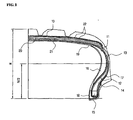
- Fig. 1 is a cross-sectional view taken across a diameter of a self-supporting type pneumatic run-flat tire according to the present invention, illustrating one side of the normally expanded tire.
- the self-supporting type pneumatic run-flat tire comprises a tread 10 contacting a road, a sidewall 13 to protect first and second carcasses 11 and 12 from external impact, a bead filler 14 to regulate rigidity of the sidewall 13, a bead wire 15 to seat the tire on a rim, an insert rubber 16 provided to the sidewall 13 to secure run-flat capability, and a reinforcing sheet 17 for preventing rubber from being separated between the bead filler 14, first and second carcasses 11 and 12 and at the sidewall 13 at a bead contacting a rim flange upon running of the run flat tire.
- Reference numerals 18, 19, 20, 21, and 22 denote chapper textile fabrics, an inner liner, a first belt layer, a second belt layer, and a reinforcing belt layer, respectively.
- the insert rubber 16 between the inner liner 19 and the first carcass 11 preferably has a thickest section located at about half of the height SH of the tire, and is gradually decreased in thickness towards the belt layers 20 and 21, and towards the bead wire 15.
- Fig. 2 is a cross-sectional view taken across the diameter of the tire similar to Fig. 1, illustrating a location of the insert rubber 16 provided to the sidewall, a turn up height (TUH) of the carcass, a bead filler height (BFH) of the bead filler, and the like.
- TH turn up height
- BH bead filler height
- the insert rubber 16 used for securing the run-flat capability starts from its original point "h" spaced a distance of at least 5 mm or more from above the bead wire 15, and preferably spaced a distance in the range of 5 mm ⁇ h ⁇ 20 mm from above the bead wire 15.
- the insert rubber 16 extends to its end point "W" spaced a distance of at least 5 mm or more from the first belt layer 20, preferably spaced a distance in the range of 5 mm ⁇ h ⁇ 25 mm from the first belt layer 20.
- a THU (turn up height) of the first carcass 11 is lower than the height H, but is higher than half of the height H. More preferably, the first carcass 11 has a THU in the range of 50 ⁇ 70 % of the height H. In addition, it is preferable that the THU of the first carcass 11 is at least 10 mm higher than a BFH (bead filler height).
- Fig. 3 is a cross-sectional view taken across the diameter of the tire similar to Fig. 1, illustrating a gauge and a location of the insert rubber 16 in the tire of the present invention.
- the insert rubber 16 When dividing the insert rubber 16 of the present invention into a first section L1, a second section L2, and a third section L3, the insert rubber 16 preferably has the maximum thickness in the second section L2, so that the thickness of the first section L1 gradually thins towards the belt layers 20 and 21, and the thickness of the third section L3 also gradually thickness towards the bead wire 15.
- the insert rubber 16 is designed such that the minimum gauge S min of the whole sidewall is located at a border between the first section L1 and the second section L2, and similar to the minimum gauge B min of the whole bead in the bead contacting the rim flange 23. More preferably, a ratio of S min /B min is in the range of 0.9 ⁇ 1.1.
- the reinforcing sheet 17 is formed from a point spaced a distance of 5 mm or more from the bead wire to a point spaced a distance of 10 mm or more from above the bead filler in order to protect the bead when the run-flat tire runs on the road.
- an insert and bead rubber composition which comprises: 20 ⁇ 80 parts by weight of natural rubber as a raw rubber; 10 ⁇ 80 parts by weight of polybutadiene with syndiotactic 1,2-polybutadiene well dispersed therein in place of the reinforcing filler; 20 ⁇ 70 parts by weight of filler for the 0 ⁇ 50 parts by weight of polybutadiene; 0.5 ⁇ 6 parts by weight of sulfur as a vulcanizing agent; 0.5 ⁇ 4 parts by weight of sulfenamide as a vulcanization accelerator; and 0.5 ⁇ 5 parts by weight of a deterioration inhibitor in order to enhance the run-flat capability of the sidewall insert and bead rubber.
- polybutadiene with syndiotactic 1, 2-polybutadiene well dispersed therein preferably comprises 3 ⁇ 35 % of syndiotactic 1, 2-polybutadiene.
- the content of polybutadiene containing syndiotactic 1, 2-polybutadiene is preferably in the range of 10 ⁇ 80 parts by weight of the whole raw rubber. If the content of polybutadiene is less than 10 parts by weight, it is difficult to secure a desired modulus level since syndiotactic 1, 2-polybutadiene does not sufficiently act as the reinforcing filler. On the contrary, if the content of polybutadiene is more than 80 parts by weight, there arise drawbacks such as reduction in workability of mixing and extrusion, in crack resistance, and in exothermic properties due to excessively high contents of butadiene and syndiotactic 1,2-polybutadiene.
- syndiotactic 1,2-polybutadiene is less than 3 %, it cannot act as the reinforcing filler, so that the rubber of the present invention does not exhibit a significant difference in its capability from that of a general butadiene rubber.
- the content of syndiotactic 1,2-polybutadiene exceeds 35 %, the modulus is rapidly increased, making it difficult to obtain a suitable run-flat capability.
- syndiotactic 1,2-polybutadiene is preferably in the range of 10 ⁇ 20 % in order to obtain the suitable run-flat capability.
- syndiotactic polybutadiene is included in place of the reinforcing filler of the conventional rubber composition, thereby preventing an increase in weight due to the reinforcing filler, while ensuring the fatigue resistance, crack resistance, and exothermic resistance.
- a rubber composition comprising a natural rubber (STR-20), polybutadiene (VCR617 available from UBEPOL) containing syndiotactic 1,2-polybutadiene, carbon black (GPF), zinc oxide (KS #2), stearic acid (curing agent, P60), anti-aging agent 1 (6PPD), anti-aging agent 2 (RD), sulfur (powder sulfur), a vulcanization accelerator (TBBS), deterioration inhibitor (KA9188 available from Bayer) according to the composition shown in Table 1, was vulcanized at a temperature of 160 °C for 20 minutes. On the basis of ASTM standards, vulcanized sheets were tested in order to measure tensile properties, Tan ⁇ , fatigue resistance, crack resistance, exothermic resistance, specific gravity, results of which are listed in Table 2.
- the tires were evaluated to confirm various capabilities, which are shown in Table 3.
- the endurance of each run-flat tire is expressed by an order of magnitude converted from a period of time until the tire fails to function normally after the tire is assembled to a rim, maintained for 24 hours at a temperature of 38 °C with an internal pressure of 2.5 kg/cm 2 , adjusted in the internal pressure to atmospheric pressure by removing a valve, and started to run on a drum (a diameter of 1.7 m) at a velocity of 80 km/h with a load of 400 kg.
- the order of magnitude of Example 1 is expressed by 100 as a control.
- Rotation resistance of each Example was obtained according to Coast Down Test (SAE J2452) after assembling the tire to the rim, and the order of magnitude of each Example is expressed by 100 as a control.
- Example 1 Composition Example 1 Example 2 Comparative Example 1 Comparative Example 2 Comparative Example 3 Natural rubber polybutadiene containing syndiotactic 1,2-polybutadiene 30 30 30 30 30 30 70 50 Butadiene rubber 20 70 70 70 Carbon black 45 55 45 65 65 Zinc oxide 5 5 ⁇ - ⁇ - ⁇ - Stearic acid 2 2 ⁇ - ⁇ - ⁇ - Anti-aging agent 1 1.5 1.5 ⁇ - ⁇ - ⁇ - Anti-aging agent 2 1.5 1.5 ⁇ - ⁇ - ⁇ - Sulfur 3.0 3.0 ⁇ - ⁇ - 3.0 Vulcanization accelerator 1.5 1.5 ⁇ - ⁇ - 2.0 Deterioration inhibitor 1.0 1.0 ⁇ - ⁇ - 1.0 (Unit: part by weight) Table 2 Example 1 Example 2 Comparative Example 1 Comparative Example 2 Comparative Example 3 Tensile properties Hardness 75 75 65
- the run-flat tire comprises syndiotactic 1,2-polybutadiene with a reduced amount of the reinforcing filler for the purpose of enhancing the run-flat capability such that the weight of rubber is decreased, whereby the tensile strength, fatigue resistance, crack resistance, and exothermic resistance of the run-flat tire are increased at the same hardness and modulus.
- the run-flat tire is prevented from being increased in weight while satisfying the run-flat endurance property, thereby enhancing fuel efficiency of a vehicle.
Landscapes
- Chemical & Material Sciences (AREA)
- Engineering & Computer Science (AREA)
- Mechanical Engineering (AREA)
- Health & Medical Sciences (AREA)
- Chemical Kinetics & Catalysis (AREA)
- Medicinal Chemistry (AREA)
- Polymers & Plastics (AREA)
- Organic Chemistry (AREA)
- Tires In General (AREA)
- Compositions Of Macromolecular Compounds (AREA)
Abstract
Description
- The present invention relates to a self-supporting type pneumatic run-flat tire, which has a structure of radial carcass and is applicable to standards of 60-series or less, and an insert and bead rubber composition for run-flat capability. More particularly, the present invention relates to a self-supporting type pneumatic run-flat tire which is optimized in location and gauge of insert rubber at sidewalls, thereby enhancing run-flat and expansion capabilities, and to an insert and bead rubber composition which comprises syndiotactic 1,2-polybutadiene for run-flat capability.
- Various self-supporting type pneumatic run-flat tires have been developed by many tire manufacturers since 1970's. Some of them are disclosed in
US Patent No. 3,949,798 filed in 1974, and assigned to Firestone Tire Rubber Co., and in patents assigned to Dunlop Tire Co. For the self-supporting type pneumatic run-flat tires disclosed in the publication, a run-flat capability can be secured by reinforcing sidewalls with a specific insert rubber, but an expansion capability is deteriorated. In this regard, many manufacturers have developed tires of various structures which can ensure the run-flat capability while preventing the expansion capability from being deteriorated. Some of them are disclosed inJapanese Patent Laid-open Publication Nos. 1998-138720 1998-067211 U.S. Patent No. 6,536,494 assigned to Dunlop Tire Co. - On the other hand, an amount of reinforcing filler or vulcanizing agent is increased for the purpose of enhancing rigidity of the sidewalls in the run-flat tire. In this case, since the specific gravity of the reinforcing filler is in the range of 1.8 ~ 2.0, it acts as a main cause of an increase in weight of rubber products, which causes difficulty in weight reduction of the tire, and therefore causes several problems in weight reduction of a vehicle.
- Since such conventional self-supporting type pneumatic run-flat tires produced as described above are disadvantageous in terms of fatigue resistance, crack resistance, and exothermic resistance, they fail to maintain requirement for the run-flat capability, leading to splitting of the rubber. In particular, the conventional self-supporting type pneumatic run-flat tires cannot be prevented from being increased in weight due to reinforcement of the insert.
- The present invention has been made to solve the above problems, and it is an object of the present invention to provide a self-supporting type pneumatic run-flat tire, which comprises an insert rubber so as to be optimized in location and gauge of the insert rubber at sidewalls, thereby enhancing run-flat and expansion capabilities.
- It is another object of the present invention to provide an insert and bead rubber composition for run-flat capability, which comprises syndiotactic 1,2-polybutadiene in place of the conventional reinforcing filler in order to allow only a small amount of filler to be filled in the tire, and to permit rubber products thereof to have a reduced weight and to be secured in strength of the insert and the bead.
- It is yet another object of the present invention to provide the insert and bead rubber composition for the run-flat capability, which comprises syndiotactic 1,2-polybutadiene with a reduced amount of the reinforcing filler for the improvement of the run-flat capability of the run-flat tire such that the weight of rubber is decreased, whereby the rubber composition of the sidewall insert and bead is lowered in its weight, enhanced in tensile strength, fatigue resistance, crack resistance, and exothermic resistance at the same hardness and modulus, and prevents an increase in weight of the tire while satisfying run-flat endurance, thereby enhancing fuel efficiency of a vehicle.
- In accordance with one aspect of the present invention, the above and other objects can be accomplished by the provision of a self-supporting type pneumatic run-flat tire comprising a tread, a sidewall and a bead, which is adapted to run stably at a predetermined velocity for a predetermined distance and capable of self-supporting a load of a vehicle upon reduction in internal pressure of the tire for standards of 60-series or less, characterized in that an insert rubber is located between an inner liner positioned inside the tire and carcasses constituting a frame of the tire, and a reinforcing sheet is located between the sidewall of the bead and an outermost carcass to enhance endurance of the bead contacting a rim flange when the run-flat tire runs on a road.
- The foregoing and other objects and features of the present invention will be more clearly understood from the following detailed description taken in conjunction with the accompanying drawings, in which:
- Fig. 1 is a cross-sectional view taken across a diameter of a self-supporting type pneumatic run-flat tire according to the present invention, illustrating one side of the normally expanded tire;
- Fig. 2 is a cross-sectional view taken across the diameter of the tire similar to Fig. 1, illustrating a location of an insert rubber provided to a sidewall, a turn up height (TUH) of a carcass, and a bead filler height (BFH) of a bead filler in the tire; and
- Fig. 3 is a cross-sectional view taken across the diameter of the tire similar to Fig. 1, illustrating a gauge and a location of the insert rubber in the tire in accordance with the present invention.
- Preferred embodiments of the present invention will be described in detail with reference to the accompanying drawings.
- Fig. 1 is a cross-sectional view taken across a diameter of a self-supporting type pneumatic run-flat tire according to the present invention, illustrating one side of the normally expanded tire.
- Referring to Fig. 1, the self-supporting type pneumatic run-flat tire according to the present invention comprises a
tread 10 contacting a road, asidewall 13 to protect first andsecond carcasses bead filler 14 to regulate rigidity of thesidewall 13, abead wire 15 to seat the tire on a rim, aninsert rubber 16 provided to thesidewall 13 to secure run-flat capability, and a reinforcingsheet 17 for preventing rubber from being separated between thebead filler 14, first andsecond carcasses sidewall 13 at a bead contacting a rim flange upon running of the run flat tire. -
Reference numerals - According to the present invention, in the run-flat tire having a height SH in a cross section as shown in Fig. 1, the
insert rubber 16 between theinner liner 19 and thefirst carcass 11 preferably has a thickest section located at about half of the height SH of the tire, and is gradually decreased in thickness towards thebelt layers bead wire 15. - Fig. 2 is a cross-sectional view taken across the diameter of the tire similar to Fig. 1, illustrating a location of the
insert rubber 16 provided to the sidewall, a turn up height (TUH) of the carcass, a bead filler height (BFH) of the bead filler, and the like. - Referring to Fig. 2, according to the present invention, the
insert rubber 16 used for securing the run-flat capability starts from its original point "h" spaced a distance of at least 5 mm or more from above thebead wire 15, and preferably spaced a distance in the range of 5 mm < h < 20 mm from above thebead wire 15. - The
insert rubber 16 extends to its end point "W" spaced a distance of at least 5 mm or more from thefirst belt layer 20, preferably spaced a distance in the range of 5 mm < h < 25 mm from thefirst belt layer 20. - As shown in Fig. 2, for the pneumatic radial tire which employs one or more sheets of classes, it is preferable that a THU (turn up height) of the
first carcass 11 is lower than the height H, but is higher than half of the height H. More preferably, thefirst carcass 11 has a THU in the range of 50 ~ 70 % of the height H. In addition, it is preferable that the THU of thefirst carcass 11 is at least 10 mm higher than a BFH (bead filler height). - Fig. 3 is a cross-sectional view taken across the diameter of the tire similar to Fig. 1, illustrating a gauge and a location of the
insert rubber 16 in the tire of the present invention. - When dividing the
insert rubber 16 of the present invention into a first section L1, a second section L2, and a third section L3, theinsert rubber 16 preferably has the maximum thickness in the second section L2, so that the thickness of the first section L1 gradually thins towards thebelt layers bead wire 15. - Preferably, the
insert rubber 16 is designed such that the minimum gauge Smin of the whole sidewall is located at a border between the first section L1 and the second section L2, and similar to the minimum gauge Bmin of the whole bead in the bead contacting therim flange 23. More preferably, a ratio of Smin/Bmin is in the range of 0.9 ~ 1.1. - The reinforcing
sheet 17 is formed from a point spaced a distance of 5 mm or more from the bead wire to a point spaced a distance of 10 mm or more from above the bead filler in order to protect the bead when the run-flat tire runs on the road. - In accordance with the present invention, an insert and bead rubber composition is provided, which comprises: 20 ~ 80 parts by weight of natural rubber as a raw rubber; 10 ~ 80 parts by weight of polybutadiene with syndiotactic 1,2-polybutadiene well dispersed therein in place of the reinforcing filler; 20 ~ 70 parts by weight of filler for the 0 ~ 50 parts by weight of polybutadiene; 0.5 ~ 6 parts by weight of sulfur as a vulcanizing agent; 0.5 ~ 4 parts by weight of sulfenamide as a vulcanization accelerator; and 0.5 ~ 5 parts by weight of a deterioration inhibitor in order to enhance the run-flat capability of the sidewall insert and bead rubber.
- In the present invention, polybutadiene with syndiotactic 1, 2-polybutadiene well dispersed therein preferably comprises 3 ~ 35 % of syndiotactic 1, 2-polybutadiene.
- The content of polybutadiene containing syndiotactic 1, 2-polybutadiene is preferably in the range of 10 ~ 80 parts by weight of the whole raw rubber. If the content of polybutadiene is less than 10 parts by weight, it is difficult to secure a desired modulus level since syndiotactic 1, 2-polybutadiene does not sufficiently act as the reinforcing filler. On the contrary, if the content of polybutadiene is more than 80 parts by weight, there arise drawbacks such as reduction in workability of mixing and extrusion, in crack resistance, and in exothermic properties due to excessively high contents of butadiene and syndiotactic 1,2-polybutadiene.
- In addition, if the content of syndiotactic 1,2-polybutadiene is less than 3 %, it cannot act as the reinforcing filler, so that the rubber of the present invention does not exhibit a significant difference in its capability from that of a general butadiene rubber. On the contrary, if the content of syndiotactic 1,2-polybutadiene exceeds 35 %, the modulus is rapidly increased, making it difficult to obtain a suitable run-flat capability. Thus, syndiotactic 1,2-polybutadiene is preferably in the range of 10 ~ 20 % in order to obtain the suitable run-flat capability.
- In the insert and bead rubber composition of the present invention, syndiotactic polybutadiene is included in place of the reinforcing filler of the conventional rubber composition, thereby preventing an increase in weight due to the reinforcing filler, while ensuring the fatigue resistance, crack resistance, and exothermic resistance.
- Examples of the present invention will be described hereinafter. In this regard, it should be noted that the examples of the present invention are provided only for an illustrative purpose, and do not limit the scope of the present invention.
- A rubber composition comprising a natural rubber (STR-20), polybutadiene (VCR617 available from UBEPOL) containing syndiotactic 1,2-polybutadiene, carbon black (GPF), zinc oxide (KS #2), stearic acid (curing agent, P60), anti-aging agent 1 (6PPD), anti-aging agent 2 (RD), sulfur (powder sulfur), a vulcanization accelerator (TBBS), deterioration inhibitor (KA9188 available from Bayer) according to the composition shown in Table 1, was vulcanized at a temperature of 160 °C for 20 minutes. On the basis of ASTM standards, vulcanized sheets were tested in order to measure tensile properties, Tan δ, fatigue resistance, crack resistance, exothermic resistance, specific gravity, results of which are listed in Table 2.
- After producing run-flat tires comprising the rubber composition of the present invention, the tires were evaluated to confirm various capabilities, which are shown in Table 3. In the table, the endurance of each run-flat tire is expressed by an order of magnitude converted from a period of time until the tire fails to function normally after the tire is assembled to a rim, maintained for 24 hours at a temperature of 38 °C with an internal pressure of 2.5 kg/cm2, adjusted in the internal pressure to atmospheric pressure by removing a valve, and started to run on a drum (a diameter of 1.7 m) at a velocity of 80 km/h with a load of 400 kg. In table 3, the order of magnitude of Example 1 is expressed by 100 as a control. Rotation resistance of each Example was obtained according to Coast Down Test (SAE J2452) after assembling the tire to the rim, and the order of magnitude of each Example is expressed by 100 as a control.
- After preparing a rubber composition which was formed by mixing various additives according to the composition shown in Table 1, except that a butadiene rubber (KBR01 available from Kumho Petrochemical Co.) was used instead of polybutadiene containing syndiotactic 1,2-polybutadiene, the rubber composition was vulcanized at a temperature of 160 °C for 20 minutes. On the basis of ASTM standards, vulcanized sheets were tested in order to measure tensile properties, Tan 8, fatigue resistance, crack resistance, exothermic resistance, specific gravity, results of which are listed in Table 2.
- After producing run-flat tires comprising the rubber composition of Comparative Examples 1 and 3, the tires were evaluated to confirm various capabilities, which are shown in Table 3. In the table, the endurance of each run-flat tire is expressed by an order of magnitude convented from to a period of time until the tire fails to function normally after the tire is assembled to a rim, maintained for 24 hours at a temperature of 38 °C with an internal pressure of 2.5 kg/cm2, adjusted in the internal pressure to atmospheric pressure by removing a valve, and started to run on a drum (a diameter of 1.7 m) at a velocity of 80 km/h with a load of 400 kg. In table 3, the order of magnitude of Example 1 is expressed by 100 as a control. Rotation resistance of each Example was obtained according to Coast Down Test (SAE J2452) after assembling the tire to the rim, and the order of magnitude of Example 1 is expressed by 100 as a control.
Table 1 Composition Example 1 Example 2 Comparative Example 1 Comparative Example 2 Comparative Example 3 Natural rubber polybutadiene containing syndiotactic 1,2-polybutadiene 30 30 30 30 30 70 50 Butadiene rubber 20 70 70 70 Carbon black 45 55 45 65 65 Zinc oxide 5 5 <- <- <- Stearic acid 2 2 <- <- <- Anti-aging agent 1 1.5 1.5 <- <- <- Anti-aging agent 21.5 1.5 <- <- <- Sulfur 3.0 3.0 <- <- 3.0 Vulcanization accelerator 1.5 1.5 <- <- 2.0 Deterioration inhibitor 1.0 1.0 <- <- 1.0 (Unit: part by weight) Table 2 Example 1 Example 2 Comparative Example 1 Comparative Example 2 Comparative Example 3 Tensile properties Hardness 75 75 65 71 74 Modulus 75 77 40 65 73 Elongation 190 200 200 150 120 Tensile strength 160 155 145 120 110 Fatigue resistance Life cycle 6000 5000 6000 1500 500 Crack resistance Growth rate 0.4 0.4 0.4 1.0 2.0 Tan δ Specific gravity At 80 0.04 0.04 0.04 0.08 0.07 g/cc 1.34 1.35 1.35 1.41 1.41 Table 3 Example 1 Example 2 Comparative Example 1 Comparative Example 2 Run-flat endurance Order of magnitude 100 100 10 30 Rotation resistance Order of magnitude 100 90 95 95 - As apparent from the above description, according to the present invention, the run-flat tire comprises syndiotactic 1,2-polybutadiene with a reduced amount of the reinforcing filler for the purpose of enhancing the run-flat capability such that the weight of rubber is decreased, whereby the tensile strength, fatigue resistance, crack resistance, and exothermic resistance of the run-flat tire are increased at the same hardness and modulus.
- In addition, according to the present invention, the run-flat tire is prevented from being increased in weight while satisfying the run-flat endurance property, thereby enhancing fuel efficiency of a vehicle.
- It should be understood that the embodiments and the accompanying drawings as described above have been described for illustrative purposes and the present invention is limited by the following claims. Further, those skilled in the art will appreciate that various modifications, additions and substitutions are allowed without departing from the scope and spirit of the invention as set forth in the accompanying claims.
Claims (9)
- A self-supporting type pneumatic run-flat tire comprising a tread, a sidewall and a bead, which adapted to run stably at a predetermined velocity for a predetermined distance and capable of self-supporting a load of a vehicle upon reduction in internal pressure of the tire for standards of 60-series or less, characterized in that,
an insert rubber is located between an inner liner positioned inside the tire and a carcass constituting a frame of the tire, and a reinforcing sheet is located between the sidewall of the bead and an outermost carcass to enhance endurance of the bead contacting a rim flange when the run-flat tire runs on a road. - The run-flat tire according to claim 1, wherein an original point "h" of the insert rubber is set in the range of 5 mm ~ 20 mm from above the bead wire.
- The run-flat tire according to claim 1, wherein an end point "w" of the insert rubber is set in the range of 5 mm ~ 20 mm from the first belt layer.
- The run-flat tire according to claim 1, wherein, when dividing the insert rubber into a first section L1, a second section L2, and a third section L3, the insert rubber has a maximum gauge Tmax located in the second section L2.
- The run-flat tire according to claim 1, wherein, when dividing the insert rubber into a first section L1, a second section L2, and a third section L3, the whole sidewall has a minimum gauge Smin located at a border between the first section L1 and the second section L2.
- The run-flat tire according to claim 5, wherein the minimum gauge Smin of the whole sidewall is similar to the minimum gauge Bmin of the whole bead in the bead contacting the rim flange.
- The run-flat tire according to claim 6, wherein a ratio of the minimum gauge Bmin of the whole bead to the minimum gauge Smin of the whole sidewall is in the range of 0.9 ~ 1.1.
- An insert and bead rubber composition, comprising a natural rubber as a raw rubber, a polybutadiene rubber, filler, a vulcanizing agent, a vulcanization accelerator, and a deterioration inhibitor for run-flat capability, characterized in that
the natural rubber as the raw rubber is in the range of 20 ~ 80 parts by weight, polybutadiene with a syndiotactic 1,2-polybutadience well dispersed therein is in the range of 10 ~ 80 parts by weight, and the polybutadiene rubber is in the range of 0 ~ 50 parts by weight. - The rubber composition according to claim 8, wherein the polybutadiene with a syndiotactic 1,2-polybutadiene well dispersed therein comprises 3 ~ 35 % of syndiotactic 1,2-polybutadiene.
Applications Claiming Priority (1)
| Application Number | Priority Date | Filing Date | Title |
|---|---|---|---|
| KR1020050061090A KR100655927B1 (en) | 2005-07-07 | 2005-07-07 | Self-supporting pneumatic run flat tire |
Publications (2)
| Publication Number | Publication Date |
|---|---|
| EP1741569A2 true EP1741569A2 (en) | 2007-01-10 |
| EP1741569A3 EP1741569A3 (en) | 2007-12-26 |
Family
ID=37072944
Family Applications (1)
| Application Number | Title | Priority Date | Filing Date |
|---|---|---|---|
| EP06012343A Withdrawn EP1741569A3 (en) | 2005-07-07 | 2006-06-15 | Self-supporting type pneumatic run-flat tire, and insert and bead rubber composition for run-flat capability |
Country Status (4)
| Country | Link |
|---|---|
| US (1) | US20070006956A1 (en) |
| EP (1) | EP1741569A3 (en) |
| KR (1) | KR100655927B1 (en) |
| CN (1) | CN1891498B (en) |
Cited By (2)
| Publication number | Priority date | Publication date | Assignee | Title |
|---|---|---|---|---|
| EP3403851A1 (en) * | 2017-05-18 | 2018-11-21 | Hankook Tire Co., Ltd. | Rubber composition for protecting sidewall of tire from ozone and tire manufactured using the same |
| US11059958B2 (en) | 2017-05-12 | 2021-07-13 | Hankook Tire Co., Ltd. | Rubber composition for protecting sidewall of tire from ozone and tire manufactured using the same |
Families Citing this family (9)
| Publication number | Priority date | Publication date | Assignee | Title |
|---|---|---|---|---|
| JP5495151B2 (en) | 2007-07-26 | 2014-05-21 | 住友ゴム工業株式会社 | Run flat tire |
| EP2437731B1 (en) | 2009-06-04 | 2017-12-27 | Roche Diabetes Care GmbH | Device and method for adjusting basal delivery profile |
| JP5550039B2 (en) * | 2009-09-29 | 2014-07-16 | 住友ゴム工業株式会社 | Pneumatic tire |
| CN102161790A (en) * | 2010-12-29 | 2011-08-24 | 东莞市迅创实业有限公司 | Thermoplastic Elastomers for Subway, Light Rail and Shock Absorbing Pads |
| CN104311908A (en) * | 2014-11-20 | 2015-01-28 | 三角轮胎股份有限公司 | Tire sidewall rubber combination comprising 1,2-syndiotactic polybutadiene |
| US10894448B2 (en) | 2015-02-11 | 2021-01-19 | Bridgestone Americas Tire Operations, Llc | Runflat tire with sidewall-reinforcing inserts |
| KR20170021400A (en) | 2015-08-17 | 2017-02-28 | 넥센타이어 주식회사 | The Run-Flat Tire |
| CN105399999A (en) * | 2015-12-08 | 2016-03-16 | 黄涌芮 | High-elasticity rubber and preparation method thereof |
| CN110577680A (en) * | 2019-09-20 | 2019-12-17 | 泉州师范学院 | A kind of light-weight non-slip rubber sole material and its manufacturing method |
Citations (4)
| Publication number | Priority date | Publication date | Assignee | Title |
|---|---|---|---|---|
| US3949798A (en) | 1974-04-23 | 1976-04-13 | The Firestone Tire & Rubber Company | Pneumatic tire |
| JPH1067211A (en) | 1996-05-29 | 1998-03-10 | Bridgestone Corp | Pneumatic radial tire provided with side reinforcing layer |
| JPH10138720A (en) | 1996-11-13 | 1998-05-26 | Bridgestone Corp | Pneumatic tire |
| US6536494B1 (en) | 1998-12-24 | 2003-03-25 | Dunlop Gmbh | Pneumatic vehicle tire |
Family Cites Families (10)
| Publication number | Priority date | Publication date | Assignee | Title |
|---|---|---|---|---|
| IT1160797B (en) * | 1983-04-18 | 1987-03-11 | Pirelli | SELF-SUPPORTING TIRE |
| US5217549A (en) * | 1991-04-04 | 1993-06-08 | Bridgestone/Firestone, Inc. | Pneumatic safety tire |
| KR940024543U (en) * | 1993-04-27 | 1994-11-16 | Bias tire with structure that reinforced side part | |
| JP2662172B2 (en) * | 1993-09-29 | 1997-10-08 | 住友ゴム工業株式会社 | Rubber composition for reinforcing bead portion of tire |
| JP3416284B2 (en) * | 1994-09-16 | 2003-06-16 | 住友ゴム工業株式会社 | Side wall |
| KR100342580B1 (en) * | 1995-04-08 | 2002-10-25 | 금호산업 주식회사 | Pneumatic tires with reinforced side walls |
| DE69927310T2 (en) * | 1998-02-27 | 2006-06-29 | Bridgestone Corp. | tire |
| DE69910085T2 (en) * | 1999-07-01 | 2004-05-06 | The Goodyear Tire & Rubber Co., Akron | TISSUE SUPPORT FOR METAL REINFORCED INNER CARCASE LOCATION OF EMERGENCY TIRES |
| US6719029B2 (en) * | 2002-08-09 | 2004-04-13 | The Goodyear Tire & Rubber Company | Tire wall gauges to optimize runflat tire ride comfort |
| US7093633B2 (en) | 2003-10-29 | 2006-08-22 | The Goodyear Tire & Rubber Company | Self-supporting pneumatic tire |
-
2005
- 2005-07-07 KR KR1020050061090A patent/KR100655927B1/en not_active Expired - Fee Related
-
2006
- 2006-06-15 EP EP06012343A patent/EP1741569A3/en not_active Withdrawn
- 2006-06-20 US US11/425,357 patent/US20070006956A1/en not_active Abandoned
- 2006-07-06 CN CN2006100985418A patent/CN1891498B/en not_active Expired - Fee Related
Patent Citations (4)
| Publication number | Priority date | Publication date | Assignee | Title |
|---|---|---|---|---|
| US3949798A (en) | 1974-04-23 | 1976-04-13 | The Firestone Tire & Rubber Company | Pneumatic tire |
| JPH1067211A (en) | 1996-05-29 | 1998-03-10 | Bridgestone Corp | Pneumatic radial tire provided with side reinforcing layer |
| JPH10138720A (en) | 1996-11-13 | 1998-05-26 | Bridgestone Corp | Pneumatic tire |
| US6536494B1 (en) | 1998-12-24 | 2003-03-25 | Dunlop Gmbh | Pneumatic vehicle tire |
Cited By (2)
| Publication number | Priority date | Publication date | Assignee | Title |
|---|---|---|---|---|
| US11059958B2 (en) | 2017-05-12 | 2021-07-13 | Hankook Tire Co., Ltd. | Rubber composition for protecting sidewall of tire from ozone and tire manufactured using the same |
| EP3403851A1 (en) * | 2017-05-18 | 2018-11-21 | Hankook Tire Co., Ltd. | Rubber composition for protecting sidewall of tire from ozone and tire manufactured using the same |
Also Published As
| Publication number | Publication date |
|---|---|
| US20070006956A1 (en) | 2007-01-11 |
| EP1741569A3 (en) | 2007-12-26 |
| KR100655927B1 (en) | 2006-12-08 |
| CN1891498B (en) | 2012-07-18 |
| CN1891498A (en) | 2007-01-10 |
Similar Documents
| Publication | Publication Date | Title |
|---|---|---|
| EP1707402B1 (en) | Radial tire reducing the rolling resistance having a breaker cushion or a side wall insert comprising a rubber composition containing as reinforcing filler a blend of carbon black and silica. | |
| JP4243356B2 (en) | Low cost run flat tire with improved carcass | |
| AU681561B2 (en) | A radial ply pneumatic tire | |
| KR100533410B1 (en) | Runflat tire with improved carcass | |
| CN1107601C (en) | Non-extensible high-temperature resistant run-flat tires | |
| EP0943466A2 (en) | Tire with sidewall carcass reinforcement | |
| EP2072289B1 (en) | Run-flat tire | |
| EP0988999B1 (en) | Antireversion agent for inserts used in runflat tires | |
| EP0842795A2 (en) | Pneumatic tyre | |
| EP2239154A1 (en) | Side part reinforcing layer and run-flat tire | |
| EP1741569A2 (en) | Self-supporting type pneumatic run-flat tire, and insert and bead rubber composition for run-flat capability | |
| EP2692544B1 (en) | Tire casing | |
| EP2123489B1 (en) | Safety tire | |
| JP6060033B2 (en) | Pneumatic radial tire for passenger cars | |
| JP2020078962A (en) | Pneumatic tire | |
| JP4220201B2 (en) | Safety tire | |
| KR100691219B1 (en) | Sidewall Inserts and Bead Rubber Compositions for Run Flat Tires | |
| EP1637359B1 (en) | Pneumatic tire | |
| JP2020104752A (en) | Pneumatic tire |
Legal Events
| Date | Code | Title | Description |
|---|---|---|---|
| PUAI | Public reference made under article 153(3) epc to a published international application that has entered the european phase |
Free format text: ORIGINAL CODE: 0009012 |
|
| AK | Designated contracting states |
Kind code of ref document: A2 Designated state(s): AT BE BG CH CY CZ DE DK EE ES FI FR GB GR HU IE IS IT LI LT LU LV MC NL PL PT RO SE SI SK TR |
|
| AX | Request for extension of the european patent |
Extension state: AL BA HR MK YU |
|
| PUAL | Search report despatched |
Free format text: ORIGINAL CODE: 0009013 |
|
| AK | Designated contracting states |
Kind code of ref document: A3 Designated state(s): AT BE BG CH CY CZ DE DK EE ES FI FR GB GR HU IE IS IT LI LT LU LV MC NL PL PT RO SE SI SK TR |
|
| AX | Request for extension of the european patent |
Extension state: AL BA HR MK YU |
|
| 17P | Request for examination filed |
Effective date: 20080623 |
|
| 17Q | First examination report despatched |
Effective date: 20080725 |
|
| AKX | Designation fees paid |
Designated state(s): DE FR GB HU IT |
|
| STAA | Information on the status of an ep patent application or granted ep patent |
Free format text: STATUS: THE APPLICATION IS DEEMED TO BE WITHDRAWN |
|
| 18D | Application deemed to be withdrawn |
Effective date: 20120303 |