EP1737791B1 - Mikroporöses gerüstsilikat und verfahren zu seiner herstellung - Google Patents
Mikroporöses gerüstsilikat und verfahren zu seiner herstellung Download PDFInfo
- Publication number
- EP1737791B1 EP1737791B1 EP05716576.3A EP05716576A EP1737791B1 EP 1737791 B1 EP1737791 B1 EP 1737791B1 EP 05716576 A EP05716576 A EP 05716576A EP 1737791 B1 EP1737791 B1 EP 1737791B1
- Authority
- EP
- European Patent Office
- Prior art keywords
- silicate
- separation
- framework
- molding
- range
- Prior art date
- Legal status (The legal status is an assumption and is not a legal conclusion. Google has not performed a legal analysis and makes no representation as to the accuracy of the status listed.)
- Expired - Lifetime
Links
Images





Classifications
-
- C—CHEMISTRY; METALLURGY
- C01—INORGANIC CHEMISTRY
- C01B—NON-METALLIC ELEMENTS; COMPOUNDS THEREOF; METALLOIDS OR COMPOUNDS THEREOF NOT COVERED BY SUBCLASS C01C
- C01B33/00—Silicon; Compounds thereof
- C01B33/20—Silicates
-
- C—CHEMISTRY; METALLURGY
- C01—INORGANIC CHEMISTRY
- C01B—NON-METALLIC ELEMENTS; COMPOUNDS THEREOF; METALLOIDS OR COMPOUNDS THEREOF NOT COVERED BY SUBCLASS C01C
- C01B39/00—Compounds having molecular sieve and base-exchange properties, e.g. crystalline zeolites; Their preparation; After-treatment, e.g. ion-exchange or dealumination
- C01B39/02—Crystalline aluminosilicate zeolites; Isomorphous compounds thereof; Direct preparation thereof; Preparation thereof starting from a reaction mixture containing a crystalline zeolite of another type, or from preformed reactants; After-treatment thereof
-
- C—CHEMISTRY; METALLURGY
- C01—INORGANIC CHEMISTRY
- C01B—NON-METALLIC ELEMENTS; COMPOUNDS THEREOF; METALLOIDS OR COMPOUNDS THEREOF NOT COVERED BY SUBCLASS C01C
- C01B39/00—Compounds having molecular sieve and base-exchange properties, e.g. crystalline zeolites; Their preparation; After-treatment, e.g. ion-exchange or dealumination
- C01B39/02—Crystalline aluminosilicate zeolites; Isomorphous compounds thereof; Direct preparation thereof; Preparation thereof starting from a reaction mixture containing a crystalline zeolite of another type, or from preformed reactants; After-treatment thereof
- C01B39/04—Crystalline aluminosilicate zeolites; Isomorphous compounds thereof; Direct preparation thereof; Preparation thereof starting from a reaction mixture containing a crystalline zeolite of another type, or from preformed reactants; After-treatment thereof using at least one organic template directing agent, e.g. an ionic quaternary ammonium compound or an aminated compound
Definitions
- the present invention relates to a process for the preparation of silicates, in particular for the preparation of framework silicates with zeolite structure.
- the present invention likewise relates to the silicates obtainable by this process, in particular phyllosilicates and framework silicates.
- the present invention relates to these silicates per se and their use, in particular their use as molecular sieves for the up and / or separation of mixtures, in particular for the separation of alkane and / or alkene gas mixtures.
- One of the objects underlying the present invention was therefore to provide compounds which can be used as molecular sieves and / or adsorbents for such separations and / or separations.
- Another object underlying the present invention was to provide a process for preparing these compounds.
- a further object of the present invention was to provide novel silicates, in particular zeolites, which can be advantageously used for the purposes described above, but also for any other conceivable purpose, such as catalysts or in other technical fields.
- the at least one tetraalkylammonium compound comprising R 1 R 2 R 3 R 4 N + it is possible according to the invention to use a base other than this compound.
- ammonium hydroxide NH 4 OH alkali metal hydroxides or alkaline earth metal hydroxides such as sodium hydroxide or potassium hydroxide or mixtures of two or more of these compounds.
- the at least one tetraalkylammonium compound comprising R 1 R 2 R 3 R 4 N + contains one or more suitable anions, for example halogen anions, for example fluoride or chloride or bromide or iodide.
- the at least one tetraalkylammonium compound comprising R 1 R 2 R 3 R 4 N + also contains the base used according to (1) as the anion.
- the base used according to (1) as the anion.
- the hydroxide ion or aluminates may be mentioned.
- the basic anion the hydroxide ion is particularly preferred.
- the present invention also relates to a process as described above, which is characterized in that the tetraalkylammonium compound comprising at least one R 1 R 2 R 3 R 4 N + comprises a basic anion, preferably a hydroxide ion.
- the present invention therefore also relates to a process as described above, which is characterized in that the aqueous solution used according to (1) contains dimethyldipropylammonium hydroxide (DMDPAH).
- DMDPAH dimethyldipropylammonium hydroxide
- the molar ratios of silica, tetraalkylammonium compound, in particular tetraalkylammonium hydroxide compound, and water can be set essentially arbitrarily, as long as it is ensured that according to (2) at least one silicate is obtained by crystallization.
- the amounts of silica and / or precursor thereof, tetraalkylammonium hydroxide compound and water are chosen such that the colloidal solution obtained in (1) is silica, Tetraalkylammoniumhydroxyid compound and water in weight ratios in the range of 1: (0.45-0.55): (8-12) contains. Furthermore, water contents of up to 15 are possible with regard to the abovementioned ranges, with 3 being the lower limit, for example. Accordingly, the colloidal solution obtained in (1) may contain silica, tetraalkylammonium hydroxide compound and water in weight ratios ranging from 1: (0.45-0.55) :( 3-15).
- the water content may be in the range of 4 to 15 or 5 to 15 or 6 to 15 or 7 to 15 or 8 to 15 or 9 to 15 or 10 to 15 or 11 to 15 or 12 to 15 or from 13 to 15 or from 14 to 15 or from 3 to 14 or from 3 to 13 or from 3 to 12 or from 3 to 11 or from 3 to 10 or from 3 to 9 or from 3 to 8 or from 3 to 7 or from 3 to 6 or from 3 to 5 or from 3 to 4.
- Further preferred ranges are for example from 4 to 14.5 or from 5 to 14 or from 6 to 13.5 or from 7 to 13 or from 7.5 to 12.5.
- the present invention relates to the preferred tetraalkylammoniumhydroxyid compounds also a method as described above, which is characterized in that the obtained according to (1) colloidal solution SiO 2 , DMDPAH and water in the weight ratios SiO 2 : DMDPAH: water of 1: (0.45-0.55): (8-12), more preferably 1: (0.46-0.54): (8-12), further preferably 1: (0.47-0.53 ): (8-12), more preferably from 1: (0.48-0.52): (8-12), and most preferably from 1: (0.49-0.51): (8-12) ,
- the water content is more preferably in the range of 8 to 11 or 8 to 10 or 8 to 9 or 9 to 12 or 9 to 11 or 9 to 10 or 10 to 12 or 10 to 11 or of 11 to 12.
- the colloidal solution according to (2) obtained according to (1) under any suitable pressure at any suitable temperature as long as it is ensured that at least one silicate crystallizes in the colloidal solution.
- the crystallization according to (2) is carried out under atmospheric pressure, while in most hydrothermal processes of the prior art, the crystallization is carried out under elevated pressure relative to normal pressure.
- the present invention also relates to a process as described above, which is characterized in that the hydrothermal crystallization in (2) is carried out at normal pressure.
- normal pressure refers to a pressure of ideally 101,325 Pa, which, however, may be subject to variations within the limits known to those skilled in the art.
- the pressure may be in the range of 95,000 to 106,000, or 96,000 to 105,000, or 97,000 to 104,000, or 98,000 to 103,000, or 99,000 to 102,000 Pa.
- the temperature used according to (2) at normal pressure in the range of 100 to 180 ° C, more preferably in the range of 110 to 175 ° C, more preferably in the range of 120 to 170 ° C, further preferably in the range of 130 to 165 ° C and particularly preferably in the range of 140 to 160 ° C.
- the present invention also relates to a process as described above, which is characterized in that the obtained according to (1) colloidal solution according to (2) is heated at normal pressure to a temperature in the range of 100 to 180 ° C.
- This temperature, to which the colloidal solution according to (1) obtained according to (1) is heated, can basically be kept until the crystallization has been carried out to the desired extent. Times are preferred in the range of up to 45 days, preferably from 12 hours to 45 days, more preferably in the range of 12 hours to 30 days, more preferably in the range of 1 to 30 days such as from about 1, 2, 5 , 10, 15, 20, 25 or 30 days.
- the present invention also relates to a process as described above, characterized in that the colloidal solution obtained according to (1) according to (2) is heated for a period in the range of 12 hours to 30 days.
- Periods in a range of up to 12 h, such as 0.5 to 12 h are also conceivable within the scope of the method according to the invention.
- any suitable compound can be used as the silicon dioxide or precursor thereof.
- suitable precursor compounds are tetraalkoxysilanes, such as tetraethoxysilane or tetrapropoxysilane.
- tetraalkoxysilanes such as tetraethoxysilane or tetrapropoxysilane.
- silica precursor no silica precursor but silica as such. Again preferred is amorphous silica.
- the present invention also relates to a method as described above, which is characterized in that according to (1) amorphous silica is used.
- any suitable amorphous silica can be used.
- amorphous silica having a specific surface area BET, Brunauer-Emmet plate, determined in accordance with DIN 66131 by nitrogen adsorption at 77 K
- BET Brunauer-Emmet plate, determined in accordance with DIN 66131 by nitrogen adsorption at 77 K
- Further preferred ranges are 50 to 100 m 2 / g or 100 to 300 m 2 / g or 300 to 400 m 2 / g.
- DMDPAH are preferably used in addition to silica.
- DMDPAH are obtained by reacting dipropylamine and methyl iodide and subsequent anion exchange.
- dipropylamine and methyl iodide are reacted together in a suitable solvent or solvent mixture, preferably in ethanol.
- the temperature at which this reaction occurs is preferably in the range of 20 to 75 ° C, more preferably in the range of 30 to 60 ° C, and particularly preferably in the range of 40 to 50 ° C.
- DMDPAH can be prepared from dimethylamine and propyl bromide in a suitable solvent, for example preferably ethanol, at a suitable temperature, for example preferably from 40 to 50 ° C.
- the anion exchange according to the invention is preferably carried out after separation such as by filtration, centrifugation or another solid-liquid separation method, for example preferably by filtration, and washing the respective ammonium hydroxide, for example preferably with a suitable alcohol such as ethanol, through a suitable ion exchange resin such as Amberlyst TM resin or AG1-X8 resin (BioRad). Also possible is ion exchange using Ag 2 O.
- DMDPAH is preferably used in (1) as a solution, particularly preferably as an aqueous solution, wherein the concentration of the aqueous solution with respect to DMDPAH is preferably in the range from 0.4 to 1 mol / l.
- DMDPAH is used according to (1).
- the temperature in the preparation of the colloidal solution according to (1) is preferably in the range of 10 to 40 ° C, more preferably in the range of 15 to 35 ° C, and particularly preferably in the range of 20 to 30 ° C.
- the colloidal solution according to (1) in one step by mixing amorphous silica and tetraalkylammonium hydroxide solution.
- first a colloidal solution is prepared in a first step, the tetraalkylammonium hydroxide, silica and water having a weight ratio of SiO 2 : tetraalkylammonium hydroxide: water of preferably 1: (0.45-0.55): (3 -15), more preferably 1: (0.47-0.53): (3-15), and particularly preferably 1: (0.49-0.51): (3-15).
- the water content of the solution obtained in the first step is then adjusted by means of a suitable method to be within the preferred limits specified above.
- the water content is adjusted by water removal in at least one suitable device.
- the water is removed at a temperature in the range of preferably 60 to 85 ° C, more preferably from 65 to 80 ° C and particularly preferably from 65 to 75 ° C.
- Rotary evaporators or ovens may be mentioned as at least one suitable device. Particularly preferred is a furnace. Preference is given in this regard, inter alia, devices that allow water removal at reduced pressure and thus at low temperatures.
- the heating and subsequent preparation of the at least one silicate can be carried out in any suitable apparatus.
- (2) takes place in an autoclave.
- the colloidal solution is preferably suitably stirred for crystallization according to (2). It is also possible to rotate the reaction vessel in which the crystallization is carried out.
- the at least one silicate is suitably separated off in at least one step according to one embodiment of the process according to the invention.
- This separation can be carried out, for example, by filtration, ultrafiltration, diafiltration, centrifuging or, for example, spray-drying and spray granulation processes.
- the separation is via spray drying or filtration.
- the crystallization according to (2) can be stopped by suitable quenching. It is particularly preferred to provide the suspension with water having a temperature which is suitable for terminating the crystallization.
- the at least one silicate separated as described above is washed and / or dried according to a preferred embodiment of the method according to the invention.
- At least one washing step and / or at least one drying step may follow the separation, it being possible to use identical or different detergents or detergent mixtures in at least two washing steps and identical or different drying temperatures to at least two drying steps.
- the drying temperatures are preferably in the range from room temperature to 95 ° C., more preferably from 40 to 90 ° C., more preferably from 50 to 85 ° C., more preferably in the range from 60 to 80 ° C. and particularly preferably in the range from 70 to 80 ° C.
- the present invention also relates to the method as described above, wherein the silicate according to (4) is washed with water and / or dried according to (5) at a temperature ranging from room temperature to 80 ° C.
- a detergent for example, water, alcohols such as methanol, ethanol or propanol, or mixtures of two or thereof may be used.
- suitable mixtures are mixtures of two or more alcohols, such as methanol and ethanol or methanol and propanol or ethanol and propanol or methanol and ethanol and propanol, or mixtures of water and at least one alcohol such as water and methanol or water and ethanol or water and Propanol or water and methanol and ethanol or water and methanol and propanol or water and ethanol and propanol or water and methanol and ethanol and propanol.
- Preference is given to water or a mixture of water and at least one alcohol, preferably water and ethanol, water being very particularly preferred as sole washing agent.
- a silicate in particular a layered silicate is obtained.
- the present invention also relates to the silicate per se, which is characterized in that in the X-ray diffraction pattern by Cu K alpha 1 radiation at least the following reflections occur: Intensity (%) Diffraction angle 2 ⁇ / ° [Cu K (alpha 1)] 100 8.0 - 8.4 11 - 21 11.0 - 11.4 13 - 23 13.2 - 13.6 5 - 15 18.0 - 18.4 7 - 17 18.4 - 18.8 19-29 19.9 - 20.0 where 100% refers to the intensity of the highest peak in the X-ray diffractogram.
- the present invention relates to the silicate per se, which is characterized in that in the X-ray diffraction pattern by Cu K alpha 1 radiation at least the following reflections occur: Intensity (%) Diffraction angle 2 ⁇ / ° [Cu K (alpha 1)] 100 8.0 - 8.4 11 - 21 11.0 - 11.4 13 - 23 13.2 - 13.6 5 - 15 18.0 - 18.4 7 - 17 18.4 - 18.8 19-29 19.8 - 20.2 20 - 30 22.0 - 22.35 6 - 16 22.36 - 22.7 23 - 33 23.3 - 23.59 22 - 32 23.60 - 23.8
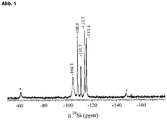
- the layered silicates according to the invention have a downfield signal at approximately 104 ppm, which is characteristic of a layer silicate-type silanol group.
- the layered silicates according to the invention have a downfield signal at approximately 16.4 ppm, which is characteristic of a layer silicate-type silanol group.
- the silicate obtained according to (2) is calcined in at least one additional step according to a particularly preferred embodiment of the process according to the invention (6).
- the suspension containing the at least one silicate directly to the calcination.
- the silicate is separated from the suspension prior to calcination as described above according to (3).
- the silicate separated from the suspension may be subjected to at least one washing step (4) as described above and / or at least one drying step (5) as described above.
- the silicate separated from the suspension is dried and fed to the calcination without a washing step.
- the calcination according to (6) of the silicate obtained according to (2) and / or (3) and / or (4) and / or (5) is preferably carried out at a temperature in the range of up to 600 ° C to obtain a framework silicate.
- the heating of the silicate from room temperature to a temperature of up to 600 ° C, wherein more preferably the heating rate in the range of 0.1 to 12 ° C / h, more preferably from 1 to 11 ° C / h and more preferably in the range of 5 to 10 ° C / h.
- calcination temperatures in the range of 300 to 600 ° C.
- the calcining is carried out in a temperature-controlled manner.
- temperature-graded refers to a calcination in which the silicate to be calcined is heated to a certain temperature, held at that temperature for a certain time, and from that temperature to at least one more Temperature is heated and held there again for a certain time.
- the silicate to be calcined is maintained at up to 4 temperatures, more preferably at up to 3 temperatures, and most preferably at 2 temperatures.
- the first temperature is preferably in the range of 500 to 540 ° C, more preferably in the range of 500 to 535 ° C, more preferably in the range of 510 to 530 ° C, and most preferably in the range of 515 to 525 ° C.
- This temperature is preferably maintained for a time in the range of 8 to 24 hours, more preferably 9 to 18 hours and especially 10 to 14 hours.
- the second temperature is preferably in the range of greater than 540 to 600 ° C, more preferably in the range of 550 to 580 ° C and most preferably in the range of 555 to 570 ° C. This temperature is preferably maintained for a time in the range of 0.5 to 6 hours, more preferably 1 to 4 hours, and especially 1 to 3 hours.
- the present invention also relates to a method as described above, which is characterized in that the calcination is carried out in a temperature-controlled manner in the range of up to 600 ° C, preferably from 300 to 600 ° C.
- the calcination may be in any suitable atmosphere such as air, lean air, nitrogen, water vapor, synthetic air, carbon dioxide. Preferably, the calcination takes place in air.
- the calcination can be carried out in any suitable apparatus.
- the calcining takes place in a rotary kiln, in a belt calciner, in a muffle furnace, in situ in a device in which the silicate is used as intended, for example as a molecular sieve or for another application described below at a later date.
- Particularly preferred here are rotary tube and belt calciner.
- a silicate in particular a framework silicate, is obtained.
- the present invention also relates to a scaffold silicate per se, which is characterized in that in the X-ray diffraction pattern by Cu K alpha 1 radiation at least the following reflections occur: Intensity /% Diffraction angle 2 ⁇ / ° [Cu K (alpha 1)] 100 9.8 - 10.2 24 - 34 11.0 - 11.4 9 - 19 15.5 - 15.9 12 - 22 19.4 - 19.6 19-29 19.6 - 19.8 where 100% refers to the intensity of the highest peak in the X-ray diffractogram.
- the present invention relates to the framework silicate per se, which is characterized in that in the X-ray diffraction pattern by Cu K alpha 1 radiation at least the following reflections occur: Intensity /% Diffraction angle 2 ⁇ / ° [Cu K (alpha 1)] 100 9.8 - 10.2 24 - 34 11.0 - 11.4 9 - 19 15.5 - 15.9 12 - 22 19.4 - 19.6 19-29 19.6 - 19.8 8 - 18 26.2 - ⁇ 26.3 8 - 18 26.3 - ⁇ 26.4 13 - 23 26.4 - 26.6
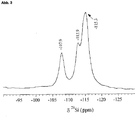
- the downfield signal found in the abovementioned layer silicates according to the invention is absent at about 104 ppm, which is characteristic for a layer silicate-type silanol group.
- the framework silicates according to the invention preferably have 8 MR and 10 MR channels, wherein the 8 MR channels particularly preferably parallel to the unit cell c, as indicated above, and the 10 MR channels particularly preferably parallel to a of the unit cell, as indicated above , run.
- the definition of the 8MR and 10MR channels be on Ch. Baerlocher, WM Meier, DH Olson, Atlas of Zeolite Framework Types, 5th edition, 2001, Elsevier, pages 10 - 15 directed.
- the framework silicates according to the invention are characterized by a substantially monomodal distribution with respect to the two-dimensional 8 MR and 10 MR channel pore structure out.
- the pore openings of both the 8 MR channels and the 10 MR channels each have an area in this respect preferably in the range of (5.70-6.00) ⁇ (4.00-4.20) ⁇ 2 , more preferably of ( 5.80-5.90) x (4.05-4.15) ⁇ 2 .
- the framework silicates according to the invention preferably have micropores with a specific surface area in the range of greater than 200 m 2 / g, more preferably greater than 200 to 800 m 2 / g, more preferably from 300 to 700 m 2 / g and particularly preferably from 400 to 600 m 2 / g, each determined according to DIN 66135 (Langmuir).
- the framework silicates according to the invention preferably have pores with a pore volume in the range from 0.15 to 0.21 ml / g, more preferably from 0.16 to 0.20 ml / g and particularly preferably from 0.17 to 0.19 ml / g each determined according to DIN 66134.
- the framework silicates according to the invention are silicates of a microporous zeolitic type.
- the thermal stability of the framework silicates according to the invention is preferably at least 600 ° C., more preferably at more than 600 ° C.
- thermal stability denotes the temperature at which the specific lattice structure of the framework silicate is maintained under normal pressure.
- the silicates prepared according to the invention contain, in addition to silicon and oxygen, at least one atom of at least one other element.
- the silicate structure it is possible to incorporate into the silicate structure at least one atom of at least one of the elements aluminum, boron, iron, titanium, tin, germanium, zirconium, vanadium or niobium.
- aluminum is incorporated, in addition to the tetraalkylammonium compound and the silicon dioxide and / or silicon dioxide precursor, it is possible to use, for example, metallic aluminum or suitable aluminates, for example alkali aluminates and / or aluminum alcoholates, for example aluminum triisopropoxide.
- boron is incorporated, in addition to the tetraalkylammonium compound and the silicon dioxide and / or silicon dioxide precursor, it is possible to use, for example, free boric acid and / or borates and / or boric acid esters, such as triethyl borate.
- titanium is incorporated, in addition to the tetraalkylammonium compound and the silicon dioxide and / or silicon dioxide precursor, it is possible to use, for example, titanium alkoxides, for example titanium ethanolates or titanium propylates, as starting materials.
- tin is incorporated, in addition to the tetraalkylammonium compound and the silica and / or silicon dioxide precursor, it is possible to use, for example, tin chlorides and / or organometallic tin compounds, such as tin alcoholates or chelates, such as tin acetylacetonates.
- zirconium chloride and / or zirconium alcoholates can be used as educts in addition to the tetraalkylammonium compound and the silica and / or silica precursor.
- vanadium or germanium or niobium is incorporated, in addition to the tetraalkylammonium compound and the silica and / or silica precursor, it is possible to use, for example, vanadium chloride or germanium chloride or niobium chloride as starting materials.
- the present invention also relates to a method as described above and the above-described layer and / or scaffold, in particular the scaffold silicates as described above, wherein the silicates in addition to Si and O additionally at least one of the elements Al, B, Fe , Ti, Sn, Ge, Zr, V or Nb included.
- a negatively charged framework can arise, which makes it possible, for example, to load the silicate with cations.
- the present invention also relates to a shaped body containing the above-described crystalline microporous skeletal silicate. Also encompassed by the present invention are moldings comprising the layered silicate described above.
- the shaped body can comprise all conceivable further compounds, as long as it is ensured that the resulting shaped body is suitable for the desired application.
- At least one suitable binder material is used in the production of the molding.
- binders all compounds are generally suitable which imparts an adhesion and / or cohesion between the particles of the framework silicate to be bound beyond the physisorption which possibly exists without the binder.
- binders include metal oxides such as SiO 2 , Al 2 O 3 , TiO 2 , ZrO 2 or MgO or clays or mixtures of two or more of these compounds.
- binders are in particular clay minerals and naturally occurring or artificially produced aluminas such as alpha-, beta-, gamma-, delta-, eta-, kappa-, chi- or theta-alumina and their inorganic or organometallic precursor compounds such For example, gibbsite, bayerite, boehmite, pseudoboehmite or trialkoxyaluminates such as aluminum triisopropoxide preferred.
- gibbsite, bayerite, boehmite, pseudoboehmite or trialkoxyaluminates such as aluminum triisopropoxide preferred.
- Other preferred binders are amphiphilic compounds having a polar and a nonpolar portion and graphite.
- Other binders include clays such as montmorillonites, kaolins, bentonites, halloysites, dickites, nacrites or anaxites.
- binder precursors are, for example, tetraalkoxysilanes, tetraalkoxytitanates, tetraalkoxyzirconates or a mixture of two or more different tetraalkoxysilanes or a mixture of two or more different tetraalkoxytitanates or a mixture of two or more different tetraalkoxyzirconates or a mixture of at least one tetraalkoxysilane and at least one tetraalkoxytitanate or of at least one tetraalkoxysilane and at least one tetraalkoxyzirconate or of at least one tetraalkoxytitanate and at least one tetraalkoxyzirconate or a mixture of
- binders which either completely or partially consist of SiO 2 or are a precursor to SiO 2 , from which SiO 2 is formed in at least one further step in the production of the shaped bodies, are very particularly preferred.
- colloidal silica and so-called “wet process” silica can be used as well as so-called “dry process” silica.
- Colloidal silica preferably as an alkaline and / or ammoniacal solution, more preferably as an ammoniacal solution, is commercially available, inter alia, as Ludox®, Syton®, Nalco® or Snowtex®.
- Weight process silica is commercially available as, for example, Hi-Sil®, Ultrasil®, Vulcasil®, Santocel®, Valron-Estersil®, Tokusil® or Nipsil®.
- dry process silica is commercially available as Aerosil®, Reolosil®, Cab-O-Sil®, Fransil® or ArcSilica®.
- an ammoniacal solution of colloidal silica is preferred.
- the present invention also describes a molded article as described above, additionally containing SiO 2 as a binder material.
- the present invention also relates to a method as described above, wherein the binder used according to (I) is a SiO 2 -containing or forming binder.
- the present invention also describes a process as described above wherein the binder is a colloidal silica.
- the binders are used in an amount which leads to ultimately resulting moldings whose binder content is in the range of up to 80 wt .-%, more preferably in the range of 5 to 80 wt .-%, more preferably in the range of 10 to 70 wt .-%, more preferably in the range of 10 to 60 wt .-%, more preferably in the range of 15 to 50 wt .-%, more preferably in the range of 15 to 45 wt .-% and particularly preferably in the range of 15 to 40 wt .-%, each based on the total weight of the final resulting shaped body.
- final resulting shaped body refers to a shaped body as it consists of the drying and calcination steps (IV) and / or (V), preferably (IV) and (V) described below ) and particularly preferably (V) is obtained.
- the mixture of binder or precursor to a binder and the zeolitic material may be added to at least one further compound for further processing and to form a plastic mass.
- all compounds which provide a specific pore size and / or a specific pore size distribution and / or specific pore volumes with respect to the finished shaped article can be used as pore formers.
- Polymers which are dispersible, suspendable or emulsifiable in water or in aqueous solvent mixtures are preferably used as pore formers in the process according to the invention.
- Preferred polymers here are polymeric vinyl compounds such as, for example, polyalkylene oxides such as polyethylene oxides, polystyrene, polyacrylates, polymethacrylates, polyolefins, polyamides and polyesters, carbohydrates such as cellulose or cellulose derivatives such as methylcellulose, or sugars or natural fibers.
- Other suitable pore formers are pulp or graphite.
- the content of the mixture according to (I) is based on pore former, preferably polymer preferably in the range from 5 to 90% by weight, preferably in the range from 15 to 75% by weight. % and particularly preferably in the range of 25 to 55 wt .-%, each based on the amount of inventive scaffold silicate in the mixture according to (I).
- the pore formers are removed in a particularly preferred embodiment of the method according to the invention, as described below, in a step (V) by calcination to obtain the porous shaped body.
- shaped bodies are obtained, the pores, determined according to DIN 66134, in the range of at least 0.6 ml / g, preferably in the range of 0.6 to 0.8 ml / g and particularly preferably in the range from more than 0.6 ml / g to 0.8 ml / g.
- the specific surface area of the shaped article according to the invention is generally at least 350 m 2 / g, preferably at least 400 m 2 / g and particularly preferably at least 425 m 2 / g.
- the specific surface area may be in the range of 350 to 500 m 2 / g or 400 to 500 m 2 / g or 425 to 500 m 2 / g.
- the present invention also describes a molded article as described above having a specific surface area of at least 350 m 2 / g, containing pores having a pore volume of at least 0.6 ml / g.
- At least one pasting agent is added as part of a likewise preferred embodiment of the process according to the invention.
- cellulose cellulose derivatives such as methylcellulose
- starch such as potato starch
- wallpaper patches polyacrylates, polymethacrylates, polyvinyl alcohol, polyvinylpyrrolidone, polyisobutene or polytetrahydrofuran.
- compounds can be used as pasting agents which also act as pore formers.
- At least one acidic additive is added in the preparation of the mixture according to (I).
- organic acidic compounds which can be removed by calcination in the preferred step (V), as described below.
- carboxylic acids such as formic acid, oxalic acid and / or citric acid. It is also possible to use two or more of these acidic compounds.
- the order of addition of the components of the framework silicate-containing mixture according to (I) is not critical. It is possible to first add the at least one binder, then the at least one pore former, the at least one acidic compound and finally the at least one pasting agent, as well as the order with respect to the at least one binder, the at least one pore former, the at least one acidic Interchange connection and the at least one pasting agent.
- the mixture according to (I) is generally homogenized for 10 to 180 minutes. Kneaders, rollers or extruders are particularly preferably used for homogenization. Preferably, the mixture is kneaded. On an industrial scale is preferably gekollert for homogenization.
- the homogenization is usually carried out at temperatures ranging from about 10 ° C to the boiling point of the pasting agent and normal pressure or slightly superatmospheric pressure. Thereafter, if appropriate, at least one of the compounds described above may be added. The mixture thus obtained is homogenized, preferably kneaded, until an absorbable plastic mass has formed.
- the homogenized mixture is deformed according to a further preferred embodiment of the present invention.
- those processes are preferred for the processes in the shaping, in which the deformation takes place by extrusion in conventional extruders, for example into strands with a diameter of preferably 1 to 10 mm and particularly preferably 2 to 5 mm.
- extrusion devices are, for example, in Ullmann's Encyclopedia of Technical Chemistry, 4. Edition, vol. 2, p. 295 ff., 1972 described.
- an extrusion press for deformation.
- the shaping may be selected from the following group, the combination of at least two of these methods being explicitly included: briquetting by stamping presses, roll pressing, ring roll pressing, briquetting without binder; Pelletizing, melting, spinning techniques, deposition, foaming, spray-drying; Burning in the shaft furnace, convection oven, traveling grate, rotary kiln, rumbling.
- the compaction can take place at ambient pressure or at elevated pressure relative to the ambient pressure, for example in a pressure range from 1 bar to several hundred bar. Furthermore, the compaction may take place at ambient temperature or at an elevated temperature relative to the ambient temperature, for example in a temperature range from 20 to 300 ° C. If drying and / or firing is part of the shaping step, then temperatures of up to 600 ° C. are conceivable. Finally, the compaction may take place in the ambient atmosphere or in a controlled atmosphere. Controlled atmospheres are, for example, inert gas atmospheres, reducing and / or oxidizing atmospheres.
- the shape of the moldings produced according to the invention can be chosen arbitrarily. In particular, among other things balls, oval shapes, cylinders or tablets are possible.
- step (III) is preferably followed by at least one drying step.
- This at least one drying step is carried out at temperatures in the range of generally 80 to 160 ° C, preferably from 90 to 145 ° C and more preferably from 100 to 130 ° C, wherein the drying time is generally 6 hours or more, for example in the range from 6 to 24 h.
- shorter drying times such as about 1, 2, 3, 4 or 5 hours are possible.
- the preferably obtained extrudate can be comminuted, for example.
- a granulate or grit having a particle diameter of 0.1 to 5 mm, in particular 0.5 to 2 mm is preferably obtained.
- step (IV) is preferably followed by at least one calcination step.
- the calcination is carried out at temperatures ranging generally from 350 to 750 ° C and preferably from 450 to 600 ° C.
- the calcination may be carried out under any suitable gas atmosphere, with air and / or lean air being preferred. Furthermore, the calcination is preferably in one Muffle furnace, a rotary kiln and / or a Bandkalzinierofen performed, wherein the Calcini mecanicsdauer is generally 1 h or more, for example in the range of 1 to 24 h or in the range of 3 to 12 h.
- the process according to the invention it is possible, for example, to calcine the shaped body once, twice or more for at least 1 h, for example in the range from 3 to 12 h, wherein the temperatures remain the same during a calcination step or can be changed continuously or discontinuously , If calcined twice or more, the calcination temperatures in the individual steps may be the same or different.
- the calcined material may be comminuted.
- a granulate or grit having a particle diameter of 0.1 to 5 mm, in particular 0.5 to 2 mm is preferably obtained.
- the at least one shaped article may optionally be treated with a concentrated or diluted Broenstedt acid or a mixture of two or more Broenstedt acids.
- Suitable acids are for example hydrochloric acid, sulfuric acid, phosphoric acid, nitric acid or carboxylic acids, dicarboxylic acids or oligo- or polycarboxylic acids such as nitrilotriacetic acid, sulfosalicylic acid or ethylenediaminetetraacetic acid.
- this at least one treatment with at least one Bronsted acid is followed by at least one drying step and / or at least one calcination step, each of which is carried out under the conditions described above.
- the moldings obtained according to the invention can be subjected to a steam treatment for better curing, after which preferably once again at least once dried and / or calcined at least once.
- a steam treatment for better curing, after which preferably once again at least once dried and / or calcined at least once.
- the calcined shaped body is subjected to the steam treatment and then again dried at least once and / or calcined at least once.
- the moldings obtained according to the invention have hardnesses which are generally in the range from 2 to 15 N, preferably in the range from 5 to 15 N and particularly preferably in the range from 10 to 15 N.
- the present invention also relates to a molded article as described above having a cutting hardness in the range of 2 to 15 N.
- the above-described hardness was measured in the context of the present invention on a Zwick type BZ2.5 / TS1S apparatus with an initial force of 0.5 N, a precursor thrust speed of 10 mm / min and a subsequent test speed of 1.6 mm / min certainly.
- the device had a fixed turntable and a freely movable punch with built-in cutting edge of 0.3 mm thickness.
- the movable punch with the cutting edge was connected to a load cell for power absorption and moved during the measurement against the fixed turntable on which the catalyst molding to be examined was located.
- the tester was controlled by a computer, which registered and evaluated the measurement results. The values obtained represent the average of the measurements for each of 10 shaped catalyst bodies.
- the shaped catalyst bodies had a cylindrical geometry with their average length approximately equal to two to three times the diameter, and were measured with the blade of 0.3 mm thickness loaded with increasing force until the molding was severed.
- the cutting edge was applied perpendicular to the longitudinal axis of the molding on the molding. The force required for this is the cutting hardness (unit N).
- the present invention furthermore relates to the use of the silicates according to the invention, in particular the framework silicates according to the invention and / or the shaped bodies according to the invention, as molecular sieve, catalyst, catalyst support or its binder, as adsorbent, pigments, additives in detergents, additive to building materials, for thioxotropation in color pastes and paints, and as lubricants and lubricants, as flame retardants, auxiliaries and fillers in paper products, in bactericidal and / or fungicidal and / or herbicidal compositions, for ion exchange, for the production of ceramics, in polymers, in electrical, optical or electro-optical components and switching elements or sensors.
- Reactions that can be catalyzed by the silicates of the present invention include, for example, hydrogenations, dehydrogenations, oxydehydrogenations, oxidations, epoxidations, polymerization reactions, aminations, hydration and dehydration, nucleophilic and electrophilic substitution reactions, addition and elimination reactions, double bond and skeletal isomerizations, dehydrocyclizations, hydroxylations of Heteroaromatics, epoxide-aldehyde rearrangements, metathesis, olefin production from methanol, Diels-Alder reactions, formation of carbon-carbon bonds such as olefin dimerization or olefin trimerization and condensation reactions of the aldol condensation type.
- the catalytic reactions can be carried out in the gas or liquid phase or else in the supercritical phase.
- the silicates according to the invention are also suitable as molecular sieves.
- the respective adsorption can take place in the gas phase or the liquid phase or in the supercritical phase.
- the silicates according to the invention are suitable for the separation of constitutional isomers, for example for the separation of n- and iso-isomers of small molecules.
- small molecule in the context of the present invention means molecules having a kinetic diameter in the range from 3.5 to 5.5 ⁇ . To define the kinetic diameter be on DW Breck, Zeolite Molecular Sieves, 1974, J. Wiley, pp. 634-641 directed.
- the silicates according to the invention are suitable for the separation of configuration isomers, for example for the separation of cis-butene and trans-butene.
- the present invention relates to the use of the silicates according to the invention, in particular the framework silicates, for the separation of at least one alkane and / or at least one alkene and / or at least one alkyne from a mixture comprising at least two alkanes or at least two alkenes or at least two alkynes or at least one alkane and at least one alkene or at least one alkane and at least one alkyne or at least one alkene and at least one alkyne or at least one alkene and at least one alkyne or at least one alkane and at least one alkene and at least one alkyne, in particular for separating constitutional isomers and / or configuration isomers, wherein the at least an alkane and / or at least one Alkene and / or at least one alkyne up to 10 carbon atoms such as 1 C atom in the case of methane or 2, 3, 4, 5, 6, 7, 8, 9 or 10 carbon atoms.
- the present invention preferably relates to the use of the silicates according to the invention, in particular of the framework silicates, for the separation of at least one alkene and / or at least one alkene and / or at least one alkyne from a gas mixture containing at least two alkanes or at least two alkenes or at least two alkynes or at least one alkane and at least one alkene or at least one alkane and at least one alkyne or at least one alkene and at least one alkyne or at least one alkene and at least one alkyne or at least one alkane and at least one alkene and at least one alkyne, in particular for separating constitutional isomers and / or configuration isomers.
- Particularly preferred fields of use here are the separation of methane and ethane or for the separation of ethene, propene and butene, in particular trans-2-butene, or for the separation of butane and butene or for the separation of n-butane and isobutane or for separation of 1-butene and trans-2-butene.
- the silicates according to the invention thus allow a simple separation of dense mixtures of substances, which is not possible by distillation methods without large apparatus devices or without the aid of additives. This can reduce costs in chemical production processes.
- the framework silicate according to the invention is used as such or preferably as a molding in at least one suitable device, such as a tubular reactor, through which the substance mixture to be separated is passed continuously or discontinuously, preferably continuously.
- the present invention also relates to a device, in particular a tubular reactor, comprising at least one skeleton silicate as described above and / or a shaped body as described above for the separation of a mixture, in particular for the separation of at least one alkane and / or at least one alkene and / or at least an alkyne from a gas mixture containing at least two alkanes or at least two alkenes or at least two alkynes or at least one alkane and at least one alkene or at least one alkane and at least one alkyne or at least one alkene and at least one alkyne or at least one alkene and at least one alkyne or at least one alkane and at least one alkene and at least one alkyne.
- such a tubular reactor has a ratio of length: width of greater than or equal to, preferably greater than 3: 1.
- the desorption of the adsorbed compound or adsorbed compounds can be achieved either by a suitable reduction of the pressure and / or a suitable temperature change, such as by a suitable temperature increase and / or by contacting the skeletal silicate or the molded body containing this skeletal silicate with at least one compound which is more strongly adsorbed than the compound to be desorbed or to desorbing compounds, accomplished.
- framework silicate according to the invention it may be necessary to regenerate the framework silicate or the molding body containing the framework silicate after a certain period of use.
- the framework silicate and / or the shaped bodies are regenerated after their use in the respective technical field by a process in which the regeneration is carried out by targeted burning of the deposits responsible for the decreasing performance.
- Such a regeneration process is inter alia in the WO 98/55228 and the DE 197 23 949 A1 , in particular in column 2, lines 33 to 54 of DE 197 23 949 A1 , the disclosure of which is hereby incorporated by reference in its entirety into the subject matter of the present application.
- the skeleton silicate to be regenerated and / or the shaped bodies are either in the apparatus, for example the tubular reactor, or in an external furnace in an atmosphere containing from 0.1 to about 20 parts by volume of oxygen-providing substances, more preferably from 0.1 to 20 Volume Oxygen contains, heated to a temperature in the range of 250 ° C to 600 ° C, preferably from 400 ° C to 550 ° C and in particular from 450 ° C to 500 ° C.
- the heating is preferably carried out at a heating rate of 0.1 ° C / min to 20 ° C / min, preferably from 0.3 ° C / min to 15 ° C / min and in particular from 0.5 ° C / min to 10 ° C / min performed.
- this heating phase is heated to a temperature at which most organic deposits begin to decompose, while the temperature is controlled by the oxygen content and thus does not increase so that it comes to damage the skeleton silicate and / or molded body structure.
- Slowly increasing the temperature or staying at low temperature by adjusting the corresponding oxygen content and the corresponding heating power is an essential step in preventing high levels of organic loading of the skeletal silicate and / or the moldings.
- the duration of the treatment is generally 1 to 30, preferably about 2 to about 20, and more preferably about 3 to about 10 hours.
- the subsequent cooling of the skeleton silicate thus regenerated and / or the shaped body is preferably carried out in such a way that the cooling does not take place too rapidly, since otherwise the mechanical strength, for example of the shaped body, can be adversely affected.
- the skeleton silicate at least partially deactivated for the respective technical field of application and / or the shaped bodies can be washed with a solvent in the reaction reactor or in an external reactor prior to heating according to the regeneration procedure in order to remove still adhering desired product.
- the washing is carried out so that, although the respective adhering value products can be removed, the temperature and pressure but not so high that the most organic deposits are also removed.
- it is merely rinsed with a suitable solvent.
- all solvents are suitable for this washing process, in which the respective desired product dissolves well.
- the amount of solvent used and the duration of the wash are not critical.
- the washing process can be repeated several times and carried out at elevated temperature.
- the washing process can be carried out under normal pressure or elevated or supercritical pressure.
- the drying process is generally not critical, the drying temperature should not exceed the boiling point of the solvent used for washing too much to avoid a sudden evaporation of the solvent in the pores, especially in the micropores, since this too can lead to damage of the lattice structure.
- At least two devices can be used, each containing the framework silicate according to the invention and / or the moldings, wherein in the case of regeneration at least one device is taken out of operation and at least one device remains in operation, so that the process is interrupted at any time must become.
- amorphous silica (Aerosil®) was mixed with 50 ml of an aqueous solution of dimethyldipropylammonium hydroxide at a concentration of 0.4 to 1 mol / l and stirred until a colloidal solution was obtained.
- the content of water in this solution was adjusted in an oven at a temperature of 70 ° C so that a mixture of the composition SiO 2 : 0.5 dimethyldipropylammonium hydroxide: ⁇ 10 water was obtained.
- the mixture was then transferred to a Teflon-lined stainless steel autoclave and heated to a temperature of 150 ° C for a period of 30 days while rotating the autoclave at a speed of 15 rpm.
- the resulting mixture was then quenched with cold water to give a viscous suspension. From this, the layered silicate according to the invention was obtained by filtration, washing the filter residue with water and drying the filter residue at 75 ° C.
- X-ray diffractogram of the layered silicate according to the invention of the structure RUB-39 ⁇ / b> 2 theta intensity I / Io 8.24345 38624.54690 100 11.20594 6132.75830 16 13.39126 6903.00439 18 13.92294 2378.23096 6 14.62231 3522.60547 9 15.60788 2344.57275 6 15.73948 2880.48438 7 16.51815 2821.19092 7 17.47815 2041.75061 5 18.33579 3715.56616 10 18.57990 4743.49219 12 18.76494 2132.02979 6 20.00261 9294.63086 24 20.50116 3292.98145 9 21.21685 2926.98779 8th 22.21572 9723.40625 25 22.51286 4358.26807 11 23.51819 10877.2
- the sheet silicate obtained according to Example 2 was calcined for a period of 12 hours at a temperature of 520 ° C and then for a period of 2 hours at a temperature of 560 ° C.
- a framework silicate was obtained which had the reflections listed in Table 2 in the X-ray diffractogram (Cu K alpha 1 radiation).
- a pulverulent, freshly calcined sample of the framework silicate obtained according to Example 3 (about 40 mg) was weighed and outgassed overnight at 120 ° C and a vacuum of about 10 -6 MPa. The measurement was then carried out with nitrogen at 77 K on a volumetric sorption apparatus (Autosorb AS-6, Messrs. Quantachrome).
- Figure 7 the recovered isotherm is shown.
- a pulverulent, freshly calcined sample of the framework silicate obtained according to Example 3 (about 140 mg) was weighed and outgassed overnight at 120 ° C and a vacuum of about 10 -6 MPa.
- the measurements with n-butane or isobutane (purity 99.5%) were carried out gravimetrically at 296 K on a microbalance (Sartorius 4003) over the pressure range up to 800 mbar (pressure sensor Fa. MKS Baratron).
- Figures 8a and 8b show the resulting isotherms. It can be clearly seen that with n-butane, preferably the leaner molecule is adsorbed, while the bulkier isobutane is absorbed only slightly with a capacity ⁇ 0.2 wt .-%. Thus, a separation of n-butane and iso-butane with the help of the framework silicate RUB-41 is possible.
- a pulverulent, freshly calcined sample of the framework silicate obtained according to Example 3 (about 140 mg) was weighed and outgassed overnight at 120 ° C and a vacuum of about 10 -6 MPa.
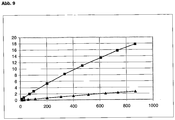
- the measurements with methane and ethane (purity 99.5%) were carried out gravimetrically at 296 K on a microbalance (Sartorius 4003) over the pressure range up to 866 mbar (pressure transducer Fa. MKS Baratron).
- a pulverulent, freshly calcined sample of the framework silicate obtained according to Example 3 (about 140 mg) was weighed and outgassed overnight at 120 ° C and a vacuum of about 10 -6 MPa.
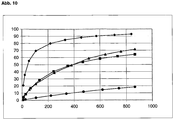
- the measurements with ethene, propene, 1-butene and trans-2-butene (99.5% pure in each case) were carried out gravimetrically at 296 K on a microbalance (Sartorius 4003) over the pressure range up to 865 mbar (pressure transducer from MKS baratron).
- a pulverulent, freshly calcined sample of the framework silicate obtained according to Example 3 (about 140 mg) was weighed and outgassed overnight at 120 ° C and a vacuum of about 10 -6 MPa.
- the measurements with n-butane, 1-butene and trans-2-butene (purity in each case 99.5%) were carried out gravimetrically at 296 K on a microbalance (Fa. Sartorius 4003) over the pressure range up to 857 mbar (pressure sensor Fa. MKS Baratron).
Landscapes
- Chemical & Material Sciences (AREA)
- Organic Chemistry (AREA)
- Life Sciences & Earth Sciences (AREA)
- General Life Sciences & Earth Sciences (AREA)
- Geology (AREA)
- Inorganic Chemistry (AREA)
- Engineering & Computer Science (AREA)
- Chemical Kinetics & Catalysis (AREA)
- Materials Engineering (AREA)
- Silicates, Zeolites, And Molecular Sieves (AREA)
Applications Claiming Priority (2)
| Application Number | Priority Date | Filing Date | Title |
|---|---|---|---|
| DE102004017915A DE102004017915A1 (de) | 2004-04-13 | 2004-04-13 | Mikroporöses Gerüstsilikat und Verfahren zu seiner Herstellung |
| PCT/EP2005/003891 WO2005100242A1 (de) | 2004-04-13 | 2005-04-13 | Mikroporöses gerüstsilikat und verfahren zu seiner herstellung |
Publications (2)
| Publication Number | Publication Date |
|---|---|
| EP1737791A1 EP1737791A1 (de) | 2007-01-03 |
| EP1737791B1 true EP1737791B1 (de) | 2018-06-13 |
Family
ID=34963837
Family Applications (1)
| Application Number | Title | Priority Date | Filing Date |
|---|---|---|---|
| EP05716576.3A Expired - Lifetime EP1737791B1 (de) | 2004-04-13 | 2005-04-13 | Mikroporöses gerüstsilikat und verfahren zu seiner herstellung |
Country Status (6)
| Country | Link |
|---|---|
| US (2) | US20080000354A1 (enExample) |
| EP (1) | EP1737791B1 (enExample) |
| JP (1) | JP4587328B2 (enExample) |
| CN (1) | CN1997591B (enExample) |
| DE (1) | DE102004017915A1 (enExample) |
| WO (1) | WO2005100242A1 (enExample) |
Families Citing this family (18)
| Publication number | Priority date | Publication date | Assignee | Title |
|---|---|---|---|---|
| DE102005049362A1 (de) * | 2005-10-12 | 2007-04-19 | Basf Ag | Verfahren zur Herstellung eines Silikates |
| CN100450926C (zh) * | 2007-01-25 | 2009-01-14 | 上海交通大学 | 双杂原子铁-钛无铝沸石分子筛快速合成方法 |
| ES2372893T3 (es) | 2007-04-04 | 2012-01-27 | Basf Se | Método para la producción de silicatos que contienen un heteroátomo. |
| WO2010099651A1 (en) * | 2009-03-03 | 2010-09-10 | Basf Se | Process for preparation of isomorphously substituted layered silicate, silicate prepared by process, and uses thereof |
| WO2010099650A1 (en) * | 2009-03-03 | 2010-09-10 | Basf Se | Isomorphously substituted silicate |
| WO2010099652A1 (en) * | 2009-03-03 | 2010-09-10 | Basf Se | Process for preparation of layered silicate, layered silicate prepared by process, and uses thereof |
| WO2010099649A1 (en) * | 2009-03-03 | 2010-09-10 | Basf Se | Process for preparation of pillared silicates |
| CN102341349B (zh) * | 2009-03-03 | 2015-09-16 | 巴斯夫欧洲公司 | 层状硅酸盐的制备方法 |
| CN103118980B (zh) | 2010-07-02 | 2015-08-19 | 巴斯夫欧洲公司 | 金属桥接的柱撑硅酸盐化合物及其制备方法 |
| US9475041B2 (en) | 2012-04-24 | 2016-10-25 | Basf Se | Zeolitic materials and methods for their preparation using alkenyltrialkylammonium compounds |
| MX354648B (es) | 2012-04-24 | 2018-03-14 | Basf Se | Materiales zeoliticos y metodos para su preparacion utilizando compuestos alqueniltrialquilamonio. |
| EP2868689A4 (en) * | 2012-06-29 | 2015-12-02 | Oceans King Lighting Science | METHOD FOR PRODUCING A POLYACRYLNITRILE-METHYL-METHACRYLATGEL ELECTROLYTE FILM, CORRESPONDING ELECTROLYTE AND METHOD OF MANUFACTURING THEREOF |
| WO2014053483A1 (en) * | 2012-10-05 | 2014-04-10 | Basf Se | Process for the production of a zeolitic material employing elemental precursors |
| CN105085462B (zh) * | 2014-05-08 | 2017-10-03 | 中国石油化工股份有限公司 | 一种环己酮氧化的方法 |
| US9193600B1 (en) * | 2014-06-04 | 2015-11-24 | Chevron U. S. A. Inc. | Method for making molecular sieve SSZ-99 |
| WO2016051400A1 (en) * | 2014-10-04 | 2016-04-07 | Brighttonix Medical Ltd. | Device and method for teeth treatment |
| WO2019229156A1 (en) | 2018-05-30 | 2019-12-05 | Basf Se | Zeolite catalyzed process for the amination of alkylene oxides |
| CN112516959B (zh) * | 2020-11-12 | 2023-04-18 | 山东荣创催化新材料有限公司 | 一种可循环再生的VOCs吸附剂及其制备方法与应用 |
Family Cites Families (12)
| Publication number | Priority date | Publication date | Assignee | Title |
|---|---|---|---|---|
| EP0063436B1 (en) | 1981-04-14 | 1986-12-30 | Imperial Chemical Industries Plc | Zeolites |
| US4495303A (en) * | 1983-11-29 | 1985-01-22 | Mobil Oil Corporation | Process for making zeolite ZSM-45 with a dimethyldiethylammonium directing agent |
| US4552739A (en) * | 1983-12-09 | 1985-11-12 | Mobil Oil Corporation | Method of preparing crystalline zeolite ZSM-12 and product |
| JPH07113484B2 (ja) | 1987-08-27 | 1995-12-06 | 松下電器産業株式会社 | 電気湯沸し器などの発熱体 |
| US5393511A (en) * | 1988-10-10 | 1995-02-28 | Societe Nationale Elf Aquitaine | Synthesis of zeolites of faujasite structure |
| US5283043A (en) * | 1992-04-16 | 1994-02-01 | Mobil Oil Corp. | Direct crystallization of organic-swelled layered silicates and preparation of layered silicates containing interlayer polymeric chalcogenides therefrom |
| US5463160A (en) * | 1993-08-30 | 1995-10-31 | Texaco Inc. | Skeletal isomerization of n-pentenes to isopentene on pretreated zeolites |
| DE19723949A1 (de) | 1997-06-06 | 1998-12-10 | Basf Ag | Verfahren zur Regenerierung eines Zeolith-Katalysators |
| DE10116023A1 (de) * | 2000-04-04 | 2001-10-11 | Henkel Kgaa | Klebstoff auf der Basis einer wäßrigen Polymer-Dispersion |
| US6713041B1 (en) * | 2002-02-12 | 2004-03-30 | Uop Llc | Crystalline aluminosilicate zeolitic composition: UZM-9 |
| US6752980B1 (en) * | 2003-03-21 | 2004-06-22 | Uop Llc | UZM-16: a crystalline aluminosilicate zeolitic material |
| US6756030B1 (en) * | 2003-03-21 | 2004-06-29 | Uop Llc | Crystalline aluminosilicate zeolitic composition: UZM-8 |
-
2004
- 2004-04-13 DE DE102004017915A patent/DE102004017915A1/de not_active Withdrawn
-
2005
- 2005-04-13 WO PCT/EP2005/003891 patent/WO2005100242A1/de not_active Ceased
- 2005-04-13 CN CN2005800193041A patent/CN1997591B/zh not_active Expired - Fee Related
- 2005-04-13 JP JP2007507748A patent/JP4587328B2/ja not_active Expired - Fee Related
- 2005-04-13 US US11/578,286 patent/US20080000354A1/en not_active Abandoned
- 2005-04-13 EP EP05716576.3A patent/EP1737791B1/de not_active Expired - Lifetime
-
2010
- 2010-10-07 US US12/899,572 patent/US8124560B2/en not_active Expired - Fee Related
Non-Patent Citations (1)
| Title |
|---|
| None * |
Also Published As
| Publication number | Publication date |
|---|---|
| US20080000354A1 (en) | 2008-01-03 |
| WO2005100242A1 (de) | 2005-10-27 |
| US8124560B2 (en) | 2012-02-28 |
| JP2007532460A (ja) | 2007-11-15 |
| EP1737791A1 (de) | 2007-01-03 |
| DE102004017915A1 (de) | 2005-11-03 |
| CN1997591B (zh) | 2010-09-29 |
| JP4587328B2 (ja) | 2010-11-24 |
| CN1997591A (zh) | 2007-07-11 |
| US20110135567A1 (en) | 2011-06-09 |
Similar Documents
| Publication | Publication Date | Title |
|---|---|---|
| EP1737791B1 (de) | Mikroporöses gerüstsilikat und verfahren zu seiner herstellung | |
| EP2160355B1 (de) | Verfahren zur herstellung eines heteroatom enthaltenden silikates | |
| US8372378B2 (en) | Silicate producing method | |
| EP2490985B1 (en) | Method of preparing zsm-5 zeolite using nanocrystalline zsm-5 seeds | |
| US10160656B2 (en) | Organotemplate-free solid-state synthetic method for zeolite molecular sieves | |
| EP2753579B1 (en) | Synthesis of zeolitic materials using n,n-dimethyl organotemplates | |
| EP2403804B1 (en) | Process for the preparation of layered silicates | |
| EP2403641B1 (en) | Process for the preparation of an isomorphously substituted silicate | |
| EP2919906B1 (en) | Process for the conversion of oxygenates to olefins | |
| JP2024535577A (ja) | シリコン-アルミニウムモレキュラーシーブscm-36、その製造方法およびその用途 |
Legal Events
| Date | Code | Title | Description |
|---|---|---|---|
| PUAI | Public reference made under article 153(3) epc to a published international application that has entered the european phase |
Free format text: ORIGINAL CODE: 0009012 |
|
| 17P | Request for examination filed |
Effective date: 20061113 |
|
| AK | Designated contracting states |
Kind code of ref document: A1 Designated state(s): AT BE BG CH CY CZ DE DK EE ES FI FR GB GR HU IE IS IT LI LT LU MC NL PL PT RO SE SI SK TR |
|
| DAX | Request for extension of the european patent (deleted) | ||
| RAP1 | Party data changed (applicant data changed or rights of an application transferred) |
Owner name: BASF SE Owner name: RUBITEC G |
|
| 17Q | First examination report despatched |
Effective date: 20120518 |
|
| STAA | Information on the status of an ep patent application or granted ep patent |
Free format text: STATUS: EXAMINATION IS IN PROGRESS |
|
| GRAP | Despatch of communication of intention to grant a patent |
Free format text: ORIGINAL CODE: EPIDOSNIGR1 |
|
| STAA | Information on the status of an ep patent application or granted ep patent |
Free format text: STATUS: GRANT OF PATENT IS INTENDED |
|
| INTG | Intention to grant announced |
Effective date: 20180119 |
|
| INTG | Intention to grant announced |
Effective date: 20180119 |
|
| GRAS | Grant fee paid |
Free format text: ORIGINAL CODE: EPIDOSNIGR3 |
|
| GRAA | (expected) grant |
Free format text: ORIGINAL CODE: 0009210 |
|
| STAA | Information on the status of an ep patent application or granted ep patent |
Free format text: STATUS: THE PATENT HAS BEEN GRANTED |
|
| AK | Designated contracting states |
Kind code of ref document: B1 Designated state(s): AT BE BG CH CY CZ DE DK EE ES FI FR GB GR HU IE IS IT LI LT LU MC NL PL PT RO SE SI SK TR |
|
| REG | Reference to a national code |
Ref country code: GB Ref legal event code: FG4D Free format text: NOT ENGLISH |
|
| REG | Reference to a national code |
Ref country code: CH Ref legal event code: EP Ref country code: AT Ref legal event code: REF Ref document number: 1008329 Country of ref document: AT Kind code of ref document: T Effective date: 20180615 |
|
| REG | Reference to a national code |
Ref country code: IE Ref legal event code: FG4D Free format text: LANGUAGE OF EP DOCUMENT: GERMAN |
|
| REG | Reference to a national code |
Ref country code: DE Ref legal event code: R096 Ref document number: 502005015846 Country of ref document: DE |
|
| REG | Reference to a national code |
Ref country code: NL Ref legal event code: FP |
|
| REG | Reference to a national code |
Ref country code: LT Ref legal event code: MG4D |
|
| PG25 | Lapsed in a contracting state [announced via postgrant information from national office to epo] |
Ref country code: LT Free format text: LAPSE BECAUSE OF FAILURE TO SUBMIT A TRANSLATION OF THE DESCRIPTION OR TO PAY THE FEE WITHIN THE PRESCRIBED TIME-LIMIT Effective date: 20180613 Ref country code: CY Free format text: LAPSE BECAUSE OF FAILURE TO SUBMIT A TRANSLATION OF THE DESCRIPTION OR TO PAY THE FEE WITHIN THE PRESCRIBED TIME-LIMIT Effective date: 20180613 Ref country code: BG Free format text: LAPSE BECAUSE OF FAILURE TO SUBMIT A TRANSLATION OF THE DESCRIPTION OR TO PAY THE FEE WITHIN THE PRESCRIBED TIME-LIMIT Effective date: 20180913 Ref country code: SE Free format text: LAPSE BECAUSE OF FAILURE TO SUBMIT A TRANSLATION OF THE DESCRIPTION OR TO PAY THE FEE WITHIN THE PRESCRIBED TIME-LIMIT Effective date: 20180613 Ref country code: FI Free format text: LAPSE BECAUSE OF FAILURE TO SUBMIT A TRANSLATION OF THE DESCRIPTION OR TO PAY THE FEE WITHIN THE PRESCRIBED TIME-LIMIT Effective date: 20180613 Ref country code: ES Free format text: LAPSE BECAUSE OF FAILURE TO SUBMIT A TRANSLATION OF THE DESCRIPTION OR TO PAY THE FEE WITHIN THE PRESCRIBED TIME-LIMIT Effective date: 20180613 |
|
| PG25 | Lapsed in a contracting state [announced via postgrant information from national office to epo] |
Ref country code: GR Free format text: LAPSE BECAUSE OF FAILURE TO SUBMIT A TRANSLATION OF THE DESCRIPTION OR TO PAY THE FEE WITHIN THE PRESCRIBED TIME-LIMIT Effective date: 20180914 |
|
| PG25 | Lapsed in a contracting state [announced via postgrant information from national office to epo] |
Ref country code: IS Free format text: LAPSE BECAUSE OF FAILURE TO SUBMIT A TRANSLATION OF THE DESCRIPTION OR TO PAY THE FEE WITHIN THE PRESCRIBED TIME-LIMIT Effective date: 20181013 Ref country code: EE Free format text: LAPSE BECAUSE OF FAILURE TO SUBMIT A TRANSLATION OF THE DESCRIPTION OR TO PAY THE FEE WITHIN THE PRESCRIBED TIME-LIMIT Effective date: 20180613 Ref country code: RO Free format text: LAPSE BECAUSE OF FAILURE TO SUBMIT A TRANSLATION OF THE DESCRIPTION OR TO PAY THE FEE WITHIN THE PRESCRIBED TIME-LIMIT Effective date: 20180613 Ref country code: CZ Free format text: LAPSE BECAUSE OF FAILURE TO SUBMIT A TRANSLATION OF THE DESCRIPTION OR TO PAY THE FEE WITHIN THE PRESCRIBED TIME-LIMIT Effective date: 20180613 Ref country code: PL Free format text: LAPSE BECAUSE OF FAILURE TO SUBMIT A TRANSLATION OF THE DESCRIPTION OR TO PAY THE FEE WITHIN THE PRESCRIBED TIME-LIMIT Effective date: 20180613 Ref country code: SK Free format text: LAPSE BECAUSE OF FAILURE TO SUBMIT A TRANSLATION OF THE DESCRIPTION OR TO PAY THE FEE WITHIN THE PRESCRIBED TIME-LIMIT Effective date: 20180613 |
|
| PG25 | Lapsed in a contracting state [announced via postgrant information from national office to epo] |
Ref country code: IT Free format text: LAPSE BECAUSE OF FAILURE TO SUBMIT A TRANSLATION OF THE DESCRIPTION OR TO PAY THE FEE WITHIN THE PRESCRIBED TIME-LIMIT Effective date: 20180613 |
|
| REG | Reference to a national code |
Ref country code: DE Ref legal event code: R097 Ref document number: 502005015846 Country of ref document: DE |
|
| PLBE | No opposition filed within time limit |
Free format text: ORIGINAL CODE: 0009261 |
|
| STAA | Information on the status of an ep patent application or granted ep patent |
Free format text: STATUS: NO OPPOSITION FILED WITHIN TIME LIMIT |
|
| 26N | No opposition filed |
Effective date: 20190314 |
|
| PG25 | Lapsed in a contracting state [announced via postgrant information from national office to epo] |
Ref country code: SI Free format text: LAPSE BECAUSE OF FAILURE TO SUBMIT A TRANSLATION OF THE DESCRIPTION OR TO PAY THE FEE WITHIN THE PRESCRIBED TIME-LIMIT Effective date: 20180613 Ref country code: DK Free format text: LAPSE BECAUSE OF FAILURE TO SUBMIT A TRANSLATION OF THE DESCRIPTION OR TO PAY THE FEE WITHIN THE PRESCRIBED TIME-LIMIT Effective date: 20180613 |
|
| REG | Reference to a national code |
Ref country code: BE Ref legal event code: MM Effective date: 20190430 |
|
| GBPC | Gb: european patent ceased through non-payment of renewal fee |
Effective date: 20190413 |
|
| PG25 | Lapsed in a contracting state [announced via postgrant information from national office to epo] |
Ref country code: MC Free format text: LAPSE BECAUSE OF FAILURE TO SUBMIT A TRANSLATION OF THE DESCRIPTION OR TO PAY THE FEE WITHIN THE PRESCRIBED TIME-LIMIT Effective date: 20180613 Ref country code: LU Free format text: LAPSE BECAUSE OF NON-PAYMENT OF DUE FEES Effective date: 20190413 |
|
| PG25 | Lapsed in a contracting state [announced via postgrant information from national office to epo] |
Ref country code: GB Free format text: LAPSE BECAUSE OF NON-PAYMENT OF DUE FEES Effective date: 20190413 |
|
| PG25 | Lapsed in a contracting state [announced via postgrant information from national office to epo] |
Ref country code: FR Free format text: LAPSE BECAUSE OF NON-PAYMENT OF DUE FEES Effective date: 20190430 Ref country code: BE Free format text: LAPSE BECAUSE OF NON-PAYMENT OF DUE FEES Effective date: 20190430 |
|
| PG25 | Lapsed in a contracting state [announced via postgrant information from national office to epo] |
Ref country code: TR Free format text: LAPSE BECAUSE OF FAILURE TO SUBMIT A TRANSLATION OF THE DESCRIPTION OR TO PAY THE FEE WITHIN THE PRESCRIBED TIME-LIMIT Effective date: 20180613 |
|
| PG25 | Lapsed in a contracting state [announced via postgrant information from national office to epo] |
Ref country code: IE Free format text: LAPSE BECAUSE OF NON-PAYMENT OF DUE FEES Effective date: 20190413 |
|
| PG25 | Lapsed in a contracting state [announced via postgrant information from national office to epo] |
Ref country code: PT Free format text: LAPSE BECAUSE OF FAILURE TO SUBMIT A TRANSLATION OF THE DESCRIPTION OR TO PAY THE FEE WITHIN THE PRESCRIBED TIME-LIMIT Effective date: 20181015 |
|
| REG | Reference to a national code |
Ref country code: AT Ref legal event code: MM01 Ref document number: 1008329 Country of ref document: AT Kind code of ref document: T Effective date: 20190413 |
|
| PG25 | Lapsed in a contracting state [announced via postgrant information from national office to epo] |
Ref country code: AT Free format text: LAPSE BECAUSE OF NON-PAYMENT OF DUE FEES Effective date: 20190413 |
|
| PG25 | Lapsed in a contracting state [announced via postgrant information from national office to epo] |
Ref country code: HU Free format text: LAPSE BECAUSE OF FAILURE TO SUBMIT A TRANSLATION OF THE DESCRIPTION OR TO PAY THE FEE WITHIN THE PRESCRIBED TIME-LIMIT; INVALID AB INITIO Effective date: 20050413 |
|
| PGFP | Annual fee paid to national office [announced via postgrant information from national office to epo] |
Ref country code: NL Payment date: 20220427 Year of fee payment: 18 |
|
| PGFP | Annual fee paid to national office [announced via postgrant information from national office to epo] |
Ref country code: DE Payment date: 20220428 Year of fee payment: 18 |
|
| PGFP | Annual fee paid to national office [announced via postgrant information from national office to epo] |
Ref country code: CH Payment date: 20220421 Year of fee payment: 18 |
|
| REG | Reference to a national code |
Ref country code: DE Ref legal event code: R119 Ref document number: 502005015846 Country of ref document: DE |
|
| REG | Reference to a national code |
Ref country code: CH Ref legal event code: PL |
|
| REG | Reference to a national code |
Ref country code: NL Ref legal event code: MM Effective date: 20230501 |
|
| PG25 | Lapsed in a contracting state [announced via postgrant information from national office to epo] |
Ref country code: NL Free format text: LAPSE BECAUSE OF NON-PAYMENT OF DUE FEES Effective date: 20230501 Ref country code: LI Free format text: LAPSE BECAUSE OF NON-PAYMENT OF DUE FEES Effective date: 20230430 Ref country code: DE Free format text: LAPSE BECAUSE OF NON-PAYMENT OF DUE FEES Effective date: 20231103 Ref country code: CH Free format text: LAPSE BECAUSE OF NON-PAYMENT OF DUE FEES Effective date: 20230430 |