EP1728805A1 - Aspherical-polymer fine particles and production method thereof, and method for producing lithographic printing plate, ink composition and electrophoretic particle composition - Google Patents
Aspherical-polymer fine particles and production method thereof, and method for producing lithographic printing plate, ink composition and electrophoretic particle composition Download PDFInfo
- Publication number
- EP1728805A1 EP1728805A1 EP20060011208 EP06011208A EP1728805A1 EP 1728805 A1 EP1728805 A1 EP 1728805A1 EP 20060011208 EP20060011208 EP 20060011208 EP 06011208 A EP06011208 A EP 06011208A EP 1728805 A1 EP1728805 A1 EP 1728805A1
- Authority
- EP
- European Patent Office
- Prior art keywords
- group
- fine particles
- aspherical
- ink
- polymer fine
- Prior art date
- Legal status (The legal status is an assumption and is not a legal conclusion. Google has not performed a legal analysis and makes no representation as to the accuracy of the status listed.)
- Withdrawn
Links
- 239000002245 particle Substances 0.000 title claims abstract description 184
- 229920000642 polymer Polymers 0.000 title claims abstract description 118
- 239000010419 fine particle Substances 0.000 title claims abstract description 103
- 239000000203 mixture Substances 0.000 title claims description 83
- 238000007639 printing Methods 0.000 title claims description 22
- 238000004519 manufacturing process Methods 0.000 title claims description 10
- 239000000178 monomer Substances 0.000 claims abstract description 107
- 229920005989 resin Polymers 0.000 claims abstract description 75
- 239000011347 resin Substances 0.000 claims abstract description 75
- 239000003125 aqueous solvent Substances 0.000 claims abstract description 41
- 230000000379 polymerizing effect Effects 0.000 claims abstract description 25
- 238000000034 method Methods 0.000 claims description 64
- 125000004432 carbon atom Chemical group C* 0.000 claims description 44
- 239000000758 substrate Substances 0.000 claims description 41
- 230000006641 stabilisation Effects 0.000 claims description 36
- 238000011105 stabilization Methods 0.000 claims description 36
- 150000001875 compounds Chemical class 0.000 claims description 32
- 238000010438 heat treatment Methods 0.000 claims description 28
- 125000004435 hydrogen atom Chemical group [H]* 0.000 claims description 27
- 125000000217 alkyl group Chemical group 0.000 claims description 25
- 230000008569 process Effects 0.000 claims description 21
- 239000002904 solvent Substances 0.000 claims description 21
- 239000003999 initiator Substances 0.000 claims description 19
- VGGSQFUCUMXWEO-UHFFFAOYSA-N Ethene Chemical compound C=C VGGSQFUCUMXWEO-UHFFFAOYSA-N 0.000 claims description 18
- 239000005977 Ethylene Substances 0.000 claims description 18
- 239000003795 chemical substances by application Substances 0.000 claims description 17
- 229910052799 carbon Inorganic materials 0.000 claims description 14
- 125000001424 substituent group Chemical group 0.000 claims description 14
- 230000009257 reactivity Effects 0.000 claims description 11
- 125000005647 linker group Chemical group 0.000 claims description 8
- 238000007599 discharging Methods 0.000 claims description 4
- 125000000547 substituted alkyl group Chemical group 0.000 claims description 4
- 125000004122 cyclic group Chemical group 0.000 claims description 3
- 230000002209 hydrophobic effect Effects 0.000 claims description 2
- 230000005855 radiation Effects 0.000 claims description 2
- -1 acryl Chemical group 0.000 description 88
- 239000006185 dispersion Substances 0.000 description 36
- 239000000463 material Substances 0.000 description 31
- NIXOWILDQLNWCW-UHFFFAOYSA-M Acrylate Chemical compound [O-]C(=O)C=C NIXOWILDQLNWCW-UHFFFAOYSA-M 0.000 description 25
- 125000002496 methyl group Chemical group [H]C([H])([H])* 0.000 description 25
- 239000000049 pigment Substances 0.000 description 25
- BAPJBEWLBFYGME-UHFFFAOYSA-N Methyl acrylate Chemical compound COC(=O)C=C BAPJBEWLBFYGME-UHFFFAOYSA-N 0.000 description 22
- 229910052782 aluminium Inorganic materials 0.000 description 22
- 238000006116 polymerization reaction Methods 0.000 description 21
- 125000001495 ethyl group Chemical group [H]C([H])([H])C([H])([H])* 0.000 description 19
- 125000001436 propyl group Chemical group [H]C([*])([H])C([H])([H])C([H])([H])[H] 0.000 description 19
- IJGRMHOSHXDMSA-UHFFFAOYSA-N Atomic nitrogen Chemical compound N#N IJGRMHOSHXDMSA-UHFFFAOYSA-N 0.000 description 18
- 229930195733 hydrocarbon Natural products 0.000 description 18
- 150000003254 radicals Chemical class 0.000 description 18
- WYGWHHGCAGTUCH-UHFFFAOYSA-N 2-[(2-cyano-4-methylpentan-2-yl)diazenyl]-2,4-dimethylpentanenitrile Chemical compound CC(C)CC(C)(C#N)N=NC(C)(C#N)CC(C)C WYGWHHGCAGTUCH-UHFFFAOYSA-N 0.000 description 17
- 239000010410 layer Substances 0.000 description 17
- 238000011282 treatment Methods 0.000 description 17
- CNPVJWYWYZMPDS-UHFFFAOYSA-N 2-methyldecane Chemical compound CCCCCCCCC(C)C CNPVJWYWYZMPDS-UHFFFAOYSA-N 0.000 description 15
- 239000010408 film Substances 0.000 description 15
- 229910052757 nitrogen Inorganic materials 0.000 description 15
- XAGFODPZIPBFFR-UHFFFAOYSA-N aluminium Chemical compound [Al] XAGFODPZIPBFFR-UHFFFAOYSA-N 0.000 description 14
- 125000000484 butyl group Chemical group [H]C([*])([H])C([H])([H])C([H])([H])C([H])([H])[H] 0.000 description 14
- 239000003921 oil Substances 0.000 description 14
- 235000019198 oils Nutrition 0.000 description 14
- 150000003839 salts Chemical class 0.000 description 14
- 239000004215 Carbon black (E152) Substances 0.000 description 13
- 230000015572 biosynthetic process Effects 0.000 description 13
- 238000009413 insulation Methods 0.000 description 13
- 229910052751 metal Inorganic materials 0.000 description 13
- 239000002184 metal Substances 0.000 description 13
- RTZKZFJDLAIYFH-UHFFFAOYSA-N Diethyl ether Chemical compound CCOCC RTZKZFJDLAIYFH-UHFFFAOYSA-N 0.000 description 12
- 238000004040 coloring Methods 0.000 description 12
- 229920001577 copolymer Polymers 0.000 description 12
- 229920000578 graft copolymer Polymers 0.000 description 12
- VVQNEPGJFQJSBK-UHFFFAOYSA-N Methyl methacrylate Chemical compound COC(=O)C(C)=C VVQNEPGJFQJSBK-UHFFFAOYSA-N 0.000 description 11
- 230000004888 barrier function Effects 0.000 description 11
- 239000000243 solution Substances 0.000 description 11
- 241000894007 species Species 0.000 description 11
- NIXOWILDQLNWCW-UHFFFAOYSA-N 2-Propenoic acid Natural products OC(=O)C=C NIXOWILDQLNWCW-UHFFFAOYSA-N 0.000 description 10
- 239000002253 acid Substances 0.000 description 10
- 125000004429 atom Chemical group 0.000 description 10
- 239000002585 base Substances 0.000 description 10
- 230000000052 comparative effect Effects 0.000 description 10
- 239000007788 liquid Substances 0.000 description 10
- SMZOUWXMTYCWNB-UHFFFAOYSA-N 2-(2-methoxy-5-methylphenyl)ethanamine Chemical compound COC1=CC=C(C)C=C1CCN SMZOUWXMTYCWNB-UHFFFAOYSA-N 0.000 description 9
- OKKJLVBELUTLKV-UHFFFAOYSA-N Methanol Chemical compound OC OKKJLVBELUTLKV-UHFFFAOYSA-N 0.000 description 9
- 238000001816 cooling Methods 0.000 description 9
- 238000009826 distribution Methods 0.000 description 9
- 239000000975 dye Substances 0.000 description 9
- 125000004051 hexyl group Chemical group [H]C([H])([H])C([H])([H])C([H])([H])C([H])([H])C([H])([H])C([H])([H])* 0.000 description 9
- HRPVXLWXLXDGHG-UHFFFAOYSA-N Acrylamide Chemical compound NC(=O)C=C HRPVXLWXLXDGHG-UHFFFAOYSA-N 0.000 description 8
- 0 CC1(CCC(CC2CCCC2)CCC1)C1*CCCC1 Chemical compound CC1(CCC(CC2CCCC2)CCC1)C1*CCCC1 0.000 description 8
- 239000004677 Nylon Substances 0.000 description 8
- OFOBLEOULBTSOW-UHFFFAOYSA-N Propanedioic acid Natural products OC(=O)CC(O)=O OFOBLEOULBTSOW-UHFFFAOYSA-N 0.000 description 8
- PPBRXRYQALVLMV-UHFFFAOYSA-N Styrene Chemical compound C=CC1=CC=CC=C1 PPBRXRYQALVLMV-UHFFFAOYSA-N 0.000 description 8
- 239000007864 aqueous solution Substances 0.000 description 8
- 235000019441 ethanol Nutrition 0.000 description 8
- 239000004744 fabric Substances 0.000 description 8
- VZCYOOQTPOCHFL-UPHRSURJSA-N maleic acid Chemical compound OC(=O)\C=C/C(O)=O VZCYOOQTPOCHFL-UPHRSURJSA-N 0.000 description 8
- 239000011976 maleic acid Substances 0.000 description 8
- 229920001778 nylon Polymers 0.000 description 8
- 238000010526 radical polymerization reaction Methods 0.000 description 8
- 238000003786 synthesis reaction Methods 0.000 description 8
- VZCYOOQTPOCHFL-UHFFFAOYSA-N trans-butenedioic acid Natural products OC(=O)C=CC(O)=O VZCYOOQTPOCHFL-UHFFFAOYSA-N 0.000 description 8
- JAHNSTQSQJOJLO-UHFFFAOYSA-N 2-(3-fluorophenyl)-1h-imidazole Chemical compound FC1=CC=CC(C=2NC=CN=2)=C1 JAHNSTQSQJOJLO-UHFFFAOYSA-N 0.000 description 7
- LFQSCWFLJHTTHZ-UHFFFAOYSA-N Ethanol Chemical compound CCO LFQSCWFLJHTTHZ-UHFFFAOYSA-N 0.000 description 7
- CERQOIWHTDAKMF-UHFFFAOYSA-N Methacrylic acid Chemical compound CC(=C)C(O)=O CERQOIWHTDAKMF-UHFFFAOYSA-N 0.000 description 7
- 125000001931 aliphatic group Chemical group 0.000 description 7
- 238000012936 correction and preventive action Methods 0.000 description 7
- 125000003438 dodecyl group Chemical group [H]C([H])([H])C([H])([H])C([H])([H])C([H])([H])C([H])([H])C([H])([H])C([H])([H])C([H])([H])C([H])([H])C([H])([H])C([H])([H])C([H])([H])* 0.000 description 7
- 230000005684 electric field Effects 0.000 description 7
- 229910052731 fluorine Inorganic materials 0.000 description 7
- 239000004816 latex Substances 0.000 description 7
- 229920000126 latex Polymers 0.000 description 7
- 238000001459 lithography Methods 0.000 description 7
- LVHBHZANLOWSRM-UHFFFAOYSA-N methylenebutanedioic acid Natural products OC(=O)CC(=C)C(O)=O LVHBHZANLOWSRM-UHFFFAOYSA-N 0.000 description 7
- 238000002360 preparation method Methods 0.000 description 7
- 230000004044 response Effects 0.000 description 7
- 238000005199 ultracentrifugation Methods 0.000 description 7
- ZWEHNKRNPOVVGH-UHFFFAOYSA-N 2-Butanone Chemical compound CCC(C)=O ZWEHNKRNPOVVGH-UHFFFAOYSA-N 0.000 description 6
- QTBSBXVTEAMEQO-UHFFFAOYSA-N Acetic acid Chemical compound CC(O)=O QTBSBXVTEAMEQO-UHFFFAOYSA-N 0.000 description 6
- CSCPPACGZOOCGX-UHFFFAOYSA-N Acetone Chemical compound CC(C)=O CSCPPACGZOOCGX-UHFFFAOYSA-N 0.000 description 6
- XEKOWRVHYACXOJ-UHFFFAOYSA-N Ethyl acetate Chemical compound CCOC(C)=O XEKOWRVHYACXOJ-UHFFFAOYSA-N 0.000 description 6
- HEMHJVSKTPXQMS-UHFFFAOYSA-M Sodium hydroxide Chemical compound [OH-].[Na+] HEMHJVSKTPXQMS-UHFFFAOYSA-M 0.000 description 6
- QAOWNCQODCNURD-UHFFFAOYSA-N Sulfuric acid Chemical compound OS(O)(=O)=O QAOWNCQODCNURD-UHFFFAOYSA-N 0.000 description 6
- 125000001797 benzyl group Chemical group [H]C1=C([H])C([H])=C(C([H])=C1[H])C([H])([H])* 0.000 description 6
- 150000001735 carboxylic acids Chemical class 0.000 description 6
- 239000012986 chain transfer agent Substances 0.000 description 6
- 238000006243 chemical reaction Methods 0.000 description 6
- 125000001309 chloro group Chemical group Cl* 0.000 description 6
- LYCAIKOWRPUZTN-UHFFFAOYSA-N ethylene glycol Natural products OCCO LYCAIKOWRPUZTN-UHFFFAOYSA-N 0.000 description 6
- 150000002430 hydrocarbons Chemical class 0.000 description 6
- 125000002347 octyl group Chemical group [H]C([*])([H])C([H])([H])C([H])([H])C([H])([H])C([H])([H])C([H])([H])C([H])([H])C([H])([H])[H] 0.000 description 6
- 230000000149 penetrating effect Effects 0.000 description 6
- 125000000843 phenylene group Chemical group C1(=C(C=CC=C1)*)* 0.000 description 6
- 239000000047 product Substances 0.000 description 6
- 229910052717 sulfur Inorganic materials 0.000 description 6
- 238000004381 surface treatment Methods 0.000 description 6
- XLYOFNOQVPJJNP-UHFFFAOYSA-N water Substances O XLYOFNOQVPJJNP-UHFFFAOYSA-N 0.000 description 6
- 125000005999 2-bromoethyl group Chemical group 0.000 description 5
- 125000001340 2-chloroethyl group Chemical group [H]C([H])(Cl)C([H])([H])* 0.000 description 5
- 125000000954 2-hydroxyethyl group Chemical group [H]C([*])([H])C([H])([H])O[H] 0.000 description 5
- WKBOTKDWSSQWDR-UHFFFAOYSA-N Bromine atom Chemical group [Br] WKBOTKDWSSQWDR-UHFFFAOYSA-N 0.000 description 5
- OKTJSMMVPCPJKN-UHFFFAOYSA-N Carbon Chemical group [C] OKTJSMMVPCPJKN-UHFFFAOYSA-N 0.000 description 5
- YMWUJEATGCHHMB-UHFFFAOYSA-N Dichloromethane Chemical compound ClCCl YMWUJEATGCHHMB-UHFFFAOYSA-N 0.000 description 5
- VYPSYNLAJGMNEJ-UHFFFAOYSA-N Silicium dioxide Chemical compound O=[Si]=O VYPSYNLAJGMNEJ-UHFFFAOYSA-N 0.000 description 5
- 125000003342 alkenyl group Chemical group 0.000 description 5
- 150000001408 amides Chemical class 0.000 description 5
- 229910052801 chlorine Inorganic materials 0.000 description 5
- LDHQCZJRKDOVOX-NSCUHMNNSA-N crotonic acid Chemical compound C\C=C\C(O)=O LDHQCZJRKDOVOX-NSCUHMNNSA-N 0.000 description 5
- 125000004093 cyano group Chemical group *C#N 0.000 description 5
- 125000002704 decyl group Chemical group [H]C([H])([H])C([H])([H])C([H])([H])C([H])([H])C([H])([H])C([H])([H])C([H])([H])C([H])([H])C([H])([H])C([H])([H])* 0.000 description 5
- 239000004205 dimethyl polysiloxane Substances 0.000 description 5
- 235000013870 dimethyl polysiloxane Nutrition 0.000 description 5
- 230000000694 effects Effects 0.000 description 5
- 239000007772 electrode material Substances 0.000 description 5
- 125000001153 fluoro group Chemical group F* 0.000 description 5
- 125000005843 halogen group Chemical group 0.000 description 5
- 125000005842 heteroatom Chemical group 0.000 description 5
- 125000000623 heterocyclic group Chemical group 0.000 description 5
- 230000001788 irregular Effects 0.000 description 5
- 125000004433 nitrogen atom Chemical group N* 0.000 description 5
- 230000003647 oxidation Effects 0.000 description 5
- 238000007254 oxidation reaction Methods 0.000 description 5
- 230000002093 peripheral effect Effects 0.000 description 5
- 229920000435 poly(dimethylsiloxane) Polymers 0.000 description 5
- FBCQUCJYYPMKRO-UHFFFAOYSA-N prop-2-enyl 2-methylprop-2-enoate Chemical compound CC(=C)C(=O)OCC=C FBCQUCJYYPMKRO-UHFFFAOYSA-N 0.000 description 5
- 125000004079 stearyl group Chemical group [H]C([*])([H])C([H])([H])C([H])([H])C([H])([H])C([H])([H])C([H])([H])C([H])([H])C([H])([H])C([H])([H])C([H])([H])C([H])([H])C([H])([H])C([H])([H])C([H])([H])C([H])([H])C([H])([H])C([H])([H])C([H])([H])[H] 0.000 description 5
- 150000003440 styrenes Chemical class 0.000 description 5
- 150000005846 sugar alcohols Polymers 0.000 description 5
- LDHQCZJRKDOVOX-UHFFFAOYSA-N trans-crotonic acid Natural products CC=CC(O)=O LDHQCZJRKDOVOX-UHFFFAOYSA-N 0.000 description 5
- VXNZUUAINFGPBY-UHFFFAOYSA-N 1-Butene Chemical compound CCC=C VXNZUUAINFGPBY-UHFFFAOYSA-N 0.000 description 4
- JKNCOURZONDCGV-UHFFFAOYSA-N 2-(dimethylamino)ethyl 2-methylprop-2-enoate Chemical compound CN(C)CCOC(=O)C(C)=C JKNCOURZONDCGV-UHFFFAOYSA-N 0.000 description 4
- SBYMUDUGTIKLCR-UHFFFAOYSA-N 2-chloroethenylbenzene Chemical compound ClC=CC1=CC=CC=C1 SBYMUDUGTIKLCR-UHFFFAOYSA-N 0.000 description 4
- 125000001731 2-cyanoethyl group Chemical group [H]C([H])(*)C([H])([H])C#N 0.000 description 4
- 125000004200 2-methoxyethyl group Chemical group [H]C([H])([H])OC([H])([H])C([H])([H])* 0.000 description 4
- 125000000094 2-phenylethyl group Chemical group [H]C1=C([H])C([H])=C(C([H])=C1[H])C([H])([H])C([H])([H])* 0.000 description 4
- 125000003903 2-propenyl group Chemical group [H]C([*])([H])C([H])=C([H])[H] 0.000 description 4
- RSWGJHLUYNHPMX-UHFFFAOYSA-N Abietic-Saeure Natural products C12CCC(C(C)C)=CC2=CCC2C1(C)CCCC2(C)C(O)=O RSWGJHLUYNHPMX-UHFFFAOYSA-N 0.000 description 4
- FERIUCNNQQJTOY-UHFFFAOYSA-N Butyric acid Chemical compound CCCC(O)=O FERIUCNNQQJTOY-UHFFFAOYSA-N 0.000 description 4
- HEDRZPFGACZZDS-UHFFFAOYSA-N Chloroform Chemical compound ClC(Cl)Cl HEDRZPFGACZZDS-UHFFFAOYSA-N 0.000 description 4
- ISWSIDIOOBJBQZ-UHFFFAOYSA-N Phenol Chemical compound OC1=CC=CC=C1 ISWSIDIOOBJBQZ-UHFFFAOYSA-N 0.000 description 4
- SMWDFEZZVXVKRB-UHFFFAOYSA-N Quinoline Chemical compound N1=CC=CC2=CC=CC=C21 SMWDFEZZVXVKRB-UHFFFAOYSA-N 0.000 description 4
- 239000000654 additive Substances 0.000 description 4
- 230000000996 additive effect Effects 0.000 description 4
- 125000003277 amino group Chemical group 0.000 description 4
- 125000002091 cationic group Chemical group 0.000 description 4
- 238000010276 construction Methods 0.000 description 4
- 235000014113 dietary fatty acids Nutrition 0.000 description 4
- XBDQKXXYIPTUBI-UHFFFAOYSA-N dimethylselenoniopropionate Natural products CCC(O)=O XBDQKXXYIPTUBI-UHFFFAOYSA-N 0.000 description 4
- 239000002270 dispersing agent Substances 0.000 description 4
- SNRUBQQJIBEYMU-UHFFFAOYSA-N dodecane Chemical compound CCCCCCCCCCCC SNRUBQQJIBEYMU-UHFFFAOYSA-N 0.000 description 4
- 239000000194 fatty acid Substances 0.000 description 4
- 229930195729 fatty acid Natural products 0.000 description 4
- 125000000524 functional group Chemical group 0.000 description 4
- 125000002887 hydroxy group Chemical group [H]O* 0.000 description 4
- 125000004430 oxygen atom Chemical group O* 0.000 description 4
- 238000000059 patterning Methods 0.000 description 4
- 125000001147 pentyl group Chemical group C(CCCC)* 0.000 description 4
- 150000002978 peroxides Chemical class 0.000 description 4
- 239000003208 petroleum Substances 0.000 description 4
- 125000001997 phenyl group Chemical group [H]C1=C([H])C([H])=C(*)C([H])=C1[H] 0.000 description 4
- 238000011084 recovery Methods 0.000 description 4
- 229920002545 silicone oil Polymers 0.000 description 4
- 238000005507 spraying Methods 0.000 description 4
- 239000000126 substance Substances 0.000 description 4
- 125000000391 vinyl group Chemical group [H]C([*])=C([H])[H] 0.000 description 4
- OSSNTDFYBPYIEC-UHFFFAOYSA-N 1-ethenylimidazole Chemical compound C=CN1C=CN=C1 OSSNTDFYBPYIEC-UHFFFAOYSA-N 0.000 description 3
- IIZPXYDJLKNOIY-JXPKJXOSSA-N 1-palmitoyl-2-arachidonoyl-sn-glycero-3-phosphocholine Chemical compound CCCCCCCCCCCCCCCC(=O)OC[C@H](COP([O-])(=O)OCC[N+](C)(C)C)OC(=O)CCC\C=C/C\C=C/C\C=C/C\C=C/CCCCC IIZPXYDJLKNOIY-JXPKJXOSSA-N 0.000 description 3
- 125000000143 2-carboxyethyl group Chemical group [H]OC(=O)C([H])([H])C([H])([H])* 0.000 description 3
- SGVYKUFIHHTIFL-UHFFFAOYSA-N 2-methylnonane Chemical compound CCCCCCCC(C)C SGVYKUFIHHTIFL-UHFFFAOYSA-N 0.000 description 3
- HNNQYHFROJDYHQ-UHFFFAOYSA-N 3-(4-ethylcyclohexyl)propanoic acid 3-(3-ethylcyclopentyl)propanoic acid Chemical class CCC1CCC(CCC(O)=O)C1.CCC1CCC(CCC(O)=O)CC1 HNNQYHFROJDYHQ-UHFFFAOYSA-N 0.000 description 3
- BTXXTMOWISPQSJ-UHFFFAOYSA-N 4,4,4-trifluorobutan-2-one Chemical class CC(=O)CC(F)(F)F BTXXTMOWISPQSJ-UHFFFAOYSA-N 0.000 description 3
- NLHHRLWOUZZQLW-UHFFFAOYSA-N Acrylonitrile Chemical compound C=CC#N NLHHRLWOUZZQLW-UHFFFAOYSA-N 0.000 description 3
- LSNNMFCWUKXFEE-UHFFFAOYSA-M Bisulfite Chemical compound OS([O-])=O LSNNMFCWUKXFEE-UHFFFAOYSA-M 0.000 description 3
- PEDCQBHIVMGVHV-UHFFFAOYSA-N Glycerine Chemical compound OCC(O)CO PEDCQBHIVMGVHV-UHFFFAOYSA-N 0.000 description 3
- GYCMBHHDWRMZGG-UHFFFAOYSA-N Methylacrylonitrile Chemical compound CC(=C)C#N GYCMBHHDWRMZGG-UHFFFAOYSA-N 0.000 description 3
- ZQPPMHVWECSIRJ-UHFFFAOYSA-N Oleic acid Natural products CCCCCCCCC=CCCCCCCCC(O)=O ZQPPMHVWECSIRJ-UHFFFAOYSA-N 0.000 description 3
- MUBZPKHOEPUJKR-UHFFFAOYSA-N Oxalic acid Chemical compound OC(=O)C(O)=O MUBZPKHOEPUJKR-UHFFFAOYSA-N 0.000 description 3
- JUJWROOIHBZHMG-UHFFFAOYSA-N Pyridine Chemical group C1=CC=NC=C1 JUJWROOIHBZHMG-UHFFFAOYSA-N 0.000 description 3
- XUIMIQQOPSSXEZ-UHFFFAOYSA-N Silicon Chemical group [Si] XUIMIQQOPSSXEZ-UHFFFAOYSA-N 0.000 description 3
- WYURNTSHIVDZCO-UHFFFAOYSA-N Tetrahydrofuran Chemical compound C1CCOC1 WYURNTSHIVDZCO-UHFFFAOYSA-N 0.000 description 3
- YXFVVABEGXRONW-UHFFFAOYSA-N Toluene Chemical compound CC1=CC=CC=C1 YXFVVABEGXRONW-UHFFFAOYSA-N 0.000 description 3
- 238000004220 aggregation Methods 0.000 description 3
- 230000002776 aggregation Effects 0.000 description 3
- 150000001298 alcohols Chemical class 0.000 description 3
- 125000002947 alkylene group Chemical group 0.000 description 3
- IISBACLAFKSPIT-UHFFFAOYSA-N bisphenol A Chemical class C=1C=C(O)C=CC=1C(C)(C)C1=CC=C(O)C=C1 IISBACLAFKSPIT-UHFFFAOYSA-N 0.000 description 3
- 239000011575 calcium Substances 0.000 description 3
- 150000001721 carbon Chemical group 0.000 description 3
- 238000005119 centrifugation Methods 0.000 description 3
- 239000003086 colorant Substances 0.000 description 3
- 239000004020 conductor Substances 0.000 description 3
- 125000003493 decenyl group Chemical group [H]C([*])=C([H])C([H])([H])C([H])([H])C([H])([H])C([H])([H])C([H])([H])C([H])([H])C([H])([H])C([H])([H])[H] 0.000 description 3
- 238000011161 development Methods 0.000 description 3
- MTHSVFCYNBDYFN-UHFFFAOYSA-N diethylene glycol Chemical compound OCCOCCO MTHSVFCYNBDYFN-UHFFFAOYSA-N 0.000 description 3
- 229940079593 drug Drugs 0.000 description 3
- 239000003814 drug Substances 0.000 description 3
- ZQPPMHVWECSIRJ-MDZDMXLPSA-N elaidic acid Chemical compound CCCCCCCC\C=C\CCCCCCCC(O)=O ZQPPMHVWECSIRJ-MDZDMXLPSA-N 0.000 description 3
- 150000002170 ethers Chemical class 0.000 description 3
- 238000001704 evaporation Methods 0.000 description 3
- 230000008020 evaporation Effects 0.000 description 3
- 229910052736 halogen Inorganic materials 0.000 description 3
- 150000002367 halogens Chemical group 0.000 description 3
- 150000002391 heterocyclic compounds Chemical class 0.000 description 3
- 230000005660 hydrophilic surface Effects 0.000 description 3
- RAXXELZNTBOGNW-UHFFFAOYSA-N imidazole Natural products C1=CNC=N1 RAXXELZNTBOGNW-UHFFFAOYSA-N 0.000 description 3
- 230000006872 improvement Effects 0.000 description 3
- 239000001023 inorganic pigment Substances 0.000 description 3
- QXJSBBXBKPUZAA-UHFFFAOYSA-N isooleic acid Natural products CCCCCCCC=CCCCCCCCCC(O)=O QXJSBBXBKPUZAA-UHFFFAOYSA-N 0.000 description 3
- 239000000787 lecithin Substances 0.000 description 3
- 229940067606 lecithin Drugs 0.000 description 3
- 235000010445 lecithin Nutrition 0.000 description 3
- 230000007246 mechanism Effects 0.000 description 3
- VLKZOEOYAKHREP-UHFFFAOYSA-N n-Hexane Chemical compound CCCCCC VLKZOEOYAKHREP-UHFFFAOYSA-N 0.000 description 3
- 239000012860 organic pigment Substances 0.000 description 3
- 239000003960 organic solvent Substances 0.000 description 3
- 125000000913 palmityl group Chemical group [H]C([*])([H])C([H])([H])C([H])([H])C([H])([H])C([H])([H])C([H])([H])C([H])([H])C([H])([H])C([H])([H])C([H])([H])C([H])([H])C([H])([H])C([H])([H])C([H])([H])C([H])([H])C([H])([H])[H] 0.000 description 3
- 239000002798 polar solvent Substances 0.000 description 3
- 229920000139 polyethylene terephthalate Polymers 0.000 description 3
- 239000005020 polyethylene terephthalate Substances 0.000 description 3
- 239000003505 polymerization initiator Substances 0.000 description 3
- 229910052710 silicon Inorganic materials 0.000 description 3
- 238000002791 soaking Methods 0.000 description 3
- 239000007787 solid Substances 0.000 description 3
- 239000012798 spherical particle Substances 0.000 description 3
- 238000010186 staining Methods 0.000 description 3
- 238000006467 substitution reaction Methods 0.000 description 3
- 125000004434 sulfur atom Chemical group 0.000 description 3
- 238000012546 transfer Methods 0.000 description 3
- 229920001567 vinyl ester resin Polymers 0.000 description 3
- WRIDQFICGBMAFQ-UHFFFAOYSA-N (E)-8-Octadecenoic acid Natural products CCCCCCCCCC=CCCCCCCC(O)=O WRIDQFICGBMAFQ-UHFFFAOYSA-N 0.000 description 2
- 125000001140 1,4-phenylene group Chemical group [H]C1=C([H])C([*:2])=C([H])C([H])=C1[*:1] 0.000 description 2
- OZFIGURLAJSLIR-UHFFFAOYSA-N 1-ethenyl-2h-pyridine Chemical compound C=CN1CC=CC=C1 OZFIGURLAJSLIR-UHFFFAOYSA-N 0.000 description 2
- IGGDKDTUCAWDAN-UHFFFAOYSA-N 1-vinylnaphthalene Chemical compound C1=CC=C2C(C=C)=CC=CC2=C1 IGGDKDTUCAWDAN-UHFFFAOYSA-N 0.000 description 2
- CISIJYCKDJSTMX-UHFFFAOYSA-N 2,2-dichloroethenylbenzene Chemical compound ClC(Cl)=CC1=CC=CC=C1 CISIJYCKDJSTMX-UHFFFAOYSA-N 0.000 description 2
- OZAIFHULBGXAKX-UHFFFAOYSA-N 2-(2-cyanopropan-2-yldiazenyl)-2-methylpropanenitrile Chemical compound N#CC(C)(C)N=NC(C)(C)C#N OZAIFHULBGXAKX-UHFFFAOYSA-N 0.000 description 2
- NONAHDHKDVQWHB-UHFFFAOYSA-N 2-(2-ethenylphenyl)acetamide Chemical compound NC(=O)CC1=CC=CC=C1C=C NONAHDHKDVQWHB-UHFFFAOYSA-N 0.000 description 2
- OBETXYAYXDNJHR-UHFFFAOYSA-N 2-Ethylhexanoic acid Chemical compound CCCCC(CC)C(O)=O OBETXYAYXDNJHR-UHFFFAOYSA-N 0.000 description 2
- JDCUKFVNOWJNBU-UHFFFAOYSA-N 2-ethenyl-1,3-thiazole Chemical compound C=CC1=NC=CS1 JDCUKFVNOWJNBU-UHFFFAOYSA-N 0.000 description 2
- BQBSIHIZDSHADD-UHFFFAOYSA-N 2-ethenyl-4,5-dihydro-1,3-oxazole Chemical compound C=CC1=NCCO1 BQBSIHIZDSHADD-UHFFFAOYSA-N 0.000 description 2
- XUDBVJCTLZTSDC-UHFFFAOYSA-N 2-ethenylbenzoic acid Chemical compound OC(=O)C1=CC=CC=C1C=C XUDBVJCTLZTSDC-UHFFFAOYSA-N 0.000 description 2
- XIXWTBLGKIRXOP-UHFFFAOYSA-N 2-ethenyloxolane Chemical compound C=CC1CCCO1 XIXWTBLGKIRXOP-UHFFFAOYSA-N 0.000 description 2
- PMNLUUOXGOOLSP-UHFFFAOYSA-N 2-mercaptopropanoic acid Chemical compound CC(S)C(O)=O PMNLUUOXGOOLSP-UHFFFAOYSA-N 0.000 description 2
- CTHJQRHPNQEPAB-UHFFFAOYSA-N 2-methoxyethenylbenzene Chemical compound COC=CC1=CC=CC=C1 CTHJQRHPNQEPAB-UHFFFAOYSA-N 0.000 description 2
- KGIGUEBEKRSTEW-UHFFFAOYSA-N 2-vinylpyridine Chemical class C=CC1=CC=CC=N1 KGIGUEBEKRSTEW-UHFFFAOYSA-N 0.000 description 2
- ORNUPNRNNSVZTC-UHFFFAOYSA-N 2-vinylthiophene Chemical compound C=CC1=CC=CS1 ORNUPNRNNSVZTC-UHFFFAOYSA-N 0.000 description 2
- LQJBNNIYVWPHFW-UHFFFAOYSA-N 20:1omega9c fatty acid Natural products CCCCCCCCCCC=CCCCCCCCC(O)=O LQJBNNIYVWPHFW-UHFFFAOYSA-N 0.000 description 2
- IWTYTFSSTWXZFU-UHFFFAOYSA-N 3-chloroprop-1-enylbenzene Chemical compound ClCC=CC1=CC=CC=C1 IWTYTFSSTWXZFU-UHFFFAOYSA-N 0.000 description 2
- XOURNDFHPYLQDJ-UHFFFAOYSA-N 3-methoxyprop-1-enylbenzene Chemical compound COCC=CC1=CC=CC=C1 XOURNDFHPYLQDJ-UHFFFAOYSA-N 0.000 description 2
- 125000006201 3-phenylpropyl group Chemical group [H]C1=C([H])C([H])=C(C([H])=C1[H])C([H])([H])C([H])([H])C([H])([H])* 0.000 description 2
- VPWNQTHUCYMVMZ-UHFFFAOYSA-N 4,4'-sulfonyldiphenol Chemical class C1=CC(O)=CC=C1S(=O)(=O)C1=CC=C(O)C=C1 VPWNQTHUCYMVMZ-UHFFFAOYSA-N 0.000 description 2
- JLBJTVDPSNHSKJ-UHFFFAOYSA-N 4-Methylstyrene Chemical compound CC1=CC=C(C=C)C=C1 JLBJTVDPSNHSKJ-UHFFFAOYSA-N 0.000 description 2
- CFZDMXAOSDDDRT-UHFFFAOYSA-N 4-ethenylmorpholine Chemical compound C=CN1CCOCC1 CFZDMXAOSDDDRT-UHFFFAOYSA-N 0.000 description 2
- QSBYPNXLFMSGKH-UHFFFAOYSA-N 9-Heptadecensaeure Natural products CCCCCCCC=CCCCCCCCC(O)=O QSBYPNXLFMSGKH-UHFFFAOYSA-N 0.000 description 2
- UJOBWOGCFQCDNV-UHFFFAOYSA-N 9H-carbazole Chemical compound C1=CC=C2C3=CC=CC=C3NC2=C1 UJOBWOGCFQCDNV-UHFFFAOYSA-N 0.000 description 2
- BQACOLQNOUYJCE-FYZZASKESA-N Abietic acid Natural products CC(C)C1=CC2=CC[C@]3(C)[C@](C)(CCC[C@@]3(C)C(=O)O)[C@H]2CC1 BQACOLQNOUYJCE-FYZZASKESA-N 0.000 description 2
- NLXLAEXVIDQMFP-UHFFFAOYSA-N Ammonia chloride Chemical compound [NH4+].[Cl-] NLXLAEXVIDQMFP-UHFFFAOYSA-N 0.000 description 2
- VTYYLEPIZMXCLO-UHFFFAOYSA-L Calcium carbonate Chemical compound [Ca+2].[O-]C([O-])=O VTYYLEPIZMXCLO-UHFFFAOYSA-L 0.000 description 2
- YCKRFDGAMUMZLT-UHFFFAOYSA-N Fluorine atom Chemical compound [F] YCKRFDGAMUMZLT-UHFFFAOYSA-N 0.000 description 2
- 108010010803 Gelatin Proteins 0.000 description 2
- SIKJAQJRHWYJAI-UHFFFAOYSA-N Indole Chemical compound C1=CC=C2NC=CC2=C1 SIKJAQJRHWYJAI-UHFFFAOYSA-N 0.000 description 2
- LRHPLDYGYMQRHN-UHFFFAOYSA-N N-Butanol Chemical compound CCCCO LRHPLDYGYMQRHN-UHFFFAOYSA-N 0.000 description 2
- WHNWPMSKXPGLAX-UHFFFAOYSA-N N-Vinyl-2-pyrrolidone Chemical compound C=CN1CCCC1=O WHNWPMSKXPGLAX-UHFFFAOYSA-N 0.000 description 2
- GRYLNZFGIOXLOG-UHFFFAOYSA-N Nitric acid Chemical compound O[N+]([O-])=O GRYLNZFGIOXLOG-UHFFFAOYSA-N 0.000 description 2
- 239000005642 Oleic acid Substances 0.000 description 2
- 229910018828 PO3H2 Inorganic materials 0.000 description 2
- NBIIXXVUZAFLBC-UHFFFAOYSA-N Phosphoric acid Chemical compound OP(O)(O)=O NBIIXXVUZAFLBC-UHFFFAOYSA-N 0.000 description 2
- GLUUGHFHXGJENI-UHFFFAOYSA-N Piperazine Chemical compound C1CNCCN1 GLUUGHFHXGJENI-UHFFFAOYSA-N 0.000 description 2
- 239000004952 Polyamide Substances 0.000 description 2
- DNIAPMSPPWPWGF-UHFFFAOYSA-N Propylene glycol Chemical compound CC(O)CO DNIAPMSPPWPWGF-UHFFFAOYSA-N 0.000 description 2
- 229910005948 SO2Cl Inorganic materials 0.000 description 2
- 229910006069 SO3H Inorganic materials 0.000 description 2
- 239000004115 Sodium Silicate Substances 0.000 description 2
- 235000021355 Stearic acid Nutrition 0.000 description 2
- XTXRWKRVRITETP-UHFFFAOYSA-N Vinyl acetate Chemical class CC(=O)OC=C XTXRWKRVRITETP-UHFFFAOYSA-N 0.000 description 2
- QYKIQEUNHZKYBP-UHFFFAOYSA-N Vinyl ether Chemical class C=COC=C QYKIQEUNHZKYBP-UHFFFAOYSA-N 0.000 description 2
- XLOMVQKBTHCTTD-UHFFFAOYSA-N Zinc monoxide Chemical compound [Zn]=O XLOMVQKBTHCTTD-UHFFFAOYSA-N 0.000 description 2
- YMOONIIMQBGTDU-VOTSOKGWSA-N [(e)-2-bromoethenyl]benzene Chemical compound Br\C=C\C1=CC=CC=C1 YMOONIIMQBGTDU-VOTSOKGWSA-N 0.000 description 2
- 150000003926 acrylamides Chemical class 0.000 description 2
- 150000007933 aliphatic carboxylic acids Chemical class 0.000 description 2
- 125000005907 alkyl ester group Chemical group 0.000 description 2
- XYLMUPLGERFSHI-UHFFFAOYSA-N alpha-Methylstyrene Chemical compound CC(=C)C1=CC=CC=C1 XYLMUPLGERFSHI-UHFFFAOYSA-N 0.000 description 2
- 150000003862 amino acid derivatives Chemical class 0.000 description 2
- TZCXTZWJZNENPQ-UHFFFAOYSA-L barium sulfate Chemical compound [Ba+2].[O-]S([O-])(=O)=O TZCXTZWJZNENPQ-UHFFFAOYSA-L 0.000 description 2
- 125000002511 behenyl group Chemical group [H]C([*])([H])C([H])([H])C([H])([H])C([H])([H])C([H])([H])C([H])([H])C([H])([H])C([H])([H])C([H])([H])C([H])([H])C([H])([H])C([H])([H])C([H])([H])C([H])([H])C([H])([H])C([H])([H])C([H])([H])C([H])([H])C([H])([H])C([H])([H])C([H])([H])C([H])([H])[H] 0.000 description 2
- PXKLMJQFEQBVLD-UHFFFAOYSA-N bisphenol F Chemical compound C1=CC(O)=CC=C1CC1=CC=C(O)C=C1 PXKLMJQFEQBVLD-UHFFFAOYSA-N 0.000 description 2
- 238000012661 block copolymerization Methods 0.000 description 2
- 238000009835 boiling Methods 0.000 description 2
- WERYXYBDKMZEQL-UHFFFAOYSA-N butane-1,4-diol Chemical compound OCCCCO WERYXYBDKMZEQL-UHFFFAOYSA-N 0.000 description 2
- 125000003178 carboxy group Chemical group [H]OC(*)=O 0.000 description 2
- 239000003153 chemical reaction reagent Substances 0.000 description 2
- FOCAUTSVDIKZOP-UHFFFAOYSA-N chloroacetic acid Chemical compound OC(=O)CCl FOCAUTSVDIKZOP-UHFFFAOYSA-N 0.000 description 2
- 125000004803 chlorobenzyl group Chemical group 0.000 description 2
- OOCCDEMITAIZTP-UHFFFAOYSA-N cinnamyl alcohol Chemical compound OCC=CC1=CC=CC=C1 OOCCDEMITAIZTP-UHFFFAOYSA-N 0.000 description 2
- 238000000576 coating method Methods 0.000 description 2
- 229910052802 copper Inorganic materials 0.000 description 2
- 239000010949 copper Substances 0.000 description 2
- JHIVVAPYMSGYDF-UHFFFAOYSA-N cyclohexanone Chemical compound O=C1CCCCC1 JHIVVAPYMSGYDF-UHFFFAOYSA-N 0.000 description 2
- 125000000113 cyclohexyl group Chemical group [H]C1([H])C([H])([H])C([H])([H])C([H])(*)C([H])([H])C1([H])[H] 0.000 description 2
- NNBZCPXTIHJBJL-UHFFFAOYSA-N decalin Chemical compound C1CCCC2CCCCC21 NNBZCPXTIHJBJL-UHFFFAOYSA-N 0.000 description 2
- DIOQZVSQGTUSAI-UHFFFAOYSA-N decane Chemical compound CCCCCCCCCC DIOQZVSQGTUSAI-UHFFFAOYSA-N 0.000 description 2
- 125000006182 dimethyl benzyl group Chemical group 0.000 description 2
- POULHZVOKOAJMA-UHFFFAOYSA-N dodecanoic acid Chemical compound CCCCCCCCCCCC(O)=O POULHZVOKOAJMA-UHFFFAOYSA-N 0.000 description 2
- 125000005066 dodecenyl group Chemical group C(=CCCCCCCCCCC)* 0.000 description 2
- 230000005611 electricity Effects 0.000 description 2
- 239000003792 electrolyte Substances 0.000 description 2
- 150000002148 esters Chemical class 0.000 description 2
- 238000005530 etching Methods 0.000 description 2
- FKRCODPIKNYEAC-UHFFFAOYSA-N ethyl propionate Chemical compound CCOC(=O)CC FKRCODPIKNYEAC-UHFFFAOYSA-N 0.000 description 2
- 238000011156 evaluation Methods 0.000 description 2
- 150000004665 fatty acids Chemical class 0.000 description 2
- 238000011049 filling Methods 0.000 description 2
- 239000012847 fine chemical Substances 0.000 description 2
- 239000011737 fluorine Substances 0.000 description 2
- 125000004175 fluorobenzyl group Chemical group 0.000 description 2
- 229920000159 gelatin Polymers 0.000 description 2
- 239000008273 gelatin Substances 0.000 description 2
- 235000019322 gelatine Nutrition 0.000 description 2
- 235000011852 gelatine desserts Nutrition 0.000 description 2
- LEQAOMBKQFMDFZ-UHFFFAOYSA-N glyoxal Chemical compound O=CC=O LEQAOMBKQFMDFZ-UHFFFAOYSA-N 0.000 description 2
- 238000005469 granulation Methods 0.000 description 2
- 230000003179 granulation Effects 0.000 description 2
- MNWFXJYAOYHMED-UHFFFAOYSA-N heptanoic acid Chemical compound CCCCCCC(O)=O MNWFXJYAOYHMED-UHFFFAOYSA-N 0.000 description 2
- IPCSVZSSVZVIGE-UHFFFAOYSA-N hexadecanoic acid Chemical compound CCCCCCCCCCCCCCCC(O)=O IPCSVZSSVZVIGE-UHFFFAOYSA-N 0.000 description 2
- 125000006038 hexenyl group Chemical group 0.000 description 2
- 229910052739 hydrogen Inorganic materials 0.000 description 2
- WGCNASOHLSPBMP-UHFFFAOYSA-N hydroxyacetaldehyde Natural products OCC=O WGCNASOHLSPBMP-UHFFFAOYSA-N 0.000 description 2
- 238000010191 image analysis Methods 0.000 description 2
- 229910052742 iron Inorganic materials 0.000 description 2
- XEEYBQQBJWHFJM-UHFFFAOYSA-N iron Substances [Fe] XEEYBQQBJWHFJM-UHFFFAOYSA-N 0.000 description 2
- KFZMGEQAYNKOFK-UHFFFAOYSA-N isopropyl alcohol Natural products CC(C)O KFZMGEQAYNKOFK-UHFFFAOYSA-N 0.000 description 2
- 150000002576 ketones Chemical class 0.000 description 2
- 125000006178 methyl benzyl group Chemical group 0.000 description 2
- 238000002156 mixing Methods 0.000 description 2
- 125000001421 myristyl group Chemical group [H]C([*])([H])C([H])([H])C([H])([H])C([H])([H])C([H])([H])C([H])([H])C([H])([H])C([H])([H])C([H])([H])C([H])([H])C([H])([H])C([H])([H])C([H])([H])C([H])([H])[H] 0.000 description 2
- 229910017604 nitric acid Inorganic materials 0.000 description 2
- QJGQUHMNIGDVPM-UHFFFAOYSA-N nitrogen group Chemical group [N] QJGQUHMNIGDVPM-UHFFFAOYSA-N 0.000 description 2
- 229920003986 novolac Polymers 0.000 description 2
- QIQXTHQIDYTFRH-UHFFFAOYSA-N octadecanoic acid Chemical compound CCCCCCCCCCCCCCCCCC(O)=O QIQXTHQIDYTFRH-UHFFFAOYSA-N 0.000 description 2
- OQCDKBAXFALNLD-UHFFFAOYSA-N octadecanoic acid Natural products CCCCCCCC(C)CCCCCCCCC(O)=O OQCDKBAXFALNLD-UHFFFAOYSA-N 0.000 description 2
- 125000005064 octadecenyl group Chemical group C(=CCCCCCCCCCCCCCCCC)* 0.000 description 2
- 125000004365 octenyl group Chemical group C(=CCCCCCC)* 0.000 description 2
- 229910052760 oxygen Inorganic materials 0.000 description 2
- 239000003973 paint Substances 0.000 description 2
- 125000002255 pentenyl group Chemical group C(=CCCC)* 0.000 description 2
- 235000011007 phosphoric acid Nutrition 0.000 description 2
- 150000003014 phosphoric acid esters Chemical class 0.000 description 2
- 229910052698 phosphorus Inorganic materials 0.000 description 2
- 239000001007 phthalocyanine dye Substances 0.000 description 2
- 239000002985 plastic film Substances 0.000 description 2
- 229920002647 polyamide Polymers 0.000 description 2
- 229920006122 polyamide resin Polymers 0.000 description 2
- 229920000151 polyglycol Polymers 0.000 description 2
- 239000010695 polyglycol Substances 0.000 description 2
- 229920001721 polyimide Polymers 0.000 description 2
- 239000002952 polymeric resin Substances 0.000 description 2
- 229920001296 polysiloxane Polymers 0.000 description 2
- 239000001267 polyvinylpyrrolidone Substances 0.000 description 2
- 229920000036 polyvinylpyrrolidone Polymers 0.000 description 2
- 235000013855 polyvinylpyrrolidone Nutrition 0.000 description 2
- 238000001556 precipitation Methods 0.000 description 2
- HJWLCRVIBGQPNF-UHFFFAOYSA-N prop-2-enylbenzene Chemical compound C=CCC1=CC=CC=C1 HJWLCRVIBGQPNF-UHFFFAOYSA-N 0.000 description 2
- BDERNNFJNOPAEC-UHFFFAOYSA-N propan-1-ol Chemical compound CCCO BDERNNFJNOPAEC-UHFFFAOYSA-N 0.000 description 2
- YPFDHNVEDLHUCE-UHFFFAOYSA-N propane-1,3-diol Chemical compound OCCCO YPFDHNVEDLHUCE-UHFFFAOYSA-N 0.000 description 2
- 235000019260 propionic acid Nutrition 0.000 description 2
- IUVKMZGDUIUOCP-BTNSXGMBSA-N quinbolone Chemical compound O([C@H]1CC[C@H]2[C@H]3[C@@H]([C@]4(C=CC(=O)C=C4CC3)C)CC[C@@]21C)C1=CCCC1 IUVKMZGDUIUOCP-BTNSXGMBSA-N 0.000 description 2
- 238000012552 review Methods 0.000 description 2
- 239000000377 silicon dioxide Substances 0.000 description 2
- NTHWMYGWWRZVTN-UHFFFAOYSA-N sodium silicate Chemical compound [Na+].[Na+].[O-][Si]([O-])=O NTHWMYGWWRZVTN-UHFFFAOYSA-N 0.000 description 2
- 229910052911 sodium silicate Inorganic materials 0.000 description 2
- 229910001220 stainless steel Inorganic materials 0.000 description 2
- 239000010935 stainless steel Substances 0.000 description 2
- 239000008117 stearic acid Substances 0.000 description 2
- 150000003460 sulfonic acids Chemical class 0.000 description 2
- 239000006228 supernatant Substances 0.000 description 2
- 239000002344 surface layer Substances 0.000 description 2
- 239000004094 surface-active agent Substances 0.000 description 2
- 238000001308 synthesis method Methods 0.000 description 2
- 229920003002 synthetic resin Polymers 0.000 description 2
- VZGDMQKNWNREIO-UHFFFAOYSA-N tetrachloromethane Chemical compound ClC(Cl)(Cl)Cl VZGDMQKNWNREIO-UHFFFAOYSA-N 0.000 description 2
- 125000005063 tetradecenyl group Chemical group C(=CCCCCCCCCCCCC)* 0.000 description 2
- YLQBMQCUIZJEEH-UHFFFAOYSA-N tetrahydrofuran Natural products C=1C=COC=1 YLQBMQCUIZJEEH-UHFFFAOYSA-N 0.000 description 2
- CWERGRDVMFNCDR-UHFFFAOYSA-N thioglycolic acid Chemical compound OC(=O)CS CWERGRDVMFNCDR-UHFFFAOYSA-N 0.000 description 2
- 239000010936 titanium Substances 0.000 description 2
- 229910052719 titanium Inorganic materials 0.000 description 2
- 125000003944 tolyl group Chemical group 0.000 description 2
- 125000002889 tridecyl group Chemical group [H]C([*])([H])C([H])([H])C([H])([H])C([H])([H])C([H])([H])C([H])([H])C([H])([H])C([H])([H])C([H])([H])C([H])([H])C([H])([H])C([H])([H])C([H])([H])[H] 0.000 description 2
- 229910052725 zinc Inorganic materials 0.000 description 2
- 239000011701 zinc Substances 0.000 description 2
- DGVVWUTYPXICAM-UHFFFAOYSA-N β‐Mercaptoethanol Chemical compound OCCS DGVVWUTYPXICAM-UHFFFAOYSA-N 0.000 description 2
- FBOUIAKEJMZPQG-AWNIVKPZSA-N (1E)-1-(2,4-dichlorophenyl)-4,4-dimethyl-2-(1,2,4-triazol-1-yl)pent-1-en-3-ol Chemical compound C1=NC=NN1/C(C(O)C(C)(C)C)=C/C1=CC=C(Cl)C=C1Cl FBOUIAKEJMZPQG-AWNIVKPZSA-N 0.000 description 1
- JIAFOCJABIEPNM-BYPYZUCNSA-N (2s)-2-(3-sulfanylpropanoylamino)propanoic acid Chemical compound OC(=O)[C@H](C)NC(=O)CCS JIAFOCJABIEPNM-BYPYZUCNSA-N 0.000 description 1
- QGKMIGUHVLGJBR-UHFFFAOYSA-M (4z)-1-(3-methylbutyl)-4-[[1-(3-methylbutyl)quinolin-1-ium-4-yl]methylidene]quinoline;iodide Chemical compound [I-].C12=CC=CC=C2N(CCC(C)C)C=CC1=CC1=CC=[N+](CCC(C)C)C2=CC=CC=C12 QGKMIGUHVLGJBR-UHFFFAOYSA-M 0.000 description 1
- OYHQOLUKZRVURQ-NTGFUMLPSA-N (9Z,12Z)-9,10,12,13-tetratritiooctadeca-9,12-dienoic acid Chemical compound C(CCCCCCC\C(=C(/C\C(=C(/CCCCC)\[3H])\[3H])\[3H])\[3H])(=O)O OYHQOLUKZRVURQ-NTGFUMLPSA-N 0.000 description 1
- UOCLXMDMGBRAIB-UHFFFAOYSA-N 1,1,1-trichloroethane Chemical compound CC(Cl)(Cl)Cl UOCLXMDMGBRAIB-UHFFFAOYSA-N 0.000 description 1
- SCYULBFZEHDVBN-UHFFFAOYSA-N 1,1-Dichloroethane Chemical compound CC(Cl)Cl SCYULBFZEHDVBN-UHFFFAOYSA-N 0.000 description 1
- FRCHKSNAZZFGCA-UHFFFAOYSA-N 1,1-dichloro-1-fluoroethane Chemical compound CC(F)(Cl)Cl FRCHKSNAZZFGCA-UHFFFAOYSA-N 0.000 description 1
- OXFSTTJBVAAALW-UHFFFAOYSA-N 1,3-dihydroimidazole-2-thione Chemical compound SC1=NC=CN1 OXFSTTJBVAAALW-UHFFFAOYSA-N 0.000 description 1
- RYHBNJHYFVUHQT-UHFFFAOYSA-N 1,4-Dioxane Chemical compound C1COCCO1 RYHBNJHYFVUHQT-UHFFFAOYSA-N 0.000 description 1
- AZQWKYJCGOJGHM-UHFFFAOYSA-N 1,4-benzoquinone Chemical compound O=C1C=CC(=O)C=C1 AZQWKYJCGOJGHM-UHFFFAOYSA-N 0.000 description 1
- UICXTANXZJJIBC-UHFFFAOYSA-N 1-(1-hydroperoxycyclohexyl)peroxycyclohexan-1-ol Chemical compound C1CCCCC1(O)OOC1(OO)CCCCC1 UICXTANXZJJIBC-UHFFFAOYSA-N 0.000 description 1
- KJCVRFUGPWSIIH-UHFFFAOYSA-N 1-naphthol Chemical compound C1=CC=C2C(O)=CC=CC2=C1 KJCVRFUGPWSIIH-UHFFFAOYSA-N 0.000 description 1
- FETFXNFGOYOOSP-UHFFFAOYSA-N 1-sulfanylpropan-2-ol Chemical compound CC(O)CS FETFXNFGOYOOSP-UHFFFAOYSA-N 0.000 description 1
- CTTJWXVQRJUJQW-UHFFFAOYSA-N 2,2-dioctyl-3-sulfobutanedioic acid Chemical class CCCCCCCCC(C(O)=O)(C(C(O)=O)S(O)(=O)=O)CCCCCCCC CTTJWXVQRJUJQW-UHFFFAOYSA-N 0.000 description 1
- CCTFAOUOYLVUFG-UHFFFAOYSA-N 2-(1-amino-1-imino-2-methylpropan-2-yl)azo-2-methylpropanimidamide Chemical compound NC(=N)C(C)(C)N=NC(C)(C)C(N)=N CCTFAOUOYLVUFG-UHFFFAOYSA-N 0.000 description 1
- AVTLBBWTUPQRAY-UHFFFAOYSA-N 2-(2-cyanobutan-2-yldiazenyl)-2-methylbutanenitrile Chemical compound CCC(C)(C#N)N=NC(C)(CC)C#N AVTLBBWTUPQRAY-UHFFFAOYSA-N 0.000 description 1
- SJIXRGNQPBQWMK-UHFFFAOYSA-N 2-(diethylamino)ethyl 2-methylprop-2-enoate Chemical compound CCN(CC)CCOC(=O)C(C)=C SJIXRGNQPBQWMK-UHFFFAOYSA-N 0.000 description 1
- OEUOSNUUSQBBKI-UHFFFAOYSA-N 2-[(2-cyano-1-hydroxypentan-2-yl)diazenyl]-2-(hydroxymethyl)pentanenitrile Chemical compound CCCC(CO)(C#N)N=NC(CO)(C#N)CCC OEUOSNUUSQBBKI-UHFFFAOYSA-N 0.000 description 1
- VUDVPVOIALASLB-UHFFFAOYSA-N 2-[(2-cyano-1-hydroxypropan-2-yl)diazenyl]-3-hydroxy-2-methylpropanenitrile Chemical compound OCC(C)(C#N)N=NC(C)(CO)C#N VUDVPVOIALASLB-UHFFFAOYSA-N 0.000 description 1
- LEPIMHWWCATZTP-UHFFFAOYSA-N 2-[(2-cyano-3,3-dimethylbutan-2-yl)diazenyl]-2,3,3-trimethylbutanenitrile Chemical compound CC(C)(C)C(C)(C#N)N=NC(C)(C#N)C(C)(C)C LEPIMHWWCATZTP-UHFFFAOYSA-N 0.000 description 1
- FRFPIUXEUZICHA-UHFFFAOYSA-N 2-[(2-cyano-3-methylbutan-2-yl)diazenyl]-2,3-dimethylbutanenitrile Chemical compound CC(C)C(C)(C#N)N=NC(C)(C#N)C(C)C FRFPIUXEUZICHA-UHFFFAOYSA-N 0.000 description 1
- YPPBVNCVKSCXRB-UHFFFAOYSA-N 2-[(3-cyano-2-methylpentan-3-yl)diazenyl]-2-ethyl-3-methylbutanenitrile Chemical compound CCC(C(C)C)(C#N)N=NC(CC)(C#N)C(C)C YPPBVNCVKSCXRB-UHFFFAOYSA-N 0.000 description 1
- QDCPNGVVOWVKJG-VAWYXSNFSA-N 2-[(e)-dodec-1-enyl]butanedioic acid Chemical compound CCCCCCCCCC\C=C\C(C(O)=O)CC(O)=O QDCPNGVVOWVKJG-VAWYXSNFSA-N 0.000 description 1
- ZBTXVQLZGLOTNG-UHFFFAOYSA-N 2-[2-[2-(5-hydroxy-1,4,5,6-tetrahydropyrimidin-2-yl)propan-2-yldiazenyl]propan-2-yl]-1,4,5,6-tetrahydropyrimidin-5-ol Chemical compound N=1CC(O)CNC=1C(C)(C)N=NC(C)(C)C1=NCC(O)CN1 ZBTXVQLZGLOTNG-UHFFFAOYSA-N 0.000 description 1
- WOPLHDNLGYOSPG-UHFFFAOYSA-N 2-butylbutanedioic acid Chemical compound CCCCC(C(O)=O)CC(O)=O WOPLHDNLGYOSPG-UHFFFAOYSA-N 0.000 description 1
- CKSAKVMRQYOFBC-UHFFFAOYSA-N 2-cyanopropan-2-yliminourea Chemical compound N#CC(C)(C)N=NC(N)=O CKSAKVMRQYOFBC-UHFFFAOYSA-N 0.000 description 1
- FVZVSOJXDWOPAH-UHFFFAOYSA-N 2-ethylhex-3-ynoic acid Chemical compound CCC#CC(CC)C(O)=O FVZVSOJXDWOPAH-UHFFFAOYSA-N 0.000 description 1
- WFUGQJXVXHBTEM-UHFFFAOYSA-N 2-hydroperoxy-2-(2-hydroperoxybutan-2-ylperoxy)butane Chemical compound CCC(C)(OO)OOC(C)(CC)OO WFUGQJXVXHBTEM-UHFFFAOYSA-N 0.000 description 1
- RXZZSDCLSLACNC-UHFFFAOYSA-N 2-iodoethanesulfonic acid Chemical compound OS(=O)(=O)CCI RXZZSDCLSLACNC-UHFFFAOYSA-N 0.000 description 1
- QSECPQCFCWVBKM-UHFFFAOYSA-N 2-iodoethanol Chemical compound OCCI QSECPQCFCWVBKM-UHFFFAOYSA-N 0.000 description 1
- KZLYQYPURWXOEW-UHFFFAOYSA-N 2-iodopropanoic acid Chemical compound CC(I)C(O)=O KZLYQYPURWXOEW-UHFFFAOYSA-N 0.000 description 1
- 229940006193 2-mercaptoethanesulfonic acid Drugs 0.000 description 1
- QTWJRLJHJPIABL-UHFFFAOYSA-N 2-methylphenol;3-methylphenol;4-methylphenol Chemical compound CC1=CC=C(O)C=C1.CC1=CC=CC(O)=C1.CC1=CC=CC=C1O QTWJRLJHJPIABL-UHFFFAOYSA-N 0.000 description 1
- GTJOHISYCKPIMT-UHFFFAOYSA-N 2-methylundecane Chemical compound CCCCCCCCCC(C)C GTJOHISYCKPIMT-UHFFFAOYSA-N 0.000 description 1
- WYKHFQKONWMWQM-UHFFFAOYSA-N 2-sulfanylidene-1h-pyridine-3-carboxylic acid Chemical compound OC(=O)C1=CC=CN=C1S WYKHFQKONWMWQM-UHFFFAOYSA-N 0.000 description 1
- VMKYTRPNOVFCGZ-UHFFFAOYSA-N 2-sulfanylphenol Chemical compound OC1=CC=CC=C1S VMKYTRPNOVFCGZ-UHFFFAOYSA-N 0.000 description 1
- FRIBMENBGGCKPD-UHFFFAOYSA-N 3-(2,3-dimethoxyphenyl)prop-2-enal Chemical compound COC1=CC=CC(C=CC=O)=C1OC FRIBMENBGGCKPD-UHFFFAOYSA-N 0.000 description 1
- GQISFOQRBXOSTM-UHFFFAOYSA-N 3-(2-sulfanylethylamino)propanoic acid Chemical compound OC(=O)CCNCCS GQISFOQRBXOSTM-UHFFFAOYSA-N 0.000 description 1
- RPGCIKCIZAEEPV-UHFFFAOYSA-N 3-(diethylcarbamothioylsulfanyl)propanoic acid Chemical compound CCN(CC)C(=S)SCCC(O)=O RPGCIKCIZAEEPV-UHFFFAOYSA-N 0.000 description 1
- MJQWABQELVFQJL-UHFFFAOYSA-N 3-Mercapto-2-butanol Chemical compound CC(O)C(C)S MJQWABQELVFQJL-UHFFFAOYSA-N 0.000 description 1
- DPZYLEIWHTWHCU-UHFFFAOYSA-N 3-ethenylpyridine Chemical compound C=CC1=CC=CN=C1 DPZYLEIWHTWHCU-UHFFFAOYSA-N 0.000 description 1
- UZZYXZWSOWQPIS-UHFFFAOYSA-N 3-fluoro-5-(trifluoromethyl)benzaldehyde Chemical compound FC1=CC(C=O)=CC(C(F)(F)F)=C1 UZZYXZWSOWQPIS-UHFFFAOYSA-N 0.000 description 1
- MARYDOMJDFATPK-UHFFFAOYSA-N 3-hydroxy-1h-pyridine-2-thione Chemical compound OC1=CC=CN=C1S MARYDOMJDFATPK-UHFFFAOYSA-N 0.000 description 1
- OBDVFOBWBHMJDG-UHFFFAOYSA-N 3-mercapto-1-propanesulfonic acid Chemical compound OS(=O)(=O)CCCS OBDVFOBWBHMJDG-UHFFFAOYSA-N 0.000 description 1
- DKIDEFUBRARXTE-UHFFFAOYSA-N 3-mercaptopropanoic acid Chemical compound OC(=O)CCS DKIDEFUBRARXTE-UHFFFAOYSA-N 0.000 description 1
- RQPNXPWEGVCPCX-UHFFFAOYSA-N 3-sulfanylbutanoic acid Chemical compound CC(S)CC(O)=O RQPNXPWEGVCPCX-UHFFFAOYSA-N 0.000 description 1
- VFXXTYGQYWRHJP-UHFFFAOYSA-N 4,4'-azobis(4-cyanopentanoic acid) Chemical compound OC(=O)CCC(C)(C#N)N=NC(C)(CCC(O)=O)C#N VFXXTYGQYWRHJP-UHFFFAOYSA-N 0.000 description 1
- HMHYBQHINBJJGL-UHFFFAOYSA-N 4-[(4-carboxy-4-cyanobutan-2-yl)diazenyl]-2-cyanopentanoic acid Chemical compound N#CC(C(O)=O)CC(C)N=NC(C)CC(C#N)C(O)=O HMHYBQHINBJJGL-UHFFFAOYSA-N 0.000 description 1
- SEAPWVKYZKVDCR-UHFFFAOYSA-N 4-cyanopentanoyl chloride Chemical compound N#CC(C)CCC(Cl)=O SEAPWVKYZKVDCR-UHFFFAOYSA-N 0.000 description 1
- KFDVPJUYSDEJTH-UHFFFAOYSA-N 4-ethenylpyridine Chemical compound C=CC1=CC=NC=C1 KFDVPJUYSDEJTH-UHFFFAOYSA-N 0.000 description 1
- BVFUUJNISLPELF-UHFFFAOYSA-N 4-oxo-4-(2-sulfanylethylamino)butanoic acid Chemical compound OC(=O)CCC(=O)NCCS BVFUUJNISLPELF-UHFFFAOYSA-N 0.000 description 1
- 239000005995 Aluminium silicate Substances 0.000 description 1
- QGZKDVFQNNGYKY-UHFFFAOYSA-O Ammonium Chemical compound [NH4+] QGZKDVFQNNGYKY-UHFFFAOYSA-O 0.000 description 1
- 239000004342 Benzoyl peroxide Substances 0.000 description 1
- OMPJBNCRMGITSC-UHFFFAOYSA-N Benzoylperoxide Chemical compound C=1C=CC=CC=1C(=O)OOC(=O)C1=CC=CC=C1 OMPJBNCRMGITSC-UHFFFAOYSA-N 0.000 description 1
- 229930185605 Bisphenol Natural products 0.000 description 1
- 241000544785 Bromus japonicus Species 0.000 description 1
- DKPFZGUDAPQIHT-UHFFFAOYSA-N Butyl acetate Natural products CCCCOC(C)=O DKPFZGUDAPQIHT-UHFFFAOYSA-N 0.000 description 1
- VYZAMTAEIAYCRO-UHFFFAOYSA-N Chromium Chemical compound [Cr] VYZAMTAEIAYCRO-UHFFFAOYSA-N 0.000 description 1
- FBPFZTCFMRRESA-FSIIMWSLSA-N D-Glucitol Natural products OC[C@H](O)[C@H](O)[C@@H](O)[C@H](O)CO FBPFZTCFMRRESA-FSIIMWSLSA-N 0.000 description 1
- FBPFZTCFMRRESA-JGWLITMVSA-N D-glucitol Chemical compound OC[C@H](O)[C@@H](O)[C@H](O)[C@H](O)CO FBPFZTCFMRRESA-JGWLITMVSA-N 0.000 description 1
- KCXVZYZYPLLWCC-UHFFFAOYSA-N EDTA Chemical compound OC(=O)CN(CC(O)=O)CCN(CC(O)=O)CC(O)=O KCXVZYZYPLLWCC-UHFFFAOYSA-N 0.000 description 1
- BRLQWZUYTZBJKN-UHFFFAOYSA-N Epichlorohydrin Chemical compound ClCC1CO1 BRLQWZUYTZBJKN-UHFFFAOYSA-N 0.000 description 1
- 239000004593 Epoxy Substances 0.000 description 1
- IAYPIBMASNFSPL-UHFFFAOYSA-N Ethylene oxide Chemical compound C1CO1 IAYPIBMASNFSPL-UHFFFAOYSA-N 0.000 description 1
- KRHYYFGTRYWZRS-UHFFFAOYSA-M Fluoride anion Chemical compound [F-] KRHYYFGTRYWZRS-UHFFFAOYSA-M 0.000 description 1
- 239000004354 Hydroxyethyl cellulose Substances 0.000 description 1
- 229920000663 Hydroxyethyl cellulose Polymers 0.000 description 1
- BUGQHORRADGONS-KRWDZBQOSA-N Indole-3-acetyl-L-phenylalanine Chemical compound C([C@@H](C(=O)O)NC(=O)CC=1C2=CC=CC=C2NC=1)C1=CC=CC=C1 BUGQHORRADGONS-KRWDZBQOSA-N 0.000 description 1
- NHTMVDHEPJAVLT-UHFFFAOYSA-N Isooctane Chemical compound CC(C)CC(C)(C)C NHTMVDHEPJAVLT-UHFFFAOYSA-N 0.000 description 1
- 239000005639 Lauric acid Substances 0.000 description 1
- 229920000877 Melamine resin Polymers 0.000 description 1
- RJUFJBKOKNCXHH-UHFFFAOYSA-N Methyl propionate Chemical compound CCC(=O)OC RJUFJBKOKNCXHH-UHFFFAOYSA-N 0.000 description 1
- 229930192627 Naphthoquinone Natural products 0.000 description 1
- CTQNGGLPUBDAKN-UHFFFAOYSA-N O-Xylene Chemical compound CC1=CC=CC=C1C CTQNGGLPUBDAKN-UHFFFAOYSA-N 0.000 description 1
- BPQQTUXANYXVAA-UHFFFAOYSA-N Orthosilicate Chemical compound [O-][Si]([O-])([O-])[O-] BPQQTUXANYXVAA-UHFFFAOYSA-N 0.000 description 1
- 229910019142 PO4 Inorganic materials 0.000 description 1
- 235000021314 Palmitic acid Nutrition 0.000 description 1
- 206010034016 Paronychia Diseases 0.000 description 1
- 229920012266 Poly(ether sulfone) PES Polymers 0.000 description 1
- 239000004698 Polyethylene Substances 0.000 description 1
- 239000002202 Polyethylene glycol Substances 0.000 description 1
- 239000004642 Polyimide Substances 0.000 description 1
- 239000004793 Polystyrene Substances 0.000 description 1
- XBDQKXXYIPTUBI-UHFFFAOYSA-M Propionate Chemical compound CCC([O-])=O XBDQKXXYIPTUBI-UHFFFAOYSA-M 0.000 description 1
- GOOHAUXETOMSMM-UHFFFAOYSA-N Propylene oxide Chemical compound CC1CO1 GOOHAUXETOMSMM-UHFFFAOYSA-N 0.000 description 1
- NRCMAYZCPIVABH-UHFFFAOYSA-N Quinacridone Chemical compound N1C2=CC=CC=C2C(=O)C2=C1C=C1C(=O)C3=CC=CC=C3NC1=C2 NRCMAYZCPIVABH-UHFFFAOYSA-N 0.000 description 1
- KHPCPRHQVVSZAH-HUOMCSJISA-N Rosin Natural products O(C/C=C/c1ccccc1)[C@H]1[C@H](O)[C@@H](O)[C@@H](O)[C@@H](CO)O1 KHPCPRHQVVSZAH-HUOMCSJISA-N 0.000 description 1
- 235000010842 Sarcandra glabra Nutrition 0.000 description 1
- 240000004274 Sarcandra glabra Species 0.000 description 1
- 239000006087 Silane Coupling Agent Substances 0.000 description 1
- 229920002472 Starch Polymers 0.000 description 1
- ULUAUXLGCMPNKK-UHFFFAOYSA-N Sulfobutanedioic acid Chemical class OC(=O)CC(C(O)=O)S(O)(=O)=O ULUAUXLGCMPNKK-UHFFFAOYSA-N 0.000 description 1
- YTPLMLYBLZKORZ-UHFFFAOYSA-N Thiophene Chemical group C=1C=CSC=1 YTPLMLYBLZKORZ-UHFFFAOYSA-N 0.000 description 1
- YTGJWQPHMWSCST-UHFFFAOYSA-N Tiopronin Chemical compound CC(S)C(=O)NCC(O)=O YTGJWQPHMWSCST-UHFFFAOYSA-N 0.000 description 1
- GWEVSGVZZGPLCZ-UHFFFAOYSA-N Titan oxide Chemical compound O=[Ti]=O GWEVSGVZZGPLCZ-UHFFFAOYSA-N 0.000 description 1
- RTAQQCXQSZGOHL-UHFFFAOYSA-N Titanium Chemical compound [Ti] RTAQQCXQSZGOHL-UHFFFAOYSA-N 0.000 description 1
- ZJCCRDAZUWHFQH-UHFFFAOYSA-N Trimethylolpropane Chemical compound CCC(CO)(CO)CO ZJCCRDAZUWHFQH-UHFFFAOYSA-N 0.000 description 1
- WGLPBDUCMAPZCE-UHFFFAOYSA-N Trioxochromium Chemical compound O=[Cr](=O)=O WGLPBDUCMAPZCE-UHFFFAOYSA-N 0.000 description 1
- 239000007983 Tris buffer Substances 0.000 description 1
- 229920001807 Urea-formaldehyde Polymers 0.000 description 1
- 235000010724 Wisteria floribunda Nutrition 0.000 description 1
- HCHKCACWOHOZIP-UHFFFAOYSA-N Zinc Chemical compound [Zn] HCHKCACWOHOZIP-UHFFFAOYSA-N 0.000 description 1
- YIMQCDZDWXUDCA-UHFFFAOYSA-N [4-(hydroxymethyl)cyclohexyl]methanol Chemical compound OCC1CCC(CO)CC1 YIMQCDZDWXUDCA-UHFFFAOYSA-N 0.000 description 1
- AUNAPVYQLLNFOI-UHFFFAOYSA-L [Pb++].[Pb++].[Pb++].[O-]S([O-])(=O)=O.[O-][Cr]([O-])(=O)=O.[O-][Mo]([O-])(=O)=O Chemical compound [Pb++].[Pb++].[Pb++].[O-]S([O-])(=O)=O.[O-][Cr]([O-])(=O)=O.[O-][Mo]([O-])(=O)=O AUNAPVYQLLNFOI-UHFFFAOYSA-L 0.000 description 1
- KYIKRXIYLAGAKQ-UHFFFAOYSA-N abcn Chemical compound C1CCCCC1(C#N)N=NC1(C#N)CCCCC1 KYIKRXIYLAGAKQ-UHFFFAOYSA-N 0.000 description 1
- KXKVLQRXCPHEJC-UHFFFAOYSA-N acetic acid trimethyl ester Natural products COC(C)=O KXKVLQRXCPHEJC-UHFFFAOYSA-N 0.000 description 1
- 230000001070 adhesive effect Effects 0.000 description 1
- GZCGUPFRVQAUEE-SLPGGIOYSA-N aldehydo-D-glucose Chemical compound OC[C@@H](O)[C@@H](O)[C@H](O)[C@@H](O)C=O GZCGUPFRVQAUEE-SLPGGIOYSA-N 0.000 description 1
- 150000001338 aliphatic hydrocarbons Chemical class 0.000 description 1
- 229910052783 alkali metal Inorganic materials 0.000 description 1
- 150000003973 alkyl amines Chemical class 0.000 description 1
- 125000002877 alkyl aryl group Chemical group 0.000 description 1
- 150000008055 alkyl aryl sulfonates Chemical class 0.000 description 1
- 150000005215 alkyl ethers Chemical class 0.000 description 1
- JRBRVDCKNXZZGH-UHFFFAOYSA-N alumane;copper Chemical compound [AlH3].[Cu] JRBRVDCKNXZZGH-UHFFFAOYSA-N 0.000 description 1
- WNROFYMDJYEPJX-UHFFFAOYSA-K aluminium hydroxide Chemical compound [OH-].[OH-].[OH-].[Al+3] WNROFYMDJYEPJX-UHFFFAOYSA-K 0.000 description 1
- PNEYBMLMFCGWSK-UHFFFAOYSA-N aluminium oxide Inorganic materials [O-2].[O-2].[O-2].[Al+3].[Al+3] PNEYBMLMFCGWSK-UHFFFAOYSA-N 0.000 description 1
- 229910000147 aluminium phosphate Inorganic materials 0.000 description 1
- 235000012211 aluminium silicate Nutrition 0.000 description 1
- 150000001412 amines Chemical class 0.000 description 1
- 229920003180 amino resin Polymers 0.000 description 1
- 235000019270 ammonium chloride Nutrition 0.000 description 1
- 238000010539 anionic addition polymerization reaction Methods 0.000 description 1
- 239000001000 anthraquinone dye Substances 0.000 description 1
- 125000001204 arachidyl group Chemical group [H]C([*])([H])C([H])([H])C([H])([H])C([H])([H])C([H])([H])C([H])([H])C([H])([H])C([H])([H])C([H])([H])C([H])([H])C([H])([H])C([H])([H])C([H])([H])C([H])([H])C([H])([H])C([H])([H])C([H])([H])C([H])([H])C([H])([H])C([H])([H])[H] 0.000 description 1
- 150000004945 aromatic hydrocarbons Chemical class 0.000 description 1
- 125000003710 aryl alkyl group Chemical group 0.000 description 1
- 125000003118 aryl group Chemical group 0.000 description 1
- 239000000987 azo dye Substances 0.000 description 1
- IRERQBUNZFJFGC-UHFFFAOYSA-L azure blue Chemical compound [Na+].[Na+].[Na+].[Na+].[Na+].[Na+].[Na+].[Na+].[Al+3].[Al+3].[Al+3].[Al+3].[Al+3].[Al+3].[S-]S[S-].[O-][Si]([O-])([O-])[O-].[O-][Si]([O-])([O-])[O-].[O-][Si]([O-])([O-])[O-].[O-][Si]([O-])([O-])[O-].[O-][Si]([O-])([O-])[O-].[O-][Si]([O-])([O-])[O-] IRERQBUNZFJFGC-UHFFFAOYSA-L 0.000 description 1
- 229910052788 barium Inorganic materials 0.000 description 1
- 230000008901 benefit Effects 0.000 description 1
- 125000003785 benzimidazolyl group Chemical group N1=C(NC2=C1C=CC=C2)* 0.000 description 1
- 125000003236 benzoyl group Chemical group [H]C1=C([H])C([H])=C(C([H])=C1[H])C(*)=O 0.000 description 1
- 235000019400 benzoyl peroxide Nutrition 0.000 description 1
- 239000011230 binding agent Substances 0.000 description 1
- 230000000740 bleeding effect Effects 0.000 description 1
- KGBXLFKZBHKPEV-UHFFFAOYSA-N boric acid Chemical compound OB(O)O KGBXLFKZBHKPEV-UHFFFAOYSA-N 0.000 description 1
- 239000004327 boric acid Substances 0.000 description 1
- 229910052796 boron Inorganic materials 0.000 description 1
- 239000011367 bulky particle Substances 0.000 description 1
- 229940043232 butyl acetate Drugs 0.000 description 1
- BNHZZINHLCTQKT-UHFFFAOYSA-N butyl acetate;2-(2-hydroxyethoxy)ethanol Chemical compound OCCOCCO.CCCCOC(C)=O BNHZZINHLCTQKT-UHFFFAOYSA-N 0.000 description 1
- LIHLBTFCBLVXNP-UHFFFAOYSA-N butyl prop-2-ynoate;propane-1,2-diol Chemical compound CC(O)CO.CCCCOC(=O)C#C LIHLBTFCBLVXNP-UHFFFAOYSA-N 0.000 description 1
- 229910052793 cadmium Inorganic materials 0.000 description 1
- BDOSMKKIYDKNTQ-UHFFFAOYSA-N cadmium atom Chemical compound [Cd] BDOSMKKIYDKNTQ-UHFFFAOYSA-N 0.000 description 1
- CJOBVZJTOIVNNF-UHFFFAOYSA-N cadmium sulfide Chemical compound [Cd]=S CJOBVZJTOIVNNF-UHFFFAOYSA-N 0.000 description 1
- 229910052791 calcium Inorganic materials 0.000 description 1
- 229910000019 calcium carbonate Inorganic materials 0.000 description 1
- 239000006229 carbon black Substances 0.000 description 1
- 125000005626 carbonium group Chemical group 0.000 description 1
- 235000010948 carboxy methyl cellulose Nutrition 0.000 description 1
- 150000001732 carboxylic acid derivatives Chemical class 0.000 description 1
- 150000001733 carboxylic acid esters Chemical class 0.000 description 1
- 239000000969 carrier Substances 0.000 description 1
- 239000005018 casein Substances 0.000 description 1
- BECPQYXYKAMYBN-UHFFFAOYSA-N casein, tech. Chemical compound NCCCCC(C(O)=O)N=C(O)C(CC(O)=O)N=C(O)C(CCC(O)=N)N=C(O)C(CC(C)C)N=C(O)C(CCC(O)=O)N=C(O)C(CC(O)=O)N=C(O)C(CCC(O)=O)N=C(O)C(C(C)O)N=C(O)C(CCC(O)=N)N=C(O)C(CCC(O)=N)N=C(O)C(CCC(O)=N)N=C(O)C(CCC(O)=O)N=C(O)C(CCC(O)=O)N=C(O)C(COP(O)(O)=O)N=C(O)C(CCC(O)=N)N=C(O)C(N)CC1=CC=CC=C1 BECPQYXYKAMYBN-UHFFFAOYSA-N 0.000 description 1
- 235000021240 caseins Nutrition 0.000 description 1
- 239000003054 catalyst Substances 0.000 description 1
- 238000010538 cationic polymerization reaction Methods 0.000 description 1
- 150000001768 cations Chemical class 0.000 description 1
- KRVSOGSZCMJSLX-UHFFFAOYSA-L chromic acid Substances O[Cr](O)(=O)=O KRVSOGSZCMJSLX-UHFFFAOYSA-L 0.000 description 1
- 229910052804 chromium Inorganic materials 0.000 description 1
- 239000011651 chromium Substances 0.000 description 1
- 229910000423 chromium oxide Inorganic materials 0.000 description 1
- 239000004927 clay Substances 0.000 description 1
- 229910052570 clay Inorganic materials 0.000 description 1
- 239000011248 coating agent Substances 0.000 description 1
- 229910017052 cobalt Inorganic materials 0.000 description 1
- 239000010941 cobalt Substances 0.000 description 1
- GUTLYIVDDKVIGB-UHFFFAOYSA-N cobalt atom Chemical compound [Co] GUTLYIVDDKVIGB-UHFFFAOYSA-N 0.000 description 1
- NNSIWZRTNZEWMS-UHFFFAOYSA-N cobalt titanium Chemical compound [Ti].[Co] NNSIWZRTNZEWMS-UHFFFAOYSA-N 0.000 description 1
- ZNEWHQLOPFWXOF-UHFFFAOYSA-N coenzyme M Chemical compound OS(=O)(=O)CCS ZNEWHQLOPFWXOF-UHFFFAOYSA-N 0.000 description 1
- 239000007859 condensation product Substances 0.000 description 1
- 239000013256 coordination polymer Substances 0.000 description 1
- 238000007334 copolymerization reaction Methods 0.000 description 1
- 229930003836 cresol Natural products 0.000 description 1
- 238000004132 cross linking Methods 0.000 description 1
- SPTHWAJJMLCAQF-UHFFFAOYSA-M ctk4f8481 Chemical compound [O-]O.CC(C)C1=CC=CC=C1C(C)C SPTHWAJJMLCAQF-UHFFFAOYSA-M 0.000 description 1
- 238000005520 cutting process Methods 0.000 description 1
- HPXRVTGHNJAIIH-UHFFFAOYSA-N cyclohexanol Chemical compound OC1CCCCC1 HPXRVTGHNJAIIH-UHFFFAOYSA-N 0.000 description 1
- 125000001511 cyclopentyl group Chemical group [H]C1([H])C([H])([H])C([H])([H])C([H])(*)C1([H])[H] 0.000 description 1
- UFULAYFCSOUIOV-UHFFFAOYSA-N cysteamine Chemical compound NCCS UFULAYFCSOUIOV-UHFFFAOYSA-N 0.000 description 1
- 238000000354 decomposition reaction Methods 0.000 description 1
- 238000007865 diluting Methods 0.000 description 1
- JVSWJIKNEAIKJW-UHFFFAOYSA-N dimethyl-hexane Natural products CCCCCC(C)C JVSWJIKNEAIKJW-UHFFFAOYSA-N 0.000 description 1
- PPSZHCXTGRHULJ-UHFFFAOYSA-N dioxazine Chemical compound O1ON=CC=C1 PPSZHCXTGRHULJ-UHFFFAOYSA-N 0.000 description 1
- POLCUAVZOMRGSN-UHFFFAOYSA-N dipropyl ether Chemical compound CCCOCCC POLCUAVZOMRGSN-UHFFFAOYSA-N 0.000 description 1
- SZXQTJUDPRGNJN-UHFFFAOYSA-N dipropylene glycol Chemical compound OCCCOCCCO SZXQTJUDPRGNJN-UHFFFAOYSA-N 0.000 description 1
- 238000004090 dissolution Methods 0.000 description 1
- 229960000878 docusate sodium Drugs 0.000 description 1
- GTZOYNFRVVHLDZ-UHFFFAOYSA-N dodecane-1,1-diol Chemical compound CCCCCCCCCCCC(O)O GTZOYNFRVVHLDZ-UHFFFAOYSA-N 0.000 description 1
- 238000001312 dry etching Methods 0.000 description 1
- 238000001035 drying Methods 0.000 description 1
- 239000000428 dust Substances 0.000 description 1
- 238000004070 electrodeposition Methods 0.000 description 1
- IFDFMWBBLAUYIW-UHFFFAOYSA-N ethane-1,2-diol;ethyl acetate Chemical compound OCCO.CCOC(C)=O IFDFMWBBLAUYIW-UHFFFAOYSA-N 0.000 description 1
- 229940093499 ethyl acetate Drugs 0.000 description 1
- 239000012530 fluid Substances 0.000 description 1
- NBVXSUQYWXRMNV-UHFFFAOYSA-N fluoromethane Chemical compound FC NBVXSUQYWXRMNV-UHFFFAOYSA-N 0.000 description 1
- AWJWCTOOIBYHON-UHFFFAOYSA-N furo[3,4-b]pyrazine-5,7-dione Chemical compound C1=CN=C2C(=O)OC(=O)C2=N1 AWJWCTOOIBYHON-UHFFFAOYSA-N 0.000 description 1
- 238000001879 gelation Methods 0.000 description 1
- 239000011521 glass Substances 0.000 description 1
- 229940015043 glyoxal Drugs 0.000 description 1
- 150000008282 halocarbons Chemical class 0.000 description 1
- 125000003187 heptyl group Chemical group [H]C([*])([H])C([H])([H])C([H])([H])C([H])([H])C([H])([H])C([H])([H])C([H])([H])[H] 0.000 description 1
- XXMIOPMDWAUFGU-UHFFFAOYSA-N hexane-1,6-diol Chemical compound OCCCCCCO XXMIOPMDWAUFGU-UHFFFAOYSA-N 0.000 description 1
- FUZZWVXGSFPDMH-UHFFFAOYSA-N hexanoic acid Chemical compound CCCCCC(O)=O FUZZWVXGSFPDMH-UHFFFAOYSA-N 0.000 description 1
- 235000019447 hydroxyethyl cellulose Nutrition 0.000 description 1
- 125000002883 imidazolyl group Chemical group 0.000 description 1
- 235000019239 indanthrene blue RS Nutrition 0.000 description 1
- UHOKSCJSTAHBSO-UHFFFAOYSA-N indanthrone blue Chemical compound C1=CC=C2C(=O)C3=CC=C4NC5=C6C(=O)C7=CC=CC=C7C(=O)C6=CC=C5NC4=C3C(=O)C2=C1 UHOKSCJSTAHBSO-UHFFFAOYSA-N 0.000 description 1
- COHYTHOBJLSHDF-BUHFOSPRSA-N indigo dye Chemical compound N\1C2=CC=CC=C2C(=O)C/1=C1/C(=O)C2=CC=CC=C2N1 COHYTHOBJLSHDF-BUHFOSPRSA-N 0.000 description 1
- COHYTHOBJLSHDF-UHFFFAOYSA-N indigo powder Natural products N1C2=CC=CC=C2C(=O)C1=C1C(=O)C2=CC=CC=C2N1 COHYTHOBJLSHDF-UHFFFAOYSA-N 0.000 description 1
- AMGQUBHHOARCQH-UHFFFAOYSA-N indium;oxotin Chemical compound [In].[Sn]=O AMGQUBHHOARCQH-UHFFFAOYSA-N 0.000 description 1
- PZOUSPYUWWUPPK-UHFFFAOYSA-N indole Natural products CC1=CC=CC2=C1C=CN2 PZOUSPYUWWUPPK-UHFFFAOYSA-N 0.000 description 1
- RKJUIXBNRJVNHR-UHFFFAOYSA-N indolenine Natural products C1=CC=C2CC=NC2=C1 RKJUIXBNRJVNHR-UHFFFAOYSA-N 0.000 description 1
- 239000011261 inert gas Substances 0.000 description 1
- 239000013033 iniferter Substances 0.000 description 1
- 229910010272 inorganic material Inorganic materials 0.000 description 1
- 239000011147 inorganic material Substances 0.000 description 1
- JDNTWHVOXJZDSN-UHFFFAOYSA-N iodoacetic acid Chemical compound OC(=O)CI JDNTWHVOXJZDSN-UHFFFAOYSA-N 0.000 description 1
- 238000012690 ionic polymerization Methods 0.000 description 1
- DCYOBGZUOMKFPA-UHFFFAOYSA-N iron(2+);iron(3+);octadecacyanide Chemical compound [Fe+2].[Fe+2].[Fe+2].[Fe+3].[Fe+3].[Fe+3].[Fe+3].N#[C-].N#[C-].N#[C-].N#[C-].N#[C-].N#[C-].N#[C-].N#[C-].N#[C-].N#[C-].N#[C-].N#[C-].N#[C-].N#[C-].N#[C-].N#[C-].N#[C-].N#[C-] DCYOBGZUOMKFPA-UHFFFAOYSA-N 0.000 description 1
- VKPSKYDESGTTFR-UHFFFAOYSA-N isododecane Natural products CC(C)(C)CC(C)CC(C)(C)C VKPSKYDESGTTFR-UHFFFAOYSA-N 0.000 description 1
- PXZQEOJJUGGUIB-UHFFFAOYSA-N isoindolin-1-one Chemical compound C1=CC=C2C(=O)NCC2=C1 PXZQEOJJUGGUIB-UHFFFAOYSA-N 0.000 description 1
- 125000001449 isopropyl group Chemical group [H]C([H])([H])C([H])(*)C([H])([H])[H] 0.000 description 1
- 229940053080 isosol Drugs 0.000 description 1
- 238000005304 joining Methods 0.000 description 1
- NLYAJNPCOHFWQQ-UHFFFAOYSA-N kaolin Chemical compound O.O.O=[Al]O[Si](=O)O[Si](=O)O[Al]=O NLYAJNPCOHFWQQ-UHFFFAOYSA-N 0.000 description 1
- 229910052745 lead Inorganic materials 0.000 description 1
- 239000011133 lead Substances 0.000 description 1
- 235000021388 linseed oil Nutrition 0.000 description 1
- 239000000944 linseed oil Substances 0.000 description 1
- 229910052744 lithium Inorganic materials 0.000 description 1
- 230000007774 longterm Effects 0.000 description 1
- 231100000053 low toxicity Toxicity 0.000 description 1
- 229910052748 manganese Inorganic materials 0.000 description 1
- 239000011572 manganese Substances 0.000 description 1
- 239000011159 matrix material Substances 0.000 description 1
- 239000012528 membrane Substances 0.000 description 1
- 229960003151 mercaptamine Drugs 0.000 description 1
- 239000000434 metal complex dye Substances 0.000 description 1
- 229910021645 metal ion Inorganic materials 0.000 description 1
- 150000002739 metals Chemical class 0.000 description 1
- 125000005395 methacrylic acid group Chemical group 0.000 description 1
- 125000004184 methoxymethyl group Chemical group [H]C([H])([H])OC([H])([H])* 0.000 description 1
- ZQMHJBXHRFJKOT-UHFFFAOYSA-N methyl 2-[(1-methoxy-2-methyl-1-oxopropan-2-yl)diazenyl]-2-methylpropanoate Chemical compound COC(=O)C(C)(C)N=NC(C)(C)C(=O)OC ZQMHJBXHRFJKOT-UHFFFAOYSA-N 0.000 description 1
- 229940017219 methyl propionate Drugs 0.000 description 1
- 230000005012 migration Effects 0.000 description 1
- 238000013508 migration Methods 0.000 description 1
- 150000007522 mineralic acids Chemical class 0.000 description 1
- 150000002763 monocarboxylic acids Chemical class 0.000 description 1
- LNOPIUAQISRISI-UHFFFAOYSA-N n'-hydroxy-2-propan-2-ylsulfonylethanimidamide Chemical compound CC(C)S(=O)(=O)CC(N)=NO LNOPIUAQISRISI-UHFFFAOYSA-N 0.000 description 1
- VXRNYQMFDGOGSI-UHFFFAOYSA-N n-(1,3-dihydroxy-2-methylpropan-2-yl)-2-[[1-[(1,3-dihydroxy-2-methylpropan-2-yl)amino]-2-methyl-1-oxopropan-2-yl]diazenyl]-2-methylpropanamide Chemical compound OCC(C)(CO)NC(=O)C(C)(C)N=NC(C)(C)C(=O)NC(C)(CO)CO VXRNYQMFDGOGSI-UHFFFAOYSA-N 0.000 description 1
- WVFLGSMUPMVNTQ-UHFFFAOYSA-N n-(2-hydroxyethyl)-2-[[1-(2-hydroxyethylamino)-2-methyl-1-oxopropan-2-yl]diazenyl]-2-methylpropanamide Chemical compound OCCNC(=O)C(C)(C)N=NC(C)(C)C(=O)NCCO WVFLGSMUPMVNTQ-UHFFFAOYSA-N 0.000 description 1
- WQEPLUUGTLDZJY-UHFFFAOYSA-N n-Pentadecanoic acid Natural products CCCCCCCCCCCCCCC(O)=O WQEPLUUGTLDZJY-UHFFFAOYSA-N 0.000 description 1
- YKYONYBAUNKHLG-UHFFFAOYSA-N n-Propyl acetate Natural products CCCOC(C)=O YKYONYBAUNKHLG-UHFFFAOYSA-N 0.000 description 1
- BUGISVZCMXHOHO-UHFFFAOYSA-N n-[1,3-dihydroxy-2-(hydroxymethyl)propan-2-yl]-2-[[1-[[1,3-dihydroxy-2-(hydroxymethyl)propan-2-yl]amino]-2-methyl-1-oxopropan-2-yl]diazenyl]-2-methylpropanamide Chemical compound OCC(CO)(CO)NC(=O)C(C)(C)N=NC(C)(C)C(=O)NC(CO)(CO)CO BUGISVZCMXHOHO-UHFFFAOYSA-N 0.000 description 1
- QYZFTMMPKCOTAN-UHFFFAOYSA-N n-[2-(2-hydroxyethylamino)ethyl]-2-[[1-[2-(2-hydroxyethylamino)ethylamino]-2-methyl-1-oxopropan-2-yl]diazenyl]-2-methylpropanamide Chemical compound OCCNCCNC(=O)C(C)(C)N=NC(C)(C)C(=O)NCCNCCO QYZFTMMPKCOTAN-UHFFFAOYSA-N 0.000 description 1
- KKFHAJHLJHVUDM-UHFFFAOYSA-N n-vinylcarbazole Chemical compound C1=CC=C2N(C=C)C3=CC=CC=C3C2=C1 KKFHAJHLJHVUDM-UHFFFAOYSA-N 0.000 description 1
- 150000002791 naphthoquinones Chemical class 0.000 description 1
- SLCVBVWXLSEKPL-UHFFFAOYSA-N neopentyl glycol Chemical compound OCC(C)(C)CO SLCVBVWXLSEKPL-UHFFFAOYSA-N 0.000 description 1
- 239000001005 nitro dye Substances 0.000 description 1
- ZCYXXKJEDCHMGH-UHFFFAOYSA-N nonane Chemical compound CCCC[CH]CCCC ZCYXXKJEDCHMGH-UHFFFAOYSA-N 0.000 description 1
- 239000002736 nonionic surfactant Substances 0.000 description 1
- BKIMMITUMNQMOS-UHFFFAOYSA-N normal nonane Natural products CCCCCCCCC BKIMMITUMNQMOS-UHFFFAOYSA-N 0.000 description 1
- GMUBIUMKHZFFNN-UHFFFAOYSA-N o-benzyl n-(2-hydroxyethyl)-n-methylcarbamothioate Chemical compound OCCN(C)C(=S)OCC1=CC=CC=C1 GMUBIUMKHZFFNN-UHFFFAOYSA-N 0.000 description 1
- TVMXDCGIABBOFY-UHFFFAOYSA-N octane Chemical compound CCCCCCCC TVMXDCGIABBOFY-UHFFFAOYSA-N 0.000 description 1
- SRSFOMHQIATOFV-UHFFFAOYSA-N octanoyl octaneperoxoate Chemical compound CCCCCCCC(=O)OOC(=O)CCCCCCC SRSFOMHQIATOFV-UHFFFAOYSA-N 0.000 description 1
- 238000007645 offset printing Methods 0.000 description 1
- 235000014593 oils and fats Nutrition 0.000 description 1
- 150000007524 organic acids Chemical class 0.000 description 1
- 235000006408 oxalic acid Nutrition 0.000 description 1
- 125000004043 oxo group Chemical group O=* 0.000 description 1
- WXZMFSXDPGVJKK-UHFFFAOYSA-N pentaerythritol Chemical compound OCC(CO)(CO)CO WXZMFSXDPGVJKK-UHFFFAOYSA-N 0.000 description 1
- 125000002080 perylenyl group Chemical group C1(=CC=C2C=CC=C3C4=CC=CC5=CC=CC(C1=C23)=C45)* 0.000 description 1
- CSHWQDPOILHKBI-UHFFFAOYSA-N peryrene Natural products C1=CC(C2=CC=CC=3C2=C2C=CC=3)=C3C2=CC=CC3=C1 CSHWQDPOILHKBI-UHFFFAOYSA-N 0.000 description 1
- 150000002989 phenols Chemical class 0.000 description 1
- WVDDGKGOMKODPV-ZQBYOMGUSA-N phenyl(114C)methanol Chemical compound O[14CH2]C1=CC=CC=C1 WVDDGKGOMKODPV-ZQBYOMGUSA-N 0.000 description 1
- NBIIXXVUZAFLBC-UHFFFAOYSA-K phosphate Chemical compound [O-]P([O-])([O-])=O NBIIXXVUZAFLBC-UHFFFAOYSA-K 0.000 description 1
- 239000010452 phosphate Substances 0.000 description 1
- 150000003904 phospholipids Chemical class 0.000 description 1
- 150000003016 phosphoric acids Chemical class 0.000 description 1
- IEQIEDJGQAUEQZ-UHFFFAOYSA-N phthalocyanine Chemical compound N1C(N=C2C3=CC=CC=C3C(N=C3C4=CC=CC=C4C(=N4)N3)=N2)=C(C=CC=C2)C2=C1N=C1C2=CC=CC=C2C4=N1 IEQIEDJGQAUEQZ-UHFFFAOYSA-N 0.000 description 1
- 125000003386 piperidinyl group Chemical group 0.000 description 1
- 229920000767 polyaniline Polymers 0.000 description 1
- 229920000573 polyethylene Polymers 0.000 description 1
- 229920001223 polyethylene glycol Polymers 0.000 description 1
- 239000009719 polyimide resin Substances 0.000 description 1
- 229920006254 polymer film Polymers 0.000 description 1
- 238000010094 polymer processing Methods 0.000 description 1
- 229920005862 polyol Polymers 0.000 description 1
- 150000003077 polyols Chemical class 0.000 description 1
- 150000008442 polyphenolic compounds Chemical class 0.000 description 1
- 235000013824 polyphenols Nutrition 0.000 description 1
- 229920001451 polypropylene glycol Polymers 0.000 description 1
- 150000007519 polyprotic acids Polymers 0.000 description 1
- 229920002223 polystyrene Polymers 0.000 description 1
- 229920000909 polytetrahydrofuran Polymers 0.000 description 1
- 229910052700 potassium Inorganic materials 0.000 description 1
- 239000000843 powder Substances 0.000 description 1
- 238000004321 preservation Methods 0.000 description 1
- 238000012545 processing Methods 0.000 description 1
- 230000002035 prolonged effect Effects 0.000 description 1
- RGBXDEHYFWDBKD-UHFFFAOYSA-N propan-2-yl propan-2-yloxy carbonate Chemical compound CC(C)OOC(=O)OC(C)C RGBXDEHYFWDBKD-UHFFFAOYSA-N 0.000 description 1
- 229940090181 propyl acetate Drugs 0.000 description 1
- 229960003351 prussian blue Drugs 0.000 description 1
- 239000013225 prussian blue Substances 0.000 description 1
- 125000004309 pyranyl group Chemical group O1C(C=CC=C1)* 0.000 description 1
- 125000003373 pyrazinyl group Chemical group 0.000 description 1
- UMJSCPRVCHMLSP-UHFFFAOYSA-N pyridine Natural products COC1=CC=CN=C1 UMJSCPRVCHMLSP-UHFFFAOYSA-N 0.000 description 1
- 125000000168 pyrrolyl group Chemical group 0.000 description 1
- 239000010453 quartz Substances 0.000 description 1
- IZMJMCDDWKSTTK-UHFFFAOYSA-N quinoline yellow Chemical compound C1=CC=CC2=NC(C3C(C4=CC=CC=C4C3=O)=O)=CC=C21 IZMJMCDDWKSTTK-UHFFFAOYSA-N 0.000 description 1
- 239000001008 quinone-imine dye Substances 0.000 description 1
- 239000007870 radical polymerization initiator Substances 0.000 description 1
- 239000011541 reaction mixture Substances 0.000 description 1
- 230000035484 reaction time Effects 0.000 description 1
- 239000012070 reactive reagent Substances 0.000 description 1
- 229930195734 saturated hydrocarbon Natural products 0.000 description 1
- 238000001878 scanning electron micrograph Methods 0.000 description 1
- 230000035945 sensitivity Effects 0.000 description 1
- 229910052709 silver Inorganic materials 0.000 description 1
- 229910052708 sodium Inorganic materials 0.000 description 1
- 239000011734 sodium Substances 0.000 description 1
- 239000000600 sorbitol Substances 0.000 description 1
- 235000015096 spirit Nutrition 0.000 description 1
- 239000007921 spray Substances 0.000 description 1
- 239000008107 starch Substances 0.000 description 1
- 235000019698 starch Nutrition 0.000 description 1
- 230000003068 static effect Effects 0.000 description 1
- 230000002194 synthesizing effect Effects 0.000 description 1
- CIHOLLKRGTVIJN-UHFFFAOYSA-N tert‐butyl hydroperoxide Chemical compound CC(C)(C)OO CIHOLLKRGTVIJN-UHFFFAOYSA-N 0.000 description 1
- 238000012360 testing method Methods 0.000 description 1
- 239000010409 thin film Substances 0.000 description 1
- JOUDBUYBGJYFFP-FOCLMDBBSA-N thioindigo Chemical compound S\1C2=CC=CC=C2C(=O)C/1=C1/C(=O)C2=CC=CC=C2S1 JOUDBUYBGJYFFP-FOCLMDBBSA-N 0.000 description 1
- NJRXVEJTAYWCQJ-UHFFFAOYSA-N thiomalic acid Chemical compound OC(=O)CC(S)C(O)=O NJRXVEJTAYWCQJ-UHFFFAOYSA-N 0.000 description 1
- NBOMNTLFRHMDEZ-UHFFFAOYSA-N thiosalicylic acid Chemical compound OC(=O)C1=CC=CC=C1S NBOMNTLFRHMDEZ-UHFFFAOYSA-N 0.000 description 1
- 229940103494 thiosalicylic acid Drugs 0.000 description 1
- OGIDPMRJRNCKJF-UHFFFAOYSA-N titanium oxide Inorganic materials [Ti]=O OGIDPMRJRNCKJF-UHFFFAOYSA-N 0.000 description 1
- 231100000419 toxicity Toxicity 0.000 description 1
- 230000001988 toxicity Effects 0.000 description 1
- KHPCPRHQVVSZAH-UHFFFAOYSA-N trans-cinnamyl beta-D-glucopyranoside Natural products OC1C(O)C(O)C(CO)OC1OCC=CC1=CC=CC=C1 KHPCPRHQVVSZAH-UHFFFAOYSA-N 0.000 description 1
- 238000013519 translation Methods 0.000 description 1
- 125000005040 tridecenyl group Chemical group C(=CCCCCCCCCCCC)* 0.000 description 1
- ZIBGPFATKBEMQZ-UHFFFAOYSA-N triethylene glycol Chemical compound OCCOCCOCCO ZIBGPFATKBEMQZ-UHFFFAOYSA-N 0.000 description 1
- QXJQHYBHAIHNGG-UHFFFAOYSA-N trimethylolethane Chemical compound OCC(C)(CO)CO QXJQHYBHAIHNGG-UHFFFAOYSA-N 0.000 description 1
- 235000013799 ultramarine blue Nutrition 0.000 description 1
- NQPDZGIKBAWPEJ-UHFFFAOYSA-N valeric acid Chemical compound CCCCC(O)=O NQPDZGIKBAWPEJ-UHFFFAOYSA-N 0.000 description 1
- PXXNTAGJWPJAGM-UHFFFAOYSA-N vertaline Natural products C1C2C=3C=C(OC)C(OC)=CC=3OC(C=C3)=CC=C3CCC(=O)OC1CC1N2CCCC1 PXXNTAGJWPJAGM-UHFFFAOYSA-N 0.000 description 1
- 238000005406 washing Methods 0.000 description 1
- 239000003232 water-soluble binding agent Substances 0.000 description 1
- 238000001039 wet etching Methods 0.000 description 1
- 239000001018 xanthene dye Substances 0.000 description 1
- 239000008096 xylene Substances 0.000 description 1
- 239000011787 zinc oxide Substances 0.000 description 1
- 229910052726 zirconium Inorganic materials 0.000 description 1
- 229910000859 α-Fe Inorganic materials 0.000 description 1
- 239000004711 α-olefin Substances 0.000 description 1
Images


Classifications
-
- B—PERFORMING OPERATIONS; TRANSPORTING
- B41—PRINTING; LINING MACHINES; TYPEWRITERS; STAMPS
- B41C—PROCESSES FOR THE MANUFACTURE OR REPRODUCTION OF PRINTING SURFACES
- B41C1/00—Forme preparation
- B41C1/10—Forme preparation for lithographic printing; Master sheets for transferring a lithographic image to the forme
- B41C1/1066—Forme preparation for lithographic printing; Master sheets for transferring a lithographic image to the forme by spraying with powders, by using a nozzle, e.g. an ink jet system, by fusing a previously coated powder, e.g. with a laser
-
- C—CHEMISTRY; METALLURGY
- C08—ORGANIC MACROMOLECULAR COMPOUNDS; THEIR PREPARATION OR CHEMICAL WORKING-UP; COMPOSITIONS BASED THEREON
- C08F—MACROMOLECULAR COMPOUNDS OBTAINED BY REACTIONS ONLY INVOLVING CARBON-TO-CARBON UNSATURATED BONDS
- C08F220/00—Copolymers of compounds having one or more unsaturated aliphatic radicals, each having only one carbon-to-carbon double bond, and only one being terminated by only one carboxyl radical or a salt, anhydride ester, amide, imide or nitrile thereof
- C08F220/02—Monocarboxylic acids having less than ten carbon atoms; Derivatives thereof
- C08F220/10—Esters
- C08F220/12—Esters of monohydric alcohols or phenols
- C08F220/14—Methyl esters, e.g. methyl (meth)acrylate
-
- C—CHEMISTRY; METALLURGY
- C09—DYES; PAINTS; POLISHES; NATURAL RESINS; ADHESIVES; COMPOSITIONS NOT OTHERWISE PROVIDED FOR; APPLICATIONS OF MATERIALS NOT OTHERWISE PROVIDED FOR
- C09D—COATING COMPOSITIONS, e.g. PAINTS, VARNISHES OR LACQUERS; FILLING PASTES; CHEMICAL PAINT OR INK REMOVERS; INKS; CORRECTING FLUIDS; WOODSTAINS; PASTES OR SOLIDS FOR COLOURING OR PRINTING; USE OF MATERIALS THEREFOR
- C09D11/00—Inks
- C09D11/30—Inkjet printing inks
- C09D11/36—Inkjet printing inks based on non-aqueous solvents
-
- G—PHYSICS
- G03—PHOTOGRAPHY; CINEMATOGRAPHY; ANALOGOUS TECHNIQUES USING WAVES OTHER THAN OPTICAL WAVES; ELECTROGRAPHY; HOLOGRAPHY
- G03G—ELECTROGRAPHY; ELECTROPHOTOGRAPHY; MAGNETOGRAPHY
- G03G9/00—Developers
- G03G9/08—Developers with toner particles
- G03G9/087—Binders for toner particles
- G03G9/08702—Binders for toner particles comprising macromolecular compounds obtained by reactions only involving carbon-to-carbon unsaturated bonds
- G03G9/08726—Polymers of unsaturated acids or derivatives thereof
- G03G9/08728—Polymers of esters
Definitions
- This invention relates to aspherical-polymer fine particles prepared in a non-aqueous solvent, methods for producing the aspherical-polymer fine particles, and an ink composition, a lithographic printing plate, and an electrophoretic particle composition.
- Polymer fine particles are broadly used in the field of organic pigments for paint, organic pigment for paper coating, carriers for diagnostic drug, ink for ink-jet, electrophoretic particles and the like.
- a recording device which records an image by a system in which recording dots are formed by spraying a liquid ink onto a recording medium in the form of small droplets, called ink drops, has been realized as an ink-jet printer.
- the ink-jet printer has been drawing attention as a plain paper recording technique, because it has advantages in that noise is small in comparison with those of printers of other recoding systems, and development, fixing and the like treatments are not necessary.
- Marry ink-jet printer systems have so far been proposed, and particularly (a) a system in which ink drops are allowed to take flight by the pressure of steam generated by the heat of a heating unit (e.g., JP-B-56-9429 (the term “JP-B” as used herein means an "examined Japanese patent application) and JP-B-61-59911 ) and (b) a system in which ink drops are allowed to take flight by a mechanical pressure pulse generated by a piezoelectric element (e.g., JP-B-53-12138 ) are typical examples.
- a heating unit e.g., JP-B-56-9429 (the term “JP-B” as used herein means an "examined Japanese patent application) and JP-B-61-59911
- JP-B-53-12138 a piezoelectric element
- a serial scanning head has been materialized, which is mounted on a carriage to carry out recording while moving toward the orthogonal direction (hereinafter referred to as “principal scanning direction”) to the transferring direction (hereinafter referred to as “principal scanning direction”) of the recording paper.
- principal scanning direction the orthogonal direction
- principal scanning direction the transferring direction
- a line scanning printer having high recording rate effected by the use of a long head in which length of the recording head is made identical to the width of recording paper has also been considered, but materialization of such a line scanning head is not easy because of the following reasons.
- an ink-jet recording system in which voltage is applied to an electrode array formed by arranging on a substrate two or more individual electrodes formed by thin membrane, and ink or coloring material thereof is allowed to take flight as ink drops from the ink liquid surface using electrostatic force.
- JP-A-49-62024 (the term “JP-A” as used herein means an "unexamined published Japanese patent application) and JP-A-56-4467 )
- JP-T-7-502218 (the term “JP-T” as used herein means a published Japanese translation of a PCT patent application)
- construction of the recording head is a slit shape nozzle structure which does not require individual nozzles for respective dots, or a nozzle-less structure that does not require individual bulkheads of ink channels for respective dots, so that they are effective in preventing and repairing the clogging which was a great hindrance in realizing the recording head of the line scanning type.
- the latter case is also fitted for attaining high resolution, because it can stably form ink particles of markedly small diameter so that their flight can be effected.
- spherical polymer particles obtained by carrying out radical polymerization in a non-aqueous solvent using radically polymerizable monomers of acryl system are generally used.
- JP-A-2001-249366 proposes an electrophoretic display device which renders possible display contrast by simple matrix drive, and describes on coloring particles in relation to black, white or RGB as coloring charging fine particles to be loaded in a transparent organic insulation liquid cell such as of silicone oil, toluene, xylene, high purity petroleum or the like.
- a transparent organic insulation liquid cell such as of silicone oil, toluene, xylene, high purity petroleum or the like.
- migrating particles polymer particles of polyethylene, polystyrene or the like having an average particle diameter of from 0.5 to 20 ⁇ m capable of exerting charging characteristics in an insulating liquid is disclosed.
- functional regular polymer particles, or coloring resin fine particles colored with a dyestuff or pigment which charges in an electrical field system are concerned in the paper like display (PLD) for displaying an image and/or typing by electrically migrating charging colored polymer fine particles in an insulating colorless transparent or colored transparent fluid to be filled in an electrophoretic display cell.
- PLD paper like display
- charging property and electrophoretic property are extremely important for acquiring the colored polymer fine particles with a display form as PLD.
- the functional regular polymer particles to be used in the PLD are colored polymer particles having an easily electrically responding charging property in the electrical field system.
- the particles were regular shape, preferably spherical particles, more preferably monodisperse-system particles having small distribution degree (dispersal degree) of their particle sizes.
- charging functional colored polymer fine particles, or electrostatic toner are concerned in the copier, laser printer, facsimile and the like electrophotography image forming devices.
- monodisperse-system functional regular particles having high uniformity ratio of particle size which hardly cause aggregation bulking at the time of the migration in the cell electrical field system of the former case and also hardly cause aggregation in the transfer and fixing system of the latter case, are in demand.
- JP-A-2000-38455 discloses a flat particle
- JP-A-6-287244 discloses a particle having a large number of cavities on the surface
- JP-A-2002-179708 discloses a method for producing a polymer-fine particle having a large number of surface cavities
- JP-A-2003-226708 discloses a method for producing a heteromorphic-polymer fine particle and a heteromorphic fine-particular polymer
- JP-A-8-259863 discloses an ink for ink-jet recording containing an aspherical particle.
- these aspherical fine particles are products synthesized in water or a high polar solvent and cannot be synthesized in low polar non-aqueous solvents. Thus, they cannot be used in ink particles for ink-jet recording of electrostatic type or particles for electrophoretic display.
- This invention has been made by taking note of the aforementioned matters, and an object is to provide an aspherical fine particle having excellent charging property, and to further provide an ink composition having excellent electric field response, an oil ink composition for process plate of ink-jet type and an electrophoretic particle composition, which use the particles.
- particle surface area of the aspherical-polymer fine particles of the invention is large in comparison with particles having the same average particle diameter, particle charging quantity is increased, and since the contacting area with other material becomes small, particle re-dispersal property and washing property of adhered particles become good.
- an ink having excellent electric field response and stable discharge for a prolonged period of time can be obtained, and an ink which is also excellent in re-dispersal property can be obtained.
- aspherical-polymer fine particles find versatile use in such applications as an electrostatic ink, an ink composition for process plate, an electrophoretic display, an electronic paper of an electrophoretic type and a toner for electrostatic charge development.
- Aspherical-polymer fine particles which have excellent charging property and are useful for an ink composition, an ink composition for process plate of ink-jet type, an electrophoretic particle composition and the like are characterized in being aspherical shape.
- average sphericity can be calculated by observing shape of the particles using an electron microscope and carrying out image analysis.
- the aspherical-polymer fine particles of the invention having excellent charging property are aspherical-polymer fine particles having an average sphericity of 0.95 or less.
- the average sphericity of polymer fine particles can be easily calculated by preparing particle images using a flow type particle image analyzer FPIA-2100 manufactured by Cismex and carrying out image analysis.
- the aspherical-polymer fine particles of the invention have an average sphericity of 0.95 or less, preferably from 0.95 to 0.5.
- the average sphericity can also be calculated by the image treatment of SEM image.
- the sphericity is defined as a value obtained by dividing peripheral length of a circle having the same projected area of the particle image by peripheral length of the projected image of the particle, and the average sphericity (Ca) is a value calculated by the following formula.
- n is the number of particles from which the sphericity Ci was calculated.
- the sphericity Ci in the above formula is the sphericity of each particle calculated by the following formula based on the peripheral length measured on each particle of a group of particles having a circle-corresponding diameter of from 0.6 to 400 ⁇ m.
- Sphericity Ci peripheral length of a circle identical to the projected area of the particle/ peripheral length of the projected image of the particle
- fi is frequency of particles of the sphericity Ci.
- the average sphericity is used as a convenient method for quantitatively expressing the shape of particle and is an index showing the degree of irregularity of fine particles.
- the average sphericity is a value which shows I when a fine particle is perfectly spherical and becomes small as the surface shape of fine particle becomes complex.
- aspherical-polymer fine particles having a sphericity of 0.95 or less can be obtained by carrying out radical polymerization of radically polymerizable monomers in a non-aqueous solvent in the presence of a resin for dispersal stabilization.
- non-aqueous solvent a non-polar insulating solvent having a relative dielectric constant of from 1.5 to 20 and a surface tension of from 15 to 60 mN/m (at 25°C) is desirable, and those having less toxicity, less inflammability and less odor are desirable.
- non-aqueous solvents examples include solvents selected from straight or branched chain aliphatic hydrocarbons, alicyclic hydrocarbons, aromatic hydrocarbons, petroleum naphtha and halogen substituted products thereof
- isoparaffin system hydrocarbons having a boiling point of from 150 to 350°C
- isoparaffin system hydrocarbons having a boiling point of from 150 to 350°C
- the aforementioned Isopar G, H, L, M and V (trade names), Norpar 12, 13 and 15 (trade names), IP Solvent 1620 and 2028 (trade names) manufactured by Idemitsu Petrochemical, Isosol 300 and 400 (trade names) manufactured by Japan Petrochemical and Amsco OMS and Amsco 460 solvent (Amsco; trade name of Spirits)
- Amsco trade name of Spirits
- fluorocarbon system solvents there are fluorocarbon system solvents, and their examples include C 7 F 16 , C 8 F 18 and the like perfluoroalkanes represented by C n F 2n+2 (e,g., "Florinate PF 5080" and “Florinate PF 5070” (trade names) manufactured by Sumitomo 3M), fluorine system inactive liquids (e.g., "Florinate FC series” (trade names) manufactured by Sumitomo 3M), fluorocarbons (e.g., "Claitox GPL series” (trade names) manufactured by Dupont Japan Limited), felons (e.g., "HCFC-141b” (trade name) manufactured by Daikin Industries), and [F(CF 2 ) 4 CH 2 CH 2 I], [F(CF 2 ) 6 I] and the like iodinated fluorocarbons (e.g., "I-1420" and "I-1600" (trade names) manufactured
- silicone oil includes synthetic dimethylpolysiloxane having low viscosity, and its commercial items include KF96L (trade name) manufactured by Shin-Etsu Silicone and SH 200 (trade name) manufactured by Toray Dow Coming Silicone.
- the silicone oil is not limited to these illustrative examples.
- These dimethylpolysiloxane items can be purchased within a broad range of viscosity depending on their molecular weights, but it is desirable to use those having a viscosity range of from 1 to 20 cSt. Similar to the case of isoparaffin system hydrocarbons, these dimethylpolysiloxane items have a volume resistivity of 10 10 ⁇ cm or more and have high stability, high safety, no odor and the like characteristics. In addition, these dimethylpolysiloxane items are characterized by their low surface tension, and they have a surface tension of from 18 to 21 mN/m.
- solvents which can be used by mixing with these organic solvents
- alcohols e.g., methyl alcohol, ethyl alcohol, propyl alcohol, butyl alcohol and alcohol fluoride
- ketones e.g., acetone, methyl ethyl ketone and cyclohexanone
- carboxylic acid esters e.g., methyl acetate, ethyl acetate, propyl acetate, butyl acetate, methyl propionate and ethyl propionate
- ethers e.g., diethyl ether, dipropyl ether, tetrahydrofuran and dioxane
- halogenated hydrocarbons e.g., methylene dichloride, chloroform, carbon tetrachloride, dichloroethane and methyl chloroform
- solvents e.g., methylene dichloride, chloroform, carbon tetrachloride, dich
- the resin for dispersal stabilization (P) to be used in the invention is used for making the aspherical-polymer fine particles (CR) formed by polymerizing radically polymerizable monomers into a stable dispersion in a non-aqueous solvent. It is desirable that the resin for dispersal stabilization (P) is a polymer which at least has a repeating unit represented by the following general formula (II) and is soluble in a non-aqueous solvent.
- the moiety represented by the general formula (II) is a moiety which becomes soluble in the aforementioned non-aqueous solvent.
- V° represents preferably -COO-, -OCO-. -CH 2 COO-, -CH 2 OCO- or -O-, more preferably -COO-, -OCO-. -CH 2 COO-.
- L preferably represents an alkyl group or alkenyl group having from 8 to 32 carbon atoms, which may be substituted.
- a halogen atom e.g., fluorine atom, chlorine atom or bromine atom
- D 2 represents an alkyl group having from 6 to 22 carbon atoms, and its examples include hexyl group, octyl group, decyl group, dodecyl group, hexadecyl group and octadecyl group
- D 2 represents an alkyl group having from 6 to 22 carbon atoms, and its examples include hexyl group, octyl group, decyl group, dodecyl group, hexadecyl group and octadecyl group
- L preferably represents an alkyl group or alkenyl group having from 10 to 22 carbon atoms.
- decyl group, dodecyl group, tridecyl group, tetradecyl group, hexadecyl group, octadecyl group, docosyl group, eicosyl group, decenyl group, dodecenyl group, tridecenyl group, tetradecenyl group, pentadecenyl group, hexadecenyl group, heptadecenyl group, octadecenyl group and docosenyl group can be cited.
- the b 1 and b 2 may be the same or different from each other and each represents preferably hydrogen atom, a halogen atom (e.g., fluorine atom, chlorine atom or bromine atom), cyano group, an alkyl group having from I to 3 carbon atoms, ⁇ COO-D 3 or ⁇ CB 2 COO-D 3 (in this connection, D 3 represents an aliphatic group having from 1 to 22 carbon atoms, and its examples include methyl group, ethyl group, propyl group, butyl group, hexyl group, octyl group, decyl group, dodecyl group, tridecyl group, tetradecyl group, hexadecyl group, octadecyl group, docosyl group, pentenyl group, hexenyl group, heptenyl group, octenyl group, decenyl group, dodecenyl group
- each of b 1 and b 2 represents hydrogen atom, an alkyl group having from 1 to 3 carbon atoms (e.g., methyl group, ethyl group or propyl group,-COO-D 4 or -CH 2 COO-D 4 (in this connection, D 4 represents an alkyl group or alkenyl group having from 1 to 12 carbon atoms, and its examples include methyl group, ethyl group, propyl group, butyl group, hexyl group, octyl group, decyl group, dodecyl group, pentenyl group, hexenyl group, heptenyl group, octenyl group and decenyl group, wherein these alkyl groups and alkenyl groups may have the same substituent groups described in relation to the aforementioned L).
- the resin for dispersal stabilization (P) of the invention is preferably a copolymer containing a monomer which corresponds to the repeating unit represented by the aforementioned general formula (II) and a copolymer component obtained by copolymerizing said monomer with other copolymerizable monomer.
- the other copolymerizable monomer may be any monomer with the proviso that it contains a polymerizable double bond group, and its examples include acrylic acid, methacrylic acid, crotonic acid, itaconic acid and the like unsaturated carboxylic acids; ester derivatives or amide derivatives of an unsaturated carboxylic acid having 6 or less carbon atoms; vinyl esters or allyl esters of carboxylic acids; styrenes; methacrylonitrile; acrylonitrile; and heterocyclic compounds containing a polymerizable double bond group.
- vinyl esters or allyl esters of an aliphatic carboxylic acid having from 1 to 6 carbon atoms e.g., acetic acid, propionic acid, butyric acid or monochloroacetic acid
- examples of the alkyl group include methyl group, ethyl group, propyl group, butyl group, 2-chloroethyl group, 2-bromoethyl group, 2-hydroxyethyl group, 2-cyanoethyl group, 2-nitroethyl group, 2-methoxyethyl group, 2-methanesulfonylethyl group, 2-benzenesulfonylethyl group, 2-carboxyethyl group,
- amount of the component of the repeating unit represented by general formula (II) is at least 50% by mass or more, preferably 60% by mass or more, more preferably 70% by mass or more, based on the whole polymer components.
- the method for polymerizing the copolymer component represented by general formula (II) which becomes soluble in the non-aqueous solvent with other copolymerizable monomer may be either random copolymerization or block copolymerization. Preferred is block copolymerization.
- the resin for dispersal stabilization (P) of the invention does not have a bridge structure between polymer principal chains.
- a polymerizable double bond group represented by the following general formula (III) is bonded to one terminus of the polymer principal chain or to the substituent group of the repeating component constituting the polymer (to be referred sometimes to as resin for dispersal stabilization (PG) hereinafter), and this polymerizable double bond group may be any functional group capable of copolymerizing with the aspherical-polymer fine particles-constituting radically polymerizable monomer which is described later.
- V 1 represents -COO-, -(CH 2 ) t COO-, -(CH 2 ) t OCO-, -O-, -SO 2 -, -CONHCOO-, -CONHCONH-, -CON(D 2 )- or -SON(D 2 ) (wherein D 2 represents hydrogen atom or a hydrocarbon radical such as an alkyl group having from 1 to 22 carbon atoms, and t is an integer of from 1 to 4) or (wherein D 3 represents a single bond, -O-, -OCO- or -COO-).
- the c 1 and c 2 may be the same or different from each other, and respectively have the same meanings of the b 1 and b 2 in the general formula (II). It is desirable that either one of c 1 and c 2 is hydrogen atom.
- the D 2 as the connecting group of -CON(D 2 )- or -SO 2 N(D 2 ) in V 1 represents preferably represents hydrogen atom or methyl group, ethyl group, propyl group, butyl group, pentyl group, hexyl group, heptyl group, octyl group, decyl group, dodecyl group or the like alkyl group.
- G represents a bond directly connecting to one terminus of the polymer principal chain or a bonding group via a connecting group.
- the bonding group is constituted by an optional combination of atomic groups of carbon atom-carbon atom bond (single bond or double bond), carbon atom-hetero atom bond (examples of the hetero atom include oxygen atom, sulfur atom, nitrogen atom and silicon atom) and hetero atom-hetero atom bond.
- each of z 1 and z 2 represents hydrogen atom, a halogen atom (e.g., fluorine atom, chlorine atom or bromine atom), cyano group, hydroxyl group, an alkyl group (e.g., methyl group, ethyl group or propyl group), and each of z 3 and z 4 represents hydrogen atom, a hydrocarbon radical having from 1 to 8 carbon atoms (e.g., methyl group, ethyl group, propyl group, butyl group, pentyl group, hexyl group, benzyl group, phenethyl group, phenyl group or tolyl group) or -Oz 5 (z 5 has the same meaning as the hydrocarbon radical in z 3 )) and the like can be cited.
- a halogen atom e.g., fluorine atom, chlorine atom or bromine atom
- cyano group e.g., cyano group
- Examples of the polymerizable double bond group represented by the general formula (III) which binds to one terminus of the polymer principal chain are illustratively shown in the following.
- A represents -H, -CH 3 or ⁇ CH 2 COOCH 3
- B represents ⁇ H or -CH 3
- n represents an integer of from 2 to 10
- m represents 2 or 3
- t represents 1, 2 or 3
- p represents an integer of from 1 to 4
- q represents 1 or 2.
- the resin of the invention for dispersal stabilization (PG) in which a polymerizable double bond group is bonded to one terminus of the polymer principal chain can be easily produced by a synthesis method such as a method in which a reagent containing various double bond groups is allowed to react with terminus of a living polymer obtained by a conventionally known radical polymerization (e.g., iniferter method), anion polymerization or cation polymerization, or a reagent containing a specific reactive group (e.g., -OH, -COOH, -SO 3 H, -NH 2 , -SH, -PO 3 H 2 , -NCS, -COCl or -SO 2 Cl) is allowed to react with terminus of this living polymer, and then a polymerizable double bong group is introduced by a polymer reaction (a method by ionic polymerization), or a method in which a radical polymerization is carried out using an initiator which contains the aforementioned specific
- the polymerizable double bong group can be introduced in accordance with the methods described in reviews such as T. Ohtsu, Kobunshi (Polymer), 33 (No. 3), 222 (1984 ), P. Dreyfuss & R.P Quirk, Encycl. Poly. Sci. Eng., 7, 551 (1987 ), Y Nakajo and Y Yamashita "Senryo to Yakuhin (Dyestuffs and Drugs)", 30, 232 (1985 ), A. Ueda and S. Nagai, "Kagaku to Kogyo 'Chemistry and Industry)", 60, 57 (1986 ), P.F.
- a method can be exemplified in which a polymer, wherein a specific reactive group is bonded to one terminus of the polymer principal chain, is synthesized by a method (a) in which a mixture containing at least one species of the monomer corresponding to the repeating unit represented by general formula (II) and a chain transfer agent containing the aforementioned reactive group in the molecule is polymerized using an initiator (e.g., an azobis system compound a or a peroxide), a method (b) in which the polymerization is effected not using the aforementioned chain transfer agent, but using an initiator containing the aforementioned specific reactive group in the molecule, or a method (c) in which a compound containing the aforementioned specific reactive group in the molecule is used in both of the chain transfer agent and initiator, and then a reactive double bond group is introduced by a polymer reaction making use of this specific reactive group.
- an initiator e.g., an azobis system compound a or
- a mercapto compound containing a specific reactive group or a substituent group which can be derived into a reactive group e,g., thioglycolic acid, thiomalicacid, thiosalicylic acid, 2-mercaptopropionic acid, 3-mercaptopropionic acid, 3-mercaptobutyric acid, N-(2-mercaptopropionyl)glycine, 2-mercaptonicotinic acid, 3-[N-(mercaptoethyl)carbamoyl]propionic acid, 3-[N-(mercaptoethyl)amino]propionic acid, N-(3-mercaptopropionyl)alanine, 2-mercaptoethanesulfonic acid, 3-mercaptopropanesulfonic acid, 4-mercaptopropanesulfonic acid, 2-mercaptoethanol, 1-mercapto-2-propanol, 3-mercapto-2-butanol, mercaptopropanesulfonic acid
- an azobis compound ⁇ e.g., 4,4'-azobis(4-cyanovaleric acid), 4,4'-azobis(4-cyanovaleric acid chloride), 2,2'-azobis(2-cyanopropanol), 2,2'-azobis(2-cyanopentanol), 2,2'-azobis[2-(5-hydroxy-3,4,5,6-tetrahydropyrimidin-2-yl)propane], 2,2'-azobis ⁇ 2-methyl-N-[1,1-bis(hydroxymethyl)-2-hydroxyethyl]propionamide ⁇ , 2,2'-azobis ⁇ 2-methyl-N-[1,1-bis(hydroxymethyl)ethyl]propionamide ⁇ , 2,2'-azobis[2-methyl-N-(2-hydroxyethyl)propionamide] or 2,2'-azobis(2-amidinopropane) ⁇ , or a thiocarbamate, 4,4'-azobis(4-cyanovaleric acid), 4,4'-azobis(4-cyanovaleric
- Each of these chain transfer agents or polymerization initiators is used in an amount vf from 0.05 to 10 parts by mass, preferably from 0.1 to 5 parts by mass, based on 100 parts by mass of total monomers.
- b 1 , b 2 , V 0 , L, c 1 and c 2 are as defined in the foregoing.
- the component x and component y may be contained in 2 species or more in the resin (P).
- the t 1 and t 2 respectively have the same meanings as the aforementioned b 1 and b 2 .
- the V 2 and V 3 respectively have the same meanings as V 1 in the formula (III).
- G° is a group which connects the bonding group V 2 with the bonding group V 3 , and consists of at least one carbon atom, oxygen atom, sulfur atom, silicon atom or nitrogen atom.
- the bonding group is constituted by an optional combination of atomic groups, heterocyclic groups and the like of carbon atom-carbon atom bond (single bond or double bond), carbon atom-hetero atom bond (examples of the hetero atom include oxygen atom, sulfur atom, nitrogen atom and silicon atom) and hetero atom-hetero atom bond.
- each of r 1 to r 4 represents hydrogen atom, a halogen atom (e.g., fluorine atom, chlorine atom or bromine atom), cyano group, hydroxyl group or an alkyl group (e.g., methyl group, ethyl group or propyl group), each of r 5 to r 7 represents hydrogen atom or an alkyl group (e.g., methyl group, ethyl group, propyl goup or butyl group), and each of r 8 and r 9 represents hydrogen atom, a hydrocarbon radical having from 1 to 8 carbon atoms (e.g., methyl group, ethyl group, propyl group, butyl group, pentyl group, hexyl group, benzyl group, phenethyl group, phenyl group or tolyl group) or -Or 10 (r 10 has the same meaning as the hydrocarbon radical in r
- heterocyclic group examples include heterocyclic rings containing a hetero atom such as oxygen atom sulfur atom or nitrogen atom (e.g., thiophene ring, pyridine ring, pyran ring, imidazole ring, benzimidazole ring, furan ring, piperidine ring, pyrazine ring, pyrrole ring and piperazine ring).
- a hetero atom such as oxygen atom sulfur atom or nitrogen atom
- the connecting principal chain constituted by the bonding group [-V 3 -G 0 -V 2 -] is constituted from 8 or more in total number of atoms.
- V 3 represents -COO- or ⁇ CONH-
- the resin for dispersal stabilization (PG) containing a polymerizable double bond group in the substitution of polymer components can be easily synthesized by a conventionally known synthesis method. That is, as the method for introducing the polymer component containing a polymerizable double bond group (component y), a method in which a monomer containing a specific reactive group (e.g., -OH, -COOH, -SO 3 H, -NH 2 , -SH, -PO 3 H 2 , -NCS, -COCl or ⁇ SO 2 Cl) is subjected to a polymerization reaction in advance together with a monomer which corresponds to the component x in the general formula (Pb), and then the polymerizable double bond group is introduced by a polymer reaction by allowing a reactive reagent containing the polymerizable double bond group to undergo the reaction cam be exemplified.
- a monomer containing a specific reactive group e.g., -OH,
- a polymerizable double bond group can be introduced in accordance with the methods described in the reviews and references cited therein, exemplified in relation of the aforementioned resin (PG) containing a polymerizable double bond group in one terminus of the polymer principal chain.
- JP-A-60-185962 a method described in JP-A-60-185962 can be exemplified, in which a copolymer represented by the general formula (Pb) is synthesized without generating gelatin by carrying out a polymerization reaction using a functional monomer having different reactivity in the radical polymerization reaction, together with a monomer which corresponds to the component x.
- a copolymer represented by the general formula (Pb) is synthesized without generating gelatin by carrying out a polymerization reaction using a functional monomer having different reactivity in the radical polymerization reaction, together with a monomer which corresponds to the component x.
- existing ratio of component x/component y is from 90/10 to 99/1 in mass ratio, preferably from 92/8 to 98/2 in mass ratio. Within this range, there is no danger of causing gelation of the reaction mixture or bulky particle diameter of the formed resin particles at the time of the polymerization granulation reaction.
- the resin for dispersal stabilization (PG) to be subjected to the invention may contain other repeating unit as a copolymer component, together with respective repeating units of the general formulae (Pa) and (Pb).
- the other copolymer component it may be any compound with the proviso that it consists of a monomer copolymerizable with monomers which correspond to respective repeating units of the general formulae (Pa) and (Pb).
- One of the preferred embodiments of the resin for dispersal stabilization (P) of the invention is a graft polymer which contains at least one species of the monomers constituting the non-aqueous solvent-soluble principal chain and at least one species of macro monomers constituting the non-aqueous solvent-insoluble moiety (side chain moiety) (to be referred sometimes to as resin for dispersal stabilization (PF) hereinafter).
- the graft polymer concerned in the invention is not particularly limited with the proviso that the principal chain has a graft chain as the side chain and is soluble in the solvent, but is preferably a polymer which has a weight average molecular weight of 1,000 or more and contains a graft chain as the side chain of a polymer component having a weight average molecular weight 500 or more.
- the graft polymer particularly preferred as the dispersant is a polymer in which its principal chain moiety is not dissolved in a dispersal medium but the side chain part (graft chain) is dissolved therein.
- the "principal chain moiety is not dissolved in a dispersal medium” means that a polymer constituted solely from its principal chain part having no side chain part does not dissolve in the dispersal medium, and illustratively, it is desirable that it has a solubility of 3 g or less based on 100 g of the disperssal medium (25°C).
- the "side chain moiety is dissolved in a dispersal medium” means that a polymer constituted solely from its side chain part having no principal chain part dissolves in the dispersal medium, and illustratively, it is desirable that it has a solubility of 5 g or more based on 100 g of the dispersal medium (25°C).
- a graft polymer in which its principal chain part is not dissolved but its side chain part is dissolved becomes a state of from transparent to opaque in the dispersal medium and is dissolved or dispersed.
- its principal chain part is strongly adhered to the particles because the principal chain part is not dissolved in the dispersal medium, and on the other hand, affinity of the side chain part for the dispersal medium is improved because the side chain part is dissolved in the dispersal medium, so that the dispersibility of particles in the dispersal medium is improve as a result.
- the graft polymer which can be suitably used in the invention is a polymer which contains at least a constituting unit represented by the following general formula (IV) and a constituting unit represented by the following general formula (V), and has a weight average molecular weight of 1,000 or more.
- R 51 ,R 52 , R 61 and R 62 may be the same or different from one another, and each represents hydrogen atom or methyl group.
- R 53 represents hydrogen atom or a hydrocarbon radical having from 1 to 30 carbon atoms which may have a substituent group.
- the hydrocarbon radical of R 53 may contain ether bond, ester bond, amido bond, carbamate bond, amino group, hydroxyl group or a halogen substitution group.
- X 51 and X 61 may be the same or different fro each other, and each represents single bond or a divalent connecting group which has 50 or less as the total number of atoms and consists of 2 or more atoms selected from C, H, N, O, S and P.
- G 1 represents a polymer component which contains at least a constituting unit represented by the following general formula (VI) and has a weight average molecular weight of 500 or more, or a polydimethylsiloxane group having a weight average molecular weight of 500 or more.
- R 71 and R 72 may be the same or different from each other, and each represents hydrogen atom or methyl group.
- R 73 represents hydrogen atom or a hydrocarbon radical having from 1 to 30 carbon atoms which may have a substituent group.
- the hydrocarbon radical of R 73 may contain ether bond, ester bond, amido bond, carbamate bond, amino group, hydroxyl group or a halogen substitution group.
- X 71 represents single bond or a divalent connecting group which has 50 or less as the total number of atoms and consists of 2 or more atoms selected from C, H, N, O, S and P.
- the total number of atoms of R 72 is larger than the total number of atoms of R 53 .
- the graft polymer which contains at least a constituting unit represented by the general forrrmla (IV) and a constituting unit represented by the general formula (V) and is suitably used in the invention can be obtained by polymerizing a radically polymerizable monomer corresponding to the general formula (IV) with a radically polymerizable macro monomer corresponding to the general formula (V) using conventionally known radical polymerization initiator.
- the monomer corresponding to the general formula (IV) is a monomer represented by the following general formula (IVM)
- the macro monomer corresponding to the general formula (V) is a monomer represented by the following general formula (VM).
- Examples of the monomer represented by the general formula (IVM) include methyl (meth)acrylate, ethyl (meth)acrylate, propyl (meth)acrylate, butyl (meth)acrylate, hexyl (meth)acrylate, octyl (meth)acrylate, 2-ethylhexyl (meth)acrylate, cyclohexyl (meth)acrylate, dodecyl (meth)acrylate, stearyl (meth)acrylate, phenyl (meth)acrylate, benzyl (meth)acrylate, 2-hydroxy (meth)acrylate and the like (meth)acrylic acid esters, and N-methyl (meth)acrylamide, N-propyl (meth)acrylamide, N-phenyl (meth)acrylamide, N,N-dimethyl (meth)acrylamide and the like (meth)acrylamides, styrene, methylstyrene, chlorosty
- the macro monomer represented by the general formula (VM) is a polymer having a radically polymerizable functional group on its terminus, obtained by polymerizing a radically polymerizable monomer represented by the following general formula (VIM) which corresponds to the general formula (VI), in the presence of a chain transfer agent as occasion demands, and introducing the radically polymerizable functional group into the polymer terminus.
- VAM radically polymerizable monomer represented by the following general formula (VI) which corresponds to the general formula (VI)
- the macro monomer represented by the general formula (VM) is preferably a macro monomer having a weight average molecular weight of within the range of from 500 to 500,000 and a polydisperse degree (weight average molecular weight/number average molecular weight) of within the range of from 1.0 to 7.0.
- the macro monomer represented by the general formula (VM) may be a polydimethylsiloxane having a radically polymerizable functional group on its terminus.
- respective symbols in the general formula (VIM) have the same meaning as in the general formula (VI).
- Examples of the monomer represented by the general formula (VIM) include methyl (meth)acrylate, ethyl (meth)acrylate, propyl (meth)acrylate, butyl (meth)acrylate, hexyl (meth)acrylate, octyl (meth)acrylate, 2-ethylhexyl (meth)acrylate, cyclohexyl (meth)acrylate, dodecyl (meth)acrylate, stearyl (meth)acrylate, phenyl (meth)acrylate, benzyl (meth)acrylatey 2-hydroxy (meth)acrylate and the like (meth)acrylic acid esters, and N-methyl (meth)acrylamide, N-propyl (meth)acrylamide, N-phenyl (meth)acrylamide, N,N-dimethyl (meth)acrylamide and the like (me
- the graft polymer to be used in the invention may solely have the constituting units represented by the general formulae (IV) and (V), but may also have other constituting units.
- the graft polymers to be suitably used in the invention the polymers [BZ-1] to [BZ-8] represented by the following structural formulae can be cited.
- n means a polymer of 5 or more.
- the "principal chain part is not dissolved in a dispersal medium” means that a polymer which does not contain the constituting unit represented by the aforementioned general formula (V) has a solubility of 3 g or less based on 100 g of the dispersal medium, and the "side chain part is dissolved in a dispersal medium” means that a polymer of G in the general formula (V), or a macro monomer of the general formula (VM), has a solubility of 5 g or more based on 100 g of the dispersal medium.
- the dispersant is a graft polymer having a weight average molecular weight of within the range of from 1,000 to 1,000,000 and a polydisperse degree (weight average molecular weight/number average molecular weight) of within the range of from 1.0 to 7.0.
- weight average molecular weight of the graft polymer is 1.5 times or more of the weight average molecular weight of graft chain (preferably the macromer component represented by the aforementioned formula (7)).
- mass ratio of the principal chain-constituting unit and the graft chain-constituting unit is within the range of from 30:70 to 95:5.
- These polymers may be used alone as the dispersant, or may be used in combination of 2 or more species.
- the resin for dispersal stabilization consisting of the soluble component containing at least a constituting unit represented by the aforementioned general formula (IV) and a constituting unit represented by the aforementioned general formula (V) and of the insoluble component graft copolymer.
- the principal chain part of insoluble component of the resin for dispersal stabilization (PF) is sufficiently adhered to the insoluble resin particles.
- the resin for dispersal stabilization (PG) which contains a polymerizable double bond group. In this case, the resin (PG) is chemically bonded to the insoluble resin particles.
- dispersibility is further improved by this, because so-called steric repulsion effect is provided by the improvement of affinity, for the dispersal medium, of the soluble component of the resin for dispersal stabilization (P) sufficiently adhered or chemically bonded to the dispersed resin particles.
- Mass average molecular weight (Mw) of the dispersant (P) of the invention is preferably from 2 x 10 4 to 1 x 10 6 , more preferably from 3 x 10 4 to 2 x 10 5 .
- radical polymerizable monomer of the invention it is preferable to use at least one of compounds having at least two of polymerizable groups in the molecule. Explanation of the compound is described below.
- the polymerizable group is a group having ethylene unsaturated bond, the ethylene unsaturated bond indicating radical-reactivity, the polymerizable group is not especially restricted.
- Desirable polymerizable group can be exemplified as an acrylic group, a methacrylic group, allyl group, vinyl group and crotonyl group which may have a substituent.
- the number of the polymerizable group is 2 or more, 2 to 18, 2 to 12. That is, it is preferable that the number of the polymerizable is 2 or more in viewpoint of particles and is 18 or less in viewpoint of dispersal stability of particles.
- the radical Polymerizable monomer of the invention is preferably to use a monomer having at least two of ethylene unsaturated bonds, each of the ethylene unsaturated bonds having different reactivity with radical in the molecule thereof.
- the "different reactivity with radicals" indicates that, under radical polymerization condition of one ethylene unsaturated bond possessed by the monomer, the other ethylene unsaturated bond does not show polymerization ability or does not substantially provide a polymer.
- a monomer represented by the following formula (I) can be exemplified as the structure of desirable monomer.
- the monomer has at least two of ethylene unsaturated bonds, each of the ethylene unsaturated bonds having different reactivity with radical in the molecule thereof.
- R 1 represents hydrogen atom or a substituted or unsubstituted alkyl group having from 1 to 6 carbon atoms (e.g., methyl group, ethyl group, hydroxyethyl group or methoxymethyl group)
- R 2 to R 6 represent hydrogen atom or a substituted or unsubstituted alkyl group having from 1 to 6 carbon atoms (methyl group, ethyl group, propyl goup, butyl group, pentyl group or hexyl group), wherein respective substituent groups on the adjacent carbon atom may be together bonded to form a cyclic structure of 5- to 7-membered ring.
- Y represents a divalent connecting group, and for example, it represents single bond, -COO-, -OCO-, -CH 2 OCO-, -CH 2 COO-, -O-, -CONHCOO-, -CONHOCO-, -SO 2 -, -CON(Q 1 )-, -SO 2 N(Q 1 )- or phenylene group (hereinafter, phenylene group is described sometimes as "-Ph-", wherein 1,2-, 1,3- and 1,4-phenylene groups are included in the phenylene group).
- Q 1 represents hydrogen atom or an aliphatic group having from 1 to 8 carbon atoms which may be substituted (e.g., methyl group, ethyl group, propyl group, butyl group, 2-chloroethyl group, 2-bromoethyl group, 2-cyanoethyl group, 2-hydroxyethyl group, benzyl group, chlorobenzyl group, methylbenzyl group, methoxybenzyl group, phenethyl group, 3-phenylpropyl group, dimethylbenzyl group, fluorobenzyl group, 2-methoxyethyl group or 3-methoxypropyl group).
- the radically polymerizable monomer to be used in the invention in order to control particle forming ability, particle dispersibility and particle charging property, it is desirable to use a conventionally known radically polymerizable monomer in addition to the compound having at least two of polymerizable groups in one molecule.
- a monofunctional monomer which is soluble in non-aqueous solvent but becomes insoluble by polymerization is suitable.
- a monomer represented by the following formula (II) can for example be cited.
- V 2 represents single bond, -COO-, -OCO-, -CH 2 OCO-, -CH 2 COO-, -O-, -CONHCOO-, -CONHOCO-, -SO 2 -, -CON(Q 1 )-, -SO 2 N(Q 1 )- or phenylene group (hereinafter, phenylene group is described sometimes as "-Ph-", wherein 1,2-, 1,3- and 1,4-phenylene groups are included in the phenylene group).
- Q 1 represents hydrogen atom or an aliphatic group having from 1 to 8 carbon atoms which may be substituted (e.g., methyl group, ethyl group, propyl group, butyl group, 2-chloroethyl group, 2-bromoethyl group, 2-cyanoethyl group, 2-hydroxyethyl group, benzyl group, chlorobenzyl group, methylbenzyl group, methoxybenzyl group, phenethyl group, 3-phenylpropyl group, dimethylbenzyl group, fluorobenzyl group, 2-methoxyethyl group or 3-methoxypropyl group).
- T represents hydrogen atom or an aliphatic group having from 1 to 6 carbon atoms which may be substituted (e.g., methyl group, ethyl group, propyl group, butyl group, 2-chloroethyl group, 2,2-dichloroethyl group, 2-bromoethyl group, 2-hydroxyethyl group, 2-hydroxypropyl group, 2,3-dihydroxypropyl group, 2-hydroxy-3-chloropropyl group, 2-methoxyethyl group, 2-methanesulfonylethyl group, 2-ethoxyethyl group, 3-bromopropyl group, 4-hydroxybutyl group, 2-furfurylethyl group, 2-thienylethyl group, 2-carboxyethyl group, 3-carboxy propylgroup, 4-carboxybutyl group, 2-carboxyamidoethyl group, 2-N-methylcarboxyamidoethyl group, cyclopen
- the a 1 and a 2 may be the same or different from each other, and each preferably represents hydrogen atom, a halogen atom (e.g., chlorine atom or bromine atom), cyano group, an alkyl group having from 1 to 3 carbon atoms (e.g., methyl group, ethyl group or propyl group), ⁇ COO-Q 2 or ⁇ CH 2 -COO-Q 2 (wherein Q 2 represents hydrogen atom or a hydrocarbon radical having 10 or less carbon atoms which may be substituted (e.g., an alkyl group, an alkenyl group, an aralkyl group or an aryl group)).
- a halogen atom e.g., chlorine atom or bromine atom
- cyano group e.g., an alkyl group having from 1 to 3 carbon atoms (e.g., methyl group, ethyl group or propyl group), ⁇ COO-Q 2 or ⁇ CH 2
- Illustrative examples of the radically polymerizable monomer include vinyl esters or allyl esters of an aliphatic carboxylic acid having from 1 to 6 carbon atoms (e.g., acetic acid, propionic acid, butyric acid or monochloroacetic acid); alkyl esters or amides of acrylic acid, methacrylic acid, crotonic acid, itaconic acid, maleic acid and the like unsaturated carboxylic acids, which have from 1 to 4 carbon atoms and may be substituted (examples of the alkyl group include methyl group, ethyl group, propyl group, butyl group; 2-chloroethyl group, 2-bromoethyl group, 2-hydroxyethyl group, 2-cyanoethyl group, 2-nitroethyl group, 2-methoxyetbyl group, 2-methanesulfonylethyl group, 2-benzenesulfonylethyl group, 2-carbox
- radically polymerizable monomers which have a cationic group.
- the radically polymerizable monomers having a cationic group are a monomer which contains at least one amino group represented by the following general formula (III) in one molecule and a polymerizable monomer having a nitrogen-containing heterocyclic ring.
- R 11 and R 12 may be the same or different from each other, and each represents hydrogen atom or a hydrocarbon radical having from 1 to 22 carbon atoms, wherein R 11 and R 12 may be bonded to form a ring together with the nitrogen.
- nitrogen-containing heterocyclic ring pyridine, imidazole, indole, carbazole and quinoline can be exemplified.
- the preferred structure include those in which the amino group represented by the general formula (III) is bonded to the atomic group represented by T in the aforementioned radically polymerizable monomer represented by the general formula (II).
- dimethylaminoethyl methacrylate, diethylaminoethyl methacrylate, 4-vinylpyridine, 3-vinylpyridine, vinylimidazole and N-vinylcarbazole can be exemplified.
- the aforementioned cationic monomer can be used by mixing with the aforementioned radically polymerizable monomer at an optional ratio.
- Ratio of the cationic monomer in this case is preferably from 1 to 50% by mass, more preferably from 5 to 30% by mass, based on the total mass of the aforementioned radically polymerizable monomer and cation polymerizable monomer.
- Such a radically polymerizable monomer may be used as a mixture of two or more species.
- ratio of the radically polymerizable monomer represented by the formula (I) is generally from 0.1 to 95% by mol, preferably from 0.5 to 80% by mol, more preferably from 1 to 50% by mol, based on the molar quantity of total monomers.
- a peroxide system or azo system initiator generally used in radical polymerization can be employed. Its examples include benzoyl peroxide, lawoyl peroxide, octanoyl peroxide, benzoyl orthochloroperoxide, benzoyl orthomethoxyperoxide, methyl ethyl ketone peroxide, diisopropyl peroxycarbonate, cumene hydroperoxide, cyclohexanone peroxide, t-butyl hydroperoxide, diisopropylbenzene hydroperoxide and the like peroxide system initiators, 2,2'-azobisisobutyronitrile, 2,2'-azobis(2,4-dimethylvaleronitrile), 2,2'-azobis(2,3-dimethylbutyronitrile), 2,2'-azobis(2-methylbutyronitrile), 2,2'-azobis(2,3,3-trimethylbutyronitrile
- the aspherical-polymer fine particles (CR) of the invention can be synthesized by subjecting preferably a monomer which has at least two ethylene unsaturated bonds having different reactivities with radicals in the molecule to radical polymerization in a non-aqueous solvent in the presence of the aforementioned resin for dispersal stabilization (P).
- the compound having at least two of polymerizable groups in one molecule is desirable.
- an initiator is added to a mixture consisting of the resin for dispersal stabilization (P), at least one species of the compound having at least two of polymerizable groups in one molecule and a non-aqueous solvent, or in which tbe resin for dispersal stabilization (P) is dissolved in a non-aqueous solvent, and at least one species of the compound having at least two of polymerizable groups in one molecule and an initiator are added dropwise to the solution together with the non-aqueous solvent as occasion demands, and the particles can be produced by either one of these methods.
- the monomer concentration is preferably from 5 to 50% by mass, more preferably from 10 to 40% by mass, based on the total of whole polymerizable monomers, non-aqueous solvent and resin for dispersal stabilization (P).
- the heating temperature can be set in response to the decomposition temperature of the initiator to be used, and is generally from 30 to 120°C, preferably from 50 to 100°C.
- Average particle diameter of the obtained aspherical-polymer fine particles (CR) are preferably from 0.05 to 10 ⁇ m, more preferably from 0.1 to 5 ⁇ m.
- the resin particles of the invention having an average particle diameter of from 0.1 to 5 ⁇ m and showing excellent monodisperse property can be easily produced.
- the aspherical-polymer fine particles (CR) may be concentrated or diluted in the non-aqueous solvent.
- the resins may be used after effecting their precipitation by centrifugation, thereby separating from the supernatant, and then re-dispersing them in the non-aqueous solvent.
- the aspherical-polymer fine particles (CR) can also be formed by firstly forming a resin particle (CR0) from a radically polymerizable monomer which does not contain the compound having at least two of polymerizable groups in one molecule, and then using this as the seed particle and adding radically polymerizable monomers (feed monomers) which contain at least one species of the radically polymerizable monomer represented by the aforementioned general formula (I) and a polymerization initiator.
- ratio of the resin particle (CR0) and the gross radically polymerizable monomers (feed monomers) which contain at least one species of the compound having at least two of polymerizable groups in one molecule is preferably from 5/95 to 95/5, more preferably from 10/90 to 80/20, as a mass ratio of resin particle (CR0)/gross feed monomers.
- Total amount of the resin particle (CR0) and the gross radically polymerizable monomers is preferably from 10 to 150 parts by mass, more preferably from 10 to 100 parts by mass, based on 100 parts by mass of the non-aqueous solvent.
- Amount of the resin for dispersal stabilization (P) to be used is preferably from 3 to 40 parts by mass, more preferably from 5 to 30 parts by mass, based on 100 parts by mass of the whole monomers.
- Amount of the initiator is preferably from 0.1 to 10% by mass of the whole monomers.
- the polymerization temperature is preferably from 40 to 180°C, more preferably from 50 to 120°C.
- the reaction time is preferably from about 5 to about 20 hours.
- the aforementioned aspherical-polymer fine particles are useful as charging particles in the ink jet ink composition, oil ink composition for ink jet type process plate and electrophoretic particle composition (to be referred collectively and simply to as composition hereinafter).
- the polymer fine particles of the invention in an ink jet ink or an electrophoretic display device, it is desirable to color the particles as occasion demands.
- the coloring agent any one of pigments and dyestuffs can be used, with the proviso that they are oil ink compositions or conventionally known coloring agents for electrostatic photograph liquid developing agents.
- pigments those which are generally used in the technical field of printing can be used regardless of inorganic pigment or organic pigment.
- pigments and dyestuffs can be used alone or can be used as an optional combination, but it is desirable to contain within the range of from 0.01 to 5% by mass based on the whole composition.
- coloring agents may be dispersed in the non-aqueous solvent as dispersed particles of the coloring materials, separately from the dispersed aspherical-polymer fine particles, or contained in the polymer fine particles.
- dispersed particles of the coloring materials may be dispersed in the non-aqueous solvent as dispersed particles of the coloring materials, separately from the dispersed aspherical-polymer fine particles, or contained in the polymer fine particles.
- the polymer fine particles are stained with a preferred dyestuff, as described for example in JP-A-57-48738 .
- the polymer fine particles are chemically bonded to a dyestuff, as described for example in JP-A-53-54029 , or there is a method in which a pigment-containing copolymer is prepared using monomers in which the pigment is contained therein in advance in producing the particles by a polymerization granulation method, as described for example in JP-B-44-22955 .
- organic solvent is a solvent which does not dissolve or aggregate the polymer fine particles when the aforementioned pigment is dissolved therein and added to a non-aqueous solvent dispersion of the aspherical-polymer fine particles.
- it may also be a solvent which slightly swells the particles. Its illustrative examples include methanol, ethanol, acetone, methyl ethyl ketone, ethyl acetate, dichloromethane and chloroform.
- the concentration of the pigment solution a range of from 0.01 to 10% by mass is preferably, and that of from 0.1 to 5% by mass is more preferable.
- the heating temperature a range of from 25°C to 100°C is desirable, and that of from 30°C to 80°C is more desirable.
- T solvent used in the dissolution of pigment may be evaporated after the heating.
- the solvents can be removed by evaporation under heating at the boiling point or more of the polar solvent or monomers or by evaporation under a reduced pressure, or the aspherical-polymer fine particles can be separated from the solvents by centrifugation.
- the aspherical-polymer fine particles obtained in the aforementioned manner are present as very fine particles having uniform particle size distribution.
- the average particle diameter is preferably from 0.1 to 3.0 ⁇ m, more preferably from 0.15 to 2.0 ⁇ m. This particle diameter can be calculated for example by a centrifugal precipitation type particle size measuring device (e.g., CAPA-700 manufactured by HORIBA) or a laser diffraction scattering type particle size measuring device (e.g., LA-920, manufactured by HORIBA).
- the aspherical-polymer fine particles in an amount of approximately from 0.001 to 10 parts by mass based on 100 parts by mass of the non-aqueous solvent as the carrier liquid.
- charge adjusting agent to be used in the invention those which are conventionally known can used.
- amino acid derivatives described in JP-A-60-21056 and JP-A-61-50951 can also be used.
- the maleic acid half amide component-containing copolymer and the like described in JP-A-60-173558 and JP-A-60-179750 cal be exemplified.
- the quaternarized amine polymers described in JP-A-54-31739 and JP-B-56-24944 can be exemplified.
- metal salts of naphthenic acid metal salts of dioctylsulfosuccinic acid, the aforementioned maleic acid half amide component-containing copolymer, lecithin and the aforementioned amino acid derivatives can be cited.
- charge adjusting agents it is possible to jointly use two or more of compounds. It is desirable that concentration of the charge adjusting agent as described in the above is within a range of from 0.0001 to 2.0% by mass based on the total amount of the composition. That is, regarding concentration of the charge adjusting agent, 0.0001% by mass or more is desirable in view of high specific conductivity, and 2.0% by mass or less is desirable in view of keeping necessary printing concentration without reducing volume resistivity.
- additive agents may be added to the composition of the invention as occasion demands. They are optionally selected in response to the materials, structures and the like of the ink jet system or ink jet discharge head, ink supplying part and ink circulating part and included as an ink composition.
- the additive agents described in " Ink Jet Printer Techniques and Materials (written in Japanese)" Chapter 17, edited by Takeshi Amari, edited in 1998 by C M C can be used.
- fatty acids e.g., monocarboxylic acids and polybasic acids having from 6 to 32 carbon atoms; e.g., 2-ethylhexynoic acid, dodecenylsuccinic acid, butylsuccinic acid, 2-ethylcaproic acid, lauric acid, palmitic acid, elaidic acid, linoleic acid, recinoleic acid, oleic acid, stearic acid, enanthic acid, naphthenic acid, ethylenediaminetetraacetic acid, abietic acid, dihydroabietic acid and hydrogenated rosin), metal salts of resin acid, alkylphthalic acid, alkylsalicylic acid and the like (as metals of the metal ions, Na, K, Li, B, Al, Ti, Ca, Pb, Mn, Co, Zn, Mg, Ce, Ag, Zr, Cu, Fe, Ba and the like),
- additive agents by adjusting their using amount to such a level that surface tension of the composition is set within a range of from 15 to 60 mN/m (at 25°C), and its viscosity within a range af from 1.0 to 40 cP.
- a composition which contains the aspherical-polymer fine particles of the invention can be applied as an ink jet ink composition to the ink jet recording by an ink jet recorder.
- Fig. 1 is a drawing showing construction of an inkjet recorder suitable for the use of the ink composition of the invention, showing a section of its periphery including individual electrodes which correspond to each recording dot.
- a line scanning type ink jet head 1 is equipped with a head block 2 having an ink well 2a, an insulation substrate 5 arranged on the ink protruding side of this head block 2 and in which a substrate penetrating hole 5a is punch-arranged in response to the ink well 2a, a control electrode 6 arranged by surrounding the aforementioned substrate penetrating hole 5a for applying voltage to a charging ink 9, a bias voltage source 7 which constantly supplies a fixed bias voltage for this control electrode 6, a signal voltage source 8 which supplies, for the control electrode 6, a signal that corresponds to the image to be recorded, and a protruding ink guide 10 arranged in the ink well 2a and substrate penetrating hole 5a.
- An ink supplying channel 2b and an ink recovery channel 2c for circulating ink are formed on both sides of the aforementioned head block 2, these ink supplying channel 2b and ink recovery channel 2c are respectively connected to an ink supplying tube 3a and an ink recovery tube 3b, and an ink circulation mechanism 4 is connected to these ink supplying tube 3a and recovery tube 3b.
- the aforementioned protruding ink guide 10 is held by a certain method on a head substrate 15 positioned at the bottom of the aforementioned head block 2.
- this protruding ink guide 10 is has the shape of a chessman of Japanese chess having a slant part 12 which slants toward both sides having the same thickness, in which an ink guide groove 13 is formed by cutting out a certain width along the center line from the top part where the aforementioned slant parts 12 are crossed, and the ink flowed up this ink guide groove 13 by the capillary phenomenon takes flight as an ink drop 16 from an ink drop flight position 14 to the side of a counter electrode 17.
- the counter electrode 17 is provided with a predetermined voltage level by an earth source 18, and at the same time, this counter electrode 17 holds a medium for recording 19 as a platen.
- This inkjet head 1 is equipped with recording dot-corresponding numbers of individual electrodes, and the ink 9 in Fig. 1 is prepared by dispersing and suspending an ink particles having plus charging property in a colloidal form in an insulating solvent having an electrical resistivity of 10 8 ⁇ cm or more.
- This ink 9 is supplied toward the ink well 2a arranged between the head substrate 15 and insulating substrate 5, from the ink circulation mechanism 4 including a pump (not illustrated) and the ink supplying tube 3a through the ink supplying channel 2b formed on the head clock 2, and at the same time, recovered into the ink circulation mechanism 4 via the ink recovering channel 2c and ink recovering tube 3b.
- the aforementioned insulating substrate 5 is an insulating substrate which has the substrate penetrating hole 5a, and a control electrode substrate is constructed from this and the control electrode 6 formed around the aforementioned substrate penetrating hole 5a on the medium for recording side of this insulating substrate 5.
- the protruding ink guide 10 is arranged on the head substrate 15 in such a manner that it is positioned at approximately the center of the aforementioned substrate penetrating hole 5a,
- a composition containing the aspherical-polymer fine particles of the invention can be used in the preparation of printing plate as an oil ink composition for ink jet type process plate.
- the water-resistant base material having the hydrophilic surface to which lithography can be applied may be any material that can provide a hydrophilic surface suited for lithography, and any of the base materials conventionally used in the offset printing plate can be used as such.
- a plastic sheet, a sheet of paper to which printing resistance is applied, an aluminum plate, a zinc plate, bimetal plates such as a copper-aluminum plate, a copper-stainless steel plate and a chrome-copper plate, trimetal plates such as a chrome-copper-aluminum plate, a chrome-zinc-iron plate and a chrome-copper-stainless steel plate, and the like substrates having hydrophilic surface are used. Its thickness is preferably from 0.1 to 3 mm, particularly from 0.1 to 1 mm.
- a graining treatment, a soaking treatment in an aqueous solution of sodium silicate, zirconium fluoride potassium, a phosphate or the like, an anode oxidation treatment or the like surface treatment is applied thereto.
- the aluminum plate which is subjected to graining and then treated by soaking in a sodium silicate aqueous solution as described in US Patent 2,714,066 and the aluminum plate which is subjected to an anode oxidation treatment and then to a soaking treatment in an alkali metal salt aqueous solution as described in JP-B-47-5125 are also used suitably.
- the aforementioned anode oxidation treatment is carried out, for example, in an electrolyte consisting of single or a combination of two or more of aqueous solution or non-aqueous solution containing phosphoric acid, chromic acid, sulfuric acid, boric acid or the like inorganic acid, oxalic acid, sulfamic acid or the like organic acid or a salt thereof, by applying an electric current using the aluminum plate as the anode.
- silicate electro-deposition described in US Patent 3,658,662 is also effective.
- the treatment with polyvinylsulfonic acid described in West Germany Patent 1,621,478 is also applicable.
- hydrophilic treatments are carried out in order to add hydrophilic property to the surface of base material, and is also carried out for the improvement of adhesion with ink images arranged thereon.
- a surface layer may be arranged on the base material surface for the purpose of adjusting adhesive property between the base material and ink images.
- a plastic sheet or paper When a plastic sheet or paper is used as the base material, parts other than the ink image part must be hydrophilic as a matter of course, so that a plate on which a surface layer having hydrophilic property is provided.
- a conventionally known original plate for direct writing type lithography or a plate material having a layer similar to the image receiving layer of such an original plate can be used.
- the image receiving layer is constituted using a water-soluble binder, an inorganic pigment and a water resistance providing agent as the main components.
- a water-soluble binder PVA, carboxy PVA or the like modified PVA, starch and its derivatives, CMC, hydroxyethyl cellulose, casein, gelatin, polyvinyl pyrrolidone, vinyl acetate-crotonic acid copolymer, styrene-maleic acid copolymer and the like water-soluble resins are used.
- glyoxal, melamine formaldehyde resin, urea formaldehyde resin and the like aminoplasts initial condensation products methylol-modified polyamide resin and the like modified polyamide resins, polyamide-polyamine-epichlorohydrin addition product, polyamide epichlorohydrin resin, modified polyamide polyimide resin and the like can be exemplified.
- the inorganic pigment kaolin clay, calcium carbonate, silica, titanium oxide, zinc oxide, barium sulfate, alumina and the like can be exemplified, of which silica is desirable.
- ammonium chloride, a silane coupling agent or the like crosslinking catalyst can be jointly used in the image receiving layer.
- pattern information on the image to be formed on the master (a figure or a sentence) is supplied from a computer or the like information supply source to an ink jet recording device which uses an oil ink, through a pass or the like transfer means.
- the inkjet recording head of the recording device stores the oil ink therein, and when the master passes through the recording device, it sprays minute droplets of the ink to the master in accordance with the aforementioned information. In this way, the ink is adhered to the master according to the aforementioned pattern.
- the head installed in the ink jet recording device has a slit interposed between the upper unit and lower unit, its tip forms a discharge slit, a discharge electrode is arranged in the slit, and oil ink is filled in the slit.
- the head voltage is applied to the discharge electrode in accordance with the digital signals of pattern information of the image.
- a counter electrode is arranged facing the discharge electrode, and the master is arranged on the counter electrode.
- a circuit is formed between the discharge electrode and counter electrode, and the oil ink is discharged from the discharge slit of the head and the image is formed on the master arranged on the counter electrode.
- width of the discharge electrode it is desirable that its tip is as narrow as possible for the purpose of carrying out high quality image formation such as printing.
- a printing of 40 ⁇ m in dot can be formed on the master, by filling the head 10 with an oil ink, using a discharge electrode having a tip of 20 ⁇ m in width, adjusting the space between the discharge electrode and counter electrode to 1.5 mm, and applying a voltage of 3 kV for 0.1 millisecond to the space of electrodes.
- a composition containing the aspherical-polymer fine particles of the invention, a non-aqueous solvent and a charge adjusting agent can be applied to an electrophoretic type display device, as an electrophoretic particle composition containing the aspherical-polymer fine particles of the invention as electrophoretic particles.
- electrophoretic type display device is not particularly limited, the electrophoretic type display device shown in Fig. 2 can for example be cited.
- the electrophoretic type display device shown in Fig. 2 has a first substrate 21, an insulation film 28 including a first display electrode 24 and a second display electrode 23 to be arranged on the first substrate 21, a second substrate 22 having an insulation film 29 arranged facing the aforementioned first substrate 21, and a means for applying a desired voltage to each electrodes, wherein a control electrode 25 is arranged on a structural barrier 31 between the aforementioned first display electrode 24 and second display electrode 23, and it has two or more of a structural unit which carry outs switching of display by filling the space between the aforementioned first substrate 21 and second substrate 22 with an electrophoretic particle composition 27 and allowing said electrophoretic particle 26 to move between the first display. electrode 24 and second display electrode 23, via a barrier 30.
- JP-A-2001-249366 discloses an electrophoretic display device in which the space between said control electrode upper face and aforementioned first substrate surface in Fig. 2 is larger than the space between he aforementioned first display electrode upper face and the aforementioned first substrate surface and the space between he aforementioned second display electrode upper face and the aforementioned first substrate surface, respectively.
- first display electrode 24 and the second display electrode 23 are formed on the first substrate 21.
- the material of the substrate polyethylene terephthalate (PET), polyether sulfone (PES) or the like polymer film or glass, quartz or the like inorganic material can be used. Any substance can be used as the display electrode material with the proviso that it is an electrically conductive material which can effect patterning, and a transparent electrode such as of indium tin oxide (ITO) is used as the first control electrode material.
- PET polyethylene terephthalate
- PES polyether sulfone
- quartz or the like inorganic material quartz or the like inorganic material.
- Any substance can be used as the display electrode material with the proviso that it is an electrically conductive material which can effect patterning, and a transparent electrode such as of indium tin oxide (ITO) is used as the first control electrode material.
- ITO indium tin oxide
- an insulation layer is formed on the display electrode.
- a material which is a thin film, hardly forms pin hole and has low dielectric constant is desirable, and, for example, an amorphous fluorine resin, a high transparency polyimide, PET, an acryl system resin, an epoxy system resin and the like can be used.
- the film thickness of the insulation layer approximately from 100 nm to 1 ⁇ m is suitable.
- the structural barrier 31 is formed.
- a thick film for barrier use, a control electrode film and a resist film are formed in that order in full face, and then the uppermost resist film is subjected to patterning, and the control electrode film and thick film for creating difference in level are treated one by one with dry etching or wet etching.
- a polymer resin is used as the barrier or different level-creating material.
- the control electrode film or second display electrode material any substance may be used with the proviso that it is an electrically conductive material which can effect patterning, and in addition to the formation of a thin metal film, a film of ITO may be formed at a low temperature by a magnetron spatter method, or polyaniline or the like organic conductive material may be made into a film by a printing method. As occasion demands, an insulation layer may be formed on the control electrode 5.
- control electrode 25 it may be transparent, or it may be coincided with either one of the first display electrode and second display electrode.
- coloring of the display electrode surfaces 23 and 24 and the control electrode surface 25 the color of the electrode material or of the insulation layer material formed on the electrode material may be directly used, or a material layer having a desired color may be formed on the electrode, on the insulation layer and on the substrate surface. Alternatively, a coloring material may be mixed into the insulation layer and the like.
- the insulation layer 29 and barrier 30 are formed on the second substrate.
- Material and film thickness of the insulation layer are as described in the foregoing.
- Arrangement of the barrier 30 has no limitation, but it is desirable to arrange in such a manner that it surrounds the periphery of each picture element so that the electrophoretic particle 26 does not shifts between picture elements.
- the barrier material a polymer resin is used. Any method may be used for the barrier formation. For example, a method in which a photosensitive resin layer is applied and then exposure and wet development is carried out, a method in which a separately prepared barrier is adhered, a method in which it is formed by a printing method or a method in which it is formed on the surface of a light-transmittable first substrate by a mold can be used.
- the electrophoretic particle composition of the invention is filled in each picture element space surrounded by the barrier.
- Particle diameter of the electrophoretic particles is not particularly limited, but those having an average particle diameter of from 0.5 ⁇ m to 10 ⁇ m, preferably from 1 ⁇ m to 5 ⁇ m are generally used.
- an adhesion layer is formed in the joining face of the first substrate 21 with the second substrate 22, and then the first substrate 21 and the second substrate 22 are put together at the same position and adhered by applying heat.
- the connecting a voltage applying means to this, the display device is completed.
- the display device shown in Fig. 3 can for example be prepared.
- the control electrode 25 was used as scanning line (S1 to S3), and the first display electrode 24 as a first signal line (I11 to I13).
- a 20 g portion of methyl methacrylate, 26 g of methyl acrylate, 4 g of allyl methacrylate and 10g of a resin for dispersal stabilization of the following structure (P-1, mass average molecular weight 52,000) were dissolved in 200 g of Isopar G and, in a stream of nitrogen, heated to a temperature of 70°C and stirred for 1 hour. This was mixed with 0.75 g of 2,2'-azobis(2,4-dimethylvaleronitrile) and stirred under heating for 2 hours and further mixed with 0.5 g of 2,2'-azobis(2,4-dimethylvaleronitrile) and stirred under heating for 2 hours.
- A20 g portion of methyl methacrylate, 30 g of methyl acrylate and 10 g of the aforementioned resin for dispersal stabilization (P-1, mass average molecular weight 52,000) were dissolved in 200 g of Isopar G and, in a stream of nitrogen, heated to a temperature of 70°C and stirred for 1 hour. This was mixed with 0.75 g of2,2'-azobis(2,4-dimethylvaleronitrile) and stirred under heating for 2 hours and further mixed with 0.5 g of 2,2'-azobis(2,4-dimethylvaleronitrile) and stirred under heating for 2 hours.
- a 18.2 g portion of methyl methacrylate, 27.2 g of methyl acrylate, 4.6 g of dimethylaminoethyl methacrylate and 10 g of the aforementioned resin for dispersal stabilization (P-1, mass average molecular weight 52,000) were dissolved in 200 g of Isopar G and, in a stream of nitrogen, heated to a temperature of 70°C and stirred for 1 hour. This was mixed with 0.75 g of 2,2'-azobis(2,4-dimethylvaleronitrile) and stirred under heating for 2 hours and further mixed with 0.5 g of 2,2'-azobis(2,4-dimethylvaleronitrile) and stirred under heating for 2 hours.
- a 17.2 g portion of methyl methacrylate, 26.2 g of methyl acrylate, 4.6 g of dimethylaminoethyl methacrylate, 2 g of allyl methacrylate and 10 g of the aforementioned resin for dispersal stabilization (P-1, mass average molecular weight 52,000) were dissolved in 283 g of Isopar- G and, in a stream of nitrogen, heated to a temperature of 70°C and stirred for 1 hour.
- a 20 g portion of methyl methacrylate, 26 g of methyl acrylate, 4 g of acrylic acid and 5 g of the aforementioned resin for dispersal stabilization (P-1, mass average molecular weight 52,000) were dissolved in 150 g of Isopar G and, in a stream of nitrogen, heated to a temperature of 70°C and stirred for 1 hour. This was mixed with 0.75 g of 2,2'-azobis(2,4-dimethylvaleronitrile) and stirred under heating for 2 hours and further mixed with 0.5 g of 2,2'-azobis(2,4-dimethylvaleronitrile) and stirred under heating for 2 hours.
- a 20 g portion of methyl methacrylate, 26 g of methyl acrylate, 4 g of acrylic acid and 5 g of the aforementioned resin for dispersal stabilization (P-1, mass average molecular weight 52,000) were dissolved in 100 g of Isopar G and, in a stream of nitrogen, heated to a temperature of 70°C and stirred for 1 hour. This was mixed with 0.75 g of 2,2'-azobis(2,4-dimethylvaleronitrile) and stirred under heating for 2 hours and further mixed with 0.5 g of 2,2'-azobis(2,4-dimethylvaleronitrile) and stirred under heating for 2 hours.
- a solution comprising 40 g of methyl methacrylate, 52 g of methyl acrylate, 8 g of allyl methacrylate, 566 g of Isopar G and 2.6 g of 2,2'-azobis(2,4-dimethylvaleronitrile) was added dropwise thereto at 70°C spending 3 hours, and after completion of the dropwise addition, the mixture was stirred at the same temperature for 2 hours.
- a 20 g portion of methyl methacrylate, 26 g of methyl acrylate, 4 g of acrylic acid and 5 g of the aforementioned resin for dispersal stabilization (P-1, mass average molecular weight 52,000) were dissolved in 150 g of Isopar G and, in a stream of nitrogen, heated to a temperature of 70°C and stirred for 1 hour. This was mixed with 0.75 g of 2,2'-azobis(2,4-dimethylvaleronitrile) and stirred under heating for 2 hours and further mixed with 0.5 g of 2,2'-azobis(2,4-dimethylvaleronitrile) and stirred under heating for 2 hours.
- the fine particle dispersion 1 synthesized in the above was adjusted to 20% by mass by diluting with Isopar G Next, Victvria Pure Blue (mfd, by Hodogaya Chemical) was added thereto in an amount of 2% by mass based on the solid content of the dispersion and stirred at 85°C for 6 hours. After cooling down to room temperature, this was passed through a 200 mesh nylon cloth to obtain the colored particle dispersion 1.
- a colored particle dispersion 2, 3 or 5 was obtained by carrying out the same operation of Inventive Example 6, except that the fine particle dispersion 2, 3 or 5 was used instead of the fine particle dispersion 1 of Inventive Example 6.
- a colored particle dispersion for comparison 1 or 2 was obtained by carrying out the same operation of Inventive Example 6, except that the fine particle dispersion for comparison I or 2 was used instead of the fine particle dispersion 1 of Inventive Example 6.
- the aforementioned colored particle dispersion 1 was diluted with Isopar G to a solid content concentration of 7.0% by mass.
- an ink composition 1 was prepared by adding an octadecene-half octadecylamide maleate copolymer as a charge adjusting agent to a concentration of 0.02% by mass. Viscosity of the thus obtained ink composition was 1.10 cP (E type viscometer, measured at 25°C), and the ink composition 1 showed clear positive charging property, its general specific electric conductivity was 400 pS/cm, and electric conductivity the colöred particles was 320 pS/cm.
- the charging amount of the ink composition was calculated from the specific electric conductivity measured under conditions of an applying voltage of 5V and a frequency of I kHz, using the aforementioned LCR meter and an electrode for liquid use (Model LP-5 manufactured by Kawaguchi Denki Seisakusho), the particle electric conductivity of the coloring material particles was calculated by subtracting the specific electric conductivity of the supernatant obtained by centrifuging the ink composition from the specific electric conductivity of the whole ink composition, and the volume resistivity was calculated by the inverse number of the whole specific electric conductivity.
- the centrifugation was carried out using a small high speed cooling centrifuge (SRX-201 manufactured by Tomy Seiko), at a rotational speed of 14,500 rpm and at a temperature of 23°C for 30 minutes.
- An ink jet recording device having the construction of Fig. 1 was prepared, and the aforementioned ink composition 1 was fed into the device. Dust was removed from the surface of coat recording paper as the recording medium by air pump suction, and then the discharge head was brought close to the coat recording paper at the printing position and an image was printed by discharging the ink with a print resolution of 600 dpi.
- the image was printed by applying a pulse voltage of 500 V to the control electrode 6 and by changing the dot area by 16 steps within a range of from 15 ⁇ m to 60 ⁇ m in dot diameter.
- the printing image was stably printed with a uniform dot without bleeding, so that a clear print image having a good quality with satisfactory concentration was obtained. Discharge stability from the ink head was also good, so that printing with stable dot shape was able to effect without causing jamming even by 10 hours of continuous image printing.
- a display device having the structure of Fig. 2 and shown in Fig. 3 was prepared.
- One picture element size was set to 200 ⁇ m x 200 ⁇ m, and the area ratio of the first display electrode and the second display electrode to 35:65 and the space between the first substrate and the second substrate to 70 ⁇ m, and the aforementioned ink composition 2 was filled in the cell.
- the display condition was evaluated by applying a pulse voltage to the control electrode, good display contrast was obtained. It showed the good display contrast even after 10,000 times of repetition of the display by pulse voltage application.
- the display condition was evaluated in the same manner as in Inventive Example 18, except that the ink composition comparative 2 was used instead of the ink composition 2. As a result, the display contrast was inferior to that of Inventive Example 18.
- the surface treatment shown in the following was carried out using a JIS A 1050 aluminum plate of 0.30 mm in thickness and 1,030 mm in width.
- An ink jet picture image was formed on the aluminum base material prepared in the above by the ink composition prepared in Inventive Example 12, using the device and method described in Inventive Example 14. Amount of ink of the picture image was 1.1 g/m 2 . Subsequently, the picture image-printed aluminum plate was dried, and then the ink picture image was fixed on the aluminum base material by heating for 10 minutes in an oven of 150°C, thereby preparing the lithography plate.
- the lithography plate obtained in the aforementioned sensitivity evaluation was attached to the cylinder of a printer SOR-M manufactured by Heidelberg.
- TRANS-G(N) sumi ink printing was carried out at a print speed of 5,000 sheets per hour.
- good printed matter was obtained without causing staining of the non-print image part.
- the picture image recording layer was gradually rubbed down and the ink acceptability was reduced, so that the ink density on the printing paper was reduced.
- the printing resistance was evaluated based on the number of printed sheets when the ink density (reflection density) of the solid print image part was reduced by a factor of 0.1 in comparison with the density at the time of the commencement of the printing, and as a result, it was possible to print 30,000 sheets of paper.
Landscapes
- Chemical & Material Sciences (AREA)
- Physics & Mathematics (AREA)
- Engineering & Computer Science (AREA)
- Organic Chemistry (AREA)
- Chemical Kinetics & Catalysis (AREA)
- Spectroscopy & Molecular Physics (AREA)
- Life Sciences & Earth Sciences (AREA)
- Medicinal Chemistry (AREA)
- Polymers & Plastics (AREA)
- Manufacturing & Machinery (AREA)
- Optics & Photonics (AREA)
- General Physics & Mathematics (AREA)
- Health & Medical Sciences (AREA)
- Materials Engineering (AREA)
- Wood Science & Technology (AREA)
- Inks, Pencil-Leads, Or Crayons (AREA)
- Manufacture Or Reproduction Of Printing Formes (AREA)
- Polymerisation Methods In General (AREA)
- Ink Jet (AREA)
- Particle Formation And Scattering Control In Inkjet Printers (AREA)
Abstract
Description
- This invention relates to aspherical-polymer fine particles prepared in a non-aqueous solvent, methods for producing the aspherical-polymer fine particles, and an ink composition, a lithographic printing plate, and an electrophoretic particle composition.
- Polymer fine particles are broadly used in the field of organic pigments for paint, organic pigment for paper coating, carriers for diagnostic drug, ink for ink-jet, electrophoretic particles and the like.
- A recording device which records an image by a system in which recording dots are formed by spraying a liquid ink onto a recording medium in the form of small droplets, called ink drops, has been realized as an ink-jet printer. The ink-jet printer has been drawing attention as a plain paper recording technique, because it has advantages in that noise is small in comparison with those of printers of other recoding systems, and development, fixing and the like treatments are not necessary. Marry ink-jet printer systems have so far been proposed, and particularly (a) a system in which ink drops are allowed to take flight by the pressure of steam generated by the heat of a heating unit (e.g.,
JP-B-56-9429 JP-B-61-59911 JP-B-53-12138 - Regarding the recording head to be used in the ink-jet printer (hereinafter referred to as "ink-jet head"), a serial scanning head has been materialized, which is mounted on a carriage to carry out recording while moving toward the orthogonal direction (hereinafter referred to as "principal scanning direction") to the transferring direction (hereinafter referred to as "principal scanning direction") of the recording paper. By this serial scanning head, it is difficult to effect high recording rate. Thus, a line scanning printer having high recording rate effected by the use of a long head in which length of the recording head is made identical to the width of recording paper has also been considered, but materialization of such a line scanning head is not easy because of the following reasons.
- Though individual thin nozzles corresponding to the resolution are arranged in a large number in the ink-jet recording device, local concentration of ink is basically apt to occur due to evaporation and volatilization of the solvent, and this is causing clogging of the aforementioned recording nozzles. In addition, in the system in which pressure of steam is used for the formation of ink-jet, adhesion of insoluble matter formed by thermally or chemically reacting with ink induces clogging of the nozzles, and also in the system which uses the pressure generated by a piezoelectric element, ink channel and the like complex structures are causing aptness to induce clogging more frequently. In the line scanning type head which uses a large number of nozzles reaching several thousand which are further larger than the case of the serial scanning type head that uses from scores to one hundred and several tens of nozzles, clogging is generated at a stochastically fairly high frequency, thus posing a problem of lacking in practical reliability.
- In addition, in the case of the system which uses the pressure of steam, it is difficult to produce a head having high resolution because of the difficulty in forming ink drops having a particle size of 20 µm or less in diameter corresponding to the recording dot of a little over 50 µm on the recording paper. Also, in the case of the system which uses the pressure generated by a piezoelectric element, it is difficult to produce a head having high resolution because of the problem regarding processing techniques due to the complex structure of the recording head. Thus, the conventional ink-jet recording devices have a problem in that it is difficult to attempt improvement of resolution by any of these systems.
- In order to solve these problems, an ink-jet recording system has been proposed, in which voltage is applied to an electrode array formed by arranging on a substrate two or more individual electrodes formed by thin membrane, and ink or coloring material thereof is allowed to take flight as ink drops from the ink liquid surface using electrostatic force. Concretely, a system in which ink drops are allowed o take flight using electrostatic gravitation (e.g.,
JP-A-49-62024 JP-A-56-4467 JP-T-7-502218 - Regarding polymer particles for the aforementioned ink-jet of the static system, spherical polymer particles obtained by carrying out radical polymerization in a non-aqueous solvent using radically polymerizable monomers of acryl system, as described in
JP-A-10-204354 - In addition, electrophoretic display devices have been proposed in relation to coloring polymer fine particles which are chargeable coloring polymer fine particles capable of migrating in an electrophoretic display cell through charging. For example,
JP-A-2001-249366 - Under the aforementioned circumstances, for example, functional regular polymer particles, or coloring resin fine particles colored with a dyestuff or pigment which charges in an electrical field system, are concerned in the paper like display (PLD) for displaying an image and/or typing by electrically migrating charging colored polymer fine particles in an insulating colorless transparent or colored transparent fluid to be filled in an electrophoretic display cell. In addition, charging property and electrophoretic property are extremely important for acquiring the colored polymer fine particles with a display form as PLD. Thus, the functional regular polymer particles to be used in the PLD are colored polymer particles having an easily electrically responding charging property in the electrical field system.
- In addition, from the viewpoint of obtaining smooth electrophoretic display property by preventing aggregation of migrating particles, it is desirable that the particles were regular shape, preferably spherical particles, more preferably monodisperse-system particles having small distribution degree (dispersal degree) of their particle sizes. Further, charging functional colored polymer fine particles, or electrostatic toner, are concerned in the copier, laser printer, facsimile and the like electrophotography image forming devices. As such charging colored resin fine particles, monodisperse-system functional regular particles having high uniformity ratio of particle size, which hardly cause aggregation bulking at the time of the migration in the cell electrical field system of the former case and also hardly cause aggregation in the transfer and fixing system of the latter case, are in demand.
- In the case of charging fine particles to be used in the ink particles for electrostatic ink-jet recording use or particles for electrophoretic display, it is difficult to improve a response to electrical field. In order to improve the response to electrical field, it is necessary to increase charging property of the particle surface. The charging property of particles greatly depends on the chemical composition and surface area of the particle surface. In the case of particles having a constant particle diameter, the surface area of particles becomes large in aspherical particles in comparison with that of spherical counterparts. However, examples of aspherical fine particles are not known as non-aqueous charging polymer fine particles.
- In recent years, in order to improve brightness and gloss of paints and the like, or to improve function of diagnostic drugs, polymer fine particles having different shapes from that of the aforementioned spherical-polymer fine particles have been developed. For Example,
JP-A-2000-38455 JP-A-6-287244 JP-A-2002-179708 JP-A-2003-226708 JP-A-8-259863 - However, these aspherical fine particles are products synthesized in water or a high polar solvent and cannot be synthesized in low polar non-aqueous solvents. Thus, they cannot be used in ink particles for ink-jet recording of electrostatic type or particles for electrophoretic display.
- This invention has been made by taking note of the aforementioned matters, and an object is to provide an aspherical fine particle having excellent charging property, and to further provide an ink composition having excellent electric field response, an oil ink composition for process plate of ink-jet type and an electrophoretic particle composition, which use the particles.
- (1) Aspherical-polymer fine particles comprising resin particles synthesized by polymerizing radically at least one radical polymerizable monomer in a non-aqueous solvent in the presence of a resin for dispersal stability, wherein the aspherical-polymer fine particles have a sphericity of 0.95 or less
- (2) The aspherical polymer-fine particles as described in the item (1), wherein the at least one radical polymerizable monomer is a compound having at least two polymerizable groups in one molecule thereof.
- (3) The aspherical polymer-fine particles as described in the item (1), wherein the at least one radical polymerizable monomer is a monomer having at least two ethylene unsaturated bonds in the molecule thereof, the at least two ethylene unsaturated bonds having different reactivities from one another with radical.
- (4) The aspherical polymer-fine particles as described in the item (1), wherein the at least one radical polymerizable monomer is a compound represented by the formula (I),

- (5) The aspherical polymer-fine particles as described in the item (1), wherein at least one radical polymerizable monomer is a monomer having at least two ethylene unsaturated bonds in the molecule thereof the at least two ethylene unsaturated bonds being identical with reactivity.
- (6) A method for producing aspherical-polymer fine particles, which comprises a radically polymerizing process, wherein the radically polymerizing process comprises: a dissolving a resin for dispersal stabilization and at least one compound in a non-aqueous solvent, the at least one compound having at least two polymerizable groups in one molecule; an adding a radical polymerizing initiator to the non-solvent; and a heating the non-aqueous solvent.
- (7) A method for producing aspherical-polymer fine particles, which comprises a first radically polymerizing process and a second radically polymerizing process, wherein (1) the first radically polymerizing process comprises: a dissolving a resin for dispersal stabilization and radical polymerizable monomers in a non-aqueous solvent so as to provide a first mixture; an adding a radical polymerizing initiator to the first mixture; and a heating the first mixture, (2) the second radically polymerizing process comprises: an adding a radical polymerizing initiator and at least one compound in a non-aqueous solvent, the at least one compound having at least two polymerizable groups in one molecule, to the dispersal solution including the fine particles so as to provide a second mixture; and a heating the second mixture.
- (8) An ink composition comprising aspherical polymer-fine particles described in the item (1).
- (9) A method for producing lithographic printing plate which comprises; a discharging an ink composition described in the item (8) onto a hydrophilic substrate; and a radiating an active radiation to the ink composition so that a hydrophobic image is formed on the hydrophilic substrate.
- (10) An electrophoretic particle composition comprising: aspherical polymer-fine particles described in the item (1), a non-aqueous solvent, and a charge adjusting agent.
- Since particle surface area of the aspherical-polymer fine particles of the invention is large in comparison with particles having the same average particle diameter, particle charging quantity is increased, and since the contacting area with other material becomes small, particle re-dispersal property and washing property of adhered particles become good.
- By the aspherical-polymer fine particles of the invention, an ink having excellent electric field response and stable discharge for a prolonged period of time can be obtained, and an ink which is also excellent in re-dispersal property can be obtained.
- These aspherical-polymer fine particles find versatile use in such applications as an electrostatic ink, an ink composition for process plate, an electrophoretic display, an electronic paper of an electrophoretic type and a toner for electrostatic charge development.
- The invention disclosed herein will be understood better with reference to the following drawings of which:
- Fig. I is a schematic drawing that illustrates construction of an ink jet recording device suitable for the use of the ink composition of the invention;
- Fig. 2 is a schematic drawing that illustrates structural unit of an electrophoretic display device;
- Fig. 3 is a schematic drawing that illustrates an electrophoretic display device;
- Fig. 4 is a photographic particle image of the resin
fine particle 1 synthesized in Inventive Example 1 and photographed by an electron microscope; - Fig. 5 is a photographic particle image of the resin
fine particle 3 synthesized in Inventive Example 3 and photographed by an electron microscope; and - Fig. 6 is a photographic particle image of a resin fine particle for comparison use photographed by an electron microscope.
- The following describes the invention in detail,
- Aspherical-polymer fine particles which have excellent charging property and are useful for an ink composition, an ink composition for process plate of ink-jet type, an electrophoretic particle composition and the like are characterized in being aspherical shape.
- As a measure of being aspherical shape, average sphericity can be calculated by observing shape of the particles using an electron microscope and carrying out image analysis.
- The aspherical-polymer fine particles of the invention having excellent charging property are aspherical-polymer fine particles having an average sphericity of 0.95 or less.
- The average sphericity of polymer fine particles can be easily calculated by preparing particle images using a flow type particle image analyzer FPIA-2100 manufactured by Cismex and carrying out image analysis. The aspherical-polymer fine particles of the invention have an average sphericity of 0.95 or less, preferably from 0.95 to 0.5.
- Alternatively, the average sphericity can also be calculated by the image treatment of SEM image.
- The sphericity is defined as a value obtained by dividing peripheral length of a circle having the same projected area of the particle image by peripheral length of the projected image of the particle, and the average sphericity (Ca) is a value calculated by the following formula.

- In the above formula, n is the number of particles from which the sphericity Ci was calculated. The sphericity Ci in the above formula is the sphericity of each particle calculated by the following formula based on the peripheral length measured on each particle of a group of particles having a circle-corresponding diameter of from 0.6 to 400 µm.
- Sphericity Ci = peripheral length of a circle identical to the projected area of the particle/ peripheral length of the projected image of the particle
- In the aforementioned formula, fi is frequency of particles of the sphericity Ci.
- The average sphericity is used as a convenient method for quantitatively expressing the shape of particle and is an index showing the degree of irregularity of fine particles. The average sphericity is a value which shows I when a fine particle is perfectly spherical and becomes small as the surface shape of fine particle becomes complex.
- According to the invention, it was found that aspherical-polymer fine particles having a sphericity of 0.95 or less can be obtained by carrying out radical polymerization of radically polymerizable monomers in a non-aqueous solvent in the presence of a resin for dispersal stabilization.
- The method for synthesizing aspherical-polymer fine particles having a sphericity of 0.95 or less is described in the following.
- As the non-aqueous solvent, a non-polar insulating solvent having a relative dielectric constant of from 1.5 to 20 and a surface tension of from 15 to 60 mN/m (at 25°C) is desirable, and those having less toxicity, less inflammability and less odor are desirable. Examples of such non-aqueous solvents include solvents selected from straight or branched chain aliphatic hydrocarbons, alicyclic hydrocarbons, aromatic hydrocarbons, petroleum naphtha and halogen substituted products thereof For example, solvents selected from hexane, octane, isooctane, decane, isodecane, decalin, nonane, dodecane, isododecane, Isopar E, Isopar G, Isopar H and Isopar L manufactured by Exon, Soltol manufactured by Phillips Petroleum, IP Solvent manufactured by Idemitsu Petrochemical and petroleum naphtha such as S.B.R., Shellsol 70 and Sellsol 71 manufactured by Shell Oil and Begasol manufactured by Mobil Oil are used alone or as a mixture thereof.
- As preferred hydrocarbon solvents, isoparaffin system hydrocarbons having a boiling point of from 150 to 350°C can be cited, and as their commercial items, the aforementioned Isopar G, H, L, M and V (trade names),
Norpar - As the halogen-substituted hydrocarbon solvents, there are fluorocarbon system solvents, and their examples include C7F16, C8F18 and the like perfluoroalkanes represented by CnF2n+2 (e,g., "Florinate PF 5080" and "Florinate PF 5070" (trade names) manufactured by Sumitomo 3M), fluorine system inactive liquids (e.g., "Florinate FC series" (trade names) manufactured by Sumitomo 3M), fluorocarbons (e.g., "Claitox GPL series" (trade names) manufactured by Dupont Japan Limited), felons (e.g., "HCFC-141b" (trade name) manufactured by Daikin Industries), and [F(CF2)4CH2CH2I], [F(CF2)6I] and the like iodinated fluorocarbons (e.g., "I-1420" and "I-1600" (trade names) manufactured by Daikin Fine Chemical Laboratory).
- As the non-aqueous solvent to be used in the invention, higher fatty acid ester and silicone oil can further be used. Illustrative example of silicone oil includes synthetic dimethylpolysiloxane having low viscosity, and its commercial items include KF96L (trade name) manufactured by Shin-Etsu Silicone and SH 200 (trade name) manufactured by Toray Dow Coming Silicone.
- The silicone oil is not limited to these illustrative examples. These dimethylpolysiloxane items can be purchased within a broad range of viscosity depending on their molecular weights, but it is desirable to use those having a viscosity range of from 1 to 20 cSt. Similar to the case of isoparaffin system hydrocarbons, these dimethylpolysiloxane items have a volume resistivity of 1010 Ω·cm or more and have high stability, high safety, no odor and the like characteristics. In addition, these dimethylpolysiloxane items are characterized by their low surface tension, and they have a surface tension of from 18 to 21 mN/m.
- Regarding solvents which can be used by mixing with these organic solvents, alcohols (e.g., methyl alcohol, ethyl alcohol, propyl alcohol, butyl alcohol and alcohol fluoride), ketones (e.g., acetone, methyl ethyl ketone and cyclohexanone), carboxylic acid esters (e.g., methyl acetate, ethyl acetate, propyl acetate, butyl acetate, methyl propionate and ethyl propionate), ethers (e.g., diethyl ether, dipropyl ether, tetrahydrofuran and dioxane), halogenated hydrocarbons (e.g., methylene dichloride, chloroform, carbon tetrachloride, dichloroethane and methyl chloroform) and the like solvents can be exemplified.
- The resin for dispersal stabilization (P) to be used in the invention is used for making the aspherical-polymer fine particles (CR) formed by polymerizing radically polymerizable monomers into a stable dispersion in a non-aqueous solvent. It is desirable that the resin for dispersal stabilization (P) is a polymer which at least has a repeating unit represented by the following general formula (II) and is soluble in a non-aqueous solvent. The moiety represented by the general formula (II) is a moiety which becomes soluble in the aforementioned non-aqueous solvent.

- In the general formula (II), V° represents preferably -COO-, -OCO-. -CH2COO-, -CH2OCO- or -O-, more preferably -COO-, -OCO-. -CH2COO-.
- L preferably represents an alkyl group or alkenyl group having from 8 to 32 carbon atoms, which may be substituted. As the substituent group, a halogen atom (e.g., fluorine atom, chlorine atom or bromine atom) and ―O-D2, ―COO-D2 and ―OCO-D2 (in this connection, D2 represents an alkyl group having from 6 to 22 carbon atoms, and its examples include hexyl group, octyl group, decyl group, dodecyl group, hexadecyl group and octadecyl group) and the like can for example be exemplified. More preferably, L preferably represents an alkyl group or alkenyl group having from 10 to 22 carbon atoms. For example, decyl group, dodecyl group, tridecyl group, tetradecyl group, hexadecyl group, octadecyl group, docosyl group, eicosyl group, decenyl group, dodecenyl group, tridecenyl group, tetradecenyl group, pentadecenyl group, hexadecenyl group, heptadecenyl group, octadecenyl group and docosenyl group can be cited.
- The b1 and b2 may be the same or different from each other and each represents preferably hydrogen atom, a halogen atom (e.g., fluorine atom, chlorine atom or bromine atom), cyano group, an alkyl group having from I to 3 carbon atoms,―COO-D3 or ―CB2COO-D3 (in this connection, D3 represents an aliphatic group having from 1 to 22 carbon atoms, and its examples include methyl group, ethyl group, propyl group, butyl group, hexyl group, octyl group, decyl group, dodecyl group, tridecyl group, tetradecyl group, hexadecyl group, octadecyl group, docosyl group, pentenyl group, hexenyl group, heptenyl group, octenyl group, decenyl group, dodecenyl group, tetradecenyl group, hexadecenyl group and octadecenyl group, wherein these aliphatic groups may have the same substituent groups described in relation to the aforementioned L). More preferably, each of b1 and b2 represents hydrogen atom, an alkyl group having from 1 to 3 carbon atoms (e.g., methyl group, ethyl group or propyl group,-COO-D4 or -CH2COO-D4 (in this connection, D4 represents an alkyl group or alkenyl group having from 1 to 12 carbon atoms, and its examples include methyl group, ethyl group, propyl group, butyl group, hexyl group, octyl group, decyl group, dodecyl group, pentenyl group, hexenyl group, heptenyl group, octenyl group and decenyl group, wherein these alkyl groups and alkenyl groups may have the same substituent groups described in relation to the aforementioned L).
- The resin for dispersal stabilization (P) of the invention is preferably a copolymer containing a monomer which corresponds to the repeating unit represented by the aforementioned general formula (II) and a copolymer component obtained by copolymerizing said monomer with other copolymerizable monomer.
- Regarding the other copolymerizable monomer, it may be any monomer with the proviso that it contains a polymerizable double bond group, and its examples include acrylic acid, methacrylic acid, crotonic acid, itaconic acid and the like unsaturated carboxylic acids; ester derivatives or amide derivatives of an unsaturated carboxylic acid having 6 or less carbon atoms; vinyl esters or allyl esters of carboxylic acids; styrenes; methacrylonitrile; acrylonitrile; and heterocyclic compounds containing a polymerizable double bond group.
- More illustratively, for example, vinyl esters or allyl esters of an aliphatic carboxylic acid having from 1 to 6 carbon atoms (e.g., acetic acid, propionic acid, butyric acid or monochloroacetic acid); alkyl esters or amides of acrylic acid, methacrylic acid, crotonic acid, itaconic acid, maleic acid and the like unsaturated carboxylic acids, which have from 1 to 4 carbon atoms and may be substituted (examples of the alkyl group include methyl group, ethyl group, propyl group, butyl group, 2-chloroethyl group, 2-bromoethyl group, 2-hydroxyethyl group, 2-cyanoethyl group, 2-nitroethyl group, 2-methoxyethyl group, 2-methanesulfonylethyl group, 2-benzenesulfonylethyl group, 2-carboxyethyl group, 4-carboxybutyl group, 3-chloropropyl group, 2-hydroxy-3-chloropropyl group, 2-furfurylethyl group, 2-thienylethyl group and 2-carboxyamidoethyl group); styrene derivatives (e.g., styrene, vinyltoluene, α-methylstyrene, vinylnaphthalene, chlorostyrene, dichlorostyrene, bromostyrene, vinylbenzenecarboxylic acid, chloromethylstyrene, hydroxymethylstyrene, methoxymethylstyrene, vinylbenzenecarboxyamide and vinylbenzenesulfoamide); acrylic acid, methacrylic acid, crotonic acid, maleic acid, itaconic acid and the like unsaturated carboxylic acids; cyclic acid anhydride of maleic acid and itaconic acid; acrylonitrile; methacrylonitrile; heterocyclic compounds containing a polymerizable double bond group (illustratively, the compounds described for example in "Polymer Data Handbook -Elementary Book- (written in Japanese)" pp. 175 - 184, edited by Kobunshi Gakkai, published in 1986 by Baifukan, such as N-vinylpyridine, N-vinylimidazole, N-vinylpyrrolidone, vinylthiophene, vinyltetrahydrofuran, vinyloxazoline, vinylthiazole and N-vinylmorpholine) and the like can be cited. These other monomers may be used as a combination of two or more species.
- Among the polymer components of the resin for dispersal stabilization (P), amount of the component of the repeating unit represented by general formula (II) is at least 50% by mass or more, preferably 60% by mass or more, more preferably 70% by mass or more, based on the whole polymer components. In addition, regarding the resin for dispersal stabilization (P), the method for polymerizing the copolymer component represented by general formula (II) which becomes soluble in the non-aqueous solvent with other copolymerizable monomer may be either random copolymerization or block copolymerization. Preferred is block copolymerization. In this connection, the resin for dispersal stabilization (P) of the invention does not have a bridge structure between polymer principal chains.
- In a further preferred embodiment of the resin for dispersal stabilization (P) of the invention, a polymerizable double bond group represented by the following general formula (III) is bonded to one terminus of the polymer principal chain or to the substituent group of the repeating component constituting the polymer (to be referred sometimes to as resin for dispersal stabilization (PG) hereinafter), and this polymerizable double bond group may be any functional group capable of copolymerizing with the aspherical-polymer fine particles-constituting radically polymerizable monomer which is described later.

- In the general formula (III), V1 represents -COO-, -(CH2)tCOO-, -(CH2)tOCO-, -O-, -SO2-, -CONHCOO-, -CONHCONH-, -CON(D2)- or -SON(D2) (wherein D2 represents hydrogen atom or a hydrocarbon radical such as an alkyl group having from 1 to 22 carbon atoms, and t is an integer of from 1 to 4) or

- The c1 and c2 may be the same or different from each other, and respectively have the same meanings of the b1 and b2 in the general formula (II). It is desirable that either one of c1 and c2 is hydrogen atom.
- In addition, the D2 as the connecting group of -CON(D2)- or -SO2N(D2) in V1 represents preferably represents hydrogen atom or methyl group, ethyl group, propyl group, butyl group, pentyl group, hexyl group, heptyl group, octyl group, decyl group, dodecyl group or the like alkyl group.
- As embodiments of the resin (PG) in which a polymerizable double bond group is bonded to one terminus of the polymer principal chain, those which are represented by the following general formula (Pa) can for example be cited.

- In the general formula (Pa), symbols other than G are as defined in the formulae (II) and (III). G represents a bond directly connecting to one terminus of the polymer principal chain or a bonding group via a connecting group.
- The bonding group is constituted by an optional combination of atomic groups of carbon atom-carbon atom bond (single bond or double bond), carbon atom-hetero atom bond (examples of the hetero atom include oxygen atom, sulfur atom, nitrogen atom and silicon atom) and hetero atom-hetero atom bond. For example,


- Examples of the polymerizable double bond group represented by the general formula (III) which binds to one terminus of the polymer principal chain are illustratively shown in the following. In the following illustrative examples, A represents -H, -CH3 or ―CH2COOCH3, B represents ―H or -CH3, and n represents an integer of from 2 to 10, m represents 2 or 3, t represents 1, 2 or 3, p represents an integer of from 1 to 4, and q represents 1 or 2.


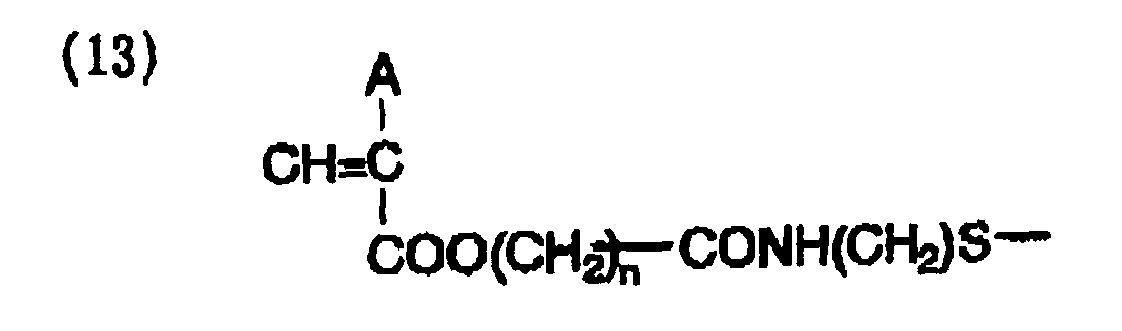


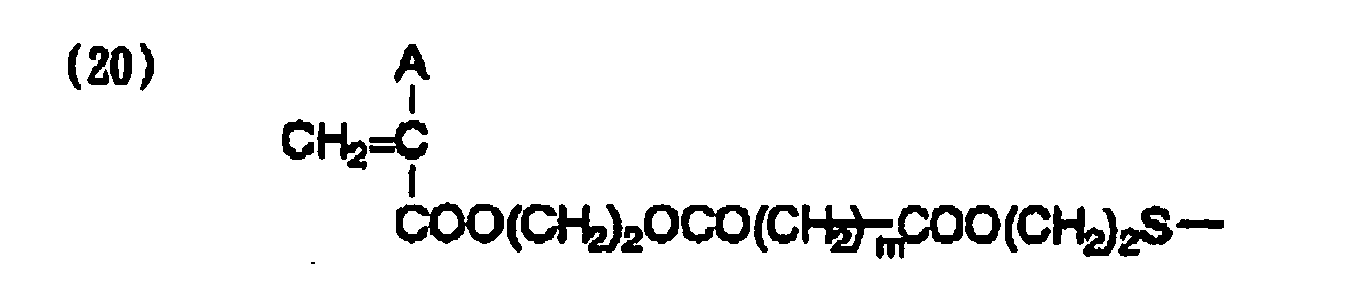





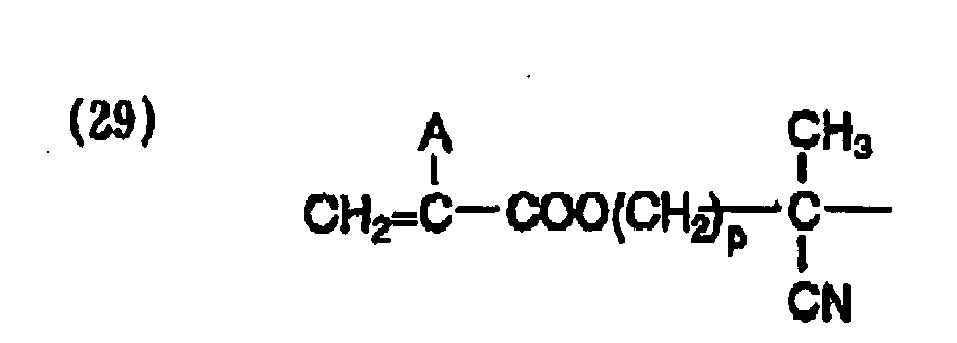





- The resin of the invention for dispersal stabilization (PG) in which a polymerizable double bond group is bonded to one terminus of the polymer principal chain can be easily produced by a synthesis method such as a method in which a reagent containing various double bond groups is allowed to react with terminus of a living polymer obtained by a conventionally known radical polymerization (e.g., iniferter method), anion polymerization or cation polymerization, or a reagent containing a specific reactive group (e.g., -OH, -COOH, -SO3H, -NH2, -SH, -PO3H2, -NCS,

- Illustratively, the polymerizable double bong group can be introduced in accordance with the methods described in reviews such as T. Ohtsu, Kobunshi (Polymer), 33 (No. 3), 222 (1984), P. Dreyfuss & R.P Quirk, Encycl. Poly. Sci. Eng., 7, 551 (1987), Y Nakajo and Y Yamashita "Senryo to Yakuhin (Dyestuffs and Drugs)", 30, 232 (1985), A. Ueda and S. Nagai, "Kagaku to Kogyo 'Chemistry and Industry)", 60, 57 (1986), P.F. Rempp & E, Franta, Advances in Polymer Science, 58, 1 (1984), K Ito "Kobunshi Kako (Polymer Processing)", 35, 262 (1986) and V Percec, Applied Polymer Science, 285, 97 (1984), and with the references and the like cited therein.
- Further illustratively, a method can be exemplified in which a polymer, wherein a specific reactive group is bonded to one terminus of the polymer principal chain, is synthesized by a method (a) in which a mixture containing at least one species of the monomer corresponding to the repeating unit represented by general formula (II) and a chain transfer agent containing the aforementioned reactive group in the molecule is polymerized using an initiator (e.g., an azobis system compound a or a peroxide), a method (b) in which the polymerization is effected not using the aforementioned chain transfer agent, but using an initiator containing the aforementioned specific reactive group in the molecule, or a method (c) in which a compound containing the aforementioned specific reactive group in the molecule is used in both of the chain transfer agent and initiator, and then a reactive double bond group is introduced by a polymer reaction making use of this specific reactive group.
- As the chain transfer agent to be used, a mercapto compound containing a specific reactive group or a substituent group which can be derived into a reactive group (e,g., thioglycolic acid, thiomalicacid, thiosalicylic acid, 2-mercaptopropionic acid, 3-mercaptopropionic acid, 3-mercaptobutyric acid, N-(2-mercaptopropionyl)glycine, 2-mercaptonicotinic acid, 3-[N-(mercaptoethyl)carbamoyl]propionic acid, 3-[N-(mercaptoethyl)amino]propionic acid, N-(3-mercaptopropionyl)alanine, 2-mercaptoethanesulfonic acid, 3-mercaptopropanesulfonic acid, 4-mercaptopropanesulfonic acid, 2-mercaptoethanol, 1-mercapto-2-propanol, 3-mercapto-2-butanol, mercaptophenol, 2-mercaptoethylamine, 2-mercapto imidazole or 2-mercapto-3-pyridinol} or an iodinated alkyl compound containing a specific reactive group or a substituent group which can be derived into a reactive group {e.g., iodoacetic acid, iodopropionic acid, 2-iodoethyl alcohol, 2-iodoethanesulfonic acid or 3-iodopropanesulfonic acid} can for example be cited. Preferably, a mercapto compound can be exemplified.
- In addition, as the initiator containing a specific reactive group or a substituent group which can be derived into a reactive group, an azobis compound {e.g., 4,4'-azobis(4-cyanovaleric acid), 4,4'-azobis(4-cyanovaleric acid chloride), 2,2'-azobis(2-cyanopropanol), 2,2'-azobis(2-cyanopentanol), 2,2'-azobis[2-(5-hydroxy-3,4,5,6-tetrahydropyrimidin-2-yl)propane], 2,2'-azobis{2-methyl-N-[1,1-bis(hydroxymethyl)-2-hydroxyethyl]propionamide}, 2,2'-azobis{2-methyl-N-[1,1-bis(hydroxymethyl)ethyl]propionamide}, 2,2'-azobis[2-methyl-N-(2-hydroxyethyl)propionamide] or 2,2'-azobis(2-amidinopropane)}, or a thiocarbamate compound {e.g., benzyl N-methyl-N-hydroxyethylthiocarbamate, 2-carboxyethyl N,N-diethyldithiocarbamate or 3-hydroxypropyl N,N-dimethyldithiocarbamate} can for example be cited.
- Each of these chain transfer agents or polymerization initiators is used in an amount vf from 0.05 to 10 parts by mass, preferably from 0.1 to 5 parts by mass, based on 100 parts by mass of total monomers.
- In addition, as illustrative embodiments of the resin (PG) containing a polymerizable double bond group in the substituent group of polymer component of the polymer, those which are represented by the following general formula (Pb) can for example be cited.

- In the formula (Pb), b1, b2, V0, L, c1 and c2 are as defined in the foregoing. The component x and component y may be contained in 2 species or more in the resin (P). The t1 and t2 respectively have the same meanings as the aforementioned b1 and b2. The V2 and V3 respectively have the same meanings as V1 in the formula (III). G° is a group which connects the bonding group V2 with the bonding group V3, and consists of at least one carbon atom, oxygen atom, sulfur atom, silicon atom or nitrogen atom.
- The bonding group is constituted by an optional combination of atomic groups, heterocyclic groups and the like of carbon atom-carbon atom bond (single bond or double bond), carbon atom-hetero atom bond (examples of the hetero atom include oxygen atom, sulfur atom, nitrogen atom and silicon atom) and hetero atom-hetero atom bond. For example, as the aforementioned atomic groups,



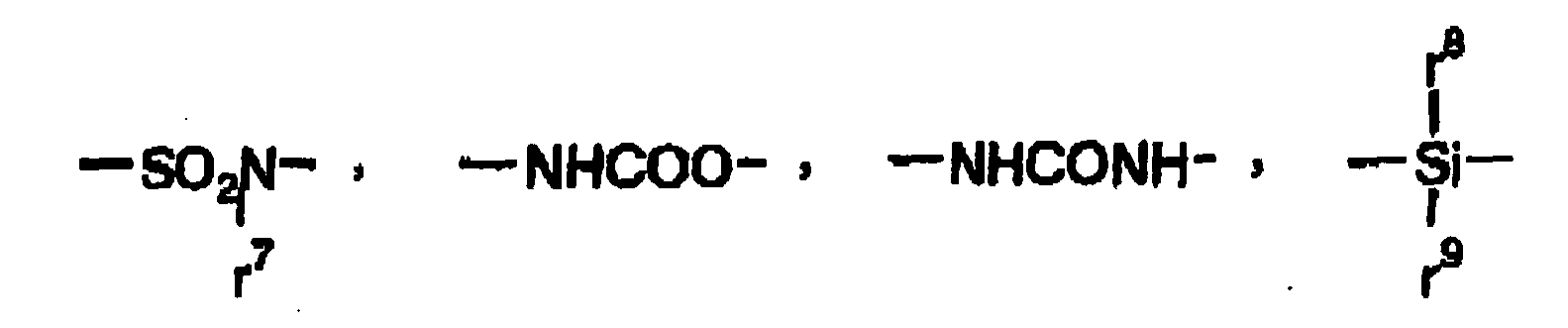
- In addition, examples of the heterocyclic group include heterocyclic rings containing a hetero atom such as oxygen atom sulfur atom or nitrogen atom (e.g., thiophene ring, pyridine ring, pyran ring, imidazole ring, benzimidazole ring, furan ring, piperidine ring, pyrazine ring, pyrrole ring and piperazine ring).
- Regarding the component y in the general formula (Pb), it is desirable that the connecting principal chain constituted by the bonding group [-V3-G0-V2-] is constituted from 8 or more in total number of atoms. In this case, for example, when V3 represents -COO- or ―CONH-, oxo group (=O group) and hydrogen atom are not included in the number of atoms, and carbon atoms, ether type oxygen atoms and nitrogen atoms which constitute the connecting principal chain are included as the number of atoms. Thus, -COO- and ―CONH-are counted 2 as the number of atoms.
- Illustrative examples of the repeating unit containing polymerizable double bond group (component y) are shown in the following, but the invention is not limited thereto.
- e1 : -H or ―CH3
- e2 : -H, ―CH3, -Cl or-CN
- k1: Integer of 4 to 12,k2: Integer of 2 to 6
- The resin for dispersal stabilization (PG) containing a polymerizable double bond group in the substitution of polymer components can be easily synthesized by a conventionally known synthesis method. That is, as the method for introducing the polymer component containing a polymerizable double bond group (component y), a method in which a monomer containing a specific reactive group (e.g., -OH, -COOH, -SO3H, -NH2, -SH, -PO3H2, -NCS, -COCl or ―SO2Cl) is subjected to a polymerization reaction in advance together with a monomer which corresponds to the component x in the general formula (Pb), and then the polymerizable double bond group is introduced by a polymer reaction by allowing a reactive reagent containing the polymerizable double bond group to undergo the reaction cam be exemplified.
- Illustratively, a polymerizable double bond group can be introduced in accordance with the methods described in the reviews and references cited therein, exemplified in relation of the aforementioned resin (PG) containing a polymerizable double bond group in one terminus of the polymer principal chain.
- Also, as another method, a method described in
JP-A-60-185962 - According to the resin represented by general formula (Pb), existing ratio of component x/component y is from 90/10 to 99/1 in mass ratio, preferably from 92/8 to 98/2 in mass ratio. Within this range, there is no danger of causing gelation of the reaction mixture or bulky particle diameter of the formed resin particles at the time of the polymerization granulation reaction.
- In addition, the resin for dispersal stabilization (PG) to be subjected to the invention may contain other repeating unit as a copolymer component, together with respective repeating units of the general formulae (Pa) and (Pb). As the other copolymer component, it may be any compound with the proviso that it consists of a monomer copolymerizable with monomers which correspond to respective repeating units of the general formulae (Pa) and (Pb). However, for the purpose of obtaining proper dispersal stability of the dispersal resin particles, it is desirable use it within such a range that it does not exceed 20 weights by mass at the most, based on 100 weights by mass of the total polymerizable components.
- One of the preferred embodiments of the resin for dispersal stabilization (P) of the invention is a graft polymer which contains at least one species of the monomers constituting the non-aqueous solvent-soluble principal chain and at least one species of macro monomers constituting the non-aqueous solvent-insoluble moiety (side chain moiety) (to be referred sometimes to as resin for dispersal stabilization (PF) hereinafter).
- The graft polymer concerned in the invention is not particularly limited with the proviso that the principal chain has a graft chain as the side chain and is soluble in the solvent, but is preferably a polymer which has a weight average molecular weight of 1,000 or more and contains a graft chain as the side chain of a polymer component having a weight average molecular weight 500 or more. The graft polymer particularly preferred as the dispersant is a polymer in which its principal chain moiety is not dissolved in a dispersal medium but the side chain part (graft chain) is dissolved therein.
- The "principal chain moiety is not dissolved in a dispersal medium" means that a polymer constituted solely from its principal chain part having no side chain part does not dissolve in the dispersal medium, and illustratively, it is desirable that it has a solubility of 3 g or less based on 100 g of the disperssal medium (25°C).
- The "side chain moiety is dissolved in a dispersal medium" means that a polymer constituted solely from its side chain part having no principal chain part dissolves in the dispersal medium, and illustratively, it is desirable that it has a solubility of 5 g or more based on 100 g of the dispersal medium (25°C).
- A graft polymer in which its principal chain part is not dissolved but its side chain part is dissolved becomes a state of from transparent to opaque in the dispersal medium and is dissolved or dispersed. When such a graft polymer is used, its principal chain part is strongly adhered to the particles because the principal chain part is not dissolved in the dispersal medium, and on the other hand, affinity of the side chain part for the dispersal medium is improved because the side chain part is dissolved in the dispersal medium, so that the dispersibility of particles in the dispersal medium is improve as a result.
- The graft polymer which can be suitably used in the invention is a polymer which contains at least a constituting unit represented by the following general formula (IV) and a constituting unit represented by the following general formula (V), and has a weight average molecular weight of 1,000 or more.


- In the general formulae (IV) and (V),
- R51,R52, R61 and R62 may be the same or different from one another, and each represents hydrogen atom or methyl group.
- R53 represents hydrogen atom or a hydrocarbon radical having from 1 to 30 carbon atoms which may have a substituent group. The hydrocarbon radical of R53 may contain ether bond, ester bond, amido bond, carbamate bond, amino group, hydroxyl group or a halogen substitution group.
- X51 and X61 may be the same or different fro each other, and each represents single bond or a divalent connecting group which has 50 or less as the total number of atoms and consists of 2 or more atoms selected from C, H, N, O, S and P.
- G1 represents a polymer component which contains at least a constituting unit represented by the following general formula (VI) and has a weight average molecular weight of 500 or more, or a polydimethylsiloxane group having a weight average molecular weight of 500 or more.

- In the general formula (VI),
- R71 and R72 may be the same or different from each other, and each represents hydrogen atom or methyl group.
- R73 represents hydrogen atom or a hydrocarbon radical having from 1 to 30 carbon atoms which may have a substituent group. The hydrocarbon radical of R73 may contain ether bond, ester bond, amido bond, carbamate bond, amino group, hydroxyl group or a halogen substitution group.
- X71 represents single bond or a divalent connecting group which has 50 or less as the total number of atoms and consists of 2 or more atoms selected from C, H, N, O, S and P.
- In this connection, from the view point of dispersal stability, it is desirable that the total number of atoms of R72 is larger than the total number of atoms of R53.
- The graft polymer which contains at least a constituting unit represented by the general forrrmla (IV) and a constituting unit represented by the general formula (V) and is suitably used in the invention can be obtained by polymerizing a radically polymerizable monomer corresponding to the general formula (IV) with a radically polymerizable macro monomer corresponding to the general formula (V) using conventionally known radical polymerization initiator. In this case, the monomer corresponding to the general formula (IV) is a monomer represented by the following general formula (IVM), and the macro monomer corresponding to the general formula (V) is a monomer represented by the following general formula (VM).
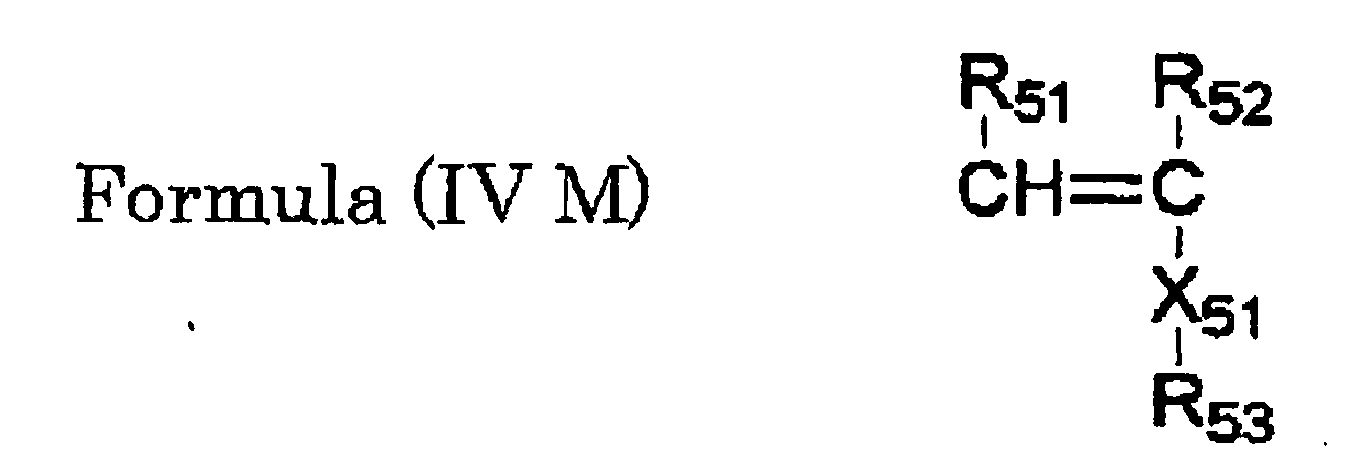

- In this connection, respective symbols in the general formulae (IVM) and (VM) have the same meanings as in the general formulae (IV) and (V).
- Examples of the monomer represented by the general formula (IVM) include methyl (meth)acrylate, ethyl (meth)acrylate, propyl (meth)acrylate, butyl (meth)acrylate, hexyl (meth)acrylate, octyl (meth)acrylate, 2-ethylhexyl (meth)acrylate, cyclohexyl (meth)acrylate, dodecyl (meth)acrylate, stearyl (meth)acrylate, phenyl (meth)acrylate, benzyl (meth)acrylate, 2-hydroxy (meth)acrylate and the like (meth)acrylic acid esters, and N-methyl (meth)acrylamide, N-propyl (meth)acrylamide, N-phenyl (meth)acrylamide, N,N-dimethyl (meth)acrylamide and the like (meth)acrylamides, styrene, methylstyrene, chlorostyrene, methoxystyrene and the like styrenes, 1-butene and the like hydrocarbons, and vinyl acetates, vinyl ethers and vinylpyridines.
- The macro monomer represented by the general formula (VM) is a polymer having a radically polymerizable functional group on its terminus, obtained by polymerizing a radically polymerizable monomer represented by the following general formula (VIM) which corresponds to the general formula (VI), in the presence of a chain transfer agent as occasion demands, and introducing the radically polymerizable functional group into the polymer terminus.
- In this connection, the macro monomer represented by the general formula (VM) is preferably a macro monomer having a weight average molecular weight of within the range of from 500 to 500,000 and a polydisperse degree (weight average molecular weight/number average molecular weight) of within the range of from 1.0 to 7.0. In addition, the macro monomer represented by the general formula (VM) may be a polydimethylsiloxane having a radically polymerizable functional group on its terminus.

- In this connection respective symbols in the general formula (VIM) have the same meaning as in the general formula (VI). Examples of the monomer represented by the general formula (VIM) include methyl (meth)acrylate, ethyl (meth)acrylate, propyl (meth)acrylate, butyl (meth)acrylate, hexyl (meth)acrylate, octyl (meth)acrylate, 2-ethylhexyl (meth)acrylate, cyclohexyl (meth)acrylate, dodecyl (meth)acrylate, stearyl (meth)acrylate, phenyl (meth)acrylate, benzyl (meth)acrylatey 2-hydroxy (meth)acrylate and the like (meth)acrylic acid esters, and N-methyl (meth)acrylamide, N-propyl (meth)acrylamide, N-phenyl (meth)acrylamide, N,N-dimethyl (meth)acrylamide and the like (meth)acrylamides, Styrene, methylstyrene, chlorostyrene, methoxystyrene and the like styrenes, 1-butene and the like hydrocarbons, and vinyl acetates, vinyl ethers and vinylpyridines.
- The graft polymer to be used in the invention may solely have the constituting units represented by the general formulae (IV) and (V), but may also have other constituting units. As illustrative examples of the graft polymers to be suitably used in the invention, the polymers [BZ-1] to [BZ-8] represented by the following structural formulae can be cited.


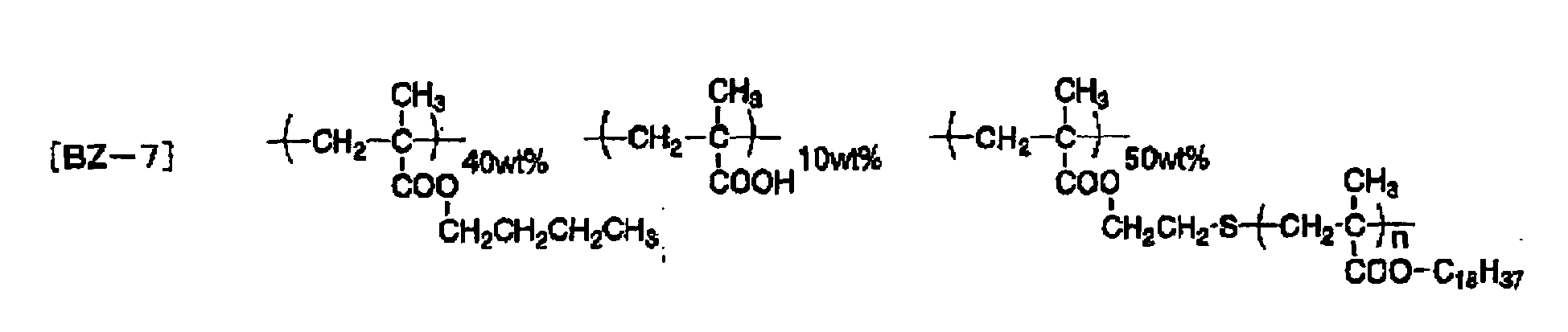

- The "principal chain part is not dissolved in a dispersal medium" means that a polymer which does not contain the constituting unit represented by the aforementioned general formula (V) has a solubility of 3 g or less based on 100 g of the dispersal medium, and the "side chain part is dissolved in a dispersal medium" means that a polymer of G in the general formula (V), or a macro monomer of the general formula (VM), has a solubility of 5 g or more based on 100 g of the dispersal medium.
- According to the invention, from the view point of long-term preservation stability and discharge stability of the particles, it is desirable that the dispersant is a graft polymer having a weight average molecular weight of within the range of from 1,000 to 1,000,000 and a polydisperse degree (weight average molecular weight/number average molecular weight) of within the range of from 1.0 to 7.0.
- Also, it is desirable that weight average molecular weight of the graft polymer is 1.5 times or more of the weight average molecular weight of graft chain (preferably the macromer component represented by the aforementioned formula (7)).
- In addition, it is desirable that mass ratio of the principal chain-constituting unit and the graft chain-constituting unit is within the range of from 30:70 to 95:5. These polymers may be used alone as the dispersant, or may be used in combination of 2 or more species.
- As described in the foregoing, it is desirable to use the resin for dispersal stabilization (PF) consisting of the soluble component containing at least a constituting unit represented by the aforementioned general formula (IV) and a constituting unit represented by the aforementioned general formula (V) and of the insoluble component graft copolymer. In this case, the principal chain part of insoluble component of the resin for dispersal stabilization (PF) is sufficiently adhered to the insoluble resin particles. In addition, it is desirable to use the resin for dispersal stabilization (PG) which contains a polymerizable double bond group. In this case, the resin (PG) is chemically bonded to the insoluble resin particles. It is considered that dispersibility is further improved by this, because so-called steric repulsion effect is provided by the improvement of affinity, for the dispersal medium, of the soluble component of the resin for dispersal stabilization (P) sufficiently adhered or chemically bonded to the dispersed resin particles.
- Mass average molecular weight (Mw) of the dispersant (P) of the invention is preferably from 2 x 10⁴ to 1 x 10⁶, more preferably from 3 x 10⁴ to 2 x 10⁵.
- As the radical polymerizable monomer of the invention, it is preferable to use at least one of compounds having at least two of polymerizable groups in the molecule. Explanation of the compound is described below.
- If the polymerizable group is a group having ethylene unsaturated bond, the ethylene unsaturated bond indicating radical-reactivity, the polymerizable group is not especially restricted. Desirable polymerizable group can be exemplified as an acrylic group, a methacrylic group, allyl group, vinyl group and crotonyl group which may have a substituent.
- The number of the polymerizable group is 2 or more, 2 to 18, 2 to 12. That is, it is preferable that the number of the polymerizable is 2 or more in viewpoint of particles and is 18 or less in viewpoint of dispersal stability of particles.
- Concrete examples of the aforesaid compound are shown below.


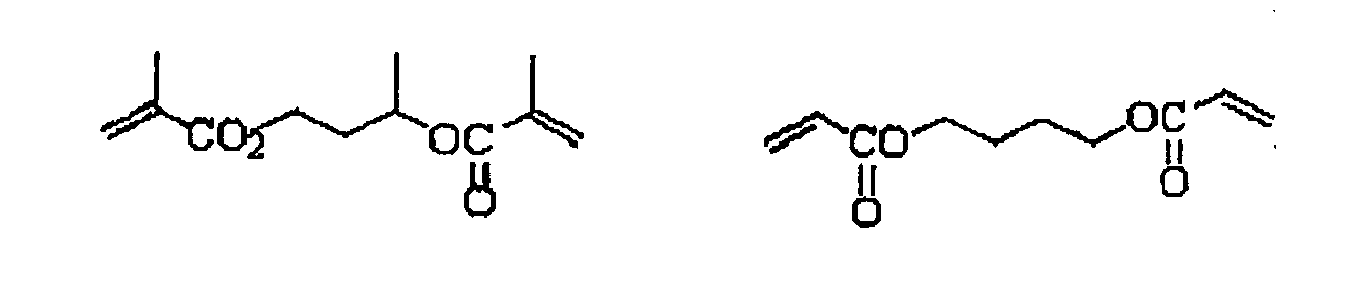


- In addition, the radical Polymerizable monomer of the invention is preferably to use a monomer having at least two of ethylene unsaturated bonds, each of the ethylene unsaturated bonds having different reactivity with radical in the molecule thereof. The "different reactivity with radicals" indicates that, under radical polymerization condition of one ethylene unsaturated bond possessed by the monomer, the other ethylene unsaturated bond does not show polymerization ability or does not substantially provide a polymer.
- A monomer represented by the following formula (I) can be exemplified as the structure of desirable monomer. The monomer has at least two of ethylene unsaturated bonds, each of the ethylene unsaturated bonds having different reactivity with radical in the molecule thereof.

- In the general formula (I), R1 represents hydrogen atom or a substituted or unsubstituted alkyl group having from 1 to 6 carbon atoms (e.g., methyl group, ethyl group, hydroxyethyl group or methoxymethyl group), and R2 to R6 represent hydrogen atom or a substituted or unsubstituted alkyl group having from 1 to 6 carbon atoms (methyl group, ethyl group, propyl goup, butyl group, pentyl group or hexyl group), wherein respective substituent groups on the adjacent carbon atom may be together bonded to form a cyclic structure of 5- to 7-membered ring.
- Y represents a divalent connecting group, and for example, it represents single bond, -COO-, -OCO-, -CH2OCO-, -CH2COO-, -O-, -CONHCOO-, -CONHOCO-, -SO2-, -CON(Q1)-, -SO2N(Q1)- or phenylene group (hereinafter, phenylene group is described sometimes as "-Ph-", wherein 1,2-, 1,3- and 1,4-phenylene groups are included in the phenylene group). In this case, Q1 represents hydrogen atom or an aliphatic group having from 1 to 8 carbon atoms which may be substituted (e.g., methyl group, ethyl group, propyl group, butyl group, 2-chloroethyl group, 2-bromoethyl group, 2-cyanoethyl group, 2-hydroxyethyl group, benzyl group, chlorobenzyl group, methylbenzyl group, methoxybenzyl group, phenethyl group, 3-phenylpropyl group, dimethylbenzyl group, fluorobenzyl group, 2-methoxyethyl group or 3-methoxypropyl group).
- Illustrative examples of the monomer represented by the general formula (I) are shown in the following.


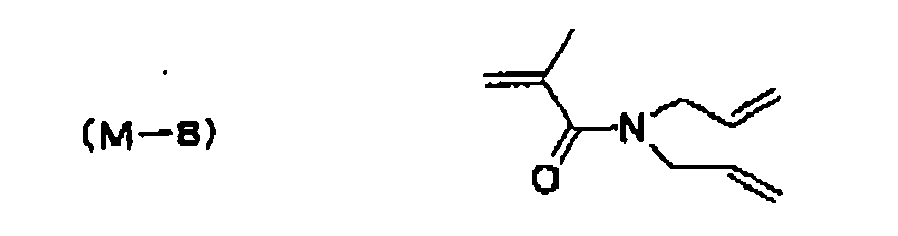


- As the radically polymerizable monomer to be used in the invention, in order to control particle forming ability, particle dispersibility and particle charging property, it is desirable to use a conventionally known radically polymerizable monomer in addition to the compound having at least two of polymerizable groups in one molecule. As the other radically polymerizable monomer, a monofunctional monomer which is soluble in non-aqueous solvent but becomes insoluble by polymerization is suitable. Illustratively, a monomer represented by the following formula (II) can for example be cited.

- In the general formula (II), V2 represents single bond, -COO-, -OCO-, -CH2OCO-, -CH2COO-, -O-, -CONHCOO-, -CONHOCO-, -SO2-, -CON(Q1)-, -SO2N(Q1)- or phenylene group (hereinafter, phenylene group is described sometimes as "-Ph-", wherein 1,2-, 1,3- and 1,4-phenylene groups are included in the phenylene group). In this case, Q1 represents hydrogen atom or an aliphatic group having from 1 to 8 carbon atoms which may be substituted (e.g., methyl group, ethyl group, propyl group, butyl group, 2-chloroethyl group, 2-bromoethyl group, 2-cyanoethyl group, 2-hydroxyethyl group, benzyl group, chlorobenzyl group, methylbenzyl group, methoxybenzyl group, phenethyl group, 3-phenylpropyl group, dimethylbenzyl group, fluorobenzyl group, 2-methoxyethyl group or 3-methoxypropyl group).
- T represents hydrogen atom or an aliphatic group having from 1 to 6 carbon atoms which may be substituted (e.g., methyl group, ethyl group, propyl group, butyl group, 2-chloroethyl group, 2,2-dichloroethyl group, 2-bromoethyl group, 2-hydroxyethyl group, 2-hydroxypropyl group, 2,3-dihydroxypropyl group, 2-hydroxy-3-chloropropyl group, 2-methoxyethyl group, 2-methanesulfonylethyl group, 2-ethoxyethyl group, 3-bromopropyl group, 4-hydroxybutyl group, 2-furfurylethyl group, 2-thienylethyl group, 2-carboxyethyl group, 3-carboxy propylgroup, 4-carboxybutyl group, 2-carboxyamidoethyl group, 2-N-methylcarboxyamidoethyl group, cyclopentyl group, chlorocyclohexyl group or dichloro hexyl group).
- The a1 and a2 may be the same or different from each other, and each preferably represents hydrogen atom, a halogen atom (e.g., chlorine atom or bromine atom), cyano group, an alkyl group having from 1 to 3 carbon atoms (e.g., methyl group, ethyl group or propyl group), ―COO-Q2 or ―CH2-COO-Q2 (wherein Q2 represents hydrogen atom or a hydrocarbon radical having 10 or less carbon atoms which may be substituted (e.g., an alkyl group, an alkenyl group, an aralkyl group or an aryl group)).
- Illustrative examples of the radically polymerizable monomer include vinyl esters or allyl esters of an aliphatic carboxylic acid having from 1 to 6 carbon atoms (e.g., acetic acid, propionic acid, butyric acid or monochloroacetic acid); alkyl esters or amides of acrylic acid, methacrylic acid, crotonic acid, itaconic acid, maleic acid and the like unsaturated carboxylic acids, which have from 1 to 4 carbon atoms and may be substituted (examples of the alkyl group include methyl group, ethyl group, propyl group, butyl group; 2-chloroethyl group, 2-bromoethyl group, 2-hydroxyethyl group, 2-cyanoethyl group, 2-nitroethyl group, 2-methoxyetbyl group, 2-methanesulfonylethyl group, 2-benzenesulfonylethyl group, 2-carboxyethyl group, 4-carboxybutyl group, 3-chloropropyl group, 2-hydroxy-3-chloropropyl group, 2-furfurylethyl group, 2-thienylethyl group and 2-carboxyamidoethyl group);
styrene derivatives (e.g., styrene, vinyltoluene, α-methylstyrene, vinylnaphthalene, chlorostyrene, dichlorostyrene, bromostyrene, vinylbenzenecarboxylic acid, chloromethylstyrene, hydroxymethylstyrene, methoxymethylstyrene, vinylbenzenecarboxyamide and vinylbenzenesulfoamide); acrylic acid, methacrylic acid, crotonic acid, maleic acid, itaconic acid and the like unsaturated carboxylic acids; cyclic acid anhydrides of maleic acid and itaconic acid; acrylonitrile; methacrylonitrile; and heterocyclic compounds containing a polymerizable double bond group (illustratively, the compounds described for example in "Polymer Data Handbook -Elementary Book- (written in Japanese)" pp. 175 - 184, edited by Kobunshi Gakkai, published in 1986 by Baifukan, such as N-vinylpyridine, N-vinylimidazole, N-vinylpyrrolidone, vinylthiophene, vinyltetrahydrofuran, vinyloxazoline, vinylthiazole and N-vinylmorpholine). - According to the fine particles of the invention, for the purpose of adding positive charge to the particles in a non-aqueous solvent, it is desirable to use radically polymerizable monomers which have a cationic group. The radically polymerizable monomers having a cationic group are a monomer which contains at least one amino group represented by the following general formula (III) in one molecule and a polymerizable monomer having a nitrogen-containing heterocyclic ring.

- In the general formula (III), R11 and R12 may be the same or different from each other, and each represents hydrogen atom or a hydrocarbon radical having from 1 to 22 carbon atoms, wherein R11 and R12 may be bonded to form a ring together with the nitrogen.
- As the nitrogen-containing heterocyclic ring, pyridine, imidazole, indole, carbazole and quinoline can be exemplified. Examples of the preferred structure include those in which the amino group represented by the general formula (III) is bonded to the atomic group represented by T in the aforementioned radically polymerizable monomer represented by the general formula (II). Illustratively, dimethylaminoethyl methacrylate, diethylaminoethyl methacrylate, 4-vinylpyridine, 3-vinylpyridine, vinylimidazole and N-vinylcarbazole can be exemplified.
- When positive charge is added to the surface of resin particle, the aforementioned cationic monomer can be used by mixing with the aforementioned radically polymerizable monomer at an optional ratio. Ratio of the cationic monomer in this case is preferably from 1 to 50% by mass, more preferably from 5 to 30% by mass, based on the total mass of the aforementioned radically polymerizable monomer and cation polymerizable monomer.
- Such a radically polymerizable monomer may be used as a mixture of two or more species.
- Among the radically polymerizable monomers to be used in the polymerization, ratio of the radically polymerizable monomer represented by the formula (I) is generally from 0.1 to 95% by mol, preferably from 0.5 to 80% by mol, more preferably from 1 to 50% by mol, based on the molar quantity of total monomers.
- As the initiator to be used in the polymerization, a peroxide system or azo system initiator generally used in radical polymerization can be employed. Its examples include benzoyl peroxide, lawoyl peroxide, octanoyl peroxide, benzoyl orthochloroperoxide, benzoyl orthomethoxyperoxide, methyl ethyl ketone peroxide, diisopropyl peroxycarbonate, cumene hydroperoxide, cyclohexanone peroxide, t-butyl hydroperoxide, diisopropylbenzene hydroperoxide and the like peroxide system initiators, 2,2'-azobisisobutyronitrile, 2,2'-azobis(2,4-dimethylvaleronitrile), 2,2'-azobis(2,3-dimethylbutyronitrile), 2,2'-azobis(2-methylbutyronitrile), 2,2'-azobis(2,3,3-trimethylbutyronitrile), 2,2'-azobis(2-isopropylbutyronitrile), 1,1'-azobis(cyclohexane-1-carbonitrile), 2-(carbamoylazo)isobutyronitrile, 4,4'-azobis(cyanovaleric acid) and dimethyl-2,2'-azobisisobutyrate. It is desirable that said initiator is used in an amount of from 0.01 to 20% by mass, particularly from 0. 1 to 10% by mass, based on the radically polymerizable monomer.
- The aspherical-polymer fine particles (CR) of the invention can be synthesized by subjecting preferably a monomer which has at least two ethylene unsaturated bonds having different reactivities with radicals in the molecule to radical polymerization in a non-aqueous solvent in the presence of the aforementioned resin for dispersal stabilization (P).
- As the monomer which has at least two of ethylene unsaturated bonds having different reactivities with radicals in the molecule, the compound having at least two of polymerizable groups in one molecule is desirable.
- Illustratively, there is a method in which an initiator is added to a mixture consisting of the resin for dispersal stabilization (P), at least one species of the compound having at least two of polymerizable groups in one molecule and a non-aqueous solvent, or in which tbe resin for dispersal stabilization (P) is dissolved in a non-aqueous solvent, and at least one species of the compound having at least two of polymerizable groups in one molecule and an initiator are added dropwise to the solution together with the non-aqueous solvent as occasion demands, and the particles can be produced by either one of these methods.
- In carrying out the polymerization, the monomer concentration is preferably from 5 to 50% by mass, more preferably from 10 to 40% by mass, based on the total of whole polymerizable monomers, non-aqueous solvent and resin for dispersal stabilization (P).
- The heating temperature can be set in response to the decomposition temperature of the initiator to be used, and is generally from 30 to 120°C, preferably from 50 to 100°C.
- It is desirable to carry out the polymerization in a stream of nitrogen or the like inert gas.
- Average particle diameter of the obtained aspherical-polymer fine particles (CR) are preferably from 0.05 to 10 µm, more preferably from 0.1 to 5 µm. By the use of such particles, the resin particles of the invention having an average particle diameter of from 0.1 to 5 µm and showing excellent monodisperse property can be easily produced.
- As occasion demands, the aspherical-polymer fine particles (CR) may be concentrated or diluted in the non-aqueous solvent. Alternatively, in order to purify the resin particles, the resins may be used after effecting their precipitation by centrifugation, thereby separating from the supernatant, and then re-dispersing them in the non-aqueous solvent.
- The aspherical-polymer fine particles (CR) can also be formed by firstly forming a resin particle (CR0) from a radically polymerizable monomer which does not contain the compound having at least two of polymerizable groups in one molecule, and then using this as the seed particle and adding radically polymerizable monomers (feed monomers) which contain at least one species of the radically polymerizable monomer represented by the aforementioned general formula (I) and a polymerization initiator.
- In that case, using ratio of the resin particle (CR0) and the gross radically polymerizable monomers (feed monomers) which contain at least one species of the compound having at least two of polymerizable groups in one molecule is preferably from 5/95 to 95/5, more preferably from 10/90 to 80/20, as a mass ratio of resin particle (CR0)/gross feed monomers. Total amount of the resin particle (CR0) and the gross radically polymerizable monomers is preferably from 10 to 150 parts by mass, more preferably from 10 to 100 parts by mass, based on 100 parts by mass of the non-aqueous solvent.
- Amount of the resin for dispersal stabilization (P) to be used is preferably from 3 to 40 parts by mass, more preferably from 5 to 30 parts by mass, based on 100 parts by mass of the whole monomers. Amount of the initiator is preferably from 0.1 to 10% by mass of the whole monomers. In addition, the polymerization temperature is preferably from 40 to 180°C, more preferably from 50 to 120°C. The reaction time is preferably from about 5 to about 20 hours.
- The aforementioned aspherical-polymer fine particles are useful as charging particles in the ink jet ink composition, oil ink composition for ink jet type process plate and electrophoretic particle composition (to be referred collectively and simply to as composition hereinafter).
- In order to use the polymer fine particles of the invention in an ink jet ink or an electrophoretic display device, it is desirable to color the particles as occasion demands. As the coloring agent, any one of pigments and dyestuffs can be used, with the proviso that they are oil ink compositions or conventionally known coloring agents for electrostatic photograph liquid developing agents.
- As the pigments, those which are generally used in the technical field of printing can be used regardless of inorganic pigment or organic pigment. Illustratively, carbon black, cadmium red, molybdenum red, chromium yellow, cadmium yellow, titanium yellow, chromium oxide, viridian, titanium cobalt green, ultra marine blue, Prussian blue, cobalt blue, an azo system pigment, a phthalocyanine system pigment, a quinacridone system pigment, an iso indolinone system pigment, a dioxazine system pigment, an indanthrene system pigment, a perylene system pigment, a perynone system pigment, a thioindigo system pigment, a quinophthalone system pigment, a meta complex pigment and the like conventionally known pigments can for example be used without particular limitation.
- As the distaffs, an azo dye, a metal complex dye, a naphthol dye, an anthraquinone dye, an indigo dye, a carbonium dye, a quinoneimine dye, a xanthene dye, a cyanine dye, a quinoline dye, a nitro dye, a benzoquinone dye, a naphthoquinone dye, a phthalocyanine dye, a metal phthalocyanine dye and the like oil-soluble dyestuffs are desirable.
- These pigments and dyestuffs can be used alone or can be used as an optional combination, but it is desirable to contain within the range of from 0.01 to 5% by mass based on the whole composition.
- These coloring agents may be dispersed in the non-aqueous solvent as dispersed particles of the coloring materials, separately from the dispersed aspherical-polymer fine particles, or contained in the polymer fine particles. As a method when they are contained therein, there is a method in which the polymer fine particles are stained with a preferred dyestuff, as described for example in
JP-A-57-48738 JP-A-53-54029 JP-B-44-22955 - In order to stain aspherical-polymer fine particles obtained by the polymerization of the aforementioned radically polymerizable monomers in the non-aqueous solvent in the presence of the aforementioned resin for dispersal stabilization (P), a method in which dispersed liquids of a pigment powder and aspherical-polymer fine particles are mixed and stirred with heating and a method in which a pigment solution is mixed with a dispersion of aspherical-polymer fine particles and stirred with heating can be exemplified, and from the viewpoint of the uniformity of staining, a pigment solution prepared using an organic solvent can be used in this case. Useful as the organic solvent is a solvent which does not dissolve or aggregate the polymer fine particles when the aforementioned pigment is dissolved therein and added to a non-aqueous solvent dispersion of the aspherical-polymer fine particles. In addition, it may also be a solvent which slightly swells the particles. Its illustrative examples include methanol, ethanol, acetone, methyl ethyl ketone, ethyl acetate, dichloromethane and chloroform.
- As the concentration of the pigment solution, a range of from 0.01 to 10% by mass is preferably, and that of from 0.1 to 5% by mass is more preferable. In addition, it is desirable to add the pigment solution within a range of from 1 to 20 parts by mass based on 100 parts by mass of the non-aqueous dispersion of aspherical-polymer fine particles. As the heating temperature, a range of from 25°C to 100°C is desirable, and that of from 30°C to 80°C is more desirable. T solvent used in the dissolution of pigment may be evaporated after the heating.
- When the non-aqueous solvent is used jointly with a polar solvent such as of the aforementioned alcohols, ketones, ethers or esters, or when unreacted matter of the radically polymerizable monomers is remained at the time of the polymerization, the solvents can be removed by evaporation under heating at the boiling point or more of the polar solvent or monomers or by evaporation under a reduced pressure, or the aspherical-polymer fine particles can be separated from the solvents by centrifugation.
- The aspherical-polymer fine particles obtained in the aforementioned manner are present as very fine particles having uniform particle size distribution. The average particle diameter is preferably from 0.1 to 3.0 µm, more preferably from 0.15 to 2.0 µm. This particle diameter can be calculated for example by a centrifugal precipitation type particle size measuring device (e.g., CAPA-700 manufactured by HORIBA) or a laser diffraction scattering type particle size measuring device (e.g., LA-920, manufactured by HORIBA).
- In the case of the ink jet ink composition of the invention, it is desirable to use the aspherical-polymer fine particles in an amount of approximately from 0.001 to 10 parts by mass based on 100 parts by mass of the non-aqueous solvent as the carrier liquid.
- Next, as the charge adjusting agent to be used in the invention, those which are conventionally known can used. For example, metal salts of naphthenic acid, octenoic acid, oleic acid, stearic acid and the like fatty acids, metal salts of sulfosuccinic acid esters, the oil-soluble sulfonic acid metal salts described in
JP-B-45-556 JP-A-52-37435 JP-A-52-37049 JP-B-45-9594 JP-B-48-25666 JP-B-55-2620 JP-A-52-107837 JP-A-52-38937 JP-A-57-90643 JP-A-57-139753 JP-A-57-210345 JP-B-56-24944 JP-A-60-21056 JP-A-61-50951 JP-A-60-173558 JP-A-60-179750 JP-A-54-31739 JP-B-56-24944 - As preferred among them, metal salts of naphthenic acid, metal salts of dioctylsulfosuccinic acid, the aforementioned maleic acid half amide component-containing copolymer, lecithin and the aforementioned amino acid derivatives can be cited. As these charge adjusting agents, it is possible to jointly use two or more of compounds. It is desirable that concentration of the charge adjusting agent as described in the above is within a range of from 0.0001 to 2.0% by mass based on the total amount of the composition. That is, regarding concentration of the charge adjusting agent, 0.0001% by mass or more is desirable in view of high specific conductivity, and 2.0% by mass or less is desirable in view of keeping necessary printing concentration without reducing volume resistivity.
- Though the components described in the foregoing are the basic constructing materials in the invention, various additive agents may be added to the composition of the invention as occasion demands. They are optionally selected in response to the materials, structures and the like of the ink jet system or ink jet discharge head, ink supplying part and ink circulating part and included as an ink composition. For example, the additive agents described in "Ink Jet Printer Techniques and Materials (written in Japanese)" , can be used.
- Its illustrative examples include fatty acids (e.g., monocarboxylic acids and polybasic acids having from 6 to 32 carbon atoms; e.g., 2-ethylhexynoic acid, dodecenylsuccinic acid, butylsuccinic acid, 2-ethylcaproic acid, lauric acid, palmitic acid, elaidic acid, linoleic acid, recinoleic acid, oleic acid, stearic acid, enanthic acid, naphthenic acid, ethylenediaminetetraacetic acid, abietic acid, dihydroabietic acid and hydrogenated rosin), metal salts of resin acid, alkylphthalic acid, alkylsalicylic acid and the like (as metals of the metal ions, Na, K, Li, B, Al, Ti, Ca, Pb, Mn, Co, Zn, Mg, Ce, Ag, Zr, Cu, Fe, Ba and the like), surface active compounds (e.g., mono, di or trialkylphosphoric acid and the like consisting of an alkyl group having from 3 to 18 carbon atoms as organic phosphoric acids or salts thereof, long chain aliphatic sulfonic acid, long chain alkylbenzenesulfonic acid, dialkylsulfosuccinic acid and the like or metal salts thereof as organic sulfonic acids or salts thereof, and lecithin, kephalin and the like phospholipids as amphoteric surface active compounds), alkyl group-containing surface active agents containing fluorine atom and/or dialkylsiloxane binding group, aliphatic alcohols (e.g., higher alcohols consisting of a branched alkyl group having from 9 to 20 carbon atoms, benzyl alcohol, phenetyl alcohol and cyclohexyl alcohol), polyhydric alcohols {e.g., alkylene glycol having from 2 to 18 carbon atoms (ethylene glycol, 1,2-propylene glycol, 1,3-propylene glycol, 1,4-butanediol, neopentyl glycol, 1,6-hexanediol, dodecanediol and the like)}, alkylene ether glycol having from 4 to 1,000 carbon atoms (diethylene glycol, triethylene glycol, dipropylene glycol, polyethylene glycol, polypropylene glycol, polytetramethylene ether glycol and the like); alicyclic diol having from 5 to 18 carbon atoms (1,4-cyclohexane dimethanol, hydrogenated bisphenol A and the like); alkylene oxide having from 2 to 18 carbon atoms (ethylene oxide, propylene oxide, butylene oxide, α-olefin oxide and the like) addition products of bisphenols having from 12 to 23 carbon atoms (bisphenol A, bisphenol F, bisphenol S and the like), glycerol, trimethylolethane, trimethylolpropane, pentaerythritol, sorbitol an the like polyols; phenols of trivalent to octavalent or more (tris phenol PA, phenol novolak, cresol novolak and the like); alkylene oxide having from 2 to 18 carbon atoms addition products (the addition mol number is from 2 to 29) of the aforementioned polyphenols of trivalent or more, ether derivatives of the aforementioned polyhydric alcohols (polyglycol alkyl ethers, alkyl aryl polyglycol ether and the like), fatty acid ester derivatives of polyhydric alcohol, ether oleate derivatives of polyhydric alcohol (e.g., ethylene glycol monoethyl acetate, diethylene glycol monobutyl acetate, propylene glycol monobutyl propiolate, sorbitan monomethyl dioxide and the like), alkyl naphthalene sulfonate, alkyl aryl sulfonate and the like compounds, though not limited thereto.
- It is desirable to use these additive agents by adjusting their using amount to such a level that surface tension of the composition is set within a range of from 15 to 60 mN/m (at 25°C), and its viscosity within a range af from 1.0 to 40 cP.
- A composition which contains the aspherical-polymer fine particles of the invention can be applied as an ink jet ink composition to the ink jet recording by an ink jet recorder.
- Fig. 1 is a drawing showing construction of an inkjet recorder suitable for the use of the ink composition of the invention, showing a section of its periphery including individual electrodes which correspond to each recording dot. In the drawing, a line scanning type
ink jet head 1 is equipped with ahead block 2 having anink well 2a, aninsulation substrate 5 arranged on the ink protruding side of thishead block 2 and in which asubstrate penetrating hole 5a is punch-arranged in response to theink well 2a, acontrol electrode 6 arranged by surrounding the aforementionedsubstrate penetrating hole 5a for applying voltage to a chargingink 9, abias voltage source 7 which constantly supplies a fixed bias voltage for thiscontrol electrode 6, asignal voltage source 8 which supplies, for thecontrol electrode 6, a signal that corresponds to the image to be recorded, and a protrudingink guide 10 arranged in theink well 2a andsubstrate penetrating hole 5a. - An
ink supplying channel 2b and anink recovery channel 2c for circulating ink are formed on both sides of theaforementioned head block 2, theseink supplying channel 2b andink recovery channel 2c are respectively connected to an ink supplying tube 3a and anink recovery tube 3b, and anink circulation mechanism 4 is connected to these ink supplying tube 3a andrecovery tube 3b. - The aforementioned protruding
ink guide 10 is held by a certain method on ahead substrate 15 positioned at the bottom of theaforementioned head block 2. In addition, this protrudingink guide 10 is has the shape of a chessman of Japanese chess having aslant part 12 which slants toward both sides having the same thickness, in which anink guide groove 13 is formed by cutting out a certain width along the center line from the top part where theaforementioned slant parts 12 are crossed, and the ink flowed up thisink guide groove 13 by the capillary phenomenon takes flight as an ink drop 16 from an inkdrop flight position 14 to the side of acounter electrode 17. Thecounter electrode 17 is provided with a predetermined voltage level by anearth source 18, and at the same time, thiscounter electrode 17 holds a medium for recording 19 as a platen. - This
inkjet head 1 is equipped with recording dot-corresponding numbers of individual electrodes, and theink 9 in Fig. 1 is prepared by dispersing and suspending an ink particles having plus charging property in a colloidal form in an insulating solvent having an electrical resistivity of 108 Ω·cm or more. Thisink 9 is supplied toward theink well 2a arranged between thehead substrate 15 and insulatingsubstrate 5, from theink circulation mechanism 4 including a pump (not illustrated) and the ink supplying tube 3a through theink supplying channel 2b formed on thehead clock 2, and at the same time, recovered into theink circulation mechanism 4 via theink recovering channel 2c andink recovering tube 3b. - The aforementioned insulating
substrate 5 is an insulating substrate which has thesubstrate penetrating hole 5a, and a control electrode substrate is constructed from this and thecontrol electrode 6 formed around the aforementionedsubstrate penetrating hole 5a on the medium for recording side of this insulatingsubstrate 5. On the other hand, the protrudingink guide 10 is arranged on thehead substrate 15 in such a manner that it is positioned at approximately the center of the aforementionedsubstrate penetrating hole 5a, - A composition containing the aspherical-polymer fine particles of the invention can be used in the preparation of printing plate as an oil ink composition for ink jet type process plate.
- The water-resistant base material having the hydrophilic surface to which lithography can be applied may be any material that can provide a hydrophilic surface suited for lithography, and any of the base materials conventionally used in the offset printing plate can be used as such. Illustratively, a plastic sheet, a sheet of paper to which printing resistance is applied, an aluminum plate, a zinc plate, bimetal plates such as a copper-aluminum plate, a copper-stainless steel plate and a chrome-copper plate, trimetal plates such as a chrome-copper-aluminum plate, a chrome-zinc-iron plate and a chrome-copper-stainless steel plate, and the like substrates having hydrophilic surface are used. Its thickness is preferably from 0.1 to 3 mm, particularly from 0.1 to 1 mm.
- In the case of a base material which has the aluminum surface, it is desirable that a graining treatment, a soaking treatment in an aqueous solution of sodium silicate, zirconium fluoride potassium, a phosphate or the like, an anode oxidation treatment or the like surface treatment is applied thereto. In addition, the aluminum plate which is subjected to graining and then treated by soaking in a sodium silicate aqueous solution as described in
US Patent 2,714,066 and the aluminum plate which is subjected to an anode oxidation treatment and then to a soaking treatment in an alkali metal salt aqueous solution as described inJP-B-47-5125 - The aforementioned anode oxidation treatment is carried out, for example, in an electrolyte consisting of single or a combination of two or more of aqueous solution or non-aqueous solution containing phosphoric acid, chromic acid, sulfuric acid, boric acid or the like inorganic acid, oxalic acid, sulfamic acid or the like organic acid or a salt thereof, by applying an electric current using the aluminum plate as the anode.
- In addition, the silicate electro-deposition described in
US Patent 3,658,662 is also effective. The treatment with polyvinylsulfonic acid described in WestGermany Patent 1,621,478 - These hydrophilic treatments are carried out in order to add hydrophilic property to the surface of base material, and is also carried out for the improvement of adhesion with ink images arranged thereon. In addition, a surface layer may be arranged on the base material surface for the purpose of adjusting adhesive property between the base material and ink images.
- When a plastic sheet or paper is used as the base material, parts other than the ink image part must be hydrophilic as a matter of course, so that a plate on which a surface layer having hydrophilic property is provided. Illustratively, a conventionally known original plate for direct writing type lithography or a plate material having a layer similar to the image receiving layer of such an original plate can be used.
- For example, the image receiving layer is constituted using a water-soluble binder, an inorganic pigment and a water resistance providing agent as the main components. As the binder, PVA, carboxy PVA or the like modified PVA, starch and its derivatives, CMC, hydroxyethyl cellulose, casein, gelatin, polyvinyl pyrrolidone, vinyl acetate-crotonic acid copolymer, styrene-maleic acid copolymer and the like water-soluble resins are used.
- As the water resistance providing agent, glyoxal, melamine formaldehyde resin, urea formaldehyde resin and the like aminoplasts initial condensation products, methylol-modified polyamide resin and the like modified polyamide resins, polyamide-polyamine-epichlorohydrin addition product, polyamide epichlorohydrin resin, modified polyamide polyimide resin and the like can be exemplified. As the inorganic pigment, kaolin clay, calcium carbonate, silica, titanium oxide, zinc oxide, barium sulfate, alumina and the like can be exemplified, of which silica is desirable.
- In addition, ammonium chloride, a silane coupling agent or the like crosslinking catalyst can be jointly used in the image receiving layer.
- Next, the method for forming an image on the aforementioned original plate for lithography (to be referred also to as "master" hereinafter) is described. As a device system for carrying out such a method, the following ink jet recording device which uses an oil ink can be exemplified.
- Firstly, pattern information on the image to be formed on the master (a figure or a sentence) is supplied from a computer or the like information supply source to an ink jet recording device which uses an oil ink, through a pass or the like transfer means. The inkjet recording head of the recording device stores the oil ink therein, and when the master passes through the recording device, it sprays minute droplets of the ink to the master in accordance with the aforementioned information. In this way, the ink is adhered to the master according to the aforementioned pattern.
- In this manner, formation of the image on the master is completed to obtain a process plate master (process plate printing original plate).
- The head installed in the ink jet recording device has a slit interposed between the upper unit and lower unit, its tip forms a discharge slit, a discharge electrode is arranged in the slit, and oil ink is filled in the slit.
- In the head, voltage is applied to the discharge electrode in accordance with the digital signals of pattern information of the image. A counter electrode is arranged facing the discharge electrode, and the master is arranged on the counter electrode. By the application of voltage, a circuit is formed between the discharge electrode and counter electrode, and the oil ink is discharged from the discharge slit of the head and the image is formed on the master arranged on the counter electrode.
- Regarding width of the discharge electrode, it is desirable that its tip is as narrow as possible for the purpose of carrying out high quality image formation such as printing.
- For example, a printing of 40 µm in dot can be formed on the master, by filling the
head 10 with an oil ink, using a discharge electrode having a tip of 20 µm in width, adjusting the space between the discharge electrode and counter electrode to 1.5 mm, and applying a voltage of 3 kV for 0.1 millisecond to the space of electrodes. - A composition containing the aspherical-polymer fine particles of the invention, a non-aqueous solvent and a charge adjusting agent can be applied to an electrophoretic type display device, as an electrophoretic particle composition containing the aspherical-polymer fine particles of the invention as electrophoretic particles.
- Though the electrophoretic type display device is not particularly limited, the electrophoretic type display device shown in Fig. 2 can for example be cited.
- The electrophoretic type display device shown in Fig. 2 has a
first substrate 21, aninsulation film 28 including afirst display electrode 24 and asecond display electrode 23 to be arranged on thefirst substrate 21, asecond substrate 22 having aninsulation film 29 arranged facing the aforementionedfirst substrate 21, and a means for applying a desired voltage to each electrodes, wherein acontrol electrode 25 is arranged on astructural barrier 31 between the aforementionedfirst display electrode 24 andsecond display electrode 23, and it has two or more of a structural unit which carry outs switching of display by filling the space between the aforementionedfirst substrate 21 andsecond substrate 22 with anelectrophoretic particle composition 27 and allowing saidelectrophoretic particle 26 to move between the first display.electrode 24 andsecond display electrode 23, via abarrier 30. - In this connection,
JP-A-2001-249366 - Firstly, patterning is carried out by forming the
first display electrode 24 and thesecond display electrode 23 on thefirst substrate 21. As the material of the substrate, polyethylene terephthalate (PET), polyether sulfone (PES) or the like polymer film or glass, quartz or the like inorganic material can be used. Any substance can be used as the display electrode material with the proviso that it is an electrically conductive material which can effect patterning, and a transparent electrode such as of indium tin oxide (ITO) is used as the first control electrode material. - Next, an insulation layer is formed on the display electrode. As the material of the insulation layer, a material which is a thin film, hardly forms pin hole and has low dielectric constant is desirable, and, for example, an amorphous fluorine resin, a high transparency polyimide, PET, an acryl system resin, an epoxy system resin and the like can be used. As the film thickness of the insulation layer, approximately from 100 nm to 1 µm is suitable.
- Next, the
structural barrier 31 is formed. A thick film for barrier use, a control electrode film and a resist film are formed in that order in full face, and then the uppermost resist film is subjected to patterning, and the control electrode film and thick film for creating difference in level are treated one by one with dry etching or wet etching. - A polymer resin is used as the barrier or different level-creating material. As the control electrode film or second display electrode material, any substance may be used with the proviso that it is an electrically conductive material which can effect patterning, and in addition to the formation of a thin metal film, a film of ITO may be formed at a low temperature by a magnetron spatter method, or polyaniline or the like organic conductive material may be made into a film by a printing method. As occasion demands, an insulation layer may be formed on the
control electrode 5. - Regarding color of the
control electrode 25, it may be transparent, or it may be coincided with either one of the first display electrode and second display electrode. Regarding coloring of the display electrode surfaces 23 and 24 and thecontrol electrode surface 25, the color of the electrode material or of the insulation layer material formed on the electrode material may be directly used, or a material layer having a desired color may be formed on the electrode, on the insulation layer and on the substrate surface. Alternatively, a coloring material may be mixed into the insulation layer and the like. - Next, the
insulation layer 29 andbarrier 30 are formed on the second substrate. Material and film thickness of the insulation layer are as described in the foregoing. Arrangement of thebarrier 30 has no limitation, but it is desirable to arrange in such a manner that it surrounds the periphery of each picture element so that theelectrophoretic particle 26 does not shifts between picture elements. As the barrier material, a polymer resin is used. Any method may be used for the barrier formation. For example, a method in which a photosensitive resin layer is applied and then exposure and wet development is carried out, a method in which a separately prepared barrier is adhered, a method in which it is formed by a printing method or a method in which it is formed on the surface of a light-transmittable first substrate by a mold can be used. - Next, the electrophoretic particle composition of the invention is filled in each picture element space surrounded by the barrier.
- Particle diameter of the electrophoretic particles is not particularly limited, but those having an average particle diameter of from 0.5 µm to 10 µm, preferably from 1 µm to 5 µm are generally used.
- Finally, an adhesion layer is formed in the joining face of the
first substrate 21 with thesecond substrate 22, and then thefirst substrate 21 and thesecond substrate 22 are put together at the same position and adhered by applying heat. The connecting a voltage applying means to this, the display device is completed. - Using the electrophoretic type display device of Fig. 2 as a unit, the display device shown in Fig. 3 can for example be prepared. In Fig. 3, the
control electrode 25 was used as scanning line (S1 to S3), and thefirst display electrode 24 as a first signal line (I11 to I13). - The following describes the invention based on examples, but the invention is not limited to these examples.
- A 20 g portion of methyl methacrylate, 26 g of methyl acrylate, 4 g of allyl methacrylate and 10g of a resin for dispersal stabilization of the following structure (P-1, mass average molecular weight 52,000) were dissolved in 200 g of Isopar G and, in a stream of nitrogen, heated to a temperature of 70°C and stirred for 1 hour. This was mixed with 0.75 g of 2,2'-azobis(2,4-dimethylvaleronitrile) and stirred under heating for 2 hours and further mixed with 0.5 g of 2,2'-azobis(2,4-dimethylvaleronitrile) and stirred under heating for 2 hours. Next, by increasing the temperature to 100°C, this was stirred for 2 hours under a reduced pressure of 200 mmHg (about 26.6 kPa), and the unreacted monomers were evaporated, After cooling, this was passed through a nylon cloth of 200 mesh, thereby obtaining a white dispersion which was found to be a latex having a polymerization ratio of 99% and a particle density of 20.2%. When volume average particle diameter was measured using an ultracentrifugation type automatic particle size distribution analyzer CAPA 700 (mfd. by HORIBA), the average particle diameter was 1.03 µm.
- When the particles were photographed using an electron microscope JSM-6700F manufactured by JEOL, it was observed that they were aspherical particles having a particle shape of irregular surface (Fig. 4: photographic image of resin fine particle 1).
- When the particles were photographed from the vertical direction against the sample table and the thus obtained photographic images were analyzed using an image analyzing program Mac-View (mfd. by Mountain Tech), the average sphericity was calculated to be 0.92.

- A20 g portion of methyl methacrylate, 30 g of methyl acrylate and 10 g of the aforementioned resin for dispersal stabilization (P-1, mass average molecular weight 52,000) were dissolved in 200 g of Isopar G and, in a stream of nitrogen, heated to a temperature of 70°C and stirred for 1 hour. This was mixed with 0.75 g of2,2'-azobis(2,4-dimethylvaleronitrile) and stirred under heating for 2 hours and further mixed with 0.5 g of 2,2'-azobis(2,4-dimethylvaleronitrile) and stirred under heating for 2 hours. Next, by increasing the temperature to 100°C, this was stirred for 2 hours under a reduced pressure of 200 mmHg (about 26.6 kPa), and the unreacted monomers were evaporated. After cooling, this was passed through a nylon cloth of 200 mesh, thereby obtaining a white dispersion which was found to be a latex having a polymerization ratio of 98.5% and a particle density of 22.5%. When volume average particle diameter was measured using the ultracentrifugation type automatic particle size distribution analyzer CAPA 700 (mfd. by HORIBA), the average particle diameter was 1.10 µm.
- When the particles were photographed using the electron microscope JSM-6700F manufactured by JEOL, it was observed that they were spherical particles in particle shape. When the particle images were photographed and analyzed, the average sphericity was calculated to be 0.99.
- A 18.2 g portion of methyl methacrylate, 27.2 g of methyl acrylate, 4.6 g of dimethylaminoethyl methacrylate and 10 g of the aforementioned resin for dispersal stabilization (P-1, mass average molecular weight 52,000) were dissolved in 200 g of Isopar G and, in a stream of nitrogen, heated to a temperature of 70°C and stirred for 1 hour. This was mixed with 0.75 g of 2,2'-azobis(2,4-dimethylvaleronitrile) and stirred under heating for 2 hours and further mixed with 0.5 g of 2,2'-azobis(2,4-dimethylvaleronitrile) and stirred under heating for 2 hours. Next, by increasing the temperature to 100°C, this was stirred for 2 hours under a reduced pressure of 200 mmHg (about 26.6 kPa), and the unreacted monomers were evaporated. After cooling, this was passed through a nylon cloth of 200 mesh, thereby obtaining a white dispersion which was found to be a latex having a polymerization ratio of 98.5% and a particle density of 22.0%. When volume average particle diameter was measured using the ultracentrifugation type automatic particle size distribution analyzer CAPA 700 (mfd. by HORIBA), the average particle diameter was 1.05 µm.
- When the particles were photographed using the electron microscope JSM-6700F manufactured by JEOL, it was observed that they were spherical particles in particle shape. When the particle images were photographed and analyzed, the average sphericity was calculated to be 0.99.
- A 17.2 g portion of methyl methacrylate, 26.2 g of methyl acrylate, 4.6 g of dimethylaminoethyl methacrylate, 2 g of allyl methacrylate and 10 g of the aforementioned resin for dispersal stabilization (P-1, mass average molecular weight 52,000) were dissolved in 283 g of Isopar- G and, in a stream of nitrogen, heated to a temperature of 70°C and stirred for 1 hour. This was mixed with 0.75 g of 2,2'-azobis(2,4-dimethylvaleronitrile) and stirred under heating for 2 hours and further mixed with 0.5 g of 2,2'-azobis(2,4-dimetbylvaleronitrile) and stirred under heating for 2 hours. Next, by increasing the temperature to 100°C, this was stirred for 2 hours under a reduced pressure of 200 mmHg (about 26.6 kPa), and the unreacted monomers were evaporated . After cooling, this was passed through a nylon cloth of 200 mesh, thereby obtaining a white dispersion which was found to be a latex having a polymerization ratio of 99% and a particle density of 21.2%. When volume average particle diameter was measured using an ultracentrifugation type automatic particle size distribution analyzer CAPA 700 (mfd. by HORIBA), the average particle diameter was 1.05 µm.
- When the particles were photographed using an electron microscope JSM-6700F manufactured by JEOL, it was observed that they were aspherical particles having a particle shape of irregular surface. When the particle images were photographed and analyzed, the average sphericity was calculated to be 0.93.
- A 20 g portion of methyl methacrylate, 26 g of methyl acrylate, 4 g of acrylic acid and 5 g of the aforementioned resin for dispersal stabilization (P-1, mass average molecular weight 52,000) were dissolved in 150 g of Isopar G and, in a stream of nitrogen, heated to a temperature of 70°C and stirred for 1 hour. This was mixed with 0.75 g of 2,2'-azobis(2,4-dimethylvaleronitrile) and stirred under heating for 2 hours and further mixed with 0.5 g of 2,2'-azobis(2,4-dimethylvaleronitrile) and stirred under heating for 2 hours. Next, a solution comprising 20 g of methyl methacrylate, 26 g of methyl acrylate, 4 g of allyl methacrylate, 200 g ofIsopar G and 1.32 g of 2,2'-azobis(2,4-dimethylvaleronitrile) was added dropwise thereto at 70°
C spending 3 hours, and after completion of the dropwise addition, the mixture was stirred at the same temperature for 2 hours. Next, by increasing the temperature to 100°C, this was stirred for 2 hours under a reduced pressure of 200 mmHg (about 26.6 kPa), and the unreacted monomers were evaporated . After cooling, this was passed through a nylon cloth of 200 mesh, thereby obtaining a white dispersion which was found to be a latex having a polymerization ratio of 99% and a particle density of 22.5%. When volume average particle diameter was measured using an ultracentrifugation type automatic particle size distribution analyzer CAPA 700 (mfd. by HORIBA), the average particle diameter was 1.0 µm. - When the particles were photographed using the electron microscope JSM-6700F manufactured by JEOL, it was observed that they were aspherical particles having a particle shape of clearly wrinkled irregular surface (Fig. 5; photographic image of resin fine particle 3). When the particle images were photographed and analyzed, the average sphericity was calculated to be 0.82.
- A 20 g portion of methyl methacrylate, 26 g of methyl acrylate, 4 g of acrylic acid and 5 g of the aforementioned resin for dispersal stabilization (P-1, mass average molecular weight 52,000) were dissolved in 100 g of Isopar G and, in a stream of nitrogen, heated to a temperature of 70°C and stirred for 1 hour. This was mixed with 0.75 g of 2,2'-azobis(2,4-dimethylvaleronitrile) and stirred under heating for 2 hours and further mixed with 0.5 g of 2,2'-azobis(2,4-dimethylvaleronitrile) and stirred under heating for 2 hours. Thereafter, 100 g of Isopar G was added thereto and stirred at 70°C for 1 hour. Next, a solution comprising 20 g of methyl methacrylate, 26 g of methyl acrylate, 4 g of acrylic acid and 1.3 g of 2,2'-azobis(2,4-dimethylvaleronitrile) was added dropwise thereto at 70°
C spending 3 hours, and after completion of the dropwise addition, the mixture was stirred at the same temperature for 2 hours. Further, a solution comprising 40 g of methyl methacrylate, 52 g of methyl acrylate, 8 g of allyl methacrylate, 566 g of Isopar G and 2.6 g of 2,2'-azobis(2,4-dimethylvaleronitrile) was added dropwise thereto at 70°C spending 3 hours, and after completion of the dropwise addition, the mixture was stirred at the same temperature for 2 hours. - Thereafter, by increasing the temperature to 100°C, this was stirred for 2 hours under a reduced pressure of 200 mmHg (about 26.6 kPa), and the unreacted monomers were evaporated. After cooling, this was passed through a nylon cloth of 200 mesh, thereby obtaining a white dispersion which was found to be a latex having a polymerization ratio of 99% and a particle density of 22.5%. When volume average particle diameter was measured using an ultracentrifugation type automatic particle size distribution analyzer CAPA 700 (mfd. by HORIBA), the average particle diameter was 1.96 µm. When the particles were photographed using an electron microscope JSM-6700F manufactured by JEOL, it was observed that they were aspherical particles having a particle shape of clearly wrinkled irregular surface. When the particle images were analyzed using a flow type particle image analyzer FPLA-2100 manufactured by Cismex, the average sphericity was calculated to be 0.85.
- A 20 g portion of methyl methacrylate, 26 g of methyl acrylate, 4 g of acrylic acid and 5 g of the aforementioned resin for dispersal stabilization (P-1, mass average molecular weight 52,000) were dissolved in 150 g of Isopar G and, in a stream of nitrogen, heated to a temperature of 70°C and stirred for 1 hour. This was mixed with 0.75 g of 2,2'-azobis(2,4-dimethylvaleronitrile) and stirred under heating for 2 hours and further mixed with 0.5 g of 2,2'-azobis(2,4-dimethylvaleronitrile) and stirred under heating for 2 hours. Thereafter, 50 g of Isopar G was added thereto and stirred at 70°C for 1 hour. Next, a solution comprising 17.2 g of methyl methacrylate, 26.2 g of methyl acrylate, 4.6 g of dimethylaminoethyl methacrylate, 2 g of allyl methacrylate, 200 g of Isopar G and 1.30 g of 2,2'-azobis(2,4-dimethylvaleronitrile) was added dropwise thereto at 70°
C spending 3 hours, and after completion of the dropwise addition, the mixture was stirred at the same temperature for 2 hours. Next, by increasing the temperature to 100°C, this was stirred for 2 hours under a reduced pressure of 200 mmHg (about 26.6 kPa), and the unreacted monomers were evaporated . After cooling, this was passed through a nylon cloth of 200 mesh, thereby obtaining a white dispersion which was found to be a latex having a polymerization ratio of 99% and a particle density of 21.5%. When volume average particle diameter was measured using an ultracentrifugation type automatic particle size distribution analyzer CAPA 700 (mfd. by HORIBA), the average particle diameter was 1.1 µm. - When the particles were photographed using an electron microscope JSM-6700F manufactured by JEOL, it was observed that they were aspherical particles having a particle shape of clearly wrinkled irregular surface. When the particle images were photographed and analyzed, the average sphericity was calculated to be 0.80.
- The
fine particle dispersion 1 synthesized in the above was adjusted to 20% by mass by diluting with Isopar G Next, Victvria Pure Blue (mfd, by Hodogaya Chemical) was added thereto in an amount of 2% by mass based on the solid content of the dispersion and stirred at 85°C for 6 hours. After cooling down to room temperature, this was passed through a 200 mesh nylon cloth to obtain thecolored particle dispersion 1. - A
colored particle dispersion fine particle dispersion fine particle dispersion 1 of Inventive Example 6. - A colored particle dispersion for
comparison fine particle dispersion 1 of Inventive Example 6. - Next, the aforementioned
colored particle dispersion 1 was diluted with Isopar G to a solid content concentration of 7.0% by mass. Subsequently, anink composition 1 was prepared by adding an octadecene-half octadecylamide maleate copolymer as a charge adjusting agent to a concentration of 0.02% by mass. Viscosity of the thus obtained ink composition was 1.10 cP (E type viscometer, measured at 25°C), and theink composition 1 showed clear positive charging property, its general specific electric conductivity was 400 pS/cm, and electric conductivity the colöred particles was 320 pS/cm. - In this connection, the charging amount of the ink composition was calculated from the specific electric conductivity measured under conditions of an applying voltage of 5V and a frequency of I kHz, using the aforementioned LCR meter and an electrode for liquid use (Model LP-5 manufactured by Kawaguchi Denki Seisakusho), the particle electric conductivity of the coloring material particles was calculated by subtracting the specific electric conductivity of the supernatant obtained by centrifuging the ink composition from the specific electric conductivity of the whole ink composition, and the volume resistivity was calculated by the inverse number of the whole specific electric conductivity. In addition, the centrifugation was carried out using a small high speed cooling centrifuge (SRX-201 manufactured by Tomy Seiko), at a rotational speed of 14,500 rpm and at a temperature of 23°C for 30 minutes.
- The
colored particle dispersions comparison ink compositions comparative ink compositions Table 1 Ink composition Colored particle dispersion Viscosity CP) Charging property Whole conductivity (pS/cm) Particle conductivity (pS/cm) Inv. Ex.10 1 1 1.10 positive charge 350 280 Inv. Ex. 11 2 2 1.08 positive charge 360 290 Inv. Ex. 12 3 3 1.11 positive charge 420 360 Inv. Ex. 13 5 5 1.20 positive charge 450 390 Comp. Ex. 6 Comp. 1 1 1.25 positive charge 260 200 Comp. Ex. 7 Comp. 2 2 1.28 positive charge 300 240 - An ink jet recording device having the construction of Fig. 1 was prepared, and the
aforementioned ink composition 1 was fed into the device. Dust was removed from the surface of coat recording paper as the recording medium by air pump suction, and then the discharge head was brought close to the coat recording paper at the printing position and an image was printed by discharging the ink with a print resolution of 600 dpi. In this case, the image was printed by applying a pulse voltage of 500 V to thecontrol electrode 6 and by changing the dot area by 16 steps within a range of from 15 µm to 60 µm in dot diameter. The printing image was stably printed with a uniform dot without bleeding, so that a clear print image having a good quality with satisfactory concentration was obtained. Discharge stability from the ink head was also good, so that printing with stable dot shape was able to effect without causing jamming even by 10 hours of continuous image printing. - After 10 hours of the discharging, the feeding was stopped and the device was allowed to stand at room temperature for a whole day and night. Thereafter, when the feeding was carried out for 3 minutes and then ink discharge property was verified by again applying a pulse voltage of 500 V to the control electrode, good discharge was observed similar to the case of before the stopping and good picture image was obtained with no blur. It was found from this result that re-dispersion ability of ink particles after drying was good. In addition, when the head part was observed, there was no jamming.
- The
ink compositions comparative ink compositions Table 2 Ink composition Image quality Head jamming Image quality after restarting Head jamming after restarting Inv. Ex. 14 1 good no positive charge no Inv. Ex. 15 2 good no positive charge no Inv. Ex. 16 3 good no positive charge no Inv. Ex. 17 5 good no positive charge no Comp. Ex. 7 Comp. 1 blur no considerable blur jamming Comp. Ex. 8 Comp. 2 blur no considerable blur jamming - A display device having the structure of Fig. 2 and shown in Fig. 3 was prepared. One picture element size was set to 200 µm x 200 µm, and the area ratio of the first display electrode and the second display electrode to 35:65 and the space between the first substrate and the second substrate to 70 µm, and the
aforementioned ink composition 2 was filled in the cell. Next, when the display condition was evaluated by applying a pulse voltage to the control electrode, good display contrast was obtained. It showed the good display contrast even after 10,000 times of repetition of the display by pulse voltage application. - The display condition was evaluated in the same manner as in Inventive Example 18, except that the ink composition comparative 2 was used instead of the
ink composition 2. As a result, the display contrast was inferior to that of Inventive Example 18. - The surface treatment shown in the following was carried out using a JIS A 1050 aluminum plate of 0.30 mm in thickness and 1,030 mm in width.
- Regarding the surface treatment, respective treatments of the following (a) to (f) were continuously carried out. In this case, dewatering was carried out using a nip roller after each treatment and rinsing.
- (a) The aluminum plate was subjected to an etching treatment at a sodium hydroxide concentration of 26% by mass, at an aluminum ion concentration of 6.5% by mass and at a temperature of 70°C, to dissolve 5 g/m2 of the aluminum plate.. Thereafter, rinsing was carried out.
- (b) A death mat treatment was carried out by spraying with 1% by mass in concentration nitric acid aqueous solution (contains 0.5% by mass of aluminum ion) at a temperature of 30°C, and then rinsing was carried out.
- (c) An electrochemical rough surface treatment was continuously carried out using an alternating voltage of 60 Hz. The electrolyte of this case was 1% by mass nitric acid aqueous solution (contains 0.5% by mass aluminum ion and 0.007% by mass ammonium ion), and the temperature was 30°C. The electrochemical rough surface treatment was carried out using an alternating current source of 2 msec in the time TM wherein the current value starts from zero and reaches its peak, 1:1 in duty ratio and a trapezoid rectangular wave current, and using a carbon electrode as the counter electrode. Ferrite was used as the auxiliary anode. The current density was 25 A/dm2 as the current peak value, and the quantity of electricity was 250 C/cm2 as the sum total the quantity of electricity when the aluminum plate was positive electrode. Five percent of the current from the current source was applied as the affective shunt current to the auxiliary anode. Thereafter, rinsing was carried out.
- (d) The smut components mainly containing aluminum hydroxide, formed when the aluminum plate was subjected to an etching treatment by spraying at a sodium hydroxide concentration of 26% by mass, at an aluminum ion concentration of 6.5% by mass and at a temperature of 35°C to dissolve 0.2 g/m2 of the aluminum plate and then electrochemical rough facing was carried out using the front stage alternate current, were removed, the edge part of the formed pit was dissolved to polish the edge part. Thereafter, rinsing was carried out.
- (e) Adeath mat treatment was carried out by spraying with 25% by mass in concentration sulfuric acid aqueous solution (contains 0.5% by mass of aluminum ion) at a temperature of 60°C, and then rinsing was carried out.
- (f) An anode oxidation treatment was carried out for 50 seconds at a sulfuric acid concentration of 170 g/liter (contains 0.5% by mass of aluminum ion), at a temperature of 33°C and at a current density of 5 (A/dm 2). Thereafter, rinsing was carried out. The mass of anodic oxidation coatings in this case was 2.7 g/m2.
- A methanol solution of a compound UL-1 represented by the following formula (x/y/z/w= 20/30/30/20, weight average molecular weight 10,000) was applied to the base material prepared in the above, and then dried in an oven at 70°C for 30 seconds to form an under coat having a dry coat amount of 15 mg/m2.

- An ink jet picture image was formed on the aluminum base material prepared in the above by the ink composition prepared in Inventive Example 12, using the device and method described in Inventive Example 14. Amount of ink of the picture image was 1.1 g/m2. Subsequently, the picture image-printed aluminum plate was dried, and then the ink picture image was fixed on the aluminum base material by heating for 10 minutes in an oven of 150°C, thereby preparing the lithography plate.
- The lithography plate obtained in the aforementioned sensitivity evaluation was attached to the cylinder of a printer SOR-M manufactured by Heidelberg. Using a moistening water (EU-3 (H liquid mfd. by Fuji Photo Film)/water/isopropyl alcohol = 1/89/10 (volume ratio)) and TRANS-G(N) sumi ink, printing was carried out at a print speed of 5,000 sheets per hour. As a result, good printed matter was obtained without causing staining of the non-print image part. When the number of printing sheets was increased, the picture image recording layer was gradually rubbed down and the ink acceptability was reduced, so that the ink density on the printing paper was reduced. The printing resistance was evaluated based on the number of printed sheets when the ink density (reflection density) of the solid print image part was reduced by a factor of 0.1 in comparison with the density at the time of the commencement of the printing, and as a result, it was possible to print 30,000 sheets of paper.
- The present application claims foreign priority based on Japanese Patent Application (
JP 2005-159167) filed May 31 of 2005 JP 2006-149309) filed May 30 of 2006


Claims (10)
- Aspherical-polymer fine particles comprising resin particles synthesized by polymerizing radically at least one radical polymerizable monomer in a non-aqueous solvent in the presence of a resin for dispersal stability, wherein the aspherical-polymer fine particles have a sphericity of 0.95 or less.
- The aspherical-polymer fine particles as claimed in claim I, wherein the at least one radical polymerizable monomer is a compound having at least two polymerizable groups in one molecule thereof.
- The aspherical-polymer fine particles as claimed in claim 1, wherein the at least one radical polymerizable monomer is a monomer having at least two ethylene unsaturated bonds in the molecule thereof, the at least two ethylene unsaturated bonds having different reactivities from one another with radical.
- The aspherical-polymer fine particles as claimed in claim 1, wherein the at least one radical polymerizable monomer is a compound represented by the formula (I),

- The aspherical-polymer fine particles as claimed in claim 1, wherein the at least one radical polymerizable monomer is a monomer having at least two ethylene unsaturated bonds in the molecule thereof, the at least two ethylene unsaturated bonds being identical with reactivity.
- A method for producing aspherical-polymer fine particles, which comprises a radically polymerizing process,
wherein
the radically polymerizing process comprises:a dissolving a resin for dispersal stabilization and at least one compound in a non-aqueous solvent, the at least one compound having at least two polymerizable groups in one molecule;an adding a radical polymerizing initiator to the non-solvent; anda heating the non-aqueous solvent. - A method for producing aspherical-polymer fine particles, which comprises a first radically polymerizing process and a second radically polymerizing process,
wherein(1) the first radically polymerizing process comprises:a dissolving a resin for dispersal stabilization and radical polymerizable monomers in a non-aqueous solvent so as to provide a first mixture;an adding a radical polymerizing initiator to the first mixture; anda heating the first mixture,(2) the second radically polymerizing process comprises:an adding a radical polymerizing initiator and at least one compound in a non-aqueous solvent, the at least one compound having at least two polymerizable groups in one molecule, to the dispersal solution including the fine particles so as to provide a second mixture; anda heating the second mixture. - An ink composition comprising aspherical-polymer fine particles described in claim 1.
- A method for producing lithographic printing plate, which comprises;
a discharging an ink composition described in claim 8 onto a hydrophilic substrate; and
a radiating an active radiation to the ink composition so that a hydrophobic image is formed on the hydrophilic substrate. - An electrophoretic particle composition comprising: aspherical-polymer fine particles described in claim 1, a non-aqueous solvent, and a charge adjusting agent.
Applications Claiming Priority (2)
| Application Number | Priority Date | Filing Date | Title |
|---|---|---|---|
| JP2005159167 | 2005-05-31 | ||
| JP2006149309A JP2007009192A (en) | 2005-05-31 | 2006-05-30 | Non-spherical polymer fine particle, method for producing the same, and composition containing the fine particle |
Publications (1)
| Publication Number | Publication Date |
|---|---|
| EP1728805A1 true EP1728805A1 (en) | 2006-12-06 |
Family
ID=36829784
Family Applications (1)
| Application Number | Title | Priority Date | Filing Date |
|---|---|---|---|
| EP20060011208 Withdrawn EP1728805A1 (en) | 2005-05-31 | 2006-05-31 | Aspherical-polymer fine particles and production method thereof, and method for producing lithographic printing plate, ink composition and electrophoretic particle composition |
Country Status (3)
| Country | Link |
|---|---|
| US (1) | US20060281027A1 (en) |
| EP (1) | EP1728805A1 (en) |
| JP (1) | JP2007009192A (en) |
Cited By (1)
| Publication number | Priority date | Publication date | Assignee | Title |
|---|---|---|---|---|
| WO2012152392A1 (en) * | 2011-05-09 | 2012-11-15 | Merck Patent Gmbh | Particles for electrophoretic displays |
Families Citing this family (11)
| Publication number | Priority date | Publication date | Assignee | Title |
|---|---|---|---|---|
| JP2007326904A (en) * | 2006-06-06 | 2007-12-20 | Fujifilm Corp | Non-spherical polymer fine particles, method for producing the same, ink-jet ink composition containing the fine particles, lithographic printing plate using the same, method for producing the same, and electrophoretic particle composition containing the fine particles |
| JP2008150422A (en) * | 2006-12-14 | 2008-07-03 | Fujifilm Corp | White ink composition |
| JP4984994B2 (en) * | 2007-03-15 | 2012-07-25 | セイコーエプソン株式会社 | INKJET INK AND METHOD FOR PRODUCING INKJET INK |
| JP2009013394A (en) * | 2007-06-08 | 2009-01-22 | Fujifilm Corp | Ink composition, ink set, and ink jet recording method |
| KR101500689B1 (en) * | 2008-05-15 | 2015-03-10 | 삼성디스플레이 주식회사 | Electrophoretic particle, method for producing the same, electrophoretic display using the same |
| US8062720B1 (en) | 2008-05-27 | 2011-11-22 | Vim Technologies Ltd | Printing members for direct imaging and methods of producing same |
| KR101089981B1 (en) | 2009-09-15 | 2011-12-05 | 삼성전기주식회사 | Non-aqueous ink composition for ink jet and method for preparing ink containing same |
| US9421751B2 (en) | 2009-11-23 | 2016-08-23 | Vim-Technologies Ltd | Direct inkjet imaging lithographic plates, methods for imaging and pre-press treatment |
| US20110120333A1 (en) * | 2009-11-23 | 2011-05-26 | Michael Karp | Direct inkjet imaging lithographic plates and methods for imaging the plates |
| US20130222884A1 (en) * | 2012-02-27 | 2013-08-29 | Fujifilm Corporation | Electrophoretic particle, particle dispersion liquid for display, display medium and display device |
| US10983449B2 (en) * | 2019-03-28 | 2021-04-20 | Canon Kabushiki Kaisha | Method for manufacturing electrophotographic photoconductor |
Citations (38)
| Publication number | Priority date | Publication date | Assignee | Title |
|---|---|---|---|---|
| US2714066A (en) | 1950-12-06 | 1955-07-26 | Minnesota Mining & Mfg | Planographic printing plate |
| JPS475125B1 (en) | 1963-05-23 | 1972-02-14 | ||
| US3658662A (en) | 1969-01-21 | 1972-04-25 | Durolith Corp | Corrosion resistant metallic plates particularly useful as support members for photo-lithographic plates and the like |
| JPS4825666B1 (en) | 1969-06-05 | 1973-07-31 | ||
| JPS4962024A (en) | 1972-09-29 | 1974-06-15 | ||
| DE1621478B2 (en) | 1967-12-04 | 1976-05-13 | Hoechst Ag, 6000 Frankfurt | LAYER CARRIER FOR FLAT PRINTED PLATE PRODUCTION |
| JPS5237049A (en) | 1975-09-16 | 1977-03-22 | Agfa Gevaert Nv | Improved cataphoresis agent |
| JPS5237435A (en) | 1975-09-16 | 1977-03-23 | Agfa Gevaert Nv | Improvement in cataphoresis phenomenon |
| JPS5238937A (en) | 1975-09-23 | 1977-03-25 | Ricoh Co Ltd | Liquid developer for electrostatic photography |
| JPS52107837A (en) | 1976-03-05 | 1977-09-09 | Ricoh Co Ltd | Wet type electrostatic development material |
| JPS5312138B1 (en) | 1970-06-29 | 1978-04-27 | ||
| JPS5354029A (en) | 1976-10-26 | 1978-05-17 | Hunt Chem Corp Philip A | Mixed liquid toner for electrophotography |
| JPS5431739A (en) | 1977-08-12 | 1979-03-08 | Eastman Kodak Co | Negatively charged liquid developer for electrophotography |
| JPS552620B2 (en) | 1972-01-27 | 1980-01-21 | ||
| JPS564467A (en) | 1979-06-22 | 1981-01-17 | Nippon Telegr & Teleph Corp <Ntt> | Ink recording head |
| JPS569429B2 (en) | 1977-09-30 | 1981-03-02 | ||
| JPS5624944B2 (en) | 1973-12-28 | 1981-06-09 | ||
| JPS5748738A (en) | 1980-09-08 | 1982-03-20 | Fuji Photo Film Co Ltd | Manufacture of liquid developer for electrostatic photography |
| JPS5790643A (en) | 1980-11-27 | 1982-06-05 | Ricoh Co Ltd | Liquid developer for electrophotography |
| JPS57139753A (en) | 1981-02-23 | 1982-08-28 | Ricoh Co Ltd | Electrophotographic developer |
| JPS57210345A (en) | 1981-05-19 | 1982-12-23 | Konishiroku Photo Ind Co Ltd | Electrophotographic negatively-chargeable liquid developer and developing method using this developer |
| JPS6021056A (en) | 1983-07-14 | 1985-02-02 | Fuji Photo Film Co Ltd | Liquid developer for electrostatic charge image |
| JPS60173558A (en) | 1984-02-20 | 1985-09-06 | Fuji Photo Film Co Ltd | Liquid developer for electrostatic photography |
| JPS60179750A (en) | 1984-02-28 | 1985-09-13 | Fuji Photo Film Co Ltd | Liquid developer for electrostatic photography |
| JPS60185962A (en) | 1984-03-05 | 1985-09-21 | Fuji Photo Film Co Ltd | Liquid developer for electrostatic photography |
| JPS6150951A (en) | 1984-08-20 | 1986-03-13 | Fuji Photo Film Co Ltd | Production of charge adjuster and liquid developing solution for electrostatic image using same |
| JPS6159911B2 (en) | 1977-10-03 | 1986-12-18 | Canon Kk | |
| EP0535236A1 (en) * | 1991-02-22 | 1993-04-07 | Fuji Photo Film Co., Ltd. | Negative plate for electrophotographic lithographic printing |
| JPH06287244A (en) | 1993-03-30 | 1994-10-11 | Nippon Zeon Co Ltd | Golf balll-shaped polymer composite fine particle and its production |
| JPH07502218A (en) | 1991-12-18 | 1995-03-09 | トーン ジェット コーポレイション プロプライエタリー リミテッド | Method and apparatus for producing discrete aggregates of particulate matter |
| JPH08259863A (en) | 1995-03-23 | 1996-10-08 | Toyobo Co Ltd | Ink jet recording ink |
| JPH10204354A (en) | 1997-01-20 | 1998-08-04 | Fuji Photo Film Co Ltd | Oil-based ink for ink jet type printing plate for platemaking |
| JP2000038455A (en) | 1998-07-23 | 2000-02-08 | Soken Chem & Eng Co Ltd | Acrylic anti-blocking particles and their production |
| JP2001249366A (en) | 2000-03-03 | 2001-09-14 | Canon Inc | Electrophoretic display device and driving method thereof |
| JP2002179708A (en) | 2000-12-15 | 2002-06-26 | New Industry Research Organization | Method for producing polymer microparticle having many surface depressions |
| JP2003226708A (en) | 2002-02-07 | 2003-08-12 | New Industry Research Organization | Heteromorphic polymer fine particle and method for producing the same |
| JP2005159167A (en) | 2003-11-27 | 2005-06-16 | Kyocera Corp | Photoelectric conversion device and manufacturing method thereof |
| JP2006149309A (en) | 2004-11-30 | 2006-06-15 | Moritex Corp | Electroporation apparatus and needle used therefor |
Family Cites Families (5)
| Publication number | Priority date | Publication date | Assignee | Title |
|---|---|---|---|---|
| JPS61225254A (en) * | 1985-03-30 | 1986-10-07 | Nitto Electric Ind Co Ltd | Fine particle having uniform particle size and production thereof |
| JP2916550B2 (en) * | 1991-07-30 | 1999-07-05 | 富士写真フイルム株式会社 | Liquid developer for electrostatic photography |
| JPH0625309A (en) * | 1992-07-09 | 1994-02-01 | Mita Ind Co Ltd | Resin particle having depressions and projections on their surfaces and toner for electronic photography |
| JPH107704A (en) * | 1996-06-25 | 1998-01-13 | Origin Electric Co Ltd | Resin particles, production method thereof, paint using resin particles, and cosmetics |
| JP3816349B2 (en) * | 2001-04-11 | 2006-08-30 | 花王株式会社 | Silicone modified polymer particles |
-
2006
- 2006-05-30 JP JP2006149309A patent/JP2007009192A/en not_active Withdrawn
- 2006-05-31 US US11/443,346 patent/US20060281027A1/en not_active Abandoned
- 2006-05-31 EP EP20060011208 patent/EP1728805A1/en not_active Withdrawn
Patent Citations (38)
| Publication number | Priority date | Publication date | Assignee | Title |
|---|---|---|---|---|
| US2714066A (en) | 1950-12-06 | 1955-07-26 | Minnesota Mining & Mfg | Planographic printing plate |
| JPS475125B1 (en) | 1963-05-23 | 1972-02-14 | ||
| DE1621478B2 (en) | 1967-12-04 | 1976-05-13 | Hoechst Ag, 6000 Frankfurt | LAYER CARRIER FOR FLAT PRINTED PLATE PRODUCTION |
| US3658662A (en) | 1969-01-21 | 1972-04-25 | Durolith Corp | Corrosion resistant metallic plates particularly useful as support members for photo-lithographic plates and the like |
| JPS4825666B1 (en) | 1969-06-05 | 1973-07-31 | ||
| JPS5312138B1 (en) | 1970-06-29 | 1978-04-27 | ||
| JPS552620B2 (en) | 1972-01-27 | 1980-01-21 | ||
| JPS4962024A (en) | 1972-09-29 | 1974-06-15 | ||
| JPS5624944B2 (en) | 1973-12-28 | 1981-06-09 | ||
| JPS5237049A (en) | 1975-09-16 | 1977-03-22 | Agfa Gevaert Nv | Improved cataphoresis agent |
| JPS5237435A (en) | 1975-09-16 | 1977-03-23 | Agfa Gevaert Nv | Improvement in cataphoresis phenomenon |
| JPS5238937A (en) | 1975-09-23 | 1977-03-25 | Ricoh Co Ltd | Liquid developer for electrostatic photography |
| JPS52107837A (en) | 1976-03-05 | 1977-09-09 | Ricoh Co Ltd | Wet type electrostatic development material |
| JPS5354029A (en) | 1976-10-26 | 1978-05-17 | Hunt Chem Corp Philip A | Mixed liquid toner for electrophotography |
| JPS5431739A (en) | 1977-08-12 | 1979-03-08 | Eastman Kodak Co | Negatively charged liquid developer for electrophotography |
| JPS569429B2 (en) | 1977-09-30 | 1981-03-02 | ||
| JPS6159911B2 (en) | 1977-10-03 | 1986-12-18 | Canon Kk | |
| JPS564467A (en) | 1979-06-22 | 1981-01-17 | Nippon Telegr & Teleph Corp <Ntt> | Ink recording head |
| JPS5748738A (en) | 1980-09-08 | 1982-03-20 | Fuji Photo Film Co Ltd | Manufacture of liquid developer for electrostatic photography |
| JPS5790643A (en) | 1980-11-27 | 1982-06-05 | Ricoh Co Ltd | Liquid developer for electrophotography |
| JPS57139753A (en) | 1981-02-23 | 1982-08-28 | Ricoh Co Ltd | Electrophotographic developer |
| JPS57210345A (en) | 1981-05-19 | 1982-12-23 | Konishiroku Photo Ind Co Ltd | Electrophotographic negatively-chargeable liquid developer and developing method using this developer |
| JPS6021056A (en) | 1983-07-14 | 1985-02-02 | Fuji Photo Film Co Ltd | Liquid developer for electrostatic charge image |
| JPS60173558A (en) | 1984-02-20 | 1985-09-06 | Fuji Photo Film Co Ltd | Liquid developer for electrostatic photography |
| JPS60179750A (en) | 1984-02-28 | 1985-09-13 | Fuji Photo Film Co Ltd | Liquid developer for electrostatic photography |
| JPS60185962A (en) | 1984-03-05 | 1985-09-21 | Fuji Photo Film Co Ltd | Liquid developer for electrostatic photography |
| JPS6150951A (en) | 1984-08-20 | 1986-03-13 | Fuji Photo Film Co Ltd | Production of charge adjuster and liquid developing solution for electrostatic image using same |
| EP0535236A1 (en) * | 1991-02-22 | 1993-04-07 | Fuji Photo Film Co., Ltd. | Negative plate for electrophotographic lithographic printing |
| JPH07502218A (en) | 1991-12-18 | 1995-03-09 | トーン ジェット コーポレイション プロプライエタリー リミテッド | Method and apparatus for producing discrete aggregates of particulate matter |
| JPH06287244A (en) | 1993-03-30 | 1994-10-11 | Nippon Zeon Co Ltd | Golf balll-shaped polymer composite fine particle and its production |
| JPH08259863A (en) | 1995-03-23 | 1996-10-08 | Toyobo Co Ltd | Ink jet recording ink |
| JPH10204354A (en) | 1997-01-20 | 1998-08-04 | Fuji Photo Film Co Ltd | Oil-based ink for ink jet type printing plate for platemaking |
| JP2000038455A (en) | 1998-07-23 | 2000-02-08 | Soken Chem & Eng Co Ltd | Acrylic anti-blocking particles and their production |
| JP2001249366A (en) | 2000-03-03 | 2001-09-14 | Canon Inc | Electrophoretic display device and driving method thereof |
| JP2002179708A (en) | 2000-12-15 | 2002-06-26 | New Industry Research Organization | Method for producing polymer microparticle having many surface depressions |
| JP2003226708A (en) | 2002-02-07 | 2003-08-12 | New Industry Research Organization | Heteromorphic polymer fine particle and method for producing the same |
| JP2005159167A (en) | 2003-11-27 | 2005-06-16 | Kyocera Corp | Photoelectric conversion device and manufacturing method thereof |
| JP2006149309A (en) | 2004-11-30 | 2006-06-15 | Moritex Corp | Electroporation apparatus and needle used therefor |
Non-Patent Citations (10)
| Title |
|---|
| "INK JET PRINTER TECHNIQUES AND MATERIALS", 1998, C M C |
| A. UEDA; S. NAGAI, KAGAKU TO KOGYO, vol. 60, 1986, pages 57 |
| BAIFUKAN: "POLYMER DATA HANDBOOK -ELEMENTARY BOOK", 1986, pages: 175 - 184 |
| K ITO, KOBUNSHI KAKO, vol. 35, 1986, pages 262 |
| P. DREYFUSS; R.P QUIRK, ENCYCL. POLY. SCI. ENG., vol. 7, 1987, pages 551 |
| P.F. REMPP; E, FRANTA, ADVANCES IN POLYMER SCIENCE, vol. 58, 1984, pages 1 |
| PATENT ABSTRACTS OF JAPAN vol. 1997, no. 02 28 February 1997 (1997-02-28) * |
| T. OHTSU, KOBUNSHI, vol. 33, 1984, pages 222 |
| V PERCEC, APPLIED POLYMER SCIENCE, vol. 285, 1984, pages 97 |
| Y NAKAJO; Y YAMASHITA, SENRYO TO YAKUHIN, vol. 30, 1985, pages 232 |
Cited By (1)
| Publication number | Priority date | Publication date | Assignee | Title |
|---|---|---|---|---|
| WO2012152392A1 (en) * | 2011-05-09 | 2012-11-15 | Merck Patent Gmbh | Particles for electrophoretic displays |
Also Published As
| Publication number | Publication date |
|---|---|
| JP2007009192A (en) | 2007-01-18 |
| US20060281027A1 (en) | 2006-12-14 |
Similar Documents
| Publication | Publication Date | Title |
|---|---|---|
| EP1728805A1 (en) | Aspherical-polymer fine particles and production method thereof, and method for producing lithographic printing plate, ink composition and electrophoretic particle composition | |
| US6184267B1 (en) | Oil-based ink for preparing printing plate by ink jet process and method for preparing printing plate by ink jet process | |
| US20080038669A1 (en) | Non-truly-spherical high-molecular fine particles, process for producing the same, inkjet ink composition containing fine particles, lithographic printing plate using the same, process for producing printing plate, and electrophoretic particles-containing composition containing fine particles | |
| US6127452A (en) | Oil-based ink for printing plate by ink jet process and method for preparing printing plate by ink jet process | |
| US6143806A (en) | Oil-based ink for preparing printing plate by ink jet process and method for preparing printing plate by ink jet process | |
| US6174936B1 (en) | Oil-based ink for preparation of printing plate by ink jet process and method for preparation of printing plate ink jet process | |
| US6197847B1 (en) | Oil-based ink for preparing printing plate by ink jet process and method for preparing printing plate by ink jet process | |
| US6136889A (en) | Oil-based ink for preparing printing plate by ink jet process and method for preparing printing plate by ink jet process | |
| JPH10279867A (en) | Oil-base ink for ink jet plate printing plate | |
| US6080449A (en) | Oil-based ink for preparing printing plate by ink jet process and method for preparing printing plate by ink jet process | |
| JPH10204354A (en) | Oil-based ink for ink jet type printing plate for platemaking | |
| JPH10219163A (en) | Oil-base ink for ink jet type plate printing plate | |
| JP2003138183A (en) | Oil-based ink for electrostatic ink jet | |
| US6140389A (en) | Oil-based ink for printing plate by ink jet process and method for preparing printing plate by ink jet process | |
| JPH10251580A (en) | Oily ink for ink jet type plate making of printing plate | |
| JP2000313832A (en) | Oily ink for electrostatic ink jet | |
| JPH10204356A (en) | Oil-based ink for ink jet type printing plate for platemaking | |
| JPH10259338A (en) | Oil-based ink for ink jet plate printing plate and method for making ink jet plate printing plate | |
| JPH10273611A (en) | Oil-based ink for ink jet type printing plate | |
| JPH10316917A (en) | Oil-based ink for ink jet process printing plate and method for making ink jet process printing plate | |
| JPH10273612A (en) | Oil-based ink for ink jet type printing plate | |
| JPH11269416A (en) | Oil-base ink for ink jet process printing plate and method for forming printing plate by using same | |
| JPH10316916A (en) | Oil-base ink for ink jet process printing plate | |
| JP2001040257A (en) | Oily ink for electrostatic ink jet | |
| JPH10324833A (en) | Oil-base ink for ink jet printing process printing plate |
Legal Events
| Date | Code | Title | Description |
|---|---|---|---|
| PUAI | Public reference made under article 153(3) epc to a published international application that has entered the european phase |
Free format text: ORIGINAL CODE: 0009012 |
|
| AK | Designated contracting states |
Kind code of ref document: A1 Designated state(s): AT BE BG CH CY CZ DE DK EE ES FI FR GB GR HU IE IS IT LI LT LU LV MC NL PL PT RO SE SI SK TR |
|
| AX | Request for extension of the european patent |
Extension state: AL BA HR MK YU |
|
| RAP1 | Party data changed (applicant data changed or rights of an application transferred) |
Owner name: FUJIFILM CORPORATION |
|
| 17P | Request for examination filed |
Effective date: 20070529 |
|
| AKX | Designation fees paid |
Designated state(s): AT BE BG CH CY CZ DE DK EE ES FI FR GB GR HU IE IS IT LI LT LU LV MC NL PL PT RO SE SI SK TR |
|
| STAA | Information on the status of an ep patent application or granted ep patent |
Free format text: STATUS: THE APPLICATION HAS BEEN WITHDRAWN |
|
| 17Q | First examination report despatched |
Effective date: 20090824 |
|
| 18W | Application withdrawn |
Effective date: 20090828 |