EP1721600A1 - Sonnenschutzkit und Verfahren zur Pigmentierungsangleichung - Google Patents
Sonnenschutzkit und Verfahren zur Pigmentierungsangleichung Download PDFInfo
- Publication number
- EP1721600A1 EP1721600A1 EP06112463A EP06112463A EP1721600A1 EP 1721600 A1 EP1721600 A1 EP 1721600A1 EP 06112463 A EP06112463 A EP 06112463A EP 06112463 A EP06112463 A EP 06112463A EP 1721600 A1 EP1721600 A1 EP 1721600A1
- Authority
- EP
- European Patent Office
- Prior art keywords
- protection
- skin
- lsf
- sunscreen
- stain
- Prior art date
- Legal status (The legal status is an assumption and is not a legal conclusion. Google has not performed a legal analysis and makes no representation as to the accuracy of the status listed.)
- Withdrawn
Links
- 239000000516 sunscreening agent Substances 0.000 title claims abstract description 35
- 238000000034 method Methods 0.000 title claims abstract description 21
- 239000000049 pigment Substances 0.000 title claims description 30
- 230000000475 sunscreen effect Effects 0.000 title claims description 30
- 230000004224 protection Effects 0.000 claims abstract description 77
- 239000002537 cosmetic Substances 0.000 claims abstract description 26
- 208000012641 Pigmentation disease Diseases 0.000 claims abstract description 22
- 230000037072 sun protection Effects 0.000 claims abstract description 17
- 230000009467 reduction Effects 0.000 claims abstract description 3
- 239000000126 substance Substances 0.000 claims description 44
- 238000002360 preparation method Methods 0.000 claims description 28
- 230000019612 pigmentation Effects 0.000 claims description 14
- 229920002472 Starch Polymers 0.000 claims description 13
- RXKJFZQQPQGTFL-UHFFFAOYSA-N dihydroxyacetone Chemical compound OCC(=O)CO RXKJFZQQPQGTFL-UHFFFAOYSA-N 0.000 claims description 13
- 235000019698 starch Nutrition 0.000 claims description 13
- 239000000975 dye Substances 0.000 claims description 11
- 230000005855 radiation Effects 0.000 claims description 11
- 239000008107 starch Substances 0.000 claims description 11
- 208000003351 Melanosis Diseases 0.000 claims description 8
- 229920000881 Modified starch Polymers 0.000 claims description 8
- 239000004480 active ingredient Substances 0.000 claims description 8
- 206010024217 lentigo Diseases 0.000 claims description 8
- 235000019426 modified starch Nutrition 0.000 claims description 8
- 230000008569 process Effects 0.000 claims description 8
- 229920000858 Cyclodextrin Polymers 0.000 claims description 7
- 239000004909 Moisturizer Substances 0.000 claims description 7
- 239000000839 emulsion Substances 0.000 claims description 7
- 230000001333 moisturizer Effects 0.000 claims description 7
- HFHDHCJBZVLPGP-UHFFFAOYSA-N schardinger α-dextrin Chemical compound O1C(C(C2O)O)C(CO)OC2OC(C(C2O)O)C(CO)OC2OC(C(C2O)O)C(CO)OC2OC(C(O)C2O)C(CO)OC2OC(C(C2O)O)C(CO)OC2OC2C(O)C(O)C1OC2CO HFHDHCJBZVLPGP-UHFFFAOYSA-N 0.000 claims description 7
- 235000000346 sugar Nutrition 0.000 claims description 7
- 229940120503 dihydroxyacetone Drugs 0.000 claims description 6
- 239000000284 extract Substances 0.000 claims description 6
- SBLKVIQSIHEQOF-OWOJBTEDSA-N (e)-octadec-9-enedioic acid Chemical compound OC(=O)CCCCCCC\C=C\CCCCCCCC(O)=O SBLKVIQSIHEQOF-OWOJBTEDSA-N 0.000 claims description 5
- 206010008570 Chloasma Diseases 0.000 claims description 5
- 241001465754 Metazoa Species 0.000 claims description 5
- 239000000654 additive Substances 0.000 claims description 5
- BJRNKVDFDLYUGJ-RMPHRYRLSA-N hydroquinone O-beta-D-glucopyranoside Chemical compound O[C@@H]1[C@@H](O)[C@H](O)[C@@H](CO)O[C@H]1OC1=CC=C(O)C=C1 BJRNKVDFDLYUGJ-RMPHRYRLSA-N 0.000 claims description 5
- 206010036229 Post inflammatory pigmentation change Diseases 0.000 claims description 4
- 230000032683 aging Effects 0.000 claims description 4
- 229940097362 cyclodextrins Drugs 0.000 claims description 4
- 230000006378 damage Effects 0.000 claims description 4
- UQPHVQVXLPRNCX-UHFFFAOYSA-N erythrulose Chemical compound OCC(O)C(=O)CO UQPHVQVXLPRNCX-UHFFFAOYSA-N 0.000 claims description 4
- 206010014970 Ephelides Diseases 0.000 claims description 3
- 240000004670 Glycyrrhiza echinata Species 0.000 claims description 3
- 235000001453 Glycyrrhiza echinata Nutrition 0.000 claims description 3
- 235000006200 Glycyrrhiza glabra Nutrition 0.000 claims description 3
- 235000017382 Glycyrrhiza lepidota Nutrition 0.000 claims description 3
- 229940010454 licorice Drugs 0.000 claims description 3
- 239000000843 powder Substances 0.000 claims description 3
- 239000002994 raw material Substances 0.000 claims description 3
- 208000031019 skin pigmentation disease Diseases 0.000 claims description 3
- GFBCWCDNXDKFRH-UHFFFAOYSA-N 4-(oxan-2-yloxy)phenol Chemical compound C1=CC(O)=CC=C1OC1OCCCC1 GFBCWCDNXDKFRH-UHFFFAOYSA-N 0.000 claims description 2
- 208000032544 Cicatrix Diseases 0.000 claims description 2
- 208000029966 Hutchinson Melanotic Freckle Diseases 0.000 claims description 2
- 206010020649 Hyperkeratosis Diseases 0.000 claims description 2
- 208000001126 Keratosis Diseases 0.000 claims description 2
- 206010024218 Lentigo maligna Diseases 0.000 claims description 2
- 206010064127 Solar lentigo Diseases 0.000 claims description 2
- 229960000271 arbutin Drugs 0.000 claims description 2
- 230000001684 chronic effect Effects 0.000 claims description 2
- 201000010099 disease Diseases 0.000 claims description 2
- 208000037265 diseases, disorders, signs and symptoms Diseases 0.000 claims description 2
- 239000000017 hydrogel Substances 0.000 claims description 2
- 230000001788 irregular Effects 0.000 claims description 2
- BEJNERDRQOWKJM-UHFFFAOYSA-N kojic acid Chemical compound OCC1=CC(=O)C(O)=CO1 BEJNERDRQOWKJM-UHFFFAOYSA-N 0.000 claims description 2
- 229960004705 kojic acid Drugs 0.000 claims description 2
- WZNJWVWKTVETCG-UHFFFAOYSA-N kojic acid Natural products OC(=O)C(N)CN1C=CC(=O)C(O)=C1 WZNJWVWKTVETCG-UHFFFAOYSA-N 0.000 claims description 2
- FCCDDURTIIUXBY-UHFFFAOYSA-N lipoamide Chemical compound NC(=O)CCCCC1CCSS1 FCCDDURTIIUXBY-UHFFFAOYSA-N 0.000 claims description 2
- BJRNKVDFDLYUGJ-UHFFFAOYSA-N p-hydroxyphenyl beta-D-alloside Natural products OC1C(O)C(O)C(CO)OC1OC1=CC=C(O)C=C1 BJRNKVDFDLYUGJ-UHFFFAOYSA-N 0.000 claims description 2
- 231100000241 scar Toxicity 0.000 claims description 2
- 230000037387 scars Effects 0.000 claims description 2
- 239000007921 spray Substances 0.000 claims description 2
- 238000001356 surgical procedure Methods 0.000 claims description 2
- 239000003963 antioxidant agent Substances 0.000 claims 1
- 239000003638 chemical reducing agent Substances 0.000 claims 1
- 238000003475 lamination Methods 0.000 claims 1
- 239000007764 o/w emulsion Substances 0.000 claims 1
- 239000011814 protection agent Substances 0.000 claims 1
- 230000000694 effects Effects 0.000 abstract description 3
- 230000010534 mechanism of action Effects 0.000 abstract 1
- -1 hydrodipserions Substances 0.000 description 58
- 210000003491 skin Anatomy 0.000 description 56
- GWEVSGVZZGPLCZ-UHFFFAOYSA-N Titan oxide Chemical compound O=[Ti]=O GWEVSGVZZGPLCZ-UHFFFAOYSA-N 0.000 description 37
- PEDCQBHIVMGVHV-UHFFFAOYSA-N Glycerine Chemical compound OCC(O)CO PEDCQBHIVMGVHV-UHFFFAOYSA-N 0.000 description 28
- 235000010215 titanium dioxide Nutrition 0.000 description 23
- OSCJHTSDLYVCQC-UHFFFAOYSA-N 2-ethylhexyl 4-[[4-[4-(tert-butylcarbamoyl)anilino]-6-[4-(2-ethylhexoxycarbonyl)anilino]-1,3,5-triazin-2-yl]amino]benzoate Chemical compound C1=CC(C(=O)OCC(CC)CCCC)=CC=C1NC1=NC(NC=2C=CC(=CC=2)C(=O)NC(C)(C)C)=NC(NC=2C=CC(=CC=2)C(=O)OCC(CC)CCCC)=N1 OSCJHTSDLYVCQC-UHFFFAOYSA-N 0.000 description 21
- VYPSYNLAJGMNEJ-UHFFFAOYSA-N Silicium dioxide Chemical compound O=[Si]=O VYPSYNLAJGMNEJ-UHFFFAOYSA-N 0.000 description 21
- BXWNKGSJHAJOGX-UHFFFAOYSA-N hexadecan-1-ol Chemical compound CCCCCCCCCCCCCCCCO BXWNKGSJHAJOGX-UHFFFAOYSA-N 0.000 description 18
- 238000000576 coating method Methods 0.000 description 17
- 239000000203 mixture Substances 0.000 description 15
- SOQBVABWOPYFQZ-UHFFFAOYSA-N oxygen(2-);titanium(4+) Chemical class [O-2].[O-2].[Ti+4] SOQBVABWOPYFQZ-UHFFFAOYSA-N 0.000 description 15
- 239000002253 acid Substances 0.000 description 14
- 239000004205 dimethyl polysiloxane Substances 0.000 description 13
- 235000013870 dimethyl polysiloxane Nutrition 0.000 description 13
- 235000011187 glycerol Nutrition 0.000 description 13
- 229960001679 octinoxate Drugs 0.000 description 13
- 229920000435 poly(dimethylsiloxane) Polymers 0.000 description 13
- YBGZDTIWKVFICR-JLHYYAGUSA-N Octyl 4-methoxycinnamic acid Chemical compound CCCCC(CC)COC(=O)\C=C\C1=CC=C(OC)C=C1 YBGZDTIWKVFICR-JLHYYAGUSA-N 0.000 description 12
- XLOMVQKBTHCTTD-UHFFFAOYSA-N Zinc monoxide Chemical compound [Zn]=O XLOMVQKBTHCTTD-UHFFFAOYSA-N 0.000 description 12
- 229910052782 aluminium Inorganic materials 0.000 description 12
- 150000003839 salts Chemical class 0.000 description 12
- 229910052708 sodium Inorganic materials 0.000 description 12
- 239000011734 sodium Substances 0.000 description 12
- XLYOFNOQVPJJNP-UHFFFAOYSA-N water Substances O XLYOFNOQVPJJNP-UHFFFAOYSA-N 0.000 description 10
- DGAQECJNVWCQMB-PUAWFVPOSA-M Ilexoside XXIX Chemical compound C[C@@H]1CC[C@@]2(CC[C@@]3(C(=CC[C@H]4[C@]3(CC[C@@H]5[C@@]4(CC[C@@H](C5(C)C)OS(=O)(=O)[O-])C)C)[C@@H]2[C@]1(C)O)C)C(=O)O[C@H]6[C@@H]([C@H]([C@@H]([C@H](O6)CO)O)O)O.[Na+] DGAQECJNVWCQMB-PUAWFVPOSA-M 0.000 description 9
- XUMBMVFBXHLACL-UHFFFAOYSA-N Melanin Chemical compound O=C1C(=O)C(C2=CNC3=C(C(C(=O)C4=C32)=O)C)=C2C4=CNC2=C1C XUMBMVFBXHLACL-UHFFFAOYSA-N 0.000 description 9
- 239000004904 UV filter Substances 0.000 description 9
- XAGFODPZIPBFFR-UHFFFAOYSA-N aluminium Chemical compound [Al] XAGFODPZIPBFFR-UHFFFAOYSA-N 0.000 description 9
- PNEYBMLMFCGWSK-UHFFFAOYSA-N aluminium oxide Inorganic materials [O-2].[O-2].[O-2].[Al+3].[Al+3] PNEYBMLMFCGWSK-UHFFFAOYSA-N 0.000 description 9
- 229960000541 cetyl alcohol Drugs 0.000 description 9
- 238000009472 formulation Methods 0.000 description 9
- 239000002304 perfume Substances 0.000 description 9
- 239000000377 silicon dioxide Substances 0.000 description 9
- 229940032147 starch Drugs 0.000 description 9
- 239000000230 xanthan gum Substances 0.000 description 9
- 229920001285 xanthan gum Polymers 0.000 description 9
- 235000010493 xanthan gum Nutrition 0.000 description 9
- 229940082509 xanthan gum Drugs 0.000 description 9
- QZKRHPLGUJDVAR-UHFFFAOYSA-K EDTA trisodium salt Chemical compound [Na+].[Na+].[Na+].OC(=O)CN(CC([O-])=O)CCN(CC([O-])=O)CC([O-])=O QZKRHPLGUJDVAR-UHFFFAOYSA-K 0.000 description 8
- HEMHJVSKTPXQMS-UHFFFAOYSA-M Sodium hydroxide Chemical compound [OH-].[Na+] HEMHJVSKTPXQMS-UHFFFAOYSA-M 0.000 description 8
- AZDRQVAHHNSJOQ-UHFFFAOYSA-N alumane Chemical class [AlH3] AZDRQVAHHNSJOQ-UHFFFAOYSA-N 0.000 description 8
- 229940114374 butylene glycol dicaprylate Drugs 0.000 description 8
- 239000011248 coating agent Substances 0.000 description 8
- CVSVTCORWBXHQV-UHFFFAOYSA-N creatine Chemical compound NC(=[NH2+])N(C)CC([O-])=O CVSVTCORWBXHQV-UHFFFAOYSA-N 0.000 description 8
- 229940008099 dimethicone Drugs 0.000 description 8
- 150000002148 esters Chemical class 0.000 description 8
- 239000010410 layer Substances 0.000 description 8
- DNIAPMSPPWPWGF-UHFFFAOYSA-N monopropylene glycol Natural products CC(O)CO DNIAPMSPPWPWGF-UHFFFAOYSA-N 0.000 description 8
- FJKROLUGYXJWQN-UHFFFAOYSA-N papa-hydroxy-benzoic acid Natural products OC(=O)C1=CC=C(O)C=C1 FJKROLUGYXJWQN-UHFFFAOYSA-N 0.000 description 8
- 239000004408 titanium dioxide Substances 0.000 description 8
- 235000014692 zinc oxide Nutrition 0.000 description 8
- JGUMTYWKIBJSTN-UHFFFAOYSA-N 2-ethylhexyl 4-[[4,6-bis[4-(2-ethylhexoxycarbonyl)anilino]-1,3,5-triazin-2-yl]amino]benzoate Chemical compound C1=CC(C(=O)OCC(CC)CCCC)=CC=C1NC1=NC(NC=2C=CC(=CC=2)C(=O)OCC(CC)CCCC)=NC(NC=2C=CC(=CC=2)C(=O)OCC(CC)CCCC)=N1 JGUMTYWKIBJSTN-UHFFFAOYSA-N 0.000 description 7
- PBFGMXZRJIUGKU-UHFFFAOYSA-N 3-decanoyloxybutyl decanoate Chemical compound CCCCCCCCCC(=O)OCCC(C)OC(=O)CCCCCCCCC PBFGMXZRJIUGKU-UHFFFAOYSA-N 0.000 description 7
- LFESLSYSZQYEIZ-UHFFFAOYSA-N 3-octanoyloxybutyl octanoate Chemical compound CCCCCCCC(=O)OCCC(C)OC(=O)CCCCCCC LFESLSYSZQYEIZ-UHFFFAOYSA-N 0.000 description 7
- ZAKOWWREFLAJOT-CEFNRUSXSA-N D-alpha-tocopherylacetate Chemical compound CC(=O)OC1=C(C)C(C)=C2O[C@@](CCC[C@H](C)CCC[C@H](C)CCCC(C)C)(C)CCC2=C1C ZAKOWWREFLAJOT-CEFNRUSXSA-N 0.000 description 7
- XEEYBQQBJWHFJM-UHFFFAOYSA-N Iron Chemical compound [Fe] XEEYBQQBJWHFJM-UHFFFAOYSA-N 0.000 description 7
- UQSXHKLRYXJYBZ-UHFFFAOYSA-N Iron oxide Chemical compound [Fe]=O UQSXHKLRYXJYBZ-UHFFFAOYSA-N 0.000 description 7
- 229910004298 SiO 2 Inorganic materials 0.000 description 7
- QAOWNCQODCNURD-UHFFFAOYSA-L Sulfate Chemical compound [O-]S([O-])(=O)=O QAOWNCQODCNURD-UHFFFAOYSA-L 0.000 description 7
- ZAKOWWREFLAJOT-UHFFFAOYSA-N d-alpha-Tocopheryl acetate Natural products CC(=O)OC1=C(C)C(C)=C2OC(CCCC(C)CCCC(C)CCCC(C)C)(C)CCC2=C1C ZAKOWWREFLAJOT-UHFFFAOYSA-N 0.000 description 7
- 239000001245 distarch phosphate Substances 0.000 description 7
- 235000013804 distarch phosphate Nutrition 0.000 description 7
- FOYKKGHVWRFIBD-UHFFFAOYSA-N gamma-tocopherol acetate Natural products CC(=O)OC1=C(C)C(C)=C2OC(CCCC(C)CCCC(C)CCCC(C)C)(C)CCC2=C1 FOYKKGHVWRFIBD-UHFFFAOYSA-N 0.000 description 7
- GLDOVTGHNKAZLK-UHFFFAOYSA-N octadecan-1-ol Chemical compound CCCCCCCCCCCCCCCCCCO GLDOVTGHNKAZLK-UHFFFAOYSA-N 0.000 description 7
- 125000004178 (C1-C4) alkyl group Chemical group 0.000 description 6
- LFQSCWFLJHTTHZ-UHFFFAOYSA-N Ethanol Chemical compound CCO LFQSCWFLJHTTHZ-UHFFFAOYSA-N 0.000 description 6
- FMRHJJZUHUTGKE-UHFFFAOYSA-N Ethylhexyl salicylate Chemical compound CCCCC(CC)COC(=O)C1=CC=CC=C1O FMRHJJZUHUTGKE-UHFFFAOYSA-N 0.000 description 6
- 229920002690 Polyoxyl 40 HydrogenatedCastorOil Polymers 0.000 description 6
- 229920002125 Sokalan® Polymers 0.000 description 6
- CEGOLXSVJUTHNZ-UHFFFAOYSA-K aluminium tristearate Chemical compound [Al+3].CCCCCCCCCCCCCCCCCC([O-])=O.CCCCCCCCCCCCCCCCCC([O-])=O.CCCCCCCCCCCCCCCCCC([O-])=O CEGOLXSVJUTHNZ-UHFFFAOYSA-K 0.000 description 6
- 229940063655 aluminum stearate Drugs 0.000 description 6
- 229960005193 avobenzone Drugs 0.000 description 6
- 229920001577 copolymer Polymers 0.000 description 6
- DDRJAANPRJIHGJ-UHFFFAOYSA-N creatinine Chemical compound CN1CC(=O)NC1=N DDRJAANPRJIHGJ-UHFFFAOYSA-N 0.000 description 6
- 229940049294 glyceryl stearate se Drugs 0.000 description 6
- 125000004435 hydrogen atom Chemical class [H]* 0.000 description 6
- 229940049290 hydrogenated coco-glycerides Drugs 0.000 description 6
- 208000000069 hyperpigmentation Diseases 0.000 description 6
- 230000003810 hyperpigmentation Effects 0.000 description 6
- 239000004615 ingredient Substances 0.000 description 6
- 150000003626 triacylglycerols Chemical class 0.000 description 6
- 239000011787 zinc oxide Substances 0.000 description 6
- VBICKXHEKHSIBG-UHFFFAOYSA-N 1-monostearoylglycerol Chemical compound CCCCCCCCCCCCCCCCCC(=O)OCC(O)CO VBICKXHEKHSIBG-UHFFFAOYSA-N 0.000 description 5
- WSSJONWNBBTCMG-UHFFFAOYSA-N 2-hydroxybenzoic acid (3,3,5-trimethylcyclohexyl) ester Chemical compound C1C(C)(C)CC(C)CC1OC(=O)C1=CC=CC=C1O WSSJONWNBBTCMG-UHFFFAOYSA-N 0.000 description 5
- LEACJMVNYZDSKR-UHFFFAOYSA-N 2-octyldodecan-1-ol Chemical compound CCCCCCCCCCC(CO)CCCCCCCC LEACJMVNYZDSKR-UHFFFAOYSA-N 0.000 description 5
- ZDHRAACDPXUCHC-UHFFFAOYSA-N 3,4-diethyl-2-hexoxyphenol;5-methoxy-4-phenyltriazine Chemical class COC1=CN=NN=C1C1=CC=CC=C1.CCCCCCOC1=C(O)C=CC(CC)=C1CC ZDHRAACDPXUCHC-UHFFFAOYSA-N 0.000 description 5
- 235000021355 Stearic acid Nutrition 0.000 description 5
- RTAQQCXQSZGOHL-UHFFFAOYSA-N Titanium Chemical compound [Ti] RTAQQCXQSZGOHL-UHFFFAOYSA-N 0.000 description 5
- IAQRGUVFOMOMEM-UHFFFAOYSA-N butene Natural products CC=CC IAQRGUVFOMOMEM-UHFFFAOYSA-N 0.000 description 5
- 150000004649 carbonic acid derivatives Chemical class 0.000 description 5
- 229940081733 cetearyl alcohol Drugs 0.000 description 5
- UVCJGUGAGLDPAA-UHFFFAOYSA-N ensulizole Chemical compound N1C2=CC(S(=O)(=O)O)=CC=C2N=C1C1=CC=CC=C1 UVCJGUGAGLDPAA-UHFFFAOYSA-N 0.000 description 5
- 229940075529 glyceryl stearate Drugs 0.000 description 5
- QIQXTHQIDYTFRH-UHFFFAOYSA-N octadecanoic acid Chemical compound CCCCCCCCCCCCCCCCCC(O)=O QIQXTHQIDYTFRH-UHFFFAOYSA-N 0.000 description 5
- OQCDKBAXFALNLD-UHFFFAOYSA-N octadecanoic acid Natural products CCCCCCCC(C)CCCCCCCCC(O)=O OQCDKBAXFALNLD-UHFFFAOYSA-N 0.000 description 5
- FMJSMJQBSVNSBF-UHFFFAOYSA-N octocrylene Chemical group C=1C=CC=CC=1C(=C(C#N)C(=O)OCC(CC)CCCC)C1=CC=CC=C1 FMJSMJQBSVNSBF-UHFFFAOYSA-N 0.000 description 5
- 229960000601 octocrylene Drugs 0.000 description 5
- DXGLGDHPHMLXJC-UHFFFAOYSA-N oxybenzone Chemical compound OC1=CC(OC)=CC=C1C(=O)C1=CC=CC=C1 DXGLGDHPHMLXJC-UHFFFAOYSA-N 0.000 description 5
- 239000003755 preservative agent Substances 0.000 description 5
- 239000008117 stearic acid Substances 0.000 description 5
- BDHFUVZGWQCTTF-UHFFFAOYSA-N sulfonic acid Chemical compound OS(=O)=O BDHFUVZGWQCTTF-UHFFFAOYSA-N 0.000 description 5
- 239000001052 yellow pigment Substances 0.000 description 5
- YBJHBAHKTGYVGT-ZKWXMUAHSA-N (+)-Biotin Chemical compound N1C(=O)N[C@@H]2[C@H](CCCCC(=O)O)SC[C@@H]21 YBJHBAHKTGYVGT-ZKWXMUAHSA-N 0.000 description 4
- TYYHDKOVFSVWON-UHFFFAOYSA-N 2-butyl-2-methoxy-1,3-diphenylpropane-1,3-dione Chemical compound C=1C=CC=CC=1C(=O)C(OC)(CCCC)C(=O)C1=CC=CC=C1 TYYHDKOVFSVWON-UHFFFAOYSA-N 0.000 description 4
- QCDWFXQBSFUVSP-UHFFFAOYSA-N 2-phenoxyethanol Chemical compound OCCOC1=CC=CC=C1 QCDWFXQBSFUVSP-UHFFFAOYSA-N 0.000 description 4
- 229940090248 4-hydroxybenzoic acid Drugs 0.000 description 4
- CIWBSHSKHKDKBQ-JLAZNSOCSA-N Ascorbic acid Chemical compound OC[C@H](O)[C@H]1OC(=O)C(O)=C1O CIWBSHSKHKDKBQ-JLAZNSOCSA-N 0.000 description 4
- UHOVQNZJYSORNB-UHFFFAOYSA-N Benzene Chemical compound C1=CC=CC=C1 UHOVQNZJYSORNB-UHFFFAOYSA-N 0.000 description 4
- 241001460678 Napo <wasp> Species 0.000 description 4
- XSQUKJJJFZCRTK-UHFFFAOYSA-N Urea Chemical compound NC(N)=O XSQUKJJJFZCRTK-UHFFFAOYSA-N 0.000 description 4
- WNROFYMDJYEPJX-UHFFFAOYSA-K aluminium hydroxide Chemical compound [OH-].[OH-].[OH-].[Al+3] WNROFYMDJYEPJX-UHFFFAOYSA-K 0.000 description 4
- BTFJIXJJCSYFAL-UHFFFAOYSA-N arachidyl alcohol Natural products CCCCCCCCCCCCCCCCCCCCO BTFJIXJJCSYFAL-UHFFFAOYSA-N 0.000 description 4
- FQUNFJULCYSSOP-UHFFFAOYSA-N bisoctrizole Chemical compound N1=C2C=CC=CC2=NN1C1=CC(C(C)(C)CC(C)(C)C)=CC(CC=2C(=C(C=C(C=2)C(C)(C)CC(C)(C)C)N2N=C3C=CC=CC3=N2)O)=C1O FQUNFJULCYSSOP-UHFFFAOYSA-N 0.000 description 4
- 238000006243 chemical reaction Methods 0.000 description 4
- 229960003624 creatine Drugs 0.000 description 4
- 239000006046 creatine Substances 0.000 description 4
- WMWXXXSCZVGQAR-UHFFFAOYSA-N dialuminum;oxygen(2-);hydrate Chemical compound O.[O-2].[O-2].[O-2].[Al+3].[Al+3] WMWXXXSCZVGQAR-UHFFFAOYSA-N 0.000 description 4
- POULHZVOKOAJMA-UHFFFAOYSA-N dodecanoic acid Chemical compound CCCCCCCCCCCC(O)=O POULHZVOKOAJMA-UHFFFAOYSA-N 0.000 description 4
- 239000000945 filler Substances 0.000 description 4
- 230000002209 hydrophobic effect Effects 0.000 description 4
- 239000000463 material Substances 0.000 description 4
- 125000002496 methyl group Chemical group [H]C([H])([H])* 0.000 description 4
- 229960005323 phenoxyethanol Drugs 0.000 description 4
- 239000001054 red pigment Substances 0.000 description 4
- 235000011121 sodium hydroxide Nutrition 0.000 description 4
- 239000000454 talc Substances 0.000 description 4
- 229910052623 talc Inorganic materials 0.000 description 4
- 235000013311 vegetables Nutrition 0.000 description 4
- JIHQDMXYYFUGFV-UHFFFAOYSA-N 1,3,5-triazine Chemical class C1=NC=NC=N1 JIHQDMXYYFUGFV-UHFFFAOYSA-N 0.000 description 3
- NIXOWILDQLNWCW-UHFFFAOYSA-N Acrylic acid Chemical compound OC(=O)C=C NIXOWILDQLNWCW-UHFFFAOYSA-N 0.000 description 3
- 229910018072 Al 2 O 3 Inorganic materials 0.000 description 3
- ACTIUHUUMQJHFO-UHFFFAOYSA-N Coenzym Q10 Natural products COC1=C(OC)C(=O)C(CC=C(C)CCC=C(C)CCC=C(C)CCC=C(C)CCC=C(C)CCC=C(C)CCC=C(C)CCC=C(C)CCC=C(C)CCC=C(C)C)=C(C)C1=O ACTIUHUUMQJHFO-UHFFFAOYSA-N 0.000 description 3
- 240000003183 Manihot esculenta Species 0.000 description 3
- 235000016735 Manihot esculenta subsp esculenta Nutrition 0.000 description 3
- 229920002701 Polyoxyl 40 Stearate Polymers 0.000 description 3
- ZLMJMSJWJFRBEC-UHFFFAOYSA-N Potassium Chemical compound [K] ZLMJMSJWJFRBEC-UHFFFAOYSA-N 0.000 description 3
- 229910010413 TiO 2 Inorganic materials 0.000 description 3
- 239000007983 Tris buffer Substances 0.000 description 3
- 235000010443 alginic acid Nutrition 0.000 description 3
- 239000000783 alginic acid Substances 0.000 description 3
- 229920000615 alginic acid Polymers 0.000 description 3
- 229960001126 alginic acid Drugs 0.000 description 3
- UBNYRXMKIIGMKK-RMKNXTFCSA-N amiloxate Chemical compound COC1=CC=C(\C=C\C(=O)OCCC(C)C)C=C1 UBNYRXMKIIGMKK-RMKNXTFCSA-N 0.000 description 3
- 229950011260 betanaphthol Drugs 0.000 description 3
- 230000015572 biosynthetic process Effects 0.000 description 3
- 229960001631 carbomer Drugs 0.000 description 3
- 210000004027 cell Anatomy 0.000 description 3
- 239000003795 chemical substances by application Substances 0.000 description 3
- KRKNYBCHXYNGOX-UHFFFAOYSA-N citric acid Chemical compound OC(=O)CC(O)(C(O)=O)CC(O)=O KRKNYBCHXYNGOX-UHFFFAOYSA-N 0.000 description 3
- 238000004040 coloring Methods 0.000 description 3
- 150000001875 compounds Chemical class 0.000 description 3
- 239000006071 cream Substances 0.000 description 3
- 229940109239 creatinine Drugs 0.000 description 3
- AMTWCFIAVKBGOD-UHFFFAOYSA-N dioxosilane;methoxy-dimethyl-trimethylsilyloxysilane Chemical compound O=[Si]=O.CO[Si](C)(C)O[Si](C)(C)C AMTWCFIAVKBGOD-UHFFFAOYSA-N 0.000 description 3
- WSDISUOETYTPRL-UHFFFAOYSA-N dmdm hydantoin Chemical compound CC1(C)N(CO)C(=O)N(CO)C1=O WSDISUOETYTPRL-UHFFFAOYSA-N 0.000 description 3
- DLAHAXOYRFRPFQ-UHFFFAOYSA-N dodecyl benzoate Chemical compound CCCCCCCCCCCCOC(=O)C1=CC=CC=C1 DLAHAXOYRFRPFQ-UHFFFAOYSA-N 0.000 description 3
- HUVYTMDMDZRHBN-UHFFFAOYSA-N drometrizole trisiloxane Chemical compound C[Si](C)(C)O[Si](C)(O[Si](C)(C)C)CC(C)CC1=CC(C)=CC(N2N=C3C=CC=CC3=N2)=C1O HUVYTMDMDZRHBN-UHFFFAOYSA-N 0.000 description 3
- 229960000655 ensulizole Drugs 0.000 description 3
- FPVGTPBMTFTMRT-NSKUCRDLSA-L fast yellow Chemical compound [Na+].[Na+].C1=C(S([O-])(=O)=O)C(N)=CC=C1\N=N\C1=CC=C(S([O-])(=O)=O)C=C1 FPVGTPBMTFTMRT-NSKUCRDLSA-L 0.000 description 3
- 235000019233 fast yellow AB Nutrition 0.000 description 3
- 238000000338 in vitro Methods 0.000 description 3
- 238000001727 in vivo Methods 0.000 description 3
- 239000001023 inorganic pigment Substances 0.000 description 3
- 235000013980 iron oxide Nutrition 0.000 description 3
- 230000000670 limiting effect Effects 0.000 description 3
- 230000007935 neutral effect Effects 0.000 description 3
- 229960001173 oxybenzone Drugs 0.000 description 3
- 239000004584 polyacrylic acid Substances 0.000 description 3
- 229920000642 polymer Polymers 0.000 description 3
- 229920001282 polysaccharide Polymers 0.000 description 3
- 239000005017 polysaccharide Substances 0.000 description 3
- 150000004804 polysaccharides Chemical class 0.000 description 3
- 229910052700 potassium Inorganic materials 0.000 description 3
- 239000011591 potassium Substances 0.000 description 3
- 239000000047 product Substances 0.000 description 3
- 125000002914 sec-butyl group Chemical group [H]C([H])([H])C([H])([H])C([H])(*)C([H])([H])[H] 0.000 description 3
- 229910052710 silicon Inorganic materials 0.000 description 3
- 235000012239 silicon dioxide Nutrition 0.000 description 3
- 229940083037 simethicone Drugs 0.000 description 3
- 239000010936 titanium Substances 0.000 description 3
- 229910052719 titanium Inorganic materials 0.000 description 3
- 150000003754 zirconium Chemical class 0.000 description 3
- 229910052726 zirconium Inorganic materials 0.000 description 3
- PUPZLCDOIYMWBV-UHFFFAOYSA-N (+/-)-1,3-Butanediol Chemical compound CC(O)CCO PUPZLCDOIYMWBV-UHFFFAOYSA-N 0.000 description 2
- MAOBFOXLCJIFLV-UHFFFAOYSA-N (2-aminophenyl)-phenylmethanone Chemical compound NC1=CC=CC=C1C(=O)C1=CC=CC=C1 MAOBFOXLCJIFLV-UHFFFAOYSA-N 0.000 description 2
- HJIAMFHSAAEUKR-UHFFFAOYSA-N (2-hydroxyphenyl)-phenylmethanone Chemical class OC1=CC=CC=C1C(=O)C1=CC=CC=C1 HJIAMFHSAAEUKR-UHFFFAOYSA-N 0.000 description 2
- KIUKXJAPPMFGSW-DNGZLQJQSA-N (2S,3S,4S,5R,6R)-6-[(2S,3R,4R,5S,6R)-3-Acetamido-2-[(2S,3S,4R,5R,6R)-6-[(2R,3R,4R,5S,6R)-3-acetamido-2,5-dihydroxy-6-(hydroxymethyl)oxan-4-yl]oxy-2-carboxy-4,5-dihydroxyoxan-3-yl]oxy-5-hydroxy-6-(hydroxymethyl)oxan-4-yl]oxy-3,4,5-trihydroxyoxane-2-carboxylic acid Chemical compound CC(=O)N[C@H]1[C@H](O)O[C@H](CO)[C@@H](O)[C@@H]1O[C@H]1[C@H](O)[C@@H](O)[C@H](O[C@H]2[C@@H]([C@@H](O[C@H]3[C@@H]([C@@H](O)[C@H](O)[C@H](O3)C(O)=O)O)[C@H](O)[C@@H](CO)O2)NC(C)=O)[C@@H](C(O)=O)O1 KIUKXJAPPMFGSW-DNGZLQJQSA-N 0.000 description 2
- OIQXFRANQVWXJF-QBFSEMIESA-N (2z)-2-benzylidene-4,7,7-trimethylbicyclo[2.2.1]heptan-3-one Chemical class CC1(C)C2CCC1(C)C(=O)\C2=C/C1=CC=CC=C1 OIQXFRANQVWXJF-QBFSEMIESA-N 0.000 description 2
- 125000003837 (C1-C20) alkyl group Chemical group 0.000 description 2
- PHIQHXFUZVPYII-ZCFIWIBFSA-O (R)-carnitinium Chemical compound C[N+](C)(C)C[C@H](O)CC(O)=O PHIQHXFUZVPYII-ZCFIWIBFSA-O 0.000 description 2
- WBYWAXJHAXSJNI-VOTSOKGWSA-M .beta-Phenylacrylic acid Natural products [O-]C(=O)\C=C\C1=CC=CC=C1 WBYWAXJHAXSJNI-VOTSOKGWSA-M 0.000 description 2
- MEZZCSHVIGVWFI-UHFFFAOYSA-N 2,2'-Dihydroxy-4-methoxybenzophenone Chemical compound OC1=CC(OC)=CC=C1C(=O)C1=CC=CC=C1O MEZZCSHVIGVWFI-UHFFFAOYSA-N 0.000 description 2
- PQHYOGIRXOKOEJ-UHFFFAOYSA-N 2-(1,2-dicarboxyethylamino)butanedioic acid Chemical compound OC(=O)CC(C(O)=O)NC(C(O)=O)CC(O)=O PQHYOGIRXOKOEJ-UHFFFAOYSA-N 0.000 description 2
- LAINPTZBIXYTIZ-UHFFFAOYSA-N 2-(3-hydroxy-2,4,5,7-tetraiodo-6-oxo-9-xanthenyl)benzoic acid Chemical compound OC(=O)C1=CC=CC=C1C1=C2C=C(I)C(=O)C(I)=C2OC2=C(I)C(O)=C(I)C=C21 LAINPTZBIXYTIZ-UHFFFAOYSA-N 0.000 description 2
- KXTAOXNYQGASTA-UHFFFAOYSA-N 2-benzylidenepropanedioic acid Chemical compound OC(=O)C(C(O)=O)=CC1=CC=CC=C1 KXTAOXNYQGASTA-UHFFFAOYSA-N 0.000 description 2
- RFVNOJDQRGSOEL-UHFFFAOYSA-N 2-hydroxyethyl octadecanoate Chemical compound CCCCCCCCCCCCCCCCCC(=O)OCCO RFVNOJDQRGSOEL-UHFFFAOYSA-N 0.000 description 2
- MOMKYJPSVWEWPM-UHFFFAOYSA-N 4-(chloromethyl)-2-(4-methylphenyl)-1,3-thiazole Chemical compound C1=CC(C)=CC=C1C1=NC(CCl)=CS1 MOMKYJPSVWEWPM-UHFFFAOYSA-N 0.000 description 2
- BPTKLSBRRJFNHJ-UHFFFAOYSA-N 4-phenyldiazenylbenzene-1,3-diol Chemical compound OC1=CC(O)=CC=C1N=NC1=CC=CC=C1 BPTKLSBRRJFNHJ-UHFFFAOYSA-N 0.000 description 2
- 241001504639 Alcedo atthis Species 0.000 description 2
- 229920001661 Chitosan Polymers 0.000 description 2
- WBYWAXJHAXSJNI-SREVYHEPSA-N Cinnamic acid Chemical compound OC(=O)\C=C/C1=CC=CC=C1 WBYWAXJHAXSJNI-SREVYHEPSA-N 0.000 description 2
- XMSXQFUHVRWGNA-UHFFFAOYSA-N Decamethylcyclopentasiloxane Chemical compound C[Si]1(C)O[Si](C)(C)O[Si](C)(C)O[Si](C)(C)O[Si](C)(C)O1 XMSXQFUHVRWGNA-UHFFFAOYSA-N 0.000 description 2
- DHMQDGOQFOQNFH-UHFFFAOYSA-N Glycine Chemical compound NCC(O)=O DHMQDGOQFOQNFH-UHFFFAOYSA-N 0.000 description 2
- 235000010469 Glycine max Nutrition 0.000 description 2
- QIGBRXMKCJKVMJ-UHFFFAOYSA-N Hydroquinone Chemical compound OC1=CC=C(O)C=C1 QIGBRXMKCJKVMJ-UHFFFAOYSA-N 0.000 description 2
- 239000005639 Lauric acid Substances 0.000 description 2
- OKKJLVBELUTLKV-UHFFFAOYSA-N Methanol Chemical compound OC OKKJLVBELUTLKV-UHFFFAOYSA-N 0.000 description 2
- 229910019142 PO4 Inorganic materials 0.000 description 2
- 206010040954 Skin wrinkling Diseases 0.000 description 2
- FAPWRFPIFSIZLT-UHFFFAOYSA-M Sodium chloride Chemical compound [Na+].[Cl-] FAPWRFPIFSIZLT-UHFFFAOYSA-M 0.000 description 2
- 230000037338 UVA radiation Effects 0.000 description 2
- RLZLDSDDRORMOV-DBQHITQZSA-M [Na+].Cl.COc1ccc2cc(ccc2c1)[C@H](C)C([O-])=O.CCN(CC)CCNC(=O)c1cc(Cl)c(N)cc1OC Chemical compound [Na+].Cl.COc1ccc2cc(ccc2c1)[C@H](C)C([O-])=O.CCN(CC)CCNC(=O)c1cc(Cl)c(N)cc1OC RLZLDSDDRORMOV-DBQHITQZSA-M 0.000 description 2
- 239000013543 active substance Substances 0.000 description 2
- 150000004781 alginic acids Chemical class 0.000 description 2
- 229910052783 alkali metal Inorganic materials 0.000 description 2
- 150000001340 alkali metals Chemical group 0.000 description 2
- 125000000217 alkyl group Chemical group 0.000 description 2
- DIZPMCHEQGEION-UHFFFAOYSA-H aluminium sulfate (anhydrous) Chemical compound [Al+3].[Al+3].[O-]S([O-])(=O)=O.[O-]S([O-])(=O)=O.[O-]S([O-])(=O)=O DIZPMCHEQGEION-UHFFFAOYSA-H 0.000 description 2
- OZXBIZGSOUDEQE-UHFFFAOYSA-K aluminum octadecanoic acid trihydroxide Chemical compound [OH-].[OH-].[OH-].[Al+3].CCCCCCCCCCCCCCCCCC(O)=O OZXBIZGSOUDEQE-UHFFFAOYSA-K 0.000 description 2
- 150000001413 amino acids Chemical class 0.000 description 2
- QGZKDVFQNNGYKY-UHFFFAOYSA-O ammonium group Chemical group [NH4+] QGZKDVFQNNGYKY-UHFFFAOYSA-O 0.000 description 2
- 230000001166 anti-perspirative effect Effects 0.000 description 2
- 239000003213 antiperspirant Substances 0.000 description 2
- 239000007900 aqueous suspension Substances 0.000 description 2
- 150000005840 aryl radicals Chemical class 0.000 description 2
- UHHXUPJJDHEMGX-UHFFFAOYSA-K azanium;manganese(3+);phosphonato phosphate Chemical compound [NH4+].[Mn+3].[O-]P([O-])(=O)OP([O-])([O-])=O UHHXUPJJDHEMGX-UHFFFAOYSA-K 0.000 description 2
- IRERQBUNZFJFGC-UHFFFAOYSA-L azure blue Chemical compound [Na+].[Na+].[Na+].[Na+].[Na+].[Na+].[Na+].[Na+].[Al+3].[Al+3].[Al+3].[Al+3].[Al+3].[Al+3].[S-]S[S-].[O-][Si]([O-])([O-])[O-].[O-][Si]([O-])([O-])[O-].[O-][Si]([O-])([O-])[O-].[O-][Si]([O-])([O-])[O-].[O-][Si]([O-])([O-])[O-].[O-][Si]([O-])([O-])[O-] IRERQBUNZFJFGC-UHFFFAOYSA-L 0.000 description 2
- 230000008901 benefit Effects 0.000 description 2
- WHGYBXFWUBPSRW-FOUAGVGXSA-N beta-cyclodextrin Chemical compound OC[C@H]([C@H]([C@@H]([C@H]1O)O)O[C@H]2O[C@@H]([C@@H](O[C@H]3O[C@H](CO)[C@H]([C@@H]([C@H]3O)O)O[C@H]3O[C@H](CO)[C@H]([C@@H]([C@H]3O)O)O[C@H]3O[C@H](CO)[C@H]([C@@H]([C@H]3O)O)O[C@H]3O[C@H](CO)[C@H]([C@@H]([C@H]3O)O)O3)[C@H](O)[C@H]2O)CO)O[C@@H]1O[C@H]1[C@H](O)[C@@H](O)[C@@H]3O[C@@H]1CO WHGYBXFWUBPSRW-FOUAGVGXSA-N 0.000 description 2
- 229960002685 biotin Drugs 0.000 description 2
- 235000020958 biotin Nutrition 0.000 description 2
- 239000011616 biotin Substances 0.000 description 2
- 239000011575 calcium Substances 0.000 description 2
- 229910052791 calcium Inorganic materials 0.000 description 2
- 159000000007 calcium salts Chemical class 0.000 description 2
- FDSDTBUPSURDBL-LOFNIBRQSA-N canthaxanthin Chemical compound CC=1C(=O)CCC(C)(C)C=1/C=C/C(/C)=C/C=C/C(/C)=C/C=C/C=C(C)C=CC=C(C)C=CC1=C(C)C(=O)CCC1(C)C FDSDTBUPSURDBL-LOFNIBRQSA-N 0.000 description 2
- 239000004202 carbamide Substances 0.000 description 2
- 235000012730 carminic acid Nutrition 0.000 description 2
- 229960004203 carnitine Drugs 0.000 description 2
- TVWOWDDBXAFQDG-UHFFFAOYSA-N chembl1624506 Chemical compound C1=CC=C2C(N=NC3=C(C4=CC=CC=C4C(=C3)S(O)(=O)=O)O)=CC=C(S(O)(=O)=O)C2=C1 TVWOWDDBXAFQDG-UHFFFAOYSA-N 0.000 description 2
- 229930016911 cinnamic acid Natural products 0.000 description 2
- 235000013985 cinnamic acid Nutrition 0.000 description 2
- 235000017471 coenzyme Q10 Nutrition 0.000 description 2
- ACTIUHUUMQJHFO-UPTCCGCDSA-N coenzyme Q10 Chemical compound COC1=C(OC)C(=O)C(C\C=C(/C)CC\C=C(/C)CC\C=C(/C)CC\C=C(/C)CC\C=C(/C)CC\C=C(/C)CC\C=C(/C)CC\C=C(/C)CC\C=C(/C)CCC=C(C)C)=C(C)C1=O ACTIUHUUMQJHFO-UPTCCGCDSA-N 0.000 description 2
- 210000002808 connective tissue Anatomy 0.000 description 2
- 239000013078 crystal Substances 0.000 description 2
- 229940086555 cyclomethicone Drugs 0.000 description 2
- 230000003111 delayed effect Effects 0.000 description 2
- 230000018109 developmental process Effects 0.000 description 2
- XBDQKXXYIPTUBI-UHFFFAOYSA-N dimethylselenoniopropionate Natural products CCC(O)=O XBDQKXXYIPTUBI-UHFFFAOYSA-N 0.000 description 2
- GLCJMPWWQKKJQZ-UHFFFAOYSA-L disodium;2-[4-(4,6-disulfonato-1h-benzimidazol-2-yl)phenyl]-1h-benzimidazole-4,6-disulfonate;hydron Chemical compound [Na+].[Na+].C1=C(S(O)(=O)=O)C=C2NC(C3=CC=C(C=C3)C3=NC4=C(C=C(C=C4N3)S(=O)(=O)O)S([O-])(=O)=O)=NC2=C1S([O-])(=O)=O GLCJMPWWQKKJQZ-UHFFFAOYSA-L 0.000 description 2
- FPVGTPBMTFTMRT-UHFFFAOYSA-L disodium;2-amino-5-[(4-sulfonatophenyl)diazenyl]benzenesulfonate Chemical compound [Na+].[Na+].C1=C(S([O-])(=O)=O)C(N)=CC=C1N=NC1=CC=C(S([O-])(=O)=O)C=C1 FPVGTPBMTFTMRT-UHFFFAOYSA-L 0.000 description 2
- MCPKSFINULVDNX-UHFFFAOYSA-N drometrizole Chemical compound CC1=CC=C(O)C(N2N=C3C=CC=CC3=N2)=C1 MCPKSFINULVDNX-UHFFFAOYSA-N 0.000 description 2
- 229960000979 drometrizole Drugs 0.000 description 2
- 229940079593 drug Drugs 0.000 description 2
- 239000003814 drug Substances 0.000 description 2
- SEACYXSIPDVVMV-UHFFFAOYSA-L eosin Y Chemical class [Na+].[Na+].[O-]C(=O)C1=CC=CC=C1C1=C2C=C(Br)C(=O)C(Br)=C2OC2=C(Br)C([O-])=C(Br)C=C21 SEACYXSIPDVVMV-UHFFFAOYSA-L 0.000 description 2
- 238000001914 filtration Methods 0.000 description 2
- OVBPIULPVIDEAO-LBPRGKRZSA-N folic acid Chemical compound C=1N=C2NC(N)=NC(=O)C2=NC=1CNC1=CC=C(C(=O)N[C@@H](CCC(O)=O)C(O)=O)C=C1 OVBPIULPVIDEAO-LBPRGKRZSA-N 0.000 description 2
- 235000020688 green tea extract Nutrition 0.000 description 2
- 229920002674 hyaluronan Polymers 0.000 description 2
- 229960003160 hyaluronic acid Drugs 0.000 description 2
- 150000004677 hydrates Chemical class 0.000 description 2
- XLYOFNOQVPJJNP-UHFFFAOYSA-M hydroxide Chemical compound [OH-] XLYOFNOQVPJJNP-UHFFFAOYSA-M 0.000 description 2
- 229940080260 iminodisuccinate Drugs 0.000 description 2
- 229910052500 inorganic mineral Inorganic materials 0.000 description 2
- 229930013032 isoflavonoid Natural products 0.000 description 2
- 150000003817 isoflavonoid derivatives Chemical class 0.000 description 2
- 235000012891 isoflavonoids Nutrition 0.000 description 2
- JVTAAEKCZFNVCJ-UHFFFAOYSA-N lactic acid Chemical compound CC(O)C(O)=O JVTAAEKCZFNVCJ-UHFFFAOYSA-N 0.000 description 2
- 235000019136 lipoic acid Nutrition 0.000 description 2
- AGBQKNBQESQNJD-UHFFFAOYSA-N lipoic acid Chemical compound OC(=O)CCCCC1CCSS1 AGBQKNBQESQNJD-UHFFFAOYSA-N 0.000 description 2
- 230000007774 longterm Effects 0.000 description 2
- 230000000873 masking effect Effects 0.000 description 2
- 235000010270 methyl p-hydroxybenzoate Nutrition 0.000 description 2
- WBYWAXJHAXSJNI-UHFFFAOYSA-N methyl p-hydroxycinnamate Natural products OC(=O)C=CC1=CC=CC=C1 WBYWAXJHAXSJNI-UHFFFAOYSA-N 0.000 description 2
- LXCFILQKKLGQFO-UHFFFAOYSA-N methylparaben Chemical compound COC(=O)C1=CC=C(O)C=C1 LXCFILQKKLGQFO-UHFFFAOYSA-N 0.000 description 2
- MJVGBKJNTFCUJM-UHFFFAOYSA-N mexenone Chemical compound OC1=CC(OC)=CC=C1C(=O)C1=CC=C(C)C=C1 MJVGBKJNTFCUJM-UHFFFAOYSA-N 0.000 description 2
- 235000010755 mineral Nutrition 0.000 description 2
- 239000011707 mineral Substances 0.000 description 2
- 230000004048 modification Effects 0.000 description 2
- 238000012986 modification Methods 0.000 description 2
- 229940105132 myristate Drugs 0.000 description 2
- 229910052757 nitrogen Inorganic materials 0.000 description 2
- 230000037311 normal skin Effects 0.000 description 2
- YBGZDTIWKVFICR-UHFFFAOYSA-N octinoxate Chemical compound CCCCC(CC)COC(=O)C=CC1=CC=C(OC)C=C1 YBGZDTIWKVFICR-UHFFFAOYSA-N 0.000 description 2
- 229960003921 octisalate Drugs 0.000 description 2
- 239000012044 organic layer Substances 0.000 description 2
- 239000012860 organic pigment Substances 0.000 description 2
- TWNQGVIAIRXVLR-UHFFFAOYSA-N oxo(oxoalumanyloxy)alumane Chemical compound O=[Al]O[Al]=O TWNQGVIAIRXVLR-UHFFFAOYSA-N 0.000 description 2
- 125000004430 oxygen atom Chemical group O* 0.000 description 2
- RVTZCBVAJQQJTK-UHFFFAOYSA-N oxygen(2-);zirconium(4+) Chemical compound [O-2].[O-2].[Zr+4] RVTZCBVAJQQJTK-UHFFFAOYSA-N 0.000 description 2
- 239000002245 particle Substances 0.000 description 2
- 235000021317 phosphate Nutrition 0.000 description 2
- 150000003013 phosphoric acid derivatives Chemical class 0.000 description 2
- 229910052615 phyllosilicate Inorganic materials 0.000 description 2
- 238000001556 precipitation Methods 0.000 description 2
- 239000011164 primary particle Substances 0.000 description 2
- QELSKZZBTMNZEB-UHFFFAOYSA-N propylparaben Chemical compound CCCOC(=O)C1=CC=C(O)C=C1 QELSKZZBTMNZEB-UHFFFAOYSA-N 0.000 description 2
- 102000004169 proteins and genes Human genes 0.000 description 2
- 108090000623 proteins and genes Proteins 0.000 description 2
- NHZMQXZHNVQTQA-UHFFFAOYSA-N pyridoxamine Chemical compound CC1=NC=C(CO)C(CN)=C1O NHZMQXZHNVQTQA-UHFFFAOYSA-N 0.000 description 2
- IZMJMCDDWKSTTK-UHFFFAOYSA-N quinoline yellow Chemical compound C1=CC=CC2=NC(C3C(C4=CC=CC=C4C3=O)=O)=CC=C21 IZMJMCDDWKSTTK-UHFFFAOYSA-N 0.000 description 2
- 230000002829 reductive effect Effects 0.000 description 2
- GHMLBKRAJCXXBS-UHFFFAOYSA-N resorcinol Chemical compound OC1=CC=CC(O)=C1 GHMLBKRAJCXXBS-UHFFFAOYSA-N 0.000 description 2
- 230000000717 retained effect Effects 0.000 description 2
- 239000000741 silica gel Substances 0.000 description 2
- 229910002027 silica gel Inorganic materials 0.000 description 2
- LIVNPJMFVYWSIS-UHFFFAOYSA-N silicon monoxide Chemical class [Si-]#[O+] LIVNPJMFVYWSIS-UHFFFAOYSA-N 0.000 description 2
- 229910052814 silicon oxide Inorganic materials 0.000 description 2
- 230000009759 skin aging Effects 0.000 description 2
- GCLGEJMYGQKIIW-UHFFFAOYSA-H sodium hexametaphosphate Chemical compound [Na]OP1(=O)OP(=O)(O[Na])OP(=O)(O[Na])OP(=O)(O[Na])OP(=O)(O[Na])OP(=O)(O[Na])O1 GCLGEJMYGQKIIW-UHFFFAOYSA-H 0.000 description 2
- 235000019982 sodium hexametaphosphate Nutrition 0.000 description 2
- 235000019983 sodium metaphosphate Nutrition 0.000 description 2
- 159000000000 sodium salts Chemical class 0.000 description 2
- 239000000243 solution Substances 0.000 description 2
- 238000004381 surface treatment Methods 0.000 description 2
- 239000000725 suspension Substances 0.000 description 2
- XOAAWQZATWQOTB-UHFFFAOYSA-N taurine Chemical compound NCCS(O)(=O)=O XOAAWQZATWQOTB-UHFFFAOYSA-N 0.000 description 2
- 125000000999 tert-butyl group Chemical group [H]C([H])([H])C(*)(C([H])([H])[H])C([H])([H])[H] 0.000 description 2
- TUNFSRHWOTWDNC-UHFFFAOYSA-N tetradecanoic acid Chemical compound CCCCCCCCCCCCCC(O)=O TUNFSRHWOTWDNC-UHFFFAOYSA-N 0.000 description 2
- 239000001577 tetrasodium phosphonato phosphate Substances 0.000 description 2
- 229960002663 thioctic acid Drugs 0.000 description 2
- 238000011282 treatment Methods 0.000 description 2
- GSEJCLTVZPLZKY-UHFFFAOYSA-O triethanolammonium Chemical class OCC[NH+](CCO)CCO GSEJCLTVZPLZKY-UHFFFAOYSA-O 0.000 description 2
- 230000037303 wrinkles Effects 0.000 description 2
- RNWHGQJWIACOKP-UHFFFAOYSA-N zinc;oxygen(2-) Chemical class [O-2].[Zn+2] RNWHGQJWIACOKP-UHFFFAOYSA-N 0.000 description 2
- 229910001928 zirconium oxide Inorganic materials 0.000 description 2
- HEOCBCNFKCOKBX-RELGSGGGSA-N (1s,2e,4r)-4,7,7-trimethyl-2-[(4-methylphenyl)methylidene]bicyclo[2.2.1]heptan-3-one Chemical compound C1=CC(C)=CC=C1\C=C/1C(=O)[C@]2(C)CC[C@H]\1C2(C)C HEOCBCNFKCOKBX-RELGSGGGSA-N 0.000 description 1
- KAZSKMJFUPEHHW-UHFFFAOYSA-N (2E)-3-[5-(1,1-dimethyl-2-propenyl)-4-hydroxy-2-methoxyphenyl]-1-(4-hdyroxyphenyl)-2-propen-1-one Natural products COC1=CC(O)=C(C(C)(C)C=C)C=C1C=CC(=O)C1=CC=C(O)C=C1 KAZSKMJFUPEHHW-UHFFFAOYSA-N 0.000 description 1
- OIQXFRANQVWXJF-ACCUITESSA-N (2e)-2-benzylidene-4,7,7-trimethylbicyclo[2.2.1]heptan-3-one Chemical compound CC1(C)C2CCC1(C)C(=O)\C2=C\C1=CC=CC=C1 OIQXFRANQVWXJF-ACCUITESSA-N 0.000 description 1
- PDHSAQOQVUXZGQ-JKSUJKDBSA-N (2r,3s)-2-(3,4-dihydroxyphenyl)-3-methoxy-3,4-dihydro-2h-chromene-5,7-diol Chemical compound C1([C@H]2OC3=CC(O)=CC(O)=C3C[C@@H]2OC)=CC=C(O)C(O)=C1 PDHSAQOQVUXZGQ-JKSUJKDBSA-N 0.000 description 1
- WCGUUGGRBIKTOS-GPOJBZKASA-N (3beta)-3-hydroxyurs-12-en-28-oic acid Chemical compound C1C[C@H](O)C(C)(C)[C@@H]2CC[C@@]3(C)[C@]4(C)CC[C@@]5(C(O)=O)CC[C@@H](C)[C@H](C)[C@H]5C4=CC[C@@H]3[C@]21C WCGUUGGRBIKTOS-GPOJBZKASA-N 0.000 description 1
- AALXZHPCKJILAZ-UHFFFAOYSA-N (4-propan-2-ylphenyl)methyl 2-hydroxybenzoate Chemical compound C1=CC(C(C)C)=CC=C1COC(=O)C1=CC=CC=C1O AALXZHPCKJILAZ-UHFFFAOYSA-N 0.000 description 1
- AFDXODALSZRGIH-QPJJXVBHSA-N (E)-3-(4-methoxyphenyl)prop-2-enoic acid Chemical compound COC1=CC=C(\C=C\C(O)=O)C=C1 AFDXODALSZRGIH-QPJJXVBHSA-N 0.000 description 1
- FIDRAVVQGKNYQK-UHFFFAOYSA-N 1,2,3,4-tetrahydrotriazine Chemical compound C1NNNC=C1 FIDRAVVQGKNYQK-UHFFFAOYSA-N 0.000 description 1
- JYEUMXHLPRZUAT-UHFFFAOYSA-N 1,2,3-triazine Chemical compound C1=CN=NN=C1 JYEUMXHLPRZUAT-UHFFFAOYSA-N 0.000 description 1
- YJTKZCDBKVTVBY-UHFFFAOYSA-N 1,3-Diphenylbenzene Chemical group C1=CC=CC=C1C1=CC=CC(C=2C=CC=CC=2)=C1 YJTKZCDBKVTVBY-UHFFFAOYSA-N 0.000 description 1
- BCMCBBGGLRIHSE-UHFFFAOYSA-N 1,3-benzoxazole Chemical class C1=CC=C2OC=NC2=C1 BCMCBBGGLRIHSE-UHFFFAOYSA-N 0.000 description 1
- 229940058012 1,3-dimethylol-5,5-dimethylhydantoin Drugs 0.000 description 1
- AZUXKVXMJOIAOF-UHFFFAOYSA-N 1-(2-hydroxypropoxy)propan-2-ol Chemical compound CC(O)COCC(C)O AZUXKVXMJOIAOF-UHFFFAOYSA-N 0.000 description 1
- XEFAJZOBODPHBG-UHFFFAOYSA-N 1-phenoxyethanol Chemical compound CC(O)OC1=CC=CC=C1 XEFAJZOBODPHBG-UHFFFAOYSA-N 0.000 description 1
- FLPJVCMIKUWSDR-UHFFFAOYSA-N 2-(4-formylphenoxy)acetamide Chemical compound NC(=O)COC1=CC=C(C=O)C=C1 FLPJVCMIKUWSDR-UHFFFAOYSA-N 0.000 description 1
- IYAZLDLPUNDVAG-UHFFFAOYSA-N 2-(benzotriazol-2-yl)-4-(2,4,4-trimethylpentan-2-yl)phenol Chemical compound CC(C)(C)CC(C)(C)C1=CC=C(O)C(N2N=C3C=CC=CC3=N2)=C1 IYAZLDLPUNDVAG-UHFFFAOYSA-N 0.000 description 1
- QYXHQRJWUMDWGJ-UHFFFAOYSA-N 2-[(4-methoxyphenyl)methylidene]propanedioic acid Chemical compound COC1=CC=C(C=C(C(O)=O)C(O)=O)C=C1 QYXHQRJWUMDWGJ-UHFFFAOYSA-N 0.000 description 1
- FQNKTJPBXAZUGC-UHFFFAOYSA-N 2-[4-(diethylamino)-2-hydroxybenzoyl]benzoic acid Chemical compound OC1=CC(N(CC)CC)=CC=C1C(=O)C1=CC=CC=C1C(O)=O FQNKTJPBXAZUGC-UHFFFAOYSA-N 0.000 description 1
- NPSJHQMIVNJLNN-UHFFFAOYSA-N 2-ethylhexyl 4-nitrobenzoate Chemical compound CCCCC(CC)COC(=O)C1=CC=C([N+]([O-])=O)C=C1 NPSJHQMIVNJLNN-UHFFFAOYSA-N 0.000 description 1
- 239000004808 2-ethylhexylester Substances 0.000 description 1
- QMIBDVOQOZDSEN-UHFFFAOYSA-N 2-phenylbenzimidazole-2-sulfonic acid Chemical compound N1=C2C=CC=CC2=NC1(S(=O)(=O)O)C1=CC=CC=C1 QMIBDVOQOZDSEN-UHFFFAOYSA-N 0.000 description 1
- XPSXNFUPMKXMLB-UHFFFAOYSA-N 3-ethyl-2-hexoxyphenol;5-methoxy-4-phenyltriazine Chemical compound COC1=CN=NN=C1C1=CC=CC=C1.CCCCCCOC1=C(O)C=CC=C1CC XPSXNFUPMKXMLB-UHFFFAOYSA-N 0.000 description 1
- FGGSPCRNKDZEKY-UHFFFAOYSA-N 3-hexoxypentane-1,2,3-triol Chemical compound CCCCCCOC(O)(CC)C(O)CO FGGSPCRNKDZEKY-UHFFFAOYSA-N 0.000 description 1
- OCFMAQIVFZVNGM-UHFFFAOYSA-N 3-hydroxy-4-[(2-sulfonaphthalen-1-yl)diazenyl]naphthalene-2-carboxylic acid Chemical compound C1=CC=C2C(N=NC=3C4=CC=CC=C4C=C(C=3O)C(=O)O)=C(S(O)(=O)=O)C=CC2=C1 OCFMAQIVFZVNGM-UHFFFAOYSA-N 0.000 description 1
- 229940099451 3-iodo-2-propynylbutylcarbamate Drugs 0.000 description 1
- WYVVKGNFXHOCQV-UHFFFAOYSA-N 3-iodoprop-2-yn-1-yl butylcarbamate Chemical compound CCCCNC(=O)OCC#CI WYVVKGNFXHOCQV-UHFFFAOYSA-N 0.000 description 1
- ZDTNHRWWURISAA-UHFFFAOYSA-N 4',5'-dibromo-3',6'-dihydroxyspiro[2-benzofuran-3,9'-xanthene]-1-one Chemical class O1C(=O)C2=CC=CC=C2C21C1=CC=C(O)C(Br)=C1OC1=C(Br)C(O)=CC=C21 ZDTNHRWWURISAA-UHFFFAOYSA-N 0.000 description 1
- CYDQOEWLBCCFJZ-UHFFFAOYSA-N 4-(4-fluorophenyl)oxane-4-carboxylic acid Chemical compound C=1C=C(F)C=CC=1C1(C(=O)O)CCOCC1 CYDQOEWLBCCFJZ-UHFFFAOYSA-N 0.000 description 1
- MHKGJUOEEHNBLE-UHFFFAOYSA-N 4-[(2,4-dihydroxyphenyl)azo]benzenesulfonic acid Chemical compound OC1=CC(O)=CC=C1N=NC1=CC=C(S(O)(=O)=O)C=C1 MHKGJUOEEHNBLE-UHFFFAOYSA-N 0.000 description 1
- KKJKXQYVUVWWJP-UHFFFAOYSA-N 4-[(4,7,7-trimethyl-3-oxo-2-bicyclo[2.2.1]heptanylidene)methyl]benzenesulfonic acid Chemical compound CC1(C)C2CCC1(C)C(=O)C2=CC1=CC=C(S(O)(=O)=O)C=C1 KKJKXQYVUVWWJP-UHFFFAOYSA-N 0.000 description 1
- AXDJCCTWPBKUKL-UHFFFAOYSA-N 4-[(4-aminophenyl)-(4-imino-3-methylcyclohexa-2,5-dien-1-ylidene)methyl]aniline;hydron;chloride Chemical compound Cl.C1=CC(=N)C(C)=CC1=C(C=1C=CC(N)=CC=1)C1=CC=C(N)C=C1 AXDJCCTWPBKUKL-UHFFFAOYSA-N 0.000 description 1
- JSEYDVLGSMLKDL-UHFFFAOYSA-N 4-[(4-ethoxyphenyl)diazenyl]naphthalen-1-ol Chemical compound C1=CC(OCC)=CC=C1N=NC1=CC=C(O)C2=CC=CC=C12 JSEYDVLGSMLKDL-UHFFFAOYSA-N 0.000 description 1
- NGJJZCPADSICRI-UHFFFAOYSA-N 4-[[4,6-bis(4-carboxyanilino)-1,3,5-triazin-2-yl]amino]benzoic acid Chemical compound C1=CC(C(=O)O)=CC=C1N=C(NC(=NC=1C=CC(=CC=1)C(O)=O)N1)NC1=NC1=CC=C(C(O)=O)C=C1 NGJJZCPADSICRI-UHFFFAOYSA-N 0.000 description 1
- 150000005418 4-aminobenzoic acid derivatives Chemical class 0.000 description 1
- 125000004172 4-methoxyphenyl group Chemical group [H]C1=C([H])C(OC([H])([H])[H])=C([H])C([H])=C1* 0.000 description 1
- QPQKUYVSJWQSDY-UHFFFAOYSA-N 4-phenyldiazenylaniline Chemical compound C1=CC(N)=CC=C1N=NC1=CC=CC=C1 QPQKUYVSJWQSDY-UHFFFAOYSA-N 0.000 description 1
- AKUPYGILGNUOIG-UHFFFAOYSA-N 5-methoxy-4-phenyltriazine Chemical class COC1=CN=NN=C1C1=CC=CC=C1 AKUPYGILGNUOIG-UHFFFAOYSA-N 0.000 description 1
- XCKGFJPFEHHHQA-UHFFFAOYSA-N 5-methyl-2-phenyl-4-phenyldiazenyl-4h-pyrazol-3-one Chemical compound CC1=NN(C=2C=CC=CC=2)C(=O)C1N=NC1=CC=CC=C1 XCKGFJPFEHHHQA-UHFFFAOYSA-N 0.000 description 1
- ODHCTXKNWHHXJC-VKHMYHEASA-N 5-oxo-L-proline Chemical compound OC(=O)[C@@H]1CCC(=O)N1 ODHCTXKNWHHXJC-VKHMYHEASA-N 0.000 description 1
- 208000002874 Acne Vulgaris Diseases 0.000 description 1
- NIXOWILDQLNWCW-UHFFFAOYSA-M Acrylate Chemical compound [O-]C(=O)C=C NIXOWILDQLNWCW-UHFFFAOYSA-M 0.000 description 1
- AOMZHDJXSYHPKS-DROYEMJCSA-L Amido Black 10B Chemical compound [Na+].[Na+].[O-]S(=O)(=O)C1=CC2=CC(S([O-])(=O)=O)=C(\N=N\C=3C=CC=CC=3)C(O)=C2C(N)=C1\N=N\C1=CC=C(N(=O)=O)C=C1 AOMZHDJXSYHPKS-DROYEMJCSA-L 0.000 description 1
- 102000001381 Arachidonate 5-Lipoxygenase Human genes 0.000 description 1
- 108010093579 Arachidonate 5-lipoxygenase Proteins 0.000 description 1
- XOJVHLIYNSOZOO-SWOBOCGESA-N Arctiin Chemical compound C1=C(OC)C(OC)=CC=C1C[C@@H]1[C@@H](CC=2C=C(OC)C(O[C@H]3[C@@H]([C@@H](O)[C@H](O)[C@@H](CO)O3)O)=CC=2)C(=O)OC1 XOJVHLIYNSOZOO-SWOBOCGESA-N 0.000 description 1
- 244000139693 Arctostaphylos uva ursi Species 0.000 description 1
- 235000012871 Arctostaphylos uva ursi Nutrition 0.000 description 1
- KWIUHFFTVRNATP-UHFFFAOYSA-N Betaine Natural products C[N+](C)(C)CC([O-])=O KWIUHFFTVRNATP-UHFFFAOYSA-N 0.000 description 1
- YFJCBRSYUXWRSF-UHFFFAOYSA-N C(CCCCCCCCCCCCCCCCC)(=O)O.[O-2].[Fe+2] Chemical compound C(CCCCCCCCCCCCCCCCC)(=O)O.[O-2].[Fe+2] YFJCBRSYUXWRSF-UHFFFAOYSA-N 0.000 description 1
- OYPRJOBELJOOCE-UHFFFAOYSA-N Calcium Chemical compound [Ca] OYPRJOBELJOOCE-UHFFFAOYSA-N 0.000 description 1
- OKTJSMMVPCPJKN-UHFFFAOYSA-N Carbon Chemical compound [C] OKTJSMMVPCPJKN-UHFFFAOYSA-N 0.000 description 1
- 229920002134 Carboxymethyl cellulose Polymers 0.000 description 1
- 229920002101 Chitin Polymers 0.000 description 1
- 229920001287 Chondroitin sulfate Polymers 0.000 description 1
- 241000723346 Cinnamomum camphora Species 0.000 description 1
- 102000008186 Collagen Human genes 0.000 description 1
- 108010035532 Collagen Proteins 0.000 description 1
- 229920002261 Corn starch Polymers 0.000 description 1
- 229920000742 Cotton Polymers 0.000 description 1
- ZZZCUOFIHGPKAK-UHFFFAOYSA-N D-erythro-ascorbic acid Natural products OCC1OC(=O)C(O)=C1O ZZZCUOFIHGPKAK-UHFFFAOYSA-N 0.000 description 1
- SHZGCJCMOBCMKK-UHFFFAOYSA-N D-mannomethylose Natural products CC1OC(O)C(O)C(O)C1O SHZGCJCMOBCMKK-UHFFFAOYSA-N 0.000 description 1
- SNPLKNRPJHDVJA-ZETCQYMHSA-N D-panthenol Chemical compound OCC(C)(C)[C@@H](O)C(=O)NCCCO SNPLKNRPJHDVJA-ZETCQYMHSA-N 0.000 description 1
- 235000004866 D-panthenol Nutrition 0.000 description 1
- 239000011703 D-panthenol Substances 0.000 description 1
- 206010013786 Dry skin Diseases 0.000 description 1
- 239000001116 FEMA 4028 Substances 0.000 description 1
- PNNNRSAQSRJVSB-SLPGGIOYSA-N Fucose Natural products C[C@H](O)[C@@H](O)[C@H](O)[C@H](O)C=O PNNNRSAQSRJVSB-SLPGGIOYSA-N 0.000 description 1
- 239000004471 Glycine Substances 0.000 description 1
- 244000068988 Glycine max Species 0.000 description 1
- SQUHHTBVTRBESD-UHFFFAOYSA-N Hexa-Ac-myo-Inositol Natural products CC(=O)OC1C(OC(C)=O)C(OC(C)=O)C(OC(C)=O)C(OC(C)=O)C1OC(C)=O SQUHHTBVTRBESD-UHFFFAOYSA-N 0.000 description 1
- 235000008694 Humulus lupulus Nutrition 0.000 description 1
- UFHFLCQGNIYNRP-UHFFFAOYSA-N Hydrogen Chemical compound [H][H] UFHFLCQGNIYNRP-UHFFFAOYSA-N 0.000 description 1
- 239000004354 Hydroxyethyl cellulose Substances 0.000 description 1
- 229920000663 Hydroxyethyl cellulose Polymers 0.000 description 1
- 229930194542 Keto Natural products 0.000 description 1
- SHZGCJCMOBCMKK-DHVFOXMCSA-N L-fucopyranose Chemical compound C[C@@H]1OC(O)[C@@H](O)[C@H](O)[C@@H]1O SHZGCJCMOBCMKK-DHVFOXMCSA-N 0.000 description 1
- OUYCCCASQSFEME-QMMMGPOBSA-N L-tyrosine Chemical compound OC(=O)[C@@H](N)CC1=CC=C(O)C=C1 OUYCCCASQSFEME-QMMMGPOBSA-N 0.000 description 1
- IUCVKTHEUWACFB-UHFFFAOYSA-N Licochalcone A Natural products COC1=CC=C(C(C)(C)C=C)C=C1C=CC(=O)C1=CC=C(O)C=C1 IUCVKTHEUWACFB-UHFFFAOYSA-N 0.000 description 1
- KAZSKMJFUPEHHW-DHZHZOJOSA-N Licochalcone A Chemical compound COC1=CC(O)=C(C(C)(C)C=C)C=C1\C=C\C(=O)C1=CC=C(O)C=C1 KAZSKMJFUPEHHW-DHZHZOJOSA-N 0.000 description 1
- DRDRYGIIYOPBBZ-XBXARRHUSA-N Licochalcone B Natural products COC1=C(O)C(O)=CC=C1\C=C\C(=O)C1=CC=C(O)C=C1 DRDRYGIIYOPBBZ-XBXARRHUSA-N 0.000 description 1
- WBDNTJSRHDSPSR-UHFFFAOYSA-N Licochalcone C Natural products C1=CC(O)=C(CC=C(C)C)C(OC)=C1C=CC(=O)C1=CC=C(O)C=C1 WBDNTJSRHDSPSR-UHFFFAOYSA-N 0.000 description 1
- VAYOSLLFUXYJDT-RDTXWAMCSA-N Lysergic acid diethylamide Chemical compound C1=CC(C=2[C@H](N(C)C[C@@H](C=2)C(=O)N(CC)CC)C2)=C3C2=CNC3=C1 VAYOSLLFUXYJDT-RDTXWAMCSA-N 0.000 description 1
- PWHULOQIROXLJO-UHFFFAOYSA-N Manganese Chemical compound [Mn] PWHULOQIROXLJO-UHFFFAOYSA-N 0.000 description 1
- 244000042664 Matricaria chamomilla Species 0.000 description 1
- 235000007232 Matricaria chamomilla Nutrition 0.000 description 1
- 239000004368 Modified starch Substances 0.000 description 1
- 240000005125 Myrtus communis Species 0.000 description 1
- 235000013418 Myrtus communis Nutrition 0.000 description 1
- KWIUHFFTVRNATP-UHFFFAOYSA-O N,N,N-trimethylglycinium Chemical compound C[N+](C)(C)CC(O)=O KWIUHFFTVRNATP-UHFFFAOYSA-O 0.000 description 1
- OVBPIULPVIDEAO-UHFFFAOYSA-N N-Pteroyl-L-glutaminsaeure Natural products C=1N=C2NC(N)=NC(=O)C2=NC=1CNC1=CC=C(C(=O)NC(CCC(O)=O)C(O)=O)C=C1 OVBPIULPVIDEAO-UHFFFAOYSA-N 0.000 description 1
- GXCLVBGFBYZDAG-UHFFFAOYSA-N N-[2-(1H-indol-3-yl)ethyl]-N-methylprop-2-en-1-amine Chemical compound CN(CCC1=CNC2=C1C=CC=C2)CC=C GXCLVBGFBYZDAG-UHFFFAOYSA-N 0.000 description 1
- SEBFKMXJBCUCAI-UHFFFAOYSA-N NSC 227190 Natural products C1=C(O)C(OC)=CC(C2C(OC3=CC=C(C=C3O2)C2C(C(=O)C3=C(O)C=C(O)C=C3O2)O)CO)=C1 SEBFKMXJBCUCAI-UHFFFAOYSA-N 0.000 description 1
- 208000007256 Nevus Diseases 0.000 description 1
- PVNIIMVLHYAWGP-UHFFFAOYSA-N Niacin Chemical compound OC(=O)C1=CC=CN=C1 PVNIIMVLHYAWGP-UHFFFAOYSA-N 0.000 description 1
- DFPAKSUCGFBDDF-UHFFFAOYSA-N Nicotinamide Chemical compound NC(=O)C1=CC=CN=C1 DFPAKSUCGFBDDF-UHFFFAOYSA-N 0.000 description 1
- CIQHWLTYGMYQQR-QMMMGPOBSA-N O(4')-sulfo-L-tyrosine Chemical compound OC(=O)[C@@H](N)CC1=CC=C(OS(O)(=O)=O)C=C1 CIQHWLTYGMYQQR-QMMMGPOBSA-N 0.000 description 1
- 108091034117 Oligonucleotide Proteins 0.000 description 1
- WYWZRNAHINYAEF-UHFFFAOYSA-N Padimate O Chemical compound CCCCC(CC)COC(=O)C1=CC=C(N(C)C)C=C1 WYWZRNAHINYAEF-UHFFFAOYSA-N 0.000 description 1
- 206010033546 Pallor Diseases 0.000 description 1
- SJEYSFABYSGQBG-UHFFFAOYSA-M Patent blue Chemical compound [Na+].C1=CC(N(CC)CC)=CC=C1C(C=1C(=CC(=CC=1)S([O-])(=O)=O)S([O-])(=O)=O)=C1C=CC(=[N+](CC)CC)C=C1 SJEYSFABYSGQBG-UHFFFAOYSA-M 0.000 description 1
- OOUTWVMJGMVRQF-DOYZGLONSA-N Phoenicoxanthin Natural products CC(=C/C=C/C=C(C)/C=C/C=C(C)/C=C/C1=C(C)C(=O)C(O)CC1(C)C)C=CC=C(/C)C=CC2=C(C)C(=O)CCC2(C)C OOUTWVMJGMVRQF-DOYZGLONSA-N 0.000 description 1
- 102000004005 Prostaglandin-endoperoxide synthases Human genes 0.000 description 1
- 108090000459 Prostaglandin-endoperoxide synthases Proteins 0.000 description 1
- XUIMIQQOPSSXEZ-UHFFFAOYSA-N Silicon Chemical compound [Si] XUIMIQQOPSSXEZ-UHFFFAOYSA-N 0.000 description 1
- 208000000453 Skin Neoplasms Diseases 0.000 description 1
- 206010042496 Sunburn Diseases 0.000 description 1
- 241000219793 Trifolium Species 0.000 description 1
- 230000006750 UV protection Effects 0.000 description 1
- 229930003268 Vitamin C Natural products 0.000 description 1
- 206010047642 Vitiligo Diseases 0.000 description 1
- 208000027418 Wounds and injury Diseases 0.000 description 1
- HCHKCACWOHOZIP-UHFFFAOYSA-N Zinc Chemical compound [Zn] HCHKCACWOHOZIP-UHFFFAOYSA-N 0.000 description 1
- QCWXUUIWCKQGHC-UHFFFAOYSA-N Zirconium Chemical compound [Zr] QCWXUUIWCKQGHC-UHFFFAOYSA-N 0.000 description 1
- NBVZMBLJRHUOJR-UHFFFAOYSA-N [amino-[4-[6-[4-[amino(azaniumylidene)methyl]phenoxy]hexoxy]phenyl]methylidene]azanium;2-hydroxyethanesulfonate Chemical compound OCCS(O)(=O)=O.OCCS(O)(=O)=O.C1=CC(C(=N)N)=CC=C1OCCCCCCOC1=CC=C(C(N)=N)C=C1 NBVZMBLJRHUOJR-UHFFFAOYSA-N 0.000 description 1
- NRTJGTSOTDBPDE-UHFFFAOYSA-N [dimethyl(methylsilyloxy)silyl]oxy-dimethyl-trimethylsilyloxysilane Chemical compound C[SiH2]O[Si](C)(C)O[Si](C)(C)O[Si](C)(C)C NRTJGTSOTDBPDE-UHFFFAOYSA-N 0.000 description 1
- 230000002159 abnormal effect Effects 0.000 description 1
- 230000002378 acidificating effect Effects 0.000 description 1
- 150000007513 acids Chemical class 0.000 description 1
- 206010000496 acne Diseases 0.000 description 1
- 230000009471 action Effects 0.000 description 1
- 230000009692 acute damage Effects 0.000 description 1
- 125000003158 alcohol group Chemical group 0.000 description 1
- 125000003172 aldehyde group Chemical group 0.000 description 1
- 235000012741 allura red AC Nutrition 0.000 description 1
- 239000004191 allura red AC Substances 0.000 description 1
- 229940061720 alpha hydroxy acid Drugs 0.000 description 1
- 150000001280 alpha hydroxy acids Chemical class 0.000 description 1
- BJRNKVDFDLYUGJ-ZIQFBCGOSA-N alpha-Arbutin Chemical compound O[C@@H]1[C@@H](O)[C@H](O)[C@@H](CO)O[C@@H]1OC1=CC=C(O)C=C1 BJRNKVDFDLYUGJ-ZIQFBCGOSA-N 0.000 description 1
- 229940033280 alpha-arbutin Drugs 0.000 description 1
- HFHDHCJBZVLPGP-RWMJIURBSA-N alpha-cyclodextrin Chemical compound OC[C@H]([C@H]([C@@H]([C@H]1O)O)O[C@H]2O[C@@H]([C@@H](O[C@H]3O[C@H](CO)[C@H]([C@@H]([C@H]3O)O)O[C@H]3O[C@H](CO)[C@H]([C@@H]([C@H]3O)O)O[C@H]3O[C@H](CO)[C@H]([C@@H]([C@H]3O)O)O3)[C@H](O)[C@H]2O)CO)O[C@@H]1O[C@H]1[C@H](O)[C@@H](O)[C@@H]3O[C@@H]1CO HFHDHCJBZVLPGP-RWMJIURBSA-N 0.000 description 1
- UBNYRXMKIIGMKK-UHFFFAOYSA-N amiloxate Chemical compound COC1=CC=C(C=CC(=O)OCCC(C)C)C=C1 UBNYRXMKIIGMKK-UHFFFAOYSA-N 0.000 description 1
- HAMNKKUPIHEESI-UHFFFAOYSA-N aminoguanidine Chemical compound NNC(N)=N HAMNKKUPIHEESI-UHFFFAOYSA-N 0.000 description 1
- 230000001153 anti-wrinkle effect Effects 0.000 description 1
- 229940027983 antiseptic and disinfectant quaternary ammonium compound Drugs 0.000 description 1
- BPYGTFFYYOWDBC-LOVSFRALSA-N arctiin Natural products COc1ccc(C[C@H]2COC(=O)[C@@H]2Cc3ccc(O[C@@H]4O[C@H](C)[C@@H](O)[C@H](O)[C@H]4O)c(OC)c3)cc1OC BPYGTFFYYOWDBC-LOVSFRALSA-N 0.000 description 1
- 235000010323 ascorbic acid Nutrition 0.000 description 1
- 229960005070 ascorbic acid Drugs 0.000 description 1
- 239000011668 ascorbic acid Substances 0.000 description 1
- XNEFYCZVKIDDMS-UHFFFAOYSA-N avobenzone Chemical compound C1=CC(OC)=CC=C1C(=O)CC(=O)C1=CC=C(C(C)(C)C)C=C1 XNEFYCZVKIDDMS-UHFFFAOYSA-N 0.000 description 1
- WXLFIFHRGFOVCD-UHFFFAOYSA-L azophloxine Chemical compound [Na+].[Na+].OC1=C2C(NC(=O)C)=CC(S([O-])(=O)=O)=CC2=CC(S([O-])(=O)=O)=C1N=NC1=CC=CC=C1 WXLFIFHRGFOVCD-UHFFFAOYSA-L 0.000 description 1
- 229910052788 barium Inorganic materials 0.000 description 1
- DSAJWYNOEDNPEQ-UHFFFAOYSA-N barium atom Chemical compound [Ba] DSAJWYNOEDNPEQ-UHFFFAOYSA-N 0.000 description 1
- 159000000009 barium salts Chemical class 0.000 description 1
- 210000000270 basal cell Anatomy 0.000 description 1
- 239000002585 base Substances 0.000 description 1
- 235000013871 bee wax Nutrition 0.000 description 1
- 239000012166 beeswax Substances 0.000 description 1
- 230000009286 beneficial effect Effects 0.000 description 1
- 239000000440 bentonite Substances 0.000 description 1
- 229910000278 bentonite Inorganic materials 0.000 description 1
- SVPXDRXYRYOSEX-UHFFFAOYSA-N bentoquatam Chemical compound O.O=[Si]=O.O=[Al]O[Al]=O SVPXDRXYRYOSEX-UHFFFAOYSA-N 0.000 description 1
- SRSXLGNVWSONIS-UHFFFAOYSA-N benzenesulfonic acid Chemical compound OS(=O)(=O)C1=CC=CC=C1 SRSXLGNVWSONIS-UHFFFAOYSA-N 0.000 description 1
- 229940092714 benzenesulfonic acid Drugs 0.000 description 1
- 150000008366 benzophenones Chemical class 0.000 description 1
- 150000001565 benzotriazoles Chemical class 0.000 description 1
- 235000011175 beta-cyclodextrine Nutrition 0.000 description 1
- 229960004853 betadex Drugs 0.000 description 1
- 229960003237 betaine Drugs 0.000 description 1
- 229960003055 bisoctrizole Drugs 0.000 description 1
- 239000001058 brown pigment Substances 0.000 description 1
- 235000012682 canthaxanthin Nutrition 0.000 description 1
- 239000001659 canthaxanthin Substances 0.000 description 1
- 229940008033 canthaxanthin Drugs 0.000 description 1
- 125000004432 carbon atom Chemical group C* 0.000 description 1
- 239000001768 carboxy methyl cellulose Substances 0.000 description 1
- 235000010948 carboxy methyl cellulose Nutrition 0.000 description 1
- 239000008112 carboxymethyl-cellulose Substances 0.000 description 1
- 239000004106 carminic acid Substances 0.000 description 1
- DGQLVPJVXFOQEV-NGOCYOHBSA-N carminic acid Chemical compound OC1=C2C(=O)C=3C(C)=C(C(O)=O)C(O)=CC=3C(=O)C2=C(O)C(O)=C1[C@H]1O[C@H](CO)[C@@H](O)[C@H](O)[C@H]1O DGQLVPJVXFOQEV-NGOCYOHBSA-N 0.000 description 1
- 229940114118 carminic acid Drugs 0.000 description 1
- 235000021466 carotenoid Nutrition 0.000 description 1
- 150000001747 carotenoids Chemical class 0.000 description 1
- 239000001913 cellulose Substances 0.000 description 1
- 229920002678 cellulose Polymers 0.000 description 1
- 229940074979 cetyl palmitate Drugs 0.000 description 1
- CEZCCHQBSQPRMU-UHFFFAOYSA-L chembl174821 Chemical compound [Na+].[Na+].COC1=CC(S([O-])(=O)=O)=C(C)C=C1N=NC1=C(O)C=CC2=CC(S([O-])(=O)=O)=CC=C12 CEZCCHQBSQPRMU-UHFFFAOYSA-L 0.000 description 1
- DYMRMULFWJUGDJ-UHFFFAOYSA-N chembl1976469 Chemical compound OC=1C(C(=O)O)=CC2=CC=CC=C2C=1N=NC1=CC=CC=C1 DYMRMULFWJUGDJ-UHFFFAOYSA-N 0.000 description 1
- PZTQVMXMKVTIRC-UHFFFAOYSA-L chembl2028348 Chemical compound [Ca+2].[O-]S(=O)(=O)C1=CC(C)=CC=C1N=NC1=C(O)C(C([O-])=O)=CC2=CC=CC=C12 PZTQVMXMKVTIRC-UHFFFAOYSA-L 0.000 description 1
- 239000007795 chemical reaction product Substances 0.000 description 1
- 229940045110 chitosan Drugs 0.000 description 1
- 229940107200 chondroitin sulfates Drugs 0.000 description 1
- 229920001436 collagen Polymers 0.000 description 1
- 239000008120 corn starch Substances 0.000 description 1
- 210000000736 corneocyte Anatomy 0.000 description 1
- 239000000973 cosmetic coloring agent Substances 0.000 description 1
- 125000000392 cycloalkenyl group Chemical group 0.000 description 1
- 125000000753 cycloalkyl group Chemical group 0.000 description 1
- 230000000254 damaging effect Effects 0.000 description 1
- 230000007812 deficiency Effects 0.000 description 1
- 230000006735 deficit Effects 0.000 description 1
- 229940075894 denatured ethanol Drugs 0.000 description 1
- 210000004207 dermis Anatomy 0.000 description 1
- 229960003949 dexpanthenol Drugs 0.000 description 1
- LVYZJEPLMYTTGH-UHFFFAOYSA-H dialuminum chloride pentahydroxide dihydrate Chemical compound [Cl-].[Al+3].[OH-].[OH-].[Al+3].[OH-].[OH-].[OH-].O.O LVYZJEPLMYTTGH-UHFFFAOYSA-H 0.000 description 1
- GUJOJGAPFQRJSV-UHFFFAOYSA-N dialuminum;dioxosilane;oxygen(2-);hydrate Chemical compound O.[O-2].[O-2].[O-2].[Al+3].[Al+3].O=[Si]=O.O=[Si]=O.O=[Si]=O.O=[Si]=O GUJOJGAPFQRJSV-UHFFFAOYSA-N 0.000 description 1
- NZZIMKJIVMHWJC-UHFFFAOYSA-N dibenzoylmethane Chemical class C=1C=CC=CC=1C(=O)CC(=O)C1=CC=CC=C1 NZZIMKJIVMHWJC-UHFFFAOYSA-N 0.000 description 1
- QDOXWKRWXJOMAK-UHFFFAOYSA-N dichromium trioxide Chemical compound O=[Cr]O[Cr]=O QDOXWKRWXJOMAK-UHFFFAOYSA-N 0.000 description 1
- 125000001664 diethylamino group Chemical group [H]C([H])([H])C([H])([H])N(*)C([H])([H])C([H])([H])[H] 0.000 description 1
- FDATWRLUYRHCJE-UHFFFAOYSA-N diethylamino hydroxybenzoyl hexyl benzoate Chemical compound CCCCCCOC(=O)C1=CC=CC=C1C(=O)C1=CC=C(N(CC)CC)C=C1O FDATWRLUYRHCJE-UHFFFAOYSA-N 0.000 description 1
- JBBPTUVOZCXCSU-UHFFFAOYSA-L dipotassium;2',4',5',7'-tetrabromo-4,7-dichloro-3-oxospiro[2-benzofuran-1,9'-xanthene]-3',6'-diolate Chemical compound [K+].[K+].O1C(=O)C(C(=CC=C2Cl)Cl)=C2C21C1=CC(Br)=C([O-])C(Br)=C1OC1=C(Br)C([O-])=C(Br)C=C21 JBBPTUVOZCXCSU-UHFFFAOYSA-L 0.000 description 1
- NJHFCEDUNPPBHI-UHFFFAOYSA-L disodium 6-[(4-cyclohexyl-2-methylphenyl)diazenyl]-4-[(4-methylphenyl)sulfonylamino]-5-oxido-7-sulfonaphthalene-2-sulfonate Chemical compound CC1=CC=C(C=C1)S(=O)(=O)NC2=C3C(=CC(=C2)S(=O)(=O)[O-])C=C(C(=C3[O-])N=NC4=C(C=C(C=C4)C5CCCCC5)C)S(=O)(=O)O.[Na+].[Na+] NJHFCEDUNPPBHI-UHFFFAOYSA-L 0.000 description 1
- ZGSPNIOCEDOHGS-UHFFFAOYSA-L disodium [3-[2,3-di(octadeca-9,12-dienoyloxy)propoxy-oxidophosphoryl]oxy-2-hydroxypropyl] 2,3-di(octadeca-9,12-dienoyloxy)propyl phosphate Chemical compound [Na+].[Na+].CCCCCC=CCC=CCCCCCCCC(=O)OCC(OC(=O)CCCCCCCC=CCC=CCCCCC)COP([O-])(=O)OCC(O)COP([O-])(=O)OCC(OC(=O)CCCCCCCC=CCC=CCCCCC)COC(=O)CCCCCCCC=CCC=CCCCCC ZGSPNIOCEDOHGS-UHFFFAOYSA-L 0.000 description 1
- 239000002270 dispersing agent Substances 0.000 description 1
- 238000009826 distribution Methods 0.000 description 1
- 230000037336 dry skin Effects 0.000 description 1
- 235000013399 edible fruits Nutrition 0.000 description 1
- 239000003792 electrolyte Substances 0.000 description 1
- 230000005670 electromagnetic radiation Effects 0.000 description 1
- 210000002615 epidermis Anatomy 0.000 description 1
- 125000004494 ethyl ester group Chemical group 0.000 description 1
- 239000010642 eucalyptus oil Substances 0.000 description 1
- 229940044949 eucalyptus oil Drugs 0.000 description 1
- 230000002349 favourable effect Effects 0.000 description 1
- 239000000835 fiber Substances 0.000 description 1
- FCQJEPASRCXVCB-UHFFFAOYSA-N flavianic acid Chemical compound C1=C(S(O)(=O)=O)C=C2C(O)=C([N+]([O-])=O)C=C([N+]([O-])=O)C2=C1 FCQJEPASRCXVCB-UHFFFAOYSA-N 0.000 description 1
- 230000009969 flowable effect Effects 0.000 description 1
- 229960000304 folic acid Drugs 0.000 description 1
- 235000019152 folic acid Nutrition 0.000 description 1
- 239000011724 folic acid Substances 0.000 description 1
- 235000013305 food Nutrition 0.000 description 1
- 230000037406 food intake Effects 0.000 description 1
- 238000007710 freezing Methods 0.000 description 1
- GDSRMADSINPKSL-HSEONFRVSA-N gamma-cyclodextrin Chemical compound OC[C@H]([C@H]([C@@H]([C@H]1O)O)O[C@H]2O[C@@H]([C@@H](O[C@H]3O[C@H](CO)[C@H]([C@@H]([C@H]3O)O)O[C@H]3O[C@H](CO)[C@H]([C@@H]([C@H]3O)O)O[C@H]3O[C@H](CO)[C@H]([C@@H]([C@H]3O)O)O[C@H]3O[C@H](CO)[C@H]([C@@H]([C@H]3O)O)O[C@H]3O[C@H](CO)[C@H]([C@@H]([C@H]3O)O)O3)[C@H](O)[C@H]2O)CO)O[C@@H]1O[C@H]1[C@H](O)[C@@H](O)[C@@H]3O[C@@H]1CO GDSRMADSINPKSL-HSEONFRVSA-N 0.000 description 1
- 239000000499 gel Substances 0.000 description 1
- 230000036252 glycation Effects 0.000 description 1
- KWLMIXQRALPRBC-UHFFFAOYSA-L hectorite Chemical compound [Li+].[OH-].[OH-].[Na+].[Mg+2].O1[Si]2([O-])O[Si]1([O-])O[Si]([O-])(O1)O[Si]1([O-])O2 KWLMIXQRALPRBC-UHFFFAOYSA-L 0.000 description 1
- 229910000271 hectorite Inorganic materials 0.000 description 1
- PXDJXZJSCPSGGI-UHFFFAOYSA-N hexadecanoic acid hexadecyl ester Natural products CCCCCCCCCCCCCCCCOC(=O)CCCCCCCCCCCCCCC PXDJXZJSCPSGGI-UHFFFAOYSA-N 0.000 description 1
- 229960001915 hexamidine Drugs 0.000 description 1
- 229960004881 homosalate Drugs 0.000 description 1
- 230000036571 hydration Effects 0.000 description 1
- 238000006703 hydration reaction Methods 0.000 description 1
- 239000001257 hydrogen Substances 0.000 description 1
- 229910052739 hydrogen Inorganic materials 0.000 description 1
- 229960004337 hydroquinone Drugs 0.000 description 1
- 235000019447 hydroxyethyl cellulose Nutrition 0.000 description 1
- 239000001866 hydroxypropyl methyl cellulose Substances 0.000 description 1
- 229920003088 hydroxypropyl methyl cellulose Polymers 0.000 description 1
- 235000010979 hydroxypropyl methyl cellulose Nutrition 0.000 description 1
- UFVKGYZPFZQRLF-UHFFFAOYSA-N hydroxypropyl methyl cellulose Chemical compound OC1C(O)C(OC)OC(CO)C1OC1C(O)C(O)C(OC2C(C(O)C(OC3C(C(O)C(O)C(CO)O3)O)C(CO)O2)O)C(CO)O1 UFVKGYZPFZQRLF-UHFFFAOYSA-N 0.000 description 1
- 125000001841 imino group Chemical group [H]N=* 0.000 description 1
- 239000003112 inhibitor Substances 0.000 description 1
- 108091006086 inhibitor proteins Proteins 0.000 description 1
- 208000014674 injury Diseases 0.000 description 1
- CDAISMWEOUEBRE-GPIVLXJGSA-N inositol Chemical compound O[C@H]1[C@H](O)[C@@H](O)[C@H](O)[C@H](O)[C@@H]1O CDAISMWEOUEBRE-GPIVLXJGSA-N 0.000 description 1
- 229960000367 inositol Drugs 0.000 description 1
- 229910052742 iron Inorganic materials 0.000 description 1
- DCYOBGZUOMKFPA-UHFFFAOYSA-N iron(2+);iron(3+);octadecacyanide Chemical compound [Fe+2].[Fe+2].[Fe+2].[Fe+3].[Fe+3].[Fe+3].[Fe+3].N#[C-].N#[C-].N#[C-].N#[C-].N#[C-].N#[C-].N#[C-].N#[C-].N#[C-].N#[C-].N#[C-].N#[C-].N#[C-].N#[C-].N#[C-].N#[C-].N#[C-].N#[C-] DCYOBGZUOMKFPA-UHFFFAOYSA-N 0.000 description 1
- WTFXARWRTYJXII-UHFFFAOYSA-N iron(2+);iron(3+);oxygen(2-) Chemical compound [O-2].[O-2].[O-2].[O-2].[Fe+2].[Fe+3].[Fe+3] WTFXARWRTYJXII-UHFFFAOYSA-N 0.000 description 1
- VBMVTYDPPZVILR-UHFFFAOYSA-N iron(2+);oxygen(2-) Chemical class [O-2].[Fe+2] VBMVTYDPPZVILR-UHFFFAOYSA-N 0.000 description 1
- SZVJSHCCFOBDDC-UHFFFAOYSA-N iron(II,III) oxide Inorganic materials O=[Fe]O[Fe]O[Fe]=O SZVJSHCCFOBDDC-UHFFFAOYSA-N 0.000 description 1
- JEIPFZHSYJVQDO-UHFFFAOYSA-N iron(III) oxide Inorganic materials O=[Fe]O[Fe]=O JEIPFZHSYJVQDO-UHFFFAOYSA-N 0.000 description 1
- 230000000622 irritating effect Effects 0.000 description 1
- GOMNOOKGLZYEJT-UHFFFAOYSA-N isoflavone Chemical compound C=1OC2=CC=CC=C2C(=O)C=1C1=CC=CC=C1 GOMNOOKGLZYEJT-UHFFFAOYSA-N 0.000 description 1
- CJWQYWQDLBZGPD-UHFFFAOYSA-N isoflavone Natural products C1=C(OC)C(OC)=CC(OC)=C1C1=COC2=C(C=CC(C)(C)O3)C3=C(OC)C=C2C1=O CJWQYWQDLBZGPD-UHFFFAOYSA-N 0.000 description 1
- 235000008696 isoflavones Nutrition 0.000 description 1
- 210000002510 keratinocyte Anatomy 0.000 description 1
- 125000000468 ketone group Chemical group 0.000 description 1
- 150000003893 lactate salts Chemical class 0.000 description 1
- 239000004310 lactic acid Substances 0.000 description 1
- 235000014655 lactic acid Nutrition 0.000 description 1
- 229940094522 laponite Drugs 0.000 description 1
- 229930187586 licochalcone Natural products 0.000 description 1
- 239000004611 light stabiliser Substances 0.000 description 1
- 239000007788 liquid Substances 0.000 description 1
- SXQCTESRRZBPHJ-UHFFFAOYSA-M lissamine rhodamine Chemical compound [Na+].C=12C=CC(=[N+](CC)CC)C=C2OC2=CC(N(CC)CC)=CC=C2C=1C1=CC=C(S([O-])(=O)=O)C=C1S([O-])(=O)=O SXQCTESRRZBPHJ-UHFFFAOYSA-M 0.000 description 1
- XCOBTUNSZUJCDH-UHFFFAOYSA-B lithium magnesium sodium silicate Chemical compound [Li+].[Li+].[OH-].[OH-].[OH-].[OH-].[OH-].[OH-].[OH-].[OH-].[OH-].[OH-].[OH-].[OH-].[Na+].[Na+].[Mg+2].[Mg+2].[Mg+2].[Mg+2].[Mg+2].[Mg+2].[Mg+2].[Mg+2].[Mg+2].[Mg+2].[Mg+2].[Mg+2].[Mg+2].[Mg+2].[Mg+2].[Mg+2].O1[Si](O2)([O-])O[Si]3([O-])O[Si]1([O-])O[Si]2([O-])O3.O1[Si](O2)([O-])O[Si]3([O-])O[Si]1([O-])O[Si]2([O-])O3.O1[Si](O2)([O-])O[Si]3([O-])O[Si]1([O-])O[Si]2([O-])O3.O1[Si](O2)([O-])O[Si]3([O-])O[Si]1([O-])O[Si]2([O-])O3.O1[Si](O2)([O-])O[Si]3([O-])O[Si]1([O-])O[Si]2([O-])O3.O1[Si](O2)([O-])O[Si]3([O-])O[Si]1([O-])O[Si]2([O-])O3 XCOBTUNSZUJCDH-UHFFFAOYSA-B 0.000 description 1
- 239000006210 lotion Substances 0.000 description 1
- 229910052748 manganese Inorganic materials 0.000 description 1
- 239000011572 manganese Substances 0.000 description 1
- 238000004519 manufacturing process Methods 0.000 description 1
- 230000001404 mediated effect Effects 0.000 description 1
- 210000002752 melanocyte Anatomy 0.000 description 1
- 230000004060 metabolic process Effects 0.000 description 1
- 229910052751 metal Inorganic materials 0.000 description 1
- 239000002184 metal Substances 0.000 description 1
- 150000002736 metal compounds Chemical class 0.000 description 1
- 229910044991 metal oxide Inorganic materials 0.000 description 1
- 150000004706 metal oxides Chemical class 0.000 description 1
- 150000002739 metals Chemical class 0.000 description 1
- 229920000609 methyl cellulose Polymers 0.000 description 1
- 239000004292 methyl p-hydroxybenzoate Substances 0.000 description 1
- 239000001923 methylcellulose Substances 0.000 description 1
- 235000010981 methylcellulose Nutrition 0.000 description 1
- 125000001570 methylene group Chemical group [H]C([H])([*:1])[*:2] 0.000 description 1
- 229960002216 methylparaben Drugs 0.000 description 1
- 239000010445 mica Substances 0.000 description 1
- 229910052618 mica group Inorganic materials 0.000 description 1
- 229910052901 montmorillonite Inorganic materials 0.000 description 1
- 229940078812 myristyl myristate Drugs 0.000 description 1
- GOQYKNQRPGWPLP-UHFFFAOYSA-N n-heptadecyl alcohol Natural products CCCCCCCCCCCCCCCCCO GOQYKNQRPGWPLP-UHFFFAOYSA-N 0.000 description 1
- JMXROTHPANUTOJ-UHFFFAOYSA-H naphthol green b Chemical compound [Na+].[Na+].[Na+].[Fe+3].C1=C(S([O-])(=O)=O)C=CC2=C(N=O)C([O-])=CC=C21.C1=C(S([O-])(=O)=O)C=CC2=C(N=O)C([O-])=CC=C21.C1=C(S([O-])(=O)=O)C=CC2=C(N=O)C([O-])=CC=C21 JMXROTHPANUTOJ-UHFFFAOYSA-H 0.000 description 1
- IPSIPYMEZZPCPY-UHFFFAOYSA-N new fuchsin Chemical compound [Cl-].C1=CC(=[NH2+])C(C)=CC1=C(C=1C=C(C)C(N)=CC=1)C1=CC=C(N)C(C)=C1 IPSIPYMEZZPCPY-UHFFFAOYSA-N 0.000 description 1
- 229960003966 nicotinamide Drugs 0.000 description 1
- 235000005152 nicotinamide Nutrition 0.000 description 1
- 239000011570 nicotinamide Substances 0.000 description 1
- 235000001968 nicotinic acid Nutrition 0.000 description 1
- 229960003512 nicotinic acid Drugs 0.000 description 1
- 239000011664 nicotinic acid Substances 0.000 description 1
- 125000004433 nitrogen atom Chemical group N* 0.000 description 1
- 230000001473 noxious effect Effects 0.000 description 1
- HMMGMWAXVFQUOA-UHFFFAOYSA-N octamethylcyclotetrasiloxane Chemical compound C[Si]1(C)O[Si](C)(C)O[Si](C)(C)O[Si](C)(C)O1 HMMGMWAXVFQUOA-UHFFFAOYSA-N 0.000 description 1
- AXIUTKTZNZMMSI-UHFFFAOYSA-N octan-3-yl 2-cyano-3,3-diphenylprop-2-enoate Chemical compound C=1C=CC=CC=1C(=C(C#N)C(=O)OC(CC)CCCCC)C1=CC=CC=C1 AXIUTKTZNZMMSI-UHFFFAOYSA-N 0.000 description 1
- WWZKQHOCKIZLMA-UHFFFAOYSA-N octanoic acid Chemical compound CCCCCCCC(O)=O WWZKQHOCKIZLMA-UHFFFAOYSA-N 0.000 description 1
- WCJLCOAEJIHPCW-UHFFFAOYSA-N octyl 2-hydroxybenzoate Chemical class CCCCCCCCOC(=O)C1=CC=CC=C1O WCJLCOAEJIHPCW-UHFFFAOYSA-N 0.000 description 1
- 239000003921 oil Substances 0.000 description 1
- HSXUHWZMNJHFRV-QIKYXUGXSA-L orange G Chemical compound [Na+].[Na+].OC1=CC=C2C=C(S([O-])(=O)=O)C=C(S([O-])(=O)=O)C2=C1\N=N\C1=CC=CC=C1 HSXUHWZMNJHFRV-QIKYXUGXSA-L 0.000 description 1
- 230000000065 osmolyte Effects 0.000 description 1
- 230000003647 oxidation Effects 0.000 description 1
- 238000007254 oxidation reaction Methods 0.000 description 1
- NDLPOXTZKUMGOV-UHFFFAOYSA-N oxo(oxoferriooxy)iron hydrate Chemical compound O.O=[Fe]O[Fe]=O NDLPOXTZKUMGOV-UHFFFAOYSA-N 0.000 description 1
- ADGFKRMKSIAMAI-UHFFFAOYSA-L oxygen(2-);zirconium(4+);chloride;hydroxide Chemical compound [OH-].[O-2].[Cl-].[Zr+4] ADGFKRMKSIAMAI-UHFFFAOYSA-L 0.000 description 1
- LXTZRIBXKVRLOA-UHFFFAOYSA-N padimate a Chemical compound CCCCCOC(=O)C1=CC=C(N(C)C)C=C1 LXTZRIBXKVRLOA-UHFFFAOYSA-N 0.000 description 1
- 239000012188 paraffin wax Substances 0.000 description 1
- 235000011837 pasties Nutrition 0.000 description 1
- 230000036285 pathological change Effects 0.000 description 1
- 231100000915 pathological change Toxicity 0.000 description 1
- 230000037361 pathway Effects 0.000 description 1
- 230000002085 persistent effect Effects 0.000 description 1
- 125000001997 phenyl group Chemical group [H]C1=C([H])C([H])=C(*)C([H])=C1[H] 0.000 description 1
- 231100000760 phototoxic Toxicity 0.000 description 1
- 239000000419 plant extract Substances 0.000 description 1
- 229920002401 polyacrylamide Polymers 0.000 description 1
- 229920001296 polysiloxane Polymers 0.000 description 1
- 230000008092 positive effect Effects 0.000 description 1
- 239000002243 precursor Substances 0.000 description 1
- 230000002028 premature Effects 0.000 description 1
- 230000001737 promoting effect Effects 0.000 description 1
- ALDITMKAAPLVJK-UHFFFAOYSA-N prop-1-ene;hydrate Chemical group O.CC=C ALDITMKAAPLVJK-UHFFFAOYSA-N 0.000 description 1
- 238000011321 prophylaxis Methods 0.000 description 1
- 235000019260 propionic acid Nutrition 0.000 description 1
- 229940095574 propionic acid Drugs 0.000 description 1
- 235000010232 propyl p-hydroxybenzoate Nutrition 0.000 description 1
- 239000004405 propyl p-hydroxybenzoate Substances 0.000 description 1
- 229960003415 propylparaben Drugs 0.000 description 1
- 150000003180 prostaglandins Chemical class 0.000 description 1
- 150000003212 purines Chemical class 0.000 description 1
- 235000008151 pyridoxamine Nutrition 0.000 description 1
- 239000011699 pyridoxamine Substances 0.000 description 1
- 150000003230 pyrimidines Chemical class 0.000 description 1
- 229940079889 pyrrolidonecarboxylic acid Drugs 0.000 description 1
- 150000003856 quaternary ammonium compounds Chemical class 0.000 description 1
- IUVKMZGDUIUOCP-BTNSXGMBSA-N quinbolone Chemical compound O([C@H]1CC[C@H]2[C@H]3[C@@H]([C@]4(C=CC(=O)C=C4CC3)C)CC[C@@]21C)C1=CCCC1 IUVKMZGDUIUOCP-BTNSXGMBSA-N 0.000 description 1
- 150000003254 radicals Chemical class 0.000 description 1
- 235000012739 red 2G Nutrition 0.000 description 1
- NPCOQXAVBJJZBQ-UHFFFAOYSA-N reduced coenzyme Q9 Natural products COC1=C(O)C(C)=C(CC=C(C)CCC=C(C)CCC=C(C)CCC=C(C)CCC=C(C)CCC=C(C)CCC=C(C)CCC=C(C)CCC=C(C)C)C(O)=C1OC NPCOQXAVBJJZBQ-UHFFFAOYSA-N 0.000 description 1
- 230000002441 reversible effect Effects 0.000 description 1
- CDAISMWEOUEBRE-UHFFFAOYSA-N scyllo-inosotol Natural products OC1C(O)C(O)C(O)C(O)C1O CDAISMWEOUEBRE-UHFFFAOYSA-N 0.000 description 1
- 230000037307 sensitive skin Effects 0.000 description 1
- 230000001953 sensory effect Effects 0.000 description 1
- SEBFKMXJBCUCAI-HKTJVKLFSA-N silibinin Chemical compound C1=C(O)C(OC)=CC([C@@H]2[C@H](OC3=CC=C(C=C3O2)[C@@H]2[C@H](C(=O)C3=C(O)C=C(O)C=C3O2)O)CO)=C1 SEBFKMXJBCUCAI-HKTJVKLFSA-N 0.000 description 1
- RMAQACBXLXPBSY-UHFFFAOYSA-N silicic acid Chemical compound O[Si](O)(O)O RMAQACBXLXPBSY-UHFFFAOYSA-N 0.000 description 1
- 239000010703 silicon Substances 0.000 description 1
- 229960004245 silymarin Drugs 0.000 description 1
- 235000017700 silymarin Nutrition 0.000 description 1
- 201000000849 skin cancer Diseases 0.000 description 1
- 230000004215 skin function Effects 0.000 description 1
- 239000011780 sodium chloride Substances 0.000 description 1
- 239000001540 sodium lactate Substances 0.000 description 1
- 235000011088 sodium lactate Nutrition 0.000 description 1
- 229940005581 sodium lactate Drugs 0.000 description 1
- 229940080313 sodium starch Drugs 0.000 description 1
- AXMCIYLNKNGNOT-UHFFFAOYSA-N sodium;3-[[4-[(4-dimethylazaniumylidenecyclohexa-2,5-dien-1-ylidene)-[4-[ethyl-[(3-sulfophenyl)methyl]amino]phenyl]methyl]-n-ethylanilino]methyl]benzenesulfonate Chemical compound [Na+].C=1C=C(C(=C2C=CC(C=C2)=[N+](C)C)C=2C=CC(=CC=2)N(CC)CC=2C=C(C=CC=2)S([O-])(=O)=O)C=CC=1N(CC)CC1=CC=CC(S(O)(=O)=O)=C1 AXMCIYLNKNGNOT-UHFFFAOYSA-N 0.000 description 1
- FTUYQIPAPWPHNC-UHFFFAOYSA-M sodium;4-[[4-[benzyl(ethyl)amino]phenyl]-[4-[benzyl(ethyl)azaniumylidene]cyclohexa-2,5-dien-1-ylidene]methyl]benzene-1,3-disulfonate Chemical compound [Na+].C=1C=C(C(=C2C=CC(C=C2)=[N+](CC)CC=2C=CC=CC=2)C=2C(=CC(=CC=2)S([O-])(=O)=O)S([O-])(=O)=O)C=CC=1N(CC)CC1=CC=CC=C1 FTUYQIPAPWPHNC-UHFFFAOYSA-M 0.000 description 1
- 239000002904 solvent Substances 0.000 description 1
- 239000000992 solvent dye Substances 0.000 description 1
- 238000010186 staining Methods 0.000 description 1
- 125000004079 stearyl group Chemical group [H]C([*])([H])C([H])([H])C([H])([H])C([H])([H])C([H])([H])C([H])([H])C([H])([H])C([H])([H])C([H])([H])C([H])([H])C([H])([H])C([H])([H])C([H])([H])C([H])([H])C([H])([H])C([H])([H])C([H])([H])C([H])([H])[H] 0.000 description 1
- 125000001424 substituent group Chemical group 0.000 description 1
- 150000008163 sugars Chemical class 0.000 description 1
- 150000003458 sulfonic acid derivatives Chemical class 0.000 description 1
- YEOUFHBJWTZWCZ-UHFFFAOYSA-M sulforhodamine G Chemical compound [Na+].C=12C=C(C)C(NCC)=CC2=[O+]C=2C=C(NCC)C(C)=CC=2C=1C1=CC=C(S([O-])(=O)=O)C=C1S([O-])(=O)=O YEOUFHBJWTZWCZ-UHFFFAOYSA-M 0.000 description 1
- 208000024891 symptom Diseases 0.000 description 1
- 229960003080 taurine Drugs 0.000 description 1
- 230000002123 temporal effect Effects 0.000 description 1
- 238000010998 test method Methods 0.000 description 1
- DZKXJUASMGQEMA-UHFFFAOYSA-N tetradecyl tetradecanoate Chemical compound CCCCCCCCCCCCCCOC(=O)CCCCCCCCCCCCC DZKXJUASMGQEMA-UHFFFAOYSA-N 0.000 description 1
- 125000000383 tetramethylene group Chemical group [H]C([H])([*:1])C([H])([H])C([H])([H])C([H])([H])[*:2] 0.000 description 1
- 238000002560 therapeutic procedure Methods 0.000 description 1
- 239000002562 thickening agent Substances 0.000 description 1
- XOLBLPGZBRYERU-UHFFFAOYSA-N tin dioxide Chemical compound O=[Sn]=O XOLBLPGZBRYERU-UHFFFAOYSA-N 0.000 description 1
- 229910001887 tin oxide Inorganic materials 0.000 description 1
- 230000000699 topical effect Effects 0.000 description 1
- IAQRGUVFOMOMEM-ONEGZZNKSA-N trans-but-2-ene Chemical compound C\C=C\C IAQRGUVFOMOMEM-ONEGZZNKSA-N 0.000 description 1
- ODLHGICHYURWBS-LKONHMLTSA-N trappsol cyclo Chemical compound CC(O)COC[C@H]([C@H]([C@@H]([C@H]1O)O)O[C@H]2O[C@@H]([C@@H](O[C@H]3O[C@H](COCC(C)O)[C@H]([C@@H]([C@H]3O)O)O[C@H]3O[C@H](COCC(C)O)[C@H]([C@@H]([C@H]3O)O)O[C@H]3O[C@H](COCC(C)O)[C@H]([C@@H]([C@H]3O)O)O[C@H]3O[C@H](COCC(C)O)[C@H]([C@@H]([C@H]3O)O)O3)[C@H](O)[C@H]2O)COCC(O)C)O[C@@H]1O[C@H]1[C@H](O)[C@@H](O)[C@@H]3O[C@@H]1COCC(C)O ODLHGICHYURWBS-LKONHMLTSA-N 0.000 description 1
- OYOGCAUNFUJOMO-UHFFFAOYSA-N trimethyl(octyl)silane Chemical compound CCCCCCCC[Si](C)(C)C OYOGCAUNFUJOMO-UHFFFAOYSA-N 0.000 description 1
- 238000001665 trituration Methods 0.000 description 1
- OUYCCCASQSFEME-UHFFFAOYSA-N tyrosine Natural products OC(=O)C(N)CC1=CC=C(O)C=C1 OUYCCCASQSFEME-UHFFFAOYSA-N 0.000 description 1
- 229940035936 ubiquinone Drugs 0.000 description 1
- 235000013799 ultramarine blue Nutrition 0.000 description 1
- 238000009281 ultraviolet germicidal irradiation Methods 0.000 description 1
- PLSAJKYPRJGMHO-UHFFFAOYSA-N ursolic acid Natural products CC1CCC2(CCC3(C)C(C=CC4C5(C)CCC(O)C(C)(C)C5CCC34C)C2C1C)C(=O)O PLSAJKYPRJGMHO-UHFFFAOYSA-N 0.000 description 1
- 229940096998 ursolic acid Drugs 0.000 description 1
- 235000019154 vitamin C Nutrition 0.000 description 1
- 239000011718 vitamin C Substances 0.000 description 1
- 239000007762 w/o emulsion Substances 0.000 description 1
- 239000001993 wax Substances 0.000 description 1
- 230000003313 weakening effect Effects 0.000 description 1
- PEAGNRWWSMMRPZ-UHFFFAOYSA-L woodstain scarlet Chemical compound [Na+].[Na+].OC1=CC=C2C=C(S([O-])(=O)=O)C=C(S([O-])(=O)=O)C2=C1N=NC(C=C1)=CC=C1N=NC1=CC=CC=C1 PEAGNRWWSMMRPZ-UHFFFAOYSA-L 0.000 description 1
- 239000011701 zinc Substances 0.000 description 1
- 229910052725 zinc Inorganic materials 0.000 description 1
Classifications
-
- A—HUMAN NECESSITIES
- A61—MEDICAL OR VETERINARY SCIENCE; HYGIENE
- A61Q—SPECIFIC USE OF COSMETICS OR SIMILAR TOILETRY PREPARATIONS
- A61Q17/00—Barrier preparations; Preparations brought into direct contact with the skin for affording protection against external influences, e.g. sunlight, X-rays or other harmful rays, corrosive materials, bacteria or insect stings
- A61Q17/04—Topical preparations for affording protection against sunlight or other radiation; Topical sun tanning preparations
-
- A—HUMAN NECESSITIES
- A61—MEDICAL OR VETERINARY SCIENCE; HYGIENE
- A61K—PREPARATIONS FOR MEDICAL, DENTAL OR TOILETRY PURPOSES
- A61K2800/00—Properties of cosmetic compositions or active ingredients thereof or formulation aids used therein and process related aspects
- A61K2800/80—Process related aspects concerning the preparation of the cosmetic composition or the storage or application thereof
- A61K2800/87—Application Devices; Containers; Packaging
- A61K2800/872—Pencils; Crayons; Felt-tip pens
-
- A—HUMAN NECESSITIES
- A61—MEDICAL OR VETERINARY SCIENCE; HYGIENE
- A61K—PREPARATIONS FOR MEDICAL, DENTAL OR TOILETRY PURPOSES
- A61K2800/00—Properties of cosmetic compositions or active ingredients thereof or formulation aids used therein and process related aspects
- A61K2800/80—Process related aspects concerning the preparation of the cosmetic composition or the storage or application thereof
- A61K2800/88—Two- or multipart kits
Definitions
- the present invention relates to the use of at least two sunscreen preparations for the approximation of the staining of normal skin to not normally pigmented skin, in particular age spots and large-area hyperpigmentation such. As melasma and postinflammatory hyperpigmentation.
- the natural tanning of the skin by solar radiation is caused by the formation of brown pigments in the skin.
- the epidermis contains in its lowest layer, the basal layer, in addition to the basal cells, individual pigment-forming cells, the melanocytes.
- UV light in these cells stimulates the production of melanin, which is transported to the keratinocytes and ultimately to the corneocytes (horny cells), where it becomes visible as a brown skin color.
- This pigment formation originating from the amino acid tyrosine is predominantly initiated by UVB radiation and referred to as "indirect pigmentation". Their development runs over several days; the sun tan will last for several weeks.
- Every person shows a personal skin picture.
- the surface texture of the skin is unique, thereby it is possible to identify people based on their fingerprints.
- the coloring of the skin is very different.
- skin pigmentation disorders such as freckles (Lentigo aestiva), age spots (lentigo senilis, keratosis senilis), liver spots (lentigo simplex, lentigo juvenilis, nevi) and unnatural or abnormal skin pigmentation disorders such as lentigo maligna (Dubreuilh-Hutchinson disease), vitiligo, scars from, for example, surgery, injuries or burns (postinflammatory hyperpigmentation), melasma, irregular skin pigmentation with locally hyper- and / or hypopigmented areas (uneven skin tone) external influences (especially after chronic UV exposure).
- the object of the invention is, therefore, to overcome the lack of intensifying skin pigmentation differences on irradiation with sunlight by targeted, intensified pigmentation / browning of the lighter skin areas and to reduce the contrast between darker and lighter pigmented areas of the skin. This gives the consumer a visually even appearance.
- the targeted pigmentation of the skin is possible in different ways.
- Targeted pigmentation is understood to mean all processes which trigger pigmentation / browning in the upper layers of the skin. These include not the covering of the skin with color pigments, long-term known as makeup or the application of pigments in the dermis (corium) (tattooing).
- UVA-related pigmentations differ from UVB-mediated tanning (delayed tanning, DT) in terms of their temporal kinetics and are referred to as IPD (Immediate Pigment Darkening) and PPD (Persistent Pigment Darkening). IPD and PPD clearly appear after irradiation delayed browning DT Both IPD and PPB can be used to evaluate the UVA protection performance of a sunscreen product.
- human skin can also be artificially tanned by oral ingestion of carotenoids, which, however, can lead to unnatural orange shades of the skin.
- the artificial tanning of the skin which can be achieved by applying so-called self-tanner.
- These compounds have as a chemical structural feature keto or aldehyde groups in the vicinity of alcohol functions. These ketols or aldols belong predominantly to the substance class of sugars.
- the most commonly used self-tanner is 1,3-dihydroxyacetone.
- the compounds can be reacted with the proteins and amino acids of the horny layer of the skin in the manner of a Maillard reaction, whereby polymers which give the skin a brownish hue are formed via a reaction pathway that has not yet been fully elucidated. This reaction is complete in about 4 to 6 hours; the tan is not washable and will only be removed with the normal skinning.
- UV radiation is an electromagnetic radiation in the range of 290 nm to 400 nm to understand.
- the UV radiation can be of natural or artificial origin.
- the LSF is determined according to the guidelines of the International Sun Protection Factor Test Method, 2003 of the COLIPA (Comotti de Liaison des Associations Eurotigennes de l'Industrie de la perfumeerie, Produits Cosmographics et de Toilette).
- UVA protection plays an important role in both basic protection and stain protection.
- the UVA protection is described in terms of the UVA balance.
- the PPD value is usually determined in vitro , for example as described by Wendel et al. described ( V. Wendel et al., 2003, The influence UVA protection with a novel in vitro method, Photodermatol Photoimmunol Photomed, 19: 93-97 ).
- the PPD value can alternatively be determined in vivo .
- SPF Service Protection Factor
- the application of the basic protection takes place in the usual manner as when applying a cream, for. B. by trituration of an adequate amount of the sunscreen with the hand on the application area.
- the selective, edge-sharp application of stain protection can be carried out according to the invention with the aid of a tube with a pointed and / or small dispensing opening, a brush, a cotton swab or a suitable pen applicator.
- An essential component of the present invention is the use of the combination of the basic protection and stain protection. It allows the entire skin to be adequately protected, leaving hyperpigmented areas less pronounced or disappearing altogether.
- the inventive method achieves an excellent approximation of the coloration of normal skin to strongly pigmented skin.
- the preparations according to the invention are preferably applied to the skin parts to be tanned at least once, particularly preferably twice a day.
- the preparations with which the inventive process can be carried out can be present and used in various forms. So they can z.
- Emulsifier-free formulations such as hydrodipserions, hydrogels or a Pickering emulsion are advantageous embodiments.
- a content of sunscreen is present.
- the consistency of the formulations can range from pasty formulations via flowable formulations to low-viscosity, sprayable products. Accordingly, creams, lotions, sticks or sprays can be formulated.
- the cosmetic preparations according to the invention are applied to the skin in a sufficient amount in the manner customary for cosmetics and dermatological preparations, the base protection being applied over the whole surface and the stain protection being selectively applied.
- the inventive method not only a uniform skin coloration can be achieved, it can also be dyed even by nature or by pathological change differently colored skin areas evenly.
- An advantage of the method according to the invention is the selectively stronger UV protection of the particularly 'prone' strongly pigmented areas.
- the preparations according to the present invention preferably contain at least one UV-A and / or UV-B filter substance.
- the formulations may, although not necessary, optionally also contain one or more organic and / or inorganic pigments as UV filter substances, which may be present in the water and / or the oil phase.
- Preferred inorganic pigments are metal oxides and / or other water-insoluble or insoluble metal compounds, in particular oxides of titanium (TiO 2 ), zinc (ZnO), iron (eg Fe 2 O 3 ), zirconium (ZrO 2 ), silicon ( SiO 2 ), manganese (eg MnO), aluminum (Al 2 O 3 ), Cers (eg Ce 2 O 3 ), mixed oxides of the corresponding metals and mixtures of such oxides, as well as the sulfate of barium (BaSO 4 ).
- the titanium dioxide pigments can be present both in the rutile and anatase crystal modifications and can advantageously be surface-treated ("coated") for the purposes of the present invention, with a hydrophilic, amphiphilic or hydrophobic character, for example, being or being retained.
- This surface treatment may consist in providing the pigments with a thin hydrophilic and / or hydrophobic inorganic and / or organic layer by processes known per se.
- the various surface coating can also contain water for the purposes of the present invention.
- Inorganic surface coatings for the purposes of the present invention may consist of aluminum oxide (Al 2 O 3 ), aluminum hydroxide Al (OH) 3 or aluminum oxide hydrate (also: Alumina, CAS No .: 1333-84-2), sodium hexametaphosphate (NaPO 3 ) 6 , sodium metaphosphate (NaPO 3 ) n , silicon dioxide (SiO 2 ) (also: silica, CAS No .: 7631-86-9), zirconium oxide (ZrO 2 ) or iron oxide (Fe 2 O 3 ).
- Al 2 O 3 aluminum oxide
- Al (OH) 3 or aluminum oxide hydrate also: Alumina, CAS No .: 1333-84-2
- sodium hexametaphosphate (NaPO 3 ) 6 sodium metaphosphate (NaPO 3 ) n
- silicon dioxide (SiO 2 ) also: silica, CAS No .: 7631-86-9
- oxides, oxide hydrates or phosphates for example of the elements Al, Si, Zr are precipitated in dense layers on the pigment surface.
- the inorganic aftertreatment is generally carried out in an aqueous suspension of the pigment by the addition of soluble post-treatment chemicals, e.g. Aluminum sulfate, and subsequent precipitation of the sparingly soluble in the neutral range of hydroxide by selective adjustment of the pH with sodium hydroxide solution.
- soluble post-treatment chemicals e.g. Aluminum sulfate
- the coated pigments are separated from the suspension by filtration and washed thoroughly to remove the dissolved salts, then the isolated pigments are dried.
- titanium dioxides has been applied to the aluminum hydroxide on the surface, such as.
- available from Sun Chemical titanium dioxide types C47-051 and C47- 5175 Further preferred pigments are titanium dioxides, which are coated with aluminum and / or silicon oxides, such as. From Krosnos Titan: Kronos 1071 and 1075 or from Kingfisher: A310.03 Mathematics Aspen.
- Organic surface coatings for the purposes of the present invention may consist of vegetable or animal aluminum stearate, vegetable or animal stearic acid, lauric acid, dimethylpolysiloxane (also: dimethicone), methylpolysiloxane (methicone), simethicone (a mixture of dimethylpolysiloxane with an average chain length of 200 to 350 dimethylsiloxane Units and silica gel) or alginic acid. These organic surface coatings may be present alone, in combination and / or in combination with inorganic coating materials.
- Coated and uncoated titanium dioxides described in the present invention may also be used in the form of commercially available oily or aqueous predispersions. Dispersants and / or solubilizers may advantageously be added to these predispersions.
- the titanium dioxides according to the invention are distinguished by a primary particle size of between 10 nm and 150 nm. trade name coating additional components of predispersion Manufacturer MT-100TV Aluminum hydroxide stearic acid - Tayca Corporation MT-100Z Aluminum hydroxide stearic acid - Tayca Corporation MT-100F Stearic acid iron oxide - Tayca Corporation MT 500SAS Alumina, silica silicone - Tayca Corporation MT 100AQ Silica aluminum hydroxide alginic acid - Tayca Corporation Eusolex T-2000 Alumina Simethicone - Merck KGaA Eosolex TS Alumina, stearic acid Merck KGaA Titanium dioxide P25 none - Degussa Titanium Dioxide T805 (Uvinul TiO 2 ) octyltrimethylsilane - Degussa UV titanium X170 Alumina Dimethicone - Kemira UV titanium X161 Alumina, silica
- titanium dioxides are the MT-100 Z and MT-100 TV from Tayca Corporation, Eusolex T-2000 and Eusolex TS from Merck and the titanium dioxide T 805 from Degussa.
- zinc oxides can also be used in the form of commercially available oily or aqueous predispersions.
- Zinc oxide particles and predispersions of zinc oxide particles which are suitable according to the invention are distinguished by a primary particle size of ⁇ 300 nm and can be obtained from the following companies under the following trade names: trade name coating Manufacturer Z-Cote HP1 2% Dimethicone BASF Z Cote / BASF ZnO NDM 5% Dimethicone MR MZ 707M 7% Dimethicone M. Tayca Corp. Nanox 500 / Elementis ZnO neutral / MR
- Particularly preferred zinc oxides in the context of the invention are the Z-Cote HP1 from BASF and the zinc oxide NDM from Haarmann & Reimer.
- the total amount of one or more inorganic pigments in the finished cosmetic preparation is advantageously selected from the range 0.1% by weight to 25% by weight, preferably 0.5% by weight to 18% by weight.
- Organic pigment in the context of the present invention is the 2,2'-methylenebis (6- (2H-benzotriazol-2-yl) -4- (1,1,3,3-tetramethylbutyl) -phenol) [INCI : Bisoctyltriazole], which is represented by the chemical structural formula and available under the trade name Tinosorb® M from CIBA-Chemikalien GmbH.
- UV-A filter substances for the purposes of the present invention are dibenzoylmethane derivatives, in particular 4- (tert-butyl) -4'-methoxydibenzoylmethane (CAS No. 70356-09-1), which is sold by Givaudan under the trademark Parsol® 1789 and sold by Merck under the tradename Eusolex® 9020.
- dibenzoylmethane derivatives in particular 4- (tert-butyl) -4'-methoxydibenzoylmethane (CAS No. 70356-09-1), which is sold by Givaudan under the trademark Parsol® 1789 and sold by Merck under the tradename Eusolex® 9020.
- UV-A filter substances are the phenylene-1,4-bis (2-benzimidazyl) -3,3'-5,5'-tetrasulfonic acid and their salts, especially the corresponding sodium, potassium or triethanolammonium salts, especially the phenylene-1,4-bis (2-benzimidazyl) -3,3'-5,5'-tetrasulfonic acid bis-sodium salt with the INCI name bisimidazylate, which is available, for example, under the trade name Neo Heliopan AP from Haarmann & Reimer.
- 1,4-di (2-oxo-10-sulfo-3-bomylidenemethyl) benzene and its salts especially the corresponding 10-sulfato compounds, in particular the corresponding sodium, potassium or triethanolammonium salt
- benzene-1,4-di (2-oxo-3-bomylidene-methyl-10-sulfonic acid is also referred to as benzene-1,4-di (2-oxo-3-bomylidene-methyl-10-sulfonic acid
- a particularly advantageous hydroxybenzophenone in the context of the present invention is 2- (4'-diethylamino-2'-hydroxybenzoyl) -benzoic acid heoyl ester (also: aminobenzophenone), which is characterized by the following structure: and available under the trade name Uvinul A Plus from BASF.
- Advantageous UV filter substances for the purposes of the present invention are also so-called broadband filters, i. Filter substances that absorb both UV-A and UV-B radiation.
- Advantageous broadband filters or UV-B filter substances are, for example, bis-resorcinyl triazine derivatives having the following structure: wherein R 1 , R 2 and R 3 are independently selected from the group of branched and unbranched alkyl groups having 1 to 10 carbon atoms or represent a single hydrogen atom.
- R 1 , R 2 and R 3 are independently selected from the group of branched and unbranched alkyl groups having 1 to 10 carbon atoms or represent a single hydrogen atom.
- R 1 , R 2 and R 3 are independently selected from the group of branched and unbranched alkyl groups having 1 to 10 carbon atoms or represent a single hydrogen atom.
- R 1 , R 2 and R 3 are independently selected from the group of branched and unbranched alkyl groups having 1 to 10 carbon atoms or represent a single hydrogen atom.
- Particularly advantageous preparations according to the present invention which are characterized by a high or very high UV-A protection, preferably contain a plurality of UV-A and / or broadband filters, in particular Dibenzoylmethanderivate [for example, the 4- (tert-butyl) -4'-methoxydibenzoylmethan], benzotriazole derivatives [for example, the 2, 2'-methylene-bis (6- (2H-benzotriazol-2-yl) -4- (1,1,3,3-tetramethylbutyl) -phenol)], phenylene-1,4-bis (2-benzimidazyl ) -3,3'-5,5'-tetrasulfonic acid and / or its salts, the 1,4-di (2-oxo-10-sulfo-3-bomylidene-methyl) -benzene and / or its salts and / or 2,4-bis - ⁇ [4- (2-ethyl-hexyl
- Particularly preferred UV filter substance in the context of the present invention is also an unsymmetrically substituted s-triazine whose chemical structure is represented by the formula which is also referred to below as Dioctylbutylamidotriazon (INCI: Dioctylbutamidotriazone) and is available under the trade name UVASORB HEB in Sigma 3V.
- Dioctylbutylamidotriazon ICI: Dioctylbutamidotriazone
- benzoxazole derivatives such as. B. the 2,4-bis- [5-1 (dimethylpropyl) benzoxazol-2-yl- (4-phenyl) -imino] -6- (2-ethylhexyl) -imino-1,3,5-triazine with the CAS No. 288254-16-0, which is available from 3V Sigma under the trade name Uvasorb® K2A;
- a symmetrically substituted s-triazine which comprises 4,4 ', 4 "- (1,3,5-triazine-2,4,6-triyltriimino) -tris-benzoic acid tris (2- ethylhexyl ester), synonym: 2,4,6-tris [anilino- (p-carbo-2'-ethyl-1'-hexyloxy)] - 1,3,5-triazine (INCI: Octyl Triazone), which is available from the BASF Aktiengesellschaft under the trade name UVINUL® T 150 is sold.
- Also advantageous for the purposes of the present invention are 2,4-bis - ⁇ [4- (3-sulfonato) -2-hydroxy-propyloxy) -2-hydroxy] -phenyl ⁇ -6- (4-methoxyphenyl) -1, 3,5-triazine sodium salt containing 2,4-bis - ⁇ [4- (3- (2-propyloxy) -2-hydroxy-propyloxy) -2-hydroxy] -phenyl ⁇ -6- (4-methoxyphenyl) - 1,3,5-triazine, the 2,4-bis - ⁇ [4- (2-ethyl-hexyloxy) -2-hydroxy] -phenyl ⁇ -6- [4- (2-methoxyethylcarboxyl) -phenylamino] 1,3,5-triazine, which is 2,4-bis - ⁇ [4- (3- (2-propyloxy) -2-hydroxy-propyloxy) -2-hydroxy] -pheny
- An advantageous broadband filter for the purposes of the present invention is the 2,2'-methylene-bis (6- (2H-benzotriazol-2-yl) -4- (1,1,3,3-tetramethylbutyl) phenol), which through the chemical structural formula and available under the trade name Tinosorb® M from CIBA-Chemikalien GmbH.
- Advantageous broadband filter according to the present invention is further the 2- (2H-benzotriazol-2-yl) -4-methyl-6- [2-methyl-3- [1,3,3,3-tetramethyl-1 - [( trimethylsilyl) oxy] disiloxanyl] propyl] phenol (CAS No .: 155633-54-8) with the INCI name Drometrizole Trisiloxane, which is represented by the chemical structural formula is marked.
- Particularly advantageous at room temperature liquid UV filter substances in the context of the present Invention are homomenthyl salicylate (INCI: homosalates), 2-ethylhexyl 2-hydroxybenzoate (2-ethylhexyl salicylate, octyl salicylate, INCI: octyl salicylates), 4-isopropylbenzyl salicylate and esters of cinnamic acid, preferably 4-methoxycinnamic acid (2-ethylhexyl) ester (2-ethylhexyl) Ethylhexyl 4-methoxycinnamate, INCI: octyl methoxycinnamate) and isopentyl 4-methoxycinnamate (isopentyl 4-methoxycinnamate, INCI: isoamyl p-methoxycinnamate), 3- (4- (2,2-bis ethoxycarbonylvinyl) phenoxy) propen
- a further light stabilizer filter substance which can advantageously be used according to the invention is ethylhexyl 2-cyano-3,3-diphenylacrylate (octocrylene), which is obtainable from BASF under the name Uvinul® N 539 and has the following structure:
- UV filters which can be used in the context of the present invention is of course not intended to be limiting.
- the preparations of the invention contain the substances which absorb UV radiation in the UV-A and / or UV-B range, in a total amount of z. B. 0.1 wt .-% to 30 wt .-%, preferably 0.5 to 20 wt .-%, in particular 1.0 to 15.0 wt .-%, each based on the total weight of the preparations to cosmetic To provide preparations that protect the skin from the entire range of ultraviolet radiation.
- the preparations according to the present invention can also advantageously also self-tanning substances such as dihydroxyactone, melanin derivatives and erythrulose, these substances being used in concentrations of from 0.1% by weight up to 8% by weight, based on the total weight of the preparation.
- the formulations according to the invention may furthermore particularly advantageously contain, in addition to dihydroxyacetone, also extracts of nude, as well as further substances which are intended to obtain or produce the tan or in addition to enhance it.
- the sunscreen agents contain substances which have a positive effect on skin moisturization.
- Such substances or mixtures of substances are referred to as moisturizers. They impart cosmetic or dermatological preparations the property, after the application or distribution on the skin surface, the release of moisture in the horny layer (also t rans e pidermal w ater l oss (TEWL)) to reduce and / or to influence the hydration of the horny layer.
- the moisturizer (s) are selected from the group: glycerol, lactic acid and / or lactates, in particular sodium lactate, butylene glycol, propylene glycol, biosaccharide gum-1, glycine soya, ethylhexyloxyglycerol, pyrrolidonecarboxylic acid and urea.
- polymeric moisturizers from the group of water-soluble, water-swellable or water-gellable polysaccharides.
- hyaluronic acid, chitosan and a fucose-rich polysaccharide are particularly advantageous Chemical Abstracts under the registry number 178463-23-5 filed and z.
- glycerol as a moisturizer, preferably in a concentration of 0.05 to 30 wt .-%, particularly preferably 1 to 10 wt .-%, each based on the total weight of the preparation.
- medicinal topical compositions according to the present invention contain one or more active ingredients in cosmetically effective concentration.
- the sunscreens according to the invention are also very particularly suitable for the application of active ingredients which positively influence the condition of the skin. It has been shown that active substances have a positive influence on the aging skin, which reduces the development of wrinkles or even existing wrinkles.
- Preferred active substances for the positive influence on aging skin are biochinones, in particular ubiquinone Q10, creatine, creatinine, carnitine, biotin, isoflavone, cardiolipin, lipoic acid, liponamide, folic acid and its derivatives, niacin and its derivatives (especially niacinamide), arctiin, anti-freezing proteins, Hop and hops malt extracts. Also promoting agents of the restructuring of the connective tissue, such as isoflavonoids and isoflavonoid-containing plant extracts such. B. soy and clover extracts can be used very well in the process according to the invention.
- sunscreens which can be used for the process according to the invention are particularly suitable as active ingredients for supporting skin functions in dry skin such as vitamin C, biotin, carnitine, creatine, propionic acid, green tea extracts, eucalyptus oil, urea and mineral salts such as z.
- active ingredients for supporting skin functions in dry skin
- vitamin C vitamin C
- biotin carnitine
- creatine propionic acid
- green tea extracts eucalyptus oil
- urea and mineral salts such as z.
- mineral salts such as NaCl, marine minerals and osmolytes such.
- taurine, inositol, betaine, quaternary ammonium compounds to apply.
- the application of drugs to alleviate or positively influence irritative skin conditions be it on sensitive skin in general or in irritated by noxious skin (UV light, chemicals) proved to be beneficial.
- agents such as sericosides, various extracts of licorice, licochalcone, especially licochalcone A, silymarin, silyphos, dexpanthenol, inhibitors of prostaglandin metabolism, in particular cyclooxygenase and the Leukotrienstoff Touchs, in particular the 5-lipoxygenase, but also the 5-lipoxvgenase inhibitor protein , FLAP.
- pigmentation modulators proved to be advantageous. Particular mention should be made here of modulators which reduce the pigmentation of the skin and thus lead to a cosmetically desired lightening of the skin and / or reduce the occurrence of age spots and other local hyperpigmentation (in particular melasma) and / or lighten such hyperpigmentation.
- the use of pigmentation-reducing active ingredients is carried out in particular in the sunscreen for stain protection.
- Tyrosine sulfate, dioic acid (8-hexadecene-1,16-dicarboxylic acid and lipoic acid and lipoamide, various extracts of the licorice, kojic acid, hydroquinone, arbutin, alpha-arbutin, deoxyarbutin, fruit acids, in particular alpha-hydroxy acids, may be mentioned by way of example as pigmentation-reducing active ingredients (AHAs), Bearberry (Uvae ursi), ursolic acid, ascorbic acid.
- AHAs pigmentation-reducing active ingredients
- Bearberry Uservae ursi
- ursolic acid ascorbic acid.
- Green tea extracts aminoguanidine, pyridoxamine.
- sunscreens for basic protection preparations have been the active ingredients that cause an increased or faster tanning of the skin (advanced glycation) Endproducts (AGE), lipofuscins, nucleic acid oligonucleotides, dihydroxyacetone, erythrulose, purines and pyrimidines, NO-releasing substances, be it with or without the influence of UV light.
- active ingredients that cause an increased or faster tanning of the skin (advanced glycation) Endproducts (AGE), lipofuscins, nucleic acid oligonucleotides, dihydroxyacetone, erythrulose, purines and pyrimidines, NO-releasing substances, be it with or without the influence of UV light.
- one or more matting or slightly masking ingredients may additionally be present.
- the weight ratio of the total amount of starch and / or starch derivatives to the total amount of cyclodextrins and / or Cyclodextrin derivatives advantageously from 1: 7 to 15: 1, preferably from 1: 1 to 10: 1.
- starch and / or starch derivatives are selected from the group consisting of distarch phosphate, tapioca starch, acetyl- or adipic acid-substituted starch, hydroxypropylated starch, aluminum or sodium starch, starch substituted with N-octenyl succinate, Corn starch, 2-hydroxypropyl ether modified starch and hydroxypropyl phosphate ester and the like, with distarch phosphate (INCI: distarch phosphate) and tapioca starch (INCI: Tapioca Starch) being preferred according to the invention.
- These starches and starch derivatives are also advantageous because they further improve the sensory and cosmetic properties of the formulations and, for example, cause or enhance a velvety or silky feel on the skin.
- cyclodextrins and / or cyclodextrin derivatives are selected from the group ⁇ -, ⁇ -, ⁇ - and hydroxypropyl- ⁇ -cyclodextrin, ⁇ -cyclodextrin (INCI: cyclodextrin) is preferred according to the invention.
- the powder raw materials according to the invention from the group of sugar derivatives in a total amount of 0.5 to 10% by weight, preferably in an amount of 2 to 8% by weight and most preferably in an amount of 3 to 6 wt. % each based on the total weight of the preparation use.
- sugar derivatives further advantageous according to the invention is the use of polysaccharides and derivatives, such as hyaluronic acid, chitin and chitosan, chondroitin sulfates, starch and starch derivatives, as well as the use of cellulose derivatives, e.g. Methylcellulose, carboxymethylcellulose, hydroxyethylcellulose, hydroxypropylmethylcellulose.
- polysaccharides and derivatives such as hyaluronic acid, chitin and chitosan, chondroitin sulfates, starch and starch derivatives
- cellulose derivatives e.g. Methylcellulose, carboxymethylcellulose, hydroxyethylcellulose, hydroxypropylmethylcellulose.
- Also advantageous according to the invention is the use of phyllosilicates as matting ingredients.
- phyllosilicates are naturally occurring and synthetic clays such as montmorillonite, bentonite, hectorite, laponite, magnesium aluminum silicates such as Veegum®. These can be used as such or in modified form as a thickener such. Stearylalkonium hectorites.
- silicic acid gels can be advantageously used as matting ingredients.
- antiperspirant salts eg, acidic aluminum and / or aluminum / zirconium salts such as aluminum chlorohydrate and / or aluminum / zirconium chlorohydrate
- electrolytes e.g, aluminum chlorohydrate and / or aluminum / zirconium chlorohydrate
- antiperspirant salts can advantageously be present in a concentration of from 0.001 to 1.0% by weight, based on the total weight of the preparation.
- the cosmetic preparations according to the invention may contain a number of pigments, dyes and also pearlescent agents as matting and / or (slightly) masking ingredients.
- the dyes and pigments can be selected from the corresponding positive list of the Cosmetics Regulation or EC List of cosmetic colorants. In most cases, they are identical to the food-approved dyes.
- advantageous color pigments are titanium dioxide, mica, iron oxides (eg Fe 2 O 3 , Fe 3 O 4 , FeO (OH)) and / or tin oxide.
- Advantageous dyes are, for example, carmine, Berlin blue, chrome oxide green, ultramarine blue and / or manganese violet. It is particularly advantageous to choose the dyes and / or color pigments from the following list.
- the Color Index numbers (CIN) are the Rowe Color Index, 3rd Edition, Society of Dyers and Colourists, Bradford, England, 1971 taken.
- Preparations according to the invention may contain titanium dioxides which may be present both in the rutile and anatase crystal modification and are advantageously surface-treated ("coated") for the purposes of the present invention, for example where a hydrophilic, amphiphilic or hydrophobic character is to be formed or retained.
- This surface treatment may consist in providing the pigments with a thin hydrophilic and / or hydrophobic inorganic and / or organic layer by processes known per se.
- the various surface coatings may also contain water for the purposes of the present invention.
- Inorganic surface coatings for the purposes of the present invention may consist of aluminum oxide (Al 2 O 3 ), aluminum hydroxide Al (OH) 3 or aluminum oxide hydrate (also: Alumina, CAS No .: 1333-84-2), sodium hexametaphosphate (NaPO 3 ) 6 , sodium metaphosphate (NaPO 3 ) n , silicon dioxide (SiO 2 ) (also: silica, CAS No .: 7631-86-9), zirconium oxide (ZrO 2 ) or iron oxide (Fe 2 O 3 ).
- Al 2 O 3 aluminum oxide
- Al (OH) 3 or aluminum oxide hydrate also: Alumina, CAS No .: 1333-84-2
- sodium hexametaphosphate (NaPO 3 ) 6 sodium metaphosphate (NaPO 3 ) n
- silicon dioxide (SiO 2 ) also: silica, CAS No .: 7631-86-9
- oxides, oxide hydrates or phosphates for example of the elements Al, Si, Zr are precipitated in dense layers on the pigment surface.
- the inorganic aftertreatment is generally carried out in an aqueous suspension of the pigment by adding soluble aftertreatment chemicals such.
- soluble aftertreatment chemicals such as aluminum sulfate, and subsequent precipitation of the sparingly soluble in the neutral range of hydroxide by targeted adjustment of the pH with sodium hydroxide solution.
- the coated pigments are separated from the suspension by filtration and washed thoroughly to remove the dissolved salts, then the isolated pigments are dried.
- titanium dioxides has been applied to the aluminum hydroxide on the surface, such as.
- available from Sun Chemical titanium dioxide types C47-051 and C47- 5175 Further preferred pigments are titanium dioxides, which are coated with aluminum and / or silicon oxides, such as. From Krosnos Titan: Kronos 1071 and 1075 or from Kingfisher: A310.03 Mathematics Aspen.
- Organic surface coatings for the purposes of the present invention may consist of vegetable or animal aluminum stearate, vegetable or animal stearic acid, lauric acid, dimethylpolysiloxane (also: dimethicone), methylpolysiloxane (methicone), simethicone (a mixture of dimethylpolysiloxane with an average chain length of 200 to 350 dimethylsiloxane Units and silica gel) or alginic acid. These organic surface coatings may be present alone, in combination and / or in combination with inorganic coating materials.
- the dyes and pigments can be present both individually and in a mixture and can be mutually coated with one another, wherein different coating thicknesses generally cause different color effects.
- the total amount of dyes and coloring pigments is advantageously from the range of z. B. 0.1 wt .-% to 30 wt .-%, preferably from 0.5 to 15 wt .-%, in particular from 1.0 to 10 wt .-%, each based on the total weight of the preparations.
- Example Formulations 1-5 (Basic protection): (O / W creams with SPF 5-15) Example number 1 SPF 5 glyceryl stearate 2 myristate 1 cetyl alcohol 2 Butylene glycol dicaprylate / dicaprate 1 Octamethyltetrasiloxane (cyclomethicone) 4 dicaprylyl 1 ethylhexylmethoxycinnamate 3 Butyl methoxydibenzoylmethane 1 ethylhexyl 3 Ubiquinone (Q10) 0.05 sodium ascorbyl 0.1 Iminodisuccinate, sodium salt 0.2 phenoxyethanol 0.3 p-Hydroxybenzoic acid alkyl ester (paraben) 0.6 diazolidinyl 0.25 erythrulose 2.5 Xanthan gum 0.1 Polyacrylic acid (carbomer) 0.05 glycerin 10 butylene 2 Fillers / Additives (Distarch Phosphate, Si
- octyldodecanol 25 Cetyl Alcohol 3 Cetyl palmitate 18.8 Myristyl myristate 5 Butyl methoxydibenzoylmethane 3 Ethylhexylmethoxycinnamate 7.5 Octocrylene 5 Cera Alba 3 Chamomilla recutita 0.2 Hydrogenated polydecenes 8th Cera Microcristallina 22
- example 10a Alcohol Denat. 4 Glyceryl Stearate SE 1 Cetearyl Alcohol + PEG-40 Castor Oil + Sodium Cetearyl Sulfate 2.5 VP / hexadecenes copolymer 0.5 Trisodium EDTA 1 Preservatives q.s.
- Titanium dioxides 5 Xanthan gum 0.2 C18-36 Acid triglycerides 1 Cetyl Alcohol 1 Aqua ad 100 Tocopheryl acetate 0.5 8-hexadecene-1,16-dicarboxylic acid 1 example 10b 10c Alcohol Denat. 2 Glyceryl Stearate SE 1.5 2 Cetearyl Alcohol + PEG-40 Castor Oil + Sodium Cetearyl Sulfate 3.75 5 VP / hexadecenes copolymer 0.5 0.8 Trisodium EDTA 1 0 Preservatives q.s. q.s.
- Titanium dioxides 5 5 Xanthan gum 0.4 0 C18-36 Acid triglycerides 0.5 0 Cetyl Alcohol 1.5 1.2 Aqua ad 100 ad 100 Tocopheryl acetate 0.5 0.5 Creatine 0.5 Creatinine 0.05 example 10d 10e Alcohol Denat. 4 4 Glyceryl Stearate SE 2 1.2 Cetearyl Alcohol + PEG-40 Castor Oil + Sodium Cetearyl Sulfate 5 2.9 VP / hexadecenes copolymer 0.7 0 Trisodium EDTA 1 1.5 Preservatives q.s. q.s.
- Phenylbenzimidazole sulfonic acid 2 Diethylhexyl butamido triazone 3 2
- Bis-Ethylhexyloxyphenol Methoxyphenyl Triazines 3 Ethylhexyl triazone 0.5 1.5
- Butyl methoxydibenzoylmethane 4.5
- Ethylhexyl methoxycinnamate 0 0 glycerin 6
- Dicaprylyl carbonates 4 Butylene Glycol Dicaprylate / Dicaprate 6
- 8th C12-15 alkyl benzoates 4 Perfume q.s. q.s.
- Octocrylene 10 10 Terephthalidene Dicamphor Sulfonic Acid 8th 9
- Hydrogenated Coco-Glycerides 0.5 0.6
- Dicaprylyl carbonates 4 2 Butylene Glycol Dicaprylate / Dicaprate 6
Landscapes
- Health & Medical Sciences (AREA)
- Dermatology (AREA)
- Life Sciences & Earth Sciences (AREA)
- Animal Behavior & Ethology (AREA)
- General Health & Medical Sciences (AREA)
- Public Health (AREA)
- Veterinary Medicine (AREA)
- Cosmetics (AREA)
Abstract
Description
- Die vorliegende Erfindung betrifft die Verwendung von mindestens zwei Lichtschutzzubereitungen zur Angleichung der Färbung normaler Haut an nicht normal pigmentierte Haut, insbesondere Altersflecken sowie großflächige Hyperpigmentierungen wie z. B. Melasma und postinflammatorische Hyperpigmentierungen.
- Der Trend weg von der vornehmen Blässe hin zur "gesunden, sportlich braunen Haut" ist seit Jahren ungebrochen. Um diese zu erzielen, setzen die Menschen ihre Haut der Sonnenstrahlung aus, da diese eine Pigmentbildung im Sinne einer Melaninbildung hervorruft. Die ultraviolette Strahlung des Sonnenlichtes hat jedoch eine schädigende Wirkung auf die Haut. Neben der akuten Schädigung (Sonnenbrand) treten Langzeitschäden wie ein erhöhtes Risiko an Hautkrebs zu erkranken bei übermäßiger Bestrahlung mit Licht aus dem UVB-Bereich (Wellenlänge: 280-320 nm) auf. Die übermäßige Einwirkung der UVB- und UVA-Strahlung (Wellenlänge: 320-400 nm) führt darüber hinaus zu einer Schwächung der elastischen und kollagenen Fasern des Bindegewebes. Dies führt zu zahlreichen phototoxischen und photoallergischen Reaktionen und hat eine vorzeitige Hautalterung zur Folge.
- Die natürliche Bräunung der Haut durch Sonnenstrahlung wird verursacht durch die Bildung von braunen Farbpigmenten in der Haut. Die Epidermis enthält in ihrer untersten Schicht, der Basalschicht, neben den Basalzellen einzelne pigmentbildende Zellen, die Melanocyten. Durch UV-Licht wird in diesen Zellen die Produktion von Melanin angeregt, das in die Keratinozyten und letztlich in die Korneozyten (Hornzellen) transportiert und dort als braune Hautfarbe sichtbar wird. Diese von der Aminosäure Tyrosin ausgehende Pigmentbildung wird überwiegend durch UVB-Strahlung initiiert und als "indirekte Pigmentierung" bezeichnet. Ihre Entwicklung läuft über mehrere Tage; die so erhaltene Sonnenbräune besteht über einige Wochen.
- Jeder Mensch zeigt ein persönliches Hautbild. Insbesondere die Oberflächenstruktur der Haut ist einmalig, dadurch ist es möglich Personen anhand ihrer Fingerabdrücke zu identifizieren.
- Auch die Färbung der Haut ist sehr unterschiedlich. Es gibt natürliche Hautpigmentierungsstörungen, wie zum Beispiel Sommersprossen (Lentigo aestiva), Altersflecke (Lentigo senilis, Keratosis senilis), Leberflecke (Lentigo simplex, Lentigo juvenilis, Naevi) und unnatürliche bzw. krankhafte Hautpigmentierungsstörungen wie zum Beispiel Lentigo maligna (Dubreuilh-Hutchinson Krankheit), Vitiligo, Narben von beispielsweise Operationen, Verletzungen oder Verbrennungen (postinflammatorische Hyperpigmentierungen), Melasma, unregelmäßige Pigmentierung der Haut mit lokal hyper- und/oder hypopigmentierten Bereichen (uneven skin tone) infolge äußerer Einflüsse (insbesondere nach chronischer UV-Belastung).
- Im Rahmen der zuvor beschriebenen Alterungsprozesse kommt es auch zur Entstehung von Altersflecken in UV-Exponierten Arealen. Insbesondere die dunkleren Phototypen (Asiaten, Hispanics, auch Afrikaner) leiden häufig unter großflächigen Hyperpigmentierungen (beispielsweise Melasma) oder unter postinflammatorischen Hyperpigmentierungen. Die letztgenannten treten besonders beim männlichen Teil der Bevölkerung auf, wenn diese unter Verwachsungen der Barthaare leiden, sowie im Rahmen einer schweren Akne. Viele dieser Hyperpigmentierungen werden unter Einfluss von UV-Licht noch verstärkt.
- Unterschiedliche Hautpigmentierung, insbesondere 'fleckige' Haut ("uneven skin tone") und auch sommersprossige Haut stellt für viele Menschen einen belastenden Mangel dar. Durch die im Alter zunehmende Zahl von Altersflecken nimmt das subjektive Gefühl des 'Altwerdens' bzw. 'Altseins' zu. Dieser psychologische Druck kann zu einer Beeinträchtigung des Lebenswandels führen.
- Bei Bestrahlung mit Sonnenlicht verhalten sich Hautareale unterschiedlicher Pigmentierung unterschiedlich. Stark pigmentierte Hautareale, wie Altersflecken, bräunen ähnlich wie die normale wenig pigmentierte Haut. Nach einem Sonnenbad treten daher die stark pigmentierten Hautareale stärker hervor, als vor der Bestrahlung mit Sonnenlicht.
- Aufgabe der Erfindung ist es daher, den Mangel sich verstärkender Hautpigmentierungsunterschiede bei Bestrahlung mit Sonnenlicht durch gezielte, verstärkte Pigmentierung/Bräunung der helleren Hautareale beizukommen und den Kontrast zwischen dunkler und heller pigmentierten Hautarealen zu vermindern. Damit wird dem Verbraucher ein optisch gleichmäßigeres Erscheinungsbild gegeben.
- Die gezielte Pigmentierung der Haut ist auf verschiedene Weise möglich.
- Unter gezielter Pigmentierung werden alle Verfahren verstanden, die eine Pigmentierung/Bräunung in den oberen Hautschichten auslösen. Dazu gehören nicht die Bedeckung der Haut mit Farbpigmenten, langläufig als Schminken bekannt oder die Applikation von Pigmenten in die Lederhaut (Corium) (Tätowieren).
- Bei der "Direkt-Pigmentierung", die mit der Sonnenbestrahlung einsetzt, werden vorwiegend farblose Melanin-Vorstufen durch UVA-Strahlung zu dunkel gefärbten Melanin oxidiert. Da diese Oxidierung reversibel ist, führt sie zu einer nur kurz anhaltenden Hautbräunung. UVAbedingte Pigmentierungen grenzen sich gegenüber der UVB-vermittelten Bräunung (verzögerte Bräunung, Delayed Tanning, DT) durch ihre zeitliche Kinetik ab und werden als IPD (Immediate Pigment Darkening) und PPD (Persistent Pigment Darkening bezeichnet. IPD und PPD treten nach Bestrahlung deutlich vor der verzögerten Bäunung DT auf. Sowohl IPD als auch PPB können zur Bewertung der UVA-Schutzleistung eines Lichtschutzproduktes herangezogen werden.
- Die menschliche Haut lässt sich jedoch auch künstlich durch orale Einnahme von Carotinoiden bräunen, was jedoch zu unnatürlich wirkenden Orangefarbtönen der Haut führen kann.
- Weitaus beliebter jedoch ist die künstliche Bräunung der Haut, welche sich durch Auftragen von sogenannten Selbstbräunern erzielen lässt. Diese Verbindungen weisen als chemisches Strukturmerkmal Keto- bzw. Aldehydgruppen in Nachbarschaft zu Alkoholfunktionen auf. Diese Ketole bzw. Aldole gehören überwiegend zur Substanzklasse der Zucker. Der am häufigsten verwendete Selbstbräuner ist das 1,3-Dihydroxyaceton. Die Verbindungen können mit den Proteinen und Aminosäuren der Hornschicht der Haut im Sinne einer Maillard-Reaktion umgesetzt werden, wobei über einen noch nicht vollständig aufgeklärten Reaktionsweg Polymerisate entstehen, die der Haut einen bräunlichen Farbton verleihen. Diese Reaktion ist nach etwa 4 bis 6 Stunden abgeschlossen; die so erzielte Bräune ist nicht abwaschbar und wird erst mit der normalen Hautabschuppung entfernt.
- Die durch die Bestrahlung mit natürlichem Sonnenlicht auftretende Kontrastverstärkung zwischen helleren und dunkleren Hautarealen wird jedoch durch die gezielte Pigmentierung nicht entscheidend verringert.
- Nicht vorhersehbar war, das die Verwendung von zwei Sonnenschutzmitteln, wobei ein Sonnenschutzmittel, welches einen niedrigen Lichtschutzfaktor aufweist (im folgenden als Basisschutz bezeichnet) und als Grundierung des gesamten zu schützenden Hautareals aufgetragen wird und ein weiteres Sonnenschutzmittel, welches einen hohen Lichtschutzfaktor aufweist (im folgenden als Fleckschutz bezeichnet) und selektiv auf die stark pigmentierten Hautareale aufgetragen wird, bei UV-Bestrahlung zu einer Kontrastverringerung zwischen stark pigmentierten und weniger pigmentierten Hautbereichen führt.
- Hierbei handelt es sich nicht um eine ursächliche Therapie der Hyperpigmentierung, sondern nur um eine Kaschierung der Symptomatik.
- Im Sinne der Erfindung ist als Sonnenschutzmittel eine topisch anzuwendende Zubereitung mit einem Gehalt an wenigstens einem Lichtschutzfilter zu verstehen, die die Haut vor einer übermäßigen Schädigung durch UV-Strahlung schützt. Dabei ist mit UV-Strahlung eine elektromagnetische Strahlung im Bereich von 290 nm bis 400 nm zu verstehen. Die UV-Strahlung kann natürlichem oder künstlichen Ursprungs sein.
- Um zu guten Effekten zu kommen, müssen die Schutzleistungen zwischen dem Basisschutz und dem Fleckschutz bestimmte Kriterien erfüllen:
- a) Die Schutzleistung, das heißt der Lichtschutzfaktor (Abkürzung LSF bzw. SPF) der beiden Sonnenschutzmittel muss sich um mindestens 10, bevorzugt mindestens 15, besonders bevorzugt um mindestens 20 LSF-Einheiten unterscheiden.
- b) Die Schutzleistung des Basisschutzes sollte einen LSF von mindestens 5, bevorzugt mindestens 8, besonders bevorzugt mindestens 10 aufweisen, jedoch nicht mehr als LSF 30 betragen.
- c) Das Verhältnis der Lichtschutzfaktoren (LSF) zwischen dem Fleckschutz und dem Basisschutz (LFSFleckschutz/LSFBasisschutz) sollte bei mindestens 1.5, bevorzugt mindestens 2, besonders bevorzugt mindestens 2,5 liegen.
- Die Bestimmung des LSF erfolgt gemäß den Richtlinien «International Sun Protection Factor Test Method, 2003» der COLIPA (Comité de Liaison des Associations Européennes de l'Industrie de la Parfumerie, des Produits Cosmétiques et de Toilette).
- Ferner hatte sich gezeigt, dass sowohl zum Basisschutz wie auch zum Fleckschutz der UVA-Schutz eine wichtige Rolle spielt. Der UVA-Schutz wird in Form der UVA-Balance beschrieben. Die UVA-Balance beschreibt das Verhältnis zwischen der UVB- und der UVA-Schutzleistung eines Produktes, wobei die UVA-Balance, auch UV-Balance genannt, ist definiert als:

und wird detailliert in DIN 67502 beschrieben. Der PPD-Wert wird üblicherweise in vitro bestimmt, beispielsweise wie bei Wendel et al. beschrieben (V. Wendel et al., 2003, The influence of pre-irradiation on the predictability of in vivo UVA protection with a new in vitro method, Photodermatol Photoimmunol Photomed, 19:93-97). Hilfsweise kann der PPD-Wert alternativ auch in vivo bestimmt werden. - Der Wert für den SPF (Sun Protection Factor, auch "LSF" für Lichtschutzfaktor genannt) wird gemäß COLIPA in vivo bestimmt.
- Der UVA-Schutz sollte hierbei der Gestalt sein, dass
- d) die UVA-Balance des Fleckschutzes bei mindestens 20, bevorzugt mindestens 30, besonders bevorzugt bei mindestens 40 liegt
- e) die UVA-Balance des Basisschutzes bei mindestens 15, bevorzugt mindestens 25, besonders bevorzugt bei mindestens 35 liegt.
- Die Applikation des Basisschutzes erfolgt in üblicher Weise wie beim Auftragen einer Creme, z. B. durch Verreibung einer adäquaten Menge des Sonnenschutzmittels mit der Hand auf dem Applikationsbereich.
- Die selektive, randscharfe Applikation des Fleckschutzes kann erfindungsgemäß mit Hilfe einer Tube mit einer spitzen und/oder kleinen Ausgabeöffnung, einen Pinsel, einem Wattestäbchen bzw. über einen geeigneten Stiftapplikator erfolgen.
- Wesentlicher Bestandteil der vorliegenden Erfindung ist die Verwendung der Kombination aus dem Basisschutz und dem Fleckschutz. Sie erlaubt, die gesamte Haut ausreichend zu schützen und dabei hyperpigmentierte Areale weniger Stark in Erscheinung treten bzw. gänzlich verschwinden zu lassen.
- Werden die in den zuvor genannten Punkten a) bis e) beschriebenen Randbedingungen eingehalten, wird mit dem erfinderischen Verfahren eine hervorragende Angleichung der Färbung von normaler Haut an stark pigmentierte Haut erreicht.
- Durch mehrfache Anwendung des erfindungsgemäßen Verfahrens wird im Gegensatz zum herkömmlichen Anwendung nur eines Sonnenschutzmittels für alle Hautbereiche eine gleichmäßige (fleckenfreie) Tönung der hellen Hautpartien erreicht und der Kontrast zu dunkleren Hautpartien (z. B. zu Sommersprossen, Altersflecken) wird deutlich, mit bloßem Auge sichtbar, verringert.
- Bevorzugt werden die erfindungsgemäßen Zubereitungen mindestens einmal, besonders bevorzugt zweimal täglich auf die zu bräunenden Hautpartien aufgetragen.
- Die Zubereitungen, mit denen das erfinderische Verfahren ausgeführt werden kann, können in verschiedenen Formen vorliegen und eingesetzt werden. So können sie z. B. eine Emulsion vom Typ Öl-in-Wasser (O/W) oder eine multiple Emulsion, beispielsweise vom Typ Wasser-in-Öl-in-Wasser (W/O/W). Auch emulgatorfreie Formulierungen wie Hydrodipsersionen, Hydrogele oder eine Pickering-Emulsion sind vorteilhafte Ausführungsformen. In allen Zubereitungsformen ist jedoch ein Gehalt an Lichtschutzfiltern vorhanden.
- Die Konsistenz der Formulierungen kann von pastösen Formulierungen über fließfähige Formulierungen bis hin zu dünnflüssigen, sprühbaren Produkten reichen. Dementsprechend können Cremes, Lotionen, Stifte oder Sprays formuliert werden.
- Zur Anwendung werden die erfindungsgemäßen kosmetischen Zubereitungen in der für Kosmetika und Dermatika üblichen Weise auf die Haut in ausreichender Menge aufgebracht, wobei der Basisschutz vollflächig und der Fleckschutz selektiv appliziert wird.
- Durch das erfinderische Verfahren lässt sich nicht nur eine gleichmäßige Hautfärbung erreichen, es lassen sich insbesondere auch von Natur aus oder durch krankhafte Veränderung unterschiedlich gefärbte Hautbereiche gleichmäßig einfärben.
- Ein Vorteil der des erfindungsgemäßen Verfahrens ist der selektiv stärkere UV-Schutz der besonders ,anfälligen' stark pigmentierten Bereiche.
- Dementsprechend enthalten die Zubereitungen im Sinne der vorliegenden Erfindung vorzugsweise mindestens eine UV-A- und/oder UV-B-Filtersubstanz. Die Formulierungen können, obgleich nicht notwendig, gegebenenfalls auch ein oder mehrere organische und/oder anorganische Pigmente als UV-Filtersubstanzen enthalten, welche in der Wasser- und/oder der Ölphase vorliegen können.
- Bevorzugte anorganische Pigmente sind Metalloxide und/oder andere in Wasser schwerlösliche oder unlösliche Metallverbindungen, insbesondere Oxide des Titans (TiO2), Zinks (ZnO), Eisens (z. B. Fe2O3), Zirkoniums (ZrO2), Siliciums (SiO2), Mangans (z. B. MnO), Aluminiums (Al2O3), Cers (z. B. Ce2O3), Mischoxide der entsprechenden Metalle sowie Abmischungen aus solchen Oxiden, sowie das Sulfat des Bariums (BaSO4).
- Die Titandioxid- Pigmente können sowohl in der Kristallmodifikation Rutil als auch Anatas vorliegen und können im Sinne der vorliegenden Erfindung vorteilhaft oberflächlich behandelt ("gecoatet") sein, wobei beispielsweise ein hydrophiler, amphiphiler oder hydrophober Charakter gebildet werden bzw. erhalten bleiben soll. Diese Oberflächenbehandlung kann darin bestehen, dass die Pigmente nach an sich bekannten Verfahren mit einer dünnen hydrophilen und/oder hydrophoben anorganischen und/oder organischen Schicht versehen werden. Die verschiedenen Oberflächenbeschichtung können im Sinne der vorliegenden Erfindung auch Wasser enthalten.
- Anorganische Oberflächenbeschichtungen im Sinne der vorliegenden Erfindung können bestehen aus Aluminiumoxid (Al2O3), Aluminiumhydroxid Al(OH)3, bzw. Aluminiumoxidhydrat (auch: Alumina, CAS-Nr.: 1333-84-2), Natriumhexametaphosphat (NaPO3)6, Natriummetaphosphat (NaPO3)n, Siliciumdioxid (SiO2) (auch: Silica, CAS-Nr.: 7631-86-9), Zirkoniumoxid (ZrO2) oder Eisenoxid (Fe2O3). Diese anorganischen Oberflächenbeschichtungen können allein, in Kombination und/oder in Kombination mit organischen Beschichtungsmaterialien vorkommen.
- Hierzu werden Oxide, Oxidhydrate oder Phosphate beispielsweise der Elemente Al, Si, Zr in dichten Schichten auf die Pigmentoberfläche aufgefällt.
- Die anorganische Nachbehandlung geschieht im allgemeinen in einer wässrigen Suspension des Pigmentes durch Zugabe löslicher Nachbehandlungschemikalien, wie z.B. Aluminiumsulfat, und anschließende Ausfällung des im neutralen Bereich schwerlöslichen Hydroxides durch gezielte Einstellung des pH-Wertes mit Natronlauge.
- Nach der anorganischen Nachbehandlung werden die gecoateten Pigmente durch Filtration aus der Suspension abgetrennt und sorgfältig gewaschen, um die gelösten Salze zu entfernen, anschließend werden die isolierten Pigmente getrocknet.
- Besonders bevorzugt im Sinne dieser Erfindung sind Titandioxide, auf die Aluminiumhydroxid auf die Oberfläche aufgebracht worden ist, wie z. B. die von Sun Chemical erhältlichen Titandioxid Typen C47-051 und C47- 5175. Weiterhin bevorzugte Pigmente sind Titandioxide, die mit Aluminium- und / oder Siliziumoxiden gecoated sind, wie z. B. von der Firma Krosnos Titan: Kronos 1071 und 1075 oder von der Firma Kingfisher: A310.03 Tudor Aspen.
- Organische Oberflächenbeschichtungen im Sinne der vorliegenden Erfindung können bestehen aus pflanzlichem oder tierischem Aluminiumstearat, pflanzlicher oder tierischer Stearinsäure, Laurinsäure, Dimethylpolysiloxan (auch: Dimethicone), Methylpolysiloxan (Methicone), Simethicone (einem Gemisch aus Dimethylpolysiloxan mit einer durchschnittlichen Kettenlänge von 200 bis 350 Dimethylsiloxan-Einheiten und Silicagel) oder Alginsäure. Diese organischen Oberflächenbeschichtungen können allein, in Kombination und/oder in Kombination mit anorganischen Beschichtungsmaterialien vorkommen.
- Beschriebene beschichtete und unbeschichtete Titandioxide können im Sinne vorliegender Erfindung auch in Form commerziell erhältlicher öliger oder wäßriger Vordispersionen zur Anwendung kommen. Diesen Vordispersionen können vorteilhaft Dispergierhilfmittel und/oder Solubilisationsvermittler zugesetzt sein.
- Die erfindungsgemäßen Titandioxide zeichnen sich durch eine Primärpartikelgröße zwischen 10 nm bis 150 nm aus.
Handelsname Coating zusätzliche Bestandteile der Vordispersion Hersteller MT-100TV Aluminiumhydroxid Stearinsäure - Tayca Corporation MT-100Z Aluminiumhydroxid Stearinsäure - Tayca Corporation MT-100F Stearinsäure Eisenoxid - Tayca Corporation MT-500SAS Alumina, Silica Silikon - Tayca Corporation MT-100AQ Silica Aluminiumhydroxid Alginsäure - Tayca Corporation Eusolex T-2000 Alumina Simethicone - Merck KGaA Eosolex TS Alumina, Stearinsäure - Merck KGaA Titandioxid P25 None - Degussa Titandioxid T805 (Uvinul TiO2) Octyltrimethylsilan - Degussa UV-Titan X170 Alumina Dimethicone - Kemira UV-Titan X161 Alumina, Silica Stearinsäure - Kemira Tioveil AQ 10PG Alumina Silica Wasser Propylenglycol Solaveil Uniquema Mirasun TiW 60 Alumina Silica Wasser Rhone-Poulenc - Im Sinne der vorliegenden Erfindung sind besonders bevorzugte Titandioxide das MT-100 Z und MT-100 TV von Tayca Corporation, Eusolex T-2000 und Eusolex TS von Merck und das Titandioxid T 805 von Degussa.
- Zinkoxide können im Sinne der vorliegenden Erfindung auch in Form kommerziell erhältlicher öliger oder wäßriger Vordispersionen zur Anwendung kommen. Erfindungsgemäß geeignete Zinkoxidpartikel und Vordispersionen von Zinkoxidpartikeln zeichnen sich durch eine Primärpartikelgröße von < 300 nm aus und sind unter folgenden Handelsbezeichnungen bei den aufgeführten Firmen erhältlich:
Handelsname Coating Hersteller Z- Cote HP1 2% Dimethicone BASF Z- Cote / BASF ZnO NDM 5% Dimethicone H&R MZ 707M 7% Dimethicone M. Tayca Corp. Nanox 500 / Elementis ZnO Neutral / H&R - Besonderes bevorzugte Zinkoxide im Sinne der Erfindung sind das Z-Cote HP1 von der Firma BASF und das Zinkoxid NDM von der Firma Haarmann & Reimer.
- Die Gesamtmenge an einem oder mehreren anorganischen Pigmenten in der fertigen kosmetischen Zubereitung wird vorteilhaft aus dem Bereich 0,1 Gew.-% bis 25 Gew.-% gewählt, vorzugsweise 0,5 Gew.-% bis 18 Gew.-%.
- Vorteilhaftes organisches Pigment im Sinne der vorliegenden Erfindung ist das 2,2'-Methylen-bis-(6-(2H-benzotriazol-2-yl)-4-(1,1,3,3-tetramethylbutyl)-phenol) [INCI: Bisoctyltriazol], welches durch die chemische Strukturformel

- Vorteilhafte UV-A-Filtersubstanzen im Sinne der vorliegenden Erfindung sind Dibenzoylmethanderivate, insbesondere das 4-(tert.-Butyl)-4'-methoxydibenzoylmethan (CAS-Nr. 70356-09-1), welches von Givaudan unter der Marke Parsol® 1789 und von Merck unter der Handelsbezeichnung Eusolex® 9020 verkauft wird.
- Weitere vorteilhafte UV-A-Filtersubstanzen sind die Phenylen-1,4-bis-(2-benzimidazyl)-3,3'-5,5'-tetrasulfonsäure


- Ferner vorteilhaft sind das 1,4-di(2-oxo-10-Sulfo-3-bornylidenmethyl)-Benzol und dessen Salze (besonders die entprechenden 10-Sulfato-verbindungen, insbesondere das entsprechende Natrium-, Kalium- oder Triethanolammonium-Salz), das auch als Benzol-1,4-di(2-oxo-3-bornyliden-methyl-10-sulfonsäure) bezeichnet wird und sich durch die folgende Struktur auszeichnet:

- Weitere vorteilhafte UV-A-Filtersubstanzen sind Hydroxybenzophenone, die sich durch die folgende Strukturformel auszeichnen:

- R1 und R2 unabhängig voneinander Wasserstoff, C1-C20-Alkyl, C3-C10-Cycloalkyl oder C3-C10-Cycloalkenyl bedeuten, wobei die Substituenten R1 und R2 gemeinsam mit dem Stickstoffatom, an das sie gebunden sind, einen 5- oder 6-Ring bilden können und
- R3 einen C1-C20-Alkyl Rest bedeutet.
- Ein besonders vorteilhaftes Hydroxybenzophenon im Sinne der vorliegenden Erfindung ist der 2-(4'-Diethylamino-2'-hydooybenzoyl)-benzoesäureheoylester (auch: Aminobenzophenon), welcher sich durch folgende Struktur auszeichnet:

- Vorteilhafte UV-Filtersubstanzen im Sinne der vorliegenden Erfindung sind ferner sogenannte Breitbandfilter, d.h. Filtersubstanzen, die sowohl UV-A- als auch UV-B-Strahlung absorbieren.
- Vorteilhafte Breitbandfilter oder UV-B-Filtersubstanzen sind beispielsweise Bis-Resorcinyltriazinderivate mit der folgenden Struktur:

- Besonders vorteilhafte Zubereitungen im Sinne der vorliegenden Erfindung, die sich durch einen hohen bzw. sehr hohen UV-A-Schutz auszeichnen, enthalten bevorzugt mehrere UV-A-und/oder Breitbandfilter, insbesondere Dibenzoylmethanderivate [beispielsweise das 4-(tert.-Butyl)-4'-methoxydibenzoylmethan], Benzotriazolderivate [beispielsweise das 2,2'-Methylen-bis-(6-(2H-benzotriazol-2-yl)-4-(1,1,3,3-tetramethylbutyl)-phenol)], Phenylen-1,4-bis-(2-benzimidazyl)-3,3'-5,5'-tetrasulfonsäure und/oder ihre Salze, das 1,4-di(2-oxo-10-Sulfo-3-bornyliden-methyl)-Benzol und/oder dessen Salze und/oder das 2,4-Bis-{[4-(2-Ethyl-hexyloxy)-2-hydroxy]-phenyl}-6-(4-methoxyphenyl)-1,3,5-triazin, jeweils einzeln oder in beliebigen Kombinationen miteinander.
- Auch andere UV-Filtersubstanzen, welche das Strukturmotiv

EP 570 838 A1 
- R
- einen verzweigten oder unverzweigten C1-C18-Alkylrest, einen C5-C12-Cycloalkylrest, gegebenenfalls substituiert mit einer oder mehreren C1-C4- Alkylgruppen, darstellt,
- X
- ein Sauerstoffatom oder eine NH-Gruppe darstellt,
- R1
- einen verzweigten oder unverzweigten C1-C18-Alkylrest, einen C5-C12-Cycloalkylrest, gegebenenfalls substituiert mit einer oder mehreren C1-C4- Alkylgruppen, oder ein Wasserstoffatom, ein Alkalimetallatom, eine Ammoniumgruppe oder eine Gruppe der Formel
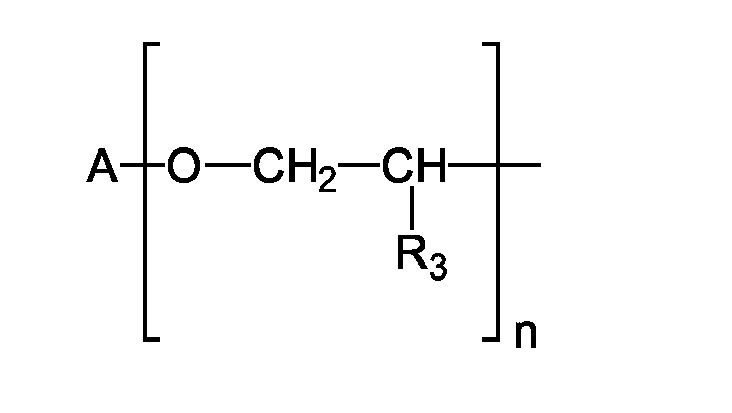
A einen verzweigten oder unverzweigten C1-C18-Alkylrest, einen C5-C12-Cycloalkyl- oder Arylrest darstellt, gegebenenfalls substituiert mit einer oder mehreren C1-C4-Alkylgruppen,
R3 ein Wasserstoffatom oder eine Methylgruppe darstellt,
n eine Zahl von 1 bis 10 darstellt, - R2
- einen verzweigten oder unverzweigten C1-C18-Alkylrest, einen C5-C12-Cycloalkylrest, gegebenenfalls substituiert mit einer oder mehreren C1-C4- Alkylgruppen, darstellt, wenn X die NH-Gruppe darstellt, und
einen verzweigten oder unverzweigten C1-C18-Alkylrest, einen C5-C12-Cycloalkylrest, gegebenenfalls substituiert mit einer oder mehreren C1-C4- Alkylgruppen, oder ein Wasserstoffatom, ein Alkalimetallatom, eine Ammoniumgruppe oder eine Gruppe der Formel - A
- einen verzweigten oder unverzweigten C1-C18-Alkylrest, einen C5-C12-Cycloalkyl- oder Arylrest darstellt, gegebenenfalls substituiert mit einer oder mehreren C1-C4-Alkylgruppen,
- R3
- ein Wasserstoffatom oder eine Methylgruppe darstellt,
- n
- eine Zahl von 1 bis 10 darstellt,
- Besonders bevorzugte UV-Filtersubstanz im Sinne der vorliegenden Erfindung ist ferner ein unsymmetrisch substituiertes s-Triazin, dessen chemische Struktur durch die Formel

- Vorteilhaft sind ferner Benzoxazol-Derivate, wie z. B. das 2,4-bis-[5-1 (dimethylpropyl)benzoxazol-2-yl-(4-phenyl)-imino]-6-(2-ethylhexyl)-imino-1,3,5-triazin mit der CAS Nr. 288254-16-0, welches bei 3V Sigma unter der Handelsbezeichnung Uvasorb® K2A erhältlich ist;
- Vorteilhaft im Sinne der vorliegenden Erfindung ist auch ein symmetrisch substituiertes s-Triazin, das 4,4',4"-(1,3,5-Triazin-2,4,6-triyltriimino)-tris-benzoësäure-tris(2-ethylhexylester), synonym: 2,4,6-Tris-[anilino-(p-carbo-2'-ethyl-1'-hexyloxy)]-1,3,5-triazin (INCI: Octyl Triazone), welches von der BASF Aktiengesellschaft unter der Warenbezeichnung UVINUL® T 150 vertrieben wird.
- Auch in der
Europäischen Offenlegungsschrift 775 698 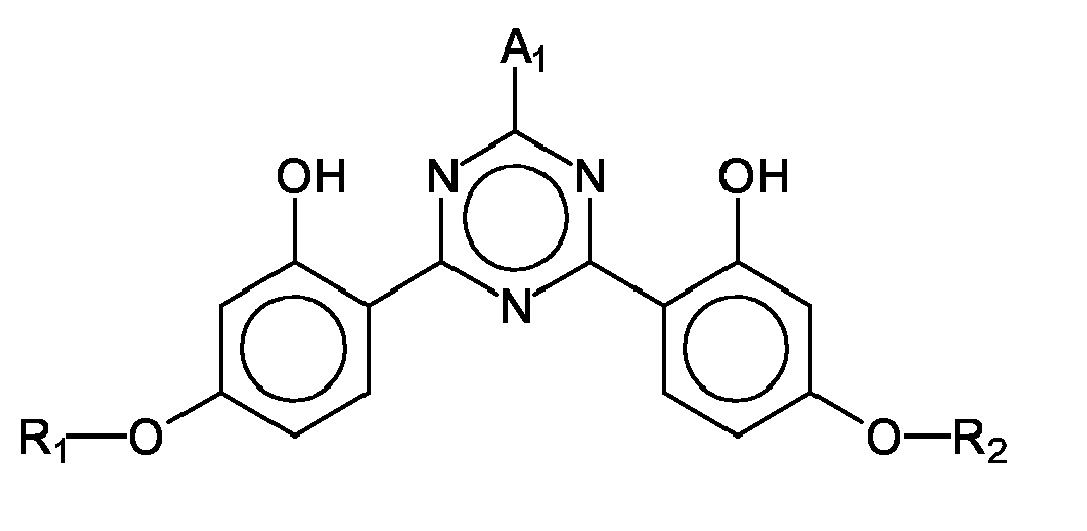
- Vorteilhaft im Sinne der vorliegenden Erfindung sind ferner das 2,4-Bis-{[4-(3-sulfonato)-2-hydroxy-propyloxy)-2-hydroxy]-phenyl}-6-(4-methoxyphenyl)-1,3,5-triazin Natriumsalz, das 2,4-Bis-{[4-(3-(2-Propyloxy)-2-hydroxy-propyloxy)-2-hydroxy]-phenyl}-6-(4-methoxyphenyl)-1,3,5-triazin, das 2,4-Bis-{[4-(2-ethyl-hexyloxy)-2-hydroxy]-phenyl}-6-[4-(2-methoxyethyl-carboxyl)-phenylamino]-1,3,5-triazin, das 2,4-Bis-{[4-(3-(2-propyloxy)-2-hydroxy-propyloxy)-2-hydroxy]-phenyl}-6-[4-(2-ethyl-carboxyl)-phenylamino]-1,3,5-triazin, das 2,4-Bis-{[4-(2-ethyl-hexyloxy)-2-hydroxy]-phenyl}-6-(1-methyl-pyrrol-2-yl)-1,3,5-triazin, das 2,4-Bis-{[4-tris(trimethylsiloxy-silylpropyloxy)-2-hydroxy]-phenyl}-6-(4-methoxyphenyl)-1,3,5-triazin, das 2,4-Bis-{[4-(2"-methyl-propenyloxy)-2-hydroxy]-phenyl}-6-(4-methoxyphenyl)-1,3,5-triazin und das 2,4-Bis-{[4-(1',1',1',3',5',5',5'-Heptamethylsiloxy-2"-methyl-propyloxy)-2-hydroxy]-phenyl}-6-(4-methoxyphenyl)-1,3,5-triazin.
- Ein vorteilhafter Breitbandfilter im Sinne der vorliegenden Erfindung ist das 2,2'-Methylen-bis-(6-(2H-benzotriazol-2-yl)-4-(1,1,3,3-tetramethylbutyl)-phenol), welches durch die chemische Strukturformel
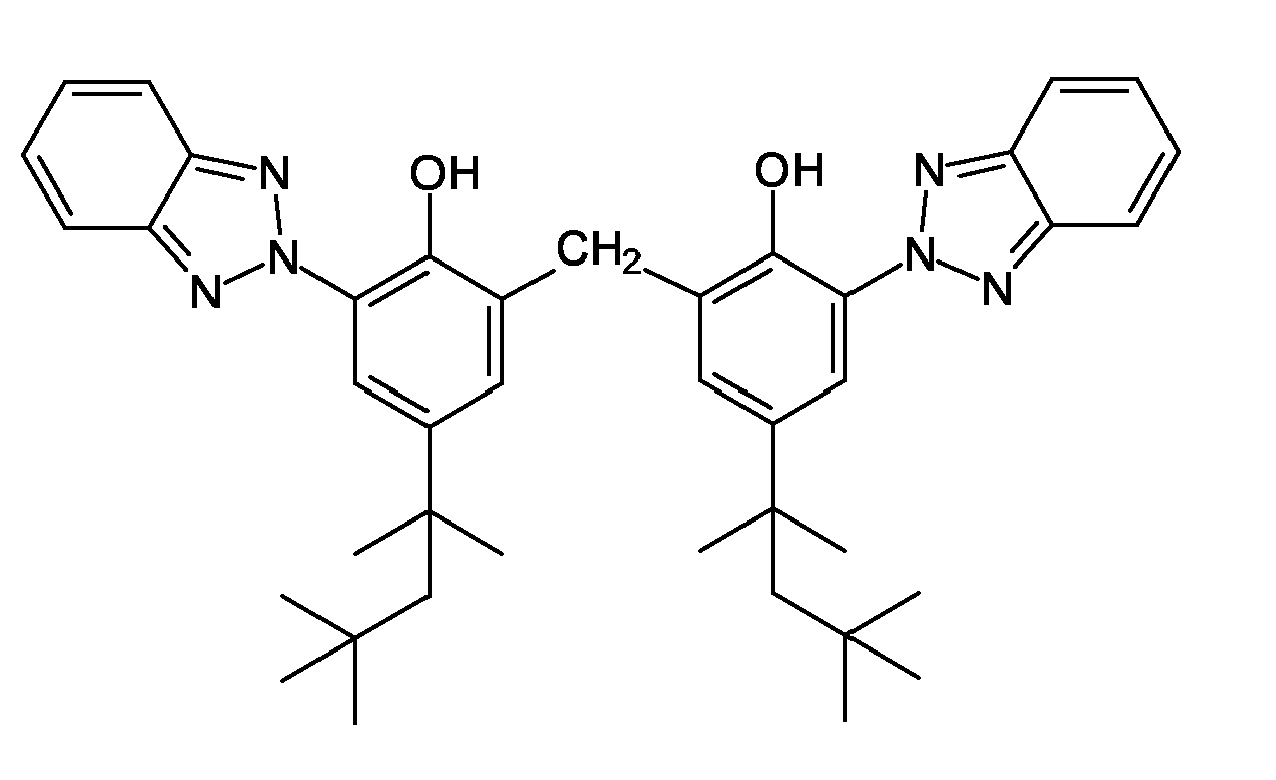
- Vorteilhafter Breitbandfilter im Sinne der vorliegenden Erfindung ist ferner das 2-(2H-benzotriazol-2-yl)-4-methyl-6-[2-methyl-3-[1,3,3,3-tetramethyl-1-[(trimethylsilyl)oxy]disiloxanyl]propyl]-phenol (CAS-Nr.: 155633-54-8) mit der INCI-Bezeichnung Drometrizole Trisiloxane, welches durch die chemische Strukturformel

- Die UV-B- und/oder Breitband-Filter können öllöslich oder wasserlöslich sein. Vorteilhafte öllösliche UV-B- und/oder Breitband-Filtersubstanzen sind z. B.:
- ■ 3-Benzylidencampher-Derivate, vorzugsweise 3-(4-Methylbenzyliden)campher, 3-Benzylidencampher;
- ■ 4-Aminobenzoesäure-Derivate, vorzugsweise 4-(Dimethylamino)-benzoesäure(2-ethylhexyl)ester, 4-(Dimethylamino)benzoesäureamylester;
- ■ 2,4,6-Trianilino-(p-carbo-2'-ethyl-1'-hexyloxy)-1,3,5-triazin;
- ■ Ester der Benzalmalonsäure, vorzugsweise 4-Methoxybenzalmalonsäuredi(2-ethylhexyl)-ester;
- ■ Ester der Zimtsäure, vorzugsweise 4-Methoxyzimtsäure(2-ethylhexyl)ester, 4-Methoxyzimtsäureisopentylester;
- ■ Derivate des Benzophenons, vorzugsweise 2-Hydroxy-4-methoxybenzophenon, 2-Hydroxy-4-methoxy-4'-methylbenzophenon, 2,2'-Dihydroxy-4-methoxybenzophenon
- ■ sowie an Polymere gebundene UV-Filter.
- Vorteilhafte wasserlösliche UV-B- und/oder Breitband-Filtersubstanzen sind z. B.:
- ■ Salze der 2-Phenylbenzimidazol-5-sulfonsäure, wie ihr Natrium-, Kalium- oder ihr Triethanolammonium-Salz, sowie die Sulfonsäure selbst;
- ■ Sulfonsäure-Derivate des 3-Benzylidencamphers, wie z. B. 4-(2-Oxo-3-bornylidenmethyl)-benzolsulfonsäure, 2-Methyl-5-(2-oxo-3-bornylidenmethyl)sulfonsäure und deren Salze.
- Besonders vorteilhafte bei Raumtemperatur flüssige UV-Filtersubstanzen im Sinne der vorliegenden Erfindung sind Homomenthylsalicylat (INCI: Homosalate), 2-Ethylhexyl-2-hydroxybenzoat (2-Ethylhexylsalicylat, Octylsalicylat, INCI: Octyl Salicylate), 4-Isopropylbenzylsalicylat und Ester der Zimtsäure, vorzugsweise 4-Methoxyzimtsäure(2-ethylhexyl)ester (2-Ethylhexyl-4-methoxycinnamat, INCI: Octyl Methoxycinnamate) und 4-Methoxyzimtsäureisopentylester (Isopentyl-4-methoxycinnamat, INCI: Isoamyl p-Methoxycinnamate), 3-(4-(2,2-bis Ethoxycarbonylvinyl)-phenoxy)propenyl)-methoxysiloxan/ Dimethylsiloxan - Copolymer (INCI: Dimethicodiethylbenzalmalonat) welches beispielsweise unter der Handelsbezeichnung Parsol® SLX bei Hoffmann La Roche erhältlich ist.
- Eine weiterere erfindungsgemäß vorteilhaft zu verwendende Lichtschutzfiltersubstanz ist das Ethylhexyl-2-cyano-3,3-diphenylacrylat (Octocrylen), welches von BASF unter der Bezeichnung Uvinul® N 539 erhältlich ist und sich durch folgende Struktur auszeichnet:

- Es kann auch von erheblichem Vorteil sein, polymergebundene oder polymere UV-Filtersubstanzen in Zubereitungen gemäß der vorliegenden Erfindung zu verwenden, insbesondere solche, wie sie in der
WO-A-92/20690 - Die Liste der genannten UV-Filter, die im Sinne der vorliegenden Erfindung eingesetzt werden können, soll selbstverständlich nicht limitierend sein.
- Vorteilhaft enthalten die erfindungsgemäßen Zubereitungen die Substanzen, die UV-Strahlung im UV-A- und/oder UV-B-Bereich absorbieren, in einer Gesamtmenge von z. B. 0,1 Gew.-% bis 30 Gew.-%, vorzugsweise 0,5 bis 20 Gew.-%, insbesondere 1,0 bis 15,0 Gew.-%, jeweils bezogen auf das Gesamtgewicht der Zubereitungen, um kosmetische Zubereitungen zur Verfügung zu stellen, die die Haut vor dem gesamten Bereich der ultravioletten Strahlung schützen.
- Die Zubereitungen gemäß der vorliegenden Erfindung können ferner vorteilhaft auch Selbstbräunungssubstanzen wie beispielsweise Dihydroxyacteon, Melaninderivate und Erythrulose enthalten, wobei diese Substanzen in Konzentrationen von 0,1 Gew.-% bis zu 8 Gew.-% bezogen auf das Gesamtgewicht der Zubereitung eingesetzt werden. Die erfindungsgemäßen Formulierungen können ferner besonders vorteilhaft neben Dihydroxyaceton auch Nussextrakte enthalten sowie weitere Substanzen, welche die Bräune erhalten oder erzeugen oder zusätzlich verstärken sollen.
Insbesondere Vorteilhaft ist es die Selbstbräunungssubstanzen mit dem Basisschutz zu applizieren, da dadurch die helle Haut stärker gebräunt wird. - Erfindungsgemäß vorteilhaft ist, wenn die Sonnenschutzmittel Substanzen beinhalten, die sich positiv auf die Hautbefeuchtung auswirken. Solche Substanzen oder Substanzgemnische werden als Moisturizer bezeichnet. Sie verleihen kosmetischen oder dermatologischen Zubereitungen die Eigenschaft, nach dem Auftragen bzw. Verteilen auf der Hautoberfläche die Feuchtigkeitsabgabe der Hornschicht (auch transepidermal water loss (TEWL) genannt) zu reduzieren und/oder die Hydratation der Hornschicht positiv zu beeinflussen.
- Vorteilhaft im Sinne der vorliegenden Erfindung werden der oder die Moisturizer gewählt aus der Gruppe: Glycerin, Milchsäure und/oder Lactate, insbesondere Natriumlactat, Butylenglykol, Propylenglykol, Biosaccaride Gum-1, Glycine Soja, Ethylhexyloxyglycerin, Pyrrolidoncarbonsäure und Harnstoff. Ferner ist es insbesondere von Vorteil, polymere Moisturizer aus der Gruppe der wasserlöslichen, in Wasser quellbaren oder mit Hilfe von Wasser gelierbaren Polysaccharide zu verwenden. Insbesondere vorteilhaft sind beispielsweise Hyaluronsäure, Chitosan und ein fucosereiches Polysaccharid, welches in den Chemical Abstracts unter der Registraturnummer 178463-23-5 abgelegt und z. B. unter der Bezeichnung Fucogel®1000 von der Gesellschaft SOLABIA S.A. erhältlich ist. Moisturizer können vorteilhaft auch als Antifaltenwirkstoffe zur Prophylaxe und Behandlung kosmetischer oder dermatologischer Hautveränderungen, wie sie z. B. bei der Hautalterung auftreten, verwendet werden. Es ist besonders vorteilhaft im Sinne der vorliegenden Erfindung, Glycerin als Moisturizer zu verwenden, bevorzugt in einer Konzentration von 0,05 bis 30 Gew.-%, besonders bevorzugt 1 bis 10 Gew.-%, jeweils bezogen auf das Gesamtgewicht der Zubereitung.
- Medizinische topische Zusammensetzungen im Sinne der vorliegenden Erfindung enthalten in der Regel ein oder mehrere Wirkstoffe in kosmetisch wirksamer Konzentration.
- So zeigte sich bei dem erfinderischen Verfahren überraschenderweise, dass die erfindungsgemäßen Sonnenschutzmittel sich auch ganz besonders eignen für Applikation von Wirkstoffen, die den Zustand der Haut positiv beeinflussen. So zeigte sich, dass Wirkstoffe zur positiven Beeinflussung der Altershaut, die die Entstehung von Falten oder auch bestehenden Falten vermindern.
- Bevorzugte Wirkstoffe zur positiven Beeinflussung von Altershaut sind Biochinone, insbesondere Ubichinon Q10, Kreatin, Kreatinin, Carnitin, Biotin, Isoflavon, Cardiolipin, Liponsäure, Liponamid, Folsäure und ihre Derviate, Niacin und seine Derivate (insbesondere Niacinamid), Arctiin, Anti Freezing Proteine, Hopfen- und Hopfen-Malz-Extrakte. Auch fördernde Mittel der Restrukturierung des Bindegewebes, wie Isoflavonoide sowie Isoflavonoid-haltige Pflanzenextrakte wie z. B. Soja- und KleeExtrakte können in dem erfindungsgemäßen Verfahren sehr gut verwendet werden.
- Auch zeigt sich, dass sich die für das erfindungsgemäße Verfahren verwendbaren Sonnenschutzmittel in besonderer Weise eignen, Wirkstoffe zur Unterstützung der Hautfunktionen bei trockener Haut, wie beispielsweise Vitamin C, Biotin, Carnitin, Kreatin, Propionsäure, Grüntee-Extrakte, Eucalyptusöl, Harnstoff und Mineralsalze wie z. B. NaCl, Meeresmineralien sowie Osmolyte wie z. B. Taurin, Inositol, Betain, quartäre Ammoniumverbindungen, zu applizieren. In ähnlicher Weise erwies sich die Applikation von Wirkstoffen zur Linderung bzw. positiven Beeinflussung von irritativen Hautzuständen, sei es bei empfindlicher Haut im allgemeinen oder bei durch Noxen gereizter Haut (UV-Licht, Chemikalien), als vorteilhaft. Hier sind Wirkstoffe zu nennen wie Sericoside, verschiedene Extrakte des Süssholzes, Licochalcone, insbesondere Licochalcone A, Silymarin, Silyphos, Dexpanthenol, Inhibitoren des Prostaglandinstoffwechsels, insbesondere der Cyclooxygenase und des Leukotrienstoffwechsels, insbesondere der 5-Lipoxyaenase, aber auch des 5-Lipoxvgenase Inhibitor Proteins, FLAP.
- Auch erwies sich ein Gehalt an Pigmentierungsmodulatoren als vorteilhaft. Hier sind insbesondere Modulatoren zu nennen, die die Pigmentierung der Haut vermindern und so zu einer kosmetisch gewünschten Aufhellung der Haut führen und/oder das Auftreten von Altersflecken und sonstigen lokalen Hyperpigmentierungen (insbesondere Melasma) reduzieren und/oder derartige Hyperpigmentierungen aufhellen. Der Einsatz von pigmentierungsmindernden Wirkstoffen erfolgt insbesondere in den Sonnenschutzmittel zum Fleckschutz. Beispielhaft seien als pigmentierungsmindernde Wirkstoffe erwähnt Tyrosinsulfat, Dioic acid (8-Hexadecen-1,16-dicarbonsäure sowie Liponsäure und Liponamid, verschiedene Extrakte des Süssholzes. Kojisäure, Hydrochinon, Arbutin, alpha-Arbutin, Deoxyarbutin, Fruchtsäuren, insbesondere Alpha-Hydroxy-Säuren (AHAs), Bearberry (Uvae ursi), Ursolsäure, Ascorbinsäure.
- Grüntee-Extrakte, Aminoguanidin, Pyridoxamin.
- Besonders vorteilhaft für den Einsatz in Sonnenschutzmitteln zum Basisschutz erwiesen sich Zubereitungen die Wirkstoffe, die eine verstärkte oder schnellere Bräunung der Haut herbeiführen (Advanced Glycation) Endproducts (AGE), Lipofuscine, NukleinsäureOligonukleotide, Dihydroxyaceton, Erythrulose, Purine und Pyrimidine, NO-freisetzende Substanzen, sei es mit oder ohne Einfluss von UV-Licht, enthalten.
- Ferner kann in einer bevorzugten Ausführungsform der erfindungsgemäßen Formulierungen zusätzlich ein oder mehrere mattierende oder leicht überdeckende Inhaltsstoffe (Farbstoffe und/oder Pigmente) enthalten sein.
- Ganz besonders vorteilhaft ist es als mattierende Inhaltsstoffe (Puderrohstoffe) Zuckerderivate aus der Gruppe der Stärken und/oder Stärkederivaten und/oder Cyclodextrine und/oder Cyclodextrinderivaten zu verwenden, wobei das Gewichtsverhältnis der Gesamtmenge an Stärke und/oder Stärkederivaten zur Gesamtmenge an Cyclodextrinen und/oder Cyclodextrinderivaten erfindungsgemäß vorteilhaft von 1:7 bis zu 15:1, bevorzugt von 1:1 bis 10:1 beträgt.
- Es ist erfindungsgemäß vorteilhaft, wenn die Stärke und/oder Stärkederivate gewählt werden aus der Gruppe Distärkephosphat, Tapioka Stärke, Acetyl- bzw. Adipinsäure substituierte Stärke, Hydroxypropylierte Stärke, Aluminium- bzw. Natrium-Stärke, Stärke sustituiert mit N-Octenyl-Succinat, Maisstärke, 2-Hydropropylether modifizierte Stärke und Hydroxypropylstärke-Phosphatester und dergleichen, wobei Distärkephosphat (INCI: Distarch Phosphat) und Tapioka-Stärke (INCI: Tapioca Starch) erfindungsgemäß bevorzugt sind. Diese Stärken und Stärkederivate sind auch vorteilhaft, da sie zudem die sensorischen und kosmetischen Eigenschaften der Formulierungen weiter verbessern und beispielsweise ein samtiges oder seidiges Hautgefühl hervorrufen oder verstärken.
- Es ist erfindungsgemäß von Vorteil, wenn die Cyclodextrine und/oder Cyclodextrinderivate gewählt werden aus der Gruppe α-, β-, γ- und Hydroxypropyl-β- Cyclodextrin, wobei β- Cyclodextrin (INCI: Cyclodextrin) erfindungsgemäß bevorzugt ist.
- Es ist erfindungsgemäß vorteilhaft, die erfindungsgemäßen Puderrohstoffe aus der Gruppe der Zuckerderivate in einer Gesamtmenge von 0,5 bis 10 Gewichts-%, bevorzugt in einer Menge von 2 bis 8 Gewichts % und ganz besonders bevorzugt in einer Menge von 3 bis 6 Gew.-%, jeweils bezogen auf das Gesamtgewicht der Zubereitung einzusetzen.
- Unter den Zuckerderivaten ist des weiteren erfindungsgemäß vorteilhaft ist die Verwendung von Polysacchariden und -derivaten, wobei hier beispielsweise zu nennen wären Hyaluronsäure, Chitin und Chitosan, Chondroitinsulfate, Stärke und Stärkederivate, sowie die Verwendung von Cellulosederivaten, wie z.B. Methylcellulose, Carboxymethylcellulose, Hydroxyethylcellulose, Hydroxypropylmethylcellulose.
- Weiterhin erfindungsgemäß vorteilhaft ist die Verwendung von Schichtsilikaten als mattierende Inhaltsstoffe.
- Unter den Schichtsilikaten befinden sich natürlich vorkommende und synthetische Tonerden wie z. B. Montmorillonit, Bentonit, Hektorit, Laponit, Magnesiumaluminiumsilikate wie Veegum®. Diese können als solche oder in modifizierter Form als Verdicker verwendet werden wie z. B. Stearylalkonium Hektorite.
- Weiterhin können vorteilhaft als mattierende Inhaltsstoffe auch Kieselsäuregele verwendet werden.
- Auch ist es vorteilhaft, Antitranspirant-Salze (z. B. saure Aluminium- und/oder Aluminium/Zirkoniumsalze wie Aluminiumchlorhydrat und/oder Aluminium/ Zirkoniumchlorhydrat) und Elektrolyte zu verwenden. Antitranspirant-Salze können dabei erfindungsgemäß vorteilhaft in einer Konzentration von 0,001 bis 1,0 Gewichts-% bezogen auf das Gesamtgewicht der Zubereitung enthalten sein.
- Die erfindungsgemäßen kosmetischen Zubereitungen können eine Reihe von Pigmenten, Farbstoffen und auch Perlglanzagentien als mattierende und/oder (leicht) überdeckende Inhaltsstoffe enthalten.
- Die Farbstoffe und -pigmente können aus der entsprechenden Positivliste der Kosmetikverordnung bzw. der EG-Liste kosmetischer Färbemittel ausgewählt werden. In den meisten Fällen sind sie mit den für Lebensmittel zugelassenen Farbstoffen identisch. Vorteilhafte Farbpigmente sind beispielsweise Titandioxid, Glimmer, Eisenoxide (z. B. Fe2O3, Fe3O4, FeO(OH)) und/oder Zinnoxid. Vorteilhafte Farbstoffe sind beispielsweise Carmin, Berliner Blau, Chromoxidgrün, Ultramarinblau und/oder Manganviolett. Es ist insbesondere vorteilhaft, die Farbstoffe und/oder Farbpigmente aus der folgenden Liste zu wählen. Die Colour Index Nummern (CIN) sind dem Rowe Colour Index, 3. Auflage, Society of Dyers and Colourists, Bradford, England, 1971 entnommen.
Chemische oder sonstige Bezeichnung CIN Farbe Pigment Green 10006 Grün Acid Green 1 10020 Grün 2,4-Dinitrohydroxynaphthalin-7-sulfosäure 10316 Gelb Pigment Yellow 1 11680 Gelb Pigment Yellow 3 11710 Gelb Pigment Orange 1 11725 Orange 2,4-Dihydroxyazobenzol 11920 Orange Solvent Red 3 12010 Rot 1-(2'-Chlor-4'-nitro-1'-phenylazo)-2-hydroxynaphthalin 12085 Rot Pigment Red 3 12120 Rot Ceresrot; Sudanrot; Fettrot G 12150 Rot Pigment Red 112 12370 Rot Pigment Red 7 12420 Rot Pigment Brown 1 12480 Braun 4-(2'-Methoxy-5'-sulfosäurediethylamid-1'-phenylazo)-3-hydroxy-5"-chloro-2",4"-dimethoxy-2-naphthoesäureanilid 12490 Rot Disperse Yellow 16 12700 Gelb 1-(4-Sulfo-1-phenylazo)-4-amino-benzol-5-sulfosäure 13015 Gelb 2,4-Dihydroxy-azobenzol-4'-sulfosäure 14270 Orange 2-(2,4-Dimethylphenylazo-5-sulfosäure)-1-hydrooynaphthalin-4-sulfosäure 14700 Rot 2-(4-Sulfo-1-naphthylazo)-1-naphthol-4-sulfosäure 14720 Rot 2-(6-Sulfo-2,4-xylylazo)-1-naphthol-5-sulfosäure 14815 Rot 1-(4'-Sulfophenylazo)-2-hydrooynaphthalin 15510 Orange 1-(2-Sulfosäure-4-chlor-5-carbonsäure-1-phenylazo)-2-hydroxynaphthalin 15525 Rot 1-(3-Methyl-phenylazo-4-sulfosäure)-2-hydrooynaphthalin 15580 Rot 1-(4',(8')-Sulfosäurenaphthylazo)-2-hydrooynaphthalin 15620 Rot 2-Hydrooy-1,2'-azonaphthalin-1'-sulfosäure 15630 Rot 3-Hydroxy-4-phenylazo-2-naphthylcarbonsäure 15800 Rot 1-(2-Sulfo-4-methyl-1-phenylazo)-2-naphthylcarbonsäure 15850 Rot 1-(2-Sulfo-4-methyl-5-chlor-1-phenylazo)-2-hydrooy-naphthalin-3-carbonsäure 15865 Rot 1-(2-Sulfo-1-naphthylazo)-2-hydrooynaphthalin-3-carbonsäure 15880 Rot 1-(3-Sulfo-1-phenylazo)-2-naphthol-6-sulfosäure 15980 Orange 1-(4-Sulfo-1-phenylazo)-2-naphthol-6-sulfosäure 15985 Gelb Allura Red 16035 Rot 1-(4-Sulfo-1-naphthylazo)-2-naphthol-3,6-disulfosäure 16185 Rot Acid Orange 10 16230 Orange 1-(4-Sulfo-1-naphthylazo)-2-naphthol-6,8-disulfosäure 16255 Rot 1-(4-Sulfo-1-naphthylazo)-2-naphthol-3,6,8-trisulfosäure 16290 Rot 8-Amino-2 -phenylazo- 1 -naphthol-3,6-disulfosäure 17200 Rot Acid Red 1 18050 Rot Acid Red 155 18130 Rot Acid Yellow 121 18690 Gelb Acid Red 180 18736 Rot Acid Yellow 11 18820 Gelb Acid Yellow 17 18965 Gelb 4-(4-Sulfo-1-phenylazo)-1-(4-sulfophenyl)-5-hydroxy-pyrazolon-3-carbonsäure 19140 Gelb Pigment Yellow 16 20040 Gelb 2,6-(4'-Sulfo-2", 4"-dimethyl)-bis-phenylazo)1,3-dihydroxy-benzol 20170 Orange Acid Black 1 20470 Schwarz Pigment Yellow 13 21100 Gelb Pigment Yellow 83 21108 Gelb Solvent Yellow 21230 Gelb Acid Red 163 24790 Rot Acid Red 73 27290 Rot 2-[4'-(4"-Sulfo-1 "-phenylazo)-7'-sulfo-1'-naphthylazo]-1-hydroxy-7-aminonaphthalin-3,6-disulfosäure 27755 Schwarz 4'-[(4"-Sulfo-1"-phenylazo)-7'-sulfo-1'-naphthylazo]-1-hydroxy-8-acetyl-aminonaphthalin-3,5-disulfosäure 28440 Schwarz Direct Orange 34, 39, 44, 46, 60 40215 Orange Food Yellow 40800 Orange trans-β-Apo-8'-Carotinaldehyd (C30) 40820 Orange trans-Apo-8'-Carotinsäure (C30)-ethylester 40825 Orange Canthaxanthin 40850 Orange Acid Blue 1 42045 Blau 2,4-Disulfo-5-hydroxy-4'-4"-bis-(diethylamino)triphenyl- 42051 Blau carbinol 4-[(-4-N-Ethyl-p-sulfobenzylamino)-phenyl-(4-hydroxy-2-sulfo-phenyl)-(methylen)-1-(N-ethylN-p-sulfobenzyl)-2,5-cyclohexadienimin] 42053 Grün Acid Blue 7 42080 Blau (N-Ethyl-p-sulfobenzyl-amino)-phenyl-(2-sulfophenyl)-methylen-(N-ethyl-N-p-sulfo-benzyl)Δ2,5-cyclohexadienimin 42090 Blau Acid Green 9 42100 Grün Diethyl-di-sulfobenzyl-di-4-amino-2-chlor-di-2-methyl-fuchsonimmonium 42170 Grün Basic Violet 14 42510 Violett Basic Violet 2 42520 Violett 2'-Methyl-4'-(N-ethyl-N-m-sulfobenzyl)-amino-4"-(N-diethyl)-amino-2-methyl-N-ethylN-m-sulfobenzyl-fuchsonimmonium 42735 Blau 4'-(N-Dimethyl)-amino-4"-(N-phenyl)-aminonaphtho-N-dimethyl-fuchsonimmonium 44045 Blau 2-Hydroxy-3,6-disulfo-4,4'-bis-dimethylamino-naphthofuchsonimmonium 44090 Grün Acid Red 52 45100 Rot 3-(2'-Methylphenylamino)-6-(2'-methyl-4'-sulfophenylamino)-9-(2"-carboxyphenyl)-xantheniumsalz 45190 Violett Acid Red 50 45220 Rot Phenyl-2-oxyfluoron-2-carbonsäure 45350 Gelb 4,5-Dibromfluorescein 45370 Orange 2,4,5,7-Tetrabromfluorescein 45380 Rot Solvent Dye 45396 Orange Acid Red 98 45405 Rot 3',4',5',6'-Tetrachlor-2,4,5,7-tetrabromfluorescein 45410 Rot 4,5-Diiodfluorescein 45425 Rot 2,4,5,7-Tetraiodfluorescein 45430 Rot Chinophthalon 47000 Gelb Chinophthalon-disulfosäure 47005 Gelb - Erfindungsgemäße Zubereitungen können Titandioxide enthalten, die sowohl in der Kristallmodifikation Rutil als auch Anatas vorliegen können und im Sinne der vorliegenden Erfindung vorteilhaft oberflächlich behandelt ("gecoatet") ist, wobei beispielsweise ein hydrophiler, amphiphiler oder hydrophober Charakter gebildet werden bzw. erhalten bleiben soll. Diese Oberflächenbehandlung kann darin bestehen, dass die Pigmente nach an sich bekannten Verfahren mit einer dünnen hydrophilen und/oder hydrophoben anorganischen und/oder organischen Schicht versehen werden. Die verschiedenen Oberflächenbeschichtungen können im Sinne der vorliegenden Erfindung auch Wasser enthalten.
- Anorganische Oberflächenbeschichtungen im Sinne der vorliegenden Erfindung können bestehen aus Aluminiumoxid (Al2O3), Aluminiumhydroxid Al(OH)3, bzw. Aluminiumoxidhydrat (auch: Alumina, CAS-Nr.: 1333-84-2), Natriumhexametaphosphat (NaPO3)6, Natriummetaphosphat (NaPO3)n, Siliciumdioxid (SiO2) (auch: Silica, CAS-Nr.: 7631-86-9), Zirkoniumoxid (ZrO2) oder Eisenoxid (Fe2O3). Diese anorganischen Oberflächenbeschichtungen können allein, in Kombination und/oder in Kombination mit organischen Beschichtungsmaterialien vorkommen.
- Hierzu werden Oxide, Oxidhydrate oder Phosphate beispielsweise der Elemente Al, Si, Zr in dichten Schichten auf die Pigmentoberfläche aufgefällt.
- Die anorganische Nachbehandlung geschieht im allgemeinen in einer wässrigen Suspension des Pigmentes durch Zugabe löslicher Nachbehandlungschemikalien, wie z. B. Aluminiumsulfat, und anschließende Ausfällung des im neutralen Bereich schwerlöslichen Hydroxides durch gezielte Einstellung des pH-Wertes mit Natronlauge.
- Nach der anorganischen Nachbehandlung werden die gecoateten Pigmente durch Filtration aus der Suspension abgetrennt und sorgfältig gewaschen, um die gelösten Salze zu entfernen, anschließend werden die isolierten Pigmente getrocknet.
- Besonders bevorzugt im Sinne dieser Erfindung sind Titandioxide, auf die Aluminiumhydroxid auf die Oberfläche aufgebracht worden ist, wie z. B. die von Sun Chemical erhältlichen Titandioxid Typen C47-051 und C47- 5175. Weiterhin bevorzugte Pigmente sind Titandioxide, die mit Aluminium- und / oder Siliziumoxiden gecoated sind, wie z. B. von der Firma Krosnos Titan: Kronos 1071 und 1075 oder von der Firma Kingfisher: A310.03 Tudor Aspen.
- Organische Oberflächenbeschichtungen im Sinne der vorliegenden Erfindung können bestehen aus pflanzlichem oder tierischem Aluminiumstearat, pflanzlicher oder tierischer Stearinsäure, Laurinsäure, Dimethylpolysiloxan (auch: Dimethicone), Methylpolysiloxan (Methicone), Simethicone (einem Gemisch aus Dimethylpolysiloxan mit einer durchschnittlichen Kettenlänge von 200 bis 350 Dimethylsiloxan-Einheiten und Silicagel) oder Alginsäure. Diese organischen Oberflächenbeschichtungen können allein, in Kombination und/oder in Kombination mit anorganischen Beschichtungsmaterialien vorkommen.
- Die Farbstoffe und Pigmente können sowohl einzeln als auch im Gemisch vorliegen sowie gegenseitig miteinander beschichtet sein, wobei durch unterschiedliche Beschichtungsdicken im allgemeinen verschiedene Farbeffekte hervorgerufen werden. Die Gesamtmenge der Farbstoffe und farbgebenden Pigmente wird vorteilhaft aus dem Bereich von z. B. 0,1 Gew.-% bis 30 Gew.-%, vorzugsweise von 0,5 bis 15 Gew.-%, insbesondere von 1,0 bis 10 Gew.-% gewählt, jeweils bezogen auf das Gesamtgewicht der Zubereitungen.
- Die Liste der genannten Substanzen zur Mattierung bzw. zum Überdecken, die im Sinne der vorliegenden Erfindung eingesetzt werden können, soll selbstverständlich nicht limitierend sein. Ebenso ist es selbstverständlich, dass die einzelnen Substanzen zur Mattierung und/oder (leichten) Überdeckung (Farbstoffe, Pigmente usw.) einzeln wie auch in unterschiedlichen Kombinationen aus zwei oder mehreren verwendet werden können.
- Die nachfolgenden Beispiele sollen die vorliegende Erfindung verdeutlichen, ohne sie einzuschränken. Die Zahlenwerte in den Beispielen bedeuten Gewichtsprozente, bezogen auf das Gesamtgewicht der jeweiligen Zubereitungen.
- Beispielrezepturen 1-5 (Basisschutz): (O/W-Cremes mit SPF 5-15)
Beispiel Nummer 1 SPF 5 Glycerylstearatcitrat 2 Myristylmyristat 1 Cetylalkohol 2 Butylenglycol Dicaprylat/Dicaprat 1 Octamethyltetrasiloxan (Cyclomethicon) 4 Dicaprylylether 1 Ethylhexylmethoxycinnamat 3 Butyl Methoxydibenzoylmethan 1 Ethylhexylsalicylat 3 Ubichinon (Q10) 0,05 Natriumascorbylphosphat 0,1 Iminodisuccinat, Natriumsalz 0,2 Phenoxyethanol 0,3 p-Hydroxybenzoesäurealkylester (Paraben) 0,6 Diazolidinylharnstoff 0,25 Erythrulose 2,5 Xanthan Gummi 0,1 Polyacrylsäure (Carbomer) 0,05 Glycerin 10 Butylenglycol 2 Füllstoffe/ Additive (Distärke-phosphat, SiO2, BHT, Talkum, Aluminiumstearat) 0,1 Parfüm q.s. Wasser Ad 100 Beispiel Nummer 2 SPF 15 Glycerylstearat, selbstemulgierend 5 Stearylalkohol 1 C12-15 Alkylbenzoat 3 Dicaprylylether 4 Ethylhexylmethoxycinnamat 5 Ethylhexylcyanodiphenyl-acrylat 5 Benzophenone-3 3 Trinatrium EDTA 0.1 p-Hydroxybenzoesäurealkylester (Paraben) 0,3 Hexamidindiisethionat 0,04 1,3-Dimethylol-5,5-dimethyl-hydantoin (DMDM Hydantoin) 0,2 lodopropynylbutylcarbamat 0,1 Ethanol denaturiert 2 Polyacrylamid 0,2 Butylenglycol 5 Füllstoffe/ Additive (Distärke-phosphat, SiO2, BHT, Talkum, Aluminiumstearat) 1 Parfüm q.s. Wasser Ad 100 Beispiel Nummer 3 4 SPF 10 8 Glycerylstearatcitrat 2 Glycerylstearat (selbstemulgierend) 3 PEG-40-Stearat 1 Cetearylalkohol 4 Cetylalkohol 3 C12-15 Alkylbenzoat 2 Butylenglycol Dicaprylat/Dicaprat 1 Octyldodecanol 1 Dimethylpolysiloxan (Dimethicon) 1 1 Dicaprylylether 2 Dicarprylylcarbonat 3 TiO2 2 3 Ethylhexylmethoxycinnamat 5 Bis-Imidazylate 2 Phenylbenzimidazole Sulfonic Acid 2 Bis-Ethylhexyloxyphenol-methoxyphenyltriazine 2 Ethylhexylsalicylat 5 Tocopherylacetat 1 Trinatrium EDTA 0,2 Phenoxyethanol 0,3 0,2 p-Hydroxybenzoesäurealkylester (Paraben) 0,2 0,3 Dihydroxyaceton 1,5 Polyacrylsäure (Carbomer) 0,1 Glycerin 6 7,5 Füllstoffe/ Additive (Distärke-phosphat, SiO2, BHT, Talkum, Aluminiumstearat) 0,2 0,5 Parfüm q.s. q.s. Wasser Ad 100 Ad 100 Beispiel Nummer 5 SPF 12 Glycerylstearat (selbstemulgierend) 2 PEG-40-Stearat 1 Myristylmyristat 1 Cetearylalkohol 2 C12-15 Alkylbenzoat 3 Ethylhexylmethoxycinnamat 5 Benzophenone-3 3 Ethylhexylsalicylat 4 Iminodisuccinat, Natriumsalz 0,1 Phenoxyethanol 0,2 p-Hydroxybenzoesäurealkylester (Paraben) 0,3 Polyacrylsäure (Carbomer) 0,1 Glycerin 8 Füllstoffe/ Additive (Distärke-phosphat, SiO2, BHT, Talkum, Aluminiumstearat) 0,05 Parfüm q.s. Wasser Ad 100 -
Aqua Ad 100 Polyglyceryl-3 Methylglucose Distearate 5 Butylene Glycol Dicaprylate/Dicaprate 4 Octyldodecanol 3 Citric Acid 0,2 Glycerin 5 Butylene Glycol 3 Phenoxyethanol 0,3 Methylparaben 0,4 Propylparaben 0,1 Sodium Hydroxide q.s. Dihydroxyacetone 2,5 Ethylhexyl Methoxycinnamate 4 Benzophenone- 3 3 Octocrylene 2 Xanthan Gum 0,2 -
Octyldodecanol 25 Cetyl Alcohol 3 Cetyl Palmitate 18,8 Myristyl Myristate 5 Butyl Methoxydibenzoylmethane 3 Ethylhexylmethoxycinnamate 7,5 Octocrylene 5 Cera Alba 3 Chamomilla Recutita 0,2 Hydrogenated Polydecene 8 Cera Microcristallina 22 -
Aqua 58 Stearic Acid 0,5 Dimethicone 3,5 Cyclomethicone 1 Cera Microcristallina 0,5 Paraffinum Liquidum 1 Syntetic Beeswax 2 Octyldodecanol 3 Glycerin 2 Propylene Glycol 1 Titanium Dioxide 4 Ethylhexylmethoxycinnamate 7,5 Octylsalicylate 5 Bis-Ethylhexyloxyphenolmethoxyphenyltriazine 3 Phenylbenzimidazole Sulfonic Acid 2 PEG-40 Stearate 2 Cetyl Alcohol 1 Myreth 4 0,5 Ceteareth 25 0,5 Tocopheryl Acetate 0,5 Tetrasodium Imidosuccinate 0,1 Xanthan Gum 0,3 Phenoxyethanol 0,6 Isoporoylparabene 0,2 Butylparabene 0,1 Methylparabene 0,3 -
Aqua Ad 100 Caprylic/Capric Triglyceride 8 Octyldodecanol 2 Glycerin 4 Stearyl Alcohol 2 Glyceryl Stearate SE 1 Trisodium EDTA 1 Ethylhexylmethoxycinnamate 8 Phenylbenzimidazo Sulfonsäure 2 Ethylhexyl Triazone 3,5 Titanium Dioxide 6 Diethylhexyl Butamido Triazone 3 Bis-Ethylhexyloxyphenyol Methoxyphenyl Triazine 2 Xanthan Gum 0,5 Sodium Hydroxide q.s. Hydrogenated Coco-Glycerides 2 Pheoxyethanol 0,4 Cyclomethicone 4 Cetyl Alcohol 1 Peg-40 Castor Oil 1 Sodium Cetearyl Sulfate 0,5 DMDM Hydantoin 0,3 -
Beispiel 10a Alcohol Denat. 4 Glyceryl Stearate SE 1 Cetearyl Alcohol + PEG-40 Castor Oil + Sodium Cetearyl Sulfate 2,5 VP/Hexadecene Copolymer 0,5 Trisodium EDTA 1 Preservatives q.s. Aminobenzophenon 1 Phenylbenzimidazole Sulfonic Acid 2 Diethylhexyl Butamido Triazone 2 Bis-Ethylhexyloxyphenol Methoxyphenyl Triazine 3 Ethylhexyl Triazone 4 Butyl Methoxydibenzoylmethane 4,0 Ethylhexyl Methoxycinnamate 7,5 Glycerin 7,5 Hydrogenated Coco-Glycerides 1 Dicaprylyl Carbonate 1 Butylene Glycol Dicaprylate/Dicaprate 6,5 C12-15 Alkyl Benzoate 0 Parfum q.s. Titanium Dioxide 5 Xanthan Gum 0,2 C18-36 Acid Triglyceride 1 Cetyl Alcohol 1 Aqua ad 100 Tocopheryl Acetate 0,5 8-Hexadecen-1,16-dicarbonsäure 1 Beispiel 10b 10c Alcohol Denat. 2 Glyceryl Stearate SE 1,5 2 Cetearyl Alcohol + PEG-40 Castor Oil + Sodium Cetearyl Sulfate 3,75 5 VP/Hexadecene Copolymer 0,5 0,8 Trisodium EDTA 1 0 Preservatives q.s. q.s. 2,4-bis-[5-1(dimethylpropyl)benzoxazol-2-yl-(4-phenyl)imino]-6-(2- ethylhexyl)-imino-1,3,5-triazin 1,5 Phenylbenzimidazole Sulfonic Acid 2 2 Disodium Phenyl Dibenzimidazole Tetrasulfonate 1,5 Diethylhexyl Butamido Triazone 1 3 Bis-Ethylhexyloxyphenol Methoxyphenyl Triazine 4 3 Ethylhexyl Triazone 4 1,5 Butyl Methoxydibenzoylmethane 3,0 4,5 Ethylhexyl Methoxycinnamate 7,5 0 Glycerin 4 7,5 Hydrogenated Coco-Glycerides 0,5 1 Dicaprylyl Carbonate 2 3 Butylene Glycol Dicaprylate/Dicaprate 7,5 9 C12-15 Alkyl Benzoate 0 5 Parfum q.s. q.s. Titanium Dioxide 5 5 Xanthan Gum 0,4 0 C18-36 Acid Triglyceride 0,5 0 Cetyl Alcohol 1,5 1,2 Aqua ad 100 ad 100 Tocopheryl Acetate 0,5 0,5 Creatine 0,5 Creatinine 0,05 Beispiel 10d 10e Alcohol Denat. 4 4 Glyceryl Stearate SE 2 1,2 Cetearyl Alcohol + PEG-40 Castor Oil + Sodium Cetearyl Sulfate 5 2,9 VP/Hexadecene Copolymer 0,7 0 Trisodium EDTA 1 1,5 Preservatives q.s. q.s. Phenylbenzimidazole Sulfonic Acid 2 2 Diethylhexyl Butamido Triazone 3 2 Bis-Ethylhexyloxyphenol Methoxyphenyl Triazine 3 3 Ethylhexyl Triazone 0,5 1,5 Butyl Methoxydibenzoylmethane 4,5 4,5 Ethylhexyl Methoxycinnamate 0 0 Glycerin 6 5 Hydrogenated Coco-Glycerides 0,5 0,6 Dicaprylyl Carbonate 4 2 Butylene Glycol Dicaprylate/Dicaprate 6 8 C12-15 Alkyl Benzoate 4 2 Parfum q.s. q.s. Titanium Dioxide 5 5 Xanthan Gum 0,3 0,1 C18-36 Acid Triglyceride 1 0,2 Cetyl Alcohol 0,5 Aqua ad 100 ad 100 Tocopheryl Acetate 0,5 0,5 Creatine 0,5 Creatinine 0,01 8-Hexadecen-1,16-dicarbonsäure 0,1 Beispiel 10f 10g Alcohol Denat. 0 3 Glyceryl Stearate SE 2 1,2 Cetearyl Alcohol + PEG-40 Castor Oil + Sodium Cetearyl Sulfate 5 2,9 VP/Hexadecene Copolymer 0,7 0,2 Trisodium EDTA 1 1 Preservatives q.s. q.s. Octocrylene 10 10 Terephthalidene Dicamphor Sulfonic Acid 8 9 Drometrizole Trisiloxane 8 14 Diethylhexyl Butamido Triazone 5 Bis-Ethylhexyloxyphenol Methoxyphenyl Triazine 3 Ethylhexyl Triazone 2 Butyl Methoxydibenzoylmethane 4,9 4,5 Glycerin 6 0 Hydrogenated Coco-Glycerides 0,5 0,6 Dicaprylyl Carbonate 4 2 Butylene Glycol Dicaprylate/Dicaprate 6 8 C12-15 Alkyl Benzoate 4 2 Parfum q.s. q.s. Titanium Dioxide 10 10 Xanthan Gum 0,3 0,1 C18-36 Acid Triglyceride 1 0,2 Cetyl Alcohol 0,5 Aqua ad 100 ad 100 Tocopheryl Acetate 0,5 0,5 8-Hexadecen-1,16-dicarbonsäure 0,1 Beispiel 10h 10i Alcohol Denat. 4 4 Glyceryl Stearate SE 1,2 1,2 Cetearyl Alcohol + PEG-40 Castor Oil + Sodium Cetearyl Sulfate 2,9 2,9 VP/Hexadecene Copolymer 0,2 0,2 Trisodium EDTA 1 1 Preservatives q.s. q.s. 2,4-bis-[5-1 (dimethylpropyl)benzoxazol-2-yl-(4-phenyl)-imino]-6-(2-ethylhexyl)-imino-1,3,5-triazin 9,4 8,2 Aminobenzophenon 6,7 8,9 Octocrylene 10 10 Terephthalidene Dicamphor Sulfonic Acid 9 9 Drometrizole Trisiloxane 14 14 Diethylhexyl Butamido Triazone 5 5 Bis-Ethylhexyloxyphenol Methoxyphenyl Triazine 3 3 Ethylhexyl Triazone 2 2 Butyl Methoxydibenzoylmethane 1 Glycerin 5 5 Hydrogenated Coco-Glycerides 0,6 0,6 Dicaprylyl Carbonate 2 2 Butylene Glycol Dicaprylate/Dicaprate 8 8 C12-15 Alkyl Benzoate 2 2 Parfum q.s. q.s. Titanium Dioxide 10 10 Xanthan Gum 0,1 0,1 C18-36 Acid Triglyceride 0,2 0,2 Aqua ad 100 ad 100 Tocopheryl Acetate 0,5 0,5

Claims (25)
- Kosmetisches Kit zur Reduktion von Hautpigmentierungsunterschieden, dadurch gekennzeichnet, dass ein Sonnenschutzmittel zum Basisschutz und ein Sonnenschutzmittel zum Fleckschutz aufweist, wobei der Lichtschutzfaktor des Sonnenschutzmittels zum Basisschutzes niedriger ist als der Lichtschutzfaktor des Sonnenschutzmittels zum Fleckschutz.
- Kosmetisches Kit nach Anspruch 1, dadurch gekennzeichnet, dass der Unterschied der Lichtschutzfaktoren der beiden Sonnenschutzmittel um mindestens 10 LSF Einheiten, bevorzugt mindestens 15 LSF Einheiten, besonders bevorzugt um mindestens 20 LSF-Einheiten beträgt.
- Kosmetisches Kit nach mindestens einem der Ansprüche 1 bis 2, dadurch gekennzeichnet, dass das Sonnschutzmittels für den Basisschutzes einen Lichtschutzfaktor von mindestens 5, bevorzugt mindestens 8, besonders bevorzugt mindestens 10 aufweisen, jedoch nicht mehr als LSF30 aufweist.
- Kosmetisches Kit nach mindestens einem der Ansprüche 1 bis 3, dadurch gekennzeichnet, dass das Verhältnis der Lichtschutzfaktoren von Fleckschutz und Basisschutz (LFSFleckschutz /LSFBasisschutz) bei mindestens 1.5, bevorzugt mindestens 2, besonders bevorzugt mindestens 2.5 beträgt.
- Kosmetisches Kit nach mindestens einem der Ansprüche 1 bis 4, dadurch gekennzeichnet, dass die UVA-Balance des Fleckschutzes mindestens 20, bevorzugt mindestens 30, besonders bevorzugt bei mindestens 40 beträgt.
- Kosmetisches Kit nach mindestens einem der Ansprüche 1 bis 5, dadurch gekennzeichnet, dass die UVA-Balance des Basisschutzes mindestens 15, bevorzugt mindestens 25, besonders bevorzugt bei mindestens 35 beträgt.
- Kosmetisches Kit nach mindestens einem der Ansprüche 1 bis 6, dadurch gekennzeichnet, dass der Basisschutz, ein oder mehrere selbstbräunende Substanzen enthält, insbesondere Dihydroxyaceton und/oder Erythrulose.
- Kosmetisches Kit nach mindestens einem der Ansprüche 1 bis 7, dadurch gekennzeichnet, dass der Fleckschutz ein oder mehrere pigmentierungsmindernde Wirkstoffe enthält, bevorzugt 8-Hexadecen-1,16-dicarbonsäure, Liponamid, Deoxyarbutin, Arbutin, Kojisäure und/oder, Extrakte des Süssholzes.
- Kosmetisches Kit nach mindestens einem der Ansprüche 1 bis 8, dadurch gekennzeichnet, dass der Basisschutz und/oder der Fleckschutz weitere kosmetischen und/oder dermatologischen Wirk-, Hilfs- und Zusatzstoffe enthält.
- Kosmetisches Kit nach mindestens einem der Ansprüche 1 bis 9, dadurch gekennzeichnet, das der Basisschutz und/oder Fleckschutz Moisturizer und/oder Antioxidantien enthält.
- Kosmetisches Kit nach mindestens einem der Ansprüche 1 bis 10, dadurch gekennzeichnet, dass es sich bei dem Fleckschutz und/oder Basisschutz O/W-Emulsionen, Hydrodispersionen, Pickering-Emulsionen, Stifte oder Hydrogele handelt.
- Kosmetisches Kit nach mindestens einem der Ansprüche 1 bis 10, dadurch gekennzeichnet, dass der Basisschutz und/oder Fleckschutz einen oder mehrere Puderrohstoffe und/oder ein oder mehrere Zuckerderivate in einer Menge von 0,5 bis 10 Gew.-%, bevorzugt in einer Menge von 2 bis 8 Gew.-% und ganz besonders bevorzugt in einer Menge von 3 bis 6 Gew.-% bezogen auf das Gesamtgewicht der Zubereitung enthält.
- Kosmetisches Kit nach Ansprüch 12, dadurch gekennzeichnet, dass mindestens ein Zuckerderivat eine Stärke und/oder ein Stärkederivat und mindestens ein Zuckerderivat ein Cyclodextrin und/oder Cyclodextrinderivaten ist und das Gewichtsverhältnis der Gesamtmenge an Stärke und/oder Stärkederivaten zur Gesamtmenge an Cyclodextrinen und/oder Cyclodextrinderivaten von 1:5 bis zu 20:1 beträgt.
- Kosmetisches Kit nach mindestens einem der Ansprüche 1 bis 10, dadurch gekennzeichnet, dass die kosmetische Zubereitung einen oder mehrere Farbstoffe und/oder Pigmente in einer Menge von 0,1 bis 30 Gew.-%, vorzugsweise von 0,5 bis 15 Gew.-%, insbesondere von 1,0 bis 10 Gew.-% gewählt bezogen auf das Gesamtgewicht der Zubereitung enthält.
- Verfahren zur Reduktion des Kontrastunterschiedes nicht vollflächig pigmentierter Haut, dadurch gekennzeichnet, dass zuerst das anzugleichende Hautareal vollflächig mit einem ersten Sonnenschutzmittel (Basisschutz) behandelt wird und anschließend die stark pigmentierten Bereiche des anzugleichenden Hautareals selektiv mit einem zweiten Sonnenschutzmittel (Fleckschutz) behandelt werden, und anschließender Bestrahlung mit natürlicher oder künstlicher UV-Strahlung, wobei der Lichtschutzfaktor des ersten Sonnenschutzmittels kleiner ist als der des zweiten Sonnenschutzmittels.
- Verfahren nach Anspruch 15, dadurch gekennzeichnet, dass der Unterschied der Lichtschutzfaktoren von Basisschutz und Fleckschutz mindestens 10 LSF-Einheiten, bevorzugt mindestens 15 LSF-Einheiten, besonders bevorzugt um mindestens 20 LSF-Einheiten beträgt.
- Verfahren nach mindestens einem der Ansprüche 15 bis 16, dadurch gekennzeichnet, das das Sonnschutzmittels für den Basisschutzes einen Lichtschutzfaktor von mindestens LSF 5, bevorzugt mindestens LSF 8, besonders bevorzugt mindestens LSF 10 aufweisen, jedoch nicht mehr als LSF30 aufweist
- Verfahren nach mindestens einem der Ansprüche 15 bis 17, dadurch gekennzeichnet, das das Verhältnis der Lichtschutzfaktoren von Fleckschutz und Basisschutz (LFSFleckschutz /LSFBasisschutz) bei mindestens 1.5, bevorzugt mindestens 2, besonders bevorzugt mindestens 2.5 beträgt.
- Verfahren nach mindestens einem der Ansprüche 15 bis 18, dadurch gekennzeichnet, das die UVA-Balance des Fleckschutzes mindestens 20, bevorzugt mindestens 30, besonders bevorzugt bei mindestens 40 beträgt.
- Verfahren nach mindestens einem der Ansprüche 15 bis 19, dadurch gekennzeichnet, das die UVA-Balance des Basisschutzes mindestens 15, bevorzugt mindestens 25, besonders bevorzugt bei mindestens 35 beträgt.
- Verfahren nach mindestens einem der Ansprüche 15 bis 20, dadurch gekennzeichnet, dass es bei einer Auftragung auf die zu färbenden Hautareale nicht zum direkten Kontakt mit Händen bzw. Fingern kommt, insbesondere durch Verwendung von Stift-, Roll-on-, Spray-, Pinsel-, Bürsten-, Schwammapplikatoren.
- Verwendung von Sonnenschutzmitteln mit unterschiedlichem Lichtschutzfaktor zur Farbangleichung von unterschiedlich pigmentierten Hautstellen von mehrzelligen Organismen, insbesondere der Haut von Mensch und Tier, wobei ein Sonnenschutzmittel vollflächig auf ein Hautareal appliziert wird (Basisschutz) und ein zweites Sonnenschutzmittel (Fleckschutz) mit einem Lichtschutzfaktor der höher ist als der Lichtschutzfaktor des Basisschutzes selektiv auf stark pigmentierte Bereiche aufgetragen wird.
- Verwendung nach Anspruch 22, dadurch gekennzeichnet, dass das Sonnenschutzmittel für den Fleckschutz einen Lichtschutzfaktor von mindestens 10 LSF-Einheiten, bevorzugt mindestens 15 LSF-Einheiten, besonders bevorzugt mindestens 20 LSF-Einheiten, aufweist und das zweite Sonnenschutzmittel für den Basisschutz einen Lichtschutzfaktor von 1 bis 30 LSF-Einheiten, besonders bevorzugt 5 bis 15 LSF-Einheiten aufweist.
- Verwendung nach mindestens einem der Ansprüche 22 bis 23, zur Kaschierung von natürlichen, unnatürlichen und/oder krankhaften Hautpigmentierungsstörungen, insbesondere von Sommersprossen (Lentigo aestiva), Altersflecken (Lentigo senilis, Keratosis senilis), Leberflecken (Lentigo simplex, Lentigo juvenilis), Lentigo maligna (Dubreuilh-Hutchinson Krankheit), Narben von beispielsweise Operationen, Verletzungen oder Verbrennungen (postinflammatorische Hyperpigmentierungen), Melasma, unregelmäßige Pigmentierung der Haut mit lokal hyper- und/oder hypopigmentierten Bereichen (uneven skin tone) infolge äußerer Einflüsse (insbesondere nach chronischer UV-Belastung).
- Verwendung nach mindestens einem der Ansprüche 22 bis 24, zur Unterdrückung und/oder Verringerung des subjektiven Gefühls des 'Altwerdens' bzw. 'Altseins', durch Kaschierung von Altersflecken und anderen durch Alterung entstehenden Haupigmentierungsunregelmäßigkeiten.
Applications Claiming Priority (1)
| Application Number | Priority Date | Filing Date | Title |
|---|---|---|---|
| DE200510021913 DE102005021913A1 (de) | 2005-05-09 | 2005-05-09 | Sonnenschutzkit und Verfahren zur Pigmentierungsangleichung |
Publications (1)
| Publication Number | Publication Date |
|---|---|
| EP1721600A1 true EP1721600A1 (de) | 2006-11-15 |
Family
ID=36822333
Family Applications (1)
| Application Number | Title | Priority Date | Filing Date |
|---|---|---|---|
| EP06112463A Withdrawn EP1721600A1 (de) | 2005-05-09 | 2006-04-11 | Sonnenschutzkit und Verfahren zur Pigmentierungsangleichung |
Country Status (3)
| Country | Link |
|---|---|
| EP (1) | EP1721600A1 (de) |
| CN (1) | CN1973816A (de) |
| DE (1) | DE102005021913A1 (de) |
Cited By (2)
| Publication number | Priority date | Publication date | Assignee | Title |
|---|---|---|---|---|
| CN104800803A (zh) * | 2015-04-29 | 2015-07-29 | 肖付亮 | 一种治疗汗斑的药物及其制备方法 |
| IT201600080301A1 (it) * | 2016-07-29 | 2018-01-29 | 3V Sigma Spa | Nuovi composti triazinici come agenti fotostabilizzanti |
Families Citing this family (1)
| Publication number | Priority date | Publication date | Assignee | Title |
|---|---|---|---|---|
| CN111225656B (zh) * | 2017-10-18 | 2023-04-04 | 株式会社Lg生活健康 | 微尘阻隔用化妆料组合物 |
Citations (12)
| Publication number | Priority date | Publication date | Assignee | Title |
|---|---|---|---|---|
| US4893729A (en) * | 1988-07-08 | 1990-01-16 | Jerry R. Iggulden | Selectable mixing bottle |
| US4993594A (en) * | 1989-09-27 | 1991-02-19 | Piper Becker | Multi-constituent mixing and metering dispenser |
| WO1992020690A1 (en) | 1991-05-10 | 1992-11-26 | Givaudan-Roure (International) S.A. | Organosiloxanes for use as sunscreen agents |
| EP0570838A1 (de) | 1992-05-19 | 1993-11-24 | 3V SIGMA S.p.A | 1-Triazinderivate als Lichtschutzmittel |
| US5387200A (en) * | 1994-01-10 | 1995-02-07 | Sun-Safe Technologies Limited Partnership | Portable applicator for applying skin protection fluids |
| US5514437A (en) * | 1994-03-29 | 1996-05-07 | The Procter & Gamble Company | Artificial tanning compositions having improved stability |
| EP0775698A1 (de) | 1995-11-23 | 1997-05-28 | Ciba SC Holding AG | Bis-Resorcinyl-Triazine als UV-Absorber |
| DE19603018A1 (de) * | 1996-01-17 | 1997-08-14 | Lancaster Group Gmbh | Kosmetisches Selbstbräunungsmittel mit Lichtschutzwirkung |
| DE19847936A1 (de) * | 1998-10-09 | 2000-04-20 | Coty Bv | Parfümkomposition mit Bräunungseffekt oder Lichtschutz- und Bräunungseffekt |
| DE69607263T2 (de) * | 1995-08-10 | 2000-11-02 | L'oreal S.A., Paris | Aufnahme- und Ausgabevorrichtung |
| US20040228810A1 (en) * | 2003-05-13 | 2004-11-18 | Starr Hamson | Sprayable sunless tanning solution with sunscreen protection |
| WO2005004826A1 (de) * | 2003-07-10 | 2005-01-20 | Beiersdorf Ag | Hauttönungsprodukt enthaltend selbstbräuner zur farbangleichung unterschiedlich pigmentierter hautstellen |
-
2005
- 2005-05-09 DE DE200510021913 patent/DE102005021913A1/de not_active Ceased
-
2006
- 2006-04-11 EP EP06112463A patent/EP1721600A1/de not_active Withdrawn
- 2006-05-08 CN CNA2006101635680A patent/CN1973816A/zh active Pending
Patent Citations (12)
| Publication number | Priority date | Publication date | Assignee | Title |
|---|---|---|---|---|
| US4893729A (en) * | 1988-07-08 | 1990-01-16 | Jerry R. Iggulden | Selectable mixing bottle |
| US4993594A (en) * | 1989-09-27 | 1991-02-19 | Piper Becker | Multi-constituent mixing and metering dispenser |
| WO1992020690A1 (en) | 1991-05-10 | 1992-11-26 | Givaudan-Roure (International) S.A. | Organosiloxanes for use as sunscreen agents |
| EP0570838A1 (de) | 1992-05-19 | 1993-11-24 | 3V SIGMA S.p.A | 1-Triazinderivate als Lichtschutzmittel |
| US5387200A (en) * | 1994-01-10 | 1995-02-07 | Sun-Safe Technologies Limited Partnership | Portable applicator for applying skin protection fluids |
| US5514437A (en) * | 1994-03-29 | 1996-05-07 | The Procter & Gamble Company | Artificial tanning compositions having improved stability |
| DE69607263T2 (de) * | 1995-08-10 | 2000-11-02 | L'oreal S.A., Paris | Aufnahme- und Ausgabevorrichtung |
| EP0775698A1 (de) | 1995-11-23 | 1997-05-28 | Ciba SC Holding AG | Bis-Resorcinyl-Triazine als UV-Absorber |
| DE19603018A1 (de) * | 1996-01-17 | 1997-08-14 | Lancaster Group Gmbh | Kosmetisches Selbstbräunungsmittel mit Lichtschutzwirkung |
| DE19847936A1 (de) * | 1998-10-09 | 2000-04-20 | Coty Bv | Parfümkomposition mit Bräunungseffekt oder Lichtschutz- und Bräunungseffekt |
| US20040228810A1 (en) * | 2003-05-13 | 2004-11-18 | Starr Hamson | Sprayable sunless tanning solution with sunscreen protection |
| WO2005004826A1 (de) * | 2003-07-10 | 2005-01-20 | Beiersdorf Ag | Hauttönungsprodukt enthaltend selbstbräuner zur farbangleichung unterschiedlich pigmentierter hautstellen |
Non-Patent Citations (2)
| Title |
|---|
| "COLOUR INDEX NUMMERN (CIN) SIND DEM ROWE COLOUR INDEX", vol. 3, 1971, SOCIETY OF DYERS AND COLOURISTS |
| V. WENDEL: "The influence of pre-irradiation on the predictability of in vivo UVA protection with a new in vitro method", PHO- TODERMATOL PHOTOIMMUNOL PHOTOMED, vol. 19, 2003, pages 93 - 97 |
Cited By (4)
| Publication number | Priority date | Publication date | Assignee | Title |
|---|---|---|---|---|
| CN104800803A (zh) * | 2015-04-29 | 2015-07-29 | 肖付亮 | 一种治疗汗斑的药物及其制备方法 |
| IT201600080301A1 (it) * | 2016-07-29 | 2018-01-29 | 3V Sigma Spa | Nuovi composti triazinici come agenti fotostabilizzanti |
| EP3275872A1 (de) * | 2016-07-29 | 2018-01-31 | 3V SIGMA S.p.A | Neue triazinverbindungen als photostabilisierungsmittel |
| US10457650B2 (en) | 2016-07-29 | 2019-10-29 | 3V Sigma S.P.A. | Triazine compounds as photostabilizing agents |
Also Published As
| Publication number | Publication date |
|---|---|
| DE102005021913A1 (de) | 2006-11-23 |
| CN1973816A (zh) | 2007-06-06 |
Similar Documents
| Publication | Publication Date | Title |
|---|---|---|
| EP1579847B1 (de) | Kosmetische und dermatologische Lichtschutzformulierungen | |
| EP1952844B1 (de) | Organische Mikropigmente enthaltende kosmetische Lichtschutzemulsion | |
| EP1477159B1 (de) | Stabilisierung von Selbstbräunungsprodukten durch Schichtsilikate | |
| EP1670488B1 (de) | Verfahren zum auftrag von sauerstoff auf die haut | |
| DE102004036092A1 (de) | Haut- und/oder Haarmittel enthaltend Verbindungen zur Steigerung der Hautbräunung | |
| DE10155963A1 (de) | Kosmetische und dermatologische Lichtschutzformulierungen mit einem Gehalt an Hydroxybenzophenonen, Triazin- und/oder Benzotriazol-Derivaten | |
| EP1453478B1 (de) | Kosmetische und dermatologische lichtschutzformulierungen mit einem gehalt an partikulären uv-filtersubstanzen und alkylnaphthalaten | |
| DE10141474A1 (de) | Stabilisierung UV-empfindlicher Wirkstoffe | |
| EP1310237A2 (de) | Kosmetische und dermatologische Lichtschutzformulierungen mit einem Gehalt an Hydroxybenzophenonen und Acrylamid-Polymeren | |
| EP2114359B1 (de) | Organische mikropigmente in kosmetischen lichtschutzemulsionen | |
| EP1310239A1 (de) | Kosmetische und dermatologische Lichtschutzformulierungen mit einem Gehalt an Hydroxybenzophenonen und Pentanatrium-Ethylendiamintetramethylenphosphonat | |
| EP1728501A1 (de) | Polypeptidgebundene UV-Lichtschutzfilter in kosmetischen Zubereitungen | |
| EP1562536A1 (de) | Kosmetikkonzentrat | |
| EP1648395A1 (de) | Hauttönungsprodukt enthaltend selbstbräuner zur farbangleichung unterschiedlich pigmentierter hautstellen | |
| EP1310236A1 (de) | Kosmetische und dermatologische Lichtschutzformulierungen mit einem Gehalt an Hydroxybenzophenonen und Iminodibernsteinsäure und/oder ihren Salzen | |
| EP1284130B1 (de) | Kosmetische und dermatologische Lichtschutzformulierungen | |
| EP1473026A1 (de) | Selbstbräuner enthaltende kosmetische Stifte | |
| EP1565156A1 (de) | Lichtschutzkonzentrat mit wasserlöslichen polymeren | |
| EP1285648B1 (de) | Kosmetische und/oder dermatologische Lichtschutzformulierungen mit einem Gehalt an öllöslichen UV-Filtersubstanzen und Iminodibernsteinsäure und/oder deren Salzen | |
| DE102005021913A1 (de) | Sonnenschutzkit und Verfahren zur Pigmentierungsangleichung | |
| EP1555016A1 (de) | Kosmetische und dermatologische Lichtschutzformulierungen | |
| DE102005023634A1 (de) | Wirkstoffkombinationen aus 2-(4'-(Diethylamino)-2'-hydoxybenzoyl)-benzoesäurehexylester und einem oder mehreren Glucosylglyceriden | |
| EP1284129A1 (de) | Kosmetische und dermatologische Lichtschutzformulierungen mit einem Gehalt an wasserlöslichen UV-Filtersubstanzen und Iminodibernsteinsäure und/oder ihren Salzen | |
| DE10355541A1 (de) | Hauttönungsprodukt | |
| EP1284132A1 (de) | Kosmetische und dermatologische Llichtschutzzubereitungen mit einem Gehalt an Triazinen und Iiminobernsteinsäure und/oder ihren Salzen |
Legal Events
| Date | Code | Title | Description |
|---|---|---|---|
| PUAI | Public reference made under article 153(3) epc to a published international application that has entered the european phase |
Free format text: ORIGINAL CODE: 0009012 |
|
| AK | Designated contracting states |
Kind code of ref document: A1 Designated state(s): AT BE BG CH CY CZ DE DK EE ES FI FR GB GR HU IE IS IT LI LT LU LV MC NL PL PT RO SE SI SK TR |
|
| AX | Request for extension of the european patent |
Extension state: AL BA HR MK YU |
|
| 17P | Request for examination filed |
Effective date: 20070515 |
|
| AKX | Designation fees paid |
Designated state(s): AT BE BG CH CY CZ DE DK EE ES FI FR GB GR HU IE IS IT LI LT LU LV MC NL PL PT RO SE SI SK TR |
|
| 17Q | First examination report despatched |
Effective date: 20070622 |
|
| GRAP | Despatch of communication of intention to grant a patent |
Free format text: ORIGINAL CODE: EPIDOSNIGR1 |
|
| INTG | Intention to grant announced |
Effective date: 20150311 |
|
| STAA | Information on the status of an ep patent application or granted ep patent |
Free format text: STATUS: THE APPLICATION IS DEEMED TO BE WITHDRAWN |
|
| 18D | Application deemed to be withdrawn |
Effective date: 20150722 |