EP1708212A2 - Method for manufacturing dielectric ceramic powder, and multilayer ceramic capacitor obtained by using the ceramic powder - Google Patents
Method for manufacturing dielectric ceramic powder, and multilayer ceramic capacitor obtained by using the ceramic powder Download PDFInfo
- Publication number
- EP1708212A2 EP1708212A2 EP06250686A EP06250686A EP1708212A2 EP 1708212 A2 EP1708212 A2 EP 1708212A2 EP 06250686 A EP06250686 A EP 06250686A EP 06250686 A EP06250686 A EP 06250686A EP 1708212 A2 EP1708212 A2 EP 1708212A2
- Authority
- EP
- European Patent Office
- Prior art keywords
- powder
- baco
- slurry
- wet
- mixed
- Prior art date
- Legal status (The legal status is an assumption and is not a legal conclusion. Google has not performed a legal analysis and makes no representation as to the accuracy of the status listed.)
- Granted
Links
- 239000000843 powder Substances 0.000 title claims abstract description 203
- 238000000034 method Methods 0.000 title claims abstract description 59
- 239000000919 ceramic Substances 0.000 title claims abstract description 50
- 238000004519 manufacturing process Methods 0.000 title claims abstract description 18
- 239000003985 ceramic capacitor Substances 0.000 title claims abstract description 14
- AYJRCSIUFZENHW-UHFFFAOYSA-L barium carbonate Chemical compound [Ba+2].[O-]C([O-])=O AYJRCSIUFZENHW-UHFFFAOYSA-L 0.000 claims abstract description 238
- GWEVSGVZZGPLCZ-UHFFFAOYSA-N Titan oxide Chemical compound O=[Ti]=O GWEVSGVZZGPLCZ-UHFFFAOYSA-N 0.000 claims abstract description 99
- 239000002002 slurry Substances 0.000 claims abstract description 61
- 229910002113 barium titanate Inorganic materials 0.000 claims abstract description 54
- 239000011812 mixed powder Substances 0.000 claims abstract description 24
- 239000002904 solvent Substances 0.000 claims abstract description 15
- 239000002270 dispersing agent Substances 0.000 claims abstract description 14
- 239000011268 mixed slurry Substances 0.000 claims abstract description 14
- 239000002245 particle Substances 0.000 claims description 55
- 238000001238 wet grinding Methods 0.000 claims description 27
- 238000009826 distribution Methods 0.000 claims description 26
- 238000000445 field-emission scanning electron microscopy Methods 0.000 claims description 21
- QGZKDVFQNNGYKY-UHFFFAOYSA-N Ammonia Chemical compound N QGZKDVFQNNGYKY-UHFFFAOYSA-N 0.000 claims description 18
- 238000002156 mixing Methods 0.000 claims description 17
- VTYYLEPIZMXCLO-UHFFFAOYSA-L Calcium carbonate Chemical compound [Ca+2].[O-]C([O-])=O VTYYLEPIZMXCLO-UHFFFAOYSA-L 0.000 claims description 16
- 238000001354 calcination Methods 0.000 claims description 15
- 229910021529 ammonia Inorganic materials 0.000 claims description 9
- 229910000019 calcium carbonate Inorganic materials 0.000 claims description 8
- 239000013078 crystal Substances 0.000 claims description 7
- 239000012153 distilled water Substances 0.000 claims description 6
- 238000001035 drying Methods 0.000 claims description 6
- XLYOFNOQVPJJNP-UHFFFAOYSA-N water Chemical compound O XLYOFNOQVPJJNP-UHFFFAOYSA-N 0.000 claims description 6
- LFQSCWFLJHTTHZ-UHFFFAOYSA-N Ethanol Chemical compound CCO LFQSCWFLJHTTHZ-UHFFFAOYSA-N 0.000 claims description 5
- 238000005259 measurement Methods 0.000 claims description 5
- 239000003990 capacitor Substances 0.000 claims description 3
- 238000010298 pulverizing process Methods 0.000 claims description 3
- 230000008569 process Effects 0.000 description 18
- 238000003746 solid phase reaction Methods 0.000 description 13
- 239000011324 bead Substances 0.000 description 12
- 238000010671 solid-state reaction Methods 0.000 description 12
- MCMNRKCIXSYSNV-UHFFFAOYSA-N Zirconium dioxide Chemical compound O=[Zr]=O MCMNRKCIXSYSNV-UHFFFAOYSA-N 0.000 description 8
- 239000000243 solution Substances 0.000 description 8
- 239000010419 fine particle Substances 0.000 description 7
- 238000005516 engineering process Methods 0.000 description 6
- 238000003475 lamination Methods 0.000 description 6
- 238000003801 milling Methods 0.000 description 6
- 150000001553 barium compounds Chemical class 0.000 description 4
- 230000001186 cumulative effect Effects 0.000 description 4
- 239000006185 dispersion Substances 0.000 description 4
- 238000001027 hydrothermal synthesis Methods 0.000 description 4
- 239000011164 primary particle Substances 0.000 description 4
- 239000010936 titanium Substances 0.000 description 4
- 150000004703 alkoxides Chemical class 0.000 description 3
- 230000008901 benefit Effects 0.000 description 3
- 230000007423 decrease Effects 0.000 description 3
- 239000004408 titanium dioxide Substances 0.000 description 3
- 239000000654 additive Substances 0.000 description 2
- 230000015572 biosynthetic process Effects 0.000 description 2
- 238000006243 chemical reaction Methods 0.000 description 2
- 230000002542 deteriorative effect Effects 0.000 description 2
- QDOXWKRWXJOMAK-UHFFFAOYSA-N dichromium trioxide Chemical compound O=[Cr]O[Cr]=O QDOXWKRWXJOMAK-UHFFFAOYSA-N 0.000 description 2
- 238000010304 firing Methods 0.000 description 2
- 229910052751 metal Inorganic materials 0.000 description 2
- 239000002184 metal Substances 0.000 description 2
- 239000011259 mixed solution Substances 0.000 description 2
- 238000001694 spray drying Methods 0.000 description 2
- 239000007858 starting material Substances 0.000 description 2
- 238000003786 synthesis reaction Methods 0.000 description 2
- 230000002194 synthesizing effect Effects 0.000 description 2
- 238000010345 tape casting Methods 0.000 description 2
- AKMXMQQXGXKHAN-UHFFFAOYSA-N titanium;hydrate Chemical compound O.[Ti] AKMXMQQXGXKHAN-UHFFFAOYSA-N 0.000 description 2
- 229910010252 TiO3 Inorganic materials 0.000 description 1
- 238000002441 X-ray diffraction Methods 0.000 description 1
- 230000002411 adverse Effects 0.000 description 1
- 238000005054 agglomeration Methods 0.000 description 1
- 230000002776 aggregation Effects 0.000 description 1
- 239000007864 aqueous solution Substances 0.000 description 1
- QVGXLLKOCUKJST-UHFFFAOYSA-N atomic oxygen Chemical compound [O] QVGXLLKOCUKJST-UHFFFAOYSA-N 0.000 description 1
- 229910052788 barium Inorganic materials 0.000 description 1
- DSAJWYNOEDNPEQ-UHFFFAOYSA-N barium atom Chemical compound [Ba] DSAJWYNOEDNPEQ-UHFFFAOYSA-N 0.000 description 1
- RQPZNWPYLFFXCP-UHFFFAOYSA-L barium dihydroxide Chemical compound [OH-].[OH-].[Ba+2] RQPZNWPYLFFXCP-UHFFFAOYSA-L 0.000 description 1
- 229910001863 barium hydroxide Inorganic materials 0.000 description 1
- JRPBQTZRNDNNOP-UHFFFAOYSA-N barium titanate Chemical compound [Ba+2].[Ba+2].[O-][Ti]([O-])([O-])[O-] JRPBQTZRNDNNOP-UHFFFAOYSA-N 0.000 description 1
- 239000011230 binding agent Substances 0.000 description 1
- 230000008859 change Effects 0.000 description 1
- 239000003153 chemical reaction reagent Substances 0.000 description 1
- 150000001875 compounds Chemical class 0.000 description 1
- RKTYLMNFRDHKIL-UHFFFAOYSA-N copper;5,10,15,20-tetraphenylporphyrin-22,24-diide Chemical compound [Cu+2].C1=CC(C(=C2C=CC([N-]2)=C(C=2C=CC=CC=2)C=2C=CC(N=2)=C(C=2C=CC=CC=2)C2=CC=C3[N-]2)C=2C=CC=CC=2)=NC1=C3C1=CC=CC=C1 RKTYLMNFRDHKIL-UHFFFAOYSA-N 0.000 description 1
- 230000007547 defect Effects 0.000 description 1
- 238000013461 design Methods 0.000 description 1
- 239000003989 dielectric material Substances 0.000 description 1
- 238000009837 dry grinding Methods 0.000 description 1
- 230000000694 effects Effects 0.000 description 1
- 230000005684 electric field Effects 0.000 description 1
- 238000002474 experimental method Methods 0.000 description 1
- 239000011521 glass Substances 0.000 description 1
- 238000010438 heat treatment Methods 0.000 description 1
- 230000007062 hydrolysis Effects 0.000 description 1
- 238000006460 hydrolysis reaction Methods 0.000 description 1
- 239000007791 liquid phase Substances 0.000 description 1
- 238000012423 maintenance Methods 0.000 description 1
- AMWRITDGCCNYAT-UHFFFAOYSA-L manganese oxide Inorganic materials [Mn].O[Mn]=O.O[Mn]=O AMWRITDGCCNYAT-UHFFFAOYSA-L 0.000 description 1
- 239000000463 material Substances 0.000 description 1
- 239000000203 mixture Substances 0.000 description 1
- 238000012986 modification Methods 0.000 description 1
- 230000004048 modification Effects 0.000 description 1
- 230000000877 morphologic effect Effects 0.000 description 1
- 229920000620 organic polymer Polymers 0.000 description 1
- 229910052760 oxygen Inorganic materials 0.000 description 1
- 239000001301 oxygen Substances 0.000 description 1
- 239000011148 porous material Substances 0.000 description 1
- 230000009467 reduction Effects 0.000 description 1
- 238000009877 rendering Methods 0.000 description 1
- 230000000630 rising effect Effects 0.000 description 1
- 238000007650 screen-printing Methods 0.000 description 1
- 239000011163 secondary particle Substances 0.000 description 1
- 238000000926 separation method Methods 0.000 description 1
- 239000007787 solid Substances 0.000 description 1
- 239000012798 spherical particle Substances 0.000 description 1
- 238000005507 spraying Methods 0.000 description 1
- 230000003068 static effect Effects 0.000 description 1
- 238000009827 uniform distribution Methods 0.000 description 1
- RUDFQVOCFDJEEF-UHFFFAOYSA-N yttrium(III) oxide Inorganic materials [O-2].[O-2].[O-2].[Y+3].[Y+3] RUDFQVOCFDJEEF-UHFFFAOYSA-N 0.000 description 1
Images






Classifications
-
- C—CHEMISTRY; METALLURGY
- C04—CEMENTS; CONCRETE; ARTIFICIAL STONE; CERAMICS; REFRACTORIES
- C04B—LIME, MAGNESIA; SLAG; CEMENTS; COMPOSITIONS THEREOF, e.g. MORTARS, CONCRETE OR LIKE BUILDING MATERIALS; ARTIFICIAL STONE; CERAMICS; REFRACTORIES; TREATMENT OF NATURAL STONE
- C04B35/00—Shaped ceramic products characterised by their composition; Ceramics compositions; Processing powders of inorganic compounds preparatory to the manufacturing of ceramic products
- C04B35/01—Shaped ceramic products characterised by their composition; Ceramics compositions; Processing powders of inorganic compounds preparatory to the manufacturing of ceramic products based on oxide ceramics
- C04B35/46—Shaped ceramic products characterised by their composition; Ceramics compositions; Processing powders of inorganic compounds preparatory to the manufacturing of ceramic products based on oxide ceramics based on titanium oxides or titanates
- C04B35/462—Shaped ceramic products characterised by their composition; Ceramics compositions; Processing powders of inorganic compounds preparatory to the manufacturing of ceramic products based on oxide ceramics based on titanium oxides or titanates based on titanates
- C04B35/465—Shaped ceramic products characterised by their composition; Ceramics compositions; Processing powders of inorganic compounds preparatory to the manufacturing of ceramic products based on oxide ceramics based on titanium oxides or titanates based on titanates based on alkaline earth metal titanates
- C04B35/468—Shaped ceramic products characterised by their composition; Ceramics compositions; Processing powders of inorganic compounds preparatory to the manufacturing of ceramic products based on oxide ceramics based on titanium oxides or titanates based on titanates based on alkaline earth metal titanates based on barium titanates
- C04B35/4682—Shaped ceramic products characterised by their composition; Ceramics compositions; Processing powders of inorganic compounds preparatory to the manufacturing of ceramic products based on oxide ceramics based on titanium oxides or titanates based on titanates based on alkaline earth metal titanates based on barium titanates based on BaTiO3 perovskite phase
-
- B—PERFORMING OPERATIONS; TRANSPORTING
- B41—PRINTING; LINING MACHINES; TYPEWRITERS; STAMPS
- B41J—TYPEWRITERS; SELECTIVE PRINTING MECHANISMS, i.e. MECHANISMS PRINTING OTHERWISE THAN FROM A FORME; CORRECTION OF TYPOGRAPHICAL ERRORS
- B41J2/00—Typewriters or selective printing mechanisms characterised by the printing or marking process for which they are designed
- B41J2/005—Typewriters or selective printing mechanisms characterised by the printing or marking process for which they are designed characterised by bringing liquid or particles selectively into contact with a printing material
- B41J2/01—Ink jet
- B41J2/135—Nozzles
- B41J2/165—Prevention or detection of nozzle clogging, e.g. cleaning, capping or moistening for nozzles
-
- B—PERFORMING OPERATIONS; TRANSPORTING
- B41—PRINTING; LINING MACHINES; TYPEWRITERS; STAMPS
- B41J—TYPEWRITERS; SELECTIVE PRINTING MECHANISMS, i.e. MECHANISMS PRINTING OTHERWISE THAN FROM A FORME; CORRECTION OF TYPOGRAPHICAL ERRORS
- B41J2/00—Typewriters or selective printing mechanisms characterised by the printing or marking process for which they are designed
- B41J2/005—Typewriters or selective printing mechanisms characterised by the printing or marking process for which they are designed characterised by bringing liquid or particles selectively into contact with a printing material
- B41J2/01—Ink jet
- B41J2/135—Nozzles
- B41J2/165—Prevention or detection of nozzle clogging, e.g. cleaning, capping or moistening for nozzles
- B41J2/16502—Printhead constructions to prevent nozzle clogging or facilitate nozzle cleaning
-
- B—PERFORMING OPERATIONS; TRANSPORTING
- B82—NANOTECHNOLOGY
- B82Y—SPECIFIC USES OR APPLICATIONS OF NANOSTRUCTURES; MEASUREMENT OR ANALYSIS OF NANOSTRUCTURES; MANUFACTURE OR TREATMENT OF NANOSTRUCTURES
- B82Y30/00—Nanotechnology for materials or surface science, e.g. nanocomposites
-
- C—CHEMISTRY; METALLURGY
- C01—INORGANIC CHEMISTRY
- C01G—COMPOUNDS CONTAINING METALS NOT COVERED BY SUBCLASSES C01D OR C01F
- C01G23/00—Compounds of titanium
- C01G23/003—Titanates
- C01G23/006—Alkaline earth titanates
-
- C—CHEMISTRY; METALLURGY
- C04—CEMENTS; CONCRETE; ARTIFICIAL STONE; CERAMICS; REFRACTORIES
- C04B—LIME, MAGNESIA; SLAG; CEMENTS; COMPOSITIONS THEREOF, e.g. MORTARS, CONCRETE OR LIKE BUILDING MATERIALS; ARTIFICIAL STONE; CERAMICS; REFRACTORIES; TREATMENT OF NATURAL STONE
- C04B35/00—Shaped ceramic products characterised by their composition; Ceramics compositions; Processing powders of inorganic compounds preparatory to the manufacturing of ceramic products
- C04B35/622—Forming processes; Processing powders of inorganic compounds preparatory to the manufacturing of ceramic products
- C04B35/626—Preparing or treating the powders individually or as batches ; preparing or treating macroscopic reinforcing agents for ceramic products, e.g. fibres; mechanical aspects section B
- C04B35/62605—Treating the starting powders individually or as mixtures
- C04B35/6261—Milling
-
- C—CHEMISTRY; METALLURGY
- C04—CEMENTS; CONCRETE; ARTIFICIAL STONE; CERAMICS; REFRACTORIES
- C04B—LIME, MAGNESIA; SLAG; CEMENTS; COMPOSITIONS THEREOF, e.g. MORTARS, CONCRETE OR LIKE BUILDING MATERIALS; ARTIFICIAL STONE; CERAMICS; REFRACTORIES; TREATMENT OF NATURAL STONE
- C04B35/00—Shaped ceramic products characterised by their composition; Ceramics compositions; Processing powders of inorganic compounds preparatory to the manufacturing of ceramic products
- C04B35/622—Forming processes; Processing powders of inorganic compounds preparatory to the manufacturing of ceramic products
- C04B35/626—Preparing or treating the powders individually or as batches ; preparing or treating macroscopic reinforcing agents for ceramic products, e.g. fibres; mechanical aspects section B
- C04B35/62605—Treating the starting powders individually or as mixtures
- C04B35/62625—Wet mixtures
-
- C—CHEMISTRY; METALLURGY
- C04—CEMENTS; CONCRETE; ARTIFICIAL STONE; CERAMICS; REFRACTORIES
- C04B—LIME, MAGNESIA; SLAG; CEMENTS; COMPOSITIONS THEREOF, e.g. MORTARS, CONCRETE OR LIKE BUILDING MATERIALS; ARTIFICIAL STONE; CERAMICS; REFRACTORIES; TREATMENT OF NATURAL STONE
- C04B35/00—Shaped ceramic products characterised by their composition; Ceramics compositions; Processing powders of inorganic compounds preparatory to the manufacturing of ceramic products
- C04B35/622—Forming processes; Processing powders of inorganic compounds preparatory to the manufacturing of ceramic products
- C04B35/626—Preparing or treating the powders individually or as batches ; preparing or treating macroscopic reinforcing agents for ceramic products, e.g. fibres; mechanical aspects section B
- C04B35/62605—Treating the starting powders individually or as mixtures
- C04B35/62645—Thermal treatment of powders or mixtures thereof other than sintering
- C04B35/62675—Thermal treatment of powders or mixtures thereof other than sintering characterised by the treatment temperature
-
- H—ELECTRICITY
- H01—ELECTRIC ELEMENTS
- H01G—CAPACITORS; CAPACITORS, RECTIFIERS, DETECTORS, SWITCHING DEVICES, LIGHT-SENSITIVE OR TEMPERATURE-SENSITIVE DEVICES OF THE ELECTROLYTIC TYPE
- H01G4/00—Fixed capacitors; Processes of their manufacture
- H01G4/002—Details
- H01G4/018—Dielectrics
- H01G4/06—Solid dielectrics
- H01G4/08—Inorganic dielectrics
- H01G4/12—Ceramic dielectrics
- H01G4/1209—Ceramic dielectrics characterised by the ceramic dielectric material
- H01G4/1218—Ceramic dielectrics characterised by the ceramic dielectric material based on titanium oxides or titanates
- H01G4/1227—Ceramic dielectrics characterised by the ceramic dielectric material based on titanium oxides or titanates based on alkaline earth titanates
-
- B—PERFORMING OPERATIONS; TRANSPORTING
- B41—PRINTING; LINING MACHINES; TYPEWRITERS; STAMPS
- B41J—TYPEWRITERS; SELECTIVE PRINTING MECHANISMS, i.e. MECHANISMS PRINTING OTHERWISE THAN FROM A FORME; CORRECTION OF TYPOGRAPHICAL ERRORS
- B41J2/00—Typewriters or selective printing mechanisms characterised by the printing or marking process for which they are designed
- B41J2/005—Typewriters or selective printing mechanisms characterised by the printing or marking process for which they are designed characterised by bringing liquid or particles selectively into contact with a printing material
- B41J2/01—Ink jet
- B41J2/17—Ink jet characterised by ink handling
- B41J2/175—Ink supply systems ; Circuit parts therefor
-
- C—CHEMISTRY; METALLURGY
- C01—INORGANIC CHEMISTRY
- C01P—INDEXING SCHEME RELATING TO STRUCTURAL AND PHYSICAL ASPECTS OF SOLID INORGANIC COMPOUNDS
- C01P2004/00—Particle morphology
- C01P2004/01—Particle morphology depicted by an image
- C01P2004/04—Particle morphology depicted by an image obtained by TEM, STEM, STM or AFM
-
- C—CHEMISTRY; METALLURGY
- C01—INORGANIC CHEMISTRY
- C01P—INDEXING SCHEME RELATING TO STRUCTURAL AND PHYSICAL ASPECTS OF SOLID INORGANIC COMPOUNDS
- C01P2004/00—Particle morphology
- C01P2004/60—Particles characterised by their size
- C01P2004/62—Submicrometer sized, i.e. from 0.1-1 micrometer
-
- C—CHEMISTRY; METALLURGY
- C01—INORGANIC CHEMISTRY
- C01P—INDEXING SCHEME RELATING TO STRUCTURAL AND PHYSICAL ASPECTS OF SOLID INORGANIC COMPOUNDS
- C01P2004/00—Particle morphology
- C01P2004/60—Particles characterised by their size
- C01P2004/64—Nanometer sized, i.e. from 1-100 nanometer
-
- C—CHEMISTRY; METALLURGY
- C01—INORGANIC CHEMISTRY
- C01P—INDEXING SCHEME RELATING TO STRUCTURAL AND PHYSICAL ASPECTS OF SOLID INORGANIC COMPOUNDS
- C01P2006/00—Physical properties of inorganic compounds
- C01P2006/12—Surface area
-
- C—CHEMISTRY; METALLURGY
- C04—CEMENTS; CONCRETE; ARTIFICIAL STONE; CERAMICS; REFRACTORIES
- C04B—LIME, MAGNESIA; SLAG; CEMENTS; COMPOSITIONS THEREOF, e.g. MORTARS, CONCRETE OR LIKE BUILDING MATERIALS; ARTIFICIAL STONE; CERAMICS; REFRACTORIES; TREATMENT OF NATURAL STONE
- C04B2235/00—Aspects relating to ceramic starting mixtures or sintered ceramic products
- C04B2235/02—Composition of constituents of the starting material or of secondary phases of the final product
- C04B2235/30—Constituents and secondary phases not being of a fibrous nature
- C04B2235/32—Metal oxides, mixed metal oxides, or oxide-forming salts thereof, e.g. carbonates, nitrates, (oxy)hydroxides, chlorides
- C04B2235/3205—Alkaline earth oxides or oxide forming salts thereof, e.g. beryllium oxide
- C04B2235/3208—Calcium oxide or oxide-forming salts thereof, e.g. lime
-
- C—CHEMISTRY; METALLURGY
- C04—CEMENTS; CONCRETE; ARTIFICIAL STONE; CERAMICS; REFRACTORIES
- C04B—LIME, MAGNESIA; SLAG; CEMENTS; COMPOSITIONS THEREOF, e.g. MORTARS, CONCRETE OR LIKE BUILDING MATERIALS; ARTIFICIAL STONE; CERAMICS; REFRACTORIES; TREATMENT OF NATURAL STONE
- C04B2235/00—Aspects relating to ceramic starting mixtures or sintered ceramic products
- C04B2235/02—Composition of constituents of the starting material or of secondary phases of the final product
- C04B2235/30—Constituents and secondary phases not being of a fibrous nature
- C04B2235/32—Metal oxides, mixed metal oxides, or oxide-forming salts thereof, e.g. carbonates, nitrates, (oxy)hydroxides, chlorides
- C04B2235/3205—Alkaline earth oxides or oxide forming salts thereof, e.g. beryllium oxide
- C04B2235/3215—Barium oxides or oxide-forming salts thereof
-
- C—CHEMISTRY; METALLURGY
- C04—CEMENTS; CONCRETE; ARTIFICIAL STONE; CERAMICS; REFRACTORIES
- C04B—LIME, MAGNESIA; SLAG; CEMENTS; COMPOSITIONS THEREOF, e.g. MORTARS, CONCRETE OR LIKE BUILDING MATERIALS; ARTIFICIAL STONE; CERAMICS; REFRACTORIES; TREATMENT OF NATURAL STONE
- C04B2235/00—Aspects relating to ceramic starting mixtures or sintered ceramic products
- C04B2235/02—Composition of constituents of the starting material or of secondary phases of the final product
- C04B2235/30—Constituents and secondary phases not being of a fibrous nature
- C04B2235/32—Metal oxides, mixed metal oxides, or oxide-forming salts thereof, e.g. carbonates, nitrates, (oxy)hydroxides, chlorides
- C04B2235/3224—Rare earth oxide or oxide forming salts thereof, e.g. scandium oxide
- C04B2235/3225—Yttrium oxide or oxide-forming salts thereof
-
- C—CHEMISTRY; METALLURGY
- C04—CEMENTS; CONCRETE; ARTIFICIAL STONE; CERAMICS; REFRACTORIES
- C04B—LIME, MAGNESIA; SLAG; CEMENTS; COMPOSITIONS THEREOF, e.g. MORTARS, CONCRETE OR LIKE BUILDING MATERIALS; ARTIFICIAL STONE; CERAMICS; REFRACTORIES; TREATMENT OF NATURAL STONE
- C04B2235/00—Aspects relating to ceramic starting mixtures or sintered ceramic products
- C04B2235/02—Composition of constituents of the starting material or of secondary phases of the final product
- C04B2235/30—Constituents and secondary phases not being of a fibrous nature
- C04B2235/32—Metal oxides, mixed metal oxides, or oxide-forming salts thereof, e.g. carbonates, nitrates, (oxy)hydroxides, chlorides
- C04B2235/3231—Refractory metal oxides, their mixed metal oxides, or oxide-forming salts thereof
- C04B2235/3239—Vanadium oxides, vanadates or oxide forming salts thereof, e.g. magnesium vanadate
-
- C—CHEMISTRY; METALLURGY
- C04—CEMENTS; CONCRETE; ARTIFICIAL STONE; CERAMICS; REFRACTORIES
- C04B—LIME, MAGNESIA; SLAG; CEMENTS; COMPOSITIONS THEREOF, e.g. MORTARS, CONCRETE OR LIKE BUILDING MATERIALS; ARTIFICIAL STONE; CERAMICS; REFRACTORIES; TREATMENT OF NATURAL STONE
- C04B2235/00—Aspects relating to ceramic starting mixtures or sintered ceramic products
- C04B2235/02—Composition of constituents of the starting material or of secondary phases of the final product
- C04B2235/30—Constituents and secondary phases not being of a fibrous nature
- C04B2235/32—Metal oxides, mixed metal oxides, or oxide-forming salts thereof, e.g. carbonates, nitrates, (oxy)hydroxides, chlorides
- C04B2235/3262—Manganese oxides, manganates, rhenium oxides or oxide-forming salts thereof, e.g. MnO
- C04B2235/3263—Mn3O4
-
- C—CHEMISTRY; METALLURGY
- C04—CEMENTS; CONCRETE; ARTIFICIAL STONE; CERAMICS; REFRACTORIES
- C04B—LIME, MAGNESIA; SLAG; CEMENTS; COMPOSITIONS THEREOF, e.g. MORTARS, CONCRETE OR LIKE BUILDING MATERIALS; ARTIFICIAL STONE; CERAMICS; REFRACTORIES; TREATMENT OF NATURAL STONE
- C04B2235/00—Aspects relating to ceramic starting mixtures or sintered ceramic products
- C04B2235/02—Composition of constituents of the starting material or of secondary phases of the final product
- C04B2235/50—Constituents or additives of the starting mixture chosen for their shape or used because of their shape or their physical appearance
- C04B2235/52—Constituents or additives characterised by their shapes
- C04B2235/528—Spheres
-
- C—CHEMISTRY; METALLURGY
- C04—CEMENTS; CONCRETE; ARTIFICIAL STONE; CERAMICS; REFRACTORIES
- C04B—LIME, MAGNESIA; SLAG; CEMENTS; COMPOSITIONS THEREOF, e.g. MORTARS, CONCRETE OR LIKE BUILDING MATERIALS; ARTIFICIAL STONE; CERAMICS; REFRACTORIES; TREATMENT OF NATURAL STONE
- C04B2235/00—Aspects relating to ceramic starting mixtures or sintered ceramic products
- C04B2235/02—Composition of constituents of the starting material or of secondary phases of the final product
- C04B2235/50—Constituents or additives of the starting mixture chosen for their shape or used because of their shape or their physical appearance
- C04B2235/54—Particle size related information
- C04B2235/5409—Particle size related information expressed by specific surface values
-
- C—CHEMISTRY; METALLURGY
- C04—CEMENTS; CONCRETE; ARTIFICIAL STONE; CERAMICS; REFRACTORIES
- C04B—LIME, MAGNESIA; SLAG; CEMENTS; COMPOSITIONS THEREOF, e.g. MORTARS, CONCRETE OR LIKE BUILDING MATERIALS; ARTIFICIAL STONE; CERAMICS; REFRACTORIES; TREATMENT OF NATURAL STONE
- C04B2235/00—Aspects relating to ceramic starting mixtures or sintered ceramic products
- C04B2235/02—Composition of constituents of the starting material or of secondary phases of the final product
- C04B2235/50—Constituents or additives of the starting mixture chosen for their shape or used because of their shape or their physical appearance
- C04B2235/54—Particle size related information
- C04B2235/5418—Particle size related information expressed by the size of the particles or aggregates thereof
- C04B2235/5436—Particle size related information expressed by the size of the particles or aggregates thereof micrometer sized, i.e. from 1 to 100 micron
-
- C—CHEMISTRY; METALLURGY
- C04—CEMENTS; CONCRETE; ARTIFICIAL STONE; CERAMICS; REFRACTORIES
- C04B—LIME, MAGNESIA; SLAG; CEMENTS; COMPOSITIONS THEREOF, e.g. MORTARS, CONCRETE OR LIKE BUILDING MATERIALS; ARTIFICIAL STONE; CERAMICS; REFRACTORIES; TREATMENT OF NATURAL STONE
- C04B2235/00—Aspects relating to ceramic starting mixtures or sintered ceramic products
- C04B2235/02—Composition of constituents of the starting material or of secondary phases of the final product
- C04B2235/50—Constituents or additives of the starting mixture chosen for their shape or used because of their shape or their physical appearance
- C04B2235/54—Particle size related information
- C04B2235/5463—Particle size distributions
-
- C—CHEMISTRY; METALLURGY
- C04—CEMENTS; CONCRETE; ARTIFICIAL STONE; CERAMICS; REFRACTORIES
- C04B—LIME, MAGNESIA; SLAG; CEMENTS; COMPOSITIONS THEREOF, e.g. MORTARS, CONCRETE OR LIKE BUILDING MATERIALS; ARTIFICIAL STONE; CERAMICS; REFRACTORIES; TREATMENT OF NATURAL STONE
- C04B2235/00—Aspects relating to ceramic starting mixtures or sintered ceramic products
- C04B2235/70—Aspects relating to sintered or melt-casted ceramic products
- C04B2235/74—Physical characteristics
- C04B2235/76—Crystal structural characteristics, e.g. symmetry
- C04B2235/761—Unit-cell parameters, e.g. lattice constants
-
- C—CHEMISTRY; METALLURGY
- C04—CEMENTS; CONCRETE; ARTIFICIAL STONE; CERAMICS; REFRACTORIES
- C04B—LIME, MAGNESIA; SLAG; CEMENTS; COMPOSITIONS THEREOF, e.g. MORTARS, CONCRETE OR LIKE BUILDING MATERIALS; ARTIFICIAL STONE; CERAMICS; REFRACTORIES; TREATMENT OF NATURAL STONE
- C04B2235/00—Aspects relating to ceramic starting mixtures or sintered ceramic products
- C04B2235/70—Aspects relating to sintered or melt-casted ceramic products
- C04B2235/74—Physical characteristics
- C04B2235/76—Crystal structural characteristics, e.g. symmetry
- C04B2235/765—Tetragonal symmetry
Definitions
- the present invention relates to a method for manufacturing dielectric ceramic powder. More particularly, the present invention relates to a method for manufacturing dielectric ceramic powder by using wet-milled BaCO 3 as raw powder to prepare raw ceramic powder via solid state reaction, thereby ensuring fine particle size and uniform particle size distribution, and a multilayer ceramic capacitor made from the ceramic powder.
- BaTiO 3 powder has been produced by hydrothermal synthesis, alkoxide method, solid state reaction and the like.
- jel-type titanium hydrate is added to a great quantity of barium hydroxide to react at a high temperature of about 150 ⁇ and under a high atmospheric pressure of 10, thereby producing crystalline BaTiO 3 .
- This method has the advantage of directly producing spherical crystal BaTiO 3 sized about 100nm but has the disadvantage of difficult design and maintenance of a reactor, and expensive manufacturing cost.
- BaTiO 3 powder produced by hydrothermal synthesis has revealed significant defects such as oxygen vacancy and barium vacancy, which develop into pores in the case of heat treatment, thus deteriorating properties of BaTiO 3 powder.
- solid state reaction In solid state reaction, BaCO 3 powder and TiO 2 powder are used as starting powder. The BaCO 3 powder and TiO 2 powder are mixed, and then undergo solid phase reaction in a calcination process to be synthesized into final BaTiO 3 powder. To achieve lamination of dielectric layers, dielectric material powder should have small particle size and uniform particle distribution. But BaTiO 3 manufactured by solid state reaction reportedly does not exhibit uniform particle size distribution compared to BTO manufactured via other methods described above. In the end, in sold state reaction, one of essential factors for obtaining final uniform BaTiO 3 powder concerns uniform dispersion of BaCO 3 powder and TiO 2 powder in the early stage. Such technologies have been consistently developed.
- BaTiO 3 powder finally obtained agglomerates heavily among primary particles and forms secondary particles relatively bigger than primary particles, also causing uneven particle distribution of powder.
- BaTiO 3 powder with such properties may be hardly dispersible when applied to the MLCC, and unsuitable for the dielectric ceramic use for up to 1 ⁇ m lamination to ensure a high-capacity capacitor.
- the present invention has been made to solve the foregoing problems of the prior art and it is therefore an obj ect of the present invention to provide dielectric ceramic powder having fine particles and uniform particle size distribution, and high tetragonal crystalinity.
- solid state reaction is the most economical method for producing BaTiO 3 powder having fine particles and uniform particle size, and high tetragonality to manufacture a high-capacity MLCC.
- fine BaTiO 3 powder may be produced via BaCO 3 powder and TiO 2 powder having big specific surface area.
- the acicular shape of BaCO 3 powder obstructs uniform mixing with TiO 2 powder even in the case of mechanical mixing via beads mill equipment, and renders it difficult to obtain uniform BaTiO 3 powder after final calcination.
- BaCO 3 power particles grow easily in the calcination process. Therefore the BaCO 3 powder particles grow even before reacting with TiO 2 and reaching a temperature at which BaTiO 3 particles are formed, thus making uniform reaction with TiO 2 difficult.
- the inventors have conducted studies and experiments to solve problems of the solid state reaction. As a result, they confirmed that fine particles of BaCO 3 powder could be obtained effectively by wet-milling acicular-shaped BaCO 3 raw powder into a slurry and changing the particle shape from acicular to spherical. Also, the inventors found that fine BaTiO 3 powder with high tetragonality and uniform particle size distribution could be produced by mixing TiO 2 powder having a big specific surface area into such fine and spherical BaCO 3 slurry, drying and gravnating the mixed slurry.
- a method for manufacturing dielectric ceramic powder comprising steps of:
- a method for manufacturing dielectric ceramic powder comprising steps of:
- a multilayer ceramic capacitor comprising:
- FIG. 1 illustrates a process for producing dielectric ceramic powder of the invention
- FIG. 2a is a graph illustrating particle size change in accordance with wet-milling duration of the invention.
- FIG. 2b is a graph illustrating effects of ammonia addition on viscosity of BaCO 3 slurry in a wet-milling process of the invention
- FIG. 3 is a sectional view illustrating a multilayer ceramic capacitor manufactured via the dielectric ceramic powder of the invention
- FIG. 4a is SEM picture of BaCO 3 powder before wet milling
- FIG. 4b is SEM picture of BaCO 3 powder wet-milled according to the invention.
- FIG. 5a is FE-SEM picture illustrating mixed powder of BaCO 3 powder and TiO 2 powder obtained without wet milling
- FIG. 5b is FE-SEM picture illustrating mixed powder of BaCO 3 powder wet-milled according to the invention and TiO 2 powder;
- FIG. 6a is FE-SEM picture of the mixed powder of FIG. 5a which was heat-treated at a temperature of 900 ;
- FIG. 6b is FE-SEM picture of the mixed powder of FIG. 5b which was heat-treated at a temperature of 900 ;
- FIG. 7a is FE-SEM picture illustrating morphology of BaTiO 3 powder manufactured according to a conventional solid state reaction
- FIG. 7b is a graph illustrating particle size distribution of BaTiO 3 powder of FIG. 7a;
- FIG. 8a is FE-SEM picture illustrating an example of morphology of BaTiO 3 powder produced according to the invention.
- FIG. 8b is a graph illustrating particle size distribution of BaTiO 3 powder of FIG. 8a;
- FIG. 9a is FE-SEM picture illustrating another example of morphology of BaTiO 3 powder obtained according to the invention.
- FIG. 9b is a graph illustrating particle size distribution of BaTiO 3 powder of FIG. 9a.
- FIG. 1 illustrates a process for manufacturing dielectric ceramic powder of the invention.
- BaCO 3 powder is dispersed into a solution of solvent and dispersant to prepare BaCO 3 slurry.
- the dispersant e.g. polyacrylic dispersant
- the dispersant is added to 1 - 5 weight parts with respect to BaCO 3 raw powder.
- the BaCO 3 raw powder is acicular, and preferably should have a specific surface area of 5 to 30m 2 /g by BET measurement.
- the BaCO 3 powder is dispersed into the solution to such an extent that that the BaCO 3 slurry contains 10 to 60 wt% BaCO 3 . Less than 10 wt% BaCO 3 out of the BaCO 3 slurry adversely affects productivity (mass productivity). Also, BaCO 3 in excess of 60 wt% out of the BaCO 3 slurry degrades dispersibility and impairs wet milling.
- the BaCO 3 slurry is wet-milled.
- the wet-milling is carried out at a speed of 1800rpm via beads mill type equipment that uses zirconia beads with a diameter of 0.3mm.
- the milling duration should be limited to up to 20 hours.
- the BaCO 3 powder is wet-milled so as to have a specific surface area of at least 30m 2 /g by BET measurement.
- ammonia should be preferably added in the wet-milling process. More preferably, the ammonia can be added to at least 0.1 wt% with respect to the solvent.
- TiO 2 powder slurry is mixed into the wet-milled BaCO 3 slurry to form mixed slurry.
- TiO 2 slurry can be easily manufactured by dispersing TiO 2 powder into a solution of solvent and dispersant.
- the TiO 2 raw powder preferably have a specific surface area of at least 20m 2 /g, and more preferably at least 45m 2 /g.
- TiO 2 powder is mixed into a slurry to such an extent that a Ba/Ti mole ratio becomes 1.
- the BaCO 3 slurry and TiO 2 slurry can be wet-mixed via zirconia beads with a diameter of 0.3mm.
- TiO 2 slurry and CaCO 3 slurry as well may be mixed into the wet-milled BaCO 3 slurry.
- CaCO 3 slurry, Ca-doped BaTiO 3 , or fine BaCaTiO 3 powder can be obtained in a following process.
- the mixed slurry is dried to produce dried mixed powder, preferably, at a temperature of up to 200 .
- the invention is not limited to the aforesaid drying method but spray drying method may be more preferable.
- the dried powder may be coarsely crushed via atomizer.
- the dried mixed powder is calcined to synthesize dielectric ceramic powder such as BaTiO 3 powder or BaCaTiO 3 powder.
- dielectric ceramic powder such as BaTiO 3 powder or BaCaTiO 3 powder.
- BaCO 3 powder and TiO 2 powder may undergo solid state reaction to form BaTiO 3 dielectric powder.
- Ca-doped BaCaTiO 3 power can be obtained.
- the calciantion temperature ranges from 900 to 1100 .
- Powders synthesized in this fashion have necking among primary particles.
- the mixed powders could go through a process of separation from primary particles undamaged.
- the synthesized ceramic powder can be pulverized. The pulverizing process can be carried out effectively through deagglomeration in beads mill.
- Typical solid state reaction is applied to the dielectric ceramic powder manufactured according to the aforesaid process. Still the dielectric ceramic powder may have uniform particle size distribution, with mean particle size of 150nm to 250nm, D10/D50 of at least 0.6 and D90/D50 of up to 1.4. based on FE-SEM picture
- the dielectric ceramic powder may have at least 5. 0m 2 /g of BET specific surface area, and based on FE-SEM picture, a c/a ratio of c-axis to a-axis of the powder crystal lattice is at least 1.009.
- organic binder, solvent and other additives may be mixed with the dielectric ceramic powder obtained to prepare ceramic slurry, and a dielectric layer for the MLCC, or green sheets may be manufactured by using the ceramic slurry via a general tape casting method.
- Y 2 O 3 , Mn 3 O 4 , Cr 2 O 3 and glass are used as additives.
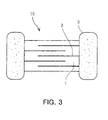
- FIG. 3 is a sectional view illustrating a multilayer ceramic capacitor manufactured via the dielectric ceramic powder.
- the multilayer ceramic capacitor (MLCC) 10 includes a multilayer ceramic structure having a plurality of dielectric layers 1 and a plurality of internal electrodes 3 alternating with the dielectric layers; and external electrodes 5 provided at both ends of the multilayer ceramic structure.
- ceramic slurry including the dielectric ceramic powder prepared as described above is used to form the dielectric layers 1 through the typical tape casting method.
- the internal electrodes 3 are formed on the dielectric layers 1 via screen printing.
- firing is carried our for the multilayer ceramic structure including the unfired dielectric layers 1, and then applying a conductive paste on both ends of the multilayer ceramic structure and finally firing it, thereby producing the multilayer ceramic capacitor 10 having the external electrodes 5.
- acicular-shaped BaCO 3 powder is wet-milled to be made spherical.
- Spherical particle shape or significant reduction in particle size allows uniform mixing with TiO 2 .
- dielectric ceramic powder having fine particle size of 150 to 250nm and high tetragonality can be manufactured by reacting BaCO 3 powder with TiO 2 powder before BaCO 3 powder particles grow in a calcination process.
- the multilayer ceramic capacitor is manufactured via the dielectric ceramic powder produced by the aforesaid process, sheet lamination is ensured to effectively realize higher-capacity of the MLCC while reducing the size thereof.
- BaCO 3 raw powder having a specific surface area of 20m 2 /g was prepared. Some of BaCO 3 raw powder was dispersed into a mixed solution of distilled water and polyacrylic dispersant to manufacture BaCO 3 slurry. BaCO 3 raw powder was dispersed into the solution to such an extent that the BaCO 3 slurry would contain 10 to 60wt% BaCO 3 . The slurry was wet-milled for 18 hours via beads mill type equipment that uses zirconia beads with a diameter of 0.3mm as milling media. During wet-milling, considering a sudden increase in viscosity in accordance with decrease in BaCO 3 particle numbers, ammonia was added after 8 hour milling to reduce viscosity. A specific surface area of the wet-milled BaCO 3 powder was 31m 2 /g, a significant increase from the initial one, and the particles had almost a spherical shape.
- FIG. 4(a-b) Field Emission (FE-SEM) picture before and after wet-milling BaCO 3 is shown in FIG. 4(a-b).
- FE-SEM Field Emission
- FIG. 5(a-b) shows FE-SEM picture of the final mixed powder.
- FIG. 5(a) is FE-SEM picture illustrating BaCO 3 powder mixed with TiO 2 powder without wet-milling
- FIG. 5 (b) is FE-SEM picture of wet-milled BaCO 3 powder mixed with TiO 2 power.
- FIG. 5 (a-b) when BaCO 3 powder without wet -milling was mixed with TiO 2 powder, it leads to uneven mixing but use of the wet-crushed BaCO 3 powder led to uniform mixing among each component.
- BaCO 3 raw powder having a specific surface area of 20m 2 /g was prepared. Some of BaCO 3 raw powder was dispersed into a mixed solution of distilled water and polyarcrylic dispersant to produce BaCO 3 slurry. BaCO 3 powder was dispersed into the solution to such an extent that BaCO 3 slurry would contain 10 to 60 wt% BaCO 3 . The resultant slurry was wet milled for 18 hours via beads mill type equipment using zirconia beads with a diameter of 0.3mm as milling media. Considering a sudden increase in viscosity in accordance with decrease in BaCO 3 particle numbers during a wet-milling process, ammonia was added to reduce viscosity after 8-hour milling. A specific surface area of the wet-milled BaCO 3 powder is shown in Table 1 above.
- the resultant mixed powders were dried and calcined under the conditions set forth in Table 1 to manufacture BaTiO 3 or BaCaTiO 3 dielectric ceramic powder. Thereafter, the ceramic powder was deagglomerated via beads mill to produce final powder.
- Ceramic powder SSA* (m 2 /g) MPS* (nm) Particle size distribution Tetragon ality D10/D50 D90/D50 1 BaTiO 3 5.66 176 0.41 1.57 1.0070 2 BaTiO 3 3.97 212 0.40 1.54 1.0097 3 BaTiO 3 4.58 199 0.62 1.38 1.0097 4 BaTiO 3 4.01 230 0.65 1.36 1.0103 5 BaTiO 3 5.68 150 0.70 1.26 1.0093 6 BaTiO 3 4.53 202 0.69 1.24 1.0105 7 BaTiO 3 4.08 218 0.72 1.24 1.0105 8 BaCaTiO 3 5.62 155 0.71 1.27 1.0091 9 BaCaTiO 3 4.57 198 0.70 1.24 1.0103 *SSA: Specific Surface Area *MPS: Mean Particle Size
- BaCO 3 powder was obtained with fine particle size of 150nm and big specific surface area of 5. 68m 2 /g. Still, BaTiO 3 powder obtained had high tetragonality of 1.0093.
- Ca-added BaCaTiO 3 powder (samples 8 to 9) exhibited behavior similar to BaTiO 3 powder.
- BaCaTiO 3 powders having mean particle size of 198nm and 155nm, respectively, could be produced with tetragonalitiy of at least 1.0091 overall.
- FIGs. 7a, 8a and 9a are FE-SEM pictures of dielectric ceramic powder corresponding to samples 2, 3 and 6.
- FIGs. 7b, 8b and 9b are graphs illustrating particle size distribution measured via image analyzer. As shown in the above FIGs.7a, 7b, 8b and 9b, compared to sample 2 which used BaCO 3 without wet-milling, sample 3 which used wet-milled BaCO 3 powder indicated more uniform particle size distribution. Further, the narrowest particle size distribution was found in sample 6 which used wet-milled BaCO 3 powder and TiO 2 powder having big specific surface area.
- BaTiO 3 or BaCaTiO 3 is manufactured via wet-milled BaCO 3 powder to produce uniform dielectric ceramic powder having fine particles sized 150 to 250nm and high tetragonality.
- the multilayer ceramic capacitor manufactured via dielectric ceramic powder allows sheet lamination and enables higher-capacity and minimization of the MLCC.
Landscapes
- Chemical & Material Sciences (AREA)
- Engineering & Computer Science (AREA)
- Ceramic Engineering (AREA)
- Manufacturing & Machinery (AREA)
- Materials Engineering (AREA)
- Organic Chemistry (AREA)
- Inorganic Chemistry (AREA)
- Structural Engineering (AREA)
- Power Engineering (AREA)
- Physics & Mathematics (AREA)
- Nanotechnology (AREA)
- Life Sciences & Earth Sciences (AREA)
- Environmental & Geological Engineering (AREA)
- Crystallography & Structural Chemistry (AREA)
- Condensed Matter Physics & Semiconductors (AREA)
- General Physics & Mathematics (AREA)
- Microelectronics & Electronic Packaging (AREA)
- Thermal Sciences (AREA)
- Composite Materials (AREA)
- General Life Sciences & Earth Sciences (AREA)
- Geology (AREA)
- Compositions Of Oxide Ceramics (AREA)
- Ceramic Capacitors (AREA)
- Inorganic Compounds Of Heavy Metals (AREA)
- Fixed Capacitors And Capacitor Manufacturing Machines (AREA)
- Inorganic Insulating Materials (AREA)
Abstract
Description
- This application claims the benefit of
Korean Patent Application No. 2005-25891 filed on March 29, 2005 - The present invention relates to a method for manufacturing dielectric ceramic powder. More particularly, the present invention relates to a method for manufacturing dielectric ceramic powder by using wet-milled BaCO3 as raw powder to prepare raw ceramic powder via solid state reaction, thereby ensuring fine particle size and uniform particle size distribution, and a multilayer ceramic capacitor made from the ceramic powder.
- The information society of the 21st century has seen an increasing trend of digitalization, high-performance and high-reliability and multimedia in products such as electronic appliances, PC, HHP which chiefly utilize Multilayer Ceramic Capacitor (MLCC), one of the necessary passive devices of the electronics industry. Accordingly, MLCC parts have undergone higher-capacity and minimization fast. But this requires sheet lamination and fine BaTiO3 particles having uniform size distribution as the dielectric power used. Also, tetragonality indicated by a c/a ratio of c-axis to a-axis of BaTiO3 powder crystal needs to be higher(more than 1.008).
- BaTiO3 powder has been produced by hydrothermal synthesis, alkoxide method, solid state reaction and the like.
- In hydrothermal synthesis, jel-type titanium hydrate is added to a great quantity of barium hydroxide to react at a high temperature of about 150□ and under a high atmospheric pressure of 10, thereby producing crystalline BaTiO3. This method has the advantage of directly producing spherical crystal BaTiO3 sized about 100nm but has the disadvantage of difficult design and maintenance of a reactor, and expensive manufacturing cost. Furthermore, recently, BaTiO3 powder produced by hydrothermal synthesis has revealed significant defects such as oxygen vacancy and barium vacancy, which develop into pores in the case of heat treatment, thus deteriorating properties of BaTiO3 powder.
- Meanwhile in synthesizing BaTiO3 via hydrolysis of metal alkoxide, metal alkoaxide alcohol solution and Ba (OH) aqueous solution are mixed in a tube-type static mixer to react at a temperature of 800. This method is advantageous due to following reasons. Liquid phase employed herein as starting material is more reactive than solid jel-type titanium hydrate used in hydrothermal synthesis. This allows synthesizing at a relatively low temperature, and easy adjustment of the synthesized powder particle size to about 20 to 100 nm. However this method has drawbacks in that a synthesis device is hard to configure, and alkoxide reagent used as starting material is expensive. Furthermore, material cost is expensive due to use of alcohol solvent, and complicated process conditions such as synthesis temperature hamper mass productions.
- Therefore, to manufacture low-priced BaTiO3, solid state reaction is most advantageous. In solid state reaction, BaCO3 powder and TiO2 powder are used as starting powder. The BaCO3 powder and TiO2 powder are mixed, and then undergo solid phase reaction in a calcination process to be synthesized into final BaTiO3 powder. To achieve lamination of dielectric layers, dielectric material powder should have small particle size and uniform particle distribution. But BaTiO3 manufactured by solid state reaction reportedly does not exhibit uniform particle size distribution compared to BTO manufactured via other methods described above. In the end, in sold state reaction, one of essential factors for obtaining final uniform BaTiO3 powder concerns uniform dispersion of BaCO3 powder and TiO2 powder in the early stage. Such technologies have been consistently developed.
- For example, conventional technologies are disclosed in
Korean Patent Application Publication Nos. 2002-0053749 2004-0038747 - Another conventional technology is disclosed in
Korean Patent Application Publication No. 2004-0020252 - The present invention has been made to solve the foregoing problems of the prior art and it is therefore an obj ect of the present invention to provide dielectric ceramic powder having fine particles and uniform particle size distribution, and high tetragonal crystalinity.
- It is another object of the invention to provide a multilayer ceramic capacitor obtained by using the dielectric ceramic powder.
- The invention will be explained hereunder.
- As identified above, solid state reaction is the most economical method for producing BaTiO3 powder having fine particles and uniform particle size, and high tetragonality to manufacture a high-capacity MLCC.
- In solid state reaction, fine BaTiO3 powder may be produced via BaCO3 powder and TiO2 powder having big specific surface area. But the acicular shape of BaCO3 powder obstructs uniform mixing with TiO2 powder even in the case of mechanical mixing via beads mill equipment, and renders it difficult to obtain uniform BaTiO3 powder after final calcination. Further, despite uniform dispersion of fine BaCO3 and TiO2 powders, BaCO3 power particles grow easily in the calcination process. Therefore the BaCO3 powder particles grow even before reacting with TiO2 and reaching a temperature at which BaTiO3 particles are formed, thus making uniform reaction with TiO2 difficult.
- This increases unevenness of particles in case where fine BaTiO3 powder is produced via solid state reaction to laminate dielectric layers.
- Therefore, the inventors have conducted studies and experiments to solve problems of the solid state reaction. As a result, they confirmed that fine particles of BaCO3 powder could be obtained effectively by wet-milling acicular-shaped BaCO3 raw powder into a slurry and changing the particle shape from acicular to spherical. Also, the inventors found that fine BaTiO3 powder with high tetragonality and uniform particle size distribution could be produced by mixing TiO2 powder having a big specific surface area into such fine and spherical BaCO3 slurry, drying and cacinating the mixed slurry.
- According to an aspect of the invention for realizing the object, there is provided a method for manufacturing dielectric ceramic powder comprising steps of:
- dispersing BaCO3 powder into a solution of solvent and dispersant to prepare a slurry and then wet-milling the slurry;
- mixing TiO2 powder slurry into the wet-milled BaCO3 slurry to form mixed slurry and then drying the mixed slurry into mixed powder; and
- calcining the dried mixed powder to produce BaTiO3 powder.
- According to another aspect of the invention for realizing the object, there is provided a method for manufacturing dielectric ceramic powder comprising steps of:
- dispersing BaCO3 powder into a solution of solvent and dispersant to prepare a slurry and then wet-milling the slurry;
- mixing CaCO3 powder slurry and TiO2 powder slurry into the wet-milled BaCO3 slurry to form mixed slurry, and then drying the mixed slurry; and
- calcining the dried mixed powder to produce BaCaTiO3 powder.
- According to further another aspect of the invention for realizing the object, there is provided a multilayer ceramic capacitor comprising:
- a multilayer ceramic structure having a plurality of dielectric layers and a plurality of internal electrodes alternating with the dielectric layers; and
- external electrodes provided at both ends of the multilayer ceramic, electrically connected to at least one of the internal electrodes,
- wherein the dielectric layers comprise the dielectric ceramic powder manufactured according to the methods.
- The above and other objects, features and other advantages of the present invention will be more clearly understood from the following detailed description taken in conjunction with the accompanying drawings, in which:
- FIG. 1 illustrates a process for producing dielectric ceramic powder of the invention;
- FIG. 2a is a graph illustrating particle size change in accordance with wet-milling duration of the invention;
- FIG. 2b is a graph illustrating effects of ammonia addition on viscosity of BaCO3 slurry in a wet-milling process of the invention;
- FIG. 3 is a sectional view illustrating a multilayer ceramic capacitor manufactured via the dielectric ceramic powder of the invention;
- FIG. 4a is SEM picture of BaCO3 powder before wet milling;
- FIG. 4b is SEM picture of BaCO3 powder wet-milled according to the invention;
- FIG. 5a is FE-SEM picture illustrating mixed powder of BaCO3 powder and TiO2 powder obtained without wet milling;
- FIG. 5b is FE-SEM picture illustrating mixed powder of BaCO3 powder wet-milled according to the invention and TiO2 powder;
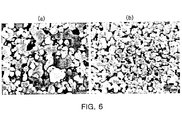
- FIG. 6a is FE-SEM picture of the mixed powder of FIG. 5a which was heat-treated at a temperature of 900;

- FIG. 6b is FE-SEM picture of the mixed powder of FIG. 5b which was heat-treated at a temperature of 900;

- FIG. 7a is FE-SEM picture illustrating morphology of BaTiO3 powder manufactured according to a conventional solid state reaction;
- FIG. 7b is a graph illustrating particle size distribution of BaTiO3 powder of FIG. 7a;
- FIG. 8a is FE-SEM picture illustrating an example of morphology of BaTiO3 powder produced according to the invention;
- FIG. 8b is a graph illustrating particle size distribution of BaTiO3 powder of FIG. 8a;
- FIG. 9a is FE-SEM picture illustrating another example of morphology of BaTiO3 powder obtained according to the invention;
- FIG. 9b is a graph illustrating particle size distribution of BaTiO3 powder of FIG. 9a.
- Preferred embodiments of the present invention will now be described in detail with reference to the accompanying drawings.
- FIG. 1 illustrates a process for manufacturing dielectric ceramic powder of the invention. As shown in FIG. 1, according to the invention, first, BaCO3 powder is dispersed into a solution of solvent and dispersant to prepare BaCO3 slurry. The dispersant, e.g. polyacrylic dispersant, is added to increase dispersibility of powder. Preferably, the dispersant is added to 1 - 5 weight parts with respect to BaCO3 raw powder. The BaCO3 raw powder is acicular, and preferably should have a specific surface area of 5 to 30m2/g by BET measurement.
- Further, according to the invention, distilled water and alcohol may be used as the solvent, but distilled water is preferable.
More preferably, the BaCO3 powder is dispersed into the solution to such an extent that that the BaCO3 slurry contains 10 to 60 wt% BaCO3. Less than 10 wt% BaCO3 out of the BaCO3 slurry adversely affects productivity (mass productivity). Also, BaCO3 in excess of 60 wt% out of the BaCO3 slurry degrades dispersibility and impairs wet milling. - Then, according to the invention, the BaCO3 slurry is wet-milled. The wet-milling is carried out at a speed of 1800rpm via beads mill type equipment that uses zirconia beads with a diameter of 0.3mm. Preferably, the milling duration should be limited to up to 20 hours. More preferably, the BaCO3 powder is wet-milled so as to have a specific surface area of at least 30m2/g by BET measurement.
- With increase in milling time for BaCO3 slurry, particle size of BaCO3 powder decreases, leading to continuous increase in the specific surface area thereof. But as shown in FIG. 2 (a), the specific surface area does not increase any more after 8 hours, increasing viscosity of slurry significantly. However, increased viscosity renders continuous wet-milling process difficult and thus it is necessary to reduce viscosity.
- Therefore, according to the invention, to reduce viscosity of slurry, as shown in FIG. 2(b), ammonia should be preferably added in the wet-milling process. More preferably, the ammonia can be added to at least 0.1 wt% with respect to the solvent.
- Then, according to the invention, TiO2 powder slurry is mixed into the wet-milled BaCO3 slurry to form mixed slurry. TiO2 slurry can be easily manufactured by dispersing TiO2 powder into a solution of solvent and dispersant. The TiO2 raw powder preferably have a specific surface area of at least 20m2/g, and more preferably at least 45m2/g.
- At this time, to produce BaTiO3 powder in a following process, TiO2 powder is mixed into a slurry to such an extent that a Ba/Ti mole ratio becomes 1. In this mixing process, the BaCO3 slurry and TiO2 slurry can be wet-mixed via zirconia beads with a diameter of 0.3mm.
- Meanwhile, sheet lamination of a high-capacity MLCC increases induced electric field, resultantly deteriorating IR and TCC properties. Therefore, to solve this problem, if necessary, TiO2 slurry and CaCO3 slurry as well may be mixed into the wet-milled BaCO3 slurry. With such mixing of CaCO3 slurry, Ca-doped BaTiO3, or fine BaCaTiO3 powder can be obtained in a following process.
- Thereafter, the mixed slurry is dried to produce dried mixed powder, preferably, at a temperature of up to 200. The invention is not limited to the aforesaid drying method but spray drying method may be more preferable.

- Also, if necessary, the dried powder may be coarsely crushed via atomizer.
- And the dried mixed powder is calcined to synthesize dielectric ceramic powder such as BaTiO3 powder or BaCaTiO3 powder. In a calcination process, BaCO3 powder and TiO2 powder may undergo solid state reaction to form BaTiO3 dielectric powder. Further, in case where CaCO3 powder is additionally mixed, Ca-doped BaCaTiO3 power can be obtained. Preferably, the calciantion temperature ranges from 900 to 1100.

- Powders synthesized in this fashion have necking among primary particles. To be used for the MLCC, typically, the mixed powders could go through a process of separation from primary particles undamaged. To this end, according to the invention, the synthesized ceramic powder can be pulverized. The pulverizing process can be carried out effectively through deagglomeration in beads mill.
- Typical solid state reaction is applied to the dielectric ceramic powder manufactured according to the aforesaid process. Still the dielectric ceramic powder may have uniform particle size distribution, with mean particle size of 150nm to 250nm, D10/D50 of at least 0.6 and D90/D50 of up to 1.4. based on FE-SEM picture
- Also, the dielectric ceramic powder may have at least 5. 0m2/g of BET specific surface area, and based on FE-SEM picture, a c/a ratio of c-axis to a-axis of the powder crystal lattice is at least 1.009.
- Meanwhile, organic binder, solvent and other additives may be mixed with the dielectric ceramic powder obtained to prepare ceramic slurry, and a dielectric layer for the MLCC, or green sheets may be manufactured by using the ceramic slurry via a general tape casting method. Y2O3, Mn3O4, Cr2O3 and glass are used as additives.
- FIG. 3 is a sectional view illustrating a multilayer ceramic capacitor manufactured via the dielectric ceramic powder. As shown in FIG. 3, the multilayer ceramic capacitor (MLCC) 10 includes a multilayer ceramic structure having a plurality of
dielectric layers 1 and a plurality ofinternal electrodes 3 alternating with the dielectric layers; andexternal electrodes 5 provided at both ends of the multilayer ceramic structure. - To manufacture the
capacitor 10, first, ceramic slurry including the dielectric ceramic powder prepared as described above is used to form thedielectric layers 1 through the typical tape casting method. Then theinternal electrodes 3 are formed on thedielectric layers 1 via screen printing. Subsequently firing is carried our for the multilayer ceramic structure including the unfireddielectric layers 1, and then applying a conductive paste on both ends of the multilayer ceramic structure and finally firing it, thereby producing the multilayerceramic capacitor 10 having theexternal electrodes 5. - As described above, according to the invention, to uniformly disperse and mix BaCO3 powder and TiO2 powder, before mixing with TiO2 powder, only acicular-shaped BaCO3 powder is wet-milled to be made spherical. Spherical particle shape or significant reduction in particle size allows uniform mixing with TiO2. Also, dielectric ceramic powder having fine particle size of 150 to 250nm and high tetragonality can be manufactured by reacting BaCO3 powder with TiO2 powder before BaCO3 powder particles grow in a calcination process.
- Further, in case where the multilayer ceramic capacitor is manufactured via the dielectric ceramic powder produced by the aforesaid process, sheet lamination is ensured to effectively realize higher-capacity of the MLCC while reducing the size thereof.
- The invention will be explained in detail with reference to the unlimited examples which follow.
- BaCO3 raw powder having a specific surface area of 20m2/g was prepared. Some of BaCO3 raw powder was dispersed into a mixed solution of distilled water and polyacrylic dispersant to manufacture BaCO3 slurry. BaCO3 raw powder was dispersed into the solution to such an extent that the BaCO3 slurry would contain 10 to 60wt% BaCO3. The slurry was wet-milled for 18 hours via beads mill type equipment that uses zirconia beads with a diameter of 0.3mm as milling media. During wet-milling, considering a sudden increase in viscosity in accordance with decrease in BaCO3 particle numbers, ammonia was added after 8 hour milling to reduce viscosity. A specific surface area of the wet-milled BaCO3 powder was 31m2/g, a significant increase from the initial one, and the particles had almost a spherical shape.
- Field Emission (FE-SEM) picture before and after wet-milling BaCO3 is shown in FIG. 4(a-b). As shown in the aforesaid FIG 4 (a-b), wet-milling changed BaCO3 from acicular powder into finer spherical powder.
- Meanwhile, slurried TiO2 powder having a specific surface area of 45m2/g was mixed into the wet-milled BaCO3 slurry, and then the mixed slurry was mixed via beads mill. At this time, mixed powder was slurried so that BaTiO3 powder would have a Ba/Ti ratio of 1. Then for comparison, BaCO3 raw powder, which was not wet-milled, was mixed with TiO2 powder to produce mixed powder.
- FIG. 5(a-b) shows FE-SEM picture of the final mixed powder. FIG. 5(a) is FE-SEM picture illustrating BaCO3 powder mixed with TiO2 powder without wet-milling, while FIG. 5 (b) is FE-SEM picture of wet-milled BaCO3 powder mixed with TiO2 power. As shown in FIG. 5 (a-b), when BaCO3 powder without wet -milling was mixed with TiO2 powder, it leads to uneven mixing but use of the wet-crushed BaCO3 powder led to uniform mixing among each component.
- Also, to confirm whether BaCO3 powder particles grow in case of rising temperature during a calcination process, mixed powders prepared as above were calcined and heat-treated at a temperature ranging from 600to 1000
 . Consequently, as in FIG. 6 (a), in case of using BaCO3 powder without wet-milling, BaCO3 particles grew considerably at a temperature of 900
 , while as in FIG. 6(b), in case where wet-milled BaCO3 powder was used, particle growth was not observed, indicating that BaTiO3 powder can be synthesized.
-
Table 1 No. Wet-milling of BaCO3 Specific surface area (m2/g) Calcination temp.(□) BaCO3 TiO2 CaCO3 1 Not wet-milled 20 20 1020 2 Not wet-milled 20 20 1040 3 Wet-milled 31 20 1020 4 Wet-milled 31 20 1040 5 Wet-milled 31 45 960 6 Wet-milled 31 45 990 7 Wet-milled 31 45 1020 8 Wet-milled 31 45 30 960 9 Wet-milled 31 45 30 990 - BaCO3 raw powder having a specific surface area of 20m2/g was prepared. Some of BaCO3 raw powder was dispersed into a mixed solution of distilled water and polyarcrylic dispersant to produce BaCO3 slurry. BaCO3 powder was dispersed into the solution to such an extent that BaCO3 slurry would contain 10 to 60 wt% BaCO3. The resultant slurry was wet milled for 18 hours via beads mill type equipment using zirconia beads with a diameter of 0.3mm as milling media. Considering a sudden increase in viscosity in accordance with decrease in BaCO3 particle numbers during a wet-milling process, ammonia was added to reduce viscosity after 8-hour milling. A specific surface area of the wet-milled BaCO3 powder is shown in Table 1 above.
- Slurried TiO2 raw powder having different specific surface area was mixed into the wet-milled BaCO3 slurry via beads mill. The mixed powder was slurried so that BaTiO3 powder would have a Ba/Ti ratio of 1, and then the mixed powder was obtained by spray drying.
- Meanwhile, in manufacturing Ca-doped BaCaTiO3 dielectric ceramic powder, as shown in Table 1, slurried TiO2 powder and slurried CaCO3 powder having a specific surface area of 30m2/g were mixed into the wet-milled BaCO3. At this time, to obtain (Ba0.98Ca0.02)1.00OTiO3 powder, each of TiO2 powder and CaCO3 powder were mixed into a slurry form, and then dried by spraying dying to produce mixed powder.
- For comparison, as shown in Table 1, some of BaCO3 raw powder having a specific surface area of 20m2/g was wet-mixed with TiO2 powder having a specific surface area of 20m2/g without undergoing wet-milling. The powders were measured and mixed so that resultant BaTiO3 powder would have a Ba/Ti ratio of 1.
- The resultant mixed powders were dried and calcined under the conditions set forth in Table 1 to manufacture BaTiO3 or BaCaTiO3 dielectric ceramic powder. Thereafter, the ceramic powder was deagglomerated via beads mill to produce final powder.
- To examine properties of powders manufactured as above, BET specific surface area was measured, Also, through XRD analysis, a c/a ratio of c-axis to a-axis of the powder crystal lattice was calculated to measure tetragonality, and the results are shown in Table 2 below. Mean particle size (Dmean) of powder was measured via image analyzer based on FE-SEM picture. Further, to investigate uniformity of particle size distribution, measurement was conducted on 10% cumulative distribution D10, 50% cumulative distribution D50, and 90% cumulative distribution D90, respectively from small size distribution. The calculated results of D10/D50, D90/D50 are shown in Table 2.
[Table 2] No. Ceramic powder SSA* (m2/g) MPS* (nm) Particle size distribution Tetragon ality D10/D50 D90/ D50 1 BaTiO3 5.66 176 0.41 1.57 1.0070 2 BaTiO3 3.97 212 0.40 1.54 1.0097 3 BaTiO3 4.58 199 0.62 1.38 1.0097 4 BaTiO3 4.01 230 0.65 1.36 1.0103 5 BaTiO3 5.68 150 0.70 1.26 1.0093 6 BaTiO3 4.53 202 0.69 1.24 1.0105 7 BaTiO3 4.08 218 0.72 1.24 1.0105 8 BaCaTiO3 5.62 155 0.71 1.27 1.0091 9 BaCaTiO3 4.57 198 0.70 1.24 1.0103 *SSA: Specific Surface Area
*MPS: Mean Particle Size - As shown in Tables 1 and 2, for
sample 1 in which BaCO3 was calcined at a temperature of 1020without wet-milling, the particles were finely-sized with 176nm but tetragonality thereof was 1.007, which is lower than 1.008 or a requirement for high-capacity dielectric powder. For sample 2 in which BaCO3 was calcined at a temperature of 1040 , BaTiO3 having tetragonality of 1.0097 and size of about 212nmwas synthesized.
- In contrast, for
sample 3, in which BaCO3 was wet-milled and then mixed with 20m2/g of TiO2, BaCO3 particles were finely-sized with 199nm and tetragonality thereof was 1.0097, a high figure even at a temperature of 1020, which is lower than when BaCO3 was not wet-milled. Also, for sample 6 in which BaCO3 was wet-milled and then mixed with TiO2 powder having a specific area of 45m2/g, BaTiO3 powder particles were sized 202nm, with tetragonality of at least 1.010 at a temperature of 990 . Further, for
sample 5 in which BaCO3 was calcined at a temperature of 960□, BaCO3 powder was obtained with fine particle size of 150nm and big specific surface area of 5. 68m2/g. Still, BaTiO3 powder obtained had high tetragonality of 1.0093. - In addition, to compare particle uniformity based on cumulative particle size distribution, the calculated values of D10/D50, D90/D50 were considered. Herein, bigger D10/D50 value and smaller D90/D50 value mean more uniform distribution. When the calculated values are compared, wet-milled BaCO3 indicates bigger D10/D50 and smaller D90/D50, and thus more uniform particle size distribution than that without wet-milling. For mixed powders (
samples 5 to 7) in which wet-milled BaCO3 was mixed with TiO2 having a specific surface area of 45m2/g, the particle size distributions were most uniform. - Further, Ca-added BaCaTiO3 powder (
samples 8 to 9) exhibited behavior similar to BaTiO3 powder. By calcining at a temperature of 990and 960 , BaCaTiO3 powders having mean particle size of 198nm and 155nm, respectively, could be produced with tetragonalitiy of at least 1.0091 overall.
- FIGs. 7a, 8a and 9a are FE-SEM pictures of dielectric ceramic powder corresponding to
samples 2, 3 and 6. FIGs. 7b, 8b and 9b are graphs illustrating particle size distribution measured via image analyzer. As shown in the above FIGs.7a, 7b, 8b and 9b, compared to sample 2 which used BaCO3 without wet-milling,sample 3 which used wet-milled BaCO3 powder indicated more uniform particle size distribution. Further, the narrowest particle size distribution was found in sample 6 which used wet-milled BaCO3 powder and TiO2 powder having big specific surface area. - As set forth above, according to the invention, BaTiO3 or BaCaTiO3 is manufactured via wet-milled BaCO3 powder to produce uniform dielectric ceramic powder having fine particles sized 150 to 250nm and high tetragonality.
- Also, the multilayer ceramic capacitor manufactured via dielectric ceramic powder allows sheet lamination and enables higher-capacity and minimization of the MLCC.
- While the present invention has been shown and described in connection with the preferred embodiments, it will be apparent to those skilled in the art that modifications and variations can be made without departing from the spirit and scope of the invention as defined by the appended claims.
Claims (29)
- A method for manufacturing dielectric ceramic powder comprising steps of:dispersing BaCO3 Powder into a solution of solvent and dispersant to prepare a slurry and then wet-milling the slurry;mixing TiO2 powder slurry into the wet-milled BaCO3 slurry to form mixed slurry and then drying the mixed slurry into mixed powder; andcalcining the dried mixed powder to produce BaTiO3 powder.
- The method according to claim 1, wherein the solvent comprises distilled water or alcohol.
- The method according to claim 1, wherein the dispersant is polyacrylic, and added to 1~5 weight parts with respect to the BaCO3 powder.
- The method according to claim 1, wherein the BaCO3 powder has a specific surface area ranging from 5 to 30m2/g by BET measurement.
- The method according to claim 1, wherein BaCO3 powder is dispersed into the solution to such an extent that the BaCO3 slurry contains 10 to 60wt% BaCO3.
- The method according to claim 1, wherein the BaCO3 slurry is wet-milled to such an extent that BET specific surface area of BaCO3 powder is at least 30m2/g.
- The method according to claim 1, wherein in the wet-milling step, ammonia is added to reduce viscosity of the slurry.
- The method according to claim 7, wherein the ammonia is added to at least 0.1 weight parts with respect to the solvent.
- The method according to claim 1, wherein the TiO2 powder has a specific surface area of at least 20m2/g.
- The method according to claim 1, wherein the calcination temperature ranges from 900 to 1100.

- The method according to claim 1, further comprising pulverizing the produced BaTiO3 powder.
- The method according to claim 11, wherein the pulverized BaTiO3 powder has uniform particle size distribution, with mean particle size of 150nm to 250nm, D10/D50 of at least 0.6 and D90/D50 of up to 1.4 based on FE-SEM picture.
- The method according to claim 11, wherein the pulverized BaTiO3 powder has at least 5.0 m2/g of BET specific surface area, and based on FE-SEM picture, a c/a ratio of C-axis to a-axis of the powder crystal lattice is at least 1.009.
- A method for manufacturing dielectric ceramic powder comprising steps of:dispersing BaCO3 powder into a solution of solvent and dispersant to prepare a slurry and then wet-milling the slurry;mixing CaCO3 powder slurry and TiO2 powder slurry into the wet-milled BaCO3 slurry to form mixed slurry, and then drying the mixed slurry; andcalcining the dried mixed powder to produce BaCaTiO3 powder.
- The method according to claim 14, wherein the solvent comprises distilled water or alcohol.
- The method according to claim 14, wherein the dispersant is polyacrylic, and added to 1 - 5 weight parts with respect to the BaCO3 powder.
- The method according to claim 14, wherein the BaCO3 powder has a specific surface area of 5 to 30m2/g by BET measurement.
- The method according to claim 14, wherein BaCO3 powder is dispersed into the solution so that the BaCO3 slurry contains 10 to 60 wt% BaCO3.
- The method according to claim 14, wherein the BaCO3 slurry is wet-milled to such an extent that the BaCO3 powder has a specific surface area of at least 30m2/g.
- The method according to claim 14, wherein in the wet-milling step, ammonia is added to reduce viscosity of the slurry.
- The method according to claim 20, wherein the ammonia is added to at least 0.1 weight parts with respect to the solvent.
- The method according to claim 14, wherein the TiO2 powder has a specific surface area of at least 20m2/g.
- The method according to claim 14, wherein the calcination temperature ranges from 900 to 1100.

- The method according to claim 14, further comprising pulverizing the produced BaCaTiO3 powder.
- The method according to claim 24, wherein the pulverized BaCaTiO3 powder has uniform particle size distribution, with mean particle size of 150nm to 250nm, D10/D50 of at least 0. 6 and D90/D50 of up to 1.4 based on FE-SEM picture.
- The method according to claim 24, wherein the pulverized BaCaTiO3 powder has at least 5.0m2/g of BET specific surface area, and based on FE-SEM picture, a c/a ratio of C-axis to α-axis of the powder crystal lattice is at least 1.009.
- A multilayer ceramic capacitor comprising:a multilayer ceramic structure having a plurality of dielectric layers and a plurality of internal electrodes alternating with the dielectric layers; andexternal electrodes provided at both ends of the multilayer ceramic, electrically connected to at least one of the internal electrodes,wherein the dielectric layers comprise the dielectric ceramic powder manufactured according to claims 1 or 14.
- The multilayer ceramic capacitor according to claim 27, wherein the ceramic power has uniform particle size distribution, with mean particle size of 150nm to 250nm, D10/D50 of at least 0. 6 and D90/D50 of up to 1.4 based on FE-SEM picture.
- The multilayer capacitor according to claim 27, wherein the ceramic powder has at least 5.0m2/g of BET specific surface area, and based on FE-SEM picture, a c/a ratio of c-axis to a-axis of the powder crystal lattice is at least 1.009.
Applications Claiming Priority (1)
| Application Number | Priority Date | Filing Date | Title |
|---|---|---|---|
| KR1020050025891A KR100674846B1 (en) | 2005-03-29 | 2005-03-29 | Method for producing ceramic powder for dielectric, and laminated ceramic capacitor manufactured using ceramic powder |
Publications (3)
| Publication Number | Publication Date |
|---|---|
| EP1708212A2 true EP1708212A2 (en) | 2006-10-04 |
| EP1708212A3 EP1708212A3 (en) | 2006-12-06 |
| EP1708212B1 EP1708212B1 (en) | 2010-09-15 |
Family
ID=36659852
Family Applications (1)
| Application Number | Title | Priority Date | Filing Date |
|---|---|---|---|
| EP06250686A Expired - Lifetime EP1708212B1 (en) | 2005-03-29 | 2006-02-09 | Method for manufacturing dielectric ceramic BaTiO3 powder, and multilayer ceramic capacitor obtained by using the ceramic powder |
Country Status (7)
| Country | Link |
|---|---|
| US (2) | US20060221550A1 (en) |
| EP (1) | EP1708212B1 (en) |
| JP (1) | JP4310318B2 (en) |
| KR (1) | KR100674846B1 (en) |
| CN (1) | CN1841588B (en) |
| AT (1) | ATE481722T1 (en) |
| DE (1) | DE602006016886D1 (en) |
Cited By (6)
| Publication number | Priority date | Publication date | Assignee | Title |
|---|---|---|---|---|
| WO2009121679A1 (en) * | 2008-04-04 | 2009-10-08 | Evonik Degussa Gmbh | A method to produce barium titanate powder from pyrogenic titanium dioxide |
| CN101805180A (en) * | 2010-03-03 | 2010-08-18 | 苏州达方电子有限公司 | Ceramic powder composition, ceramic material and multilayer ceramic capacitor made of same |
| CN101671170B (en) * | 2009-09-18 | 2012-05-09 | 苏州达方电子有限公司 | Ceramic powder composition, ceramic material and multilayer ceramic capacitor manufactured by same |
| CN101628809B (en) * | 2008-07-18 | 2013-04-03 | 株式会社村田制作所 | Dielectric ceramic material and monolithic ceramic capacitor |
| CN110526708A (en) * | 2019-09-23 | 2019-12-03 | 中国科学技术大学先进技术研究院 | Nano barium titanate, its preparation method, and its application |
| CN112390644A (en) * | 2020-11-23 | 2021-02-23 | 中国振华集团云科电子有限公司 | Method for improving quality of MCT ceramic once ball-milling mixed material |
Families Citing this family (31)
| Publication number | Priority date | Publication date | Assignee | Title |
|---|---|---|---|---|
| JP5067531B2 (en) * | 2007-01-23 | 2012-11-07 | Tdk株式会社 | Dielectric porcelain composition and electronic component |
| JP5026242B2 (en) * | 2007-12-11 | 2012-09-12 | サムソン エレクトロ−メカニックス カンパニーリミテッド. | Method for manufacturing dielectric material |
| JP5459951B2 (en) * | 2007-12-25 | 2014-04-02 | サムソン エレクトロ−メカニックス カンパニーリミテッド. | Method for producing ceramic slurry |
| WO2009098918A1 (en) * | 2008-02-05 | 2009-08-13 | Murata Manufacturing Co., Ltd. | Dielectric ceramic and multilayer ceramic capacitor |
| JP4530057B2 (en) * | 2008-02-13 | 2010-08-25 | Tdk株式会社 | Method for producing dielectric powder |
| JP4525788B2 (en) * | 2008-04-17 | 2010-08-18 | Tdk株式会社 | Dielectric particle manufacturing method |
| KR101119974B1 (en) | 2008-04-17 | 2012-02-22 | 티디케이가부시기가이샤 | Method for producing dielectric particle |
| JP5184333B2 (en) * | 2008-12-25 | 2013-04-17 | サムソン エレクトロ−メカニックス カンパニーリミテッド. | Method for manufacturing dielectric ceramic material |
| CN102378746A (en) * | 2009-03-30 | 2012-03-14 | 住友化学株式会社 | Method for producing aluminum titanate ceramic body |
| JP5111426B2 (en) | 2009-04-01 | 2013-01-09 | 株式会社村田製作所 | Barium titanate-based powder and manufacturing method thereof, dielectric ceramic and multilayer ceramic capacitor |
| JP5062244B2 (en) * | 2009-10-13 | 2012-10-31 | Tdk株式会社 | Dielectric powder |
| JP5231387B2 (en) * | 2009-12-25 | 2013-07-10 | サムソン エレクトロ−メカニックス カンパニーリミテッド. | Method for manufacturing dielectric ceramic material |
| JP5531863B2 (en) * | 2010-08-31 | 2014-06-25 | Tdk株式会社 | Dielectric ceramic composition and ceramic electronic component |
| JP5655466B2 (en) * | 2010-09-27 | 2015-01-21 | Tdk株式会社 | Hexagonal barium titanate powder, method for producing the same, dielectric ceramic composition, and electronic component |
| KR101218979B1 (en) | 2010-12-10 | 2013-01-04 | 삼성전기주식회사 | A manufacturing method of perovskite powder, perovskite powder and laminated ceramic electronic part manufactured by the same |
| KR20120131726A (en) * | 2011-05-26 | 2012-12-05 | 삼성전기주식회사 | Multi-layered capacitor and manufacturing method thereof |
| JP5484506B2 (en) | 2012-03-30 | 2014-05-07 | 太陽誘電株式会社 | Ceramic powder and multilayer ceramic capacitor |
| JP5629719B2 (en) | 2012-03-30 | 2014-11-26 | 太陽誘電株式会社 | Ceramic powder and multilayer ceramic capacitor |
| JP5870976B2 (en) * | 2013-09-04 | 2016-03-01 | 株式会社村田製作所 | Ceramic powder for multilayer ceramic capacitor, dielectric ceramic, and method for producing multilayer ceramic capacitor |
| KR101477426B1 (en) * | 2013-11-04 | 2014-12-29 | 삼성전기주식회사 | Embedded multilayer ceramic electronic part and print circuit board having embedded multilayer ceramic electronic part |
| JP6298385B2 (en) * | 2014-08-21 | 2018-03-20 | 住友金属鉱山株式会社 | Method for producing metal oxide fine particles, metal oxide fine particles, and powder, dispersion, dispersion and coated substrate |
| JP6781540B2 (en) * | 2015-10-30 | 2020-11-04 | 太陽誘電株式会社 | Barium titanate powder, additive manufacturing capacitors and their manufacturing methods |
| RU2646062C1 (en) * | 2017-04-27 | 2018-03-01 | Открытое акционерное общество "Витебский завод радиодеталей "Монолит" (ОАО "ВЗРД "Монолит") | Method of manufacturing barium titanate (batio3) for multilayer ceramic condensers with solvent temperature of dielectric not more than 1130 °c |
| KR101933420B1 (en) | 2017-09-29 | 2018-12-28 | 삼성전기 주식회사 | Multilayer ceramic capacitor |
| CN108394932A (en) * | 2018-05-16 | 2018-08-14 | 江南大学 | A kind of preparation method of the submicron order barium carbonate powder of good dispersion |
| US11094463B2 (en) * | 2019-02-27 | 2021-08-17 | Aegis Technology Inc. | Method for manufacturing spherical ceramic-glass nanocomposite dielectrics for multilayer ceramic capacitor applications |
| CN111063543A (en) * | 2019-12-03 | 2020-04-24 | 南京汇聚新材料科技有限公司 | High-mechanical-strength capacitor and preparation method thereof |
| CN111410530B (en) * | 2020-05-12 | 2021-07-20 | 武汉理工大学 | A kind of anti-reduction BaTiO3-based dielectric ceramic and preparation method thereof |
| CN113121222A (en) * | 2021-04-02 | 2021-07-16 | 深圳先进电子材料国际创新研究院 | Barium titanate powder preparation method |
| CN113314340B (en) * | 2021-06-01 | 2023-01-17 | 山东国瓷功能材料股份有限公司 | Ultrathin medium slurry for casting ceramic superfine powder and ceramic film formed by ultrathin medium slurry |
| US20250256427A1 (en) * | 2024-02-09 | 2025-08-14 | Vq Research, Inc. | Printing of barium titanate passive components from precursor compounds |
Citations (3)
| Publication number | Priority date | Publication date | Assignee | Title |
|---|---|---|---|---|
| KR20020053749A (en) | 2000-12-27 | 2002-07-05 | 무라타 야스타카 | Barium titanate powder and method for manufacturing the same |
| KR20040020252A (en) | 2002-08-30 | 2004-03-09 | 한창산업주식회사 | manufacturing method for fine powder of Barium metatitanate |
| KR20040038747A (en) | 2002-10-30 | 2004-05-08 | 가부시키가이샤 무라타 세이사쿠쇼 | Method for producing dielectric ceramic material powder, dielectric ceramic and monolithic ceramic capacitor |
Family Cites Families (26)
| Publication number | Priority date | Publication date | Assignee | Title |
|---|---|---|---|---|
| FR782028A (en) * | 1933-11-30 | 1935-05-27 | Porzellanfabrik Kahla | Insulating materials with high dielectric constants in particular for high frequency purposes |
| US4448665A (en) * | 1982-12-30 | 1984-05-15 | Exxon Research And Engineering Co. | Use of ammonia to reduce the viscosity of bottoms streams produced in hydroconversion processes |
| US4612600A (en) * | 1984-10-29 | 1986-09-16 | Tam Ceramics Inc. | Low fire ceramic compositions |
| JPH0733292B2 (en) | 1985-12-06 | 1995-04-12 | 株式会社村田製作所 | Method for producing powder for ceramic raw material |
| US4764493A (en) | 1986-06-16 | 1988-08-16 | Corning Glass Works | Method for the production of mono-size powders of barium titanate |
| US5030286A (en) * | 1988-09-22 | 1991-07-09 | Ppg Industries, Inc. | High solids aqueous silica slurry |
| US5356868A (en) * | 1989-07-03 | 1994-10-18 | Gte Laboratories Incorporated | Highly oriented superconductor oxide ceramic platelets and process for the production thereof |
| JP3232794B2 (en) | 1993-07-12 | 2001-11-26 | 堺化学工業株式会社 | Method for producing fine barium carbonate for producing barium titanate |
| JP3086421B2 (en) | 1996-08-23 | 2000-09-11 | 太陽誘電株式会社 | Mixing method of ceramic raw material powder |
| US5783165A (en) * | 1997-01-08 | 1998-07-21 | Ferro Corporation | Method of making barium titanate |
| JP3630205B2 (en) | 1997-03-24 | 2005-03-16 | Tdk株式会社 | Method for manufacturing dielectric ceramic material |
| JP3295018B2 (en) | 1997-06-06 | 2002-06-24 | 太陽誘電株式会社 | Method for producing barium titanate powder |
| JP3752812B2 (en) | 1998-01-05 | 2006-03-08 | 株式会社村田製作所 | Method for producing barium titanate |
| TW434600B (en) * | 1998-02-17 | 2001-05-16 | Murata Manufacturing Co | Dielectric ceramic composition, laminated ceramic capacitor, and method for producing the laminate ceramic capacitor |
| US6251816B1 (en) * | 1998-12-31 | 2001-06-26 | Mra Laboratories, Inc. | Capacitor and dielectric ceramic powder based upon a barium borate and zinc silicate dual-component sintering flux |
| JP2001199765A (en) | 2000-01-18 | 2001-07-24 | Murata Mfg Co Ltd | Raw material powder for dielectric porcelain composition, and dielectric porcelain composition |
| JP3780851B2 (en) * | 2000-03-02 | 2006-05-31 | 株式会社村田製作所 | Barium titanate, production method thereof, dielectric ceramic and ceramic electronic component |
| JP3460683B2 (en) * | 2000-07-21 | 2003-10-27 | 株式会社村田製作所 | Chip-type electronic component and method of manufacturing the same |
| JP2002234769A (en) * | 2001-02-01 | 2002-08-23 | Murata Mfg Co Ltd | Method for producing barium titanate powder, barium titanate powder, dielectric ceramic and multilayer ceramic capacitor |
| JP2002321983A (en) | 2001-04-27 | 2002-11-08 | Tdk Corp | Manufacturing method of dielectric ceramic material and dielectric ceramic capacitor |
| JP2003002739A (en) * | 2001-06-19 | 2003-01-08 | Murata Mfg Co Ltd | Method for manufacturing barium titanate powder, barium titanate powder and its evaluation method, dielectric ceramic and laminated ceramic capacitor |
| KR100474216B1 (en) * | 2001-09-25 | 2005-03-08 | (주)에어링크테크놀로지 | Composition of microwave dielectric material and process for manufacturing the same |
| US20050244677A1 (en) * | 2002-05-24 | 2005-11-03 | Vassilios Zaspalis | Hybrid electronic device comprising a low-temperature-cofired-ceramic ltcc-tape |
| JP4235409B2 (en) | 2002-07-29 | 2009-03-11 | Dowaホールディングス株式会社 | Method for producing fine barium carbonate and method for producing barium titanate |
| US8084014B2 (en) * | 2003-04-25 | 2011-12-27 | Sumitomo Chemical Company, Limited | Barium titanate powder and method for producing same |
| JP4349007B2 (en) | 2003-06-18 | 2009-10-21 | 株式会社村田製作所 | Multilayer electronic components |
-
2005
- 2005-03-29 KR KR1020050025891A patent/KR100674846B1/en not_active Expired - Lifetime
-
2006
- 2006-02-09 EP EP06250686A patent/EP1708212B1/en not_active Expired - Lifetime
- 2006-02-09 DE DE602006016886T patent/DE602006016886D1/en not_active Expired - Lifetime
- 2006-02-09 AT AT06250686T patent/ATE481722T1/en not_active IP Right Cessation
- 2006-02-10 JP JP2006034407A patent/JP4310318B2/en not_active Expired - Lifetime
- 2006-02-14 US US11/353,120 patent/US20060221550A1/en not_active Abandoned
- 2006-02-15 CN CN2006100076453A patent/CN1841588B/en not_active Expired - Fee Related
-
2008
- 2008-12-19 US US12/340,041 patent/US7791859B2/en not_active Expired - Fee Related
Patent Citations (3)
| Publication number | Priority date | Publication date | Assignee | Title |
|---|---|---|---|---|
| KR20020053749A (en) | 2000-12-27 | 2002-07-05 | 무라타 야스타카 | Barium titanate powder and method for manufacturing the same |
| KR20040020252A (en) | 2002-08-30 | 2004-03-09 | 한창산업주식회사 | manufacturing method for fine powder of Barium metatitanate |
| KR20040038747A (en) | 2002-10-30 | 2004-05-08 | 가부시키가이샤 무라타 세이사쿠쇼 | Method for producing dielectric ceramic material powder, dielectric ceramic and monolithic ceramic capacitor |
Cited By (8)
| Publication number | Priority date | Publication date | Assignee | Title |
|---|---|---|---|---|
| WO2009121679A1 (en) * | 2008-04-04 | 2009-10-08 | Evonik Degussa Gmbh | A method to produce barium titanate powder from pyrogenic titanium dioxide |
| EP2108620A1 (en) | 2008-04-04 | 2009-10-14 | Evonik Degussa GmbH | A method to produce barium titanate powder from pyrogenic titanium dioxide |
| CN101628809B (en) * | 2008-07-18 | 2013-04-03 | 株式会社村田制作所 | Dielectric ceramic material and monolithic ceramic capacitor |
| CN101671170B (en) * | 2009-09-18 | 2012-05-09 | 苏州达方电子有限公司 | Ceramic powder composition, ceramic material and multilayer ceramic capacitor manufactured by same |
| CN101805180A (en) * | 2010-03-03 | 2010-08-18 | 苏州达方电子有限公司 | Ceramic powder composition, ceramic material and multilayer ceramic capacitor made of same |
| CN101805180B (en) * | 2010-03-03 | 2012-12-12 | 苏州达方电子有限公司 | Ceramic powder composition, ceramic material and multilayer ceramic capacitor made of same |
| CN110526708A (en) * | 2019-09-23 | 2019-12-03 | 中国科学技术大学先进技术研究院 | Nano barium titanate, its preparation method, and its application |
| CN112390644A (en) * | 2020-11-23 | 2021-02-23 | 中国振华集团云科电子有限公司 | Method for improving quality of MCT ceramic once ball-milling mixed material |
Also Published As
| Publication number | Publication date |
|---|---|
| CN1841588B (en) | 2011-01-12 |
| EP1708212A3 (en) | 2006-12-06 |
| KR20060104058A (en) | 2006-10-09 |
| US7791859B2 (en) | 2010-09-07 |
| US20090103238A1 (en) | 2009-04-23 |
| US20060221550A1 (en) | 2006-10-05 |
| JP2006273708A (en) | 2006-10-12 |
| KR100674846B1 (en) | 2007-01-26 |
| JP4310318B2 (en) | 2009-08-05 |
| DE602006016886D1 (en) | 2010-10-28 |
| CN1841588A (en) | 2006-10-04 |
| EP1708212B1 (en) | 2010-09-15 |
| ATE481722T1 (en) | 2010-10-15 |
Similar Documents
| Publication | Publication Date | Title |
|---|---|---|
| EP1708212B1 (en) | Method for manufacturing dielectric ceramic BaTiO3 powder, and multilayer ceramic capacitor obtained by using the ceramic powder | |
| CN1337358A (en) | Method for preparing bartum titanate-base powder through oxalate process | |
| JP3835254B2 (en) | Method for producing barium titanate powder | |
| JP2012116740A (en) | Method of producing barium titanate powder, and barium titanate powder | |
| US20020141139A1 (en) | Method for making barium titanate powder, barium titanate powder prepared by the method, dielectric ceramic compact, and monolithic ceramic capacitor | |
| JP2003002739A (en) | Method for manufacturing barium titanate powder, barium titanate powder and its evaluation method, dielectric ceramic and laminated ceramic capacitor | |
| JP3783678B2 (en) | Method for producing raw material powder for dielectric ceramic, dielectric ceramic and multilayer ceramic capacitor | |
| KR100360118B1 (en) | A Method for Preparing Barium Titanate Powder by Oxalate Synthesis | |
| KR101142251B1 (en) | Barium titanate powder coated oxide layer and method for fabricating the same | |
| JP4766910B2 (en) | Method for producing barium titanate powder, barium titanate powder, and barium titanate sintered body | |
| US7147835B2 (en) | Oxide powder for dielectrics, method of manufacturing oxide powder for dielectrics, and multi-layer ceramic capacitor using the same | |
| KR100771796B1 (en) | Manufacturing method of ceramic powder for dielectric | |
| KR102555686B1 (en) | Manufacturing method of barium titanate powder | |
| US20040009350A1 (en) | Methods of heat treating barium titanate-based particles and compositions formed from the same | |
| WO2026058658A1 (en) | Barium titanate powder and method for producing same | |
| KR100616541B1 (en) | Method for producing oxide powder for dielectric having perovskite structure and multilayer ceramic capacitor | |
| KR20090080680A (en) | Manufacturing method of barium titanate nano powder for multilayer capacitor | |
| JPH10273360A (en) | Dielectric porcelain composition, method for producing raw material powder of dielectric porcelain composition, and method for producing dielectric porcelain composition | |
| WO2015182411A1 (en) | Composite oxide powder, method for producing composite oxide powder, and laminated ceramic electric part | |
| KR20050081316A (en) | An ultra fine barium titanate based powder and a method for producing the barium titanate based powder by oxalate process |
Legal Events
| Date | Code | Title | Description |
|---|---|---|---|
| PUAI | Public reference made under article 153(3) epc to a published international application that has entered the european phase |
Free format text: ORIGINAL CODE: 0009012 |
|
| AK | Designated contracting states |
Kind code of ref document: A2 Designated state(s): AT BE BG CH CY CZ DE DK EE ES FI FR GB GR HU IE IS IT LI LT LU LV MC NL PL PT RO SE SI SK TR |
|
| AX | Request for extension of the european patent |
Extension state: AL BA HR MK YU |
|
| PUAL | Search report despatched |
Free format text: ORIGINAL CODE: 0009013 |
|
| AK | Designated contracting states |
Kind code of ref document: A3 Designated state(s): AT BE BG CH CY CZ DE DK EE ES FI FR GB GR HU IE IS IT LI LT LU LV MC NL PL PT RO SE SI SK TR |
|
| AX | Request for extension of the european patent |
Extension state: AL BA HR MK YU |
|
| 17P | Request for examination filed |
Effective date: 20070302 |
|
| 17Q | First examination report despatched |
Effective date: 20070329 |
|
| AKX | Designation fees paid |
Designated state(s): AT BE BG CH CY CZ DE DK EE ES FI FR GB GR HU IE IS IT LI LT LU LV MC NL PL PT RO SE SI SK TR |
|
| GRAP | Despatch of communication of intention to grant a patent |
Free format text: ORIGINAL CODE: EPIDOSNIGR1 |
|
| RTI1 | Title (correction) |
Free format text: METHOD FOR MANUFACTURING DIELECTRIC CERAMIC BATIO3 POWDER, AND MULTILAYER CERAMIC CAPACITOR OBTAINED BY USING THE CERAMIC POWDER |
|
| GRAS | Grant fee paid |
Free format text: ORIGINAL CODE: EPIDOSNIGR3 |
|
| GRAA | (expected) grant |
Free format text: ORIGINAL CODE: 0009210 |
|
| AK | Designated contracting states |
Kind code of ref document: B1 Designated state(s): AT BE BG CH CY CZ DE DK EE ES FI FR GB GR HU IE IS IT LI LT LU LV MC NL PL PT RO SE SI SK TR |
|
| REG | Reference to a national code |
Ref country code: GB Ref legal event code: FG4D Ref country code: CH Ref legal event code: EP |
|
| REG | Reference to a national code |
Ref country code: IE Ref legal event code: FG4D |
|
| REF | Corresponds to: |
Ref document number: 602006016886 Country of ref document: DE Date of ref document: 20101028 Kind code of ref document: P |
|
| REG | Reference to a national code |
Ref country code: NL Ref legal event code: T3 |
|
| PG25 | Lapsed in a contracting state [announced via postgrant information from national office to epo] |
Ref country code: AT Free format text: LAPSE BECAUSE OF FAILURE TO SUBMIT A TRANSLATION OF THE DESCRIPTION OR TO PAY THE FEE WITHIN THE PRESCRIBED TIME-LIMIT Effective date: 20100915 Ref country code: LT Free format text: LAPSE BECAUSE OF FAILURE TO SUBMIT A TRANSLATION OF THE DESCRIPTION OR TO PAY THE FEE WITHIN THE PRESCRIBED TIME-LIMIT Effective date: 20100915 |
|
| LTIE | Lt: invalidation of european patent or patent extension |
Effective date: 20100915 |
|
| PG25 | Lapsed in a contracting state [announced via postgrant information from national office to epo] |
Ref country code: PL Free format text: LAPSE BECAUSE OF FAILURE TO SUBMIT A TRANSLATION OF THE DESCRIPTION OR TO PAY THE FEE WITHIN THE PRESCRIBED TIME-LIMIT Effective date: 20100915 Ref country code: CY Free format text: LAPSE BECAUSE OF FAILURE TO SUBMIT A TRANSLATION OF THE DESCRIPTION OR TO PAY THE FEE WITHIN THE PRESCRIBED TIME-LIMIT Effective date: 20100915 Ref country code: SI Free format text: LAPSE BECAUSE OF FAILURE TO SUBMIT A TRANSLATION OF THE DESCRIPTION OR TO PAY THE FEE WITHIN THE PRESCRIBED TIME-LIMIT Effective date: 20100915 |
|
| PG25 | Lapsed in a contracting state [announced via postgrant information from national office to epo] |
Ref country code: SE Free format text: LAPSE BECAUSE OF FAILURE TO SUBMIT A TRANSLATION OF THE DESCRIPTION OR TO PAY THE FEE WITHIN THE PRESCRIBED TIME-LIMIT Effective date: 20100915 Ref country code: LV Free format text: LAPSE BECAUSE OF FAILURE TO SUBMIT A TRANSLATION OF THE DESCRIPTION OR TO PAY THE FEE WITHIN THE PRESCRIBED TIME-LIMIT Effective date: 20100915 Ref country code: GR Free format text: LAPSE BECAUSE OF FAILURE TO SUBMIT A TRANSLATION OF THE DESCRIPTION OR TO PAY THE FEE WITHIN THE PRESCRIBED TIME-LIMIT Effective date: 20101216 |
|
| PG25 | Lapsed in a contracting state [announced via postgrant information from national office to epo] |
Ref country code: EE Free format text: LAPSE BECAUSE OF FAILURE TO SUBMIT A TRANSLATION OF THE DESCRIPTION OR TO PAY THE FEE WITHIN THE PRESCRIBED TIME-LIMIT Effective date: 20100915 Ref country code: IS Free format text: LAPSE BECAUSE OF FAILURE TO SUBMIT A TRANSLATION OF THE DESCRIPTION OR TO PAY THE FEE WITHIN THE PRESCRIBED TIME-LIMIT Effective date: 20110115 Ref country code: RO Free format text: LAPSE BECAUSE OF FAILURE TO SUBMIT A TRANSLATION OF THE DESCRIPTION OR TO PAY THE FEE WITHIN THE PRESCRIBED TIME-LIMIT Effective date: 20100915 Ref country code: CZ Free format text: LAPSE BECAUSE OF FAILURE TO SUBMIT A TRANSLATION OF THE DESCRIPTION OR TO PAY THE FEE WITHIN THE PRESCRIBED TIME-LIMIT Effective date: 20100915 Ref country code: SK Free format text: LAPSE BECAUSE OF FAILURE TO SUBMIT A TRANSLATION OF THE DESCRIPTION OR TO PAY THE FEE WITHIN THE PRESCRIBED TIME-LIMIT Effective date: 20100915 Ref country code: PT Free format text: LAPSE BECAUSE OF FAILURE TO SUBMIT A TRANSLATION OF THE DESCRIPTION OR TO PAY THE FEE WITHIN THE PRESCRIBED TIME-LIMIT Effective date: 20110117 |
|
| PG25 | Lapsed in a contracting state [announced via postgrant information from national office to epo] |
Ref country code: BE Free format text: LAPSE BECAUSE OF FAILURE TO SUBMIT A TRANSLATION OF THE DESCRIPTION OR TO PAY THE FEE WITHIN THE PRESCRIBED TIME-LIMIT Effective date: 20100915 Ref country code: ES Free format text: LAPSE BECAUSE OF FAILURE TO SUBMIT A TRANSLATION OF THE DESCRIPTION OR TO PAY THE FEE WITHIN THE PRESCRIBED TIME-LIMIT Effective date: 20101226 |
|
| PLBE | No opposition filed within time limit |
Free format text: ORIGINAL CODE: 0009261 |
|
| STAA | Information on the status of an ep patent application or granted ep patent |
Free format text: STATUS: NO OPPOSITION FILED WITHIN TIME LIMIT |
|
| 26N | No opposition filed |
Effective date: 20110616 |
|
| PG25 | Lapsed in a contracting state [announced via postgrant information from national office to epo] |
Ref country code: DK Free format text: LAPSE BECAUSE OF FAILURE TO SUBMIT A TRANSLATION OF THE DESCRIPTION OR TO PAY THE FEE WITHIN THE PRESCRIBED TIME-LIMIT Effective date: 20100915 |
|
| PG25 | Lapsed in a contracting state [announced via postgrant information from national office to epo] |
Ref country code: MC Free format text: LAPSE BECAUSE OF NON-PAYMENT OF DUE FEES Effective date: 20110228 |
|
| REG | Reference to a national code |
Ref country code: CH Ref legal event code: PL |
|
| REG | Reference to a national code |
Ref country code: DE Ref legal event code: R097 Ref document number: 602006016886 Country of ref document: DE Effective date: 20110616 |
|
| PG25 | Lapsed in a contracting state [announced via postgrant information from national office to epo] |
Ref country code: LI Free format text: LAPSE BECAUSE OF NON-PAYMENT OF DUE FEES Effective date: 20110228 Ref country code: CH Free format text: LAPSE BECAUSE OF NON-PAYMENT OF DUE FEES Effective date: 20110228 |
|
| REG | Reference to a national code |
Ref country code: IE Ref legal event code: MM4A |
|
| PG25 | Lapsed in a contracting state [announced via postgrant information from national office to epo] |
Ref country code: IE Free format text: LAPSE BECAUSE OF NON-PAYMENT OF DUE FEES Effective date: 20110209 |
|
| PG25 | Lapsed in a contracting state [announced via postgrant information from national office to epo] |
Ref country code: LU Free format text: LAPSE BECAUSE OF NON-PAYMENT OF DUE FEES Effective date: 20110209 |
|
| PG25 | Lapsed in a contracting state [announced via postgrant information from national office to epo] |
Ref country code: BG Free format text: LAPSE BECAUSE OF FAILURE TO SUBMIT A TRANSLATION OF THE DESCRIPTION OR TO PAY THE FEE WITHIN THE PRESCRIBED TIME-LIMIT Effective date: 20101215 |
|
| PG25 | Lapsed in a contracting state [announced via postgrant information from national office to epo] |
Ref country code: HU Free format text: LAPSE BECAUSE OF FAILURE TO SUBMIT A TRANSLATION OF THE DESCRIPTION OR TO PAY THE FEE WITHIN THE PRESCRIBED TIME-LIMIT Effective date: 20100915 |
|
| REG | Reference to a national code |
Ref country code: FR Ref legal event code: PLFP Year of fee payment: 11 |
|
| PGFP | Annual fee paid to national office [announced via postgrant information from national office to epo] |
Ref country code: NL Payment date: 20160121 Year of fee payment: 11 |
|
| PGFP | Annual fee paid to national office [announced via postgrant information from national office to epo] |
Ref country code: DE Payment date: 20160120 Year of fee payment: 11 Ref country code: TR Payment date: 20160122 Year of fee payment: 11 |
|
| PGFP | Annual fee paid to national office [announced via postgrant information from national office to epo] |
Ref country code: GB Payment date: 20160121 Year of fee payment: 11 Ref country code: FR Payment date: 20160126 Year of fee payment: 11 Ref country code: FI Payment date: 20160120 Year of fee payment: 11 |
|
| PGFP | Annual fee paid to national office [announced via postgrant information from national office to epo] |
Ref country code: IT Payment date: 20160215 Year of fee payment: 11 |
|
| REG | Reference to a national code |
Ref country code: DE Ref legal event code: R119 Ref document number: 602006016886 Country of ref document: DE |
|
| REG | Reference to a national code |
Ref country code: NL Ref legal event code: MM Effective date: 20170301 |
|
| GBPC | Gb: european patent ceased through non-payment of renewal fee |
Effective date: 20170209 |
|
| PG25 | Lapsed in a contracting state [announced via postgrant information from national office to epo] |
Ref country code: FI Free format text: LAPSE BECAUSE OF NON-PAYMENT OF DUE FEES Effective date: 20170209 |
|
| PG25 | Lapsed in a contracting state [announced via postgrant information from national office to epo] |
Ref country code: NL Free format text: LAPSE BECAUSE OF NON-PAYMENT OF DUE FEES Effective date: 20170301 |
|
| REG | Reference to a national code |
Ref country code: FR Ref legal event code: ST Effective date: 20171031 |
|
| PG25 | Lapsed in a contracting state [announced via postgrant information from national office to epo] |
Ref country code: FR Free format text: LAPSE BECAUSE OF NON-PAYMENT OF DUE FEES Effective date: 20170228 Ref country code: DE Free format text: LAPSE BECAUSE OF NON-PAYMENT OF DUE FEES Effective date: 20170901 |
|
| PG25 | Lapsed in a contracting state [announced via postgrant information from national office to epo] |
Ref country code: IT Free format text: LAPSE BECAUSE OF NON-PAYMENT OF DUE FEES Effective date: 20170209 Ref country code: GB Free format text: LAPSE BECAUSE OF NON-PAYMENT OF DUE FEES Effective date: 20170209 |
|
| PG25 | Lapsed in a contracting state [announced via postgrant information from national office to epo] |
Ref country code: TR Free format text: LAPSE BECAUSE OF NON-PAYMENT OF DUE FEES Effective date: 20170209 |