EP1707995A1 - Dye composition for anisotropic dye film, anisotropic dye film and polarizer - Google Patents
Dye composition for anisotropic dye film, anisotropic dye film and polarizer Download PDFInfo
- Publication number
- EP1707995A1 EP1707995A1 EP05709262A EP05709262A EP1707995A1 EP 1707995 A1 EP1707995 A1 EP 1707995A1 EP 05709262 A EP05709262 A EP 05709262A EP 05709262 A EP05709262 A EP 05709262A EP 1707995 A1 EP1707995 A1 EP 1707995A1
- Authority
- EP
- European Patent Office
- Prior art keywords
- dye
- film
- anisotropic
- anisotropic dye
- dye film
- Prior art date
- Legal status (The legal status is an assumption and is not a legal conclusion. Google has not performed a legal analysis and makes no representation as to the accuracy of the status listed.)
- Withdrawn
Links
- 239000000203 mixture Substances 0.000 title claims abstract description 97
- 239000000975 dye Substances 0.000 claims description 451
- 150000001875 compounds Chemical class 0.000 claims description 76
- 230000002378 acidificating effect Effects 0.000 claims description 53
- 150000001413 amino acids Chemical class 0.000 claims description 31
- 230000007935 neutral effect Effects 0.000 claims description 28
- 239000002904 solvent Substances 0.000 claims description 8
- 150000001923 cyclic compounds Chemical class 0.000 claims description 7
- AVXURJPOCDRRFD-UHFFFAOYSA-N Hydroxylamine Chemical compound ON AVXURJPOCDRRFD-UHFFFAOYSA-N 0.000 claims description 5
- 239000000987 azo dye Substances 0.000 claims description 4
- 238000000151 deposition Methods 0.000 claims description 2
- 230000007547 defect Effects 0.000 abstract description 21
- 239000010408 film Substances 0.000 description 255
- 238000000034 method Methods 0.000 description 48
- 150000003839 salts Chemical class 0.000 description 31
- 229940024606 amino acid Drugs 0.000 description 30
- 235000001014 amino acid Nutrition 0.000 description 30
- 239000000758 substrate Substances 0.000 description 27
- 238000010438 heat treatment Methods 0.000 description 19
- XLYOFNOQVPJJNP-UHFFFAOYSA-N water Substances O XLYOFNOQVPJJNP-UHFFFAOYSA-N 0.000 description 18
- 239000002253 acid Substances 0.000 description 17
- 238000001914 filtration Methods 0.000 description 14
- 230000000052 comparative effect Effects 0.000 description 13
- BVHLGVCQOALMSV-JEDNCBNOSA-N L-lysine hydrochloride Chemical compound Cl.NCCCC[C@H](N)C(O)=O BVHLGVCQOALMSV-JEDNCBNOSA-N 0.000 description 12
- 230000000694 effects Effects 0.000 description 12
- VZSRBBMJRBPUNF-UHFFFAOYSA-N 2-(2,3-dihydro-1H-inden-2-ylamino)-N-[3-oxo-3-(2,4,6,7-tetrahydrotriazolo[4,5-c]pyridin-5-yl)propyl]pyrimidine-5-carboxamide Chemical compound C1C(CC2=CC=CC=C12)NC1=NC=C(C=N1)C(=O)NCCC(N1CC2=C(CC1)NN=N2)=O VZSRBBMJRBPUNF-UHFFFAOYSA-N 0.000 description 11
- 238000010521 absorption reaction Methods 0.000 description 10
- -1 amine salt Chemical class 0.000 description 10
- 238000000576 coating method Methods 0.000 description 10
- PEDCQBHIVMGVHV-UHFFFAOYSA-N Glycerine Chemical compound OCC(O)CO PEDCQBHIVMGVHV-UHFFFAOYSA-N 0.000 description 9
- WMFOQBRAJBCJND-UHFFFAOYSA-M Lithium hydroxide Chemical compound [Li+].[OH-] WMFOQBRAJBCJND-UHFFFAOYSA-M 0.000 description 9
- 239000000243 solution Substances 0.000 description 9
- YLZOPXRUQYQQID-UHFFFAOYSA-N 3-(2,4,6,7-tetrahydrotriazolo[4,5-c]pyridin-5-yl)-1-[4-[2-[[3-(trifluoromethoxy)phenyl]methylamino]pyrimidin-5-yl]piperazin-1-yl]propan-1-one Chemical compound N1N=NC=2CN(CCC=21)CCC(=O)N1CCN(CC1)C=1C=NC(=NC=1)NCC1=CC(=CC=C1)OC(F)(F)F YLZOPXRUQYQQID-UHFFFAOYSA-N 0.000 description 8
- 239000007864 aqueous solution Substances 0.000 description 8
- UCMIRNVEIXFBKS-UHFFFAOYSA-N beta-alanine Chemical compound NCCC(O)=O UCMIRNVEIXFBKS-UHFFFAOYSA-N 0.000 description 8
- KGBXLFKZBHKPEV-UHFFFAOYSA-N boric acid Chemical compound OB(O)O KGBXLFKZBHKPEV-UHFFFAOYSA-N 0.000 description 7
- 239000004327 boric acid Substances 0.000 description 7
- 229920001721 polyimide Polymers 0.000 description 7
- 238000002834 transmittance Methods 0.000 description 7
- WHUUTDBJXJRKMK-VKHMYHEASA-N L-glutamic acid Chemical compound OC(=O)[C@@H](N)CCC(O)=O WHUUTDBJXJRKMK-VKHMYHEASA-N 0.000 description 6
- COLNVLDHVKWLRT-QMMMGPOBSA-N L-phenylalanine Chemical compound OC(=O)[C@@H](N)CC1=CC=CC=C1 COLNVLDHVKWLRT-QMMMGPOBSA-N 0.000 description 6
- 239000000654 additive Substances 0.000 description 6
- 239000011248 coating agent Substances 0.000 description 6
- 229920006158 high molecular weight polymer Polymers 0.000 description 6
- XLYOFNOQVPJJNP-UHFFFAOYSA-M hydroxide Chemical compound [OH-] XLYOFNOQVPJJNP-UHFFFAOYSA-M 0.000 description 6
- 230000009878 intermolecular interaction Effects 0.000 description 6
- 230000003287 optical effect Effects 0.000 description 6
- ZCYVEMRRCGMTRW-UHFFFAOYSA-N 7553-56-2 Chemical compound [I] ZCYVEMRRCGMTRW-UHFFFAOYSA-N 0.000 description 5
- NIPNSKYNPDTRPC-UHFFFAOYSA-N N-[2-oxo-2-(2,4,6,7-tetrahydrotriazolo[4,5-c]pyridin-5-yl)ethyl]-2-[[3-(trifluoromethoxy)phenyl]methylamino]pyrimidine-5-carboxamide Chemical compound O=C(CNC(=O)C=1C=NC(=NC=1)NCC1=CC(=CC=C1)OC(F)(F)F)N1CC2=C(CC1)NN=N2 NIPNSKYNPDTRPC-UHFFFAOYSA-N 0.000 description 5
- AFCARXCZXQIEQB-UHFFFAOYSA-N N-[3-oxo-3-(2,4,6,7-tetrahydrotriazolo[4,5-c]pyridin-5-yl)propyl]-2-[[3-(trifluoromethoxy)phenyl]methylamino]pyrimidine-5-carboxamide Chemical compound O=C(CCNC(=O)C=1C=NC(=NC=1)NCC1=CC(=CC=C1)OC(F)(F)F)N1CC2=C(CC1)NN=N2 AFCARXCZXQIEQB-UHFFFAOYSA-N 0.000 description 5
- 239000004642 Polyimide Substances 0.000 description 5
- 230000008859 change Effects 0.000 description 5
- 238000001035 drying Methods 0.000 description 5
- 235000019441 ethanol Nutrition 0.000 description 5
- 238000011156 evaluation Methods 0.000 description 5
- 125000000524 functional group Chemical group 0.000 description 5
- 229910052740 iodine Inorganic materials 0.000 description 5
- 239000011630 iodine Substances 0.000 description 5
- 230000031700 light absorption Effects 0.000 description 5
- 239000004973 liquid crystal related substance Substances 0.000 description 5
- 239000000463 material Substances 0.000 description 5
- 230000010287 polarization Effects 0.000 description 5
- LFQSCWFLJHTTHZ-UHFFFAOYSA-N Ethanol Chemical compound CCO LFQSCWFLJHTTHZ-UHFFFAOYSA-N 0.000 description 4
- VEXZGXHMUGYJMC-UHFFFAOYSA-N Hydrochloric acid Chemical compound Cl VEXZGXHMUGYJMC-UHFFFAOYSA-N 0.000 description 4
- PMMYEEVYMWASQN-DMTCNVIQSA-N Hydroxyproline Chemical compound O[C@H]1CN[C@H](C(O)=O)C1 PMMYEEVYMWASQN-DMTCNVIQSA-N 0.000 description 4
- FAPWRFPIFSIZLT-UHFFFAOYSA-M Sodium chloride Chemical compound [Na+].[Cl-] FAPWRFPIFSIZLT-UHFFFAOYSA-M 0.000 description 4
- 238000010306 acid treatment Methods 0.000 description 4
- 239000003513 alkali Substances 0.000 description 4
- 239000002585 base Substances 0.000 description 4
- 229940000635 beta-alanine Drugs 0.000 description 4
- 238000004043 dyeing Methods 0.000 description 4
- 239000011521 glass Substances 0.000 description 4
- 229960002989 glutamic acid Drugs 0.000 description 4
- 229960002591 hydroxyproline Drugs 0.000 description 4
- 150000002500 ions Chemical class 0.000 description 4
- 229960005190 phenylalanine Drugs 0.000 description 4
- 239000000126 substance Substances 0.000 description 4
- 239000004094 surface-active agent Substances 0.000 description 4
- STOOUUMSJPLRNI-UHFFFAOYSA-N 5-amino-4-hydroxy-3-[[4-[4-[(4-hydroxyphenyl)diazenyl]phenyl]phenyl]diazenyl]-6-[(4-nitrophenyl)diazenyl]naphthalene-2,7-disulfonic acid Chemical compound OS(=O)(=O)C1=CC2=CC(S(O)(=O)=O)=C(N=NC=3C=CC(=CC=3)C=3C=CC(=CC=3)N=NC=3C=CC(O)=CC=3)C(O)=C2C(N)=C1N=NC1=CC=C([N+]([O-])=O)C=C1 STOOUUMSJPLRNI-UHFFFAOYSA-N 0.000 description 3
- QTBSBXVTEAMEQO-UHFFFAOYSA-N Acetic acid Chemical compound CC(O)=O QTBSBXVTEAMEQO-UHFFFAOYSA-N 0.000 description 3
- KWTQSFXGGICVPE-WCCKRBBISA-N Arginine hydrochloride Chemical compound Cl.OC(=O)[C@@H](N)CCCN=C(N)N KWTQSFXGGICVPE-WCCKRBBISA-N 0.000 description 3
- LYCAIKOWRPUZTN-UHFFFAOYSA-N Ethylene glycol Chemical compound OCCO LYCAIKOWRPUZTN-UHFFFAOYSA-N 0.000 description 3
- KFZMGEQAYNKOFK-UHFFFAOYSA-N Isopropanol Chemical compound CC(C)O KFZMGEQAYNKOFK-UHFFFAOYSA-N 0.000 description 3
- ONIBWKKTOPOVIA-BYPYZUCNSA-N L-Proline Chemical compound OC(=O)[C@@H]1CCCN1 ONIBWKKTOPOVIA-BYPYZUCNSA-N 0.000 description 3
- OKKJLVBELUTLKV-UHFFFAOYSA-N Methanol Chemical compound OC OKKJLVBELUTLKV-UHFFFAOYSA-N 0.000 description 3
- ZMXDDKWLCZADIW-UHFFFAOYSA-N N,N-Dimethylformamide Chemical compound CN(C)C=O ZMXDDKWLCZADIW-UHFFFAOYSA-N 0.000 description 3
- MKYBYDHXWVHEJW-UHFFFAOYSA-N N-[1-oxo-1-(2,4,6,7-tetrahydrotriazolo[4,5-c]pyridin-5-yl)propan-2-yl]-2-[[3-(trifluoromethoxy)phenyl]methylamino]pyrimidine-5-carboxamide Chemical compound O=C(C(C)NC(=O)C=1C=NC(=NC=1)NCC1=CC(=CC=C1)OC(F)(F)F)N1CC2=C(CC1)NN=N2 MKYBYDHXWVHEJW-UHFFFAOYSA-N 0.000 description 3
- 230000009471 action Effects 0.000 description 3
- 230000000996 additive effect Effects 0.000 description 3
- 238000005054 agglomeration Methods 0.000 description 3
- 230000002776 aggregation Effects 0.000 description 3
- 150000003973 alkyl amines Chemical class 0.000 description 3
- 150000001412 amines Chemical class 0.000 description 3
- 229910052799 carbon Inorganic materials 0.000 description 3
- 125000003178 carboxy group Chemical group [H]OC(*)=O 0.000 description 3
- 238000006243 chemical reaction Methods 0.000 description 3
- 238000005859 coupling reaction Methods 0.000 description 3
- MTHSVFCYNBDYFN-UHFFFAOYSA-N diethylene glycol Chemical compound OCCOCCO MTHSVFCYNBDYFN-UHFFFAOYSA-N 0.000 description 3
- 239000010410 layer Substances 0.000 description 3
- 238000004519 manufacturing process Methods 0.000 description 3
- 239000003960 organic solvent Substances 0.000 description 3
- 229960002429 proline Drugs 0.000 description 3
- 239000011241 protective layer Substances 0.000 description 3
- 238000004528 spin coating Methods 0.000 description 3
- 239000011550 stock solution Substances 0.000 description 3
- 125000001424 substituent group Chemical group 0.000 description 3
- 125000000020 sulfo group Chemical group O=S(=O)([*])O[H] 0.000 description 3
- VRVDFJOCCWSFLI-UHFFFAOYSA-K trisodium 3-[[4-[(6-anilino-1-hydroxy-3-sulfonatonaphthalen-2-yl)diazenyl]-5-methoxy-2-methylphenyl]diazenyl]naphthalene-1,5-disulfonate Chemical compound [Na+].[Na+].[Na+].COc1cc(N=Nc2cc(c3cccc(c3c2)S([O-])(=O)=O)S([O-])(=O)=O)c(C)cc1N=Nc1c(O)c2ccc(Nc3ccccc3)cc2cc1S([O-])(=O)=O VRVDFJOCCWSFLI-UHFFFAOYSA-K 0.000 description 3
- NWUYHJFMYQTDRP-UHFFFAOYSA-N 1,2-bis(ethenyl)benzene;1-ethenyl-2-ethylbenzene;styrene Chemical compound C=CC1=CC=CC=C1.CCC1=CC=CC=C1C=C.C=CC1=CC=CC=C1C=C NWUYHJFMYQTDRP-UHFFFAOYSA-N 0.000 description 2
- VNWVMZDJPMCAKD-UHFFFAOYSA-N 3-amino-5-hydroxynaphthalene-2,7-disulfonic acid Chemical compound C1=C(S(O)(=O)=O)C=C2C=C(S(O)(=O)=O)C(N)=CC2=C1O VNWVMZDJPMCAKD-UHFFFAOYSA-N 0.000 description 2
- ZAJAQTYSTDTMCU-UHFFFAOYSA-N 3-aminobenzenesulfonic acid Chemical compound NC1=CC=CC(S(O)(=O)=O)=C1 ZAJAQTYSTDTMCU-UHFFFAOYSA-N 0.000 description 2
- DEXFNLNNUZKHNO-UHFFFAOYSA-N 6-[3-[4-[2-(2,3-dihydro-1H-inden-2-ylamino)pyrimidin-5-yl]piperidin-1-yl]-3-oxopropyl]-3H-1,3-benzoxazol-2-one Chemical compound C1C(CC2=CC=CC=C12)NC1=NC=C(C=N1)C1CCN(CC1)C(CCC1=CC2=C(NC(O2)=O)C=C1)=O DEXFNLNNUZKHNO-UHFFFAOYSA-N 0.000 description 2
- JOYRKODLDBILNP-UHFFFAOYSA-N Ethyl urethane Chemical compound CCOC(N)=O JOYRKODLDBILNP-UHFFFAOYSA-N 0.000 description 2
- WHUUTDBJXJRKMK-UHFFFAOYSA-N Glutamic acid Natural products OC(=O)C(N)CCC(O)=O WHUUTDBJXJRKMK-UHFFFAOYSA-N 0.000 description 2
- DHMQDGOQFOQNFH-UHFFFAOYSA-N Glycine Chemical compound NCC(O)=O DHMQDGOQFOQNFH-UHFFFAOYSA-N 0.000 description 2
- DCXYFEDJOCDNAF-REOHCLBHSA-N L-asparagine Chemical compound OC(=O)[C@@H](N)CC(N)=O DCXYFEDJOCDNAF-REOHCLBHSA-N 0.000 description 2
- CKLJMWTZIZZHCS-REOHCLBHSA-N L-aspartic acid Chemical compound OC(=O)[C@@H](N)CC(O)=O CKLJMWTZIZZHCS-REOHCLBHSA-N 0.000 description 2
- 229930182821 L-proline Natural products 0.000 description 2
- QAOWNCQODCNURD-UHFFFAOYSA-N Sulfuric acid Chemical compound OS(O)(=O)=O QAOWNCQODCNURD-UHFFFAOYSA-N 0.000 description 2
- NIXOWILDQLNWCW-UHFFFAOYSA-N acrylic acid group Chemical group C(C=C)(=O)O NIXOWILDQLNWCW-UHFFFAOYSA-N 0.000 description 2
- 229910052783 alkali metal Inorganic materials 0.000 description 2
- 150000001340 alkali metals Chemical class 0.000 description 2
- 125000000217 alkyl group Chemical group 0.000 description 2
- 150000003863 ammonium salts Chemical class 0.000 description 2
- 235000003704 aspartic acid Nutrition 0.000 description 2
- OQFSQFPPLPISGP-UHFFFAOYSA-N beta-carboxyaspartic acid Natural products OC(=O)C(N)C(C(O)=O)C(O)=O OQFSQFPPLPISGP-UHFFFAOYSA-N 0.000 description 2
- ZBNARPCCDMHDDV-UHFFFAOYSA-N chembl1206040 Chemical compound C1=C(S(O)(=O)=O)C=C2C=C(S(O)(=O)=O)C(N=NC3=CC=C(C=C3C)C=3C=C(C(=CC=3)N=NC=3C(=CC4=CC(=CC(N)=C4C=3O)S(O)(=O)=O)S(O)(=O)=O)C)=C(O)C2=C1N ZBNARPCCDMHDDV-UHFFFAOYSA-N 0.000 description 2
- CVSVTCORWBXHQV-UHFFFAOYSA-N creatine Chemical compound NC(=[NH2+])N(C)CC([O-])=O CVSVTCORWBXHQV-UHFFFAOYSA-N 0.000 description 2
- 238000010494 dissociation reaction Methods 0.000 description 2
- 230000005593 dissociations Effects 0.000 description 2
- PMMYEEVYMWASQN-UHFFFAOYSA-N dl-hydroxyproline Natural products OC1C[NH2+]C(C([O-])=O)C1 PMMYEEVYMWASQN-UHFFFAOYSA-N 0.000 description 2
- 239000012789 electroconductive film Substances 0.000 description 2
- 238000005401 electroluminescence Methods 0.000 description 2
- 239000004744 fabric Substances 0.000 description 2
- 235000013922 glutamic acid Nutrition 0.000 description 2
- 239000004220 glutamic acid Substances 0.000 description 2
- KWIUHFFTVRNATP-UHFFFAOYSA-N glycine betaine Chemical compound C[N+](C)(C)CC([O-])=O KWIUHFFTVRNATP-UHFFFAOYSA-N 0.000 description 2
- 125000002768 hydroxyalkyl group Chemical group 0.000 description 2
- 238000010348 incorporation Methods 0.000 description 2
- 239000003456 ion exchange resin Substances 0.000 description 2
- 229920003303 ion-exchange polymer Polymers 0.000 description 2
- YGPSJZOEDVAXAB-UHFFFAOYSA-N kynurenine Chemical compound OC(=O)C(N)CC(=O)C1=CC=CC=C1N YGPSJZOEDVAXAB-UHFFFAOYSA-N 0.000 description 2
- 229910052744 lithium Inorganic materials 0.000 description 2
- KWGKDLIKAYFUFQ-UHFFFAOYSA-M lithium chloride Chemical compound [Li+].[Cl-] KWGKDLIKAYFUFQ-UHFFFAOYSA-M 0.000 description 2
- BDAGIHXWWSANSR-UHFFFAOYSA-N methanoic acid Natural products OC=O BDAGIHXWWSANSR-UHFFFAOYSA-N 0.000 description 2
- COLNVLDHVKWLRT-UHFFFAOYSA-N phenylalanine Natural products OC(=O)C(N)CC1=CC=CC=C1 COLNVLDHVKWLRT-UHFFFAOYSA-N 0.000 description 2
- 229920000728 polyester Polymers 0.000 description 2
- 229920000642 polymer Polymers 0.000 description 2
- 229920006254 polymer film Polymers 0.000 description 2
- 229910052700 potassium Inorganic materials 0.000 description 2
- 239000002244 precipitate Substances 0.000 description 2
- 230000008569 process Effects 0.000 description 2
- CSNFMBGHUOSBFU-UHFFFAOYSA-N pyrimidine-2,4,5-triamine Chemical compound NC1=NC=C(N)C(N)=N1 CSNFMBGHUOSBFU-UHFFFAOYSA-N 0.000 description 2
- 229910052708 sodium Inorganic materials 0.000 description 2
- 239000011734 sodium Substances 0.000 description 2
- 239000011780 sodium chloride Substances 0.000 description 2
- ILJSQTXMGCGYMG-UHFFFAOYSA-N triacetic acid Chemical compound CC(=O)CC(=O)CC(O)=O ILJSQTXMGCGYMG-UHFFFAOYSA-N 0.000 description 2
- MTCFGRXMJLQNBG-REOHCLBHSA-N (2S)-2-Amino-3-hydroxypropansäure Chemical compound OC[C@H](N)C(O)=O MTCFGRXMJLQNBG-REOHCLBHSA-N 0.000 description 1
- JYEUMXHLPRZUAT-UHFFFAOYSA-N 1,2,3-triazine Chemical group C1=CN=NN=C1 JYEUMXHLPRZUAT-UHFFFAOYSA-N 0.000 description 1
- 125000001399 1,2,3-triazolyl group Chemical group N1N=NC(=C1)* 0.000 description 1
- 125000001376 1,2,4-triazolyl group Chemical group N1N=C(N=C1)* 0.000 description 1
- ZGCHLAJIRWDGFE-UHFFFAOYSA-N 1-aminopropane-1,1-diol Chemical compound CCC(N)(O)O ZGCHLAJIRWDGFE-UHFFFAOYSA-N 0.000 description 1
- XNWFRZJHXBZDAG-UHFFFAOYSA-N 2-METHOXYETHANOL Chemical compound COCCO XNWFRZJHXBZDAG-UHFFFAOYSA-N 0.000 description 1
- ZNQVEEAIQZEUHB-UHFFFAOYSA-N 2-ethoxyethanol Chemical compound CCOCCO ZNQVEEAIQZEUHB-UHFFFAOYSA-N 0.000 description 1
- ZHBHWSJJEQNEFB-UHFFFAOYSA-N 2-methoxyaniline Chemical compound COC1=CC=CC=C1N.COC1=CC=CC=C1N ZHBHWSJJEQNEFB-UHFFFAOYSA-N 0.000 description 1
- DGQQLJUOIVFNLX-UHFFFAOYSA-N 3-methylaniline Chemical compound CC1=CC=CC(N)=C1.CC1=CC=CC(N)=C1 DGQQLJUOIVFNLX-UHFFFAOYSA-N 0.000 description 1
- SJCDYZGKKDQMAR-UHFFFAOYSA-N 3-pyridin-1-ium-1-ylpropane-1-sulfonic acid;hydroxide Chemical compound [OH-].OS(=O)(=O)CCC[N+]1=CC=CC=C1 SJCDYZGKKDQMAR-UHFFFAOYSA-N 0.000 description 1
- JVQIKJMSUIMUDI-UHFFFAOYSA-N 3-pyrroline Chemical group C1NCC=C1 JVQIKJMSUIMUDI-UHFFFAOYSA-N 0.000 description 1
- MCGBIXXDQFWVDW-UHFFFAOYSA-N 4,5-dihydro-1h-pyrazole Chemical group C1CC=NN1 MCGBIXXDQFWVDW-UHFFFAOYSA-N 0.000 description 1
- OSWFIVFLDKOXQC-UHFFFAOYSA-N 4-(3-methoxyphenyl)aniline Chemical compound COC1=CC=CC(C=2C=CC(N)=CC=2)=C1 OSWFIVFLDKOXQC-UHFFFAOYSA-N 0.000 description 1
- AVERNFJXXRIVQN-XSDYUOFFSA-N 5-[(4-ethoxyphenyl)diazenyl]-2-[(e)-2-[4-[(4-ethoxyphenyl)diazenyl]-2-sulfophenyl]ethenyl]benzenesulfonic acid Chemical compound C1=CC(OCC)=CC=C1N=NC(C=C1S(O)(=O)=O)=CC=C1\C=C\C1=CC=C(N=NC=2C=CC(OCC)=CC=2)C=C1S(O)(=O)=O AVERNFJXXRIVQN-XSDYUOFFSA-N 0.000 description 1
- POHJIWSCJNKSOQ-UHFFFAOYSA-N 7-anilino-4-hydroxy-3-[[2-methoxy-5-methyl-4-[(4-sulfophenyl)diazenyl]phenyl]diazenyl]naphthalene-2-sulfonic acid Chemical compound COc1cc(N=Nc2ccc(cc2)S(O)(=O)=O)c(C)cc1N=Nc1c(O)c2ccc(Nc3ccccc3)cc2cc1S(O)(=O)=O POHJIWSCJNKSOQ-UHFFFAOYSA-N 0.000 description 1
- 239000004475 Arginine Substances 0.000 description 1
- DCXYFEDJOCDNAF-UHFFFAOYSA-N Asparagine Natural products OC(=O)C(N)CC(N)=O DCXYFEDJOCDNAF-UHFFFAOYSA-N 0.000 description 1
- 0 CC(C1)=CC=C[C@]1N=NC(C=C[C@]1C=CC=Nc2c(C)cc(CC=Nc3c(*)cc(cc(c(N)c4)S(O)(=O)=O)c4c3O)c(C)c2)=CC1OC Chemical compound CC(C1)=CC=C[C@]1N=NC(C=C[C@]1C=CC=Nc2c(C)cc(CC=Nc3c(*)cc(cc(c(N)c4)S(O)(=O)=O)c4c3O)c(C)c2)=CC1OC 0.000 description 1
- OKTJSMMVPCPJKN-UHFFFAOYSA-N Carbon Chemical compound [C] OKTJSMMVPCPJKN-UHFFFAOYSA-N 0.000 description 1
- WWXVFPOSQUMMEO-RDOZUCBRSA-N Cc(cc(c(OC)c1)/N=N/c(c(O)c(cc(cc2)NC)c2c2)c2S(O)(=O)=O)c1/N=N\c(ccc(/N=N\c1cc(C=C)ccc1)c1)c1OC Chemical compound Cc(cc(c(OC)c1)/N=N/c(c(O)c(cc(cc2)NC)c2c2)c2S(O)(=O)=O)c1/N=N\c(ccc(/N=N\c1cc(C=C)ccc1)c1)c1OC WWXVFPOSQUMMEO-RDOZUCBRSA-N 0.000 description 1
- 229920002284 Cellulose triacetate Polymers 0.000 description 1
- PTIWCWYYGIRDIZ-UHFFFAOYSA-K Durazol blue 4R Chemical compound [Na+].[Na+].[Na+].COc1cc(N=Nc2cc(cc3cc(cc(O)c23)S([O-])(=O)=O)S([O-])(=O)=O)c(C)cc1N=Nc1c(O)c2ccc(Nc3ccccc3)cc2cc1S([O-])(=O)=O PTIWCWYYGIRDIZ-UHFFFAOYSA-K 0.000 description 1
- 239000004471 Glycine Substances 0.000 description 1
- XUJNEKJLAYXESH-REOHCLBHSA-N L-Cysteine Chemical compound SC[C@H](N)C(O)=O XUJNEKJLAYXESH-REOHCLBHSA-N 0.000 description 1
- QNAYBMKLOCPYGJ-REOHCLBHSA-N L-alanine Chemical compound C[C@H](N)C(O)=O QNAYBMKLOCPYGJ-REOHCLBHSA-N 0.000 description 1
- ODKSFYDXXFIFQN-BYPYZUCNSA-P L-argininium(2+) Chemical compound NC(=[NH2+])NCCC[C@H]([NH3+])C(O)=O ODKSFYDXXFIFQN-BYPYZUCNSA-P 0.000 description 1
- RHGKLRLOHDJJDR-BYPYZUCNSA-N L-citrulline Chemical compound NC(=O)NCCC[C@H]([NH3+])C([O-])=O RHGKLRLOHDJJDR-BYPYZUCNSA-N 0.000 description 1
- LEVWYRKDKASIDU-IMJSIDKUSA-N L-cystine Chemical compound [O-]C(=O)[C@@H]([NH3+])CSSC[C@H]([NH3+])C([O-])=O LEVWYRKDKASIDU-IMJSIDKUSA-N 0.000 description 1
- ZDXPYRJPNDTMRX-VKHMYHEASA-N L-glutamine Chemical compound OC(=O)[C@@H](N)CCC(N)=O ZDXPYRJPNDTMRX-VKHMYHEASA-N 0.000 description 1
- HNDVDQJCIGZPNO-YFKPBYRVSA-N L-histidine Chemical compound OC(=O)[C@@H](N)CC1=CN=CN1 HNDVDQJCIGZPNO-YFKPBYRVSA-N 0.000 description 1
- AGPKZVBTJJNPAG-WHFBIAKZSA-N L-isoleucine Chemical compound CC[C@H](C)[C@H](N)C(O)=O AGPKZVBTJJNPAG-WHFBIAKZSA-N 0.000 description 1
- ROHFNLRQFUQHCH-YFKPBYRVSA-N L-leucine Chemical compound CC(C)C[C@H](N)C(O)=O ROHFNLRQFUQHCH-YFKPBYRVSA-N 0.000 description 1
- KDXKERNSBIXSRK-YFKPBYRVSA-N L-lysine Chemical compound NCCCC[C@H](N)C(O)=O KDXKERNSBIXSRK-YFKPBYRVSA-N 0.000 description 1
- FFEARJCKVFRZRR-BYPYZUCNSA-N L-methionine Chemical compound CSCC[C@H](N)C(O)=O FFEARJCKVFRZRR-BYPYZUCNSA-N 0.000 description 1
- AYFVYJQAPQTCCC-GBXIJSLDSA-N L-threonine Chemical compound C[C@@H](O)[C@H](N)C(O)=O AYFVYJQAPQTCCC-GBXIJSLDSA-N 0.000 description 1
- QIVBCDIJIAJPQS-VIFPVBQESA-N L-tryptophane Chemical compound C1=CC=C2C(C[C@H](N)C(O)=O)=CNC2=C1 QIVBCDIJIAJPQS-VIFPVBQESA-N 0.000 description 1
- OUYCCCASQSFEME-QMMMGPOBSA-N L-tyrosine Chemical compound OC(=O)[C@@H](N)CC1=CC=C(O)C=C1 OUYCCCASQSFEME-QMMMGPOBSA-N 0.000 description 1
- KZSNJWFQEVHDMF-BYPYZUCNSA-N L-valine Chemical compound CC(C)[C@H](N)C(O)=O KZSNJWFQEVHDMF-BYPYZUCNSA-N 0.000 description 1
- ROHFNLRQFUQHCH-UHFFFAOYSA-N Leucine Natural products CC(C)CC(N)C(O)=O ROHFNLRQFUQHCH-UHFFFAOYSA-N 0.000 description 1
- KDXKERNSBIXSRK-UHFFFAOYSA-N Lysine Natural products NCCCCC(N)C(O)=O KDXKERNSBIXSRK-UHFFFAOYSA-N 0.000 description 1
- 239000004472 Lysine Substances 0.000 description 1
- RHGKLRLOHDJJDR-UHFFFAOYSA-N Ndelta-carbamoyl-DL-ornithine Natural products OC(=O)C(N)CCCNC(N)=O RHGKLRLOHDJJDR-UHFFFAOYSA-N 0.000 description 1
- 239000004988 Nematic liquid crystal Substances 0.000 description 1
- 239000004372 Polyvinyl alcohol Substances 0.000 description 1
- ONIBWKKTOPOVIA-UHFFFAOYSA-N Proline Natural products OC(=O)C1CCCN1 ONIBWKKTOPOVIA-UHFFFAOYSA-N 0.000 description 1
- JUJWROOIHBZHMG-UHFFFAOYSA-N Pyridine Chemical group C1=CC=NC=C1 JUJWROOIHBZHMG-UHFFFAOYSA-N 0.000 description 1
- MTCFGRXMJLQNBG-UHFFFAOYSA-N Serine Natural products OCC(N)C(O)=O MTCFGRXMJLQNBG-UHFFFAOYSA-N 0.000 description 1
- UFUQRRYHIHJMPB-DUCFOALUSA-L Sirius red 4B Chemical compound [Na+].[Na+].OS(=O)(=O)c1cc2cc(NC(=O)c3ccccc3)ccc2c([O-])c1\N=N\c1ccc(cc1)\N=N\c1ccc(cc1)S([O-])(=O)=O UFUQRRYHIHJMPB-DUCFOALUSA-L 0.000 description 1
- AYFVYJQAPQTCCC-UHFFFAOYSA-N Threonine Natural products CC(O)C(N)C(O)=O AYFVYJQAPQTCCC-UHFFFAOYSA-N 0.000 description 1
- 239000004473 Threonine Substances 0.000 description 1
- QIVBCDIJIAJPQS-UHFFFAOYSA-N Tryptophan Natural products C1=CC=C2C(CC(N)C(O)=O)=CNC2=C1 QIVBCDIJIAJPQS-UHFFFAOYSA-N 0.000 description 1
- KZSNJWFQEVHDMF-UHFFFAOYSA-N Valine Natural products CC(C)C(N)C(O)=O KZSNJWFQEVHDMF-UHFFFAOYSA-N 0.000 description 1
- NNLVGZFZQQXQNW-ADJNRHBOSA-N [(2r,3r,4s,5r,6s)-4,5-diacetyloxy-3-[(2s,3r,4s,5r,6r)-3,4,5-triacetyloxy-6-(acetyloxymethyl)oxan-2-yl]oxy-6-[(2r,3r,4s,5r,6s)-4,5,6-triacetyloxy-2-(acetyloxymethyl)oxan-3-yl]oxyoxan-2-yl]methyl acetate Chemical compound O([C@@H]1O[C@@H]([C@H]([C@H](OC(C)=O)[C@H]1OC(C)=O)O[C@H]1[C@@H]([C@@H](OC(C)=O)[C@H](OC(C)=O)[C@@H](COC(C)=O)O1)OC(C)=O)COC(=O)C)[C@@H]1[C@@H](COC(C)=O)O[C@@H](OC(C)=O)[C@H](OC(C)=O)[C@H]1OC(C)=O NNLVGZFZQQXQNW-ADJNRHBOSA-N 0.000 description 1
- CQPFMGBJSMSXLP-UHFFFAOYSA-M acid orange 7 Chemical compound [Na+].OC1=CC=C2C=CC=CC2=C1N=NC1=CC=C(S([O-])(=O)=O)C=C1 CQPFMGBJSMSXLP-UHFFFAOYSA-M 0.000 description 1
- 239000012790 adhesive layer Substances 0.000 description 1
- 235000004279 alanine Nutrition 0.000 description 1
- 150000001298 alcohols Chemical class 0.000 description 1
- 125000003277 amino group Chemical group 0.000 description 1
- 150000003927 aminopyridines Chemical class 0.000 description 1
- 125000000129 anionic group Chemical group 0.000 description 1
- 239000003945 anionic surfactant Substances 0.000 description 1
- ODKSFYDXXFIFQN-UHFFFAOYSA-N arginine Natural products OC(=O)C(N)CCCNC(N)=N ODKSFYDXXFIFQN-UHFFFAOYSA-N 0.000 description 1
- 229960003121 arginine Drugs 0.000 description 1
- 229960001230 asparagine Drugs 0.000 description 1
- 235000009582 asparagine Nutrition 0.000 description 1
- 125000000751 azo group Chemical group [*]N=N[*] 0.000 description 1
- 238000007611 bar coating method Methods 0.000 description 1
- 230000008033 biological extinction Effects 0.000 description 1
- 238000005266 casting Methods 0.000 description 1
- 125000002091 cationic group Chemical group 0.000 description 1
- 239000003093 cationic surfactant Substances 0.000 description 1
- 239000001913 cellulose Substances 0.000 description 1
- 229920002678 cellulose Polymers 0.000 description 1
- BPHHNXJPFPEJOF-UHFFFAOYSA-J chembl296966 Chemical compound [Na+].[Na+].[Na+].[Na+].[O-]S(=O)(=O)C1=CC(S([O-])(=O)=O)=C(N)C2=C(O)C(N=NC3=CC=C(C=C3OC)C=3C=C(C(=CC=3)N=NC=3C(=C4C(N)=C(C=C(C4=CC=3)S([O-])(=O)=O)S([O-])(=O)=O)O)OC)=CC=C21 BPHHNXJPFPEJOF-UHFFFAOYSA-J 0.000 description 1
- 239000003795 chemical substances by application Substances 0.000 description 1
- 235000013477 citrulline Nutrition 0.000 description 1
- 229960002173 citrulline Drugs 0.000 description 1
- 239000000084 colloidal system Substances 0.000 description 1
- 239000003086 colorant Substances 0.000 description 1
- 230000006835 compression Effects 0.000 description 1
- 238000007906 compression Methods 0.000 description 1
- 230000008878 coupling Effects 0.000 description 1
- 238000010168 coupling process Methods 0.000 description 1
- 229960003624 creatine Drugs 0.000 description 1
- 239000006046 creatine Substances 0.000 description 1
- XUJNEKJLAYXESH-UHFFFAOYSA-N cysteine Natural products SCC(N)C(O)=O XUJNEKJLAYXESH-UHFFFAOYSA-N 0.000 description 1
- 235000018417 cysteine Nutrition 0.000 description 1
- 229960003067 cystine Drugs 0.000 description 1
- 230000006866 deterioration Effects 0.000 description 1
- 238000006193 diazotization reaction Methods 0.000 description 1
- 238000007598 dipping method Methods 0.000 description 1
- SLZCDQVDTBWJND-UHFFFAOYSA-L disodium 8-[[4-[4-[(4-ethoxyphenyl)diazenyl]-3-methylphenyl]-2-methylphenyl]diazenyl]-7-hydroxynaphthalene-1,3-disulfonate Chemical compound CCOC1=CC=C(C=C1)N=NC2=C(C=C(C=C2)C3=CC(=C(C=C3)N=NC4=C(C=CC5=CC(=CC(=C54)S(=O)(=O)O)S(=O)(=O)[O-])[O-])C)C.[Na+].[Na+] SLZCDQVDTBWJND-UHFFFAOYSA-L 0.000 description 1
- 239000003792 electrolyte Substances 0.000 description 1
- 238000001125 extrusion Methods 0.000 description 1
- 235000019253 formic acid Nutrition 0.000 description 1
- ZDXPYRJPNDTMRX-UHFFFAOYSA-N glutamine Natural products OC(=O)C(N)CCC(N)=O ZDXPYRJPNDTMRX-UHFFFAOYSA-N 0.000 description 1
- NJZRLXNBGZBREL-UHFFFAOYSA-N glycine betaine hydrate Chemical compound [OH-].C[N+](C)(C)CC(O)=O NJZRLXNBGZBREL-UHFFFAOYSA-N 0.000 description 1
- 150000002334 glycols Chemical class 0.000 description 1
- HNDVDQJCIGZPNO-UHFFFAOYSA-N histidine Natural products OC(=O)C(N)CC1=CN=CN1 HNDVDQJCIGZPNO-UHFFFAOYSA-N 0.000 description 1
- 229960002885 histidine Drugs 0.000 description 1
- 229910052739 hydrogen Inorganic materials 0.000 description 1
- 239000001257 hydrogen Substances 0.000 description 1
- 125000002887 hydroxy group Chemical group [H]O* 0.000 description 1
- 150000002443 hydroxylamines Chemical class 0.000 description 1
- 125000002883 imidazolyl group Chemical group 0.000 description 1
- 229910017053 inorganic salt Inorganic materials 0.000 description 1
- 230000003993 interaction Effects 0.000 description 1
- 229960000310 isoleucine Drugs 0.000 description 1
- AGPKZVBTJJNPAG-UHFFFAOYSA-N isoleucine Natural products CCC(C)C(N)C(O)=O AGPKZVBTJJNPAG-UHFFFAOYSA-N 0.000 description 1
- 238000003475 lamination Methods 0.000 description 1
- 239000007788 liquid Substances 0.000 description 1
- 230000002535 lyotropic effect Effects 0.000 description 1
- 229960003646 lysine Drugs 0.000 description 1
- 230000007246 mechanism Effects 0.000 description 1
- JDSHMPZPIAZGSV-UHFFFAOYSA-N melamine Chemical compound NC1=NC(N)=NC(N)=N1 JDSHMPZPIAZGSV-UHFFFAOYSA-N 0.000 description 1
- 229930182817 methionine Natural products 0.000 description 1
- 150000007522 mineralic acids Chemical class 0.000 description 1
- 239000010446 mirabilite Substances 0.000 description 1
- 239000012046 mixed solvent Substances 0.000 description 1
- 238000002156 mixing Methods 0.000 description 1
- 150000004682 monohydrates Chemical class 0.000 description 1
- 239000002736 nonionic surfactant Substances 0.000 description 1
- 150000007524 organic acids Chemical class 0.000 description 1
- MPQXHAGKBWFSNV-UHFFFAOYSA-N oxidophosphanium Chemical group [PH3]=O MPQXHAGKBWFSNV-UHFFFAOYSA-N 0.000 description 1
- 239000003002 pH adjusting agent Substances 0.000 description 1
- 238000005191 phase separation Methods 0.000 description 1
- 125000004193 piperazinyl group Chemical group 0.000 description 1
- 125000003386 piperidinyl group Chemical group 0.000 description 1
- 229920002451 polyvinyl alcohol Polymers 0.000 description 1
- 238000002360 preparation method Methods 0.000 description 1
- XFTQRUTUGRCSGO-UHFFFAOYSA-N pyrazin-2-amine Chemical compound NC1=CN=CC=N1 XFTQRUTUGRCSGO-UHFFFAOYSA-N 0.000 description 1
- CAFSXVAFGILCCI-UHFFFAOYSA-N pyrazine-2,3-diamine Chemical compound NC1=NC=CN=C1N CAFSXVAFGILCCI-UHFFFAOYSA-N 0.000 description 1
- 125000003373 pyrazinyl group Chemical group 0.000 description 1
- 125000003072 pyrazolidinyl group Chemical group 0.000 description 1
- 125000003226 pyrazolyl group Chemical group 0.000 description 1
- LETVJWLLIMJADE-UHFFFAOYSA-N pyridazin-3-amine Chemical compound NC1=CC=CN=N1 LETVJWLLIMJADE-UHFFFAOYSA-N 0.000 description 1
- PBMFSQRYOILNGV-UHFFFAOYSA-N pyridazine Chemical group C1=CC=NN=C1 PBMFSQRYOILNGV-UHFFFAOYSA-N 0.000 description 1
- BXFLYXZXQZSHOZ-UHFFFAOYSA-N pyridazine-3,4-diamine Chemical compound NC1=CC=NN=C1N BXFLYXZXQZSHOZ-UHFFFAOYSA-N 0.000 description 1
- APXBXAJWVZTKSE-UHFFFAOYSA-N pyridine-2,3,4-triamine Chemical compound NC1=CC=NC(N)=C1N APXBXAJWVZTKSE-UHFFFAOYSA-N 0.000 description 1
- ZZYXNRREDYWPLN-UHFFFAOYSA-N pyridine-2,3-diamine Chemical compound NC1=CC=CN=C1N ZZYXNRREDYWPLN-UHFFFAOYSA-N 0.000 description 1
- YAAWASYJIRZXSZ-UHFFFAOYSA-N pyrimidine-2,4-diamine Chemical compound NC1=CC=NC(N)=N1 YAAWASYJIRZXSZ-UHFFFAOYSA-N 0.000 description 1
- 125000000714 pyrimidinyl group Chemical group 0.000 description 1
- 125000000719 pyrrolidinyl group Chemical group 0.000 description 1
- 125000000168 pyrrolyl group Chemical group 0.000 description 1
- 238000005185 salting out Methods 0.000 description 1
- RSIJVJUOQBWMIM-UHFFFAOYSA-L sodium sulfate decahydrate Chemical compound O.O.O.O.O.O.O.O.O.O.[Na+].[Na+].[O-]S([O-])(=O)=O RSIJVJUOQBWMIM-UHFFFAOYSA-L 0.000 description 1
- FIXVWFINKCQNFG-UHFFFAOYSA-M sodium;4-[(4-aminophenyl)diazenyl]benzenesulfonate Chemical compound [Na+].C1=CC(N)=CC=C1N=NC1=CC=C(S([O-])(=O)=O)C=C1 FIXVWFINKCQNFG-UHFFFAOYSA-M 0.000 description 1
- WYLWMAWLDZBLRN-UHFFFAOYSA-M sodium;4-[3-methyl-4-[[4-methyl-3-(phenylsulfamoyl)phenyl]diazenyl]-5-oxo-4h-pyrazol-1-yl]benzenesulfonate Chemical compound [Na+].CC1=NN(C=2C=CC(=CC=2)S([O-])(=O)=O)C(=O)C1N=NC(C=1)=CC=C(C)C=1S(=O)(=O)NC1=CC=CC=C1 WYLWMAWLDZBLRN-UHFFFAOYSA-M 0.000 description 1
- 238000005507 spraying Methods 0.000 description 1
- RWSOTUBLDIXVET-UHFFFAOYSA-O sulfonium group Chemical group [SH3+] RWSOTUBLDIXVET-UHFFFAOYSA-O 0.000 description 1
- 125000003375 sulfoxide group Chemical group 0.000 description 1
- JQRFOMXXFJIGMQ-UHFFFAOYSA-J tetrasodium;3-[[4-[[4-[(4,8-disulfonatonaphthalen-2-yl)diazenyl]-2-methoxy-5-methylphenyl]carbamoylamino]-5-methoxy-2-methylphenyl]diazenyl]naphthalene-1,5-disulfonate Chemical compound [Na+].[Na+].[Na+].[Na+].C1=CC=C(S([O-])(=O)=O)C2=CC(N=NC3=C(C)C=C(C(=C3)OC)NC(=O)NC3=CC(C)=C(N=NC=4C=C5C(=CC=CC5=C(C=4)S([O-])(=O)=O)S([O-])(=O)=O)C=C3OC)=CC(S([O-])(=O)=O)=C21 JQRFOMXXFJIGMQ-UHFFFAOYSA-J 0.000 description 1
- WNQPPENQFWLADQ-UHFFFAOYSA-J tetrasodium;4-hydroxy-5-[[4-[[4-[(8-hydroxy-3,6-disulfonatonaphthalen-1-yl)diazenyl]-2-methoxy-5-methylphenyl]carbamoylamino]-5-methoxy-2-methylphenyl]diazenyl]naphthalene-2,7-disulfonate Chemical compound [Na+].[Na+].[Na+].[Na+].[O-]S(=O)(=O)C1=CC(O)=C2C(N=NC3=C(C)C=C(C(=C3)OC)NC(=O)NC3=CC(C)=C(N=NC=4C5=C(O)C=C(C=C5C=C(C=4)S([O-])(=O)=O)S([O-])(=O)=O)C=C3OC)=CC(S([O-])(=O)=O)=CC2=C1 WNQPPENQFWLADQ-UHFFFAOYSA-J 0.000 description 1
- DQZDXNOLPPLSFD-UHFFFAOYSA-J tetrasodium;7-[[4-[[4-[(6,8-disulfonatonaphthalen-2-yl)diazenyl]-2-methoxy-5-methylphenyl]carbamoylamino]-5-methoxy-2-methylphenyl]diazenyl]naphthalene-1,3-disulfonate Chemical compound [Na+].[Na+].[Na+].[Na+].C1=C(S([O-])(=O)=O)C=C(S([O-])(=O)=O)C2=CC(N=NC3=C(C)C=C(C(=C3)OC)NC(=O)NC3=CC(C)=C(N=NC=4C=C5C(=CC(=CC5=CC=4)S([O-])(=O)=O)S([O-])(=O)=O)C=C3OC)=CC=C21 DQZDXNOLPPLSFD-UHFFFAOYSA-J 0.000 description 1
- QQOWHRYOXYEMTL-UHFFFAOYSA-N triazin-4-amine Chemical compound N=C1C=CN=NN1 QQOWHRYOXYEMTL-UHFFFAOYSA-N 0.000 description 1
- WEWFIUPOLKEEJP-UHFFFAOYSA-N triazine-4,6-diamine Chemical compound NC1=CC(N)=NN=N1 WEWFIUPOLKEEJP-UHFFFAOYSA-N 0.000 description 1
- OUYCCCASQSFEME-UHFFFAOYSA-N tyrosine Natural products OC(=O)C(N)CC1=CC=C(O)C=C1 OUYCCCASQSFEME-UHFFFAOYSA-N 0.000 description 1
- 239000004474 valine Substances 0.000 description 1
Images
Classifications
-
- G—PHYSICS
- G02—OPTICS
- G02B—OPTICAL ELEMENTS, SYSTEMS OR APPARATUS
- G02B5/00—Optical elements other than lenses
- G02B5/30—Polarising elements
-
- G—PHYSICS
- G02—OPTICS
- G02B—OPTICAL ELEMENTS, SYSTEMS OR APPARATUS
- G02B5/00—Optical elements other than lenses
- G02B5/30—Polarising elements
- G02B5/3025—Polarisers, i.e. arrangements capable of producing a definite output polarisation state from an unpolarised input state
- G02B5/3033—Polarisers, i.e. arrangements capable of producing a definite output polarisation state from an unpolarised input state in the form of a thin sheet or foil, e.g. Polaroid
- G02B5/3041—Polarisers, i.e. arrangements capable of producing a definite output polarisation state from an unpolarised input state in the form of a thin sheet or foil, e.g. Polaroid comprising multiple thin layers, e.g. multilayer stacks
- G02B5/305—Polarisers, i.e. arrangements capable of producing a definite output polarisation state from an unpolarised input state in the form of a thin sheet or foil, e.g. Polaroid comprising multiple thin layers, e.g. multilayer stacks including organic materials, e.g. polymeric layers
-
- C—CHEMISTRY; METALLURGY
- C09—DYES; PAINTS; POLISHES; NATURAL RESINS; ADHESIVES; COMPOSITIONS NOT OTHERWISE PROVIDED FOR; APPLICATIONS OF MATERIALS NOT OTHERWISE PROVIDED FOR
- C09B—ORGANIC DYES OR CLOSELY-RELATED COMPOUNDS FOR PRODUCING DYES, e.g. PIGMENTS; MORDANTS; LAKES
- C09B31/00—Disazo and polyazo dyes of the type A->B->C, A->B->C->D, or the like, prepared by diazotising and coupling
- C09B31/16—Trisazo dyes
- C09B31/22—Trisazo dyes from a coupling component "D" containing directive hydroxyl and amino groups
Definitions
- the present invention relates to dye compositions for anisotropic dye films capable of forming anisotropic dye films showing high dichroism, which are useful for e.g. polarizing plates provided on display devices such as light control devices, liquid crystal devices (LCD) or organic electroluminescence devices (OLED), anisotropic dye films formed by using such dye compositions for anisotropic dye films, and polarizing elements employing such anisotropic dye films.
- display devices such as light control devices, liquid crystal devices (LCD) or organic electroluminescence devices (OLED)
- anisotropic dye films formed by using such dye compositions for anisotropic dye films and polarizing elements employing such anisotropic dye films.
- linear polarizers or circular polarizers are used to control optical rotation or birefringence in display.
- circular polarizers are used to prevent reflection of outside light.
- iodine has been widely used as a dichroic material.
- iodine is highly sublimable and thus has had a drawback that when it is used for a polarizing film, its heat resistance or light fastness is inadequate.
- an anisotropic dye film as a polarizing film has been studied wherein an organic dye is used as a dichroic material.
- conventional organic dye films have had a problem such that only dye films or polarizing elements are obtainable which are substantially inferior in dichroism as compared with ones employing iodine.
- the present inventors have conducted an extensive study to solve the above-mentioned problems and as a result, have found it possible to provide an anisotropic dye film which has good heat resistance, has little defects and shows high dichroism, by using a dye composition for an anisotropic dye film which contains a compound (hereinafter referred to as "the compound of the present invention") having at least two groups selected from the group consisting of an acidic group, a basic group and a neutral group, wherein at least one of said at least two groups is a basic group.
- the present invention has been accomplished.
- the present invention provides the following:
- an anisotropic dye film which has good heat resistance, has little defects and shows high dichroism, and by such an anisotropic dye film, a polarizing element is provided which is excellent in heat resistance and light fastness and which is excellent also in polarizing performance.
- the anisotropic dye film in the present invention is a dye film having anisotropy in an electromagnetic characteristic in optional two directions selected from a total of three directions in a three-dimensional coordinate system comprising the thickness direction of the dye film and mutually perpendicular optional two in-plane directions.
- the electromagnetic characteristic may, for example, be an optical characteristic such as absorption or refraction, or an electric characteristic such as resistance or capacitance.
- a film having an optical anisotropy in e.g. absorption or refraction a linearly polarizing film, a circularly polarizing film, a phase difference film or an anisotropic electroconductive film may, for example, be mentioned.
- the anisotropic dye film of the present invention is preferably employed for a polarizing film, a phase difference film or an anisotropic electroconductive film. Particularly preferably, it is employed for a polarizing film.
- the dye composition for an anisotropic dye film of the present invention is characterized by comprising a dye and a compound (hereinafter referred to as the compound of the present invention) having at least two groups selected from the group consisting of an acidic group, a basic group and a neutral group, wherein at least one of said at least two groups is a basic group.
- the compound of the present invention is a compound having at least two groups selected from the group consisting of an acidic group, a basic group and a neutral group, wherein at least one of said at least two groups is a basic group, i.e. either one of the following compounds.
- the compound of the present invention has at least one basic group.
- Such at least one basic group is considered to have a mutual action with an acidic group of the dye molecule in the anisotropic dye film in a case where the dye molecule has such an acidic group.
- the dye is considered to have the molecular orientation increased via the compound of the present invention.
- the anisotropic dye film will have its defects reduced to increase the dichroism.
- the compound of the present invention further has at least one acidic, basic or neutral group. It is considered that by such acidic, basic or neutral group, the dye and the compound of the present invention will form a salt or will be agglomerated, whereby the dye composition for an anisotropic dye film will be prevented from becoming unstable.
- the compound of the present invention serves to provide intermolecular interactions such as an electrostatic attracting force, a repulsive force and a hydrogen bond with functional groups of the dye.
- Such interactions of attracting and repulsive forces function simultaneously between the compound and the dye, whereby agglomeration due to too much bonding with the dye, or phase separation due to too much repulsion, can be prevented.
- Such a compound of the present invention is usually a water-soluble compound.
- the basic group, the acidic group and the neutral group, which the composition of the present invention has, are as follows.
- the acidic group and the basic group are functional groups such that in an aqueous solution having an inert support electrolyte added in an amount of from 0.1 to 3 mol/dm, the acidic group is a functional group having a pka of less than 7, and the basic group is a functional group having a pka of at least 7.
- the neutral group is a group having no dissociation constant.
- Kagaku Binran Kisohen (Chemical Handbook Basic) II, p.331 (compiled by Chemical Society of Japan, published by Maruzen Co., Ltd. )
- pka is logarithmic value of the reciprocal of the dissociation constant ka, i.e. -log ka.
- a sulfo group As the acidic group, which the compound of the present invention has, a sulfo group, a carboxyl group or a phosphoric group may, for example, be mentioned.
- an amino group, a sulfonium group, a pyrrole group, a 3-pyrroline group, a pyrrolidine group, a pyrazole group, a 2-pyrazoline group, a pyrazolidine group, an imidazole group, a 1,2,3-triazole group, a 1,2,4-triazole group, a pyridine group, a pyridazine group, a piperidine group, a pyrazine group, a piperazine group, a pyrimidine group or a triazine group may, for example, be mentioned.
- a hydroxyl group an amine oxide group, a sulfoxide group or a phosphine oxide group may, for example, be mentioned.
- the above groups may further have substituents, so long as such substituents do not substantially change the properties of the dye composition for an anisotropic dye film of the present invention.
- the salt form of a basic group may, for example, be a salt of an inorganic acid such as hydrochloric acid or sulfuric acid, or a salt of an organic acid such as acetic acid or formic acid.
- the salt form of an acidic group may, for example, be a salt of an alkali metal such as Na, Li or K, an ammonium salt which may be substituted by an alkyl group or a hydroxyalkyl group, or an organic amine salt.
- these salt forms their types may not be restricted to one type, and a plurality of different types may be present as mixed.
- the molecular weight of the compound of the present invention is usually at least 60, preferably at least 75, more preferably at least 100, particularly preferably at least 140, and preferably at most 300, more preferably at most 250, particularly preferably at most 200.
- the compound of the present invention is preferably a compound having a carbon number of at least 1, more preferably at least 3, particularly preferably at least 6 and preferably at most 15, further preferably at most 12, particularly preferably at most 10.
- the number of basic groups which the compound of the present invention has may be at least 1, preferably at least 2 and at most 5, more preferably at most 4. Further, in a case where the compound of the present invention has basic groups only i.e. without having a neutral group or an acidic group, the number of basic groups is preferably at least 3 and at most 5, more preferably at most 4.
- the number of acidic groups may be at least 1, preferably at most 4, more preferably at most 3. Further, the relative ratio of the number of basic groups/the number of acidic groups in the compound of the present invention, is preferably at least 1.3 and at most 4.
- the number of neutral groups may be at least 1, and the number is not particularly limited but is usually at most 8, preferably at most 6.
- the compound of the present invention has at least two basic groups, acidic groups or neutral groups, such at least two groups may be the same groups or different groups.
- the compound of the present invention may be either a linear compound or a cyclic compound.
- amines are preferred, and particularly preferred are amino acids, betains, hydroxyamines or cyclic compounds having basic groups.
- the amino acids are classified into a neutral amino acid, an acidic amino acid and a basic amino acid, from the nature and the number of acidic groups and basic groups.
- neutral amino acid examples include glycine, alanine, valine, leucine, isoleucine, phenylalanine, tyrosine, tryptophan, serine, threonine, proline, 4-hydroxyproline, cysteine, cystine, methionine, asparagine, glutamine, ⁇ -alanine, citrulline, creatine and kynurenine.
- phenylalanine, aspargine, 4-hydroxyproline and ⁇ -alanine particularly preferred are phenylalanine, aspargine, 4-hydroxyproline and ⁇ -alanine.
- acidic amino acid examples include aspartic acid, glutamic acid, etc. Among them, particularly preferred is aspartic acid and glutamic acid.
- basic amino acid examples include lysine, arginine and histidine.
- the molecular weight of the amino acid is usually at least 60, preferably at least 75 and usually at most 300, preferably at most 250. If the molecular weight of the amino acid is too large, the molecular size will be large, whereby orientation of dye molecules is likely to be disturbed. On the other hand, if it is too small, the effect for fixing the orientation of dye molecules may not sufficiently be obtained.
- the betains include, for example, a carboxylalkyltrialkylammonium hydroxide, a carboxyalkylpyridinium hydroxide, a sulfoalkyltrialkylammonium hydroxide, a sulfoalkylpyridinium hydroxide, a phosphoalkyltrialkylammonium hydroxide, a phosphoalkylpyridinium hydroxide, and derivatives of these compounds.
- carboxymethyltrimethylammonium hydroxide and sulfopropylpyridinium hydroxide are preferred.
- the molecular weight of the betain is usually at least 60, preferably at least 75 and usually at most 300, preferably at most 250. If the molecular weight of the betain is too large, the molecular size will be large, whereby the orientation of dye molecules is likely to be disturbed. On the other hand, if it is too small, the effect for fixing the orientation of dye molecules may not sufficiently be obtained.
- the hydroxylamines include, for example, an aminoalkyl alcohol, a diaminoalkyl alcohol, an aminoalkyldiol and a diaminoalkyldiol. Among them, aminopropanediol is preferred.
- the molecular weight of the hydroxyamine is usually at least 60, preferably at least 75 and usually at most 300, preferably at most 250. If the molecular weight of the hydroxyamine is too large, the molecular size will be large, whereby the orientation of dye molecules is likely to be disturbed. On the other hand, if it is too small, the effect for fixing the orientation of dye molecules may not sufficiently be obtained.
- the cyclic compounds having basic groups include, for example, aminopyridine, diaminopyridine, triaminopyridine, aminopyridazine, diaminopyridazine, triaminopyridazine, amimopyrimidine, diaminopyrimidine, triaminopyrimidine, aminopyrazine, diaminopyrazine, triaminopyrazine, aminotriazine, diaminotriazine and triaminotriazine.
- triaminopyrimidine is preferred.
- the molecular weight of the cyclic compound having basic groups is usually at least 60, preferably at least 75 and usually at most 300, preferably at most 250. If the molecular weight of the cyclic compound having basic groups is too large, the molecular size will be large, whereby the orientation of dye molecules is likely to be disturbed. On the other hand, if it is too small, the effect for fixing the orientation of dye molecules may not sufficiently be obtained.
- one type may be used alone, or compounds of the same type or compounds of different types may be used in combination as a mixture of two or more of them.
- optical isomers of e.g. an amino acid may be used alone or in combination.
- it may contain a salt form compound and a free form compound, or may contain compounds of different salt forms.
- the blend amount of the above-described compound of the present invention in the dye composition for an anisotropic dye film of the present invention is preferably at least 0.05, particularly preferably at least 0.1 and preferably at most 4, particularly preferably at most 3 by a molar concentration ratio to the dye (the molar concentration ratio of the compound of the present invention to the dye) in order to sufficiently obtain the effect for improving the heat resistance, etc. and in order not to hinder the orientation of dye molecules. If the blend amount of the compound of the present invention is too small, no adequate effect for improving the heat resistance, etc. will be obtained by the incorporation of the compound of the present invention. On the other hand, if it is too large, the compound of the present invention is likely to precipitate in the anisotropic dye film.
- the dye to be used for the dye composition for an anisotropic dye film of the present invention is usually one having an absorption wavelength of from 400 to 700 nm.
- the dye to be used for the dye composition for an anisotropic dye film of the present invention is preferably a dye having an acidic group as a functional group with a view to effectively obtaining the above-described intermolecular interaction with the compound of the present invention.
- an acidic group may, for example, be a sulfo group, a carboxyl group or a phosphoric group, and such a group may further have a substituent.
- the acidic group is preferably a sulfo group or a carboxyl group.
- the acidic groups may be in a free acid form, or some or all of them may be in a salt form. Or, a dye in a salt form and a dye in a free acid form may be present as mixed.
- the salt form may, for example, be a salt of an alkali metal such as Na, Li or K, an ammonium salt which may be substituted by an alkyl group or a hydroxyalkyl group, or an organic amine salt.
- the organic amine may, for example, be a C 1-6 lower alkylamine, a hydroxy-substituted C 1-6 lower alkylamine or a carboxy-substituted C 1-6 lower alkylamine.
- the dye to be used in the present invention is preferably an azo dye, whereby a distinct effect can be obtained when it is combined with the compound of the present invention.
- the number of azo groups in the azo dye is preferably at least 2 and at most 4, more preferably 3, from the viewpoint of the chromaticness and the production efficiency.
- the dye to be used in the present invention is preferably water-soluble, since it is subjected to the after-mentioned wet system film-forming method.
- the dye to be used in the present invention has a molecular weight of usually at least 200, preferably at least 300 and usually at most 1,500, preferably at most 1,200, in a free state not taking a salt form, from the viewpoint of the production efficiency of the dye and the polarizing performance.
- Such a dye include dyes disclosed in the above-mentioned patent document 1, non-patent documents 1 and 2 and non-patent document 3 ( J.Lydon, "Chromonics” in “Handbook of Liquid Crystals Vol. 2B: Low Molecular Weight Liquid Crystals II", D. Demus, J. Goodby, G.W. Gray, H.W. Spiessm V. Vill ed., Willey-VCH. P. 981-1007, (1998 )) and dyes having structures shown in the following formulae (I-1) to (I-14) and from (II-1) to (II-4).
- the dye is not limited to such specific examples.
- dyes can be produced in accordance with methods per se well known.
- the dye represented by the formula (I-1) can be produced by the following steps (A) to (C).
- the above-mentioned dyes may be used alone, but two or more of them may be used in combination. Further, dyes other than the above exemplified dyes may also be incorporated to such an extent not to decrease the orientation. Thus, anisotropic dye films having various colors can be produced.
- examples of such dyes to be blended include C.I. Direct Yellow 12, C.I. Direct Yellow 34, C.I. Direct Yellow 86, C.I. Direct Yellow 142, C.I. Direct Yellow 132, C.I. Acid Yellow 25, C.I. Direct Orange 39, C.I. Direct Orange 72, C.I. Direct Orange 79, C.I. Acid Orange 28, C.I. Direct Red 39, C.I. Direct Red 79, C.I. Direct Red 81, C.I. Direct Red 83, C.I. Direct Red 89, C.I. Acid Red 37, C.I. Direct Violet 9, C.I. Direct Violet 35, C.I. Direct Violet 48, C.I. Direct Violet 57, C.I. Direct Blue 1, C.I. Direct Blue 67, C.I. Direct Blue 83, C.I. Direct Blue 90, C.I. Direct Green 42, C.I. Direct Green 51, and C.I. Direct Green 59.
- such acidic groups may be in a free acid form, or some or all of the acidic groups may be in a salt form. Further, a dye in a salt form and a dye in the free acid form may be present as mixed.
- the dye having acidic groups to be used in the present invention may be used in its free acid form, or some of acidic groups may take a salt form. Further, a dye in a salt form and a dye in an acid form may be present as mixed. Accordingly, when it is obtained in a salt form at the time of its production, it may be used as it is or may be converted to a desired salt form.
- a method for conversion to a salt form a known method may optionally be employed. For example, the following methods (1) to (4) may be mentioned.
- the dye composition for an anisotropic dye film of the present invention comprises the above-described compound of the present invention and the dye, but as the case requires, additives such as a solvent, a surfactant and a pH-adjusting agent may be incorporated.
- the solvent to be used in the present invention water, an organic solvent miscible with water or their mixture is suitable.
- a specific example of the organic solvent may, for example, be a single solvent or a mixed solvent of two or more, selected from alcohols such as methyl alcohol, ethyl alcohol and isopropyl alcohol, glycols such as ethylene glycol and diethylene glycol, and cellosolves such as methyl cellosolve and ethyl cellosolve.
- the concentration of the dye in the dye composition for an anisotropic dye film is usually preferably at least 0.01 wt%, particularly preferably at least 0.1 wt% and usually preferably at most 50 wt%, particularly preferably at most 30 wt%. If the dye concentration is too low, sufficient dichroism can not be obtained in the anisotropic dye film, and if it is too high, the dye is likely to precipitate.
- an additive such as a surfactant may be added, as the case requires, in order to improve the coating property or wettability to the substrate.
- a surfactant an anionic, cationic or nonionic surfactant may be used.
- the concentration is usually preferably at least 0.05 wt% and at most 0.5 wt%, as the concentration in the dye composition for an anisotropic dye film and as an amount sufficient to obtain the desired effect and not to impair the orientation of the dye molecules.
- a pH controlling agent such as a known acid or alkali may be added before or after mixing the constituting components to carry out the pH control.
- additives other than the above known additives disclosed in " Additive for Coating", edited by J. Bieleman, Willey-VCH (2000 ), may be employed.
- the anisotropic dye film formed by using such a dye composition for an anisotropic dye film of the present invention will be described.
- the dye composition for an anisotropic dye film of the present invention comprising the compound of the present invention and the dye, the dye can exhibit a high level of molecular orientation.
- the anisotropic dye film of the present invention formed by using such a dye composition for an anisotropic dye film of the present invention is a useful dye film showing high dichroism.
- the anisotropic dye film of the present invention shows a high dichroic ratio and is preferably one having a dichroic ratio of at least 5, more preferably at least 10, particularly preferably at least 15.
- an intermolecular interaction works between the compound of the present invention and the dye.
- an intermolecular interaction will work, whereby the orientation of dye molecules will be fixed, and disturbance or change in direction of the orientation during the heating will be suppressed, thus leading to a useful anisotropic dye film showing high heat resistance.
- the heat resistance of the anisotropic dye film which is practically required, is determined depending upon the environment in which the anisotropic dye film is to be used and the process for producing a display device or the like wherein the anisotropic dye film will be provided.
- a decrease of the order parameter showing the molecular orientation degree by a heat resistance test is employed as a standard for comparison of the heat resistance.
- a test condition may, for example, be such that the film is held in an environment of 170°C for 30 minutes.
- the decrease of the order parameter under such a condition is preferably at most 7%, more preferably at most 5%, particularly preferably at most 4.6%.
- the anisotropic dye film of the present invention preferably has a high degree of molecular orientation from the practical viewpoint, and it is preferably one having an order parameter value of at least 0.5, more preferably at least 0.6, particularly preferably at least 0.7, before the heat resistance test.
- Such an anisotropic dye film of the present invention is prepared by a dry system film-forming method or a wet system film-forming method by using the dye composition for an anisotropic dye film of the present invention.
- the solution containing the dye is likely to show liquid crystallizability, it is preferred to use the wet system film-forming method.
- the dry system film-forming method may, for example, be a method of stretching a non-stretched film obtained e.g. by a method wherein a high molecular weight polymer is formed into a film which is then dyed with the dye composition for an anisotropic dye film of the present invention, or by a method wherein the dye composition for an anisotropic dye film of the present invention is added to the solution of a high molecular weight polymer to dye the stock solution, followed by film-forming.
- Such dyeing, film-forming and stretching can be carried out by the following common methods.
- Dyeing is carried out by dipping a polymer film in a dye bath containing the dye composition for an anisotropic dye film of the present invention and, as the case requires, an inorganic salt such as sodium chloride or Glauber's salt and a dyeing assistant such as a surfactant, usually at a temperature of at least 20°C, preferably at least 30°C and usually at most 80°C, preferably at most 50°C, usually for at least 1 minute, preferably at least 3 minutes and usually at most 60 minutes, preferably at most 20 minutes, then boric acid treatment is carried out if necessary, followed by drying.
- an inorganic salt such as sodium chloride or Glauber's salt
- a dyeing assistant such as a surfactant
- the high molecular weight polymer is dissolved in water and/or a hydrophilic organic solvent such as an alcohol, glycerol or dimethylformamide, then the dye composition for an anisotropic dye film of the present invention, is added to dye the stock solution, and this dyed stock solution is formed into a film by a casting method, a solution-coating method or an extrusion method to obtain a dyed film.
- concentration of the high molecular weight polymer dissolved in the solvent varies depending upon the polymer, but it is usually at least 5 wt%, preferably at least 10 wt% and usually at most 30 wt%, preferably at most 20 wt%. Further, the concentration of the dye to be dissolved in the solvent is usually at least 0.1 wt%, preferably at least 0.8 wt% and usually at most 5 wt%, preferably at most 2.5 wt%, based on the polymer.
- a non-stretched film obtained by dyeing and film forming as described above, is stretched in a monoaxial direction by a suitable method.
- the dye molecules will be oriented to produce dichroism.
- a method for stretching in a monoaxial direction a method of carrying out tensile stretching by a wet system method, a method of carrying out tensile stretching by a dry system method or a method of a pinch roll compression stretching in a dry system method may, for example, be mentioned, and any method may be employed.
- the stretching is carried out usually at a stretching ratio of at least 2 times and at most 9 times.
- the stretching ratio is preferably within a range of at least 2.5 times and at most 6 times.
- boric acid treatment is carried out for the purpose of improving the water resistance and the polarizing degree of the stretched film.
- the conditions for such boric acid treatment may vary depending upon the types of the hydrophilic high molecular weight polymer and the dye to be used.
- the boric acid concentration is at least 1 wt%, preferably at least 5 wt% and usually at most 15 wt%, preferably at most 10 wt%.
- the treating temperature is preferably within a range of usually at least 30°C, preferably at least 50°C and usually at most 80°C. If the boric acid concentration is less than 1 wt%, or if the treating temperature is less than 30°C, the treating effects tend to be small, and if the boric acid concentration exceeds 15 wt% or if the treating temperature exceeds 80°C, the anisotropic dye film tends to be brittle, such being undesirable.
- the thickness of the anisotropic dye film to be obtained by such a dry system film-forming method is preferably at least 50 ⁇ m, particularly preferably at least 80 ⁇ m and preferably at most 200 ⁇ m, particularly preferably at most 100 ⁇ m.
- the wet system film-forming method a known method may be mentioned such as a method wherein the dye composition for an anisotropic dye film of the present invention is formed into a coating solution, which is applied to a various substrate such as a glass plate and dried to have the dye oriented and laminated.
- the coating method may, for example, be a known method disclosed, for example, in " Coating Engineering” edited by Yuji Harazaki, published by Kabushiki Kaisha Asakura Shoten on March 20, 1971, p. 253-277 , or " Preparation and Application of a Molecule Adjusting Material” compiled by Kunihiro Ichimura, published by Kabushiki Kaisha CMC on March 3, 1998, p.
- the dye concentration in the dye composition for an anisotropic dye film in the wet system film-forming method is preferably at least 0.1 wt%, particularly preferably at least 1 wt% and preferably at most 50 wt%, particularly preferably at most 30 wt%.
- the temperature at the time of the coating is preferably at least 0°C and at most 80°C, and the humidity is preferably at least 10%RH and at most 80%RH.
- the temperature at the time of drying the coated film is preferably at least 0°C and at most 120°C, and the humidity is at least 10%RH and at most 80%RH.
- the anisotropic dye film is usually preferably at least 50 nm, more preferably at least 100 nm and preferably at most 30 ⁇ m, more preferably at most 20 ⁇ m, still further preferably at most 1 ⁇ m as the thickness after drying.
- the substrate material to be used for the wet system film-forming method glass, or a triacetate, acrylic, polyester, triacetyl cellulose or urethane type film may, for example, be mentioned.
- an orientation treatment layer may be applied by a known method as disclosed in e.g. " Liquid Crystal Handbook" published by Maruzen Co., Ltd. on October 30, 2000, p. 226-239 , in order to control the orientation direction of the dichroic dye.
- a protective layer may be provided, as the case requires, on the anisotropic dye film of a dichroic dye obtained by the dry system film-forming method or the wet system film-forming method.
- a protective layer may be formed by lamination of a transparent polymer film such as a triacetate, acrylic, polyester, polyimide, ployacetyl cellulose or urethane type film, and then subjected to practical use.
- the anisotropic dye film of the present invention may be formed directly on e.g. an electrode substrate constituting such a display device, or a base material having the anisotropic dye film of the present invention formed thereon, may be used as a constituting component of such a display device.
- the anisotropic dye film of the present invention is one which comprises a dye and a compound having at least two groups selected from the group consisting of an acidic group, a basic group and a natural group, wherein at least one of said at least two groups is a basic group.
- the compound having at least two groups selected from the group consisting of an acidic group, a basic group and a neutral group, wherein at least one of said at least two groups is a basic group, and the dye are the same as the compound of the present invention and the dye, which are contained in the above-mentioned dye composition for an anisotropic dye film of the present invention. Namely, even if the anisotropic dye film is not produced as described above by means of the dye composition for an anisotropic dye film of the present invention, a film comprising a dye and the compound of the present invention, will show the effects of the present invention.
- the anisotropic dye film of the present invention will function as a polarizing film whereby a linearly polarized light, circularly polarized light or oval polarized light can be obtained by utilizing the anisotropy in light absorption and further is capable of providing functions as various anisotropic films such as refractive anisotropy and conductivity anisotropy by suitably selecting the film-forming process and the composition comprising the substrate and the dye, whereby it can be made various types of polarizing elements which can be used for various purposes.
- the polarizing element of the present invention is one employing such an anisotropic dye film of the present invention.
- the anisotropic dye film of the present invention is formed on a substrate to obtain a polarizing element of the present invention, the formed anisotropic dye film itself may be employed, or not only the above-mentioned protective layer, but also layers having various functions such as an adhesive layer and a reflection-preventing layer, may be laminated, so that it may be used in the form of a laminate.
- the transmittance of an anisotropic dye film was measured by a spectrophotometer having an iodine type polarizing element disposed in an incident optical system, whereupon the dichroic ratio was calculated by the following formula.
- Dichroic ratio ( D ) A z / A y
- a z ⁇ log ( T z )
- a y ⁇ log ( T y )
- Tz Transmittance of the dye film against polarized light in the direction of the absorption axis
- Ty Transmittance of the dye film against polarized light in the direction of the polarization axis
- the transmittance of an anisotropic dye film was measured by a spectrophotometer having an iodine type polarizing element disposed in the incident optical system ("instant multilight measuring system MCPD 2000", manufactured by Otsuka Electronics Co., Ltd. , whereupon the order parameter was calculated by the following formula.
- Order parameter ( S ) ( A z ⁇ A y ) / ( A z + 2 ⁇ A y )
- a z ⁇ log ( T z )
- a y ⁇ log ( T y ) Tz: Transmittance of the dye film against polarized light in the direction of the absorption axis
- Ty Transmittance of the dye film against polarized light in the direction of the polarization axis
- parts means “parts by weight”.
- the above dye composition for an anisotropic dye film was applied by an applicator having a gap of 10 ⁇ m (manufactured by Imoto Seisakusho) on a glass substrate having a polyimide oriented film formed on its surface by a spin coating method (75 mm ⁇ 25 mm, thickness: 1.1 mm, a polyimide oriented film having a polyimide film thickness of about 800 ⁇ was preliminarily subjected to rubbing treatment with cloth), followed by drying naturally to obtain an anisotropic dye film having a thickness of about 0.4 ⁇ m.
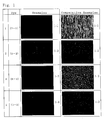
- a photograph of defects of the obtained anisotropic dye film is shown in Fig. 1. Further, the maximum absorption wavelength ( ⁇ max ) and the dichroic ratio (D) of the obtained anisotropic dye film are shown in Table 1.
- Defects of the anisotropic dye film obtained by this Example were sufficiently little, and the film had a high dichroic ratio (light absorption anisotropy) sufficiently functionable as a polarizing film.
- a photograph of defects of the obtained anisotropic dye film is shown in Fig. 1. Further, the maximum absorption wavelength ( ⁇ max ) and the dichroic ratio (D) of the obtained anisotropic dye film are shown in Table 1.
- Defects of the anisotropic dye film obtained in this Example were sufficiently little, and the film had a high dichroic ratio (light absorption anisotropy) sufficiently functionable as a polarizing film.
- a photograph of defects of the obtained anisotropic dye film is shown in Fig. 1. Further, the maximum absorption wavelength ( ⁇ max ) and the dichroic ratio (D) of the obtained anisotropic dye film are shown in Table 1.
- Defects of the anisotropic dye film obtained in this Example were sufficiently little, and the film had a high dichroic ratio (light absorption anisotropy) sufficiently functionable as a polarizing film.
- a photograph of defects of the obtained anisotropic dye film is shown in Fig. 1. Further, the maximum absorption wavelength ( ⁇ max ) and the dichroic ratio (D) of the obtained anisotropic dye film are shown in Table 1.
- Defects of the anisotropic dye film obtained in this Example were sufficiently little, and the film had a high dichroic ratio (light absorption anisotropy) sufficiently functionable as a polarizing film.
- a dye composition for a dye film was prepared in the same manner as in Example 1-1 except that no L-(+)lysine monohydrochloride was added, and it was applied to the same substrate under the same conditions to obtain a dye film.
- a dye composition for a dye film was prepared in the same manner as in Example 1-2 except that no L-(+)lysine monohydrochloride was added, and it was applied to the same substrate under the same conditions to obtain a dye film.
- a dye composition for a dye film was prepared in the same manner as in Example 1-3 except that no L-(+)lysine monohydrochloride was added, and it was applied to the same substrate under the same conditions to obtain a dye film.
- this anisotropic dye film was held in a constant temperature chamber ("Fine Oven DF-42", manufactured by Yamato Scientific Co., Ltd.) heated to 170°C for 30 minutes, whereby the change in the order parameter before and after the heating was examined.
- the anisotropic dye film obtained in this Example was an anisotropic dye film having a high order parameter and good heat resistance, whereby the decrease in the order parameter by heating was low.
- the anisotropic dye film obtained in this Example was an anisotropic dye film having a high order parameter and a good heat resistance, whereby the decrease in the order parameter by heating was low.
- the anisotropic dye film obtained in this Example was an anisotropic dye film having a high order parameter and good heat resistance, whereby the decrease in the order parameter by heating was low.
- the anisotropic dye film obtained in this Example was an anisotropic dye film having a high order parameter and good heat resistance, whereby the decrease in the order parameter by heating was low.
- the anisotropic dye film obtained in this Example was an anisotropic dye film having a high order parameter and good heat resistance, whereby the decrease in the order parameter by heating was low.
- the anisotropic dye film obtained in this Example was an anisotropic dye film having a high order parameter and good heat resistance, whereby the decrease in the order parameter by heating was low.
- the anisotropic dye film obtained in this Example was an anisotropic dye film having a high order parameter and good heat resistance, whereby the decrease in the order parameter by heating was low.
- the obtained anisotropic dye film was an anisotropic dye film inferior in the heat resistance, whereby the decrease in the order parameter by heating was large as compared with Examples 2-1 to 6.
- the obtained anisotropic dye film was an anisotropic dye film inferior in the heat resistance, whereby the decrease in the order parameter by heating was large as compared with Example 2-7.
- the obtained anisotropic dye film was an anisotropic dye film inferior in the heat resistance, whereby the order parameter before the heat resistance test was low as compared with Example 2-7, and the decrease in the order parameter by heating was large.
- the anisotropic dye film of the present invention is useful for various polarizing elements such as polarizing plates provided on display devices such as light control devices, liquid crystal devices (LCD) or organic electroluminescence devices (OLED).
- display devices such as light control devices, liquid crystal devices (LCD) or organic electroluminescence devices (OLED).
- the present invention is based on a Japanese Patent Application No. 2004-10283 (filed on January 19, 2004 ), a Japanese Patent Application No. 2004-149375 (filed on May 19, 2004 ) and a Japanese Patent Application No. 2004-376442 (filed on December 27, 2004 ), and their entireties are hereby included by reference.
Landscapes
- Physics & Mathematics (AREA)
- General Physics & Mathematics (AREA)
- Optics & Photonics (AREA)
- Chemical & Material Sciences (AREA)
- Organic Chemistry (AREA)
- Polarising Elements (AREA)
- Compositions Of Macromolecular Compounds (AREA)
Abstract
To provide a dye composition for an anisotropic dye film, capable of forming an anisotropic dye film which has good heat resistance, has little defects and shows high dichroism; an anisotropic dye film formed by using such a composition for an anisotropic dye film; and a polarizing element employing such an anisotropic dye film.
Description
- The present invention relates to dye compositions for anisotropic dye films capable of forming anisotropic dye films showing high dichroism, which are useful for e.g. polarizing plates provided on display devices such as light control devices, liquid crystal devices (LCD) or organic electroluminescence devices (OLED), anisotropic dye films formed by using such dye compositions for anisotropic dye films, and polarizing elements employing such anisotropic dye films.
- In LCD, linear polarizers or circular polarizers are used to control optical rotation or birefringence in display. Also in OLED, circular polarizers are used to prevent reflection of outside light. Heretofore, for such polarizers (polarizing elements), iodine has been widely used as a dichroic material. However, iodine is highly sublimable and thus has had a drawback that when it is used for a polarizing film, its heat resistance or light fastness is inadequate.
- Therefore, as disclosed in
e.g. patent document 1 or non-patentdocuments - Patent Document 1:
U.S. Patent 2,400,877 - Non-Patent Document 1: Dreyer, J.F., Phys. And Colloid Chem., 1948, 52, 808., "The Fixing of Molecular Orientation"
- Non-Patent Document 2: Dreyer, J.F., Journal de Physique, 1969, 4, 114., "Light Polarization From Films of Lyotropic Nematic Liquid Crystals"
- It is an object of the present invention to provide a dye composition for an anisotropic dye film capable of forming an anisotropic dye film which has good heat resistance, has little defects and shows high dichroism, an anisotropic dye film formed by using such a dye composition for an anisotropic dye film, and a polarizing elements employing such an anisotropic dye film.
- The present inventors have conducted an extensive study to solve the above-mentioned problems and as a result, have found it possible to provide an anisotropic dye film which has good heat resistance, has little defects and shows high dichroism, by using a dye composition for an anisotropic dye film which contains a compound (hereinafter referred to as "the compound of the present invention") having at least two groups selected from the group consisting of an acidic group, a basic group and a neutral group, wherein at least one of said at least two groups is a basic group. Thus, the present invention has been accomplished.
- The present invention provides the following:
- (1) A dye composition for an anisotropic dye film, which comprises a dye and a compound having at least two groups selected from the group consisting of an acidic group, a basic group and a neutral group, wherein at least one of said at least two groups is a basic group.
- (2) The dye composition for an anisotropic dye film according to (1), wherein the content of the compound to the dye is at least 0.05 and at most 4 by molar ratio.
- (3) The dye composition for an anisotropic dye film according to (1) or (2), wherein the compound is a cyclic compound.
- (4) The dye composition for an anisotropic dye film according to (1) or (2), wherein the compound is a hydroxylamine.
- (5) The dye composition for an anisotropic dye film according to (1) or (2), wherein the compound is an amino acid.
- (6) The dye composition for an anisotropic dye film according to any one of (1) to (5), wherein the composition is a solution which further contains a solvent.
- (7) The dye composition for an anisotropic dye film according to any one of (1) to (6), wherein the dye is an acidic dye.
- (8) The dye composition for an anisotropic dye film according to any one of (1) to (7), wherein the dye is an azo dye.
- (9) An anisotropic dye film formed by using the dye composition for an anisotropic dye film as defined in any one of (1) to (8).
- (10) The anisotropic dye film according to (9), formed by a wet system deposition method.
- (11) The anisotropic dye film according to (9) or (10), wherein the film thickness is at most 30 µm.
- (12) An anisotropic dye film comprising a dye and a compound having at least two groups selected from the group consisting of an acidic group, a basic group and a neutral group, wherein at least one of said at least two groups is a basic group.
- (13) The anisotropic dye film according to any one of (9) to (12), which has a dichroic ratio of at least 5.
- (14) The anisotropic dye film according to any one of (9) to (12), wherein the order parameter before a heat resistance test at 170°C for 30 minutes, is at least 0.5, and the decrease in the order parameter after the heat resistance test is at most 7%.
- (15) A polarizing element employing the anisotropic dye film as defined in any one of (9) to (14).
- According to the present invention, an anisotropic dye film is provided which has good heat resistance, has little defects and shows high dichroism, and by such an anisotropic dye film, a polarizing element is provided which is excellent in heat resistance and light fastness and which is excellent also in polarizing performance.
-
- Fig. 1 is microscopic photographs showing defects in anisotropic dye films obtained in Examples 1-1 to 1-4 and Comparative Examples 1-1 to 1-3.
- Now, the present invention will be described in detail with reference to practical embodiments, but it should be understood that the following description of the constituting elements are merely exemplary (typical examples) of practical embodiments of the present invention, and the present invention is by no means thereby restricted.
- The anisotropic dye film in the present invention is a dye film having anisotropy in an electromagnetic characteristic in optional two directions selected from a total of three directions in a three-dimensional coordinate system comprising the thickness direction of the dye film and mutually perpendicular optional two in-plane directions. The electromagnetic characteristic may, for example, be an optical characteristic such as absorption or refraction, or an electric characteristic such as resistance or capacitance. As a film having an optical anisotropy in e.g. absorption or refraction, a linearly polarizing film, a circularly polarizing film, a phase difference film or an anisotropic electroconductive film may, for example, be mentioned.
- The anisotropic dye film of the present invention is preferably employed for a polarizing film, a phase difference film or an anisotropic electroconductive film. Particularly preferably, it is employed for a polarizing film.
- Firstly, the dye composition for an anisotropic dye film of the present invention will be described.
- The dye composition for an anisotropic dye film of the present invention is characterized by comprising a dye and a compound (hereinafter referred to as the compound of the present invention) having at least two groups selected from the group consisting of an acidic group, a basic group and a neutral group, wherein at least one of said at least two groups is a basic group.
- The compound of the present invention is a compound having at least two groups selected from the group consisting of an acidic group, a basic group and a neutral group, wherein at least one of said at least two groups is a basic group, i.e. either one of the following compounds.
- (1) A compound having at least two basic groups.
- (2) A compound having at least one basic group and at least one acidic group.
- (3) A compound having at least one basic group and at least one neutral group.
- (4) A compound having at least one basic group, at least one acidic group and at least one neutral group.
- The details of the functional mechanism whereby the dichroism or heat resistance of the anisotropic dye film is improved by the incorporation of the compound of the present invention, are not clearly understood, but it is considered as follows.
- The compound of the present invention has at least one basic group. Such at least one basic group is considered to have a mutual action with an acidic group of the dye molecule in the anisotropic dye film in a case where the dye molecule has such an acidic group. By such a mutual action, the dye is considered to have the molecular orientation increased via the compound of the present invention. And, it is considered that by the increase of the molecular orientation of the dye, the anisotropic dye film will have its defects reduced to increase the dichroism.
- Further, in addition to such one basic group having a mutual action with the dye molecule, the compound of the present invention further has at least one acidic, basic or neutral group. It is considered that by such acidic, basic or neutral group, the dye and the compound of the present invention will form a salt or will be agglomerated, whereby the dye composition for an anisotropic dye film will be prevented from becoming unstable.
- Especially when the compound of the present invention having a basic group is present against a dye molecule having a terminal acidic group, an acid/base bond will be formed, whereby the dye molecules will be regularly oriented to provide a function as a polarizing plate. However, if the bonding frequency of acid/base is too high, agglomeration may rather takes place, whereby it becomes difficult to prepare a film. It is considered that in the present invention, for example, by using a compound containing basic groups more than acidic groups, bonding of the basic groups with the terminal acidic groups of the dye molecule will be properly prevented to provide a proper bonding frequency of acid/base, whereby it is possible to prepare a film wherein dye molecules are regularly oriented without being agglomerated.
- Further, deterioration in performance of the anisotropic dye film by heating is considered to be caused by disturbance of the molecular orientation of the dye or a change of the molecular orientation to an undesirable direction when the dye oriented in the film receives thermal fluctuation by the heating. As mentioned above, the compound of the present invention serves to provide intermolecular interactions such as an electrostatic attracting force, a repulsive force and a hydrogen bond with functional groups of the dye. Such interactions of attracting and repulsive forces function simultaneously between the compound and the dye, whereby agglomeration due to too much bonding with the dye, or phase separation due to too much repulsion, can be prevented.
- Thus, it is considered that also in the anisotropic dye film of the present invention, such intermolecular interactions will work in good balance between the compound of the present invention and the dye, which serves a role of fixing the molecular orientation of the dye in the optimum direction. And, it is considered that by such fixing of the orientation of dye molecules, the change in orientation of dye molecules by heating can be suppressed, whereby the heat resistance of the anisotropic dye film is improved.
- Such a compound of the present invention is usually a water-soluble compound.
- The basic group, the acidic group and the neutral group, which the composition of the present invention has, are as follows. The acidic group and the basic group are functional groups such that in an aqueous solution having an inert support electrolyte added in an amount of from 0.1 to 3 mol/dm, the acidic group is a functional group having a pka of less than 7, and the basic group is a functional group having a pka of at least 7. Further, the neutral group is a group having no dissociation constant. Further, as disclosed in Kagaku Binran Kisohen (Chemical Handbook Basic) II, p.331 (compiled by Chemical Society of Japan, published by Maruzen Co., Ltd.), pka is logarithmic value of the reciprocal of the dissociation constant ka, i.e. -log ka.
- As the acidic group, which the compound of the present invention has, a sulfo group, a carboxyl group or a phosphoric group may, for example, be mentioned.
- As the basic group, an amino group, a sulfonium group, a pyrrole group, a 3-pyrroline group, a pyrrolidine group, a pyrazole group, a 2-pyrazoline group, a pyrazolidine group, an imidazole group, a 1,2,3-triazole group, a 1,2,4-triazole group, a pyridine group, a pyridazine group, a piperidine group, a pyrazine group, a piperazine group, a pyrimidine group or a triazine group may, for example, be mentioned.
- As the neutral group, a hydroxyl group, an amine oxide group, a sulfoxide group or a phosphine oxide group may, for example, be mentioned.
- The above groups may further have substituents, so long as such substituents do not substantially change the properties of the dye composition for an anisotropic dye film of the present invention.
- Some or all of acidic groups and basic groups contained in the compound of the present invention may take salt forms. The salt form of a basic group may, for example, be a salt of an inorganic acid such as hydrochloric acid or sulfuric acid, or a salt of an organic acid such as acetic acid or formic acid. Further, the salt form of an acidic group may, for example, be a salt of an alkali metal such as Na, Li or K, an ammonium salt which may be substituted by an alkyl group or a hydroxyalkyl group, or an organic amine salt. In the case of these salt forms, their types may not be restricted to one type, and a plurality of different types may be present as mixed.
- The molecular weight of the compound of the present invention is usually at least 60, preferably at least 75, more preferably at least 100, particularly preferably at least 140, and preferably at most 300, more preferably at most 250, particularly preferably at most 200.
- The compound of the present invention is preferably a compound having a carbon number of at least 1, more preferably at least 3, particularly preferably at least 6 and preferably at most 15, further preferably at most 12, particularly preferably at most 10.
- In order to effectively obtain the above effects by the compound of the present invention, the number of basic groups which the compound of the present invention has, may be at least 1, preferably at least 2 and at most 5, more preferably at most 4. Further, in a case where the compound of the present invention has basic groups only i.e. without having a neutral group or an acidic group, the number of basic groups is preferably at least 3 and at most 5, more preferably at most 4.
- When the compound of the present invention has acidic groups, the number of acidic groups may be at least 1, preferably at most 4, more preferably at most 3. Further, the relative ratio of the number of basic groups/the number of acidic groups in the compound of the present invention, is preferably at least 1.3 and at most 4.
- When the compound of the present invention has neutral groups, the number of neutral groups may be at least 1, and the number is not particularly limited but is usually at most 8, preferably at most 6.
- Further, in a case where the compound of the present invention has at least two basic groups, acidic groups or neutral groups, such at least two groups may be the same groups or different groups.
- The compound of the present invention may be either a linear compound or a cyclic compound.
- As the compound of the present invention, amines are preferred, and particularly preferred are amino acids, betains, hydroxyamines or cyclic compounds having basic groups.
- The amino acids are classified into a neutral amino acid, an acidic amino acid and a basic amino acid, from the nature and the number of acidic groups and basic groups.
- Specific examples of the neutral amino acid include glycine, alanine, valine, leucine, isoleucine, phenylalanine, tyrosine, tryptophan, serine, threonine, proline, 4-hydroxyproline, cysteine, cystine, methionine, asparagine, glutamine, β-alanine, citrulline, creatine and kynurenine. Among them, particularly preferred are phenylalanine, aspargine, 4-hydroxyproline and β-alanine.
- Further, specific examples of the acidic amino acid include aspartic acid, glutamic acid, etc. Among them, particularly preferred is aspartic acid and glutamic acid.
- Further, specific examples of the basic amino acid include lysine, arginine and histidine.
- The molecular weight of the amino acid is usually at least 60, preferably at least 75 and usually at most 300, preferably at most 250. If the molecular weight of the amino acid is too large, the molecular size will be large, whereby orientation of dye molecules is likely to be disturbed. On the other hand, if it is too small, the effect for fixing the orientation of dye molecules may not sufficiently be obtained.
- The betains include, for example, a carboxylalkyltrialkylammonium hydroxide, a carboxyalkylpyridinium hydroxide, a sulfoalkyltrialkylammonium hydroxide, a sulfoalkylpyridinium hydroxide, a phosphoalkyltrialkylammonium hydroxide, a phosphoalkylpyridinium hydroxide, and derivatives of these compounds. Among them, carboxymethyltrimethylammonium hydroxide and sulfopropylpyridinium hydroxide are preferred.
- The molecular weight of the betain is usually at least 60, preferably at least 75 and usually at most 300, preferably at most 250. If the molecular weight of the betain is too large, the molecular size will be large, whereby the orientation of dye molecules is likely to be disturbed. On the other hand, if it is too small, the effect for fixing the orientation of dye molecules may not sufficiently be obtained.
- The hydroxylamines include, for example, an aminoalkyl alcohol, a diaminoalkyl alcohol, an aminoalkyldiol and a diaminoalkyldiol. Among them, aminopropanediol is preferred.
- The molecular weight of the hydroxyamine is usually at least 60, preferably at least 75 and usually at most 300, preferably at most 250. If the molecular weight of the hydroxyamine is too large, the molecular size will be large, whereby the orientation of dye molecules is likely to be disturbed. On the other hand, if it is too small, the effect for fixing the orientation of dye molecules may not sufficiently be obtained.
- The cyclic compounds having basic groups, include, for example, aminopyridine, diaminopyridine, triaminopyridine, aminopyridazine, diaminopyridazine, triaminopyridazine, amimopyrimidine, diaminopyrimidine, triaminopyrimidine, aminopyrazine, diaminopyrazine, triaminopyrazine, aminotriazine, diaminotriazine and triaminotriazine. Among them, triaminopyrimidine is preferred.
- The molecular weight of the cyclic compound having basic groups is usually at least 60, preferably at least 75 and usually at most 300, preferably at most 250. If the molecular weight of the cyclic compound having basic groups is too large, the molecular size will be large, whereby the orientation of dye molecules is likely to be disturbed. On the other hand, if it is too small, the effect for fixing the orientation of dye molecules may not sufficiently be obtained.
- With respect to the compound of the present invention as described above, one type may be used alone, or compounds of the same type or compounds of different types may be used in combination as a mixture of two or more of them. Further, optical isomers of e.g. an amino acid may be used alone or in combination. Further, it may contain a salt form compound and a free form compound, or may contain compounds of different salt forms.
- The blend amount of the above-described compound of the present invention in the dye composition for an anisotropic dye film of the present invention is preferably at least 0.05, particularly preferably at least 0.1 and preferably at most 4, particularly preferably at most 3 by a molar concentration ratio to the dye (the molar concentration ratio of the compound of the present invention to the dye) in order to sufficiently obtain the effect for improving the heat resistance, etc. and in order not to hinder the orientation of dye molecules. If the blend amount of the compound of the present invention is too small, no adequate effect for improving the heat resistance, etc. will be obtained by the incorporation of the compound of the present invention. On the other hand, if it is too large, the compound of the present invention is likely to precipitate in the anisotropic dye film.
- The dye to be used for the dye composition for an anisotropic dye film of the present invention is usually one having an absorption wavelength of from 400 to 700 nm.
- The dye to be used for the dye composition for an anisotropic dye film of the present invention is preferably a dye having an acidic group as a functional group with a view to effectively obtaining the above-described intermolecular interaction with the compound of the present invention. Such an acidic group may, for example, be a sulfo group, a carboxyl group or a phosphoric group, and such a group may further have a substituent. From the viewpoint of the high solubility and the strength of the intermolecular interaction with the compound of the present invention, the acidic group is preferably a sulfo group or a carboxyl group.
- These acidic groups may be in a free acid form, or some or all of them may be in a salt form. Or, a dye in a salt form and a dye in a free acid form may be present as mixed. The salt form may, for example, be a salt of an alkali metal such as Na, Li or K, an ammonium salt which may be substituted by an alkyl group or a hydroxyalkyl group, or an organic amine salt. The organic amine may, for example, be a C1-6 lower alkylamine, a hydroxy-substituted C1-6 lower alkylamine or a carboxy-substituted C1-6 lower alkylamine. These salt forms may be used alone or in combination as a mixture of a plurality of them.
- The dye to be used in the present invention is preferably an azo dye, whereby a distinct effect can be obtained when it is combined with the compound of the present invention. The number of azo groups in the azo dye is preferably at least 2 and at most 4, more preferably 3, from the viewpoint of the chromaticness and the production efficiency.
- Further, the dye to be used in the present invention is preferably water-soluble, since it is subjected to the after-mentioned wet system film-forming method.
- Further, the dye to be used in the present invention has a molecular weight of usually at least 200, preferably at least 300 and usually at most 1,500, preferably at most 1,200, in a free state not taking a salt form, from the viewpoint of the production efficiency of the dye and the polarizing performance.
- Specific examples of such a dye include dyes disclosed in the above-mentioned
patent document 1,non-patent documents 


- These dyes can be produced in accordance with methods per se well known. For example, the dye represented by the formula (I-1) can be produced by the following steps (A) to (C).
- (A) From 3-aminobenzenesulfonic acid (metanilic acid) and 2-methoxyaniline (o-anisidine), a monoazo compound is produced via diazotization and coupling steps in accordance with a common method (e.g. "New Dye Chemistry" edited by Hosoda Yutaka, published by Gihodo on December 21, 1973) p. 396-409).
- (B) The obtained disazo compound is likewise diazotized by a common method, followed by a coupling reaction with 3-methylaniline (m-toluidine), to obtain a disazo compound.
- (C) The obtained disazo compound is likewise diazotized by a common method, followed by a coupling reaction with 7-amino-1-naphthol-3,6-disulfonic acid (RR acid) and salting out with sodium chloride to obtain the desired dye number (I-1).
- In the dye composition for an anisotropic dye film of the present invention, the above-mentioned dyes may be used alone, but two or more of them may be used in combination. Further, dyes other than the above exemplified dyes may also be incorporated to such an extent not to decrease the orientation. Thus, anisotropic dye films having various colors can be produced.
- In a case where other dyes are to be blended, examples of such dyes to be blended include C.I. Direct Yellow 12, C.I. Direct Yellow 34, C.I. Direct Yellow 86, C.I. Direct Yellow 142, C.I. Direct Yellow 132, C.I. Acid Yellow 25, C.I. Direct Orange 39, C.I. Direct Orange 72, C.I. Direct Orange 79, C.I. Acid Orange 28, C.I. Direct Red 39, C.I. Direct Red 79, C.I. Direct Red 81, C.I. Direct Red 83, C.I. Direct Red 89, C.I. Acid Red 37, C.I. Direct Violet 9, C.I. Direct Violet 35, C.I. Direct Violet 48, C.I. Direct Violet 57, C.I.
Direct Blue 1, C.I. Direct Blue 67, C.I. Direct Blue 83, C.I. Direct Blue 90, C.I. Direct Green 42, C.I. Direct Green 51, and C.I. Direct Green 59. - In a case where the above dyes to be blended have acidic groups, such acidic groups may be in a free acid form, or some or all of the acidic groups may be in a salt form. Further, a dye in a salt form and a dye in the free acid form may be present as mixed.
- As mentioned above, the dye having acidic groups to be used in the present invention, may be used in its free acid form, or some of acidic groups may take a salt form. Further, a dye in a salt form and a dye in an acid form may be present as mixed. Accordingly, when it is obtained in a salt form at the time of its production, it may be used as it is or may be converted to a desired salt form. As a method for conversion to a salt form, a known method may optionally be employed. For example, the following methods (1) to (4) may be mentioned.
- (1) A method wherein a strong acid such as hydrochloric acid is added to an aqueous solution of a dye obtained in a salt form, to let the dye precipitate in the form of a free acid, and then the acidic groups of the dye are neutralized with an alkali solution having a desired counter ion (such as a lithium hydroxide aqueous solution) for conversion to a salt.
- (2) A method wherein a large excess amount of a neutral salt having a desired counter ion (such as lithium chloride) is added to an aqueous solution of a dye obtained in a salt form to carry out a salt exchange in the form of a salted out cake.
- (3) A method wherein an aqueous solution of a dye obtained in a salt form is treated with a strongly acidic ion exchange resin to let the dye precipitate in the form of a free acid, and then the acidic groups of the dye are neutralized with an alkali solution having a desired counter ion (such as a lithium hydroxide aqueous solution) for conversion to a salt.
- (4) A method wherein an aqueous solution of a dye obtained in a salt form is treated with a strongly acid ion exchange resin preliminarily treated with an alkali solution having a desired counter ion (such as a lithium hydroxide aqueous solution), to carry out a salt exchange.
- The dye composition for an anisotropic dye film of the present invention comprises the above-described compound of the present invention and the dye, but as the case requires, additives such as a solvent, a surfactant and a pH-adjusting agent may be incorporated.
- As the solvent to be used in the present invention, water, an organic solvent miscible with water or their mixture is suitable. A specific example of the organic solvent may, for example, be a single solvent or a mixed solvent of two or more, selected from alcohols such as methyl alcohol, ethyl alcohol and isopropyl alcohol, glycols such as ethylene glycol and diethylene glycol, and cellosolves such as methyl cellosolve and ethyl cellosolve.
- In a case where the dye composition for an anisotropic dye film of the present invention is a solution containing such a solvent, the concentration of the dye in the dye composition for an anisotropic dye film, is usually preferably at least 0.01 wt%, particularly preferably at least 0.1 wt% and usually preferably at most 50 wt%, particularly preferably at most 30 wt%. If the dye concentration is too low, sufficient dichroism can not be obtained in the anisotropic dye film, and if it is too high, the dye is likely to precipitate.
- In a case where the dye composition for an anisotropic dye film of the present invention is applied in the form of a dye solution to a substrate by e.g. the after-mentioned wet system film forming method, an additive such as a surfactant may be added, as the case requires, in order to improve the coating property or wettability to the substrate. As such a surfactant, an anionic, cationic or nonionic surfactant may be used. The concentration is usually preferably at least 0.05 wt% and at most 0.5 wt%, as the concentration in the dye composition for an anisotropic dye film and as an amount sufficient to obtain the desired effect and not to impair the orientation of the dye molecules.
- Further, for the purpose of e.g. suppressing instability such as agglomeration or salt-formation of the dye and the compound of the present invention in the dye composition for an anisotropic dye film of the present invention, a pH controlling agent such as a known acid or alkali may be added before or after mixing the constituting components to carry out the pH control.
- Further, as additives other than the above, known additives disclosed in "Additive for Coating", edited by J. Bieleman, Willey-VCH (2000), may be employed.
- Now, the anisotropic dye film formed by using such a dye composition for an anisotropic dye film of the present invention, will be described. With the above described dye composition for an anisotropic dye film of the present invention comprising the compound of the present invention and the dye, the dye can exhibit a high level of molecular orientation. Accordingly, the anisotropic dye film of the present invention formed by using such a dye composition for an anisotropic dye film of the present invention, is a useful dye film showing high dichroism.
- The anisotropic dye film of the present invention shows a high dichroic ratio and is preferably one having a dichroic ratio of at least 5, more preferably at least 10, particularly preferably at least 15.
- Further, as mentioned above, in the dye composition for an anisotropic dye film of the present invention comprising the compound of the present invention and the dye, an intermolecular interaction works between the compound of the present invention and the dye. And, also in the anisotropic dye film formed by using such a dye composition for an anisotropic dye film, such an intermolecular interaction will work, whereby the orientation of dye molecules will be fixed, and disturbance or change in direction of the orientation during the heating will be suppressed, thus leading to a useful anisotropic dye film showing high heat resistance.
- The heat resistance of the anisotropic dye film which is practically required, is determined depending upon the environment in which the anisotropic dye film is to be used and the process for producing a display device or the like wherein the anisotropic dye film will be provided. In the present invention, as a standard for comparison of the heat resistance, a decrease of the order parameter showing the molecular orientation degree by a heat resistance test is employed. As a specific heat resistance test, a test condition may, for example, be such that the film is held in an environment of 170°C for 30 minutes. As a sufficient heat resistance performance of an anisotropic dye film, the decrease of the order parameter under such a condition is preferably at most 7%, more preferably at most 5%, particularly preferably at most 4.6%.
- The anisotropic dye film of the present invention preferably has a high degree of molecular orientation from the practical viewpoint, and it is preferably one having an order parameter value of at least 0.5, more preferably at least 0.6, particularly preferably at least 0.7, before the heat resistance test.
- Such an anisotropic dye film of the present invention is prepared by a dry system film-forming method or a wet system film-forming method by using the dye composition for an anisotropic dye film of the present invention. In the present invention, in a case where the solution containing the dye is likely to show liquid crystallizability, it is preferred to use the wet system film-forming method.
- The dry system film-forming method may, for example, be a method of stretching a non-stretched film obtained e.g. by a method wherein a high molecular weight polymer is formed into a film which is then dyed with the dye composition for an anisotropic dye film of the present invention, or by a method wherein the dye composition for an anisotropic dye film of the present invention is added to the solution of a high molecular weight polymer to dye the stock solution, followed by film-forming. Such dyeing, film-forming and stretching can be carried out by the following common methods.
- Dyeing is carried out by dipping a polymer film in a dye bath containing the dye composition for an anisotropic dye film of the present invention and, as the case requires, an inorganic salt such as sodium chloride or Glauber's salt and a dyeing assistant such as a surfactant, usually at a temperature of at least 20°C, preferably at least 30°C and usually at most 80°C, preferably at most 50°C, usually for at least 1 minute, preferably at least 3 minutes and usually at most 60 minutes, preferably at most 20 minutes, then boric acid treatment is carried out if necessary, followed by drying. Otherwise, the high molecular weight polymer is dissolved in water and/or a hydrophilic organic solvent such as an alcohol, glycerol or dimethylformamide, then the dye composition for an anisotropic dye film of the present invention, is added to dye the stock solution, and this dyed stock solution is formed into a film by a casting method, a solution-coating method or an extrusion method to obtain a dyed film. The concentration of the high molecular weight polymer dissolved in the solvent varies depending upon the polymer, but it is usually at least 5 wt%, preferably at least 10 wt% and usually at most 30 wt%, preferably at most 20 wt%. Further, the concentration of the dye to be dissolved in the solvent is usually at least 0.1 wt%, preferably at least 0.8 wt% and usually at most 5 wt%, preferably at most 2.5 wt%, based on the polymer.
- A non-stretched film obtained by dyeing and film forming as described above, is stretched in a monoaxial direction by a suitable method. By such stretching treatment, the dye molecules will be oriented to produce dichroism. As a method for stretching in a monoaxial direction, a method of carrying out tensile stretching by a wet system method, a method of carrying out tensile stretching by a dry system method or a method of a pinch roll compression stretching in a dry system method may, for example, be mentioned, and any method may be employed. The stretching is carried out usually at a stretching ratio of at least 2 times and at most 9 times. However, in a case where a polyvinyl alcohol or its derivative is employed as the high molecular weight polymer, the stretching ratio is preferably within a range of at least 2.5 times and at most 6 times. After the stretching and orientation treatment, boric acid treatment is carried out for the purpose of improving the water resistance and the polarizing degree of the stretched film. By such boric acid treatment, the light transmittance and the degree of polarization of the anisotropic dye film will be improved. The conditions for such boric acid treatment may vary depending upon the types of the hydrophilic high molecular weight polymer and the dye to be used. However, usually, the boric acid concentration is at least 1 wt%, preferably at least 5 wt% and usually at most 15 wt%, preferably at most 10 wt%. Further, the treating temperature is preferably within a range of usually at least 30°C, preferably at least 50°C and usually at most 80°C. If the boric acid concentration is less than 1 wt%, or if the treating temperature is less than 30°C, the treating effects tend to be small, and if the boric acid concentration exceeds 15 wt% or if the treating temperature exceeds 80°C, the anisotropic dye film tends to be brittle, such being undesirable.
- The thickness of the anisotropic dye film to be obtained by such a dry system film-forming method is preferably at least 50 µm, particularly preferably at least 80 µm and preferably at most 200 µm, particularly preferably at most 100 µm.
- On the other hand, as the wet system film-forming method, a known method may be mentioned such as a method wherein the dye composition for an anisotropic dye film of the present invention is formed into a coating solution, which is applied to a various substrate such as a glass plate and dried to have the dye oriented and laminated. The coating method may, for example, be a known method disclosed, for example, in "Coating Engineering" edited by Yuji Harazaki, published by Kabushiki Kaisha Asakura Shoten on March 20, 1971, p. 253-277, or "Preparation and Application of a Molecule Adjusting Material" compiled by Kunihiro Ichimura, published by Kabushiki Kaisha CMC on March 3, 1998, p. 118-149, or a method wherein it is applied on e.g. a substrate having orientation treatment preliminarily applied, by e.g. a spin coating method, a spray coating method, a bar coating method, a roll coating method or a blade coating method. In such a case, if the dye concentration in the dye composition for an anisotropic dye film is too low, no adequate dichroism can be obtained, and if it is too high, the film-forming tends to be difficult. The dye concentration in the dye composition for an anisotropic dye film in the wet system film-forming method is preferably at least 0.1 wt%, particularly preferably at least 1 wt% and preferably at most 50 wt%, particularly preferably at most 30 wt%. The temperature at the time of the coating is preferably at least 0°C and at most 80°C, and the humidity is preferably at least 10%RH and at most 80%RH.
- Further, the temperature at the time of drying the coated film is preferably at least 0°C and at most 120°C, and the humidity is at least 10%RH and at most 80%RH.
- In a case where the anisotropic dye film is to be formed on a substrate by the wet system film-forming method, the anisotropic dye film is usually preferably at least 50 nm, more preferably at least 100 nm and preferably at most 30 µm, more preferably at most 20 µm, still further preferably at most 1 µm as the thickness after drying.
- Further, as the substrate material to be used for the wet system film-forming method, glass, or a triacetate, acrylic, polyester, triacetyl cellulose or urethane type film may, for example, be mentioned. Further, on the surface of such a substrate, an orientation treatment layer may be applied by a known method as disclosed in e.g. "Liquid Crystal Handbook" published by Maruzen Co., Ltd. on October 30, 2000, p. 226-239, in order to control the orientation direction of the dichroic dye.
- A protective layer may be provided, as the case requires, on the anisotropic dye film of a dichroic dye obtained by the dry system film-forming method or the wet system film-forming method. Such a protective layer may be formed by lamination of a transparent polymer film such as a triacetate, acrylic, polyester, polyimide, ployacetyl cellulose or urethane type film, and then subjected to practical use.
- Further, in a case where the dye composition for an anisotropic dye film of the present invention is used for e.g. a polarizing filter for various display devices such as ECD and OLED, the anisotropic dye film of the present invention may be formed directly on e.g. an electrode substrate constituting such a display device, or a base material having the anisotropic dye film of the present invention formed thereon, may be used as a constituting component of such a display device.
- Further, the anisotropic dye film of the present invention is one which comprises a dye and a compound having at least two groups selected from the group consisting of an acidic group, a basic group and a natural group, wherein at least one of said at least two groups is a basic group. In such an anisotropic dye film, the compound having at least two groups selected from the group consisting of an acidic group, a basic group and a neutral group, wherein at least one of said at least two groups is a basic group, and the dye, are the same as the compound of the present invention and the dye, which are contained in the above-mentioned dye composition for an anisotropic dye film of the present invention. Namely, even if the anisotropic dye film is not produced as described above by means of the dye composition for an anisotropic dye film of the present invention, a film comprising a dye and the compound of the present invention, will show the effects of the present invention.
- The anisotropic dye film of the present invention will function as a polarizing film whereby a linearly polarized light, circularly polarized light or oval polarized light can be obtained by utilizing the anisotropy in light absorption and further is capable of providing functions as various anisotropic films such as refractive anisotropy and conductivity anisotropy by suitably selecting the film-forming process and the composition comprising the substrate and the dye, whereby it can be made various types of polarizing elements which can be used for various purposes.
- The polarizing element of the present invention is one employing such an anisotropic dye film of the present invention. In a case where the anisotropic dye film of the present invention is formed on a substrate to obtain a polarizing element of the present invention, the formed anisotropic dye film itself may be employed, or not only the above-mentioned protective layer, but also layers having various functions such as an adhesive layer and a reflection-preventing layer, may be laminated, so that it may be used in the form of a laminate.
- Now, the present invention will be described in further detail with reference to Examples. However, it should be understood that the present invention is by no means restricted to such specific Examples.
- In the following, various evaluations of the formed dye films were carried out as follows.
- The transmittance of an anisotropic dye film was measured by a spectrophotometer having an iodine type polarizing element disposed in an incident optical system, whereupon the dichroic ratio was calculated by the following formula.


Tz: Transmittance of the dye film against polarized light in the direction of the absorption axis Ty: Transmittance of the dye film against polarized light in the direction of the polarization axis - Using a polarization microscope Nikon Optiphot-POL and using an objective lens of 100 magnifications and an ocular lens of 10 magnifications, observation was made at an extinction position, and a photograph was taken by Nikon Coolpix 950. At that time, the sample was set so that the transverse direction of the photograph would be the coating direction.
- The transmittance of an anisotropic dye film was measured by a spectrophotometer having an iodine type polarizing element disposed in the incident optical system ("instant multilight measuring system MCPD 2000", manufactured by Otsuka Electronics Co., Ltd., whereupon the order parameter was calculated by the following formula.


Tz: Transmittance of the dye film against polarized light in the direction of the absorption axis
Ty: Transmittance of the dye film against polarized light in the direction of the polarization axis - The decrease was calculated by the following formula.

- S1: Order parameter before heating
- S2: Order parameter after heating
- In the following, "parts" means "parts by weight".
- 5 Parts of Dye No. (II-1) and 2.5 parts of L-(+)lysine monohydrochloride (number of basic groups: 2, number of acidic groups: 1) (manufactured by Tokyo Kasei Kogyo Co., Ltd.) were added to 92.5 parts of water (molar ratio of the dye to L-(+)lysine monohydrochloride = 1:1), stirred and dissolved, followed by filtration to obtain a dye composition for an anisotropic dye film of the present invention having a pH of 7. The above dye composition for an anisotropic dye film was applied by an applicator having a gap of 10 µm (manufactured by Imoto Seisakusho) on a glass substrate having a polyimide oriented film formed on its surface by a spin coating method (75 mm × 25 mm, thickness: 1.1 mm, a polyimide oriented film having a polyimide film thickness of about 800 Å was preliminarily subjected to rubbing treatment with cloth), followed by drying naturally to obtain an anisotropic dye film having a thickness of about 0.4 µm.
- A photograph of defects of the obtained anisotropic dye film is shown in Fig. 1. Further, the maximum absorption wavelength (λmax) and the dichroic ratio (D) of the obtained anisotropic dye film are shown in Table 1.
- Defects of the anisotropic dye film obtained by this Example were sufficiently little, and the film had a high dichroic ratio (light absorption anisotropy) sufficiently functionable as a polarizing film.
- 14 Parts of the above exemplified Dye No. (II-2) and 3.1 parts of L-(+)lysine monohydrochloride (number of basic groups: 2, number of acidic groups: 1) (manufactured by Tokyo Kasei Kogyo Co., Ltd.) were added to 82.9 parts of water (molar ratio of the dye to L-(+)lysine monohydrochloride = 1:1), stirred and dissolved, followed by filtration to obtain a dye composition for an anisotropic dye film of the present invention having a pH of 7. This dye composition for an anisotropic dye film was applied on the same substrate as in Example 1-1 under the same conditions to obtain an anisotropic dye film having a thickness of about 0.9 µm.
- A photograph of defects of the obtained anisotropic dye film is shown in Fig. 1. Further, the maximum absorption wavelength (λmax) and the dichroic ratio (D) of the obtained anisotropic dye film are shown in Table 1.
- Defects of the anisotropic dye film obtained in this Example were sufficiently little, and the film had a high dichroic ratio (light absorption anisotropy) sufficiently functionable as a polarizing film.
- 15 Parts of the above exemplified Dye No. (II-3) and 3.3 parts of L-(+)lysine monohydrochloride (number of basic groups: 2, number of acidic groups: 1) (manufactured by Tokyo Kasei Kogyo Co., Ltd.) were added to 81.7 parts of water (molar ratio of the dye to L-(+)lysine monohydrochloride = 1:1), stirred and dissolved, followed by filtration to obtain a dye composition for an anisotropic dye film of the present invention having a pH of 7. This dye composition for an anisotropic dye film was applied to the same substrate as in Example 1-1 under the same conditions to obtain an anisotropic dye film having a thickness of about 0.9 µm.
- A photograph of defects of the obtained anisotropic dye film is shown in Fig. 1. Further, the maximum absorption wavelength (λmax) and the dichroic ratio (D) of the obtained anisotropic dye film are shown in Table 1.
- Defects of the anisotropic dye film obtained in this Example were sufficiently little, and the film had a high dichroic ratio (light absorption anisotropy) sufficiently functionable as a polarizing film.
- 14 Parts of the above exemplified Dye No. (II-2) and 3.5 parts of L-(+)arginine hydrochloride (number of basic groups: 4, number of acidic groups: 1) (manufactured by Tokyo Kasei Kogyo Co., Ltd.) were added to 82.5 parts of water (molar ratio of the dye to L-(+)arginine hydrochloride = 1:1), stirred and dissolved, followed by filtration to obtain a dye composition for an anisotropic dye film of the present invention having a pH of 7. This dye composition for an anisotropic dye film was applied to the same substrate as in Example 1-1 under the same conditions to obtain an anisotropic dye film having a thickness of about 0.9 µm.
- A photograph of defects of the obtained anisotropic dye film is shown in Fig. 1. Further, the maximum absorption wavelength (λmax) and the dichroic ratio (D) of the obtained anisotropic dye film are shown in Table 1.
- Defects of the anisotropic dye film obtained in this Example were sufficiently little, and the film had a high dichroic ratio (light absorption anisotropy) sufficiently functionable as a polarizing film.
- A dye composition for a dye film was prepared in the same manner as in Example 1-1 except that no L-(+)lysine monohydrochloride was added, and it was applied to the same substrate under the same conditions to obtain a dye film.
- With respect to the obtained dye film, various tests were carried out in the same manner as in Example 1-1, the results of the observation of defects are shown in Fig. 1, and the evaluation results of the dichroism are shown in Table 1.
- With the dye film obtained in this Comparative Example, striped defects were distinct as compared with the anisotropic dye film in Example 1-1, and the dichroic ratio was lower than the one in Example 1-1.
- A dye composition for a dye film was prepared in the same manner as in Example 1-2 except that no L-(+)lysine monohydrochloride was added, and it was applied to the same substrate under the same conditions to obtain a dye film.
- With respect to the obtained dye film, various tests were carried out in the same manner as in Example 1-1, the results of the observation of defects are shown in Fig. 1, and the evaluation results of the dichroism are shown in Table 1.
- With the dye film obtained in this Comparative Example, striped defects were more distinct as compared with the anisotropic dye film in Example 1-2 and 4, and the dichroic ratio was lower than the one in Example 1-2 and 4.
- A dye composition for a dye film was prepared in the same manner as in Example 1-3 except that no L-(+)lysine monohydrochloride was added, and it was applied to the same substrate under the same conditions to obtain a dye film.
- With respect to the obtained dye film, various tests were carried out in the same manner as in Example 1-1, the results of the observation of defects are shown in Fig. 1, and the evaluation results of the dichroism are shown in Table 1.
- With the dye film obtained in this Comparative Example, striped defects were distinct as compared with the anisotropic dye film in Example 1-3, and the dichroic ratio was lower than the one in Example 1-3.
TABLE 1 Examples Dye No. Basic amino acid Evaluation results Maximum absorption wavelength (nm) Dichroic ratio Ex. 1-1 (II-1) L-(+)lysine monohydrochloride 430 7 Comp. Ex. 1-1 Nil 430 4 Ex. 1-2 (II-2) L-(+)lysine monohydrochloride 600 35 Ex. 1-4 L-(+)arginine hydrochloride 600 34 Comp. Ex. 1-2 Nil 600 23 Ex. 1-3 (II-3) L-(+)lysine monohydrochloride 650 17 Comp. Ex. 1-3 Nil 650 15 - 15 Parts of the above exemplified Dye No. (I-3) and 1.5 parts of L-phenylalanine (manufactured by Kanto Kagaku) as a neutral amino acid were added to 83.5 parts of water (molar ratio of the dye to the amino acid = 1:0.5), stirred and dissolved, followed by filtration to obtain a dye composition for an anisotropic dye film of the present invention. The above dye composition for an anisotropic dye film was applied by No. 2 bar coater (manufactured by Tester Sangyo Co., Ltd.) on a glass substrate having a polyimide oriented film formed on its surface by a spin coating method (75 mm × 25 mm, thickness: 1.1 mm, a polyimide oriented film having a polyimide film thickness of about 800 Å was preliminarily subjected to rubbing treatment with cloth), followed by drying naturally to obtain an anisotropic dye film having a thickness of about 0.4 µm. As a heat resistance test, this anisotropic dye film was held in a constant temperature chamber ("Fine Oven DF-42", manufactured by Yamato Scientific Co., Ltd.) heated to 170°C for 30 minutes, whereby the change in the order parameter before and after the heating was examined.
- The order parameter measured before and after the heat resistance test of the obtained anisotropic dye film, and its decrease, are shown in Table 2.
- As is evident from Table 2, the anisotropic dye film obtained in this Example was an anisotropic dye film having a high order parameter and good heat resistance, whereby the decrease in the order parameter by heating was low.
- 15 Parts of the above exemplified Dye No. (I-3) and 0.32 part of β-alanine (manufactured by Tokyo Kasei Kogyo Co., Ltd.) as a neutral amino acid were added to 84.68 parts of water (molar ratio of the dye to the amino acid = 1:0.2), stirred and dissolved, followed by filtration to obtain a dye composition for an anisotropic dye film of the present invention. In the same manner as in Example 2-1, this dye composition for an anisotropic dye film was applied to a substrate, and the obtained anisotropic dye film was subjected to the heat resistance test.
- The order parameter measured before and after the heat resistance test of the obtained anisotropic dye film, and its decrease, are shown in Table 2.
- As is evident from Table 2, the anisotropic dye film obtained in this Example was an anisotropic dye film having a high order parameter and a good heat resistance, whereby the decrease in the order parameter by heating was low.
- 15 Parts of the above exemplified Dye No. (I-3) and 1.2 parts of 4-hydroxy-L-proline (manufactured by Tokyo Kasei Kogyo Co., Ltd.) as a neutral amino acid were added to 83.8 parts of water (molar ratio of the dye to the amino acid = 1:0.5), stirred and dissolved, followed by filtration to obtain a dye composition for an anisotropic dye film of the present invention. In the same manner as in Example 2-1, this dye composition for an anisotropic dye film was applied to a substrate, and the obtained anisotropic dye film was subjected to a heat resistance test.
- The order parameter measured before and after the heat resistance test of the obtained anisotropic dye film, and its decrease, are shown in Table 2.
- As is evident from Table 2, the anisotropic dye film obtained in this Example was an anisotropic dye film having a high order parameter and good heat resistance, whereby the decrease in the order parameter by heating was low.
- 15 Parts of the above exemplified Dye No. (I-3) and 2.7 parts of L-aspargine monohydrate (manufactured by Wako Pure Chemical Industries, Ltd.) as a neutral amino acid were added to 82.3 parts of water (molar ratio of the dye to the amino acid = 1:1), stirred and dissolved, followed by filtration to obtain a dye composition for an anisotropic dye film of the present invention. In the same manner as in Example 2-1, this dye composition for an anisotropic dye film was applied to a substrate, and the obtained anisotropic dye film was subjected to a heat resistance test.
- The order parameter measured before and after the heat treatment of the obtained anisotropic dye film, and its decrease, are shown in Table 2.
- As is evident from Table 2, the anisotropic dye film obtained in this Example was an anisotropic dye film having a high order parameter and good heat resistance, whereby the decrease in the order parameter by heating was low.
- 15 Parts of the above exemplified Dye No. (I-3) and 2.3 parts of L-asparginic acid (manufactured by Tokyo Kasei Kogyo Co., Ltd.) as an acidic amino acid were added to 82.7 parts of water (molar ratio of the dye to the amino acid = 1:1), stirred and dissolved, followed by filtration to obtain a dye composition for an anisotropic dye film of the present invention. In the same manner as in Example 2-1, this dye composition for an anisotropic dye film was applied to a substrate, and the obtained anisotropic dye film was subjected to a heat resistance test.
- The order parameter measured before and after the heat resistance test of the obtained anisotropic dye film, and its decrease, are shown in Table 2.
- As is evident from Table 2, the anisotropic dye film obtained in this Example was an anisotropic dye film having a high order parameter and good heat resistance, whereby the decrease in the order parameter by heating was low.
- 15 Parts of the above exemplified Dye No. (I-3) and 2.7 parts of L-glutamic acid (manufactured by Wako Pure Chemical Industries, Ltd.) as an acidic amino acid were added to 82.3 parts of water (molar ratio of the dye to the amino acid = 1:1), stirred and dissolved, followed by filtration to obtain a dye composition for an anisotropic dye film of the present invention. In the same manner as in Example 2-1, this dye composition for an anisotropic dye film was applied to a substrate, and the obtained anisotropic dye film was subjected to a heat resistance test.
- The order parameter measured before and after the heat resistance test of the obtained anisotropic dye film, and its decrease, are shown in Table 2.
- As is evident from Table 2, the anisotropic dye film obtained in this Example was an anisotropic dye film having a high order parameter and good heat resistance, whereby the decrease in the order parameter by heating was low.
- 15 Parts of the above exemplified Dye No. (I-15) and 5 parts of L-proline (manufactured by Tokyo Kasei Kogyo Co., Ltd.) as a neutral amino acid were added to 80 parts of water (molar ratio of the dye to the amino acid = 1:2.5), stirred and dissolved, followed by filtration to obtain a dye composition for an anisotropic dye film of the present invention. In the same manner as in Example 2-1, this dye composition for an anisotropic dye film was applied to a substrate, and the obtained anisotropic dye film was subjected to a heat resistance test.
- The order parameter measured before and after the heat resistance test of the obtained anisotropic dye film, and its decrease, are shown in Table 2.
- As is evident from Table 2, the anisotropic dye film obtained in this Example was an anisotropic dye film having a high order parameter and good heat resistance, whereby the decrease in the order parameter by heating was low.
- 15 Parts of the above exemplified Dye No. (I-3) was added to 85 parts of water, stirred and dissolved, followed by filtration to obtain a dye composition for an anisotropic dye film. In the same manner as in Example 2-1, this dye composition for an anisotropic dye film was applied to a substrate, and the obtained anisotropic dye film was subjected to a heat resistance test.
- The order parameter measured before and after the heat resistance test of the obtained anisotropic dye film, and its decrease, are shown in Table 2.
- As is evident from Table 2, the obtained anisotropic dye film was an anisotropic dye film inferior in the heat resistance, whereby the decrease in the order parameter by heating was large as compared with Examples 2-1 to 6.
- 15 Parts of the above exemplified Dye No. (I-15) was added to 85 parts of water, stirred and dissolved, followed by filtration to obtain a dye composition for an anisotropic dye film. In the same manner as in Example 2-1, this dye composition for an anisotropic dye film was applied to a substrate, and the obtained anisotropic dye film was subjected to a heat resistance test.
- The order parameter measured before and after the heat resistance test of the obtained anisotropic dye film, and its decrease, are shown in Table 2.
- As is evident from Table 2, the obtained anisotropic dye film was an anisotropic dye film inferior in the heat resistance, whereby the decrease in the order parameter by heating was large as compared with Example 2-7.
- 16 Parts of the above exemplified Dye No. (I-15) and 5 parts of glycerol were added to 79 parts of water, stirred and dissolved, followed by filtration to obtain a dye composition for an anisotropic dye film. In the same manner as in Example 2-1, this dye composition for an anisotropic dye film was applied to a substrate, and the obtained anisotropic dye film was subjected to a heat resistance test.
- The order parameter measured before and after the heat resistance test of the obtained anisotropic dye film, and its decrease, are shown in Table 2.
- As is evident from Table 2, the obtained anisotropic dye film was an anisotropic dye film inferior in the heat resistance, whereby the order parameter before the heat resistance test was low as compared with Example 2-7, and the decrease in the order parameter by heating was large.
TABLE 2 Examples Dye No. Additive Order parameter Decrease in order parameter (%) Before heat resistance test After heat resistance test Example 2-1 L-phenylalanine 0.89 0.87 2.2 Example 2-2 β-alanine 0.86 0.84 2.3 Example 2-3 4-Hydroxy-L-proline 0.88 0.84 4.5 L-aspargine Example 2-4 (I-3) monohydrate 0.89 0.88 1.1 Example 2-5 L-asparginic acid 0.88 0.85 3.4 Example 2-6 L-glutamic acid 0.86 0.83 3.5 Comparative Example 2-1 Nil 0.84 0.80 4.8 Example 2-7 L-proline 0.88 0.85 3.4 Comparative Example 2-2 (I-15) Nil 0.82 0.78 4.9 Comparative Example 2-3 Glycerol 0.72 0.68 5.6 - The anisotropic dye film of the present invention is useful for various polarizing elements such as polarizing plates provided on display devices such as light control devices, liquid crystal devices (LCD) or organic electroluminescence devices (OLED).
- The present invention is based on a
Japanese Patent Application No. 2004-10283 (filed on January 19, 2004 Japanese Patent Application No. 2004-149375 (filed on May 19, 2004 Japanese Patent Application No. 2004-376442 (filed on December 27, 2004
Claims (15)
- A dye composition for an anisotropic dye film, which comprises a dye and a compound having at least two groups selected from the group consisting of an acidic group, a basic group and a neutral group, wherein at least one of said at least two groups is a basic group.
- The dye composition for an anisotropic dye film according to Claim 1, wherein the content of the compound to the dye is at least 0.05 and at most 4 by molar ratio.
- The dye composition for an anisotropic dye film according to Claim 1 or 2, wherein the compound is a cyclic compound.
- The dye composition for an anisotropic dye film according to Claim 1 or 2, wherein the compound is a hydroxylamine.
- The dye composition for an anisotropic dye film according to Claim 1 or 2, wherein the compound is an amino acid.
- The dye composition for an anisotropic dye film according to any one of Claims 1 to 5, wherein the composition is a solution which further contains a solvent.
- The dye composition for an anisotropic dye film according to any one of Claims 1 to 6, wherein the dye is an acidic dye.
- The dye composition for an anisotropic dye film according to any one of Claims 1 to 7, wherein the dye is an azo dye.
- An anisotropic dye film formed by using the dye composition for an anisotropic dye film as defined in any one of Claims 1 to 8.
- The anisotropic dye film according to Claim 9, formed by a wet system deposition method.
- The anisotropic dye film according to Claim 9 or 10, wherein the film thickness is at most 30 µm.
- An anisotropic dye film comprising a dye and a compound having at least two groups selected from the group consisting of an acidic group, a basic group and a neutral group, wherein at least one of said at least two groups is a basic group.
- The anisotropic dye film according to any one of Claims 9 to 12, which has a dichroic ratio of at least 5.
- The anisotropic dye film according to any one of Claims 9 to 12, wherein the order parameter before a heat resistance test at 170°C for 30 minutes, is at least 0.5, and the decrease in the order parameter after the heat resistance test is at most 7%.
- A polarizing element employing the anisotropic dye film as defined in any one of Claims 9 to 14.
Applications Claiming Priority (4)
| Application Number | Priority Date | Filing Date | Title |
|---|---|---|---|
| JP2004010283 | 2004-01-19 | ||
| JP2004149375 | 2004-05-19 | ||
| JP2004376442A JP4586532B2 (en) | 2004-01-19 | 2004-12-27 | Dye composition for anisotropic dye film, anisotropic dye film and polarizing element |
| PCT/JP2005/000808 WO2005069048A1 (en) | 2004-01-19 | 2005-01-18 | Dye composition for anisotropic dye film, anisotropic dye film and polarizer |
Publications (1)
| Publication Number | Publication Date |
|---|---|
| EP1707995A1 true EP1707995A1 (en) | 2006-10-04 |
Family
ID=34799324
Family Applications (1)
| Application Number | Title | Priority Date | Filing Date |
|---|---|---|---|
| EP05709262A Withdrawn EP1707995A1 (en) | 2004-01-19 | 2005-01-18 | Dye composition for anisotropic dye film, anisotropic dye film and polarizer |
Country Status (7)
| Country | Link |
|---|---|
| US (1) | US20060230551A1 (en) |
| EP (1) | EP1707995A1 (en) |
| JP (1) | JP4586532B2 (en) |
| KR (1) | KR100832759B1 (en) |
| CN (1) | CN100390583C (en) |
| TW (1) | TWI354816B (en) |
| WO (1) | WO2005069048A1 (en) |
Families Citing this family (6)
| Publication number | Priority date | Publication date | Assignee | Title |
|---|---|---|---|---|
| WO2006115206A1 (en) * | 2005-04-21 | 2006-11-02 | Mitsubishi Chemical Corporation | Composition for anisotropic dye film, anisotropic dye film, and polarizing device |
| JP5219971B2 (en) | 2009-09-08 | 2013-06-26 | 株式会社ジャパンディスプレイイースト | Liquid crystal display |
| WO2018123691A1 (en) * | 2016-12-27 | 2018-07-05 | 三菱ケミカル株式会社 | Composition for forming anisotropic dye film, and anisotropic dye film |
| JP7024379B2 (en) * | 2016-12-27 | 2022-02-24 | 三菱ケミカル株式会社 | Anisotropic dye film forming composition, anisotropic dye film and polarizing element |
| JP7024458B2 (en) * | 2017-03-27 | 2022-02-24 | 三菱ケミカル株式会社 | Anisotropic dye film forming composition, anisotropic dye film and polarizing element |
| JP2018205712A (en) * | 2017-06-01 | 2018-12-27 | 三菱ケミカル株式会社 | Composition for anisotropic membrane, anisotropic membrane, and optical element |
Family Cites Families (8)
| Publication number | Priority date | Publication date | Assignee | Title |
|---|---|---|---|---|
| US2400877A (en) * | 1941-03-21 | 1946-05-28 | John F Dreyer | Optical device and method and manufacture thereof |
| JPH0652327B2 (en) * | 1986-06-17 | 1994-07-06 | 三菱化成株式会社 | Polarizing film |
| JPH0378703A (en) * | 1989-08-23 | 1991-04-03 | Nippon Kayaku Co Ltd | Polarizing plate |
| US5667719A (en) * | 1995-06-02 | 1997-09-16 | Hoechst Celanese Corp. | High extinction polarizer films comprising liquid crystal polymeric moieties |
| DE19606386A1 (en) * | 1996-02-21 | 1997-08-28 | Bayer Ag | Composite material |
| KR100444413B1 (en) * | 1996-05-09 | 2005-01-17 | 스미또모 가가꾸 고교 가부시끼가이샤 | Optical anisotropic film and liquid crystal display device |
| JP2002090526A (en) * | 2000-09-19 | 2002-03-27 | Fuji Photo Film Co Ltd | Dichroic polarizing element and manufacturing method thereof |
| US7294370B2 (en) * | 2004-08-17 | 2007-11-13 | Kent State University | Aligned lyotropic chromonic liquid crystal films |
-
2004
- 2004-12-27 JP JP2004376442A patent/JP4586532B2/en not_active Expired - Fee Related
-
2005
- 2005-01-18 CN CNB200580002666XA patent/CN100390583C/en not_active Expired - Lifetime
- 2005-01-18 EP EP05709262A patent/EP1707995A1/en not_active Withdrawn
- 2005-01-18 WO PCT/JP2005/000808 patent/WO2005069048A1/en not_active Ceased
- 2005-01-18 KR KR1020067014231A patent/KR100832759B1/en not_active Expired - Lifetime
- 2005-01-19 TW TW094101562A patent/TWI354816B/en not_active IP Right Cessation
-
2006
- 2006-06-19 US US11/454,929 patent/US20060230551A1/en not_active Abandoned
Non-Patent Citations (1)
| Title |
|---|
| See references of WO2005069048A1 * |
Also Published As
| Publication number | Publication date |
|---|---|
| CN100390583C (en) | 2008-05-28 |
| US20060230551A1 (en) | 2006-10-19 |
| KR20070028304A (en) | 2007-03-12 |
| KR100832759B1 (en) | 2008-05-27 |
| TW200602695A (en) | 2006-01-16 |
| WO2005069048A1 (en) | 2005-07-28 |
| JP2006003864A (en) | 2006-01-05 |
| CN1910484A (en) | 2007-02-07 |
| JP4586532B2 (en) | 2010-11-24 |
| TWI354816B (en) | 2011-12-21 |
Similar Documents
| Publication | Publication Date | Title |
|---|---|---|
| CN103224714B (en) | Dye for anisotropic dye film, composition containing same, anisotropic dye film, and polarizing element | |
| JP6036787B2 (en) | Azo compound for anisotropic film, composition containing the compound, anisotropic film and polarizing element | |
| US7527862B2 (en) | Dyes for anisotropic dye films, dye compositions for anisotropic dye films, anisotropic dye films and polarizing elements | |
| JP2007241269A (en) | Resin composition, optical element and liquid crystal display element | |
| CN101056949B (en) | Azo dye, composition for anisotropic dye film using same, anisotropic dye film, and polarizing element | |
| CN100475914C (en) | Dye for anisotropic dye film, dye composition for anisotropic dye film, and polarizing element | |
| KR101301468B1 (en) | Composition for anisotropic pigmented film, anisotropic pigmented film, and polarizing element | |
| KR100832759B1 (en) | Dye composition for anisotropic dye film, anisotropic dye film and polarizer | |
| JP4784417B2 (en) | Composition for anisotropic dye film, anisotropic dye film and polarizing element | |
| JP5168878B2 (en) | Composition for anisotropic dye film, anisotropic dye film and polarizing element | |
| JP2009057551A (en) | Azo compounds for anisotropic films | |
| JP5549047B2 (en) | Azo dyes for anisotropic dye films | |
| JP2007148179A (en) | Dye composition for anisotropic dye film, film-forming composition for anisotropic dye film, anisotropic dye film, and polarizing element | |
| JP5092345B2 (en) | Anisotropic dye film and polarizing element | |
| JP5521408B2 (en) | Compound, composition containing the compound, anisotropic film, and polarizing element | |
| JP2007302807A (en) | Azo dye for anisotropic dye film, composition containing the azo dye, anisotropic dye film, and polarizing element | |
| JP4973100B2 (en) | Anisotropic dye film and polarizing element formed by wet film formation method | |
| JP6107352B2 (en) | Dye for anisotropic dye film, composition containing the dye, anisotropic dye film and polarizing element |
Legal Events
| Date | Code | Title | Description |
|---|---|---|---|
| PUAI | Public reference made under article 153(3) epc to a published international application that has entered the european phase |
Free format text: ORIGINAL CODE: 0009012 |
|
| 17P | Request for examination filed |
Effective date: 20060710 |
|
| AK | Designated contracting states |
Kind code of ref document: A1 Designated state(s): DE |
|
| RAP1 | Party data changed (applicant data changed or rights of an application transferred) |
Owner name: MITSUBISHI CHEMICAL CORPORATION |
|
| DAX | Request for extension of the european patent (deleted) | ||
| RBV | Designated contracting states (corrected) |
Designated state(s): DE |
|
| STAA | Information on the status of an ep patent application or granted ep patent |
Free format text: STATUS: THE APPLICATION HAS BEEN WITHDRAWN |
|
| 18W | Application withdrawn |
Effective date: 20090715 |