EP1704050B1 - Lichtdurchlässige, flammfeste verbundmaterialien - Google Patents
Lichtdurchlässige, flammfeste verbundmaterialien Download PDFInfo
- Publication number
- EP1704050B1 EP1704050B1 EP04817829.7A EP04817829A EP1704050B1 EP 1704050 B1 EP1704050 B1 EP 1704050B1 EP 04817829 A EP04817829 A EP 04817829A EP 1704050 B1 EP1704050 B1 EP 1704050B1
- Authority
- EP
- European Patent Office
- Prior art keywords
- mold
- minutes
- per square
- square inch
- layer
- Prior art date
- Legal status (The legal status is an assumption and is not a legal conclusion. Google has not performed a legal analysis and makes no representation as to the accuracy of the status listed.)
- Expired - Lifetime
Links
- 239000002131 composite material Substances 0.000 title claims description 66
- 239000000758 substrate Substances 0.000 claims description 53
- 239000000463 material Substances 0.000 claims description 51
- 229920000491 Polyphenylsulfone Polymers 0.000 claims description 46
- 238000000034 method Methods 0.000 claims description 36
- 239000003365 glass fiber Substances 0.000 claims description 32
- 239000002657 fibrous material Substances 0.000 claims description 28
- 238000001816 cooling Methods 0.000 claims description 13
- 238000012360 testing method Methods 0.000 claims description 12
- 238000010030 laminating Methods 0.000 claims description 5
- 238000002844 melting Methods 0.000 claims description 5
- 230000008018 melting Effects 0.000 claims description 5
- 238000005192 partition Methods 0.000 claims description 5
- 238000010943 off-gassing Methods 0.000 claims description 3
- 238000012805 post-processing Methods 0.000 claims description 3
- 238000005520 cutting process Methods 0.000 claims description 2
- 238000003856 thermoforming Methods 0.000 claims description 2
- 229920001169 thermoplastic Polymers 0.000 claims 4
- 239000004416 thermosoftening plastic Substances 0.000 claims 4
- 239000000835 fiber Substances 0.000 description 21
- 238000005470 impregnation Methods 0.000 description 8
- 238000003825 pressing Methods 0.000 description 8
- 230000005540 biological transmission Effects 0.000 description 4
- 239000003517 fume Substances 0.000 description 4
- 239000000779 smoke Substances 0.000 description 4
- 231100000331 toxic Toxicity 0.000 description 4
- 230000002588 toxic effect Effects 0.000 description 4
- 230000014759 maintenance of location Effects 0.000 description 3
- 229920005989 resin Polymers 0.000 description 3
- 239000011347 resin Substances 0.000 description 3
- 239000012815 thermoplastic material Substances 0.000 description 3
- 238000009413 insulation Methods 0.000 description 2
- 238000004519 manufacturing process Methods 0.000 description 2
- 239000004033 plastic Substances 0.000 description 2
- 238000007655 standard test method Methods 0.000 description 2
- 229920003295 Radel® Polymers 0.000 description 1
- 230000002411 adverse Effects 0.000 description 1
- 238000005452 bending Methods 0.000 description 1
- 230000015572 biosynthetic process Effects 0.000 description 1
- 230000015556 catabolic process Effects 0.000 description 1
- 230000003247 decreasing effect Effects 0.000 description 1
- 238000006731 degradation reaction Methods 0.000 description 1
- 238000013461 design Methods 0.000 description 1
- 239000011152 fibreglass Substances 0.000 description 1
- 239000011521 glass Substances 0.000 description 1
- 238000010348 incorporation Methods 0.000 description 1
- 239000012212 insulator Substances 0.000 description 1
- 238000003475 lamination Methods 0.000 description 1
- 239000000203 mixture Substances 0.000 description 1
- 238000012986 modification Methods 0.000 description 1
- 230000004048 modification Effects 0.000 description 1
- 229920000642 polymer Polymers 0.000 description 1
- 239000002994 raw material Substances 0.000 description 1
- 229910001220 stainless steel Inorganic materials 0.000 description 1
- 239000010935 stainless steel Substances 0.000 description 1
- 230000000153 supplemental effect Effects 0.000 description 1
- 229920005992 thermoplastic resin Polymers 0.000 description 1
Images




Classifications
-
- B—PERFORMING OPERATIONS; TRANSPORTING
- B32—LAYERED PRODUCTS
- B32B—LAYERED PRODUCTS, i.e. PRODUCTS BUILT-UP OF STRATA OF FLAT OR NON-FLAT, e.g. CELLULAR OR HONEYCOMB, FORM
- B32B27/00—Layered products comprising a layer of synthetic resin
- B32B27/04—Layered products comprising a layer of synthetic resin as impregnant, bonding, or embedding substance
-
- B—PERFORMING OPERATIONS; TRANSPORTING
- B32—LAYERED PRODUCTS
- B32B—LAYERED PRODUCTS, i.e. PRODUCTS BUILT-UP OF STRATA OF FLAT OR NON-FLAT, e.g. CELLULAR OR HONEYCOMB, FORM
- B32B27/00—Layered products comprising a layer of synthetic resin
- B32B27/06—Layered products comprising a layer of synthetic resin as the main or only constituent of a layer, which is next to another layer of the same or of a different material
- B32B27/08—Layered products comprising a layer of synthetic resin as the main or only constituent of a layer, which is next to another layer of the same or of a different material of synthetic resin
-
- B—PERFORMING OPERATIONS; TRANSPORTING
- B32—LAYERED PRODUCTS
- B32B—LAYERED PRODUCTS, i.e. PRODUCTS BUILT-UP OF STRATA OF FLAT OR NON-FLAT, e.g. CELLULAR OR HONEYCOMB, FORM
- B32B27/00—Layered products comprising a layer of synthetic resin
- B32B27/12—Layered products comprising a layer of synthetic resin next to a fibrous or filamentary layer
-
- B—PERFORMING OPERATIONS; TRANSPORTING
- B32—LAYERED PRODUCTS
- B32B—LAYERED PRODUCTS, i.e. PRODUCTS BUILT-UP OF STRATA OF FLAT OR NON-FLAT, e.g. CELLULAR OR HONEYCOMB, FORM
- B32B27/00—Layered products comprising a layer of synthetic resin
- B32B27/28—Layered products comprising a layer of synthetic resin comprising synthetic resins not wholly covered by any one of the sub-groups B32B27/30 - B32B27/42
-
- C—CHEMISTRY; METALLURGY
- C08—ORGANIC MACROMOLECULAR COMPOUNDS; THEIR PREPARATION OR CHEMICAL WORKING-UP; COMPOSITIONS BASED THEREON
- C08J—WORKING-UP; GENERAL PROCESSES OF COMPOUNDING; AFTER-TREATMENT NOT COVERED BY SUBCLASSES C08B, C08C, C08F, C08G or C08H
- C08J5/00—Manufacture of articles or shaped materials containing macromolecular substances
- C08J5/04—Reinforcing macromolecular compounds with loose or coherent fibrous material
- C08J5/0405—Reinforcing macromolecular compounds with loose or coherent fibrous material with inorganic fibres
- C08J5/043—Reinforcing macromolecular compounds with loose or coherent fibrous material with inorganic fibres with glass fibres
-
- B—PERFORMING OPERATIONS; TRANSPORTING
- B32—LAYERED PRODUCTS
- B32B—LAYERED PRODUCTS, i.e. PRODUCTS BUILT-UP OF STRATA OF FLAT OR NON-FLAT, e.g. CELLULAR OR HONEYCOMB, FORM
- B32B2260/00—Layered product comprising an impregnated, embedded, or bonded layer wherein the layer comprises an impregnation, embedding, or binder material
- B32B2260/02—Composition of the impregnated, bonded or embedded layer
- B32B2260/021—Fibrous or filamentary layer
-
- B—PERFORMING OPERATIONS; TRANSPORTING
- B32—LAYERED PRODUCTS
- B32B—LAYERED PRODUCTS, i.e. PRODUCTS BUILT-UP OF STRATA OF FLAT OR NON-FLAT, e.g. CELLULAR OR HONEYCOMB, FORM
- B32B2260/00—Layered product comprising an impregnated, embedded, or bonded layer wherein the layer comprises an impregnation, embedding, or binder material
- B32B2260/04—Impregnation, embedding, or binder material
- B32B2260/046—Synthetic resin
-
- B—PERFORMING OPERATIONS; TRANSPORTING
- B32—LAYERED PRODUCTS
- B32B—LAYERED PRODUCTS, i.e. PRODUCTS BUILT-UP OF STRATA OF FLAT OR NON-FLAT, e.g. CELLULAR OR HONEYCOMB, FORM
- B32B2307/00—Properties of the layers or laminate
- B32B2307/30—Properties of the layers or laminate having particular thermal properties
- B32B2307/306—Resistant to heat
- B32B2307/3065—Flame resistant or retardant, fire resistant or retardant
-
- B—PERFORMING OPERATIONS; TRANSPORTING
- B32—LAYERED PRODUCTS
- B32B—LAYERED PRODUCTS, i.e. PRODUCTS BUILT-UP OF STRATA OF FLAT OR NON-FLAT, e.g. CELLULAR OR HONEYCOMB, FORM
- B32B2307/00—Properties of the layers or laminate
- B32B2307/40—Properties of the layers or laminate having particular optical properties
- B32B2307/414—Translucent
-
- B—PERFORMING OPERATIONS; TRANSPORTING
- B32—LAYERED PRODUCTS
- B32B—LAYERED PRODUCTS, i.e. PRODUCTS BUILT-UP OF STRATA OF FLAT OR NON-FLAT, e.g. CELLULAR OR HONEYCOMB, FORM
- B32B2605/00—Vehicles
- B32B2605/18—Aircraft
-
- C—CHEMISTRY; METALLURGY
- C08—ORGANIC MACROMOLECULAR COMPOUNDS; THEIR PREPARATION OR CHEMICAL WORKING-UP; COMPOSITIONS BASED THEREON
- C08J—WORKING-UP; GENERAL PROCESSES OF COMPOUNDING; AFTER-TREATMENT NOT COVERED BY SUBCLASSES C08B, C08C, C08F, C08G or C08H
- C08J2381/00—Characterised by the use of macromolecular compounds obtained by reactions forming in the main chain of the macromolecule a linkage containing sulfur with or without nitrogen, oxygen, or carbon only; Polysulfones; Derivatives of such polymers
- C08J2381/06—Polysulfones; Polyethersulfones
-
- Y—GENERAL TAGGING OF NEW TECHNOLOGICAL DEVELOPMENTS; GENERAL TAGGING OF CROSS-SECTIONAL TECHNOLOGIES SPANNING OVER SEVERAL SECTIONS OF THE IPC; TECHNICAL SUBJECTS COVERED BY FORMER USPC CROSS-REFERENCE ART COLLECTIONS [XRACs] AND DIGESTS
- Y10—TECHNICAL SUBJECTS COVERED BY FORMER USPC
- Y10T—TECHNICAL SUBJECTS COVERED BY FORMER US CLASSIFICATION
- Y10T442/00—Fabric [woven, knitted, or nonwoven textile or cloth, etc.]
- Y10T442/20—Coated or impregnated woven, knit, or nonwoven fabric which is not [a] associated with another preformed layer or fiber layer or, [b] with respect to woven and knit, characterized, respectively, by a particular or differential weave or knit, wherein the coating or impregnation is neither a foamed material nor a free metal or alloy layer
- Y10T442/2631—Coating or impregnation provides heat or fire protection
-
- Y—GENERAL TAGGING OF NEW TECHNOLOGICAL DEVELOPMENTS; GENERAL TAGGING OF CROSS-SECTIONAL TECHNOLOGIES SPANNING OVER SEVERAL SECTIONS OF THE IPC; TECHNICAL SUBJECTS COVERED BY FORMER USPC CROSS-REFERENCE ART COLLECTIONS [XRACs] AND DIGESTS
- Y10—TECHNICAL SUBJECTS COVERED BY FORMER USPC
- Y10T—TECHNICAL SUBJECTS COVERED BY FORMER US CLASSIFICATION
- Y10T442/00—Fabric [woven, knitted, or nonwoven textile or cloth, etc.]
- Y10T442/20—Coated or impregnated woven, knit, or nonwoven fabric which is not [a] associated with another preformed layer or fiber layer or, [b] with respect to woven and knit, characterized, respectively, by a particular or differential weave or knit, wherein the coating or impregnation is neither a foamed material nor a free metal or alloy layer
- Y10T442/2926—Coated or impregnated inorganic fiber fabric
- Y10T442/2992—Coated or impregnated glass fiber fabric
-
- Y—GENERAL TAGGING OF NEW TECHNOLOGICAL DEVELOPMENTS; GENERAL TAGGING OF CROSS-SECTIONAL TECHNOLOGIES SPANNING OVER SEVERAL SECTIONS OF THE IPC; TECHNICAL SUBJECTS COVERED BY FORMER USPC CROSS-REFERENCE ART COLLECTIONS [XRACs] AND DIGESTS
- Y10—TECHNICAL SUBJECTS COVERED BY FORMER USPC
- Y10T—TECHNICAL SUBJECTS COVERED BY FORMER US CLASSIFICATION
- Y10T442/00—Fabric [woven, knitted, or nonwoven textile or cloth, etc.]
- Y10T442/30—Woven fabric [i.e., woven strand or strip material]
- Y10T442/3472—Woven fabric including an additional woven fabric layer
-
- Y—GENERAL TAGGING OF NEW TECHNOLOGICAL DEVELOPMENTS; GENERAL TAGGING OF CROSS-SECTIONAL TECHNOLOGIES SPANNING OVER SEVERAL SECTIONS OF THE IPC; TECHNICAL SUBJECTS COVERED BY FORMER USPC CROSS-REFERENCE ART COLLECTIONS [XRACs] AND DIGESTS
- Y10—TECHNICAL SUBJECTS COVERED BY FORMER USPC
- Y10T—TECHNICAL SUBJECTS COVERED BY FORMER US CLASSIFICATION
- Y10T442/00—Fabric [woven, knitted, or nonwoven textile or cloth, etc.]
- Y10T442/30—Woven fabric [i.e., woven strand or strip material]
- Y10T442/3976—Including strand which is stated to have specific attributes [e.g., heat or fire resistance, chemical or solvent resistance, high absorption for aqueous composition, water solubility, heat shrinkability, etc.]
Definitions
- the present invention generally relates to composite materials and more specifically to translucent, flame resistant composite materials that may be used in aircraft interiors and other aerospace applications.
- the interiors of commercial aircraft are typically formed with a large number of components in many shapes and forms that have both practical and aesthetic functions. It is also highly desirable that certain of these components be translucent, i.e. that these panels should allow light to pass through them for various purposes (i.e. be transmissive). Examples of translucent interior components may include but are not limited to partitions, windscreens, class dividers, privacy curtains, sidewalls, ceilings, doorway linings, lighting fixtures, backlit control panels, stow bin doors, tray tables, proximity lighting, and window bezels.
- FAR 25.853 and Appendix F flammability resistance properties
- Prior art plastic materials used in commercial aircraft could not typically achieve the combination of a desired transmissivity of light while meeting FAA requirements in terms of flammability resistance properties (FAR 25.853 and Appendix F), vertical burn, smoke emissions tests, and toxic fume emissions tests.
- interior components have typically been made of non-translucent (opaque), or marginally translucent plastic materials that meet these FAA requirements.
- WO 95/22487 A discloses a liner for aircraft made from a thermoplastic material, said liner being used to separate an inside surface of the fuselage skin from a layer of thermal insulation.
- a thermoplastic material because of its outstanding heat resistance and transparency, is polyarylsulfone.
- said resin may be reinforced whereby the introduction of fibres may be made either at forming time or by supplemental application.
- the present invention discloses composite materials that meet or exceed the FAA requirements in terms of flammability resistance properties (FAR 25.853 and Appendix F), including heat release, vertical burn, smoke emissions tests, and toxic fume emissions tests.
- the composite materials are post-processed to form various translucent components used throughout the interior of a cabin on an aircraft that allow transmissivity of desirable amounts of light.
- the composite material consists of long s-type or e-type glass fibers encapsulated within a polyphenylsulfone (PPSU) substrate material.
- the long glass fibers are preferably configured within a loose weave or may alternatively be unidirectional in nature so long as the fibers meet the requirements for light transmission and flammability.
- the composite material is formed as a two-layer or three-layer system.
- the glass fibers are laminated to one side of the PPSU substrate.
- the glass fibers are sandwiched between and laminated to two layers of the PPSU substrate.
- the preferred manufacturing processes identified for forming the two-layer or three-layer panels a thermal pressing process and a continuous fiber impregnation process.
- the composite material is cut and thermoformed or bended to the shape of the final part.
- the present invention describes the formation of composite materials that are ideally suited for use as translucent components for various devices contained within cabin areas of commercial aircraft due to their light transmissivity properties and flame retardancy.
- the composite materials could find usage in other aerospace applications.
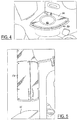
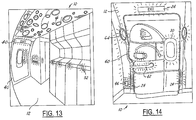
- Figures 1-14 illustrate various views of an interior, or cabin region 12, of a commercial aircraft 10.
- the aircraft 10 has a wide variety of translucent components 14 that are traditionally found within the cabin region 12 that are formed from a novel composite material 70 that is the subject of the present invention.
- the components 14 formed are light transmissive to allow for a pleasing glow or to allow for use as primary lighting within the cabin region 12.
- the materials also meet flammability standards.
- the standard test method for heat release is the Ohio State University heat release test as found in FAR 25.853, Part IV, in which the maximum allowable average heat release for interior panels contained with the cabin area of commercial airlines does not exceed 65kw/m 2 as measure at a two minute interval and for a peak rate at five minutes. This is also known in the industry as the 65/65 standard (peak heat release/total heat release).
- the translucent components 14 also meet Federal Aviation Association (FAA) certification requirements for materials used overhead in the passenger cabin area 12. These certification requirements state that the composite material 70 must not drip or dislodge from their designated flight configuration such that they inhibit egress when exposed to a temperature of 500 degrees Fahrenheit (260 degrees Celsius) for five minutes.
- FAA Federal Aviation Association
- Non-limiting examples of translucent components 14 that are formed from the composite material 70 of the present invention include, countertops 16, cabinet enclosures 18 such as wastebaskets, tray tables 20, backlit lighted signs 22 such as emergency exit signs 24, illuminating window panels 26 having light emitting diode displays 28, window bezels 30, class dividers 32, privacy partitions 34, backlit ceiling panels 36, direct lighting ceiling panels 38, lighted doors 40, lighted door latches 42, doorway linings 44, proximity lights 46, stow bin doors 48, privacy curtains 50, translucent door handles 52 (capable of changing from red to green, for example), translucent amenities cabinets 54, translucent sink decks 56 for lavatories and kitchens (with or without an appropriate undersink enclosure 58), doorway liners 60, stow bin latch handles 62, lighted phones 64, and backlit control panels 66. While these components 14 are illustrated in one preferred arrangement, it is understood that the number, type, and location of these translucent components 14 may vary greatly among various types of commercial aircraft 10 are not meant to be limited to the illustrated arrangement
- Figures 15-17 illustrate three preferred composite materials 70 that can subsequently be post-processed to form the translucent components 14 of Figures 1-14 .
- Figure 15 illustrates a two-layer composite material
- Figure 16 illustrates a three-layer composite material.
- Figure 17 illustrates another preferred two-layer composite material utilizing a unidirectional fiberglass material. Each is described below.
- a two-layer composite material 70 is formed by laminating a layer of weaved fibrous material 72 to a substrate material 74.
- a three-layer composite material 70 is formed by introducing second layer of substrate material 76 having the same composition as first layer 74 such that the fibrous material 72 is sandwiched and laminated between first and second layer 74, 76.
- a unidirectional, non-weaved fibrous material 72 is laminated to the substrate material to form another two-layer translucent composite material 70.
- one three-layer composite material 70 consists of a weaved fibrous material 72 sandwiched between and laminated to the first layer 74 and second layer 76 as in Figure 16 .
- two layers of fibrous material 72 could be introduced to a top and bottom surface of the substrate material 74 to form another composite material 70.
- the substrate material 74 is chosen based on the application for which it is utilized. In the case of airplane interior components 14, the substrate material 74 is chosen to allow adequate light transmissivity for the desired component.
- the substrate material 74 has the ability to soften to permit lamination of the fibrous material 72 as well as being able to be post processed to form a translucent component 14 having a desired shape and thickness. It is also desirable that the substrate material 74 is low cost, durable, and is available in varying thickness to provide design flexibility. Additionally, the substrate material 74 should be compatible with the fibrous material 72 and resist degradation due to light, heat, and stress.
- thermoplastic resin that meets these requirements is polyphenylsulfone, otherwise known as PPSU.
- PPSU is a translucent thermoplastic material typically that is relatively light transmissive and typically has a light brown tint.
- many grades of PPSU are commercially available, each having slightly varying transmissivity and flammability resistant properties.
- Radel PPSU available from Solvay Advanced Polymers, LLC.
- the fibrous material 72 is added to the PPSU substrate 74, 76 material to provide retention of the composite panel 60 in the event of fire.
- the fibrous material 72 laminated within the substrate or substrates 74, 76 allows compliance with the FAA certification requirement for flammability resistance properties, including heat release, vertical burn, smoke emissions tests, and toxic fume emissions tests.
- Long glass fibers 78 are preferred for use as the fibrous material 72, 70 due to their ability to act as thermal insulators, their ability to allow the substrate 70 to pass flammability tests, their ability to not overly decrease light transmissivity, and their overall appearance within the PPSU substrate 74, 76.
- the long glass fibers 78 utilized should have a thread count that is coarse enough to allow sufficient light transmission between the fibers 78 and through the substrate 74, 76. Also, there should be sufficient volume of fibers 78 in the fibrous material 72, 70 to produce a thermal insulation capacity necessary to achieve the minimum flammability properties. Further, visible fibers 78 in the composite material 70 should have a consistent appearance. Additionally, sufficient density of fibers 78 should be present to ensure article retention.
- the long glass fibers 78 have melting temperatures substantially above the melting temperature of the PPSU substrate 74.
- the glass fibers are able to support the PPSU substrate 74 once the PPSU substrate 74 is softened at 260°C (500 degrees Fahrenheit.)
- Two types of glass fibers 78 that meet these criteria are e-glass and s-glass fibers.
- the fiber 78 density, thickness, and orientation are all properties that may be optimized for a particular application.
- a higher density of fibers 78, or thicker fibers 78, within the PPSU substrate 74 will provide additional strength and will act as a heat sink when exposed to fire while adversely affecting light transmissivity and overall weight.
- a particular fiber orientation, or fiber weave may also affect weight, flammability, overhead fire retention, material strength, and light transmission.
- the fiber density, thickness, and orientation will be set to allow maximum transmissivity while maintaining the 65/65 standard.
- the density of glass fiber for example, may be increased compared to backlit light signs 22, as transmissivity of light is not necessary.
- the composite material 70 may be formed by many different and unique methods. Two preferred methods for forming the composite material 70 are the thermal pressing process and the continuous fiber impregnation process. Each is described below with respect to the two-layer composite material 70 of Figure 15 . However, as one of ordinary skill recognizes, the same preferred processes may be manipulated slightly to form the three-layer composite material 70 of Figure 16 or the two-layer composite material 70 having unidirectional fibers 78 as in Figure 17 .
- the substrate material 74 and fibrous material 72 are first introduced within a mold.
- the mold is first heated under controlled pressure to soften the substrate material 74. This is known as the preheating stage.
- higher heat and pressure are introduced to laminate the fibrous material 72 to the substrate material 74.
- the higher heat and pressure allows the impregnation of the embedded glass fibers 78 and substantially encapsulates the fibers 78 with the PPSU substrate material 74, therein forming the composite material 70.
- the composite material is cooled under controlled heat and pressure conditions to control internal stresses and warpage.
- a composite sheet 60 of 0.254 cm (0.1 inches) in thickness is formed by first introducing the PPSU substrate material 74 and fibrous material 72 to a mold. Next, in the preheating stage, the mold is heated to 279.4°C ( 535 degrees Fahrenheit) over 15 minutes.
- the mold is then held at 279.4°C ( 535 degrees) for 55 minutes at during the impregnation stage. During this time, the pressure is ratcheted upward slowly to prevent outgassing of the PPSU substrate material, therein preventing bubbles formed within the composite sheet 70.
- the pressure is maintained at 103.4 kPa ( 15 pounds per square inch) part pressure.
- the pressure is maintained at 344.7 kPa ( 50 pounds per square inch) part pressure.
- the pressure is maintained at 689.5 kPa (100 pounds per square inch) part pressure.
- the pressure is maintained at 1379.0 kPa ( 200 pounds per square inch) part pressure.
- the composite part is allowed to slowly cool down to 112.8°C (235 degrees Fahrenheit ) under constant pressure of 1379.0 kPa (200 pounds per square) part pressure.
- the cooling rate is maintained at -15°C (5 degrees Fahrenheit ) per minute, thus this portion of the cooling stage lasts approximately one hour to control internal stresses and warpage of the forming composite part.
- the temperature within the mold is slowly decreased to 65.6°C( 150 degrees Fahrenheit ) and 689.5 kPa ( 100 pounds per square inch) part pressure to further control internal stresses and warpage. Finally, the mold is opened and the composite sheet 70 is allowed to cool to room temperature.
- the thermal pressing technique has many benefits over other techniques used for forming composite materials.
- the fibers 78 are substantially encapsulated with the PPSU substrate material.
- thermal pressing at a temperature below the melting point of the PPSU substrate allows sufficient flex without yield.
- the thermal pressing technique also allows the incorporation of decorative features into the composite material. For example, a screen print may be added to the fibers 78 prior to adding the fibers 78 to the PPSU substrate material 74.
- molten PPSU resin making up the substrate material 74 is introduced from an extruder having a die set between a pair of rollers contained within a calendar roll stack.
- a sheet layer of fibrous material 72 is unrolled from a roller onto the molten layer between the first set of rollers.
- the calendar roll stack preferably containing three or more stainless steel calendar rolls stacked vertically, presses the fibrous material sheet layer and molten layer to a desired thickness, therein impregnating the PPSU resin within the fibrous material 72.
- the composite material 70 formed then is removed from the calendar rolls stack on a conveyor belt line and allowed to cool, therein forming a cooled, hardened composite sheet 70.
- the continuous impregnation technique offers slightly different benefits to the thermal pressing technique.
- the composite sheet material 70 may be formed at a quicker rate than with the thermal pressing technique. This is also cost effective.
- the thickness of the material formed may be easily modified by adjusting the clearance gap between the respective rollers of the calendar stack. Additionally, the process also automates impregnation techniques that would otherwise have to be accomplished manually.
- the composite material 70 is then available to be post-processed for the desired application.
- the type of post processing depends upon the component 14, and typically involves cutting, bending or thermoforming the part to a desired shape and size.
- a privacy curtain 50 must remain flexible, and is thus formed as a very thin composite material.
- a countertop 16 must be able to support items placed upon it, and thus is formed with a thickness much greater than the privacy curtain 50.
- the amount of light transmissivity may vary based upon the ultimate use of the component.
- an emergency exit sign 24 may be formed of a thin composite material 70 and with a lower fiber thread per unit area, therein allowing maximum light transmissivity.
- a ceiling may be formed with minimal light transmissivity having higher fiber thread count per unit area, therein providing maximum flammability resistance.
- the component 14 is then available for use within the cabin area 12.
- the composite material 70 having the desired light transmissivity and flame resistant characteristics as described above is bent, cut thermoformed or otherwise post-processed in methods well known in the art to shape and size the part to the desired configuration.
Landscapes
- Chemical & Material Sciences (AREA)
- Inorganic Chemistry (AREA)
- Engineering & Computer Science (AREA)
- Manufacturing & Machinery (AREA)
- Materials Engineering (AREA)
- Health & Medical Sciences (AREA)
- Chemical Kinetics & Catalysis (AREA)
- Medicinal Chemistry (AREA)
- Polymers & Plastics (AREA)
- Organic Chemistry (AREA)
- Laminated Bodies (AREA)
- Reinforced Plastic Materials (AREA)
Claims (19)
- Lichtdurchlässiges flammfestes Panel zur Verwendung im Innern eines Luftfahrzeugs, wobei das Panel aus einem zweilagigen Verbundmaterial gebildet ist, das aufweist:ein Polyphenylsulfon-Substratmaterial; undmehrere lange Glasfasern, die im Wesentlichen in das Polyphenylsulfon-Substratmaterial eingebettet sind, sodass das Verbundmaterial eine mittlere zulässige Wärmeabgabe aufweist, die einen 65/65-Standard gemäß dem in FAR 25.853 Teil IV aufgenommenen Wärmeabgabetest der Ohio State Universität nicht überschreitet, wobei die mehreren langen Glasfasern unter mehreren langen Glasfasern vom s-Typ und mehreren langen Glasfasern vom e-Typ ausgewählt sind.
- Lichtdurchlässiges flammfestes Panel nach Anspruch 1, wobei die mehreren langen Glasfasern mehrere unidirektionale lange Glasfasern umfassen.
- Lichtdurchlässiges flammfestes Panel nach Anspruch 1, wobei das Panel unter einer Arbeitsplatte, einem Möbelkorpus, einem Klapptisch, einem von hinten beleuchteten Hinweisschild, einem Beleuchtungsfensterpanel, einer Fenstereinfassung, einer Klassentrennwand, einer Diskretionstrennwand, einer von hinten beleuchteten Deckenplatte, einer direkt beleuchteten Deckenplatte, einem von hinten beleuchteten Bedienfeld, einer beleuchteten Tür, einem beleuchteten Türverschluss, einer Türverkleidung, einem Näherungslicht, einer Staufachtür, einem Diskretionsvorhang, einem lichtdurchlässigen Türgriff, einem lichtdurchlässigen Bedarfsartikelschrank, einer Waschbeckenablage, einer Türzarge, einem Staufachverriegelungsgriff und einem beleuchteten Telefon ausgewählt ist.
- Lichtdurchlässiges flammfestes Panel nach Anspruch 1, wobei das Verbundmaterial aufweist:eine erste Schicht des Polyphenylsulfon-Substratmaterials;eine zweite Schicht des Polyphenylsulfon-Substratmaterials;wobei die mehreren langen Glasfasern zwischen der ersten Schicht und der zweiten Schicht angeordnet und im Wesentlichen in der ersten und zweiten Schicht eingebettet sind, wobei diese Schichten ein dreilagiges Verbundmaterial bilden.
- Lichtdurchlässiges flammfestes Panel nach Anspruch 4, wobei die mehreren langen Glasfasern mehrere unidirektionale lange Glasfasern umfassen.
- Lichtdurchlässiges flammfestes Panel nach Anspruch 4, wobei das Panel unter einer Arbeitsplatte, einem Möbelkorpus, einem Klapptisch, einem von hinten beleuchteten Hinweisschild, einem Beleuchtungsfensterpanel, einer Fenstereinfassung, einer Klassentrennwand, einer Diskretionstrennwand, einer von hinten beleuchteten Deckenplatte, einer direkt beleuchteten Deckenplatte, einem von hinten beleuchteten Bedienfeld, einer beleuchteten Tür, einem beleuchteten Türverschluss, einer Türverkleidung, einem Näherungslicht, einer Staufachtür, einem Diskretionsvorhang, einem lichtdurchlässigen Türgriff, einem lichtdurchlässigen Bedarfsartikelschrank, einer Waschbeckenablage, einer Türzarge, einem Staufachverriegelungsgriff und einem beleuchteten Telefon ausgewählt ist.
- Lichtdurchlässiges flammfestes Panel nach Anspruch 1, wobei das Verbundmaterial aufweist:eine erste Schicht aus mehreren langen Glasfasern;eine zweite Schicht aus mehreren langen Glasfasern; undeine Schicht aus einem thermoplastischen Polyphenylsulfon-Substratmaterial, das zwischen der ersten Schicht und der zweiten Schicht angeordnet und die erste und zweite Schicht im Wesentlichen einbettet, wobei diese Schichten ein dreilagiges Verbundmaterial bilden.
- Verfahren zur Herstellung eines lichtdurchlässigen flammfesten Panels, wobei das Verfahren umfasst:Einbringen einer Schicht eines thermoplastischen Polyphenylsulfon-Substratmaterials in eine Form;Aufbringen eines Fasermaterials auf eine gesamte obere Oberfläche des Polyphenylsulfon-Substratmaterials innerhalb der Form, wobei das Fasermaterial mehrere lange Glasfasern umfasst, wobei die mehreren langen Glasfasern unter mehreren langen Glasfasern vom e-Typ und mehreren langen Glasfasern vom s-Typ ausgewählt sind und wobei die mehreren langen Glasfasern eine Schmelztemperatur über der Schmelztemperatur des Polyphenylsulfons aufweisen;Vorwärmen der Form auf eine erste Temperatur zum Erweichen des Polyphenylsulfon-Substratmaterials; Laminieren des Fasermaterials auf das Polyphenylsulfon-Substratmaterial, sodass die mehreren langen Glasfasern im Wesentlichen in dem Polyphenylsulfon-Substratmaterial eingebettet sind, wobei gleichzeitig ein Ausgasen des Polyphenylsulfon-Substratmaterials im Wesentlichen verhindert wird; Abkühlen der Form unter kontrollierten Wärme- und Druckbedingungen zur Bildung des Verbundmaterials;Entnehmen des Verbundmaterials aus der Form; undNachbearbeiten des Verbundmaterials zur Bildung eines lichtdurchlässigen flammfesten Panels.
- Verfahren nach Anspruch 8, worin das Aufbringen eines Fasermaterials umfasst, mehrere unidirektionale lange Glasfasern auf eine gesamte obere Oberfläche des Polyphenylsulfon-Substratmaterials innerhalb der Form aufzubringen.
- Verfahren nach Anspruch 8, worin das Vorwärmen der Form umfasst, die Form 15 Minuten lang auf 279,4 °C (535 Grad Fahrenheit) zu erwärmen, um das Polyphenylsulfon-Substratmaterial zu erweichen.
- Verfahren nach Anspruch 10, worin das Laminieren des Fasermaterials auf das Polyphenylsulfon-Substratmaterial umfasst:Halten der Form auf einer Temperatur von 279,4 °C (535 Grad Fahrenheit) für eine Zeitspanne von 0 bis 55 Minuten;Erhöhen des Drucks der Form bei 0 Minuten auf einen Teiledruck von 103,4 kPa (15 Pfund pro Quadratzoll);Halten der Form auf einem Teiledruck von 103,4 kPa (15 Pfund pro Quadratzoll) zwischen etwa 0 bis 5 Minuten;Erhöhen des Drucks von einem Teiledruck von 103,4 kPa (15 Pfund pro Quadratzoll) bei 5 Minuten auf einen Teiledruck von 344,7 kPa (50 Pfund pro Quadratzoll);Halten der Form auf einem Teiledruck von 344,7 kPa (50 Pfund pro Quadratzoll) zwischen etwa 5 bis 27 Minuten;Erhöhen des Drucks von einem Teiledruck von 344,7 kPa (50 Pfund pro Quadratzoll) bei 27 Minuten auf einen Teiledruck von 689,5 kPa (100 Pfund pro Quadratzoll);Halten der Form auf einem Teiledruck von 689,5 kPa (100 Pfund pro Quadratzoll) zwischen etwa 27 bis 47 Minuten;Erhöhen des Drucks von einem Teiledruck von 689,5 kPa (100 Pfund pro Quadratzoll) bei 47 Minuten auf einen Teiledruck von 1379,0 kPa (200 Pfund pro Quadratzoll); undHalten der Form auf einem Teiledruck von 1379,0 kPa (200 Pfund pro Quadratzoll) zwischen 47 bis 55 Minuten.
- Verfahren nach Anspruch 10, worin das Abkühlen der Form umfasst: langsames Abkühlen der Form von 279,4 °C (535 Grad Fahrenheit) auf 112, 8 °C (235 Grad Fahrenheit) bei 1379,0 kPa (200 Pfund pro Quadratzoll) Teiledruck mit einer Abkühlrate von -15 °C (5 Grad Fahrenheit) pro Minute; und weiteres Abkühlen der Form auf 65,6 °C (150 Grad Fahrenheit) bei 689,5 kPa (100 Pfund pro Quadratzoll) Teiledruck.
- Verfahren nach Anspruch 8, worin das Verfahren umfasst:Einbringen einer ersten Schicht des thermoplastischen Polyphenylsulfon-Substratmaterials in die Form;Aufbringen des Fasermaterials auf eine gesamte obere Oberfläche des Polyphenylsulfon-Substratmaterials innerhalb der Form;Einbringen einer zweiten Schicht des thermoplastischen Polyphenylsulfon-Substratmaterials in die Form, sodass das Fasermaterial zwischen der ersten Schicht und der zweiten Schicht eingefasst ist;Vorwärmen der Form auf eine erste Temperatur zum Erweichen der ersten Schicht und der zweiten Schicht;Laminieren des Fasermaterials auf die erste Schicht und die zweite Schicht, sodass die mehreren langen Glasfasern im Wesentlichen in dem Polyphenylsulfon-Substratmaterial eingebettet sind, wobei gleichzeitig ein Ausgasen der ersten und zweiten Schicht im Wesentlichen verhindert wird.
- Verfahren nach Anspruch 13, worin das Aufbringen eines Fasermaterials umfasst, mehrere unidirektionale lange Glasfasern auf eine gesamte obere Oberfläche des Polyphenylsulfon-Substratmaterials innerhalb der Form aufzubringen.
- Verfahren nach Anspruch 13, worin das Vorwärmen der Form umfasst, die Form 15 Minuten lang auf 279,4 °C (535 Grad Fahrenheit) zu erwärmen, um das Polyphenylsulfon-Substratmaterial zu erweichen.
- Verfahren nach Anspruch 15, worin das Laminieren des Fasermaterials auf das Polyphenylsulfon-Substratmaterial umfasst:die Form für eine Zeitspanne von 0 bis 55 Minuten auf einer Temperatur von 279,4 °C (535 Grad Fahrenheit) zu halten;den Druck der Form bei 0 Minuten auf einen Teiledruck von 103,4 kPa (15 Pfund pro Quadratzoll) zu erhöhen;die Form zwischen etwa 0 bis 5 Minuten auf einem Teiledruck von 103,4 kPa (15 Pfund pro Quadratzoll) zu halten;den Druck bei 5 Minuten von einem Teiledruck von 103,4 kPa (15 Pfund pro Quadratzoll) auf einen Teiledruck von 344,7 kPa (50 Pfund pro Quadratzoll) zu erhöhen;die Form zwischen etwa 5 bis 27 Minuten auf einem Teiledruck von 344,7 kPa (50 Pfund pro Quadratzoll) zu halten;den Druck bei 27 Minuten von einem Teiledruck von 344,7 kPa (50 Pfund pro Quadratzoll) auf einen Teiledruck von 689,5 kPa (100 Pfund pro Quadratzoll) zu erhöhen;die Form zwischen etwa 27 bis 47 Minuten auf einem Teiledruck von 689,5 kPa (100 Pfund pro Quadratzoll) zu halten;den Druck bei 47 Minuten von einem Teiledruck von 689,5 kPa (100 Pfund pro Quadratzoll) auf einen Teiledruck von 1379,0 kPa (200 Pfund pro Quadratzoll) zu erhöhen; unddie Form zwischen 47 bis 55 Minuten auf einem Teiledruck von 1379,0 kPa (200 Pfund pro Quadratzoll) zu halten.
- Verfahren nach Anspruch 16, worin das Abkühlen der Form umfasst:langsames Abkühlen der Form von 279,4 °C (535 Grad Fahrenheit) auf 112,8 °C (235 Grad Fahrenheit) bei 1379,0 kPa (200 Pfund pro Quadratzoll) Teiledruck mit einer Abkühlrate von -15 °C (5 Grad Fahrenheit) pro Minute; undweiteres Abkühlen der Form auf 65,6 °C (150 Grad Fahrenheit) bei 689,5 kPa (100 Pfund pro Quadratzoll) Teiledruck.
- Verfahren nach Anspruch 8, worin das Nachbearbeiten des Verbundmaterials unter Schneiden des Verbundmaterials in die gewünschte Form und Größe, Thermoformen des Verbundmaterials in die gewünschte Form und Größe und Verbinden des Verbundmaterials auf die gewünschte Form und Größe ausgewählt ist.
- Verfahren nach Anspruch 8, worin das lichtdurchlässige, flammenfeste Panel unter einer Arbeitsplatte, einem Möbelkorpus, einem Klapptisch, einem von hinten beleuchteten Hinweisschild, einem Beleuchtungsfensterpanel, einer Fenstereinfassung, einer Klassentrennwand, einer Diskretionstrennwand, einer von hinten beleuchteten Deckenplatte, einer direkt beleuchteten Dekkenplatte, einem von hinten beleuchteten Bedienfeld, einer beleuchteten Tür, einem beleuchteten Türverschluss, einer Türverkleidung, einem Näherungslicht, einer Staufachtür, einem Diskretionsvorhang, einem lichtdurchlässigen Türgriff, einem lichtdurchlässigen Bedarfsartikelschrank, einer Waschbeckenablage, einer Türzarge, einem Staufachverriegelungsgriff und einem beleuchteten Telefon ausgewählt ist.
Applications Claiming Priority (2)
| Application Number | Priority Date | Filing Date | Title |
|---|---|---|---|
| US10/707,612 US20050142968A1 (en) | 2003-12-24 | 2003-12-24 | Translucent, flame resistant composite materials |
| PCT/US2004/038242 WO2005065944A1 (en) | 2003-12-24 | 2004-11-10 | Translucent, flame resistant composite material |
Publications (2)
| Publication Number | Publication Date |
|---|---|
| EP1704050A1 EP1704050A1 (de) | 2006-09-27 |
| EP1704050B1 true EP1704050B1 (de) | 2016-05-25 |
Family
ID=34700309
Family Applications (1)
| Application Number | Title | Priority Date | Filing Date |
|---|---|---|---|
| EP04817829.7A Expired - Lifetime EP1704050B1 (de) | 2003-12-24 | 2004-11-10 | Lichtdurchlässige, flammfeste verbundmaterialien |
Country Status (3)
| Country | Link |
|---|---|
| US (2) | US20050142968A1 (de) |
| EP (1) | EP1704050B1 (de) |
| WO (1) | WO2005065944A1 (de) |
Families Citing this family (8)
| Publication number | Priority date | Publication date | Assignee | Title |
|---|---|---|---|---|
| DE102007001578B4 (de) * | 2007-01-10 | 2018-10-11 | Diehl Aviation Laupheim Gmbh | Hinterleuchtbares Flugzeuginterieurbauteil |
| US8277070B1 (en) | 2009-11-17 | 2012-10-02 | Crafted Countertops, Inc. | Counter with border lighting |
| FR2960902B1 (fr) * | 2010-06-08 | 2015-04-24 | Baumert Technologies | Bloc-porte coupe feu a un ou deux vantaux pivotant(s) |
| JP6535167B2 (ja) * | 2015-01-21 | 2019-06-26 | 三菱航空機株式会社 | 航空機、および胴体の冷却構造 |
| US10125439B2 (en) | 2017-02-02 | 2018-11-13 | Douglas J. Bailey | Flexible translucent to transparent fireproof composite material |
| DE102017215369A1 (de) * | 2017-09-01 | 2019-03-07 | Benecke-Kaliko Ag | Lichtdurchlässige Mehrschichtverbundfolie |
| GB2569151B (en) * | 2017-12-07 | 2021-01-27 | Jaguar Land Rover Ltd | Reformable article |
| US12491981B2 (en) | 2023-03-08 | 2025-12-09 | Jetzero, Inc. | Blended wing body aircraft with transmissive panels |
Family Cites Families (14)
| Publication number | Priority date | Publication date | Assignee | Title |
|---|---|---|---|---|
| US3434914A (en) * | 1966-02-01 | 1969-03-25 | Union Carbide Corp | Glass fiber reinforced thermoplastic polyarylene polyether resin article and process for making same |
| FR2619399B1 (fr) * | 1987-08-11 | 1991-10-25 | Brochier Sa | Structure textile pour la realisation de stratifies a hautes proprietes mecaniques |
| EP0312151B1 (de) * | 1987-10-14 | 1991-03-27 | Akzo N.V. | Schichtstoff aus Metallschichten und aus durchgehendem faserverstärktem synthetischem Material |
| DE3741539A1 (de) * | 1987-12-08 | 1989-06-22 | Bayer Ag | Leichtverbundwerkstoff, verbundwerkstoff, der in diesen leichtverbundwerkstoff uebergehen kann, verfahren zur herstellung des leichtverbundwerkstoffs und des verbundwerkstoffs und formteile, die den leichtverbundwerkstoff enthalten oder daraus bestehen |
| GB8925193D0 (en) * | 1989-11-08 | 1991-01-02 | Royal Ordnance Plc | The protection of aircraft structures |
| US5258445A (en) * | 1990-03-08 | 1993-11-02 | The B. F. Goodrich Company | Fiber-reinforced thermoplastic molding compositions using a copolyester |
| JPH0817880B2 (ja) * | 1990-11-28 | 1996-02-28 | 帝人株式会社 | プレスクッション材 |
| US5319003A (en) * | 1992-09-30 | 1994-06-07 | Union Carbide Chemicals & Plastics Technology Corporation | Method for improving the mechanical performance of composite articles |
| US5398889A (en) * | 1994-02-22 | 1995-03-21 | Furon Company | Aircraft fuselage lining system |
| JPH08193623A (ja) * | 1994-10-25 | 1996-07-30 | Koyo Seiko Co Ltd | 転がり軸受用保持器 |
| US5911932A (en) * | 1997-07-09 | 1999-06-15 | R. Charles Balmer | Method of prepregging with resin |
| US6242638B1 (en) * | 1999-03-12 | 2001-06-05 | Vantico Inc. | Cyanate esters having flame resistant properties |
| US6673872B2 (en) * | 2000-05-17 | 2004-01-06 | General Electric Company | High performance thermoplastic compositions with improved melt flow properties |
| US20040219855A1 (en) * | 2003-05-02 | 2004-11-04 | Tsotsis Thomas K. | Highly porous interlayers to toughen liquid-molded fabric-based composites |
-
2003
- 2003-12-24 US US10/707,612 patent/US20050142968A1/en not_active Abandoned
-
2004
- 2004-11-10 EP EP04817829.7A patent/EP1704050B1/de not_active Expired - Lifetime
- 2004-11-10 WO PCT/US2004/038242 patent/WO2005065944A1/en not_active Ceased
-
2009
- 2009-10-12 US US12/577,618 patent/US8007620B2/en not_active Expired - Fee Related
Also Published As
| Publication number | Publication date |
|---|---|
| US20100059900A1 (en) | 2010-03-11 |
| WO2005065944A1 (en) | 2005-07-21 |
| US8007620B2 (en) | 2011-08-30 |
| US20050142968A1 (en) | 2005-06-30 |
| EP1704050A1 (de) | 2006-09-27 |
Similar Documents
| Publication | Publication Date | Title |
|---|---|---|
| US8007620B2 (en) | Translucent, flame resistant composite materials | |
| US10180517B2 (en) | Vehicle mirror, and method for manufacturing such a mirror | |
| US7682697B2 (en) | Fiber reinforced thermoplastic sheets with surface coverings | |
| US20050272329A1 (en) | Wire mesh panel and method | |
| US20160136929A1 (en) | Composite Element and Use Thereof | |
| US20150284910A1 (en) | Fiber reinforced thermoplastic sheets with surface coverings | |
| US9650496B2 (en) | Interior aircraft components and methods of manufacture | |
| JP2000343632A (ja) | 熱可塑性樹脂外装とこれらの外装の1つに接着している装飾フィルムとが備わっているコアを有する構造パネルを用いて作成した複合体構造物 | |
| USRE44893E1 (en) | Fiber reinforced thermoplastic sheets with surface coverings | |
| US8617715B2 (en) | Fire retardant shades | |
| EP0529980A1 (de) | Thermoformbare Polycarbonat/Glasgewebe-Verbundstoffe | |
| EP1874537B1 (de) | Schichtförmiger transparenter thermoplast für entflammbarkeitsresistenz | |
| MXPA04002337A (es) | Productos de espuma compuesta y metodo. | |
| CN113022033A (zh) | 防弹板和制作防弹板的方法 | |
| KR20190052691A (ko) | 적층 가식 필름과 그 제조 방법, 그리고, 가식 성형체와 그 제조 방법 | |
| US20120156440A1 (en) | Translucent, Flame Resistant Composite Materials | |
| CN116472255A (zh) | 增强型玻璃陶瓷制品 | |
| Lyon | Materials with reduced flammability in aerospace and aviation | |
| CN108474156A (zh) | 用于半结构面板的阻燃聚碳酸酯复合材料 | |
| EP4009017B1 (de) | Systeme und verfahren zur verwendung von uv-empfindlichen laminaten und verfahren zu deren herstellung | |
| JP3187473U (ja) | 装飾パネル | |
| CN112549707A (zh) | 一种食品级阻燃航空板材及其制作方法 | |
| JP2015116805A (ja) | ポリカーボネート積層体、及び、屋根材 | |
| US20200296864A1 (en) | Antenna screening composite, panel, assembly, and method of manufacturing same | |
| KR100896476B1 (ko) | 층간 접착력이 우수한 장식 시트 및 그 제조방법 |
Legal Events
| Date | Code | Title | Description |
|---|---|---|---|
| PUAI | Public reference made under article 153(3) epc to a published international application that has entered the european phase |
Free format text: ORIGINAL CODE: 0009012 |
|
| 17P | Request for examination filed |
Effective date: 20060706 |
|
| AK | Designated contracting states |
Kind code of ref document: A1 Designated state(s): AT BE BG CH CY CZ DE DK EE ES FI FR GB GR HU IE IS IT LI LU MC NL PL PT RO SE SI SK TR |
|
| 17Q | First examination report despatched |
Effective date: 20061026 |
|
| DAX | Request for extension of the european patent (deleted) | ||
| GRAP | Despatch of communication of intention to grant a patent |
Free format text: ORIGINAL CODE: EPIDOSNIGR1 |
|
| INTG | Intention to grant announced |
Effective date: 20151208 |
|
| GRAS | Grant fee paid |
Free format text: ORIGINAL CODE: EPIDOSNIGR3 |
|
| GRAA | (expected) grant |
Free format text: ORIGINAL CODE: 0009210 |
|
| AK | Designated contracting states |
Kind code of ref document: B1 Designated state(s): AT BE BG CH CY CZ DE DK EE ES FI FR GB GR HU IE IS IT LI LU MC NL PL PT RO SE SI SK TR |
|
| REG | Reference to a national code |
Ref country code: GB Ref legal event code: FG4D |
|
| REG | Reference to a national code |
Ref country code: CH Ref legal event code: EP |
|
| REG | Reference to a national code |
Ref country code: IE Ref legal event code: FG4D Ref country code: AT Ref legal event code: REF Ref document number: 801926 Country of ref document: AT Kind code of ref document: T Effective date: 20160615 |
|
| REG | Reference to a national code |
Ref country code: DE Ref legal event code: R096 Ref document number: 602004049377 Country of ref document: DE |
|
| REG | Reference to a national code |
Ref country code: NL Ref legal event code: MP Effective date: 20160525 |
|
| PG25 | Lapsed in a contracting state [announced via postgrant information from national office to epo] |
Ref country code: FI Free format text: LAPSE BECAUSE OF FAILURE TO SUBMIT A TRANSLATION OF THE DESCRIPTION OR TO PAY THE FEE WITHIN THE PRESCRIBED TIME-LIMIT Effective date: 20160525 Ref country code: NL Free format text: LAPSE BECAUSE OF FAILURE TO SUBMIT A TRANSLATION OF THE DESCRIPTION OR TO PAY THE FEE WITHIN THE PRESCRIBED TIME-LIMIT Effective date: 20160525 |
|
| REG | Reference to a national code |
Ref country code: AT Ref legal event code: MK05 Ref document number: 801926 Country of ref document: AT Kind code of ref document: T Effective date: 20160525 |
|
| REG | Reference to a national code |
Ref country code: FR Ref legal event code: PLFP Year of fee payment: 13 |
|
| PG25 | Lapsed in a contracting state [announced via postgrant information from national office to epo] |
Ref country code: GR Free format text: LAPSE BECAUSE OF FAILURE TO SUBMIT A TRANSLATION OF THE DESCRIPTION OR TO PAY THE FEE WITHIN THE PRESCRIBED TIME-LIMIT Effective date: 20160826 Ref country code: PT Free format text: LAPSE BECAUSE OF FAILURE TO SUBMIT A TRANSLATION OF THE DESCRIPTION OR TO PAY THE FEE WITHIN THE PRESCRIBED TIME-LIMIT Effective date: 20160926 Ref country code: SE Free format text: LAPSE BECAUSE OF FAILURE TO SUBMIT A TRANSLATION OF THE DESCRIPTION OR TO PAY THE FEE WITHIN THE PRESCRIBED TIME-LIMIT Effective date: 20160525 Ref country code: ES Free format text: LAPSE BECAUSE OF FAILURE TO SUBMIT A TRANSLATION OF THE DESCRIPTION OR TO PAY THE FEE WITHIN THE PRESCRIBED TIME-LIMIT Effective date: 20160525 |
|
| PG25 | Lapsed in a contracting state [announced via postgrant information from national office to epo] |
Ref country code: IT Free format text: LAPSE BECAUSE OF FAILURE TO SUBMIT A TRANSLATION OF THE DESCRIPTION OR TO PAY THE FEE WITHIN THE PRESCRIBED TIME-LIMIT Effective date: 20160525 |
|
| PG25 | Lapsed in a contracting state [announced via postgrant information from national office to epo] |
Ref country code: DK Free format text: LAPSE BECAUSE OF FAILURE TO SUBMIT A TRANSLATION OF THE DESCRIPTION OR TO PAY THE FEE WITHIN THE PRESCRIBED TIME-LIMIT Effective date: 20160525 Ref country code: CZ Free format text: LAPSE BECAUSE OF FAILURE TO SUBMIT A TRANSLATION OF THE DESCRIPTION OR TO PAY THE FEE WITHIN THE PRESCRIBED TIME-LIMIT Effective date: 20160525 Ref country code: RO Free format text: LAPSE BECAUSE OF FAILURE TO SUBMIT A TRANSLATION OF THE DESCRIPTION OR TO PAY THE FEE WITHIN THE PRESCRIBED TIME-LIMIT Effective date: 20160525 Ref country code: EE Free format text: LAPSE BECAUSE OF FAILURE TO SUBMIT A TRANSLATION OF THE DESCRIPTION OR TO PAY THE FEE WITHIN THE PRESCRIBED TIME-LIMIT Effective date: 20160525 Ref country code: SK Free format text: LAPSE BECAUSE OF FAILURE TO SUBMIT A TRANSLATION OF THE DESCRIPTION OR TO PAY THE FEE WITHIN THE PRESCRIBED TIME-LIMIT Effective date: 20160525 |
|
| PG25 | Lapsed in a contracting state [announced via postgrant information from national office to epo] |
Ref country code: BE Free format text: LAPSE BECAUSE OF FAILURE TO SUBMIT A TRANSLATION OF THE DESCRIPTION OR TO PAY THE FEE WITHIN THE PRESCRIBED TIME-LIMIT Effective date: 20160525 Ref country code: PL Free format text: LAPSE BECAUSE OF FAILURE TO SUBMIT A TRANSLATION OF THE DESCRIPTION OR TO PAY THE FEE WITHIN THE PRESCRIBED TIME-LIMIT Effective date: 20160525 Ref country code: AT Free format text: LAPSE BECAUSE OF FAILURE TO SUBMIT A TRANSLATION OF THE DESCRIPTION OR TO PAY THE FEE WITHIN THE PRESCRIBED TIME-LIMIT Effective date: 20160525 |
|
| REG | Reference to a national code |
Ref country code: DE Ref legal event code: R097 Ref document number: 602004049377 Country of ref document: DE |
|
| PLBE | No opposition filed within time limit |
Free format text: ORIGINAL CODE: 0009261 |
|
| STAA | Information on the status of an ep patent application or granted ep patent |
Free format text: STATUS: NO OPPOSITION FILED WITHIN TIME LIMIT |
|
| 26N | No opposition filed |
Effective date: 20170228 |
|
| PG25 | Lapsed in a contracting state [announced via postgrant information from national office to epo] |
Ref country code: SI Free format text: LAPSE BECAUSE OF FAILURE TO SUBMIT A TRANSLATION OF THE DESCRIPTION OR TO PAY THE FEE WITHIN THE PRESCRIBED TIME-LIMIT Effective date: 20160525 |
|
| REG | Reference to a national code |
Ref country code: CH Ref legal event code: PL |
|
| PG25 | Lapsed in a contracting state [announced via postgrant information from national office to epo] |
Ref country code: CH Free format text: LAPSE BECAUSE OF NON-PAYMENT OF DUE FEES Effective date: 20161130 Ref country code: LI Free format text: LAPSE BECAUSE OF NON-PAYMENT OF DUE FEES Effective date: 20161130 |
|
| REG | Reference to a national code |
Ref country code: IE Ref legal event code: MM4A |
|
| PG25 | Lapsed in a contracting state [announced via postgrant information from national office to epo] |
Ref country code: LU Free format text: LAPSE BECAUSE OF NON-PAYMENT OF DUE FEES Effective date: 20161130 |
|
| REG | Reference to a national code |
Ref country code: FR Ref legal event code: PLFP Year of fee payment: 14 |
|
| PG25 | Lapsed in a contracting state [announced via postgrant information from national office to epo] |
Ref country code: IE Free format text: LAPSE BECAUSE OF NON-PAYMENT OF DUE FEES Effective date: 20161110 |
|
| PG25 | Lapsed in a contracting state [announced via postgrant information from national office to epo] |
Ref country code: CY Free format text: LAPSE BECAUSE OF FAILURE TO SUBMIT A TRANSLATION OF THE DESCRIPTION OR TO PAY THE FEE WITHIN THE PRESCRIBED TIME-LIMIT Effective date: 20160525 Ref country code: HU Free format text: LAPSE BECAUSE OF FAILURE TO SUBMIT A TRANSLATION OF THE DESCRIPTION OR TO PAY THE FEE WITHIN THE PRESCRIBED TIME-LIMIT; INVALID AB INITIO Effective date: 20041110 |
|
| PG25 | Lapsed in a contracting state [announced via postgrant information from national office to epo] |
Ref country code: TR Free format text: LAPSE BECAUSE OF FAILURE TO SUBMIT A TRANSLATION OF THE DESCRIPTION OR TO PAY THE FEE WITHIN THE PRESCRIBED TIME-LIMIT Effective date: 20160525 Ref country code: MC Free format text: LAPSE BECAUSE OF FAILURE TO SUBMIT A TRANSLATION OF THE DESCRIPTION OR TO PAY THE FEE WITHIN THE PRESCRIBED TIME-LIMIT Effective date: 20160525 Ref country code: IS Free format text: LAPSE BECAUSE OF FAILURE TO SUBMIT A TRANSLATION OF THE DESCRIPTION OR TO PAY THE FEE WITHIN THE PRESCRIBED TIME-LIMIT Effective date: 20160525 |
|
| PG25 | Lapsed in a contracting state [announced via postgrant information from national office to epo] |
Ref country code: BG Free format text: LAPSE BECAUSE OF FAILURE TO SUBMIT A TRANSLATION OF THE DESCRIPTION OR TO PAY THE FEE WITHIN THE PRESCRIBED TIME-LIMIT Effective date: 20160525 |
|
| REG | Reference to a national code |
Ref country code: DE Ref legal event code: R082 Ref document number: 602004049377 Country of ref document: DE Representative=s name: MAIER, LL.M., MICHAEL C., DE Ref country code: DE Ref legal event code: R082 Ref document number: 602004049377 Country of ref document: DE Representative=s name: BOULT WADE TENNANT LLP, DE |
|
| REG | Reference to a national code |
Ref country code: DE Ref legal event code: R082 Ref document number: 602004049377 Country of ref document: DE Representative=s name: BOULT WADE TENNANT LLP, DE |
|
| PGFP | Annual fee paid to national office [announced via postgrant information from national office to epo] |
Ref country code: FR Payment date: 20211124 Year of fee payment: 18 Ref country code: GB Payment date: 20211129 Year of fee payment: 18 Ref country code: DE Payment date: 20211126 Year of fee payment: 18 |
|
| REG | Reference to a national code |
Ref country code: DE Ref legal event code: R119 Ref document number: 602004049377 Country of ref document: DE |
|
| GBPC | Gb: european patent ceased through non-payment of renewal fee |
Effective date: 20221110 |
|
| PG25 | Lapsed in a contracting state [announced via postgrant information from national office to epo] |
Ref country code: GB Free format text: LAPSE BECAUSE OF NON-PAYMENT OF DUE FEES Effective date: 20221110 Ref country code: DE Free format text: LAPSE BECAUSE OF NON-PAYMENT OF DUE FEES Effective date: 20230601 |
|
| PG25 | Lapsed in a contracting state [announced via postgrant information from national office to epo] |
Ref country code: FR Free format text: LAPSE BECAUSE OF NON-PAYMENT OF DUE FEES Effective date: 20221130 |