EP1702962A1 - Ink composition containing a photo-acid and a photo-base generator and processes using them - Google Patents
Ink composition containing a photo-acid and a photo-base generator and processes using them Download PDFInfo
- Publication number
- EP1702962A1 EP1702962A1 EP20060003312 EP06003312A EP1702962A1 EP 1702962 A1 EP1702962 A1 EP 1702962A1 EP 20060003312 EP20060003312 EP 20060003312 EP 06003312 A EP06003312 A EP 06003312A EP 1702962 A1 EP1702962 A1 EP 1702962A1
- Authority
- EP
- European Patent Office
- Prior art keywords
- group
- ink composition
- compound
- acid
- radiation
- Prior art date
- Legal status (The legal status is an assumption and is not a legal conclusion. Google has not performed a legal analysis and makes no representation as to the accuracy of the status listed.)
- Granted
Links
- 239000000203 mixture Substances 0.000 title claims abstract description 153
- 238000000034 method Methods 0.000 title claims abstract description 66
- 239000002253 acid Substances 0.000 title claims abstract description 61
- 230000008569 process Effects 0.000 title claims description 10
- 150000001875 compounds Chemical class 0.000 claims abstract description 185
- 230000005855 radiation Effects 0.000 claims abstract description 55
- 229910052757 nitrogen Inorganic materials 0.000 claims abstract description 19
- 125000004433 nitrogen atom Chemical group N* 0.000 claims abstract description 18
- 230000001678 irradiating effect Effects 0.000 claims abstract description 11
- 238000007599 discharging Methods 0.000 claims abstract description 9
- 239000000049 pigment Substances 0.000 claims description 114
- 125000000217 alkyl group Chemical group 0.000 claims description 75
- 125000003118 aryl group Chemical group 0.000 claims description 73
- 125000000753 cycloalkyl group Chemical group 0.000 claims description 54
- 238000007639 printing Methods 0.000 claims description 51
- 239000000463 material Substances 0.000 claims description 27
- 125000003710 aryl alkyl group Chemical group 0.000 claims description 26
- 125000004435 hydrogen atom Chemical group [H]* 0.000 claims description 23
- 239000003086 colorant Substances 0.000 claims description 19
- 125000005843 halogen group Chemical group 0.000 claims description 14
- 125000005842 heteroatom Chemical group 0.000 claims description 12
- 150000001450 anions Chemical class 0.000 claims description 10
- 125000001931 aliphatic group Chemical group 0.000 claims description 9
- 125000004430 oxygen atom Chemical group O* 0.000 claims description 8
- 229910052717 sulfur Inorganic materials 0.000 claims description 8
- 125000004434 sulfur atom Chemical group 0.000 claims description 8
- 125000002252 acyl group Chemical group 0.000 claims description 7
- 230000002209 hydrophobic effect Effects 0.000 claims description 7
- 125000000449 nitro group Chemical group [O-][N+](*)=O 0.000 claims description 7
- 125000005462 imide group Chemical group 0.000 claims description 5
- 238000004519 manufacturing process Methods 0.000 claims description 5
- 125000002950 monocyclic group Chemical group 0.000 claims description 5
- 239000000976 ink Substances 0.000 description 211
- -1 aromatic epoxides Chemical class 0.000 description 90
- 239000000460 chlorine Substances 0.000 description 41
- 239000002609 medium Substances 0.000 description 36
- 238000001723 curing Methods 0.000 description 35
- 239000000975 dye Substances 0.000 description 34
- 238000011282 treatment Methods 0.000 description 33
- 230000035945 sensitivity Effects 0.000 description 29
- 229910052782 aluminium Inorganic materials 0.000 description 26
- XAGFODPZIPBFFR-UHFFFAOYSA-N aluminium Chemical compound [Al] XAGFODPZIPBFFR-UHFFFAOYSA-N 0.000 description 26
- 238000003860 storage Methods 0.000 description 25
- 239000006185 dispersion Substances 0.000 description 24
- 239000010408 film Substances 0.000 description 23
- RTZKZFJDLAIYFH-UHFFFAOYSA-N Diethyl ether Chemical compound CCOCC RTZKZFJDLAIYFH-UHFFFAOYSA-N 0.000 description 21
- 239000002585 base Substances 0.000 description 21
- 125000003545 alkoxy group Chemical group 0.000 description 20
- 125000002947 alkylene group Chemical group 0.000 description 19
- 239000004593 Epoxy Substances 0.000 description 18
- 229920000642 polymer Polymers 0.000 description 17
- QYKIQEUNHZKYBP-UHFFFAOYSA-N Vinyl ether Chemical class C=COC=C QYKIQEUNHZKYBP-UHFFFAOYSA-N 0.000 description 15
- 239000002904 solvent Substances 0.000 description 15
- 125000001424 substituent group Chemical group 0.000 description 15
- 238000011156 evaluation Methods 0.000 description 14
- 239000000178 monomer Substances 0.000 description 13
- LYCAIKOWRPUZTN-UHFFFAOYSA-N ethylene glycol Natural products OCCO LYCAIKOWRPUZTN-UHFFFAOYSA-N 0.000 description 11
- 125000000962 organic group Chemical group 0.000 description 11
- 238000007254 oxidation reaction Methods 0.000 description 11
- 229920005989 resin Polymers 0.000 description 11
- 239000011347 resin Substances 0.000 description 11
- 238000007788 roughening Methods 0.000 description 11
- 239000007787 solid Substances 0.000 description 11
- 0 *C1(CO*OCC2(CO*C2)*=C)COCC1 Chemical compound *C1(CO*OCC2(CO*C2)*=C)COCC1 0.000 description 10
- 230000015556 catabolic process Effects 0.000 description 10
- 238000006731 degradation reaction Methods 0.000 description 10
- GYZLOYUZLJXAJU-UHFFFAOYSA-N diglycidyl ether Chemical class C1OC1COCC1CO1 GYZLOYUZLJXAJU-UHFFFAOYSA-N 0.000 description 10
- 125000001495 ethyl group Chemical group [H]C([H])([H])C([H])([H])* 0.000 description 10
- 125000002496 methyl group Chemical group [H]C([H])([H])* 0.000 description 10
- 230000003647 oxidation Effects 0.000 description 10
- 125000001436 propyl group Chemical group [H]C([*])([H])C([H])([H])C([H])([H])[H] 0.000 description 10
- 238000007789 sealing Methods 0.000 description 10
- 229960000834 vinyl ether Drugs 0.000 description 10
- 230000002378 acidificating effect Effects 0.000 description 9
- 125000004122 cyclic group Chemical group 0.000 description 9
- 239000002270 dispersing agent Substances 0.000 description 9
- 239000002245 particle Substances 0.000 description 9
- 230000035515 penetration Effects 0.000 description 9
- 239000000758 substrate Substances 0.000 description 9
- XLYOFNOQVPJJNP-UHFFFAOYSA-N water Substances O XLYOFNOQVPJJNP-UHFFFAOYSA-N 0.000 description 9
- FNYWFRSQRHGKJT-UHFFFAOYSA-N 3-ethyl-3-[(3-ethyloxetan-3-yl)methoxymethyl]oxetane Chemical compound C1OCC1(CC)COCC1(CC)COC1 FNYWFRSQRHGKJT-UHFFFAOYSA-N 0.000 description 8
- 239000003795 chemical substances by application Substances 0.000 description 8
- 239000003792 electrolyte Substances 0.000 description 8
- 229910052731 fluorine Inorganic materials 0.000 description 8
- AHHWIHXENZJRFG-UHFFFAOYSA-N oxetane Chemical compound C1COC1 AHHWIHXENZJRFG-UHFFFAOYSA-N 0.000 description 8
- 125000003566 oxetanyl group Chemical group 0.000 description 8
- 230000000052 comparative effect Effects 0.000 description 7
- 125000004093 cyano group Chemical group *C#N 0.000 description 7
- 125000002887 hydroxy group Chemical group [H]O* 0.000 description 7
- 229920002521 macromolecule Polymers 0.000 description 7
- 125000001997 phenyl group Chemical group [H]C1=C([H])C([H])=C(*)C([H])=C1[H] 0.000 description 7
- 150000003839 salts Chemical class 0.000 description 7
- LFQSCWFLJHTTHZ-UHFFFAOYSA-N Ethanol Chemical compound CCO LFQSCWFLJHTTHZ-UHFFFAOYSA-N 0.000 description 6
- IAYPIBMASNFSPL-UHFFFAOYSA-N Ethylene oxide Chemical compound C1CO1 IAYPIBMASNFSPL-UHFFFAOYSA-N 0.000 description 6
- 206010073306 Exposure to radiation Diseases 0.000 description 6
- GOOHAUXETOMSMM-UHFFFAOYSA-N Propylene oxide Chemical compound CC1CO1 GOOHAUXETOMSMM-UHFFFAOYSA-N 0.000 description 6
- GWEVSGVZZGPLCZ-UHFFFAOYSA-N Titan oxide Chemical compound O=[Ti]=O GWEVSGVZZGPLCZ-UHFFFAOYSA-N 0.000 description 6
- 239000007864 aqueous solution Substances 0.000 description 6
- 125000000484 butyl group Chemical group [H]C([*])([H])C([H])([H])C([H])([H])C([H])([H])[H] 0.000 description 6
- 125000000113 cyclohexyl group Chemical group [H]C1([H])C([H])([H])C([H])([H])C([H])(*)C([H])([H])C1([H])[H] 0.000 description 6
- 230000000694 effects Effects 0.000 description 6
- 150000002148 esters Chemical class 0.000 description 6
- 229940052303 ethers for general anesthesia Drugs 0.000 description 6
- 230000001747 exhibiting effect Effects 0.000 description 6
- 238000010438 heat treatment Methods 0.000 description 6
- 125000005647 linker group Chemical group 0.000 description 6
- BBEAQIROQSPTKN-UHFFFAOYSA-N pyrene Chemical compound C1=CC=C2C=CC3=CC=CC4=CC=C1C2=C43 BBEAQIROQSPTKN-UHFFFAOYSA-N 0.000 description 6
- 239000000523 sample Substances 0.000 description 6
- 238000003892 spreading Methods 0.000 description 6
- 230000007480 spreading Effects 0.000 description 6
- LCFVJGUPQDGYKZ-UHFFFAOYSA-N Bisphenol A diglycidyl ether Chemical compound C=1C=C(OCC2OC2)C=CC=1C(C)(C)C(C=C1)=CC=C1OCC1CO1 LCFVJGUPQDGYKZ-UHFFFAOYSA-N 0.000 description 5
- XLOMVQKBTHCTTD-UHFFFAOYSA-N Zinc monoxide Chemical compound [Zn]=O XLOMVQKBTHCTTD-UHFFFAOYSA-N 0.000 description 5
- 150000007513 acids Chemical class 0.000 description 5
- 125000005079 alkoxycarbonylmethyl group Chemical group 0.000 description 5
- 230000015572 biosynthetic process Effects 0.000 description 5
- 125000003178 carboxy group Chemical group [H]OC(*)=O 0.000 description 5
- 238000011109 contamination Methods 0.000 description 5
- 229920001577 copolymer Polymers 0.000 description 5
- 125000001511 cyclopentyl group Chemical group [H]C1([H])C([H])([H])C([H])([H])C([H])(*)C1([H])[H] 0.000 description 5
- 238000010894 electron beam technology Methods 0.000 description 5
- 150000002170 ethers Chemical class 0.000 description 5
- 125000001153 fluoro group Chemical group F* 0.000 description 5
- 125000003709 fluoroalkyl group Chemical group 0.000 description 5
- 230000000269 nucleophilic effect Effects 0.000 description 5
- 125000000547 substituted alkyl group Chemical group 0.000 description 5
- 239000004094 surface-active agent Substances 0.000 description 5
- 238000012360 testing method Methods 0.000 description 5
- CZAVRNDQSIORTH-UHFFFAOYSA-N 1-ethenoxy-2,2-bis(ethenoxymethyl)butane Chemical compound C=COCC(CC)(COC=C)COC=C CZAVRNDQSIORTH-UHFFFAOYSA-N 0.000 description 4
- TXBCBTDQIULDIA-UHFFFAOYSA-N 2-[[3-hydroxy-2,2-bis(hydroxymethyl)propoxy]methyl]-2-(hydroxymethyl)propane-1,3-diol Chemical compound OCC(CO)(CO)COCC(CO)(CO)CO TXBCBTDQIULDIA-UHFFFAOYSA-N 0.000 description 4
- 125000003903 2-propenyl group Chemical group [H]C([*])([H])C([H])=C([H])[H] 0.000 description 4
- JTHZUSWLNCPZLX-UHFFFAOYSA-N 6-fluoro-3-methyl-2h-indazole Chemical compound FC1=CC=C2C(C)=NNC2=C1 JTHZUSWLNCPZLX-UHFFFAOYSA-N 0.000 description 4
- VEXZGXHMUGYJMC-UHFFFAOYSA-N Hydrochloric acid Chemical compound Cl VEXZGXHMUGYJMC-UHFFFAOYSA-N 0.000 description 4
- ISWSIDIOOBJBQZ-UHFFFAOYSA-N Phenol Chemical compound OC1=CC=CC=C1 ISWSIDIOOBJBQZ-UHFFFAOYSA-N 0.000 description 4
- 229920003171 Poly (ethylene oxide) Polymers 0.000 description 4
- 239000004698 Polyethylene Substances 0.000 description 4
- 239000002202 Polyethylene glycol Substances 0.000 description 4
- 239000004743 Polypropylene Substances 0.000 description 4
- 125000004453 alkoxycarbonyl group Chemical group 0.000 description 4
- 238000007743 anodising Methods 0.000 description 4
- PYKYMHQGRFAEBM-UHFFFAOYSA-N anthraquinone Natural products CCC(=O)c1c(O)c2C(=O)C3C(C=CC=C3O)C(=O)c2cc1CC(=O)OC PYKYMHQGRFAEBM-UHFFFAOYSA-N 0.000 description 4
- 150000004056 anthraquinones Chemical class 0.000 description 4
- IISBACLAFKSPIT-UHFFFAOYSA-N bisphenol A Chemical compound C=1C=C(O)C=CC=1C(C)(C)C1=CC=C(O)C=C1 IISBACLAFKSPIT-UHFFFAOYSA-N 0.000 description 4
- 125000002915 carbonyl group Chemical group [*:2]C([*:1])=O 0.000 description 4
- 230000008859 change Effects 0.000 description 4
- XCJYREBRNVKWGJ-UHFFFAOYSA-N copper(II) phthalocyanine Chemical compound [Cu+2].C12=CC=CC=C2C(N=C2[N-]C(C3=CC=CC=C32)=N2)=NC1=NC([C]1C=CC=CC1=1)=NC=1N=C1[C]3C=CC=CC3=C2[N-]1 XCJYREBRNVKWGJ-UHFFFAOYSA-N 0.000 description 4
- 125000000664 diazo group Chemical group [N-]=[N+]=[*] 0.000 description 4
- FJKIXWOMBXYWOQ-UHFFFAOYSA-N ethenoxyethane Chemical compound CCOC=C FJKIXWOMBXYWOQ-UHFFFAOYSA-N 0.000 description 4
- 238000000227 grinding Methods 0.000 description 4
- GWVMLCQWXVFZCN-UHFFFAOYSA-N isoindoline Chemical compound C1=CC=C2CNCC2=C1 GWVMLCQWXVFZCN-UHFFFAOYSA-N 0.000 description 4
- 150000002605 large molecules Chemical class 0.000 description 4
- 238000002844 melting Methods 0.000 description 4
- 230000008018 melting Effects 0.000 description 4
- 229910052751 metal Inorganic materials 0.000 description 4
- 239000002184 metal Substances 0.000 description 4
- IOQPZZOEVPZRBK-UHFFFAOYSA-N octan-1-amine Chemical compound CCCCCCCCN IOQPZZOEVPZRBK-UHFFFAOYSA-N 0.000 description 4
- 150000002921 oxetanes Chemical class 0.000 description 4
- IEQIEDJGQAUEQZ-UHFFFAOYSA-N phthalocyanine Chemical compound N1C(N=C2C3=CC=CC=C3C(N=C3C4=CC=CC=C4C(=N4)N3)=N2)=C(C=CC=C2)C2=C1N=C1C2=CC=CC=C2C4=N1 IEQIEDJGQAUEQZ-UHFFFAOYSA-N 0.000 description 4
- 239000002985 plastic film Substances 0.000 description 4
- 229920001223 polyethylene glycol Polymers 0.000 description 4
- 229920001155 polypropylene Polymers 0.000 description 4
- 230000002829 reductive effect Effects 0.000 description 4
- 125000000383 tetramethylene group Chemical group [H]C([H])([*:1])C([H])([H])C([H])([H])C([H])([H])[*:2] 0.000 description 4
- XDWRKTULOHXYGN-UHFFFAOYSA-N 1,3-bis(ethenoxy)-2,2-bis(ethenoxymethyl)propane Chemical compound C=COCC(COC=C)(COC=C)COC=C XDWRKTULOHXYGN-UHFFFAOYSA-N 0.000 description 3
- OISVCGZHLKNMSJ-UHFFFAOYSA-N 2,6-dimethylpyridine Chemical compound CC1=CC=CC(C)=N1 OISVCGZHLKNMSJ-UHFFFAOYSA-N 0.000 description 3
- ZWEHNKRNPOVVGH-UHFFFAOYSA-N 2-Butanone Chemical compound CCC(C)=O ZWEHNKRNPOVVGH-UHFFFAOYSA-N 0.000 description 3
- WMYINDVYGQKYMI-UHFFFAOYSA-N 2-[2,2-bis(hydroxymethyl)butoxymethyl]-2-ethylpropane-1,3-diol Chemical compound CCC(CO)(CO)COCC(CC)(CO)CO WMYINDVYGQKYMI-UHFFFAOYSA-N 0.000 description 3
- VPWNQTHUCYMVMZ-UHFFFAOYSA-N 4,4'-sulfonyldiphenol Chemical compound C1=CC(O)=CC=C1S(=O)(=O)C1=CC=C(O)C=C1 VPWNQTHUCYMVMZ-UHFFFAOYSA-N 0.000 description 3
- JWJMBKSFTTXMLL-UHFFFAOYSA-N 9,10-dimethoxyanthracene Chemical compound C1=CC=C2C(OC)=C(C=CC=C3)C3=C(OC)C2=C1 JWJMBKSFTTXMLL-UHFFFAOYSA-N 0.000 description 3
- QTBSBXVTEAMEQO-UHFFFAOYSA-N Acetic acid Chemical compound CC(O)=O QTBSBXVTEAMEQO-UHFFFAOYSA-N 0.000 description 3
- CSCPPACGZOOCGX-UHFFFAOYSA-N Acetone Chemical compound CC(C)=O CSCPPACGZOOCGX-UHFFFAOYSA-N 0.000 description 3
- WEVYAHXRMPXWCK-UHFFFAOYSA-N Acetonitrile Chemical compound CC#N WEVYAHXRMPXWCK-UHFFFAOYSA-N 0.000 description 3
- UHOVQNZJYSORNB-UHFFFAOYSA-N Benzene Chemical compound C1=CC=CC=C1 UHOVQNZJYSORNB-UHFFFAOYSA-N 0.000 description 3
- WWZKQHOCKIZLMA-UHFFFAOYSA-N Caprylic acid Natural products CCCCCCCC(O)=O WWZKQHOCKIZLMA-UHFFFAOYSA-N 0.000 description 3
- OKTJSMMVPCPJKN-UHFFFAOYSA-N Carbon Chemical compound [C] OKTJSMMVPCPJKN-UHFFFAOYSA-N 0.000 description 3
- 229920000298 Cellophane Polymers 0.000 description 3
- RYGMFSIKBFXOCR-UHFFFAOYSA-N Copper Chemical compound [Cu] RYGMFSIKBFXOCR-UHFFFAOYSA-N 0.000 description 3
- YMWUJEATGCHHMB-UHFFFAOYSA-N Dichloromethane Chemical compound ClCCl YMWUJEATGCHHMB-UHFFFAOYSA-N 0.000 description 3
- RWSOTUBLDIXVET-UHFFFAOYSA-N Dihydrogen sulfide Chemical class S RWSOTUBLDIXVET-UHFFFAOYSA-N 0.000 description 3
- XEKOWRVHYACXOJ-UHFFFAOYSA-N Ethyl acetate Chemical compound CCOC(C)=O XEKOWRVHYACXOJ-UHFFFAOYSA-N 0.000 description 3
- YCKRFDGAMUMZLT-UHFFFAOYSA-N Fluorine atom Chemical compound [F] YCKRFDGAMUMZLT-UHFFFAOYSA-N 0.000 description 3
- PEDCQBHIVMGVHV-UHFFFAOYSA-N Glycerine Chemical compound OCC(O)CO PEDCQBHIVMGVHV-UHFFFAOYSA-N 0.000 description 3
- KFZMGEQAYNKOFK-UHFFFAOYSA-N Isopropanol Chemical compound CC(C)O KFZMGEQAYNKOFK-UHFFFAOYSA-N 0.000 description 3
- OFOBLEOULBTSOW-UHFFFAOYSA-N Malonic acid Chemical compound OC(=O)CC(O)=O OFOBLEOULBTSOW-UHFFFAOYSA-N 0.000 description 3
- CERQOIWHTDAKMF-UHFFFAOYSA-N Methacrylic acid Chemical compound CC(=C)C(O)=O CERQOIWHTDAKMF-UHFFFAOYSA-N 0.000 description 3
- OKKJLVBELUTLKV-UHFFFAOYSA-N Methanol Chemical compound OC OKKJLVBELUTLKV-UHFFFAOYSA-N 0.000 description 3
- ZMXDDKWLCZADIW-UHFFFAOYSA-N N,N-Dimethylformamide Chemical compound CN(C)C=O ZMXDDKWLCZADIW-UHFFFAOYSA-N 0.000 description 3
- JLTDJTHDQAWBAV-UHFFFAOYSA-N N,N-dimethylaniline Chemical compound CN(C)C1=CC=CC=C1 JLTDJTHDQAWBAV-UHFFFAOYSA-N 0.000 description 3
- LRHPLDYGYMQRHN-UHFFFAOYSA-N N-Butanol Chemical compound CCCCO LRHPLDYGYMQRHN-UHFFFAOYSA-N 0.000 description 3
- MUBZPKHOEPUJKR-UHFFFAOYSA-N Oxalic acid Chemical compound OC(=O)C(O)=O MUBZPKHOEPUJKR-UHFFFAOYSA-N 0.000 description 3
- KWYUFKZDYYNOTN-UHFFFAOYSA-M Potassium hydroxide Chemical compound [OH-].[K+] KWYUFKZDYYNOTN-UHFFFAOYSA-M 0.000 description 3
- DNIAPMSPPWPWGF-UHFFFAOYSA-N Propylene glycol Chemical compound CC(O)CO DNIAPMSPPWPWGF-UHFFFAOYSA-N 0.000 description 3
- HEMHJVSKTPXQMS-UHFFFAOYSA-M Sodium hydroxide Chemical compound [OH-].[Na+] HEMHJVSKTPXQMS-UHFFFAOYSA-M 0.000 description 3
- 241000519995 Stachys sylvatica Species 0.000 description 3
- RTAQQCXQSZGOHL-UHFFFAOYSA-N Titanium Chemical compound [Ti] RTAQQCXQSZGOHL-UHFFFAOYSA-N 0.000 description 3
- YXFVVABEGXRONW-UHFFFAOYSA-N Toluene Chemical compound CC1=CC=CC=C1 YXFVVABEGXRONW-UHFFFAOYSA-N 0.000 description 3
- ZMANZCXQSJIPKH-UHFFFAOYSA-N Triethylamine Chemical compound CCN(CC)CC ZMANZCXQSJIPKH-UHFFFAOYSA-N 0.000 description 3
- 239000006096 absorbing agent Substances 0.000 description 3
- 239000000654 additive Substances 0.000 description 3
- 150000001448 anilines Chemical class 0.000 description 3
- 239000003963 antioxidant agent Substances 0.000 description 3
- 230000003078 antioxidant effect Effects 0.000 description 3
- 150000007514 bases Chemical class 0.000 description 3
- 239000000981 basic dye Substances 0.000 description 3
- XUCHXOAWJMEFLF-UHFFFAOYSA-N bisphenol F diglycidyl ether Chemical compound C1OC1COC(C=C1)=CC=C1CC(C=C1)=CC=C1OCC1CO1 XUCHXOAWJMEFLF-UHFFFAOYSA-N 0.000 description 3
- 125000004106 butoxy group Chemical group [*]OC([H])([H])C([H])([H])C(C([H])([H])[H])([H])[H] 0.000 description 3
- 238000006243 chemical reaction Methods 0.000 description 3
- 150000004696 coordination complex Chemical class 0.000 description 3
- 229910052802 copper Inorganic materials 0.000 description 3
- 239000010949 copper Substances 0.000 description 3
- 125000001559 cyclopropyl group Chemical group [H]C1([H])C([H])([H])C1([H])* 0.000 description 3
- 230000006866 deterioration Effects 0.000 description 3
- 239000012954 diazonium Substances 0.000 description 3
- 150000001989 diazonium salts Chemical class 0.000 description 3
- GGSUCNLOZRCGPQ-UHFFFAOYSA-N diethylaniline Chemical compound CCN(CC)C1=CC=CC=C1 GGSUCNLOZRCGPQ-UHFFFAOYSA-N 0.000 description 3
- 238000002848 electrochemical method Methods 0.000 description 3
- 125000001301 ethoxy group Chemical group [H]C([H])([H])C([H])([H])O* 0.000 description 3
- GVEPBJHOBDJJJI-UHFFFAOYSA-N fluoranthrene Natural products C1=CC(C2=CC=CC=C22)=C3C2=CC=CC3=C1 GVEPBJHOBDJJJI-UHFFFAOYSA-N 0.000 description 3
- 239000011737 fluorine Substances 0.000 description 3
- 150000002222 fluorine compounds Chemical class 0.000 description 3
- 229910052736 halogen Inorganic materials 0.000 description 3
- XMBWDFGMSWQBCA-UHFFFAOYSA-N hydrogen iodide Chemical class I XMBWDFGMSWQBCA-UHFFFAOYSA-N 0.000 description 3
- WGCNASOHLSPBMP-UHFFFAOYSA-N hydroxyacetaldehyde Natural products OCC=O WGCNASOHLSPBMP-UHFFFAOYSA-N 0.000 description 3
- PXZQEOJJUGGUIB-UHFFFAOYSA-N isoindolin-1-one Chemical compound C1=CC=C2C(=O)NCC2=C1 PXZQEOJJUGGUIB-UHFFFAOYSA-N 0.000 description 3
- 125000000956 methoxy group Chemical group [H]C([H])([H])O* 0.000 description 3
- 125000004108 n-butyl group Chemical group [H]C([H])([H])C([H])([H])C([H])([H])C([H])([H])* 0.000 description 3
- 125000001624 naphthyl group Chemical group 0.000 description 3
- PXHVJJICTQNCMI-UHFFFAOYSA-N nickel Substances [Ni] PXHVJJICTQNCMI-UHFFFAOYSA-N 0.000 description 3
- 125000002868 norbornyl group Chemical group C12(CCC(CC1)C2)* 0.000 description 3
- 150000002891 organic anions Chemical class 0.000 description 3
- 239000012860 organic pigment Substances 0.000 description 3
- FJKROLUGYXJWQN-UHFFFAOYSA-N papa-hydroxy-benzoic acid Natural products OC(=O)C1=CC=C(O)C=C1 FJKROLUGYXJWQN-UHFFFAOYSA-N 0.000 description 3
- 125000004817 pentamethylene group Chemical group [H]C([H])([*:2])C([H])([H])C([H])([H])C([H])([H])C([H])([H])[*:1] 0.000 description 3
- 125000001147 pentyl group Chemical group C(CCCC)* 0.000 description 3
- 125000002080 perylenyl group Chemical group C1(=CC=C2C=CC=C3C4=CC=CC5=CC=CC(C1=C23)=C45)* 0.000 description 3
- CSHWQDPOILHKBI-UHFFFAOYSA-N peryrene Natural products C1=CC(C2=CC=CC=3C2=C2C=CC=3)=C3C2=CC=CC3=C1 CSHWQDPOILHKBI-UHFFFAOYSA-N 0.000 description 3
- 125000003356 phenylsulfanyl group Chemical group [*]SC1=C([H])C([H])=C([H])C([H])=C1[H] 0.000 description 3
- 150000004714 phosphonium salts Chemical class 0.000 description 3
- 229920003023 plastic Polymers 0.000 description 3
- 239000004033 plastic Substances 0.000 description 3
- 229920006255 plastic film Polymers 0.000 description 3
- 229920000573 polyethylene Polymers 0.000 description 3
- 229920001451 polypropylene glycol Polymers 0.000 description 3
- 238000002360 preparation method Methods 0.000 description 3
- BDERNNFJNOPAEC-UHFFFAOYSA-N propan-1-ol Chemical compound CCCO BDERNNFJNOPAEC-UHFFFAOYSA-N 0.000 description 3
- 125000002572 propoxy group Chemical group [*]OC([H])([H])C(C([H])([H])[H])([H])[H] 0.000 description 3
- 125000002914 sec-butyl group Chemical group [H]C([H])([H])C([H])([H])C([H])(*)C([H])([H])[H] 0.000 description 3
- 239000000243 solution Substances 0.000 description 3
- 238000004381 surface treatment Methods 0.000 description 3
- OGIDPMRJRNCKJF-UHFFFAOYSA-N titanium oxide Inorganic materials [Ti]=O OGIDPMRJRNCKJF-UHFFFAOYSA-N 0.000 description 3
- 238000012546 transfer Methods 0.000 description 3
- ARCGXLSVLAOJQL-UHFFFAOYSA-N trimellitic acid Chemical compound OC(=O)C1=CC=C(C(O)=O)C(C(O)=O)=C1 ARCGXLSVLAOJQL-UHFFFAOYSA-N 0.000 description 3
- 239000012855 volatile organic compound Substances 0.000 description 3
- 239000012463 white pigment Substances 0.000 description 3
- 239000011787 zinc oxide Substances 0.000 description 3
- 235000014692 zinc oxide Nutrition 0.000 description 3
- UNMJLQGKEDTEKJ-UHFFFAOYSA-N (3-ethyloxetan-3-yl)methanol Chemical compound CCC1(CO)COC1 UNMJLQGKEDTEKJ-UHFFFAOYSA-N 0.000 description 2
- GPHWXFINOWXMDN-UHFFFAOYSA-N 1,1-bis(ethenoxy)hexane Chemical compound CCCCCC(OC=C)OC=C GPHWXFINOWXMDN-UHFFFAOYSA-N 0.000 description 2
- SKYXLDSRLNRAPS-UHFFFAOYSA-N 1,2,4-trifluoro-5-methoxybenzene Chemical compound COC1=CC(F)=C(F)C=C1F SKYXLDSRLNRAPS-UHFFFAOYSA-N 0.000 description 2
- ZXHDVRATSGZISC-UHFFFAOYSA-N 1,2-bis(ethenoxy)ethane Chemical compound C=COCCOC=C ZXHDVRATSGZISC-UHFFFAOYSA-N 0.000 description 2
- LXSVCBDMOGLGFA-UHFFFAOYSA-N 1,2-bis(ethenoxy)propane Chemical compound C=COC(C)COC=C LXSVCBDMOGLGFA-UHFFFAOYSA-N 0.000 description 2
- MWZJGRDWJVHRDV-UHFFFAOYSA-N 1,4-bis(ethenoxy)butane Chemical compound C=COCCCCOC=C MWZJGRDWJVHRDV-UHFFFAOYSA-N 0.000 description 2
- SAMJGBVVQUEMGC-UHFFFAOYSA-N 1-ethenoxy-2-(2-ethenoxyethoxy)ethane Chemical compound C=COCCOCCOC=C SAMJGBVVQUEMGC-UHFFFAOYSA-N 0.000 description 2
- UZKWTJUDCOPSNM-UHFFFAOYSA-N 1-ethenoxybutane Chemical compound CCCCOC=C UZKWTJUDCOPSNM-UHFFFAOYSA-N 0.000 description 2
- LAYAKLSFVAPMEL-UHFFFAOYSA-N 1-ethenoxydodecane Chemical compound CCCCCCCCCCCCOC=C LAYAKLSFVAPMEL-UHFFFAOYSA-N 0.000 description 2
- OVGRCEFMXPHEBL-UHFFFAOYSA-N 1-ethenoxypropane Chemical compound CCCOC=C OVGRCEFMXPHEBL-UHFFFAOYSA-N 0.000 description 2
- LNETULKMXZVUST-UHFFFAOYSA-N 1-naphthoic acid Chemical compound C1=CC=C2C(C(=O)O)=CC=CC2=C1 LNETULKMXZVUST-UHFFFAOYSA-N 0.000 description 2
- BWZVCCNYKMEVEX-UHFFFAOYSA-N 2,4,6-Trimethylpyridine Chemical compound CC1=CC(C)=NC(C)=C1 BWZVCCNYKMEVEX-UHFFFAOYSA-N 0.000 description 2
- WULAHPYSGCVQHM-UHFFFAOYSA-N 2-(2-ethenoxyethoxy)ethanol Chemical compound OCCOCCOC=C WULAHPYSGCVQHM-UHFFFAOYSA-N 0.000 description 2
- AOBIOSPNXBMOAT-UHFFFAOYSA-N 2-[2-(oxiran-2-ylmethoxy)ethoxymethyl]oxirane Chemical compound C1OC1COCCOCC1CO1 AOBIOSPNXBMOAT-UHFFFAOYSA-N 0.000 description 2
- DSSAWHFZNWVJEC-UHFFFAOYSA-N 3-(ethenoxymethyl)heptane Chemical compound CCCCC(CC)COC=C DSSAWHFZNWVJEC-UHFFFAOYSA-N 0.000 description 2
- LULAYUGMBFYYEX-UHFFFAOYSA-N 3-chlorobenzoic acid Chemical compound OC(=O)C1=CC=CC(Cl)=C1 LULAYUGMBFYYEX-UHFFFAOYSA-N 0.000 description 2
- JUXZNIDKDPLYBY-UHFFFAOYSA-N 3-ethyl-3-(phenoxymethyl)oxetane Chemical compound C=1C=CC=CC=1OCC1(CC)COC1 JUXZNIDKDPLYBY-UHFFFAOYSA-N 0.000 description 2
- VVBLNCFGVYUYGU-UHFFFAOYSA-N 4,4'-Bis(dimethylamino)benzophenone Chemical compound C1=CC(N(C)C)=CC=C1C(=O)C1=CC=C(N(C)C)C=C1 VVBLNCFGVYUYGU-UHFFFAOYSA-N 0.000 description 2
- HMBNQNDUEFFFNZ-UHFFFAOYSA-N 4-ethenoxybutan-1-ol Chemical compound OCCCCOC=C HMBNQNDUEFFFNZ-UHFFFAOYSA-N 0.000 description 2
- KDCGOANMDULRCW-UHFFFAOYSA-N 7H-purine Chemical compound N1=CNC2=NC=NC2=C1 KDCGOANMDULRCW-UHFFFAOYSA-N 0.000 description 2
- ASDLSKCKYGVMAI-UHFFFAOYSA-N 9,10-dioxoanthracene-2-carboxylic acid Chemical compound C1=CC=C2C(=O)C3=CC(C(=O)O)=CC=C3C(=O)C2=C1 ASDLSKCKYGVMAI-UHFFFAOYSA-N 0.000 description 2
- KWOLFJPFCHCOCG-UHFFFAOYSA-N Acetophenone Chemical compound CC(=O)C1=CC=CC=C1 KWOLFJPFCHCOCG-UHFFFAOYSA-N 0.000 description 2
- 229920000178 Acrylic resin Polymers 0.000 description 2
- 239000004925 Acrylic resin Substances 0.000 description 2
- 229910000838 Al alloy Inorganic materials 0.000 description 2
- IJGRMHOSHXDMSA-UHFFFAOYSA-N Atomic nitrogen Chemical compound N#N IJGRMHOSHXDMSA-UHFFFAOYSA-N 0.000 description 2
- LSNNMFCWUKXFEE-UHFFFAOYSA-M Bisulfite Chemical compound OS([O-])=O LSNNMFCWUKXFEE-UHFFFAOYSA-M 0.000 description 2
- 229920002799 BoPET Polymers 0.000 description 2
- RCOCMILJXXUEHU-UHFFFAOYSA-N Cc(cc1)ccc1[S+](c1ccccc1)c1ccccc1 Chemical compound Cc(cc1)ccc1[S+](c1ccccc1)c1ccccc1 RCOCMILJXXUEHU-UHFFFAOYSA-N 0.000 description 2
- HEDRZPFGACZZDS-UHFFFAOYSA-N Chloroform Chemical compound ClC(Cl)Cl HEDRZPFGACZZDS-UHFFFAOYSA-N 0.000 description 2
- XTHFKEDIFFGKHM-UHFFFAOYSA-N Dimethoxyethane Chemical compound COCCOC XTHFKEDIFFGKHM-UHFFFAOYSA-N 0.000 description 2
- BRLQWZUYTZBJKN-UHFFFAOYSA-N Epichlorohydrin Chemical compound ClCC1CO1 BRLQWZUYTZBJKN-UHFFFAOYSA-N 0.000 description 2
- VZCYOOQTPOCHFL-OWOJBTEDSA-N Fumaric acid Chemical compound OC(=O)\C=C\C(O)=O VZCYOOQTPOCHFL-OWOJBTEDSA-N 0.000 description 2
- AEMRFAOFKBGASW-UHFFFAOYSA-N Glycolic acid Chemical compound OCC(O)=O AEMRFAOFKBGASW-UHFFFAOYSA-N 0.000 description 2
- MHAJPDPJQMAIIY-UHFFFAOYSA-N Hydrogen peroxide Chemical compound OO MHAJPDPJQMAIIY-UHFFFAOYSA-N 0.000 description 2
- QIGBRXMKCJKVMJ-UHFFFAOYSA-N Hydroquinone Chemical compound OC1=CC=C(O)C=C1 QIGBRXMKCJKVMJ-UHFFFAOYSA-N 0.000 description 2
- XEEYBQQBJWHFJM-UHFFFAOYSA-N Iron Chemical compound [Fe] XEEYBQQBJWHFJM-UHFFFAOYSA-N 0.000 description 2
- JGFZNNIVVJXRND-UHFFFAOYSA-N N,N-Diisopropylethylamine (DIPEA) Chemical compound CCN(C(C)C)C(C)C JGFZNNIVVJXRND-UHFFFAOYSA-N 0.000 description 2
- 125000005118 N-alkylcarbamoyl group Chemical group 0.000 description 2
- AFBPFSWMIHJQDM-UHFFFAOYSA-N N-methylaniline Chemical compound CNC1=CC=CC=C1 AFBPFSWMIHJQDM-UHFFFAOYSA-N 0.000 description 2
- 239000004793 Polystyrene Substances 0.000 description 2
- NRCMAYZCPIVABH-UHFFFAOYSA-N Quinacridone Chemical compound N1C2=CC=CC=C2C(=O)C2=C1C=C1C(=O)C3=CC=CC=C3NC1=C2 NRCMAYZCPIVABH-UHFFFAOYSA-N 0.000 description 2
- QAOWNCQODCNURD-UHFFFAOYSA-N Sulfuric acid Chemical compound OS(O)(=O)=O QAOWNCQODCNURD-UHFFFAOYSA-N 0.000 description 2
- KKEYFWRCBNTPAC-UHFFFAOYSA-N Terephthalic acid Chemical compound OC(=O)C1=CC=C(C(O)=O)C=C1 KKEYFWRCBNTPAC-UHFFFAOYSA-N 0.000 description 2
- DKGAVHZHDRPRBM-UHFFFAOYSA-N Tert-Butanol Chemical compound CC(C)(C)O DKGAVHZHDRPRBM-UHFFFAOYSA-N 0.000 description 2
- WYURNTSHIVDZCO-UHFFFAOYSA-N Tetrahydrofuran Chemical compound C1CCOC1 WYURNTSHIVDZCO-UHFFFAOYSA-N 0.000 description 2
- HCHKCACWOHOZIP-UHFFFAOYSA-N Zinc Chemical compound [Zn] HCHKCACWOHOZIP-UHFFFAOYSA-N 0.000 description 2
- 125000002777 acetyl group Chemical group [H]C([H])([H])C(*)=O 0.000 description 2
- WNLRTRBMVRJNCN-UHFFFAOYSA-N adipic acid Chemical compound OC(=O)CCCCC(O)=O WNLRTRBMVRJNCN-UHFFFAOYSA-N 0.000 description 2
- 239000002671 adjuvant Substances 0.000 description 2
- 125000003342 alkenyl group Chemical group 0.000 description 2
- 125000004471 alkyl aminosulfonyl group Chemical group 0.000 description 2
- 125000004448 alkyl carbonyl group Chemical group 0.000 description 2
- 229910045601 alloy Inorganic materials 0.000 description 2
- 239000000956 alloy Substances 0.000 description 2
- 150000001412 amines Chemical class 0.000 description 2
- 150000003863 ammonium salts Chemical class 0.000 description 2
- MWPLVEDNUUSJAV-UHFFFAOYSA-N anthracene Chemical compound C1=CC=CC2=CC3=CC=CC=C3C=C21 MWPLVEDNUUSJAV-UHFFFAOYSA-N 0.000 description 2
- RWZYAGGXGHYGMB-UHFFFAOYSA-N anthranilic acid Chemical compound NC1=CC=CC=C1C(O)=O RWZYAGGXGHYGMB-UHFFFAOYSA-N 0.000 description 2
- VUEDNLCYHKSELL-UHFFFAOYSA-N arsonium Chemical class [AsH4+] VUEDNLCYHKSELL-UHFFFAOYSA-N 0.000 description 2
- 125000005141 aryl amino sulfonyl group Chemical group 0.000 description 2
- 125000005161 aryl oxy carbonyl group Chemical group 0.000 description 2
- 125000000732 arylene group Chemical group 0.000 description 2
- WPYMKLBDIGXBTP-UHFFFAOYSA-N benzoic acid Chemical compound OC(=O)C1=CC=CC=C1 WPYMKLBDIGXBTP-UHFFFAOYSA-N 0.000 description 2
- 125000003236 benzoyl group Chemical group [H]C1=C([H])C([H])=C(C([H])=C1[H])C(*)=O 0.000 description 2
- 125000001797 benzyl group Chemical group [H]C1=C([H])C([H])=C(C([H])=C1[H])C([H])([H])* 0.000 description 2
- 125000003917 carbamoyl group Chemical group [H]N([H])C(*)=O 0.000 description 2
- 229910052799 carbon Inorganic materials 0.000 description 2
- 229910052801 chlorine Inorganic materials 0.000 description 2
- 238000004040 coloring Methods 0.000 description 2
- 238000009833 condensation Methods 0.000 description 2
- 230000005494 condensation Effects 0.000 description 2
- 125000006165 cyclic alkyl group Chemical group 0.000 description 2
- 125000001995 cyclobutyl group Chemical group [H]C1([H])C([H])([H])C([H])(*)C1([H])[H] 0.000 description 2
- LJOODBDWMQKMFB-UHFFFAOYSA-N cyclohexylacetic acid Chemical compound OC(=O)CC1CCCCC1 LJOODBDWMQKMFB-UHFFFAOYSA-N 0.000 description 2
- JBDSSBMEKXHSJF-UHFFFAOYSA-N cyclopentanecarboxylic acid Chemical compound OC(=O)C1CCCC1 JBDSSBMEKXHSJF-UHFFFAOYSA-N 0.000 description 2
- DMBHHRLKUKUOEG-UHFFFAOYSA-N diphenylamine Chemical compound C=1C=CC=CC=1NC1=CC=CC=C1 DMBHHRLKUKUOEG-UHFFFAOYSA-N 0.000 description 2
- 238000002845 discoloration Methods 0.000 description 2
- 238000001035 drying Methods 0.000 description 2
- 229920001971 elastomer Polymers 0.000 description 2
- 238000005868 electrolysis reaction Methods 0.000 description 2
- 239000008151 electrolyte solution Substances 0.000 description 2
- 230000007613 environmental effect Effects 0.000 description 2
- 239000003822 epoxy resin Substances 0.000 description 2
- 239000004210 ether based solvent Substances 0.000 description 2
- 230000006870 function Effects 0.000 description 2
- LNTHITQWFMADLM-UHFFFAOYSA-N gallic acid Chemical compound OC(=O)C1=CC(O)=C(O)C(O)=C1 LNTHITQWFMADLM-UHFFFAOYSA-N 0.000 description 2
- 150000002367 halogens Chemical class 0.000 description 2
- LNEPOXFFQSENCJ-UHFFFAOYSA-N haloperidol Chemical compound C1CC(O)(C=2C=CC(Cl)=CC=2)CCN1CCCC(=O)C1=CC=C(F)C=C1 LNEPOXFFQSENCJ-UHFFFAOYSA-N 0.000 description 2
- IPCSVZSSVZVIGE-UHFFFAOYSA-N hexadecanoic acid Chemical compound CCCCCCCCCCCCCCCC(O)=O IPCSVZSSVZVIGE-UHFFFAOYSA-N 0.000 description 2
- 150000002430 hydrocarbons Chemical group 0.000 description 2
- 238000003384 imaging method Methods 0.000 description 2
- 230000006872 improvement Effects 0.000 description 2
- 235000019239 indanthrene blue RS Nutrition 0.000 description 2
- 125000001041 indolyl group Chemical group 0.000 description 2
- 239000001023 inorganic pigment Substances 0.000 description 2
- 238000009413 insulation Methods 0.000 description 2
- QQVIHTHCMHWDBS-UHFFFAOYSA-N isophthalic acid Chemical compound OC(=O)C1=CC=CC(C(O)=O)=C1 QQVIHTHCMHWDBS-UHFFFAOYSA-N 0.000 description 2
- JVTAAEKCZFNVCJ-UHFFFAOYSA-N lactic acid Chemical compound CC(O)C(O)=O JVTAAEKCZFNVCJ-UHFFFAOYSA-N 0.000 description 2
- RYZCLUQMCYZBJQ-UHFFFAOYSA-H lead(2+);dicarbonate;dihydroxide Chemical compound [OH-].[OH-].[Pb+2].[Pb+2].[Pb+2].[O-]C([O-])=O.[O-]C([O-])=O RYZCLUQMCYZBJQ-UHFFFAOYSA-H 0.000 description 2
- 239000007788 liquid Substances 0.000 description 2
- KWGKDLIKAYFUFQ-UHFFFAOYSA-M lithium chloride Chemical compound [Li+].[Cl-] KWGKDLIKAYFUFQ-UHFFFAOYSA-M 0.000 description 2
- IIPYXGDZVMZOAP-UHFFFAOYSA-N lithium nitrate Chemical compound [Li+].[O-][N+]([O-])=O IIPYXGDZVMZOAP-UHFFFAOYSA-N 0.000 description 2
- 238000005259 measurement Methods 0.000 description 2
- 230000007246 mechanism Effects 0.000 description 2
- NYGZLYXAPMMJTE-UHFFFAOYSA-M metanil yellow Chemical group [Na+].[O-]S(=O)(=O)C1=CC=CC(N=NC=2C=CC(NC=3C=CC=CC=3)=CC=2)=C1 NYGZLYXAPMMJTE-UHFFFAOYSA-M 0.000 description 2
- FUZZWVXGSFPDMH-UHFFFAOYSA-N n-hexanoic acid Natural products CCCCCC(O)=O FUZZWVXGSFPDMH-UHFFFAOYSA-N 0.000 description 2
- 229910052759 nickel Inorganic materials 0.000 description 2
- 125000000018 nitroso group Chemical group N(=O)* 0.000 description 2
- 229920003986 novolac Polymers 0.000 description 2
- 239000003960 organic solvent Substances 0.000 description 2
- 125000002524 organometallic group Chemical group 0.000 description 2
- RZXMPPFPUUCRFN-UHFFFAOYSA-N p-toluidine Chemical compound CC1=CC=C(N)C=C1 RZXMPPFPUUCRFN-UHFFFAOYSA-N 0.000 description 2
- FDPIMTJIUBPUKL-UHFFFAOYSA-N pentan-3-one Chemical compound CCC(=O)CC FDPIMTJIUBPUKL-UHFFFAOYSA-N 0.000 description 2
- 125000004115 pentoxy group Chemical group [*]OC([H])([H])C([H])([H])C([H])([H])C(C([H])([H])[H])([H])[H] 0.000 description 2
- DGBWPZSGHAXYGK-UHFFFAOYSA-N perinone Chemical compound C12=NC3=CC=CC=C3N2C(=O)C2=CC=C3C4=C2C1=CC=C4C(=O)N1C2=CC=CC=C2N=C13 DGBWPZSGHAXYGK-UHFFFAOYSA-N 0.000 description 2
- LCPDWSOZIOUXRV-UHFFFAOYSA-N phenoxyacetic acid Chemical compound OC(=O)COC1=CC=CC=C1 LCPDWSOZIOUXRV-UHFFFAOYSA-N 0.000 description 2
- 238000006303 photolysis reaction Methods 0.000 description 2
- XNGIFLGASWRNHJ-UHFFFAOYSA-N phthalic acid Chemical compound OC(=O)C1=CC=CC=C1C(O)=O XNGIFLGASWRNHJ-UHFFFAOYSA-N 0.000 description 2
- 239000001007 phthalocyanine dye Substances 0.000 description 2
- 230000000704 physical effect Effects 0.000 description 2
- BASFCYQUMIYNBI-UHFFFAOYSA-N platinum Chemical compound [Pt] BASFCYQUMIYNBI-UHFFFAOYSA-N 0.000 description 2
- 229920000058 polyacrylate Polymers 0.000 description 2
- 229920000515 polycarbonate Polymers 0.000 description 2
- 239000004417 polycarbonate Substances 0.000 description 2
- 229920000647 polyepoxide Polymers 0.000 description 2
- 229920000139 polyethylene terephthalate Polymers 0.000 description 2
- 238000006116 polymerization reaction Methods 0.000 description 2
- 229920000098 polyolefin Polymers 0.000 description 2
- 229920002223 polystyrene Polymers 0.000 description 2
- 125000001325 propanoyl group Chemical group O=C([*])C([H])([H])C([H])([H])[H] 0.000 description 2
- 125000006239 protecting group Chemical group 0.000 description 2
- IZMJMCDDWKSTTK-UHFFFAOYSA-N quinoline yellow Chemical compound C1=CC=CC2=NC(C3C(C4=CC=CC=C4C3=O)=O)=CC=C21 IZMJMCDDWKSTTK-UHFFFAOYSA-N 0.000 description 2
- 238000003847 radiation curing Methods 0.000 description 2
- 238000011160 research Methods 0.000 description 2
- 230000000717 retained effect Effects 0.000 description 2
- 230000002441 reversible effect Effects 0.000 description 2
- 239000005060 rubber Substances 0.000 description 2
- YGSDEFSMJLZEOE-UHFFFAOYSA-N salicylic acid Chemical compound OC(=O)C1=CC=CC=C1O YGSDEFSMJLZEOE-UHFFFAOYSA-N 0.000 description 2
- FSYKKLYZXJSNPZ-UHFFFAOYSA-N sarcosine Chemical compound C[NH2+]CC([O-])=O FSYKKLYZXJSNPZ-UHFFFAOYSA-N 0.000 description 2
- CXMXRPHRNRROMY-UHFFFAOYSA-N sebacic acid Chemical compound OC(=O)CCCCCCCCC(O)=O CXMXRPHRNRROMY-UHFFFAOYSA-N 0.000 description 2
- SPVXKVOXSXTJOY-UHFFFAOYSA-O selenonium Chemical class [SeH3+] SPVXKVOXSXTJOY-UHFFFAOYSA-O 0.000 description 2
- PUZPDOWCWNUUKD-UHFFFAOYSA-M sodium fluoride Chemical compound [F-].[Na+] PUZPDOWCWNUUKD-UHFFFAOYSA-M 0.000 description 2
- 239000000126 substance Substances 0.000 description 2
- 150000005846 sugar alcohols Polymers 0.000 description 2
- 125000000999 tert-butyl group Chemical group [H]C([H])([H])C(*)(C([H])([H])[H])C([H])([H])[H] 0.000 description 2
- 239000010936 titanium Substances 0.000 description 2
- 229910052719 titanium Inorganic materials 0.000 description 2
- VZCYOOQTPOCHFL-UHFFFAOYSA-N trans-butenedioic acid Natural products OC(=O)C=CC(O)=O VZCYOOQTPOCHFL-UHFFFAOYSA-N 0.000 description 2
- GETQZCLCWQTVFV-UHFFFAOYSA-N trimethylamine Chemical compound CN(C)C GETQZCLCWQTVFV-UHFFFAOYSA-N 0.000 description 2
- 229930195735 unsaturated hydrocarbon Natural products 0.000 description 2
- 125000000391 vinyl group Chemical group [H]C([*])=C([H])[H] 0.000 description 2
- 229920002554 vinyl polymer Polymers 0.000 description 2
- 239000001993 wax Substances 0.000 description 2
- 239000001052 yellow pigment Substances 0.000 description 2
- 229910052725 zinc Inorganic materials 0.000 description 2
- 239000011701 zinc Substances 0.000 description 2
- YSWBUABBMRVQAC-UHFFFAOYSA-N (2-nitrophenyl)methanesulfonic acid Chemical class OS(=O)(=O)CC1=CC=CC=C1[N+]([O-])=O YSWBUABBMRVQAC-UHFFFAOYSA-N 0.000 description 1
- QBYIENPQHBMVBV-HFEGYEGKSA-N (2R)-2-hydroxy-2-phenylacetic acid Chemical compound O[C@@H](C(O)=O)c1ccccc1.O[C@@H](C(O)=O)c1ccccc1 QBYIENPQHBMVBV-HFEGYEGKSA-N 0.000 description 1
- MTCFGRXMJLQNBG-REOHCLBHSA-N (2S)-2-Amino-3-hydroxypropansäure Chemical compound OC[C@H](N)C(O)=O MTCFGRXMJLQNBG-REOHCLBHSA-N 0.000 description 1
- KZFMOINJHMONLW-FOCLMDBBSA-N (2e)-4,7-dichloro-2-(4,7-dichloro-3-oxo-1-benzothiophen-2-ylidene)-1-benzothiophen-3-one Chemical compound S\1C(C(=CC=C2Cl)Cl)=C2C(=O)C/1=C1/C(=O)C(C(Cl)=CC=C2Cl)=C2S1 KZFMOINJHMONLW-FOCLMDBBSA-N 0.000 description 1
- RBGBQMOBKHHECH-VKHMYHEASA-N (2s)-2-(methoxyamino)propanoic acid Chemical compound CON[C@@H](C)C(O)=O RBGBQMOBKHHECH-VKHMYHEASA-N 0.000 description 1
- WRIDQFICGBMAFQ-UHFFFAOYSA-N (E)-8-Octadecenoic acid Natural products CCCCCCCCCC=CCCCCCCC(O)=O WRIDQFICGBMAFQ-UHFFFAOYSA-N 0.000 description 1
- BJEPYKJPYRNKOW-REOHCLBHSA-N (S)-malic acid Chemical compound OC(=O)[C@@H](O)CC(O)=O BJEPYKJPYRNKOW-REOHCLBHSA-N 0.000 description 1
- VLSRUFWCGBMYDJ-ONEGZZNKSA-N (e)-3-(3,5-dimethoxyphenyl)prop-2-enoic acid Chemical compound COC1=CC(OC)=CC(\C=C\C(O)=O)=C1 VLSRUFWCGBMYDJ-ONEGZZNKSA-N 0.000 description 1
- WBYWAXJHAXSJNI-VOTSOKGWSA-M .beta-Phenylacrylic acid Natural products [O-]C(=O)\C=C\C1=CC=CC=C1 WBYWAXJHAXSJNI-VOTSOKGWSA-M 0.000 description 1
- HIYIGPVBMDKPCR-UHFFFAOYSA-N 1,1-bis(ethenoxymethyl)cyclohexane Chemical compound C=COCC1(COC=C)CCCCC1 HIYIGPVBMDKPCR-UHFFFAOYSA-N 0.000 description 1
- CGXVUIBINWTLNT-UHFFFAOYSA-N 1,2,3-tris(ethenoxy)propane Chemical compound C=COCC(OC=C)COC=C CGXVUIBINWTLNT-UHFFFAOYSA-N 0.000 description 1
- USGYMDAUQBQWFU-UHFFFAOYSA-N 1,2,5,6-diepoxycyclooctane Chemical compound C1CC2OC2CCC2OC12 USGYMDAUQBQWFU-UHFFFAOYSA-N 0.000 description 1
- RBACIKXCRWGCBB-UHFFFAOYSA-N 1,2-Epoxybutane Chemical compound CCC1CO1 RBACIKXCRWGCBB-UHFFFAOYSA-N 0.000 description 1
- CYIGRWUIQAVBFG-UHFFFAOYSA-N 1,2-bis(2-ethenoxyethoxy)ethane Chemical compound C=COCCOCCOCCOC=C CYIGRWUIQAVBFG-UHFFFAOYSA-N 0.000 description 1
- LFKLPJRVSHJZPL-UHFFFAOYSA-N 1,2:7,8-diepoxyoctane Chemical compound C1OC1CCCCC1CO1 LFKLPJRVSHJZPL-UHFFFAOYSA-N 0.000 description 1
- JIHQDMXYYFUGFV-UHFFFAOYSA-N 1,3,5-triazine Chemical class C1=NC=NC=N1 JIHQDMXYYFUGFV-UHFFFAOYSA-N 0.000 description 1
- BCMCBBGGLRIHSE-UHFFFAOYSA-N 1,3-benzoxazole Chemical class C1=CC=C2OC=NC2=C1 BCMCBBGGLRIHSE-UHFFFAOYSA-N 0.000 description 1
- RYHBNJHYFVUHQT-UHFFFAOYSA-N 1,4-Dioxane Chemical compound C1COCCO1 RYHBNJHYFVUHQT-UHFFFAOYSA-N 0.000 description 1
- 150000005208 1,4-dihydroxybenzenes Chemical class 0.000 description 1
- DYUWIMGIHNMKSD-UHFFFAOYSA-N 1-(2-chloroethoxy)-2-ethenoxyethane Chemical compound ClCCOCCOC=C DYUWIMGIHNMKSD-UHFFFAOYSA-N 0.000 description 1
- AYMDJPGTQFHDSA-UHFFFAOYSA-N 1-(2-ethenoxyethoxy)-2-ethoxyethane Chemical compound CCOCCOCCOC=C AYMDJPGTQFHDSA-UHFFFAOYSA-N 0.000 description 1
- UNMYKPSSIFZORM-UHFFFAOYSA-N 1-(2-ethenoxyethoxy)butane Chemical compound CCCCOCCOC=C UNMYKPSSIFZORM-UHFFFAOYSA-N 0.000 description 1
- KLWGMEDURRDUPO-UHFFFAOYSA-N 1-(ethenoxymethyl)-4-methylcyclohexane Chemical compound CC1CCC(COC=C)CC1 KLWGMEDURRDUPO-UHFFFAOYSA-N 0.000 description 1
- 125000004973 1-butenyl group Chemical group C(=CCC)* 0.000 description 1
- DNJRKFKAFWSXSE-UHFFFAOYSA-N 1-chloro-2-ethenoxyethane Chemical compound ClCCOC=C DNJRKFKAFWSXSE-UHFFFAOYSA-N 0.000 description 1
- PNEWSCXZLUPKET-UHFFFAOYSA-N 1-chloro-4-ethenoxybutane Chemical compound ClCCCCOC=C PNEWSCXZLUPKET-UHFFFAOYSA-N 0.000 description 1
- RQJCIXUNHZZFMB-UHFFFAOYSA-N 1-ethenoxy-2-(2-ethenoxypropoxy)propane Chemical compound C=COCC(C)OCC(C)OC=C RQJCIXUNHZZFMB-UHFFFAOYSA-N 0.000 description 1
- HWCLMKDWXUGDKL-UHFFFAOYSA-N 1-ethenoxy-2-ethoxyethane Chemical compound CCOCCOC=C HWCLMKDWXUGDKL-UHFFFAOYSA-N 0.000 description 1
- GXZPMXGRNUXGHN-UHFFFAOYSA-N 1-ethenoxy-2-methoxyethane Chemical compound COCCOC=C GXZPMXGRNUXGHN-UHFFFAOYSA-N 0.000 description 1
- OZCMOJQQLBXBKI-UHFFFAOYSA-N 1-ethenoxy-2-methylpropane Chemical compound CC(C)COC=C OZCMOJQQLBXBKI-UHFFFAOYSA-N 0.000 description 1
- MIMKRVLJPMYKID-UHFFFAOYSA-N 1-ethenoxynonane Chemical compound CCCCCCCCCOC=C MIMKRVLJPMYKID-UHFFFAOYSA-N 0.000 description 1
- QJJDJWUCRAPCOL-UHFFFAOYSA-N 1-ethenoxyoctadecane Chemical compound CCCCCCCCCCCCCCCCCCOC=C QJJDJWUCRAPCOL-UHFFFAOYSA-N 0.000 description 1
- HAVHPQLVZUALTL-UHFFFAOYSA-N 1-ethenoxypropan-2-ol Chemical compound CC(O)COC=C HAVHPQLVZUALTL-UHFFFAOYSA-N 0.000 description 1
- SJJCQDRGABAVBB-UHFFFAOYSA-N 1-hydroxy-2-naphthoic acid Chemical compound C1=CC=CC2=C(O)C(C(=O)O)=CC=C21 SJJCQDRGABAVBB-UHFFFAOYSA-N 0.000 description 1
- SKYXZSVBBFFJQQ-UHFFFAOYSA-N 1-methyl-2h-pyrazine Chemical compound CN1CC=NC=C1 SKYXZSVBBFFJQQ-UHFFFAOYSA-N 0.000 description 1
- DIYFBIOUBFTQJU-UHFFFAOYSA-N 1-phenyl-2-sulfanylethanone Chemical group SCC(=O)C1=CC=CC=C1 DIYFBIOUBFTQJU-UHFFFAOYSA-N 0.000 description 1
- 125000006017 1-propenyl group Chemical group 0.000 description 1
- WJFKNYWRSNBZNX-UHFFFAOYSA-N 10H-phenothiazine Chemical compound C1=CC=C2NC3=CC=CC=C3SC2=C1 WJFKNYWRSNBZNX-UHFFFAOYSA-N 0.000 description 1
- LRMSQVBRUNSOJL-UHFFFAOYSA-N 2,2,3,3,3-pentafluoropropanoic acid Chemical compound OC(=O)C(F)(F)C(F)(F)F LRMSQVBRUNSOJL-UHFFFAOYSA-N 0.000 description 1
- PGGMEZOUAPIYOY-UHFFFAOYSA-N 2,2-dicyclohexylacetic acid Chemical compound C1CCCCC1C(C(=O)O)C1CCCCC1 PGGMEZOUAPIYOY-UHFFFAOYSA-N 0.000 description 1
- AOTQGWFNFTVXNQ-UHFFFAOYSA-N 2-(1-adamantyl)acetic acid Chemical compound C1C(C2)CC3CC2CC1(CC(=O)O)C3 AOTQGWFNFTVXNQ-UHFFFAOYSA-N 0.000 description 1
- STMDPCBYJCIZOD-UHFFFAOYSA-N 2-(2,4-dinitroanilino)-4-methylpentanoic acid Chemical compound CC(C)CC(C(O)=O)NC1=CC=C([N+]([O-])=O)C=C1[N+]([O-])=O STMDPCBYJCIZOD-UHFFFAOYSA-N 0.000 description 1
- BBBUAWSVILPJLL-UHFFFAOYSA-N 2-(2-ethylhexoxymethyl)oxirane Chemical compound CCCCC(CC)COCC1CO1 BBBUAWSVILPJLL-UHFFFAOYSA-N 0.000 description 1
- JAHNSTQSQJOJLO-UHFFFAOYSA-N 2-(3-fluorophenyl)-1h-imidazole Chemical compound FC1=CC=CC(C=2NC=CN=2)=C1 JAHNSTQSQJOJLO-UHFFFAOYSA-N 0.000 description 1
- GHTVHGGJFHMYBA-UHFFFAOYSA-N 2-(7-oxabicyclo[4.1.0]heptane-4-carbonyloxy)ethyl 7-oxabicyclo[4.1.0]heptane-4-carboxylate Chemical compound C1CC2OC2CC1C(=O)OCCOC(=O)C1CC2OC2CC1 GHTVHGGJFHMYBA-UHFFFAOYSA-N 0.000 description 1
- YSUQLAYJZDEMOT-UHFFFAOYSA-N 2-(butoxymethyl)oxirane Chemical compound CCCCOCC1CO1 YSUQLAYJZDEMOT-UHFFFAOYSA-N 0.000 description 1
- UIUSRIAANRCPGF-UHFFFAOYSA-N 2-(ethenoxymethyl)oxolane Chemical compound C=COCC1CCCO1 UIUSRIAANRCPGF-UHFFFAOYSA-N 0.000 description 1
- BHUGZIJOVAVBOQ-UHFFFAOYSA-N 2-(propylazaniumyl)acetate Chemical compound CCCNCC(O)=O BHUGZIJOVAVBOQ-UHFFFAOYSA-N 0.000 description 1
- XNWFRZJHXBZDAG-UHFFFAOYSA-N 2-METHOXYETHANOL Chemical compound COCCO XNWFRZJHXBZDAG-UHFFFAOYSA-N 0.000 description 1
- FWLHAQYOFMQTHQ-UHFFFAOYSA-N 2-N-[8-[[8-(4-aminoanilino)-10-phenylphenazin-10-ium-2-yl]amino]-10-phenylphenazin-10-ium-2-yl]-8-N,10-diphenylphenazin-10-ium-2,8-diamine hydroxy-oxido-dioxochromium Chemical compound O[Cr]([O-])(=O)=O.O[Cr]([O-])(=O)=O.O[Cr]([O-])(=O)=O.Nc1ccc(Nc2ccc3nc4ccc(Nc5ccc6nc7ccc(Nc8ccc9nc%10ccc(Nc%11ccccc%11)cc%10[n+](-c%10ccccc%10)c9c8)cc7[n+](-c7ccccc7)c6c5)cc4[n+](-c4ccccc4)c3c2)cc1 FWLHAQYOFMQTHQ-UHFFFAOYSA-N 0.000 description 1
- HHRACYLRBOUBKM-UHFFFAOYSA-N 2-[(4-tert-butylphenoxy)methyl]oxirane Chemical compound C1=CC(C(C)(C)C)=CC=C1OCC1OC1 HHRACYLRBOUBKM-UHFFFAOYSA-N 0.000 description 1
- SYEWHONLFGZGLK-UHFFFAOYSA-N 2-[1,3-bis(oxiran-2-ylmethoxy)propan-2-yloxymethyl]oxirane Chemical compound C1OC1COCC(OCC1OC1)COCC1CO1 SYEWHONLFGZGLK-UHFFFAOYSA-N 0.000 description 1
- GMOUFZQRQCICEI-UHFFFAOYSA-N 2-[10-(oxiran-2-yl)decyl]oxirane Chemical compound C1OC1CCCCCCCCCCC1CO1 GMOUFZQRQCICEI-UHFFFAOYSA-N 0.000 description 1
- SHKUUQIDMUMQQK-UHFFFAOYSA-N 2-[4-(oxiran-2-ylmethoxy)butoxymethyl]oxirane Chemical compound C1OC1COCCCCOCC1CO1 SHKUUQIDMUMQQK-UHFFFAOYSA-N 0.000 description 1
- WTYYGFLRBWMFRY-UHFFFAOYSA-N 2-[6-(oxiran-2-ylmethoxy)hexoxymethyl]oxirane Chemical compound C1OC1COCCCCCCOCC1CO1 WTYYGFLRBWMFRY-UHFFFAOYSA-N 0.000 description 1
- OJPDDQSCZGTACX-UHFFFAOYSA-N 2-[n-(2-hydroxyethyl)anilino]ethanol Chemical compound OCCN(CCO)C1=CC=CC=C1 OJPDDQSCZGTACX-UHFFFAOYSA-N 0.000 description 1
- AOPBDRUWRLBSDB-UHFFFAOYSA-N 2-bromoaniline Chemical compound NC1=CC=CC=C1Br AOPBDRUWRLBSDB-UHFFFAOYSA-N 0.000 description 1
- 125000004974 2-butenyl group Chemical group C(C=CC)* 0.000 description 1
- AKCRQHGQIJBRMN-UHFFFAOYSA-N 2-chloroaniline Chemical compound NC1=CC=CC=C1Cl AKCRQHGQIJBRMN-UHFFFAOYSA-N 0.000 description 1
- MPGABYXKKCLIRW-UHFFFAOYSA-N 2-decyloxirane Chemical compound CCCCCCCCCCC1CO1 MPGABYXKKCLIRW-UHFFFAOYSA-N 0.000 description 1
- IELQNQLDZIHBPK-UHFFFAOYSA-N 2-ethenoxy-1-ethoxy-1-methoxyethane Chemical compound CCOC(OC)COC=C IELQNQLDZIHBPK-UHFFFAOYSA-N 0.000 description 1
- PGYJSURPYAAOMM-UHFFFAOYSA-N 2-ethenoxy-2-methylpropane Chemical compound CC(C)(C)OC=C PGYJSURPYAAOMM-UHFFFAOYSA-N 0.000 description 1
- VUIWJRYTWUGOOF-UHFFFAOYSA-N 2-ethenoxyethanol Chemical compound OCCOC=C VUIWJRYTWUGOOF-UHFFFAOYSA-N 0.000 description 1
- OUELSYYMNDBLHV-UHFFFAOYSA-N 2-ethenoxyethylbenzene Chemical compound C=COCCC1=CC=CC=C1 OUELSYYMNDBLHV-UHFFFAOYSA-N 0.000 description 1
- VIEXGYLWFCRXOB-UHFFFAOYSA-N 2-ethenoxyprop-1-ene Chemical compound CC(=C)OC=C VIEXGYLWFCRXOB-UHFFFAOYSA-N 0.000 description 1
- GNUGVECARVKIPH-UHFFFAOYSA-N 2-ethenoxypropane Chemical compound CC(C)OC=C GNUGVECARVKIPH-UHFFFAOYSA-N 0.000 description 1
- TZLVUWBGUNVFES-UHFFFAOYSA-N 2-ethyl-5-methylpyrazol-3-amine Chemical compound CCN1N=C(C)C=C1N TZLVUWBGUNVFES-UHFFFAOYSA-N 0.000 description 1
- CNXZMGRWEYQCOQ-UHFFFAOYSA-N 2-methoxy-3-phenylprop-2-enoic acid Chemical compound COC(C(O)=O)=CC1=CC=CC=C1 CNXZMGRWEYQCOQ-UHFFFAOYSA-N 0.000 description 1
- ICPWFHKNYYRBSZ-UHFFFAOYSA-N 2-methoxypropanoic acid Chemical compound COC(C)C(O)=O ICPWFHKNYYRBSZ-UHFFFAOYSA-N 0.000 description 1
- 125000006020 2-methyl-1-propenyl group Chemical group 0.000 description 1
- 125000006022 2-methyl-2-propenyl group Chemical group 0.000 description 1
- AAMHBRRZYSORSH-UHFFFAOYSA-N 2-octyloxirane Chemical compound CCCCCCCCC1CO1 AAMHBRRZYSORSH-UHFFFAOYSA-N 0.000 description 1
- WLJVXDMOQOGPHL-PPJXEINESA-N 2-phenylacetic acid Chemical compound O[14C](=O)CC1=CC=CC=C1 WLJVXDMOQOGPHL-PPJXEINESA-N 0.000 description 1
- 125000000094 2-phenylethyl group Chemical group [H]C1=C([H])C([H])=C(C([H])=C1[H])C([H])([H])C([H])([H])* 0.000 description 1
- ZDFKSZDMHJHQHS-UHFFFAOYSA-N 2-tert-butylbenzoic acid Chemical compound CC(C)(C)C1=CC=CC=C1C(O)=O ZDFKSZDMHJHQHS-UHFFFAOYSA-N 0.000 description 1
- LQJBNNIYVWPHFW-UHFFFAOYSA-N 20:1omega9c fatty acid Natural products CCCCCCCCCCC=CCCCCCCCC(O)=O LQJBNNIYVWPHFW-UHFFFAOYSA-N 0.000 description 1
- RVNUUWJGSOHMRR-UHFFFAOYSA-N 3,5-dibromoaniline Chemical compound NC1=CC(Br)=CC(Br)=C1 RVNUUWJGSOHMRR-UHFFFAOYSA-N 0.000 description 1
- PBVZQAXFSQKDKK-UHFFFAOYSA-N 3-Methoxy-3-oxopropanoic acid Chemical compound COC(=O)CC(O)=O PBVZQAXFSQKDKK-UHFFFAOYSA-N 0.000 description 1
- SLJFKNONPLNAPF-UHFFFAOYSA-N 3-Vinyl-7-oxabicyclo[4.1.0]heptane Chemical compound C1C(C=C)CCC2OC21 SLJFKNONPLNAPF-UHFFFAOYSA-N 0.000 description 1
- NYPYPOZNGOXYSU-UHFFFAOYSA-N 3-bromopyridine Chemical compound BrC1=CC=CN=C1 NYPYPOZNGOXYSU-UHFFFAOYSA-N 0.000 description 1
- 125000004975 3-butenyl group Chemical group C(CC=C)* 0.000 description 1
- PNPCRKVUWYDDST-UHFFFAOYSA-N 3-chloroaniline Chemical compound NC1=CC=CC(Cl)=C1 PNPCRKVUWYDDST-UHFFFAOYSA-N 0.000 description 1
- PWRBCZZQRRPXAB-UHFFFAOYSA-N 3-chloropyridine Chemical compound ClC1=CC=CN=C1 PWRBCZZQRRPXAB-UHFFFAOYSA-N 0.000 description 1
- KLBVIRPOVIVOLL-UHFFFAOYSA-N 3-hydroxy-4-[[4-[4-[[2-hydroxy-3-[(2-methoxyphenyl)carbamoyl]naphthalen-1-yl]diazenyl]-3-methoxyphenyl]-2-methoxyphenyl]diazenyl]-N-(2-methoxyphenyl)naphthalene-2-carboxamide Chemical compound COc1ccccc1NC(=O)c1cc2ccccc2c(N=Nc2ccc(cc2OC)-c2ccc(N=Nc3c(O)c(cc4ccccc34)C(=O)Nc3ccccc3OC)c(OC)c2)c1O KLBVIRPOVIVOLL-UHFFFAOYSA-N 0.000 description 1
- XJCVRTZCHMZPBD-UHFFFAOYSA-N 3-nitroaniline Chemical compound NC1=CC=CC([N+]([O-])=O)=C1 XJCVRTZCHMZPBD-UHFFFAOYSA-N 0.000 description 1
- AFPHTEQTJZKQAQ-UHFFFAOYSA-N 3-nitrobenzoic acid Chemical compound OC(=O)C1=CC=CC([N+]([O-])=O)=C1 AFPHTEQTJZKQAQ-UHFFFAOYSA-N 0.000 description 1
- MECNWXGGNCJFQJ-UHFFFAOYSA-N 3-piperidin-1-ylpropane-1,2-diol Chemical compound OCC(O)CN1CCCCC1 MECNWXGGNCJFQJ-UHFFFAOYSA-N 0.000 description 1
- BTXXTMOWISPQSJ-UHFFFAOYSA-N 4,4,4-trifluorobutan-2-one Chemical compound CC(=O)CC(F)(F)F BTXXTMOWISPQSJ-UHFFFAOYSA-N 0.000 description 1
- ZEHOVWPIGREOPO-UHFFFAOYSA-N 4,5,6,7-tetrachloro-2-[2-(4,5,6,7-tetrachloro-1,3-dioxoinden-2-yl)quinolin-8-yl]isoindole-1,3-dione Chemical compound O=C1C(C(=C(Cl)C(Cl)=C2Cl)Cl)=C2C(=O)N1C(C1=N2)=CC=CC1=CC=C2C1C(=O)C2=C(Cl)C(Cl)=C(Cl)C(Cl)=C2C1=O ZEHOVWPIGREOPO-UHFFFAOYSA-N 0.000 description 1
- WZSFTHVIIGGDOI-UHFFFAOYSA-N 4,5,6,7-tetrachloro-3-[2-methyl-3-[(4,5,6,7-tetrachloro-3-oxoisoindol-1-yl)amino]anilino]isoindol-1-one Chemical compound ClC1=C(Cl)C(Cl)=C(Cl)C2=C1C(NC1=CC=CC(NC=3C4=C(C(=C(Cl)C(Cl)=C4Cl)Cl)C(=O)N=3)=C1C)=NC2=O WZSFTHVIIGGDOI-UHFFFAOYSA-N 0.000 description 1
- RRXFVFZYPPCDAW-UHFFFAOYSA-N 4-(7-oxabicyclo[4.1.0]heptan-4-ylmethoxymethyl)-7-oxabicyclo[4.1.0]heptane Chemical compound C1CC2OC2CC1COCC1CC2OC2CC1 RRXFVFZYPPCDAW-UHFFFAOYSA-N 0.000 description 1
- HYYPKCMPDGCDHE-UHFFFAOYSA-N 4-(7-oxabicyclo[4.1.0]heptan-4-ylmethyl)-7-oxabicyclo[4.1.0]heptane Chemical compound C1CC2OC2CC1CC1CC2OC2CC1 HYYPKCMPDGCDHE-UHFFFAOYSA-N 0.000 description 1
- QPQKUYVSJWQSDY-CCEZHUSRSA-N 4-(phenylazo)aniline Chemical compound C1=CC(N)=CC=C1\N=N\C1=CC=CC=C1 QPQKUYVSJWQSDY-CCEZHUSRSA-N 0.000 description 1
- IRQWEODKXLDORP-UHFFFAOYSA-N 4-ethenylbenzoic acid Chemical compound OC(=O)C1=CC=C(C=C)C=C1 IRQWEODKXLDORP-UHFFFAOYSA-N 0.000 description 1
- 229940090248 4-hydroxybenzoic acid Drugs 0.000 description 1
- GCNTZFIIOFTKIY-UHFFFAOYSA-N 4-hydroxypyridine Chemical compound OC1=CC=NC=C1 GCNTZFIIOFTKIY-UHFFFAOYSA-N 0.000 description 1
- OECTYKWYRCHAKR-UHFFFAOYSA-N 4-vinylcyclohexene dioxide Chemical compound C1OC1C1CC2OC2CC1 OECTYKWYRCHAKR-UHFFFAOYSA-N 0.000 description 1
- AWQSAIIDOMEEOD-UHFFFAOYSA-N 5,5-Dimethyl-4-(3-oxobutyl)dihydro-2(3H)-furanone Chemical compound CC(=O)CCC1CC(=O)OC1(C)C AWQSAIIDOMEEOD-UHFFFAOYSA-N 0.000 description 1
- FDWQGNULGGFFDP-UHFFFAOYSA-N 5-ethenyl-7-oxabicyclo[4.1.0]heptane Chemical compound C=CC1CCCC2OC12 FDWQGNULGGFFDP-UHFFFAOYSA-N 0.000 description 1
- RBHIUNHSNSQJNG-UHFFFAOYSA-N 6-methyl-3-(2-methyloxiran-2-yl)-7-oxabicyclo[4.1.0]heptane Chemical compound C1CC2(C)OC2CC1C1(C)CO1 RBHIUNHSNSQJNG-UHFFFAOYSA-N 0.000 description 1
- CAKHDJPNOKXIED-UHFFFAOYSA-N 7-oxabicyclo[4.1.0]heptan-5-ylmethyl 2-methylprop-2-enoate Chemical compound CC(=C)C(=O)OCC1CCCC2OC12 CAKHDJPNOKXIED-UHFFFAOYSA-N 0.000 description 1
- ISRHJUURKPOCPC-UHFFFAOYSA-N 7-oxabicyclo[4.1.0]heptan-5-ylmethyl prop-2-enoate Chemical compound C=CC(=O)OCC1CCCC2OC12 ISRHJUURKPOCPC-UHFFFAOYSA-N 0.000 description 1
- LSMXYINDHJLFFO-UHFFFAOYSA-N 7-oxabicyclo[4.1.0]heptane;6-oxabicyclo[3.1.0]hexane Chemical compound C1CCC2OC21.C1CCCC2OC21 LSMXYINDHJLFFO-UHFFFAOYSA-N 0.000 description 1
- ZCYVEMRRCGMTRW-UHFFFAOYSA-N 7553-56-2 Chemical group [I] ZCYVEMRRCGMTRW-UHFFFAOYSA-N 0.000 description 1
- YPDSIEMYVQERLJ-UHFFFAOYSA-N 8-Hydroxypurine Chemical compound C1=NC=C2NC(O)=NC2=N1 YPDSIEMYVQERLJ-UHFFFAOYSA-N 0.000 description 1
- QSBYPNXLFMSGKH-UHFFFAOYSA-N 9-Heptadecensaeure Natural products CCCCCCCC=CCCCCCCCC(O)=O QSBYPNXLFMSGKH-UHFFFAOYSA-N 0.000 description 1
- XGWFJBFNAQHLEF-UHFFFAOYSA-N 9-anthroic acid Chemical compound C1=CC=C2C(C(=O)O)=C(C=CC=C3)C3=CC2=C1 XGWFJBFNAQHLEF-UHFFFAOYSA-N 0.000 description 1
- BJCTXUUKONLPPK-UHFFFAOYSA-N 9-oxofluorene-2-carboxylic acid Chemical compound C1=CC=C2C(=O)C3=CC(C(=O)O)=CC=C3C2=C1 BJCTXUUKONLPPK-UHFFFAOYSA-N 0.000 description 1
- BQACOLQNOUYJCE-FYZZASKESA-N Abietic acid Natural products CC(C)C1=CC2=CC[C@]3(C)[C@](C)(CCC[C@@]3(C)C(=O)O)[C@H]2CC1 BQACOLQNOUYJCE-FYZZASKESA-N 0.000 description 1
- RSWGJHLUYNHPMX-UHFFFAOYSA-N Abietic-Saeure Natural products C12CCC(C(C)C)=CC2=CCC2C1(C)CCCC2(C)C(O)=O RSWGJHLUYNHPMX-UHFFFAOYSA-N 0.000 description 1
- RGCKGOZRHPZPFP-UHFFFAOYSA-N Alizarin Natural products C1=CC=C2C(=O)C3=C(O)C(O)=CC=C3C(=O)C2=C1 RGCKGOZRHPZPFP-UHFFFAOYSA-N 0.000 description 1
- 101001053395 Arabidopsis thaliana Acid beta-fructofuranosidase 4, vacuolar Proteins 0.000 description 1
- 239000004475 Arginine Substances 0.000 description 1
- BMFMQGXDDJALKQ-BYPYZUCNSA-N Argininic acid Chemical compound NC(N)=NCCC[C@H](O)C(O)=O BMFMQGXDDJALKQ-BYPYZUCNSA-N 0.000 description 1
- 239000005711 Benzoic acid Substances 0.000 description 1
- WVDDGKGOMKODPV-UHFFFAOYSA-N Benzyl alcohol Chemical compound OCC1=CC=CC=C1 WVDDGKGOMKODPV-UHFFFAOYSA-N 0.000 description 1
- PXKLMJQFEQBVLD-UHFFFAOYSA-N Bisphenol F Natural products C1=CC(O)=CC=C1CC1=CC=C(O)C=C1 PXKLMJQFEQBVLD-UHFFFAOYSA-N 0.000 description 1
- WKBOTKDWSSQWDR-UHFFFAOYSA-N Bromine atom Chemical group [Br] WKBOTKDWSSQWDR-UHFFFAOYSA-N 0.000 description 1
- DKPFZGUDAPQIHT-UHFFFAOYSA-N Butyl acetate Natural products CCCCOC(C)=O DKPFZGUDAPQIHT-UHFFFAOYSA-N 0.000 description 1
- HYKWGOLPTUYFCI-GHRIWEEISA-N C/C(/c1ccccc1)=N\OC(c1ccc(C)cc1)=O Chemical compound C/C(/c1ccccc1)=N\OC(c1ccc(C)cc1)=O HYKWGOLPTUYFCI-GHRIWEEISA-N 0.000 description 1
- SIIUCZGVLNNCPO-UHFFFAOYSA-N C1=C2C(C=C(Cl)C(C3=O)Cl)=C3C=C(C=C3)C2=C2C3=CC3=C(C=CC=C4)C4=CC4=CC=C1C2=C34 Chemical compound C1=C2C(C=C(Cl)C(C3=O)Cl)=C3C=C(C=C3)C2=C2C3=CC3=C(C=CC=C4)C4=CC4=CC=C1C2=C34 SIIUCZGVLNNCPO-UHFFFAOYSA-N 0.000 description 1
- PWEDBFYMJLDKPH-VAWYXSNFSA-N CC(/C(/c1ccccc1)=N\OC(C)=O)=O Chemical compound CC(/C(/c1ccccc1)=N\OC(C)=O)=O PWEDBFYMJLDKPH-VAWYXSNFSA-N 0.000 description 1
- SEPPOLVJLKCJDB-UHFFFAOYSA-N CC(C)(C)C(C[S+]1CCCC1)=O Chemical compound CC(C)(C)C(C[S+]1CCCC1)=O SEPPOLVJLKCJDB-UHFFFAOYSA-N 0.000 description 1
- LKRSNOQKQLBAIR-UHFFFAOYSA-N CC(c(c(C(F)(F)F)ccc1)c1[N+]([O-])=O)OC(N1CCCCC1)=O Chemical compound CC(c(c(C(F)(F)F)ccc1)c1[N+]([O-])=O)OC(N1CCCCC1)=O LKRSNOQKQLBAIR-UHFFFAOYSA-N 0.000 description 1
- HBXCFTARERXWEP-UHFFFAOYSA-N CCC(C[S+]1CCCC1)=O Chemical compound CCC(C[S+]1CCCC1)=O HBXCFTARERXWEP-UHFFFAOYSA-N 0.000 description 1
- PQTIRJGIJDODDP-UHFFFAOYSA-N CCN(C)c1cc(O)ccc1 Chemical compound CCN(C)c1cc(O)ccc1 PQTIRJGIJDODDP-UHFFFAOYSA-N 0.000 description 1
- RKUXOSVIFHZNRV-UHFFFAOYSA-N CCN(CC)C(OC(C)c(c([N+]([O-])=O)c1)ccc1[N+]([O-])=O)=O Chemical compound CCN(CC)C(OC(C)c(c([N+]([O-])=O)c1)ccc1[N+]([O-])=O)=O RKUXOSVIFHZNRV-UHFFFAOYSA-N 0.000 description 1
- NQGGNNKWBLDBDK-UHFFFAOYSA-N CCN(CC)C(OCc1cc(OC)ccc1)=O Chemical compound CCN(CC)C(OCc1cc(OC)ccc1)=O NQGGNNKWBLDBDK-UHFFFAOYSA-N 0.000 description 1
- DEXHDJIOZUXIKJ-UHFFFAOYSA-N CCN(CC)C(ON=C1CCCCC1)=O Chemical compound CCN(CC)C(ON=C1CCCCC1)=O DEXHDJIOZUXIKJ-UHFFFAOYSA-N 0.000 description 1
- CIXSDMKDSYXUMJ-UHFFFAOYSA-N CCN(CC)C1CCCCC1 Chemical compound CCN(CC)C1CCCCC1 CIXSDMKDSYXUMJ-UHFFFAOYSA-N 0.000 description 1
- FZIFUJULXRFHBB-UHFFFAOYSA-N CCN(CC)S(c1ccccc1)(=O)=O Chemical compound CCN(CC)S(c1ccccc1)(=O)=O FZIFUJULXRFHBB-UHFFFAOYSA-N 0.000 description 1
- ISNICOKBNZOJQG-UHFFFAOYSA-N CN(C)C(N(C)C)=NC Chemical compound CN(C)C(N(C)C)=NC ISNICOKBNZOJQG-UHFFFAOYSA-N 0.000 description 1
- WWAUODGABIKHIX-UHFFFAOYSA-N CN(C)C(OCc1cc(OC)ccc1)=O Chemical compound CN(C)C(OCc1cc(OC)ccc1)=O WWAUODGABIKHIX-UHFFFAOYSA-N 0.000 description 1
- SVYKKECYCPFKGB-UHFFFAOYSA-N CN(C)C1CCCCC1 Chemical compound CN(C)C1CCCCC1 SVYKKECYCPFKGB-UHFFFAOYSA-N 0.000 description 1
- DBSFECXQLNDZAX-UHFFFAOYSA-N CN(C)c(cc1C(F)(F)F)ccc1Br Chemical compound CN(C)c(cc1C(F)(F)F)ccc1Br DBSFECXQLNDZAX-UHFFFAOYSA-N 0.000 description 1
- DVUPIINFZNUWBU-UHFFFAOYSA-N CN(C1CCCCC1)S(c(cc1)ccc1OC)(=O)=O Chemical compound CN(C1CCCCC1)S(c(cc1)ccc1OC)(=O)=O DVUPIINFZNUWBU-UHFFFAOYSA-N 0.000 description 1
- HYLFFGNJGRBYHJ-UHFFFAOYSA-N C[N+](C)(C)C(c1ccccc1)c1ccccc1 Chemical compound C[N+](C)(C)C(c1ccccc1)c1ccccc1 HYLFFGNJGRBYHJ-UHFFFAOYSA-N 0.000 description 1
- NGXSBRHHKFSAQV-UHFFFAOYSA-N Cc(cc(cc1C)S(C)(c2ccccc2)C2=CCCC=C2)c1O Chemical compound Cc(cc(cc1C)S(C)(c2ccccc2)C2=CCCC=C2)c1O NGXSBRHHKFSAQV-UHFFFAOYSA-N 0.000 description 1
- IGWGXOHABPCPHZ-UHFFFAOYSA-N Cc(cc1)ccc1S(N1CCCCC1)(=O)=O Chemical compound Cc(cc1)ccc1S(N1CCCCC1)(=O)=O IGWGXOHABPCPHZ-UHFFFAOYSA-N 0.000 description 1
- 229920001747 Cellulose diacetate Polymers 0.000 description 1
- DQEFEBPAPFSJLV-UHFFFAOYSA-N Cellulose propionate Chemical compound CCC(=O)OCC1OC(OC(=O)CC)C(OC(=O)CC)C(OC(=O)CC)C1OC1C(OC(=O)CC)C(OC(=O)CC)C(OC(=O)CC)C(COC(=O)CC)O1 DQEFEBPAPFSJLV-UHFFFAOYSA-N 0.000 description 1
- 229920002284 Cellulose triacetate Polymers 0.000 description 1
- ZAMOUSCENKQFHK-UHFFFAOYSA-N Chlorine atom Chemical compound [Cl] ZAMOUSCENKQFHK-UHFFFAOYSA-N 0.000 description 1
- VYZAMTAEIAYCRO-UHFFFAOYSA-N Chromium Chemical compound [Cr] VYZAMTAEIAYCRO-UHFFFAOYSA-N 0.000 description 1
- WBYWAXJHAXSJNI-SREVYHEPSA-N Cinnamic acid Chemical compound OC(=O)\C=C/C1=CC=CC=C1 WBYWAXJHAXSJNI-SREVYHEPSA-N 0.000 description 1
- FEWJPZIEWOKRBE-JCYAYHJZSA-N Dextrotartaric acid Chemical compound OC(=O)[C@H](O)[C@@H](O)C(O)=O FEWJPZIEWOKRBE-JCYAYHJZSA-N 0.000 description 1
- QEVGZEDELICMKH-UHFFFAOYSA-N Diglycolic acid Chemical compound OC(=O)COCC(O)=O QEVGZEDELICMKH-UHFFFAOYSA-N 0.000 description 1
- GXBYFVGCMPJVJX-UHFFFAOYSA-N Epoxybutene Chemical compound C=CC1CO1 GXBYFVGCMPJVJX-UHFFFAOYSA-N 0.000 description 1
- PNKUSGQVOMIXLU-UHFFFAOYSA-N Formamidine Chemical group NC=N PNKUSGQVOMIXLU-UHFFFAOYSA-N 0.000 description 1
- WHUUTDBJXJRKMK-UHFFFAOYSA-N Glutamic acid Natural products OC(=O)C(N)CCC(O)=O WHUUTDBJXJRKMK-UHFFFAOYSA-N 0.000 description 1
- PMMYEEVYMWASQN-DMTCNVIQSA-N Hydroxyproline Chemical compound O[C@H]1CN[C@H](C(O)=O)C1 PMMYEEVYMWASQN-DMTCNVIQSA-N 0.000 description 1
- XUJNEKJLAYXESH-REOHCLBHSA-N L-Cysteine Chemical compound SC[C@H](N)C(O)=O XUJNEKJLAYXESH-REOHCLBHSA-N 0.000 description 1
- AHLPHDHHMVZTML-BYPYZUCNSA-N L-Ornithine Chemical compound NCCC[C@H](N)C(O)=O AHLPHDHHMVZTML-BYPYZUCNSA-N 0.000 description 1
- ONIBWKKTOPOVIA-BYPYZUCNSA-N L-Proline Chemical compound OC(=O)[C@@H]1CCCN1 ONIBWKKTOPOVIA-BYPYZUCNSA-N 0.000 description 1
- QNAYBMKLOCPYGJ-REOHCLBHSA-N L-alanine Chemical compound C[C@H](N)C(O)=O QNAYBMKLOCPYGJ-REOHCLBHSA-N 0.000 description 1
- ODKSFYDXXFIFQN-BYPYZUCNSA-P L-argininium(2+) Chemical compound NC(=[NH2+])NCCC[C@H]([NH3+])C(O)=O ODKSFYDXXFIFQN-BYPYZUCNSA-P 0.000 description 1
- CKLJMWTZIZZHCS-REOHCLBHSA-N L-aspartic acid Chemical compound OC(=O)[C@@H](N)CC(O)=O CKLJMWTZIZZHCS-REOHCLBHSA-N 0.000 description 1
- WHUUTDBJXJRKMK-VKHMYHEASA-N L-glutamic acid Chemical compound OC(=O)[C@@H](N)CCC(O)=O WHUUTDBJXJRKMK-VKHMYHEASA-N 0.000 description 1
- HNDVDQJCIGZPNO-YFKPBYRVSA-N L-histidine Chemical compound OC(=O)[C@@H](N)CC1=CN=CN1 HNDVDQJCIGZPNO-YFKPBYRVSA-N 0.000 description 1
- AGPKZVBTJJNPAG-WHFBIAKZSA-N L-isoleucine Chemical compound CC[C@H](C)[C@H](N)C(O)=O AGPKZVBTJJNPAG-WHFBIAKZSA-N 0.000 description 1
- ROHFNLRQFUQHCH-YFKPBYRVSA-N L-leucine Chemical compound CC(C)C[C@H](N)C(O)=O ROHFNLRQFUQHCH-YFKPBYRVSA-N 0.000 description 1
- FFEARJCKVFRZRR-BYPYZUCNSA-N L-methionine Chemical compound CSCC[C@H](N)C(O)=O FFEARJCKVFRZRR-BYPYZUCNSA-N 0.000 description 1
- AYFVYJQAPQTCCC-GBXIJSLDSA-N L-threonine Chemical compound C[C@@H](O)[C@H](N)C(O)=O AYFVYJQAPQTCCC-GBXIJSLDSA-N 0.000 description 1
- QIVBCDIJIAJPQS-VIFPVBQESA-N L-tryptophane Chemical compound C1=CC=C2C(C[C@H](N)C(O)=O)=CNC2=C1 QIVBCDIJIAJPQS-VIFPVBQESA-N 0.000 description 1
- ROHFNLRQFUQHCH-UHFFFAOYSA-N Leucine Natural products CC(C)CC(N)C(O)=O ROHFNLRQFUQHCH-UHFFFAOYSA-N 0.000 description 1
- FYYHWMGAXLPEAU-UHFFFAOYSA-N Magnesium Chemical compound [Mg] FYYHWMGAXLPEAU-UHFFFAOYSA-N 0.000 description 1
- FNJSWIPFHMKRAT-UHFFFAOYSA-N Monomethyl phthalate Chemical compound COC(=O)C1=CC=CC=C1C(O)=O FNJSWIPFHMKRAT-UHFFFAOYSA-N 0.000 description 1
- NPKSPKHJBVJUKB-UHFFFAOYSA-N N-phenylglycine Chemical compound OC(=O)CNC1=CC=CC=C1 NPKSPKHJBVJUKB-UHFFFAOYSA-N 0.000 description 1
- PVNIIMVLHYAWGP-UHFFFAOYSA-N Niacin Chemical compound OC(=O)C1=CC=CN=C1 PVNIIMVLHYAWGP-UHFFFAOYSA-N 0.000 description 1
- GRYLNZFGIOXLOG-UHFFFAOYSA-N Nitric acid Chemical compound O[N+]([O-])=O GRYLNZFGIOXLOG-UHFFFAOYSA-N 0.000 description 1
- 239000000020 Nitrocellulose Substances 0.000 description 1
- BUZGHSGOBYMDMS-UHFFFAOYSA-N O=C(N1CCCCC1)ON(C(c1cccc2c1c1ccc2)=O)C1=O Chemical compound O=C(N1CCCCC1)ON(C(c1cccc2c1c1ccc2)=O)C1=O BUZGHSGOBYMDMS-UHFFFAOYSA-N 0.000 description 1
- APMPWZLHBSIXJQ-UHFFFAOYSA-N O=C(Nc1ccccc1)ON(C(C1C2C3C=CC1C3)=O)C2=O Chemical compound O=C(Nc1ccccc1)ON(C(C1C2C3C=CC1C3)=O)C2=O APMPWZLHBSIXJQ-UHFFFAOYSA-N 0.000 description 1
- JEANUGXIWGVYFV-UHFFFAOYSA-N O=C(c1ccccc1)ON=C1CCCCC1 Chemical compound O=C(c1ccccc1)ON=C1CCCCC1 JEANUGXIWGVYFV-UHFFFAOYSA-N 0.000 description 1
- FOFUWJNBAQJABO-UHFFFAOYSA-N Oc1ccc2c3c1CCCN3CCC2 Chemical compound Oc1ccc2c3c1CCCN3CCC2 FOFUWJNBAQJABO-UHFFFAOYSA-N 0.000 description 1
- 241000123069 Ocyurus chrysurus Species 0.000 description 1
- 239000005642 Oleic acid Substances 0.000 description 1
- ZQPPMHVWECSIRJ-UHFFFAOYSA-N Oleic acid Natural products CCCCCCCCC=CCCCCCCCC(O)=O ZQPPMHVWECSIRJ-UHFFFAOYSA-N 0.000 description 1
- AHLPHDHHMVZTML-UHFFFAOYSA-N Orn-delta-NH2 Natural products NCCCC(N)C(O)=O AHLPHDHHMVZTML-UHFFFAOYSA-N 0.000 description 1
- UTJLXEIPEHZYQJ-UHFFFAOYSA-N Ornithine Natural products OC(=O)C(C)CCCN UTJLXEIPEHZYQJ-UHFFFAOYSA-N 0.000 description 1
- CBENFWSGALASAD-UHFFFAOYSA-N Ozone Chemical compound [O-][O+]=O CBENFWSGALASAD-UHFFFAOYSA-N 0.000 description 1
- 229910019142 PO4 Inorganic materials 0.000 description 1
- 235000021314 Palmitic acid Nutrition 0.000 description 1
- FQYUMYWMJTYZTK-UHFFFAOYSA-N Phenyl glycidyl ether Chemical compound C1OC1COC1=CC=CC=C1 FQYUMYWMJTYZTK-UHFFFAOYSA-N 0.000 description 1
- 229930182556 Polyacetal Natural products 0.000 description 1
- ONIBWKKTOPOVIA-UHFFFAOYSA-N Proline Natural products OC(=O)C1CCCN1 ONIBWKKTOPOVIA-UHFFFAOYSA-N 0.000 description 1
- IWYDHOAUDWTVEP-UHFFFAOYSA-N R-2-phenyl-2-hydroxyacetic acid Natural products OC(=O)C(O)C1=CC=CC=C1 IWYDHOAUDWTVEP-UHFFFAOYSA-N 0.000 description 1
- 108010077895 Sarcosine Proteins 0.000 description 1
- MTCFGRXMJLQNBG-UHFFFAOYSA-N Serine Natural products OCC(N)C(O)=O MTCFGRXMJLQNBG-UHFFFAOYSA-N 0.000 description 1
- 229920001800 Shellac Polymers 0.000 description 1
- XUIMIQQOPSSXEZ-UHFFFAOYSA-N Silicon Chemical compound [Si] XUIMIQQOPSSXEZ-UHFFFAOYSA-N 0.000 description 1
- 206010040880 Skin irritation Diseases 0.000 description 1
- 206010070835 Skin sensitisation Diseases 0.000 description 1
- 239000004115 Sodium Silicate Substances 0.000 description 1
- 229910002370 SrTiO3 Inorganic materials 0.000 description 1
- 235000021355 Stearic acid Nutrition 0.000 description 1
- PJANXHGTPQOBST-VAWYXSNFSA-N Stilbene Natural products C=1C=CC=CC=1/C=C/C1=CC=CC=C1 PJANXHGTPQOBST-VAWYXSNFSA-N 0.000 description 1
- AWMVMTVKBNGEAK-UHFFFAOYSA-N Styrene oxide Chemical compound C1OC1C1=CC=CC=C1 AWMVMTVKBNGEAK-UHFFFAOYSA-N 0.000 description 1
- KDYFGRWQOYBRFD-UHFFFAOYSA-N Succinic acid Natural products OC(=O)CCC(O)=O KDYFGRWQOYBRFD-UHFFFAOYSA-N 0.000 description 1
- QAOWNCQODCNURD-UHFFFAOYSA-L Sulfate Chemical compound [O-]S([O-])(=O)=O QAOWNCQODCNURD-UHFFFAOYSA-L 0.000 description 1
- FEWJPZIEWOKRBE-UHFFFAOYSA-N Tartaric acid Natural products [H+].[H+].[O-]C(=O)C(O)C(O)C([O-])=O FEWJPZIEWOKRBE-UHFFFAOYSA-N 0.000 description 1
- FZWLAAWBMGSTSO-UHFFFAOYSA-N Thiazole Chemical compound C1=CSC=N1 FZWLAAWBMGSTSO-UHFFFAOYSA-N 0.000 description 1
- AYFVYJQAPQTCCC-UHFFFAOYSA-N Threonine Natural products CC(O)C(N)C(O)=O AYFVYJQAPQTCCC-UHFFFAOYSA-N 0.000 description 1
- 239000004473 Threonine Substances 0.000 description 1
- 239000007983 Tris buffer Substances 0.000 description 1
- QIVBCDIJIAJPQS-UHFFFAOYSA-N Tryptophan Natural products C1=CC=C2C(CC(N)C(O)=O)=CNC2=C1 QIVBCDIJIAJPQS-UHFFFAOYSA-N 0.000 description 1
- BZHJMEDXRYGGRV-UHFFFAOYSA-N Vinyl chloride Chemical compound ClC=C BZHJMEDXRYGGRV-UHFFFAOYSA-N 0.000 description 1
- 229910000004 White lead Inorganic materials 0.000 description 1
- 235000010724 Wisteria floribunda Nutrition 0.000 description 1
- NNLVGZFZQQXQNW-ADJNRHBOSA-N [(2r,3r,4s,5r,6s)-4,5-diacetyloxy-3-[(2s,3r,4s,5r,6r)-3,4,5-triacetyloxy-6-(acetyloxymethyl)oxan-2-yl]oxy-6-[(2r,3r,4s,5r,6s)-4,5,6-triacetyloxy-2-(acetyloxymethyl)oxan-3-yl]oxyoxan-2-yl]methyl acetate Chemical compound O([C@@H]1O[C@@H]([C@H]([C@H](OC(C)=O)[C@H]1OC(C)=O)O[C@H]1[C@@H]([C@@H](OC(C)=O)[C@H](OC(C)=O)[C@@H](COC(C)=O)O1)OC(C)=O)COC(=O)C)[C@@H]1[C@@H](COC(C)=O)O[C@@H](OC(C)=O)[C@H](OC(C)=O)[C@H]1OC(C)=O NNLVGZFZQQXQNW-ADJNRHBOSA-N 0.000 description 1
- FJWGYAHXMCUOOM-QHOUIDNNSA-N [(2s,3r,4s,5r,6r)-2-[(2r,3r,4s,5r,6s)-4,5-dinitrooxy-2-(nitrooxymethyl)-6-[(2r,3r,4s,5r,6s)-4,5,6-trinitrooxy-2-(nitrooxymethyl)oxan-3-yl]oxyoxan-3-yl]oxy-3,5-dinitrooxy-6-(nitrooxymethyl)oxan-4-yl] nitrate Chemical compound O([C@@H]1O[C@@H]([C@H]([C@H](O[N+]([O-])=O)[C@H]1O[N+]([O-])=O)O[C@H]1[C@@H]([C@@H](O[N+]([O-])=O)[C@H](O[N+]([O-])=O)[C@@H](CO[N+]([O-])=O)O1)O[N+]([O-])=O)CO[N+](=O)[O-])[C@@H]1[C@@H](CO[N+]([O-])=O)O[C@@H](O[N+]([O-])=O)[C@H](O[N+]([O-])=O)[C@H]1O[N+]([O-])=O FJWGYAHXMCUOOM-QHOUIDNNSA-N 0.000 description 1
- MOOIXEMFUKBQLJ-UHFFFAOYSA-N [1-(ethenoxymethyl)cyclohexyl]methanol Chemical compound C=COCC1(CO)CCCCC1 MOOIXEMFUKBQLJ-UHFFFAOYSA-N 0.000 description 1
- 238000005299 abrasion Methods 0.000 description 1
- 239000002250 absorbent Substances 0.000 description 1
- 230000002745 absorbent Effects 0.000 description 1
- DHKHKXVYLBGOIT-UHFFFAOYSA-N acetaldehyde Diethyl Acetal Natural products CCOC(C)OCC DHKHKXVYLBGOIT-UHFFFAOYSA-N 0.000 description 1
- 150000001241 acetals Chemical class 0.000 description 1
- 150000001252 acrylic acid derivatives Chemical class 0.000 description 1
- NIXOWILDQLNWCW-UHFFFAOYSA-N acrylic acid group Chemical group C(C=C)(=O)O NIXOWILDQLNWCW-UHFFFAOYSA-N 0.000 description 1
- 229920000122 acrylonitrile butadiene styrene Polymers 0.000 description 1
- 239000004676 acrylonitrile butadiene styrene Substances 0.000 description 1
- 125000004442 acylamino group Chemical group 0.000 description 1
- 125000004423 acyloxy group Chemical group 0.000 description 1
- PAVQGHWQOQZQEH-UHFFFAOYSA-N adamantane-1,3-dicarboxylic acid Chemical compound C1C(C2)CC3CC1(C(=O)O)CC2(C(O)=O)C3 PAVQGHWQOQZQEH-UHFFFAOYSA-N 0.000 description 1
- JIMXXGFJRDUSRO-UHFFFAOYSA-N adamantane-1-carboxylic acid Chemical compound C1C(C2)CC3CC2CC1(C(=O)O)C3 JIMXXGFJRDUSRO-UHFFFAOYSA-N 0.000 description 1
- 230000000996 additive effect Effects 0.000 description 1
- 239000001361 adipic acid Substances 0.000 description 1
- 235000011037 adipic acid Nutrition 0.000 description 1
- 235000004279 alanine Nutrition 0.000 description 1
- 239000005456 alcohol based solvent Substances 0.000 description 1
- 125000002723 alicyclic group Chemical group 0.000 description 1
- HFVAFDPGUJEFBQ-UHFFFAOYSA-M alizarin red S Chemical compound [Na+].O=C1C2=CC=CC=C2C(=O)C2=C1C=C(S([O-])(=O)=O)C(O)=C2O HFVAFDPGUJEFBQ-UHFFFAOYSA-M 0.000 description 1
- 239000003513 alkali Substances 0.000 description 1
- AOADSHDCARXSGL-ZMIIQOOPSA-M alkali blue 4B Chemical compound CC1=CC(/C(\C(C=C2)=CC=C2NC2=CC=CC=C2S([O-])(=O)=O)=C(\C=C2)/C=C/C\2=N\C2=CC=CC=C2)=CC=C1N.[Na+] AOADSHDCARXSGL-ZMIIQOOPSA-M 0.000 description 1
- 229910052910 alkali metal silicate Inorganic materials 0.000 description 1
- 239000012670 alkaline solution Substances 0.000 description 1
- 125000004450 alkenylene group Chemical group 0.000 description 1
- 125000003282 alkyl amino group Chemical group 0.000 description 1
- 125000005157 alkyl carboxy group Chemical group 0.000 description 1
- 150000005215 alkyl ethers Chemical class 0.000 description 1
- 125000004390 alkyl sulfonyl group Chemical group 0.000 description 1
- 125000004656 alkyl sulfonylamino group Chemical group 0.000 description 1
- 125000004414 alkyl thio group Chemical group 0.000 description 1
- SHGAZHPCJJPHSC-YCNIQYBTSA-N all-trans-retinoic acid Chemical compound OC(=O)\C=C(/C)\C=C\C=C(/C)\C=C\C1=C(C)CCCC1(C)C SHGAZHPCJJPHSC-YCNIQYBTSA-N 0.000 description 1
- HSFWRNGVRCDJHI-UHFFFAOYSA-N alpha-acetylene Natural products C#C HSFWRNGVRCDJHI-UHFFFAOYSA-N 0.000 description 1
- OBETXYAYXDNJHR-UHFFFAOYSA-N alpha-ethylcaproic acid Natural products CCCCC(CC)C(O)=O OBETXYAYXDNJHR-UHFFFAOYSA-N 0.000 description 1
- BJEPYKJPYRNKOW-UHFFFAOYSA-N alpha-hydroxysuccinic acid Natural products OC(=O)C(O)CC(O)=O BJEPYKJPYRNKOW-UHFFFAOYSA-N 0.000 description 1
- DTOSIQBPPRVQHS-PDBXOOCHSA-N alpha-linolenic acid Chemical compound CC\C=C/C\C=C/C\C=C/CCCCCCCC(O)=O DTOSIQBPPRVQHS-PDBXOOCHSA-N 0.000 description 1
- 235000020661 alpha-linolenic acid Nutrition 0.000 description 1
- 235000001014 amino acid Nutrition 0.000 description 1
- 229940024606 amino acid Drugs 0.000 description 1
- SOIFLUNRINLCBN-UHFFFAOYSA-N ammonium thiocyanate Chemical compound [NH4+].[S-]C#N SOIFLUNRINLCBN-UHFFFAOYSA-N 0.000 description 1
- 239000003945 anionic surfactant Substances 0.000 description 1
- 125000005428 anthryl group Chemical group [H]C1=C([H])C([H])=C2C([H])=C3C(*)=C([H])C([H])=C([H])C3=C([H])C2=C1[H] 0.000 description 1
- ODKSFYDXXFIFQN-UHFFFAOYSA-N arginine Natural products OC(=O)C(N)CCCNC(N)=N ODKSFYDXXFIFQN-UHFFFAOYSA-N 0.000 description 1
- 235000009697 arginine Nutrition 0.000 description 1
- 125000005100 aryl amino carbonyl group Chemical group 0.000 description 1
- 125000001769 aryl amino group Chemical group 0.000 description 1
- 125000005199 aryl carbonyloxy group Chemical group 0.000 description 1
- 125000005410 aryl sulfonium group Chemical group 0.000 description 1
- 125000004657 aryl sulfonyl amino group Chemical group 0.000 description 1
- 125000004104 aryloxy group Chemical group 0.000 description 1
- 235000003704 aspartic acid Nutrition 0.000 description 1
- HYGWNUKOUCZBND-UHFFFAOYSA-N azanide Chemical compound [NH2-] HYGWNUKOUCZBND-UHFFFAOYSA-N 0.000 description 1
- 239000000987 azo dye Substances 0.000 description 1
- POJOORKDYOPQLS-UHFFFAOYSA-L barium(2+) 5-chloro-2-[(2-hydroxynaphthalen-1-yl)diazenyl]-4-methylbenzenesulfonate Chemical compound [Ba+2].C1=C(Cl)C(C)=CC(N=NC=2C3=CC=CC=C3C=CC=2O)=C1S([O-])(=O)=O.C1=C(Cl)C(C)=CC(N=NC=2C3=CC=CC=C3C=CC=2O)=C1S([O-])(=O)=O POJOORKDYOPQLS-UHFFFAOYSA-L 0.000 description 1
- 230000004888 barrier function Effects 0.000 description 1
- 235000010233 benzoic acid Nutrition 0.000 description 1
- 229960004365 benzoic acid Drugs 0.000 description 1
- RWCCWEUUXYIKHB-UHFFFAOYSA-N benzophenone Chemical compound C=1C=CC=CC=1C(=O)C1=CC=CC=C1 RWCCWEUUXYIKHB-UHFFFAOYSA-N 0.000 description 1
- 239000012965 benzophenone Substances 0.000 description 1
- 150000008366 benzophenones Chemical class 0.000 description 1
- 125000003354 benzotriazolyl group Chemical class N1N=NC2=C1C=CC=C2* 0.000 description 1
- GONOPSZTUGRENK-UHFFFAOYSA-N benzyl(trichloro)silane Chemical compound Cl[Si](Cl)(Cl)CC1=CC=CC=C1 GONOPSZTUGRENK-UHFFFAOYSA-N 0.000 description 1
- OQFSQFPPLPISGP-UHFFFAOYSA-N beta-carboxyaspartic acid Natural products OC(=O)C(N)C(C(O)=O)C(O)=O OQFSQFPPLPISGP-UHFFFAOYSA-N 0.000 description 1
- DVWBKCSKPCZFDE-UHFFFAOYSA-N bicyclo[2.2.1]hept-2-ene-2,3-dicarboxylic acid Chemical compound C1CC2C(C(=O)O)=C(C(O)=O)C1C2 DVWBKCSKPCZFDE-UHFFFAOYSA-N 0.000 description 1
- DJUWPHRCMMMSCV-UHFFFAOYSA-N bis(7-oxabicyclo[4.1.0]heptan-4-ylmethyl) hexanedioate Chemical compound C1CC2OC2CC1COC(=O)CCCCC(=O)OCC1CC2OC2CC1 DJUWPHRCMMMSCV-UHFFFAOYSA-N 0.000 description 1
- LMMDJMWIHPEQSJ-UHFFFAOYSA-N bis[(3-methyl-7-oxabicyclo[4.1.0]heptan-4-yl)methyl] hexanedioate Chemical compound C1C2OC2CC(C)C1COC(=O)CCCCC(=O)OCC1CC2OC2CC1C LMMDJMWIHPEQSJ-UHFFFAOYSA-N 0.000 description 1
- 229910052797 bismuth Inorganic materials 0.000 description 1
- JCXGWMGPZLAOME-UHFFFAOYSA-N bismuth atom Chemical compound [Bi] JCXGWMGPZLAOME-UHFFFAOYSA-N 0.000 description 1
- 229920001400 block copolymer Polymers 0.000 description 1
- 239000001055 blue pigment Substances 0.000 description 1
- 238000005282 brightening Methods 0.000 description 1
- 244000309464 bull Species 0.000 description 1
- KDYFGRWQOYBRFD-NUQCWPJISA-N butanedioic acid Chemical compound O[14C](=O)CC[14C](O)=O KDYFGRWQOYBRFD-NUQCWPJISA-N 0.000 description 1
- 125000005569 butenylene group Chemical group 0.000 description 1
- QHIWVLPBUQWDMQ-UHFFFAOYSA-N butyl prop-2-enoate;methyl 2-methylprop-2-enoate;prop-2-enoic acid Chemical compound OC(=O)C=C.COC(=O)C(C)=C.CCCCOC(=O)C=C QHIWVLPBUQWDMQ-UHFFFAOYSA-N 0.000 description 1
- 125000006251 butylcarbonyl group Chemical group 0.000 description 1
- 125000004744 butyloxycarbonyl group Chemical group 0.000 description 1
- 125000004063 butyryl group Chemical group O=C([*])C([H])([H])C([H])([H])C([H])([H])[H] 0.000 description 1
- PFHLXMMCWCWAMA-UHFFFAOYSA-N c(cc1)ccc1[S+](c1ccccc1)c(cc1)ccc1Sc(cc1)ccc1[S+](c1ccccc1)c1ccccc1 Chemical compound c(cc1)ccc1[S+](c1ccccc1)c(cc1)ccc1Sc(cc1)ccc1[S+](c1ccccc1)c1ccccc1 PFHLXMMCWCWAMA-UHFFFAOYSA-N 0.000 description 1
- UJOBWOGCFQCDNV-UHFFFAOYSA-N c1ccc2[nH]c3ccccc3c2c1 Chemical compound c1ccc2[nH]c3ccccc3c2c1 UJOBWOGCFQCDNV-UHFFFAOYSA-N 0.000 description 1
- 150000001721 carbon Chemical group 0.000 description 1
- 125000004432 carbon atom Chemical group C* 0.000 description 1
- 239000006229 carbon black Substances 0.000 description 1
- 150000001732 carboxylic acid derivatives Chemical class 0.000 description 1
- 150000001733 carboxylic acid esters Chemical class 0.000 description 1
- 150000001735 carboxylic acids Chemical class 0.000 description 1
- 238000012663 cationic photopolymerization Methods 0.000 description 1
- 239000003093 cationic surfactant Substances 0.000 description 1
- 150000001768 cations Chemical class 0.000 description 1
- 229920006217 cellulose acetate butyrate Polymers 0.000 description 1
- 229920001727 cellulose butyrate Polymers 0.000 description 1
- 229920006218 cellulose propionate Polymers 0.000 description 1
- PZTQVMXMKVTIRC-UHFFFAOYSA-L chembl2028348 Chemical compound [Ca+2].[O-]S(=O)(=O)C1=CC(C)=CC=C1N=NC1=C(O)C(C([O-])=O)=CC2=CC=CC=C12 PZTQVMXMKVTIRC-UHFFFAOYSA-L 0.000 description 1
- ZLFVRXUOSPRRKQ-UHFFFAOYSA-N chembl2138372 Chemical compound [O-][N+](=O)C1=CC(C)=CC=C1N=NC1=C(O)C=CC2=CC=CC=C12 ZLFVRXUOSPRRKQ-UHFFFAOYSA-N 0.000 description 1
- VYXSBFYARXAAKO-WTKGSRSZSA-N chembl402140 Chemical compound Cl.C1=2C=C(C)C(NCC)=CC=2OC2=C\C(=N/CC)C(C)=CC2=C1C1=CC=CC=C1C(=O)OCC VYXSBFYARXAAKO-WTKGSRSZSA-N 0.000 description 1
- 125000001309 chloro group Chemical group Cl* 0.000 description 1
- KRVSOGSZCMJSLX-UHFFFAOYSA-L chromic acid Substances O[Cr](O)(=O)=O KRVSOGSZCMJSLX-UHFFFAOYSA-L 0.000 description 1
- 229910052804 chromium Inorganic materials 0.000 description 1
- 239000011651 chromium Substances 0.000 description 1
- 229930016911 cinnamic acid Natural products 0.000 description 1
- 235000013985 cinnamic acid Nutrition 0.000 description 1
- 150000001851 cinnamic acid derivatives Chemical class 0.000 description 1
- 239000011248 coating agent Substances 0.000 description 1
- 238000000576 coating method Methods 0.000 description 1
- 238000007334 copolymerization reaction Methods 0.000 description 1
- LDHQCZJRKDOVOX-NSCUHMNNSA-N crotonic acid Chemical compound C\C=C\C(O)=O LDHQCZJRKDOVOX-NSCUHMNNSA-N 0.000 description 1
- 238000002425 crystallisation Methods 0.000 description 1
- 230000008025 crystallization Effects 0.000 description 1
- 238000002484 cyclic voltammetry Methods 0.000 description 1
- 125000000392 cycloalkenyl group Chemical group 0.000 description 1
- TXWOGHSRPAYOML-UHFFFAOYSA-N cyclobutanecarboxylic acid Chemical compound OC(=O)C1CCC1 TXWOGHSRPAYOML-UHFFFAOYSA-N 0.000 description 1
- 125000000582 cycloheptyl group Chemical group [H]C1([H])C([H])([H])C([H])([H])C([H])([H])C([H])(*)C([H])([H])C1([H])[H] 0.000 description 1
- ZWAJLVLEBYIOTI-UHFFFAOYSA-N cyclohexene oxide Chemical compound C1CCCC2OC21 ZWAJLVLEBYIOTI-UHFFFAOYSA-N 0.000 description 1
- FWFSEYBSWVRWGL-UHFFFAOYSA-N cyclohexene oxide Natural products O=C1CCCC=C1 FWFSEYBSWVRWGL-UHFFFAOYSA-N 0.000 description 1
- 125000000596 cyclohexenyl group Chemical group C1(=CCCCC1)* 0.000 description 1
- 125000002933 cyclohexyloxy group Chemical group C1(CCCCC1)O* 0.000 description 1
- 125000002433 cyclopentenyl group Chemical group C1(=CCCC1)* 0.000 description 1
- 125000001887 cyclopentyloxy group Chemical group C1(CCCC1)O* 0.000 description 1
- YMGUBTXCNDTFJI-UHFFFAOYSA-N cyclopropanecarboxylic acid Chemical compound OC(=O)C1CC1 YMGUBTXCNDTFJI-UHFFFAOYSA-N 0.000 description 1
- XUJNEKJLAYXESH-UHFFFAOYSA-N cysteine Natural products SCC(N)C(O)=O XUJNEKJLAYXESH-UHFFFAOYSA-N 0.000 description 1
- 235000018417 cysteine Nutrition 0.000 description 1
- 238000000354 decomposition reaction Methods 0.000 description 1
- 125000002704 decyl group Chemical group [H]C([H])([H])C([H])([H])C([H])([H])C([H])([H])C([H])([H])C([H])([H])C([H])([H])C([H])([H])C([H])([H])C([H])([H])* 0.000 description 1
- 238000005238 degreasing Methods 0.000 description 1
- 230000002542 deteriorative effect Effects 0.000 description 1
- 125000004663 dialkyl amino group Chemical group 0.000 description 1
- 150000001991 dicarboxylic acids Chemical class 0.000 description 1
- 235000014113 dietary fatty acids Nutrition 0.000 description 1
- MTHSVFCYNBDYFN-UHFFFAOYSA-N diethylene glycol Chemical compound OCCOCCO MTHSVFCYNBDYFN-UHFFFAOYSA-N 0.000 description 1
- URSLCTBXQMKCFE-UHFFFAOYSA-N dihydrogenborate Chemical compound OB(O)[O-] URSLCTBXQMKCFE-UHFFFAOYSA-N 0.000 description 1
- ZOMNIUBKTOKEHS-UHFFFAOYSA-L dimercury dichloride Chemical class Cl[Hg][Hg]Cl ZOMNIUBKTOKEHS-UHFFFAOYSA-L 0.000 description 1
- XHFGWHUWQXTGAT-UHFFFAOYSA-N dimethylamine hydrochloride Natural products CNC(C)C XHFGWHUWQXTGAT-UHFFFAOYSA-N 0.000 description 1
- IQDGSYLLQPDQDV-UHFFFAOYSA-N dimethylazanium;chloride Chemical compound Cl.CNC IQDGSYLLQPDQDV-UHFFFAOYSA-N 0.000 description 1
- IPZJQDSFZGZEOY-UHFFFAOYSA-N dimethylmethylene Chemical compound C[C]C IPZJQDSFZGZEOY-UHFFFAOYSA-N 0.000 description 1
- BJZIJOLEWHWTJO-UHFFFAOYSA-H dipotassium;hexafluorozirconium(2-) Chemical compound [F-].[F-].[F-].[F-].[F-].[F-].[K+].[K+].[Zr+4] BJZIJOLEWHWTJO-UHFFFAOYSA-H 0.000 description 1
- 239000002612 dispersion medium Substances 0.000 description 1
- 238000010494 dissociation reaction Methods 0.000 description 1
- 230000005593 dissociations Effects 0.000 description 1
- PMMYEEVYMWASQN-UHFFFAOYSA-N dl-hydroxyproline Natural products OC1C[NH2+]C(C([O-])=O)C1 PMMYEEVYMWASQN-UHFFFAOYSA-N 0.000 description 1
- 230000005518 electrochemistry Effects 0.000 description 1
- 239000003759 ester based solvent Substances 0.000 description 1
- 238000005530 etching Methods 0.000 description 1
- AZDCYKCDXXPQIK-UHFFFAOYSA-N ethenoxymethylbenzene Chemical compound C=COCC1=CC=CC=C1 AZDCYKCDXXPQIK-UHFFFAOYSA-N 0.000 description 1
- BIUZXWXXSCLGNK-UHFFFAOYSA-N ethenoxymethylcyclohexane Chemical compound C=COCC1CCCCC1 BIUZXWXXSCLGNK-UHFFFAOYSA-N 0.000 description 1
- 125000003754 ethoxycarbonyl group Chemical group C(=O)(OCC)* 0.000 description 1
- FPIQZBQZKBKLEI-UHFFFAOYSA-N ethyl 1-[[2-chloroethyl(nitroso)carbamoyl]amino]cyclohexane-1-carboxylate Chemical compound ClCCN(N=O)C(=O)NC1(C(=O)OCC)CCCCC1 FPIQZBQZKBKLEI-UHFFFAOYSA-N 0.000 description 1
- PLYDMIIYRWUYBP-UHFFFAOYSA-N ethyl 4-[[2-chloro-4-[3-chloro-4-[(3-ethoxycarbonyl-5-oxo-1-phenyl-4h-pyrazol-4-yl)diazenyl]phenyl]phenyl]diazenyl]-5-oxo-1-phenyl-4h-pyrazole-3-carboxylate Chemical compound CCOC(=O)C1=NN(C=2C=CC=CC=2)C(=O)C1N=NC(C(=C1)Cl)=CC=C1C(C=C1Cl)=CC=C1N=NC(C(=N1)C(=O)OCC)C(=O)N1C1=CC=CC=C1 PLYDMIIYRWUYBP-UHFFFAOYSA-N 0.000 description 1
- 125000004672 ethylcarbonyl group Chemical group [H]C([H])([H])C([H])([H])C(*)=O 0.000 description 1
- 125000000816 ethylene group Chemical group [H]C([H])([*:1])C([H])([H])[*:2] 0.000 description 1
- 229930195729 fatty acid Natural products 0.000 description 1
- 239000000194 fatty acid Substances 0.000 description 1
- 238000001914 filtration Methods 0.000 description 1
- 238000009459 flexible packaging Methods 0.000 description 1
- 125000004175 fluorobenzyl group Chemical group 0.000 description 1
- NVVZQXQBYZPMLJ-UHFFFAOYSA-N formaldehyde;naphthalene-1-sulfonic acid Chemical compound O=C.C1=CC=C2C(S(=O)(=O)O)=CC=CC2=C1 NVVZQXQBYZPMLJ-UHFFFAOYSA-N 0.000 description 1
- 239000001530 fumaric acid Substances 0.000 description 1
- NKHAVTQWNUWKEO-UHFFFAOYSA-N fumaric acid monomethyl ester Natural products COC(=O)C=CC(O)=O NKHAVTQWNUWKEO-UHFFFAOYSA-N 0.000 description 1
- AWJWCTOOIBYHON-UHFFFAOYSA-N furo[3,4-b]pyrazine-5,7-dione Chemical compound C1=CN=C2C(=O)OC(=O)C2=N1 AWJWCTOOIBYHON-UHFFFAOYSA-N 0.000 description 1
- 125000002541 furyl group Chemical group 0.000 description 1
- 229940074391 gallic acid Drugs 0.000 description 1
- 235000004515 gallic acid Nutrition 0.000 description 1
- 239000011521 glass Substances 0.000 description 1
- 235000013922 glutamic acid Nutrition 0.000 description 1
- 239000004220 glutamic acid Substances 0.000 description 1
- 230000005484 gravity Effects 0.000 description 1
- 150000008282 halocarbons Chemical class 0.000 description 1
- 230000020169 heat generation Effects 0.000 description 1
- 125000001072 heteroaryl group Chemical group 0.000 description 1
- 150000002391 heterocyclic compounds Chemical class 0.000 description 1
- 125000000623 heterocyclic group Chemical group 0.000 description 1
- XXMIOPMDWAUFGU-UHFFFAOYSA-N hexane-1,6-diol Chemical compound OCCCCCCO XXMIOPMDWAUFGU-UHFFFAOYSA-N 0.000 description 1
- 125000004051 hexyl group Chemical group [H]C([H])([H])C([H])([H])C([H])([H])C([H])([H])C([H])([H])C([H])([H])* 0.000 description 1
- HNDVDQJCIGZPNO-UHFFFAOYSA-N histidine Natural products OC(=O)C(N)CC1=CN=CN1 HNDVDQJCIGZPNO-UHFFFAOYSA-N 0.000 description 1
- 150000002433 hydrophilic molecules Chemical class 0.000 description 1
- 230000005660 hydrophilic surface Effects 0.000 description 1
- 229960002591 hydroxyproline Drugs 0.000 description 1
- 238000005286 illumination Methods 0.000 description 1
- 238000007654 immersion Methods 0.000 description 1
- 150000002468 indanes Chemical class 0.000 description 1
- UHOKSCJSTAHBSO-UHFFFAOYSA-N indanthrone blue Chemical compound C1=CC=C2C(=O)C3=CC=C4NC5=C6C(=O)C7=CC=CC=C7C(=O)C6=CC=C5NC4=C3C(=O)C2=C1 UHOKSCJSTAHBSO-UHFFFAOYSA-N 0.000 description 1
- 230000002401 inhibitory effect Effects 0.000 description 1
- 239000003999 initiator Substances 0.000 description 1
- 238000007689 inspection Methods 0.000 description 1
- 238000011835 investigation Methods 0.000 description 1
- 229910052740 iodine Inorganic materials 0.000 description 1
- 238000010884 ion-beam technique Methods 0.000 description 1
- 229910052742 iron Inorganic materials 0.000 description 1
- 230000001788 irregular Effects 0.000 description 1
- AGPKZVBTJJNPAG-UHFFFAOYSA-N isoleucine Natural products CCC(C)C(N)C(O)=O AGPKZVBTJJNPAG-UHFFFAOYSA-N 0.000 description 1
- 229960000310 isoleucine Drugs 0.000 description 1
- QXJSBBXBKPUZAA-UHFFFAOYSA-N isooleic acid Natural products CCCCCCCC=CCCCCCCCCC(O)=O QXJSBBXBKPUZAA-UHFFFAOYSA-N 0.000 description 1
- JMMWKPVZQRWMSS-UHFFFAOYSA-N isopropanol acetate Natural products CC(C)OC(C)=O JMMWKPVZQRWMSS-UHFFFAOYSA-N 0.000 description 1
- 229940011051 isopropyl acetate Drugs 0.000 description 1
- 125000001449 isopropyl group Chemical group [H]C([H])([H])C([H])(*)C([H])([H])[H] 0.000 description 1
- GWYFCOCPABKNJV-UHFFFAOYSA-M isovalerate Chemical compound CC(C)CC([O-])=O GWYFCOCPABKNJV-UHFFFAOYSA-M 0.000 description 1
- 239000005453 ketone based solvent Substances 0.000 description 1
- 239000004310 lactic acid Substances 0.000 description 1
- 235000014655 lactic acid Nutrition 0.000 description 1
- 229910021514 lead(II) hydroxide Inorganic materials 0.000 description 1
- KQQKGWQCNNTQJW-UHFFFAOYSA-N linolenic acid Natural products CC=CCCC=CCC=CCCCCCCCC(O)=O KQQKGWQCNNTQJW-UHFFFAOYSA-N 0.000 description 1
- 229960004488 linolenic acid Drugs 0.000 description 1
- 235000010187 litholrubine BK Nutrition 0.000 description 1
- 229910052749 magnesium Inorganic materials 0.000 description 1
- 239000011777 magnesium Substances 0.000 description 1
- 230000014759 maintenance of location Effects 0.000 description 1
- VZCYOOQTPOCHFL-UPHRSURJSA-N maleic acid Chemical compound OC(=O)\C=C/C(O)=O VZCYOOQTPOCHFL-UPHRSURJSA-N 0.000 description 1
- 239000011976 maleic acid Substances 0.000 description 1
- 239000001630 malic acid Substances 0.000 description 1
- 235000011090 malic acid Nutrition 0.000 description 1
- 229960002510 mandelic acid Drugs 0.000 description 1
- WPBNNNQJVZRUHP-UHFFFAOYSA-L manganese(2+);methyl n-[[2-(methoxycarbonylcarbamothioylamino)phenyl]carbamothioyl]carbamate;n-[2-(sulfidocarbothioylamino)ethyl]carbamodithioate Chemical compound [Mn+2].[S-]C(=S)NCCNC([S-])=S.COC(=O)NC(=S)NC1=CC=CC=C1NC(=S)NC(=O)OC WPBNNNQJVZRUHP-UHFFFAOYSA-L 0.000 description 1
- 239000006224 matting agent Substances 0.000 description 1
- QSHDDOUJBYECFT-UHFFFAOYSA-N mercury Chemical compound [Hg] QSHDDOUJBYECFT-UHFFFAOYSA-N 0.000 description 1
- 229910052753 mercury Inorganic materials 0.000 description 1
- 229910001507 metal halide Inorganic materials 0.000 description 1
- 150000005309 metal halides Chemical class 0.000 description 1
- LGRLWUINFJPLSH-UHFFFAOYSA-N methanide Chemical compound [CH3-] LGRLWUINFJPLSH-UHFFFAOYSA-N 0.000 description 1
- 229930182817 methionine Natural products 0.000 description 1
- NKHAVTQWNUWKEO-IHWYPQMZSA-N methyl hydrogen fumarate Chemical compound COC(=O)\C=C/C(O)=O NKHAVTQWNUWKEO-IHWYPQMZSA-N 0.000 description 1
- WBYWAXJHAXSJNI-UHFFFAOYSA-N methyl p-hydroxycinnamate Natural products OC(=O)C=CC1=CC=CC=C1 WBYWAXJHAXSJNI-UHFFFAOYSA-N 0.000 description 1
- XJRBAMWJDBPFIM-UHFFFAOYSA-N methyl vinyl ether Chemical compound COC=C XJRBAMWJDBPFIM-UHFFFAOYSA-N 0.000 description 1
- 125000001570 methylene group Chemical group [H]C([H])([*:1])[*:2] 0.000 description 1
- LVHBHZANLOWSRM-UHFFFAOYSA-N methylenebutanedioic acid Natural products OC(=O)CC(=C)C(O)=O LVHBHZANLOWSRM-UHFFFAOYSA-N 0.000 description 1
- 238000000465 moulding Methods 0.000 description 1
- XTAZYLNFDRKIHJ-UHFFFAOYSA-N n,n-dioctyloctan-1-amine Chemical compound CCCCCCCCN(CCCCCCCC)CCCCCCCC XTAZYLNFDRKIHJ-UHFFFAOYSA-N 0.000 description 1
- AJDUTMFFZHIJEM-UHFFFAOYSA-N n-(9,10-dioxoanthracen-1-yl)-4-[4-[[4-[4-[(9,10-dioxoanthracen-1-yl)carbamoyl]phenyl]phenyl]diazenyl]phenyl]benzamide Chemical compound O=C1C2=CC=CC=C2C(=O)C2=C1C=CC=C2NC(=O)C(C=C1)=CC=C1C(C=C1)=CC=C1N=NC(C=C1)=CC=C1C(C=C1)=CC=C1C(=O)NC1=CC=CC2=C1C(=O)C1=CC=CC=C1C2=O AJDUTMFFZHIJEM-UHFFFAOYSA-N 0.000 description 1
- WQEPLUUGTLDZJY-UHFFFAOYSA-N n-Pentadecanoic acid Natural products CCCCCCCCCCCCCCC(O)=O WQEPLUUGTLDZJY-UHFFFAOYSA-N 0.000 description 1
- 125000004923 naphthylmethyl group Chemical group C1(=CC=CC2=CC=CC=C12)C* 0.000 description 1
- 239000000025 natural resin Substances 0.000 description 1
- 238000006386 neutralization reaction Methods 0.000 description 1
- 150000002815 nickel Chemical class 0.000 description 1
- 229910017604 nitric acid Inorganic materials 0.000 description 1
- 229920001220 nitrocellulos Polymers 0.000 description 1
- 239000002736 nonionic surfactant Substances 0.000 description 1
- QIQXTHQIDYTFRH-UHFFFAOYSA-N octadecanoic acid Chemical compound CCCCCCCCCCCCCCCCCC(O)=O QIQXTHQIDYTFRH-UHFFFAOYSA-N 0.000 description 1
- OQCDKBAXFALNLD-UHFFFAOYSA-N octadecanoic acid Natural products CCCCCCCC(C)CCCCCCCCC(O)=O OQCDKBAXFALNLD-UHFFFAOYSA-N 0.000 description 1
- 125000002347 octyl group Chemical group [H]C([*])([H])C([H])([H])C([H])([H])C([H])([H])C([H])([H])C([H])([H])C([H])([H])C([H])([H])[H] 0.000 description 1
- 239000003921 oil Substances 0.000 description 1
- ZQPPMHVWECSIRJ-KTKRTIGZSA-N oleic acid Chemical compound CCCCCCCC\C=C/CCCCCCCC(O)=O ZQPPMHVWECSIRJ-KTKRTIGZSA-N 0.000 description 1
- 235000021313 oleic acid Nutrition 0.000 description 1
- 230000003287 optical effect Effects 0.000 description 1
- 239000013307 optical fiber Substances 0.000 description 1
- 150000002894 organic compounds Chemical class 0.000 description 1
- 150000002896 organic halogen compounds Chemical class 0.000 description 1
- 229960003104 ornithine Drugs 0.000 description 1
- 235000006408 oxalic acid Nutrition 0.000 description 1
- 150000007978 oxazole derivatives Chemical class 0.000 description 1
- 239000007800 oxidant agent Substances 0.000 description 1
- 230000001590 oxidative effect Effects 0.000 description 1
- 239000003973 paint Substances 0.000 description 1
- 230000000149 penetrating effect Effects 0.000 description 1
- 125000006551 perfluoro alkylene group Chemical group 0.000 description 1
- 125000005010 perfluoroalkyl group Chemical group 0.000 description 1
- 150000004965 peroxy acids Chemical class 0.000 description 1
- 239000005011 phenolic resin Substances 0.000 description 1
- 150000002989 phenols Chemical class 0.000 description 1
- 229950000688 phenothiazine Drugs 0.000 description 1
- GVKCHTBDSMQENH-UHFFFAOYSA-L phloxine B Chemical compound [Na+].[Na+].[O-]C(=O)C1=C(Cl)C(Cl)=C(Cl)C(Cl)=C1C1=C2C=C(Br)C(=O)C(Br)=C2OC2=C(Br)C([O-])=C(Br)C=C21 GVKCHTBDSMQENH-UHFFFAOYSA-L 0.000 description 1
- 239000010452 phosphate Substances 0.000 description 1
- UEZVMMHDMIWARA-UHFFFAOYSA-M phosphonate Chemical compound [O-]P(=O)=O UEZVMMHDMIWARA-UHFFFAOYSA-M 0.000 description 1
- 230000015843 photosynthesis, light reaction Effects 0.000 description 1
- 229940110337 pigment blue 1 Drugs 0.000 description 1
- 229910052697 platinum Inorganic materials 0.000 description 1
- 229920002037 poly(vinyl butyral) polymer Polymers 0.000 description 1
- 229920001515 polyalkylene glycol Polymers 0.000 description 1
- 229920006122 polyamide resin Polymers 0.000 description 1
- 229920000767 polyaniline Polymers 0.000 description 1
- 229920005668 polycarbonate resin Polymers 0.000 description 1
- 239000004431 polycarbonate resin Substances 0.000 description 1
- 229920006267 polyester film Polymers 0.000 description 1
- 229920001225 polyester resin Polymers 0.000 description 1
- 239000004645 polyester resin Substances 0.000 description 1
- 239000002685 polymerization catalyst Substances 0.000 description 1
- 229920006324 polyoxymethylene Polymers 0.000 description 1
- 229920005749 polyurethane resin Polymers 0.000 description 1
- 229920002451 polyvinyl alcohol Polymers 0.000 description 1
- ZNNZYHKDIALBAK-UHFFFAOYSA-M potassium thiocyanate Chemical compound [K+].[S-]C#N ZNNZYHKDIALBAK-UHFFFAOYSA-M 0.000 description 1
- 229940116357 potassium thiocyanate Drugs 0.000 description 1
- 230000002265 prevention Effects 0.000 description 1
- 230000001737 promoting effect Effects 0.000 description 1
- 125000006410 propenylene group Chemical group 0.000 description 1
- 125000004673 propylcarbonyl group Chemical group 0.000 description 1
- 125000004805 propylene group Chemical group [H]C([H])([H])C([H])([*:1])C([H])([H])[*:2] 0.000 description 1
- 125000004742 propyloxycarbonyl group Chemical group 0.000 description 1
- KXXXUIKPSVVSAW-UHFFFAOYSA-K pyranine Chemical compound [Na+].[Na+].[Na+].C1=C2C(O)=CC(S([O-])(=O)=O)=C(C=C3)C2=C2C3=C(S([O-])(=O)=O)C=C(S([O-])(=O)=O)C2=C1 KXXXUIKPSVVSAW-UHFFFAOYSA-K 0.000 description 1
- 150000003222 pyridines Chemical class 0.000 description 1
- 125000000168 pyrrolyl group Chemical group 0.000 description 1
- 150000003242 quaternary ammonium salts Chemical class 0.000 description 1
- 235000012752 quinoline yellow Nutrition 0.000 description 1
- 229940051201 quinoline yellow Drugs 0.000 description 1
- 239000004172 quinoline yellow Substances 0.000 description 1
- 238000010526 radical polymerization reaction Methods 0.000 description 1
- 150000003254 radicals Chemical class 0.000 description 1
- 230000009467 reduction Effects 0.000 description 1
- 238000007670 refining Methods 0.000 description 1
- 239000013557 residual solvent Substances 0.000 description 1
- 230000027756 respiratory electron transport chain Effects 0.000 description 1
- 229930002330 retinoic acid Natural products 0.000 description 1
- 239000010731 rolling oil Substances 0.000 description 1
- 238000005096 rolling process Methods 0.000 description 1
- 229960004889 salicylic acid Drugs 0.000 description 1
- 239000012488 sample solution Substances 0.000 description 1
- 239000004576 sand Substances 0.000 description 1
- 229920006395 saturated elastomer Polymers 0.000 description 1
- 230000008313 sensitization Effects 0.000 description 1
- 239000004208 shellac Substances 0.000 description 1
- ZLGIYFNHBLSMPS-ATJNOEHPSA-N shellac Chemical compound OCCCCCC(O)C(O)CCCCCCCC(O)=O.C1C23[C@H](C(O)=O)CCC2[C@](C)(CO)[C@@H]1C(C(O)=O)=C[C@@H]3O ZLGIYFNHBLSMPS-ATJNOEHPSA-N 0.000 description 1
- 229940113147 shellac Drugs 0.000 description 1
- 235000013874 shellac Nutrition 0.000 description 1
- 229910052710 silicon Inorganic materials 0.000 description 1
- 239000010703 silicon Substances 0.000 description 1
- 230000036556 skin irritation Effects 0.000 description 1
- 231100000475 skin irritation Toxicity 0.000 description 1
- 231100000370 skin sensitisation Toxicity 0.000 description 1
- 150000003384 small molecules Chemical class 0.000 description 1
- APSBXTVYXVQYAB-UHFFFAOYSA-M sodium docusate Chemical group [Na+].CCCCC(CC)COC(=O)CC(S([O-])(=O)=O)C(=O)OCC(CC)CCCC APSBXTVYXVQYAB-UHFFFAOYSA-M 0.000 description 1
- 239000011775 sodium fluoride Substances 0.000 description 1
- 235000013024 sodium fluoride Nutrition 0.000 description 1
- BAZAXWOYCMUHIX-UHFFFAOYSA-M sodium perchlorate Chemical compound [Na+].[O-]Cl(=O)(=O)=O BAZAXWOYCMUHIX-UHFFFAOYSA-M 0.000 description 1
- 229910001488 sodium perchlorate Inorganic materials 0.000 description 1
- NTHWMYGWWRZVTN-UHFFFAOYSA-N sodium silicate Chemical compound [Na+].[Na+].[O-][Si]([O-])=O NTHWMYGWWRZVTN-UHFFFAOYSA-N 0.000 description 1
- 229910052911 sodium silicate Inorganic materials 0.000 description 1
- 241000894007 species Species 0.000 description 1
- 230000000087 stabilizing effect Effects 0.000 description 1
- 239000007858 starting material Substances 0.000 description 1
- 239000008117 stearic acid Substances 0.000 description 1
- PJANXHGTPQOBST-UHFFFAOYSA-N stilbene Chemical compound C=1C=CC=CC=1C=CC1=CC=CC=C1 PJANXHGTPQOBST-UHFFFAOYSA-N 0.000 description 1
- 235000021286 stilbenes Nutrition 0.000 description 1
- 229910052712 strontium Inorganic materials 0.000 description 1
- CIOAGBVUUVVLOB-UHFFFAOYSA-N strontium atom Chemical compound [Sr] CIOAGBVUUVVLOB-UHFFFAOYSA-N 0.000 description 1
- VEALVRVVWBQVSL-UHFFFAOYSA-N strontium titanate Chemical compound [Sr+2].[O-][Ti]([O-])=O VEALVRVVWBQVSL-UHFFFAOYSA-N 0.000 description 1
- 238000000859 sublimation Methods 0.000 description 1
- 230000008022 sublimation Effects 0.000 description 1
- 125000003107 substituted aryl group Chemical group 0.000 description 1
- BDHFUVZGWQCTTF-UHFFFAOYSA-M sulfonate Chemical compound [O-]S(=O)=O BDHFUVZGWQCTTF-UHFFFAOYSA-M 0.000 description 1
- 150000003871 sulfonates Chemical class 0.000 description 1
- 150000003460 sulfonic acids Chemical class 0.000 description 1
- 239000003115 supporting electrolyte Substances 0.000 description 1
- 230000001629 suppression Effects 0.000 description 1
- 238000010408 sweeping Methods 0.000 description 1
- 230000002195 synergetic effect Effects 0.000 description 1
- 238000003786 synthesis reaction Methods 0.000 description 1
- 239000011975 tartaric acid Substances 0.000 description 1
- 235000002906 tartaric acid Nutrition 0.000 description 1
- BFKJFAAPBSQJPD-UHFFFAOYSA-N tetrafluoroethene Chemical group FC(F)=C(F)F BFKJFAAPBSQJPD-UHFFFAOYSA-N 0.000 description 1
- YLQBMQCUIZJEEH-UHFFFAOYSA-N tetrahydrofuran Natural products C=1C=COC=1 YLQBMQCUIZJEEH-UHFFFAOYSA-N 0.000 description 1
- 125000001544 thienyl group Chemical group 0.000 description 1
- 239000010409 thin film Substances 0.000 description 1
- JADVWWSKYZXRGX-UHFFFAOYSA-M thioflavine T Chemical compound [Cl-].C1=CC(N(C)C)=CC=C1C1=[N+](C)C2=CC=C(C)C=C2S1 JADVWWSKYZXRGX-UHFFFAOYSA-M 0.000 description 1
- JOUDBUYBGJYFFP-FOCLMDBBSA-N thioindigo Chemical compound S\1C2=CC=CC=C2C(=O)C/1=C1/C(=O)C2=CC=CC=C2S1 JOUDBUYBGJYFFP-FOCLMDBBSA-N 0.000 description 1
- 125000003396 thiol group Chemical group [H]S* 0.000 description 1
- YRHRIQCWCFGUEQ-UHFFFAOYSA-N thioxanthen-9-one Chemical compound C1=CC=C2C(=O)C3=CC=CC=C3SC2=C1 YRHRIQCWCFGUEQ-UHFFFAOYSA-N 0.000 description 1
- 235000010215 titanium dioxide Nutrition 0.000 description 1
- 125000003944 tolyl group Chemical group 0.000 description 1
- FGMPLJWBKKVCDB-UHFFFAOYSA-N trans-L-hydroxy-proline Natural products ON1CCCC1C(O)=O FGMPLJWBKKVCDB-UHFFFAOYSA-N 0.000 description 1
- LDHQCZJRKDOVOX-UHFFFAOYSA-N trans-crotonic acid Natural products CC=CC(O)=O LDHQCZJRKDOVOX-UHFFFAOYSA-N 0.000 description 1
- 229960001727 tretinoin Drugs 0.000 description 1
- 125000004665 trialkylsilyl group Chemical group 0.000 description 1
- 150000003918 triazines Chemical class 0.000 description 1
- IMFACGCPASFAPR-UHFFFAOYSA-N tributylamine Chemical compound CCCCN(CCCC)CCCC IMFACGCPASFAPR-UHFFFAOYSA-N 0.000 description 1
- 150000003628 tricarboxylic acids Chemical class 0.000 description 1
- QXJQHYBHAIHNGG-UHFFFAOYSA-N trimethylolethane Chemical compound OCC(C)(CO)CO QXJQHYBHAIHNGG-UHFFFAOYSA-N 0.000 description 1
- UJMBCXLDXJUMFB-UHFFFAOYSA-K trisodium;5-oxo-1-(4-sulfonatophenyl)-4-[(4-sulfonatophenyl)diazenyl]-4h-pyrazole-3-carboxylate Chemical compound [Na+].[Na+].[Na+].[O-]C(=O)C1=NN(C=2C=CC(=CC=2)S([O-])(=O)=O)C(=O)C1N=NC1=CC=C(S([O-])(=O)=O)C=C1 UJMBCXLDXJUMFB-UHFFFAOYSA-K 0.000 description 1
- 125000003774 valeryl group Chemical group O=C([*])C([H])([H])C([H])([H])C([H])([H])C([H])([H])[H] 0.000 description 1
- ROVRRJSRRSGUOL-UHFFFAOYSA-N victoria blue bo Chemical compound [Cl-].C12=CC=CC=C2C(NCC)=CC=C1C(C=1C=CC(=CC=1)N(CC)CC)=C1C=CC(=[N+](CC)CC)C=C1 ROVRRJSRRSGUOL-UHFFFAOYSA-N 0.000 description 1
- 125000002348 vinylic group Chemical group 0.000 description 1
- 229910052724 xenon Inorganic materials 0.000 description 1
- FHNFHKCVQCLJFQ-UHFFFAOYSA-N xenon atom Chemical compound [Xe] FHNFHKCVQCLJFQ-UHFFFAOYSA-N 0.000 description 1
- 239000001043 yellow dye Substances 0.000 description 1
- 150000003751 zinc Chemical class 0.000 description 1
- INRGAWUQFOBNKL-UHFFFAOYSA-N {4-[(Vinyloxy)methyl]cyclohexyl}methanol Chemical compound OCC1CCC(COC=C)CC1 INRGAWUQFOBNKL-UHFFFAOYSA-N 0.000 description 1
Classifications
-
- C—CHEMISTRY; METALLURGY
- C09—DYES; PAINTS; POLISHES; NATURAL RESINS; ADHESIVES; COMPOSITIONS NOT OTHERWISE PROVIDED FOR; APPLICATIONS OF MATERIALS NOT OTHERWISE PROVIDED FOR
- C09D—COATING COMPOSITIONS, e.g. PAINTS, VARNISHES OR LACQUERS; FILLING PASTES; CHEMICAL PAINT OR INK REMOVERS; INKS; CORRECTING FLUIDS; WOODSTAINS; PASTES OR SOLIDS FOR COLOURING OR PRINTING; USE OF MATERIALS THEREFOR
- C09D11/00—Inks
- C09D11/02—Printing inks
- C09D11/10—Printing inks based on artificial resins
- C09D11/101—Inks specially adapted for printing processes involving curing by wave energy or particle radiation, e.g. with UV-curing following the printing
Definitions
- the present invention relates to an ink composition suitable used for inkjet recording, an inkjet recording method, a printed material employing same, a lithographic printing plate obtained using the ink composition, and a process for producing a lithographic printing plate. More particularly, it relates to an ink composition suitable for inkjet recording that cures with high sensitivity upon exposure to radiation, can form a high quality image, has good storage stability, and does not degrade image quality or a substrate due to acid remaining in an image area after forming an image, an inkjet recording method, a printed material employing same, a lithographic printing plate obtained using the ink composition, and a process for producing a lithographic printing plate.
- an image recording method for forming an image on a recording medium such as paper based on an image data signal
- an electrophotographic system there are an electrophotographic system, sublimation type and melt type thermal transfer systems, an inkjet system, etc.
- the inkjet system can be carried out using inexpensive equipment and, since an image is formed directly on a recording medium by discharging an ink only on a required image area, the ink can be used efficiently and the running cost is low. Furthermore, there is little noise and it is excellent as an image recording system.
- inkjet system it is possible to print not only on plain paper but also on a non-water absorbing recording medium such as a plastic sheet or a metal sheet, but achieving a higher printing speed and higher image quality is an important object, and the time required for drying and curing droplets after printing greatly influences the productivity of a printed material and the sharpness of a printed image.
- inkjet system there is a recording system using an inkjet recording ink that can be cured by exposure to radiation.
- this method by irradiating with radiation immediately after printing or after a certain period of time so as to cure an ink droplet, it is possible to improve the printing productivity and form a sharp image.
- an inkjet recording ink that can be cured by exposure to radiation such as ultraviolet rays
- a large number of benefits are provided, such as high curability toward radiation, improvement in the productivity of inkjet recording, a reduction in power consumption, longer lifetime due to a decrease in the load on a radiation generator, and prevention of volatilization of a low molecular weight material originating from insufficient curing.
- higher sensitivity particularly improves the strength of an image formed using the inkjet recording ink, and when it is applied to the formation of a lithographic printing plate in particular, the cure strength of an image area increases, and high plate life can be obtained.
- radiation such as, for example, ultraviolet rays
- a composition containing a color material and a polymerizable compound comprising a group of specified radically polymerizable acrylate compounds (ref., for example, JP-A-2003-192943 and JP-A-2003-192944 ).
- These radically polymerizable inks have excellent curing speed and can form an image without spreading, but they have the problem that the adhesion to the recording medium is degraded due to volume shrinkage during curing.
- the present invention is as described in ⁇ 1> and ⁇ 7> to ⁇ 10> below.
- ⁇ 2> to ⁇ 6> which are preferred embodiments, are also shown below.
- the ink composition of the present invention can not only give a high quality printed material by forming an image having high image quality and excellent strength when used in normal printing, but can also be used suitably for production of a resist, a color filter, or an optical disk, and is useful as a stereolithographic material.
- the ink composition of the present invention can be used suitably for production of a lithographic printing plate, in particular, a large area lithographic printing plate equal to or larger than A2 size, and the lithographic printing plate thus obtained has excellent plate life.
- an inkjet recording ink composition that cures with high sensitivity when exposed to radiation, can form a high quality image, has excellent adhesion to a recording medium, and has good storage stability, and an inkjet recording method employing the ink composition.
- a printed material obtained using the ink composition having excellent storage stability and capable of curing with high sensitivity when exposed to ultraviolet rays has high image quality, excellent strength for an image area, and has suppressed degradation of image quality and deterioration of a substrate over time.
- the ink composition of the present invention there is exhibited the effect that a lithographic printing plate having high plate life and high image quality can be produced based on digital data.
- the ink composition of the present invention can be cured when exposed to radiation, and comprises a cationically polymerizable compound (a), a compound (b) that generates an acid when exposed to radiation (hereinafter, also called a 'photo-acid generator'), and a compound (c) that generates a compound having a basic nitrogen atom when exposed to radiation (hereinafter, also called 'photo-base generator'), and may further comprise a colorant (d) as desired.
- a cationically polymerizable compound (a) a compound (b) that generates an acid when exposed to radiation
- a compound (c) that generates a compound having a basic nitrogen atom when exposed to radiation hereinafter, also called 'photo-base generator'
- a colorant (d) as desired.
- the compounds (b) and (c) are selected so that the efficiency of the compound (b) in generating an acid when exposed to radiation (hereinafter, also called the generating efficiency of (b)) is higher than the efficiency of the compound (c) in generating a compound having a basic nitrogen atom when exposed to radiation (hereinafter, also called the generating efficiency of (c)); this enables the sensitivity of the ink composition to be prevented from deteriorating, and the effects of the present invention can be exhibited well.
- the generating efficiencies of (b) and (c) are of course compared under the same conditions.
- the 'radiation' referred to in the present invention is not particularly limited as long as it is actinic radiation that can provide energy allowing an initiator species to be generated in an ink composition by the radiation, and broadly includes ⁇ rays, ⁇ rays, X rays, ultraviolet rays, visible rays, and electron beams and, among these, ultraviolet rays and electron beams are preferable from the viewpoint of curing sensitivity and the availability of equipment, and ultraviolet rays are particularly preferable.
- an ink composition that can be cured when exposed to ultraviolet rays as radiation is therefore preferable.
- the light source for the radiation for component (c) includes room lighting such as a fluorescent lamp and sunlight, to which the printed material is exposed over time.
- the cationically polymerizable compound (a) used in the present invention is not particularly limited as long as it is a compound that undergoes a polymerization reaction by virtue of an acid generated by the photo-acid generator (b), which will be described later, and is cured, and various types of cationically polymerizable monomers known as photo-cationically polymerizable monomers may be used.
- Examples of the cationically polymerizable monomer include epoxy compounds, vinyl ether compounds, oxetane compounds described in JP-A-6-9714, JP-A-2001-31892 , JP-A-2001-40068 , JP-A-2001-55507 , JP-A-2001-310938 , JP-A-2001-310937 , JP-A-2001-220526 , etc.
- Examples of the epoxy compounds include aromatic epoxides, alicyclic epoxides, and aliphatic epoxides
- examples of the aromatic epoxide include di- or polyglycidyl ethers produced by a reaction between epichlorohydrin and a polyhydric phenol having at least one aromatic nucleus or an alkylene oxide adduct thereof; specific examples include di- or polyglycidyl ethers of bisphenol A or an alkylene oxide adduct thereof, di- or polyglycidyl ethers of hydrogenated bisphenol A or an alkylene oxide adduct thereof, and novolac type epoxy resins.
- alkylene oxide above include ethylene oxide and propylene oxide.
- alicyclic epoxides examples include cyclohexene oxide- and cyclopentene oxide-containing compounds obtained by epoxidizing a compound having at least one cycloalkene ring such as a cyclohexene ring or a cyclopentene ring with an appropriate oxidizing agent such as hydrogen peroxide or a peracid.
- Examples of the aliphatic epoxides include di- or polyglycidyl ethers of an aliphatic polyhydric alcohol or an alkylene oxide adduct thereof, and representative examples thereof include diglycidyl ethers of an alkylene glycol such as the diglycidyl ether of ethylene glycol, the diglycidyl ether of propylene glycol, and the diglycidyl ether of 1,6-hexanediol, polyglycidyl ethers of a polyhydric alcohol such as the di- or triglycidyl ether of glycerol or an alkylene oxide adduct thereof, and diglycidyl ethers of a polyalkylene glycol such as the diglycidyl ether of polyethylene glycol or an alkylene oxide adduct thereof and the diglycidyl ether of polypropylene glycol or an alkylene oxide adduct thereof.
- Examples of the alkylene oxide above include
- Examples of monofunctional epoxy compounds used in the present invention include phenyl glycidyl ether, p-tert -butylphenyl glycidyl ether, butyl glycidyl ether, 2-ethylhexyl glycidyl ether, allyl glycidyl ether, 1,2-butylene oxide, 1,3-butadiene monooxide, 1,2-epoxydodecane, epichlorohydrin, 1,2-epoxydecane, styrene oxide, cyclohexene oxide, 3-methacryloyloxymethylcyclohexene oxide, 3-acryloyloxymethylcyclohexene oxide, and 3-vinylcyclohexene oxide.
- examples of polyfunctional epoxy compounds include bisphenol A diglycidyl ether, bisphenol F diglycidyl ether, bisphenol S diglycidyl ether, brominated bisphenol A diglycidyl ether, brominated bisphenol F diglycidyl ether, brominated bisphenol S diglycidyl ether, epoxy novolac resins, hydrogenated bisphenol A diglycidyl ether, hydrogenated bisphenol F diglycidyl ether, hydrogenated bisphenol S diglycidyl ether, 3,4-epoxycyclohexenylmethyl-3',4'-epoxycyclohexenecarboxylate, 2-(3,4-epoxycyclohexyl-5,5-spiro-3,4-epoxy)cyclohexane-meta-dioxane, bis(3,4-epoxycyclohexylmethyl) adipate, vinylcyclohexene dioxide, 4-vinylepoxycyclohexane, bis(
- the aromatic epoxides and the alicyclic epoxides are preferable from the viewpoint of excellent curing speed, and the alicyclic epoxides are particularly preferable.
- vinyl ether compounds include di- or tri-vinyl ether compounds such as ethylene glycol divinyl ether, diethylene glycol divinyl ether, triethylene glycol divinyl ether, propylene glycol divinyl ether, dipropylene glycol divinyl ether, butanediol divinyl ether, hexanediol divinyl ether, cyclohexanedimethanol divinyl ether, and trimethylolpropane trivinyl ether, and monovinyl ether compounds such as ethyl vinyl ether, n -butyl vinyl ether, isobutyl vinyl ether, octadecyl vinyl ether, cyclohexyl vinyl ether, hydroxybutyl vinyl ether, 2-ethylhexyl vinyl ether, cyclohexanedimethanol monovinyl ether, n -propyl vinyl ether, isopropyl vinyl ether,
- monofunctional vinyl ethers include methyl vinyl ether, ethyl vinyl ether, propyl vinyl ether, n -butyl vinyl ether, t -butyl vinyl ether, 2-ethylhexyl vinyl ether, n -nonyl vinyl ether, lauryl vinyl ether, cyclohexyl vinyl ether, cyclohexylmethyl vinyl ether, 4-methylcyclohexylmethyl vinyl ether, benzyl vinyl ether, dicyclopentenyl vinyl ether, 2-dicyclopentenoxyethyl vinyl ether, methoxyethyl vinyl ether, ethoxyethyl vinyl ether, butoxyethyl vinyl ether, methoxyethoxyethyl vinyl ether, ethoxyethoxyethyl vinyl ether, methoxypolyethylene glycol vinyl ether, tetrahydrofurfuryl vinyl ether, 2-hydroxyethyl vinyl ether, 2-hydroxyeth
- polyfunctional vinyl ethers include divinyl ethers such as ethylene glycol divinyl ether, diethylene glycol divinyl ether, polyethylene glycol divinyl ether, propylene glycol divinyl ether, butylene glycol divinyl ether, hexanediol divinyl ether, bisphenol A alkylene oxide divinyl ether, and bisphenol F alkylene oxide divinyl ether; and polyfunctional vinyl ethers such as trimethylolethane trivinyl ether, trimethylolpropane trivinyl ether, ditrimethylolpropane tetravinyl ether, glycerol trivinyl ether, pentaerythritol tetravinyl ether, dipentaerythritol pentavinyl ether, dipentaerythritol hexavinyl ether, an ethylene oxide adduct of trimethylolpropane trivinyl
- the vinyl ether compound the di- or tri-vinyl ether compounds are preferable from the viewpoint of curability, adhesion to a recording medium, surface hardness of the image formed, etc., and the divinyl ether compounds are particularly preferable.
- the oxetane compound in the present invention means a compound having an oxetane ring, and may be selected freely from known oxetane compounds such as those described in JP-A-2001-220526 , JP-A-2001-310937 , and JP-A-2003- 341217 .
- the compound having an oxetane ring that can be used in the ink composition of the present invention a compound having 1 to 4 oxetane rings in the structure is preferable. In accordance with use of such a compound, it becomes easy to maintain the viscosity of the ink composition in a range that gives good handling properties and, furthermore, the cured ink can be given high adhesion to the recording medium, which is preferable.
- Examples of compounds having 1 to 2 oxetane rings in the molecule include compounds represented by Formulae (1) to (3) below.
- R a1 denotes a hydrogen atom, an alkyl group having 1 to 6 carbons, a fluoroalkyl group having 1 to 6 carbons, an allyl group, an aryl group, a furyl group, or a thienyl group. When there are two R a1 in the molecule, they may be identical to or different from each other.
- alkyl group examples include a methyl group, an ethyl group, a propyl group, and a butyl group
- fluoroalkyl group examples include those obtained by substituting any of the hydrogen atoms of the above alkyl groups with a fluorine atom.
- R a2 denotes a hydrogen atom, an alkyl group having 1 to 6 carbons, an alkenyl group having 2 to 6 carbons, a group having an aromatic ring, an alkylcarbonyl group having 2 to 6 carbons, an alkoxycarbonyl group having 2 to 6 carbons, or an N- alkylcarbamoyl group having 2 to 6 carbons.
- Examples of the alkyl group include a methyl group, an ethyl group, a propyl group, and a butyl group
- examples of the alkenyl group include a 1-propenyl group, a 2-propenyl group, a 2-methyl-1-propenyl group, a 2-methyl-2-propenyl group, a 1-butenyl group, a 2-butenyl group, and a 3-butenyl group
- examples of the group having an aromatic ring include a phenyl group, a benzyl group, a fluorobenzyl group, a methoxybenzyl group, and a phenoxyethyl group.
- alkylcarbonyl group examples include an ethylcarbonyl group, a propylcarbonyl group, and a butylcarbonyl group
- examples of the alkoxycarbonyl group include an ethoxycarbonyl group, a propoxycarbonyl group, and a butoxycarbonyl group
- examples of the N- alkylcarbamoyl group include an ethylcarbamoyl group, a propylcarbamoyl group, a butylcarbamoyl group, and a pentylcarbamoyl group.
- R a3 denotes a linear or branched alkylene group, a linear or branched poly(alkyleneoxy) group, a linear or branched unsaturated hydrocarbon group, a carbonyl group, a carbonyl group-containing alkylene group, a carboxyl group-containing alkylene group, a carbamoyl group-containing alkylene group, or a group shown below.
- the alkylene group include an ethylene group, a propylene group, and a butylene group
- examples of the poly(alkyleneoxy) group include a poly(ethyleneoxy) group and a poly(propyleneoxy) group.
- the unsaturated hydrocarbon group include a propenylene group, a methylpropenylene group, and a butenylene group.
- R a4 denotes a hydrogen atom, an alkyl group having 1 to 4 carbons, an alkoxy group having 1 to 4 carbons, a halogen atom, a nitro group, a cyano group, a mercapto group, a lower alkylcarboxyl group, a carboxyl group, or a carbamoyl group.
- R a5 denotes an oxygen atom, a sulfur atom, a methylene group, NH, SO, SO 2 , C(CF 3 ) 2 , or, C(CH 3 ) 2 .
- R a6 denotes an alkyl group having 1 to 4 carbons or an aryl group, and n is an integer of 0 to 2,000.
- R a7 denotes an alkyl group having 1 to 4 carbons, an aryl group, or a monovalent group having the structure below.
- R a8 denotes an alkyl group having 1 to 4 carbons or an aryl group, and m is an integer of 0 to 100.
- Examples of the compound having 3 to 4 oxetane rings in the molecule include compounds represented by Formula (4) below.
- R a1 denotes the same as in Formula (1) above.
- examples of R a9 which is a polyvalent linking group, include a branched alkylene group having 1 to 12 carbons such as a group represented by A to C below, a branched poly(alkyleneoxy) group such as a group represented by D below, and a branched polysiloxane group such as a group represented by E below.
- j is 3 or 4.
- R a10 denotes a methyl group, an ethyl group, or a propyl group. Furthermore, in the above D, p is an integer of 1 to 10.
- oxetane compound that can be suitably used in the present invention, a compound having an oxetane ring on a side chain, represented by Formula (5) below, can be cited.
- R a1 and R a8 denote the same as in the above-mentioned formulae.
- R a11 is an alkyl group having 1 to 4 carbons such as a methyl group, an ethyl group, a propyl group, or a butyl group, or a trialkylsilyl group, and r is 1 to 4.
- oxetane compounds used in the present invention from the viewpoint of ink composition viscosity and tackiness, it is preferable to use a compound having one oxetane ring.
- the ink composition of the present invention may comprise only one type of cationically polymerizable compound or two or more types thereof in combination, but from the viewpoint of suppressing effectively shrinkage during ink curing, it is preferable to use a combination of a vinyl ether compound and at least one type of compound selected from the oxetane compounds and the epoxy compounds.
- the content of the cationically polymerizable compound (a) in the ink composition is suitably in the range of 10 to 95 wt % relative to the total solids content of the composition, preferably 30 to 90 wt %, and more preferably 50 to 85 wt %.
- the solids content in the ink composition referred to in the present invention means components excluding volatile components such as a solvent, which will be described later.
- the ink composition of the present invention comprises the compound that generates an acid when exposed to radiation (also called the photo-acid generator as appropriate).
- the photo-acid generator used in the present invention a cationic photopolymerization photoinitiator, a radical photopolymerization photoinitiator, a photo-decolorizing agent or a photo-discoloring agent for a dye, or a compound that generates an acid when exposed to light used in a microresist, etc.
- UV light at 400 to 200 nm far ultraviolet light, particularly preferably, g-line, h-line, i-line, KrF excimer laser light
- ArF excimer laser light an electron beam, X rays, a molecular beam, or an ion beam, may be used by appropriately selecting therefrom.
- Examples of such a photo-acid generator include onium salt compounds such as diazonium salts, phosphonium salts, sulfonium salts, and iodonium salts, and sulfonate compounds such as imidosulfonates, oxime sulfonates, diazodisulfones, disulfones, and o- nitrobenzylsulfonates, which generate an acid by decomposition when exposed to radiation.
- onium salt compounds such as diazonium salts, phosphonium salts, sulfonium salts, and iodonium salts
- sulfonate compounds such as imidosulfonates, oxime sulfonates, diazodisulfones, disulfones, and o- nitrobenzylsulfonates, which generate an acid by decomposition when exposed to radiation.
- diazonium salts disclosed in, for instance, S. I. Schlesinger, Photogr. Sci. Eng., 1974, 18:387 and T. S. Bal et al., Polymer, 1980, 21:423
- ammonium salts disclosed in, for instance, US Pat. Nos. 4,069,055 , 4,069,056 and JP-A-3-140140
- phosphonium salts disclosed in, for instance, D. C. Necker et al., Macromolecules, 1984, 17:2468 , C. S. Wen et al., The. Proc. Conf. Rad.
- Examples thereof include onium salt compounds such as diazonium salts, ammonium salts, phosphonium salts, iodonium salts, sulfonium salts, selenonium salts, and arsonium salts; organic halogen compounds; organometallic/organohalides; photo-acid generators having an o- nitrobenzyl type protecting group; compounds that generate a sulfonic acid by photodecomposition, represented by iminosulfonates; disulfone compounds; diazoketosulfones; and diazodisulfone compounds.
- onium salt compounds such as diazonium salts, ammonium salts, phosphonium salts, iodonium salts, sulfonium salts, selenonium salts, and arsonium salts
- organic halogen compounds such as diazonium salts, ammonium salts, phosphonium salts, iodonium salts, sulfonium salts,
- Preferred examples of the photo-acid generator that can be used in the present invention include compounds represented by Formulae (b1), (b2), and (b3) below.
- R 201 , R 202 , and R 203 independently denote an organic group.
- X - denotes a non-nucleophilic anion; preferred examples thereof include a sulfonic acid anion, a carboxylic acid anion, a bis(alkylsulfonyl)amide anion, a tris(alkylsulfonyl)methide anion, BF 4 - , PF 6 - , SbF 6 - , and groups shown below, and an organic anion having a carbon atom is preferable.
- organic anion examples include organic anions represented by the formulae below.
- Rc 1 denotes an organic group.
- Examples of the organic group denoted by Rc 1 include those having 1 to 30 carbons, and preferred examples thereof include an alkyl group, a cycloalkyl group, an aryl group, and a group formed by connecting a plurality of the above groups via a linking group such as a single bond, -O-, -CO 2 - -S-, -SO 3 -, or - SO 2 N(Rd 1 )-.
- Rd 1 denotes a hydrogen atom or an alkyl group.
- Rc 3 , Rc 4 , and Rc 5 independently denote an organic group.
- Rc 3 and Rc 4 may be bonded to form a ring.
- Examples of a group formed by bonding of Rc 3 and Rc 4 include an alkylene group and an arylene group. It is preferably a perfluoroalkylene group having 2 to 4 carbons.
- the most preferred examples of the organic groups denoted by Rc 1 , and Rc 3 to Rc 5 include an alkyl group whose 1 position has been substituted with a fluorine atom or a fluoroalkyl group, and a phenyl group substituted with a fluorine atom or a fluoroalkyl group. Introducing a fluorine atom or a fluoroalkyl group increases the acidity of an acid generated on exposure to light, thus improving the sensitivity.
- the number of carbons of the organic groups denoted by R 201 R 202 , and R 203 is preferably 1 to 30, and more preferably 1 to 20.
- two of R 201 to R 203 may be bonded to form a ring structure, and an oxygen atom, a sulfur atom, an ester bond, an amide bond, or a carbonyl group may be contained in the ring.
- Examples of the group formed by bonding of two of R 201 to R 203 include alkylene groups (e.g. a butylene group and a pentylene group).
- R 201 , R 202 , and R 203 are the corresponding groups in compounds (b1-1), (b1-2), and (b1-3), which will be described later.
- the photo-acid generator may be a compound having a plurality of structures represented by Formula (b1).
- it may be a compound having a structure in which at least one of R 201 to R 203 of a compound represented by Formula (b1) is bonded directly or via a linking group to at least one of R 201 to R 203 of a compound represented by Formula (b1).
- component (b1) include compounds (b1-1), (b1-2), and (b1-3), which are explained below.
- the compound (b1-1) is an arylsulfonium compound in which at least one of R 201 to R 203 of the Formula (b1) above is an aryl group, that is, a compound having arylsulfonium as a cation.
- R 201 to R 203 may be aryl groups, or some of R 201 to R 203 may be an aryl group and the rest may be an alkyl group or a cycloalkyl group.
- arylsulfonium compound examples include a triarylsulfonium compound, a diarylalkylsulfonium compound, an aryldialkylsulfonium compound, a diarylcycloalkylsulfonium compound, and an aryldicycloalkylsulfonium compound.
- aryl group of the arylsulfonium compound an aryl group such as a phenyl group or a naphthyl group and a heteroaryl group such as an indole residue or a pyrrole residue are preferable, and a phenyl group and an indole residue are more preferable.
- the aryl sulfonium compound has two or more aryl groups, two or more of the aryl groups may be identical to or different from each other.
- the alkyl group that the arylsulfonium compound may have as necessary is preferably a straight-chain or branched alkyl group having 1 to 15 carbons, and examples thereof include a methyl group, an ethyl group, a propyl group, an n- butyl group, a sec-butyl group, and a t -butyl group.
- the cycloalkyl group that the arylsulfonium compound may have as necessary is preferably a cycloalkyl group having 3 to 15 carbons, and examples thereof include a cyclopropyl group, a cyclobutyl group, and a cyclohexyl group.
- the aryl group, the alkyl group, and the cycloalkyl group denoted by R 201 to R 203 may have as a substituent an alkyl group (e.g. having 1 to 15 carbons), a cycloalkyl group (e.g. having 3 to 15 carbons), an aryl group (e.g. having 6 to 14 carbons), an alkoxy group (e.g. having 1 to 15 carbons), a halogen atom, a hydroxyl group, or a phenylthio group.
- an alkyl group e.g. having 1 to 15 carbons
- a cycloalkyl group e.g. having 3 to 15 carbons
- an aryl group e.g. having 6 to 14 carbons
- an alkoxy group e.g. having 1 to 15 carbons
- a halogen atom e.g. having 1 to 15 carbons
- a hydroxyl group e.g. having 1 to 15 carbons
- Preferred examples of the substituent include a straight-chain or branched alkyl group having 1 to 12 carbons, a cycloalkyl group having 3 to 12 carbons, and a straight-chain, branched, or cyclic alkoxy group having 1 to 12 carbons, and the most preferable examples include an alkyl group having 1 to 4 carbons and an alkoxy group having 1 to 4 carbons.
- One of R 201 to R 203 may be substituted or all thereof may be substituted.
- R 201 to R 203 are aryl groups, it is preferable for the substituent to be present at the p-position of the aryl group.
- the compound (b1-2) is a compound in which R 201 to R 203 of Formula (b1) independently denote an organic group having no aromatic ring.
- the aromatic ring referred to here includes an aromatic ring containing a hetero atom.
- the organic group having no aromatic ring denoted by R 201 to R 203 preferably has 1 to 30 carbons, and more preferably 1 to 20 carbons.
- R 201 to R 203 preferably independently denote an alkyl group, a cycloalkyl group, an allyl group, or a vinyl group, more preferably a straight-chain, branched, or cyclic 2-oxoalkyl group or alkoxycarbonylmethyl group, and particularly preferably a straight-chain or branched 2-oxoalkyl group.
- the alkyl group denoted by R 201 to R 203 may be a straight-chain or branched, is preferably a straight-chain or branched alkyl group having 1 to 10 carbons (e.g. a methyl group, an ethyl group, a propyl group, a butyl group, and a pentyl group), and is more preferably a straight-chain or branched 2-oxoalkyl group or an alkoxycarbonylmethyl group.
- the cycloalkyl group denoted by R 201 to R 203 may preferably be a cycloalkyl group having 3 to 10 carbons (a cyclopentyl group, a cyclohexyl group, or a norbornyl group), and a cyclic 2-oxoalkyl group is more preferable.
- Preferred examples of the alkoxy group of the alkoxycarbonylmethyl group denoted by R 201 to R 203 include an alkoxy group having 1 to 5 carbons (a methoxy group, an ethoxy group, a propoxy group, a butoxy group, and a pentoxy group).
- R 201 to R 203 may further be substituted with a halogen atom, an alkoxy group (e.g. having 1 to 5 carbons), a hydroxyl group, a cyano group, or a nitro group.
- a halogen atom e.g. having 1 to 5 carbons
- an alkoxy group e.g. having 1 to 5 carbons
- a hydroxyl group e.g. having 1 to 5 carbons
- a cyano group e.g. having 1 to 5 carbons
- the compound (b1-3) referred to is a compound represented by Formula (b1-3) below and is a compound having a phenacylsulfonium salt structure.
- R 1c to R 5c independently denote a hydrogen atom, an alkyl group, a cycloalkyl group, an alkoxy group, or a halogen atom.
- R 6c and R 7c independently denote a hydrogen atom, an alkyl group, or a cycloalkyl group.
- R x and R y independently denote an alkyl group, a cycloalkyl group, an allyl group, or a vinyl group.
- R 1c to R 5c , R 6c and R 7c , and R x and R y may be bonded together to form a ring structure.
- Zc- denotes a non-nucleophilic anion, and the same examples as those of the non-nucleophilic anion X - in Formula (b1) may be cited.
- the alkyl group denoted by R 1c to R 7c may be either a straight-chain alkyl group or a branched alkyl group, and preferred examples thereof include straight-chain and branched alkyl groups having 1 to 20 carbons, and more preferably 1 to 12 carbons (e.g. a methyl group, an ethyl group, a straight-chain or branched propyl group, a straight-chain or branched butyl group, and a straight-chain or branched pentyl group).
- cycloalkyl group denoted by R 1c to R 7c include cycloalkyl groups having 3 to 8 carbons (e.g. a cyclopentyl group and a cyclohexyl group).
- the alkoxy group denoted by R 1c to R 5c may be any of a straight-chain, branched, or cyclic alkoxy group; examples thereof include alkoxy groups having 1 to 10 carbons, and preferably straight-chain or branched alkoxy groups having 1 to 5 carbons (e.g. a methoxy group, an ethoxy group, a straight-chain or branched propoxy group, a straight-chain or branched butoxy group, and a straight-chain or branched pentoxy group), and cyclic alkoxy groups having 3 to 8 carbons (e.g. a cyclopentyloxy group and a cyclohexyloxy group).
- alkoxy groups having 1 to 10 carbons and preferably straight-chain or branched alkoxy groups having 1 to 5 carbons (e.g. a methoxy group, an ethoxy group, a straight-chain or branched propoxy group, a straight-chain or branched butoxy group, and
- Examples of the group formed by bonding any two or more of R 1c to R 5c , R 6c and R 7c , and R x and R y include a butylene group and a pentylene group.
- This cyclic structure may contain an oxygen atom, a sulfur atom, an ester bond, or an amide bond.
- R 1c to R 5c it is preferable for any one of R 1c to R 5c to be a straight-chain or branched alkyl group, a cycloalkyl group, or a straight-chain, branched, or cyclic alkoxy group, and it is more preferable that the sum of the number of carbons of R 1c to R 5c is 2 to 15. This is preferable since the solvent solubility further improves and the occurrence of particles during storage is suppressed.
- Examples of the alkyl groups and the cycloalkyl groups denoted by R x and R y may be the same as those of the alkyl groups and the cycloalkyl groups denoted by R 1c to R 7c .
- R x and R y are preferably 2-oxoalkyl groups or alkoxycarbonylmethyl groups.
- alkoxy group of the alkoxycarbonylmethyl group may be the same as those of the alkoxy group denoted by R 1c to R 5c .
- R x and R y are preferably alkyl groups or cycloalkyl groups having 4 or more carbons, more preferably alkyl groups or cycloalkyl groups having 6 or more carbons, and yet more preferably 8 or more carbons.
- R 204 to R 207 in Formulae (b2) and (b3) independently denote an aryl group, an alkyl group, or a cycloalkyl group.
- X - denotes a non-nucleophilic anion, and examples thereof include those that are the same as the non-nucleophilic anion Xin Formula (b1).
- the aryl group denoted by R 204 to R 207 is preferably a phenyl group or a naphthyl group, and more preferably a phenyl group.
- the alkyl group denoted by R 204 to R 207 may be either a straight-chain or a branched alkyl group, and preferred examples thereof include straight-chain or branched alkyl groups having 1 to 10 carbons (e.g. a methyl group, an ethyl group, a propyl group, a butyl group, and a pentyl group).
- Preferred examples of the cycloalkyl groups denoted by R 204 to R 207 include cycloalkyl groups having 3 to 10 carbons (a cyclopentyl group, a cyclohexyl group, and a norbornyl group).
- R 204 to R 207 examples include an alkyl group (e.g. having 1 to 15 carbons), a cycloalkyl group (e.g. having 3 to 15 carbons), an aryl group (e.g. having 6 to 15 carbons), an alkoxy group (e.g. having 1 to 15 carbons), a halogen atom, a hydroxyl group, and a phenylthio group.
- an alkyl group e.g. having 1 to 15 carbons
- a cycloalkyl group e.g. having 3 to 15 carbons
- an aryl group e.g. having 6 to 15 carbons
- an alkoxy group e.g. having 1 to 15 carbons
- a halogen atom e.g. having 1 to 15 carbons
- a hydroxyl group e.g. having 1 to 15 carbons
- a phenylthio group examples include an alkyl group (e.g. having 1 to 15 carbons), a
- R 204 and R 205 , R 206 and R 207 may be bonded to form a ring structure, and an oxygen atom, a sulfur atom, an ester bond, an amide bond, or a carbonyl group may be contained in the ring.
- Examples of the groups formed by bonding of R 204 and R 205 or R 206 and R 207 include an alkylene group (e.g. a butylene group and a pentylene group).
- the photo-acid generator may be a compound having a plurality of the structures represented by Formula (b2) or (b3).
- it may be a compound having a structure in which R 204 or R 205 of one compound represented by Formula (b2) is bonded directly or via a linking group to R 204 or R 205 of another compound represented by Formula (b2).
- Examples of the compound that generates an acid when exposed to actinic light or radiation further include compounds represented by Formulae (b4), (b5), and (b6) below.
- Ar 3 and Ar 4 independently denote an aryl group.
- R 206 , R 207 and R 208 independently denote an alkyl group, a cycloalkyl group, an aryl group, or a cyano group.
- A denotes an alkylene group, an alkenylene group, or an arylene group.
- Ar 3 and Ar 4 , R 206 to R 208 , and A may have a substituent, and examples thereof include an alkyl group (e.g. having 1 to 15 carbons), a cycloalkyl group (e.g. having 3 to 15 carbons), an aryl group (e.g. having 6 to 15 carbons), an alkoxy group (e.g. having 1 to 15 carbons), a halogen atom, a hydroxyl group, and a phenylthio group.
- an alkyl group e.g. having 1 to 15 carbons
- a cycloalkyl group e.g. having 3 to 15 carbons
- an aryl group e.g. having 6 to 15 carbons
- an alkoxy group e.g. having 1 to 15 carbons
- a halogen atom e.g. having 1 to 15 carbons
- a hydroxyl group e.g. having 1 to 15 carbons
- a phenylthio group
- the photo-acid generator may be a compound having a plurality of structures represented by Formulae (b4) to (b6).
- it may be a compound having a structure in which at least one of R 206 to R 208 of a compound represented by Formula (b6) is bonded directly or via a linking group to at least one of R 206 to R 208 of another compound represented by Formula (b6).
- Preferred compound examples (b-1) to (b-96) of the photo-acid generator (b) used in the present invention are cited below, but the present invention should not be construed by being limited thereto.
- oxazole derivatives and s-triazine derivatives described in Paragraph Nos. (0029) to (0030) of JP-A-2002-122994 may suitably be used.
- Onium salt compounds and sulfonate-based compounds cited as examples in Paragraph Nos. (0037) to (0063) of JP-A-2002-122994 may also be suitably used in the present invention.
- the photo-acid generator (b) may be used singly or in a combination of two or more types.
- the content of the photo-acid generator (b) in the ink composition is preferably 0.1 to 20 wt % on the basis of the total solids content of the ink composition, more preferably 0.5 to 10 wt %, and yet more preferably 1 to 7 wt %.
- the compound (c) that generates a compound having a basic nitrogen atom when exposed to radiation is a compound that does not originally exhibit basicity in the ink composition or has low level of basicity but, when exposed to radiation, decomposes and generates a compound having a basic nitrogen atom or increases the basicity compared with that of the starting compound.
- R 1 , R 2 , R 16 , R 17 , R 18 , R 19 , and R 20 independently denote a hydrogen atom, an alkyl group, a cycloalkyl group, an aralkyl group, or an aryl group.
- R 3 , R 8 , R 21 , and R 22 independently denote a hydrogen atom, an alkyl group, or an aryl group.
- R 4 , R 5 , and R 6 independently denote a hydrogen atom, a halogen atom, an alkyl group, a cycloalkyl group, an aralkyl group, an aryl group, an -NO 2 group, or an -OR 7 group, and R 7 denotes an alkyl group.
- R 9 , R 10 , R 11 , R 23 , R 24 , and R 25 independently denote a hydrogen atom, a halogen atom, an alkyl group, a cycloalkyl group, an aralkyl group, or an -OR 7 group.
- R 12 and R 13 independently denote an alkyl group, a cycloalkyl group, an aralkyl group, an aryl group, an acyl group, or a -CN group.
- R 14 denotes an alkyl group, a cycloalkyl group, an aralkyl group, an aryl group, or an -N(R 1 )(R 2 ) group.
- R 15 denotes an alkyl group, a cycloalkyl group, an aralkyl group, or an aryl group.
- Ar 1 and Ar 2 denote aryl groups.
- Z denotes an atomic group that forms, together with an imide group of Formula (III), a monocyclic or polycyclic aliphatic ring, aromatic ring, or hetero ring.
- Y denotes an NH group, a sulfur atom, or an oxygen atom.
- X - denotes a monovalent or polyvalent anion.
- R 1 and R 2 in Formulae (I) to (IV), two of R 4 to R 6 in Formulae (I) and (II), two of R 9 to R 11 in Formula (IV), R 12 and R 13 in Formula (V), R 16 and R 17 in Formula (VI), two of R 18 to R 20 in Formulae (VII) to (IX), Ar 1 and R 21 in Formula (VII), and two of R 23 to R 25 in Formula (VIII) may be bonded together to form an aliphatic ring, an aromatic ring, or a hetero ring.
- the alkyl group, cycloalkyl group, aralkyl group, and aryl group denoted by R 1 to R 25 , Ar 1 , and Ar 2 , and the atomic group that forms, together with the imide group denoted by Z, a monocyclic or polycyclic aliphatic ring, aromatic ring, or hetero ring may have a substituent described later, and the substituent may further have a substituent.
- Preferred examples of the alkyl group include those having 1 to 10 carbons such as a methyl group, an ethyl group, a propyl group, an n -butyl group, a sec-butyl group, a hexyl group, an octyl group, and a decyl group.
- Preferred examples of the cycloalkyl group include those having 3 to 10 carbons such as a cyclopropyl group, a cyclobutyl group, a cyclopentyl group, a cyclohexyl group, a cycloheptyl group, and a norbornyl group.
- Preferred examples of the aralkyl group include those having 7 to 16 carbons such as a benzyl group, a phenethyl group, and a naphthylmethyl group.
- Preferred examples of the aryl group include those having 6 to 15 carbons such as a phenyl group, a tolyl group, a methoxyphenyl group, a naphthyl group, and an anthryl group.
- Preferred examples of the acyl group include those having 2 to 8 carbons such as an acetyl group, a propanoyl group, a butanoyl group, a pentanoyl group, and a benzoyl group.
- a monocyclic or polycyclic aliphatic ring, aromatic ring, or hetero ring include an atomic group mainly containing carbon atoms and forming a 4- to 15-membered ring, which may have a substituent, more preferably a 5- to 8-membered ring, which may have a substituent, and an atomic group that may further include an oxygen atom, a nitrogen atom, or a sulfur atom as necessary.
- X - is a monovalent or polyvalent anion, and preferred examples thereof include halogen anions such as a chloro anion, a bromo anion, or an iodo anion, an alkylsulfonate anion, an arylsulfonate anion, a sulfate anion, a phosphate anion, an alkylphosphonate anion, an arylphosphonate anion, and a borate anion such as BPh 4 - , BF 4 - , PF 6 - , or SbF 6 - .
- halogen anions such as a chloro anion, a bromo anion, or an iodo anion
- an alkylsulfonate anion an arylsulfonate anion
- a sulfate anion a phosphate anion
- an alkylphosphonate anion an alkylphosphonate anion
- Preferred examples of the aliphatic ring, aromatic ring, or hetero ring formed by bonding of R 1 and R 2 in Formulae (I) to (IV), two of R 4 to R 6 in Formulae (I) and (II), two of R 9 to R 11 in Formula (IV), R 12 and R 13 in Formula (V), R 16 and R 17 in Formula (VI), two of R 18 to R 20 in Formulae (VH) to (IX), Ar 1 and R 21 in Formula (VII), and two of R 23 to R 25 in Formula (VIII) include 4- to 12-membered aliphatic, aromatic, and hetero rings, which may have a substituent, and more preferably 5-to 8-membered rings, which may have a substituent.
- examples of the substituent that may be incorporated into the above groups include a straight-chain, branched, or cyclic alkyl group (a methyl group, an ethyl group, a propyl group, an isopropyl group, a n -butyl group, a sec-butyl group, a t -butyl group, a cyclopropyl group, a cyclopentyl group, a cyclohexyl group, etc.), a straight-chain, branched, or cyclic alkoxy group (a methoxy group, an ethoxy group, a propoxy group, a butoxy group, a hydroxylethoxy group, etc.), the above-mentioned aryl group, a halogen atom (a fluorine atom, a chlorine atom, a bromine atom, or an iodine atom), a hydroxyl group, a carboxyl group, a cyano group
- R 0 denotes the above-mentioned straight-chain, branched, or cyclic alkyl group, or the aryl group.
- Specific examples of the compounds represented by Formulae (I) to (IX) include compounds (I-1) to (IX-7) below, but the present invention should not be construed as being limited thereto.
- the ink composition of the present invention may contain, in combination with the above-mentioned essential components, various types of additives according to the intended application. These optional components are now explained.
- a visible image may be formed.
- the colorant is not necessarily added, but from the viewpoint of ease of plate inspection of the lithographic printing plate obtained, it is also preferable to use a colorant.
- the colorant that can be used here is not particularly limited, and various types of known coloring materials (pigments, dyes) may be selected as appropriate according to the intended application.
- a pigment is preferable.
- a dye either a water-soluble dye or an oil-soluble dye may be used, and an oil-soluble dye is preferable.
- the pigment is not particularly limited, and it is possible to use any generally commercially available organic pigment or inorganic pigment, a dispersion of a pigment in an insoluble resin, etc. as a dispersion medium, a pigment on the surface of which a resin has been grafted, etc. It is also possible to use resin particles colored with a dye, etc.
- organic pigment and the inorganic pigment that can be used in the present invention include, as those exhibiting a yellow color, monoazo pigments such as Cl Pigment Yellow 1 (Fast Yellow G, etc.) and Cl Pigment Yellow 74, disazo pigments such as Cl Pigment Yellow 12 (Disazo Yellow AAA, etc.) and Cl Pigment Yellow 17, benzidine-free azo pigments such as Cl Pigment Yellow 180, azo lake pigments such as Cl Pigment Yellow 100 (Tartrazine Yellow Lake, etc.), condensed azo pigments such as Cl Pigment Yellow 95 (Azo Condensation Yellow GR, etc.), acidic dye lake pigments such as Cl Pigment Yellow 115 (Quinoline Yellow Lake, etc.), basic dye lake pigments such as Cl Pigment Yellow 18 (Thioflavine Lake, etc.), anthraquinone pigments such as Flavanthrone Yellow (Y-24), isoindolinone pigments such as Isoindolinone Yellow 3RLT (Y-110), quinophthal
- pigments exhibiting a red or magenta color include monoazo pigments such as Cl Pigment Red 3 (Toluidine Red, etc.), disazo pigments such as Cl Pigment Red 38 (Pyrazolone Red B, etc.), azo lake pigments such as Cl Pigment Red 53:1 (Lake Red C, etc.) and Cl Pigment Red 57:1 (Brilliant Carmine 6B), condensed azo pigments such as Cl Pigment Red 144 (Azo Condensation Red BR, etc.), acidic dye lake pigments such as Cl Pigment Red 174 (Phloxine B Lake, etc.), basic dye lake pigments such as Cl Pigment Red 81 (Rhodamine 6G' Lake, etc.), anthraquinone pigments such as Cl Pigment Red 177 (Dianthraquinonyl Red, etc.), thioindigo pigments such as Cl Pigment Red 88 (Thioindigo Bordeaux, etc.), perinone pigments such as Cl Pigment Red 194
- pigments exhibiting a blue or cyan color examples include disazo pigments such as Cl Pigment Blue 25 (Dianisidine Blue, etc.), phthalocyanine pigments such as Cl Pigment Blue 15 (Phthalocyanine Blue, etc.) and Cl Pigment Blue 15:3, acidic dye lake pigments such as Cl Pigment Blue 24 (Peacock Blue Lake, etc.), basic dye lake pigments such as Cl Pigment Blue 1 (Victoria Pure Blue BO Lake, etc.), anthraquinone pigments such as Cl Pigment Blue 60 (Indanthrone Blue, etc.), and alkali blue pigments such as Cl Pigment Blue 18 (Alkali Blue V-5:1).
- disazo pigments such as Cl Pigment Blue 25 (Dianisidine Blue, etc.)
- phthalocyanine pigments such as Cl Pigment Blue 15 (Phthalocyanine Blue, etc.) and Cl Pigment Blue 15:3, acidic dye lake pigments such as Cl Pigment Blue 24 (Peacock Blue Lake, etc.)
- pigments exhibiting a green color include phthalocyanine pigments such as Cl Pigment Green 7 (Phthalocyanine Green) and Cl Pigment Green 36 (Phthalocyanine Green), and azo metal complex pigments such as Cl Pigment Green 8 (Nitroso Green).
- pigments exhibiting an orange color include isoindoline pigments such as Cl Pigment Orange 66 (Isoindoline Orange) and anthraquinone pigments such as Cl Pigment Orange 51 (Dichloropyranthrone Orange).
- pigments exhibiting a black color include Pigment Black 7 (carbon black), titanium black, and aniline black.
- white pigments include basic lead carbonate (2PbCO 3 Pb(OH) 2 , also known as silver white), zinc oxide (ZnO, also known as zinc white), titanium oxide (TiO 2 , also known as titanium white), and strontium titanate (SrTiO 3 , also known as titan strontium white).
- 2PbCO 3 Pb(OH) 2 also known as silver white
- ZnO zinc oxide
- TiO 2 titanium oxide
- strontium titanate SrTiO 3 , also known as titan strontium white
- Titanium oxide has, compared with other white pigments, a low specific gravity, a high refractive index, and is chemically and physically stable, and therefore has high hiding power and coloring power as a pigment and, furthermore, has excellent durability toward acids, alkalis, and other environments. It is therefore preferable to use titanium oxide as the white pigment. It is of course possible to use another white pigment (which can be any white pigment, in addition to the white pigments cited above) as necessary.
- a dispersing machine such as a ball mill, a sand mill, an attritor, a roll mill, a jet mill, a homogenizer, a paint shaker, a kneader, an agitator, a Henschel mixer, a colloidal mill, an ultrasonic homogenizer, a pearl mill, or a wet type jet mill may be used.
- a dispersant When carrying out dispersion of the pigment, a dispersant may be added.
- the dispersant include hydroxyl group-containing carboxylic acid esters, salts of a long-chain polyaminoamide and a high molecular weight acid ester, high molecular weight polycarboxylic acid salts, high molecular weight unsaturated acid esters, high molecular weight copolymers, modified polyacrylates, aliphatic polycarboxylic acids, naphthalenesulfonic acid formaldehyde condensates, polyoxyethylene alkylphosphate esters, and pigment derivatives. It is also preferable to use a commercial polymeric dispersant such as the Solsperse series manufactured by Zeneca.
- dispersion adjuvant it is also possible to use a synergist, depending on the various types of pigment.
- the dispersant and dispersion adjuvant are preferably used at 1 to 50 parts by weight relative to 100 parts by weight of the pigment.
- a solvent may be added, or the cationically polymerizable compound (a), which is a low molecular weight compound, may be used as a dispersing medium without using a solvent, and since the ink composition of the present invention is a radiation curing type ink, and after the ink is applied on top of a recording medium it is cured, it is preferable not to use a solvent. This is because, if a solvent remains in the cured ink image, the solvent resistance is degraded and the VOC (Volatile Organic Compound) problem of the residual solvent occurs.
- VOC Volatile Organic Compound
- the cationically polymerizable compound (a) it is preferable to use as a dispersing medium the cationically polymerizable compound (a) and, in particular, it is preferable to select a cationically polymerizable monomer having the lowest viscosity in terms of improvement of dispersion suitability and handling properties of the ink composition.
- the average particle size of the pigment prefferably be in the range of 0.02 to 0.4 ⁇ m, more preferably 0.02 to 0.1 ⁇ m, and yet more preferably, 0.02 to 0.07 ⁇ m.
- the pigment, the dispersant, and the dispersing medium are selected, and dispersion conditions and filtration conditions are set.
- dispersion conditions and filtration conditions are set.
- the colorant it is preferable to add the colorant at 1 to 20 wt % on a solids content basis of the ink composition, and more preferably 2 to 10 wt %.
- the dye to be used in the present invention is preferably oil-soluble. Specifically, this means that the solubility in water at 25°C (the weight of a dye that can be dissolved in 100 g of water) is equal to or less than 1 g, preferably equal to or less than 0.5 g, and more preferably equal to or less than 0.1 g. Therefore, the so-called oil-soluble dye, which is insoluble in water, is preferably used.
- the dye used in the present invention may preferably be formed by incorporating an oil-solubilizing group into a dye core in order to dissolve a necessary amount thereof in an ink composition.
- oil-solubilizing group examples include a long-chain branched alkyl group, a long-chain branched alkoxy group, a long-chain branched alkylthio group, a long-chain branched alkylsulfonyl group, a long-chain branched acyloxy group, a long-chain branched alkoxycarbonyl group, a long-chain branched acyl group, a long-chain branched acylamino group, a long-chain branched alkylsulfonylamino group, a long-chain branched alkylaminosulfonyl group, and an aryl group, aryloxy group, aryloxycarbonyl group, arylcarbonyloxy group, arylaminocarbonyl group, arylaminosulfonyl group, or arylsulfonylamino group containing the long-chain branched substituent above.
- a dye may be obtained by converting, using a long-chain branched alcohol, amine, phenol, or aniline derivative, a carboxylic acid or sulfonic acid of a water-soluble dye into an alkoxycarbonyl group, aryloxycarbonyl group, alkylaminosulfonyl group, or arylaminosulfonyl group, which are oil-solubilizing groups.
- the above-mentioned oil-soluble dye preferably has a melting point of equal to or less than 200°C, more preferably a melting point of equal to or less than 150°C, and yet more preferably a melting point of equal to or less than 100°C.
- a melting point of equal to or less than 200°C more preferably a melting point of equal to or less than 150°C, and yet more preferably a melting point of equal to or less than 100°C.
- the oxidation potential is high.
- the oil-soluble dye used in the present invention it is preferable to use those having an oxidation potential of equal to or greater than 1.0 V (vs SCE).
- vs SCE 1.0 V
- a compound having a structure represented by Formula (Y-I) described in JP-A-2004-250483 is preferable.
- Dyes represented by Formulae (Y-II) to (Y-IV) described in paragraph No. (0034) of JP-A-2004-250483 are particularly preferable, and specific examples thereof include compounds described in paragraph Nos. (0060) to (0071) of JP-A-2004-250483 .
- the oil-soluble dye represented by Formula (Y-I) described in this publication may be used not only for a yellow ink but also for any color ink, including a black ink and a red ink.
- a compound having a structure represented by Formulae (3) and (4) described in JP-A-2002-114930 is preferable, and specific examples thereof include compounds described in paragraph Nos. (0054) to (0073) of JP-A-2002-114930 .
- Particularly preferred dyes are azo dyes represented by Formulae (M-1) to (M-2) described in paragraph Nos. (0084) to (0122) of JP-A-2002-121414 , and specific examples thereof include compounds described in paragraph Nos. (0123) to (0132) of JP-A-2002-121414 .
- the oil-soluble dyes represented by Formulae (3), (4), and (M-1) to (M-2) described in this publication may be used not only for a magenta ink but also for any color ink, including a black ink and a red ink.
- Preferred examples of a cyan dye include dyes represented by Formulae (I) to (IV) described in JP-A-2001-181547 and dyes represented by Formulae (IV-1) to (IV-4) described in paragraph Nos. (0063) to (0078) of JP-A-2002-121414 , and specific examples thereof include compounds described in paragraph Nos. (0052) to (0066) of JP-A-2001-181547 , and paragraph Nos. (0079) to (0081) of JP-A-2002-121414 .
- Particularly preferred dyes are phthalocyanine dyes represented by Formulae (C-I) and (C-II) described in paragraph Nos. (0133) to (0196) of JP-A-2002-121414 , and a phthalocyanine dye represented by Formula (C-II) is more preferable. Specific examples thereof include compounds described in paragraph Nos. (0198) to (0201) of JP-A-2002-121414 .
- the oil-soluble dyes represented by the above-mentioned Formulae (I) to (IV), (IV-1) to (IV-4), (C-I), and (C-11) may be used not only for a cyan ink but also for any color ink, including a black ink and a green ink.
- the oxidation potential value (Eox) of a dye used in the present invention can be easily measured by one skilled in the art and the method therefor is described in, for example, P. Delahay, 'New Instrumental Methods in Electrochemistry', Interscience Publishers (1954 ), A. J. Bard et al., 'Electrochemical Methods', John Wiley & Sons (1980 ), and Akira Fujishima et al., 'Denkikagaku Sokuteihou' (Electrochemical Measurement Methods), Gihodo Shuppan Sha (1984 ).
- a test sample is dissolved to give a concentration of 1 x 10 -2 to 1 x 10 -6 mol/L in a solvent such as dimethylformamide or acetonitrile containing a supporting electrolyte such as sodium perchlorate or tetrapropylammonium perchlorate, an oxidation wave when sweeping toward the oxidation side (noble side) using carbon (GC) as a working electrode and a rotating platinum electrode as the counter electrode using cyclic voltammetry or direct current polarographic equipment is approximated to a straight line, and the oxidation potential of the midpoint of a line segment formed between an intersection point of the straight line and a residual current/potential straight line and an intersection point of the straight line and a saturated current straight line (or an intersection point with a straight line parallel to the ordinate passing through the potential peak value) is measured as a value relative to the SCE (saturated calomel electrode).
- a solvent such as dimethylformamide or acetonitrile
- the support electrolyte and solvent used may be selected appropriately according to the oxidation potential and the solubility of the test sample.
- the support electrolyte and solvent that can be used here may be referred to in Akira Fujishima et al., 'Denkikagaku Sokuteihou' (Electrochemical Measurement Methods), Gihodo Shuppan Sha (1984), pp. 101 to 118 .
- a compound having a basic nitrogen atom (hereinafter, called a specified base component as appropriate) may be added as desired.
- the compound preferably has a basic nitrogen and has a pKa of the conjugate acid of equal to or greater than 4.
- anilines such as 2-chloroaniline, 2-bromoaniline, 4-methylaniline, 3-chloroaniline, 3,5-dibromoaniline, N- methylaniline, N,N- dimethylaniline, N,N -diethylaniline, N,N- bis(hydroxyethyl)aniline, 3-nitroaniline, 2-aminobenzoic acid, 4-aminoazobenzene, N- phenylaniline, and N- phenylglycine, pyridines such as 3-chloropyridine, 3-bromopyridine, 4-hydroxypyridine, 3-carboxypyridine, 2,6-dimethylpyridine, and 2,4,6-trimethylpyridine, cyclic amines such as proline, hydroxyproline, purine, 8-hydroxypurine, N -methylpyrazine, thiazole, and tryptophan, aliphatic aminoacids such as arginine, aspartic acid, glutamic acid
- R 01 and R 02 independently denote a hydrogen atom, or an optionally substituted alkyl group, cycloalkyl group, aralkyl group, or aryl group
- Ar 01 denotes an optionally substituted aryl group
- R 03 to R 05 independently denote a hydrogen atom, a halogen atom, an optionally substituted alkyl group, cycloalkyl group, aralkyl group, or aryl group, a hydroxyl group, a carboxyl group, a cyano group, a nitro group, an acyl group, or an -N(R 01 )(R 02 ) group.
- R 06 to R 08 and R 010 to R 012 independently denote a hydrogen atom, or an optionally substituted alkyl group, cycloalkyl group, or aralkyl group.
- R 09 denotes an optionally substituted alkyl group, cycloalkyl group, aralkyl group, or aryl group, an -N(R 013 )(R 014 ) group, or an -OR 015 group.
- R 013 to R 015 independently denote a hydrogen atom, or an optionally substituted alkyl group, cycloalkyl group, or aralkyl group.
- R 01 , R 02 , and Ar 01 in Formula (X) may be bonded together to form an aliphatic ring, an aromatic ring, or a hetero ring.
- R 01 and A 01 , and R 02 and A 01 may form a ring.
- a compound having a plurality of the structures represented by Formulae (X) to (XIII) may be used.
- it may be a compound having a structure in which R 06 to R 08 of a compound represented by Formula (XII) are bonded directly or via a linking group to R 06 to R 08 of a compound represented by Formula (XII).
- alkyl group cycloalkyl group, aralkyl group, aryl group, and a substituent that can be introduced into these groups are the same as those defined for Formulae (I) to (IX).
- Specific examples thereof include compounds (X-1) to (XIII-12) below, but the present invention should not be construed as being limited thereto.
- the ink composition of the present invention may contain only one type of specified base component or may contain two or more types in combination.
- the content of the specified base component in the ink composition is suitably 0.001 to 10 wt % relative to the total solids content of the composition, preferably 0.01 to 7 wt %, and yet more preferably 0.03 to 5 wt %.
- the proportion used of the compound (b) of the present invention that generates an acid when exposed to radiation is in the range of 0.1 to 50 mol %, and preferably 0.5 to 20 mol %.
- Organic acidic compound having pKa value of 2 to 6
- the present invention may as necessary employ an organic acidic compound having a pKa value of 2 to 6.
- the organic acidic compound having a pKa of 2 to 6 (hereinafter, also simply called an 'organic acidic component') qualitatively corresponds to a weakly acidic organic compound. It is preferable if the pKa is in the above-mentioned range since the ink composition of the present invention has excellent sensitivity and stability over time.
- Specific compounds include carboxylic acids in particular.
- Examples thereof include aliphatic or aromatic monocarboxylic acids, dicarboxylic acids, and tricarboxylic acids having 1 to 20 carbons, such as acetic acid, phenylacetic acid, phenoxyacetic acid, methoxypropionic acid, lactic acid, hexanoic acid, heptanoic acid, octanoic acid, palmitic acid, stearic acid, oleic acid, linolenic acid, cyclopropylcarboxylic acid, cyclobutanecarboxylic acid, cyclopentanecarboxylic acid, cyclohexanecarboxylic acid, 1-adamantanecarboxylic acid, 1,3-adamantanedicarboxylic acid, norbornene-2,3-dicarboxylic acid, abietic acid, trans -retinoic acid, cyclohexylacetic acid, dicyclohexylacetic acid, adamantaneacetic acid
- the content thereof is preferably 0.001 to 10 wt % relative to the total solids content of the ink composition, and more preferably 0.01 to 7 wt %, and yet more preferably 0.05 to 5 wt %.
- the molar ratio of the specified base component to the organic acidic component (specified base component) / (organic acidic component) is preferably 0.1 to 4, and more preferably 0.3 to 2.
- a UV absorber may be used from the viewpoint of improving the weather resistance of an image obtained and preventing discoloration.
- the UV absorbers include benzotriazole compounds described in JP-A-58-185677 , JP-A-61-190537 , JP-A-2-782 , JP-A-5-197075 and JP-A-9-34057 ; benzophenone compounds described in JP-A-46-2784 , JP-A-5-194483 and US Pat. No.
- JP-W as used herein means an unexamined published international patent application
- compounds described in Research Disclosure No. 24239 and compounds represented by stilbene and benzoxazole compounds, which absorb ultraviolet rays to emit fluorescence, the so-called fluorescent brightening agents.
- the amount thereof added is appropriately selected according to the intended application, and it is generally on the order of 0.5 to 15 wt % on the basis of the solids content in the ink composition.
- the ink composition of the present invention may contain a sensitizer as necessary for the purpose of improving the acid generating efficiency of the photo-acid generator and increasing the photosensitive wavelength.
- Any sensitizer may be used as long as the photo-acid generator is sensitized by virtue of an electron transfer mechanism or an energy transfer mechanism.
- Preferred examples thereof include aromatic polycondensed compounds such as anthracene, 9,10-dialkoxyanthracene, pyrene, and perylene, aromatic ketone compounds such as acetophenone, benzophenone, thioxanthone, and Michler's ketone, and heterocyclic compounds such as phenothiazine and N- aryloxazolidinone.
- the amount thereof added is appropriately selected according to the intended application, and it is generally used at 0.01 to 1 mol % relative to the photo-acid generator (b), and preferably 0.1 to 0.5 mol %.
- an antioxidant may be added.
- the antioxidant include those described in Laid-open European Patent Nos. 223739 , 309401 , 309402 , 310551 , 310552 , and 459416 , Laid-open German Patent No. 3435443 , JP-A-54-48535 , JP-A-62-262047 , JP-A-63-113536 , JP-A-63-163351 , JP-A-2-262654 , JP-A-2-71262 , JP-A-3-121449 , JP-A-5-61166 , JP-A-5-119449 , and US Pat. Nos. 4,814,262 and 4,980,275 .
- the amount thereof added is appropriately selected according to the intended application, and it is generally on the order of 0.1 to 8 wt % on the basis of the solids content in the ink composition.
- the ink composition of the present invention may employ various organic and metal complex antifading agents.
- the organic antifading agents include hydroquinones, alkoxyphenols, dialkoxyphenols, phenols, anilines, amines, indanes, chromans, alkoxyanilines, and heterocycles
- the metal complex antifading agents include nickel complexes and zinc complexes. More specifically, there can be used compounds described in patents cited in Research Disclosure, No. 17643, Items VII-I to J, ibid., No.15162, ibid., No.18716, page 650, left-hand column, ibid., No. 36544, page 527, ibid., No. 307105, page 872, and ibid., No. 15162, and compounds contained in general formulae and compound examples of typical compounds described in JP-A-62-21572 , pages 127 to 137.
- the amount thereof added is appropriately selected according to the intended application, and it is generally on the order of 0.1 to 8 wt % on the basis of the solids content in the ink composition.
- the ink composition of the present invention may contain, for the purpose of controlling discharge properties, a conductive salt such as potassium thiocyanate, lithium nitrate, ammonium thiocyanate, or dimethylamine hydrochloride.
- a conductive salt such as potassium thiocyanate, lithium nitrate, ammonium thiocyanate, or dimethylamine hydrochloride.
- the solvent examples include ketone-based solvents such as acetone, methyl ethyl ketone, and diethyl ketone, alcohol-based solvents such as methanol, ethanol, 2-propanol, 1-propanol, 1-butanol, and tert -butanol, chlorine-based solvents such as chloroform and methylene chloride, aromatic-based solvents such as benzene and toluene, ester-based solvents such as ethyl acetate, butyl acetate, and isopropyl acetate, ether-based solvents such as diethyl ether, tetrahydrofuran, and dioxane, and glycol ether-based solvents such as ethylene glycol monomethyl ether and ethylene glycol dimethyl ether.
- ketone-based solvents such as acetone, methyl ethyl ketone, and diethyl ketone
- alcohol-based solvents such as m
- the amount thereof added is in a range that does not cause problems with the solvent resistance or the VOC, and the amount is preferably in the range of 0.1 to 5 wt % relative to the total amount of the ink composition, and more preferably 0.1 to 3 wt %.
- the ink composition may contain various types of high molecular weight compounds in order to adjust film physical properties.
- the high molecular weight compounds include acrylic polymers, polyvinylbutyral resins, polyurethane resins, polyamide resins, polyester resins, epoxy resins, phenol resins, polycarbonate resins, polyvinylformal resins, shellac, vinylic resins, acrylic resins, rubber-based resins, waxes, and other natural resins. They may be used in a combination of two or more types. Among these, a vinylic copolymer obtained by copolymerization of an acrylic monomer is preferable.
- a copolymer component of the high molecular weight compound a copolymer containing as a structural unit a 'carboxyl group-containing monomer', an 'alkyl methacrylate ester', or an 'alkyl acrylate ester' may preferably be used.
- surfactant those described in JP-A-62-173463 and JP-A-62-183457 can be cited.
- anionic surfactants such as dialkylsulfosuccinic acid salts, alkylnaphthalenesulfonic acid salts, and fatty acid salts
- nonionic surfactants such as polyoxyethylene alkyl ethers, polyoxyethylene alkyl allyl ethers, acetylene glycols, and polyoxyethylene / polyoxypropylene block copolymers
- cationic surfactants such as alkylamine salts and quaternary ammonium salts.
- an organofluoro compound may be used.
- the organofluoro compound is preferably hydrophobic.
- examples of the organofluoro compound include fluorine-based surfactants, oil-like fluorine-based compounds (e.g. a fluorine oil), and solid fluorine compounds resin (e.g. tetrafluoroethylene resin), and those described in JP-B-57-9053 (8th to 17th columns) and JP-A-62-135826 .
- the composition may contain as necessary, for example, a leveling additive, a matting agent, a wax for adjusting film physical properties, or a tackifier in order to improve the adhesion to a recording medium such as polyolefin or PET, the tackifier not inhibiting polymerization.
- a leveling additive for example, a matting agent, a wax for adjusting film physical properties, or a tackifier in order to improve the adhesion to a recording medium such as polyolefin or PET, the tackifier not inhibiting polymerization.
- the tackifier include high molecular weight tacky polymers described on pp. 5 and 6 of JP-A-2001-49200 (e.g. a copolymer formed from an ester of (meth)acrylic acid and an alcohol having an alkyl group with 1 to 20 carbons, an ester of (meth)acrylic acid and an alicyclic alcohol having 3 to 14 carbons, or an ester of (meth)acrylic acid and an aromatic alcohol having 6 to 14 carbons), and a low molecular weight tackifying resin having a polymerizable unsaturated bond.
- high molecular weight tacky polymers described on pp. 5 and 6 of JP-A-2001-49200 e.g. a copolymer formed from an ester of (meth)acrylic acid and an alcohol having an alkyl group with 1 to 20 carbons, an ester of (meth)acrylic acid and an alicyclic alcohol having 3 to 14 carbons, or an ester of (meth)acrylic acid and an
- the ink composition of the present invention preferably has an ink viscosity of 7 to 30 mPa ⁇ s at the discharge temperature while taking into consideration the discharge properties, and yet more preferably 7 to 20 mPa ⁇ s, and it is preferably set in the above-mentioned range by adjusting the component ratio as appropriate.
- the ink viscosity at 25°C to 30°C is preferably 35 to 500 mPa ⁇ s, and more preferably 35 to 200 mPa ⁇ s.
- the viscosity at room temperature at a high value, even when a porous recording medium is used, ink penetration into the recording medium can be prevented, the amount of uncured monomer can be reduced, and the odor can be reduced; furthermore, dot spread when an ink droplet lands can be suppressed, and as a result the image quality is improved.
- the ink viscosity at 25°C to 30°C is in the above-mentioned range, the effect in preventing spread can be exhibited sufficiently, and delivery of the ink solution is good.
- the surface tension of the ink composition of the present invention is preferably 20 to 30 mN/m, and yet more preferably 23 to 28 mN/m.
- recording medium such as polyolefin, PET, coated paper, and uncoated paper, from the viewpoint of spread and penetration, it is preferably at least 20 mN/m, and from the viewpoint of wettability it is preferably not more than 30 mN/m.
- the ink composition of the present invention thus prepared is suitably used as an inkjet recording ink.
- the ink composition is printed on a recording medium using an inkjet printer, and subsequently the printed ink composition is cured by irradiating with radiation.
- an image area of a printed material obtained using the ink is cured by irradiation with radiation such as ultraviolet rays, the strength of the image area is excellent, and it can be used for various types of application, in addition to formation of an image using an ink, such as formation of an ink accepting layer (image area) of a lithographic printing plate.
- the inkjet recording method of the present invention is an inkjet recording method comprising a step (a) of discharging an ink composition onto a recording medium, and a step (b) of irradiating the discharged ink composition with radiation so as to cure the ink composition, wherein the ink composition of the present invention is used.
- the printed material of the present invention is a printed material recorded using the inkjet recording method.
- the inkjet recording method it is preferable to heat the ink composition to 40°C to 80°C so as to reduce the viscosity of the ink composition to 7 to 30 mPa ⁇ s, and then carry out discharge; in accordance with the use of this method, a high discharge stability can be achieved.
- the radiation curing type ink composition has a higher viscosity than that of a water-based ink, variation in viscosity due to a change in temperature when printing is large.
- This viscosity variation of the ink composition directly has a large influence on the droplet size and droplet discharge speed, and since this causes a degradation in image quality, it is necessary to maintain the ink composition temperature at as uniform a level as possible when printing.
- the control range of the ink composition temperature is preferably set at ⁇ 5°C, more preferably ⁇ 2°C, and yet more preferably ⁇ 1°C.
- the inkjet recording device is equipped with means for stabilizing the ink composition temperature, and a section that is to be maintained at a constant temperature includes an ink tank (a middle tank if there is a middle tank) and all pipes and members up to a nozzle discharge surface.
- the method for controlling the temperature is not particularly restricted, and it is preferable to control heating according to the ink composition flow rate and the environmental temperature by providing, for example, a plurality of temperature sensors for each pipe section.
- a head heating unit is preferably thermally shielded or insulated so that the device main body is not influenced by the external temperature.
- JP-A-60-132767 A basic irradiation method is disclosed in JP-A-60-132767 . Specifically, a light source is provided on either side of a head unit, and the head and the light sources are made to scan by a shuttle system. Irradiation is carried out after a certain time has elapsed from when the ink has landed. Curing is completed using another light source that is not driven.
- WO99/54415 discloses, as an irradiation method, a method employing an optical fiber and a method in which a collimated light source is incident on a mirror surface provided on a head unit side face, and a recording part is irradiated with UV light. In the present invention, these irradiation methods may be used.
- the radiation with which irradiation is carried out is not particularly restricted as long as energy that can decompose the compounds (b) and (c) can be provided, and it is actinic radiation such as X rays, ultraviolet rays, visible light, or an electron beam, but it is particularly preferable to use ultraviolet rays at a wavelength of 230 nm to 420 nm.
- a light source a mercury lamp with or without an electrode, a metal halide lamp, a xenon lamp, or a light-emitting diode having the same wavelength region (UV-LED) may be used.
- UV-LED When the UV-LED is used, it is used as a multi array in which a plurality thereof are arranged along a straight line or in three dimensions according to the energy power of a light-emitting chip.
- the ink composition it is preferable to heat the ink composition to a constant temperature and set the time from landing to irradiation at 0.01 to 0.5 sec., and preferably 0.01 to 0.3 sec., and it is yet more preferable to apply radiation after 0.01 to 0.15 sec.
- the time from landing to irradiation it becomes possible to prevent the landed ink from spreading before curing.
- the ink composition can be irradiated before penetrating deep into a porous recording medium where a light source cannot reach, it is possible to suppress the amount of unreacted monomer remaining, and as a result the odor can be reduced.
- the inkjet recording device used in the present invention is not particularly restricted, and a commercial inkjet recording device may be used. That is, in the present invention, recording on a recording medium may be carried out using a commercial inkjet recording device.
- the recording medium to which the ink composition of the present invention can be applied is not particularly limited, and papers such as ordinary uncoated paper and coated paper, various types of non-absorbent resin material used as so-called flexible packaging, and resin films formed by molding the material into a film may be used, and examples of various types of plastic films include PET film, OPS film, OPP film, ONy film, PVC film, PE film, and TAC film.
- plastic films include PET film, OPS film, OPP film, ONy film, PVC film, PE film, and TAC film.
- Other examples of plastic that can be used as a recording medium material include polycarbonate, acrylic resin, ABS, polyacetal, PVA, and rubber.
- metal and glass may be used as a recording medium.
- the ink composition of the present invention has little thermal shrinkage during curing and has excellent adhesion to a substrate (recording medium), even for a film for which curling and deformation of the film easily occur due to ink curing shrinkage or heat generation during a curing reaction such as, for example, PET film, OPS film, OPP film, ONy film, or PVC film, which are thermally shrinkable, a high precision image can be formed advantageously.
- Suitable examples of applications of the ink composition of the present invention include application to a lithographic printing plate.
- a process for producing a lithographic printing plate of the present invention comprises a step (a) of discharging the ink composition of the present invention onto a hydrophilic support, and a step (b) of irradiating the discharged ink composition with radiation so as to cure the ink composition, thus forming a hydrophobic image on the hydrophilic support by curing the ink composition.
- the lithographic printing plate of the present invention is a lithographic printing plate produced by the above-mentioned process for producing a lithographic printing plate.
- a hydrophobic ink-receiving region is formed imagewise on the surface of the hydrophilic support.
- the lithographic printing plate of the present invention Since the ink composition of the present invention exhibits excellent curing properties on exposure to radiation, the lithographic printing plate of the present invention employing the above has an image area having excellent plate life. Furthermore, by using an inkjet recording device for forming an image area, a high precision lithographic printing plate image area can be formed directly according to digital data.
- the ink composition used in production of a lithographic printing plate may employ the above-mentioned ink composition of the present invention as it is.
- the support used in the lithographic printing plate of the present invention is not particularly limited, and a dimensionally stable sheet-form support may be used.
- a material forming the support has a hydrophilic surface, it may be used as it is, or the surface of the sheet-form material forming the support may be subjected to a hydrophilization treatment.
- Examples of materials forming the support include paper, paper laminated with a plastic (e.g. polyethylene, polypropylene, polystyrene, etc.), a metal sheet (e.g. aluminum, zinc, copper, etc.), a plastic film (e.g. cellulose diacetate, cellulose triacetate, cellulose propionate, cellulose butyrate, cellulose acetate butyrate, cellulose nitrate, polyethylene terephthaiate, polyethylene, polystyrene, polypropylene, polycarbonate, polyvinyl acetal, etc.), and paper or plastic film on which the above-mentioned metal is laminated or vapor-deposited.
- Preferred examples of the support include a polyester film and aluminum sheet. Among these, aluminum sheet is particularly preferable since the dimensional stability is good and it is relatively inexpensive.
- the aluminum sheet is a pure aluminum sheet, an alloy sheet containing aluminum as a main component and a small amount of a different element, or a thin film of aluminum or an aluminum alloy laminated with a plastic.
- the different element contained in the aluminum alloy include silicon, iron, manganese, copper, magnesium, chromium, zinc, bismuth, nickel, and titanium.
- the content of the different element in the alloy is preferably equal to or less than 10 wt %.
- a pure aluminum sheet is preferable, but since it is difficult to produce completely pure aluminum because of the refining technique, a trace amount of a different element may be contained.
- the composition of the aluminum sheet is not specified, and a known generally used material may be utilized as appropriate.
- the support preferably has a thickness of 0.1 to 0.6 mm, and more preferably 0.15 to 0.4 mm.
- a surface treatment such as a surface roughening treatment or an anodizing treatment.
- Surface treatment makes it easy to improve the hydrophilicity and ensure that there is good adhesion between an image recording layer and the support.
- a degreasing treatment using a surfactant, an organic solvent, an aqueous alkaline solution, etc. in order to remove rolling oil on the surface.
- the surface roughening treatment for the aluminum sheet surface may be carried out by various types of methods, and examples thereof include a mechanical surface roughening treatment, an electrochemical surface roughening treatment (a surface roughening treatment involving dissolving the surface electrochemically), and a chemical surface roughening treatment (a surface roughening treatment involving selectively dissolving the surface chemically).
- a known method such as a ball grinding method, a brush grinding method, a blast grinding method, or a buff grinding method may be used. It is also possible to use a transfer method in which an irregular shape is transferred using a roller provided with irregularities in an aluminum rolling stage.
- a method for the electrochemical surface roughening treatment for example, a method in which alternating current or direct current is applied in an electrolyte solution containing an acid such as hydrochloric acid or nitric acid can be cited. It is also possible to employ a method as described in JP-A-54-63902 in which a mixed acid is used.
- the aluminum sheet subjected to a surface roughening treatment is subjected as necessary to an alkali etching treatment using an aqueous solution of potassium hydroxide, sodium hydroxide, etc.; furthermore, after neutralization, it may be subjected to an anodizing treatment as desired in order to improve the abrasion resistance.
- electrolyte that may be used for the anodizing treatment of the aluminum sheet
- various types of electrolytes that form a porous oxide film may be used.
- sulfuric acid, hydrochloric acid, oxalic acid, chromic acid, or a mixed acid thereof may be used.
- concentration of the electrolyte may be determined as appropriate according to the type of electrolyte.
- Conditions for the anodizing treatment depend on the type of electrolyte used and cannot be specified, but in general the electrolyte solution concentration is 1 to 80 wt %, the solution temperature is 5°C to 70°C, the current density is 5 to 60 A/dm 2 , the voltage is 1 to 100V, and the electrolysis time is 10 sec. to 5 min.
- the amount of anodized film formed is preferably 1.0 to 5.0 g/m 2 , and more preferably 1.5 to 4.0 g/m 2 . It is preferable for it to be in this range since good plate life and good scratch resistance of a non-image area of a lithographic printing plate can be obtained.
- a substrate that has been subjected to the above-mentioned surface treatment and has an anodized film may be used as it is, but in order to further improve the adhesion to an upper layer, and the hydrophilicity, the contamination resistance, the thermal insulation, etc., the substrate may appropriately be subjected as necessary to a treatment for enlarging micropores of the anodized film, a sealing treatment, or a surface hydrophilization treatment involving immersion in an aqueous solution containing a hydrophilic compound, which are described in JP-A-2001-253181 or JP-A-2001-322365 .
- These enlarging and sealing treatments are not limited to those described therein, and any conventionally known methods may be employed.
- the sealing treatment may be vapor sealing, a treatment with an aqueous solution containing an inorganic fluorine compound such as a single treatment with fluorozirconic acid or a treatment with sodium fluoride, vapor sealing with added lithium chloride, or a sealing treatment with hot water.
- an inorganic fluorine compound such as a single treatment with fluorozirconic acid or a treatment with sodium fluoride
- vapor sealing with added lithium chloride or a sealing treatment with hot water.
- the sealing treatment with an aqueous solution containing an inorganic fluorine compound, the sealing treatment with vapor, and the sealing treatment with hot water are preferable.
- a hydrophilization treatment used in the present invention is an alkali metal silicate method as described in US Pat. Nos. 2,714,066 , 3,181,461 , 3,280,734 , and 3,902,734 .
- a support is immersed in an aqueous solution of sodium silicate, etc. or subjected to electrolysis.
- JP-B-36-22063 in which the support is treated with potassium fluorozirconate
- the support of the present invention preferably has a center line average roughness of 0.10 to 1.2 ⁇ m. In this range, good adhesion to an image recording layer, good plate life, and good contamination resistance can be obtained.
- an inkjet recording ink composition that cures with high sensitivity when exposed to radiation, can form a high quality image, has excellent adhesion to a recording medium, and has good storage stability, and an inkjet recording method employing the ink composition.
- a printed material obtained using the ink composition having excellent storage stability and capable of curing with high sensitivity when exposed to ultraviolet rays has high image quality, excellent strength for an image area, and has suppressed degradation of image quality and deterioration of a substrate over time.
- the ink composition of the present invention there is exhibited the effect that a lithographic printing plate having high plate life and high image quality can be produced based on digital data.
- Pigment dispersions 1 of each of yellow, magenta, cyan, and black were prepared according to the method below. Dispersion conditions were appropriately adjusted so that the average particle size of the pigment particles in each case was in the range of 0.2 to 0.3 ⁇ m using a known dispersing device, and subsequently they were filtered using a filter while heating.
- Cationically polymerizable compound (a) Celloxide 2021 (epoxy compound, manufactured by Daicel-UCB Co., Ltd.) 35 parts by weight OXT-221 (oxetane compound, manufactured by Toagosei Co., Ltd.) 55 parts by weight Photo-acid generator (b) Compound example (b-3) 5 parts by weight Photo-base generator (c) Compound example (III-7) 1.5 parts by weight Colorant (the above pigment dispersion) Magenta pigment dispersion 1 5 parts by weight
- Cationically polymerizable compound (a) Celloxide 2021 (epoxy compound, manufactured by Daicel-UCB Co., Ltd.) 35 parts by weight OXT-221 (oxetane compound, manufactured by Toagosei Co., Ltd.) 55 parts by weight Photo-acid generator (b) Compound example (b-75) 5 parts by weight Photo-base generator (c) Compound example (VII-4) 1.5 parts by weight Colorant (the pigment dispersion above) Cyan pigment dispersion 1 5 parts by weight
- Cationically polymerizable compound (a) Celloxide 2021 (epoxy compound, manufactured by Daicel-UCB Co., Ltd.) 35 parts by weight OXT-221 (oxetane compound, manufactured by Toagosei Co., Ltd.) 55 parts by weight Photo-acid generator (b) Compound example (b-10) Photo-base generator (c) 5 parts by weight Compound example (IX-7) 1.5 parts by weight 9,10-Dimethoxyanthracene 0.5 parts by weight Colorant (the pigment dispersion above) Black pigment dispersion 1 5 parts by weight
- the ink supply system comprised a main tank, a supply pipe, an ink supply tank immediately before an inkjet head, a filter, and a piezo system inkjet head, and a section from the ink supply tank to the inkjet head was thermally insulated and heated. Temperature sensors were provided on the ink supply tank and in the vicinity of the nozzle of the inkjet head, and the temperature was controlled so that the nozzle section was always at 70°C ⁇ 2°C.
- the piezo system inkjet head was driven so as to discharge a multisize dot of 8 to 30 pL at a resolution of 720 x 720 dpi.
- the exposure system, the main scanning speed, and the discharge frequency were adjusted so that, after landing, UV-A light was focused to give an exposure area illumination intensity of 100 mW/cm 2 , and irradiation started 0.1 sec. after the ink landed on the recording medium. Furthermore, the exposure time was made variable, and exposure energy was applied.
- dpi referred to in the present invention denotes the number of dots per 2.54 cm.
- the inks of each color prepared above were discharged at an environmental temperature of 25°C in the order black ⁇ cyan ⁇ magenta ⁇ yellow, and irradiation with ultraviolet rays was carried out after each color was discharged.
- the total exposure energy per color was 300 mJ/cm 2 for all the colors.
- recording media a grained aluminum support, a transparent biaxially stretched polypropylene film whose surface had been treated so as to impart printability, a soft vinyl chloride sheet, a cast coat paper, and a commercial recycled paper were used, each color image was recorded, and an image having high resolution without dot spreading was obtained in all cases.
- the ink did not penetrate to the reverse side, the ink was sufficiently cured, and there was hardly any odor due to unreacted monomer. Moreover, the ink recorded on the film had sufficient flexibility, the ink did not crack when bent, and there was no problem in an adhesion test involving peeling with cellophane tape.
- Cationically polymerizable compound (a) 1 90 parts by weight Photo-acid generator (b) 5 parts by weight Photo-base generator (c) 1.5 parts by weight Specified base component as necessary 0.03 parts by weight Sensitizer as necessary 0.5 parts by weight Colorant (the magenta pigment dispersion 1 above) 5 parts by weight
- Cationically polymerizable compound (2): Celloxide 3000 (epoxy, manufactured by Daicel-UCB Co., Ltd.) / OXT-211 (oxetane, manufactured by Toagosei Co., Ltd.) 50/40 mixture
- Cationically polymerizable compound (3): bisphenol A - diglycidyl ether / OXT-221 (oxetane, manufactured by Toagosei Co., Ltd.) 40/50 mixture
- the ink viscosity at the discharge temperature was in the range of 7 to 20 mPa ⁇ s.
- a magenta image was printed by the same method as described in Example 1 using the magenta inks 2 to 15 prepared above.
- the exposure energy intensity (mJ/cm 2 ) when a feeling of tackiness disappeared on the image surface after irradiation with ultraviolet rays was defined as the curing sensitivity.
- the ink viscosity at the discharge temperature was measured, and an increase in the ink viscosity was expressed as a viscosity ratio (after storage / before storage).
- a viscosity ratio (after storage / before storage).
- the ink thus prepared was discharged onto a grained aluminum support and a surface-treated transparent biaxially stretched polypropylene film, and cured by irradiation with ultraviolet rays, and an image thus obtained was allowed to stand under a fluorescent lamp (300 Lux) / room temperature for 1 week, then stored at 75%RH / 60°C for 3 days, and subjected to measurement of adhesion.
- the durability after image recording was evaluated by the degree of degradation of adhesion. Good: no change over time in the adhesion was observed after image recording Fair: slight image peeling was observed. Poor: degradation in adhesion was obvious due to the image peeling.
- Penetration was evaluated in accordance with the criteria below with respect to an image printed on commercial recycled paper. Good: little penetration, no odor due to residual monomer. Fair: slight penetration, slight odor due to residual monomer. Poor: ink obviously penetrated to the reverse side, strong odor due to residual monomer.
- ink spread was evaluated in accordance with the criteria below. Good: no spread between adjacent dots. Fair: dots slightly spread. Poor: dots spread and image was obviously blurred.
- An image was formed on the grained aluminum support prepared above by printing using the ink composition of the present invention. This was evaluated as a lithographic printing plate.
- the lithographic printing plate prepared using the ink composition of the present invention was mounted on a Heidel KOR-D machine and printing was carried out by supplying an ink (sheet-feed VALUES-G magenta (manufactured by Dainippon Ink and Chemicals, Inc.) and dampening solution (Ecolity 2 (manufactured by Fuji Photo Film Co., Ltd.). After printing 100 sheets, the printed material was visually evaluated in accordance with the criteria below. Good: image obtained had no white spots in the image area, and no contamination on the non-image area. Fair: a few white spots were observed in the image area and/or slight contamination was observed in the non-image area. Poor: white spots in the image area and/or contamination in the non-image area were observed at a level that caused problems in actual use.
- Cationically polymerizable compound (2): Celloxide 3000 (epoxy, manufactured by Daicel-UCB Co., Ltd.) / OXT-211 (oxetane, manufactured by Toagosei Co., Ltd.) 50/40 mixture
- Cationically polymerizable compound (3): Bisphenol A - diglycidyl ether / OXT-221 (oxetane, manufactured by Toagosei Co., Ltd.) 40/50 mixture Cationically polymerizable compound (4): Celloxide 2021 (epoxy, manufactured by Daicel-UCB Co., Ltd.) / OXT-221 (oxetane, manufactured by Toagosei Co.,
- the ink composition of the present invention cured with high sensitivity when exposed to radiation, formed a high quality image in terms of image formation properties on paper, and had good storage stability. In this way, in the present invention, curing sensitivity, suppression of spreading on a non-penetrable support, and ink storage stability are achieved at the same time.
- a lithographic printing plate on which an image was formed using the ink composition of the present invention could form a high quality image, and had good plate life.
Landscapes
- Chemical & Material Sciences (AREA)
- Life Sciences & Earth Sciences (AREA)
- Engineering & Computer Science (AREA)
- Materials Engineering (AREA)
- Wood Science & Technology (AREA)
- Organic Chemistry (AREA)
- Ink Jet Recording Methods And Recording Media Thereof (AREA)
- Inks, Pencil-Leads, Or Crayons (AREA)
- Manufacture Or Reproduction Of Printing Formes (AREA)
- Ink Jet (AREA)
Abstract
Description
- The present invention relates to an ink composition suitable used for inkjet recording, an inkjet recording method, a printed material employing same, a lithographic printing plate obtained using the ink composition, and a process for producing a lithographic printing plate. More particularly, it relates to an ink composition suitable for inkjet recording that cures with high sensitivity upon exposure to radiation, can form a high quality image, has good storage stability, and does not degrade image quality or a substrate due to acid remaining in an image area after forming an image, an inkjet recording method, a printed material employing same, a lithographic printing plate obtained using the ink composition, and a process for producing a lithographic printing plate.
- With regard to an image recording method for forming an image on a recording medium such as paper based on an image data signal, there are an electrophotographic system, sublimation type and melt type thermal transfer systems, an inkjet system, etc. Among these, the inkjet system can be carried out using inexpensive equipment and, since an image is formed directly on a recording medium by discharging an ink only on a required image area, the ink can be used efficiently and the running cost is low. Furthermore, there is little noise and it is excellent as an image recording system.
- In accordance with the inkjet system, it is possible to print not only on plain paper but also on a non-water absorbing recording medium such as a plastic sheet or a metal sheet, but achieving a higher printing speed and higher image quality is an important object, and the time required for drying and curing droplets after printing greatly influences the productivity of a printed material and the sharpness of a printed image.
- As one inkjet system, there is a recording system using an inkjet recording ink that can be cured by exposure to radiation. In accordance with this method, by irradiating with radiation immediately after printing or after a certain period of time so as to cure an ink droplet, it is possible to improve the printing productivity and form a sharp image.
- By achieving higher sensitivity for an inkjet recording ink that can be cured by exposure to radiation such as ultraviolet rays, a large number of benefits are provided, such as high curability toward radiation, improvement in the productivity of inkjet recording, a reduction in power consumption, longer lifetime due to a decrease in the load on a radiation generator, and prevention of volatilization of a low molecular weight material originating from insufficient curing. Furthermore, higher sensitivity particularly improves the strength of an image formed using the inkjet recording ink, and when it is applied to the formation of a lithographic printing plate in particular, the cure strength of an image area increases, and high plate life can be obtained.
- Such an inkjet system of a type that is cured by radiation such as, for example, ultraviolet rays, generates a relatively low degree of odor and can be applied to recording on a recording medium that does not have quick drying properties or ink absorbing properties; the system has therefore attracted attention in recent years, and an inkjet ultraviolet-curable ink composition employing radical polymerization has been disclosed (ref., for example,
JP-A-63-235382 JP-A-3-216379 JP-A-5-214280 JP-B-6-21256 JP-B-6-62905 JP-A-2003-192943 JP-A-2003-192944 - Because of this, in order to improve the adhesion to the recording medium, cationically polymerizable ink compositions having a low shrinkage ratio during ultraviolet curing have been proposed (ref., for example,
JP-A-9-183928 JP-A-2003-312121 JP-A-2003-341217 JP-A-2004-91558 - Furthermore, in the case of a cationically polymerizable ink, since an acid of a polymerization catalyst remains after an image is formed and causes degradation of the image quality or deterioration of the substrate, there has been a strong desire to prevent acid from remaining.
- It is an object of the present invention, which has been accomplished under the above-mentioned circumstances, to provide an ink composition that cures with high sensitivity upon exposure to radiation, can form a high quality image, has excellent adhesion to a recording medium, and has good storage stability, and an inkjet recording method employing the ink composition.
- It is another object of the present invention to provide an ink composition that suppresses degradation of the image quality of a printed material or a lithographic printing plate formed using a cationically polymerizable ink composition, and degradation of a substrate, and an inkjet recording method employing the ink composition.
- Furthermore, it is yet another object of the present invention to provide a printed material and a lithographic printing plate obtained using an ink composition that has excellent storage stability and can be cured with high sensitivity upon exposure to ultraviolet rays, and a process for producing a lithographic printing plate.
- As a result of an intensive investigation by the present inventors, it has been found that, by adding a compound that generates a compound having a basic nitrogen atom upon exposure to radiation, it is possible to obtain an ink composition in which the storage stability is improved while maintaining high sensitivity, the discharge properties, the particle shape retention, and the adhesion to a recording medium of the ink composition are enhanced, and degradation of the image quality and degradation of a substrate after an image is formed are suppressed, and the present invention has thus been accomplished.
- That is, the present invention is as described in <1> and <7> to <10> below. <2> to <6>, which are preferred embodiments, are also shown below.
- <1> An ink composition comprising a cationically polymerizable compound (a), a compound (b) that generates an acid when exposed to radiation, and a compound (c) that generates a compound having a basic nitrogen atom when exposed to radiation,
- <2> the ink composition according to <1> above, wherein the compound (c) that generates a compound having a basic nitrogen atom when exposed to radiation is at least one selected from the group consisting of compounds represented by Formulae (I) to (IX) below;


- <3> the ink composition according to <1> or <2> above, wherein the efficiency of the compound (b) in generating an acid when exposed to radiation is higher than the efficiency of the compound (c) in generating a compound having a basic nitrogen atom when exposed to radiation,
- <4> the ink composition according to any one of <1> to <3> above, wherein it further comprises a colorant (d),
- <5> the ink composition according to <4> above, wherein the colorant (d) is a pigment or an oil-soluble dye,
- <6> the ink composition according to any one of <1> to <5> above, wherein it is for inkjet recording use,
- <7> an inkjet recording method comprising a step (a) of discharging an ink composition onto a recording medium, and a step (b) of irradiating the discharged ink composition with radiation so as to cure the ink composition, the ink composition being the ink composition according to any one of <1> to <6> above,
- <8> a printed material recorded by the inkjet recording method according to <7> above,
- <9> a process for producing a lithographic printing plate, the process comprising a step (a) of discharging the ink composition according to any one of <1> to <6> above onto a hydrophilic support, and a step (b) of irradiating the discharged ink composition with radiation so as to cure the ink composition, thus forming a hydrophobic image on the hydrophilic support by curing the ink composition, and
- <10> a lithographic printing plate produced by the lithographic printing plate production process according to <9> above.
- The ink composition of the present invention can not only give a high quality printed material by forming an image having high image quality and excellent strength when used in normal printing, but can also be used suitably for production of a resist, a color filter, or an optical disk, and is useful as a stereolithographic material.
- Furthermore, by employing an inkjet recording method, since by curing with high sensitivity an image area having high strength can be formed directly on a non-absorbing recording medium based on digital data, the ink composition of the present invention can be used suitably for production of a lithographic printing plate, in particular, a large area lithographic printing plate equal to or larger than A2 size, and the lithographic printing plate thus obtained has excellent plate life.
- In accordance with the present invention, it is possible to provide an inkjet recording ink composition that cures with high sensitivity when exposed to radiation, can form a high quality image, has excellent adhesion to a recording medium, and has good storage stability, and an inkjet recording method employing the ink composition.
- Furthermore, a printed material obtained using the ink composition having excellent storage stability and capable of curing with high sensitivity when exposed to ultraviolet rays has high image quality, excellent strength for an image area, and has suppressed degradation of image quality and deterioration of a substrate over time. Similarly, in accordance with use of the ink composition of the present invention, there is exhibited the effect that a lithographic printing plate having high plate life and high image quality can be produced based on digital data.
- The ink composition of the present invention can be cured when exposed to radiation, and comprises a cationically polymerizable compound (a), a compound (b) that generates an acid when exposed to radiation (hereinafter, also called a 'photo-acid generator'), and a compound (c) that generates a compound having a basic nitrogen atom when exposed to radiation (hereinafter, also called 'photo-base generator'), and may further comprise a colorant (d) as desired. In the ink composition of the present invention, it is preferable that the compounds (b) and (c) are selected so that the efficiency of the compound (b) in generating an acid when exposed to radiation (hereinafter, also called the generating efficiency of (b)) is higher than the efficiency of the compound (c) in generating a compound having a basic nitrogen atom when exposed to radiation (hereinafter, also called the generating efficiency of (c)); this enables the sensitivity of the ink composition to be prevented from deteriorating, and the effects of the present invention can be exhibited well. The generating efficiencies of (b) and (c) are of course compared under the same conditions.
- The 'radiation' referred to in the present invention is not particularly limited as long as it is actinic radiation that can provide energy allowing an initiator species to be generated in an ink composition by the radiation, and broadly includes α rays, γ rays, X rays, ultraviolet rays, visible rays, and electron beams and, among these, ultraviolet rays and electron beams are preferable from the viewpoint of curing sensitivity and the availability of equipment, and ultraviolet rays are particularly preferable. With regard to the ink composition of the present invention, an ink composition that can be cured when exposed to ultraviolet rays as radiation is therefore preferable.
- The light source for the radiation for component (c) includes room lighting such as a fluorescent lamp and sunlight, to which the printed material is exposed over time.
- Components used in the ink composition of the present invention are now explained in turn.
- The cationically polymerizable compound (a) used in the present invention is not particularly limited as long as it is a compound that undergoes a polymerization reaction by virtue of an acid generated by the photo-acid generator (b), which will be described later, and is cured, and various types of cationically polymerizable monomers known as photo-cationically polymerizable monomers may be used. Examples of the cationically polymerizable monomer include epoxy compounds, vinyl ether compounds, oxetane compounds described in JP-A-6-9714,
JP-A-2001-31892 JP-A-2001-40068 JP-A-2001-55507 JP-A-2001-310938 JP-A-2001-310937 JP-A-2001-220526 - Examples of the epoxy compounds include aromatic epoxides, alicyclic epoxides, and aliphatic epoxides, and examples of the aromatic epoxide include di- or polyglycidyl ethers produced by a reaction between epichlorohydrin and a polyhydric phenol having at least one aromatic nucleus or an alkylene oxide adduct thereof; specific examples include di- or polyglycidyl ethers of bisphenol A or an alkylene oxide adduct thereof, di- or polyglycidyl ethers of hydrogenated bisphenol A or an alkylene oxide adduct thereof, and novolac type epoxy resins. Examples of the alkylene oxide above include ethylene oxide and propylene oxide.
- Examples of the alicyclic epoxides include cyclohexene oxide- and cyclopentene oxide-containing compounds obtained by epoxidizing a compound having at least one cycloalkene ring such as a cyclohexene ring or a cyclopentene ring with an appropriate oxidizing agent such as hydrogen peroxide or a peracid.
- Examples of the aliphatic epoxides include di- or polyglycidyl ethers of an aliphatic polyhydric alcohol or an alkylene oxide adduct thereof, and representative examples thereof include diglycidyl ethers of an alkylene glycol such as the diglycidyl ether of ethylene glycol, the diglycidyl ether of propylene glycol, and the diglycidyl ether of 1,6-hexanediol, polyglycidyl ethers of a polyhydric alcohol such as the di- or triglycidyl ether of glycerol or an alkylene oxide adduct thereof, and diglycidyl ethers of a polyalkylene glycol such as the diglycidyl ether of polyethylene glycol or an alkylene oxide adduct thereof and the diglycidyl ether of polypropylene glycol or an alkylene oxide adduct thereof. Examples of the alkylene oxide above include ethylene oxide and propylene oxide.
- Examples of monofunctional epoxy compounds used in the present invention include phenyl glycidyl ether, p-tert-butylphenyl glycidyl ether, butyl glycidyl ether, 2-ethylhexyl glycidyl ether, allyl glycidyl ether, 1,2-butylene oxide, 1,3-butadiene monooxide, 1,2-epoxydodecane, epichlorohydrin, 1,2-epoxydecane, styrene oxide, cyclohexene oxide, 3-methacryloyloxymethylcyclohexene oxide, 3-acryloyloxymethylcyclohexene oxide, and 3-vinylcyclohexene oxide.
- Furthermore, examples of polyfunctional epoxy compounds include bisphenol A diglycidyl ether, bisphenol F diglycidyl ether, bisphenol S diglycidyl ether, brominated bisphenol A diglycidyl ether, brominated bisphenol F diglycidyl ether, brominated bisphenol S diglycidyl ether, epoxy novolac resins, hydrogenated bisphenol A diglycidyl ether, hydrogenated bisphenol F diglycidyl ether, hydrogenated bisphenol S diglycidyl ether, 3,4-epoxycyclohexenylmethyl-3',4'-epoxycyclohexenecarboxylate, 2-(3,4-epoxycyclohexyl-5,5-spiro-3,4-epoxy)cyclohexane-meta-dioxane, bis(3,4-epoxycyclohexylmethyl) adipate, vinylcyclohexene dioxide, 4-vinylepoxycyclohexane, bis(3,4-epoxy-6-methylcyclohexylmethyl) adipate, 3,4-epoxy-6-methylcyclohexenyl 3',4'-epoxy-6'-methylcyclohexenecarboxylate, methylenebis(3,4-epoxycyclohexane), dicyclopentadiene diepoxide, the di(3,4-epoxycyclohexylmethyl) ether of ethylene glycol, ethylene bis(3,4-epoxycyclohexanecarboxylate), dioctyl epoxyhexahydrophthalate, di-2-ethylhexyl epoxyhexahydrophthalate, 1,4-butanediol diglycidyl ether, 1,6-hexanediol diglycidyl ether, glycerol triglycidyl ether, trimethylolpropane triglycidyl ether, polyethylene glycol diglycidyl ether, polypropylene glycol diglycidyl ether, 1,13-tetradecadiene dioxide, limonene dioxide, 1,2,7,8-diepoxyoctane, and 1,2,5,6-diepoxycyclooctane.
- Among these epoxy compounds, the aromatic epoxides and the alicyclic epoxides are preferable from the viewpoint of excellent curing speed, and the alicyclic epoxides are particularly preferable.
- Examples of the vinyl ether compounds include di- or tri-vinyl ether compounds such as ethylene glycol divinyl ether, diethylene glycol divinyl ether, triethylene glycol divinyl ether, propylene glycol divinyl ether, dipropylene glycol divinyl ether, butanediol divinyl ether, hexanediol divinyl ether, cyclohexanedimethanol divinyl ether, and trimethylolpropane trivinyl ether, and monovinyl ether compounds such as ethyl vinyl ether, n-butyl vinyl ether, isobutyl vinyl ether, octadecyl vinyl ether, cyclohexyl vinyl ether, hydroxybutyl vinyl ether, 2-ethylhexyl vinyl ether, cyclohexanedimethanol monovinyl ether, n-propyl vinyl ether, isopropyl vinyl ether, isopropenyl vinyl ether, dodecyl vinyl ether, and diethylene glycol monovinyl ether.
- Specific examples of monofunctional vinyl ethers include methyl vinyl ether, ethyl vinyl ether, propyl vinyl ether, n-butyl vinyl ether, t-butyl vinyl ether, 2-ethylhexyl vinyl ether, n-nonyl vinyl ether, lauryl vinyl ether, cyclohexyl vinyl ether, cyclohexylmethyl vinyl ether, 4-methylcyclohexylmethyl vinyl ether, benzyl vinyl ether, dicyclopentenyl vinyl ether, 2-dicyclopentenoxyethyl vinyl ether, methoxyethyl vinyl ether, ethoxyethyl vinyl ether, butoxyethyl vinyl ether, methoxyethoxyethyl vinyl ether, ethoxyethoxyethyl vinyl ether, methoxypolyethylene glycol vinyl ether, tetrahydrofurfuryl vinyl ether, 2-hydroxyethyl vinyl ether, 2-hydroxypropyl vinyl ether, 4-hydroxybutyl vinyl ether, 4-hydroxymethylcyclohexylmethyl vinyl ether, diethylene glycol monovinyl ether, polyethylene glycol vinyl ether, chloroethyl vinyl ether, chlorobutyl vinyl ether, chloroethoxyethyl vinyl ether, phenylethyl vinyl ether, and phenoxypolyethylene glycol vinyl ether.
- Furthermore, examples of polyfunctional vinyl ethers include divinyl ethers such as ethylene glycol divinyl ether, diethylene glycol divinyl ether, polyethylene glycol divinyl ether, propylene glycol divinyl ether, butylene glycol divinyl ether, hexanediol divinyl ether, bisphenol A alkylene oxide divinyl ether, and bisphenol F alkylene oxide divinyl ether; and polyfunctional vinyl ethers such as trimethylolethane trivinyl ether, trimethylolpropane trivinyl ether, ditrimethylolpropane tetravinyl ether, glycerol trivinyl ether, pentaerythritol tetravinyl ether, dipentaerythritol pentavinyl ether, dipentaerythritol hexavinyl ether, an ethylene oxide adduct of trimethylolpropane trivinyl ether, a propylene oxide adduct of trimethylolpropane trivinyl ether, an ethylene oxide adduct of ditrimethylolpropane tetravinyl ether, a propylene oxide adduct of ditrimethylolpropane tetravinyl ether, an ethylene oxide adduct of pentaerythritol tetravinyl ether, a propylene oxide adduct of pentaerythritol tetravinyl ether, an ethylene oxide adduct of dipentaerythritol hexavinyl ether, and a propylene oxide adduct of dipentaerythritol hexavinyl ether.
- As the vinyl ether compound, the di- or tri-vinyl ether compounds are preferable from the viewpoint of curability, adhesion to a recording medium, surface hardness of the image formed, etc., and the divinyl ether compounds are particularly preferable.
- The oxetane compound in the present invention means a compound having an oxetane ring, and may be selected freely from known oxetane compounds such as those described in
JP-A-2001-220526 JP-A-2001-310937 JP-A-2003- 341217 - As the compound having an oxetane ring that can be used in the ink composition of the present invention, a compound having 1 to 4 oxetane rings in the structure is preferable. In accordance with use of such a compound, it becomes easy to maintain the viscosity of the ink composition in a range that gives good handling properties and, furthermore, the cured ink can be given high adhesion to the recording medium, which is preferable.
- Examples of compounds having 1 to 2 oxetane rings in the molecule include compounds represented by Formulae (1) to (3) below.


- Ra1 denotes a hydrogen atom, an alkyl group having 1 to 6 carbons, a fluoroalkyl group having 1 to 6 carbons, an allyl group, an aryl group, a furyl group, or a thienyl group. When there are two Ra1 in the molecule, they may be identical to or different from each other.
- Examples of the alkyl group include a methyl group, an ethyl group, a propyl group, and a butyl group, and preferred examples of the fluoroalkyl group include those obtained by substituting any of the hydrogen atoms of the above alkyl groups with a fluorine atom.
- Ra2 denotes a hydrogen atom, an alkyl group having 1 to 6 carbons, an alkenyl group having 2 to 6 carbons, a group having an aromatic ring, an alkylcarbonyl group having 2 to 6 carbons, an alkoxycarbonyl group having 2 to 6 carbons, or an N-alkylcarbamoyl group having 2 to 6 carbons. Examples of the alkyl group include a methyl group, an ethyl group, a propyl group, and a butyl group, examples of the alkenyl group include a 1-propenyl group, a 2-propenyl group, a 2-methyl-1-propenyl group, a 2-methyl-2-propenyl group, a 1-butenyl group, a 2-butenyl group, and a 3-butenyl group, and examples of the group having an aromatic ring include a phenyl group, a benzyl group, a fluorobenzyl group, a methoxybenzyl group, and a phenoxyethyl group. Examples of the alkylcarbonyl group include an ethylcarbonyl group, a propylcarbonyl group, and a butylcarbonyl group, examples of the alkoxycarbonyl group include an ethoxycarbonyl group, a propoxycarbonyl group, and a butoxycarbonyl group, and examples of the N-alkylcarbamoyl group include an ethylcarbamoyl group, a propylcarbamoyl group, a butylcarbamoyl group, and a pentylcarbamoyl group.
- Ra3 denotes a linear or branched alkylene group, a linear or branched poly(alkyleneoxy) group, a linear or branched unsaturated hydrocarbon group, a carbonyl group, a carbonyl group-containing alkylene group, a carboxyl group-containing alkylene group, a carbamoyl group-containing alkylene group, or a group shown below. Examples of the alkylene group include an ethylene group, a propylene group, and a butylene group, and examples of the poly(alkyleneoxy) group include a poly(ethyleneoxy) group and a poly(propyleneoxy) group. Examples of the unsaturated hydrocarbon group include a propenylene group, a methylpropenylene group, and a butenylene group.


- When Ra3 is the above-mentioned polyvalent group, Ra4 denotes a hydrogen atom, an alkyl group having 1 to 4 carbons, an alkoxy group having 1 to 4 carbons, a halogen atom, a nitro group, a cyano group, a mercapto group, a lower alkylcarboxyl group, a carboxyl group, or a carbamoyl group.
- Ra5 denotes an oxygen atom, a sulfur atom, a methylene group, NH, SO, SO2, C(CF3)2, or, C(CH3)2.
- Ra6 denotes an alkyl group having 1 to 4 carbons or an aryl group, and n is an integer of 0 to 2,000. Ra7 denotes an alkyl group having 1 to 4 carbons, an aryl group, or a monovalent group having the structure below. In the formula, Ra8 denotes an alkyl group having 1 to 4 carbons or an aryl group, and m is an integer of 0 to 100.

- Examples of the compound having 3 to 4 oxetane rings in the molecule include compounds represented by Formula (4) below.
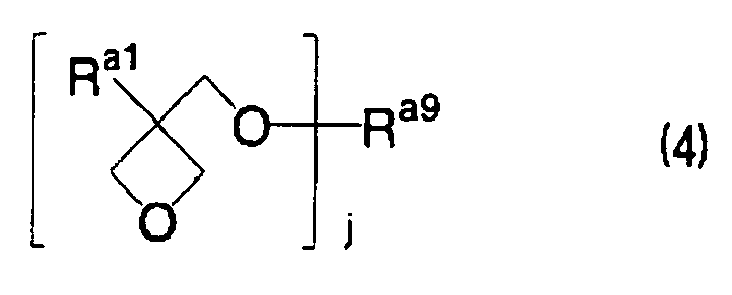
- In Formula (4), Ra1 denotes the same as in Formula (1) above. Furthermore, examples of Ra9, which is a polyvalent linking group, include a branched alkylene group having 1 to 12 carbons such as a group represented by A to C below, a branched poly(alkyleneoxy) group such as a group represented by D below, and a branched polysiloxane group such as a group represented by E below. j is 3 or 4.


- In the above A, Ra10 denotes a methyl group, an ethyl group, or a propyl group. Furthermore, in the above D, p is an integer of 1 to 10.
- Moreover, as another embodiment of the oxetane compound that can be suitably used in the present invention, a compound having an oxetane ring on a side chain, represented by Formula (5) below, can be cited.

- In Formula (5), Ra1 and Ra8 denote the same as in the above-mentioned formulae. Ra11 is an alkyl group having 1 to 4 carbons such as a methyl group, an ethyl group, a propyl group, or a butyl group, or a trialkylsilyl group, and r is 1 to 4.
- Such compounds having an oxetane ring are described in detail in paragraph Nos. (0021) to (0084) of
JP-A-2003-341217 - Among the oxetane compounds used in the present invention, from the viewpoint of ink composition viscosity and tackiness, it is preferable to use a compound having one oxetane ring.
- The ink composition of the present invention may comprise only one type of cationically polymerizable compound or two or more types thereof in combination, but from the viewpoint of suppressing effectively shrinkage during ink curing, it is preferable to use a combination of a vinyl ether compound and at least one type of compound selected from the oxetane compounds and the epoxy compounds.
- The content of the cationically polymerizable compound (a) in the ink composition is suitably in the range of 10 to 95 wt % relative to the total solids content of the composition, preferably 30 to 90 wt %, and more preferably 50 to 85 wt %. The solids content in the ink composition referred to in the present invention means components excluding volatile components such as a solvent, which will be described later.
- The ink composition of the present invention comprises the compound that generates an acid when exposed to radiation (also called the photo-acid generator as appropriate). As the photo-acid generator used in the present invention, a cationic photopolymerization photoinitiator, a radical photopolymerization photoinitiator, a photo-decolorizing agent or a photo-discoloring agent for a dye, or a compound that generates an acid when exposed to light used in a microresist, etc. (ultraviolet light at 400 to 200 nm, far ultraviolet light, particularly preferably, g-line, h-line, i-line, KrF excimer laser light), ArF excimer laser light, an electron beam, X rays, a molecular beam, or an ion beam, may be used by appropriately selecting therefrom.
- Examples of such a photo-acid generator include onium salt compounds such as diazonium salts, phosphonium salts, sulfonium salts, and iodonium salts, and sulfonate compounds such as imidosulfonates, oxime sulfonates, diazodisulfones, disulfones, and o-nitrobenzylsulfonates, which generate an acid by decomposition when exposed to radiation.
- Other specific examples of the compound that generates an acid when exposed to actinic light or radiation, which can be used in the present invention, include diazonium salts disclosed in, for instance, S. I. Schlesinger, Photogr. Sci. Eng., 1974, 18:387 and T. S. Bal et al., Polymer, 1980, 21:423; ammonium salts disclosed in, for instance,
US Pat. Nos. 4,069,055 ,4,069,056 andJP-A-3-140140 US Pat. Nos. 4,069,055 and4,069,056 ; iodonium salts disclosed in, for instance, J. V. Crivello et al., Macromolecules, 10 (6), 1307 (1977), Chem. Eng. News, November 28, p. 31 (1988),European Patent No. 104,143 JP-A-2-150848 JP-A-2-296514
sulfonium salts disclosed in, for instance, J. V. Crivello et al., Polymer J., 1985, 17:73, J. V. Crivello et al., J. Org. Chem., 1978, 43:3055, W.R. Watt et al., J. Polymer Sci., Polymer Chem. Ed., 1984, 22:1789, J. V. Crivello et al., Polymer Bull., 1985, 14:279, J. V. Crivello et al., Macromolecules, 14(5), 1141 (1981), J. V. Crivello et al., J. Polymer Sci., Polymer Chem. Ed., 1979, 17:2877,European Patent Nos. 370,693 161,811 410,201 339,049 233,567 297,443 297,442 US Pat. Nos. 3,902,114 ,4,933,377 ,4,760,013 ,4,734,444 and2,833,827 andGerman Patent Nos. 2,904,626 ,3,604,580 and3,604,581 ,JP-A-7-28237 JP-A-8-27102
selenonium salts disclosed in, for instance, J. V. Crivello et al., Macromolecules, 10(6), 1307 (1977) and J. V. Crivello et al., J. Polymer Sci., Polymer Chem. Ed., 1979, 17:1047; onium salts such as arsonium salts disclosed in, for instance, C. S. Wen et al., The Proc. Conf. Rad. Curing ASIA, p.478, Tokyo, Oct. (1988); organic halogen-containing compounds disclosed in, for instance,US Pat. No. 3,905,815 ,JP-B-46-4605 JP-A-48-36281 JP-A-55-32070 JP-A-60-239736 JP-A-61-169835 JP-A-61-169837 JP-A-62-58241 JP-A-62-212401 JP-A-63-70243 JP-A-63-298339 JP-A-2-161445
photo-acid generators comprising o-nitrobenzyl type protecting group disclosed in, for instance, S. Hayase et al., J. Polymer Sci., 1987, 25:753, E. Reichmanis et al., J. Polymer Sci., Polymer Chem. Ed., 1985, 23:1, Q. Q. Zhu et al., J. Photochem., 36, 85, 39, 317 (1987), B. Amit et al., Tetrahedron Lett., (24), 2205 (1973), D. H. R. Barton et al., J. Chem. Soc., 3571 (1965), P. M. Collins et al., J. Chem. Soc., Perkin 1, 1695 (1975), M. Rudinstein et al., Tetrahedron Lett., (17), 1445 (1975), J. W. Walker et al., J. Am. Chem. Soc., 110, 7170 (1988), S.C. Busman et al., J. Imaging Technol., 11 (4), 191 (1985), H. M. Houlihan et al., Macromolecules, 21, 2001 (1988), P.M. Collins et al., J. Chem. Soc., Chem. Commun., 532 (1972), S. Hayase et al., Macromolecules, 18, 1799 (1985), E. Reichmanis et al., J. Electrochem. Soc., Solid State Sci. Technol., 130(6), F. M. Houlihan et al., Macromolecules, 21, 2001 (1988),European Patent Nos. 0,290,750 ,046,083 156,535 271,851 0,388,343 ,US Pat. Nos. 3,901,710 and4,181,531 andJP-A-60-198538 JP-A-53-133022
compounds producing sulfonic acids by photolysis which are represented by iminosulfonates described in M. Tunooka et al., Polymer Preprints Japan, 38 (8), G. Berner et al., J. Rad. Curing, 13 (4), W. J. Mijs et al., Coating Technol., 55 (697), 45 (1983), Akzo, H. Adachi et al., Polymer Preprints Japan, 37 (3),European Patents 0,199,672 ,84,515 044,115 618, 564 0,101,122 ,US Pat. Nos. 4,371,605 and4,431,774 ,JP-A-64-18143 JP-A-2-245756 JP-A-3-140109 JP-A-61-166544 JP-A-2-71270 JP-A-3-103854 JP-A-3-103856 JP-A-4-210960 - Further, compounds in which these photo-acid generating groups or compounds are introduced into their main chains or side chains can be used. Examples of such compounds are described in M. E. Woodhouse et al., J. Am. Chem. Soc., 104, 5586 (1982), S. P. Pappas et al., J. Imaging Sci., 30 (5), 218 (1986), S. Kondo et al., Makromol. Chem., Rapid Commun., 9, 625 (1988), Y. Yamada et al., Makromol. Chem., 152, 153, 163 (1972), J. V. Crivello et al., J. Polymer Sci., Polymer Chem. Ed., 17, 3845 (1979),
US Pat. No. 3,849,137 ,German Patent 3,914,407 ,JP-A-63-26653 JP-A-55-164824 JP-A-62-69263 JP-A-63-146038 JP-A-63-163452 JP-A-62-153853 JP-A-63-146029 - Further, there can also be used compounds that generate an acid with light which are described in V. N. R. Pillai, Synthesis, (1) 1 (1980), A. Abad et al., Tetrahedron Lett., (47), 4555 (1971), D. H. R. Barton et al., J. Chem. Soc., (C), 329 (1970),
US Pat. No. 3,779,778 andEuropean Patent No. 126,712 - Preferred examples of the photo-acid generator that can be used in the present invention include compounds represented by Formulae (b1), (b2), and (b3) below.

- In Formula (b1), R201, R202, and R203 independently denote an organic group.
- X- denotes a non-nucleophilic anion; preferred examples thereof include a sulfonic acid anion, a carboxylic acid anion, a bis(alkylsulfonyl)amide anion, a tris(alkylsulfonyl)methide anion, BF4 -, PF6 -, SbF6 -, and groups shown below, and an organic anion having a carbon atom is preferable.

- Preferred examples of the organic anion include organic anions represented by the formulae below.

- Rc1 denotes an organic group.
- Examples of the organic group denoted by Rc1 include those having 1 to 30 carbons, and preferred examples thereof include an alkyl group, a cycloalkyl group, an aryl group, and a group formed by connecting a plurality of the above groups via a linking group such as a single bond, -O-, -CO2- -S-, -SO3-, or - SO2N(Rd1)-.
- Rd1 denotes a hydrogen atom or an alkyl group.
- Rc3, Rc4, and Rc5 independently denote an organic group.
- With regard to the organic groups denoted by Rc3, Rc4, and Rc5, those cited as preferred examples for the organic group denoted by Rc1 are cited here, and a perfluoroalkyl group having 1 to 4 carbons is most preferable.
- Rc3 and Rc4 may be bonded to form a ring.
- Examples of a group formed by bonding of Rc3 and Rc4 include an alkylene group and an arylene group. It is preferably a perfluoroalkylene group having 2 to 4 carbons.
- The most preferred examples of the organic groups denoted by Rc1, and Rc3 to Rc5, include an alkyl group whose 1 position has been substituted with a fluorine atom or a fluoroalkyl group, and a phenyl group substituted with a fluorine atom or a fluoroalkyl group. Introducing a fluorine atom or a fluoroalkyl group increases the acidity of an acid generated on exposure to light, thus improving the sensitivity.
- The number of carbons of the organic groups denoted by R201 R202, and R203 is preferably 1 to 30, and more preferably 1 to 20.
- Furthermore, two of R201 to R203 may be bonded to form a ring structure, and an oxygen atom, a sulfur atom, an ester bond, an amide bond, or a carbonyl group may be contained in the ring. Examples of the group formed by bonding of two of R201 to R203 include alkylene groups (e.g. a butylene group and a pentylene group).
- Specific examples of the organic groups denoted by R201, R202, and R203 are the corresponding groups in compounds (b1-1), (b1-2), and (b1-3), which will be described later.
- The photo-acid generator may be a compound having a plurality of structures represented by Formula (b1). For example, it may be a compound having a structure in which at least one of R201 to R203 of a compound represented by Formula (b1) is bonded directly or via a linking group to at least one of R201 to R203 of a compound represented by Formula (b1).
- Yet more preferred examples of the component (b1) include compounds (b1-1), (b1-2), and (b1-3), which are explained below.
- The compound (b1-1) is an arylsulfonium compound in which at least one of R201 to R203 of the Formula (b1) above is an aryl group, that is, a compound having arylsulfonium as a cation.
- With regard to the arylsulfonium compound, all of R201 to R203 may be aryl groups, or some of R201 to R203 may be an aryl group and the rest may be an alkyl group or a cycloalkyl group.
- Examples of the arylsulfonium compound include a triarylsulfonium compound, a diarylalkylsulfonium compound, an aryldialkylsulfonium compound, a diarylcycloalkylsulfonium compound, and an aryldicycloalkylsulfonium compound.
- With regard to the aryl group of the arylsulfonium compound, an aryl group such as a phenyl group or a naphthyl group and a heteroaryl group such as an indole residue or a pyrrole residue are preferable, and a phenyl group and an indole residue are more preferable. When the aryl sulfonium compound has two or more aryl groups, two or more of the aryl groups may be identical to or different from each other.
- The alkyl group that the arylsulfonium compound may have as necessary is preferably a straight-chain or branched alkyl group having 1 to 15 carbons, and examples thereof include a methyl group, an ethyl group, a propyl group, an n-butyl group, a sec-butyl group, and a t-butyl group.
- The cycloalkyl group that the arylsulfonium compound may have as necessary is preferably a cycloalkyl group having 3 to 15 carbons, and examples thereof include a cyclopropyl group, a cyclobutyl group, and a cyclohexyl group.
- The aryl group, the alkyl group, and the cycloalkyl group denoted by R201 to R203 may have as a substituent an alkyl group (e.g. having 1 to 15 carbons), a cycloalkyl group (e.g. having 3 to 15 carbons), an aryl group (e.g. having 6 to 14 carbons), an alkoxy group (e.g. having 1 to 15 carbons), a halogen atom, a hydroxyl group, or a phenylthio group. Preferred examples of the substituent include a straight-chain or branched alkyl group having 1 to 12 carbons, a cycloalkyl group having 3 to 12 carbons, and a straight-chain, branched, or cyclic alkoxy group having 1 to 12 carbons, and the most preferable examples include an alkyl group having 1 to 4 carbons and an alkoxy group having 1 to 4 carbons. One of R201 to R203 may be substituted or all thereof may be substituted. When R201 to R203 are aryl groups, it is preferable for the substituent to be present at the p-position of the aryl group.
- The compound (b1-2) is now explained.
- The compound (b1-2) is a compound in which R201 to R203 of Formula (b1) independently denote an organic group having no aromatic ring. The aromatic ring referred to here includes an aromatic ring containing a hetero atom.
- The organic group having no aromatic ring denoted by R201 to R203 preferably has 1 to 30 carbons, and more preferably 1 to 20 carbons.
- R201 to R203 preferably independently denote an alkyl group, a cycloalkyl group, an allyl group, or a vinyl group, more preferably a straight-chain, branched, or cyclic 2-oxoalkyl group or alkoxycarbonylmethyl group, and particularly preferably a straight-chain or branched 2-oxoalkyl group.
- The alkyl group denoted by R201 to R203 may be a straight-chain or branched, is preferably a straight-chain or branched alkyl group having 1 to 10 carbons (e.g. a methyl group, an ethyl group, a propyl group, a butyl group, and a pentyl group), and is more preferably a straight-chain or branched 2-oxoalkyl group or an alkoxycarbonylmethyl group.
- The cycloalkyl group denoted by R201 to R203 may preferably be a cycloalkyl group having 3 to 10 carbons (a cyclopentyl group, a cyclohexyl group, or a norbornyl group), and a cyclic 2-oxoalkyl group is more preferable.
- The straight-chain, branched, or cyclic 2-oxoalkyl group denoted by R201 to R203 may preferably be the above-mentioned alkyl group or cycloalkyl group in which there is >C = O at the 2-position.
- Preferred examples of the alkoxy group of the alkoxycarbonylmethyl group denoted by R201 to R203 include an alkoxy group having 1 to 5 carbons (a methoxy group, an ethoxy group, a propoxy group, a butoxy group, and a pentoxy group).
- R201 to R203 may further be substituted with a halogen atom, an alkoxy group (e.g. having 1 to 5 carbons), a hydroxyl group, a cyano group, or a nitro group.
- The compound (b1-3) referred to is a compound represented by Formula (b1-3) below and is a compound having a phenacylsulfonium salt structure.

- In Formula (b1-3), R1c to R5c independently denote a hydrogen atom, an alkyl group, a cycloalkyl group, an alkoxy group, or a halogen atom.
- R6c and R7c independently denote a hydrogen atom, an alkyl group, or a cycloalkyl group.
- Rx and Ry independently denote an alkyl group, a cycloalkyl group, an allyl group, or a vinyl group.
- Any two or more of R1c to R5c, R6c and R7c, and Rx and Ry may be bonded together to form a ring structure.
- Zc- denotes a non-nucleophilic anion, and the same examples as those of the non-nucleophilic anion X- in Formula (b1) may be cited.
- The alkyl group denoted by R1c to R7c may be either a straight-chain alkyl group or a branched alkyl group, and preferred examples thereof include straight-chain and branched alkyl groups having 1 to 20 carbons, and more preferably 1 to 12 carbons (e.g. a methyl group, an ethyl group, a straight-chain or branched propyl group, a straight-chain or branched butyl group, and a straight-chain or branched pentyl group).
- Preferred examples of the cycloalkyl group denoted by R1c to R7c include cycloalkyl groups having 3 to 8 carbons (e.g. a cyclopentyl group and a cyclohexyl group).
- The alkoxy group denoted by R1c to R5c may be any of a straight-chain, branched, or cyclic alkoxy group; examples thereof include alkoxy groups having 1 to 10 carbons, and preferably straight-chain or branched alkoxy groups having 1 to 5 carbons (e.g. a methoxy group, an ethoxy group, a straight-chain or branched propoxy group, a straight-chain or branched butoxy group, and a straight-chain or branched pentoxy group), and cyclic alkoxy groups having 3 to 8 carbons (e.g. a cyclopentyloxy group and a cyclohexyloxy group).
- Examples of the group formed by bonding any two or more of R1c to R5c, R6c and R7c, and Rx and Ry include a butylene group and a pentylene group. This cyclic structure may contain an oxygen atom, a sulfur atom, an ester bond, or an amide bond.
- It is preferable for any one of R1c to R5c to be a straight-chain or branched alkyl group, a cycloalkyl group, or a straight-chain, branched, or cyclic alkoxy group, and it is more preferable that the sum of the number of carbons of R1c to R5c is 2 to 15. This is preferable since the solvent solubility further improves and the occurrence of particles during storage is suppressed.
- Examples of the alkyl groups and the cycloalkyl groups denoted by Rx and Ry may be the same as those of the alkyl groups and the cycloalkyl groups denoted by R1c to R7c.
- Rx and Ry are preferably 2-oxoalkyl groups or alkoxycarbonylmethyl groups.
- Examples of the 2-oxoalkyl group include a group in which the alkyl group or the cycloalkyl group denoted by R1c to R5c has >C = O at the 2-position.
- Examples of the alkoxy group of the alkoxycarbonylmethyl group may be the same as those of the alkoxy group denoted by R1c to R5c.
- Rx and Ry are preferably alkyl groups or cycloalkyl groups having 4 or more carbons, more preferably alkyl groups or cycloalkyl groups having 6 or more carbons, and yet more preferably 8 or more carbons.
- R204 to R207 in Formulae (b2) and (b3) independently denote an aryl group, an alkyl group, or a cycloalkyl group. X- denotes a non-nucleophilic anion, and examples thereof include those that are the same as the non-nucleophilic anion Xin Formula (b1).
- The aryl group denoted by R204 to R207 is preferably a phenyl group or a naphthyl group, and more preferably a phenyl group.
- The alkyl group denoted by R204 to R207 may be either a straight-chain or a branched alkyl group, and preferred examples thereof include straight-chain or branched alkyl groups having 1 to 10 carbons (e.g. a methyl group, an ethyl group, a propyl group, a butyl group, and a pentyl group). Preferred examples of the cycloalkyl groups denoted by R204 to R207 include cycloalkyl groups having 3 to 10 carbons (a cyclopentyl group, a cyclohexyl group, and a norbornyl group).
- Examples of the substituents that are present on R204 to R207 include an alkyl group (e.g. having 1 to 15 carbons), a cycloalkyl group (e.g. having 3 to 15 carbons), an aryl group (e.g. having 6 to 15 carbons), an alkoxy group (e.g. having 1 to 15 carbons), a halogen atom, a hydroxyl group, and a phenylthio group.
- Furthermore, R204 and R205, R206 and R207 may be bonded to form a ring structure, and an oxygen atom, a sulfur atom, an ester bond, an amide bond, or a carbonyl group may be contained in the ring. Examples of the groups formed by bonding of R204 and R205 or R206 and R207 include an alkylene group (e.g. a butylene group and a pentylene group).
- The photo-acid generator may be a compound having a plurality of the structures represented by Formula (b2) or (b3). For example, it may be a compound having a structure in which R204 or R205 of one compound represented by Formula (b2) is bonded directly or via a linking group to R204 or R205 of another compound represented by Formula (b2).
- Examples of the compound that generates an acid when exposed to actinic light or radiation further include compounds represented by Formulae (b4), (b5), and (b6) below.

- In Formula (b4) to (b6), Ar3 and Ar4 independently denote an aryl group.
- R206, R207 and R208 independently denote an alkyl group, a cycloalkyl group, an aryl group, or a cyano group.
- A denotes an alkylene group, an alkenylene group, or an arylene group.
- Ar3 and Ar4, R206 to R208, and A may have a substituent, and examples thereof include an alkyl group (e.g. having 1 to 15 carbons), a cycloalkyl group (e.g. having 3 to 15 carbons), an aryl group (e.g. having 6 to 15 carbons), an alkoxy group (e.g. having 1 to 15 carbons), a halogen atom, a hydroxyl group, and a phenylthio group.
- The photo-acid generator may be a compound having a plurality of structures represented by Formulae (b4) to (b6). For example, it may be a compound having a structure in which at least one of R206 to R208 of a compound represented by Formula (b6) is bonded directly or via a linking group to at least one of R206 to R208 of another compound represented by Formula (b6).
- Among the above-mentioned photo-acid generators, compounds represented by Formulae (b1) to (b3) are preferable.
- Preferred compound examples (b-1) to (b-96) of the photo-acid generator (b) used in the present invention are cited below, but the present invention should not be construed by being limited thereto.


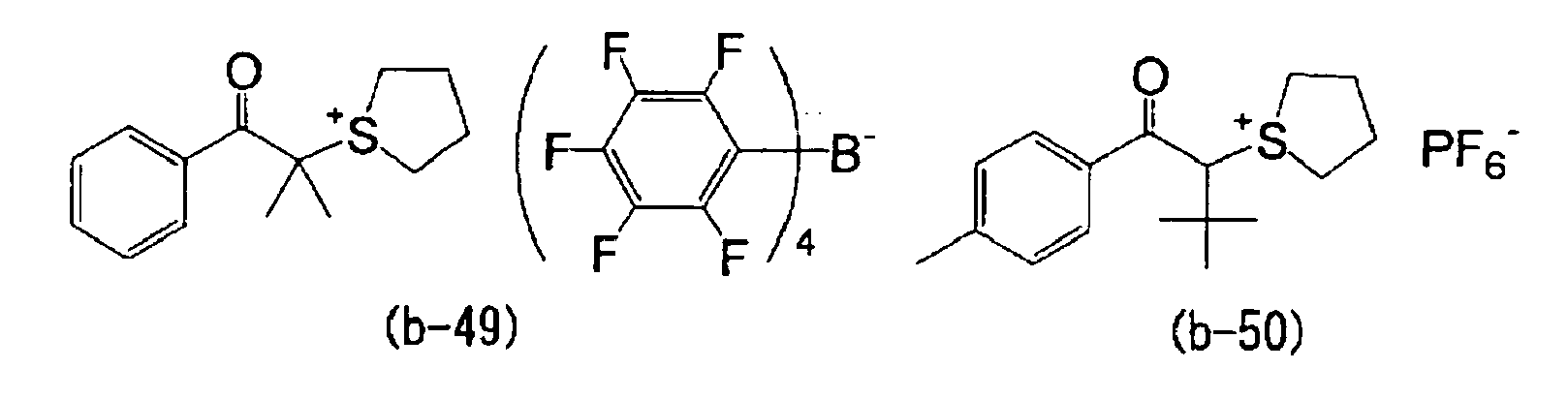
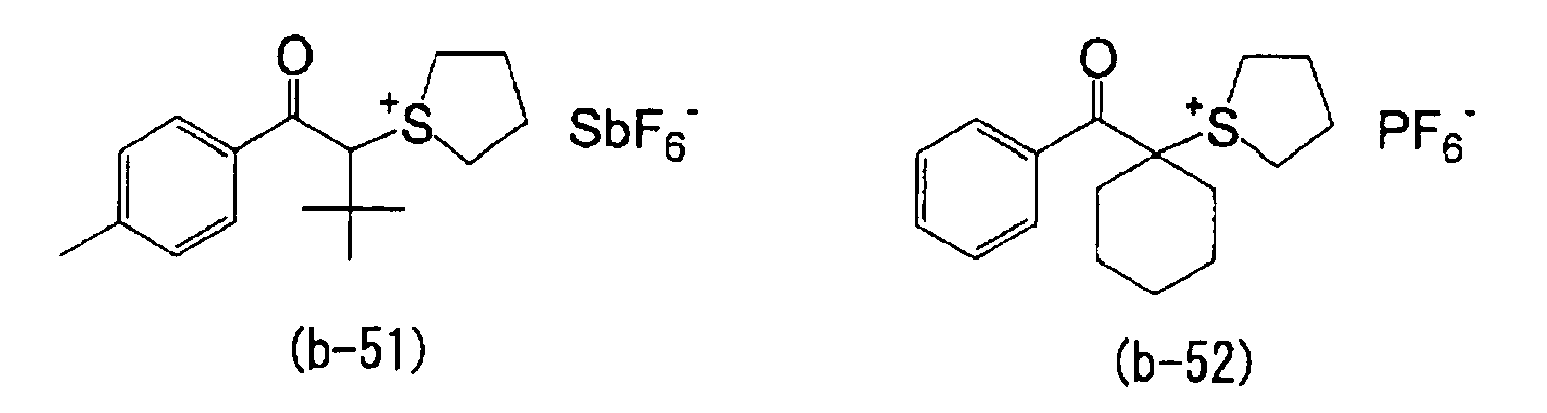


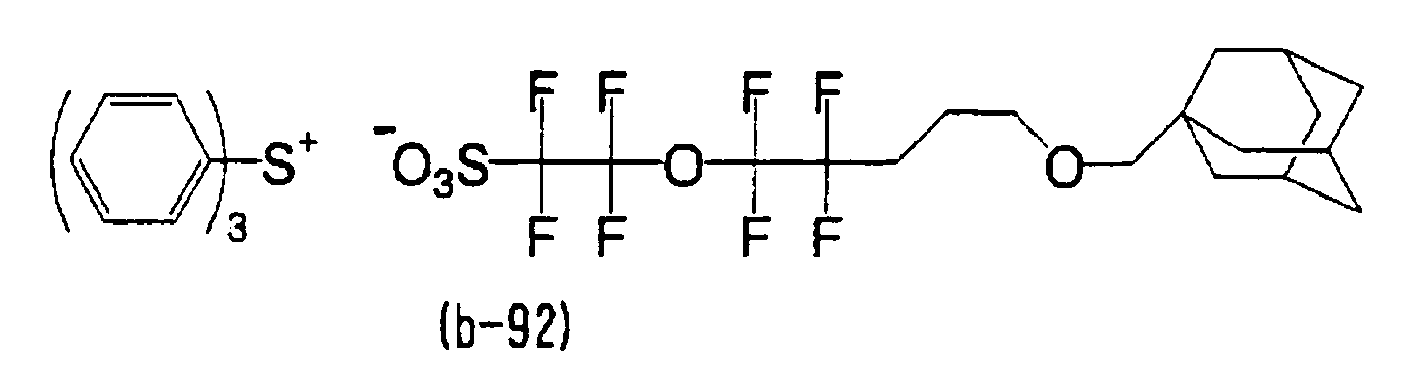


- Furthermore, oxazole derivatives and s-triazine derivatives described in Paragraph Nos. (0029) to (0030) of
JP-A-2002-122994 - Onium salt compounds and sulfonate-based compounds cited as examples in Paragraph Nos. (0037) to (0063) of
JP-A-2002-122994 - The photo-acid generator (b) may be used singly or in a combination of two or more types.
- The content of the photo-acid generator (b) in the ink composition is preferably 0.1 to 20 wt % on the basis of the total solids content of the ink composition, more preferably 0.5 to 10 wt %, and yet more preferably 1 to 7 wt %.
- The compound (c) that generates a compound having a basic nitrogen atom when exposed to radiation (also called the photo-base generator as appropriate), which is a characteristic component used in the present invention, is a compound that does not originally exhibit basicity in the ink composition or has low level of basicity but, when exposed to radiation, decomposes and generates a compound having a basic nitrogen atom or increases the basicity compared with that of the starting compound. Compounds having such characteristics are disclosed in, for example,
JP-A-63-149638 JP-A-2-118650 JP-A-4-330444 JP-A-6-130668 JP-A-6-194834 JP-A-7-134399 JP-A-10-83079 


- In Formulae (I) to (IX), R1, R2, R16, R17, R18, R19, and R20 independently denote a hydrogen atom, an alkyl group, a cycloalkyl group, an aralkyl group, or an aryl group. R3, R8, R21, and R22 independently denote a hydrogen atom, an alkyl group, or an aryl group. R4, R5, and R6 independently denote a hydrogen atom, a halogen atom, an alkyl group, a cycloalkyl group, an aralkyl group, an aryl group, an -NO2 group, or an -OR7 group, and R7 denotes an alkyl group. R9, R10, R11, R23, R24, and R25 independently denote a hydrogen atom, a halogen atom, an alkyl group, a cycloalkyl group, an aralkyl group, or an -OR7 group. R12 and R13 independently denote an alkyl group, a cycloalkyl group, an aralkyl group, an aryl group, an acyl group, or a -CN group. R14 denotes an alkyl group, a cycloalkyl group, an aralkyl group, an aryl group, or an -N(R1)(R2) group. R15 denotes an alkyl group, a cycloalkyl group, an aralkyl group, or an aryl group. Ar1 and Ar2 denote aryl groups. Z denotes an atomic group that forms, together with an imide group of Formula (III), a monocyclic or polycyclic aliphatic ring, aromatic ring, or hetero ring. Y denotes an NH group, a sulfur atom, or an oxygen atom. X- denotes a monovalent or polyvalent anion. Furthermore, R1 and R2 in Formulae (I) to (IV), two of R4 to R6 in Formulae (I) and (II), two of R9 to R11 in Formula (IV), R12 and R13 in Formula (V), R16 and R17 in Formula (VI), two of R18 to R20 in Formulae (VII) to (IX), Ar1 and R21 in Formula (VII), and two of R23 to R25 in Formula (VIII) may be bonded together to form an aliphatic ring, an aromatic ring, or a hetero ring.
- The alkyl group, cycloalkyl group, aralkyl group, and aryl group denoted by R1 to R25, Ar1, and Ar2, and the atomic group that forms, together with the imide group denoted by Z, a monocyclic or polycyclic aliphatic ring, aromatic ring, or hetero ring may have a substituent described later, and the substituent may further have a substituent.
- Preferred examples of the alkyl group include those having 1 to 10 carbons such as a methyl group, an ethyl group, a propyl group, an n-butyl group, a sec-butyl group, a hexyl group, an octyl group, and a decyl group. Preferred examples of the cycloalkyl group include those having 3 to 10 carbons such as a cyclopropyl group, a cyclobutyl group, a cyclopentyl group, a cyclohexyl group, a cycloheptyl group, and a norbornyl group. Preferred examples of the aralkyl group include those having 7 to 16 carbons such as a benzyl group, a phenethyl group, and a naphthylmethyl group. Preferred examples of the aryl group include those having 6 to 15 carbons such as a phenyl group, a tolyl group, a methoxyphenyl group, a naphthyl group, and an anthryl group. Preferred examples of the acyl group include those having 2 to 8 carbons such as an acetyl group, a propanoyl group, a butanoyl group, a pentanoyl group, and a benzoyl group. Furthermore, preferred examples of the atomic group that forms, together with the imide group denoted by Z in Formula (III), a monocyclic or polycyclic aliphatic ring, aromatic ring, or hetero ring include an atomic group mainly containing carbon atoms and forming a 4- to 15-membered ring, which may have a substituent, more preferably a 5- to 8-membered ring, which may have a substituent, and an atomic group that may further include an oxygen atom, a nitrogen atom, or a sulfur atom as necessary. X- is a monovalent or polyvalent anion, and preferred examples thereof include halogen anions such as a chloro anion, a bromo anion, or an iodo anion, an alkylsulfonate anion, an arylsulfonate anion, a sulfate anion, a phosphate anion, an alkylphosphonate anion, an arylphosphonate anion, and a borate anion such as BPh4 -, BF4 - , PF6 -, or SbF6 -. Preferred examples of the aliphatic ring, aromatic ring, or hetero ring formed by bonding of R1 and R2 in Formulae (I) to (IV), two of R4 to R6 in Formulae (I) and (II), two of R9 to R11 in Formula (IV), R12 and R13 in Formula (V), R16 and R17 in Formula (VI), two of R18 to R20 in Formulae (VH) to (IX), Ar1 and R21 in Formula (VII), and two of R23 to R25 in Formula (VIII) include 4- to 12-membered aliphatic, aromatic, and hetero rings, which may have a substituent, and more preferably 5-to 8-membered rings, which may have a substituent.
- Furthermore, examples of the substituent that may be incorporated into the above groups include a straight-chain, branched, or cyclic alkyl group (a methyl group, an ethyl group, a propyl group, an isopropyl group, a n-butyl group, a sec-butyl group, a t-butyl group, a cyclopropyl group, a cyclopentyl group, a cyclohexyl group, etc.), a straight-chain, branched, or cyclic alkoxy group (a methoxy group, an ethoxy group, a propoxy group, a butoxy group, a hydroxylethoxy group, etc.), the above-mentioned aryl group, a halogen atom (a fluorine atom, a chlorine atom, a bromine atom, or an iodine atom), a hydroxyl group, a carboxyl group, a cyano group, an acyl group (an acetyl group, a propanoyl group, a benzoyl group, etc.), a nitro group, an alkylamino group (the alkyl group being the same as above), a dialkylamino group (the alkyl group being the same as above), an arylamino group (the aryl group being the same as above), and an -S-R0 group. Here, R0 denotes the above-mentioned straight-chain, branched, or cyclic alkyl group, or the aryl group. Specific examples of the compounds represented by Formulae (I) to (IX) include compounds (I-1) to (IX-7) below, but the present invention should not be construed as being limited thereto.


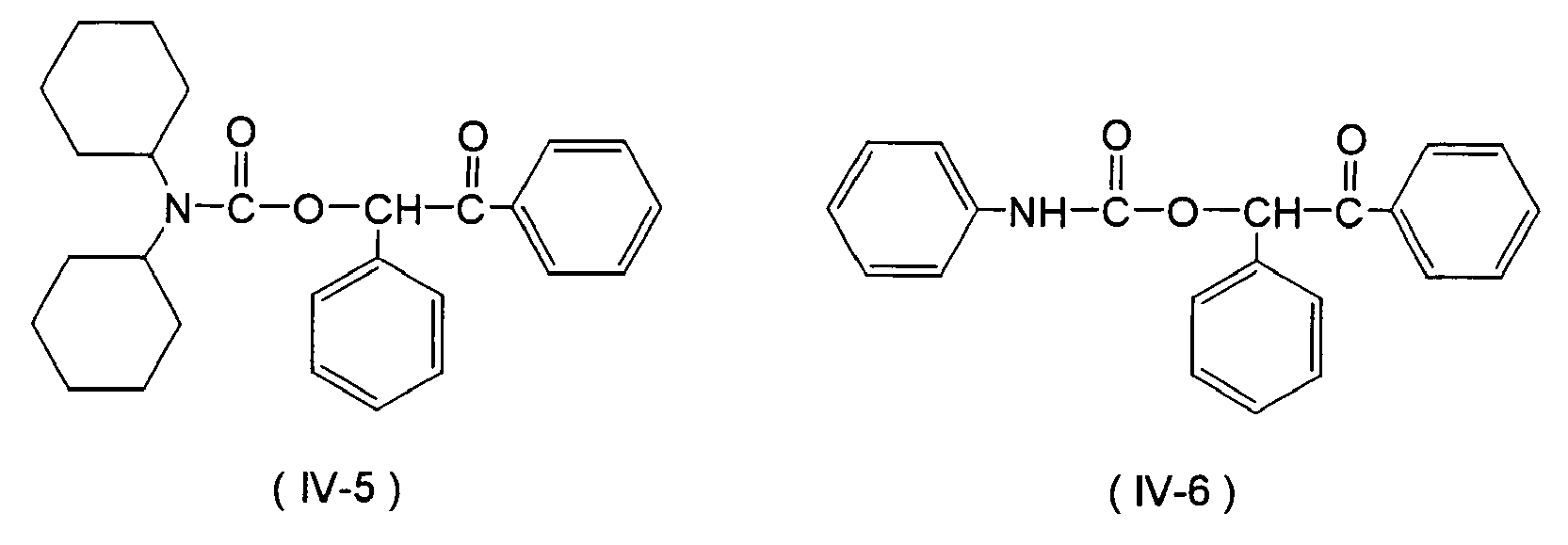


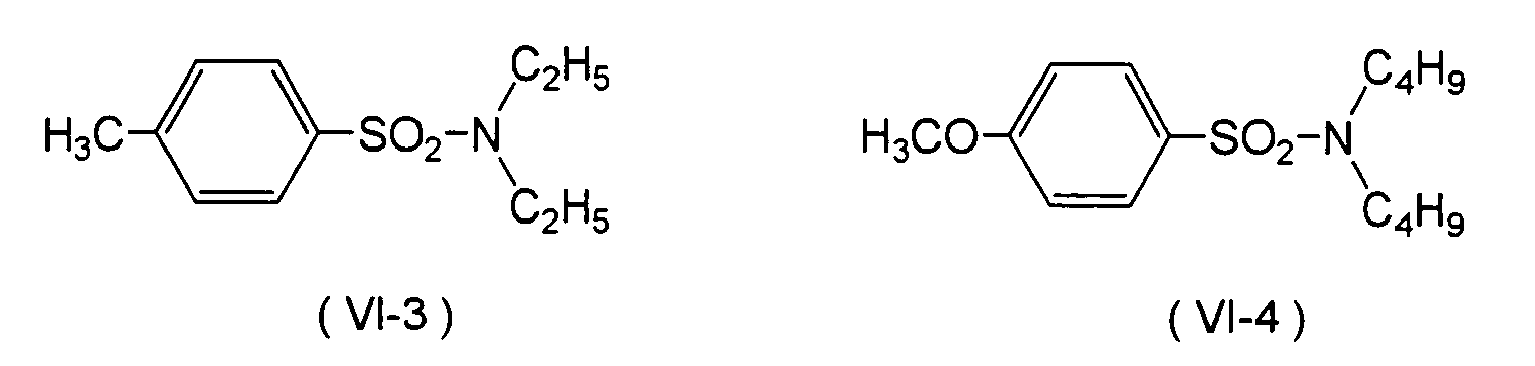


- The ink composition of the present invention may contain, in combination with the above-mentioned essential components, various types of additives according to the intended application. These optional components are now explained.
- By adding a colorant to the ink composition of the present invention, a visible image may be formed. For example, when an image region of a lithographic printing plate is formed, the colorant is not necessarily added, but from the viewpoint of ease of plate inspection of the lithographic printing plate obtained, it is also preferable to use a colorant.
- The colorant that can be used here is not particularly limited, and various types of known coloring materials (pigments, dyes) may be selected as appropriate according to the intended application. For example, when forming an image having excellent weather resistance, a pigment is preferable. As a dye, either a water-soluble dye or an oil-soluble dye may be used, and an oil-soluble dye is preferable.
- The pigment is not particularly limited, and it is possible to use any generally commercially available organic pigment or inorganic pigment, a dispersion of a pigment in an insoluble resin, etc. as a dispersion medium, a pigment on the surface of which a resin has been grafted, etc. It is also possible to use resin particles colored with a dye, etc.
- Examples of these pigments include pigments described in 'Ganryo no Jiten' (Dictionary of Pigments) Ed. by Seijirou Ito (2000), W. Herbst, K. Hunger 'Industrial Organic Pigments',
JP-A-2002-12607 JP-A-2002-188025 JP-A-2003- 26978 JP-A-2003-342503 - Specific examples of the organic pigment and the inorganic pigment that can be used in the present invention include, as those exhibiting a yellow color, monoazo pigments such as Cl Pigment Yellow 1 (Fast Yellow G, etc.) and Cl Pigment Yellow 74, disazo pigments such as Cl Pigment Yellow 12 (Disazo Yellow AAA, etc.) and Cl Pigment Yellow 17, benzidine-free azo pigments such as Cl Pigment Yellow 180, azo lake pigments such as Cl Pigment Yellow 100 (Tartrazine Yellow Lake, etc.), condensed azo pigments such as Cl Pigment Yellow 95 (Azo Condensation Yellow GR, etc.), acidic dye lake pigments such as Cl Pigment Yellow 115 (Quinoline Yellow Lake, etc.), basic dye lake pigments such as Cl Pigment Yellow 18 (Thioflavine Lake, etc.), anthraquinone pigments such as Flavanthrone Yellow (Y-24), isoindolinone pigments such as Isoindolinone Yellow 3RLT (Y-110), quinophthalone pigments such as Quinophthalone Yellow (Y-138), isoindoline pigments such as Isoindoline Yellow (Y-139), nitroso pigments such as Cl Pigment Yellow 153 (Nickel Nitroso Yellow, etc.), and metal complex azomethine pigments such as Cl Pigment Yellow 117 (Copper Azomethine Yellow, etc.).
- Examples of pigments exhibiting a red or magenta color include monoazo pigments such as Cl Pigment Red 3 (Toluidine Red, etc.), disazo pigments such as Cl Pigment Red 38 (Pyrazolone Red B, etc.), azo lake pigments such as Cl Pigment Red 53:1 (Lake Red C, etc.) and Cl Pigment Red 57:1 (Brilliant Carmine 6B), condensed azo pigments such as Cl Pigment Red 144 (Azo Condensation Red BR, etc.), acidic dye lake pigments such as Cl Pigment Red 174 (Phloxine B Lake, etc.), basic dye lake pigments such as Cl Pigment Red 81 (Rhodamine 6G' Lake, etc.), anthraquinone pigments such as Cl Pigment Red 177 (Dianthraquinonyl Red, etc.), thioindigo pigments such as Cl Pigment Red 88 (Thioindigo Bordeaux, etc.), perinone pigments such as Cl Pigment Red 194 (Perinone Red, etc.), perylene pigments such as Cl Pigment Red 149 (Perylene Scarlet, etc.), quinacridone pigments such as Cl Pigment violet 19 (unsubstituted quinachridone) and CI Pigment Red 122 (Quinacridone Magenta, etc.), isoindolinone pigments such as CI Pigment Red 180 (Isoindolinone Red 2BLT, etc.), and alizarin lake pigments such as Cl Pigment Red 83 (Madder Lake, etc.).
- Examples of pigments exhibiting a blue or cyan color include disazo pigments such as Cl Pigment Blue 25 (Dianisidine Blue, etc.), phthalocyanine pigments such as Cl Pigment Blue 15 (Phthalocyanine Blue, etc.) and Cl Pigment Blue 15:3, acidic dye lake pigments such as Cl Pigment Blue 24 (Peacock Blue Lake, etc.), basic dye lake pigments such as Cl Pigment Blue 1 (Victoria Pure Blue BO Lake, etc.), anthraquinone pigments such as Cl Pigment Blue 60 (Indanthrone Blue, etc.), and alkali blue pigments such as Cl Pigment Blue 18 (Alkali Blue V-5:1).
- Examples of pigments exhibiting a green color include phthalocyanine pigments such as Cl Pigment Green 7 (Phthalocyanine Green) and Cl Pigment Green 36 (Phthalocyanine Green), and azo metal complex pigments such as Cl Pigment Green 8 (Nitroso Green).
- Examples of pigments exhibiting an orange color include isoindoline pigments such as Cl Pigment Orange 66 (Isoindoline Orange) and anthraquinone pigments such as Cl Pigment Orange 51 (Dichloropyranthrone Orange).
- Examples of pigments exhibiting a black color include Pigment Black 7 (carbon black), titanium black, and aniline black.
- Specific examples of white pigments that can be used include basic lead carbonate (2PbCO3Pb(OH)2, also known as silver white), zinc oxide (ZnO, also known as zinc white), titanium oxide (TiO2, also known as titanium white), and strontium titanate (SrTiO3, also known as titan strontium white).
- Titanium oxide has, compared with other white pigments, a low specific gravity, a high refractive index, and is chemically and physically stable, and therefore has high hiding power and coloring power as a pigment and, furthermore, has excellent durability toward acids, alkalis, and other environments. It is therefore preferable to use titanium oxide as the white pigment. It is of course possible to use another white pigment (which can be any white pigment, in addition to the white pigments cited above) as necessary.
- For dispersion of the pigment, for example, a dispersing machine such as a ball mill, a sand mill, an attritor, a roll mill, a jet mill, a homogenizer, a paint shaker, a kneader, an agitator, a Henschel mixer, a colloidal mill, an ultrasonic homogenizer, a pearl mill, or a wet type jet mill may be used.
- When carrying out dispersion of the pigment, a dispersant may be added. Examples of the dispersant include hydroxyl group-containing carboxylic acid esters, salts of a long-chain polyaminoamide and a high molecular weight acid ester, high molecular weight polycarboxylic acid salts, high molecular weight unsaturated acid esters, high molecular weight copolymers, modified polyacrylates, aliphatic polycarboxylic acids, naphthalenesulfonic acid formaldehyde condensates, polyoxyethylene alkylphosphate esters, and pigment derivatives. It is also preferable to use a commercial polymeric dispersant such as the Solsperse series manufactured by Zeneca.
- Furthermore, as a dispersion adjuvant, it is also possible to use a synergist, depending on the various types of pigment. The dispersant and dispersion adjuvant are preferably used at 1 to 50 parts by weight relative to 100 parts by weight of the pigment.
- In the ink composition, as a dispersing medium for various components such as the pigment, a solvent may be added, or the cationically polymerizable compound (a), which is a low molecular weight compound, may be used as a dispersing medium without using a solvent, and since the ink composition of the present invention is a radiation curing type ink, and after the ink is applied on top of a recording medium it is cured, it is preferable not to use a solvent. This is because, if a solvent remains in the cured ink image, the solvent resistance is degraded and the VOC (Volatile Organic Compound) problem of the residual solvent occurs. From this viewpoint, it is preferable to use as a dispersing medium the cationically polymerizable compound (a) and, in particular, it is preferable to select a cationically polymerizable monomer having the lowest viscosity in terms of improvement of dispersion suitability and handling properties of the ink composition.
- It is preferable for the average particle size of the pigment to be in the range of 0.02 to 0.4 µm, more preferably 0.02 to 0.1 µm, and yet more preferably, 0.02 to 0.07 µm.
- In order to make the average particle size of the pigment particles be in the above-mentioned range, the pigment, the dispersant, and the dispersing medium are selected, and dispersion conditions and filtration conditions are set. By such control of particle size, clogging of a head nozzle can be suppressed, and the storage stability of ink, the ink transparency, and the curing sensitivity can be maintained.
- It is preferable to add the colorant at 1 to 20 wt % on a solids content basis of the ink composition, and more preferably 2 to 10 wt %.
- The dye to be used in the present invention is preferably oil-soluble. Specifically, this means that the solubility in water at 25°C (the weight of a dye that can be dissolved in 100 g of water) is equal to or less than 1 g, preferably equal to or less than 0.5 g, and more preferably equal to or less than 0.1 g. Therefore, the so-called oil-soluble dye, which is insoluble in water, is preferably used.
- The dye used in the present invention may preferably be formed by incorporating an oil-solubilizing group into a dye core in order to dissolve a necessary amount thereof in an ink composition.
- Examples of the oil-solubilizing group include a long-chain branched alkyl group, a long-chain branched alkoxy group, a long-chain branched alkylthio group, a long-chain branched alkylsulfonyl group, a long-chain branched acyloxy group, a long-chain branched alkoxycarbonyl group, a long-chain branched acyl group, a long-chain branched acylamino group, a long-chain branched alkylsulfonylamino group, a long-chain branched alkylaminosulfonyl group, and an aryl group, aryloxy group, aryloxycarbonyl group, arylcarbonyloxy group, arylaminocarbonyl group, arylaminosulfonyl group, or arylsulfonylamino group containing the long-chain branched substituent above.
- Furthermore, a dye may be obtained by converting, using a long-chain branched alcohol, amine, phenol, or aniline derivative, a carboxylic acid or sulfonic acid of a water-soluble dye into an alkoxycarbonyl group, aryloxycarbonyl group, alkylaminosulfonyl group, or arylaminosulfonyl group, which are oil-solubilizing groups.
- The above-mentioned oil-soluble dye preferably has a melting point of equal to or less than 200°C, more preferably a melting point of equal to or less than 150°C, and yet more preferably a melting point of equal to or less than 100°C. By using an oil-soluble dye having a low melting point, dye crystallization in the ink composition can be suppressed, and the storage stability of the ink composition is improved.
- Furthermore, in order to improve discoloration resistance, in particular, the resistance to an oxidizing material such as ozone, and improve curing properties, it is desirable that the oxidation potential is high. Because of this, as the oil-soluble dye used in the present invention, it is preferable to use those having an oxidation potential of equal to or greater than 1.0 V (vs SCE). The higher the oxidation potential the more preferable it is; those having an oxidation potential of equal to or greater than 1.1 V (vs SCE) are yet more preferable, and those having an oxidation potential of equal to or greater than 1.15V (vs SCE) or greater are particularly preferable.
- As a yellow dye, a compound having a structure represented by Formula (Y-I) described in
JP-A-2004-250483 - Dyes represented by Formulae (Y-II) to (Y-IV) described in paragraph No. (0034) of
JP-A-2004-250483 JP-A-2004-250483 - As a magenta dye, a compound having a structure represented by Formulae (3) and (4) described in
JP-A-2002-114930 JP-A-2002-114930 - Particularly preferred dyes are azo dyes represented by Formulae (M-1) to (M-2) described in paragraph Nos. (0084) to (0122) of
JP-A-2002-121414 JP-A-2002-121414 - Preferred examples of a cyan dye include dyes represented by Formulae (I) to (IV) described in
JP-A-2001-181547 JP-A-2002-121414 JP-A-2001-181547 JP-A-2002-121414 - Particularly preferred dyes are phthalocyanine dyes represented by Formulae (C-I) and (C-II) described in paragraph Nos. (0133) to (0196) of
JP-A-2002-121414 JP-A-2002-121414 - The oxidation potential value (Eox) of a dye used in the present invention can be easily measured by one skilled in the art and the method therefor is described in, for example, P. Delahay, 'New Instrumental Methods in Electrochemistry', Interscience Publishers (1954), A. J. Bard et al., 'Electrochemical Methods', John Wiley & Sons (1980), and Akira Fujishima et al., 'Denkikagaku Sokuteihou' (Electrochemical Measurement Methods), Gihodo Shuppan Sha (1984).
- More specifically, a test sample is dissolved to give a concentration of 1 x 10⁻² to 1 x 10⁻⁶ mol/L in a solvent such as dimethylformamide or acetonitrile containing a supporting electrolyte such as sodium perchlorate or tetrapropylammonium perchlorate, an oxidation wave when sweeping toward the oxidation side (noble side) using carbon (GC) as a working electrode and a rotating platinum electrode as the counter electrode using cyclic voltammetry or direct current polarographic equipment is approximated to a straight line, and the oxidation potential of the midpoint of a line segment formed between an intersection point of the straight line and a residual current/potential straight line and an intersection point of the straight line and a saturated current straight line (or an intersection point with a straight line parallel to the ordinate passing through the potential peak value) is measured as a value relative to the SCE (saturated calomel electrode). This value sometimes deviates by on the order of tens of millivolts due to the effect of a liquid junction potential, the liquid resistance of the sample solution, or the like, but the reproducibility of the potential can be guaranteed by adding a standard sample (for example, hydroquinone). The support electrolyte and solvent used may be selected appropriately according to the oxidation potential and the solubility of the test sample. The support electrolyte and solvent that can be used here may be referred to in Akira Fujishima et al., 'Denkikagaku Sokuteihou' (Electrochemical Measurement Methods), Gihodo Shuppan Sha (1984), pp. 101 to 118.
- Various types of additives that are used as necessary are described below.
- In the present invention, for the purpose of improving the storage stability of the ink composition, a compound having a basic nitrogen atom (hereinafter, called a specified base component as appropriate) may be added as desired. The compound preferably has a basic nitrogen and has a pKa of the conjugate acid of equal to or greater than 4. The pKa value described here can be defined as the negative of the common logarithm of a dissociation constant Ka in an aqueous solution of a weak electrolyte, that is, pKa = -log10 Ka. As specific examples thereof there can be cited anilines such as 2-chloroaniline, 2-bromoaniline, 4-methylaniline, 3-chloroaniline, 3,5-dibromoaniline, N-methylaniline, N,N-dimethylaniline, N,N-diethylaniline, N,N-bis(hydroxyethyl)aniline, 3-nitroaniline, 2-aminobenzoic acid, 4-aminoazobenzene, N-phenylaniline, and N-phenylglycine, pyridines such as 3-chloropyridine, 3-bromopyridine, 4-hydroxypyridine, 3-carboxypyridine, 2,6-dimethylpyridine, and 2,4,6-trimethylpyridine, cyclic amines such as proline, hydroxyproline, purine, 8-hydroxypurine, N-methylpyrazine, thiazole, and tryptophan, aliphatic aminoacids such as arginine, aspartic acid, glutamic acid, N-methylglycine, N-propylglycine, histidine, cysteine, leucine, isoleucine, ornithine, serine, threonine, methionine, alanine, and methoxyalanine, aliphatic tertiary amines such as trimethylamine, triethylamine, tributylamine, diisopropylethylamine, and trioctylamine, and in addition compounds having a 1,3-diazapropene structure, but as long as the compound has a basic nitrogen atom in the molecular structure the examples are not limited thereto. Yet more preferred examples thereof include compounds represented by Formulae (X) to (XIII).

- In Formulae (X) to (XIII), R01 and R02 independently denote a hydrogen atom, or an optionally substituted alkyl group, cycloalkyl group, aralkyl group, or aryl group, and Ar01 denotes an optionally substituted aryl group. R03 to R05 independently denote a hydrogen atom, a halogen atom, an optionally substituted alkyl group, cycloalkyl group, aralkyl group, or aryl group, a hydroxyl group, a carboxyl group, a cyano group, a nitro group, an acyl group, or an -N(R01)(R02) group. R06 to R08 and R010 to R012 independently denote a hydrogen atom, or an optionally substituted alkyl group, cycloalkyl group, or aralkyl group. R09 denotes an optionally substituted alkyl group, cycloalkyl group, aralkyl group, or aryl group, an -N(R013)(R014) group, or an -OR015 group. R013 to R015 independently denote a hydrogen atom, or an optionally substituted alkyl group, cycloalkyl group, or aralkyl group. Furthermore, two of R01, R02, and Ar01 in Formula (X), two of R03 to R05 in Formula (XI), two of R06 to R08 in Formula (XII), and two of R09 to R015 in Formula (XIII) may be bonded together to form an aliphatic ring, an aromatic ring, or a hetero ring. Furthermore, in Formula (X), R01 and A01, and R02 and A01 may form a ring.
- A compound having a plurality of the structures represented by Formulae (X) to (XIII) may be used. For example, it may be a compound having a structure in which R06 to R08 of a compound represented by Formula (XII) are bonded directly or via a linking group to R06 to R08 of a compound represented by Formula (XII).
- The above-mentioned alkyl group, cycloalkyl group, aralkyl group, aryl group, and a substituent that can be introduced into these groups are the same as those defined for Formulae (I) to (IX). Specific examples thereof include compounds (X-1) to (XIII-12) below, but the present invention should not be construed as being limited thereto.


- The ink composition of the present invention may contain only one type of specified base component or may contain two or more types in combination. The content of the specified base component in the ink composition is suitably 0.001 to 10 wt % relative to the total solids content of the composition, preferably 0.01 to 7 wt %, and yet more preferably 0.03 to 5 wt %. Furthermore, the proportion used of the compound (b) of the present invention that generates an acid when exposed to radiation is in the range of 0.1 to 50 mol %, and preferably 0.5 to 20 mol %.
- The present invention may as necessary employ an organic acidic compound having a pKa value of 2 to 6. The organic acidic compound having a pKa of 2 to 6 (hereinafter, also simply called an 'organic acidic component') qualitatively corresponds to a weakly acidic organic compound. It is preferable if the pKa is in the above-mentioned range since the ink composition of the present invention has excellent sensitivity and stability over time. Specific compounds include carboxylic acids in particular. Examples thereof include aliphatic or aromatic monocarboxylic acids, dicarboxylic acids, and tricarboxylic acids having 1 to 20 carbons, such as acetic acid, phenylacetic acid, phenoxyacetic acid, methoxypropionic acid, lactic acid, hexanoic acid, heptanoic acid, octanoic acid, palmitic acid, stearic acid, oleic acid, linolenic acid, cyclopropylcarboxylic acid, cyclobutanecarboxylic acid, cyclopentanecarboxylic acid, cyclohexanecarboxylic acid, 1-adamantanecarboxylic acid, 1,3-adamantanedicarboxylic acid, norbornene-2,3-dicarboxylic acid, abietic acid, trans-retinoic acid, cyclohexylacetic acid, dicyclohexylacetic acid, adamantaneacetic acid, malonic acid, malonic acid monomethyl ester, fumaric acid, maleic acid, maleic acid monomethyl ester, itaconic acid, crotonic acid, succinic acid, adipic acid, sebacic acid, glycolic acid, diglycolic acid, mandelic acid, tartaric acid, malic acid, arginic acid, cinnamic acid, methoxycinnamic acid, 3,5-dimethoxycinnamic acid, benzoic acid, salicylic acid, 4-hydroxybenzoic acid, gallic acid, 3-nitrobenzoic acid, 3-chlorobenzoic acid, 4-vinylbenzoic acid, t-butylbenzoic acid, 1-naphthoic acid, 1-hydroxy-2-naphthoic acid, fluorenone-2-carboxylic acid, 9-anthracenecarboxylic acid, 2-anthraquinonecarboxylic acid, phthalic acid, phthalic acid monomethyl ester, isophthalic acid, terephthalic acid, trimellitic acid, and trimellitic acid monomethyl ester, but the present invention should not be construed as being limited thereto.
- When the ink composition of the present invention employs the organic acidic component, the content thereof is preferably 0.001 to 10 wt % relative to the total solids content of the ink composition, and more preferably 0.01 to 7 wt %, and yet more preferably 0.05 to 5 wt %. Furthermore, when the specified base component is used, the molar ratio of the specified base component to the organic acidic component (specified base component) / (organic acidic component) is preferably 0.1 to 4, and more preferably 0.3 to 2.
- A UV absorber may be used from the viewpoint of improving the weather resistance of an image obtained and preventing discoloration.
- The UV absorbers include benzotriazole compounds described in
JP-A-58-185677 JP-A-61-190537 JP-A-2-782 JP-A-5-197075 JP-A-9-34057 JP-A-46-2784 JP-A-5-194483 US Pat. No. 3,214,463 ; cinnamic acid compounds described inJP-B-48-30492 JP-B-56-21141 JP-A-10-88106 JP-A-4-298503 JP-A-8-53427 JP-A-8-239368 JP-A-10-182621 JP-W-8-501291 - The amount thereof added is appropriately selected according to the intended application, and it is generally on the order of 0.5 to 15 wt % on the basis of the solids content in the ink composition.
- The ink composition of the present invention may contain a sensitizer as necessary for the purpose of improving the acid generating efficiency of the photo-acid generator and increasing the photosensitive wavelength. Any sensitizer may be used as long as the photo-acid generator is sensitized by virtue of an electron transfer mechanism or an energy transfer mechanism. Preferred examples thereof include aromatic polycondensed compounds such as anthracene, 9,10-dialkoxyanthracene, pyrene, and perylene, aromatic ketone compounds such as acetophenone, benzophenone, thioxanthone, and Michler's ketone, and heterocyclic compounds such as phenothiazine and N-aryloxazolidinone. The amount thereof added is appropriately selected according to the intended application, and it is generally used at 0.01 to 1 mol % relative to the photo-acid generator (b), and preferably 0.1 to 0.5 mol %.
- In order to improve the stability of the ink composition, an antioxidant may be added. Examples of the antioxidant include those described in Laid-open
European Patent Nos. 223739 309401 309402 310551 310552 459416 German Patent No. 3435443 ,JP-A-54-48535 JP-A-62-262047 JP-A-63-113536 JP-A-63-163351 JP-A-2-262654 JP-A-2-71262 JP-A-3-121449 JP-A-5-61166 JP-A-5-119449 US Pat. Nos. 4,814,262 and4,980,275 . - The amount thereof added is appropriately selected according to the intended application, and it is generally on the order of 0.1 to 8 wt % on the basis of the solids content in the ink composition.
- The ink composition of the present invention may employ various organic and metal complex antifading agents. The organic antifading agents include hydroquinones, alkoxyphenols, dialkoxyphenols, phenols, anilines, amines, indanes, chromans, alkoxyanilines, and heterocycles, and the metal complex antifading agents include nickel complexes and zinc complexes. More specifically, there can be used compounds described in patents cited in Research Disclosure, No. 17643, Items VII-I to J, ibid., No.15162, ibid., No.18716, page 650, left-hand column, ibid., No. 36544, page 527, ibid., No. 307105, page 872, and ibid., No. 15162, and compounds contained in general formulae and compound examples of typical compounds described in
JP-A-62-21572 - The amount thereof added is appropriately selected according to the intended application, and it is generally on the order of 0.1 to 8 wt % on the basis of the solids content in the ink composition.
- The ink composition of the present invention may contain, for the purpose of controlling discharge properties, a conductive salt such as potassium thiocyanate, lithium nitrate, ammonium thiocyanate, or dimethylamine hydrochloride.
- It is also effective to add a trace amount of organic solvent to the ink composition of the present invention in order to improve the adhesion to a recording medium.
- Examples of the solvent include ketone-based solvents such as acetone, methyl ethyl ketone, and diethyl ketone, alcohol-based solvents such as methanol, ethanol, 2-propanol, 1-propanol, 1-butanol, and tert-butanol, chlorine-based solvents such as chloroform and methylene chloride, aromatic-based solvents such as benzene and toluene, ester-based solvents such as ethyl acetate, butyl acetate, and isopropyl acetate, ether-based solvents such as diethyl ether, tetrahydrofuran, and dioxane, and glycol ether-based solvents such as ethylene glycol monomethyl ether and ethylene glycol dimethyl ether.
- In this case, it is effective if the amount thereof added is in a range that does not cause problems with the solvent resistance or the VOC, and the amount is preferably in the range of 0.1 to 5 wt % relative to the total amount of the ink composition, and more preferably 0.1 to 3 wt %.
- The ink composition may contain various types of high molecular weight compounds in order to adjust film physical properties. Examples of the high molecular weight compounds include acrylic polymers, polyvinylbutyral resins, polyurethane resins, polyamide resins, polyester resins, epoxy resins, phenol resins, polycarbonate resins, polyvinylformal resins, shellac, vinylic resins, acrylic resins, rubber-based resins, waxes, and other natural resins. They may be used in a combination of two or more types. Among these, a vinylic copolymer obtained by copolymerization of an acrylic monomer is preferable. Furthermore, as a copolymer component of the high molecular weight compound, a copolymer containing as a structural unit a 'carboxyl group-containing monomer', an 'alkyl methacrylate ester', or an 'alkyl acrylate ester' may preferably be used.
- As a surfactant, those described in
JP-A-62-173463 JP-A-62-183457 JP-B-57-9053 JP-A-62-135826 - In addition to the above, the composition may contain as necessary, for example, a leveling additive, a matting agent, a wax for adjusting film physical properties, or a tackifier in order to improve the adhesion to a recording medium such as polyolefin or PET, the tackifier not inhibiting polymerization.
- Specific examples of the tackifier include high molecular weight tacky polymers described on pp. 5 and 6 of
JP-A-2001-49200 - The ink composition of the present invention preferably has an ink viscosity of 7 to 30 mPa·s at the discharge temperature while taking into consideration the discharge properties, and yet more preferably 7 to 20 mPa·s, and it is preferably set in the above-mentioned range by adjusting the component ratio as appropriate. The ink viscosity at 25°C to 30°C is preferably 35 to 500 mPa·s, and more preferably 35 to 200 mPa·s. By setting the viscosity at room temperature at a high value, even when a porous recording medium is used, ink penetration into the recording medium can be prevented, the amount of uncured monomer can be reduced, and the odor can be reduced; furthermore, dot spread when an ink droplet lands can be suppressed, and as a result the image quality is improved. When the ink viscosity at 25°C to 30°C is in the above-mentioned range, the effect in preventing spread can be exhibited sufficiently, and delivery of the ink solution is good.
- The surface tension of the ink composition of the present invention is preferably 20 to 30 mN/m, and yet more preferably 23 to 28 mN/m. When recording is carried out on various types of recording medium such as polyolefin, PET, coated paper, and uncoated paper, from the viewpoint of spread and penetration, it is preferably at least 20 mN/m, and from the viewpoint of wettability it is preferably not more than 30 mN/m.
- The ink composition of the present invention thus prepared is suitably used as an inkjet recording ink. The ink composition is printed on a recording medium using an inkjet printer, and subsequently the printed ink composition is cured by irradiating with radiation.
- Since an image area of a printed material obtained using the ink is cured by irradiation with radiation such as ultraviolet rays, the strength of the image area is excellent, and it can be used for various types of application, in addition to formation of an image using an ink, such as formation of an ink accepting layer (image area) of a lithographic printing plate.
- An inkjet recording method and an inkjet recording device that are desirably employed in the present invention are now explained.
- The inkjet recording method of the present invention is an inkjet recording method comprising a step (a) of discharging an ink composition onto a recording medium, and a step (b) of irradiating the discharged ink composition with radiation so as to cure the ink composition, wherein the ink composition of the present invention is used.
- Furthermore, the printed material of the present invention is a printed material recorded using the inkjet recording method.
- In the inkjet recording method, it is preferable to heat the ink composition to 40°C to 80°C so as to reduce the viscosity of the ink composition to 7 to 30 mPa·s, and then carry out discharge; in accordance with the use of this method, a high discharge stability can be achieved. In general, since the radiation curing type ink composition has a higher viscosity than that of a water-based ink, variation in viscosity due to a change in temperature when printing is large. This viscosity variation of the ink composition directly has a large influence on the droplet size and droplet discharge speed, and since this causes a degradation in image quality, it is necessary to maintain the ink composition temperature at as uniform a level as possible when printing. The control range of the ink composition temperature is preferably set at ±5°C, more preferably ±2°C, and yet more preferably ±1°C.
- The inkjet recording device is equipped with means for stabilizing the ink composition temperature, and a section that is to be maintained at a constant temperature includes an ink tank (a middle tank if there is a middle tank) and all pipes and members up to a nozzle discharge surface.
- The method for controlling the temperature is not particularly restricted, and it is preferable to control heating according to the ink composition flow rate and the environmental temperature by providing, for example, a plurality of temperature sensors for each pipe section. Furthermore, a head heating unit is preferably thermally shielded or insulated so that the device main body is not influenced by the external temperature. In order to reduce the printer warm-up time required for heating, or in order to reduce the thermal energy loss, it is preferable for there to be thermal insulation from other sections and also for the heat capacity of the entire heating unit to be reduced.
- Conditions for irradiation with radiation are now explained. A basic irradiation method is disclosed in
JP-A-60-132767 WO99/54415 - The radiation with which irradiation is carried out is not particularly restricted as long as energy that can decompose the compounds (b) and (c) can be provided, and it is actinic radiation such as X rays, ultraviolet rays, visible light, or an electron beam, but it is particularly preferable to use ultraviolet rays at a wavelength of 230 nm to 420 nm. As a light source, a mercury lamp with or without an electrode, a metal halide lamp, a xenon lamp, or a light-emitting diode having the same wavelength region (UV-LED) may be used. When the UV-LED is used, it is used as a multi array in which a plurality thereof are arranged along a straight line or in three dimensions according to the energy power of a light-emitting chip.
- Furthermore, in the present invention, it is preferable to heat the ink composition to a constant temperature and set the time from landing to irradiation at 0.01 to 0.5 sec., and preferably 0.01 to 0.3 sec., and it is yet more preferable to apply radiation after 0.01 to 0.15 sec. By controlling the time from landing to irradiation in this way so that it is very short, it becomes possible to prevent the landed ink from spreading before curing. Furthermore, since the ink composition can be irradiated before penetrating deep into a porous recording medium where a light source cannot reach, it is possible to suppress the amount of unreacted monomer remaining, and as a result the odor can be reduced. By using the above-mentioned inkjet recording method and the ink composition of the present invention, a large synergistic effect can be exhibited. In particular, by using an ink composition having an ink viscosity at 25°C of 35 to 500 mP·s, a large effect can be obtained. By employing such a recording method, it is possible to maintain a uniform dot diameter for landed ink even for various types of recording media having different surface wettability, thereby improving the image quality. In order to obtain a color image, it is preferable to superimpose colors in order from those with a low lightness. If an ink having a low lightness is superimposed over another, it is difficult for radiation to reach the lower ink, the curing sensitivity is inhibited, the amount of residual monomer increases, the odor occurs, and the adhesion easily deteriorates. Furthermore, although it is possible to discharge all colors and then irradiate them at the same time, it is preferable to irradiate one color at a time from the viewpoint of promoting curing.
- The inkjet recording device used in the present invention is not particularly restricted, and a commercial inkjet recording device may be used. That is, in the present invention, recording on a recording medium may be carried out using a commercial inkjet recording device.
- The recording medium to which the ink composition of the present invention can be applied is not particularly limited, and papers such as ordinary uncoated paper and coated paper, various types of non-absorbent resin material used as so-called flexible packaging, and resin films formed by molding the material into a film may be used, and examples of various types of plastic films include PET film, OPS film, OPP film, ONy film, PVC film, PE film, and TAC film. Other examples of plastic that can be used as a recording medium material include polycarbonate, acrylic resin, ABS, polyacetal, PVA, and rubber. Furthermore, metal and glass may be used as a recording medium.
- Since the ink composition of the present invention has little thermal shrinkage during curing and has excellent adhesion to a substrate (recording medium), even for a film for which curling and deformation of the film easily occur due to ink curing shrinkage or heat generation during a curing reaction such as, for example, PET film, OPS film, OPP film, ONy film, or PVC film, which are thermally shrinkable, a high precision image can be formed advantageously.
- Suitable examples of applications of the ink composition of the present invention include application to a lithographic printing plate.
- A process for producing a lithographic printing plate of the present invention comprises a step (a) of discharging the ink composition of the present invention onto a hydrophilic support, and a step (b) of irradiating the discharged ink composition with radiation so as to cure the ink composition, thus forming a hydrophobic image on the hydrophilic support by curing the ink composition.
- Furthermore, the lithographic printing plate of the present invention is a lithographic printing plate produced by the above-mentioned process for producing a lithographic printing plate.
- By discharging the ink composition of the present invention onto a hydrophilic support using an inkjet recording device, etc. and then irradiating the ink with radiation so as to cure it to form a hydrophobic image, a hydrophobic ink-receiving region is formed imagewise on the surface of the hydrophilic support. By supplying an ink and a water-based component, the water-based component is retained by a region exposed on the hydrophilic support, the ink is retained on the hydrophobic image, and a printing step can be carried out in this state.
- Since the ink composition of the present invention exhibits excellent curing properties on exposure to radiation, the lithographic printing plate of the present invention employing the above has an image area having excellent plate life. Furthermore, by using an inkjet recording device for forming an image area, a high precision lithographic printing plate image area can be formed directly according to digital data.
- The ink composition used in production of a lithographic printing plate may employ the above-mentioned ink composition of the present invention as it is.
- A support that is preferably used when preparing a lithographic printing plate of the present invention is now explained.
- The support used in the lithographic printing plate of the present invention is not particularly limited, and a dimensionally stable sheet-form support may be used. When a material forming the support has a hydrophilic surface, it may be used as it is, or the surface of the sheet-form material forming the support may be subjected to a hydrophilization treatment.
- Examples of materials forming the support include paper, paper laminated with a plastic (e.g. polyethylene, polypropylene, polystyrene, etc.), a metal sheet (e.g. aluminum, zinc, copper, etc.), a plastic film (e.g. cellulose diacetate, cellulose triacetate, cellulose propionate, cellulose butyrate, cellulose acetate butyrate, cellulose nitrate, polyethylene terephthaiate, polyethylene, polystyrene, polypropylene, polycarbonate, polyvinyl acetal, etc.), and paper or plastic film on which the above-mentioned metal is laminated or vapor-deposited. Preferred examples of the support include a polyester film and aluminum sheet. Among these, aluminum sheet is particularly preferable since the dimensional stability is good and it is relatively inexpensive.
- The aluminum sheet is a pure aluminum sheet, an alloy sheet containing aluminum as a main component and a small amount of a different element, or a thin film of aluminum or an aluminum alloy laminated with a plastic. Examples of the different element contained in the aluminum alloy include silicon, iron, manganese, copper, magnesium, chromium, zinc, bismuth, nickel, and titanium. The content of the different element in the alloy is preferably equal to or less than 10 wt %. In the present invention, a pure aluminum sheet is preferable, but since it is difficult to produce completely pure aluminum because of the refining technique, a trace amount of a different element may be contained. The composition of the aluminum sheet is not specified, and a known generally used material may be utilized as appropriate.
- The support preferably has a thickness of 0.1 to 0.6 mm, and more preferably 0.15 to 0.4 mm.
- Prior to the aluminum sheet being used, it is preferably subjected to a surface treatment such as a surface roughening treatment or an anodizing treatment. Surface treatment makes it easy to improve the hydrophilicity and ensure that there is good adhesion between an image recording layer and the support. Prior to the aluminum sheet being subjected to the surface roughening treatment, it may be subjected as desired to a degreasing treatment using a surfactant, an organic solvent, an aqueous alkaline solution, etc. in order to remove rolling oil on the surface.
- The surface roughening treatment for the aluminum sheet surface may be carried out by various types of methods, and examples thereof include a mechanical surface roughening treatment, an electrochemical surface roughening treatment (a surface roughening treatment involving dissolving the surface electrochemically), and a chemical surface roughening treatment (a surface roughening treatment involving selectively dissolving the surface chemically).
- As a method for the mechanical surface roughening treatment, a known method such as a ball grinding method, a brush grinding method, a blast grinding method, or a buff grinding method may be used. It is also possible to use a transfer method in which an irregular shape is transferred using a roller provided with irregularities in an aluminum rolling stage.
- As a method for the electrochemical surface roughening treatment, for example, a method in which alternating current or direct current is applied in an electrolyte solution containing an acid such as hydrochloric acid or nitric acid can be cited. It is also possible to employ a method as described in
JP-A-54-63902 - The aluminum sheet subjected to a surface roughening treatment is subjected as necessary to an alkali etching treatment using an aqueous solution of potassium hydroxide, sodium hydroxide, etc.; furthermore, after neutralization, it may be subjected to an anodizing treatment as desired in order to improve the abrasion resistance.
- As an electrolyte that may be used for the anodizing treatment of the aluminum sheet, various types of electrolytes that form a porous oxide film may be used. In general, sulfuric acid, hydrochloric acid, oxalic acid, chromic acid, or a mixed acid thereof may be used. The concentration of the electrolyte may be determined as appropriate according to the type of electrolyte.
- Conditions for the anodizing treatment depend on the type of electrolyte used and cannot be specified, but in general the electrolyte solution concentration is 1 to 80 wt %, the solution temperature is 5°C to 70°C, the current density is 5 to 60 A/dm2, the voltage is 1 to 100V, and the electrolysis time is 10 sec. to 5 min. The amount of anodized film formed is preferably 1.0 to 5.0 g/m2, and more preferably 1.5 to 4.0 g/m2. It is preferable for it to be in this range since good plate life and good scratch resistance of a non-image area of a lithographic printing plate can be obtained.
- As the support that can be used in the present invention, a substrate that has been subjected to the above-mentioned surface treatment and has an anodized film may be used as it is, but in order to further improve the adhesion to an upper layer, and the hydrophilicity, the contamination resistance, the thermal insulation, etc., the substrate may appropriately be subjected as necessary to a treatment for enlarging micropores of the anodized film, a sealing treatment, or a surface hydrophilization treatment involving immersion in an aqueous solution containing a hydrophilic compound, which are described in
JP-A-2001-253181 JP-A-2001-322365 - The sealing treatment may be vapor sealing, a treatment with an aqueous solution containing an inorganic fluorine compound such as a single treatment with fluorozirconic acid or a treatment with sodium fluoride, vapor sealing with added lithium chloride, or a sealing treatment with hot water.
- Among these, the sealing treatment with an aqueous solution containing an inorganic fluorine compound, the sealing treatment with vapor, and the sealing treatment with hot water are preferable.
- A hydrophilization treatment used in the present invention is an alkali metal silicate method as described in
US Pat. Nos. 2,714,066 ,3,181,461 ,3,280,734 , and3,902,734 . In this method, a support is immersed in an aqueous solution of sodium silicate, etc. or subjected to electrolysis. Other than the above, there are a method described inJP-B-36-22063 US Pat. Nos. 3,276,868 ,4,153,461 , and4,689,272 in which the support is treated with polyvinyl phosphonate. - The support of the present invention preferably has a center line average roughness of 0.10 to 1.2 µm. In this range, good adhesion to an image recording layer, good plate life, and good contamination resistance can be obtained.
- In accordance with the present invention, it is possible to provide an inkjet recording ink composition that cures with high sensitivity when exposed to radiation, can form a high quality image, has excellent adhesion to a recording medium, and has good storage stability, and an inkjet recording method employing the ink composition.
- Furthermore, a printed material obtained using the ink composition having excellent storage stability and capable of curing with high sensitivity when exposed to ultraviolet rays has high image quality, excellent strength for an image area, and has suppressed degradation of image quality and deterioration of a substrate over time. Similarly, in accordance with use of the ink composition of the present invention, there is exhibited the effect that a lithographic printing plate having high plate life and high image quality can be produced based on digital data.
- The present invention is explained more specifically below by reference to Examples, but the present invention should not be construed as being limited to the modes of these Examples.
- Pigment dispersions 1 of each of yellow, magenta, cyan, and black were prepared according to the method below. Dispersion conditions were appropriately adjusted so that the average particle size of the pigment particles in each case was in the range of 0.2 to 0.3 µm using a known dispersing device, and subsequently they were filtered using a filter while heating.
-
Cl Pigment Yellow 12 10 parts by weight Polymeric dispersant (Solsperse series, manufactured by Zeneca) 5 parts by weight Stearyl acrylate 85 parts by weight -
Cl Pigment Red 57:1 15 parts by weight Polymeric dispersant (Solsperse series, manufactured by Zeneca) 5 parts by weight Stearyl acrylate 80 parts by weight -
Cl Pigment Blue 15:3 20 parts by weight Polymeric dispersant (Solsperse series, manufactured by Zeneca) 5 parts by weight Stearyl acrylate 75 parts by weight -
Cl Pigment Black 7 20 parts by weight Polymeric dispersant (Solsperse series, manufactured by Zeneca) 5 parts by weight Stearyl acrylate 75 parts by weight - Color inks were prepared using the corresponding dispersions 1 prepared above in accordance with the method described below.
Yellow ink 1 Cationically polymerizable compound (a) Celloxide 2021 (an epoxy compound, manufactured by Daicel-UCB Co., Ltd.) 35 parts by weight OXT-221 (an oxetane compound, manufactured by Toagosei Co., Ltd.) 55 parts by weight Photo-acid generator (b) Compound example (b-27) / (b-32) =1/2 5 parts by weight Photo-base generator (c) Compound example (II-8) 1.5 parts by weight Colorant (the above pigment dispersion) Yellow pigment dispersion 1 5 parts by weight -
Cationically polymerizable compound (a) Celloxide 2021 (epoxy compound, manufactured by Daicel-UCB Co., Ltd.) 35 parts by weight OXT-221 (oxetane compound, manufactured by Toagosei Co., Ltd.) 55 parts by weight Photo-acid generator (b) Compound example (b-3) 5 parts by weight Photo-base generator (c) Compound example (III-7) 1.5 parts by weight Colorant (the above pigment dispersion) Magenta pigment dispersion 1 5 parts by weight -
Cationically polymerizable compound (a) Celloxide 2021 (epoxy compound, manufactured by Daicel-UCB Co., Ltd.) 35 parts by weight OXT-221 (oxetane compound, manufactured by Toagosei Co., Ltd.) 55 parts by weight Photo-acid generator (b) Compound example (b-75) 5 parts by weight Photo-base generator (c) Compound example (VII-4) 1.5 parts by weight Colorant (the pigment dispersion above) Cyan pigment dispersion 1 5 parts by weight -
Cationically polymerizable compound (a) Celloxide 2021 (epoxy compound, manufactured by Daicel-UCB Co., Ltd.) 35 parts by weight OXT-221 (oxetane compound, manufactured by Toagosei Co., Ltd.) 55 parts by weight Photo-acid generator (b) Compound example (b-10) Photo-base generator (c) 5 parts by weight Compound example (IX-7) 1.5 parts by weight 9,10-Dimethoxyanthracene 0.5 parts by weight Colorant (the pigment dispersion above) Black pigment dispersion 1 5 parts by weight - Subsequently, recording was carried out on a recording medium using a commercial inkjet recording device having a piezo system inkjet nozzle. The ink supply system comprised a main tank, a supply pipe, an ink supply tank immediately before an inkjet head, a filter, and a piezo system inkjet head, and a section from the ink supply tank to the inkjet head was thermally insulated and heated. Temperature sensors were provided on the ink supply tank and in the vicinity of the nozzle of the inkjet head, and the temperature was controlled so that the nozzle section was always at 70°C ±2°C. The piezo system inkjet head was driven so as to discharge a multisize dot of 8 to 30 pL at a resolution of 720 x 720 dpi. The exposure system, the main scanning speed, and the discharge frequency were adjusted so that, after landing, UV-A light was focused to give an exposure area illumination intensity of 100 mW/cm2, and irradiation started 0.1 sec. after the ink landed on the recording medium. Furthermore, the exposure time was made variable, and exposure energy was applied. Here, dpi referred to in the present invention denotes the number of dots per 2.54 cm.
- The inks of each color prepared above were discharged at an environmental temperature of 25°C in the order black → cyan → magenta → yellow, and irradiation with ultraviolet rays was carried out after each color was discharged. As an energy level that could completely cure the inks so that tackiness disappeared when touched by hand, the total exposure energy per color was 300 mJ/cm2 for all the colors. As recording media, a grained aluminum support, a transparent biaxially stretched polypropylene film whose surface had been treated so as to impart printability, a soft vinyl chloride sheet, a cast coat paper, and a commercial recycled paper were used, each color image was recorded, and an image having high resolution without dot spreading was obtained in all cases. Furthermore, for high quality paper, the ink did not penetrate to the reverse side, the ink was sufficiently cured, and there was hardly any odor due to unreacted monomer. Moreover, the ink recorded on the film had sufficient flexibility, the ink did not crack when bent, and there was no problem in an adhesion test involving peeling with cellophane tape.
-
Cationically polymerizable compound (a) 1 90 parts by weight Photo-acid generator (b) 5 parts by weight Photo-base generator (c) 1.5 parts by weight Specified base component as necessary 0.03 parts by weight Sensitizer as necessary 0.5 parts by weight Colorant (the magenta pigment dispersion 1 above) 5 parts by weight - The compounds for each component used in Examples 2 to 13 (magenta inks 2 to 13) and Comparative Examples 1 and 2 (magenta inks 14 and 15) are shown in Table 1 below.
- Details of the cationically polymerizable compound, organic acidic component, and sensitizer described in Table 1 are as follows.
Cationically polymerizable compound (1): Celloxide 2021 (epoxy, manufactured by Daicel-UCB Co., Ltd.) / OXT-221 (oxetane, manufactured by Toagosei Co., Ltd.) = 35/55 mixture
Cationically polymerizable compound (2): Celloxide 3000 (epoxy, manufactured by Daicel-UCB Co., Ltd.) / OXT-211 (oxetane, manufactured by Toagosei Co., Ltd.) = 50/40 mixture
Cationically polymerizable compound (3): bisphenol A - diglycidyl ether / OXT-221 (oxetane, manufactured by Toagosei Co., Ltd.) = 40/50 mixture
Cationically polymerizable compound (4): Celloxide 2021 (epoxy, manufactured by Daicel-UCB Co., Ltd.) / OXT-101 (oxetane, manufactured by Toagosei Co., Ltd.) = 55/35 mixture
Sensitizer (5): 9,10-dimethoxyanthracene
Sensitizer (6): pyrene - In Comparative Example 2, as the specified base component, 0.03 parts by weight of octylamine (II) was added.
- For the ink compositions prepared in the above-mentioned Examples and Comparative Examples, the ink viscosity at the discharge temperature was in the range of 7 to 20 mPa·s.
- A magenta image was printed by the same method as described in Example 1 using the magenta inks 2 to 15 prepared above.
- Subsequently, with regard to each of images thus formed, the sensitivity required for curing, penetration into commercial recycled paper, ink spread on a grained aluminum support, adhesion, plate life, and storage stability were evaluated in accordance with the methods described below.
- The exposure energy intensity (mJ/cm2) when a feeling of tackiness disappeared on the image surface after irradiation with ultraviolet rays was defined as the curing sensitivity. The smaller the value, the higher the sensitivity.
- After storing the prepared ink at 75%RH and 60°C for 3 days, the ink viscosity at the discharge temperature was measured, and an increase in the ink viscosity was expressed as a viscosity ratio (after storage / before storage). When the viscosity was unchanged and the ratio was close to 1.0, the storage stability was good, and if the ratio exceeded 1.5, clogging might undesirably be caused during discharge.
- The ink thus prepared was discharged onto a grained aluminum support and a surface-treated transparent biaxially stretched polypropylene film, and cured by irradiation with ultraviolet rays, and an image thus obtained was allowed to stand under a fluorescent lamp (300 Lux) / room temperature for 1 week, then stored at 75%RH / 60°C for 3 days, and subjected to measurement of adhesion. The durability after image recording was evaluated by the degree of degradation of adhesion.
Good: no change over time in the adhesion was observed after image recording Fair: slight image peeling was observed.
Poor: degradation in adhesion was obvious due to the image peeling. - Penetration was evaluated in accordance with the criteria below with respect to an image printed on commercial recycled paper.
Good: little penetration, no odor due to residual monomer.
Fair: slight penetration, slight odor due to residual monomer.
Poor: ink obviously penetrated to the reverse side, strong odor due to residual monomer. - With respect to an image printed on a grained aluminum support, ink spread was evaluated in accordance with the criteria below.
Good: no spread between adjacent dots.
Fair: dots slightly spread.
Poor: dots spread and image was obviously blurred. - With regard to the printed images formed above, a completely undamaged sample and a sample whose printed surface was crosshatched with 11 cuts in both lengthwise and widthwise directions at intervals of 1 mm in accordance with JIS K 5400 to give 100 1 mm squares were prepared, cellophane tape was affixed to the surface of each sample and peeled off quickly at an angle of 90 degrees, and the condition of the remaining printed image that had not been peeled off was evaluated in accordance with the criteria below.
Good: printed image was not peeled off at all in the crosshatch test.
Fair: the ink was slightly peeled off in the crosshatch test, but unless the ink surface was damaged little was peeled off.
Poor: easily peeled off by cellophane tape under both conditions. - An image was formed on the grained aluminum support prepared above by printing using the ink composition of the present invention. This was evaluated as a lithographic printing plate.
- The lithographic printing plate prepared using the ink composition of the present invention was mounted on a Heidel KOR-D machine and printing was carried out by supplying an ink (sheet-feed VALUES-G magenta (manufactured by Dainippon Ink and Chemicals, Inc.) and dampening solution (Ecolity 2 (manufactured by Fuji Photo Film Co., Ltd.). After printing 100 sheets, the printed material was visually evaluated in accordance with the criteria below.
Good: image obtained had no white spots in the image area, and no contamination on the non-image area.
Fair: a few white spots were observed in the image area and/or slight contamination was observed in the non-image area.
Poor: white spots in the image area and/or contamination in the non-image area were observed at a level that caused problems in actual use. - Printing was continued, and the number of prints completed was compared as an index for the plate life (the number obtained for Comparative Example 1 was defined as 100). The larger the number, the longer the plate life, which is preferable.
- These evaluation results are given in Table 1.
Table 1 Example Ex. 2 Ex.3 Ex. 4 Ex. 5 Ex. 6 Ex. 7 Ex.8 Ex.9 Ex.10 Ex.11 Ex.12 Ex. 13 Comp. Ex. 1 Comp Ex. 2 Cationically polymerizable compound (a) (1) (1) (1) (2) (2) (2) (3) (3) (3) (4) (4) (4) (4) (4) Photo-acid generator (b) b-3 b-5 b-29 b-40 b-59 b-74 b-12 b-24 b-80 b-82 b-39 b-3 b-3 b-3 Photo-base generator (c) II-3 I-9 III-5 II-10 IV-6 V-10 II-6 VII-7 VIII-5 IV-9 VI-4 IX-4 None None Specified base component None None X-5 None XII-12 None XI-3 None None XIII-5 None None None (II)* Sensitizer None None (5) None (6) None None (5) None (6) None None None None Penetration into recycled paper Good Good Good Good Good Fair Good Good Good Good Fair Good Fair Fair Spread on aluminum support Good Fair Good Good Good Good Good Fair Good Good Good Good Fair Fair Adhesion to aluminum support Good Good Good Good Good Good Good Good Good Good Good Good Good Good Change over time of Change over time of image adhesion Good Good Good Good Good Good Good Good Good Good Good Good Poor Fair Curing sensitivity (mJ/cm2) 280 300 320 300 310 320 350 260 300 300 350 320 400 500 Ink storage stability 1.2 1.2 1.1 1.2 1.1 1.2 1.1 1.2 1.2 1.1 1.2 1.2 1.8 1.3 image evaluation of Image evaluation of lithographic printing plate Good Good Good Good Good Good Good Good Good Good Good Good Good Good Plate life 120 130 130 110 120 120 130 120 110 120 110 120 100 90 *: in Comp. Ex. 2, as a specified base component, 0.03 parts by weight of octylamine (II) was added.
Cationically polymerizable compound (1): Celloxide 2021 (epoxy, manufactured by Daicel-UCB Co., Ltd.) / OXT-221 (oxetane, manufactured by Toagosei Co., Ltd.) = 35/55 mixture
Cationically polymerizable compound (2): Celloxide 3000 (epoxy, manufactured by Daicel-UCB Co., Ltd.) / OXT-211 (oxetane, manufactured by Toagosei Co., Ltd.) = 50/40 mixture
Cationically polymerizable compound (3): Bisphenol A - diglycidyl ether / OXT-221 (oxetane, manufactured by Toagosei Co., Ltd.) = 40/50 mixture
Cationically polymerizable compound (4): Celloxide 2021 (epoxy, manufactured by Daicel-UCB Co., Ltd.) / OXT-101 (oxetane, manufactured by Toagosei Co., Ltd.) = 55/35 mixture
Sensitizer (5): 9,10-dimethoxyanthracene Sensitizer (6): pyrene - It can be seen from Table 1 that the ink composition of the present invention cured with high sensitivity when exposed to radiation, formed a high quality image in terms of image formation properties on paper, and had good storage stability. In this way, in the present invention, curing sensitivity, suppression of spreading on a non-penetrable support, and ink storage stability are achieved at the same time.
- It can also be seen that the ink composition of Comparative Example 1, which did not contain the photo-base generator (c), had a problem with storage stability, and the penetration properties into recycled paper, spreading on an aluminum support, and curing sensitivity were all slightly poorer. It was also observed that, in Comparative Example 2, in which octylamine was used instead of the photo-base generator (c) used in the Examples, octylamine being a relatively basic compound that does not have the function of generating a compound having a basic nitrogen atom when exposed to radiation, although the storage stability was improved, the curing sensitivity was greatly degraded.
- Furthermore, it was found that a lithographic printing plate on which an image was formed using the ink composition of the present invention could form a high quality image, and had good plate life.
Claims (10)
- An ink composition comprising:a cationically polymerizable compound (a);a compound (b) that generates an acid when exposed to radiation; anda compound (c) that generates a compound having a basic nitrogen atom when exposed to radiation.
- The ink composition according to Claim 1, wherein the compound (c) that generates a compound having a basic nitrogen atom when exposed to radiation is at least one selected from the group consisting of compounds represented by Formulae (I) to (IX) below;

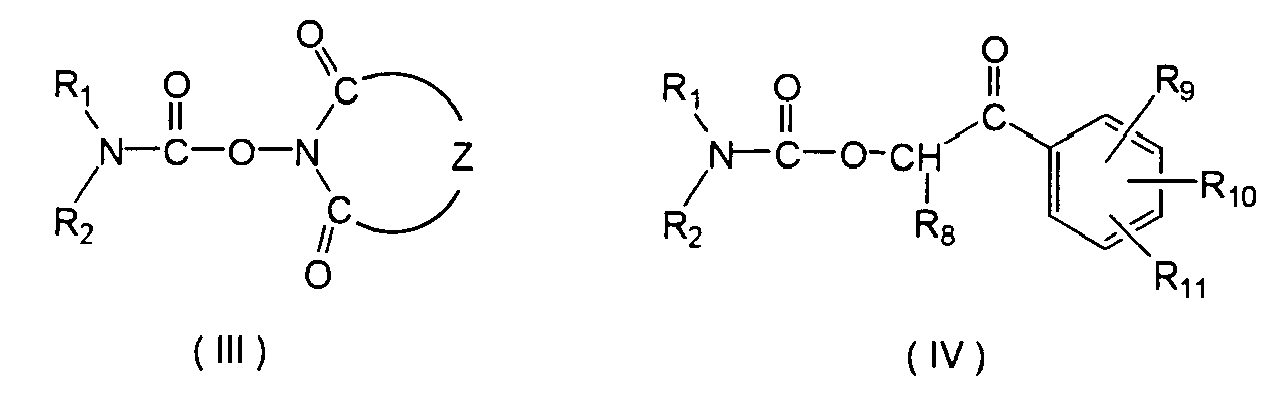


- The ink composition according to Claim 1 or Claim2, wherein the efficiency of the compound (b) in generating an acid when exposed to radiation is higher than the efficiency of the compound (c) in generating a compound having a basic nitrogen atom when exposed to radiation.
- The ink composition according to any one of Claim 1 to Claim 3, wherein it further comprises a colorant (d).
- The ink composition according to Claim 4, wherein the colorant (d) is a pigment or an oil-soluble dye.
- The ink composition according to any one of Claim 1 to Claim 5, wherein it is for inkjet use.
- An inkjet recording method comprising:a step (a) of discharging an ink composition onto a recording medium; anda step (b) of irradiating the discharged ink composition with radiation so as to cure the ink composition,the ink composition being the ink composition according to any one of Claim 1 to Claim 6.
- A printed material recorded by the inkjet recording method according to Claim 7.
- A process for producing a lithographic printing plate, the process comprising:a step (a) of discharging the ink composition according to any one of Claim 1 to Claim 6 onto a hydrophilic support; anda step (b) of irradiating the discharged ink composition with radiation so as to cure the ink composition, thus forming a hydrophobic image on the hydrophilic support by curing the ink composition.
- A lithographic printing plate produce by the lithographic printing plate production process according to Claim 9.
Applications Claiming Priority (1)
| Application Number | Priority Date | Filing Date | Title |
|---|---|---|---|
| JP2005076196A JP2006257248A (en) | 2005-03-17 | 2005-03-17 | Ink composition, inkjet recording method, printed matter, manufacturing method of lithographic printing plate, and lithographic printing plate |
Publications (2)
| Publication Number | Publication Date |
|---|---|
| EP1702962A1 true EP1702962A1 (en) | 2006-09-20 |
| EP1702962B1 EP1702962B1 (en) | 2008-12-24 |
Family
ID=36498698
Family Applications (1)
| Application Number | Title | Priority Date | Filing Date |
|---|---|---|---|
| EP20060003312 Expired - Lifetime EP1702962B1 (en) | 2005-03-17 | 2006-02-17 | Ink composition containing a photo-acid and a photo-base generator and processes using them |
Country Status (5)
| Country | Link |
|---|---|
| US (1) | US20060211785A1 (en) |
| EP (1) | EP1702962B1 (en) |
| JP (1) | JP2006257248A (en) |
| AT (1) | ATE418588T1 (en) |
| DE (1) | DE602006004380D1 (en) |
Cited By (7)
| Publication number | Priority date | Publication date | Assignee | Title |
|---|---|---|---|---|
| EP1834998A3 (en) * | 2006-03-16 | 2007-10-03 | FUJIFILM Corporation | Mixture, method for storing ink composition, ink container, and image formation method |
| WO2008074548A1 (en) * | 2006-12-21 | 2008-06-26 | Agfa Graphics Nv | White inkjet ink improved for dispersion stability |
| EP1952982A1 (en) * | 2007-02-02 | 2008-08-06 | FUJIFILM Corporation | Radiation-curable polymerizable composition, ink composition, inkjet recording method, printed material, planographic printing plate, and method for forming planographic printing plate |
| US7618683B2 (en) | 2006-01-12 | 2009-11-17 | Fujifilm Corporation | Ink composition, inkjet recording method, printed material, process for producing lithographic printing plate, and lithographic printing plate |
| EP2085438A4 (en) * | 2006-11-28 | 2011-04-06 | Konica Minolta Med & Graphic | Active ray-curable ink and image-forming method |
| TWI456008B (en) * | 2008-02-27 | 2014-10-11 | Mitsubishi Chem Corp | Colored resin composition for color filter, color filter organic el display and liquid crystal display device |
| US10274824B2 (en) | 2015-05-15 | 2019-04-30 | Rohm And Haas Electronic Materials Korea Ltd. | Photobase generators and photoresist compositions comprising same |
Families Citing this family (17)
| Publication number | Priority date | Publication date | Assignee | Title |
|---|---|---|---|---|
| JP5203575B2 (en) | 2005-05-04 | 2013-06-05 | ローム・アンド・ハース・エレクトロニック・マテリアルズ,エル.エル.シー. | Coating composition |
| ATE444999T1 (en) * | 2005-08-31 | 2009-10-15 | Fujifilm Corp | RADIATION CURED INK CONTAINING A CONDENSED POLYCYCLIC AROMATIC PHOTOSENSITIZER |
| US20110069127A1 (en) * | 2006-07-10 | 2011-03-24 | Silverbrook Research Pty Ltd. | Phthalocyanine dye formulations |
| US7615585B2 (en) * | 2007-04-19 | 2009-11-10 | Troy Corporation | Degassing compositions for curable coatings |
| CN102171181A (en) * | 2008-10-02 | 2011-08-31 | 昭和电工株式会社 | N-(alpha-aromatic group-substituted-2-nitro-4,5-dialkoxybenzyloxycarbonyl)amine compound and method for producing same |
| JP5333452B2 (en) * | 2008-10-02 | 2013-11-06 | 大日本印刷株式会社 | Photosensitive resin composition, article using the same, and negative pattern forming method |
| JP2012025710A (en) * | 2010-07-27 | 2012-02-09 | Wako Pure Chem Ind Ltd | Photobase generator |
| JP6108765B2 (en) * | 2011-12-19 | 2017-04-05 | キヤノン株式会社 | Photocurable composition and pattern forming method |
| JP2013159106A (en) * | 2012-02-09 | 2013-08-19 | Ricoh Co Ltd | Recording method, recording apparatus, and ink set used therefor |
| JP6208119B2 (en) * | 2012-03-22 | 2017-10-04 | 株式会社Adeka | Novel compound and photosensitive resin composition |
| JP6047422B2 (en) * | 2013-02-21 | 2016-12-21 | 富士フイルム株式会社 | Photosensitive composition, photocurable composition, chemically amplified resist composition, resist film, pattern formation method, and electronic device manufacturing method |
| KR20150138220A (en) * | 2013-03-28 | 2015-12-09 | 산아프로 가부시키가이샤 | Photobase generator |
| KR101785426B1 (en) | 2015-04-30 | 2017-10-17 | 롬엔드하스전자재료코리아유한회사 | Photoresist compositions and methods |
| KR101848656B1 (en) | 2015-04-30 | 2018-04-13 | 롬엔드하스전자재료코리아유한회사 | Overcoat compositions and methods for photolithography |
| CN106556972B (en) | 2015-09-30 | 2021-07-27 | 罗门哈斯电子材料韩国有限公司 | Overcoat compositions and methods for photolithography |
| TWI672562B (en) | 2015-09-30 | 2019-09-21 | 南韓商羅門哈斯電子材料韓國公司 | Photoresist compositions and methods |
| KR102177417B1 (en) | 2017-12-31 | 2020-11-11 | 롬 앤드 하스 일렉트로닉 머트어리얼즈 엘엘씨 | Photoresist compositions and methods |
Citations (5)
| Publication number | Priority date | Publication date | Assignee | Title |
|---|---|---|---|---|
| US5204218A (en) * | 1990-06-19 | 1993-04-20 | Mitsubishi Denki Kabushiki Kaisha | Photosensitive resin composition |
| EP0633502A1 (en) * | 1992-12-25 | 1995-01-11 | Hoechst Japan Limited | Pattern forming material |
| US20040052968A1 (en) * | 2002-09-02 | 2004-03-18 | Konica Corporation | Actinic radiation curable composition and actinic radiation curable ink, and image forming method as well as ink jet recording apparatus using the same |
| JP3514590B2 (en) * | 1996-09-06 | 2004-03-31 | 信越化学工業株式会社 | Chemically amplified positive resist material |
| US20040201659A1 (en) * | 2003-01-21 | 2004-10-14 | Konica Minolta Holdings, Inc. | Ink jet recording method |
Family Cites Families (8)
| Publication number | Priority date | Publication date | Assignee | Title |
|---|---|---|---|---|
| JPH05204138A (en) * | 1991-09-17 | 1993-08-13 | Nippon Paint Co Ltd | Direct plate making method using ink jet system |
| US5691100A (en) * | 1992-12-25 | 1997-11-25 | Hoechst Japan Limited | Pattern forming material including photoacid and photobase generators for large exposure latitude |
| JPH11256085A (en) * | 1998-03-12 | 1999-09-21 | Ricoh Co Ltd | Ink jet recording ink composition and direct plate making method using the same |
| US6338934B1 (en) * | 1999-08-26 | 2002-01-15 | International Business Machines Corporation | Hybrid resist based on photo acid/photo base blending |
| JP2003246818A (en) * | 2002-02-25 | 2003-09-05 | Konica Corp | Active energy ray-curable composition, and active energy ray-curable ink for inkjet recording using it and lithographic printing plate |
| JP4382364B2 (en) * | 2002-04-24 | 2009-12-09 | 株式会社東芝 | Liquid ink |
| JP4262009B2 (en) * | 2003-07-25 | 2009-05-13 | 東芝テック株式会社 | Photosensitive inkjet ink |
| JP2005060520A (en) * | 2003-08-12 | 2005-03-10 | Konica Minolta Medical & Graphic Inc | Curable composition, ink for inkjet using the same, and method of forming cured product |
-
2005
- 2005-03-17 JP JP2005076196A patent/JP2006257248A/en active Pending
-
2006
- 2006-02-17 AT AT06003312T patent/ATE418588T1/en not_active IP Right Cessation
- 2006-02-17 EP EP20060003312 patent/EP1702962B1/en not_active Expired - Lifetime
- 2006-02-17 DE DE200660004380 patent/DE602006004380D1/en not_active Expired - Lifetime
- 2006-03-10 US US11/372,095 patent/US20060211785A1/en not_active Abandoned
Patent Citations (5)
| Publication number | Priority date | Publication date | Assignee | Title |
|---|---|---|---|---|
| US5204218A (en) * | 1990-06-19 | 1993-04-20 | Mitsubishi Denki Kabushiki Kaisha | Photosensitive resin composition |
| EP0633502A1 (en) * | 1992-12-25 | 1995-01-11 | Hoechst Japan Limited | Pattern forming material |
| JP3514590B2 (en) * | 1996-09-06 | 2004-03-31 | 信越化学工業株式会社 | Chemically amplified positive resist material |
| US20040052968A1 (en) * | 2002-09-02 | 2004-03-18 | Konica Corporation | Actinic radiation curable composition and actinic radiation curable ink, and image forming method as well as ink jet recording apparatus using the same |
| US20040201659A1 (en) * | 2003-01-21 | 2004-10-14 | Konica Minolta Holdings, Inc. | Ink jet recording method |
Non-Patent Citations (1)
| Title |
|---|
| DATABASE WPI Section Ch Week 200423, Derwent World Patents Index; Class A89, AN 1998-256610, XP002387733 * |
Cited By (10)
| Publication number | Priority date | Publication date | Assignee | Title |
|---|---|---|---|---|
| US7618683B2 (en) | 2006-01-12 | 2009-11-17 | Fujifilm Corporation | Ink composition, inkjet recording method, printed material, process for producing lithographic printing plate, and lithographic printing plate |
| EP1834998A3 (en) * | 2006-03-16 | 2007-10-03 | FUJIFILM Corporation | Mixture, method for storing ink composition, ink container, and image formation method |
| EP2085438A4 (en) * | 2006-11-28 | 2011-04-06 | Konica Minolta Med & Graphic | Active ray-curable ink and image-forming method |
| US8124671B2 (en) | 2006-11-28 | 2012-02-28 | Konica Minolta Medical & Graphic, Inc. | Active ray-curable ink and method for forming image |
| WO2008074548A1 (en) * | 2006-12-21 | 2008-06-26 | Agfa Graphics Nv | White inkjet ink improved for dispersion stability |
| US8287112B2 (en) | 2006-12-21 | 2012-10-16 | Agfa Graphics Nv | White inkjet ink improved for dispersion stability |
| EP1952982A1 (en) * | 2007-02-02 | 2008-08-06 | FUJIFILM Corporation | Radiation-curable polymerizable composition, ink composition, inkjet recording method, printed material, planographic printing plate, and method for forming planographic printing plate |
| US7900558B2 (en) | 2007-02-02 | 2011-03-08 | Fujifilm Corporation | Radiation-curable polymerizable composition, ink composition, inkjet recording method, printed material, planographic printing plate, and method for forming planographic printing plate |
| TWI456008B (en) * | 2008-02-27 | 2014-10-11 | Mitsubishi Chem Corp | Colored resin composition for color filter, color filter organic el display and liquid crystal display device |
| US10274824B2 (en) | 2015-05-15 | 2019-04-30 | Rohm And Haas Electronic Materials Korea Ltd. | Photobase generators and photoresist compositions comprising same |
Also Published As
| Publication number | Publication date |
|---|---|
| DE602006004380D1 (en) | 2009-02-05 |
| JP2006257248A (en) | 2006-09-28 |
| EP1702962B1 (en) | 2008-12-24 |
| ATE418588T1 (en) | 2009-01-15 |
| US20060211785A1 (en) | 2006-09-21 |
Similar Documents
| Publication | Publication Date | Title |
|---|---|---|
| EP1702962B1 (en) | Ink composition containing a photo-acid and a photo-base generator and processes using them | |
| JP2008189776A (en) | Actinic radiation curable polymerizable composition, ink composition, ink jet recording method, printed matter, lithographic printing plate preparation method, and lithographic printing plate | |
| JP4738827B2 (en) | Ink composition, inkjet recording method, printed matter, lithographic printing plate preparation method | |
| JP2008248119A (en) | Actinic radiation polymerization type inkjet ink composition, inkjet recording method, printed matter, lithographic printing plate production method and lithographic printing plate | |
| EP1762599B1 (en) | Ink composition, inkjet recording method, printed material, process for producing lithographic plate, and lithographic printing plate | |
| JP4855052B2 (en) | Ink composition, inkjet recording method, printed matter, planographic printing plate production method | |
| JP4606907B2 (en) | Ink composition, inkjet recording method, printed matter, lithographic printing plate preparation method | |
| JP5159141B2 (en) | Ink composition, inkjet recording method, printed matter, lithographic printing plate preparation method | |
| JP2006249207A (en) | Ink composition, inkjet recording method, printed matter, manufacturing method of lithographic printing plate and lithographic printing plate | |
| JP2008013705A (en) | Ink composition, inkjet recording method, printed matter, planographic printing plate production method | |
| JP5068502B2 (en) | Ink composition, inkjet recording method, printed matter, planographic printing plate production method | |
| JP4732102B2 (en) | Ink composition, inkjet recording method, printed matter, lithographic printing plate preparation method | |
| JP4660237B2 (en) | Ink composition, ink jet recording method, printed material, method for preparing lithographic printing plate | |
| JP4597735B2 (en) | INK COMPOSITION, INKJET RECORDING METHOD, PRINTED MATERIAL, METHOD FOR PRODUCING A lithographic printing plate, and lithographic printing plate | |
| JP2007224149A (en) | Ink composition, inkjet recording method, printed matter, planographic printing plate manufacturing method, and planographic printing plate | |
| JP4606916B2 (en) | Ink composition, ink jet recording method, printed material, method for preparing lithographic printing plate | |
| JP4597736B2 (en) | INK COMPOSITION, INKJET RECORDING METHOD, PRINTED MATERIAL, METHOD FOR PRODUCING A lithographic printing plate, and lithographic printing plate | |
| JP5020611B2 (en) | Ink composition, inkjet recording method, printed material, method for producing lithographic printing plate, and lithographic printing plate | |
| JP2006321864A (en) | Ink composition, inkjet recording method, printed matter, manufacturing method of lithographic printing plate, and lithographic printing plate | |
| JP2006257206A (en) | Ink composition, inkjet recording method, printed matter, manufacturing method of lithographic printing plate, and lithographic printing plate | |
| JP5283328B2 (en) | INK COMPOSITION USING CURABLE COMPOSITION AND INK JET RECORDING METHOD | |
| JP2009084448A (en) | Actinic radiation curable inkjet ink composition, inkjet recording method, printed matter, lithographic printing plate production method, and lithographic printing plate | |
| JP2007269888A (en) | Ink composition | |
| JP2006249362A (en) | Ink composition, inkjet recording method, printed matter, manufacturing method of lithographic printing plate and lithographic printing plate | |
| JP2006273966A (en) | Ink composition, method for ink jet recording, printed matter, method for preparation of planographic printing plate and planographic printing plate |
Legal Events
| Date | Code | Title | Description |
|---|---|---|---|
| PUAI | Public reference made under article 153(3) epc to a published international application that has entered the european phase |
Free format text: ORIGINAL CODE: 0009012 |
|
| AK | Designated contracting states |
Kind code of ref document: A1 Designated state(s): AT BE BG CH CY CZ DE DK EE ES FI FR GB GR HU IE IS IT LI LT LU LV MC NL PL PT RO SE SI SK TR |
|
| AX | Request for extension of the european patent |
Extension state: AL BA HR MK YU |
|
| RAP1 | Party data changed (applicant data changed or rights of an application transferred) |
Owner name: FUJIFILM CORPORATION |
|
| 17P | Request for examination filed |
Effective date: 20070315 |
|
| AKX | Designation fees paid |
Designated state(s): AT BE BG CH CY CZ DE DK EE ES FI FR GB GR HU IE IS IT LI LT LU LV MC NL PL PT RO SE SI SK TR |
|
| 17Q | First examination report despatched |
Effective date: 20070807 |
|
| GRAP | Despatch of communication of intention to grant a patent |
Free format text: ORIGINAL CODE: EPIDOSNIGR1 |
|
| GRAS | Grant fee paid |
Free format text: ORIGINAL CODE: EPIDOSNIGR3 |
|
| GRAA | (expected) grant |
Free format text: ORIGINAL CODE: 0009210 |
|
| AK | Designated contracting states |
Kind code of ref document: B1 Designated state(s): AT BE BG CH CY CZ DE DK EE ES FI FR GB GR HU IE IS IT LI LT LU LV MC NL PL PT RO SE SI SK TR |
|
| REG | Reference to a national code |
Ref country code: GB Ref legal event code: FG4D |
|
| REG | Reference to a national code |
Ref country code: CH Ref legal event code: EP |
|
| REG | Reference to a national code |
Ref country code: IE Ref legal event code: FG4D |
|
| REF | Corresponds to: |
Ref document number: 602006004380 Country of ref document: DE Date of ref document: 20090205 Kind code of ref document: P |
|
| PG25 | Lapsed in a contracting state [announced via postgrant information from national office to epo] |
Ref country code: LT Free format text: LAPSE BECAUSE OF FAILURE TO SUBMIT A TRANSLATION OF THE DESCRIPTION OR TO PAY THE FEE WITHIN THE PRESCRIBED TIME-LIMIT Effective date: 20081224 |
|
| PG25 | Lapsed in a contracting state [announced via postgrant information from national office to epo] |
Ref country code: FI Free format text: LAPSE BECAUSE OF FAILURE TO SUBMIT A TRANSLATION OF THE DESCRIPTION OR TO PAY THE FEE WITHIN THE PRESCRIBED TIME-LIMIT Effective date: 20081224 Ref country code: LV Free format text: LAPSE BECAUSE OF FAILURE TO SUBMIT A TRANSLATION OF THE DESCRIPTION OR TO PAY THE FEE WITHIN THE PRESCRIBED TIME-LIMIT Effective date: 20081224 Ref country code: SI Free format text: LAPSE BECAUSE OF FAILURE TO SUBMIT A TRANSLATION OF THE DESCRIPTION OR TO PAY THE FEE WITHIN THE PRESCRIBED TIME-LIMIT Effective date: 20081224 Ref country code: NL Free format text: LAPSE BECAUSE OF FAILURE TO SUBMIT A TRANSLATION OF THE DESCRIPTION OR TO PAY THE FEE WITHIN THE PRESCRIBED TIME-LIMIT Effective date: 20081224 Ref country code: PL Free format text: LAPSE BECAUSE OF FAILURE TO SUBMIT A TRANSLATION OF THE DESCRIPTION OR TO PAY THE FEE WITHIN THE PRESCRIBED TIME-LIMIT Effective date: 20081224 |
|
| NLV1 | Nl: lapsed or annulled due to failure to fulfill the requirements of art. 29p and 29m of the patents act | ||
| PG25 | Lapsed in a contracting state [announced via postgrant information from national office to epo] |
Ref country code: RO Free format text: LAPSE BECAUSE OF FAILURE TO SUBMIT A TRANSLATION OF THE DESCRIPTION OR TO PAY THE FEE WITHIN THE PRESCRIBED TIME-LIMIT Effective date: 20081224 Ref country code: ES Free format text: LAPSE BECAUSE OF FAILURE TO SUBMIT A TRANSLATION OF THE DESCRIPTION OR TO PAY THE FEE WITHIN THE PRESCRIBED TIME-LIMIT Effective date: 20090404 Ref country code: EE Free format text: LAPSE BECAUSE OF FAILURE TO SUBMIT A TRANSLATION OF THE DESCRIPTION OR TO PAY THE FEE WITHIN THE PRESCRIBED TIME-LIMIT Effective date: 20081224 Ref country code: BE Free format text: LAPSE BECAUSE OF FAILURE TO SUBMIT A TRANSLATION OF THE DESCRIPTION OR TO PAY THE FEE WITHIN THE PRESCRIBED TIME-LIMIT Effective date: 20081224 Ref country code: BG Free format text: LAPSE BECAUSE OF FAILURE TO SUBMIT A TRANSLATION OF THE DESCRIPTION OR TO PAY THE FEE WITHIN THE PRESCRIBED TIME-LIMIT Effective date: 20090324 |
|
| PG25 | Lapsed in a contracting state [announced via postgrant information from national office to epo] |
Ref country code: SE Free format text: LAPSE BECAUSE OF FAILURE TO SUBMIT A TRANSLATION OF THE DESCRIPTION OR TO PAY THE FEE WITHIN THE PRESCRIBED TIME-LIMIT Effective date: 20090324 Ref country code: CZ Free format text: LAPSE BECAUSE OF FAILURE TO SUBMIT A TRANSLATION OF THE DESCRIPTION OR TO PAY THE FEE WITHIN THE PRESCRIBED TIME-LIMIT Effective date: 20081224 Ref country code: PT Free format text: LAPSE BECAUSE OF FAILURE TO SUBMIT A TRANSLATION OF THE DESCRIPTION OR TO PAY THE FEE WITHIN THE PRESCRIBED TIME-LIMIT Effective date: 20090525 Ref country code: IS Free format text: LAPSE BECAUSE OF FAILURE TO SUBMIT A TRANSLATION OF THE DESCRIPTION OR TO PAY THE FEE WITHIN THE PRESCRIBED TIME-LIMIT Effective date: 20090424 Ref country code: AT Free format text: LAPSE BECAUSE OF FAILURE TO SUBMIT A TRANSLATION OF THE DESCRIPTION OR TO PAY THE FEE WITHIN THE PRESCRIBED TIME-LIMIT Effective date: 20081224 |
|
| PG25 | Lapsed in a contracting state [announced via postgrant information from national office to epo] |
Ref country code: MC Free format text: LAPSE BECAUSE OF NON-PAYMENT OF DUE FEES Effective date: 20090228 Ref country code: SK Free format text: LAPSE BECAUSE OF FAILURE TO SUBMIT A TRANSLATION OF THE DESCRIPTION OR TO PAY THE FEE WITHIN THE PRESCRIBED TIME-LIMIT Effective date: 20081224 |
|
| PG25 | Lapsed in a contracting state [announced via postgrant information from national office to epo] |
Ref country code: DK Free format text: LAPSE BECAUSE OF FAILURE TO SUBMIT A TRANSLATION OF THE DESCRIPTION OR TO PAY THE FEE WITHIN THE PRESCRIBED TIME-LIMIT Effective date: 20081224 |
|
| PLBE | No opposition filed within time limit |
Free format text: ORIGINAL CODE: 0009261 |
|
| STAA | Information on the status of an ep patent application or granted ep patent |
Free format text: STATUS: NO OPPOSITION FILED WITHIN TIME LIMIT |
|
| REG | Reference to a national code |
Ref country code: FR Ref legal event code: ST Effective date: 20091030 |
|
| 26N | No opposition filed |
Effective date: 20090925 |
|
| PG25 | Lapsed in a contracting state [announced via postgrant information from national office to epo] |
Ref country code: IE Free format text: LAPSE BECAUSE OF NON-PAYMENT OF DUE FEES Effective date: 20090217 |
|
| PG25 | Lapsed in a contracting state [announced via postgrant information from national office to epo] |
Ref country code: FR Free format text: LAPSE BECAUSE OF NON-PAYMENT OF DUE FEES Effective date: 20090302 |
|
| REG | Reference to a national code |
Ref country code: CH Ref legal event code: PL |
|
| PG25 | Lapsed in a contracting state [announced via postgrant information from national office to epo] |
Ref country code: LI Free format text: LAPSE BECAUSE OF NON-PAYMENT OF DUE FEES Effective date: 20100228 Ref country code: CH Free format text: LAPSE BECAUSE OF NON-PAYMENT OF DUE FEES Effective date: 20100228 Ref country code: GR Free format text: LAPSE BECAUSE OF FAILURE TO SUBMIT A TRANSLATION OF THE DESCRIPTION OR TO PAY THE FEE WITHIN THE PRESCRIBED TIME-LIMIT Effective date: 20090325 |
|
| PG25 | Lapsed in a contracting state [announced via postgrant information from national office to epo] |
Ref country code: IT Free format text: LAPSE BECAUSE OF FAILURE TO SUBMIT A TRANSLATION OF THE DESCRIPTION OR TO PAY THE FEE WITHIN THE PRESCRIBED TIME-LIMIT Effective date: 20081224 |
|
| PG25 | Lapsed in a contracting state [announced via postgrant information from national office to epo] |
Ref country code: LU Free format text: LAPSE BECAUSE OF NON-PAYMENT OF DUE FEES Effective date: 20090217 |
|
| PG25 | Lapsed in a contracting state [announced via postgrant information from national office to epo] |
Ref country code: HU Free format text: LAPSE BECAUSE OF FAILURE TO SUBMIT A TRANSLATION OF THE DESCRIPTION OR TO PAY THE FEE WITHIN THE PRESCRIBED TIME-LIMIT Effective date: 20090625 |
|
| PG25 | Lapsed in a contracting state [announced via postgrant information from national office to epo] |
Ref country code: TR Free format text: LAPSE BECAUSE OF FAILURE TO SUBMIT A TRANSLATION OF THE DESCRIPTION OR TO PAY THE FEE WITHIN THE PRESCRIBED TIME-LIMIT Effective date: 20081224 |
|
| PG25 | Lapsed in a contracting state [announced via postgrant information from national office to epo] |
Ref country code: CY Free format text: LAPSE BECAUSE OF FAILURE TO SUBMIT A TRANSLATION OF THE DESCRIPTION OR TO PAY THE FEE WITHIN THE PRESCRIBED TIME-LIMIT Effective date: 20081224 |
|
| PGFP | Annual fee paid to national office [announced via postgrant information from national office to epo] |
Ref country code: DE Payment date: 20180206 Year of fee payment: 13 Ref country code: GB Payment date: 20180214 Year of fee payment: 13 |
|
| REG | Reference to a national code |
Ref country code: DE Ref legal event code: R119 Ref document number: 602006004380 Country of ref document: DE |
|
| GBPC | Gb: european patent ceased through non-payment of renewal fee |
Effective date: 20190217 |
|
| PG25 | Lapsed in a contracting state [announced via postgrant information from national office to epo] |
Ref country code: DE Free format text: LAPSE BECAUSE OF NON-PAYMENT OF DUE FEES Effective date: 20190903 Ref country code: GB Free format text: LAPSE BECAUSE OF NON-PAYMENT OF DUE FEES Effective date: 20190217 |