EP1698934A1 - Lithographic printing plate precursor - Google Patents
Lithographic printing plate precursor Download PDFInfo
- Publication number
- EP1698934A1 EP1698934A1 EP06004382A EP06004382A EP1698934A1 EP 1698934 A1 EP1698934 A1 EP 1698934A1 EP 06004382 A EP06004382 A EP 06004382A EP 06004382 A EP06004382 A EP 06004382A EP 1698934 A1 EP1698934 A1 EP 1698934A1
- Authority
- EP
- European Patent Office
- Prior art keywords
- group
- substituent
- lithographic printing
- printing plate
- plate precursor
- Prior art date
- Legal status (The legal status is an assumption and is not a legal conclusion. Google has not performed a legal analysis and makes no representation as to the accuracy of the status listed.)
- Granted
Links
- 238000007639 printing Methods 0.000 title claims abstract description 85
- 239000002243 precursor Substances 0.000 title claims abstract description 54
- 150000001875 compounds Chemical class 0.000 claims abstract description 77
- 239000011230 binding agent Substances 0.000 claims abstract description 32
- 229920000642 polymer Polymers 0.000 claims abstract description 29
- 239000003505 polymerization initiator Substances 0.000 claims abstract description 19
- 230000001235 sensitizing effect Effects 0.000 claims abstract description 15
- -1 thiol compound Chemical class 0.000 claims description 170
- 125000001424 substituent group Chemical group 0.000 claims description 98
- 239000010410 layer Substances 0.000 claims description 84
- 125000000217 alkyl group Chemical group 0.000 claims description 51
- 125000004432 carbon atom Chemical group C* 0.000 claims description 45
- 125000003118 aryl group Chemical group 0.000 claims description 41
- 238000000034 method Methods 0.000 claims description 41
- 125000004435 hydrogen atom Chemical group [H]* 0.000 claims description 31
- 239000011241 protective layer Substances 0.000 claims description 30
- 125000005843 halogen group Chemical group 0.000 claims description 28
- 125000003710 aryl alkyl group Chemical group 0.000 claims description 21
- 229920005749 polyurethane resin Polymers 0.000 claims description 20
- 239000012986 chain transfer agent Substances 0.000 claims description 15
- 125000001033 ether group Chemical group 0.000 claims description 12
- 238000012545 processing Methods 0.000 claims description 12
- 239000002736 nonionic surfactant Substances 0.000 claims description 10
- 125000005842 heteroatom Chemical group 0.000 claims description 7
- 229910052799 carbon Inorganic materials 0.000 claims description 5
- 229920006243 acrylic copolymer Polymers 0.000 claims description 2
- 229910052782 aluminium Inorganic materials 0.000 description 41
- 238000011282 treatment Methods 0.000 description 41
- XAGFODPZIPBFFR-UHFFFAOYSA-N aluminium Chemical compound [Al] XAGFODPZIPBFFR-UHFFFAOYSA-N 0.000 description 38
- 239000000243 solution Substances 0.000 description 35
- 239000000203 mixture Substances 0.000 description 28
- IAYPIBMASNFSPL-UHFFFAOYSA-N Ethylene oxide Chemical compound C1CO1 IAYPIBMASNFSPL-UHFFFAOYSA-N 0.000 description 23
- 125000003178 carboxy group Chemical group [H]OC(*)=O 0.000 description 23
- XLYOFNOQVPJJNP-UHFFFAOYSA-N water Substances O XLYOFNOQVPJJNP-UHFFFAOYSA-N 0.000 description 22
- 238000011161 development Methods 0.000 description 19
- 125000001931 aliphatic group Chemical group 0.000 description 18
- 125000003545 alkoxy group Chemical group 0.000 description 18
- 238000000576 coating method Methods 0.000 description 18
- 239000011248 coating agent Substances 0.000 description 16
- 229920001577 copolymer Polymers 0.000 description 16
- 125000000524 functional group Chemical group 0.000 description 16
- 238000007788 roughening Methods 0.000 description 16
- 239000004372 Polyvinyl alcohol Substances 0.000 description 15
- HEMHJVSKTPXQMS-UHFFFAOYSA-M Sodium hydroxide Chemical compound [OH-].[Na+] HEMHJVSKTPXQMS-UHFFFAOYSA-M 0.000 description 15
- 125000002029 aromatic hydrocarbon group Chemical group 0.000 description 15
- 229920002451 polyvinyl alcohol Polymers 0.000 description 15
- 239000003513 alkali Substances 0.000 description 14
- 239000000975 dye Substances 0.000 description 14
- 239000002253 acid Substances 0.000 description 13
- IQPQWNKOIGAROB-UHFFFAOYSA-N isocyanate group Chemical group [N-]=C=O IQPQWNKOIGAROB-UHFFFAOYSA-N 0.000 description 13
- 229920005596 polymer binder Polymers 0.000 description 13
- 239000002491 polymer binding agent Substances 0.000 description 13
- IISBACLAFKSPIT-UHFFFAOYSA-N bisphenol A Chemical compound C=1C=C(O)C=CC=1C(C)(C)C1=CC=C(O)C=C1 IISBACLAFKSPIT-UHFFFAOYSA-N 0.000 description 12
- LFQSCWFLJHTTHZ-UHFFFAOYSA-N Ethanol Chemical compound CCO LFQSCWFLJHTTHZ-UHFFFAOYSA-N 0.000 description 11
- JOYRKODLDBILNP-UHFFFAOYSA-N Ethyl urethane Chemical compound CCOC(N)=O JOYRKODLDBILNP-UHFFFAOYSA-N 0.000 description 11
- 125000003368 amide group Chemical group 0.000 description 11
- 239000003792 electrolyte Substances 0.000 description 11
- 125000004185 ester group Chemical group 0.000 description 11
- 150000003254 radicals Chemical class 0.000 description 11
- 230000035945 sensitivity Effects 0.000 description 11
- 239000007787 solid Substances 0.000 description 11
- 239000004094 surface-active agent Substances 0.000 description 11
- FBPFZTCFMRRESA-FSIIMWSLSA-N D-Glucitol Natural products OC[C@H](O)[C@H](O)[C@@H](O)[C@H](O)CO FBPFZTCFMRRESA-FSIIMWSLSA-N 0.000 description 10
- 125000004104 aryloxy group Chemical group 0.000 description 10
- PXKLMJQFEQBVLD-UHFFFAOYSA-N bisphenol F Chemical compound C1=CC(O)=CC=C1CC1=CC=C(O)C=C1 PXKLMJQFEQBVLD-UHFFFAOYSA-N 0.000 description 10
- 239000010408 film Substances 0.000 description 10
- 239000000600 sorbitol Substances 0.000 description 10
- KWYUFKZDYYNOTN-UHFFFAOYSA-M Potassium hydroxide Chemical compound [OH-].[K+] KWYUFKZDYYNOTN-UHFFFAOYSA-M 0.000 description 9
- 125000002947 alkylene group Chemical group 0.000 description 9
- 150000001408 amides Chemical class 0.000 description 9
- QVGXLLKOCUKJST-UHFFFAOYSA-N atomic oxygen Chemical compound [O] QVGXLLKOCUKJST-UHFFFAOYSA-N 0.000 description 9
- 230000015572 biosynthetic process Effects 0.000 description 9
- 238000006243 chemical reaction Methods 0.000 description 9
- 125000004093 cyano group Chemical group *C#N 0.000 description 9
- 239000001301 oxygen Substances 0.000 description 9
- 229910052760 oxygen Inorganic materials 0.000 description 9
- QAOWNCQODCNURD-UHFFFAOYSA-N Sulfuric acid Chemical compound OS(O)(=O)=O QAOWNCQODCNURD-UHFFFAOYSA-N 0.000 description 8
- 125000004453 alkoxycarbonyl group Chemical group 0.000 description 8
- 125000003277 amino group Chemical group 0.000 description 8
- 125000001951 carbamoylamino group Chemical group C(N)(=O)N* 0.000 description 8
- 125000002915 carbonyl group Chemical group [*:2]C([*:1])=O 0.000 description 8
- 150000002148 esters Chemical class 0.000 description 8
- 125000002496 methyl group Chemical class [H]C([H])([H])* 0.000 description 8
- 239000000178 monomer Substances 0.000 description 8
- 125000000449 nitro group Chemical group [O-][N+](*)=O 0.000 description 8
- 238000006116 polymerization reaction Methods 0.000 description 8
- GRYLNZFGIOXLOG-UHFFFAOYSA-N Nitric acid Chemical compound O[N+]([O-])=O GRYLNZFGIOXLOG-UHFFFAOYSA-N 0.000 description 7
- 238000007743 anodising Methods 0.000 description 7
- 150000001732 carboxylic acid derivatives Chemical class 0.000 description 7
- 239000003795 chemical substances by application Substances 0.000 description 7
- 229910017604 nitric acid Inorganic materials 0.000 description 7
- 239000000049 pigment Substances 0.000 description 7
- ZWEHNKRNPOVVGH-UHFFFAOYSA-N 2-Butanone Chemical compound CCC(C)=O ZWEHNKRNPOVVGH-UHFFFAOYSA-N 0.000 description 6
- VEXZGXHMUGYJMC-UHFFFAOYSA-N Hydrochloric acid Chemical compound Cl VEXZGXHMUGYJMC-UHFFFAOYSA-N 0.000 description 6
- OKKJLVBELUTLKV-UHFFFAOYSA-N Methanol Chemical compound OC OKKJLVBELUTLKV-UHFFFAOYSA-N 0.000 description 6
- VYPSYNLAJGMNEJ-UHFFFAOYSA-N Silicium dioxide Chemical compound O=[Si]=O VYPSYNLAJGMNEJ-UHFFFAOYSA-N 0.000 description 6
- 238000007259 addition reaction Methods 0.000 description 6
- 229910000272 alkali metal oxide Inorganic materials 0.000 description 6
- 239000007795 chemical reaction product Substances 0.000 description 6
- 239000003999 initiator Substances 0.000 description 6
- 229920001451 polypropylene glycol Polymers 0.000 description 6
- 230000009257 reactivity Effects 0.000 description 6
- 229910052814 silicon oxide Inorganic materials 0.000 description 6
- 229940058015 1,3-butylene glycol Drugs 0.000 description 5
- RTZKZFJDLAIYFH-UHFFFAOYSA-N Diethyl ether Chemical compound CCOCC RTZKZFJDLAIYFH-UHFFFAOYSA-N 0.000 description 5
- LYCAIKOWRPUZTN-UHFFFAOYSA-N Ethylene glycol Chemical class OCCO LYCAIKOWRPUZTN-UHFFFAOYSA-N 0.000 description 5
- 229920003171 Poly (ethylene oxide) Polymers 0.000 description 5
- GOOHAUXETOMSMM-UHFFFAOYSA-N Propylene oxide Chemical compound CC1CO1 GOOHAUXETOMSMM-UHFFFAOYSA-N 0.000 description 5
- 150000001412 amines Chemical class 0.000 description 5
- 125000005442 diisocyanate group Chemical group 0.000 description 5
- 230000005611 electricity Effects 0.000 description 5
- 125000002887 hydroxy group Chemical group [H]O* 0.000 description 5
- 125000000962 organic group Chemical group 0.000 description 5
- 230000035699 permeability Effects 0.000 description 5
- 150000003839 salts Chemical class 0.000 description 5
- 239000011734 sodium Substances 0.000 description 5
- 229910052708 sodium Inorganic materials 0.000 description 5
- 239000000126 substance Substances 0.000 description 5
- 125000000020 sulfo group Chemical group O=S(=O)([*])O[H] 0.000 description 5
- 238000012719 thermal polymerization Methods 0.000 description 5
- PUPZLCDOIYMWBV-UHFFFAOYSA-N (+/-)-1,3-Butanediol Chemical compound CC(O)CCO PUPZLCDOIYMWBV-UHFFFAOYSA-N 0.000 description 4
- FBPFZTCFMRRESA-JGWLITMVSA-N D-glucitol Chemical compound OC[C@H](O)[C@@H](O)[C@H](O)[C@H](O)CO FBPFZTCFMRRESA-JGWLITMVSA-N 0.000 description 4
- IMROMDMJAWUWLK-UHFFFAOYSA-N Ethenol Chemical compound OC=C IMROMDMJAWUWLK-UHFFFAOYSA-N 0.000 description 4
- QIGBRXMKCJKVMJ-UHFFFAOYSA-N Hydroquinone Chemical compound OC1=CC=C(O)C=C1 QIGBRXMKCJKVMJ-UHFFFAOYSA-N 0.000 description 4
- CERQOIWHTDAKMF-UHFFFAOYSA-N Methacrylic acid Chemical compound CC(=C)C(O)=O CERQOIWHTDAKMF-UHFFFAOYSA-N 0.000 description 4
- BAVYZALUXZFZLV-UHFFFAOYSA-N Methylamine Chemical compound NC BAVYZALUXZFZLV-UHFFFAOYSA-N 0.000 description 4
- 239000000654 additive Substances 0.000 description 4
- 125000003282 alkyl amino group Chemical group 0.000 description 4
- 125000004390 alkyl sulfonyl group Chemical group 0.000 description 4
- 125000001769 aryl amino group Chemical group 0.000 description 4
- 125000004391 aryl sulfonyl group Chemical group 0.000 description 4
- 125000000732 arylene group Chemical group 0.000 description 4
- 150000001733 carboxylic acid esters Chemical class 0.000 description 4
- JHIVVAPYMSGYDF-UHFFFAOYSA-N cyclohexanone Chemical compound O=C1CCCCC1 JHIVVAPYMSGYDF-UHFFFAOYSA-N 0.000 description 4
- 238000001035 drying Methods 0.000 description 4
- 238000000227 grinding Methods 0.000 description 4
- 239000003112 inhibitor Substances 0.000 description 4
- 238000004519 manufacturing process Methods 0.000 description 4
- 239000000463 material Substances 0.000 description 4
- 229920002635 polyurethane Polymers 0.000 description 4
- 239000004814 polyurethane Substances 0.000 description 4
- 238000002360 preparation method Methods 0.000 description 4
- 238000004321 preservation Methods 0.000 description 4
- 238000007142 ring opening reaction Methods 0.000 description 4
- 239000002904 solvent Substances 0.000 description 4
- LDHQCZJRKDOVOX-UHFFFAOYSA-N trans-crotonic acid Natural products CC=CC(O)=O LDHQCZJRKDOVOX-UHFFFAOYSA-N 0.000 description 4
- 229920002554 vinyl polymer Polymers 0.000 description 4
- 229920003169 water-soluble polymer Polymers 0.000 description 4
- HZAXFHJVJLSVMW-UHFFFAOYSA-N 2-Aminoethan-1-ol Chemical compound NCCO HZAXFHJVJLSVMW-UHFFFAOYSA-N 0.000 description 3
- CDAWCLOXVUBKRW-UHFFFAOYSA-N 2-aminophenol Chemical class NC1=CC=CC=C1O CDAWCLOXVUBKRW-UHFFFAOYSA-N 0.000 description 3
- CSCPPACGZOOCGX-UHFFFAOYSA-N Acetone Chemical compound CC(C)=O CSCPPACGZOOCGX-UHFFFAOYSA-N 0.000 description 3
- 229910000838 Al alloy Inorganic materials 0.000 description 3
- QGZKDVFQNNGYKY-UHFFFAOYSA-O Ammonium Chemical compound [NH4+] QGZKDVFQNNGYKY-UHFFFAOYSA-O 0.000 description 3
- UHOVQNZJYSORNB-UHFFFAOYSA-N Benzene Chemical compound C1=CC=CC=C1 UHOVQNZJYSORNB-UHFFFAOYSA-N 0.000 description 3
- XEKOWRVHYACXOJ-UHFFFAOYSA-N Ethyl acetate Chemical compound CCOC(C)=O XEKOWRVHYACXOJ-UHFFFAOYSA-N 0.000 description 3
- DGAQECJNVWCQMB-PUAWFVPOSA-M Ilexoside XXIX Chemical compound C[C@@H]1CC[C@@]2(CC[C@@]3(C(=CC[C@H]4[C@]3(CC[C@@H]5[C@@]4(CC[C@@H](C5(C)C)OS(=O)(=O)[O-])C)C)[C@@H]2[C@]1(C)O)C)C(=O)O[C@H]6[C@@H]([C@H]([C@@H]([C@H](O6)CO)O)O)O.[Na+] DGAQECJNVWCQMB-PUAWFVPOSA-M 0.000 description 3
- WMFOQBRAJBCJND-UHFFFAOYSA-M Lithium hydroxide Chemical compound [Li+].[OH-] WMFOQBRAJBCJND-UHFFFAOYSA-M 0.000 description 3
- BPQQTUXANYXVAA-UHFFFAOYSA-N Orthosilicate Chemical compound [O-][Si]([O-])([O-])[O-] BPQQTUXANYXVAA-UHFFFAOYSA-N 0.000 description 3
- MUBZPKHOEPUJKR-UHFFFAOYSA-N Oxalic acid Chemical compound OC(=O)C(O)=O MUBZPKHOEPUJKR-UHFFFAOYSA-N 0.000 description 3
- 229910019142 PO4 Inorganic materials 0.000 description 3
- 239000004698 Polyethylene Substances 0.000 description 3
- 239000004793 Polystyrene Substances 0.000 description 3
- OFOBLEOULBTSOW-UHFFFAOYSA-N Propanedioic acid Natural products OC(=O)CC(O)=O OFOBLEOULBTSOW-UHFFFAOYSA-N 0.000 description 3
- 239000004115 Sodium Silicate Substances 0.000 description 3
- PPBRXRYQALVLMV-UHFFFAOYSA-N Styrene Chemical compound C=CC1=CC=CC=C1 PPBRXRYQALVLMV-UHFFFAOYSA-N 0.000 description 3
- YXFVVABEGXRONW-UHFFFAOYSA-N Toluene Chemical compound CC1=CC=CC=C1 YXFVVABEGXRONW-UHFFFAOYSA-N 0.000 description 3
- ZMANZCXQSJIPKH-UHFFFAOYSA-N Triethylamine Chemical compound CCN(CC)CC ZMANZCXQSJIPKH-UHFFFAOYSA-N 0.000 description 3
- XTXRWKRVRITETP-UHFFFAOYSA-N Vinyl acetate Chemical compound CC(=O)OC=C XTXRWKRVRITETP-UHFFFAOYSA-N 0.000 description 3
- 235000010724 Wisteria floribunda Nutrition 0.000 description 3
- 150000001252 acrylic acid derivatives Chemical class 0.000 description 3
- 239000007864 aqueous solution Substances 0.000 description 3
- 239000003086 colorant Substances 0.000 description 3
- XCJYREBRNVKWGJ-UHFFFAOYSA-N copper(II) phthalocyanine Chemical compound [Cu+2].C12=CC=CC=C2C(N=C2[N-]C(C3=CC=CC=C32)=N2)=NC1=NC([C]1C=CC=CC1=1)=NC=1N=C1[C]3C=CC=CC3=C2[N-]1 XCJYREBRNVKWGJ-UHFFFAOYSA-N 0.000 description 3
- UAOMVDZJSHZZME-UHFFFAOYSA-N diisopropylamine Chemical compound CC(C)NC(C)C UAOMVDZJSHZZME-UHFFFAOYSA-N 0.000 description 3
- 239000006185 dispersion Substances 0.000 description 3
- 238000004090 dissolution Methods 0.000 description 3
- 238000005868 electrolysis reaction Methods 0.000 description 3
- 238000005530 etching Methods 0.000 description 3
- 238000010438 heat treatment Methods 0.000 description 3
- 125000000623 heterocyclic group Chemical group 0.000 description 3
- 229910001389 inorganic alkali salt Inorganic materials 0.000 description 3
- 239000012948 isocyanate Substances 0.000 description 3
- 150000002513 isocyanates Chemical class 0.000 description 3
- 125000001449 isopropyl group Chemical group [H]C([H])([H])C([H])(*)C([H])([H])[H] 0.000 description 3
- 239000011976 maleic acid Substances 0.000 description 3
- 229910052751 metal Inorganic materials 0.000 description 3
- 239000002184 metal Substances 0.000 description 3
- LVHBHZANLOWSRM-UHFFFAOYSA-N methylenebutanedioic acid Natural products OC(=O)CC(=C)C(O)=O LVHBHZANLOWSRM-UHFFFAOYSA-N 0.000 description 3
- 238000002156 mixing Methods 0.000 description 3
- 229920000620 organic polymer Polymers 0.000 description 3
- 125000004430 oxygen atom Chemical group O* 0.000 description 3
- 239000010452 phosphate Substances 0.000 description 3
- 125000002467 phosphate group Chemical group [H]OP(=O)(O[H])O[*] 0.000 description 3
- 229920000728 polyester Polymers 0.000 description 3
- 229920000036 polyvinylpyrrolidone Polymers 0.000 description 3
- 239000001267 polyvinylpyrrolidone Substances 0.000 description 3
- 235000013855 polyvinylpyrrolidone Nutrition 0.000 description 3
- 230000008569 process Effects 0.000 description 3
- NTHWMYGWWRZVTN-UHFFFAOYSA-N sodium silicate Chemical compound [Na+].[Na+].[O-][Si]([O-])=O NTHWMYGWWRZVTN-UHFFFAOYSA-N 0.000 description 3
- 229910052911 sodium silicate Inorganic materials 0.000 description 3
- 239000007858 starting material Substances 0.000 description 3
- 229910052717 sulfur Inorganic materials 0.000 description 3
- 125000004434 sulfur atom Chemical group 0.000 description 3
- 238000004381 surface treatment Methods 0.000 description 3
- 150000003573 thiols Chemical class 0.000 description 3
- VZCYOOQTPOCHFL-UHFFFAOYSA-N trans-butenedioic acid Natural products OC(=O)C=CC(O)=O VZCYOOQTPOCHFL-UHFFFAOYSA-N 0.000 description 3
- ORTVZLZNOYNASJ-OWOJBTEDSA-N (e)-but-2-ene-1,4-diol Chemical compound OC\C=C\CO ORTVZLZNOYNASJ-OWOJBTEDSA-N 0.000 description 2
- HXKKHQJGJAFBHI-UHFFFAOYSA-N 1-aminopropan-2-ol Chemical compound CC(O)CN HXKKHQJGJAFBHI-UHFFFAOYSA-N 0.000 description 2
- VBICKXHEKHSIBG-UHFFFAOYSA-N 1-monostearoylglycerol Chemical compound CCCCCCCCCCCCCCCCCC(=O)OCC(O)CO VBICKXHEKHSIBG-UHFFFAOYSA-N 0.000 description 2
- DEPDDPLQZYCHOH-UHFFFAOYSA-N 1h-imidazol-2-amine Chemical compound NC1=NC=CN1 DEPDDPLQZYCHOH-UHFFFAOYSA-N 0.000 description 2
- VZSRBBMJRBPUNF-UHFFFAOYSA-N 2-(2,3-dihydro-1H-inden-2-ylamino)-N-[3-oxo-3-(2,4,6,7-tetrahydrotriazolo[4,5-c]pyridin-5-yl)propyl]pyrimidine-5-carboxamide Chemical compound C1C(CC2=CC=CC=C12)NC1=NC=C(C=N1)C(=O)NCCC(N1CC2=C(CC1)NN=N2)=O VZSRBBMJRBPUNF-UHFFFAOYSA-N 0.000 description 2
- YCCILVSKPBXVIP-UHFFFAOYSA-N 2-(4-hydroxyphenyl)ethanol Chemical compound OCCC1=CC=C(O)C=C1 YCCILVSKPBXVIP-UHFFFAOYSA-N 0.000 description 2
- INQDDHNZXOAFFD-UHFFFAOYSA-N 2-[2-(2-prop-2-enoyloxyethoxy)ethoxy]ethyl prop-2-enoate Chemical compound C=CC(=O)OCCOCCOCCOC(=O)C=C INQDDHNZXOAFFD-UHFFFAOYSA-N 0.000 description 2
- HCLJOFJIQIJXHS-UHFFFAOYSA-N 2-[2-[2-(2-prop-2-enoyloxyethoxy)ethoxy]ethoxy]ethyl prop-2-enoate Chemical compound C=CC(=O)OCCOCCOCCOCCOC(=O)C=C HCLJOFJIQIJXHS-UHFFFAOYSA-N 0.000 description 2
- TXBCBTDQIULDIA-UHFFFAOYSA-N 2-[[3-hydroxy-2,2-bis(hydroxymethyl)propoxy]methyl]-2-(hydroxymethyl)propane-1,3-diol Chemical compound OCC(CO)(CO)COCC(CO)(CO)CO TXBCBTDQIULDIA-UHFFFAOYSA-N 0.000 description 2
- SVONRAPFKPVNKG-UHFFFAOYSA-N 2-ethoxyethyl acetate Chemical compound CCOCCOC(C)=O SVONRAPFKPVNKG-UHFFFAOYSA-N 0.000 description 2
- GFHGEIJFEHZKHZ-UHFFFAOYSA-N 2-hydroxyethyl 4-hydroxybenzoate Chemical compound OCCOC(=O)C1=CC=C(O)C=C1 GFHGEIJFEHZKHZ-UHFFFAOYSA-N 0.000 description 2
- KUDUQBURMYMBIJ-UHFFFAOYSA-N 2-prop-2-enoyloxyethyl prop-2-enoate Chemical compound C=CC(=O)OCCOC(=O)C=C KUDUQBURMYMBIJ-UHFFFAOYSA-N 0.000 description 2
- XOUQAVYLRNOXDO-UHFFFAOYSA-N 2-tert-butyl-5-methylphenol Chemical compound CC1=CC=C(C(C)(C)C)C(O)=C1 XOUQAVYLRNOXDO-UHFFFAOYSA-N 0.000 description 2
- UCQUAMAQHHEXGD-UHFFFAOYSA-N 3',4'-dihydroxyacetophenone Chemical compound CC(=O)C1=CC=C(O)C(O)=C1 UCQUAMAQHHEXGD-UHFFFAOYSA-N 0.000 description 2
- UYEMGAFJOZZIFP-UHFFFAOYSA-N 3,5-dihydroxybenzoic acid Chemical compound OC(=O)C1=CC(O)=CC(O)=C1 UYEMGAFJOZZIFP-UHFFFAOYSA-N 0.000 description 2
- CWLKGDAVCFYWJK-UHFFFAOYSA-N 3-aminophenol Chemical compound NC1=CC=CC(O)=C1 CWLKGDAVCFYWJK-UHFFFAOYSA-N 0.000 description 2
- LPYUENQFPVNPHY-UHFFFAOYSA-N 3-methoxycatechol Chemical compound COC1=CC=CC(O)=C1O LPYUENQFPVNPHY-UHFFFAOYSA-N 0.000 description 2
- VVBLNCFGVYUYGU-UHFFFAOYSA-N 4,4'-Bis(dimethylamino)benzophenone Chemical compound C1=CC(N(C)C)=CC=C1C(=O)C1=CC=C(N(C)C)C=C1 VVBLNCFGVYUYGU-UHFFFAOYSA-N 0.000 description 2
- RQJDUEKERVZLLU-UHFFFAOYSA-N 4-Hydroxybenzylamine Chemical compound NCC1=CC=C(O)C=C1 RQJDUEKERVZLLU-UHFFFAOYSA-N 0.000 description 2
- PLIKAWJENQZMHA-UHFFFAOYSA-N 4-aminophenol Chemical compound NC1=CC=C(O)C=C1 PLIKAWJENQZMHA-UHFFFAOYSA-N 0.000 description 2
- 229920002126 Acrylic acid copolymer Polymers 0.000 description 2
- ATRRKUHOCOJYRX-UHFFFAOYSA-N Ammonium bicarbonate Chemical group [NH4+].OC([O-])=O ATRRKUHOCOJYRX-UHFFFAOYSA-N 0.000 description 2
- OKTJSMMVPCPJKN-UHFFFAOYSA-N Carbon Chemical compound [C] OKTJSMMVPCPJKN-UHFFFAOYSA-N 0.000 description 2
- RYGMFSIKBFXOCR-UHFFFAOYSA-N Copper Chemical compound [Cu] RYGMFSIKBFXOCR-UHFFFAOYSA-N 0.000 description 2
- XTHFKEDIFFGKHM-UHFFFAOYSA-N Dimethoxyethane Chemical compound COCCOC XTHFKEDIFFGKHM-UHFFFAOYSA-N 0.000 description 2
- NIQCNGHVCWTJSM-UHFFFAOYSA-N Dimethyl phthalate Chemical compound COC(=O)C1=CC=CC=C1C(=O)OC NIQCNGHVCWTJSM-UHFFFAOYSA-N 0.000 description 2
- ROSDSFDQCJNGOL-UHFFFAOYSA-N Dimethylamine Chemical compound CNC ROSDSFDQCJNGOL-UHFFFAOYSA-N 0.000 description 2
- IAZDPXIOMUYVGZ-UHFFFAOYSA-N Dimethylsulphoxide Chemical compound CS(C)=O IAZDPXIOMUYVGZ-UHFFFAOYSA-N 0.000 description 2
- 239000004593 Epoxy Substances 0.000 description 2
- QUSNBJAOOMFDIB-UHFFFAOYSA-N Ethylamine Chemical compound CCN QUSNBJAOOMFDIB-UHFFFAOYSA-N 0.000 description 2
- PIICEJLVQHRZGT-UHFFFAOYSA-N Ethylenediamine Chemical compound NCCN PIICEJLVQHRZGT-UHFFFAOYSA-N 0.000 description 2
- PEDCQBHIVMGVHV-UHFFFAOYSA-N Glycerine Chemical compound OCC(O)CO PEDCQBHIVMGVHV-UHFFFAOYSA-N 0.000 description 2
- 229920000084 Gum arabic Polymers 0.000 description 2
- XEEYBQQBJWHFJM-UHFFFAOYSA-N Iron Chemical compound [Fe] XEEYBQQBJWHFJM-UHFFFAOYSA-N 0.000 description 2
- OUYCCCASQSFEME-QMMMGPOBSA-N L-tyrosine Chemical compound OC(=O)[C@@H](N)CC1=CC=C(O)C=C1 OUYCCCASQSFEME-QMMMGPOBSA-N 0.000 description 2
- PXHVJJICTQNCMI-UHFFFAOYSA-N Nickel Chemical compound [Ni] PXHVJJICTQNCMI-UHFFFAOYSA-N 0.000 description 2
- 239000004677 Nylon Substances 0.000 description 2
- NBIIXXVUZAFLBC-UHFFFAOYSA-N Phosphoric acid Chemical compound OP(O)(O)=O NBIIXXVUZAFLBC-UHFFFAOYSA-N 0.000 description 2
- GLUUGHFHXGJENI-UHFFFAOYSA-N Piperazine Chemical compound C1CNCCN1 GLUUGHFHXGJENI-UHFFFAOYSA-N 0.000 description 2
- 239000004743 Polypropylene Substances 0.000 description 2
- DNIAPMSPPWPWGF-UHFFFAOYSA-N Propylene glycol Chemical compound CC(O)CO DNIAPMSPPWPWGF-UHFFFAOYSA-N 0.000 description 2
- JUJWROOIHBZHMG-UHFFFAOYSA-N Pyridine Chemical compound C1=CC=NC=C1 JUJWROOIHBZHMG-UHFFFAOYSA-N 0.000 description 2
- 241000978776 Senegalia senegal Species 0.000 description 2
- XUIMIQQOPSSXEZ-UHFFFAOYSA-N Silicon Chemical compound [Si] XUIMIQQOPSSXEZ-UHFFFAOYSA-N 0.000 description 2
- CDBYLPFSWZWCQE-UHFFFAOYSA-L Sodium Carbonate Chemical group [Na+].[Na+].[O-]C([O-])=O CDBYLPFSWZWCQE-UHFFFAOYSA-L 0.000 description 2
- UIIMBOGNXHQVGW-UHFFFAOYSA-M Sodium bicarbonate Chemical group [Na+].OC([O-])=O UIIMBOGNXHQVGW-UHFFFAOYSA-M 0.000 description 2
- WYURNTSHIVDZCO-UHFFFAOYSA-N Tetrahydrofuran Chemical compound C1CCOC1 WYURNTSHIVDZCO-UHFFFAOYSA-N 0.000 description 2
- GWEVSGVZZGPLCZ-UHFFFAOYSA-N Titan oxide Chemical compound O=[Ti]=O GWEVSGVZZGPLCZ-UHFFFAOYSA-N 0.000 description 2
- RTAQQCXQSZGOHL-UHFFFAOYSA-N Titanium Chemical compound [Ti] RTAQQCXQSZGOHL-UHFFFAOYSA-N 0.000 description 2
- HCHKCACWOHOZIP-UHFFFAOYSA-N Zinc Chemical compound [Zn] HCHKCACWOHOZIP-UHFFFAOYSA-N 0.000 description 2
- 239000000205 acacia gum Substances 0.000 description 2
- 235000010489 acacia gum Nutrition 0.000 description 2
- DHKHKXVYLBGOIT-UHFFFAOYSA-N acetaldehyde Diethyl Acetal Chemical group CCOC(C)OCC DHKHKXVYLBGOIT-UHFFFAOYSA-N 0.000 description 2
- 150000001241 acetals Chemical group 0.000 description 2
- YRKCREAYFQTBPV-UHFFFAOYSA-N acetylacetone Chemical compound CC(=O)CC(C)=O YRKCREAYFQTBPV-UHFFFAOYSA-N 0.000 description 2
- 125000005396 acrylic acid ester group Chemical group 0.000 description 2
- 230000000996 additive effect Effects 0.000 description 2
- 150000001336 alkenes Chemical group 0.000 description 2
- 125000004450 alkenylene group Chemical group 0.000 description 2
- 125000004419 alkynylene group Chemical group 0.000 description 2
- 239000001099 ammonium carbonate Chemical group 0.000 description 2
- 239000002280 amphoteric surfactant Substances 0.000 description 2
- 239000003945 anionic surfactant Substances 0.000 description 2
- 239000010407 anodic oxide Substances 0.000 description 2
- 235000019437 butane-1,3-diol Nutrition 0.000 description 2
- WERYXYBDKMZEQL-UHFFFAOYSA-N butane-1,4-diol Chemical compound OCCCCO WERYXYBDKMZEQL-UHFFFAOYSA-N 0.000 description 2
- GKRVGTLVYRYCFR-UHFFFAOYSA-N butane-1,4-diol;2-methylidenebutanedioic acid Chemical compound OCCCCO.OC(=O)CC(=C)C(O)=O.OC(=O)CC(=C)C(O)=O GKRVGTLVYRYCFR-UHFFFAOYSA-N 0.000 description 2
- VHRGRCVQAFMJIZ-UHFFFAOYSA-N cadaverine Chemical compound NCCCCCN VHRGRCVQAFMJIZ-UHFFFAOYSA-N 0.000 description 2
- 150000001721 carbon Chemical group 0.000 description 2
- 150000001728 carbonyl compounds Chemical class 0.000 description 2
- YCIMNLLNPGFGHC-UHFFFAOYSA-N catechol Chemical compound OC1=CC=CC=C1O YCIMNLLNPGFGHC-UHFFFAOYSA-N 0.000 description 2
- 239000001913 cellulose Substances 0.000 description 2
- 229920002678 cellulose Polymers 0.000 description 2
- 235000010980 cellulose Nutrition 0.000 description 2
- 239000011247 coating layer Substances 0.000 description 2
- 238000007334 copolymerization reaction Methods 0.000 description 2
- 229910052802 copper Inorganic materials 0.000 description 2
- 239000010949 copper Substances 0.000 description 2
- LDHQCZJRKDOVOX-NSCUHMNNSA-N crotonic acid Chemical compound C\C=C\C(O)=O LDHQCZJRKDOVOX-NSCUHMNNSA-N 0.000 description 2
- 239000013078 crystal Substances 0.000 description 2
- 238000005238 degreasing Methods 0.000 description 2
- 238000013461 design Methods 0.000 description 2
- SWXVUIWOUIDPGS-UHFFFAOYSA-N diacetone alcohol Chemical compound CC(=O)CC(C)(C)O SWXVUIWOUIDPGS-UHFFFAOYSA-N 0.000 description 2
- 125000004663 dialkyl amino group Chemical group 0.000 description 2
- 235000014113 dietary fatty acids Nutrition 0.000 description 2
- 238000009792 diffusion process Methods 0.000 description 2
- 239000000539 dimer Substances 0.000 description 2
- UKMSUNONTOPOIO-UHFFFAOYSA-N docosanoic acid Chemical compound CCCCCCCCCCCCCCCCCCCCCC(O)=O UKMSUNONTOPOIO-UHFFFAOYSA-N 0.000 description 2
- 230000000694 effects Effects 0.000 description 2
- 238000005516 engineering process Methods 0.000 description 2
- 125000003700 epoxy group Chemical group 0.000 description 2
- LZCLXQDLBQLTDK-UHFFFAOYSA-N ethyl 2-hydroxypropanoate Chemical compound CCOC(=O)C(C)O LZCLXQDLBQLTDK-UHFFFAOYSA-N 0.000 description 2
- 125000001495 ethyl group Chemical group [H]C([H])([H])C([H])([H])* 0.000 description 2
- XLLIQLLCWZCATF-UHFFFAOYSA-N ethylene glycol monomethyl ether acetate Natural products COCCOC(C)=O XLLIQLLCWZCATF-UHFFFAOYSA-N 0.000 description 2
- 238000011156 evaluation Methods 0.000 description 2
- 239000000194 fatty acid Substances 0.000 description 2
- 229930195729 fatty acid Natural products 0.000 description 2
- 150000004665 fatty acids Chemical class 0.000 description 2
- 239000000499 gel Substances 0.000 description 2
- 229910052736 halogen Inorganic materials 0.000 description 2
- 125000001072 heteroaryl group Chemical group 0.000 description 2
- NAQMVNRVTILPCV-UHFFFAOYSA-N hexane-1,6-diamine Chemical compound NCCCCCCN NAQMVNRVTILPCV-UHFFFAOYSA-N 0.000 description 2
- 230000003301 hydrolyzing effect Effects 0.000 description 2
- 230000006872 improvement Effects 0.000 description 2
- 230000005764 inhibitory process Effects 0.000 description 2
- 230000000977 initiatory effect Effects 0.000 description 2
- 229910000765 intermetallic Inorganic materials 0.000 description 2
- VYFOAVADNIHPTR-UHFFFAOYSA-N isatoic anhydride Chemical compound NC1=CC=CC=C1CO VYFOAVADNIHPTR-UHFFFAOYSA-N 0.000 description 2
- LDHQCZJRKDOVOX-IHWYPQMZSA-N isocrotonic acid Chemical compound C\C=C/C(O)=O LDHQCZJRKDOVOX-IHWYPQMZSA-N 0.000 description 2
- KFZMGEQAYNKOFK-UHFFFAOYSA-N isopropyl alcohol Natural products CC(C)O KFZMGEQAYNKOFK-UHFFFAOYSA-N 0.000 description 2
- 150000002576 ketones Chemical class 0.000 description 2
- 125000005647 linker group Chemical group 0.000 description 2
- 125000005397 methacrylic acid ester group Chemical group 0.000 description 2
- 229920001778 nylon Polymers 0.000 description 2
- 239000003960 organic solvent Substances 0.000 description 2
- 150000002916 oxazoles Chemical class 0.000 description 2
- VLTRZXGMWDSKGL-UHFFFAOYSA-M perchlorate Chemical compound [O-]Cl(=O)(=O)=O VLTRZXGMWDSKGL-UHFFFAOYSA-M 0.000 description 2
- 125000001997 phenyl group Chemical group [H]C1=C([H])C([H])=C(*)C([H])=C1[H] 0.000 description 2
- 229920003023 plastic Polymers 0.000 description 2
- 239000004033 plastic Substances 0.000 description 2
- 239000002985 plastic film Substances 0.000 description 2
- 229920006255 plastic film Polymers 0.000 description 2
- 229920000515 polycarbonate Polymers 0.000 description 2
- 239000004417 polycarbonate Substances 0.000 description 2
- 229920000573 polyethylene Polymers 0.000 description 2
- 229920001155 polypropylene Polymers 0.000 description 2
- 229920002223 polystyrene Polymers 0.000 description 2
- BWHMMNNQKKPAPP-UHFFFAOYSA-L potassium carbonate Chemical group [K+].[K+].[O-]C([O-])=O BWHMMNNQKKPAPP-UHFFFAOYSA-L 0.000 description 2
- 125000002924 primary amino group Chemical group [H]N([H])* 0.000 description 2
- YPFDHNVEDLHUCE-UHFFFAOYSA-N propane-1,3-diol Chemical compound OCCCO YPFDHNVEDLHUCE-UHFFFAOYSA-N 0.000 description 2
- LLHKCFNBLRBOGN-UHFFFAOYSA-N propylene glycol methyl ether acetate Chemical compound COCC(C)OC(C)=O LLHKCFNBLRBOGN-UHFFFAOYSA-N 0.000 description 2
- AOHJOMMDDJHIJH-UHFFFAOYSA-N propylenediamine Chemical compound CC(N)CN AOHJOMMDDJHIJH-UHFFFAOYSA-N 0.000 description 2
- KIDHWZJUCRJVML-UHFFFAOYSA-N putrescine Chemical compound NCCCCN KIDHWZJUCRJVML-UHFFFAOYSA-N 0.000 description 2
- WQGWDDDVZFFDIG-UHFFFAOYSA-N pyrogallol Chemical compound OC1=CC=CC(O)=C1O WQGWDDDVZFFDIG-UHFFFAOYSA-N 0.000 description 2
- CYIDZMCFTVVTJO-UHFFFAOYSA-N pyromellitic acid Chemical compound OC(=O)C1=CC(C(O)=O)=C(C(O)=O)C=C1C(O)=O CYIDZMCFTVVTJO-UHFFFAOYSA-N 0.000 description 2
- 239000002994 raw material Substances 0.000 description 2
- GHMLBKRAJCXXBS-UHFFFAOYSA-N resorcinol Chemical compound OC1=CC=CC(O)=C1 GHMLBKRAJCXXBS-UHFFFAOYSA-N 0.000 description 2
- 239000010731 rolling oil Substances 0.000 description 2
- 229910052710 silicon Inorganic materials 0.000 description 2
- 239000010703 silicon Substances 0.000 description 2
- 238000005507 spraying Methods 0.000 description 2
- 150000005846 sugar alcohols Polymers 0.000 description 2
- 239000002344 surface layer Substances 0.000 description 2
- 238000003786 synthesis reaction Methods 0.000 description 2
- WGTYBPLFGIVFAS-UHFFFAOYSA-M tetramethylammonium hydroxide Chemical compound [OH-].C[N+](C)(C)C WGTYBPLFGIVFAS-UHFFFAOYSA-M 0.000 description 2
- 125000003396 thiol group Chemical group [H]S* 0.000 description 2
- 239000010936 titanium Substances 0.000 description 2
- 229910052719 titanium Inorganic materials 0.000 description 2
- OGIDPMRJRNCKJF-UHFFFAOYSA-N titanium oxide Inorganic materials [Ti]=O OGIDPMRJRNCKJF-UHFFFAOYSA-N 0.000 description 2
- DVKJHBMWWAPEIU-UHFFFAOYSA-N toluene 2,4-diisocyanate Chemical compound CC1=CC=C(N=C=O)C=C1N=C=O DVKJHBMWWAPEIU-UHFFFAOYSA-N 0.000 description 2
- 238000012546 transfer Methods 0.000 description 2
- SRPWOOOHEPICQU-UHFFFAOYSA-N trimellitic anhydride Chemical compound OC(=O)C1=CC=C2C(=O)OC(=O)C2=C1 SRPWOOOHEPICQU-UHFFFAOYSA-N 0.000 description 2
- GETQZCLCWQTVFV-UHFFFAOYSA-N trimethylamine Chemical compound CN(C)C GETQZCLCWQTVFV-UHFFFAOYSA-N 0.000 description 2
- QIVBCDIJIAJPQS-UHFFFAOYSA-N tryptophan Chemical compound C1=CC=C2C(CC(N)C(O)=O)=CNC2=C1 QIVBCDIJIAJPQS-UHFFFAOYSA-N 0.000 description 2
- 125000000391 vinyl group Chemical group [H]C([*])=C([H])[H] 0.000 description 2
- 238000005406 washing Methods 0.000 description 2
- 239000002699 waste material Substances 0.000 description 2
- 229910052725 zinc Inorganic materials 0.000 description 2
- 239000011701 zinc Substances 0.000 description 2
- VMHYWKBKHMYRNF-UHFFFAOYSA-N (2-chlorophenyl)-phenylmethanone Chemical compound ClC1=CC=CC=C1C(=O)C1=CC=CC=C1 VMHYWKBKHMYRNF-UHFFFAOYSA-N 0.000 description 1
- CKGKXGQVRVAKEA-UHFFFAOYSA-N (2-methylphenyl)-phenylmethanone Chemical compound CC1=CC=CC=C1C(=O)C1=CC=CC=C1 CKGKXGQVRVAKEA-UHFFFAOYSA-N 0.000 description 1
- CUNWUEBNSZSNRX-RKGWDQTMSA-N (2r,3r,4r,5s)-hexane-1,2,3,4,5,6-hexol;(z)-octadec-9-enoic acid Chemical compound OC[C@H](O)[C@@H](O)[C@H](O)[C@H](O)CO.OC[C@H](O)[C@@H](O)[C@H](O)[C@H](O)CO.CCCCCCCC\C=C/CCCCCCCC(O)=O.CCCCCCCC\C=C/CCCCCCCC(O)=O.CCCCCCCC\C=C/CCCCCCCC(O)=O CUNWUEBNSZSNRX-RKGWDQTMSA-N 0.000 description 1
- URBLVRAVOIVZFJ-UHFFFAOYSA-N (3-methylphenyl)-phenylmethanone Chemical compound CC1=CC=CC(C(=O)C=2C=CC=CC=2)=C1 URBLVRAVOIVZFJ-UHFFFAOYSA-N 0.000 description 1
- AKOGNYJNGMLDOA-UHFFFAOYSA-N (4-acetyloxyphenyl) acetate Chemical compound CC(=O)OC1=CC=C(OC(C)=O)C=C1 AKOGNYJNGMLDOA-UHFFFAOYSA-N 0.000 description 1
- KEOLYBMGRQYQTN-UHFFFAOYSA-N (4-bromophenyl)-phenylmethanone Chemical compound C1=CC(Br)=CC=C1C(=O)C1=CC=CC=C1 KEOLYBMGRQYQTN-UHFFFAOYSA-N 0.000 description 1
- WXPWZZHELZEVPO-UHFFFAOYSA-N (4-methylphenyl)-phenylmethanone Chemical compound C1=CC(C)=CC=C1C(=O)C1=CC=CC=C1 WXPWZZHELZEVPO-UHFFFAOYSA-N 0.000 description 1
- OAKFFVBGTSPYEG-UHFFFAOYSA-N (4-prop-2-enoyloxycyclohexyl) prop-2-enoate Chemical compound C=CC(=O)OC1CCC(OC(=O)C=C)CC1 OAKFFVBGTSPYEG-UHFFFAOYSA-N 0.000 description 1
- QGKMIGUHVLGJBR-UHFFFAOYSA-M (4z)-1-(3-methylbutyl)-4-[[1-(3-methylbutyl)quinolin-1-ium-4-yl]methylidene]quinoline;iodide Chemical compound [I-].C12=CC=CC=C2N(CCC(C)C)C=CC1=CC1=CC=[N+](CCC(C)C)C2=CC=CC=C12 QGKMIGUHVLGJBR-UHFFFAOYSA-M 0.000 description 1
- DNIAPMSPPWPWGF-GSVOUGTGSA-N (R)-(-)-Propylene glycol Chemical class C[C@@H](O)CO DNIAPMSPPWPWGF-GSVOUGTGSA-N 0.000 description 1
- FGTUGLXGCCYKPJ-SPIKMXEPSA-N (Z)-but-2-enedioic acid 2-[2-(2-hydroxyethoxy)ethoxy]ethanol Chemical compound OC(=O)\C=C/C(O)=O.OC(=O)\C=C/C(O)=O.OCCOCCOCCO FGTUGLXGCCYKPJ-SPIKMXEPSA-N 0.000 description 1
- SORHAFXJCOXOIC-CCAGOZQPSA-N (z)-4-[2-[(z)-3-carboxyprop-2-enoyl]oxyethoxy]-4-oxobut-2-enoic acid Chemical compound OC(=O)\C=C/C(=O)OCCOC(=O)\C=C/C(O)=O SORHAFXJCOXOIC-CCAGOZQPSA-N 0.000 description 1
- ORTVZLZNOYNASJ-UPHRSURJSA-N (z)-but-2-ene-1,4-diol Chemical compound OC\C=C/CO ORTVZLZNOYNASJ-UPHRSURJSA-N 0.000 description 1
- QDNPCYCBQFHNJC-UHFFFAOYSA-N 1,1'-biphenyl-3,4-diol Chemical compound C1=C(O)C(O)=CC=C1C1=CC=CC=C1 QDNPCYCBQFHNJC-UHFFFAOYSA-N 0.000 description 1
- ZORQXIQZAOLNGE-UHFFFAOYSA-N 1,1-difluorocyclohexane Chemical compound FC1(F)CCCCC1 ZORQXIQZAOLNGE-UHFFFAOYSA-N 0.000 description 1
- MYWOJODOMFBVCB-UHFFFAOYSA-N 1,2,6-trimethylphenanthrene Chemical compound CC1=CC=C2C3=CC(C)=CC=C3C=CC2=C1C MYWOJODOMFBVCB-UHFFFAOYSA-N 0.000 description 1
- WSLDOOZREJYCGB-UHFFFAOYSA-N 1,2-Dichloroethane Chemical compound ClCCCl WSLDOOZREJYCGB-UHFFFAOYSA-N 0.000 description 1
- GEYOCULIXLDCMW-UHFFFAOYSA-N 1,2-phenylenediamine Chemical compound NC1=CC=CC=C1N GEYOCULIXLDCMW-UHFFFAOYSA-N 0.000 description 1
- JIHQDMXYYFUGFV-UHFFFAOYSA-N 1,3,5-triazine Chemical class C1=NC=NC=N1 JIHQDMXYYFUGFV-UHFFFAOYSA-N 0.000 description 1
- VDYWHVQKENANGY-UHFFFAOYSA-N 1,3-Butyleneglycol dimethacrylate Chemical compound CC(=C)C(=O)OC(C)CCOC(=O)C(C)=C VDYWHVQKENANGY-UHFFFAOYSA-N 0.000 description 1
- RTTZISZSHSCFRH-UHFFFAOYSA-N 1,3-bis(isocyanatomethyl)benzene Chemical compound O=C=NCC1=CC=CC(CN=C=O)=C1 RTTZISZSHSCFRH-UHFFFAOYSA-N 0.000 description 1
- YHMYGUUIMTVXNW-UHFFFAOYSA-N 1,3-dihydrobenzimidazole-2-thione Chemical compound C1=CC=C2NC(S)=NC2=C1 YHMYGUUIMTVXNW-UHFFFAOYSA-N 0.000 description 1
- WZCQRUWWHSTZEM-UHFFFAOYSA-N 1,3-phenylenediamine Chemical compound NC1=CC=CC(N)=C1 WZCQRUWWHSTZEM-UHFFFAOYSA-N 0.000 description 1
- AZQWKYJCGOJGHM-UHFFFAOYSA-N 1,4-benzoquinone Chemical compound O=C1C=CC(=O)C=C1 AZQWKYJCGOJGHM-UHFFFAOYSA-N 0.000 description 1
- OHLKMGYGBHFODF-UHFFFAOYSA-N 1,4-bis(isocyanatomethyl)benzene Chemical compound O=C=NCC1=CC=C(CN=C=O)C=C1 OHLKMGYGBHFODF-UHFFFAOYSA-N 0.000 description 1
- FRASJONUBLZVQX-UHFFFAOYSA-N 1,4-dioxonaphthalene Natural products C1=CC=C2C(=O)C=CC(=O)C2=C1 FRASJONUBLZVQX-UHFFFAOYSA-N 0.000 description 1
- CBCKQZAAMUWICA-UHFFFAOYSA-N 1,4-phenylenediamine Chemical compound NC1=CC=C(N)C=C1 CBCKQZAAMUWICA-UHFFFAOYSA-N 0.000 description 1
- SBJCUZQNHOLYMD-UHFFFAOYSA-N 1,5-Naphthalene diisocyanate Chemical compound C1=CC=C2C(N=C=O)=CC=CC2=C1N=C=O SBJCUZQNHOLYMD-UHFFFAOYSA-N 0.000 description 1
- KPDMOOCRWQNXAI-UHFFFAOYSA-N 1,5-diaminocyclohexa-2,4-diene-1-carboxylic acid Chemical compound NC1=CC=CC(N)(C(O)=O)C1 KPDMOOCRWQNXAI-UHFFFAOYSA-N 0.000 description 1
- BOKGTLAJQHTOKE-UHFFFAOYSA-N 1,5-dihydroxynaphthalene Chemical compound C1=CC=C2C(O)=CC=CC2=C1O BOKGTLAJQHTOKE-UHFFFAOYSA-N 0.000 description 1
- VZXPHDGHQXLXJC-UHFFFAOYSA-N 1,6-diisocyanato-5,6-dimethylheptane Chemical compound O=C=NC(C)(C)C(C)CCCCN=C=O VZXPHDGHQXLXJC-UHFFFAOYSA-N 0.000 description 1
- YFOOEYJGMMJJLS-UHFFFAOYSA-N 1,8-diaminonaphthalene Chemical compound C1=CC(N)=C2C(N)=CC=CC2=C1 YFOOEYJGMMJJLS-UHFFFAOYSA-N 0.000 description 1
- PWGJDPKCLMLPJW-UHFFFAOYSA-N 1,8-diaminooctane Chemical compound NCCCCCCCCN PWGJDPKCLMLPJW-UHFFFAOYSA-N 0.000 description 1
- PFJHBQCLWITYEN-UHFFFAOYSA-N 1-(2,5-dihydroxyphenyl)-3-methylurea Chemical compound CNC(=O)NC1=CC(O)=CC=C1O PFJHBQCLWITYEN-UHFFFAOYSA-N 0.000 description 1
- VJGYODNCIWJOST-UHFFFAOYSA-N 1-(2-aminosulfanylethoxy)ethanol Chemical compound CC(O)OCCSN VJGYODNCIWJOST-UHFFFAOYSA-N 0.000 description 1
- AZUXKVXMJOIAOF-UHFFFAOYSA-N 1-(2-hydroxypropoxy)propan-2-ol Chemical compound CC(O)COCC(C)O AZUXKVXMJOIAOF-UHFFFAOYSA-N 0.000 description 1
- BYEMOPAVGULHAT-UHFFFAOYSA-N 1-(2-methylphenyl)propan-1-ol Chemical compound CCC(O)C1=CC=CC=C1C BYEMOPAVGULHAT-UHFFFAOYSA-N 0.000 description 1
- OGBWMWKMTUSNKE-UHFFFAOYSA-N 1-(2-methylprop-2-enoyloxy)hexyl 2-methylprop-2-enoate Chemical compound CCCCCC(OC(=O)C(C)=C)OC(=O)C(C)=C OGBWMWKMTUSNKE-UHFFFAOYSA-N 0.000 description 1
- RPUJTMFKJTXSHW-UHFFFAOYSA-N 1-(methoxymethoxy)ethanol Chemical compound COCOC(C)O RPUJTMFKJTXSHW-UHFFFAOYSA-N 0.000 description 1
- RRQYJINTUHWNHW-UHFFFAOYSA-N 1-ethoxy-2-(2-ethoxyethoxy)ethane Chemical compound CCOCCOCCOCC RRQYJINTUHWNHW-UHFFFAOYSA-N 0.000 description 1
- JOLQKTGDSGKSKJ-UHFFFAOYSA-N 1-ethoxypropan-2-ol Chemical compound CCOCC(C)O JOLQKTGDSGKSKJ-UHFFFAOYSA-N 0.000 description 1
- 239000012956 1-hydroxycyclohexylphenyl-ketone Substances 0.000 description 1
- ICLCCFKUSALICQ-UHFFFAOYSA-N 1-isocyanato-4-(4-isocyanato-3-methylphenyl)-2-methylbenzene Chemical compound C1=C(N=C=O)C(C)=CC(C=2C=C(C)C(N=C=O)=CC=2)=C1 ICLCCFKUSALICQ-UHFFFAOYSA-N 0.000 description 1
- ARXJGSRGQADJSQ-UHFFFAOYSA-N 1-methoxypropan-2-ol Chemical compound COCC(C)O ARXJGSRGQADJSQ-UHFFFAOYSA-N 0.000 description 1
- RZRNAYUHWVFMIP-KTKRTIGZSA-N 1-oleoylglycerol Chemical compound CCCCCCCC\C=C/CCCCCCCC(=O)OCC(O)CO RZRNAYUHWVFMIP-KTKRTIGZSA-N 0.000 description 1
- VOBUAPTXJKMNCT-UHFFFAOYSA-N 1-prop-2-enoyloxyhexyl prop-2-enoate Chemical compound CCCCCC(OC(=O)C=C)OC(=O)C=C VOBUAPTXJKMNCT-UHFFFAOYSA-N 0.000 description 1
- AXINVSXSGNSVLV-UHFFFAOYSA-N 1h-pyrazol-4-amine Chemical compound NC=1C=NNC=1 AXINVSXSGNSVLV-UHFFFAOYSA-N 0.000 description 1
- MQCPOLNSJCWPGT-UHFFFAOYSA-N 2,2'-Bisphenol F Chemical compound OC1=CC=CC=C1CC1=CC=CC=C1O MQCPOLNSJCWPGT-UHFFFAOYSA-N 0.000 description 1
- KGRVJHAUYBGFFP-UHFFFAOYSA-N 2,2'-Methylenebis(4-methyl-6-tert-butylphenol) Chemical compound CC(C)(C)C1=CC(C)=CC(CC=2C(=C(C=C(C)C=2)C(C)(C)C)O)=C1O KGRVJHAUYBGFFP-UHFFFAOYSA-N 0.000 description 1
- JCTXKRPTIMZBJT-UHFFFAOYSA-N 2,2,4-trimethylpentane-1,3-diol Chemical compound CC(C)C(O)C(C)(C)CO JCTXKRPTIMZBJT-UHFFFAOYSA-N 0.000 description 1
- FTVFPPFZRRKJIH-UHFFFAOYSA-N 2,2,6,6-tetramethylpiperidin-4-amine Chemical compound CC1(C)CC(N)CC(C)(C)N1 FTVFPPFZRRKJIH-UHFFFAOYSA-N 0.000 description 1
- PTBDIHRZYDMNKB-UHFFFAOYSA-N 2,2-Bis(hydroxymethyl)propionic acid Chemical compound OCC(C)(CO)C(O)=O PTBDIHRZYDMNKB-UHFFFAOYSA-N 0.000 description 1
- JVYDLYGCSIHCMR-UHFFFAOYSA-N 2,2-bis(hydroxymethyl)butanoic acid Chemical compound CCC(CO)(CO)C(O)=O JVYDLYGCSIHCMR-UHFFFAOYSA-N 0.000 description 1
- PIZHFBODNLEQBL-UHFFFAOYSA-N 2,2-diethoxy-1-phenylethanone Chemical compound CCOC(OCC)C(=O)C1=CC=CC=C1 PIZHFBODNLEQBL-UHFFFAOYSA-N 0.000 description 1
- KWVGIHKZDCUPEU-UHFFFAOYSA-N 2,2-dimethoxy-2-phenylacetophenone Chemical compound C=1C=CC=CC=1C(OC)(OC)C(=O)C1=CC=CC=C1 KWVGIHKZDCUPEU-UHFFFAOYSA-N 0.000 description 1
- RNIPJYFZGXJSDD-UHFFFAOYSA-N 2,4,5-triphenyl-1h-imidazole Chemical class C1=CC=CC=C1C1=NC(C=2C=CC=CC=2)=C(C=2C=CC=CC=2)N1 RNIPJYFZGXJSDD-UHFFFAOYSA-N 0.000 description 1
- DXUMYHZTYVPBEZ-UHFFFAOYSA-N 2,4,6-tris(trichloromethyl)-1,3,5-triazine Chemical compound ClC(Cl)(Cl)C1=NC(C(Cl)(Cl)Cl)=NC(C(Cl)(Cl)Cl)=N1 DXUMYHZTYVPBEZ-UHFFFAOYSA-N 0.000 description 1
- VOZKAJLKRJDJLL-UHFFFAOYSA-N 2,4-diaminotoluene Chemical compound CC1=CC=C(N)C=C1N VOZKAJLKRJDJLL-UHFFFAOYSA-N 0.000 description 1
- CZNRFEXEPBITDS-UHFFFAOYSA-N 2,5-bis(2-methylbutan-2-yl)benzene-1,4-diol Chemical compound CCC(C)(C)C1=CC(O)=C(C(C)(C)CC)C=C1O CZNRFEXEPBITDS-UHFFFAOYSA-N 0.000 description 1
- JZODKRWQWUWGCD-UHFFFAOYSA-N 2,5-di-tert-butylbenzene-1,4-diol Chemical compound CC(C)(C)C1=CC(O)=C(C(C)(C)C)C=C1O JZODKRWQWUWGCD-UHFFFAOYSA-N 0.000 description 1
- FOVOBTLEKSQTFG-UHFFFAOYSA-N 2,5-dimethoxybenzene-1,4-diamine Chemical compound COC1=CC(N)=C(OC)C=C1N FOVOBTLEKSQTFG-UHFFFAOYSA-N 0.000 description 1
- NSMWYRLQHIXVAP-UHFFFAOYSA-N 2,5-dimethylpiperazine Chemical compound CC1CNC(C)CN1 NSMWYRLQHIXVAP-UHFFFAOYSA-N 0.000 description 1
- VJBPOYPFDHMOSM-UHFFFAOYSA-N 2-(2,2-dihydroxyethylsulfonyl)ethane-1,1-diol Chemical compound OC(O)CS(=O)(=O)CC(O)O VJBPOYPFDHMOSM-UHFFFAOYSA-N 0.000 description 1
- GIAFURWZWWWBQT-UHFFFAOYSA-N 2-(2-aminoethoxy)ethanol Chemical compound NCCOCCO GIAFURWZWWWBQT-UHFFFAOYSA-N 0.000 description 1
- BQDBORJXHYJUIV-UHFFFAOYSA-N 2-(2-bromophenyl)-2-[2-(2-bromophenyl)-4,5-diphenylimidazol-2-yl]-4,5-diphenylimidazole Chemical compound BrC1=CC=CC=C1C1(C2(N=C(C(=N2)C=2C=CC=CC=2)C=2C=CC=CC=2)C=2C(=CC=CC=2)Br)N=C(C=2C=CC=CC=2)C(C=2C=CC=CC=2)=N1 BQDBORJXHYJUIV-UHFFFAOYSA-N 0.000 description 1
- MYSSRTPFZFYMLM-UHFFFAOYSA-N 2-(2-chlorophenyl)-2-[2-(2-chlorophenyl)-4,5-bis(3-methoxyphenyl)imidazol-2-yl]-4,5-bis(3-methoxyphenyl)imidazole Chemical compound COC1=CC=CC(C=2C(=NC(N=2)(C=2C(=CC=CC=2)Cl)C2(N=C(C(=N2)C=2C=C(OC)C=CC=2)C=2C=C(OC)C=CC=2)C=2C(=CC=CC=2)Cl)C=2C=C(OC)C=CC=2)=C1 MYSSRTPFZFYMLM-UHFFFAOYSA-N 0.000 description 1
- GBOJZXLCJZDBKO-UHFFFAOYSA-N 2-(2-chlorophenyl)-2-[2-(2-chlorophenyl)-4,5-diphenylimidazol-2-yl]-4,5-diphenylimidazole Chemical compound ClC1=CC=CC=C1C1(C2(N=C(C(=N2)C=2C=CC=CC=2)C=2C=CC=CC=2)C=2C(=CC=CC=2)Cl)N=C(C=2C=CC=CC=2)C(C=2C=CC=CC=2)=N1 GBOJZXLCJZDBKO-UHFFFAOYSA-N 0.000 description 1
- SMZOUWXMTYCWNB-UHFFFAOYSA-N 2-(2-methoxy-5-methylphenyl)ethanamine Chemical compound COC1=CC=C(C)C=C1CCN SMZOUWXMTYCWNB-UHFFFAOYSA-N 0.000 description 1
- SBASXUCJHJRPEV-UHFFFAOYSA-N 2-(2-methoxyethoxy)ethanol Chemical compound COCCOCCO SBASXUCJHJRPEV-UHFFFAOYSA-N 0.000 description 1
- GYQVIILSLSOFDA-UHFFFAOYSA-N 2-(2-methylphenyl)-2-[2-(2-methylphenyl)-4,5-diphenylimidazol-2-yl]-4,5-diphenylimidazole Chemical compound CC1=CC=CC=C1C1(C2(N=C(C(=N2)C=2C=CC=CC=2)C=2C=CC=CC=2)C=2C(=CC=CC=2)C)N=C(C=2C=CC=CC=2)C(C=2C=CC=CC=2)=N1 GYQVIILSLSOFDA-UHFFFAOYSA-N 0.000 description 1
- JAHNSTQSQJOJLO-UHFFFAOYSA-N 2-(3-fluorophenyl)-1h-imidazole Chemical compound FC1=CC=CC(C=2NC=CN=2)=C1 JAHNSTQSQJOJLO-UHFFFAOYSA-N 0.000 description 1
- QXHDYMUPPXAMPQ-UHFFFAOYSA-N 2-(4-aminophenyl)ethanol Chemical compound NC1=CC=C(CCO)C=C1 QXHDYMUPPXAMPQ-UHFFFAOYSA-N 0.000 description 1
- CTNICFBTUIFPOE-UHFFFAOYSA-N 2-(4-hydroxyphenoxy)ethane-1,1-diol Chemical compound OC(O)COC1=CC=C(O)C=C1 CTNICFBTUIFPOE-UHFFFAOYSA-N 0.000 description 1
- MIJDSYMOBYNHOT-UHFFFAOYSA-N 2-(ethylamino)ethanol Chemical compound CCNCCO MIJDSYMOBYNHOT-UHFFFAOYSA-N 0.000 description 1
- XNWFRZJHXBZDAG-UHFFFAOYSA-N 2-METHOXYETHANOL Chemical compound COCCO XNWFRZJHXBZDAG-UHFFFAOYSA-N 0.000 description 1
- NIXOWILDQLNWCW-UHFFFAOYSA-N 2-Propenoic acid Natural products OC(=O)C=C NIXOWILDQLNWCW-UHFFFAOYSA-N 0.000 description 1
- APJRQJNSYFWQJD-GGWOSOGESA-N 2-[(e)-but-2-enoyl]oxyethyl (e)-but-2-enoate Chemical compound C\C=C\C(=O)OCCOC(=O)\C=C\C APJRQJNSYFWQJD-GGWOSOGESA-N 0.000 description 1
- APJRQJNSYFWQJD-GLIMQPGKSA-N 2-[(z)-but-2-enoyl]oxyethyl (z)-but-2-enoate Chemical compound C\C=C/C(=O)OCCOC(=O)\C=C/C APJRQJNSYFWQJD-GLIMQPGKSA-N 0.000 description 1
- NGNBDVOYPDDBFK-UHFFFAOYSA-N 2-[2,4-di(pentan-2-yl)phenoxy]acetyl chloride Chemical compound CCCC(C)C1=CC=C(OCC(Cl)=O)C(C(C)CCC)=C1 NGNBDVOYPDDBFK-UHFFFAOYSA-N 0.000 description 1
- HWSSEYVMGDIFMH-UHFFFAOYSA-N 2-[2-[2-(2-methylprop-2-enoyloxy)ethoxy]ethoxy]ethyl 2-methylprop-2-enoate Chemical compound CC(=C)C(=O)OCCOCCOCCOC(=O)C(C)=C HWSSEYVMGDIFMH-UHFFFAOYSA-N 0.000 description 1
- XZSHETPTCXWJQQ-UHFFFAOYSA-N 2-[4,5-diphenyl-2-[2-(trifluoromethyl)phenyl]imidazol-2-yl]-4,5-diphenyl-2-[2-(trifluoromethyl)phenyl]imidazole Chemical compound FC(F)(F)C1=CC=CC=C1C1(C2(N=C(C(=N2)C=2C=CC=CC=2)C=2C=CC=CC=2)C=2C(=CC=CC=2)C(F)(F)F)N=C(C=2C=CC=CC=2)C(C=2C=CC=CC=2)=N1 XZSHETPTCXWJQQ-UHFFFAOYSA-N 0.000 description 1
- VPSXHKGJZJCWLV-UHFFFAOYSA-N 2-[4-[2-(2,3-dihydro-1H-inden-2-ylamino)pyrimidin-5-yl]-3-(1-ethylpiperidin-4-yl)oxypyrazol-1-yl]-1-(2,4,6,7-tetrahydrotriazolo[4,5-c]pyridin-5-yl)ethanone Chemical compound C1C(CC2=CC=CC=C12)NC1=NC=C(C=N1)C=1C(=NN(C=1)CC(=O)N1CC2=C(CC1)NN=N2)OC1CCN(CC1)CC VPSXHKGJZJCWLV-UHFFFAOYSA-N 0.000 description 1
- VIYWVRIBDZTTMH-UHFFFAOYSA-N 2-[4-[2-[4-[2-(2-methylprop-2-enoyloxy)ethoxy]phenyl]propan-2-yl]phenoxy]ethyl 2-methylprop-2-enoate Chemical compound C1=CC(OCCOC(=O)C(=C)C)=CC=C1C(C)(C)C1=CC=C(OCCOC(=O)C(C)=C)C=C1 VIYWVRIBDZTTMH-UHFFFAOYSA-N 0.000 description 1
- APLNAFMUEHKRLM-UHFFFAOYSA-N 2-[5-[2-(2,3-dihydro-1H-inden-2-ylamino)pyrimidin-5-yl]-1,3,4-oxadiazol-2-yl]-1-(3,4,6,7-tetrahydroimidazo[4,5-c]pyridin-5-yl)ethanone Chemical compound C1C(CC2=CC=CC=C12)NC1=NC=C(C=N1)C1=NN=C(O1)CC(=O)N1CC2=C(CC1)N=CN2 APLNAFMUEHKRLM-UHFFFAOYSA-N 0.000 description 1
- HVYJSOSGTDINLW-UHFFFAOYSA-N 2-[dimethyl(octadecyl)azaniumyl]acetate Chemical compound CCCCCCCCCCCCCCCCCC[N+](C)(C)CC([O-])=O HVYJSOSGTDINLW-UHFFFAOYSA-N 0.000 description 1
- 229940058020 2-amino-2-methyl-1-propanol Drugs 0.000 description 1
- ZMXYNJXDULEQCK-UHFFFAOYSA-N 2-amino-p-cresol Chemical compound CC1=CC=C(O)C(N)=C1 ZMXYNJXDULEQCK-UHFFFAOYSA-N 0.000 description 1
- JWYUFVNJZUSCSM-UHFFFAOYSA-N 2-aminobenzimidazole Chemical compound C1=CC=C2NC(N)=NC2=C1 JWYUFVNJZUSCSM-UHFFFAOYSA-N 0.000 description 1
- OHUPGLMGLBWDQC-UHFFFAOYSA-N 2-aminotriazole-4-carboxylic acid Chemical compound NN1N=CC(C(O)=O)=N1 OHUPGLMGLBWDQC-UHFFFAOYSA-N 0.000 description 1
- FGTYTUFKXYPTML-UHFFFAOYSA-N 2-benzoylbenzoic acid Chemical compound OC(=O)C1=CC=CC=C1C(=O)C1=CC=CC=C1 FGTYTUFKXYPTML-UHFFFAOYSA-N 0.000 description 1
- NQBXSWAWVZHKBZ-UHFFFAOYSA-N 2-butoxyethyl acetate Chemical compound CCCCOCCOC(C)=O NQBXSWAWVZHKBZ-UHFFFAOYSA-N 0.000 description 1
- ZNQVEEAIQZEUHB-UHFFFAOYSA-N 2-ethoxyethanol Chemical compound CCOCCO ZNQVEEAIQZEUHB-UHFFFAOYSA-N 0.000 description 1
- LZDXRPVSAKWYDH-UHFFFAOYSA-N 2-ethyl-2-(prop-2-enoxymethyl)propane-1,3-diol Chemical compound CCC(CO)(CO)COCC=C LZDXRPVSAKWYDH-UHFFFAOYSA-N 0.000 description 1
- RLHGFJMGWQXPBW-UHFFFAOYSA-N 2-hydroxy-3-(1h-imidazol-5-ylmethyl)benzamide Chemical compound NC(=O)C1=CC=CC(CC=2NC=NC=2)=C1O RLHGFJMGWQXPBW-UHFFFAOYSA-N 0.000 description 1
- NOTCMYLBWIIRSS-UHFFFAOYSA-N 2-hydroxyethyl 2-(4-hydroxyphenyl)acetate Chemical compound OCCOC(=O)CC1=CC=C(O)C=C1 NOTCMYLBWIIRSS-UHFFFAOYSA-N 0.000 description 1
- CWBWZRTUSSENGW-UHFFFAOYSA-N 2-methoxy-4,6-bis(trichloromethyl)-1,3,5-triazine Chemical compound COC1=NC(C(Cl)(Cl)Cl)=NC(C(Cl)(Cl)Cl)=N1 CWBWZRTUSSENGW-UHFFFAOYSA-N 0.000 description 1
- TURITJIWSQEMDB-UHFFFAOYSA-N 2-methyl-n-[(2-methylprop-2-enoylamino)methyl]prop-2-enamide Chemical compound CC(=C)C(=O)NCNC(=O)C(C)=C TURITJIWSQEMDB-UHFFFAOYSA-N 0.000 description 1
- YBKWKURHPIBUEM-UHFFFAOYSA-N 2-methyl-n-[6-(2-methylprop-2-enoylamino)hexyl]prop-2-enamide Chemical compound CC(=C)C(=O)NCCCCCCNC(=O)C(C)=C YBKWKURHPIBUEM-UHFFFAOYSA-N 0.000 description 1
- GDHSRTFITZTMMP-UHFFFAOYSA-N 2-methylidenebutanedioic acid;propane-1,2-diol Chemical compound CC(O)CO.OC(=O)CC(=C)C(O)=O.OC(=O)CC(=C)C(O)=O GDHSRTFITZTMMP-UHFFFAOYSA-N 0.000 description 1
- VFZKVQVQOMDJEG-UHFFFAOYSA-N 2-prop-2-enoyloxypropyl prop-2-enoate Chemical compound C=CC(=O)OC(C)COC(=O)C=C VFZKVQVQOMDJEG-UHFFFAOYSA-N 0.000 description 1
- HCGFUIQPSOCUHI-UHFFFAOYSA-N 2-propan-2-yloxyethanol Chemical compound CC(C)OCCO HCGFUIQPSOCUHI-UHFFFAOYSA-N 0.000 description 1
- KTALPKYXQZGAEG-UHFFFAOYSA-N 2-propan-2-ylthioxanthen-9-one Chemical compound C1=CC=C2C(=O)C3=CC(C(C)C)=CC=C3SC2=C1 KTALPKYXQZGAEG-UHFFFAOYSA-N 0.000 description 1
- 125000003903 2-propenyl group Chemical group [H]C([*])([H])C([H])=C([H])[H] 0.000 description 1
- ULRPISSMEBPJLN-UHFFFAOYSA-N 2h-tetrazol-5-amine Chemical compound NC1=NN=NN1 ULRPISSMEBPJLN-UHFFFAOYSA-N 0.000 description 1
- JRBJSXQPQWSCCF-UHFFFAOYSA-N 3,3'-Dimethoxybenzidine Chemical compound C1=C(N)C(OC)=CC(C=2C=C(OC)C(N)=CC=2)=C1 JRBJSXQPQWSCCF-UHFFFAOYSA-N 0.000 description 1
- HEMGYNNCNNODNX-UHFFFAOYSA-N 3,4-diaminobenzoic acid Chemical compound NC1=CC=C(C(O)=O)C=C1N HEMGYNNCNNODNX-UHFFFAOYSA-N 0.000 description 1
- JYHNNCBQCSLFQM-UHFFFAOYSA-N 3,6-dihydroxybenzonorbornane Chemical compound OC1=CC=C(O)C2=C1C1CCC2C1 JYHNNCBQCSLFQM-UHFFFAOYSA-N 0.000 description 1
- YLZOPXRUQYQQID-UHFFFAOYSA-N 3-(2,4,6,7-tetrahydrotriazolo[4,5-c]pyridin-5-yl)-1-[4-[2-[[3-(trifluoromethoxy)phenyl]methylamino]pyrimidin-5-yl]piperazin-1-yl]propan-1-one Chemical compound N1N=NC=2CN(CCC=21)CCC(=O)N1CCN(CC1)C=1C=NC(=NC=1)NCC1=CC(=CC=C1)OC(F)(F)F YLZOPXRUQYQQID-UHFFFAOYSA-N 0.000 description 1
- RNLHGQLZWXBQNY-UHFFFAOYSA-N 3-(aminomethyl)-3,5,5-trimethylcyclohexan-1-amine Chemical compound CC1(C)CC(N)CC(C)(CN)C1 RNLHGQLZWXBQNY-UHFFFAOYSA-N 0.000 description 1
- HEAHXMOKYXTEID-UHFFFAOYSA-N 3-amino-4-methoxyphenol Chemical compound COC1=CC=C(O)C=C1N HEAHXMOKYXTEID-UHFFFAOYSA-N 0.000 description 1
- 229940018563 3-aminophenol Drugs 0.000 description 1
- ULMZOZMSDIOZAF-UHFFFAOYSA-N 3-hydroxy-2-(hydroxymethyl)propanoic acid Chemical compound OCC(CO)C(O)=O ULMZOZMSDIOZAF-UHFFFAOYSA-N 0.000 description 1
- JDFDHBSESGTDAL-UHFFFAOYSA-N 3-methoxypropan-1-ol Chemical compound COCCCO JDFDHBSESGTDAL-UHFFFAOYSA-N 0.000 description 1
- CCTFMNIEFHGTDU-UHFFFAOYSA-N 3-methoxypropyl acetate Chemical compound COCCCOC(C)=O CCTFMNIEFHGTDU-UHFFFAOYSA-N 0.000 description 1
- GMLJPYJTJXEGAE-UHFFFAOYSA-N 3-methyl-4-sulfanylphenol Chemical compound CC1=CC(O)=CC=C1S GMLJPYJTJXEGAE-UHFFFAOYSA-N 0.000 description 1
- FQMIAEWUVYWVNB-UHFFFAOYSA-N 3-prop-2-enoyloxybutyl prop-2-enoate Chemical compound C=CC(=O)OC(C)CCOC(=O)C=C FQMIAEWUVYWVNB-UHFFFAOYSA-N 0.000 description 1
- JIGUICYYOYEXFS-UHFFFAOYSA-N 3-tert-butylbenzene-1,2-diol Chemical compound CC(C)(C)C1=CC=CC(O)=C1O JIGUICYYOYEXFS-UHFFFAOYSA-N 0.000 description 1
- XDLMVUHYZWKMMD-UHFFFAOYSA-N 3-trimethoxysilylpropyl 2-methylprop-2-enoate Chemical compound CO[Si](OC)(OC)CCCOC(=O)C(C)=C XDLMVUHYZWKMMD-UHFFFAOYSA-N 0.000 description 1
- RXNYJUSEXLAVNQ-UHFFFAOYSA-N 4,4'-Dihydroxybenzophenone Chemical compound C1=CC(O)=CC=C1C(=O)C1=CC=C(O)C=C1 RXNYJUSEXLAVNQ-UHFFFAOYSA-N 0.000 description 1
- UPMLOUAZCHDJJD-UHFFFAOYSA-N 4,4'-Diphenylmethane Diisocyanate Chemical compound C1=CC(N=C=O)=CC=C1CC1=CC=C(N=C=O)C=C1 UPMLOUAZCHDJJD-UHFFFAOYSA-N 0.000 description 1
- VPWNQTHUCYMVMZ-UHFFFAOYSA-N 4,4'-sulfonyldiphenol Chemical compound C1=CC(O)=CC=C1S(=O)(=O)C1=CC=C(O)C=C1 VPWNQTHUCYMVMZ-UHFFFAOYSA-N 0.000 description 1
- VWGKEVWFBOUAND-UHFFFAOYSA-N 4,4'-thiodiphenol Chemical compound C1=CC(O)=CC=C1SC1=CC=C(O)C=C1 VWGKEVWFBOUAND-UHFFFAOYSA-N 0.000 description 1
- UQXORGNDTFKCJM-UHFFFAOYSA-N 4,6-bis(trichloromethyl)-1,3,5-triazin-2-amine Chemical compound NC1=NC(C(Cl)(Cl)Cl)=NC(C(Cl)(Cl)Cl)=N1 UQXORGNDTFKCJM-UHFFFAOYSA-N 0.000 description 1
- XOJWAAUYNWGQAU-UHFFFAOYSA-N 4-(2-methylprop-2-enoyloxy)butyl 2-methylprop-2-enoate Chemical compound CC(=C)C(=O)OCCCCOC(=O)C(C)=C XOJWAAUYNWGQAU-UHFFFAOYSA-N 0.000 description 1
- UITKHKNFVCYWNG-UHFFFAOYSA-N 4-(3,4-dicarboxybenzoyl)phthalic acid Chemical compound C1=C(C(O)=O)C(C(=O)O)=CC=C1C(=O)C1=CC=C(C(O)=O)C(C(O)=O)=C1 UITKHKNFVCYWNG-UHFFFAOYSA-N 0.000 description 1
- PBBGSZCBWVPOOL-HDICACEKSA-N 4-[(1r,2s)-1-ethyl-2-(4-hydroxyphenyl)butyl]phenol Chemical compound C1([C@H](CC)[C@H](CC)C=2C=CC(O)=CC=2)=CC=C(O)C=C1 PBBGSZCBWVPOOL-HDICACEKSA-N 0.000 description 1
- KTZOPXAHXBBDBX-FCXRPNKRSA-N 4-[(e)-but-2-enoyl]oxybutyl (e)-but-2-enoate Chemical compound C\C=C\C(=O)OCCCCOC(=O)\C=C\C KTZOPXAHXBBDBX-FCXRPNKRSA-N 0.000 description 1
- GKNGLFRVMJPWIL-UHFFFAOYSA-N 4-[amino-(4-hydroxyphenyl)methyl]phenol Chemical compound C=1C=C(O)C=CC=1C(N)C1=CC=C(O)C=C1 GKNGLFRVMJPWIL-UHFFFAOYSA-N 0.000 description 1
- ZYZQSCWSPFLAFM-UHFFFAOYSA-N 4-amino-2-chlorophenol Chemical compound NC1=CC=C(O)C(Cl)=C1 ZYZQSCWSPFLAFM-UHFFFAOYSA-N 0.000 description 1
- ABJQKDJOYSQVFX-UHFFFAOYSA-N 4-aminonaphthalen-1-ol Chemical compound C1=CC=C2C(N)=CC=C(O)C2=C1 ABJQKDJOYSQVFX-UHFFFAOYSA-N 0.000 description 1
- WUBBRNOQWQTFEX-UHFFFAOYSA-N 4-aminosalicylic acid Chemical compound NC1=CC=C(C(O)=O)C(O)=C1 WUBBRNOQWQTFEX-UHFFFAOYSA-N 0.000 description 1
- DBCAQXHNJOFNGC-UHFFFAOYSA-N 4-bromo-1,1,1-trifluorobutane Chemical compound FC(F)(F)CCCBr DBCAQXHNJOFNGC-UHFFFAOYSA-N 0.000 description 1
- JQVAPEJNIZULEK-UHFFFAOYSA-N 4-chlorobenzene-1,3-diol Chemical compound OC1=CC=C(Cl)C(O)=C1 JQVAPEJNIZULEK-UHFFFAOYSA-N 0.000 description 1
- WFJIVOKAWHGMBH-UHFFFAOYSA-N 4-hexylbenzene-1,3-diol Chemical compound CCCCCCC1=CC=C(O)C=C1O WFJIVOKAWHGMBH-UHFFFAOYSA-N 0.000 description 1
- DNFUJUFGVPNZMP-UHFFFAOYSA-N 4-hydroxy-2-(2-hydroxyethyl)-2-methylbutanoic acid Chemical compound OCCC(C)(CCO)C(O)=O DNFUJUFGVPNZMP-UHFFFAOYSA-N 0.000 description 1
- ZBCATMYQYDCTIZ-UHFFFAOYSA-N 4-methylcatechol Chemical compound CC1=CC=C(O)C(O)=C1 ZBCATMYQYDCTIZ-UHFFFAOYSA-N 0.000 description 1
- DPIZKMGPXNXSGL-UHFFFAOYSA-N 4-nitro-1,3-phenylenediamine Chemical compound NC1=CC=C([N+]([O-])=O)C(N)=C1 DPIZKMGPXNXSGL-UHFFFAOYSA-N 0.000 description 1
- JHWGFJBTMHEZME-UHFFFAOYSA-N 4-prop-2-enoyloxybutyl prop-2-enoate Chemical compound C=CC(=O)OCCCCOC(=O)C=C JHWGFJBTMHEZME-UHFFFAOYSA-N 0.000 description 1
- XESZUVZBAMCAEJ-UHFFFAOYSA-N 4-tert-butylcatechol Chemical compound CC(C)(C)C1=CC=C(O)C(O)=C1 XESZUVZBAMCAEJ-UHFFFAOYSA-N 0.000 description 1
- DMXHDELFBVERIB-UHFFFAOYSA-N 5-(2,5-dioxooxolan-3-yl)-3-methylcyclohex-3-ene-1,2-dicarbaldehyde Chemical compound C1C(C=O)C(C=O)C(C)=CC1C1C(=O)OC(=O)C1 DMXHDELFBVERIB-UHFFFAOYSA-N 0.000 description 1
- FTFXTBBEMSWGHU-UHFFFAOYSA-N 5-amino-1-hydroxynaphthalene-2-carboxylic acid Chemical compound OC(=O)C1=CC=C2C(N)=CC=CC2=C1O FTFXTBBEMSWGHU-UHFFFAOYSA-N 0.000 description 1
- IDIMQYQWJLCKLC-UHFFFAOYSA-N 5-hydroxy-2-(3-hydroxypropyl)-2-methylpentanoic acid Chemical compound OCCCC(C)(CCCO)C(O)=O IDIMQYQWJLCKLC-UHFFFAOYSA-N 0.000 description 1
- XZIIFPSPUDAGJM-UHFFFAOYSA-N 6-chloro-2-n,2-n-diethylpyrimidine-2,4-diamine Chemical compound CCN(CC)C1=NC(N)=CC(Cl)=N1 XZIIFPSPUDAGJM-UHFFFAOYSA-N 0.000 description 1
- LPEKGGXMPWTOCB-UHFFFAOYSA-N 8beta-(2,3-epoxy-2-methylbutyryloxy)-14-acetoxytithifolin Natural products COC(=O)C(C)O LPEKGGXMPWTOCB-UHFFFAOYSA-N 0.000 description 1
- NIXOWILDQLNWCW-UHFFFAOYSA-M Acrylate Chemical compound [O-]C(=O)C=C NIXOWILDQLNWCW-UHFFFAOYSA-M 0.000 description 1
- 229930024421 Adenine Natural products 0.000 description 1
- GFFGJBXGBJISGV-UHFFFAOYSA-N Adenine Chemical compound NC1=NC=NC2=C1N=CN2 GFFGJBXGBJISGV-UHFFFAOYSA-N 0.000 description 1
- KLSJWNVTNUYHDU-UHFFFAOYSA-N Amitrole Chemical compound NC1=NC=NN1 KLSJWNVTNUYHDU-UHFFFAOYSA-N 0.000 description 1
- 229910000013 Ammonium bicarbonate Inorganic materials 0.000 description 1
- VHUUQVKOLVNVRT-UHFFFAOYSA-N Ammonium hydroxide Chemical compound [NH4+].[OH-] VHUUQVKOLVNVRT-UHFFFAOYSA-N 0.000 description 1
- NOWKCMXCCJGMRR-UHFFFAOYSA-N Aziridine Chemical compound C1CN1 NOWKCMXCCJGMRR-UHFFFAOYSA-N 0.000 description 1
- 235000021357 Behenic acid Nutrition 0.000 description 1
- 239000005711 Benzoic acid Substances 0.000 description 1
- WPYMKLBDIGXBTP-UHFFFAOYSA-N Benzoic acid Natural products OC(=O)C1=CC=CC=C1 WPYMKLBDIGXBTP-UHFFFAOYSA-N 0.000 description 1
- NLZUEZXRPGMBCV-UHFFFAOYSA-N Butylhydroxytoluene Chemical compound CC1=CC(C(C)(C)C)=C(O)C(C(C)(C)C)=C1 NLZUEZXRPGMBCV-UHFFFAOYSA-N 0.000 description 1
- HZRPIZSSEMKEEW-UHFFFAOYSA-N C1CO1.O=C1NC(=O)NC(=O)N1 Chemical compound C1CO1.O=C1NC(=O)NC(=O)N1 HZRPIZSSEMKEEW-UHFFFAOYSA-N 0.000 description 1
- 229920001747 Cellulose diacetate Polymers 0.000 description 1
- DQEFEBPAPFSJLV-UHFFFAOYSA-N Cellulose propionate Chemical compound CCC(=O)OCC1OC(OC(=O)CC)C(OC(=O)CC)C(OC(=O)CC)C1OC1C(OC(=O)CC)C(OC(=O)CC)C(OC(=O)CC)C(COC(=O)CC)O1 DQEFEBPAPFSJLV-UHFFFAOYSA-N 0.000 description 1
- 229920002284 Cellulose triacetate Polymers 0.000 description 1
- VYZAMTAEIAYCRO-UHFFFAOYSA-N Chromium Chemical compound [Cr] VYZAMTAEIAYCRO-UHFFFAOYSA-N 0.000 description 1
- XDTMQSROBMDMFD-UHFFFAOYSA-N Cyclohexane Chemical compound C1CCCCC1 XDTMQSROBMDMFD-UHFFFAOYSA-N 0.000 description 1
- ZPAKUZKMGJJMAA-UHFFFAOYSA-N Cyclohexane-1,2,4,5-tetracarboxylic acid Chemical compound OC(=O)C1CC(C(O)=O)C(C(O)=O)CC1C(O)=O ZPAKUZKMGJJMAA-UHFFFAOYSA-N 0.000 description 1
- MQJKPEGWNLWLTK-UHFFFAOYSA-N Dapsone Chemical compound C1=CC(N)=CC=C1S(=O)(=O)C1=CC=C(N)C=C1 MQJKPEGWNLWLTK-UHFFFAOYSA-N 0.000 description 1
- FEWJPZIEWOKRBE-JCYAYHJZSA-N Dextrotartaric acid Chemical compound OC(=O)[C@H](O)[C@@H](O)C(O)=O FEWJPZIEWOKRBE-JCYAYHJZSA-N 0.000 description 1
- MQIUGAXCHLFZKX-UHFFFAOYSA-N Di-n-octyl phthalate Natural products CCCCCCCCOC(=O)C1=CC=CC=C1C(=O)OCCCCCCCC MQIUGAXCHLFZKX-UHFFFAOYSA-N 0.000 description 1
- VKOUCJUTMGHNOR-UHFFFAOYSA-N Diphenolic acid Chemical compound C=1C=C(O)C=CC=1C(CCC(O)=O)(C)C1=CC=C(O)C=C1 VKOUCJUTMGHNOR-UHFFFAOYSA-N 0.000 description 1
- ORAWFNKFUWGRJG-UHFFFAOYSA-N Docosanamide Chemical compound CCCCCCCCCCCCCCCCCCCCCC(N)=O ORAWFNKFUWGRJG-UHFFFAOYSA-N 0.000 description 1
- YCKRFDGAMUMZLT-UHFFFAOYSA-N Fluorine atom Chemical compound [F] YCKRFDGAMUMZLT-UHFFFAOYSA-N 0.000 description 1
- 108010010803 Gelatin Proteins 0.000 description 1
- 239000005057 Hexamethylene diisocyanate Substances 0.000 description 1
- UFHFLCQGNIYNRP-UHFFFAOYSA-N Hydrogen Chemical compound [H][H] UFHFLCQGNIYNRP-UHFFFAOYSA-N 0.000 description 1
- AVXURJPOCDRRFD-UHFFFAOYSA-N Hydroxylamine Chemical compound ON AVXURJPOCDRRFD-UHFFFAOYSA-N 0.000 description 1
- 239000005058 Isophorone diisocyanate Substances 0.000 description 1
- LEVWYRKDKASIDU-IMJSIDKUSA-N L-cystine Chemical compound [O-]C(=O)[C@@H]([NH3+])CSSC[C@H]([NH3+])C([O-])=O LEVWYRKDKASIDU-IMJSIDKUSA-N 0.000 description 1
- 239000004158 L-cystine Substances 0.000 description 1
- 235000019393 L-cystine Nutrition 0.000 description 1
- HNDVDQJCIGZPNO-YFKPBYRVSA-N L-histidine Chemical compound OC(=O)[C@@H](N)CC1=CN=CN1 HNDVDQJCIGZPNO-YFKPBYRVSA-N 0.000 description 1
- KDXKERNSBIXSRK-YFKPBYRVSA-N L-lysine Chemical compound NCCCC[C@H](N)C(O)=O KDXKERNSBIXSRK-YFKPBYRVSA-N 0.000 description 1
- 239000004472 Lysine Substances 0.000 description 1
- KDXKERNSBIXSRK-UHFFFAOYSA-N Lysine Natural products NCCCCC(N)C(O)=O KDXKERNSBIXSRK-UHFFFAOYSA-N 0.000 description 1
- FYYHWMGAXLPEAU-UHFFFAOYSA-N Magnesium Chemical compound [Mg] FYYHWMGAXLPEAU-UHFFFAOYSA-N 0.000 description 1
- 229920000881 Modified starch Polymers 0.000 description 1
- ZMXDDKWLCZADIW-UHFFFAOYSA-N N,N-Dimethylformamide Chemical compound CN(C)C=O ZMXDDKWLCZADIW-UHFFFAOYSA-N 0.000 description 1
- FSVCELGFZIQNCK-UHFFFAOYSA-N N,N-bis(2-hydroxyethyl)glycine Chemical compound OCCN(CCO)CC(O)=O FSVCELGFZIQNCK-UHFFFAOYSA-N 0.000 description 1
- WRUZLCLJULHLEY-UHFFFAOYSA-N N-(p-hydroxyphenyl)glycine Chemical compound OC(=O)CNC1=CC=C(O)C=C1 WRUZLCLJULHLEY-UHFFFAOYSA-N 0.000 description 1
- WHNWPMSKXPGLAX-UHFFFAOYSA-N N-Vinyl-2-pyrrolidone Chemical compound C=CN1CCCC1=O WHNWPMSKXPGLAX-UHFFFAOYSA-N 0.000 description 1
- 239000000020 Nitrocellulose Substances 0.000 description 1
- YDMUKYUKJKCOEE-SPIKMXEPSA-N OC(=O)\C=C/C(O)=O.OC(=O)\C=C/C(O)=O.OCC(CO)(CO)CO Chemical compound OC(=O)\C=C/C(O)=O.OC(=O)\C=C/C(O)=O.OCC(CO)(CO)CO YDMUKYUKJKCOEE-SPIKMXEPSA-N 0.000 description 1
- BEAWHIRRACSRDJ-UHFFFAOYSA-N OCC(CO)(CO)CO.OC(=O)CC(=C)C(O)=O.OC(=O)CC(=C)C(O)=O Chemical compound OCC(CO)(CO)CO.OC(=O)CC(=C)C(O)=O.OC(=O)CC(=C)C(O)=O BEAWHIRRACSRDJ-UHFFFAOYSA-N 0.000 description 1
- AMFGWXWBFGVCKG-UHFFFAOYSA-N Panavia opaque Chemical compound C1=CC(OCC(O)COC(=O)C(=C)C)=CC=C1C(C)(C)C1=CC=C(OCC(O)COC(=O)C(C)=C)C=C1 AMFGWXWBFGVCKG-UHFFFAOYSA-N 0.000 description 1
- ALQSHHUCVQOPAS-UHFFFAOYSA-N Pentane-1,5-diol Chemical compound OCCCCCO ALQSHHUCVQOPAS-UHFFFAOYSA-N 0.000 description 1
- 239000004721 Polyphenylene oxide Substances 0.000 description 1
- ZLMJMSJWJFRBEC-UHFFFAOYSA-N Potassium Chemical group [K] ZLMJMSJWJFRBEC-UHFFFAOYSA-N 0.000 description 1
- 239000004111 Potassium silicate Substances 0.000 description 1
- WUGQZFFCHPXWKQ-UHFFFAOYSA-N Propanolamine Chemical compound NCCCO WUGQZFFCHPXWKQ-UHFFFAOYSA-N 0.000 description 1
- DBMJMQXJHONAFJ-UHFFFAOYSA-M Sodium laurylsulphate Chemical compound [Na+].CCCCCCCCCCCCOS([O-])(=O)=O DBMJMQXJHONAFJ-UHFFFAOYSA-M 0.000 description 1
- 229920002125 Sokalan® Polymers 0.000 description 1
- HVUMOYIDDBPOLL-XWVZOOPGSA-N Sorbitan monostearate Chemical compound CCCCCCCCCCCCCCCCCC(=O)OC[C@@H](O)[C@H]1OC[C@H](O)[C@H]1O HVUMOYIDDBPOLL-XWVZOOPGSA-N 0.000 description 1
- 239000004147 Sorbitan trioleate Substances 0.000 description 1
- PRXRUNOAOLTIEF-ADSICKODSA-N Sorbitan trioleate Chemical compound CCCCCCCC\C=C/CCCCCCCC(=O)OC[C@@H](OC(=O)CCCCCCC\C=C/CCCCCCCC)[C@H]1OC[C@H](O)[C@H]1OC(=O)CCCCCCC\C=C/CCCCCCCC PRXRUNOAOLTIEF-ADSICKODSA-N 0.000 description 1
- YSMRWXYRXBRSND-UHFFFAOYSA-N TOTP Chemical compound CC1=CC=CC=C1OP(=O)(OC=1C(=CC=CC=1)C)OC1=CC=CC=C1C YSMRWXYRXBRSND-UHFFFAOYSA-N 0.000 description 1
- FEWJPZIEWOKRBE-UHFFFAOYSA-N Tartaric acid Natural products [H+].[H+].[O-]C(=O)C(O)C(O)C([O-])=O FEWJPZIEWOKRBE-UHFFFAOYSA-N 0.000 description 1
- BGNXCDMCOKJUMV-UHFFFAOYSA-N Tert-Butylhydroquinone Chemical compound CC(C)(C)C1=CC(O)=CC=C1O BGNXCDMCOKJUMV-UHFFFAOYSA-N 0.000 description 1
- BOTDANWDWHJENH-UHFFFAOYSA-N Tetraethyl orthosilicate Chemical compound CCO[Si](OCC)(OCC)OCC BOTDANWDWHJENH-UHFFFAOYSA-N 0.000 description 1
- GSEJCLTVZPLZKY-UHFFFAOYSA-N Triethanolamine Chemical compound OCCN(CCO)CCO GSEJCLTVZPLZKY-UHFFFAOYSA-N 0.000 description 1
- ZJCCRDAZUWHFQH-UHFFFAOYSA-N Trimethylolpropane Chemical compound CCC(CO)(CO)CO ZJCCRDAZUWHFQH-UHFFFAOYSA-N 0.000 description 1
- DAKWPKUUDNSNPN-UHFFFAOYSA-N Trimethylolpropane triacrylate Chemical compound C=CC(=O)OCC(CC)(COC(=O)C=C)COC(=O)C=C DAKWPKUUDNSNPN-UHFFFAOYSA-N 0.000 description 1
- OKKRPWIIYQTPQF-UHFFFAOYSA-N Trimethylolpropane trimethacrylate Chemical compound CC(=C)C(=O)OCC(CC)(COC(=O)C(C)=C)COC(=O)C(C)=C OKKRPWIIYQTPQF-UHFFFAOYSA-N 0.000 description 1
- QYKIQEUNHZKYBP-UHFFFAOYSA-N Vinyl ether Chemical compound C=COC=C QYKIQEUNHZKYBP-UHFFFAOYSA-N 0.000 description 1
- PZQBWGFCGIRLBB-NJYHNNHUSA-N [(2r)-2-[(2s,3r,4s)-3,4-dihydroxyoxolan-2-yl]-2-octadecanoyloxyethyl] octadecanoate Chemical compound CCCCCCCCCCCCCCCCCC(=O)OC[C@@H](OC(=O)CCCCCCCCCCCCCCCCC)[C@H]1OC[C@H](O)[C@H]1O PZQBWGFCGIRLBB-NJYHNNHUSA-N 0.000 description 1
- NNLVGZFZQQXQNW-ADJNRHBOSA-N [(2r,3r,4s,5r,6s)-4,5-diacetyloxy-3-[(2s,3r,4s,5r,6r)-3,4,5-triacetyloxy-6-(acetyloxymethyl)oxan-2-yl]oxy-6-[(2r,3r,4s,5r,6s)-4,5,6-triacetyloxy-2-(acetyloxymethyl)oxan-3-yl]oxyoxan-2-yl]methyl acetate Chemical compound O([C@@H]1O[C@@H]([C@H]([C@H](OC(C)=O)[C@H]1OC(C)=O)O[C@H]1[C@@H]([C@@H](OC(C)=O)[C@H](OC(C)=O)[C@@H](COC(C)=O)O1)OC(C)=O)COC(=O)C)[C@@H]1[C@@H](COC(C)=O)O[C@@H](OC(C)=O)[C@H](OC(C)=O)[C@H]1OC(C)=O NNLVGZFZQQXQNW-ADJNRHBOSA-N 0.000 description 1
- FJWGYAHXMCUOOM-QHOUIDNNSA-N [(2s,3r,4s,5r,6r)-2-[(2r,3r,4s,5r,6s)-4,5-dinitrooxy-2-(nitrooxymethyl)-6-[(2r,3r,4s,5r,6s)-4,5,6-trinitrooxy-2-(nitrooxymethyl)oxan-3-yl]oxyoxan-3-yl]oxy-3,5-dinitrooxy-6-(nitrooxymethyl)oxan-4-yl] nitrate Chemical compound O([C@@H]1O[C@@H]([C@H]([C@H](O[N+]([O-])=O)[C@H]1O[N+]([O-])=O)O[C@H]1[C@@H]([C@@H](O[N+]([O-])=O)[C@H](O[N+]([O-])=O)[C@@H](CO[N+]([O-])=O)O1)O[N+]([O-])=O)CO[N+](=O)[O-])[C@@H]1[C@@H](CO[N+]([O-])=O)O[C@@H](O[N+]([O-])=O)[C@H](O[N+]([O-])=O)[C@H]1O[N+]([O-])=O FJWGYAHXMCUOOM-QHOUIDNNSA-N 0.000 description 1
- ORLQHILJRHBSAY-UHFFFAOYSA-N [1-(hydroxymethyl)cyclohexyl]methanol Chemical compound OCC1(CO)CCCCC1 ORLQHILJRHBSAY-UHFFFAOYSA-N 0.000 description 1
- GQPVFBDWIUVLHG-UHFFFAOYSA-N [2,2-bis(hydroxymethyl)-3-(2-methylprop-2-enoyloxy)propyl] 2-methylprop-2-enoate Chemical compound CC(=C)C(=O)OCC(CO)(CO)COC(=O)C(C)=C GQPVFBDWIUVLHG-UHFFFAOYSA-N 0.000 description 1
- CQHKDHVZYZUZMJ-UHFFFAOYSA-N [2,2-bis(hydroxymethyl)-3-prop-2-enoyloxypropyl] prop-2-enoate Chemical compound C=CC(=O)OCC(CO)(CO)COC(=O)C=C CQHKDHVZYZUZMJ-UHFFFAOYSA-N 0.000 description 1
- ULQMPOIOSDXIGC-UHFFFAOYSA-N [2,2-dimethyl-3-(2-methylprop-2-enoyloxy)propyl] 2-methylprop-2-enoate Chemical compound CC(=C)C(=O)OCC(C)(C)COC(=O)C(C)=C ULQMPOIOSDXIGC-UHFFFAOYSA-N 0.000 description 1
- JUDXBRVLWDGRBC-UHFFFAOYSA-N [2-(hydroxymethyl)-3-(2-methylprop-2-enoyloxy)-2-(2-methylprop-2-enoyloxymethyl)propyl] 2-methylprop-2-enoate Chemical compound CC(=C)C(=O)OCC(CO)(COC(=O)C(C)=C)COC(=O)C(C)=C JUDXBRVLWDGRBC-UHFFFAOYSA-N 0.000 description 1
- HVVWZTWDBSEWIH-UHFFFAOYSA-N [2-(hydroxymethyl)-3-prop-2-enoyloxy-2-(prop-2-enoyloxymethyl)propyl] prop-2-enoate Chemical compound C=CC(=O)OCC(CO)(COC(=O)C=C)COC(=O)C=C HVVWZTWDBSEWIH-UHFFFAOYSA-N 0.000 description 1
- LAKGQRZUKPZJDH-GGWOSOGESA-N [2-[[(e)-but-2-enoyl]oxymethyl]-3-hydroxy-2-(hydroxymethyl)propyl] (e)-but-2-enoate Chemical compound C\C=C\C(=O)OCC(CO)(CO)COC(=O)\C=C\C LAKGQRZUKPZJDH-GGWOSOGESA-N 0.000 description 1
- SWHLOXLFJPTYTL-UHFFFAOYSA-N [2-methyl-3-(2-methylprop-2-enoyloxy)-2-(2-methylprop-2-enoyloxymethyl)propyl] 2-methylprop-2-enoate Chemical compound CC(=C)C(=O)OCC(C)(COC(=O)C(C)=C)COC(=O)C(C)=C SWHLOXLFJPTYTL-UHFFFAOYSA-N 0.000 description 1
- HSZUHSXXAOWGQY-UHFFFAOYSA-N [2-methyl-3-prop-2-enoyloxy-2-(prop-2-enoyloxymethyl)propyl] prop-2-enoate Chemical compound C=CC(=O)OCC(C)(COC(=O)C=C)COC(=O)C=C HSZUHSXXAOWGQY-UHFFFAOYSA-N 0.000 description 1
- MPIAGWXWVAHQBB-UHFFFAOYSA-N [3-prop-2-enoyloxy-2-[[3-prop-2-enoyloxy-2,2-bis(prop-2-enoyloxymethyl)propoxy]methyl]-2-(prop-2-enoyloxymethyl)propyl] prop-2-enoate Chemical compound C=CC(=O)OCC(COC(=O)C=C)(COC(=O)C=C)COCC(COC(=O)C=C)(COC(=O)C=C)COC(=O)C=C MPIAGWXWVAHQBB-UHFFFAOYSA-N 0.000 description 1
- BWVAOONFBYYRHY-UHFFFAOYSA-N [4-(hydroxymethyl)phenyl]methanol Chemical compound OCC1=CC=C(CO)C=C1 BWVAOONFBYYRHY-UHFFFAOYSA-N 0.000 description 1
- 238000005299 abrasion Methods 0.000 description 1
- 238000010521 absorption reaction Methods 0.000 description 1
- 150000008062 acetophenones Chemical class 0.000 description 1
- 230000002378 acidificating effect Effects 0.000 description 1
- 125000000641 acridinyl group Chemical group C1(=CC=CC2=NC3=CC=CC=C3C=C12)* 0.000 description 1
- 125000003647 acryloyl group Chemical group O=C([*])C([H])=C([H])[H] 0.000 description 1
- 125000002252 acyl group Chemical group 0.000 description 1
- 238000012644 addition polymerization Methods 0.000 description 1
- 229960000643 adenine Drugs 0.000 description 1
- 229910052783 alkali metal Inorganic materials 0.000 description 1
- 229910052910 alkali metal silicate Inorganic materials 0.000 description 1
- 150000001340 alkali metals Chemical class 0.000 description 1
- 239000012670 alkaline solution Substances 0.000 description 1
- 125000003342 alkenyl group Chemical group 0.000 description 1
- 150000001346 alkyl aryl ethers Chemical class 0.000 description 1
- 125000005907 alkyl ester group Chemical group 0.000 description 1
- 150000005215 alkyl ethers Chemical class 0.000 description 1
- 125000005037 alkyl phenyl group Chemical group 0.000 description 1
- 150000008051 alkyl sulfates Chemical class 0.000 description 1
- 150000008052 alkyl sulfonates Chemical class 0.000 description 1
- 125000000304 alkynyl group Chemical group 0.000 description 1
- 229910045601 alloy Inorganic materials 0.000 description 1
- 239000000956 alloy Substances 0.000 description 1
- 229910000147 aluminium phosphate Inorganic materials 0.000 description 1
- ANBBXQWFNXMHLD-UHFFFAOYSA-N aluminum;sodium;oxygen(2-) Chemical compound [O-2].[O-2].[Na+].[Al+3] ANBBXQWFNXMHLD-UHFFFAOYSA-N 0.000 description 1
- 229940024606 amino acid Drugs 0.000 description 1
- 150000001413 amino acids Chemical class 0.000 description 1
- CBTVGIZVANVGBH-UHFFFAOYSA-N aminomethyl propanol Chemical compound CC(C)(N)CO CBTVGIZVANVGBH-UHFFFAOYSA-N 0.000 description 1
- 229960004909 aminosalicylic acid Drugs 0.000 description 1
- 235000012538 ammonium bicarbonate Nutrition 0.000 description 1
- 235000012501 ammonium carbonate Nutrition 0.000 description 1
- 239000000908 ammonium hydroxide Substances 0.000 description 1
- 239000001000 anthraquinone dye Substances 0.000 description 1
- JPICKYUTICNNNJ-UHFFFAOYSA-N anthrarufin Chemical compound O=C1C2=C(O)C=CC=C2C(=O)C2=C1C=CC=C2O JPICKYUTICNNNJ-UHFFFAOYSA-N 0.000 description 1
- 125000005428 anthryl group Chemical group [H]C1=C([H])C([H])=C2C([H])=C3C(*)=C([H])C([H])=C([H])C3=C([H])C2=C1[H] 0.000 description 1
- 230000002421 anti-septic effect Effects 0.000 description 1
- 239000007900 aqueous suspension Substances 0.000 description 1
- XKRFYHLGVUSROY-UHFFFAOYSA-N argon Substances [Ar] XKRFYHLGVUSROY-UHFFFAOYSA-N 0.000 description 1
- 229910052786 argon Inorganic materials 0.000 description 1
- 150000008378 aryl ethers Chemical class 0.000 description 1
- 239000012298 atmosphere Substances 0.000 description 1
- 239000000987 azo dye Substances 0.000 description 1
- 229940116226 behenic acid Drugs 0.000 description 1
- HFACYLZERDEVSX-UHFFFAOYSA-N benzidine Chemical compound C1=CC(N)=CC=C1C1=CC=C(N)C=C1 HFACYLZERDEVSX-UHFFFAOYSA-N 0.000 description 1
- 125000003785 benzimidazolyl group Chemical group N1=C(NC2=C1C=CC=C2)* 0.000 description 1
- 125000000499 benzofuranyl group Chemical group O1C(=CC2=C1C=CC=C2)* 0.000 description 1
- 235000010233 benzoic acid Nutrition 0.000 description 1
- RWCCWEUUXYIKHB-UHFFFAOYSA-N benzophenone Chemical compound C=1C=CC=CC=1C(=O)C1=CC=CC=C1 RWCCWEUUXYIKHB-UHFFFAOYSA-N 0.000 description 1
- 239000012965 benzophenone Substances 0.000 description 1
- 150000008366 benzophenones Chemical class 0.000 description 1
- 125000004619 benzopyranyl group Chemical group O1C(C=CC2=C1C=CC=C2)* 0.000 description 1
- 125000004541 benzoxazolyl group Chemical group O1C(=NC2=C1C=CC=C2)* 0.000 description 1
- 230000001588 bifunctional effect Effects 0.000 description 1
- 230000005540 biological transmission Effects 0.000 description 1
- 125000006267 biphenyl group Chemical group 0.000 description 1
- VCCBEIPGXKNHFW-UHFFFAOYSA-N biphenyl-4,4'-diol Chemical group C1=CC(O)=CC=C1C1=CC=C(O)C=C1 VCCBEIPGXKNHFW-UHFFFAOYSA-N 0.000 description 1
- BJQHLKABXJIVAM-UHFFFAOYSA-N bis(2-ethylhexyl) phthalate Chemical compound CCCCC(CC)COC(=O)C1=CC=CC=C1C(=O)OCC(CC)CCCC BJQHLKABXJIVAM-UHFFFAOYSA-N 0.000 description 1
- ULCGAWLDXLEIIR-UHFFFAOYSA-N bis(2-hydroxyethyl) benzene-1,3-dicarboxylate Chemical compound OCCOC(=O)C1=CC=CC(C(=O)OCCO)=C1 ULCGAWLDXLEIIR-UHFFFAOYSA-N 0.000 description 1
- MQDJYUACMFCOFT-UHFFFAOYSA-N bis[2-(1-hydroxycyclohexyl)phenyl]methanone Chemical compound C=1C=CC=C(C(=O)C=2C(=CC=CC=2)C2(O)CCCCC2)C=1C1(O)CCCCC1 MQDJYUACMFCOFT-UHFFFAOYSA-N 0.000 description 1
- FAMJVEVTWNPFSF-UHFFFAOYSA-N bis[2-(2-hydroxypropan-2-yl)-4-propan-2-ylphenyl]methanone Chemical compound CC(O)(C)C1=CC(C(C)C)=CC=C1C(=O)C1=CC=C(C(C)C)C=C1C(C)(C)O FAMJVEVTWNPFSF-UHFFFAOYSA-N 0.000 description 1
- 229910052797 bismuth Inorganic materials 0.000 description 1
- JCXGWMGPZLAOME-UHFFFAOYSA-N bismuth atom Chemical compound [Bi] JCXGWMGPZLAOME-UHFFFAOYSA-N 0.000 description 1
- 229920001400 block copolymer Polymers 0.000 description 1
- 229910021538 borax Inorganic materials 0.000 description 1
- 150000001639 boron compounds Chemical class 0.000 description 1
- 229910052794 bromium Inorganic materials 0.000 description 1
- DLDJFQGPPSQZKI-UHFFFAOYSA-N but-2-yne-1,4-diol Chemical compound OCC#CCO DLDJFQGPPSQZKI-UHFFFAOYSA-N 0.000 description 1
- HQABUPZFAYXKJW-UHFFFAOYSA-N butan-1-amine Chemical compound CCCCN HQABUPZFAYXKJW-UHFFFAOYSA-N 0.000 description 1
- OZQCLFIWZYVKKK-UHFFFAOYSA-N butane-1,3-diol 2-methylidenebutanedioic acid Chemical compound CC(O)CCO.OC(=O)CC(=C)C(O)=O.OC(=O)CC(=C)C(O)=O OZQCLFIWZYVKKK-UHFFFAOYSA-N 0.000 description 1
- UIZLQMLDSWKZGC-UHFFFAOYSA-N cadmium helium Chemical compound [He].[Cd] UIZLQMLDSWKZGC-UHFFFAOYSA-N 0.000 description 1
- 239000006229 carbon black Substances 0.000 description 1
- 150000001735 carboxylic acids Chemical class 0.000 description 1
- 229920006217 cellulose acetate butyrate Polymers 0.000 description 1
- 229920001727 cellulose butyrate Polymers 0.000 description 1
- 229920006218 cellulose propionate Polymers 0.000 description 1
- IGGNNTSKHNEHLL-UHFFFAOYSA-N cerium(3+);n-hydroxy-n-phenylnitrous amide Chemical compound [Ce+3].O=NN(O)C1=CC=CC=C1 IGGNNTSKHNEHLL-UHFFFAOYSA-N 0.000 description 1
- 230000008859 change Effects 0.000 description 1
- 239000002738 chelating agent Substances 0.000 description 1
- 229910052801 chlorine Inorganic materials 0.000 description 1
- KRVSOGSZCMJSLX-UHFFFAOYSA-L chromic acid Substances O[Cr](O)(=O)=O KRVSOGSZCMJSLX-UHFFFAOYSA-L 0.000 description 1
- 229910052804 chromium Inorganic materials 0.000 description 1
- 239000011651 chromium Substances 0.000 description 1
- 238000004040 coloring Methods 0.000 description 1
- 230000000052 comparative effect Effects 0.000 description 1
- 238000006482 condensation reaction Methods 0.000 description 1
- 238000012790 confirmation Methods 0.000 description 1
- 238000010276 construction Methods 0.000 description 1
- 238000004132 cross linking Methods 0.000 description 1
- 125000004956 cyclohexylene group Chemical group 0.000 description 1
- 125000000058 cyclopentadienyl group Chemical group C1(=CC=CC1)* 0.000 description 1
- WOSVXXBNNCUXMT-UHFFFAOYSA-N cyclopentane-1,2,3,4-tetracarboxylic acid Chemical compound OC(=O)C1CC(C(O)=O)C(C(O)=O)C1C(O)=O WOSVXXBNNCUXMT-UHFFFAOYSA-N 0.000 description 1
- 229960003067 cystine Drugs 0.000 description 1
- 230000007547 defect Effects 0.000 description 1
- 230000018044 dehydration Effects 0.000 description 1
- 238000006297 dehydration reaction Methods 0.000 description 1
- KORSJDCBLAPZEQ-UHFFFAOYSA-N dicyclohexylmethane-4,4'-diisocyanate Chemical compound C1CC(N=C=O)CCC1CC1CCC(N=C=O)CC1 KORSJDCBLAPZEQ-UHFFFAOYSA-N 0.000 description 1
- ZBCBWPMODOFKDW-UHFFFAOYSA-N diethanolamine Chemical compound OCCNCCO ZBCBWPMODOFKDW-UHFFFAOYSA-N 0.000 description 1
- HPNMFZURTQLUMO-UHFFFAOYSA-N diethylamine Chemical compound CCNCC HPNMFZURTQLUMO-UHFFFAOYSA-N 0.000 description 1
- MTHSVFCYNBDYFN-UHFFFAOYSA-N diethylene glycol Chemical compound OCCOCCO MTHSVFCYNBDYFN-UHFFFAOYSA-N 0.000 description 1
- 229940019778 diethylene glycol diethyl ether Drugs 0.000 description 1
- XXJWXESWEXIICW-UHFFFAOYSA-N diethylene glycol monoethyl ether Chemical compound CCOCCOCCO XXJWXESWEXIICW-UHFFFAOYSA-N 0.000 description 1
- 229940075557 diethylene glycol monoethyl ether Drugs 0.000 description 1
- SBZXBUIDTXKZTM-UHFFFAOYSA-N diglyme Chemical compound COCCOCCOC SBZXBUIDTXKZTM-UHFFFAOYSA-N 0.000 description 1
- LVTYICIALWPMFW-UHFFFAOYSA-N diisopropanolamine Chemical compound CC(O)CNCC(C)O LVTYICIALWPMFW-UHFFFAOYSA-N 0.000 description 1
- 229940043276 diisopropanolamine Drugs 0.000 description 1
- 229940043279 diisopropylamine Drugs 0.000 description 1
- 238000007865 diluting Methods 0.000 description 1
- FBSAITBEAPNWJG-UHFFFAOYSA-N dimethyl phthalate Natural products CC(=O)OC1=CC=CC=C1OC(C)=O FBSAITBEAPNWJG-UHFFFAOYSA-N 0.000 description 1
- 229960001826 dimethylphthalate Drugs 0.000 description 1
- 150000002009 diols Chemical class 0.000 description 1
- BJZIJOLEWHWTJO-UHFFFAOYSA-H dipotassium;hexafluorozirconium(2-) Chemical compound [F-].[F-].[F-].[F-].[F-].[F-].[K+].[K+].[Zr+4] BJZIJOLEWHWTJO-UHFFFAOYSA-H 0.000 description 1
- 238000007598 dipping method Methods 0.000 description 1
- SZXQTJUDPRGNJN-UHFFFAOYSA-N dipropylene glycol Chemical compound OCCCOCCCO SZXQTJUDPRGNJN-UHFFFAOYSA-N 0.000 description 1
- DECZILAHWUBARY-UHFFFAOYSA-L disodium;2,2-didodecyl-3-sulfobutanedioate Chemical compound [Na+].[Na+].CCCCCCCCCCCCC(C([O-])=O)(C(C([O-])=O)S(O)(=O)=O)CCCCCCCCCCCC DECZILAHWUBARY-UHFFFAOYSA-L 0.000 description 1
- 239000002270 dispersing agent Substances 0.000 description 1
- QFTYSVGGYOXFRQ-UHFFFAOYSA-N dodecane-1,12-diamine Chemical compound NCCCCCCCCCCCCN QFTYSVGGYOXFRQ-UHFFFAOYSA-N 0.000 description 1
- GVGUFUZHNYFZLC-UHFFFAOYSA-N dodecyl benzenesulfonate;sodium Chemical compound [Na].CCCCCCCCCCCCOS(=O)(=O)C1=CC=CC=C1 GVGUFUZHNYFZLC-UHFFFAOYSA-N 0.000 description 1
- ODQWQRRAPPTVAG-GZTJUZNOSA-N doxepin Chemical compound C1OC2=CC=CC=C2C(=C/CCN(C)C)/C2=CC=CC=C21 ODQWQRRAPPTVAG-GZTJUZNOSA-N 0.000 description 1
- SUNVJLYYDZCIIK-UHFFFAOYSA-N durohydroquinone Chemical compound CC1=C(C)C(O)=C(C)C(C)=C1O SUNVJLYYDZCIIK-UHFFFAOYSA-N 0.000 description 1
- 239000000839 emulsion Substances 0.000 description 1
- ZSWFCLXCOIISFI-UHFFFAOYSA-N endo-cyclopentadiene Natural products C1C=CC=C1 ZSWFCLXCOIISFI-UHFFFAOYSA-N 0.000 description 1
- 239000003822 epoxy resin Substances 0.000 description 1
- DAOJMFXILKTYRL-UHFFFAOYSA-N ethane-1,2-diol;2-methylidenebutanedioic acid Chemical compound OCCO.OC(=O)CC(=C)C(O)=O.OC(=O)CC(=C)C(O)=O DAOJMFXILKTYRL-UHFFFAOYSA-N 0.000 description 1
- XPKFLEVLLPKCIW-UHFFFAOYSA-N ethyl 4-(diethylamino)benzoate Chemical compound CCOC(=O)C1=CC=C(N(CC)CC)C=C1 XPKFLEVLLPKCIW-UHFFFAOYSA-N 0.000 description 1
- UHESRSKEBRADOO-UHFFFAOYSA-N ethyl carbamate;prop-2-enoic acid Chemical class OC(=O)C=C.CCOC(N)=O UHESRSKEBRADOO-UHFFFAOYSA-N 0.000 description 1
- 229940116333 ethyl lactate Drugs 0.000 description 1
- HNPDNOZNULJJDL-UHFFFAOYSA-N ethyl n-ethenylcarbamate Chemical class CCOC(=O)NC=C HNPDNOZNULJJDL-UHFFFAOYSA-N 0.000 description 1
- JVICFMRAVNKDOE-UHFFFAOYSA-M ethyl violet Chemical compound [Cl-].C1=CC(N(CC)CC)=CC=C1C(C=1C=CC(=CC=1)N(CC)CC)=C1C=CC(=[N+](CC)CC)C=C1 JVICFMRAVNKDOE-UHFFFAOYSA-M 0.000 description 1
- STVZJERGLQHEKB-UHFFFAOYSA-N ethylene glycol dimethacrylate Substances CC(=C)C(=O)OCCOC(=O)C(C)=C STVZJERGLQHEKB-UHFFFAOYSA-N 0.000 description 1
- 238000001704 evaporation Methods 0.000 description 1
- 230000008020 evaporation Effects 0.000 description 1
- 230000002349 favourable effect Effects 0.000 description 1
- 229910052731 fluorine Inorganic materials 0.000 description 1
- 239000011737 fluorine Substances 0.000 description 1
- AWJWCTOOIBYHON-UHFFFAOYSA-N furo[3,4-b]pyrazine-5,7-dione Chemical compound C1=CN=C2C(=O)OC(=O)C2=N1 AWJWCTOOIBYHON-UHFFFAOYSA-N 0.000 description 1
- 125000002541 furyl group Chemical group 0.000 description 1
- 239000008273 gelatin Substances 0.000 description 1
- 229920000159 gelatin Polymers 0.000 description 1
- 235000019322 gelatine Nutrition 0.000 description 1
- 235000011852 gelatine desserts Nutrition 0.000 description 1
- 238000001879 gelation Methods 0.000 description 1
- YQEMORVAKMFKLG-UHFFFAOYSA-N glycerine monostearate Natural products CCCCCCCCCCCCCCCCCC(=O)OC(CO)CO YQEMORVAKMFKLG-UHFFFAOYSA-N 0.000 description 1
- 235000011187 glycerol Nutrition 0.000 description 1
- RZRNAYUHWVFMIP-HXUWFJFHSA-N glycerol monolinoleate Natural products CCCCCCCCC=CCCCCCCCC(=O)OC[C@H](O)CO RZRNAYUHWVFMIP-HXUWFJFHSA-N 0.000 description 1
- SVUQHVRAGMNPLW-UHFFFAOYSA-N glycerol monostearate Natural products CCCCCCCCCCCCCCCCC(=O)OCC(O)CO SVUQHVRAGMNPLW-UHFFFAOYSA-N 0.000 description 1
- 230000005484 gravity Effects 0.000 description 1
- 150000002367 halogens Chemical class 0.000 description 1
- CPBQJMYROZQQJC-UHFFFAOYSA-N helium neon Chemical compound [He].[Ne] CPBQJMYROZQQJC-UHFFFAOYSA-N 0.000 description 1
- PWSKHLMYTZNYKO-UHFFFAOYSA-N heptane-1,7-diamine Chemical compound NCCCCCCCN PWSKHLMYTZNYKO-UHFFFAOYSA-N 0.000 description 1
- SXCBDZAEHILGLM-UHFFFAOYSA-N heptane-1,7-diol Chemical compound OCCCCCCCO SXCBDZAEHILGLM-UHFFFAOYSA-N 0.000 description 1
- RRAMGCGOFNQTLD-UHFFFAOYSA-N hexamethylene diisocyanate Chemical compound O=C=NCCCCCCN=C=O RRAMGCGOFNQTLD-UHFFFAOYSA-N 0.000 description 1
- XXMIOPMDWAUFGU-UHFFFAOYSA-N hexane-1,6-diol Chemical compound OCCCCCCO XXMIOPMDWAUFGU-UHFFFAOYSA-N 0.000 description 1
- JXBYBEQWJZDAIM-UHFFFAOYSA-N hexyl naphthalene-1-sulfonate;sodium Chemical compound [Na].C1=CC=C2C(S(=O)(=O)OCCCCCC)=CC=CC2=C1 JXBYBEQWJZDAIM-UHFFFAOYSA-N 0.000 description 1
- 150000002430 hydrocarbons Chemical group 0.000 description 1
- 239000001257 hydrogen Substances 0.000 description 1
- 229910052739 hydrogen Inorganic materials 0.000 description 1
- 230000007062 hydrolysis Effects 0.000 description 1
- 238000006460 hydrolysis reaction Methods 0.000 description 1
- 229920001477 hydrophilic polymer Polymers 0.000 description 1
- WGCNASOHLSPBMP-UHFFFAOYSA-N hydroxyacetaldehyde Natural products OCC=O WGCNASOHLSPBMP-UHFFFAOYSA-N 0.000 description 1
- 125000002883 imidazolyl group Chemical group 0.000 description 1
- 238000007654 immersion Methods 0.000 description 1
- 239000011256 inorganic filler Substances 0.000 description 1
- 229910003475 inorganic filler Inorganic materials 0.000 description 1
- 239000001023 inorganic pigment Substances 0.000 description 1
- 238000007689 inspection Methods 0.000 description 1
- 238000011835 investigation Methods 0.000 description 1
- 229910052740 iodine Inorganic materials 0.000 description 1
- 150000002500 ions Chemical class 0.000 description 1
- 229910052742 iron Inorganic materials 0.000 description 1
- 125000001261 isocyanato group Chemical group *N=C=O 0.000 description 1
- ZFSLODLOARCGLH-UHFFFAOYSA-N isocyanuric acid Chemical compound OC1=NC(O)=NC(O)=N1 ZFSLODLOARCGLH-UHFFFAOYSA-N 0.000 description 1
- NIMLQBUJDJZYEJ-UHFFFAOYSA-N isophorone diisocyanate Chemical compound CC1(C)CC(N=C=O)CC(C)(CN=C=O)C1 NIMLQBUJDJZYEJ-UHFFFAOYSA-N 0.000 description 1
- JJWLVOIRVHMVIS-UHFFFAOYSA-N isopropylamine Chemical compound CC(C)N JJWLVOIRVHMVIS-UHFFFAOYSA-N 0.000 description 1
- 238000010030 laminating Methods 0.000 description 1
- 229940094506 lauryl betaine Drugs 0.000 description 1
- 239000007788 liquid Substances 0.000 description 1
- PAZHGORSDKKUPI-UHFFFAOYSA-N lithium metasilicate Chemical compound [Li+].[Li+].[O-][Si]([O-])=O PAZHGORSDKKUPI-UHFFFAOYSA-N 0.000 description 1
- 229910052912 lithium silicate Inorganic materials 0.000 description 1
- 229940018564 m-phenylenediamine Drugs 0.000 description 1
- 229910052749 magnesium Inorganic materials 0.000 description 1
- 239000011777 magnesium Substances 0.000 description 1
- VZCYOOQTPOCHFL-UPHRSURJSA-N maleic acid Chemical compound OC(=O)\C=C/C(O)=O VZCYOOQTPOCHFL-UPHRSURJSA-N 0.000 description 1
- 150000002689 maleic acids Chemical class 0.000 description 1
- WPBNNNQJVZRUHP-UHFFFAOYSA-L manganese(2+);methyl n-[[2-(methoxycarbonylcarbamothioylamino)phenyl]carbamothioyl]carbamate;n-[2-(sulfidocarbothioylamino)ethyl]carbamodithioate Chemical compound [Mn+2].[S-]C(=S)NCCNC([S-])=S.COC(=O)NC(=S)NC1=CC=CC=C1NC(=S)NC(=O)OC WPBNNNQJVZRUHP-UHFFFAOYSA-L 0.000 description 1
- QSHDDOUJBYECFT-UHFFFAOYSA-N mercury Chemical compound [Hg] QSHDDOUJBYECFT-UHFFFAOYSA-N 0.000 description 1
- 229910052753 mercury Inorganic materials 0.000 description 1
- 150000002734 metacrylic acid derivatives Chemical class 0.000 description 1
- 229910001507 metal halide Inorganic materials 0.000 description 1
- 150000005309 metal halides Chemical class 0.000 description 1
- 229910044991 metal oxide Inorganic materials 0.000 description 1
- 150000004706 metal oxides Chemical class 0.000 description 1
- 229940117841 methacrylic acid copolymer Drugs 0.000 description 1
- 229920003145 methacrylic acid copolymer Polymers 0.000 description 1
- AYLRODJJLADBOB-QMMMGPOBSA-N methyl (2s)-2,6-diisocyanatohexanoate Chemical compound COC(=O)[C@@H](N=C=O)CCCCN=C=O AYLRODJJLADBOB-QMMMGPOBSA-N 0.000 description 1
- YDKNBNOOCSNPNS-UHFFFAOYSA-N methyl 1,3-benzoxazole-2-carboxylate Chemical compound C1=CC=C2OC(C(=O)OC)=NC2=C1 YDKNBNOOCSNPNS-UHFFFAOYSA-N 0.000 description 1
- 229940057867 methyl lactate Drugs 0.000 description 1
- 125000001570 methylene group Chemical group [H]C([H])([*:1])[*:2] 0.000 description 1
- 235000019426 modified starch Nutrition 0.000 description 1
- 125000002950 monocyclic group Chemical group 0.000 description 1
- DILRJUIACXKSQE-UHFFFAOYSA-N n',n'-dimethylethane-1,2-diamine Chemical compound CN(C)CCN DILRJUIACXKSQE-UHFFFAOYSA-N 0.000 description 1
- ZIUHHBKFKCYYJD-UHFFFAOYSA-N n,n'-methylenebisacrylamide Chemical compound C=CC(=O)NCNC(=O)C=C ZIUHHBKFKCYYJD-UHFFFAOYSA-N 0.000 description 1
- AJDUTMFFZHIJEM-UHFFFAOYSA-N n-(9,10-dioxoanthracen-1-yl)-4-[4-[[4-[4-[(9,10-dioxoanthracen-1-yl)carbamoyl]phenyl]phenyl]diazenyl]phenyl]benzamide Chemical compound O=C1C2=CC=CC=C2C(=O)C2=C1C=CC=C2NC(=O)C(C=C1)=CC=C1C(C=C1)=CC=C1N=NC(C=C1)=CC=C1C(C=C1)=CC=C1C(=O)NC1=CC=CC2=C1C(=O)C1=CC=CC=C1C2=O AJDUTMFFZHIJEM-UHFFFAOYSA-N 0.000 description 1
- MVBJSQCJPSRKSW-UHFFFAOYSA-N n-[1,3-dihydroxy-2-(hydroxymethyl)propan-2-yl]prop-2-enamide Chemical compound OCC(CO)(CO)NC(=O)C=C MVBJSQCJPSRKSW-UHFFFAOYSA-N 0.000 description 1
- YQCFXPARMSSRRK-UHFFFAOYSA-N n-[6-(prop-2-enoylamino)hexyl]prop-2-enamide Chemical compound C=CC(=O)NCCCCCCNC(=O)C=C YQCFXPARMSSRRK-UHFFFAOYSA-N 0.000 description 1
- DVEKCXOJTLDBFE-UHFFFAOYSA-N n-dodecyl-n,n-dimethylglycinate Chemical compound CCCCCCCCCCCC[N+](C)(C)CC([O-])=O DVEKCXOJTLDBFE-UHFFFAOYSA-N 0.000 description 1
- XOOMNEFVDUTJPP-UHFFFAOYSA-N naphthalene-1,3-diol Chemical compound C1=CC=CC2=CC(O)=CC(O)=C21 XOOMNEFVDUTJPP-UHFFFAOYSA-N 0.000 description 1
- OLAPPGSPBNVTRF-UHFFFAOYSA-N naphthalene-1,4,5,8-tetracarboxylic acid Chemical compound C1=CC(C(O)=O)=C2C(C(=O)O)=CC=C(C(O)=O)C2=C1C(O)=O OLAPPGSPBNVTRF-UHFFFAOYSA-N 0.000 description 1
- PCILLCXFKWDRMK-UHFFFAOYSA-N naphthalene-1,4-diol Chemical compound C1=CC=C2C(O)=CC=C(O)C2=C1 PCILLCXFKWDRMK-UHFFFAOYSA-N 0.000 description 1
- DOBFTMLCEYUAQC-UHFFFAOYSA-N naphthalene-2,3,6,7-tetracarboxylic acid Chemical compound OC(=O)C1=C(C(O)=O)C=C2C=C(C(O)=O)C(C(=O)O)=CC2=C1 DOBFTMLCEYUAQC-UHFFFAOYSA-N 0.000 description 1
- MNZMMCVIXORAQL-UHFFFAOYSA-N naphthalene-2,6-diol Chemical compound C1=C(O)C=CC2=CC(O)=CC=C21 MNZMMCVIXORAQL-UHFFFAOYSA-N 0.000 description 1
- 125000001624 naphthyl group Chemical group 0.000 description 1
- SLCVBVWXLSEKPL-UHFFFAOYSA-N neopentyl glycol Chemical compound OCC(C)(C)CO SLCVBVWXLSEKPL-UHFFFAOYSA-N 0.000 description 1
- 238000006386 neutralization reaction Methods 0.000 description 1
- 230000003472 neutralizing effect Effects 0.000 description 1
- 229910052759 nickel Inorganic materials 0.000 description 1
- 229920001220 nitrocellulos Polymers 0.000 description 1
- 230000000269 nucleophilic effect Effects 0.000 description 1
- OTLDLKLSNZMTTA-UHFFFAOYSA-N octahydro-1h-4,7-methanoindene-1,5-diyldimethanol Chemical compound C1C2C3C(CO)CCC3C1C(CO)C2 OTLDLKLSNZMTTA-UHFFFAOYSA-N 0.000 description 1
- OEIJHBUUFURJLI-UHFFFAOYSA-N octane-1,8-diol Chemical compound OCCCCCCCCO OEIJHBUUFURJLI-UHFFFAOYSA-N 0.000 description 1
- 229920002114 octoxynol-9 Polymers 0.000 description 1
- 238000007645 offset printing Methods 0.000 description 1
- 150000001451 organic peroxides Chemical class 0.000 description 1
- 235000006408 oxalic acid Nutrition 0.000 description 1
- 125000002971 oxazolyl group Chemical group 0.000 description 1
- UFOIOXZLTXNHQH-UHFFFAOYSA-N oxolane-2,3,4,5-tetracarboxylic acid Chemical compound OC(=O)C1OC(C(O)=O)C(C(O)=O)C1C(O)=O UFOIOXZLTXNHQH-UHFFFAOYSA-N 0.000 description 1
- NWVVVBRKAWDGAB-UHFFFAOYSA-N p-methoxyphenol Chemical compound COC1=CC=C(O)C=C1 NWVVVBRKAWDGAB-UHFFFAOYSA-N 0.000 description 1
- FZUGPQWGEGAKET-UHFFFAOYSA-N parbenate Chemical compound CCOC(=O)C1=CC=C(N(C)C)C=C1 FZUGPQWGEGAKET-UHFFFAOYSA-N 0.000 description 1
- 230000035515 penetration Effects 0.000 description 1
- BUZHLYBJNNZTPL-UHFFFAOYSA-N pentane-1,2,4,5-tetracarboxylic acid Chemical compound OC(=O)CC(C(O)=O)CC(C(O)=O)CC(O)=O BUZHLYBJNNZTPL-UHFFFAOYSA-N 0.000 description 1
- CNHWYDIAOOWCCT-UHFFFAOYSA-N pentyl naphthalene-1-sulfonate;sodium Chemical compound [Na].C1=CC=C2C(S(=O)(=O)OCCCCC)=CC=CC2=C1 CNHWYDIAOOWCCT-UHFFFAOYSA-N 0.000 description 1
- 125000005010 perfluoroalkyl group Chemical group 0.000 description 1
- 125000005561 phenanthryl group Chemical group 0.000 description 1
- 125000000843 phenylene group Chemical group C1(=C(C=CC=C1)*)* 0.000 description 1
- 235000021317 phosphate Nutrition 0.000 description 1
- 150000003009 phosphonic acids Chemical class 0.000 description 1
- IEQIEDJGQAUEQZ-UHFFFAOYSA-N phthalocyanine Chemical compound N1C(N=C2C3=CC=CC=C3C(N=C3C4=CC=CC=C4C(=N4)N3)=N2)=C(C=CC=C2)C2=C1N=C1C2=CC=CC=C2C4=N1 IEQIEDJGQAUEQZ-UHFFFAOYSA-N 0.000 description 1
- 230000000704 physical effect Effects 0.000 description 1
- 239000004014 plasticizer Substances 0.000 description 1
- 229920002401 polyacrylamide Polymers 0.000 description 1
- 239000004584 polyacrylic acid Substances 0.000 description 1
- 238000006068 polycondensation reaction Methods 0.000 description 1
- 125000003367 polycyclic group Chemical group 0.000 description 1
- 229920000647 polyepoxide Polymers 0.000 description 1
- 229920006267 polyester film Polymers 0.000 description 1
- 229920000570 polyether Polymers 0.000 description 1
- 229920000139 polyethylene terephthalate Polymers 0.000 description 1
- 239000005020 polyethylene terephthalate Substances 0.000 description 1
- 229920001228 polyisocyanate Polymers 0.000 description 1
- 239000005056 polyisocyanate Substances 0.000 description 1
- 229920000259 polyoxyethylene lauryl ether Polymers 0.000 description 1
- 229910052700 potassium Inorganic materials 0.000 description 1
- 239000011591 potassium Chemical group 0.000 description 1
- 229960003975 potassium Drugs 0.000 description 1
- 239000011736 potassium bicarbonate Chemical group 0.000 description 1
- 229910000028 potassium bicarbonate Inorganic materials 0.000 description 1
- 235000015497 potassium bicarbonate Nutrition 0.000 description 1
- 229910000027 potassium carbonate Inorganic materials 0.000 description 1
- 235000011181 potassium carbonates Nutrition 0.000 description 1
- TYJJADVDDVDEDZ-UHFFFAOYSA-M potassium hydrogencarbonate Chemical group [K+].OC([O-])=O TYJJADVDDVDEDZ-UHFFFAOYSA-M 0.000 description 1
- 229940086066 potassium hydrogencarbonate Drugs 0.000 description 1
- NNHHDJVEYQHLHG-UHFFFAOYSA-N potassium silicate Chemical compound [K+].[K+].[O-][Si]([O-])=O NNHHDJVEYQHLHG-UHFFFAOYSA-N 0.000 description 1
- 229910052913 potassium silicate Inorganic materials 0.000 description 1
- 235000019353 potassium silicate Nutrition 0.000 description 1
- 239000002244 precipitate Substances 0.000 description 1
- 230000002265 prevention Effects 0.000 description 1
- 239000000047 product Substances 0.000 description 1
- FBCQUCJYYPMKRO-UHFFFAOYSA-N prop-2-enyl 2-methylprop-2-enoate Chemical compound CC(=C)C(=O)OCC=C FBCQUCJYYPMKRO-UHFFFAOYSA-N 0.000 description 1
- 239000001294 propane Substances 0.000 description 1
- 125000001436 propyl group Chemical group [H]C([*])([H])C([H])([H])C([H])([H])[H] 0.000 description 1
- 239000008262 pumice Substances 0.000 description 1
- 125000004309 pyranyl group Chemical group O1C(C=CC=C1)* 0.000 description 1
- UMJSCPRVCHMLSP-UHFFFAOYSA-N pyridine Natural products COC1=CC=CN=C1 UMJSCPRVCHMLSP-UHFFFAOYSA-N 0.000 description 1
- VHNQIURBCCNWDN-UHFFFAOYSA-N pyridine-2,6-diamine Chemical compound NC1=CC=CC(N)=N1 VHNQIURBCCNWDN-UHFFFAOYSA-N 0.000 description 1
- 125000004076 pyridyl group Chemical group 0.000 description 1
- 229940079877 pyrogallol Drugs 0.000 description 1
- 238000010526 radical polymerization reaction Methods 0.000 description 1
- 229920005604 random copolymer Polymers 0.000 description 1
- 230000009467 reduction Effects 0.000 description 1
- 238000007670 refining Methods 0.000 description 1
- 238000009877 rendering Methods 0.000 description 1
- 229920005989 resin Polymers 0.000 description 1
- 239000011347 resin Substances 0.000 description 1
- 239000004065 semiconductor Substances 0.000 description 1
- RMAQACBXLXPBSY-UHFFFAOYSA-N silicic acid Chemical compound O[Si](O)(O)O RMAQACBXLXPBSY-UHFFFAOYSA-N 0.000 description 1
- 235000012239 silicon dioxide Nutrition 0.000 description 1
- 229910001388 sodium aluminate Inorganic materials 0.000 description 1
- 229910000030 sodium bicarbonate Inorganic materials 0.000 description 1
- 235000017557 sodium bicarbonate Nutrition 0.000 description 1
- 229910000029 sodium carbonate Inorganic materials 0.000 description 1
- 235000017550 sodium carbonate Nutrition 0.000 description 1
- 229940080264 sodium dodecylbenzenesulfonate Drugs 0.000 description 1
- 235000019333 sodium laurylsulphate Nutrition 0.000 description 1
- 235000010339 sodium tetraborate Nutrition 0.000 description 1
- DAJSVUQLFFJUSX-UHFFFAOYSA-M sodium;dodecane-1-sulfonate Chemical compound [Na+].CCCCCCCCCCCCS([O-])(=O)=O DAJSVUQLFFJUSX-UHFFFAOYSA-M 0.000 description 1
- 229940035044 sorbitan monolaurate Drugs 0.000 description 1
- 239000001593 sorbitan monooleate Substances 0.000 description 1
- 235000011069 sorbitan monooleate Nutrition 0.000 description 1
- 229940035049 sorbitan monooleate Drugs 0.000 description 1
- 239000001587 sorbitan monostearate Substances 0.000 description 1
- 235000011076 sorbitan monostearate Nutrition 0.000 description 1
- 229940035048 sorbitan monostearate Drugs 0.000 description 1
- 229960005078 sorbitan sesquioleate Drugs 0.000 description 1
- 235000019337 sorbitan trioleate Nutrition 0.000 description 1
- 229960000391 sorbitan trioleate Drugs 0.000 description 1
- 238000006467 substitution reaction Methods 0.000 description 1
- 239000000758 substrate Substances 0.000 description 1
- 125000000475 sulfinyl group Chemical group [*:2]S([*:1])=O 0.000 description 1
- 230000003746 surface roughness Effects 0.000 description 1
- 239000011975 tartaric acid Substances 0.000 description 1
- 235000002906 tartaric acid Nutrition 0.000 description 1
- 239000004250 tert-Butylhydroquinone Substances 0.000 description 1
- 235000019281 tert-butylhydroquinone Nutrition 0.000 description 1
- STOSPPMGXZPHKP-UHFFFAOYSA-N tetrachlorohydroquinone Chemical compound OC1=C(Cl)C(Cl)=C(O)C(Cl)=C1Cl STOSPPMGXZPHKP-UHFFFAOYSA-N 0.000 description 1
- YLQBMQCUIZJEEH-UHFFFAOYSA-N tetrahydrofuran Natural products C=1C=COC=1 YLQBMQCUIZJEEH-UHFFFAOYSA-N 0.000 description 1
- LFQCEHFDDXELDD-UHFFFAOYSA-N tetramethyl orthosilicate Chemical compound CO[Si](OC)(OC)OC LFQCEHFDDXELDD-UHFFFAOYSA-N 0.000 description 1
- UEUXEKPTXMALOB-UHFFFAOYSA-J tetrasodium;2-[2-[bis(carboxylatomethyl)amino]ethyl-(carboxylatomethyl)amino]acetate Chemical compound [Na+].[Na+].[Na+].[Na+].[O-]C(=O)CN(CC([O-])=O)CCN(CC([O-])=O)CC([O-])=O UEUXEKPTXMALOB-UHFFFAOYSA-J 0.000 description 1
- 239000010409 thin film Substances 0.000 description 1
- 150000003568 thioethers Chemical group 0.000 description 1
- RUELTTOHQODFPA-UHFFFAOYSA-N toluene 2,6-diisocyanate Chemical compound CC1=C(N=C=O)C=CC=C1N=C=O RUELTTOHQODFPA-UHFFFAOYSA-N 0.000 description 1
- 125000003944 tolyl group Chemical group 0.000 description 1
- 125000005424 tosyloxy group Chemical group S(=O)(=O)(C1=CC=C(C)C=C1)O* 0.000 description 1
- 238000013519 translation Methods 0.000 description 1
- WYXIGTJNYDDFFH-UHFFFAOYSA-Q triazanium;borate Chemical group [NH4+].[NH4+].[NH4+].[O-]B([O-])[O-] WYXIGTJNYDDFFH-UHFFFAOYSA-Q 0.000 description 1
- RKBCYCFRFCNLTO-UHFFFAOYSA-N triisopropylamine Chemical compound CC(C)N(C(C)C)C(C)C RKBCYCFRFCNLTO-UHFFFAOYSA-N 0.000 description 1
- 239000013638 trimer Substances 0.000 description 1
- WUUHFRRPHJEEKV-UHFFFAOYSA-N tripotassium borate Chemical group [K+].[K+].[K+].[O-]B([O-])[O-] WUUHFRRPHJEEKV-UHFFFAOYSA-N 0.000 description 1
- BSVBQGMMJUBVOD-UHFFFAOYSA-N trisodium borate Chemical group [Na+].[Na+].[Na+].[O-]B([O-])[O-] BSVBQGMMJUBVOD-UHFFFAOYSA-N 0.000 description 1
- BIKXLKXABVUSMH-UHFFFAOYSA-N trizinc;diborate Chemical compound [Zn+2].[Zn+2].[Zn+2].[O-]B([O-])[O-].[O-]B([O-])[O-] BIKXLKXABVUSMH-UHFFFAOYSA-N 0.000 description 1
- WFKWXMTUELFFGS-UHFFFAOYSA-N tungsten Chemical compound [W] WFKWXMTUELFFGS-UHFFFAOYSA-N 0.000 description 1
- 229910052721 tungsten Inorganic materials 0.000 description 1
- 239000010937 tungsten Substances 0.000 description 1
- 229960004441 tyrosine Drugs 0.000 description 1
- XSQUKJJJFZCRTK-UHFFFAOYSA-N urea group Chemical group NC(=O)N XSQUKJJJFZCRTK-UHFFFAOYSA-N 0.000 description 1
- 150000003673 urethanes Chemical class 0.000 description 1
- ZTWTYVWXUKTLCP-UHFFFAOYSA-N vinylphosphonic acid Chemical class OP(O)(=O)C=C ZTWTYVWXUKTLCP-UHFFFAOYSA-N 0.000 description 1
- 229910052724 xenon Inorganic materials 0.000 description 1
- FHNFHKCVQCLJFQ-UHFFFAOYSA-N xenon atom Chemical compound [Xe] FHNFHKCVQCLJFQ-UHFFFAOYSA-N 0.000 description 1
- 125000006839 xylylene group Chemical group 0.000 description 1
- 239000001043 yellow dye Substances 0.000 description 1
- 229910000859 α-Fe Inorganic materials 0.000 description 1
Classifications
-
- G—PHYSICS
- G03—PHOTOGRAPHY; CINEMATOGRAPHY; ANALOGOUS TECHNIQUES USING WAVES OTHER THAN OPTICAL WAVES; ELECTROGRAPHY; HOLOGRAPHY
- G03F—PHOTOMECHANICAL PRODUCTION OF TEXTURED OR PATTERNED SURFACES, e.g. FOR PRINTING, FOR PROCESSING OF SEMICONDUCTOR DEVICES; MATERIALS THEREFOR; ORIGINALS THEREFOR; APPARATUS SPECIALLY ADAPTED THEREFOR
- G03F7/00—Photomechanical, e.g. photolithographic, production of textured or patterned surfaces, e.g. printing surfaces; Materials therefor, e.g. comprising photoresists; Apparatus specially adapted therefor
- G03F7/004—Photosensitive materials
- G03F7/027—Non-macromolecular photopolymerisable compounds having carbon-to-carbon double bonds, e.g. ethylenic compounds
- G03F7/032—Non-macromolecular photopolymerisable compounds having carbon-to-carbon double bonds, e.g. ethylenic compounds with binders
- G03F7/033—Non-macromolecular photopolymerisable compounds having carbon-to-carbon double bonds, e.g. ethylenic compounds with binders the binders being polymers obtained by reactions only involving carbon-to-carbon unsaturated bonds, e.g. vinyl polymers
-
- G—PHYSICS
- G03—PHOTOGRAPHY; CINEMATOGRAPHY; ANALOGOUS TECHNIQUES USING WAVES OTHER THAN OPTICAL WAVES; ELECTROGRAPHY; HOLOGRAPHY
- G03F—PHOTOMECHANICAL PRODUCTION OF TEXTURED OR PATTERNED SURFACES, e.g. FOR PRINTING, FOR PROCESSING OF SEMICONDUCTOR DEVICES; MATERIALS THEREFOR; ORIGINALS THEREFOR; APPARATUS SPECIALLY ADAPTED THEREFOR
- G03F7/00—Photomechanical, e.g. photolithographic, production of textured or patterned surfaces, e.g. printing surfaces; Materials therefor, e.g. comprising photoresists; Apparatus specially adapted therefor
- G03F7/004—Photosensitive materials
- G03F7/027—Non-macromolecular photopolymerisable compounds having carbon-to-carbon double bonds, e.g. ethylenic compounds
- G03F7/028—Non-macromolecular photopolymerisable compounds having carbon-to-carbon double bonds, e.g. ethylenic compounds with photosensitivity-increasing substances, e.g. photoinitiators
- G03F7/029—Inorganic compounds; Onium compounds; Organic compounds having hetero atoms other than oxygen, nitrogen or sulfur
-
- G—PHYSICS
- G03—PHOTOGRAPHY; CINEMATOGRAPHY; ANALOGOUS TECHNIQUES USING WAVES OTHER THAN OPTICAL WAVES; ELECTROGRAPHY; HOLOGRAPHY
- G03F—PHOTOMECHANICAL PRODUCTION OF TEXTURED OR PATTERNED SURFACES, e.g. FOR PRINTING, FOR PROCESSING OF SEMICONDUCTOR DEVICES; MATERIALS THEREFOR; ORIGINALS THEREFOR; APPARATUS SPECIALLY ADAPTED THEREFOR
- G03F7/00—Photomechanical, e.g. photolithographic, production of textured or patterned surfaces, e.g. printing surfaces; Materials therefor, e.g. comprising photoresists; Apparatus specially adapted therefor
- G03F7/004—Photosensitive materials
- G03F7/027—Non-macromolecular photopolymerisable compounds having carbon-to-carbon double bonds, e.g. ethylenic compounds
- G03F7/028—Non-macromolecular photopolymerisable compounds having carbon-to-carbon double bonds, e.g. ethylenic compounds with photosensitivity-increasing substances, e.g. photoinitiators
- G03F7/031—Organic compounds not covered by group G03F7/029
-
- G—PHYSICS
- G03—PHOTOGRAPHY; CINEMATOGRAPHY; ANALOGOUS TECHNIQUES USING WAVES OTHER THAN OPTICAL WAVES; ELECTROGRAPHY; HOLOGRAPHY
- G03F—PHOTOMECHANICAL PRODUCTION OF TEXTURED OR PATTERNED SURFACES, e.g. FOR PRINTING, FOR PROCESSING OF SEMICONDUCTOR DEVICES; MATERIALS THEREFOR; ORIGINALS THEREFOR; APPARATUS SPECIALLY ADAPTED THEREFOR
- G03F7/00—Photomechanical, e.g. photolithographic, production of textured or patterned surfaces, e.g. printing surfaces; Materials therefor, e.g. comprising photoresists; Apparatus specially adapted therefor
- G03F7/004—Photosensitive materials
- G03F7/027—Non-macromolecular photopolymerisable compounds having carbon-to-carbon double bonds, e.g. ethylenic compounds
- G03F7/032—Non-macromolecular photopolymerisable compounds having carbon-to-carbon double bonds, e.g. ethylenic compounds with binders
-
- G—PHYSICS
- G03—PHOTOGRAPHY; CINEMATOGRAPHY; ANALOGOUS TECHNIQUES USING WAVES OTHER THAN OPTICAL WAVES; ELECTROGRAPHY; HOLOGRAPHY
- G03F—PHOTOMECHANICAL PRODUCTION OF TEXTURED OR PATTERNED SURFACES, e.g. FOR PRINTING, FOR PROCESSING OF SEMICONDUCTOR DEVICES; MATERIALS THEREFOR; ORIGINALS THEREFOR; APPARATUS SPECIALLY ADAPTED THEREFOR
- G03F7/00—Photomechanical, e.g. photolithographic, production of textured or patterned surfaces, e.g. printing surfaces; Materials therefor, e.g. comprising photoresists; Apparatus specially adapted therefor
- G03F7/004—Photosensitive materials
- G03F7/027—Non-macromolecular photopolymerisable compounds having carbon-to-carbon double bonds, e.g. ethylenic compounds
- G03F7/032—Non-macromolecular photopolymerisable compounds having carbon-to-carbon double bonds, e.g. ethylenic compounds with binders
- G03F7/035—Non-macromolecular photopolymerisable compounds having carbon-to-carbon double bonds, e.g. ethylenic compounds with binders the binders being polyurethanes
-
- G—PHYSICS
- G03—PHOTOGRAPHY; CINEMATOGRAPHY; ANALOGOUS TECHNIQUES USING WAVES OTHER THAN OPTICAL WAVES; ELECTROGRAPHY; HOLOGRAPHY
- G03F—PHOTOMECHANICAL PRODUCTION OF TEXTURED OR PATTERNED SURFACES, e.g. FOR PRINTING, FOR PROCESSING OF SEMICONDUCTOR DEVICES; MATERIALS THEREFOR; ORIGINALS THEREFOR; APPARATUS SPECIALLY ADAPTED THEREFOR
- G03F7/00—Photomechanical, e.g. photolithographic, production of textured or patterned surfaces, e.g. printing surfaces; Materials therefor, e.g. comprising photoresists; Apparatus specially adapted therefor
- G03F7/004—Photosensitive materials
- G03F7/038—Macromolecular compounds which are rendered insoluble or differentially wettable
- G03F7/0388—Macromolecular compounds which are rendered insoluble or differentially wettable with ethylenic or acetylenic bands in the side chains of the photopolymer
Definitions
- the present invention relates to a negative-working lithographic printing plate precursor which is capable of being directly drawn with a laser beam.
- image formation is carried out by a process of coating a photosensitive composition on a support, for example, an aluminum plate subjected to surface roughening treatment, exposing a desired image to polymerize or crosslink the exposed area in the photosensitive layer thereby insolubilizing it in a developing solution, and dissolving out the unexposed area with the developing solution.
- a photosensitive composition used for such a purpose, photopolymerizable compositions have hitherto been well known, a part of which is already put into practical use.
- the sensitivity increases to a region employable for direct plate making by a visible laser, and a so-called CTP plate becomes widespread.
- hexaarylbiimidazole photopolymerization initiators do not have absorption in the visible region and a photosensitive composition containing the hexaarylbiimidazole photopolymerization initiator makes it possible to conduct the treatment in a bright room in combination with an exposure system of a ultraviolet to violet laser having a wavelength of 300 to 450 nm or an infrared laser having a wavelength of 800 to 1,200 nm.
- the hexaarylbiimidazole photopolymerization initiator alone has insufficient sensitivity and thus, it is necessary to use a sensitizing dye or a chain transfer agent.
- a sensitizing dye or a chain transfer agent.
- a thiol compound is ordinarily used (see, for example, U.S. Patent 5,256,520).
- an oxazole compound is used (see, for example, WO 04/074930).
- these techniques are still insufficient in respect to reproducibility of fine lines and printing durability.
- An object of the present invention is to provide a lithographic printing plate precursor which is capable of being directly drawn with a laser beam and which is excellent in the reproducibility of fine lines and printing durability.
- the inventor has found that the above-described object can be achieved by using a polymerization- initiation system containing a specific sensitizing dye in combination with a binder polymer having a crosslinkable group.
- the present invention includes the following items.
- a lithographic printing plate precursor which is capable of being directly drawn with a laser beam and which is excellent in the reproducibility of fine lines and printing durability is provided.
- the photosensitive layer according to the invention contains (A) a sensitizing dye represented by formula (I), (B) a polymerization initiator, (C) a polymerizable compound, and (D) a binder polymer having a crosslinkable group.
- the photosensitive layer according to the invention may also contain, if desired, (E) a chain transfer agent and other components.
- the sensitizing dye used in the invention is an oxazole compound represented by the following formula (I).
- R 1 , R 2 and R 3 each independently represents a halogen atom, an alkyl group which may have a substituent, an aryl group which may have a substituent, an aralkyl group which may have a substituent, an -NR 4 R 5 group or an -OR 6 group
- R 4 and R 5 each independently represents a hydrogen atom, an alkyl group which may have a substituent, an aryl group which may have a substituent or an aralkyl group which may have a substituent
- R 6 represents a hydrogen atom, an alkyl group which may have a substituent, an aryl group which may have a substituent or an aralkyl group which may have a substituent
- k, m and n each represents 0 or an integer of 1 to 5.
- R 1 , R 2 and R 3 are alkyl group which may have a substituent
- substituents include -CN, -NO 2 , -NR' 2 , -COOR' and -OR', wherein R' represents a hydrogen atom or an alkyl group.
- R 1 , R 2 and R 3 each independently represents a halogen atom, an alkyl group having from 1 to 8 carbon atoms or an -NR 4 R 5 group, and R 4 and R 5 each independently represents preferably a hydrogen atom or an alkyl group having from 1 to 6 carbon atoms.
- k, m and n each independently represents preferably 0 or 1.
- oxazole compounds used in the invention can be synthesized according to known methods. For instance, they can be synthesized according to methods described in DE-A-1, 120,875 and EP-A-129,059 with changing starting materials.
- the sensitizing dye is used in combination with one or more kinds of polymerization initiators.
- the amount of the sensitizing dye added is not particularly restricted and it is preferably from 0.2 to 25% by weight, particularly preferably from 0.5 to 15% by weight, based on the total solid content of the photosensitive layer.
- the polymerization initiator used in the invention includes, for example, a trihalomethyl compound, a carbonyl compound, an organic peroxide, an azo compound, an azido compound, a metallocene compound, a hexsarylbiimidazole compound, an organic boron compound, a disulfone compound, an oximester compound and an onium salt compound.
- the polymerization initiator is preferably at least one selected from the group consisting of the hexaarylbiimidazole compound, onium salt compound, trihalomethyl compound and metallocene compound
- the hexaarylbiimidazole compound is preferable.
- the polymerization initiators may be appropriately used in combination of two or more thereof.
- the hexaarylbiimidaizole polymerization initiator includes, for example, lophine dimers described in JP-B-45-37377 and JP-B-44-86516, specifically, 2,2'-bis(o-chlorophenyl)-4,4',5,5'-tetraphenylbiimidazole, 2,2'-bis(o-bromophenyl)-4,4',5,5'-tetraphenylbiimidazole, 2,2'-bis(o,p-dichlorophenyl)-4,4',5,5'-tedraphenylbiixnidazole, 2,2'-bis(o-chlorophenyl)-4,4',5,5'-tetra(m-methoxyphenyl)biimidazole, 2,2'-bis(o,o'-dichlorophenyl)-4,4',5,5'-tetraphenylbiimidazole, 2,
- the trihalomethyl compound preferably includes trihalomethyl-s-triazines, and specifically s-triazine derivatives having a trihalogen-substituted methyl group described in JP-A-58-29803, for example, 2,4,6-tris(trichloromethyl)-s-triazine, 2-methoxy-4,6-bis(trichloromethyl)-s-triazine, 2-amino-4,6-bis(trichloromethyl)-s-triazine and 2-(p-methoxystyryl)-4.6-bis(tricbloromethyl)-s-triazine.
- the onium salt includes, for example, onium salts represented by the following formula (III):
- R 11 , R 12 and R 13 which may be the same or different, each represents a hydrocarbon group having 20 or less carbon atoms which may have a substituent.
- Preferred examples of the substituent include a halogen atom, a nitro group, an alkyl group having 12 or less carbon atoms, an alkoxy group having 12 or less carbon atoms and an aryloxy group having 12 or less carbon atoms.
- Z - represents a counter ion selected from the group consisting of a halogen ion, a perchlorate ion, a tetrafluoroborate ion, a hexafluorophosphate ion, a carboxylate ion and a sulfonate ion, and preferably a perchlorate ion, a hexafluorophosphate ion, a carboxylate ion or an arylsulfonate ion.
- the titanocene compound can be used by appropriately selecting, for example, from known compounds as described in JP-A-59-152396 and JP-A-61-151197.
- Specific examples thereof include dicyclopentadienyl-Ti-dichloride, dicyclopentadienyl-Ti-bisphenyl, dicyclopentadienyl-Ti-bis-2,3,4,5,6-pentafluorophen-1-yl, dicyclopentadienyl-Ti-bis-2,3,5,6-tetrafluorophen-1-yl, dicyclopentadienyl-Ti-bis-2,4,6-trifluorophen-1-yl, dicyclopentadienyl-Ti-bis-2,6-difluorophen-1-yl, dicyclopentadienyl-Ti-bis-2,4-difluorophen-1-yl, dimethylcyclopentadienyl- Ti-bis-2,3,
- the carbonyl compound described above includes, for example, a benzophenone derivative, e.g., benzophenone, Michler's ketone, 2-methylbenzophenone, 3-methylbenzophenone, 4-methylbenzophenone, 2-chlorobenzophenone, 4-bromobenzophenone or 2-carboxybenzophenone, an acetophenone derivative, e.g., 2,2-dimethoxy-2-phenylacetophenone, 2,2-diethoxyacetophenone, 1-hydroxycyclohexylphenylketone, ⁇ -hydroxy-2-methylphenylpropane, 1-hydroxy-1-methylethyl-(p-isopropylphenyl)ketone, 1-hydroxy-1-(p-dodecylphenyl)ketone, 2-methyl-(4'-(methylthio)phenyl)-2-morpholino-1-propane or 1,1,1-trichloromethyl-(p-butylphenyl)ketone, a thio
- the oximester compound described above includes, for example, compounds described in J. C. S. Perkin II , 1653-1660 (1979), J. C. S. Perkin II , 156-162 (1979), Journal of Photopolymer Science and Technology , 202-232 (1995), JP-A-2000-66385 (the term "JP-A” as used herein means an "unexamined published Japanese patent application”) and JP-A-2000-80068.
- the polymerization initiators can be preferably used individually or in combination of two or more thereof in the invention.
- the amount of the polymerization initiator used in the photosensitive layer according to the invention is preferably from 0.01 to 20% by weight, more preferably from 0.1 to 15% by weight, still more preferably from 1.0 to 10% by weight, based on the total solid content of the photosensitive layer.
- the polymerizable compound used in the photosensitive layer according to the invention is an addition-polymerizable compound having at least one ethylenically unsaturated double bond and it is selected from compounds having at least one, preferably two or more, terminal ethylenically unsaturated double bonds.
- Such compounds are broadly known in the field of art and they can be used in the invention without any particular limitation.
- the compound has a chemical form, for example, a monomer, a prepolymer, specifically, a dimer, a trimer or an oligomer, or a copolymer thereof, or a mixture thereof
- the monomer and copolymer thereof include unsaturated carboxylic acids (for example, acrylic acid, methacrylic acid, itaconic acid, crotonic acid, isocrotonic acid or maleic acid) and esters or amides thereof.
- esters of an unsaturated carboxylic acid with an aliphatic polyhydric alcohol compound and amides of an unsaturated carboxylic acid with an aliphatic polyvalent amine compound are used.
- An addition reaction product of an unsaturated carboxylic acid ester or amide having a nucleophilic substituent, for example, a hydroxy group, an amino group or a mercapto group, with a monofunctional or polyfunctional isocyanate or epoxy, or a dehydration condensation reaction product of the unsaturated carboxylic acid ester or amide with a monofunctional or polyfunctional carboxylic acid is also preferably used.
- an addition reaction product of an unsaturated carboxylic acid ester or amide having an electrophilic substituent for example, an isocyanato group or an epoxy group with a monofunctional or polyfunctional alcohol, amine or thiol, or a substitution reaction product of an unsaturated carboxylic acid ester or amide having a releasable substituent, for example, a halogen group or a tosyloxy group with a monofunctional or polyfunctional alcohol, amine or thiol is also preferably used.
- compounds in which the unsaturated carboxylic acid described above is replaced by an unsaturated phosphonic acid, styrene, vinyl ether or the like can also be used.
- the monomer which is an ester of an aliphatic polyhydric alcohol compound with an unsaturated carboxylic acid
- acrylic acid esters for example, ethylene glycol diacrylate, triethylene glycol diacrylate, 1,3-butanediol diacrylate, tetramethylene glycol diacrylate, propylene glycol diacrylate, neopentyl glycol diacrylate, trimethylolpropane triacrylate, trimethylolpropane tri(acryloyloxypropyl) ether, trimethylolethane triacrylate, hexanediol diacrylate, 1,4-cyclohexanediol diacrylate, tetraethylene glycol diacrylate, pentaerythritol diacrylate, pentaerythritol triacrylate, pentaerythritol tetraacrylate, dipentaerythritol diacrylate, dipentaerythritol hexaned
- ester which can be preferably used, include aliphatic alcohol esters described in JP-B-51-47334 (the term "JP-B” as used herein means an "examined Japanese patent publication") and JP-A-57-196231, esters having an aromatic skeleton described in JP-A-59-5240, JP-A,-59-5241 and JP-A-2-226149, and esters containing an amino group described in JP-A-1-165613.
- ester monomers can also be used as a mixture.
- the monomer which is an amide of an aliphatic polyvalent amine compound with an unsaturated carboxylic acid
- the monomer which is an amide of an aliphatic polyvalent amine compound with an unsaturated carboxylic acid
- examples of the monomer include methylene bisacrylamide, methylene bismethacrylamide, 1,6-hexamethylene bisacrylamide, 1,6-hexamethylene bismethacrylamide, diethylenetriananne trisacrylamide, xylylene bisacrylamide and xylylene bismothacrylamide.
- Other preferred examples of the amide monomer include amides having a cyclohexylene structure described in JP-B-54-21726.
- Urethane type addition polymerizable compounds produced using an addition reaction between an isocyanate and a hydroxy group are also preferably used, and specific examples thereof include vinylurethane compounds having two or more polymerizable vinyl groups per molecule obtained by adding a vinyl monomer containing a hydroxy group represented by formula (A) shown below to a polyisocyanate compound having two or more isocyanate groups per molecule, described in JP-B-48-41708.
- urethane acrylates described in JP-A-51-37193, JP-B-2-32293 and JP-B-2-16765, and urethane compounds having an ethylene oxide skeleton described in JP-B-58-49860, JP-B-56-17654, JP-B-62-39417 and JP-B-62-39418 are preferably used.
- a photopolymerizable composition having remarkably excellent photosensitive speed can be obtained by using an addition polymerizable compound having an amino structure or a suLfide structure in its molecule, described in JP-A-63-277653, JP-A-63-260909 and JP-A.-1-105238.
- polyfunctional acrylates and methacrylates for example, polyester acrylates and epoxy acrylates obtained by reacting an epoxy resin with (meth)acrylic acid, described in JP-A-48-64183, JP-B-49-43191 and JP-B-52-30490.
- Specific unsaturated compounds described in JP-B-46-43946, JP-B-1-40337 and JP B-1-40336, and vinylphosphonic acid type compounds described in JP-A-2-25493 can also be exemplified.
- structure containing a perfluoroalkyl group described in JP-A-61-22048 can be preferably used.
- photocurable monomers or oligomers described in Nippon Secchaku Kyokaishi Journal of Japan Adhesion Society
- Vol. 20, No. 7, pages 300 to 308 (1984) can also be used.
- the method of using the polymerizable compound for example, selection of the structure, individual or combination use, or an amount added, can be appropriately arranged depending on the characteristic design of the final lithographic printing plate precursor.
- the compound is selected from the following standpoints.
- a structure having a large content of unsaturated groups per molecule is preferred and in many cases, a bifunctional or more functional compound is preferred.
- a trifunctional or more functional compound is preferred.
- a combination use of compounds different in the functional number or in the kind of polymerizable group is an effective method for controlling both the sensitivity and the strength.
- the selection and use method of the polymerizable compound are also important factors for the compatibility and dispersibility with other components (for example, a binder polymer, a polymerization initiator or a coloring agent) in the photosensitive layer.
- the compatibility may be improved in some cases by using the compound of low purity or using two or more kinds of the compounds in combination.
- a specific structure may be selected for the purpose of improving an adhesion property to a support or a protective layer described hereinafter.
- the polymerizable compound is preferably used in an amount from 5 to 80% by weight, more preferably from 25 to 75% by weight, based on the total solid content of the photosensitive layer.
- the polymerizable compounds may be used individually or in combination of two or more thereof
- the structure, blend and amount added can be appropriately selected by taking account of the degree of polymerization inhibition due to oxygen, resolution, fogging property, change in refractive index, surface adhesion and the like.
- a layer construction for example, an undercoat layer or an overcoat layer, and a coating method, may also be considered.
- a binder polymer is used as the essential component in order to improve the film property and developing property of the photosensitive layer. Further, the binder polymer used in the invention is characterized by having a crosslinkable property in order to improve the film strength of the image area.
- a crosslinkable functional group for example, an ethylenically unsaturated bond is introduced into a main chain or side chain of the polymer.
- the crosslinkable functional group may be introduced by copolymerization or a polymer reaction.
- a polymer binder having a crosslinkable group in a side chain is used.
- the crosslinkable group means a group capable of crosslinking the polymer binder in the process of a radical polymerization reaction which is caused in the photosensitive layer, when the photosensitive lithographic printing plate is exposed to light.
- the crosslinkable group is not particularly restricted as long as it has such a function and includes, for example, an ethylenically unsaturated bonding group, an amino group or an epoxy group as a functional group capable of conducting an addition polymerization reaction.
- a functional group capable of forming a radical upon irradiation with light may be used and such a crosslinkable group includes, for example, a thiol group, a halogen atom and an onium salt structure.
- a thiol group for example, a thiol group, a halogen atom and an onium salt structure.
- the ethylenically unsaturated bonding group is preferable, and functional groups represented by formulae (1) to (3) shown below are particularly preferable.
- R 1 to R 3 each independently represents a hydrogen atom or a monovalent organic group.
- R 1 preferably includes, for example, a hydrogen atom or an alkyl group which may have a substituent. Among them, a hydrogen atom or a methyl group is preferable because of high radical reactivity.
- R 2 and R 3 each independently preferably includes, for example, a hydrogen atom, a halogen atom, an amino group, a carboxy group, an alkoxycarbonyl group, a sulfo group, a nitro group, a cyano group, an alkyl group which may have a substituent, an aryl group which may have a substituent, an alkoxy group which may have a substituent, an aryloxy group which may have a substituent, an alkylamino group which may have a substituent, an arylamino group which may have a substituent, an alkylsulfonyl group which may have a substituent and an arylsulfonyl group which may have a substituent.
- a hydrogen atom, a carboxy group, an alkoxycarbonyl group, an alkyl group which may have a substituent or an aryl group which may have a substituent is preferable because of high radical reactivity.
- X represents an oxygen atom, a sulfur atom or -N(R 12 )-
- R 12 represents a hydrogen atom or a monovalent organic group.
- the organic group represented by R 12 includes, for example, an alkyl group which may have a substituent. Among them, a hydrogen atom, a methyl group, an ethyl group or an isopropyl group is preferable because of high radical reactivity.
- Examples of the substituent introduced include an alkyl group, an alkenyl group, an alkynyl group, an aryl group, an alkoxy group, an aryloxy group, a halogen atom, an amino group, an alkylamino group, an arylamino group, a carboxy group, an alkoxycarbonyl group, a sulfo group, a nitro group, a cyano group, an amido group, an alkylsulfonyl group and an arylsulfonyl group.
- R 4 to R 8 each independently represents a hydrogen atom or a monovalent organic group.
- R 4 to R 8 each independently preferably includes, for example, a hydrogen atom, a halogen atom, an amino group, a dialkylamino group, a carboxy group, an alkoxycarbonyl group, a sulfo group, a nitro group, a cyano group, an alkyl group which may have a substituent, an aryl group which may have a substituent, an alkoxy group which may have a substituent, an aryloxy group which may have a substituent, an alkylamino group which may have a substituent, an arylamino group which may have a substituent, an alkylsulfonyl group which may have a substituent and an arylsulfonyl group which may have a substituent.
- Examples of the substituent introduced include those described in Formula (1).
- Y represents an oxygen atom, a sulfur atom or -N(R 12 )-, and R 12 has the same meaning as R 12 defined in Formula (1).
- Preferred examples for R 12 are also same as those described in Formula (1).
- R 9 represents a hydrogen atom or a monovalent organic group, and preferably represents a hydrogen atom or an alkyl group which may have a substituent. Among them, a hydrogen atom or a methyl group is preferable because of high radical reactivity.
- R 10 and R 11 each independently represents, for example, a hydrogen atom, a halogen atom, an amino group, a dialkylamino group, a carboxy group, an alkoxycarbonyl group, a sulfo group, a nitro group, a cyano group, an alkyl group which may have a substituent, an aryl group which may have a substituent, an alkoxy group which may have a substituent, an aryloxy group which may have a substituent, an alkylamino group which may have a substituent, an arylamino group which may have a substituent, an alkylsulfonyl group which may have a substituent and an arylsulfonyl group which may have a substituent.
- a hydrogen atom, a carboxy group, an alkoxycarbonyl group, an alkyl group which may have a substituent or an aryl group which may have a substituent is preferable because of high radical
- Z represents an oxygen atom, a sulfur atom, N(R 13 )- or a phenylene group which may have a substituent.
- R 13 preferably includes an alkyl group which may have a substituent. Among them, a methyl group, an ethyl group or an isopropyl group is preferable because of high radical reactivity.
- the polymer binder having a crosslinkable group in a side chain according to the invention not only functions as a film-forming agent but also is preferably an organic polymer which is soluble or swellable in alkali water since it is needed to be dissolved in a developer, preferably an alkali developer. Therefore, it is preferred that the polymer binder according to the invention has an alkali-soluble group, for example, a carboxy group, in the side chain in addition to the crosslinkable group.
- the polymer binder having a crosslinkable group in a side chain is a water-soluble organic polymer, it is possible to conduct water development.
- Examples of the polymer binder according to the invention include (meth)acrylic acid copolymers, itaconic acid copolymers, crotonic acid copolymers, maleic acid copolymers and partially esterified maleic acid copolymers each having a crosslinkable group, for example, an allyl group or a (meth)acryloyl group in the side chain thereof as described in JP-A-59-53836 and JP-A-59-71048.
- polyurethanes, acid cellulose derivatives and adducts between an addition polymer having a hydroxy group and a cyclic acid anhydride, each having the crosslinkable group and carboxy group in the side chain are useful as the polymer binder according to the invention.
- the (meth)acrylic acid copolymers and polyurethanes are more preferable.
- the polyurethane resins are preferable from the standpoint that development damage in the exposed area can be prevented without accompanying with decrease in developing property in the unexposed area so that both good stain resistance and high printing durability can be achieved, even when an acid value of the photosensitive layer is low.
- the polyurethane resin having a crosslinkable group in the side chain thereof is described in more detail below.
- the polyurethane resin having a crosslinkable group in the side chain thereof particularly preferably used in the invention can be obtained by a polyaddition reaction of (i) a diisocyanate compound, (ii)a diol compound having a carboxy group, (iii) a diisocyanate compound having a crosslinkable group, and if desired, (iv) a diol compound containing no carboxy group.
- the diisocyanate compound and diol compound which are starting materials of the polyurethane resin will be described in more detail below.
- diisocyanate compound examples include diisocyanate compounds represented by the following formula (4): OCN-L-NCO (4)
- L represents a single bond or a divalent aliphatic or aromatic hydrocarbon group which may have a subsdtuent. If desired, L may contain other functional group which does not react with the isocyanate group, for example, a carbonyl group, an ester group, a urethane group, an amido group or a ureido group.
- L represents a single bond or a divalent aliphatic or aromatic hydrocarbon group which may have a substituent (preferably, for example, an alkyl group, an aralkyl group, an aryl group, an alkoxy group or a halogeno group); preferably an alkylene group having from 1 to 20 carbon atoms or an arylene group having from 6 to 15 carbon atoms; and more preferably an alkylene group having from 1 to 8 carbon atoms.
- L may contain other functional group which does not react with the isocyanate group, for example, a carbonyl group, an ester group, a urethane group, an amido group, a ureido group or an ether group.
- diisocyanate compound represented by formula (4) include the following compounds.
- an aromatic diisocyanate compound for example, 2,4-tolylene diisocyanate, dimer of 2,4-tolylene diisocyanate, 2,6-tolylene diisocyanate, p-xylylene diisocyanate, m-xylylene diisocyanate, 4,4'-diphenylmethane diisocyanate, 1,5-naphthalene diisocyanate or 3,3'-dimethylbiphenyl-4,4'-diisocyanate, an aliphatic diisocyanate compound, for example, hexamethylene diisocyanate, trimethylhexamethylene diisocyanate, lysine diisocyanate or dimeric acid diisocyanate; an alicyclic diisocyanate compound, for example, isophorone diisocyanate, 4,4'-methylenebis(cyclohexyl isocyanate),
- the diisocyanate compounds may be used individually or in combination of two or more thereof In view of the balance between printing durability and stain resistance, it is preferred to use two or more of the diisocyanate compounds in combination, and it is particularly preferred to use at least one of the aromatic diisocyanate compounds (L represents an aromatic group) and at least one of the aliphatic diisocyanate compounds (L represents an aliphatic group).
- a molar ration of the diisocyanate compound to the diol compound is preferably from 0.8 to 1.2, and more preferably from 0.9 to 1.1.
- the diol compound having at least one carboxy group includes diol compounds represented by formulae (5), (6) and (7) shown below and/or a compound obtained by ring opening of a tetracarboxylic acid dianhydride with a diol compound.
- the diol compound used for the purpose of ring opening of the tetracarboxylic acid dianhydride can be used.
- R 1 represents a hydrogen atom, an alkyl group, an aralkyl group, an aryl group, an alkoxy group or an aryloxy group, each of which may have a substituent (for example, a cyano group, a nitro group, a halogen atom (e.g., -F, -Cl, -Br or -I), -CONH 2 , -COOR 113 , -OR 113 , -NHCONHR 113 , -NHCOOR 113 , -NHCOR 113 or -OCONHR 113 (wherein R 113 represents an alkyl group having from 1, to 10 carbon atoms or an aralkyl group having from 7 to 15 carbon atoms)); and preferably a hydrogen atom, an alkyl group having from 1 to 8 carbon atoms or an aryl group having from 6 to 15 carbon atoms.
- a substituent for example, a cyano group, a nitro group
- L 10 , L 11 and L 12 which may be the same or different, each represents a single bond or a divalent aliphatic or aromatic hydrocarbon group which may have a substituent (preferably, for example, an alkyl group, an aralkyl group, an aryl group, an alkoxy group or a halogeno group); preferably an alkylene group having from 1 to 20 carbon atoms or an arylene group having from 6 to 15 carbon atoms; and more preferably an alkylene group having from 1 to 8 carbon atoms.
- a substituent preferably, for example, an alkyl group, an aralkyl group, an aryl group, an alkoxy group or a halogeno group
- an alkylene group having from 1 to 20 carbon atoms or an arylene group having from 6 to 15 carbon atoms and more preferably an alkylene group having from 1 to 8 carbon atoms.
- L 10 , L 11 and L 12 each may contain other functional group which does not react with the isocyanate group, for example, a carbonyl group, an ester group, a urethane group, an amido group, a ureido group or an ether group. Further, two or three of R 11 , L 10 , L 11 and L 12 may be taken together to form a ring.
- Ar represents a trivalent aromatic hydrocarbon group which may have substituent, and preferably an aromatic group having from 6 to 15 carbon atoms.
- diol compound having a carboxy group represented by formula (5), (6) or (7) include the following compounds.
- 3,5-dihydroxybenezoic Specifically, 3,5-dihydroxybenzoic acid, 2,2-bis(hydroxymethyl)propionic acid, 2,2-bis(2-hydroxyethyl) propionic acid, 2,2-bis(3-hydroxypropyl)propionic acid, bis(hydroxymethyl) acetic acid, bis(4-hydroxyphenyl)acefic acid, 2,2-bis(hydroxymethyl)butyric acid, 4,4-bis(4-hydroxyphenyl)pentanoic acid, tartaric acid, N,N-dihydroxyethylglycine and N,N-bis(2-hydroxyethyl)-3-carboxypropionaniide are exemplified.
- tetracarboxylic acid dihydrate which is used in the preparation of the diol compound having at least one carboxy group, include compounds represented by formulae (8), (9) and (10) shown below.
- L 21 represents a single bond, a divalent aliphatic or aromatic hydrocarbon group which may have a substituent (preferably, for example, an alkyl group, an aralkyl group, an aryl group, an alkoxy group, a halogeno group, an ester group or an amido group), -CO-, -SO-, -SO 2 -, -O- or -s-; and preferably a single bond, a divalent aliphatic hydrocarbon group having from 1 to 15 carbon atoms, -CO-, -SO 2 -, -O- or -s-.
- R 2 and R 3 which may be the same or different, each represems a hydrogen atom, an alkyl group, an aralkyl group, an aryl group, an alkoxy group or a halogeno group; and preferably a hydrogen atom, an alkyl group having from 1 to 8 carbon atoms, an aryl group having from 6 to 15 carbon atoms, an alkoxy group having from 1 to 8 carbon atoms or a halogeno group.
- two of L 21 , R 2 and R 3 may be combined with each other to form a ring.
- R 4 and R 5 which may be the same or different, each represents a hydrogen atom, an alkyl group, an aralkyl group, an aryl group or a halogeno group; and preferably a hydrogen atom, an alkyl group having from 1 to 8 carbon atoms or an aryl group having from 6 to 15 carbon atoms.
- two of L 21 , R 4 and R 5 may be combined with each other to form a ring.
- L 22 and L 23 which may be the same or different, each represents a single bond, a double bond or a divalent aliphatic hydrocarbon group; and preferably a single bond, a double bond or a methylene group.
- A represents a monocyclic or polycyclic aromatic ring; and preferably an aromatic ring having from 6 to 18 carbon atoms.
- an aromatic tetracarboxylic acid dihydride for example, pyromellitic acid dihydride, 3,3',4,4'-benzophenonetetracarboxylic acid dihydride, 3,3',4,4'-diphenyltetracarboxylic acid dihydride, 2,3,6,7-naphthalenetetracarboxylic acid dihydride, 1,4,5.8-naphthalenetetracarboxylic acid dihydride, 4,4'.-sulfonyldiphthalic acid dihydride, 2,2-bis(3,4-dicarboxyphenyl)propane dihydride, bis(3,4-dicarboxyphenyl)ether dihydride, 4,4'-[3,3'(alkylphosphoryldiphenylene)-bis(iminocarbonyl)] diphthalic acid dihydride, adduct of hydroquinonediacetate and trimellitic acid anhydride or adduct of diacetyldiamine and trimelli
- the diol compound having at least one carboxy group By ring-opening of the tetracarboxylic acid dianhydride with a diol compound, (ii) the diol compound having at least one carboxy group can be synthesized. It is also possible that a reaction between the diol compound and (i) the diisocyanate compound is initially conducted and the resulting reaction product is reacted with the tetracarboxylic acid dianhydride to synthesize the polyurethane resin according to the invention. This method is also included in the concept of the invention. Specifically, the method of introducing a structural unit resulting from the tetracarboxylic acid dianhydride and the diol compound into the polyurethane resin includes the following methods:
- the compounds represented by formula (5) are more preferable because of high solvent solubility and ease of synthesis.
- the diol compound having at least one carboxylic group is introduced into the polyurethane resin binder in an amount so that the polyurethane resin binder contains ordinarily from 0.2 to 4.0 meq/g, preferably from 0.3 to 3.0 meq/g, more preferably from 0.4 to 2.0 meq/g, particularly preferably from 0.5 to 1.5 meq/g, and most preferably from 0.6 to 1.2 meq/g, of the carboxy group.
- the content of the structure derived from the diol compounds having at least one carboxylic group in the polyurethane resin binder can be appropriately determined after considering a number of the carboxy group in the diol compound, other diol compound used in combination, an acid value or molecular weight of the resulting polyurethane resin binder, a composition or pH of developer and the like, it is, for example, ordinarily from 5 to 45% by mole, preferably from 10 to 40% by mole, and more prefarably from 15 to 35% by mole.
- the diisocyanate compound having a crosslinkable group includes, for example, a reaction product obtained by an addition reaction of a triisocyanate compound with one equivalent of a monofunctional alcohol or monofunctional amine compound having a crosslinkable group.
- the diisocyanate compound having the crosslinkable group in the side chain is preferable.
- Specific examples of the diisocyanate compound having a crosslinkable group in the side chain obtained by an addition reaction of a triisocyanate compound with one equivalent of a monofunctional alcohol or monofunctional amine e compound having the crosslinkable group are set forth below, but the invention should not be construed as being limited thereto.
- a method of using a diol compound having a crosslinkable group in the side chain as a raw material for the production of polyurethane resin is preferable as well as the method described above for the purpose of introducing the crosslinkable group into the side chain of the polyurethane resin.
- a diol compound may be a commercially avairable compound, for example, trimethylolpropane monoallyl ether or a compound easily produced by a reaction of a halogenated diol compound, a triol compound or an aminodiol compound with a carboxylic acid, acid chloride, isocyanate, alcohol, amine, thiol or halogenated alkyl compound having a crosslinkable group.
- Specific examples of the diol compound having a crosslinkable group are set forth below, but the invention should not be construed as being limited thereto.
- Another examples of the other diol compound include ethylene glycol compounds represented by the following formula (A'): HO-(CH 2 CH 2 O) n -H (A')
- n an integer of 1 or more.
- random copolymers and block copolymers between ethylene oxide and propylene oxide having hydroxy groups at the terminals are exemplified.
- an ethylene oxide adduct of bisphenol A (addition number of the ethylene oxide is from 27 to 100)
- an ethylene oxide adduct of bisphenol F (addition number of the ethylene oxide is from 22 to 100)
- an ethylene oxide adduct of hydrogenated bisphenol A (addition number of the ethylene oxide is from 23 to 100)
- an ethylene oxide adduct of hydrogenated bisphenol F (addition number of the ethylene oxide is from 18 to 100) are also used.
- the ethylene glycol compounds represented by formula (A') are preferable in view of the stain resistance.
- the ethylene glycol compounds represented by formula (A') wherein n is form 2 to 50 are more preferable, those wherein n is form 3 to 30 are still more preferable, and those wherein n is form 4 to 10 are particularly preferable.
- Specific examples thereof include 1,2-propylene glycol, di-1,2-propylene glycol, tri-1,2-propylene glycol, tetra-1,2-pmpylene glycol, hexa-1,2-propylene glycol, 1,3-propylene glycol, di-1,3-propylene glycol, tri-1,3-propylene glycol, tetra-1,3-propylene glycol, 1,3-butylene glycol, di-1,3-butylene glycol tri-1,3-butylene glycol, hexa-1,3-butylene glycol, polypropylene glycol having an average molecular weight of 400, polypropylene glycol having an average molecular weight of 700, polypropylene glycol having an average molecular weight of 1,000, polypropylene glycol having an average molecular weight of 2,000, polypropylene glycol having an average molecular weight of 3,000, polypropylene glycol having an average molecular weight of 4,000, neopentyl
- polyether diol compounds of compounds represented by the following formulae (a), (b), (c), (d) and (e) are preferably used.
- R 6 represents a hydrogen atom or a methyl group, provided that R 6 in formula (a) represents a methyl group.
- X represents a group shown below. ⁇ CH 2 CH 2 ⁇ a, b, c, d, e, f and g each represents an integer of 2 or more, and preferably an integer of 2 to 100.
- Polyester diol compounds represented by formulae (11) and (12) shown below are also enumerated as specific examples.
- L 1 , L 2 and L 3 which may be the same or different, each represents a divalent aliphatic or aromatic hydrocarbon group, and L 4 represents a divalent aliphatic hydrocarbon group.
- L 1 , L 2 and L 3 each represents an alkylene group, an alkenylene group, an alkynylene group or an arylene group, and L 4 represents an alkylene group.
- L 1 , L 2 , L 3 and L 4 each may have other functional group which does not react with the isocyanate group, for example, an ether group, a carbonyl group, an ester group, a cyano group, an olefin group, a urethane group, an amido group, a ureido group or a halogen atom
- n1 and n2 each represents an integer of 2 or more, and preferably an integer of 2 to 100.
- Polycarbonate diol compounds represented by formula (13) shown below are also enumerated as specific examples.
- L 5 which may be the same or different, each represents a divalent aliphatic or aromatic hydrocarbon group.
- L 5 represents an alkylene group, an alkenylene group, an alkynylene group or an arylene group.
- L 5 may have other functional group which does not react with the isocyanate group, for example, an ether group, a carbonyl group, an ester group, a cyano group, an olefin group, a urethane group, an amido group, a ureido group or a halogen atom.
- n3 represents an integer of 2 or more, and preferably an integer of 2 to 100.
- diol compound represented by formula (11), (12) or (13) include those shown below.
- n represents an integer of 2 or more.
- a diol compound that does not have a carboxy group and that may have other functional group which does not react with the isocyanate group may be used.
- Examples of such a diol compound include those represented by formulae (14) and (15) shown below.
- HO-L 7 -CO-O-L 6 -OH (15)
- L 6 and L 7 which may be the same or different, each represents a divalent aliphatic hydrocarbon group, aromatic hydrocarbon group or heterocyclic group, each of which may have a substituent (for example, an alkyl group, an aralkyl group, an aryl group, an alkoxy group, an aryloxy group or a halogen atom (e.g., -F, -Cl, -Br or -I)).
- L 6 and L 7 each may have other functional group which does not react with the isocyanate group, for example, a carbonyl group, an ester group, a urethane group, an amido group or a ureido group, if desired.
- L 6 and L 7 may be combined with each other to form a ring.
- diol compound represented by formula (14) or (15) include those shown below.
- (No.105) HO-CH 2 CH 2 -O-CO-CH CH-COO-CH 2 CH 2 -OH (No.106) HO-CH 2 CH 2 -O-COC 11 H 22 COO-CH 2 CH 2 -OH (No.107) HO-CH 2 CH 2 -O-COC 12 H 21 COO-CH 2 CH 2 -OH (No.108) HO-CH 2 CH 2 -O-COC 14 H 28 COO-CH 2 CH 2 -OH (No.110) HO-CH 2 CH 2 -O-CO-C ⁇ COO-CH 2 CH 2 -OH (No.113) HO-CH 2 CH 2 -O-CO-CH 2 -O-CH 2 -COO-CH 2 CH 2 -OH (No.123) HO-CH 2 CH 2 -COO-CH 2 CH 2 -OH
- HO-CH 2 -CH CH-CH 2 -OH (18)
- R 7 and R 8 which may be the same or different, each represents an alkyl group which may have a substituent, preferably an alkyl group having from 1 to 10 carbon atoms which may have a substituent (for example, a cyano group, a nitro group, a halogen atom (e.g., -F, -Cl, -Br or -I), -CONH 2 , -COOR or -OR (wherein R, which may be the same or different, each represents an alkyl group having from 1 to 10 carbon atoms, an aryl group having from 7 to 15 carbon atoms or an aralkyl group)).
- a substituent for example, a cyano group, a nitro group, a halogen atom (e.g., -F, -Cl, -Br or -I), -CONH 2 , -COOR or -OR (wherein R, which may be the same or different, each represents an alky
- diol compound represented by formula (16) examples include those shown below.
- Example of the diol compound represented by formula (17) includes 2-butyne-1,4-diol.
- Examples of the diol compound represented by formula (18) include cis-2-butene-1,4-diol and trans-2-butene-1,4-diol.
- diol compounds represented by formulae (19) and (20) shown below are also preferably used.
- L 8 and L 9 which may be the same or different, each represents a divalent aliphatic hydrocarbon group, aromatic hydrocarbon group or heterocyclic group, each of which may have a substituent (for example, an alkyl group, an aralkyl group, an aryl group, an alkoxy group, an aryloxy group or a halogen atom (e.g., -F, -Cl, -Br or -I)).
- L 5 and L 9 each may have other functional group which does not react with the isocyanate group, for example, a carbonyl group, an ester group, a urethane group, an amido group or a ureido group, if desired.
- L 8 and L 9 may be combined with each other to form a ring.
- diol compound represented by formula (19) or (20) include those shown below.
- (No.203) HO-CH 2 CH 2 -NH-CO-CH CH-CO-NH-CH 2 CH 2 -OH
- (No.204) HO-CH 2 CH 2 -NH-CO-C C-CO-NH-CH 2 CH 2 -OH
- (No.215) HO-CH 2 CH 2 -NH-CO-CH 2 -O-CH 2 -CO-NH-CH 2 CH 2 -OH
- No. 218 HO-CH 2 CH 2 -NH-CO-CH 2 -S-CH 2 -CO-NH-CH 2 CH 2 -OH
- diol compounds represented by formulae (21) and (22) shown below are also preferably used.
- L 16 represents a divalent aliphatic hydrocarbon group which may have a substituent (for example, an alkyl group, an aralkyl group, an aryl group, an alkoxy group, an aryloxy group or a halogen atom).
- L 16 may have other functional group which does not react with the isocyanate group, for example, an ester group, a urethane group, an amido group or a ureido group, if desired.
- Ar 2 and Ar 3 which may be the same or different, each represents a divalent aromatic hydrocarbon group which may have a substituent, preferably an aromatic group having from 6 to 15 carbon atoms.
- n represents an integer of 0 to 10.
- diol compound represented by formula (21) or (22) include those shown below.
- catechol, resorcine, hydroquinone 4-methylcatechol, 4-tert-butylcatechol, 4-acetylcatechol, 3-methoxycatechol, 4-phenylcatechol, 4-methylresorcine, 4-ethylresorcine, 4-tert-butylresorcine, 4-hexylresorcine, 4-chlororesorcine, 4-benzylresorcine, 4-acetylresorcine, 4-carboxymethoxyresorcine, 2-methylresorcine, 5-methylresorcine, tert-butylhydroquinone, 2,5-di-tert-butylhydroquinone, 2,5-di-tert-amylhydroquinone, tetramethylhydroquinone, tetrachlorohydroquinone, methylcarboaminohydroquinone, methylureidohydroquinone, methylthiohydroquinone,
- an amino group-containing compound represented by formula (31) or (32) shown below may be used together to react with the diisocyanate compound, thereby forming a urea structure to incorporate into the polyurethane resin.
- R 106 and R 106 ' which may be the same or different, each represents a hydrogen atom, an alkyl group, an aralkyl group or an aryl group, each of which may have a substituent (for example, an alkoxy group, a halogen atom (e.g., -F, -Cl, -Br or -I), an ester group or a carboxy group); and preferably a hydrogen atom, an alkyl group having from 1 to 8 carbon atoms or an aryl group having from 6 to 15 carbon atoms, each of which may have a carboxy group as a substituent.
- a substituent for example, an alkoxy group, a halogen atom (e.g., -F, -Cl, -Br or -I), an ester group or a carboxy group
- a substituent for example, an alkoxy group, a halogen atom (e.g., -F, -Cl,
- L 17 represents a divalent aliphatic hydrocarbon group, aromatic hydrocarbon group or heterocyclic group, each of which may have a substituent (for example, an alkyl group, an aralkyl group, an aryl goup, an alkoxy group, an aryloxy group, a halogen atom (e.g., -F, -Cl, -Br or -I) or a carboxy group).
- L 17 may have other functional group which does not react with the isocyanate group, for example, a carbonyl group, an ester group, a urethane group or an amido group, if desired.
- two of R 106 , L 17 and R 106 may be combined with each other to form a ring.
- aliphatic diamine compounds for example, ethylenediamine, propylenediamine, tetramethylenediamine, pentamethylenediamine, hexamethylenediamine, heptamethylenediamine, octamethylenediamine, dodecamethylenediamine, propane-1,2-diamine, bis(3-aminoprapyl)methylamine, 1,3-bis(3-aminopropyl)tetramethylsiloxane, piperazine, 2,5-dimethylpiperazine, N-(2-aminoethyl)pipexazine, 4-amino-2,2,6,6-tetramethylpiperidine, N,N-dimethylethylenediamine, lysine, L-cystine or isophorondiamine); aromatic diamine compounds, for example, o-phenylenediamine, m-phenylenediamine, p-phenylenediamine, 2,4-tolylenedi
- a polyurethane resin obtained by introducing a crosslinkable group into polyurethane having a carboxy group by a polymer reaction as described in JP-A-2003-270775 may also be used as the polymer binder according to the invention as well as the above-described polyurethane resin obtained by introducing a crosslinkable group into a side chain at the synthesis of polyurethane.
- a molecular weight of the polymer binder used in the invention is appropriately determined in view of the image-forming property and printing durability.
- the molecular weight is preferably in a range from 2,000 to 1,000,000, more preferably from 5,000 to 500,000, and still more preferably from 10,000 to 200,000.
- the polymer binders may be used individually or in combination of two or more thereof in the invention. Further, the polymer binder according to the invention may be used together with one or more other binder polymers having no crosslinkable group.
- the binder polymer used together conventionally known alkali-soluble or alkali-swellable binders are employed without any limitation. Specifically, for example, acryl main chain binders and urethane binders conventionally used in the field of art can be preferably employed.
- the total amount of the polymer binder and binder polymer which may be used together in the photosensitive layer can be appropriately determined. It is, however, ordinarily in a range from 10 to 90% by weight, preferably from 20 to 80% by weight, and more preferably from 30 to 70% by weight, based on the total weight of the nonvolatile components in the photosensitive layer.
- the photosensitive layer according to the invention contains a chain transfer agent.
- the chain transfer agent contributes to improvements in the sensitivity and preservation stability.
- Compounds which function as the chain transfer agents include, for example, compounds containing SH, PH, SiH or GeH in their molecules. Such a compound donates hydrogen to a radical species of low activity to generate a radical, or is oxidized and then deprotonated to generate a radical.
- a thiol compound for example, a 2-mercaptobenzimidazole
- the chain transfer agent for example, a 2-mercaptobenzimidazole
- a thiol compound represented by formula (II) shown below is particularly preferably used.
- the thiol compound represented by formula (II) as the chain transfer agent, a problem of the odor and decrease in sensitivity due to evaporation of the compound from the photosensitive layer or diffusion thereof into other layers are avoided and a lithographic printing plate precursor which is excellent in preservation stability and exhibits high sensitivity and good printing durability is obtained.
- R represents an alkyl group which may have a substituent or an aryl group which may have a substituent
- X represents a halogen atom, an alkoxy group which may have a substituent, an alkyl group which may have a substituent or an aryl group which may have a substituent.
- An amount of the chain transfer agent (for example, the thiol compound) used is preferably from 0.01 to 20% by weight, more preferably from 0.1 to 15% by weight, still more preferably from 1.0 to 10% by weight, based on the total solid content of the photosensitive layer.
- thermal polymerization inhibitor examples include hydroquinone, p-methoxyphenol, di-tert-butyl-p-cresol, pyrogallol, tert-butylcatechol, benzoquinone, 4,4-thiobis(3-methyl-6-tert-butylphenol), 2,2'-methylenebis(4-methyl-6-tert-butylphenol), N-nitrosophenylhydroxyamine cerium(III) salt and N-nitrosophenylhydroxylamine aluminum salt.
- the amount of the thermal polymerization inhibitor added is preferably from about 0.01 to about 5% by weight, based on the total solid content of the photosensitive layer.
- a higher fatty acid derivative for example, behenic acid or behenic amide may be added and allowed to localize on the photosensitive layer surface during the drying step after the coating thereof
- the amount of the higher fatty acid derivative added is preferably from about 0.5 to about 10% by weight based on the total solid content of the photosensitive layer.
- a coloring agent may be added for the purpose of coloring the photosensitive layer.
- the coloring agent include phthalocyanine pigments (for example, C.I. Pigment Blue 15:3, C.I. Pigment Blue 15:4 or C.I. Pigment Blue 15:6), azo pigments, pigments, for example, carbon black or titanium oxide, Ethyl Violet, Crystal Violet, azo dyes, anthraquinone dyes and cyanine dyes.
- the amount of the dye or pigment added is preferably from about 0.5 to about 20% by weight based on the total solid content of the photosensitive layer.
- an additive for example, an inorganic filler or a plasticizer, for example, dioctyl phthalate, dimethyl phthalate or tricresyl phosphate may be added.
- the amount of the additive added is preferably 10% by weight or less based on the total solid content of the photosensitive layer.
- each of the components described above is dissolved in a solvent to prepare a coating solution.
- the solvent used include acetone, methyl ethyl ketone, cyclohexane, ethyl acetate, ethylene dichloride, tetrahydrofuran, toluene, ethylene glycol monomethyl ether, ethylene glycol monoethyl ether, ethylene glycol dimethyl ether, propylene glycol monomethyl ether, propylene glycol monoethyl ether, acetylacetone, cyclohexanone, diacetone alcohol, ethylene glycol monomethyl ether acetate, ethylene glycol ethyl ether acetate, ethylene glycol monoisopropyl ether, ethylene glycol monobutyl ether acetate, 3-methoxypropanol, methoxymethoxyethanol, diethylene glycol monomethyl ether, diethylene glycol monoethyl ether, diethylene
- the concentration of the solid content in the coating solution is ordinarily from 1 to 50% by weight.
- a surfactant may be added to the coating solution.
- the coverage of the photosensitive layer is ordinarily from about 0.1 to about 10 g/m 2 , preferably from 0.3 to 5 g/m 2 , and more preferably from 0.5 to 3 g/m 2 , in terms of weight after drying.
- a protective layer (oxygen-block layer) is provided on the photosensitive layer in order to prevent diffusion and penetration of oxygen which binders the polymerization reaction at the time of exposure.
- the protective layer for use in the invention preferably has oxygen permeability (A) at 25°C under 1 atmosphere of 1.0 ⁇ A ⁇ 20 (ml/m 2 ⁇ day).
- oxygen permeability (A) is extremely lower than 1.0 (ml/m 2 .day) problems may occur in that an undesirable polymerization reaction arises during the production or preservation before imagewise exposure and in that undesirable fog or spread of image line generates at the image exposure.
- the oxygen permeability (A) greatly exceeds 20 (ml/m 2 ⁇ day), decrease in sensitivity may occur.
- the oxygen permeability (A) is more preferably in a range of 1.5 ⁇ A ⁇ 12 (ml/m 2 ⁇ day), and still more preferably in a range of 2.0 ⁇ A ⁇ 8.0 (ml/m 2 ⁇ day).
- the protective layer does not substantially hinder the transmission of light for exposure, is excellent in adhesion to the photosensitive layer, and can be easily removed during a development step after the exposure. Contrivances on the protective layer have been heretofore made and described in detail in U.S. Patent 3,458,311 and JP-B-55-49729.
- a water-soluble polymer compound relatively excellent in crystallizability is preferably used as the material of the protective layer.
- a water-soluble polymer for example, polyvinyl alcohol, vinyl alcohol/vinyl phthalate copolymer, vinyl acetate/vinyl alcohol/vinyl phthalate copolymer, vinyl acetate/crotonic acid copolymer, polyvinyl pyrrolidone, acidic cellulose, gelatin, gum arabic, polyacrylic acid or polyacrylamide is enumerated.
- the water-soluble polymer compounds may be used individually or as a mixture. Of the compounds, when polyvinyl alcohol is used as a main component, the best results can be obtained in fundamental characteristics, for example, oxygen-shielding property and removability of the protective layer by development.
- Polyvinyl alcohol for use in the protective layer may be partially substituted with ester, ether or acetal as long as it contains unsubstituted vinyl alcohol units for achieving the necessary oxygen-shielding property and water solubility. Also, a part of polyvinyl alcohol may have other copolymer component. As specific examples of polyvinyl alcohol, those having a hydrolyzing rate of 71 to 100% and a polymerization repeating unit number of 300 to 2,400 are exemplified.
- the content of polyvinyl alcohol in the protective layer is from 20 to 95% by weight, more preferably from 30 to 90% by weight.
- polyvinyl pyrrolidone or a modified product thereof is preferred from the viewpoint of the oxygen-shielding property and removability by development.
- the content thereof is ordinarily from 3.5 to 80% by weight, preferably from 10 to 60% by weight, more preferably from 15 to 30% by weight.
- the components of the protective layer are selected taking into consideration fogging characteristic, adhesion and scratch resistance besides the oxygen-shielding property and removability by development.
- the higher the hydrolyzing rate of the PVA used the higher the unsubstituted vinyl alcohol unit content in the protective layer
- the molecular weight of the (co)polymer for example, polyvinyl alcohol (PVA) is ordinarily from 2,000 to 10,000,000, and preferably from 20,000 to 3.,000,000.
- glycerin, dipropylene glycol or the like can be added in an amount corresponding to several % by weight of the (co)polymer to provide flexibility.
- an anionic surfactant for example, sodium alkylsulfate or sodium alkylsulfonate
- an amphoteric surfactant for example, alkylaminocarboxylate and alkylaminodicarboxylate
- a nonionic surfactant for example, polyoxyethylene alkyl phenyl ether
- the thickness of the protective layer is suitably from 0.5 to 5 ⁇ m, and particularly preferably from 1 to 3 ⁇ m.
- the adhesion of the protective layer to the photosensitive layer and scratch resistance are also extremely important in handling of the printing plate. Specifically, when a hydrophilic layer comprising a water-soluble polymer is laminated on a lipophilic photosensitive layer, layer peeling due to insufficient adhesion is liable to occur, and the peeled part causes such a defect as film hardening failure due to polymerization hindrance by oxygen.
- Various proposals have been made for improving the adhesion between the photosensitive layer and the protective layer. For example, it is described in U.S. Patent Application Nos.
- a sufficient adhesion property can be obtained by mixing from 20 to 60% by weight of an acryl-based emulsion or a water-insoluble vinyl pyrrolidone/vinyl acetate copolymer with a hydrophilic polymer mainly comprising polyvinyl alcohol and laminating the resulting mixture on the photosensitive layer.
- Any of these known techniques can be applied to the protective layer of the invention. Coating methods of the protective layer are described in detail, for example, in U.S. Patent 3,458,311 and JP-B-55-49729.
- a coating amount of the protective layer is ordinarily from 0.1 to 10 g/m 2 , and preferably from 0.5 to 5 g/m 2 , in terms of dry weight.
- the support for use in the lithographic printing plate precursor of the invention is not particularly restricted as long as it is a dimensionally stable plate-like material.
- the support includes, for example, paper, paper laminated with plastic (for example, polyethylene, polypropylene or polystyrene), a metal plate (for example, aluminum, zinc or copper plate), a plastic film (for example, cellulose diacetate, cellulose triacetate, cellulose propionate, cellulose butyrate, cellulose acetate butyrate, cellulose nitrate, polyethylene terephthalate, polyethylene, polystyrene, polypropylene, polycarbonate or polyvinyl acetal film) and paper or a plastic film laminated or deposited with the metal described above.
- a preferred support includes a polyester film and an aluminum plate. Among them, the aluminum plate is preferred since it has good dimensional stability and is relatively inexpensive.
- the aluminum plate includes a pure aluminum plate, an alloy plate comprising aluminum as a main component and containing a trace amount of hetero elements and a thin film of aluminum or aluminum alloy laminated with plastic.
- the hetero element contained in the aluminum alloy includes, for example, silicon, iron, manganese, copper, magnesium, chromium, zinc, bismuth, nickel and titanium.
- the content of the hetero element in the aluminum alloy is preferably 10% by weight or less.
- a pure aluminum plate is preferred in the invention, since completely pure aluminum is difficult to be produced in view of the refining technique, the aluminum plate may slightly contain the hetero element.
- the composition is not specified for the aluminum plate and those materials conventionally known and used can be appropriately utilized.
- the thickness of the support is preferably from 0. I to 0.6 mm, more preferably from 0.1.5 to 0.4 mm, and still more preferably from 0.2 to 0.3 mm
- a surface treatment for example, surface roughening treatment or anodizing treatment is preferably performed.
- the surface treatment facilitates improvement in the hydrophilic property and assurance of adhesion between the photosensitive layer and the support.
- a degreasing treatment for example, with a surfactant, an organic solvent or an aqueous alkaline solution is conducted for removing rolling oil on the surface thereof, if desired.
- the roughening treatment of the surface of the aluminum plate is conducted by various methods and includes, for example, a mechanical roughening treatment, an electrochemical roughening treatment (roughening treatment of electrochemically dissolving the surface) and a chemical roughening treatment (roughening treatment of chemically dissolving the surface selectively).
- a known method for example, ball grinding, brush grinding, blast grinding or buff grinding can be used.
- the electrochemical roughening treatment method includes, for example, a method of applying alternating current or direct current to the aluminum plate in an electrolyte containing an acid, for example, hydrochloric acid or nitric acid. Also, a method of using a mixed acid described in JP-A-54-63902 can be used.
- the aluminum plate subjected to the roughening treatment is subjected, if desired, to an alkali etching treatment using an aqueous solution, for example, of potassium hydroxide or sodium hydroxide and further subjected to a neutralizing treatment, and then subjected to an anodizing treatment in order to improve the abrasion resistance of the aluminum plate, if desired.
- an alkali etching treatment using an aqueous solution, for example, of potassium hydroxide or sodium hydroxide and further subjected to a neutralizing treatment, and then subjected to an anodizing treatment in order to improve the abrasion resistance of the aluminum plate, if desired.
- electrolyte used for the anodizing treatment of the aluminum plate various electrolytes capable of forming porous oxide film can be used. Ordinarily, sulfuric acid, hydrochloric acid, oxalic acid, chromic acid or a mixed acid thereof is used. The concentration of the electrolyte can be appropriately determined depending on the kind of the electrolyte used.
- electrolyte concentration in the solution is from 1 to 80% by weight
- liquid temperature is from 5 to 70°C
- current density is from 5 to 60 A/dm 2
- voltage is from 1 to 100 V
- electrolysis time is from 10 seconds to 5 minutes.
- the amount of the anodized film formed is preferably from 1.0 to 5.0 g/m 2 and more preferably from 1.5 to 4.0 g/m 2 . In the range, good printing durability and favorable scratch resistance in the non-image area of lithographic printing plate can be achieved.
- the hydrophilizing treatment includes an alkali metal silicate method described in U.S. Patents 2,714,066, 3,181,461, 3,280,734 and 3,902,734.
- the support is subjected to immersion treatment or electrolytic treatment in an aqueous solution, for example, of sodium silicate.
- the hydrophilizing treatment includes, for example, a method of treating with potassium fluorozirconate described in JP-B-36-22063 and a method of treating with polyvinylphosphonic acid described in U.S. Patents 3,276,868, 4,153,461 and 4,689,272.
- the support preferably has a center line average roughness of 0.10 to 1.2 ⁇ m. In the range, good adhesion with the photosensitive layer, good printing durability and good resistance to stain can be achieved.
- color density of the support is preferably from 0.15 to 0.65 in terms of a reflection density value. In the range, good image-forming property due to prevention of halation at the image exposure and good plate inspection property after development can be achieved.
- an intermediate layer (also referred to as an undercoat layer, sometimes) may be provided for the purpose of improving the adhesion between the photosensitive layer and the support and improving the stain resistance.
- the support undercoated with a water-soluble resin for example, polyvinylphosphonic acid, a polymer or copolymer having a sulfo group in the side chain thereof or polyacryic acid, a water-soluble metal salt, for example, zinc borate, a yellow dye or an amine salt is preferably used.
- a sol-gel treated substrate to which a functional group capable of causing an addition reaction with a radical is connected via a covalent bond as described in JP-A-7-159983 is preferably used.
- a support obtained by providing a water-resistant hydrophilic layer as a surface layer on an appropriate support examples include a layer comprising an inorganic pigment and a binder described in U.S. Patent 3,055,295 and IP-A-56-13168, a hydrophilic swellable layer described in JP-A-9-80744, and a sol-gel film comprising titanium oxide, polyvinyl alcohol and a silicic acid described in JP-T-8-507727 (The term "JP-T" as used herein means a published Japanese translation of a PCT patent application).
- the hydrophilizing treatment is conducted for the purpose of rendering the surface of the support hydrophilic, and for the purpose of preventing harmful reactions of the photosensitive layer provided thereon and improving adhesion to the photosensitive layer.
- intermediate layer examples include those described, for example, in JP-B-50-7481, JP-A-54-72104, JP-A-59-101651, JP-A-60-149491 JP-A-60-232998 JP-A-3-56177, , JP-A-4-282637, , JP-A-5-16558, JP-A-5-246171, JP-A-7-314937, JP-A-8-202025, JP-A-8-320551, JP-A-9-34104, JP-A-9-236911, JP-A-9-269593, JP-A-10-69092, JP-A 10-115931, JP-A-10-161317, JP-A-10-260S36, JP-A-10-282682, JP-A-11-84674, JP-A-11-38635, JP-A-11-38629, JP-A-10-282645, JP-A-10-301262, JP-A-11-242
- a backcoat may be provided on the rear surface of the support, if desired.
- the backcoat preferably includes, for example, a coating layer comprising an organic polymer compound described in JP-A-5-45885 and a coating layer comprising a metal oxide obtained by hydrolysis and polycondensation of an organic metallic compound or inorganic metallic compound.
- a coating layer comprising an organic polymer compound described in JP-A-5-45885 and a coating layer comprising a metal oxide obtained by hydrolysis and polycondensation of an organic metallic compound or inorganic metallic compound.
- an alkoxy compound of silicon for example, Si(OCH 3 ) 4 , Si(O( 4 H 5 ) 4 Si(OC 3 H 7 ) 4 or Si(OC 4 H 9 ) 4 is preferably used, since the starting materials thereof are not expensive and easily available.
- the photosensitive lithographic printing plate is imagewise exposed and then developed with an aqueous alkali solution.
- the developer for use in the plate-making method according to the invention is described below.
- the developer for use in the plate-making method according to the invention is not particularly restricted.
- a solution containing an inorganic alkali salt and a nonionic surfactant and having a pH of from 11.0 to 12.7 is preferably used.
- the inorganic alkali salt is appropriately used.
- examples thereof include an inorganic alkali agent, for example, sodium hydroxide, potassium hydroxide, ammonium hydroxide, lithium hydroxide, sodium silicate, potassium silicate, ammonium silicate, lithium silicate, sodium tertiary phosphate, potassium tertiary phosphate, ammonium tertiary phosphate, sodium carbonate, potassium carbonate, ammonium carbonate, sodium hydrogencarbonate, potassium hydrogencarbonate, ammonium hydrogencarbonate, sodium borate, potassium borate and ammonium borate.
- the inorganic alkali salts may be used individually or in combination of two or more thereof.
- developing property can be easily adjusted by selecting a mixing ratio of silicon oxide (SiO 2 ) to alkali oxide (M 2 O (wherein M represents an alkali metal or an ammonium group)), which are the components of the silicate, and the concentration thereof Of the aqueous alkali solutions, an aqueous alkali solution having the mixing ratio of silicon oxide (SiO 2 ) to alkali oxide (M 2 O) (SiO 2 /M 2 O in molar ratio) of from 0.5 to 3.0 is preferred, and that of from 1.0 to 2.0 is more preferred.
- the amount of the SiO 2 /M 2 O added is preferably from 1 to 10% by weight, more preferably from 3 to 8% by weight, most preferably from 4 to 7% by weight, based on the weight of the aqueous alkali solution.
- concentration is in the above-described range, there arise no reduction in the developing property and processing ability, no formation of precipitates and crystals, and no gelation at neutralization of waste liquor of the developer, thereby causing no troubles in treatment of the waste liquor.
- an organic alkali agent may be supplementarily used for the purposes of delicate adjustment of alkali concentration and of assisting dissolution of the photosensitive layer.
- the organic alkali agent includes monomethylamine, dimethylamine, trimethylamine, monoethylamine, diethylamine, triethylamine, monoisopropylamine, diisopropylamine, triisopropylamine, n-butylamine, monoethanolamine, diethanolamine, triethanolamine, monoisopropanolamine, diisopropanolamine, ethyleneimine, ethylenediamine, pyridine and tetramethylammonium hydroxide.
- the organic alkali agents may be used individually or in combination of two or more thereof
- the surfactant is appropriately used.
- nonionic surfactants for example, a nonionic surfactant having a polyoxyalkylene ether group, a polyoxyethylene alkyl ester (e.g., polyoxyethylene stearate), a sorbitan alkyl ester (e.g., sorbitan monolaurate, sorbitan monostearate, sorbitan distearate, sorbitan monooleate, sorbitan sesquioleate or sorbitan trioleate) and a monoglyceride alkyl ester (e.g., glycerol monostearate or glycerol monooleate); anionic surfactants, for example, an alkylbenzenesulfonate (e.g., sodium dodecylbenzenesulfonate), an alkylnaphthalenesulfonate (e.g., sodium butyinaphthalenesulfonate, sodium penty
- surfactant having a polyoxyalkylene ether group compounds having the structure represented by formula (VI) shown below are preferably used.
- R 40 represents an alkyl group having from 3 to 15 carbon atoms, an aromatic hydrocarbon group having from 6 to 15 carbon atoms or a heteroaromatic ring group having from 4 to 15 carbon atoms.
- Each of these groups may have a substituent, and examples of the substituent include an alkylene group having from 1 to 20 carbon atoms, a halogen atom, e.g., Br, Cl or I, an aromatic hydrocarbon group having from 6 to 15 carbon atoms, an aralkyl group having from 7 to 17 carbon atoms, an alkoxy group having from 1 to 20 carbon atoms, an alkoxycarbonyl group having from 2 to 20 carbon atoms and an acyl group having from 2 to 15 carbon atoms.
- R 41 represents an alkylene group having from 1 to 100 carbon atoms which may have a substituent.
- substituent include an alkyl group having from 1 to 20 carbon atoms and an aromatic hydrocarbon group having from 6 to 15 carbon atoms, p represents an integer of 1 to 100.
- aromatic hydrocarbon group examples include a phenyl group, a tolyl group, a naphthyl group, an anthryl group, a biphenyl group and a phenanthryl group
- heteromatic ring group examples include a furyl group, a thionyl group, an oxazolyl group, an imidazolyl group, a pyranyl group, a pyridinyl group, an acridinyl group, a benzofuranyl group, a benzothionyl group, a benzopyranyl group, a benzoxazolyl group and a benzimidazolyl group.
- the moiety of (R 41 -O)p in the formula (VI) may comprise two or three kinds of groups within the above-described scope. Specifically, there may be illustrated a random or block chain of a combination of ethyleneoxy group and propyleneoxy group, a combination of ethyleneoxy group and isopropyleneoxy group, a combination of ethyleneoxy group and butyleneoxy group, and a combination of ethyleneoxy group and isobutyleneoxy group.
- the surfactants having polyoxyalkylene ether group are used individually or in combination thereof.
- the surfactant is effectively added in an amount from 1 to 30% by weight, preferably from 2 to 20% by weight, to the developer. When the amount of surfactant added is too small, the developing property may be deteriorated. On the other hand, when the amount is too large, development damage becomes increases and the printing durability of a printing plate may decrease.
- nonionic surfactant having polyoxyalkylene ether group represented by formula (VI) examples include a polyoxyethylene alkyl ether, e.g., polyoxyethylene lauryl ether, polyoxyethylene cetyl ether or polyoxyethylene stearyl ether; a polyoxyethylene aryl ether, e.g., polyoxyethylene phenyl ether or polyoxyethylene naphthyl ether; and a polyoxyethylene alkylaryl ether, e.g., polyoxyethylene methylphenyl ether, polyoxyethylene octylphenyl ether or polyoxyethylene nonylphenyl ether.
- a polyoxyethylene alkyl ether e.g., polyoxyethylene lauryl ether, polyoxyethylene cetyl ether or polyoxyethylene stearyl ether
- a polyoxyethylene aryl ether e.g., polyoxyethylene phenyl ether or polyoxyethylene naphthyl ether
- the surfactants can be used individually or in combination thereof. Also, the amount of the surfactant used in the developer is preferably in the range from 0.1 to 20% by weight in terms of the solid content.
- the pH of the developer used in the plate-making method according to the invention is ordinarily from 11.0 to 12.7, preferably from 11.5 to 12.5, in view of the image formation and the damage of the exposed area in the development.
- the electric conductivity of the developer used in the invention is preferably from 3 to 30 mS/cm.
- the electric conductivity is particularly preferably in the range from 5 to 20 mS/cm.
- the lithographic printing plate precursor according to the invention is exposed imagewise using a conventionally known active light source, for example, a carbon arc lamp, a high-pressure mercury lamp, a xenon lamp, a metal halide lamp, a fluorescent lamp, a tungsten lamp, a halogen lamp, a helium cadmium laser, an argon ion laser, an FD-YAG laser, a helium neon laser or a semiconductor laser (350 to 600 nm) and then subjected to the development processing with a developer to form an image on the surface of aluminum plate support.
- a conventionally known active light source for example, a carbon arc lamp, a high-pressure mercury lamp, a xenon lamp, a metal halide lamp, a fluorescent lamp, a tungsten lamp, a halogen lamp, a helium cadmium laser, an argon ion laser, an FD-YAG laser, a helium neon laser or a semiconductor laser
- the heating at the temperature in the above-described range serves to increase the curing ratio and to prevent the remaining layer in the unexposed area due to dark polymerization.
- the protective layer may be provided on the photosensitive layer of the lithographic printing plate precursor according to the invention.
- a method of removing both the protective layer and the unexposed area of the photosensitive layer at the same time using a developer and a method of first removing the protective layer with water or warm water, and then removing the unexposed area of the photosensitive layer by development.
- Into the water or warm water may be incorporated an antiseptic as described in rP-A 10-10754 or an organic solvent as described in JP-A-8-278636.
- the developer for use in the development processing of the lithographic printing plate precursor according to the invention preferably contains a nonionic surfactant having a polyoxyalkylene ether group.
- the development of the lithographic printing plate precursor according to the invention with the above-described developer is conducted in a conventional manner at a temperature from 0 to 60°C, preferably from about 15 to about 40°C, for example, by immersing the exposed lithographic printing plate precursor in the developer and rubbing with a brush.
- the processing ability may be restored by using a replenisher or a fresh developer.
- the thus development-processed lithographic printing plate precursor is after-treated with washing water, a rinse solution containing, for example, a surfactant, or a desensitizing solution containing, for example, gum arabic or a starch derivative as described, for example, in JP-A-54-8002, JP-A-55-1I5045 and JP-A-59-58431.
- these processings may be used in combination.
- the printing plate thus-obtained by the above-described processing may be subjected to an after-exposure treatment in the manner as described in JP-A-2000-89478 or a heating treatment, for example, baking, in order to improve the printing durability.
- the lithographic printing plate thus-obtained is mounted on an offset printing machine to perform printing of a large number of sheets.
- a 0.3 mm-thick aluminum plate was etched by dipping in a 10% by weight aqueous sodium hydroxide solution at 60°C for 25 seconds, washed with running water, neutralized and cleaned with a 20% by weight aqueous nitric acid solution and then washed with water.
- the aluminum plate was then subjected to an electrolytic surface roughening treatment in a 1 % by weight aqueous nitric acid solution using an alternating current with a sinusoidal wavefoim at an anode time electricity of 300 coulomb/dm 2 .
- the aluminum plate was dipped in a 1% by weight aqueous sodium hydroxide solution at 40°C for 5 seconds, dipped in a 30% by weight aqueous sulfuric acid solution at 60°C for 40 seconds to effect a desmut treatment, and then subjected to an anodizing treatment in a 20% by weight aqueous sulfuric acid solution for 2 minutes at a current density of 2 A/dm 2 to form an anodic oxide film having a thickness of 2.7 g/m 2 .
- the surface roughness was measured and found to be 0.3 ⁇ m (Ra value according to JIS B0601).
- Phosmer PE (produced by Uni-Chemical Co., Ltd) 5 g Methanol 45 g Water 10 g Phosphoric acid (85% by weight) 5 g Tetraethoxysilane 20 g 3-Methacryloxypropyltrimethoxysilane 15 g
- Photopolymerizable composition P-1 having the composition shown below was coated on the intermediate layer so as to have a dry coating amount of 1.4 g/m 2 and dried at 100°C for one minute to form a photosensitive layer.
- Polymerizable compound (1) 4.5 parts by weight Binder polymer (1) 5.3 parts by weight Sensitizing dye (1) 0.4 parts by weight Polymerization initiator (1) 0.9 parts by weight Chain transfer agent (1) 0.5 parts by weight Dispersion of ⁇ -phthalocyanine pigment* 1 0.9 parts by weight Fluorine-based nonionic surfactant (Megafac F780, produced by Dainippon Ink & Chemicals, Inc.) 0.02 parts by weight Thermal polymerization inhibitor (N-nitrosophenylhydroxylamine aluminum salt) 0.03 parts by weight Methyl ethyl ketone 58 parts by weight Propylene glycol monomethyl ether acetate 53 parts by weight * 1 : Dispersion of ⁇ -phthatocyanine pigment
- a coating solution for protective layer (1) having the composition shown below was coated on the photosensitive layer so as to have a dry coating amount of 2.3 g/m 2 and dried at 125°C for 75 seconds to form a protective layer, whereby Lithographic printing plate precursor 1 was prepared.
- Polyvinyl alcohol (sapom6cation degree: 95% by mole, polymerization degree: 500) 36 parts by weight
- Polyvinyl pyrrolidone (molecular weight: 50,000) 9 parts by weight Copolymer of vinyl pyrrolidone and vinyl acetate (1/1) (molecular weight: 70,000) 0.5 parts by weight
- Surfactant (Emalex 710, produced by Nihon Emulsion Co., Ltd.) 0.5 parts by weight Water 950 parts by weight
- Lithographic printing plate precursor 1' for comparison was prepared in the same manner as in Example 1 except for changing Binder polymer (1) in Photopolymerizable composition P-1 of Example 1 to Binder polymer (2) shown below.
- Lithographic printing plate precursor 2 was prepared in the same manner as in Example 1 except for changing Binder polymer (1) in Photopolymerizable composition F-1 of Example 1 to Binder polymer (3) shown below.
- Lithographic printing plate precursor 3 was prepared in the same manner as in Example 1 except for changing Binder polymer (1) in Photopolymerizable composition P-1 of Example 1 to Binder polymer (4) shown below.
- Lithographic printing plate precursors 4 to 8 were prepared in the same manner as in Example 1 except for changing Chain transfer agent (1) in Photopolymerizable composition P-1 of Example 1 to Chain transfer agents (2) to (6) shown below, respectively.
- Lithographic printing plate precursor 9 was prepared in the same manner as in Example 1 except for changing Polymerization initiator (1) in Photopolymerizable composition P-1 of Example 1 to Polymerization initiator (2) shown below and adding 0.3 parts by weight of Polymerization initiator (3) shown below as a sensitizing aid.
- Lithographic printing plate precursor 10 was prepared in the same manner as in Example 1 except for using a support prepared in the following manner.
- a 0.3 mm-thick aluminum plate (JIS 1050 material) was subjected to a degreasing treatment at 50°C for 30 seconds using a 10% by weight aqueous sodium aluminate solution for removing rolling oil on the surface thereof and then grained the surface using three nylon brushes embedded with bundles of nylon bristle having a diameter of 0.3 mm and an aqueous suspension (specific gravity: 1.1 g/cm 3 of pumice having a median size of 25 ⁇ m), followed by thorough washing with water.
- the aluminum plate was etched by immersing in a 25% by weight aqueous sodium hydroxide solution of 45°C for 9 seconds, washed with water, then immersed in a 20% by weight aqueous nitric acid solution of 60°C for 20 seconds, and washed with water.
- the etching amount of the grained surface of the aluminum plate was about 3 g/m 2 .
- the electrochemical roughening treatment was conducted using an alternating current source, which provides a trapezoidal rectangular wave alternating current of 0.8 msec in time TP for the current to reach its peak from zero and 1:1 in duty ratio, and using a carbon electrode as a counter electrode.
- a ferrite was used as an auxiliary anode.
- the current density was 30 A/dm 2 in the peak value of the electric current.
- the quantity of electricity in the nitric acid electrolysis was 175 Coulomb/dm 2 in terms of the quantity of electricity during the aluminum plate functioning as an anode.
- the aluminum plate was then washed with water by spraying.
- the aluminum plate was further subjected to electrochemical roughening treatment in the same manner as in the nitric acid electrolysis using as an electrolyte, a 0.5% by weight aqueous hydrochloric acid solution (containing 0.5% by weight of aluminum ion) having temperature of 50°C and under the condition that the quantity of electricity was 50 Coulomb/dm 2 in terms of the quantity of electricity during the aluminum plate functioning as an anode.
- the aluminum plate was then washed with water by spraying.
- the aluminum plate was subjected to an anodizing treatment using as an electrolyte, a 15% by weight aqueous sulfuric acid solution (containing 0.5% by weight of aluminum ion) at a current density of 15 A/dm 2 to form a direct current anodic oxide film of 2.5 g/m 2 , washed with water, dried, and then treated with a 2.5% by weight aqueous sodium silicate solution at 30°C for 10 seconds.
- the center line average roughness (Ra) of the aluminum plate was measured using a stylus having a diameter of 2 ⁇ m and as a result, it was found to be 0.51 ⁇ m.
- the lithographic printing plate precursor obtained was subjected to imagewise drawing using Vx9600CTP (wavelength of light source: 405 nm, produced by Fuji Photo Film Co., Ltd.) while controlling an exposure amount on the surface of the lithographic printing plate precursor to 0.05 mJ/cm 2 . Then, the lithographic printing plate precursor was preheated at temperature of 115°C for 12 seconds and developed using a PS processor (IP850HD, produced by G & J) fed with an alkali developer having the composition shown below at the solution temperature of 25°C for development time of 28 seconds. As a finisher, an aqueous solution prepared by diluting FN-6 (produced by Fuji Photo Film Co., Ltd.) with 3 times of water was used.
- a printing machine Lithrone, produced by Komori Corp.
- ink DI-GEOS (N) Black, produced by Dainippon Ink & Chemicals, Inc.
- EU-3 Fuji Photo Film Co., Ltd.
- EU-3 Fuji Photo Film Co., Ltd.
- a fine line chart (a chart including fine lines having 10, 12, 14, 16, 18, 20, 25, 30, 35, 40, 60, 80, 100 and 200 ⁇ m in width, respectively) printed was observed by a 25-power magnifier and the width of fine line reproduced by ink on the sheet without interruption was determined to evaluate the reproducibility of fine lines.
Landscapes
- Physics & Mathematics (AREA)
- Spectroscopy & Molecular Physics (AREA)
- General Physics & Mathematics (AREA)
- Chemical & Material Sciences (AREA)
- Chemical Kinetics & Catalysis (AREA)
- Inorganic Chemistry (AREA)
- Materials For Photolithography (AREA)
- Macromonomer-Based Addition Polymer (AREA)
- Photosensitive Polymer And Photoresist Processing (AREA)
- Ink Jet (AREA)
- Formation Of Insulating Films (AREA)
- Electroluminescent Light Sources (AREA)
Abstract
Description
- The present invention relates to a negative-working lithographic printing plate precursor which is capable of being directly drawn with a laser beam.
- In negative-working lithographic printing plate precursors, in general, image formation is carried out by a process of coating a photosensitive composition on a support, for example, an aluminum plate subjected to surface roughening treatment, exposing a desired image to polymerize or crosslink the exposed area in the photosensitive layer thereby insolubilizing it in a developing solution, and dissolving out the unexposed area with the developing solution. As the photosensitive compositions used for such a purpose, photopolymerizable compositions have hitherto been well known, a part of which is already put into practical use. Also, in recent high-sensitive photopolymers which adopt a photoinitiation system technology that is highly sensitive to visible light, the sensitivity increases to a region employable for direct plate making by a visible laser, and a so-called CTP plate becomes widespread.
- In order to respond to increase in drawing speed for pursuit of higher productivity, further increase in the sensitivity is necessary. Not only that, requirement for handling ability not in a dark room but under a yellow lamp or a white lamp (treatment in a bright room) increases in view of workability. For the purpose of increase in the sensitivity, design and development of photopolymerization initiators or photopolymerization initiation systems have been made, and hexaarylbiimidazole photopolymerization initiators draw attention as highly sensitive photopolymerization initiators. Many of the hexaarylbiimidazole photopolymerization initiators do not have absorption in the visible region and a photosensitive composition containing the hexaarylbiimidazole photopolymerization initiator makes it possible to conduct the treatment in a bright room in combination with an exposure system of a ultraviolet to violet laser having a wavelength of 300 to 450 nm or an infrared laser having a wavelength of 800 to 1,200 nm.
- However, the hexaarylbiimidazole photopolymerization initiator alone has insufficient sensitivity and thus, it is necessary to use a sensitizing dye or a chain transfer agent. It is known that as the chain transfer agent, a thiol compound is ordinarily used (see, for example, U.S. Patent 5,256,520). It is also proposed that as the sensitizing dye, an oxazole compound is used (see, for example, WO 04/074930). However, these techniques are still insufficient in respect to reproducibility of fine lines and printing durability.
- An object of the present invention is to provide a lithographic printing plate precursor which is capable of being directly drawn with a laser beam and which is excellent in the reproducibility of fine lines and printing durability.
- As a result of various investigations, the inventor has found that the above-described object can be achieved by using a polymerization- initiation system containing a specific sensitizing dye in combination with a binder polymer having a crosslinkable group. Specifically, the present invention includes the following items.
- 1. A lithographic printing plate precursor comprising a support having thereon a photosensitive layer containing (A) a sensitizing dye represented by formula (I) shown below, (B) a polymerization initiator, (C) a polymerizable compound, and (D) a binder polymer having a crosslinkable group,

- 2. The lithographic printing plate precursor as described in item 1 above, wherein k, m and n in the sensitizing dye represented by formula (1) each independently represents 0 or 1.
- 3. The lithographic printing plate precursor as described in item 1 or 2 above, wherein at least one of R1, R2 and R3 in the sensitizing dye represented by formula (I) represents the -NR4R5 group.
- 4. The lithographic printing plate precursor as described in item 1 above, wherein (D) the binder polymer having a crosslinkable group is a (meth)acrylic copolymer having a crosslinkable group in a side chain or a polyurethane resin having a crosslinkable group in a side chain.
- 5. The lithographic printing plate precursor as described in any one of items 1 to 4 above, wherein the photosensitive layer further contains (E) a chain transfer agent.
- 6. The lithographic printing plate precursor as claimed in item 5 above, wherein (E) the chain transfer agent is a thiol compound represented by the following formula (II):

- 7. The lithographic printing plate precursor as claimed in any one of items 1 to 6 above, wherein (B) the polymerization initiator is a hexaarylbiimidazole compound or a metallocene compound.
- 8. The lithographic printing plate precursor as claimed in any one of items 1 to 7 above which further comprises a protective layer on the photosensitive layer.
- 9. A plate-making method of a lithographic printing plate precursor comprising imagewise exposing the lithographic printing plate precursor as claimed in any one of items 1 to 8 above with a laser beam of 350 to 600 nm, and being subjected to development processing using a developer.
- 10. The plate-making method of a lithographic printing plate precursor as claimed in item 9 above, wherein the developer contains a nonionic surfactant having a polyoxyalkylene ether group.
- According to the present invention, a lithographic printing plate precursor which is capable of being directly drawn with a laser beam and which is excellent in the reproducibility of fine lines and printing durability is provided.
- The photosensitive layer according to the invention contains (A) a sensitizing dye represented by formula (I), (B) a polymerization initiator, (C) a polymerizable compound, and (D) a binder polymer having a crosslinkable group. The photosensitive layer according to the invention may also contain, if desired, (E) a chain transfer agent and other components.
- The constituting components of the photosensitive layer will be described in detail below.
- The sensitizing dye used in the invention is an oxazole compound represented by the following formula (I).

- When at least one of R1, R2 and R3 is an alkyl group which may have a substituent, examples of the substituent include -CN, -NO2, -NR'2, -COOR' and -OR', wherein R' represents a hydrogen atom or an alkyl group.
- Preferably, R1, R2 and R3 each independently represents a halogen atom, an alkyl group having from 1 to 8 carbon atoms or an -NR4R5 group, and R4 and R5 each independently represents preferably a hydrogen atom or an alkyl group having from 1 to 6 carbon atoms. k, m and n each independently represents preferably 0 or 1.
- Among them, the oxazole compounds represented by formula (I) wherein at least one of R1, R2 and R3 represents an NR4R5 group, and preferably R4 and R5 each independently represents a hydrogen atom or an alkyl group having from 1 to 6 carbon atoms, most preferably both R4 and R5 each independently represents an alkyl group having from 1 to 6 carbon atoms, are particularly preferred.
- The oxazole compounds used in the invention can be synthesized according to known methods. For instance, they can be synthesized according to methods described in DE-A-1, 120,875 and EP-A-129,059 with changing starting materials.
- The sensitizing dye is used in combination with one or more kinds of polymerization initiators.
- The amount of the sensitizing dye added is not particularly restricted and it is preferably from 0.2 to 25% by weight, particularly preferably from 0.5 to 15% by weight, based on the total solid content of the photosensitive layer.
- The polymerization initiator used in the invention includes, for example, a trihalomethyl compound, a carbonyl compound, an organic peroxide, an azo compound, an azido compound, a metallocene compound, a hexsarylbiimidazole compound, an organic boron compound, a disulfone compound, an oximester compound and an onium salt compound. Among them, the polymerization initiator is preferably at least one selected from the group consisting of the hexaarylbiimidazole compound, onium salt compound, trihalomethyl compound and metallocene compound In particular, the hexaarylbiimidazole compound is preferable. The polymerization initiators may be appropriately used in combination of two or more thereof.
- The hexaarylbiimidaizole polymerization initiator includes, for example,
lophine dimers described in JP-B-45-37377 and JP-B-44-86516, specifically,
2,2'-bis(o-chlorophenyl)-4,4',5,5'-tetraphenylbiimidazole,
2,2'-bis(o-bromophenyl)-4,4',5,5'-tetraphenylbiimidazole,
2,2'-bis(o,p-dichlorophenyl)-4,4',5,5'-tedraphenylbiixnidazole,
2,2'-bis(o-chlorophenyl)-4,4',5,5'-tetra(m-methoxyphenyl)biimidazole,
2,2'-bis(o,o'-dichlorophenyl)-4,4',5,5'-tetraphenylbiimidazole,
2,2'-bis(o-nitrophenyl)-4,4',5,5'-tetraphenylbiimidazote,
2,2'-bis(o-methylphenyl)-4,4',5,5'-tetraphenylbiimidazole and
2,2'-bis(o-trifluoromethylphenyl)-4,4',5,5'-tetraphenylbiimidazole. - The trihalomethyl compound preferably includes trihalomethyl-s-triazines, and
specifically s-triazine derivatives having a trihalogen-substituted methyl group
described in JP-A-58-29803, for example, 2,4,6-tris(trichloromethyl)-s-triazine,
2-methoxy-4,6-bis(trichloromethyl)-s-triazine,
2-amino-4,6-bis(trichloromethyl)-s-triazine and
2-(p-methoxystyryl)-4.6-bis(tricbloromethyl)-s-triazine. - The onium salt includes, for example, onium salts represented by the following formula (III):

- In formula (III), R11, R12 and R13, which may be the same or different, each represents a hydrocarbon group having 20 or less carbon atoms which may have a substituent. Preferred examples of the substituent include a halogen atom, a nitro group, an alkyl group having 12 or less carbon atoms, an alkoxy group having 12 or less carbon atoms and an aryloxy group having 12 or less carbon atoms. Z- represents a counter ion selected from the group consisting of a halogen ion, a perchlorate ion, a tetrafluoroborate ion, a hexafluorophosphate ion, a carboxylate ion and a sulfonate ion, and preferably a perchlorate ion, a hexafluorophosphate ion, a carboxylate ion or an arylsulfonate ion.
- The titanocene compound can be used by appropriately selecting, for example,
from known compounds as described in JP-A-59-152396 and JP-A-61-151197.
Specific examples thereof include dicyclopentadienyl-Ti-dichloride,
dicyclopentadienyl-Ti-bisphenyl,
dicyclopentadienyl-Ti-bis-2,3,4,5,6-pentafluorophen-1-yl,
dicyclopentadienyl-Ti-bis-2,3,5,6-tetrafluorophen-1-yl,
dicyclopentadienyl-Ti-bis-2,4,6-trifluorophen-1-yl,
dicyclopentadienyl-Ti-bis-2,6-difluorophen-1-yl,
dicyclopentadienyl-Ti-bis-2,4-difluorophen-1-yl,
dimethylcyclopentadienyl- Ti-bis-2,3,4,5, 6-pentafluorophen-1-yl,
dimethylcyclopentadienyl-Ti-bis-2,3,5,6-tetrafluorophen-1-yl,
dimethylcyclopentadienyl-Ti-bis-2,4-difluorophen-1-yl and
bis(cyclopentadienyl)-bis-(2,6-difluoro-3-(pyr-1-lyl)phenyl) titanium. - The carbonyl compound described above includes, for example, a
benzophenone derivative, e.g., benzophenone, Michler's ketone, 2-methylbenzophenone,
3-methylbenzophenone, 4-methylbenzophenone, 2-chlorobenzophenone,
4-bromobenzophenone or 2-carboxybenzophenone, an acetophenone derivative, e.g.,
2,2-dimethoxy-2-phenylacetophenone, 2,2-diethoxyacetophenone,
1-hydroxycyclohexylphenylketone, α-hydroxy-2-methylphenylpropane,
1-hydroxy-1-methylethyl-(p-isopropylphenyl)ketone,
1-hydroxy-1-(p-dodecylphenyl)ketone,
2-methyl-(4'-(methylthio)phenyl)-2-morpholino-1-propane or
1,1,1-trichloromethyl-(p-butylphenyl)ketone, a thioxantone derivative, e.g., thioxantone,
2-ethylthioxantone, 2-isopropylthioxantone, 2-chlorothioxantone,
2,4-dimetylthioxantone, 2,4-dietyIthioxantone or 2,4-diisapropylthioxantone, and a
benzoic acid ester derivative, e.g., ethyl p-dimethylaminobenzoate or ethyl
p-diethylaminobenzoate. - The oximester compound described above includes, for example, compounds described in J. C. S. Perkin II, 1653-1660 (1979), J. C. S. Perkin II, 156-162 (1979), Journal of Photopolymer Science and Technology, 202-232 (1995), JP-A-2000-66385 (the term "JP-A" as used herein means an "unexamined published Japanese patent application") and JP-A-2000-80068.
- The polymerization initiators can be preferably used individually or in combination of two or more thereof in the invention. The amount of the polymerization initiator used in the photosensitive layer according to the invention is preferably from 0.01 to 20% by weight, more preferably from 0.1 to 15% by weight, still more preferably from 1.0 to 10% by weight, based on the total solid content of the photosensitive layer.
- The polymerizable compound used in the photosensitive layer according to the invention is an addition-polymerizable compound having at least one ethylenically unsaturated double bond and it is selected from compounds having at least one, preferably two or more, terminal ethylenically unsaturated double bonds. Such compounds are broadly known in the field of art and they can be used in the invention without any particular limitation. The compound has a chemical form, for example, a monomer, a prepolymer, specifically, a dimer, a trimer or an oligomer, or a copolymer thereof, or a mixture thereof Examples of the monomer and copolymer thereof include unsaturated carboxylic acids (for example, acrylic acid, methacrylic acid, itaconic acid, crotonic acid, isocrotonic acid or maleic acid) and esters or amides thereof. Preferably, esters of an unsaturated carboxylic acid with an aliphatic polyhydric alcohol compound and amides of an unsaturated carboxylic acid with an aliphatic polyvalent amine compound are used. An addition reaction product of an unsaturated carboxylic acid ester or amide having a nucleophilic substituent, for example, a hydroxy group, an amino group or a mercapto group, with a monofunctional or polyfunctional isocyanate or epoxy, or a dehydration condensation reaction product of the unsaturated carboxylic acid ester or amide with a monofunctional or polyfunctional carboxylic acid is also preferably used. Furthermore, an addition reaction product of an unsaturated carboxylic acid ester or amide having an electrophilic substituent, for example, an isocyanato group or an epoxy group with a monofunctional or polyfunctional alcohol, amine or thiol, or a substitution reaction product of an unsaturated carboxylic acid ester or amide having a releasable substituent, for example, a halogen group or a tosyloxy group with a monofunctional or polyfunctional alcohol, amine or thiol is also preferably used. In addition, compounds in which the unsaturated carboxylic acid described above is replaced by an unsaturated phosphonic acid, styrene, vinyl ether or the like can also be used.
- Specific examples of the monomer, which is an ester of an aliphatic polyhydric alcohol compound with an unsaturated carboxylic acid, include acrylic acid esters, for example, ethylene glycol diacrylate, triethylene glycol diacrylate, 1,3-butanediol diacrylate, tetramethylene glycol diacrylate, propylene glycol diacrylate, neopentyl glycol diacrylate, trimethylolpropane triacrylate, trimethylolpropane tri(acryloyloxypropyl) ether, trimethylolethane triacrylate, hexanediol diacrylate, 1,4-cyclohexanediol diacrylate, tetraethylene glycol diacrylate, pentaerythritol diacrylate, pentaerythritol triacrylate, pentaerythritol tetraacrylate, dipentaerythritol diacrylate, dipentaerythritol hexaacrylate, sorbitol triacrylate, sorbitol tebraacrylate, sorbitol pentaacrylate, sorbitol hexaacrylate, tri(acryloyloxyethyl) isocyanurate, isocyanuric acid ethylene oxide (EO) modified triacrylate or polyester acrylate oligomer,
methacrylic acid esters, for example, tetramethylene glycol dimethacrylate, triethylene glycol dimethacrylate, neopentyl glycol dimethacrylate, trimethylolpropane trimethacrylate, trimethylolethane trimethacrylate, ethylene glycol dimethacrylate, 1,3-butanediol dimethacrylate, hexanediol dimethacrylate, pentaerythritol dimethacrylate, pentaerythritol trimethacrylate, pentaerytbritol tetramethacrylate, dipentaerythritol dimethacrylate, dipentaerythritol hexamethacrylate, sorbitol trimethacrylate, sorbitol tetramethacrylate, bis[p-(3-methacryloxy-2-hydroxypropoxy)phenyl]dimethylmethane or bis[p-(methacryloxyethoxy)phenyl]dimethylmethane;
itaconic acid esters, for example, ethylene glycol diitaconate, propylene glycol diitaconate, 1,3-butanediol diitaconate, 1,4-butanediol diitaconate, tetramethylene glycol diitaconate, pentaerythritol diitaconate or sorbitol tetraitaconate; crotonic acid esters, for example, ethylene glycol dicrotonate, tetramethylene glycol dicrotonate, pentaerythritol dicrotonate or sorbitol tetradicrotonate, isocrotonic acid esters, for example, ethylene glycol diisocrotonate, pentaorythritol diisocrotonate or sorbitol tetraisocrotonate; and maleic acid esters, for example, ethylene glycol dimaleate, triethylene glycol dimaleate, pentaerythritol dimaleate and sorbitol tetramaleate. - Other examples of the ester, which can be preferably used, include aliphatic alcohol esters described in JP-B-51-47334 (the term "JP-B" as used herein means an "examined Japanese patent publication") and JP-A-57-196231, esters having an aromatic skeleton described in JP-A-59-5240, JP-A,-59-5241 and JP-A-2-226149, and esters containing an amino group described in JP-A-1-165613.
- The above-described ester monomers can also be used as a mixture.
- Specific examples of the monomer, which is an amide of an aliphatic polyvalent amine compound with an unsaturated carboxylic acid, include methylene bisacrylamide, methylene bismethacrylamide, 1,6-hexamethylene bisacrylamide, 1,6-hexamethylene bismethacrylamide, diethylenetriananne trisacrylamide, xylylene bisacrylamide and xylylene bismothacrylamide. Other preferred examples of the amide monomer include amides having a cyclohexylene structure described in JP-B-54-21726.
- Urethane type addition polymerizable compounds produced using an addition reaction between an isocyanate and a hydroxy group are also preferably used, and specific examples thereof include vinylurethane compounds having two or more polymerizable vinyl groups per molecule obtained by adding a vinyl monomer containing a hydroxy group represented by formula (A) shown below to a polyisocyanate compound having two or more isocyanate groups per molecule, described in JP-B-48-41708.
CH2-C(R4)COOCH2CH(R5)OH (A)
wherein R4 and R5 each independently represents H or CH3. - Also, urethane acrylates described in JP-A-51-37193, JP-B-2-32293 and JP-B-2-16765, and urethane compounds having an ethylene oxide skeleton described in JP-B-58-49860, JP-B-56-17654, JP-B-62-39417 and JP-B-62-39418 are preferably used. Furthermore, a photopolymerizable composition having remarkably excellent photosensitive speed can be obtained by using an addition polymerizable compound having an amino structure or a suLfide structure in its molecule, described in JP-A-63-277653, JP-A-63-260909 and JP-A.-1-105238.
- Other examples include polyfunctional acrylates and methacrylates, for example, polyester acrylates and epoxy acrylates obtained by reacting an epoxy resin with (meth)acrylic acid, described in JP-A-48-64183, JP-B-49-43191 and JP-B-52-30490. Specific unsaturated compounds described in JP-B-46-43946, JP-B-1-40337 and JP B-1-40336, and vinylphosphonic acid type compounds described in JP-A-2-25493 can also be exemplified. In some cases, structure containing a perfluoroalkyl group described in JP-A-61-22048 can be preferably used. Moreover, photocurable monomers or oligomers described in Nippon Secchaku Kyokaishi (Journal of Japan Adhesion Society), Vol. 20, No. 7, pages 300 to 308 (1984) can also be used.
- Details of the method of using the polymerizable compound, for example, selection of the structure, individual or combination use, or an amount added, can be appropriately arranged depending on the characteristic design of the final lithographic printing plate precursor. For instance, the compound is selected from the following standpoints.
- In view of the sensitivity, a structure having a large content of unsaturated groups per molecule is preferred and in many cases, a bifunctional or more functional compound is preferred. In order to increase the strength of image area, that is, hardened layer, a trifunctional or more functional compound is preferred. A combination use of compounds different in the functional number or in the kind of polymerizable group (for example, an acrylic acid ester, a methacrylic acid ester, a styrene compound or a vinyl ether compound) is an effective method for controlling both the sensitivity and the strength.
- The selection and use method of the polymerizable compound are also important factors for the compatibility and dispersibility with other components (for example, a binder polymer, a polymerization initiator or a coloring agent) in the photosensitive layer. For instance, the compatibility may be improved in some cases by using the compound of low purity or using two or more kinds of the compounds in combination. A specific structure may be selected for the purpose of improving an adhesion property to a support or a protective layer described hereinafter.
- The polymerizable compound is preferably used in an amount from 5 to 80% by weight, more preferably from 25 to 75% by weight, based on the total solid content of the photosensitive layer. The polymerizable compounds may be used individually or in combination of two or more thereof In the method of using the polymerizable compound, the structure, blend and amount added can be appropriately selected by taking account of the degree of polymerization inhibition due to oxygen, resolution, fogging property, change in refractive index, surface adhesion and the like. Further, depending on the case, a layer construction, for example, an undercoat layer or an overcoat layer, and a coating method, may also be considered.
- In the invention, a binder polymer is used as the essential component in order to improve the film property and developing property of the photosensitive layer. Further, the binder polymer used in the invention is characterized by having a crosslinkable property in order to improve the film strength of the image area. In order to impart the crosslinkable property to the binder polymer, a crosslinkable functional group, for example, an ethylenically unsaturated bond is introduced into a main chain or side chain of the polymer. The crosslinkable functional group may be introduced by copolymerization or a polymer reaction.
- In the photosensitive layer according to the invention, a polymer binder having a crosslinkable group in a side chain is used. The crosslinkable group means a group capable of crosslinking the polymer binder in the process of a radical polymerization reaction which is caused in the photosensitive layer, when the photosensitive lithographic printing plate is exposed to light. The crosslinkable group is not particularly restricted as long as it has such a function and includes, for example, an ethylenically unsaturated bonding group, an amino group or an epoxy group as a functional group capable of conducting an addition polymerization reaction. Also, a functional group capable of forming a radical upon irradiation with light may be used and such a crosslinkable group includes, for example, a thiol group, a halogen atom and an onium salt structure. Among them, the ethylenically unsaturated bonding group is preferable, and functional groups represented by formulae (1) to (3) shown below are particularly preferable.

- In formula (1), R1 to R3 each independently represents a hydrogen atom or a monovalent organic group. R1 preferably includes, for example, a hydrogen atom or an alkyl group which may have a substituent. Among them, a hydrogen atom or a methyl group is preferable because of high radical reactivity. R2 and R3 each independently preferably includes, for example, a hydrogen atom, a halogen atom, an amino group, a carboxy group, an alkoxycarbonyl group, a sulfo group, a nitro group, a cyano group, an alkyl group which may have a substituent, an aryl group which may have a substituent, an alkoxy group which may have a substituent, an aryloxy group which may have a substituent, an alkylamino group which may have a substituent, an arylamino group which may have a substituent, an alkylsulfonyl group which may have a substituent and an arylsulfonyl group which may have a substituent. Among them, a hydrogen atom, a carboxy group, an alkoxycarbonyl group, an alkyl group which may have a substituent or an aryl group which may have a substituent is preferable because of high radical reactivity.
- X represents an oxygen atom, a sulfur atom or -N(R12)-, and R12 represents a hydrogen atom or a monovalent organic group. The organic group represented by R12 includes, for example, an alkyl group which may have a substituent. Among them, a hydrogen atom, a methyl group, an ethyl group or an isopropyl group is preferable because of high radical reactivity.
- Examples of the substituent introduced include an alkyl group, an alkenyl group, an alkynyl group, an aryl group, an alkoxy group, an aryloxy group, a halogen atom, an amino group, an alkylamino group, an arylamino group, a carboxy group, an alkoxycarbonyl group, a sulfo group, a nitro group, a cyano group, an amido group, an alkylsulfonyl group and an arylsulfonyl group.

- In formula (2), R4 to R8 each independently represents a hydrogen atom or a monovalent organic group. R4 to R8 each independently preferably includes, for example, a hydrogen atom, a halogen atom, an amino group, a dialkylamino group, a carboxy group, an alkoxycarbonyl group, a sulfo group, a nitro group, a cyano group, an alkyl group which may have a substituent, an aryl group which may have a substituent, an alkoxy group which may have a substituent, an aryloxy group which may have a substituent, an alkylamino group which may have a substituent, an arylamino group which may have a substituent, an alkylsulfonyl group which may have a substituent and an arylsulfonyl group which may have a substituent. Among them, a hydrogen atom, a carboxy group, an alkoxycarbonyl group, an alkyl group which may have a substituent or an aryl group which may have a substituent is preferable.
- Examples of the substituent introduced include those described in Formula (1). Y represents an oxygen atom, a sulfur atom or -N(R12)-, and R12 has the same meaning as R12 defined in Formula (1). Preferred examples for R12 are also same as those described in Formula (1).

- In formula (3), R9 represents a hydrogen atom or a monovalent organic group, and preferably represents a hydrogen atom or an alkyl group which may have a substituent. Among them, a hydrogen atom or a methyl group is preferable because of high radical reactivity. R10 and R11 each independently represents, for example, a hydrogen atom, a halogen atom, an amino group, a dialkylamino group, a carboxy group, an alkoxycarbonyl group, a sulfo group, a nitro group, a cyano group, an alkyl group which may have a substituent, an aryl group which may have a substituent, an alkoxy group which may have a substituent, an aryloxy group which may have a substituent, an alkylamino group which may have a substituent, an arylamino group which may have a substituent, an alkylsulfonyl group which may have a substituent and an arylsulfonyl group which may have a substituent. Among them, a hydrogen atom, a carboxy group, an alkoxycarbonyl group, an alkyl group which may have a substituent or an aryl group which may have a substituent is preferable because of high radical reactivity.
- Examples of the substituent introduced include those described in Formula (1). Z represents an oxygen atom, a sulfur atom, N(R13)- or a phenylene group which may have a substituent. R13 preferably includes an alkyl group which may have a substituent. Among them, a methyl group, an ethyl group or an isopropyl group is preferable because of high radical reactivity.
- The polymer binder having a crosslinkable group in a side chain according to the invention not only functions as a film-forming agent but also is preferably an organic polymer which is soluble or swellable in alkali water since it is needed to be dissolved in a developer, preferably an alkali developer. Therefore, it is preferred that the polymer binder according to the invention has an alkali-soluble group, for example, a carboxy group, in the side chain in addition to the crosslinkable group. In the case where the polymer binder having a crosslinkable group in a side chain is a water-soluble organic polymer, it is possible to conduct water development.
- Examples of the polymer binder according to the invention include (meth)acrylic acid copolymers, itaconic acid copolymers, crotonic acid copolymers, maleic acid copolymers and partially esterified maleic acid copolymers each having a crosslinkable group, for example, an allyl group or a (meth)acryloyl group in the side chain thereof as described in JP-A-59-53836 and JP-A-59-71048.
- Also, polyurethanes, acid cellulose derivatives and adducts between an addition polymer having a hydroxy group and a cyclic acid anhydride, each having the crosslinkable group and carboxy group in the side chain are useful as the polymer binder according to the invention.
- Of the polymers, the (meth)acrylic acid copolymers and polyurethanes are more preferable. In particular, the polyurethane resins are preferable from the standpoint that development damage in the exposed area can be prevented without accompanying with decrease in developing property in the unexposed area so that both good stain resistance and high printing durability can be achieved, even when an acid value of the photosensitive layer is low.
- The polyurethane resin having a crosslinkable group in the side chain thereof is described in more detail below.
- The polyurethane resin having a crosslinkable group in the side chain thereof particularly preferably used in the invention can be obtained by a polyaddition reaction of (i) a diisocyanate compound, (ii)a diol compound having a carboxy group, (iii) a diisocyanate compound having a crosslinkable group, and if desired, (iv) a diol compound containing no carboxy group.
- The diisocyanate compound and diol compound which are starting materials of the polyurethane resin will be described in more detail below.
- Examples of the diisocyanate compound include diisocyanate compounds represented by the following formula (4):
OCN-L-NCO (4)
- In formula (4), L represents a single bond or a divalent aliphatic or aromatic hydrocarbon group which may have a subsdtuent. If desired, L may contain other functional group which does not react with the isocyanate group, for example, a carbonyl group, an ester group, a urethane group, an amido group or a ureido group. More specifically, L represents a single bond or a divalent aliphatic or aromatic hydrocarbon group which may have a substituent (preferably, for example, an alkyl group, an aralkyl group, an aryl group, an alkoxy group or a halogeno group); preferably an alkylene group having from 1 to 20 carbon atoms or an arylene group having from 6 to 15 carbon atoms; and more preferably an alkylene group having from 1 to 8 carbon atoms. Also, if desired, L may contain other functional group which does not react with the isocyanate group, for example, a carbonyl group, an ester group, a urethane group, an amido group, a ureido group or an ether group.
- Specific examples of the diisocyanate compound represented by formula (4) include the following compounds. Specifically, an aromatic diisocyanate compound, for example, 2,4-tolylene diisocyanate, dimer of 2,4-tolylene diisocyanate, 2,6-tolylene diisocyanate, p-xylylene diisocyanate, m-xylylene diisocyanate, 4,4'-diphenylmethane diisocyanate, 1,5-naphthalene diisocyanate or 3,3'-dimethylbiphenyl-4,4'-diisocyanate, an aliphatic diisocyanate compound, for example, hexamethylene diisocyanate, trimethylhexamethylene diisocyanate, lysine diisocyanate or dimeric acid diisocyanate; an alicyclic diisocyanate compound, for example, isophorone diisocyanate, 4,4'-methylenebis(cyclohexyl isocyanate), methylcyclohexane-2,4(or 2,6)-diisocyanate or 1,3-(isocyanatomethyl)cyclohexane; and a diisocyanate compound obtained by a reaction of diol with diisocyanate, for example, an adduct of 1 mole of 1,3-butylene glycol with 2 moles oftolylene diisocyanate are exemplified.
- The diisocyanate compounds may be used individually or in combination of two or more thereof In view of the balance between printing durability and stain resistance, it is preferred to use two or more of the diisocyanate compounds in combination, and it is particularly preferred to use at least one of the aromatic diisocyanate compounds (L represents an aromatic group) and at least one of the aliphatic diisocyanate compounds (L represents an aliphatic group).
- With respect to an amount of the diisocyanate compound used, a molar ration of the diisocyanate compound to the diol compound is preferably from 0.8 to 1.2, and more preferably from 0.9 to 1.1. In the case where an isocyanate group remains at a polymer terminal because of using an excess amount of the diisocyanate compound to the diol compound, it is preferred to treat the compound after the urethanization reaction with an alcohol or an amine to finally synthesize a compound having no residual isocyanate group at the terminal.
- The diol compound having at least one carboxy group includes diol compounds represented by formulae (5), (6) and (7) shown below and/or a compound obtained by ring opening of a tetracarboxylic acid dianhydride with a diol compound. The diol compound used for the purpose of ring opening of the tetracarboxylic acid dianhydride can be used.


- In the formulae, R1 represents a hydrogen atom, an alkyl group, an aralkyl group, an aryl group, an alkoxy group or an aryloxy group, each of which may have a substituent (for example, a cyano group, a nitro group, a halogen atom (e.g., -F, -Cl, -Br or -I), -CONH2, -COOR113, -OR113, -NHCONHR113, -NHCOOR113, -NHCOR113 or -OCONHR113 (wherein R113 represents an alkyl group having from 1, to 10 carbon atoms or an aralkyl group having from 7 to 15 carbon atoms)); and preferably a hydrogen atom, an alkyl group having from 1 to 8 carbon atoms or an aryl group having from 6 to 15 carbon atoms. L10, L11 and L12, which may be the same or different, each represents a single bond or a divalent aliphatic or aromatic hydrocarbon group which may have a substituent (preferably, for example, an alkyl group, an aralkyl group, an aryl group, an alkoxy group or a halogeno group); preferably an alkylene group having from 1 to 20 carbon atoms or an arylene group having from 6 to 15 carbon atoms; and more preferably an alkylene group having from 1 to 8 carbon atoms. Also, if desired, L10, L11 and L12 each may contain other functional group which does not react with the isocyanate group, for example, a carbonyl group, an ester group, a urethane group, an amido group, a ureido group or an ether group. Further, two or three of R11, L10, L11 and L12 may be taken together to form a ring. Ar represents a trivalent aromatic hydrocarbon group which may have substituent, and preferably an aromatic group having from 6 to 15 carbon atoms.
- Specific examples of the diol compound having a carboxy group represented by formula (5), (6) or (7) include the following compounds.
- Specifically, 3,5-dihydroxybenezoic Specifically, 3,5-dihydroxybenzoic acid, 2,2-bis(hydroxymethyl)propionic acid, 2,2-bis(2-hydroxyethyl) propionic acid, 2,2-bis(3-hydroxypropyl)propionic acid, bis(hydroxymethyl) acetic acid, bis(4-hydroxyphenyl)acefic acid, 2,2-bis(hydroxymethyl)butyric acid, 4,4-bis(4-hydroxyphenyl)pentanoic acid, tartaric acid, N,N-dihydroxyethylglycine and N,N-bis(2-hydroxyethyl)-3-carboxypropionaniide are exemplified.
- Preferable examples of the tetracarboxylic acid dihydrate, which is used in the preparation of the diol compound having at least one carboxy group, include compounds represented by formulae (8), (9) and (10) shown below.
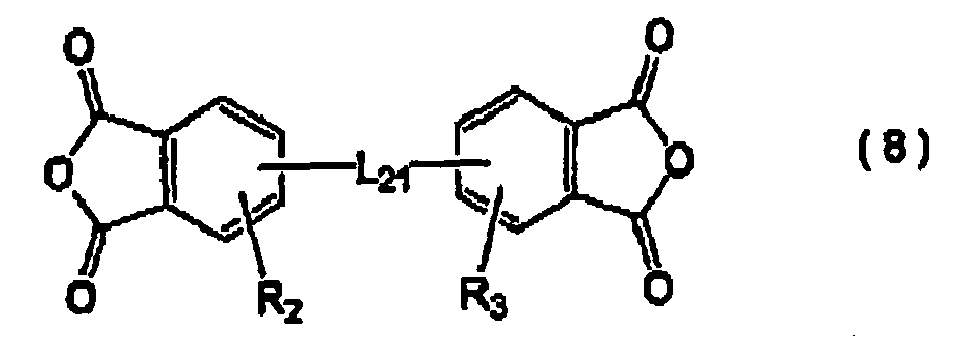


- In the formulae, L21 represents a single bond, a divalent aliphatic or aromatic hydrocarbon group which may have a substituent (preferably, for example, an alkyl group, an aralkyl group, an aryl group, an alkoxy group, a halogeno group, an ester group or an amido group), -CO-, -SO-, -SO2-, -O- or -s-; and preferably a single bond, a divalent aliphatic hydrocarbon group having from 1 to 15 carbon atoms, -CO-, -SO2-, -O- or -s-. R2 and R3, which may be the same or different, each represems a hydrogen atom, an alkyl group, an aralkyl group, an aryl group, an alkoxy group or a halogeno group; and preferably a hydrogen atom, an alkyl group having from 1 to 8 carbon atoms, an aryl group having from 6 to 15 carbon atoms, an alkoxy group having from 1 to 8 carbon atoms or a halogeno group. Alternatively, two of L21, R2 and R3 may be combined with each other to form a ring. R4 and R5, which may be the same or different, each represents a hydrogen atom, an alkyl group, an aralkyl group, an aryl group or a halogeno group; and preferably a hydrogen atom, an alkyl group having from 1 to 8 carbon atoms or an aryl group having from 6 to 15 carbon atoms. Alternatively, two of L21, R4 and R5 may be combined with each other to form a ring. L22 and L23, which may be the same or different, each represents a single bond, a double bond or a divalent aliphatic hydrocarbon group; and preferably a single bond, a double bond or a methylene group. A represents a monocyclic or polycyclic aromatic ring; and preferably an aromatic ring having from 6 to 18 carbon atoms.
- Specific examples of the compound represented by formula (8), (9) or (10) include the following compounds.
- Specifically, an aromatic tetracarboxylic acid dihydride, for example,
pyromellitic acid dihydride, 3,3',4,4'-benzophenonetetracarboxylic acid dihydride,
3,3',4,4'-diphenyltetracarboxylic acid dihydride, 2,3,6,7-naphthalenetetracarboxylic
acid dihydride, 1,4,5.8-naphthalenetetracarboxylic acid dihydride,
4,4'.-sulfonyldiphthalic acid dihydride, 2,2-bis(3,4-dicarboxyphenyl)propane dihydride, bis(3,4-dicarboxyphenyl)ether dihydride,
4,4'-[3,3'(alkylphosphoryldiphenylene)-bis(iminocarbonyl)] diphthalic acid dihydride,
adduct of hydroquinonediacetate and trimellitic acid anhydride or adduct of diacetyldiamine and trimellitic acid anhydride; an alicyclic tetracarboxylic acid dihydride, for example,
5-(2,5-dioxotetrahydrofuryl)-3-methyl-3-cyclohexene-1,2-dicarboxylic acid dihydride (Epicron B-4400, produced by Dainippon Ink and Chemicals, Inc.),
1,2,3,4-cyclopentanetetracarboxylic acid dihydride, 1,2,4,5-cyclohexanetetracarboxylic acid dihydride or tetrahydrofurantetracarboxylic acid dihydride; and an aliphatic tetracarboxylic acid dihydride, for example, 1,2,3,4-butanetetracarboxylic acid dihydride or 1,2,4,5-pentanetetracarboxylic acid dihydride are exemplified. - By ring-opening of the tetracarboxylic acid dianhydride with a diol compound, (ii) the diol compound having at least one carboxy group can be synthesized. It is also possible that a reaction between the diol compound and (i) the diisocyanate compound is initially conducted and the resulting reaction product is reacted with the tetracarboxylic acid dianhydride to synthesize the polyurethane resin according to the invention. This method is also included in the concept of the invention. Specifically, the method of introducing a structural unit resulting from the tetracarboxylic acid dianhydride and the diol compound into the polyurethane resin includes the following methods:
- a) Method wherein an alcohol-terminated compound obtained by ring-opening of the tetracarboxylic acid dianhydride with a diol compound is reacted with the diisocyanate compound; and
- b) Method wherein an alcohol-terminated urethane compound obtained by reacting the diisocyanate compound under excess of the diol compound is reacted with the tetracarboxylic acid dianhydride.
- Of the diol compounds having at least one carboxylic group, the compounds represented by formula (5) are more preferable because of high solvent solubility and ease of synthesis. The diol compound having at least one carboxylic group is introduced into the polyurethane resin binder in an amount so that the polyurethane resin binder contains ordinarily from 0.2 to 4.0 meq/g, preferably from 0.3 to 3.0 meq/g, more preferably from 0.4 to 2.0 meq/g, particularly preferably from 0.5 to 1.5 meq/g, and most preferably from 0.6 to 1.2 meq/g, of the carboxy group. Therefore, although the content of the structure derived from the diol compounds having at least one carboxylic group in the polyurethane resin binder can be appropriately determined after considering a number of the carboxy group in the diol compound, other diol compound used in combination, an acid value or molecular weight of the resulting polyurethane resin binder, a composition or pH of developer and the like, it is, for example, ordinarily from 5 to 45% by mole, preferably from 10 to 40% by mole, and more prefarably from 15 to 35% by mole.
- The diisocyanate compound having a crosslinkable group includes, for example, a reaction product obtained by an addition reaction of a triisocyanate compound with one equivalent of a monofunctional alcohol or monofunctional amine compound having a crosslinkable group.
- Examples of the triisocyanate compound are set forth below, but the invention should not be construed as being limited thereto.


- Examples of the monofunctional alcohol or monofunctional amine compound having a crosslinkable group are set forth below, but the invention should not be construed as being limited thereto.


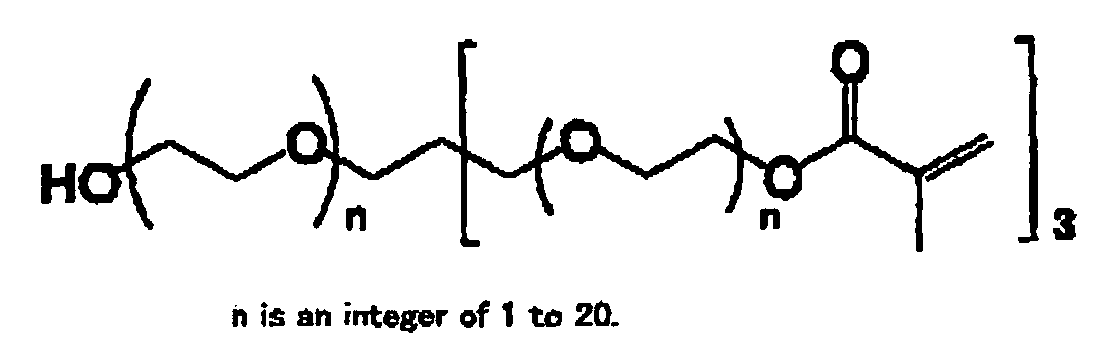


- In order to introduce a crosslinkable group into the side chain of the polyurethane resin, a method of using as a raw material for the production of polyurethane resin, the diisocyanate compound having the crosslinkable group in the side chain is preferable. Specific examples of the diisocyanate compound having a crosslinkable group in the side chain obtained by an addition reaction of a triisocyanate compound with one equivalent of a monofunctional alcohol or monofunctional amine e compound having the crosslinkable group are set forth below, but the invention should not be construed as being limited thereto.


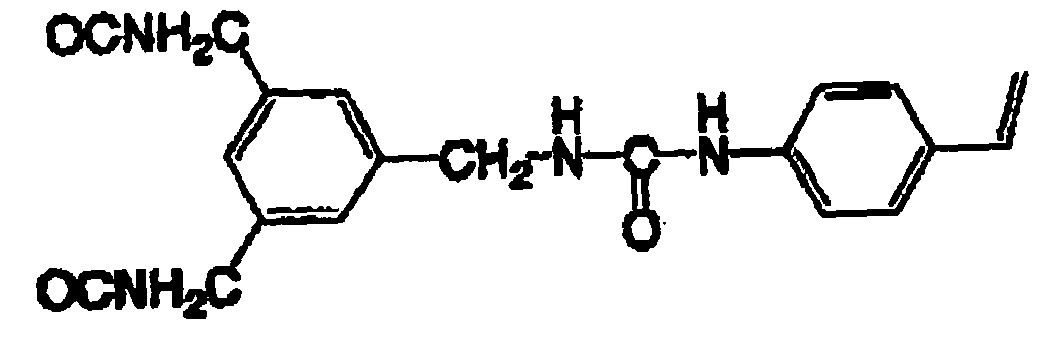


- A method of using a diol compound having a crosslinkable group in the side chain as a raw material for the production of polyurethane resin is preferable as well as the method described above for the purpose of introducing the crosslinkable group into the side chain of the polyurethane resin. Such a diol compound may be a commercially avairable compound, for example, trimethylolpropane monoallyl ether or a compound easily produced by a reaction of a halogenated diol compound, a triol compound or an aminodiol compound with a carboxylic acid, acid chloride, isocyanate, alcohol, amine, thiol or halogenated alkyl compound having a crosslinkable group. Specific examples of the diol compound having a crosslinkable group are set forth below, but the invention should not be construed as being limited thereto.


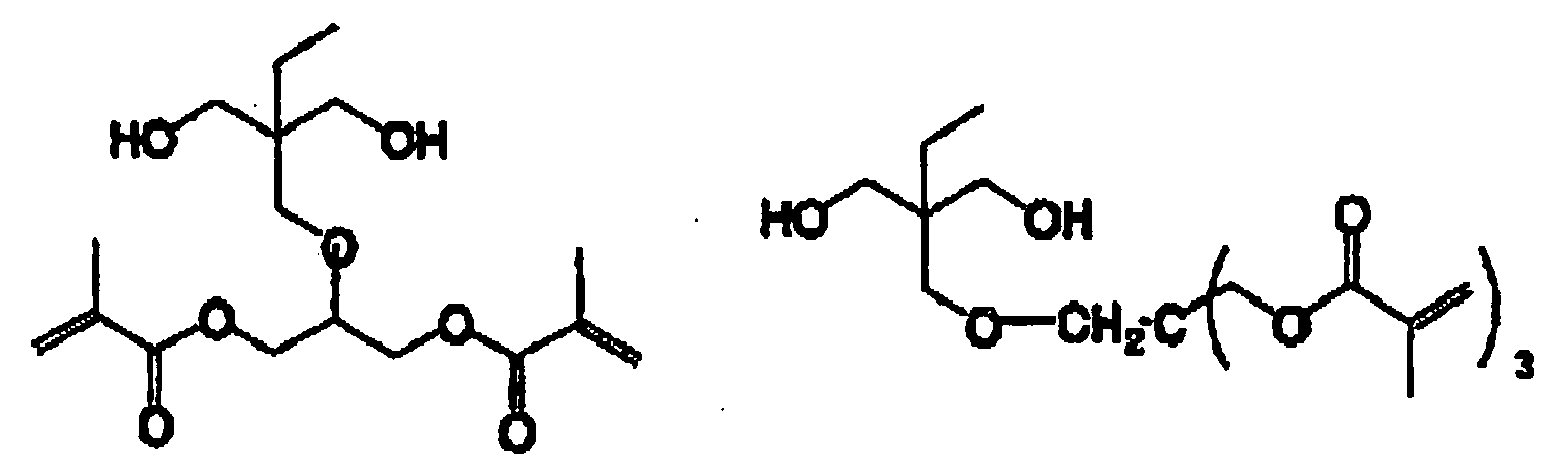
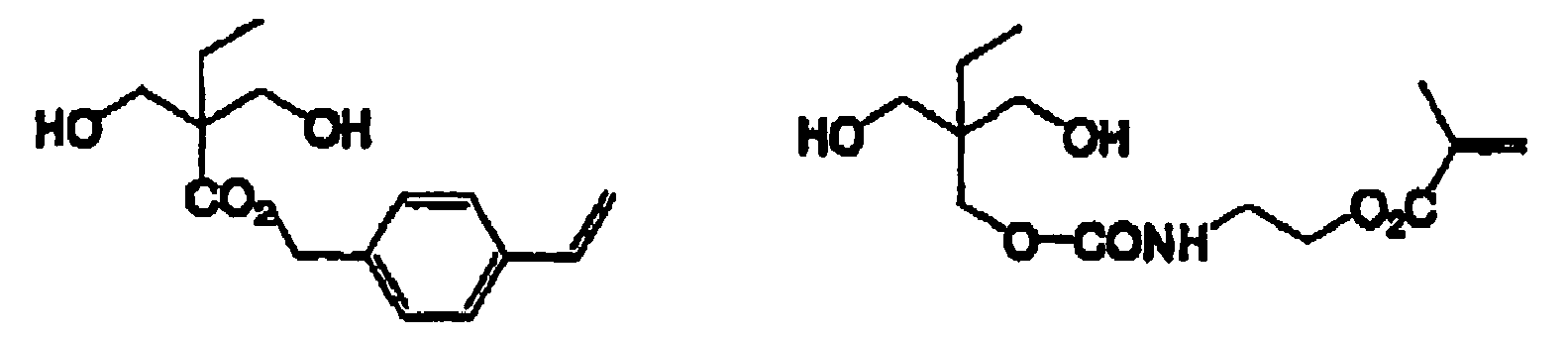


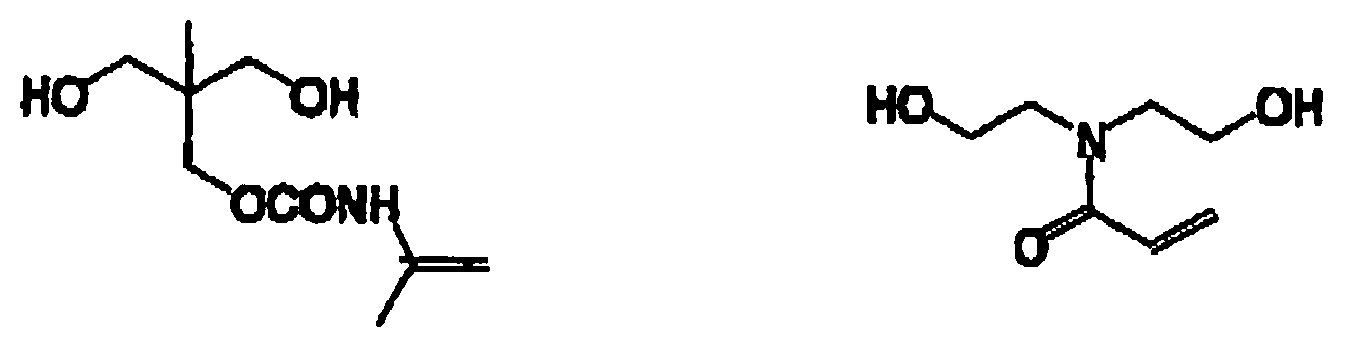


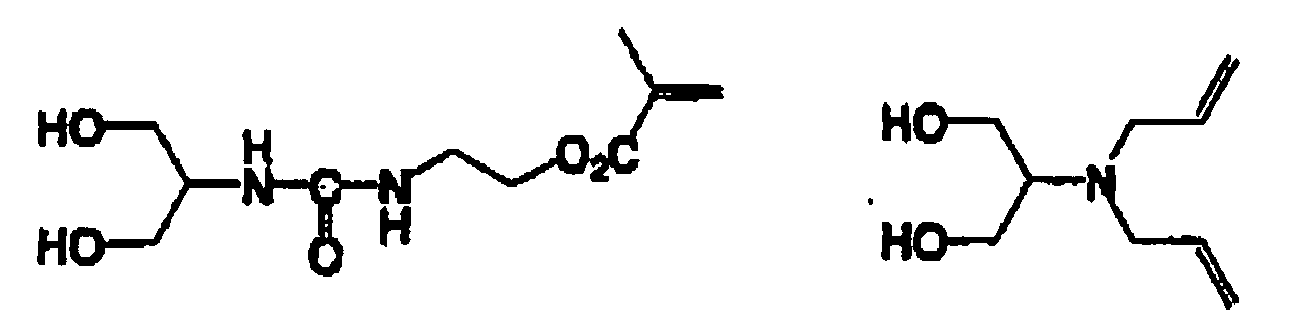


- Another examples of the other diol compound include ethylene glycol compounds represented by the following formula (A'):
HO-(CH2CH2O)n-H (A')
- In the formula, n represents an integer of 1 or more.
- Also, random copolymers and block copolymers between ethylene oxide and propylene oxide having hydroxy groups at the terminals are exemplified.
- Further, an ethylene oxide adduct of bisphenol A (addition number of the ethylene oxide is from 27 to 100), an ethylene oxide adduct of bisphenol F (addition number of the ethylene oxide is from 22 to 100), an ethylene oxide adduct of hydrogenated bisphenol A (addition number of the ethylene oxide is from 23 to 100) and an ethylene oxide adduct of hydrogenated bisphenol F (addition number of the ethylene oxide is from 18 to 100) are also used. More specifically, the ethylene glycol compounds represented by formula (A') are preferable in view of the stain resistance. The ethylene glycol compounds represented by formula (A') wherein n is form 2 to 50 are more preferable, those wherein n is form 3 to 30 are still more preferable, and those wherein n is form 4 to 10 are particularly preferable.
- Specific examples thereof include 1,2-propylene glycol, di-1,2-propylene glycol, tri-1,2-propylene glycol, tetra-1,2-pmpylene glycol, hexa-1,2-propylene glycol, 1,3-propylene glycol, di-1,3-propylene glycol, tri-1,3-propylene glycol, tetra-1,3-propylene glycol, 1,3-butylene glycol, di-1,3-butylene glycol tri-1,3-butylene glycol, hexa-1,3-butylene glycol, polypropylene glycol having an average molecular weight of 400, polypropylene glycol having an average molecular weight of 700, polypropylene glycol having an average molecular weight of 1,000, polypropylene glycol having an average molecular weight of 2,000, polypropylene glycol having an average molecular weight of 3,000, polypropylene glycol having an average molecular weight of 4,000, neopentyl glycol, 2-butene-1,4-diol, 2,2,4-trimethyl-1,3-pentanediol, 1,4-bi&-p-hydroxyethoxycyclohexane, 1,4-butanediol, 1,5-pentanediol, 1,6-hexanediol, 1,7-heptanediol, 1,8-octanediol, cyclohexanedimethanol, tricyclodecanedimethanol, hydrogenated bisphenol A, hydrogenated bisphenol F, an ethylene oxide adduct of bisphenol A (addition number of the ethylene oxide is 26 or less), an ethylene oxide adduct of bisphenol F (addition number of the ethylene oxide is 21 or less), an ethylene oxide adduct of hydrogenated bisphenol A (addition number of the ethylene oxide is 22 or less), an ethylene oxide adduct of hydrogenated bisphenol F (addition number of the ethylene oxide is 17 or less), a propylene oxide adduct of bisphenol A, a propylene oxide adduct of bisphenol F, a propylene oxide adduct of hydrogenated bisphenol A, a propylene oxide adduct of hydrogenated bisphenol F, hydroquinone dihydroxy ethyl ether, p-xylylene glycol, dihydroxyethylsulfone, bis(2-hydroxyethyl)-2,4 tolylenedicarbamate,
2,4-tolylene-bis(2-hydroxyethylcarbamide),
bis(2-hydroxyerhyl)-m-xylylenedicarbamate and bis(2-hydroxyethyl)isophthalate. - Further, polyether diol compounds of compounds represented by the following formulae (a), (b), (c), (d) and (e) are preferably used.


- In the formulae, R6 represents a hydrogen atom or a methyl group, provided that R6 in formula (a) represents a methyl group. X represents a group shown below.
― CH2CH2―

- Polyester diol compounds represented by formulae (11) and (12) shown below are also enumerated as specific examples.


- In the formulae, L1, L2 and L3, which may be the same or different, each represents a divalent aliphatic or aromatic hydrocarbon group, and L4 represents a divalent aliphatic hydrocarbon group. Preferably, L1, L2 and L3 each represents an alkylene group, an alkenylene group, an alkynylene group or an arylene group, and L4 represents an alkylene group. Also, L1, L2, L3 and L4 each may have other functional group which does not react with the isocyanate group, for example, an ether group, a carbonyl group, an ester group, a cyano group, an olefin group, a urethane group, an amido group, a ureido group or a halogen atom n1 and n2 each represents an integer of 2 or more, and preferably an integer of 2 to 100.
- Polycarbonate diol compounds represented by formula (13) shown below are also enumerated as specific examples.

- In the formula, L5, which may be the same or different, each represents a divalent aliphatic or aromatic hydrocarbon group. Preferably, L5 represents an alkylene group, an alkenylene group, an alkynylene group or an arylene group. Also, L5 may have other functional group which does not react with the isocyanate group, for example, an ether group, a carbonyl group, an ester group, a cyano group, an olefin group, a urethane group, an amido group, a ureido group or a halogen atom. n3 represents an integer of 2 or more, and preferably an integer of 2 to 100.
- Specific examples of the diol compound represented by formula (11), (12) or (13) include those shown below. In the specific examples, n represents an integer of 2 or more.





- Moreover, a diol compound that does not have a carboxy group and that may have other functional group which does not react with the isocyanate group may be used.
- Examples of such a diol compound include those represented by formulae (14) and (15) shown below.
HO-L6-O-CO-L7-CO-O-L6-OH (14)
HO-L7-CO-O-L6-OH (15)
- In the formulae, L6 and L7, which may be the same or different, each represents a divalent aliphatic hydrocarbon group, aromatic hydrocarbon group or heterocyclic group, each of which may have a substituent (for example, an alkyl group, an aralkyl group, an aryl group, an alkoxy group, an aryloxy group or a halogen atom (e.g., -F, -Cl, -Br or -I)). L6 and L7 each may have other functional group which does not react with the isocyanate group, for example, a carbonyl group, an ester group, a urethane group, an amido group or a ureido group, if desired. Alternatively, L6 and L7 may be combined with each other to form a ring.
- Specific examples of the diol compound represented by formula (14) or (15) include those shown below.


(No.105) HO-CH2CH2-O-CO-CH=CH-COO-CH2CH2-OH
(No.106) HO-CH2CH2-O-COC11H22COO-CH2CH2-OH
(No.107) HO-CH2CH2-O-COC12H21COO-CH2CH2-OH
(No.108) HO-CH2CH2-O-COC14H28COO-CH2CH2-OH

(No.110) HO-CH2CH2-O-CO-C≡COO-CH2CH2-OH


(No.113) HO-CH2CH2-O-CO-CH2-O-CH2-COO-CH2CH2-OH





(No.123) HO-CH2CH2-COO-CH2CH2-OH
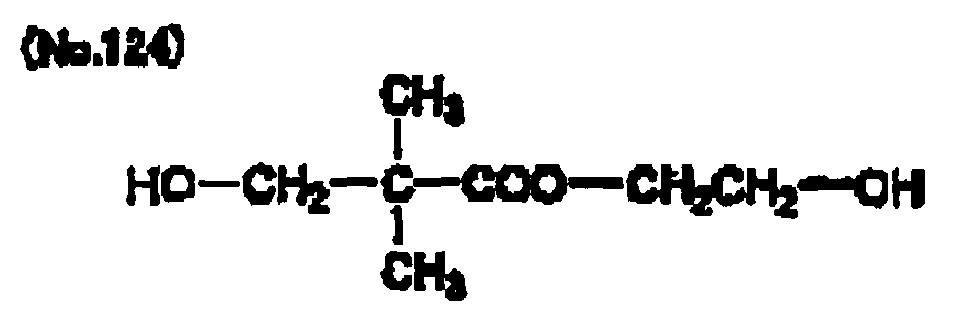

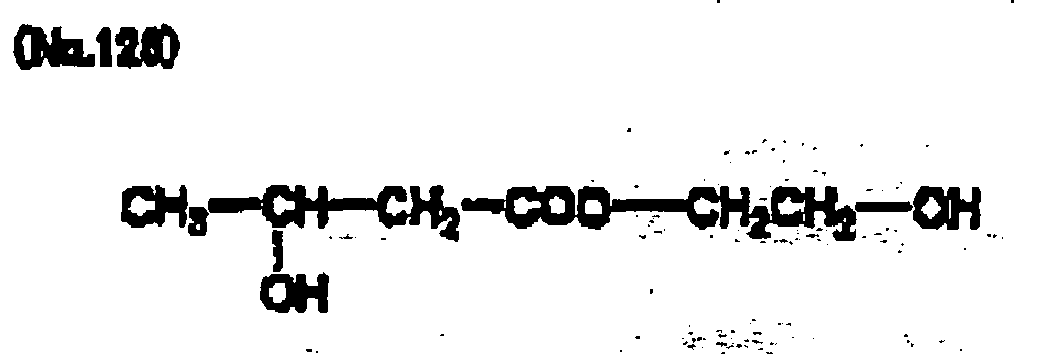


- Moreover, diol compounds shown below are also preferably used.

HO-CH2-C≡C-CH2-OH (17)
HO-CH2-CH=CH-CH2-OH (18)
- In the formulae, R7 and R8, which may be the same or different, each represents an alkyl group which may have a substituent, preferably an alkyl group having from 1 to 10 carbon atoms which may have a substituent (for example, a cyano group, a nitro group, a halogen atom (e.g., -F, -Cl, -Br or -I), -CONH2, -COOR or -OR (wherein R, which may be the same or different, each represents an alkyl group having from 1 to 10 carbon atoms, an aryl group having from 7 to 15 carbon atoms or an aralkyl group)).
- Specific examples of the diol compound represented by formula (16) include those shown below.
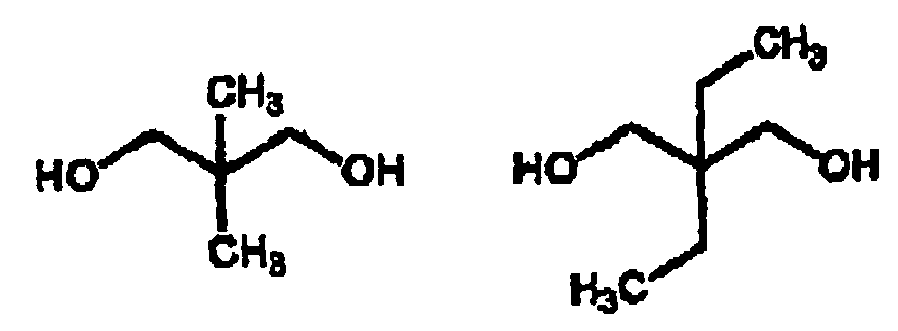

- Example of the diol compound represented by formula (17) includes 2-butyne-1,4-diol. Examples of the diol compound represented by formula (18) include cis-2-butene-1,4-diol and trans-2-butene-1,4-diol.
- Furthermore, diol compounds represented by formulae (19) and (20) shown below are also preferably used.
HO-L8-NH-CO-L9-CO-NH-L8-OH (19)
HO-L9-CO-NH-L8-OH (20)
- In the formulae, L8 and L9, which may be the same or different, each represents a divalent aliphatic hydrocarbon group, aromatic hydrocarbon group or heterocyclic group, each of which may have a substituent (for example, an alkyl group, an aralkyl group, an aryl group, an alkoxy group, an aryloxy group or a halogen atom (e.g., -F, -Cl, -Br or -I)). L5 and L9 each may have other functional group which does not react with the isocyanate group, for example, a carbonyl group, an ester group, a urethane group, an amido group or a ureido group, if desired. Alternatively, L8 and L9 may be combined with each other to form a ring.
- Specific examples of the diol compound represented by formula (19) or (20) include those shown below.

(No.203) HO-CH2CH2-NH-CO-CH=CH-CO-NH-CH2CH2-OH
(No.204) HO-CH2CH2-NH-CO-C=C-CO-NH-CH2CH2-OH


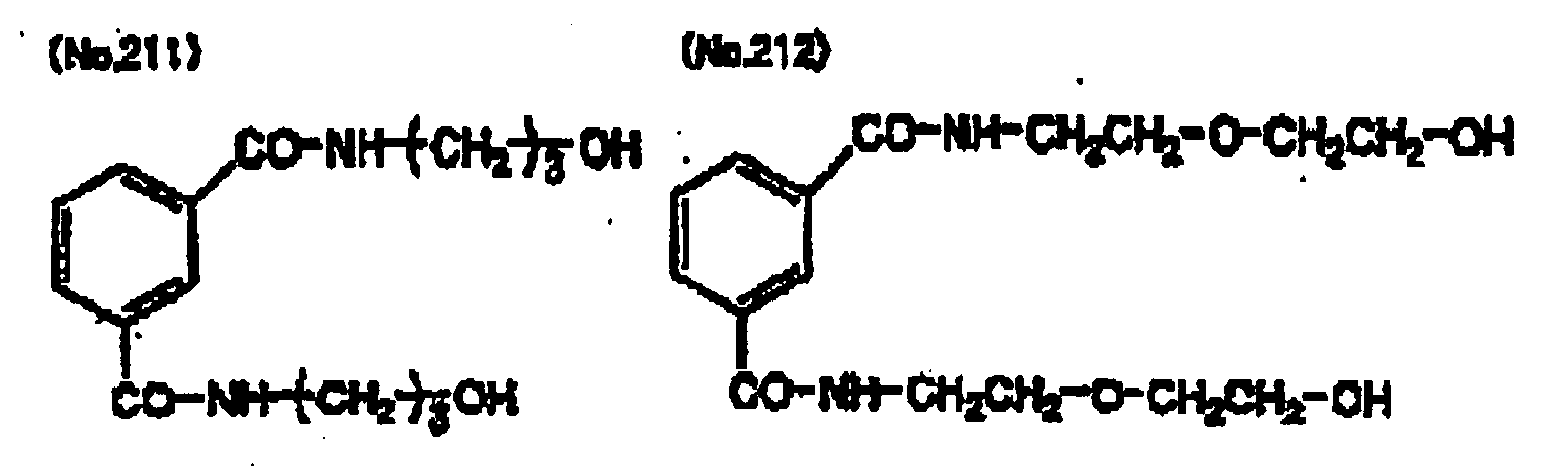


(No.215) HO-CH2CH2-NH-CO-CH2-O-CH2-CO-NH-CH2CH2-OH


(No. 218) HO-CH2CH2-NH-CO-CH2-S-CH2-CO-NH-CH2CH2-OH


- Furthermore, diol compounds represented by formulae (21) and (22) shown below are also preferably used.
HO-Ar2-(L16-Ar3)n-OH (21)
HO-Ar2-L16-OH (22)
- In the formulae, L16 represents a divalent aliphatic hydrocarbon group which may have a substituent (for example, an alkyl group, an aralkyl group, an aryl group, an alkoxy group, an aryloxy group or a halogen atom). L16 may have other functional group which does not react with the isocyanate group, for example, an ester group, a urethane group, an amido group or a ureido group, if desired.
- Ar2 and Ar3, which may be the same or different, each represents a divalent aromatic hydrocarbon group which may have a substituent, preferably an aromatic group having from 6 to 15 carbon atoms. n represents an integer of 0 to 10.
- Specific examples of the diol compound represented by formula (21) or (22) include those shown below.
- Specifically, catechol, resorcine, hydroquinone, 4-methylcatechol, 4-tert-butylcatechol, 4-acetylcatechol, 3-methoxycatechol, 4-phenylcatechol, 4-methylresorcine, 4-ethylresorcine, 4-tert-butylresorcine, 4-hexylresorcine, 4-chlororesorcine, 4-benzylresorcine, 4-acetylresorcine, 4-carboxymethoxyresorcine, 2-methylresorcine, 5-methylresorcine, tert-butylhydroquinone, 2,5-di-tert-butylhydroquinone, 2,5-di-tert-amylhydroquinone, tetramethylhydroquinone, tetrachlorohydroquinone, methylcarboaminohydroquinone, methylureidohydroquinone, methylthiohydroquinone, benzonorbornene-3,6-diol, bisphenol A, bisphenol S, 3,3'-dichlorobisphenol S, 4,4'-dihydroxybenzophenone, 4,4'-dihydroxybiphenyl, 4,4'-thiodiphenol, 2,2'-dihydroxydiphenylmethane, 3,4-bis(p-hydroxyphenyl)hexane, 1,4-bis(2-p-hydroxyphenyl)propyl)benzene, bis(4-hydroxyphenyl)methylamine, 1,3-dihydroxynaphthalene, 1,4-dihydroxynaphthalene, 1,5-dihydroxynaphthalene, 2,6-dihydroxynaphthalene, 1,5-dihydroxyanthraquinone, 2-hydroxybezyl alcohol, 4-hydroxybezyl alcohol, 2-hydroxy-3,5-di-tert-butylbezyl alcohol, 4-hydroxy-3,5-di-tert-butylbezyl alcohol, 4-hydroxyphenethyl alcohol, 2-hydroxyethyl-4-hydroxybenzoate, 2-hydroxyethyl-4-hydroxyphenylacetate and resorcine mono-2-hydroxyethyl ether are exemplified. Diol compounds shown below are also preferably used.
- In the polyurethane resin binder according to the invention, an amino group-containing compound represented by formula (31) or (32) shown below may be used together to react with the diisocyanate compound, thereby forming a urea structure to incorporate into the polyurethane resin.
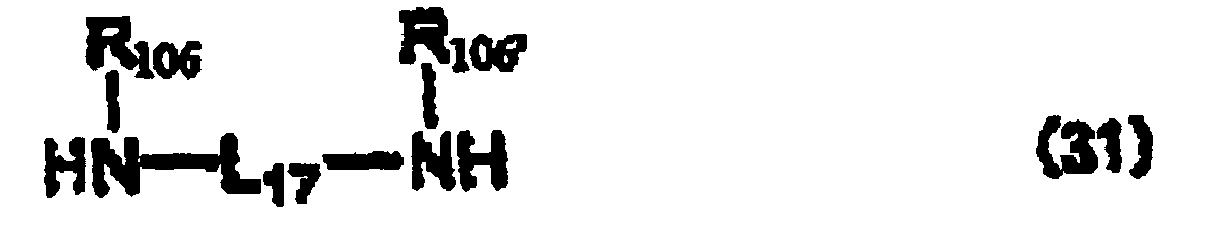

- In the formulae, R106 and R106', which may be the same or different, each represents a hydrogen atom, an alkyl group, an aralkyl group or an aryl group, each of which may have a substituent (for example, an alkoxy group, a halogen atom (e.g., -F, -Cl, -Br or -I), an ester group or a carboxy group); and preferably a hydrogen atom, an alkyl group having from 1 to 8 carbon atoms or an aryl group having from 6 to 15 carbon atoms, each of which may have a carboxy group as a substituent. L17 represents a divalent aliphatic hydrocarbon group, aromatic hydrocarbon group or heterocyclic group, each of which may have a substituent (for example, an alkyl group, an aralkyl group, an aryl goup, an alkoxy group, an aryloxy group, a halogen atom (e.g., -F, -Cl, -Br or -I) or a carboxy group). L17 may have other functional group which does not react with the isocyanate group, for example, a carbonyl group, an ester group, a urethane group or an amido group, if desired. Alternatively, two of R106, L17 and R106 may be combined with each other to form a ring.
- Specific examples of the compound represented by formula (31) or (32) include the following compounds.
- Specifically, aliphatic diamine compounds, for example, ethylenediamine, propylenediamine, tetramethylenediamine, pentamethylenediamine, hexamethylenediamine, heptamethylenediamine, octamethylenediamine, dodecamethylenediamine, propane-1,2-diamine, bis(3-aminoprapyl)methylamine, 1,3-bis(3-aminopropyl)tetramethylsiloxane, piperazine, 2,5-dimethylpiperazine, N-(2-aminoethyl)pipexazine, 4-amino-2,2,6,6-tetramethylpiperidine, N,N-dimethylethylenediamine, lysine, L-cystine or isophorondiamine); aromatic diamine compounds, for example, o-phenylenediamine, m-phenylenediamine, p-phenylenediamine, 2,4-tolylenediamine, benzidine, o-ditoluidine, o-dianisidine, 4-nitro-m-phenylenediamine, 2,5-dimethoxy-p-phenylenediamine, bis(4-aminophenyl)sulfone, 4-carboxy-o-phenylenediamine, 3-carboxy-m-phenylenediamine, - 4,4'-diaminophenyl ether or 1,8-naphthalenediamine; heterocyclic amine compounds, for example, 2-aminoimidazole, 3-aminotriazole, 5-amino-1H-tetrazole, 4-aminopyrazole, 2-aminobenzimidazole, 2-amino-5-carboxytriazole, 2,4-diamono-6-methyl-S-triazine, 2,6-diaminopyridine, L-hystidine, DL-tryptophan or adenine; and aminoalcohol or aminophenol compounds, for example, ethanolamine, N-methylethaoolamine, N-ethylethanolamine, 1-amino-2-propanol, 1-amino-3-propanol, 2-aminoethoxyethanol, 2-aminothioethoxyethanol, 2-amino-2-methyl-1-propanol, p-aminophenol, m-aminophenol, o-aminophenol, 4-methyl-2-aminophenol, 2-chloro-4-aminophenol, 4-methoxy-3-aminophenol, 4-hydroxybenzylamine, 4-amino-1-naphthol, 4-aminosalicylic acid, 4-hydroxy-N-phenylglycine, 2-aminobenzyl alcohol, 4-aminophenethyl alcohol, 2-carboxy-5-amino-1-naphthol or L-tyrosine are enumerated.
- A polyurethane resin obtained by introducing a crosslinkable group into polyurethane having a carboxy group by a polymer reaction as described in JP-A-2003-270775 may also be used as the polymer binder according to the invention as well as the above-described polyurethane resin obtained by introducing a crosslinkable group into a side chain at the synthesis of polyurethane.
- A molecular weight of the polymer binder used in the invention is appropriately determined in view of the image-forming property and printing durability. The molecular weight is preferably in a range from 2,000 to 1,000,000, more preferably from 5,000 to 500,000, and still more preferably from 10,000 to 200,000.
- The polymer binders may be used individually or in combination of two or more thereof in the invention. Further, the polymer binder according to the invention may be used together with one or more other binder polymers having no crosslinkable group. As the binder polymer used together, conventionally known alkali-soluble or alkali-swellable binders are employed without any limitation. Specifically, for example, acryl main chain binders and urethane binders conventionally used in the field of art can be preferably employed.
- The total amount of the polymer binder and binder polymer which may be used together in the photosensitive layer can be appropriately determined. It is, however, ordinarily in a range from 10 to 90% by weight, preferably from 20 to 80% by weight, and more preferably from 30 to 70% by weight, based on the total weight of the nonvolatile components in the photosensitive layer.
- It is preferred that the photosensitive layer according to the invention contains a chain transfer agent. The chain transfer agent contributes to improvements in the sensitivity and preservation stability. Compounds which function as the chain transfer agents include, for example, compounds containing SH, PH, SiH or GeH in their molecules. Such a compound donates hydrogen to a radical species of low activity to generate a radical, or is oxidized and then deprotonated to generate a radical.
- In the photosensitive layer according to the invention, a thiol compound (for example, a 2-mercaptobenzimidazole) is particularly preferably used as the chain transfer agent.
- Among them, a thiol compound represented by formula (II) shown below is particularly preferably used. By using the thiol compound represented by formula (II) as the chain transfer agent, a problem of the odor and decrease in sensitivity due to evaporation of the compound from the photosensitive layer or diffusion thereof into other layers are avoided and a lithographic printing plate precursor which is excellent in preservation stability and exhibits high sensitivity and good printing durability is obtained.

- In formula (II), R represents an alkyl group which may have a substituent or an aryl group which may have a substituent; and A represents an atomic group necessary for forming a 5-membered or 6-membered hetero ring containing a carbon atom together with the N=C-N linkage, and A may have a substituent.
- Compounds represented by formulae (IV) and (V) shown below are more preferably used.
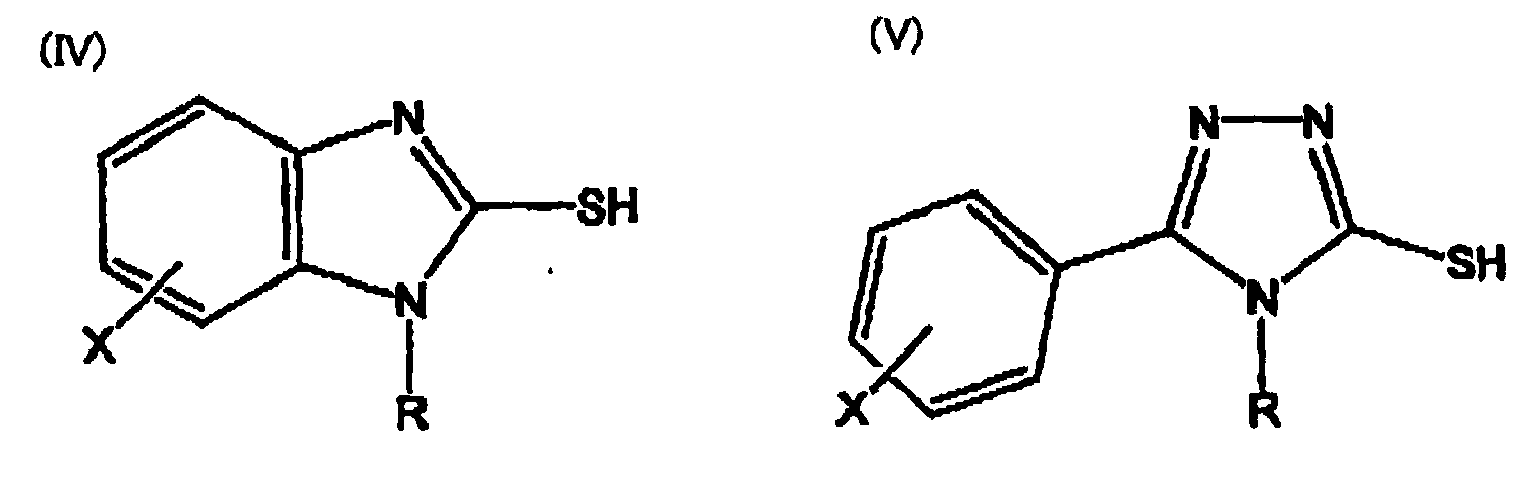
- In formulae (IV) and (V), R represents an alkyl group which may have a substituent or an aryl group which may have a substituent; and X represents a halogen atom, an alkoxy group which may have a substituent, an alkyl group which may have a substituent or an aryl group which may have a substituent.
- Specific examples of the compound represented by formula (II) are set forth below, but the invention should not be construed as being limited thereto.


- An amount of the chain transfer agent (for example, the thiol compound) used is preferably from 0.01 to 20% by weight, more preferably from 0.1 to 15% by weight, still more preferably from 1.0 to 10% by weight, based on the total solid content of the photosensitive layer.
- It is preferred to add a small amount of a thermal polymerization inhibitor to the photosensitive layer, in order to prevent undesirable thermal polymerization in the photosensitive layer during the production or preservation of the lithographic printing plate precursor. Suitable examples of the thermal polymerization inhibitor include hydroquinone, p-methoxyphenol, di-tert-butyl-p-cresol, pyrogallol, tert-butylcatechol, benzoquinone, 4,4-thiobis(3-methyl-6-tert-butylphenol), 2,2'-methylenebis(4-methyl-6-tert-butylphenol), N-nitrosophenylhydroxyamine cerium(III) salt and N-nitrosophenylhydroxylamine aluminum salt.
- The amount of the thermal polymerization inhibitor added is preferably from about 0.01 to about 5% by weight, based on the total solid content of the photosensitive layer.
- If desired, in order to avoid polymerization inhibition due to oxygen, a higher fatty acid derivative, for example, behenic acid or behenic amide may be added and allowed to localize on the photosensitive layer surface during the drying step after the coating thereof The amount of the higher fatty acid derivative added is preferably from about 0.5 to about 10% by weight based on the total solid content of the photosensitive layer.
- Further, for the purpose of coloring the photosensitive layer, a coloring agent may be added. Examples of the coloring agent include phthalocyanine pigments (for example, C.I. Pigment Blue 15:3, C.I. Pigment Blue 15:4 or C.I. Pigment Blue 15:6), azo pigments, pigments, for example, carbon black or titanium oxide, Ethyl Violet, Crystal Violet, azo dyes, anthraquinone dyes and cyanine dyes. The amount of the dye or pigment added is preferably from about 0.5 to about 20% by weight based on the total solid content of the photosensitive layer. In addition, for the purpose of improving physical properties of the cured film, an additive, for example, an inorganic filler or a plasticizer, for example, dioctyl phthalate, dimethyl phthalate or tricresyl phosphate may be added. The amount of the additive added is preferably 10% by weight or less based on the total solid content of the photosensitive layer.
- In the coating of the photosensitive layer, each of the components described above is dissolved in a solvent to prepare a coating solution. Examples of the solvent used include acetone, methyl ethyl ketone, cyclohexane, ethyl acetate, ethylene dichloride, tetrahydrofuran, toluene, ethylene glycol monomethyl ether, ethylene glycol monoethyl ether, ethylene glycol dimethyl ether, propylene glycol monomethyl ether, propylene glycol monoethyl ether, acetylacetone, cyclohexanone, diacetone alcohol, ethylene glycol monomethyl ether acetate, ethylene glycol ethyl ether acetate, ethylene glycol monoisopropyl ether, ethylene glycol monobutyl ether acetate, 3-methoxypropanol, methoxymethoxyethanol, diethylene glycol monomethyl ether, diethylene glycol monoethyl ether, diethylene glycol dimethyl ether, diethylene glycol diethyl ether, propylene glycol monomethyl ether acetate, propyolene glycol monoethyl ether acetate, 3-methoxypropyl acetate, N',N-dimethylformamide, dimethylsulfoxide, y-butyrolactone, methyl lactate and ethyl lactate. The solvents may be used individually or as a mixture thereof
- The concentration of the solid content in the coating solution is ordinarily from 1 to 50% by weight.
- Further, in order to improve surface quality of the coating, a surfactant may be added to the coating solution.
- The coverage of the photosensitive layer is ordinarily from about 0.1 to about 10 g/m2, preferably from 0.3 to 5 g/m2, and more preferably from 0.5 to 3 g/m2, in terms of weight after drying.
- It is preferred that in the lithographic printing plate precursor of the invention, a protective layer (oxygen-block layer) is provided on the photosensitive layer in order to prevent diffusion and penetration of oxygen which binders the polymerization reaction at the time of exposure. The protective layer for use in the invention preferably has oxygen permeability (A) at 25°C under 1 atmosphere of 1.0 ≤ A ≤ 20 (ml/m2·day). When the oxygen permeability (A) is extremely lower than 1.0 (ml/m2.day), problems may occur in that an undesirable polymerization reaction arises during the production or preservation before imagewise exposure and in that undesirable fog or spread of image line generates at the image exposure. On the contrary, when the oxygen permeability (A) greatly exceeds 20 (ml/m2·day), decrease in sensitivity may occur. The oxygen permeability (A) is more preferably in a range of 1.5 ≤ A ≤ 12 (ml/m2·day), and still more preferably in a range of 2.0 ≤ A ≤ 8.0 (ml/m2·day). Besides the above described oxygen permeability, as for the characteristics required of the protective layer, it is preferred that the protective layer does not substantially hinder the transmission of light for exposure, is excellent in adhesion to the photosensitive layer, and can be easily removed during a development step after the exposure. Contrivances on the protective layer have been heretofore made and described in detail in U.S. Patent 3,458,311 and JP-B-55-49729.
- As the material of the protective layer, a water-soluble polymer compound relatively excellent in crystallizability is preferably used. Specifically, a water-soluble polymer, for example, polyvinyl alcohol, vinyl alcohol/vinyl phthalate copolymer, vinyl acetate/vinyl alcohol/vinyl phthalate copolymer, vinyl acetate/crotonic acid copolymer, polyvinyl pyrrolidone, acidic cellulose, gelatin, gum arabic, polyacrylic acid or polyacrylamide is enumerated. The water-soluble polymer compounds may be used individually or as a mixture. Of the compounds, when polyvinyl alcohol is used as a main component, the best results can be obtained in fundamental characteristics, for example, oxygen-shielding property and removability of the protective layer by development.
- Polyvinyl alcohol for use in the protective layer may be partially substituted with ester, ether or acetal as long as it contains unsubstituted vinyl alcohol units for achieving the necessary oxygen-shielding property and water solubility. Also, a part of polyvinyl alcohol may have other copolymer component. As specific examples of polyvinyl alcohol, those having a hydrolyzing rate of 71 to 100% and a polymerization repeating unit number of 300 to 2,400 are exemplified. Specific examples thereof include PVA-105, PVA-110, PVA-117, PVA-117H, PVA-120, PVA-124, PVA-124K PVA-CS, PVA-CST, PVA-HC, PVA-203, PVA-204, PVA-205, PVA-210, PVA-217, PVA-220, PVA-224, PVA-217EE, PVA-217E, PVA-220E, PVA-224E, PVA-405, PVA.-420, P'VA-613 and L-8 (manufactured by Kuraray Co., Ltd.). They can be used individually or as a mixture. According to a preferred embodiment, the content of polyvinyl alcohol in the protective layer is from 20 to 95% by weight, more preferably from 30 to 90% by weight.
- As a component used as a mixture with polyvinyl alcohol, polyvinyl pyrrolidone or a modified product thereof is preferred from the viewpoint of the oxygen-shielding property and removability by development. The content thereof is ordinarily from 3.5 to 80% by weight, preferably from 10 to 60% by weight, more preferably from 15 to 30% by weight.
- The components of the protective layer (the selection of PVA and the use of additives) and the coating amount are selected taking into consideration fogging characteristic, adhesion and scratch resistance besides the oxygen-shielding property and removability by development. In general, the higher the hydrolyzing rate of the PVA used (the higher the unsubstituted vinyl alcohol unit content in the protective layer) and the larger the layer thickness, the higher is the oxygen-shielding property, thus advantageous in the point of sensitivity. The molecular weight of the (co)polymer, for example, polyvinyl alcohol (PVA) is ordinarily from 2,000 to 10,000,000, and preferably from 20,000 to 3.,000,000.
- As other components of the protective layer, glycerin, dipropylene glycol or the like can be added in an amount corresponding to several % by weight of the (co)polymer to provide flexibility. Further, an anionic surfactant, for example, sodium alkylsulfate or sodium alkylsulfonate; an amphoteric surfactant, for example, alkylaminocarboxylate and alkylaminodicarboxylate; or a nonionic surfactant, for example, polyoxyethylene alkyl phenyl ether can be added in an amount corresponding to several % by weight of the (co)polymer. The thickness of the protective layer is suitably from 0.5 to 5 µm, and particularly preferably from 1 to 3 µm.
- The adhesion of the protective layer to the photosensitive layer and scratch resistance are also extremely important in handling of the printing plate. Specifically, when a hydrophilic layer comprising a water-soluble polymer is laminated on a lipophilic photosensitive layer, layer peeling due to insufficient adhesion is liable to occur, and the peeled part causes such a defect as film hardening failure due to polymerization hindrance by oxygen. Various proposals have been made for improving the adhesion between the photosensitive layer and the protective layer. For example, it is described in U.S. Patent Application Nos. 292,501 and 44,563 that a sufficient adhesion property can be obtained by mixing from 20 to 60% by weight of an acryl-based emulsion or a water-insoluble vinyl pyrrolidone/vinyl acetate copolymer with a hydrophilic polymer mainly comprising polyvinyl alcohol and laminating the resulting mixture on the photosensitive layer. Any of these known techniques can be applied to the protective layer of the invention. Coating methods of the protective layer are described in detail, for example, in U.S. Patent 3,458,311 and JP-B-55-49729.
- A coating amount of the protective layer is ordinarily from 0.1 to 10 g/m2, and preferably from 0.5 to 5 g/m2, in terms of dry weight.
- The support for use in the lithographic printing plate precursor of the invention is not particularly restricted as long as it is a dimensionally stable plate-like material. The support includes, for example, paper, paper laminated with plastic (for example, polyethylene, polypropylene or polystyrene), a metal plate (for example, aluminum, zinc or copper plate), a plastic film (for example, cellulose diacetate, cellulose triacetate, cellulose propionate, cellulose butyrate, cellulose acetate butyrate, cellulose nitrate, polyethylene terephthalate, polyethylene, polystyrene, polypropylene, polycarbonate or polyvinyl acetal film) and paper or a plastic film laminated or deposited with the metal described above. A preferred support includes a polyester film and an aluminum plate. Among them, the aluminum plate is preferred since it has good dimensional stability and is relatively inexpensive.
- The aluminum plate includes a pure aluminum plate, an alloy plate comprising aluminum as a main component and containing a trace amount of hetero elements and a thin film of aluminum or aluminum alloy laminated with plastic. The hetero element contained in the aluminum alloy includes, for example, silicon, iron, manganese, copper, magnesium, chromium, zinc, bismuth, nickel and titanium. The content of the hetero element in the aluminum alloy is preferably 10% by weight or less. Although a pure aluminum plate is preferred in the invention, since completely pure aluminum is difficult to be produced in view of the refining technique, the aluminum plate may slightly contain the hetero element. The composition is not specified for the aluminum plate and those materials conventionally known and used can be appropriately utilized.
- The thickness of the support is preferably from 0. I to 0.6 mm, more preferably from 0.1.5 to 0.4 mm, and still more preferably from 0.2 to 0.3 mm
- Prior to the use of aluminum plate, a surface treatment, for example, surface roughening treatment or anodizing treatment is preferably performed. The surface treatment facilitates improvement in the hydrophilic property and assurance of adhesion between the photosensitive layer and the support. Prior to the surface roughening treatment of the aluminum plate, a degreasing treatment, for example, with a surfactant, an organic solvent or an aqueous alkaline solution is conducted for removing rolling oil on the surface thereof, if desired.
- The roughening treatment of the surface of the aluminum plate is conducted by various methods and includes, for example, a mechanical roughening treatment, an electrochemical roughening treatment (roughening treatment of electrochemically dissolving the surface) and a chemical roughening treatment (roughening treatment of chemically dissolving the surface selectively).
- As the method of the mechanical roughening treatment, a known method, for example, ball grinding, brush grinding, blast grinding or buff grinding can be used.
- The electrochemical roughening treatment method includes, for example, a method of applying alternating current or direct current to the aluminum plate in an electrolyte containing an acid, for example, hydrochloric acid or nitric acid. Also, a method of using a mixed acid described in JP-A-54-63902 can be used.
- The aluminum plate subjected to the roughening treatment is subjected, if desired, to an alkali etching treatment using an aqueous solution, for example, of potassium hydroxide or sodium hydroxide and further subjected to a neutralizing treatment, and then subjected to an anodizing treatment in order to improve the abrasion resistance of the aluminum plate, if desired.
- As the electrolyte used for the anodizing treatment of the aluminum plate, various electrolytes capable of forming porous oxide film can be used. Ordinarily, sulfuric acid, hydrochloric acid, oxalic acid, chromic acid or a mixed acid thereof is used. The concentration of the electrolyte can be appropriately determined depending on the kind of the electrolyte used.
- Since the conditions for the anodizing treatment are varied depending on the electrolyte used, they cannot be defined commonly. However, it is ordinarily preferred that electrolyte concentration in the solution is from 1 to 80% by weight, liquid temperature is from 5 to 70°C, current density is from 5 to 60 A/dm2, voltage is from 1 to 100 V, and electrolysis time is from 10 seconds to 5 minutes. The amount of the anodized film formed is preferably from 1.0 to 5.0 g/m2 and more preferably from 1.5 to 4.0 g/m2. In the range, good printing durability and favorable scratch resistance in the non-image area of lithographic printing plate can be achieved.
- After conducting the anodizing treatment, the surface of the aluminum plate is subjected to a hydrophilizing treatment, if desired. The hydrophilizing treatment includes an alkali metal silicate method described in U.S. Patents 2,714,066, 3,181,461, 3,280,734 and 3,902,734. In the method, the support is subjected to immersion treatment or electrolytic treatment in an aqueous solution, for example, of sodium silicate. In addition, the hydrophilizing treatment includes, for example, a method of treating with potassium fluorozirconate described in JP-B-36-22063 and a method of treating with polyvinylphosphonic acid described in U.S. Patents 3,276,868, 4,153,461 and 4,689,272.
- The support preferably has a center line average roughness of 0.10 to 1.2 µm. In the range, good adhesion with the photosensitive layer, good printing durability and good resistance to stain can be achieved.
- Further, color density of the support is preferably from 0.15 to 0.65 in terms of a reflection density value. In the range, good image-forming property due to prevention of halation at the image exposure and good plate inspection property after development can be achieved.
- According to the invention, after performing the above described treatments, an intermediate layer (also referred to as an undercoat layer, sometimes) may be provided for the purpose of improving the adhesion between the photosensitive layer and the support and improving the stain resistance. For instance, the support undercoated with a water-soluble resin, for example, polyvinylphosphonic acid, a polymer or copolymer having a sulfo group in the side chain thereof or polyacryic acid, a water-soluble metal salt, for example, zinc borate, a yellow dye or an amine salt is preferably used. Moreover, a sol-gel treated substrate to which a functional group capable of causing an addition reaction with a radical is connected via a covalent bond as described in JP-A-7-159983 is preferably used.
- Other preferred examples include a support obtained by providing a water-resistant hydrophilic layer as a surface layer on an appropriate support. Examples of the surface layer include a layer comprising an inorganic pigment and a binder described in U.S. Patent 3,055,295 and IP-A-56-13168, a hydrophilic swellable layer described in JP-A-9-80744, and a sol-gel film comprising titanium oxide, polyvinyl alcohol and a silicic acid described in JP-T-8-507727 (The term "JP-T" as used herein means a published Japanese translation of a PCT patent application). The hydrophilizing treatment is conducted for the purpose of rendering the surface of the support hydrophilic, and for the purpose of preventing harmful reactions of the photosensitive layer provided thereon and improving adhesion to the photosensitive layer.
- Other examples of the intermediate layer include those described, for example, in JP-B-50-7481, JP-A-54-72104, JP-A-59-101651, JP-A-60-149491 JP-A-60-232998 JP-A-3-56177, , JP-A-4-282637, , JP-A-5-16558, JP-A-5-246171, JP-A-7-314937, JP-A-8-202025, JP-A-8-320551, JP-A-9-34104, JP-A-9-236911, JP-A-9-269593, JP-A-10-69092, JP-A 10-115931, JP-A-10-161317, JP-A-10-260S36, JP-A-10-282682, JP-A-11-84674, JP-A-11-38635, JP-A-11-38629, JP-A-10-282645, JP-A-10-301262, JP-A-11-24277, JP-A-11-109641, JP-A-10-319600, JP-A-11-327152, JP-A-2000-10292, JP-A 2000-235254, JP-A-2000-352824 and IP-A-2001-209170.
- After performing the surface treatments on the support or forming the intermediate layer on the support, a backcoat may be provided on the rear surface of the support, if desired.
- The backcoat preferably includes, for example, a coating layer comprising an organic polymer compound described in JP-A-5-45885 and a coating layer comprising a metal oxide obtained by hydrolysis and polycondensation of an organic metallic compound or inorganic metallic compound. Among them, an alkoxy compound of silicon, for example, Si(OCH3)4, Si(O(4H5)4 Si(OC3H7)4 or Si(OC4H9)4 is preferably used, since the starting materials thereof are not expensive and easily available.
- Now, a plate-making method of the photosensitive lithographic printing plate according to the invention will be described in detail. The photosensitive lithographic printing plate is imagewise exposed and then developed with an aqueous alkali solution. The developer for use in the plate-making method according to the invention is described below.
- The developer for use in the plate-making method according to the invention is not particularly restricted. However, for example, a solution containing an inorganic alkali salt and a nonionic surfactant and having a pH of from 11.0 to 12.7 is preferably used.
- The inorganic alkali salt is appropriately used. Examples thereof include an inorganic alkali agent, for example, sodium hydroxide, potassium hydroxide, ammonium hydroxide, lithium hydroxide, sodium silicate, potassium silicate, ammonium silicate, lithium silicate, sodium tertiary phosphate, potassium tertiary phosphate, ammonium tertiary phosphate, sodium carbonate, potassium carbonate, ammonium carbonate, sodium hydrogencarbonate, potassium hydrogencarbonate, ammonium hydrogencarbonate, sodium borate, potassium borate and ammonium borate. The inorganic alkali salts may be used individually or in combination of two or more thereof.
- In the case of using the silicate, developing property can be easily adjusted by selecting a mixing ratio of silicon oxide (SiO2) to alkali oxide (M2O (wherein M represents an alkali metal or an ammonium group)), which are the components of the silicate, and the concentration thereof Of the aqueous alkali solutions, an aqueous alkali solution having the mixing ratio of silicon oxide (SiO2) to alkali oxide (M2O) (SiO2/M2O in molar ratio) of from 0.5 to 3.0 is preferred, and that of from 1.0 to 2.0 is more preferred. The amount of the SiO2/M2O added is preferably from 1 to 10% by weight, more preferably from 3 to 8% by weight, most preferably from 4 to 7% by weight, based on the weight of the aqueous alkali solution. When the concentration is in the above-described range, there arise no reduction in the developing property and processing ability, no formation of precipitates and crystals, and no gelation at neutralization of waste liquor of the developer, thereby causing no troubles in treatment of the waste liquor.
- Also, an organic alkali agent may be supplementarily used for the purposes of delicate adjustment of alkali concentration and of assisting dissolution of the photosensitive layer. Examples of the organic alkali agent includes monomethylamine, dimethylamine, trimethylamine, monoethylamine, diethylamine, triethylamine, monoisopropylamine, diisopropylamine, triisopropylamine, n-butylamine, monoethanolamine, diethanolamine, triethanolamine, monoisopropanolamine, diisopropanolamine, ethyleneimine, ethylenediamine, pyridine and tetramethylammonium hydroxide. The organic alkali agents may be used individually or in combination of two or more thereof
- The surfactant is appropriately used. Examples thereof include nonionic surfactants, for example, a nonionic surfactant having a polyoxyalkylene ether group, a polyoxyethylene alkyl ester (e.g., polyoxyethylene stearate), a sorbitan alkyl ester (e.g., sorbitan monolaurate, sorbitan monostearate, sorbitan distearate, sorbitan monooleate, sorbitan sesquioleate or sorbitan trioleate) and a monoglyceride alkyl ester (e.g., glycerol monostearate or glycerol monooleate); anionic surfactants, for example, an alkylbenzenesulfonate (e.g., sodium dodecylbenzenesulfonate), an alkylnaphthalenesulfonate (e.g., sodium butyinaphthalenesulfonate, sodium pentylnaphthalenesulfonate, sodium hexylnaphthalenesulfonate or sodium octybiaphthalenesulfonate), an alkylsulfate (e.g., sodium laurylsulfate), an alkylsulfonate (e.g., sodium dodecylsulfonate) and a sulfosuccinic acid ester salt (e.g., sodium dilaurylsulfosuccinate); and amphoteric surfactants, for example, an alkylbetaine (e.g., laurylbetaine or stearylbetaine) and an amino acid. Nonionic surfactants having a polyoxyalkylene ether group are particularly preferred.
- As the surfactant having a polyoxyalkylene ether group, compounds having the structure represented by formula (VI) shown below are preferably used.
R40-O-(R41-O)pH (VI)
- In the formula, R40 represents an alkyl group having from 3 to 15 carbon atoms, an aromatic hydrocarbon group having from 6 to 15 carbon atoms or a heteroaromatic ring group having from 4 to 15 carbon atoms. Each of these groups may have a substituent, and examples of the substituent include an alkylene group having from 1 to 20 carbon atoms, a halogen atom, e.g., Br, Cl or I, an aromatic hydrocarbon group having from 6 to 15 carbon atoms, an aralkyl group having from 7 to 17 carbon atoms, an alkoxy group having from 1 to 20 carbon atoms, an alkoxycarbonyl group having from 2 to 20 carbon atoms and an acyl group having from 2 to 15 carbon atoms. R41 represents an alkylene group having from 1 to 100 carbon atoms which may have a substituent. Examples of the substituent include an alkyl group having from 1 to 20 carbon atoms and an aromatic hydrocarbon group having from 6 to 15 carbon atoms, p represents an integer of 1 to 100.
- In the definition of the formula (VI), specific examples of the "aromatic hydrocarbon group" include a phenyl group, a tolyl group, a naphthyl group, an anthryl group, a biphenyl group and a phenanthryl group, and specific examples of the "heteroaromatic ring group" include a furyl group, a thionyl group, an oxazolyl group, an imidazolyl group, a pyranyl group, a pyridinyl group, an acridinyl group, a benzofuranyl group, a benzothionyl group, a benzopyranyl group, a benzoxazolyl group and a benzimidazolyl group.
- Also, the moiety of (R41-O)p in the formula (VI) may comprise two or three kinds of groups within the above-described scope. Specifically, there may be illustrated a random or block chain of a combination of ethyleneoxy group and propyleneoxy group, a combination of ethyleneoxy group and isopropyleneoxy group, a combination of ethyleneoxy group and butyleneoxy group, and a combination of ethyleneoxy group and isobutyleneoxy group. In the invention, the surfactants having polyoxyalkylene ether group are used individually or in combination thereof. The surfactant is effectively added in an amount from 1 to 30% by weight, preferably from 2 to 20% by weight, to the developer. When the amount of surfactant added is too small, the developing property may be deteriorated. On the other hand, when the amount is too large, development damage becomes increases and the printing durability of a printing plate may decrease.
- Examples of the nonionic surfactant having polyoxyalkylene ether group represented by formula (VI) include a polyoxyethylene alkyl ether, e.g., polyoxyethylene lauryl ether, polyoxyethylene cetyl ether or polyoxyethylene stearyl ether; a polyoxyethylene aryl ether, e.g., polyoxyethylene phenyl ether or polyoxyethylene naphthyl ether; and a polyoxyethylene alkylaryl ether, e.g., polyoxyethylene methylphenyl ether, polyoxyethylene octylphenyl ether or polyoxyethylene nonylphenyl ether.
- The surfactants can be used individually or in combination thereof. Also, the amount of the surfactant used in the developer is preferably in the range from 0.1 to 20% by weight in terms of the solid content.
- The pH of the developer used in the plate-making method according to the invention is ordinarily from 11.0 to 12.7, preferably from 11.5 to 12.5, in view of the image formation and the damage of the exposed area in the development.
- The electric conductivity of the developer used in the invention is preferably from 3 to 30 mS/cm. When it is less than the lower limit, dissolution of the photosensitive layer composition on the aluminum plate support surface becomes difficult, resulting in formation of stain at printing in some cases. On the other hand, when it exceeds the upper limit, due to the high concentration of salt, dissolution rate of the photosensitive layer becomes extremely small, resulting in remaining of the layer in the unexposed area in some cases. The electric conductivity is particularly preferably in the range from 5 to 20 mS/cm.
- The lithographic printing plate precursor according to the invention is exposed imagewise using a conventionally known active light source, for example, a carbon arc lamp, a high-pressure mercury lamp, a xenon lamp, a metal halide lamp, a fluorescent lamp, a tungsten lamp, a halogen lamp, a helium cadmium laser, an argon ion laser, an FD-YAG laser, a helium neon laser or a semiconductor laser (350 to 600 nm) and then subjected to the development processing with a developer to form an image on the surface of aluminum plate support. As the exposure light source, a laser of 350 to 600 nm is preferable.
- It is possible to provide, between the imagewise exposure and the development processing, a process of heating the photosensitive layer at a temperature of 50 to 140°C for 1 second to 5 minutes for the purpose of increasing the curing ratio of the photosensitive layer. The heating at the temperature in the above-described range serves to increase the curing ratio and to prevent the remaining layer in the unexposed area due to dark polymerization.
- As described hereinbefore, the protective layer may be provided on the photosensitive layer of the lithographic printing plate precursor according to the invention. There are known a method of removing both the protective layer and the unexposed area of the photosensitive layer at the same time using a developer and a method of first removing the protective layer with water or warm water, and then removing the unexposed area of the photosensitive layer by development. Into the water or warm water may be incorporated an antiseptic as described in rP-A 10-10754 or an organic solvent as described in JP-A-8-278636.
- The developer for use in the development processing of the lithographic printing plate precursor according to the invention preferably contains a nonionic surfactant having a polyoxyalkylene ether group.
- The development of the lithographic printing plate precursor according to the invention with the above-described developer is conducted in a conventional manner at a temperature from 0 to 60°C, preferably from about 15 to about 40°C, for example, by immersing the exposed lithographic printing plate precursor in the developer and rubbing with a brush.
- Further, in the case of conducting the development processing using an automatic developing machine, since the developing solution becomes fatigued in accordance with the processing amount, the processing ability may be restored by using a replenisher or a fresh developer. The thus development-processed lithographic printing plate precursor is after-treated with washing water, a rinse solution containing, for example, a surfactant, or a desensitizing solution containing, for example, gum arabic or a starch derivative as described, for example, in JP-A-54-8002, JP-A-55-1I5045 and JP-A-59-58431. In the after-treatment of the lithographic printing plate precursor according to the invention, these processings may be used in combination.
- The printing plate thus-obtained by the above-described processing may be subjected to an after-exposure treatment in the manner as described in JP-A-2000-89478 or a heating treatment, for example, baking, in order to improve the printing durability.
- The lithographic printing plate thus-obtained is mounted on an offset printing machine to perform printing of a large number of sheets.
- The present invention will be described in more detail with reference to the following examples, but the invention should not be construed as being limited thereto.
- A 0.3 mm-thick aluminum plate was etched by dipping in a 10% by weight aqueous sodium hydroxide solution at 60°C for 25 seconds, washed with running water, neutralized and cleaned with a 20% by weight aqueous nitric acid solution and then washed with water. The aluminum plate was then subjected to an electrolytic surface roughening treatment in a 1 % by weight aqueous nitric acid solution using an alternating current with a sinusoidal wavefoim at an anode time electricity of 300 coulomb/dm2. Subsequently, the aluminum plate was dipped in a 1% by weight aqueous sodium hydroxide solution at 40°C for 5 seconds, dipped in a 30% by weight aqueous sulfuric acid solution at 60°C for 40 seconds to effect a desmut treatment, and then subjected to an anodizing treatment in a 20% by weight aqueous sulfuric acid solution for 2 minutes at a current density of 2 A/dm2 to form an anodic oxide film having a thickness of 2.7 g/m2. The surface roughness was measured and found to be 0.3 µm (Ra value according to JIS B0601).
- On the aluminum plate thus-treated was coated a coating solution for intermediate layer shown below using a bar coater, followed by drying at 80°C for 20 seconds. A coating amount of the intermediate layer after drying was 10 mg/m2
-
Sol solution shown below 100 g Methanol 900 g -
Phosmer PE (produced by Uni-Chemical Co., Ltd) 5 g Methanol 45 g Water 10 g Phosphoric acid (85% by weight) 5 g Tetraethoxysilane 20 g 3-Methacryloxypropyltrimethoxysilane 15 g - Photopolymerizable composition P-1 having the composition shown below was coated on the intermediate layer so as to have a dry coating amount of 1.4 g/m2 and dried at 100°C for one minute to form a photosensitive layer.
-
Polymerizable compound (1) 4.5 parts by weight Binder polymer (1) 5.3 parts by weight Sensitizing dye (1) 0.4 parts by weight Polymerization initiator (1) 0.9 parts by weight Chain transfer agent (1) 0.5 parts by weight Dispersion of ε-phthalocyanine pigment*1 0.9 parts by weight Fluorine-based nonionic surfactant (Megafac F780, produced by Dainippon Ink & Chemicals, Inc.) 0.02 parts by weight Thermal polymerization inhibitor (N-nitrosophenylhydroxylamine aluminum salt) 0.03 parts by weight Methyl ethyl ketone 58 parts by weight Propylene glycol monomethyl ether acetate 53 parts by weight *1: Dispersion of ε-phthatocyanine pigment - Dispersion of 15 parts by weight of ε-phthalocyanine pigment, 10 parts by weight of dispersing agent (allyl methacrylate/methacrylic acid copolymer (copolymerization molar ratio: 83/17)) and 15 parts by weight of cyclohexanone


- Polymerizable Compound (1) (mixture of the above described isomers)


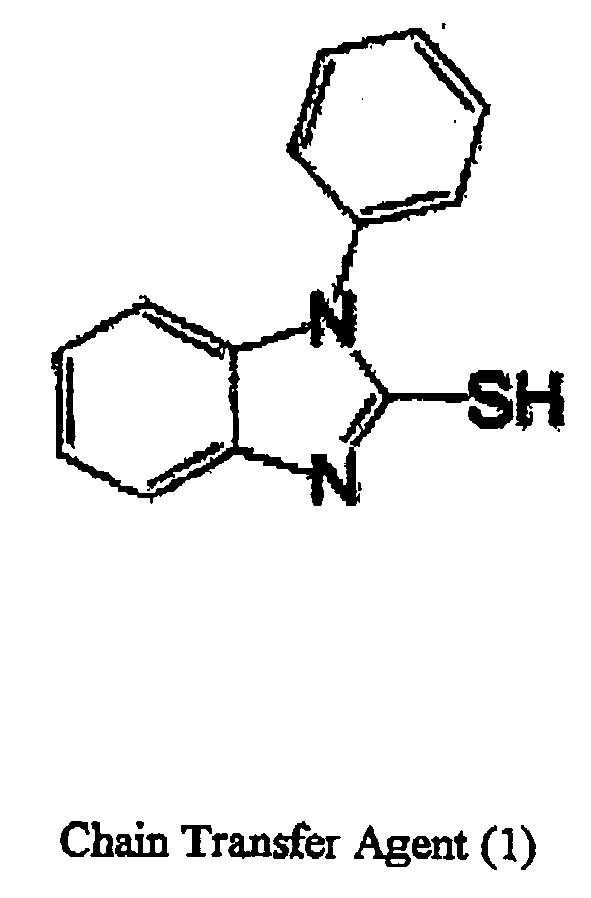
- A coating solution for protective layer (1) having the composition shown below was coated on the photosensitive layer so as to have a dry coating amount of 2.3 g/m2 and dried at 125°C for 75 seconds to form a protective layer, whereby Lithographic printing plate precursor 1 was prepared.
-
Polyvinyl alcohol (sapom6cation degree: 95% by mole, polymerization degree: 500) 36 parts by weight Polyvinyl pyrrolidone (molecular weight: 50,000) 9 parts by weight Copolymer of vinyl pyrrolidone and vinyl acetate (1/1) (molecular weight: 70,000) 0.5 parts by weight Surfactant (Emalex 710, produced by Nihon Emulsion Co., Ltd.) 0.5 parts by weight Water 950 parts by weight - Lithographic printing plate precursor 1' for comparison was prepared in the same manner as in Example 1 except for changing Binder polymer (1) in Photopolymerizable composition P-1 of Example 1 to Binder polymer (2) shown below.
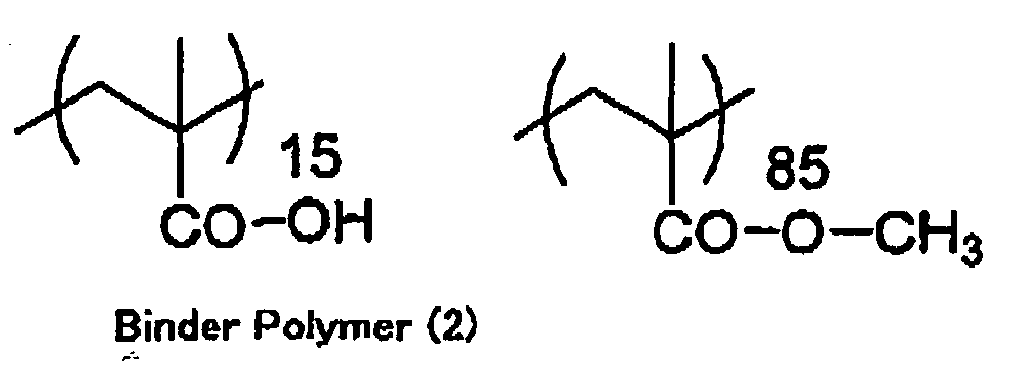
- Lithographic printing plate precursor 2 was prepared in the same manner as in Example 1 except for changing Binder polymer (1) in Photopolymerizable composition F-1 of Example 1 to Binder polymer (3) shown below.
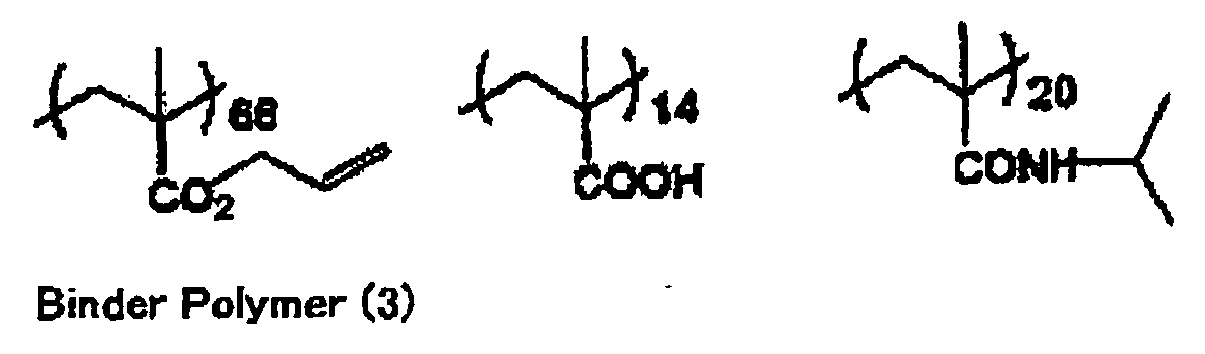
- Lithographic printing plate precursor 3 was prepared in the same manner as in Example 1 except for changing Binder polymer (1) in Photopolymerizable composition P-1 of Example 1 to Binder polymer (4) shown below.

- Lithographic printing plate precursors 4 to 8 were prepared in the same manner as in Example 1 except for changing Chain transfer agent (1) in Photopolymerizable composition P-1 of Example 1 to Chain transfer agents (2) to (6) shown below, respectively.


- Lithographic printing plate precursor 9 was prepared in the same manner as in Example 1 except for changing Polymerization initiator (1) in Photopolymerizable composition P-1 of Example 1 to Polymerization initiator (2) shown below and adding 0.3 parts by weight of Polymerization initiator (3) shown below as a sensitizing aid.


- Lithographic printing plate precursor 10 was prepared in the same manner as in Example 1 except for using a support prepared in the following manner.
- A 0.3 mm-thick aluminum plate (JIS 1050 material) was subjected to a degreasing treatment at 50°C for 30 seconds using a 10% by weight aqueous sodium aluminate solution for removing rolling oil on the surface thereof and then grained the surface using three nylon brushes embedded with bundles of nylon bristle having a diameter of 0.3 mm and an aqueous suspension (specific gravity: 1.1 g/cm3 of pumice having a median size of 25 µm), followed by thorough washing with water. The aluminum plate was etched by immersing in a 25% by weight aqueous sodium hydroxide solution of 45°C for 9 seconds, washed with water, then immersed in a 20% by weight aqueous nitric acid solution of 60°C for 20 seconds, and washed with water. The etching amount of the grained surface of the aluminum plate was about 3 g/m2.
- Then, using an alternating current of 60 Hz, an electrochemical roughening treatment was continuously carried out on the surface of the aluminum plate. The electrolyte used was a 1% by weight aqueous nitric acid solution (containing 0.5% by weight of aluminum ion) and the electrolyte temperature was 50°C. The electrochemical roughening treatment was conducted using an alternating current source, which provides a trapezoidal rectangular wave alternating current of 0.8 msec in time TP for the current to reach its peak from zero and 1:1 in duty ratio, and using a carbon electrode as a counter electrode. A ferrite was used as an auxiliary anode. The current density was 30 A/dm2 in the peak value of the electric current. To the auxiliary anode, 5% of the electric current from the electric source was distributed. The quantity of electricity in the nitric acid electrolysis was 175 Coulomb/dm2 in terms of the quantity of electricity during the aluminum plate functioning as an anode. The aluminum plate was then washed with water by spraying.
- The aluminum plate was further subjected to electrochemical roughening treatment in the same manner as in the nitric acid electrolysis using as an electrolyte, a 0.5% by weight aqueous hydrochloric acid solution (containing 0.5% by weight of aluminum ion) having temperature of 50°C and under the condition that the quantity of electricity was 50 Coulomb/dm2 in terms of the quantity of electricity during the aluminum plate functioning as an anode. The aluminum plate was then washed with water by spraying. The aluminum plate was subjected to an anodizing treatment using as an electrolyte, a 15% by weight aqueous sulfuric acid solution (containing 0.5% by weight of aluminum ion) at a current density of 15 A/dm2 to form a direct current anodic oxide film of 2.5 g/m2, washed with water, dried, and then treated with a 2.5% by weight aqueous sodium silicate solution at 30°C for 10 seconds. The center line average roughness (Ra) of the aluminum plate was measured using a stylus having a diameter of 2 µm and as a result, it was found to be 0.51 µm.
- To the aluminum plate thus-treated was applied the intermediate layer same as in Example 1.
- The lithographic printing plate precursor obtained was subjected to imagewise drawing using Vx9600CTP (wavelength of light source: 405 nm, produced by Fuji Photo Film Co., Ltd.) while controlling an exposure amount on the surface of the lithographic printing plate precursor to 0.05 mJ/cm2. Then, the lithographic printing plate precursor was preheated at temperature of 115°C for 12 seconds and developed using a PS processor (IP850HD, produced by G & J) fed with an alkali developer having the composition shown below at the solution temperature of 25°C for development time of 28 seconds. As a finisher, an aqueous solution prepared by diluting FN-6 (produced by Fuji Photo Film Co., Ltd.) with 3 times of water was used.
- The lithographic printing plate obtained was subjected to printing by a printing machine (Lithrone, produced by Komori Corp.) using ink (DIC-GEOS (N) Black, produced by Dainippon Ink & Chemicals, Inc.) and a mixture of etching solution (EU-3, produced by Fuji Photo Film Co., Ltd.)/water/isopropyl alcohol = 1/89/10 (in a volume ratio), and a number of sheets when it was visually recognized that the density of solid image area began to become thin was determined to evaluate the printing durability.
-
Potassium hydroxide 0.15 g Polyoxyethylene naphthyl ether (n=13) 5.0 g Chelest 400 (chelating agent) 0.1 g Water 94.75 g - The printing was performed as described above and after the confirmation that a print free from ink stain in the non-image area was obtained after conducting the printing of 100 sheets, further printing of 4,900 sheets was continuously carried out On the 5,000th sheet in total, a fine line chart (a chart including fine lines having 10, 12, 14, 16, 18, 20, 25, 30, 35, 40, 60, 80, 100 and 200 µm in width, respectively) printed was observed by a 25-power magnifier and the width of fine line reproduced by ink on the sheet without interruption was determined to evaluate the reproducibility of fine lines.
- The results of the evaluations are shown in Table 1 blow.
TABLE 1 Lithographic Printing Plate Precursor Printing Durability (x 104 sheets) Reproducibility of Fine Lines (µm) Example 1 1 20 18 Example 2 2 15 20 Example3 3 3 17 20 Example 4 4 20 18 Example 5 5 19 18 Example 6 6 18 20 Example 7 7 15 25 Example 8 8 15 25 Example 9 9 20 18 Example 10 10 20 18 Comparative Example 1 1' 10 35 - From the results shown in Table 1 above, it can be seen that the lithographic printing plate precursors of the invention are excellent in the printing durability and reproducibility of fine lines.
- This application is based on Japanese Patent application JP 2005-59193, filed March 3, 2005, the entire content of which is hereby incorporated by reference, the same as if set forth at length.
Claims (10)
- A lithographic printing plate precursor comprising: a support; and a photosensitive layer containing (A) a sensitizing dye represented by the following formula (1), (B) a polymerization initiator, (C) a polymerizable compound, and (D) a binder polymer having a crosslinkable group,

- The lithographic printing plate precursor as claimed in claim 1, wherein k, m and n in the formula (I) each independently represents 0 or 1.
- The lithographic printing plate precursor as claimed in claim 1, wherein at least one of R1 R2 and R3 in the formula (I) represents the -NR4R5 group.
- The lithographic printing plate precursor as claimed in claim 1, wherein the binder polymer (D) is a (meth)acrylic copolymer having a crosslinkable group in a side chain or a polyurethane resin having a crosslinicabie group in a side chain.
- The lithographic printing plate precursor as claimed in claim 1, wherein the photosensitive layer further contains (E) a chain transfer agent.
- The lithographic printing plate precursor as claimed in claim 5, wherein the chain transfer agent (E) is a thiol compound represented by the following formula (II);

- The lithographic printing plate precursor as claimed in claim 1, wherein the polymerization initiator (B) is a hexaarylbiimidazole compound or a metallocene compound.
- The lithographic printing plate precursor as claimed in claim 1, which further comprises a protective layer so that the support, the photosensitive layer and the protective layer are provided in this order.
- A plate-making method of a lithographic printing plate precursor, comprising: imagewise exposing the lithographic printing plate precursor as claimed in claim 1 with a laser beam having a wavelength of from 350 to 600 nm, and processing the exposed lithographic printing plate precursor with a developer.
- The plate-making method as claimed in claim 9, wherein the developer contains a nonionic surfactant having a polyoxyalkylene ether group.
Applications Claiming Priority (1)
| Application Number | Priority Date | Filing Date | Title |
|---|---|---|---|
| JP2005059193A JP4469741B2 (en) | 2005-03-03 | 2005-03-03 | Planographic printing plate precursor |
Publications (2)
| Publication Number | Publication Date |
|---|---|
| EP1698934A1 true EP1698934A1 (en) | 2006-09-06 |
| EP1698934B1 EP1698934B1 (en) | 2009-02-04 |
Family
ID=36648620
Family Applications (1)
| Application Number | Title | Priority Date | Filing Date |
|---|---|---|---|
| EP06004382A Revoked EP1698934B1 (en) | 2005-03-03 | 2006-03-03 | Lithographic printing plate precursor |
Country Status (5)
| Country | Link |
|---|---|
| US (1) | US20060199101A1 (en) |
| EP (1) | EP1698934B1 (en) |
| JP (1) | JP4469741B2 (en) |
| AT (1) | ATE422251T1 (en) |
| DE (1) | DE602006005067D1 (en) |
Cited By (2)
| Publication number | Priority date | Publication date | Assignee | Title |
|---|---|---|---|---|
| EP1906244A3 (en) * | 2006-09-27 | 2008-05-14 | FUJIFILM Corporation | Photopolymerizable lithographic printing plate precursor |
| US20100062375A1 (en) * | 2008-08-29 | 2010-03-11 | Fujifilm Corporation | Method of preparing lithographic printing plate |
Families Citing this family (8)
| Publication number | Priority date | Publication date | Assignee | Title |
|---|---|---|---|---|
| JP4368323B2 (en) * | 2005-03-25 | 2009-11-18 | 富士フイルム株式会社 | Photosensitive planographic printing plate |
| JP4524235B2 (en) * | 2005-03-29 | 2010-08-11 | 富士フイルム株式会社 | Planographic printing plate precursor |
| US20070212641A1 (en) * | 2006-03-13 | 2007-09-13 | Fujifilm Corporation | Lithographic printing plate precursor and method for preparation of lithographic printing plate |
| WO2008129981A1 (en) * | 2007-04-18 | 2008-10-30 | Konica Minolta Medical & Graphic, Inc. | Photosensitive lithographic printing plate material |
| WO2009028324A1 (en) * | 2007-08-30 | 2009-03-05 | Konica Minolta Medical & Graphic, Inc. | Photosensitive lithographic printing plate |
| JP4982416B2 (en) * | 2008-03-28 | 2012-07-25 | 富士フイルム株式会社 | Preparation method of lithographic printing plate |
| CN102746467B (en) * | 2008-04-22 | 2015-01-14 | 东亚合成株式会社 | Curable composition and process for production of organosilicon compound |
| CN106947057B (en) * | 2016-01-07 | 2019-08-27 | 北京英力科技发展有限公司 | A kind of Photocurable composition and its purposes as varnish and colored paint |
Citations (17)
| Publication number | Priority date | Publication date | Assignee | Title |
|---|---|---|---|---|
| US3597343A (en) * | 1966-12-08 | 1971-08-03 | Agfa Gevaert Nv | Photopolymerization of ethylenically unsaturated compounds through the use of novel azole photoinitiators |
| JPS4643946B1 (en) | 1967-11-09 | 1971-12-27 | ||
| JPS4864183A (en) | 1971-12-09 | 1973-09-05 | ||
| JPS4943191B1 (en) | 1969-07-11 | 1974-11-19 | ||
| JPS5230490B2 (en) | 1972-03-21 | 1977-08-09 | ||
| GB1582199A (en) * | 1977-07-25 | 1980-12-31 | Hoechst Ag | Process for the preparation of printing forms |
| JPS6122048A (en) | 1984-06-08 | 1986-01-30 | ヘキスト・アクチエンゲゼルシヤフト | Polymerizable compound, manufacture and radiation sensitive copying layer |
| JPS6239418A (en) | 1985-08-08 | 1987-02-20 | 川島 藤夫 | Method and device for feeding paper tape for bundling laver |
| JPS63260909A (en) | 1987-03-28 | 1988-10-27 | ヘキスト・アクチエンゲゼルシヤフト | Photopolymerizable mixture and recording material produced therefrom |
| JPS63277653A (en) | 1987-03-28 | 1988-11-15 | ヘキスト・アクチエンゲゼルシヤフト | Polymerizable compound, radiation polymerizable mixture and radiation polymerizable recording material |
| JPH01105238A (en) | 1987-03-28 | 1989-04-21 | Hoechst Ag | Photopolymerizable mixture and photopolymerizable material |
| JPH0140337B2 (en) | 1979-12-29 | 1989-08-28 | Hoechst Ag | |
| JPH0140336B2 (en) | 1979-12-29 | 1989-08-28 | Hoechst Ag | |
| JPH0225493A (en) | 1988-05-21 | 1990-01-26 | Hoechst Ag | Alkenylphosphonic ester and alkenylphoshinic ester, production thereof, radiation polymerizable mixture containing the same and recording material |
| US20030129523A1 (en) * | 2001-10-05 | 2003-07-10 | Hirotaka Matsumoto | Photopolymerizable composition and recording material using the same |
| WO2004074930A2 (en) * | 2003-02-21 | 2004-09-02 | Kodak Polychrome Graphics Gmbh | Radiation-sensitive compositions comprising oxazole derivatives and imageable elements based thereon |
| EP1502735A2 (en) * | 2003-07-31 | 2005-02-02 | Fuji Photo Film Co., Ltd. | Lithographic printing plate precursor and polymerizable composition |
Family Cites Families (7)
| Publication number | Priority date | Publication date | Assignee | Title |
|---|---|---|---|---|
| BE525225A (en) * | 1951-08-20 | |||
| US2728745A (en) * | 1954-03-23 | 1955-12-27 | Eastman Kodak Co | N-(p-cinnamoylphenyl) urethanes of hydroxyl-containing polymers |
| US3816285A (en) * | 1971-11-30 | 1974-06-11 | Union Carbide Corp | Photonitrosation process using swirl-flow plasma arc radiation |
| US4897327A (en) * | 1988-05-27 | 1990-01-30 | E. I. Du Pont De Nemours And Company | Correct-reading images from photopolymer electrographic master |
| US5256520A (en) * | 1991-12-20 | 1993-10-26 | E. I. Du Pont De Nemours And Company | Visible photosensitizers for photopolymerizable compositions |
| JP3948505B2 (en) * | 1999-10-27 | 2007-07-25 | 富士フイルム株式会社 | Master for lithographic printing plate |
| US6844137B2 (en) * | 2000-03-01 | 2005-01-18 | Fuji Photo Film Co., Ltd. | Image recording material |
-
2005
- 2005-03-03 JP JP2005059193A patent/JP4469741B2/en not_active Expired - Fee Related
-
2006
- 2006-03-03 US US11/366,447 patent/US20060199101A1/en not_active Abandoned
- 2006-03-03 AT AT06004382T patent/ATE422251T1/en not_active IP Right Cessation
- 2006-03-03 EP EP06004382A patent/EP1698934B1/en not_active Revoked
- 2006-03-03 DE DE602006005067T patent/DE602006005067D1/en not_active Expired - Lifetime
Patent Citations (17)
| Publication number | Priority date | Publication date | Assignee | Title |
|---|---|---|---|---|
| US3597343A (en) * | 1966-12-08 | 1971-08-03 | Agfa Gevaert Nv | Photopolymerization of ethylenically unsaturated compounds through the use of novel azole photoinitiators |
| JPS4643946B1 (en) | 1967-11-09 | 1971-12-27 | ||
| JPS4943191B1 (en) | 1969-07-11 | 1974-11-19 | ||
| JPS4864183A (en) | 1971-12-09 | 1973-09-05 | ||
| JPS5230490B2 (en) | 1972-03-21 | 1977-08-09 | ||
| GB1582199A (en) * | 1977-07-25 | 1980-12-31 | Hoechst Ag | Process for the preparation of printing forms |
| JPH0140336B2 (en) | 1979-12-29 | 1989-08-28 | Hoechst Ag | |
| JPH0140337B2 (en) | 1979-12-29 | 1989-08-28 | Hoechst Ag | |
| JPS6122048A (en) | 1984-06-08 | 1986-01-30 | ヘキスト・アクチエンゲゼルシヤフト | Polymerizable compound, manufacture and radiation sensitive copying layer |
| JPS6239418A (en) | 1985-08-08 | 1987-02-20 | 川島 藤夫 | Method and device for feeding paper tape for bundling laver |
| JPS63260909A (en) | 1987-03-28 | 1988-10-27 | ヘキスト・アクチエンゲゼルシヤフト | Photopolymerizable mixture and recording material produced therefrom |
| JPS63277653A (en) | 1987-03-28 | 1988-11-15 | ヘキスト・アクチエンゲゼルシヤフト | Polymerizable compound, radiation polymerizable mixture and radiation polymerizable recording material |
| JPH01105238A (en) | 1987-03-28 | 1989-04-21 | Hoechst Ag | Photopolymerizable mixture and photopolymerizable material |
| JPH0225493A (en) | 1988-05-21 | 1990-01-26 | Hoechst Ag | Alkenylphosphonic ester and alkenylphoshinic ester, production thereof, radiation polymerizable mixture containing the same and recording material |
| US20030129523A1 (en) * | 2001-10-05 | 2003-07-10 | Hirotaka Matsumoto | Photopolymerizable composition and recording material using the same |
| WO2004074930A2 (en) * | 2003-02-21 | 2004-09-02 | Kodak Polychrome Graphics Gmbh | Radiation-sensitive compositions comprising oxazole derivatives and imageable elements based thereon |
| EP1502735A2 (en) * | 2003-07-31 | 2005-02-02 | Fuji Photo Film Co., Ltd. | Lithographic printing plate precursor and polymerizable composition |
Non-Patent Citations (1)
| Title |
|---|
| NIPPON SECCHAKU KYOKAISHI, vol. 20, no. 7, 1984, pages 300 - 308 |
Cited By (3)
| Publication number | Priority date | Publication date | Assignee | Title |
|---|---|---|---|---|
| EP1906244A3 (en) * | 2006-09-27 | 2008-05-14 | FUJIFILM Corporation | Photopolymerizable lithographic printing plate precursor |
| US7767380B2 (en) | 2006-09-27 | 2010-08-03 | Fujifilm Corporation | Photopolymerization type photosensitive lithographic printing plate precursor |
| US20100062375A1 (en) * | 2008-08-29 | 2010-03-11 | Fujifilm Corporation | Method of preparing lithographic printing plate |
Also Published As
| Publication number | Publication date |
|---|---|
| JP2006243365A (en) | 2006-09-14 |
| EP1698934B1 (en) | 2009-02-04 |
| US20060199101A1 (en) | 2006-09-07 |
| JP4469741B2 (en) | 2010-05-26 |
| DE602006005067D1 (en) | 2009-03-19 |
| ATE422251T1 (en) | 2009-02-15 |
Similar Documents
| Publication | Publication Date | Title |
|---|---|---|
| US7531288B2 (en) | Photosensitive lithographic printing plate | |
| JP4064055B2 (en) | Planographic printing plate making method | |
| JP2000250211A (en) | Photopolymerizable composition | |
| EP1698934B1 (en) | Lithographic printing plate precursor | |
| US6841336B2 (en) | Plate-making method of lithographic printing plate | |
| EP1591242A2 (en) | Lithographic printing plate precursor | |
| EP1710627A1 (en) | Photosensitive lithographic printing plate | |
| JP2009075426A (en) | Photosensitive planographic printing plate | |
| JP2009237332A (en) | Original plate of planographic printing plate | |
| EP1703330B1 (en) | Plate-making method of negative-working lithographic printing plate precursor | |
| JP2007171407A (en) | Planographic printing plate precursor and plate making method | |
| EP1708025B1 (en) | Photosensitive lithographic printing plate | |
| JP4411168B2 (en) | Photosensitive planographic printing plate | |
| EP1353235B1 (en) | Method for making lithographic printing plate | |
| JP4425124B2 (en) | Photosensitive lithographic printing plate laminate | |
| JP4625659B2 (en) | Polymerizable composition | |
| JP2001117217A (en) | Photopolymerizable planographic printing plate | |
| JP4418766B2 (en) | Method for making a photosensitive lithographic printing plate | |
| EP1975708B1 (en) | Lithographic printing plate precursor | |
| JP2005234118A (en) | Photosensitive lithographic printing plate | |
| JP2002323770A (en) | Photosensitive lithographic printing plate | |
| JP2005221844A (en) | Photosensitive lithographic printing plate | |
| JP2006215272A (en) | Lithographic printing original plate | |
| JP2006276231A (en) | Photosensitive lithographic printing plate |
Legal Events
| Date | Code | Title | Description |
|---|---|---|---|
| PUAI | Public reference made under article 153(3) epc to a published international application that has entered the european phase |
Free format text: ORIGINAL CODE: 0009012 |
|
| AK | Designated contracting states |
Kind code of ref document: A1 Designated state(s): AT BE BG CH CY CZ DE DK EE ES FI FR GB GR HU IE IS IT LI LT LU LV MC NL PL PT RO SE SI SK TR |
|
| AX | Request for extension of the european patent |
Extension state: AL BA HR MK YU |
|
| RAP1 | Party data changed (applicant data changed or rights of an application transferred) |
Owner name: FUJIFILM CORPORATION |
|
| 17P | Request for examination filed |
Effective date: 20070215 |
|
| AKX | Designation fees paid |
Designated state(s): AT BE BG CH CY CZ DE DK EE ES FI FR GB GR HU IE IS IT LI LT LU LV MC NL PL PT RO SE SI SK TR |
|
| 17Q | First examination report despatched |
Effective date: 20070618 |
|
| GRAP | Despatch of communication of intention to grant a patent |
Free format text: ORIGINAL CODE: EPIDOSNIGR1 |
|
| GRAS | Grant fee paid |
Free format text: ORIGINAL CODE: EPIDOSNIGR3 |
|
| GRAA | (expected) grant |
Free format text: ORIGINAL CODE: 0009210 |
|
| AK | Designated contracting states |
Kind code of ref document: B1 Designated state(s): AT BE BG CH CY CZ DE DK EE ES FI FR GB GR HU IE IS IT LI LT LU LV MC NL PL PT RO SE SI SK TR |
|
| REG | Reference to a national code |
Ref country code: GB Ref legal event code: FG4D |
|
| REG | Reference to a national code |
Ref country code: CH Ref legal event code: EP |
|
| REG | Reference to a national code |
Ref country code: IE Ref legal event code: FG4D |
|
| REF | Corresponds to: |
Ref document number: 602006005067 Country of ref document: DE Date of ref document: 20090319 Kind code of ref document: P |
|
| NLV1 | Nl: lapsed or annulled due to failure to fulfill the requirements of art. 29p and 29m of the patents act | ||
| PG25 | Lapsed in a contracting state [announced via postgrant information from national office to epo] |
Ref country code: NL Free format text: LAPSE BECAUSE OF FAILURE TO SUBMIT A TRANSLATION OF THE DESCRIPTION OR TO PAY THE FEE WITHIN THE PRESCRIBED TIME-LIMIT Effective date: 20090204 Ref country code: ES Free format text: LAPSE BECAUSE OF FAILURE TO SUBMIT A TRANSLATION OF THE DESCRIPTION OR TO PAY THE FEE WITHIN THE PRESCRIBED TIME-LIMIT Effective date: 20090515 Ref country code: SI Free format text: LAPSE BECAUSE OF FAILURE TO SUBMIT A TRANSLATION OF THE DESCRIPTION OR TO PAY THE FEE WITHIN THE PRESCRIBED TIME-LIMIT Effective date: 20090204 Ref country code: LT Free format text: LAPSE BECAUSE OF FAILURE TO SUBMIT A TRANSLATION OF THE DESCRIPTION OR TO PAY THE FEE WITHIN THE PRESCRIBED TIME-LIMIT Effective date: 20090204 Ref country code: FI Free format text: LAPSE BECAUSE OF FAILURE TO SUBMIT A TRANSLATION OF THE DESCRIPTION OR TO PAY THE FEE WITHIN THE PRESCRIBED TIME-LIMIT Effective date: 20090204 |
|
| PG25 | Lapsed in a contracting state [announced via postgrant information from national office to epo] |
Ref country code: IS Free format text: LAPSE BECAUSE OF FAILURE TO SUBMIT A TRANSLATION OF THE DESCRIPTION OR TO PAY THE FEE WITHIN THE PRESCRIBED TIME-LIMIT Effective date: 20090604 Ref country code: AT Free format text: LAPSE BECAUSE OF FAILURE TO SUBMIT A TRANSLATION OF THE DESCRIPTION OR TO PAY THE FEE WITHIN THE PRESCRIBED TIME-LIMIT Effective date: 20090204 Ref country code: LV Free format text: LAPSE BECAUSE OF FAILURE TO SUBMIT A TRANSLATION OF THE DESCRIPTION OR TO PAY THE FEE WITHIN THE PRESCRIBED TIME-LIMIT Effective date: 20090204 Ref country code: SE Free format text: LAPSE BECAUSE OF FAILURE TO SUBMIT A TRANSLATION OF THE DESCRIPTION OR TO PAY THE FEE WITHIN THE PRESCRIBED TIME-LIMIT Effective date: 20090504 Ref country code: PL Free format text: LAPSE BECAUSE OF FAILURE TO SUBMIT A TRANSLATION OF THE DESCRIPTION OR TO PAY THE FEE WITHIN THE PRESCRIBED TIME-LIMIT Effective date: 20090204 |
|
| PG25 | Lapsed in a contracting state [announced via postgrant information from national office to epo] |
Ref country code: BE Free format text: LAPSE BECAUSE OF FAILURE TO SUBMIT A TRANSLATION OF THE DESCRIPTION OR TO PAY THE FEE WITHIN THE PRESCRIBED TIME-LIMIT Effective date: 20090204 |
|
| PG25 | Lapsed in a contracting state [announced via postgrant information from national office to epo] |
Ref country code: EE Free format text: LAPSE BECAUSE OF FAILURE TO SUBMIT A TRANSLATION OF THE DESCRIPTION OR TO PAY THE FEE WITHIN THE PRESCRIBED TIME-LIMIT Effective date: 20090204 Ref country code: DK Free format text: LAPSE BECAUSE OF FAILURE TO SUBMIT A TRANSLATION OF THE DESCRIPTION OR TO PAY THE FEE WITHIN THE PRESCRIBED TIME-LIMIT Effective date: 20090204 Ref country code: MC Free format text: LAPSE BECAUSE OF NON-PAYMENT OF DUE FEES Effective date: 20090331 Ref country code: PT Free format text: LAPSE BECAUSE OF FAILURE TO SUBMIT A TRANSLATION OF THE DESCRIPTION OR TO PAY THE FEE WITHIN THE PRESCRIBED TIME-LIMIT Effective date: 20090706 Ref country code: CZ Free format text: LAPSE BECAUSE OF FAILURE TO SUBMIT A TRANSLATION OF THE DESCRIPTION OR TO PAY THE FEE WITHIN THE PRESCRIBED TIME-LIMIT Effective date: 20090204 |
|
| PLBI | Opposition filed |
Free format text: ORIGINAL CODE: 0009260 |
|
| PG25 | Lapsed in a contracting state [announced via postgrant information from national office to epo] |
Ref country code: RO Free format text: LAPSE BECAUSE OF FAILURE TO SUBMIT A TRANSLATION OF THE DESCRIPTION OR TO PAY THE FEE WITHIN THE PRESCRIBED TIME-LIMIT Effective date: 20090204 Ref country code: SK Free format text: LAPSE BECAUSE OF FAILURE TO SUBMIT A TRANSLATION OF THE DESCRIPTION OR TO PAY THE FEE WITHIN THE PRESCRIBED TIME-LIMIT Effective date: 20090204 |
|
| PLAX | Notice of opposition and request to file observation + time limit sent |
Free format text: ORIGINAL CODE: EPIDOSNOBS2 |
|
| 26 | Opposition filed |
Opponent name: EASTMAN KODAK COMPANY Effective date: 20091102 |
|
| REG | Reference to a national code |
Ref country code: FR Ref legal event code: ST Effective date: 20091130 |
|
| PG25 | Lapsed in a contracting state [announced via postgrant information from national office to epo] |
Ref country code: IE Free format text: LAPSE BECAUSE OF NON-PAYMENT OF DUE FEES Effective date: 20090303 Ref country code: BG Free format text: LAPSE BECAUSE OF FAILURE TO SUBMIT A TRANSLATION OF THE DESCRIPTION OR TO PAY THE FEE WITHIN THE PRESCRIBED TIME-LIMIT Effective date: 20090504 |
|
| PLAF | Information modified related to communication of a notice of opposition and request to file observations + time limit |
Free format text: ORIGINAL CODE: EPIDOSCOBS2 |
|
| PG25 | Lapsed in a contracting state [announced via postgrant information from national office to epo] |
Ref country code: FR Free format text: LAPSE BECAUSE OF NON-PAYMENT OF DUE FEES Effective date: 20091123 |
|
| PLBB | Reply of patent proprietor to notice(s) of opposition received |
Free format text: ORIGINAL CODE: EPIDOSNOBS3 |
|
| PG25 | Lapsed in a contracting state [announced via postgrant information from national office to epo] |
Ref country code: GR Free format text: LAPSE BECAUSE OF FAILURE TO SUBMIT A TRANSLATION OF THE DESCRIPTION OR TO PAY THE FEE WITHIN THE PRESCRIBED TIME-LIMIT Effective date: 20090505 |
|
| REG | Reference to a national code |
Ref country code: CH Ref legal event code: PL |
|
| PG25 | Lapsed in a contracting state [announced via postgrant information from national office to epo] |
Ref country code: LI Free format text: LAPSE BECAUSE OF NON-PAYMENT OF DUE FEES Effective date: 20100331 Ref country code: CH Free format text: LAPSE BECAUSE OF NON-PAYMENT OF DUE FEES Effective date: 20100331 |
|
| PG25 | Lapsed in a contracting state [announced via postgrant information from national office to epo] |
Ref country code: IT Free format text: LAPSE BECAUSE OF FAILURE TO SUBMIT A TRANSLATION OF THE DESCRIPTION OR TO PAY THE FEE WITHIN THE PRESCRIBED TIME-LIMIT Effective date: 20090204 |
|
| PG25 | Lapsed in a contracting state [announced via postgrant information from national office to epo] |
Ref country code: LU Free format text: LAPSE BECAUSE OF NON-PAYMENT OF DUE FEES Effective date: 20090303 |
|
| PG25 | Lapsed in a contracting state [announced via postgrant information from national office to epo] |
Ref country code: HU Free format text: LAPSE BECAUSE OF FAILURE TO SUBMIT A TRANSLATION OF THE DESCRIPTION OR TO PAY THE FEE WITHIN THE PRESCRIBED TIME-LIMIT Effective date: 20090805 |
|
| PG25 | Lapsed in a contracting state [announced via postgrant information from national office to epo] |
Ref country code: TR Free format text: LAPSE BECAUSE OF FAILURE TO SUBMIT A TRANSLATION OF THE DESCRIPTION OR TO PAY THE FEE WITHIN THE PRESCRIBED TIME-LIMIT Effective date: 20090204 |
|
| PG25 | Lapsed in a contracting state [announced via postgrant information from national office to epo] |
Ref country code: CY Free format text: LAPSE BECAUSE OF FAILURE TO SUBMIT A TRANSLATION OF THE DESCRIPTION OR TO PAY THE FEE WITHIN THE PRESCRIBED TIME-LIMIT Effective date: 20090204 |
|
| PLAY | Examination report in opposition despatched + time limit |
Free format text: ORIGINAL CODE: EPIDOSNORE2 |
|
| PLBC | Reply to examination report in opposition received |
Free format text: ORIGINAL CODE: EPIDOSNORE3 |
|
| PLAY | Examination report in opposition despatched + time limit |
Free format text: ORIGINAL CODE: EPIDOSNORE2 |
|
| PLBC | Reply to examination report in opposition received |
Free format text: ORIGINAL CODE: EPIDOSNORE3 |
|
| APBM | Appeal reference recorded |
Free format text: ORIGINAL CODE: EPIDOSNREFNO |
|
| APBP | Date of receipt of notice of appeal recorded |
Free format text: ORIGINAL CODE: EPIDOSNNOA2O |
|
| APAH | Appeal reference modified |
Free format text: ORIGINAL CODE: EPIDOSCREFNO |
|
| PGFP | Annual fee paid to national office [announced via postgrant information from national office to epo] |
Ref country code: GB Payment date: 20120301 Year of fee payment: 7 |
|
| PGFP | Annual fee paid to national office [announced via postgrant information from national office to epo] |
Ref country code: DE Payment date: 20120404 Year of fee payment: 7 |
|
| APBU | Appeal procedure closed |
Free format text: ORIGINAL CODE: EPIDOSNNOA9O |
|
| RDAF | Communication despatched that patent is revoked |
Free format text: ORIGINAL CODE: EPIDOSNREV1 |
|
| REG | Reference to a national code |
Ref country code: DE Ref legal event code: R064 Ref document number: 602006005067 Country of ref document: DE Ref country code: DE Ref legal event code: R103 Ref document number: 602006005067 Country of ref document: DE |
|
| RDAG | Patent revoked |
Free format text: ORIGINAL CODE: 0009271 |
|
| STAA | Information on the status of an ep patent application or granted ep patent |
Free format text: STATUS: PATENT REVOKED |
|
| 27W | Patent revoked |
Effective date: 20130621 |
|
| GBPR | Gb: patent revoked under art. 102 of the ep convention designating the uk as contracting state |
Effective date: 20130621 |
|
| REG | Reference to a national code |
Ref country code: DE Ref legal event code: R107 Ref document number: 602006005067 Country of ref document: DE Effective date: 20131224 |