EP1698646A1 - Photocurable composition and photocurable compound - Google Patents
Photocurable composition and photocurable compound Download PDFInfo
- Publication number
- EP1698646A1 EP1698646A1 EP05004802A EP05004802A EP1698646A1 EP 1698646 A1 EP1698646 A1 EP 1698646A1 EP 05004802 A EP05004802 A EP 05004802A EP 05004802 A EP05004802 A EP 05004802A EP 1698646 A1 EP1698646 A1 EP 1698646A1
- Authority
- EP
- European Patent Office
- Prior art keywords
- group
- denotes
- carbon number
- alkyl
- photocurable
- Prior art date
- Legal status (The legal status is an assumption and is not a legal conclusion. Google has not performed a legal analysis and makes no representation as to the accuracy of the status listed.)
- Granted
Links
- XZMGDEVZKKKPJM-UHFFFAOYSA-N CC(C(CCC(OCC(COC(C=C)=O)(COC(C=C)=O)COC([I]=C)=O)=O)(CC(OC)=O)C(C1CCCCC1)=O)=O Chemical compound CC(C(CCC(OCC(COC(C=C)=O)(COC(C=C)=O)COC([I]=C)=O)=O)(CC(OC)=O)C(C1CCCCC1)=O)=O XZMGDEVZKKKPJM-UHFFFAOYSA-N 0.000 description 1
- JDCARNXVGBUIJD-UHFFFAOYSA-N CCC(COC(C)=O)(COC(CCC(CC(OC)=O)(C(C)=O)C(C1CCCCC1)=O)=O)COC(C=C)=O Chemical compound CCC(COC(C)=O)(COC(CCC(CC(OC)=O)(C(C)=O)C(C1CCCCC1)=O)=O)COC(C=C)=O JDCARNXVGBUIJD-UHFFFAOYSA-N 0.000 description 1
Classifications
-
- C—CHEMISTRY; METALLURGY
- C07—ORGANIC CHEMISTRY
- C07C—ACYCLIC OR CARBOCYCLIC COMPOUNDS
- C07C69/00—Esters of carboxylic acids; Esters of carbonic or haloformic acids
- C07C69/66—Esters of carboxylic acids having esterified carboxylic groups bound to acyclic carbon atoms and having any of the groups OH, O—metal, —CHO, keto, ether, acyloxy, groups, groups, or in the acid moiety
- C07C69/67—Esters of carboxylic acids having esterified carboxylic groups bound to acyclic carbon atoms and having any of the groups OH, O—metal, —CHO, keto, ether, acyloxy, groups, groups, or in the acid moiety of saturated acids
- C07C69/716—Esters of keto-carboxylic acids or aldehydo-carboxylic acids
-
- C—CHEMISTRY; METALLURGY
- C07—ORGANIC CHEMISTRY
- C07C—ACYCLIC OR CARBOCYCLIC COMPOUNDS
- C07C255/00—Carboxylic acid nitriles
- C07C255/01—Carboxylic acid nitriles having cyano groups bound to acyclic carbon atoms
- C07C255/23—Carboxylic acid nitriles having cyano groups bound to acyclic carbon atoms containing cyano groups and carboxyl groups, other than cyano groups, bound to the same unsaturated acyclic carbon skeleton
-
- C—CHEMISTRY; METALLURGY
- C08—ORGANIC MACROMOLECULAR COMPOUNDS; THEIR PREPARATION OR CHEMICAL WORKING-UP; COMPOSITIONS BASED THEREON
- C08F—MACROMOLECULAR COMPOUNDS OBTAINED BY REACTIONS ONLY INVOLVING CARBON-TO-CARBON UNSATURATED BONDS
- C08F222/00—Copolymers of compounds having one or more unsaturated aliphatic radicals, each having only one carbon-to-carbon double bond, and at least one being terminated by a carboxyl radical and containing at least one other carboxyl radical in the molecule; Salts, anhydrides, esters, amides, imides, or nitriles thereof
- C08F222/10—Esters
- C08F222/1006—Esters of polyhydric alcohols or polyhydric phenols
- C08F222/103—Esters of polyhydric alcohols or polyhydric phenols of trialcohols, e.g. trimethylolpropane tri(meth)acrylate
Definitions
- the present invention relates to a photocurable composition, and a new curable compound, which is usable as a constituent of the composition. More specifically, the composition of the present invention is usable for coatings, or molded articles which are curable with UV light to sunlight without any use of photoinitiators.
- a photocurable composition containing a resin having plural acryloyl groups, which can be cured by irradiation with UV (ultraviolet) light or sunlight, is widely used in fields of coatings, printing inks or molded articles.
- the photoinitiator can generate free-radicals easily under photoirradiation and initiates free-radical polymerization of the acryloyl groups, which then leads to a hardening of the resin.
- liquid oligomeric compositions disclosed in these documents had a problem in that photo-reactivity was not enough, thereby had caused tacky surfaces of the cured films at high curing-speed due to severe oxygen inhibition.
- the present invention provides, a photocurable composition containing a resin (A) having an acryloyl group and a chemical structure element represented by the following formula I, wherein R1 and R2 independently denote an alkyl or cycloalkyl group having a carbon number of 1 to 6, X1 denotes carbonyl group or cyano group, R4 denotes an alkyl or alkoxy group having carbon number of 1 to 8, n denotes 1 when X1 is carbonyl, and 0 when X1 is cyano group, R3 denotes an alkylene group having a carbon number of 1 to 3, and X2 denotes an electron attracting group.
- R1 and R2 independently denote an alkyl or cycloalkyl group having a carbon number of 1 to 6
- X1 denotes carbonyl group or cyano group
- R4 denotes an alkyl or alkoxy group having carbon number of 1 to 8
- n denotes 1 when X1 is carbony
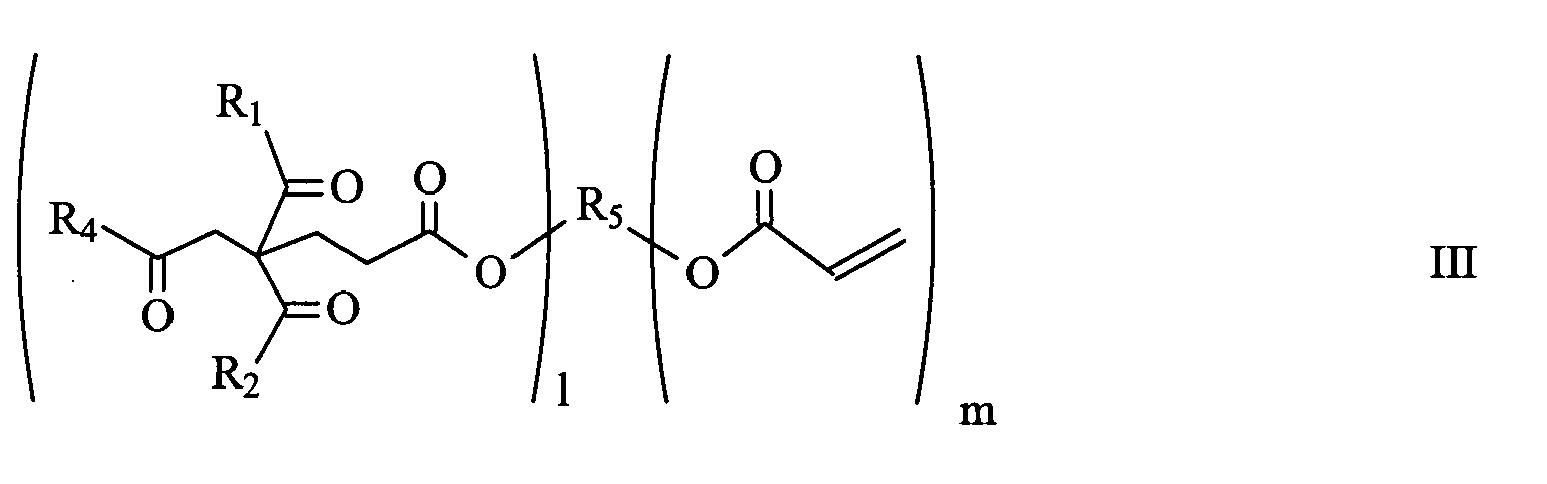
- the present invention also provides a photocurable compound, which is represented by the following formula III, wherein R1 and R2 independently denote an alkyl or cycloalkyl group having a carbon number of 1 to 6, R4 denotes an alkyl or alkoxy group having carbon number of 1 to 8, R5 denotes a polyvalent aliphatic hydro-carbon group having a carbon number of 2 to 8, 1 means an integer of 1 or 2, and m means an integer of 1 to 3.
- R1 and R2 independently denote an alkyl or cycloalkyl group having a carbon number of 1 to 6
- R4 denotes an alkyl or alkoxy group having carbon number of 1 to 8
- R5 denotes a polyvalent aliphatic hydro-carbon group having a carbon number of 2 to 8
- 1 means an integer of 1 or 2
- m means an integer of 1 to 3.
- a photocurable composition which exhibits, by irradiation withUV light or sunlight, higher curability without any photoinitiators, and thereby gives good hardness such as solvent resistance to the cured products.
- a photocurable compound usable as a constituent of the composition can be also provided, which gives the aforementioned property to the composition.
- composition of the present invention is suitable for coatings, or moldings.
- a resin to be incorporated in the photocurable composition of the present invention has an acryloyl group, and a chemical structure element represented by the following formula I.
- R1 and R2 independently denote an alkyl or cycloalkyl group having a carbon number of 1 to 6, such as methyl, ethyl, n-propyl, i-propyl, n-butyl, i-butyl, t-butyl, and cyclohexyl.
- alkyl or cycloalkyl group having a carbon number of 1 to 6 such as methyl, ethyl, n-propyl, i-propyl, n-butyl, i-butyl, t-butyl, and cyclohexyl.
- X1 denotes carbonyl group or cyano group
- R4 denotes an alkyl or alkoxy group having carbon number of 1 to 8
- n denotes 1 when X1 is carbonyl,and 0 when X1 is cyano group. That is, the sensitivity for photo-induced ⁇ (alpha)-cleavage between the ⁇ (alpha)-carbon atom and R1CO- (or R2CO-) in the formula I can be surprisingly enhanced by bonding the carbonyl group or cyano group to the ⁇ (alpha)-carbon atom in the ⁇ (beta)-diketone via methylene group.
- examples of the alkyl or alkoxy group having carbon number of 1 to 8 include methyl, ethyl, n-propyl, i-propyl, n-butyl, i-butyl, t-butyl, n-pentyl, n-hexyl, cyclo-hexyl, heptyl, octyl, methoxy, ethoxy, n-propoxy, i-propoxy, n-butoxy, t-butoxy, n-pentyloxy, n-hexyloxy, cyclo-hexyloxy, heptyloxy, and octyloxy.
- R3 denotes an alkylene group having a carbon number of 1 to 4,such as methylene, ethylene, 1,3-propylene, 2,2-propylene, 1,2-dimethylethylene, 2,2-dimethylethylene, and 1,1-dimethylethylene.
- R3 by selecting R3 so that the distance between the ⁇ (alpha)-carbon atom in the ⁇ (beta)-diketone and the electrone attracting group (X2) is within a range of a carbon number of 3, the superior photocurability can be attained.
- X2 denotes an electron attracting group as aforementioned.
- the electron attracting group include a ketone group, an carbonyloxy group, an ether group, carboxyl, a cyano group, a sulfonic acid group, a sulfonyl group, a phosphate group.
- the alkylation of ⁇ -diketone with halogenated alkyl can be carried out in accordance with aliphatic nucleophilic substitution, that includes a conventional process disclosed by Yoshimura, Saito, Tamura, Tanikaga, Kaj, Bull Chem. Soc. Jpn. 52, p.1716. (1979) or House “Modern Synthetic Reactions", 2 nd , ed., pp. 492 - 570, 586 - 595 or Fedorynski, Wojciechowski, Matacz, Makosza, J. Org. Chem. 43, 4682. (1978) (the contents of which are hereby incorporated by reference).
- Examples of catalysts of the Michael addition preferably include amines such as triethyl amine, 1,8-diazabicyclo[5.4.0]undec-7-ne, 1,5-diazabicyclo[4.3.0]non-5-ne, 1,4-diazabicyclo[2.2.2]octan, alkoholates such as sodium methylate, sodium ethylate, potassium tert-butylate, and phosphines such as trioctyl phosphine.
- amines such as triethyl amine, 1,8-diazabicyclo[5.4.0]undec-7-ne, 1,5-diazabicyclo[4.3.0]non-5-ne, 1,4-diazabicyclo[2.2.2]octan
- alkoholates such as sodium methylate, sodium ethylate, potassium tert-butylate
- phosphines such as trioctyl phosphine.
- Hal denots a halogen atom such as Chlorine atom, and Bromin atom.
- the examples of the formula include methyl chloroacetate, methyl bromoacetate, ethyl bromoacetate, t-butyl bromoacetate, ethyl chloroacetate, propyl chloroacetate, n-butyl chloroacetate, t-butyl chloroacetate, pentyl chloroacetate, cyclohexyl chloroacetate, heptyl chloroacetate, octyl chloroacetate, chloroacetone, ethyl-chloromethylketone, propyl-chloromethylketone, n-butyl-chloromethylketone , t-butyl-chloromethylketone , pentyl-chloromethylketone , cyclohexyl-chloromethylketone , heptyl-chloromethylketone, octyl-chloromethylketone, and chloromethylcyanide.
- Examples of ⁇ -diketone are represented by the following formula , wherein R1 and R2 are defined in formula 1, include for example; pentane-2,4-dione, hexane-2,4-dione, heptane-2,4-dione, heptane-3,5-dione, octane-2,4-dione, octane-3,5-dione, nonane-2,4-dione, nonane-3,5-dione, nonane-4,6-dione, decane-2,4-dione, decane-3,5-dione, decane-4,6-dione, undecane-2,4-dione, undecane-3,5-dione, undecane-4,6-dione, undecane-5,7-dione, 2,2-dimethyl-hexane-3,5-dion, 2,2,6,6-tetramethyl-heptane-3
- a poly-functional acrylic acid ester can be preferably used in the present invention.
- the poly-functional acrylic acid ester include for example: 1,2-ethanediol diacrylate, 1,3-propanediol diacrylate, 1,4-butanediol diacrylate, 1,6-hexanediol diacrylate, dipropylene glycol diacrylate, neopentyl glycol diacrylate, ethoxylated neopentyl glycol diacrylate, propoxylated neopentyl glycol diacrylate, tripropylene glycol diacrylate, bisphenol A diglycidyl ether diacrylate, ethoxylated bisphenol A diglycidyl ether diacrylate, polyethylene glycol diacrylate, trimethylolpropane triacrylate, ethoxylated trimethylolpropane triacrylate, propoxylated trimethylolpropane triacrylate
- Particularly preferable examples include trimethylolpropane triacrylate or pentaerythritol tetraacrylate from the viewpoint of hardness of cured product thereof.
- purification may be carried out in various ways.
- the product may be passed through an acidic ion exchanger that removes a basic catalyst, or the catalyst can be neutralized by addition of acids and then precipitated and filtered off.
- Combined anion exchangers and cation exchangers are suitable for removing salt-type catalysts.
- obtained products obtained by the aforementioned process are liquid, with viscosities of 200 mPa ⁇ s at 25°C to_10Pa ⁇ s at 25°C.
- Preferable viscosity is in the range between 500 and 2000 mPa ⁇ s at 25°C.
- a molecular weight (Mn) of the aforementioned resin (A) is preferably within a range of 300 to 20,000,from the viewpoint of viscosity.
- a preferred concentration of the total amount of the acyl group A1 and A2 which are represented by following formula, wherein R1 and R2 denotes an alkyl group having a carbon number of 1 to 6, is between 1 ⁇ 10 -5 mole per gram and 1 ⁇ 10 -2 mole per gram, based on the total amount of the composition from the viewpoints of curing speed, particularly between 1 ⁇ 10 -4 mole per gram and 1.10 -3 mole per gram.
- Examples of mono-functional acryloyl group containing compounds include the compounds represented by the following chemical formula.
- di-functional acryloyl group containing compounds include the compounds represented by the following chemical formula.
- tri-functional acryloyl group containing compounds include the compounds represented by the following chemical formula.
- a photocurable compound of the present invention which is presented by the following general formula III in light of having superior curability.
- R1 and R2 independently denote an alkyl or cycloalkyl group having a carbon number of 1 to 6
- R4 denotes an alkyl or alkoxy group having carbon number of 1 to 8
- R5 denotes a polyvalent aliphatic hydro-carbon group having a carbon number of 2 to 8
- 1 means an integer of 1 or 2
- m means an integer of 1 to 3.
- Examples of the photocurable compound include the aforementioned chemical formula m-1 to m-5, m-8 to m-18, d-1 to d-3, d-5 to d-7, d-9, d-10, t-1 to t-3, t-5, and t-6.
- the aforementioned resin (A) has remarkable effects in having day light curability as well as hardness. That is, the composition of the present invention is quite sensitive not only to UV light, but also to sunlight, which contains wavelengths predominantly above 400 nm. Therefore, the resin (A) can be easily cured by sunlight without addition of photoinitiators. Due to this remarkable property, the present composition can be used in the form of a thickly applied layer as coatings. Namely, UV irradiation is not suitable for curing of a thickly applied layer because the resin itself prevents the radiation from being absorbed sufficiently for thorough curing of the resin; on the other hand sunlight is effective for penetrating a thickly applied layer so that the resins are preferably applied for coatings which are usable for a thick layer.
- the preferable thickness range of the thick layer made of the coatings comprising the resin are, for example, within the range of 500 to 5000 ⁇ m.
- an oxygen atmosphere is not suitable for their curing. Therefore, in order to accelerate the curing speed, sunlight irradiation should be carried out in the absence of oxygen.
- the photocurable composition of the invention may comprise the above-mentioned resin (A) alone or may further comprise other photocurable monomers or resins in combination.
- photocurable monomers examples include dipropylene glycol diacrylate, trimethyrolpropane-triacrylate, and pentaerythritol tetraacrylate.
- Examples of the other photocurable resins include acrylated epoxy resins, acrylated polyurethanes, and acrylated polyesters.
- the photocurable composition of the invention may be used as coating, and molded articles because a tack-free and hard cured product can be obtained. Moreover, the composition can be used as printing ink.
- the coatings may comprise a proper amount of a colorant such as a dye or a pigment selected from carbon black, titanium white, phthalocyanine, an azo dyestuff or quinacridone, or an inorganic filler such as Si fine particles, mica or calcium carbonate.
- a colorant such as a dye or a pigment selected from carbon black, titanium white, phthalocyanine, an azo dyestuff or quinacridone, or an inorganic filler such as Si fine particles, mica or calcium carbonate.
- the photocurable composition exhibits good self curability as mentioned above, furthermore, a known initiator or a known photo-polymerization sensitizer may be added in order to accelerate their photocurability.
- the photocurable composition according to the invention as coating can be applied to suitable substrates such as for example paper, polyethylene, polypropylene, polyester, polyvinylidene chloride, aluminum, steel or wood and hardened in air under UV irradiation or under sunlight by a conventional coating method using a roll coater or a knife coater or a conventional printing method such as an offset printing method, a gravure printing method, or a silk screen printing method, to form a film or coating having a thickness of 0.1 to 5000 ⁇ m.
- suitable substrates such as for example paper, polyethylene, polypropylene, polyester, polyvinylidene chloride, aluminum, steel or wood and hardened in air under UV irradiation or under sunlight by a conventional coating method using a roll coater or a knife coater or a conventional printing method such as an offset printing method, a gravure printing method, or a silk screen printing method, to form a film or coating having a thickness of 0.1 to 5000 ⁇ m.
- microwavelength-excited radiators without electrodes may be used for the hardening.
- microwavelength-excited radiators so-called H bulbs are particularly suitable. These radiators also emit in a range from 225 to 325 nm in which the composition of the present invention can also absorb.
- the photocurable composition of the present invention can be cured by irradiation with sunlight when the ⁇ -diketone group is incorporated in the resin, so that cured thick layers having a thickness of 500 to 5000 ⁇ m can be obtained.
- layers can be cured under an inert gas such as nitrogen, carbon dioxide, or the curable layers can be covered by thin transparent plastic wrap such as polyethylene film.
- sunlight curable adhesive which is quite suitable for adhesion of glass articles.
- the obtained resin was applied on top of an aluminium sheet so as to be 50 ⁇ m film thickness, and was irradiated with a Fusion F300 in one pass at 70 m/min using the H-bulb. This corresponds to an irradiation energy of 0.07 J/cm 2 .
- Resistance to ethyl methyl ketone was tested by rubbing the surface of the coating with a cotton sheet sucked with ethyl methyl ketone until the surface is reached. The results are shown in the following table 1.
- Example 1 The compounds (A) obtained by Example 1 were mixed in accordance with the weight ratio shown in the table 1, then curing tests were done in the same manner of Example 1.
- the resin obtained by the example 1 is placed in a polyethylene bag of 10 cm x 10 cm x 0.5 cm, the excess of air is removed by suction with vacuum and the bag is sealed.
- the bag is placed in September at 52 degree latitude on a cloudless day at 3 pm in sunlight. After 7 minutes the bag gets warm, after 15 minutes the bag inside temperature has reached about 45 °C and all liquid material has became solid.
- the bag is opened after 20 minutes, the solid crosslinked resin sheet is removed and the degree of crosslinking is checked by a gel fraction. Measured gel-fraction is 94 to 95 % by weight, indicating a complete curing of the resin.
- Table 1 Comp. (A) TMPTA Solvent- resistance Ex. 2 Pencil hardness Ex. 2 Surface Ex. 2
- Example 1 1 0 > 200 3 H Tack-free
- Example 2 2 1 > 200 3 H Tack-free
- Example 3 1 > 200 4 H Tack-free
- Example 4 1 : 2 > 200 2 H Tack-free
- Example 5 1 : 3 > 200 2 H Tack-free Comparative Example 1 1 : 0 1 at 0.07 J/cm 2 - Liquid >75 at 0.6 J/cm 2 3H Tack-free
- compositions of the present invention show higher curability, which can be recognized by hardness of films such as solvent resistance.
Landscapes
- Chemical & Material Sciences (AREA)
- Organic Chemistry (AREA)
- Health & Medical Sciences (AREA)
- Chemical Kinetics & Catalysis (AREA)
- Medicinal Chemistry (AREA)
- Polymers & Plastics (AREA)
- Paints Or Removers (AREA)
- Addition Polymer Or Copolymer, Post-Treatments, Or Chemical Modifications (AREA)
- Polymerisation Methods In General (AREA)
Abstract

Description
- The present invention relates to a photocurable composition, and a new curable compound, which is usable as a constituent of the composition. More specifically, the composition of the present invention is usable for coatings, or molded articles which are curable with UV light to sunlight without any use of photoinitiators.
- A photocurable composition containing a resin having plural acryloyl groups, which can be cured by irradiation with UV (ultraviolet) light or sunlight, is widely used in fields of coatings, printing inks or molded articles.
- For this curing system, in general, a photoinitiator had been used together with the acryloyl group containing resin in the abovementioned fields. Namely, the photoinitiator can generate free-radicals easily under photoirradiation and initiates free-radical polymerization of the acryloyl groups, which then leads to a hardening of the resin.
- However, the above-mentioned radiation-hardening systems containing photoinitiators had given rise to several practical problems. For example, unreacted photoinitiators as well as their cleavage products usually remained in the coating , migrated to the surface , and affected adjacent products. Particularly, in the foodstuff packaging industry, migration was quite serious problem. That is, the migrated unreacted photoinitiators and their cleavage products led to contamination of the foodstuffs themselves.
- Furthermore, residues of photoinitiators such as benzophenone, or volatile cleavage products such as benzaldehyde, that are formed throughout radical formation by homolytic cleavage of α-cleavable compounds, in addition led to the formation of odor that adversely affected the quality of the hardened products.
- Additionally some of low-molecular weight cleavage products are toxic and often caused a serious problem for the consumer especially in foodstuff packaging.
- Another serious problem that has been caused by photoinitiators was yellowing, which was caused by amine based coinitiators or side-reaction products of aromatic groups within the structure of the initiator,.
- On account of the aforementioned disadvantages, the need has arisen in the technology to provide a photocurable acryloyl group containing resin system that can harden without use of photoinitiators.
- As a means for overcoming these problems, there have been proposed a photoinitiator-free oligomeric composition having acryloyl groups. For example, United State Patent No. 6025410 discloses liquid oligomeric compositions produced by Michael Addition reaction of acetoacetates with acrylates, that can be polymerized under UV light in the absence of photoinitiators. Furthermore, EP-A1-1342738 discloses a further improved self-curable liquid oligomeric composition, which is also given by Michael addition reaction of acetoacetates with acrylates. That is, the composition can give a tack-free cured product by introducing tertiary carbon atom structures into an acryloyl group containing resin.
- The liquid oligomeric compositions disclosed in these documents, however, had a problem in that photo-reactivity was not enough, thereby had caused tacky surfaces of the cured films at high curing-speed due to severe oxygen inhibition.
- It is therefore an object of the present invention to provide an aromatic free photocurable composition, which has higher curability without any photoinitiators, and thereby shows reduced oxygen inhibition and gives products with good hardness and solvent resistance. Another object is to provide a compound, which can give the abovementioned higher self-curability to the composition, and can thereby give cured products having excellent hardness and as solvent resistance.
- Unexpectedly, we have now found that, with respect to chemical structure of acryloyl group containing resin, by introducing β (beta)-diketone structure having specific substituent group at α (alpha) -position to both carbonyl groups, the photoreactivity of the composition can be extremely enhanced.
- Accordingly, the present invention provides, a photocurable composition containing a resin (A) having an acryloyl group and a chemical structure element represented by the following formula I,
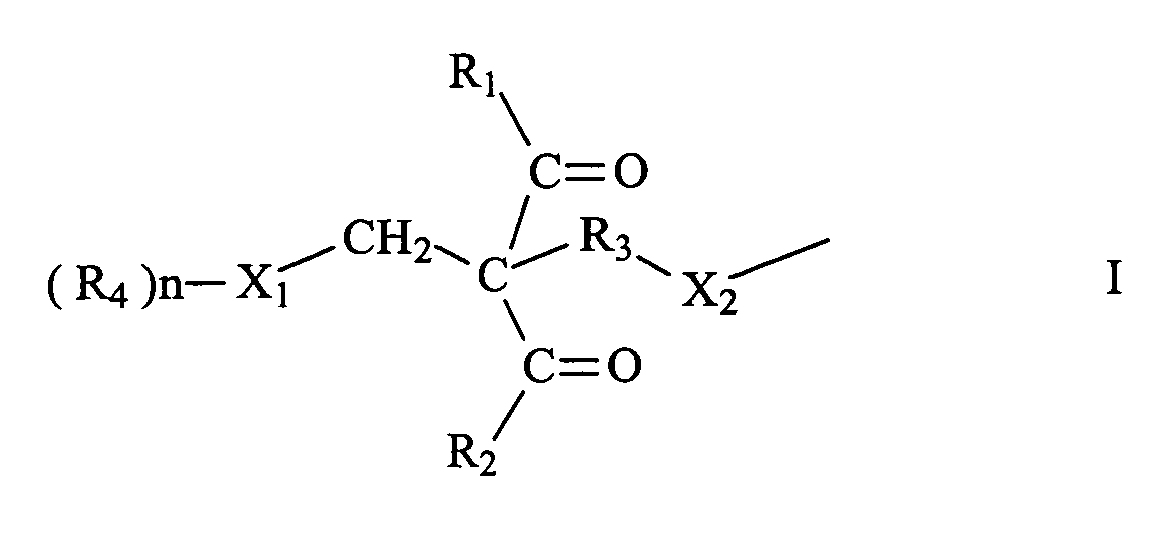
- The present invention also provides a photocurable compound, which is represented by the following formula III,
- According to the present invention, a photocurable composition can be provided, which exhibits, by irradiation withUV light or sunlight, higher curability without any photoinitiators, and thereby gives good hardness such as solvent resistance to the cured products.
- Furthermore, a photocurable compound usable as a constituent of the composition can be also provided, which gives the aforementioned property to the composition.
- Therefore, the composition of the present invention is suitable for coatings, or moldings.
- The embodiments of the present invention will hereinafter be described in detail.
- A resin to be incorporated in the photocurable composition of the present invention has an acryloyl group, and a chemical structure element represented by the following formula I.

- Here, in the formula I, R1 and R2 independently denote an alkyl or cycloalkyl group having a carbon number of 1 to 6, such as methyl, ethyl, n-propyl, i-propyl, n-butyl, i-butyl, t-butyl, and cyclohexyl. In the present invention, from the viewpoints of contribution to the reactivity of radicals towards double-bonds, preferred are methyl and t-butyl.
- As aforementioned, X1 denotes carbonyl group or cyano group, R4 denotes an alkyl or alkoxy group having carbon number of 1 to 8, and n denotes 1 when X1 is carbonyl,and 0 when X1 is cyano group. That is, the sensitivity for photo-induced α (alpha)-cleavage between the α (alpha)-carbon atom and R1CO- (or R2CO-) in the formula I can be surprisingly enhanced by bonding the carbonyl group or cyano group to the α (alpha)-carbon atom in the β (beta)-diketone via methylene group. Here, examples of the alkyl or alkoxy group having carbon number of 1 to 8 include methyl, ethyl, n-propyl, i-propyl, n-butyl, i-butyl, t-butyl, n-pentyl, n-hexyl, cyclo-hexyl, heptyl, octyl, methoxy, ethoxy, n-propoxy, i-propoxy, n-butoxy, t-butoxy, n-pentyloxy, n-hexyloxy, cyclo-hexyloxy, heptyloxy, and octyloxy.
- Next, R3 denotes an alkylene group having a carbon number of 1 to 4,such as methylene, ethylene, 1,3-propylene, 2,2-propylene, 1,2-dimethylethylene, 2,2-dimethylethylene, and 1,1-dimethylethylene. In the present invention, by selecting R3 so that the distance between the α(alpha)-carbon atom in the β(beta)-diketone and the electrone attracting group (X2) is within a range of a carbon number of 3, the superior photocurability can be attained.
- Further, X2 denotes an electron attracting group as aforementioned. Examples of the electron attracting group include a ketone group, an carbonyloxy group, an ether group, carboxyl, a cyano group, a sulfonic acid group, a sulfonyl group, a phosphate group.
- Among these structural elements represented in the aforementioned formula I, the following formula II is preferable from the viewpoints of productivity thereof as well as photocurability in the resin.

- These resins having an acryloyl group together with a chemical structural element represented by the aforementioned formula I, preferably formula II, can be obtained by standard well-known alkylation, and if necessary, further Michael Addition reaction as follows.

- In the abovementioned reaction scheme, the alkylation of β-diketone with halogenated alkyl can be carried out in accordance with aliphatic nucleophilic substitution, that includes a conventional process disclosed by Yoshimura, Saito, Tamura, Tanikaga, Kaj, Bull Chem. Soc. Jpn. 52, p.1716. (1979) or House "Modern Synthetic Reactions", 2nd, ed., pp. 492 - 570, 586 - 595 or Fedorynski, Wojciechowski, Matacz, Makosza, J. Org. Chem. 43, 4682. (1978) (the contents of which are hereby incorporated by reference).
- In the case of Michael Addition reaction of β-diketone with acrylates, for example, which can be carried out in accordance with Bergmann, Ginsburg, Pappo, Org. React. 10, p. 179-560 (1959), (the contents of which are hereby incorporated by reference). Examples of catalysts of the Michael addition preferably include amines such as triethyl amine, 1,8-diazabicyclo[5.4.0]undec-7-ne, 1,5-diazabicyclo[4.3.0]non-5-ne, 1,4-diazabicyclo[2.2.2]octan, alkoholates such as sodium methylate, sodium ethylate, potassium tert-butylate, and phosphines such as trioctyl phosphine.
- Furthermore, as for sulfoxide structural element, the synthesis thereof can proceed through the Michael addition of vinyl sulfone to β-diketone (Truce, W. E., Wellisch, E.; J. Amer. Chem. Soc. 74, 2881. (1952), the contents of which are hereby incorporated by reference).
- As a starting material of the alkylation, the compounds represented by the following formula can be used as above illustrated. Here, Hal denots a halogen atom such as Chlorine atom, and Bromin atom.
(R4)n-X1-CH2-Hal
- The examples of the formula include methyl chloroacetate, methyl bromoacetate, ethyl bromoacetate, t-butyl bromoacetate, ethyl chloroacetate, propyl chloroacetate, n-butyl chloroacetate, t-butyl chloroacetate, pentyl chloroacetate, cyclohexyl chloroacetate, heptyl chloroacetate, octyl chloroacetate, chloroacetone, ethyl-chloromethylketone, propyl-chloromethylketone, n-butyl-chloromethylketone , t-butyl-chloromethylketone , pentyl-chloromethylketone , cyclohexyl-chloromethylketone , heptyl-chloromethylketone, octyl-chloromethylketone, and chloromethylcyanide.
Examples of β-diketone are represented by the following formula

- In case of producing the compound (A) via Michael addition reaction, a poly-functional acrylic acid ester can be preferably used in the present invention. Here the poly-functional acrylic acid ester include for example: 1,2-ethanediol diacrylate, 1,3-propanediol diacrylate, 1,4-butanediol diacrylate, 1,6-hexanediol diacrylate, dipropylene glycol diacrylate, neopentyl glycol diacrylate, ethoxylated neopentyl glycol diacrylate, propoxylated neopentyl glycol diacrylate, tripropylene glycol diacrylate, bisphenol A diglycidyl ether diacrylate, ethoxylated bisphenol A diglycidyl ether diacrylate, polyethylene glycol diacrylate, trimethylolpropane triacrylate, ethoxylated trimethylolpropane triacrylate, propoxylated trimethylolpropane triacrylate, propoxylated glycerol triacrylate, tris(2-acryloyloxyethyl) isocyanurate, pentaerythritol triacrylate, ethoxylated pentaerythritol triacrylate, pentaerythritol tetraacrylate, ethoxylated pentaerythritol tetraacrylate, ditrimethylolpropane tetraacrylate,
dipentaerythritol pentaacrylate, dipentaerythritol hexaacrylate, acrylate group-containing oligomers and polymers obtained by reacting polyepoxides with acrylic acid (epoxyacrylates) or obtained by reacting polyester polyols with acrylic acid and/or monomeric alkyl acrylates (polyester acrylates). - Particularly preferable examples include trimethylolpropane triacrylate or pentaerythritol tetraacrylate from the viewpoint of hardness of cured product thereof.
- After synthesis process, purification may be carried out in various ways. For example, the product may be passed through an acidic ion exchanger that removes a basic catalyst, or the catalyst can be neutralized by addition of acids and then precipitated and filtered off. Combined anion exchangers and cation exchangers are suitable for removing salt-type catalysts.
- Thus, obtained products obtained by the aforementioned process are liquid, with viscosities of 200 mPa·s at 25°C to_10Pa·s at 25°C. Preferable viscosity is in the range between 500 and 2000 mPa·s at 25°C.
- In the present invention, a molecular weight (Mn) of the aforementioned resin (A) is preferably within a range of 300 to 20,000,from the viewpoint of viscosity.
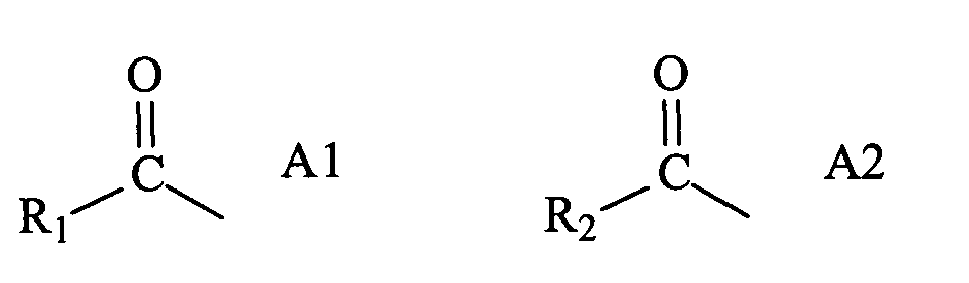
- Further, a preferred concentration of the total amount of the acyl group A1 and A2 which are represented by following formula,

- In the present invention, it is safe to say that all of compounds, which are obtainable from the abovementioned starting materials, can be used as a resin (A). However, among them, preferable are the compounds having 1 to 3 acryloy groups in light of hardness.
- Examples of mono-functional acryloyl group containing compounds, include the compounds represented by the following chemical formula.

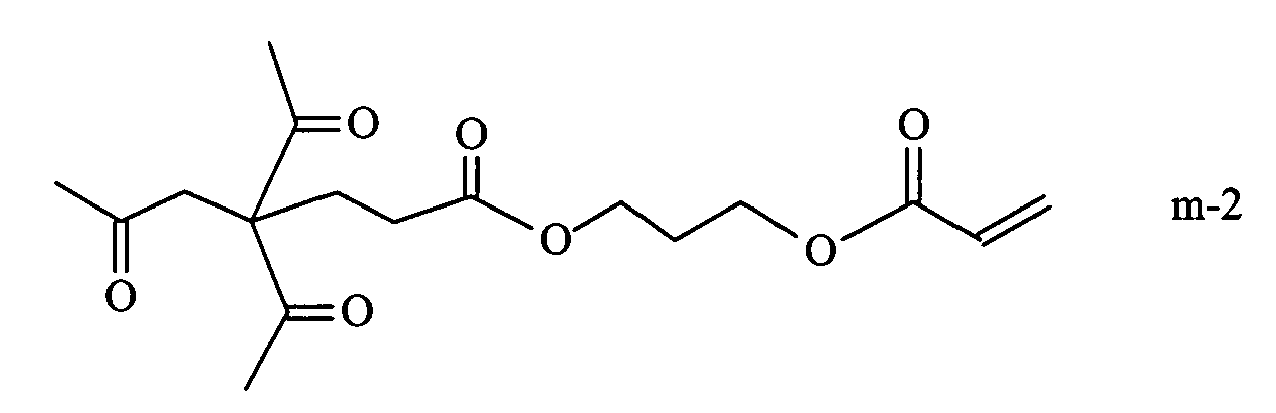


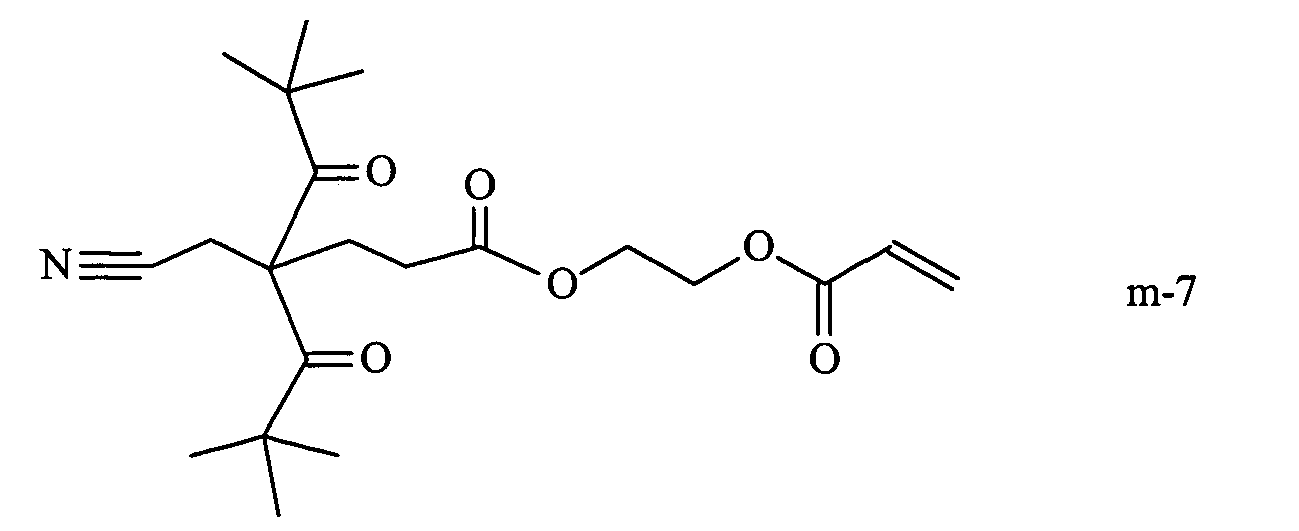


- Examples of di-functional acryloyl group containing compounds, include the compounds represented by the following chemical formula.


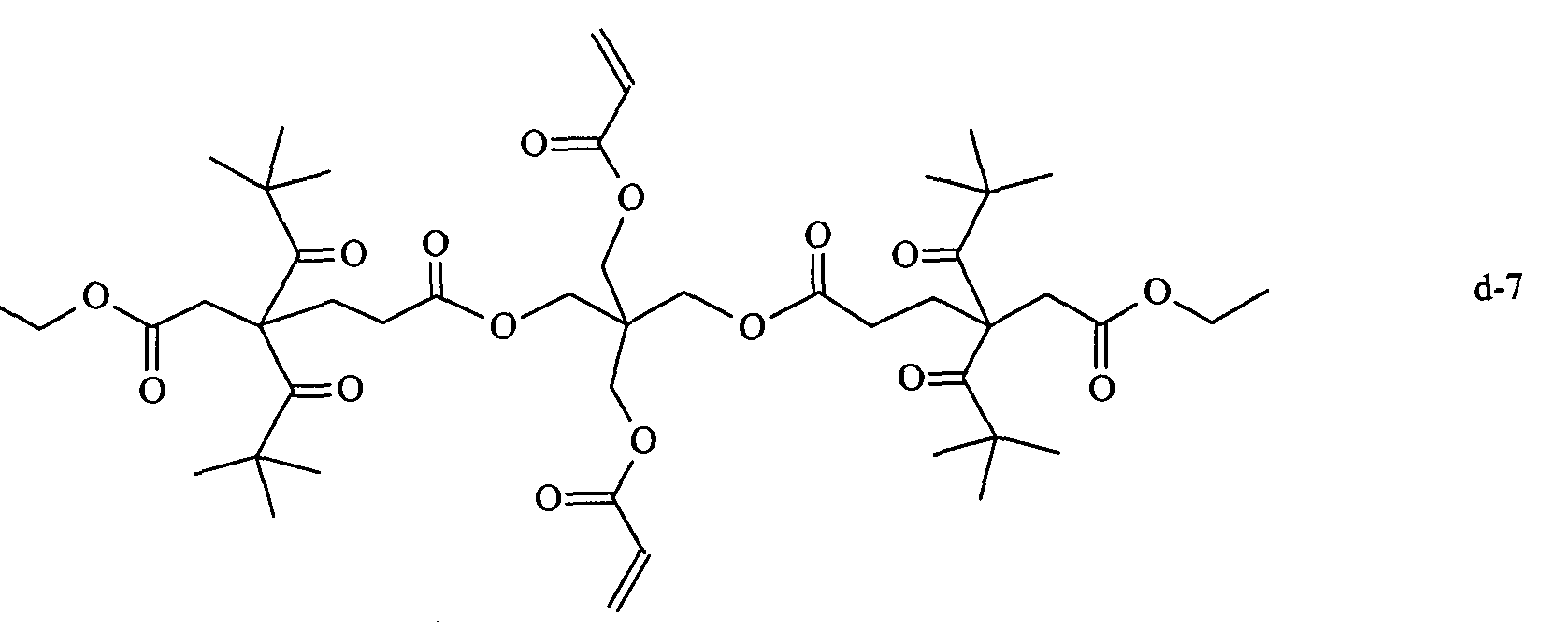


- Examples of tri-functional acryloyl group containing compounds, include the compounds represented by the following chemical formula.


- In particular, preferred among these compounds is a photocurable compound of the present invention, which is presented by the following general formula III in light of having superior curability.

- Here, R1 and R2 independently denote an alkyl or cycloalkyl group having a carbon number of 1 to 6, R4 denotes an alkyl or alkoxy group having carbon number of 1 to 8, and R5 denotes a polyvalent aliphatic hydro-carbon group having a carbon number of 2 to 8, 1 means an integer of 1 or 2, and m means an integer of 1 to 3.
- Examples of the photocurable compound include the aforementioned chemical formula m-1 to m-5, m-8 to m-18, d-1 to d-3, d-5 to d-7, d-9, d-10, t-1 to t-3, t-5, and t-6.
- In the general formula III, the compounds of m=2 or 3, further preferably that of m=2, are preferable from the viewpoint of hardness.
- In particular, among these chemical structures represented by the formula III, compounds having a secondary alkyl having carbon number of 3 to 6, tertiary alkyl having carbon number of 4 to 6, or cycloalkyl having carbon number of 5 or 6 as R1 or R2, are preferable from the viewpoints of excellent self-photocurability.
- The aforementioned resin (A) has remarkable effects in having day light curability as well as hardness. That is, the composition of the present invention is quite sensitive not only to UV light, but also to sunlight, which contains wavelengths predominantly above 400 nm. Therefore, the resin (A) can be easily cured by sunlight without addition of photoinitiators. Due to this remarkable property, the present composition can be used in the form of a thickly applied layer as coatings. Namely, UV irradiation is not suitable for curing of a thickly applied layer because the resin itself prevents the radiation from being absorbed sufficiently for thorough curing of the resin; on the other hand sunlight is effective for penetrating a thickly applied layer so that the resins are preferably applied for coatings which are usable for a thick layer. The preferable thickness range of the thick layer made of the coatings comprising the resin are, for example, within the range of 500 to 5000 µm. However, in the sunlight curing system, an oxygen atmosphere is not suitable for their curing. Therefore, in order to accelerate the curing speed, sunlight irradiation should be carried out in the absence of oxygen.
- The photocurable composition of the invention may comprise the above-mentioned resin (A) alone or may further comprise other photocurable monomers or resins in combination.
- Examples of the photocurable monomers include dipropylene glycol diacrylate, trimethyrolpropane-triacrylate, and pentaerythritol tetraacrylate.
- Examples of the other photocurable resins include acrylated epoxy resins, acrylated polyurethanes, and acrylated polyesters.
- The photocurable composition of the invention may be used as coating, and molded articles because a tack-free and hard cured product can be obtained. Moreover, the composition can be used as printing ink.
- Furthermore, the coatings may comprise a proper amount of a colorant such as a dye or a pigment selected from carbon black, titanium white, phthalocyanine, an azo dyestuff or quinacridone, or an inorganic filler such as Si fine particles, mica or calcium carbonate.
- Although the photocurable composition exhibits good self curability as mentioned above, furthermore, a known initiator or a known photo-polymerization sensitizer may be added in order to accelerate their photocurability.
- The photocurable composition according to the invention as coating can be applied to suitable substrates such as for example paper, polyethylene, polypropylene, polyester, polyvinylidene chloride, aluminum, steel or wood and hardened in air under UV irradiation or under sunlight by a conventional coating method using a roll coater or a knife coater or a conventional printing method such as an offset printing method, a gravure printing method, or a silk screen printing method, to form a film or coating having a thickness of 0.1 to 5000 µm.
- Commercially available mercury high-pressure radiators or microwavelength-excited radiators without electrodes may be used for the hardening. Particularly suitable are microwavelength-excited radiators so-called H bulbs. These radiators also emit in a range from 225 to 325 nm in which the composition of the present invention can also absorb.
- On the other hand, as mentioned above, the photocurable composition of the present invention can be cured by irradiation with sunlight when the β-diketone group is incorporated in the resin, so that cured thick layers having a thickness of 500 to 5000 µm can be obtained. In the case of using sunlight, in order to exclude oxygen, layers can be cured under an inert gas such as nitrogen, carbon dioxide, or the curable layers can be covered by thin transparent plastic wrap such as polyethylene film. In application as sunlight curable adhesive, which is quite suitable for adhesion of glass articles.
This invention will be further explained by a consideration of the following non-limiting examples which are intended to be purely exemplary of this invention. -

- In an 100 ml three necked round-bottom flask equipped with magnetic bar, reflux condenser, thermometer and gas inlet 10.0 g ethyl 3-acetyl-4-oxo-pentanoate, 15.91 g trimethylol propane triacrylate and three drops 1,8-diazabicyclo[5.4.0]undecen-7-ene were mixed. Air was bubbled through the mixture. Exothermic behavior was observed. After 2 hours the mixture has cooled to room-temperature again, 0.1 g hydrochinone mono-methyl ether is added and the mixture stirred at 60 °C for two hours.
- The followings are analytical data as to the obtained compound.
1H-NMR CDCl3 6.40 (4 H; d; 3JH-H = 17.3 Hz; =CH2); 6.13 (4 H; dd; 3JH-H = 17.3 Hz; -CH=CH2); 5.87 (4 H; d; 3JH-H= 12.0 Hz; =CH2); 4.19 (6 H; s; Cq-CH2-O-C=O)-CH=); 4.11 (2 H; q; 3JH-H= 7.3 Hz; -O-CH2-CH3); 2.97 (2 H; s; Cq-CH2-C(=O)O-); 2.38 - 2.32 (4 H; m; >Cq-CH2-CH2-C(=O)O-); 2.19 (6H; s; C=(O)-CH3); 1.52 (2 H; m; -CH2-CH3); 1.23 (3 H; t; 3JH-H = 7.1 Hz; -O-CH2-CH3); 0.95 ppm (3 H; m; CH2-CH3) 13C-NMR CDCl3 203.9 (s; -C(=O)-CH3); 171.3 (s; -CH2-C(=O)-O-CH2-); 169.9 (s; -(CH2)2-C(=O)O-); 164.9 (s; -CH2-O-C(=O)-CH=CH2); 130.5 (s; -CH=CH2); 127.4 (s; -CH=CH2); 66.9 (s; -CH2-C(=O)O-CH2-Cq); 63.4 (s; Cq -CH2-O-C(=O)-CH2-); 60.3 (s; -O-CH2-CH3); 40.3 (s; -C(=O)-Cq-C(=O)-); 35.6 (s; Cq-CH2-CH2-C(=O)O-); 28.3 (s; CqCH2-CH2-C(=O)O-); 26.0 (s; -C(=O)-CH3); 25.7 (s; Cq-CH2-C(=O)O-); 22.5 (-CH2-CH3); 6.7 ppm (CH2-CH3) - The obtained resin was applied on top of an aluminium sheet so as to be 50 µm film thickness, and was irradiated with a Fusion F300 in one pass at 70 m/min using the H-bulb. This corresponds to an irradiation energy of 0.07 J/cm2. Resistance to ethyl methyl ketone was tested by rubbing the surface of the coating with a cotton sheet sucked with ethyl methyl ketone until the surface is reached.
The results are shown in the following table 1. - The compounds (A) obtained by Example 1 were mixed in accordance with the weight ratio shown in the table 1, then curing tests were done in the same manner of Example 1.
- The results are shown in the following table 1.
- The resin obtained by the example 1 is placed in a polyethylene bag of 10 cm x 10 cm x 0.5 cm, the excess of air is removed by suction with vacuum and the bag is sealed. The bag is placed in September at 52 degree latitude on a cloudless day at 3 pm in sunlight. After 7 minutes the bag gets warm, after 15 minutes the bag inside temperature has reached about 45 °C and all liquid material has became solid. The bag is opened after 20 minutes, the solid crosslinked resin sheet is removed and the degree of crosslinking is checked by a gel fraction. Measured gel-fraction is 94 to 95 % by weight, indicating a complete curing of the resin.
- In an 250 ml three necked round-bottom flask equipped with magnetic bar, reflux condenser, thermometer and gas inlet, 97.7 g of trimethylol propane triacrylate, 5 g of acetylacetone, and 6.5 of ethyl acetoacetate were mixed, 0.77 g of tri-octylphosphine were added. Then, the mixture was heated, and stirred at 90°C for two hours. When the viscosity of the mixture did not increase any further, heating is discontinued and the product is cooled to room temperature.
- As for the obtained resin, curing tests were carried out in the same manner of Example 1 and additionally by using the same application method but curing conditions of 3 passes at 16 m/min belt-speed which means an irradiation energy of 0.6 J / cm2 .
- The results are shown in the following table 1.
Table 1 Comp. (A) : TMPTA Solvent- resistance Ex. 2 Pencil hardness Ex. 2 Surface Ex. 2 Example 1 1 : 0 > 200 3 H Tack-free Example 2 2 : 1 > 200 3 H Tack-free Example 3 1 : 1 > 200 4 H Tack-free Example 4 1 : 2 > 200 2 H Tack-free Example 5 1 : 3 > 200 2 H Tack-free Comparative Example 1 1 : 0 1 at 0.07 J/cm2 - Liquid >75 at 0.6 J/cm2 3H Tack-free - As shown by the results, the compositions of the present invention, show higher curability, which can be recognized by hardness of films such as solvent resistance.
Claims (6)
- A photocurable composition containing a resin (A) having an acryloyl group and a chemical structural element represented by the following formula I,

- A photocurable composition according to claim 1, wherein the resin (A) has an acryloyl group and a chemical structure element represented by the following formula II,

- A photocurable composition according to claims 1 to 4, wherein the resin (A) has a molecular weight (Mn) of 300 to 20,000.
- A photocurable composition according to claims 1 to 4, wherein the acyl groups represented by the following formula A1 and A2
- A photocurable composition according to claim 1, wherein the composition further contains one or several acrylic monomers.
- A photocurable compound, which is represented by the following formula III,

Priority Applications (3)
| Application Number | Priority Date | Filing Date | Title |
|---|---|---|---|
| DE602005003443T DE602005003443T2 (en) | 2005-03-04 | 2005-03-04 | Photocurable composition and photohardenable compound |
| EP05004802A EP1698646B1 (en) | 2005-03-04 | 2005-03-04 | Photocurable composition and photocurable compound |
| JP2006057802A JP2006241461A (en) | 2005-03-04 | 2006-03-03 | Photocurable composition and photocurable compound |
Applications Claiming Priority (1)
| Application Number | Priority Date | Filing Date | Title |
|---|---|---|---|
| EP05004802A EP1698646B1 (en) | 2005-03-04 | 2005-03-04 | Photocurable composition and photocurable compound |
Publications (2)
| Publication Number | Publication Date |
|---|---|
| EP1698646A1 true EP1698646A1 (en) | 2006-09-06 |
| EP1698646B1 EP1698646B1 (en) | 2007-11-21 |
Family
ID=34934064
Family Applications (1)
| Application Number | Title | Priority Date | Filing Date |
|---|---|---|---|
| EP05004802A Expired - Lifetime EP1698646B1 (en) | 2005-03-04 | 2005-03-04 | Photocurable composition and photocurable compound |
Country Status (3)
| Country | Link |
|---|---|
| EP (1) | EP1698646B1 (en) |
| JP (1) | JP2006241461A (en) |
| DE (1) | DE602005003443T2 (en) |
Cited By (1)
| Publication number | Priority date | Publication date | Assignee | Title |
|---|---|---|---|---|
| CN102507644A (en) * | 2011-11-24 | 2012-06-20 | 波达通信设备(广州)有限公司 | Method for determining optimal curing condition of silver paste |
Families Citing this family (5)
| Publication number | Priority date | Publication date | Assignee | Title |
|---|---|---|---|---|
| JP4726868B2 (en) * | 2007-08-01 | 2011-07-20 | 株式会社Adeka | Alkali-developable photosensitive resin composition |
| EP2175320B1 (en) | 2007-08-01 | 2013-03-13 | Adeka Corporation | Alkali-developable photosensitive resin composition |
| JP5065123B2 (en) * | 2008-03-31 | 2012-10-31 | 株式会社Adeka | Alkali-developable photosensitive resin composition |
| JP5550814B2 (en) * | 2008-03-05 | 2014-07-16 | 株式会社Adeka | Β-diketone compound having carbazolyl group and photopolymerization initiator using the compound |
| JP7606823B2 (en) | 2020-05-22 | 2024-12-26 | 石家庄▲誠▼志永▲華顕▼示材料有限公司 | Polymerizable compound and liquid crystal composition using the same |
Citations (3)
| Publication number | Priority date | Publication date | Assignee | Title |
|---|---|---|---|---|
| US6025410A (en) * | 1997-09-19 | 2000-02-15 | Ashland Inc. | Liquid oligomers containing acrylate unsaturation |
| EP1342737A1 (en) * | 2002-03-07 | 2003-09-10 | Dainippon Ink And Chemicals, Inc. | Initiator-free crosslinkable oligomers and polymers |
| EP1342738A1 (en) * | 2002-03-07 | 2003-09-10 | Dainippon Ink And Chemicals, Inc. | Photocurable composition, process for producing photocurable resin, and crosslinked product |
-
2005
- 2005-03-04 DE DE602005003443T patent/DE602005003443T2/en not_active Expired - Lifetime
- 2005-03-04 EP EP05004802A patent/EP1698646B1/en not_active Expired - Lifetime
-
2006
- 2006-03-03 JP JP2006057802A patent/JP2006241461A/en active Pending
Patent Citations (3)
| Publication number | Priority date | Publication date | Assignee | Title |
|---|---|---|---|---|
| US6025410A (en) * | 1997-09-19 | 2000-02-15 | Ashland Inc. | Liquid oligomers containing acrylate unsaturation |
| EP1342737A1 (en) * | 2002-03-07 | 2003-09-10 | Dainippon Ink And Chemicals, Inc. | Initiator-free crosslinkable oligomers and polymers |
| EP1342738A1 (en) * | 2002-03-07 | 2003-09-10 | Dainippon Ink And Chemicals, Inc. | Photocurable composition, process for producing photocurable resin, and crosslinked product |
Cited By (2)
| Publication number | Priority date | Publication date | Assignee | Title |
|---|---|---|---|---|
| CN102507644A (en) * | 2011-11-24 | 2012-06-20 | 波达通信设备(广州)有限公司 | Method for determining optimal curing condition of silver paste |
| CN102507644B (en) * | 2011-11-24 | 2014-06-25 | 波达通信设备(广州)有限公司 | Method for determining optimal curing condition of silver paste |
Also Published As
| Publication number | Publication date |
|---|---|
| JP2006241461A (en) | 2006-09-14 |
| EP1698646B1 (en) | 2007-11-21 |
| DE602005003443D1 (en) | 2008-01-03 |
| DE602005003443T2 (en) | 2008-10-02 |
Similar Documents
| Publication | Publication Date | Title |
|---|---|---|
| JP4451137B2 (en) | Formulatable photoinitiator | |
| FI71322C (en) | ACYLFOSFINOXIDFOERENINGAR OCH DERAS ANVAENDNING | |
| SU679150A3 (en) | Method of producing binder for coatings | |
| KR101944734B1 (en) | Photoactivable nitrogen bases | |
| CA1293835C (en) | Hardenable composition and its use | |
| TW466255B (en) | Photoactivatable nitrogen-contained bases on Α-amino alkenes | |
| KR20160029064A (en) | Liquid bisacylphosphine oxide photoinitiator | |
| US6924324B2 (en) | Photocurable composition, process for producing photocurable resin, and crosslinked product | |
| JPH11292910A (en) | Colored photocurable composition | |
| EP3725815B1 (en) | Active energy ray-curable composition | |
| TWI701255B (en) | Acid-resistant base and/or radical generator, and curable resin composition having said base or/and radical generator | |
| JP5076075B2 (en) | UV curable composition | |
| CN115698109B (en) | Active energy radiation-curable resin compositions and their cured products | |
| CN116547323A (en) | Polymeric cycloaliphatic epoxides | |
| EP1698646B1 (en) | Photocurable composition and photocurable compound | |
| JP5076076B2 (en) | UV curable composition | |
| US7112633B2 (en) | Preparation of a compound containing cyclic and linear carbonate groups | |
| JP4463649B2 (en) | Photoradical polymerization initiator, photosensitive resin composition, and article | |
| US7141354B2 (en) | Photo radical generator, photo sensitive resin composition and article | |
| JP6828467B2 (en) | Active energy ray polymerization initiator, active energy ray curable composition, cured product and benzoin thioether compound | |
| EP1342738B1 (en) | Photocurable composition, process for producing photocurable resin, and crosslinked product | |
| JP6530281B2 (en) | Active energy ray curable composition for photoresist | |
| JPS63286426A (en) | Melamine ring-containing (meth)acrylate prepolymer and curable resin composition containing said prepolymer | |
| JPH0348183B2 (en) | ||
| JP2026011335A (en) | Polymer, composition, curable resin composition, cured product, and method for producing polymer |
Legal Events
| Date | Code | Title | Description |
|---|---|---|---|
| PUAI | Public reference made under article 153(3) epc to a published international application that has entered the european phase |
Free format text: ORIGINAL CODE: 0009012 |
|
| AK | Designated contracting states |
Kind code of ref document: A1 Designated state(s): AT BE BG CH CY CZ DE DK EE ES FI FR GB GR HU IE IS IT LI LT LU MC NL PL PT RO SE SI SK TR |
|
| AX | Request for extension of the european patent |
Extension state: AL BA HR LV MK YU |
|
| 17P | Request for examination filed |
Effective date: 20070227 |
|
| AKX | Designation fees paid |
Designated state(s): DE |
|
| GRAP | Despatch of communication of intention to grant a patent |
Free format text: ORIGINAL CODE: EPIDOSNIGR1 |
|
| GRAS | Grant fee paid |
Free format text: ORIGINAL CODE: EPIDOSNIGR3 |
|
| GRAA | (expected) grant |
Free format text: ORIGINAL CODE: 0009210 |
|
| AK | Designated contracting states |
Kind code of ref document: B1 Designated state(s): DE |
|
| REF | Corresponds to: |
Ref document number: 602005003443 Country of ref document: DE Date of ref document: 20080103 Kind code of ref document: P |
|
| PLBE | No opposition filed within time limit |
Free format text: ORIGINAL CODE: 0009261 |
|
| STAA | Information on the status of an ep patent application or granted ep patent |
Free format text: STATUS: NO OPPOSITION FILED WITHIN TIME LIMIT |
|
| 26N | No opposition filed |
Effective date: 20080822 |
|
| PGFP | Annual fee paid to national office [announced via postgrant information from national office to epo] |
Ref country code: DE Payment date: 20110330 Year of fee payment: 7 |
|
| REG | Reference to a national code |
Ref country code: DE Ref legal event code: R119 Ref document number: 602005003443 Country of ref document: DE Effective date: 20121002 |
|
| PG25 | Lapsed in a contracting state [announced via postgrant information from national office to epo] |
Ref country code: DE Free format text: LAPSE BECAUSE OF NON-PAYMENT OF DUE FEES Effective date: 20121002 |