EP1697706B1 - Verwendung von spinel-ferriten als empfindliches material für bolometrische infrarot-detektionseinrichtungen - Google Patents
Verwendung von spinel-ferriten als empfindliches material für bolometrische infrarot-detektionseinrichtungen Download PDFInfo
- Publication number
- EP1697706B1 EP1697706B1 EP04816549.2A EP04816549A EP1697706B1 EP 1697706 B1 EP1697706 B1 EP 1697706B1 EP 04816549 A EP04816549 A EP 04816549A EP 1697706 B1 EP1697706 B1 EP 1697706B1
- Authority
- EP
- European Patent Office
- Prior art keywords
- spinel
- bolometric
- infrared radiation
- metals
- metal
- Prior art date
- Legal status (The legal status is an assumption and is not a legal conclusion. Google has not performed a legal analysis and makes no representation as to the accuracy of the status listed.)
- Expired - Lifetime
Links
- 229910052596 spinel Inorganic materials 0.000 title claims description 47
- 239000011029 spinel Substances 0.000 title claims description 47
- 229910000859 α-Fe Inorganic materials 0.000 title claims description 44
- 239000000463 material Substances 0.000 title claims description 34
- 238000001514 detection method Methods 0.000 title claims description 11
- XEEYBQQBJWHFJM-UHFFFAOYSA-N iron Substances [Fe] XEEYBQQBJWHFJM-UHFFFAOYSA-N 0.000 claims description 55
- 229910052751 metal Inorganic materials 0.000 claims description 27
- 230000003647 oxidation Effects 0.000 claims description 26
- 238000007254 oxidation reaction Methods 0.000 claims description 26
- 230000005855 radiation Effects 0.000 claims description 26
- 239000002184 metal Substances 0.000 claims description 25
- 239000000203 mixture Substances 0.000 claims description 19
- 238000000034 method Methods 0.000 claims description 16
- 150000002500 ions Chemical class 0.000 claims description 13
- 229910052742 iron Inorganic materials 0.000 claims description 12
- 239000002019 doping agent Substances 0.000 claims description 9
- 239000012528 membrane Substances 0.000 claims description 9
- 150000002739 metals Chemical class 0.000 claims description 9
- 239000001301 oxygen Substances 0.000 claims description 9
- 229910052760 oxygen Inorganic materials 0.000 claims description 9
- 238000003331 infrared imaging Methods 0.000 claims description 7
- 229910052748 manganese Inorganic materials 0.000 claims description 6
- 239000011159 matrix material Substances 0.000 claims description 6
- 229910052723 transition metal Inorganic materials 0.000 claims description 6
- 150000003624 transition metals Chemical class 0.000 claims description 6
- XUIMIQQOPSSXEZ-UHFFFAOYSA-N Silicon Chemical compound [Si] XUIMIQQOPSSXEZ-UHFFFAOYSA-N 0.000 claims description 5
- QVGXLLKOCUKJST-UHFFFAOYSA-N atomic oxygen Chemical compound [O] QVGXLLKOCUKJST-UHFFFAOYSA-N 0.000 claims description 5
- 229910021645 metal ion Inorganic materials 0.000 claims description 5
- 229910052710 silicon Inorganic materials 0.000 claims description 5
- 239000010703 silicon Substances 0.000 claims description 5
- 229910052802 copper Inorganic materials 0.000 claims description 4
- 229910052759 nickel Inorganic materials 0.000 claims description 4
- 239000000126 substance Substances 0.000 claims description 3
- 229910052719 titanium Inorganic materials 0.000 claims description 3
- 229910052725 zinc Inorganic materials 0.000 claims description 3
- ZOXJGFHDIHLPTG-UHFFFAOYSA-N Boron Chemical compound [B] ZOXJGFHDIHLPTG-UHFFFAOYSA-N 0.000 claims description 2
- GYHNNYVSQQEPJS-UHFFFAOYSA-N Gallium Chemical compound [Ga] GYHNNYVSQQEPJS-UHFFFAOYSA-N 0.000 claims description 2
- FYYHWMGAXLPEAU-UHFFFAOYSA-N Magnesium Chemical compound [Mg] FYYHWMGAXLPEAU-UHFFFAOYSA-N 0.000 claims description 2
- 229910052783 alkali metal Inorganic materials 0.000 claims description 2
- 150000001340 alkali metals Chemical class 0.000 claims description 2
- 229910052784 alkaline earth metal Inorganic materials 0.000 claims description 2
- 150000001342 alkaline earth metals Chemical class 0.000 claims description 2
- 229910052782 aluminium Inorganic materials 0.000 claims description 2
- XAGFODPZIPBFFR-UHFFFAOYSA-N aluminium Chemical compound [Al] XAGFODPZIPBFFR-UHFFFAOYSA-N 0.000 claims description 2
- 229910052787 antimony Inorganic materials 0.000 claims description 2
- WATWJIUSRGPENY-UHFFFAOYSA-N antimony atom Chemical compound [Sb] WATWJIUSRGPENY-UHFFFAOYSA-N 0.000 claims description 2
- 229910052785 arsenic Inorganic materials 0.000 claims description 2
- RQNWIZPPADIBDY-UHFFFAOYSA-N arsenic atom Chemical compound [As] RQNWIZPPADIBDY-UHFFFAOYSA-N 0.000 claims description 2
- 229910052788 barium Inorganic materials 0.000 claims description 2
- 229910052797 bismuth Inorganic materials 0.000 claims description 2
- JCXGWMGPZLAOME-UHFFFAOYSA-N bismuth atom Chemical compound [Bi] JCXGWMGPZLAOME-UHFFFAOYSA-N 0.000 claims description 2
- 229910052796 boron Inorganic materials 0.000 claims description 2
- 229910052791 calcium Inorganic materials 0.000 claims description 2
- 229910052733 gallium Inorganic materials 0.000 claims description 2
- 229910052732 germanium Inorganic materials 0.000 claims description 2
- GNPVGFCGXDBREM-UHFFFAOYSA-N germanium atom Chemical compound [Ge] GNPVGFCGXDBREM-UHFFFAOYSA-N 0.000 claims description 2
- 229910052738 indium Inorganic materials 0.000 claims description 2
- APFVFJFRJDLVQX-UHFFFAOYSA-N indium atom Chemical compound [In] APFVFJFRJDLVQX-UHFFFAOYSA-N 0.000 claims description 2
- 229910052744 lithium Inorganic materials 0.000 claims description 2
- 229910052749 magnesium Inorganic materials 0.000 claims description 2
- 239000011777 magnesium Substances 0.000 claims description 2
- 229910052700 potassium Inorganic materials 0.000 claims description 2
- 229910052708 sodium Inorganic materials 0.000 claims description 2
- 229910052712 strontium Inorganic materials 0.000 claims description 2
- BHEPBYXIRTUNPN-UHFFFAOYSA-N hydridophosphorus(.) (triplet) Chemical compound [PH] BHEPBYXIRTUNPN-UHFFFAOYSA-N 0.000 claims 1
- 239000010410 layer Substances 0.000 description 52
- XKRFYHLGVUSROY-UHFFFAOYSA-N Argon Chemical compound [Ar] XKRFYHLGVUSROY-UHFFFAOYSA-N 0.000 description 24
- 150000001768 cations Chemical class 0.000 description 16
- 238000000151 deposition Methods 0.000 description 15
- 239000000758 substrate Substances 0.000 description 15
- 229910052786 argon Inorganic materials 0.000 description 12
- SZVJSHCCFOBDDC-UHFFFAOYSA-N iron(II,III) oxide Inorganic materials O=[Fe]O[Fe]O[Fe]=O SZVJSHCCFOBDDC-UHFFFAOYSA-N 0.000 description 12
- 238000011282 treatment Methods 0.000 description 12
- 230000008021 deposition Effects 0.000 description 11
- 239000000047 product Substances 0.000 description 8
- 230000035945 sensitivity Effects 0.000 description 8
- 239000010409 thin film Substances 0.000 description 8
- -1 Q 2 anions Chemical class 0.000 description 7
- 238000004544 sputter deposition Methods 0.000 description 7
- 229910001566 austenite Inorganic materials 0.000 description 5
- 239000010408 film Substances 0.000 description 5
- 238000003384 imaging method Methods 0.000 description 5
- 239000011572 manganese Substances 0.000 description 5
- 239000000843 powder Substances 0.000 description 5
- PXHVJJICTQNCMI-UHFFFAOYSA-N Nickel Chemical compound [Ni] PXHVJJICTQNCMI-UHFFFAOYSA-N 0.000 description 4
- 239000010949 copper Substances 0.000 description 4
- 239000013078 crystal Substances 0.000 description 4
- 238000010438 heat treatment Methods 0.000 description 4
- 230000001590 oxidative effect Effects 0.000 description 4
- 230000008569 process Effects 0.000 description 4
- 238000005245 sintering Methods 0.000 description 4
- VTLYFUHAOXGGBS-UHFFFAOYSA-N Fe3+ Chemical compound [Fe+3] VTLYFUHAOXGGBS-UHFFFAOYSA-N 0.000 description 3
- PWHULOQIROXLJO-UHFFFAOYSA-N Manganese Chemical compound [Mn] PWHULOQIROXLJO-UHFFFAOYSA-N 0.000 description 3
- ZMANZCXQSJIPKH-UHFFFAOYSA-N Triethylamine Chemical compound CCN(CC)CC ZMANZCXQSJIPKH-UHFFFAOYSA-N 0.000 description 3
- 150000001450 anions Chemical class 0.000 description 3
- 230000015572 biosynthetic process Effects 0.000 description 3
- 125000002091 cationic group Chemical group 0.000 description 3
- 238000005530 etching Methods 0.000 description 3
- 238000002955 isolation Methods 0.000 description 3
- 238000005259 measurement Methods 0.000 description 3
- 239000010936 titanium Substances 0.000 description 3
- IJGRMHOSHXDMSA-UHFFFAOYSA-N Atomic nitrogen Chemical compound N#N IJGRMHOSHXDMSA-UHFFFAOYSA-N 0.000 description 2
- CWYNVVGOOAEACU-UHFFFAOYSA-N Fe2+ Chemical compound [Fe+2] CWYNVVGOOAEACU-UHFFFAOYSA-N 0.000 description 2
- 239000004372 Polyvinyl alcohol Substances 0.000 description 2
- ATJFFYVFTNAWJD-UHFFFAOYSA-N Tin Chemical compound [Sn] ATJFFYVFTNAWJD-UHFFFAOYSA-N 0.000 description 2
- 238000010521 absorption reaction Methods 0.000 description 2
- 230000004913 activation Effects 0.000 description 2
- 238000004458 analytical method Methods 0.000 description 2
- 238000004873 anchoring Methods 0.000 description 2
- 239000012298 atmosphere Substances 0.000 description 2
- 125000004429 atom Chemical group 0.000 description 2
- 229910017052 cobalt Inorganic materials 0.000 description 2
- 239000010941 cobalt Substances 0.000 description 2
- GUTLYIVDDKVIGB-UHFFFAOYSA-N cobalt atom Chemical compound [Co] GUTLYIVDDKVIGB-UHFFFAOYSA-N 0.000 description 2
- 150000001875 compounds Chemical class 0.000 description 2
- 230000000694 effects Effects 0.000 description 2
- 230000005684 electric field Effects 0.000 description 2
- 238000002474 experimental method Methods 0.000 description 2
- 229910001447 ferric ion Inorganic materials 0.000 description 2
- 239000007789 gas Substances 0.000 description 2
- 239000011521 glass Substances 0.000 description 2
- 150000004679 hydroxides Chemical class 0.000 description 2
- 230000010354 integration Effects 0.000 description 2
- UQSXHKLRYXJYBZ-UHFFFAOYSA-N iron oxide Inorganic materials [Fe]=O UQSXHKLRYXJYBZ-UHFFFAOYSA-N 0.000 description 2
- 235000013980 iron oxide Nutrition 0.000 description 2
- VBMVTYDPPZVILR-UHFFFAOYSA-N iron(2+);oxygen(2-) Chemical class [O-2].[Fe+2] VBMVTYDPPZVILR-UHFFFAOYSA-N 0.000 description 2
- 238000004519 manufacturing process Methods 0.000 description 2
- 239000012299 nitrogen atmosphere Substances 0.000 description 2
- 125000004430 oxygen atom Chemical group O* 0.000 description 2
- 239000002245 particle Substances 0.000 description 2
- 238000001020 plasma etching Methods 0.000 description 2
- 238000000623 plasma-assisted chemical vapour deposition Methods 0.000 description 2
- 229920002451 polyvinyl alcohol Polymers 0.000 description 2
- 239000002244 precipitate Substances 0.000 description 2
- 239000013077 target material Substances 0.000 description 2
- 239000011701 zinc Substances 0.000 description 2
- AZUYLZMQTIKGSC-UHFFFAOYSA-N 1-[6-[4-(5-chloro-6-methyl-1H-indazol-4-yl)-5-methyl-3-(1-methylindazol-5-yl)pyrazol-1-yl]-2-azaspiro[3.3]heptan-2-yl]prop-2-en-1-one Chemical compound ClC=1C(=C2C=NNC2=CC=1C)C=1C(=NN(C=1C)C1CC2(CN(C2)C(C=C)=O)C1)C=1C=C2C=NN(C2=CC=1)C AZUYLZMQTIKGSC-UHFFFAOYSA-N 0.000 description 1
- RYGMFSIKBFXOCR-UHFFFAOYSA-N Copper Chemical compound [Cu] RYGMFSIKBFXOCR-UHFFFAOYSA-N 0.000 description 1
- 229910000661 Mercury cadmium telluride Inorganic materials 0.000 description 1
- 229910020068 MgAl Inorganic materials 0.000 description 1
- OAICVXFJPJFONN-UHFFFAOYSA-N Phosphorus Chemical compound [P] OAICVXFJPJFONN-UHFFFAOYSA-N 0.000 description 1
- 229910004298 SiO 2 Inorganic materials 0.000 description 1
- 238000002441 X-ray diffraction Methods 0.000 description 1
- XHCLAFWTIXFWPH-UHFFFAOYSA-N [O-2].[O-2].[O-2].[O-2].[O-2].[V+5].[V+5] Chemical compound [O-2].[O-2].[O-2].[O-2].[O-2].[V+5].[V+5] XHCLAFWTIXFWPH-UHFFFAOYSA-N 0.000 description 1
- 239000011149 active material Substances 0.000 description 1
- 229910021417 amorphous silicon Inorganic materials 0.000 description 1
- 125000000129 anionic group Chemical group 0.000 description 1
- 238000004630 atomic force microscopy Methods 0.000 description 1
- 239000011230 binding agent Substances 0.000 description 1
- 230000017531 blood circulation Effects 0.000 description 1
- 238000003486 chemical etching Methods 0.000 description 1
- 238000000975 co-precipitation Methods 0.000 description 1
- 238000007796 conventional method Methods 0.000 description 1
- 229910052593 corundum Inorganic materials 0.000 description 1
- 239000010431 corundum Substances 0.000 description 1
- 238000002425 crystallisation Methods 0.000 description 1
- 230000008025 crystallization Effects 0.000 description 1
- 230000007812 deficiency Effects 0.000 description 1
- 230000002950 deficient Effects 0.000 description 1
- 230000018044 dehydration Effects 0.000 description 1
- 238000006297 dehydration reaction Methods 0.000 description 1
- 238000011161 development Methods 0.000 description 1
- 239000006185 dispersion Substances 0.000 description 1
- 238000001035 drying Methods 0.000 description 1
- 238000010616 electrical installation Methods 0.000 description 1
- 238000005516 engineering process Methods 0.000 description 1
- 229940006199 ferric cation Drugs 0.000 description 1
- 229910001448 ferrous ion Inorganic materials 0.000 description 1
- 239000012467 final product Substances 0.000 description 1
- 239000011261 inert gas Substances 0.000 description 1
- 239000011810 insulating material Substances 0.000 description 1
- 150000008040 ionic compounds Chemical class 0.000 description 1
- 235000014413 iron hydroxide Nutrition 0.000 description 1
- JEIPFZHSYJVQDO-UHFFFAOYSA-N iron(III) oxide Inorganic materials O=[Fe]O[Fe]=O JEIPFZHSYJVQDO-UHFFFAOYSA-N 0.000 description 1
- NCNCGGDMXMBVIA-UHFFFAOYSA-L iron(ii) hydroxide Chemical class [OH-].[OH-].[Fe+2] NCNCGGDMXMBVIA-UHFFFAOYSA-L 0.000 description 1
- YOBAEOGBNPPUQV-UHFFFAOYSA-N iron;trihydrate Chemical compound O.O.O.[Fe].[Fe] YOBAEOGBNPPUQV-UHFFFAOYSA-N 0.000 description 1
- 238000000608 laser ablation Methods 0.000 description 1
- 239000007788 liquid Substances 0.000 description 1
- 238000012423 maintenance Methods 0.000 description 1
- 238000009607 mammography Methods 0.000 description 1
- 238000013507 mapping Methods 0.000 description 1
- 230000007246 mechanism Effects 0.000 description 1
- 239000007769 metal material Substances 0.000 description 1
- 229910044991 metal oxide Inorganic materials 0.000 description 1
- 150000004706 metal oxides Chemical class 0.000 description 1
- 150000001457 metallic cations Chemical class 0.000 description 1
- 239000013081 microcrystal Substances 0.000 description 1
- 238000004377 microelectronic Methods 0.000 description 1
- 230000004048 modification Effects 0.000 description 1
- 238000012986 modification Methods 0.000 description 1
- 150000002823 nitrates Chemical class 0.000 description 1
- 229910052757 nitrogen Inorganic materials 0.000 description 1
- 230000008520 organization Effects 0.000 description 1
- 229910052698 phosphorus Inorganic materials 0.000 description 1
- 239000011574 phosphorus Substances 0.000 description 1
- 238000001556 precipitation Methods 0.000 description 1
- 238000001552 radio frequency sputter deposition Methods 0.000 description 1
- 238000011084 recovery Methods 0.000 description 1
- 238000011160 research Methods 0.000 description 1
- 230000000717 retained effect Effects 0.000 description 1
- 239000004065 semiconductor Substances 0.000 description 1
- 230000035939 shock Effects 0.000 description 1
- 239000002356 single layer Substances 0.000 description 1
- 239000000779 smoke Substances 0.000 description 1
- 238000005507 spraying Methods 0.000 description 1
- 238000000992 sputter etching Methods 0.000 description 1
- 230000004936 stimulating effect Effects 0.000 description 1
- 125000001424 substituent group Chemical group 0.000 description 1
- 238000007669 thermal treatment Methods 0.000 description 1
- 230000007704 transition Effects 0.000 description 1
- 229910000314 transition metal oxide Inorganic materials 0.000 description 1
- 238000004627 transmission electron microscopy Methods 0.000 description 1
- 238000007738 vacuum evaporation Methods 0.000 description 1
- 229910001935 vanadium oxide Inorganic materials 0.000 description 1
- 238000005406 washing Methods 0.000 description 1
- XLYOFNOQVPJJNP-UHFFFAOYSA-N water Substances O XLYOFNOQVPJJNP-UHFFFAOYSA-N 0.000 description 1
Images


Classifications
-
- G—PHYSICS
- G01—MEASURING; TESTING
- G01J—MEASUREMENT OF INTENSITY, VELOCITY, SPECTRAL CONTENT, POLARISATION, PHASE OR PULSE CHARACTERISTICS OF INFRARED, VISIBLE OR ULTRAVIOLET LIGHT; COLORIMETRY; RADIATION PYROMETRY
- G01J5/00—Radiation pyrometry, e.g. infrared or optical thermometry
- G01J5/10—Radiation pyrometry, e.g. infrared or optical thermometry using electric radiation detectors
- G01J5/20—Radiation pyrometry, e.g. infrared or optical thermometry using electric radiation detectors using resistors, thermistors or semiconductors sensitive to radiation, e.g. photoconductive devices
-
- C—CHEMISTRY; METALLURGY
- C01—INORGANIC CHEMISTRY
- C01G—COMPOUNDS CONTAINING METALS NOT COVERED BY SUBCLASSES C01D OR C01F
- C01G49/00—Compounds of iron
- C01G49/0018—Mixed oxides or hydroxides
-
- C—CHEMISTRY; METALLURGY
- C01—INORGANIC CHEMISTRY
- C01G—COMPOUNDS CONTAINING METALS NOT COVERED BY SUBCLASSES C01D OR C01F
- C01G49/00—Compounds of iron
- C01G49/0018—Mixed oxides or hydroxides
- C01G49/0063—Mixed oxides or hydroxides containing zinc
-
- C—CHEMISTRY; METALLURGY
- C01—INORGANIC CHEMISTRY
- C01G—COMPOUNDS CONTAINING METALS NOT COVERED BY SUBCLASSES C01D OR C01F
- C01G49/00—Compounds of iron
- C01G49/0018—Mixed oxides or hydroxides
- C01G49/0072—Mixed oxides or hydroxides containing manganese
-
- C—CHEMISTRY; METALLURGY
- C01—INORGANIC CHEMISTRY
- C01G—COMPOUNDS CONTAINING METALS NOT COVERED BY SUBCLASSES C01D OR C01F
- C01G49/00—Compounds of iron
- C01G49/009—Compounds containing iron, with or without oxygen or hydrogen, and containing two or more other elements
-
- C—CHEMISTRY; METALLURGY
- C01—INORGANIC CHEMISTRY
- C01G—COMPOUNDS CONTAINING METALS NOT COVERED BY SUBCLASSES C01D OR C01F
- C01G49/00—Compounds of iron
- C01G49/02—Oxides; Hydroxides
- C01G49/08—Ferroso-ferric oxide [Fe3O4]
-
- C—CHEMISTRY; METALLURGY
- C01—INORGANIC CHEMISTRY
- C01G—COMPOUNDS CONTAINING METALS NOT COVERED BY SUBCLASSES C01D OR C01F
- C01G51/00—Compounds of cobalt
- C01G51/80—Compounds containing cobalt, with or without oxygen or hydrogen, and containing one or more other elements
- C01G51/82—Compounds containing cobalt, with or without oxygen or hydrogen, and containing two or more other elements
-
- C—CHEMISTRY; METALLURGY
- C01—INORGANIC CHEMISTRY
- C01G—COMPOUNDS CONTAINING METALS NOT COVERED BY SUBCLASSES C01D OR C01F
- C01G53/00—Compounds of nickel
- C01G53/80—Compounds containing nickel, with or without oxygen or hydrogen, and containing one or more other elements
- C01G53/82—Compounds containing nickel, with or without oxygen or hydrogen, and containing two or more other elements
-
- C—CHEMISTRY; METALLURGY
- C23—COATING METALLIC MATERIAL; COATING MATERIAL WITH METALLIC MATERIAL; CHEMICAL SURFACE TREATMENT; DIFFUSION TREATMENT OF METALLIC MATERIAL; COATING BY VACUUM EVAPORATION, BY SPUTTERING, BY ION IMPLANTATION OR BY CHEMICAL VAPOUR DEPOSITION, IN GENERAL; INHIBITING CORROSION OF METALLIC MATERIAL OR INCRUSTATION IN GENERAL
- C23C—COATING METALLIC MATERIAL; COATING MATERIAL WITH METALLIC MATERIAL; SURFACE TREATMENT OF METALLIC MATERIAL BY DIFFUSION INTO THE SURFACE, BY CHEMICAL CONVERSION OR SUBSTITUTION; COATING BY VACUUM EVAPORATION, BY SPUTTERING, BY ION IMPLANTATION OR BY CHEMICAL VAPOUR DEPOSITION, IN GENERAL
- C23C14/00—Coating by vacuum evaporation, by sputtering or by ion implantation of the coating forming material
- C23C14/06—Coating by vacuum evaporation, by sputtering or by ion implantation of the coating forming material characterised by the coating material
- C23C14/08—Oxides
- C23C14/085—Oxides of iron group metals
-
- H—ELECTRICITY
- H10—SEMICONDUCTOR DEVICES; ELECTRIC SOLID-STATE DEVICES NOT OTHERWISE PROVIDED FOR
- H10F—INORGANIC SEMICONDUCTOR DEVICES SENSITIVE TO INFRARED RADIATION, LIGHT, ELECTROMAGNETIC RADIATION OF SHORTER WAVELENGTH OR CORPUSCULAR RADIATION
- H10F39/00—Integrated devices, or assemblies of multiple devices, comprising at least one element covered by group H10F30/00, e.g. radiation detectors comprising photodiode arrays
- H10F39/10—Integrated devices
- H10F39/12—Image sensors
- H10F39/191—Photoconductor image sensors
- H10F39/193—Infrared image sensors
-
- C—CHEMISTRY; METALLURGY
- C01—INORGANIC CHEMISTRY
- C01P—INDEXING SCHEME RELATING TO STRUCTURAL AND PHYSICAL ASPECTS OF SOLID INORGANIC COMPOUNDS
- C01P2002/00—Crystal-structural characteristics
- C01P2002/30—Three-dimensional structures
- C01P2002/32—Three-dimensional structures spinel-type (AB2O4)
-
- C—CHEMISTRY; METALLURGY
- C01—INORGANIC CHEMISTRY
- C01P—INDEXING SCHEME RELATING TO STRUCTURAL AND PHYSICAL ASPECTS OF SOLID INORGANIC COMPOUNDS
- C01P2002/00—Crystal-structural characteristics
- C01P2002/50—Solid solutions
- C01P2002/52—Solid solutions containing elements as dopants
-
- C—CHEMISTRY; METALLURGY
- C01—INORGANIC CHEMISTRY
- C01P—INDEXING SCHEME RELATING TO STRUCTURAL AND PHYSICAL ASPECTS OF SOLID INORGANIC COMPOUNDS
- C01P2006/00—Physical properties of inorganic compounds
- C01P2006/40—Electric properties
Definitions
- the invention relates to the use of spinel ferrites as a sensitive material for bolometric devices for the detection of infrared radiation.
- bolometric detectors comprise a sensitive element based on a material whose electrical resistance varies with temperature.
- Thermal infrared detection devices are capable of absorbing incident infrared radiation and converting it to heat.
- the increase in temperature of the sensing element which results results in a variation of the resistance of said sensitive element.
- microbolometers comprising a plurality of microsensors arranged in the form of a matrix array of pixels are currently used as infrared cameras, among other things.
- Each microsensor absorbs the infrared radiation that strikes it, and the resulting temperature variations of the sensitive material, present as a thin layer in each microsensor, induce a variation of the electrical resistance of said sensitive material.
- a measurement system known per se, evaluates the variations of the resistance and translates them into electrical signals. These electrical signals can be converted into images using an appropriate imaging device known per se.
- Infrared sensing and imaging systems with good sensitivity are known that use sensitive materials based on "HgCdTe" or "YBaCuO".
- these systems have the disadvantage of having to be cooled to the temperature of the liquid nitrogen.
- Perovskite-based materials have also been advocated. They present a potentially interesting sensitivity, but which is counterbalanced by an intense electronic noise.
- iron-based transition metal spinel oxides can be used in the form of thin films as a sensitive material for bolometric infrared detecting devices.
- These materials which are spinel ferrites, have a moderate electrical resistivity and are very sensitive to temperature. They therefore make it possible to make electrical measurements with a high signal / noise ratio, and their sensitivity can be used to detect low intensity infrared radiation, particularly in the wavelength band of 8 to 12 micrometers.
- the document FR 2 150 608 describes the use, in cooled bolometric devices, of materials of the class of ferrites and iron oxides as infrared radiation sensors (i.e. as materials capable of absorbing radiation infrared and convert it to heat with good efficiency).
- the invention thus relates, in one of its aspects, to the use as a thin film sensitive material for the bolometric detection of infrared radiation, of a material having a spinel ferrite structure whose composition chemical, apart from any doping agents present, corresponds to the empirical formula I: Fe 3 (x + y) M x A y O 4 + ⁇ (I) in which the iron is the majority metallic element, M represents a metal or a combination of two or more transition metals other than iron, A represents at least one metal selected from magnesium and aluminum, metals and oxygen are in the form of ions, x represents the number of identical or different metal ions M, y represents the number of metal ions, x can vary from 0 to 2, and whatever x, x ⁇ 3-xy y can vary from 0 to 0.5, and ⁇ represents 0 or a positive number, of such a value or sufficiently small so that the product of formula I contains at least one metal present in the form of ions having two different oxidation states and located on the same
- the present invention further relates, in another of its aspects, to a bolometric device for the detection of infrared radiation or for infrared imaging, comprising at least one sensor provided with a sensitive element in the form of a layer of a material having a spinel ferrite structure according to the present invention.
- It also relates, in another of its aspects, to a method of detecting infrared radiation or infrared imaging production, using a bolometric device capable of absorbing incident radiation, converting it in heat, and to communicate a portion of the heat generated to a sensitive element whose resistivity varies with temperature, wherein said device is as defined below.
- iron oxides are ionic compounds, the metals being in the form of cations, and oxygen in the form of Q 2 anions.
- Fe represents all the iron (ferrous and ferric) cations.
- M is a metal other than iron or a combination of two or more metals other than iron.
- M can be symbolized in the general formula I by the sequence M x0 M ' x1 M " x 2 in which M, M', M” ... represent transition metals other than iron, and the indices x 0 , x 1 and x 2 represent the number of ions M, M ', M "...
- M being selected from Co, Cu, Mn, Ni, Zn and Ti or a combination thereof.
- ⁇ -Fe 2 O 3 which is obtained by oxidation of magnetite, is a lacunar spinel structure. Indeed, during the oxidation of Fe 3 O 4 , the O 2 anion network remains immutable. Negative oxygen ions are absorbed on the surface of the oxide. They arrange themselves according to an organization identical to that existing in the network of magnetite, of which they constitute an extension. The negative charges thus made are compensated by the oxidation of ferrous ions into ferric ions which migrate, from the inside of the crystal, towards the new arrangement of oxygen anions which they provide. cohesion by establishing bonds between Fe 3+ and O 2- anions. At the end of the oxidation, the spinel type structure is retained.
- the ratio cations / anions initially equal to 3/4, became smaller considering the contribution of oxygen anions.
- the crystal of the oxidized product then comprises sites normally occupied by metal ions (in the oxide Fe 3 O 4 ), which have become vacant because abandoned by the cations having migrated to the surface. These sites are still called gaps.
- the so-called stoichiometric spinel ferrites of the type X a Fe 3-a O 4 , where X represents at least one divalent metal and a ⁇ 1, can, like magnetite, be transformed into lacunary spinel oxides, in particular by oxidation.
- the replacement of a part of the Fe 2+ ions by trivalent ions can be done by replacing three Fe 2+ ions with two ions trivalent. There is therefore in this case replacement of three iron cations by only two ions, and thus creation of a gap.
- cation-deficient spinel ferrite ferrites refers to ⁇ -Fe 2 O 3 spinel-type compounds modified by replacing part of the ferric ions, and possibly gaps, with metallic cations other than ferric.
- stoichiometric spinel ferrites and moderately lacunar (incompletely oxidized) spinel ferrites comprise, in the form of oxides, at least one metal present in the form of two cations having different ionization states. They are therefore oxidizable products, this oxidation being done with formation of gaps.
- the value of the number represented by ⁇ depends on the nature of the metals present and the conditions of the oxidation treatment.
- the number ⁇ corresponds to the number of O 2 anions, in addition to 4, which is necessary to compensate for the increase in the charges of the various cations that have been oxidized, in order to ensure the maintenance of electrical neutrality.
- the determination of ⁇ (or, which amounts to the same, the number of gaps) is of no interest in practice.
- the mention of ⁇ in the expression of the number of oxygen atoms of the empirical formula I mainly has a qualitative information value, because it makes it possible to understand immediately that, when ⁇ is not zero, the raw formula I represents a lacunar spinel ferrite.
- the number ⁇ is generally less than 0.8, more particularly less than about 0.5, and therefore describes lacunar ferrites.
- the obtaining of a thin layer of the sensitive material according to the invention, on a suitable substrate can be carried out according to the usual techniques, in particular by sputtering, starting from a target obtained in a conventional manner by sintering a mixture of oxide powders of the various metals chosen, and possibly of doping agents (the latter optionally being in the form of oxides).
- the sputtering technique is a method of depositing on a substrate thin layers of any material, in an enclosure containing an inert gas, generally argon maintained at reduced pressure. Under the influence of an electric field, the gas is ionized with formation of a luminescent plasma, and the shock of the ions incident on the material, called “target material” or “target”, which is fixed on a electrode subjected to a cathodic potential, causes, by a mechanical effect, the expulsion of surface atoms of the material which will deposit on the substrate placed in front of the target. In general, the composition of the deposit is close to the composition of the target material.
- alternating voltages in particular at high frequencies, has various advantages, in particular the spraying of insulating materials and the possibility of using lower starting voltages than in direct current.
- Such a method is called cathodic sputtering in radio frequency (or RF sputtering).
- the deposition can also be carried out by other known techniques for developing vapor, such as vacuum evaporation, or laser ablation.
- the thin films of spinel ferrites used according to the invention are polycrystalline layers.
- a material having substantially the composition of the stoichiometric ferrite in a non-oxidizing atmosphere, thin layers having the spinel structure whose crystalline state is more satisfactory than when a more oxidized ferrite having the desired composition is obtained. for the final product.
- the deposit in the form of substantially stoichiometric ferrite makes it possible to obtain a thin ferrite layer whose crystallite dimensions are satisfactory.
- thin layers having a thickness ranging from 10 to 500 nm, and in particular from 50 to 150 nm, consisting of crystallites whose average size varies between approximately 5 and 50 nm, and in particular between 10 and 50 nm. and about 30 nm.
- These dimensional characteristics thanks to the thinness of the layer, indeed make it possible to minimize the thermal inertia of the sensitive layer and, thanks to the small size of the crystallites, to minimize the dispersion of the electronic noise from one pixel to the other, during the bolometric detection.
- radiofrequency under an argon pressure ranging from 0.1 to 2.5 Pa, it is possible to obtain ferrite compositions having the characteristics just indicated.
- microcrystals constituting the thin layer are called "crystallites". These are crystalline domains that coherently diffract X-rays. In other words, they are single crystals whose average dimensions can be easily determined, in particular by transmission electron microscopy, atomic force microscopy or X-ray diffraction.
- the lacunar spinel ferrite compositions may be modified by doping agents, which are not represented by formula I, and which are not necessarily part of the crystal lattice.
- doping agents which are not represented by formula I, and which are not necessarily part of the crystal lattice.
- the use of a large number of doping agents has been described for this type of compounds.
- the presence of doping agents can for example facilitate the regulation of crystallization.
- the doping agents are present in the form of oxides in a weight proportion not exceeding 1 to 2% by weight, relative to the weight of the spinel oxide.
- the doping agents are, for example, silicon, phosphorus, boron, alkaline earth metals (in particular Ca, Ba, Sr), alkali metals (for example Na, K, Li), gallium, germanium, arsenic, indium, antimony, bismuth, lead, & c.
- alkaline earth metals in particular Ca, Ba, Sr
- alkali metals for example Na, K, Li
- oxide mixtures having substantially the stoichiometric type spinel oxide composition optionally deposited followed by a heat treatment in an oxidizing atmosphere, the deposited thin film spontaneously adopts a crystalline spinel structure.
- the thin layer having substantially the composition of a stoichiometric type spinel oxide
- the small thickness of the deposited layers and the small size of the crystallites facilitate oxidation at a moderate temperature, generally less than or equal to 300 ° C.
- the thin layer acquires the lacunar spinel structure, and it is found that this oxidation treatment generally makes it possible to increase the variation of the resistivity with the temperature, which represents the desired sensitivity property for the active materials of the bolometric devices.
- the coefficient ⁇ is expressed in% .Kelvin -1 (% .K -1 ).
- the treatment duration being, for example, 30 minutes to 3 hours.
- the oxidation treatment increases the resistivity but generally also increases the temperature coefficient ⁇ . It is therefore possible to determine, by simple routine experiments, the conditions of the oxidation treatment which may make it possible to obtain, for a given metal composition, the oxidation levels giving an optimum value of the coefficient ⁇ , or a value of ⁇ greater than , in absolute value, at a predetermined threshold value (for example> 1% .K -1 ). In the same way, transition metal compositions can be selected with such routine experiments to obtain interesting resistivity properties, or to optimize the relative proportions of the metals of such compositions.
- the process for obtaining a sensitive layer of spinel ferrite according to the invention therefore consists of depositing a layer having substantially a stoichiometric spinel ferrite composition, and to carry out, if necessary, oxidation treatments possibly allowing to improve the value of ⁇ , in order to select the compositions whose absolute value of ⁇ is, for example, greater than 1% .K -1 or to another desired value while maintaining a low resistivity and electronic noise.
- the thin layer is generally deposited on one or more layers capable of ensuring the mechanical rigidity, the absorption of the infrared radiation and the electrical connections of the sensitive layer. This thin layer or all the layers can be deposited on a sacrificial structure.
- a bolometric device for the detection of infrared radiation or for infrared imaging, comprising at least one sensor provided with a sensitive element in the form of a thin film of material as defined previously
- the senor which is inserted into a housing having an infrared-transparent entrance window, comprises a membrane capable of absorbing infrared radiation and converting it into heat, said membrane being disposed so as to be exposed to incident infrared radiation having passed through the entrance window, and so as to transmit a portion of the heat thus produced to said sensing element.
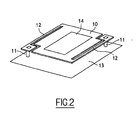
- FIG 2 is shown a simplified view of such a device.
- the bolometric device which is represented therein comprises a thin membrane 10 capable of absorbing infrared radiation, and suspended above a support 13 via anchoring points 11.
- a sensitive layer 14 is deposited on the membrane 10. Under the effect of infrared radiation, the membrane heats up and transmits its temperature to the layer 14.
- the electrical interconnection between the sensitive layer 14 and the reading elements (not shown) arranged on the substrate is ensured by a layer, generally metallic, not shown, passing through the anchoring points 11.
- the sensitivity of the thermal detection is significantly improved by introducing isolation arms 12 between the support substrate and the membrane in order to limit the thermal losses of the latter.
- the resistivity variations of the sensitive layer are recorded using two electrodes connected to a suitable reading circuit. The electrodes can be coplanar or sandwiched.
- the support substrate may consist of an integrated electronic circuit on a silicon wafer comprising, on the one hand, devices for stimulating and reading temperature variations and, on the other hand, the components of multiplexing that can serialize the signals from different thermometers and transmit them to a small number of outputs to be operated by a common imaging system.
- the membrane on which is deposited the thin layer of material according to the invention may consist for example of one or more layer (s) dielectric (s) including SiO, SiN.
- Electrodes including TiN having a high absorption of infrared radiation.
- the electrodes may be either affixed to the surface of the outer layer or enclosed between the two layers.
- the figure 3 shows two variants of integration of a thin layer of material according to the invention in a coplanar electrode detector.
- the structure supporting the ferrite is made of two insulating layers enclosing metal electrodes.
- the insulating layer deposited on the metal layer has contact openings so as to connect the ferrite sensitive element.
- the ferrite-supporting structure consists of a single insulating layer on which metal electrodes directly in contact with the ferrite sensitive element rest. In this configuration, it may be advantageous to deposit an absorbing layer infrared radiation on one of the faces of the structure.
- the etching of the ferrite makes it possible to disengage the material in the region of the isolation arms and in the regions separating the detectors from each other.
- the bolometric devices according to the invention may comprise a plurality of sensors in the form of a matrix array of pixels.
- a sensor array can be connected for example to a CCD or CMOS matrix.
- the device of the invention then constitutes an infrared camera.
- the bolometric devices of the invention can also be integrated in so-called monolithic structures, collectively manufactured by the microelectronics processes that have been developed for silicon.
- CMOS or CCD type of multiplexing circuit can be manufactured by directly connecting a matrix of sensitive elements to a CMOS or CCD type of multiplexing circuit.
- the support substrate may consist of an integrated electronic circuit comprising, on the one hand, stimulus and reading devices and, on the other hand, the multiplexing components which make it possible to serialize the signals coming from the different detectors and to transmit them to a number reduced outputs to be exploited by a conventional imaging system.
- the insulating supports are made in the form of thin layers having for example a thickness of 5 to 100 nm.
- These insulating elements for example SiN, SiO, ZnS, etc.
- PECVD plasma-assisted chemical vapor deposition
- the etching of these materials is generally performed by plasma etching methods.
- the metallic materials constituting the electrodes are preferably deposited by sputtering.
- the shape of the electrodes is defined by chemical etching or plasma methods.
- the thickness of the electrodes is for example between 5 nm and 100 nm.
- the electrodes which extend in the isolation arms are connected to the input stage of the read circuit by conventional methods of contact recovery, and are adapted to the structure of the micro-bridge (similar to the anchor points). 11 of the figure 2 ).
- the material is deposited in the form of a thin film according to the invention, using one of the techniques described above. Its etching can be carried out chemically (HCl, H 3 PO 4 ) or by specific plasma etching, or by ion milling.
- the invention also relates to a method for detecting infrared radiation or infrared imaging production, using a bolometric device capable of absorbing incident radiation, converting it to heat, and communicating a part heat generated at a sensitive element whose resistivity varies with temperature, wherein said device is as defined above.
- the device of the invention is usable in many fields of application, for example in the military field (devices for sighting and night exploration), in the industrial field (parts control), in the field of safety ( detection of fires, identification of victims in smoke-filled rooms, night surveillance of sites, assistance with night driving of vehicles), or in the medical field (blood circulation mapping, mammography, etc.).
- Example 1 Fe Fe magnetite thin layers 3 O 4
- Fe 3 O 4 magnetite particles are prepared by precipitation of iron hydroxides in a basic medium.
- the solution containing the precipitate is kept under an air sweep at 70 ° C. for four days.
- the oxide Fe 3 O 4 is gradually formed by oxidation and dehydration of the initial hydroxides. After washing and drying the precipitate, the particles were chamfered at 900 ° C. under a nitrogen atmosphere in order to reduce their specific surface area.
- the powder is mixed with an organic binder (polyvinyl alcohol) in the following proportions (by mass): 80% magnetite, 16% water, 4% polyvinyl alcohol. Then press the powder under a pressure of 55 tons in a matrix of 10 cm using a hydraulic press.
- the green compact obtained is densified by sintering at 950 ° C. under a nitrogen atmosphere to avoid the formation of the ⁇ -Fe 2 O 3 oxide.
- Radiocrystallographic analysis shows that the thin layers consist of a pure Fe 3 O 4 spinel phase.
- the electrical properties of the films in the raw state of deposit are as follows:
- the electrical properties are modified by thermal treatments under air (treatment duration: 2 hours) making it possible to modify the rate of cationic vacancies in the spinel structure.
- treatment duration 2 hours
- the results are shown in figure 1 which shows that such oxidation treatments make it possible to improve the sensitivity ⁇ .
- Radiocrystallographic analysis shows that the thin layers consist of a pure Fe 3 O 4 spinel phase.
- One sample is kept in the raw state of deposition (Example 2a) while two others are treated under air at 175 ° C. (Example 2b) and 250 ° C. (Example 2c) respectively for 2 hours so as to form Fe 3 O 4 + ⁇ .
- Example 2a Example 2b
- Example 2c Treatment Gross 175 ° C 250 ° C Resistivity (Ohm.cm) 1.6 27.6 715 Alpha (% .K -1 ) -1.9 -3.9 -4.5
- the ferrite powder is obtained by co-precipitation of hydroxides from nitrates of cobalt, copper, manganese and iron precipitated in triethylamine.
- the process for obtaining the sintered target is similar to that of Example 1.
- the sintering temperature is 900 ° C.
- the appropriate amounts of oxides (0.11 mole ZnO, 0.11 mole CuO and 0.44 mole Fe 2 O 3 ) are mixed and finely ground.
- the powder is chamotte at 750 ° C.
- the process for obtaining the sintered target is similar to that of Example 1.
- the sintering temperature is 900 ° C.
Landscapes
- Chemical & Material Sciences (AREA)
- Organic Chemistry (AREA)
- Inorganic Chemistry (AREA)
- Mechanical Engineering (AREA)
- Engineering & Computer Science (AREA)
- Materials Engineering (AREA)
- Chemical Kinetics & Catalysis (AREA)
- Metallurgy (AREA)
- Physics & Mathematics (AREA)
- General Physics & Mathematics (AREA)
- Spectroscopy & Molecular Physics (AREA)
- Photometry And Measurement Of Optical Pulse Characteristics (AREA)
- Inorganic Compounds Of Heavy Metals (AREA)
- Solid State Image Pick-Up Elements (AREA)
- Compounds Of Iron (AREA)
Claims (6)
- Verwendung, als empfindliches Dünnschichtmaterial zur bolometrischen Detektion von Infrarotstrahlungen, eines Materials mit einer Spinell-Ferrit-Struktur, dessen chemische Zusammensetzung, abgesehen von unter Umständen vorhandenen Dotierungsstoffen, der groben Formel I entspricht:
Fe3-(x+y) Mx Ay O4+δ (I),
in der das Eisen das Hauptmetallelement ist,
M für ein Metall oder eine Kombination von zwei oder mehreren Übergangsmetallen außer Eisen steht, wobei M aus Co, Cu, Mn, Ni, Zn und Ti oder einer ihrer Kombinationen ausgewählt wird,
A für mindestens ein aus Magnesium und Aluminium ausgewähltes Metall steht,
die Metalle und der Sauerstoff in Form von Ionen vorliegen,
x für die Anzahl von metallischen M-Ionen, gleicher oder verschiedener Art, steht,
y für die Anzahl von metallischen A-Ionen steht,
x zwischen 0 und 2 variieren kann und für jedes x gilt: x < 3-x-y,
y zwischen 0 und 0,5 variieren kann, und
δ 0 oder eine positive Zahl ist, niedrig genug, dass das Produkt der Formel I mindestens ein Metall enthält, das in Form von Ionen vorliegt, die zwei verschiedene Oxidationszustände aufweisen und auf einem gleichen Untergitter der Spinellstruktur angeordnet sind,
wobei die gegebenenfalls vorhandenen Dotierungsstoffe in Form von Oxiden zu einem Gewichtsanteil, der bezüglich des Gewichts des Spinell-Oxids nicht 1 bis 2 Gewichts-% überschreitet, vorliegen und aus Silicium, Phosphor, Bohr, alkalischen Erdmetallen, insbesondere Ca, Ba, Sr, Alkalimetallen, z.B. Na, K, Li, Gallium, Germanium, Arsen, Indium, Antimon, Bismut, Blei ausgewählt sind. - Bolometrische Vorrichtung zur Detektion von Infrarotstrahlung oder zur Infrarotbildgebung, umfassend mindestens einen Sensor, der mit einem empfindlichen Element in Dünnschichtform, wie es in Anspruch 1 definiert ist, ausgestattet ist.
- Bolometrische Vorrichtung nach Anspruch 2, in der der Sensor, der in ein Gehäuse eingefügt ist, das ein infrarottransparentes Eingangsfenster aufweist, eine Membran aufweist, die Infrarotstrahlung absorbieren und sie in Wärme umwandeln kann, wobei die Membran so angeordnet ist, dass sie einer das Eingangsfenster durchlaufenden inzidenten Infrarotstrahlung ausgesetzt ist und sie ein Teil der so erzeugten Wärme an das empfindliche Element übertragen kann.
- Vorrichtung nach Anspruch 2 oder 3, umfassend mehrere Sensoren in Form einer Pixelanordnung.
- Vorrichtung nach Anspruch 4, in der die Anordnung mit einer CCD- oder CMOS-Matrix verbunden ist.
- Verfahren zur Detektion von Infrarotstrahlung oder zur Erzeugung von Infrarotbildern mithilfe einer bolometrischen Vorrichtung, die eine inzidente Strahlung absorbieren, sie in Wärme umwandeln und einen Teil der erzeugten Wärme an ein sensibles Element weitergeben kann, dessen Widerstand mit der Temperatur variiert, wobei die Vorrichtung derart ist, wie sie in einem der Ansprüche 2 bis 5 definiert ist.
Applications Claiming Priority (2)
| Application Number | Priority Date | Filing Date | Title |
|---|---|---|---|
| FR0315190A FR2864065B1 (fr) | 2003-12-22 | 2003-12-22 | Utilisation de ferrites spinelles comme materiau sensible pour dispositifs bolometriques de detection de l'infrarouge. |
| PCT/FR2004/050695 WO2005064294A1 (fr) | 2003-12-22 | 2004-12-15 | Utilisation de ferrites spinelles comme materiau sensible pour dispositifs bolometriques de detection de l'infrarouge. |
Publications (2)
| Publication Number | Publication Date |
|---|---|
| EP1697706A1 EP1697706A1 (de) | 2006-09-06 |
| EP1697706B1 true EP1697706B1 (de) | 2015-04-01 |
Family
ID=34630465
Family Applications (1)
| Application Number | Title | Priority Date | Filing Date |
|---|---|---|---|
| EP04816549.2A Expired - Lifetime EP1697706B1 (de) | 2003-12-22 | 2004-12-15 | Verwendung von spinel-ferriten als empfindliches material für bolometrische infrarot-detektionseinrichtungen |
Country Status (5)
| Country | Link |
|---|---|
| US (1) | US8017911B2 (de) |
| EP (1) | EP1697706B1 (de) |
| JP (1) | JP4521407B2 (de) |
| FR (1) | FR2864065B1 (de) |
| WO (1) | WO2005064294A1 (de) |
Families Citing this family (15)
| Publication number | Priority date | Publication date | Assignee | Title |
|---|---|---|---|---|
| FR2864065B1 (fr) * | 2003-12-22 | 2006-02-24 | Univ Toulouse | Utilisation de ferrites spinelles comme materiau sensible pour dispositifs bolometriques de detection de l'infrarouge. |
| FR2910125B1 (fr) * | 2006-12-14 | 2013-07-05 | Commissariat Energie Atomique | Utilisation d'association de monoxyde de fer et d'oxydes spinelles comme materiau sensible destine a la detection de rayonnements infrarouges |
| FR2941297B1 (fr) | 2009-01-19 | 2011-02-11 | Commissariat Energie Atomique | Procede de fabrication d'un detecteur bolometrique |
| JP2011153871A (ja) * | 2010-01-26 | 2011-08-11 | Seiko Epson Corp | 熱型光検出器、熱型光検出装置及び電子機器 |
| JP5624931B2 (ja) * | 2011-04-13 | 2014-11-12 | キヤノンアネルバ株式会社 | スピネルフェライト薄膜の製造方法 |
| CN102280455B (zh) * | 2011-05-11 | 2013-01-09 | 武汉高德红外股份有限公司 | 一种非制冷式红外焦平面阵列探测器 |
| FR2999805B1 (fr) * | 2012-12-17 | 2017-12-22 | Commissariat Energie Atomique | Procede de realisation d'un dispositif de detection infrarouge |
| CN106949978A (zh) * | 2017-02-13 | 2017-07-14 | 清华大学 | 一种热成像传感器像素单元及其阵列 |
| US10770605B2 (en) | 2017-04-20 | 2020-09-08 | King Abdulaziz University | Photodiode with spinel oxide photoactive layer |
| KR101832408B1 (ko) | 2017-07-19 | 2018-02-26 | 한국세라믹기술원 | 볼로미터용 산화물 저항 박막 및 그 제조방법 |
| KR102156664B1 (ko) * | 2018-12-18 | 2020-09-16 | 한국세라믹기술원 | 볼로미터용 산화물 저항 박막 및 그 제조방법 |
| GB201821211D0 (en) * | 2018-12-24 | 2019-02-06 | Lussey David | New composition of matter |
| JP7603247B2 (ja) * | 2019-02-28 | 2024-12-20 | パナソニックIpマネジメント株式会社 | 赤外線センサ及び赤外線センサアレイ |
| FR3099573B1 (fr) * | 2019-07-30 | 2021-07-23 | Commissariat Energie Atomique | Procédé de fabrication d’un microbolomètre comportant un matériau sensible à base d’oxyde de vanadium |
| CN112577576B (zh) * | 2020-11-10 | 2024-12-17 | 河南中烟工业有限责任公司 | 自动称量装置 |
Family Cites Families (18)
| Publication number | Priority date | Publication date | Assignee | Title |
|---|---|---|---|---|
| FR2150608A1 (en) * | 1971-08-30 | 1973-04-13 | Coron Noel | Bolometric infra-red ray detector - with iron oxide powder/ferrite surface |
| FR2506294A1 (fr) * | 1981-05-19 | 1982-11-26 | Shell France | Composition ayant une structure de spinelle |
| US4531110A (en) * | 1981-09-14 | 1985-07-23 | At&T Bell Laboratories | Negative temperature coefficient thermistors |
| FR2624846B1 (fr) * | 1987-12-16 | 1990-05-04 | Atochem | Composition a base d'un oxyde de structure spinelle, son application comme catalyseur et procede pour l'obtenir |
| SE465596B (sv) * | 1990-02-16 | 1991-09-30 | Asea Brown Boveri | Seriekondensatorutrustning med styrbar krets foer daempning av subsynkrona resonanssvaengningar |
| US5821598A (en) * | 1995-02-01 | 1998-10-13 | Research Corporation Technologies, Inc. | Uncooled amorphous YBaCuO thin film infrared detector |
| US5962854A (en) * | 1996-06-12 | 1999-10-05 | Ishizuka Electronics Corporation | Infrared sensor and infrared detector |
| FR2752299B1 (fr) * | 1996-08-08 | 1998-09-11 | Commissariat Energie Atomique | Detecteur infrarouge et procede de fabication de celui-ci |
| JPH10163510A (ja) * | 1996-12-04 | 1998-06-19 | Mitsubishi Electric Corp | 赤外線検知素子 |
| EP0867701A1 (de) * | 1997-03-28 | 1998-09-30 | Interuniversitair Microelektronica Centrum Vzw | Herstellungsverfahren eines infrarotempfindlichen Strahlungsdetektors, insbesondere eines infrarotempfindlichen Bolometers |
| JPH10281864A (ja) * | 1997-04-03 | 1998-10-23 | Nikon Corp | 熱型赤外線カメラ |
| US5854587A (en) * | 1997-06-26 | 1998-12-29 | The United States Of America As Represented By The Secretary Of The Navy | REx M1-x Mny O.sub.δ films for microbolometer-based IR focal plane arrays |
| FR2781927B1 (fr) * | 1998-07-28 | 2001-10-05 | Commissariat Energie Atomique | Dispositif de detection de rayonnements multispectraux infrarouge/visible |
| CN1118103C (zh) * | 1998-10-21 | 2003-08-13 | 李韫言 | 微细加工热辐射红外传感器 |
| JP2002250655A (ja) * | 2001-02-26 | 2002-09-06 | Mitsubishi Electric Corp | 赤外線検知素子およびその製造方法 |
| FR2864065B1 (fr) * | 2003-12-22 | 2006-02-24 | Univ Toulouse | Utilisation de ferrites spinelles comme materiau sensible pour dispositifs bolometriques de detection de l'infrarouge. |
| FR2910125B1 (fr) * | 2006-12-14 | 2013-07-05 | Commissariat Energie Atomique | Utilisation d'association de monoxyde de fer et d'oxydes spinelles comme materiau sensible destine a la detection de rayonnements infrarouges |
| FR2941297B1 (fr) * | 2009-01-19 | 2011-02-11 | Commissariat Energie Atomique | Procede de fabrication d'un detecteur bolometrique |
-
2003
- 2003-12-22 FR FR0315190A patent/FR2864065B1/fr not_active Expired - Fee Related
-
2004
- 2004-12-15 JP JP2006544519A patent/JP4521407B2/ja not_active Expired - Fee Related
- 2004-12-15 WO PCT/FR2004/050695 patent/WO2005064294A1/fr not_active Ceased
- 2004-12-15 EP EP04816549.2A patent/EP1697706B1/de not_active Expired - Lifetime
- 2004-12-15 US US10/582,520 patent/US8017911B2/en not_active Expired - Fee Related
Also Published As
| Publication number | Publication date |
|---|---|
| FR2864065A1 (fr) | 2005-06-24 |
| FR2864065B1 (fr) | 2006-02-24 |
| JP4521407B2 (ja) | 2010-08-11 |
| EP1697706A1 (de) | 2006-09-06 |
| US20070120059A1 (en) | 2007-05-31 |
| WO2005064294A1 (fr) | 2005-07-14 |
| US8017911B2 (en) | 2011-09-13 |
| JP2007517387A (ja) | 2007-06-28 |
Similar Documents
| Publication | Publication Date | Title |
|---|---|---|
| EP1697706B1 (de) | Verwendung von spinel-ferriten als empfindliches material für bolometrische infrarot-detektionseinrichtungen | |
| CA2671945C (fr) | Utilisation d'association de monoxyde de fer et d'oxydes spinelles comme materiau sensible destine a la detection de rayonnements infrarouges | |
| JP4621333B2 (ja) | 薄膜形成方法 | |
| US8502639B1 (en) | Nanocomposite semiconducting material with reduced resistivity | |
| EP2894444A1 (de) | Sensibles Material für die bolometrische Detektion | |
| US11499871B2 (en) | Detector of electromagnetic radiation | |
| US5854587A (en) | REx M1-x Mny O.sub.δ films for microbolometer-based IR focal plane arrays | |
| WO1996031640A1 (fr) | Couches minces d'alliages quasi-cristallins, leur preparation et leurs utilisations | |
| Hai et al. | Uncooled silicon germanium oxide (Si [sub] x [/sub] Ge [sub] y [/sub] O [sub] 1-xy [/sub]) thin films for infrared detection | |
| EP4283263A1 (de) | Wärmedetektionselement und bildsensor | |
| Baliga et al. | Deposition and properties of rf magnetron sputtered Ni0. 6Mn2. 4O4 | |
| Al-Khalli et al. | Tuning of zinc oxide temperature sensing and optical absorption properties by tin heavy-doping | |
| CN114107924B (zh) | 一种非制冷红外微测辐射热计用热敏薄膜 | |
| KR20030019772A (ko) | 비냉각 방식의 열 감지 센서용 바나듐 다이옥사이드박막의 제조방법 | |
| CA3146045A1 (fr) | Procede de fabrication d'un microbolometre comportant un materiau sensible a base d'oxyde de vanadium | |
| Zhou et al. | Optimizing Laser‐Induced Voltage Signal in SnO2 Thin Films by Changing Oxygen Pressure | |
| Siyar et al. | The Effect of Substrate Temperature on the Microstructure and Thermoelectric Properties of Pulsed Laser Deposited Cu2SnSe3 Thin Film | |
| JPH04357888A (ja) | 焦電型赤外線検出素子 | |
| Nam et al. | Structural and electrical properties of vanadium tungsten oxide thin films grown on Pt/TiO2/SiO2/Si substrates | |
| CN120129332A (zh) | 一种逆向光敏介电特性的复合氧化物电容器及其制备方法 | |
| JP2535733B2 (ja) | 光半導体の製造法 | |
| Rana et al. | Amorphous Ge x Si 1-x O y: H Microbolometers with High Responsivity | |
| Dennis | Thermal Detectors |
Legal Events
| Date | Code | Title | Description |
|---|---|---|---|
| PUAI | Public reference made under article 153(3) epc to a published international application that has entered the european phase |
Free format text: ORIGINAL CODE: 0009012 |
|
| 17P | Request for examination filed |
Effective date: 20060602 |
|
| AK | Designated contracting states |
Kind code of ref document: A1 Designated state(s): AT BE BG CH CY CZ DE DK EE ES FI FR GB GR HU IE IS IT LI LT LU MC NL PL PT RO SE SI SK TR |
|
| 17Q | First examination report despatched |
Effective date: 20060929 |
|
| DAX | Request for extension of the european patent (deleted) | ||
| RAP1 | Party data changed (applicant data changed or rights of an application transferred) |
Owner name: CENTRE NATIONAL DE LA RECHERCHE SCIENTIFIQUE Owner name: UNIVERSITE PAUL SABATIER TOULOUSE III Owner name: COMMISSARIAT A L'ENERGIE ATOMIQUE ET AUX ENERGIES |
|
| REG | Reference to a national code |
Ref country code: DE Ref legal event code: R079 Ref document number: 602004046918 Country of ref document: DE Free format text: PREVIOUS MAIN CLASS: G01J0005200000 Ipc: C01G0049000000 |
|
| RIC1 | Information provided on ipc code assigned before grant |
Ipc: H01L 27/146 20060101ALI20140814BHEP Ipc: C01G 49/08 20060101ALI20140814BHEP Ipc: C01G 53/00 20060101ALI20140814BHEP Ipc: G01J 5/20 20060101ALI20140814BHEP Ipc: C01G 51/00 20060101ALI20140814BHEP Ipc: C23C 14/08 20060101ALI20140814BHEP Ipc: C01G 49/00 20060101AFI20140814BHEP |
|
| GRAP | Despatch of communication of intention to grant a patent |
Free format text: ORIGINAL CODE: EPIDOSNIGR1 |
|
| INTG | Intention to grant announced |
Effective date: 20141023 |
|
| GRAS | Grant fee paid |
Free format text: ORIGINAL CODE: EPIDOSNIGR3 |
|
| GRAA | (expected) grant |
Free format text: ORIGINAL CODE: 0009210 |
|
| AK | Designated contracting states |
Kind code of ref document: B1 Designated state(s): AT BE BG CH CY CZ DE DK EE ES FI FR GB GR HU IE IS IT LI LT LU MC NL PL PT RO SE SI SK TR |
|
| REG | Reference to a national code |
Ref country code: GB Ref legal event code: FG4D Free format text: NOT ENGLISH |
|
| REG | Reference to a national code |
Ref country code: CH Ref legal event code: EP |
|
| REG | Reference to a national code |
Ref country code: IE Ref legal event code: FG4D Free format text: LANGUAGE OF EP DOCUMENT: FRENCH |
|
| REG | Reference to a national code |
Ref country code: DE Ref legal event code: R096 Ref document number: 602004046918 Country of ref document: DE Effective date: 20150513 |
|
| REG | Reference to a national code |
Ref country code: AT Ref legal event code: REF Ref document number: 718969 Country of ref document: AT Kind code of ref document: T Effective date: 20150515 |
|
| REG | Reference to a national code |
Ref country code: NL Ref legal event code: VDEP Effective date: 20150401 |
|
| REG | Reference to a national code |
Ref country code: AT Ref legal event code: MK05 Ref document number: 718969 Country of ref document: AT Kind code of ref document: T Effective date: 20150401 |
|
| REG | Reference to a national code |
Ref country code: LT Ref legal event code: MG4D |
|
| PG25 | Lapsed in a contracting state [announced via postgrant information from national office to epo] |
Ref country code: NL Free format text: LAPSE BECAUSE OF FAILURE TO SUBMIT A TRANSLATION OF THE DESCRIPTION OR TO PAY THE FEE WITHIN THE PRESCRIBED TIME-LIMIT Effective date: 20150401 |
|
| PG25 | Lapsed in a contracting state [announced via postgrant information from national office to epo] |
Ref country code: LT Free format text: LAPSE BECAUSE OF FAILURE TO SUBMIT A TRANSLATION OF THE DESCRIPTION OR TO PAY THE FEE WITHIN THE PRESCRIBED TIME-LIMIT Effective date: 20150401 Ref country code: CZ Free format text: LAPSE BECAUSE OF FAILURE TO SUBMIT A TRANSLATION OF THE DESCRIPTION OR TO PAY THE FEE WITHIN THE PRESCRIBED TIME-LIMIT Effective date: 20150401 Ref country code: ES Free format text: LAPSE BECAUSE OF FAILURE TO SUBMIT A TRANSLATION OF THE DESCRIPTION OR TO PAY THE FEE WITHIN THE PRESCRIBED TIME-LIMIT Effective date: 20150401 Ref country code: PT Free format text: LAPSE BECAUSE OF FAILURE TO SUBMIT A TRANSLATION OF THE DESCRIPTION OR TO PAY THE FEE WITHIN THE PRESCRIBED TIME-LIMIT Effective date: 20150803 Ref country code: FI Free format text: LAPSE BECAUSE OF FAILURE TO SUBMIT A TRANSLATION OF THE DESCRIPTION OR TO PAY THE FEE WITHIN THE PRESCRIBED TIME-LIMIT Effective date: 20150401 |
|
| REG | Reference to a national code |
Ref country code: FR Ref legal event code: PLFP Year of fee payment: 12 |
|
| PG25 | Lapsed in a contracting state [announced via postgrant information from national office to epo] |
Ref country code: IS Free format text: LAPSE BECAUSE OF FAILURE TO SUBMIT A TRANSLATION OF THE DESCRIPTION OR TO PAY THE FEE WITHIN THE PRESCRIBED TIME-LIMIT Effective date: 20150801 Ref country code: AT Free format text: LAPSE BECAUSE OF FAILURE TO SUBMIT A TRANSLATION OF THE DESCRIPTION OR TO PAY THE FEE WITHIN THE PRESCRIBED TIME-LIMIT Effective date: 20150401 Ref country code: GR Free format text: LAPSE BECAUSE OF FAILURE TO SUBMIT A TRANSLATION OF THE DESCRIPTION OR TO PAY THE FEE WITHIN THE PRESCRIBED TIME-LIMIT Effective date: 20150702 |
|
| REG | Reference to a national code |
Ref country code: DE Ref legal event code: R097 Ref document number: 602004046918 Country of ref document: DE |
|
| PG25 | Lapsed in a contracting state [announced via postgrant information from national office to epo] |
Ref country code: EE Free format text: LAPSE BECAUSE OF FAILURE TO SUBMIT A TRANSLATION OF THE DESCRIPTION OR TO PAY THE FEE WITHIN THE PRESCRIBED TIME-LIMIT Effective date: 20150401 Ref country code: DK Free format text: LAPSE BECAUSE OF FAILURE TO SUBMIT A TRANSLATION OF THE DESCRIPTION OR TO PAY THE FEE WITHIN THE PRESCRIBED TIME-LIMIT Effective date: 20150401 |
|
| PLBE | No opposition filed within time limit |
Free format text: ORIGINAL CODE: 0009261 |
|
| STAA | Information on the status of an ep patent application or granted ep patent |
Free format text: STATUS: NO OPPOSITION FILED WITHIN TIME LIMIT |
|
| PG25 | Lapsed in a contracting state [announced via postgrant information from national office to epo] |
Ref country code: PL Free format text: LAPSE BECAUSE OF FAILURE TO SUBMIT A TRANSLATION OF THE DESCRIPTION OR TO PAY THE FEE WITHIN THE PRESCRIBED TIME-LIMIT Effective date: 20150401 Ref country code: SK Free format text: LAPSE BECAUSE OF FAILURE TO SUBMIT A TRANSLATION OF THE DESCRIPTION OR TO PAY THE FEE WITHIN THE PRESCRIBED TIME-LIMIT Effective date: 20150401 Ref country code: RO Free format text: LAPSE BECAUSE OF NON-PAYMENT OF DUE FEES Effective date: 20150401 |
|
| 26N | No opposition filed |
Effective date: 20160105 |
|
| PG25 | Lapsed in a contracting state [announced via postgrant information from national office to epo] |
Ref country code: IT Free format text: LAPSE BECAUSE OF FAILURE TO SUBMIT A TRANSLATION OF THE DESCRIPTION OR TO PAY THE FEE WITHIN THE PRESCRIBED TIME-LIMIT Effective date: 20150401 |
|
| PG25 | Lapsed in a contracting state [announced via postgrant information from national office to epo] |
Ref country code: SI Free format text: LAPSE BECAUSE OF FAILURE TO SUBMIT A TRANSLATION OF THE DESCRIPTION OR TO PAY THE FEE WITHIN THE PRESCRIBED TIME-LIMIT Effective date: 20150401 Ref country code: BE Free format text: LAPSE BECAUSE OF NON-PAYMENT OF DUE FEES Effective date: 20151231 |
|
| PG25 | Lapsed in a contracting state [announced via postgrant information from national office to epo] |
Ref country code: MC Free format text: LAPSE BECAUSE OF FAILURE TO SUBMIT A TRANSLATION OF THE DESCRIPTION OR TO PAY THE FEE WITHIN THE PRESCRIBED TIME-LIMIT Effective date: 20150401 Ref country code: LU Free format text: LAPSE BECAUSE OF FAILURE TO SUBMIT A TRANSLATION OF THE DESCRIPTION OR TO PAY THE FEE WITHIN THE PRESCRIBED TIME-LIMIT Effective date: 20151215 |
|
| REG | Reference to a national code |
Ref country code: CH Ref legal event code: PL |
|
| REG | Reference to a national code |
Ref country code: IE Ref legal event code: MM4A |
|
| PG25 | Lapsed in a contracting state [announced via postgrant information from national office to epo] |
Ref country code: IE Free format text: LAPSE BECAUSE OF NON-PAYMENT OF DUE FEES Effective date: 20151215 Ref country code: CH Free format text: LAPSE BECAUSE OF NON-PAYMENT OF DUE FEES Effective date: 20151231 Ref country code: LI Free format text: LAPSE BECAUSE OF NON-PAYMENT OF DUE FEES Effective date: 20151231 |
|
| REG | Reference to a national code |
Ref country code: FR Ref legal event code: PLFP Year of fee payment: 13 |
|
| PG25 | Lapsed in a contracting state [announced via postgrant information from national office to epo] |
Ref country code: BG Free format text: LAPSE BECAUSE OF FAILURE TO SUBMIT A TRANSLATION OF THE DESCRIPTION OR TO PAY THE FEE WITHIN THE PRESCRIBED TIME-LIMIT Effective date: 20150401 Ref country code: HU Free format text: LAPSE BECAUSE OF FAILURE TO SUBMIT A TRANSLATION OF THE DESCRIPTION OR TO PAY THE FEE WITHIN THE PRESCRIBED TIME-LIMIT; INVALID AB INITIO Effective date: 20041215 |
|
| PG25 | Lapsed in a contracting state [announced via postgrant information from national office to epo] |
Ref country code: SE Free format text: LAPSE BECAUSE OF FAILURE TO SUBMIT A TRANSLATION OF THE DESCRIPTION OR TO PAY THE FEE WITHIN THE PRESCRIBED TIME-LIMIT Effective date: 20150401 Ref country code: CY Free format text: LAPSE BECAUSE OF FAILURE TO SUBMIT A TRANSLATION OF THE DESCRIPTION OR TO PAY THE FEE WITHIN THE PRESCRIBED TIME-LIMIT Effective date: 20150401 |
|
| PG25 | Lapsed in a contracting state [announced via postgrant information from national office to epo] |
Ref country code: TR Free format text: LAPSE BECAUSE OF FAILURE TO SUBMIT A TRANSLATION OF THE DESCRIPTION OR TO PAY THE FEE WITHIN THE PRESCRIBED TIME-LIMIT Effective date: 20150401 |
|
| REG | Reference to a national code |
Ref country code: FR Ref legal event code: PLFP Year of fee payment: 14 |
|
| PGFP | Annual fee paid to national office [announced via postgrant information from national office to epo] |
Ref country code: DE Payment date: 20191216 Year of fee payment: 16 |
|
| PGFP | Annual fee paid to national office [announced via postgrant information from national office to epo] |
Ref country code: FR Payment date: 20191231 Year of fee payment: 16 |
|
| PGFP | Annual fee paid to national office [announced via postgrant information from national office to epo] |
Ref country code: GB Payment date: 20191220 Year of fee payment: 16 |
|
| REG | Reference to a national code |
Ref country code: DE Ref legal event code: R119 Ref document number: 602004046918 Country of ref document: DE |
|
| GBPC | Gb: european patent ceased through non-payment of renewal fee |
Effective date: 20201215 |
|
| PG25 | Lapsed in a contracting state [announced via postgrant information from national office to epo] |
Ref country code: FR Free format text: LAPSE BECAUSE OF NON-PAYMENT OF DUE FEES Effective date: 20201231 |
|
| PG25 | Lapsed in a contracting state [announced via postgrant information from national office to epo] |
Ref country code: DE Free format text: LAPSE BECAUSE OF NON-PAYMENT OF DUE FEES Effective date: 20210701 Ref country code: GB Free format text: LAPSE BECAUSE OF NON-PAYMENT OF DUE FEES Effective date: 20201215 |