EP1696267A2 - Positive resist composition and pattern forming method using the same - Google Patents
Positive resist composition and pattern forming method using the same Download PDFInfo
- Publication number
- EP1696267A2 EP1696267A2 EP06003591A EP06003591A EP1696267A2 EP 1696267 A2 EP1696267 A2 EP 1696267A2 EP 06003591 A EP06003591 A EP 06003591A EP 06003591 A EP06003591 A EP 06003591A EP 1696267 A2 EP1696267 A2 EP 1696267A2
- Authority
- EP
- European Patent Office
- Prior art keywords
- group
- compound
- resist composition
- positive resist
- hydrogen atom
- Prior art date
- Legal status (The legal status is an assumption and is not a legal conclusion. Google has not performed a legal analysis and makes no representation as to the accuracy of the status listed.)
- Granted
Links
- 239000000203 mixture Substances 0.000 title claims abstract description 70
- 238000000034 method Methods 0.000 title claims abstract description 20
- 150000001875 compounds Chemical class 0.000 claims abstract description 104
- 125000002887 hydroxy group Chemical group [H]O* 0.000 claims abstract description 64
- 229920005989 resin Polymers 0.000 claims abstract description 58
- 239000011347 resin Substances 0.000 claims abstract description 58
- 125000004435 hydrogen atom Chemical group [H]* 0.000 claims abstract description 52
- 125000000962 organic group Chemical group 0.000 claims abstract description 33
- 239000002253 acid Substances 0.000 claims abstract description 32
- 239000007787 solid Substances 0.000 claims abstract description 14
- 230000005855 radiation Effects 0.000 claims abstract description 13
- 230000009471 action Effects 0.000 claims abstract description 12
- 239000003513 alkali Substances 0.000 claims abstract description 10
- 239000004094 surface-active agent Substances 0.000 claims description 26
- 125000002496 methyl group Chemical group [H]C([H])([H])* 0.000 claims description 19
- 150000007514 bases Chemical class 0.000 claims description 14
- XUIMIQQOPSSXEZ-UHFFFAOYSA-N Silicon Chemical compound [Si] XUIMIQQOPSSXEZ-UHFFFAOYSA-N 0.000 claims description 11
- 125000004430 oxygen atom Chemical group O* 0.000 claims description 10
- 229910052710 silicon Inorganic materials 0.000 claims description 10
- 239000010703 silicon Substances 0.000 claims description 10
- 239000003960 organic solvent Substances 0.000 claims description 7
- 238000002844 melting Methods 0.000 claims description 6
- 230000008018 melting Effects 0.000 claims description 6
- 238000011161 development Methods 0.000 abstract description 24
- 230000007547 defect Effects 0.000 abstract description 22
- 230000035945 sensitivity Effects 0.000 abstract description 8
- 125000000217 alkyl group Chemical group 0.000 description 74
- 229910052799 carbon Inorganic materials 0.000 description 62
- OKTJSMMVPCPJKN-UHFFFAOYSA-N Carbon Chemical compound [C] OKTJSMMVPCPJKN-UHFFFAOYSA-N 0.000 description 59
- 125000000753 cycloalkyl group Chemical group 0.000 description 55
- -1 oxime sulfonate Chemical class 0.000 description 48
- 125000003118 aryl group Chemical group 0.000 description 30
- 125000001424 substituent group Chemical group 0.000 description 26
- 125000003545 alkoxy group Chemical group 0.000 description 24
- 239000002904 solvent Substances 0.000 description 24
- 230000018109 developmental process Effects 0.000 description 23
- 125000005843 halogen group Chemical group 0.000 description 18
- 239000000126 substance Substances 0.000 description 18
- 229910052731 fluorine Inorganic materials 0.000 description 15
- 150000002596 lactones Chemical group 0.000 description 13
- ZWEHNKRNPOVVGH-UHFFFAOYSA-N 2-Butanone Chemical compound CCC(C)=O ZWEHNKRNPOVVGH-UHFFFAOYSA-N 0.000 description 12
- 125000003178 carboxy group Chemical group [H]OC(*)=O 0.000 description 12
- 230000000052 comparative effect Effects 0.000 description 12
- 125000001153 fluoro group Chemical group F* 0.000 description 11
- 239000000758 substrate Substances 0.000 description 11
- 125000004093 cyano group Chemical group *C#N 0.000 description 10
- 239000000243 solution Substances 0.000 description 10
- 239000004215 Carbon black (E152) Substances 0.000 description 9
- 125000004122 cyclic group Chemical group 0.000 description 9
- 229930195733 hydrocarbon Natural products 0.000 description 9
- 239000003999 initiator Substances 0.000 description 9
- 238000006116 polymerization reaction Methods 0.000 description 9
- NIXOWILDQLNWCW-UHFFFAOYSA-M Acrylate Chemical compound [O-]C(=O)C=C NIXOWILDQLNWCW-UHFFFAOYSA-M 0.000 description 8
- WYURNTSHIVDZCO-UHFFFAOYSA-N Tetrahydrofuran Chemical compound C1CCOC1 WYURNTSHIVDZCO-UHFFFAOYSA-N 0.000 description 8
- 125000002947 alkylene group Chemical group 0.000 description 8
- JHIVVAPYMSGYDF-UHFFFAOYSA-N cyclohexanone Chemical compound O=C1CCCCC1 JHIVVAPYMSGYDF-UHFFFAOYSA-N 0.000 description 8
- 125000000113 cyclohexyl group Chemical group [H]C1([H])C([H])([H])C([H])([H])C([H])(*)C([H])([H])C1([H])[H] 0.000 description 8
- 230000003287 optical effect Effects 0.000 description 8
- WGTYBPLFGIVFAS-UHFFFAOYSA-M tetramethylammonium hydroxide Chemical compound [OH-].C[N+](C)(C)C WGTYBPLFGIVFAS-UHFFFAOYSA-M 0.000 description 8
- 150000001450 anions Chemical class 0.000 description 7
- 239000012046 mixed solvent Substances 0.000 description 7
- 239000000178 monomer Substances 0.000 description 7
- 230000036961 partial effect Effects 0.000 description 7
- 229920000642 polymer Polymers 0.000 description 7
- XEKOWRVHYACXOJ-UHFFFAOYSA-N Ethyl acetate Chemical compound CCOC(C)=O XEKOWRVHYACXOJ-UHFFFAOYSA-N 0.000 description 6
- ZMXDDKWLCZADIW-UHFFFAOYSA-N N,N-Dimethylformamide Chemical compound CN(C)C=O ZMXDDKWLCZADIW-UHFFFAOYSA-N 0.000 description 6
- 238000006243 chemical reaction Methods 0.000 description 6
- 125000001511 cyclopentyl group Chemical group [H]C1([H])C([H])([H])C([H])([H])C([H])(*)C1([H])[H] 0.000 description 6
- 238000001312 dry etching Methods 0.000 description 6
- RTZKZFJDLAIYFH-UHFFFAOYSA-N ether Substances CCOCC RTZKZFJDLAIYFH-UHFFFAOYSA-N 0.000 description 6
- LZCLXQDLBQLTDK-UHFFFAOYSA-N ethyl 2-hydroxypropanoate Chemical compound CCOC(=O)C(C)O LZCLXQDLBQLTDK-UHFFFAOYSA-N 0.000 description 6
- 125000005647 linker group Chemical group 0.000 description 6
- 125000002868 norbornyl group Chemical group C12(CCC(CC1)C2)* 0.000 description 6
- 125000002023 trifluoromethyl group Chemical group FC(F)(F)* 0.000 description 6
- 125000002723 alicyclic group Chemical group 0.000 description 5
- 125000005079 alkoxycarbonylmethyl group Chemical group 0.000 description 5
- 125000002915 carbonyl group Chemical group [*:2]C([*:1])=O 0.000 description 5
- 230000000694 effects Effects 0.000 description 5
- 125000001495 ethyl group Chemical group [H]C([H])([H])C([H])([H])* 0.000 description 5
- 125000002950 monocyclic group Chemical group 0.000 description 5
- 230000000269 nucleophilic effect Effects 0.000 description 5
- 125000001997 phenyl group Chemical group [H]C1=C([H])C([H])=C(*)C([H])=C1[H] 0.000 description 5
- XLYOFNOQVPJJNP-UHFFFAOYSA-N water Chemical group O XLYOFNOQVPJJNP-UHFFFAOYSA-N 0.000 description 5
- ARXJGSRGQADJSQ-UHFFFAOYSA-N 1-methoxypropan-2-ol Chemical compound COCC(C)O ARXJGSRGQADJSQ-UHFFFAOYSA-N 0.000 description 4
- YEJRWHAVMIAJKC-UHFFFAOYSA-N 4-Butyrolactone Chemical compound O=C1CCCO1 YEJRWHAVMIAJKC-UHFFFAOYSA-N 0.000 description 4
- YCKRFDGAMUMZLT-UHFFFAOYSA-N Fluorine atom Chemical compound [F] YCKRFDGAMUMZLT-UHFFFAOYSA-N 0.000 description 4
- 239000000654 additive Substances 0.000 description 4
- 125000004453 alkoxycarbonyl group Chemical group 0.000 description 4
- 230000015572 biosynthetic process Effects 0.000 description 4
- 238000000576 coating method Methods 0.000 description 4
- 238000007334 copolymerization reaction Methods 0.000 description 4
- 230000006866 deterioration Effects 0.000 description 4
- 125000004185 ester group Chemical group 0.000 description 4
- 238000011156 evaluation Methods 0.000 description 4
- 239000011737 fluorine Substances 0.000 description 4
- CATSNJVOTSVZJV-UHFFFAOYSA-N heptan-2-one Chemical compound CCCCCC(C)=O CATSNJVOTSVZJV-UHFFFAOYSA-N 0.000 description 4
- CBOIHMRHGLHBPB-UHFFFAOYSA-N hydroxymethyl Chemical compound O[CH2] CBOIHMRHGLHBPB-UHFFFAOYSA-N 0.000 description 4
- 238000004519 manufacturing process Methods 0.000 description 4
- 238000012545 processing Methods 0.000 description 4
- 125000001436 propyl group Chemical group [H]C([*])([H])C([H])([H])C([H])([H])[H] 0.000 description 4
- LLHKCFNBLRBOGN-UHFFFAOYSA-N propylene glycol methyl ether acetate Chemical compound COCC(C)OC(C)=O LLHKCFNBLRBOGN-UHFFFAOYSA-N 0.000 description 4
- 230000009467 reduction Effects 0.000 description 4
- 239000004065 semiconductor Substances 0.000 description 4
- 229910052717 sulfur Inorganic materials 0.000 description 4
- 125000004434 sulfur atom Chemical group 0.000 description 4
- YLQBMQCUIZJEEH-UHFFFAOYSA-N tetrahydrofuran Natural products C=1C=COC=1 YLQBMQCUIZJEEH-UHFFFAOYSA-N 0.000 description 4
- 125000003903 2-propenyl group Chemical group [H]C([*])([H])C([H])=C([H])[H] 0.000 description 3
- RWSOTUBLDIXVET-UHFFFAOYSA-N Dihydrogen sulfide Chemical class S RWSOTUBLDIXVET-UHFFFAOYSA-N 0.000 description 3
- KFZMGEQAYNKOFK-UHFFFAOYSA-N Isopropanol Chemical compound CC(C)O KFZMGEQAYNKOFK-UHFFFAOYSA-N 0.000 description 3
- HPEUJPJOZXNMSJ-UHFFFAOYSA-N Methyl stearate Chemical compound CCCCCCCCCCCCCCCCCC(=O)OC HPEUJPJOZXNMSJ-UHFFFAOYSA-N 0.000 description 3
- 229920003171 Poly (ethylene oxide) Polymers 0.000 description 3
- KWYUFKZDYYNOTN-UHFFFAOYSA-M Potassium hydroxide Chemical compound [OH-].[K+] KWYUFKZDYYNOTN-UHFFFAOYSA-M 0.000 description 3
- HEMHJVSKTPXQMS-UHFFFAOYSA-M Sodium hydroxide Chemical compound [OH-].[Na+] HEMHJVSKTPXQMS-UHFFFAOYSA-M 0.000 description 3
- YXFVVABEGXRONW-UHFFFAOYSA-N Toluene Chemical compound CC1=CC=CC=C1 YXFVVABEGXRONW-UHFFFAOYSA-N 0.000 description 3
- ZMANZCXQSJIPKH-UHFFFAOYSA-N Triethylamine Chemical compound CCN(CC)CC ZMANZCXQSJIPKH-UHFFFAOYSA-N 0.000 description 3
- 125000005073 adamantyl group Chemical group C12(CC3CC(CC(C1)C3)C2)* 0.000 description 3
- 125000000484 butyl group Chemical group [H]C([*])([H])C([H])([H])C([H])([H])C([H])([H])[H] 0.000 description 3
- 150000001721 carbon Chemical group 0.000 description 3
- 125000004432 carbon atom Chemical group C* 0.000 description 3
- 150000007942 carboxylates Chemical group 0.000 description 3
- 125000002843 carboxylic acid group Chemical group 0.000 description 3
- 239000011248 coating agent Substances 0.000 description 3
- ZDJFDFNNEAPGOP-UHFFFAOYSA-N dimethyl tetradecanedioate Chemical compound COC(=O)CCCCCCCCCCCCC(=O)OC ZDJFDFNNEAPGOP-UHFFFAOYSA-N 0.000 description 3
- 238000010894 electron beam technology Methods 0.000 description 3
- 229940116333 ethyl lactate Drugs 0.000 description 3
- 125000003709 fluoroalkyl group Chemical group 0.000 description 3
- 125000000524 functional group Chemical group 0.000 description 3
- 230000002209 hydrophobic effect Effects 0.000 description 3
- XLYOFNOQVPJJNP-UHFFFAOYSA-M hydroxide Chemical compound [OH-] XLYOFNOQVPJJNP-UHFFFAOYSA-M 0.000 description 3
- RAXXELZNTBOGNW-UHFFFAOYSA-N imidazole Natural products C1=CNC=N1 RAXXELZNTBOGNW-UHFFFAOYSA-N 0.000 description 3
- 230000010354 integration Effects 0.000 description 3
- 150000002891 organic anions Chemical class 0.000 description 3
- 239000002245 particle Substances 0.000 description 3
- 125000001147 pentyl group Chemical group C(CCCC)* 0.000 description 3
- 230000002829 reductive effect Effects 0.000 description 3
- 238000003860 storage Methods 0.000 description 3
- 125000000542 sulfonic acid group Chemical group 0.000 description 3
- 238000003786 synthesis reaction Methods 0.000 description 3
- NQRYJNQNLNOLGT-UHFFFAOYSA-N tetrahydropyridine hydrochloride Natural products C1CCNCC1 NQRYJNQNLNOLGT-UHFFFAOYSA-N 0.000 description 3
- 125000000391 vinyl group Chemical group [H]C([*])=C([H])[H] 0.000 description 3
- 230000004304 visual acuity Effects 0.000 description 3
- SGUVLZREKBPKCE-UHFFFAOYSA-N 1,5-diazabicyclo[4.3.0]-non-5-ene Chemical compound C1CCN=C2CCCN21 SGUVLZREKBPKCE-UHFFFAOYSA-N 0.000 description 2
- GQHTUMJGOHRCHB-UHFFFAOYSA-N 2,3,4,6,7,8,9,10-octahydropyrimido[1,2-a]azepine Chemical compound C1CCCCN2CCCN=C21 GQHTUMJGOHRCHB-UHFFFAOYSA-N 0.000 description 2
- WKBALTUBRZPIPZ-UHFFFAOYSA-N 2,6-di(propan-2-yl)aniline Chemical compound CC(C)C1=CC=CC(C(C)C)=C1N WKBALTUBRZPIPZ-UHFFFAOYSA-N 0.000 description 2
- VZSRBBMJRBPUNF-UHFFFAOYSA-N 2-(2,3-dihydro-1H-inden-2-ylamino)-N-[3-oxo-3-(2,4,6,7-tetrahydrotriazolo[4,5-c]pyridin-5-yl)propyl]pyrimidine-5-carboxamide Chemical compound C1C(CC2=CC=CC=C12)NC1=NC=C(C=N1)C(=O)NCCC(N1CC2=C(CC1)NN=N2)=O VZSRBBMJRBPUNF-UHFFFAOYSA-N 0.000 description 2
- OZAIFHULBGXAKX-UHFFFAOYSA-N 2-(2-cyanopropan-2-yldiazenyl)-2-methylpropanenitrile Chemical compound N#CC(C)(C)N=NC(C)(C)C#N OZAIFHULBGXAKX-UHFFFAOYSA-N 0.000 description 2
- SMZOUWXMTYCWNB-UHFFFAOYSA-N 2-(2-methoxy-5-methylphenyl)ethanamine Chemical compound COC1=CC=C(C)C=C1CCN SMZOUWXMTYCWNB-UHFFFAOYSA-N 0.000 description 2
- HZAXFHJVJLSVMW-UHFFFAOYSA-N 2-Aminoethan-1-ol Chemical compound NCCO HZAXFHJVJLSVMW-UHFFFAOYSA-N 0.000 description 2
- XNWFRZJHXBZDAG-UHFFFAOYSA-N 2-METHOXYETHANOL Chemical compound COCCO XNWFRZJHXBZDAG-UHFFFAOYSA-N 0.000 description 2
- NIXOWILDQLNWCW-UHFFFAOYSA-N 2-Propenoic acid Natural products OC(=O)C=C NIXOWILDQLNWCW-UHFFFAOYSA-N 0.000 description 2
- OJPDDQSCZGTACX-UHFFFAOYSA-N 2-[n-(2-hydroxyethyl)anilino]ethanol Chemical compound OCCN(CCO)C1=CC=CC=C1 OJPDDQSCZGTACX-UHFFFAOYSA-N 0.000 description 2
- ZNQVEEAIQZEUHB-UHFFFAOYSA-N 2-ethoxyethanol Chemical compound CCOCCO ZNQVEEAIQZEUHB-UHFFFAOYSA-N 0.000 description 2
- SVONRAPFKPVNKG-UHFFFAOYSA-N 2-ethoxyethyl acetate Chemical compound CCOCCOC(C)=O SVONRAPFKPVNKG-UHFFFAOYSA-N 0.000 description 2
- XLLIQLLCWZCATF-UHFFFAOYSA-N 2-methoxyethyl acetate Chemical compound COCCOC(C)=O XLLIQLLCWZCATF-UHFFFAOYSA-N 0.000 description 2
- VHYFNPMBLIVWCW-UHFFFAOYSA-N 4-Dimethylaminopyridine Chemical compound CN(C)C1=CC=NC=C1 VHYFNPMBLIVWCW-UHFFFAOYSA-N 0.000 description 2
- ZCYVEMRRCGMTRW-UHFFFAOYSA-N 7553-56-2 Chemical group [I] ZCYVEMRRCGMTRW-UHFFFAOYSA-N 0.000 description 2
- LPEKGGXMPWTOCB-UHFFFAOYSA-N 8beta-(2,3-epoxy-2-methylbutyryloxy)-14-acetoxytithifolin Natural products COC(=O)C(C)O LPEKGGXMPWTOCB-UHFFFAOYSA-N 0.000 description 2
- XKRFYHLGVUSROY-UHFFFAOYSA-N Argon Chemical compound [Ar] XKRFYHLGVUSROY-UHFFFAOYSA-N 0.000 description 2
- IJGRMHOSHXDMSA-UHFFFAOYSA-N Atomic nitrogen Chemical compound N#N IJGRMHOSHXDMSA-UHFFFAOYSA-N 0.000 description 2
- WKBOTKDWSSQWDR-UHFFFAOYSA-N Bromine atom Chemical group [Br] WKBOTKDWSSQWDR-UHFFFAOYSA-N 0.000 description 2
- IAZDPXIOMUYVGZ-UHFFFAOYSA-N Dimethylsulphoxide Chemical compound CS(C)=O IAZDPXIOMUYVGZ-UHFFFAOYSA-N 0.000 description 2
- QUSNBJAOOMFDIB-UHFFFAOYSA-N Ethylamine Chemical compound CCN QUSNBJAOOMFDIB-UHFFFAOYSA-N 0.000 description 2
- CERQOIWHTDAKMF-UHFFFAOYSA-M Methacrylate Chemical compound CC(=C)C([O-])=O CERQOIWHTDAKMF-UHFFFAOYSA-M 0.000 description 2
- CERQOIWHTDAKMF-UHFFFAOYSA-N Methacrylic acid Chemical compound CC(=C)C(O)=O CERQOIWHTDAKMF-UHFFFAOYSA-N 0.000 description 2
- JLTDJTHDQAWBAV-UHFFFAOYSA-N N,N-dimethylaniline Chemical compound CN(C)C1=CC=CC=C1 JLTDJTHDQAWBAV-UHFFFAOYSA-N 0.000 description 2
- SECXISVLQFMRJM-UHFFFAOYSA-N N-Methylpyrrolidone Chemical compound CN1CCCC1=O SECXISVLQFMRJM-UHFFFAOYSA-N 0.000 description 2
- 229920001214 Polysorbate 60 Polymers 0.000 description 2
- 239000004793 Polystyrene Substances 0.000 description 2
- KAESVJOAVNADME-UHFFFAOYSA-N Pyrrole Chemical compound C=1C=CNC=1 KAESVJOAVNADME-UHFFFAOYSA-N 0.000 description 2
- VYPSYNLAJGMNEJ-UHFFFAOYSA-N Silicium dioxide Chemical compound O=[Si]=O VYPSYNLAJGMNEJ-UHFFFAOYSA-N 0.000 description 2
- CDBYLPFSWZWCQE-UHFFFAOYSA-L Sodium Carbonate Chemical compound [Na+].[Na+].[O-]C([O-])=O CDBYLPFSWZWCQE-UHFFFAOYSA-L 0.000 description 2
- 239000004115 Sodium Silicate Substances 0.000 description 2
- 239000004147 Sorbitan trioleate Substances 0.000 description 2
- PRXRUNOAOLTIEF-ADSICKODSA-N Sorbitan trioleate Chemical compound CCCCCCCC\C=C/CCCCCCCC(=O)OC[C@@H](OC(=O)CCCCCCC\C=C/CCCCCCCC)[C@H]1OC[C@H](O)[C@H]1OC(=O)CCCCCCC\C=C/CCCCCCCC PRXRUNOAOLTIEF-ADSICKODSA-N 0.000 description 2
- GSEJCLTVZPLZKY-UHFFFAOYSA-N Triethanolamine Chemical compound OCCN(CCO)CCO GSEJCLTVZPLZKY-UHFFFAOYSA-N 0.000 description 2
- 239000004699 Ultra-high molecular weight polyethylene Substances 0.000 description 2
- WYGWHHGCAGTUCH-ISLYRVAYSA-N V-65 Substances CC(C)CC(C)(C#N)\N=N\C(C)(C#N)CC(C)C WYGWHHGCAGTUCH-ISLYRVAYSA-N 0.000 description 2
- 230000000996 additive effect Effects 0.000 description 2
- 125000003342 alkenyl group Chemical group 0.000 description 2
- 125000004849 alkoxymethyl group Chemical group 0.000 description 2
- 150000003973 alkyl amines Chemical class 0.000 description 2
- 150000001412 amines Chemical class 0.000 description 2
- 125000003277 amino group Chemical group 0.000 description 2
- 150000003863 ammonium salts Chemical class 0.000 description 2
- 230000003321 amplification Effects 0.000 description 2
- 150000001448 anilines Chemical class 0.000 description 2
- 239000007864 aqueous solution Substances 0.000 description 2
- 125000003710 aryl alkyl group Chemical group 0.000 description 2
- 125000000732 arylene group Chemical group 0.000 description 2
- 239000011230 binding agent Substances 0.000 description 2
- 229910052801 chlorine Inorganic materials 0.000 description 2
- 125000001309 chloro group Chemical group Cl* 0.000 description 2
- HPXRVTGHNJAIIH-UHFFFAOYSA-N cyclohexanol Chemical class OC1CCCCC1 HPXRVTGHNJAIIH-UHFFFAOYSA-N 0.000 description 2
- BGTOWKSIORTVQH-UHFFFAOYSA-N cyclopentanone Chemical compound O=C1CCCC1 BGTOWKSIORTVQH-UHFFFAOYSA-N 0.000 description 2
- JQVDAXLFBXTEQA-UHFFFAOYSA-N dibutylamine Chemical compound CCCCNCCCC JQVDAXLFBXTEQA-UHFFFAOYSA-N 0.000 description 2
- 235000014113 dietary fatty acids Nutrition 0.000 description 2
- 238000009826 distribution Methods 0.000 description 2
- GHLKSLMMWAKNBM-UHFFFAOYSA-N dodecane-1,12-diol Chemical compound OCCCCCCCCCCCCO GHLKSLMMWAKNBM-UHFFFAOYSA-N 0.000 description 2
- ODQWQRRAPPTVAG-GZTJUZNOSA-N doxepin Chemical compound C1OC2=CC=CC=C2C(=C/CCN(C)C)/C2=CC=CC=C21 ODQWQRRAPPTVAG-GZTJUZNOSA-N 0.000 description 2
- 239000000975 dye Substances 0.000 description 2
- 125000001033 ether group Chemical group 0.000 description 2
- 150000002170 ethers Chemical class 0.000 description 2
- UHKJHMOIRYZSTH-UHFFFAOYSA-N ethyl 2-ethoxypropanoate Chemical compound CCOC(C)C(=O)OCC UHKJHMOIRYZSTH-UHFFFAOYSA-N 0.000 description 2
- 239000000194 fatty acid Substances 0.000 description 2
- 229930195729 fatty acid Natural products 0.000 description 2
- 238000010438 heat treatment Methods 0.000 description 2
- FVDRFBGMOWJEOR-UHFFFAOYSA-N hexadecan-2-ol Chemical compound CCCCCCCCCCCCCCC(C)O FVDRFBGMOWJEOR-UHFFFAOYSA-N 0.000 description 2
- 125000002883 imidazolyl group Chemical group 0.000 description 2
- 125000001041 indolyl group Chemical group 0.000 description 2
- 229910052740 iodine Inorganic materials 0.000 description 2
- 150000002576 ketones Chemical class 0.000 description 2
- 125000000686 lactone group Chemical group 0.000 description 2
- 238000001459 lithography Methods 0.000 description 2
- 238000005259 measurement Methods 0.000 description 2
- 125000000956 methoxy group Chemical group [H]C([H])([H])O* 0.000 description 2
- BDJSOPWXYLFTNW-UHFFFAOYSA-N methyl 3-methoxypropanoate Chemical compound COCCC(=O)OC BDJSOPWXYLFTNW-UHFFFAOYSA-N 0.000 description 2
- 229940057867 methyl lactate Drugs 0.000 description 2
- 125000001570 methylene group Chemical group [H]C([H])([*:1])[*:2] 0.000 description 2
- XTAZYLNFDRKIHJ-UHFFFAOYSA-N n,n-dioctyloctan-1-amine Chemical compound CCCCCCCCN(CCCCCCCC)CCCCCCCC XTAZYLNFDRKIHJ-UHFFFAOYSA-N 0.000 description 2
- 125000004108 n-butyl group Chemical group [H]C([H])([H])C([H])([H])C([H])([H])C([H])([H])* 0.000 description 2
- 125000001624 naphthyl group Chemical group 0.000 description 2
- 229910052757 nitrogen Inorganic materials 0.000 description 2
- 238000003199 nucleic acid amplification method Methods 0.000 description 2
- ISWSIDIOOBJBQZ-UHFFFAOYSA-N phenol group Chemical group C1(=CC=CC=C1)O ISWSIDIOOBJBQZ-UHFFFAOYSA-N 0.000 description 2
- 125000003356 phenylsulfanyl group Chemical group [*]SC1=C([H])C([H])=C([H])C([H])=C1[H] 0.000 description 2
- 125000003367 polycyclic group Chemical group 0.000 description 2
- 239000003505 polymerization initiator Substances 0.000 description 2
- 229920001296 polysiloxane Polymers 0.000 description 2
- 229920002223 polystyrene Polymers 0.000 description 2
- 239000000843 powder Substances 0.000 description 2
- WGYKZJWCGVVSQN-UHFFFAOYSA-N propylamine Chemical compound CCCN WGYKZJWCGVVSQN-UHFFFAOYSA-N 0.000 description 2
- 150000003254 radicals Chemical class 0.000 description 2
- 230000007261 regionalization Effects 0.000 description 2
- 125000002914 sec-butyl group Chemical group [H]C([H])([H])C([H])([H])C([H])(*)C([H])([H])[H] 0.000 description 2
- NTHWMYGWWRZVTN-UHFFFAOYSA-N sodium silicate Chemical compound [Na+].[Na+].[O-][Si]([O-])=O NTHWMYGWWRZVTN-UHFFFAOYSA-N 0.000 description 2
- 229910052911 sodium silicate Inorganic materials 0.000 description 2
- 235000019337 sorbitan trioleate Nutrition 0.000 description 2
- 229960000391 sorbitan trioleate Drugs 0.000 description 2
- 125000003396 thiol group Chemical group [H]S* 0.000 description 2
- 125000005270 trialkylamine group Chemical group 0.000 description 2
- IMFACGCPASFAPR-UHFFFAOYSA-N tributylamine Chemical compound CCCCN(CCCC)CCCC IMFACGCPASFAPR-UHFFFAOYSA-N 0.000 description 2
- 229920000785 ultra high molecular weight polyethylene Polymers 0.000 description 2
- DNIAPMSPPWPWGF-VKHMYHEASA-N (+)-propylene glycol Chemical compound C[C@H](O)CO DNIAPMSPPWPWGF-VKHMYHEASA-N 0.000 description 1
- FDYDISGSYGFRJM-UHFFFAOYSA-N (2-methyl-2-adamantyl) 2-methylprop-2-enoate Chemical compound C1C(C2)CC3CC1C(OC(=O)C(=C)C)(C)C2C3 FDYDISGSYGFRJM-UHFFFAOYSA-N 0.000 description 1
- YSWBUABBMRVQAC-UHFFFAOYSA-N (2-nitrophenyl)methanesulfonic acid Chemical compound OS(=O)(=O)CC1=CC=CC=C1[N+]([O-])=O YSWBUABBMRVQAC-UHFFFAOYSA-N 0.000 description 1
- QSUJHKWXLIQKEY-UHFFFAOYSA-N (2-oxooxolan-3-yl) 2-methylprop-2-enoate Chemical compound CC(=C)C(=O)OC1CCOC1=O QSUJHKWXLIQKEY-UHFFFAOYSA-N 0.000 description 1
- DSSYKIVIOFKYAU-XCBNKYQSSA-N (R)-camphor Chemical group C1C[C@@]2(C)C(=O)C[C@@H]1C2(C)C DSSYKIVIOFKYAU-XCBNKYQSSA-N 0.000 description 1
- FFJCNSLCJOQHKM-CLFAGFIQSA-N (z)-1-[(z)-octadec-9-enoxy]octadec-9-ene Chemical compound CCCCCCCC\C=C/CCCCCCCCOCCCCCCCC\C=C/CCCCCCCC FFJCNSLCJOQHKM-CLFAGFIQSA-N 0.000 description 1
- ZORQXIQZAOLNGE-UHFFFAOYSA-N 1,1-difluorocyclohexane Chemical compound FC1(F)CCCCC1 ZORQXIQZAOLNGE-UHFFFAOYSA-N 0.000 description 1
- ZWVMLYRJXORSEP-UHFFFAOYSA-N 1,2,6-Hexanetriol Chemical compound OCCCCC(O)CO ZWVMLYRJXORSEP-UHFFFAOYSA-N 0.000 description 1
- WSLDOOZREJYCGB-UHFFFAOYSA-N 1,2-Dichloroethane Chemical compound ClCCCl WSLDOOZREJYCGB-UHFFFAOYSA-N 0.000 description 1
- BTOOAFQCTJZDRC-UHFFFAOYSA-N 1,2-hexadecanediol Chemical compound CCCCCCCCCCCCCCC(O)CO BTOOAFQCTJZDRC-UHFFFAOYSA-N 0.000 description 1
- YPFDHNVEDLHUCE-UHFFFAOYSA-N 1,3-propanediol Substances OCCCO YPFDHNVEDLHUCE-UHFFFAOYSA-N 0.000 description 1
- RYHBNJHYFVUHQT-UHFFFAOYSA-N 1,4-Dioxane Chemical compound C1COCCO1 RYHBNJHYFVUHQT-UHFFFAOYSA-N 0.000 description 1
- HMUNWXXNJPVALC-UHFFFAOYSA-N 1-[4-[2-(2,3-dihydro-1H-inden-2-ylamino)pyrimidin-5-yl]piperazin-1-yl]-2-(2,4,6,7-tetrahydrotriazolo[4,5-c]pyridin-5-yl)ethanone Chemical compound C1C(CC2=CC=CC=C12)NC1=NC=C(C=N1)N1CCN(CC1)C(CN1CC2=C(CC1)NN=N2)=O HMUNWXXNJPVALC-UHFFFAOYSA-N 0.000 description 1
- JOLQKTGDSGKSKJ-UHFFFAOYSA-N 1-ethoxypropan-2-ol Chemical compound CCOCC(C)O JOLQKTGDSGKSKJ-UHFFFAOYSA-N 0.000 description 1
- DIYFBIOUBFTQJU-UHFFFAOYSA-N 1-phenyl-2-sulfanylethanone Chemical group SCC(=O)C1=CC=CC=C1 DIYFBIOUBFTQJU-UHFFFAOYSA-N 0.000 description 1
- 238000001644 13C nuclear magnetic resonance spectroscopy Methods 0.000 description 1
- HYZJCKYKOHLVJF-UHFFFAOYSA-N 1H-benzimidazole Chemical compound C1=CC=C2NC=NC2=C1 HYZJCKYKOHLVJF-UHFFFAOYSA-N 0.000 description 1
- RNIPJYFZGXJSDD-UHFFFAOYSA-N 2,4,5-triphenyl-1h-imidazole Chemical compound C1=CC=CC=C1C1=NC(C=2C=CC=CC=2)=C(C=2C=CC=CC=2)N1 RNIPJYFZGXJSDD-UHFFFAOYSA-N 0.000 description 1
- XGLVDUUYFKXKPL-UHFFFAOYSA-N 2-(2-methoxyethoxy)-n,n-bis[2-(2-methoxyethoxy)ethyl]ethanamine Chemical compound COCCOCCN(CCOCCOC)CCOCCOC XGLVDUUYFKXKPL-UHFFFAOYSA-N 0.000 description 1
- SXAMGRAIZSSWIH-UHFFFAOYSA-N 2-[3-[2-(2,3-dihydro-1H-inden-2-ylamino)pyrimidin-5-yl]-1,2,4-oxadiazol-5-yl]-1-(2,4,6,7-tetrahydrotriazolo[4,5-c]pyridin-5-yl)ethanone Chemical compound C1C(CC2=CC=CC=C12)NC1=NC=C(C=N1)C1=NOC(=N1)CC(=O)N1CC2=C(CC1)NN=N2 SXAMGRAIZSSWIH-UHFFFAOYSA-N 0.000 description 1
- XXZCIYUJYUESMD-UHFFFAOYSA-N 2-[4-[2-(2,3-dihydro-1H-inden-2-ylamino)pyrimidin-5-yl]-3-(morpholin-4-ylmethyl)pyrazol-1-yl]-1-(2,4,6,7-tetrahydrotriazolo[4,5-c]pyridin-5-yl)ethanone Chemical compound C1C(CC2=CC=CC=C12)NC1=NC=C(C=N1)C=1C(=NN(C=1)CC(=O)N1CC2=C(CC1)NN=N2)CN1CCOCC1 XXZCIYUJYUESMD-UHFFFAOYSA-N 0.000 description 1
- WWSJZGAPAVMETJ-UHFFFAOYSA-N 2-[4-[2-(2,3-dihydro-1H-inden-2-ylamino)pyrimidin-5-yl]-3-ethoxypyrazol-1-yl]-1-(2,4,6,7-tetrahydrotriazolo[4,5-c]pyridin-5-yl)ethanone Chemical compound C1C(CC2=CC=CC=C12)NC1=NC=C(C=N1)C=1C(=NN(C=1)CC(=O)N1CC2=C(CC1)NN=N2)OCC WWSJZGAPAVMETJ-UHFFFAOYSA-N 0.000 description 1
- FYELSNVLZVIGTI-UHFFFAOYSA-N 2-[4-[2-(2,3-dihydro-1H-inden-2-ylamino)pyrimidin-5-yl]-5-ethylpyrazol-1-yl]-1-(2,4,6,7-tetrahydrotriazolo[4,5-c]pyridin-5-yl)ethanone Chemical compound C1C(CC2=CC=CC=C12)NC1=NC=C(C=N1)C=1C=NN(C=1CC)CC(=O)N1CC2=C(CC1)NN=N2 FYELSNVLZVIGTI-UHFFFAOYSA-N 0.000 description 1
- WZFUQSJFWNHZHM-UHFFFAOYSA-N 2-[4-[2-(2,3-dihydro-1H-inden-2-ylamino)pyrimidin-5-yl]piperazin-1-yl]-1-(2,4,6,7-tetrahydrotriazolo[4,5-c]pyridin-5-yl)ethanone Chemical compound C1C(CC2=CC=CC=C12)NC1=NC=C(C=N1)N1CCN(CC1)CC(=O)N1CC2=C(CC1)NN=N2 WZFUQSJFWNHZHM-UHFFFAOYSA-N 0.000 description 1
- ZRPAUEVGEGEPFQ-UHFFFAOYSA-N 2-[4-[2-(2,3-dihydro-1H-inden-2-ylamino)pyrimidin-5-yl]pyrazol-1-yl]-1-(2,4,6,7-tetrahydrotriazolo[4,5-c]pyridin-5-yl)ethanone Chemical compound C1C(CC2=CC=CC=C12)NC1=NC=C(C=N1)C=1C=NN(C=1)CC(=O)N1CC2=C(CC1)NN=N2 ZRPAUEVGEGEPFQ-UHFFFAOYSA-N 0.000 description 1
- YJLUBHOZZTYQIP-UHFFFAOYSA-N 2-[5-[2-(2,3-dihydro-1H-inden-2-ylamino)pyrimidin-5-yl]-1,3,4-oxadiazol-2-yl]-1-(2,4,6,7-tetrahydrotriazolo[4,5-c]pyridin-5-yl)ethanone Chemical compound C1C(CC2=CC=CC=C12)NC1=NC=C(C=N1)C1=NN=C(O1)CC(=O)N1CC2=C(CC1)NN=N2 YJLUBHOZZTYQIP-UHFFFAOYSA-N 0.000 description 1
- JUVSRZCUMWZBFK-UHFFFAOYSA-N 2-[n-(2-hydroxyethyl)-4-methylanilino]ethanol Chemical compound CC1=CC=C(N(CCO)CCO)C=C1 JUVSRZCUMWZBFK-UHFFFAOYSA-N 0.000 description 1
- RNMDNPCBIKJCQP-UHFFFAOYSA-N 5-nonyl-7-oxabicyclo[4.1.0]hepta-1,3,5-trien-2-ol Chemical compound C(CCCCCCCC)C1=C2C(=C(C=C1)O)O2 RNMDNPCBIKJCQP-UHFFFAOYSA-N 0.000 description 1
- CONKBQPVFMXDOV-QHCPKHFHSA-N 6-[(5S)-5-[[4-[2-(2,3-dihydro-1H-inden-2-ylamino)pyrimidin-5-yl]piperazin-1-yl]methyl]-2-oxo-1,3-oxazolidin-3-yl]-3H-1,3-benzoxazol-2-one Chemical compound C1C(CC2=CC=CC=C12)NC1=NC=C(C=N1)N1CCN(CC1)C[C@H]1CN(C(O1)=O)C1=CC2=C(NC(O2)=O)C=C1 CONKBQPVFMXDOV-QHCPKHFHSA-N 0.000 description 1
- XZIIFPSPUDAGJM-UHFFFAOYSA-N 6-chloro-2-n,2-n-diethylpyrimidine-2,4-diamine Chemical compound CCN(CC)C1=NC(N)=CC(Cl)=N1 XZIIFPSPUDAGJM-UHFFFAOYSA-N 0.000 description 1
- QTBSBXVTEAMEQO-UHFFFAOYSA-M Acetate Chemical compound CC([O-])=O QTBSBXVTEAMEQO-UHFFFAOYSA-M 0.000 description 1
- VHUUQVKOLVNVRT-UHFFFAOYSA-N Ammonium hydroxide Chemical compound [NH4+].[OH-] VHUUQVKOLVNVRT-UHFFFAOYSA-N 0.000 description 1
- ZAFNJMIOTHYJRJ-UHFFFAOYSA-N Diisopropyl ether Chemical compound CC(C)OC(C)C ZAFNJMIOTHYJRJ-UHFFFAOYSA-N 0.000 description 1
- XXRCUYVCPSWGCC-UHFFFAOYSA-N Ethyl pyruvate Chemical compound CCOC(=O)C(C)=O XXRCUYVCPSWGCC-UHFFFAOYSA-N 0.000 description 1
- 206010016173 Fall Diseases 0.000 description 1
- NTIZESTWPVYFNL-UHFFFAOYSA-N Methyl isobutyl ketone Chemical compound CC(C)CC(C)=O NTIZESTWPVYFNL-UHFFFAOYSA-N 0.000 description 1
- UIHCLUNTQKBZGK-UHFFFAOYSA-N Methyl isobutyl ketone Natural products CCC(C)C(C)=O UIHCLUNTQKBZGK-UHFFFAOYSA-N 0.000 description 1
- UEEJHVSXFDXPFK-UHFFFAOYSA-N N-dimethylaminoethanol Chemical compound CN(C)CCO UEEJHVSXFDXPFK-UHFFFAOYSA-N 0.000 description 1
- CHJJGSNFBQVOTG-UHFFFAOYSA-N N-methyl-guanidine Natural products CNC(N)=N CHJJGSNFBQVOTG-UHFFFAOYSA-N 0.000 description 1
- PAYRUJLWNCNPSJ-UHFFFAOYSA-N N-phenyl amine Natural products NC1=CC=CC=C1 PAYRUJLWNCNPSJ-UHFFFAOYSA-N 0.000 description 1
- 229920001213 Polysorbate 20 Polymers 0.000 description 1
- JUJWROOIHBZHMG-UHFFFAOYSA-N Pyridine Chemical group C1=CC=NC=C1 JUJWROOIHBZHMG-UHFFFAOYSA-N 0.000 description 1
- IYFATESGLOUGBX-YVNJGZBMSA-N Sorbitan monopalmitate Chemical compound CCCCCCCCCCCCCCCC(=O)OC[C@@H](O)[C@H]1OC[C@H](O)[C@H]1O IYFATESGLOUGBX-YVNJGZBMSA-N 0.000 description 1
- HVUMOYIDDBPOLL-XWVZOOPGSA-N Sorbitan monostearate Chemical compound CCCCCCCCCCCCCCCCCC(=O)OC[C@@H](O)[C@H]1OC[C@H](O)[C@H]1O HVUMOYIDDBPOLL-XWVZOOPGSA-N 0.000 description 1
- 239000007983 Tris buffer Substances 0.000 description 1
- QYKIQEUNHZKYBP-UHFFFAOYSA-N Vinyl ether Chemical class C=COC=C QYKIQEUNHZKYBP-UHFFFAOYSA-N 0.000 description 1
- IJCWFDPJFXGQBN-RYNSOKOISA-N [(2R)-2-[(2R,3R,4S)-4-hydroxy-3-octadecanoyloxyoxolan-2-yl]-2-octadecanoyloxyethyl] octadecanoate Chemical compound CCCCCCCCCCCCCCCCCC(=O)OC[C@@H](OC(=O)CCCCCCCCCCCCCCCCC)[C@H]1OC[C@H](O)[C@H]1OC(=O)CCCCCCCCCCCCCCCCC IJCWFDPJFXGQBN-RYNSOKOISA-N 0.000 description 1
- VDRSDNINOSAWIV-UHFFFAOYSA-N [F].[Si] Chemical compound [F].[Si] VDRSDNINOSAWIV-UHFFFAOYSA-N 0.000 description 1
- 150000003926 acrylamides Chemical class 0.000 description 1
- 125000005396 acrylic acid ester group Chemical group 0.000 description 1
- 125000002252 acyl group Chemical group 0.000 description 1
- JIMXXGFJRDUSRO-UHFFFAOYSA-M adamantane-1-carboxylate Chemical compound C1C(C2)CC3CC2CC1(C(=O)[O-])C3 JIMXXGFJRDUSRO-UHFFFAOYSA-M 0.000 description 1
- 230000001070 adhesive effect Effects 0.000 description 1
- 230000032683 aging Effects 0.000 description 1
- 239000005456 alcohol based solvent Substances 0.000 description 1
- 150000001298 alcohols Chemical class 0.000 description 1
- 150000001334 alicyclic compounds Chemical class 0.000 description 1
- 125000004450 alkenylene group Chemical group 0.000 description 1
- 125000004448 alkyl carbonyl group Chemical group 0.000 description 1
- 150000005215 alkyl ethers Chemical class 0.000 description 1
- 125000003368 amide group Chemical group 0.000 description 1
- 150000001408 amides Chemical class 0.000 description 1
- QGZKDVFQNNGYKY-UHFFFAOYSA-N ammonia Natural products N QGZKDVFQNNGYKY-UHFFFAOYSA-N 0.000 description 1
- ZRALSGWEFCBTJO-UHFFFAOYSA-N anhydrous guanidine Natural products NC(N)=N ZRALSGWEFCBTJO-UHFFFAOYSA-N 0.000 description 1
- 125000002490 anilino group Chemical group [H]N(*)C1=C([H])C([H])=C([H])C([H])=C1[H] 0.000 description 1
- 230000003667 anti-reflective effect Effects 0.000 description 1
- 238000013459 approach Methods 0.000 description 1
- 229910052786 argon Inorganic materials 0.000 description 1
- 125000005410 aryl sulfonium group Chemical group 0.000 description 1
- 239000012298 atmosphere Substances 0.000 description 1
- VIIRNWDYAQXNGQ-UHFFFAOYSA-M bis(2-tert-butylphenyl)iodanium;hydroxide Chemical compound [OH-].CC(C)(C)C1=CC=CC=C1[I+]C1=CC=CC=C1C(C)(C)C VIIRNWDYAQXNGQ-UHFFFAOYSA-M 0.000 description 1
- 229920001400 block copolymer Polymers 0.000 description 1
- 125000004106 butoxy group Chemical group [*]OC([H])([H])C([H])([H])C(C([H])([H])[H])([H])[H] 0.000 description 1
- 150000001768 cations Chemical class 0.000 description 1
- SVURIXNDRWRAFU-OGMFBOKVSA-N cedrol Chemical group C1[C@]23[C@H](C)CC[C@H]3C(C)(C)[C@@H]1[C@@](O)(C)CC2 SVURIXNDRWRAFU-OGMFBOKVSA-N 0.000 description 1
- 230000008859 change Effects 0.000 description 1
- 239000007810 chemical reaction solvent Substances 0.000 description 1
- 239000003795 chemical substances by application Substances 0.000 description 1
- 239000000470 constituent Substances 0.000 description 1
- 125000001995 cyclobutyl group Chemical group [H]C1([H])C([H])([H])C([H])(*)C1([H])[H] 0.000 description 1
- 125000000582 cycloheptyl group Chemical group [H]C1([H])C([H])([H])C([H])([H])C([H])([H])C([H])(*)C([H])([H])C1([H])[H] 0.000 description 1
- 125000000640 cyclooctyl group Chemical group [H]C1([H])C([H])([H])C([H])([H])C([H])([H])C([H])(*)C([H])([H])C([H])([H])C1([H])[H] 0.000 description 1
- 125000001559 cyclopropyl group Chemical group [H]C1([H])C([H])([H])C1([H])* 0.000 description 1
- 229960002887 deanol Drugs 0.000 description 1
- 125000004855 decalinyl group Chemical group C1(CCCC2CCCCC12)* 0.000 description 1
- FOTKYAAJKYLFFN-UHFFFAOYSA-N decane-1,10-diol Chemical compound OCCCCCCCCCCO FOTKYAAJKYLFFN-UHFFFAOYSA-N 0.000 description 1
- YSRSBDQINUMTIF-UHFFFAOYSA-N decane-1,2-diol Chemical compound CCCCCCCCC(O)CO YSRSBDQINUMTIF-UHFFFAOYSA-N 0.000 description 1
- 230000003247 decreasing effect Effects 0.000 description 1
- 239000012954 diazonium Substances 0.000 description 1
- 150000001989 diazonium salts Chemical class 0.000 description 1
- ZBCBWPMODOFKDW-UHFFFAOYSA-N diethanolamine Chemical compound OCCNCCO ZBCBWPMODOFKDW-UHFFFAOYSA-N 0.000 description 1
- XXYWYFSQJPFXBD-UHFFFAOYSA-N diethyl tetradecanedioate Chemical compound CCOC(=O)CCCCCCCCCCCCC(=O)OCC XXYWYFSQJPFXBD-UHFFFAOYSA-N 0.000 description 1
- HPNMFZURTQLUMO-UHFFFAOYSA-N diethylamine Chemical compound CCNCC HPNMFZURTQLUMO-UHFFFAOYSA-N 0.000 description 1
- 238000009792 diffusion process Methods 0.000 description 1
- SWSQBOPZIKWTGO-UHFFFAOYSA-N dimethylaminoamidine Natural products CN(C)C(N)=N SWSQBOPZIKWTGO-UHFFFAOYSA-N 0.000 description 1
- 239000012972 dimethylethanolamine Substances 0.000 description 1
- 239000006185 dispersion Substances 0.000 description 1
- 238000004090 dissolution Methods 0.000 description 1
- 239000012153 distilled water Substances 0.000 description 1
- SNRUBQQJIBEYMU-UHFFFAOYSA-N dodecane Chemical compound CCCCCCCCCCCC SNRUBQQJIBEYMU-UHFFFAOYSA-N 0.000 description 1
- ZITKDVFRMRXIJQ-UHFFFAOYSA-N dodecane-1,2-diol Chemical compound CCCCCCCCCCC(O)CO ZITKDVFRMRXIJQ-UHFFFAOYSA-N 0.000 description 1
- 238000005516 engineering process Methods 0.000 description 1
- CAMHHLOGFDZBBG-UHFFFAOYSA-N epoxidized methyl oleate Natural products CCCCCCCCC1OC1CCCCCCCC(=O)OC CAMHHLOGFDZBBG-UHFFFAOYSA-N 0.000 description 1
- 238000005530 etching Methods 0.000 description 1
- 125000001301 ethoxy group Chemical group [H]C([H])([H])C([H])([H])O* 0.000 description 1
- 229940093499 ethyl acetate Drugs 0.000 description 1
- JBTWLSYIZRCDFO-UHFFFAOYSA-N ethyl methyl carbonate Chemical compound CCOC(=O)OC JBTWLSYIZRCDFO-UHFFFAOYSA-N 0.000 description 1
- 229940117360 ethyl pyruvate Drugs 0.000 description 1
- 125000000816 ethylene group Chemical group [H]C([H])([*:1])C([H])([H])[*:2] 0.000 description 1
- 238000007687 exposure technique Methods 0.000 description 1
- 238000001914 filtration Methods 0.000 description 1
- 230000009477 glass transition Effects 0.000 description 1
- 150000002357 guanidines Chemical class 0.000 description 1
- 125000001072 heteroaryl group Chemical group 0.000 description 1
- 125000005842 heteroatom Chemical group 0.000 description 1
- 125000001183 hydrocarbyl group Chemical group 0.000 description 1
- XMBWDFGMSWQBCA-UHFFFAOYSA-N hydrogen iodide Chemical class I XMBWDFGMSWQBCA-UHFFFAOYSA-N 0.000 description 1
- 125000004029 hydroxymethyl group Chemical group [H]OC([H])([H])* 0.000 description 1
- 230000006872 improvement Effects 0.000 description 1
- 239000011261 inert gas Substances 0.000 description 1
- 230000002401 inhibitory effect Effects 0.000 description 1
- 125000000959 isobutyl group Chemical group [H]C([H])([H])C([H])(C([H])([H])[H])C([H])([H])* 0.000 description 1
- 229960004592 isopropanol Drugs 0.000 description 1
- 125000001449 isopropyl group Chemical group [H]C([H])([H])C([H])(*)C([H])([H])[H] 0.000 description 1
- 239000004973 liquid crystal related substance Substances 0.000 description 1
- FPYJFEHAWHCUMM-UHFFFAOYSA-N maleic anhydride Chemical class O=C1OC(=O)C=C1 FPYJFEHAWHCUMM-UHFFFAOYSA-N 0.000 description 1
- 239000000463 material Substances 0.000 description 1
- QSHDDOUJBYECFT-UHFFFAOYSA-N mercury Chemical compound [Hg] QSHDDOUJBYECFT-UHFFFAOYSA-N 0.000 description 1
- 229910052753 mercury Inorganic materials 0.000 description 1
- FQPSGWSUVKBHSU-UHFFFAOYSA-N methacrylamide Chemical class CC(=C)C(N)=O FQPSGWSUVKBHSU-UHFFFAOYSA-N 0.000 description 1
- 125000005397 methacrylic acid ester group Chemical group 0.000 description 1
- LGRLWUINFJPLSH-UHFFFAOYSA-N methanide Chemical compound [CH3-] LGRLWUINFJPLSH-UHFFFAOYSA-N 0.000 description 1
- ZQMHJBXHRFJKOT-UHFFFAOYSA-N methyl 2-[(1-methoxy-2-methyl-1-oxopropan-2-yl)diazenyl]-2-methylpropanoate Chemical compound COC(=O)C(C)(C)N=NC(C)(C)C(=O)OC ZQMHJBXHRFJKOT-UHFFFAOYSA-N 0.000 description 1
- CWKLZLBVOJRSOM-UHFFFAOYSA-N methyl pyruvate Chemical compound COC(=O)C(C)=O CWKLZLBVOJRSOM-UHFFFAOYSA-N 0.000 description 1
- MKQLBNJQQZRQJU-UHFFFAOYSA-N morpholin-4-amine Chemical class NN1CCOCC1 MKQLBNJQQZRQJU-UHFFFAOYSA-N 0.000 description 1
- AJFDBNQQDYLMJN-UHFFFAOYSA-N n,n-diethylacetamide Chemical compound CCN(CC)C(C)=O AJFDBNQQDYLMJN-UHFFFAOYSA-N 0.000 description 1
- 229940094933 n-dodecane Drugs 0.000 description 1
- GNVRJGIVDSQCOP-UHFFFAOYSA-N n-ethyl-n-methylethanamine Chemical compound CCN(C)CC GNVRJGIVDSQCOP-UHFFFAOYSA-N 0.000 description 1
- 125000004123 n-propyl group Chemical group [H]C([H])([H])C([H])([H])C([H])([H])* 0.000 description 1
- 125000000449 nitro group Chemical group [O-][N+](*)=O 0.000 description 1
- 239000012299 nitrogen atmosphere Substances 0.000 description 1
- 125000004433 nitrogen atom Chemical group N* 0.000 description 1
- 239000002736 nonionic surfactant Substances 0.000 description 1
- 125000005485 noradamantyl group Chemical group 0.000 description 1
- 125000004817 pentamethylene group Chemical group [H]C([H])([*:2])C([H])([H])C([H])([H])C([H])([H])C([H])([H])[*:1] 0.000 description 1
- 125000004115 pentoxy group Chemical group [*]OC([H])([H])C([H])([H])C([H])([H])C(C([H])([H])[H])([H])[H] 0.000 description 1
- 125000006551 perfluoro alkylene group Chemical group 0.000 description 1
- 125000005010 perfluoroalkyl group Chemical group 0.000 description 1
- 150000002978 peroxides Chemical class 0.000 description 1
- UINNBXWPHZJNPF-UHFFFAOYSA-N phenacylsulfanium;hydroxide Chemical compound [OH-].[SH2+]CC(=O)C1=CC=CC=C1 UINNBXWPHZJNPF-UHFFFAOYSA-N 0.000 description 1
- 150000004714 phosphonium salts Chemical class 0.000 description 1
- 238000006303 photolysis reaction Methods 0.000 description 1
- 239000003504 photosensitizing agent Substances 0.000 description 1
- 150000003053 piperidines Chemical class 0.000 description 1
- 239000004014 plasticizer Substances 0.000 description 1
- 125000005570 polycyclic cycloalkylene group Chemical group 0.000 description 1
- 229920000259 polyoxyethylene lauryl ether Polymers 0.000 description 1
- 239000000256 polyoxyethylene sorbitan monolaurate Substances 0.000 description 1
- 235000010486 polyoxyethylene sorbitan monolaurate Nutrition 0.000 description 1
- 239000000249 polyoxyethylene sorbitan monopalmitate Substances 0.000 description 1
- 235000010483 polyoxyethylene sorbitan monopalmitate Nutrition 0.000 description 1
- 239000001818 polyoxyethylene sorbitan monostearate Substances 0.000 description 1
- 235000010989 polyoxyethylene sorbitan monostearate Nutrition 0.000 description 1
- 239000001816 polyoxyethylene sorbitan tristearate Substances 0.000 description 1
- 235000010988 polyoxyethylene sorbitan tristearate Nutrition 0.000 description 1
- 229920002503 polyoxyethylene-polyoxypropylene Polymers 0.000 description 1
- 229920000166 polytrimethylene carbonate Polymers 0.000 description 1
- 239000011148 porous material Substances 0.000 description 1
- 238000002360 preparation method Methods 0.000 description 1
- 150000003141 primary amines Chemical class 0.000 description 1
- 230000008569 process Effects 0.000 description 1
- 125000002572 propoxy group Chemical group [*]OC([H])([H])C(C([H])([H])[H])([H])[H] 0.000 description 1
- ILPVOWZUBFRIAX-UHFFFAOYSA-N propyl 2-oxopropanoate Chemical compound CCCOC(=O)C(C)=O ILPVOWZUBFRIAX-UHFFFAOYSA-N 0.000 description 1
- 150000003217 pyrazoles Chemical class 0.000 description 1
- 150000003219 pyrazolines Chemical class 0.000 description 1
- SBMSLRMNBSMKQC-UHFFFAOYSA-N pyrrolidin-1-amine Chemical class NN1CCCC1 SBMSLRMNBSMKQC-UHFFFAOYSA-N 0.000 description 1
- 125000000168 pyrrolyl group Chemical group 0.000 description 1
- 150000003242 quaternary ammonium salts Chemical class 0.000 description 1
- 238000010526 radical polymerization reaction Methods 0.000 description 1
- 239000000376 reactant Substances 0.000 description 1
- 238000011084 recovery Methods 0.000 description 1
- 150000003335 secondary amines Chemical class 0.000 description 1
- 238000000926 separation method Methods 0.000 description 1
- 239000000377 silicon dioxide Substances 0.000 description 1
- 235000012239 silicon dioxide Nutrition 0.000 description 1
- 229910052814 silicon oxide Inorganic materials 0.000 description 1
- 229910000029 sodium carbonate Inorganic materials 0.000 description 1
- 235000019795 sodium metasilicate Nutrition 0.000 description 1
- 229940035044 sorbitan monolaurate Drugs 0.000 description 1
- 239000001593 sorbitan monooleate Substances 0.000 description 1
- 235000011069 sorbitan monooleate Nutrition 0.000 description 1
- 229940035049 sorbitan monooleate Drugs 0.000 description 1
- 239000001570 sorbitan monopalmitate Substances 0.000 description 1
- 235000011071 sorbitan monopalmitate Nutrition 0.000 description 1
- 229940031953 sorbitan monopalmitate Drugs 0.000 description 1
- 239000001587 sorbitan monostearate Substances 0.000 description 1
- 235000011076 sorbitan monostearate Nutrition 0.000 description 1
- 229940035048 sorbitan monostearate Drugs 0.000 description 1
- 239000001589 sorbitan tristearate Substances 0.000 description 1
- 235000011078 sorbitan tristearate Nutrition 0.000 description 1
- 229960004129 sorbitan tristearate Drugs 0.000 description 1
- 125000003003 spiro group Chemical group 0.000 description 1
- 238000003756 stirring Methods 0.000 description 1
- 238000000859 sublimation Methods 0.000 description 1
- 230000008022 sublimation Effects 0.000 description 1
- 125000000547 substituted alkyl group Chemical group 0.000 description 1
- LPSWFOCTMJQJIS-UHFFFAOYSA-N sulfanium;hydroxide Chemical compound [OH-].[SH3+] LPSWFOCTMJQJIS-UHFFFAOYSA-N 0.000 description 1
- 125000005420 sulfonamido group Chemical group S(=O)(=O)(N*)* 0.000 description 1
- 238000001308 synthesis method Methods 0.000 description 1
- 125000000999 tert-butyl group Chemical group [H]C([H])([H])C(*)(C([H])([H])[H])C([H])([H])[H] 0.000 description 1
- 150000003512 tertiary amines Chemical class 0.000 description 1
- XLKZJJVNBQCVIX-UHFFFAOYSA-N tetradecane-1,14-diol Chemical compound OCCCCCCCCCCCCCCO XLKZJJVNBQCVIX-UHFFFAOYSA-N 0.000 description 1
- 229940073455 tetraethylammonium hydroxide Drugs 0.000 description 1
- LRGJRHZIDJQFCL-UHFFFAOYSA-M tetraethylazanium;hydroxide Chemical compound [OH-].CC[N+](CC)(CC)CC LRGJRHZIDJQFCL-UHFFFAOYSA-M 0.000 description 1
- 125000000383 tetramethylene group Chemical group [H]C([H])([*:1])C([H])([H])C([H])([H])C([H])([H])[*:2] 0.000 description 1
- 125000000101 thioether group Chemical group 0.000 description 1
- 238000013519 translation Methods 0.000 description 1
- 125000005409 triarylsulfonium group Chemical group 0.000 description 1
- IMNIMPAHZVJRPE-UHFFFAOYSA-N triethylenediamine Chemical compound C1CN2CCN1CC2 IMNIMPAHZVJRPE-UHFFFAOYSA-N 0.000 description 1
- KOFQUBYAUWJFIT-UHFFFAOYSA-M triphenylsulfanium;hydroxide Chemical compound [OH-].C1=CC=CC=C1[S+](C=1C=CC=CC=1)C1=CC=CC=C1 KOFQUBYAUWJFIT-UHFFFAOYSA-M 0.000 description 1
- MKZVNKSVBFCDLB-UHFFFAOYSA-M tris(2-tert-butylphenyl)sulfanium;hydroxide Chemical compound [OH-].CC(C)(C)C1=CC=CC=C1[S+](C=1C(=CC=CC=1)C(C)(C)C)C1=CC=CC=C1C(C)(C)C MKZVNKSVBFCDLB-UHFFFAOYSA-M 0.000 description 1
- XSQUKJJJFZCRTK-UHFFFAOYSA-N urea group Chemical group NC(=O)N XSQUKJJJFZCRTK-UHFFFAOYSA-N 0.000 description 1
- JOYRKODLDBILNP-UHFFFAOYSA-N urethane group Chemical group NC(=O)OCC JOYRKODLDBILNP-UHFFFAOYSA-N 0.000 description 1
- 229920001567 vinyl ester resin Polymers 0.000 description 1
Classifications
-
- G—PHYSICS
- G03—PHOTOGRAPHY; CINEMATOGRAPHY; ANALOGOUS TECHNIQUES USING WAVES OTHER THAN OPTICAL WAVES; ELECTROGRAPHY; HOLOGRAPHY
- G03F—PHOTOMECHANICAL PRODUCTION OF TEXTURED OR PATTERNED SURFACES, e.g. FOR PRINTING, FOR PROCESSING OF SEMICONDUCTOR DEVICES; MATERIALS THEREFOR; ORIGINALS THEREFOR; APPARATUS SPECIALLY ADAPTED THEREFOR
- G03F7/00—Photomechanical, e.g. photolithographic, production of textured or patterned surfaces, e.g. printing surfaces; Materials therefor, e.g. comprising photoresists; Apparatus specially adapted therefor
- G03F7/004—Photosensitive materials
- G03F7/0046—Photosensitive materials with perfluoro compounds, e.g. for dry lithography
-
- A—HUMAN NECESSITIES
- A45—HAND OR TRAVELLING ARTICLES
- A45D—HAIRDRESSING OR SHAVING EQUIPMENT; EQUIPMENT FOR COSMETICS OR COSMETIC TREATMENTS, e.g. FOR MANICURING OR PEDICURING
- A45D34/00—Containers or accessories specially adapted for handling liquid toiletry or cosmetic substances, e.g. perfumes
- A45D34/04—Appliances specially adapted for applying liquid, e.g. using roller or ball
-
- G—PHYSICS
- G03—PHOTOGRAPHY; CINEMATOGRAPHY; ANALOGOUS TECHNIQUES USING WAVES OTHER THAN OPTICAL WAVES; ELECTROGRAPHY; HOLOGRAPHY
- G03F—PHOTOMECHANICAL PRODUCTION OF TEXTURED OR PATTERNED SURFACES, e.g. FOR PRINTING, FOR PROCESSING OF SEMICONDUCTOR DEVICES; MATERIALS THEREFOR; ORIGINALS THEREFOR; APPARATUS SPECIALLY ADAPTED THEREFOR
- G03F7/00—Photomechanical, e.g. photolithographic, production of textured or patterned surfaces, e.g. printing surfaces; Materials therefor, e.g. comprising photoresists; Apparatus specially adapted therefor
- G03F7/004—Photosensitive materials
- G03F7/0045—Photosensitive materials with organic non-macromolecular light-sensitive compounds not otherwise provided for, e.g. dissolution inhibitors
-
- G—PHYSICS
- G03—PHOTOGRAPHY; CINEMATOGRAPHY; ANALOGOUS TECHNIQUES USING WAVES OTHER THAN OPTICAL WAVES; ELECTROGRAPHY; HOLOGRAPHY
- G03F—PHOTOMECHANICAL PRODUCTION OF TEXTURED OR PATTERNED SURFACES, e.g. FOR PRINTING, FOR PROCESSING OF SEMICONDUCTOR DEVICES; MATERIALS THEREFOR; ORIGINALS THEREFOR; APPARATUS SPECIALLY ADAPTED THEREFOR
- G03F7/00—Photomechanical, e.g. photolithographic, production of textured or patterned surfaces, e.g. printing surfaces; Materials therefor, e.g. comprising photoresists; Apparatus specially adapted therefor
- G03F7/004—Photosensitive materials
- G03F7/039—Macromolecular compounds which are photodegradable, e.g. positive electron resists
-
- G—PHYSICS
- G03—PHOTOGRAPHY; CINEMATOGRAPHY; ANALOGOUS TECHNIQUES USING WAVES OTHER THAN OPTICAL WAVES; ELECTROGRAPHY; HOLOGRAPHY
- G03F—PHOTOMECHANICAL PRODUCTION OF TEXTURED OR PATTERNED SURFACES, e.g. FOR PRINTING, FOR PROCESSING OF SEMICONDUCTOR DEVICES; MATERIALS THEREFOR; ORIGINALS THEREFOR; APPARATUS SPECIALLY ADAPTED THEREFOR
- G03F7/00—Photomechanical, e.g. photolithographic, production of textured or patterned surfaces, e.g. printing surfaces; Materials therefor, e.g. comprising photoresists; Apparatus specially adapted therefor
- G03F7/004—Photosensitive materials
- G03F7/039—Macromolecular compounds which are photodegradable, e.g. positive electron resists
- G03F7/0392—Macromolecular compounds which are photodegradable, e.g. positive electron resists the macromolecular compound being present in a chemically amplified positive photoresist composition
- G03F7/0395—Macromolecular compounds which are photodegradable, e.g. positive electron resists the macromolecular compound being present in a chemically amplified positive photoresist composition the macromolecular compound having a backbone with alicyclic moieties
-
- G—PHYSICS
- G03—PHOTOGRAPHY; CINEMATOGRAPHY; ANALOGOUS TECHNIQUES USING WAVES OTHER THAN OPTICAL WAVES; ELECTROGRAPHY; HOLOGRAPHY
- G03F—PHOTOMECHANICAL PRODUCTION OF TEXTURED OR PATTERNED SURFACES, e.g. FOR PRINTING, FOR PROCESSING OF SEMICONDUCTOR DEVICES; MATERIALS THEREFOR; ORIGINALS THEREFOR; APPARATUS SPECIALLY ADAPTED THEREFOR
- G03F7/00—Photomechanical, e.g. photolithographic, production of textured or patterned surfaces, e.g. printing surfaces; Materials therefor, e.g. comprising photoresists; Apparatus specially adapted therefor
- G03F7/004—Photosensitive materials
- G03F7/039—Macromolecular compounds which are photodegradable, e.g. positive electron resists
- G03F7/0392—Macromolecular compounds which are photodegradable, e.g. positive electron resists the macromolecular compound being present in a chemically amplified positive photoresist composition
- G03F7/0397—Macromolecular compounds which are photodegradable, e.g. positive electron resists the macromolecular compound being present in a chemically amplified positive photoresist composition the macromolecular compound having an alicyclic moiety in a side chain
-
- A—HUMAN NECESSITIES
- A45—HAND OR TRAVELLING ARTICLES
- A45D—HAIRDRESSING OR SHAVING EQUIPMENT; EQUIPMENT FOR COSMETICS OR COSMETIC TREATMENTS, e.g. FOR MANICURING OR PEDICURING
- A45D34/00—Containers or accessories specially adapted for handling liquid toiletry or cosmetic substances, e.g. perfumes
- A45D2034/002—Accessories
-
- A—HUMAN NECESSITIES
- A45—HAND OR TRAVELLING ARTICLES
- A45D—HAIRDRESSING OR SHAVING EQUIPMENT; EQUIPMENT FOR COSMETICS OR COSMETIC TREATMENTS, e.g. FOR MANICURING OR PEDICURING
- A45D2200/00—Details not otherwise provided for in A45D
- A45D2200/05—Details of containers
- A45D2200/054—Means for supplying liquid to the outlet of the container
- A45D2200/056—Reciprocating pumps, i.e. with variable volume chamber wherein pressure and vacuum are alternately generated
Definitions
- the present invention relates to a positive resist composition for use in the apparatus of producing a semiconductor such as IC, in the production of a circuit board for liquid crystal, thermal head and the like, or in other photofabrication processes, and a pattern forming method using the same. More specifically, the present invention relates to a positive resist composition suitable for the fine processing of a semiconductor device, where a light energy ray at a short wavelength such as far ultraviolet ray, X-ray and electron beam is used, and a pattern forming method using the same. In particular, the present invention relates to a positive resist composition suitably used for the fine processing of a semiconductor device, where an ArF excimer laser is used, and a pattern forming method using the same.
- One known technique for attaining a fine pattern is to shorten the wavelength of exposure light used at the pattern formation of a resist.
- the i-line (365 nm) of a high-pressure mercury lamp has been used as the light source until today.
- a KrF excimer laser (248 nm) is practically used as the light source in place of the i-line.
- studies have been made on use of a light source having a further shorter wavelength, that is, an ArF excimer laser (193 nm), an F 2 excimer laser (157 nm), an X-ray or an electron beam.
- an ArF excimer laser is estimated as the exposure technique in the next generation, and development of a high-sensitivity and high-resolution resist for an ArF excimer laser is being demanded.
- a chemical amplification-type resist With respect to the resist used for the pattern formation by a lithography in this wavelength region, a chemical amplification-type resist is known.
- a compound capable of generating an acid resulting from photodecomposition is generally combined with a binder resin.
- This binder resin is a resin having, within the molecule, a group capable of decomposing under the action of an acid to increase the solubility in an alkali developer.
- a low molecular compound having a specific structure is sometimes blended in the chemical amplification-type resist.
- a resist excellent in various properties such as sensitivity, resolving power, profile, coatability, heat resistance, dry etching resistance, adhesive property, substrate dependency, stability against environment (for example, dimensional stability of resist against fluctuation in the setting time) and focus depth (for example, pattern forming property with a focus gap at the irradiation of radiation), is demanded and many devices for improving the performance by additives have been hitherto disclosed.
- the problem standing in the way of recent movement to refinement and high throughput is the line edge roughness.
- the line edge roughness means that the edge of the interface between the resist line pattern and the substrate irregularly fluctuates in the direction perpendicular to the line direction due to properties of the resist and when the pattern is observed from right above, the edge gives a rough appearance.
- This roughness inhibits the resolution of the pattern or is transferred by the etching step using the resist as a mask to cause deterioration of the electric characteristics and in turn reduction in the yield.
- the recent refinement requires a strict aspect ratio for the film thickness and therefore, the pattern falls down very easily. This tendency is particularly prominent in the resist for ArF.
- the pattern falling as used herein includes all fallings such as falling due to insufficient adhesion and falling due to insufficient film strength.
- the problem of development defect is serious.
- a resin having introduced thereinto an alicyclic hydrocarbon moiety for imparting dry etching resistance has been proposed, but the introduction of an alicyclic hydrocarbon moiety raises a problem that the system becomes significantly hydrophobic.
- TMAH tetramethylammonium hydroxide
- the approach generally taken to solve the problem of pattern falling or development defect is to introduce a hydrophilic group and thereby compensate for the effect of the hydrophobic part of the resin, specifically, the alicyclic hydrocarbon moiety.
- this causes deterioration of dry etching resistance in many cases and moreover, the resist undergoes significant film loss, giving rise to a problem such as increase of light edge roughness.
- Patent Document 1 JP-A-2003-270791 (the term "JP-A" as used herein means an "unexamined published Japanese patent application”) discloses a positive resist composition comprising a chain low molecular compound having at least three hydroxyl groups or substituted hydroxyl groups.
- Patent Document 2 JP-A-2001-343750 discloses that specific cyclohexanols are effective for the improvement of line edge roughness.
- Patent Document 3 JP-A-2000-187327
- Patent Document 4 JP-A-11-338150
- Patent Document 5 JP-A-2000-47385
- Patent Document 6 JP-A-2002-72481 disclose that addition of a low molecular compound containing a hydrophilic functional group and a cyclic hydrocarbon group is effective.
- An object of the present invention is to provide a positive resist composition ensuring excellent line edge roughness performance and no occurrence of pattern falling and development defect when deep ultraviolet light, particularly, ArF excimer laser light, is used as the exposure light source, and a pattern forming method using the composition.
- the present inventors have found that when (A) a compound capable of generating an acid upon irradiation with actinic rays or radiation, (B) a resin having an alicyclic hydrocarbon structure, which decomposes under the action of an acid to increase the solubility in an alkali, and (C) a chain compound having one or two group(s) selected from a hydroxyl group and a group where the hydrogen atom of a hydroxyl group is substituted with an organic group, and being a solid at ordinary temperature under atmospheric pressure, are combined, a positive resist composition ensuring excellent line edge roughness performance and no occurrence of pattern falling and development defect can be obtained.
- the present invention has been accomplished based on this finding.
- the present invention provides a positive resist composition having the following constitutions and a pattern forming method using the composition, and the above-described object of the present invention can be achieved by these composition and method.
- a positive resist composition ensuring excellent line edge roughness performance and no occurrence of pattern falling and development defect, and a pattern forming method using the composition can be provided.
- an "alkyl group” includes not only an alkyl group having no substituent (unsubstituted alkyl group) but also an alkyl group having a substituent (substituted alkyl group).
- the positive resist composition of the present invention comprises a compound capable of generating an acid upon irradiation with actinic rays or radiation (hereinafter sometimes referred to as a "photoacid generator” or a “compound as the component (A)").
- a photoacid generator a photoinitiator for photocationic polymerization, a photoinitiator for photoradical polymerization, a photo-decoloring agent for dyes, a known compound capable of generating an acid upon irradiation with actinic rays or radiation, which is used for microresist and the like, or a mixture thereof may be appropriately selected and used.
- Examples thereof include a diazonium salt, a phosphonium salt, a sulfonium salt, an iodonium salt, an imidosulfonate, an oxime sulfonate, a diazodisulfone, a disulfone and an o-nitrobenzyl sulfonate.
- a compound where the above-described group or compound capable of generating an acid upon irradiation with actinic rays or radiation is introduced into the polymer main or side chain such as compounds described in U.S. Patent 3,849,137, German Patent 3,914,407, JP-A-63-26653, JP-A-55-164824, JP-A-62-69263, JP-A-63-146038, JP-A-63-163452, JP-A-62-153853 and JP-A-63-146029, may be used.
- Examples of the compound capable of generating an acid upon irradiation with actinic rays or radiation include the compounds represented by the following formulae (ZI), (ZII) and (ZIII):
- R 201 , R 202 and R 203 each independently represents an organic group.
- X represents a non-nucleophilic anion, and preferred examples thereof include sulfonate anion, carboxylate anion, bis(alkylsulfonyl)imide anion, tris(alkylsulfonyl)methide anion, BF 4- , PF 6- and SbF 6- .
- An organic anion having a carbon atom is preferred.
- Preferred examples of the organic anion include organic anions represented by the following formulae.
- R c1 represents an organic group.
- the organic group in R c1 includes an organic group having a carbon number of 1 to 30, and preferred examples thereof include an alkyl or aryl group which may be substituted, and a group where a plurality of these alkyl or aryl groups are connected through a linking group such as single bond, -O-, -CO 2 -, -S-, -SO 3 - and -SO 2 N(Rd 1 )-, Rd 1 represents a hydrogen atom or an alkyl group.
- Rc 3 , Rc 4 and Rc 5 each independently represents an organic group.
- the organic group of Rc 3 , Rc 4 and Rc 5 is preferably an organic group the same as the preferred organic group in Rb 1 , more preferably a perfluoroalkyl group having a carbon number of 1 to 4.
- Rc 3 and Rc 4 may combine to form a ring.
- the group formed by combining Rc 3 and Rc 4 includes an alkylene group and an arylene group and is preferably a perfluoroalkylene group having a carbon number of 2 to 4.
- the organic group of Rc 1 and Rc 3 to Rc 5 is most preferably an alkyl group with the 1-position being substituted by a fluorine atom or a fluoroalkyl group, or a phenyl group substituted by a fluorine atom or a fluoroalkyl group.
- the carbon number of the organic group as R 201 , R 202 and R 203 in formula (ZI) is generally from 1 to 30, preferably from 1 to 20.
- Two members out of R 201 to R 203 may combine to form a ring structure, and the ring may contain an oxygen atom, a sulfur atom, an ester bond, an amide bond or a carbonyl group.
- Examples of the group formed by combining two members out of R 201 to R 203 include an alkylene group (e.g., butylene, pentylene).
- Specific examples of the organic group as R 201 , R 202 and R 203 include corresponding groups in the compounds (ZI-1), (ZI-2) and (ZI-3) which are described later.
- the compound may be a compound having a plurality of structures represented by formula (ZI).
- the compound may be a compound having a structure that at least one of R 201 to R 203 in the compound represented by formula (ZI) is bonded to at least one of R 201 to R 203 in another compound represented by formula (ZI).
- the component (ZI) is more preferably a compound (ZI-1), (ZI-2) or (ZI-3) described below.
- the compound (ZI-1) is an arylsulfonium compound where at least one of R 201 to R 203 in formula (Z1) is an aryl group, that is, a compound having an arylsulfonium as the cation.
- R 201 , to R 203 all may be an aryl group or a part of R 201 to R 203 may be an aryl group with the remaining being an alkyl group or a cycloalkyl group.
- arylsulfonium compound examples include a triarylsulfonium compound, a diarylalkylsulfonium compound, a diarylcycloalkylsulfonium compound, an aryldialkylsulfonium compound and an aryldicycloalkylsulfonium compound.
- the aryl group in the arylsulfonium compound is preferably an aryl group such as phenyl group and naphthyl group, or a heteroaryl group such as indole residue and pyrrole residue, more preferably a phenyl group or an indole residue.
- these two or more aryl groups may be the same of different.
- the alkyl group which is present, if desired, in the arylsulfonium compound is preferably a linear or branched alkyl group having a carbon number of 1 to 15 such as methyl group, ethyl group, propyl group, n-butyl group, sec-butyl group and tert-butyl group.
- the cycloalkyl group which is present, if desired, in the arylsulfonium compound is preferably a cycloalkyl group having a carbon number of 3 to 15 such as cyclopropyl group, cyclobutyl group and cyclohexyl group.
- the aryl group, alkyl group and cycloalkyl group of R 201 to R 203 each may have, as the substituent, an alkyl group (for example, an alkyl group having a carbon number of 1 to 15), a cycloalkyl group (for example, a cycloalkyl group having a carbon number of 3 to 15), an aryl group (for example, an aryl group having a carbon number of 6 to 14), an alkoxy group (for example, an alkoxy group having a carbon number of 1 to 15), a halogen atom, a hydroxyl group or a phenylthio group.
- an alkyl group for example, an alkyl group having a carbon number of 1 to 15
- a cycloalkyl group for example, a cycloalkyl group having a carbon number of 3 to 15
- an aryl group for example, an aryl group having a carbon number of 6 to 14
- an alkoxy group for example,
- the substituent is preferably a linear or branched alkyl group having a carbon number of 1 to 12, a cycloalkyl group having a carbon number of 3 to 12, or a linear, branched or cyclic alkoxy group having a carbon number of 1 to 12, and most preferably an alkyl group having a carbon number of 1 to 4 or an alkoxy group having a carbon number of 1 to 4.
- the substituent may be substituted to any one of three members R 201 , to R 203 or may be substituted to all of these three members. In the case where R 201 to R 203 each is an aryl group, the substituent is preferably substituted at the p-position of the aryl group.
- the compound (ZI-2) is described below.
- the compound (ZI-2) is a compound where R 201 to R 203 in formula (ZI) each independently represents an aromatic ring-free organic group.
- the aromatic ring as used herein includes an aromatic ring containing a heteroatom.
- the aromatic ring-free organic group as R 201 to R 203 generally has a carbon number of 1 to 30, preferably from 1 to 20.
- R 201 , to R 203 each is preferably an alkyl group, a cycloalkyl group, an allyl group or a vinyl group, more preferably a linear, branched or cyclic 2-oxoalkyl group or an alkoxycarbonylmethyl group, still more preferably a linear or branched 2-oxoalkyl group.
- the alkyl group as R 201 to R 203 may be linear or branched and is preferably a linear or branched alkyl group having a carbon number of 1 to 10, and examples thereof include a methyl group, an ethyl group, a propyl group, a butyl group and a pentyl group.
- the alkyl group as R 201 to R 203 is more preferably a linear or branched 2-oxoalkyl group or an alkoxycarbonylmethyl group.
- the cycloalkyl group as R 201 to R 203 is preferably a cycloalkyl group having a carbon number of 3 to 10, and examples thereof include a cyclopentyl group, a cyclohexyl group and a norbornyl group.
- the cycloalkyl group as R 201 , to R 203 is more preferably a cyclic 2-oxoalkyl group.
- the alkoxy group in the alkoxycarbonylmethyl group as R 201 to R 203 is preferably an alkoxy group having a carbon number of 1 to 5 (e.g., methoxy, ethoxy, propoxy, butoxy, pentyloxy).
- R 20 , to R 203 each may be further substituted by a halogen atom, an alkoxy group (for example, an alkoxy group having a carbon number of 1 to 5), a hydroxyl group, a cyano group or a nitro group.
- an alkoxy group for example, an alkoxy group having a carbon number of 1 to 5
- a hydroxyl group for example, a cyano group or a nitro group.
- the compound (ZI-3) is a compound represented by the following formula (ZI-3), and this is a compound having a phenacylsulfonium salt structure.
- R 1c to R 5c each independently represents a hydrogen atom, an alkyl group, a cycloalkyl group, an alkoxy group or a halogen atom.
- R 6c and R 7c each independently represents a hydrogen atom, an alkyl group or a cycloalkyl group.
- R x and Ry each independently represents an alkyl group, a cycloalkyl group, an allyl group or a vinyl group.
- Any two or more members out of R 1c to R 5c or each pair of R 6c and R 7c , and R x and R y may combine with each other to form a ring structure, and the ring structure may contain an oxygen atom, a sulfur atom, an ester bond or an amide bond.
- Examples of the group formed by combining any two or more members out of R 1c to R 5c or combining each pair of R 6c and R 7c, and R x and R y include a butylene group and a pentylene group.
- Zc - represents a non-nucleophilic anion, and examples thereof are the same as those of the non-nucleophilic anion of X - in formula (ZI).
- the alkyl group as R 1c to R 7c may be linear or branched and is preferably a linear or branched alkyl group having a carbon number of 1 to 20, more preferably from 1 to 12, and examples thereof include a methyl group, an ethyl group, a linear or branched propyl group, a linear or branched butyl group, a linear or branched pentyl group.
- the cycloalkyl group as R 1c to R 7c is preferably a cycloalkyl group having a carbon number of 3 to 8, and examples thereof include a cyclopentyl group and a cyclohexyl group.
- the alkoxy group as R 1c to R 5c may be linear, branched or cyclic and this is, for example, an alkoxy group having a carbon number of 1 to 10, preferably a linear or branched alkoxy group having a carbon number of 1 to 5 (e.g., methoxy, ethoxy, linear or branched propoxy, linear or branched butoxy, linear or branched pentoxy) or a cyclic alkoxy group having a carbon number of 3 to 8 (e.g., cyclopentyloxy, cyclohexyloxy).
- an alkoxy group having a carbon number of 1 to 10 preferably a linear or branched alkoxy group having a carbon number of 1 to 5 (e.g., methoxy, ethoxy, linear or branched propoxy, linear or branched butoxy, linear or branched pentoxy) or a cyclic alkoxy group having a carbon number of 3 to 8 (e.g., cycl
- a compound where any one of R 1c to R 5c is a linear or branched alkyl group, a cycloalkyl group or a linear, branched or cyclic alkoxy group is preferred, and a compound where the sum of carbon numbers of R 1c to R 5c is from 2 to 15 is more preferred.
- the solubility in a solvent is more enhanced and the generation of particles during storage is suppressed.
- alkyl group and cycloalkyl group as R x and R y are the same as those of alkyl group and cycloalkyl group in R 1c to R 7c .
- the alkyl group as R x and R y is preferably a linear or branched 2-oxoalkyl group or an alkoxymethyl group.
- the cycloalkyl group as R x and R y is preferably a cyclic a 2-oxoalkyl group.
- alkoxy group in the alkoxycarbonylmethyl group are the same as those of the alkoxy group in R 1c to R 5c .
- R x and R y each is preferably an alkyl or cycloalkyl group having a carbon number of 4 or more, more preferably 6 or more, still more preferably 8 or more.
- R 204 to R 207 each independently represents an aryl group which may have a substituent, an alkyl group which may have a substituent, or a cycloalkyl group which may have a substituent.
- the aryl group as R 204 to R 207 is preferably a phenyl group or a naphthyl group, more preferably a phenyl group.
- the alkyl group as R 204 to R 207 may be linear or branched and is preferably a linear or branched alkyl group having a carbon number of 1 to 10, and examples thereof include a methyl group, an ethyl group, a propyl group, a butyl group and a pentyl group.
- the cycloalkyl group as R 204 to R 207 is preferably a cycloalkyl group having a carbon number of 3 to 10, and examples thereof include a cyclopentyl group, a cyclohexyl group and a norbornyl group.
- R 204 to R 207 each may have include an alkyl group (for example, an alkyl group having a carbon number of 1 to 15), a cycloalkyl group (for example, a cycloalkyl group having a carbon number of 3 to 15), an aryl group (for example, an aryl group having a carbon number of 6 to 15), an alkoxy group (for example, an alkoxy group having a carbon number of 1 to 15), a halogen atom, a hydroxyl group and a phenylthio group.
- an alkyl group for example, an alkyl group having a carbon number of 1 to 15
- a cycloalkyl group for example, a cycloalkyl group having a carbon number of 3 to 15
- an aryl group for example, an aryl group having a carbon number of 6 to 15
- an alkoxy group for example, an alkoxy group having a carbon number of 1 to 15
- a halogen atom for
- X - represents a non-nucleophilic anion and examples thereof are the same as those of the non-nucleophilic anion of X - in formula (I).
- Ar 3 and Ar 4 each independently represents a substituted or unsubstituted aryl group
- R 206 , R 207 and R 208 each independently represents a substituted or unsubstituted alkyl group, a substituted or unsubstituted cycloalkyl group, or a substituted or unsubstituted aryl group
- A represents a substituted or unsubstituted alkylene group, a substituted or unsubstituted alkenylene group, or a substituted or unsubstituted arylene group.
- the content of the compound (A) in the positive resist composition of the present invention is preferably from 0.1 to 20 mass%, more preferably from 0.5 to 15 mass%, still more preferably from 1 to 10 mass%, based on the solid content of the composition.
- the positive resist composition of the present invention comprises a resin having an alicyclic hydrocarbon structure, which decomposes under the action of an acid to increase the solubility in an alkali developer (hereinafter sometime referred to as an "acid-decomposable resin").
- the acid-decomposable resin for use in the present invention has a group capable of decomposing under the action of an acid to increase the solubility in an alkali (hereinafter sometimes referred to as an "acid-decomposable group").
- Examples of the acid decomposable group include a group after the hydrogen atom of an alkali-soluble group such as carboxylic acid group, sulfonic acid group, phenol group or thiol group, is protected by a group which desorbs under the action of an acid.
- an alkali-soluble group such as carboxylic acid group, sulfonic acid group, phenol group or thiol group
- R 36 to R 39 each independently represents an alkyl group, a cycloalkyl group, an aryl group, an aralkyl group or an alkenyl group
- R 36 and R 37 may combine with each other to form a ring
- R 01 and R 02 each independently represents a hydrogen atom, an alkyl group, a cycloalkyl group, an aryl group, an aralkyl group or an alkenyl group.
- the acid-decomposable group for use in the present invention is preferably a resin having at least one repeating unit selected from the group consisting of a repeating unit having a partial structure containing an alicyclic hydrocarbon represented by any one of the following formulae (pI) to (pVI) and a repeating unit represented by the following formula (II-AB), more preferably a resin having a repeating unit having a partial structure containing an alicyclic hydrocarbon represented by any one of the following formulae (pI) to (pVI).
- R 11 represents a methyl group, an ethyl group, an n-propyl group, an isopropyl group, an n-butyl group, an isobutyl group or a sec-butyl group
- Z represents an atomic group necessary for forming a cycloalkyl group together with the carbon atom
- R 12 to R 16 each independently represents a linear or branched alkyl group having a carbon number of 1 to 4 or a cycloalkyl group, provided that at least one of R 12 to R 14 or either one of R 15 and R 16 represents a cycloalkyl group
- R 17 to R 21 each independently represents a hydrogen atom, a linear or branched alkyl group having a carbon number of 1 to 4 or a cycloalkyl group, provided that at least one of R 17 to R 21 represents a cycloalkyl group and that either one of R 19 and R 21 represents a linear or branched alkyl
- R 11 ' and R 12 ' each independently represents a hydrogen atom, a cyano group, a halogen atom or an alkyl group, and Z' represents an atomic group for forming an alicyclic structure, containing two bonded carbon atoms (C-C).
- Formula (II-AB) is preferably the following formula (II-AB1) or (II-AB2).
- R 5 represents an alkyl group, a cycloalkyl group or a group having a lactone structure
- X represents an oxygen atom, a sulfur atom, -NH-, -NHSO 2 or -NHSO 2 NH-
- A' represents a sing bond or a divalent linking group
- R 17 ' represents -COOH, -COOR 5 , -CN, a hydroxyl group, an alkoxy group, -CO-NH-R 6
- the alkyl group in R 12 to R 25 is a linear or branched alkyl group having from 1 to 4 carbon atoms.
- the cycloalkyl group of R 11 to R 25 and the cycloalkyl group formed by Z together with the carbon atom may be monocyclic or polycyclic. Specific examples thereof include a group having a monocyclo, bicyclo, tricyclo or tetracyclo structure with a carbon number of 5 or more. The carbon number thereof is preferably from 6 to 30, more preferably from 7 to 25. These cycloalkyl groups each may have a substituent.
- cycloalkyl group examples include an adamantyl group, a noradamantyl group, a decalin residue, a tricyclodecanyl group, a tetracyclododecanyl group, a norbornyl group, a cedrol group, a cyclopentyl group, a cyclohexyl group, a cycloheptyl group, a cyclooctyl group, a cyclodecanyl group and a cyclododecanyl group.
- adamantyl group a norbornyl group, a cyclohexyl group, a cyclopentyl group, a tetracyclododecanyl group and a tricyclodecanyl group.
- Examples of the substituent which these alkyl group and cycloalkyl group may further have include an alkyl group (having a carbon number of 1 to 4), a halogen atom, a hydroxyl group, an alkoxy group (having a carbon number of 1 to 4), a carboxyl group and an alkoxycarbonyl group (having a carbon number of 2 to 6).
- Examples of the substituent which these alkyl group, alkoxy group, alkoxycarbonyl group and the like may further have include a hydroxyl group, a halogen atom and an alkoxy group.
- the structures represented by formulae (pI) to (pVI) each can be used for the protection of an alkali-soluble group in the resin.
- alkali-soluble group examples include various groups known in this technical field.
- Specific examples thereof include a structure where the hydrogen atom of a carboxylic acid group, a sulfonic acid group, a phenol group or a thiol group is replaced by the structure represented by any one of formulae (pI) to (pVI).
- a structure where the hydrogen atom of a carboxylic acid group or a sulfonic acid group is replaced by the structure represented by any one of formulae (pl) to (pV) is preferred.
- the structure where the hydrogen atom of an alkali-soluble group is replaced by the structure represented by any one of formulae (pI) to (pVI) decomposes under the action of an acid to form an alkali soluble group, thereby constituting an acid-decomposable group.
- the repeating unit having an alkali-soluble group protected by the structure represented by any one of formulae (pI) to (pVI) is preferably a repeating unit represented by the following formula (pA):
- R represents a hydrogen atom, a halogen atom or a linear or branched alkyl group having a carbon number of 1 to 4, and a plurality ofR's may be the same or different.
- A represents a single bond, or one group or a combination of two or more groups, selected from the group consisting of an alkylene group, an ether group, a thioether group, a carbonyl group, an ester group, an amido group, a sulfonamido group, a urethane group and a urea group.
- A is preferably a single bond.
- R p1 represents any one group of formulae (pI) to (pV).
- the repeating unit represented by formula (pA) is most preferably a repeating unit comprising a 2-alkyl-2-adamantyl (meth)acrylate or a dialkyl(1-adamantyl)methyl (meth)acrylate.
- repeating unit represented by formula (pA) Specific examples of the repeating unit represented by formula (pA) are set forth below.
- Rx is H, CH 3 , CF 3 , CH 2 OH or Rxa, and Rxa each is an alkyl group having a carbon number of 1 to 4.
- Examples of the halogen atom of R 11 ' and R 12 ' in formula (II-AB) include a chlorine atom, a bromine atom, a fluorine atom and an iodine atom.
- the alkyl group of R 11 ' and R 12 ' includes a linear or branched alkyl group having a carbon number of 1 to 10.
- the atomic group of Z' for forming an alicyclic structure is an atomic group for forming, in the resin, an alicyclic hydrocarbon repeating unit which may have a substituent, and among these atomic groups, an atomic group for forming a crosslinked alicyclic structure to form a crosslinked alicyclic hydrocarbon repeating unit is preferred.
- Examples of the skeleton of the alicyclic hydrocarbon formed are the same as those of the cycloalkyl group of R 1 to R 25 in formulae (pI) to (pVI).
- the alicyclic hydrocarbon skeleton may have a substituent, and examples of the substituent include R 13 ' to R 16 ' in formulae (II-AB1) and (II-AB2).
- the acid-decomposable group may be contained in at least one repeating unit out of the repeating unit having a partial structure containing an alicyclic hydrocarbon represented by any one of formulae (pI) to (pV), the repeating unit represented by formula (II-AB), and the repeating unit of a copolymerization component which is described later.
- substituents R 13 ' to R 16 ' in formulae (II-AB1) and (II-AB2) may work out to the substituents of an atomic group for forming an alicyclic structure in formula (II-AB) or an atomic group Z for forming a crosslinked alicyclic structure.
- repeating units represented by formulae (II-AB1) and (II-AB2) are set forth below, but the present invention is not limited thereto.
- the acid-decomposable resin for use in the present invention preferably has a lactone group.
- the lactone group any group may be used as long as it has a lactone structure, but a group having a 5-, 6- or 7-membered ring lactone structure is preferred.
- the 5-, 6- or 7-membered ring structure is preferably condensed with another ring structure in the form of forming a bicyclo structure or a spiro structure.
- the acid-decomposable resin for use in the present invention more preferably has a repeating unit containing a group having a lactone structure represented by any one of the following formulae (LC1-1) to (LC1-16).
- the group having a lactone structure may be bonded directly to the main chain.
- these lactone structures (LC1-1), (LC1-4), (LC1-5), (LC1-6), (LC1-13) and (LC1-14) are preferred.
- the lactone structure moiety may or may not have a substituent (Rb2).
- Preferred examples of the substituent (Rb2) include an alkyl group having a carbon number of 1 to 8, a cycloalkyl group having a carbon number of 4 to 7, an alkoxy group having a carbon number of 1 to 8, an alkoxycarbonyl group having a carbon number of 1 to 8, a carboxyl group, a halogen atom, a hydroxyl group, a cyano group and an acid-decomposable group.
- n2 represents an integer of 0 to 4. When n2 is 2 or more, the plurality ofRb2's may be the same or different and may combine with each other to form a ring.
- Examples of the repeating unit containing a group having a lactone structure represented by any one of formulae (LC1-1) to (LC1-16) include a repeating unit where at least one of R 13 ' to R 16 ' in formula (II-AB1) or (II-AB2) has a group represented by any one of formulae (LC1-1) to (LC1-16) (for example, R 5 of -COOR 5 is a group represented by any one of formulae (LC1-1) to (LC1-16)), and a repeating unit represented by the following formula (AI):
- Rb 0 represents a hydrogen atom, a halogen atom or an alkyl group having a carbon number of 1 to 4.
- Preferred examples of the substituent which the alkyl group or Rb 0 may have include a hydroxyl group and a halogen atom.
- Examples of the halogen atom of Rb 0 include a fluorine atom, a chlorine atom, a bromine atom and an iodine atom.
- Rb 0 is preferably a hydrogen atom or a methyl group.
- Ab represents an alkylene group, a divalent linking group having a monocyclic or polycyclic alicyclic hydrocarbon structure, a single bond, an ether group, an ester group, a carbonyl group, a carboxyl group, or a divalent group comprising a combination thereof, preferably a single bond or a linking group represented by -Ab1-CO 2 -.
- Ab1 is a linear or branched alkylene group or a monocyclic or polycyclic cycloalkylene group, preferably a methylene group, an ethylene group, a cyclohexyl group, an adamantyl group or a norbornyl group.
- V represents a group represented by any one of formulae (LCl-1) to (LCl-16).
- the repeating unit having a lactone structure usually has an optical isomer, but any optical isomer may be used.
- One optical isomer may be used alone or a mixture of a plurality of optical isomers may be used.
- the optical purity (ee) thereof is preferably 90 or more, more preferably 95 or more.
- Specific examples of the repeating unit containing a group having a lactone structure are set forth below, but the present invention is not limited thereto.
- Rx is H, CH 3 , CH 2 OH or CF 3 .
- Rx is H, CH 3 , CH 2 OH or CF 3 .
- Rx is H, CH 3 , CH 2 OH or CF 3 .
- the acid-decomposable resin for use in the present invention preferably contains a repeating unit having an alicyclic hydrocarbon structure substituted by a polar group. By virtue of this repeating unit, the adhesion to substrate and the affinity for developer are enhanced.
- the polar group is preferably a hydroxyl group or a cyano group.
- Examples of the group having an alicyclic hydrocarbon structure substituted by a polar group include the groups represented by the following formulae (VIIa) and (VIIb):
- R 2c to R 4c each independently represents a hydrogen atom, a hydroxyl group or a cyano group, provided that at least one of R 2c to R 4c represents a hydroxyl group or a cyano group.
- one or two members out of R 2c to R 4c is a hydroxyl group with the remaining being a hydrogen atom, and more preferably, two members out of R 2c to R 4c are a hydroxyl group with the remaining being a hydrogen atom.
- the group represented by formula (VIIa) is preferably a dihydroxy form or a monohydroxy form, more preferably a dihydroxy form.
- repeating unit having a group represented by formula (VIIa) or (VIIb) examples include a repeating unit where at least one of R 13 ' to R 16 ' in formula (II-AB1) or (II-AB2) has a group represented by formula (VIIa) or (VIIb) (for example, where R 5 in -COOR 5 is a group represented by formula (VIIa) or (VIIb)), and a repeating unit represented by the following formula (AIIa) or (AIIb):
- R 1c represents a hydrogen atom, a methyl group, a trifluoromethyl group or a hydroxymethyl group.
- R 2c to R 4c have the same meanings as R 2c to R 4c in formula (VIIa).
- repeating units represented by formulae (AIIa) and (AIIb) are set forth below, but the present invention is not limited thereto.
- the acid-decomposable resin for use in the present invention may contain a repeating unit represented by the following formula (VIII):
- Z 2 represents -O- or -N(R 41 )-.
- R 41 represents a hydrogen atom, a hydroxyl group, an alkyl group or -OSO 2 -R 42 .
- R 42 represents an alkyl group, a cycloalkyl group or a camphor residue.
- the alkyl group of R 41 and R 42 may be substituted by a halogen atom (preferably a fluorine atom) or the like.
- repeating unit represented by formula (VIII) are set forth below, but the present invention is not limited thereto.
- the acid-decomposable resin for use in the present invention preferably contains a repeating unit having an alkali-soluble group, more preferably a repeating unit having a carboxyl group.
- the repeating unit having a carboxyl group is preferably a repeating unit where a carboxyl group is directly bonded to the resin main chain, such as repeating unit by an acrylic acid or a methacrylic acid, or a repeating unit where a carboxyl group is bonded to the resin main chain through a linking group.
- the linking group may have a monocyclic or polycyclic hydrocarbon structure. An acrylic acid and a methacrylic acid are particularly preferred.
- the acid-decomposable resin for use in the present invention may contain a repeating unit having from 1 to 3 groups represented by the following formula (F1). By virtue of containing this repeating unit, the line edge roughness performance is enhanced.
- R 50 to R 55 each independently represents a hydrogen atom, a fluorine atom or an alkyl group, provided that at least one of R 50 to R 55 is a fluorine atom or an alkyl group with at least one hydrogen atom being substituted by a fluorine atom.
- Rx represents a hydrogen atom or an organic group.
- the alkyl group of R 50 to R 55 may be substituted by a halogen atom (e.g., fluorine), a cyano group or the like, and is preferably an alkyl group having a carbon number of 1 to 3, such as methyl group and trifluoromethyl group. It is preferred that R 50 to R 55 all are a fluorine atom.
- a halogen atom e.g., fluorine
- a cyano group or the like is preferably an alkyl group having a carbon number of 1 to 3, such as methyl group and trifluoromethyl group. It is preferred that R 50 to R 55 all are a fluorine atom.
- the organic group represented by Rx is preferably an acid-decomposable group or an alkyl, cycloalkyl, acyl, alkylcarbonyl, alkoxycarbonyl, alkoxycarbonylmethyl, alkoxymethyl or 1-alkoxyethyl group which may have a substituent.
- the repeating unit having a group represented by formula (F1) is preferably a repeating unit represented by the following formula (F2):
- Rx represents a hydrogen atom, a halogen atom or an alkyl group having a carbon number of 1 to 4.
- Preferred examples of the substituent which the alkyl group of Rx may have include a hydroxyl group and a halogen atom.
- Fa represents a single bond or a linear or branched alkylene group (preferably a single bond).
- Fb represents a monocyclic or polycyclic hydrocarbon group.
- the cyclic hydrocarbon group in Fb is preferably a cyclopentyl group, a cyclohexyl group or a norbornyl group.
- Fc represents a single bond or a linear or branched alkylene group (preferably a single bond or a methylene group).
- F 1 represents a group represented by formula (F1).
- p 1 represents a number of 1 to 3.
- repeating unit having a structure of formula (F1) are set forth below, but the present invention is not limited thereto.
- the acid-decomposable resin for use in the present invention may contain, in addition to the above-described repeating units, various repeating structural units for the purpose of controlling the dry etching resistance, suitability for standard developer, adhesion to substrate, resist profile and properties generally required of the resist, such as resolving power, heat resistance and sensitivity.
- repeating structural unit examples include, but are not limited to, repeating structural units corresponding to the monomers described below.
- the performance required of the alicyclic hydrocarbon-based acid-decomposable resin particularly, (1) solubility in the coating solvent, (2) film-forming property (glass transition point), (3) alkali developability, (4) film loss (selection of hydrophilic, hydrophobic or alkali-soluble group), (5) adhesion of unexposed part to substrate, (6) dry etching resistance and the like, can be subtly controlled.
- Examples of the monomer include a compound having one addition-polymerizable unsaturated bond, selected from acrylic acid esters, methacrylic acid esters, acrylamides, methacrylamides, allyl compounds, vinyl ethers and vinyl esters.
- a monomer other than these compounds may also be copolymerized as long as it is an addition-polymerizable unsaturated compound copolymerizable with the monomer corresponding to the above-described various repeating structural units.
- the molar ratio of respective repeating structural units contained is appropriately selected to adjust the dry etching resistance of resist, suitability for standard developer, adhesion to substrate, resist profile and performances generally required of the resist, such as resolving power, heat resistance and sensitivity.
- the resin of (2) further includes:
- the content of the repeating unit having an acid-decomposable group is preferably from 10 to 60 mol%, more preferably from 20 to 50 mol%, still more preferably from 25 to 40 mol%, based on all repeating structural units.
- the content of the repeating unit having an alicyclic hydrocarbon-containing partial structure represented by any one of formulae (pI) to (pVI) is preferably from 20 to 70 mol%, more preferably from 24 to 65 mol%, still more preferably from 28 to 60 mol%, based on all repeating structural units.
- the content of the repeating unit represented by formula (II-AB) is preferably from 10 to 60 mol%, more preferably from 15 to 55 mol%, still more preferably from 20 to 50 mol%, based on all repeating structural units.
- the content of the repeating structural unit based on the monomer of the additional copolymerization component in the resin can also be appropriately selected according to the desired resist performance, but the content thereof is preferably 99 mol% or less, more preferably 90 mol% or less, still more preferably 80 mol% or less, based on the total molar number of the repeating structural unit having an alicyclic hydrocarbon-containing partial structure represented by any one of formulae (pI) to (pVI) and the repeating unit represented by formula (II-AB).
- each repeating structural unit set forth above as specific examples may be used singly or as a mixture of a plurality thereof. Also, in the present invention, one resin may be used or a plurality of resins may be used in combination.
- the resin When the composition of the present invention is used for exposure with ArF, the resin preferably contains no aromatic group in view of transparency to ArF light.
- the acid-decomposable resin for use in the present invention is preferably a resin where all repeating units comprise a (meth)acrylate repeating unit.
- the repeating units may be all a methacrylate, all an acrylate or all a mixture of methacrylate/acrylate, but the content of the acrylate repeating unit is preferably 50 mol% or less based on all repeating units.
- the acid-decomposable resin for use in the present invention is more preferably a ternary copolymerization polymer comprising from 25 to 50% of the repeating unit having an alicyclic hydrocarbon-containing partial structure represented by any one of formulae (pI) to (pVI), from 25 to 50% of the repeating unit having a lactone structure and from 5 to 30% of the repeating unit having an alicyclic hydrocarbon structure substituted by a polar group, or a quaternary copolymerization polymer additionally comprising from 5 to 20% of the repeating unit having a carboxyl group or a structure represented by formula (F1).
- a ternary copolymerization polymer comprising from 25 to 50% of the repeating unit having an alicyclic hydrocarbon-containing partial structure represented by any one of formulae (pI) to (pVI), from 25 to 50% of the repeating unit having a lactone structure and from 5 to 30% of the repeating unit having an alicyclic hydrocarbon structure substituted by a polar group, or a
- the acid-decomposable resin for use in the present invention can be synthesized by an ordinary method (for example, radical polymerization).
- Examples of the synthesis method in general include a batch polymerization method of dissolving the monomer species and an initiator in a solvent and heating the solution, thereby effecting the polymerization, and a dropping polymerization method of adding dropwise a solution containing the monomer species and an initiator in a heated solvent over 1 to 10 hours.
- a dropping polymerization method is preferred.
- reaction solvent examples include tetrahydrofuran, 1,4-dioxane, ethers (e.g., diisopropyl ether), ketones (e.g., methyl ethyl ketone, methyl isobutyl ketone), an ester solvent (e.g., ethyl acetate), an amide solvent (e.g., dimethylformamide, diethylacetamide), and a solvent capable of dissolving the composition of the present invention, which is described later, such as propylene glycol monomethyl ether acetate, propylene glycol monomethyl ether and cyclohexanone.
- ethers e.g., diisopropyl ether
- ketones e.g., methyl ethyl ketone, methyl isobutyl ketone
- an ester solvent e.g., ethyl acetate
- an amide solvent e.g., dimethylformamide, die
- the polymerization is preferably performed by using the same solvent as the solvent used in the positive resist composition of the present invention. By the use of this solvent, generation of particles during storage can be suppressed.
- the polymerization reaction is preferably performed in an inert gas atmosphere such as nitrogen or argon.
- the polymerization initiator the polymerization is started by using a commercially available radical initiator (e.g., azo-based initiator, peroxide).
- the radical initiator is preferably an azo-based initiator, and an azo-based initiator having an ester group, a cyano group or a carboxyl group is preferred.
- the initiator include azobisisobutyronitrile, azobisdimethylvaleronitrile and dimethyl 2,2'-azobis(2-methylpropionate).
- the initiator is added additionally or in parts, if desired.
- the reactant is charged into a solvent, and the desired polymer is recovered by a method such as powder or solid recovery.
- the reaction concentration is from 5 to 50 mass%, preferably from 10 to 30 mass%, and the reaction temperature is usually from 10 to 150°C, preferably from 30 to 120°C, more preferably from 50 to 100°C.
- the weight average molecular weight of the acid-decomposable resin is preferably from 2,000 to 200,000, more preferably from 5,000 to 50,000, still more preferably from 7,000 to 30,000, in terms of polystyrene by the GPC method.
- the molecular weight distribution of the acid-decomposable resin is usually from 1 to 5, preferably from 1 to 4, more preferably from 1 to 3. When the molecular weight distribution is from 1 to 5, the resolution and resist profile can be enhanced and the resist pattern can be prevented from deterioration such as roughened side wall or roughness.
- the amount of the acid-decomposable resin blended in the entire composition is preferably from 40 to 99.99 mass%, more preferably from 50 to 99 mass%, still more preferably from 80 to 96 mass%, based on the entire solid content.
- the positive resist composition of the present invention comprises a chain compound having one or two group(s) selected from a hydroxyl group and a group where the hydrogen atom of a hydroxyl group is substituted with an organic group, and being a solid at ordinary temperature under atmospheric pressure (760 mmHg, 25°C) (hereinafter sometimes referred to as a "compound (C)").
- the compound (C) is a solid at ordinary temperature under atmospheric pressure and does not contain a general alcohol-based solvent.
- the compound (C) is preferably a compound having a melting point of 30°C or more at 760 mmHg and 25°C.
- the compound (C) has an optical isomer depending on the structure, but includes all of the optical isomers.
- the total number of hydroxyl group and the group where the hydrogen atom of a hydroxyl group is substituted with an organic group, contained in the compound (C), is 1 or 2, preferably 2.
- the total number of hydroxyl group and the group where the hydrogen atom of a hydroxyl group is substituted with an organic group, contained in the compound (C), is 1 or 2, good compatibility with the resist composition is obtained and the effect of the present invention is brought out.
- the group where the hydrogen atom of a hydroxyl group is substituted with an organic group, contained in the compound (C), is preferably a linear alkoxy group having a carbon number of 1 to 3, more preferably an ethoxy group or a methoxy group, still more preferably a methoxy group.
- the number of carbon atoms contained in the compound (C) is usually from 8 to 28, preferably from 9 to 24, more preferably from 10 to 20.
- the carbon number of the compound (C) is from 8 to 30, the development defect can be decreased and at the same time, deterioration in the developability of the unexposed part can be prevented.
- the compound (C) is preferably represented by the following formula (I): wherein R 1 and R 2 each independently represents a methyl group, a hydroxyl group or a group where the hydrogen atom of a hydroxyl group is substituted with an organic group, R 3 to R 6 each independently represents a hydrogen atom, a methyl group, a hydroxyl group or a group wheree the hydrogen atom of a hydroxyl group is substituted with an organic group, provided that the total of the number of hydroxyl group and the number of the group where the hydrogen atom of a hydroxyl group is substituted with an organic group, in R 1 to R 6 is 1 or 2, X represents a single bond or a double bond, R 7 represents a hydrogen atom or an oxygen atom, provided that when X is a single bond, R 7 represents a hydrogen atom and when X is a double bond, R 7 represents an oxygen atom, and n is an integer of 2 to 10.
- the amount used of the compound (C) is usually from 0.001 to 10 mass%, preferably from 0.01 to 5 mass%, based on the solid content of the positive resist composition.
- the amount used of the compound (C) is from 0.001 to 10 mass%, the effect of the present invention can be exerted by preventing reduction of sensitivity or significant film loss.
- the compound (C) may be added as a sole compound or as a combination of several compounds.
- the positive resist composition of the present invention preferably contains a basic compound for reducing the change of performance in aging from exposure to heating or for controlling the diffusion of the acid generated from the compound (A) upon exposure.
- a basic compound for reducing the change of performance in aging from exposure to heating or for controlling the diffusion of the acid generated from the compound (A) upon exposure.
- the basic compound include a nitrogen-containing basic compound.
- the nitrogen-containing basic compound may be sufficient if it does not deteriorate sublimation or resist performance and, for example, an organic amine, a basic ammonium salt or a basic sulfonium salt is used.
- the basic ammonium salt or basic sulfonium salt is a compound having a basic site such as hydroxyl group or amino group in its anion moiety.
- an organic amine is preferred because of excellent image performance.
- Examples of the basic compound which can be used include those described in JP-A-63-149640, JP-A-5-249662, JP-A-5-127369, JP-A-5-289322, JP-A-5-249683, JP-A-5-289340, JP-A-5-232706, JP-A-5-257282, JP-A-6-242605, JP-A-6-242606, JP-A-6-266100, JP-A-6-266110, JP-A-6-317902, JP-A-7-120929, JP-A-7-146558, JP-A-7-319163, JP-A-7-508840, JP-A-7-333844, JP-A-7-219217, JP-A-7-92678, JP-A-7-28247, JP-A-8-22120, JP-A-8-110638, JP-A-8-123030, JP-A-9-274312, JP-A-9-166871, JP-A-9-29
- the basic compound includes a compound having a structure represented by any one of the following formulae (A) to (E).
- R 250 , R 251 and R 252 each independently represents a hydrogen atom, an alkyl group having a carbon number of 1 to 20, a cycloalkyl group having a carbon number of 3 to 20 or an aryl group having a carbon number of 6 to 20, and R 250 and R 251 may combine with each other to form a ring.
- These alkyl group, cycloalkyl group and aryl group each may have a substituent such as hydroxy group and amino group. Also, these groups each may contain an oxygen atom, a sulfur atom or a nitrogen atom in the alkyl chain.
- R 253 , R 254 , R 255 and R 256 each independently represents an alkyl group having a carbon number of 1 to 6.
- Preferred examples of the compounds include a substituted or unsubstituted guanidine, a substituted or unsubstituted aminopyrrolidine, a substituted or unsubstituted pyrazole, a substituted or unsubstituted pyrazoline, a substituted or unsubstituted piperazirie; a substituted or unsubstituted aminomorpholine, a substituted or unsubstituted aminoalkylmorpholine, and a substituted or unsubstituted piperidine.
- More preferred examples thereof include a compound having an imidazole structure, a diazabicyclo structure, an onium hydroxide structure, an onium carboxylate structure, a trialkylamine structure, an aniline structure or a pyridine structure; an alkylamine derivative having a hydroxyl group and/or an ether bond; and an aniline derivative having a hydroxyl group and/or an ether bond.
- Examples of the compound having an imidazole structure include imidazole, 2,4,5-triphenylimidazole and benzimidazole.
- Examples of the compound having a diazabicyclo structure include 1,4-diazabicyclo[2,2,2]octane, 1,5-diazabicyclo[4,3,0]non-5-ene and 1,8-diazabicyclo[5,4,0]undec-7-ene.
- Examples of the compound having an onium hydroxide structure include a triarylsulfonium hydroxide, a phenacylsulfonium hydroxide and a sulfonium hydroxide having a 2-oxoalkyl group, specifically, triphenylsulfonium hydroxide, tris(tert-butylphenyl)sulfonium hydroxide, bis(tert-butylphenyl)iodonium hydroxide, phenacylthiophenium hydroxide and 2-oxopropylthiphenium hydroxide.
- the compound having an onium carboxylate structure is a compound where the anion moiety of the compound having an onium hydroxide structure is a carboxylate, and examples thereof include an acetate, an adamantane-1-carboxylate and a perfluoroalkyl carboxylate.
- Examples of the compound having a trialkylamine structure include tri(n-butyl)amine and tri(n-octyl)amine.
- the aniline compound include 2,6-diisopropylaniline and N,N-dimethylaniline.
- Examples of the alkylamine derivative having a hydroxyl group and/or an ether bond include ethanolamine, diethanolamine, triethanolamine and tris(methoxyethoxyethyl)amine.
- Examples of the aniline derivative having a hydroxyl group and/or an ether bond include N,N-bis(hydroxyethyl)aniline.
- the amount of the basic compound used is usually from 0.001 to 10 mass%, preferably from 0.01 to 5 mass%, based on the solid content of the positive resist composition.
- the amount of the basic compound used is from 0.001 to 10 mass%, the effect by the addition of the basic compound is obtained and the tendency toward reduction in the sensitivity or worsened developability of the unexposed part can be prevented.
- the positive resist composition of the present invention preferably further contains (E) any one fluorine- and/or silicon-containing surfactant (a fluorine-containing surfactant, a silicon-containing surfactant or a surfactant containing both a fluorine atom and a silicon atom), or two or more thereof.
- E any one fluorine- and/or silicon-containing surfactant (a fluorine-containing surfactant, a silicon-containing surfactant or a surfactant containing both a fluorine atom and a silicon atom), or two or more thereof.
- this surfactant (E) a resist pattern with good sensitivity, high resolution and less failure of adhesion and development can be obtained on use of an exposure light source of 250 nm or less, particularly 220 nm or less.
- surfactant (E) examples include surfactants described in JP-A-62-36663, JP-A-61-226746, JP-A-61-226745, JP-A-62-170950, JP-A-63-34540, JP-A-7-230165, JP-A-8-62834, JP-A-9-54432, JP-A-9-5988, and U.S. Patents 5,405,720, 5,360,692, 5,529,881, 5,296,330, 5,436,098, 5,576,143, 5,294,511 and 5,824,451. The following commercially available surfactants each may also be used as it is.
- Examples of the commercially available surfactant which can be used include a fluorine-containing surfactant and a silicon-containing surfactant, such as EFtop EF301 and EF303 (produced by Shin-Akita Kasei K.K.), Florad FC430 and 431 (produced by Sumitomo 3M Inc.), Megafac F171, F173, F176, F189 and R08 (produced by Dainippon Ink & Chemicals, Inc.), Surflon S-382, SC101, 102, 103, 104, 105 and 106 (produced by Asahi Glass Co., Ltd.), Troysol S-366 (produced by Troy Chemical), and PF6320 and 6520 (produced by OMNOVA).
- a polysiloxane polymer, KP-341 (produced by Shin-Etsu Chemical Co., Ltd.), may also be used as a silicon-containing surfactant.
- the amount of the surfactant used is preferably from 0.0001 to 2 mass%, more preferably from 0.001 to 1 mass%, based on the entire amount of the positive resist composition (excluding the solvent).
- respective components are used by dissolving these in a predetermined organic solvent.
- the organic solvent which can be used include ethylene dichloride, cyclohexanone, cyclopentanone, 2-heptanone, ⁇ -butyrolactone, methyl ethyl ketone, ethylene glycol monomethyl ether, ethylene glycol monoethyl ether, 2-methoxyethyl acetate, ethylene glycol monoethyl ether acetate, propylene glycol monomethyl ether, propylene glycol monomethyl ether acetate, toluene, ethyl acetate, methyl lactate, ethyl lactate, methyl methoxypropionate, ethyl ethoxypropionate, methyl pyruvate, ethyl pyruvate, propyl pyruvate, N,N-dimethylformamide, dimethylsulfoxide, N-methylpyrrol
- cyclohexanone 2-heptanone, ⁇ -butyrolactone
- ethylene glycol monomethyl ether ethylene glycol monoethyl ether, ethylene glycol monoethyl ether acetate
- propylene glycol monomethyl ether propylene glycol monoethyl ether
- propylene glycol monomethyl ether acetate methyl lactate, ethyl lactate, methyl methoxypropionate, ethyl ethoxypropionate, N-methylpyrrolidone and tetrahydrofuran.
- the organic solvents may be used individually or as a mixture, but a mixed solvent containing two kinds of solvents differing in the functional group is preferably used.
- the mixed solvent containing two kinds of solvents differing in the functional group is preferably a mixed solvent containing a solvent having a hydroxyl group in the structure and a solvent not having a hydroxyl group in the structure, or a mixed solvent containing a solvent having an ester structure and a solvent having a ketone structure.
- the positive resist composition of the present invention may further contain, for example, a dye, a plasticizer, a surfactant other than the component (E), a photosensitizer, an acid-decomposable dissolution inhibiting compound, and a compound capable of accelerating the solubility in a developer.
- a dye for example, a dye, a plasticizer, a surfactant other than the component (E), a photosensitizer, an acid-decomposable dissolution inhibiting compound, and a compound capable of accelerating the solubility in a developer.
- the surfactant other than the fluorine- and/or silicon-containing surfactant (E) include a nonionic surfactant such as polyoxyethylene alkyl ethers (e.g., polyoxyethylene lauryl ether, polyoxyethylene stearyl ether, polyoxyethylene cetyl ether, polyoxyethylene oleyl ether), polyoxyethylene alkylallyl ethers (e.g., polyoxyethylene octylphenol ether, polyoxyethylene nonylphenol ether), polyoxyethylene polyoxypropylene block copolymers, sorbitan fatty acid esters (e.g., sorbitan monolaurate, sorbitan monopalmitate, sorbitan monostearate, sorbitan monooleate, sorbitan trioleate, sorbitan tristearate), and polyoxyethylene sorbitan fatty acid esters (e.g., polyoxyethylene sorbitan monolaurate, polyoxyethylene sorbitan monopalmitate, poly(ethylene
- the positive resist composition of the present invention is used by dissolving the above-described components in a predetermined organic solvent, preferably a mixed solvent described above, and coating the obtained solution on a predetermined support as follows. That is, the positive resist composition is coated on a substrate (e.g., silicon/silicon dioxide-coated substrate) as used in the production of a precision integrated circuit device by an appropriate coating method such as spinner or coater, and dried. After the coating, the film formed is irradiated through a predetermined mask, then baked and developed, whereby a good resist pattern can be obtained.
- the exposure light used here is preferably a far ultraviolet ray at a wavelength of 250 nm or less, more preferably 220 nm or less. Specific examples of the light source therefor include a KrF excimer laser (248 nm), an ArF excimer laser (193 nm), an F2 excimer laser (157 nm), an X-ray and an electron beam.
- the developer which can be used for the positive resist composition is an alkaline aqueous solution of inorgariic alkalis (e.g., sodium hydroxide, potassium hydroxide, sodium carbonate, sodium silicate, sodium metasilicate, aqueous ammonia), primary amines (e.g., ethylamine, n-propylamine), secondary amines (e.g., diethylamine, di-n-butylamine), tertiary amines (e.g., triethylamine, methyldiethylamine), alcohol amines (e.g., dimethylethanolamine, triethanolamine), a quaternary ammonium salt (e.g., tetramethylammonium hydroxide, tetraethylammonium hydroxide), cyclic amines (e.g., pyrrole, piperidine) or the like.
- inorgariic alkalis e.g., sodium hydroxide, potassium
- 2 mol% of a polymerization initiator, V-65, produced by Wako Pure Chemical Industries, Ltd. was added thereto, and the resulting solution was added dropwise to 10 ml of methyl ethyl ketone heated at 60°C, over 4 hours in a nitrogen atmosphere.
- compositional ratio in the polymer as determined from 13 CNMR was 46/54. Also, the standard polystyrene-reduced weight average molecular weight as determined by the GPC measurement was 10,700.
- Resins (2) to (42) were synthesized by the same operation as in Synthesis Example (1).
- a resin (1.03 g), an acid generator (0.00010 mol), a compound (C) (0.00006 mol), a basic compound (0.00004 mol) and a surfactant (100 ppm based on the entirety) were blended as shown in Tables 2 and 3 and dissolved in a solvent shown in Tables 2 and 3 to have a solid content of 8 mass%.
- the obtained solution was filtered through a polyethylene-made microfilter having a pore size of 0.1 ⁇ m.
- positive resist compositions of Examples 1 to 61 and Comparative Examples 1 to 4 were prepared.
- the positive resist composition was prepared to contain respective acid generators each in an amount of 0.00005 mol.
- a filter other than that described above may be used.
- the positive resist compositions of Examples 1 to 61 and Comparative Examples 1 to 4 were prepared by using a polyethylene-made microfilter of 0.03 ⁇ m or an ultrahigh molecular weight polyethylene (UPE)-made microfilter of 0.03 ⁇ m.
- UPE ultrahigh molecular weight polyethylene
- the resist compositions prepared above were evaluated as follows.
- the positive resist composition was coated on a substrate comprising a silicon wafer having applied thereon an antireflective film, ARC-29A (78 nm), produced by Brewer Science Inc., and then baked at 100°C for 60 seconds to provide a film having a thickness of 0.20 ⁇ m.
- PAS5500/1100 ArF excimer laser scanner
- SEM scanning electron microscope
- the dispersion (3 ⁇ ) of fluctuations at the detected positions was used as an index for edge roughness. The smaller value is more preferred.
- a contact hole pattern of 0.08 ⁇ m (pitch: 1/3) was formed in the same manner as in the evaluation of pattern falling.
- the obtained resist pattern was subjected to measurement of the number of development defects by using KLA-2112 Machine manufactured by KLA Tenkol K.K., and the primary data value obtained was used as the number of development defects. Furthermore, based on the data, the defects were observed by SEM and the number of defects (hole clogging defect, killer defect) which become a serious trouble in the formation of contact holes, was counted.
- the basic compound indicates the followings:
- the surfactant indicates the followings:
- the solvent indicates the followings:
- the ratio is the mass ratio.
- the positive resist compositions of the present invention all are remarkably reduced in the number of developments defects and assured of satisfactory results in both the light edge roughness and the pattern falling.
- the result of the pattern falling is inferior due to film loss in the pattern top.
- the results of line edge roughness and pattern falling are inferior to those in Examples of the present invention.
- the results of line edge roughness, pattern falling and development defect all are poor as compared with Examples of the present invention.
Landscapes
- Physics & Mathematics (AREA)
- Spectroscopy & Molecular Physics (AREA)
- General Physics & Mathematics (AREA)
- Materials For Photolithography (AREA)
- Exposure And Positioning Against Photoresist Photosensitive Materials (AREA)
Abstract
Description
- The present invention relates to a positive resist composition for use in the apparatus of producing a semiconductor such as IC, in the production of a circuit board for liquid crystal, thermal head and the like, or in other photofabrication processes, and a pattern forming method using the same. More specifically, the present invention relates to a positive resist composition suitable for the fine processing of a semiconductor device, where a light energy ray at a short wavelength such as far ultraviolet ray, X-ray and electron beam is used, and a pattern forming method using the same. In particular, the present invention relates to a positive resist composition suitably used for the fine processing of a semiconductor device, where an ArF excimer laser is used, and a pattern forming method using the same.
- With recent progress to a higher integration of a semiconductor integrated circuit, LSI or VLSI has come to be used in practice and at the same time, the minimum pattern width of the integrated circuit has reached the region of a sub-half micron. Thus, the processing is proceeding to finer processing.
- To cope with this trend, requirements for the photolithographic technology used to form a fine pattern have become severer and severer. One known technique for attaining a fine pattern is to shorten the wavelength of exposure light used at the pattern formation of a resist.
- For example, in the production of DRAM having an integration degree up to 64 M bits, the i-line (365 nm) of a high-pressure mercury lamp has been used as the light source until today. Also, in the mass production process of a 256 M-bit DRAM, a KrF excimer laser (248 nm) is practically used as the light source in place of the i-line. Furthermore, for the purpose of producing DRAM having an integration degree of 1 G bits or more, studies have been made on use of a light source having a further shorter wavelength, that is, an ArF excimer laser (193 nm), an F2 excimer laser (157 nm), an X-ray or an electron beam.
- In particular, an ArF excimer laser is estimated as the exposure technique in the next generation, and development of a high-sensitivity and high-resolution resist for an ArF excimer laser is being demanded.
- With respect to the resist used for the pattern formation by a lithography in this wavelength region, a chemical amplification-type resist is known. In the chemical amplification-type resist, a compound capable of generating an acid resulting from photodecomposition is generally combined with a binder resin. This binder resin is a resin having, within the molecule, a group capable of decomposing under the action of an acid to increase the solubility in an alkali developer. In addition to the above-described compound, a low molecular compound having a specific structure is sometimes blended in the chemical amplification-type resist.
- In the lithography using a chemical amplification-type resist, a resist excellent in various properties such as sensitivity, resolving power, profile, coatability, heat resistance, dry etching resistance, adhesive property, substrate dependency, stability against environment (for example, dimensional stability of resist against fluctuation in the setting time) and focus depth (for example, pattern forming property with a focus gap at the irradiation of radiation), is demanded and many devices for improving the performance by additives have been hitherto disclosed.
- The problem standing in the way of recent movement to refinement and high throughput is the line edge roughness. The line edge roughness means that the edge of the interface between the resist line pattern and the substrate irregularly fluctuates in the direction perpendicular to the line direction due to properties of the resist and when the pattern is observed from right above, the edge gives a rough appearance. This roughness inhibits the resolution of the pattern or is transferred by the etching step using the resist as a mask to cause deterioration of the electric characteristics and in turn reduction in the yield. Furthermore, the recent refinement requires a strict aspect ratio for the film thickness and therefore, the pattern falls down very easily. This tendency is particularly prominent in the resist for ArF. The pattern falling as used herein includes all fallings such as falling due to insufficient adhesion and falling due to insufficient film strength. In addition, the problem of development defect is serious. With respect to the resist composition for an ArF light source, a resin having introduced thereinto an alicyclic hydrocarbon moiety for imparting dry etching resistance has been proposed, but the introduction of an alicyclic hydrocarbon moiety raises a problem that the system becomes significantly hydrophobic. As a result, development with a tetramethylammonium hydroxide (hereinafter referred to as "TMAH") which has been heretofore widely used as the developer for resist, becomes difficult or a phenomenon such as separation of the resist from the substrate during development is observed. The approach generally taken to solve the problem of pattern falling or development defect is to introduce a hydrophilic group and thereby compensate for the effect of the hydrophobic part of the resin, specifically, the alicyclic hydrocarbon moiety. However, this causes deterioration of dry etching resistance in many cases and moreover, the resist undergoes significant film loss, giving rise to a problem such as increase of light edge roughness.
- For the purpose of improving the line edge roughness, pattern falling and development defect, attempts are being made to add various compounds, particularly, a non-aromatic organic low molecular compound having a hydroxyl group or a carboxyl group, to the chemical amplification resist composition. For example, for the purpose of preventing the pattern falling and improving the line edge roughness, Patent Document 1 (JP-A-2003-270791 (the term "JP-A" as used herein means an "unexamined published Japanese patent application")) discloses a positive resist composition comprising a chain low molecular compound having at least three hydroxyl groups or substituted hydroxyl groups. Also, Patent Document 2 (JP-A-2001-343750) discloses that specific cyclohexanols are effective for the improvement of line edge roughness. As for the reduction in the development defect, Patent Document 3 (JP-A-2000-187327), Patent Document 4 (JP-A-11-338150), Patent Document 5 (JP-A-2000-47385) and Patent Document 6 (JP-A-2002-72481) disclose that addition of a low molecular compound containing a hydrophilic functional group and a cyclic hydrocarbon group is effective.
- When the conventional organic low molecular compounds are used, this is surely effective for individual problems of line edge roughness, pattern falling and development defect, but it has been impossible to solve all of these problems at the same time either by using one of those organic low molecular compounds alone or by using a plurality thereof
- An object of the present invention is to provide a positive resist composition ensuring excellent line edge roughness performance and no occurrence of pattern falling and development defect when deep ultraviolet light, particularly, ArF excimer laser light, is used as the exposure light source, and a pattern forming method using the composition.
- As a result of intensive studies on the constituent materials of the resist composition in the positive chemical amplification system, the present inventors have found that when (A) a compound capable of generating an acid upon irradiation with actinic rays or radiation, (B) a resin having an alicyclic hydrocarbon structure, which decomposes under the action of an acid to increase the solubility in an alkali, and (C) a chain compound having one or two group(s) selected from a hydroxyl group and a group where the hydrogen atom of a hydroxyl group is substituted with an organic group, and being a solid at ordinary temperature under atmospheric pressure, are combined, a positive resist composition ensuring excellent line edge roughness performance and no occurrence of pattern falling and development defect can be obtained. The present invention has been accomplished based on this finding.
- That is, the present invention provides a positive resist composition having the following constitutions and a pattern forming method using the composition, and the above-described object of the present invention can be achieved by these composition and method.
- 1. A positive resist composition comprising:
- (A) a compound capable of generating an acid upon irradiation with actinic rays or radiation;
- (B) a resin having an alicyclic hydrocarbon structure, which decomposes under the action of an acid to increase the solubility in an alkali; and
- (C) a chain compound having one or two group(s) selected from a hydroxyl group and a group where the hydrogen atom of a hydroxyl group is substituted with an organic group, the chain compound being a solid at ordinary temperature under atmospheric pressure.
- 2. The positive resist composition as described in the item 1, wherein the compound (C) is represented by the following formula (I):

R1 and R2 each independently represents a methyl group, a hydroxyl group, or a group where the hydrogen atom of a hydroxyl group is substituted with an organic group,
R3 to R6 each independently represents a hydrogen atom, a methyl group, a hydroxyl group, or a group where the hydrogen atom of a hydroxyl group is substituted with an organic group,
provided that the total of the number of hydroxyl group and the number of the group where the hydrogen atom of a hydroxyl group is substituted with an organic group in R1 to R6 is 1 or 2,
X represents a single bond or a double bond,
R7 represents a hydrogen atom or an oxygen atom,
provided that when X is a single bond, R7 represents a hydrogen atom and when X is a double bond, R7 represents an oxygen atom, and
n is an integer of 2 to 10. - 3. The positive resist composition as described in the item 1 or 2, wherein the compound (C) has a melting point of 30°C or more at 760 mmHg and 25°C.
- 4. The positive resist composition as described in any one of the items 1 to 3, which further comprises (D) a basic compound.
- 5. The positive resist composition as described in any one of the items 1 to 4, which further comprises (E) a fluorine- and/or silicon-containing surfactant.
- 6. The positive resist composition as described in any one of the items 1 to 5, which further comprises (F) an organic solvent.
- 7. A pattern forming method comprising: forming a resist film from the positive resist composition described in any one of the items 1 to 6; and exposing and developing said resist film.
- According to the present invention, a positive resist composition ensuring excellent line edge roughness performance and no occurrence of pattern falling and development defect, and a pattern forming method using the composition can be provided.
- The present invention is described in detail below.
- In the present invention, when a group (atomic group) is denoted without specifying whether substituted or unsubstituted, the group includes both a group having no substituent and a group having a substituent. For example, an "alkyl group" includes not only an alkyl group having no substituent (unsubstituted alkyl group) but also an alkyl group having a substituent (substituted alkyl group).
- The positive resist composition of the present invention comprises a compound capable of generating an acid upon irradiation with actinic rays or radiation (hereinafter sometimes referred to as a "photoacid generator" or a "compound as the component (A)"). As for this photoacid generator, a photoinitiator for photocationic polymerization, a photoinitiator for photoradical polymerization, a photo-decoloring agent for dyes, a known compound capable of generating an acid upon irradiation with actinic rays or radiation, which is used for microresist and the like, or a mixture thereof may be appropriately selected and used.
- Examples thereof include a diazonium salt, a phosphonium salt, a sulfonium salt, an iodonium salt, an imidosulfonate, an oxime sulfonate, a diazodisulfone, a disulfone and an o-nitrobenzyl sulfonate.
- Also, a compound where the above-described group or compound capable of generating an acid upon irradiation with actinic rays or radiation is introduced into the polymer main or side chain, such as compounds described in U.S. Patent 3,849,137, German Patent 3,914,407, JP-A-63-26653, JP-A-55-164824, JP-A-62-69263, JP-A-63-146038, JP-A-63-163452, JP-A-62-153853 and JP-A-63-146029, may be used.
- Furthermore, a compound capable of generating an acid by the effect of light described, for example, in U.S. Patent 3,779,778 and European Patent 126,712 may also be used.
- Examples of the compound capable of generating an acid upon irradiation with actinic rays or radiation, which can be used, include the compounds represented by the following formulae (ZI), (ZII) and (ZIII):


- In formula (ZI), R201, R202 and R203 each independently represents an organic group.
- X represents a non-nucleophilic anion, and preferred examples thereof include sulfonate anion, carboxylate anion, bis(alkylsulfonyl)imide anion, tris(alkylsulfonyl)methide anion, BF4-, PF6- and SbF6-. An organic anion having a carbon atom is preferred. Preferred examples of the organic anion include organic anions represented by the following formulae.

- In the formulae above, Rc1 represents an organic group. The organic group in Rc1 includes an organic group having a carbon number of 1 to 30, and preferred examples thereof include an alkyl or aryl group which may be substituted, and a group where a plurality of these alkyl or aryl groups are connected through a linking group such as single bond, -O-, -CO2-, -S-, -SO3- and -SO2N(Rd1)-, Rd1 represents a hydrogen atom or an alkyl group. Rc3, Rc4 and Rc5 each independently represents an organic group. The organic group of Rc3, Rc4 and Rc5 is preferably an organic group the same as the preferred organic group in Rb1, more preferably a perfluoroalkyl group having a carbon number of 1 to 4. Rc3 and Rc4 may combine to form a ring. The group formed by combining Rc3 and Rc4 includes an alkylene group and an arylene group and is preferably a perfluoroalkylene group having a carbon number of 2 to 4. The organic group of Rc1 and Rc3 to Rc5 is most preferably an alkyl group with the 1-position being substituted by a fluorine atom or a fluoroalkyl group, or a phenyl group substituted by a fluorine atom or a fluoroalkyl group. By virtue of having a fluorine atom or a fluoroalkyl group, the acidity of the acid generated upon light irradiation is increased and the sensitivity is enhanced.
- The carbon number of the organic group as R201, R202 and R203 in formula (ZI) is generally from 1 to 30, preferably from 1 to 20. Two members out of R201 to R203 may combine to form a ring structure, and the ring may contain an oxygen atom, a sulfur atom, an ester bond, an amide bond or a carbonyl group. Examples of the group formed by combining two members out of R201 to R203 include an alkylene group (e.g., butylene, pentylene). Specific examples of the organic group as R201, R202 and R203 include corresponding groups in the compounds (ZI-1), (ZI-2) and (ZI-3) which are described later.
- The compound may be a compound having a plurality of structures represented by formula (ZI). For example, the compound may be a compound having a structure that at least one of R201 to R203 in the compound represented by formula (ZI) is bonded to at least one of R201 to R203 in another compound represented by formula (ZI).
- The component (ZI) is more preferably a compound (ZI-1), (ZI-2) or (ZI-3) described below.
- The compound (ZI-1) is an arylsulfonium compound where at least one of R201 to R203 in formula (Z1) is an aryl group, that is, a compound having an arylsulfonium as the cation. In the arylsulfonium compound, R201, to R203 all may be an aryl group or a part of R201 to R203 may be an aryl group with the remaining being an alkyl group or a cycloalkyl group. Examples of the arylsulfonium compound include a triarylsulfonium compound, a diarylalkylsulfonium compound, a diarylcycloalkylsulfonium compound, an aryldialkylsulfonium compound and an aryldicycloalkylsulfonium compound.
- The aryl group in the arylsulfonium compound is preferably an aryl group such as phenyl group and naphthyl group, or a heteroaryl group such as indole residue and pyrrole residue, more preferably a phenyl group or an indole residue. In the case where the arylsulfonium compound has two or more aryl groups, these two or more aryl groups may be the same of different.
- The alkyl group which is present, if desired, in the arylsulfonium compound is preferably a linear or branched alkyl group having a carbon number of 1 to 15 such as methyl group, ethyl group, propyl group, n-butyl group, sec-butyl group and tert-butyl group.
- The cycloalkyl group which is present, if desired, in the arylsulfonium compound is preferably a cycloalkyl group having a carbon number of 3 to 15 such as cyclopropyl group, cyclobutyl group and cyclohexyl group.
- The aryl group, alkyl group and cycloalkyl group of R201 to R203 each may have, as the substituent, an alkyl group (for example, an alkyl group having a carbon number of 1 to 15), a cycloalkyl group (for example, a cycloalkyl group having a carbon number of 3 to 15), an aryl group (for example, an aryl group having a carbon number of 6 to 14), an alkoxy group (for example, an alkoxy group having a carbon number of 1 to 15), a halogen atom, a hydroxyl group or a phenylthio group. The substituent is preferably a linear or branched alkyl group having a carbon number of 1 to 12, a cycloalkyl group having a carbon number of 3 to 12, or a linear, branched or cyclic alkoxy group having a carbon number of 1 to 12, and most preferably an alkyl group having a carbon number of 1 to 4 or an alkoxy group having a carbon number of 1 to 4. The substituent may be substituted to any one of three members R201, to R203 or may be substituted to all of these three members. In the case where R201 to R203 each is an aryl group, the substituent is preferably substituted at the p-position of the aryl group.
- The compound (ZI-2) is described below. The compound (ZI-2) is a compound where R201 to R203 in formula (ZI) each independently represents an aromatic ring-free organic group. The aromatic ring as used herein includes an aromatic ring containing a heteroatom. The aromatic ring-free organic group as R201 to R203 generally has a carbon number of 1 to 30, preferably from 1 to 20.
- R201, to R203 each is preferably an alkyl group, a cycloalkyl group, an allyl group or a vinyl group, more preferably a linear, branched or cyclic 2-oxoalkyl group or an alkoxycarbonylmethyl group, still more preferably a linear or branched 2-oxoalkyl group.
- The alkyl group as R201 to R203 may be linear or branched and is preferably a linear or branched alkyl group having a carbon number of 1 to 10, and examples thereof include a methyl group, an ethyl group, a propyl group, a butyl group and a pentyl group. The alkyl group as R201 to R203 is more preferably a linear or branched 2-oxoalkyl group or an alkoxycarbonylmethyl group.
- The cycloalkyl group as R201 to R203 is preferably a cycloalkyl group having a carbon number of 3 to 10, and examples thereof include a cyclopentyl group, a cyclohexyl group and a norbornyl group. The cycloalkyl group as R201, to R203 is more preferably a cyclic 2-oxoalkyl group.
- The linear, branched or cyclic 2-oxoalkyl group as R201 to R203 is preferably a group having >C=O at the 2-position of the above-described alkyl or cycloalkyl group.
- The alkoxy group in the alkoxycarbonylmethyl group as R201 to R203 is preferably an alkoxy group having a carbon number of 1 to 5 (e.g., methoxy, ethoxy, propoxy, butoxy, pentyloxy).
- R20, to R203 each may be further substituted by a halogen atom, an alkoxy group (for example, an alkoxy group having a carbon number of 1 to 5), a hydroxyl group, a cyano group or a nitro group.
- The compound (ZI-3) is a compound represented by the following formula (ZI-3), and this is a compound having a phenacylsulfonium salt structure.

- In formula (ZI-3), R1c to R5c each independently represents a hydrogen atom, an alkyl group, a cycloalkyl group, an alkoxy group or a halogen atom.
- R6c and R7c each independently represents a hydrogen atom, an alkyl group or a cycloalkyl group.
- Rx and Ry each independently represents an alkyl group, a cycloalkyl group, an allyl group or a vinyl group.
- Any two or more members out of R1c to R5c or each pair of R6c and R7c, and Rx and Ry may combine with each other to form a ring structure, and the ring structure may contain an oxygen atom, a sulfur atom, an ester bond or an amide bond. Examples of the group formed by combining any two or more members out of R1c to R5c or combining each pair of R6c and R7c, and Rx and Ry include a butylene group and a pentylene group.
- Zc- represents a non-nucleophilic anion, and examples thereof are the same as those of the non-nucleophilic anion of X- in formula (ZI).
- The alkyl group as R1c to R7c may be linear or branched and is preferably a linear or branched alkyl group having a carbon number of 1 to 20, more preferably from 1 to 12, and examples thereof include a methyl group, an ethyl group, a linear or branched propyl group, a linear or branched butyl group, a linear or branched pentyl group.
- The cycloalkyl group as R1c to R7c is preferably a cycloalkyl group having a carbon number of 3 to 8, and examples thereof include a cyclopentyl group and a cyclohexyl group.
- The alkoxy group as R1c to R5c may be linear, branched or cyclic and this is, for example, an alkoxy group having a carbon number of 1 to 10, preferably a linear or branched alkoxy group having a carbon number of 1 to 5 (e.g., methoxy, ethoxy, linear or branched propoxy, linear or branched butoxy, linear or branched pentoxy) or a cyclic alkoxy group having a carbon number of 3 to 8 (e.g., cyclopentyloxy, cyclohexyloxy).
- A compound where any one of R1c to R5c is a linear or branched alkyl group, a cycloalkyl group or a linear, branched or cyclic alkoxy group is preferred, and a compound where the sum of carbon numbers of R1c to R5c is from 2 to 15 is more preferred. In this case, the solubility in a solvent is more enhanced and the generation of particles during storage is suppressed.
- Examples of the alkyl group and cycloalkyl group as Rx and Ry are the same as those of alkyl group and cycloalkyl group in R1c to R7c. The alkyl group as Rx and Ry is preferably a linear or branched 2-oxoalkyl group or an alkoxymethyl group. The cycloalkyl group as Rx and Ry is preferably a cyclic a 2-oxoalkyl group.
- Examples of the linear, branched or cyclic 2-oxoalkyl group include a group having >C=O at the 2-position of the alkyl group or cycloalkyl group as R1c to R7c.
- Examples of the alkoxy group in the alkoxycarbonylmethyl group are the same as those of the alkoxy group in R1c to R5c.
- Rx and Ry each is preferably an alkyl or cycloalkyl group having a carbon number of 4 or more, more preferably 6 or more, still more preferably 8 or more.
- In formulae (ZII) and (ZIII), R204 to R207 each independently represents an aryl group which may have a substituent, an alkyl group which may have a substituent, or a cycloalkyl group which may have a substituent.
- The aryl group as R204 to R207 is preferably a phenyl group or a naphthyl group, more preferably a phenyl group.
- The alkyl group as R204 to R207 may be linear or branched and is preferably a linear or branched alkyl group having a carbon number of 1 to 10, and examples thereof include a methyl group, an ethyl group, a propyl group, a butyl group and a pentyl group.
- The cycloalkyl group as R204 to R207 is preferably a cycloalkyl group having a carbon number of 3 to 10, and examples thereof include a cyclopentyl group, a cyclohexyl group and a norbornyl group.
- Examples of the substituent which R204 to R207 each may have include an alkyl group (for example, an alkyl group having a carbon number of 1 to 15), a cycloalkyl group (for example, a cycloalkyl group having a carbon number of 3 to 15), an aryl group (for example, an aryl group having a carbon number of 6 to 15), an alkoxy group (for example, an alkoxy group having a carbon number of 1 to 15), a halogen atom, a hydroxyl group and a phenylthio group.
- X- represents a non-nucleophilic anion and examples thereof are the same as those of the non-nucleophilic anion of X- in formula (I).
- Other examples of the compound capable of generating an acid upon irradiation with actinic rays or radiation, which can be used, include the compounds represented by the following formulae (ZIV), (ZV) and (ZVI):
Ar3- SO2-SO2-Ar4 (ZIV)


- In formulae (ZIV) to (ZVI),
Ar3 and Ar4 each independently represents a substituted or unsubstituted aryl group,
R206, R207 and R208 each independently represents a substituted or unsubstituted alkyl group, a substituted or unsubstituted cycloalkyl group, or a substituted or unsubstituted aryl group, and
A represents a substituted or unsubstituted alkylene group, a substituted or unsubstituted alkenylene group, or a substituted or unsubstituted arylene group. - Among the compounds capable of generating an acid upon irradiation with actinic rays or radiation, preferred are the compounds represented by formulae (ZI) to (ZIII).
- The content of the compound (A) in the positive resist composition of the present invention is preferably from 0.1 to 20 mass%, more preferably from 0.5 to 15 mass%, still more preferably from 1 to 10 mass%, based on the solid content of the composition.
- Out of the compounds capable of decomposing upon irradiation with actinic rays or radiation to generate an acid, particularly preferred examples are forth below.

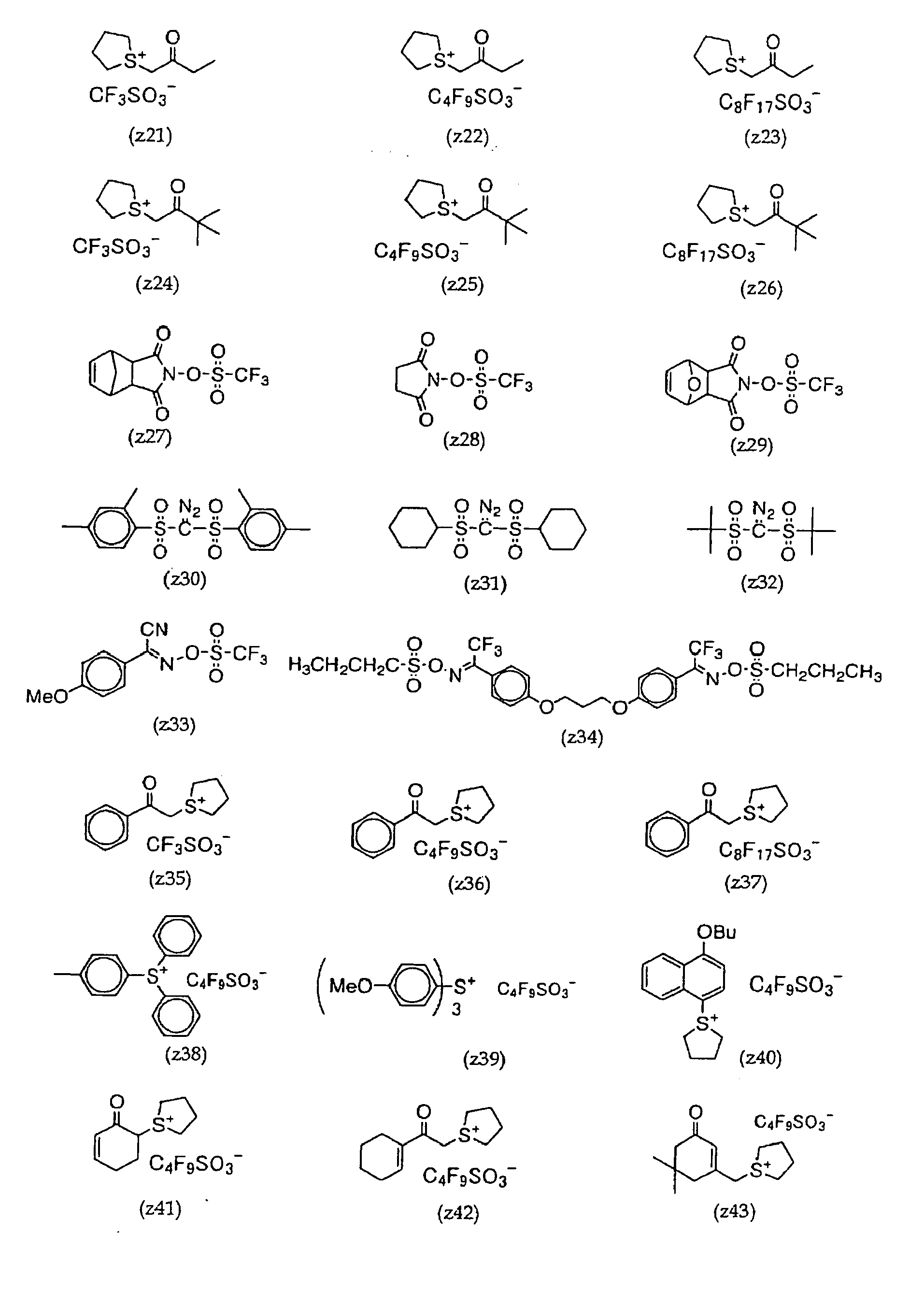


- The positive resist composition of the present invention comprises a resin having an alicyclic hydrocarbon structure, which decomposes under the action of an acid to increase the solubility in an alkali developer (hereinafter sometime referred to as an "acid-decomposable resin").
- The acid-decomposable resin for use in the present invention has a group capable of decomposing under the action of an acid to increase the solubility in an alkali (hereinafter sometimes referred to as an "acid-decomposable group").
- Examples of the acid decomposable group include a group after the hydrogen atom of an alkali-soluble group such as carboxylic acid group, sulfonic acid group, phenol group or thiol group, is protected by a group which desorbs under the action of an acid.
- Examples of the group which desorbs under the action of an acid include - C(R36)(R37)(R38) and -C(R01)(R02)(OR39). In the formulae, R36 to R39 each independently represents an alkyl group, a cycloalkyl group, an aryl group, an aralkyl group or an alkenyl group, and R36 and R37 may combine with each other to form a ring. R01 and R02 each independently represents a hydrogen atom, an alkyl group, a cycloalkyl group, an aryl group, an aralkyl group or an alkenyl group.
- The acid-decomposable group for use in the present invention is preferably a resin having at least one repeating unit selected from the group consisting of a repeating unit having a partial structure containing an alicyclic hydrocarbon represented by any one of the following formulae (pI) to (pVI) and a repeating unit represented by the following formula (II-AB), more preferably a resin having a repeating unit having a partial structure containing an alicyclic hydrocarbon represented by any one of the following formulae (pI) to (pVI).


- In formulae (pI) to (pVI),
R11 represents a methyl group, an ethyl group, an n-propyl group, an isopropyl group, an n-butyl group, an isobutyl group or a sec-butyl group,
Z represents an atomic group necessary for forming a cycloalkyl group together with the carbon atom,
R12 to R16 each independently represents a linear or branched alkyl group having a carbon number of 1 to 4 or a cycloalkyl group, provided that at least one of R12 to R14 or either one of R15 and R16 represents a cycloalkyl group,
R17 to R21 each independently represents a hydrogen atom, a linear or branched alkyl group having a carbon number of 1 to 4 or a cycloalkyl group, provided that at least one of R17 to R21 represents a cycloalkyl group and that either one of R19 and R21 represents a linear or branched alkyl group having a carbon number of 1 to 4 or a cycloalkyl group,
R22 to R25 each independently represents a hydrogen atom, a linear or branched alkyl group having a carbon number of 1 to 4, or a cycloalkyl group, provided that at least one of R22 to R25 represents a cycloalkyl group, and
R23 and R24 may combine with each other to form a ring.
- In formula (II-AB),
R11' and R12' each independently represents a hydrogen atom, a cyano group, a halogen atom or an alkyl group, and
Z' represents an atomic group for forming an alicyclic structure, containing two bonded carbon atoms (C-C). - Formula (II-AB) is preferably the following formula (II-AB1) or (II-AB2).


- In formulae (II-AB1) and (II-AB2),
R13' to R16' each independently represents a hydrogen atom, a halogen atom, a cyano group, -COOH, -COOR5, a group capable of decomposing under the action of an acid, -C(=O)-X-A'-R17', an alkyl group or a cycloalkyl group, and at least two members out of R13' to R16' may combine to form a ring,
R5 represents an alkyl group, a cycloalkyl group or a group having a lactone structure,
X represents an oxygen atom, a sulfur atom, -NH-, -NHSO2 or -NHSO2NH-,
A' represents a sing bond or a divalent linking group,
R17' represents -COOH, -COOR5, -CN, a hydroxyl group, an alkoxy group, -CO-NH-R6, -CO-NH-SO2-R6 or a group having a lactone structure,
R6 represents an alkyl group or a cycloalkyl group, and
n represents 0 or 1. - In formulae (pI) to (pVI), the alkyl group in R12 to R25 is a linear or branched alkyl group having from 1 to 4 carbon atoms.
- The cycloalkyl group of R11 to R25 and the cycloalkyl group formed by Z together with the carbon atom may be monocyclic or polycyclic. Specific examples thereof include a group having a monocyclo, bicyclo, tricyclo or tetracyclo structure with a carbon number of 5 or more. The carbon number thereof is preferably from 6 to 30, more preferably from 7 to 25. These cycloalkyl groups each may have a substituent.
- Preferred examples of the cycloalkyl group include an adamantyl group, a noradamantyl group, a decalin residue, a tricyclodecanyl group, a tetracyclododecanyl group, a norbornyl group, a cedrol group, a cyclopentyl group, a cyclohexyl group, a cycloheptyl group, a cyclooctyl group, a cyclodecanyl group and a cyclododecanyl group. Among these, more preferred are an adamantyl group, a norbornyl group, a cyclohexyl group, a cyclopentyl group, a tetracyclododecanyl group and a tricyclodecanyl group.
- Examples of the substituent which these alkyl group and cycloalkyl group may further have include an alkyl group (having a carbon number of 1 to 4), a halogen atom, a hydroxyl group, an alkoxy group (having a carbon number of 1 to 4), a carboxyl group and an alkoxycarbonyl group (having a carbon number of 2 to 6). Examples of the substituent which these alkyl group, alkoxy group, alkoxycarbonyl group and the like may further have include a hydroxyl group, a halogen atom and an alkoxy group.
- The structures represented by formulae (pI) to (pVI) each can be used for the protection of an alkali-soluble group in the resin. Examples of the alkali-soluble group include various groups known in this technical field.
- Specific examples thereof include a structure where the hydrogen atom of a carboxylic acid group, a sulfonic acid group, a phenol group or a thiol group is replaced by the structure represented by any one of formulae (pI) to (pVI). A structure where the hydrogen atom of a carboxylic acid group or a sulfonic acid group is replaced by the structure represented by any one of formulae (pl) to (pV) is preferred.
- The structure where the hydrogen atom of an alkali-soluble group is replaced by the structure represented by any one of formulae (pI) to (pVI) decomposes under the action of an acid to form an alkali soluble group, thereby constituting an acid-decomposable group.
- The repeating unit having an alkali-soluble group protected by the structure represented by any one of formulae (pI) to (pVI) is preferably a repeating unit represented by the following formula (pA):

- In formula (pA), R represents a hydrogen atom, a halogen atom or a linear or branched alkyl group having a carbon number of 1 to 4, and a plurality ofR's may be the same or different.
- A represents a single bond, or one group or a combination of two or more groups, selected from the group consisting of an alkylene group, an ether group, a thioether group, a carbonyl group, an ester group, an amido group, a sulfonamido group, a urethane group and a urea group. A is preferably a single bond.
- Rp1 represents any one group of formulae (pI) to (pV).
- The repeating unit represented by formula (pA) is most preferably a repeating unit comprising a 2-alkyl-2-adamantyl (meth)acrylate or a dialkyl(1-adamantyl)methyl (meth)acrylate.
- Specific examples of the repeating unit represented by formula (pA) are set forth below.
- (In formulae, Rx is H, CH3, CF3, CH2OH or Rxa, and Rxa each is an alkyl group having a carbon number of 1 to 4.)

- Examples of the halogen atom of R11' and R12' in formula (II-AB) include a chlorine atom, a bromine atom, a fluorine atom and an iodine atom.
- The alkyl group of R11' and R12' includes a linear or branched alkyl group having a carbon number of 1 to 10.
- The atomic group of Z' for forming an alicyclic structure is an atomic group for forming, in the resin, an alicyclic hydrocarbon repeating unit which may have a substituent, and among these atomic groups, an atomic group for forming a crosslinked alicyclic structure to form a crosslinked alicyclic hydrocarbon repeating unit is preferred.
- Examples of the skeleton of the alicyclic hydrocarbon formed are the same as those of the cycloalkyl group of R1 to R25 in formulae (pI) to (pVI).
- The alicyclic hydrocarbon skeleton may have a substituent, and examples of the substituent include R13' to R16' in formulae (II-AB1) and (II-AB2).
- In the acid-decomposable resin for use in the present invention, the acid-decomposable group may be contained in at least one repeating unit out of the repeating unit having a partial structure containing an alicyclic hydrocarbon represented by any one of formulae (pI) to (pV), the repeating unit represented by formula (II-AB), and the repeating unit of a copolymerization component which is described later.
- Various substituents R13' to R16' in formulae (II-AB1) and (II-AB2) may work out to the substituents of an atomic group for forming an alicyclic structure in formula (II-AB) or an atomic group Z for forming a crosslinked alicyclic structure.
- Specific examples of the repeating units represented by formulae (II-AB1) and (II-AB2) are set forth below, but the present invention is not limited thereto.

- The acid-decomposable resin for use in the present invention preferably has a lactone group. As for the lactone group, any group may be used as long as it has a lactone structure, but a group having a 5-, 6- or 7-membered ring lactone structure is preferred. The 5-, 6- or 7-membered ring structure is preferably condensed with another ring structure in the form of forming a bicyclo structure or a spiro structure. The acid-decomposable resin for use in the present invention more preferably has a repeating unit containing a group having a lactone structure represented by any one of the following formulae (LC1-1) to (LC1-16). The group having a lactone structure may be bonded directly to the main chain. Among these lactone structures, (LC1-1), (LC1-4), (LC1-5), (LC1-6), (LC1-13) and (LC1-14) are preferred. By virtue of using a specific lactone structure, the line edge roughness and the development defect are improved.

- The lactone structure moiety may or may not have a substituent (Rb2). Preferred examples of the substituent (Rb2) include an alkyl group having a carbon number of 1 to 8, a cycloalkyl group having a carbon number of 4 to 7, an alkoxy group having a carbon number of 1 to 8, an alkoxycarbonyl group having a carbon number of 1 to 8, a carboxyl group, a halogen atom, a hydroxyl group, a cyano group and an acid-decomposable group. n2 represents an integer of 0 to 4. When n2 is 2 or more, the plurality ofRb2's may be the same or different and may combine with each other to form a ring.
- Examples of the repeating unit containing a group having a lactone structure represented by any one of formulae (LC1-1) to (LC1-16) include a repeating unit where at least one of R13' to R16' in formula (II-AB1) or (II-AB2) has a group represented by any one of formulae (LC1-1) to (LC1-16) (for example, R5 of -COOR5 is a group represented by any one of formulae (LC1-1) to (LC1-16)), and a repeating unit represented by the following formula (AI):

- In formula (AI), Rb0 represents a hydrogen atom, a halogen atom or an alkyl group having a carbon number of 1 to 4. Preferred examples of the substituent which the alkyl group or Rb0 may have include a hydroxyl group and a halogen atom. Examples of the halogen atom of Rb0 include a fluorine atom, a chlorine atom, a bromine atom and an iodine atom. Rb0 is preferably a hydrogen atom or a methyl group.
- Ab represents an alkylene group, a divalent linking group having a monocyclic or polycyclic alicyclic hydrocarbon structure, a single bond, an ether group, an ester group, a carbonyl group, a carboxyl group, or a divalent group comprising a combination thereof, preferably a single bond or a linking group represented by -Ab1-CO2-.
- Ab1 is a linear or branched alkylene group or a monocyclic or polycyclic cycloalkylene group, preferably a methylene group, an ethylene group, a cyclohexyl group, an adamantyl group or a norbornyl group.
- V represents a group represented by any one of formulae (LCl-1) to (LCl-16).
- The repeating unit having a lactone structure usually has an optical isomer, but any optical isomer may be used. One optical isomer may be used alone or a mixture of a plurality of optical isomers may be used. In the case of mainly using one optical isomer, the optical purity (ee) thereof is preferably 90 or more, more preferably 95 or more. Specific examples of the repeating unit containing a group having a lactone structure are set forth below, but the present invention is not limited thereto.
- (In formulae, Rx is H, CH3, CH2OH or CF3.)

- (In formulae, Rx is H, CH3, CH2OH or CF3.)

- (In formulae, Rx is H, CH3, CH2OH or CF3.)

- The acid-decomposable resin for use in the present invention preferably contains a repeating unit having an alicyclic hydrocarbon structure substituted by a polar group. By virtue of this repeating unit, the adhesion to substrate and the affinity for developer are enhanced. The polar group is preferably a hydroxyl group or a cyano group.
- Examples of the group having an alicyclic hydrocarbon structure substituted by a polar group include the groups represented by the following formulae (VIIa) and (VIIb):


- In formula (VIIa), R2c to R4c each independently represents a hydrogen atom, a hydroxyl group or a cyano group, provided that at least one of R2c to R4c represents a hydroxyl group or a cyano group. Preferably, one or two members out of R2c to R4c is a hydroxyl group with the remaining being a hydrogen atom, and more preferably, two members out of R2c to R4c are a hydroxyl group with the remaining being a hydrogen atom.
- The group represented by formula (VIIa) is preferably a dihydroxy form or a monohydroxy form, more preferably a dihydroxy form.
- Examples of the repeating unit having a group represented by formula (VIIa) or (VIIb) include a repeating unit where at least one of R13' to R16' in formula (II-AB1) or (II-AB2) has a group represented by formula (VIIa) or (VIIb) (for example, where R5 in -COOR5 is a group represented by formula (VIIa) or (VIIb)), and a repeating unit represented by the following formula (AIIa) or (AIIb):


- In formulae (AIIa) and (AIIb), R1c represents a hydrogen atom, a methyl group, a trifluoromethyl group or a hydroxymethyl group.
- R2c to R4c have the same meanings as R2c to R4c in formula (VIIa).
- Specific examples of the repeating units represented by formulae (AIIa) and (AIIb) are set forth below, but the present invention is not limited thereto.

- The acid-decomposable resin for use in the present invention may contain a repeating unit represented by the following formula (VIII):

- In formula (VIII), Z2 represents -O- or -N(R41)-.
- R41 represents a hydrogen atom, a hydroxyl group, an alkyl group or -OSO2-R42.
- R42 represents an alkyl group, a cycloalkyl group or a camphor residue.
- The alkyl group of R41 and R42 may be substituted by a halogen atom (preferably a fluorine atom) or the like.
- Specific examples of the repeating unit represented by formula (VIII) are set forth below, but the present invention is not limited thereto.

- The acid-decomposable resin for use in the present invention preferably contains a repeating unit having an alkali-soluble group, more preferably a repeating unit having a carboxyl group. By virtue of containing such a repeating unit, the resolution increases in usage of forming contact holes. The repeating unit having a carboxyl group is preferably a repeating unit where a carboxyl group is directly bonded to the resin main chain, such as repeating unit by an acrylic acid or a methacrylic acid, or a repeating unit where a carboxyl group is bonded to the resin main chain through a linking group. The linking group may have a monocyclic or polycyclic hydrocarbon structure. An acrylic acid and a methacrylic acid are particularly preferred.
- The acid-decomposable resin for use in the present invention may contain a repeating unit having from 1 to 3 groups represented by the following formula (F1). By virtue of containing this repeating unit, the line edge roughness performance is enhanced.

- In formula (F1), R50 to R55 each independently represents a hydrogen atom, a fluorine atom or an alkyl group, provided that at least one of R50 to R55 is a fluorine atom or an alkyl group with at least one hydrogen atom being substituted by a fluorine atom.
- Rx represents a hydrogen atom or an organic group.
- The alkyl group of R50 to R55 may be substituted by a halogen atom (e.g., fluorine), a cyano group or the like, and is preferably an alkyl group having a carbon number of 1 to 3, such as methyl group and trifluoromethyl group. It is preferred that R50 to R55 all are a fluorine atom.
- The organic group represented by Rx is preferably an acid-decomposable group or an alkyl, cycloalkyl, acyl, alkylcarbonyl, alkoxycarbonyl, alkoxycarbonylmethyl, alkoxymethyl or 1-alkoxyethyl group which may have a substituent. The repeating unit having a group represented by formula (F1) is preferably a repeating unit represented by the following formula (F2):

- In formula (F2), Rx represents a hydrogen atom, a halogen atom or an alkyl group having a carbon number of 1 to 4. Preferred examples of the substituent which the alkyl group of Rx may have include a hydroxyl group and a halogen atom.
- Fa represents a single bond or a linear or branched alkylene group (preferably a single bond).
- Fb represents a monocyclic or polycyclic hydrocarbon group. The cyclic hydrocarbon group in Fb is preferably a cyclopentyl group, a cyclohexyl group or a norbornyl group.
- Fc represents a single bond or a linear or branched alkylene group (preferably a single bond or a methylene group).
- F1 represents a group represented by formula (F1).
- p1 represents a number of 1 to 3.
- Specific examples of the repeating unit having a structure of formula (F1) are set forth below, but the present invention is not limited thereto.

- The acid-decomposable resin for use in the present invention may contain, in addition to the above-described repeating units, various repeating structural units for the purpose of controlling the dry etching resistance, suitability for standard developer, adhesion to substrate, resist profile and properties generally required of the resist, such as resolving power, heat resistance and sensitivity.
- Examples of such a repeating structural unit include, but are not limited to, repeating structural units corresponding to the monomers described below.
- By virtue of containing such a repeating structural unit, the performance required of the alicyclic hydrocarbon-based acid-decomposable resin, particularly, (1) solubility in the coating solvent, (2) film-forming property (glass transition point), (3) alkali developability, (4) film loss (selection of hydrophilic, hydrophobic or alkali-soluble group), (5) adhesion of unexposed part to substrate, (6) dry etching resistance and the like, can be subtly controlled.
- Examples of the monomer include a compound having one addition-polymerizable unsaturated bond, selected from acrylic acid esters, methacrylic acid esters, acrylamides, methacrylamides, allyl compounds, vinyl ethers and vinyl esters.
- A monomer other than these compounds may also be copolymerized as long as it is an addition-polymerizable unsaturated compound copolymerizable with the monomer corresponding to the above-described various repeating structural units.
- In the acid-decomposable resin, the molar ratio of respective repeating structural units contained is appropriately selected to adjust the dry etching resistance of resist, suitability for standard developer, adhesion to substrate, resist profile and performances generally required of the resist, such as resolving power, heat resistance and sensitivity.
- The preferred embodiment of the acid-decomposable resin includes the followings:
- (1) a resin containing a repeating unit having an alicyclic hydrocarbon-containing partial structure represented by any one of formulae (pI) to (pVI) (side chain type), preferably containing a repeating unit by a (meth)acrylate having a structure represented by any one of formulae (pI) to (pVI), and
- (2) a resin containing a repeating unit represented by formula (II-AB) (main chain type).
- The resin of (2) further includes:
- (3) a resin containing a repeating unit represented by formula (II-AB), a maleic anhydride derivative and a repeating unit by a (meth)acrylate structure (hybrid type).
- In the acid-decomposable resin, the content of the repeating unit having an acid-decomposable group is preferably from 10 to 60 mol%, more preferably from 20 to 50 mol%, still more preferably from 25 to 40 mol%, based on all repeating structural units.
- In the acid-decomposable resin, the content of the repeating unit having an alicyclic hydrocarbon-containing partial structure represented by any one of formulae (pI) to (pVI) is preferably from 20 to 70 mol%, more preferably from 24 to 65 mol%, still more preferably from 28 to 60 mol%, based on all repeating structural units.
- In the acid-decomposable resin, the content of the repeating unit represented by formula (II-AB) is preferably from 10 to 60 mol%, more preferably from 15 to 55 mol%, still more preferably from 20 to 50 mol%, based on all repeating structural units.
- The content of the repeating structural unit based on the monomer of the additional copolymerization component in the resin can also be appropriately selected according to the desired resist performance, but the content thereof is preferably 99 mol% or less, more preferably 90 mol% or less, still more preferably 80 mol% or less, based on the total molar number of the repeating structural unit having an alicyclic hydrocarbon-containing partial structure represented by any one of formulae (pI) to (pVI) and the repeating unit represented by formula (II-AB).
- Each repeating structural unit set forth above as specific examples may be used singly or as a mixture of a plurality thereof. Also, in the present invention, one resin may be used or a plurality of resins may be used in combination.
- When the composition of the present invention is used for exposure with ArF, the resin preferably contains no aromatic group in view of transparency to ArF light.
- The acid-decomposable resin for use in the present invention is preferably a resin where all repeating units comprise a (meth)acrylate repeating unit. In this case, the repeating units may be all a methacrylate, all an acrylate or all a mixture of methacrylate/acrylate, but the content of the acrylate repeating unit is preferably 50 mol% or less based on all repeating units. The acid-decomposable resin for use in the present invention is more preferably a ternary copolymerization polymer comprising from 25 to 50% of the repeating unit having an alicyclic hydrocarbon-containing partial structure represented by any one of formulae (pI) to (pVI), from 25 to 50% of the repeating unit having a lactone structure and from 5 to 30% of the repeating unit having an alicyclic hydrocarbon structure substituted by a polar group, or a quaternary copolymerization polymer additionally comprising from 5 to 20% of the repeating unit having a carboxyl group or a structure represented by formula (F1).
- The acid-decomposable resin for use in the present invention can be synthesized by an ordinary method (for example, radical polymerization). Examples of the synthesis method in general include a batch polymerization method of dissolving the monomer species and an initiator in a solvent and heating the solution, thereby effecting the polymerization, and a dropping polymerization method of adding dropwise a solution containing the monomer species and an initiator in a heated solvent over 1 to 10 hours. A dropping polymerization method is preferred. Examples of the reaction solvent include tetrahydrofuran, 1,4-dioxane, ethers (e.g., diisopropyl ether), ketones (e.g., methyl ethyl ketone, methyl isobutyl ketone), an ester solvent (e.g., ethyl acetate), an amide solvent (e.g., dimethylformamide, diethylacetamide), and a solvent capable of dissolving the composition of the present invention, which is described later, such as propylene glycol monomethyl ether acetate, propylene glycol monomethyl ether and cyclohexanone. The polymerization is preferably performed by using the same solvent as the solvent used in the positive resist composition of the present invention. By the use of this solvent, generation of particles during storage can be suppressed. The polymerization reaction is preferably performed in an inert gas atmosphere such as nitrogen or argon. As for the polymerization initiator, the polymerization is started by using a commercially available radical initiator (e.g., azo-based initiator, peroxide). The radical initiator is preferably an azo-based initiator, and an azo-based initiator having an ester group, a cyano group or a carboxyl group is preferred. Preferred examples of the initiator include azobisisobutyronitrile, azobisdimethylvaleronitrile and dimethyl 2,2'-azobis(2-methylpropionate). The initiator is added additionally or in parts, if desired. After the completion of reaction, the reactant is charged into a solvent, and the desired polymer is recovered by a method such as powder or solid recovery. The reaction concentration is from 5 to 50 mass%, preferably from 10 to 30 mass%, and the reaction temperature is usually from 10 to 150°C, preferably from 30 to 120°C, more preferably from 50 to 100°C. The weight average molecular weight of the acid-decomposable resin is preferably from 2,000 to 200,000, more preferably from 5,000 to 50,000, still more preferably from 7,000 to 30,000, in terms of polystyrene by the GPC method. The molecular weight distribution of the acid-decomposable resin is usually from 1 to 5, preferably from 1 to 4, more preferably from 1 to 3. When the molecular weight distribution is from 1 to 5, the resolution and resist profile can be enhanced and the resist pattern can be prevented from deterioration such as roughened side wall or roughness.
- In the positive resist composition of the present invention, the amount of the acid-decomposable resin blended in the entire composition is preferably from 40 to 99.99 mass%, more preferably from 50 to 99 mass%, still more preferably from 80 to 96 mass%, based on the entire solid content.
- The positive resist composition of the present invention comprises a chain compound having one or two group(s) selected from a hydroxyl group and a group where the hydrogen atom of a hydroxyl group is substituted with an organic group, and being a solid at ordinary temperature under atmospheric pressure (760 mmHg, 25°C) (hereinafter sometimes referred to as a "compound (C)").
- The compound (C) is a solid at ordinary temperature under atmospheric pressure and does not contain a general alcohol-based solvent. The compound (C) is preferably a compound having a melting point of 30°C or more at 760 mmHg and 25°C. Incidentally, the compound (C) has an optical isomer depending on the structure, but includes all of the optical isomers.
- The total number of hydroxyl group and the group where the hydrogen atom of a hydroxyl group is substituted with an organic group, contained in the compound (C), is 1 or 2, preferably 2. When the total number of hydroxyl group and the group where the hydrogen atom of a hydroxyl group is substituted with an organic group, contained in the compound (C), is 1 or 2, good compatibility with the resist composition is obtained and the effect of the present invention is brought out.
- The group where the hydrogen atom of a hydroxyl group is substituted with an organic group, contained in the compound (C), is preferably a linear alkoxy group having a carbon number of 1 to 3, more preferably an ethoxy group or a methoxy group, still more preferably a methoxy group.
- The number of carbon atoms contained in the compound (C) is usually from 8 to 28, preferably from 9 to 24, more preferably from 10 to 20. When the carbon number of the compound (C) is from 8 to 30, the development defect can be decreased and at the same time, deterioration in the developability of the unexposed part can be prevented.
- The compound (C) is preferably represented by the following formula (I):

R1 and R2 each independently represents a methyl group, a hydroxyl group or a group where the hydrogen atom of a hydroxyl group is substituted with an organic group,
R3 to R6 each independently represents a hydrogen atom, a methyl group, a hydroxyl group or a group wheree the hydrogen atom of a hydroxyl group is substituted with an organic group,
provided that the total of the number of hydroxyl group and the number of the group where the hydrogen atom of a hydroxyl group is substituted with an organic group, in R1 to R6 is 1 or 2,
X represents a single bond or a double bond,
R7 represents a hydrogen atom or an oxygen atom,
provided that when X is a single bond, R7 represents a hydrogen atom and when X is a double bond, R7 represents an oxygen atom, and
n is an integer of 2 to 10. - Specific examples of the compound (C) are set forth below, but the present invention is not limited thereto.

- The amount used of the compound (C) is usually from 0.001 to 10 mass%, preferably from 0.01 to 5 mass%, based on the solid content of the positive resist composition. When the amount used of the compound (C) is from 0.001 to 10 mass%, the effect of the present invention can be exerted by preventing reduction of sensitivity or significant film loss.
- The compound (C) may be added as a sole compound or as a combination of several compounds.
- The positive resist composition of the present invention preferably contains a basic compound for reducing the change of performance in aging from exposure to heating or for controlling the diffusion of the acid generated from the compound (A) upon exposure. Examples of the basic compound include a nitrogen-containing basic compound.
- The nitrogen-containing basic compound may be sufficient if it does not deteriorate sublimation or resist performance and, for example, an organic amine, a basic ammonium salt or a basic sulfonium salt is used. Here, the basic ammonium salt or basic sulfonium salt is a compound having a basic site such as hydroxyl group or amino group in its anion moiety. Among these nitrogen-containing basic compounds, an organic amine is preferred because of excellent image performance. Examples of the basic compound which can be used include those described in JP-A-63-149640, JP-A-5-249662, JP-A-5-127369, JP-A-5-289322, JP-A-5-249683, JP-A-5-289340, JP-A-5-232706, JP-A-5-257282, JP-A-6-242605, JP-A-6-242606, JP-A-6-266100, JP-A-6-266110, JP-A-6-317902, JP-A-7-120929, JP-A-7-146558, JP-A-7-319163, JP-A-7-508840, JP-A-7-333844, JP-A-7-219217, JP-A-7-92678, JP-A-7-28247, JP-A-8-22120, JP-A-8-110638, JP-A-8-123030, JP-A-9-274312, JP-A-9-166871, JP-A-9-292708, JP-A-9-325496, JP-T-7-508840 (the term (the term "JP-T" as used herein means a "published Japanese translation of a PCT patent application"), and U. S. Patents 5,525,453, 5,629,134 and 5,667,938.
- Specifically, the basic compound includes a compound having a structure represented by any one of the following formulae (A) to (E).

- In formula (A), R250, R251 and R252 each independently represents a hydrogen atom, an alkyl group having a carbon number of 1 to 20, a cycloalkyl group having a carbon number of 3 to 20 or an aryl group having a carbon number of 6 to 20, and R250 and R251 may combine with each other to form a ring. These alkyl group, cycloalkyl group and aryl group each may have a substituent such as hydroxy group and amino group. Also, these groups each may contain an oxygen atom, a sulfur atom or a nitrogen atom in the alkyl chain.

- In formulae (B) to (E), R253, R254, R255 and R256 each independently represents an alkyl group having a carbon number of 1 to 6.
- Preferred examples of the compounds include a substituted or unsubstituted guanidine, a substituted or unsubstituted aminopyrrolidine, a substituted or unsubstituted pyrazole, a substituted or unsubstituted pyrazoline, a substituted or unsubstituted piperazirie; a substituted or unsubstituted aminomorpholine, a substituted or unsubstituted aminoalkylmorpholine, and a substituted or unsubstituted piperidine. More preferred examples thereof include a compound having an imidazole structure, a diazabicyclo structure, an onium hydroxide structure, an onium carboxylate structure, a trialkylamine structure, an aniline structure or a pyridine structure; an alkylamine derivative having a hydroxyl group and/or an ether bond; and an aniline derivative having a hydroxyl group and/or an ether bond.
- Examples of the compound having an imidazole structure include imidazole, 2,4,5-triphenylimidazole and benzimidazole. Examples of the compound having a diazabicyclo structure include 1,4-diazabicyclo[2,2,2]octane, 1,5-diazabicyclo[4,3,0]non-5-ene and 1,8-diazabicyclo[5,4,0]undec-7-ene. Examples of the compound having an onium hydroxide structure include a triarylsulfonium hydroxide, a phenacylsulfonium hydroxide and a sulfonium hydroxide having a 2-oxoalkyl group, specifically, triphenylsulfonium hydroxide, tris(tert-butylphenyl)sulfonium hydroxide, bis(tert-butylphenyl)iodonium hydroxide, phenacylthiophenium hydroxide and 2-oxopropylthiphenium hydroxide. The compound having an onium carboxylate structure is a compound where the anion moiety of the compound having an onium hydroxide structure is a carboxylate, and examples thereof include an acetate, an adamantane-1-carboxylate and a perfluoroalkyl carboxylate. Examples of the compound having a trialkylamine structure include tri(n-butyl)amine and tri(n-octyl)amine. Examples of the aniline compound include 2,6-diisopropylaniline and N,N-dimethylaniline. Examples of the alkylamine derivative having a hydroxyl group and/or an ether bond include ethanolamine, diethanolamine, triethanolamine and tris(methoxyethoxyethyl)amine. Examples of the aniline derivative having a hydroxyl group and/or an ether bond include N,N-bis(hydroxyethyl)aniline.
- These basic compounds are used individually or in combination of two or more thereof The amount of the basic compound used is usually from 0.001 to 10 mass%, preferably from 0.01 to 5 mass%, based on the solid content of the positive resist composition. When the amount of the basic compound used is from 0.001 to 10 mass%, the effect by the addition of the basic compound is obtained and the tendency toward reduction in the sensitivity or worsened developability of the unexposed part can be prevented.
- The positive resist composition of the present invention preferably further contains (E) any one fluorine- and/or silicon-containing surfactant (a fluorine-containing surfactant, a silicon-containing surfactant or a surfactant containing both a fluorine atom and a silicon atom), or two or more thereof. When the positive resist composition of the present invention contains this surfactant (E), a resist pattern with good sensitivity, high resolution and less failure of adhesion and development can be obtained on use of an exposure light source of 250 nm or less, particularly 220 nm or less.
- Examples of the surfactant (E) include surfactants described in JP-A-62-36663, JP-A-61-226746, JP-A-61-226745, JP-A-62-170950, JP-A-63-34540, JP-A-7-230165, JP-A-8-62834, JP-A-9-54432, JP-A-9-5988, and U.S. Patents 5,405,720, 5,360,692, 5,529,881, 5,296,330, 5,436,098, 5,576,143, 5,294,511 and 5,824,451. The following commercially available surfactants each may also be used as it is. Examples of the commercially available surfactant which can be used include a fluorine-containing surfactant and a silicon-containing surfactant, such as EFtop EF301 and EF303 (produced by Shin-Akita Kasei K.K.), Florad FC430 and 431 (produced by Sumitomo 3M Inc.), Megafac F171, F173, F176, F189 and R08 (produced by Dainippon Ink & Chemicals, Inc.), Surflon S-382, SC101, 102, 103, 104, 105 and 106 (produced by Asahi Glass Co., Ltd.), Troysol S-366 (produced by Troy Chemical), and PF6320 and 6520 (produced by OMNOVA). In addition, a polysiloxane polymer, KP-341 (produced by Shin-Etsu Chemical Co., Ltd.), may also be used as a silicon-containing surfactant.
- The amount of the surfactant used is preferably from 0.0001 to 2 mass%, more preferably from 0.001 to 1 mass%, based on the entire amount of the positive resist composition (excluding the solvent).
- In the positive resist composition of the present invention, respective components are used by dissolving these in a predetermined organic solvent. Examples of the organic solvent which can be used include ethylene dichloride, cyclohexanone, cyclopentanone, 2-heptanone, γ-butyrolactone, methyl ethyl ketone, ethylene glycol monomethyl ether, ethylene glycol monoethyl ether, 2-methoxyethyl acetate, ethylene glycol monoethyl ether acetate, propylene glycol monomethyl ether, propylene glycol monomethyl ether acetate, toluene, ethyl acetate, methyl lactate, ethyl lactate, methyl methoxypropionate, ethyl ethoxypropionate, methyl pyruvate, ethyl pyruvate, propyl pyruvate, N,N-dimethylformamide, dimethylsulfoxide, N-methylpyrrolidone and tetrahydrofuran. These solvents may be used individually or as a mixture.
- Among these solvents, preferred are cyclohexanone, 2-heptanone, γ-butyrolactone, ethylene glycol monomethyl ether, ethylene glycol monoethyl ether, ethylene glycol monoethyl ether acetate, propylene glycol monomethyl ether, propylene glycol monoethyl ether, propylene glycol monomethyl ether acetate, methyl lactate, ethyl lactate, methyl methoxypropionate, ethyl ethoxypropionate, N-methylpyrrolidone and tetrahydrofuran. In the present invention, the organic solvents may be used individually or as a mixture, but a mixed solvent containing two kinds of solvents differing in the functional group is preferably used. The mixed solvent containing two kinds of solvents differing in the functional group is preferably a mixed solvent containing a solvent having a hydroxyl group in the structure and a solvent not having a hydroxyl group in the structure, or a mixed solvent containing a solvent having an ester structure and a solvent having a ketone structure. By virtue of using such a mixed solvent, generation of particles during storage of the resist can be reduced.
- If desired, the positive resist composition of the present invention may further contain, for example, a dye, a plasticizer, a surfactant other than the component (E), a photosensitizer, an acid-decomposable dissolution inhibiting compound, and a compound capable of accelerating the solubility in a developer.
- Specific examples of the surfactant other than the fluorine- and/or silicon-containing surfactant (E) include a nonionic surfactant such as polyoxyethylene alkyl ethers (e.g., polyoxyethylene lauryl ether, polyoxyethylene stearyl ether, polyoxyethylene cetyl ether, polyoxyethylene oleyl ether), polyoxyethylene alkylallyl ethers (e.g., polyoxyethylene octylphenol ether, polyoxyethylene nonylphenol ether), polyoxyethylene polyoxypropylene block copolymers, sorbitan fatty acid esters (e.g., sorbitan monolaurate, sorbitan monopalmitate, sorbitan monostearate, sorbitan monooleate, sorbitan trioleate, sorbitan tristearate), and polyoxyethylene sorbitan fatty acid esters (e.g., polyoxyethylene sorbitan monolaurate, polyoxyethylene sorbitan monopalmitate, polyoxyethylene sorbitan monostearate, polyoxyethylene sorbitan trioleate, polyoxyethylene sorbitan tristearate). One of these surfactants may be added alone, or several surfactants may be added in combination.
- The positive resist composition of the present invention is used by dissolving the above-described components in a predetermined organic solvent, preferably a mixed solvent described above, and coating the obtained solution on a predetermined support as follows. That is, the positive resist composition is coated on a substrate (e.g., silicon/silicon dioxide-coated substrate) as used in the production of a precision integrated circuit device by an appropriate coating method such as spinner or coater, and dried. After the coating, the film formed is irradiated through a predetermined mask, then baked and developed, whereby a good resist pattern can be obtained. The exposure light used here is preferably a far ultraviolet ray at a wavelength of 250 nm or less, more preferably 220 nm or less. Specific examples of the light source therefor include a KrF excimer laser (248 nm), an ArF excimer laser (193 nm), an F2 excimer laser (157 nm), an X-ray and an electron beam.
- In the development step, a development is used as follows. The developer which can be used for the positive resist composition is an alkaline aqueous solution of inorgariic alkalis (e.g., sodium hydroxide, potassium hydroxide, sodium carbonate, sodium silicate, sodium metasilicate, aqueous ammonia), primary amines (e.g., ethylamine, n-propylamine), secondary amines (e.g., diethylamine, di-n-butylamine), tertiary amines (e.g., triethylamine, methyldiethylamine), alcohol amines (e.g., dimethylethanolamine, triethanolamine), a quaternary ammonium salt (e.g., tetramethylammonium hydroxide, tetraethylammonium hydroxide), cyclic amines (e.g., pyrrole, piperidine) or the like. Furthermore, in the alkaline aqueous solution, alcohols and a surfactant may also be added in an appropriate amount.
- The present invention is described in greater detail below by referring to Examples, but the present invention is not limited to these Examples.
- 2-Methyl-2-adamantyl methacrylate and butyrolactone methacrylate were charged at a ratio of 55/45 (by mol) and dissolved in methyl ethyl ketone/tetrahydrofuran (=5/5 by mass) to prepare 100 ml of a solution having a solid content concentration of 20 mass%. Subsequently, 2 mol% of a polymerization initiator, V-65, produced by Wako Pure Chemical Industries, Ltd. was added thereto, and the resulting solution was added dropwise to 10 ml of methyl ethyl ketone heated at 60°C, over 4 hours in a nitrogen atmosphere. After the completion of dropwise addition, the reaction solution was heated for 4 hours and 1 mol% of V-65 was again added thereto, followed by stirring for 4 hours. After the completion of reaction, the reaction solution was cooled to room temperature and crystallized in 3 liter of a mixed solvent of distilled water/ISO propyl alcohol (=1/1 by mass) to synthesize Resin (1) having a structure shown below as a white powder precipitated.
- The compositional ratio in the polymer as determined from 13CNMR was 46/54. Also, the standard polystyrene-reduced weight average molecular weight as determined by the GPC measurement was 10,700.
- Resins (2) to (42) were synthesized by the same operation as in Synthesis Example (1). Resin (1):

- Structures of Resins (2) to (42) are shown below.


- The compositional ratio and molecular weight of each of Resins (2) to (42) are shown below (the repeating units 1, 2, 3 and 4 are in the order from the left of the structure formula).
Table 1 Resin Repeating Unit 1 (mol%) Repeating Unit 2 (mol%) Repeating Unit 3 (mol%) Repeating Unit 4 (mol%) Repeating Unit 5 (mol%) Molecular weight 2 41 40 19 - - 11000 3 35 45 20 - - 10000 4 38 39 23 - - 10500 5 35 35 18 12 - 11500 6 38 30 21 11 - 12500 7 21 25 35 19 - 12000 8 18 22 35 15 10 12500 9 35 48 17 - - 11500 10 32 35 22 11 - 10000 11 33 39 22 6 - 9500 12 35 43 22 - - 12000 13 38 42 20 - - 11500 14 33 45 22 - - 11000 15 31 41 19 9 - 12500 16 36 36 18 10 - 9500 17 34 48 18 - - 11000 18 32 45 23 - - 10500 19 48 28 18 6 - 9500 20 42 42 16 - - 9500 21 28 38 24 10 - 10000 22 38 31 19 12 - 10500 23 25 38 29 8 - 13000 24 40 40 20 - - 11000 25 39 28 18 15 - 11000 26 45 42 13 - - 10500 27 42 29 16 13 - 10000 28 41 41 18 - - 9500 29 38 30 17 15 - 10500 30 37 30 21 12 - 11000 31 38 38 24 - - 10000 32 41 29 20 10 - 10000 33 42 45 13 - - 10500 34 40 27 18 15 - 9500 35 39 42 19 - - 10500 36 40 27 21 12 - 9500 37 41 29 19 11 - 10000 38 42 50 8 - - 8300 39 60 40 - - - 9600 40 20 70 10 - - 5800 41 30 20 50 - - 4700 42 38 12 50 - - 8900 - A resin (1.03 g), an acid generator (0.00010 mol), a compound (C) (0.00006 mol), a basic compound (0.00004 mol) and a surfactant (100 ppm based on the entirety) were blended as shown in Tables 2 and 3 and dissolved in a solvent shown in Tables 2 and 3 to have a solid content of 8 mass%. The obtained solution was filtered through a polyethylene-made microfilter having a pore size of 0.1 µm. In this way, positive resist compositions of Examples 1 to 61 and Comparative Examples 1 to 4 were prepared. In the case of containing two kinds of acid generators in the resist composition, the positive resist composition was prepared to contain respective acid generators each in an amount of 0.00005 mol. Incidentally, as for the filter for filtering the resist solution, a filter other than that described above may be used. The same results were obtained also when the positive resist compositions of Examples 1 to 61 and Comparative Examples 1 to 4 were prepared by using a polyethylene-made microfilter of 0.03 µm or an ultrahigh molecular weight polyethylene (UPE)-made microfilter of 0.03 µm.
- The resist compositions prepared above were evaluated as follows.
- The positive resist composition was coated on a substrate comprising a silicon wafer having applied thereon an antireflective film, ARC-29A (78 nm), produced by Brewer Science Inc., and then baked at 100°C for 60 seconds to provide a film having a thickness of 0.20 µm. The obtained resist film was exposed through a mask by using an ArF excimer laser scanner (PAS5500/1100, manufactured by ASML, NA=0.75) and immediately after exposure, heated (PEB) on a hot plate at 120°C for 60 seconds. Thereafter, the resist film was developed with an aqueous 2.38 mass% tetramethylammonium hydroxide solution at 23°C for 60 seconds, rinsed with pure water for 30 seconds and then dried to obtain a resist line pattern. The pattern formed by changing the exposure amount by 10 mJcm-2 to the overexposure side with respect to the exposure amount E1 necessary for reproducing a mask pattern of 0.08 µm (line/space = 1/1) was observed by a scanning electron microscope (SEM) and rated □ when no pattern falling occurred, o when only slight pattern falling occurred, or x when pattern falling occurred.
- A pattern of 0.08 µm (line/space = 1/1) was formed in the same manner as in the evaluation of pattern falling and observed by SEM, and the line pattern edge was detected at a plurality of positions within the measuring monitor. The dispersion (3σ) of fluctuations at the detected positions was used as an index for edge roughness. The smaller value is more preferred.
- A contact hole pattern of 0.08 µm (pitch: 1/3) was formed in the same manner as in the evaluation of pattern falling. The obtained resist pattern was subjected to measurement of the number of development defects by using KLA-2112 Machine manufactured by KLA Tenkol K.K., and the primary data value obtained was used as the number of development defects. Furthermore, based on the data, the defects were observed by SEM and the number of defects (hole clogging defect, killer defect) which become a serious trouble in the formation of contact holes, was counted.
- These evaluation results are shown in Tables 2 and 3.
Table 2 Resin Photoacid Generator Component C of the Invention Basic Compound Surfactant Solvent Development Defect Pattern Falling Line Edge Roughness Example 1 1 z2 C-1 N-5 W-2 S-1 5 ⓞ 4.8 Example 2 1 z2 C-2 N-5 W-2 S-1 7 ⓞ 5.0 Example 3 1 z2 C-3 N-5 W-2 S-1 5 ⓞ 4.2 Example 4 1 z2 C-4 N-5 W-2 S-1 1 ⓞ 3.8 Example 5 1 z2 C-5 N-5 W-2 S-1 2 ⓞ 4.4 Example 6 1 z2 C-6 N-5 W-2 S-1 1 ⓞ 4.6 Example 7 1 z2 C-7 N-5 W-2 S-1 8 ⓞ 7.5 Example 8 1 z2 C-8 N-5 W-2 S-1 6 ○ 4.2 Example 9 1 z2 C-9 N-5 W-2 S-1 9 ○ 4.3 Example 10 1 z2 C-10 N-5 W-2 S-1 7 ○ 5.1 Example 11 1 z2 C-4 N-5 W-2 S-2 2 ⓞ 6.5 Example 12 1 z2 C-4 N-5 W-2 S-4 3 ⓞ 4.9 Example 13 2 z2 C-4 N-5 W-2 S-1/S-2=5/5 2 ⓞ 5.6 Example 14 2 z2 C-4 N-5 W-2 S-1/S-3=6/4 3 ⓞ 6.2 Example 15 2 z2 C-4 N-5 W-2 S-1/S-4=7/3 3 ⓞ 4.2 Example 16 3 z40 C-4 N-6 W-1 S-1/S-4=7/3 1 ⓞ 4.7 Example 17 4 z38 C-4 N-1 W-4 S-1/S-4=6/4 1 ⓞ 4.6 Example 18 5 z68 C-4 N-3 W-5 S-1/S-4=7/3 1 ⓞ 5.7 Example 19 6 z67 C-4 N-4 W-3 S-1/S-4=7/3 2 ⓞ 6.5 Example 20 7 z69/z64 C-4 N-4 W-3 S-1/S-4=6/4 3 ⓞ 5.7 Example 21 8 z56 C-4 N-6 W-2 S-1/S-4=7/3 2 ⓞ 6.8 Example 22 9 z69 C-4 N-7 W-6 S-1/S-4=6/4 1 ⓞ 5.8 Example 23 10 z14 C-4 N-7 W-1 S-1/S-4=6/4 0 ⓞ 4.2 Example 24 11 z16 C-4 N-2 W-4 S-1/S-4=7/3 4 ⓞ 4.2 Example 25 12 z67 C-4 N-1 W-4 S-1/S-4=6/4 2 ⓞ 7.0 Example 26 13 z69 C-4 N-3 W-3 S-1/S-4=7/3 2 ⓞ 5.5 Example 27 14 z71/z61 C-4 N-1 W-4 S-1/S-4=7/3 2 ⓞ 4.9 Example 28 15 z14 C-4 N-5 W-5 S-1/S-4=6/4 1 ⓞ 4.2 Example 29 16 z39 C-4 N-3 W-2 S-1/S-4=6/4 4 ⓞ 5.0 Example 30 17 z38 C-4 N-4 W-1 S-1/S-4=7/3 3 ⓞ 5.7 Example 31 18 z16 C-4 N-6 W-2 S-1/S-4=6/4 2 ⓞ 5.2 Example 32 19 z38 C-4 N-5 W-5 S-1/S-3=6/4 2 ⓞ 5.6 Example 33 20 z69 C-4 N-3 W-4 S-1/S-4=6/4 1 ⓞ 6.0 Example 34 21 z40 C-4 N-2 W-2 S-1/S-3=6/4 3 ⓞ 5.9 Example 35 22 z57 C-4 N-1 W-2 S-1/S-4=6/4 2 ⓞ 5.7 Table 3 Resin Photoacid Generator Component C of the Invention Basic Surfactant Solvent Development Defect Pattern Falling Line Edge Roughness (nm) Example 36 23 z16 C-4 N-4 W-3 S-1/S-4=7/3 3 ⓞ 5.2 Example 37 24 z60/z67 C-4 N-6 W-2 S-1/S-4=6/4 1 ⓞ 5.4 Example 38 25 z69/z56 C-4 N-5 W-5 S-1/S-3=6/4 0 ⓞ 4.7 Example 39 26 z40 C-4 N-3 W-4 S-1/S-4=6/4 1 ⓞ 4.7 Example 40 27 z38/z62 C-4 N-2 W-2 S-1/S-3=6/4 2 ⓞ 4.6 Example 41 28 z38 C-4 N-1 W-2 S-1 2 ⓞ 5.5 Example 42 29 z69 C-4 N-4 W-3 S-1/S-4=6/4 1 ⓞ 5.3 Example 43 30 z16 C-4 N-7 w-1 S-1/S-4=7/3 0 ⓞ 5.0 Example 44 31 z3 C-4 N-6 W-2 S-1/S-4=6/4 2 ⓞ 4.7 Example 45 32 z65 C-4 N-5 W-5 S-1/S-3=6/4 2 ⓞ 5.8 Example 46 33 z40 C-4 N-3 W-4 S-1/S-4=6/4 0 ⓞ 4.5 Example 47 34 z3 C-4 N-2 W-2 S-1/S-3=6/4 1 ⓞ 4.6 Example 48 35 z64/z67 C-4 N-1 W-2 S-1 0 ⓞ 6.2 Example 49 36 z60 C-4 N-4 W-3 S-1/S-4=6/4 1 ⓞ 5.6 Example 50 37 z16 C-4 N-7 w-1 S-1/S-4=7/3 3 ⓞ 5.9 Example 51 38 z38 C-4 N-4 W-3 S-1/S-3=6/4 4 ⓞ 4.9 Example 52 39 z65 C-4 N-1 W-3 S-1/S-4=6/4 3 ⓞ 5.9 Example 53 40 z40 C-4 N-7 W-1 S-1/S-4=7/3 3 ⓞ 5.8 Example 54 41 z57/z69 C-4 N-6 W-2 S-1/S-4=6/4 3 ⓞ 5.0 Example 55 42 z38 C-4 N-4 W-4 S-1/S-3=6/4 3 ⓞ 6.5 Example 56 2 z38 C-4 N-4 W-3 S-1/S-3=6/4 2 ⓞ 5.9 Example 57 10 z65 C-4 N-1 W-3 S-1/S-4=6/4 3 ⓞ 5.6 Example 58 11 z40 C-4 N-7 W-1 S-1/S-4=7/3 2 ⓞ 5.5 Example 59 23 z57/z69 C-4 N-6 W-2 S-1/S-4=6/4 3 ⓞ 4.8 Example 60 25 z38 C-4 N-4 W-4 S-1/S-3=6/4 0 ⓞ 4.5 Example 61 39 z70/z72 C-4 N-3 W-4 S-1/S-4=6/4 0 ⓞ 4.5 Comparative Example 1 1 z2 C'-1 N-5 W-2 S-1 2 X 5.5 Comparative Example 2 18 z2 C'-2 N-5 W-2 S-1 15 X 14.1 Comparative Example 3 18 z2 C'-3 N-5 W-2 S-1 9 X 12.8 Comparative Example 4 10 z2 C'-4 N-5 W-2 S-1 55 X 15.3 - In Tables 2 and 3, the C component of the invention indicates the followings:
- C-1:
- 1,2-decanediol (323-23861, produced by Wako Pure Chemical Industries, Ltd.)
- C-2:
- 1,10-decanediol (047-00092, produced by Wako Pure Chemical Industries, Ltd.)
- C-3:
- 1,2-dodecanediol (327-23881, produced by Wako Pure Chemical Industries, Ltd.)
- C-4:
- 1, 12-dodecanediol (323-20402, produced by Wako Pure Chemical Industries, Ltd.)
- C-5:
- 1,2-dihydroxyhexadecane (327-23901, produced by Wako Pure Chemical Industries, Ltd.)
- C-6:
- 1,14-tetradecanediol (325-23941, produced by Wako Pure Chemical Industries, Ltd.)
- C-7:
- 2-hexadecanol (H682-7, produced by Aldrich)
- C-8:
- methyl stearate (S0312, produced by Tokyo Kasei Kogyo Co., Ltd.)
- C-9:
- diethyl tetradecanedioate (14404-5, produced by Aldrich)
- C-10:
- dimethyl tetradecanedioate (T1726, produced by Tokyo Kasei Kogyo Co., Ltd.)
- The additive C' in Comparative Examples indicates the followings:
- C'-1:
- 1,2,6-hexanetriol
- C'-2:
- cyclohexanol
- C'-3:
- 1,3-propanediol
- C'-4:
- n-dodecane
- The basic compound indicates the followings:
- N-1:
- 1,5-diazabicyclo[4.3.0]-5-nonene
- N-2:
- 1,8-diazabicyclo[5.4.0]-7-undecene
- N-3:
- 4-dimethylaminopyridine
- N-4:
- N,N-di(2-hydroxyethyl)aniline
- N-5:
- 2,2'-(p-tolylimino)diethanol
- N-6:
- diisopropylaniline
- N-7:
- tributylamine
- N-8:
- trioctylamine
- The surfactant indicates the followings:
- W-1:
- Megafac F176 (produced by Dainippon Ink & Chemicals, Inc.) (fluorine-containing)
- W-2:
- Megafac R08 (produced by Dainippon Ink & Chemicals, Inc.) (fluorine- and silicon-containing)
- W-3:
- polysiloxane polymer KP-341 (produced by Shin-Etsu Chemical Co., Ltd.)
- W-4:
- Troysol S-366 (produced by Troy Chemical)
- W-5:
- PF6320 (produced by OMNOVA)
- W-6:
- PF6520 (produced by OMNOVA)
- The solvent indicates the followings:
- S-1:
- propylene glycol monomethyl ether acetate
- S-2:
- ethyl lactate
- S-3:
- cyclohexanone
- S-4:
- propylene glycol monomethyl ether
- In the case of using two kinds of solvents, the ratio is the mass ratio.
- The melting points at 25°C and 760 mmHg of the compounds as the component (C) used in Examples and the additives (C') used in Comparative Examples are shown in Table 4 below.
Table 4 Compound as Component (C) Melting Point (°C) Additive (C') Melting Point (°C) C-1 49 C'-1 27 C-2 74 C'-2 23 C-3 60 C'-3 -59 C-4 82 C'-4 -10 C-5 73 C-6 48 C-7 45 C-8 38 C-9 31 C-10 43 - As seen in Tables 2 and 3, the positive resist compositions of the present invention all are remarkably reduced in the number of developments defects and assured of satisfactory results in both the light edge roughness and the pattern falling. On the other hand, in the case of using a compound where the number of hydroxyl groups is 3 or more (Comparative Example 1), the result of the pattern falling is inferior due to film loss in the pattern top. Also, even when the number of hydroxyl groups is 1 or 2, in the case of using an alicyclic compound or a compound having a carbon number of 8 or less (Comparative Examples 2 and 3), the results of line edge roughness and pattern falling are inferior to those in Examples of the present invention. In the case of using a compound not having a hydroxyl group (Comparative Example 4), the results of line edge roughness, pattern falling and development defect all are poor as compared with Examples of the present invention.
- Similar results were obtained also when other BARC substrates such as AR46 (29 nm) manufactured by Rohm and Haas were used.
- This application is based on Japanese patent application JP 2005-047392, filed on February 23, 2005, the entire content of which is hereby incorporated by reference, the same as if set forth at length.
Claims (7)
- A positive resist composition comprising:(A) a compound capable of generating an acid upon irradiation with actinic rays or radiation;(B) a resin having an alicyclic hydrocarbon structure, which decomposes under the action of an acid to increase the solubility in an alkali; and(C) a chain compound having one or two group(s) selected from a hydroxyl group and a group where the hydrogen atom of a hydroxyl group is substituted with an organic group, the chain compound being a solid at ordinary temperature under atmospheric pressure.
- The positive resist composition as claimed in claim 1, wherein the compound (C) is represented by the following formula (I):

R1 and R2 each independently represents a methyl group, a hydroxyl group, or a group where the hydrogen atom of a hydroxyl group is substituted with an organic group,
R3 to R6 each independently represents a hydrogen atom, a methyl group, a hydroxyl group, or a group where the hydrogen atom of a hydroxyl group is substituted with an organic group,
provided that the total of the number of hydroxyl group and the number of the group where the hydrogen atom of a hydroxyl group is substituted with an organic group in R1 to R6 is 1 or 2,
X represents a single bond or a double bond,
R7 represents a hydrogen atom or an oxygen atom,
provided that when X is a single bond, R7 represents a hydrogen atom and when X is a double bond, R7 represents an oxygen atom, and
n is an integer of 2 to 10. - The positive resist composition as claimed in claim 1, wherein the compound (C) has a melting point of 30°C or more at 760 mmHg and 25°C.
- The positive resist composition as claimed in claim 1, which further comprises (D) a basic compound.
- The positive resist composition as claimed in claim 1, which further comprises (E) a fluorine- and/or silicon-containing surfactant.
- The positive resist composition as claimed in claim 1, which further comprises (F) an organic solvent.
- A pattern forming method comprising: forming a resist film from the positive resist composition claimed in claim 1; and exposing and developing said resist film.
Applications Claiming Priority (1)
| Application Number | Priority Date | Filing Date | Title |
|---|---|---|---|
| JP2005047392A JP4511383B2 (en) | 2005-02-23 | 2005-02-23 | Positive resist composition and pattern forming method using the same |
Publications (3)
| Publication Number | Publication Date |
|---|---|
| EP1696267A2 true EP1696267A2 (en) | 2006-08-30 |
| EP1696267A3 EP1696267A3 (en) | 2010-12-29 |
| EP1696267B1 EP1696267B1 (en) | 2014-07-09 |
Family
ID=36579591
Family Applications (1)
| Application Number | Title | Priority Date | Filing Date |
|---|---|---|---|
| EP06003591.2A Expired - Lifetime EP1696267B1 (en) | 2005-02-23 | 2006-02-22 | Positive resist composition and pattern forming method using the same |
Country Status (5)
| Country | Link |
|---|---|
| US (1) | US7338744B2 (en) |
| EP (1) | EP1696267B1 (en) |
| JP (1) | JP4511383B2 (en) |
| KR (1) | KR101365032B1 (en) |
| TW (1) | TWI388930B (en) |
Families Citing this family (7)
| Publication number | Priority date | Publication date | Assignee | Title |
|---|---|---|---|---|
| JP4743426B2 (en) * | 2006-05-12 | 2011-08-10 | 信越化学工業株式会社 | Polymer for resist material and manufacturing method thereof, resist material, pattern forming method |
| US7785483B2 (en) * | 2006-12-22 | 2010-08-31 | Hynix Semiconductor Inc. | Exposure mask and method for fabricating semiconductor device using the same |
| US7399576B1 (en) | 2007-02-28 | 2008-07-15 | Eastman Kodak Company | Positive-working radiation-sensitive composition and elements |
| JPWO2008143301A1 (en) * | 2007-05-23 | 2010-08-12 | Jsr株式会社 | Pattern forming method and resin composition used therefor |
| JP5586294B2 (en) * | 2009-03-31 | 2014-09-10 | 富士フイルム株式会社 | Actinic ray-sensitive or radiation-sensitive resin composition, and pattern formation method using the composition |
| JP6115322B2 (en) * | 2012-06-19 | 2017-04-19 | 信越化学工業株式会社 | Pattern formation method |
| CN110645909A (en) * | 2019-08-16 | 2020-01-03 | 广州瑞松北斗汽车装备有限公司 | Vehicle body appearance defect detection method and detection system |
Family Cites Families (20)
| Publication number | Priority date | Publication date | Assignee | Title |
|---|---|---|---|---|
| US4737426A (en) * | 1985-05-15 | 1988-04-12 | Ciba-Geigy Corporation | Cyclic acetals or ketals of beta-keto esters or amides |
| GB8910364D0 (en) * | 1989-05-05 | 1989-06-21 | Nat Res Dev | Anti-fungal compounds |
| JP3340864B2 (en) * | 1994-10-26 | 2002-11-05 | 富士写真フイルム株式会社 | Positive chemically amplified resist composition |
| JP3431481B2 (en) * | 1996-12-24 | 2003-07-28 | 株式会社東芝 | Photosensitive composition, pattern forming method using the same, and method for manufacturing electronic component |
| JP3832790B2 (en) | 1998-05-26 | 2006-10-11 | 富士写真フイルム株式会社 | Positive photosensitive resin composition |
| JP3824288B2 (en) | 1998-05-26 | 2006-09-20 | 富士写真フイルム株式会社 | Positive photosensitive resin composition |
| JP4036986B2 (en) | 1998-10-15 | 2008-01-23 | 富士フイルム株式会社 | Positive photoresist composition for deep ultraviolet exposure |
| JP4480835B2 (en) * | 1999-02-12 | 2010-06-16 | ローム・アンド・ハース・エレクトロニック・マテリアルズ,エル.エル.シー. | Positive radiation sensitive resin composition |
| JP4604367B2 (en) * | 2000-03-27 | 2011-01-05 | 住友化学株式会社 | Chemically amplified positive resist composition |
| JP2002072481A (en) | 2000-09-01 | 2002-03-12 | Fuji Photo Film Co Ltd | Positive type photosensitive resin composition |
| JP2002207289A (en) * | 2001-01-10 | 2002-07-26 | Fuji Photo Film Co Ltd | Positive resist composition |
| TWI269118B (en) * | 2001-03-05 | 2006-12-21 | Sumitomo Chemical Co | Chemical amplifying type positive resist composition |
| US6787286B2 (en) * | 2001-03-08 | 2004-09-07 | Shipley Company, L.L.C. | Solvents and photoresist compositions for short wavelength imaging |
| JP4025102B2 (en) | 2002-03-18 | 2007-12-19 | 富士フイルム株式会社 | Positive resist composition |
| JP4048824B2 (en) * | 2002-05-09 | 2008-02-20 | Jsr株式会社 | Radiation sensitive resin composition |
| JP2004069857A (en) * | 2002-08-02 | 2004-03-04 | Jsr Corp | Radiation-sensitive resin composition |
| US6830871B2 (en) * | 2002-08-19 | 2004-12-14 | Fuji Photo Film Co., Ltd. | Chemical amplification type resist composition |
| JP4360844B2 (en) * | 2003-06-16 | 2009-11-11 | 富士フイルム株式会社 | Positive resist composition |
| US7132218B2 (en) * | 2004-03-23 | 2006-11-07 | Sumitomo Chemical Company, Limited | Chemically amplified positive resist composition |
| JP2005316259A (en) * | 2004-04-30 | 2005-11-10 | Fuji Photo Film Co Ltd | Positive resist composition for dipping exposure, and pattern forming method using the same |
-
2005
- 2005-02-23 JP JP2005047392A patent/JP4511383B2/en not_active Expired - Fee Related
-
2006
- 2006-02-17 US US11/356,051 patent/US7338744B2/en not_active Expired - Fee Related
- 2006-02-20 TW TW095105559A patent/TWI388930B/en not_active IP Right Cessation
- 2006-02-22 EP EP06003591.2A patent/EP1696267B1/en not_active Expired - Lifetime
- 2006-02-23 KR KR1020060017910A patent/KR101365032B1/en not_active Expired - Fee Related
Non-Patent Citations (1)
| Title |
|---|
| None |
Also Published As
| Publication number | Publication date |
|---|---|
| TWI388930B (en) | 2013-03-11 |
| JP4511383B2 (en) | 2010-07-28 |
| EP1696267B1 (en) | 2014-07-09 |
| KR101365032B1 (en) | 2014-02-20 |
| US20060194148A1 (en) | 2006-08-31 |
| JP2006235076A (en) | 2006-09-07 |
| US7338744B2 (en) | 2008-03-04 |
| TW200643628A (en) | 2006-12-16 |
| EP1696267A3 (en) | 2010-12-29 |
| KR20060094060A (en) | 2006-08-28 |
Similar Documents
| Publication | Publication Date | Title |
|---|---|---|
| EP1739483B1 (en) | Positive photosensitive composition and pattern forming method using the same | |
| EP1701214B1 (en) | Positive photosensitive composition and pattern-forming method using the same | |
| US7790351B2 (en) | Positive resist composition and pattern making method using the same | |
| EP1767992A1 (en) | Positive resist composition for immersion exposure and pattern forming method using the same | |
| EP1795962B1 (en) | Positive resist composition and pattern for forming method using the same | |
| EP1684116A2 (en) | Photosensitive composition, compound for use in the photosensitive composition and pattern forming method using the photosensitive composition | |
| JP2008083384A (en) | Positive resist composition and pattern forming method using the same | |
| EP1975714A1 (en) | Positive resist composition and pattern forming method | |
| JP4834505B2 (en) | Positive photosensitive composition and pattern forming method using the same | |
| EP1906238B1 (en) | Photosensitive composition and pattern forming method using the same | |
| EP1628159B1 (en) | Chemical amplification resist composition and pattern-forming method using the same | |
| EP1696267B1 (en) | Positive resist composition and pattern forming method using the same | |
| EP1764649B1 (en) | Positive resist composition and pattern forming method using the same | |
| EP1736825A2 (en) | Photosensitive composition, pattern forming method using the photosensitive composition and compound for use in the photosensitive composition | |
| US20070031757A1 (en) | Positive photosensitive composition and method of pattern formation with the same | |
| EP1767993B1 (en) | Positive photosensitive composition and pattern forming method using the same | |
| EP1835340A1 (en) | Positive resist composition and pattern formation method using the positive resist composition |
Legal Events
| Date | Code | Title | Description |
|---|---|---|---|
| PUAI | Public reference made under article 153(3) epc to a published international application that has entered the european phase |
Free format text: ORIGINAL CODE: 0009012 |
|
| AK | Designated contracting states |
Kind code of ref document: A2 Designated state(s): AT BE BG CH CY CZ DE DK EE ES FI FR GB GR HU IE IS IT LI LT LU LV MC NL PL PT RO SE SI SK TR |
|
| AX | Request for extension of the european patent |
Extension state: AL BA HR MK YU |
|
| RAP1 | Party data changed (applicant data changed or rights of an application transferred) |
Owner name: FUJIFILM CORPORATION |
|
| PUAL | Search report despatched |
Free format text: ORIGINAL CODE: 0009013 |
|
| AK | Designated contracting states |
Kind code of ref document: A3 Designated state(s): AT BE BG CH CY CZ DE DK EE ES FI FR GB GR HU IE IS IT LI LT LU LV MC NL PL PT RO SE SI SK TR |
|
| AX | Request for extension of the european patent |
Extension state: AL BA HR MK YU |
|
| 17P | Request for examination filed |
Effective date: 20110627 |
|
| AKX | Designation fees paid |
Designated state(s): AT BE BG CH CY CZ DE DK EE ES FI FR GB GR HU IE IS IT LI LT LU LV MC NL PL PT RO SE SI SK TR |
|
| 17Q | First examination report despatched |
Effective date: 20130807 |
|
| GRAP | Despatch of communication of intention to grant a patent |
Free format text: ORIGINAL CODE: EPIDOSNIGR1 |
|
| INTG | Intention to grant announced |
Effective date: 20140130 |
|
| RIN1 | Information on inventor provided before grant (corrected) |
Inventor name: TSUBAKI, HIDEAKI Inventor name: TARUTANI, SHINJI |
|
| GRAS | Grant fee paid |
Free format text: ORIGINAL CODE: EPIDOSNIGR3 |
|
| GRAA | (expected) grant |
Free format text: ORIGINAL CODE: 0009210 |
|
| AK | Designated contracting states |
Kind code of ref document: B1 Designated state(s): AT BE BG CH CY CZ DE DK EE ES FI FR GB GR HU IE IS IT LI LT LU LV MC NL PL PT RO SE SI SK TR |
|
| REG | Reference to a national code |
Ref country code: GB Ref legal event code: FG4D |
|
| REG | Reference to a national code |
Ref country code: AT Ref legal event code: REF Ref document number: 676781 Country of ref document: AT Kind code of ref document: T Effective date: 20140715 Ref country code: CH Ref legal event code: EP |
|
| REG | Reference to a national code |
Ref country code: IE Ref legal event code: FG4D |
|
| REG | Reference to a national code |
Ref country code: DE Ref legal event code: R096 Ref document number: 602006042186 Country of ref document: DE Effective date: 20140821 |
|
| REG | Reference to a national code |
Ref country code: AT Ref legal event code: MK05 Ref document number: 676781 Country of ref document: AT Kind code of ref document: T Effective date: 20140709 |
|
| REG | Reference to a national code |
Ref country code: NL Ref legal event code: VDEP Effective date: 20140709 |
|
| REG | Reference to a national code |
Ref country code: LT Ref legal event code: MG4D |
|
| PG25 | Lapsed in a contracting state [announced via postgrant information from national office to epo] |
Ref country code: GR Free format text: LAPSE BECAUSE OF FAILURE TO SUBMIT A TRANSLATION OF THE DESCRIPTION OR TO PAY THE FEE WITHIN THE PRESCRIBED TIME-LIMIT Effective date: 20141010 Ref country code: ES Free format text: LAPSE BECAUSE OF FAILURE TO SUBMIT A TRANSLATION OF THE DESCRIPTION OR TO PAY THE FEE WITHIN THE PRESCRIBED TIME-LIMIT Effective date: 20140709 Ref country code: LT Free format text: LAPSE BECAUSE OF FAILURE TO SUBMIT A TRANSLATION OF THE DESCRIPTION OR TO PAY THE FEE WITHIN THE PRESCRIBED TIME-LIMIT Effective date: 20140709 Ref country code: BG Free format text: LAPSE BECAUSE OF FAILURE TO SUBMIT A TRANSLATION OF THE DESCRIPTION OR TO PAY THE FEE WITHIN THE PRESCRIBED TIME-LIMIT Effective date: 20141009 Ref country code: FI Free format text: LAPSE BECAUSE OF FAILURE TO SUBMIT A TRANSLATION OF THE DESCRIPTION OR TO PAY THE FEE WITHIN THE PRESCRIBED TIME-LIMIT Effective date: 20140709 Ref country code: PT Free format text: LAPSE BECAUSE OF FAILURE TO SUBMIT A TRANSLATION OF THE DESCRIPTION OR TO PAY THE FEE WITHIN THE PRESCRIBED TIME-LIMIT Effective date: 20141110 Ref country code: SE Free format text: LAPSE BECAUSE OF FAILURE TO SUBMIT A TRANSLATION OF THE DESCRIPTION OR TO PAY THE FEE WITHIN THE PRESCRIBED TIME-LIMIT Effective date: 20140709 |
|
| PG25 | Lapsed in a contracting state [announced via postgrant information from national office to epo] |
Ref country code: PL Free format text: LAPSE BECAUSE OF FAILURE TO SUBMIT A TRANSLATION OF THE DESCRIPTION OR TO PAY THE FEE WITHIN THE PRESCRIBED TIME-LIMIT Effective date: 20140709 Ref country code: IS Free format text: LAPSE BECAUSE OF FAILURE TO SUBMIT A TRANSLATION OF THE DESCRIPTION OR TO PAY THE FEE WITHIN THE PRESCRIBED TIME-LIMIT Effective date: 20141109 Ref country code: LV Free format text: LAPSE BECAUSE OF FAILURE TO SUBMIT A TRANSLATION OF THE DESCRIPTION OR TO PAY THE FEE WITHIN THE PRESCRIBED TIME-LIMIT Effective date: 20140709 Ref country code: CY Free format text: LAPSE BECAUSE OF FAILURE TO SUBMIT A TRANSLATION OF THE DESCRIPTION OR TO PAY THE FEE WITHIN THE PRESCRIBED TIME-LIMIT Effective date: 20140709 Ref country code: NL Free format text: LAPSE BECAUSE OF FAILURE TO SUBMIT A TRANSLATION OF THE DESCRIPTION OR TO PAY THE FEE WITHIN THE PRESCRIBED TIME-LIMIT Effective date: 20140709 Ref country code: AT Free format text: LAPSE BECAUSE OF FAILURE TO SUBMIT A TRANSLATION OF THE DESCRIPTION OR TO PAY THE FEE WITHIN THE PRESCRIBED TIME-LIMIT Effective date: 20140709 |
|
| REG | Reference to a national code |
Ref country code: DE Ref legal event code: R097 Ref document number: 602006042186 Country of ref document: DE |
|
| PG25 | Lapsed in a contracting state [announced via postgrant information from national office to epo] |
Ref country code: RO Free format text: LAPSE BECAUSE OF FAILURE TO SUBMIT A TRANSLATION OF THE DESCRIPTION OR TO PAY THE FEE WITHIN THE PRESCRIBED TIME-LIMIT Effective date: 20140709 Ref country code: SK Free format text: LAPSE BECAUSE OF FAILURE TO SUBMIT A TRANSLATION OF THE DESCRIPTION OR TO PAY THE FEE WITHIN THE PRESCRIBED TIME-LIMIT Effective date: 20140709 Ref country code: EE Free format text: LAPSE BECAUSE OF FAILURE TO SUBMIT A TRANSLATION OF THE DESCRIPTION OR TO PAY THE FEE WITHIN THE PRESCRIBED TIME-LIMIT Effective date: 20140709 Ref country code: IT Free format text: LAPSE BECAUSE OF FAILURE TO SUBMIT A TRANSLATION OF THE DESCRIPTION OR TO PAY THE FEE WITHIN THE PRESCRIBED TIME-LIMIT Effective date: 20140709 Ref country code: DK Free format text: LAPSE BECAUSE OF FAILURE TO SUBMIT A TRANSLATION OF THE DESCRIPTION OR TO PAY THE FEE WITHIN THE PRESCRIBED TIME-LIMIT Effective date: 20140709 Ref country code: CZ Free format text: LAPSE BECAUSE OF FAILURE TO SUBMIT A TRANSLATION OF THE DESCRIPTION OR TO PAY THE FEE WITHIN THE PRESCRIBED TIME-LIMIT Effective date: 20140709 |
|
| PLBE | No opposition filed within time limit |
Free format text: ORIGINAL CODE: 0009261 |
|
| STAA | Information on the status of an ep patent application or granted ep patent |
Free format text: STATUS: NO OPPOSITION FILED WITHIN TIME LIMIT |
|
| PGFP | Annual fee paid to national office [announced via postgrant information from national office to epo] |
Ref country code: FR Payment date: 20141230 Year of fee payment: 10 |
|
| 26N | No opposition filed |
Effective date: 20150410 |
|
| PG25 | Lapsed in a contracting state [announced via postgrant information from national office to epo] |
Ref country code: BE Free format text: LAPSE BECAUSE OF NON-PAYMENT OF DUE FEES Effective date: 20150228 |
|
| REG | Reference to a national code |
Ref country code: DE Ref legal event code: R119 Ref document number: 602006042186 Country of ref document: DE |
|
| PG25 | Lapsed in a contracting state [announced via postgrant information from national office to epo] |
Ref country code: LU Free format text: LAPSE BECAUSE OF FAILURE TO SUBMIT A TRANSLATION OF THE DESCRIPTION OR TO PAY THE FEE WITHIN THE PRESCRIBED TIME-LIMIT Effective date: 20150222 |
|
| REG | Reference to a national code |
Ref country code: CH Ref legal event code: PL |
|
| GBPC | Gb: european patent ceased through non-payment of renewal fee |
Effective date: 20150222 |
|
| PG25 | Lapsed in a contracting state [announced via postgrant information from national office to epo] |
Ref country code: MC Free format text: LAPSE BECAUSE OF FAILURE TO SUBMIT A TRANSLATION OF THE DESCRIPTION OR TO PAY THE FEE WITHIN THE PRESCRIBED TIME-LIMIT Effective date: 20140709 Ref country code: LI Free format text: LAPSE BECAUSE OF NON-PAYMENT OF DUE FEES Effective date: 20150228 Ref country code: CH Free format text: LAPSE BECAUSE OF NON-PAYMENT OF DUE FEES Effective date: 20150228 |
|
| REG | Reference to a national code |
Ref country code: IE Ref legal event code: MM4A |
|
| PG25 | Lapsed in a contracting state [announced via postgrant information from national office to epo] |
Ref country code: SI Free format text: LAPSE BECAUSE OF FAILURE TO SUBMIT A TRANSLATION OF THE DESCRIPTION OR TO PAY THE FEE WITHIN THE PRESCRIBED TIME-LIMIT Effective date: 20140709 |
|
| PG25 | Lapsed in a contracting state [announced via postgrant information from national office to epo] |
Ref country code: DE Free format text: LAPSE BECAUSE OF NON-PAYMENT OF DUE FEES Effective date: 20150901 Ref country code: IE Free format text: LAPSE BECAUSE OF NON-PAYMENT OF DUE FEES Effective date: 20150222 Ref country code: GB Free format text: LAPSE BECAUSE OF NON-PAYMENT OF DUE FEES Effective date: 20150222 |
|
| PG25 | Lapsed in a contracting state [announced via postgrant information from national office to epo] |
Ref country code: BE Free format text: LAPSE BECAUSE OF FAILURE TO SUBMIT A TRANSLATION OF THE DESCRIPTION OR TO PAY THE FEE WITHIN THE PRESCRIBED TIME-LIMIT Effective date: 20140709 |
|
| REG | Reference to a national code |
Ref country code: FR Ref legal event code: ST Effective date: 20161028 |
|
| PG25 | Lapsed in a contracting state [announced via postgrant information from national office to epo] |
Ref country code: FR Free format text: LAPSE BECAUSE OF NON-PAYMENT OF DUE FEES Effective date: 20160229 |
|
| PG25 | Lapsed in a contracting state [announced via postgrant information from national office to epo] |
Ref country code: HU Free format text: LAPSE BECAUSE OF FAILURE TO SUBMIT A TRANSLATION OF THE DESCRIPTION OR TO PAY THE FEE WITHIN THE PRESCRIBED TIME-LIMIT; INVALID AB INITIO Effective date: 20060222 |
|
| PG25 | Lapsed in a contracting state [announced via postgrant information from national office to epo] |
Ref country code: TR Free format text: LAPSE BECAUSE OF FAILURE TO SUBMIT A TRANSLATION OF THE DESCRIPTION OR TO PAY THE FEE WITHIN THE PRESCRIBED TIME-LIMIT Effective date: 20140709 |