EP1688803B1 - Fuser member and image forming apparatus comprising the same - Google Patents
Fuser member and image forming apparatus comprising the same Download PDFInfo
- Publication number
- EP1688803B1 EP1688803B1 EP20060100340 EP06100340A EP1688803B1 EP 1688803 B1 EP1688803 B1 EP 1688803B1 EP 20060100340 EP20060100340 EP 20060100340 EP 06100340 A EP06100340 A EP 06100340A EP 1688803 B1 EP1688803 B1 EP 1688803B1
- Authority
- EP
- European Patent Office
- Prior art keywords
- release agent
- fuser member
- fuser
- group
- accordance
- Prior art date
- Legal status (The legal status is an assumption and is not a legal conclusion. Google has not performed a legal analysis and makes no representation as to the accuracy of the status listed.)
- Ceased
Links
- 239000003795 chemical substances by application Substances 0.000 claims description 66
- -1 siloxane units Chemical group 0.000 claims description 41
- 229920001296 polysiloxane Polymers 0.000 claims description 28
- 229920001973 fluoroelastomer Polymers 0.000 claims description 25
- 239000000203 mixture Substances 0.000 claims description 24
- 125000003396 thiol group Chemical class [H]S* 0.000 claims description 21
- 239000000758 substrate Substances 0.000 claims description 18
- 125000000217 alkyl group Chemical group 0.000 claims description 16
- 239000000463 material Substances 0.000 claims description 16
- 229920002379 silicone rubber Polymers 0.000 claims description 14
- BQCIDUSAKPWEOX-UHFFFAOYSA-N 1,1-Difluoroethene Chemical compound FC(F)=C BQCIDUSAKPWEOX-UHFFFAOYSA-N 0.000 claims description 13
- 125000003118 aryl group Chemical group 0.000 claims description 13
- 125000003710 aryl alkyl group Chemical group 0.000 claims description 12
- 238000000576 coating method Methods 0.000 claims description 10
- HCDGVLDPFQMKDK-UHFFFAOYSA-N hexafluoropropylene Chemical group FC(F)=C(F)C(F)(F)F HCDGVLDPFQMKDK-UHFFFAOYSA-N 0.000 claims description 9
- 239000004945 silicone rubber Substances 0.000 claims description 9
- BFKJFAAPBSQJPD-UHFFFAOYSA-N tetrafluoroethene Chemical group FC(F)=C(F)F BFKJFAAPBSQJPD-UHFFFAOYSA-N 0.000 claims description 9
- 239000011248 coating agent Substances 0.000 claims description 8
- 229920002313 fluoropolymer Polymers 0.000 claims description 8
- 239000004811 fluoropolymer Substances 0.000 claims description 8
- 229920001343 polytetrafluoroethylene Polymers 0.000 claims description 8
- 239000004810 polytetrafluoroethylene Substances 0.000 claims description 8
- 125000003282 alkyl amino group Chemical group 0.000 claims description 7
- 125000000524 functional group Chemical group 0.000 claims description 7
- 239000000178 monomer Substances 0.000 claims description 7
- 229920001577 copolymer Polymers 0.000 claims description 6
- 239000004812 Fluorinated ethylene propylene Substances 0.000 claims description 3
- 229920000840 ethylene tetrafluoroethylene copolymer Polymers 0.000 claims description 3
- 229920009441 perflouroethylene propylene Polymers 0.000 claims description 3
- 229920001897 terpolymer Polymers 0.000 claims description 3
- 229920006029 tetra-polymer Polymers 0.000 claims description 3
- SKRWRXWNQFQGRU-UHFFFAOYSA-N 1,1,1,2,2,3,3,4,4,5,5,6,6-tridecafluorooctane Chemical group CCC(F)(F)C(F)(F)C(F)(F)C(F)(F)C(F)(F)C(F)(F)F SKRWRXWNQFQGRU-UHFFFAOYSA-N 0.000 claims description 2
- QHSJIZLJUFMIFP-UHFFFAOYSA-N ethene;1,1,2,2-tetrafluoroethene Chemical group C=C.FC(F)=C(F)F QHSJIZLJUFMIFP-UHFFFAOYSA-N 0.000 claims description 2
- 239000003921 oil Substances 0.000 description 42
- 239000010410 layer Substances 0.000 description 35
- 229920002449 FKM Polymers 0.000 description 17
- 239000012530 fluid Substances 0.000 description 16
- 229920001971 elastomer Polymers 0.000 description 14
- WSFSSNUMVMOOMR-UHFFFAOYSA-N Formaldehyde Chemical compound O=C WSFSSNUMVMOOMR-UHFFFAOYSA-N 0.000 description 12
- 239000000945 filler Substances 0.000 description 12
- 229920000642 polymer Polymers 0.000 description 11
- 239000002245 particle Substances 0.000 description 9
- 229920002545 silicone oil Polymers 0.000 description 9
- 235000013870 dimethyl polysiloxane Nutrition 0.000 description 8
- 239000000806 elastomer Substances 0.000 description 8
- 229910052751 metal Inorganic materials 0.000 description 8
- 239000002184 metal Substances 0.000 description 8
- 229920000435 poly(dimethylsiloxane) Polymers 0.000 description 8
- 229920003249 vinylidene fluoride hexafluoropropylene elastomer Polymers 0.000 description 8
- 239000005060 rubber Substances 0.000 description 7
- 150000001875 compounds Chemical class 0.000 description 6
- 239000007788 liquid Substances 0.000 description 6
- 238000000034 method Methods 0.000 description 6
- 239000006227 byproduct Substances 0.000 description 5
- 230000015556 catabolic process Effects 0.000 description 5
- 238000006731 degradation reaction Methods 0.000 description 5
- 108091008695 photoreceptors Proteins 0.000 description 5
- PXHVJJICTQNCMI-UHFFFAOYSA-N Nickel Chemical compound [Ni] PXHVJJICTQNCMI-UHFFFAOYSA-N 0.000 description 4
- 239000012790 adhesive layer Substances 0.000 description 4
- 239000004205 dimethyl polysiloxane Substances 0.000 description 4
- 238000010438 heat treatment Methods 0.000 description 4
- 239000011133 lead Substances 0.000 description 4
- 230000003647 oxidation Effects 0.000 description 4
- 238000007254 oxidation reaction Methods 0.000 description 4
- 230000008569 process Effects 0.000 description 4
- 239000007787 solid Substances 0.000 description 4
- QGZKDVFQNNGYKY-UHFFFAOYSA-N Ammonia Chemical compound N QGZKDVFQNNGYKY-UHFFFAOYSA-N 0.000 description 3
- UHOVQNZJYSORNB-UHFFFAOYSA-N Benzene Chemical compound C1=CC=CC=C1 UHOVQNZJYSORNB-UHFFFAOYSA-N 0.000 description 3
- CURLTUGMZLYLDI-UHFFFAOYSA-N Carbon dioxide Chemical compound O=C=O CURLTUGMZLYLDI-UHFFFAOYSA-N 0.000 description 3
- OKKJLVBELUTLKV-UHFFFAOYSA-N Methanol Chemical compound OC OKKJLVBELUTLKV-UHFFFAOYSA-N 0.000 description 3
- 239000000654 additive Substances 0.000 description 3
- 229910052782 aluminium Inorganic materials 0.000 description 3
- XAGFODPZIPBFFR-UHFFFAOYSA-N aluminium Chemical compound [Al] XAGFODPZIPBFFR-UHFFFAOYSA-N 0.000 description 3
- 238000006243 chemical reaction Methods 0.000 description 3
- 238000004140 cleaning Methods 0.000 description 3
- ZUOUZKKEUPVFJK-UHFFFAOYSA-N diphenyl Chemical compound C1=CC=CC=C1C1=CC=CC=C1 ZUOUZKKEUPVFJK-UHFFFAOYSA-N 0.000 description 3
- 125000001495 ethyl group Chemical group [H]C([H])([H])C([H])([H])* 0.000 description 3
- 229910044991 metal oxide Inorganic materials 0.000 description 3
- 150000004706 metal oxides Chemical class 0.000 description 3
- BDAGIHXWWSANSR-UHFFFAOYSA-N methanoic acid Natural products OC=O BDAGIHXWWSANSR-UHFFFAOYSA-N 0.000 description 3
- 239000000047 product Substances 0.000 description 3
- 229920002631 room-temperature vulcanizate silicone Polymers 0.000 description 3
- 150000003839 salts Chemical class 0.000 description 3
- 238000004073 vulcanization Methods 0.000 description 3
- UGFAIRIUMAVXCW-UHFFFAOYSA-N Carbon monoxide Chemical compound [O+]#[C-] UGFAIRIUMAVXCW-UHFFFAOYSA-N 0.000 description 2
- RYGMFSIKBFXOCR-UHFFFAOYSA-N Copper Chemical compound [Cu] RYGMFSIKBFXOCR-UHFFFAOYSA-N 0.000 description 2
- QPLDLSVMHZLSFG-UHFFFAOYSA-N Copper oxide Chemical compound [Cu]=O QPLDLSVMHZLSFG-UHFFFAOYSA-N 0.000 description 2
- XEEYBQQBJWHFJM-UHFFFAOYSA-N Iron Chemical compound [Fe] XEEYBQQBJWHFJM-UHFFFAOYSA-N 0.000 description 2
- 229920001774 Perfluoroether Polymers 0.000 description 2
- 229910000831 Steel Inorganic materials 0.000 description 2
- HCHKCACWOHOZIP-UHFFFAOYSA-N Zinc Chemical compound [Zn] HCHKCACWOHOZIP-UHFFFAOYSA-N 0.000 description 2
- 239000002253 acid Substances 0.000 description 2
- 239000000853 adhesive Substances 0.000 description 2
- 230000001070 adhesive effect Effects 0.000 description 2
- PNEYBMLMFCGWSK-UHFFFAOYSA-N aluminium oxide Inorganic materials [O-2].[O-2].[O-2].[Al+3].[Al+3] PNEYBMLMFCGWSK-UHFFFAOYSA-N 0.000 description 2
- 239000003963 antioxidant agent Substances 0.000 description 2
- 239000004305 biphenyl Substances 0.000 description 2
- 235000010290 biphenyl Nutrition 0.000 description 2
- 125000000484 butyl group Chemical group [H]C([*])([H])C([H])([H])C([H])([H])C([H])([H])[H] 0.000 description 2
- 239000001569 carbon dioxide Substances 0.000 description 2
- 229910002092 carbon dioxide Inorganic materials 0.000 description 2
- 229910002091 carbon monoxide Inorganic materials 0.000 description 2
- 229910052802 copper Inorganic materials 0.000 description 2
- 239000010949 copper Substances 0.000 description 2
- 230000007423 decrease Effects 0.000 description 2
- 239000008187 granular material Substances 0.000 description 2
- 231100001261 hazardous Toxicity 0.000 description 2
- PQPVPZTVJLXQAS-UHFFFAOYSA-N hydroxy-methyl-phenylsilicon Chemical compound C[Si](O)C1=CC=CC=C1 PQPVPZTVJLXQAS-UHFFFAOYSA-N 0.000 description 2
- 238000004519 manufacturing process Methods 0.000 description 2
- 230000007246 mechanism Effects 0.000 description 2
- 150000002739 metals Chemical class 0.000 description 2
- 125000002496 methyl group Chemical group [H]C([H])([H])* 0.000 description 2
- 229910052759 nickel Inorganic materials 0.000 description 2
- 230000001590 oxidative effect Effects 0.000 description 2
- 125000001997 phenyl group Chemical group [H]C1=C([H])C([H])=C(*)C([H])=C1[H] 0.000 description 2
- BASFCYQUMIYNBI-UHFFFAOYSA-N platinum Chemical compound [Pt] BASFCYQUMIYNBI-UHFFFAOYSA-N 0.000 description 2
- 239000013047 polymeric layer Substances 0.000 description 2
- 239000000843 powder Substances 0.000 description 2
- 125000001436 propyl group Chemical group [H]C([*])([H])C([H])([H])C([H])([H])[H] 0.000 description 2
- 230000003014 reinforcing effect Effects 0.000 description 2
- 229920000260 silastic Polymers 0.000 description 2
- 230000006641 stabilisation Effects 0.000 description 2
- 238000011105 stabilization Methods 0.000 description 2
- 239000010959 steel Substances 0.000 description 2
- 239000000126 substance Substances 0.000 description 2
- 229920005992 thermoplastic resin Polymers 0.000 description 2
- 125000003944 tolyl group Chemical group 0.000 description 2
- 230000032258 transport Effects 0.000 description 2
- 229910052725 zinc Inorganic materials 0.000 description 2
- 239000011701 zinc Substances 0.000 description 2
- UTMIEQASUFFADK-UHFFFAOYSA-N 3,3,3-trifluoropropanal Chemical compound FC(F)(F)CC=O UTMIEQASUFFADK-UHFFFAOYSA-N 0.000 description 1
- OSWFIVFLDKOXQC-UHFFFAOYSA-N 4-(3-methoxyphenyl)aniline Chemical compound COC1=CC=CC(C=2C=CC(N)=CC=2)=C1 OSWFIVFLDKOXQC-UHFFFAOYSA-N 0.000 description 1
- 101100537937 Caenorhabditis elegans arc-1 gene Proteins 0.000 description 1
- 239000004215 Carbon black (E152) Substances 0.000 description 1
- VYZAMTAEIAYCRO-UHFFFAOYSA-N Chromium Chemical compound [Cr] VYZAMTAEIAYCRO-UHFFFAOYSA-N 0.000 description 1
- RWSOTUBLDIXVET-UHFFFAOYSA-N Dihydrogen sulfide Chemical compound S RWSOTUBLDIXVET-UHFFFAOYSA-N 0.000 description 1
- 239000004593 Epoxy Chemical group 0.000 description 1
- 229920007925 Ethylene chlorotrifluoroethylene (ECTFE) Polymers 0.000 description 1
- PYVHTIWHNXTVPF-UHFFFAOYSA-N F.F.F.F.C=C Chemical compound F.F.F.F.C=C PYVHTIWHNXTVPF-UHFFFAOYSA-N 0.000 description 1
- YCKRFDGAMUMZLT-UHFFFAOYSA-N Fluorine atom Chemical compound [F] YCKRFDGAMUMZLT-UHFFFAOYSA-N 0.000 description 1
- FYYHWMGAXLPEAU-UHFFFAOYSA-N Magnesium Chemical compound [Mg] FYYHWMGAXLPEAU-UHFFFAOYSA-N 0.000 description 1
- 239000001825 Polyoxyethene (8) stearate Substances 0.000 description 1
- KJTLSVCANCCWHF-UHFFFAOYSA-N Ruthenium Chemical compound [Ru] KJTLSVCANCCWHF-UHFFFAOYSA-N 0.000 description 1
- BQCADISMDOOEFD-UHFFFAOYSA-N Silver Chemical compound [Ag] BQCADISMDOOEFD-UHFFFAOYSA-N 0.000 description 1
- 239000004809 Teflon Substances 0.000 description 1
- 229920006362 Teflon® Polymers 0.000 description 1
- ATJFFYVFTNAWJD-UHFFFAOYSA-N Tin Chemical compound [Sn] ATJFFYVFTNAWJD-UHFFFAOYSA-N 0.000 description 1
- 238000005299 abrasion Methods 0.000 description 1
- 150000007513 acids Chemical class 0.000 description 1
- 230000009471 action Effects 0.000 description 1
- 239000002671 adjuvant Substances 0.000 description 1
- 229910045601 alloy Inorganic materials 0.000 description 1
- 239000000956 alloy Substances 0.000 description 1
- 229910021529 ammonia Inorganic materials 0.000 description 1
- 238000004873 anchoring Methods 0.000 description 1
- 229910052787 antimony Inorganic materials 0.000 description 1
- WATWJIUSRGPENY-UHFFFAOYSA-N antimony atom Chemical compound [Sb] WATWJIUSRGPENY-UHFFFAOYSA-N 0.000 description 1
- QVGXLLKOCUKJST-UHFFFAOYSA-N atomic oxygen Chemical compound [O] QVGXLLKOCUKJST-UHFFFAOYSA-N 0.000 description 1
- 230000015572 biosynthetic process Effects 0.000 description 1
- 229910052797 bismuth Inorganic materials 0.000 description 1
- JCXGWMGPZLAOME-UHFFFAOYSA-N bismuth atom Chemical compound [Bi] JCXGWMGPZLAOME-UHFFFAOYSA-N 0.000 description 1
- 229910052793 cadmium Inorganic materials 0.000 description 1
- BDOSMKKIYDKNTQ-UHFFFAOYSA-N cadmium atom Chemical compound [Cd] BDOSMKKIYDKNTQ-UHFFFAOYSA-N 0.000 description 1
- 229910052804 chromium Inorganic materials 0.000 description 1
- 239000011651 chromium Substances 0.000 description 1
- 238000003776 cleavage reaction Methods 0.000 description 1
- 238000010073 coating (rubber) Methods 0.000 description 1
- 239000011247 coating layer Substances 0.000 description 1
- 239000002131 composite material Substances 0.000 description 1
- 238000011109 contamination Methods 0.000 description 1
- 238000005260 corrosion Methods 0.000 description 1
- 230000007797 corrosion Effects 0.000 description 1
- 238000004132 cross linking Methods 0.000 description 1
- 239000011243 crosslinked material Substances 0.000 description 1
- 229960004643 cupric oxide Drugs 0.000 description 1
- 230000007547 defect Effects 0.000 description 1
- 239000007857 degradation product Substances 0.000 description 1
- 230000003413 degradative effect Effects 0.000 description 1
- 125000000118 dimethyl group Chemical group [H]C([H])([H])* 0.000 description 1
- 230000003467 diminishing effect Effects 0.000 description 1
- 125000003700 epoxy group Chemical group 0.000 description 1
- 239000003822 epoxy resin Substances 0.000 description 1
- 125000000816 ethylene group Chemical group [H]C([H])([*:1])C([H])([H])[*:2] 0.000 description 1
- 239000004744 fabric Substances 0.000 description 1
- 239000000835 fiber Substances 0.000 description 1
- 239000011737 fluorine Substances 0.000 description 1
- 229910052731 fluorine Inorganic materials 0.000 description 1
- 235000019253 formic acid Nutrition 0.000 description 1
- 239000000499 gel Substances 0.000 description 1
- PCHJSUWPFVWCPO-UHFFFAOYSA-N gold Chemical compound [Au] PCHJSUWPFVWCPO-UHFFFAOYSA-N 0.000 description 1
- 229910052737 gold Inorganic materials 0.000 description 1
- 239000010931 gold Substances 0.000 description 1
- LNEPOXFFQSENCJ-UHFFFAOYSA-N haloperidol Chemical compound C1CC(O)(C=2C=CC(Cl)=CC=2)CCN1CCCC(=O)C1=CC=C(F)C=C1 LNEPOXFFQSENCJ-UHFFFAOYSA-N 0.000 description 1
- 238000003988 headspace gas chromatography Methods 0.000 description 1
- 229910001385 heavy metal Inorganic materials 0.000 description 1
- 229930195733 hydrocarbon Natural products 0.000 description 1
- 150000002430 hydrocarbons Chemical class 0.000 description 1
- 239000001257 hydrogen Substances 0.000 description 1
- 229910052739 hydrogen Inorganic materials 0.000 description 1
- 125000004435 hydrogen atom Chemical class [H]* 0.000 description 1
- 230000003116 impacting effect Effects 0.000 description 1
- 239000012535 impurity Substances 0.000 description 1
- 239000003112 inhibitor Substances 0.000 description 1
- 230000005764 inhibitory process Effects 0.000 description 1
- 239000003999 initiator Substances 0.000 description 1
- 230000002452 interceptive effect Effects 0.000 description 1
- 150000002500 ions Chemical class 0.000 description 1
- 229910052741 iridium Inorganic materials 0.000 description 1
- GKOZUEZYRPOHIO-UHFFFAOYSA-N iridium atom Chemical compound [Ir] GKOZUEZYRPOHIO-UHFFFAOYSA-N 0.000 description 1
- 229910052742 iron Inorganic materials 0.000 description 1
- 239000002085 irritant Substances 0.000 description 1
- 231100000021 irritant Toxicity 0.000 description 1
- 230000007794 irritation Effects 0.000 description 1
- 229910052749 magnesium Inorganic materials 0.000 description 1
- 239000011777 magnesium Substances 0.000 description 1
- 238000007726 management method Methods 0.000 description 1
- WPBNNNQJVZRUHP-UHFFFAOYSA-L manganese(2+);methyl n-[[2-(methoxycarbonylcarbamothioylamino)phenyl]carbamothioyl]carbamate;n-[2-(sulfidocarbothioylamino)ethyl]carbamodithioate Chemical compound [Mn+2].[S-]C(=S)NCCNC([S-])=S.COC(=O)NC(=S)NC1=CC=CC=C1NC(=S)NC(=O)OC WPBNNNQJVZRUHP-UHFFFAOYSA-L 0.000 description 1
- 238000001819 mass spectrum Methods 0.000 description 1
- QSHDDOUJBYECFT-UHFFFAOYSA-N mercury Chemical compound [Hg] QSHDDOUJBYECFT-UHFFFAOYSA-N 0.000 description 1
- 229910052753 mercury Inorganic materials 0.000 description 1
- 150000002736 metal compounds Chemical class 0.000 description 1
- 229910001092 metal group alloy Inorganic materials 0.000 description 1
- 229910000069 nitrogen hydride Inorganic materials 0.000 description 1
- 230000009965 odorless effect Effects 0.000 description 1
- 230000003287 optical effect Effects 0.000 description 1
- 125000002524 organometallic group Chemical class 0.000 description 1
- TWNQGVIAIRXVLR-UHFFFAOYSA-N oxo(oxoalumanyloxy)alumane Chemical compound O=[Al]O[Al]=O TWNQGVIAIRXVLR-UHFFFAOYSA-N 0.000 description 1
- RPDJEKMSFIRVII-UHFFFAOYSA-N oxomethylidenehydrazine Chemical group NN=C=O RPDJEKMSFIRVII-UHFFFAOYSA-N 0.000 description 1
- 239000001301 oxygen Substances 0.000 description 1
- 229910052760 oxygen Inorganic materials 0.000 description 1
- 230000037361 pathway Effects 0.000 description 1
- 229920011301 perfluoro alkoxyl alkane Polymers 0.000 description 1
- 229920013653 perfluoroalkoxyethylene Polymers 0.000 description 1
- 230000000737 periodic effect Effects 0.000 description 1
- 150000002978 peroxides Chemical class 0.000 description 1
- 229910052697 platinum Inorganic materials 0.000 description 1
- 229920000515 polycarbonate Polymers 0.000 description 1
- 239000004417 polycarbonate Substances 0.000 description 1
- 229920006294 polydialkylsiloxane Polymers 0.000 description 1
- 229920000647 polyepoxide Polymers 0.000 description 1
- 229920000728 polyester Polymers 0.000 description 1
- 229920002959 polymer blend Polymers 0.000 description 1
- 230000002028 premature Effects 0.000 description 1
- 230000002265 prevention Effects 0.000 description 1
- 230000002035 prolonged effect Effects 0.000 description 1
- 230000001737 promoting effect Effects 0.000 description 1
- 125000004805 propylene group Chemical group [H]C([H])([H])C([H])([*:1])C([H])([H])[*:2] 0.000 description 1
- 238000000746 purification Methods 0.000 description 1
- 229910052761 rare earth metal Inorganic materials 0.000 description 1
- 229920005989 resin Polymers 0.000 description 1
- 239000011347 resin Substances 0.000 description 1
- 229910052707 ruthenium Inorganic materials 0.000 description 1
- 230000007017 scission Effects 0.000 description 1
- SCPYDCQAZCOKTP-UHFFFAOYSA-N silanol Chemical compound [SiH3]O SCPYDCQAZCOKTP-UHFFFAOYSA-N 0.000 description 1
- 229910052709 silver Inorganic materials 0.000 description 1
- 239000004332 silver Substances 0.000 description 1
- 239000010802 sludge Substances 0.000 description 1
- 239000000344 soap Substances 0.000 description 1
- 239000002904 solvent Substances 0.000 description 1
- 239000003381 stabilizer Substances 0.000 description 1
- 238000003860 storage Methods 0.000 description 1
- 230000001629 suppression Effects 0.000 description 1
- 239000002344 surface layer Substances 0.000 description 1
- 230000008961 swelling Effects 0.000 description 1
- 150000003568 thioethers Chemical group 0.000 description 1
- 239000011135 tin Substances 0.000 description 1
- 229910052718 tin Inorganic materials 0.000 description 1
- WFKWXMTUELFFGS-UHFFFAOYSA-N tungsten Chemical compound [W] WFKWXMTUELFFGS-UHFFFAOYSA-N 0.000 description 1
- 229910052721 tungsten Inorganic materials 0.000 description 1
- 239000010937 tungsten Substances 0.000 description 1
- 229910052720 vanadium Inorganic materials 0.000 description 1
- GPPXJZIENCGNKB-UHFFFAOYSA-N vanadium Chemical compound [V]#[V] GPPXJZIENCGNKB-UHFFFAOYSA-N 0.000 description 1
- 125000000391 vinyl group Chemical group [H]C([*])=C([H])[H] 0.000 description 1
- 229920002554 vinyl polymer Polymers 0.000 description 1
- 239000003039 volatile agent Substances 0.000 description 1
- 238000009736 wetting Methods 0.000 description 1
- 239000002023 wood Substances 0.000 description 1
Images

Classifications
-
- G—PHYSICS
- G03—PHOTOGRAPHY; CINEMATOGRAPHY; ANALOGOUS TECHNIQUES USING WAVES OTHER THAN OPTICAL WAVES; ELECTROGRAPHY; HOLOGRAPHY
- G03G—ELECTROGRAPHY; ELECTROPHOTOGRAPHY; MAGNETOGRAPHY
- G03G15/00—Apparatus for electrographic processes using a charge pattern
- G03G15/20—Apparatus for electrographic processes using a charge pattern for fixing, e.g. by using heat
- G03G15/2003—Apparatus for electrographic processes using a charge pattern for fixing, e.g. by using heat using heat
- G03G15/2014—Apparatus for electrographic processes using a charge pattern for fixing, e.g. by using heat using heat using contact heat
- G03G15/2053—Structural details of heat elements, e.g. structure of roller or belt, eddy current, induction heating
- G03G15/2057—Structural details of heat elements, e.g. structure of roller or belt, eddy current, induction heating relating to the chemical composition of the heat element and layers thereof
-
- G—PHYSICS
- G03—PHOTOGRAPHY; CINEMATOGRAPHY; ANALOGOUS TECHNIQUES USING WAVES OTHER THAN OPTICAL WAVES; ELECTROGRAPHY; HOLOGRAPHY
- G03G—ELECTROGRAPHY; ELECTROPHOTOGRAPHY; MAGNETOGRAPHY
- G03G2215/00—Apparatus for electrophotographic processes
- G03G2215/20—Details of the fixing device or porcess
- G03G2215/2003—Structural features of the fixing device
- G03G2215/2048—Surface layer material
-
- Y—GENERAL TAGGING OF NEW TECHNOLOGICAL DEVELOPMENTS; GENERAL TAGGING OF CROSS-SECTIONAL TECHNOLOGIES SPANNING OVER SEVERAL SECTIONS OF THE IPC; TECHNICAL SUBJECTS COVERED BY FORMER USPC CROSS-REFERENCE ART COLLECTIONS [XRACs] AND DIGESTS
- Y10—TECHNICAL SUBJECTS COVERED BY FORMER USPC
- Y10T—TECHNICAL SUBJECTS COVERED BY FORMER US CLASSIFICATION
- Y10T428/00—Stock material or miscellaneous articles
- Y10T428/31504—Composite [nonstructural laminate]
- Y10T428/3154—Of fluorinated addition polymer from unsaturated monomers
-
- Y—GENERAL TAGGING OF NEW TECHNOLOGICAL DEVELOPMENTS; GENERAL TAGGING OF CROSS-SECTIONAL TECHNOLOGIES SPANNING OVER SEVERAL SECTIONS OF THE IPC; TECHNICAL SUBJECTS COVERED BY FORMER USPC CROSS-REFERENCE ART COLLECTIONS [XRACs] AND DIGESTS
- Y10—TECHNICAL SUBJECTS COVERED BY FORMER USPC
- Y10T—TECHNICAL SUBJECTS COVERED BY FORMER US CLASSIFICATION
- Y10T428/00—Stock material or miscellaneous articles
- Y10T428/31504—Composite [nonstructural laminate]
- Y10T428/31652—Of asbestos
- Y10T428/31663—As siloxane, silicone or silane
Definitions
- fuser members useful in electrostatographic apparatuses, including printers, copiers, image-on-image, digital, and other apparatuses. More specifically, described are compositions and processes which are effective in minimizing or eliminating volatile emissions from the heated fuser oil composition during thermal and/or pressure fusing operations.
- the compositions which are particularly effective as volatile emission inhibitors or suppressants and as release agents for a variety of metal, elastomeric, or composite fuser substrates contain blends comprising a mercapto functional release agent and a polydimethylsiloxane fuser agent comprising fluoro-functional groups.
- U.S. Patent Nos. 4,029,827 ; 4,101,686 ; and 4,185,140 Disclosed in U.S. Patent 4,029,827 is the use of polyorganosiloxanes having mercapto functionality as release agents.
- U.S. Patent Nos. 4,101,686 and 4,185,140 are directed to polymeric release agents having functional groups such as carboxy, hydroxy, epoxy, amino, isocyanate, thioether and mercapto groups as release fluids.
- Patent 5,716,747 discloses the use of fluorine-containing silicone oils for use on fixing rollers with outermost layers of ethylene tetrafluoride perfluoro alkoxyethylene copolymer, polytetrafluoroethylene and polyfluoroethylenepropylene copolymer.
- U.S. Patent 5,698,320 discloses the use of fluorosilicone polymers for use on fixing rollers with outermost layers of perfluoroalkoxy and tetrafluoroethylene resins.
- release agents for fuser members are nonfunctional silicone release oils, mercapto-functional silicone release oils, and amino-functional silicone release oils.
- silicone release agents provide adequate wetting of the silicone rubber surface.
- the nonfunctional and functional silicone release agents can swell the silicone rubber coating. Swelling shortens roll life because it weakens the silicone, resulting in rapid mechanical wear.
- High viscosity (13,000 cS) nonfunctional fluids are currently used with silicone rolls, because these fluids do not swell the rolls as much as lower viscosity (100-350 cS) oils.
- high viscosity oils present fluid management problems and do not wet the fuser as efficiently.
- fluoroelastomers used as an outer coating for fuser members are more durable and abrasion resistant than silicone rubber fuser members. Also, fluoroelastomer outer coatings do not swell when contacted by nonfunctional or functional silicone fluids. Therefore, fluoroelastomers are the current desired outer fuser member coating.
- compositions have been proposed for treating fuser roll and belt substrates to impart release properties thereto.
- many of these compositions in particular those comprised of organopolysiloxanes and various derivatives thereof, suffer from thermal instability when heated to fusing temperatures, for example about 150°C and above for short periods of time of, for example, about 0.5 seconds and longer.
- formaldehyde CH 2 H
- CO 2 carbon dioxide
- CO carbon monoxide
- H 2 methanol
- NH 3 ammonia
- H 2 S hydrogen sulfide
- the byproducts may also be harmful to machine components and subsystems, such as photoreceptor or fuser members, promoting premature failure. Further, the byproducts may remain dissolved in the release agent oil and may promote continued or accelerated degradation of the silicone release agent oil composition thereby leading to undesirable changes in release agent viscosity, release properties, and perhaps negatively impacting optimal fusing performance of the fusing subsystem.
- the volatile emissions also have an unpleasant odor and are potentially hazardous to machine operators or passersby, particularly with prolonged exposure.
- Volatile emissions from fused copy or prints that is volatiles that are dissolved in the release agent oil, may become imbibed into paper fibers, synthetic receiver sheet materials, or fixed toner images, and may outgas over time and may further pose an objectionable odor or irritation problem which may lead to reduced customer acceptance and satisfaction.
- Antioxidant additives for silicone fluids are known. J. M. Nielsen in “Stabilization of Polymers and Stabilizer Processes", Advances in Chemistry Series, Vol. 85, American Chemical Society, Washington D.C., 1968 , provides an early account of antioxidant additives for silicone fluids including, for example, redox metal complexes and soaps which are however disadvantaged by producing haze, gels or sludge on storage and or during use, and interfering with copy quality and color print fidelity.
- Silicone compound stability is categorized into oxidation stability and thermal stability.
- Oxidation stability refers to resistance of the silicone compound to react with oxygen which reactions lead to intermolecular cross-linking and increased viscosity for silicone liquids and hardening for silicone rubbers.
- Thermal stability refers to the resistance of the silicone compound to undergo intramolecular cleavage of siloxane bonds (Si--O--Si) by heat, which reactions produce lower molecular weight products and leads to reduced viscosity for silicone oils and softening of silicone rubbers. Resistance to both pathways of degradation is called thermal oxidation stability.
- Homologous hydrocarbon structural derivatives of dimethyl polysiloxanes such as ethyl, propyl, butyl, and the like, generally possess lower thermal stability than the dimethyl compound.
- Certain structural derivatives of polysiloxanes have enhanced thermal stability, for example, phenyl methyl siloxane, but these derivatives are disadvantaged by their higher cost and thermal degradation liberates benzene.
- Thermal stability for silicone oils having the same repeat unit is generally higher for the oil with the greater molecular weight.
- Additives made from, for example, salts of organometallic acids are commonly used to improve the thermal oxidation stability of silicone oils.
- these salts chemically react with the silicone oil in a multitude of ways as part of the stabilization mechanism and therefore unpredictably lead to oils having significantly altered physical, for example, viscosity and performance, for example, release properties.
- U.S. Patent 5,395,725 to Bluett, et al discloses use of mercapto-functional fuser agent to non-mercapto release agent to reduce formaldehyde emissions, wherein the non-mercapto release agent may be amino-functional, phenyl-methyl siloxane, trifluoropropyl-functional, or non-functional polydimethylsiloxane release agent.
- EP-A-1460491 discloses a fuser member comprising a substrate; an outer polymeric layer; and a release agent material coating on the outer polymeric layer, wherein the release agent material coating comprises a functional polydimethylsiloxane release agent having mercapto functionality, and a fluorinated silicone release agent.
- release agent oils which are cost effective; clear; colorless; odorless or nearly so at room temperature and at fuser operating temperatures; free of additives such as acids, bases, peroxides, heavy metals, that can interfere with the fusing and sheet release performance of the fusing system and associated hardware; and free of or produce minimal volatile emission component(s) over the service life of the release agent oil.
- a mercapto functional release agent has been found, which decreases or eliminates the production of formaldehyde byproducts.
- U.S. Patent 5,395,725 to Bluett, et al. described above, teaches the addition of mercaptopropyl functional fuser agent to polydimethyl siloxanes and aminopropyl-substituted polydimethyl siloxanes to inhibit the formation of formaldehyde.
- the present invention provides a fuser member comprising a substrate; an outer layer comprising a fluoropolymer; and a release agent material coating on the outer layer, wherein the release agent material coating comprises a blend comprising a mercapto functional release agent and a fluorinated silicone release agent, said mercapto functional release agent having the formula wherein A represents -R 4 -X, wherein R 4 represents an alkyl group having from 1 to 10 carbons, X represents -SH; R 1 and R 2 are the same or different and each is selected from the group consisting of an alkyl having from 1 to 25 carbons, an aryl having from 4 to 10 carbons, and an arylalkyl; R 3 is selected from the group consisting of an alkyl having from 1 to 25 carbons, an aryl having from 4 to 10 carbons, an arylalkyl, and a substituted diorganosiloxane chain having from 1 to 500 siloxane units; b and c are numbers and are the same or
- the present invention further provides an image forming apparatus for forming images on a recording medium, said apparatus comprising a charge-retentive surface to receive an electrostatic latent image thereon; a development component to apply a developer material to the charge-retentive surface to develop the electrostatic latent image to form a developed image on the charge retentive surface; a transfer component to transfer the developed image from the charge retentive surface to a copy substrate; and the above fuser member to fuse the transferred developed image to the copy substrate.
- a release agent oil composition containing a mixture of a specific mercapto functionalized silicone oil compound and a specific fluorosilicone oil.
- the release agent is effective in volatile emission control or suppression of, for example, fluoroaldehydes at elevated or operating temperatures from the fuser oil blend composition.
- the release agent oil composition and fusing method employing the composition limits or eliminates the level of fluoroaldehyde volatile emission arising from oxidative and thermal degradative processes.
- a light image of an original to be copied is recorded in the form of an electrostatic latent image upon a photosensitive member and the latent image is subsequently rendered visible by the application of electroscopic thermoplastic resin particles, which are commonly referred to as toner.
- photoreceptor 10 is charged on its surface by means of a charger 12 to which a voltage has been supplied from power supply 11.
- the photoreceptor is then imagewise exposed to light from an optical system or an image input apparatus 13, such as a laser and light emitting diode, to form an electrostatic latent image thereon.
- the electrostatic latent image is developed by bringing a developer mixture from developer station 14 into contact therewith.
- a dry developer mixture usually comprises carrier granules having toner particles adhering triboelectrically thereto. Toner particles are attracted from the carrier granules to the latent image forming a toner powder image thereon.
- a liquid developer material may be employed, which includes a liquid carrier having toner particles dispersed therein. The liquid developer material is advanced into contact with the electrostatic latent image and the toner particles are deposited thereon in image configuration.
- toner particles After the toner particles have been deposited on the photoconductive surface, in image configuration, they are transferred to a copy sheet 16 by transfer means 15, which can be pressure transfer or electrostatic transfer. Alternatively, the developed image can be transferred to an intermediate transfer member, or bias transfer member, and subsequently transferred to a copy sheet.
- transfer means 15 can be pressure transfer or electrostatic transfer.
- the developed image can be transferred to an intermediate transfer member, or bias transfer member, and subsequently transferred to a copy sheet.
- copy substrates include paper, transparency material such as polyester, polycarbonate, or the like, cloth, wood, or any other desired material upon which the finished image will be situated.
- copy sheet 16 advances to fusing station 19, depicted in Figure 1 as fuser roll 20 and pressure roll 21 (although any other fusing components such as fuser belt in contact with a pressure roll, fuser roll in contact with pressure belt, are suitable for use with the present apparatus), wherein the developed image is fused to copy sheet 16 by passing copy sheet 16 between the fusing and pressure members, thereby forming a permanent image.
- fusing station 19 depicted in Figure 1 as fuser roll 20 and pressure roll 21 (although any other fusing components such as fuser belt in contact with a pressure roll, fuser roll in contact with pressure belt, are suitable for use with the present apparatus), wherein the developed image is fused to copy sheet 16 by passing copy sheet 16 between the fusing and pressure members, thereby forming a permanent image.
- transfer and fusing can be effected by a transfix application.
- Photoreceptor 10 subsequent to transfer, advances to cleaning station 17, wherein any toner left on photoreceptor 10 is cleaned therefrom by use of a blade (as shown in Figure 1 ), brush, or other cleaning apparatus.
- a blade as shown in Figure 1
- brush or other cleaning apparatus.
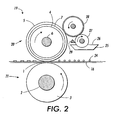
- a fusing station 19 is depicted with an embodiment of a fuser roll 20 comprising polymer surface 5 on a suitable base member or substrate 4, which in this embodiment is a hollow cylinder or core fabricated from any suitable metal, such as aluminum, anodized aluminum, steel, nickel, copper, having a suitable heating element 6 disposed in the hollow portion thereof which is coextensive with the cylinder.
- the fuser member 20 optionally can include an adhesive, cushion, or other suitable layer 7 positioned between core 4 and outer layer 5.
- Backup or pressure roll 21 cooperates with fuser roll 20 to form a nip or contact arc 1 through which a copy paper or other substrate 16 passes such that toner images 24 thereon contact polymer or elastomer surface 5 of fuser roll 20.
- a backup roll or pressure roll 21 is depicted as having a rigid steel core 2 with a polymer or elastomer surface or layer 3 thereon.
- Sump 25 contains polymeric release agent 26, which may be a solid or liquid at room temperature, but is a fluid at operating temperatures, and, can be a a functional or non-functional silicone oil or mixtures thereof.
- the pressure member 21 can also optionally include a heating element (not shown).
- two release agent delivery rolls 27 and 28 rotatably mounted in the direction indicated are provided to transport release agent 26 to polymer or elastomer surface 5.
- Delivery roll 27 is partly immersed in the sump 25 and transports on its surface release agent from the sump to the delivery roll 28.
- a metering blade 29 By using a metering blade 29, a layer of polymeric release fluid can be applied initially to delivery roll 27 and subsequently to polymer or elastomer 5 in controlled thickness ranging from submicron thickness to thicknesses of several microns of release fluid.
- metering device 29 from about 0.1 to about 2 microns or greater thicknesses of release fluid can be applied to the surface of polymer or elastomer 5.
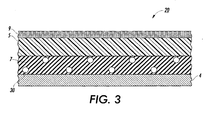
- FIG. 3 is an enlarged schematic view of an embodiment of a fuser member, demonstrating the various possible layers.
- substrate 4 has intermediate layer 7 thereon.
- Intermediate layer 7 can be, for example, a rubber such as silicone rubber or other suitable rubber material.
- outer layer 5 comprising a fluoroelastomer as described below.
- a fluorosilicone is used in combination with a mercapto functional release agent in order to reduce or eliminate fluoroaldehyde emissions.
- the fluorosilicone has the following formula: wherein m is a number of from 0 to 25, or from 1 to 15, or from 1 to 10, and n is a number of from 1 to 25, or from 1 to 15, or from 2 to 12; x/(x + y) is from 1 percent to 100 percent, or from 2 to 80 percent, or from 4 to 20 percent; R 1 and R 2 are selected from the group consisting of alkyl having from about 1 to 25 carbons such as methyl, ethyl, propyl, butyl, aryl such as phenyl, biphenyl, arylalkyl having from 1 to 25 carbons such as methylphenyl, ethylphenyl, propylphenyl, and alkylamino groups having from 1 to 25 carbons, such as methyl amino, ethyl amino,
- m is 2, and R 1 , R 2 and R 3 are selected from the group consisting of alkyl, aryl, arylalkyl and alkylamino groups.
- the fluorosilicone comprises tridecafluorooctane functional groups. In embodiments, the fluorosilicone comprises 3,3,4,4,5,5,6,6,7,7,8,8,8-tridecafluorooctane functional groups.
- the fluorosilicone is blended or mixed with a mercapto functional release agent.
- the mercapto oil is used in combination with the fluorofluid in order to reduce or eliminate fluoroaldehyde emissions.
- the mercapto functional siloxanes include those having the following formulas: wherein A represents -R 4 -X, wherein R 4 represents an alkyl group having from 1 to 10 carbons, X represents -SH; R 1 and R 2 are the same or different and each is selected from the group consisting of an alkyl having from 1 to 25 carbons, an aryl having from 4 to 10 carbons, and an arylalkyl; R 3 is selected from the group consisting of an alkyl having from 1 to 25 carbons, an aryl having from 4 to 10 carbons, an arylalkyl, and a substituted diorganosiloxane chain having from 1 to 500 siloxane units; b and c are numbers and are the same or different and each satisfy the conditions of 1 ⁇ b ⁇ 10 and 10 ⁇ c ⁇ 1,000; d and d' are numbers and are the same or different and are 2 or 3, and e and e' are numbers and are the same or different and are 0 or 1 and satisfy
- a nonfunctional oil refers to oils that do not interact or chemically react with the surface of the fuser member or with fillers on the surface.
- a functional oil refers to a release agent having functional groups which chemically react with the fillers present on the surface of the fuser member, so as to reduce the surface energy of the fillers so as to provide better release of toner particles from the surface of the fuser member. If the surface energy is not reduced, the toner particles will tend to adhere to the fuser roll surface or to filler particles on the surface of the fuser roll, which will result in copy quality defects.
- the fuser oil composition comprises from 1 to 15 weight percent of mercapto functional oil, or from 5 to 10 weight percent mercapto functional oil, and from 85 to 99 weight percent, or from 90 to 95 weight percent fluorosilicone oil.
- the release agent oil compositions may be applied to the fusing surface of the fuser member, such as a fuser roller, fuser belt, fuser film, using known application methodologies such as a roller applicator or by wicking action.
- the amount of the release agent oil applied to the fuser member and subsequently transferred to the receiver sheet is in the range from 0.011 to 6 microliters per sheet, or from 0.01 to 3 microliters per sheet for best release and most efficient use of the oil composition.
- Examples of the outer surface of the fuser system members include fluoroelastomers.
- suitable fluoroelastomers are those described in detail in U.S. Patents 5,166,031 , 5,281,506 , 5,366,772 and 5,370,931 , together with U.S. Patents 4,257,699 , 5,017,432 and 5,061,965 .
- these elastomers are from the class of 1) copolymers of vinylidenefluoride and hexafluoropropylene; 2) terpolymers of vinylidenefluoride, hexafluoropropylene and tetrafluoroethylene; and 3) tetrapolymers of vinylidenefluoride, hexafluoropropylene, tetrafluoroethylene and cure site monomer, are known commercially under various designations as VITON A ® , VITON B ® , VITON E ® , VITON E 60C ® , VITON E430 ® , VITON 910 ® , VITON GH ® ; VITON GF ® ; and VITON ETP ® .
- the VITON ® designation is a Trademark of E.I. DuPont de Nemours, Inc.
- the cure site monomer can be 4-bromoperfluorobutene-1, 1,1-dihydro-4-bromoperfluorobutene-1, 3-bromoperfluoropropene-1, 1,1-dihydro-3-bromoperfluoropropene-1, or any other suitable, known cure site monomer commercially available from DuPont.
- FLUOREL 2170 ® FLUOREL 2174 ®
- FLUOREL 2176 ® FLUOREL 2177 ®
- FLUOREL LVS 76 ® FLUOREL LVS 76 ®
- FLUOREL ® being a Trademark of 3M Company.
- Additional commercially available materials include AFLAS tm a poly(propylene-tetrafluoroethylene) and FLUOREL II ® (LII900) a poly(propylene-tetrafluoroethylenevinylidenefluoride) both also available from 3M Company, as well as the Tecnoflons identified as FOR-60KIR ® , FOR-LHF ® , NM ® FOR-THF ® , FOR-TFS ® , TH ® , and TN505 ® , available from Montedison Specialty Chemical Company.
- fluoroelastomers useful for the surfaces of fuser members include fluoroelastomers, such as fluoroelastomers of vinylidenefluoride-based fluoroelastomers, hexafluoropropylene and tetrafluoroethylene as comonomers. There are also copolymers of one of vinylidenefluoride, hexafluoropropylene and tetrafluoroethylene.
- Examples of three known fluoroelastomers are (1) a class of copolymers of two of vinylidenefluoride, hexafluoropropylene and tetrafluoroethylene, such as those known commercially as VITON A ® (2) a class of terpolymers of vinylidenefluoride, hexafluoropropylene and tetrafluoroethylene known commercially as VITON B ® and (3) a class of tetrapolymers of vinylidenefluoride, hexafluoropropylene, tetrafluoroethylene and cure site monomer known commercially as VITON GH ® or VITON GF ® .
- the fluoroelastomers VITON GH ® and VITON GF ® have relatively low amounts of vinylidenefluoride.
- the VITON GF ® and Viton GH ® have about 35 weight percent of vinylidenefluoride, about 34 weight percent of hexafluoropropylene and about 29 weight percent of tetrafluoroethylene with about 2 weight percent cure site monomer.
- outer layers include fluoropolymers such as polytetrafluoroethylene (PTFE), fluorinated ethylenepropylene copolymer (FEP), polyfluoroalkoxy polytetrafluoroethylene (PFA Teflon), ethylene chlorotrifluoro ethylene (ECTFE), ethylene tetrafluoroethylene (ETFE), polytetrafluoroethylene perfluoromethylvinylether copolymer (MFA), and mixtures or polymers thereof.
- fluoropolymers such as polytetrafluoroethylene (PTFE), fluorinated ethylenepropylene copolymer (FEP), polyfluoroalkoxy polytetrafluoroethylene (PFA Teflon), ethylene chlorotrifluoro ethylene (ECTFE), ethylene tetrafluoroethylene (ETFE), polytetrafluoroethylene perfluoromethylvinylether copolymer (MFA), and mixtures or polymers thereof.
- PTFE polyt
- the amount of fluoroelastomer compound in solution in the outer layer solutions is from 10 to 25 percent, or from 16 to 22 percent by weight of total solids.
- Total solids as used herein includes the amount of fluoroelastomer, dehydrofluorinating agent and optional adjuvants and fillers, including metal oxide fillers.
- the outer layer may comprise a fluoropolymer or other fluoroelastomer blended with the above fluoroelastomer.
- suitable polymer blends include the above fluoroelastomer, blended with a fluoropolymer selected from the group consisting of polytetrafluoroethylene and perfluoroalkoxy.
- the fluoroelastomer can also be blended with non-fluorinated ethylene or non-fluorinated propylene.
- An inorganic particulate filler may be used in connection with the fluoroelastomer outer layer, in order to provide anchoring sites for the functional groups of the silicone fuser agent.
- a filler is not necessary for use with the present fluorosilicone release agent.
- dispensing with a metal oxide increases fuser life and decreases fabrication costs.
- suitable fillers include a metal-containing filler, such as a metal, metal alloy, metal oxide, metal salt or other metal compound.
- the general classes of metals which are applicable to the present invention include those metals of Groups 1b, 2a, 2b, 3a, 3b, 4a, 4b, 5a, 5b, 6b, 7b, 8 and the rare earth elements of the Periodic Table.
- the filler can be an oxide of aluminum, copper, tin, zinc, lead, iron, platinum, gold, silver, antimony, bismuth, zinc, iridium, ruthenium, tungsten, manganese, cadmium, mercury, vanadium, chromium, magnesium, nickel and alloys thereof.
- Other specific examples include inorganic particulate fillers are aluminum oxide and cupric oxide.
- Other examples include reinforcing and non-reinforcing calcined alumina and tabular alumina respectively.
- the thickness of the outer fluoroelastomer surface layer of the fuser member herein is from 10 to 250 micrometers, or from 15 to 100 micrometers.
- Optional intermediate adhesive layers and/or intermediate polymer or elastomer layers may be applied to achieve desired properties and performance objectives.
- the intermediate layer may be present between the substrate and the outer fluoroelastomer surface.
- An adhesive intermediate layer may be selected from, for example, epoxy resins and polysiloxanes.
- suitable intermediate layers include silicone rubbers such as room temperature vulcanization (RTV) silicone rubbers; high temperature vulcanization (HTV) silicone rubbers and low temperature vulcanization (LTV) silicone rubbers. These rubbers are known and readily available commercially such as SILASTIC ® 735 black RTV and SILASTIC ® 732 RTV, both from Dow Corning; and 106 RTV Silicone Rubber and 90 RTV Silicone Rubber, both from General Electric.
- silicone materials include the siloxanes (such as polydimethylsiloxanes); fluorosilicones such as Silicone Rubber 552, available from Sampson Coatings, Richmond, Virginia; liquid silicone rubbers such as vinyl crosslinked heat curable rubbers or silanol room temperature crosslinked materials; and the like. Another specific example is Dow Corning Sylgard 182.
- an adhesive layer between the substrate and the intermediate layer There may be provided an adhesive layer between the substrate and the intermediate layer. There may also be an adhesive layer between the intermediate layer and the outer layer. In the absence of an intermediate layer, the fluoroelastomer layer may be bonded to the substrate via an adhesive layer.
- the thickness of the intermediate layer is from 0.5 to 20 mm, or from 1 to 5 mm.
- the release agents or fusing oils described herein are provided onto the outer layer of the fuser member via a delivery mechanism such as a delivery roll.
- the delivery roll is partially immersed in a sump, which houses the fuser oil or release agent.
- the fluorosilicone oil is renewable in that the release oil is housed in a holding sump and provided to the fuser roll when needed, optionally by way of a release agent donor roll in an amount of from 0.1 to 20 mg/copy, or from 1 to 12 mg/copy.
- the system by which fuser oil is provided to the fuser roll via a holding sump and optional donor roll is well known.
- the release oil may be present on the fuser member in a continuous or semicontinuous phase.
- the fuser oil in the form of a film is in a continuous phase and continuously covers the fuser member.
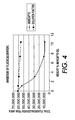
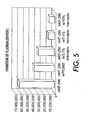
- a fluorinated organopolydimethylsiloxane containing 5.6 mol% pendant tridecafluorooctyl fluorinated groups was compared with (2) the same fluorinated organopolydimethylsiloxane with PC085 (chloroplatinic acid), (3) the same fluorinated organopolydimethylsiloxane with 3.1 wt% mercaptopropyl functional fluid (Xerox Fuser Agent), (4) the same fluorinated organopolydimethylsiloxane with 7.4 wt% mercaptopropyl functional fluid (Xerox Fuser Agent) and (5) the same fluorinated organopolydimethylsiloxane with 10% mercaptopropyl functional fluid (Xerox Fuser Agent).
- Figure 5 is a bar graph of the relative amounts of fluoroaldehydes emitted upon heating for 30 minutes at 260°C for the above five different fluids.
- Figure 4 is a graph of total fluoroaldehyde peak area from the Headspace Gas Chromatography/Mass spectra of the M/Z 95 base ion for the fluoroaldehyde structures emitted versus weight percent mercapto oil, showing the inhibition of fluoroaldehydes upon heating for 30 minutes at 260°C in a closed container.
Landscapes
- Physics & Mathematics (AREA)
- General Physics & Mathematics (AREA)
- Fixing For Electrophotography (AREA)
- Laminated Bodies (AREA)
- Paints Or Removers (AREA)
- Rolls And Other Rotary Bodies (AREA)
- Compositions Of Macromolecular Compounds (AREA)
- Coating Of Shaped Articles Made Of Macromolecular Substances (AREA)
Applications Claiming Priority (1)
| Application Number | Priority Date | Filing Date | Title |
|---|---|---|---|
| US11/054,086 US7381514B2 (en) | 2005-02-08 | 2005-02-08 | Stabilization of fluorinated silicone fuser release agents using mercapto functional silicones |
Publications (3)
| Publication Number | Publication Date |
|---|---|
| EP1688803A2 EP1688803A2 (en) | 2006-08-09 |
| EP1688803A3 EP1688803A3 (en) | 2009-01-07 |
| EP1688803B1 true EP1688803B1 (en) | 2013-06-26 |
Family
ID=36499578
Family Applications (1)
| Application Number | Title | Priority Date | Filing Date |
|---|---|---|---|
| EP20060100340 Ceased EP1688803B1 (en) | 2005-02-08 | 2006-01-13 | Fuser member and image forming apparatus comprising the same |
Country Status (5)
| Country | Link |
|---|---|
| US (1) | US7381514B2 (enExample) |
| EP (1) | EP1688803B1 (enExample) |
| JP (1) | JP4587968B2 (enExample) |
| BR (1) | BRPI0600342A (enExample) |
| CA (1) | CA2534949C (enExample) |
Families Citing this family (3)
| Publication number | Priority date | Publication date | Assignee | Title |
|---|---|---|---|---|
| US8318302B2 (en) * | 2008-03-12 | 2012-11-27 | Xerox Corporation | Fuser member release layer having nano-size copper metal particles |
| US8563116B2 (en) * | 2010-09-02 | 2013-10-22 | Xerox Corporation | Fuser manufacture and apparatus |
| CN116406328A (zh) * | 2020-11-04 | 2023-07-07 | 琳得科株式会社 | 剥离膜 |
Family Cites Families (18)
| Publication number | Priority date | Publication date | Assignee | Title |
|---|---|---|---|---|
| US4029827A (en) * | 1974-07-24 | 1977-06-14 | Xerox Corporation | Mercapto functional polyorganosiloxane release agents for fusers in electrostatic copiers |
| US4251277A (en) * | 1978-04-24 | 1981-02-17 | Sws Silicones Corporation | Compositions containing thiofunctional polysiloxanes |
| US4515884A (en) * | 1982-09-21 | 1985-05-07 | Xerox Corporation | Fusing system with unblended silicone oil |
| US4968766A (en) * | 1989-01-12 | 1990-11-06 | Dow Corning Corporation | Fluorosilicone compounds and compositions for adhesive release liners |
| US5217837A (en) * | 1991-09-05 | 1993-06-08 | Xerox Corporation | Multilayered fuser member |
| US5366772A (en) * | 1993-07-28 | 1994-11-22 | Xerox Corporation | Fuser member |
| JPH07331226A (ja) * | 1993-08-27 | 1995-12-19 | Asahi Glass Co Ltd | 加熱定着ロール防汚用オイル |
| US5395725A (en) * | 1993-11-22 | 1995-03-07 | Xerox Corporation | Fuser oil compositions and processes thereof |
| JPH0850424A (ja) * | 1994-08-08 | 1996-02-20 | Fujitsu Ltd | 画像形成装置 |
| JP3369008B2 (ja) * | 1994-09-29 | 2003-01-20 | コニカ株式会社 | 定着装置 |
| US5627000A (en) * | 1994-10-07 | 1997-05-06 | Konica Corporation | Heat fixing method |
| US5636012A (en) * | 1994-12-13 | 1997-06-03 | Konica Corporation | Toner image fixing device |
| US5624780A (en) * | 1995-04-03 | 1997-04-29 | Konica Corporation | Toner image fixing method using fluorine containing silicone oil |
| US5757214A (en) * | 1995-07-19 | 1998-05-26 | Stoddard; Robert J. | PWM driver for an inductive load with detector of a not regulating PWM condition |
| US6197989B1 (en) * | 1996-07-18 | 2001-03-06 | Asahi Glass Company Ltd. | Fluorinated organosilicon compounds and process for the preparation thereof |
| US6808814B2 (en) * | 2003-03-18 | 2004-10-26 | Xerox Corporation | Blended fluorosilicone release agent for polymeric fuser members |
| US6830819B2 (en) * | 2003-03-18 | 2004-12-14 | Xerox Corporation | Fluorosilicone release agent for fluoroelastomer fuser members |
| US6808815B2 (en) * | 2003-03-18 | 2004-10-26 | Xerox Corporation | Blended fluorosilicone release agent for silicone fuser members |
-
2005
- 2005-02-08 US US11/054,086 patent/US7381514B2/en not_active Expired - Fee Related
-
2006
- 2006-01-13 EP EP20060100340 patent/EP1688803B1/en not_active Ceased
- 2006-02-01 CA CA 2534949 patent/CA2534949C/en not_active Expired - Fee Related
- 2006-02-08 JP JP2006031471A patent/JP4587968B2/ja not_active Expired - Fee Related
- 2006-02-08 BR BRPI0600342 patent/BRPI0600342A/pt not_active Application Discontinuation
Also Published As
| Publication number | Publication date |
|---|---|
| JP4587968B2 (ja) | 2010-11-24 |
| BRPI0600342A (pt) | 2006-10-03 |
| CA2534949A1 (en) | 2006-08-08 |
| US20060177758A1 (en) | 2006-08-10 |
| JP2006221179A (ja) | 2006-08-24 |
| EP1688803A3 (en) | 2009-01-07 |
| US7381514B2 (en) | 2008-06-03 |
| CA2534949C (en) | 2009-05-05 |
| EP1688803A2 (en) | 2006-08-09 |
Similar Documents
| Publication | Publication Date | Title |
|---|---|---|
| US6830819B2 (en) | Fluorosilicone release agent for fluoroelastomer fuser members | |
| US6261688B1 (en) | Tertiary amine functionalized fuser fluids | |
| US6159588A (en) | Fuser member with fluoropolymer, silicone and alumina composite layer | |
| EP1288727B1 (en) | Polydimethylsiloxane and fluorosurfactant fusing release agent | |
| US6485835B1 (en) | Functional fusing agent | |
| US6808815B2 (en) | Blended fluorosilicone release agent for silicone fuser members | |
| US6808814B2 (en) | Blended fluorosilicone release agent for polymeric fuser members | |
| JP5009554B2 (ja) | フッ素化界面活性剤を用いたフルオロエラストマー溶融定着部材をコーティングするためのプロセス | |
| EP1726628B1 (en) | Process for coating a fuser member using a coating composition comprising a fluoroelastomer and a blend of two different fluorinated copolymer surfactants | |
| EP1727003B1 (en) | Process for producing a fuser member coating using a fluoroelastomer and a blend of a fluorinated surfactant and a fluorinated polydimethylsiloxane | |
| EP1688803B1 (en) | Fuser member and image forming apparatus comprising the same | |
| JP5270072B2 (ja) | フッ素化ポリジメチルシロキサン添加剤を用いたフルオロエラストマー定着部材をコーティングするためのプロセス | |
| US7242900B2 (en) | Oil-less fuser member | |
| US20060110543A1 (en) | Method for optimizing fuser release agent composition | |
| US20080069609A1 (en) | Fluoroelastomer fuser members having fluoropolymer filler |
Legal Events
| Date | Code | Title | Description |
|---|---|---|---|
| PUAI | Public reference made under article 153(3) epc to a published international application that has entered the european phase |
Free format text: ORIGINAL CODE: 0009012 |
|
| AK | Designated contracting states |
Kind code of ref document: A2 Designated state(s): AT BE BG CH CY CZ DE DK EE ES FI FR GB GR HU IE IS IT LI LT LU LV MC NL PL PT RO SE SI SK TR |
|
| AX | Request for extension of the european patent |
Extension state: AL BA HR MK YU |
|
| PUAL | Search report despatched |
Free format text: ORIGINAL CODE: 0009013 |
|
| AK | Designated contracting states |
Kind code of ref document: A3 Designated state(s): AT BE BG CH CY CZ DE DK EE ES FI FR GB GR HU IE IS IT LI LT LU LV MC NL PL PT RO SE SI SK TR |
|
| AX | Request for extension of the european patent |
Extension state: AL BA HR MK YU |
|
| 17P | Request for examination filed |
Effective date: 20090707 |
|
| AKX | Designation fees paid |
Designated state(s): DE FR GB |
|
| 17Q | First examination report despatched |
Effective date: 20090825 |
|
| GRAP | Despatch of communication of intention to grant a patent |
Free format text: ORIGINAL CODE: EPIDOSNIGR1 |
|
| GRAS | Grant fee paid |
Free format text: ORIGINAL CODE: EPIDOSNIGR3 |
|
| GRAA | (expected) grant |
Free format text: ORIGINAL CODE: 0009210 |
|
| AK | Designated contracting states |
Kind code of ref document: B1 Designated state(s): DE FR GB |
|
| REG | Reference to a national code |
Ref country code: GB Ref legal event code: FG4D |
|
| REG | Reference to a national code |
Ref country code: DE Ref legal event code: R096 Ref document number: 602006036955 Country of ref document: DE Effective date: 20130822 |
|
| PLBE | No opposition filed within time limit |
Free format text: ORIGINAL CODE: 0009261 |
|
| STAA | Information on the status of an ep patent application or granted ep patent |
Free format text: STATUS: NO OPPOSITION FILED WITHIN TIME LIMIT |
|
| 26N | No opposition filed |
Effective date: 20140327 |
|
| REG | Reference to a national code |
Ref country code: DE Ref legal event code: R097 Ref document number: 602006036955 Country of ref document: DE Effective date: 20140327 |
|
| REG | Reference to a national code |
Ref country code: FR Ref legal event code: PLFP Year of fee payment: 11 |
|
| REG | Reference to a national code |
Ref country code: FR Ref legal event code: PLFP Year of fee payment: 12 |
|
| REG | Reference to a national code |
Ref country code: FR Ref legal event code: PLFP Year of fee payment: 13 |
|
| PGFP | Annual fee paid to national office [announced via postgrant information from national office to epo] |
Ref country code: FR Payment date: 20171221 Year of fee payment: 13 |
|
| PGFP | Annual fee paid to national office [announced via postgrant information from national office to epo] |
Ref country code: GB Payment date: 20171222 Year of fee payment: 13 |
|
| PGFP | Annual fee paid to national office [announced via postgrant information from national office to epo] |
Ref country code: DE Payment date: 20171218 Year of fee payment: 13 |
|
| REG | Reference to a national code |
Ref country code: DE Ref legal event code: R119 Ref document number: 602006036955 Country of ref document: DE |
|
| GBPC | Gb: european patent ceased through non-payment of renewal fee |
Effective date: 20190113 |
|
| PG25 | Lapsed in a contracting state [announced via postgrant information from national office to epo] |
Ref country code: FR Free format text: LAPSE BECAUSE OF NON-PAYMENT OF DUE FEES Effective date: 20190131 Ref country code: DE Free format text: LAPSE BECAUSE OF NON-PAYMENT OF DUE FEES Effective date: 20190801 |
|
| PG25 | Lapsed in a contracting state [announced via postgrant information from national office to epo] |
Ref country code: GB Free format text: LAPSE BECAUSE OF NON-PAYMENT OF DUE FEES Effective date: 20190113 |