EP1685214B1 - A process for making lube oil basestocks - Google Patents
A process for making lube oil basestocks Download PDFInfo
- Publication number
- EP1685214B1 EP1685214B1 EP04818610.0A EP04818610A EP1685214B1 EP 1685214 B1 EP1685214 B1 EP 1685214B1 EP 04818610 A EP04818610 A EP 04818610A EP 1685214 B1 EP1685214 B1 EP 1685214B1
- Authority
- EP
- European Patent Office
- Prior art keywords
- catalyst
- lubricating oil
- dewaxing
- raffinate
- solvent
- Prior art date
- Legal status (The legal status is an assumption and is not a legal conclusion. Google has not performed a legal analysis and makes no representation as to the accuracy of the status listed.)
- Expired - Lifetime
Links
Images
Classifications
-
- C—CHEMISTRY; METALLURGY
- C10—PETROLEUM, GAS OR COKE INDUSTRIES; TECHNICAL GASES CONTAINING CARBON MONOXIDE; FUELS; LUBRICANTS; PEAT
- C10G—CRACKING HYDROCARBON OILS; PRODUCTION OF LIQUID HYDROCARBON MIXTURES, e.g. BY DESTRUCTIVE HYDROGENATION, OLIGOMERISATION, POLYMERISATION; RECOVERY OF HYDROCARBON OILS FROM OIL-SHALE, OIL-SAND, OR GASES; REFINING MIXTURES MAINLY CONSISTING OF HYDROCARBONS; REFORMING OF NAPHTHA; MINERAL WAXES
- C10G49/00—Treatment of hydrocarbon oils, in the presence of hydrogen or hydrogen-generating compounds, not provided for in a single one of groups C10G45/02, C10G45/32, C10G45/44, C10G45/58 or C10G47/00
- C10G49/002—Apparatus for fixed bed hydrotreatment processes
-
- B—PERFORMING OPERATIONS; TRANSPORTING
- B01—PHYSICAL OR CHEMICAL PROCESSES OR APPARATUS IN GENERAL
- B01J—CHEMICAL OR PHYSICAL PROCESSES, e.g. CATALYSIS OR COLLOID CHEMISTRY; THEIR RELEVANT APPARATUS
- B01J23/00—Catalysts comprising metals or metal oxides or hydroxides, not provided for in group B01J21/00
- B01J23/70—Catalysts comprising metals or metal oxides or hydroxides, not provided for in group B01J21/00 of the iron group metals or copper
- B01J23/76—Catalysts comprising metals or metal oxides or hydroxides, not provided for in group B01J21/00 of the iron group metals or copper combined with metals, oxides or hydroxides provided for in groups B01J23/02 - B01J23/36
- B01J23/84—Catalysts comprising metals or metal oxides or hydroxides, not provided for in group B01J21/00 of the iron group metals or copper combined with metals, oxides or hydroxides provided for in groups B01J23/02 - B01J23/36 with arsenic, antimony, bismuth, vanadium, niobium, tantalum, polonium, chromium, molybdenum, tungsten, manganese, technetium or rhenium
- B01J23/85—Chromium, molybdenum or tungsten
-
- B—PERFORMING OPERATIONS; TRANSPORTING
- B01—PHYSICAL OR CHEMICAL PROCESSES OR APPARATUS IN GENERAL
- B01J—CHEMICAL OR PHYSICAL PROCESSES, e.g. CATALYSIS OR COLLOID CHEMISTRY; THEIR RELEVANT APPARATUS
- B01J23/00—Catalysts comprising metals or metal oxides or hydroxides, not provided for in group B01J21/00
- B01J23/70—Catalysts comprising metals or metal oxides or hydroxides, not provided for in group B01J21/00 of the iron group metals or copper
- B01J23/76—Catalysts comprising metals or metal oxides or hydroxides, not provided for in group B01J21/00 of the iron group metals or copper combined with metals, oxides or hydroxides provided for in groups B01J23/02 - B01J23/36
- B01J23/84—Catalysts comprising metals or metal oxides or hydroxides, not provided for in group B01J21/00 of the iron group metals or copper combined with metals, oxides or hydroxides provided for in groups B01J23/02 - B01J23/36 with arsenic, antimony, bismuth, vanadium, niobium, tantalum, polonium, chromium, molybdenum, tungsten, manganese, technetium or rhenium
- B01J23/85—Chromium, molybdenum or tungsten
- B01J23/888—Tungsten
- B01J23/8885—Tungsten containing also molybdenum
-
- B—PERFORMING OPERATIONS; TRANSPORTING
- B01—PHYSICAL OR CHEMICAL PROCESSES OR APPARATUS IN GENERAL
- B01J—CHEMICAL OR PHYSICAL PROCESSES, e.g. CATALYSIS OR COLLOID CHEMISTRY; THEIR RELEVANT APPARATUS
- B01J35/00—Catalysts, in general, characterised by their form or physical properties
- B01J35/19—Catalysts containing parts with different compositions
-
- B—PERFORMING OPERATIONS; TRANSPORTING
- B01—PHYSICAL OR CHEMICAL PROCESSES OR APPARATUS IN GENERAL
- B01J—CHEMICAL OR PHYSICAL PROCESSES, e.g. CATALYSIS OR COLLOID CHEMISTRY; THEIR RELEVANT APPARATUS
- B01J35/00—Catalysts, in general, characterised by their form or physical properties
- B01J35/60—Catalysts, in general, characterised by their form or physical properties characterised by their surface properties or porosity
-
- B—PERFORMING OPERATIONS; TRANSPORTING
- B01—PHYSICAL OR CHEMICAL PROCESSES OR APPARATUS IN GENERAL
- B01J—CHEMICAL OR PHYSICAL PROCESSES, e.g. CATALYSIS OR COLLOID CHEMISTRY; THEIR RELEVANT APPARATUS
- B01J23/00—Catalysts comprising metals or metal oxides or hydroxides, not provided for in group B01J21/00
- B01J23/70—Catalysts comprising metals or metal oxides or hydroxides, not provided for in group B01J21/00 of the iron group metals or copper
- B01J23/76—Catalysts comprising metals or metal oxides or hydroxides, not provided for in group B01J21/00 of the iron group metals or copper combined with metals, oxides or hydroxides provided for in groups B01J23/02 - B01J23/36
- B01J23/84—Catalysts comprising metals or metal oxides or hydroxides, not provided for in group B01J21/00 of the iron group metals or copper combined with metals, oxides or hydroxides provided for in groups B01J23/02 - B01J23/36 with arsenic, antimony, bismuth, vanadium, niobium, tantalum, polonium, chromium, molybdenum, tungsten, manganese, technetium or rhenium
- B01J23/85—Chromium, molybdenum or tungsten
- B01J23/88—Molybdenum
- B01J23/882—Molybdenum and cobalt
-
- B—PERFORMING OPERATIONS; TRANSPORTING
- B01—PHYSICAL OR CHEMICAL PROCESSES OR APPARATUS IN GENERAL
- B01J—CHEMICAL OR PHYSICAL PROCESSES, e.g. CATALYSIS OR COLLOID CHEMISTRY; THEIR RELEVANT APPARATUS
- B01J23/00—Catalysts comprising metals or metal oxides or hydroxides, not provided for in group B01J21/00
- B01J23/70—Catalysts comprising metals or metal oxides or hydroxides, not provided for in group B01J21/00 of the iron group metals or copper
- B01J23/76—Catalysts comprising metals or metal oxides or hydroxides, not provided for in group B01J21/00 of the iron group metals or copper combined with metals, oxides or hydroxides provided for in groups B01J23/02 - B01J23/36
- B01J23/84—Catalysts comprising metals or metal oxides or hydroxides, not provided for in group B01J21/00 of the iron group metals or copper combined with metals, oxides or hydroxides provided for in groups B01J23/02 - B01J23/36 with arsenic, antimony, bismuth, vanadium, niobium, tantalum, polonium, chromium, molybdenum, tungsten, manganese, technetium or rhenium
- B01J23/85—Chromium, molybdenum or tungsten
- B01J23/88—Molybdenum
- B01J23/883—Molybdenum and nickel
-
- B—PERFORMING OPERATIONS; TRANSPORTING
- B01—PHYSICAL OR CHEMICAL PROCESSES OR APPARATUS IN GENERAL
- B01J—CHEMICAL OR PHYSICAL PROCESSES, e.g. CATALYSIS OR COLLOID CHEMISTRY; THEIR RELEVANT APPARATUS
- B01J35/00—Catalysts, in general, characterised by their form or physical properties
- B01J35/60—Catalysts, in general, characterised by their form or physical properties characterised by their surface properties or porosity
- B01J35/61—Surface area
- B01J35/615—100-500 m2/g
-
- B—PERFORMING OPERATIONS; TRANSPORTING
- B01—PHYSICAL OR CHEMICAL PROCESSES OR APPARATUS IN GENERAL
- B01J—CHEMICAL OR PHYSICAL PROCESSES, e.g. CATALYSIS OR COLLOID CHEMISTRY; THEIR RELEVANT APPARATUS
- B01J35/00—Catalysts, in general, characterised by their form or physical properties
- B01J35/60—Catalysts, in general, characterised by their form or physical properties characterised by their surface properties or porosity
- B01J35/63—Pore volume
-
- B—PERFORMING OPERATIONS; TRANSPORTING
- B01—PHYSICAL OR CHEMICAL PROCESSES OR APPARATUS IN GENERAL
- B01J—CHEMICAL OR PHYSICAL PROCESSES, e.g. CATALYSIS OR COLLOID CHEMISTRY; THEIR RELEVANT APPARATUS
- B01J35/00—Catalysts, in general, characterised by their form or physical properties
- B01J35/60—Catalysts, in general, characterised by their form or physical properties characterised by their surface properties or porosity
- B01J35/64—Pore diameter
- B01J35/647—2-50 nm
-
- B—PERFORMING OPERATIONS; TRANSPORTING
- B01—PHYSICAL OR CHEMICAL PROCESSES OR APPARATUS IN GENERAL
- B01J—CHEMICAL OR PHYSICAL PROCESSES, e.g. CATALYSIS OR COLLOID CHEMISTRY; THEIR RELEVANT APPARATUS
- B01J37/00—Processes, in general, for preparing catalysts; Processes, in general, for activation of catalysts
- B01J37/20—Sulfiding
-
- C—CHEMISTRY; METALLURGY
- C10—PETROLEUM, GAS OR COKE INDUSTRIES; TECHNICAL GASES CONTAINING CARBON MONOXIDE; FUELS; LUBRICANTS; PEAT
- C10G—CRACKING HYDROCARBON OILS; PRODUCTION OF LIQUID HYDROCARBON MIXTURES, e.g. BY DESTRUCTIVE HYDROGENATION, OLIGOMERISATION, POLYMERISATION; RECOVERY OF HYDROCARBON OILS FROM OIL-SHALE, OIL-SAND, OR GASES; REFINING MIXTURES MAINLY CONSISTING OF HYDROCARBONS; REFORMING OF NAPHTHA; MINERAL WAXES
- C10G2300/00—Aspects relating to hydrocarbon processing covered by groups C10G1/00 - C10G99/00
- C10G2300/10—Feedstock materials
- C10G2300/1022—Fischer-Tropsch products
-
- C—CHEMISTRY; METALLURGY
- C10—PETROLEUM, GAS OR COKE INDUSTRIES; TECHNICAL GASES CONTAINING CARBON MONOXIDE; FUELS; LUBRICANTS; PEAT
- C10G—CRACKING HYDROCARBON OILS; PRODUCTION OF LIQUID HYDROCARBON MIXTURES, e.g. BY DESTRUCTIVE HYDROGENATION, OLIGOMERISATION, POLYMERISATION; RECOVERY OF HYDROCARBON OILS FROM OIL-SHALE, OIL-SAND, OR GASES; REFINING MIXTURES MAINLY CONSISTING OF HYDROCARBONS; REFORMING OF NAPHTHA; MINERAL WAXES
- C10G2300/00—Aspects relating to hydrocarbon processing covered by groups C10G1/00 - C10G99/00
- C10G2300/10—Feedstock materials
- C10G2300/1037—Hydrocarbon fractions
- C10G2300/1062—Lubricating oils
-
- C—CHEMISTRY; METALLURGY
- C10—PETROLEUM, GAS OR COKE INDUSTRIES; TECHNICAL GASES CONTAINING CARBON MONOXIDE; FUELS; LUBRICANTS; PEAT
- C10G—CRACKING HYDROCARBON OILS; PRODUCTION OF LIQUID HYDROCARBON MIXTURES, e.g. BY DESTRUCTIVE HYDROGENATION, OLIGOMERISATION, POLYMERISATION; RECOVERY OF HYDROCARBON OILS FROM OIL-SHALE, OIL-SAND, OR GASES; REFINING MIXTURES MAINLY CONSISTING OF HYDROCARBONS; REFORMING OF NAPHTHA; MINERAL WAXES
- C10G2300/00—Aspects relating to hydrocarbon processing covered by groups C10G1/00 - C10G99/00
- C10G2300/10—Feedstock materials
- C10G2300/1074—Vacuum distillates
-
- C—CHEMISTRY; METALLURGY
- C10—PETROLEUM, GAS OR COKE INDUSTRIES; TECHNICAL GASES CONTAINING CARBON MONOXIDE; FUELS; LUBRICANTS; PEAT
- C10G—CRACKING HYDROCARBON OILS; PRODUCTION OF LIQUID HYDROCARBON MIXTURES, e.g. BY DESTRUCTIVE HYDROGENATION, OLIGOMERISATION, POLYMERISATION; RECOVERY OF HYDROCARBON OILS FROM OIL-SHALE, OIL-SAND, OR GASES; REFINING MIXTURES MAINLY CONSISTING OF HYDROCARBONS; REFORMING OF NAPHTHA; MINERAL WAXES
- C10G2300/00—Aspects relating to hydrocarbon processing covered by groups C10G1/00 - C10G99/00
- C10G2300/20—Characteristics of the feedstock or the products
- C10G2300/201—Impurities
- C10G2300/202—Heteroatoms content, i.e. S, N, O, P
-
- C—CHEMISTRY; METALLURGY
- C10—PETROLEUM, GAS OR COKE INDUSTRIES; TECHNICAL GASES CONTAINING CARBON MONOXIDE; FUELS; LUBRICANTS; PEAT
- C10G—CRACKING HYDROCARBON OILS; PRODUCTION OF LIQUID HYDROCARBON MIXTURES, e.g. BY DESTRUCTIVE HYDROGENATION, OLIGOMERISATION, POLYMERISATION; RECOVERY OF HYDROCARBON OILS FROM OIL-SHALE, OIL-SAND, OR GASES; REFINING MIXTURES MAINLY CONSISTING OF HYDROCARBONS; REFORMING OF NAPHTHA; MINERAL WAXES
- C10G2300/00—Aspects relating to hydrocarbon processing covered by groups C10G1/00 - C10G99/00
- C10G2300/20—Characteristics of the feedstock or the products
- C10G2300/30—Physical properties of feedstocks or products
- C10G2300/301—Boiling range
-
- C—CHEMISTRY; METALLURGY
- C10—PETROLEUM, GAS OR COKE INDUSTRIES; TECHNICAL GASES CONTAINING CARBON MONOXIDE; FUELS; LUBRICANTS; PEAT
- C10G—CRACKING HYDROCARBON OILS; PRODUCTION OF LIQUID HYDROCARBON MIXTURES, e.g. BY DESTRUCTIVE HYDROGENATION, OLIGOMERISATION, POLYMERISATION; RECOVERY OF HYDROCARBON OILS FROM OIL-SHALE, OIL-SAND, OR GASES; REFINING MIXTURES MAINLY CONSISTING OF HYDROCARBONS; REFORMING OF NAPHTHA; MINERAL WAXES
- C10G2300/00—Aspects relating to hydrocarbon processing covered by groups C10G1/00 - C10G99/00
- C10G2300/20—Characteristics of the feedstock or the products
- C10G2300/30—Physical properties of feedstocks or products
- C10G2300/302—Viscosity
-
- C—CHEMISTRY; METALLURGY
- C10—PETROLEUM, GAS OR COKE INDUSTRIES; TECHNICAL GASES CONTAINING CARBON MONOXIDE; FUELS; LUBRICANTS; PEAT
- C10G—CRACKING HYDROCARBON OILS; PRODUCTION OF LIQUID HYDROCARBON MIXTURES, e.g. BY DESTRUCTIVE HYDROGENATION, OLIGOMERISATION, POLYMERISATION; RECOVERY OF HYDROCARBON OILS FROM OIL-SHALE, OIL-SAND, OR GASES; REFINING MIXTURES MAINLY CONSISTING OF HYDROCARBONS; REFORMING OF NAPHTHA; MINERAL WAXES
- C10G2300/00—Aspects relating to hydrocarbon processing covered by groups C10G1/00 - C10G99/00
- C10G2300/40—Characteristics of the process deviating from typical ways of processing
- C10G2300/4018—Spatial velocity, e.g. LHSV, WHSV
-
- C—CHEMISTRY; METALLURGY
- C10—PETROLEUM, GAS OR COKE INDUSTRIES; TECHNICAL GASES CONTAINING CARBON MONOXIDE; FUELS; LUBRICANTS; PEAT
- C10G—CRACKING HYDROCARBON OILS; PRODUCTION OF LIQUID HYDROCARBON MIXTURES, e.g. BY DESTRUCTIVE HYDROGENATION, OLIGOMERISATION, POLYMERISATION; RECOVERY OF HYDROCARBON OILS FROM OIL-SHALE, OIL-SAND, OR GASES; REFINING MIXTURES MAINLY CONSISTING OF HYDROCARBONS; REFORMING OF NAPHTHA; MINERAL WAXES
- C10G2300/00—Aspects relating to hydrocarbon processing covered by groups C10G1/00 - C10G99/00
- C10G2300/40—Characteristics of the process deviating from typical ways of processing
- C10G2300/44—Solvents
-
- C—CHEMISTRY; METALLURGY
- C10—PETROLEUM, GAS OR COKE INDUSTRIES; TECHNICAL GASES CONTAINING CARBON MONOXIDE; FUELS; LUBRICANTS; PEAT
- C10G—CRACKING HYDROCARBON OILS; PRODUCTION OF LIQUID HYDROCARBON MIXTURES, e.g. BY DESTRUCTIVE HYDROGENATION, OLIGOMERISATION, POLYMERISATION; RECOVERY OF HYDROCARBON OILS FROM OIL-SHALE, OIL-SAND, OR GASES; REFINING MIXTURES MAINLY CONSISTING OF HYDROCARBONS; REFORMING OF NAPHTHA; MINERAL WAXES
- C10G2400/00—Products obtained by processes covered by groups C10G9/00 - C10G69/14
- C10G2400/10—Lubricating oil
Definitions
- the present invention relates to a process for preparing lubricating oil basestocks from lube oil boiling range feedstreams that meet American Petroleum Institute Group II specifications. More particularly, the present invention is directed at a process wherein a wax containing feedstock is solvent extracted to produce at least a lube oil boiling range raffinate, the lube oil raffinate is hydrotreated to produce a hydrotreated raffinate, and the hydrotreated raffinate is dewaxed.
- Hydrocracking has been combined with hydrotreating as a preliminary step. However, this combination also results in decreased yields of lubricating oils due to the conversion to distillates that typically accompany the hydrocracking process.
- WO-00/42119 disposes hydroconversion processes for preparing lubricating oil basestocks from lube oil boiling range feedstreams.
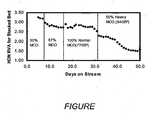
- the Figure is a plot of the relative volume activity of various catalysts and catalyst systems versus the days the respective catalysts and catalyst systems were on stream.
- the present invention is directed at a process to prepare lubricating oil basestocks having a viscosity index of 80 to 120 from a lube oil boiling range feedstock as defined in the claims.
- the American Petroleum Institute (API) requirements for Group II basestocks include a saturates content of at least 90%, a sulfur content of 0.03 wt.% or less and a viscosity index (VI) between 80 and 120.
- the present process involves hydrotreating a lubricating oil feedstock with a stacked bed hydrotreating catalyst system in a reaction stage operated under effective conditions to produce a hydrotreated effluent comprising at least a gaseous product and a hydrotreated lubricating oil feedstock.
- the hydrotreated effluent is stripped to remove at least a portion of the gaseous product from the hydrotreated effluent thereby producing at least a lubricating oil basestock having a saturates content of at least 90%, a sulfur content of 0.03 wt.% or less, and a viscosity index (VI) between 80 and 120.
- the lubricating oil feedstock is a lubricating oil boiling range raffinate. While in another embodiment of the instant invention, the lubricating oil boiling range feedstock is a dewaxed oil.
- one embodiment of the instant invention involves solvent extracting a lubricating oil feedstock in a solvent extraction zone under conditions effective at producing at least an aromatics-lean raffinate solution containing extraction solvent. At least a portion of the extraction solvent from the aromatics-lean raffinate solution is then removed, thus producing a raffinate feedstock.
- the raffinate feedstock is contacted with a stacked bed hydrotreating catalyst system in a reaction stage operated under effective conditions to produce a hydrotreated effluent comprising at least a gaseous product and a hydrotreated raffinate.
- the hydrotreated raffinate is subsequently dewaxed under effective dewaxing conditions thereby producing at least a lubricating oil basestock characterized as a Group II basestock having a saturates content of at least 90%, a sulfur content of 0.03 wt.% or less, and a viscosity index (VI) between 80 and 120.
- a lubricating oil basestock characterized as a Group II basestock having a saturates content of at least 90%, a sulfur content of 0.03 wt.% or less, and a viscosity index (VI) between 80 and 120.
- the lubricating oil feedstock can be a dewaxed oil
- one embodiment of the instant invention is directed at dewaxing a lubricating oil feedstock under-effective dewaxing conditions thereby producing at least a dewaxed lubricating oil feedstock.
- the dewaxed lubricating oil feedstock is then contacted with a stacked bed hydrotreating catalyst system in a reaction stage operated under effective conditions thereby producing a hydrotreated effluent comprising at least gaseous product and a hydrotreated dewaxed lubricating oil feedstock.
- the hydrotreated effluent is then stripped to remove at least a portion of the gaseous product from the hydrotreated effluent thereby producing at least a lubricating oil basestock having a saturates content of at least 90%, a sulfur content of 0.03 wt.% or less, and a viscosity index (VI) between 80 and 120.
- Feedstocks suitable for use in the present invention are wax-containing feeds that boil in the lubricating oil range, typically having a 10% distillation point greater than 650°F (343°C) and an endpoint greater than 800°F (426°C), measured by ASTM D 86 or ASTM 2887. These feedstocks can be derived from mineral sources, synthetic sources, or a mixture of the two.
- Non-limiting examples of suitable lubricating oil feedstocks include those derived from sources such as oils derived from solvent refining processes such as raffinates, partially solvent dewaxed oils, deasphalted oils, distillates, vacuum gas oils, coker gas oils, slack waxes, foots oils and the like, dewaxed oils, automatic transmission fluid feedstocks, and Fischer-Tropsch waxes.
- Preferred lubricating oil feedstocks are those selected from raffinates, automatic transmission fluid feedstocks, and dewaxed oils.
- Automatic transmission fluid (“ATF”) feedstocks are lube oil feedstocks having an initial boiling point between 200°C and 275°C, and a 10% distillation point greater than 300°C.
- ATF feedstocks are typically 75-110N feedstocks.
- feedstocks may also have high contents of nitrogen- and sulfur-contaminants.
- Feeds containing up to 0.2 wt.% of nitrogen, based on feed and up to 3.0 wt.% of sulfur can be processed in the present process.
- Feeds having a high wax content typically have high viscosity indexes of up to 200 or more.
- Sulfur and nitrogen contents may be measured by standard ASTM methods D5453 and D4629, respectively.
- the lubricating oil feedstock is a raffinate.
- one of the above-defined lubricating oil feedstocks are solvent extracted.
- the solvent extraction process selectively dissolves the aromatic components in an aromatics-rich extract solution while leaving the more paraffinic components in the "aromatics-lean raffinate solution". Naphthenes are distributed between the extract and raffinate phases.
- Typical solvents for solvent extraction include phenol, furfural and N-methyl pyrrolidone.
- the lube oil feedstocks are subjected to solvent extraction in a solvent extraction zone.
- a lube oil boiling range feedstock as defined above is contacted with an extraction solvent.
- the extraction solvent used herein is not critical and can be any solvent known that has an affinity for aromatic hydrocarbons in preference to non-aromatic hydrocarbons.
- Non-limiting examples of such solvents include sulfolane, furfural, phenol, and N-methyl pyrrolidone ("NMP"). Furfural, phenol, and NMP are preferred, with NMP being more preferred.
- the contacting of the lube oil boiling range feedstream with the extraction solvent can be accomplished by any suitable solvent extraction method.
- suitable solvent extraction method include batch, semi-batch, or continuous.
- the extraction process be a continuous process, and it is more preferred that the continuous process be operated in a counter-current fashion.
- the lube oil boiling range feedstream be introduced into the bottom of an elongated contacting zone or tower and caused to flow in an upward direction while the extraction solvent is introduced at the top of the tower and allowed to flow in a downward direction, counter-current to the upflowing lube oil boiling range feedstream.
- the lube oil boiling range feedstream is forced to pass counter-currently to the extraction solvent resulting in the intimate contact between the extraction solvent and the lube oil boiling range feedstock.
- the extraction solvent and the lube oil boiling range feedstream thus migrate to opposite ends of the contacting zone.
- the contacting of the lube oil boiling range feedstream with the extraction solvent produces at least an aromatics-lean raffinate solution, which contains extraction solvent.
- the aromatics-lean raffinate solution is then treated to remove at least a portion of the extraction solvent contained therein, thus producing a raffinate feedstock.
- the removal of at least a portion of the extraction solvent can be done by any means known in the art effective at separating at least a portion of an extraction solvent from an aromatics lean raffinate solution.
- the raffinate feedstock is produced by separating at least a portion of the first-extraction solvent from the aromatics-lean raffinate solution in a stripping or distillation tower.
- aromatics-lean raffinate solution is not synonymous with the phrase “raffinate feedstock”.
- aromatics-lean raffinate solution is meant to refer to the products of solvent extraction before the solvent has been removed, i.e. distilled or stripped, from the respective phases.
- raffinate feedstock refers to the raffinate product after at least a portion of the solvent contained in the "aromatics-lean raffinate solution” has been removed.
- hydrotreating refers to processes wherein a hydrogen-containing treat gas is used in the presence of a suitable catalyst that is primarily active for the removal of heteroatoms, such as sulfur, and nitrogen, and saturation of aromatics.
- the lubricating oil feedstock is hydrotreated with a stacked bed hydrotreating catalyst system in a reaction stage operated under effective conditions to produce a hydrotreated effluent comprising at least a gaseous product and a hydrotreated lubricating oil feedstock. If the lubricating oil feedstock is a raffinate, then the hydrotreating step or stage occurs after solvent extraction. If the lubricating oil feedstock is a dewaxed oil, then the hydrotreating step or stage occurs after a dewaxing.
- the catalyst system used herein comprises at least a first and second hydrotreating catalyst.
- stacked bed it is meant that the first catalyst appears in a separate catalyst bed, reactor, or reaction zone, and the second hydrotreating catalyst appears in a separate catalyst bed, reactor, or reaction zone downstream, in relation to the flow of the lubricating oil feedstock, from the first catalyst.
- the first hydrotreating catalyst is a supported catalyst.
- Suitable hydrotreating catalysts for use as the first catalyst of the present catalyst system include any conventional hydrotreating catalyst.
- Conventional hydrotreating catalyst as used herein is meant to refer to those which are comprised of at least one Group VIII metal, preferably Fe, Co and Ni, more preferably Co and/or Ni, and most preferably Ni; and at least one Group VI metal, preferably Mo and W, more preferably Mo, on a high surface area support material, preferably alumina.
- the Group VIII metal is typically present in an amount ranging from 2 to 20 wt.%, preferably from 4 to 12%.
- the Group VI metal will typically be present in an amount ranging from 5 to 50 wt.%, preferably from 10 to 40 wt.%, and more preferably from 20 to 30 wt.%. All metals weight percents are on support. By “on support” we mean that the percents are based on the weight of the support. For example, if the support were to weigh 100 g. then 20 wt.% Group VIII metal would mean that 20 g. of Group VIII metal was on the support.
- the average pore diameter of the first catalyst must have a specific size to be suitable for use herein.
- a conventional catalyst as described above, but having an average pore diameter greater than 10 nm, as measured by water adsorption porosimetry, must be used as the first catalyst of the present stacked bed catalyst system. It is preferred that the average pore diameter of the first catalyst, i.e. the conventional hydrotreating catalyst, of the present stacked bed catalyst system be greater than 11 nm, more preferably greater than 12 nm.
- the second hydrotreating catalyst is a bulk metal catalyst.
- bulk metal it is meant that the catalysts are unsupported wherein the bulk catalyst particles comprise 30 - 100 wt.% of at least one Group VIII non-noble metal and at least one Group VIB metal, based on the total weight of the bulk catalyst particles, calculated as metal oxides and wherein the bulk catalyst particles have a surface area of at least 10 m 2 /g.
- the bulk metal hydrotreating catalysts used herein comprise 50 to 100 wt.%, and even more preferably 70 to 100 wt.%, of at least one Group VIII non-noble metal and at least one Group VIB metal, based on the total weight of the particles, calculated as metal oxides.
- the amount of Group VIB and Group VIII non-noble metals can easily be determined VIB TEM-EDX.
- Bulk catalyst compositions comprising one Group VIII non-noble metal and two Group VIB metals are preferred. It has been found that in this case, the bulk catalyst particles are sintering-resistant. Thus the active surface area of the bulk catalyst particles is maintained during use.
- the molar ratio of Group VIB to Group VIII non-noble metals ranges generally from 10:1 - 1:10 and preferably from 3:1 - 1:3. In the case of a core-shell structured particle, these ratios of course apply to the metals contained in the shell. If more than one Group VIB metal is contained in the bulk catalyst particles, the ratio of the different Group VIB metals is generally not critical. The same holds when more than one Group VIII non-noble metal is applied.
- the molybenum:tungsten ratio preferably lies in the range of 9:1 -1:9.
- the Group VIII non-noble metal comprises nickel and/or cobalt.
- the Group VIB metal comprises a combination of molybdenum and tungsten.
- combinations of nickel/molybdenum/tungsten and cobalt/molybdenum/tungsten and nickel/cobalt/molybdenum/tungsten are used. These types of precipitates appear to be sinter-resistant. Thus, the active surface area of the precipitate is remained during use.
- the metals are preferably present as oxidic compounds of the corresponding metals, or if the catalyst composition has been sulfided, sulfidic compounds of the corresponding metals.
- the bulk metal hydrotreating catalysts used herein have a surface area of at least 50 m 2 /g and more preferably of at least 100 m 2 /g. It is also desired that the pore size distribution of the bulk metal hydrotreating catalysts be approximately the same as the one of conventional hydrotreating catalysts. More in particular, these bulk metal hydrotreating catalysts have preferably a pore volume of 0.05 - 5 ml/g, more preferably of 0.1 - 4 ml/g, still more preferably of 0.1 - 3 ml/g and most preferably 0.1 - 2 ml/g determined by nitrogen adsorption. Preferably, pores smaller than 1 nm are not present.
- these bulk metal hydrotreating catalysts preferably have a median diameter of at least 50 nm, more preferably at least 100 nm, and preferably not /in more than 5000 ⁇ m and more preferably not more than 3000 ⁇ m. Even more preferably, the median particle diameter lies in the range of 0.1 - 50 ⁇ m and most preferably in the range of 0.5 - 50 ⁇ m.
- the reaction stage containing the stacked bed hydrotreating catalyst system used in the present invention can be comprised of one or more fixed bed reactors or reaction zones each of which can comprise one or more catalyst beds of the same or different catalyst.
- fixed beds are preferred.
- Such other types of catalyst beds include fluidized beds, ebullating beds, slurry beds, and moving beds.
- Interstage cooling or heating between reactors, reaction zones, or between catalyst beds in the same reactor can be employed since some olefin saturation can take place, and olefin saturation and the desulfurization reaction are generally exothermic.
- a portion of the heat generated during hydrotreating can be recovered. Where this heat recovery option is not available, conventional cooling may be performed through cooling utilities such as cooling water or air, or through use of a hydrogen quench stream. In this manner, optimum reaction temperatures can be more easily maintained.
- the catalyst system of the present invention comprises 5-95 vol.% of the first catalyst with the second catalyst comprising the remainder, preferably 40-60 vol.%, more preferably 5 to 50 vol.%.
- the second catalyst will comprise 50 vol.% also.
- Effective hydrotreating conditions include temperatures of from 150 to 400°C, a hydrogen partial pressure of from 1480 to 20786 kPa (200 to 3000 psig), a space velocity of from 0.1 to 10 liquid hourly space velocity (LHSV), and a hydrogen to feed ratio of from 89 to 1780 m 3 /m 3 (500 to 10000 scf/B).
- the contacting of the lube oil boiling range feedstock with the stacked bed hydrotreating catalysts system produces a hydrotreated effluent comprising at least a gaseous product and a hydrotreated lubricating oil feedstock.
- the hydrotreated effluent is stripped to remove at least a portion of the gaseous product from the hydrotreated effluent thereby producing at least a lubricating oil basestock.
- the means used herein to strip the hydrotreated effluent is not critical to the present invention. Thus, any stripping method, process, or means known can be used. Non-limiting examples of suitable stripping methods, means, and processes include flash drums, fractionators, knock-out drums, steam stripping, etc. After stripping, the raffinate is referred to as a stripped raffinate herein.
- embodiment of the present invention involves dewaxing a lubricating oil feedstock to be used as the lubricating oil feedstream for use in the hydrotreating reaction stage.
- a lubricating oil feedstock as described above, is dewaxed, either catalytically or solvent, to produce a dewaxed lubricating oil feedstock, also referred to as a dewaxed oil herein.
- the dewaxed lubricating oil feedstock is subsequently hydrotreated as described above to produce a hydrotreated effluent comprising at least a gaseous product and a hydrotreated lubricating oil feedstock, which is subsequently stripped in a stripping zone.
- This process also produces a thereby producing at least a lubricating oil basestock characterized as a lubricating oil basestock meeting API requirements for Group II basestocks as described above, including preferred ranges.
- one embodiment of the present invention is directed at an integrated process involving solvent extraction, as described above, hydrotreating, as described above, followed by optional stripping and dewaxing. If this process is employed, the hydrotreated raffinate, or stripped raffinate if stripping is employed, is dewaxed under effective dewaxing conditions thereby producing at least a lubricating oil basestock characterized as a Group II basestock under American Petroleum Institute (API) requirements. API requirements for Group II basestocks include the conditions that the basestock have a saturates content of at least 90%, a sulfur content of 0.03 wt.% or less, and a viscosity index (VI) between 80 and 120.
- API American Petroleum Institute
- solvent dewaxing and catalytic dewaxing Any type of solvent dewaxing and catalytic dewaxing known can be used in the embodiments of the present invention disclosed herein. Below are non-limiting examples of both solvent dewaxing and catalytic dewaxing steps suitable for use in the present invention as contemplated herein.
- an effective amount of any suitable dewaxing solvent may be used, for example, between 50 and 700 vol.% solvent to oil ratio, most preferably between 100 and 500 vol.% solvent to oil ratio may be used.
- suitable dewaxing solvents include methyl ethyl ketone ("MEK”) and methyl isobutyl ketone (“MIBK”).
- MEK methyl ethyl ketone
- MIBK methyl isobutyl ketone
- Preferred dewaxing solvents include a mixture of MEK and MIBK, preferred are those mixtures containing 30 vol.% MEK, based on the total volume of the solvent.
- Effective solvent dewaxing conditions as used herein include any solvent dewaxing conditions known in the art, and are those conditions chosen to maximize the performance of the dewaxing solvent chosen.
- the dewaxing catalyst may be either crystalline or amorphous.
- Crystalline materials are molecular sieves that contain at least one 10 or 12 ring channel and may be based on aluminosilicates (zeolites) or on aluminophosphates such as silicoaluminophosphates (SAPOs) and MAPOs.
- Zeolites used for oxygenate treatment may contain at least one 10 or 12 channel. Examples of such zeolites include ZSM-22, ZSM-23, ZSM-35, ZSM-48, ZSM-57, ferrierite, ITQ-13, MCM-68 and MCM-71.
- Examples of aluminophosphates containing at least one 10 ring channel include ECR-42.
- Examples of molecular sieves containing 12 ring channels include zeolite beta, and MCM-68.
- the molecular sieves are described in U.S. Patent Numbers 5,246,566 ; 5,282,958 ; 4,975,177 ; 4,397,827 ; 4,585,747 ; 5,075,269 ; and 4,440,871 .
- MCM-68 is described in US Patent No. 6,310,265 .
- MCM-71 and ITQ-13 are described in PCT published applications WO 0242207 and WO 0078677 .
- ECR-42 is disclosed in US 6,303,534 .
- Suitable SAPOs for use herein include SAPO-11, SAPO-31, SAPO-41, and suitable MAPOs include MAPO-11.
- SSZ-31 is also a catalyst that can be effectively used herein.
- Preferred catalysts include ZSM-48, ZSM-22 and ZSM-23. Especially preferred is ZSM-48.
- the molecular sieves are preferably in the hydrogen form. Reduction can occur in situ during the dewaxing step itself or can occur ex situ in another vessel.
- Amorphous dewaxing catalysts include alumina, fluorided alumina, silica-alumina, fluorided silica-alumina and silica-alumina doped with Group IIIB metals. Such catalysts are described for example in US Patent Nos. 4,900,707 and 6,383,366 .
- the dewaxing catalysts used herein are bifunctional, i.e., they are loaded with at least one metal hydrogenation component, which is selected from Group VI metals, Group VIII metals, or mixtures thereof.
- Preferred metals are selected from Group VIII metals.
- Group VIII noble metals such as Pt, Pd or mixtures thereof. These metals are loaded at the rate of 0.1 to 30 wt.%, based on catalyst.
- Catalyst preparation and metal loading methods are described for example in U.S. Patent No. 6,294,077 , and include for example ion exchange and impregnation using decomposable metal salts.
- Metal dispersion techniques and catalyst particle size control techniques are described in US Patent No. 5,282,958 . Catalysts with small particle size and well-dispersed metal are preferred.
- the molecular sieves are typically composited with binder materials which are resistant to high temperatures which may be employed under dewaxing conditions to form a finished dewaxing catalyst or may be binderless (self bound).
- the binder materials are usually inorganic oxides such as silica, alumina, silica-aluminas, binary combinations of silicas with other metal oxides such as titania, magnesia, thoria, zirconia and the like and tertiary combinations of these oxides such as silica-alumina -thoria and silica-alumina magnesia.
- the amount of molecular sieve in the finished dewaxing catalyst is from 10 to 100, preferably 35 to 100 wt.%, based on catalyst. Such catalysts are formed by methods such spray drying, extrusion and the like.
- the dewaxing catalyst may be used in the sulfided or unsulfided form, and is preferably in the sulfided form
- Effective catalytic dewaxing conditions as used herein includes temperatures of from 250 - 400°C, preferably 275 to 350°C, pressures of from 791 to 20786 kPa (100 to 3000 psig), preferably 1480 to 17339 kPa (200 to 2500 psig), liquid hourly space velocities of from 0.1 to 10 hr -1 , preferably 0.1 to 5 hr -1 and hydrogen treat gas rates from 45 to 1780 m 3 /m 3 (250 to 10000 scf/B), preferably 89 to 890 m 3 /m 3 (500 to 5000 scf/B).
- a medium vacuum gas oil having the properties outlined in Table 1 was processed in an isothermal pilot plant over three catalysts systems at 1200 psig (8273.7 kPag) hydrogen partial pressure.
- the catalyst systems and operating conditions are given in Table 2.
- Catalyst B is a conventional hydrotreating catalyst having 4.5 wt.% Group VI metal, 23 wt.% Group VIII metal on an alumina support and has an average pore size of 14.0 nm.
- the bulk metal hydrotreating catalyst was a commercial bulk metal hydrotreating catalyst marketed under the name Nebula by Akzo-Nobel.
- the Nitrogen Removal Relative Volume Activity (RVA) for each catalyst system was calculated by simple first order kinetic modeling. As shown in Table 2, the 50/50 vol.% stacked bed catalyst system, with the large average pore size Catalyst B upstream of the bulk metal catalyst, showed higher nitrogen removal activity than either of the single catalyst systems demonstrated on their own.
- the hydrotreating ability of different stacked beds of Catalyst C and Nebula were analyzed by hydrotreating different feedstreams over the stacked beds in the in two parallel reactor trains of the same isothermal pilot plant unit used in Example 1 above.
- the feedstreams used were Medium Cycle Oils("MCO") from an FCC unit and blends of the MCO with a virgin feedstock were tested in two parallel reactor trains.
- the feed properties are described in Table 3, below.
- one reactor train consisted entirely of a conventional NiMo on Alumina hydrotreating catalyst, Catalyst C, with an average pore diameter of 7.5 nm.
- the other reactor train contained a stacked bed system with 75-vol. % of Catalyst C followed by 25-vol. % of Catalyst A, a bulk multimetallic sulfide catalyst having an average pore diameter of 5.5 nm.
- each of the two reactor trains was divided into two separate reactor vessels where the temperature of the first 75-volume% containing 75 vol.% of the catalyst loading of that reactor could be independently controlled from the last 25-volume % of catalyst.
- the operating conditions for the two trains were 1350 psig (9307.9 kPag) H 2 , liquid hourly space velocities ("LHSV") of 1.4 vol./hr/vol., and 5500-6300 SCF/B (979-1121.4 Nm3/m3) of hydrogen.
- LHSV liquid hourly space velocities
- Example 2 was conducted in the same two reactor train pilot plant unit as described in Example 2 above. The operating conditions for the two trains were 1200 psig (8273.7 kPag) H 2 , liquid hourly space velocities of 2 vol./hr/vol., and 5000 SCF/B (890 Nm3/m3) of hydrogen.
Landscapes
- Chemical & Material Sciences (AREA)
- Engineering & Computer Science (AREA)
- Organic Chemistry (AREA)
- Chemical Kinetics & Catalysis (AREA)
- Materials Engineering (AREA)
- Oil, Petroleum & Natural Gas (AREA)
- General Chemical & Material Sciences (AREA)
- Production Of Liquid Hydrocarbon Mixture For Refining Petroleum (AREA)
- Lubricants (AREA)
- Catalysts (AREA)
Applications Claiming Priority (3)
| Application Number | Priority Date | Filing Date | Title |
|---|---|---|---|
| US51873903P | 2003-11-10 | 2003-11-10 | |
| US60846604P | 2004-09-09 | 2004-09-09 | |
| PCT/US2004/036110 WO2005047434A1 (en) | 2003-11-10 | 2004-10-29 | A process for making lube oil basestocks |
Publications (2)
| Publication Number | Publication Date |
|---|---|
| EP1685214A1 EP1685214A1 (en) | 2006-08-02 |
| EP1685214B1 true EP1685214B1 (en) | 2015-03-04 |
Family
ID=34594919
Family Applications (1)
| Application Number | Title | Priority Date | Filing Date |
|---|---|---|---|
| EP04818610.0A Expired - Lifetime EP1685214B1 (en) | 2003-11-10 | 2004-10-29 | A process for making lube oil basestocks |
Country Status (7)
| Country | Link |
|---|---|
| US (2) | US20050113250A1 (enExample) |
| EP (1) | EP1685214B1 (enExample) |
| JP (1) | JP2007510798A (enExample) |
| AU (1) | AU2004288904A1 (enExample) |
| CA (1) | CA2543844C (enExample) |
| NO (1) | NO341109B1 (enExample) |
| WO (1) | WO2005047434A1 (enExample) |
Families Citing this family (23)
| Publication number | Priority date | Publication date | Assignee | Title |
|---|---|---|---|---|
| US20050109679A1 (en) * | 2003-11-10 | 2005-05-26 | Schleicher Gary P. | Process for making lube oil basestocks |
| US7998340B2 (en) * | 2005-07-01 | 2011-08-16 | Shell Oil Company | Process to prepare a blended brightstock |
| US20070062847A1 (en) * | 2005-09-16 | 2007-03-22 | Hyde Evan P | Integrated lubricant upgrading process using once-through, hydrogen-containing treat gas |
| DK3085441T3 (da) * | 2005-10-26 | 2021-11-22 | Albemarle Netherlands Bv | Fremgangsmåde til fremstilling af en formet bulkkatalysator |
| US8366908B2 (en) * | 2008-12-31 | 2013-02-05 | Exxonmobil Research And Engineering Company | Sour service hydroprocessing for lubricant base oil production |
| EP2510075B1 (en) * | 2009-12-08 | 2020-08-19 | ExxonMobil Research and Engineering Company | Hydroprocessing of high nitrogen feed using bulk catalyst |
| US8853474B2 (en) | 2009-12-29 | 2014-10-07 | Exxonmobil Research And Engineering Company | Hydroprocessing of biocomponent feedstocks with low purity hydrogen-containing streams |
| US20120000829A1 (en) * | 2010-06-30 | 2012-01-05 | Exxonmobil Research And Engineering Company | Process for the preparation of group ii and group iii lube base oils |
| US20120016167A1 (en) | 2010-07-15 | 2012-01-19 | Exxonmobil Research And Engineering Company | Hydroprocessing of biocomponent feeds with low pressure hydrogen-containing streams |
| JP6161608B2 (ja) | 2011-07-29 | 2017-07-12 | サウジ アラビアン オイル カンパニー | 統合的選択的水素化分解および流動接触分解方法 |
| US9394495B1 (en) | 2013-09-18 | 2016-07-19 | Thomas George Murray | Post hydrotreatment finishing of lubricant distillates |
| US20180127666A1 (en) * | 2013-09-18 | 2018-05-10 | Thomas George Murray | Properties of Hydroprocessed Base Oils |
| US11788017B2 (en) | 2017-02-12 | 2023-10-17 | Magëmã Technology LLC | Multi-stage process and device for reducing environmental contaminants in heavy marine fuel oil |
| US20190233741A1 (en) | 2017-02-12 | 2019-08-01 | Magēmā Technology, LLC | Multi-Stage Process and Device for Reducing Environmental Contaminates in Heavy Marine Fuel Oil |
| US12071592B2 (en) | 2017-02-12 | 2024-08-27 | Magēmā Technology LLC | Multi-stage process and device utilizing structured catalyst beds and reactive distillation for the production of a low sulfur heavy marine fuel oil |
| US12025435B2 (en) | 2017-02-12 | 2024-07-02 | Magēmã Technology LLC | Multi-stage device and process for production of a low sulfur heavy marine fuel oil |
| US12281266B2 (en) | 2017-02-12 | 2025-04-22 | Magẽmã Technology LLC | Heavy marine fuel oil composition |
| US10604709B2 (en) | 2017-02-12 | 2020-03-31 | Magēmā Technology LLC | Multi-stage device and process for production of a low sulfur heavy marine fuel oil from distressed heavy fuel oil materials |
| FR3075220A1 (fr) * | 2017-12-19 | 2019-06-21 | IFP Energies Nouvelles | Procede d'hydrotraitement de distillats sous vide mettant en oeuvre un enchainement specifique de catalyseurs |
| JP7050544B2 (ja) | 2018-03-27 | 2022-04-08 | Eneos株式会社 | ワックス異性化油の製造方法 |
| JP7714332B2 (ja) * | 2020-11-05 | 2025-07-29 | 日揮触媒化成株式会社 | 重質炭化水素油の水素化処理触媒及びその製造方法ならびに水素化処理方法 |
| US20220143587A1 (en) * | 2020-11-11 | 2022-05-12 | Chevron U.S.A Inc. | High nanopore volume catalyst and process using ssz-91 |
| CN116064115B (zh) * | 2021-10-31 | 2025-01-03 | 中国石油化工股份有限公司 | 加氢生产环烷基橡胶填充油的工艺方法 |
Family Cites Families (51)
| Publication number | Priority date | Publication date | Assignee | Title |
|---|---|---|---|---|
| FR2268860B1 (enExample) | 1974-04-24 | 1977-06-24 | Inst Francais Du Petrole | |
| FR2337195A1 (fr) | 1976-01-05 | 1977-07-29 | Inst Francais Du Petrole | Procede de traitement catalytique, en trois etapes, sous pression d'hydrogene de coupes lourdes tres fortement insaturees |
| US4181602A (en) * | 1977-12-21 | 1980-01-01 | Standard Oil Company (Indiana) | Process for the hydrotreating of heavy hydrocarbon streams |
| US4188284A (en) * | 1977-12-21 | 1980-02-12 | Standard Oil Company (Indiana) | Process for the hydrotreating of heavy hydrocarbon streams |
| US4191635A (en) * | 1977-12-21 | 1980-03-04 | Standard Oil Company (Indiana) | Process for the cracking of heavy hydrocarbon streams |
| US4211634A (en) * | 1978-11-13 | 1980-07-08 | Standard Oil Company (Indiana) | Two-catalyst hydrocracking process |
| US4225421A (en) | 1979-03-13 | 1980-09-30 | Standard Oil Company (Indiana) | Process for hydrotreating heavy hydrocarbons |
| US4397827A (en) | 1979-07-12 | 1983-08-09 | Mobil Oil Corporation | Silico-crystal method of preparing same and catalytic conversion therewith |
| US4431525A (en) * | 1982-04-26 | 1984-02-14 | Standard Oil Company (Indiana) | Three-catalyst process for the hydrotreating of heavy hydrocarbon streams |
| US4440871A (en) * | 1982-07-26 | 1984-04-03 | Union Carbide Corporation | Crystalline silicoaluminophosphates |
| US4642179A (en) | 1983-12-19 | 1987-02-10 | Intevep, S.A. | Catalyst for removing sulfur and metal contaminants from heavy crudes and residues |
| US4572778A (en) * | 1984-01-19 | 1986-02-25 | Union Oil Company Of California | Hydroprocessing with a large pore catalyst |
| US4585747A (en) | 1984-06-27 | 1986-04-29 | Mobil Oil Corporation | Synthesis of crystalline silicate ZSM-48 |
| DE3581777D1 (de) | 1984-09-12 | 1991-03-28 | Nippon Kokan Kk | Hydrierkatalysator fuer kohlenteer, methode zur hydrierung von kohlenteer mit dem katalysator, und methode zur herstellung von supernadelkoks aus dem hydrierungsprodukt von kohlenteer. |
| US4776945A (en) | 1984-11-30 | 1988-10-11 | Shell Oil Company | Single-stage hydrotreating process |
| US4657663A (en) * | 1985-04-24 | 1987-04-14 | Phillips Petroleum Company | Hydrotreating process employing a three-stage catalyst system wherein a titanium compound is employed in the second stage |
| US4975177A (en) | 1985-11-01 | 1990-12-04 | Mobil Oil Corporation | High viscosity index lubricants |
| JPS62199687A (ja) | 1986-04-28 | 1987-09-03 | ユニオン・オイル・コンパニ−・オブ・カリフオルニア | 細孔の大きい触媒を用いる水素化法 |
| US4695365A (en) * | 1986-07-31 | 1987-09-22 | Union Oil Company Of California | Hydrocarbon refining process |
| US4900707A (en) * | 1987-12-18 | 1990-02-13 | Exxon Research And Engineering Company | Method for producing a wax isomerization catalyst |
| US4925554A (en) | 1988-02-05 | 1990-05-15 | Catalysts & Chemicals Industries Co., Ltd. | Hydrotreating process for heavy hydrocarbon oils |
| US4902404A (en) * | 1988-07-05 | 1990-02-20 | Exxon Research And Engineering Company | Hydrotreating process with catalyst staging |
| US5075269A (en) | 1988-12-15 | 1991-12-24 | Mobil Oil Corp. | Production of high viscosity index lubricating oil stock |
| US5246566A (en) * | 1989-02-17 | 1993-09-21 | Chevron Research And Technology Company | Wax isomerization using catalyst of specific pore geometry |
| US5100855A (en) | 1990-03-30 | 1992-03-31 | Amoco Corporation | Mixed catalyst system for hyproconversion system |
| US5068025A (en) * | 1990-06-27 | 1991-11-26 | Shell Oil Company | Aromatics saturation process for diesel boiling-range hydrocarbons |
| US5282958A (en) * | 1990-07-20 | 1994-02-01 | Chevron Research And Technology Company | Use of modified 5-7 a pore molecular sieves for isomerization of hydrocarbons |
| US5116484A (en) | 1990-10-31 | 1992-05-26 | Shell Oil Company | Hydrodenitrification process |
| US5232578A (en) | 1991-04-09 | 1993-08-03 | Shell Oil Company | Multibed hydrocracking process utilizing beds with disparate particle sizes and hydrogenating metals contents |
| EP0526988A3 (en) | 1991-07-10 | 1993-03-31 | Texaco Development Corporation | Hydrotreatment process employing a mono-modal catalyst with specified pore size distribution |
| US5624547A (en) | 1993-09-20 | 1997-04-29 | Texaco Inc. | Process for pretreatment of hydrocarbon oil prior to hydrocracking and fluid catalytic cracking |
| US5474670A (en) * | 1994-05-17 | 1995-12-12 | Exxon Research And Engineering Company | Stacked bed catalyst system for deep hydrodesulfurization |
| JP3504984B2 (ja) | 1994-09-19 | 2004-03-08 | 日本ケッチェン株式会社 | 重質炭化水素油の水素化脱硫脱金属触媒 |
| US6974535B2 (en) * | 1996-12-17 | 2005-12-13 | Exxonmobil Research And Engineering Company | Hydroconversion process for making lubricating oil basestockes |
| US5935417A (en) | 1996-12-17 | 1999-08-10 | Exxon Research And Engineering Co. | Hydroconversion process for making lubricating oil basestocks |
| US6096189A (en) * | 1996-12-17 | 2000-08-01 | Exxon Research And Engineering Co. | Hydroconversion process for making lubricating oil basestocks |
| US6758963B1 (en) * | 1997-07-15 | 2004-07-06 | Exxonmobil Research And Engineering Company | Hydroprocessing using bulk group VIII/group vib catalysts |
| US6620313B1 (en) * | 1997-07-15 | 2003-09-16 | Exxonmobil Research And Engineering Company | Hydroconversion process using bulk group VIII/Group VIB catalysts |
| US6582590B1 (en) | 1997-07-15 | 2003-06-24 | Exxonmobil Research And Engineering Company | Multistage hydroprocessing using bulk multimetallic catalyst |
| US7232515B1 (en) * | 1997-07-15 | 2007-06-19 | Exxonmobil Research And Engineering Company | Hydrofining process using bulk group VIII/Group VIB catalysts |
| US6863803B1 (en) * | 1997-07-15 | 2005-03-08 | Exxonmobil Research And Engineering Company | Production of low sulfur/low nitrogen hydrocrackates |
| US6162350A (en) | 1997-07-15 | 2000-12-19 | Exxon Research And Engineering Company | Hydroprocessing using bulk Group VIII/Group VIB catalysts (HEN-9901) |
| US5976354A (en) * | 1997-08-19 | 1999-11-02 | Shell Oil Company | Integrated lube oil hydrorefining process |
| US6383366B1 (en) * | 1998-02-13 | 2002-05-07 | Exxon Research And Engineering Company | Wax hydroisomerization process |
| US6294081B1 (en) | 1998-05-26 | 2001-09-25 | Exxonmobil Chemical Patents, Inc. | Hydroprocessing with catalytic silicoaluminophosphates having an AEL structure |
| US6218333B1 (en) * | 1999-02-15 | 2001-04-17 | Shell Oil Company | Preparation of a hydrotreating catalyst |
| ES2160058B1 (es) | 1999-06-17 | 2002-06-16 | Univ Valencia Politecnica | Sintesis de zeolitas. |
| US6310265B1 (en) | 1999-11-01 | 2001-10-30 | Exxonmobil Chemical Patents Inc. | Isomerization of paraffins |
| US6294077B1 (en) | 2000-02-02 | 2001-09-25 | Mobil Oil Corporation | Production of high viscosity lubricating oil stock with improved ZSM-5 catalyst |
| US6645462B1 (en) | 2000-11-03 | 2003-11-11 | Exxon Mobil Oil Corporation | Synthetic porous crystalline MCM-71, its synthesis and use |
| WO2004053028A1 (en) | 2002-12-06 | 2004-06-24 | Albemarle Netherlands B.V. | Hydro processing of hydrocarbon using a mixture of catalysts |
-
2004
- 2004-09-24 US US10/949,513 patent/US20050113250A1/en not_active Abandoned
- 2004-09-24 US US10/949,482 patent/US7597795B2/en not_active Expired - Lifetime
- 2004-10-29 EP EP04818610.0A patent/EP1685214B1/en not_active Expired - Lifetime
- 2004-10-29 AU AU2004288904A patent/AU2004288904A1/en not_active Abandoned
- 2004-10-29 JP JP2006539574A patent/JP2007510798A/ja active Pending
- 2004-10-29 WO PCT/US2004/036110 patent/WO2005047434A1/en not_active Ceased
- 2004-10-29 CA CA2543844A patent/CA2543844C/en not_active Expired - Fee Related
-
2006
- 2006-06-09 NO NO20062678A patent/NO341109B1/no not_active IP Right Cessation
Also Published As
| Publication number | Publication date |
|---|---|
| NO20062678L (no) | 2006-06-09 |
| US20050109673A1 (en) | 2005-05-26 |
| US7597795B2 (en) | 2009-10-06 |
| EP1685214A1 (en) | 2006-08-02 |
| CA2543844C (en) | 2012-07-10 |
| WO2005047434A1 (en) | 2005-05-26 |
| US20050113250A1 (en) | 2005-05-26 |
| AU2004288904A1 (en) | 2005-05-26 |
| NO341109B1 (no) | 2017-08-28 |
| CA2543844A1 (en) | 2005-05-26 |
| JP2007510798A (ja) | 2007-04-26 |
Similar Documents
| Publication | Publication Date | Title |
|---|---|---|
| EP1685214B1 (en) | A process for making lube oil basestocks | |
| AU717101B2 (en) | Process for highly shape selective dewaxing which retards catalyst aging | |
| CA2931187C (en) | Hydrocracking of gas oils with increased distillate yield | |
| JP2004518011A (ja) | 統合潤滑油品質向上方法 | |
| EP0912660A1 (en) | Layered catalyst system for lube oil hydroconversion | |
| US7179365B2 (en) | Process for producing lubricant base oils | |
| US20070062847A1 (en) | Integrated lubricant upgrading process using once-through, hydrogen-containing treat gas | |
| CN112601802A (zh) | 0℃下无浑浊重质基础油和用于生产的方法 | |
| EP1685213B1 (en) | A process for making lube oil basestocks | |
| US20240093100A1 (en) | Dewaxing Catalysts And Processes Using The Same | |
| EP1682637B1 (en) | A hydrotreating catalyst system suitable for use in hydrotreating hydrocarbonaceous feedstreams | |
| CA2123628A1 (en) | Catalytic process for dewaxing hydrocarbon feedstocks |
Legal Events
| Date | Code | Title | Description |
|---|---|---|---|
| PUAI | Public reference made under article 153(3) epc to a published international application that has entered the european phase |
Free format text: ORIGINAL CODE: 0009012 |
|
| 17P | Request for examination filed |
Effective date: 20060531 |
|
| AK | Designated contracting states |
Kind code of ref document: A1 Designated state(s): AT BE BG CH CY CZ DE DK EE ES FI FR GB GR HU IE IT LI LU MC NL PL PT RO SE SI SK TR |
|
| RIN1 | Information on inventor provided before grant (corrected) |
Inventor name: RILEY, KENNETH, L. Inventor name: HANTZER, SYLVAIN Inventor name: STAVENS, ELIZABETH Inventor name: SCHLEICHER, GARY, P. |
|
| DAX | Request for extension of the european patent (deleted) | ||
| 17Q | First examination report despatched |
Effective date: 20091008 |
|
| GRAP | Despatch of communication of intention to grant a patent |
Free format text: ORIGINAL CODE: EPIDOSNIGR1 |
|
| INTG | Intention to grant announced |
Effective date: 20141016 |
|
| GRAS | Grant fee paid |
Free format text: ORIGINAL CODE: EPIDOSNIGR3 |
|
| GRAA | (expected) grant |
Free format text: ORIGINAL CODE: 0009210 |
|
| AK | Designated contracting states |
Kind code of ref document: B1 Designated state(s): AT BE BG CH CY CZ DE DK EE ES FI FR GB GR HU IE IT LI LU MC NL PL PT RO SE SI SK TR |
|
| REG | Reference to a national code |
Ref country code: GB Ref legal event code: FG4D |
|
| REG | Reference to a national code |
Ref country code: CH Ref legal event code: EP |
|
| REG | Reference to a national code |
Ref country code: IE Ref legal event code: FG4D |
|
| REG | Reference to a national code |
Ref country code: AT Ref legal event code: REF Ref document number: 713906 Country of ref document: AT Kind code of ref document: T Effective date: 20150415 |
|
| REG | Reference to a national code |
Ref country code: DE Ref legal event code: R096 Ref document number: 602004046750 Country of ref document: DE Effective date: 20150416 |
|
| REG | Reference to a national code |
Ref country code: NL Ref legal event code: T3 |
|
| REG | Reference to a national code |
Ref country code: AT Ref legal event code: MK05 Ref document number: 713906 Country of ref document: AT Kind code of ref document: T Effective date: 20150304 |
|
| PG25 | Lapsed in a contracting state [announced via postgrant information from national office to epo] |
Ref country code: FI Free format text: LAPSE BECAUSE OF FAILURE TO SUBMIT A TRANSLATION OF THE DESCRIPTION OR TO PAY THE FEE WITHIN THE PRESCRIBED TIME-LIMIT Effective date: 20150304 Ref country code: ES Free format text: LAPSE BECAUSE OF FAILURE TO SUBMIT A TRANSLATION OF THE DESCRIPTION OR TO PAY THE FEE WITHIN THE PRESCRIBED TIME-LIMIT Effective date: 20150304 Ref country code: SE Free format text: LAPSE BECAUSE OF FAILURE TO SUBMIT A TRANSLATION OF THE DESCRIPTION OR TO PAY THE FEE WITHIN THE PRESCRIBED TIME-LIMIT Effective date: 20150304 |
|
| PG25 | Lapsed in a contracting state [announced via postgrant information from national office to epo] |
Ref country code: GR Free format text: LAPSE BECAUSE OF FAILURE TO SUBMIT A TRANSLATION OF THE DESCRIPTION OR TO PAY THE FEE WITHIN THE PRESCRIBED TIME-LIMIT Effective date: 20150605 Ref country code: AT Free format text: LAPSE BECAUSE OF FAILURE TO SUBMIT A TRANSLATION OF THE DESCRIPTION OR TO PAY THE FEE WITHIN THE PRESCRIBED TIME-LIMIT Effective date: 20150304 |
|
| REG | Reference to a national code |
Ref country code: FR Ref legal event code: PLFP Year of fee payment: 12 |
|
| PG25 | Lapsed in a contracting state [announced via postgrant information from national office to epo] |
Ref country code: EE Free format text: LAPSE BECAUSE OF FAILURE TO SUBMIT A TRANSLATION OF THE DESCRIPTION OR TO PAY THE FEE WITHIN THE PRESCRIBED TIME-LIMIT Effective date: 20150304 Ref country code: RO Free format text: LAPSE BECAUSE OF FAILURE TO SUBMIT A TRANSLATION OF THE DESCRIPTION OR TO PAY THE FEE WITHIN THE PRESCRIBED TIME-LIMIT Effective date: 20150304 Ref country code: SK Free format text: LAPSE BECAUSE OF FAILURE TO SUBMIT A TRANSLATION OF THE DESCRIPTION OR TO PAY THE FEE WITHIN THE PRESCRIBED TIME-LIMIT Effective date: 20150304 Ref country code: PT Free format text: LAPSE BECAUSE OF FAILURE TO SUBMIT A TRANSLATION OF THE DESCRIPTION OR TO PAY THE FEE WITHIN THE PRESCRIBED TIME-LIMIT Effective date: 20150706 Ref country code: CZ Free format text: LAPSE BECAUSE OF FAILURE TO SUBMIT A TRANSLATION OF THE DESCRIPTION OR TO PAY THE FEE WITHIN THE PRESCRIBED TIME-LIMIT Effective date: 20150304 |
|
| PG25 | Lapsed in a contracting state [announced via postgrant information from national office to epo] |
Ref country code: PL Free format text: LAPSE BECAUSE OF FAILURE TO SUBMIT A TRANSLATION OF THE DESCRIPTION OR TO PAY THE FEE WITHIN THE PRESCRIBED TIME-LIMIT Effective date: 20150304 |
|
| REG | Reference to a national code |
Ref country code: DE Ref legal event code: R097 Ref document number: 602004046750 Country of ref document: DE |
|
| PLBE | No opposition filed within time limit |
Free format text: ORIGINAL CODE: 0009261 |
|
| STAA | Information on the status of an ep patent application or granted ep patent |
Free format text: STATUS: NO OPPOSITION FILED WITHIN TIME LIMIT |
|
| PG25 | Lapsed in a contracting state [announced via postgrant information from national office to epo] |
Ref country code: DK Free format text: LAPSE BECAUSE OF FAILURE TO SUBMIT A TRANSLATION OF THE DESCRIPTION OR TO PAY THE FEE WITHIN THE PRESCRIBED TIME-LIMIT Effective date: 20150304 |
|
| 26N | No opposition filed |
Effective date: 20151207 |
|
| PG25 | Lapsed in a contracting state [announced via postgrant information from national office to epo] |
Ref country code: SI Free format text: LAPSE BECAUSE OF FAILURE TO SUBMIT A TRANSLATION OF THE DESCRIPTION OR TO PAY THE FEE WITHIN THE PRESCRIBED TIME-LIMIT Effective date: 20150304 |
|
| REG | Reference to a national code |
Ref country code: DE Ref legal event code: R119 Ref document number: 602004046750 Country of ref document: DE |
|
| PG25 | Lapsed in a contracting state [announced via postgrant information from national office to epo] |
Ref country code: LU Free format text: LAPSE BECAUSE OF FAILURE TO SUBMIT A TRANSLATION OF THE DESCRIPTION OR TO PAY THE FEE WITHIN THE PRESCRIBED TIME-LIMIT Effective date: 20151029 |
|
| REG | Reference to a national code |
Ref country code: CH Ref legal event code: PL |
|
| PG25 | Lapsed in a contracting state [announced via postgrant information from national office to epo] |
Ref country code: MC Free format text: LAPSE BECAUSE OF FAILURE TO SUBMIT A TRANSLATION OF THE DESCRIPTION OR TO PAY THE FEE WITHIN THE PRESCRIBED TIME-LIMIT Effective date: 20150304 |
|
| REG | Reference to a national code |
Ref country code: IE Ref legal event code: MM4A |
|
| PG25 | Lapsed in a contracting state [announced via postgrant information from national office to epo] |
Ref country code: LI Free format text: LAPSE BECAUSE OF NON-PAYMENT OF DUE FEES Effective date: 20151031 Ref country code: DE Free format text: LAPSE BECAUSE OF NON-PAYMENT OF DUE FEES Effective date: 20160503 Ref country code: CH Free format text: LAPSE BECAUSE OF NON-PAYMENT OF DUE FEES Effective date: 20151031 |
|
| REG | Reference to a national code |
Ref country code: FR Ref legal event code: PLFP Year of fee payment: 13 |
|
| PG25 | Lapsed in a contracting state [announced via postgrant information from national office to epo] |
Ref country code: IE Free format text: LAPSE BECAUSE OF NON-PAYMENT OF DUE FEES Effective date: 20151029 |
|
| PG25 | Lapsed in a contracting state [announced via postgrant information from national office to epo] |
Ref country code: BG Free format text: LAPSE BECAUSE OF FAILURE TO SUBMIT A TRANSLATION OF THE DESCRIPTION OR TO PAY THE FEE WITHIN THE PRESCRIBED TIME-LIMIT Effective date: 20150304 Ref country code: HU Free format text: LAPSE BECAUSE OF FAILURE TO SUBMIT A TRANSLATION OF THE DESCRIPTION OR TO PAY THE FEE WITHIN THE PRESCRIBED TIME-LIMIT; INVALID AB INITIO Effective date: 20041029 |
|
| PG25 | Lapsed in a contracting state [announced via postgrant information from national office to epo] |
Ref country code: CY Free format text: LAPSE BECAUSE OF FAILURE TO SUBMIT A TRANSLATION OF THE DESCRIPTION OR TO PAY THE FEE WITHIN THE PRESCRIBED TIME-LIMIT Effective date: 20150304 |
|
| PG25 | Lapsed in a contracting state [announced via postgrant information from national office to epo] |
Ref country code: TR Free format text: LAPSE BECAUSE OF FAILURE TO SUBMIT A TRANSLATION OF THE DESCRIPTION OR TO PAY THE FEE WITHIN THE PRESCRIBED TIME-LIMIT Effective date: 20150304 |
|
| REG | Reference to a national code |
Ref country code: FR Ref legal event code: PLFP Year of fee payment: 14 |
|
| REG | Reference to a national code |
Ref country code: FR Ref legal event code: PLFP Year of fee payment: 15 |
|
| PGFP | Annual fee paid to national office [announced via postgrant information from national office to epo] |
Ref country code: GB Payment date: 20180926 Year of fee payment: 15 Ref country code: NL Payment date: 20180928 Year of fee payment: 15 |
|
| REG | Reference to a national code |
Ref country code: NL Ref legal event code: MM Effective date: 20191101 |
|
| REG | Reference to a national code |
Ref country code: BE Ref legal event code: MM Effective date: 20191031 |
|
| PG25 | Lapsed in a contracting state [announced via postgrant information from national office to epo] |
Ref country code: BE Free format text: LAPSE BECAUSE OF NON-PAYMENT OF DUE FEES Effective date: 20191031 Ref country code: NL Free format text: LAPSE BECAUSE OF NON-PAYMENT OF DUE FEES Effective date: 20191101 |
|
| GBPC | Gb: european patent ceased through non-payment of renewal fee |
Effective date: 20191029 |
|
| PG25 | Lapsed in a contracting state [announced via postgrant information from national office to epo] |
Ref country code: GB Free format text: LAPSE BECAUSE OF NON-PAYMENT OF DUE FEES Effective date: 20191029 |
|
| PGFP | Annual fee paid to national office [announced via postgrant information from national office to epo] |
Ref country code: FR Payment date: 20200923 Year of fee payment: 17 |
|
| PGFP | Annual fee paid to national office [announced via postgrant information from national office to epo] |
Ref country code: IT Payment date: 20201015 Year of fee payment: 17 |
|
| PG25 | Lapsed in a contracting state [announced via postgrant information from national office to epo] |
Ref country code: FR Free format text: LAPSE BECAUSE OF NON-PAYMENT OF DUE FEES Effective date: 20211031 |
|
| PG25 | Lapsed in a contracting state [announced via postgrant information from national office to epo] |
Ref country code: IT Free format text: LAPSE BECAUSE OF NON-PAYMENT OF DUE FEES Effective date: 20211029 |