EP1664061B1 - Verfahren zur synthese von morphinanverbindungen und zwischenprodukten davon - Google Patents
Verfahren zur synthese von morphinanverbindungen und zwischenprodukten davon Download PDFInfo
- Publication number
- EP1664061B1 EP1664061B1 EP04761332.8A EP04761332A EP1664061B1 EP 1664061 B1 EP1664061 B1 EP 1664061B1 EP 04761332 A EP04761332 A EP 04761332A EP 1664061 B1 EP1664061 B1 EP 1664061B1
- Authority
- EP
- European Patent Office
- Prior art keywords
- compound
- formula
- iii
- reducing agent
- oxidation
- Prior art date
- Legal status (The legal status is an assumption and is not a legal conclusion. Google has not performed a legal analysis and makes no representation as to the accuracy of the status listed.)
- Expired - Lifetime
Links
- 238000000034 method Methods 0.000 title claims description 60
- 239000000543 intermediate Substances 0.000 title description 9
- 230000015572 biosynthetic process Effects 0.000 title description 8
- 238000003786 synthesis reaction Methods 0.000 title description 7
- 150000003810 morphinanes Chemical class 0.000 title description 6
- 150000001875 compounds Chemical class 0.000 claims description 43
- BDAGIHXWWSANSR-UHFFFAOYSA-N methanoic acid Natural products OC=O BDAGIHXWWSANSR-UHFFFAOYSA-N 0.000 claims description 28
- 238000007254 oxidation reaction Methods 0.000 claims description 25
- MHAJPDPJQMAIIY-UHFFFAOYSA-N Hydrogen peroxide Chemical compound OO MHAJPDPJQMAIIY-UHFFFAOYSA-N 0.000 claims description 23
- 230000003647 oxidation Effects 0.000 claims description 22
- 238000006243 chemical reaction Methods 0.000 claims description 21
- LFQSCWFLJHTTHZ-UHFFFAOYSA-N Ethanol Chemical group CCO LFQSCWFLJHTTHZ-UHFFFAOYSA-N 0.000 claims description 18
- HEMHJVSKTPXQMS-UHFFFAOYSA-M sodium hydroxide Inorganic materials [OH-].[Na+] HEMHJVSKTPXQMS-UHFFFAOYSA-M 0.000 claims description 16
- LMBFAGIMSUYTBN-MPZNNTNKSA-N teixobactin Chemical compound C([C@H](C(=O)N[C@@H]([C@@H](C)CC)C(=O)N[C@@H](CO)C(=O)N[C@H](CCC(N)=O)C(=O)N[C@H]([C@@H](C)CC)C(=O)N[C@@H]([C@@H](C)CC)C(=O)N[C@@H](CO)C(=O)N[C@H]1C(N[C@@H](C)C(=O)N[C@@H](C[C@@H]2NC(=N)NC2)C(=O)N[C@H](C(=O)O[C@H]1C)[C@@H](C)CC)=O)NC)C1=CC=CC=C1 LMBFAGIMSUYTBN-MPZNNTNKSA-N 0.000 claims description 16
- 239000003638 chemical reducing agent Substances 0.000 claims description 15
- OSWFIVFLDKOXQC-UHFFFAOYSA-N 4-(3-methoxyphenyl)aniline Chemical compound COC1=CC=CC(C=2C=CC(N)=CC=2)=C1 OSWFIVFLDKOXQC-UHFFFAOYSA-N 0.000 claims description 14
- 235000019253 formic acid Nutrition 0.000 claims description 14
- 238000001914 filtration Methods 0.000 claims description 11
- 239000000203 mixture Substances 0.000 claims description 10
- 125000004169 (C1-C6) alkyl group Chemical group 0.000 claims description 9
- QTBSBXVTEAMEQO-UHFFFAOYSA-N Acetic acid Chemical compound CC(O)=O QTBSBXVTEAMEQO-UHFFFAOYSA-N 0.000 claims description 9
- 125000002252 acyl group Chemical group 0.000 claims description 9
- CWYNVVGOOAEACU-UHFFFAOYSA-N Fe2+ Chemical group [Fe+2] CWYNVVGOOAEACU-UHFFFAOYSA-N 0.000 claims description 8
- 125000001797 benzyl group Chemical group [H]C1=C([H])C([H])=C(C([H])=C1[H])C([H])([H])* 0.000 claims description 8
- BWHMMNNQKKPAPP-UHFFFAOYSA-L potassium carbonate Chemical compound [K+].[K+].[O-]C([O-])=O BWHMMNNQKKPAPP-UHFFFAOYSA-L 0.000 claims description 8
- 239000011541 reaction mixture Substances 0.000 claims description 8
- 239000007787 solid Substances 0.000 claims description 8
- XLYOFNOQVPJJNP-UHFFFAOYSA-N water Substances O XLYOFNOQVPJJNP-UHFFFAOYSA-N 0.000 claims description 8
- 239000002904 solvent Substances 0.000 claims description 7
- KWYUFKZDYYNOTN-UHFFFAOYSA-M Potassium hydroxide Chemical compound [OH-].[K+] KWYUFKZDYYNOTN-UHFFFAOYSA-M 0.000 claims description 6
- VHUUQVKOLVNVRT-UHFFFAOYSA-N Ammonium hydroxide Chemical compound [NH4+].[OH-] VHUUQVKOLVNVRT-UHFFFAOYSA-N 0.000 claims description 4
- 238000007126 N-alkylation reaction Methods 0.000 claims description 4
- 239000000908 ammonium hydroxide Substances 0.000 claims description 4
- BAUYGSIQEAFULO-UHFFFAOYSA-L iron(2+) sulfate (anhydrous) Chemical compound [Fe+2].[O-]S([O-])(=O)=O BAUYGSIQEAFULO-UHFFFAOYSA-L 0.000 claims description 4
- 229910000359 iron(II) sulfate Inorganic materials 0.000 claims description 4
- 229910000027 potassium carbonate Inorganic materials 0.000 claims description 4
- 229910021577 Iron(II) chloride Inorganic materials 0.000 claims description 3
- NMCUIPGRVMDVDB-UHFFFAOYSA-L iron dichloride Chemical compound Cl[Fe]Cl NMCUIPGRVMDVDB-UHFFFAOYSA-L 0.000 claims description 3
- 238000002955 isolation Methods 0.000 claims description 3
- DGAQECJNVWCQMB-PUAWFVPOSA-M Ilexoside XXIX Chemical group C[C@@H]1CC[C@@]2(CC[C@@]3(C(=CC[C@H]4[C@]3(CC[C@@H]5[C@@]4(CC[C@@H](C5(C)C)OS(=O)(=O)[O-])C)C)[C@@H]2[C@]1(C)O)C)C(=O)O[C@H]6[C@@H]([C@H]([C@@H]([C@H](O6)CO)O)O)O.[Na+] DGAQECJNVWCQMB-PUAWFVPOSA-M 0.000 claims description 2
- 150000001732 carboxylic acid derivatives Chemical class 0.000 claims 6
- 230000003472 neutralizing effect Effects 0.000 claims 1
- OKKJLVBELUTLKV-UHFFFAOYSA-N Methanol Chemical compound OC OKKJLVBELUTLKV-UHFFFAOYSA-N 0.000 description 39
- BQJCRHHNABKAKU-KBQPJGBKSA-N morphine Chemical compound O([C@H]1[C@H](C=C[C@H]23)O)C4=C5[C@@]12CCN(C)[C@@H]3CC5=CC=C4O BQJCRHHNABKAKU-KBQPJGBKSA-N 0.000 description 20
- -1 methylcyclobutyl Chemical group 0.000 description 18
- ZKLXUUYLEHCAMF-UUWFMWQGSA-N Oripavine Chemical compound C([C@@H](N(CC1)C)C2=CC=C3OC)C4=CC=C(O)C5=C4[C@@]21[C@H]3O5 ZKLXUUYLEHCAMF-UUWFMWQGSA-N 0.000 description 14
- 229940127240 opiate Drugs 0.000 description 14
- WYNCHZVNFNFDNH-UHFFFAOYSA-N Oxazolidine Chemical compound C1COCN1 WYNCHZVNFNFDNH-UHFFFAOYSA-N 0.000 description 13
- OROGSEYTTFOCAN-DNJOTXNNSA-N codeine Chemical compound C([C@H]1[C@H](N(CC[C@@]112)C)C3)=C[C@H](O)[C@@H]1OC1=C2C3=CC=C1OC OROGSEYTTFOCAN-DNJOTXNNSA-N 0.000 description 12
- ZKLXUUYLEHCAMF-UHFFFAOYSA-N Oripavine Natural products COC1=CC=C2C(N(CC3)C)CC4=CC=C(O)C5=C4C23C1O5 ZKLXUUYLEHCAMF-UHFFFAOYSA-N 0.000 description 11
- 229960005181 morphine Drugs 0.000 description 10
- DQCKKXVULJGBQN-XFWGSAIBSA-N naltrexone Chemical compound N1([C@@H]2CC3=CC=C(C=4O[C@@H]5[C@](C3=4)([C@]2(CCC5=O)O)CC1)O)CC1CC1 DQCKKXVULJGBQN-XFWGSAIBSA-N 0.000 description 10
- UZHSEJADLWPNLE-GRGSLBFTSA-N naloxone Chemical compound O=C([C@@H]1O2)CC[C@@]3(O)[C@H]4CC5=CC=C(O)C2=C5[C@@]13CCN4CC=C UZHSEJADLWPNLE-GRGSLBFTSA-N 0.000 description 9
- 150000001204 N-oxides Chemical class 0.000 description 8
- 229960004127 naloxone Drugs 0.000 description 8
- FQXXSQDCDRQNQE-VMDGZTHMSA-N thebaine Chemical compound C([C@@H](N(CC1)C)C2=CC=C3OC)C4=CC=C(OC)C5=C4[C@@]21[C@H]3O5 FQXXSQDCDRQNQE-VMDGZTHMSA-N 0.000 description 8
- 0 CN(CCC12c(c(C3)ccc4O*)c4O[C@@]11)C3C2=CC=C1OC Chemical compound CN(CCC12c(c(C3)ccc4O*)c4O[C@@]11)C3C2=CC=C1OC 0.000 description 7
- 229960003086 naltrexone Drugs 0.000 description 7
- GVGLGOZIDCSQPN-PVHGPHFFSA-N Heroin Chemical compound O([C@H]1[C@H](C=C[C@H]23)OC(C)=O)C4=C5[C@@]12CCN(C)[C@@H]3CC5=CC=C4OC(C)=O GVGLGOZIDCSQPN-PVHGPHFFSA-N 0.000 description 6
- VEXZGXHMUGYJMC-UHFFFAOYSA-N Hydrochloric acid Chemical compound Cl VEXZGXHMUGYJMC-UHFFFAOYSA-N 0.000 description 6
- 229960004126 codeine Drugs 0.000 description 6
- 238000010520 demethylation reaction Methods 0.000 description 6
- 229960002069 diamorphine Drugs 0.000 description 6
- OROGSEYTTFOCAN-UHFFFAOYSA-N hydrocodone Natural products C1C(N(CCC234)C)C2C=CC(O)C3OC2=C4C1=CC=C2OC OROGSEYTTFOCAN-UHFFFAOYSA-N 0.000 description 6
- XEEYBQQBJWHFJM-UHFFFAOYSA-N iron Substances [Fe] XEEYBQQBJWHFJM-UHFFFAOYSA-N 0.000 description 6
- 238000004519 manufacturing process Methods 0.000 description 6
- FQXXSQDCDRQNQE-UHFFFAOYSA-N markiertes Thebain Natural products COC1=CC=C2C(N(CC3)C)CC4=CC=C(OC)C5=C4C23C1O5 FQXXSQDCDRQNQE-UHFFFAOYSA-N 0.000 description 6
- 238000002360 preparation method Methods 0.000 description 6
- 239000000047 product Substances 0.000 description 6
- 229930003945 thebaine Natural products 0.000 description 6
- CXDMJGWJKDQNKM-ALULZMFBSA-N (4r,4as,7ar,12bs)-4a,9-dihydroxy-3-methyl-3-oxido-2,4,7a,13-tetrahydro-1h-4,12-methanobenzofuro[3,2-e]isoquinoline-3-ium-7-one Chemical compound O([C@H]1C(C=C[C@]23O)=O)C4=C5[C@@]12CC[N+](C)([O-])[C@@H]3CC5=CC=C4O CXDMJGWJKDQNKM-ALULZMFBSA-N 0.000 description 5
- 239000002253 acid Substances 0.000 description 5
- 125000000217 alkyl group Chemical group 0.000 description 5
- 230000000694 effects Effects 0.000 description 5
- 238000002330 electrospray ionisation mass spectrometry Methods 0.000 description 5
- 230000007062 hydrolysis Effects 0.000 description 5
- 238000006460 hydrolysis reaction Methods 0.000 description 5
- INAXVFBXDYWQFN-XHSDSOJGSA-N morphinan Chemical group C1C2=CC=CC=C2[C@]23CCCC[C@H]3[C@@H]1NCC2 INAXVFBXDYWQFN-XHSDSOJGSA-N 0.000 description 5
- 239000007858 starting material Substances 0.000 description 5
- YYCRAERBSFHMPL-XFKAJCMBSA-N (4r,4as,7ar,12bs)-4a-hydroxy-9-methoxy-3-methyl-2,4,7a,13-tetrahydro-1h-4,12-methanobenzofuro[3,2-e]isoquinoline-7-one Chemical compound O=C([C@@H]1O2)C=C[C@@]3(O)[C@]4([H])N(C)CC[C@]13C1=C2C(OC)=CC=C1C4 YYCRAERBSFHMPL-XFKAJCMBSA-N 0.000 description 4
- YYCRAERBSFHMPL-UHFFFAOYSA-N 14beta-Hydroxycodeinone Natural products O1C2C(=O)C=CC3(O)C4CC5=CC=C(OC)C1=C5C23CCN4C YYCRAERBSFHMPL-UHFFFAOYSA-N 0.000 description 4
- QGZKDVFQNNGYKY-UHFFFAOYSA-N Ammonia Chemical compound N QGZKDVFQNNGYKY-UHFFFAOYSA-N 0.000 description 4
- OKTJSMMVPCPJKN-UHFFFAOYSA-N Carbon Chemical compound [C] OKTJSMMVPCPJKN-UHFFFAOYSA-N 0.000 description 4
- 239000002244 precipitate Substances 0.000 description 4
- 238000010626 work up procedure Methods 0.000 description 4
- HWPKBAWXQLGRFP-BZUAXINKSA-N (1R,9R,10S)-10-hydroxy-17-azatetracyclo[7.5.3.01,10.02,7]heptadeca-2,4,6-trien-13-one Chemical compound C1C(=O)CC[C@@]2(O)[C@]3([H])NCC[C@@]21C1=CC=CC=C1C3 HWPKBAWXQLGRFP-BZUAXINKSA-N 0.000 description 3
- PUFUSFNKMXAVFM-AEPLYWMPSA-N (4R,4aS,7aR,12bS)-9-benzyl-4a,9-dihydroxy-3-methyl-3-oxido-1,2,4,7a,10,13-hexahydro-4,12-methanobenzofuro[3,2-e]isoquinolin-3-ium-7-one Chemical compound C(C1=CC=CC=C1)C1(CC=C2C[C@@H]3[C@@]4(C=CC([C@H]5[C@@]4(C2=C1O5)CC[N+]3(C)[O-])=O)O)O PUFUSFNKMXAVFM-AEPLYWMPSA-N 0.000 description 3
- UQCNKQCJZOAFTQ-ISWURRPUSA-N Oxymorphone Chemical compound O([C@H]1C(CC[C@]23O)=O)C4=C5[C@@]12CCN(C)[C@@H]3CC5=CC=C4O UQCNKQCJZOAFTQ-ISWURRPUSA-N 0.000 description 3
- 239000003153 chemical reaction reagent Substances 0.000 description 3
- 229910052742 iron Inorganic materials 0.000 description 3
- SURQXAFEQWPFPV-UHFFFAOYSA-L iron(2+) sulfate heptahydrate Chemical compound O.O.O.O.O.O.O.[Fe+2].[O-]S([O-])(=O)=O SURQXAFEQWPFPV-UHFFFAOYSA-L 0.000 description 3
- 125000002496 methyl group Chemical group [H]C([H])([H])* 0.000 description 3
- 229960005118 oxymorphone Drugs 0.000 description 3
- 230000002829 reductive effect Effects 0.000 description 3
- 239000002002 slurry Substances 0.000 description 3
- 238000004809 thin layer chromatography Methods 0.000 description 3
- WJZVCRUPHQAKSZ-IPOQPSJVSA-N (4r,4as,7ar,12bs)-4a,9-dihydroxy-1,2,3,4,7a,13-hexahydro-4,12-methanobenzofuro[3,2-e]isoquinoline-7-one Chemical compound O=C([C@@H]1O2)C=C[C@@]3(O)[C@H]4CC5=CC=C(O)C2=C5[C@@]13CCN4 WJZVCRUPHQAKSZ-IPOQPSJVSA-N 0.000 description 2
- 238000001644 13C nuclear magnetic resonance spectroscopy Methods 0.000 description 2
- 125000001494 2-propynyl group Chemical group [H]C#CC([H])([H])* 0.000 description 2
- KFZMGEQAYNKOFK-UHFFFAOYSA-N Isopropanol Chemical compound CC(C)O KFZMGEQAYNKOFK-UHFFFAOYSA-N 0.000 description 2
- UIQMVEYFGZJHCZ-SSTWWWIQSA-N Nalorphine Chemical compound C([C@@H](N(CC1)CC=C)[C@@H]2C=C[C@@H]3O)C4=CC=C(O)C5=C4[C@@]21[C@H]3O5 UIQMVEYFGZJHCZ-SSTWWWIQSA-N 0.000 description 2
- KDLHZDBZIXYQEI-UHFFFAOYSA-N Palladium Chemical compound [Pd] KDLHZDBZIXYQEI-UHFFFAOYSA-N 0.000 description 2
- 240000001090 Papaver somniferum Species 0.000 description 2
- NBIIXXVUZAFLBC-UHFFFAOYSA-N Phosphoric acid Chemical compound OP(O)(O)=O NBIIXXVUZAFLBC-UHFFFAOYSA-N 0.000 description 2
- 229930013930 alkaloid Natural products 0.000 description 2
- 230000029936 alkylation Effects 0.000 description 2
- 238000005804 alkylation reaction Methods 0.000 description 2
- 229910021529 ammonia Inorganic materials 0.000 description 2
- 230000000202 analgesic effect Effects 0.000 description 2
- 238000013459 approach Methods 0.000 description 2
- 239000003054 catalyst Substances 0.000 description 2
- 238000009903 catalytic hydrogenation reaction Methods 0.000 description 2
- 239000003795 chemical substances by application Substances 0.000 description 2
- ATDGTVJJHBUTRL-UHFFFAOYSA-N cyanogen bromide Chemical compound BrC#N ATDGTVJJHBUTRL-UHFFFAOYSA-N 0.000 description 2
- 125000004122 cyclic group Chemical group 0.000 description 2
- 150000001993 dienes Chemical class 0.000 description 2
- 125000001495 ethyl group Chemical group [H]C([H])([H])C([H])([H])* 0.000 description 2
- 238000005984 hydrogenation reaction Methods 0.000 description 2
- 125000002887 hydroxy group Chemical group [H]O* 0.000 description 2
- 238000004895 liquid chromatography mass spectrometry Methods 0.000 description 2
- 229960000938 nalorphine Drugs 0.000 description 2
- 239000003887 narcotic antagonist Substances 0.000 description 2
- BASFCYQUMIYNBI-UHFFFAOYSA-N platinum Chemical compound [Pt] BASFCYQUMIYNBI-UHFFFAOYSA-N 0.000 description 2
- 125000001436 propyl group Chemical group [H]C([*])([H])C([H])([H])C([H])([H])[H] 0.000 description 2
- 125000006239 protecting group Chemical group 0.000 description 2
- 238000003756 stirring Methods 0.000 description 2
- 238000005406 washing Methods 0.000 description 2
- ORXWIMVTSMUFKA-XJCQYFIJSA-N (4R,4aS,7aR,12bS)-9-benzyl-4a,9-dihydroxy-3-methyl-1,2,4,7a,10,13-hexahydro-4,12-methanobenzofuro[3,2-e]isoquinolin-7-one Chemical compound C(C1=CC=CC=C1)C1(CC=C2C[C@@H]3[C@@]4(C=CC([C@H]5[C@@]4(C2=C1O5)CCN3C)=O)O)O ORXWIMVTSMUFKA-XJCQYFIJSA-N 0.000 description 1
- NOBPDEYWFIONBA-WEZQJLTASA-N (4r,4as,7ar,12br)-4a-hydroxy-9-methoxy-3,7a-dimethyl-1,2,4,5,6,13-hexahydro-4,12-methanobenzofuro[3,2-e]isoquinoline-7-one Chemical compound O=C([C@]1(C)O2)CC[C@@]3(O)[C@H]4CC5=CC=C(OC)C2=C5[C@@]13CCN4C NOBPDEYWFIONBA-WEZQJLTASA-N 0.000 description 1
- 238000005160 1H NMR spectroscopy Methods 0.000 description 1
- 238000005084 2D-nuclear magnetic resonance Methods 0.000 description 1
- BMYNFMYTOJXKLE-UHFFFAOYSA-N 3-azaniumyl-2-hydroxypropanoate Chemical compound NCC(O)C(O)=O BMYNFMYTOJXKLE-UHFFFAOYSA-N 0.000 description 1
- 125000000882 C2-C6 alkenyl group Chemical group 0.000 description 1
- 125000003601 C2-C6 alkynyl group Chemical group 0.000 description 1
- 240000006162 Chenopodium quinoa Species 0.000 description 1
- 206010010774 Constipation Diseases 0.000 description 1
- FEWJPZIEWOKRBE-JCYAYHJZSA-N Dextrotartaric acid Chemical compound OC(=O)[C@H](O)[C@@H](O)C(O)=O FEWJPZIEWOKRBE-JCYAYHJZSA-N 0.000 description 1
- 208000000059 Dyspnea Diseases 0.000 description 1
- 206010013975 Dyspnoeas Diseases 0.000 description 1
- 241000196324 Embryophyta Species 0.000 description 1
- 239000001358 L(+)-tartaric acid Substances 0.000 description 1
- 235000011002 L(+)-tartaric acid Nutrition 0.000 description 1
- FEWJPZIEWOKRBE-LWMBPPNESA-N L-(+)-Tartaric acid Natural products OC(=O)[C@@H](O)[C@H](O)C(O)=O FEWJPZIEWOKRBE-LWMBPPNESA-N 0.000 description 1
- AFVFQIVMOAPDHO-UHFFFAOYSA-N Methanesulfonic acid Chemical compound CS(O)(=O)=O AFVFQIVMOAPDHO-UHFFFAOYSA-N 0.000 description 1
- IHBSVVZENGBQDY-BBWFWOEESA-N N-Methyl morphinan Chemical compound C1C2=CC=CC=C2[C@]23CCN(C)[C@H]1[C@@H]2CCCC3 IHBSVVZENGBQDY-BBWFWOEESA-N 0.000 description 1
- WMPIYOIJOOJEMJ-OWCLPIDISA-N O[C@@]1(CCCC2)[C@@]2(CC2)C3=CC=CC=C3C[C@H]1N2O Chemical compound O[C@@]1(CCCC2)[C@@]2(CC2)C3=CC=CC=C3C[C@H]1N2O WMPIYOIJOOJEMJ-OWCLPIDISA-N 0.000 description 1
- 208000012488 Opiate Overdose Diseases 0.000 description 1
- 102000003840 Opioid Receptors Human genes 0.000 description 1
- 108090000137 Opioid Receptors Proteins 0.000 description 1
- BRUQQQPBMZOVGD-XFKAJCMBSA-N Oxycodone Chemical compound O=C([C@@H]1O2)CC[C@@]3(O)[C@H]4CC5=CC=C(OC)C2=C5[C@@]13CCN4C BRUQQQPBMZOVGD-XFKAJCMBSA-N 0.000 description 1
- 241000218180 Papaveraceae Species 0.000 description 1
- 208000005392 Spasm Diseases 0.000 description 1
- QAOWNCQODCNURD-UHFFFAOYSA-N Sulfuric acid Chemical compound OS(O)(=O)=O QAOWNCQODCNURD-UHFFFAOYSA-N 0.000 description 1
- FEWJPZIEWOKRBE-UHFFFAOYSA-N Tartaric acid Natural products [H+].[H+].[O-]C(=O)C(O)C(O)C([O-])=O FEWJPZIEWOKRBE-UHFFFAOYSA-N 0.000 description 1
- 206010046555 Urinary retention Diseases 0.000 description 1
- 125000002777 acetyl group Chemical group [H]C([H])([H])C(*)=O 0.000 description 1
- 230000002378 acidificating effect Effects 0.000 description 1
- 150000007513 acids Chemical class 0.000 description 1
- 125000003158 alcohol group Chemical group 0.000 description 1
- 239000002168 alkylating agent Substances 0.000 description 1
- 229940100198 alkylating agent Drugs 0.000 description 1
- 125000002947 alkylene group Chemical group 0.000 description 1
- 229910000147 aluminium phosphate Inorganic materials 0.000 description 1
- 229940035676 analgesics Drugs 0.000 description 1
- 230000000954 anitussive effect Effects 0.000 description 1
- 239000000730 antalgic agent Substances 0.000 description 1
- 229940124584 antitussives Drugs 0.000 description 1
- 230000009286 beneficial effect Effects 0.000 description 1
- AGEZXYOZHKGVCM-UHFFFAOYSA-N benzyl bromide Chemical compound BrCC1=CC=CC=C1 AGEZXYOZHKGVCM-UHFFFAOYSA-N 0.000 description 1
- 238000005574 benzylation reaction Methods 0.000 description 1
- 210000003445 biliary tract Anatomy 0.000 description 1
- 230000008499 blood brain barrier function Effects 0.000 description 1
- 210000001218 blood-brain barrier Anatomy 0.000 description 1
- 229910052794 bromium Inorganic materials 0.000 description 1
- IFKLAQQSCNILHL-QHAWAJNXSA-N butorphanol Chemical compound N1([C@@H]2CC3=CC=C(C=C3[C@@]3([C@]2(CCCC3)O)CC1)O)CC1CCC1 IFKLAQQSCNILHL-QHAWAJNXSA-N 0.000 description 1
- 229960001113 butorphanol Drugs 0.000 description 1
- 150000004657 carbamic acid derivatives Chemical class 0.000 description 1
- 125000004432 carbon atom Chemical group C* 0.000 description 1
- 150000001735 carboxylic acids Chemical class 0.000 description 1
- 210000003169 central nervous system Anatomy 0.000 description 1
- 229910052801 chlorine Inorganic materials 0.000 description 1
- FZFAMSAMCHXGEF-UHFFFAOYSA-N chloro formate Chemical compound ClOC=O FZFAMSAMCHXGEF-UHFFFAOYSA-N 0.000 description 1
- AOGYCOYQMAVAFD-UHFFFAOYSA-N chlorocarbonic acid Chemical class OC(Cl)=O AOGYCOYQMAVAFD-UHFFFAOYSA-N 0.000 description 1
- 238000003776 cleavage reaction Methods 0.000 description 1
- 230000006957 competitive inhibition Effects 0.000 description 1
- 238000001816 cooling Methods 0.000 description 1
- 238000005100 correlation spectroscopy Methods 0.000 description 1
- 125000004850 cyclobutylmethyl group Chemical group C1(CCC1)C* 0.000 description 1
- 125000004186 cyclopropylmethyl group Chemical group [H]C([H])(*)C1([H])C([H])([H])C1([H])[H] 0.000 description 1
- 230000017858 demethylation Effects 0.000 description 1
- 238000010511 deprotection reaction Methods 0.000 description 1
- 238000001784 detoxification Methods 0.000 description 1
- ZZVUWRFHKOJYTH-UHFFFAOYSA-N diphenhydramine Chemical compound C=1C=CC=CC=1C(OCCN(C)C)C1=CC=CC=C1 ZZVUWRFHKOJYTH-UHFFFAOYSA-N 0.000 description 1
- 229940079593 drug Drugs 0.000 description 1
- 239000003814 drug Substances 0.000 description 1
- 230000032050 esterification Effects 0.000 description 1
- 238000005886 esterification reaction Methods 0.000 description 1
- PQLFROTZSIMBKR-UHFFFAOYSA-N ethenyl carbonochloridate Chemical compound ClC(=O)OC=C PQLFROTZSIMBKR-UHFFFAOYSA-N 0.000 description 1
- 238000006266 etherification reaction Methods 0.000 description 1
- 230000002743 euphoric effect Effects 0.000 description 1
- 230000007717 exclusion Effects 0.000 description 1
- 239000000706 filtrate Substances 0.000 description 1
- 210000000232 gallbladder Anatomy 0.000 description 1
- 230000002496 gastric effect Effects 0.000 description 1
- 210000001035 gastrointestinal tract Anatomy 0.000 description 1
- 229910052736 halogen Inorganic materials 0.000 description 1
- 125000005843 halogen group Chemical group 0.000 description 1
- 238000003919 heteronuclear multiple bond coherence Methods 0.000 description 1
- 238000003929 heteronuclear multiple quantum coherence Methods 0.000 description 1
- 125000004051 hexyl group Chemical group [H]C([H])([H])C([H])([H])C([H])([H])C([H])([H])C([H])([H])C([H])([H])* 0.000 description 1
- 230000003301 hydrolyzing effect Effects 0.000 description 1
- 230000001939 inductive effect Effects 0.000 description 1
- 229910052740 iodine Inorganic materials 0.000 description 1
- 125000000959 isobutyl group Chemical group [H]C([H])([H])C([H])(C([H])([H])[H])C([H])([H])* 0.000 description 1
- 229960004592 isopropanol Drugs 0.000 description 1
- 125000001449 isopropyl group Chemical group [H]C([H])([H])C([H])(*)C([H])([H])[H] 0.000 description 1
- 125000000468 ketone group Chemical group 0.000 description 1
- 230000000670 limiting effect Effects 0.000 description 1
- 150000002632 lipids Chemical class 0.000 description 1
- 239000000463 material Substances 0.000 description 1
- 125000005394 methallyl group Chemical group 0.000 description 1
- 125000006431 methyl cyclopropyl group Chemical group 0.000 description 1
- 238000002156 mixing Methods 0.000 description 1
- 238000012544 monitoring process Methods 0.000 description 1
- 150000003809 morphinane derivatives Chemical class 0.000 description 1
- 125000004108 n-butyl group Chemical group [H]C([H])([H])C([H])([H])C([H])([H])C([H])([H])* 0.000 description 1
- NETZHAKZCGBWSS-CEDHKZHLSA-N nalbuphine Chemical compound C([C@]12[C@H]3OC=4C(O)=CC=C(C2=4)C[C@@H]2[C@]1(O)CC[C@@H]3O)CN2CC1CCC1 NETZHAKZCGBWSS-CEDHKZHLSA-N 0.000 description 1
- 229960000805 nalbuphine Drugs 0.000 description 1
- 229940065778 narcan Drugs 0.000 description 1
- 239000003401 opiate antagonist Substances 0.000 description 1
- 238000005457 optimization Methods 0.000 description 1
- 229940051877 other opioids in atc Drugs 0.000 description 1
- 150000002917 oxazolidines Chemical class 0.000 description 1
- 125000000160 oxazolidinyl group Chemical group 0.000 description 1
- 239000007800 oxidant agent Substances 0.000 description 1
- 229960002085 oxycodone Drugs 0.000 description 1
- 125000004430 oxygen atom Chemical group O* 0.000 description 1
- 229910052763 palladium Inorganic materials 0.000 description 1
- 230000000144 pharmacologic effect Effects 0.000 description 1
- 229910052697 platinum Inorganic materials 0.000 description 1
- CLSUSRZJUQMOHH-UHFFFAOYSA-L platinum dichloride Chemical compound Cl[Pt]Cl CLSUSRZJUQMOHH-UHFFFAOYSA-L 0.000 description 1
- 239000002798 polar solvent Substances 0.000 description 1
- BDERNNFJNOPAEC-UHFFFAOYSA-N propan-1-ol Chemical compound CCCO BDERNNFJNOPAEC-UHFFFAOYSA-N 0.000 description 1
- 238000000746 purification Methods 0.000 description 1
- 239000003237 recreational drug Substances 0.000 description 1
- 230000029058 respiratory gaseous exchange Effects 0.000 description 1
- 239000011369 resultant mixture Substances 0.000 description 1
- 230000002441 reversible effect Effects 0.000 description 1
- 230000007017 scission Effects 0.000 description 1
- 150000003335 secondary amines Chemical class 0.000 description 1
- 210000002460 smooth muscle Anatomy 0.000 description 1
- 239000011343 solid material Substances 0.000 description 1
- 241000894007 species Species 0.000 description 1
- 239000000126 substance Substances 0.000 description 1
- 238000006467 substitution reaction Methods 0.000 description 1
- 239000001117 sulphuric acid Substances 0.000 description 1
- 235000011149 sulphuric acid Nutrition 0.000 description 1
- 150000003512 tertiary amines Chemical class 0.000 description 1
- JOXIMZWYDAKGHI-UHFFFAOYSA-N toluene-4-sulfonic acid Chemical compound CC1=CC=C(S(O)(=O)=O)C=C1 JOXIMZWYDAKGHI-UHFFFAOYSA-N 0.000 description 1
- 230000001988 toxicity Effects 0.000 description 1
- 231100000419 toxicity Toxicity 0.000 description 1
- 238000005809 transesterification reaction Methods 0.000 description 1
- ITMCEJHCFYSIIV-UHFFFAOYSA-M triflate Chemical compound [O-]S(=O)(=O)C(F)(F)F ITMCEJHCFYSIIV-UHFFFAOYSA-M 0.000 description 1
- 210000001635 urinary tract Anatomy 0.000 description 1
- 238000005945 von Braun degradation reaction Methods 0.000 description 1
- 229910006287 γ-MnO2 Inorganic materials 0.000 description 1
Classifications
-
- C—CHEMISTRY; METALLURGY
- C07—ORGANIC CHEMISTRY
- C07D—HETEROCYCLIC COMPOUNDS
- C07D489/00—Heterocyclic compounds containing 4aH-8, 9 c- Iminoethano-phenanthro [4, 5-b, c, d] furan ring systems, e.g. derivatives of [4, 5-epoxy]-morphinan of the formula:
- C07D489/02—Heterocyclic compounds containing 4aH-8, 9 c- Iminoethano-phenanthro [4, 5-b, c, d] furan ring systems, e.g. derivatives of [4, 5-epoxy]-morphinan of the formula: with oxygen atoms attached in positions 3 and 6, e.g. morphine, morphinone
-
- A—HUMAN NECESSITIES
- A61—MEDICAL OR VETERINARY SCIENCE; HYGIENE
- A61P—SPECIFIC THERAPEUTIC ACTIVITY OF CHEMICAL COMPOUNDS OR MEDICINAL PREPARATIONS
- A61P11/00—Drugs for disorders of the respiratory system
- A61P11/14—Antitussive agents
-
- A—HUMAN NECESSITIES
- A61—MEDICAL OR VETERINARY SCIENCE; HYGIENE
- A61P—SPECIFIC THERAPEUTIC ACTIVITY OF CHEMICAL COMPOUNDS OR MEDICINAL PREPARATIONS
- A61P11/00—Drugs for disorders of the respiratory system
- A61P11/16—Central respiratory analeptics
-
- A—HUMAN NECESSITIES
- A61—MEDICAL OR VETERINARY SCIENCE; HYGIENE
- A61P—SPECIFIC THERAPEUTIC ACTIVITY OF CHEMICAL COMPOUNDS OR MEDICINAL PREPARATIONS
- A61P25/00—Drugs for disorders of the nervous system
- A61P25/04—Centrally acting analgesics, e.g. opioids
-
- C—CHEMISTRY; METALLURGY
- C07—ORGANIC CHEMISTRY
- C07D—HETEROCYCLIC COMPOUNDS
- C07D489/00—Heterocyclic compounds containing 4aH-8, 9 c- Iminoethano-phenanthro [4, 5-b, c, d] furan ring systems, e.g. derivatives of [4, 5-epoxy]-morphinan of the formula:
- C07D489/06—Heterocyclic compounds containing 4aH-8, 9 c- Iminoethano-phenanthro [4, 5-b, c, d] furan ring systems, e.g. derivatives of [4, 5-epoxy]-morphinan of the formula: with a hetero atom directly attached in position 14
- C07D489/08—Oxygen atom
Definitions
- This invention relates to intermediates useful in the preparation of opiate alkaloids, particularly morphinane compounds.
- the invention also relates to processes for preparing such intermediates and to processes which utilise such intermediates in the synthesis of morphinane compounds.
- the opiate alkaloids obtained from poppy plants of the family Papaveraceae include some of the most powerfully acting and clinically useful drugs in the depression of the central nervous system.
- Exemplary opiates include morphine (1), codeine (2), heroin (3), thebaine (4) and oripavine (5).
- Morphine, codeine and heroin are characterised by a double bond at the 7-position ( ⁇ 7 -morphinanes) while thebaine and oripavine possess a 6,8-diene system ( ⁇ 6 , ⁇ 8 -morphinanes).
- Morphine and codeine are principally used as analgesics but also find use as agents for inducing sleep in the presence of pain, easing dyspnea and as an anti-tussive. Despite its valuable clinical properties, morphine has a number of negative aspects as it also depresses respiration and increases the activity and the tone of the smooth muscles of the gastrointestinal, biliary and urinary tracts causing constipation, gallbladder spasm and urinary retention. In addition, if administered to a patient over a period of time, the patient develops a tolerance to the analgesic effect so that the dosage must be increased to obtain the same level of pain relief.
- Heroin displays better lipid solubility than either morphine or codeine which allows for easy passage across the blood-brain barrier. It is this effect which is the primary reason heroin is so sought after as a recreational drug. When administered intravenously "users" experience an intense feeling of pleasure and dulling of pain. The problem however with heroin, morphine and related compounds is that in combination with the euphoric effect a physical dependence can develop.
- Other second generation derivatives of natural opiates include the 14-hydroxy opiate antagonists, such as naltrexone (6), naloxone (7), and 14-hydroxynormorphinone (Nor14-OH) (8).
- Naloxone also known as Narcan
- opiate overdose for instance, heroin overdose
- naloxone exhibits essentially no pharmacological activity.
- Naltrexone also known as Tecan
- 14-Hydroxynormorphinone is a synthetically valuable intermediate in the production of naloxone and naltrexone.
- the 14-hydroxy opiates are pharmacologically important derivatives.
- the present invention is directed to processes and novel intermediates useful in the manufacture of 14-hydroxy opiates.
- N-Demethylation of tertiary amines was traditionally achieved using cyanogen bromide in the von Braun reaction (von Braun, J. Chem. Ber., 1900, 33, 1438 ). Limited yields and the toxicity of cyanogen bromide have seen this reaction largely replaced by chloroformate reagents ( Cooley, J.H.; Evain, E.J. Synthesis, 1989, 1 ). Certain chloroformates, such as vinyl chloroformate, generally N-demethylate in high yield and the resultant carbamates are readily cleaved to afford the corresponding secondary amines. Unfortunately this reagent is very expensive, and thus, its applicability to larger scale processes is limited.
- WO 02/16367 discloses a multistep complimentary sequence which includes N-demethylation and oxidation of a ⁇ 7 -morphinane compound to the ⁇ 6 , ⁇ 8 -morphinane compound.
- demethylation is achieved by initial oxidation of the N-methyl morphinane to form the N-oxide morphinane which is then treated with a Fe(II) based reducing agent.
- the oxidation of the ⁇ 7 -morphinane to the diene is reported as a separate reaction and is facilitated through the use of ⁇ -MnO 2 . Both of these procedures are complicated by work-up procedures which are inefficient on large scales. These work-up steps are required in both the N-demethylation and oxidation steps in order to separate the desired morphinanes from the respective Fe or Mn reagents after the respective reactions are completed.
- the 14-hydroxy group has been introduced by the oxidation of ⁇ 6 , ⁇ 8 -morphinanes.
- GB 939287 describes the oxidation of thebaine (4) in formic acid with 30% hydrogen peroxide at 40-50°C to give 14-hydroxycodeinone.
- the commonly used procedures have usually only involved the oxidation of ⁇ 6 , ⁇ 8 -morphinanes which have a protected 3-hydroxy group. Consequently in the preparation of commercially valuable 14-hydroxy opiates, such as naloxone and naltrexone, an additional step would be required to remove the protective group.
- Oripavine which is extracted from the poppy plant in low yields and has an unprotected 3-hydroxy group, has not been widely used as a starting material for the commercial production of 14-hydroxy opiates.
- oripavine is naturally less abundant than either morphine and codeine, its present lack of utility means that there is no real shortage of this naturally occurring opioid. Accordingly, it would be desirable to be able to use oripavine as a starting material for the production of 14-hydroxy opiates.
- the present invention provides a method for preparing a 6-oxo-14-hydroxy ⁇ 7 -morphinane comprising oxidising a 6-methoxy-N-methyl- ⁇ 6 , ⁇ 8 -morphinane for a time and under conditions sufficient to form a 6-oxo-14-hydroxy-N-methyl- ⁇ 7 -morphinane-N-oxide and converting the formed N-oxide to the 6-oxo-14-hydroxy- ⁇ 7 -morphinane as defined in claim 1
- the present invention also describes a method for converting a 6-oxo-14-hydroxy-N-methyl- ⁇ 7 -morphinane-N-oxide to a 6-oxo-14-hydroxy- ⁇ 7 -morphinane comprising subjecting the N-oxide to reducing conditions to ring close the N-methyl group with the 14-hydroxy group forming an oxazolidine ring, and hydrolysing the ring closed oxazolidine product to form the 6-oxo-14-hydroxy- ⁇ 7 -morphinane.
- the invention describes a compound having the following modified morphinane skeleton:
- the invention describes a method of preparing a morphinane compound having a modified morphinane skeleton (B) comprising treating a 6-oxo-N-methyl-14-hydroxy- ⁇ 7 -morphinane-N-oxide with an Fe(II) reducing agent for a time and under conditions sufficient to ring close the N-methyl group with the 14-hydroxy group.
- the processes according to the present invention are capable of being performed using naturally isolatable ⁇ 6 , ⁇ 8 -morphinanes like oripavine (4) and thebaine (3) as starting materials.
- the 6-methoxy-N-methyl- ⁇ 6 , ⁇ 8 -morphinane is a compound of formula I: where R is H, C 1 -C 6 alkyl, benzyl or acyl.
- C 1 -C 6 alkyl refers to a straight chain or branched alkyl group having from 1 to 6 carbon atoms.
- suitable alkyl groups include methyl, ethyl, propyl, isopropyl and n-butyl.
- RN is generally an C 1 -C 6 alkyl group.
- An example of acyl group is an acetyl group.
- R represents an hydroxy protecting group, although protection of the hydroxy group is not necessary in the process of the present invention.
- the process according to the present invention allows for the conversion of 6-methoxy-N-methyl- ⁇ 6 , ⁇ 8 -morphinanes to 6-oxo-14-hydroxy-N-methyl- ⁇ 7 -morphinane-N-oxides in a single step. That is, in a single step, the 14-hydroxy group is introduced, the N-methyl group is oxidized to the corresponding N-methyl oxide, the 6-methoxy is converted to 6-oxo group and the ⁇ 6 , ⁇ 8 conjugated diene is converted to ⁇ 7 double bond.
- the 6-oxo-14-hydroxy-N-methyl- ⁇ 7 -morphinane-N-oxide may be a compound of formula II: where R is H, C 1 -C 6 alkyl, benzyl or acyl.
- This oxidation is carried out by treating the 6-methoxy-N-methyl- ⁇ 6 , ⁇ 8 -morphinane with hydrogen peroxide (H 2 O 2 ) in the presence of formic acid or other suitable carboxylic acids such as, for instance, acetic acid.
- the preferred concentration of hydrogen peroxide used in the oxidation is between 30-50% by weight in water. More preferably, the hydrogen peroxide is at a concentration of 50% by weight in water.
- the 6-methoxy-N-methyl- ⁇ 6 , ⁇ 8 -morphinane is treated with the hydrogen peroxide in molar excess, for example with 2-5 equivalents, more preferably at least 3 equivalents.
- the oxidation process is preferably carried out in the presence of formic acid.
- formic acid concentration is between 30-96% by weight in water. More preferably the concentration is between 35-55% and even more preferably 40-50%. Most preferably the formic acid is at a concentration of 45%.
- reaction temperature of the oxidation is carried out at below 50°C.
- reaction is carried out at a temperature from 20-40°C, however a constant reaction temperature of ⁇ 20°C is particularly preferred.
- oxidation of the 6-methoxy-N-methyl- ⁇ 6 , ⁇ 8 -morphinane to the 6-oxo-14-hydroxy-N-methyl- ⁇ 7 -morphinane-N-oxide is performed in the presence of a solvent.
- the solvents are polar solvents, which may be protic or aprotic.
- the solvent is an alcohol, for example methanol, ethanol, propanol, iso-propanol, etc. Most preferably the solvent is ethanol.
- the 6-methoxy-N-methyl- ⁇ 6 , ⁇ 8 -morphinane is dissolved in a mixture of formic acid and the solvent prior to the addition of the hydrogen peroxide.
- the reaction should be carried out for a time which allows for the formation of the desired N-oxide. This time may depend on the amount of material being treated, the amount, nature and concentration of the oxidizing agent present and the temperature at which the reaction is carried out. Monitoring the reaction by chromotographic means, such as thin layer chromatography (TLC) will allow the skilled practitioner to determine the completeness of the reaction.
- TLC thin layer chromatography
- the oxidation reaction is carried out for at least 30 minutes, although more usually it will be for at least 1 or 2 hours.
- the oxidation of the 6-methoxy-N-methyl- ⁇ 6 , ⁇ 8 -morphinane to the 6-oxo-14-hydroxy-N-methyl- ⁇ 7 -morphinane-N-oxide may be followed by an isolation step before conversion to the 6-oxo-14-hydroxy- ⁇ 7 -morphinane.
- the isolation of the 6-oxo-14-hydroxy-N-methyl- ⁇ 7 -morphinane-N-oxide may be achieved by any suitable means.
- the crude reaction mixture may be neutralized to a pH of about 7. This can be effected by the addition of a suitable base, for example, sodium or potassium hydroxide, potassium carbonate, etc.
- the oxidation reaction mixture is neutralized with a sodium hydroxide solution at a rate which ensures that the reaction temperature reaches 55°C. This is preferably done over a period of time (for example 2hrs) at which time the reaction is allowed to continue for a further 1-2hr period before being cooled.
- the crude N-oxide product (compound of formula II) can be collected as a solid. This crude solid may be subject to further purification steps (eg. washing with water and/or ethanol) or it may be reduced in crude form.
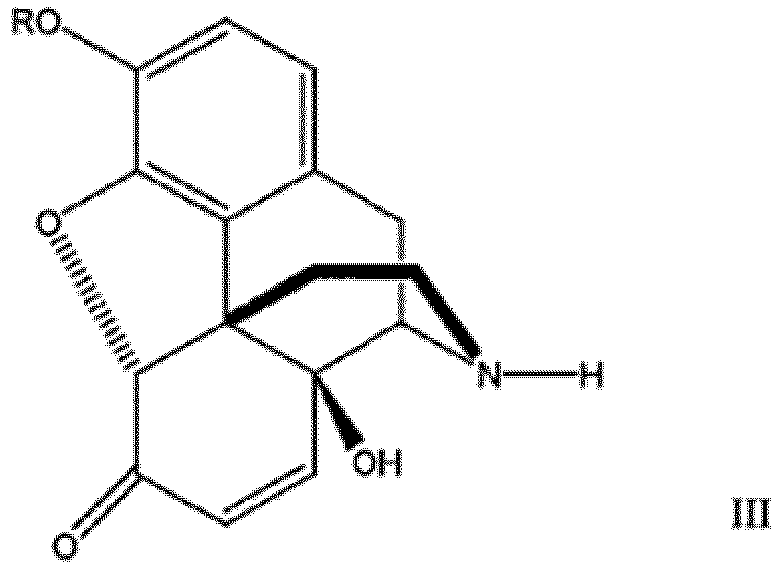
- the 6-oxo-14-hydroxy-N-methyl- ⁇ 7 -morphinane-N-oxide is then converted to 6-oxo-14-hydroxy- ⁇ 7 -morphinane by performing an N-demethylation. This is generally done by treating it with a reducing agent. Suitable reducing conditions are outlined in WO02/16367 .
- Exemplary reducing agents include Fe (II) based agents such as FeSO 4 , FeCl 2 or Fe-porphrin complexes.
- the reaction is preformed at a temperature of around 10°C. The reaction can be monitored by TLC to determine the completeness of the reduction (N-demethylation).
- reaction mixture may be subjected to work-up step(s) which may, for instance, involve addition of ammonium hydroxide and subsequent filtering.
- work-up step(s) which may, for instance, involve addition of ammonium hydroxide and subsequent filtering.
- the 6-oxo-14-hydroxy- ⁇ 7 -morphinane will generally be a compound of formula III: where R is H, C 1 -C 6 alkyl, benzyl or acyl.
- the 6-oxo-14-hydroxy-N-methyl- ⁇ 7 -morphinane-N-oxide is treated as a slurry in methanol with FeSO 4 , whereby formic acid is then added which forms the oxazolidine compound of formula IV as an acid insoluble precipitate.
- oxazolidine compound has acid insolubility makes it easy to separate from the iron reducing agent and the crude reaction mixture. This is generally achieved by a simple filtration step. The crude oxazolidine intermediate can then be immediately hydrolyzed or subjected to a further washing step (for example with methanol). This process is extremely beneficial in the production of kilogram scales of 14-hydroxy opiates as the tedious work-up steps generally required to remove the iron reducing agent are avoided.
- Conversion of the oxazolidine compound to the 6-oxo-14-hydroxy- ⁇ 7 -morphinane by hydrolysis can be achieved by treating the oxazolidine compound with a strong acid.
- strong acids include, hydrochloric acid, sulphuric acid, hydrobromic acid, phosphoric acid, etc.
- the compound of formula IV is hydrolyzed with hydrochloric acid. More preferably the hydrolysis is preformed at elevated temperatures. In a preferred embodiment hydrolysis is conducted with a strong acid followed by ammonia at an elevated temperature.
- 6-oxo-14-hydroxy- ⁇ 7 -morphinane is an important intermediate for the preparation of 14-hydroxy opiates, especially those which have a non-methyl N-substituent, for example naltrexone (6) and naloxone (7).
- Processes for converting 6-oxo-14-hydroxy- ⁇ 7 -morphinanes into other useful morphinane compounds are described in the literature.
- An example of an alkylation treatment would be the reaction of the N-demethylated compound with R'-Br and a base, such as K 2 CO 3 .
- a base such as K 2 CO 3 .
- Suitable N-alkylation conditions are disclosed in US 3,254,088 , US 3,332,950 and US 5,922,876 .
- R' groups include C 2-6 alkyl, such as straight chain, branched and cyclic isomers of ethyl, propylbutyl, isobutyl pentyl (all isomers), hexyl (all isomers), cyclopropylmethyl, (as found in naltrexone (5)) and cyclobutylmethyl (as found in nalbuphine and butorphanol), C 2-6 alkenyl residues such as alkyl (as found in nalorphine and naloxone (6)), and C 2-6 alkynyl, such as propargyl.
- C 2-6 alkyl such as straight chain, branched and cyclic isomers of ethyl, propylbutyl, isobutyl pentyl (all isomers), hexyl (all isomers), cyclopropylmethyl, (as found in naltrexone (5)) and cyclo
- leaving groups include halogen, such as Br, Cl and I, mesylate, tosylate and triflate.
- a 6-oxo-14-hydroxy-N-methyl- ⁇ 7 -morphinane can be first hydrogenated and subsequently oxidised to form the corresponding N-oxide.
- Hydrogenation to reduce the ⁇ 7 -double bond may be carried out in the presence of platinum or palladium catalysts under the standard hydrogenation conditions as discussed above.
- the N-oxide from this procedure may be reduced as mentioned previously to form an oxazolidine compound.
- the oxazolidine compound will generally be of formula V: where R is H, C 1 -C 6 alkyl, benzyl or acyl.
- Hydrolysis of the oxazolidine and alkylation to form, for instance, naltrexone (6) and naloxone (7), may follow the synthetic route previously discussed.
- N-alkyl or N-alkenyl 6-oxo-14-hydroxymorphinane it is possible to further modify the compound using known techniques to prepare further morphinane derivatives.
- further chemistry can be performed on the ⁇ , ⁇ unsaturated keto moiety.
- the oxygen atom in the 3-position can be subjected to esterification, transesterification and etherification reactions using known techniques.
- 14-Hydroxymorphinone-N-oxide 14-NO
- 14-NO 14-Hydroxymorphinone-N-oxide
- 100 L of methanol >98%).
- the resultant slurry is stirred for 5 minutes.
- 0.8kg FeSO 4 .7H 2 0 To the slurry is added 0.8kg FeSO 4 .7H 2 0 and the resultant mixture is vigorously stirred for about 5 minutes. After 2 minutes 15L of 85% Formic acid is added and the resultant precipitate is immediately filtered after mixing complete.
- the oxazolidine (1 kg) is added to a solution of 25% ammonium hydroxide (0.96 L) in H 2 O (7.2L). 30% Hydrochloric acid (1.65 L) is then added and the mixture is heated to 50°C followed by the addition of activated carbon (0.025kg). After 30 min the activated carbon is removed by filtration and the filtrate is stirred for a further 30 min. The pH is then adjusted to pH 9.0 with 25% ammonia and stirred for a further 15 hours at 50°C.
- Oxymorphone (4.0 g) was added to methanol (40 mL) followed by m CPBA (5.50 g, 50% wet). After stirring for 5 min oxymorphone-N-oxide was collected by filtration (75% yield). ESI-MS m / z 318 [M+H].
- Oxymorphone-N-oxide (2.0 g) was slurried in methanol (40 mL). FeSO 4 .7H 2 O (0.4 g) was then added and the solution was stirred for 15 min. The product was collected by filtration and the solid was washed with methanol (15 mL) to yield the oxazolidine ( ⁇ 50% yield, ESI-MS m / z 300 [M+H]) as a mixture with oxymorphone.
Landscapes
- Health & Medical Sciences (AREA)
- Chemical & Material Sciences (AREA)
- Organic Chemistry (AREA)
- Animal Behavior & Ethology (AREA)
- Engineering & Computer Science (AREA)
- Veterinary Medicine (AREA)
- Public Health (AREA)
- Bioinformatics & Cheminformatics (AREA)
- Chemical Kinetics & Catalysis (AREA)
- General Chemical & Material Sciences (AREA)
- Medicinal Chemistry (AREA)
- Nuclear Medicine, Radiotherapy & Molecular Imaging (AREA)
- General Health & Medical Sciences (AREA)
- Pharmacology & Pharmacy (AREA)
- Life Sciences & Earth Sciences (AREA)
- Pulmonology (AREA)
- Pain & Pain Management (AREA)
- Biomedical Technology (AREA)
- Neurosurgery (AREA)
- Neurology (AREA)
- Pharmaceuticals Containing Other Organic And Inorganic Compounds (AREA)
- Nitrogen And Oxygen Or Sulfur-Condensed Heterocyclic Ring Systems (AREA)
- Organic Low-Molecular-Weight Compounds And Preparation Thereof (AREA)
Claims (30)
- Verfahren zur Herstellung einer Verbindung der Formel III, welches das Oxidieren einer Verbindung der Formel I über eine Zeitdauer und unter Bedingungen umfasst, die ausreichen, um eine Verbindung der Formel II zu bilden, wobei die Verbindung der Formel II nach ihrer Bildung in die Verbindung der Formel III umgewandelt wird;
wobei:die Oxidation erfolgt, indem die Verbindung der Formel I in Gegenwart einer Carbonsäure mit einem molarem Überschuss an Wasserstoffperoxid behandelt wird;die Verbindung der Formel II nach ihrer Bildung in die Verbindung der Formel III umgewandelt wird, indem die Verbindung der Formel II eine N-Demethylierung erfährt;unddie Verbindungen der Formeln I, II und III folgendermaßen beschaffen sind: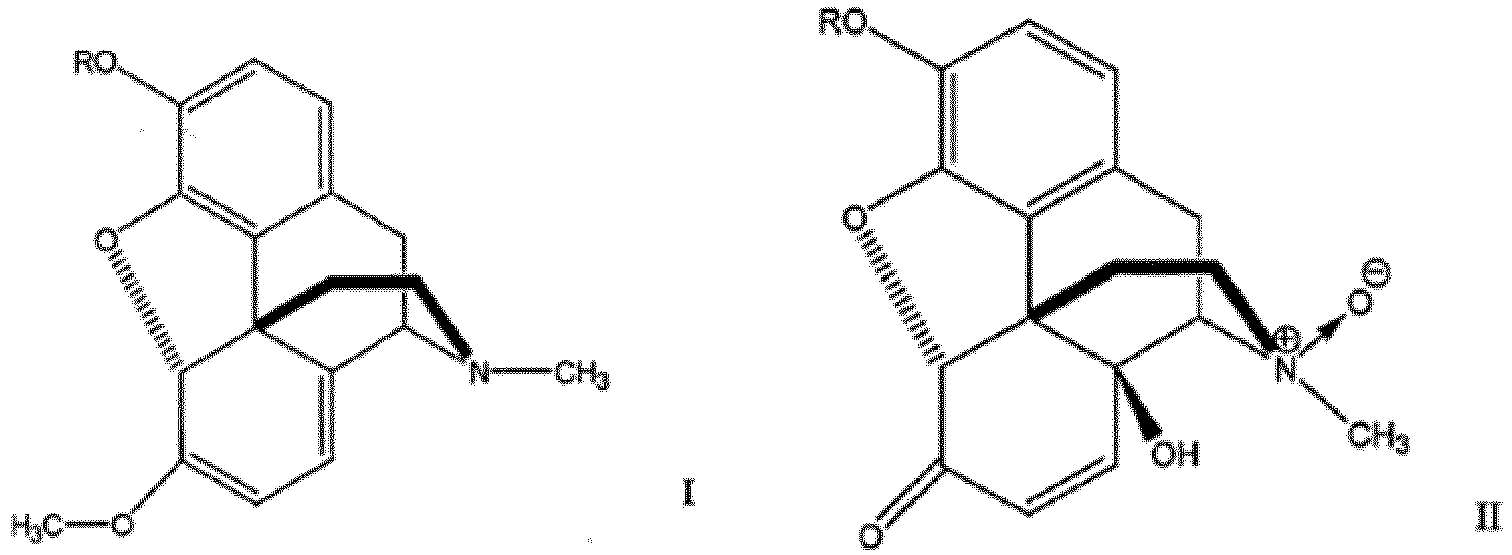
- Verfahren nach Anspruch 1, wobei die Oxidation erfolgt, indem die Verbindung der Formel I in Gegenwart einer Carbonsäure mit 2 bis 5 Äquivalenten an Wasserstoffperoxid behandelt wird.
- Verfahren nach Anspruch 2, wobei es sich bei der Carbonsäure um Ameisensäure oder Essigsäure handelt.
- Verfahren nach Anspruch 3, wobei es sich bei der Carbonsäure um Ameisensäure handelt.
- Verfahren nach Anspruch 4, wobei die Konzentration der Ameisensäure 45 Gewichts-% an Ameisensäure in Wasser beträgt.
- Verfahren nach einem beliebigen der Ansprüche 2 bis 5, wobei die Verbindung der Formel I mit einem molaren Überschuss an Wasserstoffperoxid in einer Konzentration von 50 Gewichts-% in Wasser behandelt wird.
- Verfahren nach einem beliebigen der Ansprüche 2 bis 6, wobei die Verbindung der Formel I in einer Mischung aus der Carbonsäure und einem Lösungsmittel aufgelöst wird, bevor das Wasserstoffperoxid zugesetzt wird.
- Verfahren nach Anspruch 7, wobei es sich bei dem Lösungsmittel um Ethanol handelt.
- Verfahren nach einem beliebigen der Ansprüche 1 bis 8, wobei die Oxidation bei einer Temperatur von weniger als 50 °C durchgeführt wird.
- Verfahren nach Anspruch 9, wobei die Temperatur ungefähr 20 °C beträgt.
- Verfahren nach einem beliebigen der Ansprüche 1 bis 10, wobei es zusätzlich den Schritt des Isolierens der Verbindung der Formel II umfasst, bevor die Umwandlung zur Verbindung der Formel III erfolgt.
- Verfahren nach Anspruch 11, wobei der Isolierungsschritt das Neutralisieren der Oxidationsreaktionsmischung auf einen pH-Wert von ungefähr 7 durch Zusatz einer Base und das Gewinnen der Verbindung der Formel II in Form eines Feststoffs umfasst.
- Verfahren nach Anspruch 12, wobei die Base aus Natrium- oder Kaliumhydroxid oder Kaliumcarbonat ausgewählt ist.
- Verfahren nach Anspruch 13, wobei es sich bei der Base um Natriumhydroxid handelt.
- Verfahren nach Anspruch 14, wobei das Natriumhydroxid der Oxidationsmischung mit einer Geschwindigkeit zugesetzt wird, die gewährleistet, dass die Temperatur des Reaktionsansatzes 55 °C erreicht.
- Verfahren nach einem beliebigen der Ansprüche 1 bis 15, wobei die Verbindung der Formel II nach ihrer Bildung in die Verbindung der Formel III umgewandelt wird, indem die Verbindung der Formel II mit einem Reduktionsmittel behandelt wird.
- Verfahren nach Anspruch 16, wobei es sich bei dem Reduktionsmittel um ein Reduktionsmittel auf Basis von Fe(II) handelt.
- Verfahren nach Anspruch 17, wobei das Reduktionsmittel auf Basis von Fe(II) aus der Gruppe ausgewählt ist, die aus FeSO4, FeCl2 und Fe-Porphrinkomplexen besteht.
- Verfahren nach einem beliebigen der Ansprüche 16 bis 18, wobei es zusätzlich den Schritt des Zusetzens von Ammoniumhydroxid und des anschließenden Filtrierens umfasst.
- Verfahren zur Herstellung von N-Alkyl- oder N-Alkenyl-6-oxo-14-hydroxymorphinanen, wobei es Folgendes umfasst:Oxidieren einer Verbindung der Formel I über eine Zeitdauer und unter Bedingungen, die ausreichen, um eine Verbindung der Formel II zu bilden, wobei die Oxidation erfolgt, indem die Verbindung der Formel I in Gegenwart einer Carbonsäure mit einem molarem Überschuss an Wasserstoffperoxid behandelt wird,Umwandeln der Verbindung der Formel II, nach der Bildung derselben, in eine Verbindung der Formel III, indem die Verbindung der Formel II eine N-Demethylierung erfährt,Reduzieren der Δ7-Doppelbindung, um eine Verbindung der Formel III' zu bilden, undEinwirkenlassen einer N-Alkylierung auf die Verbindung der Formel III', um den N-Alkyl- oder N-Alkenylsubstituenten einzuführen;wobei:die Verbindungen der Formeln I, II, III und III' folgendermaßen beschaffen sind:wobei R gleich H, C1-C6-Alkyl, Benzyl oder Acyl ist.


- Verfahren nach Anspruch 20, wobei ein Reduktionsmittel die Verbindung der Formel II in die Verbindung der Formel III umwandelt.
- Verfahren nach Anspruch 21, wobei es sich bei dem Reduktionsmittel um ein Reduktionsmittel auf Basis von Fe(II) handelt.
- Verfahren nach Anspruch 22, wobei das Reduktionsmittel auf Basis von Fe(II) aus der Gruppe ausgewählt ist, die aus FeSO4, FeCl2 und Fe-Porphrinkomplexen besteht.
- Verfahren nach einem beliebigen der Ansprüche 22 bis 24, wobei es zusätzlich den Schritt des Zusetzens von Ammoniumhydroxid und des anschließenden Filtrierens umfasst.
- Verfahren einer nach einem beliebigen der Ansprüche 1 bis 24, wobei R in der Verbindung der Formel I für H oder CH3 steht.
- Verfahren nach Anspruch 25, wobei R in der Verbindung der Formel I gleich H ist.
- Verfahren einer nach einem beliebigen der Ansprüche 1 bis 24, wobei R in der Verbindung der Formel II für H oder CH3 steht.
- Verfahren nach Anspruch 27, wobei R in der Verbindung der Formel II gleich H ist.
- Verfahren einer nach einem beliebigen der Ansprüche 1 bis 24, wobei R in der Verbindung der Formel III für H oder CH3 steht.
- Verfahren nach Anspruch 29, wobei R in der Verbindung der Formel III gleich H ist.
Applications Claiming Priority (2)
| Application Number | Priority Date | Filing Date | Title |
|---|---|---|---|
| AU2003905153A AU2003905153A0 (en) | 2003-09-22 | Chemical Compounds and Processes | |
| PCT/AU2004/001297 WO2005028483A1 (en) | 2003-09-22 | 2004-09-22 | Process for the synthesis of morphinane compounds and intermediates thereof |
Publications (3)
| Publication Number | Publication Date |
|---|---|
| EP1664061A1 EP1664061A1 (de) | 2006-06-07 |
| EP1664061A4 EP1664061A4 (de) | 2009-09-09 |
| EP1664061B1 true EP1664061B1 (de) | 2017-03-15 |
Family
ID=34318304
Family Applications (1)
| Application Number | Title | Priority Date | Filing Date |
|---|---|---|---|
| EP04761332.8A Expired - Lifetime EP1664061B1 (de) | 2003-09-22 | 2004-09-22 | Verfahren zur synthese von morphinanverbindungen und zwischenprodukten davon |
Country Status (7)
| Country | Link |
|---|---|
| EP (1) | EP1664061B1 (de) |
| JP (1) | JP4879740B2 (de) |
| CA (1) | CA2539659C (de) |
| ES (1) | ES2627995T3 (de) |
| HU (1) | HUE034668T2 (de) |
| PT (1) | PT1664061T (de) |
| WO (1) | WO2005028483A1 (de) |
Families Citing this family (21)
| Publication number | Priority date | Publication date | Assignee | Title |
|---|---|---|---|---|
| DK2073636T3 (da) | 2006-10-17 | 2012-11-19 | Penick Corp | Fremgangsmåde til fremstilling af oxymorphon |
| CA2674915C (en) * | 2006-10-17 | 2015-06-30 | Penick Corporation | Process for preparing oxymorphone |
| AU2012216358B2 (en) * | 2006-10-17 | 2014-11-20 | Penick Corporation | Process For Preparing Oxymorphone, Naltrexone and Buprenorphine |
| US20080125592A1 (en) | 2006-10-17 | 2008-05-29 | Penick Corporation | Process for preparing oxymorphone, naltrexone, and buprenorphine |
| GB0624880D0 (en) | 2006-12-14 | 2007-01-24 | Johnson Matthey Plc | Improved method for making analgesics |
| PL2125824T5 (pl) | 2007-03-23 | 2024-11-04 | SpecGx LLC | Ulepszony sposób wytwarzania oksymorfonu z oripawiny |
| WO2008130553A1 (en) | 2007-04-16 | 2008-10-30 | Mallinckrodt Inc. | Novel opiate reduction utilizing catalytic hydrogen transfer reaction |
| WO2009067275A1 (en) * | 2007-11-21 | 2009-05-28 | Progenics Pharmaceuticals, Inc | N-oxides of 4,5-epoxy-morphinanium analogs |
| CN102089310A (zh) * | 2008-06-20 | 2011-06-08 | Tpi企业有限公司 | 用于合成n-去甲基吗啡烷化合物的方法 |
| CN102325777B (zh) | 2009-02-23 | 2015-08-12 | 马林克罗特公司 | (+)-吗啡喃*n-氧化物及其制备方法 |
| US8946419B2 (en) | 2009-02-23 | 2015-02-03 | Mallinckrodt Llc | (+)-6-hydroxy-morphinan or (+)-6-amino-morphinan derivatives |
| US8829020B2 (en) | 2009-07-16 | 2014-09-09 | Mallinckrodt Llc | Compounds and compositions for use in phototherapy and in treatment of ocular neovascular disease and cancers |
| BR112013003097B1 (pt) * | 2010-08-12 | 2021-03-16 | Boehringer Ingelheim International Gmbh | 6-cicloalquil-pirazolopirimidinonas e composição farmacêutica |
| EP2705043B1 (de) * | 2011-05-02 | 2016-11-30 | Brock University | Verfahren und zwischenprodukte zur herstellung von morphinanalogen über n-demethylierung von n-oxiden mit cyclodehydrierungsreagenzien |
| JP6121988B2 (ja) | 2011-05-06 | 2017-04-26 | ブロック ユニバーシティ | 金属触媒n−脱メチル化/官能基化および分子内基移動によるモルヒネ類似体の調製のための方法 |
| KR20140063763A (ko) | 2011-09-08 | 2014-05-27 | 말린크로트 엘엘씨 | 중간체를 단리하지 않는 알칼로이드의 제조 방법 |
| WO2013113120A1 (en) * | 2012-02-03 | 2013-08-08 | Tomas Hudlicky | Process for the preparation of morphine analogs via the reaction of organometallic reagents with an oxazolidine derived from morphinans |
| EP3027622B8 (de) | 2013-08-02 | 2019-06-12 | Johnson Matthey Public Limited Company | Verfahren zur herstellung von oxymorphon |
| GB201313915D0 (en) | 2013-08-02 | 2013-09-18 | Johnson Matthey Plc | Process |
| US20160052932A1 (en) | 2014-08-25 | 2016-02-25 | Johnson Matthey Public Limited Company | Processes for Making Opioids Including 14-Hydroxycodeinone and 14-hydroxymorphinone |
| EP3252055B1 (de) | 2016-05-31 | 2018-09-19 | Alcaliber Investigacion Desarrollo e Innovacion SLU | Verfahren zur gewinnung von 3,14-diacetyloxymorphon aus oripavin |
Family Cites Families (5)
| Publication number | Priority date | Publication date | Assignee | Title |
|---|---|---|---|---|
| GB939287A (en) * | 1961-03-14 | 1963-10-09 | Sankyo Co | New morphinone and codeinone derivatives and process for preparing the same |
| US3254088A (en) | 1961-03-14 | 1966-05-31 | Lewenstein | Morphine derivative |
| US3332950A (en) | 1963-03-23 | 1967-07-25 | Endo Lab | 14-hydroxydihydronormorphinone derivatives |
| US5869669A (en) | 1996-07-26 | 1999-02-09 | Penick Corporation | Preparation of 14-hydroxynormorphinones from normorphinone dienol acylates |
| AUPQ968300A0 (en) * | 2000-08-25 | 2000-09-21 | Glaxo Wellcome Australia Ltd | Chemical methods |
-
2004
- 2004-09-22 JP JP2006527222A patent/JP4879740B2/ja not_active Expired - Fee Related
- 2004-09-22 ES ES04761332.8T patent/ES2627995T3/es not_active Expired - Lifetime
- 2004-09-22 PT PT47613328T patent/PT1664061T/pt unknown
- 2004-09-22 HU HUE04761332A patent/HUE034668T2/hu unknown
- 2004-09-22 EP EP04761332.8A patent/EP1664061B1/de not_active Expired - Lifetime
- 2004-09-22 WO PCT/AU2004/001297 patent/WO2005028483A1/en not_active Ceased
- 2004-09-22 CA CA2539659A patent/CA2539659C/en not_active Expired - Lifetime
Non-Patent Citations (1)
| Title |
|---|
| None * |
Also Published As
| Publication number | Publication date |
|---|---|
| CA2539659A1 (en) | 2005-03-31 |
| PT1664061T (pt) | 2017-06-22 |
| EP1664061A4 (de) | 2009-09-09 |
| ES2627995T3 (es) | 2017-08-01 |
| JP2007505935A (ja) | 2007-03-15 |
| HUE034668T2 (hu) | 2018-02-28 |
| JP4879740B2 (ja) | 2012-02-22 |
| EP1664061A1 (de) | 2006-06-07 |
| CA2539659C (en) | 2013-03-26 |
| WO2005028483A1 (en) | 2005-03-31 |
Similar Documents
| Publication | Publication Date | Title |
|---|---|---|
| CA2539659C (en) | Process for the synthesis of morphinane compounds and intermediates thereof | |
| US8106201B2 (en) | Process for the synthesis of morphinane compounds and intermediates thereof | |
| EP2332410B1 (de) | Verfahren für die herstellung von oxymorphon, naltrexon und buprenorphin | |
| AU2009233315B2 (en) | An improved process for the preparation of morphinane analogues | |
| US6177567B1 (en) | Method for preparing oxycodone | |
| US7405301B2 (en) | Chemical methods | |
| US8357802B2 (en) | Process for preparing oxymorphone | |
| EP1000065A1 (de) | Herstellung von oxymorphon, oxycodon und derivaten davon | |
| AU2007313103A1 (en) | Process for preparing oxymorphone | |
| EP2328900B1 (de) | VERFAHREN ZUR HERSTELLUNG VON MORPHINAN-6 alpha-OLS | |
| EP0496830B1 (de) | Totale synthese von northebain-, normorphin-, noroxymorphon-enantiomeren und -derivaten via n-nor-zwischenverbindungen | |
| AU2004274038B2 (en) | Process for the synthesis of morphinane compounds and intermediates thereof | |
| GB2438401A (en) | Preparation of morphinan derivatives comprising N-demethylation, reductive amination and O-demethylation steps | |
| AU2001281599A1 (en) | Chemical methods |
Legal Events
| Date | Code | Title | Description |
|---|---|---|---|
| PUAI | Public reference made under article 153(3) epc to a published international application that has entered the european phase |
Free format text: ORIGINAL CODE: 0009012 |
|
| 17P | Request for examination filed |
Effective date: 20060315 |
|
| AK | Designated contracting states |
Kind code of ref document: A1 Designated state(s): AT BE BG CH CY CZ DE DK EE ES FI FR GB GR HU IE IT LI LU MC NL PL PT RO SE SI SK TR |
|
| RAP1 | Party data changed (applicant data changed or rights of an application transferred) |
Owner name: JOHNSON MATTHEY PUBLIC LIMITED COMPANY |
|
| DAX | Request for extension of the european patent (deleted) | ||
| RIN1 | Information on inventor provided before grant (corrected) |
Inventor name: WILSON,GEORGE, SCOTT Inventor name: MITCHELL, MELVILLE Inventor name: HALLIDAY, SCOTT, BRIAN Inventor name: RITCHIE, JARROD Inventor name: HAYES, NICHOLAS Inventor name: WADDELL, LUCY Inventor name: PURCELL, STUART Inventor name: SMITH, CRAIG |
|
| RIN1 | Information on inventor provided before grant (corrected) |
Inventor name: MITCHELL, MELVILLE Inventor name: HALLIDAY, SCOTT, BRIAN Inventor name: RITCHIE, JARROD Inventor name: HAYES, NICHOLAS Inventor name: WADDELL, LUCY Inventor name: PURCELL, STUART Inventor name: SMITH, CRAIG Inventor name: WILSON,GEORGE, SCOTT |
|
| RIN1 | Information on inventor provided before grant (corrected) |
Inventor name: WILSON,GEORGE, SCOTT Inventor name: MITCHELL, MELVILLE Inventor name: HALLIDAY, SCOTT, BRIAN Inventor name: RITCHIE, JARROD Inventor name: HAYES, NICHOLAS Inventor name: WADDELL, LUCY Inventor name: PURCELL, STUART Inventor name: SMITH, CRAIG |
|
| A4 | Supplementary search report drawn up and despatched |
Effective date: 20090806 |
|
| RIC1 | Information provided on ipc code assigned before grant |
Ipc: C07D 489/08 20060101ALI20090731BHEP Ipc: C07D 498/10 20060101AFI20050406BHEP Ipc: A61K 31/485 20060101ALI20090731BHEP |
|
| 17Q | First examination report despatched |
Effective date: 20090923 |
|
| RAP1 | Party data changed (applicant data changed or rights of an application transferred) |
Owner name: JOHNSON MATTHEY PUBLIC LIMITED COMPANY |
|
| RAP1 | Party data changed (applicant data changed or rights of an application transferred) |
Owner name: JOHNSON MATTHEY PUBLIC LIMITED COMPANY Owner name: GLAXOSMITHKLINE AUSTRALIA PTY LTD |
|
| GRAJ | Information related to disapproval of communication of intention to grant by the applicant or resumption of examination proceedings by the epo deleted |
Free format text: ORIGINAL CODE: EPIDOSDIGR1 |
|
| GRAP | Despatch of communication of intention to grant a patent |
Free format text: ORIGINAL CODE: EPIDOSNIGR1 |
|
| GRAP | Despatch of communication of intention to grant a patent |
Free format text: ORIGINAL CODE: EPIDOSNIGR1 |
|
| INTG | Intention to grant announced |
Effective date: 20160928 |
|
| GRAS | Grant fee paid |
Free format text: ORIGINAL CODE: EPIDOSNIGR3 |
|
| GRAA | (expected) grant |
Free format text: ORIGINAL CODE: 0009210 |
|
| AK | Designated contracting states |
Kind code of ref document: B1 Designated state(s): AT BE BG CH CY CZ DE DK EE ES FI FR GB GR HU IE IT LI LU MC NL PL PT RO SE SI SK TR |
|
| REG | Reference to a national code |
Ref country code: CH Ref legal event code: EP Ref country code: GB Ref legal event code: FG4D |
|
| REG | Reference to a national code |
Ref country code: IE Ref legal event code: FG4D |
|
| REG | Reference to a national code |
Ref country code: AT Ref legal event code: REF Ref document number: 875427 Country of ref document: AT Kind code of ref document: T Effective date: 20170415 |
|
| REG | Reference to a national code |
Ref country code: DE Ref legal event code: R096 Ref document number: 602004050916 Country of ref document: DE |
|
| REG | Reference to a national code |
Ref country code: CH Ref legal event code: NV Representative=s name: BOVARD AG PATENT- UND MARKENANWAELTE, CH |
|
| REG | Reference to a national code |
Ref country code: PT Ref legal event code: SC4A Ref document number: 1664061 Country of ref document: PT Date of ref document: 20170622 Kind code of ref document: T Free format text: AVAILABILITY OF NATIONAL TRANSLATION Effective date: 20170608 |
|
| REG | Reference to a national code |
Ref country code: NL Ref legal event code: MP Effective date: 20170315 |
|
| PG25 | Lapsed in a contracting state [announced via postgrant information from national office to epo] |
Ref country code: FI Free format text: LAPSE BECAUSE OF FAILURE TO SUBMIT A TRANSLATION OF THE DESCRIPTION OR TO PAY THE FEE WITHIN THE PRESCRIBED TIME-LIMIT Effective date: 20170315 Ref country code: GR Free format text: LAPSE BECAUSE OF FAILURE TO SUBMIT A TRANSLATION OF THE DESCRIPTION OR TO PAY THE FEE WITHIN THE PRESCRIBED TIME-LIMIT Effective date: 20170616 |
|
| REG | Reference to a national code |
Ref country code: ES Ref legal event code: FG2A Ref document number: 2627995 Country of ref document: ES Kind code of ref document: T3 Effective date: 20170801 |
|
| REG | Reference to a national code |
Ref country code: AT Ref legal event code: MK05 Ref document number: 875427 Country of ref document: AT Kind code of ref document: T Effective date: 20170315 |
|
| REG | Reference to a national code |
Ref country code: FR Ref legal event code: PLFP Year of fee payment: 14 |
|
| PG25 | Lapsed in a contracting state [announced via postgrant information from national office to epo] |
Ref country code: BG Free format text: LAPSE BECAUSE OF FAILURE TO SUBMIT A TRANSLATION OF THE DESCRIPTION OR TO PAY THE FEE WITHIN THE PRESCRIBED TIME-LIMIT Effective date: 20170615 Ref country code: SE Free format text: LAPSE BECAUSE OF FAILURE TO SUBMIT A TRANSLATION OF THE DESCRIPTION OR TO PAY THE FEE WITHIN THE PRESCRIBED TIME-LIMIT Effective date: 20170315 |
|
| PG25 | Lapsed in a contracting state [announced via postgrant information from national office to epo] |
Ref country code: NL Free format text: LAPSE BECAUSE OF FAILURE TO SUBMIT A TRANSLATION OF THE DESCRIPTION OR TO PAY THE FEE WITHIN THE PRESCRIBED TIME-LIMIT Effective date: 20170315 |
|
| PG25 | Lapsed in a contracting state [announced via postgrant information from national office to epo] |
Ref country code: EE Free format text: LAPSE BECAUSE OF FAILURE TO SUBMIT A TRANSLATION OF THE DESCRIPTION OR TO PAY THE FEE WITHIN THE PRESCRIBED TIME-LIMIT Effective date: 20170315 Ref country code: SK Free format text: LAPSE BECAUSE OF FAILURE TO SUBMIT A TRANSLATION OF THE DESCRIPTION OR TO PAY THE FEE WITHIN THE PRESCRIBED TIME-LIMIT Effective date: 20170315 Ref country code: CZ Free format text: LAPSE BECAUSE OF FAILURE TO SUBMIT A TRANSLATION OF THE DESCRIPTION OR TO PAY THE FEE WITHIN THE PRESCRIBED TIME-LIMIT Effective date: 20170315 Ref country code: AT Free format text: LAPSE BECAUSE OF FAILURE TO SUBMIT A TRANSLATION OF THE DESCRIPTION OR TO PAY THE FEE WITHIN THE PRESCRIBED TIME-LIMIT Effective date: 20170315 Ref country code: RO Free format text: LAPSE BECAUSE OF FAILURE TO SUBMIT A TRANSLATION OF THE DESCRIPTION OR TO PAY THE FEE WITHIN THE PRESCRIBED TIME-LIMIT Effective date: 20170315 |
|
| PG25 | Lapsed in a contracting state [announced via postgrant information from national office to epo] |
Ref country code: PL Free format text: LAPSE BECAUSE OF FAILURE TO SUBMIT A TRANSLATION OF THE DESCRIPTION OR TO PAY THE FEE WITHIN THE PRESCRIBED TIME-LIMIT Effective date: 20170315 |
|
| REG | Reference to a national code |
Ref country code: DE Ref legal event code: R097 Ref document number: 602004050916 Country of ref document: DE |
|
| PLBE | No opposition filed within time limit |
Free format text: ORIGINAL CODE: 0009261 |
|
| STAA | Information on the status of an ep patent application or granted ep patent |
Free format text: STATUS: NO OPPOSITION FILED WITHIN TIME LIMIT |
|
| PG25 | Lapsed in a contracting state [announced via postgrant information from national office to epo] |
Ref country code: DK Free format text: LAPSE BECAUSE OF FAILURE TO SUBMIT A TRANSLATION OF THE DESCRIPTION OR TO PAY THE FEE WITHIN THE PRESCRIBED TIME-LIMIT Effective date: 20170315 |
|
| 26N | No opposition filed |
Effective date: 20171218 |
|
| PG25 | Lapsed in a contracting state [announced via postgrant information from national office to epo] |
Ref country code: SI Free format text: LAPSE BECAUSE OF FAILURE TO SUBMIT A TRANSLATION OF THE DESCRIPTION OR TO PAY THE FEE WITHIN THE PRESCRIBED TIME-LIMIT Effective date: 20170315 |
|
| REG | Reference to a national code |
Ref country code: HU Ref legal event code: AG4A Ref document number: E034668 Country of ref document: HU |
|
| PG25 | Lapsed in a contracting state [announced via postgrant information from national office to epo] |
Ref country code: MC Free format text: LAPSE BECAUSE OF FAILURE TO SUBMIT A TRANSLATION OF THE DESCRIPTION OR TO PAY THE FEE WITHIN THE PRESCRIBED TIME-LIMIT Effective date: 20170315 |
|
| REG | Reference to a national code |
Ref country code: IE Ref legal event code: MM4A |
|
| REG | Reference to a national code |
Ref country code: BE Ref legal event code: MM Effective date: 20170930 |
|
| PG25 | Lapsed in a contracting state [announced via postgrant information from national office to epo] |
Ref country code: LU Free format text: LAPSE BECAUSE OF NON-PAYMENT OF DUE FEES Effective date: 20170922 |
|
| PG25 | Lapsed in a contracting state [announced via postgrant information from national office to epo] |
Ref country code: IE Free format text: LAPSE BECAUSE OF NON-PAYMENT OF DUE FEES Effective date: 20170922 |
|
| REG | Reference to a national code |
Ref country code: FR Ref legal event code: PLFP Year of fee payment: 15 |
|
| PG25 | Lapsed in a contracting state [announced via postgrant information from national office to epo] |
Ref country code: BE Free format text: LAPSE BECAUSE OF NON-PAYMENT OF DUE FEES Effective date: 20170930 |
|
| REG | Reference to a national code |
Ref country code: DE Ref legal event code: R082 Ref document number: 602004050916 Country of ref document: DE Representative=s name: BARDEHLE PAGENBERG PARTNERSCHAFT MBB PATENTANW, DE |
|
| PG25 | Lapsed in a contracting state [announced via postgrant information from national office to epo] |
Ref country code: CY Free format text: LAPSE BECAUSE OF NON-PAYMENT OF DUE FEES Effective date: 20170315 |
|
| PG25 | Lapsed in a contracting state [announced via postgrant information from national office to epo] |
Ref country code: TR Free format text: LAPSE BECAUSE OF FAILURE TO SUBMIT A TRANSLATION OF THE DESCRIPTION OR TO PAY THE FEE WITHIN THE PRESCRIBED TIME-LIMIT Effective date: 20170315 |
|
| PGFP | Annual fee paid to national office [announced via postgrant information from national office to epo] |
Ref country code: IT Payment date: 20230822 Year of fee payment: 20 Ref country code: GB Payment date: 20230823 Year of fee payment: 20 |
|
| PGFP | Annual fee paid to national office [announced via postgrant information from national office to epo] |
Ref country code: PT Payment date: 20230823 Year of fee payment: 20 Ref country code: HU Payment date: 20230829 Year of fee payment: 20 Ref country code: FR Payment date: 20230822 Year of fee payment: 20 Ref country code: DE Payment date: 20230822 Year of fee payment: 20 |
|
| PGFP | Annual fee paid to national office [announced via postgrant information from national office to epo] |
Ref country code: ES Payment date: 20231002 Year of fee payment: 20 |
|
| PGFP | Annual fee paid to national office [announced via postgrant information from national office to epo] |
Ref country code: CH Payment date: 20231001 Year of fee payment: 20 |
|
| REG | Reference to a national code |
Ref country code: DE Ref legal event code: R071 Ref document number: 602004050916 Country of ref document: DE |
|
| REG | Reference to a national code |
Ref country code: CH Ref legal event code: PL |
|
| REG | Reference to a national code |
Ref country code: ES Ref legal event code: FD2A Effective date: 20241002 |
|
| PG25 | Lapsed in a contracting state [announced via postgrant information from national office to epo] |
Ref country code: GB Free format text: LAPSE BECAUSE OF EXPIRATION OF PROTECTION Effective date: 20240921 |
|
| REG | Reference to a national code |
Ref country code: GB Ref legal event code: PE20 Expiry date: 20240921 |
|
| PG25 | Lapsed in a contracting state [announced via postgrant information from national office to epo] |
Ref country code: ES Free format text: LAPSE BECAUSE OF EXPIRATION OF PROTECTION Effective date: 20240923 |
|
| PG25 | Lapsed in a contracting state [announced via postgrant information from national office to epo] |
Ref country code: GB Free format text: LAPSE BECAUSE OF EXPIRATION OF PROTECTION Effective date: 20240921 Ref country code: ES Free format text: LAPSE BECAUSE OF EXPIRATION OF PROTECTION Effective date: 20240923 |
|
| PG25 | Lapsed in a contracting state [announced via postgrant information from national office to epo] |
Ref country code: PT Free format text: LAPSE BECAUSE OF EXPIRATION OF PROTECTION Effective date: 20241002 |
|
| PG25 | Lapsed in a contracting state [announced via postgrant information from national office to epo] |
Ref country code: PT Free format text: LAPSE BECAUSE OF EXPIRATION OF PROTECTION Effective date: 20241002 |