EP1663241B1 - 5-arylpyrimidines as anticancer agents - Google Patents
5-arylpyrimidines as anticancer agents Download PDFInfo
- Publication number
- EP1663241B1 EP1663241B1 EP04784529A EP04784529A EP1663241B1 EP 1663241 B1 EP1663241 B1 EP 1663241B1 EP 04784529 A EP04784529 A EP 04784529A EP 04784529 A EP04784529 A EP 04784529A EP 1663241 B1 EP1663241 B1 EP 1663241B1
- Authority
- EP
- European Patent Office
- Prior art keywords
- chloro
- pyrimidin
- amine
- trifluoroethyl
- propoxy
- Prior art date
- Legal status (The legal status is an assumption and is not a legal conclusion. Google has not performed a legal analysis and makes no representation as to the accuracy of the status listed.)
- Expired - Lifetime
Links
- 239000002246 antineoplastic agent Substances 0.000 title claims abstract description 12
- 150000001875 compounds Chemical class 0.000 claims abstract description 263
- 150000003839 salts Chemical class 0.000 claims abstract description 103
- 206010028980 Neoplasm Diseases 0.000 claims abstract description 73
- 206010048723 Multiple-drug resistance Diseases 0.000 claims abstract description 52
- 238000000034 method Methods 0.000 claims abstract description 49
- 241000124008 Mammalia Species 0.000 claims abstract description 42
- 230000012010 growth Effects 0.000 claims abstract description 32
- 230000002401 inhibitory effect Effects 0.000 claims abstract description 27
- 210000004881 tumor cell Anatomy 0.000 claims abstract description 22
- 230000029115 microtubule polymerization Effects 0.000 claims abstract description 13
- 125000006273 (C1-C3) alkyl group Chemical group 0.000 claims description 106
- -1 cyano, hydroxy Chemical group 0.000 claims description 102
- 102000004243 Tubulin Human genes 0.000 claims description 85
- 108090000704 Tubulin Proteins 0.000 claims description 85
- 125000001997 phenyl group Chemical group [H]C1=C([H])C([H])=C(*)C([H])=C1[H] 0.000 claims description 48
- 229910052794 bromium Inorganic materials 0.000 claims description 41
- 229910052801 chlorine Inorganic materials 0.000 claims description 41
- 102000029749 Microtubule Human genes 0.000 claims description 40
- 108091022875 Microtubule Proteins 0.000 claims description 40
- 229910052731 fluorine Inorganic materials 0.000 claims description 40
- 229910052739 hydrogen Inorganic materials 0.000 claims description 38
- 210000004688 microtubule Anatomy 0.000 claims description 38
- 125000002572 propoxy group Chemical group [*]OC([H])([H])C(C([H])([H])[H])([H])[H] 0.000 claims description 37
- 125000006413 ring segment Chemical group 0.000 claims description 33
- 229910052757 nitrogen Inorganic materials 0.000 claims description 32
- 125000002924 primary amino group Chemical group [H]N([H])* 0.000 claims description 32
- OYRRZWATULMEPF-UHFFFAOYSA-N pyrimidin-4-amine Chemical compound NC1=CC=NC=N1 OYRRZWATULMEPF-UHFFFAOYSA-N 0.000 claims description 30
- 238000000338 in vitro Methods 0.000 claims description 29
- 125000002496 methyl group Chemical group [H]C([H])([H])* 0.000 claims description 29
- 125000000623 heterocyclic group Chemical group 0.000 claims description 24
- 125000004433 nitrogen atom Chemical group N* 0.000 claims description 24
- 229910052736 halogen Inorganic materials 0.000 claims description 22
- 150000002367 halogens Chemical class 0.000 claims description 21
- 125000003178 carboxy group Chemical group [H]OC(*)=O 0.000 claims description 20
- 239000003814 drug Substances 0.000 claims description 20
- 125000004453 alkoxycarbonyl group Chemical group 0.000 claims description 19
- 125000001589 carboacyl group Chemical group 0.000 claims description 19
- 125000006559 (C1-C3) alkylamino group Chemical group 0.000 claims description 18
- 125000004455 (C1-C3) alkylthio group Chemical group 0.000 claims description 18
- 125000006698 (C1-C3) dialkylamino group Chemical group 0.000 claims description 18
- 125000006274 (C1-C3)alkoxy group Chemical group 0.000 claims description 18
- 125000000852 azido group Chemical group *N=[N+]=[N-] 0.000 claims description 18
- 125000001559 cyclopropyl group Chemical group [H]C1([H])C([H])([H])C1([H])* 0.000 claims description 18
- 125000002485 formyl group Chemical group [H]C(*)=O 0.000 claims description 18
- 125000001072 heteroaryl group Chemical group 0.000 claims description 18
- 125000000449 nitro group Chemical group [O-][N+](*)=O 0.000 claims description 18
- 229910052760 oxygen Inorganic materials 0.000 claims description 18
- 229910052717 sulfur Inorganic materials 0.000 claims description 18
- 238000002360 preparation method Methods 0.000 claims description 17
- 125000000246 pyrimidin-2-yl group Chemical group [H]C1=NC(*)=NC([H])=C1[H] 0.000 claims description 16
- 125000003118 aryl group Chemical group 0.000 claims description 15
- 230000001737 promoting effect Effects 0.000 claims description 15
- 230000000087 stabilizing effect Effects 0.000 claims description 15
- 125000004432 carbon atom Chemical group C* 0.000 claims description 13
- 125000000753 cycloalkyl group Chemical group 0.000 claims description 13
- 125000000217 alkyl group Chemical group 0.000 claims description 12
- 125000004206 2,2,2-trifluoroethyl group Chemical group [H]C([H])(*)C(F)(F)F 0.000 claims description 10
- CBWLEMXYPINBTA-NSHDSACASA-N 6-chloro-5-[2,6-difluoro-4-[3-(methylamino)propoxy]phenyl]-2-pyrazin-2-yl-n-[(2s)-1,1,1-trifluoropropan-2-yl]pyrimidin-4-amine Chemical compound FC1=CC(OCCCNC)=CC(F)=C1C1=C(Cl)N=C(C=2N=CC=NC=2)N=C1N[C@@H](C)C(F)(F)F CBWLEMXYPINBTA-NSHDSACASA-N 0.000 claims description 10
- ODURFEQFDLNVNA-UHFFFAOYSA-N [4-chloro-6-(2,2,2-trifluoroethylamino)-5-(2,4,6-trifluorophenyl)pyrimidin-2-yl]-methylcyanamide Chemical compound FC(F)(F)CNC1=NC(N(C#N)C)=NC(Cl)=C1C1=C(F)C=C(F)C=C1F ODURFEQFDLNVNA-UHFFFAOYSA-N 0.000 claims description 10
- HXJHMTCVYUBCGI-UHFFFAOYSA-N 6-chloro-5-[4-[3-(dimethylamino)propoxy]-2,6-difluorophenyl]-2-pyrazin-2-yl-n-(2,2,2-trifluoroethyl)pyrimidin-4-amine Chemical compound FC1=CC(OCCCN(C)C)=CC(F)=C1C1=C(Cl)N=C(C=2N=CC=NC=2)N=C1NCC(F)(F)F HXJHMTCVYUBCGI-UHFFFAOYSA-N 0.000 claims description 9
- 125000005842 heteroatom Chemical group 0.000 claims description 9
- VKAOCYPNKOPRSE-UHFFFAOYSA-N 3-[4-(4-chloro-6-cycloheptyl-2-pyrazin-2-ylpyrimidin-5-yl)-3,5-difluorophenoxy]-n-methylpropan-1-amine Chemical compound FC1=CC(OCCCNC)=CC(F)=C1C1=C(Cl)N=C(C=2N=CC=NC=2)N=C1C1CCCCCC1 VKAOCYPNKOPRSE-UHFFFAOYSA-N 0.000 claims description 8
- LILWNAIAPCBLHU-UHFFFAOYSA-N 6-chloro-2-imidazol-1-yl-n-(2,2,2-trifluoroethyl)-5-(2,4,6-trifluorophenyl)pyrimidin-4-amine Chemical compound FC1=CC(F)=CC(F)=C1C1=C(Cl)N=C(N2C=NC=C2)N=C1NCC(F)(F)F LILWNAIAPCBLHU-UHFFFAOYSA-N 0.000 claims description 8
- SXRPINFLPQMOJG-LBPRGKRZSA-N 6-chloro-5-[2,6-difluoro-4-[3-(methylamino)propoxy]phenyl]-2-pyridin-2-yl-n-[(2s)-1,1,1-trifluoropropan-2-yl]pyrimidin-4-amine Chemical compound FC1=CC(OCCCNC)=CC(F)=C1C1=C(Cl)N=C(C=2N=CC=CC=2)N=C1N[C@@H](C)C(F)(F)F SXRPINFLPQMOJG-LBPRGKRZSA-N 0.000 claims description 8
- LDESLYKWJNFLSX-UHFFFAOYSA-N 6-chloro-5-[4-[2-(dimethylamino)ethoxy]-2,6-difluorophenyl]-2-pyrazin-2-yl-n-(2,2,2-trifluoroethyl)pyrimidin-4-amine Chemical compound FC1=CC(OCCN(C)C)=CC(F)=C1C1=C(Cl)N=C(C=2N=CC=NC=2)N=C1NCC(F)(F)F LDESLYKWJNFLSX-UHFFFAOYSA-N 0.000 claims description 8
- QIHITHOIUNZULD-UHFFFAOYSA-N 6-chloro-5-[4-[3-(dimethylamino)propoxy]-2,6-difluorophenyl]-2-imidazol-1-yl-n-(2,2,2-trifluoroethyl)pyrimidin-4-amine Chemical compound FC1=CC(OCCCN(C)C)=CC(F)=C1C1=C(Cl)N=C(N2C=NC=C2)N=C1NCC(F)(F)F QIHITHOIUNZULD-UHFFFAOYSA-N 0.000 claims description 8
- CMRXBBZWPSTMEC-UHFFFAOYSA-N 6-chloro-5-[4-[3-(dimethylamino)propoxy]-2,6-difluorophenyl]-2-pyrimidin-2-yl-n-(2,2,2-trifluoroethyl)pyrimidin-4-amine Chemical compound FC1=CC(OCCCN(C)C)=CC(F)=C1C1=C(Cl)N=C(C=2N=CC=CN=2)N=C1NCC(F)(F)F CMRXBBZWPSTMEC-UHFFFAOYSA-N 0.000 claims description 8
- DDOWVXUYVOTAEQ-UHFFFAOYSA-N 6-chloro-5-[4-[3-(dimethylamino)propoxy]-2,6-difluorophenyl]-2-quinolin-2-yl-n-(2,2,2-trifluoroethyl)pyrimidin-4-amine Chemical compound FC1=CC(OCCCN(C)C)=CC(F)=C1C1=C(Cl)N=C(C=2N=C3C=CC=CC3=CC=2)N=C1NCC(F)(F)F DDOWVXUYVOTAEQ-UHFFFAOYSA-N 0.000 claims description 8
- ZIHOWUDDUIKPMZ-UHFFFAOYSA-N 6-chloro-5-[4-[4-(dimethylamino)butoxy]-2,6-difluorophenyl]-2-pyrazin-2-yl-n-(2,2,2-trifluoroethyl)pyrimidin-4-amine Chemical compound FC1=CC(OCCCCN(C)C)=CC(F)=C1C1=C(Cl)N=C(C=2N=CC=NC=2)N=C1NCC(F)(F)F ZIHOWUDDUIKPMZ-UHFFFAOYSA-N 0.000 claims description 8
- ZXUDPCQCQFLPJR-UHFFFAOYSA-N [4-chloro-5-[4-[3-(dimethylamino)propoxy]-2,6-difluorophenyl]-6-(2,2,2-trifluoroethylamino)pyrimidin-2-yl]-methylcyanamide Chemical compound FC1=CC(OCCCN(C)C)=CC(F)=C1C1=C(Cl)N=C(N(C)C#N)N=C1NCC(F)(F)F ZXUDPCQCQFLPJR-UHFFFAOYSA-N 0.000 claims description 8
- IVTAIPZURLELLV-UHFFFAOYSA-N [4-chloro-5-[4-[4-(dimethylamino)butoxy]-2,6-difluorophenyl]-6-(2,2,2-trifluoroethylamino)pyrimidin-2-yl]methylcyanamide Chemical compound FC1=CC(OCCCCN(C)C)=CC(F)=C1C1=C(Cl)N=C(CNC#N)N=C1NCC(F)(F)F IVTAIPZURLELLV-UHFFFAOYSA-N 0.000 claims description 8
- USCQBKSUWCKHKG-UHFFFAOYSA-N 2-(5-azidopyridin-2-yl)-6-chloro-5-[4-[3-(dimethylamino)propoxy]-2,6-difluorophenyl]-n-(2,2,2-trifluoroethyl)pyrimidin-4-amine Chemical compound FC1=CC(OCCCN(C)C)=CC(F)=C1C1=C(Cl)N=C(C=2N=CC(=CC=2)N=[N+]=[N-])N=C1NCC(F)(F)F USCQBKSUWCKHKG-UHFFFAOYSA-N 0.000 claims description 7
- LNCPZOZLBVKFPW-UHFFFAOYSA-N 6-chloro-2-(5-nitropyridin-2-yl)-n-(2,2,2-trifluoroethyl)-5-(2,4,6-trifluorophenyl)pyrimidin-4-amine Chemical compound N1=CC([N+](=O)[O-])=CC=C1C1=NC(Cl)=C(C=2C(=CC(F)=CC=2F)F)C(NCC(F)(F)F)=N1 LNCPZOZLBVKFPW-UHFFFAOYSA-N 0.000 claims description 7
- GBKOAMQVMBTXRG-UHFFFAOYSA-N 6-chloro-5-[4-[3-(dimethylamino)propoxy]-2,6-difluorophenyl]-2-n-methyl-4-n-(2,2,2-trifluoroethyl)pyrimidine-2,4-diamine Chemical compound FC(F)(F)CNC1=NC(NC)=NC(Cl)=C1C1=C(F)C=C(OCCCN(C)C)C=C1F GBKOAMQVMBTXRG-UHFFFAOYSA-N 0.000 claims description 7
- XCWLPLOUCMTHFI-NSHDSACASA-N [4-chloro-5-[4-[3-(dimethylamino)propoxy]-2,6-difluorophenyl]-6-[[(2s)-1,1,1-trifluoropropan-2-yl]amino]pyrimidin-2-yl]methylcyanamide Chemical compound FC(F)(F)[C@H](C)NC1=NC(CNC#N)=NC(Cl)=C1C1=C(F)C=C(OCCCN(C)C)C=C1F XCWLPLOUCMTHFI-NSHDSACASA-N 0.000 claims description 7
- 125000004105 2-pyridyl group Chemical group N1=C([*])C([H])=C([H])C([H])=C1[H] 0.000 claims description 6
- AAVPJMAUGKOJNP-UHFFFAOYSA-N 6-chloro-2-(1h-pyrrol-2-yl)-n-(2,2,2-trifluoroethyl)-5-(2,4,6-trifluorophenyl)pyrimidin-4-amine Chemical compound FC1=CC(F)=CC(F)=C1C1=C(Cl)N=C(C=2NC=CC=2)N=C1NCC(F)(F)F AAVPJMAUGKOJNP-UHFFFAOYSA-N 0.000 claims description 6
- ADGOHMZGCSFAOQ-UHFFFAOYSA-N 6-chloro-2-(4-methylpyridin-2-yl)-n-(2,2,2-trifluoroethyl)-5-(2,4,6-trifluorophenyl)pyrimidin-4-amine Chemical compound CC1=CC=NC(C=2N=C(NCC(F)(F)F)C(=C(Cl)N=2)C=2C(=CC(F)=CC=2F)F)=C1 ADGOHMZGCSFAOQ-UHFFFAOYSA-N 0.000 claims description 6
- GNJIOXWXWUUCQZ-UHFFFAOYSA-N 6-chloro-2-isoquinolin-3-yl-n-(2,2,2-trifluoroethyl)-5-(2,4,6-trifluorophenyl)pyrimidin-4-amine Chemical compound FC1=CC(F)=CC(F)=C1C1=C(Cl)N=C(C=2N=CC3=CC=CC=C3C=2)N=C1NCC(F)(F)F GNJIOXWXWUUCQZ-UHFFFAOYSA-N 0.000 claims description 6
- ODKBOKAYDWNIFV-UHFFFAOYSA-N 6-chloro-2-pyridin-3-yl-n-(2,2,2-trifluoroethyl)-5-(2,4,6-trifluorophenyl)pyrimidin-4-amine Chemical compound FC1=CC(F)=CC(F)=C1C1=C(Cl)N=C(C=2C=NC=CC=2)N=C1NCC(F)(F)F ODKBOKAYDWNIFV-UHFFFAOYSA-N 0.000 claims description 6
- ZDOGRDYQRDOYPT-UHFFFAOYSA-N 6-chloro-2-quinolin-2-yl-n-(2,2,2-trifluoroethyl)-5-(2,4,6-trifluorophenyl)pyrimidin-4-amine Chemical compound FC1=CC(F)=CC(F)=C1C1=C(Cl)N=C(C=2N=C3C=CC=CC3=CC=2)N=C1NCC(F)(F)F ZDOGRDYQRDOYPT-UHFFFAOYSA-N 0.000 claims description 6
- SXRPINFLPQMOJG-UHFFFAOYSA-N 6-chloro-5-[2,6-difluoro-4-[3-(methylamino)propoxy]phenyl]-2-pyridin-2-yl-n-(1,1,1-trifluoropropan-2-yl)pyrimidin-4-amine Chemical compound FC1=CC(OCCCNC)=CC(F)=C1C1=C(Cl)N=C(C=2N=CC=CC=2)N=C1NC(C)C(F)(F)F SXRPINFLPQMOJG-UHFFFAOYSA-N 0.000 claims description 6
- SXRPINFLPQMOJG-GFCCVEGCSA-N 6-chloro-5-[2,6-difluoro-4-[3-(methylamino)propoxy]phenyl]-2-pyridin-2-yl-n-[(2r)-1,1,1-trifluoropropan-2-yl]pyrimidin-4-amine Chemical compound FC1=CC(OCCCNC)=CC(F)=C1C1=C(Cl)N=C(C=2N=CC=CC=2)N=C1N[C@H](C)C(F)(F)F SXRPINFLPQMOJG-GFCCVEGCSA-N 0.000 claims description 6
- UGCOTKFGCFLGSC-UHFFFAOYSA-N [4-chloro-5-[4-[2-(dimethylamino)ethoxy]-2,6-difluorophenyl]-6-(2,2,2-trifluoroethylamino)pyrimidin-2-yl]-methylcyanamide Chemical compound FC1=CC(OCCN(C)C)=CC(F)=C1C1=C(Cl)N=C(N(C)C#N)N=C1NCC(F)(F)F UGCOTKFGCFLGSC-UHFFFAOYSA-N 0.000 claims description 6
- XCWLPLOUCMTHFI-UHFFFAOYSA-N [4-chloro-5-[4-[3-(dimethylamino)propoxy]-2,6-difluorophenyl]-6-(1,1,1-trifluoropropan-2-ylamino)pyrimidin-2-yl]methylcyanamide Chemical compound FC(F)(F)C(C)NC1=NC(CNC#N)=NC(Cl)=C1C1=C(F)C=C(OCCCN(C)C)C=C1F XCWLPLOUCMTHFI-UHFFFAOYSA-N 0.000 claims description 6
- 239000000010 aprotic solvent Substances 0.000 claims description 6
- 229940127089 cytotoxic agent Drugs 0.000 claims description 6
- JOGZZTFIGKYTSV-UHFFFAOYSA-N ethylcyanamide Chemical compound CCNC#N JOGZZTFIGKYTSV-UHFFFAOYSA-N 0.000 claims description 6
- 230000008569 process Effects 0.000 claims description 6
- 125000004307 pyrazin-2-yl group Chemical group [H]C1=C([H])N=C(*)C([H])=N1 0.000 claims description 6
- QBYHZMDVKBPHAA-UHFFFAOYSA-N 6-chloro-2-isoquinolin-1-yl-n-(2,2,2-trifluoroethyl)-5-(2,4,6-trifluorophenyl)pyrimidin-4-amine Chemical compound FC1=CC(F)=CC(F)=C1C1=C(Cl)N=C(C=2C3=CC=CC=C3C=CN=2)N=C1NCC(F)(F)F QBYHZMDVKBPHAA-UHFFFAOYSA-N 0.000 claims description 5
- PYOACZADEZQCJS-UHFFFAOYSA-N 6-chloro-2-pyridin-2-yl-n-(2,2,2-trifluoroethyl)-5-(2,4,6-trifluorophenyl)pyrimidin-4-amine Chemical compound FC1=CC(F)=CC(F)=C1C1=C(Cl)N=C(C=2N=CC=CC=2)N=C1NCC(F)(F)F PYOACZADEZQCJS-UHFFFAOYSA-N 0.000 claims description 5
- YDUXGZDCHMEEGU-UHFFFAOYSA-N 6-chloro-2-pyrrol-1-yl-n-(2,2,2-trifluoroethyl)-5-(2,4,6-trifluorophenyl)pyrimidin-4-amine Chemical compound FC1=CC(F)=CC(F)=C1C1=C(Cl)N=C(N2C=CC=C2)N=C1NCC(F)(F)F YDUXGZDCHMEEGU-UHFFFAOYSA-N 0.000 claims description 5
- CBWLEMXYPINBTA-UHFFFAOYSA-N 6-chloro-5-[2,6-difluoro-4-[3-(methylamino)propoxy]phenyl]-2-pyrazin-2-yl-n-(1,1,1-trifluoropropan-2-yl)pyrimidin-4-amine Chemical compound FC1=CC(OCCCNC)=CC(F)=C1C1=C(Cl)N=C(C=2N=CC=NC=2)N=C1NC(C)C(F)(F)F CBWLEMXYPINBTA-UHFFFAOYSA-N 0.000 claims description 5
- CBWLEMXYPINBTA-LLVKDONJSA-N 6-chloro-5-[2,6-difluoro-4-[3-(methylamino)propoxy]phenyl]-2-pyrazin-2-yl-n-[(2r)-1,1,1-trifluoropropan-2-yl]pyrimidin-4-amine Chemical compound FC1=CC(OCCCNC)=CC(F)=C1C1=C(Cl)N=C(C=2N=CC=NC=2)N=C1N[C@H](C)C(F)(F)F CBWLEMXYPINBTA-LLVKDONJSA-N 0.000 claims description 5
- 239000003937 drug carrier Substances 0.000 claims description 5
- 125000000250 methylamino group Chemical group [H]N(*)C([H])([H])[H] 0.000 claims description 5
- MCLITRXWHZUNCQ-UHFFFAOYSA-N methylcyanamide Chemical compound CNC#N MCLITRXWHZUNCQ-UHFFFAOYSA-N 0.000 claims description 5
- XCWLPLOUCMTHFI-LLVKDONJSA-N [4-chloro-5-[4-[3-(dimethylamino)propoxy]-2,6-difluorophenyl]-6-[[(2r)-1,1,1-trifluoropropan-2-yl]amino]pyrimidin-2-yl]methylcyanamide Chemical compound FC(F)(F)[C@@H](C)NC1=NC(CNC#N)=NC(Cl)=C1C1=C(F)C=C(OCCCN(C)C)C=C1F XCWLPLOUCMTHFI-LLVKDONJSA-N 0.000 claims description 4
- 239000008194 pharmaceutical composition Substances 0.000 claims description 4
- 125000001436 propyl group Chemical group [H]C([*])([H])C([H])([H])C([H])([H])[H] 0.000 claims description 3
- 239000000203 mixture Substances 0.000 abstract description 78
- 238000011282 treatment Methods 0.000 abstract description 24
- 201000011510 cancer Diseases 0.000 abstract description 21
- 230000002265 prevention Effects 0.000 abstract description 17
- 201000010099 disease Diseases 0.000 abstract description 4
- 208000037265 diseases, disorders, signs and symptoms Diseases 0.000 abstract description 4
- XEKOWRVHYACXOJ-UHFFFAOYSA-N Ethyl acetate Chemical compound CCOC(C)=O XEKOWRVHYACXOJ-UHFFFAOYSA-N 0.000 description 115
- 229930012538 Paclitaxel Natural products 0.000 description 53
- 229960001592 paclitaxel Drugs 0.000 description 53
- RCINICONZNJXQF-MZXODVADSA-N taxol Chemical compound O([C@@H]1[C@@]2(C[C@@H](C(C)=C(C2(C)C)[C@H](C([C@]2(C)[C@@H](O)C[C@H]3OC[C@]3([C@H]21)OC(C)=O)=O)OC(=O)C)OC(=O)[C@H](O)[C@@H](NC(=O)C=1C=CC=CC=1)C=1C=CC=CC=1)O)C(=O)C1=CC=CC=C1 RCINICONZNJXQF-MZXODVADSA-N 0.000 description 53
- IAKHMKGGTNLKSZ-INIZCTEOSA-N (S)-colchicine Chemical compound C1([C@@H](NC(C)=O)CC2)=CC(=O)C(OC)=CC=C1C1=C2C=C(OC)C(OC)=C1OC IAKHMKGGTNLKSZ-INIZCTEOSA-N 0.000 description 52
- OKKJLVBELUTLKV-UHFFFAOYSA-N Methanol Chemical compound OC OKKJLVBELUTLKV-UHFFFAOYSA-N 0.000 description 48
- IAZDPXIOMUYVGZ-UHFFFAOYSA-N Dimethylsulphoxide Chemical compound CS(C)=O IAZDPXIOMUYVGZ-UHFFFAOYSA-N 0.000 description 42
- 210000004027 cell Anatomy 0.000 description 41
- CSNNHWWHGAXBCP-UHFFFAOYSA-L Magnesium sulfate Chemical compound [Mg+2].[O-][S+2]([O-])([O-])[O-] CSNNHWWHGAXBCP-UHFFFAOYSA-L 0.000 description 36
- ZMXDDKWLCZADIW-UHFFFAOYSA-N N,N-Dimethylformamide Chemical compound CN(C)C=O ZMXDDKWLCZADIW-UHFFFAOYSA-N 0.000 description 33
- FAPWRFPIFSIZLT-UHFFFAOYSA-M Sodium chloride Chemical compound [Na+].[Cl-] FAPWRFPIFSIZLT-UHFFFAOYSA-M 0.000 description 33
- VLKZOEOYAKHREP-UHFFFAOYSA-N n-Hexane Chemical class CCCCCC VLKZOEOYAKHREP-UHFFFAOYSA-N 0.000 description 30
- VEXZGXHMUGYJMC-UHFFFAOYSA-N Hydrochloric acid Chemical compound Cl VEXZGXHMUGYJMC-UHFFFAOYSA-N 0.000 description 28
- 230000000694 effects Effects 0.000 description 28
- 239000007787 solid Substances 0.000 description 28
- 229960001338 colchicine Drugs 0.000 description 26
- DTQVDTLACAAQTR-UHFFFAOYSA-N Trifluoroacetic acid Chemical compound OC(=O)C(F)(F)F DTQVDTLACAAQTR-UHFFFAOYSA-N 0.000 description 25
- 239000003795 chemical substances by application Substances 0.000 description 25
- 238000010998 test method Methods 0.000 description 23
- 230000000144 pharmacologic effect Effects 0.000 description 22
- 229960004528 vincristine Drugs 0.000 description 22
- OGWKCGZFUXNPDA-UHFFFAOYSA-N vincristine Natural products C1C(CC)(O)CC(CC2(C(=O)OC)C=3C(=CC4=C(C56C(C(C(OC(C)=O)C7(CC)C=CCN(C67)CC5)(O)C(=O)OC)N4C=O)C=3)OC)CN1CCC1=C2NC2=CC=CC=C12 OGWKCGZFUXNPDA-UHFFFAOYSA-N 0.000 description 22
- YMWUJEATGCHHMB-UHFFFAOYSA-N Dichloromethane Chemical compound ClCCl YMWUJEATGCHHMB-UHFFFAOYSA-N 0.000 description 21
- OGWKCGZFUXNPDA-XQKSVPLYSA-N vincristine Chemical compound C([N@]1C[C@@H](C[C@]2(C(=O)OC)C=3C(=CC4=C([C@]56[C@H]([C@@]([C@H](OC(C)=O)[C@]7(CC)C=CCN([C@H]67)CC5)(O)C(=O)OC)N4C=O)C=3)OC)C[C@@](C1)(O)CC)CC1=C2NC2=CC=CC=C12 OGWKCGZFUXNPDA-XQKSVPLYSA-N 0.000 description 21
- 239000000243 solution Substances 0.000 description 20
- 238000006243 chemical reaction Methods 0.000 description 19
- IXCSERBJSXMMFS-UHFFFAOYSA-N hydrogen chloride Substances Cl.Cl IXCSERBJSXMMFS-UHFFFAOYSA-N 0.000 description 19
- 229910000041 hydrogen chloride Inorganic materials 0.000 description 19
- AOJJSUZBOXZQNB-TZSSRYMLSA-N Doxorubicin Chemical compound O([C@H]1C[C@@](O)(CC=2C(O)=C3C(=O)C=4C=CC=C(C=4C(=O)C3=C(O)C=21)OC)C(=O)CO)[C@H]1C[C@H](N)[C@H](O)[C@H](C)O1 AOJJSUZBOXZQNB-TZSSRYMLSA-N 0.000 description 18
- 108010047230 Member 1 Subfamily B ATP Binding Cassette Transporter Proteins 0.000 description 18
- 229910052943 magnesium sulfate Inorganic materials 0.000 description 18
- 235000019341 magnesium sulphate Nutrition 0.000 description 18
- XLYOFNOQVPJJNP-UHFFFAOYSA-N water Substances O XLYOFNOQVPJJNP-UHFFFAOYSA-N 0.000 description 18
- 102100033350 ATP-dependent translocase ABCB1 Human genes 0.000 description 17
- 229940079593 drug Drugs 0.000 description 17
- MQLACMBJVPINKE-UHFFFAOYSA-N 10-[(3-hydroxy-4-methoxyphenyl)methylidene]anthracen-9-one Chemical compound C1=C(O)C(OC)=CC=C1C=C1C2=CC=CC=C2C(=O)C2=CC=CC=C21 MQLACMBJVPINKE-UHFFFAOYSA-N 0.000 description 16
- 230000027455 binding Effects 0.000 description 16
- 239000012044 organic layer Substances 0.000 description 16
- RTZKZFJDLAIYFH-UHFFFAOYSA-N Diethyl ether Chemical compound CCOCC RTZKZFJDLAIYFH-UHFFFAOYSA-N 0.000 description 15
- 241000699670 Mus sp. Species 0.000 description 14
- VYPSYNLAJGMNEJ-UHFFFAOYSA-N Silicium dioxide Chemical compound O=[Si]=O VYPSYNLAJGMNEJ-UHFFFAOYSA-N 0.000 description 14
- KEAYESYHFKHZAL-UHFFFAOYSA-N Sodium Chemical compound [Na] KEAYESYHFKHZAL-UHFFFAOYSA-N 0.000 description 14
- 230000015572 biosynthetic process Effects 0.000 description 14
- 150000003840 hydrochlorides Chemical class 0.000 description 14
- 239000000741 silica gel Substances 0.000 description 14
- 229910002027 silica gel Inorganic materials 0.000 description 14
- 239000012312 sodium hydride Substances 0.000 description 14
- 229910000104 sodium hydride Inorganic materials 0.000 description 14
- JXLYSJRDGCGARV-CFWMRBGOSA-N vinblastine Chemical compound C([C@H](C[C@]1(C(=O)OC)C=2C(=CC3=C([C@]45[C@H]([C@@]([C@H](OC(C)=O)[C@]6(CC)C=CCN([C@H]56)CC4)(O)C(=O)OC)N3C)C=2)OC)C[C@@](C2)(O)CC)N2CCC2=C1NC1=CC=CC=C21 JXLYSJRDGCGARV-CFWMRBGOSA-N 0.000 description 12
- 102000009664 Microtubule-Associated Proteins Human genes 0.000 description 11
- 239000002585 base Substances 0.000 description 11
- 208000002154 non-small cell lung carcinoma Diseases 0.000 description 11
- 239000000047 product Substances 0.000 description 11
- 0 CCCC[C@@]1C[C@](*CC)CC1 Chemical compound CCCC[C@@]1C[C@](*CC)CC1 0.000 description 10
- 108010078791 Carrier Proteins Proteins 0.000 description 10
- LFQSCWFLJHTTHZ-UHFFFAOYSA-N Ethanol Chemical compound CCO LFQSCWFLJHTTHZ-UHFFFAOYSA-N 0.000 description 10
- 108010020004 Microtubule-Associated Proteins Proteins 0.000 description 10
- ZDZOTLJHXYCWBA-VCVYQWHSSA-N N-debenzoyl-N-(tert-butoxycarbonyl)-10-deacetyltaxol Chemical compound O([C@H]1[C@H]2[C@@](C([C@H](O)C3=C(C)[C@@H](OC(=O)[C@H](O)[C@@H](NC(=O)OC(C)(C)C)C=4C=CC=CC=4)C[C@]1(O)C3(C)C)=O)(C)[C@@H](O)C[C@H]1OC[C@]12OC(=O)C)C(=O)C1=CC=CC=C1 ZDZOTLJHXYCWBA-VCVYQWHSSA-N 0.000 description 10
- 229940123237 Taxane Drugs 0.000 description 10
- 238000006116 polymerization reaction Methods 0.000 description 10
- 239000003981 vehicle Substances 0.000 description 10
- PEDCQBHIVMGVHV-UHFFFAOYSA-N Glycerine Chemical compound OCC(O)CO PEDCQBHIVMGVHV-UHFFFAOYSA-N 0.000 description 9
- 238000002835 absorbance Methods 0.000 description 9
- 229960003668 docetaxel Drugs 0.000 description 9
- 238000002474 experimental method Methods 0.000 description 9
- 238000001727 in vivo Methods 0.000 description 9
- XHXFXVLFKHQFAL-UHFFFAOYSA-N phosphoryl trichloride Chemical compound ClP(Cl)(Cl)=O XHXFXVLFKHQFAL-UHFFFAOYSA-N 0.000 description 9
- USZDFOPAUAEWBC-ZETCQYMHSA-N 6-chloro-2-pyrazin-2-yl-5-(2,4,6-trifluorophenyl)-n-[(2s)-1,1,1-trifluoropropan-2-yl]pyrimidin-4-amine Chemical compound FC(F)(F)[C@H](C)NC1=NC(C=2N=CC=NC=2)=NC(Cl)=C1C1=C(F)C=C(F)C=C1F USZDFOPAUAEWBC-ZETCQYMHSA-N 0.000 description 8
- 206010009944 Colon cancer Diseases 0.000 description 8
- 241001465754 Metazoa Species 0.000 description 8
- 239000002480 mineral oil Substances 0.000 description 8
- 235000010446 mineral oil Nutrition 0.000 description 8
- 241000863480 Vinca Species 0.000 description 7
- 229960004679 doxorubicin Drugs 0.000 description 7
- 239000011541 reaction mixture Substances 0.000 description 7
- 230000001988 toxicity Effects 0.000 description 7
- 231100000419 toxicity Toxicity 0.000 description 7
- OISVCGZHLKNMSJ-UHFFFAOYSA-N 2,6-dimethylpyridine Chemical compound CC1=CC=CC(C)=N1 OISVCGZHLKNMSJ-UHFFFAOYSA-N 0.000 description 6
- 201000009030 Carcinoma Diseases 0.000 description 6
- XKMLYUALXHKNFT-UUOKFMHZSA-N Guanosine-5'-triphosphate Chemical compound C1=2NC(N)=NC(=O)C=2N=CN1[C@@H]1O[C@H](COP(O)(=O)OP(O)(=O)OP(O)(O)=O)[C@@H](O)[C@H]1O XKMLYUALXHKNFT-UUOKFMHZSA-N 0.000 description 6
- DNIAPMSPPWPWGF-UHFFFAOYSA-N Propylene glycol Chemical compound CC(O)CO DNIAPMSPPWPWGF-UHFFFAOYSA-N 0.000 description 6
- 239000003153 chemical reaction reagent Substances 0.000 description 6
- 231100000135 cytotoxicity Toxicity 0.000 description 6
- 230000003013 cytotoxicity Effects 0.000 description 6
- 239000000706 filtrate Substances 0.000 description 6
- FCVKLVNLBIBCCU-UHFFFAOYSA-N hydron;pyrazine-2-carboximidamide;chloride Chemical compound Cl.NC(=N)C1=CN=CC=N1 FCVKLVNLBIBCCU-UHFFFAOYSA-N 0.000 description 6
- 239000007788 liquid Substances 0.000 description 6
- ZCSHNCUQKCANBX-UHFFFAOYSA-N lithium diisopropylamide Chemical compound [Li+].CC(C)[N-]C(C)C ZCSHNCUQKCANBX-UHFFFAOYSA-N 0.000 description 6
- XKMLYUALXHKNFT-UHFFFAOYSA-N rGTP Natural products C1=2NC(N)=NC(=O)C=2N=CN1C1OC(COP(O)(=O)OP(O)(=O)OP(O)(O)=O)C(O)C1O XKMLYUALXHKNFT-UHFFFAOYSA-N 0.000 description 6
- 239000002904 solvent Substances 0.000 description 6
- 231100000331 toxic Toxicity 0.000 description 6
- 230000002588 toxic effect Effects 0.000 description 6
- IMFACGCPASFAPR-UHFFFAOYSA-N tributylamine Chemical compound CCCCN(CCCC)CCCC IMFACGCPASFAPR-UHFFFAOYSA-N 0.000 description 6
- ILYCKCZXFXHRMJ-UHFFFAOYSA-N 6-chloro-2-(furan-2-yl)-n-(2,2,2-trifluoroethyl)-5-(2,4,6-trifluorophenyl)pyrimidin-4-amine Chemical compound FC1=CC(F)=CC(F)=C1C1=C(Cl)N=C(C=2OC=CC=2)N=C1NCC(F)(F)F ILYCKCZXFXHRMJ-UHFFFAOYSA-N 0.000 description 5
- CBESMOQBSQZIGA-UHFFFAOYSA-N 6-chloro-2-pyrazol-1-yl-n-(2,2,2-trifluoroethyl)-5-(2,4,6-trifluorophenyl)pyrimidin-4-amine Chemical compound FC1=CC(F)=CC(F)=C1C1=C(Cl)N=C(N2N=CC=C2)N=C1NCC(F)(F)F CBESMOQBSQZIGA-UHFFFAOYSA-N 0.000 description 5
- IOOKTIUCSYUVRN-UHFFFAOYSA-N 6-chloro-2-pyridin-4-yl-n-(2,2,2-trifluoroethyl)-5-(2,4,6-trifluorophenyl)pyrimidin-4-amine Chemical compound FC1=CC(F)=CC(F)=C1C1=C(Cl)N=C(C=2C=CN=CC=2)N=C1NCC(F)(F)F IOOKTIUCSYUVRN-UHFFFAOYSA-N 0.000 description 5
- BIKBKLCRFOIENH-UHFFFAOYSA-N 6-chloro-2-pyrimidin-2-yl-n-(2,2,2-trifluoroethyl)-5-(2,4,6-trifluorophenyl)pyrimidin-4-amine Chemical compound FC1=CC(F)=CC(F)=C1C1=C(Cl)N=C(C=2N=CC=CN=2)N=C1NCC(F)(F)F BIKBKLCRFOIENH-UHFFFAOYSA-N 0.000 description 5
- JPNHKLURIKULOR-UHFFFAOYSA-N 6-chloro-2-thiophen-2-yl-n-(2,2,2-trifluoroethyl)-5-(2,4,6-trifluorophenyl)pyrimidin-4-amine Chemical compound FC1=CC(F)=CC(F)=C1C1=C(Cl)N=C(C=2SC=CC=2)N=C1NCC(F)(F)F JPNHKLURIKULOR-UHFFFAOYSA-N 0.000 description 5
- 108020004414 DNA Proteins 0.000 description 5
- JXLYSJRDGCGARV-WWYNWVTFSA-N Vinblastine Natural products O=C(O[C@H]1[C@](O)(C(=O)OC)[C@@H]2N(C)c3c(cc(c(OC)c3)[C@]3(C(=O)OC)c4[nH]c5c(c4CCN4C[C@](O)(CC)C[C@H](C3)C4)cccc5)[C@@]32[C@H]2[C@@]1(CC)C=CCN2CC3)C JXLYSJRDGCGARV-WWYNWVTFSA-N 0.000 description 5
- 239000003513 alkali Substances 0.000 description 5
- 229910000288 alkali metal carbonate Inorganic materials 0.000 description 5
- 150000008041 alkali metal carbonates Chemical class 0.000 description 5
- 150000008044 alkali metal hydroxides Chemical class 0.000 description 5
- 239000000872 buffer Substances 0.000 description 5
- 230000008859 change Effects 0.000 description 5
- 230000002140 halogenating effect Effects 0.000 description 5
- 150000004678 hydrides Chemical class 0.000 description 5
- 239000000463 material Substances 0.000 description 5
- KKZJGLLVHKMTCM-UHFFFAOYSA-N mitoxantrone Chemical compound O=C1C2=C(O)C=CC(O)=C2C(=O)C2=C1C(NCCNCCO)=CC=C2NCCNCCO KKZJGLLVHKMTCM-UHFFFAOYSA-N 0.000 description 5
- 229960001156 mitoxantrone Drugs 0.000 description 5
- UXCDUFKZSUBXGM-UHFFFAOYSA-N phosphoric tribromide Chemical compound BrP(Br)(Br)=O UXCDUFKZSUBXGM-UHFFFAOYSA-N 0.000 description 5
- 229920000642 polymer Polymers 0.000 description 5
- 108090000623 proteins and genes Proteins 0.000 description 5
- 102000004169 proteins and genes Human genes 0.000 description 5
- 238000012360 testing method Methods 0.000 description 5
- 230000004614 tumor growth Effects 0.000 description 5
- 229960003048 vinblastine Drugs 0.000 description 5
- HZNVUJQVZSTENZ-UHFFFAOYSA-N 2,3-dichloro-5,6-dicyano-1,4-benzoquinone Chemical compound ClC1=C(Cl)C(=O)C(C#N)=C(C#N)C1=O HZNVUJQVZSTENZ-UHFFFAOYSA-N 0.000 description 4
- KRGXWTOLFOPIKV-UHFFFAOYSA-N 3-(methylamino)propan-1-ol Chemical compound CNCCCO KRGXWTOLFOPIKV-UHFFFAOYSA-N 0.000 description 4
- FGDWZLMPZYDLKE-UHFFFAOYSA-N 6-chloro-2-(1-methylimidazol-2-yl)-n-(2,2,2-trifluoroethyl)-5-(2,4,6-trifluorophenyl)pyrimidin-4-amine Chemical compound CN1C=CN=C1C1=NC(Cl)=C(C=2C(=CC(F)=CC=2F)F)C(NCC(F)(F)F)=N1 FGDWZLMPZYDLKE-UHFFFAOYSA-N 0.000 description 4
- USZDFOPAUAEWBC-SSDOTTSWSA-N 6-chloro-2-pyrazin-2-yl-5-(2,4,6-trifluorophenyl)-n-[(2r)-1,1,1-trifluoropropan-2-yl]pyrimidin-4-amine Chemical compound FC(F)(F)[C@@H](C)NC1=NC(C=2N=CC=NC=2)=NC(Cl)=C1C1=C(F)C=C(F)C=C1F USZDFOPAUAEWBC-SSDOTTSWSA-N 0.000 description 4
- RFSSBTBRSZAIBG-UHFFFAOYSA-N 6-chloro-2-pyrazin-2-yl-n-(2,2,2-trifluoroethyl)-5-(2,4,6-trifluorophenyl)pyrimidin-4-amine Chemical compound FC1=CC(F)=CC(F)=C1C1=C(Cl)N=C(C=2N=CC=NC=2)N=C1NCC(F)(F)F RFSSBTBRSZAIBG-UHFFFAOYSA-N 0.000 description 4
- KNFWEQCTFQIEMA-UHFFFAOYSA-N 6-chloro-2-pyridin-2-yl-5-(2,4,6-trifluorophenyl)-n-(1,1,1-trifluoropropan-2-yl)pyrimidin-4-amine Chemical compound FC(F)(F)C(C)NC1=NC(C=2N=CC=CC=2)=NC(Cl)=C1C1=C(F)C=C(F)C=C1F KNFWEQCTFQIEMA-UHFFFAOYSA-N 0.000 description 4
- KNFWEQCTFQIEMA-MRVPVSSYSA-N 6-chloro-2-pyridin-2-yl-5-(2,4,6-trifluorophenyl)-n-[(2r)-1,1,1-trifluoropropan-2-yl]pyrimidin-4-amine Chemical compound FC(F)(F)[C@@H](C)NC1=NC(C=2N=CC=CC=2)=NC(Cl)=C1C1=C(F)C=C(F)C=C1F KNFWEQCTFQIEMA-MRVPVSSYSA-N 0.000 description 4
- KNFWEQCTFQIEMA-QMMMGPOBSA-N 6-chloro-2-pyridin-2-yl-5-(2,4,6-trifluorophenyl)-n-[(2s)-1,1,1-trifluoropropan-2-yl]pyrimidin-4-amine Chemical compound FC(F)(F)[C@H](C)NC1=NC(C=2N=CC=CC=2)=NC(Cl)=C1C1=C(F)C=C(F)C=C1F KNFWEQCTFQIEMA-QMMMGPOBSA-N 0.000 description 4
- NLXLAEXVIDQMFP-UHFFFAOYSA-N Ammonia chloride Chemical compound [NH4+].[Cl-] NLXLAEXVIDQMFP-UHFFFAOYSA-N 0.000 description 4
- XZMCDFZZKTWFGF-UHFFFAOYSA-N Cyanamide Chemical compound NC#N XZMCDFZZKTWFGF-UHFFFAOYSA-N 0.000 description 4
- WYURNTSHIVDZCO-UHFFFAOYSA-N Tetrahydrofuran Chemical compound C1CCOC1 WYURNTSHIVDZCO-UHFFFAOYSA-N 0.000 description 4
- XSQUKJJJFZCRTK-UHFFFAOYSA-N Urea Chemical compound NC(N)=O XSQUKJJJFZCRTK-UHFFFAOYSA-N 0.000 description 4
- 230000009471 action Effects 0.000 description 4
- 239000002775 capsule Substances 0.000 description 4
- VCCISIBKCNTCLR-UHFFFAOYSA-N diethyl 2-(2,4,6-trifluorophenyl)propanedioate Chemical compound CCOC(=O)C(C(=O)OCC)C1=C(F)C=C(F)C=C1F VCCISIBKCNTCLR-UHFFFAOYSA-N 0.000 description 4
- 235000019441 ethanol Nutrition 0.000 description 4
- 238000001914 filtration Methods 0.000 description 4
- 239000012530 fluid Substances 0.000 description 4
- 125000001153 fluoro group Chemical group F* 0.000 description 4
- 239000007789 gas Substances 0.000 description 4
- 230000014509 gene expression Effects 0.000 description 4
- 239000000833 heterodimer Substances 0.000 description 4
- 238000001990 intravenous administration Methods 0.000 description 4
- 208000032839 leukemia Diseases 0.000 description 4
- 230000001404 mediated effect Effects 0.000 description 4
- 201000001441 melanoma Diseases 0.000 description 4
- 244000005700 microbiome Species 0.000 description 4
- 229930014626 natural product Natural products 0.000 description 4
- QJGQUHMNIGDVPM-UHFFFAOYSA-N nitrogen group Chemical group [N] QJGQUHMNIGDVPM-UHFFFAOYSA-N 0.000 description 4
- 239000003921 oil Substances 0.000 description 4
- 235000019198 oils Nutrition 0.000 description 4
- BWHMMNNQKKPAPP-UHFFFAOYSA-L potassium carbonate Chemical compound [K+].[K+].[O-]C([O-])=O BWHMMNNQKKPAPP-UHFFFAOYSA-L 0.000 description 4
- 239000002244 precipitate Substances 0.000 description 4
- 238000003786 synthesis reaction Methods 0.000 description 4
- 239000003826 tablet Substances 0.000 description 4
- 125000005931 tert-butyloxycarbonyl group Chemical group [H]C([H])([H])C(OC(*)=O)(C([H])([H])[H])C([H])([H])[H] 0.000 description 4
- VLVCERQEOKPRTG-DKWTVANSSA-N (2s)-1,1,1-trifluoropropan-2-amine;hydrochloride Chemical compound Cl.C[C@H](N)C(F)(F)F VLVCERQEOKPRTG-DKWTVANSSA-N 0.000 description 3
- VUHMRVLSRIYKKU-UHFFFAOYSA-N 1-methylimidazole-2-carbonitrile Chemical compound CN1C=CN=C1C#N VUHMRVLSRIYKKU-UHFFFAOYSA-N 0.000 description 3
- PYSGFFTXMUWEOT-UHFFFAOYSA-N 3-(dimethylamino)propan-1-ol Chemical compound CN(C)CCCO PYSGFFTXMUWEOT-UHFFFAOYSA-N 0.000 description 3
- XJULAXDLPMEOEL-UHFFFAOYSA-N 4,6-dichloro-2-imidazol-1-yl-5-(2,4,6-trifluorophenyl)pyrimidine Chemical compound FC1=CC(F)=CC(F)=C1C1=C(Cl)N=C(N2C=NC=C2)N=C1Cl XJULAXDLPMEOEL-UHFFFAOYSA-N 0.000 description 3
- SAWHIQMQGZZGTO-UHFFFAOYSA-N 4,6-dichloro-2-pyrazin-2-yl-5-(2,4,6-trifluorophenyl)pyrimidine Chemical compound FC1=CC(F)=CC(F)=C1C1=C(Cl)N=C(C=2N=CC=NC=2)N=C1Cl SAWHIQMQGZZGTO-UHFFFAOYSA-N 0.000 description 3
- FRUHHVIOSKAPJF-UHFFFAOYSA-N 5,7-dichloro-6-(2,4,6-trifluorophenyl)-[1,2,4]triazolo[1,5-a]pyrimidine Chemical compound FC1=CC(F)=CC(F)=C1C1=C(Cl)N2N=CN=C2N=C1Cl FRUHHVIOSKAPJF-UHFFFAOYSA-N 0.000 description 3
- BBRKHARXDYTRSK-UHFFFAOYSA-N 5-chloro-3-methyl-n-(2,2,2-trifluoroethyl)-6-(2,4,6-trifluorophenyl)-[1,2,4]triazolo[1,5-a]pyrimidin-7-imine Chemical compound CN1C=NN(C2=NCC(F)(F)F)C1=NC(Cl)=C2C1=C(F)C=C(F)C=C1F BBRKHARXDYTRSK-UHFFFAOYSA-N 0.000 description 3
- FEOXAMHBHGUNHP-UHFFFAOYSA-N 5-chloro-n-(2,2,2-trifluoroethyl)-6-(2,4,6-trifluorophenyl)-[1,2,4]triazolo[1,5-a]pyrimidin-7-amine Chemical compound FC1=CC(F)=CC(F)=C1C1=C(NCC(F)(F)F)N2N=CN=C2N=C1Cl FEOXAMHBHGUNHP-UHFFFAOYSA-N 0.000 description 3
- USZDFOPAUAEWBC-UHFFFAOYSA-N 6-chloro-2-pyrazin-2-yl-5-(2,4,6-trifluorophenyl)-n-(1,1,1-trifluoropropan-2-yl)pyrimidin-4-amine Chemical compound FC(F)(F)C(C)NC1=NC(C=2N=CC=NC=2)=NC(Cl)=C1C1=C(F)C=C(F)C=C1F USZDFOPAUAEWBC-UHFFFAOYSA-N 0.000 description 3
- AVMZTTMEKCSZEV-UHFFFAOYSA-N 6-cycloheptyl-2-pyrazin-2-yl-5-(2,4,6-trifluorophenyl)-1h-pyrimidin-4-one Chemical compound FC=1C=C(F)C=C(F)C=1C=1C(O)=NC(C=2N=CC=NC=2)=NC=1C1CCCCCC1 AVMZTTMEKCSZEV-UHFFFAOYSA-N 0.000 description 3
- GFZIFIOUTHTQDI-UHFFFAOYSA-N 6-hydroxy-5-(2,4,6-trifluorophenyl)-1h-pyrimidine-2,4-dione Chemical compound OC1=NC(O)=NC(O)=C1C1=C(F)C=C(F)C=C1F GFZIFIOUTHTQDI-UHFFFAOYSA-N 0.000 description 3
- HBAQYPYDRFILMT-UHFFFAOYSA-N 8-[3-(1-cyclopropylpyrazol-4-yl)-1H-pyrazolo[4,3-d]pyrimidin-5-yl]-3-methyl-3,8-diazabicyclo[3.2.1]octan-2-one Chemical class C1(CC1)N1N=CC(=C1)C1=NNC2=C1N=C(N=C2)N1C2C(N(CC1CC2)C)=O HBAQYPYDRFILMT-UHFFFAOYSA-N 0.000 description 3
- QTBSBXVTEAMEQO-UHFFFAOYSA-N Acetic acid Chemical compound CC(O)=O QTBSBXVTEAMEQO-UHFFFAOYSA-N 0.000 description 3
- 206010058467 Lung neoplasm malignant Diseases 0.000 description 3
- 102100021339 Multidrug resistance-associated protein 1 Human genes 0.000 description 3
- RWRDLPDLKQPQOW-UHFFFAOYSA-N Pyrrolidine Chemical compound C1CCNC1 RWRDLPDLKQPQOW-UHFFFAOYSA-N 0.000 description 3
- 241001116500 Taxus Species 0.000 description 3
- ZMANZCXQSJIPKH-UHFFFAOYSA-N Triethylamine Chemical compound CCN(CC)CC ZMANZCXQSJIPKH-UHFFFAOYSA-N 0.000 description 3
- 230000001946 anti-microtubular Effects 0.000 description 3
- 230000037396 body weight Effects 0.000 description 3
- 210000004556 brain Anatomy 0.000 description 3
- 230000001413 cellular effect Effects 0.000 description 3
- 239000002254 cytotoxic agent Substances 0.000 description 3
- 231100000599 cytotoxic agent Toxicity 0.000 description 3
- 230000001472 cytotoxic effect Effects 0.000 description 3
- 238000010790 dilution Methods 0.000 description 3
- 239000012895 dilution Substances 0.000 description 3
- 239000006185 dispersion Substances 0.000 description 3
- SZWVYJLZOMWPLJ-UHFFFAOYSA-N ethyl 3-cycloheptyl-3-oxo-2-(2,4,6-trifluorophenyl)propanoate Chemical compound FC=1C=C(F)C=C(F)C=1C(C(=O)OCC)C(=O)C1CCCCCC1 SZWVYJLZOMWPLJ-UHFFFAOYSA-N 0.000 description 3
- 208000005017 glioblastoma Diseases 0.000 description 3
- RAXXELZNTBOGNW-UHFFFAOYSA-N imidazole Natural products C1=CNC=N1 RAXXELZNTBOGNW-UHFFFAOYSA-N 0.000 description 3
- 239000003446 ligand Substances 0.000 description 3
- 210000004072 lung Anatomy 0.000 description 3
- HCWCAKKEBCNQJP-UHFFFAOYSA-N magnesium orthosilicate Chemical compound [Mg+2].[Mg+2].[O-][Si]([O-])([O-])[O-] HCWCAKKEBCNQJP-UHFFFAOYSA-N 0.000 description 3
- 239000000391 magnesium silicate Substances 0.000 description 3
- 229910052919 magnesium silicate Inorganic materials 0.000 description 3
- 235000019792 magnesium silicate Nutrition 0.000 description 3
- 239000002609 medium Substances 0.000 description 3
- 108010066052 multidrug resistance-associated protein 1 Proteins 0.000 description 3
- 239000012299 nitrogen atmosphere Substances 0.000 description 3
- 229920001223 polyethylene glycol Polymers 0.000 description 3
- 230000003389 potentiating effect Effects 0.000 description 3
- 239000002243 precursor Substances 0.000 description 3
- 108090000765 processed proteins & peptides Proteins 0.000 description 3
- 239000002287 radioligand Substances 0.000 description 3
- 230000002829 reductive effect Effects 0.000 description 3
- 238000011160 research Methods 0.000 description 3
- 239000011780 sodium chloride Substances 0.000 description 3
- 239000007858 starting material Substances 0.000 description 3
- 238000003756 stirring Methods 0.000 description 3
- 238000003860 storage Methods 0.000 description 3
- DKPFODGZWDEEBT-QFIAKTPHSA-N taxane Chemical class C([C@]1(C)CCC[C@@H](C)[C@H]1C1)C[C@H]2[C@H](C)CC[C@@H]1C2(C)C DKPFODGZWDEEBT-QFIAKTPHSA-N 0.000 description 3
- 150000003512 tertiary amines Chemical class 0.000 description 3
- 229910052727 yttrium Inorganic materials 0.000 description 3
- RHUYHJGZWVXEHW-UHFFFAOYSA-N 1,1-Dimethyhydrazine Chemical compound CN(C)N RHUYHJGZWVXEHW-UHFFFAOYSA-N 0.000 description 2
- WJQAKFRHCZWOKB-UHFFFAOYSA-N 1-methylimidazole-2-carboximidamide;hydrochloride Chemical compound Cl.CN1C=CN=C1C(N)=N WJQAKFRHCZWOKB-UHFFFAOYSA-N 0.000 description 2
- KIPSRYDSZQRPEA-UHFFFAOYSA-N 2,2,2-trifluoroethanamine Chemical compound NCC(F)(F)F KIPSRYDSZQRPEA-UHFFFAOYSA-N 0.000 description 2
- ZLCUYPLENIBECZ-UHFFFAOYSA-N 2,4,6-trichloro-5-(2,4,6-trifluorophenyl)pyrimidine Chemical compound FC1=CC(F)=CC(F)=C1C1=C(Cl)N=C(Cl)N=C1Cl ZLCUYPLENIBECZ-UHFFFAOYSA-N 0.000 description 2
- YFNHCZXWVMBHAC-UHFFFAOYSA-N 2-(5-aminopyridin-2-yl)-6-chloro-n-(2,2,2-trifluoroethyl)-5-(2,4,6-trifluorophenyl)pyrimidin-4-amine Chemical compound N1=CC(N)=CC=C1C1=NC(Cl)=C(C=2C(=CC(F)=CC=2F)F)C(NCC(F)(F)F)=N1 YFNHCZXWVMBHAC-UHFFFAOYSA-N 0.000 description 2
- XWKFPIODWVPXLX-UHFFFAOYSA-N 2-methyl-5-methylpyridine Natural products CC1=CC=C(C)N=C1 XWKFPIODWVPXLX-UHFFFAOYSA-N 0.000 description 2
- RAZDJZZSHLZQFL-UHFFFAOYSA-N 4-hydroxy-2-pyrazin-2-yl-5-(2,4,6-trifluorophenyl)-1h-pyrimidin-6-one Chemical compound OC1=NC(C=2N=CC=NC=2)=NC(O)=C1C1=C(F)C=C(F)C=C1F RAZDJZZSHLZQFL-UHFFFAOYSA-N 0.000 description 2
- 125000004217 4-methoxybenzyl group Chemical group [H]C1=C([H])C(=C([H])C([H])=C1OC([H])([H])[H])C([H])([H])* 0.000 description 2
- YZDHDHMJKCKESU-UHFFFAOYSA-N 5-nitropyridine-2-carbonitrile Chemical compound [O-][N+](=O)C1=CC=C(C#N)N=C1 YZDHDHMJKCKESU-UHFFFAOYSA-N 0.000 description 2
- YWLXLRUDGLRYDR-ZHPRIASZSA-N 5beta,20-epoxy-1,7beta,10beta,13alpha-tetrahydroxy-9-oxotax-11-ene-2alpha,4alpha-diyl 4-acetate 2-benzoate Chemical compound O([C@H]1[C@H]2[C@@](C([C@H](O)C3=C(C)[C@@H](O)C[C@]1(O)C3(C)C)=O)(C)[C@@H](O)C[C@H]1OC[C@]12OC(=O)C)C(=O)C1=CC=CC=C1 YWLXLRUDGLRYDR-ZHPRIASZSA-N 0.000 description 2
- CIWBSHSKHKDKBQ-JLAZNSOCSA-N Ascorbic acid Chemical compound OC[C@H](O)[C@H]1OC(=O)C(O)=C1O CIWBSHSKHKDKBQ-JLAZNSOCSA-N 0.000 description 2
- 241000894006 Bacteria Species 0.000 description 2
- 241000283690 Bos taurus Species 0.000 description 2
- 241000167854 Bourreria succulenta Species 0.000 description 2
- 206010006187 Breast cancer Diseases 0.000 description 2
- 208000026310 Breast neoplasm Diseases 0.000 description 2
- VEXZGXHMUGYJMC-UHFFFAOYSA-M Chloride anion Chemical compound [Cl-] VEXZGXHMUGYJMC-UHFFFAOYSA-M 0.000 description 2
- 229920002261 Corn starch Polymers 0.000 description 2
- VZFUCHSFHOYXIS-UHFFFAOYSA-N Cycloheptanecarboxylic acid Chemical compound OC(=O)C1CCCCCC1 VZFUCHSFHOYXIS-UHFFFAOYSA-N 0.000 description 2
- 102000016928 DNA-directed DNA polymerase Human genes 0.000 description 2
- 108010014303 DNA-directed DNA polymerase Proteins 0.000 description 2
- YNQLUTRBYVCPMQ-UHFFFAOYSA-N Ethylbenzene Chemical compound CCC1=CC=CC=C1 YNQLUTRBYVCPMQ-UHFFFAOYSA-N 0.000 description 2
- 241000233866 Fungi Species 0.000 description 2
- 108010010803 Gelatin Proteins 0.000 description 2
- 238000000719 MTS assay Methods 0.000 description 2
- 231100000070 MTS assay Toxicity 0.000 description 2
- TWRXJAOTZQYOKJ-UHFFFAOYSA-L Magnesium chloride Chemical compound [Mg+2].[Cl-].[Cl-] TWRXJAOTZQYOKJ-UHFFFAOYSA-L 0.000 description 2
- BAVYZALUXZFZLV-UHFFFAOYSA-N Methylamine Chemical compound NC BAVYZALUXZFZLV-UHFFFAOYSA-N 0.000 description 2
- YNAVUWVOSKDBBP-UHFFFAOYSA-N Morpholine Chemical compound C1COCCN1 YNAVUWVOSKDBBP-UHFFFAOYSA-N 0.000 description 2
- JGFZNNIVVJXRND-UHFFFAOYSA-N N,N-Diisopropylethylamine (DIPEA) Chemical compound CCN(C(C)C)C(C)C JGFZNNIVVJXRND-UHFFFAOYSA-N 0.000 description 2
- IMNFDUFMRHMDMM-UHFFFAOYSA-N N-Heptane Chemical compound CCCCCCC IMNFDUFMRHMDMM-UHFFFAOYSA-N 0.000 description 2
- 206010033128 Ovarian cancer Diseases 0.000 description 2
- ISWSIDIOOBJBQZ-UHFFFAOYSA-N Phenol Chemical compound OC1=CC=CC=C1 ISWSIDIOOBJBQZ-UHFFFAOYSA-N 0.000 description 2
- GLUUGHFHXGJENI-UHFFFAOYSA-N Piperazine Chemical compound C1CNCCN1 GLUUGHFHXGJENI-UHFFFAOYSA-N 0.000 description 2
- NQRYJNQNLNOLGT-UHFFFAOYSA-N Piperidine Chemical compound C1CCNCC1 NQRYJNQNLNOLGT-UHFFFAOYSA-N 0.000 description 2
- 206010060862 Prostate cancer Diseases 0.000 description 2
- 206010038389 Renal cancer Diseases 0.000 description 2
- 206010039491 Sarcoma Diseases 0.000 description 2
- CZMRCDWAGMRECN-UGDNZRGBSA-N Sucrose Chemical compound O[C@H]1[C@H](O)[C@@H](CO)O[C@@]1(CO)O[C@@H]1[C@H](O)[C@@H](O)[C@H](O)[C@@H](CO)O1 CZMRCDWAGMRECN-UGDNZRGBSA-N 0.000 description 2
- 229930006000 Sucrose Natural products 0.000 description 2
- 229940122803 Vinca alkaloid Drugs 0.000 description 2
- LMLINTMWNXXATR-UHFFFAOYSA-N [4-chloro-5-[4-[3-(dimethylamino)propoxy]-2,6-difluorophenyl]-6-(2,2,2-trifluoroethylamino)pyrimidin-2-yl]-methylcyanamide;2,2,2-trifluoroacetic acid Chemical compound OC(=O)C(F)(F)F.FC1=CC(OCCCN(C)C)=CC(F)=C1C1=C(Cl)N=C(N(C)C#N)N=C1NCC(F)(F)F LMLINTMWNXXATR-UHFFFAOYSA-N 0.000 description 2
- 238000010521 absorption reaction Methods 0.000 description 2
- 239000002253 acid Substances 0.000 description 2
- 150000007513 acids Chemical class 0.000 description 2
- 229940009456 adriamycin Drugs 0.000 description 2
- 125000003545 alkoxy group Chemical group 0.000 description 2
- 150000001412 amines Chemical class 0.000 description 2
- 235000019270 ammonium chloride Nutrition 0.000 description 2
- 229940044684 anti-microtubule agent Drugs 0.000 description 2
- 230000000259 anti-tumor effect Effects 0.000 description 2
- 125000006615 aromatic heterocyclic group Chemical group 0.000 description 2
- 238000003556 assay Methods 0.000 description 2
- 125000002619 bicyclic group Chemical group 0.000 description 2
- 210000000481 breast Anatomy 0.000 description 2
- 239000004202 carbamide Substances 0.000 description 2
- 229910052799 carbon Inorganic materials 0.000 description 2
- 235000019693 cherries Nutrition 0.000 description 2
- OSASVXMJTNOKOY-UHFFFAOYSA-N chlorobutanol Chemical compound CC(C)(O)C(Cl)(Cl)Cl OSASVXMJTNOKOY-UHFFFAOYSA-N 0.000 description 2
- 208000029742 colonic neoplasm Diseases 0.000 description 2
- 230000009137 competitive binding Effects 0.000 description 2
- 230000006957 competitive inhibition Effects 0.000 description 2
- 239000008120 corn starch Substances 0.000 description 2
- PMSVVUSIPKHUMT-UHFFFAOYSA-N cyanopyrazine Chemical compound N#CC1=CN=CC=N1 PMSVVUSIPKHUMT-UHFFFAOYSA-N 0.000 description 2
- CIYPNZYEUZQIHN-UHFFFAOYSA-N cycloheptanecarbonyl chloride Chemical compound ClC(=O)C1CCCCCC1 CIYPNZYEUZQIHN-UHFFFAOYSA-N 0.000 description 2
- 210000004292 cytoskeleton Anatomy 0.000 description 2
- 231100000433 cytotoxic Toxicity 0.000 description 2
- 230000001419 dependent effect Effects 0.000 description 2
- LOKCTEFSRHRXRJ-UHFFFAOYSA-I dipotassium trisodium dihydrogen phosphate hydrogen phosphate dichloride Chemical compound P(=O)(O)(O)[O-].[K+].P(=O)(O)([O-])[O-].[Na+].[Na+].[Cl-].[K+].[Cl-].[Na+] LOKCTEFSRHRXRJ-UHFFFAOYSA-I 0.000 description 2
- 239000002612 dispersion medium Substances 0.000 description 2
- 101150042537 dld1 gene Proteins 0.000 description 2
- 150000002148 esters Chemical class 0.000 description 2
- 125000001301 ethoxy group Chemical group [H]C([H])([H])C([H])([H])O* 0.000 description 2
- YNRBMAMRMQJKBW-UHFFFAOYSA-N ethyl 2-(2,4,6-trifluorophenyl)acetate Chemical compound CCOC(=O)CC1=C(F)C=C(F)C=C1F YNRBMAMRMQJKBW-UHFFFAOYSA-N 0.000 description 2
- 235000003599 food sweetener Nutrition 0.000 description 2
- 239000000417 fungicide Substances 0.000 description 2
- 229920000159 gelatin Polymers 0.000 description 2
- 239000008273 gelatin Substances 0.000 description 2
- 235000019322 gelatine Nutrition 0.000 description 2
- 235000011852 gelatine desserts Nutrition 0.000 description 2
- 230000026030 halogenation Effects 0.000 description 2
- 238000005658 halogenation reaction Methods 0.000 description 2
- 125000004435 hydrogen atom Chemical group [H]* 0.000 description 2
- 238000011534 incubation Methods 0.000 description 2
- 230000003993 interaction Effects 0.000 description 2
- 201000005296 lung carcinoma Diseases 0.000 description 2
- HQKMJHAJHXVSDF-UHFFFAOYSA-L magnesium stearate Chemical compound [Mg+2].CCCCCCCCCCCCCCCCCC([O-])=O.CCCCCCCCCCCCCCCCCC([O-])=O HQKMJHAJHXVSDF-UHFFFAOYSA-L 0.000 description 2
- 238000004519 manufacturing process Methods 0.000 description 2
- 230000007246 mechanism Effects 0.000 description 2
- 125000002950 monocyclic group Chemical group 0.000 description 2
- 230000036457 multidrug resistance Effects 0.000 description 2
- 231100000252 nontoxic Toxicity 0.000 description 2
- 230000003000 nontoxic effect Effects 0.000 description 2
- 230000002018 overexpression Effects 0.000 description 2
- 239000000546 pharmaceutical excipient Substances 0.000 description 2
- 239000002831 pharmacologic agent Substances 0.000 description 2
- 239000002953 phosphate buffered saline Substances 0.000 description 2
- 239000002504 physiological saline solution Substances 0.000 description 2
- 239000006187 pill Substances 0.000 description 2
- 239000008389 polyethoxylated castor oil Substances 0.000 description 2
- 229920005862 polyol Polymers 0.000 description 2
- 150000003077 polyols Chemical class 0.000 description 2
- 229910000027 potassium carbonate Inorganic materials 0.000 description 2
- 239000003755 preservative agent Substances 0.000 description 2
- 125000006239 protecting group Chemical group 0.000 description 2
- 238000000746 purification Methods 0.000 description 2
- 230000002285 radioactive effect Effects 0.000 description 2
- 239000012258 stirred mixture Substances 0.000 description 2
- UCSJYZPVAKXKNQ-HZYVHMACSA-N streptomycin Chemical compound CN[C@H]1[C@H](O)[C@@H](O)[C@H](CO)O[C@H]1O[C@@H]1[C@](C=O)(O)[C@H](C)O[C@H]1O[C@@H]1[C@@H](NC(N)=N)[C@H](O)[C@@H](NC(N)=N)[C@H](O)[C@H]1O UCSJYZPVAKXKNQ-HZYVHMACSA-N 0.000 description 2
- 125000001424 substituent group Chemical group 0.000 description 2
- 239000005720 sucrose Substances 0.000 description 2
- 235000000346 sugar Nutrition 0.000 description 2
- 239000006228 supernatant Substances 0.000 description 2
- 239000000725 suspension Substances 0.000 description 2
- 239000003765 sweetening agent Substances 0.000 description 2
- 239000006188 syrup Substances 0.000 description 2
- 235000020357 syrup Nutrition 0.000 description 2
- DYHSDKLCOJIUFX-UHFFFAOYSA-N tert-butoxycarbonyl anhydride Chemical compound CC(C)(C)OC(=O)OC(=O)OC(C)(C)C DYHSDKLCOJIUFX-UHFFFAOYSA-N 0.000 description 2
- YLQBMQCUIZJEEH-UHFFFAOYSA-N tetrahydrofuran Natural products C=1C=COC=1 YLQBMQCUIZJEEH-UHFFFAOYSA-N 0.000 description 2
- 230000001225 therapeutic effect Effects 0.000 description 2
- FYSNRJHAOHDILO-UHFFFAOYSA-N thionyl chloride Chemical compound ClS(Cl)=O FYSNRJHAOHDILO-UHFFFAOYSA-N 0.000 description 2
- KQODQNJLJQHFQV-UHFFFAOYSA-N (-)-hemiasterlin Natural products C1=CC=C2C(C(C)(C)C(C(=O)NC(C(=O)N(C)C(C=C(C)C(O)=O)C(C)C)C(C)(C)C)NC)=CN(C)C2=C1 KQODQNJLJQHFQV-UHFFFAOYSA-N 0.000 description 1
- KQODQNJLJQHFQV-MKWZWQCGSA-N (e,4s)-4-[[(2s)-3,3-dimethyl-2-[[(2s)-3-methyl-2-(methylamino)-3-(1-methylindol-3-yl)butanoyl]amino]butanoyl]-methylamino]-2,5-dimethylhex-2-enoic acid Chemical compound C1=CC=C2C(C(C)(C)[C@@H](C(=O)N[C@H](C(=O)N(C)[C@H](\C=C(/C)C(O)=O)C(C)C)C(C)(C)C)NC)=CN(C)C2=C1 KQODQNJLJQHFQV-MKWZWQCGSA-N 0.000 description 1
- CNTMOLDWXSVYKD-PSRNMDMQSA-N (e,4s)-4-[[(2s)-3,3-dimethyl-2-[[(2s)-3-methyl-2-(methylamino)-3-phenylbutanoyl]amino]butanoyl]-methylamino]-2,5-dimethylhex-2-enoic acid Chemical compound OC(=O)C(/C)=C/[C@H](C(C)C)N(C)C(=O)[C@H](C(C)(C)C)NC(=O)[C@@H](NC)C(C)(C)C1=CC=CC=C1 CNTMOLDWXSVYKD-PSRNMDMQSA-N 0.000 description 1
- UEBFLTZXUXZPJO-UHFFFAOYSA-N 1-methylimidazole-2-carbaldehyde Chemical compound CN1C=CN=C1C=O UEBFLTZXUXZPJO-UHFFFAOYSA-N 0.000 description 1
- 125000001637 1-naphthyl group Chemical group [H]C1=C([H])C([H])=C2C(*)=C([H])C([H])=C([H])C2=C1[H] 0.000 description 1
- DBEYVIGIPJSTOR-UHFFFAOYSA-N 12alpha-fumitremorgin C Natural products O=C1C2CCCN2C(=O)C2CC(C3=CC=C(C=C3N3)OC)=C3C(C=C(C)C)N21 DBEYVIGIPJSTOR-UHFFFAOYSA-N 0.000 description 1
- IHPYMWDTONKSCO-UHFFFAOYSA-N 2,2'-piperazine-1,4-diylbisethanesulfonic acid Chemical compound OS(=O)(=O)CCN1CCN(CCS(O)(=O)=O)CC1 IHPYMWDTONKSCO-UHFFFAOYSA-N 0.000 description 1
- NGEKZFHYZPHNKQ-UHFFFAOYSA-N 2-(2,4,6-trifluorophenyl)acetic acid Chemical compound OC(=O)CC1=C(F)C=C(F)C=C1F NGEKZFHYZPHNKQ-UHFFFAOYSA-N 0.000 description 1
- GDINSHAUACPWMU-UHFFFAOYSA-N 2-(5-aminopyridin-2-yl)-6-chloro-5-[4-[3-(dimethylamino)propoxy]-2,6-difluorophenyl]-n-(2,2,2-trifluoroethyl)pyrimidin-4-amine Chemical compound FC1=CC(OCCCN(C)C)=CC(F)=C1C1=C(Cl)N=C(C=2N=CC(N)=CC=2)N=C1NCC(F)(F)F GDINSHAUACPWMU-UHFFFAOYSA-N 0.000 description 1
- NGNBDVOYPDDBFK-UHFFFAOYSA-N 2-[2,4-di(pentan-2-yl)phenoxy]acetyl chloride Chemical compound CCCC(C)C1=CC=C(OCC(Cl)=O)C(C(C)CCC)=C1 NGNBDVOYPDDBFK-UHFFFAOYSA-N 0.000 description 1
- YWARNRIBWGHMIS-UHFFFAOYSA-N 2-[3-[2-(4,5-dimethyl-1,3-thiazol-2-yl)-3-(4-sulfophenyl)-1h-tetrazol-5-yl]phenoxy]acetic acid Chemical compound S1C(C)=C(C)N=C1N1N(C=2C=CC(=CC=2)S(O)(=O)=O)N=C(C=2C=C(OCC(O)=O)C=CC=2)N1 YWARNRIBWGHMIS-UHFFFAOYSA-N 0.000 description 1
- OCLZPNCLRLDXJC-NTSWFWBYSA-N 2-amino-9-[(2r,5s)-5-(hydroxymethyl)oxolan-2-yl]-3h-purin-6-one Chemical class C1=2NC(N)=NC(=O)C=2N=CN1[C@H]1CC[C@@H](CO)O1 OCLZPNCLRLDXJC-NTSWFWBYSA-N 0.000 description 1
- 125000001622 2-naphthyl group Chemical group [H]C1=C([H])C([H])=C2C([H])=C(*)C([H])=C([H])C2=C1[H] 0.000 description 1
- LVXOXXGCJHYEOS-UHFFFAOYSA-N 5-phenylpyrimidine Chemical class C1=CC=CC=C1C1=CN=CN=C1 LVXOXXGCJHYEOS-UHFFFAOYSA-N 0.000 description 1
- PTRAIIDKBOAEBD-YDALLXLXSA-N 6-chloro-5-[2,6-difluoro-4-[3-(methylamino)propoxy]phenyl]-2-pyridin-2-yl-n-[(2s)-1,1,1-trifluoropropan-2-yl]pyrimidin-4-amine;hydron;chloride Chemical compound Cl.FC1=CC(OCCCNC)=CC(F)=C1C1=C(Cl)N=C(C=2N=CC=CC=2)N=C1N[C@@H](C)C(F)(F)F PTRAIIDKBOAEBD-YDALLXLXSA-N 0.000 description 1
- GUBGYTABKSRVRQ-XLOQQCSPSA-N Alpha-Lactose Chemical compound O[C@@H]1[C@@H](O)[C@@H](O)[C@@H](CO)O[C@H]1O[C@@H]1[C@@H](CO)O[C@H](O)[C@H](O)[C@H]1O GUBGYTABKSRVRQ-XLOQQCSPSA-N 0.000 description 1
- QGZKDVFQNNGYKY-UHFFFAOYSA-O Ammonium Chemical compound [NH4+] QGZKDVFQNNGYKY-UHFFFAOYSA-O 0.000 description 1
- 241000416162 Astragalus gummifer Species 0.000 description 1
- 108091003079 Bovine Serum Albumin Proteins 0.000 description 1
- COVZYZSDYWQREU-UHFFFAOYSA-N Busulfan Chemical compound CS(=O)(=O)OCCCCOS(C)(=O)=O COVZYZSDYWQREU-UHFFFAOYSA-N 0.000 description 1
- KHPSGPGZBOYPKG-UHFFFAOYSA-N CCc(cc(cc1F)F)c1-c1c(NCC(F)(F)F)nc(-c2ccncc2)nc1Cl Chemical compound CCc(cc(cc1F)F)c1-c1c(NCC(F)(F)F)nc(-c2ccncc2)nc1Cl KHPSGPGZBOYPKG-UHFFFAOYSA-N 0.000 description 1
- FBPFZTCFMRRESA-FSIIMWSLSA-N D-Glucitol Natural products OC[C@H](O)[C@H](O)[C@@H](O)[C@H](O)CO FBPFZTCFMRRESA-FSIIMWSLSA-N 0.000 description 1
- FBPFZTCFMRRESA-KVTDHHQDSA-N D-Mannitol Chemical compound OC[C@@H](O)[C@@H](O)[C@H](O)[C@H](O)CO FBPFZTCFMRRESA-KVTDHHQDSA-N 0.000 description 1
- FBPFZTCFMRRESA-JGWLITMVSA-N D-glucitol Chemical compound OC[C@H](O)[C@@H](O)[C@H](O)[C@H](O)CO FBPFZTCFMRRESA-JGWLITMVSA-N 0.000 description 1
- 235000019739 Dicalciumphosphate Nutrition 0.000 description 1
- 206010059866 Drug resistance Diseases 0.000 description 1
- VZCYOOQTPOCHFL-OWOJBTEDSA-N Fumaric acid Chemical compound OC(=O)\C=C\C(O)=O VZCYOOQTPOCHFL-OWOJBTEDSA-N 0.000 description 1
- 108010072471 HTI-286 Proteins 0.000 description 1
- 241000282412 Homo Species 0.000 description 1
- 101000573199 Homo sapiens Protein PML Proteins 0.000 description 1
- 229920002153 Hydroxypropyl cellulose Polymers 0.000 description 1
- 206010020751 Hypersensitivity Diseases 0.000 description 1
- DGAQECJNVWCQMB-PUAWFVPOSA-M Ilexoside XXIX Chemical compound C[C@@H]1CC[C@@]2(CC[C@@]3(C(=CC[C@H]4[C@]3(CC[C@@H]5[C@@]4(CC[C@@H](C5(C)C)OS(=O)(=O)[O-])C)C)[C@@H]2[C@]1(C)O)C)C(=O)O[C@H]6[C@@H]([C@H]([C@@H]([C@H](O6)CO)O)O)O.[Na+] DGAQECJNVWCQMB-PUAWFVPOSA-M 0.000 description 1
- XEEYBQQBJWHFJM-UHFFFAOYSA-N Iron Chemical compound [Fe] XEEYBQQBJWHFJM-UHFFFAOYSA-N 0.000 description 1
- 208000008839 Kidney Neoplasms Diseases 0.000 description 1
- WHUUTDBJXJRKMK-VKHMYHEASA-N L-glutamic acid Chemical compound OC(=O)[C@@H](N)CCC(O)=O WHUUTDBJXJRKMK-VKHMYHEASA-N 0.000 description 1
- ZDXPYRJPNDTMRX-VKHMYHEASA-N L-glutamine Chemical compound OC(=O)[C@@H](N)CCC(N)=O ZDXPYRJPNDTMRX-VKHMYHEASA-N 0.000 description 1
- 229930182816 L-glutamine Natural products 0.000 description 1
- GUBGYTABKSRVRQ-QKKXKWKRSA-N Lactose Natural products OC[C@H]1O[C@@H](O[C@H]2[C@H](O)[C@@H](O)C(O)O[C@@H]2CO)[C@H](O)[C@@H](O)[C@H]1O GUBGYTABKSRVRQ-QKKXKWKRSA-N 0.000 description 1
- 235000010643 Leucaena leucocephala Nutrition 0.000 description 1
- 240000007472 Leucaena leucocephala Species 0.000 description 1
- 206010025323 Lymphomas Diseases 0.000 description 1
- 108091077621 MAPRE family Proteins 0.000 description 1
- 108700041567 MDR Genes Proteins 0.000 description 1
- 108090000301 Membrane transport proteins Proteins 0.000 description 1
- 102000003939 Membrane transport proteins Human genes 0.000 description 1
- 244000246386 Mentha pulegium Species 0.000 description 1
- 235000016257 Mentha pulegium Nutrition 0.000 description 1
- 235000004357 Mentha x piperita Nutrition 0.000 description 1
- 102000014842 Multidrug resistance proteins Human genes 0.000 description 1
- 108050005144 Multidrug resistance proteins Proteins 0.000 description 1
- 241000699666 Mus <mouse, genus> Species 0.000 description 1
- 241000238367 Mya arenaria Species 0.000 description 1
- 208000015914 Non-Hodgkin lymphomas Diseases 0.000 description 1
- 206010061535 Ovarian neoplasm Diseases 0.000 description 1
- 229930182555 Penicillin Natural products 0.000 description 1
- JGSARLDLIJGVTE-MBNYWOFBSA-N Penicillin G Chemical compound N([C@H]1[C@H]2SC([C@@H](N2C1=O)C(O)=O)(C)C)C(=O)CC1=CC=CC=C1 JGSARLDLIJGVTE-MBNYWOFBSA-N 0.000 description 1
- 239000002202 Polyethylene glycol Substances 0.000 description 1
- 229920002685 Polyoxyl 35CastorOil Polymers 0.000 description 1
- 208000000236 Prostatic Neoplasms Diseases 0.000 description 1
- 239000012980 RPMI-1640 medium Substances 0.000 description 1
- 208000006265 Renal cell carcinoma Diseases 0.000 description 1
- 229920001800 Shellac Polymers 0.000 description 1
- UIIMBOGNXHQVGW-UHFFFAOYSA-M Sodium bicarbonate Chemical class [Na+].OC([O-])=O UIIMBOGNXHQVGW-UHFFFAOYSA-M 0.000 description 1
- 238000000692 Student's t-test Methods 0.000 description 1
- 241001116498 Taxus baccata Species 0.000 description 1
- 241000202349 Taxus brevifolia Species 0.000 description 1
- 241000015728 Taxus canadensis Species 0.000 description 1
- 235000009065 Taxus cuspidata Nutrition 0.000 description 1
- 208000024770 Thyroid neoplasm Diseases 0.000 description 1
- 229920001615 Tragacanth Polymers 0.000 description 1
- OKJPEAGHQZHRQV-UHFFFAOYSA-N Triiodomethane Natural products IC(I)I OKJPEAGHQZHRQV-UHFFFAOYSA-N 0.000 description 1
- NQFPWIWTMFBTTI-UHFFFAOYSA-N [4-chloro-5-[4-[3-(dimethylamino)propoxy]-2,6-difluorophenyl]-6-(2,2,2-trifluoroethylamino)pyrimidin-2-yl]-methylcyanamide;hydron;chloride Chemical compound Cl.FC1=CC(OCCCN(C)C)=CC(F)=C1C1=C(Cl)N=C(N(C)C#N)N=C1NCC(F)(F)F NQFPWIWTMFBTTI-UHFFFAOYSA-N 0.000 description 1
- JHCLBLFHSPBZQU-MERQFXBCSA-N [4-chloro-5-[4-[3-(dimethylamino)propoxy]-2,6-difluorophenyl]-6-[[(2s)-1,1,1-trifluoropropan-2-yl]amino]pyrimidin-2-yl]methylcyanamide;hydrochloride Chemical compound Cl.FC(F)(F)[C@H](C)NC1=NC(CNC#N)=NC(Cl)=C1C1=C(F)C=C(OCCCN(C)C)C=C1F JHCLBLFHSPBZQU-MERQFXBCSA-N 0.000 description 1
- HDRRAMINWIWTNU-PRJDIBJQSA-N [[(5r)-5-(2-amino-6-oxo-3h-purin-9-yl)oxolan-2-yl]methoxy-hydroxyphosphoryl] phosphono hydrogen phosphate Chemical compound C1=2NC(N)=NC(=O)C=2N=CN1[C@H]1CCC(COP(O)(=O)OP(O)(=O)OP(O)(O)=O)O1 HDRRAMINWIWTNU-PRJDIBJQSA-N 0.000 description 1
- 230000002159 abnormal effect Effects 0.000 description 1
- 239000004480 active ingredient Substances 0.000 description 1
- 239000013543 active substance Substances 0.000 description 1
- 239000000783 alginic acid Substances 0.000 description 1
- 235000010443 alginic acid Nutrition 0.000 description 1
- 229920000615 alginic acid Polymers 0.000 description 1
- 229960001126 alginic acid Drugs 0.000 description 1
- 150000004781 alginic acids Chemical class 0.000 description 1
- 125000003282 alkyl amino group Chemical group 0.000 description 1
- 125000004414 alkyl thio group Chemical group 0.000 description 1
- 239000002168 alkylating agent Substances 0.000 description 1
- 229940100198 alkylating agent Drugs 0.000 description 1
- 239000003242 anti bacterial agent Substances 0.000 description 1
- 230000000844 anti-bacterial effect Effects 0.000 description 1
- 230000001093 anti-cancer Effects 0.000 description 1
- 230000002927 anti-mitotic effect Effects 0.000 description 1
- 230000000118 anti-neoplastic effect Effects 0.000 description 1
- 239000003429 antifungal agent Substances 0.000 description 1
- 229940121375 antifungal agent Drugs 0.000 description 1
- 229940125715 antihistaminic agent Drugs 0.000 description 1
- 239000000739 antihistaminic agent Substances 0.000 description 1
- 239000003080 antimitotic agent Substances 0.000 description 1
- 229940034982 antineoplastic agent Drugs 0.000 description 1
- 229940041181 antineoplastic drug Drugs 0.000 description 1
- 230000006907 apoptotic process Effects 0.000 description 1
- 239000007864 aqueous solution Substances 0.000 description 1
- 235000010323 ascorbic acid Nutrition 0.000 description 1
- 229960005070 ascorbic acid Drugs 0.000 description 1
- 239000011668 ascorbic acid Substances 0.000 description 1
- HONIICLYMWZJFZ-UHFFFAOYSA-N azetidine Chemical compound C1CNC1 HONIICLYMWZJFZ-UHFFFAOYSA-N 0.000 description 1
- 230000003385 bacteriostatic effect Effects 0.000 description 1
- 230000008901 benefit Effects 0.000 description 1
- 208000012999 benign epithelial neoplasm Diseases 0.000 description 1
- 125000001797 benzyl group Chemical group [H]C1=C([H])C([H])=C(C([H])=C1[H])C([H])([H])* 0.000 description 1
- 125000000051 benzyloxy group Chemical group [H]C1=C([H])C([H])=C(C([H])=C1[H])C([H])([H])O* 0.000 description 1
- 208000036815 beta tubulin Diseases 0.000 description 1
- 239000011230 binding agent Substances 0.000 description 1
- 230000000903 blocking effect Effects 0.000 description 1
- 201000008275 breast carcinoma Diseases 0.000 description 1
- 239000006189 buccal tablet Substances 0.000 description 1
- 239000001506 calcium phosphate Substances 0.000 description 1
- 239000003560 cancer drug Substances 0.000 description 1
- GTCAXTIRRLKXRU-UHFFFAOYSA-N carbamic acid methyl ester Natural products COC(N)=O GTCAXTIRRLKXRU-UHFFFAOYSA-N 0.000 description 1
- 150000001721 carbon Chemical group 0.000 description 1
- 150000001732 carboxylic acid derivatives Chemical class 0.000 description 1
- 239000000969 carrier Substances 0.000 description 1
- 239000006143 cell culture medium Substances 0.000 description 1
- 239000012578 cell culture reagent Substances 0.000 description 1
- 230000010261 cell growth Effects 0.000 description 1
- 230000022534 cell killing Effects 0.000 description 1
- 210000000170 cell membrane Anatomy 0.000 description 1
- 230000004663 cell proliferation Effects 0.000 description 1
- 238000001516 cell proliferation assay Methods 0.000 description 1
- 239000006285 cell suspension Substances 0.000 description 1
- 238000002512 chemotherapy Methods 0.000 description 1
- 239000007958 cherry flavor Substances 0.000 description 1
- 229960004926 chlorobutanol Drugs 0.000 description 1
- 238000000576 coating method Methods 0.000 description 1
- 210000001072 colon Anatomy 0.000 description 1
- 239000012230 colorless oil Substances 0.000 description 1
- 230000000052 comparative effect Effects 0.000 description 1
- 239000003246 corticosteroid Substances 0.000 description 1
- 229960001334 corticosteroids Drugs 0.000 description 1
- 239000000287 crude extract Substances 0.000 description 1
- 125000004093 cyano group Chemical group *C#N 0.000 description 1
- 125000000582 cycloheptyl group Chemical group [H]C1([H])C([H])([H])C([H])([H])C([H])([H])C([H])(*)C([H])([H])C1([H])[H] 0.000 description 1
- 125000000113 cyclohexyl group Chemical group [H]C1([H])C([H])([H])C([H])([H])C([H])(*)C([H])([H])C1([H])[H] 0.000 description 1
- 125000000640 cyclooctyl group Chemical group [H]C1([H])C([H])([H])C([H])([H])C([H])([H])C([H])(*)C([H])([H])C([H])([H])C1([H])[H] 0.000 description 1
- 239000000824 cytostatic agent Substances 0.000 description 1
- 230000001085 cytostatic effect Effects 0.000 description 1
- 230000001934 delay Effects 0.000 description 1
- 239000003405 delayed action preparation Substances 0.000 description 1
- 238000010511 deprotection reaction Methods 0.000 description 1
- 125000004663 dialkyl amino group Chemical group 0.000 description 1
- NEFBYIFKOOEVPA-UHFFFAOYSA-K dicalcium phosphate Chemical compound [Ca+2].[Ca+2].[O-]P([O-])([O-])=O NEFBYIFKOOEVPA-UHFFFAOYSA-K 0.000 description 1
- 229940038472 dicalcium phosphate Drugs 0.000 description 1
- 229910000390 dicalcium phosphate Inorganic materials 0.000 description 1
- 150000005690 diesters Chemical class 0.000 description 1
- 235000005911 diet Nutrition 0.000 description 1
- 230000037213 diet Effects 0.000 description 1
- UGMCXQCYOVCMTB-UHFFFAOYSA-K dihydroxy(stearato)aluminium Chemical compound CCCCCCCCCCCCCCCCCC(=O)O[Al](O)O UGMCXQCYOVCMTB-UHFFFAOYSA-K 0.000 description 1
- 230000008034 disappearance Effects 0.000 description 1
- 229930004069 diterpene Natural products 0.000 description 1
- 150000004141 diterpene derivatives Chemical class 0.000 description 1
- 229950007919 egtazic acid Drugs 0.000 description 1
- 239000003623 enhancer Substances 0.000 description 1
- 210000003238 esophagus Anatomy 0.000 description 1
- DEFVIWRASFVYLL-UHFFFAOYSA-N ethylene glycol bis(2-aminoethyl)tetraacetic acid Chemical compound OC(=O)CN(CC(O)=O)CCOCCOCCN(CC(O)=O)CC(O)=O DEFVIWRASFVYLL-UHFFFAOYSA-N 0.000 description 1
- 239000000284 extract Substances 0.000 description 1
- 239000012894 fetal calf serum Substances 0.000 description 1
- 235000013305 food Nutrition 0.000 description 1
- 238000009472 formulation Methods 0.000 description 1
- 239000012458 free base Substances 0.000 description 1
- DBEYVIGIPJSTOR-FHWLQOOXSA-N fumitremorgin C Chemical compound O=C1[C@@H]2CCCN2C(=O)[C@@H]2CC(C3=CC=C(C=C3N3)OC)=C3[C@H](C=C(C)C)N21 DBEYVIGIPJSTOR-FHWLQOOXSA-N 0.000 description 1
- 125000000524 functional group Chemical group 0.000 description 1
- 239000007903 gelatin capsule Substances 0.000 description 1
- 229930195712 glutamate Natural products 0.000 description 1
- 125000005843 halogen group Chemical group 0.000 description 1
- 108010057806 hemiasterlin Proteins 0.000 description 1
- 229930187626 hemiasterlin Natural products 0.000 description 1
- 238000004128 high performance liquid chromatography Methods 0.000 description 1
- 235000001050 hortel pimenta Nutrition 0.000 description 1
- 102000054896 human PML Human genes 0.000 description 1
- 210000005260 human cell Anatomy 0.000 description 1
- 150000007857 hydrazones Chemical class 0.000 description 1
- 239000001257 hydrogen Substances 0.000 description 1
- 239000001863 hydroxypropyl cellulose Substances 0.000 description 1
- 235000010977 hydroxypropyl cellulose Nutrition 0.000 description 1
- 230000005917 in vivo anti-tumor Effects 0.000 description 1
- 239000003701 inert diluent Substances 0.000 description 1
- 239000003112 inhibitor Substances 0.000 description 1
- 230000005764 inhibitory process Effects 0.000 description 1
- 239000007972 injectable composition Substances 0.000 description 1
- 230000002452 interceptive effect Effects 0.000 description 1
- 239000000543 intermediate Substances 0.000 description 1
- 238000007918 intramuscular administration Methods 0.000 description 1
- 238000010253 intravenous injection Methods 0.000 description 1
- HVTICUPFWKNHNG-UHFFFAOYSA-N iodoethane Chemical compound CCI HVTICUPFWKNHNG-UHFFFAOYSA-N 0.000 description 1
- INQOMBQAUSQDDS-UHFFFAOYSA-N iodomethane Chemical compound IC INQOMBQAUSQDDS-UHFFFAOYSA-N 0.000 description 1
- 239000007951 isotonicity adjuster Substances 0.000 description 1
- 210000003734 kidney Anatomy 0.000 description 1
- 201000010982 kidney cancer Diseases 0.000 description 1
- 239000008101 lactose Substances 0.000 description 1
- 210000000867 larynx Anatomy 0.000 description 1
- 239000010410 layer Substances 0.000 description 1
- XMGQYMWWDOXHJM-UHFFFAOYSA-N limonene Chemical compound CC(=C)C1CCC(C)=CC1 XMGQYMWWDOXHJM-UHFFFAOYSA-N 0.000 description 1
- 210000004185 liver Anatomy 0.000 description 1
- 239000000314 lubricant Substances 0.000 description 1
- 201000005202 lung cancer Diseases 0.000 description 1
- 208000020816 lung neoplasm Diseases 0.000 description 1
- 229910001629 magnesium chloride Inorganic materials 0.000 description 1
- 235000019359 magnesium stearate Nutrition 0.000 description 1
- FODOUIXGKGNSMR-UHFFFAOYSA-L magnesium;2-oxidooxycarbonylbenzoate;hexahydrate Chemical compound O.O.O.O.O.O.[Mg+2].[O-]OC(=O)C1=CC=CC=C1C([O-])=O FODOUIXGKGNSMR-UHFFFAOYSA-L 0.000 description 1
- 238000005259 measurement Methods 0.000 description 1
- 239000012528 membrane Substances 0.000 description 1
- 235000010270 methyl p-hydroxybenzoate Nutrition 0.000 description 1
- OSWPMRLSEDHDFF-UHFFFAOYSA-N methyl salicylate Chemical compound COC(=O)C1=CC=CC=C1O OSWPMRLSEDHDFF-UHFFFAOYSA-N 0.000 description 1
- 230000003641 microbiacidal effect Effects 0.000 description 1
- 230000000394 mitotic effect Effects 0.000 description 1
- 238000009448 modified atmosphere packaging Methods 0.000 description 1
- 235000019837 monoammonium phosphate Nutrition 0.000 description 1
- 210000000214 mouth Anatomy 0.000 description 1
- VMGAPWLDMVPYIA-HIDZBRGKSA-N n'-amino-n-iminomethanimidamide Chemical compound N\N=C\N=N VMGAPWLDMVPYIA-HIDZBRGKSA-N 0.000 description 1
- SYSQUGFVNFXIIT-UHFFFAOYSA-N n-[4-(1,3-benzoxazol-2-yl)phenyl]-4-nitrobenzenesulfonamide Chemical class C1=CC([N+](=O)[O-])=CC=C1S(=O)(=O)NC1=CC=C(C=2OC3=CC=CC=C3N=2)C=C1 SYSQUGFVNFXIIT-UHFFFAOYSA-N 0.000 description 1
- 125000003506 n-propoxy group Chemical group [H]C([H])([H])C([H])([H])C([H])([H])O* 0.000 description 1
- 230000009826 neoplastic cell growth Effects 0.000 description 1
- 230000001613 neoplastic effect Effects 0.000 description 1
- WWZKQHOCKIZLMA-UHFFFAOYSA-N octanoic acid Chemical compound CCCCCCCC(O)=O WWZKQHOCKIZLMA-UHFFFAOYSA-N 0.000 description 1
- 238000011275 oncology therapy Methods 0.000 description 1
- 230000003287 optical effect Effects 0.000 description 1
- 238000003305 oral gavage Methods 0.000 description 1
- 239000007968 orange flavor Substances 0.000 description 1
- XSXHWVKGUXMUQE-UHFFFAOYSA-N osmium dioxide Inorganic materials O=[Os]=O XSXHWVKGUXMUQE-UHFFFAOYSA-N 0.000 description 1
- 230000002611 ovarian Effects 0.000 description 1
- 210000001672 ovary Anatomy 0.000 description 1
- QUANRIQJNFHVEU-UHFFFAOYSA-N oxirane;propane-1,2,3-triol Chemical compound C1CO1.OCC(O)CO QUANRIQJNFHVEU-UHFFFAOYSA-N 0.000 description 1
- 125000004430 oxygen atom Chemical group O* 0.000 description 1
- IPCSVZSSVZVIGE-UHFFFAOYSA-N palmitic acid group Chemical group C(CCCCCCCCCCCCCCC)(=O)O IPCSVZSSVZVIGE-UHFFFAOYSA-N 0.000 description 1
- 210000000496 pancreas Anatomy 0.000 description 1
- 230000036961 partial effect Effects 0.000 description 1
- 239000008188 pellet Substances 0.000 description 1
- 229940049954 penicillin Drugs 0.000 description 1
- 229960003742 phenol Drugs 0.000 description 1
- 125000000951 phenoxy group Chemical group [H]C1=C([H])C([H])=C(O*)C([H])=C1[H] 0.000 description 1
- 229920001592 potato starch Polymers 0.000 description 1
- 239000000843 powder Substances 0.000 description 1
- 230000002335 preservative effect Effects 0.000 description 1
- 230000002035 prolonged effect Effects 0.000 description 1
- 235000010232 propyl p-hydroxybenzoate Nutrition 0.000 description 1
- 210000002307 prostate Anatomy 0.000 description 1
- 201000001514 prostate carcinoma Diseases 0.000 description 1
- DRYYOLGDWVJUCL-UHFFFAOYSA-N pyrimidin-2-ylcyanamide Chemical class N#CNC1=NC=CC=N1 DRYYOLGDWVJUCL-UHFFFAOYSA-N 0.000 description 1
- YAAWASYJIRZXSZ-UHFFFAOYSA-N pyrimidine-2,4-diamine Chemical compound NC1=CC=NC(N)=N1 YAAWASYJIRZXSZ-UHFFFAOYSA-N 0.000 description 1
- 150000003230 pyrimidines Chemical class 0.000 description 1
- 125000000714 pyrimidinyl group Chemical group 0.000 description 1
- 201000010174 renal carcinoma Diseases 0.000 description 1
- BOLDJAUMGUJJKM-LSDHHAIUSA-N renifolin D Natural products CC(=C)[C@@H]1Cc2c(O)c(O)ccc2[C@H]1CC(=O)c3ccc(O)cc3O BOLDJAUMGUJJKM-LSDHHAIUSA-N 0.000 description 1
- CVHZOJJKTDOEJC-UHFFFAOYSA-N saccharin Chemical compound C1=CC=C2C(=O)NS(=O)(=O)C2=C1 CVHZOJJKTDOEJC-UHFFFAOYSA-N 0.000 description 1
- 229940081974 saccharin Drugs 0.000 description 1
- 235000019204 saccharin Nutrition 0.000 description 1
- 239000000901 saccharin and its Na,K and Ca salt Substances 0.000 description 1
- 229920006395 saturated elastomer Polymers 0.000 description 1
- 238000000926 separation method Methods 0.000 description 1
- 239000004208 shellac Substances 0.000 description 1
- ZLGIYFNHBLSMPS-ATJNOEHPSA-N shellac Chemical compound OCCCCCC(O)C(O)CCCCCCCC(O)=O.C1C23[C@H](C(O)=O)CCC2[C@](C)(CO)[C@@H]1C(C(O)=O)=C[C@@H]3O ZLGIYFNHBLSMPS-ATJNOEHPSA-N 0.000 description 1
- 229940113147 shellac Drugs 0.000 description 1
- 235000013874 shellac Nutrition 0.000 description 1
- 238000007086 side reaction Methods 0.000 description 1
- 210000003491 skin Anatomy 0.000 description 1
- 229910052708 sodium Inorganic materials 0.000 description 1
- 239000011734 sodium Substances 0.000 description 1
- 239000000600 sorbitol Substances 0.000 description 1
- 238000002798 spectrophotometry method Methods 0.000 description 1
- 206010041823 squamous cell carcinoma Diseases 0.000 description 1
- 210000002784 stomach Anatomy 0.000 description 1
- 229960005322 streptomycin Drugs 0.000 description 1
- 238000007920 subcutaneous administration Methods 0.000 description 1
- 239000000126 substance Substances 0.000 description 1
- 239000000758 substrate Substances 0.000 description 1
- 150000003890 succinate salts Chemical class 0.000 description 1
- 150000005846 sugar alcohols Polymers 0.000 description 1
- 150000008163 sugars Chemical class 0.000 description 1
- 125000004434 sulfur atom Chemical group 0.000 description 1
- 239000004094 surface-active agent Substances 0.000 description 1
- RCINICONZNJXQF-XAZOAEDWSA-N taxol® Chemical compound O([C@@H]1[C@@]2(CC(C(C)=C(C2(C)C)[C@H](C([C@]2(C)[C@@H](O)C[C@H]3OC[C@]3(C21)OC(C)=O)=O)OC(=O)C)OC(=O)[C@H](O)[C@@H](NC(=O)C=1C=CC=CC=1)C=1C=CC=CC=1)O)C(=O)C1=CC=CC=C1 RCINICONZNJXQF-XAZOAEDWSA-N 0.000 description 1
- 229940063683 taxotere Drugs 0.000 description 1
- 125000000999 tert-butyl group Chemical group [H]C([H])([H])C(*)(C([H])([H])[H])C([H])([H])[H] 0.000 description 1
- DVOBHVDPGRBJCG-UHFFFAOYSA-N tert-butyl n-[3-[4-(6-cycloheptyl-4-oxo-2-pyrazin-2-yl-1h-pyrimidin-5-yl)-3,5-difluorophenoxy]propyl]-n-methylcarbamate Chemical compound FC1=CC(OCCCN(C)C(=O)OC(C)(C)C)=CC(F)=C1C1=C(O)N=C(C=2N=CC=NC=2)N=C1C1CCCCCC1 DVOBHVDPGRBJCG-UHFFFAOYSA-N 0.000 description 1
- 125000003831 tetrazolyl group Chemical group 0.000 description 1
- 229940124597 therapeutic agent Drugs 0.000 description 1
- 229940126585 therapeutic drug Drugs 0.000 description 1
- 230000004797 therapeutic response Effects 0.000 description 1
- RTKIYNMVFMVABJ-UHFFFAOYSA-L thimerosal Chemical compound [Na+].CC[Hg]SC1=CC=CC=C1C([O-])=O RTKIYNMVFMVABJ-UHFFFAOYSA-L 0.000 description 1
- 229940033663 thimerosal Drugs 0.000 description 1
- 201000002510 thyroid cancer Diseases 0.000 description 1
- 210000001519 tissue Anatomy 0.000 description 1
- 238000006257 total synthesis reaction Methods 0.000 description 1
- VZCYOOQTPOCHFL-UHFFFAOYSA-N trans-butenedioic acid Natural products OC(=O)C=CC(O)=O VZCYOOQTPOCHFL-UHFFFAOYSA-N 0.000 description 1
- 230000009466 transformation Effects 0.000 description 1
- 210000003932 urinary bladder Anatomy 0.000 description 1
- 235000015112 vegetable and seed oil Nutrition 0.000 description 1
- 239000008158 vegetable oil Substances 0.000 description 1
- GBABOYUKABKIAF-GHYRFKGUSA-N vinorelbine Chemical compound C1N(CC=2C3=CC=CC=C3NC=22)CC(CC)=C[C@H]1C[C@]2(C(=O)OC)C1=CC([C@]23[C@H]([C@]([C@H](OC(C)=O)[C@]4(CC)C=CCN([C@H]34)CC2)(O)C(=O)OC)N2C)=C2C=C1OC GBABOYUKABKIAF-GHYRFKGUSA-N 0.000 description 1
- 229960002066 vinorelbine Drugs 0.000 description 1
- 235000012431 wafers Nutrition 0.000 description 1
- 239000009637 wintergreen oil Substances 0.000 description 1
- 238000002424 x-ray crystallography Methods 0.000 description 1
Classifications
-
- C—CHEMISTRY; METALLURGY
- C07—ORGANIC CHEMISTRY
- C07D—HETEROCYCLIC COMPOUNDS
- C07D239/00—Heterocyclic compounds containing 1,3-diazine or hydrogenated 1,3-diazine rings
- C07D239/02—Heterocyclic compounds containing 1,3-diazine or hydrogenated 1,3-diazine rings not condensed with other rings
- C07D239/24—Heterocyclic compounds containing 1,3-diazine or hydrogenated 1,3-diazine rings not condensed with other rings having three or more double bonds between ring members or between ring members and non-ring members
- C07D239/28—Heterocyclic compounds containing 1,3-diazine or hydrogenated 1,3-diazine rings not condensed with other rings having three or more double bonds between ring members or between ring members and non-ring members with hetero atoms or with carbon atoms having three bonds to hetero atoms with at the most one bond to halogen, directly attached to ring carbon atoms
- C07D239/32—One oxygen, sulfur or nitrogen atom
- C07D239/42—One nitrogen atom
-
- A—HUMAN NECESSITIES
- A61—MEDICAL OR VETERINARY SCIENCE; HYGIENE
- A61K—PREPARATIONS FOR MEDICAL, DENTAL OR TOILETRY PURPOSES
- A61K31/00—Medicinal preparations containing organic active ingredients
- A61K31/33—Heterocyclic compounds
- A61K31/395—Heterocyclic compounds having nitrogen as a ring hetero atom, e.g. guanethidine or rifamycins
- A61K31/495—Heterocyclic compounds having nitrogen as a ring hetero atom, e.g. guanethidine or rifamycins having six-membered rings with two or more nitrogen atoms as the only ring heteroatoms, e.g. piperazine or tetrazines
- A61K31/505—Pyrimidines; Hydrogenated pyrimidines, e.g. trimethoprim
-
- A—HUMAN NECESSITIES
- A61—MEDICAL OR VETERINARY SCIENCE; HYGIENE
- A61K—PREPARATIONS FOR MEDICAL, DENTAL OR TOILETRY PURPOSES
- A61K31/00—Medicinal preparations containing organic active ingredients
- A61K31/33—Heterocyclic compounds
- A61K31/395—Heterocyclic compounds having nitrogen as a ring hetero atom, e.g. guanethidine or rifamycins
- A61K31/495—Heterocyclic compounds having nitrogen as a ring hetero atom, e.g. guanethidine or rifamycins having six-membered rings with two or more nitrogen atoms as the only ring heteroatoms, e.g. piperazine or tetrazines
- A61K31/505—Pyrimidines; Hydrogenated pyrimidines, e.g. trimethoprim
- A61K31/506—Pyrimidines; Hydrogenated pyrimidines, e.g. trimethoprim not condensed and containing further heterocyclic rings
-
- A—HUMAN NECESSITIES
- A61—MEDICAL OR VETERINARY SCIENCE; HYGIENE
- A61P—SPECIFIC THERAPEUTIC ACTIVITY OF CHEMICAL COMPOUNDS OR MEDICINAL PREPARATIONS
- A61P35/00—Antineoplastic agents
-
- A—HUMAN NECESSITIES
- A61—MEDICAL OR VETERINARY SCIENCE; HYGIENE
- A61P—SPECIFIC THERAPEUTIC ACTIVITY OF CHEMICAL COMPOUNDS OR MEDICINAL PREPARATIONS
- A61P35/00—Antineoplastic agents
- A61P35/02—Antineoplastic agents specific for leukemia
-
- C—CHEMISTRY; METALLURGY
- C07—ORGANIC CHEMISTRY
- C07D—HETEROCYCLIC COMPOUNDS
- C07D239/00—Heterocyclic compounds containing 1,3-diazine or hydrogenated 1,3-diazine rings
- C07D239/02—Heterocyclic compounds containing 1,3-diazine or hydrogenated 1,3-diazine rings not condensed with other rings
- C07D239/24—Heterocyclic compounds containing 1,3-diazine or hydrogenated 1,3-diazine rings not condensed with other rings having three or more double bonds between ring members or between ring members and non-ring members
- C07D239/28—Heterocyclic compounds containing 1,3-diazine or hydrogenated 1,3-diazine rings not condensed with other rings having three or more double bonds between ring members or between ring members and non-ring members with hetero atoms or with carbon atoms having three bonds to hetero atoms with at the most one bond to halogen, directly attached to ring carbon atoms
- C07D239/46—Two or more oxygen, sulphur or nitrogen atoms
- C07D239/48—Two nitrogen atoms
-
- C—CHEMISTRY; METALLURGY
- C07—ORGANIC CHEMISTRY
- C07D—HETEROCYCLIC COMPOUNDS
- C07D401/00—Heterocyclic compounds containing two or more hetero rings, having nitrogen atoms as the only ring hetero atoms, at least one ring being a six-membered ring with only one nitrogen atom
- C07D401/02—Heterocyclic compounds containing two or more hetero rings, having nitrogen atoms as the only ring hetero atoms, at least one ring being a six-membered ring with only one nitrogen atom containing two hetero rings
- C07D401/04—Heterocyclic compounds containing two or more hetero rings, having nitrogen atoms as the only ring hetero atoms, at least one ring being a six-membered ring with only one nitrogen atom containing two hetero rings directly linked by a ring-member-to-ring-member bond
-
- C—CHEMISTRY; METALLURGY
- C07—ORGANIC CHEMISTRY
- C07D—HETEROCYCLIC COMPOUNDS
- C07D403/00—Heterocyclic compounds containing two or more hetero rings, having nitrogen atoms as the only ring hetero atoms, not provided for by group C07D401/00
- C07D403/02—Heterocyclic compounds containing two or more hetero rings, having nitrogen atoms as the only ring hetero atoms, not provided for by group C07D401/00 containing two hetero rings
- C07D403/04—Heterocyclic compounds containing two or more hetero rings, having nitrogen atoms as the only ring hetero atoms, not provided for by group C07D401/00 containing two hetero rings directly linked by a ring-member-to-ring-member bond
-
- C—CHEMISTRY; METALLURGY
- C07—ORGANIC CHEMISTRY
- C07D—HETEROCYCLIC COMPOUNDS
- C07D405/00—Heterocyclic compounds containing both one or more hetero rings having oxygen atoms as the only ring hetero atoms, and one or more rings having nitrogen as the only ring hetero atom
- C07D405/02—Heterocyclic compounds containing both one or more hetero rings having oxygen atoms as the only ring hetero atoms, and one or more rings having nitrogen as the only ring hetero atom containing two hetero rings
- C07D405/04—Heterocyclic compounds containing both one or more hetero rings having oxygen atoms as the only ring hetero atoms, and one or more rings having nitrogen as the only ring hetero atom containing two hetero rings directly linked by a ring-member-to-ring-member bond
-
- C—CHEMISTRY; METALLURGY
- C07—ORGANIC CHEMISTRY
- C07D—HETEROCYCLIC COMPOUNDS
- C07D409/00—Heterocyclic compounds containing two or more hetero rings, at least one ring having sulfur atoms as the only ring hetero atoms
- C07D409/02—Heterocyclic compounds containing two or more hetero rings, at least one ring having sulfur atoms as the only ring hetero atoms containing two hetero rings
- C07D409/04—Heterocyclic compounds containing two or more hetero rings, at least one ring having sulfur atoms as the only ring hetero atoms containing two hetero rings directly linked by a ring-member-to-ring-member bond
Definitions
- the present invention relates to certain 5-arylpyrimidine compounds or a pharmaceutically acceptable salt thereof, and compositions containing said compounds or a pharmaceutically acceptable salt thereof, wherein said compounds are anti-cancer agents useful for the treatment of cancer in mammals, treatment or prevention of cancerous tumors that express multiple drug resistance (MDR) or are resistant because of MDR, and treating or inhibiting the growth of cancerous tumor cells and associated diseases in a mammal in need thereof by promotion of microtubule polymerization
- MDR multiple drug resistance
- Antimicrotubule drugs are a major category of anticancer agents ( Rowinsky, E.K., and Tolcher, A.W. Antimicrotubule agents. In: V.T. Devita, Jr., S. Hellman, and S.A. Rosenberg (eds.), Cancer Principles and Practice, Ed. 6, pp. 431-452. Philadelphia: Lippincott Williams and Wilkins, 2001 ). They work by interfering with the function of cellular microtubules, particularly the mitotic spindle. The disruption of normal spindle function leads to apoptotic cell death.
- antimicrotubule pharmacological agents there are three major classes of known antimicrotubule pharmacological agents. Each has a distinct binding region on ⁇ -tubutin and distinct effects on microtubule function. These classes are: 1) taxane-site agents which promote microtubule formation and stabilize microtubules; 2) vinca/peptide-site agents which destabilize microtubules and often induce formation of abnormal polymers or aggregates at high concentrations; and 3) colchicine-site agents which also destabilize microtubules and generally do not induce other polymers ( Hamel, E. Antimitotic natural products and their interactions with tubulin. Med. Res. Rev., 16: 207-231, 1996 ). Most of the ligands for all three classes of sites are natural products or semi-synthetic derivatives of natural products.
- Paclitaxel and its semisynthetic derivative docetaxel interfere with microtubule formation and stabilize microtubules.
- Paclitaxel (Taxol®), is a diterpene isolated from the bark of the Western ( Pacific) yew, Taxus brevifolia and is representative of a new class of therapeutic agent having a taxane ring system. It was additionally found in other members of the Taxacae family including the yew of Canada (Taxus canadensis) found in Gaspesia, eastern Canada and Taxus baccata found in Europe whose needles contain paclitaxel and analogs and hence provide a renewable source of paclitaxel and derivatives.
- Paclitaxel has been demonstrated to possess antineoplastic activity. More recently, it was shown that the antitumor activity of paclitaxel is due to a promotion of microtubule polymerization ( Kumar, N., J. Biol. Chem. 256:10435-10441 (1981 ); Rowinsky, et al., J. Natl.Cancer Inst., 82:1247-1259 (1990 ); and Schiff, et al., Nature, 277:665-667 (1979 )).
- Paclitaxel has now demonstrated efficacy in several human tumors in clinical trials ( McGuire, et al., Ann. Int. Med., 111:273-279 (1989 ); Holmes, et al., J. Natl. Cancer Inst., 83:1797-1805 (1991 ); Kohn et al., J. Natl. Cancer Inst., 86:18-24 (1994 ); and A. Bicker et al., Anti-Cancer Drugs, 4,141-148 (1993 ).
- Taxanes Two taxane-site agents (paclitaxel and docetaxel) and three vinca/peptide-site agents (vinblastine, vincristine, and vinorelbine) are used clinically to treat various human cancers. Taxanes have proven to be of greater utility against solid tumors (e.g., lung, breast, ovarian) than the vinca alkaloids, suggesting that agents that promote microtubule formation might be superior clinically to those that destabilize microtubules. Colchicine-site agents are not used therapeutically.
- paclitaxel and docetaxel have poor water solubility and paclitaxel must be formulated in Cremophor EL, a vehicle that induces serious hypersensitivity reactions ( Li, C.L., Newman, R.A., and Wallace, S. Reformulating paclitaxel. Science & Medicine, Jan/Feb: 38-47, 1999 ). Patients are typically premedicated with corticosteroids and antihistamines before administration of paclitaxel to minimize these toxicities. Accordingly, there is a need for new agents with taxane-like effects on microtubule polymerization that are highly water soluble and can be administered in physiological saline or other suitable non-toxic vehicle.
- paclitaxel is a natural product having a highly complex structure
- docetaxel is a closely related semisynthetic derivative. Therefore there is a need for compounds which are readily available through synthesis, are structurally different from taxanes and which have taxane-like effects on microtubule polymerization.
- cytotoxic agents for use in cancer therapy.
- cytotoxic agents which inhibit or treat the growth of tumors which have an effect similar to paclitaxel and interfere with the process of microtubule formation.
- agents which accelerate tubulin polymerization and stabilize the assembled microtubules are also a need in the art for cytotoxic agents for use in cancer therapy.
- MDR multiple drug resistance
- the compounds of this invention are a new class of taxane-like agents that satisfy the hereinbefore described needs, and that differ in significant ways from the previously known classes of antimicrotubule compounds.
- the compounds of this invention bind at the vinca site of ⁇ -tubulin, yet they have many properties that are similar to taxanes and distinct from vinca-site agents.
- the compounds of this invention enhance the polymerization of microtubule-associated protein (MAP)-rich tubulin in the presence of GTP at low compound:tubulin molar ratios, in a manner similar to paclitaxel and docetaxel.
- MAP microtubule-associated protein
- the compounds of this invention also induce polymerization of highly purified tubulin in the absence of GTP under suitable experimental conditions, an activity that is a hallmark of taxanes.
- the compounds of this invention are potently cytotoxic for many human cancer cell lines in culture, including lines that overexpress the membrane transporters MDR (P-glycoprotein), MRP, and MXR, thus making them active against cell lines that are resistant to paclitaxel and vincristine.
- MDR membrane transporters
- MRP membrane transporters
- MXR membrane transporters
- representative examples of this invention have high water solubility and can be formulated in saline.
- Representative examples of this invention are active as anti-tumor agents in athymic mice bearing human tumor xenografts of lung and colon carcinoma, melanoma, and glioblastoma, when dosed either intravenously or orally.
- alkyl means a straight or branched alkyl moiety of 1 to 3 carbon atoms.
- alkoxy means an alkyl-O- group in which the alkyl group is as previously described.
- exemplary alkoxy groups include methoxy, ethoxy, and n-propoxy.
- alkoxycarbonyl means a moiety -C(O)(O)alkyl in which the alkyl group is as previously described.
- carboxyl means a -COOH group.
- alkanoyl means a -C(O)alkyl group where alkyl is previously defined.
- alkylthio means an alkyl-S- group in which the alkyl group is as previously described.
- alkylamido means a -C(O)NHalkyl group where alkyl is previously described.
- heterocyclic ring is a saturated 4 to 6 membered ring which contains 1-2 nitrogen atoms, 0-1 oxygen atoms and 0-1 sulfur atoms within the ring where said ring is optionally substituted with C 1 -C 3 alkyl.
- Representative examples include: morpholine, piperidine, pyrrolidine, piperazine, and azetidine.
- aryl means a monocyclic or bicyclic aromatic ring having from 6 to 12 carbon atoms optionally substituted with 1-3 groups independently selected from halogen, azido, nitro, cyano, hydroxy, C 1 -C 3 alkyl, C 1 -C 3 alkoxy, amino, C 1 -C 3 alkylamino, C 1 -C 3 dialkylamino, formyl, C 1 -C 3 alkoxycarbonyl, carboxyl, C 1 -C 3 alkanoyl, C 1 -C 3 alkylthio, C 1 -C 3 alkylamido, phenyl, phenoxy, benzyl, benzoxy, furyl, and cyclopropyl groups.
- a preferred embodiment of aryl is a aromatic ring having 6 carbon atoms. Representative aryl examples include: phenyl, 1-naphthyl, and 2-naphthyl.
- heteroaryl is an aromatic heterocyclic ring system (monocyclic or bicyclic) of 5 to 10 ring atoms having from 1 to 4 heteroatoms selected from S, O and N and optionally substituted with 1-3 groups including but not limited to halogen, azido, nitro, cyano, hydroxy, C 1 -C 3 alkyl, C 1 -C 3 alkoxy, amino, C 1 -C 3 alkylamino, C 1 -C 3 dialkylamino, formyl, C 1 -C 3 alkoxycarbonyl, carboxyl, C 1 -C 3 alkanoyl, C 1 -C 3 alkylthio, C 1 -C 3 alkylamido, phenyl, phenoxy, benzyl, benzoxy, furyl, and cyclopropyl groups.
- 1-3 groups including but not limited to halogen, azido, nitro, cyano, hydroxy, C 1 -C 3 alkyl, C 1 -C
- heteroaryl is a aromatic heterocyclic ring system which has 5 or 6 ring atoms having 1 or 2 nitrogen heteroatoms.
- Representative heteroaryl examples include: 1-pyrazolyl, 2-pyrazinyl, 2-pyridyl, 2-pyrimidinyl, and 3-isoquinolinyl.
- Cycloalkyl as used herein means a saturated carbocyclic monocyclic ring having from 6 to 8 carbon atoms optionally substituted with C 1 -C 3 alkyl. Representative examples include: cyclohexyl, cycloheptyl and cyclooctyl.
- halogen means F, Cl or Br.
- Phenyl as used herein refers to a 6-membered carbon aromatic ring.
- phenoxy means a -O-phenyl group where phenyl is as previously described.
- benzyl means a -CH 2 -phenyl group where phenyl is as previously described.
- benzyloxy means a -O-CH 2 -phenyl group where phenyl is as previously described.
- N-methylamine means a moiety of the formula
- alkyl amino means a moiety of the formula
- dialkylamino means a moiety of the formula
- N-methylcyanamido means a moiety of the formula
- the present invention provides a composition for use in treating or inhibiting the growths of cancerous tumor cells in a mammal in need thereof comprising an effective amount of a compound of Formula (I) and pharmaceutically acceptable salts thereof.
- the present invention also provides a composition for use in treating or inhibiting the growth of cancerous tumor cell in mammals in need thereof by interacting with tubulin and microtubules by promotion of microtubule polymerization which comprises an effective amount of a compound of Formula (I) and pharmaceutically acceptable salts thereof.
- compositions for use in the treatment or prevention of tumors that express multiple drug resistance (MDR) or are resistant because of MDR in a mammal in need thereof which comprises an effective amount of a compound of Formula (I) or a pharmaceutically acceptable salt thereof.
- This invention further provides a method of promoting tubulin polymerization in a tubulin containing system by contacting said tubulin containing system "in vitro" with an effective amount of a compound of Formula (I) or a pharmaceutically acceptable salt thereof.
- this invention provides a method of stabilizing microtubules in a tubulin containing system which comprises contacting said tubulin containing system "in vitro" with an effective amount of a compound of Formula (I) or a pharmaceutically acceptable salt thereof.
- a compound of Formula (I) in combination or association with a pharmaceutically acceptable carrier.
- the present invention provides a pharmaceutical composition which comprises an effective amount of a compound of Formula (I) and a pharmaceutically acceptable carrier.
- this invention provides a composition for use in treating, inhibiting the growth of, or eradicating a tumor in a mammal in need thereof wherein said tumor is resistant to at least one chemotherapeutic agent which comprises an effective amount of the compounds of Formula (I) and pharmaceutically acceptable salts thereof.
- the compounds of this invention may contain an asymmetric carbon atom and some of the compounds of this invention may contain one or more asymmetric centers and may thus give rise to stereoisomers, such as enantiomers and diastereomers.
- stereoisomers of the instant invention are named according to the Cahn-Ingold-Prelog System. While shown without respect to stereochemistry in Formula (I), the present invention includes all the individual possible stereoisomers; as well as the racemic mixtures and other mixtures of R and S stereoisomers (scalemic mixtures which are mixtures of unequal amounts of enantiomers) and pharmaceutically acceptable salts thereof.
- R isomers of compounds of general Formula (I) having a chiral center and the racemates thereof and in particular compounds of formula (Ia) and formula (Ib).
- a preferred embodiment of this invention are (S) isomers of compounds of general Formula (I) having a chiral center.
- An additional preferred embodiment of this invention are (R) isomers of compounds of general Formula (I) having a chiral center.
- the present invention encompasses all stereoisomers of the compounds whether free from other stereoisomers or admixed with other stereoisomers in any proportion and thus includes, for instance, racemic mixture of enantiomers as well as the diastereomeric mixture of isomers.
- the absolute configuration of any compound may be determined by conventional X-ray crystallography.
- Optical isomers may be obtained in pure form by standard separation techiques or enantiomer specific synthesis.
- a preferred embodiment of the invention is a compound of formula (la): or a pharmaceutically acceptable salt thereof.
- a preferred embodiment of the invention is a compound of formula (Ib): or a pharmaceutically acceptable salt thereof.
- a further preferred embodiment are compounds of Formula (I) wherein R is the moiety or a pharmaceutically acceptable salt thereof.
- a further more preferred group of compounds of this invention according to Formula (I) including pharmaceutically acceptable salts thereof are those wherein:
- Specifically preferred compounds of this invention according to Formula (I) are the following compounds or pharmaceutically acceptable salts thereof:
- Specifically preferred compounds of this invention according to formula (Ia) are the following compounds or pharmaceutically acceptable salts thereof:
- Specifically preferred compounds of this invention according to formula (Ib) are the following compounds or pharmaceutically acceptable salts thereof:
- composition for use in treating or inhibiting the growth of cancerous tumor cells in a mammal in need thereof comprising a compound of formula (I): wherein:
- a preferred embodiment of the present invention is to provide a composition for use in treating or inhibiting the growth of cancerous tumor cells in a mammal in need thereof which comprises an effective amount of a compound according to Formula (Ia): or pharmaceutically acceptable salts thereof.
- a preferred embodiment of the present invention is to provide a composition for use in treating or inhibiting the growth of cancerous tumor cells in a mammal in need thereof which comprises administering an effective amount of a compound according to Formula (Ib): or pharmaceutically acceptable salts thereof.
- compositions for use in treating or inhibiting the growth of cancerous tumor cells in a mammal in need thereof which comprises an effective amount of a compound according to formula (I) wherein R is a moiety or pharmaceutically acceptable salts thereof.
- compositions for use in treating or inhibiting the growth of cancerous tumor cells in a mammal in need thereof which comprises an effective amount of a compound according to Formula (Ia) including pharmaceutically acceptable salts thereof wherein:
- compositions for use in treating or inhibiting the growth of cancerous tumor cells in a mammal in need thereof which comprises an effective amount of a compound according to Formula (Ib) including pharmaceutically acceptable salts thereof wherein:
- compositions for use in treating or inhibiting the growth of cancerous tumor cells in a mammal in need thereof which comprises an effective amount of compounds according to Formula (Ia) including pharmaceutically acceptable salts thereof are those wherein:
- compositions for use in treating or inhibiting the growth of cancerous tumor cells in a mammal in need thereof which comprises an effective amount of compounds according to Formula (Ib) including pharmaceutically acceptable salts thereof wherein:
- Specifically preferred compounds of this invention according to formula (I) useful in a method of treating or inhibiting the growth of cancerous tumor cells in a mammal in need thereof are the compounds or pharmaceutically acceptable salts thereof selected from:
- Specifically preferred compounds of this invention according to formula (Ia) useful in a method of treating or inhibiting the growth of cancerous tumor cells in a mammal in need thereof are the compounds or pharmaceutically acceptable salts thereof selected from:
- Specifically preferred compounds of this invention according to formula (Ib) useful in a method of treating or inhibiting the growth of cancerous tumor cells in a mammal in need thereof are the compounds or pharmaceutically acceptable salts thereof selected from:
- the present invention provides a method of promoting tubulin polymerization in a tubulin containing system which comprises contacting said tubulin containing system "in vitro" with effective amount of a compound of formula (I): wherein:
- Also provided by this invention is a method of promoting tubulin polymerization in a Tubulin containing system which comprises contacting said tubulin containing system "in vitro" with an effective amount of a compound of formula (Ia): or pharmaceutically acceptable salts thereof.
- a preferred embodiment of the present invention is to provide a method of promoting tubulin polymerization in a tubulin containing system which comprises contacting said tubulin containing system "in vitro" with an effective amount of a compound of formula (Ib): or pharmaceutically acceptable salts thereof.
- Further preferred embodiment of the present invention is to provide a method of promoting tubulin polymerization in a tubulin containing system which comprises contacting said tubulin containing system "in vitro" with an effective amount of a compound according to formula (I) wherein R is a moiety or pharmaceutically acceptable salts thereof.
- a more preferred embodiment of the present invention is to provide a method of promoting tubulin polymerization in a tubulin containing system which comprises contacting said tubulin containing system "in vitro" with an effective amount of a compound according to formula (Ia) or pharmaceutically acceptable salts thereof wherein:
- a more preferred embodiment of the present invention is to provide a method of promoting tubulin polymerization in a tubulin containing system which comprises contacting said tubulin containing system "in vitro" with an effective amount of a compound according to formula (Ib) including pharmaceutically acceptable salts thereof wherein:
- a more preferred embodiment of the present invention is to provide a method of promoting tubulin polymerization in a tubulin containing system which comprises contacting said tubulin containing system "in vitro" with an effective amount of a compound according to formula (Ia) or pharmaceutically acceptable salts thereof wherein:
- a more preferred embodiment of the present invention is to provide a method of promoting tubulin polymerization in a tubutin containing system which comprises contacting said tubulin containing system "in vitro" with an effective amount of a compound according to Formula (Ib) including pharmaceutically acceptable salts wherein:
- a method of stabilizing microtubules in a tubulin containing system by contacting said tubulin containing system "in vitro" with an effective amount of a compound of formula (I) or a pharmaceutically acceptable salt thereof wherein:
- a preferred embodiment of the present invention is to provide a method of stabilizing microtubules in a tubulin containing system by contacting said tubulin containing system "in vitro" with an effective amount of a compound of formula (Ia) or a pharmaceutically acceptable salt thereof or pharmaceutically acceptable salts thereof.
- a preferred embodiment of the present invention is to provide a method of stabilizing microtubules in a tubulin containing system by contacting said tubulin containing system "in vitro" with an effective amount of a compound of formula (Ib) or pharmaceutically acceptable salts thereof.
- Further preferred embodiment of the present invention is to provide a method of stabilizing microtubules in a tubulin containing system by contacting said tubulin containing system "in vitro" with an effective amount of a compound of formula (I) wherein R is a moiety
- a more preferred embodiment of the present invention is to provide a method of stabilizing microtubules in a tubulin containing system by contacting said tubulin containing system "in vitro" with an effective amount of a compound of formula (Ia) wherein:
- a more preferred embodiment of the present invention is to provide a method of stabilizing microtubules in a tubulin containing system by contacting said tubulin containing system "in vitro" with an effective amount of a compound of formula (Ib) wherein:
- a more preferred embodiment of the present invention is to provide a method of stabilizing microtubles in a tubulin containing system by contacting said tubulin containing system "in vitro" with an effective amount of a compound of formula (Ia) wherein:
- a more preferred embodiment of the present invention is to provide a method of stabilizing microtubules in a tubulin containing system by contacting said tubulin containing system "in vitro" with an effective amount of a compound of formula (Ib) wherein:
- Specifically preferred compounds of this invention useful in a method of stabilizing microtubules in a tubulin containing system by contacting said tubulin containing system "in vitro" with an effective amount of a compound of formula (I) are the following compounds or a pharmaceutically acceptable salt thereof:
- a more preferred embodiment of this invention useful in a method of stabilizing microtubules in a tubulin containing system by contacting said tubulin containing system "in vitro" with an effective amount of a compound of formula (Ia) are the following compounds or a pharmaceutically acceptable salt thereof:
- a more preferred embodiment of this invention useful in a method of stabilizing microtubules in a tubulin containing system by contacting said tubulin containing system "in vitro" with an effective amount of a compound of formula (Ib) are the following compounds or a pharmaceutically acceptable salt thereof:
- the present invention also provides a composition for use in the treatment or prevention of tumors that express multiple drug resistance (MDR) or are resistant because of MDR in a mammal in need thereof which comprises an effective amount of a compound of formula (I): wherein:
- a preferred embodiment of the present invention is to provide a composition for use in the treatment or prevention of tumors that express multiple drug resistance (MDR) or are resistant because of MDR in a mammal in need thereof which comprises an effective amount of a compound according to Formula (Ia): or pharmaceutically acceptable salts thereof.
- MDR multiple drug resistance
- a preferred embodiment of the present invention is to provide a composition for use in the treatment or prevention of tumors that express multiple drug resistance (MDR) or are resistant because of MDR in a mammal in need thereof which comprises an effective amount of a compound according to Formula (Ib): or pharmaceutically acceptable salts thereof.
- MDR multiple drug resistance
- a more preferred embodiment of the present invention is to provide a composition for use in for the treatment or prevention of tumors that express multiple drug resistance (MDR) or are resistant because of MDR in a mammal in need thereof which comprises an effective amount of a compound according to formula (Ia) wherein:
- a more preferred embodiment of the present invention is to provide a composition for use in the treatment or prevention of tumors that express multiple drug resistance (MDR) or are resistant because of MDR in a mammal in need thereof which comprises an effective amount of a compound according to formula (Ib) wherein:
- a more preferred embodiment of the present invention is to provide a composition for use in the treatment or prevention of tumors that express multiple drug resistance (MDR) or are resistant because of MDR in a mammal in need thereof which comprises an effective amount of a compound according to Formula (Ia) wherein:
- a more preferred embodiment of the present invention is to provide a composition for use in the treatment or prevention of tumors that express multiple drug resistance (MDR) or are resistant because of MDR in a mammal in need thereof which comprises an effective amount of a compound according to Formula (Ib) wherein:
- Specifically preferred compounds of this invention according to Formula (I) useful in a method for the treatment or prevention of tumors that express multiple drug resistance (MDR) or are resistant because of MDR in a mammal in need thereof are the following compounds or a pharmaceutically acceptable salt thereof:
- Specifically preferred compounds of this invention according to Formula (Ia) useful in a method for the treatment or prevention of tumors that express multiple drug resistance (MDR) or are resistant because of MDR in a mammal in need thereof are the following compounds or a pharmaceutically acceptable salt thereof:
- Specifically preferred compounds of this invention according to Formula (Ib) useful in a method for the treatment or prevention of tumors that express multiple drug resistance (MDR) or are resistant because of MDR in a mammal in need thereof are the following compounds or a pharmaceutically acceptable salt thereof:
- the compounds of this invention may be prepared from: (a) commercially available starting materials (b) known starting materials which may be prepared as described in literature procedures or (c) new intermediates described in the schemes and experimental procedures herein. Reactions are performed in a solvent appropriate to the reagents and materials employed and suitable for the transformation being effected. It is understood by those skilled in the art of organic synthesis that the various functionalities present on the molecule must be consistent with the chemical transformations proposed. This may necessitate judgement as to the order of synthetic steps. Appropriate consideration must be made as to the protection of reactive functional groups to prevent undesired side reactions. Substituents on the starting materials may be incompatible with some of the reaction conditions. Such restrictions to the substituents which are compatible with the reaction conditions will be apparent to one skilled in the art. Reactions were run under inert atmospheres where appropriate.
- Compounds of Formula (V) are treated with a strong base which includes an alkali metal hydroxide, alkali metal carbonate and alkali hydride, e.g., sodium hydride, in the presence of an aprotic solvent which includes dimethylsulfoxide, dimethylformamide and the like to yield cyano compounds of Formula (II).
- a strong base which includes an alkali metal hydroxide, alkali metal carbonate and alkali hydride, e.g., sodium hydride
- a compound of Formula (II) wherein Z is the moiety W' is aryl or heteroaryl as hereinbefore defined can be prepared as shown in Scheme III.
- Treating diester (VIII, US 6,156,925 ) with carboxamidine (VII) in the presence of a tertiary amine base, such as tributylamine, at a temperature up to 190° C provides compound (IX).
- Halogenation with halogenating agents POX 3 , PX 3 or PX 5 such as phosphorous oxychloride or phosphorous oxybromide gives compound (X).
- Replacement of one of the halogens with excess amount of an amine (XI) in a suitable solvent, such as methylene chloride, dimethylsulfoxide or dimethylformamide, provides compound (II).
- compounds of Formula (II) wherein Z is and W' is heteroaryl having 1 to 4 nitrogen heteroatoms may be prepared wherein reaction of heteroaryl reagent W'-H, in which one nitrogen heteroatom is attached to a hydrogen atom in said heteroaryl reagent W'-H, and said nitrogen heteroatom is further connected to the pyrimidine ring of compound (XV) by reaction of heteroaryl reagent W'-H with compound (XIV), which can be further converted to compounds of formula (II).
- Treating compound (VIII, US 6,156,925 ) with urea (XII) in the presence of a tertiary amine base, such as tributylamine, at a temperature up to 190° C provides compound (XIII).
- Halogenation with halogenating agents POX 3 , PX 3 or PX 5 , such as phosphorous oxychloride or phosphorous oxybromide gives compound (XIV).
- Replacement of the 2-halogen of compound (XIV) by reaction with heteroaryl reagent W'-H gives compound (XV).
- Replacement of an additional halogen of compound (XV) with excess amount of an amine (XI) in a suitable solvent, such as methylene chloride, dimethylsulfoxide or dimethylformamide, provides compounds of formula (II).
- Ester (XVI) is reacted with acid chloride (XVII), prepared from the corresponding carboxylic acid where Z is C 6 -C 8 cycloalkyl, in the presence of lithium diisopropylamide (LDA) to give ketoester (XVIII) which is further reacted with carboxamidine (VII) in the presence of a tertiary amine base, such as tributylamine, at a temperature up to 190° C provides compound (XIX).
- LDA lithium diisopropylamide
- VII carboxamidine
- A is a leaving group, in particular a fluorine atom
- a strong base which includes an alkali metal hydroxide, alkali metal carbonate and alkali hydride, e.g., sodium hydride in an aprotic solvent which includes dimethylsulfoxide, dimethylformamide, and the like to give compound (XXI).
- Reaction of compound (XIX) with halogenating agents POX 3 , PX 3 , or PX 5 , such as phosphorous oxychloride or phosphorous oxybromide in the presence of a inert base affords compound (II) where X is hereinbefore defined and A is H, F, Cl, Br or Y(CH 2 ) n Q where Q is -NR 3 R 4 and R 3 and R 4 are independently alkyl of 1 to 3 carbon atoms.
- a strong base which includes an alkali metal hydroxide, alkali metal carbonate and alkali hydride, e.g., sodium hydride in an aprotic solvent which includes dimethylsulfoxide, dimethylformamide, and the like
- the pharmaceutically acceptable salts of the compounds of this invention are those derived from such organic and inorganic pharmaceutically acceptable salt forming acids as: lactic, citric, acetic, tartaric, fumaric, succinic, maleic, malonic, hydrochloric, hydrobromic, phosphoric, nitric, sulfuric, methanesulfonic, benzenesulfonic, L-aspartic, R or S-mandelic, palmitic and similarly known acceptable acids and further including trifluoroacetic acid (TFA).
- TFA trifluoroacetic acid
- the hydrochloride, fumarate and succinate salts are preferred.
- the present invention accordingly provides a pharmaceutical composition which comprises a compound of this invention, (formula I), in combination or association with a pharmaceutically acceptable carrier.
- the present invention provides a pharmaceutical composition which comprises an effective amount of a compound of this invention and a pharmaceutically acceptable carrier.
- the compounds of this invention are useful as agents for treating, inhibiting or controlling the growth of cancerous tumor cells in a mammal in need thereof.
- the compounds of the invention are useful as agents for treating, inhibiting or controlling the growth of cancerous tumor cells in a mammal in need thereof by interacting with tubulin and microtubules and promoting microtubule polymerization.
- the compounds of the invention are further useful for the treatment or prevention of cancerous tumors by stabilizing microtubules.
- the compounds of the invention are also useful for the treatment or prevention of cancerous tumors that express multiple drug resistance (MDR) or are resistant because of MDR.
- MDR multiple drug resistance
- a tubulin containing system in vitro
- an effective amount of a compound of formulae (I) results in the promotion of microtubule polymerization and further stabilizes microtubules.
- said compounds of formulae (I) are useful as agents for treating, inhibiting or controlling the growth of cancerous tumor cells.
- compounds of formulae (I) are useful for the treatment or prevention of cancerous tumors that express multiple drug resistance (MDR) or are resistant because of MDR.
- the tubulin containing system may be in a tumor cell, thereby inhibiting neoplastic disease by administering an effective amount of a compound described in the present invention. Mammals may be treated and in particular, humans.
- tubulin containing system may be in a patient.
- cancer refers to all types of cancers, or neoplasms or benign or malignant tumors.
- Preferred cancers for treatment using methods provided herein include carcinoma, sarcoma, lymphoma, or leukemia.
- carcinoma is meant a benign or malignant epithelial tumor and includes breast carcinoma, prostate carcinoma, non-small lung carcinoma, colon carcinoma, melanoma carcinoma, ovarian carcinoma, or renal carcinoma.
- a preferred host is a human.
- the effective dosage of active ingredient employed may vary depending on the particular compound employed, the mode of administration and severity of the condition being treated. However, in general satisfactory results are obtained when the compounds of the invention are administered in amounts ranging from 0.10 to 100 mg/kg of body weight per day. A preferred regimen for optimum results would be from 1 mg to 20 mg/kg of body weight per day and such dosage units are employed that a total of from 70 mg to 1400 mg of the active compound for a subject of 70 kg of body weight are administered in a 24 hour period.
- the dosage regimen for treating mammals may be adjusted to provide the optimum therapeutic response. For example, several divided doses may be administered daily or the dose may be proportionally reduced as indicated by the exigencies of the therapeutic situation.
- these active compounds may be administered in any convenient manner such as by the oral, intravenous, intramuscular or subcutaneous routes.
- the active compounds may be orally administered, for example, with an inert diluent or with an assimilable edible carrier, or they may be enclosed in hard or soft shell gelatin capsules, or they may be compressed into tablets or they may be incorporated directly with the food of the diet.
- these active compounds may be incorporated with excipients and used in the form of ingestible tablets, buccal tablets, troches, capsules, elixirs, suspensions, syrups, wafers.
- Such compositions and preparations should contain at least 0.1 % of active compound.
- the percentage of the compositions and preparations may, of course, be varied and may conveniently be between about 2% to about 60% of the weight of the unit.
- the amount of active compound in such therapeutically useful compositions is such that a suitable dosage will be obtained.
- Preferred compositions or preparations according to the present invention are prepared so that an oral dosage unit form contains between 10 and 1000 mg of active compound.
- the tablets, troches, pills, capsules and the like may also contain the following: a binder such as gum tragacanth, acacia, corn starch or gelatin; excipients such as dicalcium phosphate; a disintegrating agent such as corn starch, potato starch, alginic acid; a lubricant such as magnesium stearate; and a sweetening agent such as sucrose, lactose, or saccharin may be added or a flavoring agnet such as peppermint, oil of wintergreen or cherry flavoring.
- a binder such as gum tragacanth, acacia, corn starch or gelatin
- excipients such as dicalcium phosphate
- a disintegrating agent such as corn starch, potato starch, alginic acid
- a lubricant such as magnesium stearate
- a sweetening agent such as sucrose, lactose, or saccharin
- a flavoring agnet such as peppermint, oil
- tablets, pills or capsules may be coated with shellac, sugar or both.
- a syrup or elixir may contain the active compound, sucrose, as a sweetening agent, methyl and propylparabens as preservatives, a dye and flavoring such as cherry or orange flavor.
- any material used in preparing any dosage unit form should be pharmaceutically pure and substantially non-toxic in the amounts used.
- these active compounds may be incorporated into sustained-release preparations and formulations.
- active compounds may also be administered parenterally or intraperitoneally.
- Solutions or suspensions of these active compounds as a free base or pharmacologically acceptable salt can be prepared in water suitably mixed with a surfactant such as hydroxypropylcellulose.
- Dispersions can also be prepared in glycerol, liquid polyethylene glycols, and mixtures thereof in oils. Under ordinary conditions of storage and use, these preparations contain a preservative to prevent the growth or microorganisms.
- the pharmaceutical forms suitable for injectable use include sterile aqueous solutions or dispersions and sterile powders for the extemporaneous preparation of sterile injectable solutions or dispersions.
- the form must be sterile and must be fluid to the extent that easy syringability exists. It must be stable under the conditions of manufacture and storage and must be prepared against the contaminating action of microorganisms such as bacteria and fungi.
- the carrier can be a solvent or dispersion medium containing, for example, water, ethanol, polyol (e.g., glycerol, propylene glycol and liquid poly-ethylene glycol), suitable mixtures thereof, and vegetable oils.
- Intravenous administration is a preferred manner of administration of compounds of the invention.
- suitable carriers include physiological saline, bacteriostatic water, Cremophor ELTM (BASF, Parsippany, N.J.) or phosphate buffered saline (PBS).
- the composition must be sterile and should be fluid to the extent that easy syringability exists. It should be stable under the conditions of manufacture and storage and must be preserved against the contaminating action of microorganisms such as bacteria and fungi.
- the carrier can be a solvent or dispersion medium containing, for example, water, ethanol, polyol (for example, glycerol, propylene glycol, and liquid polyetheylene glycol, and the like), and suitable mixtures thereof.
- polyol for example, glycerol, propylene glycol, and liquid polyetheylene glycol, and the like
- Prevention of the action of microorganisms can be achieved by various antibacterial and antifungal agents, for example, parabens, chlorobutanol, phenol, ascorbic acid, thimerosal, and the like.
- isotonic agents for example, sugars, polyalcohols such as manitol, sorbitol, sodium chloride in the composition.
- Prolonged absorption of the injectable compositions can be brought about by including in the composition an agent which delays absorption, for example, aluminum monostearate and gelatin.
- the term providing an effective amount of a compound means directly administering such compound.
- Examples of this invention are evaluated in several standard pharmacological test procedures that showed that the compounds of this invention possess significant activity as promoters of microtubule polymerization and are antineoplastic agents. Based on the activity shown in the standard pharmacological test procedures, the compounds of this invention are therefore useful as anticancer agents.
- Associated cancers are selected from the group consisting of breast, colon, lung, prostate, melanoma, epidermal, leukemia, kidney, bladder, mouth, larynx, esophagus, stomach, ovary, pancreas, liver, skin and brain.
- the compounds of this invention possess an effect similar to Paclitaxel. The test procedures used and results obtained are shown below.
- MAP Microtubule-associated protein
- PEM buffer 80 mM piperazine-N,N'-bis[2-ethanesulfonic acid], pH 6.9, 1 mM ethylene glycol-bis( ⁇ -aminoethyl ether)-N,N,N',N'-tetraacetic acid, 1 mM magnesium chloride
- GTP guanosine 5'-triphosphate
- [ 3 H]paclitaxel, specific activity 14.7 Ci/mmol is purchased from Moravek Biochemicals (Brea, CA).
- [ 3 H]vinblastine specific activity 9.60 Ci/mmol and MicroSpin G-50 columns are obtained from Amersham Biosciences (Piscataway, NJ).
- [ 3 H]colchicine specific activity 76.5 Ci/mmol, is obtained from New England Nuclear (Boston, MA). Other reagents are obtained from Sigma (St. Louis, MO).
- S1 parental line from a subclone of human colon carcinoma line LS174T
- S1-M1 derived S1-M1-3.2
- Dr. L. Greenberger, Wyeth Research Rabindran, S.K., He, H., Singh, M., Brown, E., Collins, K.I., Annable, T., and Greenberger, L.M.
- the assay which is sold in kit form by Promega (Madison, WI; CellTiter 96 AQueous Non-Radioactive Cell Proliferation Assay), is based on the conversion by viable cells, but not by dead cells, of the tetrazolium salt, MTS (3-(4,5-dimethylthiazol-2-yl)-5-(3-carboxymethoxyphenyl)-2-(4-sulphophenyl)-2H-tetrazolium, inner salt), into a water-soluble colored formazan which is detected by spectrophotometry. Compounds are tested at nine concentrations, in order to determine IC 50 values.
- test procedure cells are harvested by trypsinization, washed, counted and distributed to wells of 96-well flat-bottom microtiter plates at 1000 cells per well in 200 ⁇ L of medium. In addition, one row of wells on a separate plate receives cells as above ("time 0" plate). All plates are incubated at 37° in humidified 5% CO 2 in air for about 24 hr.
- the MTS assay is done on all wells of the experimental plates.
- the absorbance values of the quadruplicate sample wells are averaged and divided by the average of the "time 0" values.
- the average of control wells without drug, divided by the average "time 0" value gives the maximal relative increase in MTS color yield due to cell growth during the final three days of culture.
- the average of control wells with high drug concentration, divided by the "time 0" value gives the minimal relative color yield for cells that were completely killed.
- the nine values for each compound are plotted against concentration, and the concentration that produces a relative color yield half way between the maximum and minimum is taken as the IC 50 value. The most potent compounds have the lowest IC 50 values.
- MAP-rich tubulin is dissolved in ice-cold PEM buffer containing 1 mM GTP (GPEM buffer) at a concentration of 1.3 mg/mL.
- the solution is centrifuged at top speed in an Eppendorf model 5415C microcentrifuge (Brinkmann Instruments, Westbury, NY) for 10 min at 4° immediately before use.
- the tubulin solution is added to wells of a 1 ⁇ 2-area 96-well plate (Costar No. 3696, Coming, Inc., Coming, NY) already containing the compounds of interest. Each compound is tested in duplicate at a final concentration of 0.3 ⁇ M in a volume of 110 ⁇ L per well. The final DMSO concentration in all wells is 0.3%.
- Control reactions which receive compound solvent only, are done in quadruplicate.
- the plate is put in a SpectraMax Plus plate reader (Molecular Devices Corp. Sunnyvale, CA) thermostated at 24° and the absorbance of each well at 340 nm, a measure of the appearance of turbidity due to tubulin polymer formation, is determined every minute for 60 minutes.
- the absorbance at time 0 for each well is subtracted from each of the subsequent absorbance readings for that well, and then the duplicates are averaged.
- the binding of examples of this invention to highly purified tubulin is studied by competitive inhibition methods.
- the ⁇ -tubulin heterodimer contains binding sites for the three major classes of microtubule-active pharmacological agents: taxanes, vinca/peptide-site agents, and colchicine-site agents.
- taxanes a major class of microtubule-active pharmacological agents
- colchicine-site agents a major class of microtubule-active pharmacological agents.
- incubations are done under conditions which do not favor polymerization because vinblastine and colchicine bind preferentially to unpolymerized heterodimer.
- polymerized tubulin microtubules
- paclitaxel binds preferentially to microtubules.
- each column effluent (containing tubulin and bound radioligand) is mixed with scintillation fluid and counted in a liquid scintillation spectrometer.
- Controls include samples without competitor, and samples with unlabeled vincristine, colchicine, or paclitaxel. Quadruplicates are averaged, and the ability of the competitor to inhibit the binding of the radioligand is expressed as a percentage of control binding in the absence of any competitor.
- tubulin For competition with [ 3 H]paclitaxel, highly purified tubulin is dissolved in PEM buffer containing 0.75 M glutamate and 25 ⁇ M dideoxy-GTP; final protein concentration is 0.25 to 0.35 mg/mL (2.5 to 3.5 ⁇ M). These conditions foster the rapid formation of short, stable microtubule polymers ( Hamel, E., del Campo, A.A., and Lin, C.M. Stability of tubulin polymers formed with dideoxyguanosine nucleotides in the presence and absence of microtubule-associated proteins. J. Biol. Chem., 259: 2501-2508, 1984 ). This solution is incubated for 30 min at 37° to allow microtubules to form.
- [ 3 H]paclitaxel final concentration of 2.1 ⁇ M, 1.2 Ci/mmol
- competitor final concentration of 20 ⁇ M, except 5 ⁇ M for unlabeled paclitaxel
- Controls include samples without competitor, and samples with unlabeled vincristine, colchicine, or paclitaxel.
- the reactions are then centrifuged at top speed in an Eppendorf 5415C microfuge for 20 min at room temperature in order to pellet the microtubule protein. Triplicate aliquots of each supernatant are mixed with scintillation fluid and counted in a liquid scintillation spectrometer.
- the amount of [ 3 H]paclitaxel bound to pelleted microtubule protein is calculated.
- the ability of each competitor to inhibit radioligand binding to pelleted protein is expressed as a percent of controls without any competitor.
- mice of this invention are studied in the athymic mouse xenograft standard pharmacological test.
- Female nu/nu mice in an outbred albino background are obtained from Charles River Laboratories (Wilmington, MA). Animals are injected subcutaneously on the flank with the desired tumor cell suspension. Several days later, mice with tumors of approximately 100 mm 3 are selected from those injected (staged) and randomly distributed into groups of 5-10. The day of staging is called day 0.
- Tumor/Control is obtained by dividing the mean tumor volume of the treated group by the mean tumor volume of the control group on each measurement day.
- a treatment dose is defined as active if it produces a statistically significant T/C of 0.50 or less.
- a p value ⁇ 0.05, determined by one-side Students t-test, is required for statistical significance.
- a treatment dose is defined as toxic if more than 30% of the animals die from a compound-related toxicity.
- COLO 205 is a human colon carcinoma cell line that is used for comparative testing of the examples of this invention and several reference compounds. This line is sensitive to paclitaxel and vincristine. As shown in Table 1, for example, Example 32a has an IC 50 value of 2.4 nM, comparable to those of paclitaxel and vincristine.
- the KB lines express different amounts of the P-glycoprotein (MDR1) membrane pump which produces resistance to the action of many cytotoxic compounds, including paclitaxel and vincristine.
- the parental KB line expresses no P-glycoprotein, KB-8-5 expresses moderate levels of the protein, and KB-V1 expresses very high levels.
- P-glycoprotein to recognize and export a potential cytotoxic agent can be inferred from the change in IC 50 values on these lines ( Loganzo, F., Discafani, C.M., Annable, T., Beyer, C., Musto, S., Hari, M., Tan, X., Hardy, C., Hernandez, R., Baxter, M., Singanallore, T., Khafizova, G., Poruchynsky, M.S., Fojo, T., Nieman, J.A., Ayral-Kaloustian, S., Zask, A., Andersen, R.J., and Greenberger, L.M.
- HTI-286 a synthetic analogue of the tripeptide hemiasterlin, is a potent antimicrotubule agent that circumvents P-glycoprotein-mediated resistance in vitro and in vivo. Cancer Res., 63: 1838-1845, 2003 ). If a compound is recognized by P-glycoprotein, its IC 50 value will increase substantially (several hundred-fold) on going from KB to KB-8-5 to KB-V1; if a compound is not recognized, it will have similar IC 50 values (3-fold or less difference) on all three lines.
- KB-8-5 cells are moderately resistant to paclitaxel (11-fold), vincristine (26-fold), colchicine (4.7-fold) and doxorubicin (6.8-fold).
- paclitaxel 11-fold
- vincristine 26-fold
- colchicine 4.7-fold
- doxorubicin 6.8-fold
- several representative examples of this invention show less than a 3-fold change in IC 50 values.
- KB-V1 cells are highly resistant to paclitaxel (822-fold), vincristine (925-fold), colchicine (92-fold), and doxorubicin (>79-fold).
- Two of the compounds of this invention (Nos. 19 and 30) show less than a 3-fold change in IC 50 compared to the parental KB line. This indicates that these compounds are not recognized at all by P-glycoprotein and therefore that they completely overcome P-glycoprotein-mediated resistance to cell killing.
- Other representative examples of the invention (Nos. 20a, 21, 25a, and 33a) show recognition by P-glycoprotein, but much less than that shown by paclitaxel and vincristine.
- HL-60/ADR cells overexpress the multidrug resistance protein MRP1 which mediates resistance to some chemotherapeutics ( Gottesman, M.M., Fojo, T., and Bates, S.E. Multidrug resistance in cancer: role of ATP-dependent transporters. Nature Rev. Cancer, 2: 48-58, 2002 ).
- MRP1 multidrug resistance protein
- the IC 50 values of representative examples of this invention, as well as reference compounds, on HL-60/ADR are compared to values on the sensitive parental HL-60 line.
- S1-M1 cells overexpress the MXR transporter which mediates resistance to some chemotherapeutics ( Gottesman, M.M., Fojo, T., and Bates, S.E. Miltidrug resistance in cancer: role of ATP-dependent transporters. Nature Rev. Cancer, 2: 48-58, 2002 ).
- the IC 50 values of representative examples of this invention, as well as reference compounds, on S1-M1 are compared to values on the sensitive parental S1 line.
- the results, shown in Table 4 indicate that whereas S1-M1 cells show resistance to mitoxantrone (>120-fold) and doxorubicin (47-fold), they show no resistance to any of the examples.
- control reactions with MAP-rich tubulin show an S-shaped absorbance profile characterized by three phases: first, a lag phase during which no change in absorbance occurs; second, a polymerization phase in which absorbance increases; and third, a plateau phase in which absorbance reaches a maximum and little or no further change occurs.
- Polymerization enhancers such as paclitaxel and docetaxel shorten or eliminate the lag phase, increase the rate of the polymerization phase, and often increase the height of the plateau.
- Polymerization inhibitors such as vincristine and colchicine reduce or prevent the absorbance increase.
- Representative compounds of this invention have a taxane-like effect on the polymerization reaction.
- Paclitaxel shows an enhancement factor of 2.4
- docetaxel shows a factor of 8.6.
- Most examples of this invention have factors ranging from 2.3 to 6.1 while Example 33a, has a value of 0.5.
- vincristine and colchicine give enhancement factors of 0.2 and 0.5, respectively, because they inhibit polymerization of MAP-rich tubulin.
- the site on highly purified bovine brain tubulin to which compounds of this invention bind is determined by competitive inhibition studies with the radioactive ligands [ 3 H]vinblastine, [ 3 H]colchicine, and [ 3 H]paclitaxel.
- the results, shown in Table 6, indicate that all of the tested compounds inhibit the binding of [ 3 H]vinblastine to tubulin heterodimer (12-30% of control), but do not inhibit binding of [ 3 H]colchicine to tubulin heterodimer or of [ 3 H]paclitaxel to microtubules. This is strong evidence that these compounds bind at the vinca/peptide site of tubulin and not at the colchicine or taxane sites.
- vincristine inhibits [ 3 H]vinblastine binding but not [ 3 H]colchicine
- colchicine inhibits [ 3 H]colchicine binding but not [ 3 H]vinblastine.
- Vincristine and colchicine also appear to inhibit the binding of [ 3 H]paclitaxel to microtubules; however, this is not due to binding competition but rather to depolymerization of the microtubules to which [ 3 H]paclitaxel binds.
- Example 19 of this invention does not reduce [ 3 H]paclitaxel binding to microtubules, which indicates that it neither competes with [ 3 H]paclitaxel for binding nor depolymerizes the microtubules to which [ 3 H]paclitaxel binds.
- Example 24a inhibits the growth of U87-MG glioblastoma xenografts when dosed intravenously on day 1 with 5 mg/kg, although some compound toxicity is also observed (Table 8). This example also inhibits the growth of H157 NSCLC xenografts when dosed orally on days 1 and 7 with 5 or 1 mg/kg/dose (Table 9).
- Example 25a inhibits the growth of H157 NSCLC xenografts when dosed intravenously on day 0 with 10, 5, or 2.5 mg/kg (Table 10) although some compound toxicity is observed at the highest dose.
- Example 29a inhibits the growth of H157 NSCLC xenografts when dosed intravenously on day 0 with 2.5 mg/kg, and when dosed orally on day 0 with 5 mg/kg (Table 11).
- Example 32a inhibits the growth of H157 NSCLC xenografts as shown in Table 12 when given intravenously on days 0 and 7 at 3 or 1.5 mg/kg/dose.
- Examples 24a and 29a are also tested against the highly resistant DLD1 colon carcinoma xenograft, which is resistant to paclitaxel and vinblastine because of high expression of the drug transporter P-glycoprotein.
- Example 24a inhibits the growth of this tumor when given orally on days 1 and 7 at 10 mg/kg/dose, (Table 13).
- Example 21 a In Vivo Activity of Example 21 a in the Human Tumor Xenograft Standard Pharmacological Test Procedure with Mice Bearing H157 Human Non-Small Cell Lung Carcinoma Compound Schedule (days) Route Dose (mg/kg) T/C on day 0 4 7 11
- Example 24a In Vivo Activity of Example 24a in the Human Tumor Xenograft Standard Pharmacological Test Procedure with Mice Bearing U87-MG Human Glioblastoma Compound Schedule (days) Route Dose (mg/kg) T/C on day 0 3 7 10
- Compounds of this invention show potent cytotoxic activity against multiple human cancer cell lines in culture, including lines that are resistant to paclitaxel and vincristine because of drug transporter overexpression.
- the compounds enhance the initial rate of MAP-rich tubulin polymerization, in a manner reminiscent of taxanes and distinct from the inhibitory effects of depolymerizers such as vinca alkaloids and colchicine, despite the fact that they bind to the vinca/peptide site of tubulin.
- Representative compounds inhibit the growth of human tumor xenografts in athymic mice by both intravenous and oral dosing, including a tumor resistant to paclitaxel and vinblastine because of P-glycoprotein overexpression.
- diethyl 2-(2,4,6-trifluorophenyl)malonate is prepared according to the conditions disclosed in US6,156,925 .
- Step A 5-Chloro-6-(2,4,6-trifluorophenyl)-N-(2,2,2-trifluoroethyl)[1,2,4]triazolo[1,5-a]pyrimidin-7-amine
- Step B N-[5-Chloro-3-methyl-6-(2,4,6-trifluorophenyl)[1,2,4]triazolo[1,5-a]pyrimidin-7(3H)-ylidene]-2,2,2-trifluoroethanamine
- Step C 4-Chloro-6-[(2,2,2-trifluoroethyl)amino]-5-(2,4,6-trifluorophenyl)pyrimidin-2-yl(methyl)cyanamide
- Example 2 is synthesized analogously to Example 1.
- 2-pyrazinecarboxamidine hydrochloride can be prepared as follows: A solution of 2-pyrazinecarbonitrile (21 g, 200 mmol) in a mixture of 10 mL of methyl alcohol and 120 mL of diethyl ether is treated with hydrogen chloride gas at 0 °C. The mixture is then stored at 5 °C for 3 days. The precipitates are collected by filtration and and dried. This solid is then suspended in 100 mL of ethyl alcohol and the mixture is treated with ammonium gas at 0 °C. The mixture is then stored at 5 °C for 4 days, and filtered. Concentration of the filtrate gives 2-pyrazinecarboxamidine hydrochloride as a tan solid (2.8 g).
- Step B 4,6-Dichloro-2-pyrazin-2-yl-5-(2,4,6-trifluorophenyl)pyrimidine
- Step C 6-Chloro-2-pyrazin-2-yl-N-[(1S)-2,2,2-trifluoro-1-methylethyl]-5-(2,4,6-trifluorophenyl)pyrimidin-4-amine
- Step B 4,6-Dichloro-2-(1H-imidazol-1-yl)-5-(2,4,6-trifluorophenyl)pyrimidine
- Step C 6-Chloro-2-(1H-imidazol-1-yl)-N-(2,2,2-trifluoroethyl)-5-(2,4,6-trifluorophenyl)pyrimidin-4-amine
- Examples 16-18 are synthesized analogously to Example 15.
- Examples 21-23 are synthesized analogously to Example 19.
- Examples 25-30 are synthesized analogously to Example 24.
- Example 32 is synthesized analogously to Example 24 and 31.
- Step A Ethyl 3-cycloheptyl-3-oxo-2-(2,4,6-trifluorophenyl)propanoate
- a mixture of cycloheptanecarboxylic acid (5.0 g, 35.2 mmol) in 25 mL of thionyl chloride is refluxed for 1 h, and concentrated.
- the crude cycloheptanecarboxylic acid chloride thus obtained is used directly in the next step.
- a solution of ethyl 2,4,6-trifluorophenylacetate (436 mg, 2.0 mmol) in 3 mL of tetrahydrofuran is cooled to -78 °C, and lithium diisopropylamide (2.0 M in heptane/tetrahydrofuran/ethylbenzene, 1.0 mL, 2.0 mmol) is added dropwise with stirring.
- Step B 6-Cycloheptyl-2-pyrazin-2-yl-5-(2,4,6-trifluorophenyl)pyrimidin-4-ol;
- Step C tert -Butyl ⁇ 3-[4-(4-cyloheptyl-6-hydroxy-2-pyrazin-2-ylpyrimidin-5-yl)-3,5-difluorophenoxyl]propyl ⁇ methylcarbamate;
- Step D N- ⁇ 3-[4-(4-Chloro-6-cycloheptyl-2-pyrazin-2-ylpyrimidin-5-yl)-3,5-difluorophenoxl]propyl ⁇ -N-methylamine;
- Step B 1-Methyl-2-imidazole carboxamidine hydrochloride
- Step A 2-(5-Aminopyridin-2-yl)-6-chloro- N -(2,2,2-trifluoroethyl)-5-(2,4,6-trifluorophenyl)pyrimidin-4-amine
Landscapes
- Chemical & Material Sciences (AREA)
- Organic Chemistry (AREA)
- Health & Medical Sciences (AREA)
- General Health & Medical Sciences (AREA)
- Public Health (AREA)
- Veterinary Medicine (AREA)
- Medicinal Chemistry (AREA)
- Animal Behavior & Ethology (AREA)
- Life Sciences & Earth Sciences (AREA)
- Pharmacology & Pharmacy (AREA)
- Epidemiology (AREA)
- Nuclear Medicine, Radiotherapy & Molecular Imaging (AREA)
- Chemical Kinetics & Catalysis (AREA)
- General Chemical & Material Sciences (AREA)
- Oncology (AREA)
- Hematology (AREA)
- Pharmaceuticals Containing Other Organic And Inorganic Compounds (AREA)
- Plural Heterocyclic Compounds (AREA)
- Acyclic And Carbocyclic Compounds In Medicinal Compositions (AREA)
Abstract
Description
- The present invention relates to certain 5-arylpyrimidine compounds or a pharmaceutically acceptable salt thereof, and compositions containing said compounds or a pharmaceutically acceptable salt thereof, wherein said compounds are anti-cancer agents useful for the treatment of cancer in mammals, treatment or prevention of cancerous tumors that express multiple drug resistance (MDR) or are resistant because of MDR, and treating or inhibiting the growth of cancerous tumor cells and associated diseases in a mammal in need thereof by promotion of microtubule polymerization
- Most of the cytostatics in use today either inhibit the formation of essential precursors for biosynthesis of DNA or block DNA polymerases or interfere with the template function of DNA because DNA was the primary target for developing therapeutic drugs for chemotherapy. Unfortunately, inhibition of the formation of essential precursors for biosynthesis of DNA or blocking DNA polymerases or interference with the template function of DNA also affects normal tissues.
- Antimicrotubule drugs are a major category of anticancer agents (Rowinsky, E.K., and Tolcher, A.W. Antimicrotubule agents. In: V.T. Devita, Jr., S. Hellman, and S.A. Rosenberg (eds.), Cancer Principles and Practice, Ed. 6, pp. 431-452. Philadelphia: Lippincott Williams and Wilkins, 2001). They work by interfering with the function of cellular microtubules, particularly the mitotic spindle. The disruption of normal spindle function leads to apoptotic cell death.
- Currently, there are three major classes of known antimicrotubule pharmacological agents. Each has a distinct binding region on β-tubutin and distinct effects on microtubule function. These classes are: 1) taxane-site agents which promote microtubule formation and stabilize microtubules; 2) vinca/peptide-site agents which destabilize microtubules and often induce formation of abnormal polymers or aggregates at high concentrations; and 3) colchicine-site agents which also destabilize microtubules and generally do not induce other polymers (Hamel, E. Antimitotic natural products and their interactions with tubulin. Med. Res. Rev., 16: 207-231, 1996). Most of the ligands for all three classes of sites are natural products or semi-synthetic derivatives of natural products.
- Paclitaxel and its semisynthetic derivative docetaxel (Taxotere®) interfere with microtubule formation and stabilize microtubules. Paclitaxel (Taxol®), is a diterpene isolated from the bark of the Western (Pacific) yew, Taxus brevifolia and is representative of a new class of therapeutic agent having a taxane ring system. It was additionally found in other members of the Taxacae family including the yew of Canada (Taxus canadensis) found in Gaspesia, eastern Canada and Taxus baccata found in Europe whose needles contain paclitaxel and analogs and hence provide a renewable source of paclitaxel and derivatives. The crude extract was tested for the first time during the 1960s and its active principle was isolated in 1971 and the chemical structure identified (M.C. Wani et al, J.Am.Chem.Soc., 93, 2325 (1971)). Further, a wide range of activity over melanoma cells, leukemia, various carcinomas, sarcomas and non-Hodgkin lymphomas as well as a number of solid tumors in animals was shown through additional testing. Paclitaxel and its analogs have been produced by partial synthesis from 10-deacetylbaccatin III, a precursor obtained from yew needles and twigs, and by total synthesis (Holton, et al., J. Am. Chem. Soc. 116:1597-1601 (1994) and Nicolaou, et al., Nature 367:630-634 (1994)). Paclitaxel has been demonstrated to possess antineoplastic activity. More recently, it was shown that the antitumor activity of paclitaxel is due to a promotion of microtubule polymerization (Kumar, N., J. Biol. Chem. 256:10435-10441 (1981); Rowinsky, et al., J. Natl.Cancer Inst., 82:1247-1259 (1990); and Schiff, et al., Nature, 277:665-667 (1979)). Paclitaxel has now demonstrated efficacy in several human tumors in clinical trials (McGuire, et al., Ann. Int. Med., 111:273-279 (1989); Holmes, et al., J. Natl. Cancer Inst., 83:1797-1805 (1991); Kohn et al., J. Natl. Cancer Inst., 86:18-24 (1994); and A. Bicker et al., Anti-Cancer Drugs, 4,141-148 (1993).
- Two taxane-site agents (paclitaxel and docetaxel) and three vinca/peptide-site agents (vinblastine, vincristine, and vinorelbine) are used clinically to treat various human cancers. Taxanes have proven to be of greater utility against solid tumors (e.g., lung, breast, ovarian) than the vinca alkaloids, suggesting that agents that promote microtubule formation might be superior clinically to those that destabilize microtubules. Colchicine-site agents are not used therapeutically.
- Despite the widespread clinical use of paclitaxel and docetaxel, these drugs have several limitations that create a need for improved agents. First, many tumors are inherently resistant (e.g., colon tumors) or become resistant after multiple cycles of treatment, at least in part due to the expression of drug transporters located in cancer cell membranes that pump the drugs out of cells and thereby decrease their efficacy (Gottesman, M.M. Mechanisms of cancer drug resistance. Annu. Rev. Med., 53: 615-627, 2002). The best known of these transporters is P-glycoprotein. Accordingly, there is a need for new agents with taxane-like effects on microtubule polymerization that are not substrates of P-glycoprotein or other such pumps and that therefore will overcome this cause of taxane resistance in patients.
- Second, paclitaxel and docetaxel have poor water solubility and paclitaxel must be formulated in Cremophor EL, a vehicle that induces serious hypersensitivity reactions (Li, C.L., Newman, R.A., and Wallace, S. Reformulating paclitaxel. Science & Medicine, Jan/Feb: 38-47, 1999). Patients are typically premedicated with corticosteroids and antihistamines before administration of paclitaxel to minimize these toxicities. Accordingly, there is a need for new agents with taxane-like effects on microtubule polymerization that are highly water soluble and can be administered in physiological saline or other suitable non-toxic vehicle.
- Third, paclitaxel is a natural product having a highly complex structure, and docetaxel is a closely related semisynthetic derivative. Therefore there is a need for compounds which are readily available through synthesis, are structurally different from taxanes and which have taxane-like effects on microtubule polymerization.
- Accordingly, there is still a need in the art for cytotoxic agents for use in cancer therapy. In particular, there is a need for cytotoxic agents which inhibit or treat the growth of tumors which have an effect similar to paclitaxel and interfere with the process of microtubule formation. Additionally, there is a need in the art for agents which accelerate tubulin polymerization and stabilize the assembled microtubules.
- Accordingly, it would be advantageous to provide new compounds for use in a method of treating or inhibiting cell proliferation, neoplastic growth and malignant tumor growth in mammals by administering compounds which have paclitaxel like anticancer activity.
- Additionally, it would be advantageous to provide new compounds for use in a method for treating or inhibiting growth of cancerous tumors that express multiple drug resistance (MDR) or are resistant because of MDR.
- Further, it would be advantageous to provide new compounds for use in a method of treating or inhibiting the growth of cancerous tumors in a mammal with inherent or acquired resistance to chemotherapeutic agents and in particular antimitotic agents.
- The preparation and use of 5-phenyl substituted 2-(cyanoamino)pyrimidines having the following general formula as fungicides are disclosed in
WO01/96314 A1 
- The preparation and use of 5-phenylpyrimidines having the following general formula as fungicides are disclosed in
WO02/074753 A2 
- The preparation and use of 4-amino-2-(pyrin-2-yl)pyrimidines having the following general formula as microbicidal active substances are disclosed in
WO02/074753 A2 
- The compounds of this invention are a new class of taxane-like agents that satisfy the hereinbefore described needs, and that differ in significant ways from the previously known classes of antimicrotubule compounds. The compounds of this invention bind at the vinca site of β-tubulin, yet they have many properties that are similar to taxanes and distinct from vinca-site agents. In particular, the compounds of this invention enhance the polymerization of microtubule-associated protein (MAP)-rich tubulin in the presence of GTP at low compound:tubulin molar ratios, in a manner similar to paclitaxel and docetaxel. The compounds of this invention also induce polymerization of highly purified tubulin in the absence of GTP under suitable experimental conditions, an activity that is a hallmark of taxanes. The compounds of this invention are potently cytotoxic for many human cancer cell lines in culture, including lines that overexpress the membrane transporters MDR (P-glycoprotein), MRP, and MXR, thus making them active against cell lines that are resistant to paclitaxel and vincristine. In particular, representative examples of this invention have high water solubility and can be formulated in saline. Representative examples of this invention are active as anti-tumor agents in athymic mice bearing human tumor xenografts of lung and colon carcinoma, melanoma, and glioblastoma, when dosed either intravenously or orally.
- In accordance with the present invention, there are provided compounds represented by Formula (I):

- Z is selected from:

- R is a moiety

- n is an integer of 2, 3, or 4;
- L1 and L2, are each independently H, F, CI or Br;
- L3 and L4 are H;
- X is Cl or Br;
- Y is O, S, or -NR2;
- Q is OH or -NR3R4;
- R1 is H or C1-C3 alkyl;
- R2 is H or C1-C3 alkyl;
- R3 and R4 are each independently H or C1-C3 alkyl; or R3 and R4 when optionally taken together with the nitrogen atom to which each is attached form a heterocyclic ring of 4 to 6 ring atoms optionally substituted with R7;
- R5 is CF3 or C2F5;
- W is -NHR6, -N(CN)R6, aryl of 6 to 12 carbon atoms optionally substituted with 1-3 groups independently selected from halogen, azido, nitro, cyano, hydroxy, C1-C3 alkyl, C1-C3 alkoxy, amino, C1-C3 alkylamino, C1-C3 dialkylamino, formyl; C1-C3 alkoxycarbonyl, carboxyl, C1-C3 alkanoyl, C1-C3 alkylthio, C1-C3 alkylamido, phenyl, phenoxy, benzyl, benzoxy, furyl, and cyclopropyl groups; or heteroaryl of 5 to 10 ring atoms having from 1 to 4 heteroatoms selected from S, O and N and optionally substituted with 1-3 groups independently selected from halogen, azido, nitro, cyano, hydroxy, C1-C3 alkyl, C1-C3 alkoxy, amino, C1-C3 alkylamino, C1-C3 dialkylamino, formyl, C1-C3 alkoxycarbonyl, carboxyl, C1-C3 alkanoyl, C1-C3 alkylthio, C1-C3 alkylamido, phenyl, phenoxy, benzyl, benzoxy, furyl, and cyclopropyl groups;
- R6 is C1-C3 alkyl;
- R7 is C1-C3 alkyl;
- As used herein the term alkyl means a straight or branched alkyl moiety of 1 to 3 carbon atoms.
- As used herein alkoxy means an alkyl-O- group in which the alkyl group is as previously described. Exemplary alkoxy groups include methoxy, ethoxy, and n-propoxy.
- As used herein alkoxycarbonyl means a moiety -C(O)(O)alkyl in which the alkyl group is as previously described.
- As used herein carboxyl means a -COOH group.
- As used herein alkanoyl means a -C(O)alkyl group where alkyl is previously defined.
- As used herein alkylthio means an alkyl-S- group in which the alkyl group is as previously described.
- As used herein alkylamido, means a -C(O)NHalkyl group where alkyl is previously described.
- As used herein a heterocyclic ring is a saturated 4 to 6 membered ring which contains 1-2 nitrogen atoms, 0-1 oxygen atoms and 0-1 sulfur atoms within the ring where said ring is optionally substituted with C1-C3 alkyl. Representative examples include: morpholine, piperidine, pyrrolidine, piperazine, and azetidine.
- As used herein aryl means a monocyclic or bicyclic aromatic ring having from 6 to 12 carbon atoms optionally substituted with 1-3 groups independently selected from halogen, azido, nitro, cyano, hydroxy, C1-C3 alkyl, C1-C3 alkoxy, amino, C1-C3 alkylamino, C1-C3 dialkylamino, formyl, C1-C3 alkoxycarbonyl, carboxyl, C1-C3 alkanoyl, C1-C3 alkylthio, C1-C3 alkylamido, phenyl, phenoxy, benzyl, benzoxy, furyl, and cyclopropyl groups. A preferred embodiment of aryl is a aromatic ring having 6 carbon atoms. Representative aryl examples include: phenyl, 1-naphthyl, and 2-naphthyl.
- As used herein heteroaryl is an aromatic heterocyclic ring system (monocyclic or bicyclic) of 5 to 10 ring atoms having from 1 to 4 heteroatoms selected from S, O and N and optionally substituted with 1-3 groups including but not limited to halogen, azido, nitro, cyano, hydroxy, C1-C3 alkyl, C1-C3 alkoxy, amino, C1-C3 alkylamino, C1-C3 dialkylamino, formyl, C1-C3 alkoxycarbonyl, carboxyl, C1-C3 alkanoyl, C1-C3 alkylthio, C1-C3 alkylamido, phenyl, phenoxy, benzyl, benzoxy, furyl, and cyclopropyl groups. A preferred embodiment of heteroaryl is a aromatic heterocyclic ring system which has 5 or 6 ring atoms having 1 or 2 nitrogen heteroatoms. Representative heteroaryl examples include: 1-pyrazolyl, 2-pyrazinyl, 2-pyridyl, 2-pyrimidinyl, and 3-isoquinolinyl.
- Cycloalkyl as used herein means a saturated carbocyclic monocyclic ring having from 6 to 8 carbon atoms optionally substituted with C1-C3 alkyl. Representative examples include: cyclohexyl, cycloheptyl and cyclooctyl.
- As used herein halogen means F, Cl or Br.
- Phenyl as used herein refers to a 6-membered carbon aromatic ring.
- As used herein phenoxy means a -O-phenyl group where phenyl is as previously described.
- As used herein benzyl means a -CH2-phenyl group where phenyl is as previously described.
- As used herein benzyloxy means a -O-CH2-phenyl group where phenyl is as previously described.
- As used herein N-methylamine means a moiety of the formula

- As used herein alkyl amino means a moiety of the formula

- As used herein dialkylamino means a moiety of the formula

- As used herein N-methylcyanamido means a moiety of the formula

- The present invention provides a composition for use in treating or inhibiting the growths of cancerous tumor cells in a mammal in need thereof comprising an effective amount of a compound of Formula (I) and pharmaceutically acceptable salts thereof.
- The present invention also provides a composition for use in treating or inhibiting the growth of cancerous tumor cell in mammals in need thereof by interacting with tubulin and microtubules by promotion of microtubule polymerization which comprises an effective amount of a compound of Formula (I) and pharmaceutically acceptable salts thereof.
- Also provided by the present invention is a composition for use in the treatment or prevention of tumors that express multiple drug resistance (MDR) or are resistant because of MDR in a mammal in need thereof which comprises an effective amount of a compound of Formula (I) or a pharmaceutically acceptable salt thereof.
- This invention further provides a method of promoting tubulin polymerization in a tubulin containing system by contacting said tubulin containing system "in vitro" with an effective amount of a compound of Formula (I) or a pharmaceutically acceptable salt thereof.
- Additionally this invention provides a method of stabilizing microtubules in a tubulin containing system which comprises contacting said tubulin containing system "in vitro" with an effective amount of a compound of Formula (I) or a pharmaceutically acceptable salt thereof.
- Also provided by this invention is a compound of Formula (I) in combination or association with a pharmaceutically acceptable carrier. In particular, the present invention provides a pharmaceutical composition which comprises an effective amount of a compound of Formula (I) and a pharmaceutically acceptable carrier.
- Additionally this invention provides a composition for use in treating, inhibiting the growth of, or eradicating a tumor in a mammal in need thereof wherein said tumor is resistant to at least one chemotherapeutic agent which comprises an effective amount of the compounds of Formula (I) and pharmaceutically acceptable salts thereof.
- The compounds of this invention may contain an asymmetric carbon atom and some of the compounds of this invention may contain one or more asymmetric centers and may thus give rise to stereoisomers, such as enantiomers and diastereomers. The stereoisomers of the instant invention are named according to the Cahn-Ingold-Prelog System. While shown without respect to stereochemistry in Formula (I), the present invention includes all the individual possible stereoisomers; as well as the racemic mixtures and other mixtures of R and S stereoisomers (scalemic mixtures which are mixtures of unequal amounts of enantiomers) and pharmaceutically acceptable salts thereof. Included in the scope of the present invention are (R) and (5) isomers of compounds of general Formula (I) having a chiral center and the racemates thereof and in particular compounds of formula (Ia) and formula (Ib). A preferred embodiment of this invention are (S) isomers of compounds of general Formula (I) having a chiral center. An additional preferred embodiment of this invention are (R) isomers of compounds of general Formula (I) having a chiral center. The present invention encompasses all stereoisomers of the compounds whether free from other stereoisomers or admixed with other stereoisomers in any proportion and thus includes, for instance, racemic mixture of enantiomers as well as the diastereomeric mixture of isomers. The absolute configuration of any compound may be determined by conventional X-ray crystallography.
- Optical isomers may be obtained in pure form by standard separation techiques or enantiomer specific synthesis.
- A preferred embodiment of the invention is a compound of formula (la):

- A preferred embodiment of the invention is a compound of formula (Ib):

- A further preferred embodiment are compounds of Formula (I) wherein R is the moiety
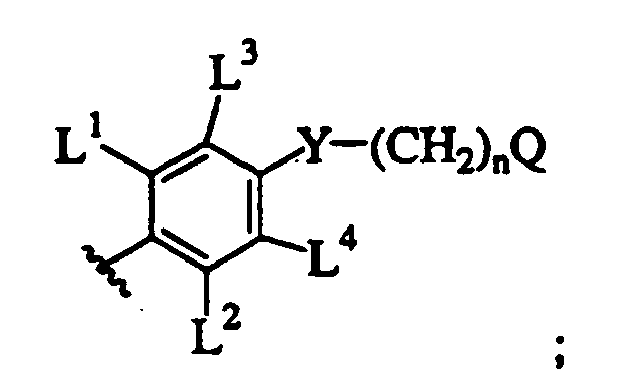
- Also preferred are compounds of Formula (I) where Z is C6-C8 cycloalkyl or a pharmaceutically acceptable salt thereof.
- Among the more preferred group of compounds of this invention according to Formula (Ia) including pharmaceutically acceptable salts thereof are those wherein:
- R is the moiety:

- n=3;
- R1 is H or methyl;
- R3 and R4 are each independently H or C1-C3 alkyl; or R3 and R4 when optionally taken together with the nitrogen atom to which each is attached form a heterocyclic ring of 4 to 6 ring atoms optionally substituted with R7;
- R5 is CF3;
- R7 is C1-C3 alkyl;
- L1 is F;
- L2 is F;
- L3 is H;
- L4 is H;
- X is Cl;
- Y is O;
- W' is N-methylamino, N-methylcyanamido, 1-pyrazolyl, 2-pyrazinyl, 2-pyridyl, 2-pyrimidinyl, or 3-isoquinolinyl groups.
- Among the more preferred group of compounds of this invention according to Formula (Ib) including pharmaceutically acceptable salts thereof are those wherein:
- R is the moiety:

- n=3;
- R1 is H or methyl;
- R3 and R4 are each independently H or C1-C3 alkyl; or R3 and R4 when optionally taken together with the nitrogen atom to which each is attached form a heterocyclic ring of 4 to 6 ring atoms optionally substituted with R7;
- R5 is CF3;
- R7 is C1-C3 alkyl;
- L1 is F;
- L2 is F;
- L 3 is H;
- L4 is H;
- X is Cl;
- Y is O;
- W' is N-methylamino, N-methylcyanamido, 1-pyrazolyl, 2-pyrazinyl, 2-pyridyl, 2-pyrimidinyl, or 3-isoquinolinyl groups.
- A further more preferred group of compounds of this invention according to Formula (I) including pharmaceutically acceptable salts thereof are those wherein:
- Z is C8-C8 cycloalkyl;
- R is the moiety:

- n=3;
- R3 and R4 are each independently H or C1-C3 alkyl; or R3 and R4 when optionally taken together with the nitrogen atom to which each is attached form a heterocyclic ring of 4 to 6 ring atoms optionally substituted with R7;
- R7 is C1-C3 alkyl;
- L1 is F;
- L2 is F;
- L3 is H;
- L4 is H;
- X is Cl;
- Y is O;
- W' is N-methylamino, N-methylcyanamido, 1-pyrazolyl, 2-pyrazinyl, 2-pyridyl, 2-pyrimidinyl, or 3-isoquinolinyl groups.
- Specifically preferred compounds of this invention according to Formula (I) are the following compounds or pharmaceutically acceptable salts thereof:
- 4-chloro-5-{4-[3-(dimethylamino)propoxy]-2,6-difluorophenyl}-6-[(2,2,2-trifluoroethyl)amino]pyrimidin-2-yl(methyl)cyanamide,
- 6-chloro-5-{4-[3-(dimethylamino)propoxy]-2,6-difluorophenyl}-Nz-methyl-N°-(2,2,2-trifluoroethyl)pyrimidine-2,4-diamine,
- (4-chloro-5-{4-[3-(dimethylamino)propoxy]-2,6-difluorophenyl}-6-{[2,2,2-trifluoro-1-methylethyl]amino}pyrimidin-2-yl)methylcyanamide,
- 4-chloro-5-{4-[2-(dimethylamino)ethoxy]-2,6-difluorophenyl}-6-[(2,2,2-trifluoroethyl)amino]pyrimidin-2-yl(methyt)cyanamide,
- {4-chloro-5-{4-[4-(dimethylamino)butoxy]-2,6-difluorophenyl}-6-[(2,2,2-trifluoroethyl)amino]pyrimidin-2-yl}methylcyanamide,
- 6-chloro-5-{2,6-difluoro-4-[3-(methylamino)propoxy}phenyl}-2-pyrazin-2-yl-N-[2,2,2-trifluoro-1-methylethyl]pyrimidin-4-amine,
- 6-chloro-5-{4-[3-(dimethylamino)propoxy]-2,6-difluorophenyl}-2-pyrazin-2-yl-N-(2,2,2-trifluoroethyl)pyrimidin-4-amine,
- 6-chloro-5-{4-[3-(dimethylamino)propoxy]-2,6-difluorophenyl}-N-(2,2,2-trifluoroethyl)-2,2'-bipyrimidin-4-amine,
- 6-chloro-5-{4-[3-(dimethylamino)propoxy]-2,6-difluorophenyl}-2-(1H-imidazol-1-yl)-N-(2,2,2-trifluoroethyl)pyrimidin-4-amine,
- 6-chloro-5-{2,6-difluoro-4-[3-(methylamino)propoxy]phenyl}-2-(1H-pyrazol-1-yl)-N-[2,2,2-trifluoro-1-methylethyl)pyrimidin-4-amine,
- N-{3-[4-(4-chloro-6-cycloheptyl-2-pyrazin-2-ylpyrimidin-5-yl)-3,5-difluorophenoxy]propyl}-N-methylamine,
- 6-chloro-5-{4-[2-(dimethylamino)ethoxy]-2,6-difluorophenyl}-2-pyrazin-2-yl-N-(2,2,2-trifluoroethyl)pyrimidin-4-amine,
- 6-chloro-5-{4-[4-(dimethylamino)butoxy]-2,6-difluorophenyl}-2-pyrazin-2-yl-N-(2,2,2-trifluoroethyl)pyrimidin-4-amine,
- 6-chloro-5-{2,6-difluoro-4-[3-(methylamino)propoxy]phenyl}-2-pyridin-2-yl-N-[2,2,2-trifluoro-1-methylethyl]pyrimidin-4-amine,
- 6-chloro-5-{4-[3-(dimethylamino)propoxy]-2,6-difluorophenyl}-2-quinolin-2-yl-N-(2,2,2-trifluoroethyl)pyrimidin-4-amine and
- 2-(5-Azidopyridin-2-yl)-6-chloro-5-{4-[3-(dimethylamino)propoxy]-2,6-difluorophenyl}-N-(2,2,2-trifluoroethyl)pyrimidin-4-amine.
- Specifically preferred compounds of this invention according to formula (Ia) are the following compounds or pharmaceutically acceptable salts thereof:
- (4-chloro-5-{4-[3-(dimethylamino)propoxy]-2,6-difluorophenyl}-6-{[(1S)-2,2,2-trifluoro-1-methylethyl]amino}pyrimidin-2-yl)methylcyanamide,
- 6-chloro-5-(2,6-difluoro-4-[3-(methylamino)propoxy]phenyl)-2-pyrazin-2-yl-N-[(1S)-2,2,2-trifluoro-1-methylethyl]pyrimidin-4-amine,
- 6-chloro-5-{2,6-difluoro-4-[3-(dimethylamino)propoxy]phenyl}-2-(1H-pyrazol-1-yl)-N-[(1S)-2,2,2-trifluoro-1-methylethyl)pyrimidin-4-amine and
- 6-chloro-5-{2,6-difluoro-4-[3-(methylamino)propoxy]phenyl}-2-pyridin-2-yl-N-[(1S)-2,2,2-trifluoro-1-methylethyl]pyrimidin-4-amine.
- Specifically preferred compounds of this invention according to formula (Ib) are the following compounds or pharmaceutically acceptable salts thereof:
- (4-chloro-5-{4-[3-(dimethylamino)propoxy]-2,6-difluorophenyl}-6-{[(1R)-2,2,2-trifluoro-1-methylethyl]amino}pyrimidin-2-yl)methylcyanamide,
- 6-chloro-5-{2,6-difluoro-4-[3-(methylamino)propoxy]phenyl}-2-pyrazin-2-yl-N-[(1R)-2,2,2-trifluoro-1-methylethyl]pyrimidin-4-amine,
- 6-chloro-5-{2,6-difluoro-4-[3-(dimethylamino)propoxy]phenyl}-2-(1H-pyrazol-1-yl)-N-[(1R)-2,2,2-trifluoro-1-methylethyl)pyrimidin-4-amine and
- 6-chloro-5-{2,6-difluoro-4-[3-(methylamino)propoxy]phenyl}-2-pyridin-2-yl-N-[(1R)-2,2,2-trifluoro-1-methylethyl]pyrimidin-4-amine.
- The present invention also provides composition for use in treating or inhibiting the growth of cancerous tumor cells in a mammal in need thereof comprising a compound of formula (I):
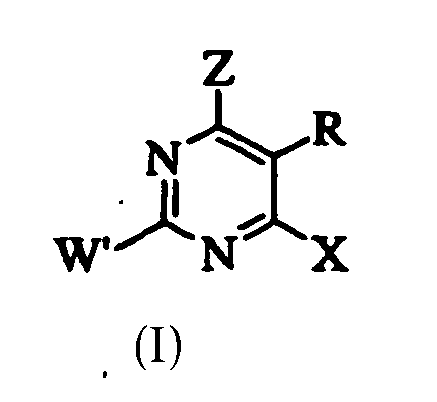
- Z is selected from:

- R is a moiety

- X is Cl or Br;
- L1, L2, L3 and L4 are each independently H, F, Cl or Br;
- A is H, F, Cl, Br, or Y(CH2)nQ;
- Y is O, S, or NR2;
- n is an integer of 2, 3, or 4;
- Q is OH or -NR3R4;
- R1 is H or C1-C3 alkyl;
- R2 is H or C1-C3 alkyl;
- R3 and R4 are each independently H or C1-C3 alkyl; or R3 and R4 when optionally taken together with the nitrogen atom to which each is attached form a heterocyclic ring of 4 to 6 ring atoms optionally substituted with R7;
- R5 is CF3 or C2F5 ;
- W' is -NHR6, -N(CN)R6, aryl of 6 to 12 carbon atoms optionally substituted with 1-3 groups independently selected from halogen , azido, nitro, cyano, hydroxy, C1-C3 alkyl, C1-C3 alkoxy, amino, C1-C3 alkylamino, C1-C3 dialkylamino, formyl, C1-C3 alkoxycarbonyl, carboxyl, C1-C3 alkanoyl, C1-C3 alkylthio, C1-C3 alkylamido, phenyl, phenoxy, benzyl, benzoxy, furyl, and cyclopropyl groups; or heteroaryl of 5 to 10 ring atoms having from 1 to 4 heteroatoms selected from S, O and N and optionally substituted with 1-3 groups independently selected from halogen, azido, nitro, cyano, hydroxy, C1-C3 alkyl, C1-C3 alkoxy, amino, C1-C3 alkylamino, C1-C3 dialkylamino, formyl, C1-C3 alkoxycarbonyl, carboxyl, C1-C3 alkanoyl, C1-C3 alkylthio, C1-C3 alkylamido, phenyl, phenoxy, benzyl, benzoxy, furyl, and cyclopropyl groups;
- R6 is C1-C3 alkyl;
- R7 is C1-C3 alkyl;
- A preferred embodiment of the present invention is to provide a composition for use in treating or inhibiting the growth of cancerous tumor cells in a mammal in need thereof which comprises an effective amount of a compound according to Formula (Ia):

- A preferred embodiment of the present invention is to provide a composition for use in treating or inhibiting the growth of cancerous tumor cells in a mammal in need thereof which comprises administering an effective amount of a compound according to Formula (Ib):

- Further preferred embodiment of the present invention is to provide a composition for use in treating or inhibiting the growth of cancerous tumor cells in a mammal in need thereof which comprises an effective amount of a compound according to formula (I) wherein R is a moiety

- Among the more preferred embodiments of the present invention is to provide a composition for use in treating or inhibiting the growth of cancerous tumor cells in a mammal in need thereof which comprises an effective amount of a compound according to Formula (Ia) including pharmaceutically acceptable salts thereof wherein:
- R is a moiety

- n=3;
- Y is O;
- Q is -NR3R4;
- R1 is H or methyl;
- R5 is CF3;
- R3 and R4 are each independently H or C1-C3 alkyl; or R3 and R4 when optionally taken together with the nitrogen atom to which each is attached form a heterocyclic ring of 4 to 6 ring atoms optionally substituted with R7;
- R6 is C1-C3 alkyl;
- R7 is C1-C3 alkyl;
- L1 is F;
- L2 is H or F;
- L3 is H;
- L4 is H;
- X is Cl or Br,
- Among the more preferred embodiments of the present invention is to provide a composition for use in treating or inhibiting the growth of cancerous tumor cells in a mammal in need thereof which comprises an effective amount of a compound according to Formula (Ib) including pharmaceutically acceptable salts thereof wherein:
- R is a moiety

- n = 3;
- Y is O;
- Q is -NR3R4 ;
- R1 is H or methyl;
- R5 is CF3;
- R3 and R4 are each independently H or C1-C3 alkyl; or R3 and R4 when optionally taken together with the nitrogen atom to which each is attached form a heterocyclic ring of 4 to 6 ring atoms optionally substituted with R7;
- R6 is C1-C3 alkyl;
- R7 is C1-C3 alkyl;
- L1 is F;
- L2 is H or F;
- L3 is H;
- L4 is H;
- X is Cl or Br;
- Among the more preferred embodiments of the present invention is to provide a composition for use in treating or inhibiting the growth of cancerous tumor cells in a mammal in need thereof which comprises an effective amount of compounds according to Formula (Ia) including pharmaceutically acceptable salts thereof are those wherein:
- R is a moiety

- AisF;
- R1 is H or methyl;
- R5 is CF3;
- R6 is C1-C3 alkyl;
- L1 is F;
- L2 is H or F;
- L3 is H;
- L4 is H;
- X is Cl or Br;
- Among the more preferred embodiments of the present invention is to provide a composition for use in treating or inhibiting the growth of cancerous tumor cells in a mammal in need thereof which comprises an effective amount of compounds according to Formula (Ib) including pharmaceutically acceptable salts thereof wherein:
- R is a moiety

- A is F;
- R1 is H or methyl;
- R5 is CF3;
- R6 is C1-C3 alkyl;
- L1 is F;
- L2 is H or F;
- L3 is H;
- L4 is H;
- X is CI or Br;
- Specifically preferred compounds of this invention according to formula (I) useful in a method of treating or inhibiting the growth of cancerous tumor cells in a mammal in need thereof are the compounds or pharmaceutically acceptable salts thereof selected from:
- 4-Chloro-6-[(2,2,2-trifluoroethyl)amino]-5-(2,4,6-trifluorophenyl)pyrimidin-2-yl(methyl)cyanamide,
- 4-Chloro-6-[(2,2,2-trifluoroethyl)amino]-5-(2,4,6-trifluorophenyl)pyrimidin-2-yl]ethylcyanamide,
- 6-Chloro-2-pyrazin-2-yl-N-[2,2,2-tritfluoro-1-methylethyl]-5-(2,4,6-trifluorophenyl)pyrimidin-4-amine,
- 6-Chloro-2-pyrazin-2-yl-N-(2,2,2-trifluoroethyl)-5-(2,4,6-trifluorophenyl)pyrimidin-4-amine,
- 6-Chloro-N-(2,2,2-trifluoroethyl)-5-(2,4,6-trifluorophenyl)-2,2'-bipyrimidin-4-amine,
- 6-Chloro-2-pyridin-4-yl-N-(2,2,2-trifluoroethyl)-5-(2,4,6-trifluorophenyl)pyrimidin-4-amine,
- 6-Chloro-2-pyridin-3-yl-N-(2,2,2-trifluoroethyl)-5-(2,4,6-trifluorophenyl)pyrimidin-4-amine,
- 6-Chloro-2-pyridin-2-yl-N-(2,2,2-trifluoroethyl)-5-(2,4,6-trifluorophenyl)pyrimidin-4-amine,
- 6-Chloro-2-pyridin-2-yl-N-[2,2,2-trifluoro-1-methylethyl]-5-(2,4,6-trifluorophenyl)pyrimidin-4-amine,
- 6-Chloro-2-quinolin-2-yl-N-(2,2,2-trifluoroethyl)-5-(2,4,6-trifluorophenyl)pyrimidin-4-amine,
- 6-Chloro-2-isoquinolin-1-yl-N-(2,2,2-trifluoroethyl)-5-(2,4,6-trifluorophenyl)pyrimidin-4-amine,
- 6-Chloro-2-isoquinolin-3-yl-N-(2,2,2-trifluoroethyl)-5-(2,4,6-trifluorophenyl)pyrimidin-4-amine,
- 6-Chloro-2-thien-2-yl-N-(2,2,2-trifluoroethyl) 5-(2,4,6-trifluorophenyl)pyrimidin-4-amine,
- 6-Chloro-2-(2-furyl)-N-(2,2,2-trifluoroethyl)-5-(2,4,6-trifluorophenyl)pyrimidin-4-amine,
- 6-Chloro-2-(1H-imidazol-1-yl)-N-(2,2,2-trifluoroethyl)-5-(2,4,6-trifluorophenyl)pyrimidin-4-amine,
- 6-Chloro-2-(1H-pyrazol-1-yl)-N-(2,2,2-trifluoroethyl)-5-(2,4,6-trifluorophenyl)pyrimidin-4-amine,
- 6-Chloro-2-(1H-pyrazol-1-yl)-N-[2,2,2-trifluoro-1-methylethyl)-5-(2,4,6-trifluorophenyl)pyrimidin-4-amine,
- 6-Chloro-2-(1H-pyrrool-yl)-N-(2,2,2-trifluoroethyl)-5-(2,4,6-trifluorophenyl)pyrimidin-4-amine,
- 4-Chloro-5-{4-(3-(dimethylamino)propoxyl-2,6-difluorophenyl}-6-[(2,2,2-trifluoroethyl)amino]pyrimidin-2-yl(methyl)cyanamide,
- 6-Chloro-5-{4-[3-(dimethylamino)propoxy]-2,6-difluorophenyl}-N2-methyl-N4-(2,2,2-trifluoroethyl)pyrimidine-2,4-diamine,
- (4-Chloro-5-{4-[3-(dimethylamino)propoxy]-2,6-difluorophenyl}-6-{[2,2,2-trifluoro-1-methylethyl]amino}pyrimidin-2-yl)methylcyanamide,
- 4-Chloro-5-{4-[2-(dimethylamino)ethoxy]-2,6-diftuorophenyl}-6-[(2,2,2-trifluoroethyl)amino]pyrimidin-2-yl(methyl)cyanamide,
- {4-Chloro-5-{4-[4-(dimethylamino)butoxy]-2,6-difluorophenyl}-6-[(2,2,2-trifluoroethyl)amino]pyrimidin-2-yl}methylcyanamide,
- 6-Chloro-5-{2,6-difluoro-4-[3-(methylamino)propoxy]phenyl}-2-pyrazin-2-yl-N-[2,2,2-trifluoro-1 -methylethyl]pyrimidin-4-amine,
- 6-Chloro-5-{4-[3-(dimethylamino)propoxy}-2,6-difluorophenyl}-2-pyrazin-2-yl-N-(2,2,2-trifluoroethyl)pyrimidin-4-amine,
- 6-Chloro-5-{4-[3-(dimethylamino)propoxy]-2,6-difluorophenyl}-N-(2,2,2-trifluoroethyl)-2,2'-bipyrimidin-4-amine,
- 6-Chloro-5-{4-[2-(dimethylamino)ethoxy]-2,6-difluorophenyl}-2-pyrazin-2-yl-N-(2,2,2-trifluoroethyl)pyrimidin-4-amine,
- 6-Chloro-5-{4-[4-(dimethylamino)butoxy]-2,6-difluorophenyl}-2-pyrazin-2-yl-N-(2,2,2-trifluoroethyl)pyrimidin-4-amine,
- 6-Chloro-5-{2,6-difluoro-4-[3-(methylamino)propoxy]phenyl}-2-pyridin-2-yl-N-[2,2,2-trifluoro-1-methylethyl]pyrimidin-4-amine,
- 6-Chloro-5-{4-[3-(dimethylamino)propoxy]- 2,6-difluorophenyl}-2-quinolin-2-yl-N-(2,2,2-trifluoroethyl)pyrimidin-4-amine,
- 6-Chloro-5-{4-[3-(dimethylamino)propoxy]-2,6-difluorophenyl}-2-(1H-imidazol-1-yl)-N-(2,2,2-trifluoroethyl)pyrimidin-4-amine,
- 6-Chloro-5-{2,6-difluoro-4-[3-(methylamino)propoxy]phenyl}-2-(1H-pyrazol-1-yl)-N-[2,2,2-trifluoro-1-methylethyl)pyrimidin-4-amine,
- N-{3-[4-(4-Chloro-6-cycloheptyl-2-pyrazin-2-ylpyrimidin-5-yl)-3,5-difluorophenoxy]propyl}-N-methylamine,
- 6-Chloro-2-(1-methyl-1H-imidazol-2-yl)-Ng2,2,2-trifluoroethyl)-5-(2,4,6-trifluorophenyl)pyrimidin-4-amine,
- 6-Chloro-2-(1H-pyrrol-2-yl)-N-(2,2,2-trifluoroethyl)-5-(2,4,6-trifluorophenyl)pyrimidin-4-amine,
- 6-Chloro-2-(4-methylpyridin-2-yl)-N-(2,2,2-trifluoroethyl)-5-(2,4,6-trifluorophenyl)pyrimidin-4-amine,
- 6-Chloro-2-(5-nitropyridin-2-yl)-N-(2,2,2-trifluoroethyl)-5-(2,4,6-trifluorophenyl)pyrimidin-4-amine and
- 2-(5-Azidopyridin-2-yl)-6-chloro-5-{4-[3-(dimethylamino)propoxy]-2,6-difluorophenyl}-N-(2,2,2-trifluoroethyl)pyrimidin-4-amine.
- Specifically preferred compounds of this invention according to formula (Ia) useful in a method of treating or inhibiting the growth of cancerous tumor cells in a mammal in need thereof are the compounds or pharmaceutically acceptable salts thereof selected from:
- 6-Chloro-2-pyrazin-2-yl-N-[(1S)-2,2,2-trifluoro-1-methylethyl]-5-(2,4,6-trifluorophenyl)pyrimidin-4-amine,
- 6-Chloro-2-pyridin-2-yl-N-[(1S)-2,2,2-trifluoro-1-methylethyl)-5-(2,4,6-trifluorophenyl)pyrimidin-4-amine,
- 6-Chloro-2-(1H-pyrazol-1-yl)-N-[(1S)-2,2,2-trifluoro-1-methylethyl)-5-(2,4,6-trifluorophenyl)pyrimidin-4-amine,
- (4-Chloro-5-{4-[3-(dimethylamino)propoxy]-2,6-difluorophenyl}-6-{[(1S)-2,2,2-trifluoro-1-methylethyl]amino}pyrimidin-2-yl)methylcyanamide,
- 6-Chloro-5-{2,6-difluoro-4-[3-(methylamino)propoxy]phenyl}-2-pyrazin-2-yl-N-[(1S)-2,2,2-trifluoro-1-methylethyl]pyrimidin-4-amine,
- 6-Chloro-5-{2,6-difluoro-4-[3-(methylamino)propoxy]phenyl}-2-pyridin-2-yl-N-[(S)-2,2,2-trifluoro-1-methylethyl]pyrimidin-4-amine and
- 6-Chloro-5-{2,6-difluoro-4-[3-(methylamino)propoxy]phenyl}-2-(1H-pyrazol-1-yl)-N-[(1S)-2,2,2-trifluoro-1-methylethyl)pyrimidin-4-amine.
- Specifically preferred compounds of this invention according to formula (Ib) useful in a method of treating or inhibiting the growth of cancerous tumor cells in a mammal in need thereof are the compounds or pharmaceutically acceptable salts thereof selected from:
- 6-Chloro-2-pyrazin-2-yl-N-[(1R)-2,2,2-trifluoro-1-methylethyl]-5-(2,4,6-trifluorophenyl)pyrimidin-4-amine,
- 6-Chloro-2-pyridin-2-yl-N-[(1R)-2,2,2-trifluoro-1-methylethyl]-5-(2,4,6-trifluorophenyl)pyrimidin-4-amine,
- 6-Chloro-2-(1H-pyrazol-1-yl)-N-[(1R)-2,2,2-trifluoro-1-methylethyl)-5-(2,4,6-trifluorophenyl)pyrimidin-4-amine,
- (4-Chloro-5-{4-[3-(dimethylamino)propoxy]-2,6-difluorophenyl}-6-{[(1 R)-2,2,2-trifluoro-1-methylethyl]amino}pyrimidin-2-yl)methylcyanamide,
- 6-Chloro-5-(2,6-difluoro-4-[3-(methylamino)propoxy]phenyl)-2-pyrazin-2-yl-N-[(1R)-2,2,2-trifluoro-1-methylethyl]pyrimidin-4-amine,
- 6-Chloro-5-{2,6-difluoro-4-[3-(methylamino)propoxy]phenyl}-2-pyridin-2-yl-N-[(1R)-2,2,2-trifluoro-1-methylethyl]pyrimidin-4-amine and
- 6-Chloro-5-{2,6-difluoro-4-[3-(methylamino)propoxy]phenyl}-2-(1H-pyrazol-1-yl)-N-[(1R)-2,2,2-trifluoro-1-methylethyl)pyrimidin-4-amine.
- The present invention provides a method of promoting tubulin polymerization in a tubulin containing system which comprises contacting said tubulin containing system "in vitro" with effective amount of a compound of formula (I):
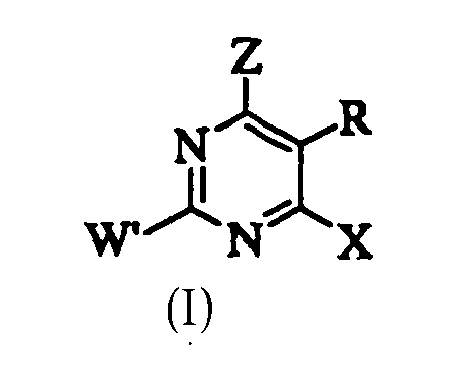
- Z is selected from:
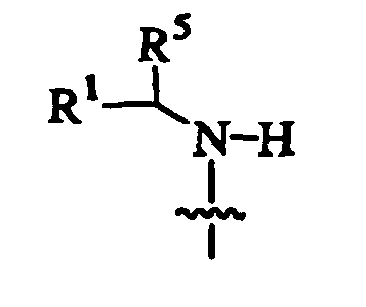
- R is a moiety

- X is Cl or Br;
- L1, L2, L3 and L4 are each independently H, F, Cl or Br;
- A is H, F, Cl, Br, or Y(CH2)nQ ;
- Y is O, S, or -NR2;
- n is an integer of 2, 3, or 4;
- Q is OH or -NR3R4;
- R1 is H or C1-C3 alkyl;
- R3 and R4 are each independently H or C1-C3 alkyl; or R3 and R4 when optionally taken together with the nitrogen atom to which each is attached form a heterocyclic ring of 4 to 6 ring atoms optionally substituted with R7;
- R6 is CF3 or C2F5
- W' is -NHR6, -N(CN)R6, aryl of 6 to 12 carbon atoms optionally substituted with 1-3 groups independently selected from halogen , azido, nitro, cyano, hydroxy, C1-C3 alkyl, C1-C3 alkoxy, amino, C1-C3 alkylamino, C1-C3 dialkylamino, formyl, C1-C3 alkoxycarbonyl, carboxyl, C1-C3 alkanoyl, C1-C3 alkylthio, C1-C3 alkylamido, phenyl, phenoxy, benzyl, benzoxy, furyl, and cyclopropyl groups; or heteroaryl of 5 to 10 ring atoms having from 1 to 4 heteroatoms selected from S, O and N and optionally substituted with 1-3 groups independently selected from halogen, azido, nitro, cyano, hydroxy, C1-C3 alkyl, C1-C3 alkoxy, amino, C1-C3 alkylamino, C1-C3 dialkylamino, formyl, C1-C3 alkoxycarbonyl, carboxyl, C1-C3 alkanoyl, C1-C3 alkylthio, C1-C6 alkylamido, phenyl, phenoxy, benzyl, benzoxy, furyl, and cyclopropyl groups;
- R6 is C1-C3 alkyl;
- R7 is C1-C3 alkyl;
- Also provided by this invention is a method of promoting tubulin polymerization in a Tubulin containing system which comprises contacting said tubulin containing system "in vitro" with an effective amount of a compound of formula (Ia):

- A preferred embodiment of the present invention is to provide a method of promoting tubulin polymerization in a tubulin containing system which comprises contacting said tubulin containing system "in vitro" with an effective amount of a compound of formula (Ib):

- Further preferred embodiment of the present invention is to provide a method of promoting tubulin polymerization in a tubulin containing system which comprises contacting said tubulin containing system "in vitro" with an effective amount of a compound according to formula (I) wherein R is a moiety

- A more preferred embodiment of the present invention is to provide a method of promoting tubulin polymerization in a tubulin containing system which comprises contacting said tubulin containing system "in vitro" with an effective amount of a compound according to formula (Ia) or pharmaceutically acceptable salts thereof wherein:
- R is a moiety

- n=3;
- Y is O;
- Q is -NR3R4;
- R1 is H or methyl;
- R5 is CF3;
- R3 and R4 are each independently H or C1-C3 alkyl; or R3 and R4 when optionally taken together with the nitrogen atom to which each is attached form a heterocyclic ring of 4 to 6 ring atoms optionally substituted with R7;
- R6 is C1-C3 alkyl;
- R7 is C1-C3 alkyl;
- L1 is F;
- L2 is H or F;
- L3 is H;
- L4 is H;
- X is Cl or Br;
- A more preferred embodiment of the present invention is to provide a method of promoting tubulin polymerization in a tubulin containing system which comprises contacting said tubulin containing system "in vitro" with an effective amount of a compound according to formula (Ib) including pharmaceutically acceptable salts thereof wherein:
- R is

- n=3;
- Y is O;
- Q is -NR3R4;
- R1 is H or methyl;
- R5 is CF3;
- R3 and R4 are each independently H or C1-C3 alkyl; or R3 and R4 when optionally taken together with the nitrogen atom to which each is attached form a heterocyclic ring of 4 to 6 ring atoms optionally substituted with R7;
- R6 is C1-C3 alkyl;
- R7 is C1-C3 alkyl;
- L1 is F;
- L2 is H or F;
- L3 is H;
- L4 is H;
- X is Cl or Br;
- A more preferred embodiment of the present invention is to provide a method of promoting tubulin polymerization in a tubulin containing system which comprises contacting said tubulin containing system "in vitro" with an effective amount of a compound according to formula (Ia) or pharmaceutically acceptable salts thereof wherein:
- R is a moiety

- A is F;
- R1 is H or methyl;
- R5 is CF3;
- R6 is C1-C3 alkyl;
- L1 is F;
- L2 is H or F;
- L3 is H;
- L4 is H;
- X is Cl or Br;
- A more preferred embodiment of the present invention is to provide a method of promoting tubulin polymerization in a tubutin containing system which comprises contacting said tubulin containing system "in vitro" with an effective amount of a compound according to Formula (Ib) including pharmaceutically acceptable salts wherein:
- R is a moiety

- A is F;
- R1 is H or methyl;
- R5 is CF3;
- R6 is C1-C3 alkyl;
- L1 is F;
- L2 is H or F;
- L3 is H;
- L4 is H;
- X is Cl or Br;
- Specifically preferred compounds of this invention useful in a method of promoting tubulin polymerization in a tubulin containing system which comprises contacting said tubulin containing system "in vitro" with an effective amount of a compound according to formula (I) or a pharmaceutically acceptable salt thereof selected from :
- 4-Chloro-6-[(2,2,2-trifluoroethyl)amino]-5-(2,4,6-trifluorophenyl)pyrimidin-2-yl(methyl)cyanamide,
- 4-Chloro-6-[(2,2,2-trifluoroethyl)amino]-5-(2,4,6-trifluorophenyl)pyrimidin-2-yl]ethylcyanamide,
- 6-Chloro-2-pyrazin-2-yl-N-[2,2,2-trifluoro-1-methylethyl]-5-(2,4,6-trifluorophenyl)pyrimidin-4-amine,
- 6-Chloro-2-pyrazin-2-yl-N-(2,2,2-trifluoroethyl)-5-(2,4,6-trifluorophenyl)pyrimidin-4-amine,
- 6-Chloro-N-(2,2,2-trifluoroethyl)-5-(2,4,6-trifluorophenyl)-2,2'-bipyrimidin-4-amine,
- 6-Chloro-2-pyridin-4-yl-N-(2,2,2-trifluoroethyl)-5-(2,4,6-trifluorophenyl)pyrimidin-4-amine,
- 6-Chloro-2-pyridin-3-yl-N-(2,2,2-trifluoroethyl)-5-(2,4,6-trifluorophenyl)pyrimidin-4-amine,
- 6-Chloro-2-pyridin-2-yl-N-(2,2,2-trifluoroethyl)-5-(2,4,6-trifluorophenyl)pyrimidin-4-amine,
- 6-Chloro-2-pyridin-2-yl-N-[2,2,2-trifluoro-1-methylethyl]-5-(2,4,6-trifluorophenyl)pyrimidin-4-amine,
- 6-Chloro-2-quinolin-2-yl-N-(2,2,2-trifluoroethyl)-5-(2,4,6-trifluorophenyl)pyrimidin-4-amine,
- 6-Chloro-2-isoquinolin-1-yl-N-(2,2,2-trifluoroethyl)-5-(2,4,6-trifluorophenyl)pyrimidin-4-amine,
- 6-Chloro-2-isoquinolin-3-yl-N-(2,2,2-trifluoroethyl)-5-(2,4,6-trifluorophenyl)pyrimidin-4-amine,
- 6-Chloro-2-thien-2-yl-N-(2,2,2-trifluoroethyl)-5-(2,4,6-trifluorophenyl)pyrimidin-4-amine,
- 6-Chloro-2-(2-furyl)-N-(2,2,2-trifluoroethyl)-5-(2,4,6-trifluorophenyl)pyrimidin-4-amine,
- 6-Chloro-2-(1H-imidazol-1-yl)-N-(2,2,2-trifluoroethyl)-5-(2,4,6-trifluorophenyl)pyrimidin-4-amine,
- 6-Chloro-2-(1H-pyrazol-1-yl)-N-(2,2,2-trifluoroethyl)-5-(2,4,6-trifluorophenyl)pyrimidin-4-amine,
- 6-Chloro-2-(1H-pyrazol-1-yl)-N-[2,2,2-trifluoro-1-methylethyl)-5-(2,4,6-trifluorophenyl)pyrimidin-4-amine,
- 6-Chloro-2-(1H-pyrrol-1-yl)-N-(2,2 ,2-trifluoroethyl)-5-(2,4,6-trifluorophenyl)pyrimidin-4-amine,
- 4-Chloro-5-{4-[3-(dimethylamino)propoxy]-2,6-difluorophenyl}-6-[(2,2,2-trifluoroethyl)amino]pyrimidin-2-yl(methyl)cyanamide,
- 6-Chloro-5-{4-[3-(dimethylamino)propoxy]-2,6-difluorophenyl}-N2-methyl-N4-(2,2,2-trifluoroethyl)pyrimidine-2,4-diamine,
- (4-Chloro-5-{4-[3-(dimethylamino)propoxy]-2,6-difluorophenyl}-6-{[2,2,2-trifluoro-1-methylethyl]amino}pyrimidin-2-yl)methylcyanamide,
- 4-Chloro-5-{4-[2-(dimethylamino)ethoxy]-2,6-difluorophenyl}-6-[(2,2,2-trifluoroethyl)amino]pyrimidin-2-yl(methyl)cyanamide,
- {4-Chloro-5-{4-[4-(dimethylamino)butoxy]-2,6-difluorophenyl}-6-[(2,2,2-trifluoroethyl)amino]pyrimidin-2-yl}methylcyanamide,
- 6-Chloro-5-{2,6-difluoro-4-[3-(methylamino)propoxy]phenyl}-2-pyrazin-2-yl-N-[2,2,2-trifluoro-1-methylethyl]pyrimidln-4-amine,
- 6-Chloro-5-{4-[3-(dimethylamino)propoxy]-2,6-difluorophenyl}-2-pyrazin-2-yl-N-(2,2,2-trifluoroethyl)pyrimidin-4-amine,
- 6-Chloro-5-{4-[3-(dimethylamino)propoxy]-2,6-difluorophenyl}-N-(2,2,2-trifluoroethyl)-2,2'-bipyrimidin-4-amine,
- 6-Chloro-5-{4-[2-(dimethylamino)ethoxy]-2,6-difluorophenyl}-2-pyrazin-2-yl-N-(2,2,2-trifluoroethyl)pyrimidin-4-amine,
- 6-Chloro-5-{4-[4-(dimethylamino)butoxy]-2,6-difluorophenyl}-2-pyrazin-2-yl-N-(2,2,2-trifluoroethyl)pyrimidin-4-amine,
- 6-Chloro-5-{2,6-difluoro-4-[3-(methylamino)propoxy]phenyl}-2-pyridin-2-yl-N-[2,2,2-trifluoro-1-methylethyl]pyrimidin-4-amine,
- 6-Chloro-5-{4-[3-(dimethylamino)propoxy]-2,6-difluorophenyl}-2-quinolin-2-yl-N-(2,2,2-trifluoroethyl)pyrimidin-4-amine,
- 6-Chloro-5-{4-[3-(dimethylamino)propoxy]-2,6-difluorophenyl}-2-(1H-imidazol-1-yl)-N-(2,2,2-trifluoroethyl)pyrimidin-4-amine,
- 6-Chloro-5-{2,6-difluoro-4-[3-(methylamino)propoxy]phenyl}-2-(1H-pyrazol-1-yl)-N-[2,2,2-trifluoro-1-methylethyl)pyrimidin-4-amine,
- N-{3-[4-(4-Chloro-6-cycloheptyl-2-pyrazin-2-ylpyrimidin-5-yl)-3,5-difluorophenoxy]propyl}-N-methylamine,
- 6-Chloro-2-(1-methyl-1H-imidazol-2-yl)-N-(2,2,2-trifluoroethyl)-5-(2,4,6-trifluorophenyl)pyrimidin-4-amine,
- 6-Chloro-2-(1H-pyrrol-2-yl)-N-(2,2,2-trifluoroethyl)-5-(2,4,6-trifluorophenyl)pyrimidin-4-amine,
- 6-Chloro-2-(4-methylpyridin-2-yl)-N-(2,2,2-trifluoroethyl)-5-(2,4,6-trifluorophenyl)pyrimidin-4-amine,
- 6-Chloro-2-(5-nitropyridin-2-yl)-N-(2,2,2-trifluoroethyl)-5-(2,4,6-trifluorophenyl)pyrimidin-4-amine and
- 2-(5-Azidopyridin-2-yl)-6-chloro-5-{4-[3-(dimethylamino)propoxy]-2,6-difluorophenyl}-N-(2,2,2-trifluoroethyl)pyrimidin-4-amine.
- Specifically preferred compounds of this invention useful in a method of promoting tubulin polymerization in a tubulin containing system which comprises contacting said tubulin containing system "in vitro" with an effective amount of a compound according to formula (Ia) or pharmaceutically acceptable salts thereof selected from:
- 6-Chloro-2-pyrazin-2-yl-N-[(1S)-2,2,2-trifluoro-1-methylethyl]-5-(2,4,6-trifluorophenyl)pyrimidin-4-amine,
- 6-Chloro-2-pyridin-2-yl-N-[(1S)-2,2,2-trifluoro-1-methylethyl]-5-(2,4,6-trifluorophenyl)pyrimidin-4-amine,
- 6-Chloro-2-(1H-pyrazo)-1-yl)-N-[(1S)-2,2,2-trifluoro-1-methylethyl)-5-(2,4,6-trifluorophenyl)pyrimidin-4-amine,
- (4-Chloro-5-{4-[3-(dimethylamino)propoxy]-2,6-difluorophenyl}-6-{[(1S)-2,2,2-trifluoro-1-methylethyl]amino}pyrimidin-2-yl)methylcyanamide,
- 6-Chloro-5-{2,6-difluoro-4-[3-(methylamino)propoxy]phenyl}-2-pyrazin-2-yl-N-[(1S)-2,2,2-trifluoro-1-methylethyl]pyrimidin-4-amine,
- 6-Chloro-5-{2,6-difluoro-4-[3-(methylamino)propoxy]phenyl}-2-pyridin-2-yl-N-[(1S)-2,2,2-trifluoro-1-methylethyl]pyrimidin-4-amine and
- 6-Chloro-5-{2,6-difluoro-4-[3-(methylamino)propoxy]phenyl)-2-(1H-pyrazol-1-yl)-N-[(1S)-2,2,2-trifluoro-1-methylethyl)pyrimidin-4-amine.
- Specifically preferred compounds of this invention useful in a method of promoting tubulin polymerization in a tubulin containing system which comprises contacting said tubulin containing system "in vitro" with an effective amount of a compound according to formula (Ib) or pharmaceutically acceptable salts thereof selected from:
- 6-Chloro-2-pyrazin-2-yl-N-[(1R)-2,2,2-trifluoro-1-methylethyl]-5-(2,4,6-trifluorophenyl)pyrimidin-4-amine,
- 6-Chloro-2-pyridin-2-yl-N-[(1R)-2,2,2-trifluoro-1-methylethyl]-5-(2,4,6-trifluorophenyl)pyrimidin-4-amine,
- 6-Chloro-2-(1H-pyrazol-1-yl)-N-[(1R)-2,2,2-trifluoro-1-methylethyl)-5-(2,4,6-trifluorophenyl)pyrimidin-4-amine,
- (4-Chloro-5-{4-[3-(dimethylamino)propoxy]-2,6-difluorophenyl}-6-{[(1R)-2,2,2-trifluoro-1-methylethyl]amino}pyrimidin-2-yl)methylcyanamide,
- 6-Chloro-5-{2,6-difluoro-4-[3-(methylamino)propoxy]phenyl}-2-pyrazin-2-yl-N-[(1R)-2,2,2-trifluoro-1-methylethyl]pyrimidin-4-amine,
- 6-Chloro-5-{2,6-difluoro-4-[3-(methylamino)propoxy]phenyl}-2-pyridin-2-yl-N-[(1R)-2,2,2-trifluoro-1-methylethyl]pyrimidin-4-amine and
- 6-Chloro-5-(2,6-difluoro-4-[3-(methylamino)propoxylpheno}-2-(1H-pyrazol-1-yl)-N-[(1R)-2,2,2-trifluoro-1-methytethyl)pyrimidin-4-amine.
- Further provided by the present invention is a method of stabilizing microtubules in a tubulin containing system by contacting said tubulin containing system "in vitro" with an effective amount of a compound of formula (I) or a pharmaceutically acceptable salt thereof

- Z is selected from:

- R is a moiety

- X is Cl or Br;
- L1, L2, L3 and L4 are each independently H, F, Cl or Br;
- A is H, F, Cl, Br, or Y(CH2)nQ;
- Y is O, S, or -NR2;
- n is an integer of 2, 3, or 4;
- Q is OH or -NR3R4;
- R1 is H or C1-C3 alkyl;
- R3 and R4 are each independently H or C1-C3 alkyl; or R3 and R4 when optionally taken together with the nitrogen atom to which each is attached form a heterocyclic ring of 4 to 6 ring atoms optional substituted with R7;
- R5 is CF3 or C2F5 ;
- W' is -NHR6, -N(CN)R6, aryl of 6 to 12 carbon atoms optionally substituted with 1-3 groups independently selected from halogen , azido, nitro, cyano, hydroxy, C1-C3 alkyl, C1-C3 alkoxy, amino, C1-C3 alkylamino, C1-C3 dialkylamino, formyl, C1-C3 alkoxycarbonyl, carboxyl, C1-C3 alkanoyl, C1-C3 alkylthio, C1-C3 alkylamido, phenyl, phenoxy, benzyl, benzoxy, furyl, and cyclopropyl groups; or heteroaryl of 5 to 10 ring atoms having from 1 to 4 heteroatoms selected from S, O and N and optionally substituted with 1-3 groups independently selected from halogen, azido, nitro, cyano, hydroxy, C1-C3 alkyl, C1-C3 alkoxy, amino, C1-C3 alkylamino, C1-C3 dialkylamino, formyl, C1-C3 alkoxycarbonyl, carboxyl, C1-C3 alkanoyl, C1-C3 alkylthio, C1-C3 alkylamido, phenyl, phenoxy, benzyl, benzoxy, furyl, and cyclopropyl groups;
- R6 is C1-C3 alkyl;
- R7 is C1-C3 alkyl;
- A preferred embodiment of the present invention is to provide a method of stabilizing microtubules in a tubulin containing system by contacting said tubulin containing system "in vitro" with an effective amount of a compound of formula (Ia) or a pharmaceutically acceptable salt thereof

- A preferred embodiment of the present invention is to provide a method of stabilizing microtubules in a tubulin containing system by contacting said tubulin containing system "in vitro" with an effective amount of a compound of formula (Ib)

- Further preferred embodiment of the present invention is to provide a method of stabilizing microtubules in a tubulin containing system by contacting said tubulin containing system "in vitro" with an effective amount of a compound of formula (I) wherein R is a moiety

- A more preferred embodiment of the present invention is to provide a method of stabilizing microtubules in a tubulin containing system by contacting said tubulin containing system "in vitro" with an effective amount of a compound of formula (Ia) wherein:
- R is a moiety
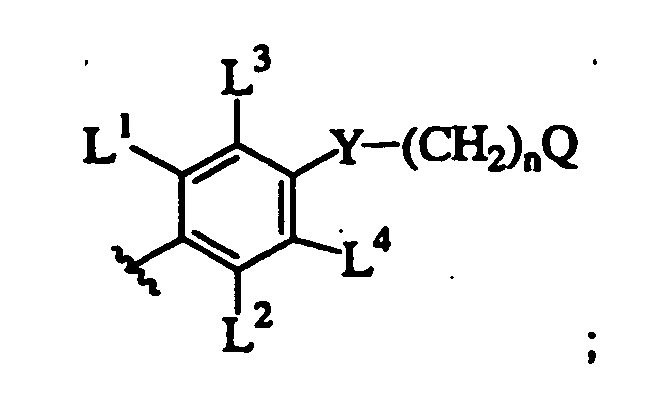
- n = 3;
- Y is O;
- Q is -NR3R4;
- R1 is H or methyl;
- R5 is CF3;
- R3 and R4 are each independently H or C1-C3 alkyl; or R3 and R4 when optionally taken together with the nitrogen atom to which each is attached form a heterocyclic ring of 4 to 6 ring atoms optionally substituted with R7;
- R6 is C1-C3 alkyl;
- R7 is C1-C3 alkyl;
- L1 is F;
- L2 is H or F;
- L3 is H;
- L4 is H;
- X is Cl or Br;
- A more preferred embodiment of the present invention is to provide a method of stabilizing microtubules in a tubulin containing system by contacting said tubulin containing system "in vitro" with an effective amount of a compound of formula (Ib) wherein:
- R is a moiety

- n=3;
- Y is O;
- Q is -NR3R4;
- R1 is H or methyl;
- R5 is CF3;
- R3 and R4 are each independently H or C1-C3 alkyl; or R3 and R4 when optionally taken together with the nitrogen atom to which each is attached form a heterocyclic ring of 4 to 6 ring atoms optionally substituted with R7;
- R6 is C1-C3 alkyl;
- R7 is C1-C3 alkyl;
- L1 is F;
- L2 is H or F;
- L3 is H;
- L4 is H;
- X is Cl or Br;
- A more preferred embodiment of the present invention is to provide a method of stabilizing microtubles in a tubulin containing system by contacting said tubulin containing system "in vitro" with an effective amount of a compound of formula (Ia) wherein:
- R is a moiety
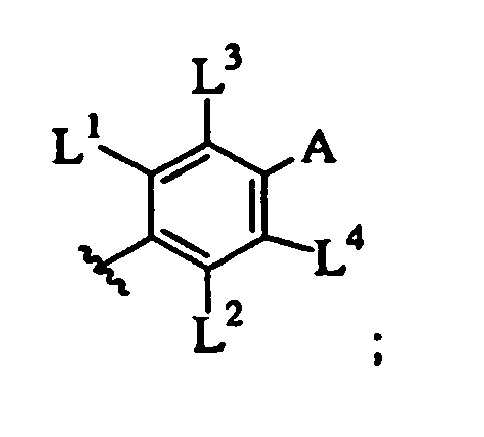
- A is F;
- R1 is H or methyl;
- R5 is CF3;
- R6 is C1-C3 alkyl;
- L1 is F;
- L2 is H or F;
- L3 is H;
- L4 is H;
- X is Cl or Br;
- A more preferred embodiment of the present invention is to provide a method of stabilizing microtubules in a tubulin containing system by contacting said tubulin containing system "in vitro" with an effective amount of a compound of formula (Ib) wherein:
- R is a moiety

- AisF;
- R1 is H or methyl;
- R5 is CF3;
- R6 is C1-C3 alkyl;
- L1 is F;
- L2 is H or F;
- L3 is H;
- L4 is H;
- X is Cl or Br;
- Specifically preferred compounds of this invention useful in a method of stabilizing microtubules in a tubulin containing system by contacting said tubulin containing system "in vitro" with an effective amount of a compound of formula (I) are the following compounds or a pharmaceutically acceptable salt thereof:
- 4-Chloro-6-[(2,2,2-trifluoroethyl)amino]-5-(2,4,6-trifluorophenyl)pyrimidin-2-yl(methyl)cyanamide,
- 4-Chloro-6-[(2,2,2-trifluoroethyl)amino]-5-(2,4,6-trifluorophenyl)pyrimidin-2-yl]ethylcyanamide,
- 6-Chloro-2-pyrazin-2-yl-N-[2,2,2-trifluoro-1-methylethyl]-5-(2,4,6-trifluorophenyl)pyrimidin-4-amine,
- 6-Chloro-2-pyrazin-2-yl-N-(2,2,2-trifluoroethyl)-5-(2,4,6-trifluorophenyl)pyrimidin-4-amine,
- 6-Chloro-N-(2,2,2-trifluoroethyl)-5-(2,4,6-trifluorophenyl)-2,2'-bipyrimidin-4-amine,
- 6-Chloro-2-pyridin-4-yl-N-(2,2,2-trifluoroethyl)-5-(2,4,6-trifluorophenyl)pyrimidin-4-amine,
- 6-Chloro-2-pyridin-3-yl-N-(2,2,2-trifluoroethyl)-5-(2,4,6-trifluorophenyl)pyrimidin-4-amine,
- 6-Chforo-2-pyridin-2-yl-N-(2,2,2-trifluoroethyl)-5-(2,4,6-trifluorophenyl)pyrimidin-4-amine,
- 6-Chloro-2-pyridin-2-yl-N-[2,2,2-trifluoro-1-methylethyl]-5-(2,4,6-trifluorophenyl)pyrimidin-4-amine,
- 6-Chloro-2-quinolin-2-yl-N-(2,2,2-trifluoroethyl)-5-(2,4,6-trifluorophenyl)pyrimidin-4-amine,
- 6-Chloro-2-isoquinolin-1-yl-N-(2,2,2-trifluoroethyl)-5-(2,4,6-trifluorophenyl)pyrimidin-4-amine,
- 6-Chloro-2-isoquinolin-3-yl-N-(2,2,2-trifluoroethyl)-5-(2,4,6-trifluorophenyl)pyrimidin-4-amine,
- 6-Chloro-2-thien-2-yl-N-(2,2,2-trifluoroethyl)-5-(2,4,6-trifluorophenyl)pyrimidin-4-amine,
- 6-Chloro-2-(2-furyl)-N-(2,2,2-trifluoroethyl)-5-(2,4,6-trifluorophenyl)pyrimidin-4-amine,
- 6-Chloro-2-(1H-imidazol-1-yl)-N-(2,2,2-trifluoroethyl)-5-(2,4,6-trifluorophenyl)pyrimidin-4-amine,
- 6-Chloro-2-(1H-pyrazol-1-yl)-N-(2,2,2-trifluoroethyl)-5-(2,4,6-trifluorophenyl)pyrimidin-4-amine,
- 6-Chloro-2-(1H-pyrazol-1-yl)-N-[2,2,2-trifluoro-1-methylethyl)-5-(2,4,6-trifluorophenyl)pyrimidin-4-amine,
- 6-Chloro-2-(1H-pyrrol-1-yl)-N-(2,2,2-trifluoroethyl)-5-(2,4,6-trifluorophenyl)pyrimidin-4-amine,
- 4-Chloro-5-{4-[3-(dimethylamino)propoxy]-2,6-difluorophenyl}-6-[(2,2,2-trifluoroethyl)amino]pyrimidin-2-yl (methyl)cyanamide,
- 6-Chloro-5-{4-[3-(dimethylamino)propoxy]-2,6-difluorophenyl}-N2-methyl-N4-(2,2,2-trifluoroethyl)pyrimidine-2,4-diamine,
- (4-Chloro-5-{4-[3-(dimethylamino)propoxy]-2,6-difluorophenyl}-6-{(2,2,2-trifluoro-1-methylethyl]amino}pyrimidin-2-yl)methylcyanamide,
- 4-Chloro-5-{4-[2-(dimethylamino)ethoxy]-2,6-difluorophenyl}-6-[(2,2,2-trifluoroethyl)amino]pyrimidin-2-yl(methyl)cyanamide,
- {4-Chloro-5-{4-[4-(dimethylamino)butoxy]-2,6-difluorophenyl}-6-[(2,2,2-trifluoroethyl)amino]pyrimidin-2-yl}methylcyanamide,
- 6-Chloro-5-{2,6-difluoro-4-[3-(methylamino)propoxy]phenyl}-2-pyrazin-2-yl-N-[2,2,2-trifluoro-1-methylethyl]pyrimidin-4-amine,
- 6-Chloro-5-{4-[3-(dimethylamino)propoxy]-2,6-difluorophenyl}-2-pyrazin-2-yl-N-(2,2,2-trifluoroethyl)pyrimidin-4-amine,
- 6-Chloro-5-{4-[3-(dimethylamino)propoxy]-2,6-difluorophenyl}-N-(2,2,2-trifluoroethyl)-2,2'-bipyrimidin-4-amine,
- 6-Chloro-5-{4-[2-(dimethylamino)ethoxy]-2,6-difluorophenyl}-2-pyrazin-2-yl-N-(2,2,2-trifluoroethyl)pyrimidin-4-amine,
- 6-Chloro-5-{4-[4-(dimethylamino)butoxy]-2,6-difluorophenyl}-2-pyrazin-2-yl-N-(2,2,2-trifluoroethyl)pyrimidin-4-amine,
- 6-Chloro-5-{2,6-difluoro-4-[3-(methylamino)propoxy]phenyl}-2-pyridin-2-yl-N-[2,2,2-trifluoro-1-methylethyl]pyrimidin-4-amine,
- 6-Chloro-5-{4-[3-(dimethylamino)propoxy]- 2,6-difluorophenyl}-2-quinolin-2-yl-N-(2,2,2-trifluoroethyl)pyrimidin-4-amine,
- 6-Chloro-5-{4-[3-(dimethylamino)propoxy]-2,6-difluorophenyl}-2-(1H-imidazol-1-yl)-N-(2,2,2-trifluoroethyl)pyrimidin-4-amine,
- 6-Chloro-5-{2,6-difluoro-4-[3-(dimethylamino)propoxy]phenyl}-2-(1H-pyrazol-1-yl)-N-[2,2,2-trifluoro-1-methylethyl)pyrimidin-4-amine,
- N-{3-[4-(4-Chloro-6-cycloheptyl-2-pyrazin-2-ylpyrimidin-5-yl)-3,5-difluorophenoxy]propyl}-N-methylamine,
- 6-Chloro-2-(1-methyl-1H-imidazol-2-yl)-N-(2,2,2-trifluoroethyl)-5-(2,4,6-trifluorophenyl)pyrimidin-4-amine,
- 6-Chloro-2-(1H-pyrrol-2-yl)-N-(2,2,2-trifluoroethyl)-5-(2,4,6-trifluorophenyl)pyrimidin-4-amine,
- 6-Chloro-2-(4-methylpyridin-2-yl)-N-(2,2,2-trifluoroethyl)-5-(2,4,6-trifluorophenyl)pyrimidin-4-amine,
- 6-Chloro-2-(5-nitropyridin-2-yl)-N-(2,2,2-trifluoroethyl)-5-(2,4,6-trifluorophenyl)pyrimidin-4-amine and
- 2-(5-Azidopyridin-2-yl)-6-chloro-5-{4-[3-(dimethylamino)propoxy]-2,6-difluorophenyl}-N-(2,2,2-trifluoroethyl)pyrimidin-4-amine.
- A more preferred embodiment of this invention useful in a method of stabilizing microtubules in a tubulin containing system by contacting said tubulin containing system "in vitro" with an effective amount of a compound of formula (Ia) are the following compounds or a pharmaceutically acceptable salt thereof:
- 6-Chloro-2-pyrazin-2-yl-N-[(1S)-2,2,2-trifluoro-1-methylethyl]-5-(2,4,6-trifluorophenyl)pyrimidin-4-amine,
- 6-Chloro-2-pyridin-2-yl-N-[(1S)-2,2,2-trifluoro-1-methylethyl]-5-(2,4,6-trifluorophenyl)pyrimidin-4-amine,
- 6-Chloro-2-(1H-pyrazol-1-yl)-N-[(1S)-2,2,2-trifluoro-1-methylethyl)-5-(2,4,6-trifluorophenyl)pyrimidin-4-amine,
- (4-Chloro-5-{4-[3-(dimethylamino)propoxy]-2,6-difluorophenyl}-6-{[(1S)-2,2,2-trifluoro-1-methylethyl]amino}pyrimidin-2-yl)methylcyanamide,
- 6-Chloro-5-{2,6-difluoro-4-[3-(methylamino)propoxy]phenyl}-2-pyrazin-2-yl-N-[(1S)-2,2,2-trifluoro-1-methylethyl]pyrimidin-4-amine,
- 6-Chloro-5-{2,6-difluoro-4-[3-(methylamino)propoxy]phenyl}-2-pyridin-2-yl-N-[(1S)-2,2,2-trifluoro-1-methylethyl]pyrimidin-4-amine and
- 6-Chloro-5-{2,6-difluoro-4-[3-(dimethylamino)propoxylphenyl}-2-(1H-pyrazol-1-yl)-N-[(1S)-2,2,2-trifluoro-1-methylethyl)pyrimidin-4-amine.
- A more preferred embodiment of this invention useful in a method of stabilizing microtubules in a tubulin containing system by contacting said tubulin containing system "in vitro" with an effective amount of a compound of formula (Ib) are the following compounds or a pharmaceutically acceptable salt thereof:
- 6-Chloro-2-pyrazin-2-yl-N-[(1R)-2,2,2-trifluoro-1-methylethyl]-5-(2,4,6-trifluorophenyl)pyrimidin-4-amine,
- 6-Chloro-2-pyridin-2-yl-N-[(1R)-2,2,2-trifluoro-1-methylethyl]-5-(2,4,6-trifluorophenyl)pyrimidin-4-amine,
- 6-Chloro-2-(1H-pyrazol-1-yl)-N-[(1R)-2,2,2-trifluoro-1-methylethyl)-5-(2,4,6-trifluorophenyl)pyrimidin-4-amine,
- (4-Chloro-5-{4-[3-(dimethylamino)propoxy]-2,6-difluorophenyl}-6-{[(1R)-2,2,2-trifluoro-1-methylethyl]amino}pyrimidin-2-yl)methylcyanamide,
- 6-Chloro-5-{2,6-difluoro-4-[3-(methylamino)propoxy)phenyl}-2-pyrazin-2-yl-N-[(1R)-2,2,2-trifluoro-1-methylethyl]pyrimidin-4-amine,
- 6-Chloro-5-{2,6-difluoro-4-[3-(methylamino)propoxy]phenyl}-2-pyridin-2-yl-N-[(1R)-2,2,2-trifluoro-1-methylethyl]pyrimidin-4-amine and
- 6-Chloro-5-{2,6-difluoro-4-[3-(dimethylamino)propoxy]phenyl}-2-(1H-pyrazol-1-yl)-N-[(1R)-2,2,2-trifluoro-1-methylethyl)pyrimidin-4-amine.
- The present invention also provides a composition for use in the treatment or prevention of tumors that express multiple drug resistance (MDR) or are resistant because of MDR in a mammal in need thereof which comprises an effective amount of a compound of formula (I):
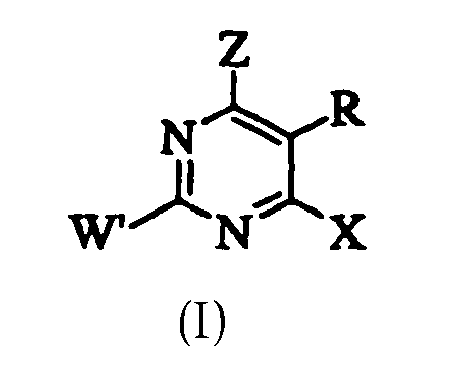
- Z is selected from:
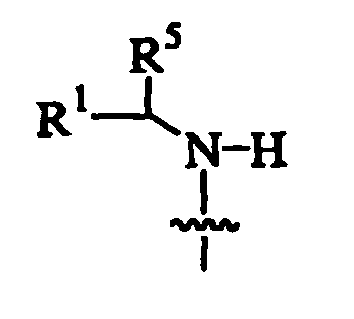
- R is a moiety of the group

- X is Cl or Br;
- L1, L2, L3 and L4 are each independently H, F, Cl or Br;
- A is H, F, Cl, Br, or Y(CH2)nQ;
- Y is O S, or -NR2;
- n is an integer of 2, 3, or 4;
- Q is OH or -NR3R4;
- R1 is H or C1-C3 alkyl;
- R3 and R4 are each independently H or C1-C3 alkyl; or R3 and R4 when optionally taken together with the nitrogen atom to which each is attached form a heterocyclic ring of 4 to 6 ring atoms optionally substituted with R7;
- R5 is CF3 or C2F6 ;
- W' is -NHR6, -N(CN)R6, aryl of 6 to 12 carbon atoms optionally substituted with 1-3 groups independently selected from halogen , azido, nitro, cyano, hydroxy, C1-C3 alkyl, C1-C3 alkoxy, amino, C1-C3 alkylamino, C1-C3 dialkylamino, formyl, C1-C3 alkoxycarbonyl, carboxyl, C1-C3 alkanoyl, C1-C3 alkylthio, C1-C3 alkylamido, phenyl, phenoxy, benzyl, benzoxy, furyl, and cyclopropyl groups; or heteroaryl of 5 to 10 ring atoms having from 1 to 4 heteroatoms selected from S, O and N and optionally substituted with 1-3 groups independently selected from halogen, azido, nitro, cyano, hydroxy, C1-C3 alkyl, C1-C3 alkoxy, amino, C1-C3 alkylamino, C1-C3 dialkylamino, formyl, C1-C3 alkoxycarbonyl, carboxyl, C1-C3 alkanoyl, C1-C3 alkylthio, C1-C3 alkylamido, phenyl, phenoxy, benzyl, benzoxy, furyl, and cyclopropyl groups;
- R6 is C1-C3 alkyl;
- R7 is C1-C3 alkyl;
- A preferred embodiment of the present invention is to provide a composition for use in the treatment or prevention of tumors that express multiple drug resistance (MDR) or are resistant because of MDR in a mammal in need thereof which comprises an effective amount of a compound according to Formula (Ia):

- A preferred embodiment of the present invention is to provide a composition for use in the treatment or prevention of tumors that express multiple drug resistance (MDR) or are resistant because of MDR in a mammal in need thereof which comprises an effective amount of a compound according to Formula (Ib):

- Further preferred are compounds of formula (I) wherein R is a moiety

- A more preferred embodiment of the present invention is to provide a composition for use in for the treatment or prevention of tumors that express multiple drug resistance (MDR) or are resistant because of MDR in a mammal in need thereof which comprises an effective amount of a compound according to formula (Ia) wherein:
- R is

- n=3;
- Y is O;
- Q is -NR3R4;
- R1 is H or methyl;
- R5 is CF3;
- R3 and R4 are each independently H or C1-C3 alkyl; or R3 and R4 when optionally taken together with the nitrogen atom to which each is attached form a heterocyclic ring of 4 to 6 ring atoms optionally substituted with R7;
- R6 is C1-C3 alkyl;
- R7 is C1-C3 alkyl;
- L1 is F;
- L2 is H or F;
- L3 is H;
- L4 is H;
- X is Cl or Br;
- A more preferred embodiment of the present invention is to provide a composition for use in the treatment or prevention of tumors that express multiple drug resistance (MDR) or are resistant because of MDR in a mammal in need thereof which comprises an effective amount of a compound according to formula (Ib) wherein:
- R is

- n=3;
- Y is O;
- Q is -NR3R4;
- R1 is H or methyl;
- R5 is CF3;
- R3 and R4 are each independently H or C1-C3 alkyl; or R3 and R4 when optionally taken together with the nitrogen atom to which each is attached form a heterocyclic ring of 4 to 6 ring atoms optionally substituted with R7;
- R6 is C1-C3 alkyl;
- R7 is C1-C3 alkyl;
- L1 is F;
- L2 is H or F;
- L3 is H;
- L4 is H;
- X is Cl or Br;
- A more preferred embodiment of the present invention is to provide a composition for use in the treatment or prevention of tumors that express multiple drug resistance (MDR) or are resistant because of MDR in a mammal in need thereof which comprises an effective amount of a compound according to Formula (Ia) wherein:
- R is

- A is F;
- R1 is H or methyl;
- R5 is CF3;
- R6 is C1-C3 alkyl;
- L1 is F;
- L2 is H or F;
- L3 is H;
- L4 is H;
- X is Cl or Br;
- A more preferred embodiment of the present invention is to provide a composition for use in the treatment or prevention of tumors that express multiple drug resistance (MDR) or are resistant because of MDR in a mammal in need thereof which comprises an effective amount of a compound according to Formula (Ib) wherein:
- R is

- A is F;
- R1 is H or methyl;
- R5 is CF3;
- R6 is C1-C3 alkyl;
- L1 is F;
- L2 is H or F;
- L3 is H;
- L4 is H;
- X is Cl or Br;
- Specifically preferred compounds of this invention according to Formula (I) useful in a method for the treatment or prevention of tumors that express multiple drug resistance (MDR) or are resistant because of MDR in a mammal in need thereof are the following compounds or a pharmaceutically acceptable salt thereof:
- 4-Chloro-6-[(2,2,2-trifluoroethyl)amino]-5-(2,4,6-trifluorophenyl)pyrimidin-2-yl(methyl)cyanamide,
- 4-Chloro-6-[(2,2,2-trifluoroethyl)amino]-5-(2,4,6-trifluorophenyl)pyrimidin-2-yl]ethylcyanamide,
- 6-Chloro-2-pyrazin-2-yl-N-[2,2,2-trifluoro-1-methylethyl]-5-(2,4,6-trifluorophenyl)pyrimidin-4-amine,
- 6-Chloro-2-pyrazin-2-yl-N-(2,2,2-trifluoroethyl)-5-(2,4,6-trifluorophenyl)pyrimidin-4-amine,
- 6-Chloro-N-(2,2,2-trifluoroethyl)-5-(2,4,6-trifluorophenyl)-2,2'-bipyrimidin-4-amine,
- 6-Chloro-2-pyridin-4-yl-N-(2,2,2-trifluoroethyl)-5-(2,4,6-trifluorophenyl)pyrimidin-4-amine,
- 6-Chloro-2-pyridin-3-yl-N-(2,2,2-trifluoroethyl)-5-(2,4,6-trifluorophenyl)pyrimidin-4-amine,
- 6-Chloro-2-pyridin-2-yl-N-(2,2,2-trifluoroethyl)-5-(2,4,6-trifluorophenyl)pyrimidin-4-amine,
- 6-Chloro-2-pyridin-2-yl-N-[2,2,2-trifluoro-1-methylethyl]-5-(2,4,6-trifluorophenyl)pyrimidin-4-amine,
- 6-Chloro-2-quinolin-2-yl-N-(2,2,2-trifluoroethyl)-5-(2,4,6-trifluorophenyl)pyrimidin-4-amine,
- 6-Chloro-2-isoquinolin-1-y)-N-(2,2,2-trifluorophenyl)-5-(2,4,6-trifluorophenyl)pyrimidin-4-amine,
- 6-Chloro-2-isoquinolin-3-yl-N-(2,2,2-trifluoroethyl)-5-(2,4,6-trifluorophenyl)pyrimidin-4-amine,
- 6-Chloro-2-thien-2-yl-N-(2,2,2-trifluoroethyl)-5-(2,4,6-trifluorophenyl)pyrimidin-4-amine,
- 6-Chloro-2-(2-furyl)-N-(2,2,2-trifluoroethyl)-5-(2,4,6-trifluorophenyl)pyrimidin-4-amine,
- 6-Chloro-2-(1H-imidazol-1-yl)-N-(2,2,2-triftuoroethyl)-5-(2,4,6-trifluorophenyl)pyrimidin-4-amine,
- 6-Chloro-2-(1H-pyrazol-1-yl)-N-(2,2,2-trifluoroethyl)-5-(2,4,6-trifluorophenyl)pyrimidin-4-amine,
- 6-Chloro-2-(1H-pyrazol-1-yl)-N-[2,2,2-trifluoro-1-methylethyl)-5-(2,4,6-trifluorophenyl)pyrimidin-4-amine,
- 6-Chloro-2-(1H-pyrrol-1-yl)-N-(2,2,2-trifluoroethyl)-5-(2,4,6-trifluorophenyl)pyrimidin-4-amine,
- 4-Chloro-5-{4-[3-(dimethylamino)propoxy]-2,6-difluorophenyl}-6-[(2,2,2-trifluoroethyl)amino]pyrimidin-2-yl(methyl)cyanamide,
- 6-Chloro-5-{4-[3-(dimethylamino)propoxy]-2,6-difluorophenyl}-N2-methyl-N4-(2,2,2-trifluoroethyl)pyrimidine-2,4-diamine,
- (4-Chloro-5-{4-[3-(dimethylamino)propoxy]-2,6-difluorophenyl}-6-{[2,2,2-trifluoro-1-methylethyl]amino}pyrimidin-2-yl)methylcyanamide,
- 4-Chloro-5-{4-[2-(dimethylamino)ethoxy]-2,6-difluorophenyl}-6-[(2,2,2-trifluoroethyl)amino]pyrimidin-2-yl(methyl)cyanamide,
- {4-Chloro-5-{4-[4-(dimethylamino)butoxy]-2,6-difluorophenyl}-6-[(2,2,2-trifluoroethyl)amino]pyrimidin-2-yl}methylcyanamide,
- 6-Chloro-5-{2,6-difluoro-4-[3-(methylamino)propoxy]phenyl}-2-pyrazin-2-yl-N-[2,2,2-trifluoro-1-methylethyl]pyrimidin-4-amine,
- 6-Chloro-5-{4-[3-(dimethylamino)propoxy]-2,6-difluorophenyl}-2-pyrazin-2-yl-N-(2,2,2-trifluoroethyl)pyrimidin-4-amine,
- 6-Chloro-5-{4-[3-(dimethylamino)propoxy]-2,6-difluorophenyl}-N-(2,2,2-trifluoroethyl)-2,2'-bipyrimidin-4-amine,
- 6-Chloro-5-{4-[2-(dimethylamino)ethoxy]-2,6-difluorophenyl}-2-pyrazin-2-yl-N-(2,2,2-trifluoroethyl)pyrimidin-4-amine,
- 6-Chloro-5-{4-[4-(dimethylamino)butoxy]-2,6-difluorophenyl}-2-pyrazin-2-yl-N-(2,2,2-trifluoroethyl)pyrimidin-4-amine,
- 6-Chloro-5-{2,6-difluoro-4-[3-(methylamino)propoxy]phenyl}-2-pyridin-2-yl-N-[2,2,2-trifluoro-1-methylethyl]pyrimidin-4-amine,
- 6-Chloro-5-{4-[3-(dimethylamino)propoxy]-2,6-difluorophenyl}-2-quinolin-2-yl-N-(2,2,2-trifluoroethyl)pyrimidin-4-amine,
- 6-Chloro-5-{4-[3-(dimethytamino)propoxy]-2,6-difluorophenyl}-2-(1H-imidazol-1-yl)-N-(2,2,2-trifluoroethyl)pyrimidin-4-amine,
- 6-Chloro-5-{2,6-difluoro-4-[3-(dimethylamino)propoxy]phenyl}-2-(1H-pyrazol-1-yl)-N-[2,2,2-trifluoro-1-methylethyl)pyrimidin-4-amine,
- N-{3-[4-(4-Chloro-6-cycloheptyl-2-pyrazin-2-ylpyrimidin-5-yl)-3,5-difluorophenoxy]propyl}-N-methylamine,
- 6-Chloro-2-(1-methyl-1H-imidazol-2-yl)-N-(2,2,2-trifluoroethyl)-5-(2,4,6-trifluorophenyl)pyrimidin-4-amine,
- 6-Chloro-2-(1H-pyrrol-2-yl)-N-(2,2,2-trifluoroethyl)-5-(2,4,6-trifluorophenyl)pyrimidin-4-amine,
- 6-Chloro-2-(4-methylpyridin-2-yl)-N-(2,2,2-trifluoroethyl)-5-(2,4,6-trifluorophenyl)pyrimidin-4-amine,
- 6-Chloro-2-(5-nitropyridin-2-yl)-N-(2,2,2-trifluoroethyl)-5-(2,4,6-trifluorophenyl)pyrimidin-4-amine and
- 2-(5-Azidopyridin-2-yl)-6-chloro-5-{4-[3-(dimethylamino)propoxy]-2,6-difluorophenyl}-N-(2,2,2,-trifluoroethyl)pyrimidin-4-amine.
- Specifically preferred compounds of this invention according to Formula (Ia) useful in a method for the treatment or prevention of tumors that express multiple drug resistance (MDR) or are resistant because of MDR in a mammal in need thereof are the following compounds or a pharmaceutically acceptable salt thereof:
- 6-Chloro-2-pyrazin-2-yl-N-[(1S)-2,2,2-trifluoro-1-methylethyl]-5-(2,4,6-trifluorophenyl)pyrimidin-4-amine,
- 6-Chloro-2-pyridin-2-yl-N-[(1S)-2,2,2-trifluoro-1-methylethyl]-5-(2,4,6-trifluorophenyl)pyrimidin-4-amine,
- 6-Chloro-2-(1H-pyrazol-1-yl)-N-[(1S)-2,2,2-trifluoro-1-methylethyl)-5-(2,4,6-trifluorophenyl)pyrimidin-4-amine,
- (4-Chloro-5-{4-[3-(dimethylamino)propoxy}-2,6-difluorophenyl}-6-{[(1 S)-2,2,2-trifluoro-1-methylethyl]amino}pyrimidin-2-yl)methylcyanamide,
- 6-Chloro-5-{2,6-difluoro-4-[3-(methylamino)propoxy]phenyl}-2-pyrazin-2-yl-N-[(1S)-2,2,2-trifluoro-1-methylethyl]pyrimidin-4-amine,
- 6-Chloro-5-{2,6-difluoro-4-[3-(methylamino)propoxy]phenyl}-2-pyridin-2-yl-N-[(1S)-2,2,2-trifluoro-1-methylethyl]pyrimidin-4-amine and
- 6-Chloro-5-{2,6-difluoro-4-[3-(methylamino)propoxy]phenyl}-2-(1H-pyrazol-1-yl)-N-[(1S)-2,2,2-trifluoro-1-methylethyl)pyrimidin-4-amine.
- Specifically preferred compounds of this invention according to Formula (Ib) useful in a method for the treatment or prevention of tumors that express multiple drug resistance (MDR) or are resistant because of MDR in a mammal in need thereof are the following compounds or a pharmaceutically acceptable salt thereof:
- 6-Chloro-2-pyrazin-2-yl-N-[(1R)-2,2,2-trifluoro-1-methylethyl]-5-(2,4,6-trifluorophenyl)pyrimidin-4-amine,
- 6-Chloro-2-pyridin-2-yl-N-[(1R)-2,2,2-trifluoro-1-methylethyl]-5-(2,4,6-trifluorophenyl)pyrimidin-4-amine,
- 6-Chloro-2-(1H-pyrazol-1-yl)-N-[(1R)-2,2,2-trifluoro-1-methylethyl)-5-(2,4,6-trifluorophenyl)pyrimidin-4-amine,
- (4-Chloro-5-{4-[3-(dimethylamino)propoxy]-2,6-difluorophenyl}-6-{[(1R)-2,2,2-trifluoro-1-methylethyl]amino}pyrimidln-2-yl)methylcyanamide,
- 6-Chloro-5-{2,6-difluoro-4-[3-(methylamino)propoxy]phenyl}-2-pyrazin-2-yl-N-[(1R)-2,2,2-trifluoro-1-methylethyl]pyrimidin-4-amine,
- 6-Chloro-5-{2,6-difluoro-4-[3-(methylamino)propoxy]phenyl}-2-pyridin-2-yl-N-[(1R)-2,2,2-trifluoro-1-methylethyl]pyrimidin-4-amine and
- 6-Chloro-5-{2,6-difluoro-4-[3-(methylamino)propoxy]phenyl}-2-(1H-pyrazol-1-yl)-N-[(1R)-2,2,2-trifluoro-1-methylethyl)pyrimidin-4-amine.
- The compounds of this invention may be prepared from: (a) commercially available starting materials (b) known starting materials which may be prepared as described in literature procedures or (c) new intermediates described in the schemes and experimental procedures herein.
Reactions are performed in a solvent appropriate to the reagents and materials employed and suitable for the transformation being effected. It is understood by those skilled in the art of organic synthesis that the various functionalities present on the molecule must be consistent with the chemical transformations proposed. This may necessitate judgement as to the order of synthetic steps. Appropriate consideration must be made as to the protection of reactive functional groups to prevent undesired side reactions.
Substituents on the starting materials may be incompatible with some of the reaction conditions. Such restrictions to the substituents which are compatible with the reaction conditions will be apparent to one skilled in the art. Reactions were run under inert atmospheres where appropriate. - The preparation of the compounds of this invention encompassed by Formulae (I) wherein
Z is
can be prepared by a process shown in Scheme I, which comprises treating a compound of Formula (III) in which R5, R1, L1, L2 L3, L4, A and X are as hereinbefore defined, with an alkylating agent R6-LG (IV), in which LG is a halo group or a moiety -OSO2R5, and R6 is as hereinbefore defined. Compounds of Formula (V) are treated with a strong base which includes an alkali metal hydroxide, alkali metal carbonate and alkali hydride, e.g., sodium hydride, in the presence of an aprotic solvent which includes dimethylsulfoxide, dimethylformamide and the like to yield cyano compounds of Formula (II). Treatment of a cyano compound of Formula (II) when A is a leaving group, in particular a fluorine atom, with a compound of Formula (VI) in which Y, n and Q are as hereinbefore defined, in the presence of a strong base which includes alkali metal hydroxide, alkali metal carbonate and alkali hydride, e.g., sodium hydride, In the presence of an aprotic solvent which includes dimethylsulfoxide, dimethylformamide and the like gives Formula (I). The reaction is suitably carried out at a temperature in the range from about 0° C to about 100º C.
- The preparation of the compounds of this invention encompassed by Formula (I) wherein Z is

- Y is O, S, or -NR2 and
- W' is aryl or heteroaryl as hereinbefore defined,
- A compound of Formula (II) wherein Z is the moiety

US 6,156,925 ) with carboxamidine (VII) in the presence of a tertiary amine base, such as tributylamine, at a temperature up to 190° C provides compound (IX). Halogenation with halogenating agents POX3, PX3 or PX5, such as phosphorous oxychloride or phosphorous oxybromide gives compound (X). Replacement of one of the halogens with excess amount of an amine (XI) in a suitable solvent, such as methylene chloride, dimethylsulfoxide or dimethylformamide, provides compound (II).
- Alternatively, as shown in Scheme IV, compounds of Formula (II) wherein Z is

US 6,156,925 ) with urea (XII) in the presence of a tertiary amine base, such as tributylamine, at a temperature up to 190° C provides compound (XIII). Halogenation with halogenating agents POX3, PX3 or PX5, such as phosphorous oxychloride or phosphorous oxybromide gives compound (XIV). Replacement of the 2-halogen of compound (XIV) by reaction with heteroaryl reagent W'-H gives compound (XV). Replacement of an additional halogen of compound (XV) with excess amount of an amine (XI) in a suitable solvent, such as methylene chloride, dimethylsulfoxide or dimethylformamide, provides compounds of formula (II).
- The preparation of the compounds of this invention encompassed by Formulae (I) and (II) wherein Z is C6-C8 cycloalkyl;
Y is O, S, or -NR2 and W' is as hereinbefore defined, can be prepared by a process shown in Scheme V and Scheme VI wherein L1, L2, L3, L4, A, X and n are as defined above. - Ester (XVI) is reacted with acid chloride (XVII), prepared from the corresponding carboxylic acid where Z is C6-C8 cycloalkyl, in the presence of lithium diisopropylamide (LDA) to give ketoester (XVIII) which is further reacted with carboxamidine (VII) in the presence of a tertiary amine base, such as tributylamine, at a temperature up to 190° C provides compound (XIX). When A is a leaving group, in particular a fluorine atom, reaction with compound (XX), in which Q is - OH or -NR3R4 wherein at least one of R3 or R4 is hydrogen, and Q is protected, as the 4-methoxybenzyl group when
Q is -OH or as the tert-butoxy carbonyl (t-BOC) group when Q is -NR3R4 in the presence of a strong base which includes an alkali metal hydroxide, alkali metal carbonate and alkali hydride, e.g., sodium hydride in an aprotic solvent which includes dimethylsulfoxide, dimethylformamide, and the like to give compound (XXI). Reaction of compound (XXI) with with halogenating agents POX3, PX3, or PX5, such as phosphorous oxychloride or phosphorous oxybromide in the presence of a inert base affords compound (XXII) where X is hereinbefore defined. Deprotection of the protecting group on Q with 2,3-dichloro-5,6-dicyano-1,4-benzoquinone (DDQ) in the case of the 4-methoxybenzyl protecting group or trifluoroacetic acid in the case of the tert-butoxy carbonyl (t-BOC) protecting group gives compound (I) where Z is C5-C8 cycloalkyl. - Reaction of compound (XIX) with halogenating agents POX3, PX3, or PX5, such as phosphorous oxychloride or phosphorous oxybromide in the presence of a inert base affords compound (II) where X is hereinbefore defined and A is H, F, Cl, Br or Y(CH2)nQ where Q is -NR3R4 and R3 and R4 are independently alkyl of 1 to 3 carbon atoms.

- As shown in Scheme VI, when A is a leaving group, in particular a fluorine atom, reaction with compound (VI), in which a is -NR3R4 and R3 and R4 are independently alkyl in the presence of a strong base which includes an alkali metal hydroxide, alkali metal carbonate and alkali hydride, e.g., sodium hydride in an aprotic solvent which includes dimethylsulfoxide, dimethylformamide, and the like to give compound (XXIII). Reaction of compound (XXIII) with halogenating agent POX3, PX3, or PX5, such as phosphorous oxychloride or phosphorous oxybromide in the presence of a inert base affords compound (I) where X is hereinbefore defined.

- It is understood that this invention encompasses all crystalline and hydrated forms of compounds of Formula (I) and their pharmaceutically acceptable salts. The pharmaceutically acceptable salts of the compounds of this invention are those derived from such organic and inorganic pharmaceutically acceptable salt forming acids as: lactic, citric, acetic, tartaric, fumaric, succinic, maleic, malonic, hydrochloric, hydrobromic, phosphoric, nitric, sulfuric, methanesulfonic, benzenesulfonic, L-aspartic, R or S-mandelic, palmitic and similarly known acceptable acids and further including trifluoroacetic acid (TFA). In particular the hydrochloride, fumarate and succinate salts are preferred.
- The present invention accordingly provides a pharmaceutical composition which comprises a compound of this invention, (formula I), in combination or association with a pharmaceutically acceptable carrier. In particular, the present invention provides a pharmaceutical composition which comprises an effective amount of a compound of this invention and a pharmaceutically acceptable carrier.
- Based on the results of these standard pharmacological test procedures, the compounds of this invention are useful as agents for treating, inhibiting or controlling the growth of cancerous tumor cells in a mammal in need thereof. The compounds of the invention are useful as agents for treating, inhibiting or controlling the growth of cancerous tumor cells in a mammal in need thereof by interacting with tubulin and microtubules and promoting microtubule polymerization. The compounds of the invention are further useful for the treatment or prevention of cancerous tumors by stabilizing microtubules. The compounds of the invention are also useful for the treatment or prevention of cancerous tumors that express multiple drug resistance (MDR) or are resistant because of MDR.
- In particular, when contacting a tubulin containing system "in vitro" with an effective amount of a compound of formulae (I) results in the promotion of microtubule polymerization and further stabilizes microtubules. By promoting microtubule polymerization and stabilizing microtubules said compounds of formulae (I) are useful as agents for treating, inhibiting or controlling the growth of cancerous tumor cells. Additionally, compounds of formulae (I) are useful for the treatment or prevention of cancerous tumors that express multiple drug resistance (MDR) or are resistant because of MDR. The tubulin containing system may be in a tumor cell, thereby inhibiting neoplastic disease by administering an effective amount of a compound described in the present invention. Mammals may be treated and in particular, humans. Further, said tubulin containing system may be in a patient. In the case of cancer treatment, it is believed that many neoplasias such as leukemia, lung cancer, colon cancer, thyroid cancer, ovarian cancer, renal cancer, prostate cancer and breast cancers may be treated by effectively administering effective amounts of the compounds of formulae (I) and (II). As used herein, cancer refers to all types of cancers, or neoplasms or benign or malignant tumors. Preferred cancers for treatment using methods provided herein include carcinoma, sarcoma, lymphoma, or leukemia. By carcinoma is meant a benign or malignant epithelial tumor and includes breast carcinoma, prostate carcinoma, non-small lung carcinoma, colon carcinoma, melanoma carcinoma, ovarian carcinoma, or renal carcinoma. A preferred host is a human.
- The effective dosage of active ingredient employed may vary depending on the particular compound employed, the mode of administration and severity of the condition being treated. However, in general satisfactory results are obtained when the compounds of the invention are administered in amounts ranging from 0.10 to 100 mg/kg of body weight per day. A preferred regimen for optimum results would be from 1 mg to 20 mg/kg of body weight per day and such dosage units are employed that a total of from 70 mg to 1400 mg of the active compound for a subject of 70 kg of body weight are administered in a 24 hour period.
- The dosage regimen for treating mammals may be adjusted to provide the optimum therapeutic response. For example, several divided doses may be administered daily or the dose may be proportionally reduced as indicated by the exigencies of the therapeutic situation. A decidedly practical advantage is that these active compounds may be administered in any convenient manner such as by the oral, intravenous, intramuscular or subcutaneous routes.
The active compounds may be orally administered, for example, with an inert diluent or with an assimilable edible carrier, or they may be enclosed in hard or soft shell gelatin capsules, or they may be compressed into tablets or they may be incorporated directly with the food of the diet. For oral therapeutic administration, these active compounds may be incorporated with excipients and used in the form of ingestible tablets, buccal tablets, troches, capsules, elixirs, suspensions, syrups, wafers. Such compositions and preparations should contain at least 0.1 % of active compound. The percentage of the compositions and preparations may, of course, be varied and may conveniently be between about 2% to about 60% of the weight of the unit. The amount of active compound in such therapeutically useful compositions is such that a suitable dosage will be obtained. Preferred compositions or preparations according to the present invention are prepared so that an oral dosage unit form contains between 10 and 1000 mg of active compound. The tablets, troches, pills, capsules and the like may also contain the following: a binder such as gum tragacanth, acacia, corn starch or gelatin; excipients such as dicalcium phosphate; a disintegrating agent such as corn starch, potato starch, alginic acid; a lubricant such as magnesium stearate; and a sweetening agent such as sucrose, lactose, or saccharin may be added or a flavoring agnet such as peppermint, oil of wintergreen or cherry flavoring. When the dosage unit form is a capsule, it may contain, in addition to materials of the above type, a liquid carrier. Various other materials may be present as coatings or to otherwise modify the physical form of the dosage unit. For instance, tablets, pills or capsules may be coated with shellac, sugar or both. A syrup or elixir may contain the active compound, sucrose, as a sweetening agent, methyl and propylparabens as preservatives, a dye and flavoring such as cherry or orange flavor. Of course, any material used in preparing any dosage unit form should be pharmaceutically pure and substantially non-toxic in the amounts used. In addition, these active compounds may be incorporated into sustained-release preparations and formulations. - These active compounds may also be administered parenterally or intraperitoneally. Solutions or suspensions of these active compounds as a free base or pharmacologically acceptable salt can be prepared in water suitably mixed with a surfactant such as hydroxypropylcellulose. Dispersions can also be prepared in glycerol, liquid polyethylene glycols, and mixtures thereof in oils. Under ordinary conditions of storage and use, these preparations contain a preservative to prevent the growth or microorganisms.
- The pharmaceutical forms suitable for injectable use include sterile aqueous solutions or dispersions and sterile powders for the extemporaneous preparation of sterile injectable solutions or dispersions. In all cases, the form must be sterile and must be fluid to the extent that easy syringability exists. It must be stable under the conditions of manufacture and storage and must be prepared against the contaminating action of microorganisms such as bacteria and fungi. The carrier can be a solvent or dispersion medium containing, for example, water, ethanol, polyol (e.g., glycerol, propylene glycol and liquid poly-ethylene glycol), suitable mixtures thereof, and vegetable oils.
- Intravenous administration is a preferred manner of administration of compounds of the invention. For intravenous administration examples of suitable carriers include physiological saline, bacteriostatic water, Cremophor ELTM (BASF, Parsippany, N.J.) or phosphate buffered saline (PBS). The composition must be sterile and should be fluid to the extent that easy syringability exists. It should be stable under the conditions of manufacture and storage and must be preserved against the contaminating action of microorganisms such as bacteria and fungi. The carrier can be a solvent or dispersion medium containing, for example, water, ethanol, polyol (for example, glycerol, propylene glycol, and liquid polyetheylene glycol, and the like), and suitable mixtures thereof. Prevention of the action of microorganisms can be achieved by various antibacterial and antifungal agents, for example, parabens, chlorobutanol, phenol, ascorbic acid, thimerosal, and the like. In many cases, it will be preferable to include isotonic agents, for example, sugars, polyalcohols such as manitol, sorbitol, sodium chloride in the composition. Prolonged absorption of the injectable compositions can be brought about by including in the composition an agent which delays absorption, for example, aluminum monostearate and gelatin.
- As used in accordance with this invention, the term providing an effective amount of a compound means directly administering such compound.
- In addition to the above utilities some of the compounds of this invention are useful for the preparation of other compounds of this invention.
- Examples of this invention are evaluated in several standard pharmacological test procedures that showed that the compounds of this invention possess significant activity as promoters of microtubule polymerization and are antineoplastic agents. Based on the activity shown in the standard pharmacological test procedures, the compounds of this invention are therefore useful as anticancer agents. Associated cancers are selected from the group consisting of breast, colon, lung, prostate, melanoma, epidermal, leukemia, kidney, bladder, mouth, larynx, esophagus, stomach, ovary, pancreas, liver, skin and brain. In particular, the compounds of this invention possess an effect similar to Paclitaxel. The test procedures used and results obtained are shown below.
- Medium is RPMI-1640 with L-glutamine, supplemented with 10% heat-inactivated fetal calf serum, 100 units/mL penicillin, and 100 µg/mL streptomycin (Gibco, Grand Island, NY). Microtubule-associated protein (MAP)-rich tubulin, containing about 70% tubulin and 30% MAPs (#ML113), and highly purified tubulin (>99% pure, #TL238), both from bovine brain, are obtained from Cytoskeleton, Inc., Denver, CO. PEM buffer (80 mM piperazine-N,N'-bis[2-ethanesulfonic acid], pH 6.9, 1 mM ethylene glycol-bis(β-aminoethyl ether)-N,N,N',N'-tetraacetic acid, 1 mM magnesium chloride) and guanosine 5'-triphosphate (GTP) are also obtained from Cytoskeleton. [3H]paclitaxel, specific activity 14.7 Ci/mmol, is purchased from Moravek Biochemicals (Brea, CA). [3H]vinblastine, specific activity 9.60 Ci/mmol and MicroSpin G-50 columns are obtained from Amersham Biosciences (Piscataway, NJ). [3H]colchicine, specific activity 76.5 Ci/mmol, is obtained from New England Nuclear (Boston, MA). Other reagents are obtained from Sigma (St. Louis, MO).
- Human cancer cell lines, unless otherwise noted, are obtained from the American Type Culture Collection (Rockville, MD). The following drug-sensitive parental cell lines, and their derived drug-resistant counterparts, are obtained from the originators as listed: (a) S1 (parental line from a subclone of human colon carcinoma line LS174T) and derived S1-M1-3.2 (herein called S1-M1) which expresses the MXR drug transporter protein, are provided by Dr. L. Greenberger, Wyeth Research (Rabindran, S.K., He, H., Singh, M., Brown, E., Collins, K.I., Annable, T., and Greenberger, L.M. Reversal of a novel multidrug resistance mechanism in human colon carcinoma cells by fumitremorgin C. Cancer Res., 58: 5850-5858, 1998); (b) parental HL-60 human promyelocytic leukemia line and derived HL-60/ADR, which expresses the MRP1 drug transporter protein, are provided by Dr. M. Center, University of Kansas (McGrath, T., and Center, M.S. Adriamycin resistance in HL60 cells in the absence of detectable P-glycoprotein. Biochem. Biophys. Res. Commun., 145: 1171-1176, 1987), via Dr. L. Greenberger, Wyeth Research; and (c) parental KB-3-1 (herein called KB, cloned from a human epidermoid carcinoma) and the derived lines KB-8-5 and KB-V1, which express moderate and very high levels of the MDR1 (P-glycoprotein) drug transporter protein, respectively, are provided by Dr. M. Gottesman, National Cancer Institute (Shen, D.W., Cardarelli, C., Hwang, J., Cornwell, M., Richert, N., Ishii, S., Pastan, I., and Gottesman, M.M. Multiple drug-resistant human KB carcinoma cells independently selected for high-level resistance to colchicine, adriamycin, or vinblastine show changes in expression of specific proteins. J. Biol. Chem., 261: 7762-7770, 1986) via Dr. L. Greenberger, Wyeth Research.
- The assay, which is sold in kit form by Promega (Madison, WI; CellTiter 96 AQueous Non-Radioactive Cell Proliferation Assay), is based on the conversion by viable cells, but not by dead cells, of the tetrazolium salt, MTS (3-(4,5-dimethylthiazol-2-yl)-5-(3-carboxymethoxyphenyl)-2-(4-sulphophenyl)-2H-tetrazolium, inner salt), into a water-soluble colored formazan which is detected by spectrophotometry. Compounds are tested at nine concentrations, in order to determine IC50 values. For the test procedure, cells are harvested by trypsinization, washed, counted and distributed to wells of 96-well flat-bottom microtiter plates at 1000 cells per well in 200 µL of medium. In addition, one row of wells on a separate plate receives cells as above ("time 0" plate). All plates are incubated at 37° in humidified 5% CO2 in air for about 24 hr.
- On day 2, compounds for test are diluted and added to wells. Compounds are dissolved in DMSO at 10 mg/mL. For each compound, nine serial 2-fold dilutions are prepared in DMSO. Ten µL of each dilution in DMSO are transferred to 100 µL of medium, mixed well, and then 5 µL of this dilution are transferred in quadruplicate to wells containing cells. The final high concentration of each compound is typically 5 µM. Plates are returned to the incubator for three days.
At the time of drug addition to the experimental plates, the MTS assay is run on the "time 0" plate. This produces the "time 0 MTS value" which is related to the number of viable cells per well at the time of drug addition. - After three days of culture with test compounds (day 5 overall), the MTS assay is done on all wells of the experimental plates. The absorbance values of the quadruplicate sample wells are averaged and divided by the average of the "time 0" values. The average of control wells without drug, divided by the average "time 0" value, gives the maximal relative increase in MTS color yield due to cell growth during the final three days of culture. The average of control wells with high drug concentration, divided by the "time 0" value, gives the minimal relative color yield for cells that were completely killed. The nine values for each compound are plotted against concentration, and the concentration that produces a relative color yield half way between the maximum and minimum is taken as the IC50 value. The most potent compounds have the lowest IC50 values.
- MAP-rich tubulin is dissolved in ice-cold PEM buffer containing 1 mM GTP (GPEM buffer) at a concentration of 1.3 mg/mL. The solution is centrifuged at top speed in an Eppendorf model 5415C microcentrifuge (Brinkmann Instruments, Westbury, NY) for 10 min at 4° immediately before use. The tubulin solution is added to wells of a ½-area 96-well plate (Costar No. 3696, Coming, Inc., Coming, NY) already containing the compounds of interest. Each compound is tested in duplicate at a final concentration of 0.3 µM in a volume of 110 µL per well. The final DMSO concentration in all wells is 0.3%. Control reactions, which receive compound solvent only, are done in quadruplicate. The plate is put in a SpectraMax Plus plate reader (Molecular Devices Corp. Sunnyvale, CA) thermostated at 24° and the absorbance of each well at 340 nm, a measure of the appearance of turbidity due to tubulin polymer formation, is determined every minute for 60 minutes. The absorbance at time 0 for each well is subtracted from each of the subsequent absorbance readings for that well, and then the duplicates are averaged.
- The binding of examples of this invention to highly purified tubulin is studied by competitive inhibition methods. The αβ-tubulin heterodimer contains binding sites for the three major classes of microtubule-active pharmacological agents: taxanes, vinca/peptide-site agents, and colchicine-site agents. To study possible competition at the vinca/peptide and colchicine sites, incubations are done under conditions which do not favor polymerization because vinblastine and colchicine bind preferentially to unpolymerized heterodimer. To study possible competition at the taxane site, on the other hand, polymerized tubulin (microtubules) is used because paclitaxel binds preferentially to microtubules.
- Highly purified tubulin is dissolved in PEM buffer without GTP and used at a final concentration of 1.0 to 1.3 mg/ml (10 to 13 µM). To aliquots of the tubulin solution are added various competitors (in quadruplicate) at 100 µM final concentrations, and [3H]vinblastine or [3H]colchicine at final concentrations of 100 nM or 50 nM, respectively. These solutions are incubated at 24° for 1 hr and then applied to MicroSpin G-50 columns which are centrifuged for 2 min at 3000 rpm in an Eppendorf 5415C microfuge. An aliquot of each column effluent (containing tubulin and bound radioligand) is mixed with scintillation fluid and counted in a liquid scintillation spectrometer. Controls include samples without competitor, and samples with unlabeled vincristine, colchicine, or paclitaxel. Quadruplicates are averaged, and the ability of the competitor to inhibit the binding of the radioligand is expressed as a percentage of control binding in the absence of any competitor.
- For competition with [3H]paclitaxel, highly purified tubulin is dissolved in PEM buffer containing 0.75 M glutamate and 25 µM dideoxy-GTP; final protein concentration is 0.25 to 0.35 mg/mL (2.5 to 3.5 µM). These conditions foster the rapid formation of short, stable microtubule polymers (Hamel, E., del Campo, A.A., and Lin, C.M. Stability of tubulin polymers formed with dideoxyguanosine nucleotides in the presence and absence of microtubule-associated proteins. J. Biol. Chem., 259: 2501-2508, 1984). This solution is incubated for 30 min at 37° to allow microtubules to form. Then [3H]paclitaxel (final concentration of 2.1 µM, 1.2 Ci/mmol) and competitor (final concentration of 20 µM, except 5 µM for unlabeled paclitaxel) are added to aliquots of the polymerized tubulin solution and incubation at 37° is continued for another 30 min. Controls include samples without competitor, and samples with unlabeled vincristine, colchicine, or paclitaxel. The reactions are then centrifuged at top speed in an Eppendorf 5415C microfuge for 20 min at room temperature in order to pellet the microtubule protein. Triplicate aliquots of each supernatant are mixed with scintillation fluid and counted in a liquid scintillation spectrometer. From the amount of radioactivity in the supernatants and the measured total starting radioactivity, the amount of [3H]paclitaxel bound to pelleted microtubule protein is calculated. The ability of each competitor to inhibit radioligand binding to pelleted protein is expressed as a percent of controls without any competitor.
- The ability of compounds of this invention to inhibit tumor growth in animals is studied in the athymic mouse xenograft standard pharmacological test. Female nu/nu mice in an outbred albino background are obtained from Charles River Laboratories (Wilmington, MA). Animals are injected subcutaneously on the flank with the desired tumor cell suspension. Several days later, mice with tumors of approximately 100 mm3 are selected from those injected (staged) and randomly distributed into groups of 5-10. The day of staging is called day 0. Compounds of the invention, formulated in saline, are administered to animals by intravenous injection or oral gavage on various schedules starting on day 0 or 1, as noted in the tables. The control group in each experiment is dosed with vehicle on the same schedule. Tumor size is measured every 3-7 days with calipers in two orthogonal dimensions, and tumor volume is calculated from the formula volume = [(length X width2)/2].
- Tumor/Control (T/C) is obtained by dividing the mean tumor volume of the treated group by the mean tumor volume of the control group on each measurement day. A treatment dose is defined as active if it produces a statistically significant T/C of 0.50 or less. A p value ≤ 0.05, determined by one-side Students t-test, is required for statistical significance. A treatment dose is defined as toxic if more than 30% of the animals die from a compound-related toxicity.
- COLO 205 is a human colon carcinoma cell line that is used for comparative testing of the examples of this invention and several reference compounds. This line is sensitive to paclitaxel and vincristine. As shown in Table 1, for example, Example 32a has an IC50 value of 2.4 nM, comparable to those of paclitaxel and vincristine.
Table 1 Activity of Representative Examples of the Invention and Reference Compounds in the MTS Cytotoxicity Standard Pharmacological Test Procedure with COLO 205 Cells1 Example or Reference Compound Salt IC50 (nM) SD n 1 214 41 9 2 304 153 2 3 51 2 3 4 84 11 5 5 265 - 1 6 7050 - 1 7 3930 373 2 8 39 8 5 9 29 6 4 10 250 23 2 11 4680 251 2 12 119 4 2 13 3465 - 1 14 232 - 1 15 3030 111 3 16 53 5 5 17 19 6 4 18 7080 - 1 19 52 12 8 20a TFA salt 56 3 2 21 36 10 4 22 532 - 1 23 229 - 1 24 6.9 2.2 5 24a HCl salt 8.9 0.7 4 25 22 5 9 25a HCl salt 18 3 4 26 49 - 1 27 128 47 3 28 32 14 3 29a HCl salt 5.2 1.3 4 30 7.4 - 1 31 682 232 2 32a HCl salt 2.4 0.3 10 33a TFA salt 8.2 0.6 2 34 77 22 2 35 7027 1 36 109 1 37 132 24 2 38 23 1 Paclitaxel 3.3 1.0 20 Vincristine 2.6 0.5 7 1IC50 values and standard deviations are from the indicated number of independent experiments - The KB lines express different amounts of the P-glycoprotein (MDR1) membrane pump which produces resistance to the action of many cytotoxic compounds, including paclitaxel and vincristine. The parental KB line expresses no P-glycoprotein, KB-8-5 expresses moderate levels of the protein, and KB-V1 expresses very high levels. The ability of P-glycoprotein to recognize and export a potential cytotoxic agent can be inferred from the change in IC50 values on these lines (Loganzo, F., Discafani, C.M., Annable, T., Beyer, C., Musto, S., Hari, M., Tan, X., Hardy, C., Hernandez, R., Baxter, M., Singanallore, T., Khafizova, G., Poruchynsky, M.S., Fojo, T., Nieman, J.A., Ayral-Kaloustian, S., Zask, A., Andersen, R.J., and Greenberger, L.M. HTI-286, a synthetic analogue of the tripeptide hemiasterlin, is a potent antimicrotubule agent that circumvents P-glycoprotein-mediated resistance in vitro and in vivo. Cancer Res., 63: 1838-1845, 2003). If a compound is recognized by P-glycoprotein, its IC50 value will increase substantially (several hundred-fold) on going from KB to KB-8-5 to KB-V1; if a compound is not recognized, it will have similar IC50 values (3-fold or less difference) on all three lines. For example, as shown in Table 2, KB-8-5 cells are moderately resistant to paclitaxel (11-fold), vincristine (26-fold), colchicine (4.7-fold) and doxorubicin (6.8-fold). In contrast, several representative examples of this invention (Nos. 19, 20a, 21, 25a, 30, and 33a) show less than a 3-fold change in IC50 values.
- Even slight interactions of compounds with P-glycoprotein can be determined with the KB-V1 line, which expresses a level of this protein higher than is typically found in clinical samples from a variety of tumors (Goldstein, L.J., Galski, H., Fojo, T., Willingham, M., Lai, S.L., Gazdar, A., Pirker, R., Green, A., Crist, W., Brodeur, G.M., Lieber, M., Cossman, J., Gottesman, M.M., and Pastan, I. Expression of a multidrug resistance gene in human cells. J. Natl. Cancer Inst. (Bethesda), 81: 116-124, 1989). As also shown in Table 2, KB-V1 cells are highly resistant to paclitaxel (822-fold), vincristine (925-fold), colchicine (92-fold), and doxorubicin (>79-fold). Two of the compounds of this invention (Nos. 19 and 30) show less than a 3-fold change in IC50 compared to the parental KB line. This indicates that these compounds are not recognized at all by P-glycoprotein and therefore that they completely overcome P-glycoprotein-mediated resistance to cell killing. Other representative examples of the invention (Nos. 20a, 21, 25a, and 33a) show recognition by P-glycoprotein, but much less than that shown by paclitaxel and vincristine.
Table 2 Activity of Representative Examples of the Invention and Reference Compounds in the MTS Cytotoxicity Standard Pharmacological Test Procedure with KB, KB-8.5 and KB-VI Cells Example or Reference Salt IC50 (nM)1 Ratio2 KB KB 8.5 KB VI 8.5/KB VI/KB 19 63 69 176 1.1 2.8 20a TFA 26 57 140 2.2 5.5 21 24 59 82 2.5 3.5 24a HCl 7.0 24 405 3.5 58 25a HCl 20 24 99 1.2 4.9 29a HCl 6.2 21 423 3.4 69 30 60 68 82 1.1 1.4 32a HCl 2.4 32 569 14 242 33a TFA 6.8 7.5 91 1.1 13 Paclitaxel 2.5 26 2014 11 822 Vincristine 2.2 58 2036 26 925 Colchicine 13 61 1195 4.7 92 Mitoxantrone 132 256 401 1.9 3.0 Doxorubicin 38 255 >300 6.8 >79 1IC50 values are means of 2 independent experiments.
2Ratio = IC50 on KB 8.5 or KB VI cells/IC50 on KB cells. A ratio of about 1 indicates no resistance. - HL-60/ADR cells overexpress the multidrug resistance protein MRP1 which mediates resistance to some chemotherapeutics (Gottesman, M.M., Fojo, T., and Bates, S.E. Multidrug resistance in cancer: role of ATP-dependent transporters. Nature Rev. Cancer, 2: 48-58, 2002). The IC50 values of representative examples of this invention, as well as reference compounds, on HL-60/ADR are compared to values on the sensitive parental HL-60 line. The results, shown in Table 3, indicate that whereas HL-60/ADR cells show resistance to vincristine (9.6-fold), colchicine (8.7-fold), mitoxantrone (15-fold), and doxorubicin (>75-fold), these cells show no resistance to any of the representative examples. This indicates that the compounds of this invention are not recognized by MRP1 and therefore overcome cellular resistance mediated by this transporter.
Table 3 Activity of Representative Examples of the Invention and Reference Compounds in the MTS Cytotoxicity Standard Pharmacological Test Procedure with HL-60 and HL-60/ADR Cells Example or Reference Salt IC50 (nM)1 Ratio2 HL-60 HL-60/ADR 19 66 60 0.9 20a TFA 72 68 0.9 21 58 37 0.6 24a HCl 6.6 6.3 1.0 25a HCl 23 21 0.9 29a HCl 6.9 6.8 1.0 30 88 71 0.8 32a HCl 2.6 2.2 0.8 33a TFA 6.9 6.1 0.9 Paclitaxel 3.0 3.5 1.2 Vincristine 2.5 24 9.6 Colchicine 21 182 8.7 Mitoxantrone 17 259 15 Doxorubicin 40 >3000 >75 1IC50 values are means of 2 independent experiments.
2Ratio = IC50 on HL-60/ADR cells/IC50 on HL-60 cells. A ratio of about 1 indicates no resistance. - S1-M1 cells overexpress the MXR transporter which mediates resistance to some chemotherapeutics (Gottesman, M.M., Fojo, T., and Bates, S.E. Miltidrug resistance in cancer: role of ATP-dependent transporters. Nature Rev. Cancer, 2: 48-58, 2002). The IC50 values of representative examples of this invention, as well as reference compounds, on S1-M1 are compared to values on the sensitive parental S1 line. The results, shown in Table 4, indicate that whereas S1-M1 cells show resistance to mitoxantrone (>120-fold) and doxorubicin (47-fold), they show no resistance to any of the examples. This indicates that the compounds of this invention are not recognized by MXR and therefore overcome cellular resistance mediated by this transporter.
Table 4 Activity of Representative Examples of the Invention and Reference Compounds in the MTS Cytotoxicity Standard Pharmacological Test Procedure with S1 and S1-M1 Cells Example or Reference Salt IC50 (nM)1 Ratio2 S1 S1-M1 19 88 88 1.0 20a TFA 95 82 0.9 21 66 76 1.2 24a HCl 20 53 2.7 25a HCl 27 36 1.3 29a HCl 7.9 21 2.7 30 138 201 1.5 32a HCl 9.9 8.7 0.9 33a TFA 8.5 12 1.4 Paclitaxel 4.2 2.7 0.6 Vincristine 14 7.9 0.6 Colchicine 37 109 2.9 Mitoxantrone 25 >3000 >120 Doxorubicin 61 2875 47 1IC50 values are means of 2 independent experiments.
2Ratio = IC50 on S1-M1 cells/IC50 on S1 cells. A ratio of about 1 indicates no resistance. - In this assay, control reactions with MAP-rich tubulin show an S-shaped absorbance profile characterized by three phases: first, a lag phase during which no change in absorbance occurs; second, a polymerization phase in which absorbance increases; and third, a plateau phase in which absorbance reaches a maximum and little or no further change occurs. Polymerization enhancers such as paclitaxel and docetaxel shorten or eliminate the lag phase, increase the rate of the polymerization phase, and often increase the height of the plateau. Polymerization inhibitors such as vincristine and colchicine reduce or prevent the absorbance increase. Representative compounds of this invention have a taxane-like effect on the polymerization reaction. This is expressed quantitatively in Table 5 by dividing the mean A340 of each sample at 20 min by the mean A340 of the control at 20 min to give a fold enhancement over control. Paclitaxel shows an enhancement factor of 2.4, and docetaxel shows a factor of 8.6. Most examples of this invention have factors ranging from 2.3 to 6.1 while Example 33a, has a value of 0.5. In contrast, vincristine and colchicine give enhancement factors of 0.2 and 0.5, respectively, because they inhibit polymerization of MAP-rich tubulin.
Table 5 Activity of Representative Examples of the Invention and Reference Compounds in the Tubulin Polymerization Standard Pharmacological Test Procedure with MAP-rich Tubulin Example or Reference Compound Salt A 340 Compound
A340 Control21 6.1 24a HCl 2.3 29a HCl 2.4 32a HCl 2.3 33a TFA 0.5 Paclitaxel 2.4 Docetaxel 8.6 Vincristine 0.2 Colchicine 0.5 Control 1.0 - The site on highly purified bovine brain tubulin to which compounds of this invention bind is determined by competitive inhibition studies with the radioactive ligands [3H]vinblastine, [3H]colchicine, and [3H]paclitaxel. The results, shown in Table 6, indicate that all of the tested compounds inhibit the binding of [3H]vinblastine to tubulin heterodimer (12-30% of control), but do not inhibit binding of [3H]colchicine to tubulin heterodimer or of [3H]paclitaxel to microtubules. This is strong evidence that these compounds bind at the vinca/peptide site of tubulin and not at the colchicine or taxane sites. Among the control compounds tested, vincristine inhibits [3H]vinblastine binding but not [3H]colchicine, and colchicine inhibits [3H]colchicine binding but not [3H]vinblastine. Vincristine and colchicine also appear to inhibit the binding of [3H]paclitaxel to microtubules; however, this is not due to binding competition but rather to depolymerization of the microtubules to which [3H]paclitaxel binds. Example 19 of this invention does not reduce [3H]paclitaxel binding to microtubules, which indicates that it neither competes with [3H]paclitaxel for binding nor depolymerizes the microtubules to which [3H]paclitaxel binds.
Table 6 Activity of Representative Examples of the Invention and Reference Compounds in the Competitive Binding Standard Pharmacological Test Procedure1 Competitor Radioactive Ligand [3H]Vinblastine [1H]Colchicine [1H]Paclitaxel Mean2 SD2 Mean2 SD2 Mean3 SD3 Control 100 100 100 Example 1 30 1.8 47 3.1 1 - - Example 19 22 4.7 116 4.6 103 3.1 Example 21 12 1.8 105 6.3 - - Vincristine 5 1.0 99 7.9 22 0.9 Colchicine 125 12.6 6 1.9 19 0.2 Paclitaxel 92 7.8 93 12.3 35 1.6 1Results are expressed as percent of binding to control without competitor.
2Data are from 1 (4 replicates) or 2 (8 replicates) independent experiments.
3Data are from 1 to 4 independent experiments (3 to 12 replicates). - Several experiments with human tumor xenografts in athymic mice are done to evaluate the ability of compounds of this invention to inhibit tumor growth in vivo. Table 7 shows results for example 21a with mice bearing H157 non-small cell lung carcinoma (NSCLC). The compound inhibits tumor growth when dosed intravenously at 5 mg/kg/dose on days 1 and 8.
- Example 24a inhibits the growth of U87-MG glioblastoma xenografts when dosed intravenously on day 1 with 5 mg/kg, although some compound toxicity is also observed (Table 8). This example also inhibits the growth of H157 NSCLC xenografts when dosed orally on days 1 and 7 with 5 or 1 mg/kg/dose (Table 9).
- Example 25a inhibits the growth of H157 NSCLC xenografts when dosed intravenously on day 0 with 10, 5, or 2.5 mg/kg (Table 10) although some compound toxicity is observed at the highest dose.
- Example 29a inhibits the growth of H157 NSCLC xenografts when dosed intravenously on day 0 with 2.5 mg/kg, and when dosed orally on day 0 with 5 mg/kg (Table 11).
- Example 32a inhibits the growth of H157 NSCLC xenografts as shown in Table 12 when given intravenously on days 0 and 7 at 3 or 1.5 mg/kg/dose. Examples 24a and 29a are also tested against the highly resistant DLD1 colon carcinoma xenograft, which is resistant to paclitaxel and vinblastine because of high expression of the drug transporter P-glycoprotein. Example 24a inhibits the growth of this tumor when given orally on days 1 and 7 at 10 mg/kg/dose, (Table 13).
Table 7 In Vivo Activity of Example 21 a in the Human Tumor Xenograft Standard Pharmacological Test Procedure with Mice Bearing H157 Human Non-Small Cell Lung Carcinoma Compound Schedule (days) Route Dose (mg/kg) T/C on day 0 4 7 11 Example 21 a, HCl salt 1,8 IV 10 1.01 0.87 0.73 0.73 5 0.99 0.49* 0.44** 0.38** 1 0.97 0.76 0.70 0.67 * = p < 0.05
** = p < 0.01
Vehicle was normal salineTable 8 In Vivo Activity of Example 24a in the Human Tumor Xenograft Standard Pharmacological Test Procedure with Mice Bearing U87-MG Human Glioblastoma Compound Schedule (days) Route Dose (mg/kg) T/C on day 0 3 7 10 Example 24a, HCl salt 1 IV 10 1.04 0.31** Toxic - 5 1.04 0.41** 0.21** 0.17** 1 1.03 0.71* 0.75 0.86 * = p<0.05
** = p < 0.01
Vehicle was normal saline
Note: 3 out of 10 animals in the group dosed at 5 mg/kg died from compound toxicityTable 9 In Vivo Activity of Example 24a in the Human Tumor Xenograft Standard Pharmacological Test Procedure with Mice Bearing H157 Human Non-Small Cell Lung Carcinoma Compound Schedule (days) Route Dose (mg/kg) T/C on day 0 4 7 10 13 Example 24a, HCl salt 1,7 PO 5 0.98 0.64** 0.51** 0.16** 0.12** 1 0.96 0.73* 0.70 0.58 0.50* * = p < 0.05
** = p < 0.01
Vehicle was normal salineTable 10 In Vivo Activity of Example 25a in the Human Tumor Xenograft Standard Pharmacological Test Procedure with Mice Bearing H157 Human Non-Small Cell Lung Carcinoma Compound Schedule (days) Route Dose (mg/kg) T/C on day 0 3 7 10 13 Example 25a, HCl salt 0 IV 10 1.01 0.49** 0.36** 0.22** 0.12** 5 1.02 0.69* 0.44** 0.29** 0.23** 2.5 1.05 0.84 0.51* 0.48* 0.43* *= p < 0.05
** = p < 0.01
Vehicle was normal saline
Note: 1 out of 10 animals in the group dosed at 10 mg/kg died from compound toxicityTable 11 In Vivo Activity of Example 29a in the Human Tumor Xenograft Standard Pharmacological Test Procedure with Mice Bearing H157 Human Non-Small Cell Lung Carcinoma Compound Schedule (days) Route Dose (mg/kg) T/C on day 0 2 7 9 14 Example 29a, HCl salt 0 IV 5 1.03 0.34** Toxic 2.5 0.99 0.51** 0.55** 0.32** 0.27** 1.25 1.01 0.59** 0.72 0.67 0.68 0 PO 5 1.02 0.43** 0.37** 0.33** 0.25** *=p<0.05
** = p < 0.01
Vehicle was normal salineTable 12 In Vivo Activity of Example 32a in the Human Tumor Xenograft Standard Pharmacological Test Procedure with Mice Bearing H157 Human Non-Small Cell Lung Carcinoma Compound Schedule (days) Route Dose (mg/kg) T/C on day 0 4 7 13 Example 32a, HCl salt 0,7 IV 3 0.95 0.72 0.46** 0.10** 1.5 0.95 0.89 0.63* 0.48* * = p < 0.05
** = p < 0.01
Vehicle was normal salineTable 13 In Vivo Activity of Examples 24a and 29a in the Human Tumor Xenograft Standard Pharmacological Test Procedure with Mice Bearing DLD1 Human Colon Carcinoma Compound Schedule Route Dose (mg/kg) T/C on day (days) 0 7 14 Example 24a, HCl salt 1, 7 PO 10 1.0 0.82 0.28** 5 1.0 1.07 0.85 2.5 1.0 0.87 0.80 Example 24a, HCl salt 1, 7 IV 10 1.0 Toxic - 5 1.0 0.24** Toxic 2.5 1.0 1.14 0.91 Example 29a, HCl salt 1, 7 PO 5 1.0 0.79 0.59* 2.5 1.0 1.33 1.10 1 1.0 1.40 1.02 Example 29a, HCl salt 1, 7 IV 5 1.0 0.22** Toxic 2.5 1.0 0.66* 0.62* 1 1.0 0.63* 0.71* * = p < 0.05
** = p < 0.01
Vehicle was normal saline
Note:1 out of 5 animals in the group dosed orally with Example 24a at 10 mg/kg died from compound toxicity - Compounds of this invention show potent cytotoxic activity against multiple human cancer cell lines in culture, including lines that are resistant to paclitaxel and vincristine because of drug transporter overexpression. The compounds enhance the initial rate of MAP-rich tubulin polymerization, in a manner reminiscent of taxanes and distinct from the inhibitory effects of depolymerizers such as vinca alkaloids and colchicine, despite the fact that they bind to the vinca/peptide site of tubulin. Representative compounds inhibit the growth of human tumor xenografts in athymic mice by both intravenous and oral dosing, including a tumor resistant to paclitaxel and vinblastine because of P-glycoprotein overexpression.
- The following reference examples are useful for the preparation of the representative examples of compounds of this invention which are useful as promoters of microtubule polymerization and as anticancer agents.
- The product (1S)-2,2,2-trifluoro-1-methylethylamine hydrogen chloride is prepared according to the conditions disclosed in
US5,986,135 andUS6,204,269 . - The product, 5,7-dichloro-6-(2,4,6-trifluorophenyl)[1,2,4]triazolo[1,5-a]pyrimidine is prepared according to the conditions disclosed in
US6,117,876 andUS6,297,251 . - The product diethyl 2-(2,4,6-trifluorophenyl)malonate is prepared according to the conditions disclosed in
US6,156,925 . - The product 3-(methylamino)propan-1-ol is prepared according to the conditions disclosed in J. Org. Chem. 44, 2718 (1979).
- The product, 5-nitropyridine-2-carbonitrile is prepared according to the conditions described in J. Med. Chem. 37, 18 (1994).
-

- A mixture of 5,7-dichloro-6-(2,4,6-trifluorophenyl)[1,2,4]triazolo[1,5-a]pyrimidine (3.19 g,10 mmol), 2,2,2-trifluoroethylamine (3.0 g, 30 mmol), and triethylamine (3.0 g, 30 mmol) in 30 mL of N,N-dimethylformamide is stirred at room temperature under nitrogen atmosphere for 1 h. The reaction mixture is diluted with ethyl acetate. The organic layer is washed with saturated sodium chloride (x3), dried over magnesium sulfate, and concentrated. The residue is filtered through hydrous magnesium silicate. Concentration provides 5-chloro-6-(2,4,6-trifluorophenyl)-N-(2,2,2-trifluoroethyl)[1,2,4]triazolo[1,5-a]pyrimidin-7-amine as a light yellow solid (3.70 g). MS: m/z 381.9 (M+H).
- To a solution of 5-chloro-6-(2,4,6-trifluorophenyl)-N-(2,2,2-trifluoroethyl)[1,2,4]triazolo[1,5-a]pyrimidin-7-amine (300 mg, 0.78 mmol) in 4 mL of dimethylsulfoxide at room temperature is added iodomethane (146 µL, 2.34 mmol) followed by sodium hydride (60% in mineral oil, 31 mg, 0.78 mmol). The mixture is then stirred at room temperature for 18 h, and diluted with ethyl acetate. The organic layer is washed with water and saturated sodium chloride, dried over magnesium sulfate, and concentrated. The residue is chromatographed over silica gel, eluting with 20% ethyl acetate in hexanes. Concentration provides N-[5-chloro-3-methyl-6-(2,4,6-trifluorophenyl)[1,2,4]triazolo[1,5-a]pyrimidin-7(3H)-ylidene]-2,2,2-trifluoroethanamine as a white solid (76 mg). MS: m/z 396.0 (M+H).
- To a solution of N-[5-chloro-3-methyl-6-(2,4,6-trifluorophenyl)[1,2,4]triazolo[1,5-a]pyrimidin-7(3H)-ylidene]-2,2,2-trifluoroethanamine (345 mg, 0.87 mmol) in 1 mL of dimethylsulfoxide at room temperature is added sodium hydride (60% in mineral oil, 35 mg, 0.87 mmol). The mixture is then stirred at room temperature for 2 h, and diluted with ethyl acetate. The organic layer is washed with water and saturated sodium chloride, dried over magnesium sulfate, and concentrated. The residue is chromatographed over silica gel, eluting with 10% ethyl acetate in hexanes. Concentration provides 4-chloro-6-[(2,2,2-trifluoroethyl)amino]-5-(2,4,6-trifluorophenyl)pyrimidin-2-yl(methyl)cyanamide as a white solid (157 mg). MS: m/z 396.1 (M+H).
- Example 2 is synthesized analogously to Example 1.
-

-

- To 20 mL of methyl alcohol is added sodium (109 mg, 4.74 mmol) with stirring. After disappearance of the solid, 2-pyrazinecarbonitrile (5.0 g, 47.6 mmol) is added. The mixture is stirred at room temperature for 6 h, and ammonium chloride (2.8 g, 52.3 mmol) is added. The mixture is then stirred at room temperature for 18 h. Diethyl ether (50 mL) is added to the reaction mixture, and the precipitates are collected by filtration. The solid was washed with diethyl ether (x2) and dried in vacuum oven to give 2-pyrazinecarboxamidine hydrochloride as a white solid (6.5g). MS: m/z 123.1 (M+H).
- Alternatively, 2-pyrazinecarboxamidine hydrochloride can be prepared as follows: A solution of 2-pyrazinecarbonitrile (21 g, 200 mmol) in a mixture of 10 mL of methyl alcohol and 120 mL of diethyl ether is treated with hydrogen chloride gas at 0 °C. The mixture is then stored at 5 °C for 3 days. The precipitates are collected by filtration and and dried. This solid is then suspended in 100 mL of ethyl alcohol and the mixture is treated with ammonium gas at 0 °C. The mixture is then stored at 5 °C for 4 days, and filtered. Concentration of the filtrate gives 2-pyrazinecarboxamidine hydrochloride as a tan solid (2.8 g).
- A mixture of diethyl 2-(2,4,6-trifluorophenyl)malonate (
US 6,156,925 ) (870 mg, 3.0 mmol), 2-pyrazinecarboxamidine hydrochloride (500 mg, 3.15 mmol), and 600 mg of tributylamine is stirred under nitrogen atmosphere at 180 °C for 1 h and cooled to room temperature. The mixture is cooled to room temperature and treated with 1.0 N hydrochloric acid. The precipitates are collected by filtration, washed with water and dried to give 2-pyrazin-2-yl-5-(2,4,6-trifluorophenyl)pyrimidine-4,6-diol as a tan solid (401 mg), which is used directly in the next step. - A mixture of 2-pyrazin-2-yl-5-(2,4,6-trifluorophenyl)pyrimidine-4,6-diol (401 mg) in 5 mL of phosphorous oxychloride and 1 mL of 2,6-lutidine is heated at 110 °C for 16 h. The excess phosphorous oxychloride is removed in vaccuo, and the resulting residue is dissolved in ethyl acetate. The organic layer is washed with water and saturated sodium chloride, dried over magnesium sulfate, and concentrated. The residue is chromatographed over silica gel, eluting with a gradient of 20% ethyl acetate in hexanes to 33% ethyl acetate in hexanes. Concentration provides 4,6-dichloro-2-pyrazin-2-yl-5-(2,4,6-trifluorophenyl)pyrimidine as a red solid (201 mg). MS: m/z 356.9 (M+H).
- A mixture of 4,6-dichloro-2-pyrazin-2-yl-5-(2,4,6-trifluorophenyl)pyrimidine (205 mg, 0.57 mmol), (1S)-2,2,2-trifluoro-1-methylethylamine hydrogen chloride (298 mg, 2 mmol), and N,N-diisopropylethylamine (258 mg, 2 mmol) in 5 mL of N,N-dimethylformamide is stirred at 90 °C in a sealed tube for 18 h. The reaction mixture is partitioned between ethyl acetate and saturated sodium chloride. The organic layer is washed with saturated sodium chloride (x3), dried over magnesium sulfate, and concentrated. The residue is chromatographed over silica gel, eluting with a gradient of 20% ethyl acetate in hexanes to 50% ethyl acetate in hexanes. Concentration provides 6-chloro-2-pyrazin-2-yl-N-[(1S)-2,2,2-trifluoro-1-methylethyl]-5-(2,4,6-trifluorophenyl)pyrimidin-4-amine as a light yellow solid (111 m g). MS: m/z 434.1 (M+H).
- Examples 4-14 are synthesized analogously to Example 3.
-

-
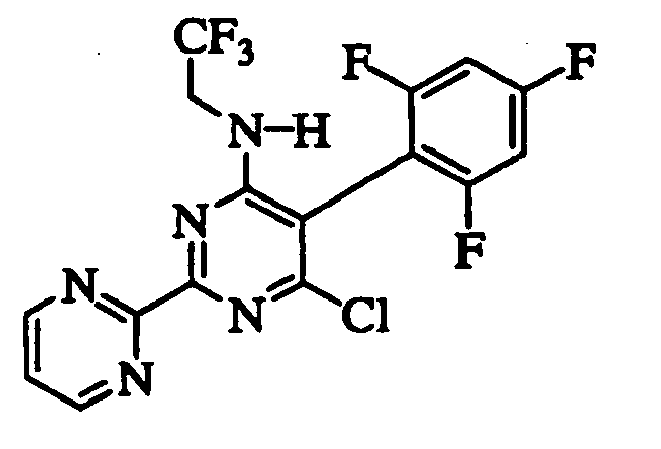
-

-

-

-

-
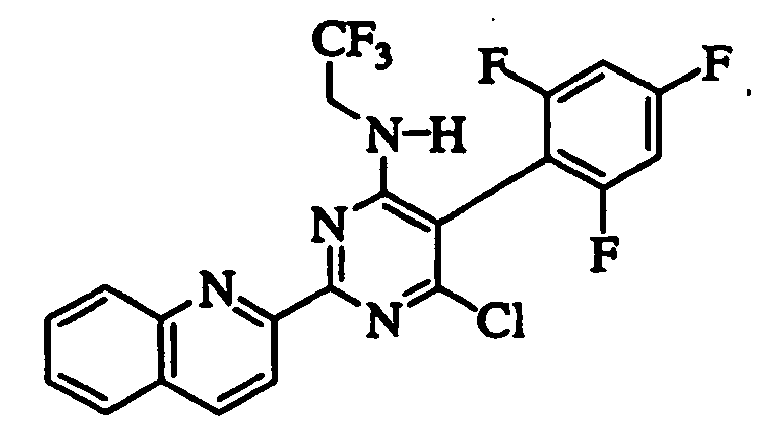
-

-

-

-
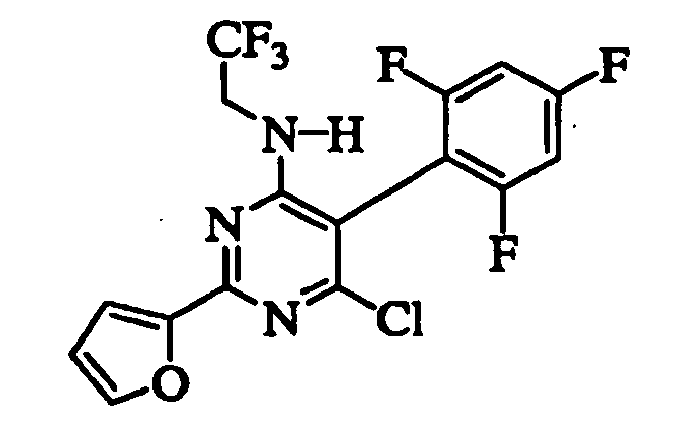
-

- To a mixture of diethyl 2-(2,4,6-trifluorophenyl)malonate (580 mg, 2.0 mmol,
US6,156,925 ) and urea (360 mg, 6.0 mmol) in 10 mL of ethyl alcohol at room temperature is added sodium hydride (60% in mineral oil, 160 mg, 4.0 mmol). The mixture is then heated at 80 °C for 3 days, cooled to room temperature, and partitioned between ethyl acetate and 1 N hydrochloric acid. The aqueous layer is extracted with ethyl acetate, and the combined organic extracts are dried over magnesium sulfate, and concentrated. The residue is chromatographed over silica gel, eluting with a gradient of ethyl acetate to 10% methyl alcohol in ethyl acetate. Concentration provides 5-(2,4,6-trifluorophenyl)pyrimidine-2,4,6-triol as a light tan solid (148 mg). MS: m/z 257.0 (M-H). - A mixture of 5-(2,4,6-trifluorophenyl)pyrimidine-2,4,6-triol (258 mg, 1.0 mmol) in 2.5 mL of phosphorous oxychloride and 0.5 mL of 2,6-lutidine is heated at 110 °C for 16 h. The excess phosphorous oxychloride is removed in vaccuo, and the resulting residue is dissolved in a 1:1 mixture of methylene chloride and hexanes. The organic layer is filtered through hydrous magnesium silicate, and the filtrate is concentrated to provide crude 2,4,6-trichloro-5-(2,4,6-trifluorophenyl)pyrimidine as a dark solid (104 mg).
- A mixture of the above 2,4,6-trichloro-5-(2,4,6-trifluorophenyl)pyrimidine (104 mg), imidazole (23 mg, 0.33 mmol), and potassium carbonate (92 mg, 0.66 mmol) in 2 mL of N,N-dimethylformamide is stirred at room temperature for 3 h. The mixture is partitioned between ethyl acetate and saturated sodium chloride. The organic layer is washed with saturated sodium chloride (x4), dried over magnesium sulfate, and concentrated. The residue is chromatographed over silica gel, eluting with a gradient of hexanes to 50% ethyl acetate in hexanes. Concentration provides 4,6-dichloro-2-(1 H-imidazol-1-yl)-5-(2,4,6-trifluorophenyl)pyrimidine as a tan solid (71 mg, mp 72-74°C). MS: m/z 345.2 (M+H).
- A solution of 4,6-dichloro-2-(1H-imidazol-1-yl)-5-(2,4,6-trifluorophenyl)pyrimidine (35 mg, 0.10 mmol) and 2,2,2-trifluoroethylamine (50 mg, 0.5 mmol) in 2 mL of N,N-dimethylformamide is stirred at room temperature for 1 h. A saturated sodium chloride solution is added, and the product is extracted with ehtyl acetate. The organic solution is washed with saturated sodium chloride (x4), dried over magnesium sulfate, and concentrated. The residue is chromatographed over silica gel, eluting with a gradient of 20% ethyl acetate in hexanes to 50% ethyl acetate in hexanes. Concentration provides 6-chloro-2-(1H-imidazol-1-yl)-N-(2,2,2-trifluoroethyl)-5-(2,4,6-trifluorophenyl)pyrimidin-4-amine as a light tan solid (36 mg, mp 168-170°C). MS: m/z 408.2 (M+H).
- Examples 16-18 are synthesized analogously to Example 15.
-

-

-

-
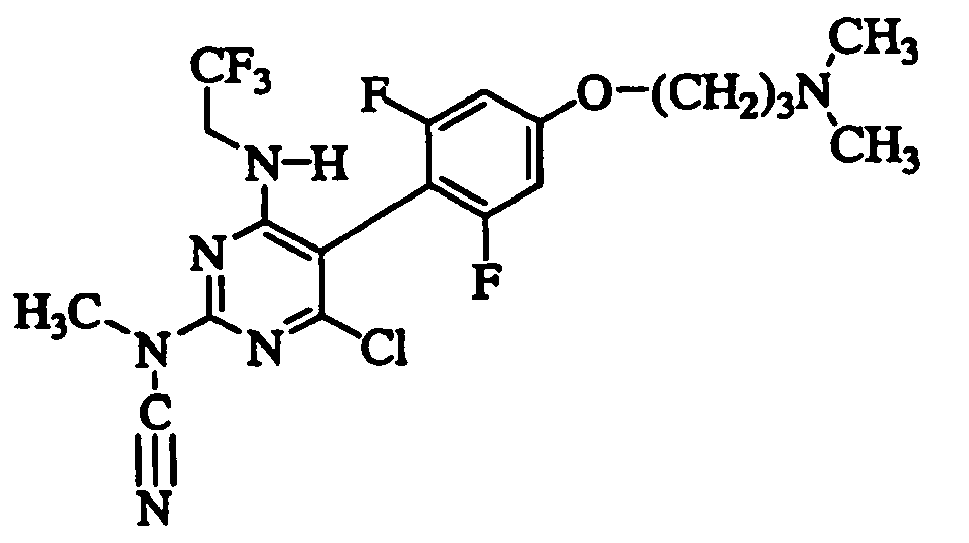
- To a stirred mixture of sodium hydride (60% in mineral oil, 12 mg, 0.30 mmol) in 2 mL of dimethylsulfoxide is added 3-dimethylamino-1-propanol (27 µL, 0.23 mmol). The mixture is then stirred at room temperature for 1 h. 4-Chloro-6-[(2,2,2-trifluoroethyl)amino]-5-(2,4,6-trifluorophenyl)pyrimidin-2-yl(methyl)cyanamide (60 mg, 0.152 mmol) is then added, and the reaction mixture is heated at 60 °C for 4 h, and diluted with ethyl acetate. The organic layer is washed with water and saturated sodium chloride, dried over magnesium sulfate, and concentrated. The residue is chromatographed over silica gel, eluting with a gradient of ethyl acetate to 50% methyl alcohol in ethyl acetate to methyl alcohol. Concentration provides 4-chloro-5-(4-[3-(dimethylamino)propoxy]-2,6-difluorophenyl)-6-[(2,2,2-trifluoroethyl)amino]pyrimidin-2-yl(methyl)cyanamide as a light yellow semisolid solid (20 mg). MS: m/z 479.3(M+H).
- 4-Chloro-5-{4-[3-(dimethytamino)propoxy]-2,6-difluorophenyl}-6-[(2,2,2-trifluoroethyl)amino]pyrimidin-2-yl(methyl)cyanamide (165 mg) is dissolved in methylene chloride and filtered. To the filtrate is bubbled hydrogen chloride gas. Concentration provides hydrogen chloride salt as a red solid (170 mg).
-

- To a stirred mixture of sodium hydride (60% in mineral oil, 308 mg, 7.7 mmol) in 10 mL of dimethylsulfoxide is added 3-dimethylamino-1-propanol (0.91 mL, 7.7 mmol). The mixture is then stirred at room temperature for 1 h. 4-Chloro-6-[(2,2,2-trifluoroethyl)amino]-5-(2,4,6-trifluorophenyl)pyrimidin-2-yl(methyl)cyanamide (762 mg, 1.93 mmol) is then added, and the reaction mixture is heated at 90 °C for 1 h, and diluted with ethyl acetate. The organic layer is washed with water and saturated sodium chloride, dried over magnesium sulfate, and concentrated. The residue is chromatographed over silica gel, eluting with a gradient of ethyl acetate to 50% methyl alcohol in ethyl acetate to methyl alcohol. Concentration provides a light yellow solid, which is further purified by HPLC to yield 6-chloro-5-{4-[3-(dimethylamino)propoxy]-2,6-difluorophenyl}-N2-methyl-N4-(2,2,2-pyrimidine-2,4-diamine trifluoroacetic acid salt as a white solid (8mg), MS: m/z 454.3(M+H) and 4-chloro-5-{4-[3-(dimethylamino)propoxy]-2,6-difluorophenyl}-6-[(2,2,2-trifluoroethyl)amino]pyrimidin-2-yl(methyl)cyanamide trifluoroacetic acid salt as a white solid (50 mg), MS: m/z 479.3(M+H).
- Examples 21-23 are synthesized analogously to Example 19.
-

-

-

-

- To a solution of 6-chloro-2-pyrazin-2-yl-N-[(1S)-2,2,2-trifluoro-1-methylethyl]-5-(2,4,6-trifluorophenyl)pyrimidin-4-amine (251 mg, 0.58 mmol) and 3-(methylamino)propan-1-ol (267 mg, 3.0 mmol) in 3 mL of dimethylsulfoxide at room temperature is added sodium hydride (60% in mineral oil, 120 mg, 3.0 mmol). The mixture is stirred at 60 °C for 2h, cooled to room temperature, and partitioned between ethyl acetate and saturated sodium chloride. The organic layer is washed with saturated sodium chloride (x3), dried over magnesium sulfate, and concentrated. The residue is chromatographed over silica gel, eluting with a gradient of ethyl acetate to 50% methyl alcohol in ethyl acetate. Concentration provides 6-chloro-5-{2,6-difluoro-4-[3-(methylamino)propoxy]phenyl}-2-pyrazin-2-yl-N-[(1S)-2,2,2-trifluoro-1-methylethyl]pyrimidin-4-amine as a light tan solid (181 mg, mp 48-50°C). MS: m/z 503.1 (M+H).
- The product thus obtained is dissolved in methylene chloride and filtered. To the filtrate is bubbled hydrogen chloride gas. Concentration provides hydrogen chloride salt as a red solid (210 mg).
- Examples 25-30 are synthesized analogously to Example 24.
-
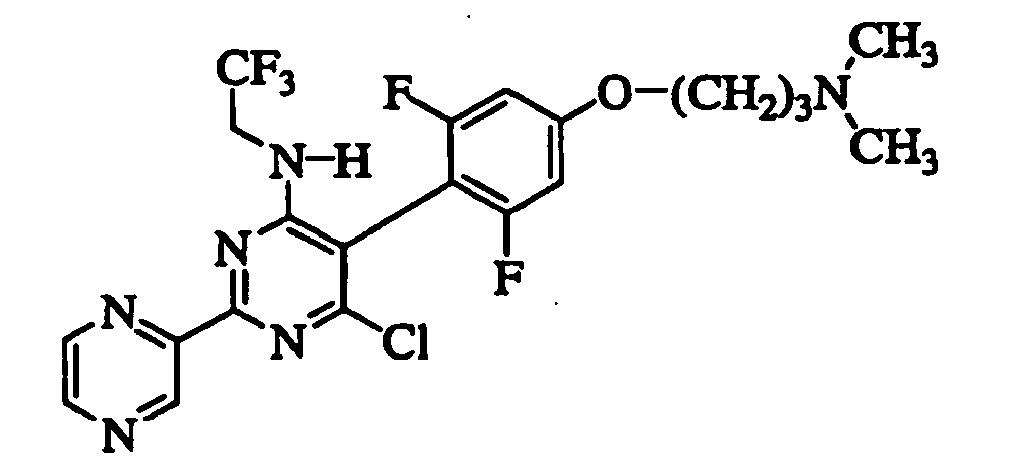
-

-

-
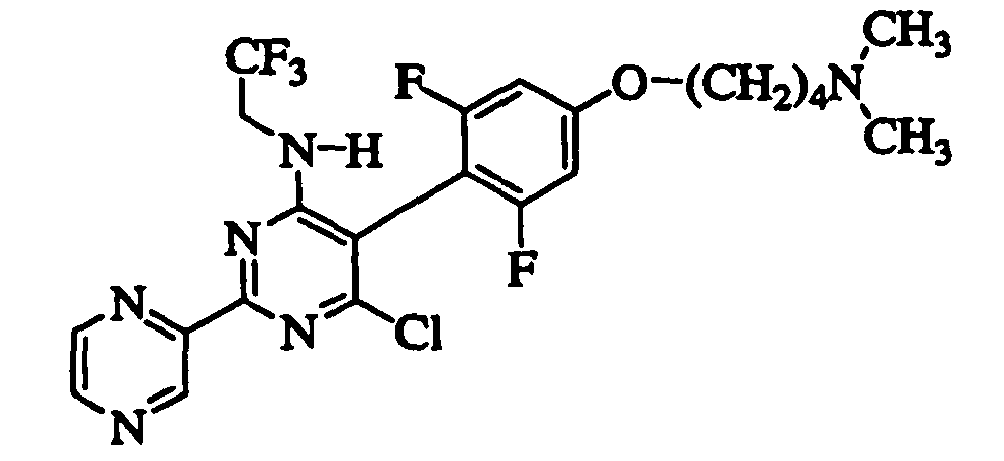
-
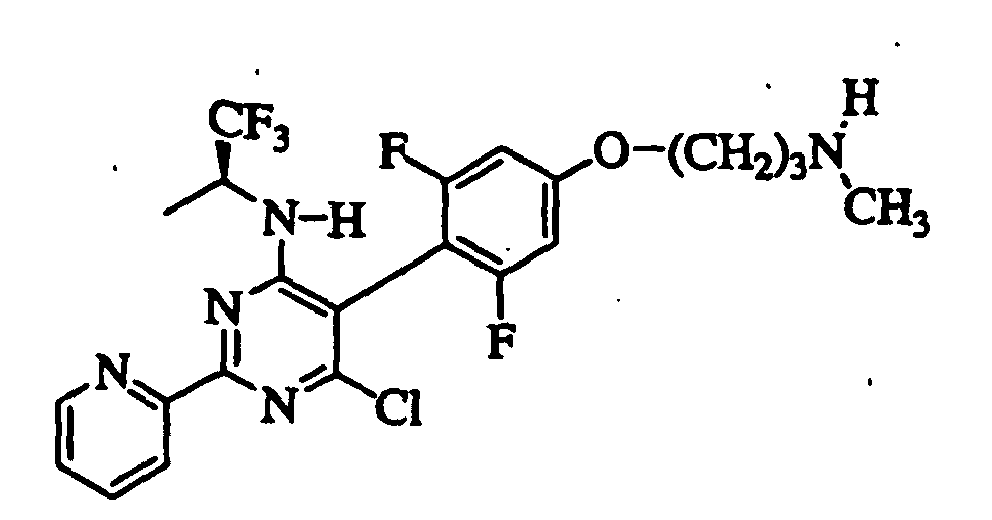
-

-
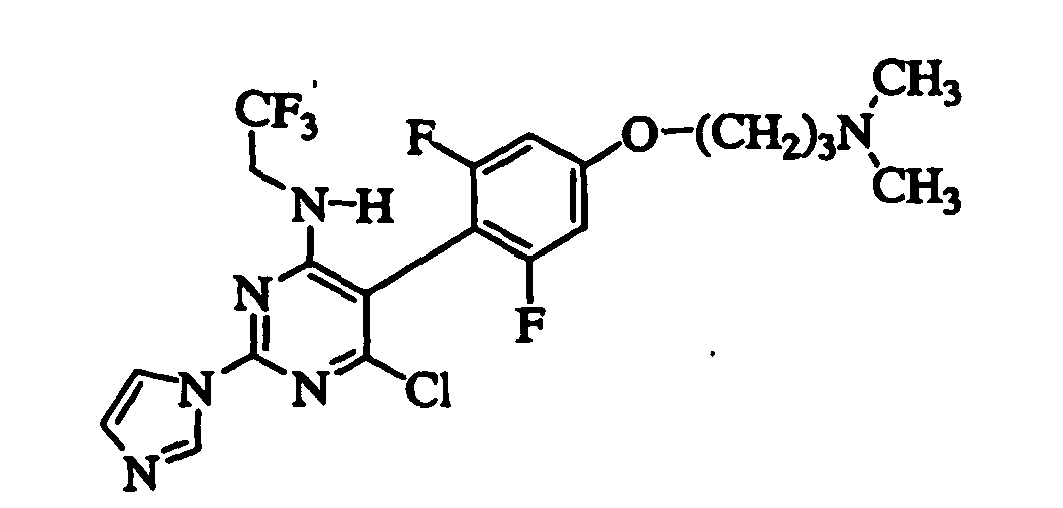
- To a solution of 6-chloro-2-(1H-imidazol-1-yl)-N-(2,2,2-trifluoroethyl)-5-(2,4,6-trifluorophenyl)pyrimidin-4-amine (20 mg, 0.05 mmol) and 3-dimethylamino-1-propanol (103 m g, 1.0 mmol) in 3 mL of dimethylsulfoxide at room temperature is added sodium hydride (60% in mineral oil, 40 mg, 1.0 mmol). The mixture is stirred at 60 °C for 2h, cooled to room temperature, and partitioned between ethyl acetate and saturated sodium chloride. The organic layer is washed with saturated sodium chloride (x3), dried over magnesium sulfate, and concentrated. The residue is chromatographed over silica gel, eluting with a gradient of ethyl acetate to 50% methyl alcohol in ethyl acetate. Concentration provides 6-chloro-5-{4-[3-(dimethylamino)propoxy]-2,6-difluorophenyl}-2-(1H-imidazol-1-yl)-N-(2,2,2-trifluoroethyl)pyrimidin-4-amine as a light tan solid (16 mg, mp 47-49°C). MS: m/z 491.1 (M+H).
- Example 32 is synthesized analogously to Example 24 and 31.
-

-

- A mixture of 2,4,6-trifluorophenylacetic acid (570 mg, 3.0 mmol), iodoethane (1.56 g, 10 mmol), and potassium carbonate (1.38 g, 10 mmol) in 5 mL of dimethylsulfoxide is stirred at 50 °C for 3 h, and cooled to room temperature. The mixture is partitioned between diethyl ether and water. The organic layer is washed with water, and saturated sodium chloride, dried over magnesium sulfate, and filtered through hydrous magnesium silicate. The filtrate is concentrated to give ethyl 2,4,6-trifluorophenylacetate as a light yellow oil (581 mg, 2.66 mmol).
A mixture of cycloheptanecarboxylic acid (5.0 g, 35.2 mmol) in 25 mL of thionyl chloride is refluxed for 1 h, and concentrated. The crude cycloheptanecarboxylic acid chloride thus obtained is used directly in the next step.
A solution of ethyl 2,4,6-trifluorophenylacetate (436 mg, 2.0 mmol) in 3 mL of tetrahydrofuran is cooled to -78 °C, and lithium diisopropylamide (2.0 M in heptane/tetrahydrofuran/ethylbenzene, 1.0 mL, 2.0 mmol) is added dropwise with stirring. The mixture is stirred at -78 °C for 1 h, and cycloheptanecarboxylic acid chloride (321 mg, 2.0 mmol) is added dropwise. The mixture is warmed to room temperature and acidified with 2 mL of 1.0 N hydrochloric acid. The product is extracted with ethyl acetate. The organic layer is washed with saturated sodium chloride, dried over magnesium sulfate, and concentrated. The residue is chromatographed over silica gel, eluting with a gradient of hexanes to 10% ethyl acetate in hexanes. Concentration provides ethyl 3-cycloheptyl-3-oxo-2-(2,4,6-trifluorophenyl)propanoate as a colorless oil (410 mg). MS: m/z 341.2 (M-H). - A mixture of ethyl 3-cycloheptyl-3-oxo-2-(2,4,6-trifluorophenyl)propanoate (649 mg, 1.9 mmol) and 2-pyrazinecarboxamidine hydrochloride (452 mg, 2.85 mmol) in 1.5 mL of tributylamine is stirred under nitrogen atmosphere at 160 °C for 4 h. The mixture is cooled to room temperature and the excess of tributylamine is decanted off. The residue is washed with hexanes and chromatographed over silica gel, eluting with 10% methanol in ethyl acetate. Concentration provides 6-cycloheptyl-2-pyrazin-2-yl-5-(2,4,6-trifluorophenyl)pyrimidin-4-ol as a light yelllow solid. MS: m/z 401.2 (M+H).
- To a mixture of sodium hydride (60% in mineral oil, 102 mg, 2.55 mmol) in 4 mL of dimethylsulfoxide at room temperature is added 3-(methylamino)propan-1-ol (224 mg, 2.51 mmol). The mixture is stirred at room temperature for 1 h, and 6-cycloheptyl-2-pyrazin-2-yl-5-(2,4,6-trifluorophenyl)pyrimidin-4-ol (336 mg, 0.84 mmol) is added. The mixture is stirred at 60 °C for 14 h, and cooled to room temperature. Di-tert-butyl dicarbonate (550 mg, 2.5 mmol) is added, and the mixture is stirred at room temperature for 16 h. The mixture is diluted with ethyl acetate. The organic layer is washed with water and saturated sodium chloride, dried over magnesium sulfate, and concentrated. The residue is chromatographed over silica gel, eluting with 10% methanol in ethyl acetate. Concentration provides tert-butyl {3-[4-(4-cycloheptyl-6-hydroxy-2-pyrazin-2-ylpyrimidin-5-yl)-3,5-difluorophenoxy]propyl}methylcarbamate as a light yellow solid (320 mg). MS: m/z 570.3 (M+H).
- To tert-butyl {3-[4-(4-cycloheptyl-6-hydroxy-2-pyrazin-2-ylpyrimidin-5-yl)-3,5-difluorophenoxy]propyl}methylcarbamate (130 mg, 0.23 mmol) is added 2.0 mL of phosphorous oxychloride and 1.0 mL of 2,6-lutidine, and the mixture is heated at 110 °C for 12 h. The excess phosphorous oxychloride is removed in vaccuo, and the resulting residue is chromatographed over silica gel, eluting with 30% ethyl acetate in hexanes. Concentration provides tert-butyl {3-[4-(6-chloro-4-cycloheptyl-2-pyrazin-2-ylpyrimidin-5-yl)-3,5-difluorophenoxy]propyl}methylcarbamate as a light yellow semi-solid (23 mg). MS: m/z 588.0 (M+H). This product is dissolved in 2 mL of methylene chloride, and 2.3 mL of trifluoroacetic acid is added. The mixture is stirred at 40 °C for 20 h, and concentrated in vaccuo, yielding N-{3-[4-(4-chloro-6-cycloheptyl-2-pyrazin-2-ylpyrimidin-5-yl)-3,5-difluorophenoxy]propyl}-N-methylamine as a trifluoroacetic acid salt as a light yellow semi-solid (24 mg). MS: m/z 488.2 (M+H).
- Examples 34-37 are synthesized analogously to Example 3.
-
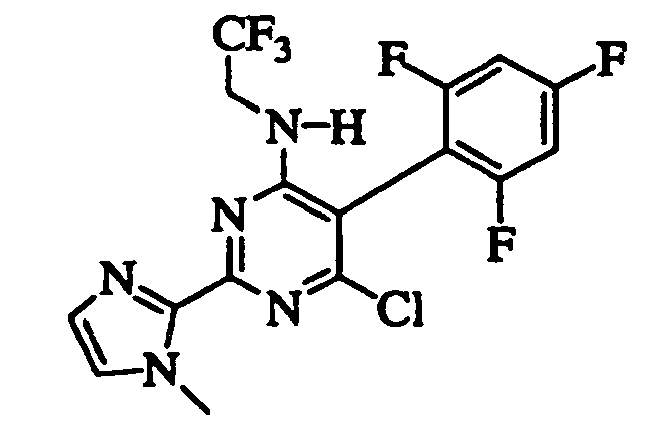
- 1-Methyl-2-imidazole carboxaldehyde (1.7 g, 15.4 mmol) is stirred in 10 mL of methyl alcohol. N,N-Dimethylhydrazine (1.4 g, 23.3 mmol) is then added. The mixture is stirred for 5 h, and the resulting hydrazone solution is added dropwise into a solution of magnesium monoperoxyphtalate hexahydrate (23.9g, 80%, 38.6 mmol) in 20 mL of methyl alcohol at 0 °C. The resulting reaction mixture is allowed to warm to room temperature overnight and concentrated. The residue is diluted with water, then extracted with methylene chloride (x3). The combined organic is washed with saturated sodium chloride, dried over magnesium sulfate and concentrated. The residue is chromatographed, eluting with 40% ethyl acetate in hexanes to give 1-methyl-2-imidazole carbonitrile as a yellow oil.
- To 10 mL of methyl alcohol in a sealed tube is added sodium hydride (440 mg, 11 mmol) with stirring. 1-Methyl-2-imidazole carbonitrile (1.18 g, 11 mmol) is added. The mixture is stirred at room temperature for 20 h, and ammonium chloride (588 mg, 11 mmol) is added. The bottle is then sealed and stirred at 80 °C for 8 h, and cooled to room temperature. The mixture is filtered, and the filtrate is concentrated. The residue is treated with 1% methyl alcohol in diethyl ether, and the precipitates are collected by filtration and dried to give 1-methyl-2-imidazole carboxamidine hydrochloride as a gray solid (1.6 g). MS: m/z 125.2 (M+H).
-

-

-

-

- A mixture of 6-chloro-2-(5-nitropyridin-2-yl)-N-(2,2,2-trifluoroethyl)-5-(2,4,6-trifluorophenyl)pyrimidin-4-amine (101 mg, 0.22 mmol) and Iron powder (256 mg, 4.58 mmol) in 2 mL of methyl alcohol and 1 mL of acetic acid is heated at 100 °C for 1 h. The reaction mixture is cooled to room temperature and diluted with ethyl acetate. The organic layer is washed with saturated sodium bicarbonate and then with saturated sodium chloride, dried over magnesium sulfate, filtered, concentrated and dried under reduced pressure to yield 2-(5-aminopyridin-2-yl)-6-chloro-N-(2,2,2-trifluoroethyl)-5-(2,4,6-trifluorophenyl)pyrimidin-4-amine as a light yellow oil (100 mg). MS: m/z 434.2 (M+H). This product is used in the next step with out further purification.
- To a mixture of sodium hydride (33.6 mg, 0.84 mmol) in 2 mL of dimethylsulfide is added N,N-Dimethylaminopropan-1-ol(99 µL, 0.84 mmol) slowly. After 30 minutes, 2-(5-aminopyridin-2-yl)-6-chloro-N-(2,2,2-trifluoroethyl)-5-(2,4,6-trifluorophenyl)pyrimidin-4-amine (100 mag, from Step A) is added and the resulting reaction mixture is heated at 60 °C for 4 h. The reaction mixture is cooled to room temperature, and diluted with ethyl acetate. The organic layer is washed with water and then with saturated sodium chloride solution, dried over magnesium sulfate, filtered, concentrated and dried under reduced pressure to yield 2-(5-aminopyridin-2-yl)-6-chloro-5-{4-[3-(dimethylamino)propoxy]-2,6-difluorophenyl}-N-(2,2,2-trifluoroethyl)pyrimidin-4-amine as a yellow semi-solid (60 mg). MS: m/z 517.3 (M+H). This product was used in the next step without further purification.

Claims (37)
- Use of an effective amount of a compound of formula (I):
 Z is selected from:
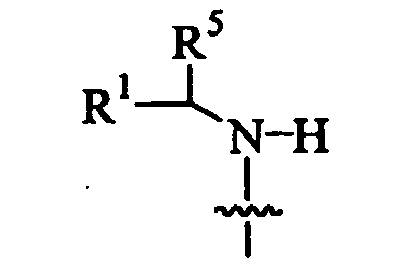 R is a moiety
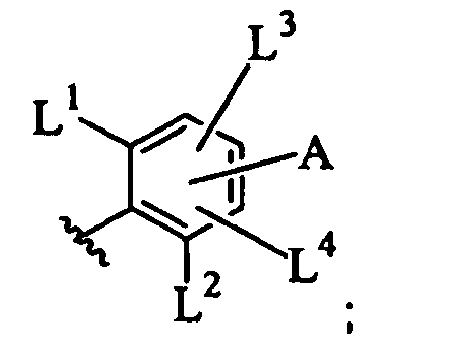 X is Cl or Br;L1, L2, L3 and L4 are each independently H, F, Cl or Br;A is H, F, Cl, Br, or Y(CH2)nQ ;Y is O, S, or -NR2;n is an integer of 2, 3, or 4;Q is OH or -NR3R4;R1 is H or C1-C3 alkyl;R2 is H or C1-C3 alkyl;R3 and R4 are each independently H or C1-C3 alkyl; or R3 and R4 when optionally taken together with the nitrogen atom to which each is attached form a heterocyclic ring of 4 to 6 ring atoms optionally substituted with R7;R5 is CF3 or C2F5 ;W' is -NHR6, -N(CN)R6 aryl of 6 to 12 carbon atoms optionally substituted with 1-3 groups independently selected from halogen , azido, nitro, cyano, hydroxy, C1-C3 alkyl, C1-C3 alkoxy, amino, C1-C3 alkylamino, C1-C3 dialkylamino, formyl, C1-C3 alkoxycarbonyl, carboxyl, C1-C3 alkanoyl, C1-C3 alkylthio, C1-C3 alkylamido, phenyl, phenoxy, benzyl, benzoxy, furyl, and cyclopropyl groups; or heteroaryl of 5 to 10 ring atoms having from 1 to 4 heteroatoms selected from S, O and N and optionally substituted with 1-3 groups independently selected from halogen, azido, nitro, cyano, hydroxy, C1-C3 alkyl, C1-C3 alkoxy, amino, C1C3 alkylamino, C1-C3 dialkylamino, formyl, C1-C3 alkoxycarbonyl, carboxyl, C1-C3 alkanoyl, C1C3 alkylthio, C1-C3 alkylamido, phenyl, phenoxy, benzyl, benzoxy, furyl, and cyclopropyl groups;R6 is C1C3 alkyl;R7 is C1-C3 alkyl;or a pharmaceutically acceptable salt thereof, in the preparation of a medicament for treating or inhibiting the growth of cancerous tumor cells in a mammal.
 - Use according to claim 1 wherein tumor expresses multiple drug resistance (MDR) or is resistant because of MDR in a mammal.
- Use of a compound as defined in claim 1 in the preparation of a medicament for treating, inhibiting the growth of, or eradicating a tumor in a mammal wherein said tumor is resistant to at least one chemotherapeutic agent.
- A use according to any one of claims 1 to 3 wherein X is Cl.
- A use according to any one of claims 1 to 4 wherein W' is N-methylamino, N-methylcyanamido, 1-pyrazolyl, 2-pyrazinyl, 2-pyridyl, 2-pyrimidinyl, or 3-isoquinolinyl.
- A use according to any one of claims 1 to 5 wherein R is
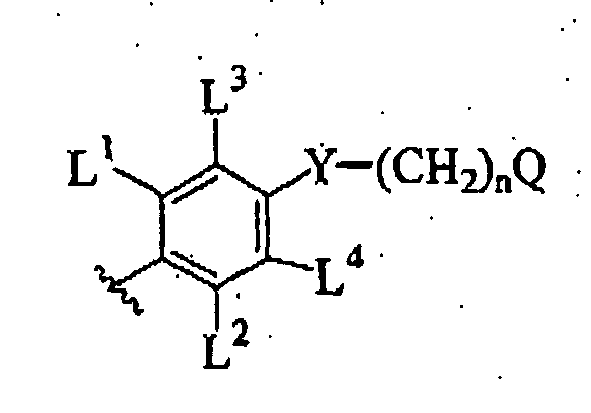
- A use according to any one of claims 1 to 6 wherein n is 3.
- A use according to any one of claims 1 to 7 wherein Y is O.
- A use according to any one of claims 1 to 8 wherein Q is -NR3R4.
- A use according to Claim 9 wherein R3 is methyl and R4 is H or methyl.
- A use according to to any one of claims 1 to 5 wherein A is F.
- A use according to any one of claims 1 to 11 wherein L1 is F and L2 is H or F.
- A use according to to any one of claims 1 to 12 wherein L3 and L4 are H.
- A Use according to to any one of claims 1 to 13 wherein R1 is H or methyl.
- A use according to any one of claims 1 to 14 wherein R5 is CF3.
- A use according to any one of claims 1 to 3 wherein:formula I is represented by formula Ia:
 R is a moiety
 n=3;Y is O;Q is -NR3R4;R1 is H or methyl;R5 is CF3;R3 and R4 are each independently H or C1-C3 alkyl; or R3 and R4 when optionally taken together with the nitrogen atom to which each is attached form a heterocyclic ring of 4 to 6 ring atoms optionally substituted with R7;R6 is C1-C3 alkyl;R7 is C1-C3 alkyl;L1 is F;L2 is H or F;L3 is H;L4 is H;X is Cl or Brand W' is as defined in claim 1;or a pharmaceutically acceptable salt thereof.
 - A use according to any one of claims 1 to 5 wherein formula I is represented by formula Ib
 R is a moiety
 n=3;Y is O;Q is -NR3R4;R1 is H or methyl;R5 is CF3;R3 and R4 are each independently H or C1-C3 alkyl; or R3 and R4 when optionally taken together with the nitrogen atom to which each is attached form a heterocyclic ring of 4 to 6 ring atoms optionally substituted with R7;R6 is C1-C3 alkyl;R7 is C1-C3 alkyl;L1 is F;L2 is H or F;L3 is H;L4 is H;X is Cl or Brand W' is as defined in claim 1;or a pharmaceutically acceptable salt thereof.
 - A use according to any one of claims 1 to 3 wherein the compound is selected from the following:4-Chloro-6-[(2,2,2-trifluoroethyl)amino]-5-(2,4,6-trifluorophenyl)pyrimidin-2-yl(methyl)cyanamide,4-Chloro-6-[(2,2,2-trifluoroethyl)amino]-5-(2,4,6-trifluorophenyl)pyrimidin-2-yl]ethylcyanamide,6-Chloro-2-pyrazin-2-yl-N-[2,2,2-trifluoro-1-methylethyl]-5-(2,4,6-trifluorophenyl)pyrimidin-4-amine,6-Chloro-2-pyrazin-2-yl-N-(2.2,2-trifluoroethyl)-5-(2,4,6-trifluorophenyl)pyrimidin-4-amine,6-Chloro-N-(2,2,2-trifluoroethyl)-5-(2,4,6-trifluorophenyl)-2,2'-bipyrimidin-4-amine,6-Chloro-N-pyridin-4-yl-N-(2,2,2-trifluoroethyl)-5-(2,4,6-trifluorophenyl)pyrimidin-4-amine,6-Chloro-2-pyridin-3-yl-N-(2,2,2-trifluoroethyl)-5-(2,4,6-trifluorophenyl)pyrimidin-4-amine,6-Chloro-2-pyridin-2-yl-N-(2,2,2-trifluoroethyl)-5-(2,4,6-trifluorophenyl)pyrimidin-4-amine,6-Chloro-2-pyridin-2-yl-N-[2,2,2-trifluoro-1-methylethyl]-5-(2,4,6-trifluorophenyl)pyrimidin-4-amine,6-Chloro-2-quinolin-2-yl-N-(2,2,2-trifluoroethyl)-5-(2,4,6-trifluorophenyl)pyrimidin-4-amine,6-Chloro-2-isoquinolin-1-yl-N-(2,2,2-trifluoroethyl)-5-(2,4,6-trifluorophenyl)pyrimidin-4-amine,6-Chloro-2-isoquinolin-3-yl-N-(2,2,2-trifluoroethyl)-5-(2,4,6-trifluorophenyl)pyrimidin-4-amine,6-Chloro-2-thien-2-yl-N-(2,2,2-trifluoroethyl)-5-(2,4,6-trifluorophenyl)pyrimidin-4-amine,6-Chloro-2-(2-furyl)-N-(2,2,2-trifluoroethyl)-5-(2,4,6-trifluorophenyl)pyrimidin-4-amine,6-Chloro-2-(1H-imidazol-1-yl)-N-(2,2,2-trifluoroethyl)-5-(2,4,6-trifluorophenyl)pyrimidin-4-amine,6-Chloro-2-(1H-pyrazol-1-yl)-N-(2,2,2-trifluoroethyl)-5-(2,4,6-trifluorophenyl)-pyrimidin-4-amine,6-Chloro-2-(1H-pyrazol-1-yl)-N-[2,2,2-trifluoro-1-methylethyl)-5-(2,4,6-trifluorophenyl)pyrimidin-4-amine,6-Chloro-2-(1H-pyrrol-1-yl)-N-(2,2,2-trifluoroethyl)-5-(2,4,6-trifluorophenyl)pyrimidin-4-amine,4-Chloro-5-{4-[3-(dimethylamino)propoxy]-2,6-difluorophenyl}-6-[(2,2,2-trifluoroethyl)amino]pyrimidin-2-yl(methyl)cyanamide,6-Chloro-5-{4-[3-(dimethylamino)propoxy]-2,6-difluorophenyl}-N2-methyl-N4-(2,2,2-trifluoroethyl)pyrimidine-2,4-diamine,(4-Chloro-5-{4-[3(dimethylamino)propoxy]-2,6-difluorophenyl}-6-{[2,2,2-trifluoro-1-methylethyl]amino}pyrimidin-2-yl)methylcyanamide,4-Chloro-5-{4-[2-(dimethylamino)ethoxy]-2,6-difluorophenyl}-6-[(2,2,2-trifluoroethyl)amino]pyrimidin-2-yl(methyl)cyanamide,{4-Chloro-5-{4-[4-(dimethylamino)butoxy]-2,6-difluorophenyl}-6-[(2,2,2-trifluoroethyl)amino]pyrimidin-2-yl}methylcyanamide,6-Chloro-5-{2,6-difluoro-4-[3-(methylamino)propoxy]phenyl}-2-pyrazin-2-yl-N-[2,2,2-trifluoro-1-methylethyl]pyrimidin-4-amine,6-Chloro-5-{4-[3-(dimethylamino)propoxy]-2,6-difluorophenyl}-2-pyrazin-2-yl-N-(2,2,2-trifluoroethyl)pyrimidin-4-amine,6-Chloro-5-{4-[3-(dimethylamino)propoxy]-2,6-difluorophenyl}-N-(2,2,2-trifluoroethyl)-2,2'-bipyrimidin-4-amine,6-Chloro-5-{4-[2-(dimethylamino)ethoxy]-2,6-difluorophenyl}-2-pyrazin-2-yl-N-(2,2,2-trifluoroethyl)pyrimidin-4-amine,6-Chloro-5-{4-[4-(dimethylamino)butoxy]-2,6-difluorophenyl}-2-pyrazin-2-yl-N-(2,2,2-trifluoroethyl)pyrimidin-4-amine,6-Chloro-5-{2,6-difluoro-4-[3-(methylamino)propoxy]phenyl}-2-pyridin-2-yl-N-[2,2,2-trifluoro-1-methylethyl]pyrimidin-4-amine,6-Chloro-5-{4-[3-(dimethylamino)propoxy]-2,6-difluorophenyl}-2-quinolin-2-yl-N-(2,2,2-trifluoroethyl)pyrimidin-4-amine,6-Chloro-5-{4-[3-(dimethylamino)propoxy]-2,6-difluorophenyl}-2-(1H-imidazol-1-yl)-N-(2,2,2-trifluoroethyl)pyrimidin-4-amine,6-Chloro-5-{2,6-difluoro-4-[3-(dimethylamino)propoxy]phenyl}-2-(1H-pyrazol-1-yl)-N-[2,2,2-trifluoro-1-methylethyl)pyrimidin-4-amine,N-{3-[4-(4-Chloro-6-cycloheptyl-2-pyrazin-2-ylpyrimidin-5-yl)-3,5-difluorophenoxy]propyl}-N-methylamine,6-Chloro-2-(1-methyl-1H-imidazol-2-yl)-N-(2,2,2-trifluoroethyl)-5-(2,4,6-trifluorophenyl)pyrimidin-4-amine,6-Chloro-2-(1H-pyrrol-2-yl)-N-(2,2,2-trifluoroethyl)-5-(2,4,6-trifluorophenyl)pyrimidin-4-amine,6-Chloro-2-(4-methylpyridin-2-yl)-N-(2,2,2-trifluoroethyl)-5-(2,4,6-trifluorophenyl)pyrimidin-4-amine,6-Chloro-2-(5-nitropyridin-2-yl)-N-(2,2,2-trifluoroethyl)-5-(2,4,6-trifluorophenyl)pyrimidin-4-amine,2-(5-Azidopyridin-2-yl)-6-chloro-5-{4-[3-(dimethylamino)propoxy]-2,6-difluorophenyl} N-(2,2,2-trifluoroethyl)pyrimidin-4-amine,6-Chloro-2-pyrazin-2-yl-N-[(1S)-2,2,2-trifluoro-1-methylethyl]-5-(2,4,6-trifluorophenyt)pyrimidin-4-amine,6-Chloro-2-pyridin-2-yl-N-[(1S)-2,2,2-trifluoro-1-methylethyl]-5-(2,4,6-trifluorophenyl)pyrimidin-4-amine,6-Chloro-2-(1H-pyrazol-1-yl)-N-[(1S)-2,2,2-trifluoro-1-methylethyl)-5-(2,4,6-trifluorophenyl)pyrimidin-4-amine,(4-Chloro-5-{4-[3-(dimethylamino)propoxy]-2,6-difluorophenyl}-6-{[(1S)-2,2,2-trifluoro-1-methylethyl]amino}pyrimidin-2-yl)methylcyanamide,6-Chloro-5-{2,6-difluoro-4-[3-(methylamino)propoxy]phenyl}-2-pyrazin-2-yl-N-[(1S)-2,2,2-trifluoro-1-methylethyl]pyrimidin-4-amine,6-Chloro-5-{2,6-difluoro-4-[3-(methylamino)propoxy]phenyl}-2-pyridin-2-yl-N-[(1S)-2,2,2-trifluoro-1-methylethyl]pyrimidin-4-amine;6-Chloro-5-{2,6-difluoro-4-[3-(dimethylamino)propoxy]phenyl}-2-(1H-pyrazol-1-yl)-N-[(1S)-2,2,2-trifluoro-1-methylethyl)pyrimidin-4-amine;6-Chloro-2-pyrazin-2-yl-N-[(1R)-2,2,2-trifluoro-1-methylethyl]-5-(2,4,6-trifluorophenyl)pyrimidin-4-amine,6-Chloro-2-pyridin-2-yl-N-[(1R)-2,2,2-trifluoro-1-methylethyl]-5-(2,4,6-trifluorophenyl)pyrimidin-4-amine,6-Chtoro-2-(1H-pyrazol-1-yl)-N-[(1R)-2,2,2-trifluoro-1-methytethyl)-5-(2,4,6-trifluorophenyl)pyrimidin-4-amine,(4-Chloro-5-{4-[3-(dimethylamino)propoxy]-2,6-difluorophenyl}-6-{[(1R)-2,2,2-trifluoro-1-methylethyl]amino}pyrimidin-2-yl)methylcyanamide,6-Chloro-5-{2,6-difluoro-4-[3-(methylamino)propoxy]phenyl}-2-pyrazin-2-yl-N-[(1R)-2,2,2-trifluoro-1-methylethyl]pyrimidin-4-amine,6-Chloro-5-{2,6-difluoro-4-[3-(methylamino)propoxy]phenyl}-2-pyridin-2-yl-N-[(1R)-2,2,2-trifluoro-1-methylethyl]pyrimidin-4-amine, and6-Chloro-5-{2,6-difluoro-4-[3-(dimethylamino)propoxy]phenyl}-2-(1H-pyrazol-1-yl)-N-[(1R)-2,2,2-trifluoro-1-methylethyl)pyrimidin-4-amine;or a pharmaceutically acceptable salt thereof.
- A pharmaceutical composition which comprises a compound of Formula (I) as defined in any one of claims 1 and 4 to 18 or a pharmaceutically acceptable salt thereof together with a pharmaceutically acceptable carrier.
- A method of promoting microtubule polymerization in a tubulin containing system which comprises contacting said tubulin containing system in vitro with an effective amount of a compound of formula (I) or a pharmaceutically acceptable salt thereof as defined in claim 1.
- A method of stabilizing microtubules in a tubulin containing system by contacting said tubulin containing system in vitro with an effective amount of a compound of formula (I) or a pharmaceutically acceptable salt thereof as defined in claim 1.
- A compound of Formula (I)
 Z is selected from:
 R is a moiety
 n is an integer of 2, 3, or 4;L1 and L2, are each independently H, F, Cl or Br;L3 and L4 are H;X is Cl or Br;Y is O, S, or -NR2;Q is OH or -NR3R4;R1 is H or C1-C3 alkyl;R2 is H or C1-C3 alkyl;R3 and R4 are each independently H or C1-C3 alkyl; or R3 and R4 when optionally taken together with the nitrogen atom to which each is attached form a heterocyclic ring of 4 to 6 ring atoms optionally substituted with R7;R5 is CF3 or C2F5 ;W' is -NHR6, -N(CN)R6, aryl of 6 to 12 carbon atoms optionally substituted with 1-3 groups independently selected from halogen , azido, nitro, cyano, hydroxy, C1-C3 alkyl, C1-C3 alkoxy, amino, C1-C3 alkylamino, C1-C3 dialkylamino, formyl, C1-C3 alkoxycarbonyl, carboxyl, C1-C3 alkanoyl, C1-C3 alkylthio, C1-C3 alkylamido, phenyl, phenoxy, benzyl, benzoxy, furyl, and cyclopropyl groups; or heteroaryl of 5 to 10 ring atoms having from 1 to 4 heteroatoms selected from S, O and N and optionally substituted with 1-3 groups independently selected from halogen, azido, nitro, cyano, hydroxy, C1-C3 alkyl, C1-C3 alkoxy, amino, C1-C3 alkylamino, C1-C3 dialkylamino, formyl, C1-C3 alkoxycarbonyl, carboxyl. C1-C3 alkanoyl, C1-C3 alkylthio, C1-C3 alkylamido, phenyl, phenoxy, benzyl, benzoxy, furyl, and cyclopropyl groups;R6 is C1-C3 alkyl;R7 is C1-C3 alkyl;or a pharmaceutically acceptable salt thereof.
 - A compound according to claim 22 wherein X is Cl.
- A compound according to claim 22 or claim 23 wherein W' is N-methylamino, N-methylcyanamido, 1-pyrazolyl, 2-pyrazinyl, 2-pyridyl, 2-pyrimidinyl, or 3-isoquinolinyl.
- A compound according to any one of claims 22 to 24 wherein R is

- A compound according to any one of claims 22 to 25 wherein n is 3.
- A compound according to any one of claims 22 to 26 wherein Y is O.
- A compound according to any one of claims 22 to 27 wherein Q is -NR3R4.
- A compound according to Claim 28 wherein R3 is methyl and R4 is H or methyl.
- A compound according to any one of claims 22 to 29 wherein L1 is F and L2 is HorF.
- A compound according to any one of claims 22 to 30 wherein R1 is H or methyl.
- A compound according to any one of claims 22 to 31 wherein R5 is CF3.
- A compound according to claim 22 wherein formula I is represented by formula Ia:
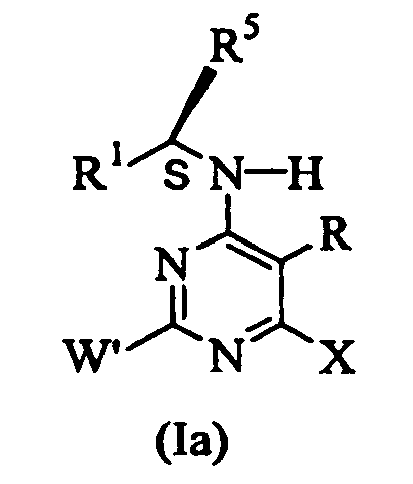 R is a moiety
 n = 3;Y is O;Q is -NR3R4;R1 is H or methyl;R5 is CF3;R3 and R4 are each independently H or C1-C3 alkyl: or R3 and R4 when optionally taken together with the nitrogen atom to which each is attached form a heterocyclic ring of 4 to 6 ring atoms optionally substituted with R7;R6 is C1-C3 alkyl;R7 is C1-C3 alkyl;L1 is F;L2 is H or F;L3 is H;L4 is H;X is Cl or Brand W' is as defined in claim 22;or a pharmaceutically acceptable salt thereof.
 - A compound according to claim 22 wherein formula I is represented by formula lb
 R is a moiety
 n=3;Y is O;Q is -NR3R4;R1 is H or methyl;R5 is CF3;R3 and R4 are each independently H or C1-C3 alkyl; or R3 and R4 when optionally taken together with the nitrogen atom to which each is attached form a heterocyclic ring of 4 to 6 ring atoms optionally substituted with R7;R6 is C1-C3 alkyl;R7 is C1-C3 alkyl;L1 is F;L2 is H or F;L3 is H;L4 is H;X is Cl or Brand W' is as defined in claim 22;or a pharmaceutically acceptable salt thereof.
 - The compound according to claim 22 which is one of the following:4-chloro-5-{4-[3-(dimethylamino)propoxy]-2,6-difluorophenyl}-6-[(2,2,2-trifluoroethyl)amino]pyrimidin-2-yl(methyl)cyanamide;6-chloro-5-{4-[3-(dimethylamino)propoxy]-2,6-difluorophenyl}-N2-methyl-N4-(2,2,2-trifluoroethyl)pyrimidine-2,4-diamine ;.(4-chloro-5-{4-[3-(dimethylamino)propoxy]-2,6-difluorophenyl}-6-{[2,2,2-trifluoro-1-methylethyl]amino}pyrimidin-2-yl)methylcyanamide ;.4-chloro-5-{4-[2-(dimethylamino)ethoxy]-2,6-difluorophenyl}-6-[(2,2,2-trifluoroethyl)amino]pyrimidin-2-yl(methyl)cyanamide;.{4-chloro-5-{4-[4-(dimethylamino)butoxy]-2,6-difluorophenyl}-6-[(2,2,2-trifluoroethyl)amino]pyrimidin-2-yl}methylcyanamide;.6-chloro-5-{2,6-difluoro-4-[3-(methylamino)propoxy]phenyl}-2-pyrazin-2-yl-N-[2,2,2-trifluoro-1-methylethyl]pyrimidin-4-amine;6-chloro-5-{4-[3-(dimethylamino)propoxy]-2,6-difluorophenyl}-2-pyrazin-2-yl-N-(2,2,2-trifluoroethyl)pyrimidin-4-amine;.6-chloro-5-{4-[3-(dimethylamino)propoxy]-2,6-difluorophenyl}-N-(2,2,2-trifluoroethyl)-2,2'-bipyrimidin-4-amine;.6-chloro-5-{4-[3-(dimethylamino)propoxy]-2,6-difluorophenyl}-2-(1H-imidazol-1-yl)-N-(2,2,2-trifluoroethyl)pyrimidin-4-amine;.6-chloro-5-{2,6-difluoro-4-[3-(dimethylamino)propoxy]phenyl}-2-(1H-pyrazol-1-yl)-N-[2,2,2-trifluoro-1-methylethyl)pyrimidin-4-amine;N-{3-[4-(4-chloro-6-cycloheptyl-2-pyrazin-2-ylpyrimidin-5-yl)-3,5-difluorophenoxy]propyl}-N-methylamine;.6-chloro-5-(4-[2-(dimethylamino)ethoxy]-2,6-difluorophenyl)-2-pyrazin-2-yl-N-(2,2,2-trifluoroethyl)pyrimidin-4-amine;.6-chloro-5-{4-[4-(dimethylamino)butoxy]-2,6-difluorophenyl}-2-pyrazin-2-yl-N-(2,2,2-trifluoroethyl)pyrimidin-4-amine;.6-chloro-5-{2,6-difluoro-4-[3-(methylamino)propoxy]phenyl}-2-pyridin-2-yl-N-[2,2,2-trifluoro-1-methytethyl]pyrimidin-4-amine;6-chloro-5-{4-[3-(dimethylamino)propoxy]- 2,6-difluorophenyl}-2-quinolin-2-yl-N-(2,2,2-trifluoroethyl)pyrimidin-4-amine;.2-(5-Azidopyridin-2-yl)-6-chloro-5-{4-[3-(dimethylamino)propoxy]-2,6-difluorophenyl}-N-(2,2,2-trifluoroethyl)pyrimidin-4-amine;.(4-chloro-5-{4-[3-(dimethylamino)propoxy]-2,6-difluorophenyl}-6-{[(1S)-2,2,2-trifluoro-1-methylethyl]amino}pyrimidin-2-yl)methylcyanamide;.6-chloro-5-{2,6-difluoro-4-[3-(methylamino)propoxy]phenyl}-2-pyrazin-2-yl-N-[(1S)-2,2,2-trifluoro-1-methylethyl]pyrimidin-4-amine;.6-chloro-5-{2,6-difluoro-4-[3-(dimethylamino)propoxy]phenyl}-2-(1H-pyrazol-1-yl)-N-[(1S)-2,2,2-trifluoro-1-methylethyl)pyrimidin-4-amine;.6-chloro-5-{2,6-difluoro-4-[3-(methylamino)propoxy]phenyl}-2-pyridin-2-yl-N-[(1S)-2,2,2-trifluoro-1-methylethyl]pyrimidin-4-amine;.(4-chloro-5-{4-[3-(dimethylamino)propoxy]-2,6-difluorophenyl}-6-{[(1R)-2,2,2-trifluoro-1-methylethyl]amino}pyrimidin-2-yl)methylcyanamide;.6-chloro-5-{2,6-difluoro-4-[3-(methylamino)propoxy]phenyl}-2-pyrazin-2-yl-N-[(1R)-2,2,2-trifluoro-1-methylethyl]pyrimidin-4-amine;6-chloro-5-{2,6-difluoro-4-[3-(dimethylamino)propoxy]phenyl}-2-(1H-pyrazol-1-yl)-N-[(1R)-2,2,2-trifluoro-1-methylethyl)pyrimidin-4-amine
or6-chloro-5-{2,6-difluoro-4-[3-(methylamino)propoxy]phenyl}-2-pyridin-2-yl-N-[(1R)-2,2,2-trifluoro-1-methylethyl]pyrimidin-4-amine;or a pharmaceutically acceptable salt thereof. - A process for the preparation of a compound of Formula (I) as defined in claim 22 or a pharmaceutically acceptable salt thereof, comprising reacting a compound of the formula

- A process for the preparation of a compound of Formula (I)
 Z is:
Z is: R is a moiety
 n is an integer of 2, 3, or 4;L1 and L2, are each independently H, F, Cl or Br;L3 and L4 are H;X is Cl or Br;Y is O, S, or-NR2;Q is OH or -NR3R4;R1 is H or C1-C3 alkyl;R2 is H or C1-C3 alkyl;R3 and R4 are each independently H or C1-C3 alkyl; or R3 and R4 when optionally taken together with the nitrogen atom to which each is attached form a heterocyclic ring of 4 to 6 ring atoms optionally substituted with R7;R5 is CF3 or C2F5 ;W' is -NHR6, -N(CN)R6, aryl of 6 to 12 carbon atoms optionally substituted with 1-3 groups independently selected from halogen, azido, nitro, cyano, hydroxy, C1-C3 alkyl, C1-C3 alkoxy, amino, C1-C3 alkylamino, C1-C3 dialkylamino, formyl, C1-C3 alkoxycarbonyl, carboxyl, C1-C3 alkanoyl, C1-C3 alkylthio, C1-C3 alkylamido, phenyl, phenoxy, benzyl, benzoxy, furyl, and cyclopropyl groups; or heteroaryl of 5 to 10 ring atoms having from 1 to 4 heteroatoms selected from S, O and N and optionally substituted with 1-3 groups independently selected from halogen, azido, nitro, cyano, hydroxy, C1-C3 alkyl, C1-C3 alkoxy, amino, C1-C3 alkylamino, C1-C3 dialkylamino, formyl, C1-C3 alkoxycarbonyl, carboxyl, C1-C3 alkanoyl, C1-C3 alkylthio, C1-C3 alkylamido, phenyl, phenoxy, benzyl, benzoxy, furyl, and cyclopropyl groups;R6 is C1-C3 alkyl;R7 is C1-C3 alkyl;or a pharmaceutically acceptable salt thereof, comprising reacting a compound of the formula
Applications Claiming Priority (2)
| Application Number | Priority Date | Filing Date | Title |
|---|---|---|---|
| US50548703P | 2003-09-24 | 2003-09-24 | |
| PCT/US2004/030682 WO2005030216A1 (en) | 2003-09-24 | 2004-09-17 | 5-arylpyrimidines as anticancer agents |
Publications (2)
| Publication Number | Publication Date |
|---|---|
| EP1663241A1 EP1663241A1 (en) | 2006-06-07 |
| EP1663241B1 true EP1663241B1 (en) | 2009-05-27 |
Family
ID=34393022
Family Applications (1)
| Application Number | Title | Priority Date | Filing Date |
|---|---|---|---|
| EP04784529A Expired - Lifetime EP1663241B1 (en) | 2003-09-24 | 2004-09-17 | 5-arylpyrimidines as anticancer agents |
Country Status (24)
| Country | Link |
|---|---|
| US (1) | US7524849B2 (en) |
| EP (1) | EP1663241B1 (en) |
| JP (1) | JP2007506746A (en) |
| KR (1) | KR20060089215A (en) |
| CN (1) | CN1871009A (en) |
| AR (1) | AR045811A1 (en) |
| AT (1) | ATE432077T1 (en) |
| AU (1) | AU2004275733A1 (en) |
| BR (1) | BRPI0414736A (en) |
| CA (1) | CA2539235A1 (en) |
| CO (1) | CO5690592A2 (en) |
| DE (1) | DE602004021269D1 (en) |
| EC (1) | ECSP066457A (en) |
| GT (1) | GT200400188A (en) |
| IL (1) | IL174305A0 (en) |
| MX (1) | MXPA06003207A (en) |
| NO (1) | NO20061319L (en) |
| PA (1) | PA8613201A1 (en) |
| PE (1) | PE20050470A1 (en) |
| RU (1) | RU2006107578A (en) |
| SA (1) | SA04250303A (en) |
| TW (1) | TW200512198A (en) |
| WO (1) | WO2005030216A1 (en) |
| ZA (1) | ZA200602386B (en) |
Families Citing this family (17)
| Publication number | Priority date | Publication date | Assignee | Title |
|---|---|---|---|---|
| TW200637556A (en) * | 2005-01-31 | 2006-11-01 | Basf Ag | Substituted 5-phenyl pyrimidines I in therapy |
| CN101193884A (en) | 2005-06-13 | 2008-06-04 | 惠氏公司 | Tubulin inhibitor and its preparation method |
| JP2008543838A (en) * | 2005-06-13 | 2008-12-04 | ワイス | Tubulin inhibitors and processes for their preparation |
| EP2001298A2 (en) * | 2006-03-27 | 2008-12-17 | Basf Se | Substituted 5-hetaryl-4-aminopyrimidines |
| CL2007002231A1 (en) * | 2006-08-02 | 2008-04-11 | Basf Ag | USE OF COMPOUNDS DERIVED FROM 5- (HET) ARILPIRIMIDINE TO COMBAT DANGINE FUNGES; COMPOUNDS DERIVED FROM 5- (HET) ARILPIRIMIDINA; FUNGICIDE AGENT; AND PHARMACEUTICAL AGENT. |
| WO2008084081A2 (en) * | 2007-01-11 | 2008-07-17 | Basf Se | 2-substituted 5-phenylpyrimidines for the treatment of proliferative disorders |
| WO2009007187A1 (en) * | 2007-07-09 | 2009-01-15 | Basf Se | Substituted 5-hetarylpyrimidines |
| TWI548621B (en) | 2011-04-22 | 2016-09-11 | 標誌製藥公司 | Substituted diaminocarboxamide and diaminocarbonitrile pyrimidines, compositions thereof, and methods of treatment therewith |
| EP3219207A1 (en) * | 2012-09-19 | 2017-09-20 | The Trustees Of The University Of Pennsylvania | Heterocyclic compounds and their use for the treatment of neurodegenerative tauopathies |
| NZ715903A (en) | 2014-01-30 | 2017-06-30 | Signal Pharm Llc | Solid forms of 2-(tert-butylamino)-4-((1r,3r,4r)-3-hydroxy-4-methylcyclohexylamino)-pyrimidine-5-carboxamide, compositions thereof and methods of their use |
| EP3712134B1 (en) | 2014-12-16 | 2023-11-29 | Signal Pharmaceuticals, LLC | Salts of 2-(tert-butylamino)-4-((1r,3r,4r)-3-hydroxy-4-methycyclohexylamino)-pyrimidine-5-carboxamide |
| US9513297B2 (en) | 2014-12-16 | 2016-12-06 | Signal Pharmaceuticals, Llc | Methods for measurement of inhibition of c-Jun N-terminal kinase in skin |
| EP3250557B1 (en) | 2015-01-29 | 2024-11-20 | Signal Pharmaceuticals, LLC | Isotopologues of 2-(tert-butylamino)-4-((1r,3r,4r)-3-hydroxy-4-methylcyclohexylamino)-pyrimidine-5-carboxamide |
| EP3325432B1 (en) | 2015-07-24 | 2020-09-02 | Celgene Corporation | Methods of synthesis of (1r,2r,5r)-5-amino-2-methylcyclohexanol hydrochloride and intermediates useful therein |
| WO2019169111A1 (en) | 2018-03-02 | 2019-09-06 | The Trustees Of The University Of Pennsylvania | [1,2,4]triazolo[1,5-a]pyrimidine compounds and use in stabilizing microtubules |
| EP4052759A4 (en) * | 2019-11-01 | 2023-12-20 | Unimatec Co., Ltd. | Fluorine-containing pyrimidine compound and manufacturing method for same |
| TW202132285A (en) * | 2019-11-13 | 2021-09-01 | 美商愛彼特生物製藥股份有限公司 | Substituted isoindolonyl 2,2'-bipyrimidinyl compounds, analogues thereof, and methods using same |
Family Cites Families (18)
| Publication number | Priority date | Publication date | Assignee | Title |
|---|---|---|---|---|
| US116429A (en) * | 1871-06-27 | Improvement in dial-telegraph apparatus | ||
| US69242A (en) * | 1867-09-24 | Calvin pepper | ||
| US61889A (en) * | 1867-02-05 | Improvement in animal teaps | ||
| US88096A (en) * | 1869-03-23 | t h a y e r | ||
| US147744A (en) * | 1874-02-24 | Improvement in locomotive-furnaces | ||
| GB9700664D0 (en) | 1997-01-14 | 1997-03-05 | British Tech Group | Anti-cancer agents |
| US6117876A (en) | 1997-04-14 | 2000-09-12 | American Cyanamid Company | Fungicidal trifluorophenyl-triazolopyrimidines |
| AU3536699A (en) | 1998-04-27 | 1999-11-16 | Ihara Chemical Industry Co. Ltd. | 3-arylphenyl sulfide derivatives and insecticides and miticides |
| US6156925A (en) | 1998-09-25 | 2000-12-05 | American Cyanamid Company | Process for the preparation of halogenated phenylmaloates |
| US5986135A (en) | 1998-09-25 | 1999-11-16 | American Cyanamid Company | Fungicidal trifluoromethylalkylamino-triazolopyrimidines |
| PL362551A1 (en) * | 2000-06-13 | 2004-11-02 | Basf Aktiengesellschaft | Fungicidal 5-phenyl substituted 2-(cyanoamino) pyrimidines |
| US6670362B2 (en) | 2000-09-20 | 2003-12-30 | Pfizer Inc. | Pyridazine endothelin antagonists |
| SK11422003A3 (en) * | 2001-03-15 | 2004-04-06 | Basf Aktiengesellschaft | 5-Phenylpyrimidine, methods and intermediate products for production thereof and use of same for controlling pathogenic fungi |
| ATE297390T1 (en) | 2001-04-20 | 2005-06-15 | Ciba Sc Holding Ag | 4-AMINO-2-(2-PYRIDINYL)PYRIMIDINES AS MICROBICIDAL ACTIVE SUBSTANCES |
| JP4450625B2 (en) | 2001-11-19 | 2010-04-14 | ビーエーエスエフ ソシエタス・ヨーロピア | 5-Phenylpyrimidines, processes for their preparation, compositions containing them and their use |
| EP1504001B1 (en) | 2002-02-21 | 2009-04-15 | Basf Se | 2-(2-pyridyl)-5-phenyl-6-aminopyrimidine, method and intermediate products for the production and use thereof for combating noxious fungi |
| AU2003214110A1 (en) | 2002-03-15 | 2003-09-29 | Ciba Specialty Chemicals Holding Inc. | 4-aminopyrimidines and their use for the antimicrobial treatment of surfaces |
| DK2316831T3 (en) | 2002-11-21 | 2013-06-10 | Novartis Ag | 2- (Morpholin-4-yl) pyrimidines as phosphotidylinositol (PI) -3-kinase inhibitors and their use in the treatment of cancer |
-
2004
- 2004-09-17 JP JP2006528086A patent/JP2007506746A/en not_active Withdrawn
- 2004-09-17 DE DE602004021269T patent/DE602004021269D1/en not_active Expired - Fee Related
- 2004-09-17 MX MXPA06003207A patent/MXPA06003207A/en unknown
- 2004-09-17 RU RU2006107578/04A patent/RU2006107578A/en not_active Application Discontinuation
- 2004-09-17 KR KR1020067005903A patent/KR20060089215A/en not_active Withdrawn
- 2004-09-17 AT AT04784529T patent/ATE432077T1/en not_active IP Right Cessation
- 2004-09-17 CN CNA200480031581XA patent/CN1871009A/en active Pending
- 2004-09-17 AU AU2004275733A patent/AU2004275733A1/en not_active Withdrawn
- 2004-09-17 EP EP04784529A patent/EP1663241B1/en not_active Expired - Lifetime
- 2004-09-17 BR BRPI0414736-7A patent/BRPI0414736A/en not_active IP Right Cessation
- 2004-09-17 CA CA002539235A patent/CA2539235A1/en not_active Abandoned
- 2004-09-17 WO PCT/US2004/030682 patent/WO2005030216A1/en not_active Ceased
- 2004-09-21 TW TW093128501A patent/TW200512198A/en unknown
- 2004-09-22 PE PE2004000922A patent/PE20050470A1/en not_active Application Discontinuation
- 2004-09-22 SA SA04250303A patent/SA04250303A/en unknown
- 2004-09-23 GT GT200400188A patent/GT200400188A/en unknown
- 2004-09-23 AR ARP040103441A patent/AR045811A1/en not_active Application Discontinuation
- 2004-09-24 PA PA20048613201A patent/PA8613201A1/en unknown
- 2004-09-24 US US10/950,375 patent/US7524849B2/en not_active Expired - Fee Related
-
2006
- 2006-03-13 IL IL174305A patent/IL174305A0/en unknown
- 2006-03-23 ZA ZA200602386A patent/ZA200602386B/en unknown
- 2006-03-23 NO NO20061319A patent/NO20061319L/en not_active Application Discontinuation
- 2006-03-24 EC EC2006006457A patent/ECSP066457A/en unknown
- 2006-04-21 CO CO06038135A patent/CO5690592A2/en not_active Application Discontinuation
Also Published As
| Publication number | Publication date |
|---|---|
| MXPA06003207A (en) | 2006-06-23 |
| KR20060089215A (en) | 2006-08-08 |
| IL174305A0 (en) | 2008-02-09 |
| CA2539235A1 (en) | 2005-04-07 |
| ZA200602386B (en) | 2009-03-25 |
| WO2005030216A1 (en) | 2005-04-07 |
| DE602004021269D1 (en) | 2009-07-09 |
| EP1663241A1 (en) | 2006-06-07 |
| CN1871009A (en) | 2006-11-29 |
| RU2006107578A (en) | 2007-10-27 |
| US7524849B2 (en) | 2009-04-28 |
| SA04250303A (en) | 2005-12-03 |
| AR045811A1 (en) | 2005-11-16 |
| TW200512198A (en) | 2005-04-01 |
| JP2007506746A (en) | 2007-03-22 |
| PE20050470A1 (en) | 2005-10-03 |
| NO20061319L (en) | 2006-04-20 |
| ECSP066457A (en) | 2006-09-18 |
| CO5690592A2 (en) | 2006-10-31 |
| US20050075357A1 (en) | 2005-04-07 |
| ATE432077T1 (en) | 2009-06-15 |
| BRPI0414736A (en) | 2006-11-21 |
| GT200400188A (en) | 2005-05-02 |
| PA8613201A1 (en) | 2005-11-25 |
| AU2004275733A1 (en) | 2005-04-07 |
Similar Documents
| Publication | Publication Date | Title |
|---|---|---|
| US7524849B2 (en) | 5-arylpyrimidines as anticancer agents | |
| US6884799B2 (en) | Non-cross-linking pyrrolo[2,1-c][1,4]benzodiazepines and process thereof | |
| EP4421069A1 (en) | Compounds and compositions for modulating egfr mutant kinase activities | |
| EP1680425B1 (en) | 6- [(substituted)phenyl] triazolopyrimidines as anticancer agents | |
| EP3569602B1 (en) | Imidazopyrazine compound, preparation method therefor and use thereof | |
| US7915266B2 (en) | 6-aryl-7-halo-imidazo[1,2-a]pyrimidines as anticancer agents | |
| US12570651B2 (en) | Quinazoline-2,4-dione derivatives as PARP inhibitors | |
| US20240132492A1 (en) | Pyridopyrimidine-based compound and application thereof | |
| HK1090374B (en) | 6- [(substituted)phenyl] triazolopyrimidines as anticancer agents | |
| AU2006329862A1 (en) | Dimers and adducts of 6-[(substituted) phenyl] triazolopyrimidines useful as anticancer agents | |
| HK40109469A (en) | Compounds and compositions for modulating egfr mutant kinase activities | |
| HK40010470A (en) | Imidazopyrazine compound, preparation method therefor and use thereof | |
| HK40010470B (en) | Imidazopyrazine compound, preparation method therefor and use thereof |
Legal Events
| Date | Code | Title | Description |
|---|---|---|---|
| PUAI | Public reference made under article 153(3) epc to a published international application that has entered the european phase |
Free format text: ORIGINAL CODE: 0009012 |
|
| 17P | Request for examination filed |
Effective date: 20060306 |
|
| AK | Designated contracting states |
Kind code of ref document: A1 Designated state(s): AT BE BG CH CY CZ DE DK EE ES FI FR GB GR HU IE IT LI LU MC NL PL PT RO SE SI SK TR |
|
| AX | Request for extension of the european patent |
Extension state: AL HR LT LV MK |
|
| 17Q | First examination report despatched |
Effective date: 20060718 |
|
| REG | Reference to a national code |
Ref country code: HK Ref legal event code: DE Ref document number: 1085947 Country of ref document: HK |
|
| GRAP | Despatch of communication of intention to grant a patent |
Free format text: ORIGINAL CODE: EPIDOSNIGR1 |
|
| GRAS | Grant fee paid |
Free format text: ORIGINAL CODE: EPIDOSNIGR3 |
|
| GRAA | (expected) grant |
Free format text: ORIGINAL CODE: 0009210 |
|
| AK | Designated contracting states |
Kind code of ref document: B1 Designated state(s): AT BE BG CH CY CZ DE DK EE ES FI FR GB GR HU IE IT LI LU MC NL PL PT RO SE SI SK TR |
|
| AX | Request for extension of the european patent |
Extension state: AL HR LT LV MK |
|
| REG | Reference to a national code |
Ref country code: GB Ref legal event code: FG4D |
|
| REG | Reference to a national code |
Ref country code: CH Ref legal event code: EP |
|
| REG | Reference to a national code |
Ref country code: IE Ref legal event code: FG4D |
|
| REF | Corresponds to: |
Ref document number: 602004021269 Country of ref document: DE Date of ref document: 20090709 Kind code of ref document: P |
|
| PG25 | Lapsed in a contracting state [announced via postgrant information from national office to epo] |
Ref country code: FI Free format text: LAPSE BECAUSE OF FAILURE TO SUBMIT A TRANSLATION OF THE DESCRIPTION OR TO PAY THE FEE WITHIN THE PRESCRIBED TIME-LIMIT Effective date: 20090527 Ref country code: PT Free format text: LAPSE BECAUSE OF FAILURE TO SUBMIT A TRANSLATION OF THE DESCRIPTION OR TO PAY THE FEE WITHIN THE PRESCRIBED TIME-LIMIT Effective date: 20090927 Ref country code: AT Free format text: LAPSE BECAUSE OF FAILURE TO SUBMIT A TRANSLATION OF THE DESCRIPTION OR TO PAY THE FEE WITHIN THE PRESCRIBED TIME-LIMIT Effective date: 20090527 |
|
| NLV1 | Nl: lapsed or annulled due to failure to fulfill the requirements of art. 29p and 29m of the patents act | ||
| LTIE | Lt: invalidation of european patent or patent extension |
Effective date: 20090527 |
|
| PG25 | Lapsed in a contracting state [announced via postgrant information from national office to epo] |
Ref country code: PL Free format text: LAPSE BECAUSE OF FAILURE TO SUBMIT A TRANSLATION OF THE DESCRIPTION OR TO PAY THE FEE WITHIN THE PRESCRIBED TIME-LIMIT Effective date: 20090527 Ref country code: SE Free format text: LAPSE BECAUSE OF FAILURE TO SUBMIT A TRANSLATION OF THE DESCRIPTION OR TO PAY THE FEE WITHIN THE PRESCRIBED TIME-LIMIT Effective date: 20090827 Ref country code: SI Free format text: LAPSE BECAUSE OF FAILURE TO SUBMIT A TRANSLATION OF THE DESCRIPTION OR TO PAY THE FEE WITHIN THE PRESCRIBED TIME-LIMIT Effective date: 20090527 Ref country code: NL Free format text: LAPSE BECAUSE OF FAILURE TO SUBMIT A TRANSLATION OF THE DESCRIPTION OR TO PAY THE FEE WITHIN THE PRESCRIBED TIME-LIMIT Effective date: 20090527 |
|
| PG25 | Lapsed in a contracting state [announced via postgrant information from national office to epo] |
Ref country code: CZ Free format text: LAPSE BECAUSE OF FAILURE TO SUBMIT A TRANSLATION OF THE DESCRIPTION OR TO PAY THE FEE WITHIN THE PRESCRIBED TIME-LIMIT Effective date: 20090527 Ref country code: DK Free format text: LAPSE BECAUSE OF FAILURE TO SUBMIT A TRANSLATION OF THE DESCRIPTION OR TO PAY THE FEE WITHIN THE PRESCRIBED TIME-LIMIT Effective date: 20090527 Ref country code: EE Free format text: LAPSE BECAUSE OF FAILURE TO SUBMIT A TRANSLATION OF THE DESCRIPTION OR TO PAY THE FEE WITHIN THE PRESCRIBED TIME-LIMIT Effective date: 20090527 Ref country code: ES Free format text: LAPSE BECAUSE OF FAILURE TO SUBMIT A TRANSLATION OF THE DESCRIPTION OR TO PAY THE FEE WITHIN THE PRESCRIBED TIME-LIMIT Effective date: 20090907 Ref country code: RO Free format text: LAPSE BECAUSE OF FAILURE TO SUBMIT A TRANSLATION OF THE DESCRIPTION OR TO PAY THE FEE WITHIN THE PRESCRIBED TIME-LIMIT Effective date: 20090527 |
|
| PG25 | Lapsed in a contracting state [announced via postgrant information from national office to epo] |
Ref country code: BE Free format text: LAPSE BECAUSE OF FAILURE TO SUBMIT A TRANSLATION OF THE DESCRIPTION OR TO PAY THE FEE WITHIN THE PRESCRIBED TIME-LIMIT Effective date: 20090527 Ref country code: SK Free format text: LAPSE BECAUSE OF FAILURE TO SUBMIT A TRANSLATION OF THE DESCRIPTION OR TO PAY THE FEE WITHIN THE PRESCRIBED TIME-LIMIT Effective date: 20090527 |
|
| PG25 | Lapsed in a contracting state [announced via postgrant information from national office to epo] |
Ref country code: BG Free format text: LAPSE BECAUSE OF FAILURE TO SUBMIT A TRANSLATION OF THE DESCRIPTION OR TO PAY THE FEE WITHIN THE PRESCRIBED TIME-LIMIT Effective date: 20090827 |
|
| PLBE | No opposition filed within time limit |
Free format text: ORIGINAL CODE: 0009261 |
|
| STAA | Information on the status of an ep patent application or granted ep patent |
Free format text: STATUS: NO OPPOSITION FILED WITHIN TIME LIMIT |
|
| PG25 | Lapsed in a contracting state [announced via postgrant information from national office to epo] |
Ref country code: MC Free format text: LAPSE BECAUSE OF NON-PAYMENT OF DUE FEES Effective date: 20090930 |
|
| REG | Reference to a national code |
Ref country code: CH Ref legal event code: PL |
|
| 26N | No opposition filed |
Effective date: 20100302 |
|
| GBPC | Gb: european patent ceased through non-payment of renewal fee |
Effective date: 20090917 |
|
| REG | Reference to a national code |
Ref country code: IE Ref legal event code: MM4A |
|
| REG | Reference to a national code |
Ref country code: FR Ref legal event code: ST Effective date: 20100531 |
|
| PG25 | Lapsed in a contracting state [announced via postgrant information from national office to epo] |
Ref country code: DE Free format text: LAPSE BECAUSE OF NON-PAYMENT OF DUE FEES Effective date: 20100401 Ref country code: FR Free format text: LAPSE BECAUSE OF NON-PAYMENT OF DUE FEES Effective date: 20090930 Ref country code: IE Free format text: LAPSE BECAUSE OF NON-PAYMENT OF DUE FEES Effective date: 20090917 |
|
| PG25 | Lapsed in a contracting state [announced via postgrant information from national office to epo] |
Ref country code: CH Free format text: LAPSE BECAUSE OF NON-PAYMENT OF DUE FEES Effective date: 20090930 Ref country code: GR Free format text: LAPSE BECAUSE OF FAILURE TO SUBMIT A TRANSLATION OF THE DESCRIPTION OR TO PAY THE FEE WITHIN THE PRESCRIBED TIME-LIMIT Effective date: 20090828 Ref country code: LI Free format text: LAPSE BECAUSE OF NON-PAYMENT OF DUE FEES Effective date: 20090930 |
|
| PG25 | Lapsed in a contracting state [announced via postgrant information from national office to epo] |
Ref country code: GB Free format text: LAPSE BECAUSE OF NON-PAYMENT OF DUE FEES Effective date: 20090917 |
|
| PG25 | Lapsed in a contracting state [announced via postgrant information from national office to epo] |
Ref country code: IT Free format text: LAPSE BECAUSE OF FAILURE TO SUBMIT A TRANSLATION OF THE DESCRIPTION OR TO PAY THE FEE WITHIN THE PRESCRIBED TIME-LIMIT Effective date: 20090527 |
|
| PG25 | Lapsed in a contracting state [announced via postgrant information from national office to epo] |
Ref country code: LU Free format text: LAPSE BECAUSE OF NON-PAYMENT OF DUE FEES Effective date: 20090917 |
|
| PG25 | Lapsed in a contracting state [announced via postgrant information from national office to epo] |
Ref country code: HU Free format text: LAPSE BECAUSE OF FAILURE TO SUBMIT A TRANSLATION OF THE DESCRIPTION OR TO PAY THE FEE WITHIN THE PRESCRIBED TIME-LIMIT Effective date: 20091128 |
|
| PG25 | Lapsed in a contracting state [announced via postgrant information from national office to epo] |
Ref country code: TR Free format text: LAPSE BECAUSE OF FAILURE TO SUBMIT A TRANSLATION OF THE DESCRIPTION OR TO PAY THE FEE WITHIN THE PRESCRIBED TIME-LIMIT Effective date: 20090527 |
|
| PG25 | Lapsed in a contracting state [announced via postgrant information from national office to epo] |
Ref country code: CY Free format text: LAPSE BECAUSE OF FAILURE TO SUBMIT A TRANSLATION OF THE DESCRIPTION OR TO PAY THE FEE WITHIN THE PRESCRIBED TIME-LIMIT Effective date: 20090527 |
|
| REG | Reference to a national code |
Ref country code: HK Ref legal event code: WD Ref document number: 1085947 Country of ref document: HK |