EP1663219B1 - Use of indole-derived compounds for the preparation of a medicament that can be used to treat diseases related to the splicing process - Google Patents
Use of indole-derived compounds for the preparation of a medicament that can be used to treat diseases related to the splicing process Download PDFInfo
- Publication number
- EP1663219B1 EP1663219B1 EP04787316A EP04787316A EP1663219B1 EP 1663219 B1 EP1663219 B1 EP 1663219B1 EP 04787316 A EP04787316 A EP 04787316A EP 04787316 A EP04787316 A EP 04787316A EP 1663219 B1 EP1663219 B1 EP 1663219B1
- Authority
- EP
- European Patent Office
- Prior art keywords
- group
- splicing
- pyrido
- methyl
- methoxy
- Prior art date
- Legal status (The legal status is an assumption and is not a legal conclusion. Google has not performed a legal analysis and makes no representation as to the accuracy of the status listed.)
- Expired - Lifetime
Links
- 0 CC(CPC(C)c1c2*)c1c(C=S)*(C)c2C1=**(*)C([*-])=C(C2IC2)C1=* Chemical compound CC(CPC(C)c1c2*)c1c(C=S)*(C)c2C1=**(*)C([*-])=C(C2IC2)C1=* 0.000 description 8
- GRDQXXRYAZFWBW-UHFFFAOYSA-N CCCCC(CCc1c(c(C)c(c(C=C(CC2)OC)c2[o]2)c2c2C)c2ccc1)O Chemical compound CCCCC(CCc1c(c(C)c(c(C=C(CC2)OC)c2[o]2)c2c2C)c2ccc1)O GRDQXXRYAZFWBW-UHFFFAOYSA-N 0.000 description 1
- IVGHNVCGNUACIW-UHFFFAOYSA-N CCc1ccc2[n](C)c3c(C)c4ccnc(NCCN(CC)CC)c4c(C)c3c2c1 Chemical compound CCc1ccc2[n](C)c3c(C)c4ccnc(NCCN(CC)CC)c4c(C)c3c2c1 IVGHNVCGNUACIW-UHFFFAOYSA-N 0.000 description 1
- PVOAHINGSUIXLS-UHFFFAOYSA-N CN1CCNCC1 Chemical compound CN1CCNCC1 PVOAHINGSUIXLS-UHFFFAOYSA-N 0.000 description 1
- MCTWTZJPVLRJOU-UHFFFAOYSA-N C[n]1cncc1 Chemical compound C[n]1cncc1 MCTWTZJPVLRJOU-UHFFFAOYSA-N 0.000 description 1
- KLMYJQWUDINSIT-UHFFFAOYSA-N Cc(cn1)c2[IH]c(c(cc3)c(cc4)cc3OC)c4-c2c1OCCCCN Chemical compound Cc(cn1)c2[IH]c(c(cc3)c(cc4)cc3OC)c4-c2c1OCCCCN KLMYJQWUDINSIT-UHFFFAOYSA-N 0.000 description 1
- LPWXWLSFESDYLP-UHFFFAOYSA-N Cc1c(Cc(cc2)c-3cc2OC)c-3cc2c1ccnc2C(CCC1=C2C1CCCC2)CN Chemical compound Cc1c(Cc(cc2)c-3cc2OC)c-3cc2c1ccnc2C(CCC1=C2C1CCCC2)CN LPWXWLSFESDYLP-UHFFFAOYSA-N 0.000 description 1
- PWLNEOAWRVKYHO-UHFFFAOYSA-N Cc1c(ccnc2NCC[I](C)C)c2cc(c2c3)c1[nH]c2ccc3OC Chemical compound Cc1c(ccnc2NCC[I](C)C)c2cc(c2c3)c1[nH]c2ccc3OC PWLNEOAWRVKYHO-UHFFFAOYSA-N 0.000 description 1
Images
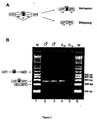

Classifications
-
- A—HUMAN NECESSITIES
- A61—MEDICAL OR VETERINARY SCIENCE; HYGIENE
- A61K—PREPARATIONS FOR MEDICAL, DENTAL OR TOILETRY PURPOSES
- A61K31/00—Medicinal preparations containing organic active ingredients
- A61K31/33—Heterocyclic compounds
- A61K31/395—Heterocyclic compounds having nitrogen as a ring hetero atom, e.g. guanethidine or rifamycins
- A61K31/435—Heterocyclic compounds having nitrogen as a ring hetero atom, e.g. guanethidine or rifamycins having six-membered rings with one nitrogen as the only ring hetero atom
- A61K31/4353—Heterocyclic compounds having nitrogen as a ring hetero atom, e.g. guanethidine or rifamycins having six-membered rings with one nitrogen as the only ring hetero atom ortho- or peri-condensed with heterocyclic ring systems
- A61K31/4375—Heterocyclic compounds having nitrogen as a ring hetero atom, e.g. guanethidine or rifamycins having six-membered rings with one nitrogen as the only ring hetero atom ortho- or peri-condensed with heterocyclic ring systems the heterocyclic ring system containing a six-membered ring having nitrogen as a ring heteroatom, e.g. quinolizines, naphthyridines, berberine, vincamine
-
- A—HUMAN NECESSITIES
- A61—MEDICAL OR VETERINARY SCIENCE; HYGIENE
- A61K—PREPARATIONS FOR MEDICAL, DENTAL OR TOILETRY PURPOSES
- A61K31/00—Medicinal preparations containing organic active ingredients
- A61K31/33—Heterocyclic compounds
- A61K31/395—Heterocyclic compounds having nitrogen as a ring hetero atom, e.g. guanethidine or rifamycins
- A61K31/40—Heterocyclic compounds having nitrogen as a ring hetero atom, e.g. guanethidine or rifamycins having five-membered rings with one nitrogen as the only ring hetero atom, e.g. sulpiride, succinimide, tolmetin, buflomedil
- A61K31/403—Heterocyclic compounds having nitrogen as a ring hetero atom, e.g. guanethidine or rifamycins having five-membered rings with one nitrogen as the only ring hetero atom, e.g. sulpiride, succinimide, tolmetin, buflomedil condensed with carbocyclic rings, e.g. carbazole
-
- A—HUMAN NECESSITIES
- A61—MEDICAL OR VETERINARY SCIENCE; HYGIENE
- A61K—PREPARATIONS FOR MEDICAL, DENTAL OR TOILETRY PURPOSES
- A61K31/00—Medicinal preparations containing organic active ingredients
- A61K31/33—Heterocyclic compounds
- A61K31/395—Heterocyclic compounds having nitrogen as a ring hetero atom, e.g. guanethidine or rifamycins
- A61K31/435—Heterocyclic compounds having nitrogen as a ring hetero atom, e.g. guanethidine or rifamycins having six-membered rings with one nitrogen as the only ring hetero atom
- A61K31/4353—Heterocyclic compounds having nitrogen as a ring hetero atom, e.g. guanethidine or rifamycins having six-membered rings with one nitrogen as the only ring hetero atom ortho- or peri-condensed with heterocyclic ring systems
- A61K31/437—Heterocyclic compounds having nitrogen as a ring hetero atom, e.g. guanethidine or rifamycins having six-membered rings with one nitrogen as the only ring hetero atom ortho- or peri-condensed with heterocyclic ring systems the heterocyclic ring system containing a five-membered ring having nitrogen as a ring hetero atom, e.g. indolizine, beta-carboline
-
- A—HUMAN NECESSITIES
- A61—MEDICAL OR VETERINARY SCIENCE; HYGIENE
- A61K—PREPARATIONS FOR MEDICAL, DENTAL OR TOILETRY PURPOSES
- A61K31/00—Medicinal preparations containing organic active ingredients
- A61K31/33—Heterocyclic compounds
- A61K31/395—Heterocyclic compounds having nitrogen as a ring hetero atom, e.g. guanethidine or rifamycins
- A61K31/435—Heterocyclic compounds having nitrogen as a ring hetero atom, e.g. guanethidine or rifamycins having six-membered rings with one nitrogen as the only ring hetero atom
- A61K31/47—Quinolines; Isoquinolines
- A61K31/4738—Quinolines; Isoquinolines ortho- or peri-condensed with heterocyclic ring systems
- A61K31/4745—Quinolines; Isoquinolines ortho- or peri-condensed with heterocyclic ring systems condensed with ring systems having nitrogen as a ring hetero atom, e.g. phenantrolines
-
- A—HUMAN NECESSITIES
- A61—MEDICAL OR VETERINARY SCIENCE; HYGIENE
- A61K—PREPARATIONS FOR MEDICAL, DENTAL OR TOILETRY PURPOSES
- A61K31/00—Medicinal preparations containing organic active ingredients
- A61K31/33—Heterocyclic compounds
- A61K31/395—Heterocyclic compounds having nitrogen as a ring hetero atom, e.g. guanethidine or rifamycins
- A61K31/495—Heterocyclic compounds having nitrogen as a ring hetero atom, e.g. guanethidine or rifamycins having six-membered rings with two or more nitrogen atoms as the only ring heteroatoms, e.g. piperazine or tetrazines
- A61K31/496—Non-condensed piperazines containing further heterocyclic rings, e.g. rifampin, thiothixene or sparfloxacin
-
- A—HUMAN NECESSITIES
- A61—MEDICAL OR VETERINARY SCIENCE; HYGIENE
- A61K—PREPARATIONS FOR MEDICAL, DENTAL OR TOILETRY PURPOSES
- A61K31/00—Medicinal preparations containing organic active ingredients
- A61K31/33—Heterocyclic compounds
- A61K31/395—Heterocyclic compounds having nitrogen as a ring hetero atom, e.g. guanethidine or rifamycins
- A61K31/535—Heterocyclic compounds having nitrogen as a ring hetero atom, e.g. guanethidine or rifamycins having six-membered rings with at least one nitrogen and one oxygen as the ring hetero atoms, e.g. 1,2-oxazines
- A61K31/5375—1,4-Oxazines, e.g. morpholine
- A61K31/5377—1,4-Oxazines, e.g. morpholine not condensed and containing further heterocyclic rings, e.g. timolol
-
- A—HUMAN NECESSITIES
- A61—MEDICAL OR VETERINARY SCIENCE; HYGIENE
- A61P—SPECIFIC THERAPEUTIC ACTIVITY OF CHEMICAL COMPOUNDS OR MEDICINAL PREPARATIONS
- A61P1/00—Drugs for disorders of the alimentary tract or the digestive system
-
- A—HUMAN NECESSITIES
- A61—MEDICAL OR VETERINARY SCIENCE; HYGIENE
- A61P—SPECIFIC THERAPEUTIC ACTIVITY OF CHEMICAL COMPOUNDS OR MEDICINAL PREPARATIONS
- A61P11/00—Drugs for disorders of the respiratory system
-
- A—HUMAN NECESSITIES
- A61—MEDICAL OR VETERINARY SCIENCE; HYGIENE
- A61P—SPECIFIC THERAPEUTIC ACTIVITY OF CHEMICAL COMPOUNDS OR MEDICINAL PREPARATIONS
- A61P15/00—Drugs for genital or sexual disorders; Contraceptives
-
- A—HUMAN NECESSITIES
- A61—MEDICAL OR VETERINARY SCIENCE; HYGIENE
- A61P—SPECIFIC THERAPEUTIC ACTIVITY OF CHEMICAL COMPOUNDS OR MEDICINAL PREPARATIONS
- A61P19/00—Drugs for skeletal disorders
- A61P19/04—Drugs for skeletal disorders for non-specific disorders of the connective tissue
-
- A—HUMAN NECESSITIES
- A61—MEDICAL OR VETERINARY SCIENCE; HYGIENE
- A61P—SPECIFIC THERAPEUTIC ACTIVITY OF CHEMICAL COMPOUNDS OR MEDICINAL PREPARATIONS
- A61P25/00—Drugs for disorders of the nervous system
-
- A—HUMAN NECESSITIES
- A61—MEDICAL OR VETERINARY SCIENCE; HYGIENE
- A61P—SPECIFIC THERAPEUTIC ACTIVITY OF CHEMICAL COMPOUNDS OR MEDICINAL PREPARATIONS
- A61P25/00—Drugs for disorders of the nervous system
- A61P25/14—Drugs for disorders of the nervous system for treating abnormal movements, e.g. chorea, dyskinesia
-
- A—HUMAN NECESSITIES
- A61—MEDICAL OR VETERINARY SCIENCE; HYGIENE
- A61P—SPECIFIC THERAPEUTIC ACTIVITY OF CHEMICAL COMPOUNDS OR MEDICINAL PREPARATIONS
- A61P25/00—Drugs for disorders of the nervous system
- A61P25/14—Drugs for disorders of the nervous system for treating abnormal movements, e.g. chorea, dyskinesia
- A61P25/16—Anti-Parkinson drugs
-
- A—HUMAN NECESSITIES
- A61—MEDICAL OR VETERINARY SCIENCE; HYGIENE
- A61P—SPECIFIC THERAPEUTIC ACTIVITY OF CHEMICAL COMPOUNDS OR MEDICINAL PREPARATIONS
- A61P25/00—Drugs for disorders of the nervous system
- A61P25/28—Drugs for disorders of the nervous system for treating neurodegenerative disorders of the central nervous system, e.g. nootropic agents, cognition enhancers, drugs for treating Alzheimer's disease or other forms of dementia
-
- A—HUMAN NECESSITIES
- A61—MEDICAL OR VETERINARY SCIENCE; HYGIENE
- A61P—SPECIFIC THERAPEUTIC ACTIVITY OF CHEMICAL COMPOUNDS OR MEDICINAL PREPARATIONS
- A61P31/00—Antiinfectives, i.e. antibiotics, antiseptics, chemotherapeutics
- A61P31/12—Antivirals
-
- A—HUMAN NECESSITIES
- A61—MEDICAL OR VETERINARY SCIENCE; HYGIENE
- A61P—SPECIFIC THERAPEUTIC ACTIVITY OF CHEMICAL COMPOUNDS OR MEDICINAL PREPARATIONS
- A61P31/00—Antiinfectives, i.e. antibiotics, antiseptics, chemotherapeutics
- A61P31/12—Antivirals
- A61P31/14—Antivirals for RNA viruses
- A61P31/18—Antivirals for RNA viruses for HIV
-
- A—HUMAN NECESSITIES
- A61—MEDICAL OR VETERINARY SCIENCE; HYGIENE
- A61P—SPECIFIC THERAPEUTIC ACTIVITY OF CHEMICAL COMPOUNDS OR MEDICINAL PREPARATIONS
- A61P35/00—Antineoplastic agents
-
- A—HUMAN NECESSITIES
- A61—MEDICAL OR VETERINARY SCIENCE; HYGIENE
- A61P—SPECIFIC THERAPEUTIC ACTIVITY OF CHEMICAL COMPOUNDS OR MEDICINAL PREPARATIONS
- A61P43/00—Drugs for specific purposes, not provided for in groups A61P1/00-A61P41/00
-
- C—CHEMISTRY; METALLURGY
- C07—ORGANIC CHEMISTRY
- C07D—HETEROCYCLIC COMPOUNDS
- C07D209/00—Heterocyclic compounds containing five-membered rings, condensed with other rings, with one nitrogen atom as the only ring hetero atom
- C07D209/56—Ring systems containing three or more rings
- C07D209/80—[b, c]- or [b, d]-condensed
-
- C—CHEMISTRY; METALLURGY
- C07—ORGANIC CHEMISTRY
- C07D—HETEROCYCLIC COMPOUNDS
- C07D471/00—Heterocyclic compounds containing nitrogen atoms as the only ring hetero atoms in the condensed system, at least one ring being a six-membered ring with one nitrogen atom, not provided for by groups C07D451/00 - C07D463/00
- C07D471/02—Heterocyclic compounds containing nitrogen atoms as the only ring hetero atoms in the condensed system, at least one ring being a six-membered ring with one nitrogen atom, not provided for by groups C07D451/00 - C07D463/00 in which the condensed system contains two hetero rings
- C07D471/04—Ortho-condensed systems
-
- C—CHEMISTRY; METALLURGY
- C07—ORGANIC CHEMISTRY
- C07D—HETEROCYCLIC COMPOUNDS
- C07D471/00—Heterocyclic compounds containing nitrogen atoms as the only ring hetero atoms in the condensed system, at least one ring being a six-membered ring with one nitrogen atom, not provided for by groups C07D451/00 - C07D463/00
- C07D471/12—Heterocyclic compounds containing nitrogen atoms as the only ring hetero atoms in the condensed system, at least one ring being a six-membered ring with one nitrogen atom, not provided for by groups C07D451/00 - C07D463/00 in which the condensed system contains three hetero rings
- C07D471/14—Ortho-condensed systems
Definitions
- the invention relates to novel compounds derived from indole and their use for the preparation of a medicament useful for treating diseases related to the splicing process.
- the viral disease is AIDS.
- the compounds C 47 , C 97 , C 57 , C 92 , C 91 , C 83 , C 51 , C 13 , C 10 , C 44 , C 41 , C 50 , C 32 , C 2 , C 1 , C 29 , C 35 and C 99 have been shown to be excellent inhibitors of HIV multiplication as no amplification virus was detected in the cells treated with these compounds.
Landscapes
- Health & Medical Sciences (AREA)
- Chemical & Material Sciences (AREA)
- Organic Chemistry (AREA)
- Life Sciences & Earth Sciences (AREA)
- General Health & Medical Sciences (AREA)
- Medicinal Chemistry (AREA)
- Veterinary Medicine (AREA)
- Public Health (AREA)
- Animal Behavior & Ethology (AREA)
- Pharmacology & Pharmacy (AREA)
- Engineering & Computer Science (AREA)
- Nuclear Medicine, Radiotherapy & Molecular Imaging (AREA)
- Epidemiology (AREA)
- Chemical Kinetics & Catalysis (AREA)
- General Chemical & Material Sciences (AREA)
- Bioinformatics & Cheminformatics (AREA)
- Biomedical Technology (AREA)
- Neurology (AREA)
- Neurosurgery (AREA)
- Virology (AREA)
- Oncology (AREA)
- Communicable Diseases (AREA)
- Psychology (AREA)
- AIDS & HIV (AREA)
- Molecular Biology (AREA)
- Hospice & Palliative Care (AREA)
- Psychiatry (AREA)
- Tropical Medicine & Parasitology (AREA)
- Pulmonology (AREA)
- Physical Education & Sports Medicine (AREA)
- Endocrinology (AREA)
- Reproductive Health (AREA)
- Nitrogen Condensed Heterocyclic Rings (AREA)
- Pharmaceuticals Containing Other Organic And Inorganic Compounds (AREA)
Abstract
Description
L'invention se rapporte à de nouveaux composés dérivés d'indole et leur utilisation pour la préparation d'un médicament utile pour traiter des maladies liées au processus d'épissage.The invention relates to novel compounds derived from indole and their use for the preparation of a medicament useful for treating diseases related to the splicing process.
Certains composés dérivés d'indole tels que les dérivés d'ellipticine et d'azaellipticine sont déjà connus en tant que molécules intercalantes pour corriger le disfonctionnement de l'expression génétique, au niveau de la réplication. Elles ont été plus spécifiquement décrites pour le traitement de maladies telles que le cancer, la leucémie et le SIDA (
Le processus d'épissage intracellulaire consiste à éliminer les introns des ARN pré-messagers de façon à produire un ARN messagers mature exploitable par la machinerie de traduction de la cellule (
Le séquençage du génome humain et l'analyse des banques d'EST (Expressed Sequence Tag) ont révélé que 35 à 65% des gènes s'expriment sous la forme de variants d'épissage alternatif (
Les stratégies actuellement développées pour corriger ces défauts d'épissage reposent sur l'utilisation de différents types de molécules.The strategies currently being developed to correct these splicing defects rely on the use of different types of molecules.
Le document de
Le document de
Le document de
Une stratégie visant au développement de nouvelles molécules permettant de corriger ou d'éliminer les épissages anormaux reposent par exemple sur la surexpression de protéines qui interfèrent avec ce type d'épissage (
Une autre stratégie repose sur l'utilisation d'oligonucléotides antisens (
Une autre stratégie encore repose sur l'identification de composés qui influencent l'efficacité d'épissage du pré-mRNA d'intérêt (
Enfin, une stratégie basée sur l'utilisation de l'épissage en trans pour remplacer des exons mutés a été décrite (
Un des inconvénient des stratégies développées et citées ci-avant pour corriger ou éliminer les épissages anormaux est leur coût de production. En effet, le coût de production des oligonucléotides antisens qui doivent être modifiés pour améliorer leur stabilité ou encore celui des molécules de type PNA est élevé.One of the drawbacks of the strategies developed and cited above to correct or eliminate abnormal splices is their cost of production. Indeed, the cost of production of the antisense oligonucleotides that must be modified to improve their stability or that of the PNA-type molecules is high.
Un autre inconvénient des stratégies développées et citées ci-avant est qu'elles requièrent l'utilisation de vecteurs d'expression, comme par exemple pour la stratégie basée sur l'utilisation de l'épissage en trans.Another disadvantage of the strategies developed and cited above is that they require the use of expression vectors, as for example for the strategy based on the use of trans splicing.
Les inventeurs se sont donnés pour but de trouver une nouvelle stratégie et notamment par l'utilisation de molécules ayant la capacité d'inhiber les processus d'épissage des ARN pré-messagers, et ne présentant pas les inconvénients des molécules de l'art antérieur.The inventors set themselves the goal of finding a new strategy and in particular by the use of molecules having the capacity to inhibit the splicing processes of pre-messenger RNAs, and not having the disadvantages of the molecules of the prior art.
Ainsi la présente invention concerne des dérivés d'indole correspondant à la formule I suivante :

R1 représente :
- un atome d'halogène ou un groupement -C=N-OH ou -O-C(=O)(CH3) ou -C ≡ N, ou
- un gloupement-N-R6R7,
où R6 et R7 représentent indépendamment l'un de l'autre :- un atome d'hydrogène,
- un cycle en C6, saturé ou insaturé, comportant éventuellement un atome d'azote, et éventuellement substitué par un ou plusieurs groupements alkyles en C1 à C3, ou
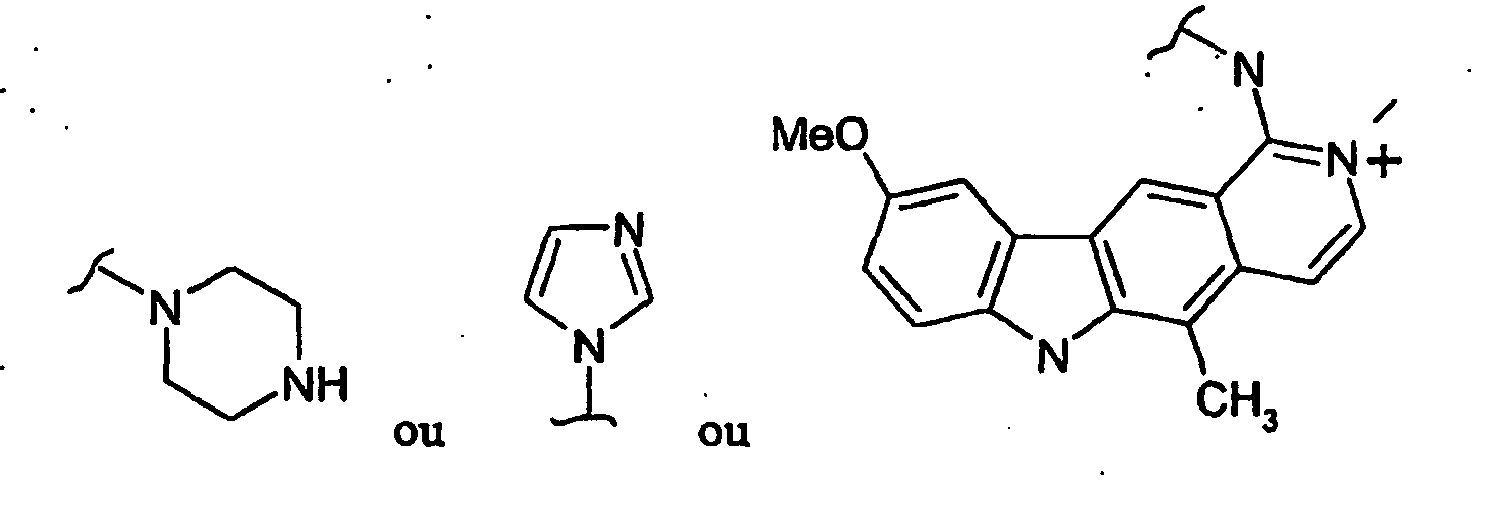
- un groupement alkyle de C1 à C13 linéaire ou ramifié et/ou insaturé, dans lequel un ou plusieurs atomes de carbone peut être substitué par un atome d'azote, ledit groupement alkhyle étant éventuellement substitué par un ou plusieurs groupements -OH et/ou = O et/ou par un groupement tel que :

- un groupement-NH-R8
où R8 représente un groupement alkyle-N-R9R10
où le groupement alkyle représente un groupement de C1 à C13 linéaire ou ramifié éventuellement insaturé et/ou substitué par un ou plusieurs groupements alkyle en C1 à C3 et/ou groupements hydroxyle,
R9 et R10 représentent chacun indépendamment l'un de l'autre un atome d'hydrogène ou un groupement alkyle en C1 à C4 éventuellement substitué par un ou plusieurs groupements hydroxyle et/ou oxo,
R2 représente un atome d'hydrogène, un groupement méthyle ou un groupement - NH-(CH2)3-N(CH3)2,
R3 représente un atome d'hydrogène, un atome d'halogène ou un groupement méthyle, amine ou méthoxyméthyle ou -NH-R8 tel que défini précédemment,
R4 représente un groupement hydroxyle ou alkyle en C1-C6 ou un groupement méthoxy éventuellement substitué par un groupement phényle,
R11 et R12 représentent indépendamment l'un de l'autre un atome d'hydrogène ou un groupement alkyle en C1-C3,
R13 représente un atome d'hydrogène ou un groupement méthyle, et les sels pharmaceutiquement acceptables desdits composés, et/ou mélanges de ceux-ci.
R1 represents:
- a halogen atom or a group -C = N-OH or -OC (= O) (CH 3 ) or -C ≡ N, or
- a glitch-N-R6R7,
where R6 and R7 independently represent each other:- a hydrogen atom,
- a saturated or
unsaturated C 6 ring, optionally containing a nitrogen atom, and optionally substituted by one ormore C 1 toC 3 alkyl groups, or - a linear or branched and / or unsaturated C1 to C13 alkyl group in which one or more carbon atoms may be substituted by a nitrogen atom, said alkyl group being optionally substituted with one or more -OH groups and / or = O and / or by a group such as:
- a group-NH-R8
where R8 represents an alkyl-N-R9R10 group
wherein the alkyl group represents a linear or branched C1 to C13 group optionally unsaturated and / or substituted by one or more C1 to C3 alkyl groups and / or hydroxyl groups,
R9 and R10 each independently represent a hydrogen atom or a C1-C4 alkyl group optionally substituted with one or more hydroxyl and / or oxo groups,
R2 represents a hydrogen atom, a methyl group or a group - NH- (CH 2 ) 3 -N (CH 3 ) 2 ,
R3 represents a hydrogen atom, a halogen atom or a methyl, amine or methoxymethyl group or -NH-R8 as defined above,
R4 represents a hydroxyl or C1-C6 alkyl group or a methoxy group optionally substituted by a phenyl group,
R11 and R12 represent, independently of one another, a hydrogen atom or a C1-C3 alkyl group,
R13 represents a hydrogen atom or a methyl group, and the pharmaceutically acceptable salts of said compounds, and / or mixtures thereof.
Par "maladies liées à l'épissage des ARN pré-messagers dans la cellule", on entend toutes les maladies liées au processus d'épis sage, c'est-à-dire les maladies dont la cause est une altération du processus d'épissage et les maladies dont l'apparition nécessite que le processus d'épissage des cellules soit activé. Notamment, on entend les maladies génétiques résultant de l'altération des processus d'épissage comme par exemple le syndrome de frasier, la démence fronto-temporale liée au chromosome 17 (une forme du Parkinson), le syndrome de Leigh (type d'encéphalopathie), la mucoviscidose atypique, certaines neuropathologies dont notamment l'Alzheimer lié à une mutation de la protéine Tau, l'amyotrophie qui touche le gène SMN (Survival of Motor Neuron), la dépression liée à un dérèglement de l'épissage de la sérotonine, et certains cancers dans lesquelles le processus global de l'épissage est affecté (notamment le cancer du sein, du colon et certains lymphomes).By "diseases linked to the splicing of pre-messenger RNAs in the cell", we mean all the diseases related to the process of wise ears, that is to say the diseases whose cause is an alteration of the process of splicing and diseases whose onset requires that the cell splicing process be activated. In particular, we mean genetic diseases resulting from the alteration of splicing processes such as, for example, the syndrome of frosierum, fronto-temporal dementia linked to chromosome 17 (a form of Parkinson's disease), Leigh's syndrome (type of encephalopathy). ), atypical cystic fibrosis, certain neuropathologies including Alzheimer's linked to a mutation of the Tau protein, amyotrophy that affects the SMN (Survival of Motor Neuron) gene, depression linked to a disruption of the splicing of serotonin , and some cancers in which the overall process of splicing is affected (including breast, colon and certain lymphoma).
On entend également les maladies d'origine virale ou dues à l'intrusion de virus dans l'organisme humain ou animal, appelées maladies virales, et pour lesquelles des séquences ESE sont identifiées pour l'épissage. En particulier, on peut citer le SIDA pour lequel des séquences ESE sont identifiées dans l'épissage de certains ARN pré-messagers de gènes clefs impliqués dans la réplication du virus responsable du SIDA.Also meant are diseases of viral origin or due to the intrusion of viruses into the human or animal body, called viral diseases, and for which ESE sequences are identified for splicing. In particular, there may be mentioned AIDS for which ESE sequences are identified in the splicing of certain pre-messenger RNAs of key genes involved in the replication of the virus responsible for AIDS.
Par "atome d'halogène", on entend le groupe F, Cl, Br et I, et plus particulièrement le Cl.By "halogen atom" is meant the group F, Cl, Br and I, and more particularly Cl.
Par "anhydro base", on entend un composé résultant de la neutralisation acido-basique interne (avec perte d'eau) des hydroxydes iminium contenant un site acide conjugué avec la fonction iminium (cf. IUPAC). Dans le cas de la présente invention, dans l'anhydro base, l'hydroxyde est remplacé par l'amino.By "anhydro base" is meant a compound resulting from the internal acid-base neutralization (with loss of water) of the iminium hydroxides containing an acidic site conjugated with the iminium function (see IUPAC). In the case of the present invention, in the anhydro base, the hydroxide is replaced by amino.
Le premier avantage lié à l'utilisation de dérivés d'indole tels que dérivés de benzo-indole ou de pyrido-indole selon l'invention pour traiter des maladies liées au processus d'épissage est d'ordre financier. En effet, le coût de production de ces molécules est bien inférieur à celui des oligonucléotides antisens ou encore à celui des molécules hybrides de type PNA.The first advantage related to the use of indole derivatives such as benzoindole or pyridoindole derivatives according to the invention for treating diseases related to the splicing process is of a financial nature. Indeed, the cost of production of these molecules is much lower than that of the antisense oligonucleotides or that of the hybrid molecules of the PNA type.
Le second avantage des dérivés d'indole selon l'invention tient à leur facilité d'administration et au fait que cette stratégie de traitement ne requiert pas l'utilisation de vecteurs d'expression.The second advantage of the indole derivatives according to the invention lies in their ease of administration and the fact that this treatment strategy does not require the use of expression vectors.
La pénétration des molécules selon l'invention à l'intérieur des cellules et leur ciblage vers des tissus particuliers peuvent être effectués soit en utilisant des polymères (
Dans un autre mode de réalisation préférentielle, dans la formule I,
- R1 représente un atome d'halogène, un groupement amine, -N-R6R7 ou -NH-R8,
- R2 représente un atome d'hydrogène ou un groupement méthyle,
- R3 représente un atome d'hydrogène ou un groupement NH-R8,
- R4 représente un groupement méthyle,
- R11 représente un atome d'hydrogène ou un groupement méthyle, et
- R6, R7, R8, R9, R10, R12 et R13 sont tels que définis précédemment.
-
R 1 represents a halogen atom, an amine group, -NR 6 R 7 or -NH-R 8, - R2 represents a hydrogen atom or a methyl group,
- R3 represents a hydrogen atom or an NH-R8 group,
- R4 represents a methyl group,
- R11 represents a hydrogen atom or a methyl group, and
- R6, R7, R8, R9, R10, R12 and R13 are as defined above.
Le composé préférentiel est:
- la 10-chloro-2,6-diméthyl-2H-pyrido[3',4':4,5]pyrrolo[2,3-g]isoquinoline,
- la N,N-diéthyl-N'-(6-méthyl-5H-pyrido[3',4':4,5]pyrrolo[2,3-g]isoquinolin-10-yl)-éthane-1,2-diamine,
- la N'-(5,6-diméthyl-5H-pyrido[3'4':4,5]pyoolo[2,3-g]isoquinolin-10-yl)-N,N-diméthyl-propane-1,3-diamine,
- 10-chloro-2,6-dimethyl-2H-pyrido [3 ', 4': 4,5] pyrrolo [2,3-g] isoquinoline,
- N, N-diethyl-N '- (6-methyl-5H-pyrido [3', 4 ': 4,5] pyrrolo [2,3-g] isoquinolin-10-yl) -ethane-1,2- diamine,
- N '- (5,6-dimethyl-5H-pyrido [3' 4 ': 4,5] pyoolo [2,3-g] isoquinolin-10-yl) -N, N-dimethylpropane-1,3 diamine,
Un autre objet de l'invention est les composés tels que décrits précédemment en tant que médicament.Another subject of the invention is the compounds as previously described as a medicament.
Les composés selon l'invention ont la capacité d'inhiber les processus d'épissage des ARN pré-messagers qui sont soit constitutifs, soit, de manière plus spécifique, dépendants de séquences régulatrices appelées ESE (Exonic Splicing Enhancer), ISE (Intronic Splicing Enhancer), ESS (Exonic Splicing Silencer) et ISS (Intronic Splicing Silencer).The compounds according to the invention have the capacity to inhibit the splicing processes of the pre-messenger RNAs which are either constitutive or, more specifically, dependent on regulatory sequences called ESE (Exonic Splicing Enhancer), ISE (Intronic Splicing). Enhancer), ESS (Exonic Splicing Silencer) and ISS (Intronic Splicing Silencer).
Les processus d'épissage sont soit constitutifs et/ou soit dépendants de séquences régulatrices ESE. Un autre objet de l'invention est les composés tels que décrits précédemment pour traiter les maladies liées au processus d'épissage des ARN pré-messagers dans la cellule, notamment les maladies génétiques résultant de l'altération des processus d'épissage, notamment le syndrome de frasier, la démence fronto-temporale liée au chromosome 17 (une forme du Parkinson), le syndrome de Leigh (type d'encéphalopathie), la mucoviscidose atypique, certaines neuropathologies dont notamment l'Alzheimer lié à une mutation de la protéine Tau, l'amyotrophie qui touche le gène SMN (Survival of Motor Neuron), la dépression liée à un dérèglement de l'épissage de la sérotonine, les maladies d'origine virale et pour lesquelles des séquences ESE sont identifiées pour l'épissage.The splicing processes are either constitutive and / or dependent on ESE regulatory sequences. Another subject of the invention is the compounds as described above for treating diseases related to the process of splicing the pre-messenger RNAs in the cell, in particular the genetic diseases resulting from the alteration of the splicing processes, in particular the fungal syndrome, chromosome 17-related frontotemporal dementia (a form of Parkinson's disease), Leigh's syndrome (type of encephalopathy), atypical cystic fibrosis, certain neuropathologies including Alzheimer's linked to a mutation of the Tau protein , amyotrophy that affects the SMN (Survival of Motor Neuron) gene, depression related to disruption of serotonin splicing, viral diseases and for which ESE sequences are identified for splicing.
De manière préférentielle, la maladie virale est le SIDA.Preferably, the viral disease is AIDS.
Dans un mode de réalisation selon l'invention, ledit médicament comprend également un excipient permettant de formuler les composés selon la formule I et ledit médicament se présente sous forme solide ou liquide pour être préparé et administré par voie intraveineuse.In one embodiment of the invention, said medicament also comprises an excipient for formulating compounds according to formula I and said drug is in solid or liquid form to be prepared and administered intravenously.
Les composés selon l'invention seront administrés de préférence par voie intraveineuse à une concentration de 80-100 mg/m2 (cf.
-
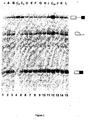
Figure 1 : Analyse des produits d'épissage de l'ARN pré-messager Minx obtenus in vitro en présence de différents composés. La structure des différents produits d'épissage est indiquée. Le trait représente l'intron soit sous forme linéaire ou en lasso (*). Les rectangles représentent les deux exons du Minx.Figure 1 : Analysis of Minx pre-messenger RNA splice products obtained in vitro in the presence of different compounds. The structure of the different splicing products is indicated. The line represents the intron either in linear form or in lasso (*). The rectangles represent the two exons of Minx. -
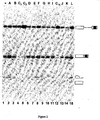
Figure 2 : Analyse des produits d'épissage de l'ARN pré-messager M3S1 obtenus in vitro en présence de différentes composés. La structure des différents produits d'épissage est indiquée. Les rectangles sont les exons. La partie noire du rectangle représente l'ESE. Le trait représente l'intron soit sous forme linéaire ou en lasso (*).Figure 2 : Analysis of M3S1 pre-messenger RNA splice products obtained in vitro in the presence of different compounds. The structure of the different splicing products is indicated. The rectangles are the exons. The black part of the rectangle represents the ESE. The line represents the intron either in linear form or in lasso (*). -
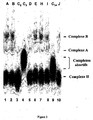
Figure 3 : Analyse de la formation des complexes d'épissage sur l'ARN pré-messager M3S1 en présence de différents composés.Figure 3 : Analysis of the formation of splice complexes on M3S1 pre-messenger RNA in the presence of different compounds. -
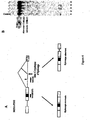
Figure 4 :- (A) Structure de deux types de transcrits produits par épissage de l'exon 7-intron 7-exon 8 du gène codant pour la sous-unité E1α de la pyruvate déshydrogénase mutée.
- (B) Analyse des produits d'épissage de l'ARN pré-messager M3S1-PDH obtenus in vitro en présence de différents composés. La structure des différents produits d'épissage est indiquée. Le trait représente les introns les rectangles représentent les trois exons.
Figure 4 :- (A) Structure of two types of transcripts produced by splicing exon 7-intron 7-
exon 8 of the gene encoding the E1α subunit of mutated pyruvate dehydrogenase. - (B) Analysis of M3S1-PDH pre-messenger RNA splice products obtained in vitro in the presence of different compounds. The structure of the different splicing products is indicated. The line represents the introns the rectangles represent the three exons.
-
Figure 5 :- (A) Structure du transgène et les deux types de transcrits produits par épissage alternatif. Les flèches indiquent la position des amorces utilisées pour la PCR.
- (B) Analyse en gel d'agarose 2% des produits de PCR. M indique les marqueurs ADN correspondant à des multiples de 100 pairs de bases (pistes 1 et 6). Les PCR sont effectuées sur des ARNs issues de cellules non traitées (pistes 2 et 3), traitées par 1 µM du composé C27 (piste 4) ou par 1 µM du composé C14 (piste 5).
Figure 5 :- (A) Structure of the transgene and the two types of transcripts products by alternative splicing. The arrows indicate the position of the primers used for the PCR.
- (B)
Agarose gel analysis 2% PCR products. M indicates the DNA markers corresponding to multiples of 100 base pairs (lanes 1 and 6). The PCRs are carried out on RNAs from untreated cells (lanes 2 and 3) treated with 1 μM of compound C 27 (lane 4) or with 1 μM of compound C 14 (lane 5).
-
Figure 6 : Analyse des produits d'amplification par RT-PCR des mRNAs viraux issues de cellules U1 stimulées par le PMA (pistes 1, 3-27) en absence (piste 1) ou en présence (pistes 3-27) des différents composés. La piste 2 représente les produits d'amplification à partir de cellules non stimulées par le PMA. La nomenclature de RT-PCR est en accord avecPurcell D.F. and Martin M.A. (1993, Alternative splicing of human immunodeficiency virus type 1 mRNA modulates viral protein expression, replication, and infectivity. J Virol. 67:6365-78 Figure 6 : Analysis of RT-PCR amplification products of viral mRNAs from U1 cells stimulated by PMA (lanes 1, 3-27) in the absence (lane 1) or in the presence (lanes 3-27) of the various compounds.Lane 2 represents the amplification products from cells not stimulated by PMA. The nomenclature of RT-PCR is in agreement withPurcell DF and Martin MA (1993), Alternative splicing of human immunodeficiency virus type 1 mRNA modulates viral protein expression, replication, and infectivity J Virol 67: 6365-78
Les composés présentés dans les Tableaux 1 et 2 ci-après ont été testés dans des gammes de concentration de 1 µM, 10 µM et 100 µM, et sont sélectionnés dans un premier temps sur la base de leur capacité d'inhiber, in vitro, l'épissage de deux types de pré-ARNm modèles.


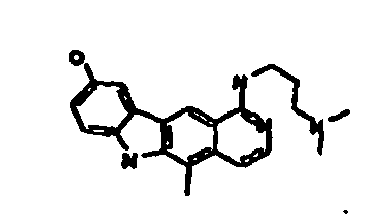


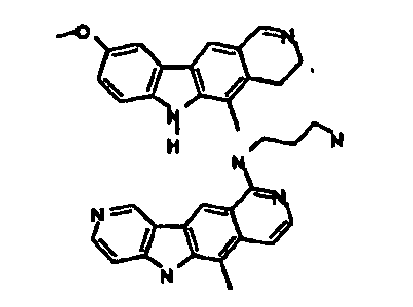


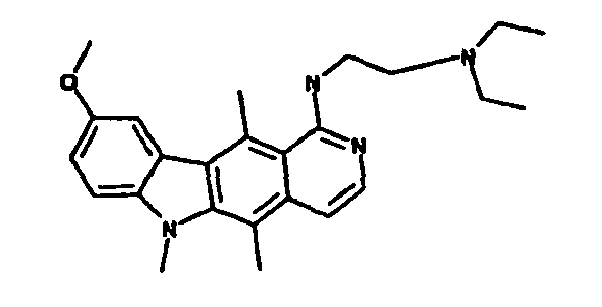

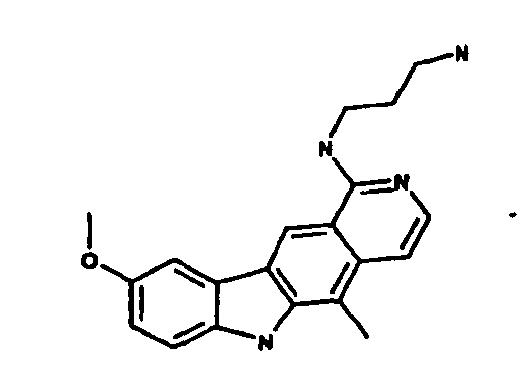


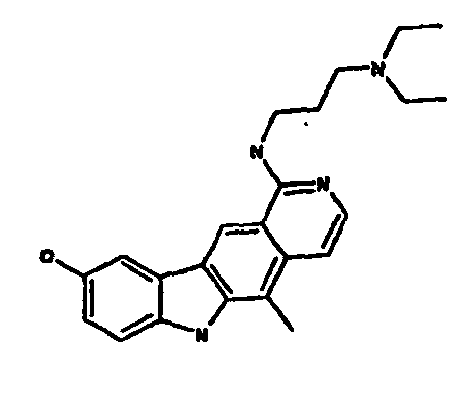


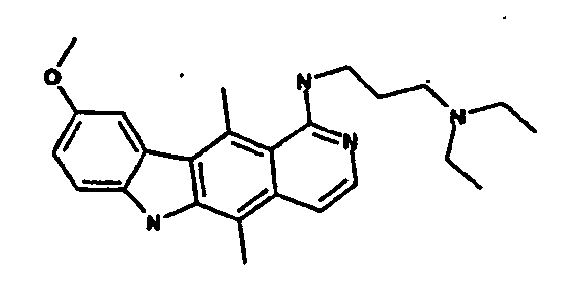
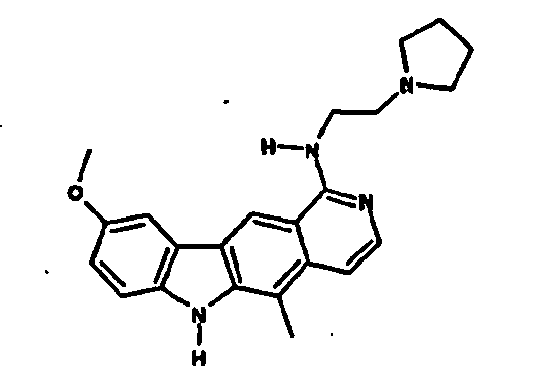

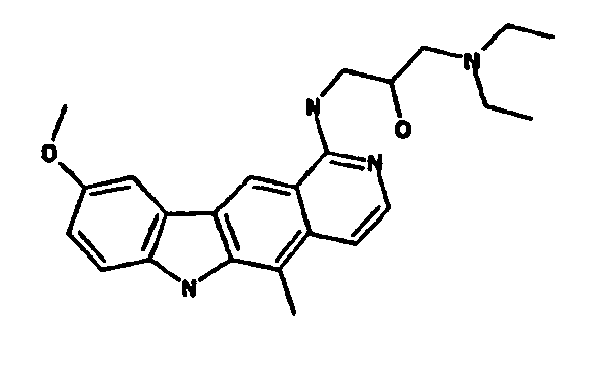
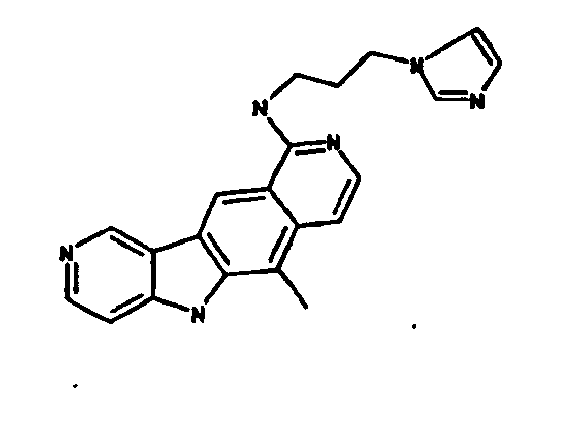

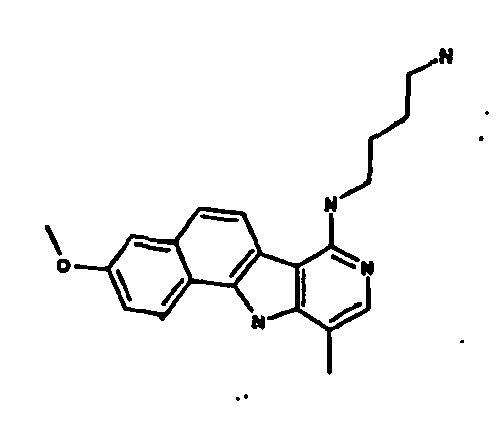


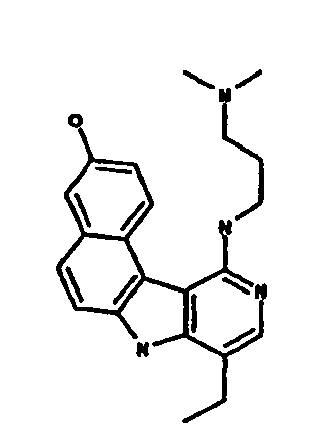


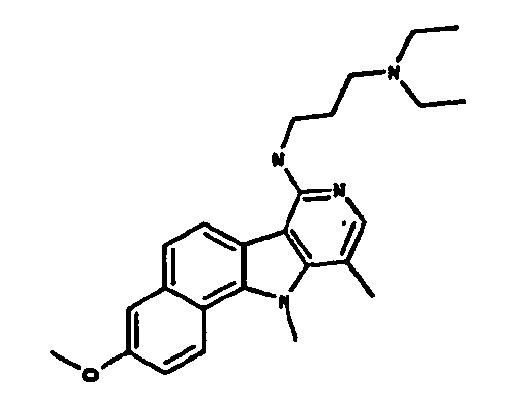


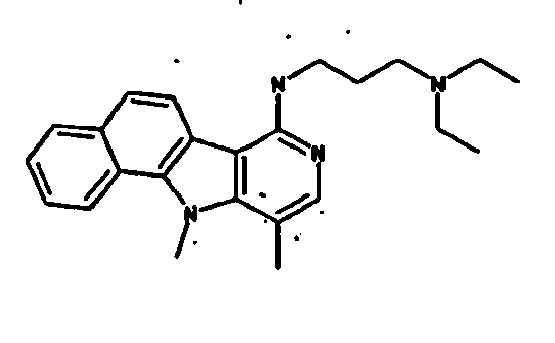


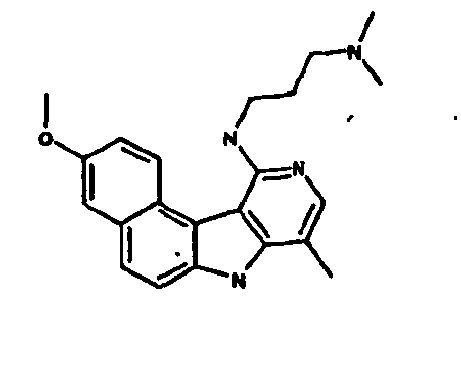


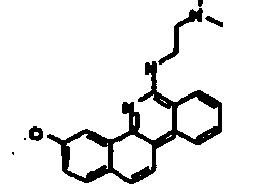


Le Tableau 1 représente le composé selon l'invention et le Tableau 2 les composés testés ayant une structure chimique différente des composés selon l'invention.Table 1 represents the compound according to the invention and Table 2 the compounds tested having a chemical structure different from the compounds according to the invention.
Le premier type de pré-messager correspond au Minx dérivé d'un transcrit d'adénovirus et dont l'épissage est constitutif (
50 finoles de ce transcrit sont utilisées pour des réactions d'épissage standard contenant dans 20 µl : 10 mM Triéthanolamine pH 7,9 ; 50 mM KCI, 0,1 mM EDTA ; 10% glycérol ; 0,5 mM DTT ; 20 mM créatine phosphate ; 2,5 mM ATP ; 2,5 mM MgCl2 et 6% polyvinylalcool. On laisse incuber les réactions pendant 1h à 30°C.50 endols of this transcript are used for standard splice reactions containing in 20 μl: 10 mM Triethanolamine pH 7.9; 50 mM KCl, 0.1 mM EDTA; 10% glycerol; 0.5 mM DTT; 20 mM creatine phosphate; 2.5 mM ATP; 2.5 mM MgCl 2 and 6% polyvinyl alcohol. The reactions are incubated for 1 h at 30 ° C.
Pour tester l'effet du composé selon l'invention, 1 µl de la dilution adéquate du composé est ajouté au début de la réaction sous forme d'une solution soluble dans du DMSO 10%.To test the effect of the compound according to the invention, 1 .mu.l of the appropriate dilution of the compound is added at the beginning of the reaction in the form of a solution soluble in 10% DMSO.
Les ARNs produits au cours de la réaction d'épissage sont extraits, analysés sur un gel dénaturant de polyacrylamide 7% puis révélés par autoradiographie. Un exemple de l'inhibition de l'épissage du transcrit Minx obtenu avec 10 µM du composé C2 (piste 4) est présenté sur la
Le second type de pré-messager M3S1 est dérivé du gène de la Béta-Globine humaine (
Un exemple de l'inhibition de l'épissage de M3S1 obtenu avec 10 µM des composés C2, C3 et C14 (pistes 4, 5 et 12) est présenté sur la
L'activité des produits a également été testée dans des réactions de formation de complexes d'épissage in vitro (
Les réactions d'épissage du transcrit M3S1 en présence des différents composés selon l'invention réalisées dans les mêmes conditions que celles décrites pour la
La
Le composé représenté dans le Tableau 1 est capable d'inhiber la formation des complexes d'épissage du transcrit M3S1 à une concentration comprise entre 10 µM et 50 µM.The compound shown in Table 1 is capable of inhibiting the formation of M3S1 transcript splice complexes at a concentration of between 10 μM and 50 μM.
Afin de tester l'efficacité des dérivés d'indole ex vivo, des lignées cellulaires HeLa de fibroblastes ont été établies exprimant de façon stable un transgène correspondant à la GFP dont la séquence a été interrompue par une séquence ESE flanquée de deux introns identiques du gène de la Béta-Globine humaine décrit dans l'exemple 1 (voir
Pour détecter les ARN messagers issus de l'épissage de ce gène, la technique de RT-PCR a été utilisée avec des amorces dans la séquence GFP de part et d'autre de l'ESE et les produits de PCR ont été analysés sur gel d'agarose.To detect the messenger RNAs resulting from the splicing of this gene, the RT-PCR technique was used with primers in the GFP sequence on either side of the ESE and the PCR products were analyzed on gel agarose.
Dans presque toutes les lignées établies, un seul fragment de 250 paires de bases (pb) est amplifié par PCR (
Le résultat indique que l'ESE a un effet dominant et l'ARN messager produit après épissage contient les deux parties de la GFP interrompues par l'ESE (
A l'inverse, le traitement des cellules par des dérivés d'indole C28 (piste 4) et C14 (piste 5) fait apparaître un fragment de 194 pb, au détriment du fragment 250 pb, qui ne contient plus de séquence ESE entre les séquences GFP, démontrant ainsi que certains dérivés d'indole selon l'invention peuvent supprimer l'effet des ESE dans les cellules.Conversely, the treatment of cells with indole derivatives C 28 (lane 4) and C 14 (lane 5) reveals a 194 bp fragment, to the detriment of the 250 bp fragment, which no longer contains an ESE sequence between the GFP sequences, thus demonstrating that certain indole derivatives according to the invention can suppress the effect of ESAs in cells.
Certains composés représentés dans le Tableau 2 ont été testés à une concentration au moins égale à 1 µM et se sont avérés inefficaces dans ce test à cette concentration puisqu'ils n'ont pas induit un changement dans le profil d'épissage du transgène GFP-ESE.Some compounds shown in Table 2 were tested at a concentration of at least 1 μM and were ineffective in this assay at this concentration since they did not induce a change in the splicing pattern of the GFP-transgene. ESE.
Néanmoins, on peut signaler que l'ESE du transgène GFP-ESE utilisé dans les expériences décrites ci-dessus est spécifique de la protéine SR SF2/ASF et il est tout à fait probable que le composé selon l'invention représenté dans le Tableau 1 soit capable d'influencer l'épissage contrôlé par d'autres types d'ESE spécifiques des autres protéines SR (SC35, 9G8, SRp55, SRp40 ou SRp75).
Afin de démontrer la sélectivité de l'action des composés selon l'invention sur les séquences ESE, il a été décidé d'utiliser un autre substrat modèle comportant deux introns et dont l'épissage dépend de deux séquences ESEs différentes. Dans ce substrat les séquences correspondant à l'exon 7-intron 7-exon 8 du gène codant pour la sous unité E1α de la puryvate désydrogènase (PDH E1α) sont insérées en aval de la séquence de M3S1 (M3S1-PDH, voir
Le virus du SIDA, comme pratiquement tous les rétrovirus, a recours à l'épissage alternatif pour exprimer des gènes essentiels à sa réplication. En effet, la version du virus qui s'intègre dans le génome des cellules humaines est transcrite sous forme d'un précurseur unique qui, par épissage alternatif, génère 40 ARN messagers différents codant pour des protéines virales essentielles à sa réplication (
Puisque des composés inhibent l'utilisation de sites d'épissage dépendants de séquences ESE, il a été testé leur efficacité à bloquer la réplication virale. Pour cela, nous avons utilisé la lignée lymphocytaire humaine U1, chroniquement infectée par le VIH (
Les résultats de cette expérience sont présentés en
A la solution refroidie à -10 °C de 10-chloro-6-méthyl-5H-pyrido[3',4':4,5]pyrrolo[2,3-g]isoquinoline (400 mg; produit connu, déjà publié) dans le N,N-diméthylacétamide (20 mL) est ajouté NaH à 50% (90 mg). Le mélange est agité pendant 30 min. puis CH3I (0,11 mL) est introduit et le mélange est agité toujours à -10 °C pendant 2,5 h. De l'eau et CH2Cl2 sont ajoutés et la phase organique est séparée, séchée (MgSO4) et évaporée à sec. Le résidu obtenu est chromatographié sur colonne de silice en éluant successivement par CH2Cl2-EtOH (9-1: v/v) puis par EtOH-NEt3 (95-5: v/v) pour donner respectivement la 10-chloro-5,6-diméthyl-5H-pyrido[3',4':4,5]pyrrolo[2,3-g]isoquinoline (66 mg, 16% de rendement) et la 10-chloro-2,6-diméthyl-2H-pyrido[3',4':4,5]pyrrolo[2,3-g]isoquinoline attendue (138 mg, 32 % de rendement) sous forme des microcristaux jaunes (point de fusion > 260°C). RMN en accord.To the cooled solution at -10 ° C of 10-chloro-6-methyl-5H-pyrido [3 ', 4': 4,5] pyrrolo [2,3-g] isoquinoline (400 mg, known product, already published ) in N, N-dimethylacetamide (20 mL) is added 50% NaH (90 mg). The mixture is stirred for 30 minutes. then CH 3 I (0.11 mL) is introduced and the mixture is stirred at -10 ° C for 2.5 h. Water and CH 2 Cl 2 are added and the organic phase is separated, dried (MgSO 4 ) and evaporated to dryness. The residue obtained is chromatographed on a silica column, eluting successively with CH 2 Cl 2 -EtOH (9-1: v / v) and then with EtOH-NEt 3 (95-5: v / v) to give 10-chloro, respectively. -5,6-dimethyl-5H-pyrido [3 ', 4': 4,5] pyrrolo [2,3-g] isoquinoline (66 mg, 16% yield) and the expected 10-chloro-2,6-dimethyl-2H-pyrido [3 ', 4': 4,5] pyrrolo [2,3-g] isoquinoline (138 mg, 32%). % yield) as yellow microcrystals (mp> 260 ° C). NMR in agreement.
Le mélange de 1-chloro-9-méthoxy-5-méthyl-6H-pyrido[4,3-b]carbazole (1,0 g; produit connu, déjà publié) et de 4-amino-2,2,6,6-tétraméthylpiperidine (1,0 g) est chauffé à 150°C pendant 21 h. L'excès de l'amine est éliminé par évaporation sous pression réduite. De l'eau est ajoutée au résidu obtenu pour former un solide. Ce dernier est filtré, lavé à l'eau, puis recristallisé du xylène pour donner la 9-méthoxy-5-méthyl-6H-pyrido[4,3-b]carbazol-1-yl)-(2,2,6,6-tétraméthyl-pipéridin-4-yl)-amine attendue (1,0 g, 71 % de rendement) sous forme des microcristaux jaunes (point de fusion: 223-5°C). RMN en accord.The mixture of 1-chloro-9-methoxy-5-methyl-6H-pyrido [4,3-b] carbazole (1.0 g, known product, already published) and 4-amino-2,2,6, 6-tetramethylpiperidine (1.0 g) is heated at 150 ° C for 21 h. The excess of the amine is removed by evaporation under reduced pressure. Water is added to the resulting residue to form a solid. The latter is filtered, washed with water and then recrystallized xylene to give 9-methoxy-5-methyl-6H-pyrido [4,3-b] carbazol-1-yl) - (2,2,6, 6-tetramethyl-piperidin-4-yl) -amine expected (1.0 g, 71% yield) as yellow microcrystals (m.p .: 223-5 ° C). NMR in agreement.
Une solution de 100 mg d'anhydride succinique (1 mM) et de 376 mg (1 mM) de N-éthyl-N'-(9-méthoxy-5,11-diméthyl-6H-pyrido[4,3-b]carbazol-1-yl)-propane-1,3-diamine dans 100 ml de toluène sec est portée à reflux durant 5 h. Le précipité obtenu après refroidissement est essoré et recristallisé de l'acétone. On obtient 270 mg (54,6 %) du produit désiré sous forme de solide F ∼150°. Analyse centésimale pour C27H32N4O4 + H2O ; Calc. : C, 65,57 ; H, 6,93 ; N, 11.33 ; Exp. : C, 65,18 ; H, 6,88 ; N, 10,95. RMN et SM en accord.A solution of 100 mg of succinic anhydride (1 mM) and 376 mg (1 mM) of N-ethyl-N '- (9-methoxy-5,11-dimethyl-6H-pyrido [4,3-b] carbazol-1-yl) -propane-1,3-diamine in 100 ml of dry toluene is refluxed for 5 hours. The precipitate obtained after cooling is filtered off and recrystallized from acetone. 270 mg (54.6%) of the desired product is obtained in the form of a solid F -150 °. Centesimal analysis for C 27 H 32 N 4 O 4 + H 2 O; Calc. C, 65.57; H, 6.93; N, 11.33; Exp. C, 65.18; H, 6.88; N, 10.95. NMR and SM agree.
Une solution de 75 mg d'anhydride succinique (0.75 mM) et de 250 mg (0 .75 mM) de N-éthyl-N'-(6-méthyl-5H-pyrido[3',4' : 4,5] pyrrolo[2,3-g] isoquinoléine-10-yl)propane-1,3-diamine dans 80 ml de toluène sec est portée à reflux durant 4 h. Le précipité obtenu après refroidissement est essoré et recristallisé de l'acétone. On obtient 240 mg (65,6 %) sous forme de solide F ∼150°. Analyse centésimale pour C24H27N5O3 + 3H2O ; Calc. : C, 59,12 ; H, 6,82 ; N, 14,37 ; Exp. : C, 59,14 ; H, 6,88 ; N, 14,17. RMN et SM en accord.A solution of 75 mg of succinic anhydride (0.75 mM) and 250 mg (0.75 mM) of N-ethyl-N '- (6-methyl-5H-pyrido [3', 4 ': 4,5] pyrrolo [2,3-g] isoquinolin-10-yl) propane-1,3-diamine in 80 ml of dry toluene is refluxed for 4 h. The precipitate obtained after cooling is drained and recrystallized acetone. 240 mg (65.6%) is obtained in the form of a solid F -150 °. Centesimal analysis for C 24 H 27 N 5 O 3 + 3H 2 O; Calc. C, 59.12; H, 6.82; N, 14.37; Exp. C, 59.14; H, 6.88; N, 14.17. NMR and SM agree.
Une suspension de 1,5 g de 2-(-6-méthoxy-1-méthyl-9H-carbazel-2yl)-éthylamine dans 15 ml de formiate d'éthyle est portée à reflux durant 20 h. La solution obtenue est concentrée sous vide et la pâte obtenue est reprise dans le dichlorométhane. Après évaporation complète sous pression réduite le solide obtenu est broyé puis lavé au pentane pour fournir 1,6 g (98 %) du dérivé intermédiaire N-formylé.A suspension of 1.5 g of 2- (6-methoxy-1-methyl-9H-carbazin-2-yl) ethylamine in 15 ml of ethyl formate is refluxed for 20 hours. The solution obtained is concentrated under vacuum and the paste obtained is taken up in dichloromethane. After complete evaporation under reduced pressure, the solid obtained is ground and then washed with pentane to give 1.6 g (98%) of the N-formylated intermediate derivative.
Les 1,6 g de cet intermédiaire sont dissous dans 120 ml de toluène sec et l'ensemble est porté à reflux dans un tricol équipé d'un Dean Stark. 12 ml de POCl3 sont additionnés goutte à goutte en 10 min. et le reflux est maintenu durant 24 h. Après refroidissement et évaporation du toluène et du POCl3, sous pression réduite, le solide est repris dans 500 ml d'HCL 2N à ébullition. Un léger insoluble est filtré et, de la solution refroidie, on essore le chlorhydrate. Celui-ci est repris dans NH4OH 2N (jusqu'à pH 12). Le précipité jaune essoré après séchage fournit 1,4 g (92 %) du produit désiré. RMN en accord.The 1.6 g of this intermediate are dissolved in 120 ml of dry toluene and the whole is refluxed in a tricol equipped with a Dean Stark. 12 ml of POCl 3 are added dropwise over 10 min. and reflux is maintained for 24 hours. After cooling and evaporation of toluene and POCl 3 , under reduced pressure, the solid is taken up in 500 ml of boiling 2N HCl. A slight insoluble matter is filtered and the cooled solution is filtered off with hydrochloride. This is taken up in NH 4 OH 2N (up to pH 12). The yellow precipitate drained after drying gives 1.4 g (92%) of the desired product. NMR in agreement.
Le mélange de 11-chloro-8-méthyl-3-méthoxy-7H-benzo[e]pyrido[4,3-b]indole (210 mg; produit connu, déjà publié) et de spermine (1,0 g) est chauffé à 170°C pendant 18 h. L'excès de l'amine est éliminé par évaporation sous pression réduite et le résidu obtenu est repris dans CH2Cl2 puis lavé à l'eau. La phase organique est séchée (MgSO4) et évaporée à sec..La base libre obtenue est ensuite dissoute dans l'éthanol absolu bouillant (15 mL) puis verséé dans une solution contenant l'acide maléique (410 mg) et éthanol (10 mL). Le précipité obtenu est filtré à 20°C, lavé à l'éthanol et séché à l'abri de l'humidité pour donner 270 mg (39% de rendement) de sel tétramaléate du produit attendu. Analyse centésimale pour C43H54N6O17 + 2H2O; Calc. : C, 53,64 ; H, 6,03 ; N, 8.73 ; Exp. : C, 53,83 ; H, 6,01 ; N, 8,79. RMN en accord.The mixture of 11-chloro-8-methyl-3-methoxy-7H-benzo [e] pyrido [4,3-b] indole (210 mg, known product, already published) and spermine (1.0 g) is heated at 170 ° C for 18 h. The excess of the amine is removed by evaporation under reduced pressure and the residue obtained is taken up in CH 2 Cl 2 and then washed with water. The organic phase is dried (MgSO 4 ) and evaporated to dryness. The free base obtained is then dissolved in boiling absolute ethanol (15 ml) and then poured into a solution containing maleic acid (410 mg) and ethanol (10 ml). mL). The precipitate obtained is filtered at 20 ° C., washed with ethanol and dried in the absence of moisture to give 270 mg (39% yield) of tetramaleate salt of the expected product. Centesimal analysis for C 43 H 54 N 6 O 17 + 2H 2 O; Calc. C, 53.64; H, 6.03; N, 8.73; Exp. C, 53.83; H, 6.01; N, 8.79. NMR in agreement.
Le mélange de 11-chloro-8-méthyl-3-méthoxy-7H-benzo[e]pyrido[4,3-b]indole (360 mg; produit connu, déjà publié) et de l'hexane-1,6-diamine (5 mL) est chauffé à 170°C pendant 18 h. L'excès de l'amine est éliminé par évaporation sous pression réduite et le résidu obtenu est repris dans CH2Cl2 puis lavé à l'eau. La phase organique est séchée (MgSO4) et évaporée à sec. La base libre obtenue est ensuite dissoute dans l'éthanol absolu bouillant (15 mL) puis verséé dans une solution contenant l'acide maléique (648 mg) et éthanol (10 mL). Le précipité obtenu est filtré à 20°C, lavé à l'éthanol et séché à l'abri de l'humidité pour donner 700 mg (89% de rendement) de sel bimaléate du produit attendu. Analyse centésimale pour C31H36N4O9 + 2H2O; Calc. : C, 57,76 ; H, 6,21 ; N, 8.69 ; Exp. : C, 58,22 ; H, 9,91 ; N, 8,47. RMN en accord.The mixture of 11-chloro-8-methyl-3-methoxy-7H-benzo [e] pyrido [4,3-b] indole (360 mg, known product, already published) and hexane-1,6- Diamine (5 mL) is heated at 170 ° C for 18 h. The excess of the amine is removed by evaporation under reduced pressure and the residue obtained is taken up in CH 2 Cl 2 and then washed with water. The organic phase is dried (MgSO 4 ) and evaporated to dryness. The free base obtained is then dissolved in boiling absolute ethanol (15 mL) and then poured into a solution containing maleic acid (648 mg) and ethanol (10 mL). The precipitate obtained is filtered at 20 ° C, washed with ethanol and dried in the absence of moisture to give 700 mg (89% yield) of bimaleate salt of the expected product. Centesimal analysis for C 31 H 36 N 4 O 9 + 2H 2 O; Calc. C, 57.76; H, 6.21; N, 8.69; Exp. C, 58.22; H, 9.91; N, 8.47. NMR in agreement.
Le mélange de 7-chloro-10-méthyl-3-méthoxy-11H-benzo[g]pyrido[4,3-b]indole (335 mg; produit connu, déjà publié) et de la N-(3-aminopropyl)-1,3-propanediamine (8 mL) est chauffé à 170°C pendant 18 h. L'excès de l'amine est éliminé par évaporation sous pression réduite et le résidu obtenu est repris dans CH2Cl2 puis lavé à l'eau. La phase organique est séchée (MgSO4) et évaporée à sec. La base libre obtenue est ensuite dissoute dans l'éthanol absolu bouillant (15 mL) puis verséé dans une solution contenant l'acide maléique (620 mg) et éthanol (10 mL). Le précipité obtenu est filtré à 20°C, lavé à l'éthanol et séché à l'abri de l'humidité pour donner 460 mg (53% de rendement) de sel trimaléate du produit attendu. Analyse centésimale pour C35H41N5O13 + H2O; Calc. : C, 55,48 ; H, 5,68 ; N, 9.25 ; Exp. : C, 55,01 ; H, 5,68 ; N, 9,14. RMN en accordThe mixture of 7-chloro-10-methyl-3-methoxy-11H-benzo [g] pyrido [4,3-b] indole (335 mg, known product, already published) and N- (3-aminopropyl) -1,3-propanediamine (8 mL) is heated at 170 ° C for 18 h. The excess of the amine is removed by evaporation under reduced pressure and the residue obtained is taken up in CH 2 Cl 2 and then washed with water. The organic phase is dried (MgSO 4 ) and evaporated to dryness. The free base obtained is then dissolved in boiling absolute ethanol (15 mL) and then poured into a solution containing maleic acid (620 mg) and ethanol (10 mL). The precipitate obtained is filtered at 20 ° C, washed with ethanol and dried in the absence of moisture to give 460 mg (53% yield) of trimaleate salt of the expected product. Centesimal analysis for C 35 H 41 N 5 O 13 + H 2 O; Calc. C, 55.48; H, 5.68; N, 9.25; Exp. C, 55.01; H, 5.68; N, 9.14. NMR in agreement
Le mélange de 11-chloro-8-méthyl-3-méthoxy-7H-benzo[e]pyrido[4,3-b]indole (290 mg; produit connu, déjà publié) et de la N-(3-aminopropyl)-1,3-propanediamine (5 mL) est chauffé à 170°C pendant 30 h. L'excès de l'amine est éliminé par évaporation sous pression réduite et le résidu obtenu est repris dans CH2Cl2 puis lavé à l'eau. La phase organique est séchée (MgSO4) et évaporée à sec. La base libre obtenue est ensuite dissoute dans l'éthanol absolu bouillant (15 mL) puis verséé dans une solution contenant l'acide maléique (620 mg) et éthanol (10 mL). Le précipité obtenu est filtré à 20°C, lavé à l'éthanol et séché à l'abri de l'humidité pour donner 360 mg (48% de rendement) de sel trimaléate du produit attendu. Analyse centésimale pour C35H41N5O13 + 1,5 H2O; Calc. : C, 54,83 ; H, 5,74 ; N, 9.14 ; Exp. : C, 54,98 ; H, 5,91 ; N, 8,76. RMN en accord.The mixture of 11-chloro-8-methyl-3-methoxy-7H-benzo [e] pyrido [4,3-b] indole (290 mg, known product, already published) and N- (3-aminopropyl) -1,3-propanediamine (5 mL) is heated at 170 ° C for 30 h. The excess of the amine is removed by evaporation under reduced pressure and the residue obtained is taken up in CH 2 Cl 2 and then washed with water. The organic phase is dried (MgSO 4 ) and evaporated to dryness. The free base obtained is then dissolved in boiling absolute ethanol (15 mL) and then poured into a solution containing maleic acid (620 mg) and ethanol (10 mL). The precipitate obtained is filtered at 20 ° C, washed with ethanol and dried in the absence of moisture to give 360 mg (48% yield) of trimaleate salt of the expected product. Centesimal analysis for C 35 H 41 N 5 O 13 + 1.5 H 2 O; Calc. C, 54.83; H, 5.74; N, 9.14; Exp. C, 54.98; H, 5.91; N, 8.76. NMR in agreement.
Claims (7)
- An indole derivative corresponding to following formula I:

R1 represents:• a halogen atom or a -C=N-OH or -O-C (=O) (CH3) or -C≡N group, or• an -N-R6R7 group,wherein R6 and R7 represent independently of one another:• a hydrogen atom,• a ring at C6, saturated or unsaturated, optionally containing an atom of nitrogen, and optionally substituted by one or more alkyl groups at Cl to C3, or• a linear, branched and/or unsaturated alkyl group at C1 to C13 wherein one or more atoms of carbon can be substituted by an atom of nitrogen, the aforementioned alkyl group being optionally substituted by one or more -OH and/or =O groups and/or by a group such as:the aforementioned group being optionally substituted by an alkyl group at C1 to C3 which itself is optionally substituted by an amino group,
 - an -NH-R8 groupR2 represents a hydrogen atom, a methyl group or a -NH-(CH2)3-N(CH3)2 group,
wherein R8 represents an alkyl-N-R9R10 group
wherein the alkyl group represents a linear or branched group at C1 to C13 optionally unsaturated and/or substituted by one or more alkyl groups at C1 to C3 and/or hydroxyl groups,
R9 and R10 represent independently of one another a hydrogen atom or an alkyl group at C1 to C4 optionally substituted by one or more hydroxyl and/or oxo groups,
R3 represents a hydrogen atom, a halogen atom or a methyl, amino or methoxymethyl group, or -NH-R8 such as defined previously,
R4 represents an alkyl group at C1-C6, a hydroxyl group or a methoxy group optionally substituted by a phenyl group,
R11 and R12 represent independently of one another a hydrogen atom or an alkyl group at C1-C3,
R13 represents a hydrogen atom or a methyl group,
and the pharmaceutically acceptable salts of the aforementioned compounds, and/or mixtures of same. - Indole derivatives according to claim 1 -of formula I, wherein:R1 represents an atom of halogen, an amino, -N-R6R7 or -NH-R8 group,R2 represents a hydrogen atom or a methyl group,R3 represents a hydrogen atom or an NH-R8 group,R4 represents a methyl group,R11 represents a hydrogen atom or a methyl group, andR6, R7, R8, R9, R10, R12 and R13 are such as defined in claim 1.
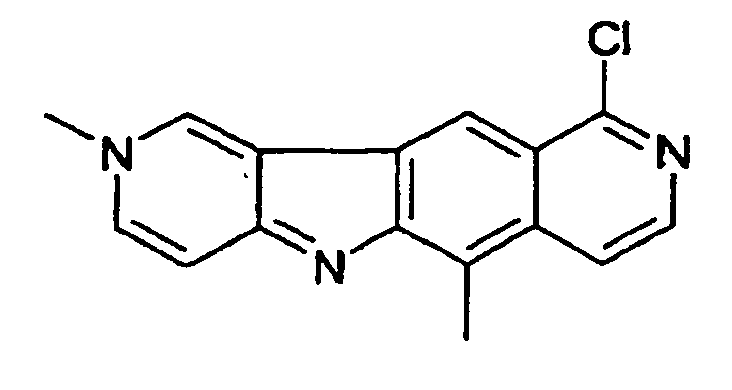
- Derivatives according to claim 1, wherein compound I is the compound 10-chloro-2,6-dimethyl-2H-pyrido[3',4':4,5]pyrrolo[2,3-g]isoquinoline:
- Derivatives according to any of claims 1 to 3 for their use as a drug.
- Derivatives according to claim 4,
characterized in that the drug is intended to treat diseases related to pre-messenger RNA splicing process within the cell,(a) genetic diseases resulting from splicing-process modification, notably Frasier syndrome, frontotemporal dementia related to chromosome 17 (a form of Parkinson's), Leigh syndrome (a type of encephalopathy), atypical cystic fibrosis, certain neuropathologies, such as in particular the Alzheimer, related to a Tau protein mutation, amyotrophy that influences the SMN (survival motor neuron) gene, depression related to disturbances in serotonin splicing,(b) diseases of viral origin for which ESE splicing sequences are identified, such as AIDS. - Derivatives according to claim 4 or 5,
characterized in that the aforementioned drug also includes an excipient enabling the formulation of compounds according to formula I. - Derivatives according to one of claims 4 to 6, characterized in that the aforementioned drug is provided in solid or liquid form to be prepared and administered by intravenous route.
Applications Claiming Priority (3)
| Application Number | Priority Date | Filing Date | Title |
|---|---|---|---|
| FR0310460A FR2859475A1 (en) | 2003-09-04 | 2003-09-04 | Use of ellipticin, or its aza-derivatives, in treatment of genetic disorders caused by alteration of RNA splicing, e.g. parkinsonism, neuropathy and cancers |
| FR0400973A FR2859474B1 (en) | 2003-09-04 | 2004-02-02 | USE OF INDOLE-DERIVED COMPOUNDS FOR THE PREPARATION OF A MEDICAMENT USEFUL IN THE TREATMENT OF GENETIC DISEASES RESULTING FROM THE ALTERATION OF SPLICE PROCESSES |
| PCT/FR2004/002261 WO2005023255A2 (en) | 2003-09-04 | 2004-09-06 | Use of indole-derived compounds for the preparation of a medicament that can be used to treat diseases related to the splicing process |
Publications (2)
| Publication Number | Publication Date |
|---|---|
| EP1663219A2 EP1663219A2 (en) | 2006-06-07 |
| EP1663219B1 true EP1663219B1 (en) | 2010-05-12 |
Family
ID=34196237
Family Applications (1)
| Application Number | Title | Priority Date | Filing Date |
|---|---|---|---|
| EP04787316A Expired - Lifetime EP1663219B1 (en) | 2003-09-04 | 2004-09-06 | Use of indole-derived compounds for the preparation of a medicament that can be used to treat diseases related to the splicing process |
Country Status (9)
| Country | Link |
|---|---|
| US (1) | US7989467B2 (en) |
| EP (1) | EP1663219B1 (en) |
| JP (1) | JP2007504205A (en) |
| AT (1) | ATE467414T1 (en) |
| CA (1) | CA2537752A1 (en) |
| DE (1) | DE602004027148D1 (en) |
| ES (1) | ES2346317T3 (en) |
| FR (1) | FR2859474B1 (en) |
| WO (1) | WO2005023255A2 (en) |
Families Citing this family (22)
| Publication number | Priority date | Publication date | Assignee | Title |
|---|---|---|---|---|
| JPWO2008102903A1 (en) * | 2007-02-19 | 2010-05-27 | 学校法人麻布獣医学園 | RNA splicing detection system |
| FR2912745A1 (en) * | 2007-02-19 | 2008-08-22 | Centre Nat Rech Scient | NEW INDOLE-DERIVED COMPOUNDS AND PHARMACEUTICAL COMPOSITIONS CONTAINING THEM |
| FR2926297B1 (en) * | 2008-01-10 | 2013-03-08 | Centre Nat Rech Scient | INHIBITORY CHEMICAL MOLECULES IN THE SPLICE MECHANISM FOR TREATING DISEASES RESULTING FROM SPLICE ANOMALIES. |
| FR2942476B1 (en) | 2009-02-20 | 2013-03-15 | Commissariat Energie Atomique | PYRIDOCARBAZOLE COMPOUNDS AND THEIR APPLICATIONS |
| EP2266972A1 (en) | 2009-06-12 | 2010-12-29 | Splicos | New chemical molecules that inhibit the splicing mechanism for treating diseases resulting from splicing anomalies |
| CN102625804B (en) | 2009-06-12 | 2015-04-08 | Abivax公司 | Compounds for the treatment of AIDS |
| US10253020B2 (en) | 2009-06-12 | 2019-04-09 | Abivax | Compounds for preventing, inhibiting, or treating cancer, AIDS and/or premature aging |
| EP2465502A1 (en) | 2010-12-15 | 2012-06-20 | Société Splicos | Compounds useful for treating AIDS |
| EP2505198A1 (en) | 2011-04-01 | 2012-10-03 | Société Splicos | Compounds for use as therapeutic agents affecting p53 expression and/or activity |
| EP2757161A1 (en) | 2013-01-17 | 2014-07-23 | Splicos | miRNA-124 as a biomarker of viral infection |
| CA2916623C (en) | 2013-07-05 | 2021-09-14 | Abivax | Bicyclic compounds useful for treating diseases caused by retroviruses |
| EP2974729A1 (en) | 2014-07-17 | 2016-01-20 | Abivax | Quinoline derivatives for use in the treatment of inflammatory diseases |
| EP2975034A1 (en) | 2014-07-17 | 2016-01-20 | Abivax | A quinoline derivative for the treatment of inflammatory diseases and AIDS |
| EP3059236A1 (en) | 2015-02-23 | 2016-08-24 | Abivax | A new quinoline derivative for use in the treatment and prevention of viral infections |
| EP3594205A1 (en) | 2018-07-09 | 2020-01-15 | Abivax | Phenyl-n-aryl derivatives for treating a rna virus infection |
| EP3594206A1 (en) | 2018-07-09 | 2020-01-15 | Abivax | Phenyl-n-quinoline derivatives for treating a rna virus infection |
| CN110759963A (en) * | 2018-07-25 | 2020-02-07 | 中山大学 | A kind of fused ring compound and its preparation method and use |
| EP3669873A1 (en) | 2018-12-20 | 2020-06-24 | Abivax | Quinoline derivatives for use ine the traeatment of inflammation diseases |
| CN111484494B (en) * | 2019-01-29 | 2022-09-13 | 诺沃斯达药业(上海)有限公司 | Polycyclic compounds that inhibit MNK1 and MNK2 |
| EP3999493B1 (en) | 2019-07-19 | 2023-12-20 | Abivax | Aryl-n-aryl derivatives for treating a rna virus infection |
| US20230381170A1 (en) * | 2020-10-20 | 2023-11-30 | University Of Florida Research Foundation, Incorporated | Method for treating als/ftd through degradation of rna repeat expansion |
| US11884668B1 (en) | 2023-08-02 | 2024-01-30 | King Faisal University | Substituted pyrido[3′,4′:4,5]pyrrolo[2,3-c]quinolines as CK2 inhibitors |
Citations (1)
| Publication number | Priority date | Publication date | Assignee | Title |
|---|---|---|---|---|
| FR2422662A2 (en) * | 1978-04-10 | 1979-11-09 | Anvar | Di:pyrido (4,3-b) (3,4-f) indole derivs. - useful as antiviral and antitumour agents |
Family Cites Families (14)
| Publication number | Priority date | Publication date | Assignee | Title |
|---|---|---|---|---|
| FR2485537B2 (en) | 1977-04-13 | 1986-05-16 | Anvar | DIPYRIDO (4,3-B) (3,4-F) INDOLES, PROCESS FOR OBTAINING IT, THERAPEUTIC APPLICATION AND PHARMACEUTICAL COMPOSITIONS CONTAINING THEM |
| FR2387229A1 (en) * | 1977-04-13 | 1978-11-10 | Anvar | DIPYRIDO (4,3-B) (3,4-F) INDOLES, PROCESS FOR OBTAINING, THERAPEUTIC APPLICATION AND PHARMACEUTICAL COMPOSITIONS CONTAINING THEM |
| FR2436786A1 (en) | 1978-09-21 | 1980-04-18 | Anvar | NOVEL PYRIDO (4,3-B) CARBAZOLES (ELLIPTICINS) DERIVATIVES, SUBSTITUTED IN POSITION 1 BY A POLYAMINE CHAIN, THEIR OBTAINMENT AND THEIR APPLICATION AS MEDICAMENTS |
| EP0257701A1 (en) * | 1986-08-15 | 1988-03-02 | Cedona Pharmaceuticals B.V. | A process for preparing hydroxyl derivatives of compounds containing a carbazole, dibenzofurane or dibenzothiophene group |
| FR2623191B1 (en) * | 1987-11-16 | 1990-04-06 | Centre Nat Rech Scient | PROCESS FOR THE PREPARATION OF CHLORO-1 ALKYL-5 ISOQUINOLEINS CONDENSED WITH AROMATIC GROUPS, THE NEW PRODUCTS OBTAINED, AND THEIR APPLICATION AS MEDICAMENTS |
| FR2627493B1 (en) * | 1988-02-23 | 1991-10-31 | Sanofi Sa | PROCESS FOR THE PREPARATION OF ISOQUINOLEIN DERIVATIVES |
| FR2645861A1 (en) | 1989-04-17 | 1990-10-19 | Inst Nat Sante Rech Med | USE OF DIPYRIDO (4,3-B) (3,4-F) INDOLES FOR THE PREPARATION OF MEDICAMENTS USEFUL FOR THE TREATMENT OF AIDS |
| IL94600A0 (en) * | 1989-06-06 | 1991-04-15 | Rhone Poulenc Sante | Pyridobenzoindole compounds,their preparation and compositions containing them |
| FR2665162A1 (en) * | 1990-07-30 | 1992-01-31 | Univ Caen | 6H-Pyrido[3,2-b]carbazole derivatives, process for their preparation and their application in therapeutics |
| FR2669637A1 (en) * | 1990-11-23 | 1992-05-29 | Centre Nat Rech Scient | NOVEL PYRIDOBENZOINDOLE DERIVATIVES, THEIR PREPARATION AND COMPOSITIONS CONTAINING THEM. |
| JPH05310736A (en) * | 1992-05-06 | 1993-11-22 | Tanabe Seiyaku Co Ltd | Ellipticine derivatives, their production and their synthetic intermediates |
| FR2757859B1 (en) * | 1996-12-30 | 1999-01-29 | Adir | NOVEL ELLIPTICIN DERIVATIVES, THEIR PREPARATION PROCESS AND THE PHARMACEUTICAL COMPOSITIONS CONTAINING THE SAME |
| US20020018768A1 (en) * | 1999-10-21 | 2002-02-14 | Yissum Research Development Company Of The Hebrew University Of Jerusalem | Control of gene expression |
| EP1133993A1 (en) * | 2000-03-10 | 2001-09-19 | Max-Planck-Gesellschaft zur Förderung der Wissenschaften e.V. | Substances for the treatment of spinal muscular atrophy |
-
2004
- 2004-02-02 FR FR0400973A patent/FR2859474B1/en not_active Expired - Lifetime
- 2004-09-06 US US10/570,849 patent/US7989467B2/en active Active
- 2004-09-06 JP JP2006525168A patent/JP2007504205A/en active Pending
- 2004-09-06 CA CA002537752A patent/CA2537752A1/en not_active Abandoned
- 2004-09-06 DE DE602004027148T patent/DE602004027148D1/en not_active Expired - Lifetime
- 2004-09-06 WO PCT/FR2004/002261 patent/WO2005023255A2/en not_active Ceased
- 2004-09-06 AT AT04787316T patent/ATE467414T1/en not_active IP Right Cessation
- 2004-09-06 EP EP04787316A patent/EP1663219B1/en not_active Expired - Lifetime
- 2004-09-06 ES ES04787316T patent/ES2346317T3/en not_active Expired - Lifetime
Patent Citations (1)
| Publication number | Priority date | Publication date | Assignee | Title |
|---|---|---|---|---|
| FR2422662A2 (en) * | 1978-04-10 | 1979-11-09 | Anvar | Di:pyrido (4,3-b) (3,4-f) indole derivs. - useful as antiviral and antitumour agents |
Also Published As
| Publication number | Publication date |
|---|---|
| WO2005023255A3 (en) | 2006-04-20 |
| US7989467B2 (en) | 2011-08-02 |
| JP2007504205A (en) | 2007-03-01 |
| FR2859474A1 (en) | 2005-03-11 |
| CA2537752A1 (en) | 2005-03-17 |
| WO2005023255A2 (en) | 2005-03-17 |
| ATE467414T1 (en) | 2010-05-15 |
| DE602004027148D1 (en) | 2010-06-24 |
| FR2859474B1 (en) | 2006-01-13 |
| US20070054905A1 (en) | 2007-03-08 |
| ES2346317T3 (en) | 2010-10-14 |
| EP1663219A2 (en) | 2006-06-07 |
Similar Documents
| Publication | Publication Date | Title |
|---|---|---|
| US7989467B2 (en) | Use of indole-derived compounds for the preparation of a medicament that can be used to treat diseases related to the splicing process | |
| EP2125803B1 (en) | Pyrrolo[2,3-b]pyridine compounds, azaindole compounds used for synthesizing said pyrrolo[2,3-b]pyridine compounds, methods for the production thereof, and uses thereof | |
| CN106456580B (en) | Heterocyclic hydroxamic acids as protein deacetylase inhibitors and dual protein deacetylase-protein kinase inhibitors and methods of use thereof | |
| EP2046775B1 (en) | N-(aminoheteroaryl)-1h-indole-2-carboxamide derivatives, preparation thereof and therapeutic use thereof | |
| US8399422B2 (en) | Compositions for transfection of oligonucleotides active for gene silencing and their biological and therapeutical applications | |
| EP2542239B1 (en) | Use of isoquinolones for preparing drugs, novel isoquinolones and method for synthesising same | |
| EP0939654A1 (en) | Association of no syntase inhibitors with trappers of oxygen reactive forms | |
| PT1341769E (en) | Bacterial gyrase inhibitors and uses thereof | |
| JP7741987B2 (en) | Heterocyclic inhibitors of methionine adenosyltransferase 2A | |
| WO2003045951A1 (en) | Triazolo[4,3-a]pyrido[2,3-d]pyrimidin-5-one derivatives, compositions containing same, preparation method and use thereof | |
| US20200101075A1 (en) | Application of n-benzyl tryptanthrin derivative as tryptophan dioxygenase (tdo) inhibitor | |
| EP2691377B1 (en) | Aminoquinoxaline derivatives for treatment of neurodegenerative diseases | |
| EP2078009A1 (en) | New fluorene derivatives, compositions containing the same and use thereof as inhibitors of the protein chaperone hsp 90 | |
| JP4169149B2 (en) | Chemical compound | |
| FR2859475A1 (en) | Use of ellipticin, or its aza-derivatives, in treatment of genetic disorders caused by alteration of RNA splicing, e.g. parkinsonism, neuropathy and cancers | |
| EP1373252A1 (en) | Chemical derivatives and their use as anti-telomerase agent | |
| AU2016311502B2 (en) | Compositions for app-selective bace inhibition and uses therfor | |
| EP1912644A2 (en) | N-(arylalkyl)-1h-pyrrolopyridine-2-carboxamide derivatives, preparation and use thereof | |
| FR2932484A1 (en) | NOVEL PYRROLOINDOLE DERIVATIVES INHIBITORS OF HSP90, COMPOSITIONS CONTAINING SAME AND USE THEREOF | |
| KR20230067637A (en) | Compositions and methods for treating muscular dystrophy | |
| EP0623620B1 (en) | 5-HT3 Pyrrolopyrazine derivatives | |
| EP3875086A1 (en) | Dual-inhibitors of cellular necroptosis and ferroptosis for use in the treatment of organ transplant patients | |
| FR2845995A1 (en) | NOVEL DERIVATIVES OF PYRROLO [3,4-C] CARBAZOLE AND PYRIDO [2,3-B] PYRROLO [3,4-E] INDOLE, PROCESS FOR PREPARING THEM AND PHARMACEUTICAL COMPOSITIONS CONTAINING THEM | |
| BE1021251B1 (en) | PYRROLIDINE-2,5-DIONE DERIVATIVES, PHARMACEUTICAL COMPOSITIONS AND METHODS OF USE AS INHIBITORS OF IDO1 | |
| SK500742020A3 (en) | Compound cemtirestat disulfide, prodrug of aldoketoreductase inhibitor, method of its preparation, pharmaceutical composition containing it and its use |
Legal Events
| Date | Code | Title | Description |
|---|---|---|---|
| PUAI | Public reference made under article 153(3) epc to a published international application that has entered the european phase |
Free format text: ORIGINAL CODE: 0009012 |
|
| 17P | Request for examination filed |
Effective date: 20060320 |
|
| AK | Designated contracting states |
Kind code of ref document: A2 Designated state(s): AT BE BG CH CY CZ DE DK EE ES FI FR GB GR HU IE IT LI LU MC NL PL PT RO SE SI SK TR |
|
| AX | Request for extension of the european patent |
Extension state: AL HR LT LV MK |
|
| PUAK | Availability of information related to the publication of the international search report |
Free format text: ORIGINAL CODE: 0009015 |
|
| RAX | Requested extension states of the european patent have changed |
Extension state: LT |
|
| DAX | Request for extension of the european patent (deleted) | ||
| RIN1 | Information on inventor provided before grant (corrected) |
Inventor name: BISAGNI, EMILE Inventor name: TAZI, JAMAL Inventor name: NGUYEN, CHI HUNG Inventor name: JEANTEUR, PHILIPPE Inventor name: SORET, JOHANN Inventor name: GRIERSON, DAVID Inventor name: RIVALLE, CHRISTIAN |
|
| 17Q | First examination report despatched |
Effective date: 20070516 |
|
| GRAP | Despatch of communication of intention to grant a patent |
Free format text: ORIGINAL CODE: EPIDOSNIGR1 |
|
| GRAS | Grant fee paid |
Free format text: ORIGINAL CODE: EPIDOSNIGR3 |
|
| RAP1 | Party data changed (applicant data changed or rights of an application transferred) |
Owner name: UNIVERSITE MONTPELLIER 2 SCIENCES ET TECHNIQUES Owner name: CENTRE NATIONAL DE LA RECHERCHE SCIENTIFIQUE (CNRS Owner name: INSTITUT CURIE |
|
| GRAA | (expected) grant |
Free format text: ORIGINAL CODE: 0009210 |
|
| AK | Designated contracting states |
Kind code of ref document: B1 Designated state(s): AT BE BG CH CY CZ DE DK EE ES FI FR GB GR HU IE IT LI LU MC NL PL PT RO SE SI SK TR |
|
| REG | Reference to a national code |
Ref country code: GB Ref legal event code: FG4D Free format text: NOT ENGLISH |
|
| REG | Reference to a national code |
Ref country code: CH Ref legal event code: EP |
|
| REG | Reference to a national code |
Ref country code: IE Ref legal event code: FG4D Free format text: LANGUAGE OF EP DOCUMENT: FRENCH |
|
| REF | Corresponds to: |
Ref document number: 602004027148 Country of ref document: DE Date of ref document: 20100624 Kind code of ref document: P |
|
| REG | Reference to a national code |
Ref country code: NL Ref legal event code: VDEP Effective date: 20100512 |
|
| REG | Reference to a national code |
Ref country code: CH Ref legal event code: NV Representative=s name: KIRKER & CIE S.A. |
|
| REG | Reference to a national code |
Ref country code: ES Ref legal event code: FG2A Ref document number: 2346317 Country of ref document: ES Kind code of ref document: T3 |
|
| PG25 | Lapsed in a contracting state [announced via postgrant information from national office to epo] |
Ref country code: SE Free format text: LAPSE BECAUSE OF FAILURE TO SUBMIT A TRANSLATION OF THE DESCRIPTION OR TO PAY THE FEE WITHIN THE PRESCRIBED TIME-LIMIT Effective date: 20100512 Ref country code: NL Free format text: LAPSE BECAUSE OF FAILURE TO SUBMIT A TRANSLATION OF THE DESCRIPTION OR TO PAY THE FEE WITHIN THE PRESCRIBED TIME-LIMIT Effective date: 20100512 |
|
| PG25 | Lapsed in a contracting state [announced via postgrant information from national office to epo] |
Ref country code: SI Free format text: LAPSE BECAUSE OF FAILURE TO SUBMIT A TRANSLATION OF THE DESCRIPTION OR TO PAY THE FEE WITHIN THE PRESCRIBED TIME-LIMIT Effective date: 20100512 Ref country code: FI Free format text: LAPSE BECAUSE OF FAILURE TO SUBMIT A TRANSLATION OF THE DESCRIPTION OR TO PAY THE FEE WITHIN THE PRESCRIBED TIME-LIMIT Effective date: 20100512 Ref country code: AT Free format text: LAPSE BECAUSE OF FAILURE TO SUBMIT A TRANSLATION OF THE DESCRIPTION OR TO PAY THE FEE WITHIN THE PRESCRIBED TIME-LIMIT Effective date: 20100512 |
|
| REG | Reference to a national code |
Ref country code: IE Ref legal event code: FD4D |
|
| PG25 | Lapsed in a contracting state [announced via postgrant information from national office to epo] |
Ref country code: PL Free format text: LAPSE BECAUSE OF FAILURE TO SUBMIT A TRANSLATION OF THE DESCRIPTION OR TO PAY THE FEE WITHIN THE PRESCRIBED TIME-LIMIT Effective date: 20100512 Ref country code: CY Free format text: LAPSE BECAUSE OF FAILURE TO SUBMIT A TRANSLATION OF THE DESCRIPTION OR TO PAY THE FEE WITHIN THE PRESCRIBED TIME-LIMIT Effective date: 20100512 Ref country code: GR Free format text: LAPSE BECAUSE OF FAILURE TO SUBMIT A TRANSLATION OF THE DESCRIPTION OR TO PAY THE FEE WITHIN THE PRESCRIBED TIME-LIMIT Effective date: 20100813 |
|
| PG25 | Lapsed in a contracting state [announced via postgrant information from national office to epo] |
Ref country code: IE Free format text: LAPSE BECAUSE OF FAILURE TO SUBMIT A TRANSLATION OF THE DESCRIPTION OR TO PAY THE FEE WITHIN THE PRESCRIBED TIME-LIMIT Effective date: 20100512 Ref country code: PT Free format text: LAPSE BECAUSE OF FAILURE TO SUBMIT A TRANSLATION OF THE DESCRIPTION OR TO PAY THE FEE WITHIN THE PRESCRIBED TIME-LIMIT Effective date: 20100913 Ref country code: EE Free format text: LAPSE BECAUSE OF FAILURE TO SUBMIT A TRANSLATION OF THE DESCRIPTION OR TO PAY THE FEE WITHIN THE PRESCRIBED TIME-LIMIT Effective date: 20100512 Ref country code: DK Free format text: LAPSE BECAUSE OF FAILURE TO SUBMIT A TRANSLATION OF THE DESCRIPTION OR TO PAY THE FEE WITHIN THE PRESCRIBED TIME-LIMIT Effective date: 20100512 |
|
| PG25 | Lapsed in a contracting state [announced via postgrant information from national office to epo] |
Ref country code: RO Free format text: LAPSE BECAUSE OF FAILURE TO SUBMIT A TRANSLATION OF THE DESCRIPTION OR TO PAY THE FEE WITHIN THE PRESCRIBED TIME-LIMIT Effective date: 20100512 Ref country code: CZ Free format text: LAPSE BECAUSE OF FAILURE TO SUBMIT A TRANSLATION OF THE DESCRIPTION OR TO PAY THE FEE WITHIN THE PRESCRIBED TIME-LIMIT Effective date: 20100512 Ref country code: SK Free format text: LAPSE BECAUSE OF FAILURE TO SUBMIT A TRANSLATION OF THE DESCRIPTION OR TO PAY THE FEE WITHIN THE PRESCRIBED TIME-LIMIT Effective date: 20100512 |
|
| PLBE | No opposition filed within time limit |
Free format text: ORIGINAL CODE: 0009261 |
|
| STAA | Information on the status of an ep patent application or granted ep patent |
Free format text: STATUS: NO OPPOSITION FILED WITHIN TIME LIMIT |
|
| BERE | Be: lapsed |
Owner name: INSTITUT CURIE Effective date: 20100930 Owner name: CENTRE NATIONAL DE LA RECHERCHE SCIENTIFIQUE (CNR Effective date: 20100930 Owner name: UNIVERSITE MONTPELLIER 2 SCIENCES ET TECHNIQUES Effective date: 20100930 |
|
| 26N | No opposition filed |
Effective date: 20110215 |
|
| PG25 | Lapsed in a contracting state [announced via postgrant information from national office to epo] |
Ref country code: MC Free format text: LAPSE BECAUSE OF NON-PAYMENT OF DUE FEES Effective date: 20100930 |
|
| REG | Reference to a national code |
Ref country code: DE Ref legal event code: R097 Ref document number: 602004027148 Country of ref document: DE Effective date: 20110214 |
|
| PG25 | Lapsed in a contracting state [announced via postgrant information from national office to epo] |
Ref country code: BE Free format text: LAPSE BECAUSE OF NON-PAYMENT OF DUE FEES Effective date: 20100930 |
|
| PG25 | Lapsed in a contracting state [announced via postgrant information from national office to epo] |
Ref country code: LU Free format text: LAPSE BECAUSE OF NON-PAYMENT OF DUE FEES Effective date: 20100906 Ref country code: HU Free format text: LAPSE BECAUSE OF FAILURE TO SUBMIT A TRANSLATION OF THE DESCRIPTION OR TO PAY THE FEE WITHIN THE PRESCRIBED TIME-LIMIT Effective date: 20101113 Ref country code: BG Free format text: LAPSE BECAUSE OF FAILURE TO SUBMIT A TRANSLATION OF THE DESCRIPTION OR TO PAY THE FEE WITHIN THE PRESCRIBED TIME-LIMIT Effective date: 20100512 |
|
| PG25 | Lapsed in a contracting state [announced via postgrant information from national office to epo] |
Ref country code: TR Free format text: LAPSE BECAUSE OF FAILURE TO SUBMIT A TRANSLATION OF THE DESCRIPTION OR TO PAY THE FEE WITHIN THE PRESCRIBED TIME-LIMIT Effective date: 20100512 |
|
| PG25 | Lapsed in a contracting state [announced via postgrant information from national office to epo] |
Ref country code: BG Free format text: LAPSE BECAUSE OF FAILURE TO SUBMIT A TRANSLATION OF THE DESCRIPTION OR TO PAY THE FEE WITHIN THE PRESCRIBED TIME-LIMIT Effective date: 20100812 |
|
| REG | Reference to a national code |
Ref country code: FR Ref legal event code: PLFP Year of fee payment: 13 |
|
| REG | Reference to a national code |
Ref country code: DE Ref legal event code: R082 Ref document number: 602004027148 Country of ref document: DE Representative=s name: STREHL SCHUEBEL-HOPF & PARTNER MBB PATENTANWAE, DE Ref country code: DE Ref legal event code: R081 Ref document number: 602004027148 Country of ref document: DE Owner name: INSTITUT CURIE, FR Free format text: FORMER OWNERS: CENTRE NATIONAL DE LA RECHERCHE SCIENTIFIQUE (C.N.R.S.), PARIS, FR; INSTITUT CURIE, PARIS, FR; UNIVERSITE MONTPELLIER 2 SCIENCES ET TECHNIQUES, MONTPELLIER, FR Ref country code: DE Ref legal event code: R081 Ref document number: 602004027148 Country of ref document: DE Owner name: CENTRE NATIONAL DE LA RECHERCHE SCIENTIFIQUE (, FR Free format text: FORMER OWNERS: CENTRE NATIONAL DE LA RECHERCHE SCIENTIFIQUE (C.N.R.S.), PARIS, FR; INSTITUT CURIE, PARIS, FR; UNIVERSITE MONTPELLIER 2 SCIENCES ET TECHNIQUES, MONTPELLIER, FR Ref country code: DE Ref legal event code: R081 Ref document number: 602004027148 Country of ref document: DE Owner name: UNIVERSITE DE MONTPELLIER, FR Free format text: FORMER OWNERS: CENTRE NATIONAL DE LA RECHERCHE SCIENTIFIQUE (C.N.R.S.), PARIS, FR; INSTITUT CURIE, PARIS, FR; UNIVERSITE MONTPELLIER 2 SCIENCES ET TECHNIQUES, MONTPELLIER, FR |
|
| REG | Reference to a national code |
Ref country code: CH Ref legal event code: PFUS Owner name: INSTITUT CURIE, FR Free format text: FORMER OWNER: INSTITUT CURIE, FR Ref country code: CH Ref legal event code: PK Free format text: RECTIFICATION TITULAIRE |
|
| REG | Reference to a national code |
Ref country code: FR Ref legal event code: TQ Owner name: INSTITUT CURIE, FR Effective date: 20170124 Ref country code: FR Ref legal event code: TQ Owner name: UNIVERSITE DE MONTPELLIER, FR Effective date: 20170124 Ref country code: FR Ref legal event code: TQ Owner name: CENTRE NATIONAL DE LA RECHERCHE SCIENTIFIQUE, FR Effective date: 20170124 |
|
| REG | Reference to a national code |
Ref country code: FR Ref legal event code: PLFP Year of fee payment: 14 |
|
| REG | Reference to a national code |
Ref country code: GB Ref legal event code: 732E Free format text: REGISTERED BETWEEN 20180503 AND 20180509 |
|
| REG | Reference to a national code |
Ref country code: FR Ref legal event code: PLFP Year of fee payment: 15 |
|
| REG | Reference to a national code |
Ref country code: GB Ref legal event code: 732E Free format text: REGISTERED BETWEEN 20181213 AND 20181219 |
|
| PGFP | Annual fee paid to national office [announced via postgrant information from national office to epo] |
Ref country code: GB Payment date: 20230920 Year of fee payment: 20 |
|
| PGFP | Annual fee paid to national office [announced via postgrant information from national office to epo] |
Ref country code: FR Payment date: 20230927 Year of fee payment: 20 Ref country code: DE Payment date: 20230920 Year of fee payment: 20 |
|
| PGFP | Annual fee paid to national office [announced via postgrant information from national office to epo] |
Ref country code: ES Payment date: 20231123 Year of fee payment: 20 |
|
| PGFP | Annual fee paid to national office [announced via postgrant information from national office to epo] |
Ref country code: IT Payment date: 20230927 Year of fee payment: 20 Ref country code: CH Payment date: 20231001 Year of fee payment: 20 |
|
| REG | Reference to a national code |
Ref country code: DE Ref legal event code: R071 Ref document number: 602004027148 Country of ref document: DE |
|
| REG | Reference to a national code |
Ref country code: CH Ref legal event code: PL |
|
| REG | Reference to a national code |
Ref country code: GB Ref legal event code: PE20 Expiry date: 20240905 |
|
| REG | Reference to a national code |
Ref country code: ES Ref legal event code: FD2A Effective date: 20240927 |
|
| PG25 | Lapsed in a contracting state [announced via postgrant information from national office to epo] |
Ref country code: GB Free format text: LAPSE BECAUSE OF EXPIRATION OF PROTECTION Effective date: 20240905 |
|
| PG25 | Lapsed in a contracting state [announced via postgrant information from national office to epo] |
Ref country code: ES Free format text: LAPSE BECAUSE OF EXPIRATION OF PROTECTION Effective date: 20240907 |
|
| PG25 | Lapsed in a contracting state [announced via postgrant information from national office to epo] |
Ref country code: GB Free format text: LAPSE BECAUSE OF EXPIRATION OF PROTECTION Effective date: 20240905 Ref country code: ES Free format text: LAPSE BECAUSE OF EXPIRATION OF PROTECTION Effective date: 20240907 |