EP1662993B1 - Bioimpedanzverfahren und gerät - Google Patents
Bioimpedanzverfahren und gerät Download PDFInfo
- Publication number
- EP1662993B1 EP1662993B1 EP04783794.3A EP04783794A EP1662993B1 EP 1662993 B1 EP1662993 B1 EP 1662993B1 EP 04783794 A EP04783794 A EP 04783794A EP 1662993 B1 EP1662993 B1 EP 1662993B1
- Authority
- EP
- European Patent Office
- Prior art keywords
- segment
- subject
- value
- fat
- muscle
- Prior art date
- Legal status (The legal status is an assumption and is not a legal conclusion. Google has not performed a legal analysis and makes no representation as to the accuracy of the status listed.)
- Expired - Lifetime
Links
Images





Classifications
-
- A—HUMAN NECESSITIES
- A61—MEDICAL OR VETERINARY SCIENCE; HYGIENE
- A61B—DIAGNOSIS; SURGERY; IDENTIFICATION
- A61B5/00—Measuring for diagnostic purposes; Identification of persons
- A61B5/05—Detecting, measuring or recording for diagnosis by means of electric currents or magnetic fields; Measuring using microwaves or radio waves
-
- A—HUMAN NECESSITIES
- A61—MEDICAL OR VETERINARY SCIENCE; HYGIENE
- A61B—DIAGNOSIS; SURGERY; IDENTIFICATION
- A61B5/00—Measuring for diagnostic purposes; Identification of persons
- A61B5/05—Detecting, measuring or recording for diagnosis by means of electric currents or magnetic fields; Measuring using microwaves or radio waves
- A61B5/053—Measuring electrical impedance or conductance of a portion of the body
- A61B5/0537—Measuring body composition by impedance, e.g. tissue hydration or fat content
-
- A—HUMAN NECESSITIES
- A61—MEDICAL OR VETERINARY SCIENCE; HYGIENE
- A61B—DIAGNOSIS; SURGERY; IDENTIFICATION
- A61B5/00—Measuring for diagnostic purposes; Identification of persons
- A61B5/05—Detecting, measuring or recording for diagnosis by means of electric currents or magnetic fields; Measuring using microwaves or radio waves
- A61B5/055—Detecting, measuring or recording for diagnosis by means of electric currents or magnetic fields; Measuring using microwaves or radio waves involving electronic [EMR] or nuclear [NMR] magnetic resonance, e.g. magnetic resonance imaging
-
- A—HUMAN NECESSITIES
- A61—MEDICAL OR VETERINARY SCIENCE; HYGIENE
- A61B—DIAGNOSIS; SURGERY; IDENTIFICATION
- A61B5/00—Measuring for diagnostic purposes; Identification of persons
- A61B5/48—Other medical applications
- A61B5/4869—Determining body composition
- A61B5/4872—Body fat
-
- A—HUMAN NECESSITIES
- A61—MEDICAL OR VETERINARY SCIENCE; HYGIENE
- A61B—DIAGNOSIS; SURGERY; IDENTIFICATION
- A61B5/00—Measuring for diagnostic purposes; Identification of persons
- A61B5/48—Other medical applications
- A61B5/4869—Determining body composition
- A61B5/4881—Determining interstitial fluid distribution or content within body tissue
-
- A—HUMAN NECESSITIES
- A61—MEDICAL OR VETERINARY SCIENCE; HYGIENE
- A61B—DIAGNOSIS; SURGERY; IDENTIFICATION
- A61B2560/00—Constructional details of operational features of apparatus; Accessories for medical measuring apparatus
- A61B2560/02—Operational features
- A61B2560/0223—Operational features of calibration, e.g. protocols for calibrating sensors
Definitions
- This invention relates to bioimpedance methods and apparatus and, more particularly, to the use of such methods and apparatus to determine the muscle content, fat content, and/or extracellular fluid content of a segment of the body of a subject, where a segment can include essentially the subject's entire body.
- Bioelectrical impedance analysis is one of the interesting and challenging subjects in this area.
- Bioimpedance has been studied in many areas of medicine because of its potential ability to measure body composition with noninvasive, simple, inexpensive, and portable methods.
- bioimpedance has been employed in clinical research for many years. For example, clinical applications using bioimpedance were reported at an early stage by Nyboer [3] and Patterson [4].
- a method of using bioimpedance spectroscopy (BIS) has been suggested to measure extracellular (ECV) and intracellular (ICV) fluid volumes based on the Cole-Cole model and the Hanai method [5, 6, 10].
- the methodology of multi-frequency bioimpedance analysis can now provide some information about extracellular and intracellular fluid volume in the total or segmental body compartment [6].
- the present invention is concerned with one of those factors, namely, the model used to analyze bioimpedance data.
- the bioimpedance model commonly used to date to calculate electrical properties of different tissues has a basic assumption that fat has a high resistivity compared to fat free mass, and that therefore, fat mass can be ignored.
- bioimpedance measurements at 50 kilohertz are affected when subjects have large amounts of adipose tissue [7].
- the amount of fat mass is one of the major factors affecting the accurate measurement of body composition by BIS for subjects having a variety of body mass index (BMI) values.
- US-A-6,125,297 discloses a method and apparatus for determining volumes of body fluids in a subject using bioelectrical response spectroscopy.
- the human body is represented using an electrical circuit.
- Intra-cellular water is represented by a resistor in series with a capacitor; extra-cellular water is represented by a resistor in series with two parallel inductors.
- the parallel inductors represent the resistance due to vascular fluids.
- An alternating, low amperage, multi-frequency signal is applied to determine a subject's impedance and resistance. From these data, statistical regression is used to determine a 1% impedance where the subject's impedance changes by no more than 1% over a 25 kHz interval.
- Circuit components of the human body circuit are determined based on the 1% impedance. Equations for calculating total body water, extra-cellular water, total blood volume, and plasma volume are developed based on the circuit components.
- the present invention provides a method as defined in claim 1 and its dependent claims and an apparatus as defined in claim 18 for analyzing bioimpedence data for a body segment of a subject.
- the present invention relates to bioimpedance methods and apparatus which can provide information regarding the fat, muscle, and/or extracellular fluid content of a segment of a body of a subject, i.e., a human or an animal.
- the segment will typically be a part or all of a subject's limb, e.g., a subject's calf or forearm, but can also be all or part of the subject's torso, e.g., part or all of the subject's abdomen. Similarly, the segment can be as small as a specific muscle or a part of a muscle and as large as essentially the subject's entire body.
- the location and size of the segment will depend on the placement of current applying electrodes on the subject's skin.
- the segment will constitute the portion of the subject's body through which substantial current passes when the current applying electrodes are activated.
- suitable choices of the number, location, and polarity of the current applying electrodes a variety of current patterns within the subject's body can be achieved. Indeed, by varying the polarity of selected current applying electrodes, more than one segment can be analyzed without the need to move the current applying electrodes.
- the potential recording electrodes will typically be located inboard of the current applying electrodes, i.e., the potential recording electrodes will typically be located on skin which surrounds the portion of the patient's body through which substantial current passes when the current applying electrodes are activated.
- bioimpedance equipment including current applying and recording electrodes, now known or subsequently developed, e.g., commercially available equipment such as the 4000B Bio-Impedance Spectrum Analyzer System (Xitron Technologies, Inc., San Diego, CA) used in the examples discussed below.
- 4000B Bio-Impedance Spectrum Analyzer System Xitron Technologies, Inc., San Diego, CA
- customized equipment can be used in the practice of the invention.
- Processing of the data obtained by the bioimpedance equipment can be performed entirely within the equipment or can be performed on-line using a separate computer. Alternatively, the data can be stored and processed subsequent to the time of measurement.
- the bioimpedance equipment will include a microprocessor programmed to perform at least a portion of the analysis procedures of the present invention.
- the bioimpedance equipment can apply a regression equation obtained from a study on calibration subjects to measured impedance data for a subject and thus directly report the subject's fat, muscle, and/or extracellular fluid content(s) to the user of the equipment, e.g., the subject himself and/or other personnel, e.g., a health care provider, interested in the information.
- the fat, muscle, and/or extracellular fluid content can be reported graphically, numerically (e.g., as a fat and/or muscle percentage value), by color (e.g., red for high fat content), or the like.
- alternating current at a plurality of frequencies is applied to the subject's skin.
- at least 10 frequencies are used and more preferably, approximately 50 frequencies are used.
- the plurality of frequencies comprises frequencies between 5 and 1000 kilohertz, although frequencies over larger or smaller ranges can be used if desired.
- the frequencies are logarithmically distributed over the frequency range.
- the bioimpedance model commonly used to date to calculate electrical properties of different tissues has suffered from a number of problems.
- One of those problems is the basic assumption that fat has a high resistivity compared to fat free mass, and that therefore, fat mass can be ignored.
- Another is related to the model's calculation of extracellular and intracellular resistances.
- that model which is based on the tissue under the skin, is influenced by the skin and amount of adipose tissue.
- the present invention is directed to reducing various of the problems with the present analysis approach by examining the response of different constituent body components, such as skin, fat, muscle, to electrical input. More particularly, the invention, in accordance with certain of its aspects, provides models to describe the effects of different components of body tissue using equivalent circuits.
- an improved electrical model is provided which is able to explain the electrical properties with different proportions of body tissues, and the effect of a wide range of current frequencies.
- the data presented below in Example 1 specifically evaluates the relationship of the resistivity at 5 kHz measured at the skin to the resistivity by calculation with the model.
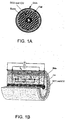
- Figure 1 shows a segmental body composition model in accordance with the invention which can be used to describe the components of conductivity in the limbs.
- the figure shows conductive components in a limb segment which form the basis for the electrical models of the invention.
- Table 1 shows the electrical properties (permittivity and resistivity) of different tissues using a 10 kHz current frequency as reported in a previous study [8].
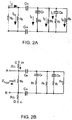
- FIG. 2A An equivalent circuit model to Figure 1 is shown in Figure 2A , where R G represents resistance of measurement by two electrodes on the skin and Rs, R F , R E , R I , and R B represent resistance of the skin, fat mass, extracellular volume, intracellular volume, and bone, respectively.
- R G represents resistance of measurement by two electrodes on the skin
- Rs represents resistance of measurement by two electrodes on the skin
- Rs represent resistance of the skin, fat mass, extracellular volume, intracellular volume, and bone, respectively.
- C IN , C F , and C M represent capacitance between skin and electrode, capacitance of fat mass, and capacitance of membrane of cells, respectively.
- I G I S + I F + I E + I I + I B
- R G I G R E I E + 2 I G ′ ⁇ C IN
- I G is the current pass through capacitor C IN
- I G ′ I F + I E + I I + I B
- E E E + 2 I G j ⁇ C IN where the parameter 2 I G j ⁇ C IN represents the potential across the capacitor C IN . This potential can be ignored at high current frequency or when C IN is large.
- a F and A E represent the cross sectional area of fat mass from MRI and ECV in this segment, respectively.
- the ratio of resistivity in fat mass to resistivity in ECV is approximately as follows [6]. ⁇ F ⁇ E ⁇ 3 ⁇ 5
- Example 1 The experimental data of Example 1 was obtained using one frequency for the applied current, namely, 5 kilohertz.
- the invention's equivalent circuit models of segmental body components are used to describe responses to multi-frequency current.
- Example 2 shows the results of such multi-frequency testing. In particular, this example shows different decreases in impedance with increases in current frequency for subjects with different fat contents.
- Figure 2B is a modified version of the equivalent circuit model of Figure 2A .
- Z Total represents total impedance of measurement by two electrodes at A and B.
- R S , R F , R E , R I , and R B represent resistance of the skin, fat mass, extracellular and intracellular volume, and bone, respectively
- C IN , C F , and C M represent capacitance between skin and electrode, capacitance of fat mass and the capacitance of the membranes of the cells, respectively.
- R i1 and R i2 represent resistance of segmental body between injecting and measuring electrodes.
- Z Total aC IN R P R S + j ⁇ 3 + R s 2 + C IN bR P + 2 a j ⁇ 2 + R s ( C IN cR P + 2 b + 2 dRp j ⁇ + 2 cR s C IN R S a + bR P + aR P j ⁇ 3 + R S C IN dR P + b + bR P 2 + C IN + 2 a j ⁇ 2 + cR S C IN + cC IN + 2 d R P + 2 b ) j ⁇ + 2 c
- Z Total 1 ⁇ aC IN R P R S + j ⁇ 3 + 1 ⁇ R s 2 + C IN bR P + 2 a j ⁇ 2 + R s ⁇ ( C IN cR P + 2 b + 2 dRp j ⁇ + 2 cR s ⁇ j ⁇ 3 + 1 ⁇ R S C IN dR P + b + bR P 2 + C IN + 2 a j ⁇ 2 + 1 ⁇ c R S C IN + cC IN + 2 d R P + 2 b j ⁇ + 2 c ⁇
- Quantitative analysis of frequency response data for individual subjects is preferably performed using a group of parameters to represent the function of components in the equivalent circuit.
- a group of parameters helps in the identification of differences in the body composition of individual subjects by facilitating the use of a standard transfer function for the analysis.
- R I , R F , C I , C F , Rp, Rs, C IN are the variables to be determined and P 1 , P 2 , P 3 , P 4 Q 1 , Q 2 , Q 3 are data values for an individual patient obtained by curve fitting of the frequency response data for the patient.
- the values of the seven variables R I , R F , C I , C F , R P , R S , C IN for an individual patient are obtained by solving the above seven equations (Eq. 23 to Eq. 29) using the P 1 , P 2 , P 3 , P 4 Q 1 , Q 2 , Q 3 values for that patient.
- Example 2 the curve fitting program of the MATLAB toolbox (The MathWorks, Inc., Natick, Massachusetts) was used to obtain the values of the parameters P 1 , P 2 , P 3 , P 4 , Q 1 , Q 2 , Q 3 for individual patients. Simulation of frequency response curves was obtained using the standard signal processing program of the MATLAB toolbox.
- Segmental length and circumference can be measured manually.
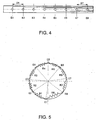
- the circumference and the length of a segment can be measured using groups of electrodes instead of single electrodes (see Fig. 4 ).
- the resistance at low frequency e.g., ⁇ 10 Hz, preferably ⁇ 1 Hz
- R i the resistance between any adjacent two electrodes except the resistance between the first and end
- D i the distance between any adjacent two electrodes except the distance between the first and the last electrodes.
- R1 to R7 represents the skin resistance between adjacent two electrodes.
- R8 is the resistance between, as discussed above, the first (E1) and the last electrode (E8).
- the distance between E1 and E8 is unknown but it, as discussed above, can be calculated by R8/ ⁇ and therefore, the circumference (C) can be calculated by Eq. 30.
- the mathematical operations described herein can be performed using a variety of computers and software. For example, those operations can be performed using the commercially available MATLAB program discussed above and a personal computer configured to run that program in accordance with the program manufacturer's specifications.
- the program as customized to perform the mathematical operations of the invention can be embodied as an article of manufacture comprising a computer usable medium, such as a magnetic disc, an optical disc, or the like, upon which the program is encoded.
- the data generated by the programs can similarly be stored on various types of storage media.
- Table 2 sets forth the relevant parameters for this group of subjects (patients).
- Calf bioimpedance measurements were performed using BIS device Xitron 4200 (Xitron Technologies, San Diego, CA). The procedure of placement of electrodes was published in a previous study [9]. As described therein, to place the electrodes in the normal position, the distance (H) between the central part of the patella and the center of the lateral malleolus was measured while the subject was in the sitting position (see Figure 6 ). With the patient recumbent, two measuring electrodes were placed, one 5 cm above the mid point M and another 5 cm below. Two current injecting electrodes were placed, one 3 cm above and the other 3 cm below the measuring electrodes. The circumference of the calf at the two measuring electrodes was measured using a tape with 0.1 cm precision.
- Calf resistance and reactance were measured using the BIS device with 50 logarithmically distributed frequencies from 5 kHz to 1 MHz. Extracellular resistance (Re) and intracellular resistance (Ri) were calculated and ECV and ICV were obtained using a program provided by the BIS device [9, 10]. Fat mass, muscle mass, and bone were separately measured in the same area by MRI.
- Geometric volume (V G ) was defined as the cross sectional area (A G ) times the length (L) of the segment.
- V F fat mass
- V G geometric volume
- Table 3 shows results of comparison of the resistivity between the two groups. There were significant differences in ⁇ G,Mea (p ⁇ 0.05), ⁇ G,Cal (p ⁇ 0.005) and ⁇ p (p ⁇ 0.05), however, no significant difference was seen in ⁇ * G,Cal between the two groups (Table 3). The difference (p ⁇ 0.05) between ⁇ G,Mea and ⁇ * G,Cal was significant but no significant difference was seen between ⁇ G,Mea and ⁇ G;Cal .
- Figure 7 shows correlations between calculated and measured resistivity values using Equations 12 and 13.
- the figure shows a high degree of correlation between the resistivity ( ⁇ G,Mea ) determined from Eq. 35 which is based on the measured value and the resistivity ( ⁇ G,Cal ) calculated using Eq. 12.
- the present invention provides a model which includes the variable of impedance of fat mass and may include the variables of resistance of skin and interface between capacitance.
- Table 3 shows that there is significant difference in resistivity ( ⁇ ) at 5 kHz between calculation by the model and by measurement as the amount of fat mass increases. This suggests that the value of resistivity at low frequency (5 kHz) obtained from measurement on the skin should include the contribution not only from extracellular fluid compartment but also from the fat mass compartment.
- Figure 7 shows that after calibration with individual k E the slope of the curve as shown by the solid circles is almost equal to one, which indicates that the calculated value is close to the measurement values. It is important to understand that the variability of resistivity in healthy subjects depends mainly on the individual volume of fat mass.
- this example illustrates some of the aspects of the invention that provide a model which can be used as a basis to calculate the resistivity in different tissues from the measurement of resistivity at the skin surface. That is, this example illustrates some of the aspects of the invention that provide an electrical resistivity model of segmented body composition for use in bioimpedance analysis, where the model describes the relationship of the resistivity with measurement on the skin surface and by calculation of tissues composing a limb.
- Example 2 The same 28 chronic hemodialysis patients as in Example 1 were studied before treatment (see Table 2). Again, calf bioimpedance measurements were performed using BIS device Xitron 4200 (Xitron Technologies, San Diego, CA) and the placement of electrodes was as described above in Example 1 (see Figure 6 ).
- Calf resistance and reactance were measured using BIS device with 50 logarithmically distributed frequencies from 5 kHz to 1 MHz. Fat mass, muscle mass and bone were separately measured in the same area of BIS measurement by MRI. Patients were divided into three groups according to the amount of fat mass in the calf with G1 : fat > 0.4 kg, G2: 0.25 ⁇ fat ⁇ 0.4 kg and G3: fat ⁇ 0.25 kg.
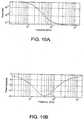
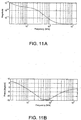
- the frequency response curve (A) and phase response (B) are shown in Figures 10 and 11 from two patients: one had 0.55 kg fat mass, 1.046 kg muscle mass and 0.021 kg borie ( Figure 10 ) as estimated by MRI and the other had 0.134 kg fat mass, 1.022 kg muscle mass and 0.022 kg bone ( Figure 11 ), again estimated by MRI.
- L (10 cm) is the distance between measuring electrodes along the patient's calf
- Ri is intracellular resistance which was calculated using the model of Figure 2B ).
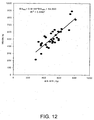
- the value of 285 ⁇ -cm used as muscle resistivity in calculating MS BIS was obtained by a regression analysis based on the MRI data.
- Ri was determined by solving Equations 23-29 using the P 1 , P 2 , P 3 , P 4 , Q 1 , Q 2 , and Q 3 values obtained for that patient from the measured frequency response data.
- Figure 12 thus illustrates the use of a group of parameters to quantify the analysis of the frequency response of the components of an equivalent circuit which can be used to identify the differences in body composition of individual subjects.
- Example 1 above showed that electrical resistivity of measurement on the skin surface is affected by adipose tissue using the equivalent circuit model of Figure 2 . This is believed to be one of the more important factors which influence the accuracy of bioimpedance technique to estimate body composition such as extracellular and intracellular fluid volumes. Of course, bioimpedance accuracy is not only influenced by the amount of fat mass but also by the interface between electrodes and skin or the degree of skin hydration.
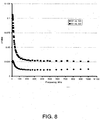
- the results shown in Figure 9 demonstrate a decrease in impedance related to increase of the current frequency in patients with different fat content. Impedance of the patient with larger fat mass is higher than that of the patient with small fat mass. Simulation results of two patients with similar muscle mass and bone mass show that the frequency response curve is different in the frequency range from 0 to 1kHz.
- the difference between Figures 10 and 11 demonstrate that the change in curve in response to the frequency from 0 to 1 kHz depends on the fat mass and that will largely affect the estimation of extracellular and intracellular resistance by multi-frequency bioimpedance analysis.
- the difference at the minimum point of phase response between the two patients indicates that using 50 kHz single frequency bioimpedance method could produce error when subject has a larger fat mass.
- the electrical model of the present invention correlates well with actual muscle mass as measured by MRI.
- the model therefore allows one to determine the muscle mass of individual subjects (patients) using only simple, inexpensive, and non-invasive electrical measurements.
- the particular muscle mass determined using the model will depend on the particular locations chosen for the electrodes used to make the BIS measurement.
- the data of Figure 12 is for the entire calf muscle.
- the muscle mass of, for example, a portion of the calf muscle can be determined, e.g., the muscle mass of the gastrocnemius portion of the calf.
- measurements can be made on other muscles, portions of muscles, and/or or muscle groups, e.g., measurements can be made on all or part of a subject's biceps. If only relative measurements are needed, the bioimpedance measurement can be used as is.
- correlations of the type shown in Figure 12 can be obtained between bioimpedance measurements and MRI measurements for particular muscles, portions of muscles, or muscle groups, thus allowing the electrical measurements to provide "absolute” values for muscle mass, where "absolute” values are preferably those which correspond to those obtained using MRI, the acknowledged "gold standard” for muscle mass measurements.
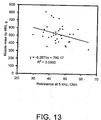
- Figure 13 is a plot based on the data of Examples 1 and 2 which shows the lack of a correlation between measured resistance values at 5 kilohertz and muscle mass determined by MRI. This data supports the conclusion that at low frequencies, measured bioimpedance data is not responsive to the muscle content of a segment. Rather, as set forth in the circuit model of Figure 3 , at these frequencies, the components of a segment that primarily determine the measured values obtained with a bioimpedance procedure are the fat and extracellular fluid components.
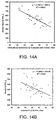
- Figures 14 and 15 compare correlations between bioimpedance and MRI measurements achieved using the multi-frequency, three parallel path model of Figure 2 with correlations achieved using impedance at a single frequency, namely, the commonly used frequency of 50 kilohertz.
- the data used in preparing these figures was the data discussed above in connection with Examples 1 and 2.
- Figure 14 shows muscle mass correlations
- Figure 15 shows fat mass correlations.
- the multi-frequency, three parallel path equivalent circuit frequency response model of the invention achieves higher correlations than the single 50 kilohertz approach both for muscle mass (R 2 of 0.6 for the invention versus 0.3 for 50 kilohertz) and for fat mass (R 2 of 0.7 for the invention versus 0.2 for 50 kilohertz).
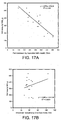
- Figures 16 and 17 compare correlations between BIS and MRI measurements achieved using the multi-frequency, three parallel path model of Figure 2 with correlations achieved using the Cole-Cole model.
- the data used in preparing these figures was the data discussed above in connection with Examples 1 and 2.
- Figure 16 shows muscle mass correlations
- Figure 17 shows fat mass correlations.
- the multi-frequency, three parallel path equivalent circuit frequency response model of the invention achieves higher correlations than the Cole-Cole model both for muscle mass (R 2 of 0.6 for the invention versus 0.4 for the Cole-Cole model) and for fat mass (R 2 of 0.7 for the invention versus 0.1 for the Cole-Cole model).
Landscapes
- Health & Medical Sciences (AREA)
- Life Sciences & Earth Sciences (AREA)
- Physics & Mathematics (AREA)
- Surgery (AREA)
- General Health & Medical Sciences (AREA)
- Engineering & Computer Science (AREA)
- Biomedical Technology (AREA)
- Heart & Thoracic Surgery (AREA)
- Medical Informatics (AREA)
- Molecular Biology (AREA)
- Biophysics (AREA)
- Animal Behavior & Ethology (AREA)
- Pathology (AREA)
- Public Health (AREA)
- Veterinary Medicine (AREA)
- Nuclear Medicine, Radiotherapy & Molecular Imaging (AREA)
- Radiology & Medical Imaging (AREA)
- High Energy & Nuclear Physics (AREA)
- Measurement And Recording Of Electrical Phenomena And Electrical Characteristics Of The Living Body (AREA)
- Magnetic Resonance Imaging Apparatus (AREA)
Claims (18)
- Verfahren zum Analysieren von Bioimpedanzdaten für ein Körpersegment einer Person, wobei das Körpersegment eine äußere Hautfläche aufweist, wobei das Verfahren die folgenden Schritte aufweist:(a) Anlegen von Wechselstrom mit mehreren Frequenzen an mindestens zwei Punkten auf der äußeren Hautfläche, um das Fließen von Strom durch das Segment zu bewirken;(b) für jede Frequenz erfolgendes Aufzeichnen der Spannungsdifferenz zwischen mindestens zwei anderen Punkten auf der äußeren Hautfläche, wobei die aufgezeichneten Spannungsdifferenzen sowohl Magnituden-, als auch Phaseninformationen aufweisen; und(c) Verwenden der aufgezeichneten Spannungsdifferenzen bei den mehreren Frequenzen zum Bestimmen mindestens eines numerischen Werts, welcher den Muskel-, Fett- und/oder extrazellulären Fluidanteil des Segments angibt, wobei die numerischen Werte unter Verwendung eines Impedanzmodells des Segments bestimmt werden, welches mindestens drei parallele Pfade aufweist, von welchen einer aus einem Kondensator CM und einem Widerstand RI, die in Reihe geschaltet sind, gebildet ist, welche hauptsächlich den Muskelanteil des Segments wiedergeben, von welchen ein anderer aus einem Kondensator CF und einem Widerstand RF, die in Reihe geschaltet sind, gebildet ist, welche hauptsächlich die Fettanteil des Segments wiedergeben, und von welchen ein weiterer durch einen Widerstand gebildet ist;wobei die angelegten Wechselströme von Schritt (a) und die aufgezeichneten Spannungsdifferenzen von Schritt (b) verwendet werden, um Impedanzwerte bei den mehreren Frequenzen zu berechnen, und der Schritt (c) eine Kurvenanpassung an diese Impedanzwerte aufweist, wobei die Kurvenanpassung eine Gleichung des Typs
 (i) ZTotal die Impedanz angibt,
ω die Winkelfrequenz in Radianten pro Sekunde j = √-1 angibt, und P1, P2, P3, P4, Q1, Q2 und Q3 Gruppenparameter sind, welche von den in dem Impedanzmodell verwendeten elektrischen Bauteilen abhängig sind; und(ii) die Werte von P1, P2, P3, P4, Q1, Q2 und Q3, welche für die Person durch die Kurvenanpassung erhalten werden, zur Bestimmung eines RI-Wertes und/oder eines RF-Wertes für die Person verwendet werden. - Verfahren nach Anspruch 1, bei welchem der mindestens eine numerische Wert den Muskelanteil des Segments angibt und aus einer Korrelationsgleichung erhalten wird, welche einen R1-Wert in einen Muskelanteilwert für das Segment umwandelt.
- Verfahren nach Anspruch 2, bei welchem die Korrelationsgleichung erhalten wird durch(i) das Durchführen der Schritte (a), (b) und (c) an mehreren Kalibrierungspersonen, um einen RI-Wert für jede Person zu erhalten;(ii) das Durchführen einer Magnetresonanztomographie des Segments für jeden der mehreren Kalibrierungspersonen, um einen Wert für den Muskelanteil des Segments für jede Person zu erhalten; und(iii) das Durchführen einer Regressionsanalyse der in den Schritten (i) und (ii) erhaltenen Werte, um die Korrelationsgleichung zu erhalten.
- Verfahren nach Anspruch 3, bei welchem die Regressionsanalyse einen R2-Wert von mindestens 0,5 für die Korrelationsgleichung ergibt.
- Verfahren nach Anspruch 4, bei welchem die mehreren Kalibrierungspersonen mindestens eine Kalibrierungsperson mit einem Body-Mass-Index von weniger als 20 und mindestens eine Kalibrierungsperson mit einem Body-Mass-Index von mehr als 35 aufweisen.
- Verfahren nach Anspruch 1, bei welchem mindestens ein numerischer Wert den Fettanteil des Segments angibt und aus einer Korrelationsgleichung erhalten wird, welche einen RF-Wert in einen Fettanteilwert für das Segment umwandelt.
- Verfahren nach Anspruch 6, bei welchem die Korrelationsgleichung erhalten wird durch(i) das Durchführen der Schritte (a), (b) und (c) an mehreren Kalibrierungspersonen, um einen RF-Wert für jede Person zu erhalten;(ii) das Durchführen einer Magnetresonanztomographie des Segments für jede der mehreren Kalibrierungspersonen, um einen Wert für den Fettanteil des Segments für jede der Personen zu erhalten; und(iii) das Durchführen einer Regressionsanalyse der in den Schritten (i) und (ii) erhaltenen Werte, um die Korrelationsgleichung zu erhalten.
- Verfahren nach Anspruch 7, bei welchem die Regressionsanalyse einen R2-Wert von mindestens 0,5 für die Korrelationsgleichung ergibt.
- Verfahren nach Anspruch 8, bei welchem die mehreren Kalibrierungspersonen mindestens eine Kalibrierungsperson mit einem Body-Mass-Index von weniger als 20 und mindestens eine Kalibrierungsperson mit einem Body-Mass-Index von mehr als 35 aufweisen.
- Verfahren nach Anspruch 1, bei welchem der parallele Pfad, welcher durch einen Widerstand gebildet ist, hauptsächlich den extrazellulären Fluidanteil des Segments wiedergibt.
- Verfahren nach Anspruch 1, bei welchem der parallele Pfad, der durch einen Widerstand gebildet ist, hauptsächlich eine parallele Kombination des extrazellulären Fluids und des Knochenanteils des Segments wiedergibt.
- Verfahren nach Anspruch 1, bei welchem das Impedanzmodell ferner einen mit den drei parallelen Pfaden in Reihe geschalteten Kondensator aufweist.
- Verfahren nach Anspruch 1, bei welchem die mehreren Frequenzen Frequenzen aufweisen, die höher als oder gleich 5 Kilohertz und niedriger als oder gleich 1000 Kilohertz sind.
- Verfahren nach Anspruch 1, bei welchem im Schritt (a) die mindestens zwei Punkte auf der äußeren Hautfläche aufweisen:(i) zwei Punkte an dem Bein der Person;(ii) zwei Punkte an der Wade der Person;(iii) zwei Punkte am Arm der Person;(iv) zwei Punkte am Bizeps der Person;(v) zwei Punkte am Abdomen der Person;(vi) einen Punkt an der linken Hand der Person und einen Punkt an der rechten Hand der Person;(vii) einen Punkt am linken Fuß der Person und einen Punkt am rechten Fuß der Person; oder(viii) einen Punkt an einer der Hände der Person oder einem der Füße der Person und einen Punkt an einem Bein der Person oder einem der Füße der Person.
- Verfahren nach Anspruch 1, ferner mit dem Schritt des Anzeigens des mindestens einen numerischen Werts, welcher einem Benutzer den Muskel-, Fett- und/oder extrazellulären Fluidanteil des Segments angibt.
- Verfahren nach Anspruch 1, bei welchem das Verfahren an derselben Person zu zwei oder mehr Zeitpunkten durchgeführt wird.
- Verfahren nach Anspruch 16, bei welchem das Verfahren in Verbindung mit(i) einem Dialysevorgang,(ii) einem Übungsprogramm,(iii) einem Rehabilitationsprogramm und/oder(iv) einem Gewichtskontrollprogrammdurchgeführt wird.
- Vorrichtung zum Analysieren von Bioimpedanzdaten für ein Körpersegment einer Person, wobei das Körpersegment eine äußere Hautfläche aufweist, mit:Einrichtungen zum Anlegen von Wechselstrom mit mehreren Frequenzen an mindestens zwei Punkten auf der äußeren Hautfläche, um das Fließen von Strom durch das Segment zu bewirken, und zum Aufzeichnen der Spannungsdifferenz zwischen mindestens zwei anderen Punkten auf der äußeren Hautfläche für jede Frequenz, wobei die aufgezeichneten Spannungsdifferenzen sowohl Magnituden-, als auch Phaseninformationen aufweisen; undEinrichtungen, die dazu ausgebildet sind, (a) die aufgezeichneten Spannungsdifferenzen bei den mehreren Frequenzen zum Bestimmen mindestens eines numerischen Werts, welcher den Muskel-, Fett- und/oder extrazellulären Fluidanteil des Segments angibt, zu verwenden, wobei die numerischen Werte unter Verwendung eines Impedanzmodells des Segments bestimmt werden, welches mindestens drei parallele Pfade aufweist, von welchen einer aus einem Kondensator CM und einem Widerstand RI, die in Reihe geschaltet sind, gebildet ist, welche hauptsächlich die Muskelkomponente des Segments wiedergeben, von welchen ein anderer aus einem Kondensator CF und einem Widerstand RF, die in Reihe geschaltet sind, gebildet ist, welche hauptsächlich die Fettkomponente des Segments wiedergeben, und von welchen ein weiterer durch einen Widerstand gebildet ist; und (b) um auf der Grundlage der angelegten Wechselströme und der aufgezeichneten Spannungsdifferenzen Impedanzwerte zu berechnen, und um eine Kurvenanpassung an den Impedanzwerten entsprechend der Gleichung
 (i) ZTotal die Impedanz angibt,
ω die Winkelfrequenz in Radianten pro Sekunde j = √-1 angibt, und P1, P2, P3, P4, Q1, Q2 und Q3 Gruppenparameter sind, welche von den in dem Impedanzmodell verwendeten elektrischen Bauteilen abhängig sind; und(ii) die Werte von P1, P2, P3, P4, Q1, Q2 und Q3, welche für die Person durch die Kurvenanpassung erhalten werden, zur Bestimmung eines R1-wertes und/oder eines RF-Wertes für die Person verwendet werden.
Priority Applications (1)
| Application Number | Priority Date | Filing Date | Title |
|---|---|---|---|
| EP13158614.1A EP2604184B1 (de) | 2003-09-12 | 2004-09-10 | Verfahren und Gerät zur Bestimmung des Umfangs eines Teils eines Körpersegments |
Applications Claiming Priority (4)
| Application Number | Priority Date | Filing Date | Title |
|---|---|---|---|
| US50248303P | 2003-09-12 | 2003-09-12 | |
| US58016604P | 2004-06-16 | 2004-06-16 | |
| US58765204P | 2004-07-14 | 2004-07-14 | |
| PCT/US2004/029711 WO2005027717A2 (en) | 2003-09-12 | 2004-09-10 | Bioimpedance methods and apparatus |
Related Child Applications (2)
| Application Number | Title | Priority Date | Filing Date |
|---|---|---|---|
| EP13158614.1A Division EP2604184B1 (de) | 2003-09-12 | 2004-09-10 | Verfahren und Gerät zur Bestimmung des Umfangs eines Teils eines Körpersegments |
| EP13158614.1A Division-Into EP2604184B1 (de) | 2003-09-12 | 2004-09-10 | Verfahren und Gerät zur Bestimmung des Umfangs eines Teils eines Körpersegments |
Publications (3)
| Publication Number | Publication Date |
|---|---|
| EP1662993A2 EP1662993A2 (de) | 2006-06-07 |
| EP1662993A4 EP1662993A4 (de) | 2010-05-26 |
| EP1662993B1 true EP1662993B1 (de) | 2016-11-02 |
Family
ID=34381969
Family Applications (2)
| Application Number | Title | Priority Date | Filing Date |
|---|---|---|---|
| EP13158614.1A Expired - Lifetime EP2604184B1 (de) | 2003-09-12 | 2004-09-10 | Verfahren und Gerät zur Bestimmung des Umfangs eines Teils eines Körpersegments |
| EP04783794.3A Expired - Lifetime EP1662993B1 (de) | 2003-09-12 | 2004-09-10 | Bioimpedanzverfahren und gerät |
Family Applications Before (1)
| Application Number | Title | Priority Date | Filing Date |
|---|---|---|---|
| EP13158614.1A Expired - Lifetime EP2604184B1 (de) | 2003-09-12 | 2004-09-10 | Verfahren und Gerät zur Bestimmung des Umfangs eines Teils eines Körpersegments |
Country Status (7)
| Country | Link |
|---|---|
| US (2) | US7945317B2 (de) |
| EP (2) | EP2604184B1 (de) |
| JP (2) | JP5215560B2 (de) |
| KR (1) | KR101091271B1 (de) |
| CN (1) | CN101926647B (de) |
| AU (2) | AU2004273821B2 (de) |
| WO (1) | WO2005027717A2 (de) |
Families Citing this family (56)
| Publication number | Priority date | Publication date | Assignee | Title |
|---|---|---|---|---|
| AUPQ113799A0 (en) | 1999-06-22 | 1999-07-15 | University Of Queensland, The | A method and device for measuring lymphoedema |
| EP1765161B1 (de) | 2004-06-18 | 2019-09-25 | Impedimed Limited | Nachweis von ödem |
| US8068906B2 (en) * | 2004-06-21 | 2011-11-29 | Aorora Technologies Pty Ltd | Cardiac monitoring system |
| CA2528303A1 (en) | 2004-11-26 | 2006-05-26 | Z-Tech (Canada) Inc. | Weighted gradient method and system for diagnosing disease |
| CA2609111C (en) * | 2005-07-01 | 2016-10-18 | Scott Chetham | A method and apparatus for performing impedance measurements in accordance with determining an electrode arrangement using a displayed representation |
| AU2006265761B2 (en) * | 2005-07-01 | 2011-08-11 | Impedimed Limited | Monitoring system |
| JP5034028B2 (ja) * | 2005-07-01 | 2012-09-26 | インペダイムド・リミテッド | 肺モニタリングシステム |
| JP5161772B2 (ja) * | 2005-08-02 | 2013-03-13 | インぺディメッド リミテッド | インピーダンスパラメータ値 |
| WO2007041783A1 (en) | 2005-10-11 | 2007-04-19 | Impedance Cardiology Systems, Inc. | Hydration status monitoring |
| RU2428111C2 (ru) * | 2005-12-20 | 2011-09-10 | Дикстал Биомедика Индустриа И Комерсио Лтда. | Электродный узел для электроимпедансной томографии |
| US8761870B2 (en) | 2006-05-30 | 2014-06-24 | Impedimed Limited | Impedance measurements |
| EP2091425A4 (de) | 2006-11-30 | 2012-07-25 | Impedimed Ltd | Messgerät |
| ES2543967T3 (es) * | 2007-01-15 | 2015-08-26 | Impedimed Limited | Método para efectuar mediciones de impedancia en un sujeto |
| CA2703361C (en) * | 2007-03-30 | 2016-06-28 | Impedimed Limited | Active guarding for reduction of resistive and capacitive signal loading with adjustable control of compensation level |
| EP2148613B9 (de) | 2007-04-20 | 2014-12-10 | Impedimed Limited | Überwachungssystem und sonde |
| CA2704061C (en) * | 2007-11-05 | 2017-06-20 | Impedimed Limited | Impedance determination |
| AU2008207672B2 (en) | 2008-02-15 | 2013-10-31 | Impedimed Limited | Impedance Analysis |
| US20090264776A1 (en) * | 2008-04-17 | 2009-10-22 | Terence Vardy | Measurement of physiological characteristics |
| US8423167B2 (en) * | 2008-07-24 | 2013-04-16 | University Of Washington | Computer aided design and manufacturing of transtibial prosthetic sockets |
| US20100030083A1 (en) * | 2008-07-28 | 2010-02-04 | University Of Washington | Assessment of tissue response to stress |
| US8142369B2 (en) * | 2008-07-28 | 2012-03-27 | University Of Washington | Measurement and use of in-socket residual limb volume change data for prosthetic fitting |
| GB0815752D0 (en) * | 2008-09-01 | 2008-10-08 | Maarek Albert | Medical device |
| EP2348987B1 (de) | 2008-11-28 | 2017-03-22 | Impedimed Limited | Impedanz-messverfahren |
| WO2010088262A2 (en) * | 2009-01-27 | 2010-08-05 | University Of Washington | Prosthetic limb monitoring system |
| EP2493378A4 (de) | 2009-10-26 | 2014-07-09 | Impedimed Ltd | Bestimmung einer flüssigkeitsstandsanzeige |
| US9585593B2 (en) | 2009-11-18 | 2017-03-07 | Chung Shing Fan | Signal distribution for patient-electrode measurements |
| CA2802505A1 (en) * | 2010-07-02 | 2012-01-05 | Impedimed Limited | Tissue indicator determination |
| WO2012051261A2 (en) | 2010-10-15 | 2012-04-19 | Fresenius Medical Care Holdings, Inc. | Dry weight predictor |
| US10362968B2 (en) | 2010-10-15 | 2019-07-30 | Fresenius Medical Care Holdings, Inc. | Bioimpedance circumference measurement |
| FR2970656B1 (fr) * | 2011-01-21 | 2014-06-27 | Cosmosoft | Methode pour la reduction de la masse graisseuse viscerale ou intramusculaire |
| EP2670301A4 (de) * | 2011-02-03 | 2014-07-02 | Impedimed Ltd | Gewebemasseindikatorbestimmung |
| CN103998072B (zh) | 2011-09-19 | 2018-02-06 | 弗雷森纽斯医疗护理控股有限公司 | 透析患者的干重量估计 |
| US9149225B2 (en) | 2011-12-14 | 2015-10-06 | Intesection Medical, Inc. | Methods for determining the relative spatial change in subsurface resistivities across frequencies in tissue |
| PL398277A1 (pl) * | 2012-02-29 | 2013-09-02 | Bone Vitae Spólka Akcyjna | Sposób sterowania elektrodami do pomiaru bioimpedancyjnych i urzadzenie do pomiarów bioimpedancyjnych |
| ES2736950T3 (es) * | 2012-04-26 | 2020-01-09 | Fresenius Medical Care Deutschland Gmbh | Electrodos para un dispositivo de medición de bioimpedancia y dispositivos usados durante diálisis |
| CN104363827B (zh) * | 2012-06-05 | 2017-09-22 | 皇家飞利浦有限公司 | 用于估计对象的身体的部分的液体成分的方法和装置 |
| CN102961136B (zh) * | 2012-11-29 | 2014-10-29 | 中国人民解放军第四军医大学 | 一种用于电阻抗断层成像系统的定标装置 |
| US10463273B2 (en) * | 2013-02-01 | 2019-11-05 | Halo Wearables, Llc | Hydration monitor |
| CN103323670B (zh) * | 2013-06-07 | 2015-11-18 | 中国人民解放军第四军医大学 | 一种离体乳腺腺体的介电特性分析方法 |
| EP3038526A1 (de) * | 2013-08-25 | 2016-07-06 | Skulpt, Inc. | Vorrichtungen und verfahren zur messung von bioimpedanzeigenschaften von körpergewebe und zur anzeige von prozentualen fett- und muskelantelien sowie der muskelqualität von körpern und körperregionen |
| ES2537351B1 (es) | 2013-11-04 | 2015-12-03 | Universidad De Sevilla | Sensor inteligente de bioimpedancia para aplicaciones biomédicas |
| JP6552804B2 (ja) * | 2013-12-17 | 2019-07-31 | キヤノンメディカルシステムズ株式会社 | 磁気共鳴イメージング装置 |
| WO2015123603A1 (en) * | 2014-02-14 | 2015-08-20 | Beth Israel Deaconess Medical Center, Inc. | Electrical impedance myography |
| DE102014104768A1 (de) | 2014-04-03 | 2015-10-29 | B. Braun Avitum Ag | Vorrichtung und Verfahren zum Bestimmen eines Verteilungsvolumens bei einem Dialysepatienten |
| CN106413544A (zh) * | 2014-04-29 | 2017-02-15 | 加利福尼亚大学董事会 | 对可植入式刺激器使用双相电流刺激激励的生物阻抗测量方法 |
| KR101576171B1 (ko) * | 2014-05-21 | 2015-12-22 | 연세대학교 산학협력단 | 진동을 이용한 전기임피던스 단층촬영 기법 |
| CN104638612B (zh) * | 2015-02-13 | 2017-08-08 | 西安交通大学 | 一种人体触电事故识别与保护方法 |
| EP3322335B1 (de) * | 2015-07-16 | 2021-01-20 | Impedimed Limited | Flüssigkeitsstandbestimmung |
| EP3505045A1 (de) * | 2017-12-27 | 2019-07-03 | Koninklijke Philips N.V. | Bestimmung des wasser- oder lipidsniveaus der haut |
| JP7386520B2 (ja) * | 2017-12-28 | 2023-11-27 | 株式会社タニタ | コンディション評価装置、コンディション評価方法、及びプログラム |
| US10571538B2 (en) | 2018-06-01 | 2020-02-25 | General Electric Company | Diagnostic device and method for diagnosing a faulty condition in a gradient amplifier system |
| WO2020237652A1 (zh) * | 2019-05-31 | 2020-12-03 | 麦层移动健康管理有限公司 | 一种用于提取生物组织特征信息的非侵入性方法及其系统 |
| KR102373723B1 (ko) * | 2019-11-27 | 2022-03-14 | 한국 한의학 연구원 | 생체 기능 평가 및 모니터링을 위한 부위별 생체 임피던스 바이오마커 방법 및 장치 |
| RU2752594C1 (ru) * | 2020-05-15 | 2021-07-29 | Федеральное государственное бюджетное образовательное учреждение высшего образования "Юго-Западный государственный университет" (ЮЗГУ) | Способ классификации биологических объектов на основе многомерного биоимпедансного анализа и устройство для его реализации |
| CN114113227B (zh) * | 2021-11-22 | 2024-02-02 | 江苏济纶医工智能科技有限公司 | 一种测量系统以及测量方法 |
| JP2023136293A (ja) * | 2022-03-16 | 2023-09-29 | 株式会社豊田中央研究所 | 生体電気インピーダンスの測定装置および測定方法 |
Family Cites Families (23)
| Publication number | Priority date | Publication date | Assignee | Title |
|---|---|---|---|---|
| US4008712A (en) | 1975-11-14 | 1977-02-22 | J. M. Richards Laboratories | Method for monitoring body characteristics |
| JPS5772627A (en) * | 1980-10-21 | 1982-05-07 | Tokyo Shibaura Electric Co | Apparatus for detecting abnormal cell |
| US4605010A (en) * | 1984-05-17 | 1986-08-12 | Western Clinical Engineering Ltd. | Pressurizing cuff |
| JPH073444B2 (ja) | 1987-10-27 | 1995-01-18 | 株式会社日本システム研究所 | 導電性測定装置 |
| JPH01288233A (ja) * | 1988-02-20 | 1989-11-20 | Hiroshi Motoyama | 生体情報測定装置 |
| GB9222888D0 (en) * | 1992-10-30 | 1992-12-16 | British Tech Group | Tomography |
| US5335667A (en) | 1992-11-20 | 1994-08-09 | University Of Utah Research Foundation | Method and apparatus for determining body composition using bioelectrical impedance |
| US5579782A (en) | 1993-08-12 | 1996-12-03 | Omron Corporation | Device to provide data as a guide to health management |
| CN1127628A (zh) * | 1995-01-28 | 1996-07-31 | 中国医学科学院基础医学研究所 | 生物体体液分布测量分析仪 |
| TW303441B (de) * | 1995-03-29 | 1997-04-21 | Trw Inc | |
| ES2151774B1 (es) | 1997-03-06 | 2001-07-01 | Nte Sa | Aparato y procedimiento para la medida de volumenes y composicion corporal global y segmental en seres humanos. |
| GB9726397D0 (en) * | 1997-12-12 | 1998-02-11 | Switched Reluctance Drives Ltd | Communication controller |
| US6125297A (en) * | 1998-02-06 | 2000-09-26 | The United States Of America As Represented By The United States National Aeronautics And Space Administration | Body fluids monitor |
| JP3907353B2 (ja) * | 1999-08-26 | 2007-04-18 | 株式会社タニタ | 生体インピーダンス測定装置 |
| JP2001070273A (ja) | 1999-09-03 | 2001-03-21 | Tanita Corp | 生体電気インピーダンス測定方法および身体組成測定装置 |
| US6615077B1 (en) * | 2000-08-14 | 2003-09-02 | Renal Research Institute, Llc | Device and method for monitoring and controlling physiologic parameters of a dialysis patient using segmental bioimpedence |
| JP4101654B2 (ja) * | 2000-12-14 | 2008-06-18 | 株式会社フィジオン | 身体インピーダンス測定装置 |
| US7283869B2 (en) * | 2001-02-22 | 2007-10-16 | Kao Corporation | Apparatus for measuring body fat |
| JP3493020B2 (ja) * | 2001-07-27 | 2004-02-03 | 一幸 池本 | ピン・ターン訓練器具 |
| JP4105472B2 (ja) * | 2002-04-12 | 2008-06-25 | 株式会社フィジオン | 身体組成測定装置 |
| JP2004255120A (ja) * | 2003-02-28 | 2004-09-16 | Tanita Corp | 体組成推定法及び体組成測定装置 |
| US7957784B2 (en) * | 2006-12-29 | 2011-06-07 | St. Jude Medical, Atrial Fibrillation Division, Inc. | Body surface mapping system |
| CN101524273B (zh) * | 2009-04-03 | 2010-07-28 | 姜枫 | 环状电极终端装置及人体电阻率或体液含量的测量方法 |
-
2004
- 2004-09-10 CN CN2009101704186A patent/CN101926647B/zh not_active Expired - Fee Related
- 2004-09-10 KR KR1020067005011A patent/KR101091271B1/ko not_active Expired - Fee Related
- 2004-09-10 JP JP2006526346A patent/JP5215560B2/ja not_active Expired - Fee Related
- 2004-09-10 EP EP13158614.1A patent/EP2604184B1/de not_active Expired - Lifetime
- 2004-09-10 US US10/570,368 patent/US7945317B2/en not_active Expired - Fee Related
- 2004-09-10 EP EP04783794.3A patent/EP1662993B1/de not_active Expired - Lifetime
- 2004-09-10 AU AU2004273821A patent/AU2004273821B2/en not_active Expired
- 2004-09-10 WO PCT/US2004/029711 patent/WO2005027717A2/en not_active Ceased
-
2010
- 2010-10-22 AU AU2010235963A patent/AU2010235963B2/en not_active Ceased
- 2010-11-10 JP JP2010252009A patent/JP5491362B2/ja not_active Expired - Fee Related
-
2011
- 2011-05-13 US US13/107,246 patent/US8257280B2/en not_active Expired - Fee Related
Also Published As
| Publication number | Publication date |
|---|---|
| AU2010235963B2 (en) | 2011-04-14 |
| EP2604184B1 (de) | 2019-07-24 |
| WO2005027717A3 (en) | 2005-10-13 |
| AU2004273821A1 (en) | 2005-03-31 |
| US20070027402A1 (en) | 2007-02-01 |
| CN101926647A (zh) | 2010-12-29 |
| KR101091271B1 (ko) | 2011-12-07 |
| US7945317B2 (en) | 2011-05-17 |
| WO2005027717A2 (en) | 2005-03-31 |
| US20110275922A1 (en) | 2011-11-10 |
| JP5215560B2 (ja) | 2013-06-19 |
| US8257280B2 (en) | 2012-09-04 |
| JP5491362B2 (ja) | 2014-05-14 |
| EP1662993A2 (de) | 2006-06-07 |
| KR20070018774A (ko) | 2007-02-14 |
| JP2011050765A (ja) | 2011-03-17 |
| CN101926647B (zh) | 2013-06-05 |
| JP2007521102A (ja) | 2007-08-02 |
| EP2604184A1 (de) | 2013-06-19 |
| AU2004273821B2 (en) | 2010-08-12 |
| AU2010235963A1 (en) | 2010-11-11 |
| EP1662993A4 (de) | 2010-05-26 |
Similar Documents
| Publication | Publication Date | Title |
|---|---|---|
| EP1662993B1 (de) | Bioimpedanzverfahren und gerät | |
| Lukaski | Biological indexes considered in the derivation of the bioelectrical impedance analysis | |
| Stahn et al. | Use of bioelectrical impedance: general principles and overview | |
| CA2686883C (en) | Indicator | |
| KR101052679B1 (ko) | 환자의 수화 및/또는 영양 상태를 측정하는 방법 및 장치 | |
| AU2012212386B2 (en) | Tissue mass indicator determination | |
| Zhu et al. | Body composition modeling in the calf using an equivalent circuit model of multi-frequency bioimpedance analysis | |
| Chumlea et al. | Bioelectric and anthropometric assessments and reference data in the elderly | |
| Kenworthy et al. | Bioimpedance spectroscopy: A technique to monitor interventions for swelling in minor burns | |
| CN100542482C (zh) | 生物阻抗方法和仪器 | |
| Hlúbik | Bioimpedance measurement of specific body resistance | |
| Beckmann et al. | Monitoring of body fluid in patients with chronic heart failure using Bioimpedance-Spectroscopy | |
| Medrano et al. | Modeling the influence of body position in bioimpedance measurements | |
| Batra et al. | Electrical bioimpedance: Methods and applications | |
| Zhu et al. | An electrical resistivity model of segmental body composition using bioimpedance analysis | |
| BenRamdane et al. | Accuracy of InBody 770 device analysis | |
| Komiya | Application of bioelectrical impedance to sports science | |
| Dewberry | A review of electrical impedance spectrometry methods for parametric estimation of physiologic fluid volumes | |
| KALDOUDI | BODY COMPOSITION STUDIES USING BIOELECTRIC IMPEDANCE MEASUREMENTS |
Legal Events
| Date | Code | Title | Description |
|---|---|---|---|
| PUAI | Public reference made under article 153(3) epc to a published international application that has entered the european phase |
Free format text: ORIGINAL CODE: 0009012 |
|
| 17P | Request for examination filed |
Effective date: 20060302 |
|
| AK | Designated contracting states |
Kind code of ref document: A2 Designated state(s): AT BE BG CH CY CZ DE DK EE ES FI FR GB GR HU IE IT LI LU MC NL PL PT RO SE SI SK TR |
|
| DAX | Request for extension of the european patent (deleted) | ||
| A4 | Supplementary search report drawn up and despatched |
Effective date: 20100423 |
|
| 17Q | First examination report despatched |
Effective date: 20110408 |
|
| GRAP | Despatch of communication of intention to grant a patent |
Free format text: ORIGINAL CODE: EPIDOSNIGR1 |
|
| INTG | Intention to grant announced |
Effective date: 20160422 |
|
| GRAS | Grant fee paid |
Free format text: ORIGINAL CODE: EPIDOSNIGR3 |
|
| GRAA | (expected) grant |
Free format text: ORIGINAL CODE: 0009210 |
|
| AK | Designated contracting states |
Kind code of ref document: B1 Designated state(s): AT BE BG CH CY CZ DE DK EE ES FI FR GB GR HU IE IT LI LU MC NL PL PT RO SE SI SK TR |
|
| REG | Reference to a national code |
Ref country code: GB Ref legal event code: FG4D |
|
| REG | Reference to a national code |
Ref country code: AT Ref legal event code: REF Ref document number: 840965 Country of ref document: AT Kind code of ref document: T Effective date: 20161115 Ref country code: CH Ref legal event code: EP |
|
| REG | Reference to a national code |
Ref country code: IE Ref legal event code: FG4D |
|
| REG | Reference to a national code |
Ref country code: DE Ref legal event code: R096 Ref document number: 602004050222 Country of ref document: DE |
|
| REG | Reference to a national code |
Ref country code: NL Ref legal event code: MP Effective date: 20161102 |
|
| REG | Reference to a national code |
Ref country code: AT Ref legal event code: MK05 Ref document number: 840965 Country of ref document: AT Kind code of ref document: T Effective date: 20161102 |
|
| PG25 | Lapsed in a contracting state [announced via postgrant information from national office to epo] |
Ref country code: GR Free format text: LAPSE BECAUSE OF FAILURE TO SUBMIT A TRANSLATION OF THE DESCRIPTION OR TO PAY THE FEE WITHIN THE PRESCRIBED TIME-LIMIT Effective date: 20170203 Ref country code: SE Free format text: LAPSE BECAUSE OF FAILURE TO SUBMIT A TRANSLATION OF THE DESCRIPTION OR TO PAY THE FEE WITHIN THE PRESCRIBED TIME-LIMIT Effective date: 20161102 Ref country code: NL Free format text: LAPSE BECAUSE OF FAILURE TO SUBMIT A TRANSLATION OF THE DESCRIPTION OR TO PAY THE FEE WITHIN THE PRESCRIBED TIME-LIMIT Effective date: 20161102 |
|
| PG25 | Lapsed in a contracting state [announced via postgrant information from national office to epo] |
Ref country code: AT Free format text: LAPSE BECAUSE OF FAILURE TO SUBMIT A TRANSLATION OF THE DESCRIPTION OR TO PAY THE FEE WITHIN THE PRESCRIBED TIME-LIMIT Effective date: 20161102 Ref country code: FI Free format text: LAPSE BECAUSE OF FAILURE TO SUBMIT A TRANSLATION OF THE DESCRIPTION OR TO PAY THE FEE WITHIN THE PRESCRIBED TIME-LIMIT Effective date: 20161102 Ref country code: ES Free format text: LAPSE BECAUSE OF FAILURE TO SUBMIT A TRANSLATION OF THE DESCRIPTION OR TO PAY THE FEE WITHIN THE PRESCRIBED TIME-LIMIT Effective date: 20161102 Ref country code: PL Free format text: LAPSE BECAUSE OF FAILURE TO SUBMIT A TRANSLATION OF THE DESCRIPTION OR TO PAY THE FEE WITHIN THE PRESCRIBED TIME-LIMIT Effective date: 20161102 Ref country code: PT Free format text: LAPSE BECAUSE OF FAILURE TO SUBMIT A TRANSLATION OF THE DESCRIPTION OR TO PAY THE FEE WITHIN THE PRESCRIBED TIME-LIMIT Effective date: 20170302 |
|
| PG25 | Lapsed in a contracting state [announced via postgrant information from national office to epo] |
Ref country code: CZ Free format text: LAPSE BECAUSE OF FAILURE TO SUBMIT A TRANSLATION OF THE DESCRIPTION OR TO PAY THE FEE WITHIN THE PRESCRIBED TIME-LIMIT Effective date: 20161102 Ref country code: SK Free format text: LAPSE BECAUSE OF FAILURE TO SUBMIT A TRANSLATION OF THE DESCRIPTION OR TO PAY THE FEE WITHIN THE PRESCRIBED TIME-LIMIT Effective date: 20161102 Ref country code: DK Free format text: LAPSE BECAUSE OF FAILURE TO SUBMIT A TRANSLATION OF THE DESCRIPTION OR TO PAY THE FEE WITHIN THE PRESCRIBED TIME-LIMIT Effective date: 20161102 Ref country code: RO Free format text: LAPSE BECAUSE OF FAILURE TO SUBMIT A TRANSLATION OF THE DESCRIPTION OR TO PAY THE FEE WITHIN THE PRESCRIBED TIME-LIMIT Effective date: 20161102 Ref country code: EE Free format text: LAPSE BECAUSE OF FAILURE TO SUBMIT A TRANSLATION OF THE DESCRIPTION OR TO PAY THE FEE WITHIN THE PRESCRIBED TIME-LIMIT Effective date: 20161102 |
|
| REG | Reference to a national code |
Ref country code: DE Ref legal event code: R097 Ref document number: 602004050222 Country of ref document: DE |
|
| REG | Reference to a national code |
Ref country code: FR Ref legal event code: PLFP Year of fee payment: 14 |
|
| PG25 | Lapsed in a contracting state [announced via postgrant information from national office to epo] |
Ref country code: IT Free format text: LAPSE BECAUSE OF FAILURE TO SUBMIT A TRANSLATION OF THE DESCRIPTION OR TO PAY THE FEE WITHIN THE PRESCRIBED TIME-LIMIT Effective date: 20161102 Ref country code: BG Free format text: LAPSE BECAUSE OF FAILURE TO SUBMIT A TRANSLATION OF THE DESCRIPTION OR TO PAY THE FEE WITHIN THE PRESCRIBED TIME-LIMIT Effective date: 20170202 Ref country code: BE Free format text: LAPSE BECAUSE OF FAILURE TO SUBMIT A TRANSLATION OF THE DESCRIPTION OR TO PAY THE FEE WITHIN THE PRESCRIBED TIME-LIMIT Effective date: 20161102 |
|
| PLBE | No opposition filed within time limit |
Free format text: ORIGINAL CODE: 0009261 |
|
| STAA | Information on the status of an ep patent application or granted ep patent |
Free format text: STATUS: NO OPPOSITION FILED WITHIN TIME LIMIT |
|
| 26N | No opposition filed |
Effective date: 20170803 |
|
| PG25 | Lapsed in a contracting state [announced via postgrant information from national office to epo] |
Ref country code: SI Free format text: LAPSE BECAUSE OF FAILURE TO SUBMIT A TRANSLATION OF THE DESCRIPTION OR TO PAY THE FEE WITHIN THE PRESCRIBED TIME-LIMIT Effective date: 20161102 |
|
| REG | Reference to a national code |
Ref country code: CH Ref legal event code: PL |
|
| PG25 | Lapsed in a contracting state [announced via postgrant information from national office to epo] |
Ref country code: MC Free format text: LAPSE BECAUSE OF FAILURE TO SUBMIT A TRANSLATION OF THE DESCRIPTION OR TO PAY THE FEE WITHIN THE PRESCRIBED TIME-LIMIT Effective date: 20161102 |
|
| REG | Reference to a national code |
Ref country code: IE Ref legal event code: MM4A |
|
| PG25 | Lapsed in a contracting state [announced via postgrant information from national office to epo] |
Ref country code: LU Free format text: LAPSE BECAUSE OF NON-PAYMENT OF DUE FEES Effective date: 20170910 |
|
| PG25 | Lapsed in a contracting state [announced via postgrant information from national office to epo] |
Ref country code: LI Free format text: LAPSE BECAUSE OF NON-PAYMENT OF DUE FEES Effective date: 20170930 Ref country code: CH Free format text: LAPSE BECAUSE OF NON-PAYMENT OF DUE FEES Effective date: 20170930 Ref country code: IE Free format text: LAPSE BECAUSE OF NON-PAYMENT OF DUE FEES Effective date: 20170910 |
|
| REG | Reference to a national code |
Ref country code: FR Ref legal event code: PLFP Year of fee payment: 15 |
|
| PG25 | Lapsed in a contracting state [announced via postgrant information from national office to epo] |
Ref country code: HU Free format text: LAPSE BECAUSE OF FAILURE TO SUBMIT A TRANSLATION OF THE DESCRIPTION OR TO PAY THE FEE WITHIN THE PRESCRIBED TIME-LIMIT; INVALID AB INITIO Effective date: 20040910 |
|
| PG25 | Lapsed in a contracting state [announced via postgrant information from national office to epo] |
Ref country code: CY Free format text: LAPSE BECAUSE OF NON-PAYMENT OF DUE FEES Effective date: 20161102 |
|
| PGFP | Annual fee paid to national office [announced via postgrant information from national office to epo] |
Ref country code: DE Payment date: 20190820 Year of fee payment: 16 Ref country code: FR Payment date: 20190820 Year of fee payment: 16 |
|
| PGFP | Annual fee paid to national office [announced via postgrant information from national office to epo] |
Ref country code: GB Payment date: 20190820 Year of fee payment: 16 |
|
| PG25 | Lapsed in a contracting state [announced via postgrant information from national office to epo] |
Ref country code: TR Free format text: LAPSE BECAUSE OF FAILURE TO SUBMIT A TRANSLATION OF THE DESCRIPTION OR TO PAY THE FEE WITHIN THE PRESCRIBED TIME-LIMIT Effective date: 20161102 |
|
| REG | Reference to a national code |
Ref country code: DE Ref legal event code: R119 Ref document number: 602004050222 Country of ref document: DE |
|
| REG | Reference to a national code |
Ref country code: DE Ref legal event code: R082 Ref document number: 602004050222 Country of ref document: DE |
|
| GBPC | Gb: european patent ceased through non-payment of renewal fee |
Effective date: 20200910 |
|
| PG25 | Lapsed in a contracting state [announced via postgrant information from national office to epo] |
Ref country code: DE Free format text: LAPSE BECAUSE OF NON-PAYMENT OF DUE FEES Effective date: 20210401 Ref country code: FR Free format text: LAPSE BECAUSE OF NON-PAYMENT OF DUE FEES Effective date: 20200930 |
|
| PG25 | Lapsed in a contracting state [announced via postgrant information from national office to epo] |
Ref country code: GB Free format text: LAPSE BECAUSE OF NON-PAYMENT OF DUE FEES Effective date: 20200910 |