EP1654898B1 - Verfahren zur planung von zellularen kommunikationsnetzen, entsprechendes netz und computerprogrammprodukt dafür - Google Patents
Verfahren zur planung von zellularen kommunikationsnetzen, entsprechendes netz und computerprogrammprodukt dafür Download PDFInfo
- Publication number
- EP1654898B1 EP1654898B1 EP03817941A EP03817941A EP1654898B1 EP 1654898 B1 EP1654898 B1 EP 1654898B1 EP 03817941 A EP03817941 A EP 03817941A EP 03817941 A EP03817941 A EP 03817941A EP 1654898 B1 EP1654898 B1 EP 1654898B1
- Authority
- EP
- European Patent Office
- Prior art keywords
- network
- service
- services
- quality
- planning
- Prior art date
- Legal status (The legal status is an assumption and is not a legal conclusion. Google has not performed a legal analysis and makes no representation as to the accuracy of the status listed.)
- Expired - Lifetime
Links
- 238000000034 method Methods 0.000 title claims abstract description 101
- 230000010267 cellular communication Effects 0.000 title claims abstract description 9
- 238000004590 computer program Methods 0.000 title claims description 4
- 238000005259 measurement Methods 0.000 claims abstract description 43
- 239000012895 dilution Substances 0.000 claims abstract description 9
- 238000010790 dilution Methods 0.000 claims abstract description 9
- 230000006870 function Effects 0.000 claims description 34
- 238000013461 design Methods 0.000 claims description 26
- 230000000694 effects Effects 0.000 claims description 14
- 238000004458 analytical method Methods 0.000 claims description 13
- 238000012545 processing Methods 0.000 claims description 9
- 230000008569 process Effects 0.000 description 48
- 230000001413 cellular effect Effects 0.000 description 10
- 230000015572 biosynthetic process Effects 0.000 description 7
- 238000003786 synthesis reaction Methods 0.000 description 7
- 238000009472 formulation Methods 0.000 description 5
- 239000000203 mixture Substances 0.000 description 5
- 230000009471 action Effects 0.000 description 4
- 238000004891 communication Methods 0.000 description 4
- 238000013459 approach Methods 0.000 description 3
- 238000010586 diagram Methods 0.000 description 3
- 238000011835 investigation Methods 0.000 description 3
- 239000011159 matrix material Substances 0.000 description 3
- 238000010295 mobile communication Methods 0.000 description 3
- 239000000243 solution Substances 0.000 description 3
- 230000005540 biological transmission Effects 0.000 description 2
- 230000035945 sensitivity Effects 0.000 description 2
- 238000012546 transfer Methods 0.000 description 2
- 101150012579 ADSL gene Proteins 0.000 description 1
- 102100020775 Adenylosuccinate lyase Human genes 0.000 description 1
- 108700040193 Adenylosuccinate lyases Proteins 0.000 description 1
- 241000551546 Minerva Species 0.000 description 1
- 238000003491 array Methods 0.000 description 1
- 238000010420 art technique Methods 0.000 description 1
- 230000008859 change Effects 0.000 description 1
- 238000012937 correction Methods 0.000 description 1
- 230000006735 deficit Effects 0.000 description 1
- 238000011161 development Methods 0.000 description 1
- 208000016570 early-onset generalized limb-onset dystonia Diseases 0.000 description 1
- 238000012804 iterative process Methods 0.000 description 1
- 238000012886 linear function Methods 0.000 description 1
- 238000012986 modification Methods 0.000 description 1
- 230000004048 modification Effects 0.000 description 1
- 238000010606 normalization Methods 0.000 description 1
- 230000005855 radiation Effects 0.000 description 1
- 230000009467 reduction Effects 0.000 description 1
- 238000012552 review Methods 0.000 description 1
- 238000004088 simulation Methods 0.000 description 1
- 238000010200 validation analysis Methods 0.000 description 1
Images




Classifications
-
- H—ELECTRICITY
- H04—ELECTRIC COMMUNICATION TECHNIQUE
- H04W—WIRELESS COMMUNICATION NETWORKS
- H04W16/00—Network planning, e.g. coverage or traffic planning tools; Network deployment, e.g. resource partitioning or cells structures
- H04W16/18—Network planning tools
Definitions
- the present invention relates to techniques for planning cellular communication networks such as mobile communication networks.
- the arrangement disclosed in WO-A-01/72071 is essentially a method that optimises the dimensions and shapes of the cells in a given area on the basis of certain parameters (e.g. received power, signal-to-noise ratio, traffic capability, bit error rate) assumed that the locations of the base stations (SRB) are provided.
- SRB base stations
- the locations of the various base stations represent input data and do not come into play in the planning process intended to maximise the grade of service (GOS) of voice and data services.
- GOS grade of service
- WO-A-02/35872 is intended to optimise mobile networks based on a Code Division Multiple Access (CDMA).
- CDMA Code Division Multiple Access
- This goal is achieved by ensuring cell planning by means of real or realistic data in order to obtain, at each step in the process, results that are reasonably close to the final ones.
- the whole planning process optimises the network nodes configuration in terms of fitting the above mentioned parameters values (e.g. received power, signal-to-noise ratio, etc.) by paying specific attention to the quality of voice and data services.
- the planning process does not take into account location services, or topology criteria for defining the optimum mutual positioning of the network apparatuses within a given area.
- US6,556,832 several different approaches are taken to adding mobile unit position location capability to a system for wireless communications. These approaches may include terrestrial techniques as well as satellite-based techniques.
- An apparatus is disclosed whereby such approaches may be evaluated and compared in the context of a particular existing or proposed system for wireless communications.
- a structured collection of information (such as one or more among databases, arrays, matrices, or compilations) is provided which relates to a target region.
- At least one processing unit is also provided which processes at least a part of the structured collection of information. Information is thereby produced by the processing unit or units that relates to the position of a mobile or stationary wireless unit within the target region.
- prior art systems and/or methods for planning cellular mobile networks aim at achieving an optimal configuration of network apparatuses within a given area by paying attention to the voice and data services only.
- the planning process evaluates parameters such as:
- the location of the base stations represents input data and thus do not come into play in the planning process directed at optimising the quality of voice and data services.
- Applicant has found that a need exists for improved solutions that may permit a cellular communications networks to be optimised by taking into account the vast majority of (and notionally all) the services offered by the network by paying specific attention to location based services.
- the present invention pays specific attention to any service directly or indirectly connected to the use of the network for locating mobile terminals and hereinafter defined as a location based service.
- the object of the present invention is thus to provide an improved arrangement satisfying those needs.
- the invention also relates to a corresponding communication network including at least one processing module for implementing the method of the invention as well as a computer program product loadable in the memory of at least one computer and including software code portions for performing the steps of the method of the invention when the product is run on a computer.
- the arrangement disclosed herein extends the concept of cellular network planning also to location services.
- the arrangement disclosed herein is based on the optimisation of parameters that, in addition to the radioelectric, urbanization and other parameters related to cell dimensions and shapes also takes into account topological criteria such as the location or position of the network apparatuses and their mutual positioning (i.e. topology aspects as highlighted in the following).
- the arrangement disclosed herein optimises the planning process by ensuring a pre-defined level of quality of service (QoS) by jointly taking into account voice services, data services (fax, web, and so on) as well as so-called Location Based Services (LBS).
- QoS quality of service
- LBS Location Based Services
- the arrangement disclosed herein provides for a feedback action to take place within the deployment process with a view to optimising the final results.
- the arrangement disclosed herein is adapted to identify within the network certain "critical" areas or sub-areas within the network (that is areas/sub-areas that are appreciably misaligned with respect to the network design) thereby permitting optimal deployment and configuration of the mobile network apparatuses within a given area.
- planning of the cellular network is based on radio parameters as well as parameters that are typical of the type of network in use (for instance macro diversity in the case of UTMS networks). Planning does not merely involve voice and data services but, additionally, also location services; this is preferably done by optimising the network topology by a method based on the formulation of dilution of precision (DOP) that is extended to all types of wireless networks.
- DOP dilution of precision
- DOP is a measure of the strength or confidence factor in the accuracy of the position solution of objects, that measure having lower values when the confidence factor is greater.
- the arrangement disclosed herein preferably optimises the mobile network jointly for all of the voice, data and location services.
- a preferred embodiment of the invention is based on an analysis process based on an initial layout of the network planning and a plurality of measurements effected "in the field" in order to define the misalignment of the actual data with respect to the design data.
- the analysis process leads to specific actions being proposed in order to maximise the quality of services.
- the arrangement disclosed herein preferably introduces a feedback action within the deployment process adapted to optimise location services in the areas involved by the planning process.
- the arrangement disclosed herein includes a system that allows planning of a mobile network apparatus to be carried out over a given area by optimising the joint quality of service (QoS) of a number of services.
- QoS quality of service
- the planning process involves defining the location of antennas or radiating systems included in the network infrastructure, that are typically associated to, or even adjacent to, the Radio Base Stations (RBS) or, generally, Base Transceiver Station (BTS) for a GSM (Global System for Mobile communications) mobile telecommunication network or B nodes in an UMTS mobile telecommunication network).
- RBS Radio Base Stations
- BTS Base Transceiver Station
- quality of service quality of service is meant as applying in general to voice, data and location services. Such an optimisation activity also permits to check the correctness of network design by pointing out specific corrections and interventions possibly required.
- a preferred embodiment of the arrangement disclosed herein includes:
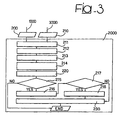
- FIGS. 2 , 3 , and 4 detail the structures of modules 1000, 2000 and 3000. A detailed description of the measurement module 4000 is not necessary herein insofar as such a measurement module is to be regarded as known per se.
- the cellular planning module 1000 as shown in figure 2 is essentially based on an arrangement already known in the art for use in network design related to the voice and data services (e.g. WO-A-02/35872 ).
- the arrangement disclosed herein introduces a new planning process for location services that is based, in addition to those network parameters 100 already considered in the foregoing (namely radio parameters, system characteristics, urbanization parameters, territory morphology and so on) also the network topology information designated 110. This occurs preferably by means of both linear and non-linear functions referred to the concept of dilution of precision (DOP).
- DOP dilution of precision
- a cost function as expressed in the formula above can be defined in the case of LBS once the related DOP parameters are correctly related thereto.
- the arrangement disclosed herein introduces a cellular planning process for location services and produces as a result (designated 200) an optimum planning of voice, data and location services for any type of mobile network.
- the arrangement disclosed herein also checks that the network design is already complied with during actual deployment of the network.
- the analysis module 2000 that takes care of synthesis of the network design proceeds by processing the network design data 200 and those measurements 210 that are carried out on the network by means of the measurement sub-system designated 4000.
- the arrangement disclosed herein provides an indication (under 220) of those critical areas where location services cannot be offered due to the insufficient quality of service and also (under 230) the countermeasures to be effected in the network in order to re-establish a given value of quality of service as desired by the network operator.
- the module 2000 as shown in figure 3 preferably cooperates with the module 3000; this latter module acting as a remote unit that implements a part of the processes on a territory sub-set.
- This has the purpose of offering the end-to-end functions of the whole system by introducing the concept of mobility over the territory where the mobile network apparatus have been deployed according to the network design.
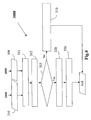
- the module designated 3000 By processing a subset of the network design data 310 ( figure 4 ) together with the measurements 300 performed on the network by means of the measurements module 4000 the module designated 3000 provides an indication of the critical areas for offering location services with a given quality of service over a certain portion of the territory (see figure 4 under 320) and the counter-measures to be carried on the network apparatus ( figure 4 under 330) while also possibly sending pre-validated measurements to the module 2000 (210).
- the three modules above described should be resided in workstations or, generally, servers in order to have at least one central computer system comprising modules 1000 and 2000 and one remote computer system comprising the module 3000.
- Communication among the various computer systems considered herein in terms of network e.g. Public Swiched Telephone Network - PSTN, Integrated Service Digital Network - ISDN, Asymmetric Digital Subscriber Line - ADSL, GSM, General Packet Radio Service - GPRS, UMTS, Wireless Local Area Network - WLAN and so on
- protocols e.g.
- Transmission Control Protocol/Internet Protocol -TCP/IP, Hyper Text Transfer Protocol - HTTP, File Transfer Protocol - FTP, TELNET, Wireless Application Protocol - WAP) takes place according to standard arrangements of the prior art thereby making it unnecessary to provide a detailed description herein.
- f Cost LBS f Topology
- Topology parameters take into account the own location of the network apparatuses and their mutual positioning.
- the optimum of function (1) can be searched by means of iterative processes e.g. by means of a minimum search process or by setting a threshold on the function value or the maximum number of iterations allowed.
- F cost (voice) and F cost (data) can be assumed to be known by known documents (e.g. by public document " Optimisation Problems in Mobile Network Planning" - LEPSHY, MENOLASCINO, MINERVA - CSELT 18-12-1998 ); by using the F cost (LBS) described ahead (15), the process optimises the formula (5) for instance by solving the equation that minimised the cost functions defined by the formula (1) above.
- A, B and C are variable coefficients related to the quality of service desired.
- A, B and C allow to more or less emphasize one of the F cost factors in formula 5 with respect to the others (for instance, to emphasize the voice and data services, A and B could assume values 10 (ten) and 5 (five), respectively, and C the unitary value (one)).
- the arrangement disclosed herein provides an optimal use of a module as shown in figure 1 under 2000 that, by jointly analysing the network design and the measurements actually carried out on the network by means of an external measurements system such as the module designated 4000, identifies the critical areas within the network where the quality of location services becomes critical while also suggesting countermeasures to be adopted in order to lead the quality of service to the desired values. For instance in the case of LBS and of the DOP criteria, one could consider an area as critical when the DOP assumes values from 10 (ten) on (i.e. assuming a root mean square -r.m.s.
- positioning accuracy becomes equal to (50x10) 500 meters); in the case of voice service instead and by the BER criteria one could point out critical area while the BER values are between 10 -1 and 10 -2 (that means an errored bit over 10 or 100 bits).
- the process providing the information on the critical areas in the network calculates the effects of any variations in the network parameters (for instance azimuth, tilt, synchronization loss, and so on) on the accuracy of location with respect to the network design as indicated by 200 in figure 1 .
- the radio models or propagation models adopted, that depend on the operating scenarios (for instance urban, suburban, rural, and so on), are known in the art and do not require a detailed description herein (3GPP TS 25.101 V5.6.0, "3rd Generation Partnership Project; Technical Specification Group Radio Access Network; UE Radio Transmission and Reception (FDD) - Release 5", Annex B - propagation conditions).
- the arrangement disclosed herein provides for the optimal use of the remote computer system via the module 3000 that, by jointly analysing a portion of the network design and the measurements carried out on the corresponding sub-network by the module 4000, identifies critical areas in the network, namely those areas where location services cannot be provided with the desired level of quality of service. Additionally, the module 3000 suggests countermeasures that may be adopted in the network to bring the quality of service back to the desired value and gives back to the module 2000 pre-validated measurements in view of processing over the whole network.
- module 1000 will be described in greater detail in connection with a UMTS network. Specifically the issue will be considered by way of example of planning the addition of a new radio base station (a so-called Node B for the UMTS network) and associated antenna or radiating system to the pre-existing network.
- a new radio base station a so-called Node B for the UMTS network
- associated antenna or radiating system to the pre-existing network.
- the pre-existing network design can be regarded both as additional data and as network data without any change in the validity of the description.
- Cellular network planning is carried out in order to maximise jointly the quality of all the services namely voice services, data services and location services as provided by the network.
- Such an optimisation action is obtained by means of the following functional blocks.
- a first block 111 subdivides the area covered by the planning process into sub-areas.
- One of these sub-areas will correspond to the destination area of the new base station, while the remaining sub-areas will be characterised by the effects due to the introduction of the new base station. Exemplary for this is e.g. an increase in the adjacent channel interference C/I.
- Another block 112 performs (according to principles that are known in the art e.g. by WO-A-02/35872 ) planning of the sub-area that should host the additional base station by computing the effects on the adjacent areas. It will be appreciated that the location data of the new base station (latitude, longitude, altitude) represent input data to the process.
- a further block 113 proper cellular planning is introduced.
- the topological aspects of the area subject to planning are taken into account.
- a DOP value is computed for all the pixels in the area subject to planning.
- ⁇ R 1 ,...., ⁇ R N are assumed to be independent Gaussian processes with zero mean value and variance that is identical for all the processes and equal to .
- ⁇ y 2 ⁇ R 2 . . . ⁇ z 2 ⁇ R 2 diag ⁇ H ⁇ ⁇ T ⁇ H ⁇ ⁇ - 1
- DOP parameters are dimensionless and statistically relate the variance of the measurements of the absolute range with the variance of the location accuracy.
- f CostLBS a average ⁇ DOP ⁇ + b 67 % ⁇ DOP ⁇ + c min ⁇ DOP ⁇
- a, b and c are multiplying coefficients (that is the weights of the cost function) expressing a linear combination of DOP, its average, its 67 percentile value and the minimum value over the area under investigation.
- the process evaluates the correspondence of the quality of service (jointly for voice services, data services and location base services) resulting from the planning process with respect to the desired QoS.
- a possible implementation of the block 115 can be as follows.
- a first sub block minimises the function (1) introduced in the foregoing by identifying the quality of service related to all of the voice, data, and location based services.
- planning at block 112 is subject to review through block 116.
- one or more base stations are located requiring an intervention to be effected in order to optimise (also) planning of location services.
- the base station considered is the newly added one.
- the coordinates of the antenna or radiating system associated to the base station to be used for re-planning are provided to the block 112.
- the position (location) of the antenna is provided by the module 1000.
- the impact of the new base station having been introduced on pre-existing network (that is in the adjacent areas selected by block 111) is investigated by completing the planning process.
- the module 1000 provides some intermediate results on the joint quality of the services in order to yield a joint planning of the network:
- the computer system calculate the joint cost function F c .
- the obtained result could not yield suitable values ( figure 6 and 7 ), block 115; then through the block 116 a new base station position should be computed.
- the module 1000 could process the next step (i.e. in the case a new station have to be added in the network, or evaluates the joint cost function for the pre-selected adjacent areas).
- a first set of input data is represented by the network design 200 that must be checked in order to ascertain the compliance therewith of the actual network situation.
- Such actual situation may in fact be affected by some configurations of the radioelectric parameters being changed due to drift over time or as a consequence of unexpected phenomena such as rainstorms, human errors and so on.
- the design can be loaded into a computer system by the system operator (the data are available by the module 1000) or, optionally, directly by the module 1000 via a direct connection as shown in figure 1 .
- that portion of the network design is considered corresponding to the area affected by the introduction of a new radio site (e.g. a Node B in the UMTS network).
- the values of the parameters measured "in the field" and concerning the base stations subject to analysis are also taken into account.
- those characterising in parameters are considered that are significant for the portion of the network design whose correct execution is to be checked.
- the first block designated 211 selects automatically the service scenario of the area concerned by the analysis project, i,e. the context wherein the services have to be provided.
- the service scenario depends on the degree of urbanisation and on the propagation model and is defined, for example, as urban A, urban B, suburban, rural and so on.
- the method/methods for location are automatically selected for the purpose of analysis.
- the process that identifies the critical areas where the location services do not reach the expected quality of service varies depending on the location method used. Different environments have in fact a different impact on the measures used in the positioning process: as an example, urban and rural areas have different impairment on measurements since the former introduces a multipath impair too.
- the process in question is adapted to discriminate the effects of the variations of the network parameters with respect to the network design depending on the types of measurements that are used for location e.g. time measurements such as TA, EOTD, OTDOA, power measurements P or also additional data such as a Cell Identity (cell ID).
- time measurements such as TA, EOTD, OTDOA, power measurements P or also additional data such as a Cell Identity (cell ID).
- cell ID Cell Identity
- this most accurate method is the one that is most affected by the variations in the network parameters (for instance, in an accurate location environment, its reduction has a very strong effect on the quality of service).
- the parameter or parameters of the network subjected to analysis are selected.
- a possible embodiment provides for automatically selecting the parameter(s) depending on the effect on the location based services.
- the parameters are listed starting from those that have a stronger effect on the network on the basis of the results achieved in the two blocks 211 and 212.
- a block 214 represents the first synthesis step related to data, e.g. table 1 highlights per each reference scenario, the sensitivity of the basic location methods with respect the variation of few network parameters; in particular the date in the table are simulation results which consider a variation as:
- Criterion LBS Criteron ⁇ 1 n ⁇ D
- Criterion ⁇ 2 n number of pixel
- D is a normalization coefficient depending on the service scenario. For instance, in an urban area D can be equal to 200.
- the quality of service is regarded as acceptable if the criterion is higher than or equal to 1.
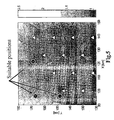
- a suitable scale of the Criterion LBS could adopt as units the values: 0.2, 0.4, 0.6, 0.8, 1, 1.4, 1.2, 1.6 ( figure 9 ).
- the results obtained are further processed to associate to each value of Criterion LBs a corresponding n-pla of input data (service scenario, location method and parameter measured).
- the result obtained in block 214 can be also displayed for instance by means of a map ( figure 9 , the most critical areas in the picture have a dark colour) by indicating the discrete values of the criterion and highlighting the critical situations in the area under analysis.
- a block 215 indicates that the process can be regarded as completed if (1) no critical areas were identified and (2) no interventions on the network parameters are desired.
- a block 216 takes into account the situation where counter measures are intended to be applied. This way of proceeding requires that the "critical" areas in the network be identified first. A possible implementation of such a functional block identifies critical areas as those areas where the Criterion LBS is less than 1.
- a block 217 provides the possibility for an external operator to act on the critical areas previously located. In that way for instance, only those areas covered by the offer of location services may be selected and/or other areas may be added following indications provided by the network operator (for instance with values of Criterion LBS different from 1). If the external operator doesn't act on the system than it evolves towards step or block 230.
- a new set of critical areas is defined including totally or partly those determined automatically by the module 2000 with the addition of those designated by the operator.
- the block designated 230 processes all the data defined in the previous steps according to an order established based on the service scenario, the location method and the network parameters (see the blocks designated 211 to 214) starting from those areas that are most critical for the quality of service of the location service (see the blocks 215 - 220).
- the module employed in the network design as shown in figure 3 under 2000 can be used with some modifications as a remote module in a client/server configuration.
- This arrangement, indicated by 3000 in figure 4 is to be preferred in those application areas that require certain activities to be rendered remote activities (for instance managing a mobile network and checking /certifying its quality).
- the module 3000 according to the functional diagram of figure 4 is to be considered. There a number of inputs to the module 3000 can be identified.
- a first input is comprised of a sub-set of the network design 310 that has to be checked in terms of correct implementation "in the field” by measuring any possible misalignments with respect to the real situation of the network (for instance some configurations of the radioelectric parameters may vary as a consequence of drift over time and unexpected events such as rainstorms and the like).
- the design data can be loaded by the system operator since the data are available in the module 1000 or optionally, directly from the module itself via a direct link as shown in figure 1 .
- the parameters in the radio stations represent other input parameters.
- those parameters are considered that characterise the portion of the network design whose quality is to be tested.
- a first block is designated 311: there, the additional data such as the service scenario and the location method are collected.
- a pre-validation of the measurements effected in the field is introduced. Since the remote unit has the purpose of performing a first synthesis of the location services quality, only those parameters are selected whose variation may have an impact on accuracy of the location once i) the location method used (for instance the power method) and ii) the reference scenario (for instance a rural area) are known.
- Reference 313 designates a block where the decision is taken to whether or not the module 3000 have to processe the inputs; in the positive case it proceedes as the module 2000 of figure 3 ; in the negative case it sends the pre-validated measurements out to the module 2000.
- the network parameter measurements are sent to the remote computer system comprising the module 2000 for data system synthesis and for identifying critical areas as well as possible counter-measures needed for re-establishing the desired quality of service.
- the module 2000 processes data over a portion of territory which is relatively large and comprises all those areas that can form the subject matter of analysis by means of remote client systems such as the ones built up on module 3000.
- module 2000 leads to the two typical results of the complete system 2000 being made available locally without having to take into account the effects on the surrounding portions of the network.
- data synthesis provides information on the critical areas included in the network portion that is subject to analysis.
Landscapes
- Engineering & Computer Science (AREA)
- Computer Networks & Wireless Communication (AREA)
- Signal Processing (AREA)
- Mobile Radio Communication Systems (AREA)
- Management, Administration, Business Operations System, And Electronic Commerce (AREA)
- Financial Or Insurance-Related Operations Such As Payment And Settlement (AREA)
- Multi-Process Working Machines And Systems (AREA)
Claims (19)
- Verfahren zum Planen eines zellularen Kommunikationsnetzes, welches die folgenden Schritte umfasst:- Unterteilen (111) eines Gebiets des Netzes in Teilgebiete, wobei ein Teilgebiet einem geplanten ziel-Teilgebiet einer neuen Basisstation in dem Netz entspricht, wobei erwartet wird, dass die übrigen Teilgebiete von dem Einführen der neuen Basisstation betroffen sein werden;- Planen (112, 113) des Ziel-Teilgebiets durch Bestimmen der Auswirkungen des Einführens auf die übrigen Teilgebiete;- Berechnen wenigstens einer Kostenfunktion (114), wobei die wenigstens eine Kostenfunktion proportional ist zu wenigstens einem Netzparameter, der eine Dienstgüte für standortbezogene Dienste angibt, die von dem geplanten Netz angeboten werden;- Berechnen einer zusammengesetzten Kostenfunktion, welche von der wenigstens einen Kostenfunktion (114) und von Netzparametern abhängt, welche eine Dienstgüte für wenigstens eine zusätzliche Klasse von Diensten angeben, die von dem geplanten Netz angeboten wird, wobei die zusätzliche Klasse von Diensten aus der Gruppe ausgewählt ist, die aus Sprachdiensten und Datendiensten besteht;- Minimieren (115) der zusammengesetzten Kostenfunktion;- Berechnen (115) eines Grads der Dienstgüte der standortbezogenen Dienste und der zusätzlichen Klasse von Diensten, welcher sich aus der Planung (112, 113) ergibt; und- Feststellen, ob der berechnete Grad der Dienstgüte vorbestimmten Anforderungen genügt.
- Verfahren nach Anspruch 1, wobei der wenigstens eine Netzparameter, welcher den Grad der Dienstgüte der standortbezogenen Dienste angibt, ein Topologie-Parameter ist.
- Verfahren nach Anspruch 2, wobei der Topologie-Parameter repräsentativ ist für eine Dilution of Precision des Netzes.
- Verfahren nach Anspruch 1, wobei der Schritt des Berechnens wenigstens einer Kostenfunktion den Schritt des Verwendens des Standorts wenigstens eines Antennensystems, welches der neuen Basisstation zugeordnet ist, als Eingangsdaten, umfasst.
- Verfahren nach Anspruch 3, wobei das Verfahren den Schritt des Berechnens eines Werts, Punkt für Punkt, der Dilution of Precision für alle Pixel in dem Gebiet, welches Gegenstand der Planung ist, umfasst.
- Verfahren nach Anspruch 5, wobei das Verfahren den Schritt des Berechnens der wenigstens einen Kostenfunktion als eine lineare Kombination der Dilution of Precision (DOP) und des Mittelwerts und des Minimalwerts derselben umfasst.
- Verfahren nach Anspruch 1, wobei das Verfahren den Schritt des Neuplanens der Position des wenigstens einen Antennensystems umfasst, welches der neuen Basisstation zugeordnet ist, wenn sich herausstellt, dass die Dienstgüte des standortbezogenen Dienstes und der zusätzlichen Klasse von Diensten den vorbestimmten Anforderungen nicht genügt.
- Verfahren nach Anspruch 1, wobei das Verfahren die Schritte umfasst:- Messen wenigstens eines Netzparameters; und- Vergleichen der Ergebnisse der Messungen mit entsprechenden geplanten Netzparametern.
- Verfahren nach Anspruch 8, wobei das Verfahren den Schritt des Auffindens (220, 320) wenigstens eines kritischen Punkts in dem Netz umfasst, an welchem unzureichende Dienstgüte bereitgestellt ist, auf Basis der Ergebnisse des Vergleichs.
- Verfahren nach Anspruch 9, wobei das Verfahren den Schritt des Erzeugens (215) von Informationseinheiten umfasst, welche Gegenmaßnahmen angeben, die an dem wenigstens einen kritischen Punkt vorzunehmen sind.
- Verfahren nach Anspruch 10, wobei das Verfahren den Schritt des Erzeugens und Darstellens einer Karte der kritischen Punkte in dem Gebiet umfasst, das Gegenstand der Analyse ist.
- Verfahren nach Anspruch 8, wobei das Verfahren die Schritte umfasst:- Auswählen eines Dienstszenarios (211);- Auswählen wenigstens eines Lokalisierungssystems (212) als jenes, das von den Änderungen des wenigstens einen gemessenen Netzparameters am meisten betroffen ist.
- Verarbeitungssystem (1000, 2000, 3000, 4000) zum Planen eines zellularen Kommunikationsnetzes, wobei das System ein erstes Modul (1000) umfasst, welches gestaltet ist zum:- Unterteilen (111) eines Gebiets des Netzes in Teilgebiete, wobei ein Teilgebiet einem geplanten ziel-Teilgebiet einer neuen Basisstation in dem Netz entspricht, wobei erwartet wird, dass die übrigen Teilgebiete von dem Einführen der neuen Basisstation betroffen sein werden;- Planen (112, 113) des Ziel-Teilgebiets durch Bestimmen der Auswirkungen des Einführens auf die übrigen Teilgebiete;- Berechnen wenigstens einer Kostenfunktion (114), wobei die wenigstens eine Kostenfunktion proportional ist zu wenigstens einem Netzparameter, der eine Dienstgüte für standortbezogene Dienste angibt, die von dem geplanten Netz angeboten werden;- Berechnen einer zusammengesetzten Kostenfunktion, welche von der wenigstens einen Kostenfunktion (114) und von Netzparametern abhängt, welche eine Dienstgüte für wenigstens eine zusätzliche Klasse von Diensten angeben, die von dem geplanten Netz angeboten wird, wobei die zusätzliche Klasse von Diensten aus der Gruppe ausgewählt ist, die aus Sprachdiensten und Datendiensten besteht; und- Minimieren (115) der zusammengesetzten Kostenfunktion;- Berechnen (115) eines Grads der Dienstgüte der standortbezogenen Dienste und der zusätzlichen Klasse von Diensten, welcher sich aus der Planung (112, 113) ergibt; und- Feststellen, ob der berechnete Grad der Dienstgüte vorbestimmten Anforderungen genügt.
- System nach Anspruch 13, wobei das System ein zweites und ein drittes Modul (2000, 3000) umfasst, welche gestaltet sind zum Auffinden (220, 320) wenigstens eines kritischen Punkts in dem Netz, an welchem unzureichende Dienstgüte bereitgestellt ist.
- System nach Anspruch 14, wobei das zweite und das dritte Modul (2000, 3000) gestaltet sind zum Erzeugen (215) von Informationseinheiten, welche Gegenmaßnahmen angeben, die an dem wenigstens einen kritischen Punkt vorzunehmen sind.
- System nach Anspruch 15, wobei das zweite Modul (2000) angeordnet ist zum Erzeugen und Darstellen einer Karte der kritischen Punkte in dem Gebiet, das Gegenstand der Analyse ist.
- System nach Anspruch 16, wobei das dritte Modul (3000) ein entfernt einzusetzendes Modul (3000) ist, welches angeordnet ist, an einer Teilanordnung des Netzes zu arbeiten, welches Gegenstand der Planung ist.
- System nach Anspruch 17, wobei das System ein Messsystem (4000) umfasst, und wobei das dritte Modul (3000) gestaltet ist zum:- Sammeln lokaler Netzdaten (311);- Vorauswerten von Messungen (312) von Planungsdaten, ausgeführt durch das Messsystem (4000); und- entweder Vergleichen der Messungen mit entsprechenden Planungsdaten einer Teilanordnung der Netzgestaltung (310) oder Senden derartiger Messungen zu dem zweiten Modul (2000) zum weiteren Verarbeiten.
- Computerprogrammprodukt, welches direkt in den Speicher eines Computers geladen werden kann, und welches Abschnitte von Softwarecode umfasst, die angepasst sind zum Durchführen der Schritte des Verfahrens nach einem der Ansprüche 1 bis 12, wenn das Produkt auf einem Computer ausgeführt wird.
Applications Claiming Priority (1)
| Application Number | Priority Date | Filing Date | Title |
|---|---|---|---|
| PCT/EP2003/008652 WO2005015936A1 (en) | 2003-08-05 | 2003-08-05 | A method for planning cellular communication networks, corresponding network and computer program product therefor |
Publications (2)
| Publication Number | Publication Date |
|---|---|
| EP1654898A1 EP1654898A1 (de) | 2006-05-10 |
| EP1654898B1 true EP1654898B1 (de) | 2011-01-26 |
Family
ID=34129895
Family Applications (1)
| Application Number | Title | Priority Date | Filing Date |
|---|---|---|---|
| EP03817941A Expired - Lifetime EP1654898B1 (de) | 2003-08-05 | 2003-08-05 | Verfahren zur planung von zellularen kommunikationsnetzen, entsprechendes netz und computerprogrammprodukt dafür |
Country Status (6)
| Country | Link |
|---|---|
| US (1) | US8078181B2 (de) |
| EP (1) | EP1654898B1 (de) |
| AT (1) | ATE497335T1 (de) |
| AU (1) | AU2003255374A1 (de) |
| DE (1) | DE60335919D1 (de) |
| WO (1) | WO2005015936A1 (de) |
Cited By (1)
| Publication number | Priority date | Publication date | Assignee | Title |
|---|---|---|---|---|
| US20220007203A1 (en) * | 2020-07-06 | 2022-01-06 | City University Of Hong Kong | Method for determining wireless communication network layout |
Families Citing this family (9)
| Publication number | Priority date | Publication date | Assignee | Title |
|---|---|---|---|---|
| GB0401767D0 (en) * | 2004-01-27 | 2004-03-03 | Koninkl Philips Electronics Nv | Positioning systems |
| KR101176215B1 (ko) * | 2008-12-11 | 2012-08-22 | 한국전자통신연구원 | 무선측위용 액세스포인트 배치 장치 및 그 방법 |
| JP5598475B2 (ja) * | 2009-08-26 | 2014-10-01 | 日本電気株式会社 | ネットワーク運用システム、ネットワーク運用方法、及びネットワーク運用プログラム |
| US9252982B2 (en) | 2010-10-21 | 2016-02-02 | Marshall Jobe | System and method for simulating a land mobile radio system |
| US9774386B2 (en) | 2013-03-15 | 2017-09-26 | E.F. Johnson Company | Distributed simulcast architecture |
| US9800460B2 (en) | 2014-08-01 | 2017-10-24 | E.F. Johnson Company | Interoperability gateway for land mobile radio system |
| US9763260B2 (en) | 2014-11-06 | 2017-09-12 | E.F. Johnson Company | System and method for dynamic channel allocaton |
| US10970724B2 (en) | 2017-01-06 | 2021-04-06 | At&T Intellectual Property I, L.P. | Generating telecommunication network construction zones via clustering on weighted adjacency graphs of distribution areas |
| US12219420B2 (en) | 2022-03-10 | 2025-02-04 | T-Mobile Usa, Inc. | Dynamically adjusting a service plan provided to a UE by a wireless telecommunication network |
Family Cites Families (12)
| Publication number | Priority date | Publication date | Assignee | Title |
|---|---|---|---|---|
| US5987328A (en) * | 1997-04-24 | 1999-11-16 | Ephremides; Anthony | Method and device for placement of transmitters in wireless networks |
| US6154657A (en) * | 1997-10-21 | 2000-11-28 | Telefonaktiebolaget Lm Ericsson | Smart subdivision of base station candidates for position location accuracy |
| US6336035B1 (en) * | 1998-11-19 | 2002-01-01 | Nortel Networks Limited | Tools for wireless network planning |
| US6771966B1 (en) * | 1999-03-29 | 2004-08-03 | Carriercomm, Inc. | System and method for an automated radio network planning tool |
| US6836467B2 (en) * | 1999-12-14 | 2004-12-28 | Verizon Laboratories Inc. | Method for modeling radioports in a wireless communication network design |
| US6556832B1 (en) | 2000-02-04 | 2003-04-29 | Qualcomm Incorporated | Method and apparatus for evaluation of position location performance |
| WO2001072071A1 (en) | 2000-03-21 | 2001-09-27 | Motorola Inc. | Method of defining network cells in a communications network |
| IT1320733B1 (it) * | 2000-10-27 | 2003-12-10 | Cselt Centro Studi Lab Telecom | Sistema e metodo per la pianificazione di una rete per apparecchiature mobili di telecomunicazioni. |
| US6968195B2 (en) * | 2001-03-01 | 2005-11-22 | Openwave Systems Inc. | Enhanced PDE selection |
| US6829491B1 (en) * | 2001-08-15 | 2004-12-07 | Kathrein-Werke Kg | Dynamic and self-optimizing smart network |
| US7596373B2 (en) * | 2002-03-21 | 2009-09-29 | Mcgregor Christopher M | Method and system for quality of service (QoS) monitoring for wireless devices |
| US7295960B2 (en) * | 2003-01-22 | 2007-11-13 | Wireless Valley Communications, Inc. | System and method for automated placement or configuration of equipment for obtaining desired network performance objectives |
-
2003
- 2003-08-05 AU AU2003255374A patent/AU2003255374A1/en not_active Abandoned
- 2003-08-05 WO PCT/EP2003/008652 patent/WO2005015936A1/en not_active Ceased
- 2003-08-05 EP EP03817941A patent/EP1654898B1/de not_active Expired - Lifetime
- 2003-08-05 AT AT03817941T patent/ATE497335T1/de not_active IP Right Cessation
- 2003-08-05 US US10/566,677 patent/US8078181B2/en active Active
- 2003-08-05 DE DE60335919T patent/DE60335919D1/de not_active Expired - Lifetime
Cited By (2)
| Publication number | Priority date | Publication date | Assignee | Title |
|---|---|---|---|---|
| US20220007203A1 (en) * | 2020-07-06 | 2022-01-06 | City University Of Hong Kong | Method for determining wireless communication network layout |
| US11627473B2 (en) * | 2020-07-06 | 2023-04-11 | City University Of Hong Kong | Method for determining wireless communication network layout |
Also Published As
| Publication number | Publication date |
|---|---|
| DE60335919D1 (de) | 2011-03-10 |
| US8078181B2 (en) | 2011-12-13 |
| AU2003255374A1 (en) | 2005-02-25 |
| US20060217120A1 (en) | 2006-09-28 |
| WO2005015936A1 (en) | 2005-02-17 |
| EP1654898A1 (de) | 2006-05-10 |
| ATE497335T1 (de) | 2011-02-15 |
Similar Documents
| Publication | Publication Date | Title |
|---|---|---|
| US11800373B2 (en) | System and method for 3D propagation modelling for planning of a radio network | |
| US8326320B2 (en) | Method and locating device for locating at least one mobile radio subscriber | |
| CN101060689B (zh) | 通信系统网络规划的方法和设备 | |
| US8786494B2 (en) | Method to modify calibration data used to locate a mobile unit | |
| US7797000B2 (en) | System for automatically determining cell transmitter parameters to facilitate the location of wireless devices | |
| US8965393B2 (en) | Estimating the location of a wireless terminal based on assisted GPS and pattern matching | |
| US7848762B2 (en) | Computationally-efficient estimation of the location of a wireless terminal based on pattern matching | |
| US7753278B2 (en) | Estimating the location of a wireless terminal based on non-uniform locations | |
| US7257414B2 (en) | Estimating the Location of a Wireless Terminal Based on Non-Uniform Probabilities of Movement | |
| US6285664B1 (en) | Method and apparatus for estimating pilot coverages | |
| US7734298B2 (en) | Estimating the location of a wireless terminal based on signal path impairment | |
| EP3293539A1 (de) | Verwendung von mobilstationen zur bestimmung von basisstationstandortparametern in einem drahtlosen mobilen kommunikationssystem | |
| US20060240845A1 (en) | Estimating the Location of a Wireless Terminal Based on the Traits of the Multipath Components of a Signal | |
| Popoola et al. | Calibrating the standard path loss model for urban environments using field measurements and geospatial data | |
| US8571577B2 (en) | Estimating the location of a wireless terminal based on signal path impairment | |
| EP1654898B1 (de) | Verfahren zur planung von zellularen kommunikationsnetzen, entsprechendes netz und computerprogrammprodukt dafür | |
| CN109471134A (zh) | 地理定位分析系统和运营商网络装备参数的自动校准 | |
| CN106796277A (zh) | 移动通信网络中的位置调整 | |
| US6665542B1 (en) | System and method for cumulative clutter path loss | |
| EP3700253B1 (de) | Vorhersage der geografischen verteilung der mobilkommunikationsnetzqualität | |
| Rodriguez et al. | Propagation characteristics of Managua city based on Standard Propagation Model (SPM) at 850 MHz for 3G-WCDMA systems | |
| Schmitz et al. | A new method for positioning of mobile users by comparing a time series of measured reception power levels with predictions | |
| Almăjanu et al. | Radio coverage analysis for mobile communication networks using ics telecom | |
| US20080096596A1 (en) | Apparatus And Method For Optimising A Spread Spectrum Cellular Communication System | |
| Neuland et al. | Influence of different factors on X-map estimation in LTE |
Legal Events
| Date | Code | Title | Description |
|---|---|---|---|
| PUAI | Public reference made under article 153(3) epc to a published international application that has entered the european phase |
Free format text: ORIGINAL CODE: 0009012 |
|
| 17P | Request for examination filed |
Effective date: 20060124 |
|
| AK | Designated contracting states |
Kind code of ref document: A1 Designated state(s): AT BE BG CH CY CZ DE DK EE ES FI FR GB GR HU IE IT LI LU MC NL PT RO SE SI SK TR |
|
| 17Q | First examination report despatched |
Effective date: 20060922 |
|
| DAX | Request for extension of the european patent (deleted) | ||
| RIC1 | Information provided on ipc code assigned before grant |
Ipc: H04W 16/18 20090101AFI20100701BHEP |
|
| GRAP | Despatch of communication of intention to grant a patent |
Free format text: ORIGINAL CODE: EPIDOSNIGR1 |
|
| GRAS | Grant fee paid |
Free format text: ORIGINAL CODE: EPIDOSNIGR3 |
|
| GRAA | (expected) grant |
Free format text: ORIGINAL CODE: 0009210 |
|
| AK | Designated contracting states |
Kind code of ref document: B1 Designated state(s): AT BE BG CH CY CZ DE DK EE ES FI FR GB GR HU IE IT LI LU MC NL PT RO SE SI SK TR |
|
| REG | Reference to a national code |
Ref country code: GB Ref legal event code: FG4D |
|
| REG | Reference to a national code |
Ref country code: CH Ref legal event code: EP |
|
| REG | Reference to a national code |
Ref country code: IE Ref legal event code: FG4D |
|
| REF | Corresponds to: |
Ref document number: 60335919 Country of ref document: DE Date of ref document: 20110310 Kind code of ref document: P |
|
| REG | Reference to a national code |
Ref country code: DE Ref legal event code: R096 Ref document number: 60335919 Country of ref document: DE Effective date: 20110310 |
|
| REG | Reference to a national code |
Ref country code: NL Ref legal event code: VDEP Effective date: 20110126 |
|
| PG25 | Lapsed in a contracting state [announced via postgrant information from national office to epo] |
Ref country code: GR Free format text: LAPSE BECAUSE OF FAILURE TO SUBMIT A TRANSLATION OF THE DESCRIPTION OR TO PAY THE FEE WITHIN THE PRESCRIBED TIME-LIMIT Effective date: 20110427 Ref country code: PT Free format text: LAPSE BECAUSE OF FAILURE TO SUBMIT A TRANSLATION OF THE DESCRIPTION OR TO PAY THE FEE WITHIN THE PRESCRIBED TIME-LIMIT Effective date: 20110526 Ref country code: SE Free format text: LAPSE BECAUSE OF FAILURE TO SUBMIT A TRANSLATION OF THE DESCRIPTION OR TO PAY THE FEE WITHIN THE PRESCRIBED TIME-LIMIT Effective date: 20110126 Ref country code: ES Free format text: LAPSE BECAUSE OF FAILURE TO SUBMIT A TRANSLATION OF THE DESCRIPTION OR TO PAY THE FEE WITHIN THE PRESCRIBED TIME-LIMIT Effective date: 20110507 |
|
| PG25 | Lapsed in a contracting state [announced via postgrant information from national office to epo] |
Ref country code: FI Free format text: LAPSE BECAUSE OF FAILURE TO SUBMIT A TRANSLATION OF THE DESCRIPTION OR TO PAY THE FEE WITHIN THE PRESCRIBED TIME-LIMIT Effective date: 20110126 Ref country code: SI Free format text: LAPSE BECAUSE OF FAILURE TO SUBMIT A TRANSLATION OF THE DESCRIPTION OR TO PAY THE FEE WITHIN THE PRESCRIBED TIME-LIMIT Effective date: 20110126 Ref country code: BG Free format text: LAPSE BECAUSE OF FAILURE TO SUBMIT A TRANSLATION OF THE DESCRIPTION OR TO PAY THE FEE WITHIN THE PRESCRIBED TIME-LIMIT Effective date: 20110426 Ref country code: NL Free format text: LAPSE BECAUSE OF FAILURE TO SUBMIT A TRANSLATION OF THE DESCRIPTION OR TO PAY THE FEE WITHIN THE PRESCRIBED TIME-LIMIT Effective date: 20110126 Ref country code: BE Free format text: LAPSE BECAUSE OF FAILURE TO SUBMIT A TRANSLATION OF THE DESCRIPTION OR TO PAY THE FEE WITHIN THE PRESCRIBED TIME-LIMIT Effective date: 20110126 Ref country code: CY Free format text: LAPSE BECAUSE OF FAILURE TO SUBMIT A TRANSLATION OF THE DESCRIPTION OR TO PAY THE FEE WITHIN THE PRESCRIBED TIME-LIMIT Effective date: 20110126 Ref country code: AT Free format text: LAPSE BECAUSE OF FAILURE TO SUBMIT A TRANSLATION OF THE DESCRIPTION OR TO PAY THE FEE WITHIN THE PRESCRIBED TIME-LIMIT Effective date: 20110126 |
|
| PG25 | Lapsed in a contracting state [announced via postgrant information from national office to epo] |
Ref country code: EE Free format text: LAPSE BECAUSE OF FAILURE TO SUBMIT A TRANSLATION OF THE DESCRIPTION OR TO PAY THE FEE WITHIN THE PRESCRIBED TIME-LIMIT Effective date: 20110126 Ref country code: DK Free format text: LAPSE BECAUSE OF FAILURE TO SUBMIT A TRANSLATION OF THE DESCRIPTION OR TO PAY THE FEE WITHIN THE PRESCRIBED TIME-LIMIT Effective date: 20110126 |
|
| PG25 | Lapsed in a contracting state [announced via postgrant information from national office to epo] |
Ref country code: RO Free format text: LAPSE BECAUSE OF FAILURE TO SUBMIT A TRANSLATION OF THE DESCRIPTION OR TO PAY THE FEE WITHIN THE PRESCRIBED TIME-LIMIT Effective date: 20110126 Ref country code: SK Free format text: LAPSE BECAUSE OF FAILURE TO SUBMIT A TRANSLATION OF THE DESCRIPTION OR TO PAY THE FEE WITHIN THE PRESCRIBED TIME-LIMIT Effective date: 20110126 Ref country code: CZ Free format text: LAPSE BECAUSE OF FAILURE TO SUBMIT A TRANSLATION OF THE DESCRIPTION OR TO PAY THE FEE WITHIN THE PRESCRIBED TIME-LIMIT Effective date: 20110126 |
|
| PLBE | No opposition filed within time limit |
Free format text: ORIGINAL CODE: 0009261 |
|
| STAA | Information on the status of an ep patent application or granted ep patent |
Free format text: STATUS: NO OPPOSITION FILED WITHIN TIME LIMIT |
|
| 26N | No opposition filed |
Effective date: 20111027 |
|
| REG | Reference to a national code |
Ref country code: DE Ref legal event code: R097 Ref document number: 60335919 Country of ref document: DE Effective date: 20111027 |
|
| PG25 | Lapsed in a contracting state [announced via postgrant information from national office to epo] |
Ref country code: MC Free format text: LAPSE BECAUSE OF NON-PAYMENT OF DUE FEES Effective date: 20110831 |
|
| REG | Reference to a national code |
Ref country code: CH Ref legal event code: PL |
|
| PG25 | Lapsed in a contracting state [announced via postgrant information from national office to epo] |
Ref country code: CH Free format text: LAPSE BECAUSE OF NON-PAYMENT OF DUE FEES Effective date: 20110831 Ref country code: LI Free format text: LAPSE BECAUSE OF NON-PAYMENT OF DUE FEES Effective date: 20110831 |
|
| REG | Reference to a national code |
Ref country code: IE Ref legal event code: MM4A |
|
| PG25 | Lapsed in a contracting state [announced via postgrant information from national office to epo] |
Ref country code: IE Free format text: LAPSE BECAUSE OF NON-PAYMENT OF DUE FEES Effective date: 20110805 |
|
| PG25 | Lapsed in a contracting state [announced via postgrant information from national office to epo] |
Ref country code: LU Free format text: LAPSE BECAUSE OF NON-PAYMENT OF DUE FEES Effective date: 20110805 |
|
| PG25 | Lapsed in a contracting state [announced via postgrant information from national office to epo] |
Ref country code: TR Free format text: LAPSE BECAUSE OF FAILURE TO SUBMIT A TRANSLATION OF THE DESCRIPTION OR TO PAY THE FEE WITHIN THE PRESCRIBED TIME-LIMIT Effective date: 20110126 |
|
| PG25 | Lapsed in a contracting state [announced via postgrant information from national office to epo] |
Ref country code: HU Free format text: LAPSE BECAUSE OF FAILURE TO SUBMIT A TRANSLATION OF THE DESCRIPTION OR TO PAY THE FEE WITHIN THE PRESCRIBED TIME-LIMIT Effective date: 20110126 |
|
| REG | Reference to a national code |
Ref country code: FR Ref legal event code: PLFP Year of fee payment: 14 |
|
| REG | Reference to a national code |
Ref country code: FR Ref legal event code: PLFP Year of fee payment: 15 |
|
| REG | Reference to a national code |
Ref country code: FR Ref legal event code: PLFP Year of fee payment: 16 |
|
| PGFP | Annual fee paid to national office [announced via postgrant information from national office to epo] |
Ref country code: IT Payment date: 20220819 Year of fee payment: 20 Ref country code: GB Payment date: 20220829 Year of fee payment: 20 Ref country code: DE Payment date: 20220829 Year of fee payment: 20 |
|
| PGFP | Annual fee paid to national office [announced via postgrant information from national office to epo] |
Ref country code: FR Payment date: 20220825 Year of fee payment: 20 |
|
| P01 | Opt-out of the competence of the unified patent court (upc) registered |
Effective date: 20230528 |
|
| P02 | Opt-out of the competence of the unified patent court (upc) changed |
Effective date: 20230601 |
|
| REG | Reference to a national code |
Ref country code: DE Ref legal event code: R071 Ref document number: 60335919 Country of ref document: DE |
|
| REG | Reference to a national code |
Ref country code: GB Ref legal event code: PE20 Expiry date: 20230804 |
|
| PG25 | Lapsed in a contracting state [announced via postgrant information from national office to epo] |
Ref country code: GB Free format text: LAPSE BECAUSE OF EXPIRATION OF PROTECTION Effective date: 20230804 |