EP1643673A1 - Wireless data communication - Google Patents
Wireless data communication Download PDFInfo
- Publication number
- EP1643673A1 EP1643673A1 EP05112972A EP05112972A EP1643673A1 EP 1643673 A1 EP1643673 A1 EP 1643673A1 EP 05112972 A EP05112972 A EP 05112972A EP 05112972 A EP05112972 A EP 05112972A EP 1643673 A1 EP1643673 A1 EP 1643673A1
- Authority
- EP
- European Patent Office
- Prior art keywords
- data
- buffer
- wireless communication
- communication apparatus
- sent
- Prior art date
- Legal status (The legal status is an assumption and is not a legal conclusion. Google has not performed a legal analysis and makes no representation as to the accuracy of the status listed.)
- Ceased
Links
Images
Classifications
-
- H—ELECTRICITY
- H04—ELECTRIC COMMUNICATION TECHNIQUE
- H04B—TRANSMISSION
- H04B7/00—Radio transmission systems, i.e. using radiation field
- H04B7/24—Radio transmission systems, i.e. using radiation field for communication between two or more posts
- H04B7/26—Radio transmission systems, i.e. using radiation field for communication between two or more posts at least one of which is mobile
-
- H—ELECTRICITY
- H04—ELECTRIC COMMUNICATION TECHNIQUE
- H04L—TRANSMISSION OF DIGITAL INFORMATION, e.g. TELEGRAPHIC COMMUNICATION
- H04L1/00—Arrangements for detecting or preventing errors in the information received
- H04L1/12—Arrangements for detecting or preventing errors in the information received by using return channel
- H04L1/16—Arrangements for detecting or preventing errors in the information received by using return channel in which the return channel carries supervisory signals, e.g. repetition request signals
- H04L1/1607—Details of the supervisory signal
-
- H—ELECTRICITY
- H04—ELECTRIC COMMUNICATION TECHNIQUE
- H04L—TRANSMISSION OF DIGITAL INFORMATION, e.g. TELEGRAPHIC COMMUNICATION
- H04L1/00—Arrangements for detecting or preventing errors in the information received
- H04L1/12—Arrangements for detecting or preventing errors in the information received by using return channel
- H04L1/16—Arrangements for detecting or preventing errors in the information received by using return channel in which the return channel carries supervisory signals, e.g. repetition request signals
- H04L1/18—Automatic repetition systems, e.g. Van Duuren systems
- H04L1/1867—Arrangements specially adapted for the transmitter end
- H04L1/1874—Buffer management
- H04L1/1877—Buffer management for semi-reliable protocols, e.g. for less sensitive applications like streaming video
-
- H—ELECTRICITY
- H04—ELECTRIC COMMUNICATION TECHNIQUE
- H04L—TRANSMISSION OF DIGITAL INFORMATION, e.g. TELEGRAPHIC COMMUNICATION
- H04L1/00—Arrangements for detecting or preventing errors in the information received
- H04L1/12—Arrangements for detecting or preventing errors in the information received by using return channel
- H04L1/16—Arrangements for detecting or preventing errors in the information received by using return channel in which the return channel carries supervisory signals, e.g. repetition request signals
-
- H—ELECTRICITY
- H04—ELECTRIC COMMUNICATION TECHNIQUE
- H04L—TRANSMISSION OF DIGITAL INFORMATION, e.g. TELEGRAPHIC COMMUNICATION
- H04L1/00—Arrangements for detecting or preventing errors in the information received
- H04L1/12—Arrangements for detecting or preventing errors in the information received by using return channel
- H04L1/16—Arrangements for detecting or preventing errors in the information received by using return channel in which the return channel carries supervisory signals, e.g. repetition request signals
- H04L1/18—Automatic repetition systems, e.g. Van Duuren systems
- H04L1/1867—Arrangements specially adapted for the transmitter end
- H04L1/1874—Buffer management
-
- H—ELECTRICITY
- H04—ELECTRIC COMMUNICATION TECHNIQUE
- H04L—TRANSMISSION OF DIGITAL INFORMATION, e.g. TELEGRAPHIC COMMUNICATION
- H04L1/00—Arrangements for detecting or preventing errors in the information received
- H04L1/12—Arrangements for detecting or preventing errors in the information received by using return channel
- H04L1/16—Arrangements for detecting or preventing errors in the information received by using return channel in which the return channel carries supervisory signals, e.g. repetition request signals
- H04L1/18—Automatic repetition systems, e.g. Van Duuren systems
- H04L1/1867—Arrangements specially adapted for the transmitter end
- H04L1/188—Time-out mechanisms
-
- H—ELECTRICITY
- H04—ELECTRIC COMMUNICATION TECHNIQUE
- H04L—TRANSMISSION OF DIGITAL INFORMATION, e.g. TELEGRAPHIC COMMUNICATION
- H04L1/00—Arrangements for detecting or preventing errors in the information received
- H04L2001/0092—Error control systems characterised by the topology of the transmission link
- H04L2001/0094—Bus
-
- H—ELECTRICITY
- H04—ELECTRIC COMMUNICATION TECHNIQUE
- H04W—WIRELESS COMMUNICATION NETWORKS
- H04W28/00—Network traffic management; Network resource management
- H04W28/02—Traffic management, e.g. flow control or congestion control
- H04W28/10—Flow control between communication endpoints
- H04W28/14—Flow control between communication endpoints using intermediate storage
Definitions
- the present invention relates to a method of wirelessly transmitting a data packet, the method comprising, in an initiating apparatus, transferring data from a buffer for transmission, and determining whether said data has been transmitted.
- Bluetooth is a recently developed standard for wireless communication over ranges of 10m to 100m with speeds of up to 1Mbps.
- the Bluetooth system uses the ISM (Industrial Scientific Medical) band at 2.4GHz.
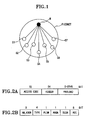
- Figure 1 shows the structure of a Bluetooth piconet.
- a piconet is formed such that a plurality of slave devices (S 1 - S 7 ) are connected to a master device (M). At most, seven slave devices (S 1 - S 7 ) can be connected to the master device (M) in an active mode in one piconet. In the piconet, the master device (M) and the slave devices (S 1 - S 7 ) communicate using packets.
- Figure 2A shows the structure of the packets transmitted in the piconet shown in Figure 1.
- Figure 2B shows the header of the packet in more detail.
- a packet header has a total of 18 bits consisiting of AM_ADDR, TYPE, FLOW, ARQN, SEQN and HEC fields.
- ARQN consists of 1 bit and is an acknowledgement indicator, used for notifying a source of a successful transmission without CRC (Cyclic Redundancy Check) errors.
- a response message having acknowledge information takes one of two forms: positive acknowledgement (ACK) and negative acknowledgement (NAK).
- ACK positive acknowledgement
- NAK negative acknowledgement
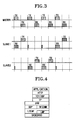
- the master device and the slave devices perform bi-directional communication by a TDD (Time Division Duplex) method as shown in Figure 3.
- the master device designates and transmits data to a target slave device in a Tx slot.
- the 1s and 2s in the Tx slots of the master indicate that they are for slave 1 and slave 2 respectively.
- the slave devices receive data from the master in the corresponding Rx slots of their own timebases.
- Figure 4 illustrates the Bluetooth protocol stack.
- LMP Link Manager Protocol
- the LMP layer establishes a link between a source wireless communication apparatus and a destination wireless communication apparatus, and manages security and control thereof.
- the LMP layer builds a packet containing a response message to a request-to-send message.
- the source wireless communication apparatus After sending a request-to-send message, the source wireless communication apparatus must receive a response message from the destination wireless communication apparatus within a predetermined time, in other words within an LMP response time. Therefore, the source wireless communication apparatus confirms the acknowledgement information relating to the request message or whether the request message has been received by the destination wireless communication apparatus, then determines whether to re-send the request message or to perform the next operation according to the message flow.
- the source wireless communication apparatus confirms whether the destination wireless communication apparatus received a signal, a baseband layer (refer to Figure 4) analyses acknowledge information included in the header of a Null packet, or an ARQN value included in the header is judged and acknowledgement information is offered to the LMP layer.
- a wireless communication apparatus having a Bluetooth module processes the received null packet in the baseband after sending the first message and offers acknowledgement information to the LMP layer.
- the LMP layer determines whether to send a second message or to send the first message again, using the acknowledgement information received from the baseband layer.
- a request message is sent in a Bluetooth communication, it can be determined whether the request message has been sent successfully by the transmission of the acknowledgement information from the baseband layer to the LMP layer.
- the present invention has been made to overcome the above-mentioned problems of the related art.
- a wireless communication apparatus for transceiving data, that receives an acknowledgement (ACK) message upon completing data transmission
- the wireless communication apparatus comprising a transceiving unit for transmitting and receiving data to and from an external apparatus; a buffer for storing data to be transmitted and having an indicator for indicating an existence of data; and a controller for checking the indicator of the buffer when the ACK message is not received and confirming that the data is sent to the destination wireless communication apparatus successfully if there is no data in the buffer.
- the controller checks the indicator of the buffer, and if there is no data in the buffer, confirms that the data is sent to the destination successfully.
- a method being characterised in that said data is determined to have been transmitted if it is not in said buffer at the end of a time interval beginning when said data is stored in the buffer.
- a method according to the present invention comprises setting a flag when said data is stored in the buffer and resetting the flag when said data is transferred from the buffer, and said data is determined to have been transmitted by checking the state of said flag at the end of said time interval.
- a method according to the present invention includes starting a timer operation in conjunction with the storing of said data in the buffer for establishing said interval.
- a method of wirelessly transmitting a plurality of data packets comprising, in an initiating apparatus:-
- a method of transmitting a plurality of packets according to the present invention comprises, at a responsive apparatus:
- the present invention extends to an apparatus configured to perform a method according to the present invention.
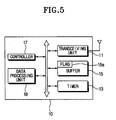
- a wireless communication apparatus 10 comprises a transceiving unit 11, a timer 13, a buffer 15, a controller 17 and a data processing unit 18.
- the transceiving unit 11 processes received RF signals in the 2.4GHz band, and transmits packets as RF signals.
- the wireless communication apparatus can confirm that the has been sent correctly by checking the flag 15a.
- the timer 13 determines the timing of the checking of whether data has been sent successfully.
- the time for checking whether the data has been sent successfully has to be less than the LMP response timeout (30 seconds) or the supervision timeout (default 20 seconds, maximum 40.9 seconds).
- the controller 17 implements the baseband layer of a protocol stack corresponding to that of the Bluetooth standard as shown in Figure 4, and communicates with a host connected via a HCI (Host Controller Interface) (not shown).
- HCI Home Controller Interface
- the host can be any of various devices that can operated as communication terminals such as laptop computers, cellular phones, and printers.
- the data processing unit 18 implements a protocol stack layer corresponding to the LMP layer of the Bluetooth protocol stack as shown in Figure 4, and performs functions including controlling the transceiving unit 11, link control, controlling the logic channel, data whitening, address allocation and security. In addition, the data processing unit 18 confirms that data has been sent successfully by checking the flag 15a of the buffer 15 when transmitting data packets having no response message, and transmits request message data of its own after receiving request message data from another wireless communication apparatus, namely more than two different types of message data consecutively.
- the data processing unit 18 confirms the transmission of the data by checking the flag 15a of the buffer 15 when the time set in the timer 15 is exceeded. At that time, if the flag 15a indicates 'false', then it is determined that the data has been sent successfully.
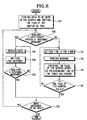
- the wireless communication apparatus stores the data in the buffer 15 and sets the flag 15a of the buffer 15 as 'true' (step 101). Then, the wireless communication apparatus checks whether the data intended to be sent is a data packet having a response message (step 102).
- the wireless communication apparatus waits for the reception of a response message during the LMP layer response time. After that, the wireless communication apparatus checks for the reception of the response message (step 108), and if the response message has not been received, the data is re-sent.
- the wireless communication apparatus After checking that the data has been transmitted successfully, the wireless communication apparatus again checks whether there is more data to be sent (step 120). If there is more data to be sent, the wireless communication apparatus returns to the step 102.
- the waiting time for checking whether the data has been transmitted successfully is set in the timer 13 (step 112). Then, the data is read from the buffer 15 and sent in a Tx slot (step 114).
- the wireless communication apparatus After the time, set in the timer 13, has been exceeded, the wireless communication apparatus checks the flag 15a of the buffer 15 (step 116). If the flag 15a of the buffer 15 indicates 'true,' it means that data is stored in the buffer 15. Thus it is confirmed that the data has not been sent to a destination wireless communication apparatus. Therefore, the wireless communication apparatus returns to step 112, sets the time in the timer 13, then repeats from step 114 to step 118. However, if the flag 15a of the buffer 15 indicates 'false,' it means that the data has been sent.
- the wireless communication apparatus confirms that the data has been successfully sent to the destination wireless communication apparatus.
- the source wireless communication apparatus After confirming the successful sending of data, the source wireless communication apparatus checks whether there is more data to be sent. If there is more data to be sent, the source wireless communication apparatus returns to step 102.
- the successful transmission of data can be easily checked.
- the baseband processing load is decreased vis-à-vis the prior art and the signalling interface between the baseband and the LMP layers is reduced.
Landscapes
- Engineering & Computer Science (AREA)
- Computer Networks & Wireless Communication (AREA)
- Signal Processing (AREA)
- Multimedia (AREA)
- Mobile Radio Communication Systems (AREA)
- Transmitters (AREA)
- Small-Scale Networks (AREA)
Abstract
Description
- The present invention relates to a method of wirelessly transmitting a data packet, the method comprising, in an initiating apparatus, transferring data from a buffer for transmission, and determining whether said data has been transmitted.
- Bluetooth is a recently developed standard for wireless communication over ranges of 10m to 100m with speeds of up to 1Mbps.
- The Bluetooth system uses the ISM (Industrial Scientific Medical) band at 2.4GHz.
- Figure 1 shows the structure of a Bluetooth piconet.
- Referring to Figure 1, in a Bluetooth communication system, a piconet is formed such that a plurality of slave devices (S1 - S7) are connected to a master device (M). At most, seven slave devices (S1 - S7) can be connected to the master device (M) in an active mode in one piconet. In the piconet, the master device (M) and the slave devices (S1 - S7) communicate using packets.
- Figure 2A shows the structure of the packets transmitted in the piconet shown in Figure 1. Figure 2B shows the header of the packet in more detail.
- Referring to Figure 2B, a packet header has a total of 18 bits consisiting of AM_ADDR, TYPE, FLOW, ARQN, SEQN and HEC fields.
- ARQN consists of 1 bit and is an acknowledgement indicator, used for notifying a source of a successful transmission without CRC (Cyclic Redundancy Check) errors.
- A response message having acknowledge information takes one of two forms: positive acknowledgement (ACK) and negative acknowledgement (NAK). The ACK is sent by setting ARQN to 1 and the NAK is sent by setting ARQN to 0.
- Moreover, in Bluetooth communication, the master device and the slave devices perform bi-directional communication by a TDD (Time Division Duplex) method as shown in Figure 3. The master device designates and transmits data to a target slave device in a Tx slot. In Figure 3, the 1s and 2s in the Tx slots of the master indicate that they are for
slave 1 and slave 2 respectively. The slave devices receive data from the master in the corresponding Rx slots of their own timebases. - Figure 4 illustrates the Bluetooth protocol stack.
- LMP (Link Manager Protocol) layer establishes a link between a source wireless communication apparatus and a destination wireless communication apparatus, and manages security and control thereof. The LMP layer builds a packet containing a response message to a request-to-send message.
- After sending a request-to-send message, the source wireless communication apparatus must receive a response message from the destination wireless communication apparatus within a predetermined time, in other words within an LMP response time. Therefore, the source wireless communication apparatus confirms the acknowledgement information relating to the request message or whether the request message has been received by the destination wireless communication apparatus, then determines whether to re-send the request message or to perform the next operation according to the message flow.
- On the other hand, in the LMP layer, when a piconet does not have a response message, the source wireless communication apparatus confirms whether the destination wireless communication apparatus received a signal, a baseband layer (refer to Figure 4) analyses acknowledge information included in the header of a Null packet, or an ARQN value included in the header is judged and acknowledgement information is offered to the LMP layer.
- In addition, when sending request information, that is when sending more than two different data messages consecutively, after receiving request message data from another wireless communication apparatus, a wireless communication apparatus having a Bluetooth module processes the received null packet in the baseband after sending the first message and offers acknowledgement information to the LMP layer.
- Then, the LMP layer determines whether to send a second message or to send the first message again, using the acknowledgement information received from the baseband layer.
- As described above, if a request message is sent in a Bluetooth communication, it can be determined whether the request message has been sent successfully by the transmission of the acknowledgement information from the baseband layer to the LMP layer.
- Therefore, it causes overload in the baseband layer, and there is increased signalling between the baseband layer and the LMP layer.
- The present invention has been made to overcome the above-mentioned problems of the related art.
- According to a first aspect of the present invention there is provided a wireless communication apparatus for transceiving data, that receives an acknowledgement (ACK) message upon completing data transmission, the wireless communication apparatus comprising a transceiving unit for transmitting and receiving data to and from an external apparatus; a buffer for storing data to be transmitted and having an indicator for indicating an existence of data; and a controller for checking the indicator of the buffer when the ACK message is not received and confirming that the data is sent to the destination wireless communication apparatus successfully if there is no data in the buffer.
- Preferably, when the wireless communication apparatus for transceiving data does not receive the ACK message even upon completing data transmission, the controller checks the indicator of the buffer, and if there is no data in the buffer, confirms that the data is sent to the destination successfully.
- There is envisaged a corresponding method associated with the first aspect.
- According to another aspect, there is provided a method being characterised in that said data is determined to have been transmitted if it is not in said buffer at the end of a time interval beginning when said data is stored in the buffer.
- Preferably, a method according to the present invention comprises setting a flag when said data is stored in the buffer and resetting the flag when said data is transferred from the buffer, and said data is determined to have been transmitted by checking the state of said flag at the end of said time interval.
- Preferably, a method according to the present invention includes starting a timer operation in conjunction with the storing of said data in the buffer for establishing said interval.
- According to the present invention, there is also provided a method of wirelessly transmitting a plurality of data packets, the method comprising, in an initiating apparatus:-
- storing first data in a buffer, the first data comprising a message requiring a response;
- transferring said first data from the buffer for transmission;
- determining whether said first data has been transmitted by waiting for a response thereto within a response window,
- storing second data in the buffer, the second data comprising a message not requiring a response; and
- performing a method of transmitting a data packet according to the present invention as set out above.
- Preferably, a method of transmitting a plurality of packets according to the present invention comprises, at a responsive apparatus:
- receiving said first data;
- transmitting a response, including an acknowledgement, in response to reception of said first data; and
- receiving said second data,
- wherein no response is sent in response to reception of said second data.
- The present invention extends to an apparatus configured to perform a method according to the present invention.
- An embodiment of the present invention will now be described, by way of example, with reference to Figures 5 and 6 of the accompanying drawings, in which:-
- Figure 1 shows the structure of a Bluetooth Piconet;
- Figure 2A shows the structure of a packet transmitted in a Bluetooth piconet;
- Figure 2B shows the header of the packet of Figure 2A in detail;
- Figure 3 illustrates the transmission and reception time slots of components of a Bluetooth piconet;
- Figure 4 shows the Bluetooth protocol stack;
- Figure 5 is a block diagram of a wireless communication apparatus according to the present invention; and
- Figure 6 is a flowchart illustrating a communication method according to the present invention.
- Referring to Figure 5, a
wireless communication apparatus 10 comprises a transceivingunit 11, atimer 13, abuffer 15, acontroller 17 and adata processing unit 18. - The transceiving
unit 11 processes received RF signals in the 2.4GHz band, and transmits packets as RF signals. Thebuffer 15 has aflag 15a and temporarily stores data intended to be sent by the transceivingunit 11. If there is data stored in thebuffer 15, theflag 15a is set to true (flag = true), and if there is no data stored in thebuffer 15, then theflag 15a is set to false (flag = false). The wireless communication apparatus can confirm that the has been sent correctly by checking theflag 15a. - The
timer 13 determines the timing of the checking of whether data has been sent successfully. The time for checking whether the data has been sent successfully has to be less than the LMP response timeout (30 seconds) or the supervision timeout (default 20 seconds, maximum 40.9 seconds). - The
controller 17 implements the baseband layer of a protocol stack corresponding to that of the Bluetooth standard as shown in Figure 4, and communicates with a host connected via a HCI (Host Controller Interface) (not shown). The host can be any of various devices that can operated as communication terminals such as laptop computers, cellular phones, and printers. - The
data processing unit 18 implements a protocol stack layer corresponding to the LMP layer of the Bluetooth protocol stack as shown in Figure 4, and performs functions including controlling the transceivingunit 11, link control, controlling the logic channel, data whitening, address allocation and security. In addition, thedata processing unit 18 confirms that data has been sent successfully by checking theflag 15a of thebuffer 15 when transmitting data packets having no response message, and transmits request message data of its own after receiving request message data from another wireless communication apparatus, namely more than two different types of message data consecutively. - Here, if a transmission success checking time is set in the
timer 13, thedata processing unit 18 confirms the transmission of the data by checking theflag 15a of thebuffer 15 when the time set in thetimer 15 is exceeded. At that time, if theflag 15a indicates 'false', then it is determined that the data has been sent successfully. - The operation of the wireless communication apparatus will now be described with reference to Figure 6.
- First, when the source wireless communication apparatus intends to transmit data, the wireless communication apparatus stores the data in the
buffer 15 and sets theflag 15a of thebuffer 15 as 'true' (step 101). Then, the wireless communication apparatus checks whether the data intended to be sent is a data packet having a response message (step 102). - When the data packet has a response message, the data is sent (step 104). Then, the wireless communication apparatus waits for the reception of a response message during the LMP layer response time. After that, the wireless communication apparatus checks for the reception of the response message (step 108), and if the response message has not been received, the data is re-sent.
- After checking that the data has been transmitted successfully, the wireless communication apparatus again checks whether there is more data to be sent (step 120). If there is more data to be sent, the wireless communication apparatus returns to the
step 102. - If there is no response message, such as when sending data having no response message or sending more than two different types of message consecutively, the waiting time for checking whether the data has been transmitted successfully is set in the timer 13 (step 112). Then, the data is read from the
buffer 15 and sent in a Tx slot (step 114). - After the time, set in the
timer 13, has been exceeded, the wireless communication apparatus checks theflag 15a of the buffer 15 (step 116). If theflag 15a of thebuffer 15 indicates 'true,' it means that data is stored in thebuffer 15. Thus it is confirmed that the data has not been sent to a destination wireless communication apparatus. Therefore, the wireless communication apparatus returns to step 112, sets the time in thetimer 13, then repeats fromstep 114 to step 118. However, if theflag 15a of thebuffer 15 indicates 'false,' it means that the data has been sent. - Thus, the wireless communication apparatus confirms that the data has been successfully sent to the destination wireless communication apparatus.
- After confirming the successful sending of data, the source wireless communication apparatus checks whether there is more data to be sent. If there is more data to be sent, the source wireless communication apparatus returns to step 102.
- As is apparent from the foregoing, the successful transmission of data can be easily checked. In addition, the baseband processing load is decreased vis-à-vis the prior art and the signalling interface between the baseband and the LMP layers is reduced.
Claims (17)
- A wireless communication apparatus for transceiving data, that receives an acknowledgement (ACK) message upon completing data transmission, the wireless communication apparatus comprising:a transceiving unit for transmitting and receiving data to and from an external apparatus;a buffer for storing data to be transmitted and having an indicator for indicating an existence of data; anda controller for checking the indicator of the buffer when the ACK message is not received and confirming that the data is sent to the destination wireless communication apparatus successfully if there is no data in the buffer.
- The wireless communication apparatus of claim 1, wherein, when the wireless communication apparatus for transceiving data does not receive the ACK message even upon completing data transmission, the controller checks the indicator of the buffer, and if there is no data in the buffer, confirms that the data is sent to the destination successfully.
- A method of wirelessly transmitting a data packet, the method comprising, in an initiating apparatus (10):transferring data from a buffer (15) for transmission; anddetermining whether said data has been transmitted,characterised in that said data is determined to have been transmitted if it is not in said buffer (15) at the end of a time interval beginning when said data is stored in the buffer (15).
- A method according to claim 3, comprising setting a flag (15a) when said data is stored in the buffer (15) and resetting the flag (15a) when said data is transferred from the buffer (15), wherein said data is determined to have been transmitted by checking the state of said flag (15a) at the end of said time interval.
- A method according to claim 3 or 4, including starting a timer operation in conjunction with the storing of said data in the buffer (15) for establishing said interval.
- A method of wirelessly transmitting a plurality of data packets, the method comprising, in an initiating apparatus:-storing first data in a buffer (15), the first data comprising a message requiring a response;transferring said first data from the buffer (15) for transmission;determining whether said first data has been transmitted by waiting for a response thereto within a response window,storing second data in the buffer (15), the second data comprising a message not requiring a response; andperforming a method according to claim 3, 4 or 5 in respect of said second data.
- A method according to claim 6, comprising, at a responsive apparatus:receiving said first data;transmitting a response, including an acknowledgement, in response to reception of said first data; andreceiving said second data,wherein no response is sent in response to reception of said second data.
- An apparatus configured to perform a method according to any preceding claim.
- A wireless communication apparatus for transceiving data wirelessly, comprising:a transceiving unit for transmitting and receiving data to and from an external apparatus;a buffer for storing data, the buffer having an indicator for indicating an existence of data; anda controller for checking the indicator of the buffer with regard to the data being sent to a destination wireless communication apparatus via the transceiving unit, and for confirming that the data is sent to the destination wireless communication apparatus successfully if there is no data in the buffer.
- The wireless communication apparatus of claim 9, wherein the controller checks a flag of the buffer and obtains acknowledgement information of the data which is sent to the destination wireless communication apparatus, when sending data having no response message.
- The wireless communication apparatus of claim 9, wherein the controller checks a flag of the buffer and obtains acknowledgement information of the data which is sent to the destination wireless communication apparatus, when sending more than two different types of message data.
- The wireless communication apparatus of claim 9, further comprising:a timer for setting a waiting time for checking if data has been sent, and the controller checks the indicator of the buffer when a predetermined time of the timer is exceeded.
- A wireless communication method for transceiving data wirelessly, comprising the steps of:a) storing data to be sent in a buffer, and activating an indicator of the buffer when the data exists in the buffer;b) examining the buffer after sending the data to a destination wireless communication apparatus; andc) confirming that the data has been sent to the destination wireless communication apparatus if the indicator indicates that there is no data in the buffer.
- The wireless communication method of claim 13, wherein when sending a data packet without a response message, the step (b) checks the flag of the buffer and obtains the acknowledge information of the data.
- The wireless communication method of claim 13, wherein, when sending more than two different types of message data, the step (b) checks the flag in the buffer and obtains acknowledgement information of the data.
- The wireless communication method of claim 13, further comprising the step of setting a waiting time for checking if the data has been sent, wherein the indicator of the buffer is checked after a predetermined time has passed.
- A wireless communication system comprising a plurality of wireless communication apparatuses, each of which operates as a master or a slave, the master wireless communication apparatus sends data to a destination slave wireless communication apparatus, wherein the master wireless communication apparatus stores the data in a buffer, activates an indicator of the buffer with regard to an existence of the data in the buffer, sends the data to the destination slave device, checks the indicator of the buffer, and, if the indicator indicates a non-existence of the data in the buffer, the master wireless communication apparatus confirms that data has been sent to the destination slave device.
Applications Claiming Priority (2)
| Application Number | Priority Date | Filing Date | Title |
|---|---|---|---|
| KR1020010006519A KR100691419B1 (en) | 2001-02-09 | 2001-02-09 | Wireless communication device and its communication method and wireless communication system using same |
| EP01309845A EP1231736B1 (en) | 2001-02-09 | 2001-11-22 | Wireless data communication |
Related Parent Applications (1)
| Application Number | Title | Priority Date | Filing Date |
|---|---|---|---|
| EP01309845A Division EP1231736B1 (en) | 2001-02-09 | 2001-11-22 | Wireless data communication |
Publications (1)
| Publication Number | Publication Date |
|---|---|
| EP1643673A1 true EP1643673A1 (en) | 2006-04-05 |
Family
ID=36709997
Family Applications (2)
| Application Number | Title | Priority Date | Filing Date |
|---|---|---|---|
| EP05112972A Ceased EP1643673A1 (en) | 2001-02-09 | 2001-11-22 | Wireless data communication |
| EP01309845A Expired - Lifetime EP1231736B1 (en) | 2001-02-09 | 2001-11-22 | Wireless data communication |
Family Applications After (1)
| Application Number | Title | Priority Date | Filing Date |
|---|---|---|---|
| EP01309845A Expired - Lifetime EP1231736B1 (en) | 2001-02-09 | 2001-11-22 | Wireless data communication |
Country Status (6)
| Country | Link |
|---|---|
| US (1) | US7203483B2 (en) |
| EP (2) | EP1643673A1 (en) |
| JP (1) | JP3730908B2 (en) |
| KR (1) | KR100691419B1 (en) |
| CN (1) | CN100423468C (en) |
| DE (1) | DE60121130T2 (en) |
Families Citing this family (17)
| Publication number | Priority date | Publication date | Assignee | Title |
|---|---|---|---|---|
| US20060116075A1 (en) * | 2002-12-18 | 2006-06-01 | Francesco Gallo | Bluetooth broadcast data stream to multiple bluetooth mobile terminals |
| KR100549378B1 (en) * | 2002-12-21 | 2006-02-03 | 한국전자통신연구원 | Bluetooth broadcast packet transmission / reception device and method thereof for improving transmission efficiency |
| KR100555872B1 (en) * | 2003-02-28 | 2006-03-03 | 삼성전자주식회사 | Wireless communication method and apparatus using algorithm for adaptive redistribution of credit |
| CN1268153C (en) | 2003-06-12 | 2006-08-02 | 华为技术有限公司 | Interaction method for reporting location report of subscriber equipment in location service |
| US20070066296A1 (en) * | 2005-09-21 | 2007-03-22 | Scott-Goddard Alasdair C | Method and apparatus for providing information |
| US8059676B2 (en) | 2008-02-17 | 2011-11-15 | Lg Electronics Inc. | Method of communication using frame |
| EP2357748A2 (en) | 2008-11-27 | 2011-08-17 | LG Electronics Inc. | Apparatus and method for data transmission in wireless communication system |
| CN103501217B (en) * | 2008-12-22 | 2017-01-04 | Lg电子株式会社 | Use the data transmission method of Frame |
| US9154273B2 (en) | 2008-12-22 | 2015-10-06 | Lg Electronics Inc. | Method and apparatus for data transmission using a data frame |
| US8275316B2 (en) * | 2009-02-06 | 2012-09-25 | Broadcom Corporation | Method and system for a fast power control mechanism for bluetooth devices |
| US9130605B2 (en) * | 2009-07-09 | 2015-09-08 | Mediatek Inc. | Systems and methods for coexistence between plurality of wireless communications modules sharing single antenna |
| US9294937B2 (en) | 2011-10-05 | 2016-03-22 | Qualcomm Incorporated | Apparatus and method for selection between receivers in a wireless communication system |
| CN103107831B (en) * | 2011-11-11 | 2015-03-18 | 中国科学院声学研究所 | Data two-way transmission method based on 2.4G one-way wireless communication protocol |
| US8842552B2 (en) * | 2012-12-17 | 2014-09-23 | Litepoint Corporation | Method of facilitating testing of multiple time-division-duplex (TDD) data packet signal transceivers |
| CN103869777A (en) * | 2014-03-12 | 2014-06-18 | 浙江瑞能通信科技股份有限公司 | Intelligent monitoring system |
| US11570605B2 (en) | 2017-11-09 | 2023-01-31 | Airoha Technology Corp. | Bluetooth communication system, electronic device and Bluetooth chip having low power consumption |
| US10555156B2 (en) | 2017-11-09 | 2020-02-04 | Audiowise Technology Inc. | Wireless bluetooth communication mechanism capable of effectively reducing number of audio packet retransmission |
Citations (2)
| Publication number | Priority date | Publication date | Assignee | Title |
|---|---|---|---|---|
| US5301274A (en) * | 1991-08-19 | 1994-04-05 | Multi-Tech Systems, Inc. | Method and apparatus for automatic balancing of modem resources |
| WO1999009698A1 (en) * | 1997-08-19 | 1999-02-25 | Telefonaktiebolaget Lm Ericsson (Publ) | A multi-channel automatic retransmission query (arq) method |
Family Cites Families (18)
| Publication number | Priority date | Publication date | Assignee | Title |
|---|---|---|---|---|
| JPS57203135A (en) | 1981-06-10 | 1982-12-13 | Toshiba Corp | Data transfer system |
| JPS60207945A (en) | 1984-03-30 | 1985-10-19 | Panafacom Ltd | Data transfer control system |
| JPS6478355A (en) | 1987-09-19 | 1989-03-23 | Pfu Ltd | Buffer control system |
| KR940007555B1 (en) * | 1991-12-07 | 1994-08-19 | 재단법인 한국전자통신연구소 | TD bus interface method of network synchronizer |
| JPH06132981A (en) | 1992-10-15 | 1994-05-13 | Hitachi Ltd | Packet transmission method |
| JP2930852B2 (en) | 1994-02-07 | 1999-08-09 | 三菱電機株式会社 | Broadcast communication method |
| FI103700B (en) * | 1994-09-20 | 1999-08-13 | Nokia Mobile Phones Ltd | Simultaneous transmission of voice and data in mobile telecommunication systems |
| FI98689C (en) * | 1994-11-14 | 1997-07-25 | Nokia Telecommunications Oy | Abbonnentnätelement |
| JP2742672B2 (en) | 1995-08-24 | 1998-04-22 | 株式会社ソフィア | Gaming equipment |
| KR970056275A (en) * | 1995-12-23 | 1997-07-31 | 전성원 | How to solve loopback during communication |
| JPH1056468A (en) * | 1996-08-09 | 1998-02-24 | Nippon Telegr & Teleph Corp <Ntt> | ATM cell radio transmitter |
| CA2270604A1 (en) * | 1996-11-08 | 1998-05-14 | Atx Research, Inc. | Cellular telephone communication protocol |
| KR19980040452A (en) * | 1996-11-29 | 1998-08-17 | 배순훈 | Data transmission flow control method in asynchronous transmission mode communication method |
| JP3516829B2 (en) * | 1997-03-24 | 2004-04-05 | 三菱電機株式会社 | Communication device |
| TW375529B (en) * | 1997-05-14 | 1999-12-01 | Sega Corp | Data transmission method and game system using the same |
| JP3464762B2 (en) * | 1998-08-26 | 2003-11-10 | 日本電信電話株式会社 | Wireless channel access control method and wireless transmission device |
| KR100371136B1 (en) * | 1999-12-10 | 2003-02-07 | 주식회사 케이티 | Full detection and management method of message buffer using DPRAM |
| US20020082033A1 (en) * | 2000-12-21 | 2002-06-27 | Anit Lohtia | Method and apparatus for efficient packet-based communications over a wireless network |
-
2001
- 2001-02-09 KR KR1020010006519A patent/KR100691419B1/en not_active Expired - Fee Related
- 2001-11-19 CN CNB011385944A patent/CN100423468C/en not_active Expired - Fee Related
- 2001-11-22 EP EP05112972A patent/EP1643673A1/en not_active Ceased
- 2001-11-22 DE DE60121130T patent/DE60121130T2/en not_active Expired - Lifetime
- 2001-11-22 EP EP01309845A patent/EP1231736B1/en not_active Expired - Lifetime
- 2001-12-10 JP JP2001376408A patent/JP3730908B2/en not_active Expired - Fee Related
-
2002
- 2002-02-06 US US10/066,681 patent/US7203483B2/en not_active Expired - Fee Related
Patent Citations (2)
| Publication number | Priority date | Publication date | Assignee | Title |
|---|---|---|---|---|
| US5301274A (en) * | 1991-08-19 | 1994-04-05 | Multi-Tech Systems, Inc. | Method and apparatus for automatic balancing of modem resources |
| WO1999009698A1 (en) * | 1997-08-19 | 1999-02-25 | Telefonaktiebolaget Lm Ericsson (Publ) | A multi-channel automatic retransmission query (arq) method |
Non-Patent Citations (6)
| Title |
|---|
| "Bluetooth Specification Version 1.0 A Baseband Specification. 10.4 OVERVIEW OF STATES", 24 July 1999, BLUETOOTH SPECIFICATION VERSION, XX, XX, PAGE(S) 98-122, XP002227783 * |
| EYNDE F O ET AL: "A fully-integrated single-chip SOC for bluetooth", SOLID-STATE CIRCUITS CONFERENCE, 2001. DIGEST OF TECHNICAL PAPERS. ISSCC. 2001 IEEE INTERNATIONAL FEB. 5-7, 2001, PISCATAWAY, NJ, USA,IEEE, 5 February 2001 (2001-02-05), pages 196 - 197, 446, XP010536234, ISBN: 0-7803-6608-5 * |
| KALIA ET AL: "Scatternet structure and Inter-Piconet communication in the Bluetooth System", IEEE NCC, XX, XX, 2000, pages 1 - 4, XP000863816 * |
| PATTERSON, DAVID AND HENNESSY, JOHN: "Computer Organisation and Design - The Hardware Software Interface", 1998, MORGAN KAUFMANN PUBLISHERS, INC., SAN FRANCISCO, CA, USA, ISBN: 1-55860-428-6, XP002236603 * |
| SHU LIN ET AL: "AUTOMATIC-REPEAT-REQUEST ERROR-CONTROL SCHEMES", IEEE COMMUNICATIONS MAGAZINE, IEEE SERVICE CENTER,NEW YORK, NY, US, vol. 22, no. 12, 1 December 1984 (1984-12-01), pages 5 - 17, XP000674086, ISSN: 0163-6804 * |
| T. FLIK, H. LIEBIG: "Mikroprozessortechnik", 1994, SPRINGER VERLAG, BERLIN, XP002365880 * |
Also Published As
| Publication number | Publication date |
|---|---|
| JP3730908B2 (en) | 2006-01-05 |
| CN100423468C (en) | 2008-10-01 |
| KR100691419B1 (en) | 2007-03-09 |
| JP2002262361A (en) | 2002-09-13 |
| DE60121130D1 (en) | 2006-08-10 |
| EP1231736A3 (en) | 2003-05-28 |
| EP1231736A2 (en) | 2002-08-14 |
| DE60121130T2 (en) | 2006-11-23 |
| EP1231736B1 (en) | 2006-06-28 |
| KR20020066294A (en) | 2002-08-14 |
| US7203483B2 (en) | 2007-04-10 |
| US20020111178A1 (en) | 2002-08-15 |
| CN1368798A (en) | 2002-09-11 |
Similar Documents
| Publication | Publication Date | Title |
|---|---|---|
| EP1231736B1 (en) | Wireless data communication | |
| JP4407126B2 (en) | Wireless communication system, wireless communication apparatus, wireless communication method, and computer program | |
| TW586299B (en) | Method and system for variable rate acknowledgement for wireless communication protocols | |
| US8472361B2 (en) | Method of generating repeated data package transmission | |
| JP2001285315A (en) | Dynamic assignment of retransmission slot for high quality of radio communication link | |
| EP1322075B1 (en) | Improving connection rate in wireless communication | |
| WO2003005630A2 (en) | Method and system for data packet collision avoidance in a wireless communication system | |
| EP3491761B1 (en) | Receiver devices, transmitter devices, methods for controlling a receiver device, methods for controlling a transmitter device, and computer-readable media | |
| JP2003037606A (en) | Wireless communication device and wireless communication method | |
| US7298748B2 (en) | Method of packet transmission and wireless communication device | |
| WO2005034433A1 (en) | Access control system in radio lan system | |
| US6467059B1 (en) | Wireless transmission system | |
| WO1989011126A1 (en) | A method and arrangement for channel monitor and control | |
| US12520310B2 (en) | Communication method and apparatus | |
| US11638317B2 (en) | Electronic apparatus and method | |
| EP1505759B1 (en) | Method and device for transmitting/receiving data using acknowledged transport layer protocols | |
| US8780934B2 (en) | Method for performing serial transport communication, and associated device | |
| JP2021082863A (en) | Wireless communication device and wireless communication system | |
| JP4246034B2 (en) | Transmission terminal, communication terminal, radio communication system, and radio communication method | |
| US10904894B2 (en) | Devices, systems and methods for increasing data throughput in wireless device with shared medium | |
| EP4243244A1 (en) | Continuous packet transmission for wireless charging | |
| KR100842651B1 (en) | Data block transmission and reception method for wireless link control in general packet radio service system | |
| JP2005167367A (en) | Wireless communication apparatus and wireless communication method | |
| US20030179739A1 (en) | Radio communication device and communication system using the same | |
| WO2021192293A1 (en) | Base station, wireless communication system, and wireless communication method |
Legal Events
| Date | Code | Title | Description |
|---|---|---|---|
| PUAI | Public reference made under article 153(3) epc to a published international application that has entered the european phase |
Free format text: ORIGINAL CODE: 0009012 |
|
| AC | Divisional application: reference to earlier application |
Ref document number: 1231736 Country of ref document: EP Kind code of ref document: P |
|
| AK | Designated contracting states |
Kind code of ref document: A1 Designated state(s): DE GB NL |
|
| 17P | Request for examination filed |
Effective date: 20060615 |
|
| 17Q | First examination report despatched |
Effective date: 20061019 |
|
| AKX | Designation fees paid |
Designated state(s): DE GB NL |
|
| STAA | Information on the status of an ep patent application or granted ep patent |
Free format text: STATUS: THE APPLICATION HAS BEEN REFUSED |
|
| 18R | Application refused |
Effective date: 20110630 |