EP1641803B1 - Thienopyrimidine derivatives as potassium channel inhibitors - Google Patents
Thienopyrimidine derivatives as potassium channel inhibitors Download PDFInfo
- Publication number
- EP1641803B1 EP1641803B1 EP04736524A EP04736524A EP1641803B1 EP 1641803 B1 EP1641803 B1 EP 1641803B1 EP 04736524 A EP04736524 A EP 04736524A EP 04736524 A EP04736524 A EP 04736524A EP 1641803 B1 EP1641803 B1 EP 1641803B1
- Authority
- EP
- European Patent Office
- Prior art keywords
- unsubstituted
- thieno
- pyrimidin
- phenyl
- ylmethyl
- Prior art date
- Legal status (The legal status is an assumption and is not a legal conclusion. Google has not performed a legal analysis and makes no representation as to the accuracy of the status listed.)
- Expired - Lifetime
Links
- 0 CCOC(CC(N1)=Nc([s]c(*)c2*)c2C1=O)=O Chemical compound CCOC(CC(N1)=Nc([s]c(*)c2*)c2C1=O)=O 0.000 description 2
- DQFJZBVPOLGQMB-UHFFFAOYSA-N CC1OC1CN Chemical compound CC1OC1CN DQFJZBVPOLGQMB-UHFFFAOYSA-N 0.000 description 1
Classifications
-
- C—CHEMISTRY; METALLURGY
- C07—ORGANIC CHEMISTRY
- C07D—HETEROCYCLIC COMPOUNDS
- C07D495/00—Heterocyclic compounds containing in the condensed system at least one hetero ring having sulfur atoms as the only ring hetero atoms
- C07D495/02—Heterocyclic compounds containing in the condensed system at least one hetero ring having sulfur atoms as the only ring hetero atoms in which the condensed system contains two hetero rings
- C07D495/04—Ortho-condensed systems
-
- A—HUMAN NECESSITIES
- A61—MEDICAL OR VETERINARY SCIENCE; HYGIENE
- A61K—PREPARATIONS FOR MEDICAL, DENTAL OR TOILETRY PURPOSES
- A61K31/00—Medicinal preparations containing organic active ingredients
- A61K31/33—Heterocyclic compounds
- A61K31/395—Heterocyclic compounds having nitrogen as a ring hetero atom, e.g. guanethidine or rifamycins
- A61K31/495—Heterocyclic compounds having nitrogen as a ring hetero atom, e.g. guanethidine or rifamycins having six-membered rings with two or more nitrogen atoms as the only ring heteroatoms, e.g. piperazine or tetrazines
-
- A—HUMAN NECESSITIES
- A61—MEDICAL OR VETERINARY SCIENCE; HYGIENE
- A61P—SPECIFIC THERAPEUTIC ACTIVITY OF CHEMICAL COMPOUNDS OR MEDICINAL PREPARATIONS
- A61P9/00—Drugs for disorders of the cardiovascular system
Definitions
- the present invention relates to thienopyrimidine compounds which are potassium channel inhibitors.
- Pharmaceutical compositions comprising the compounds and their use in the treatment of arrhythmia are also provided.
- Ion channels are proteins that span the lipid bilayer of the cell membrane and provide an aqueous pathway through which specific ions such as Na + , K + , Ca 2+ and Cl - can pass (Herbert, 1998). Potassium channels represent the largest and most diverse sub-group of ion channels and they play a central role in regulating the membrane potential and controlling cellular excitability (Armstrong & Hille, 1998). Potassium channels have been categorized into gene families based on their amino acid sequence and their biophysical properties (for nomenclature see Gutman et al ., 2003).
- potassium channels which modulate potassium channels have multiple therapeutic applications in several disease areas including cardiovascular, neuronal, auditory, renal, metabolic and cell proliferation (Shieh et al ., 2000; Ford et al ., 2002). More specifically potassium channels such as Kv4.3, Kir2.1, hERG, KCNQ1/minK, and Kv1.5 are involved in the repolarisation phase of the action potential in cardiac myocytes. These potassium channels subtypes have been associated with cardiovascular diseases and disorders including long QT syndrome, hypertrophy, ventricular fibrillation, and atrial fibrillation, all of which can cause cardiac failure and fatality (Marban, 2002).
- Kv1.5 The human delayed rectifier voltage gated potassium channel subunit, Kv1.5, is exclusively expressed in atrial myocytes and is believed to offer therapeutic opportunities for the management of atrial fibrillation for several different reasons (see review of Brendel and Peukert, 2002): (i) There is evidence that Kv1.5 underlies the cardiac ultrarapid delayed rectifier (Kv (ur) ) physiological current in humans due to similar biophysical and pharmacological properties (Wang et al ., 1993; and Fedida et al ., 1993). This has been supported with antisense oligonucleotides to Kv1.5 which have been shown to reduce Kv (ur) amplitude in human atrial myocytes (Feng et al ., 1997).
- the novel benzopyran derivative, NIP-142 blocks Kv1.5 channels, prolongs the atrial refractory period and terminates atrial fibrillation and flutter in in vivo canine models (Matsuda et al ., 2001), and S9947 inhibited Kv1.5 stably expressed in both Xenopus oocytes and Chinese hamster ovary (CHO) cells and Kv (ur) in native rat and human cardiac myocytes (Bachmann et al ., 2001).
- Thienopyrimidines have been reported to be useful as anti-inflammatory, anti-fungal, anti-osteoporosis and anti-microbial agents amongst others. Although also reported as cardiovascular agents (acting through modulation of the phosphodiesterase group of enzymes or through modulation of the sodium/proton exchange system), thienopyrimidines have not previously been reported as useful agents for modulating ion channels.
- Thieno[2,3- d ]-pyrimidines substituted in the 4-position with an optionally substituted benzylamine or phenethylamine moiety and in the 5-position with a methyl group may serve as anti-inflammatory or anti-osteoporosis agents (Katada et al ., 1999).
- Such compounds were shown to modulate the activity of several cell types including leukocytes, which originate from hematopoietic precursor cells in the bone marrow. Increased activity in leukocytes can lead to various inflammatory diseases; therefore compounds cytotoxic to leukocytes could function as anti-inflammatory drugs.
- Such compounds are thought to suppress cellular activity by binding to integrins on the surface of leukocytes and preventing downstream cellular signalling events.
- Thieno[2,3- d ]pyrimidines substituted in the 4-position with heteroarylthiols, aryl thiols, arylmethyl thiols, heteroarylamines, benzylamine, hydroxyl and chloro groups may also be useful anti-inflammatory agents (Stewart et al ., 2001). This series of compounds were shown to inhibit induced expression of cell adhesion molecules on the luminal surface of vascular endothelial thus preventing the adhesion of leukocytes at the site of inflammation.
- Tetrahydrobenzothieno[2,3- d ]pyrimidine with the 2-oxo-3-pyrrolidinylmethylene-hydrazino moiety in the 4-position showed some herbicidal activity against velvet leaf (Ram et al ., 1981).
- 4-chlorotetrahydrobenzothieno[2,3- d ]pyrimidine is herbicidal
- tetrahydrobenzothieno-[2,3- d ]pyrimidines with a thiol, hydrazine, 2-fluoroanilino, 3-fluoroanilino or 4-diethylanilino substituent in the 4-position are bactericidal against Streptococcus fecales and tetrahyrobenzothieno[2,3- d ]pyrimidines with a 2,4-dichlorobenzylamino or 2-fluoroanilino substituent in the 4-position are fungicidal against Pythium (Ram, 1979).
- Thieno[2,3- d ]pyrimidines with a substituted amino group at the 4-position, hydrogen, alkyl or halo substitution at the 5 and 6-positions and an alkyl chain at the 2-position are claimed to be inhibitors of phosphodiesterase V and useful in the treatment of cardiovascular diseases and for disturbances in potency ( DE10104802 ).
- 5-alkyl thieno[2,3- d ]pyrimidines with a piperazinyl substituent at the 4-position were found to be inhibitors of the sodium/proton exchanger and useful in the treatment of various cardiovascular disorders, including angina pectoris and arrhythmia ( WO 01/27107 ).
- US6531495 discloses 2'-aminomethylbiphenyl-2-carboxamides
- W02002/100825 discloses anthranillic acid amides as antiarrhythmics
- W02002/036556 discloses acylaminoalkylbenzenesulfonamides as cardiovascular agents.
- This invention provides compounds that are potassium channel inhibitors. These compounds are particularly useful for inhibiting potassium channels Kv1.5 or Kv (ur) , which are known targets for the treatment of cardiac arrhythmia in the atria such as atrial fibrillation (Nattel et al ., 1999; Wang et al ., 1993). This invention is not limited to the compounds disclosed for treating cardiac arrhythmias, the compounds also being useful to treat diseases which require potassium channel inhibition (e.g. Shieh et al ., 2000; Ford et al ., 2002).
- the present invention provides a compound of formula (I) Wherein R1 is C 6 -C 10 aryl which is unsubstituted or substituted with cyano, halogen, nitro, trifluoromethyl, alkyl, alkylthio, alkoxy, NR 9 R 10 , CO 2 R7, C(O)NR 9 R 10 , NHC(O)R8, SO 2 NR 9 R 10 or hydroxyl; heteroaryl which is unsubstituted or substituted with cyano, nitro, halogen, alkyl, alkylthio, alkoxy, NR 9 R 10 , CO 2 R7, C(O)NR 9 R 10 , NHC(O)R8, SO 2 NR 9 R 10 or hydroxyl; or C 3-6 cycloalkyl; R2 is H, nitro, -CO 2 R7, CONR4R5 halo, or C 1-6 alkyl which is unsubstituted or substituted with hal
- an alkyl group or moiety is typically a linear or branched alkyl group or moiety containing from 1 to 6 carbon atoms, such as a C 1 -C 4 alkyl group or moiety, for example methyl, ethyl, n-propyl, i-propyl, butyl, i-butyl and t-butyl.
- An alkyl group or moiety may be unsubstituted or substituted at any position. Typically, it is unsubstituted or carries one or two substituents.
- Suitable substituents include halogen, cyano, nitro, NR9R10, alkoxy, hydroxyl, unsubstituted aryl, unsubstituted heteroaryl, CO 2 R7, C(O)NR9R10, NHC(O)R8 and SO 2 NR9R10.
- an aryl group is typically a C 6 -C 10 aryl group such as phenyl or napthyl.
- a preferred aryl group is phenyl.
- An aryl group may be unsubstituted or substituted at any position. Typically, it carries 1, 2, 3 or 4 substituents. Suitable substituents include cyano, halogen, nitro, trifluoromethyl, alkyl, alkylthio, alkoxy, NR9R10, CO 2 R7, C(O)NR9R10, NHC(O)R8 and SO 2 NR9R10 and hydroxyl.
- a heterocyclic group is a heteroaryl group, typically a 5- to 10- membered aromatic ring, such as a 5- or 6- membered ring, containing at least one heteroatom selected from O, S and N.
- heteroaryl groups include pyridyl, pyrazinyl, pyrimidinyl, pyridazinyl, furanyl, thienyl, pyrazolidinyl, pyrrolyl and pyrazolyl groups.
- Preferred heteroaryl groups are furanyl, thienyl and pyridyl.
- polycyclic heterocycles include indolyl, benzofuranyl, benzothiophenyl and benzodioxolyl.
- Non-aryl heterocyclic groups are also included, such as tetrahydrofuranyl or pyrrolidinyl.
- a heterocyclic group may be unsubstituted or substituted at any position.
- Suitable substituents include cyano, nitro, halogen, alkyl, alkylthio, alkoxy, NR9R10, CO 2 R7, C(O)NR9R10, NHC(O)R8 and SO 2 NR9R10 and hydroxyl.
- R9 and R10 can be the same or different, and may be selected from H, unsubstituted alkyl, unsubstituted aryl, unsubstituted heteroaryl, unsubstituted cycloalkyl, aminoethyl, methylaminoethyl, dimethylaminoethyl, hydroxyethyl, alkoxyethyl, or R9 and R10 may together form a saturated, unsaturated or partially saturated 4 to 7 member ring.
- the ring may optionally comprise one, two, or three further heteroatoms.
- alkoxy means C 1-3 alkoxy
- cycloalkyl means C 3-6 cycloalkyl
- halogen means Cl, F, Br, or I, preferably Cl, F or Br.
- Preferred compounds of formula I are those wherein R1 is aryl or heteroaryl, R2 is H or alkyl, R3 is H, NR4R5, alkoxy or alkyl, X is O or NR6, R6 is H, n is 1 or 2 and Y is alkyl, cycloalkyl, aryl or heteroaryl.
- More preferred compounds of formula I are those wherein R1 is aryl or heteroaryl, R2 is H or methyl, R3 is H, NR4R5, alkoxy or alkyl, X is NR6, R6 is H, n is 1 and Y is heteroaryl.
- Y is furanyl, thienyl or pyridyl. More preferably Y is optionally substituted furan-2-yl or optionally substituted pyridin-2-yl.
- Preferred compounds include:
- a compound of formula II may be obtained from a compound of formula III by reaction with a chlorinating reagent such as phenylphosphonic dichloride or phosphorous oxychloride in a suitable solvent or no solvent, and with heating.
- a chlorinating reagent such as phenylphosphonic dichloride or phosphorous oxychloride in a suitable solvent or no solvent, and with heating.
- the chlorinating reagent is phosphorous oxychloride and the reaction is carried out at reflux temperature and in the absence of additional solvent.
- Compounds of formula III may be obtained by the reaction of a compound of formula IV with a suitable substituted or unsubstituted amidine of formula V, or its salt equivalent.
- the reaction may be carried out in the presence of a suitable solvent at elevated temperature.
- a suitable solvent is ethanol and the reaction is carried out under reflux conditions.
- reaction of a compound of formula VI under basic conditions in a suitable solvent is performed.
- Suitable bases include alkali metal alkoxides such as sodium methoxide.
- Suitable solvents include alcohols such as methanol.
- a compound of formula VI can be prepared by reaction of a compound of formula VII under acylating conditions, for example in the presence of an acid chloride and a base.
- acid chlorides include acetyl chloride.
- bases include the nitrogenous bases such as triethylamine and pyridine.
- a compound of formula IV can be prepared by reaction of a compound of formula VIII, under basic conditions and in a suitable solvent, with powdered sulphur.
- the base is diethylamine and the reaction is carried out at 25 to 65°C.
- the solvent may be an alcohol, preferably ethanol.
- Compounds of formula VIII can be prepared by heating a compound of formula IX with ethylcyanoacetate (NCCH 2 CO 2 Et) in the presence of an acid and ammonium acetate in a suitable solvent, optionally with azeotropic water removal.
- the acid is acetic acid.
- compounds of formula I wherein R3 is other than H, alkyl or trifluoroalkyl can be prepared from a compound of formula X by displacement of the 2-chloro substituent with a suitable nucleophilic species. Such a reaction may be carried out with heating or microwave irradiation.
- Compounds of formula X are readily synthesised from compounds of formula XI by reaction with a suitable nucleophile X-L-Y, optionally in the presence of a solvent and a base, and optionally at elevated temperature or with microwave irradiation.
- a suitable nucleophile X-L-Y optionally in the presence of a solvent and a base, and optionally at elevated temperature or with microwave irradiation.
- the solvent if present
- the base is a hindered nitrogen base such as triethylamine.
- the reaction is carried out at ambient temperatures.
- a compound of formula XI may be synthesised by reaction of a compound of formula XII with a chlorinating reagent such as phenylphosphonic dichloride or phosphorous oxychloride.
- compounds of formula I wherein R3 is an ester-substituted alkyl group, in particular an acetic acid ester can be prepared by the reaction of a compound of formula XIII, by reaction with a suitable nucleophile X-L-Y optionally in the presence of a solvent and a base, and optionally at elevated temperature or with microwave irradiation.
- a suitable nucleophile X-L-Y optionally in the presence of a solvent and a base, and optionally at elevated temperature or with microwave irradiation.
- the solvent if present
- the base is a hindered nitrogen base such as triethylamine. If a solvent is present the reaction is carried out at the reflux temperature of the solvent, or under sealed conditions and with microwave irradiation at a temperature of 120-160°C.
- Compounds of formula XIII may be synthesized from compounds of formula XIV by reaction with a chlorinating reagent such as phenylphosphonic dichloride or phosphorous oxychloride.
- compounds of formula I wherein R3 is a carboethoxy group may undergo functional group transformation of the ester moiety using methods familiar to those skilled in the art. In a preferred instance such compounds may undergo amidation by reaction with an alkyl or dialkylamine. In another preferred instance compounds of formula I wherein R3 is a 1-hydroxyethyl group can be prepared by reaction with a reducing agent such as diisobutylaluminium hydride or lithium aluminium hydride. In a further instance compounds of formula I wherein R3 is a carboethoxy group may be reacted with a dialkyl carbonate under basic conditions to provide a compound of formula I wherein R3 is a dialkylmalonyl group. Such compounds may be reduced, preferably with a reducing agent such as diisobutylaluminium hydride or lithium aluminium hydride, to provide compounds of formula I wherein R3 is a propanediol group.
- a reducing agent such as diisobutylaluminium
- Compounds of formula I wherein R3 is a chloromethyl group may be synthesized from compounds of formula XV by reaction with a suitable nucleophile X-L-Y optionally in the presence of a solvent and a base, and optionally at elevated temperature or with microwave irradiation.
- a suitable nucleophile X-L-Y optionally in the presence of a solvent and a base, and optionally at elevated temperature or with microwave irradiation.
- the solvent if present
- the base is a hindered nitrogen base such as triethylamine.
- the reaction is carried out at ambient temperature.
- Compounds of formula XV may be synthesized from compounds of formula XVI by reaction with a chlorinating reagent such as phenylphosphonic dichloride or phosphorous oxychloride.
- Compounds of formula XVI may be synthesized by reaction of a compound of formula IV under acidic conditions in a suitable solvent with chloroacetonitrile.
- Suitable acids include gaseous hydrogen chloride.
- Suitable solvents include alkyl ethers such as 1,4-dioxane.
- nucleophiles may include an alkyl or dialkyl amine, an alcohol or a thiol, or anion derivatives thereof.
- a compound of formula XVII is reacted with an aryl or heteroaryl boronic acid, preferably under coupling conditions such as in the presence of a palladium(0) catalyst, preferably tetrakis(triphenylphosphine) palladium(0) which may be generated in situ or attached to a polymer resin.
- a palladium(0) catalyst preferably tetrakis(triphenylphosphine) palladium(0) which may be generated in situ or attached to a polymer resin.
- Alternative coupling conditions will be familiar to those skilled in the art. If a solvent is present the reaction is carried out at the reflux temperature of the solvent, or under sealed conditions and with microwave irradiation at a temperature of 120-160°C.
- a compound of formula XVII may be synthesised from a compound of formula XVIII by reaction with a suitable nucleophile X-L-Y optionally in the presence of a solvent and a base, and optionally at elevated temperature or with microwave irradiation.
- a suitable nucleophile X-L-Y optionally in the presence of a solvent and a base, and optionally at elevated temperature or with microwave irradiation.
- the solvent if present
- the base is a hindered nitrogen base such as triethylamine. If a solvent is present the reaction is carried out at the reflux temperature of the solvent, or under sealed conditions and with microwave irradiation at a temperature of 120-160°C.
- Compounds of formula XVIII wherein R2 is H may be synthesized by reaction of a compound of formula SIX under basic conditions at reduced temperature in a suitable solvent.
- the base is an alkyllithium, in the most preferred instance lithium diisopropylamide and the solvent is an alkylether, in the most preferred instance tetrahydrofuran.
- the reaction may be carried out from -80°C to ambient temperature.
- a compound of formula XIX may be obtained from a compound of formula XX by reaction with a chlorinating reagent such as phenylphosphonic dichloride or phosphorous oxychloride in a suitable solvent or no solvent, and with heating.
- a chlorinating reagent such as phenylphosphonic dichloride or phosphorous oxychloride in a suitable solvent or no solvent, and with heating.
- the chlorinating reagent is phosphorous oxychloride and the reaction is carried out at reflux temperature and in the absence of additional solvent.
- Compounds of formula XX may be synthesized by reactions of compounds of formula III wherein R1 is H and R2 is H with an electrophilic halogenating reagent preferably bromine in a suitable solvent preferably glacial acetic acid.
- compounds of formula XVIII wherein R3 is other than H, alkyl or trifluoroalkyl and R2 is other than hydrogen may be synthesized from compounds of formula XXI by displacement of the 2-chloro substituent with a suitable nucleophilic species. Such a reaction may be carried out with heating or microwave irradiation.
- Compounds of formula XXI are readily synthesised from compounds of formula XXII by reaction with a suitable nucleophile X-L-Y, optionally in the presence of a solvent and a base, and optionally at elevated temperature or with microwave irradiation.
- a suitable nucleophile X-L-Y optionally in the presence of a solvent and a base, and optionally at elevated temperature or with microwave irradiation.
- the solvent if present
- the base is a hindered nitrogen base such as triethylamine.
- a compound of formula XXII may be synthesised by reaction of a compound of formula XXIII with a chlorinating reagent such as phenylphosphonic dichloride or phosphorous oxychloride.
- a compound of formula XXIII may be synthesized by reaction of a compound of formula XII wherein R1 is H and R2 is alkyl with an electrophilic halogenating reagent, preferably bromine, in a suitable solvent, preferably glacial acetic acid.
- an electrophilic halogenating reagent preferably bromine
- Suitable starting materials include: Material Reference Supplier Formamidine Hydrochloride 26,860-7 Aldrich 2-Methyl Propionamidine M23802 Tyger Acetamidine Hydrochloride 15,915-8 Aldrich Trifluoroacetamidine 12422 Lancaster 4-Fluoroacetophenone F-320-7 Aldrich Acetophenone A1 070-1 Aldrich 2-Methylacetophenone M2,659-3 Aldrich 3,4-Dimethylacetophenone 13,723-5 Aldrich 4-Methylacetophenone M2,661-5 Aldrich 2-Acetylpyridine A2,100-2 Aldrich 2-Acetyl-4-methylpyridine 49,923-4 Aldrich 3-Acetylpyridine A2,120-7 Aldrich 3-Acetylthiophene 19,632-0 Aldrich 2-Acetylthiophene A2,260-2 Aldrich 2-Acetylfuran A1,625-4 Aldrich Furfurylamine F2,000-9 Aldrich Benzylamine B1,630-5 Al
- the present invention provides a pharmaceutical formulation comprising at least one compound and optionally one or more excipients, carriers or diluents; wherein said compound has the formula: Wherein R1 is C 6 -C 10 aryl which is unsubstituted or substituted with cyano, halogen, nitro, trifluoromethyl, alkyl, alkylthio, alkoxy, NR 9 R 10 , CO 2 R7, C(O)NR 9 R 10 , NHC(O)R8, SO 2 NR 9 R 10 or hydroxyl; heteroaryl which is unsubstituted or substituted with cyano, nitro, halogen, alkyl, alkylthio, alkoxy, NR 9 R 10 , CO 2 R7, C(O)NR 9 R 10 , NHC(O)R8, SO 2 NR 9 R 10 or hydroxyl; or C 3 -C 6
- compositions of the invention may be presented in unit dose forms containing a predetermined amount of each active ingredient per dose.
- a unit may be adapted to provide 5-100mg/day of the compound, preferably either 5-15mg/day, 10-30mg/day, 25-50mg/day 40-80mg/day or 60-100mglday.
- doses in the range 100-1000mg/day are provided, preferably either 100-400mg/day, 300-600mg/day or 500-1000mg/day.
- Such doses can be provided in a single dose or as a number of discrete doses. The ultimate dose will depend on the condition being treated, the route of administration and the age, weight and condition of the patient and will be at the doctor's discretion.
- compositions of the invention may be adapted for administration by any appropriate route, for example by the oral (including buccal or sublingual), rectal, nasal, topical (including buccal, sublingual or transdermal), vaginal or parenteral (including subcutaneous, intramuscular, intravenous or intradermal) route.
- oral including buccal or sublingual
- rectal nasal
- topical including buccal, sublingual or transdermal
- vaginal or parenteral including subcutaneous, intramuscular, intravenous or intradermal
- parenteral including subcutaneous, intramuscular, intravenous or intradermal route.
- Such formulations may be prepared by any method known in the art of pharmacy, for example by bringing into association the active ingredient with the carrier(s) or excipient(s).
- compositions adapted for oral administration may be presented as discrete units such as capsules or tablets; powders or granules; solutions or suspensions in aqueous or non-aqueous liquids; edible foams or whips; or oil-in-water liquid emulsions or water-in-oil liquid emulsions.
- compositions adapted for transdermal administration may be presented as discrete patches intended to remain in intimate contact with the epidermis of the recipient for a prolonged period of time.
- the active ingredient may be delivered from the patch by iontophoresis as generally described in Pharmaceutical Research, 3(6), 318 (1986 ).
- compositions adapted for topical administration may be formulated as ointments, creams, suspensions, lotions, powders, solutions, pastes, gels, sprays, aerosols or oils.
- the formulations are preferably applied as a topical ointment or cream.
- the active ingredient may be employed with either a paraffinic or a water-miscible ointment base.
- the active ingredient may be formulated in a cream with an oil-in-water cream base or a water-in-oil base.
- compositions adapted for topical administration to the eye include eye drops wherein the active ingredient is dissolved or suspended in a suitable carrier, especially an aqueous solvent.
- compositions adapted for topical administration in the mouth include lozenges, pastilles and mouth washes.
- compositions adapted for rectal administration may be presented as suppositories or enemas.
- compositions adapted for nasal administration wherein the carrier is a solid include a coarse powder having a particle size for example in the range 20 to 500 microns which is administered in the manner in which snuff is taken, i.e. by rapid inhalation through the nasal passage from a container of the powder held close up to the nose.
- Suitable formulations wherein the carrier is a liquid, for administration as a nasal spray or as nasal drops, include aqueous or oil solutions of the active ingredient.
- Fine particle dusts or mists which may be generated by means of various types of metered dose pressurised aerosols, nebulizers or insufflators.
- compositions adapted for vaginal administration may be presented as pessaries, tampons, creams, gels, pastes, foams or spray formulations.
- compositions adapted for parenteral administration include aqueous and non-aqueous sterile injection solutions which may contain anti-oxidants, buffers, bacteriostats and solutes which render the formulation isotonic with the blood of the intended recipient; and aqueous and non-aqueous sterile suspensions which may include suspending agents and thickening agents.
- the formulations may be presented in unit-dose or multi-dose containers, for example sealed ampoules and vials, and may be stored in a freeze-dried (lyophilized) condition requiring only the addition of the sterile liquid carrier, for example water for injections, immediately prior to use.
- Extemporaneous injection solutions and suspensions may be prepared from sterile powders, granules and tablets.
- Preferred unit dosage formulations are those containing a daily dose or sub-dose, as herein above recited, or an appropriate fraction thereof, of an active ingredient.
- formulations may also include other agents conventional in the art having regard to the type of formulation in question, for example those suitable for oral administration may include flavouring agents.
- the present invention provides a compound, or a pharmaceutical composition comprising said compound for use in medicine, wherein said compound has the formula: Wherein R1 is C 3 -C 6 cycloalkyl; C 6 -C 10 aryl which is unsubstituted or substituted with cyano, halogen, nitro, trifluoromethyl, alkyl, alkylthio, alkoxy, NR 9 R 10 , CO 2 R7, C(O)NR 9 R 10 , NHC(O)R8, SO 2 NR 9 R 10 or hydroxyl; or heteroaryl which is unsubstituted or substituted with cyano, nitro, halogen, alkyl, alkylthio, alkoxy, NR 9 R 10 , CO 2 R7, C(O)NR 9 R 10 , NHC(O)R8, SO 2 NR 9 R 10 or hydroxyl; R2 is H, nitro, -CO 2 R7, CONR4R5, halo or C 1
- compositions of the invention can be used to treat conditions which require inhibition of potassium channels, for example in the treatment of arrhythmia.
- the compositions can be used in a method of treating or preventing a disorder which requires potassium channel inhibition, eg arrhythmia, comprising administering to a subject an effective amount of at least one compound or of a pharmaceutical composition comprising said at least one compound and optionally one or more excipients, diluents and/or carriers wherein said compound has the formula:
- R1 is C 6 -C 10 aryl which is unsubstituted or substituted with cyano, halogen, nitro, trifluoromethyl, alkyl, alkylthio, alkoxy, NR 9 R 10 , CO 2 R7, C(O)NR 9 R 10 , NHC(O)R8, SO 2 NR 9 R 10 or hydroxyl; heteroaryl which is unsubstituted or substituted with cyano, nitro, halogen, alkyl, alkylthio
- R1 is C 6 -C 10 aryl which is unsubstituted or substituted with cyano, halogen, nitro, trifluoromethyl, alkyl, alkylthio, alkoxy, NR 9 R 10 , CO 2 R7, C(O)NR 9 R 10 , NHC(O)R8, SO 2 NR 9 R 10 or hydroxyl; heteroaryl which is unsubstituted or substituted with cyano, nitro, halogen, alkyl, alkylthio, alkoxy, NR 9 R 10 , CO 2 R7, C(O)NR 9 R 10 , NHC(O)R8, SO 2 NR 9 R 10 or hydroxyl; or C 3 -C 6 cycloalkyl; R2 is H, nitro, -CO 2 R7, CONR4R5, halo or
- Example Compound 2 2-Cyano-3-(5-methyl-pyridin-2-yl)-but-2-enoic acid ethyl ester 3 2-Cyano-3-(4-fluoro-phenyl)-but-2-enoic acid ethyl ester 4 2-Cyano-3-thiophen-2-yl-but-2-enoic acid ethyl ester 5 2-Cyano-3-methyl-but-2-enoic acid ethyl ester 6 2-Cyano-3-p-tolyl-but-2-enoic acid ethyl ester 7 3-(4-Chloro-phenyl)-2-cyano-but-2-enoic acid ethyl ester 8 2-Cyano-3-(4-methoxy-phenyl)-but-2-enoic acid ethyl ester 9 2-Cyano-3-phenyl-he
- 2-Cyano-3-phenyl-but-2-enoic acid ethyl ester (513.25g, 2.3mol) was added at ambient temperature to a vigorously-stirred suspension of powdered sulfur (76g, 2.3mols) in ethanol (500ml). Diethylamine (200ml) was added in portions over 20 minutes, during which time the temperature of the reaction rose to 62°C. The mixture was allowed to cool to 36°C, then it was heated to 50°C and stirring at that temperature was continued for 1 hour. After this time, stirring was discontinued, the hot solution was removed by decantation from unreacted sulfur, then it was allowed to cool to ambient temperature.
- Example Compound 20 2-Amino-4-(5-methyl-pyridin-2-yl)-thiophene-3-carboxylic acid ethyl ester 21 2-Amino-4-(4-fluoro-phenyl)-thiophene-3-carboxylic acid ethyl ester 22 5'-Amino-[2,3']bithiophenyl-4'-carboxylic acid ethyl ester 23 2-Amino-4-methyl-thiophene-3-carboxylic acid ethyl ester 24 2-Amino-4-p-tolyl-thiophene-3-carboxylic acid ethyl ester 25 2-Amino-4-(4-chloro-phenyl)-thiophene-3-carboxylic acid ethyl ester 26 2-Amino-4-(4-bromo-phenyl)-thiophene-3-carboxylic acid ethyl ester 26 2-Amino-4-(
- Example Compound 38 5-(5-Methyl-pyridin-2-yl)-3H-thieno[2,3-d]pyrimidin-4-one; 39 5-(4-Fluoro-phenyl)-3H-thieno[2,3-d]pyrimidin-4-one; 40 5-Thiophen-2-yl-3H-thieno[2,3-d]pyrimidin-4-one; 41 5-Methyl-3H-thieno[2,3-d]pyrimidin-4-one; 42 5-p-Tolyl-3H-thieno[2,3-d]pyrimidin-4-one; 43 5-(4-Chloro-phenyl)-3H-thieno[2,3-d]pyrimidin-4-one; 44 5-(4-Bromo-phenyl)-3H-thieno[2,3-d]pyrimidin-4-one; 45 5-(4-Methoxy-phenyl)-3H
- Example Compound 56 5-(4-Fluoro-phenyl)-2-methyl-3H-thieno[2,3-d]pyrimidin-4-one
- the solid 4-phenyl-2-propionylaminothiophene-3-carboxylic amide was added to a mixture of ethanol (50ml) and sodium methoxide (2.24g) and the resultant mixture was heated under reflux with stirring for 18 hours. The cooled mixture was diluted with water (300ml) and acidified with concentrated hydrochloric acid. The resulting solid was collected by filtration, washed with water followed by acetonitrile and dried in vacuo to give 2-ethyl-5-phenyl-3 H -thieno[2,3- d ]pyrimidin-4-one (2.38g), which was used without further purification.
- Example Compound 62 4-Chloro-5-(5-methyl-pyridin-2-yl)-thieno[2,3-d]pyrimidine 63 4-Chloro-5-(4-fluoro-phenyl)-thieno[2,3-d]pyrimidine 64 4-Chloro-5-thiophen-2-yl-thieno[2,3-d]pyrimidine 65 4-Chloro-5-methyl-thieno[2,3-d]pyrimidine 66 4-Chloro-5-p-tolyl-thieno[2,3-d]pyrimidine 67 4-Chloro-5-(3,4-dimethyl-phenyl)-thieno[2,3-d]pyrimidine 68 4-Chloro-5-(4-chloro-phenyl)-thieno[2,3-d]pyrimidine 69 5-(4-Bromo-phenyl)-4-chloro-thieno[
- Example Compound 84 Cyclopropylmethyl-(5-phenyl-thieno[2,3-d]pyrimidin-4-yl)-amine 85 (5-Phenyl-thieno[2,3-d]pyrimidin-4-yl)-thiophen-2-ylmethyl-amine 86 Benzyl-(5-phenyl-thieno[2,3-d]pyrimidin-4-yl)-amine 87 Allyl-(5-phenyl-thieno[2,3-d]pyrimidin-4-yl)-amine 88 Furan-2-ylmethyl-methyl-(5-phenyl-thieno[2,3-d]pyrimidin-4-yl)-amine 89 Cyclohexylmethyl-(5-phenyl-thieno[2,3-d]pyrimidin-4-yl)-amine 90 Phenethyl-(5-phenyl-thieno[2,3-d]pyrimidin-4-yl)-amine 90 Phenethyl
- Example Compound 102 (1-Ethyl-pyrrolidin-2-ylmethyl)-(5-phenyl-thieno[2,3-d]pyrimidin-4-yl)-amine 103 N,N-Dimethyl-2-(5-phenyl-thieno[2,3-d]pyrimidin-4-ylamino)-acetamide 104 (3-Imidazol-1-yl-propyl)-(5-phenyl-thieno[2,3-d]pyrimidin-4-yl)-amine 105 (5-Phenyl-thieno[2,3-d]pyrimidin-4-yl)-pyridin-2-ylmethyl-amine 106 5-Phenyl-4-(pyridin-2-ylmethoxy)-thieno[2,3-d]pyrimidine 107 Furan-3-ylmethyl-(5-phenyl-thieno[2,3-d]pyrimid
- Example Compound 169 5-(4-Fluorophenyl)-1,3H-thieno[2,3-d]pyrimidine-2,4-dione 170 6-Methyl-1,3H-thieno[2,3-d]pyrimidine-2,4-dione 171 5-Benzo[1,3]dioxol-5-yl-1,3H-thieno[2,3-d]pyrimidine-2,4-dione 172 5-(1,3-Benzodioxol-5-yl)-6-methyl-1,3H-thieno[2,3-d]pyrimidine-2,4-dione 173 5-(4-Fluorophenyl)-6-methyl-1,3H-thieno[2,3-d]pyrimidine-2,4-dione 174 6-Methyl-5-phenyl-1,3H-thieno[2,3-d]pyrimidine-2,4-dione 174 6-Methyl-5-phenyl-1
- Example Compound 176 2,4-Dichloro-5-(4-fluoro-phenyl)-thieno[2,3-d]pyrimidine 177 5-Benzo[1,3]dioxol-5-yl-2,4-dichloro-thieno[2,3-d]pyrimidine 178 2,4-Dichloro-6-methyl-5-phenylthieno[2,3-d]pyrimidine 179 2,4-Dichloro-5-(4-fluorophenyl)-6-methylthieno[2,3-d]pyrimidine 180 5-(1,3-Benzodioxol-5-yl)-2,4-dichloro-6-methylthieno[2,3-d]pyrimidine
- Example Compound 182 (2-Chloro-5-phenyl-thieno[2,3-d]pyrimidin-4-yl)-furan-2-ylmethyl-amine; 183 [2-Chloro-5-(4-fluorophenyl)-thieno[2,3-d]pyrimidin-4-yl]-pyridin-2-ylmethyl-amine 184 (2-Chloro-5-phenyl-thieno[2,3-d]pyrimidin-4-yl)-(6-methyl-pyridin-2-yl methyl)-amine 185 [2-Chloro-5-(4-fluorophenyl)-thieno[2,3-d]pyrimidin-4-yl]-(6-methyl-p yridin-2-ylmethyl)-amine 186 (5-Benzo[1,3]dioxol-5-yl-2-chloro-thieno[2,3-d]pyrimid;
- Example Compound 189 N 2 -(2-Methoxyethyl)-5-phenyl-N 4 -(pyridin-2-ylmethyl)thieno[2,3-d]pyrimidine-2,4-diamine 190 2- ⁇ 5-Phenyl-4-[(pyridin-2-ylmethyl)-amino]-thieno[2,3-d]pyrimidin-2-ylamino ⁇ -ethanol 191 (2-Methoxy-5-phenyl-thieno[2,3-d]pyrimidin-4-yl)-pyridin-2-ylmethyl-amine 192 5-Phenyl-N-4-pyridin-2-ylmethyl-thieno[2,3-d]pyrimidine-2,4-diamine 193 N,N'-Bis(2-furylmethyl)-5-phenylthieno[2,3-d]pyrimidine-2,4-diamine 194 5-
- Hydrogen chloride gas was bubbled through a stirred reaction mixture of 2-amino-4-phenylthiophene-3-carboxylic acid ethyl ester (4.94g, 0.02mol) in ethyl cyanoacetate (50ml) for 2 hours. A thick suspension formed initially which slowly dissolved on gentle warming. The mixture was allowed to stand at ambient temperature for 18 hours. Excess hydrogen chloride was removed by bubbling nitrogen through the reaction mixture and most of the excess ethyl cyanoacetate was distilled out at reduced pressure.
- Example Compound 226 [5-(4-Fluorophenyl)-4-oxo-3,4-dihydro-thieno[2,3-d]pyrimidin-2-yl]-acetic acid ethyl ester 227 (5-Benzo[1,3]dioxol-5-yl-4-oxo-3,4-dihydro-thieno[2,3-d]pyrimidin-2-yl)-acetic acid ethyl ester 228 (6-Methyl-4-oxo-5-phenyl-3,4-dihydro-thieno[2,3-d]pyrimidin-2-yl)-acetic acid ethyl ester 229 [5-(4-Fluorophenyl)-6-methyl-4-oxo-3,4-dihydro-thieno[2,3-d]pyrimidin-2-yl]-acetic acid ethyl ester 229 [5-(4-Fluoroph
- Example Compound 232 [4-Chloro-5-(4-Fluorophenyl)-thieno[2,3-d]pyrimidin-2-yl]-acetic acid ethyl ester 233 (4-Chloro-5-Benzo[1,3]dioxol-5-yl-thieno[2,3-d]pyrimidin-2-yl)-acetic acid ethyl ester 234 (4-Chloro-6-methyl-5-phenyl-thieno[2,3-d]pyrimidin-2-yl)-acetic acid ethyl ester 235 [4-Chloro-5-(4-fluorophenyl)-6-methyl-thieno[2,3-d]pyrimidin-2-yl]-acetic acid ethyl ester 236 (5-Benzo[1,3]dioxol-5-yl-4-chloro-6-methyl-
- Example Compound 238 ⁇ 4-[(Furan-2-ylmethyl)-amino]-5-phenyl-thieno[2,3-d]pyrimidin-2-yl ⁇ -acetic acid ethyl ester 239 ⁇ 5-(4-Fluorophenyl)-4-[(pyridin-2-ylmethyl)-amino]-thieno[2,3-d]pyrimidin-2-yl ⁇ -acetic acid ethyl ester 240 ⁇ 5-Benzo[1,3]dioxol-5-yl-4-[(pyridin-2-ylmethyl)-amino]-thieno[2,3-d]pyrimidin-2-yl ⁇ -acetic acid ethyl ester 241 ⁇ 5-(4-Fluorophenyl)-4-[(6-methyl-pyridin-2-ylmethyl)-amino
- Example Compound 251 2- ⁇ 4-[(Furan-2-ylmethyl)-amino]-5-phenyl-thieno[2,3-d]pyrimidin-2-yl ⁇ -ethanol 252 2- ⁇ 4-[(6-Methyl-pyridin-2-ylmethyl)-amino]-5-phenyl-thieno[2,3-d]pyrimidin-2-yl ⁇ -ethanol 253 2- ⁇ 5-(4-Fluorophenyl)-4-[(pyridin-2-ylmethyl)-amino]-thieno[2,3-d]pyrimidin-2-yl ⁇ -ethanol 254 2- ⁇ 5-(4-Fluorophenyl)-4-[(6-methyl-pyridin-2-ylmethyl)-amino]-thieno[2,3-d]pyrimidin-2-yl ⁇ -ethanol 255 2- ⁇ 5-Benzo[1,3]d
- Example Compound 264 2- ⁇ 5-(4-Fluorophenyl)-4-[(pyridin-2-ylmethyl)-amino]-thieno[2,3-d]pyrimidin-2-yl ⁇ -malonic acid diethyl ester 265 2- ⁇ 5-Benzo[1,3]dioxol-5-yl-4-[(pyridin-2-ylmethyl)-amino]-thieno[2,3-d]pyrimidin-2-yl ⁇ -malonic acid diethyl ester 266 2- ⁇ 5-(4-Fluorophenyl)-4-[(6-methyl-pyridin-2-ylmethyl)-amino]-thieno[2,3-d]pyrimidin-2-yl ⁇ -malonic acid diethyl ester 267 2- ⁇ 4-[(6-Methyl-pyridin-2-ylmethyl)-amino]-5
- Example Compound 276 2- ⁇ 4-[(6-Methyl-pyridin-2-ylmethyl)-amino]-5-phenyl-thieno[2,3-d]pyrimidin-2-yl ⁇ -propane-1,3-diol 277 2- ⁇ 5-(4-Fluorophenyl)-4-[(pyridin-2-ylmethyl)-amino]-thieno[2,3-d]pyrimidin-2-yl ⁇ -propane-1,3-diol 278 2- ⁇ 5-(4-Fluorophenyl)-4-[(6-methyl-pyridin-2-ylmethyl)-amino]-thieno[2,3-d]pyrimidin-2-yl ⁇ -propane-1,3-diol 279 2- ⁇ 5-Benzo[1,3]dioxol-5-yl-4-[(pyridin
- Example Compound 288 N-Methyl-2- ⁇ 4-[(6-methyl-pyridin-2-ylmethyl)-amino]-5-phenyl-thieno[2,3-d]pyrimidin-2-yl ⁇ -acetamide 289 2- ⁇ 5-(4-Fluorophenyl)-4-[(pyridin-2-ylmethyl)-amino]-thieno[2,3-d]pyrimidin-2-yl ⁇ -N-methyl-acetamide 290 2- ⁇ 5-(4-Fluorophenyl)-4-[(6-methyl-pyridin-2-ylmethyl)-amino]-thieno[2,3-d]pyrimidin-2-yl ⁇ -N-methyl-acetamide 291 2- ⁇ 5-Benzo[1,3]dioxol-5-yl-4-[(pyridin-2-ylmethyl)-amino]-
- Hydrogen chloride gas was bubbled through a stirred solution of 2-amino-4-phenylthiophene-3-carboxylic acid ethyl ester (4.94g, 0.02mol) and chloroacetonitrile (1.4ml), 0.022mol) in anhydrous 1,4-dioxane (60ml) for about 4 hours. A thick suspension formed initially which slowly dissolved. The mixture was stirred at ambient temperature for 18 hours before being poured into water (250ml) and basified (pH 8) by the addition of sodium hydrogen carbonate.
- Example Compound 303 (2-Morpholin-4-ylmethyl-5-phenyl-thieno[2,3-d]pyrimidin-4-yl)-pyridin-2-ylmethyl-amine 304 (2-Methylaminomethyl-5-phenyl-thieno[2,3-d]pyrimidin-4-yl)-pyridin-2-ylmethyl-amine
- Example Compound 307 6-Bromo-5-phenylthieno[2,3-d]pyrimidin-4(3H)-one
- 6-Bromo-3 H -thieno[2,3- d ]pyrimidin-4-one (11.64g, 0.05ml) was added portion-wise to phosphoryl chloride (220ml) and the resulting mixture was heated under reflux for 6 hours. The excess phosphoryl chloride was then removed in vacuo . The resulting residue was dissolved in dichloromethane (250ml) and washed with water (2x100ml), followed by saturated sodium hydrogen carbonate solution (100ml). The organic layer was then dried (MgSO 4 ) and the solvent was removed in vacuo to give 6-bromo-4-chlorothieno[2,3- d ]pyrimidine (9.06g) as a yellow solid, which was used without further purification.
- Example Compound 309 6-Bromo-4-chloro-5-phenylthieno[2,3-d]pyrimidin-4(3H)-one
- Example Compound 313 Pyridin-2-ylmethyl-[5-(4-trifluoromethyl-phenyl)-thieno[2,3-d]pyrimidin-4-yl]-amine 314 (5-Benzo[1,3]dioxol-5-yl-thieno[2,3-d]pyrimidin-4-yl)-pyridin-2-ylmeth yl-amine 315 [5-(4-Dimethylamino-phenyl)-thieno[2,3-d]pyrimidin-4-yl]-pyridin-2-ylmethyl-amine 316 [5-(3,4-Dimethyl-phenyl)-thieno[2,3-d]pyrimidin-4-yl]-pyridin-2-ylmethyl-amine 317 Pyridin-2-ylmethyl-[5-(4-trifluoromethoxy-phenyl)-thieno[2,3-
- Example Compound 337 5-Bromo-2-chloro-6-methyl-thieno[2,3-d]pyrimidin-4-yl)-(6-methyl-pyri din-2-ylmethyl)-amine
- Example Compound 339 2- ⁇ 5-Bromo-6-methyl-4-[(6-methyl-pyridin-2-ylmethyl)-amino]-thieno[2,3-d]pyrimidin-2-ylamino ⁇ -ethanol 340 2-[ ⁇ 5-Bromo-6-methyl-4-[(6-methyl-pyridin-2-ylmethyl)-amino]thieno[2,3-d]pyrimidin-2-yl ⁇ -(2-hydroxy-ethyl)-amino]-ethanol 341 2-( ⁇ 5-Bromo-6-methyl-4-[(pyridin-2-ylmethyl)-amino]-thieno[2,3d]pyrimidin-2-yl ⁇ amino)-ethanol
- Example Compound 343 2-[ ⁇ 5-Benzo[1,3]dioxol-5-yl-6-methyl-4-[(pyridin-2-ylmethyl)-amino]-thieno[2,3- d ]pyrimidin-2-yl ⁇ -(2-hydroxy-ethyl)-amino]-ethanol 344 2-[ ⁇ 5-(4-Fluorophenyl)-6-methyl-4-[(pyridin-2-ylmethyl)-amino]-thieno[2,3- d ]pyrimidin-2-yl ⁇ -(2-hydroxy-ethyl)-amino]-ethanol 345 2- ⁇ 6-Methyl-5-phenyl-4-[(pyridin-2-ylmethyl)-amino]-thieno[2,3-d]pyrimidin-2-ylamino ⁇ -ethanol 346 2- ⁇ 6-Methyl-4-[(6-methyl
- the pore of a potassium channel is permeable to other monovalent cations such as Rb + and Tl + .
- Analysis of cellular efflux of potassium channel permeable ions enables potassium channel activity to be monitored directly.
- Cells stably transfected with cDNA for human Kv1.5 (in pEF6::VA-His-TOPO) were grown in Dulbecco's Modified Eagle media (DMEM) alpha supplemented with 10% Fetal Calf Serum (FCS), 20 ⁇ l/ml penicillin (5000U/ml) streptomycin (5000 ⁇ g/ml), 10 ⁇ l/ml [100x] glutamine, and blasticidin (7.5 ⁇ g/ml).
- DMEM Dulbecco's Modified Eagle media
- Unloaded 86 Rb + in the "hot” media was aspirated and each well washed 4x250 ⁇ l with Earls Balanced Salt Solution (EBSS) which contained 5mM KCl, 140mM NaCl, 2mM CaCl 2 , 1mM MgSO 4 , 10mM HEPES, and 5mM glucose, pH 7.4, 290-300 mOsm. These cells were then pre-incubated with 50 ⁇ l of EBSS +/- test compounds for 10 minutes at room temperature.
- EBSS Earls Balanced Salt Solution
- modified EBSS which contained 145mM KCl, 2mM CaCl 2 , 1mM MgSO 4 , 10mM HEPES, 5mM glucose, pH 7.4, 290-300 mOsm, was added, and the cells were incubated for a further 10 minutes at room temperature.
- the high KCl EBSS was used to depolarise cells to a membrane potential that would activate Kv1.5 channels.
- 80 ⁇ l/100 ⁇ l of the reaction from each well was transferred to equivalent wells in a Packard "Optiplate" white 96 well plate and counted in a Packard TopCount liquid scintillation counter by Cerenkov emission.
- Example Compound IC 50 ( ⁇ M) 83 Furan-2-ylmethyl-(5-phenyl-thieno[2,3-d]pyrimidin-4-yl)-amine 0.07 102 (1-Ethyl-pyrrolidin-2-ylmethyl)-(5-phenyl-thieno[2,3-d]pyrimidin-4-yl)-amine >30 103 N,N-Dimethyl-2-(5-phenyl-thieno[2,3-d]pyrimidin-4-ylamino)-acetamide >30 104 (3-Imidazol-1-yl-propyl)-(5-phenyl-thieno[2,3-d]pyrimidin-4-yl)-amine >30 105 (5-Phenyl-thieno[2,3-d]pyrimidin-4-yl)-pyridin-2-ylmethyl-amine 0.28 106 5-Phenyl-4-(pyridin-2-ylmethoxy)-thieno[2,3-d
- the external bathing solution contained (in mM): 150 NaCl, 10 KCl, 100 Potassium Gluconate, 3 MgCl 2 , 1 CaCl 2 , 10 HEPES, pH 7.4.
- Patch pipettes were filled with an electrode solution of composition (in mM): 160 KCl, 0.5 MgCl 2 , 10 HEPES, 1 EGTA, pH 7.4 with KOH.
- a length of capillary glass (1B150F-4, WPI) was dipped into the cell suspension solution, such that - 3 cm column of fluid was taken up by capillary action.
- a Ag/AgCl wire was dropped into the non-dipped end of the capillary also.
- the outside of the solution-filled end of the capillary was then dried and the capillary was loaded into the AutoPatchTM.
- Borosilicate glass patch pipettes from 1.5mm OD, thin-walled filamented, GC150-TF capillary glass, Harvard
- DMZ pipette puller Zeitz Instruments
- Patch pipettes typically had resistances of 2.3-3.5 M ⁇ . Once filled, the pipette tip and a proportion of the shaft (- 15 mm) were dipped into Sigmacote (Sigma). The recording pipette was then loaded into the AutoPatchTM.
- Electrophysiology voltage-step protocols and analysis of data was performed as follows. Data was sampled at 5kHz, and filtered with a -3 dB bandwidth of 2.5kHz. Cells were held at a voltage of -80mV. Currents were evoked to a voltage step for 1000ms in duration at 0mV every 5s. Currents were analysed using Pulsefit software (v8.54, HEKA, Germany), with the total charge measured during the whole of the voltage step. All other plots were produced using Igor Pro (WaveMetrics).
Landscapes
- Chemical & Material Sciences (AREA)
- Health & Medical Sciences (AREA)
- Organic Chemistry (AREA)
- Public Health (AREA)
- Life Sciences & Earth Sciences (AREA)
- Veterinary Medicine (AREA)
- General Health & Medical Sciences (AREA)
- Pharmacology & Pharmacy (AREA)
- Medicinal Chemistry (AREA)
- Animal Behavior & Ethology (AREA)
- Epidemiology (AREA)
- Engineering & Computer Science (AREA)
- Heart & Thoracic Surgery (AREA)
- Nuclear Medicine, Radiotherapy & Molecular Imaging (AREA)
- General Chemical & Material Sciences (AREA)
- Chemical Kinetics & Catalysis (AREA)
- Cardiology (AREA)
- Bioinformatics & Cheminformatics (AREA)
- Heterocyclic Carbon Compounds Containing A Hetero Ring Having Oxygen Or Sulfur (AREA)
- Pharmaceuticals Containing Other Organic And Inorganic Compounds (AREA)
Abstract
Description
- The present invention relates to thienopyrimidine compounds which are potassium channel inhibitors. Pharmaceutical compositions comprising the compounds and their use in the treatment of arrhythmia are also provided.
- Ion channels are proteins that span the lipid bilayer of the cell membrane and provide an aqueous pathway through which specific ions such as Na+, K+, Ca2+ and Cl- can pass (Herbert, 1998). Potassium channels represent the largest and most diverse sub-group of ion channels and they play a central role in regulating the membrane potential and controlling cellular excitability (Armstrong & Hille, 1998). Potassium channels have been categorized into gene families based on their amino acid sequence and their biophysical properties (for nomenclature see Gutman et al., 2003).
- Compounds which modulate potassium channels have multiple therapeutic applications in several disease areas including cardiovascular, neuronal, auditory, renal, metabolic and cell proliferation (Shieh et al., 2000; Ford et al., 2002). More specifically potassium channels such as Kv4.3, Kir2.1, hERG, KCNQ1/minK, and Kv1.5 are involved in the repolarisation phase of the action potential in cardiac myocytes. These potassium channels subtypes have been associated with cardiovascular diseases and disorders including long QT syndrome, hypertrophy, ventricular fibrillation, and atrial fibrillation, all of which can cause cardiac failure and fatality (Marban, 2002).
- The human delayed rectifier voltage gated potassium channel subunit, Kv1.5, is exclusively expressed in atrial myocytes and is believed to offer therapeutic opportunities for the management of atrial fibrillation for several different reasons (see review of Brendel and Peukert, 2002): (i) There is evidence that Kv1.5 underlies the cardiac ultrarapid delayed rectifier (Kv(ur)) physiological current in humans due to similar biophysical and pharmacological properties (Wang et al., 1993; and Fedida et al., 1993). This has been supported with antisense oligonucleotides to Kv1.5 which have been shown to reduce Kv(ur) amplitude in human atrial myocytes (Feng et al., 1997). (ii) electrophysiological recordings have demonstrated that Kv(ur) is selectively expressed in atrial myocytes, and therefore avoids inducing potentially fatal ventricular arrhythmia through interfering with ventricular repolarisation (Amos et al., 1996; Li et al., 1996; and Nattel, 2002). (iii) Inhibiting Kv(ur) in atrial fibrillation-type human atrial myocytes prolonged the action potential duration compared to normal healthy human atrial myocytes (Courtemanche et al., 1999). (iv) Prolonging the action potential duration by selectively inhibiting Kv1.5 could present safer pharmacological interventions for protecting against atrial re-entrant arrhythmias such as atrial fibrillation and atrial flutter compared to traditional class III antiarrythmics, by prolonging the atrial refractory period while leaving ventricular refractoriness unaltered (Nattel et al., 1999, Knobloch et al., 2002; and Wirth et al., 2003). Class III antiarrythmics have been widely reported as a preferred method for treating cardiac arrhythmias (Colatsky et al., 1990).
- Traditional and novel class III antiarrythmic potassium channel blockers have been reported to have a mechanism of action by directly modulating Kv1.5 or Kv(ur). The known class III antiarrythmics ambasilide (Feng et al., 1997), quinidine (Wang et al., 1995), clofilium (Malayev et al., 1995) and bertosamil (Godreau et al., 2002) have all been reported as potassium channel blockers of Kv(ur) in human atrial myocytes. The novel benzopyran derivative, NIP-142, blocks Kv1.5 channels, prolongs the atrial refractory period and terminates atrial fibrillation and flutter in in vivo canine models (Matsuda et al., 2001), and S9947 inhibited Kv1.5 stably expressed in both Xenopus oocytes and Chinese hamster ovary (CHO) cells and Kv(ur) in native rat and human cardiac myocytes (Bachmann et al., 2001). Elsewhere, other novel potassium channel modulators which target Kv1.5 or Kv(ur) have been described for the treatment of cardiac arrhythmias, these include biphenyls (Peukert et al 2003), thiophene carboxylic acid amides (
WO0248131 WO0244137 WO0246162 WO0100573 W00125189 W02002100825 ,WO02088073 W002087568 WO0140231 WO03063797 WO0146155 W09804521 W09937607 W09962891 WO0025774 WO0224655 W09818475 W09818476 W09804542 WO0121610 WO03000675 WO0121609 W00125224 WO02064581 WO0012492 - Thienopyrimidines have been reported to be useful as anti-inflammatory, anti-fungal, anti-osteoporosis and anti-microbial agents amongst others. Although also reported as cardiovascular agents (acting through modulation of the phosphodiesterase group of enzymes or through modulation of the sodium/proton exchange system), thienopyrimidines have not previously been reported as useful agents for modulating ion channels.
- Thieno[2,3-d]-pyrimidines substituted in the 4-position with an optionally substituted benzylamine or phenethylamine moiety and in the 5-position with a methyl group may serve as anti-inflammatory or anti-osteoporosis agents (Katada et al., 1999). Such compounds were shown to modulate the activity of several cell types including leukocytes, which originate from hematopoietic precursor cells in the bone marrow. Increased activity in leukocytes can lead to various inflammatory diseases; therefore compounds cytotoxic to leukocytes could function as anti-inflammatory drugs. Such compounds are thought to suppress cellular activity by binding to integrins on the surface of leukocytes and preventing downstream cellular signalling events. Thieno[2,3-d]pyrimidines substituted in the 4-position with heteroarylthiols, aryl thiols, arylmethyl thiols, heteroarylamines, benzylamine, hydroxyl and chloro groups may also be useful anti-inflammatory agents (Stewart et al., 2001). This series of compounds were shown to inhibit induced expression of cell adhesion molecules on the luminal surface of vascular endothelial thus preventing the adhesion of leukocytes at the site of inflammation.
- Thieno[2,3-d]pyrimidines with a substituted hydrazine in the 4-position and a phenyl group in the 5 position (Hozien et al., 1996), tetrahydrobenzo[b]thieno[2,3-d]pyrimidines (Ismail et al., 1995), thieno[2,3-d]pyrimidines which have a hydrogen, chloro, hydrazine, heterocyclyl, amino, methyl, ethyl or phenyl group in the 2-position, an alkylamino, alkylarylamino, amino, dialkylamino or hydrazino substituent in the 4-position, a hydrogen or methyl group in the 5-position, a hydrogen, methyl acetamide or phenyl group in the 6-position or a tetramethylene in the 5,6-position (
GB7549025 AU 521790 - Elsewhere, tetrahydrobenzo[b]thieno[2,3-d]pyrimidines exhibited anti-tumour activity (Shehata et al., 1996) and analgesic activity half that of aspirin (Moneer et al., 1994), a series of thieno[2,3-d]pyrimidines with 4-alkylamino or arylamino, 5-H or 5-methyl, 6-methyl or 5,6-tetramethylene were shown to have potential as anticytokinins (Jordis et al., 1986), a series of 5,6-dimethyl-thieno[2,3-d]pyrimidines and 5,6-tetramethylenethieno[2,3-d]pyrimidines, both substituted in the 2-position with arylamines or heterocyclic amines and in the 4-position with arylamines displayed blood platelet aggregation inhibiting properties (
DD 226893 RU 2116309 - Thieno[2,3-d]pyrimidines with a substituted amino group at the 4-position, hydrogen, alkyl or halo substitution at the 5 and 6-positions and an alkyl chain at the 2-position are claimed to be inhibitors of phosphodiesterase V and useful in the treatment of cardiovascular diseases and for disturbances in potency (
DE10104802 ). - Elsewhere, 5-alkyl thieno[2,3-d]pyrimidines with a piperazinyl substituent at the 4-position were found to be inhibitors of the sodium/proton exchanger and useful in the treatment of various cardiovascular disorders, including angina pectoris and arrhythmia (
WO 01/27107 - 4-[(Phenyl)amino]-thieno[2,3-d]pyrimidines bearing a 5-thiophenyl substituent and a 2-methyl substituent were found to have molluscicidal activity (Hosni et al, Acta Poloniae Pharmaceutica, 1999, 56(1), 49-56).
- Recently thienopyrimidines have also been reported as potent VEGFR inhibitors (Munchhof, 2004).
- Several publications disclose compounds which are indicated as acting on potassium channels. Thus,
US6531495 discloses 2'-aminomethylbiphenyl-2-carboxamides,W02002/100825 discloses anthranillic acid amides as antiarrhythmics andW02002/036556 discloses acylaminoalkylbenzenesulfonamides as cardiovascular agents. - This invention provides compounds that are potassium channel inhibitors. These compounds are particularly useful for inhibiting potassium channels Kv1.5 or Kv(ur), which are known targets for the treatment of cardiac arrhythmia in the atria such as atrial fibrillation (Nattel et al., 1999; Wang et al., 1993). This invention is not limited to the compounds disclosed for treating cardiac arrhythmias, the compounds also being useful to treat diseases which require potassium channel inhibition (e.g. Shieh et al., 2000; Ford et al., 2002). Thus, in a first aspect, the present invention provides a compound of formula (I)

R1 is C6-C10 aryl which is unsubstituted or substituted with cyano, halogen, nitro, trifluoromethyl, alkyl, alkylthio, alkoxy, NR9R10, CO2R7, C(O)NR9R10, NHC(O)R8, SO2NR9R10 or hydroxyl; heteroaryl which is unsubstituted or substituted with cyano, nitro, halogen, alkyl, alkylthio, alkoxy, NR9R10, CO2R7, C(O)NR9R10, NHC(O)R8, SO2NR9R10 or hydroxyl; or C3-6 cycloalkyl;
R2 is H, nitro, -CO2R7, CONR4R5 halo, or C1-6alkyl which is unsubstituted or substituted with halogen, cyano, nitro, NR9NR10, alkoxyl, hydroxyl, unsubstituted aryl, unsubstituted heteroaryl, CO2R7, C(O)NR9R10, NHC(O)R8 or SO2NR9R10;
R3 is H, NR4R5, NHC(O)R8, halo, trifluoromethyl, nitrile, C1-3 alkoxy, or C1-6 alkyl which is unsubstituted or substituted with halogen, cyano, nitro, NR9NR10, alkoxyl, hydroxyl, unsubstituted aryl, unsubstituted heteroaryl, CO2R7, C(O)NR9R10, NHC(O)R8 or SO2NR9R10;
R4 and R5 may be the same or different, and may be H; C1-6alkyl which is unsubstituted or substituted with halogen, cyano, nitro, NR9NR10, alkoxyl, hydroxyl, unsubstituted aryl, unsubstituted heteroaryl, CO2R7, C(O)NR9R10, NHC(O)R8 or SO2NR9R10; C6-C10 aryl which is unsubstituted or substituted with cyano, halogen, nitro, trifluoromethyl, alkyl, alkylthio, alkoxy, NR9R10, CO2R7, C(O)NR9R10, NHC(O)R8, SO2NR9R10 or hydroxyl; heteroaryl which is unsubstituted or substituted with cyano, nitro, halogen, alkyl, alkylthio, alkoxy, NR9R10, CO2R7, C(O)NR9R10, NHC(O)R8, SO2NR9R10 or hydroxyl; or C3-C6 cycloalkyl; or R4 and R5 may together form a saturated, unsaturated or partially saturated 4 to 7 member ring, wherein said ring may optionally comprise one or more further heteroatoms selected from N, O or S;
X is O, S or NR6;
R6 is H or C1-6alkyl which is unsubstituted or substituted with halogen, cyano, nitro, NR9NR10, alkoxyl, hydroxyl, unsubstituted aryl, unsubstituted heteroaryl, CO2R7, C(O)NR9R10, NHC(O)R8 or SO2NR9R10;
R7 is hydrogen, methyl or ethyl;
R8 is methyl or ethyl;
L is (CH2)n, where n is 1, 2 or 3; and
Y is C6-C10 aryl which is unsubstituted or substituted with cyano, halogen, nitro, trifluoromethyl, alkyl, alkylthio, alkoxy, NR9R10, CO2R7, C(O)NR9R10, NHC(O)R8, SO2NR9R10 or hydroxyl; an heterocyclic group, which is unsubstituted or substituted with cyano, nitro, halogen, alkyl, alkylthio, alkoxy, NR9R10, CO2R7, C(O)NR9R10, NHC(O)R8, SO2NR9R10 or hydroxyl;alkenyl; C3-C6 cycloalkyl; an unsubstituted C1-C6 alkyl or C1-C6 alkyl substituted with halogen, cyano, nitro, NR9R10, alkoxy, unsubstituted aryl, unsubstituted heteroaryl, C(O)NR9R10, NHC(O)R8 or SO2NR9R10;
R9 and R10 can be the same or different, and may be selected from H, unsubstituted C1-6 alkyl, unsubstituted C6-C10 aryl, unsubstituted heteroaryl, unsubstituted cycloalkyl, aminoethyl, methylaminoethyl, dimethylaminoethyl, hydroxylethyl, alkoxyethyl, or R9 and R10 may together form a saturated or partially saturated 4-7 member ring, wherein said ring may optionally comprise one, two or three further heteroatoms.
or pharmaceutically acceptable salts thereof;
with the proviso that when Y is phenyl, phenyl monosubstituted by Cl or methoxy, furanyl, tetrahydrofurayl, pyrimidinyl, pyrrolidinyl or 1,3-benzodioxolyl, then R1 is not phenyl, phenyl monosubstituted by halogen or phenyl substituted by methyl;
and wherein the compound is not: - N-butyl-5-phenylthieno[2,3-d]pyrimidin-4-amine;
- 5-phenyl-N-(pyridin-2-ylmethyl)thieno[2,3-d]pyrimidin-4-amine;
- 5-(4-chlorophenyl)-N-[3-(1H-imidazol-1-yl)propyl]thieno[2,3-d]pyrimidin-4-amine;
- 5-(4-chlorophenyl)-N-(pyridin-2-ylmethyl)thieno[2,3-d]pyrimidin-4-amine;
- 5-(4-Chlomphenyl)-N-(2-cyclohex-1-en-1-ylethyl)thieno[2,3-d]pyrimidin4-amine;
- 5-(4-Chlorophenyl)-N-(pyridin-3-ylmemyl)thieno[2,3-d]pyrimidin-4-amine;
- 5-(4-Chlorophenyl)-N-(2-furylmethyl)thieno[2,3-d]pyrimidin-4-amine;
- 5-(4-Fluorophenyl)-N-(pyridin-3-ylmethyl)thieno[2,3-d]pyrimidin-4-amine;
- N-Allyl-5-phenylthieno[2,3-d]pyrimidin-4-amine;
- 5-(4-Methylphenyl)-N-(2-thien-2-ylethyl)thieno[2,3-d]pyrimidin-4-amine;
- N-(2-Furymethyl)-5-phenylthieno[2,3-d]pyrimidin-4-amine;
- 5-(4-Chlorophenyl)-N-(2-thien-2-ylethyl)thieno[2,3-d]pyrimidin-4-amine;
- 5-(4-Fluorophenyl)-N-(2-thien-2-ylethyl)thieno[2,3-d]pyrimidin-4-amine;
- N-Allyl-5-(4-chlorophenyl)thieno[2,3-d]pyrimidin-4-amine;
- 5-(4-Chlorophenyl)-N-(tetrahydrofuran-2-ylmethyl)thieno[2,3-d]pyrimidin-4-amine;
- 5-Phenyl-N-(tetrahydrofuran-2-ylmethyl)thieno[2,3-d]pyrimidin-4-amine;
- 5-(4-Bromophenyl)-N-(pyridin-3-ylmethyl)thieno[2,3-d]pyrimidin-4-amine;
- N-[3-(1H-Imidazol-1-yl)propyl]-5-phenylthieno[2,3-d]pyrimidin-4-amine;
- 1-(2-{[5-(4-Methylphenyl)thieno[2,3-d]pyrimidin-4-yl]amino}ethyl)imidazolidin-2-one; or
- N-(2-Furylmethyl)-5-(4-methylphenyl)thieno[2,3-d]pyrimidin-4-amine.
- As used herein, an alkyl group or moiety is typically a linear or branched alkyl group or moiety containing from 1 to 6 carbon atoms, such as a C1-C4 alkyl group or moiety, for example methyl, ethyl, n-propyl, i-propyl, butyl, i-butyl and t-butyl. An alkyl group or moiety may be unsubstituted or substituted at any position. Typically, it is unsubstituted or carries one or two substituents. Suitable substituents include halogen, cyano, nitro, NR9R10, alkoxy, hydroxyl, unsubstituted aryl, unsubstituted heteroaryl, CO2R7, C(O)NR9R10, NHC(O)R8 and SO2NR9R10.
- As used herein, an aryl group is typically a C6-C10 aryl group such as phenyl or napthyl. A preferred aryl group is phenyl. An aryl group may be unsubstituted or substituted at any position. Typically, it carries 1, 2, 3 or 4 substituents. Suitable substituents include cyano, halogen, nitro, trifluoromethyl, alkyl, alkylthio, alkoxy, NR9R10, CO2R7, C(O)NR9R10, NHC(O)R8 and SO2NR9R10 and hydroxyl.
- As used herein, a heterocyclic group is a heteroaryl group, typically a 5- to 10- membered aromatic ring, such as a 5- or 6- membered ring, containing at least one heteroatom selected from O, S and N. Examples include pyridyl, pyrazinyl, pyrimidinyl, pyridazinyl, furanyl, thienyl, pyrazolidinyl, pyrrolyl and pyrazolyl groups. Preferred heteroaryl groups are furanyl, thienyl and pyridyl. Examples of polycyclic heterocycles include indolyl, benzofuranyl, benzothiophenyl and benzodioxolyl. Non-aryl heterocyclic groups are also included, such as tetrahydrofuranyl or pyrrolidinyl. A heterocyclic group may be unsubstituted or substituted at any position. Suitable substituents include cyano, nitro, halogen, alkyl, alkylthio, alkoxy, NR9R10, CO2R7, C(O)NR9R10, NHC(O)R8 and SO2NR9R10 and hydroxyl.
- R9 and R10 can be the same or different, and may be selected from H, unsubstituted alkyl, unsubstituted aryl, unsubstituted heteroaryl, unsubstituted cycloalkyl, aminoethyl, methylaminoethyl, dimethylaminoethyl, hydroxyethyl, alkoxyethyl, or R9 and R10 may together form a saturated, unsaturated or partially saturated 4 to 7 member ring.
- When R4 and R5 or R9 and R10 together form a saturated, unsaturated or partially saturated 4 to 7 member ring, the ring may optionally comprise one, two, or three further heteroatoms.
- As used herein, alkoxy means C1-3 alkoxy, cycloalkyl means C3-6 cycloalkyl and halogen means Cl, F, Br, or I, preferably Cl, F or Br.
Preferred compounds of formula I are those wherein R1 is aryl or heteroaryl, R2 is H or alkyl, R3 is H, NR4R5, alkoxy or alkyl, X is O or NR6, R6 is H, n is 1 or 2 and Y is alkyl, cycloalkyl, aryl or heteroaryl. - More preferred compounds of formula I are those wherein R1 is aryl or heteroaryl, R2 is H or methyl, R3 is H, NR4R5, alkoxy or alkyl, X is NR6, R6 is H, n is 1 and Y is heteroaryl. Preferably Y is furanyl, thienyl or pyridyl. More preferably Y is optionally substituted furan-2-yl or optionally substituted pyridin-2-yl.
- Preferred compounds include:
- 2-{5-Phenyl-4-[(pyridin-2-ylmethyl)-amino]-thieno[2,3-d]pyrimidin-2-yl}-propane-1,3-diol;
- 2-{5-(4-Fluorophenyl)-4-[(pyridin-2-ylmethyl)-amino]-thieno[2,3-d]pyrimidin-2-ylamino}-ethanol;
- Pyridin-2-ylmethyl-(5-p-tolyl-thieno[2,3-d]pyrimidin-4-yl)-amine;
- 2-{5-Phenyl-4-[(pyridin-2-ylmethyl)-amino]-thieno[2,3-d]pyrimidin-2-ylamino}-ethanol;
- 2-{5-Phenyl-4-[(pyridin-2-ylmethyl)amino]thieno[2,3-d]pylimidin-2-yl}ethanol;
- 2-((2-Hydroxy-ethyl)-{5-phenyl-4-[(pyridin-2-ylmethyl)-amino]-thieno[2,3-d]pyrimidin-2-yl}-amino)-ethanol;
- 2-Methyl-N-(2-pyridyl)methyl-5-phenylthieno[2,3-d]pyrimidin-4-ylamine;
- 2-{4-[(Furan-2-ylmethyl)-amino]-5-phenyl-thieno[2,3-d]pyrimidin-2-yl}-ethanol;
- [2-(2-Methoxy-ethoxy)-5-phenyl-thieno[2,3-d]pyrimidin-4-yl]-pyridin-2-ylmethyl-amine;
- (2-Methoxy-5-phenyl-thieno[2,3-d]pyrimidin-4-yl)-pyridin-2-ylmethyl-amine;
- 5-(4-Fluorophenyl)-N2-(2-methoxy-ethyl)-N4-pyridin-2-ylmethyl-thieno[2,3-d]pyrimidine-2,4-diamine;
- [5-(4-Dimethylamino-phenyl)-thieno[2,3-d]pyrimidin-4-yl]-pyridin-2-ylmethyl-amine;
- 5-(4-Fluorophenyl)-N2,N2-dimethyl-N4-pyridin-2-ylmethyl-thieno[2,3-d]pyrimidine-2,4-diamine;
- Pyridin-2-ylmethyl-[5-(4-trifluoromethyl-phenyl)-thieno[2,3-d]pyrimidin-4-yl]-amine;
- [5-(1H-Indol-6-yl)-thieno[2,3-d]pyrimidin-4-yl]-pyridin-2-ylmethyl-amine;
- (5-Benzo[1,3]dioxol-5-yl-thieno[2,3-d]pyrimidin-4-yl)-pyridin-2-ylmethyl-amine;
- 2-{5-Phenyl-4-[(pyridin-2-ylmethyl)-amino]-thieno[2,3-d]pyrimidin-2-ylamino}-propane-1,3-diol;
- 3-{5-Phenyl-4-[(pyridin-2-ylmethyl)-amino]-thieno[2,3-d]pyrimidin-2-ylamino}-propane-1,2-diol;
- N-Methyl-2-{5-phenyl-4-[(pyridin-2-ylmethyl)amino]thieno[2,3-d]pyrimidin-2-yl}acetamide; or
- 6-Methyl-N-[(6-methylpyridin-2-yl)methyl]-5-phenylthieno[2,3-d]pyrimidin-4-amine;
- Compounds of formula I wherein R3 is H, alkyl or trifluoroalkyl are synthesised from a compound of formula II by reaction with a suitable nucleophile X-L-Y, where X, Y and L are as defined herein, optionally in the presence of a solvent and a base, and optionally at elevated temperature or with microwave irradiation. Preferably the solvent (if present) is an alcohol, preferably ethanol, and the base is a hindered nitrogen base such as triethylamine. If a solvent is present the reaction is carried out at the reflux temperature of the solvent, or under sealed conditions and with microwave irradiation at a temperature of 120-160°C.

- A compound of formula II may be obtained from a compound of formula III by reaction with a chlorinating reagent such as phenylphosphonic dichloride or phosphorous oxychloride in a suitable solvent or no solvent, and with heating. Preferably the chlorinating reagent is phosphorous oxychloride and the reaction is carried out at reflux temperature and in the absence of additional solvent.

- Compounds of formula III may be obtained by the reaction of a compound of formula IV with a suitable substituted or unsubstituted amidine of formula V, or its salt equivalent. The reaction may be carried out in the presence of a suitable solvent at elevated temperature. Preferably the solvent is ethanol and the reaction is carried out under reflux conditions.

- In an alternative synthesis of compounds of formula III, also applicable to those examples wherein R3 is an alkyl group, reaction of a compound of formula VI under basic conditions in a suitable solvent is performed. Suitable bases include alkali metal alkoxides such as sodium methoxide. Suitable solvents include alcohols such as methanol.

- A compound of formula VI can be prepared by reaction of a compound of formula VII under acylating conditions, for example in the presence of an acid chloride and a base. Exemplified acid chlorides include acetyl chloride. Suitable bases include the nitrogenous bases such as triethylamine and pyridine.

- Compounds of formula VII are widely available from standard commercial sources or may be obtained from compounds of formula IV by simple functional group interconversions.
- Compounds of formula V are widely available from standard commercial sources or can be synthesised by routine organic chemistry procedures.
- A compound of formula IV can be prepared by reaction of a compound of formula VIII, under basic conditions and in a suitable solvent, with powdered sulphur. Preferably the base is diethylamine and the reaction is carried out at 25 to 65°C. The solvent may be an alcohol, preferably ethanol.

- Compounds of formula VIII can be prepared by heating a compound of formula IX with ethylcyanoacetate (NCCH2CO2Et) in the presence of an acid and ammonium acetate in a suitable solvent, optionally with azeotropic water removal. Preferably the acid is acetic acid.

- Compounds of formula IX are widely available from commercial sources or can be readily synthesised using standard synthetic organic chemistry procedures.
- Alternatively, compounds of formula I wherein R3 is other than H, alkyl or trifluoroalkyl, can be prepared from a compound of formula X by displacement of the 2-chloro substituent with a suitable nucleophilic species. Such a reaction may be carried out with heating or microwave irradiation.

- Compounds of formula X are readily synthesised from compounds of formula XI by reaction with a suitable nucleophile X-L-Y, optionally in the presence of a solvent and a base, and optionally at elevated temperature or with microwave irradiation. Preferably the solvent (if present) is an alcohol, preferably propan-2-ol, and the base is a hindered nitrogen base such as triethylamine. The reaction is carried out at ambient temperatures.

- A compound of formula XI may be synthesised by reaction of a compound of formula XII with a chlorinating reagent such as phenylphosphonic dichloride or phosphorous oxychloride.

- Compounds of formula XII are available by the reaction of a compound of formula IV with an alkali metal cyanate, preferably potassium cyanate.
- Alternatively, compounds of formula I wherein R3 is an ester-substituted alkyl group, in particular an acetic acid ester, can be prepared by the reaction of a compound of formula XIII, by reaction with a suitable nucleophile X-L-Y optionally in the presence of a solvent and a base, and optionally at elevated temperature or with microwave irradiation. Preferably the solvent (if present) is an alcohol, preferably ethanol, and the base is a hindered nitrogen base such as triethylamine. If a solvent is present the reaction is carried out at the reflux temperature of the solvent, or under sealed conditions and with microwave irradiation at a temperature of 120-160°C.

- Compounds of formula XIII may be synthesized from compounds of formula XIV by reaction with a chlorinating reagent such as phenylphosphonic dichloride or phosphorous oxychloride.

- Compounds of formula XIV are synthesized by reaction of compounds of formula IV with ethyl cyanoacetate, performed under acidic conditions with or without the presence of solvent. Suitable acids include gaseous hydrogen chloride.
- It is understood that compounds of formula I wherein R3 is a carboethoxy group may undergo functional group transformation of the ester moiety using methods familiar to those skilled in the art. In a preferred instance such compounds may undergo amidation by reaction with an alkyl or dialkylamine. In another preferred instance compounds of formula I wherein R3 is a 1-hydroxyethyl group can be prepared by reaction with a reducing agent such as diisobutylaluminium hydride or lithium aluminium hydride. In a further instance compounds of formula I wherein R3 is a carboethoxy group may be reacted with a dialkyl carbonate under basic conditions to provide a compound of formula I wherein R3 is a dialkylmalonyl group. Such compounds may be reduced, preferably with a reducing agent such as diisobutylaluminium hydride or lithium aluminium hydride, to provide compounds of formula I wherein R3 is a propanediol group.
- Compounds of formula I wherein R3 is a chloromethyl group may be synthesized from compounds of formula XV by reaction with a suitable nucleophile X-L-Y optionally in the presence of a solvent and a base, and optionally at elevated temperature or with microwave irradiation. Preferably the solvent (if present) is an alcohol, preferably propan-2-ol, and the base is a hindered nitrogen base such as triethylamine. The reaction is carried out at ambient temperature.

- Compounds of formula XV may be synthesized from compounds of formula XVI by reaction with a chlorinating reagent such as phenylphosphonic dichloride or phosphorous oxychloride.
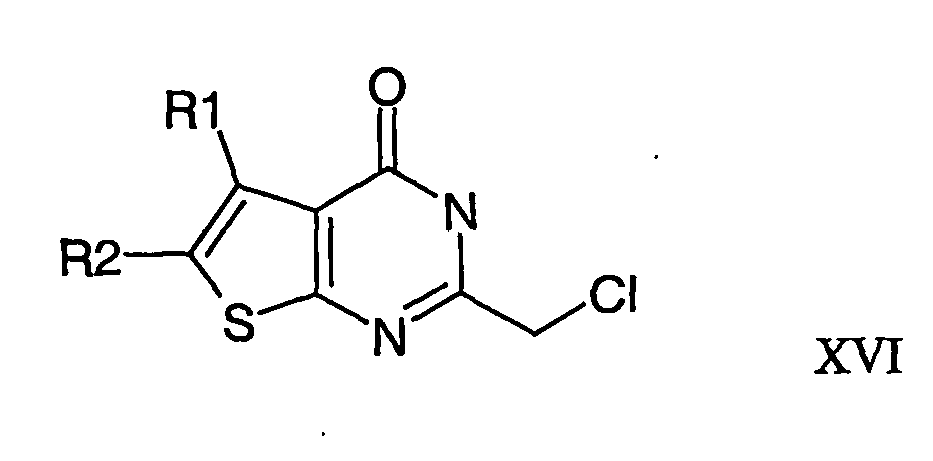
- Compounds of formula XVI may be synthesized by reaction of a compound of formula IV under acidic conditions in a suitable solvent with chloroacetonitrile. Suitable acids include gaseous hydrogen chloride. Suitable solvents include alkyl ethers such as 1,4-dioxane.
- It is understood that compounds of formula I wherein R3 is a chloromethyl group may undergo standard functional group transformations of the chloromethyl moiety using methods familiar to those skilled in the art. In a preferred instance reaction with a nucleophile is carried out. Suitable nucleophiles may include an alkyl or dialkyl amine, an alcohol or a thiol, or anion derivatives thereof.
- In an alternative synthesis of compounds of formula I, particularly applicable to those examples wherein R1 comprises an aryl or heteroaryl group, a compound of formula XVII is reacted with an aryl or heteroaryl boronic acid, preferably under coupling conditions such as in the presence of a palladium(0) catalyst, preferably tetrakis(triphenylphosphine) palladium(0) which may be generated in situ or attached to a polymer resin. Alternative coupling conditions will be familiar to those skilled in the art. If a solvent is present the reaction is carried out at the reflux temperature of the solvent, or under sealed conditions and with microwave irradiation at a temperature of 120-160°C.

- A compound of formula XVII may be synthesised from a compound of formula XVIII by reaction with a suitable nucleophile X-L-Y optionally in the presence of a solvent and a base, and optionally at elevated temperature or with microwave irradiation. Preferably the solvent (if present) is an alcohol, preferably ethanol, and the base is a hindered nitrogen base such as triethylamine. If a solvent is present the reaction is carried out at the reflux temperature of the solvent, or under sealed conditions and with microwave irradiation at a temperature of 120-160°C.

- Compounds of formula XVIII wherein R2 is H may be synthesized by reaction of a compound of formula SIX under basic conditions at reduced temperature in a suitable solvent. Preferably the base is an alkyllithium, in the most preferred instance lithium diisopropylamide and the solvent is an alkylether, in the most preferred instance tetrahydrofuran. The reaction may be carried out from -80°C to ambient temperature.

- A compound of formula XIX may be obtained from a compound of formula XX by reaction with a chlorinating reagent such as phenylphosphonic dichloride or phosphorous oxychloride in a suitable solvent or no solvent, and with heating. Preferably the chlorinating reagent is phosphorous oxychloride and the reaction is carried out at reflux temperature and in the absence of additional solvent.

- Compounds of formula XX may be synthesized by reactions of compounds of formula III wherein R1 is H and R2 is H with an electrophilic halogenating reagent preferably bromine in a suitable solvent preferably glacial acetic acid.
- Alternatively, compounds of formula XVIII wherein R3 is other than H, alkyl or trifluoroalkyl and R2 is other than hydrogen may be synthesized from compounds of formula XXI by displacement of the 2-chloro substituent with a suitable nucleophilic species. Such a reaction may be carried out with heating or microwave irradiation.

- Compounds of formula XXI are readily synthesised from compounds of formula XXII by reaction with a suitable nucleophile X-L-Y, optionally in the presence of a solvent and a base, and optionally at elevated temperature or with microwave irradiation. Preferably the solvent (if present) is an alcohol, preferably ethanol, and the base is a hindered nitrogen base such as triethylamine.

- A compound of formula XXII may be synthesised by reaction of a compound of formula XXIII with a chlorinating reagent such as phenylphosphonic dichloride or phosphorous oxychloride.
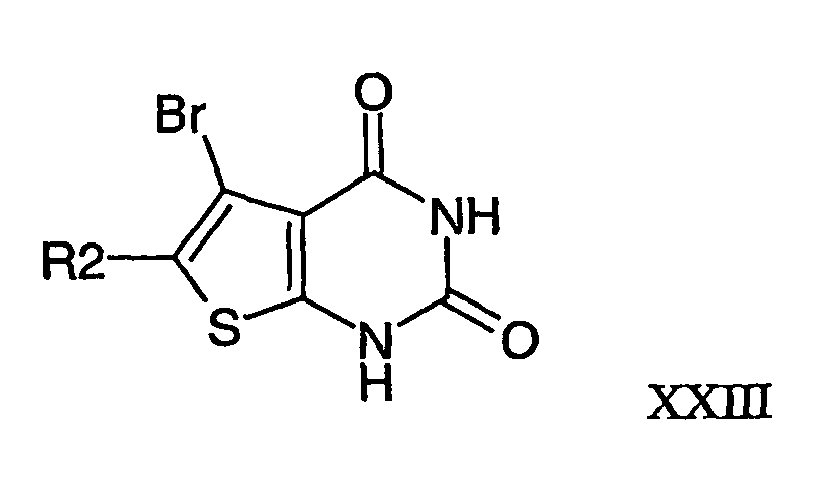
- A compound of formula XXIII may be synthesized by reaction of a compound of formula XII wherein R1 is H and R2 is alkyl with an electrophilic halogenating reagent, preferably bromine, in a suitable solvent, preferably glacial acetic acid.
- Many of the starting materials referred to in the reactions described above are available from commercial sources or can be made by methods cited in the literature references. Synthetic methods can also be found in reviews; thiophenes for example can be found in references cited in Comprehensive Heterocyclic Chemistry, Eds Katritzky, A. R., Rees, C. R., (4), 863-934, and Comprehensive Heterocyclic Chemistry (II), Eds Katritzky, A. R., Rees, C. W., Scriven, E. F. V., (2). 607-678.
- Suitable starting materials include:
Material Reference Supplier Formamidine Hydrochloride 26,860-7 Aldrich 2-Methyl Propionamidine M23802 Tyger Acetamidine Hydrochloride 15,915-8 Aldrich Trifluoroacetamidine 12422 Lancaster 4-Fluoroacetophenone F-320-7 Aldrich Acetophenone A1 070-1 Aldrich 2-Methylacetophenone M2,659-3 Aldrich 3,4-Dimethylacetophenone 13,723-5 Aldrich 4-Methylacetophenone M2,661-5 Aldrich 2-Acetylpyridine A2,100-2 Aldrich 2-Acetyl-4-methylpyridine 49,923-4 Aldrich 3-Acetylpyridine A2,120-7 Aldrich 3-Acetylthiophene 19,632-0 Aldrich 2-Acetylthiophene A2,260-2 Aldrich 2-Acetylfuran A1,625-4 Aldrich Furfurylamine F2,000-9 Aldrich Benzylamine B1,630-5 Aldrich 2-(Aminomethyl)pyridine A6,520-4 Aldrich 2-Pyridinemethanol P6,660-2 Aldrich Propiophenone P5,160-5 Aldrich N-Butyrophenone 12,433-8 Aldrich 4-Chloro-5-(2-thienyl)thieno[2,3d]pyrimidine[2,3-d]pyrimidine AW00007 Maybridge 4-Chloro-5-phenylthieno[2,3d]pyrimidine[2,3-d]pyrimidine 30\08-39 Buttpark 4-Chloro-5-(4-chlorophenyl) thieno[2,3d]pyrimidine[2,3-d]pyrimidine 17097 Fluorochem Ethyl-2-cyano-3-phenyl-2-butenoate 39,875-6 Aldrich 4-Fluorophenylboronic acid 41,755-6 Aldrich 4-Trifluoromethylphenylboronic acid 43,932-0 Aldrich 3,4-Methylenedioxyphenylboronic acid 49,999-4 Aldrich Phenylboronic acid P2,000-9 Aldrich 4-Methoxyphenylboronic acid M1,920-1 Aldrich 2-Amino-4-phenylthiophene-3-carboxamide B014343 Art-Chem-BB 2-Amino-4-(4-fluorophenyl)-5-methylthiophene-3-carboxamide B006163 Art-Chem-BB 2-Amino-5-methyl-4-phenylthiophene-3-carboxamide B014344 Art-Chem-BB - As discussed herein, the compounds of the invention are useful in the treatment of various conditions. Thus, in a second aspect, the present invention provides a pharmaceutical formulation comprising at least one compound and optionally one or more excipients, carriers or diluents; wherein said compound has the formula:

R1 is C6-C10 aryl which is unsubstituted or substituted with cyano, halogen, nitro, trifluoromethyl, alkyl, alkylthio, alkoxy, NR9R10, CO2R7, C(O)NR9R10, NHC(O)R8, SO2NR9R10 or hydroxyl; heteroaryl which is unsubstituted or substituted with cyano, nitro, halogen, alkyl, alkylthio, alkoxy, NR9R10, CO2R7, C(O)NR9R10, NHC(O)R8, SO2NR9R10 or hydroxyl; or C3-C6 cycloalkyl;
R2 is H;C1-6 alkyl which is unsubstituted or substituted with halogen, cyano, nitro, NR9NR10, alkoxyl, hydroxyl, unsubstituted aryl, unsubstituted heteroaryl, CO2R7, C(O)NR9R10, NHC(O)R8 or SO2NR9R10; nitro; -CO2R7;CONR4R5; or halo;
R3 is H, NR4R5, NHC(O)R8, halo, trifluoromethyl, C1-6alkyl which is unsubstituted or substituted with halogen, cyano, nitro, NR9NR10, alkoxyl, hydroxyl, unsubstituted aryl, unsubstituted heteroaryl, CO2R7, C(O)NR9R10, NHC(O)R8 or SO2NR9R10;nitrile or alkoxy;
R4 and R5 may be the same or different, and may be H, C1-6 alkyl which is unsubstituted or substituted with halogen, cyano, nitro, NR9NR10, alkoxyl, hydroxyl, unsubstituted aryl, unsubstituted heteroaryl, CO2R7, C(O)NR9R10, NHC(O)R8 or SO2NR9R10; C6-C10 aryl which is unsubstituted or substituted with cyano, halogen, nitro, trifluoromethyl, alkyl, alkylthio, alkoxy, NR9R10, CO2R7, C(O)NR9R10, NHC(O)R8, SO2NR9R10 or hydroxyl; heteroaryl which is unsubstituted or substituted with cyano, nitro, halogen, alkyl, alkylthio, alkoxy, NR9R10, CO2R7, C(O)NR9R10, NHC(O)R8, SO2NR9R10 or hydroxyl; or C3-C6 cycloalkyl; or R4 and R5 may together form a saturated, unsaturated or partially saturated 4 to 7 member ring, wherein said ring may optionally comprise one or more further heteroatoms selected from N, O or S;
X is O, S or NR6;
R6 is H or C1-6 alkyl which is unsubstituted or substituted with halogen, cyano, nitro, NR9NR10, alkoxyl, hydroxyl, unsubstituted aryl, unsubstituted heteroaryl, CO2R7, C(O)NR9R10, NHC(O)R8 or SO2NR9R10;
R7 is hydrogen, methyl or ethyl;
R8 is methyl or ethyl;
L is (CH2)n, where n is 1, 2 or 3; and
Y is C6-C10 aryl which is unsubstituted or substituted with cyano, halogen, nitro, trifluoromethyl, alkyl, alkylthio, alkoxy, NR9R10, CO2R7, C(O)NR9R10, NHC(O)R8, SO2NR9R10 or hydroxyl;, heterocyclic group which is unsubstituted or substituted with cyano, nitro, halogen, alkyl, alkylthio, alkoxy, NR9R10, CO2R7, C(O)NR9R10, NHC(O)R8, SO2NR9R10 or hydroxyl; alkenyl; C3-C6 cycloalkyl; C1-6 alkyl which is unsubstituted or substituted with halogen, cyano, nitro, NR9R10, alkoxy, unsubstituted aryl, unsubstituted heteroaryl, C(O)NR9R10, NHC(O)R8 or SO2NR9R10;
R9 and R10 can be the same or different, and may be selected from H, unsubstituted C1-6 alkyl, unsubstituted C6-C10 aryl, unsubstituted heteroaryl, unsubstituted cycloalkyl, aminoethyl, methylaminoethyl, dimethylaminoethyl, hydroxylethyl, alkoxyethyl, or R9 and R10 may together form a saturated or partially saturated 4-7 member ring, wherein said ring may optionally comprise one, two or three further heteroatoms
or pharmaceutically acceptable salts thereof;
with the proviso that when Y is phenyl, phenyl monosubstituted by Cl or methoxy, furanyl, tetrahydrofurayl, pyrimidinyl, pyrrolidinyl or 1,3-benzodioxolyl, then R1 is not phenyl, phenyl monosubstituted by halogen or phenyl substituted by methyl. - The compositions of the invention may be presented in unit dose forms containing a predetermined amount of each active ingredient per dose. Such a unit may be adapted to provide 5-100mg/day of the compound, preferably either 5-15mg/day, 10-30mg/day, 25-50mg/day 40-80mg/day or 60-100mglday. For compounds of formula I, doses in the range 100-1000mg/day are provided, preferably either 100-400mg/day, 300-600mg/day or 500-1000mg/day. Such doses can be provided in a single dose or as a number of discrete doses. The ultimate dose will depend on the condition being treated, the route of administration and the age, weight and condition of the patient and will be at the doctor's discretion.
- The compositions of the invention may be adapted for administration by any appropriate route, for example by the oral (including buccal or sublingual), rectal, nasal, topical (including buccal, sublingual or transdermal), vaginal or parenteral (including subcutaneous, intramuscular, intravenous or intradermal) route. Such formulations may be prepared by any method known in the art of pharmacy, for example by bringing into association the active ingredient with the carrier(s) or excipient(s).
- Pharmaceutical formulations adapted for oral administration may be presented as discrete units such as capsules or tablets; powders or granules; solutions or suspensions in aqueous or non-aqueous liquids; edible foams or whips; or oil-in-water liquid emulsions or water-in-oil liquid emulsions.
- Pharmaceutical formulations adapted for transdermal administration may be presented as discrete patches intended to remain in intimate contact with the epidermis of the recipient for a prolonged period of time. For example, the active ingredient may be delivered from the patch by iontophoresis as generally described in Pharmaceutical Research, 3(6), 318 (1986).
- Pharmaceutical formulations adapted for topical administration may be formulated as ointments, creams, suspensions, lotions, powders, solutions, pastes, gels, sprays, aerosols or oils.
- For applications to the eye or other external tissues, for example the mouth and skin, the formulations are preferably applied as a topical ointment or cream. When formulated in an ointment, the active ingredient may be employed with either a paraffinic or a water-miscible ointment base. Alternatively, the active ingredient may be formulated in a cream with an oil-in-water cream base or a water-in-oil base.
- Pharmaceutical formulations adapted for topical administration to the eye include eye drops wherein the active ingredient is dissolved or suspended in a suitable carrier, especially an aqueous solvent.
- Pharmaceutical formulations adapted for topical administration in the mouth include lozenges, pastilles and mouth washes.
- Pharmaceutical formulations adapted for rectal administration may be presented as suppositories or enemas.
- Pharmaceutical formulations adapted for nasal administration wherein the carrier is a solid include a coarse powder having a particle size for example in the range 20 to 500 microns which is administered in the manner in which snuff is taken, i.e. by rapid inhalation through the nasal passage from a container of the powder held close up to the nose. Suitable formulations wherein the carrier is a liquid, for administration as a nasal spray or as nasal drops, include aqueous or oil solutions of the active ingredient.
- Pharmaceutical formulations adapted for administration by inhalation include fine particle dusts or mists which may be generated by means of various types of metered dose pressurised aerosols, nebulizers or insufflators.
- Pharmaceutical formulations adapted for vaginal administration may be presented as pessaries, tampons, creams, gels, pastes, foams or spray formulations.
- Pharmaceutical formulations adapted for parenteral administration include aqueous and non-aqueous sterile injection solutions which may contain anti-oxidants, buffers, bacteriostats and solutes which render the formulation isotonic with the blood of the intended recipient; and aqueous and non-aqueous sterile suspensions which may include suspending agents and thickening agents. The formulations may be presented in unit-dose or multi-dose containers, for example sealed ampoules and vials, and may be stored in a freeze-dried (lyophilized) condition requiring only the addition of the sterile liquid carrier, for example water for injections, immediately prior to use. Extemporaneous injection solutions and suspensions may be prepared from sterile powders, granules and tablets.
- Preferred unit dosage formulations are those containing a daily dose or sub-dose, as herein above recited, or an appropriate fraction thereof, of an active ingredient.
- It should be understood that in addition to the ingredients particularly mentioned above, the formulations may also include other agents conventional in the art having regard to the type of formulation in question, for example those suitable for oral administration may include flavouring agents.
- In a further aspect the present invention provides a compound, or a pharmaceutical composition comprising said compound for use in medicine, wherein said compound has the formula:

R1 is C3-C6 cycloalkyl; C6-C10 aryl which is unsubstituted or substituted with cyano, halogen, nitro, trifluoromethyl, alkyl, alkylthio, alkoxy, NR9R10, CO2R7, C(O)NR9R10, NHC(O)R8, SO2NR9R10 or hydroxyl; or heteroaryl which is unsubstituted or substituted with cyano, nitro, halogen, alkyl, alkylthio, alkoxy, NR9R10, CO2R7, C(O)NR9R10, NHC(O)R8, SO2NR9R10 or hydroxyl;
R2 is H, nitro, -CO2R7, CONR4R5, halo or C1-6alkyl which is unsubstituted or substituted with halogen, cyano, nitro, NR9NR10, alkoxyl, hydroxyl, unsubstituted aryl, unsubstituted heteroaryl, CO2R7, C(O)NR9R10, NHC(O)R8 or SO2NR9R10;
R3 is H, NR4R5, NHC(O)R8, halo, trifluoromethyl, nitrile, alkoxy, or C1-6 Alkyl which is unsubstituted or substituted with halogen, cyano, nitro, NR9NR10, alkoxyl, hydroxyl, unsubstituted aryl, unsubstituted heteroaryl, CO2R7, C(O)NR9R10, NHC(O)R8 or SO2NR9R10;
R4 and R5 may be the same or different, and may be H; C1-6 alkyl which is unsubstituted or substituted with halogen, cyano, nitro, NR9NR10, alkoxyl, hydroxyl, unsubstituted aryl, unsubstituted heteroaryl, CO2R7, C(O)NR9R10, NHC(O)R8 or SO2NR9R10; C6-C10 aryl which is unsubstituted or substituted with cyano, halogen, nitro, trifluoromethyl, alkyl, alkylthio, alkoxy, NR9R10, CO2R7, C(O)NR9R10, NHC(O)R8, SO2NR9R10 or hydroxyl; heteroaryl which is unsubstituted or substituted with cyano, nitro, halogen, alkyl, alkylthio, alkoxy, NR9R10, CO2R7, C(O)NR9R10, NHC(O)R8, SO2NR9R10 or hydroxyl; or C3-C6 cycloalkyl; or R4 and R5 may together form a saturated, unsaturated or partially saturated 4 to 7 member ring, wherein said ring may optionally comprise one or more further heteroatoms selected from N, O or S;
X is O, S or NR6;
R6 is H or C1-6 alkyl, which is unsubstituted or substituted with halogen, cyano, nitro, NR9NR10, alkoxyl, hydroxyl, unsubstituted aryl, unsubstituted heteroaryl, CO2R7, C(O)NR9R10, NHC(O)R8 or SO2NR9R10;
R7 is hydrogen, methyl or ethyl;
R8 is ethyl or methyl;
R9 and R10 can be the same or different, and may be selected from H, unsubstituted C1-6 alkyl, unsubstituted C6-C10 aryl, unsubstituted heteroaryl, unsubstituted cycloalkyl, aminoethyl, methylaminoethyl, dimethylaminoethyl, hydroxylethyl, alkoxyethyl, or R9 and R10 may together form a saturated or partially saturated 4-7 member ring, wherein said ring may optionally comprise one, two or three further heteroatoms
L is (CH2)n, where n is 1, 2 or 3; and
Y is alkenyl, C3-C6 cycloalkyl, C6-C10 aryl which is unsubstituted or substituted with cyano, halogen, nitro, trifluoromethyl, alkyl, alkylthio, alkoxy, NR9R10, CO2R7, C(O)NR9R10, NHC(O)R8, SO2NR9R10 or hydroxyl; heterocyclic group which is unsubstituted or substituted with cyano, nitro, halogen, alkyl, alkylthio, alkoxy, NR9R10, CO2R7, C(O)NR9R10, NHC(O)R8, SO2NR9R10 or hydroxyl; or C1-6 alkyl, which is unsubstituted or substituted with halogen, cyano, nitro, NR9NR10, alkoxyl, hydroxyl, unsubstituted aryl, unsubstituted heteroaryl, CO2R7, C(O)NR9R10, NHC(O)R8 or SO2NR9R10,
or pharmaceutically acceptable salts thereof;
with the proviso that when Y is phenyl, phenyl monosubstituted by Cl or methoxy, furanyl, tetrahydrofurayl, pyrimidinyl, pyrrolidinyl or 1,3-benzodioxolyl, then R1 is not phenyl, phenyl monosubstituted by halogen or phenyl substituted by methyl. - The compositions of the invention can be used to treat conditions which require inhibition of potassium channels, for example in the treatment of arrhythmia. Thus the compositions can be used in a method of treating or preventing a disorder which requires potassium channel inhibition, eg arrhythmia, comprising administering to a subject an effective amount of at least one compound or of a pharmaceutical composition comprising said at least one compound and optionally one or more excipients, diluents and/or carriers wherein said compound has the formula:

R1 is C6-C10 aryl which is unsubstituted or substituted with cyano, halogen, nitro, trifluoromethyl, alkyl, alkylthio, alkoxy, NR9R10, CO2R7, C(O)NR9R10, NHC(O)R8, SO2NR9R10 or hydroxyl; heteroaryl which is unsubstituted or substituted with cyano, nitro, halogen, alkyl, alkylthio, alkoxy, NR9R10, CO2R7, C(O)NR9R10, NHC(O)R8, SO2NR9R10 or hydroxyl; C3-C6 cycloalkyl; or C1-6 alkyl which is unsubstituted or substituted with halogen, cyano, nitro, NR9NR10, alkoxyl, hydroxyl, unsubstituted aryl, unsubstituted heteroaryl, CO2R7, C(O)NR9R10, NHC(O)R8 or SO2NR9R10;
R2 is H, nitro, -CO2R7, CONR4R5, halo, or C1-6alkyl which is unsubstituted or substituted with halogen, cyano, nitro, NR9NR10, alkoxyl, hydroxyl, unsubstituted aryl, unsubstituted heteroaryl, CO2R7, C(O)NR9R10, NHC(O)R8 or SO2NR9R10;
R3 is H, NR4R5, halo, trifluoromethyl, nitrile, alkoxy or C1-6alkyl which is unsubstituted or substituted with halogen, cyano, nitro, NR9NR10, alkoxyl, hydroxyl, unsubstituted aryl, unsubstituted heteroaryl, CO2R7, C(O)NR9R10, NHC(O)R8 or SO2NR9R10;
R4 and R5 may be the same or different, and may be H; C1-6 alkyl, which is unsubstituted or substituted with halogen, cyano, nitro, NR9NR10, alkoxyl, hydroxyl, unsubstituted aryl, unsubstituted heteroaryl, CO2R7, C(O)NR9R10, NHC(O)R8 or SO2NR9R10; C6-C10 aryl which is unsubstituted or substituted with cyano, halogen, nitro, trifluoromethyl, alkyl, alkylthio, alkoxy, NR9R10, CO2R7, C(O)NR9R10, NHC(O)R8, SO2NR9R10 or hydroxyl; heteroaryl which is unsubstituted or substituted with cyano, nitro, halogen, alkyl, alkylthio, alkoxy, NR9R10, CO2R7, C(O)NR9R10, NHC(O)R8, SO2NR9R10 or hydroxyl; or C3-C6 cycloalkyl; or R4 and R5 may together form a saturated, unsaturated or partially saturated 4 to 7 member ring wherein said ring may optionally comprise one or more further heteroatoms selected from N, O or S;
X is O, S or NR6;
R6 is H or C1-6 alkyl, which is unsubstituted or substituted with halogen, cyano, nitro, NR9NR'O, alkoxyl, hydroxyl, unsubstituted aryl, unsubstituted heteroaryl, CO2R7, C(O)NR9R10, NHC(O)R8 or SO2NR9R10;
R7 is hydrogen, methyl or ethyl;
R8 is methyl or ethyl;
L is (CH2)n, where n is 1, 2 or 3; and
Y is alkenyl; C3-C6 cycloalkyl; C6-C10 aryl which is unsubstituted or substituted with cyano, halogen, nitro, trifluoromethyl, alkyl, alkylthio, alkoxy, NR9R10, CO2R7, C(O)NR9R10, NHC(O)R8, SO2NR9R10 or hydroxyl; a heterocyclic group which is unsubstituted or substituted with cyano, nitro, halogen, alkyl, alkylthio, alkoxy, NR9R10, CO2R7, C(O)NR9R10, NHC(O)R8, SO2NR9R10 or hydroxyl; or C1-6 alkyl, which is unsubstituted or substituted with halogen, cyano, nitro, NR9NR10, alkoxyl, hydroxyl, unsubstituted aryl, unsubstituted heteroaryl, CO2R7, C(O)NR9R10, NHC(O)R8,
or pharmaceutically acceptable salts thereof. - Furthermore the present invention relates to the use of a compound of the invention in the manufacture of a medicament for use in potassium channel inhibition; wherein the compound has the formula:

R1 is C6-C10 aryl which is unsubstituted or substituted with cyano, halogen, nitro, trifluoromethyl, alkyl, alkylthio, alkoxy, NR9R10, CO2R7, C(O)NR9R10, NHC(O)R8, SO2NR9R10 or hydroxyl; heteroaryl which is unsubstituted or substituted with cyano, nitro, halogen, alkyl, alkylthio, alkoxy, NR9R10, CO2R7, C(O)NR9R10, NHC(O)R8, SO2NR9R10 or hydroxyl; or C3-C6cycloalkyl;
R2 is H, nitro, -CO2R7, CONR4R5, halo or C1-6alkyl, which is unsubstituted or substituted with halogen, cyano, nitro, NR9NR10, alkoxyl, hydroxyl, unsubstituted aryl, unsubstituted heteroaryl, CO2R7, C(O)NR9R10, NHC(O)R8 or SO2NR9R10;
R3 is H, NR4R5, NHC(O)R8, halo, trifluoromethyl, nitrile, alkoxy or C1-6 alkyl, which is unsubstituted or substituted with halogen, cyano, nitro, NR9NR10, alkoxyl, hydroxyl, unsubstituted aryl, unsubstituted heteroaryl, CO2R7, C(O)NR9R10, NHC(O)R8 or SO2NR9R10;
R4 and R5 may be the same or different, and may be H; C1-6 alkyl, which is unsubstituted or substituted with halogen, cyano, nitro, NR9NR10, alkoxyl, hydroxyl, unsubstituted aryl, unsubstituted heteroaryl, CO2R7, C(O)NR9R10, NHC(O)R8 or SO2NR9R10; C6-C10 aryl which is unsubstituted or substituted with cyano, halogen, nitro, trifluoromethyl, alkyl, alkylthio, alkoxy, NR9R10, CO2R7, C(O)NR9R10, NHC(O)R8, SO2NR9R10 or hydroxyl; heteroaryl which is unsubstituted or substituted with cyano, nitro, halogen, alkyl, alkylthio, alkoxy, NR9R10, CO2R7, C(O)NR9R10, NHC(O)R8, SO2NR9R10 or hydroxyl or C3-C6 cycloalkyl; or R4 and R5 may together form a saturated, unsaturated or partially saturated 4 to 7 member ring, wherein said ring may optionally comprise one or more further heteroatoms selected from N, O or S;
X is O, S or NR6;
R6 is H or C1-6alkyl, which is unsubstituted or substituted with halogen, cyano, nitro, NR9NR10, alkoxyl, hydroxyl, unsubstituted aryl, unsubstituted heteroaryl, CO2R7, C(O)NR9R10, NHC(O)R8 or SO2NR9R10;
R7 is hydrogen, methyl or ethyl;
R8 is methyl or ethyl;
L is (CH2)n, where n is 1, 2 or 3; and
Y is alkenyl; C3-C6 cycloalkyl; C6-C10 aryl which is unsubstituted or substituted with cyano, halogen, nitro, trifluoromethyl, alkyl, alkylthio, alkoxy, NR9R10, CO2R7, C(O)NR9R10, NHC(O)R8, SO2NR9R10 or hydroxyl, an heterocyclic group which is unsubstituted or substituted with cyano, nitro, halogen, alkyl, alkylthio, alkoxy, NR9R10, CO2R7, C(O)NR9R10, NHC(O)R8, SO2NR9R10 or hydroxyl, cycloalkyl; or C1-6 alkyl, which is unsubstituted or substituted with halogen, cyano, nitro, NR9NR10, alkoxyl, hydroxyl, unsubstituted aryl, unsubstituted heteroaryl, CO2R7, C(O)NR9R10, NHC(O)R8 or SO2NR9R10,
or pharmaceutically acceptable salts thereof. - Using the information outlined herein the following compounds can be synthesised which are given by way of example only. The pharmacological profile of compounds of the present invention can readily be assessed by those skilled in the art using routine experimentation, such as procedures and techniques illustrated herein and described in detail in Ford et al., 2002.
- A stirred mixture of acetophenone (180g, 1.5mol), ethyl cyanoacetate (170g, 1.3ml), ammonium acetate (23.1g), acetic acid (72g) and toluene (300ml) was heated under reflux for 18 hours while water was removed from the reaction by azeotropic distillation. The mixture was allowed to cool to ambient temperature, toluene (100ml) was added, then the mixture was washed with water (3 x 100ml). The combined aqueous washings were shaken with toluene (50ml), then the combined toluene solutions were dried (MgSO4) and the solvent was removed in vacuo. The residual oil was distilled under reduced pressure to give 2-cyano-3-phenyl-but-2-enoic acid ethyl ester as an oil which was used without further purification.
- The compounds set out below were prepared in the same way as in Example 1, using the appropriate starting materials.
Example Compound 2 2-Cyano-3-(5-methyl-pyridin-2-yl)-but-2-enoic acid ethyl ester 3 2-Cyano-3-(4-fluoro-phenyl)-but-2-enoic acid ethyl ester 4 2-Cyano-3-thiophen-2-yl-but-2-enoic acid ethyl ester 5 2-Cyano-3-methyl-but-2-enoic acid ethyl ester 6 2-Cyano-3-p-tolyl-but-2-enoic acid ethyl ester 7 3-(4-Chloro-phenyl)-2-cyano-but-2-enoic acid ethyl ester 8 2-Cyano-3-(4-methoxy-phenyl)-but-2-enoic acid ethyl ester 9 2-Cyano-3-phenyl-hex-2-enoic acid ethyl ester 10 2-Cyano-3-o-tolyl-but-2-enoic acid ethyl ester 11 2-Cyano-3-(3,4-dimethyl-phenyl)-but-2-enoic acid ethyl ester 12 3-(4-Bromo-phenyl)-2-cyano-but-2-enoic acid ethyl ester 13 2-Cyano-3-cyclohexyl-but-2-enoic acid ethyl ester 14 3-(4-tert-Butyl-phenyl)-2-cyano-but-2-enoic acid ethyl ester 15 2-Cyano-3-phenyl-pent-2-enoic acid ethyl ester 16 3-Benzo[1,3]dioxol-5-yl-2-cyano-but-2-enoic acid ethyl ester 17 3-Benzo[1,3]dioxol-5-yl-2-cyano-pent-2-enoic acid ethyl ester 18 2-Cyano-3-(4-fluoro-phenyl)-pent-2-enoic acid ethyl ester - 2-Cyano-3-phenyl-but-2-enoic acid ethyl ester (513.25g, 2.3mol) was added at ambient temperature to a vigorously-stirred suspension of powdered sulfur (76g, 2.3mols) in ethanol (500ml). Diethylamine (200ml) was added in portions over 20 minutes, during which time the temperature of the reaction rose to 62°C. The mixture was allowed to cool to 36°C, then it was heated to 50°C and stirring at that temperature was continued for 1 hour. After this time, stirring was discontinued, the hot solution was removed by decantation from unreacted sulfur, then it was allowed to cool to ambient temperature. The resulting solid was collected by filtration, washed with a little cold ethanol and dried in vacuo to give 2-amino-4-phenylthiophene-3-carboxylic acid ethyl ester as an orange solid which was used without further purification.
- The compounds set out below were prepared in the same way as in Example 19, using the appropriate starting materials.
Example Compound 20 2-Amino-4-(5-methyl-pyridin-2-yl)-thiophene-3-carboxylic acid ethyl ester 21 2-Amino-4-(4-fluoro-phenyl)-thiophene-3-carboxylic acid ethyl ester 22 5'-Amino-[2,3']bithiophenyl-4'-carboxylic acid ethyl ester 23 2-Amino-4-methyl-thiophene-3-carboxylic acid ethyl ester 24 2-Amino-4-p-tolyl-thiophene-3-carboxylic acid ethyl ester 25 2-Amino-4-(4-chloro-phenyl)-thiophene-3-carboxylic acid ethyl ester 26 2-Amino-4-(4-bromo-phenyl)-thiophene-3-carboxylic acid ethyl ester 27 2-Amino-4-(4-methoxy-phenyl)-thiophene-3-carboxylic acid ethyl ester 28 2-Amino-4-(3,4-dimethyl-phenyl)-thiophene-3-carboxylic acid ethyl ester 29 2-Amino-4-o-tolyl-thiophene-3-carboxylic acid ethyl ester 30 2-Amino-5-ethyl-4-phenyl-thiophene-3-carboxylic acid ethyl ester 31 2-Amino-4-(4-tert-butyl-phenyl)-thiophene-3-carboxylic acid ethyl ester 32 2-Amino-4-cyclohexyl-thiophene-3-carboxylic acid ethyl ester 33 2-Amino-5-methyl-4-phenyl-thiophene-3-carboxylic acid ethyl ester 34 2-Amino-4-benzo[1,3]dioxol-5-yl-thiophene-3-carboxylic acid ethyl ester 35 2-Amino-4-benzo[1,3]dioxol-5-yl-5-methyl-thiophene-3-carboxylic acid ethyl ester 36 2-Amino-4-(4-fluoro-phenyl)-5-methyl-thiophene-3-carboxylic acid ethyl ester - A stirred mixture of 2-amino-4-phenylthiophene-3-carboxylic acid ethyl ester (350.43g, 1.535mol), formamidine acetate (799.13g, 7.7mol) and ethanol (1500ml) was heated under reflux for 18 hours then allowed to cool to ambient temperature. The resulting solid was collected by filtration, washed with a little cold ethanol, then crystallised from ethanol to give 5-Phenyl-3H-thieno[2,3-d]pyrimidin-4-one as a yellow solid which was used without further purification.
- The compounds set out below were prepared in the same way as in Example 37, using the appropriate starting materials.
Example Compound 38 5-(5-Methyl-pyridin-2-yl)-3H-thieno[2,3-d]pyrimidin-4-one; 39 5-(4-Fluoro-phenyl)-3H-thieno[2,3-d]pyrimidin-4-one; 40 5-Thiophen-2-yl-3H-thieno[2,3-d]pyrimidin-4-one; 41 5-Methyl-3H-thieno[2,3-d]pyrimidin-4-one; 42 5-p-Tolyl-3H-thieno[2,3-d]pyrimidin-4-one; 43 5-(4-Chloro-phenyl)-3H-thieno[2,3-d]pyrimidin-4-one; 44 5-(4-Bromo-phenyl)-3H-thieno[2,3-d]pyrimidin-4-one; 45 5-(4-Methoxy-phenyl)-3H-thieno[2,3-d]pyrimidin-4-one; 46 5-(3,4-Dimethyl-phenyl)-3H-thieno[2,3-d]pyrimidin-4-one; 47 5-(4-tert-Butyl-phenyl)-3H-thieno[2,3-d]pyrimidin-4-one; 48 6-Ethyl-5-phenyl-3H-thieno[2,3-d]pyrimidin-4-one; 49 5-Cyclohexyl-3H-thieno[2,3-d]pyrimidin-4-one; 50 5-o-Tolyl-3H-thieno[2,3-d]pyrimidin-4-one; 51 6-Methyl-5-phenyl-3H-thieno[2,3-d]pyrimidin-4-one 52 5-Benzo[1,3]dioxol-5-yl-3H-thieno[2,3-d]pyrimidin-4-one 53 5-Benzo[1,3]dioxol-5-yl-6-methyl-3H-thieno[2,3-d]pyrimidin-4-one 54 5-(4-Fluoro-phenyl)-6-methyl-3H-thieno[2,3-d]pyrimidin-4-one - A stirred mixture of 2-amino-4-phenylthiophene-3-carboxylic acid ethyl ester (350.43g, 1.54ml), acetamidine hydrochloride (725.13g, 7.676mol) and ethanol (1500ml) was heated under reflux for 18 hours then allowed to cool to ambient temperature. The resulting solid was collected by filtration, washed with a little cold ethanol, then crystallised from ethanol to give 2-Methyl-5-phenyl-3H-thieno[2,3-d]pyrimidin-4-one as a yellow solid which was used without further purification.
- The compound set out below was prepared in the same way as in Example 55, using the appropriate starting materials.
Example Compound 56 5-(4-Fluoro-phenyl)-2-methyl-3H-thieno[2,3-d]pyrimidin-4-one - A mixture of 2-amino-4-phenylthiophene-3-carboxylic acid amide (3.0g, 13.8mmol) and anhydrous pyridine (12ml) was treated with propionyl chloride (1.32ml), 15.2mmol) and stirred at ambient temperature for 3 hours. The excess pyridine was removed in vacuo to give a residue, which was treated with ethanol (50ml) and sodium methoxide (2.24g, 41.4mmol) and the resultant mixture was heated under reflux for 18 hours. The cooled mixture was then diluted with water (300ml) and acidified with concentrated hydrochloric acid. The resulting solid was collected by filtration, washed with water and dried in vacuo to give 4-phenyl-2-propionylaminothiophene-3-carboxylic amide.
- The solid 4-phenyl-2-propionylaminothiophene-3-carboxylic amide was added to a mixture of ethanol (50ml) and sodium methoxide (2.24g) and the resultant mixture was heated under reflux with stirring for 18 hours. The cooled mixture was diluted with water (300ml) and acidified with concentrated hydrochloric acid. The resulting solid was collected by filtration, washed with water followed by acetonitrile and dried in vacuo to give 2-ethyl-5-phenyl-3H-thieno[2,3-d]pyrimidin-4-one (2.38g), which was used without further purification.
- A stirred mixture of 2-amino-4-phenylthiophene-3-carboxylic acid ethyl ester (350.43g, 1.535mol), trifluoromethylacetamidine hydrochloride (1167.36g, 7.676mol) and ethanol (1500ml) was heated under reflux for 18 hours then allowed to cool to ambient temperature. The resulting solid was collected by filtration, washed with a little cold ethanol, then crystallised from ethanol to give 5-Phenyl-2-trifluoromethyl-3H-thieno[2,3-d]pyrimidin-4-one as a yellow solid which was used without further purification.
- A stirred mixture of 2-amino-4-phenylthiophene-3-carboxylic acid ethyl ester (350.43g, 1.54mol), isopropylacetamidine hydrochloride (958.75g, 7.7mol) and ethanol (1500ml) was heated under reflux for 18 hours then allowed to cool to ambient temperature. The resulting solid was collected by filtration, washed with a little cold ethanol, then crystallised from ethanol to give 2-Isopropyl-5-phenyl-3H-thieno[2,3-d]pyrimidin-4-one as a yellow solid which was used without further purification.
- 5-Phenyl-3H-thieno[2,3-d]pyrimidin-4-one (294.6g, 1.29mol) was added in portions to stirred phosphoryl chloride (1000ml), then the stirred suspension was warmed gently to reflux temperature, heated under reflux for 4 hours, and allowed to stand at ambient temperature for 18 hours. The resulting dark solution was removed by decantation from a solid residue and concentrated in vacuo to give a gummy solid. The two solids were combined and added to crushed ice (1000ml). The product was extracted into dichloromethane (3 x 500ml), then the combined extracts were washed with water (2 x 300ml) and saturated aqueous sodium hydrogen carbonate solution (500ml) and dried and decolourised (MgSO4 + charcoal). The solvent was removed in vacuo to give 4-Chloro-5-phenyl-thieno[2,3-d]pyrimidine as a yellow/orange solid which was used without further purification.
- The compounds set out below were prepared in the same way as in Example 61, using the appropriate starting materials.
Example Compound 62 4-Chloro-5-(5-methyl-pyridin-2-yl)-thieno[2,3-d]pyrimidine 63 4-Chloro-5-(4-fluoro-phenyl)-thieno[2,3-d]pyrimidine 64 4-Chloro-5-thiophen-2-yl-thieno[2,3-d]pyrimidine 65 4-Chloro-5-methyl-thieno[2,3-d]pyrimidine 66 4-Chloro-5-p-tolyl-thieno[2,3-d]pyrimidine 67 4-Chloro-5-(3,4-dimethyl-phenyl)-thieno[2,3-d]pyrimidine 68 4-Chloro-5-(4-chloro-phenyl)-thieno[2,3-d]pyrimidine 69 5-(4-Bromo-phenyl)-4-chloro-thieno[2,3-d]pyrimidine 70 4-Chloro-5-(4-methoxy-phenyl)-thieno[2,3-d]pyrimidine 71 4-Chloro-6-ethyl-5-phenyl-thieno[2,3-d]pyrimidine 72 4-Chloro-5-o-tolyl-thieno[2,3-d]pyrimidine 73 5-(4-tert-Butyl-phenyl)-4-chloro-thieno[2,3-d]pyrimidine 74 4-Chloro-5-cyclohexyl-thieno[2,3-d]pyrimidine 75 4-Chloro-2-methyl-5-phenyl-thieno[2,3-d]pyrimidine 76 4-Chloro-5-phenyl-2-trifluoromethyl-thieno[2,3-d]pyrimidine 77 4-Chloro-2-isopropyl-5-phenyl-thieno[2,3-d]pyrimidine 78 4-Chloro-2-ethyl-5-phenyl-thieno[2,3-d]pyrimidine 79 4-Chloro-6-methyl-5-phenyl-thieno[2,3-d]pyrimidine 80 4-Chloro-5-(4-fluoro-phenyl)-2-methyl-thieno[2,3-d]pyrimidine 81 5-(1,3-Benzodioxol-5-yl)-4-chloro-6-methylthieno[2,3-d]pyrimidine 82 4-Chloro-5-(4-fluorophenyl)-6-methylthieno[2,3-d]pyrimidine - A stirred mixture of 4-chloro-5-phenylthieno[2,3-d]pyrimidine (2.2g, 0.009ml), furfurylamine (1.26g, 0.013mol), triethylamine (1.3g) and ethanol (20ml) was heated under reflux for 2 hours then cooled to ambient temperature and poured into water (50ml). The resulting solid was collected by filtration, washed with water (30ml), dried in vacuo and crystallised from a mixture of hexane and toluene to give furan-2-ylmethyl-(5-phenyl-thieno[2,3-d]pyrimidin-4-yl)-amine as a pale yellow solid, m.pt. 77-79°C.
- The compounds set out below were prepared in the same way as in Example 83, using the appropriate starting materials.
Example Compound 84 Cyclopropylmethyl-(5-phenyl-thieno[2,3-d]pyrimidin-4-yl)-amine 85 (5-Phenyl-thieno[2,3-d]pyrimidin-4-yl)-thiophen-2-ylmethyl-amine 86 Benzyl-(5-phenyl-thieno[2,3-d]pyrimidin-4-yl)-amine 87 Allyl-(5-phenyl-thieno[2,3-d]pyrimidin-4-yl)-amine 88 Furan-2-ylmethyl-methyl-(5-phenyl-thieno[2,3-d]pyrimidin-4-yl)-amine 89 Cyclohexylmethyl-(5-phenyl-thieno[2,3-d]pyrimidin-4-yl)-amine 90 Phenethyl-(5-phenyl-thieno[2,3-d]pyrimidin-4-yl)-amine 91 Cyclohexyl-(5-phenyl-thieno[2,3-d]pyrimidin-4-yl)-amine 92 Furan-2-ylmethyl-(5-thiophen-2-yl-thieno[2,3-d]pyrimidin-4-yl)-amine 93 (4-Nitro-benzyl)-(5-thiophen-2-yl-thieno[2,3-d]pyrimidin-4-yl)-amine 94 (5-Thiophen-2-yl-thieno[2,3-d]pyrimidin-4-yl)-(3,4,5-trimethoxy-benzyl)-amine 95 Cyclopropylmethyl-(5-thiophen-2-yl-thieno[2,3-d]pyrimidin-4-yl)-amine 96 Isobutyl-(5-thiophen-2-yl-thieno[2,3-d]pyrimidin-4-yl)-amine 97 Benzyl-(5-thiophen-2-yl-thieno[2,3-d]pyrimidin-4-yl)-amine 98 Thiophen-2-ylmethyl-(5-thiophen-2-yl-thieno[2,3-d]pyrimidin-4-yl)-amine 99 Allyl-(5-thiophen-2-yl-thieno[2,3-d]pyrimidin-4-yl)-amine 100 Furan-2-ylmethyl-methyl-(5-thiophen-2-yl-thieno[2,3-d]pyrimidin-4-yl)-amine - In a 10 ml glass tube were placed 2-methyl-4-chloro-5-phenylthieno[2,3-d]pyrimidin-4-ylamine (0.076g, 0.293 mmol), 2-(aminomethyl)pyridine (0.0364g, 0.03mmol) and ethanol (2.5ml). The vessel was sealed with a septum and placed in the microwave cavity. Microwave irradiation of 200W was used, the temperature being ramped from room temperature to 150°C. Once 150°C was reached, the reaction mixture was held at this temperature for 10 minutes. After cooling to ambient temperature, water (4ml) was added and the mixture stirred for 2.5 hours. The resulting solid was collected by filtration, washed with water and dried in vacuo to give 2-methyl-N-(2-pyridyl)methyl-5-phenylthieno[2,3-d]pyrimidin-4-ylamine (0.084g) as an off white solid, m.pt. 110-112°C.
- The compounds set out below were prepared in the same way as in Example 101, using the appropriate starting materials.
Example Compound 102 (1-Ethyl-pyrrolidin-2-ylmethyl)-(5-phenyl-thieno[2,3-d]pyrimidin-4-yl)-amine 103 N,N-Dimethyl-2-(5-phenyl-thieno[2,3-d]pyrimidin-4-ylamino)-acetamide 104 (3-Imidazol-1-yl-propyl)-(5-phenyl-thieno[2,3-d]pyrimidin-4-yl)-amine 105 (5-Phenyl-thieno[2,3-d]pyrimidin-4-yl)-pyridin-2-ylmethyl-amine 106 5-Phenyl-4-(pyridin-2-ylmethoxy)-thieno[2,3-d]pyrimidine 107 Furan-3-ylmethyl-(5-phenyl-thieno[2,3-d]pyrimidin-4-yl)-amine 108 (5-Methyl-furan-2-ylmethyl)-(5-phenyl-thieno[2,3-d]pyrimidin-4-yl)-amine 109 4-(Furan-2-ylmethoxy)-5-phenyl-thieno[2,3-d]pyrimidine 110 (1-Methyl-1H-pyrrol-2-ylmethyl)-(5-phenyl-thieno[2,3-d]pyrimidin-4-yl)-amine 111 (5-Phenyl-thieno[2,3-d]pyrimidin-4-yl)-(2-pyridin-2-yl-ethyl)-amine 112 (5-Phenyl-thieno[2,3-d]pyrimidin-4-ylamino)-acetic acid methyl ester 113 (2-Methoxy-ethyl)-(5-phenyl-thieno[2,3-d]pyrimidin-4-yl)-amine 114 (5-Phenyl-thieno[2,3-d]pyrimidin-4-yl)-(tetrahydro-furan-2-ylmethyl)-amine 115 Thiophen-2-ylmethyl-(5-thiophen-2-yl-thieno[2,3-d]pyrimidin-4-yl)-amine 116 [1,3]Dioxolan-2-ylmethyl-(5-phenyl-thieno[2,3-d]pyrimidin-4-yl)-amine 117 4-(Furan-2-ylmethylsulfanyl)-5-phenyl-thieno[2,3-d]pyrimidine 118 (5-Phenyl-thieno[2,3-d]pyrimidin-4-yl)-(2-thiophen-2-yl-ethyl)-amine 119 4-Benzyloxy-5-phenyl-thieno[2,3-d]pyrimidine 120 5-Phenyl-4-(pyridin-2-ylmethylsulfanyl)-thieno[2,3-d]pyrimidine 121 [5-(5-Methyl-pyridin-2-yl)-thieno[2,3-d]pyrimidin-4-yl]-pyridin-2-ylmethyl-amine 122 Furan-2-ylmethyl-[5-(5-methyl-pyridin-2-yl)-thieno[2,3-d]pyrimidin-4-yl]-amine 123 [5-(4-Fluoro-phenyl)-thieno[2,3-d]pyrimidin-4-yl]-pyridin-2-ylmethyl-amine 124 [5-(4-Fluoro-phenyl)-thieno[2,3-d]pyrimidin-4-yl]-furan-2-ylmethyl-amine 125 [2-(4-Chloro-phenyl)-ethyl]-(5-methyl-thieno[2,3-d]pyrimidin-4-yl)-amine 126 Furan-2-ylmethyl-(5-p-tolyl-thieno[2,3-d]pyrimidin-4-yl)-amine 127 [2-(3,4-Dimethoxy-phenyl)-ethyl]-(5-p-tolyl-thieno[2,3-d]pyrimidin-4-yl)-amine 128 1-[2-(5-p-Tolyl-thieno[2,3-d]pyrimidin-4-ylamino)-ethyl]-imidazolidin-2-one 129 4-(Naphthalen-2-yloxy)-5-p-tolyl-thieno[2,3-d]pyrimidine 130 Phenethyl-(5-p-tolyl-thieno[2,3-d]pyrimidin-4-yl)-amine 131 4-(5-p-Tolyl-thieno[2,3-d]pyrimidin-4-yloxy)-benzoic acid methyl ester 132 [2-(2,3-Dihydro-benzo[1,4]dioxin-6-yl)-ethyl]-[5-(3,4-dimethyl-phenyl)-thieno[2,3-d]pyrimidin-4-yl]-amine 133 [5-(3,4-Dimethyl-phenyl)-thieno[2,3-d]pyrimidin-4-yl]-furan-2-ylmethyl-amine 134 4-(4-tert-Butyl-phenoxy)-5-(4-chloro-phenyl)-thieno[2,3-d]pyrimidine 135 [5-(4-Chloro-phenyl)-thieno[2,3-d]pyrimidin-4-yl]-furan-2-ylmethyl-amine 136 [5-(4-Chloro-phenyl)-thieno[2,3-d]pyrimidin-4-yl]-phenethyl-amine 137 [5-(4-Bromo-phenyl)-thieno[2,3-d]pyrimidin-4-yl]-[2-(2,3-dihydro-benzo[1,4]dioxin-6-yl)-ethyl]-amine 138 [5-(4-Methoxy-phenyl)-thieno[2,3-d]pyrimidin-4-yl]-pyridin-2-ylmethyl-amine 139 Furan-2-ylmethyl-[5-(4-methoxy-phenyl)-thieno[2,3-d]pyrimidin-4-yl]-amine 140 (6-Ethyl-5-phenyl-thieno[2,3-d]pyrimidin-4-yl)-furan-2-ylmethyl-amine 141 (6-Ethyl-5-furan-3-yl-thieno[2,3-d]pyrimidin-4-yl)-furan-2-ylmethyl-amine 142 Pyridin-2-ylmethyl-(5-o-tolyl-thieno[2,3-d]pyrimidin-4-yl)-amine 143 Furan-2-ylmethyl-(5-o-tolyl-thieno[2,3-d]pyrimidin-4-yl)-amine 144 [5-(4-tert-Butyl-phenyl)-thieno[2,3-d]pyrimidin-4-yl]-pyridin-2-ylmethyl-amine 145 [5-(4-tert-Butyl-phenyl)-thieno[2,3-d]pyrimidin-4-yl]-furan-2-ylmethyl-amine 146 (5-Cyclohexyl-thieno[2,3-d]pyrimidin-4-yl)-pyridin-2-ylmethyl-amine 147 (5-Cyclohexyl-thieno[2,3-d]pyrimidin-4-yl)-furan-2-ylmethyl-amine 148 (2-Isopropyl-5-phenyl-thieno[2,3-d]pyrimidin-4-yl)-pyridin-2-ylmethyl-amine 149 (5-Phenyl-thieno[2,3-d]pyrimidin-4-yl)-(1-pyridin-2-yl-ethyl)-amine 150 Furan-2-ylmethyl-(2-methyl-5-phenyl-thieno[2,3-d]pyrimidin-4-yl)-amine 151 (5-Phenyl-2-trifluoromethyl-thieno[2,3-d]pyrimidin-4-yl)-pyridin-2-ylmethyl-amine 152 (2-Ethyl-5-phenyl-thieno[2,3-d]pyrimidin-4-yl)-pyridin-2-ylmethyl-amine 153 (2-Ethyl-5-phenyl-thieno[2,3-d]pyrimidin-4-yl)-furan-2-ylmethyl-amine 154 (6-Methylpyridin-2-ylmethyl)-(5-phenyl-thieno[2,3-d]pyrimidin-4-yl)-amine 155 [5-(4-Fluorophenyl)-2-methyl-thieno[2,3-d]pyrimidin-4-yl]-pyridin-2-ylmethyl-amine 156 (3-methyl-pyridin-2-ylmethyl)-(5-phenyl-thieno[2,3-d]pyrimidin-4-yl)-amine 157 (6-Methyl-5-phenyl-thieno[2,3-d]pyrimidin-4-yl)-pyridin-2-ylmethyl-amine 158 (5-Phenyl-thieno[2,3-d]pyrimidin-4-yl)-(1,2,3,4-tetrahydro-naphthalen-1-yl)-amine 159 6-Methyl-5-phenyl-4-piperidin-1-yl-thieno[2,3-d]pyrimidine 160 2-[(5-Phenyl-thieno[2,3-d]pyrimidin-4-ylamino)-methyl]-nicotinic acid ethyl ester 161 (5-Phenyl-thieno[2,3-d]pyrimidin-4-yl)-(2-thiophen-2-yl-thiazol-4-ylmethyl)-amine 162 (2-Phenyl-thiazol-4-ylmethyl)-(5-phenyl-thieno[2,3-d]pyrimidin-4-yl)-amine 163 Phenethyl-(5-thiophen-2-yl-thieno[2,3-d]pyrimidin-4-yl)-amine 164 (6-Bromo-5-phenyl-thieno[2,3-d]pyrimidin-4-yl)-pyridin-2-ylmethyl-amine 165 (6-Bromo-5-phenyl-thieno[2,3-d]pyrimidin-4-yl)-furan-2-ylmethyl-amine 166 6-methyl-N-[(6-methylpyridin-2-yl)methyl]-5-phenylthieno[2,3-d]pyrimidin-4-amine 167 6-bromo-N-[(6-methylpyridin-2-yl)methyl]-5-phenylthieno[2,3-d]pyrimidin-4-amine - A mixture of ethyl 2-amino-4-phenyl-thiophene-3-carboxylate (2.0g, 8.1 mmol) and potassium cyanate (2.0g, 24.3 mmol) in glacial acetic acid (20ml) was stirred at ambient temperature for 72 hours. The resultant solid material was filtered off. The filtrate was diluted with water (50ml) and the precipitated solid was filtered off. The two solids were combined, suspended in water (100ml) and made alkaline by the addition of concentrated sodium hydroxide solution. The resultant suspension was heated at 100°C for 2 hours with stirring, then allowed to cool to ambient temperature and acidified by the addition of glacial acetic acid. The resulting solid was collected by filtration to give 5-phenyl-1,3H-thieno[2,3-d]pyrimidin-2,4-dione (1.1g) as a white solid which was used without further purification.
- The compounds set out below were prepared in the same way as in Example 168, using the appropriate starting materials.
Example Compound 169 5-(4-Fluorophenyl)-1,3H-thieno[2,3-d]pyrimidine-2,4-dione 170 6-Methyl-1,3H-thieno[2,3-d]pyrimidine-2,4-dione 171 5-Benzo[1,3]dioxol-5-yl-1,3H-thieno[2,3-d]pyrimidine-2,4-dione 172 5-(1,3-Benzodioxol-5-yl)-6-methyl-1,3H-thieno[2,3-d]pyrimidine-2,4-dione 173 5-(4-Fluorophenyl)-6-methyl-1,3H-thieno[2,3-d]pyrimidine-2,4-dione 174 6-Methyl-5-phenyl-1,3H-thieno[2,3-d]pyrimidine-2,4-dione - A stirred mixture of 5-phenyl-1,3H-thieno[2,3-d]pyrimidin-2,4-dione (1.07g, 4.39 mmol) and phenylphosphonic dichloride (10ml) was heated at 150°C for 7 hours then allowed to stand at ambient temperature for 18 hours. The resulting dark solution was poured into ice-water and extracted with dichloromethane (3 x 150ml). The combined extracts were washed with saturated sodium hydrogen carbonate solution (150ml) and dried (MgSO4). The solvent was removed in vacuo and the oily residue triturated with 40-60°C petrol to give 2,4-dichloro-5-phenyl-thieno[2,3-d]pyrimidine (0.82g) as a pale yellow solid which was used without further purification.
- The compounds set out below were prepared in the same way as in Example 175, using the appropriate starting materials.
Example Compound 176 2,4-Dichloro-5-(4-fluoro-phenyl)-thieno[2,3-d]pyrimidine 177 5-Benzo[1,3]dioxol-5-yl-2,4-dichloro-thieno[2,3-d]pyrimidine 178 2,4-Dichloro-6-methyl-5-phenylthieno[2,3-d]pyrimidine 179 2,4-Dichloro-5-(4-fluorophenyl)-6-methylthieno[2,3-d]pyrimidine 180 5-(1,3-Benzodioxol-5-yl)-2,4-dichloro-6-methylthieno[2,3-d]pyrimidine - A mixture of 2,4-dichloro-5-phenyl-thieno[2,3-d]pyrimidine (0.82g, 2.92 mmol), 2-(aminomethyl)pyridine (0.35g, 3.21 mmol), triethylamine (0.32g, 0.45ml, 3.21 mmol) and propan-2-ol (20 ml) was stirred at ambient temperature for 72 hours. Water (50ml) was added to the reaction mixture and the organic phase was extracted using dichloromethane (3 x 50ml). The combined extracts were washed with water and dried (MgSO4). The solvent was removed in vacuo to give 2-chloro-N-(2-pyridyl)methyl-5-phenylthieno[2,3-d]pyrimidin-4-ylamine (1.0g) as a white solid which was used without further purification.
- The compounds set out below were prepared in the same way as in Example 181, using the appropriate starting materials.
Example Compound 182 (2-Chloro-5-phenyl-thieno[2,3-d]pyrimidin-4-yl)-furan-2-ylmethyl-amine; 183 [2-Chloro-5-(4-fluorophenyl)-thieno[2,3-d]pyrimidin-4-yl]-pyridin-2-ylmethyl-amine 184 (2-Chloro-5-phenyl-thieno[2,3-d]pyrimidin-4-yl)-(6-methyl-pyridin-2-yl methyl)-amine 185 [2-Chloro-5-(4-fluorophenyl)-thieno[2,3-d]pyrimidin-4-yl]-(6-methyl-p yridin-2-ylmethyl)-amine 186 (5-Benzo[1,3]dioxol-5-yl-2-chloro-thieno[2,3-d]pyrimidin-4-yl)-(6-meth yl-pyridin-2-ylmethyl)-amine 187 (5-Benzo[1,3]dioxol-5-yl-2-chloro-thieno[2,3-d]pyrimidin-4-yl)-pyridin-2-ylmethyl-amine - In a 10 ml glass tube were placed 2-chloro-N-(2-pyridyl)methyl-5-phenylthieno[2,3-d]pyrimidin-4-ylamine (0.03g, 0.0852 mmol) and cyclopropylmethylamine (0.5ml). The vessel was sealed with a septum and placed in the microwave cavity. Microwave irradiation of 200 W was used, the temperature being ramped from room temperature to 200°C. Once 200°C was reached, the reaction mixture was held at this temperature for 40 minutes. After cooling to ambient temperature, water (4ml) was added and the mixture stirred for 2.5 hours. The resulting solid was collected by filtration, washed with water and dried under reduced pressure to give N2-Cyclopropylmethyl-5-phenyl-N4-pyridin-2-ylmethyl-thieno[2,3-d]pyrimidine-2,4-diamine (0.025g) as a yellow solid, m.p.t. 109-111°C.
- The compounds set out below were prepared in the same way as in Example 188, using the appropriate starting materials.
Example Compound 189 N2-(2-Methoxyethyl)-5-phenyl-N4-(pyridin-2-ylmethyl)thieno[2,3-d]pyrimidine-2,4-diamine 190 2-{5-Phenyl-4-[(pyridin-2-ylmethyl)-amino]-thieno[2,3-d]pyrimidin-2-ylamino }-ethanol 191 (2-Methoxy-5-phenyl-thieno[2,3-d]pyrimidin-4-yl)-pyridin-2-ylmethyl-amine 192 5-Phenyl-N-4-pyridin-2-ylmethyl-thieno[2,3-d]pyrimidine-2,4-diamine 193 N,N'-Bis(2-furylmethyl)-5-phenylthieno[2,3-d]pyrimidine-2,4-diamine 194 5-(3,4-Dimethylphenyl)-N-(2-furylmethyl)thieno[2,3-d]pyrimidin-4-amine 195 (2-Benzyloxy-5-phenyl-thieno[2,3-d]pyrimidin-4-yl)-furan-2-ylmethyl-amine 196 N2-methyl-5-phenyl-N4-(pyridin-2-ylmethyl)thieno[2,3-d]pyrimidine-2,4-diamine 197 (2-Morpholin-4-yl-5-phenyl-thieno[2,3-d]pyrimidin-4-yl)-pyridin-2-ylmethyl-amine 198 N2,N2-Dimethyl-5-phenyl-N4-pyridin-2-ylmethyl-thieno[2,3-d]pyrimidine-2,4-diamine 199 5-Phenyl-4-[(pyridin-2-ylmethyl)-amino]-thieno[2,3-d]pyrimidine-2-carbonitrile 200 5-(4-Fluorophenyl)-N2,N2-dimethyl-N4-pyridin-2-ylmethyl-thieno[2,3-d]pyrimidine-2,4-diamine 201 1-{5-(4-Fluorophenyl)-4-[(pyridin-2-ylmethyl)-amino]-thieno[2,3-d]pyrimidin-2-yl}-piperidine-4-carboxylic acid methyl ester 202 3-{5-Phenyl-4-[(pyridin-2-ylmethyl)-amino]-thieno[2,3-d]pyrimidin-2-ylamino}-propionic acid ethyl ester 203 [2-(2-Methoxy-ethoxy)-5-phenyl-thieno[2,3-d]pyrimidin-4-yl]-pyridin-2-ylmethyl-amine 204 5-(4-Fluorophenyl)-N2-methyl-N4-pyridin-2-ylmethyl-thieno[2,3-d]pyrimidine-2,4-diamine 205 5-(4-Fluorophenyl)-N4-pyridin-2-ylmethyl-thieno[2,3-d]pyrimidine-2,4-diamine 206 2-(1-{5-Phenyl-4-[(pyridin-2-ylmethyl)-amino]-thieno[2,3-d]pyrimidin-2-yl}-piperidin-4-yl)-ethanol 207 [5-(4-Fluorophenyl)-2-morpholin-4-yl-thieno[2,3-d]pyrimidin-4-yl]-pyridin-2-ylmethyl-amine 208 2-((2-Hydroxy-ethyl)-{5-phenyl-4-[(pyridin-2-ylmethyl)-amino]-thieno[2,3-d]pyrimidin-2-yl}-amino)-ethanol 209 5-(4-Fluorophenyl)-N2-(2-methoxy-ethyl)-N4-pyridin-2-ylmethyl-thieno[2,3-d]pyrimidine-2,4-diamine 210 2-{5-Phenyl-4-[(pyridin-2-ylmethyl)-amino]-thieno[2,3-d]pyrimidin-2-ylamino}-propane-1,3-diol 211 [2-(2-Dimethylamino-ethoxy)-5-phenyl-thieno[2,3-d]pyrimidin-4-yl]-pyridin-2-ylmethyl-amine 212 2-{5-(4-Fluorophenyl)-4-[(pyridin-2-ylmethyl)-amino]-thieno[2,3-d]pyrimidin-2-ylamino}-ethanol 213 2-{4-[(6-Methyl-pyridin-2-ylmethyl)-amino]-5-phenyl-thieno[2,3-d]pyrimidin-2-ylamino}-ethanol 214 3-{5-Phenyl-4-[(pyridin-2-ylmethyl)-amino]-thieno[2,3-d]pyrimidin-2-ylamino}-propane-1,2-diol 215 [2-(4-Methyl-piperazin-1-yl)-5-phenyl-thieno[2,3-d]pyrimidin-4-yl]-pyridin-2-ylmethyl-amine 216 2-{4-[(6-Methyl-pyridin-2-ylmethyl)-amino]-5-phenyl-thieno[2,3-d]pyrimidin-2-ylamino}-ethanol 217 2-((2-Hydroxy-ethyl)-{4-[(6-methyl-pyridin-2-ylmethyl)-amino]-5-phenyl-thieno[2,3-d]pyrimidin-2-yl}-amino)-ethanol 218 2-{5-(4-Fluorophenyl)-4-[(6-methyl-pyridin-2-ylmethyl)-amino]-thieno[2,3-d]pyrimidin-2-ylamino}-ethanol 219 2-[{5-(4-Fluorophenyl)-4-[(pyridin-2-ylmethyl)-amino]-thieno[2,3-d]pyrimidin-2-yl}-(2-hydroxy-ethyl)-amino]-ethanol 220 2-[{5-(4-Fluorophenyl)-4-[(6-methyl-pyridin-2-ylmethyl)-amino]-thieno[2,3-d]pyrimidin-2-yl}-(2-hydroxy-ethyl)-amino]-ethanol 221 2-{5-Benzo[1,3]dioxol-5-yl-4-[(pyridin-2-ylmethyl)-amino]-thieno[2,3-d]pyrimidin-2-ylamino}-ethanol 222 2-{5-Benzo[1,3]dioxol-5-yl-4-[(6-methyl-pyridin-2-ylmethyl)-amino]-thieno[2,3-d]pyrimidin-2-ylamino}-ethanol 223 2-[{5-Benzo[1,3]dioxol-5-yl-4-[(pyridin-2-ylmethyl)-amino]-thieno[2,3-d]pyrimidin-2-yl}-(2-hydroxy-ethyl)-amino]-ethanol 224 2-[{5-Benzo[1,3]dioxol-5-yl-4-[(6-methyl-pyridin-2-ylmethyl)-amino]-thieno[2,3-d]pyrimidin-2-yl}-(2-hydroxy-ethyl)-amino]-ethanol - Hydrogen chloride gas was bubbled through a stirred reaction mixture of 2-amino-4-phenylthiophene-3-carboxylic acid ethyl ester (4.94g, 0.02mol) in ethyl cyanoacetate (50ml) for 2 hours. A thick suspension formed initially which slowly dissolved on gentle warming. The mixture was allowed to stand at ambient temperature for 18 hours. Excess hydrogen chloride was removed by bubbling nitrogen through the reaction mixture and most of the excess ethyl cyanoacetate was distilled out at reduced pressure. The solid residue was recrystallised from ethanol to give (4-oxo-5-phenyl-3,4-dihydrothieno[2,3-d]pyrimidin-2-yl)acetic acid ethyl ester (3.64g), which was used without further purification.
- The compounds set out below were prepared in the same way as in Example 225, using the appropriate starting materials.
Example Compound 226 [5-(4-Fluorophenyl)-4-oxo-3,4-dihydro-thieno[2,3-d]pyrimidin-2-yl]-acetic acid ethyl ester 227 (5-Benzo[1,3]dioxol-5-yl-4-oxo-3,4-dihydro-thieno[2,3-d]pyrimidin-2-yl)-acetic acid ethyl ester 228 (6-Methyl-4-oxo-5-phenyl-3,4-dihydro-thieno[2,3-d]pyrimidin-2-yl)-acetic acid ethyl ester 229 [5-(4-Fluorophenyl)-6-methyl-4-oxo-3,4-dihydro-thieno[2,3-d]pyrimidin-2-yl]-acetic acid ethyl ester 230 (5-Benzo[1,3]dioxol-5-yl-6-methyl-4-oxo-3,4-dihydro-thieno[2,3-d]pyrimidin-2-yl)-acetic acid ethyl ester - A stirred solution of (4-oxo-5-phenyl-3,4-dihydrothieno[2,3-d]pyrimidin-2-yl)acetic acid ethyl ester (1.0g, 3.185mmol), phosphoryl chloride (15ml) and N,N-dimethylaniline (4.8ml) was heated under reflux for 6 hours and then left to stand at ambient temperature for 18 hours. The excess phosphoryl chloride was removed in vacuo to give a dark residue, which was dissolved in dichloromethane (100ml) and then washed with water (2x50ml) followed by saturated sodium hydrogen carbonate solution (50ml). The organic layer was dried (MgSO4) and the solvent was removed in vacuo to give the crude product. Purification by flash chromatography (silica) eluting with dichloromethane and 40°-60° petroleum ether (3:1) gave (4-chloro-5-phenylthieno[2,3-d]pyrimidin-2-yl)acetic acid ethyl ester as a pale-yellow solid (0.86g).
- The compounds set out below were prepared in the same way as in Example 231, using the appropriate starting materials.
Example Compound 232 [4-Chloro-5-(4-Fluorophenyl)-thieno[2,3-d]pyrimidin-2-yl]-acetic acid ethyl ester 233 (4-Chloro-5-Benzo[1,3]dioxol-5-yl-thieno[2,3-d]pyrimidin-2-yl)-acetic acid ethyl ester 234 (4-Chloro-6-methyl-5-phenyl-thieno[2,3-d]pyrimidin-2-yl)-acetic acid ethyl ester 235 [4-Chloro-5-(4-fluorophenyl)-6-methyl-thieno[2,3-d]pyrimidin-2-yl]-acetic acid ethyl ester 236 (5-Benzo[1,3]dioxol-5-yl-4-chloro-6-methyl-thieno[2,3-d]pyrimidin-2-yl)-acetic acid ethyl ester - A stirred mixture of (4-chloro-5-phenylthieno[2,3-d]pyrimidin-2-yl)acetic acid ethyl ester (0.36g, 1.08mmol), 2-aminomethylpyridine (0.12ml, 1.19mmol), triethylamine (0.17ml, 1.19mmol) and ethanol (8ml) was heated under reflux for 4 hours. The solution was then cooled to ambient temperature, poured into water (100ml) and extracted with dichloromethane (3x50ml). The combined organic extracts were dried (MgSO4) and the solvent removed in vacuo to give the crude product. Purification by flash chromatography (silica) eluting with ethyl acetate and 40°-60° petroleum ether (1:2) gave {5-phenyl-4-[(pyridin-2-ylmethyl)amino]thieno[2,3-d]pyrimidin-2-yl}acetic acid ethyl ester as a colourless gum (0.41g).
- The compounds set out below were prepared in the same way as in Example 237, using the appropriate starting materials.
Example Compound 238 {4-[(Furan-2-ylmethyl)-amino]-5-phenyl-thieno[2,3-d]pyrimidin-2-yl}-acetic acid ethyl ester 239 {5-(4-Fluorophenyl)-4-[(pyridin-2-ylmethyl)-amino]-thieno[2,3-d]pyrimidin-2-yl}-acetic acid ethyl ester 240 {5-Benzo[1,3]dioxol-5-yl-4-[(pyridin-2-ylmethyl)-amino]-thieno[2,3-d]pyrimidin-2-yl}-acetic acid ethyl ester 241 {5-(4-Fluorophenyl)-4-[(6-methyl-pyridin-2-ylmethyl)-amino]-thieno[2,3-d]pyrimidin-2-yl}-acetic acid ethyl ester 242 {5-Benzo[1,3]dioxol-5-yl-4-[(6-methyl-pyridin-2-ylmethyl)-amino]-thieno[2,3-d]pyrimidin-2-yl}-acetic acidethyl ester 243 {6-Methyl-4-[(6-methyl-pyridin-2-ylmethyl)-amino]-5-phenyl-thieno[2,3-d]pyrimidin-2-yl}-acetic acid ethyl ester 244 {5-(4-Fluorophenyl)-6-methyl-4-[(6-methyl-pyridin-2-ylmethyl)-amino]-thieno[2,3-d]pyrimidin-2-yl}-acetic acid ethyl ester 245 {5-Benzo[1,3]dioxol-5-yl-6-methyl-4-[(6-methyl-pyridin-2-ylmethyl)-amino]-thieno[2,3-d]pyrimidin-2-yl}-acetic acid ethyl ester 246 {6-Methyl-5-phenyl-4-[(pyridin-2-ylmethyl)-amino]-thieno[2,3-d]pyrimidin-2-yl}-acetic acid ethyl ester 247 {5-(4-Fluorophenyl)-6-methyl-4-[(pyridin-2-ylmethyl)-amino]-thieno[2,3-d]pyrimidin-2-yl}-acetic acid ethyl ester 248 {5-Benzo[1,3]dioxol-5-yl-6-methyl-4-[(pyridin-2-ylmethyl)-amino]-thieno[2,3-d]pyrimidin-2-yl}-acetic acid ethyl ester 249 4-[(6-Methyl-pyridin-2-ylmethyl)-amino]-5-phenyl-thieno[2,3-d]pyrimidine-2-carboxylic acid ethyl ester - A stirred solution of {5-phenyl-4-[(pyridin-2-ylmethyl)amino]thieno[2,3-d]pyrimidin-2-yl}acetic acid ethyl ester (0.10g, 0.248mmol) in anhydrous tetrahydrofuran (1ml) was cooled in an ice-bath and treated, under a nitrogen atmosphere, with diisobutylaluminium hydride (1M solution in hexane, 1.04ml, 1.04mmol) over about 15 minutes. The reaction mixture was allowed to warm up and left to stir at ambient temperature for 3 hours. The resultant mixture was then cooled in an ice-bath and quenched by the slow addition of methanol (0.5ml) followed by water (1ml). The mixture was then diluted with 2M sodium hydroxide solution (10ml) and extracted with ethyl acetate (3x20ml). The combined organic extracts were dried (MgSO4) and the solvent removed in vacuo to give the crude product. Purification by flash chromatography (silica) eluting with ethyl acetate and 40°-60° petroleum ether (4:1) gave 2-{5-phenyl-4-[(pyridin-2-ylmethyl)amino]thieno[2,3-d]pyrimidin-2-yl}ethanol as an off-white solid (0.05g), m.p. 90°-92°C.
- The compounds set out below were prepared in the same way as in Example 250, using the appropriate starting materials.
Example Compound 251 2-{4-[(Furan-2-ylmethyl)-amino]-5-phenyl-thieno[2,3-d]pyrimidin-2-yl}-ethanol 252 2-{4-[(6-Methyl-pyridin-2-ylmethyl)-amino]-5-phenyl-thieno[2,3-d]pyrimidin-2-yl}-ethanol 253 2-{5-(4-Fluorophenyl)-4-[(pyridin-2-ylmethyl)-amino]-thieno[2,3-d]pyrimidin-2-yl}-ethanol 254 2-{5-(4-Fluorophenyl)-4-[(6-methyl-pyridin-2-ylmethyl)-amino]-thieno[2,3-d]pyrimidin-2-yl}-ethanol 255 2-{5-Benzo[1,3]dioxol-5-yl-4-[(pyridin-2-ylmethyl)-amino]-thieno[2,3-d]pyrimidin-2-yl}-ethanol 256 2-{5-Benzo[1,3]dioxol-5-yl-4-[(6-methyl-pyridin-2-ylmethyl)-amino]-thieno[2,3-d]pyrimidin-2-yl}-ethanol 25 2-{6-Methyl-5-phenyl-4-[(pyridin-2-ylmethyl)-amino]-thieno[2,3-d]pyrimidin-2-yl}-ethanol 258 2-{6-Methyl-4-[(6-methyl-pyridin-2-ylmethyl)-amino]-5-phenyl-thieno[2,3-d]pyrimidin-2-yl}-ethanol 259 2-{5-(4-Fluorophenyl)-6-methyl-4-[(pyridin-2-ylmethyl)-amino]-thieno[2,3-d]pyrimidin-2-yl}-ethanol 260 2-{5-(4-Fluorophenyl)-6-methyl-4-[(6-methyl-pyridin-2-ylmethyl)-amino]-thieno[2,3-d]pyrimidin-2-yl}-ethanol 261 2-{5-Benzo[1,3]dioxol-5-yl-6-methyl-4-[(pyridin-2-ylmethyl)-amino]-thieno[2,3-d]pyrimidin-2-yl}-ethanol 262 2-{5-Benzo[1,3]dioxol-5-yl-6-methyl-4-[(6-methyl-pyridin-2-ylmethyl)-amino]-thieno[2,3-d]pyrimidin-2-yl}-ethanol - Sodium hydride (60% dispersion in oil, 64mg, 1.59mmol) was treated with a solution of {5-phenyl-4-[(pyridin-2-ylmethyl)amino]thieno[2,3-d]pyrimidin-2-yl}acetic acid ethyl ester (0.43g, 1.06mmol) in diethyl carbonate (2.5ml). The resulting suspension was stirred at ambient temperature for 5 hours and left to stand for 18 hours. The mixture was then quenched with aqueous ammonium chloride solution (50ml) and extracted with diethyl ether (3x50ml). The combined organic extracts were dried (MgSO4) and the solvent removed in vacuo to give the crude product. Purification by flash chromatography (silica) eluting with dichloromethane followed by dichloromethane and ethyl acetate (5:1) gave 2-{5-phenyl-4-[(pyridin-2-ylmethyl)amino]thieno[2,3-d]pyrimidin-2-yl}malonic acid diethyl ester as a colourless gum (0.32g).
- The compounds set out below were prepared in the same way as in Example 263, using the appropriate starting materials.
Example Compound 264 2-{5-(4-Fluorophenyl)-4-[(pyridin-2-ylmethyl)-amino]-thieno[2,3-d]pyrimidin-2-yl}-malonic acid diethyl ester 265 2-{5-Benzo[1,3]dioxol-5-yl-4-[(pyridin-2-ylmethyl)-amino]-thieno[2,3-d]pyrimidin-2-yl}-malonic acid diethyl ester 266 2-{5-(4-Fluorophenyl)-4-[(6-methyl-pyridin-2-ylmethyl)-amino]-thieno[2,3-d]pyrimidin-2-yl}-malonic acid diethyl ester 267 2-{4-[(6-Methyl-pyridin-2-ylmethyl)-amino]-5-phenyl-thieno[2,3d]pyrimidin-2-yl}-malonic acid diethyl ester 268 2-{5-Benzo[1,3]dioxol-5-yl-4-[(6-methyl-pyridin-2-ylmethyl)-amino]-thieno[2,3-d]pyrimidin-2-yl}-malonic acid diethyl ester 269 2-{6-Methyl-5-phenyl-4-[(pyridin-2-ylmethyl)-amino]-thieno[2,3d]pyrimidin-2-yl}-malonic acid diethyl ester 270 2-{5-(4-Fluorophenyl)-6-methyl-4-[(pyridin-2-ylmethyl)-amino]-thieno[2,3-d]pyrimidin-2-yl}-malonic acid diethyl ester 271 2-{5-Benzo[1,3]dioxol-5-yl-6-methyl-4-[(pyridin-2-ylmethyl)-amino]-thieno[2,3-d]pyrimidin-2-yl}-malonic acid diethyl ester 272 2-{6-Methyl-4-[(6-methyl-pyridin-2-ylmethyl)-amino]-5-phenylthieno[2,3-d]pyrimidin-2-yl}-malonic acid diethyl ester 273 2-{5-(4-Fluorophenyl)-6-methyl-4-[(6-methyl-pyridin-2-ylmethyl)-amino]-thieno[2,3-d]pyrimidin-2-yl}-malonic acid diethyl ester 274 2-{5-Benzo[1,3]dioxol-5-yl-6-methyl-4-[(6-methyl-pyridin-2-ylmethyl)-amino]-thieno[2,3-d]pyrimidin-2-yl}-malonic acid diethyl ester - A stirred solution of 2-{5-phenyl-4-[(pyridin-2-ylmethyl)amino]thieno[2,3-d]pyrimidin-2-yl}malonic acid diethyl ester (0.32g, 0.672mmol) in anhydrous tetrahydrofuran (10ml) was cooled in an ice-bath and treated, under a nitrogen atmosphere, with diisobutylaluminium hydride (1M solution in hexane, 5.52ml), 5.52mmol) over 15 minutes. The reaction mixture was allowed to warm up and left to stir at ambient temperature for 3 hours. The resultant mixture was then cooled in an ice-bath and quenched by the slow addition of methanol (5ml) followed by water (10ml). The mixture was then diluted with 2M sodium hydroxide solution (50ml) and extracted with ethyl acetate (3x50ml). The combined organic extracts were dried (MgSO4) and the solvent removed in vacuo to give the crude product. Purification by flash chromatography (silica) eluting with 5% methanol in dichloromethane gave 2-{5-phenyl-4-[(pyridin-2-ylmethyl)amino]thieno[2,3-d]pyrimidin-2-yl}propane-1,3-diol as a pale yellow solid (0.08g), m.p. 137°-139°C.
- The compounds set out below were prepared in the same way as in Example 275, using the appropriate starting materials.
Example Compound 276 2-{4-[(6-Methyl-pyridin-2-ylmethyl)-amino]-5-phenyl-thieno[2,3-d]pyrimidin-2-yl}-propane-1,3-diol 277 2-{5-(4-Fluorophenyl)-4-[(pyridin-2-ylmethyl)-amino]-thieno[2,3-d]pyrimidin-2-yl}-propane-1,3-diol 278 2-{5-(4-Fluorophenyl)-4-[(6-methyl-pyridin-2-ylmethyl)-amino]-thieno[2,3-d]pyrimidin-2-yl}-propane-1,3-diol 279 2-{5-Benzo[1,3]dioxol-5-yl-4-[(pyridin-2-ylmethyl)-amino]-thieno[2,3-d]pyrimidin-2-yl}-propane-1,3-diol 280 2-{5-Benzo[1,3]dioxol-5-yl-4-[(6-methyl-pyridin-2-ylmethyl)-amino]-thieno[2,3-d]pyrimidin-2-yl}-propane-1,3-diol 281 2-{6-Methyl-5-phenyl-4-[(pyridin-2-ylmethyl)-amino]-thieno[2,3-d]pyrimidin-2-yl}-propane-1,3-diol 282 2-{6-Methyl-4-[(6-methyl-pyridin-2-ylmethyl)-amino]-5-phenyl-thieno[2,3-d]pyrimidin-2-yl}-propane-1,3-diol 283 2-{5-(4-Fluorophenyl)-6-methyl-4-[(pyridin-2-ylmethyl)-amino]-thieno[2,3-d]pyrimidin-2-yl}-propane-1,3-diol 284 2-{5-(4-Fluorophenyl)-6-methyl-4-[(6-methyl-pyridin-2-ylmethyl)-amino]thieno[2,3-d]pyrimidin-2-yl}-propane-1,3-diol 285 2-{5-Benzo[1,3]dioxol-5-yl-6-methyl-4-[(pyridin-2-ylmethyl)-amino]-thieno[2,3-d]pyrimidin-2-yl}-propane-1,3-diol 286 2-{5-Benzo[1,3]dioxol-5-yl-6-methyl-4-[(6-methyl-pyridin-2-ylmethyl)-amino]-thieno[2,3-d]pyrimidin-2-yl}-propane-1,3-diol - In a 10ml glass tube were placed {5-phenyl-4-[(pyridin-2-ylmethyl)amino]thieno[2,3-d]pyrimidin-2-yl}acetic acid ethyl ester (35mg, 0.088mmol) and a saturated solution of methylamine in ethanol (2.0ml). The tube was sealed with a septum and placed in the microwave cavity. Microwave irradiation of 200W was used, the temperature being ramped from room temperature to 100°C. Once 100°C was reached, the reaction mixture was held at this temperature for 30 minutes. The temperature was then ramped up to 150°C and the reaction mixture was held at this temperature for a further 30 minutes. The resultant mixture was diluted with water (50ml) and extracted with dichloromethane (3x50ml). The combined organic extracts were dried (MgSO4) and the solvent removed in vacuo to give a residue which was purified by flash chromatography (silica) eluting with 5% methanol in dichloromethane to give N-methyl-2-{5-phenyl-4-[{pyridin-2-ylmethyl)amino]thieno[2,3-d]pyrimidin-2-yl}acetamide (2mg).
- The compounds set out below were prepared in the same way as in Example 287, using the appropriate starting materials.
Example Compound 288 N-Methyl-2-{4-[(6-methyl-pyridin-2-ylmethyl)-amino]-5-phenyl-thieno[2,3-d]pyrimidin-2-yl}-acetamide 289 2-{5-(4-Fluorophenyl)-4-[(pyridin-2-ylmethyl)-amino]-thieno[2,3-d]pyrimidin-2-yl}-N-methyl-acetamide 290 2-{5-(4-Fluorophenyl)-4-[(6-methyl-pyridin-2-ylmethyl)-amino]-thieno[2,3-d]pyrimidin-2-yl}-N-methyl-acetamide 291 2-{5-Benzo[1,3]dioxol-5-yl-4-[(pyridin-2-ylmethyl)-amino]-thieno[2,3-d]pyrimidin-2-yl}-N-methyl-acetamide 292 2-{5-Benzo[1,3]dioxol-5-yl-4-[(6-methyl-pyridin-2-ylmethyl)-amino]-thieno[2,3-d]pyrimidin-2-yl}-N-methyl-acetamide 293 N-Methyl-2-{6-methyl-5-phenyl-4-[(pyridin-2-ylmethyl)-amino]-thieno[2,3-d]pyrimidin-2-yl}-acetamide 294 N-Methyl-2-{6-methyl-4-[(6-methyl-pyridin-2-ylmethyl)-amino]-5-phenyl-thieno[2,3-d]pyrimidin-2-yl}-acetamide 295 2-{5-(4-Fluorophenyl)-6-methyl-4-[(pyridin-2-ylmethyl)-amino]-thieno[2,3-d]pyrimidin-2-yl}-N-methyl-acetamide 296 2-{5-(4-Fluorophenyl)-6-methyl-4-[(6-methyl-pyridin-2-ylmethyl)-amino]-thieno[2,3-d]pyrimidin-2-yl}-N-methyl-acetamide 297 2-{5-Benzo[1,3]dioxol-5-yl-6-methyl-4-[(pyridin-2-ylmethyl)-amino]-thieno[2,3-d]pyrimidin-2-yl}-N-methyl-acetamide 298 2-{5-Benzo[1,3]dioxol-5-yl-6-methyl-4-[(6-methyl-pyridin-2-ylmethyl)-amino]-thieno[2,3-d]pyrimidin-2-yl}-N-methyl-acetamide - Hydrogen chloride gas was bubbled through a stirred solution of 2-amino-4-phenylthiophene-3-carboxylic acid ethyl ester (4.94g, 0.02mol) and chloroacetonitrile (1.4ml), 0.022mol) in anhydrous 1,4-dioxane (60ml) for about 4 hours. A thick suspension formed initially which slowly dissolved. The mixture was stirred at ambient temperature for 18 hours before being poured into water (250ml) and basified (pH 8) by the addition of sodium hydrogen carbonate. The supernatant was then decanted to leave a gummy solid which was triturated with aqueous ethanol to give 2-chloromethyl-5-phenyl-3H-thieno[2,3-d]pyrimidin-4-one as a yellow solid (3.70g), which was used without further purification.
- A stirred suspension of 2-chloromethyl-5-phenyl-3H-thieno[2,3-d]pyrimidin-4-one (1.5g, 5.42mmol) and phosphoryl chloride (23ml) was heated under reflux for 7 hours and then left to stand at ambient temperature for 18 hours. The excess phosphoryl chloride was removed in vacuo to give a dark residue, which was dissolved in dichloromethane (100ml) and then washed with water (2x100ml) followed by saturated sodium hydrogen carbonate solution (100ml). The organic extract was dried (MgSO4) and the solvent was removed in vacuo to give the crude product. Purification by flash chromatography (silica) eluting with dichloromethane gave 4-chloro-2-chloromethyl-5-phenylthieno[2,3-d]pyrimidine as a pale-yellow solid (1.42g).
- A reaction mixture of 4-chloro-2-chloromethyl-5-phenylthieno[2,3-d]pyrimidine (0.50g, 1.69mmol), 2-aminomethylpyridine (0.17ml, 1.69mmol), triethylamine (0.26ml, 1.86mmol) and propan-2-ol (15ml) was stirred at ambient temperature for 4 days. The solution was then poured into water (150ml) and extracted with ethyl acetate (3x75ml).
- The combined organic extracts were dried (MgSO4) and the solvent removed in vacuo to give the crude product. Purification by flash chromatography (silica) eluting with ethyl acetate and 40°-60° petroleum ether (1:4) gave (2-chloromethyl-5-phenylthieno[2,3-d]pyrimidin-4-yl)pyridin-2-ylmethylamine as a yellow solid (0.17g), m.p. 97°-99°C.
- In a 10ml glass tube were placed (2-chloromethyl-5-phenylthieno[2,3-d]pyrimidin-4-yl)pyridin-2-ylmethylamine (50mg, 0.136mmol) and a saturated solution of dimethylamine in ethanol (2.0ml). The tube was sealed with a septum and placed in the microwave cavity. Microwave irradiation of 200W was used, the temperature being ramped from room temperature to 150°C. Once 150°C was reached, the reaction mixture was held at this temperature for 10 minutes. The resultant mixture was diluted with water (50ml) and extracted with dichloromethane (3x50ml). The combined organic extracts were dried (MgSO4) and the solvent removed in vacuo to give the crude product. Purification by flash chromatography (silica) eluting with 4% triethylamine in ethyl acetate gave (2-dimethylaminomethyl-5-phenylthieno[2,3-d]pyrimidin-4-yl)pyridin-2-ylmethylamine as a yellow gum (36mg).
- The compounds set out below were prepared in the same way as in Example 302, using the appropriate starting materials.
Example Compound 303 (2-Morpholin-4-ylmethyl-5-phenyl-thieno[2,3-d]pyrimidin-4-yl)-pyridin-2-ylmethyl-amine 304 (2-Methylaminomethyl-5-phenyl-thieno[2,3-d]pyrimidin-4-yl)-pyridin-2-ylmethyl-amine - In a 10ml glass tube was placed anhydrous methanol (1ml). This was cooled in an ice-bath and treated with sodium hydride (60% dispersion in oil, 6mg, 0.147mmol). After stirring for about 10 minutes, (2-chloromethyl-5-phenylthieno[2,3-d]pyrimidin-4-yl)pyridin-2-ylmethylamine (36mg, 0.098mmol) was added. The tube was sealed with a septum and placed in the microwave cavity. Microwave irradiation of 200W was used, the temperature being ramped from room temperature to 150°C. Once 150°C was reached, the reaction mixture was held at this temperature for 10 minutes. The resultant mixture was diluted with water (50ml) and extracted with dichloromethane (3x50ml). The combined organic extracts were dried (MgSO4) and the solvent removed in vacuo to give the crude product. Purification by flash chromatography (silica) eluting with ethyl acetate and 40°-60° petroleum ether (3:2) gave (2-methoxymethyl-5-phenylthien[2,3-d]primidin-4-yl)pyidin-2-ylmethylamine as a pale brown gum (1mg).
- A suspension of 3H-thieno[2,3-d]pyrimidin-4-one (7.68g, 0.056mol) in glacial acetic acid (75ml) was treated with bromine (7.5ml) and stirred at ambient temperature for 4 hours. The resulting solid was collected by filtration, washed with water and dried in vacuo to give 6-bromo-3H-thieno[2,3-d]pyrimidin-4-one as a light brown solid (11.64g), which was used without further purification.
- The compound set out below was prepared in the same way as in Example 306 , using the appropriate starting materials.
Example Compound 307 6-Bromo-5-phenylthieno[2,3-d]pyrimidin-4(3H)-one - 6-Bromo-3H-thieno[2,3-d]pyrimidin-4-one (11.64g, 0.05ml) was added portion-wise to phosphoryl chloride (220ml) and the resulting mixture was heated under reflux for 6 hours. The excess phosphoryl chloride was then removed in vacuo. The resulting residue was dissolved in dichloromethane (250ml) and washed with water (2x100ml), followed by saturated sodium hydrogen carbonate solution (100ml). The organic layer was then dried (MgSO4) and the solvent was removed in vacuo to give 6-bromo-4-chlorothieno[2,3-d]pyrimidine (9.06g) as a yellow solid, which was used without further purification.
- The compound set out below was prepared in the same way as in Example 308, using the appropriate starting materials.
Example Compound 309 6-Bromo-4-chloro-5-phenylthieno[2,3-d]pyrimidin-4(3H)-one - A stirred solution of 6-bromo-4-chlorothieno[2,3-d]pyrimidine (4.0g, 0.016mol) in anhydrous tetrahydrofuran (100ml) was cooled in a dry-ice/acetone bath and treated, under a nitrogen atmosphere, with lithium diisopropylamide (1.8M solution in tetrahydrofuran, 9.0ml, 0.016mol) over about 20 minutes. The resultant dark solution was stirred in the cold for 1 hour and then treated with a mixture of water (5ml) and tetrahydrofuran (20ml) over about 20 minutes. The mixture was then allowed to warm up to about 0°C before being poured into water (250ml) and extracted with dichloromethane (3x100ml). The combined organic extracts were dried (MgSO4) and the solvent removed in vacuo to give the crude product. Purification by flash chromatography (silica) eluting with dichloromethane gave 5-bromo-4-chlorothieno[2,3-d]pyrimidine as a pale brown solid (3.8g).
- A stirred mixture of 5-bromo-4-chlorothieno[2,3-d]pyrimidine (3.8g, 15.2mmol), ethanol (250ml), triethylamine (2.32ml, 16.7mmol) and 2-aminomethylpyridine (1.72ml, 16.7mmol) was heated under reflux for 2.5 hours. The solution was then cooled to ambient temperature, poured into water (300ml) and extracted with dichloromethane (3x150ml). The combined organic extracts were dried (MgSO4) and the solvent removed in vacuo to give the crude product. Purification by flash chromatography (silica) eluting with ethyl acetate and 40°-60° petroleum ether (1:1) gave (5-bromothieno[2,3-d]pyrimidin-4-yl)pyridin-2-ylmethylamine as a yellow solid (3.12g), m.pt. 127°-129°C.
- In a 10ml glass tube were placed 5-bromothieno[2,3-d]pyrimidin-4-yl)pyridin-2-ylmethylamine (47mg, 0.146mmol), N-methylindole-5-boronic acid (51mg, 0.294mmol), polymer-bound triphenylphosphine-Pd(0) (Argonaut PS-PPh3-Pd, 0.13mmol/g,146mg, 0.0146mmol), sodium carbonate (46mg, 0.440mmol), dimethoxyethane (0.75ml), ethanol (0.75ml) and water (0.5ml). The tube was sealed with a septum and placed in the microwave cavity. Microwave irradiation of 200W was used, the temperature being ramped from room temperature to 150°C. Once 150°C was reached, the reaction mixture was held at this temperature for 1 hour. The resultant mixture was filtered through Kieselguhr, the filtered solid being washed through with water and dichloromethane. The filtrate was then extracted with dichloromethane (3x50ml) and the organic extracts dried (MgSO4). The solvent was removed in vacuo to give the crude product. Purification by flash chromatography (silica) eluting with ethyl acetate and 40°-60° petroleum ether (2:1) gave [5-(1-methyl-1H-indol-5-yl)thieno[2,3-d]pyrimidin-4-yl]pyridin-2-ylmethylamine as a yellow solid (25mg), m.pt. 184-185°C.
- The compounds set out below were prepared in the same way as in Example 312, using the appropriate starting materials.
Example Compound 313 Pyridin-2-ylmethyl-[5-(4-trifluoromethyl-phenyl)-thieno[2,3-d]pyrimidin-4-yl]-amine 314 (5-Benzo[1,3]dioxol-5-yl-thieno[2,3-d]pyrimidin-4-yl)-pyridin-2-ylmeth yl-amine 315 [5-(4-Dimethylamino-phenyl)-thieno[2,3-d]pyrimidin-4-yl]-pyridin-2-ylmethyl-amine 316 [5-(3,4-Dimethyl-phenyl)-thieno[2,3-d]pyrimidin-4-yl]-pyridin-2-ylmethyl-amine 317 Pyridin-2-ylmethyl-[5-(4-trifluoromethoxy-phenyl)-thieno[2,3-d]pyrimidin-4-yl]-amine 318 Pyridin-2-ylmethyl-(5-p-tolyl-thieno[2,3-d]pyrimidin-4-yl)-amine 319 (5-Benzo[1,3]dioxol-5-yl-thieno[2,3-d]pyrimidin-4-yl)-pyridin-2-ylmethyl-amine 320 [5-(2,3-Dihydro-benzo[1,4]dioxin-6-yl)-thieno[2,3-d]pyrimidin-4-yl]-pyridin-2-ylmethyl-amine 321 [5-(3-Chlorophenyl)-thieno[2,3-d]pyrimidin-4-yl]-pyridin-2-ylmethyl-amine 322 [5-(3-Methoxyphenyl)-thieno[2,3-d]pyrimidin-4-yl]-pyridin-2-ylmethyl-amine 323 [5-(1H-Indol-6-yl)-thieno[2,3-d]pyrimidin-4-yl]-pyridin-2-ylmethyl-amine 324 [5-(4-Methoxymethoxy-phenyl)-thieno[2,3-d]pyrimidin-4-yl]-pyridin-2-ylmethyl-amine 325 [5-(4-Chlorophenyl)-thieno[2,3-d]pyrimidin-4-yl]-pyridin-2-ylmethyl-amine 326 [5-(2,2-Difluoro-benzo[1,3]dioxol-5-yl)-thieno[2,3-d]pyrimidin-4-yl]-pyridin-2-ylmethyl-amine 327 4-{4-[(Pyridin-2-ylmethyl)-amino]-thieno[2,3-d]pyrimidin-5-yl}-benzoic acid methyl ester 328 [5-(6-Methoxy-pyridin-3-yl)-thieno[2,3-d]pyrimidin-4-yl]-pyridin-2-ylmethyl-amine 329 [5-(2,4-Dichloro-phenyl)-thieno[2,3-d]pyrimidin-4-yl]-pyridin-2-ylmethyl-amine 330 [5-(4-Chloro-3-trifluoromethyl-phenyl)-thieno[2,3-d]pyrimidin-4-yl]-pyridin-2-ylmethyl-amine 331 [5-(3-Fluorophenyl)-thieno[2,3-d]pyrimidin-4-yl]-pyridin-2-ylmethyl-amine 332 [5-(4-Morpholin-4-yl-phenyl)-thieno[2,3-d]pyrimidin-4-yl]-pyridin-2-ylmethyl-amine 333 [5-(3,4-Difluoro-phenyl)-thieno[2,3-d]pyrimidin-4-yl]-pyridin-2-ylmethyl-amine - A brown glass round-bottom flask was charged with 6-methyl-1H-thieno[2,3-d]pyrimidine-2,4-dione (2.70g, 14.8mmol) and glacial acetic acid (30ml). Bromine (2.70ml) was added and the mixture stirred at ambient temperature for 4 hours. The resultant mixture was diluted with water (30ml) and the solid was collected by filtration, washed thoroughly with water and then dried in vacuo to give 5-bromo-6-methyl-1H-thieno[2,3-d]pyrimidine-2,4-dione as a brown solid (2.43g), which was used without further purification.
- A stirred mixture of 5-bromo-6-methyl-1H-thieno[2,3-d]pyrimidine-2,4-dione (2.43g, 9.3mmol) and phenylphosphonic dichloride (15ml) was heated at a temperature of 150°C for 6 hours in a vessel protected by a calcium chloride drying tube. The reaction mixture was allowed to cool to ambient temperature and poured into ice-water (250ml). After stirring for 45 minutes, the resulting mixture was extracted with dichloromethane (3x100ml). The combined organic extracts were washed with water (100ml) followed by saturated sodium hydrogen carbonate solution (100ml) and dried (MgSO4). The solvent was removed in vacuo to give the crude product which was purified by flash chromatography (silica) eluting with dichloromethane giving 2.02g of 5-bromo-2,4-dichloro-6-methylthieno[2,3-d]pyrimidine as a yellow solid.
- A stirred mixture of 5-bromo-2,4-dichloro-6-methylthieno[2,3-d]pyrimidine (1.0g, 3.35mmol), ethanol (40ml), 2-aminomethylpyridine (0.40ml), 3.69mmol) and triethylamine (0.50ml), 3.69mmol) was heated at a temperature of 60°C for 1 hour. The reaction mixture was then cooled to ambient temperature, diluted with water (100ml) and extracted with dichloromethane (3x50ml). The combined organic extracts were dried (MgSO4) and the solvent removed in vacuo to give a residue. Purification by flash chromatography (silica) eluting with dichloromethane followed by 5% ethyl acetate in dichloromethane gave (5-bromo-2-chloro-6-methylthieno[2,3-d]pyrimidin-4-yl)pyridin-2-ylmethylamine as a white solid (0.99g).
- The compound set out below was prepared in the same way as in Example 336, using the appropriate starting materials.
Example Compound 337 5-Bromo-2-chloro-6-methyl-thieno[2,3-d]pyrimidin-4-yl)-(6-methyl-pyri din-2-ylmethyl)-amine - In a 10ml glass tube were placed 5-bromo-2-chloro-6-methylthieno[2,3-d]pyrimidin-4-yl)pyridin-2-ylmethylamine (0.10g, 0.27mmol) and diethanolamine (0.80ml). The tube was sealed with a septum and placed in the microwave cavity. Microwave irradiation of 200W was used, the temperature being ramped from room temperature to 200°C. Once 200°C was reached, the reaction mixture was held at this temperature for 30 minutes. After cooling to ambient temperature, water (50 ml) was added and the mixture extracted with dichloromethane (3x50 ml). The combined organic extracts were dried (MgSO4) and the solvent removed in vacuo to give the crude product which was recrystallised from dichloromethane to give 2-[{5-bromo-6-methyl-4-[(pyridin-2-ylmethyl)amino]thieno [2,3-d]pyrimidin-2-yl}-(2-hydroxyethyl)amino]ethanol as a white solid (0.71g), m.pt. 152°C.
- The compounds set out below were prepared in the same way as in Example 338, using the appropriate starting materials.
Example Compound 339 2-{5-Bromo-6-methyl-4-[(6-methyl-pyridin-2-ylmethyl)-amino]-thieno[2,3-d]pyrimidin-2-ylamino}-ethanol 340 2-[{5-Bromo-6-methyl-4-[(6-methyl-pyridin-2-ylmethyl)-amino]thieno[2,3-d]pyrimidin-2-yl}-(2-hydroxy-ethyl)-amino]-ethanol 341 2-({5-Bromo-6-methyl-4-[(pyridin-2-ylmethyl)-amino]-thieno[2,3d]pyrimidin-2-yl}amino)-ethanol - In a 10ml glass tube were placed 2-[{5-bromo-6-methyl-4-[(pyridin-2-ylmethyl)amino]thieno[2,3-d]pyrimidin-2-yl}-(2-hydroxyethyl)amino]ethanol (32mg, 0.073mmol), phenylboronic acid (20mg, 0.166mmol), sodium carbonate (26mg, 0.249mmol), triphenylphosphine (7mg, 0.025mmol), palladium(II)acetate (2mg, 0.008mmol), dimethoxyethane (0.75ml) and water (0.25ml). The tube was sealed with a septum and placed in the microwave cavity. Microwave irradiation of 200W was used, the temperature being ramped from room temperature to 150°C. Once 150°C was reached, the reaction mixture was held at this temperature for 1 hour. The resultant mixture was diluted with water (50ml), extracted into dichloromethane (3x50ml) and the combined organic extracts were dried (MgSO4). The solvent was removed in vacuo to give the crude product which was purified by flash chromatography (silica) eluting with ethyl acetate followed by 5% methanol in ethyl acetate to give 2-((2-hydroxyethyl)-{6-methl-5-phenyl-4-[(pyridin-2-ylmethyl)amino]thieno[2,3-d]pyrimidin-2-yl}amino)ethanol as a brown gum (7mg).
- The compounds set out below were prepared in the same way as in Example 342, using the appropriate starting materials.
Example Compound 343 2-[{5-Benzo[1,3]dioxol-5-yl-6-methyl-4-[(pyridin-2-ylmethyl)-amino]-thieno[2,3-d]pyrimidin-2-yl}-(2-hydroxy-ethyl)-amino]-ethanol 344 2-[{5-(4-Fluorophenyl)-6-methyl-4-[(pyridin-2-ylmethyl)-amino]-thieno[2,3-d]pyrimidin-2-yl}-(2-hydroxy-ethyl)-amino]-ethanol 345 2-{6-Methyl-5-phenyl-4-[(pyridin-2-ylmethyl)-amino]-thieno[2,3-d]pyrimidin-2-ylamino}-ethanol 346 2-{6-Methyl-4-[(6-methyl-pyridin-2-ylmethyl)-amino]-5-phenyl-thieno[2,3-d]pyrimidin-2-ylamino}-ethanol 347 2-((2-Hydroxy-ethyl)-{6-methyl-4-[(6-methyl-pyridin-2-ylmethyl)-amino]-5-phenyl-thieno[2,3-d]pyrimidin-2-yl}-amino)-ethanol 348 2-{5-(4-Fluorophenyl)-6-methyl-4-[(pyridin-2-ylmethyl)-amino]-thieno[2,3-d]pyrimidin-2-ylamino}-ethanol 349 2-{5-(4-Fluorophenyl)-6-methyl-4-[(6-methyl-pyridin-2-ylmethyl)-amino]-thieno[2,3-d]pyrimidin-2-ylamino}-ethanol 350 2-[{5-(4-Fluorophenyl)-6-methyl-4-[(6-methyl-pyridin-2-ylmethyl)-amino]-thieno[2,3-d]pyrimidin-2-yl}-(2-hydroxy-ethyl)-amino]-ethanol 351 2-{5-Benzo[1,3]dioxol-5-yl-6-methyl-4-[(pyridin-2-ylmethyl)-amino]-thieno[2,3-d]pyrimidin-2-ylamino}-ethanol 352 2-{5-Benzo[1,3]dioxol-5-yl-6-methyl-4-[(6-methyl-pyridin-2-ylmethyl)-amino]-thieno[2,3-d]pyrimidin-2-ylamino}-ethanol 353 2-[{5-Benzo[1,3]dioxol-5-yl-6-methyl-4-[(6-methyl-pyridin-2-ylmethyl)-amino]-thieno[2,3-d]pyrimidin-2-yl}-(2-hydroxy-ethyl)-amino]-ethanol - Analytical Data for compounds representative of the above examples are shown in the table below.
Example NMR Spectrum 1H (400 MHz; CDCl3; Me4Si), Mass Spectrum (m/z) (APCI) 101 2.65 (3H, s), 4.72 (2H, d), 6.5 (1H, br s), 6.98 (1H, s), 7.12 (1H, m), 7.19 (1H, d), 7.48 (5H, s), 7.60 (1H, t), 8.25 (1H, d). 333 (100%, [M+H]+) 83 4.60 (2H, d), 5.27 (1H, br s), 6.07 (1H, d), 6.27 (1H, d), 7.10 (1H, s), 7.29 (1H, s), 7.43 (5H, m), 8.55 (1H, s). 308 (100%, [M+H]+) 105 4.73 (2H, s), 6.60 (1H, br s), 7.09 (1H, s), 7.12 (1H, m), 7.17 (1H, d), 7.51 (5H, m), 7.59 (1H, t), 8.25 (1H, d), 8.55 (1H, s). 319 (100%, [M+H]+) 106 5.55 (2H, s), 6.62 (1H, d), 7.15 (1H, m), 7.29 (1H, s), 7.36 (3H, m), 7.50 (3H, m), 8.55 (1H, m), 8.71 (1H, s). 320 (100%, [M+H]+) 190 3.60 (2H, m), 3.81 (2H, m), 4.42 (1H, br s), 4.61 (2H, d), 5.27 (1H, m), 6.31 (1H, br s), 6.65 (1H, s), 7.15 (2H, m), 7.46 (5H, s), 7.60 (1H, t), 8.25 (1H, d) 378 (100%, [M+H]+) 189 3.38 (3H, s), 3.55 (2H, m), 3.65 (2H, m), 4.65 (2H, d), 5.19 (1H, m), 6.10 (1H, br s), 6.61 (1H, s), 7.11 (2H, m), 7.45 (5H, m), 7.60 (1H, t), 8.30 (1H, d). 393 (100%, [M+2H]+) 191 4.02 (3H, s), 4.70 (2H, d), 6.60 (1H, br s), 6.85 (1H, s), 7.13 (2H, m), 7.48 (5H, s), 7.58 (1H, t), 8.24 (1H, d). 349 (100%, [M+H]+) 196 3.00 (3H, d), 4.67 (2H, d), 4.82 (1H, br s), 6.07 (1H, br s), 6.60 (1H, s), 7.12 (2H, m), 7.43 (5H, m), 7.60 (1H, t), 8.31 (1H, d). 348 (100%, [M+H]+) 197 3.72 (4H, m), 3.80 (4H, m), 4.62 (2H, d), 6.04 (1H, br s), 6.62 (1H, s), 7.13 (2H, m), 7.45 (5H, m), 7.59 (1H, t), 8.30 (1H, d). 404 (100%, [M+H]+) 198 3.17 (6H, s), 4.68 (2H, d), 5.90 (1H br s), 6.59 (1H, s), 7.12 (1H, m), 7.18 (1H, d), 7.42 (5H, m), 7.58 (1H, t), 8.32 (1H, d). 363 (100%, [M+2H]+) 123 4.70 (2H, d), 6.65 (1H, br s), 7.09 (1H, s), 7.18 (4H, m), 7.48 (2H, m), 7.60 (1H, t), 8.25 (1H, d), 8.56 (1H, s). 337 (100%, [M+H]+) 138 3.90 (3H, s), 4.73 (2H,d), 6.64 (1H, br s), 7.04 (3H, m), 7.18 (2H, m), 7.40 (2H, m), 7.60 (1H, t), 8.28 (1H, d), 8.52 (1H, s). 350 (100%, [M+2H]+) 84 0.07 (2H, m), 0.38 (2H, m), 0.82 (1H, m), 3.30 (2H, m), 5.41 (1H, br s), 7.18 (1H, s), 7.50 (5H, m), 8.56 (1H, s). 282 (100%, [M+H]+) 135 4.61 (2H, d), 5.18 (1H, br s), 6.10 (1H, s), 6.28 (1H, s), 7.06 (1H, s), 7.32 (3H, m), 7.40 (2H, m), 8.51 (1H, s). 341 (100%, [M]+) 109 5.41 (2H, s), 6.28 (1H, d), 6.31 (1H, d), 7.26 (1H, s), 7.28 (3H, m), 7.40 (3H, m), 8.69 (1H, s). 309 (100%, [M+H]+) 108 2.20 (3H, s), 4.55 (2H, d), 5.26 (1H, br s), 5.82 (1H, d), 5.92 (1H, d), 7.07 (1H, s), 7.41 (5H, s), 8.52 (1H, s). 322 (100%, [M+H]+) 133 2.25 (3H, s), 2.30 (3H, s), 4.65 (2H, br s), 5.41 (1H, br s), 6.08 (1H, d), 6.25 (1H, d), 7.02 (1H, s), 7.15 (3H, m), 7.28 (1H, d), 8.50 (1H, s) 336 (100%, [M+H]+) 149 1.40 (3H, d), 5.37 (1H, m), 6.60 (1H, d), 7.06 (1H, s), 7.10 (2H, m), 7.48 (5H, m), 7.60 (1H, t), 8.22 (1H, d), 8.50 (1H, s). 334 (100%, [M+2H]+) 150 2.63 (3H, s), 4.62 (2H, d), 5.20 (1H, br s), 6.06 (1H, d), 6.27 (1H, d), 6.98 (1H, s), 7.28 (1H, d), 7.40 (5H, m) 322 (100%, [M+H]+) 152 1.35 (3H, t), 2.90 (2H, q), 4.75 (2H, d), 6.35 (1H, br s), 7.00 (1H, s), 7.10 (1H, m), 7.20 (1H, d), 7.50 (5H, s), 7.60 (1H, t), 8.25 (1H, d) 347 (100%, [M+H]+) 312 3.85 (3H, s), 4.65 (2H, d), 6.45 (1H, br s), 6.55 (1H, d), 7.00 (1H, m), 7.05 (1H, s), 7.10 (1H, d), 7.15 (1H, d), 7.30 (1H, m), 7.40 (1H, d), 7.50 (1H, t), 7.75 (1H, s), 7.80 (1H, m), 8.50 (1H, s) 372 (100%, [M+H]+) 313 4.75 (2H, d), 6.75 (1H, br s), 7.15 (3H, m), 7.20 (1H, m), 7.60 (3H, m), 7.80 (1H, d), 8.15 (1H, d), 8.60 (1H, s) 387 (100%, [M+H]+) 314 4.75 (2H, d), 6.05 (2H, s), 6.75 (1H, br s), 6.95 (3H, m), 7.05 (1H, s), 7.20 (2H, m), 7.60 (1H, t), 8.35 (1H, d), 8.50 (1H, s) 363 (100%, [M+H]+) 237 1.25 (3H, t), 3.90 (2H, s), 4.20 (2H, q), 4.70 (2H, d), 6.50 (1H, br s), 7.05 (1H, s), 7.10 (1H, m), 7.20 (1H, dd), 7.50 (5H, m), 7.60 (1H, t), 8.25 (1H, d) 405 (100%, [M+H]+) 275 3.20 (1H, m), 4.05 (4H, m), 4.40 (2H, br s), 4.65 (2H, d), 6.75 (1H, br s), 7.05 (1H, s), 7.15 (2H, m), 7.50 (5H, m), 7.60 (1H, m), 8.25 (1H, d) 393 (100%, [M+H]+) 250 3.10 (2H, t), 4.05 (2H, m), 4.65 (2H, d), 4.85 (1H, br s), 6.65 (1H, br s), 7.05 (1H, s), 7.15 (2H, m), 7.50 (5H, m), 7.60 (1H, m), 8.25 (1H, d) 363 (100%, [M+H]+) 287 2.80 (3H, d), 3.85 (2H, s), 4.70 (2H, d), 6.55 (1H, br s), 7.05 (1H, s), 7.15 (2H, m), 7.50 (6H, m), 7.60 (1H, m), 8.30 (1H, d) 390 (100%, [M+H]+) 302 2.40 (6H, s), 3.70 (2H, s), 4.75 (2H, d), 6.45 (1H, br s), 7.00 (1H, s), 7.10 (1H, m), 7.20 (1H, d), 7.50 (5H, br s), 7.60 (1H, t), 8.25 (1H, d) 376 (100%, [M+H]+) 303 2.65 (4H, m), 3.80 (6H, m), 4.75 (2H, d), 6.40 (1H, br s), 7.05 (1H, s), 7.10 (1H, m), 7.20 (1H, dd), 7.50 (5H, br s), 7.60 (1H, m), 8.30 (1H, d) 418 (100%, [M+H]+) 304 2.50 (3H, s), 3.90 (2H, s), 4.75 (2H, d), 6.50 (1H, br s), 7.05 (1H, s), 7.15 (1H, m), 7.20 (1H, d), 7.50 (6H, br s), 7.60 (1H, t), 8.30 (1H, d) 362 (100%, [M+H]+) 305 3.55 (3H, s), 4.60 (2H, s), 4.75 (2H, d), 6.55 (1H, br s), 7.05 (1H, s), 7.10 (1H, m), 7.20 (1H, d), 7.50 (5H, br s), 7.60 (1H, t), 8.25 (1H, d) 363 (100%, [M+H]+) 157 2.30 (3H, s), 4.65 (2H, d), 6.30 (1H, br s), 7.10 (2H, m), 7.40 (2H, m), 7.50 (3H, m), 7.60 (1H, t), 8.20 (1H, d), 8.50 (1H, s) 333 (100%, [M+H]+) 342 2.20 (3H, s), 3.80 (4H, m), 3.85 (4H, m), 4.50 (2H, d), 4.75 (2H, br s), 6.05 (1H, br s), 7.10 (2H, m), 7.35 (2H, m), 7.50 (3H, m), 7.55 (1H, m), 8.25 (1H, d) 436 (100%, [M+H]+) 343 2.20 (3H,s), 3.80 (4H, m), 3.90 (4H, m), 4.55 (2H, d), 4.75 (2H, br s), 6.00 (2H, s), 6.30 (1H, br s), 6.80 (2H, m), 6.95 (1H, d), 7.15 (2H, m), 7.60 (1H, t), 8.35 (1H, d) 480 (100%, [M+H]+) 344 2.20 (3H, s), 3.80 (4H, m), 3.90 (4H, m), 4.50 (2H, d), 4.75 (2H, br s), 6.20 (1H, br s), 7.15 (4H, m), 7.30 (2H, m), 7.55 (1H, t), 8.25 (1H, d) 454 (100%, [M+H]+) 148 1.30 (3H, s), 1.35 (3H, s), 3.10 (1H, q), 4.75 (2H, d), 6.25 (1H, br s), 7.00 (1H, s), 7.10 (1H, m), 7.20 (1H, d), 7.50 (5H, s), 7.60 (1H, t), 8.30 (1H, d) 361 (100%, [M+H]+) 212 3.62 (2H, m), 3.85 (2H, m), 4.37 (1H, br s), 4.62 (2H, d), 5.31 (1H, br t), 6.40 (1H, br s), 6.60 (1H, s), 7.16 (4H, m), 7.45 (2H, m), 7.62 (1H, m), 8.28 (1H, m). 396 (100%, [M+H]+) 208 3.80 (4H, m), 3.88 (4H, m), 4.50 (2H, br s), 4.60 (2H, d), 6.35 (1H, br s), 6.63 (1H, s), 7.14 (2H, m), 7.45 (5H, s), 7.59 (1H, m), 8.27 (1H, d). 422 (100%, [M+H]+) 318 2.48 (3H, s), 4.73 (2H, d), 6.55 (1H, br s), 7.05 (1H, s), 7.16 (2H, m), 7.28 (2H, m), 7.37 (2H, m), 7.60 (1H, m), 8.26 (1H, m), 8.53 (1H, s). 333 (100%, [M+H]+) 213 2.33 (3H, s), 3.62 (2H, m), 3.83 (2H, m), 4.47 (1H, br s), 4.62 (2H, d), 5.42 (1H, br t), 6.11 (1H, br s), 6.61 (1H, s), 6.95 (2H, m), 7.44 (6H, m). 392 (100%, [M+H]+) 217 2.35 (3H, s), 3.79 (4H, m), 3.87 (4H, m), 4.59 (2H, d), 4.62 (2H, br s), 6.14 (1H, br s), 6.61 (1H, s), 6.96 (2H, m), 7.45 (6H, m). 436 (100%, [M+H]+) - The pore of a potassium channel is permeable to other monovalent cations such as Rb+ and Tl+. Analysis of cellular efflux of potassium channel permeable ions enables potassium channel activity to be monitored directly. Cells stably transfected with cDNA for human Kv1.5 (in pEF6::VA-His-TOPO) were grown in Dulbecco's Modified Eagle media (DMEM) alpha supplemented with 10% Fetal Calf Serum (FCS), 20 µl/ml penicillin (5000U/ml) streptomycin (5000µg/ml), 10µl/ml [100x] glutamine, and blasticidin (7.5µg/ml). Cells were dispensed into 96 well cellstar TC plates and allowed to grow until a confluent monolayer was visible. On the morning of the assay run, cold media was aspirated using the TECAN plate washer, and a 50µl media spike containing 2µCi/ml (37kBq/ml) 86Rb+ added to each well containing cells using the Shallow-Well Matrix Platemate. Plates were placed in a incubator at 37°C for a minimum of 3 hours. Unloaded 86Rb+ in the "hot" media was aspirated and each well washed 4x250µl with Earls Balanced Salt Solution (EBSS) which contained 5mM KCl, 140mM NaCl, 2mM CaCl2, 1mM MgSO4, 10mM HEPES, and 5mM glucose, pH 7.4, 290-300 mOsm. These cells were then pre-incubated with 50µl of EBSS +/- test compounds for 10 minutes at room temperature. After the 10 minute incubation, 50µl of modified EBSS which contained 145mM KCl, 2mM CaCl2, 1mM MgSO4, 10mM HEPES, 5mM glucose, pH 7.4, 290-300 mOsm, was added, and the cells were incubated for a further 10 minutes at room temperature. The high KCl EBSS was used to depolarise cells to a membrane potential that would activate Kv1.5 channels. After the final incubation 80µl/100µl of the reaction from each well was transferred to equivalent wells in a Packard "Optiplate" white 96 well plate and counted in a Packard TopCount liquid scintillation counter by Cerenkov emission. Percentage inhibition 86Rb+ efflux through Kv1.5 was calculated by normalisation to 2.5mM 4 amino-pyridine control block of Kv1.5. Alternatively cells were loaded with 85Rb+ and quantified by atomic absorption spectroscopy. IC50 determinations were derived from 10 point concentration response curves n=2 using the method described above. Data was fitted as variable slope sigmoidal fit using Graphpad Prism (V3.02) software.
Example Compound IC50 (µM) 83 Furan-2-ylmethyl-(5-phenyl-thieno[2,3-d]pyrimidin-4-yl)-amine 0.07 102 (1-Ethyl-pyrrolidin-2-ylmethyl)-(5-phenyl-thieno[2,3-d]pyrimidin-4-yl)-amine >30 103 N,N-Dimethyl-2-(5-phenyl-thieno[2,3-d]pyrimidin-4-ylamino)-acetamide >30 104 (3-Imidazol-1-yl-propyl)-(5-phenyl-thieno[2,3-d]pyrimidin-4-yl)-amine >30 105 (5-Phenyl-thieno[2,3-d]pyrimidin-4-yl)-pyridin-2-ylmethyl-amine 0.28 106 5-Phenyl-4-(pyridin-2-ylmethoxy)-thieno[2,3-d]pyrimidine 0.33 84 Cyclopropylmethyl-(5-phenyl-thieno[2,3-d]pyrimidin-4-yl)-amine 0.80 107 Furan-3-ylmethyl-(5-phenyl-thieno[2,3-d]pyrimidin-4-yl)-amine 1.05 108 (5-Methyl-furan-2-ylmethyl)-(5-phenyl-thieno[2,3-d]pyrimidin-4-yl)-amine 0.41 109 4-(Furan-2-ylmethoxy)-5-phenyl-thieno[2,3-d]pyrimidine 0.8 110 (1-Methyl-1H-pyrrol-2-ylmethyl)-(5-phenyl-thieno[2,3-d]pyrimidin-4-yl)-amine 3.90 85 (5-Phenyl-thieno[2,3-d]pyrimidin-4-yl)-thiophen-2-ylmethyl-amine 4.21 86 Benzyl-(5-phenyl-thieno[2,3-d]pyrimidin-4-yl)-amine 4.36 111 (5-Phenyl-thieno[2,3-d]pyrimidin-4-yl)-(2-pyridin-2-yl-ethyl)-amine 4.49 112 (5-Phenyl-thieno[2,3-d]pyrimidin-4-ylamino)-acetic acid methyl ester 5.03 87 Allyl-(5-phenyl-thieno[2,3-d]pyrimidin-4-yl)-amine 5.14 113 (2-Methoxy-ethyl)-(5-phenyl-thieno[2,3-d]pyrimidin-4-yl)-amine 5.27 114 (5-Phenyl-thieno[2,3-d]pyrimidin-4-yl)-(tetrahydro-furan-2-ylmethyl)-amine 5.18 88 Furan-2-ylmethyl-methyl-(5-phenyl-thieno[2,3-d]pyrimidin-4-yl)-amine 6.82 115 Thiophen-2-ylmethyl-(5-thiophen-2-yl-thieno[2,3-d]pyrimidin-4-yl)-amine 7.07 116 [1,3]Dioxolan-2-ylmethyl-(5-phenyl-thieno[2,3-d]pyrimidin-4- yl)-amine 6.16 89 Cyclohexylmethyl-(5-phenyl-thieno[2,3-d]pyrimidin-4-yl)-amine 8.10 117 4-(Furan-2-ylmethylsulfanyl)-5-phenyl-thieno[2,3-d]pyrimidine 9.37 118 (5-Phenyl-thieno[2,3-d]pyrimidin-4-yl)-(2-thiophen-2-yl-ethyl)-amine 8.56 90 Phenethyl-(5-phenyl-thieno[2,3-d]pyrimidin-4-yl)-amine 10.09 91 Cyclohexyl-(5-phenyl-thieno[2,3-d]pyrimidin-4-yl)-amine >30 119 4-Benzyloxy-5-phenyl-thieno[2,3-d]pyrimidine 5.79 120 5-Phenyl-4-(pyridin-2-ylmethylsulfanyl)-thieno[2,3-d]pyrimidine 12.73 121 [5-(5-Methyl-pyridin-2-yl)-thieno[2,3-d]pyrimidin-4-yl]-pyridin-2-ylmethyl-amine 2.09 122 Furan-2-ylmethyl-[5-(5-methyl-pyridin-2-yl)-thieno[2,3-d]pyrimidin-4-yl]-amine 3.53 123 [5-(4-Fluorophenyl)-thieno[2,3-d]pyrimidin-4-yl]-pyridin-2-ylmethyl-amine 0.05 124 [5-(4-Fluorophenyl)-thieno[2,3-d]pyrimidin-4-yl]-furan-2-ylmethyl-amine 1.16 92 Furan-2-ylmethyl-(5-thiophen-2-yl-thieno[2,3-d]pyrimidin-4-yl)-amine 1.91 93 (4-Nitrobenzyl)-(5-thiophen-2-yl-thieno[2,3-d]pyrimidin-4-yl)-amine >30 94 (5-Thiophen-2-yl-thieno[2,3-d]pyrimidin-4-yl)-(3,4,5-trimethoxy-benzyl)-amine >30 95 Cyclopropylmethyl-(5-thiophen-2-yl-thieno[2,3-d]pyrimidin-4-yl)-amine 4.51 96 Isobutyl-(5-thiophen-2-yl-thieno[2,3-d]pyrimidin-4-yl)-amine 6.32 97 Benzyl-(5-thiophen-2-yl-thieno[2,3-d]pyrimidin-4-yl)-amine 6.53 98 Thiophen-2-ylmethyl-(5-thiophen-2-yl-thieno[2,3-d]pyrimidin-4-yl)-amine 6.95 99 Allyl-(5-thiophen-2-yl-thieno[2,3-d]pyrimidin-4-yl)-amine 7.53 100 Furan-2-ylmethyl-methyl-(5-thiophen-2-yl-thieno[2,3-d]pyrimidin-4-yl)-amine 9.71 125 [2-(4-Chloro-phenyl)-ethyl]-(5-methyl-thieno[2,3-d]pyrimidin-4-yl)-amine 6.91 126 Furan-2-ylmethyl-(5-p-tolyl-thieno[2,3-d]pyrimidin-4-yl)-amine 0.47 127 [2-(3,4-Dimethoxy-phenyl)-ethyl]-(5-p-tolyl-thieno[2,3-d]pyrimidin-4-yl)-amine 5.3 128 1-[2-(5-p-Tolyl-thieno[2,3-d]pyrimidin-4-ylamino)-ethyl]-imidazolidin-2-one >30 129 4-(Naphthalen-2-yloxy)-5-p-tolyl-thieno[2,3-d]pyrimidine >30 130 Phenethyl-(5-p-tolyl-thieno[2,3-d]pyrimidin-4-yl)-amine 8.05 131 4-(5-p-Tolyl-thieno[2,3-d]pyrimidin-4-yloxy)-benzoic acid methyl ester >30 132 [2-(2,3-Dihydro-benzo[1,4]dioxin-6-yl)-ethyl]-[5-(3,4-dimethyl-phenyl)-thieno[2,3-d]pyrimidin-4-yl]-amine 4.58 133 [5-(3,4-Dimethyl-phenyl)-thieno[2,3-d]pyrimidin-4-yl]-furan-2-ylmethyl-amine 0.67 135 [5-(4-Chlorophenyl)-thieno[2,3-d]pyrimidin-4-yl]-furan-2-ylmethyl-amine 0.93 136 [5-(4-Chlorophenyl)-thieno[2,3-d]pyrimidin-4-yl]-phenethyl-amine 16.8 137 [5-(4-Bromophenyl)-thieno[2,3-d]pyrimidin-4-yl]-[2-(2,3-dihydro-benzo[1,4]dioxin-6-yl)-ethyl]-amine 10.68 138 [5-(4-Methoxy-phenyl)-thieno[2,3-d]pyrimidin-4-yl]-pyridin-2-ylmethyl-amine 0.22 139 Furan-2-ylmethyl-[5-(4-methoxy-phenyl)-thieno[2,3-d]pyrimidin-4-yl]-amine 1.68 140 (6-Ethyl-5-phenyl-thieno[2,3-d]pyrimidin-4-yl)-furan-2-ylmethyl-amine 2.71 141 (6-Ethyl-5-furan-3-yl-thieno[2,3-d]pyrimidin-4-yl)-furan-2-ylmethyl-amine 2.15 142 Pyridin-2-ylmethyl-(5-o-tolyl-thieno[2,3-d]pyfimidin-4-yl)-amine 1.28 143 Furan-2-ylmethyl-(5-o-tolyl-thieno[2,3-d]pyrimidin-4-yl)-amine 1.32 144 [5-(4-tert-Butyl-phenyl)-thieno[2,3-d]pyritnidan-4-yl]-pyridin-2-ylmethyl-amine 1.32 145 [5-(4-tert-Butyl-phenyl)-thieno[2,3-d]pyrimidin-4-yl]-furan-2-ylmethyl-amine 3.05 146 (5-Cyclohexyl-thieno[2,3-d]pyrimidin-4-yl)-pyridin-2-ylmethyl-amine 1.68 147 (5-Cyclohexyl-thieno[2,3-d]pyrimidin-4-yl)-furan-2-ylmethyl-amine 2.52 148 (2-Isopropyl-5-phenyl-thieno[2,3-d]pyrimidin-4-yl)-pyridin-2-ylmethyl-amine 1.51 149 (5-Phenyl-thieno[2,3-d]pyrimidin-4-yl)-(1-pyridin-2-yl-ethyl)-amine 0.37 150 Furan-2-ylmethyl-(2-methyl-5-phenyl-thieno[2,3-d]pyrimidin-4-yl)-amine 0.14 151 (5-Phenyl-2-trifluoromethyl-thieno[2,3-d]pyrimidin-4-yl)-pyridin-2-ylmethyl-amine 1.68 181 (2-Chloro-5-phenyl-thieno[2,3-d]pyrimidin-4-yl)-pyridin-2-ylmethyl-amine 4.13 182 (2-Chloro-5-phenyl-thieno[2,3-d]pyrimidin-4-yl)-furan-2-ylmethyl-amine 1.04 188 N2-Cyclopropylmethyl-5-phenyl-N4-pyridin-2-ylmethyl-thieno[2,3-d]pyrimidine-2,4-diamine 2.52 189 N2-(2-Methoxy-ethyl)-5-phenyl-N4-pyridin-2-ylmethyl-thieno[2,3-d]pyrimidine-2,4-diamine 0.28 190 2-{5-Phenyl-4-[(pyridin-2-ylmethyl)-amino]-thieno[2,3-d]pyrimidin-2-ylamino} -ethanol 0.26 191 (2-Metlloxy-5-phenyl-thieno[2,3-d]pyrinlidin-4-yl)-pyridin-2-ylmethyl-amine 0.47 192 5-Phenyl-N4-pyridin-2-ylmethyl-thieno[2,3-d]pyrimidine-2,4-diamine 2.18 193 N2,N4-Bis-furan-2-ylmethyl-5-phenyl-thieno[2,3- d]pyrimidine-2,4-diamine 2.5 194 N4-Furan-2-ylmethyl-5-phenyl-N2-pyridin-2-ylmethyl-thieno[2,3-d]pyrimidine-2,4-diamine 4.16 195 (2-Benzyloxy-5-phenyl-thieno[2,3-d]pyrimidin-4-yl)-furan-2-ylmethyl-amine 6.39 196 N2-Methyl-5-phenyl-N4-pyridin-2-ylmethyl-thieno[2,3-d]pyrimidine-2,4-diamine 0.04 197 (2-Morpholin-4-yl-5-phenyl-thieno[2,3-d]pyrimidin-4-yl)-pyridin-2-ylmethyl-amine 0.15 198 N2,N2-Dimethyl-5-phenyl-N4-pyridin-2-ylmethyl-thieno[2,3-d]pyrimidine-2,4-diamine 0.57 152 (2-Ethyl-5-phenyl-thieno[2,3-d]pyrimidin-4-yl)-pyridin-2-ylmethyl-amine 0.39 153 (2-Ethyl-5-phenyl-thieno[2,3-d]pyrimidin-4-yl)-furan-2-ylmethyl-amine 3.63 154 [5-(4-Fluorophenyl)-2-methyl-thieno[2,3-d]pyrimidin-4-yl]-pyridin-2-ylmethyl-amine 1.62 157 (6-Methyl-5-phenyl-thieno[2,3-d]pyrimidin-4-yl)-pyridin-2-ylmethyl-amine 0.24 158 (5-Phenyl-thieno[2,3-d]pyrimidin-4-yl)-(1,2,3,4-tetrahydro-naphthalen-1-yl)-amine 17.70 159 6-Methyl-5-phenyl-4-piperidin-1-yl-thieno[2,3-d]pyrimidine 13.36 161 (5-Phenyl-thieno[2,3-d]pyrimidin-4-yl)-(2-thiophen-2-yl-thiazol-4-ylmethyl)-amine 25.46 162 (2-Phenyl-thiazol-4-ylmethyl)-(5-phenyl-thieno[2,3-d]pyrimidin-4-yl)-amine 19.72 163 Phenethyl-(5-thiophen-2-yl-thieno[2,3-d]pyrimidin-4-yl)-amine 14.32 164 (6-Bromo-5-phenyl-thieno[2,3-d]pyrimidin-4-yl)-pyridin-2-ylmethyl-amine 0.53 165 (6-Bromo-5-phenyl-thieno[2,3-d]pyrimidin-4-yl)-furan-2-ylmethyl-amine 1.6 199 5-Phenyl-4-[(pyridin-2-ylmethyl)-amino]-thieno[2,3-d]pyrimidine-2-carbonitrile 6.61 200 5-(4-Fluorophenyl)-N2,N2-dimethyl-N4-pyridin-2-ylmethyl-thieno[2,3-d]pyrimidine-2,4-diamine 71.77 201 1-{ 5-(4-Fluorophenyl)-4-[(pyridin-2-ylmethyl)-amino]-thieno [2,3-d]pyrimidin-2-yl}-piperidine-4-carboxylic acid methyl ester 15.87 202 3-{5-Phenyl-4-[(pyridin-2-ylmethyl)-amino]-thieno[2,3-d]pyrimidin-2-ylamino}-propionic acid ethyl ester 2.7 203 [2-(2-Methoxy-ethoxy)-5-phenyl-thieno[2,3-d]pyrimidin-4-yl]-pyridin-2-ylmethyl-amine 0.48 204 5-(4-Fluorophenyl)-N2-methyl-N4-pyridin-2-ylmethyl-thieno[2,3-d]pyrimidine-2,4-diamine 4.7 205 5-(4-Fluorophenyl)-N4-pyridin-2-ylmethyl-thieno[2,3-d]pyrimidine-2,4-diamine 11.87 206 2-(1-{5-Phenyl-4-[(pyridin-2-ylmethyl)-amino]-thieno[2,3-d]pyrimidin-2-yl}-piperidin-4-yl)-ethanol 3.41 207 [5-(4-Fluorophenyl)-2-morpholin-4-yl-thieno[2,3-d]pyrimidin-4-yl]-pyridin-2-ylmethyl-amine 42.5 208 2-((2-Hydroxy-ethyl)-{5-phenyl-4-[(pyridin-2-ylmethyl)-amino]-thieno[2,3-d]pyrimidin-2-yl }-amino)-ethanol 0.33 209 5-(4-Fluorophenyl)-N2-(2-methoxy-ethyl)-N4-pyridin-2-ylmethyl-thieno[2,3-d]pyrimidine-2,4-diamine 1.83 210 2-{5-Phenyl-4-[(pyridin-2-ylmethyl)-amino]-thieno[2,3-d]pyrimidin-2-ylamino }-propane-1,3-diol 0.74 211 [2-(2-Dimethylamino-ethoxy)-5-phenyl-thieno[2,3-d]pyrimidin-4-yl]-pyridin-2-ylmethyl-amine 5.37 212 2-{5-(4-Fluorophenyl)-4-[(pyridin-2-ylmethyl)-amino]-thieno[2,3-d]pyrimidin-2-ylamino}-ethanol 7.63 237 {5-Phenyl-4-[(pyridin-2-ylmethyl)amino]thieno[2,3-d]pyrimidin-2-yl }acetic acid ethyl ester 0.54 238 {4-[(Furan-2-ylmethyl)-amino]-5-phenyl-thieno[2,3-d]pyrimidin-2-yl}-acetic acid ethyl ester 3.33 250 2-{5-Phenyl-4-[(pyridin-2-ylmethyl)amino]thieno[2,3-d]pyrimidin-2-yl }ethanol 0.33 251 2-{4-[(Furan-2-ylmethyl)-amino]-5-phenyl-thieno[2,3-d]pyrimidin-2-yl}-ethanol 0.08 275 2-{5-Phenyl-4-[(pyridin-2-ylmethyl)-amino]-thieno[2,3-d]pyrimidin-2-yl}-propane-1,3-diol 1.53 313 Pyridin-2-ylmethyl-[5-(4-trifluoromethyl-phenyl)-thieno[2,3-d]pyrimidin-4-yl]-amine 2.90 314 (5-Benzo[1,3]dioxol-5-yl-thieno[2,3-d]pyrimidin-4-yl)-pyridin-2-ylmethyl-amine 0.01 320 [5-(2,3-Dihydro-benzo[1,4]dioxin-6-yl)-thieno[2,3-d]pyrimidin-4-yl]-pyridin-2-ylmethyl-amine 0.37 321 [5-(3-Chlorophenyl)-thieno[2,3-d]pyrimidin-4-yl]-pyridin-2-ylmethyl-amine 1.52 322 [5-(3-Methoxyphenyl)-thieno[2,3-d]pyrimidin-4-yl]-pyridin-2-ylmethyl-amine 0.26 323 [5-(1H-Indol-6-yl)-thieno[2,3-d]pyrimidin-4-yl]-pyridin-2-ylmethyl-amine 0.04 325 [5-(4-Chlorophenyl)-thieno[2,3-d]pyrimidin-4-yl]-pyridin-2-ylmethyl-amine 2.54 326 [5-(2,2-Difluoro-benzo[1,3]dioxol-5-yl)-thieno[2,3-d]pyrimidin-4-yl]-pyridin-2-ylmethyl-amine 10.43 331 [5-(3-Fluorophenyl)-thieno[2,3-d]pyrimidin-4-yl]-pyridin-2-ylmethyl-amine 0.03 332 [5-(4-Morpholin-4-yl-phenyl)-thieno[2,3-d]pyrimidin-4-yl]-pyridin-2-ylmethyl-amine 47.43 333 [5-(3,4-Difluorophenyl)-thieno[2,3-d]pyrimidin-4-yl]-pyridin-2-ylmethyl-amine 10.36 - The external bathing solution contained (in mM): 150 NaCl, 10 KCl, 100 Potassium Gluconate, 3 MgCl2, 1 CaCl2, 10 HEPES, pH 7.4. Patch pipettes were filled with an electrode solution of composition (in mM): 160 KCl, 0.5 MgCl2, 10 HEPES, 1 EGTA, pH 7.4 with KOH.
- Compounds were dissolved in DMSO (100 %) and made up in the external bather at a concentration of 1µM. All experiments were conducted at room temperature (22-24°C).
- A cell suspension (10 ml), with a density of 100,000 cells/ml, was aliquoted into a 15ml centrifuge tube and transferred to an incubator (37°C, 5% CO2) for approximately one hour before use. Following 60 min incubation, a tube was taken and centrifuged at 1000 rpm for 4 mins at room temperature. 9.5 ml supernatant was thence discarded, leaving a cell pellet at the bottom of the tube. The pellet was then resuspended using 100 µl of cold (4 °C), filtered (0.22 µm), 0.2 % BSA/bather solution (0.02g BSA/10ml bather). The bottom of the tube was manually agitated gently until the solution became cloudy with cells. The 100 µl cell resuspension solution was then stored on the bench at 4 °C (using a Peltier-based temperature control device) until used.
- A length of capillary glass (1B150F-4, WPI) was dipped into the cell suspension solution, such that - 3 cm column of fluid was taken up by capillary action. A Ag/AgCl wire was dropped into the non-dipped end of the capillary also. The outside of the solution-filled end of the capillary was then dried and the capillary was loaded into the AutoPatch™. Borosilicate glass patch pipettes (from 1.5mm OD, thin-walled filamented, GC150-TF capillary glass, Harvard) were pulled using a DMZ pipette puller (Zeitz Instruments), and were back-filled using the internal pipette solution, being careful that no bubbles remain at the tip or in the body of the pipette. Patch pipettes typically had resistances of 2.3-3.5 MΩ. Once filled, the pipette tip and a proportion of the shaft (- 15 mm) were dipped into Sigmacote (Sigma). The recording pipette was then loaded into the AutoPatch™.
- Automated patch-clamping was initiated by the operator, but thereafter AutoPatch.exe continued the experiment providing that pre-set conditions and criteria were satisfied.
- Whole cell patch-clamp recordings were made using the AutoPatch™ rig, which incorporated an EPC9 amplifier (HEKA, Germany) under control of Pulse software (v8.54, HEKA, Germany), a motion controller with 2 translators (Newport, UK), valve controller (VF1) and a c-level suction device all at room temperature (22-24°C). This equipment was completely under the control of AutoPatch.exe and operator intervention was only made when there was a requirement to refill the drug reservoirs or to prevent the loss of a cell due to a technical error. Cells with an Rseries greater than 18 MΩ were discounted from the experiment.
- Qualification stages prior to perfusion and drug application ensured that the observed current met the criteria for the experiment. Only those cells with an I K > 500 pA were used for experiments. Cells were continuously perfused with external solution at a flow rate of 1.8-2 ml/minute. The perfusion chamber had a working volume of 80-85µl and allowed for rapid exchange of drug solutions. Online analysis of the hKv1.5 current during the application of compounds was performed by the AutoPatch™ software. Voltage-step protocols and analysis of data was performed as described for conventional electrophysiology.
- Electrophysiology voltage-step protocols and analysis of data was performed as follows. Data was sampled at 5kHz, and filtered with a -3 dB bandwidth of 2.5kHz. Cells were held at a voltage of -80mV. Currents were evoked to a voltage step for 1000ms in duration at 0mV every 5s. Currents were analysed using Pulsefit software (v8.54, HEKA, Germany), with the total charge measured during the whole of the voltage step. All other plots were produced using Igor Pro (WaveMetrics).
Example Compound % Inhibition at 1µM 83 Furan-2-ylmethyl-(5-phenyl-thieno[2,3-d]pyrimidin-4-yl)-amine 21.9 103 N,N-Dimethyl-2-(5-phenyl-thieno[2,3-d]pyrimidin-4-ylamino)-acetamide 13.6 105 (5-Phenyl-thieno[2,3-d]pyrimidin-4-yl)-pyridin-2-ylmethyl-amine 63.0 106 5-Phenyl-4-(pyridin-2-ylmethoxy)-thieno[2,3-d]pyrimidine 21.9 84 Cyclopropylmethyl-(5-phenyl-thieno[2,3-d]pyrimidin-4-yl)-amine 15.3 107 Furan-3-ylmethyl-(5-phenyl-thieno[2,3-d]pyrimidin-4-yl)-amine 25.3 108 (5-Methyl-furan-2-ylmethyl)-(5-phenyl-thieno[2,3-d]pyrimidin-4-yl)-amine 37.2 109 4-(Furan-2-ylmethoxy)-5-phenyl-thieno[2,3-d]pyrimidine 52.3 110 (1-Methyl-1H-pyrrol-2-ylmethyl)-(5-phenyl-thieno[2,3-d]pyrimidin-4-yl)-amine 14.2 85 (5-Phenyl-thieno[2,3-d]pyrimidin-4-yl)-thiophen-2-ylmethyl-amine 24.2 86 Benzyl-(5-phenyl-thieno[2,3-d]pyrimidin-4-yl)-amine 46.0 111 (5-Phenyl-thieno[2,3-d]pyrimidin-4-yl)-(2-pyridin-2-yl-ethyl)-amine 40.0 112 (5-Phenyl-thieno[2,3-d]pyrimidin-4-ylamino)-acetic acid methyl ester 43.5 87 Allyl-(5-phenyl-thieno[2,3-d]pyrimidin-4-yl)-amine 3.4 111 (2-Methoxy-ethyl)-(5-phenyl-thieno[2,3-d]pyrimidin-4-yl)-amine 22.2 88 Furan-2-ylmethyl-methyl-(5-phenyl-thieno[2,3-d]pyrimidin-4-yl)-amine 26.4 115 Thiophen-2-ylmethyl-(5-thiophen-2-yl-thieno[2,3-d]pyrimidin-4-yl)-amine 45.9 89 Cyclohexylmethyl-(5-phenyl-thieno[2,3-d]pyrimidin-4-yl)-amine 73.4 117 4-(Furan-2-ylmethylsulfanyl)-5-phenyl-thieno[2,3-d]pyrimidine 43.6 118 (5-Phenyl-thieno[2,3-d]pyrimidin-4-yl)-(2-thiophen-2-yl-ethyl)-amine 15.8 89 Cyclohexyl-(5-phenyl-thieno[2,3-d]pyrimidin-4-yl)-amine 42.2 117 4-Benzyloxy-5-phenyl-thieno[2,3-d]pyrimidine 57.2 119 [5-(5-Methyl-pyridin-2-yl)-thieno[2,3-d]pyrimidin-4-yl]-pyridin-2-ylmethyl-amine 44.1 120 Furan-2-ylmethyl-[5-(5-methyl-pyridin-2-yl)-thieno[2,3-d]pyrimidin-4-yl]-amine 25.0 121 [5-(4-Fluorophenyl)-thieno[2,3-d]pyrimidin-4-yl]-pyridin-2-ylmethyl-amine 82.6 122 [5-(4-Fluorophenyl)-thieno[2,3-d]pyrimidin-4-yl]-furan-2-ylmethyl-amine 36.3 92 Furan-2-ylmethyl-(5-thiopen-2-yl-thieno[2,3-d]pyrimidin-4-yl)-amine 27.6 93 (4-Nitrobenzyl)-(5-thiophen-2-yl-thieno[2,3-d]pyrimidin-4-yl)-amine 44.0 94 (5-Thiophen-2-yl-thieno[2,3-d]pyrimidin-4-yl)-(3,4,5-trimethoxy-benzyl)-amine 19.4 95 Cyclopropylmethyl-(5-thiophen-2-yl-thieno[2,3-d]pyrimidin-4-yl)-amine 32.6 96 Isobutyl-(5-thiophen-2-yl-thieno[2,3-d]pyrimidin-4-yl)-amine 22.9 97 Benzyl-(5-thiophen-2-yl-thieno[2,3-d]pyrimidin-4-yl)-amine 43.3 98 Thiophen-2-ylmethyl-(5-thiophen-2-yl-thieno[2,3-d]pyrimidin-4-yl)-amine 21.0 99 Allyl-(5-thiophen-2-yl-thieno[2,3-d]pyrimidin-4-yl)-amine 17.5 100 Furan-2-ylmethyl-methyl-(5-thiophen-2-yl-thieno[2,3-d]pyrimidin-4-yl)-amine 19.9 126 Furan-2-ylmethyl-(5-p-tolyl-thieno[2,3-d]pyrimidin-4-yl)-amine 83.4 127 [2-(3,4-Dimethoxyphenyl)-ethyl]-(5-p-tolyl-thieno[2,3-d]pyrimidin-4-yl)-amine 20.7 128 1-[2-(5-p-Tolyl-thieno[2,3-d]pyrimidin-4-ylamino)-ethyl]-imidazolidin-2-one 25.0 129 4-(Naphthalen-2-yloxy)-5-p-tolyl-thieno[2,3-d]pyrimidine 47.4 131 4-(5-p-Tolyl-thieno[2,3-d]pyrimidin-4-yloxy)-benzoic acid methyl ester 29.8 132 [2-(2,3-Dihydro-benzo[1,4]dioxin-6-yl)-ethyl]-[5-(3,4-dimethyl-phenyl)-thieno[2,3-d]pyrimidin-4-yl]-amine 92.0 133 [5-(3,4-Dimethyl-phenyl)-thieno[2,3-d]pyrimidin-4-yl]-furan-2-ylmethyl-amine 77.0 135 [5-(4-Chlorophenyl)-thieno[2,3-d]pyrimidin-4-yl]-furan-2-ylmethyl-amine 84.8 136 [5-(4-Chlorophenyl)-thieno[2,3-d]pyrimidin-4-yl]-phenethyl-amine 27.2 137 [5-(4-Bromophenyl)-thieno[2,3-d]pyrimidin-4-yl]-[2-(2,3-dihydro-benzo[1,4]dioxin-6-yl)-ethyl]-amine 96.0 138 [5-(4-Methoxyphenyl)-thieno[2,3-d]pyrimidin-4-yl]-pyridin-2-ylmethyl-amine 92.6 139 Furan-2-ylmethyl-[5-(4-methoxy-phenyl)-thieno[2,3-d]pyrimidin-4-yl]-amine 46.9 140 (6-Ethyl-5-phenyl-thieno[2,3-d]pyrimidin-4-yl)-furan-2-ylmethyl-amine 74.2 141 (6-Ethyl-5-furan-3-yl-thieno[2,3-d]pyrimidin-4-yl)-furan-2-ylmethyl-amine 81.3 142 Pyridin-2-ylmethyl-(5-o-tolyl-thieno[2,3-d]pyrimidin-4-yl)-amine 49.7 143 Furan-2-ylmethyl-(5-o-tolyl-thieno[2,3-d]pyrimidin-4-yl)-amine 63.0 144 [5-(4-tert-Butyl-phenyl)-thieno[2,3-d]pyrimidin-4-yl]-pyridin-2-ylmethyl-amine 81.0 145 [5-(4-tert-Butyl-phenyl)-thieno[2,3-d]pyrimidin-4-yl]-furan-2-ylmethyl-amine 68.0 146 (5-Cyclohexyl-thieno[2,3-d]pyrimidin-4-yl)-pyridin-2-ylmethyl-amine 81.0 147 (5-Cyclohexyl-thieno[2,3-d]pyrimidin-4-yl)-furan-2-ylmethyl-amine 71.0 148 (2-Isopropyl-5-phenyl-thieno[2,3-d]pyrimidin-4-yl)-pyridin-2-ylmethyl-amine 88.0 149 (5-Phenyl-thieno[2,3-d]pyrimidin-4-yl)-(1-pyridin-2-yl-ethyl)-amine 78.0 150 Furan-2-ylmethyl-(2-methyl-5-phenyl-thieno[2,3-d]pyrimidin-4-yl)-amine 96.8 151 (5-Phenyl-2-trifluoromethyl-thieno[2,3-d]pyrimidin-4-yl)-pyridin-2-ylmethyl-amine 95.0 181 (2-Chloro-5-phenyl-thieno[2,3-d]pyrimidin-4-yl)-pyridin-2-ylmethyl-amine 96.0 182 (2-Chloro-5-phenyl-thieno[2,3-d]pyrimidin-4-yl)-furan-2-ylmethyl-amine 75.8 188 N2-Cyclopropylmethyl-5-phenyl-N4-pyridin-2-ylmethyl-thieno[2,3-d]pyrimidine-2,4-diamine 98.0 189 N2-(2-Methoxy-ethyl)-5-phenyl-N4-pyridin-2-ylmethyl-thieno[2,3-d]pyrimidine-2,4-diamine 97.4 190 2-{5-Phenyl-4-[(pyridin-2-ylmethyl)-amino]-thieno[2,3-d]pyrimidin-2-ylamino }-ethanol 97.1 191 (2-Methoxy-5-phenyl-thieno[2,3-d]pyrimidin-4-yl)-pyridin-2-ylmethyl-amine 91.8 192 5-Phenyl-N4-pyridin-2-ylmethyl-thieno[2,3-d]pyrimidine-2,4-diamine 90.0 193 N2,N4-Bis-furan-2-ylmethyl-5-phenyl-thieno[2,3-d]pyrimidine-2,4-diamine 89.2 194 N4-Furan-2-ylmethyl-5-phenyl-N2-pyridin-2-ylmethyl-thieno[2,3-d]pyrimidine-2,4-diamine 81.0 195 (2-Benzyloxy-5-phenyl-thieno[2,3-d]pyrimidin-4-yl)-furan-2-ylmethyl-amine 90.0 196 N2-Methyl-5-phenyl-N4-pyridin-2-ylmethyl-thieno[2,3-d]pyrimidine-2,4-diamine 97.0 197 (2-Morpholin-4-yl-5-phenyl-thieno[2,3-d]pyrimidin-4-yl)-pyridin-2-ylmethyl-amine 98.0 198 N2,N2-Dimethyl-5-phenyl-N4-pyridin-2-ylmethyl-thieno[2,3-d]pyrimidine-2,4-diamine 98.1 152 (2-Ethyl-5-phenyl-thieno[2,3-d]pyrimidin-4-yl)-pyridin-2-ylmethyl-amine 98.7 153 (2-Ethyl-5-phenyl-thieno[2,3-d]pyrimidin-4-yl)-furan-2-ylmethyl-amine 96.8 154 (6-Methylpyridin-2-ylmethyl)-(5-phenyl-thieno[2,3-d]pyrimidin-4-yl)-amine 93.0 155 [5-(4-Fluorophenyl)-2-methyl-thieno[2,3-d]pyrimidin-4-yl]-pyridin-2-ylmethyl-amine 92.2 156 (6-Methyl-pyridin-2-ylmethyl)-(5-phenyl-thieno[2,3-d]pyrimidin-4-yl)-amine 92.0 157 (6-Methyl-5-phenyl-thieno[2,3-d]pyrimidin-4-yl)-pyridin-2-ylmethyl-amine 88.0 158 (5-Phenyl-thieno[2,3-d]pyrimidin-4-yl)-(1,2,3,4-tetrahydro-naphthalen-1-yl)-amine 83.4 159 6-Methyl-5-phenyl-4-piperidin-1-yl-thieno[2,3-d]pyrimidine 83.0 160 2-[(5-Phenyl-thieno[2,3-d]pyrimidin-4-ylamino)-methyl]-nicotinic acid ethyl ester 80.0 161 (5-Phenyl-thieno[2,3-d]pyrimidin-4-yl)-(2-thiophen-2-yl-thiazol-4-ylmethyl)-amine 79.4 162 (2-Phenyl-thiazol-4-ylmethyl)-(5-phenyl-thieno[2,3-d]pyrimidin-4-yl)-amine 74.5 163 Phenethyl-(5-thiophen-2-yl-thieno[2,3-d]pyrimidin-4-yl)-amine 70.8 164 (6-Bromo-5-phenyl-thieno[2,3-d]pyrimidin-4-yl)-pyridin-2-ylmethyl-amine 92.8 165 (6-Bromo-5-phenyl-thieno[2,3-d]pyrimidin-4-yl)-furan-2-ylmethyl-amine 91.0 199 5-Phenyl-4-[(pyridin-2-ylmethyl)-amino]-thieno[2,3-d]pyrimidine-2-carbonitrile 99.5 200 5-(4-Fluorophenyl)-N2,N2-dimethyl-N4-pyiidin-2-ylmethyl-thieno[2,3-d]pyrimidine-2,4-diamine 99.3 201 1-{5-(4-Fluorophenyl)-4-[(pyridin-2-ylmethyl)-amino]-thieno[2,3-d]pyrimidin-2-yl}-piperidine-4-carboxylicacid methyl ester 98.2 202 3-{5-Phenyl-4-[(pyridin-2-ylmethyl)-amino]-thieno[2,3-d]pyrimidin-2-ylamino}-propionic acid ethyl ester 98.0 203 [2-(2-Methoxy-ethoxy)-5-phenyl-thieno[2,3-d]pyrimidin-4-yl]-pyridin-2-ylmethyl-amine 98.0 204 5-(4-Fluorophenyl)-N2-methyl-N4-pyridin-2-ylmethyl-thieno[2,3-d]pyrimidine-2,4-diamine 97.9 205 5-(4-Fluorophenyl)-N4-pyridin-2-ylmethyl-thieno[2,3-d]pyrimidine-2,4-diamine 97.5 206 2-(1-{5-Phenyl-4-[(pyridin-2-ylmethyl)-amino]-thieno[2,3-d]pyrimidin-2-yl}-piperidin-4-yl)-ethanol 97.5 207 [5-(4-Fluorophenyl)-2-morpholin-4-yl-thieno[2,3-d]pyrimidin-4-yl]-pyridin-2-ylmethyl-amine 97.2 208 2-((2-Hydroxy-ethyl)-{5-phenyl-4-[(pyridin-2-ylmethyl)-amino]-thieno[2,3-d]pyrimidin-2-yl}-amino)-ethanol 96.6 209 5-(4-Fluoraphenyl)-N2-(2-methoxy-ethyl)-N4-pyridin-2-ylmethyl-thieno[2,3-d]pyrimidine-2,4-diamine 96.0 210 2-{5-Phenyl-4-[(pyridin-2-ylmethyl)-amino]-thieno[2,3-d]pyrimidin-2-ylamino }-propane-1,3-diol 95.6 211 [2-(2-Dimethylamino-ethoxy)-5-phenyl-thieno[2,3-d]pyrimidin-4-yl]-pyridin-2-ylmethyl-amine 89.0 212 2-{5-(4-Fluorophenyl)-4-[(pyridin-2-ylmethyl)-amino]-thieno[2,3-d]pyrimidin-2-ylamino }-ethanol 87.0 214 3-{5-Phenyl-4-[(pyridin-2-ylmethyl)-amino]-thieno[2,3-d]pyrimidin-2-ylamino}-propane-1,2-diol 87.0 215 (2-(4-Methyl-piperazin-1-yl)-5-phenyl-thieno[2,3-d]pyrimidin-4-yl]-pyridin-2-ylmethyl-amine 82.0 237 {5-Phenyl-4-[(pyridin-2-ylmethyl)amino]thieno[2,3-d]pyrimidin-2-yl}acetic acid ethyl ester 95.0 238 {4-[(Furan-2-ylmethyl)-amino]-5-phenyl-thieno[2,3-d]pyrimidin-2-yl}-acetic acid ethyl ester 96.0 250 2-{5-Phenyl-4-[(pyridin-2-ylmethyl)amino]thieno[2,3-d]pyrimidin-2-yl}ethanol 98.0 251 2-{4-[(Furan-2-ylmethyl)-amino]-5-phenyl-thieno[2,3-d]pyrimidin-2-yl}-ethanol 98.0 275 2-{5-Phenyl-4-[(pyridin-2-ylmethyl)-amino]-thieno[2,3-d]pyrimidin-2-yl }-propane-1,3-diol 93.0 287 N-Methyl-2-{5-phenyl-4-[(pyridin-2-ylmethyl) amino]thieno[2,3-d]pyrimidin-2-yl}acetamide 91.0 302 (2-Dimethylaminomethyl-5-phenylthieno[2,3-d]pyrimidin- 4-yl)pyridin-2-ylmethylamine 76.0 303 (2-Morpholin-4-ylmethyl-5-phenyl-thieno[2,3-d]pyrimidin-4-yl)-pyridin-2-ylmethyl-amine 63.0 304 (2-Methylaminomethyl-5-phenyl-thieno[2,3-d]pyrimidin-4-yl)-pyridin-2-ylmethyl-amine 58.0 305 (2-Methoxymethyl-5-phenylthien[2,3-d]primidin-4-yl)pyridin-2-ylmethylamine 94.0 313 Pyridin-2-ylmethyl-[5-(4-trifluoromethyl-phenyl)-thieno[2,3-d]pyrimidin-4-yl]-amine 98.3 314 (5-Benzo[1,3]dioxol-5-yl-thieno[2,3-d]pyrimidin-4-yl)-pyridin-2-ylmethyl-amine 97.3 315 [5-(4-Dimethylamino-phenyl)-thieno[2,3-d]pyrimidin-4-yl]-pyridin-2-ylmethyl-amine 98.0 316 [5-(3,4-Dimethyl-phenyl)-thieno[2,3-d]pyrimidin-4-yl]-pyridin-2-ylmethyl-amine 98.0 317 Pyridin-2-ylmethyl-[5-(4-trifluoromethoxy-phenyl)-thieno[2,3-d]pyrimidin-4-yl]-amine 98.0 318 Pyridin-2-ylmethyl-(5-p-tolyl-thieno[2,3-d]pyrimidin-4-yl)-amine 98.0 319 (5-Benzo[1,3]dioxol-5-yl-thieno[2,3-d]pyrimidin-4-yl)-pyridin-2-ylmethyl-amine 97.3 320 [5-(2,3-Dihydro-benzo[1,4]dioxin-6-yl)-thieno[2,3-d]pyrimidin-4-yl]-pyridin-2-ylmethyl-amine 97.0 321 [5-(3-Chlorophenyl)-thieno[2,3-d]pyrimidin-4-yl]-pyridin-2-ylmethyl-amine 95.0 322 [5-(3-Methoxyphenyl)-thieno[2,3-d]pyrimidin-4-yl]-pyridin-2-ylmethyl-amine 94.0 323 [5-(1H-Indol-6-yl)-thieno[2,3-d]pyrimidin-4-yl]-pyridin-2-ylmethyl-amine 94.0 324 [5-(4-Methoxymethoxy-phenyl)-thieno[2,3-d]pyrimidin-4-yl]-pyridin-2-ylmethyl-amine 93.0 325 [5-(4-Chlorophenyl)-thieno[2,3-d]pyrimidin-4-yl]-pyridin-2-ylmethyl-amine 90.8 326 [5-(2,2-Difluoro-benzo[1,3]dioxol-5-yl)-thieno[2,3-d]pyrimidin-4-yl]-pyridin-2-ylmethyl-amine 89.0 327 4-{4-[(Pyridin-2-ylmethyl)-amino]-thieno[2,3-d]pyrimidin-5-yl}-benzoic acid methyl ester 83.0 328 [5-(6-Methoxy-pyridin-3-yl)-thieno[2,3-d]pyrimidin-4-yl]-pyridin-2-ylmethyl-amine 83.0 329 [5-(2,4-Dichlorophenyl)-thieno[2,3-d]pyrimidin-4-yl]-pyridin-2-ylmethyl-amine 81.0 330 [5-(4-Chloro-3-trifluoromethyl-phenyl)-thieno[2,3-d]pyrimidin-4-yl]-pyridin-2-ylmethyl-amine 79.0 331 [5-(3-Fluorophenyl)-thieno[2,3-d]pyrimidin-4-yl]-pyridin-2-ylmethyl-amine 76.0 332 [5-(4-Morpholin-4-yl-phenyl)-thieno[2,3-d]pyrimidin-4-yl]-pyridin-2-ylmethyl-amine 73.0 333 [5-(3,4-Difluoro-phenyl)-thieno[2,3-d]pyrimidin-4-yl]-pyridin-2-ylmethyl-amine 63.0 166 6-Methyl-N-[(6-methylpyridin-2-yl)methyl]-5-phenylthieno[2,3-d]pyrimidin-4-amine 97 167 6-Bromo-N-[(6-methylpyridin-2-yl)methyl]-5-phenylthieno[2,3-d]pyrimidin-4-amine 99 -
- Kv(ur)
- Cardiac Ultrarapid Delayed Rectifier
- CHO
- Chinese Hamster Ovary Cells
- DMEM
- Dulbecco's Modified Eagle media
- FCS
- Fetal Calf Serum
- EBSS
- Earls Balanced Salt Solution
- WCPC
- Whole-Cell Patch-Clamp
-
- Herbert, "General principles of the structure of ion channels", Am. J. Med, 104, 87-98, 1998.
- Armstrong & Hille, "Voltage-gated ion channels and electrical excitability", Neuron, 20, 371-380,1998.
- Gutman GA, Chandy KG, Adelman JP, Aiyar J, Bayliss DA, Clapham DE, Covarriubias M, Desir GV, Furuichi K, Ganetzky B, Garcia ML, Grissmer S, Jan LY, Karschin A, Kim D, Kuperschmidt S, Kurachi Y, Lazdunski M, Lesage F, Lester HA, McKinnon D, Nichols CG, O'Kelly I, Robbins J, Robertson GA, Rudy B, Sanguinetti M, Seino S, Stuehmer W, Tamkun MM, Vandenberg CA, Wei A, Wulff H, Wymore RS International Union of Pharmacology. XLI. Compendium of voltage-gated ion channels: potassium channels. Pharmacol Rev. 2003 Dec;55(4):583-6.
- Shieh et al. "Potassium channels: molecular defects, diseases, and therapeutic opportunities", Pharmacol Rev, 52(4), 557-594, 2000.
- Ford et al. "Potassium Channels: Gene Family, Therapeutic Relevance, High-Throughput Screening Technologies and Drug Discovery", Prog Drug Res, 58, 133-168, 2002.
- Marban "Cardiac channelopalthies", Nature, 415, 213-218, 213-218, 2002.
- Brendel and Peukert 'Blockers of the Kv1.5 Channel for the Treatment of Atrial Arrhythmias', Expert Opinion in Therapeutic Patents, 12 (11), 1589-1598 (2002).
- Wang et al., "Sustained depolarization-induced outward current in human atrial myocytes. Evidence for a novel delayed rectifier K+ current similar to Kv1.5 cloned channel currents", Circ Res, 73, 1061-1076, 1993.
- Fedida et al., "Identity of a novel delayed rectifier current from human heart with a cloned K+ channel current", Circ Res , 73, 210-216, 1993.
- Feng et al., "Antisense oligodeoxynucleotides directed against Kv1.5 mRNA specifically inhibit ultrarapid delayed rectifier K+ current in cultured adult human atrial myocytes", Circ Res, 80, 572-579, 1997.
- Amos et al., "Differences between outward currents of human atrial and subepicardial ventricular myocytes", J Physiol, 491, 31-50, 1996.
- Li et al., "Evidence for two components of delayed rectifier K+ current in human ventricular myocytes", Circ Res, 78, 689-696, 1996.
- Nattel, 'Therapeutic implications of atrial fibrillation mechanisms: can mechanistic insights be used to improve AF management Cardiovascular Research, Volume 54, Issue 2, 347-360, 2002.
- Courtemanche et al., "Ionic targets for drug therapy and atrial fibrillation-induced electrical remodeling: insights from a mathematical model", Cardiovasc Res, 42(2), 477-489,1999.
- Nattel et al., "Cardiac ultrarapid delayed rectifiers: a novel potassium current family of functional similarity and molecular diversity", Cell Physiol Biochem, 9(4-5), 217-226, 1999.
- Knobloch K, Brendel J, Peukert S, Rosenstein B, Busch AE, Wirth KJ. Electrophysiological and antiarrhythmic effects of the novel I(Kur) channel blockers, S9947 and S20951, on left vs. right pig atrium in vivo in comparison with the I(Kr) blockers dofetilide, azimilide, d,l-sotalol and ibutilide. Naunyn Schmiedebergs Arch Pharmacol. 2002 Nov;366(5):482-7.
- Wirth KJ, Paehler T, Rosenstein B, Knobloch K, Maier T, Frenzel J, Brendel J, Busch AE, Bleich M.Atrial effects of the novel K(+)-channel-blocker AVE0118 in anesthetized pigs. Cardiovasc Res. Nov 1;60(2):298-306, 2003.
- Colatsky et al., "Channel specificity in antiarrhythmic drug action. Mechanism of potassium channel block and its role in suppressing and aggravating cardiac arrhythmias", Circulation, 82(6), 2235-2242, 1990.
- Feng et al., "Effects of class III antiarrhythmic drugs on transient outward and ultra-rapid delayed rectifier currents in human atrial myocytes", J Pharmacol Exp Ther, 281(1), 384-392, 1997.
- Wang et al., "Effects of flecainide, quinidine, and 4-aminopyridine on transient outward and ultrarapid delayed rectifier currents in human atrial myocytes", J Pharmacol, 272(1), 184-196, 1995.
- Malayev et al., "Mechanism of clofilium block of the human Kv1.5 delayed rectifier potassium channel", Mol Pharmaco, 147(1), 198-205, 1995.
- Godreau et al., "Mechanisms of action of antiarrhythmic agent bertosamil on hKv1.5 channels and outward potassium current in human atrial myocytes", J Pharmacol Exp Ther 300(2), 612-620, 2002.
- Matsuda et al., "Inhibition by a novel anti-arrhythmic agent, NIP-142, of cloned human cardiac K+channel Kv1.5 current", Life Sci, 68, 2017-2024, 2001.
- Bachmann et al., "Characterization of a novel Kv1.5 channel blocker in Xenopus oocytes, CHO cells, human and rat cardiomyocytes", Naunyn Schmiedebergs Arch Pharmacol, 364(5), 472-478, 2001.
- Peukert S, Brendel J, Pirard B, Bruggemann A, Below P, Kleemann HW, Hemmerle H, Schmidt W. Identification, synthesis, and activity of novel blockers of the voltage-gated potassium channel Kv1.5. J Med Chem. Feb 13;46(4):486-98, 2003.
- Xu & Xu, "The expression of arrhythmic related genes on Xenopus oocytes for evaluation of class III antiarrhythmic drugs from ocean active material", Yi Chuan Xue Bao, 27(3), 195-201, 2000.
- Katada et al, 'Cytotoxic effects of NSL-1406, a new thienopyrimidine derivative, on leukocytes and osteoclasts.' Bioorg. Med. Chem. Lett., 9, 797-802, 1999.
- Stewart et al, 'Discovery of inhibitors of cell adhesion molecule expression in human endothelial cells. 1. Selective inhibition of ICAM-1 and E-selectin expression', J. Med. Chem., 44, 988-1002, 2001.
- Hozien et al, 'Synthesis and application of some new thienopyrimidine derivatives as antimicrobial agents', Synthetic Communications, 26(20), 3733-3755, 1996.
- Ismail et al., 'Synthesis and antimicrobial activity of some tetramethylenethienopyrimidine derivatives', Farmaco, 50(9), 611-616,1995.
- Konno et al., 'Synthesis of thienopyrimidine derivatives and their antifungal activities', Yakugaku Zasshi, 109(7), 464-473, 1989.
- Ram et al., "Thienopyrimidines as potential chemotherapeutic agents II', J. Het. Chem., 18(7), 1277-1280, 1981.
- Ram et al., 'Thienopyrimidines as potential chemotherapeutic agents ', Archiv der Pharmazie, 312(1), 19-25, 1979.
- Shehata et al., 'Synthesis, antitumour and anti-HIV-1 testing of certain thienopyrimidine, thienoimidazopyrimidine and thienothiazine derivatives' Med. Chem. Res., 6(3), 148-163, 1996.
- Moneer et al, 'Reaction of 30amino and 4-hydrazino-5,6-tetramethylenethienopyrimidine derivatives with azlactones', Egyptian Journal of Pharm. Sci., 34 (4-6), 599-609, 1994.
- Jordis et al., '7,9-Dideaza-9-thiaadenines (4-aminothieno[2,3-d]pyrimidines) as potential anticytokinins' Vestnik Slovenskega Kemijskega Drustva , 33(3), 217-38, 1986.
- Noravyan et al., 'Synthesis and anticonvulsive activity of 4-alkyl (or aryl)amino-6,6-dimethyl-5,6-dihydro-8H-pyrano (or thiopyrano)[3,4-b]thieno[5,4-d]pyrimidines' Khimiko-Farmatsevticheskii Zhurnal, 11(9), 38-42, 1977.
- Hosni et al., 'Thienopyrimidines II: synthesis of newer thieno[2,3-d]pyrimidines and their quatemized derivatives with molluscicidal activity' Acta Poloniae Pharmaceutica, 56(1) 49-56, 1999.
- Munchof et al., 'Design and SAR of thienopyrimidine and thienopyridine inhibitors of VEGFR-2 kinase activity'. Bioorganic & Medicinal Chemistry Letters, 14(1), 21-24, 2004
Claims (15)
- A compound of formula (I)

R1 is C6-C10 aryl which is unsubstituted or substituted with cyano, halogen, nitro, trifluoromethyl, alkyl, alkylthio, alkoxy, NR9R10, CO2R7, C(O)NR9R10, NHC(O)R8, SO2NR9R10 or hydroxyl; heteroaryl which is unsubstituted or substituted with cyano, nitro, halogen, alkyl, alkylthio, alkoxy, NR9R10, CO2R7, C(O)NR9R10, NHC(O)R8, SO2NR9R10 or hydroxyl; or C3-6 cycloalkyl;
R2 is H, nitro, -CO2R7, CONR4R5 halo, or C1-6 alkyl which is unsubstituted or substituted with halogen, cyano, nitro, NR9NR10, alkoxyl, hydroxyl, unsubstituted aryl, unsubstituted heteroaryl, CO2R7, C(O)NR9R10, NHC(O)R8 or SO2NR9R10;
R3 is H, NR4R5, NHC(O)R8, halo, trifluoromethyl, nitrile, C1-3 alkoxy, or C1-6 alkyl which is unsubstituted or substituted with halogen, cyano, nitro, NR9NR10, alkoxyl, hydroxyl, unsubstituted aryl, unsubstituted heteroaryl, CO2R7, C(O)NR9R10, NHC(O)R8 or SO2NR9R10;
R4 and R5 may be the same or different, and may be H; C1-6 alkyl which is unsubstituted or substituted with halogen, cyano, nitro, NR9NR10, alkoxyl, hydroxyl, unsubstituted aryl, unsubstituted heteroaryl, CO2R7, C(O)NR9R10, NHC(O)R8 or SO2NR9R10; C6-C10 aryl which is unsubstituted or substituted with cyano, halogen, nitro, trifluoromethyl, alkyl, alkylthio, alkoxy, NR9R10, CO2R7, C(O)NR9R10, NHC(O)R8, SO2NR9R10 or hydroxyl; heteroaryl which is unsubstituted or substituted with cyano, nitro, halogen, alkyl, alkylthio, alkoxy, NR9R10, CO2R7, C(O)NR9R10, NHC(O)R8, SO2NR9R10 or hydroxyl; or C3-C6 cycloalkyl; or R4 and R5 may together form a saturated, unsaturated or partially saturated 4 to 7 member ring, wherein said ring may optionally comprise one or more further heteroatoms selected from N, O or S;
X is O, S or NR6;
R6 is H or C1-6 alkyl which is unsubstituted or substituted with halogen, cyano, nitro, NR9NR10, alkoxyl, hydroxyl, unsubstituted aryl, unsubstituted heteroaryl, CO2R7, C(O)NR9R10, NHC(O)R8 or SO2NR9R10;
R7 is hydrogen, methyl or ethyl;
R8 is methyl or ethyl;
L is (CHO2)n, where n is 1, 2 or 3; and
Y is C6-C10 aryl which is unsubstituted or substituted with cyano, halogen, nitro, trifluoromethyl, alkyl, alkylthio, alkoxy, NR9R10, CO2R7, C(O)NR9R10, NHC(O)R8, SO2NR9R10 or hydroxyl; an heterocyclic group, which is unsubstituted or substituted with cyano, nitro, halogen, alkyl, alkylthio, alkoxy, NR9R10, CO2R7, C(O)NR9R10, NHC(O)R8, SO2NR9R10 or hydroxyl;alkenyl; C3-C6 cycloalkyl; an unsubstituted C1-C6 alkyl or C1-C6 alkyl substituted with halogen, cyano, nitro, NR9R10, alkoxy, unsubstituted aryl, unsubstituted heteroaryl, C(O)NR9R10, NHC(O)R8 or SO2NR9R10;
R9 and R10 can be the same or different, and may be selected from H, unsubstituted C1-6 alkyl, unsubstituted C6-C10 aryl, unsubstituted heteroaryl, unsubstituted cycloalkyl, aminoethyl, methylaminoethyl, dimethylaminoethyl, hydroxylethyl, alkoxyethyl, or R9 and R10 may together form a saturated or partially saturated 4-7 member ring, wherein said ring may optionally comprise one, two or three further heteroatoms or pharmaceutically acceptable salts thereof;
with the proviso that when Y is phenyl, phenyl monosubstituted by Cl or methoxy, furanyl, tetrahydrofurayl, pyrimidinyl, pyrrolidinyl or 1,3-benzodioxolyl, then R1 is not phenyl, phenyl monosubstituted by halogen or phenyl substituted by methyl;
and wherein the compound is not:N-butyl-5-phenylthieno[2,3-d]pyrimidin-4-amine;5-phenyl-N-(pyridin-2-ylmethyl)thieno[2,3-d]pyrimidin-4-amine;5-(4-chlorophenyl)-N-[3-(1H-imidazol-1-yl)propyl]thieno[2,3-d]pyrimidin-4-amine;5-(4-chlorophenyl)-N-(pyridin-2-ylmethyl)thieno[2,3-d]pyrimidin-4-amine;5-(4-chlorophenyl)-N-(2-cyclohex-1-en-1-ylethyl)thieno[2,3-d]pyrimidin-4-amine;5-(4-chlorophenyl)-N-(pyridin-3-ylmethyl)thieno[2,3-d]pyrimidin-4-amine;5-(4-chlorophenyl)-N-(2-furylmethyl)thieno[2,3-d]pyrimidin-4-amine;5-(4-fluorophenyl)-N-(pyridin-3-ylmethyl)thieno[2,3-d]pyrimidin-4-amine;N-allyl-5-phenylthieno[2,3-d]pyrimidin-4-amine;5-(4-methylphenyl)-N-(2-thien-2-ylethyl)thieno[2,3-d]pyrimidin-4-amine;N-(2-furylmethyl)-5-phenylthieno[2,3-d]pyrimidin-4-amine;5-(4-chlorophenyl)-N-(2-thien-2-ylethyl)thieno[2,3-d]pyrimidin-4-amine;5-(4-fluorophenyl)-N-(2-thien-2-ylethyl)thieno[2,3-d]pyrimidin-4-amine;N-allyl-5-(4-chlorophenyl)thieno[2,3-d]pyrimidin-4-amine;5-(4-chlorophenyl)-N-(tetrahydrofuran-2-ylmethyl)thieno[2,3-d]pyrimidin-4-amine;5-phenyl-N-(tetrahydrofuran-2-ylmethyl)thieno[2,3-d]pyrimidin-4-amine;5-(4-bromophenyl)-N-(pyridin-3-ylmethyl)thieno[2,3-d]pyrimidin-4-amine;N-[3-(1H-imidazol-1-yl)propyl]-5-phenylthieno[2,3-d]pyrimidin-4-amine;1-(2-{[5-(4-methylphenyl)thieno[2,3-d]pyrimidin-4-yl]amino}ethyl)imidazolidin-2-one; orN-(2-furylmethyl)-5-(4-methylphenyl)thieno[2,3-d]pyrimidin-4-amine. - A compound as claimed in claim 1 wherein R1 is aryl or heteroaryl, R2 is H or alkyl, R3 is H, NR4R5, alkoxy or alkyl, X is O or NR6, R6 is H, n is 1 or 2 and Y is an unsubstituted alkyl or alkyl substituted with halogen, cyano, nitro, NR9R10, alkoxy, unsubstituted aryl, unsubstituted heteroaryl, C(O)NR9R10, NHC(O)R8 or SO2NR9R10, cycloalkyl, aryl or heteroaryl.
- A compound as claimed in claim 2 wherein R1 is aryl or heteroaryl, R2 is H or methyl, R3 is H, NR4R5, alkoxy or alkyl, X is NR6, R6 is H, n is 1 and Y is heteroaryl.
- A compound as claimed in any one of claims 1 to 3 wherein Y is furanyl, thienyl or pyridyl.
- A compound as claimed in any one of claims 1 to 4 wherein Y is optionally substituted furan-2-yl or optionally substituted pyridin-2-yl.
- A compound as claimed in claim 1 which is:2-{5-Phenyl-4-[(pyridin-2-ylmethyl)-amino]-thieno[2,3-d]pyrimidin-2-yl}-propane-1,3-diol;2-{5-(4-Fluoro-phenyl)-4-[(pyridin-2-ylmethyl)-amino]-thieno[2,3-d]pyrimidin-2-ylamino}-ethanol;Pyridin-2-ylmethyl-(5-p-tolyl-thieno[2,3-d]pyrimidin-4-yl)-amine;2-{5-Phenyl-4-[(pyridin-2-ylmethyl)-amino]-thieno[2,3-d]pyrimidin-2-ylamino}-ethanol;2-{5-phenyl-4-[(pyridin-2-ylmethyl)amino]thieno[2,3-d]pyrimidin-2-yl }ethanol;2-((2-Hydroxy-ethyl)-{5-phenyl-4-[(pyridin-2-ylmethyl)-amino]-thieno[2,3-d]pyrimidin-2-yl}-amino)-ethanol;2-Methyl-N-(2-pyridyl)methyl-5-phenylthieno[2,3-d]pyrimidin-4-ylamine;2-{4-[(Furan-2-ylmethyl)-amino]-5-phenyl-thieno[2,3-d]pyrimidin-2-yl}-ethanol;[2-(2-Methoxy-ethoxy)-5-phenyl-thieno[2,3-d]pyrimidin-4-yl]-pyridin-2-ylmethyl-amine;(2-Methoxy-5-phenyl-thieno[2,3-d]pyrimidin-4-yl)-pyridin-2-ylmethyl-amine;5-(4-Fluoro-phenyl)-N*2*-(2-methoxy-ethyl)-N*4*-pyridin-2-ylmethyl-thieno[2,3-d]pyrimidine-2,4-diamine;[5-(4-Dimethylamino-phenyl)-thieno[2,3-d]pyrimidin-4-yl]-pyridin-2-ylmethyl-amine;5-(4-Fluoro-phenyl)-N*2*,N*2*-dimethyl-N*4*-pyridin-2-ylmethyl-thieno[2,3-d]pyrimidine-2,4-diamine;Pyridin-2-ylmethyl-[5-(4-trifluoromethyl-phenyl)-thieno[2,3-d]pyrimidin-4-yl]-amine;[5-(1H-Indol-6-yl)-thieno[2,3-d]pyrimidin-4-yl]-pyridin-2-ylmethyl-amine;(5-Benzo[1,3]dioxol-5-yl-thieno[2,3-d]pyrimidin-4-yl)-pyridin-2-ylmethyl-amine;2-{5-Phenyl-4-[(pyridin-2-ylmethyl)-amino]-thieno[2,3-d]pyrimidin-2-ylamino}-propane-1,3-diol;3-{5-Phenyl-4-[(pyridin-2-ylmethyl)-amino]-thieno[2,3-d]pyrimidin-2-ylamino}-propane-1,2-diol;N-methyl-2-{5-phenyl-4-[(pyridin-2-ylmethyl)amino]thieno[2,3-d]pyrimidin-2-yl}acetamide; or6-methyl-N-[(6-methylpyridin-2-yl)methyl]-5-phenylthieno[2,3-d]pyrimidin-4-amine;and pharmaceutically acceptable salts thereof.
- A process for preparing a compound as claimed in any one of claims 1 to 6 comprising:(i) by reacting a compound of formula II with a suitable nucleophile X-L-Y, optionally in the presence of a solvent and a base, and optionally at elevated temperature or with microwave irradiation; or
 (ii) reacting a compound of formula IX by displacement of the 2-chloro substituent with a suitable nucleophilic species; or
 (iii) reacting a compound of formula XVIII with an aryl or heteroaryl boronic acid, optionally in the presence of a palladium catalyst, and optionally at elevated temperature or with microwave irradiation.
- A pharmaceutical composition comprising at least one compound and optionally one or more excipients, diluents and/or carriers, wherein said compound has the formula

R1 is C6-C10 aryl which is unsubstituted or substituted with cyano, halogen, nitro, trifluoromethyl, alkyl, alkylthio, alkoxy, NR9R10, CO2R7, C(O)NR9R10, NHC(O)R8, SO2NR9R10 or hydroxyl; heteroaryl which is unsubstituted or substituted with cyano, nitro, halogen, alkyl, alkylthio, alkoxy, NR9R10, CO2R7, C(O)NR9R10, NHC(O)R8, SO2NR9R10 or hydroxyl;
or C3-C6 cycloalkyl;
R2 is H;C1-6 alkyl which is unsubstituted or substituted with halogen, cyano, nitro, NR9NR10, alkoxyl, hydroxyl, unsubstituted aryl, unsubstituted heteroaryl, CO2R7 C(O)NR9R10, NHC(O)R8 or SO2NR9R10; nitro; -CO2R7, CONR4R5; or halo;
R3 is H, NR4R5, NHC(O)R8, halo, trifluoromethyl, C1-6 alkyl which is unsubstituted or substituted with halogen, cyano, nitro, NR9NR10, alkoxyl, hydroxyl, unsubstituted aryl, unsubstituted heteroaryl, CO2R7, C(O)NR9R10, NHC(O)R8 or SO2NR9R10;nitrile or alkoxy;
R4 and R5 may be the same or different, and may be H, C1-6 alkyl which is unsubstituted or substituted with halogen, cyano, nitro, NR9NR10, alkoxyl, hydroxyl, unsubstituted aryl, unsubstituted heteroaryl, CO2R7, C(O)NR9R10, NHC(O)R8 or SO2NR9R10; C6-C10 aryl which is unsubstituted or substituted with cyano, halogen, nitro, trifluoromethyl, alkyl, alkylthio, alkoxy, NR9R10, CO2R7, C(O)NR9R10, NHC(O)R8, SO2NR9R10 or hydroxyl;
heteroaryl which is unsubstituted or substituted with cyano, nitro, halogen, alkyl, alkylthio, alkoxy, NR9R10, CO2R7, C(O)NR9R10, NHC(O)R8, SO2NR9R10 or hydroxyl; or C3-C6 cycloalkyl; or R4 and R5 may together form a saturated, unsaturated or partially saturated 4 to 7 member ring, wherein said ring may optionally comprise one or more further heteroatoms selected from N, O or S;
X is O, S or NR6;
R6 is H or C1-6 alkyl which is unsubstituted or substituted with halogen, cyano, nitro, NR9NR10, alkoxyl, hydroxyl, unsubstituted aryl, unsubstituted heteroaryl, CO2R7 C(O)NR9R10, NHC(O)R8 or SO2NR9R10;
R7 is hydrogen, methyl or ethyl;
R8 is methyl or ethyl;
L is (CH2)n, where n is 1, 2 or 3; and
Y is C6-C10 aryl which is unsubstituted or substituted with cyano, halogen, nitro, trifluoromethyl, alkyl, alkylthio, alkoxy, NR9R10, CO2R7, C(O)NR9R10, NHC(O)R8, SO2NR9R10 or hydroxyl;, heterocyclic group which is unsubstituted or substituted with cyano, nitro, halogen, alkyl, alkylthio, alkoxy, NR9R10, CO2R7, C(O)NR9R10, NHC(O)R8, SO2NR9R10 or hydroxyl; alkenyl;
C3-C6 cycloalkyl; C1-6 alkyl which is unsubstituted or substituted with halogen, cyano, nitro, NR9R10, alkoxy, unsubstituted aryl, unsubstituted heteroaryl; C(O)NR9R10, NHC(O)R8 or SO2NR9R10;
R9 and R10 can be the same or different, and may be selected from H, unsubstituted C1-6 alkyl, unsubstituted C6-C10 aryl, unsubstituted heteroaryl, unsubstituted cycloalkyl, aminoethyl, methylaminoethyl, dimethylaminoethyl, hydroxylethyl, alkoxyethyl, or R9 and R10 may together form a saturated or partially saturated 4-7 member ring, wherein said ring may optionally comprise one, two or three further heteroatoms or pharmaceutically acceptable salts thereof;
with the proviso that when Y is phenyl, phenyl monosubstituted by Cl or methoxy, furanyl, tetrahydrofurayl, pyrimidinyl, pyrrolidinyl or 1,3-benzodioxolyl, then R1 is not phenyl, phenyl monosubstituted by halogen or phenyl substituted by methyl. - A pharmaceutical composition as claimed in claim 8 wherein said compound is a compound as claimed in any one of claims 1 to 6.
- A compound, or a pharmaceutical composition comprising said compound for use in medicine, wherein said compound has the formula:

R1 is C3-C6 cycloalkyl; C6-C10 aryl which is unsubstituted or substituted with cyano, halogen, nitro, trifluoromethyl, alkyl, alkylthio, alkoxy, NR9R10, CO2R7, C(O)NR9R10, NHC(O)R8, SO2NR9R10 or hydroxyl; or
heteroaryl which is unsubstituted or substituted with cyano, nitro, halogen, alkyl, alkylthio, alkoxy, NR9R10, CO2R7, C(O)NR9R10, NHC(O)R8, SO2NR9R10 or hydroxyl;
R2 is H, nitro, -CO2R7, CONR4R5, halo or C1-6 alkyl which is unsubstituted or substituted with halogen, cyano, nitro, NR9NR10, alkoxyl, hydroxyl, unsubstituted aryl, unsubstituted heteroaryl, CO2R7, C(O)NR9R10, NHC(O)R8 or SO2NR9R10;
R3 is H, NR4R5, NHC(O)R8, halo, trifluoromethyl, nitrile, alkoxy, or C1-6 alkyl which is unsubstituted or substituted with halogen, cyano, nitro, NR9NR10, alkoxyl, hydroxyl, unsubstituted aryl, unsubstituted heteroaryl, CO2R7, C(O)NR9R10, NHC(O)R8 or SO2NR9R10;
R4 and R5 may be the same or different, and may be H; C1-6 alkyl which is unsubstituted or substituted with halogen, cyano, nitro, NR9NR10, alkoxyl, hydroxyl, unsubstituted aryl, unsubstituted heteroaryl, CO2R7, C(O)NR9R10, NHC(O)R8 or SO2NR9R10; C6-C10 aryl which is unsubstituted or substituted with cyano, halogen, nitro, trifluoromethyl, alkyl, alkylthio, alkoxy, NR9R10, CO2R7, C(O)NR9R10, NHC(O)R8, SO2NR9R10 or hydroxyl;
heteroaryl which is unsubstituted or with cyano, nitro, halogen, alkyl, alkylthio, alkoxy, NR9R10, CO2R7, C(O)NR9R10, NHC(O)R8, SO2NR9R10 or hydroxyl; or C3-C6 cycloalkyl; or R4 and R5 may together form a saturated, unsaturated or partially saturated 4 to 7 member ring, wherein said ring may optionally comprise one or more further heteroatoms selected from N, O or S;
X is O, S or NR6;
R6 is H or C1-6 alkyl, which is unsubstituted or substituted with halogen, cyano, nitro, NR9NR10, alkoxyl, hydroxyl, unsubstituted aryl, unsubstituted heteroaryl, CO2R7, C(O)NR9R10, NHC(O)R8 or SO2NR9R10;
R7 is hydrogen, methyl or ethyl;
R8 is ethyl or methyl;
R9 and R10 can be the same or different, and may be selected from H, unsubstituted C1-6 alkyl, unsubstituted C6-C10 aryl, unsubstituted heteroaryl, unsubstituted cycloalkyl, aminoethyl, methylaminoethyl, dimethylaminoethyl, hydroxylethyl, alkoxyethyl, or R9 and R10 may together form a saturated or partially saturated 4-7 member ring, wherein said ring may optionally comprise one, two or three further heteroatoms L is (CH2)n, where n is 1, 2 or 3; and
Y is alkenyl, C3-C6 cycloalkyl, C6-C10 aryl which is unsubstituted or substituted with cyano, halogen, nitro, trifluoromethyl, alkyl, alkylthio, alkoxy,
NR9R10, CO2R7, C(O)NR9R10, NHC(O)R8, SO2NR9R10 or hydroxyl; heterocyclic group which is unsubstituted or substituted with cyano, nitro, halogen, alkyl, alkylthio, alkoxy, NR9R10, CO2R7, C(O)NR9R10, NHC(O)R8, SO2NR9R10 or hydroxyl; or C1-6 alkyl, which is unsubstituted or substituted with halogen, cyano, nitro, NR9NR10, alkoxyl, hydroxyl, unsubstituted aryl, unsubstituted heteroaryl, CO2R7, C(O)NR9R10, NHC(O)R8 or SO2NR9R10, or pharmaceutically acceptable salts thereof;
with the proviso that when Y is phenyl, phenyl monosubstituted by Cl or methoxy, furanyl, tetrahydrofurayl, pyrimidinyl, pyrrolidinyl or 1,3-benzodioxolyl, then R1 is not phenyl, phenyl monosubstituted by halogen or phenyl substituted by methyl. - A compound or pharmaceutical composition as claimed in claim 10, wherein said compound is a compound as claimed in any one of claims 1 to 6.
- A compound having the formula:

R1 is C6-C10 aryl which is unsubstituted or substituted with cyano, halogen, nitro, trifluoromethyl, alkyl, alkylthio, alkoxy, NR9R10, CO2R7, C(O)NR9R10, NHC(O)R8, SO2NR9R10 or hydroxyl;
heteroaryl which is unsubstituted or substituted with cyano, nitro, halogen, alkyl, alkylthio, alkoxy, NR9R10, CO2R7, C(O)NR9R10, NHC(O)R8, SO2NR9R10 or hydroxyl;
C3-C6 cycloalkyl; or C1-6 alkyl which is unsubstituted or substituted with halogen, cyano, nitro, NR9NR10, alkoxyl, hydroxyl, unsubstituted aryl, unsubstituted heteroaryl, CO2R7, C(O)NR9R10, NHC(O)R8 or SO2NR9R10;
R2 is H, nitro, -CO2R7, CONR4R5, halo, or C1-6 alkyl which is unsubstituted or substituted with halogen, cyano, nitro, NR9NR10, alkoxyl, hydroxyl, unsubstituted aryl, unsubstituted heteroaryl, CO2R7, C(O)NR9R10, NHC(O)R8 or SO2NR9R10;
R3 is H, NR4R5, halo, trifluoromethyl, nitrile, alkoxy or C1-6 alkyl which is unsubstituted or substituted with halogen, cyano, nitro, NR9NR10, alkoxyl, hydroxyl, unsubstituted aryl, unsubstituted heteroaryl, CO2R7, C(O)NR9R10, NHC(O)R8 or SO2NR9R10;
R4 and R5 may be the same or different, and may be H; C1-6 alkyl, which is unsubstituted or substituted with halogen, cyano, nitro, NR9NR10, alkoxyl, hydroxyl, unsubstituted aryl, unsubstituted heteroaryl, CO2R7, C(O)NR9R10, NHC(O)R8 or SO2NR9R10; C6-C10 aryl which is unsubstituted or substituted with cyano, halogen, nitro, trifluoromethyl, alkyl, alkylthio, alkoxy, NR9R10, CO2R7, C(O)NR9R10, NHC(O)R8, SO2NR9R10 or hydroxyl; heteroaryl which is unsubstituted or substituted with cyano, nitro, halogen, alkyl, alkylthio, alkoxy, NR9R10, CO2R7, C(O)NR9R10, NHC(O)R8, SO2NR9R10 or hydroxyl; or C3-C6 cycloalkyl; or R4 and R5 may together form a saturated, unsaturated or partially saturated 4 to 7 member ring wherein said ring may optionally comprise one or more further heteroatoms selected from N, O or S;
X is O, S or NR6;
R6 is H or C1-6 alkyl, which is unsubstituted or substituted with halogen, cyano, nitro, NR9NR10, alkoxyl, hydroxyl, unsubstituted aryl, unsubstituted heteroaryl, CO2R7, C(O)NR9R10, NHC(O)R8 or SO2NR9R10;
R7 is hydrogen, methyl or ethyl;
R8 is methyl or ethyl;
L is (CH2)n, where n is 1, 2 or 3; and
Y is alkenyl; C3-C6 cycloalkyl; C6-C10 aryl which is unsubstituted or substituted with cyano, halogen, nitro, trifluoromethyl, alkyl, alkylthio, alkoxy, NR9R10, CO2R7, C(O)NR9R10, NHC(O)R8, SO2NR9R10 or hydroxyl; a heterocyclic group which is unsubstituted or substituted with cyano, nitro, halogen, alkyl, alkylthio, alkoxy, NR9R10, CO2R7, C(O)NR9R10, NHC(O)R8, SO2NR9R10 or hydroxyl; or C1-6 alkyl, which is unsubstituted or substituted with halogen, cyano, nitro, NR9NR10, alkoxyl, hydroxyl, unsubstituted aryl, unsubstituted heteroaryl, CO2R7, C(O)NR9R10, NHC(O)R8 , or pharmaceutically acceptable salts thereof for use as a potassium inhibitor. - A compound as claimed in claim 12, wherein the compound is a compound as claimed in any one of claims 1-6.
- The use of a compound having the formula:

R1 is C6-C10 aryl which is unsubstituted or substituted with cyano, halogen, nitro, trifluoromethyl, alkyl, alkylthio, alkoxy; NR9R10, CO2R7, C(O)NR9R10, NHC(O)R8, SO2NR9R10 or hydroxyl; heteroaryl which is unsubstituted or substituted with cyano, nitro, halogen, alkyl, alkylthio, alkoxy, NR9R10, CO2R7, C(O)NR9R10, NHC(O)R8, SO2NR9R10 or hydroxyl; or C3-C6 cycloalkyl;
R2 is H, nitro, -CO2R7, CONR4R5, halo or C1-6 alkyl, which is unsubstituted or substituted with halogen, cyano, nitro, NR9NR10, alkoxyl, hydroxyl, unsubstituted aryl, unsubstituted heteroaryl, CO2R7, C(O)NR9R10, NHC(O)R8 or SO2NR9R10;
R3 is H, NR4R5, NHC(O)R8, halo, trifluoromethyl, nitrile, alkoxy or C1-6 alkyl, which is unsubstituted or substituted with halogen, cyano, nitro, NR9NR10, alkoxyl, hydroxyl, unsubstituted aryl, unsubstituted heteroaryl, CO2R7, C(O)NR9R10, NHC(O)R8 or SO2NR9R10;
R4 and R5 may be the same or different, and may be H; C1-6 alkyl, which is unsubstituted or substituted with halogen, cyano, nitro, NR9NR10, alkoxyl, hydroxyl, unsubstituted aryl, unsubstituted heteroaryl, CO2R7, C(O)NR9R10, NHC(O)R8 or SO2NR9R10; C6-C10 aryl which is unsubstituted or substituted with cyano, halogen, nitro, trifluoromethyl, alkyl, alkylthio, alkoxy, NR9R10, CO2R7, C(O)NR9R10, NHC(O)R8, SO2NR9R10 or hydroxyl; heteroaryl which is unsubstituted or substituted with cyano, nitro, halogen, alkyl, alkylthio, alkoxy, Nk9R10, CO2R7, C(O)NR9R10, NHC(O)R8, SO2NR9R10 or hydroxyl or C3-C6 cycloalkyl; or R4 and R5 may together form a saturated, unsaturated or partially saturated 4 to 7 member ring, wherein said ring may optionally comprise one or more further heteroatoms selected from N, O or S;
X is O, S or NR6;
R6 is H or C1-6 alkyl, which is unsubstituted or substituted with halogen, cyano, nitro, NR9NR10, alkoxyl, hydroxyl, unsubstituted aryl, unsubstituted heteroaryl, CO2R7, C(O)NR9R10, NHC(O)R8 or SO2NR9R10;
R7 is hydrogen, methyl or ethyl;
R8 is methyl or ethyl;
L is (CH2)n, where n is 1, 2 or 3; and
Y is alkenyl; C3-C6 cycloalkyl; C6-C10 aryl which is unsubstituted or substituted with cyano, halogen, nitro, trifluoromethyl, alkyl, alkylthio, alkoxy, NR9R10, CO2R7, C(O)NR9R10, NHC(O)R8, SO2NR9R10 or hydroxyl, an heterocyclic group which is unsubstituted or substituted with cyano, nitro, halogen, alkyl, alkylthio, alkoxy, NR9R10, CO2R7, C(O)Nk9R10, NHC(O)R8, SO2NR9R10 or hydroxyl, cycloalkyl; or C1-6 alkyl, which is unsubstituted or substituted with halogen, cyano, nitro, NR9NR10, alkoxyl, hydroxyl, unsubstituted aryl, unsubstituted heteroaryl, CO2R7, C(O)NR9R10, NHC(O)R8 or SO2NR9R10, or pharmaceutically acceptable salts thereof in the manufacture of a medicament for use in potassium channel inhibition. - The use as claimed in claim 14 wherein the medicament is for use in the treatment or prevention of arrhythmia.
Priority Applications (2)
| Application Number | Priority Date | Filing Date | Title |
|---|---|---|---|
| PL04736524T PL1641803T6 (en) | 2003-06-11 | 2004-06-10 | Thienopyrimidine derivatives as potassium channel inhibitors |
| SI200431150T SI1641803T1 (en) | 2003-06-11 | 2004-06-10 | Thienopyrimidine derivatives as potassium channel inhibitors |
Applications Claiming Priority (3)
| Application Number | Priority Date | Filing Date | Title |
|---|---|---|---|
| US47751803P | 2003-06-11 | 2003-06-11 | |
| GBGB0315950.6A GB0315950D0 (en) | 2003-06-11 | 2003-06-11 | Compounds |
| PCT/GB2004/002454 WO2004111057A1 (en) | 2003-06-11 | 2004-06-10 | Thienopyrimidine derivatives as potassium channel inhibitors |
Publications (3)
| Publication Number | Publication Date |
|---|---|
| EP1641803A1 EP1641803A1 (en) | 2006-04-05 |
| EP1641803B1 true EP1641803B1 (en) | 2009-03-18 |
| EP1641803B3 EP1641803B3 (en) | 2010-12-08 |
Family
ID=33554173
Family Applications (1)
| Application Number | Title | Priority Date | Filing Date |
|---|---|---|---|
| EP04736524A Expired - Lifetime EP1641803B3 (en) | 2003-06-11 | 2004-06-10 | Thienopyrimidine derivatives as potassium channel inhibitors |
Country Status (15)
| Country | Link |
|---|---|
| EP (1) | EP1641803B3 (en) |
| KR (1) | KR101186678B1 (en) |
| CN (1) | CN1823071B (en) |
| AT (1) | ATE425982T1 (en) |
| AU (1) | AU2004247470B2 (en) |
| BR (1) | BRPI0411239A (en) |
| CA (1) | CA2528848C (en) |
| DE (1) | DE602004020070D1 (en) |
| DK (1) | DK1641803T3 (en) |
| ES (1) | ES2324536T7 (en) |
| MX (1) | MXPA05013549A (en) |
| PL (1) | PL1641803T6 (en) |
| SI (1) | SI1641803T1 (en) |
| WO (1) | WO2004111057A1 (en) |
| ZA (1) | ZA200600225B (en) |
Families Citing this family (27)
| Publication number | Priority date | Publication date | Assignee | Title |
|---|---|---|---|---|
| GB0315950D0 (en) | 2003-06-11 | 2003-08-13 | Xention Discovery Ltd | Compounds |
| JP2008505084A (en) * | 2004-06-29 | 2008-02-21 | アムゲン インコーポレイティッド | Furanopyrimidine |
| EP1802632B1 (en) * | 2004-10-21 | 2011-07-13 | Dow AgroSciences LLC | Thieno-pyrimidine compounds having fungicidal activity |
| US7576212B2 (en) | 2004-12-09 | 2009-08-18 | Xention Limited | Thieno[2,3-B] pyridines as potassium channel inhibitors |
| US7576080B2 (en) * | 2004-12-23 | 2009-08-18 | Memory Pharmaceuticals Corporation | Certain thienopyrimidine derivatives as phosphodiesterase 10 inhibitors |
| CN101277939A (en) | 2005-09-09 | 2008-10-01 | 布里斯托尔-迈尔斯斯奎布公司 | Acyclic IKUR inhibitors |
| GB0525164D0 (en) | 2005-12-09 | 2006-01-18 | Xention Discovery Ltd | Compounds |
| DE102007027800A1 (en) | 2007-06-16 | 2008-12-18 | Bayer Healthcare Ag | Substituted bicyclic heteroaryl compounds and their use |
| US8883852B2 (en) | 2008-10-22 | 2014-11-11 | University of Pittburgh—Of the Commonwealth System of Higher Education | Radioprotective agents |
| ES2665277T3 (en) | 2009-03-13 | 2018-04-25 | Katholieke Universiteit Leuven K.U. Leuven R&D | Purine analogues and their use as immunosuppressive agents |
| ES2900504T3 (en) | 2009-09-03 | 2022-03-17 | Bristol Myers Squibb Co | Quinazolines as inhibitors of potassium ion channels |
| CA2790284C (en) * | 2010-02-17 | 2019-01-08 | Takeda Pharmaceutical Company Limited | Thieno-pyrimidine compounds having cdc7 inhibitory activity |
| GB201012889D0 (en) | 2010-08-02 | 2010-09-15 | Univ Leuven Kath | Antiviral activity of novel bicyclic heterocycles |
| GB201015411D0 (en) | 2010-09-15 | 2010-10-27 | Univ Leuven Kath | Anti-cancer activity of novel bicyclic heterocycles |
| WO2012044993A1 (en) * | 2010-09-30 | 2012-04-05 | The United States Of America, As Represented By The Secretary, Department Of Health And Human Services | Compounds, pharmaceutical compositions, and methods of treating or preventing neurodegenerative diseases or disorders |
| GB201105659D0 (en) | 2011-04-01 | 2011-05-18 | Xention Ltd | Compounds |
| NO3175985T3 (en) | 2011-07-01 | 2018-04-28 | ||
| EP2780344A1 (en) * | 2011-11-15 | 2014-09-24 | Xention Limited | Thieno [2, 3 - c]pyrazoles for use as potassium channel inhibitors |
| AR090037A1 (en) | 2011-11-15 | 2014-10-15 | Xention Ltd | DERIVATIVES OF TIENO AND / OR FURO-PYRIMIDINES AND PYRIDINES INHIBITORS OF THE POTASSIUM CHANNELS |
| CA2855446C (en) | 2011-11-23 | 2021-04-20 | Cancer Research Technology Limited | Thienopyrimidine inhibitors of atypical protein kinase c |
| NZ627942A (en) | 2012-01-27 | 2016-03-31 | Gilead Sciences Inc | Combination therapies using late sodium ion channel blockers and potassium ion channel blockers |
| WO2014134419A1 (en) | 2013-03-01 | 2014-09-04 | Gilead Sciences, Inc. | Use of ikach blockers for the treatment of cardiac diseases |
| KR20150128768A (en) * | 2013-03-07 | 2015-11-18 | 글락소스미스클라인 엘엘씨 | Thieno[3,2-d]pyrimidine-6-carboxamides and analogues as sirtuin modulators |
| FR3015483B1 (en) * | 2013-12-23 | 2016-01-01 | Servier Lab | NOVEL THIENOPYRIMIDINE DERIVATIVES, PROCESS FOR THEIR PREPARATION AND PHARMACEUTICAL COMPOSITIONS CONTAINING SAME |
| CN106727587A (en) * | 2016-11-28 | 2017-05-31 | 李娜 | A kind of pharmaceutical composition for treating arrhythmia cordis |
| CA3066939A1 (en) * | 2017-06-21 | 2018-12-27 | SHY Therapeutics LLC | Compounds that interact with the ras superfamily for the treatment of cancers, inflammatory diseases, rasopathies, and fibrotic disease |
| EP3898609A1 (en) | 2018-12-19 | 2021-10-27 | Shy Therapeutics LLC | Compounds that interact with the ras superfamily for the treatment of cancers, inflammatory diseases, rasopathies, and fibrotic disease |
Family Cites Families (4)
| Publication number | Priority date | Publication date | Assignee | Title |
|---|---|---|---|---|
| DD248593A1 (en) * | 1985-01-11 | 1987-08-12 | Univ Halle Wittenberg | PROCESS FOR PREPARING 4-BASED SUBSTITUTED THIENO / 2,3-D / PYRIMIDIN-6-YLCARBOXYANESEESTERS |
| WO2001046155A1 (en) | 1999-12-21 | 2001-06-28 | Icagen, Inc. | Potassium channel inhibitors |
| US6566380B2 (en) * | 2000-07-25 | 2003-05-20 | Icagen, Inc. | Potassium channel inhibitors |
| US6849634B2 (en) | 2000-12-21 | 2005-02-01 | Icagen | Potassium channel inhibitors |
-
2004
- 2004-06-10 AU AU2004247470A patent/AU2004247470B2/en not_active Ceased
- 2004-06-10 CN CN2004800201950A patent/CN1823071B/en not_active Expired - Fee Related
- 2004-06-10 DE DE602004020070T patent/DE602004020070D1/en not_active Expired - Lifetime
- 2004-06-10 PL PL04736524T patent/PL1641803T6/en unknown
- 2004-06-10 EP EP04736524A patent/EP1641803B3/en not_active Expired - Lifetime
- 2004-06-10 CA CA2528848A patent/CA2528848C/en not_active Expired - Fee Related
- 2004-06-10 DK DK04736524T patent/DK1641803T3/en active
- 2004-06-10 SI SI200431150T patent/SI1641803T1/en unknown
- 2004-06-10 ES ES04736524T patent/ES2324536T7/en active Active
- 2004-06-10 AT AT04736524T patent/ATE425982T1/en active
- 2004-06-10 KR KR1020057023928A patent/KR101186678B1/en not_active Expired - Fee Related
- 2004-06-10 MX MXPA05013549A patent/MXPA05013549A/en active IP Right Grant
- 2004-06-10 WO PCT/GB2004/002454 patent/WO2004111057A1/en not_active Ceased
- 2004-06-10 BR BRPI0411239-3A patent/BRPI0411239A/en not_active Application Discontinuation
-
2006
- 2006-01-10 ZA ZA200600225A patent/ZA200600225B/en unknown
Also Published As
| Publication number | Publication date |
|---|---|
| PL1641803T3 (en) | 2009-08-31 |
| DE602004020070D1 (en) | 2010-10-07 |
| AU2004247470B2 (en) | 2009-04-23 |
| HK1093064A1 (en) | 2007-02-23 |
| SI1641803T1 (en) | 2009-08-31 |
| ATE425982T1 (en) | 2009-04-15 |
| PL1641803T6 (en) | 2011-04-29 |
| AU2004247470A1 (en) | 2004-12-23 |
| KR20060057539A (en) | 2006-05-26 |
| CA2528848A1 (en) | 2004-12-23 |
| KR101186678B1 (en) | 2012-09-27 |
| CN1823071B (en) | 2012-12-19 |
| ES2324536T7 (en) | 2012-03-16 |
| CN1823071A (en) | 2006-08-23 |
| BRPI0411239A (en) | 2006-07-18 |
| EP1641803A1 (en) | 2006-04-05 |
| EP1641803B3 (en) | 2010-12-08 |
| ZA200600225B (en) | 2007-04-25 |
| DK1641803T3 (en) | 2009-06-29 |
| MXPA05013549A (en) | 2006-04-05 |
| ES2324536T3 (en) | 2009-08-10 |
| CA2528848C (en) | 2012-09-04 |
| WO2004111057A1 (en) | 2004-12-23 |
Similar Documents
| Publication | Publication Date | Title |
|---|---|---|
| US8022076B2 (en) | Substituted thieno[2,3-d]pyrimidines as potassium channel inhibitors | |
| EP1641803B3 (en) | Thienopyrimidine derivatives as potassium channel inhibitors | |
| US7456187B2 (en) | Furanopyrimidine compounds as potassium ion channel inhibitors | |
| US8193215B2 (en) | Thieno[2 3-b]pyridines as potassium channel inhibitors | |
| JP2008505084A (en) | Furanopyrimidine | |
| JP4955557B2 (en) | Furanopyrimidine compounds effective as potassium channel inhibitors | |
| US9249155B2 (en) | Thieno [2, 3-D] pyrimidine derivatives and their use to treat arrhythmia | |
| EP1879899B1 (en) | Thienopyridine derivatives as potassium channel inhibitors | |
| HK1093064B (en) | Thienopyrimidine derivatives as potassium channel inhibitors | |
| HK1193806B (en) | Thieno[2,3-d]pyrimidine derivatives and their use to treat arrhythmia | |
| NZ615621B2 (en) | Thieno [2,3-d] pyrimidine derivatives and their use to treat arrhythmia | |
| OA16730A (en) | Thieno [2,3 -D] Pyrimidine derivatives and their use to treat Arrhythmia. | |
| HK1109771B (en) | Thienopyridine derivatives as potassium channel inhibitors |
Legal Events
| Date | Code | Title | Description |
|---|---|---|---|
| PUAI | Public reference made under article 153(3) epc to a published international application that has entered the european phase |
Free format text: ORIGINAL CODE: 0009012 |
|
| 17P | Request for examination filed |
Effective date: 20060109 |
|
| AK | Designated contracting states |
Kind code of ref document: A1 Designated state(s): AT BE BG CH CY CZ DE DK EE ES FI FR GB GR HU IE IT LI LU MC NL PL PT RO SE SI SK TR |
|
| DAX | Request for extension of the european patent (deleted) | ||
| REG | Reference to a national code |
Ref country code: HK Ref legal event code: DE Ref document number: 1093064 Country of ref document: HK |
|
| 17Q | First examination report despatched |
Effective date: 20070730 |
|
| GRAP | Despatch of communication of intention to grant a patent |
Free format text: ORIGINAL CODE: EPIDOSNIGR1 |
|
| RAP1 | Party data changed (applicant data changed or rights of an application transferred) |
Owner name: XENTION LIMITED |
|
| GRAS | Grant fee paid |
Free format text: ORIGINAL CODE: EPIDOSNIGR3 |
|
| GRAA | (expected) grant |
Free format text: ORIGINAL CODE: 0009210 |
|
| AK | Designated contracting states |
Kind code of ref document: B1 Designated state(s): AT BE BG CH CY CZ DE DK EE ES FI FR GB GR HU IE IT LI LU MC NL PL PT RO SE SI SK TR |
|
| REG | Reference to a national code |
Ref country code: GB Ref legal event code: FG4D |
|
| REG | Reference to a national code |
Ref country code: CH Ref legal event code: EP |
|
| REG | Reference to a national code |
Ref country code: IE Ref legal event code: FG4D |
|
| REF | Corresponds to: |
Ref document number: 602004020070 Country of ref document: DE Date of ref document: 20090430 Kind code of ref document: P |
|
| REG | Reference to a national code |
Ref country code: CH Ref legal event code: NV Representative=s name: KIRKER & CIE S.A. |
|
| REG | Reference to a national code |
Ref country code: DK Ref legal event code: T3 |
|
| REG | Reference to a national code |
Ref country code: SE Ref legal event code: TRGR |
|
| PG25 | Lapsed in a contracting state [announced via postgrant information from national office to epo] |
Ref country code: FI Free format text: LAPSE BECAUSE OF FAILURE TO SUBMIT A TRANSLATION OF THE DESCRIPTION OR TO PAY THE FEE WITHIN THE PRESCRIBED TIME-LIMIT Effective date: 20090318 |
|
| REG | Reference to a national code |
Ref country code: ES Ref legal event code: FG2A Ref document number: 2324536 Country of ref document: ES Kind code of ref document: T3 |
|
| REG | Reference to a national code |
Ref country code: PL Ref legal event code: T3 |
|
| PG25 | Lapsed in a contracting state [announced via postgrant information from national office to epo] |
Ref country code: EE Free format text: LAPSE BECAUSE OF FAILURE TO SUBMIT A TRANSLATION OF THE DESCRIPTION OR TO PAY THE FEE WITHIN THE PRESCRIBED TIME-LIMIT Effective date: 20090318 Ref country code: CZ Free format text: LAPSE BECAUSE OF FAILURE TO SUBMIT A TRANSLATION OF THE DESCRIPTION OR TO PAY THE FEE WITHIN THE PRESCRIBED TIME-LIMIT Effective date: 20090318 Ref country code: PT Free format text: LAPSE BECAUSE OF FAILURE TO SUBMIT A TRANSLATION OF THE DESCRIPTION OR TO PAY THE FEE WITHIN THE PRESCRIBED TIME-LIMIT Effective date: 20090826 |
|
| REG | Reference to a national code |
Ref country code: HK Ref legal event code: GR Ref document number: 1093064 Country of ref document: HK |
|
| PG25 | Lapsed in a contracting state [announced via postgrant information from national office to epo] |
Ref country code: SK Free format text: LAPSE BECAUSE OF FAILURE TO SUBMIT A TRANSLATION OF THE DESCRIPTION OR TO PAY THE FEE WITHIN THE PRESCRIBED TIME-LIMIT Effective date: 20090318 Ref country code: RO Free format text: LAPSE BECAUSE OF FAILURE TO SUBMIT A TRANSLATION OF THE DESCRIPTION OR TO PAY THE FEE WITHIN THE PRESCRIBED TIME-LIMIT Effective date: 20090318 |
|
| PLBE | No opposition filed within time limit |
Free format text: ORIGINAL CODE: 0009261 |
|
| PG25 | Lapsed in a contracting state [announced via postgrant information from national office to epo] |
Ref country code: BG Free format text: LAPSE BECAUSE OF FAILURE TO SUBMIT A TRANSLATION OF THE DESCRIPTION OR TO PAY THE FEE WITHIN THE PRESCRIBED TIME-LIMIT Effective date: 20090618 Ref country code: MC Free format text: LAPSE BECAUSE OF NON-PAYMENT OF DUE FEES Effective date: 20090630 |
|
| 26N | No opposition filed |
Effective date: 20091221 |
|
| PLCP | Request for limitation filed |
Free format text: ORIGINAL CODE: EPIDOSNLIM1 |
|
| PLCQ | Request for limitation of patent found admissible |
Free format text: ORIGINAL CODE: 0009231 |
|
| LIM1 | Request for limitation found admissible |
Free format text: SEQUENCE NO: 1; FILED AFTER OPPOSITION PERIOD Filing date: 20100316 |
|
| PLCO | Limitation procedure: reply received to communication from examining division + time limit |
Free format text: ORIGINAL CODE: EPIDOSNLIR3 |
|
| PLCR | Communication despatched that request for limitation of patent was allowed |
Free format text: ORIGINAL CODE: 0009245 |
|
| REG | Reference to a national code |
Ref country code: DE Ref legal event code: 8505 |
|
| PLCN | Payment of fee for limitation of patent |
Free format text: ORIGINAL CODE: EPIDOSNRAL3 |
|
| PG25 | Lapsed in a contracting state [announced via postgrant information from national office to epo] |
Ref country code: GR Free format text: LAPSE BECAUSE OF FAILURE TO SUBMIT A TRANSLATION OF THE DESCRIPTION OR TO PAY THE FEE WITHIN THE PRESCRIBED TIME-LIMIT Effective date: 20090619 |
|
| PUAM | (expected) publication of b3 document |
Free format text: ORIGINAL CODE: 0009410 |
|
| STAA | Information on the status of an ep patent application or granted ep patent |
Free format text: STATUS: THE PATENT HAS BEEN LIMITED |
|
| REG | Reference to a national code |
Ref country code: CH Ref legal event code: AEN Free format text: BESCHRAENKUNGANTRAG GUTGEHEISSEN |
|
| REG | Reference to a national code |
Ref country code: NL Ref legal event code: T3 |
|
| REG | Reference to a national code |
Ref country code: PL Ref legal event code: T6 |
|
| PG25 | Lapsed in a contracting state [announced via postgrant information from national office to epo] |
Ref country code: HU Free format text: LAPSE BECAUSE OF FAILURE TO SUBMIT A TRANSLATION OF THE DESCRIPTION OR TO PAY THE FEE WITHIN THE PRESCRIBED TIME-LIMIT Effective date: 20090919 |
|
| PG25 | Lapsed in a contracting state [announced via postgrant information from national office to epo] |
Ref country code: TR Free format text: LAPSE BECAUSE OF FAILURE TO SUBMIT A TRANSLATION OF THE DESCRIPTION OR TO PAY THE FEE WITHIN THE PRESCRIBED TIME-LIMIT Effective date: 20090318 |
|
| PG25 | Lapsed in a contracting state [announced via postgrant information from national office to epo] |
Ref country code: CY Free format text: LAPSE BECAUSE OF FAILURE TO SUBMIT A TRANSLATION OF THE DESCRIPTION OR TO PAY THE FEE WITHIN THE PRESCRIBED TIME-LIMIT Effective date: 20090318 |
|
| REG | Reference to a national code |
Ref country code: FR Ref legal event code: PLFP Year of fee payment: 12 |
|
| PGFP | Annual fee paid to national office [announced via postgrant information from national office to epo] |
Ref country code: DE Payment date: 20150602 Year of fee payment: 12 Ref country code: DK Payment date: 20150610 Year of fee payment: 12 Ref country code: ES Payment date: 20150512 Year of fee payment: 12 Ref country code: CH Payment date: 20150612 Year of fee payment: 12 Ref country code: LU Payment date: 20150611 Year of fee payment: 12 Ref country code: SE Payment date: 20150611 Year of fee payment: 12 Ref country code: GB Payment date: 20150610 Year of fee payment: 12 Ref country code: SI Payment date: 20150508 Year of fee payment: 12 |
|
| PGFP | Annual fee paid to national office [announced via postgrant information from national office to epo] |
Ref country code: IE Payment date: 20150609 Year of fee payment: 12 Ref country code: AT Payment date: 20150527 Year of fee payment: 12 Ref country code: PL Payment date: 20150416 Year of fee payment: 12 Ref country code: NL Payment date: 20150609 Year of fee payment: 12 Ref country code: BE Payment date: 20150612 Year of fee payment: 12 Ref country code: FR Payment date: 20150608 Year of fee payment: 12 |
|
| PGFP | Annual fee paid to national office [announced via postgrant information from national office to epo] |
Ref country code: IT Payment date: 20150625 Year of fee payment: 12 |
|
| PG25 | Lapsed in a contracting state [announced via postgrant information from national office to epo] |
Ref country code: BE Free format text: LAPSE BECAUSE OF NON-PAYMENT OF DUE FEES Effective date: 20160630 |
|
| REG | Reference to a national code |
Ref country code: DE Ref legal event code: R119 Ref document number: 602004020070 Country of ref document: DE |
|
| REG | Reference to a national code |
Ref country code: SE Ref legal event code: EUG Ref country code: CH Ref legal event code: PL |
|
| REG | Reference to a national code |
Ref country code: NL Ref legal event code: MM Effective date: 20160701 |
|
| REG | Reference to a national code |
Ref country code: AT Ref legal event code: MM01 Ref document number: 425982 Country of ref document: AT Kind code of ref document: T Effective date: 20160610 |
|
| PG25 | Lapsed in a contracting state [announced via postgrant information from national office to epo] |
Ref country code: SE Free format text: LAPSE BECAUSE OF NON-PAYMENT OF DUE FEES Effective date: 20160611 |
|
| GBPC | Gb: european patent ceased through non-payment of renewal fee |
Effective date: 20160610 |
|
| REG | Reference to a national code |
Ref country code: IE Ref legal event code: MM4A |
|
| REG | Reference to a national code |
Ref country code: SI Ref legal event code: KO00 Effective date: 20170228 Ref country code: FR Ref legal event code: ST Effective date: 20170228 |
|
| PG25 | Lapsed in a contracting state [announced via postgrant information from national office to epo] |
Ref country code: FR Free format text: LAPSE BECAUSE OF NON-PAYMENT OF DUE FEES Effective date: 20160630 Ref country code: CH Free format text: LAPSE BECAUSE OF NON-PAYMENT OF DUE FEES Effective date: 20160630 Ref country code: DE Free format text: LAPSE BECAUSE OF NON-PAYMENT OF DUE FEES Effective date: 20170103 Ref country code: LI Free format text: LAPSE BECAUSE OF NON-PAYMENT OF DUE FEES Effective date: 20160630 |
|
| PG25 | Lapsed in a contracting state [announced via postgrant information from national office to epo] |
Ref country code: SI Free format text: LAPSE BECAUSE OF NON-PAYMENT OF DUE FEES Effective date: 20160611 Ref country code: AT Free format text: LAPSE BECAUSE OF NON-PAYMENT OF DUE FEES Effective date: 20160610 Ref country code: IE Free format text: LAPSE BECAUSE OF NON-PAYMENT OF DUE FEES Effective date: 20160610 Ref country code: NL Free format text: LAPSE BECAUSE OF NON-PAYMENT OF DUE FEES Effective date: 20160701 Ref country code: GB Free format text: LAPSE BECAUSE OF NON-PAYMENT OF DUE FEES Effective date: 20160610 |
|
| PG25 | Lapsed in a contracting state [announced via postgrant information from national office to epo] |
Ref country code: IT Free format text: LAPSE BECAUSE OF NON-PAYMENT OF DUE FEES Effective date: 20160610 |
|
| PG25 | Lapsed in a contracting state [announced via postgrant information from national office to epo] |
Ref country code: PL Free format text: LAPSE BECAUSE OF NON-PAYMENT OF DUE FEES Effective date: 20160610 |
|
| REG | Reference to a national code |
Ref country code: DK Ref legal event code: EBP Effective date: 20160630 |
|
| PG25 | Lapsed in a contracting state [announced via postgrant information from national office to epo] |
Ref country code: ES Free format text: LAPSE BECAUSE OF NON-PAYMENT OF DUE FEES Effective date: 20160611 |
|
| PG25 | Lapsed in a contracting state [announced via postgrant information from national office to epo] |
Ref country code: DK Free format text: LAPSE BECAUSE OF NON-PAYMENT OF DUE FEES Effective date: 20160630 Ref country code: LU Free format text: LAPSE BECAUSE OF NON-PAYMENT OF DUE FEES Effective date: 20160610 |
|
| REG | Reference to a national code |
Ref country code: ES Ref legal event code: FD2A Effective date: 20181203 |