EP1639943A1 - Gerät und Verfahren zur Messung der kognitiven Leistungsfähigkeit - Google Patents
Gerät und Verfahren zur Messung der kognitiven Leistungsfähigkeit Download PDFInfo
- Publication number
- EP1639943A1 EP1639943A1 EP05020830A EP05020830A EP1639943A1 EP 1639943 A1 EP1639943 A1 EP 1639943A1 EP 05020830 A EP05020830 A EP 05020830A EP 05020830 A EP05020830 A EP 05020830A EP 1639943 A1 EP1639943 A1 EP 1639943A1
- Authority
- EP
- European Patent Office
- Prior art keywords
- subject
- cognitive capacity
- image
- challenge level
- data
- Prior art date
- Legal status (The legal status is an assumption and is not a legal conclusion. Google has not performed a legal analysis and makes no representation as to the accuracy of the status listed.)
- Withdrawn
Links
Images





Classifications
-
- A—HUMAN NECESSITIES
- A61—MEDICAL OR VETERINARY SCIENCE; HYGIENE
- A61B—DIAGNOSIS; SURGERY; IDENTIFICATION
- A61B5/00—Measuring for diagnostic purposes; Identification of persons
- A61B5/16—Devices for psychotechnics; Testing reaction times ; Devices for evaluating the psychological state
- A61B5/162—Testing reaction times
-
- A—HUMAN NECESSITIES
- A61—MEDICAL OR VETERINARY SCIENCE; HYGIENE
- A61B—DIAGNOSIS; SURGERY; IDENTIFICATION
- A61B5/00—Measuring for diagnostic purposes; Identification of persons
- A61B5/16—Devices for psychotechnics; Testing reaction times ; Devices for evaluating the psychological state
-
- A—HUMAN NECESSITIES
- A61—MEDICAL OR VETERINARY SCIENCE; HYGIENE
- A61B—DIAGNOSIS; SURGERY; IDENTIFICATION
- A61B5/00—Measuring for diagnostic purposes; Identification of persons
- A61B5/40—Detecting, measuring or recording for evaluating the nervous system
- A61B5/4076—Diagnosing or monitoring particular conditions of the nervous system
- A61B5/4088—Diagnosing of monitoring cognitive diseases, e.g. Alzheimer, prion diseases or dementia
Definitions
- the present invention relates to a cognitive capacity measurement device and cognitive capacity measurement method that measures the unique cognitive capacity of individuals in order to contribute to research on brain function.
- the present inventors discovered the heretofore completely unknown fact that the order of subjects based on the recognition time did not depend on the type of image, and hardly fluctuated at all; and at the same time, the order of images based on recognition time did not depend on the subjects, and hardly fluctuated at all. Close scrutiny also revealed that the frequency distribution of the number of subjects in relation to the logarithm of the recognition time of the images could approximate a normal distribution, and that the standardized scores of the subjects were nearly fixed irrespective of the type of image.
- the present inventors identified the fact that the unique cognitive capacity of each subject and the unique challenge level of the image could be quantified into the two variables of the cognitive capacity score and the challenge level parameter respectively, and demonstrated that a specific relation expression could be established between these and the recognition time.
- the present invention addresses the problems of using these facts to establish a method to measure the cognitive capacity to reconstruct from incomplete data original data explainable by correspondence to brain function, of applying these results to conduct research on brain function, and, in the future, of selecting and determining the suitability of training appropriate to each individual, and of contributing to early detection, etc. of diseases related to cognitive function such as Alzheimer type dementia.
- the object is achieved according to the present invention by a cognitive capacity measurement device, by by a cognitive capacity measurement method, by a degraded image challenge level measurement device, and by a degraded image challenge level measurement method with the features of independent claims 1, 8, 19, and 22, respectively.
- the cognitive capacity measurement device related to the present invention is characterized by comprising: an image display unit that has a function to display to a subject a degraded image that is an image in which degradation of the data for recognizing a significant photographic object has been caused by conducting a specified process on an original image having a significant photographic object; a receiving unit to receive from the subject the fact that the aforementioned photographic object has been recognized, and to output the reception signals; a recognition time calculator that receives the aforementioned reception signals from this receiving unit and calculates the recognition time, which is the time the subject requires to recognize the aforementioned photographic object; a challenge level data memory unit that memorizes the challenge level data, which is data related to the challenge level of the aforementioned degraded image in conjunction with recognition of the photographic object; and a cognitive capacity computer that conducts specified computations using the aforementioned recognition time calculated by the aforementioned recognition time calculator and the aforementioned challenge level data memorized in the aforementioned challenge level data memory unit, and that calculates the cognitive capacity score, which is an index that
- the cognitive capacity scores of individuals can be measured using a simple configuration, and moreover, the results can be explained corresponding to brain function. Further, the results can play a role in brain function research, and in the future can be used in the selection and determination of the suitability of training appropriate to each individual, and can be used in early detection, etc. of diseases related to cognitive function such as Alzheimer type dementia.
- a preferable method to calculate recognition time can eliminate such factors as the physical reflex velocity of the subject by subtracting the time required for the original image from the time required for the degraded image.
- the cognitive capacity score is unique to the individual, to effectively use this cognitive capacity score in training, etc., it is preferable to further provide a cognitive capacity memory unit that relates and memorizes the aforementioned cognitive capacity score and a subject identifier.
- the aforementioned image display unit selectively displays multiple types of images, and that the aforementioned cognitive capacity calculator calculate the cognitive capacity score from various recognition times obtained for each of the aforementioned degraded images.
- a cognitive capacity measurement device of degraded images may be used that provides: an image display unit that has a function to display to a subject these degraded images; a receiving unit to receive from the subject the fact that the aforementioned photographic object has been recognized, and to output the reception signals; a recognition time calculator that receives the aforementioned reception signals from this receiving unit and calculates the recognition time, which is the time the subject requires to recognize the aforementioned photographic object; a recognition time data memory unit to memorize the respective recognition time data, which are data relating the aforementioned recognition times of multiple subjects that are calculated by this recognition time calculator; and a challenge level data computer that calculates challenge level data, which is data related to the challenge level of the aforementioned degraded image in conjunction with recognition of the photographic object, by obtaining the aforementioned recognition time data memorized in this recognition time data memory unit and approximating the aforementioned recognition time distribution form using a specified function.
- the challenge level data is of unique degraded images, to effectively use this challenge level data in cognitive capacity measurements, it is preferable to further provide a challenge level data memory unit to relate and memorize the aforementioned challenge level data with a degraded image identifier.
- the cognitive capacity score obtained by this method can explain the correlation to brain function, and therefore it is possible for these results to play a role in research on brain function. Further, in the future it will be possible to select and determine the suitability of training appropriate for each individual, and to contribute to the early discovery of diseases related to cognitive function such as Alzheimer type dementia.
- Fig. 1 is a schematic configuration diagram indicating the challenge level measurement device of the present embodiment.
- This challenge level measurement device comprises: an image display unit 1 that displays to a subject for a specified time an original image having a significant photographic object and a degraded image that is an image in which specified processing has been conducted on the aforementioned original image and the data for recognizing the aforementioned photographic object has been degraded; a receiving unit 2 to receive from the subject the fact that the aforementioned photographic object has been recognized; and a data processing device 3 that receives the reception signals from this receiving unit 2 and conducts specified data processing based thereon.
- the image display unit 1 is configured using a display 104, is communicably connected to the aforementioned data processing device 3 in this embodiment, and displays one of the aforementioned original images or aforementioned degraded images based on commands from the data processing device 3 in question.
- the aforementioned original images and aforementioned degraded images are, for example, like those indicated in Fig. 2.
- the receiving unit 2 uses, for example, a push button type switch like that indicated in Fig. 1, and when the subject pushes the aforementioned switch, a reception signal is output. Further, the subject responds with the photographic object prior to pressing the aforementioned switch, and if this response is incorrect, the operator conducts processing that makes that response invalid.
- the data processing device 3 comprises a volatile memory and a memory device such as an HDD 102, and further has an input units 103 that are a mouse and keyboard, etc., and an input/output interface 105, etc. for connecting to the aforementioned display 104. Then, a specified program is installed in the aforementioned memory device, the CPU 101 and the peripheral devices are coordinated based on this program, and as indicated in the functional block diagram in Fig.
- this data processing device 3 is comprised to manifest the functions of a subject data acquisition unit 11, a subject data memory unit D1, an image data memory unit D2, an image display control unit 12, a recognition time calculator 13, a recognition time data memory unit D3, a challenge level data calculator 14, a challenge level data memory unit D4, etc.
- the aforementioned image display unit 1, receiving unit 2, and data processing device 3 do not have to be provided in a physically separated manner, and may be configured and used in a single unit such as, for example, a lap top computer.
- the subject data acquisition unit 11 receives the subject data such as the age, sex and name of the subject, provides the received subject data with an identifier (number, etc.) for identifying the subject (refer to Fig. 5), and stores these in the subject data memory unit Dprovided in a specified region of the aforementioned memory device.
- the image data memory unit D2 is provided in a specified region of the aforementioned memory device, and as indicated in Fig. 2, relates and stores the image data for displaying the various images to an image identifier for identifying the various images (refer to Fig. 6).
- the image display control unit 12 displays the various images by using control signals to control the image display unit 1 based on the image data memorized in the aforementioned image data memory unit D2, and also outputs display signals to the recognition time calculator 13.
- the recognition time calculator 13 calculates the time the subject requires to look at the degraded image and to recognize the photographic object.
- the recognition time calculator is configured to receive display signals from the aforementioned image display unit 12 and reception signals from the reception unit 2, to measure the times required from displaying the image to the subject pressing the switch for the degraded image and for the original image thereof, and to calculate the recognition time by subtracting the time required for the original image from the time required for the degraded image. This eliminates such factors as the physical response velocity of the subject.
- the calculated recognition times are related to the image identifier and the subject identifier, and stored in a specified format in the recognition time data memory unit D3 (refer to Fig. 7).
- the challenge level data calculator 14 receives recognition time data from the recognition time data memory unit D4, finds a normal distribution in the frequency distribution of the number of subjects in relation to the logarithm of the recognition time for every image, and for example, outputs the mean value m and the standard deviation ⁇ of this normal distribution as the challenge level data.
- This mean value m is equivalent to the recognition time in logarithmic time in which half of the subjects recognize the photographic object, and is an index that expresses the cognitive difficulty of the degraded images.
- the challenge level data memory unit D4 relates and memorizes the challenge level data calculated by the challenge level data calculator 14 to the image identifier (refer to Fig. 8).
- the operator manipulates the input unit to enter the subject data.
- the subject data acquisition unit 11 receives the subject data input in this way (step S1), and stores this in the subject data memory unit D1 (step S2).
- step S3 one of the degraded images or original images is displayed by the mage display unit 1 based on the command of the image display controller 12 (step S3).
- step S4 the subject looks at the displayed image, responds regarding that photographic object, and the fact that the photographic object has been recognized is entered by manipulating the receiving unit 2 (step S4).
- the recognition time calculator 13 receives the display signals from the image display controller 12 and the reception signals from the receiving unit 2, acquires the required time, relates the required time data to the image identifier and the subject identifier, and memorizes this in the required time data memory unit not indicated in the diagram (step S5). When the required time data has been memorized or the specified time limit has lapsed, then steps S3 to S6 are repeated for all of the images.
- the recognition time calculator 13 receives the required time data from the aforementioned required time memory unit, calculates the recognition time by subtracting the corresponding original image required time from the degraded image required time (step S7), and memorizes this as the recognition time data in the recognition time data memory unit D3 (step S8).
- step S9 The test above is repeated for all of the subjects.
- the challenge level data calculator 14 acquires the recognition time data from the recognition time data memory D3, fits the frequency distribution of the number of subjects to the logarithm of the recognition time for every image into a normal distribution, calculates, for example, the mean value m and standard deviation ⁇ of this normal distribution as the challenge level data (step S10), and relates the data to an image identifier and stores this in the challenge level data memory unit D4 (step S11).
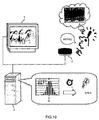
- Fig. 10 is a schematic configuration diagram indicating the cognitive capacity measurement device of the present embodiment.
- this cognitive capacity measurement device comprises: an image display unit 1 that displays to a subject for a specified time an original image having a significant photographic object and a degraded image that is an image in which specified processing has been conducted on the aforementioned original image and the data for recognizing the aforementioned photographic object has been degraded; a receiving unit 2 to receive from the subject the fact that the aforementioned photographic object has been recognized; and a data processing device 3 that receives the reception signals from this receiving unit 2 and conducts specified data processing based thereon.
- the subject in the present embodiment is not limited to subjects for whom the recognition time is measured in order to calculate the challenge level in Embodiment 1, and may be other people.
- this cognitive capacity measurement device is effective for subjects who do not contribute to the calculation of challenge level data, and if the recognition times are measured and the challenge level data of images are calculated for sufficiently many subjects according to Embodiment 1, the cognitive capacities of new subjects can be calculated using these images.
- Fig. 11 is a functional block diagram of the data processing unit 3 in the present embodiment, and because there are many parts of the present embodiment that are the same as in Embodiment 1, the description will be confined to the points of difference from Embodiment 1, namely, the challenge level data memory unit D4, the cognitive capacity calculator 15, the cognitive capacity memory unit D5, and the output unit 16.
- the challenge level data memory unit D4 relates and memorizes the challenge level data calculated in Embodiment 1 with an image identifier.
- the cognitive capacity calculator 15 uses the recognition time data of the subject memorized in the recognition time data memory unit D3 and the challenge level data memorized in the challenge level data memory unit D4 to calculate the capacity score s of the subject based on the following Formula 2.
- t is the recognition time
- m and ⁇ are the challenge level data of the corresponding image, specifically, the mean value and standard deviation of the aforementioned normal distribution.
- the sign of the value called the standardized score is generally inverted to make this capacity score.
- the standardized score indicates the position at which the subject in question stands within the group of subjects that contributed to the challenge level data calculation in Embodiment 1.
- the present inventors discovered by experiment that the standardized score of a given subject is a nearly fixed value independent of the image.
- this standardized score is an index of the cognitive capacities of the subjects.
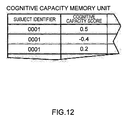
- the cognitive capacity memory unit D5 relates and memorizes the cognitive capacity score calculated by the cognitive capacity calculator 15 with the subject identifier (refer to Fig. 12).
- the output unit 16 uses a display or printer, etc. to output the cognitive capacity scores memorized in the cognitive capacity memory unit D5.
- Steps S1 to S8 are the same as in Embodiment 1. Moreover, when calculating the cognitive capacity of a subject for whom the recognition time has already been measured in Embodiment 1, this operation may be omitted because the recognition time data memorized in the recognition time data memory unit D3 may be used.
- the cognitive capacity calculator 15 calculates the cognitive capacity score of the subject from the recognition time data memorized in the recognition time data memory unit D3 and the challenge level data memorized in the challenge level data memory unit D4 (step S12), and stores this in the cognitive capacity memory unit D5 (step S 13).
- the output unit 16 outputs the cognitive capacity score (step S 14).
- the challenge level parameters of the images are calculated by Embodiment 1
- the cognitive capacity scores of the subjects are calculated by Embodiment 2.
- the present inventors have indicated as follows the fact the challenge level parameter and the cognitive capacity score derived in this way reflect brain function.
- the following relational equation Formula 3 may be established between the challenge level parameter, the cognitive capacity score and the recognition time.
- the present inventors think that the cognitive capacity score of the subject corresponds to the temperature, that is, to the way that the number of micro-states increase, and the challenge level parameter of the images corresponds to the active energy. Further, the present inventors believe that the capacity score probably plays a role like the temperature of the search activity of the data space (memory space), and this suggests the possibility that new discoveries regarding brain function could be obtained by considering an analogy with thermodynamics.
- the present invention it is possible to digitize the cognitive capacity of the individual and the challenge level of the image by the heretofore unknown simple method of measuring recognition time of degraded images. Moreover, because the relational equation that determines the recognition time has been demonstrated, it will be possible to obtain new discoveries regarding brain function based on further research using the present invention.
- the present invention may also contribute to research on brain function, and in the future may be expected to play a role in the selection and determination of the suitability of training appropriate to individuals, and in the early discovery of illnesses related to cognitive function such as Alzheimer type dementia, etc.
- Fig. 14 indicates the cumulative frequency distribution of the subjects in relation to the logarithm of the recognition times.
- Fig. 15 indicates one part of the challenge level parameters of the images calculated in the experiment.
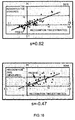
- the measured values of the recognition times for images with pre-known challenge levels that were not used when calculating the capacity scores were compared with the estimated values obtained from Formula 3 in regard to subjects with calculated capacity scores.
- Fig. 16 indicates the relationship between the estimated values and the measured values of the recognition times for two subjects with differing capacity scores.
- the straight line indicating the estimated values represented in the diagram and the distribution of the point groups indicating the measured values demonstrate that the recognition times are effectively estimated.
- the present invention is not limited to the embodiments above.
- the accuracy in the calculation of the challenge level parameters and the capacity scores could be improved by suitably eliminating data that differs from the trends at the extremes.
- the median value may be used as the challenge level parameter to calculate the challenge level parameters.
- the median value is generally not affected by extreme values, and is satisfactory.
- a cognitive capacity measurement device which comprises an image display unit 1 that has a function to display to a subject a degraded image that is an image in which degradation of the data for recognizing a significant photographic object has been caused by conducting a specified process on an original image having said subject; a receiving unit 2 to receive from the subject the fact that said photographic object has been recognized, and to output the reception signals; a recognition time calculator 13 that receives said reception signals from this receiving unit 2 and calculates the recognition time, which is the time the subject requires to recognize said photographic object; a challenge level data memory unit D4 that memorizes the challenge level data, which is data related to the challenge level of said degraded image in conjunction with recognition of the photographic object; and a cognitive capacity calculator 15 that conducts specified operations using said recognition time calculated by said recognition time calculator 13 and said challenge level data memorized in said challenge level data memory unit D4, and that calculates the cognitive capacity score, which is an index that digitizes the cognitive capacity of each subject.
- Said challenge level data memory unit D4 may memorize as said challenge level data the data that specifies a normal distribution applied to the frequency distribution of the number of subjects in relation to the logarithm of said recognition time acquired in advance from a statistically significant number of subjects.
- Said cognitive capacity calculator 15 may perform computations that derive and invert the sign of the standardized points corresponding to said recognition times, which were calculated by said recognition time calculator 13 in said normal distribution specified by said challenge level data memorized in said challenge level data memory unit D4.
- Said image display unit 1 may have a further function to display said original image to the subject, and said recognition time calculator 13 calculates the recognition time by subtracting the original image required time, which is the time required after said image display unit 1 displays the corresponding aforementioned original image until said receiving unit 2 receives the fact that said subject has recognized said photographic object, from the degraded image required time, which is the time required after said image display unit 1 displays said degraded image until said receiving unit 2 receives the fact that said subject has recognized said photographic object.
- a cognitive capacity memory part D5 may be further provided to relate and memorize said cognitive capacity score with a subject identifier to identify said subject.
- Said image display unit 1 may selectively display multiple kinds of images, and said cognitive capacity calculator 15 calculates the cognitive capacity score from the recognition times obtained from each image.
- An output unit 16 that outputs said cognitive capacity score may be further provided.
- Said degraded image may be one in which the original image has been digitized.
- a cognitive capacity measurement method which is characterized by displaying to a subject a degraded image that is an image for which specified processing has been conducted on an original image having a significant photographic object and the data for recognizing said photographic object has been degraded; by receiving from the subject the fact that said photographic object has been recognized; by computing the recognition time, which is the time required for the subject to recognize said photographic object, based on these received results; and by calculating the cognitive capacity score, which is an index that digitizes the cognitive capacity of the subject by specified computations, from this recognition time and the challenge level data, which is data related to the challenge level of said degraded image in conjunction with the recognition of the photographic object.
- said cognitive capacity measurement method may also be referred to as a method of or for measuring the cognitive capacity of an subject or an individual and/or as a method of or for measuring the challenge level of degraded images.
- Said cognitive capacity score may be related to or with a subject identifier for identifying said subject.
- Said cognitive capacity score may memorized in a cognitive capacity memory unit D5 provided in a specified memory device.
- Data that specifies a normal distribution applied to the frequency distribution of the number of subjects in relation to the logarithm of said recognition time acquired in advance from a statistically significant number of subjects may be memorized as said challenge level data, in particular in a challenge level data memory unit D4.
- Computations may be performed - in particular by a cognitive capacity calculator 15 - that derive and invert the sign of the standardized points corresponding to said recognition times, which were calculated - in particular by a recognition time calculator 13 - in said normal distribution specified by said challenge level data memorized, in particular in a challenge level data memory unit D4.
- Said original image may be displayed to the subject, in particular by said image display unit 1.
- Said recognition time may be calculated - in particular by said recognition time calculator 13 - by subtracting the original image required time, which is the time required after having displayed - in particular by said image display unit 1 - the said corresponding original image until having received - in particular by said receiving unit 2 - the fact that said subject has recognized said photographic object, from the degraded image required time, which is the time required after having displayed - in particular by said image display unit 1 - said degraded image until having received - in particular by said receiving unit 2 -the fact that said subject has recognized said photographic object.
- Said cognitive capacity score may be memorized and related to or with a subject identifier to identify said subject, in particular by a cognitive capacity memory part D5.
- Multiple kinds of images may selectively be displayed, in particular by said image display unit 1.
- the cognitive capacity score may calculated from the recognition times obtained from each image, in particular by said cognitive capacity calculator 15.
- Said cognitive capacity score may be output, in particular by an output unit 16.
- Said degraded image may be one in which the original image has been digitized.
- a degraded image challenge level measurement device which comprises an image display unit 1 that has a function to display to a subject a degraded image that is an image for which specified processing has been conducted on an original image having a significant photographic object and the data for recognizing said photographic object has been degraded; a receiving unit 2 that receives from the subject the fact that said photographic object has been recognized, and outputs reception signals; a recognition time calculator 13 that receives said reception signals from this receiving unit 2, and calculates the recognition time, which is the time required for the subject to recognize said photographic object; a recognition time data memory unit that respectively memorizes the recognition time data, which is data relating to said recognition times of multiple subjects calculated by this recognition time calculator 13; and a challenge level data calculator 14 that calculates the challenge level data, which is data relating to the challenge level of said degraded images in conjunction with photographic object recognition, by acquiring said recognition time data memorized in this recognition time data memory unit, and by using a specified function to approximate the distribution form of said recognition
- Said challenge level data calculator may calculate said challenge level data using data that specifies a normal distribution that applies to the frequency distribution of the number of subjects in relation to the logarithm of said recognition time.
- a challenge level data memory unit D4 may further be provided to relate and memorize said challenge level data with a degraded image identifier for identifying said degraded image.
- a degraded image challenge level measurement method which displays to a subject a degraded image that is an image for which specified processing has been conducted on an original image having a significant photographic object and the data for recognizing said photographic object has been degraded; which receives from the subject the fact that said photographic object has been recognized; which conducts in relation to a statistically significant number of subjects tests to calculate the recognition time, which is the time required for the subject to recognize said photographic object, based on these received results; and which calculates the challenge level data, which is data related to the challenge level of said degraded image, by using a specified function to approximate the distribution form of the calculated said recognition times.
- the present invention may have a variety of other forms within the range that does not deviate from the purpose thereof.
Landscapes
- Health & Medical Sciences (AREA)
- Life Sciences & Earth Sciences (AREA)
- Engineering & Computer Science (AREA)
- Hospice & Palliative Care (AREA)
- Pathology (AREA)
- Developmental Disabilities (AREA)
- Psychiatry (AREA)
- Psychology (AREA)
- Social Psychology (AREA)
- Physics & Mathematics (AREA)
- Child & Adolescent Psychology (AREA)
- Biophysics (AREA)
- Educational Technology (AREA)
- Biomedical Technology (AREA)
- Heart & Thoracic Surgery (AREA)
- Medical Informatics (AREA)
- Molecular Biology (AREA)
- Surgery (AREA)
- Animal Behavior & Ethology (AREA)
- General Health & Medical Sciences (AREA)
- Public Health (AREA)
- Veterinary Medicine (AREA)
- Measurement Of The Respiration, Hearing Ability, Form, And Blood Characteristics Of Living Organisms (AREA)
Applications Claiming Priority (1)
| Application Number | Priority Date | Filing Date | Title |
|---|---|---|---|
| JP2004278225A JP4635179B2 (ja) | 2004-09-24 | 2004-09-24 | 認識能力測定装置及び認識能力測定方法 |
Publications (1)
| Publication Number | Publication Date |
|---|---|
| EP1639943A1 true EP1639943A1 (de) | 2006-03-29 |
Family
ID=35414976
Family Applications (1)
| Application Number | Title | Priority Date | Filing Date |
|---|---|---|---|
| EP05020830A Withdrawn EP1639943A1 (de) | 2004-09-24 | 2005-09-23 | Gerät und Verfahren zur Messung der kognitiven Leistungsfähigkeit |
Country Status (3)
| Country | Link |
|---|---|
| US (1) | US7556604B2 (de) |
| EP (1) | EP1639943A1 (de) |
| JP (1) | JP4635179B2 (de) |
Cited By (3)
| Publication number | Priority date | Publication date | Assignee | Title |
|---|---|---|---|---|
| WO2010128934A1 (en) * | 2009-05-04 | 2010-11-11 | Siegbert Warkentin | Apparatus and method for voice based diagnostic support |
| CN103561651A (zh) * | 2010-11-24 | 2014-02-05 | 数字制品有限责任公司 | 评估认知功能的系统和方法 |
| US10579743B2 (en) | 2016-05-20 | 2020-03-03 | International Business Machines Corporation | Communication assistant to bridge incompatible audience |
Families Citing this family (24)
| Publication number | Priority date | Publication date | Assignee | Title |
|---|---|---|---|---|
| US20080038706A1 (en) * | 2006-08-08 | 2008-02-14 | Siemens Medical Solutions Usa, Inc. | Automated User Education and Training Cognitive Enhancement System |
| US20080057483A1 (en) * | 2006-09-05 | 2008-03-06 | Lawrence H Avidan | Apparatus and System for Testing Memory |
| US20080070207A1 (en) * | 2006-09-05 | 2008-03-20 | Lawrence H Avidan | System and Method for Testing Memory |
| US20090298025A1 (en) * | 2007-05-09 | 2009-12-03 | Oregon Health & Science University | Object recognition testing tools and techniques for measuring cognitive ability and cognitive impairment |
| WO2008157544A1 (en) * | 2007-06-18 | 2008-12-24 | New York University | Electronic identity card |
| US8777630B2 (en) * | 2009-09-16 | 2014-07-15 | Cerebral Assessment Systems, Inc. | Method and system for quantitative assessment of facial emotion sensitivity |
| US12502074B2 (en) * | 2010-10-13 | 2025-12-23 | Gholam A. Peyman | Telemedicine system with dynamic imaging |
| US20130252215A1 (en) | 2010-12-06 | 2013-09-26 | National University Corporation Okayama University | Method and device for verifying onset of dementia |
| ES2781873T3 (es) | 2012-08-28 | 2020-09-08 | Delos Living Llc | Sistemas y métodos para mejorar el bienestar asociado con ambientes habitables |
| JP6187902B2 (ja) | 2012-08-31 | 2017-08-30 | パナソニックIpマネジメント株式会社 | 知的生産性分析装置、プログラム |
| JP6206791B2 (ja) | 2012-08-31 | 2017-10-04 | パナソニックIpマネジメント株式会社 | 集中度計測装置、プログラム |
| GB201319619D0 (en) * | 2013-11-06 | 2013-12-18 | Diamentech Ltd | System for assessing a mental health disorder |
| CA2940766A1 (en) | 2014-02-28 | 2015-09-03 | Delos Living Llc | Systems, methods and articles for enhancing wellness associated with habitable environments |
| JP5866567B2 (ja) * | 2014-05-26 | 2016-02-17 | パナソニックIpマネジメント株式会社 | 集中度の評価装置、プログラム |
| US20170150907A1 (en) * | 2015-02-04 | 2017-06-01 | Cerebral Assessment Systems, LLC | Method and system for quantitative assessment of visual motor response |
| EP3302227B1 (de) * | 2015-06-05 | 2021-08-11 | S2 Cognition, Inc. | Vorrichtung zur messung der leistungsfähigkeit im schnelltempo von menschen |
| EP3192434B1 (de) * | 2016-01-15 | 2018-10-03 | Centre National de la Recherche Scientifique | Vorrichtung und verfahren zur bestimmung der augenbewegung durch berührungsempfindliche schnittstelle |
| JP6793932B2 (ja) * | 2016-05-17 | 2020-12-02 | 公立大学法人会津大学 | 被験者の識別・反応機能を計測するための識別・反応計測装置、及び被験者の識別・反応機能の計測を実行制御するプログラム |
| CN110574054B (zh) | 2017-04-24 | 2023-06-02 | 松下知识产权经营株式会社 | 智力生产率评价装置和智力生产率评价方法 |
| WO2019046580A1 (en) | 2017-08-30 | 2019-03-07 | Delos Living Llc | SYSTEMS, METHODS AND ARTICLES FOR EVALUATING AND / OR IMPROVING HEALTH AND WELL-BEING |
| US11649977B2 (en) | 2018-09-14 | 2023-05-16 | Delos Living Llc | Systems and methods for air remediation |
| US11844163B2 (en) | 2019-02-26 | 2023-12-12 | Delos Living Llc | Method and apparatus for lighting in an office environment |
| US11898898B2 (en) | 2019-03-25 | 2024-02-13 | Delos Living Llc | Systems and methods for acoustic monitoring |
| JP7838476B2 (ja) * | 2020-04-14 | 2026-04-01 | ソニーグループ株式会社 | 情報処理装置および情報処理プログラム |
Citations (2)
| Publication number | Priority date | Publication date | Assignee | Title |
|---|---|---|---|---|
| JPH0646989A (ja) | 1993-06-30 | 1994-02-22 | Olympus Optical Co Ltd | 形状記憶合金アクチュエータおよび挿入具 |
| US20030073885A1 (en) * | 2000-01-31 | 2003-04-17 | Alexis Theodoracopulos | Measuring cognitive impairment |
Family Cites Families (3)
| Publication number | Priority date | Publication date | Assignee | Title |
|---|---|---|---|---|
| JP2506023B2 (ja) | 1992-04-08 | 1996-06-12 | 株式会社フクト | 進路適性検査装置 |
| ATE321491T1 (de) * | 1999-06-15 | 2006-04-15 | Dimitri Caplygin | System zur verbesserung von neurophysiologischen prozessen |
| JP3954295B2 (ja) * | 2000-11-02 | 2007-08-08 | 独立行政法人科学技術振興機構 | 識別・反応計測方法、識別・反応計測プログラムを記録したコンピュータ読み取り可能な記録媒体及び識別・反応計測装置 |
-
2004
- 2004-09-24 JP JP2004278225A patent/JP4635179B2/ja not_active Expired - Fee Related
-
2005
- 2005-09-22 US US11/233,287 patent/US7556604B2/en not_active Expired - Fee Related
- 2005-09-23 EP EP05020830A patent/EP1639943A1/de not_active Withdrawn
Patent Citations (2)
| Publication number | Priority date | Publication date | Assignee | Title |
|---|---|---|---|---|
| JPH0646989A (ja) | 1993-06-30 | 1994-02-22 | Olympus Optical Co Ltd | 形状記憶合金アクチュエータおよび挿入具 |
| US20030073885A1 (en) * | 2000-01-31 | 2003-04-17 | Alexis Theodoracopulos | Measuring cognitive impairment |
Non-Patent Citations (5)
| Title |
|---|
| DELL'ACQUA R ET AL: "Naming times and standardized norms for the Italian PD/DPSS set of 266 pictures: direct comparisons with American, English, French, and Spanish published databases.", November 2000, BEHAVIOR RESEARCH METHODS, INSTRUMENTS, & COMPUTERS : A JOURNAL OF THE PSYCHONOMIC SOCIETY, INC. NOV 2000, VOL. 32, NR. 4, PAGE(S) 588 - 615, ISSN: 0743-3808, XP008056656 * |
| LAWS KEITH R ET AL: "The effect of 'masking' on picture naming.", CORTEX; A JOURNAL DEVOTED TO THE STUDY OF THE NERVOUS SYSTEM AND BEHAVIOR. APR 2002, vol. 38, no. 2, April 2002 (2002-04-01), pages 137 - 147, XP008056538, ISSN: 0010-9452 * |
| MACK J L ET AL: "Performance of subjects with probable Alzheimer disease and normal elderly controls on the Gollin Incomplete Pictures Test.", PERCEPTUAL AND MOTOR SKILLS. DEC 1993, vol. 77, no. 3 Pt 1, December 1993 (1993-12-01), UNITED STATES, pages 951 - 969, XP008056615, ISSN: 0031-5125 * |
| PATTERSON M B ET AL: "Performance of elderly and young normals on the Gollin Incomplete Pictures Test.", PERCEPTUAL AND MOTOR SKILLS. OCT 1999, vol. 89, no. 2, October 1999 (1999-10-01), UNITED STATES, pages 663 - 664, XP008056638, ISSN: 0031-5125 * |
| SZEKELY ANNA ET AL: "Timed action and object naming.", 2002, TECHNICAL REPORT CRL-0202, CENTER FOR RESEARCH IN LANGUAGE, UNIVERSITY OF CALIFORNIA, SAN DIEGO, LA JOLLA, CA 92093-0526, XP002357384 * |
Cited By (5)
| Publication number | Priority date | Publication date | Assignee | Title |
|---|---|---|---|---|
| WO2010128934A1 (en) * | 2009-05-04 | 2010-11-11 | Siegbert Warkentin | Apparatus and method for voice based diagnostic support |
| CN103561651A (zh) * | 2010-11-24 | 2014-02-05 | 数字制品有限责任公司 | 评估认知功能的系统和方法 |
| CN103561651B (zh) * | 2010-11-24 | 2017-03-22 | 数字制品有限责任公司 | 评估认知功能的系统和方法 |
| US10579743B2 (en) | 2016-05-20 | 2020-03-03 | International Business Machines Corporation | Communication assistant to bridge incompatible audience |
| US11205057B2 (en) | 2016-05-20 | 2021-12-21 | International Business Machines Corporation | Communication assistant to bridge incompatible audience |
Also Published As
| Publication number | Publication date |
|---|---|
| US7556604B2 (en) | 2009-07-07 |
| JP4635179B2 (ja) | 2011-02-16 |
| JP2006087743A (ja) | 2006-04-06 |
| US20060074340A1 (en) | 2006-04-06 |
Similar Documents
| Publication | Publication Date | Title |
|---|---|---|
| EP1639943A1 (de) | Gerät und Verfahren zur Messung der kognitiven Leistungsfähigkeit | |
| US12336808B2 (en) | Method and device for automatic identification of measurement item and ultrasound imaging apparatus | |
| Jobbágy et al. | Analysis of finger-tapping movement | |
| CN106256312B (zh) | 认知功能障碍评价装置 | |
| US20150150476A1 (en) | Electrophysiological analysis system and method | |
| US9888845B2 (en) | System and method for optical detection of cognitive impairment | |
| Dehbandi et al. | Using data from the Microsoft Kinect 2 to quantify upper limb behavior: a feasibility study | |
| CN115497621A (zh) | 一种老年人认知状况测评系统 | |
| JP2021097913A (ja) | 認知機能確認方法、認知機能障害判定方法、認知機能確認プログラム、認知機能障害判定プログラム及び認知機能確認判定装置 | |
| CN102131461A (zh) | 睡眠判断装置以及睡眠判断方法 | |
| KR102302411B1 (ko) | 생체 데이터를 비롯한 각종 데이터를 사용하는 인공지능 모델을 이용한 금융상품 매매 방법, 서버 및 컴퓨터프로그램 | |
| Röhner et al. | EZ: An easy way to conduct a more fine-grained analysis of faked and nonfaked Implicit Association Test (IAT) data | |
| Bacchin et al. | Gaze-based metrics of cognitive load in a conjunctive visual memory task | |
| Wright et al. | Measuring functional status in rehabilitation | |
| KR20200121692A (ko) | 피부 나이 추정 방법 및 장치 | |
| CN114818776A (zh) | 多模态测谎的数据对齐及异常值处理方法、装置及存储介质 | |
| CN111738234B (zh) | 基于个体眼动特征的自动化共情能力识别方法 | |
| US20210169415A1 (en) | Machine classification of significant psychophysiological response | |
| Kuravsky et al. | Assessing the Pilot Condition According to Video Oculography Data and Parameters of Brain Alpha Rhythms by Modeling the Neural Activity | |
| Jacobson et al. | Effect of directional response variables on eye-hand reaction times and decision time | |
| JP6670413B1 (ja) | 情報処理装置、情報処理方法及びプログラム | |
| US10342421B2 (en) | Method for measuring visual acuity | |
| Suryaneta et al. | Quantifying Feel, Fragrance And Finish: A Review of Sensory Threshold In Cosmetics | |
| US20230284948A1 (en) | Test protocol for detecting significant psychophysiological response | |
| Mehrotra et al. | Enhancing Elderly Care: Remote Glucose Monitoring for Health and Independence |
Legal Events
| Date | Code | Title | Description |
|---|---|---|---|
| PUAI | Public reference made under article 153(3) epc to a published international application that has entered the european phase |
Free format text: ORIGINAL CODE: 0009012 |
|
| AK | Designated contracting states |
Kind code of ref document: A1 Designated state(s): AT BE BG CH CY CZ DE DK EE ES FI FR GB GR HU IE IS IT LI LT LU LV MC NL PL PT RO SE SI SK TR |
|
| AX | Request for extension of the european patent |
Extension state: AL BA HR MK YU |
|
| 17P | Request for examination filed |
Effective date: 20060929 |
|
| AKX | Designation fees paid |
Designated state(s): DE FI FR GB |
|
| 17Q | First examination report despatched |
Effective date: 20080411 |
|
| STAA | Information on the status of an ep patent application or granted ep patent |
Free format text: STATUS: THE APPLICATION IS DEEMED TO BE WITHDRAWN |
|
| 18D | Application deemed to be withdrawn |
Effective date: 20120403 |