EP1639663B1 - Polyimide based electrolyte and improved batteries therefrom - Google Patents
Polyimide based electrolyte and improved batteries therefrom Download PDFInfo
- Publication number
- EP1639663B1 EP1639663B1 EP04750764.5A EP04750764A EP1639663B1 EP 1639663 B1 EP1639663 B1 EP 1639663B1 EP 04750764 A EP04750764 A EP 04750764A EP 1639663 B1 EP1639663 B1 EP 1639663B1
- Authority
- EP
- European Patent Office
- Prior art keywords
- battery
- polymer
- polyimide
- pme
- lithium
- Prior art date
- Legal status (The legal status is an assumption and is not a legal conclusion. Google has not performed a legal analysis and makes no representation as to the accuracy of the status listed.)
- Expired - Lifetime
Links
- 229920001721 polyimide Polymers 0.000 title claims description 148
- 239000004642 Polyimide Substances 0.000 title claims description 146
- 239000003792 electrolyte Substances 0.000 title claims description 58
- 229920000642 polymer Polymers 0.000 claims description 101
- 239000002904 solvent Substances 0.000 claims description 89
- 150000003839 salts Chemical class 0.000 claims description 63
- SECXISVLQFMRJM-UHFFFAOYSA-N N-Methylpyrrolidone Chemical compound CN1CCCC1=O SECXISVLQFMRJM-UHFFFAOYSA-N 0.000 claims description 58
- 229910052744 lithium Inorganic materials 0.000 claims description 56
- 150000003949 imides Chemical group 0.000 claims description 44
- 159000000002 lithium salts Chemical class 0.000 claims description 43
- 229910003002 lithium salt Inorganic materials 0.000 claims description 42
- 238000000034 method Methods 0.000 claims description 39
- WHXSMMKQMYFTQS-UHFFFAOYSA-N Lithium Chemical compound [Li] WHXSMMKQMYFTQS-UHFFFAOYSA-N 0.000 claims description 30
- ZMXDDKWLCZADIW-UHFFFAOYSA-N N,N-Dimethylformamide Chemical compound CN(C)C=O ZMXDDKWLCZADIW-UHFFFAOYSA-N 0.000 claims description 30
- 239000011159 matrix material Substances 0.000 claims description 27
- 239000000463 material Substances 0.000 claims description 23
- 239000005022 packaging material Substances 0.000 claims description 23
- 238000010521 absorption reaction Methods 0.000 claims description 20
- 229910001416 lithium ion Inorganic materials 0.000 claims description 19
- 239000000203 mixture Substances 0.000 claims description 18
- HBBGRARXTFLTSG-UHFFFAOYSA-N Lithium ion Chemical compound [Li+] HBBGRARXTFLTSG-UHFFFAOYSA-N 0.000 claims description 14
- 239000011230 binding agent Substances 0.000 claims description 11
- 230000003287 optical effect Effects 0.000 claims description 10
- 229910013188 LiBOB Inorganic materials 0.000 claims description 8
- FXHOOIRPVKKKFG-UHFFFAOYSA-N N,N-Dimethylacetamide Chemical compound CN(C)C(C)=O FXHOOIRPVKKKFG-UHFFFAOYSA-N 0.000 claims description 8
- AMXOYNBUYSYVKV-UHFFFAOYSA-M lithium bromide Chemical compound [Li+].[Br-] AMXOYNBUYSYVKV-UHFFFAOYSA-M 0.000 claims description 8
- KWGKDLIKAYFUFQ-UHFFFAOYSA-M lithium chloride Chemical compound [Li+].[Cl-] KWGKDLIKAYFUFQ-UHFFFAOYSA-M 0.000 claims description 8
- 239000011262 electrochemically active material Substances 0.000 claims description 7
- 238000001035 drying Methods 0.000 claims description 6
- 150000002500 ions Chemical class 0.000 claims description 6
- HSZCZNFXUDYRKD-UHFFFAOYSA-M lithium iodide Inorganic materials [Li+].[I-] HSZCZNFXUDYRKD-UHFFFAOYSA-M 0.000 claims description 6
- 229910001290 LiPF6 Inorganic materials 0.000 claims description 5
- 239000004962 Polyamide-imide Substances 0.000 claims description 5
- 238000009830 intercalation Methods 0.000 claims description 5
- 230000002687 intercalation Effects 0.000 claims description 5
- 229920002312 polyamide-imide Polymers 0.000 claims description 5
- 229920002480 polybenzimidazole Polymers 0.000 claims description 5
- 229910032387 LiCoO2 Inorganic materials 0.000 claims description 4
- 229910052493 LiFePO4 Inorganic materials 0.000 claims description 4
- 229910003005 LiNiO2 Inorganic materials 0.000 claims description 4
- 239000004693 Polybenzimidazole Substances 0.000 claims description 4
- 229910000552 LiCF3SO3 Inorganic materials 0.000 claims description 3
- 229910012761 LiTiS2 Inorganic materials 0.000 claims description 3
- 229910045601 alloy Inorganic materials 0.000 claims description 3
- 239000000956 alloy Substances 0.000 claims description 3
- 229910001540 lithium hexafluoroarsenate(V) Inorganic materials 0.000 claims description 3
- MHCFAGZWMAWTNR-UHFFFAOYSA-M lithium perchlorate Chemical compound [Li+].[O-]Cl(=O)(=O)=O MHCFAGZWMAWTNR-UHFFFAOYSA-M 0.000 claims description 3
- 229910001486 lithium perchlorate Inorganic materials 0.000 claims description 3
- 229910001496 lithium tetrafluoroborate Inorganic materials 0.000 claims description 3
- 229910013131 LiN Inorganic materials 0.000 claims 1
- 239000010408 film Substances 0.000 description 36
- 210000004027 cell Anatomy 0.000 description 35
- YEJRWHAVMIAJKC-UHFFFAOYSA-N 4-Butyrolactone Chemical compound O=C1CCCO1 YEJRWHAVMIAJKC-UHFFFAOYSA-N 0.000 description 24
- 230000008569 process Effects 0.000 description 22
- 238000003475 lamination Methods 0.000 description 21
- 239000005518 polymer electrolyte Substances 0.000 description 20
- ANSXAPJVJOKRDJ-UHFFFAOYSA-N furo[3,4-f][2]benzofuran-1,3,5,7-tetrone Chemical compound C1=C2C(=O)OC(=O)C2=CC2=C1C(=O)OC2=O ANSXAPJVJOKRDJ-UHFFFAOYSA-N 0.000 description 16
- 239000011244 liquid electrolyte Substances 0.000 description 16
- WFDIJRYMOXRFFG-UHFFFAOYSA-N Acetic anhydride Chemical compound CC(=O)OC(C)=O WFDIJRYMOXRFFG-UHFFFAOYSA-N 0.000 description 15
- OKKJLVBELUTLKV-UHFFFAOYSA-N Methanol Chemical compound OC OKKJLVBELUTLKV-UHFFFAOYSA-N 0.000 description 15
- 150000004985 diamines Chemical class 0.000 description 14
- 238000010438 heat treatment Methods 0.000 description 14
- GTDPSWPPOUPBNX-UHFFFAOYSA-N ac1mqpva Chemical compound CC12C(=O)OC(=O)C1(C)C1(C)C2(C)C(=O)OC1=O GTDPSWPPOUPBNX-UHFFFAOYSA-N 0.000 description 13
- 239000000499 gel Substances 0.000 description 13
- 229910000686 lithium vanadium oxide Inorganic materials 0.000 description 11
- 238000005033 Fourier transform infrared spectroscopy Methods 0.000 description 10
- 239000000243 solution Substances 0.000 description 10
- QTBSBXVTEAMEQO-UHFFFAOYSA-N Acetic acid Chemical compound CC(O)=O QTBSBXVTEAMEQO-UHFFFAOYSA-N 0.000 description 9
- -1 Ni-MH) Chemical class 0.000 description 9
- 230000008859 change Effects 0.000 description 9
- JUJWROOIHBZHMG-UHFFFAOYSA-N Pyridine Chemical compound C1=CC=NC=C1 JUJWROOIHBZHMG-UHFFFAOYSA-N 0.000 description 8
- RLTFLELMPUMVEH-UHFFFAOYSA-N [Li+].[O--].[O--].[O--].[V+5] Chemical compound [Li+].[O--].[O--].[O--].[V+5] RLTFLELMPUMVEH-UHFFFAOYSA-N 0.000 description 8
- 239000002184 metal Substances 0.000 description 8
- 238000000782 polymeric membrane extraction Methods 0.000 description 8
- 230000006870 function Effects 0.000 description 7
- 230000003993 interaction Effects 0.000 description 7
- 229910052751 metal Inorganic materials 0.000 description 7
- 238000004806 packaging method and process Methods 0.000 description 7
- 229910000733 Li alloy Inorganic materials 0.000 description 6
- 230000001351 cycling effect Effects 0.000 description 6
- 239000001989 lithium alloy Substances 0.000 description 6
- 238000005259 measurement Methods 0.000 description 6
- 239000011148 porous material Substances 0.000 description 6
- XLYOFNOQVPJJNP-UHFFFAOYSA-N water Substances O XLYOFNOQVPJJNP-UHFFFAOYSA-N 0.000 description 6
- OKTJSMMVPCPJKN-UHFFFAOYSA-N Carbon Chemical compound [C] OKTJSMMVPCPJKN-UHFFFAOYSA-N 0.000 description 5
- 238000006243 chemical reaction Methods 0.000 description 5
- 125000006159 dianhydride group Chemical group 0.000 description 5
- 238000001746 injection moulding Methods 0.000 description 5
- 238000004519 manufacturing process Methods 0.000 description 5
- 230000035699 permeability Effects 0.000 description 5
- 238000005191 phase separation Methods 0.000 description 5
- 229920000139 polyethylene terephthalate Polymers 0.000 description 5
- 239000005020 polyethylene terephthalate Substances 0.000 description 5
- 238000012545 processing Methods 0.000 description 5
- WCZNKVPCIFMXEQ-UHFFFAOYSA-N 2,3,5,6-tetramethylbenzene-1,4-diamine Chemical compound CC1=C(C)C(N)=C(C)C(C)=C1N WCZNKVPCIFMXEQ-UHFFFAOYSA-N 0.000 description 4
- CSCPPACGZOOCGX-UHFFFAOYSA-N Acetone Chemical compound CC(C)=O CSCPPACGZOOCGX-UHFFFAOYSA-N 0.000 description 4
- 150000008064 anhydrides Chemical group 0.000 description 4
- 230000007547 defect Effects 0.000 description 4
- 238000005516 engineering process Methods 0.000 description 4
- 239000007789 gas Substances 0.000 description 4
- 238000000465 moulding Methods 0.000 description 4
- 229920005575 poly(amic acid) Polymers 0.000 description 4
- UMJSCPRVCHMLSP-UHFFFAOYSA-N pyridine Natural products COC1=CC=CN=C1 UMJSCPRVCHMLSP-UHFFFAOYSA-N 0.000 description 4
- 239000000565 sealant Substances 0.000 description 4
- 239000002002 slurry Substances 0.000 description 4
- UHOVQNZJYSORNB-UHFFFAOYSA-N Benzene Chemical compound C1=CC=CC=C1 UHOVQNZJYSORNB-UHFFFAOYSA-N 0.000 description 3
- LFQSCWFLJHTTHZ-UHFFFAOYSA-N Ethanol Chemical compound CCO LFQSCWFLJHTTHZ-UHFFFAOYSA-N 0.000 description 3
- 150000004984 aromatic diamines Chemical class 0.000 description 3
- WKDNYTOXBCRNPV-UHFFFAOYSA-N bpda Chemical compound C1=C2C(=O)OC(=O)C2=CC(C=2C=C3C(=O)OC(C3=CC=2)=O)=C1 WKDNYTOXBCRNPV-UHFFFAOYSA-N 0.000 description 3
- 239000010406 cathode material Substances 0.000 description 3
- 238000006482 condensation reaction Methods 0.000 description 3
- 239000013078 crystal Substances 0.000 description 3
- 239000010439 graphite Substances 0.000 description 3
- 229910002804 graphite Inorganic materials 0.000 description 3
- 239000007788 liquid Substances 0.000 description 3
- 239000000178 monomer Substances 0.000 description 3
- 125000001997 phenyl group Chemical group [H]C1=C([H])C([H])=C(*)C([H])=C1[H] 0.000 description 3
- 239000004014 plasticizer Substances 0.000 description 3
- 239000004417 polycarbonate Substances 0.000 description 3
- 229920000515 polycarbonate Polymers 0.000 description 3
- 238000000746 purification Methods 0.000 description 3
- 238000005096 rolling process Methods 0.000 description 3
- 238000010512 small scale reaction Methods 0.000 description 3
- KIFDSGGWDIVQGN-UHFFFAOYSA-N 4-[9-(4-aminophenyl)fluoren-9-yl]aniline Chemical compound C1=CC(N)=CC=C1C1(C=2C=CC(N)=CC=2)C2=CC=CC=C2C2=CC=CC=C21 KIFDSGGWDIVQGN-UHFFFAOYSA-N 0.000 description 2
- IPDXWXPSCKSIII-UHFFFAOYSA-N 4-propan-2-ylbenzene-1,3-diamine Chemical compound CC(C)C1=CC=C(N)C=C1N IPDXWXPSCKSIII-UHFFFAOYSA-N 0.000 description 2
- IJGRMHOSHXDMSA-UHFFFAOYSA-N Atomic nitrogen Chemical compound N#N IJGRMHOSHXDMSA-UHFFFAOYSA-N 0.000 description 2
- RTZKZFJDLAIYFH-UHFFFAOYSA-N Diethyl ether Chemical compound CCOCC RTZKZFJDLAIYFH-UHFFFAOYSA-N 0.000 description 2
- 229910004708 Li(PF6) Inorganic materials 0.000 description 2
- 229910013027 LiVxOy Inorganic materials 0.000 description 2
- 229910015734 LixMnyOz Inorganic materials 0.000 description 2
- 229910018095 Ni-MH Inorganic materials 0.000 description 2
- PXHVJJICTQNCMI-UHFFFAOYSA-N Nickel Chemical compound [Ni] PXHVJJICTQNCMI-UHFFFAOYSA-N 0.000 description 2
- 229910018477 Ni—MH Inorganic materials 0.000 description 2
- 229920003171 Poly (ethylene oxide) Polymers 0.000 description 2
- 239000002253 acid Substances 0.000 description 2
- 239000010405 anode material Substances 0.000 description 2
- 230000004888 barrier function Effects 0.000 description 2
- 230000008901 benefit Effects 0.000 description 2
- 230000005540 biological transmission Effects 0.000 description 2
- 230000015572 biosynthetic process Effects 0.000 description 2
- 229910052799 carbon Inorganic materials 0.000 description 2
- 239000006257 cathode slurry Substances 0.000 description 2
- 230000001413 cellular effect Effects 0.000 description 2
- 239000007795 chemical reaction product Substances 0.000 description 2
- 239000003153 chemical reaction reagent Substances 0.000 description 2
- 239000011248 coating agent Substances 0.000 description 2
- 238000000576 coating method Methods 0.000 description 2
- 229920005598 conductive polymer binder Polymers 0.000 description 2
- 230000007423 decrease Effects 0.000 description 2
- 238000004146 energy storage Methods 0.000 description 2
- 239000001307 helium Substances 0.000 description 2
- 229910052734 helium Inorganic materials 0.000 description 2
- SWQJXJOGLNCZEY-UHFFFAOYSA-N helium atom Chemical compound [He] SWQJXJOGLNCZEY-UHFFFAOYSA-N 0.000 description 2
- 230000006872 improvement Effects 0.000 description 2
- 238000010030 laminating Methods 0.000 description 2
- QSZMZKBZAYQGRS-UHFFFAOYSA-N lithium;bis(trifluoromethylsulfonyl)azanide Chemical compound [Li+].FC(F)(F)S(=O)(=O)[N-]S(=O)(=O)C(F)(F)F QSZMZKBZAYQGRS-UHFFFAOYSA-N 0.000 description 2
- NUJOXMJBOLGQSY-UHFFFAOYSA-N manganese dioxide Chemical compound O=[Mn]=O NUJOXMJBOLGQSY-UHFFFAOYSA-N 0.000 description 2
- 229910052757 nitrogen Inorganic materials 0.000 description 2
- 229920003229 poly(methyl methacrylate) Polymers 0.000 description 2
- 229920002239 polyacrylonitrile Polymers 0.000 description 2
- 239000004926 polymethyl methacrylate Substances 0.000 description 2
- 239000004800 polyvinyl chloride Substances 0.000 description 2
- 239000000047 product Substances 0.000 description 2
- 238000001953 recrystallisation Methods 0.000 description 2
- 230000009467 reduction Effects 0.000 description 2
- 238000006798 ring closing metathesis reaction Methods 0.000 description 2
- 239000007787 solid Substances 0.000 description 2
- 239000000758 substrate Substances 0.000 description 2
- 230000008961 swelling Effects 0.000 description 2
- 238000012360 testing method Methods 0.000 description 2
- 229910017048 AsF6 Inorganic materials 0.000 description 1
- XFXPMWWXUTWYJX-UHFFFAOYSA-N Cyanide Chemical compound N#[C-] XFXPMWWXUTWYJX-UHFFFAOYSA-N 0.000 description 1
- KRHYYFGTRYWZRS-UHFFFAOYSA-M Fluoride anion Chemical compound [F-] KRHYYFGTRYWZRS-UHFFFAOYSA-M 0.000 description 1
- 229910007039 Li(CF3 SO2)2 Inorganic materials 0.000 description 1
- 229910007040 Li(CF3 SO2)3 Inorganic materials 0.000 description 1
- 229910004380 Li(NO3) Inorganic materials 0.000 description 1
- 229910004711 Li(SCN) Inorganic materials 0.000 description 1
- 229910002986 Li4Ti5O12 Inorganic materials 0.000 description 1
- 229910002097 Lithium manganese(III,IV) oxide Inorganic materials 0.000 description 1
- 229910014504 LixNiyCozO2 Inorganic materials 0.000 description 1
- BZLVMXJERCGZMT-UHFFFAOYSA-N Methyl tert-butyl ether Chemical compound COC(C)(C)C BZLVMXJERCGZMT-UHFFFAOYSA-N 0.000 description 1
- 239000004721 Polyphenylene oxide Substances 0.000 description 1
- 229910003092 TiS2 Inorganic materials 0.000 description 1
- 208000027418 Wounds and injury Diseases 0.000 description 1
- JFBZPFYRPYOZCQ-UHFFFAOYSA-N [Li].[Al] Chemical compound [Li].[Al] JFBZPFYRPYOZCQ-UHFFFAOYSA-N 0.000 description 1
- FDLZQPXZHIFURF-UHFFFAOYSA-N [O-2].[Ti+4].[Li+] Chemical compound [O-2].[Ti+4].[Li+] FDLZQPXZHIFURF-UHFFFAOYSA-N 0.000 description 1
- 238000002835 absorbance Methods 0.000 description 1
- 238000004847 absorption spectroscopy Methods 0.000 description 1
- 239000011149 active material Substances 0.000 description 1
- 150000001447 alkali salts Chemical class 0.000 description 1
- 238000009835 boiling Methods 0.000 description 1
- 230000005587 bubbling Effects 0.000 description 1
- OJIJEKBXJYRIBZ-UHFFFAOYSA-N cadmium nickel Chemical compound [Ni].[Cd] OJIJEKBXJYRIBZ-UHFFFAOYSA-N 0.000 description 1
- 125000002915 carbonyl group Chemical group [*:2]C([*:1])=O 0.000 description 1
- 238000005266 casting Methods 0.000 description 1
- 239000003054 catalyst Substances 0.000 description 1
- 239000003795 chemical substances by application Substances 0.000 description 1
- 229910001914 chlorine tetroxide Inorganic materials 0.000 description 1
- 230000009918 complex formation Effects 0.000 description 1
- 230000000536 complexating effect Effects 0.000 description 1
- 239000004020 conductor Substances 0.000 description 1
- 230000021615 conjugation Effects 0.000 description 1
- 238000002425 crystallisation Methods 0.000 description 1
- 230000008025 crystallization Effects 0.000 description 1
- 230000006378 damage Effects 0.000 description 1
- 210000001787 dendrite Anatomy 0.000 description 1
- 238000009792 diffusion process Methods 0.000 description 1
- 230000000694 effects Effects 0.000 description 1
- 239000008151 electrolyte solution Substances 0.000 description 1
- 125000001495 ethyl group Chemical group [H]C([H])([H])C([H])([H])* 0.000 description 1
- 238000000605 extraction Methods 0.000 description 1
- 238000013213 extrapolation Methods 0.000 description 1
- 239000000945 filler Substances 0.000 description 1
- 239000011888 foil Substances 0.000 description 1
- 238000009472 formulation Methods 0.000 description 1
- 125000000524 functional group Chemical group 0.000 description 1
- 239000011245 gel electrolyte Substances 0.000 description 1
- 230000009477 glass transition Effects 0.000 description 1
- 229920006158 high molecular weight polymer Polymers 0.000 description 1
- 239000008240 homogeneous mixture Substances 0.000 description 1
- 208000014674 injury Diseases 0.000 description 1
- 238000003780 insertion Methods 0.000 description 1
- 230000037431 insertion Effects 0.000 description 1
- 230000010354 integration Effects 0.000 description 1
- 230000001788 irregular Effects 0.000 description 1
- 238000005304 joining Methods 0.000 description 1
- 239000002650 laminated plastic Substances 0.000 description 1
- 238000010667 large scale reaction Methods 0.000 description 1
- 229910021437 lithium-transition metal oxide Inorganic materials 0.000 description 1
- 239000000155 melt Substances 0.000 description 1
- 229910001092 metal group alloy Inorganic materials 0.000 description 1
- 229910052987 metal hydride Inorganic materials 0.000 description 1
- 150000004681 metal hydrides Chemical class 0.000 description 1
- 229910052976 metal sulfide Inorganic materials 0.000 description 1
- 125000002496 methyl group Chemical group [H]C([H])([H])* 0.000 description 1
- 238000001000 micrograph Methods 0.000 description 1
- 238000002156 mixing Methods 0.000 description 1
- 238000012986 modification Methods 0.000 description 1
- 230000004048 modification Effects 0.000 description 1
- 229910052759 nickel Inorganic materials 0.000 description 1
- 238000010943 off-gassing Methods 0.000 description 1
- 238000013021 overheating Methods 0.000 description 1
- 238000012858 packaging process Methods 0.000 description 1
- VLTRZXGMWDSKGL-UHFFFAOYSA-M perchlorate Chemical compound [O-]Cl(=O)(=O)=O VLTRZXGMWDSKGL-UHFFFAOYSA-M 0.000 description 1
- 230000000737 periodic effect Effects 0.000 description 1
- 239000012071 phase Substances 0.000 description 1
- 229920000570 polyether Polymers 0.000 description 1
- 239000002861 polymer material Substances 0.000 description 1
- 238000006116 polymerization reaction Methods 0.000 description 1
- 229920001343 polytetrafluoroethylene Polymers 0.000 description 1
- 239000004810 polytetrafluoroethylene Substances 0.000 description 1
- 229920000915 polyvinyl chloride Polymers 0.000 description 1
- 239000000843 powder Substances 0.000 description 1
- 239000002244 precipitate Substances 0.000 description 1
- 238000001556 precipitation Methods 0.000 description 1
- 238000009824 pressure lamination Methods 0.000 description 1
- 230000002035 prolonged effect Effects 0.000 description 1
- RUOJZAUFBMNUDX-UHFFFAOYSA-N propylene carbonate Chemical compound CC1COC(=O)O1 RUOJZAUFBMNUDX-UHFFFAOYSA-N 0.000 description 1
- 239000000376 reactant Substances 0.000 description 1
- 230000001105 regulatory effect Effects 0.000 description 1
- 239000013557 residual solvent Substances 0.000 description 1
- 230000004044 response Effects 0.000 description 1
- 230000000717 retained effect Effects 0.000 description 1
- 238000012552 review Methods 0.000 description 1
- 238000001878 scanning electron micrograph Methods 0.000 description 1
- 238000012216 screening Methods 0.000 description 1
- 238000000926 separation method Methods 0.000 description 1
- 239000011343 solid material Substances 0.000 description 1
- 239000007790 solid phase Substances 0.000 description 1
- 238000007614 solvation Methods 0.000 description 1
- 238000003860 storage Methods 0.000 description 1
- 239000000126 substance Substances 0.000 description 1
- 238000006467 substitution reaction Methods 0.000 description 1
- HXJUTPCZVOIRIF-UHFFFAOYSA-N sulfolane Chemical compound O=S1(=O)CCCC1 HXJUTPCZVOIRIF-UHFFFAOYSA-N 0.000 description 1
- 150000003457 sulfones Chemical class 0.000 description 1
- 230000008646 thermal stress Effects 0.000 description 1
- 229920006259 thermoplastic polyimide Polymers 0.000 description 1
- 239000010409 thin film Substances 0.000 description 1
- 238000012546 transfer Methods 0.000 description 1
- 238000011144 upstream manufacturing Methods 0.000 description 1
- 229910052720 vanadium Inorganic materials 0.000 description 1
- 238000013022 venting Methods 0.000 description 1
- 238000005406 washing Methods 0.000 description 1
Images












Classifications
-
- H—ELECTRICITY
- H01—ELECTRIC ELEMENTS
- H01M—PROCESSES OR MEANS, e.g. BATTERIES, FOR THE DIRECT CONVERSION OF CHEMICAL ENERGY INTO ELECTRICAL ENERGY
- H01M10/00—Secondary cells; Manufacture thereof
- H01M10/05—Accumulators with non-aqueous electrolyte
- H01M10/056—Accumulators with non-aqueous electrolyte characterised by the materials used as electrolytes, e.g. mixed inorganic/organic electrolytes
- H01M10/0564—Accumulators with non-aqueous electrolyte characterised by the materials used as electrolytes, e.g. mixed inorganic/organic electrolytes the electrolyte being constituted of organic materials only
- H01M10/0565—Polymeric materials, e.g. gel-type or solid-type
-
- H—ELECTRICITY
- H01—ELECTRIC ELEMENTS
- H01M—PROCESSES OR MEANS, e.g. BATTERIES, FOR THE DIRECT CONVERSION OF CHEMICAL ENERGY INTO ELECTRICAL ENERGY
- H01M6/00—Primary cells; Manufacture thereof
- H01M6/14—Cells with non-aqueous electrolyte
- H01M6/18—Cells with non-aqueous electrolyte with solid electrolyte
-
- H—ELECTRICITY
- H01—ELECTRIC ELEMENTS
- H01M—PROCESSES OR MEANS, e.g. BATTERIES, FOR THE DIRECT CONVERSION OF CHEMICAL ENERGY INTO ELECTRICAL ENERGY
- H01M10/00—Secondary cells; Manufacture thereof
- H01M10/04—Construction or manufacture in general
- H01M10/0413—Large-sized flat cells or batteries for motive or stationary systems with plate-like electrodes
- H01M10/0418—Large-sized flat cells or batteries for motive or stationary systems with plate-like electrodes with bipolar electrodes
-
- H—ELECTRICITY
- H01—ELECTRIC ELEMENTS
- H01M—PROCESSES OR MEANS, e.g. BATTERIES, FOR THE DIRECT CONVERSION OF CHEMICAL ENERGY INTO ELECTRICAL ENERGY
- H01M10/00—Secondary cells; Manufacture thereof
- H01M10/05—Accumulators with non-aqueous electrolyte
-
- H—ELECTRICITY
- H01—ELECTRIC ELEMENTS
- H01M—PROCESSES OR MEANS, e.g. BATTERIES, FOR THE DIRECT CONVERSION OF CHEMICAL ENERGY INTO ELECTRICAL ENERGY
- H01M4/00—Electrodes
- H01M4/02—Electrodes composed of, or comprising, active material
- H01M4/36—Selection of substances as active materials, active masses, active liquids
- H01M4/58—Selection of substances as active materials, active masses, active liquids of inorganic compounds other than oxides or hydroxides, e.g. sulfides, selenides, tellurides, halogenides or LiCoFy; of polyanionic structures, e.g. phosphates, silicates or borates
- H01M4/581—Chalcogenides or intercalation compounds thereof
- H01M4/5815—Sulfides
-
- H—ELECTRICITY
- H01—ELECTRIC ELEMENTS
- H01M—PROCESSES OR MEANS, e.g. BATTERIES, FOR THE DIRECT CONVERSION OF CHEMICAL ENERGY INTO ELECTRICAL ENERGY
- H01M4/00—Electrodes
- H01M4/02—Electrodes composed of, or comprising, active material
- H01M4/62—Selection of inactive substances as ingredients for active masses, e.g. binders, fillers
- H01M4/621—Binders
-
- H—ELECTRICITY
- H01—ELECTRIC ELEMENTS
- H01M—PROCESSES OR MEANS, e.g. BATTERIES, FOR THE DIRECT CONVERSION OF CHEMICAL ENERGY INTO ELECTRICAL ENERGY
- H01M4/00—Electrodes
- H01M4/02—Electrodes composed of, or comprising, active material
- H01M4/62—Selection of inactive substances as ingredients for active masses, e.g. binders, fillers
- H01M4/621—Binders
- H01M4/622—Binders being polymers
-
- H—ELECTRICITY
- H01—ELECTRIC ELEMENTS
- H01M—PROCESSES OR MEANS, e.g. BATTERIES, FOR THE DIRECT CONVERSION OF CHEMICAL ENERGY INTO ELECTRICAL ENERGY
- H01M50/00—Constructional details or processes of manufacture of the non-active parts of electrochemical cells other than fuel cells, e.g. hybrid cells
- H01M50/40—Separators; Membranes; Diaphragms; Spacing elements inside cells
- H01M50/409—Separators, membranes or diaphragms characterised by the material
- H01M50/411—Organic material
- H01M50/414—Synthetic resins, e.g. thermoplastics or thermosetting resins
-
- H—ELECTRICITY
- H01—ELECTRIC ELEMENTS
- H01M—PROCESSES OR MEANS, e.g. BATTERIES, FOR THE DIRECT CONVERSION OF CHEMICAL ENERGY INTO ELECTRICAL ENERGY
- H01M50/00—Constructional details or processes of manufacture of the non-active parts of electrochemical cells other than fuel cells, e.g. hybrid cells
- H01M50/40—Separators; Membranes; Diaphragms; Spacing elements inside cells
- H01M50/409—Separators, membranes or diaphragms characterised by the material
- H01M50/446—Composite material consisting of a mixture of organic and inorganic materials
-
- H—ELECTRICITY
- H01—ELECTRIC ELEMENTS
- H01M—PROCESSES OR MEANS, e.g. BATTERIES, FOR THE DIRECT CONVERSION OF CHEMICAL ENERGY INTO ELECTRICAL ENERGY
- H01M6/00—Primary cells; Manufacture thereof
- H01M6/14—Cells with non-aqueous electrolyte
- H01M6/18—Cells with non-aqueous electrolyte with solid electrolyte
- H01M6/181—Cells with non-aqueous electrolyte with solid electrolyte with polymeric electrolytes
-
- H—ELECTRICITY
- H01—ELECTRIC ELEMENTS
- H01M—PROCESSES OR MEANS, e.g. BATTERIES, FOR THE DIRECT CONVERSION OF CHEMICAL ENERGY INTO ELECTRICAL ENERGY
- H01M6/00—Primary cells; Manufacture thereof
- H01M6/42—Grouping of primary cells into batteries
- H01M6/46—Grouping of primary cells into batteries of flat cells
- H01M6/48—Grouping of primary cells into batteries of flat cells with bipolar electrodes
-
- H—ELECTRICITY
- H01—ELECTRIC ELEMENTS
- H01M—PROCESSES OR MEANS, e.g. BATTERIES, FOR THE DIRECT CONVERSION OF CHEMICAL ENERGY INTO ELECTRICAL ENERGY
- H01M10/00—Secondary cells; Manufacture thereof
- H01M10/05—Accumulators with non-aqueous electrolyte
- H01M10/052—Li-accumulators
-
- H—ELECTRICITY
- H01—ELECTRIC ELEMENTS
- H01M—PROCESSES OR MEANS, e.g. BATTERIES, FOR THE DIRECT CONVERSION OF CHEMICAL ENERGY INTO ELECTRICAL ENERGY
- H01M10/00—Secondary cells; Manufacture thereof
- H01M10/05—Accumulators with non-aqueous electrolyte
- H01M10/056—Accumulators with non-aqueous electrolyte characterised by the materials used as electrolytes, e.g. mixed inorganic/organic electrolytes
- H01M10/0564—Accumulators with non-aqueous electrolyte characterised by the materials used as electrolytes, e.g. mixed inorganic/organic electrolytes the electrolyte being constituted of organic materials only
- H01M10/0566—Liquid materials
- H01M10/0568—Liquid materials characterised by the solutes
-
- H—ELECTRICITY
- H01—ELECTRIC ELEMENTS
- H01M—PROCESSES OR MEANS, e.g. BATTERIES, FOR THE DIRECT CONVERSION OF CHEMICAL ENERGY INTO ELECTRICAL ENERGY
- H01M2300/00—Electrolytes
- H01M2300/0017—Non-aqueous electrolytes
- H01M2300/0065—Solid electrolytes
- H01M2300/0082—Organic polymers
-
- H—ELECTRICITY
- H01—ELECTRIC ELEMENTS
- H01M—PROCESSES OR MEANS, e.g. BATTERIES, FOR THE DIRECT CONVERSION OF CHEMICAL ENERGY INTO ELECTRICAL ENERGY
- H01M2300/00—Electrolytes
- H01M2300/0088—Composites
- H01M2300/0091—Composites in the form of mixtures
-
- H—ELECTRICITY
- H01—ELECTRIC ELEMENTS
- H01M—PROCESSES OR MEANS, e.g. BATTERIES, FOR THE DIRECT CONVERSION OF CHEMICAL ENERGY INTO ELECTRICAL ENERGY
- H01M4/00—Electrodes
- H01M4/02—Electrodes composed of, or comprising, active material
- H01M4/36—Selection of substances as active materials, active masses, active liquids
- H01M4/48—Selection of substances as active materials, active masses, active liquids of inorganic oxides or hydroxides
- H01M4/50—Selection of substances as active materials, active masses, active liquids of inorganic oxides or hydroxides of manganese
- H01M4/505—Selection of substances as active materials, active masses, active liquids of inorganic oxides or hydroxides of manganese of mixed oxides or hydroxides containing manganese for inserting or intercalating light metals, e.g. LiMn2O4 or LiMn2OxFy
-
- H—ELECTRICITY
- H01—ELECTRIC ELEMENTS
- H01M—PROCESSES OR MEANS, e.g. BATTERIES, FOR THE DIRECT CONVERSION OF CHEMICAL ENERGY INTO ELECTRICAL ENERGY
- H01M4/00—Electrodes
- H01M4/02—Electrodes composed of, or comprising, active material
- H01M4/36—Selection of substances as active materials, active masses, active liquids
- H01M4/48—Selection of substances as active materials, active masses, active liquids of inorganic oxides or hydroxides
- H01M4/52—Selection of substances as active materials, active masses, active liquids of inorganic oxides or hydroxides of nickel, cobalt or iron
- H01M4/525—Selection of substances as active materials, active masses, active liquids of inorganic oxides or hydroxides of nickel, cobalt or iron of mixed oxides or hydroxides containing iron, cobalt or nickel for inserting or intercalating light metals, e.g. LiNiO2, LiCoO2 or LiCoOxFy
-
- H—ELECTRICITY
- H01—ELECTRIC ELEMENTS
- H01M—PROCESSES OR MEANS, e.g. BATTERIES, FOR THE DIRECT CONVERSION OF CHEMICAL ENERGY INTO ELECTRICAL ENERGY
- H01M4/00—Electrodes
- H01M4/02—Electrodes composed of, or comprising, active material
- H01M4/36—Selection of substances as active materials, active masses, active liquids
- H01M4/58—Selection of substances as active materials, active masses, active liquids of inorganic compounds other than oxides or hydroxides, e.g. sulfides, selenides, tellurides, halogenides or LiCoFy; of polyanionic structures, e.g. phosphates, silicates or borates
- H01M4/5825—Oxygenated metallic salts or polyanionic structures, e.g. borates, phosphates, silicates, olivines
-
- H—ELECTRICITY
- H01—ELECTRIC ELEMENTS
- H01M—PROCESSES OR MEANS, e.g. BATTERIES, FOR THE DIRECT CONVERSION OF CHEMICAL ENERGY INTO ELECTRICAL ENERGY
- H01M6/00—Primary cells; Manufacture thereof
- H01M6/14—Cells with non-aqueous electrolyte
- H01M6/16—Cells with non-aqueous electrolyte with organic electrolyte
- H01M6/162—Cells with non-aqueous electrolyte with organic electrolyte characterised by the electrolyte
- H01M6/166—Cells with non-aqueous electrolyte with organic electrolyte characterised by the electrolyte by the solute
-
- Y—GENERAL TAGGING OF NEW TECHNOLOGICAL DEVELOPMENTS; GENERAL TAGGING OF CROSS-SECTIONAL TECHNOLOGIES SPANNING OVER SEVERAL SECTIONS OF THE IPC; TECHNICAL SUBJECTS COVERED BY FORMER USPC CROSS-REFERENCE ART COLLECTIONS [XRACs] AND DIGESTS
- Y02—TECHNOLOGIES OR APPLICATIONS FOR MITIGATION OR ADAPTATION AGAINST CLIMATE CHANGE
- Y02E—REDUCTION OF GREENHOUSE GAS [GHG] EMISSIONS, RELATED TO ENERGY GENERATION, TRANSMISSION OR DISTRIBUTION
- Y02E60/00—Enabling technologies; Technologies with a potential or indirect contribution to GHG emissions mitigation
- Y02E60/10—Energy storage using batteries
-
- Y—GENERAL TAGGING OF NEW TECHNOLOGICAL DEVELOPMENTS; GENERAL TAGGING OF CROSS-SECTIONAL TECHNOLOGIES SPANNING OVER SEVERAL SECTIONS OF THE IPC; TECHNICAL SUBJECTS COVERED BY FORMER USPC CROSS-REFERENCE ART COLLECTIONS [XRACs] AND DIGESTS
- Y02—TECHNOLOGIES OR APPLICATIONS FOR MITIGATION OR ADAPTATION AGAINST CLIMATE CHANGE
- Y02P—CLIMATE CHANGE MITIGATION TECHNOLOGIES IN THE PRODUCTION OR PROCESSING OF GOODS
- Y02P70/00—Climate change mitigation technologies in the production process for final industrial or consumer products
- Y02P70/50—Manufacturing or production processes characterised by the final manufactured product
-
- Y—GENERAL TAGGING OF NEW TECHNOLOGICAL DEVELOPMENTS; GENERAL TAGGING OF CROSS-SECTIONAL TECHNOLOGIES SPANNING OVER SEVERAL SECTIONS OF THE IPC; TECHNICAL SUBJECTS COVERED BY FORMER USPC CROSS-REFERENCE ART COLLECTIONS [XRACs] AND DIGESTS
- Y10—TECHNICAL SUBJECTS COVERED BY FORMER USPC
- Y10T—TECHNICAL SUBJECTS COVERED BY FORMER US CLASSIFICATION
- Y10T29/00—Metal working
- Y10T29/49—Method of mechanical manufacture
- Y10T29/49002—Electrical device making
- Y10T29/49108—Electric battery cell making
Definitions
- the invention generally relates to polymer matrix electrolytes for use as an electrolyte or in primary and rechargeable lithium metal and lithium ion batteries.
- Lithium batteries have been introduced into the market because of their high energy densities. Lithium is atomic number three on the periodic table of elements, having the lightest atomic weight and highest energy density of any solid material. As a result, lithium is a preferred material for batteries, having very high energy density. Lithium batteries are also desirable because they have a high unit cell voltage of up to approximately 4.2 V, as compared to approximately 1.5 V for both Ni-Cd and Ni-MH cells.
- Lithium batteries can be either lithium ion batteries or lithium metal batteries.
- Lithium ion batteries intercalate lithium ions in a host material, such as graphite, to form the anode.
- lithium metal batteries use metallic lithium or lithium alloys for the anode.
- the electrolyte used in lithium batteries can be a liquid or a polymer based electrolyte.
- Lithium batteries including liquid electrolytes have been on the market for several years.
- Lithium ion rechargeable batteries having liquid electrolytes are currently mass produced for applications such as notebook computers, camcorders and cellular telephones.
- lithium batteries having liquid electrolyte technology have several major drawbacks. These drawbacks relate to cost and safety and stem from use of a liquid electrolyte.
- the liquid electrolyte generally requires packaging in rigid hermetically sealed metal "cans" which can reduce energy density.
- lithium ion rechargeable batteries and lithium-metal primary batteries having liquid electrolytes are designed to vent automatically when certain abuse conditions exist, such as a substantial increase in internal pressure which can be caused by internal or external overheating. If the cell is not vented under extreme pressure, it can explode because the liquid electrolyte used in liquid Li cells is extremely flammable.
- Lithium batteries having solid polymer electrolytes represent an evolving alternative to lithium batteries having liquid electrolytes.
- Solid polymer electrodes are generally gel type electrolytes which trap solvent and salt in pores of the polymer to provide a medium for ionic conduction.
- Typical polymer electrolytes comprise polyethylene oxide (PEO), polyether based polymers and other polymers which are configured as gels, such as polyacrylonitrile (PAN), polymethylmethacrylate (PMMA) and polyvinylidine fluoride (PVDF).
- PEO polyethylene oxide
- PAN polyacrylonitrile
- PMMA polymethylmethacrylate
- PVDF polyvinylidine fluoride
- the polymer electrolyte generally functions as a separator, being interposed between the cathode and anode films of the battery.
- a lithium battery having a polymer electrolyte is intrinsically safer than a lithium battery having a liquid electrolyte.
- polymer electrolytes eliminate the need for venting and package pressure control which are generally required for operation of lithium batteries having liquid electrolytes.
- polymer electrolytes make it possible to use a soft outer case such as a metal plastic laminate bag, resulting in improvement in weight and thickness, when compared to liquid electrolyte can-type Li batteries.
- Each cathode, separator and anode combination forms a unit battery cell.
- Practical lithium batteries such as those having polymer electrolytes, are generally prepared by stacking a number of battery cells in series and/or parallel to achieve desired battery capacity.
- Lithium metal polymer (LMP) rechargeable batteries offer improved performance as compared to Li ion batteries, particularly higher capacity.
- LMP batteries result from the lamination/assembly of three types of main thin films: a film of positive electrode comprising a mixture of a polymer and an electrochemically active material such as lithium vanadium oxide, an electrolyte film separator made of a polymer and a lithium salt, and a negative electrode film comprising metallic lithium or a lithium alloy.
- a known limitation of LMP batteries, especially for automotive applications is that the polymers presently used provide their peak ionic conductivity at elevated temperatures. These LMP batteries must therefore be heated to produce peak power output.
- Li metal and lithium alloy batteries A problem with Li metal and lithium alloy batteries is that lithium, in its metallic form, is highly reactive. As such, it presents unique difficulties in rechargeable configurations. Repeated charge/discharge cycles can cause a build-up of surface irregularities on the lithium metal electrode. External pressure is generally necessary for prolonged performance of a lithium metal battery.
- gel polymer electrolytes represent an improvement over liquid electrolytes in terms of safety and manufacturability
- safety issues remain because gel polymers trap solvent on its pores and under extreme conditions (e.g. heat and/or pressure) can still escape and cause injury.
- gel polymer electrolytes cannot generally operate over a broad temperature range because the gel generally freezes at low temperatures and reacts with other battery components or melts at elevated temperatures.
- electrode instability and resulting poor cycling characteristics, particularly for metallic lithium containing anodes limits possible applications for such batteries formed with gel polymer electrolytes.
- U.S. Patent No. 5,888,672 to Gustafson et al. discloses a polyimide electrolyte and a battery formed from the same which operates at room temperature and over a broad range of temperatures.
- the polyimides disclosed are soluble in several solvents and are substantially amorphous.
- the resulting polyimide based electrolytes provide surprisingly high ionic conductivity.
- the electrolytes disclosed in '672 are all optically opaque which evidences some phase separation of the various components comprising the electrolyte.
- electrolytes disclosed by the '672 patent can be used to form a polymer electrolyte and a battery therefrom which provides an improved operating temperature range, ease of manufacture, and improved safety over batteries formed from conventional gel polymer electrolytes, it would be helpful if the electrolyte stability over temperature and pressure as well as the ionic conductivity could be improved.
- WO 98/35397 discloses a battery having at least one anode, at least one cathode, and at least one electrolyte disposed between the anode and the cathode.
- Each electrolyte comprises a soluble amorphous, thermoplastic polyimide, and a lithium salt.
- the process for preparing the battery comprises the steps of casting a film of an electrolyte solution, drying the electrolyte layer, and assembling the electrolyte layer, anode, and cathode to form a battery.
- a battery includes an anode, a cathode, and a polymer matrix electrolyte (PME) separator disposed between the anode and the cathode.
- the PME separator includes a polyimide, a polybenzimidazole or a polyamide-imide, at least one lithium salt and at least one solvent.
- the PME is generally homogeneous as evidenced by its high level of optical clarity. As used herein, when the PME is referred to as being substantially optically clear.
- substantially optically clear refers to the PME being at least 90% clear (transmissive), preferably at least 95%, and most preferably being at least 99% clear as measured by a standard turbidity measurement, transmitting through a normalized 1 mil film using 540 nm light
- the battery can be a lithium ion, lithium metal battery or a lithium metal alloy battery.
- a repeat unit weight per imide ring of the polyimide can be no more than 350, no more than 300, or no more than 250.
- the polyimide is preferably soluble at 25 °C in at least one solvent selected from the group consisting of N-methylpyrrolidinone (NMP), dimethylacetamide (DMAc) and dimethylformamide (DMF).
- the ionic conductivity of the polymer electrolyte at 25°C is at least 1 x 10 -4 S/cm, and preferable at least 3 x 10 -4 S/cm.
- the Li salt can be selected from a variety of salts including LiCl, LiBr, LiI, LiClO4, LiBF4, LiAsF6, LiPF6, LiCF3SO3, LiBOB, LiN(CF3SO2)2, and lithium bis(trifluorosulfonyl)imide (LiTFSI).
- the cathode can include an ion conducting polymeric binder intermixed with an intercalation material.
- the polymeric binder can include at least one polyimide, such as the polyimide used in the PME.
- the cathode can include an electrochemically active material selected from the group consisting of LiFePO4, LiCoO2, LiNiO2 and LiTiS2.
- the PME permits the battery to be highly stable over temperature and pressure extremes.
- the battery can demonstrate no significant change in open circuit voltage (OCV) and capacity following heating at 125°C for at least 5 minutes while under a pressure of at least 1379 kPa (200 psi), or more preferably no significant change in OCV and capacity following heating at 140°C for at least 10 mintues while under a pressure of at least 1724 kPa (250 psi).
- the battery can be a bicell.
- the cathode having a PME coating thereon is preferably folded over to sandwich the anode.
- the salt complexes with the polyimide.
- Evidence for complexing is shown by the salt and polyimide not providing any absorption peaks between 1630 and 1690 cm -1 , while the PME formed from the mixture provides at least one absorption between about 1630 and 1690 cm -1 .
- the battery can be a packaged battery, wherein the package comprises packaging material surrounding the battery, the packaging material being laminated to all exterior surfaces of the battery.
- a frame is included in the packaging process, the frame having an opening to accommodate the battery therein, where the battery is disposed within the opening and the packaging material is disposed thereon.
- the packaged battery can provide a thickness uniformity throughout within ⁇ 1 mm.
- a method for forming a battery includes the steps of providing a cathode layer disposed on a cathode current collector, overcoating a mixture of a polymer, lithium salt and solvent on the cathode layer, wherein the polymer includes highly polar groups that can complex with lithium salts and participate in ionic conduction drying the mixture to remove at least a portion of the solvent, wherein an electrolyte separator bonded to the cathode (electrolyte/cathode) is formed. An anode layer is then disposed on the electrolyte/cathode.
- the electrolyte separator is a polymer matrix electrolyte (PME) as defined in claim 1.
- the anode is preferably a lithium metal comprising anode, although it can be a Li ion anode.
- the battery can be formed by laminating only two layers, a first layer being the PME disposed on the cathode and a second layer being the anode.
- the PME coated cathode is then laminated with the anode to form the cell.
- the method can include the step of folding a PME coated cathode over the anode, wherein a bicell is formed.
- the invention describes a substantially optically clear electrolyte separator matrix which includes a polyimide a polybenzimidazole or a polyamide-imide, a lithium salt and some solvent.
- the lithium salt may be in a concentration of at least 0.5 moles of lithium per mole of imide ring provided by the polyimide.
- the solvent is generally a low molecular weight, low viscosity liquid which swells the polyimide at low concentration and at a sufficiently high concentration allows the polyimide, salt and the solvent to become homogeneously mixed.
- the substantially optically clear electrolyte separator matrix is referred to as a "polymer matrix electrolyte" or PME.
- the PME can be used for batteries, supercapacitors and other applications.
- the high level of optical clarity provided by the PME evidences the homogeneity of the PME comprising its respective components (polymer, salt and the solvent) as any significant phase separation would reduce optical clarity.
- the PME can be used to form both lithium ion and lithium metal containing batteries. Unlike gel polymer electrolytes, once the PME is formed, there is generally no free solvent or identifiable pores. For example, using a SEM providing a 50 A resolution, no pores in the PME can be identified. Instead, the solvent is integrated with the polymer and the lithium salt in a homogeneous and substantially optically clear matrix. In addition, unlike conventional gel polymers where the polymer only provides mechanical support, the polymer together with the salt and the solvent participate in ionic conduction.
- the PME provides high current carrying capacity, cycling stability and maintains this performance level across a wide temperature range, such as at least from -40°C to 100°C.
- the PME can withstand high temperatures and pressures with small changes in open circuit voltage and capacity, such as the conditions generally used in the hot lamination processes used in credit card manufacturing, or even the more rigorous conditions associate with a typical injection molding process.
- hot lamination processes used in credit card assembly generally utilize a temperature of about 115 -150°C for 5 to 15 minutes under a pressure of about 1379-1724 kPa (200-250 psi).
- Lamination can comprise a single stage heating cycle or a multiple stage heating cycle.
- Lamination also can comprise a single stage pressure cycle or a multiple stage pressure cycle.
- lamination in a single stage heating cycle, can comprise heating to a single temperature such as, for example, 115°C, for a set single period of time such as, for example, 5 minutes.
- lamination can comprise heating in stages using multiple temperatures such as, for example, heating to a first temperature and holding for a first period of time, followed by heating to a second temperature and holding for a second period of time.
- pressure can be increased in stages if desired.
- the performance of batteries formed using the PME experience no significant change in open circuit voltage (OCV) or capacity from the temperature and pressure conditions provided by a typical credit card lamination process.
- OCV open circuit voltage
- the phrase "no significant change in OCV and capacity" following a lamination or molding process refers to a battery including the PME which demonstrates an OCV and capacity which shifts less than 15%, preferably less than 10%, and more preferably less than a 5% following the lamination or molding process.
- a lithium metal battery having a lithium vanadium oxide comprising cathode was found to provide a shift in OCV of 1.4 % and a commensurately small reduction in capacity following a lamination process comprising a temperature of 140 C for 15 minutes under a pressure of 1517kPa (220 psi).
- batteries formed using the PME are quite flexible and can exceed ISO standards ISO/EEC 7810-10373 and 14443.
- PME based batteries are particularly well suited for use inside credit cards, smart labels, and other small devices which require high temperature/high pressure lamination processing and can benefit from an on board power supply.
- the high level of battery stability to both mechanical and thermal stresses provided by the PME permits batteries according to the invention to withstand harsh credit card processing conditions.
- the PME is generally based on one or more polyimides, which unlike other polymer-based electrolytes, participate in ionic conductivity through the presence of imide rings and other polar groups.
- Other polymer types which include highly polar groups having functional groups that can complex with lithium salts and participate in ionic conduction include polybenzimidazoles and polyamide-imides. Accordingly, these polymer types may also include species useful in forming a PME.
- Polyimides are reaction products of a condensation reaction between diamines and dianhydrides to initially form a poly (amic-acid) intermediate.
- Either or both the diamine and dianhydride reagent can be mixture of diamine or dianhydride species.
- the poly amic-acid intermediate is then converted to a fully imidized polyimide.
- polyimide formed depend on the selection of the particular diamines and dianhydride monomers.
- Polyimides are generally known to provide high thermal stability, chemical resistance and high glass transition temperatures, such as 200 °C to more than 400 °C.
- the current invention includes the identification of polyimides distinct from those disclosed in the '672 patent and has found the addition of solvent to some of these distinct polyimides can result in the formation of a PME.
- Some of the polyimides identified herein provide represent newly synthesized polymers. Unlike the polymers disclosed in '672, the polymers disclosed herein form a substantially homogeneous matrix material (PME) when combined with an appropriate concentration of salt to achieve a practical ionic conductivity level and the solvent.
- PME substantially homogeneous matrix material
- the homogeneity of the PME is evidenced by the high level of optical clarity provided which is shown in Example 1.
- the electrolytes disclosed in '672 are non-homogeneous mixture, as evidenced by their opaqueness also shown in Example 1 which is indicative of phase separation of the respective components.
- the Inventors have identified and synthesized improved polyimides for use in forming PMEs by qualitatively relating certain polymer parameters to ionic conductivity. Imide ring density is believed to explain why polyimide films, when loaded with lithium salt, show significant ionic conductivity, even in the absence of solvent. Repeat unit weight per imide ring is one measure of imide ring density and is calculated by dividing the molecular weight of the entire repeat unit of the respective polyimides by the number of imide rings within the respective repeat units.
- Imide rings may provide the equivalent of a high dielectric constant to materials because of the high electron density provided by the rings. Accordingly, it is believed that the interaction between the imide rings and the lithium ion is a factor in determining the ionic conductivity of a PME.
- improved polyimides for use as PMEs can be generally selected for further consideration by first calculating the number of imide rings (and to a lesser degree other highly polar groups, such as sulfone, carbonyl and cyanide) per molecular repeat unit in a given polyimide. The more imide ring function present per unit weight, the higher the average dielectric strength equivalence of the polymer. Higher equivalent dielectric strength is believed to generally lead to improved salt interaction, which can improve the ionic conductivity of the PME.
- repeat unit weight per imide ring a quantity roughly inverse to imide ring density referred to as repeat unit weight per imide ring can be calculated to also compare the relative concentration of imide rings in polyimides.
- repeat weight per imide ring decreases, imide rings become an increasingly greater contributor to the repeat unit as a whole.
- the equivalent dielectric constant and ionic conductivity of the polyimide generally increase.
- Polyimides which provide high helium permeability may generally produce higher ionic conductivity and thus form better PMEs.
- the measured He permeability of most polyimides according to the invention has been found to be at least 20 barrers.
- the He permeability can be at least 25, 30, 35,40, 45, 50, 55,60, 65, 70, 75 or 80 barrers, or more.
- Helium permeability may be measured in the following suggested manner.
- the gas permeability (GP) of a gas component through a given film having a thickness (1) and area (A) can be determined by applying a pressure (p) across the film which is equal to the upstream pressure minus the downstream pressure of the gas component and measuring the resulting steady state rate of gas flow (f) permeating through the film at STP.
- GP f ⁇ 1 / Ap
- Preferred units for GP is (cm 2 )(sec) -1 (cmHg), where 1 barrer is defined as the GP multiplied by 10 10 .
- the maximum ionic conductivity of the PME generally occurs when the polyimide/salt/solvent combination creates a completely homogenous, clear matrix. Any phase separation is expected to reduce the ionic conductivity values because phase separation would increase the tortuosity within the PME.
- the maximum electrolyte conductivity of the PME at a given temperature generally occurs when the polyimide/salt/solvent matrix has a ratio within a specified range.
- the optimum salt concentration is generally in the range of 0.5 to 2.0 moles Li per mole of imide ring for a polyimide. Too little salt generally does not provide a sufficient number of ions to contribute to the charge transfer. Too much salt generally leads to phase instability and possible precipitation of the polyimide and resulting loss of homogeneity which can be verified by a loss in optical clarity.
- the solvent is believed to play the role of a swelling agent for the polymer to move the backbone chains slightly apart and therefore enables greater ionic diffusion coefficients.
- the solvent also acts as a solvation carrier for the ions.
- the solvent is chosen to also be stable within the limitations of the type of battery chosen. For example, for a lithium ion type battery the solvent must be stable up to the reduction potential of lithium metal.
- the amount of solvent can be optimized depending upon the either the conductivity desired or the softening point of the matrix at some required temperature.
- Solvents can be selected from a group of solvents including gamma butyrolactone (GBL), propylene carbonate, N-methylpyrrolidinone (NMP), tetrahydrothiophen-1,1-dioxide (TMS), polycarbonate (PC) and dimethyl formamide (DMF).
- GBL gamma butyrolactone
- NMP N-methylpyrrolidinone
- TMS tetrahydrothiophen-1,1-dioxide
- PC polycarbonate
- DMF dimethyl formamide
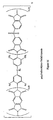
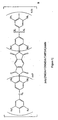
- FIG. 1(a)-(m) illustrates the repeat unit structure for several polyimides, according to an embodiment of the invention.
- the repeat unit for a polymer referred to as Polyimide A is shown in FIG. 1(a) .
- This polyimide can be formed by reacting PMDA [89-32-7] with TMMDA [4037-98-7].
- This high molecular weight polymer is soluble in NMP for a limited number of hours thus a lithium salt containing electrolyte could not be produced.
- Polyimide B The repeat unit for the polymer referred herein to as Polyimide B is shown in FIG. 1(b) .
- This polyimide can be formed by reacting 90 mole % PMDA [89-32-7], 10 mole % 6FDA [1107-00-2] dianhydrides and the diamine TMMDA [4037-98-7].
- the polymer formed was soluble indefinitely in NMP at 20 % by weight.
- Polyimide C The repeat unit for the polymer referred herein to as Polyimide C is shown in FIG. 1(c) .
- This polyimide can be formed by reacting 85.7 mole % PMDA [89-32-7], 14.3 mole % 6FDA [1107-00-2] and TMMDA [4037-98-7]. The polymer formed was soluble indefinitely in NMP at 20% by weight.
- Polyimide D The repeat unit for the polymer referred herein to as Polyimide D is shown in FIG. 1(d) .
- This polyimide can be formed by reacting 80 mole % PMDA [89-32-7], 20 mole % PSDA [2540-99-0] and TMMDA [4037-98-7]. The polymer formed was soluble indefinitely in NMP at 20% by weight.
- Polyimide E The repeat unit for the polymer referred herein to as Polyimide E is shown in FIG. 1(e) .
- This polyimide can be formed by reacting BPDA [2421-28-5] and 3,6 diaminodurene [3102-87-2]. The polymer formed was soluble indefinitely in NMP at 20% by weight.
- Polyimide F The repeat unit for the polymer referred herein to as Polyimide F is shown in FIG. 1(f) .
- This polyimide can be formed by reacting 6FDA [1107-00-2] and 3,6- diaminodurene [3102-87-2].
- the polymer formed was soluble indefinitely in NMP at 20 % by weight and is also soluble in acetone, GBL, DMAc, and DMF.
- Polyimide G The repeat unit for the polymer referred herein to as Polyimide G is shown in FIG. 1(g) .
- This polyimide can be formed by reacting PSDA [2540-99-0] and TMMDA [4037-98-7].
- the polymer formed was soluble indefinitely in NMP at 20 % by weight and is soluble in GBL.
- Polyimide H The repeat unit for the polymer referred herein to as Polyimide H is shown in FIG. 1(h) .
- This polyimide can be formed by reacting 6FDA [1107-00-2] and TMMDA [4037-98-7].
- the polymer formed was soluble indefinitely in NMP at 20 % by weight and is soluble in acetone, GBL, DMAc, and DMF.
- Polyimide I The repeat unit for the polymer referred herein to as Polyimide I is shown in FIG. 1(i) .
- This polyimide can be formed by reacting BPDA [2421-28-5] and 4,4'-(9-fluorenylidene)dianiline [15499-84-0].
- the polymer formed was soluble indefinitely in NMP at 20 % by weight.
- Polyimide J The repeat unit for the polymer referred herein to as Polyimide J is shown in FIG. 1(j) .
- This polyimide can be formed by reacting PMDA [89-32-7], 33.3 mole % TMPDA [22657-64-3] and 66.7 mole % TMMDA [4037-98-7].
- the polymer formed was soluble indefinitely in NMP at 20 % by weight.
- Polyimide K The repeat unit for the polymer referred herein to as Polyimide K is shown in FIG. 1(k) .
- This polyimide can be formed by reacting PMDA [89-32-7] and DAMs [3102-70-3]. The polymer formed was soluble only for a short time in NMP.
- Polyimide L The repeat unit for the polymer referred to herein as Polyimide L is shown in FIG. 1(l) .
- This polyimide can be formed by reacting PMDA [89-32-7] and 4-isopropyl-m-phenylenediamine [14235-45-1].
- the polymer formed was soluble indefinitely in NMP at 20 % by weight.
- Polyimide M The repeat unit for the polymer referred herein to as Polyimide M is shown in FIG. 1(m) .
- This polyimide can be formed by reacting PMDA [89-32-7], 33.3 mole % DAMs [3102-70-2] and 66.7 mole % TMMDA [4037-98-7].
- the polymer formed was soluble indefinitely in NMP at 20 % by weight.
- the PME includes at least one lithium salt.
- High PME ion conductivities are generally achieved using a high salt content, such as from about 0.5 to 2.0 moles of Li per mole of imide ring for polyimide polymers.
- the concentration of lithium salt can be 0.6, 0.7, 0.8, 0.9, 1.0, 1.1, 1.2, 1.3, 1.4, 1.5, 1.6, 1.7, 1.8, 1.9, 2.0, 2.1, 2.2, 2.3, 2.3, 2.4 or 2.5 moles Li per mole of imide ring of the polyimide.
- Salt concentrations are also described herein as a ratio of the weight of the salt to weight of the polymer (e.g. polyimide) excluding the salt.
- a 1x concentration corresponds to an equal amount of salt and polymer
- a 2x salt concentration corresponds to twice the salt concentration as compared to the polymer concentration.
- the lithium salt can generally be any lithium salt known in the art.
- lithium salts are chosen from LiCl, LiBr, LiI, Li(ClO 4 ), Li(BF 4 ), Li(PF 6 ), Li(AsF 6 ), Li(CH 3 CO 2 ), Li(CF 3 SO 3 ), Li(CF 3 SO 2 ) 2 N, Li(CF 3 SO 2 ) 3 , Li(CF 3 CO 2 ), Li(B(C 6 H 5 ) 4 , Li(SCN), and Li(NO 3 ), lithium bis(trifluorosulfonyl)imide (LiTFSI), LiBOB, and LiSCN.
- the salt is either Li(PF 6 ) or LiTFSi.
- Polyimide structures other than the exemplary structures shown in FIG. 1 can be good candidates for use in forming a PME matrix.
- Characteristics that a good PI should display, such as solubility in NMP (or other suitable solvent) to at least 20 wt % and a low repeat unit weight per imide ring can be a first criteria.
- solubility of the PI itself or the solution stability when combined with a high concentration of a lithium salt applicable for battery applications is not easily predictable.
- Behavior in solution can not generally be ascertained by simply looking at the polymer repeat unit structure. However, it can be determined from looking at the structure whether the polymer will possibly be crystalline, or whether it would have a high or low relative density in the solid phase.
- the polyimides are preferably non-crystalline, low-density repeat structures because they would be most likely to be very soluble. However, changing a single side group from a methyl to an ethyl can cause the properties of the PI to be changed from useful to of no use.
- a suggested meaningful screening procedure for alternative polyimides for battery applications is to take a polyimide that is known to have a good solubility in the solvent itself and then try to introduce the lithium salt at 0.5 mole Li per imide ring or more and see if (i) the resulting PI/salt/solvent solution is clear and homogenous for a few hours and (ii) the film cast from that solution remains substantially clear when most of the solvent (e.g. 95%) has been evaporated.
- FIG. 2 is a table illustrating the ionic conductivity at 20.5°C and the corresponding film composition for a polyimide based PME comprising the polyimide shown in FIG. 1(m) , LiTFSi salt (2.2x) and the solvent GBL, according to an embodiment of the invention.
- Room temperature ionic conductivity values for PME films were calculated from measured impedance using a complex impedance analyzer. Measurements using the impedance analyzer were made in the frequency range of 1 MHz to 0.1 Hz. A value for the resistance of the film, R, was taken as the intercept with the real axis of a Nyquist plot, or by an extrapolation of the high frequency portion of the response curve to the real axis.
- the maximum ionic conductivity at 20.5 °C was about 1 X 10 -4 S/cm for a 1x salt concentration and 4 X 10 -4 S/cm for a 2.2x concentration, where the PME film comprised 37.9% GBL.
- the lower table portion shown in FIG. 2 shows the minimum solvent level required to provide a conductivity of 1 X 10 -4 S/cm for 1.0, 1.4, 1.8 and 2.2 x salt concentrations.
- the range of solvent in FIG. 2 is expressed as the solvent/PI ratio and runs from about 1 to about 2.
- the lower value is where one arbitrarily defines a conductivity as being high enough for a given application, such as 1.0E -4 S/cm.
- the maximum conductivity was found to occur between a solvent/ PI ratio of 1.5 to 2.0 depending upon the salt concentration.
- the upper solvent/ PI limit near 2 is controlled by the mechanical properties of the PME.
- the PME film becomes very soft and may not be usable over an extended temperature range as a separator for a battery.
- the solvent is chosen to be moderately stable against lithium metal, high boiling (>150 C), capable of dissolving the chosen salt and swelling the PI, and finally it should have a low viscosity which promotes a high conductivity for the salt/solvent combination by itself, as well as for the PME.
- a PI species is selected which is soluble in an appropriate solvent, such as NMP or GBL. All the polyimides shown in FIG. 1 except the polyimide shown in FIG. 1(k) , are soluble in NMP.
- a desired lithium salt is selected and an initial concentration is selected, such as a mass ratio that gives one lithium ion per imide ring provided by the selected PI.
- the solvent concentration can then be varied from a solvent/PI ratio of about 0.8 to 2.0 while measuring the ionic conductivity for several solvent/PI data points in between. This can be repeated at salt concentrations both higher and lower. There are generally several combinations of PI/salt/solvent by mass that will give similar ionic conductivities, such as within a factor of two.
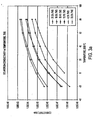
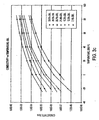
- FIG. 3(a)-(d) are plots of the ionic conductivity of a PME comprising the polyimide shown in FIG. 1 (m) and the lithium salt LiTFSi (2.2x) as a function of solvent load and temperature for the solvents TMS, PC, GBL, and NMP, respectively. These curves generally do not show a clear conductivity maximum because the salt content was 2.2x, and as a result, the amount of solvent needed to provide the maximum ionic conductivity was large and generally impractical.
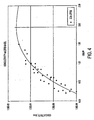
- FIG. 4 is a plot of ionic conductivity of a PME comprising the polyimide shown in FIG. 1 (m) the lithium salt (LiTFSi; 2.2x) as a function solvent/polyimide ratio at 20°C, where the solvent is GBL.
- the ionic conductivity is seen to increase for increasing solvent to polyimide ratio up to about a GBL/polyimide ratio of about 1.5, where the ionic conductivity levels off at a value of about 7 X 10 -4 S/cm.
- the ionic conductivity of PMEs based on polyimides is believed to be related to the degree the polyimides associate with alkali salts, particularly Li salts. This association is likely related to the formation of complexes between polar groups (e.g. imide and benzene) of the polyimide and the salt. Evidence for this association can be found by measuring the absorption frequencies displayed by the polymer when intermixed with the salt and comparing this data to the absorption frequencies displayed by the polyimide and the salt by themselves.
- polar groups e.g. imide and benzene
- characteristic absorption frequencies are believed to be related to the imide rings and benzene rings that comprise the polyimide backbone. These absorption peaks are at about 1778 cm -1 and 1721 cm -1 for the imide ring and 730 cm -1 for the benzene ring. Common Li salts, including LiPF 6 , LiBOB, LiI and LiTFSi do not show absorption at these frequencies, nor any absorption peaks between about 1630 and 1690 cm -1 .
- the first absorption frequency is present when a significant concentration of salt is in the polyimide film, such as at least 33 wt. %, but does not change significantly with increasing salt concentration.
- this peak can be used to indicate the interaction, provided a sufficient salt concentration is present.
- the magnitude of the second peak is nearly proportional to the ratio of the Li ion concentration to the imide rings and can be used to assess the extent of the interaction between the polyimide and the salt.
- Polymers other than polyimides which provide a high relative local electron density (e.g. comparable to electron density adjacent to imide rings in polyimides) and the potential for charge separation due to multiple bond conjugation may form a polymer/salt complex and display characteristic absorption peaks based on the complex formed, provided they are soluble.
- absorption spectroscopy such as FTIR can be used to identify these soluble non-polyimide polymers which show evidence of complex formation for use as a PME.
- Figure 5(a) is FTIR data for an exemplary polyimide, the polyimide shown in FIG. 1(c) , without the addition of a Li salt or any solvent. Absorption peaks related to the imide rings are shown at about 1778 cm -1 and 1721 cm -1 and at 730 cm -1 for the benzene ring. This polyimide does not show any detectable absorption peaks between about 1630 and 1690 cm -1 .
- Figure 5(c) shows the FTIR the polyimide shown in FIG. 1(c) combined with LiBOB.
- the resulting polyimide electrolyte shows a very strong doublet with a first peak at about 1672 cm -1 and a second peak at 1640 cm -1 .
- FTIR measurements taken from exemplary PMEs according to the invention provide evidence that the lithium salt forms a complex with the imide rings of the polyimide. This is likely one of the main reasons why the polyimide/lithium salt combination, in a dry film, has no apparent structure or crystallinity. The lack of crystallinity can be shown by a flat DCS trace. This evidence has also been found of an interaction between the lithium salt and the polyimide as the PME film is optically clear whether as a free standing film or as an overcoated film.
- the invention can be used in a wide variety of applications. Both primary and rechargeable batteries formed from either lithium ion or lithium metal anodes can be formed using the invention.
- a lithium metal battery having a PME is formed.
- the anode can be formed from lithium metal or a lithium alloy.
- Lithium alloys can include lithium-aluminum, lithium-aluminum-silicon, lithium-aluminum-cadmium, lithium-aluminum-bismuth, lithium-aluminum-tin or lithium-titanium oxide.
- the lithium content in these lithium alloys may be up to 99.98 wt. %.
- the overall lithium content in the anode is based on the required capacity of the battery.
- the cathode material for the lithium metal battery can comprise an ionic conductive polymer binder, such as the polyimides described herein, an electronically conductive material (e.g. graphite), and an electrochemically active material.
- the electrochemically active material is preferably selected from MnO 2 , the various lithium vanadium oxides, lithium transition metal oxides, such as LiMn 2 O 4 , LiCoO 2 , LiNiO 2 , Li 4 Ti 5 O 12 , and other materials such as metal sulfides (e.g. TiS 2 ) and LiFePO 4 .
- cathodes and anodes in the case of Li ion batteries preferably include polyimides as binder matrices, such as those disclosed herein.
- the anode, cathode and PME separator can all include the same or different polyimides.
- Polyimides are generally prepared by reacting one or more diamines and one or more dianhydride monomers in a step-wise condensation reaction. Preferred diamines and dianhydrides are shown in FIG. 6 .
- Aromatic diamines are known to be air sensitive. Thus, a purification process generally includes removing a portion of the oxidized diamine material. Following purification, aromatic diamines typically become white. However, absolutely pure diamines are difficult to achieve, and usually unnecessary. Recrystallization of the diamine from a mixture of alcohol and water has been found to be both effective and sufficient. The collected crystals are preferably dried under a vacuum because the water used for crystallization may not be easily removable at room temperature.
- Dianhydrides are also preferably purified and can be purified using at least two methods.
- a preferred purification method is recrystallization from acetic anhydride. Acetic anhydride closes reactive anhydride rings. However, removal of acetic acid produced is sometimes difficult. Washing with ether or MTBE can be used to remove the residual acetic acid.
- the dianhydride crystals generally require drying in a vacuum oven.
- An alternate method is to quickly wash the crystals with dry ethanol to remove open anhydride rings and then to rapidly dry the washed powder in a vacuum oven. This method works for purifying BPDA if the incoming purity is at least approximately 96%.
- the condensation reaction is performed to the poly (amic-acid) stage.
- One mole of diamine is reacted with about 1.005 to 1.01 equivalents of dianhydride.
- Excess dianhydride is generally preferably used to ensure that the dianhydride reagent determines the end group of the reaction product, the dianhydride excess ensuring that polymer chains are terminated with anhydride end groups which are known to maximize stability of the polymer product. In addition, such an excess compensates for traces of water which can react with anhydride groups.
- the solution is preferably about 15 to 20 weight % total in NMP solvent.
- the diamine is usually dissolved first, preferably under nitrogen, although this is not required for all diamines.
- the dianhydride is then added.
- a large scale reaction preferably adds the dianhydride in portions because there is some heat of reaction and it is desirable to keep the temperature below 40 °C. For example, a small scale reaction of 50 grams could add the dianhydride all at once, provided there is good initial mixing.
- the dianhydride generally dissolves much more slowly than the diamine.
- the best and simplest way to perform the reaction is to use a cylindrical jar with a polytetrafluoroethylene sealed cap. This jar can be shaken by hand in the beginning and then put on a rolling mill at slow speed to turn the jar smoothly. The reaction proceeds best at room temperature over a two to twelve hour period. Once the initial reaction is complete, as evidenced by a substantially constant solution color and viscosity, the solution is ready for imide ring closure.
- the chemical reaction to form the polyimide from the poly (amic-acid) can be performed with 1.1 equivalents of acetic anhydride per imide ring and 1 equivalent of pyridine as a ring closure catalyst. Pyridine can be added and rolling preferably continued until mixed. The acetic anhydride can cause a portion of the amic-acid polymer to precipitate.
- the polymer should be redissolved before heating.
- the jar is put on a rolling mill to cool while turning. Once the solution returns to room temperature, a fully imidized polymer dissolved in NMP results.
- the solution generally also has some residual pyridine, acetic acid, and may include some acetic anhydride. The solution is expected to be stable for reasonable periods of time.
- a preferred method for collecting the product from a small-scale reaction is to precipitate the polymer into methyl alcohol. This removes the solvent load and traces of monomers that did not react. It also can be used, in conjunction with the observed viscosity, to estimate the quality of the polymerization. A good, high molecular weight polyimide will precipitate cleanly into methyl alcohol with little or no cloudiness. The viscosity should be high (e.g. 8000 to 10,000 cp).
- the precipitated polymer is preferably washed two or more times until the smell of pyridine is slight.
- the polymer can then be air dried for a few hours in a hood and then dried in a vacuum oven at 125 °C overnight.
- the volume of methyl alcohol is preferably about a gallon per 100 grams of polymer.
- water can be used to remove solvents or trace materials.
- water is expected to be a less efficient than methyl alcohol for this purpose.
- a final soak with methyl alcohol is preferably added before drying if water is used with large quantities of polymer.
- a two piece battery assembly comprises overcoating an electrode with a PME to form an electrode/separator and subsequent assembly (e.g. lamination) with the other electrode.
- a cathode slurry of electrochemically active material, conductive carbon and binder is mixed in a bulk solvent with the solvent functioning as a plasticizer for the binder material.
- the slurry is coated upon a current collector substrate and the bulk solvent removed.
- the anode is typically carbonaceous and made from a slurry of graphite, binder and plasticizing solvent.
- the bulk solvent is removed after coating on the current collector.
- the separator is coated as a free standing film from a slurry of non-ionically conductive polymer binder, inorganic support filler material and plasticizing solvent.
- the cathode, separator and anode are placed together and laminated under heat and pressure.
- plasticizer is then removed via an extraction process typically utilizing a hot solvent.
- the cell is removed and a liquid electrolyte is introduced into the system to fill the "pores" created via removal of the plasticizer.
- the cell is then packaged in a foil packaging material.
- conventional assembly processes comprise the joining of three separate components.
- a cathode slurry of active material, conductive carbon, polyimide binder and lithium salt is mixed in a bulk solvent.
- the slurry is coated upon a metal current collector substrate and the solvent is removed.
- the coated cathode is overcoated with a PME comprising a mixture of polyimide, lithium salt and bulk solvent, and then dried to remove solvent with an effective amount of solvent retained for conductivity purposes, such as 5 to 50 weight % versus polyimide plus salt.
- the overcoated cathode has become both the cathode and the PME separator.
- An anode layer is then placed over the PME coated cathode, thus providing a battery assembly using only two components.
- FIG. 7 shows a preferred assembly "folding" process related to the two component battery assembly process described above.
- a PME coated cathode on a cathode current collector is first provided as described above.
- the surface of the PME overcoated cathode is sprayed with a small amount of solvent for adhesion purposes.
- a Li anode such as a Li metal strip having an area slightly less than the area of the PME coated cathode is then placed on the PME coated cathode.
- the anode could also be coated, dried, then overcoated on the PME coated cathode.
- An anode tab such as a nickel tab, is then placed on the anode in step 730.
- a cell fold is then performed in step 740 by wrapping the PME coated cathode over the lithium metal anode (or graphitic anode) as shown in FIG. 7 .
- a bicell battery 755 having an anode tab which is ready for packaging is produced. Bicells provide twice the capacity of conventional cells while having the same footprint of the conventional cell.
- Figure 8 shows an assembly process for packaging the electrochemical bicell 755 produced by the assembly process shown in FIG. 7 , where the steps of the assembly process shown in FIG. 7 are repeated on the top of FIG. 8 for convenient reference.
- the process shown in FIG. 8 is applied to a bicell battery, the described process is in no way limited to bicells.
- standard cells according to the invention can be packaged as shown in FIG. 8 .
- step 810 packaging frame material is rolled out from a suitable roller, the frame material being a material such as PET, having a thickness substantially the same as the battery itself to fit around the battery.
- step 820 an opening is created in the frame material which is slightly larger than the cell 755 to be inserted using a window punch or equivalent. A registration hole is also shown which can be created in step 820.
- Tab sealant is applied to the package frame material or pre-applied to the tab strip.
- a cathode tab is fed, cut and applied to the frame material.
- Lower packaging material having a low temperature heat sealant and moisture barrier is then applied to the frame.
- the interior heat sealant layer is a material that not only heat seals to itself, but also bonds strongly to the current collector of the battery, and preferably activates at between about 90 C to 100 C.
- the cell 755 is then preferably pick and placed into the cavity formed by the punched out package frame and onto the lower packaging material attached to the bottom of the frame in step 840.
- the lower packaging material is preferably heated (e.g. 90 C) prior to placing the cell 755 thereon to promote adhesion.
- Upper packaging material having a low temperature heat sealant and moisture barrier which can be the same composition as lower packaging material, is then applied in step 850.
- a binder material can be included on the outside of the lower and upper packaging material for applications such as the insertion into a credit card.
- the entire surface of the battery along with the perimeter of the packaging material is heat laminated in step 860 to form a finished bicell battery 865 having substantially the same thickness dimension throughout.
- the assembly process shown in FIG. 8 can package one or more cells in a single package.
- a lamination temperature such as 110°C for typically 5 to 15 seconds under a pressure sufficient to produce a uniform heat seal but not too high as to distort the battery and/or the package is used to provide the lamination to form the finished bicell battery 865.
- the substantially constant thickness of bicell 865 facilitates integration into a card, such as a credit card, and also reduces surface defects.
- substantially the same thickness dimension throughout the battery refers to a thickness over the entire area of the packaged battery being ⁇ 1 mil.
- a totally laminated battery with package 865 results which behaves as a single laminated layer.
- a step-down seal process which does not utilize a frame can be used. Instead, an elastomeric lamination plate set is used. This allows intimate contact of the packaging material all over the surface of the battery, the packaging material necking down to the side seal area where the packaging material laminates to itself.
- the battery package material is laminated to the entire battery.
- Previous lamination work discloses only lamination of a portion of the battery.
- Second, the use of a frame to surround the cell permits production of highly planar batteries having substantially the same thickness dimension throughout.
- Example 1 Optical Clarity Measurements for commercially available polyimide/salt/solvent as compared to exemplary PMEs according to the invention
- the purpose of this example is to demonstrate the homogenous nature of the PME formed from polyimides that have strong interactions with a lithium salt through demonstrated optical transmission.
- PME films were generated from polyimides shown in FIGs. 1(b) , (c) and (m) , while a Matrimid 5218p/salt/solvent was generated for comparison.
- the PMEs and Matrimid based film were cast upon a clear polyethylene terephthalate support film from NMP and dried for three hours in a vacuum oven at 120°C. The residual solvent content was approximately 4 wt%. All PME compositions and the Matrimid formulation were 32% polyimide, 64% LiTFSi salt, and the remainder being the small amount of solvent. All measurements were performed using 540 nm light.
- the Matrimid polyimide does not form a clear homogenous composition when the lithium salt concentration is 64%. Moreover, the Matrimid polyimide does not form a clear homogenous composition even at substantially lower salt concentrations, such at a concentration of 0.5 moles of lithium salt per imide ring provided by the polyimide.
- Polyimides including a lithium salt in a concentration of 0.5 moles (or less) of lithium salt per imide ring provided by the polyimide generally lack sufficient minimum ionic conductivity to be a useful electrolyte separator for an electrochemical cell.
- the PME is a homogeneous or near homogeneous matrix material
- batteries formed using the PME exhibit a unique ability to handle exposure to high temperatures and pressures, and still maintain its performance characteristics.
- Cell assembly is typically performed at elevated temperatures (e.g. 140°C) and pressure (e.g 862 kPa (125 psi)) for about 10 minutes, so subsequent exposures to similar or less rigorous conditions do not effect cells manufactured according to the invention.
- elevated temperatures e.g. 140°C
- pressure e.g 862 kPa (125 psi)
- Typical card manufacturing techniques require hot lamination at 125°C for 5 or more minutes in an hydraulic press exerting over 1724 kPa (250 psi) Batteries according to the invention have demonstrated full function following this process with no significant change in open circuit voltage (OCV) or capacity following typical lamination processing. In contrast, other battery technologies currently available will fail to operate (e.g. short) following conventional lamination processing or significantly lose capacity and/or OCV.
- OCV open circuit voltage
- Batteries according to the invention can withstand conditions more rigorous than typical lamination processing.
- a battery according to the invention was subjected to an injection molding process to see if the battery could withstand the conditions encountered during an injection molding process.
- Injection molding process were investigated for molding the polymers polyethylene-terephthalate (PET) and polyvinyl chloride (PVC) to encapsulate batteries according to the invention.
- PET polyethylene-terephthalate
- PVC polyvinyl chloride
- Li battery systems with liquid electrolytes or gel polymers having solvent in the pores of the polymer raise safety issues.
- the PME based cells according to the invention generally include some solvent, the solvent is complexed with the polymer and salt, not trapped in a porous film (gel electrolyte) or freely available (liquid electrolyte).
- FIG. 9(a) shows two (2) SEM micrographs of the PME alone which each evidence a substantially defect free and a porosity free film.
- the thickness of the PME films shown were both about 75 ⁇ m.
- Figure 9(b) shows a SEM of an interface between a PME film (20 ⁇ m) disposed on a lithium vanadium oxide/polyimide cathode layer (55 ⁇ m).
- the lower images are blowups of the interfaces shown at the top of FIG. 9(b) .
- the interfaces shown are quite uniform and smooth.
- Figure 10 shows the charge/discharge profile of a typical cell according to the invention, the cell including a lithium vanadium oxide (LVO) cathode, a Li metal anode and a PME separator, according to an embodiment of the invention.
- the cell capacity was 25 mAh.
- the y-axis represents cell voltage, while the x-axis represents total time. The cell demonstrates good cycling stability during a cycling of over 300 hours.
- Embodiment 1 provides a battery comprising:
- Embodiment 4 provides the battery of embodiment 1, wherein said anode comprises a lithium metal alloy anode.
- Embodiment 5 provides the battery of embodiment 1, wherein a repeat unit weight per imide ring of said polyimide is no more than 350.
- Embodiment 6 provides the battery of embodiment 1, wherein a repeat unit weight per imide ring of said polyimide is no more than 300.
- Embodiment 7 provides the battery of embodiment 1, wherein a repeat unit weight per imide ring of said polyimide is no more than 250.
- Embodiment 8 provides the battery of embodiment 1, wherein said polyimide is soluble at 25 °C in at least one solvent selected from the group consisting of N-methylpyrrolidinone (NMP), dimethylacetamide (DMAc) and dimethylformamide (DMF).
- Embodiment 9 provides the battery of embodiment 1, wherein the ionic conductivity of said polymer electrolyte at 25 °C is at least 1 x 10 -4 S/cm.
- Embodiment 10 provides the battery of embodiment 1, wherein the ionic conductivity of said polymer electrolyte at 25 °C is at least 3 x 10 -4 S/cm.
- Embodiment 11 provides the battery of embodiment 1, wherein said Li salt is at least one selected from the group consisting of LiCl, LiBr, LiI, LiClO 4 , LiBF 4 , LiAsF 6 , LiPF 6 , LiCF 3 SO 3 , LiBOB, LiN(CF 3 SO 2 ) 2 , and lithium bis(trifluorosulfonyl)imide (LiTFSI).
- Embodiment 12 provides the battery of embodiment 1, wherein said cathode comprises an ion conducting polymeric binder intermixed with an intercalation material.
- Embodiment 13 provides the battery of embodiment 12, wherein said polymeric binder comprises at least one polyimide.
- Embodiment 14 provides the battery of embodiment 1, wherein said cathode further comprises an electrochemically active material selected from the group consisting of LiFePO 4 , Li x Ni y Co z O 2 , LiV x O y , Li x Mn y O z , LiV x O y , Li x Mn y O z , LiCoO 2 , LiNiO 2 and LiTiS 2 .
- Embodiment 15 provides the battery of embodiment 1, wherein said battery provides no significant change in OCV and capacity following heating at 125°C for at least 5 minutes while under a pressure of at least 1379 kPa (200 psi).
- Embodiment 16 provides the battery of embodiment 1, wherein said battery provides no significant change in OCV and capacity following heating at 140°C for at least 10 minutes while under a pressure of at least 1724 kPa (250 psi).
- Embodiment 17 provides the battery of embodiment 1, wherein said battery is a bicell, wherein said cathode is folded over to sandwich said anode.
- Embodiment 18 provides the battery of embodiment 1, wherein said salt and said polyimide do not provide any absorption peaks between 1630 and 1690 cm -1 , said PME providing at least one absorption between about 1630 and 1690 cm -1 .
- Embodiment 19 provides the battery of embodiment 1, further comprising a package comprising packaging material surrounding said battery to form a packaged battery, said packaging material laminated to all exterior surfaces of said battery.
- Embodiment 20 provides the battery of embodiment 1, further comprising a package comprising packaging material surrounding said battery and a frame having an opening to accommodate said battery therein to form a packaged battery, wherein said battery is disposed within said opening.
- Embodiment 21 provides the battery of embodiment 20, wherein said packaged battery provides a thickness uniformity throughout within ⁇ 1 mm.
- Embodiment 22 provides a method for forming a battery, comprising the steps of:
- Embodiment 24 provides the method of embodiment 22, wherein said anode is a lithium metal comprising anode.
- Embodiment 25 provides the method of embodiment 23, wherein said battery is formed by laminating only two layers, a first layer being said PME disposed on said cathode and a second layer being said anode.
- Embodiment 26 provides the method of embodiment 25, further comprising the step of folding said PME disposed on said cathode over said anode, wherein a bicell is formed.
Landscapes
- Chemical & Material Sciences (AREA)
- Chemical Kinetics & Catalysis (AREA)
- Electrochemistry (AREA)
- General Chemical & Material Sciences (AREA)
- Engineering & Computer Science (AREA)
- Manufacturing & Machinery (AREA)
- Inorganic Chemistry (AREA)
- Dispersion Chemistry (AREA)
- Condensed Matter Physics & Semiconductors (AREA)
- General Physics & Mathematics (AREA)
- Physics & Mathematics (AREA)
- Composite Materials (AREA)
- Materials Engineering (AREA)
- Secondary Cells (AREA)
- Cell Separators (AREA)
- Sealing Battery Cases Or Jackets (AREA)
- Battery Electrode And Active Subsutance (AREA)
- Conductive Materials (AREA)
- Macromolecular Compounds Obtained By Forming Nitrogen-Containing Linkages In General (AREA)
Description
- The invention generally relates to polymer matrix electrolytes for use as an electrolyte or in primary and rechargeable lithium metal and lithium ion batteries.
- The demand for new and improved electronic devices, such as cellular phones, notebook computers and compact camcorders, has demanded energy storage devices having increasingly higher specific energy densities. For example, the telecommunication industry is actively seeking alternate energy storage devices for its outside plant back-up power sources for telecommunication stations to replace the current standard valve-regulated lead acid batteries. Moreover, the automotive industry is in need of high specific energy density batteries for the developing electric and hybrid vehicles market. A number of advanced battery technologies have recently been developed to service these devices and markets, such as metal hydride (e.g., Ni-MH), nickel-cadmium (Ni-Cd), lithium batteries with liquid electrolytes and recently, lithium batteries with polymer electrolytes.
- Lithium batteries have been introduced into the market because of their high energy densities. Lithium is atomic number three on the periodic table of elements, having the lightest atomic weight and highest energy density of any solid material. As a result, lithium is a preferred material for batteries, having very high energy density. Lithium batteries are also desirable because they have a high unit cell voltage of up to approximately 4.2 V, as compared to approximately 1.5 V for both Ni-Cd and Ni-MH cells.
- Lithium batteries can be either lithium ion batteries or lithium metal batteries. Lithium ion batteries intercalate lithium ions in a host material, such as graphite, to form the anode. On the other hand, lithium metal batteries use metallic lithium or lithium alloys for the anode.
- The electrolyte used in lithium batteries can be a liquid or a polymer based electrolyte. Lithium batteries including liquid electrolytes have been on the market for several years. Lithium ion rechargeable batteries having liquid electrolytes are currently mass produced for applications such as notebook computers, camcorders and cellular telephones. However, lithium batteries having liquid electrolyte technology have several major drawbacks. These drawbacks relate to cost and safety and stem from use of a liquid electrolyte. The liquid electrolyte generally requires packaging in rigid hermetically sealed metal "cans" which can reduce energy density. In addition, for safety reasons, lithium ion rechargeable batteries and lithium-metal primary batteries having liquid electrolytes are designed to vent automatically when certain abuse conditions exist, such as a substantial increase in internal pressure which can be caused by internal or external overheating. If the cell is not vented under extreme pressure, it can explode because the liquid electrolyte used in liquid Li cells is extremely flammable.
- Lithium batteries having solid polymer electrolytes represent an evolving alternative to lithium batteries having liquid electrolytes. Solid polymer electrodes are generally gel type electrolytes which trap solvent and salt in pores of the polymer to provide a medium for ionic conduction. Typical polymer electrolytes comprise polyethylene oxide (PEO), polyether based polymers and other polymers which are configured as gels, such as polyacrylonitrile (PAN), polymethylmethacrylate (PMMA) and polyvinylidine fluoride (PVDF). The polymer electrolyte generally functions as a separator, being interposed between the cathode and anode films of the battery.
- Because its electrolyte is generally a non-volatile material which does not generally under normal operating conditions leak, a lithium battery having a polymer electrolyte is intrinsically safer than a lithium battery having a liquid electrolyte. Moreover, polymer electrolytes eliminate the need for venting and package pressure control which are generally required for operation of lithium batteries having liquid electrolytes. Thus, polymer electrolytes make it possible to use a soft outer case such as a metal plastic laminate bag, resulting in improvement in weight and thickness, when compared to liquid electrolyte can-type Li batteries.
- Each cathode, separator and anode combination forms a unit battery cell. Practical lithium batteries, such as those having polymer electrolytes, are generally prepared by stacking a number of battery cells in series and/or parallel to achieve desired battery capacity.
- Lithium metal polymer (LMP) rechargeable batteries offer improved performance as compared to Li ion batteries, particularly higher capacity. LMP batteries result from the lamination/assembly of three types of main thin films: a film of positive electrode comprising a mixture of a polymer and an electrochemically active material such as lithium vanadium oxide, an electrolyte film separator made of a polymer and a lithium salt, and a negative electrode film comprising metallic lithium or a lithium alloy. A known limitation of LMP batteries, especially for automotive applications is that the polymers presently used provide their peak ionic conductivity at elevated temperatures. These LMP batteries must therefore be heated to produce peak power output.
- A problem with Li metal and lithium alloy batteries is that lithium, in its metallic form, is highly reactive. As such, it presents unique difficulties in rechargeable configurations. Repeated charge/discharge cycles can cause a build-up of surface irregularities on the lithium metal electrode. External pressure is generally necessary for prolonged performance of a lithium metal battery.
- These irregular structures, known as dendrites, can grow to such an extent that they penetrate the separator between positive and negative electrodes and create an internal short circuit. At best, this phenomenon shortens the useful life of a rechargeable Li-metal battery to generally about 900 cycles or less.
- Many performance parameters of lithium batteries are associated with the electrolyte choice, and the interaction of the selected electrolyte with the cathode and anode materials used. High electrolyte ionic conductivity generally results in improved battery performance. The ionic conductivity of gel polymer electrolytes have been reported to be as high as approximately 10-4 S/cm at 25°C. However, it is desirable for the ionic conductivity of the polymer electrolyte to reach even higher values for some battery applications. In addition, it would also be desirable to enhance the electrochemical stability of the polymer electrolyte towards anode and cathode materials to improve battery reliability, as well as storage and cycling characteristics.
- While gel polymer electrolytes represent an improvement over liquid electrolytes in terms of safety and manufacturability, safety issues remain because gel polymers trap solvent on its pores and under extreme conditions (e.g. heat and/or pressure) can still escape and cause injury. In addition, gel polymer electrolytes cannot generally operate over a broad temperature range because the gel generally freezes at low temperatures and reacts with other battery components or melts at elevated temperatures. Moreover, electrode instability and resulting poor cycling characteristics, particularly for metallic lithium containing anodes, limits possible applications for such batteries formed with gel polymer electrolytes.
- Alternative polymer materials have been actively investigated to provide improved characteristics over available polymer choices. For example,
U.S. Patent No. 5,888,672 to Gustafson et al. ('672 patent) discloses a polyimide electrolyte and a battery formed from the same which operates at room temperature and over a broad range of temperatures. The polyimides disclosed are soluble in several solvents and are substantially amorphous. When mixed with a lithium salt, the resulting polyimide based electrolytes provide surprisingly high ionic conductivity. The electrolytes disclosed in '672 are all optically opaque which evidences some phase separation of the various components comprising the electrolyte. Although the electrolytes disclosed by the '672 patent can be used to form a polymer electrolyte and a battery therefrom which provides an improved operating temperature range, ease of manufacture, and improved safety over batteries formed from conventional gel polymer electrolytes, it would be helpful if the electrolyte stability over temperature and pressure as well as the ionic conductivity could be improved. -
WO 98/35397 - The present invention is set out in the appended claims.
- A battery includes an anode, a cathode, and a polymer matrix electrolyte (PME) separator disposed between the anode and the cathode. The PME separator includes a polyimide, a polybenzimidazole or a polyamide-imide, at least one lithium salt and at least one solvent. The PME is generally homogeneous as evidenced by its high level of optical clarity. As used herein, when the PME is referred to as being substantially optically clear. The phrase "substantially optically clear" regarding the PME refers to the PME being at least 90% clear (transmissive), preferably at least 95%, and most preferably being at least 99% clear as measured by a standard turbidity measurement, transmitting through a normalized 1 mil film using 540 nm light
- The battery can be a lithium ion, lithium metal battery or a lithium metal alloy battery. A repeat unit weight per imide ring of the polyimide can be no more than 350, no more than 300, or no more than 250. The polyimide is preferably soluble at 25 °C in at least one solvent selected from the group consisting of N-methylpyrrolidinone (NMP), dimethylacetamide (DMAc) and dimethylformamide (DMF).
- The ionic conductivity of the polymer electrolyte at 25°C is at least 1 x 10⁻⁴ S/cm, and preferable at least 3 x 10⁻⁴ S/cm. The Li salt can be selected from a variety of salts including LiCl, LiBr, LiI, LiClO4, LiBF4, LiAsF6, LiPF6, LiCF3SO3, LiBOB, LiN(CF3SO2)2, and lithium bis(trifluorosulfonyl)imide (LiTFSI).
- The cathode can include an ion conducting polymeric binder intermixed with an intercalation material. In this embodiment, the polymeric binder can include at least one polyimide, such as the polyimide used in the PME.
- The cathode can include an electrochemically active material selected from the group consisting of LiFePO4, LiCoO2, LiNiO2 and LiTiS2.
- The PME permits the battery to be highly stable over temperature and pressure extremes. The battery can demonstrate no significant change in open circuit voltage (OCV) and capacity following heating at 125°C for at least 5 minutes while under a pressure of at least 1379 kPa (200 psi), or more preferably no significant change in OCV and capacity following heating at 140°C for at least 10 mintues while under a pressure of at least 1724 kPa (250 psi).
- The battery can be a bicell. In this embodiment, the cathode having a PME coating thereon is preferably folded over to sandwich the anode.
- The salt complexes with the polyimide. Evidence for complexing is shown by the salt and polyimide not providing any absorption peaks between 1630 and 1690 cm-1, while the PME formed from the mixture provides at least one absorption between about 1630 and 1690 cm-1.
- The battery can be a packaged battery, wherein the package comprises packaging material surrounding the battery, the packaging material being laminated to all exterior surfaces of the battery. In a preferred embodiment, a frame is included in the packaging process, the frame having an opening to accommodate the battery therein, where the battery is disposed within the opening and the packaging material is disposed thereon. In the frame embodiment, the packaged battery can provide a thickness uniformity throughout within ±1 mm.
- A method for forming a battery includes the steps of providing a cathode layer disposed on a cathode current collector, overcoating a mixture of a polymer, lithium salt and solvent on the cathode layer, wherein the polymer includes highly polar groups that can complex with lithium salts and participate in ionic conduction drying the mixture to remove at least a portion of the solvent, wherein an electrolyte separator bonded to the cathode (electrolyte/cathode) is formed. An anode layer is then disposed on the electrolyte/cathode. The electrolyte separator is a polymer matrix electrolyte (PME) as defined in
claim 1. The anode is preferably a lithium metal comprising anode, although it can be a Li ion anode. - The battery can be formed by laminating only two layers, a first layer being the PME disposed on the cathode and a second layer being the anode. The PME coated cathode is then laminated with the anode to form the cell. In one embodiment of the invention, the method can include the step of folding a PME coated cathode over the anode, wherein a bicell is formed.
- A fuller understanding of the present invention and the features and benefits thereof will be accomplished upon review of the following detailed description together with the accompanying drawings, in which:
-
FIG. 1(a)-(m) illustrates the repeat unit structure for several suitable polyimides, according to an embodiment of the invention. -
FIG. 2 is a table illustrating ionic conductivity and the resulting film composition at 20.5 °C for a PME comprising the polyimide shown inFIG. 1 (m) , LiTFSi salt (2.2x) and the solvent gamma butyrolactone (GBL), according to an embodiment of the invention. -
FIG. 3(a)-(d) are plots of the ionic conductivity of a PME comprising the polyimide shown inFIG. 1 (m) and the lithium salt LiTFSi (2.2x) as a function of solvent load and temperature for the solvents TMS, PC, GBL, and NMP, respectively. -
FIG. 4 is a plot of ionic conductivity of a PME comprising the polyimide shown inFIG. 1 (m) and a lithium salt (LiTFSi; 2.2x) as a function solvent/polyimide ratio at 20 C, where the solvent is GBL. -
FIG. 5(a) is FTIR data for an exemplary polyimide without the addition of a Li salt or any solvent. -
FIG. 5(b) is FTIR data for an exemplary Li salt. -
FIG. 5 (c) is FTIR data for the exemplary polyimide whose FTIR data is shown in ofFIG. 5(a) intermixed with and the exemplary Li salt whose FTIR data is shown inFIG. 5(b) evidencing the emergence of a doublet absorption peak at between about 1630 cm-1 and 1690 cm-1. -
FIG. 6 is a table which includes dianhydrides and aromatic diamines that can be used for making polyimides presented herein. -
FIG. 7 shows an assembly process for forming an electrochemical bicell which is ready for packaging, according to an embodiment of the invention. -
FIG. 8 shows an assembly process for packaging the electrochemical bicell produced by the assembly process shown inFIG. 7 . -
FIG. 9(a) is a SEM evidencing a defect free PME. -
FIG. 9(b) is a SEM showing a smooth and uniform interface between a PME disposed on a lithium vanadium oxide (LVO) comprising cathode layer. -
FIG. 10 shows the charge/discharge profile of a typical cell according to the invention, the cell including a lithium vanadium oxide cathode, a Li metal anode and a PME separator, according to an embodiment of the invention. - The invention describes a substantially optically clear electrolyte separator matrix which includes a polyimide a polybenzimidazole or a polyamide-imide, a lithium salt and some solvent. The lithium salt may be in a concentration of at least 0.5 moles of lithium per mole of imide ring provided by the polyimide. The solvent is generally a low molecular weight, low viscosity liquid which swells the polyimide at low concentration and at a sufficiently high concentration allows the polyimide, salt and the solvent to become homogeneously mixed. As used herein, the substantially optically clear electrolyte separator matrix is referred to as a "polymer matrix electrolyte" or PME. The PME can be used for batteries, supercapacitors and other applications. The high level of optical clarity provided by the PME evidences the homogeneity of the PME comprising its respective components (polymer, salt and the solvent) as any significant phase separation would reduce optical clarity.
- The PME can be used to form both lithium ion and lithium metal containing batteries. Unlike gel polymer electrolytes, once the PME is formed, there is generally no free solvent or identifiable pores. For example, using a SEM providing a 50 A resolution, no pores in the PME can be identified. Instead, the solvent is integrated with the polymer and the lithium salt in a homogeneous and substantially optically clear matrix. In addition, unlike conventional gel polymers where the polymer only provides mechanical support, the polymer together with the salt and the solvent participate in ionic conduction.
- The PME provides high current carrying capacity, cycling stability and maintains this performance level across a wide temperature range, such as at least from -40°C to 100°C. For example, the PME can withstand high temperatures and pressures with small changes in open circuit voltage and capacity, such as the conditions generally used in the hot lamination processes used in credit card manufacturing, or even the more rigorous conditions associate with a typical injection molding process. For example, hot lamination processes used in credit card assembly generally utilize a temperature of about 115 -150°C for 5 to 15 minutes under a pressure of about 1379-1724 kPa (200-250 psi). Lamination can comprise a single stage heating cycle or a multiple stage heating cycle. Lamination also can comprise a single stage pressure cycle or a multiple stage pressure cycle. For example, in a single stage heating cycle, lamination can comprise heating to a single temperature such as, for example, 115°C, for a set single period of time such as, for example, 5 minutes. In a multi-stage heating cycle, lamination can comprise heating in stages using multiple temperatures such as, for example, heating to a first temperature and holding for a first period of time, followed by heating to a second temperature and holding for a second period of time. Similarly, pressure can be increased in stages if desired. The performance of batteries formed using the PME experience no significant change in open circuit voltage (OCV) or capacity from the temperature and pressure conditions provided by a typical credit card lamination process.
- As used herein, the phrase "no significant change in OCV and capacity" following a lamination or molding process refers to a battery including the PME which demonstrates an OCV and capacity which shifts less than 15%, preferably less than 10%, and more preferably less than a 5% following the lamination or molding process.
- For example, a lithium metal battery having a lithium vanadium oxide comprising cathode was found to provide a shift in OCV of 1.4 % and a commensurately small reduction in capacity following a lamination process comprising a temperature of 140 C for 15 minutes under a pressure of 1517kPa (220 psi). Moreover, batteries formed using the PME are quite flexible and can exceed ISO standards ISO/EEC 7810-10373 and 14443.
- Thus, PME based batteries are particularly well suited for use inside credit cards, smart labels, and other small devices which require high temperature/high pressure lamination processing and can benefit from an on board power supply. Regarding credit card and related applications for the invention, the high level of battery stability to both mechanical and thermal stresses provided by the PME permits batteries according to the invention to withstand harsh credit card processing conditions.
- The PME is generally based on one or more polyimides, which unlike other polymer-based electrolytes, participate in ionic conductivity through the presence of imide rings and other polar groups. Other polymer types which include highly polar groups having functional groups that can complex with lithium salts and participate in ionic conduction include polybenzimidazoles and polyamide-imides. Accordingly, these polymer types may also include species useful in forming a PME.
- Polyimides are reaction products of a condensation reaction between diamines and dianhydrides to initially form a poly (amic-acid) intermediate. Either or both the diamine and dianhydride reagent can be mixture of diamine or dianhydride species. The poly amic-acid intermediate is then converted to a fully imidized polyimide.
- The properties of the resulting polyimide formed depend on the selection of the particular diamines and dianhydride monomers. Polyimides are generally known to provide high thermal stability, chemical resistance and high glass transition temperatures, such as 200 °C to more than 400 °C.
- The current invention includes the identification of polyimides distinct from those disclosed in the '672 patent and has found the addition of solvent to some of these distinct polyimides can result in the formation of a PME. Some of the polyimides identified herein provide represent newly synthesized polymers. Unlike the polymers disclosed in '672, the polymers disclosed herein form a substantially homogeneous matrix material (PME) when combined with an appropriate concentration of salt to achieve a practical ionic conductivity level and the solvent. As noted above, the homogeneity of the PME is evidenced by the high level of optical clarity provided which is shown in Example 1. In contrast, the electrolytes disclosed in '672 are non-homogeneous mixture, as evidenced by their opaqueness also shown in Example 1 which is indicative of phase separation of the respective components.
- The Inventors have identified and synthesized improved polyimides for use in forming PMEs by qualitatively relating certain polymer parameters to ionic conductivity. Imide ring density is believed to explain why polyimide films, when loaded with lithium salt, show significant ionic conductivity, even in the absence of solvent. Repeat unit weight per imide ring is one measure of imide ring density and is calculated by dividing the molecular weight of the entire repeat unit of the respective polyimides by the number of imide rings within the respective repeat units.
- Imide rings may provide the equivalent of a high dielectric constant to materials because of the high electron density provided by the rings. Accordingly, it is believed that the interaction between the imide rings and the lithium ion is a factor in determining the ionic conductivity of a PME. Thus, improved polyimides for use as PMEs can be generally selected for further consideration by first calculating the number of imide rings (and to a lesser degree other highly polar groups, such as sulfone, carbonyl and cyanide) per molecular repeat unit in a given polyimide. The more imide ring function present per unit weight, the higher the average dielectric strength equivalence of the polymer. Higher equivalent dielectric strength is believed to generally lead to improved salt interaction, which can improve the ionic conductivity of the PME.
- Alternatively, a quantity roughly inverse to imide ring density referred to as repeat unit weight per imide ring can be calculated to also compare the relative concentration of imide rings in polyimides. As the repeat weight per imide ring decreases, imide rings become an increasingly greater contributor to the repeat unit as a whole. As a result, as the repeat weight per imide ring decreases, the equivalent dielectric constant and ionic conductivity of the polyimide generally increase.
- Polyimides which provide high helium permeability may generally produce higher ionic conductivity and thus form better PMEs. At 25 °C, the measured He permeability of most polyimides according to the invention has been found to be at least 20 barrers. The He permeability can be at least 25, 30, 35,40, 45, 50, 55,60, 65, 70, 75 or 80 barrers, or more.
- Helium permeability may be measured in the following suggested manner. The gas permeability (GP) of a gas component through a given film having a thickness (1) and area (A) can be determined by applying a pressure (p) across the film which is equal to the upstream pressure minus the downstream pressure of the gas component and measuring the resulting steady state rate of gas flow (f) permeating through the film at STP.

- Preferred units for GP is (cm2)(sec)-1(cmHg), where 1 barrer is defined as the GP multiplied by 1010.
- It is believed that the maximum ionic conductivity of the PME generally occurs when the polyimide/salt/solvent combination creates a completely homogenous, clear matrix. Any phase separation is expected to reduce the ionic conductivity values because phase separation would increase the tortuosity within the PME.
- The maximum electrolyte conductivity of the PME at a given temperature generally occurs when the polyimide/salt/solvent matrix has a ratio within a specified range. The optimum salt concentration is generally in the range of 0.5 to 2.0 moles Li per mole of imide ring for a polyimide. Too little salt generally does not provide a sufficient number of ions to contribute to the charge transfer. Too much salt generally leads to phase instability and possible precipitation of the polyimide and resulting loss of homogeneity which can be verified by a loss in optical clarity.
- The solvent is believed to play the role of a swelling agent for the polymer to move the backbone chains slightly apart and therefore enables greater ionic diffusion coefficients. The solvent also acts as a solvation carrier for the ions. Typically the solvent is chosen to also be stable within the limitations of the type of battery chosen. For example, for a lithium ion type battery the solvent must be stable up to the reduction potential of lithium metal. The amount of solvent can be optimized depending upon the either the conductivity desired or the softening point of the matrix at some required temperature. Solvents can be selected from a group of solvents including gamma butyrolactone (GBL), propylene carbonate, N-methylpyrrolidinone (NMP), tetrahydrothiophen-1,1-dioxide (TMS), polycarbonate (PC) and dimethyl formamide (DMF).
-
FIG. 1(a)-(m) illustrates the repeat unit structure for several polyimides, according to an embodiment of the invention. The repeat unit for a polymer referred to as Polyimide A is shown inFIG. 1(a) . This polyimide can be formed by reacting PMDA [89-32-7] with TMMDA [4037-98-7]. This high molecular weight polymer is soluble in NMP for a limited number of hours thus a lithium salt containing electrolyte could not be produced. - The repeat unit for the polymer referred herein to as Polyimide B is shown in
FIG. 1(b) . This polyimide can be formed by reacting 90 mole % PMDA [89-32-7], 10 mole % 6FDA [1107-00-2] dianhydrides and the diamine TMMDA [4037-98-7]. The polymer formed was soluble indefinitely in NMP at 20 % by weight. - The repeat unit for the polymer referred herein to as Polyimide C is shown in
FIG. 1(c) . This polyimide can be formed by reacting 85.7 mole % PMDA [89-32-7], 14.3 mole % 6FDA [1107-00-2] and TMMDA [4037-98-7]. The polymer formed was soluble indefinitely in NMP at 20% by weight. - The repeat unit for the polymer referred herein to as Polyimide D is shown in
FIG. 1(d) . This polyimide can be formed by reacting 80 mole % PMDA [89-32-7], 20 mole % PSDA [2540-99-0] and TMMDA [4037-98-7]. The polymer formed was soluble indefinitely in NMP at 20% by weight. - The repeat unit for the polymer referred herein to as Polyimide E is shown in
FIG. 1(e) . This polyimide can be formed by reacting BPDA [2421-28-5] and 3,6 diaminodurene [3102-87-2]. The polymer formed was soluble indefinitely in NMP at 20% by weight. - The repeat unit for the polymer referred herein to as Polyimide F is shown in
FIG. 1(f) . This polyimide can be formed by reacting 6FDA [1107-00-2] and 3,6- diaminodurene [3102-87-2]. The polymer formed was soluble indefinitely in NMP at 20 % by weight and is also soluble in acetone, GBL, DMAc, and DMF. - The repeat unit for the polymer referred herein to as Polyimide G is shown in
FIG. 1(g) . This polyimide can be formed by reacting PSDA [2540-99-0] and TMMDA [4037-98-7]. The polymer formed was soluble indefinitely in NMP at 20 % by weight and is soluble in GBL. - The repeat unit for the polymer referred herein to as Polyimide H is shown in
FIG. 1(h) . This polyimide can be formed by reacting 6FDA [1107-00-2] and TMMDA [4037-98-7]. The polymer formed was soluble indefinitely in NMP at 20 % by weight and is soluble in acetone, GBL, DMAc, and DMF. - The repeat unit for the polymer referred herein to as Polyimide I is shown in
FIG. 1(i) . This polyimide can be formed by reacting BPDA [2421-28-5] and 4,4'-(9-fluorenylidene)dianiline [15499-84-0]. The polymer formed was soluble indefinitely in NMP at 20 % by weight. - The repeat unit for the polymer referred herein to as Polyimide J is shown in
FIG. 1(j) . This polyimide can be formed by reacting PMDA [89-32-7], 33.3 mole % TMPDA [22657-64-3] and 66.7 mole % TMMDA [4037-98-7]. The polymer formed was soluble indefinitely in NMP at 20 % by weight. - The repeat unit for the polymer referred herein to as Polyimide K is shown in
FIG. 1(k) . This polyimide can be formed by reacting PMDA [89-32-7] and DAMs [3102-70-3]. The polymer formed was soluble only for a short time in NMP. - The repeat unit for the polymer referred to herein as Polyimide L is shown in
FIG. 1(l) . This polyimide can be formed by reacting PMDA [89-32-7] and 4-isopropyl-m-phenylenediamine [14235-45-1]. The polymer formed was soluble indefinitely in NMP at 20 % by weight. - The repeat unit for the polymer referred herein to as Polyimide M is shown in
FIG. 1(m) . This polyimide can be formed by reacting PMDA [89-32-7], 33.3 mole % DAMs [3102-70-2] and 66.7 mole % TMMDA [4037-98-7]. The polymer formed was soluble indefinitely in NMP at 20 % by weight. - The PME includes at least one lithium salt. High PME ion conductivities are generally achieved using a high salt content, such as from about 0.5 to 2.0 moles of Li per mole of imide ring for polyimide polymers. However, the concentration of lithium salt can be 0.6, 0.7, 0.8, 0.9, 1.0, 1.1, 1.2, 1.3, 1.4, 1.5, 1.6, 1.7, 1.8, 1.9, 2.0, 2.1, 2.2, 2.3, 2.3, 2.4 or 2.5 moles Li per mole of imide ring of the polyimide.
- Salt concentrations are also described herein as a ratio of the weight of the salt to weight of the polymer (e.g. polyimide) excluding the salt. For example, a 1x concentration corresponds to an equal amount of salt and polymer, while a 2x salt concentration corresponds to twice the salt concentration as compared to the polymer concentration. The lithium salt can generally be any lithium salt known in the art. Preferably, lithium salts are chosen from LiCl, LiBr, LiI, Li(ClO4), Li(BF4), Li(PF6), Li(AsF6), Li(CH3CO2), Li(CF3 SO3), Li(CF3 SO2)2N, Li(CF3 SO2)3, Li(CF3 CO2), Li(B(C6 H5)4, Li(SCN), and Li(NO3), lithium bis(trifluorosulfonyl)imide (LiTFSI), LiBOB, and LiSCN. Preferably, the salt is either Li(PF6) or LiTFSi.
- Polyimide structures other than the exemplary structures shown in
FIG. 1 can be good candidates for use in forming a PME matrix. Characteristics that a good PI should display, such as solubility in NMP (or other suitable solvent) to at least 20 wt % and a low repeat unit weight per imide ring can be a first criteria. However, the solubility of the PI itself or the solution stability when combined with a high concentration of a lithium salt applicable for battery applications is not easily predictable. - Behavior in solution can not generally be ascertained by simply looking at the polymer repeat unit structure. However, it can be determined from looking at the structure whether the polymer will possibly be crystalline, or whether it would have a high or low relative density in the solid phase. The polyimides are preferably non-crystalline, low-density repeat structures because they would be most likely to be very soluble. However, changing a single side group from a methyl to an ethyl can cause the properties of the PI to be changed from useful to of no use. A suggested meaningful screening procedure for alternative polyimides for battery applications is to take a polyimide that is known to have a good solubility in the solvent itself and then try to introduce the lithium salt at 0.5 mole Li per imide ring or more and see if (i) the resulting PI/salt/solvent solution is clear and homogenous for a few hours and (ii) the film cast from that solution remains substantially clear when most of the solvent (e.g. 95%) has been evaporated.
-
FIG. 2 is a table illustrating the ionic conductivity at 20.5°C and the corresponding film composition for a polyimide based PME comprising the polyimide shown inFIG. 1(m) , LiTFSi salt (2.2x) and the solvent GBL, according to an embodiment of the invention. Room temperature ionic conductivity values for PME films were calculated from measured impedance using a complex impedance analyzer. Measurements using the impedance analyzer were made in the frequency range of 1 MHz to 0.1 Hz. A value for the resistance of the film, R, was taken as the intercept with the real axis of a Nyquist plot, or by an extrapolation of the high frequency portion of the response curve to the real axis. Measurements were also made on an LCR meter at a fixed frequency of 10 kHz where the resistance values were read directly. The ionic conductivity was calculated using the formula:
where t is film thickness in microns and R is the measured film resistance in Ohms. - As shown in
FIG. 2 , for the PMEs tested, the maximum ionic conductivity at 20.5 °C was about 1 X 10⁻⁴ S/cm for a 1x salt concentration and 4 X 10⁻⁴ S/cm for a 2.2x concentration, where the PME film comprised 37.9% GBL. The lower table portion shown inFIG. 2 shows the minimum solvent level required to provide a conductivity of 1 X 10⁻⁴ S/cm for 1.0, 1.4, 1.8 and 2.2 x salt concentrations. - The range of solvent in
FIG. 2 is expressed as the solvent/PI ratio and runs from about 1 to about 2. The lower value is where one arbitrarily defines a conductivity as being high enough for a given application, such as 1.0E-4 S/cm. The maximum conductivity was found to occur between a solvent/ PI ratio of 1.5 to 2.0 depending upon the salt concentration. - The upper solvent/ PI limit near 2 is controlled by the mechanical properties of the PME. At a high solvent/PI ratio the PME film becomes very soft and may not be usable over an extended temperature range as a separator for a battery. Applied to lithium metal batteries, As a practical matter, the solvent is chosen to be moderately stable against lithium metal, high boiling (>150 C), capable of dissolving the chosen salt and swelling the PI, and finally it should have a low viscosity which promotes a high conductivity for the salt/solvent combination by itself, as well as for the PME.
- To optimize the respective PI, salt and solvent concentrations, a suggested procedure is described below, in a first step, a PI species is selected which is soluble in an appropriate solvent, such as NMP or GBL. All the polyimides shown in
FIG. 1 except the polyimide shown inFIG. 1(k) , are soluble in NMP. In the second step, a desired lithium salt is selected and an initial concentration is selected, such as a mass ratio that gives one lithium ion per imide ring provided by the selected PI. The solvent concentration can then be varied from a solvent/PI ratio of about 0.8 to 2.0 while measuring the ionic conductivity for several solvent/PI data points in between. This can be repeated at salt concentrations both higher and lower. There are generally several combinations of PI/salt/solvent by mass that will give similar ionic conductivities, such as within a factor of two. -
FIG. 3(a)-(d) are plots of the ionic conductivity of a PME comprising the polyimide shown inFIG. 1 (m) and the lithium salt LiTFSi (2.2x) as a function of solvent load and temperature for the solvents TMS, PC, GBL, and NMP, respectively. These curves generally do not show a clear conductivity maximum because the salt content was 2.2x, and as a result, the amount of solvent needed to provide the maximum ionic conductivity was large and generally impractical. -
FIG. 4 is a plot of ionic conductivity of a PME comprising the polyimide shown inFIG. 1 (m) the lithium salt (LiTFSi; 2.2x) as a function solvent/polyimide ratio at 20°C, where the solvent is GBL. The ionic conductivity is seen to increase for increasing solvent to polyimide ratio up to about a GBL/polyimide ratio of about 1.5, where the ionic conductivity levels off at a value of about 7 X 10⁻⁴ S/cm. - The ionic conductivity of PMEs based on polyimides is believed to be related to the degree the polyimides associate with alkali salts, particularly Li salts. This association is likely related to the formation of complexes between polar groups (e.g. imide and benzene) of the polyimide and the salt. Evidence for this association can be found by measuring the absorption frequencies displayed by the polymer when intermixed with the salt and comparing this data to the absorption frequencies displayed by the polyimide and the salt by themselves.
- For a polyimide, characteristic absorption frequencies are believed to be related to the imide rings and benzene rings that comprise the polyimide backbone. These absorption peaks are at about 1778 cm-1 and 1721 cm-1 for the imide ring and 730 cm-1 for the benzene ring. Common Li salts, including LiPF6, LiBOB, LiI and LiTFSi do not show absorption at these frequencies, nor any absorption peaks between about 1630 and 1690 cm-1. However, when certain polyimides which associate strongly with Li salts are combined with those salts, the resulting polyimide /salt film show the emergence of a very strong doublet with a first peak at about 1672 cm-1 and a second peak at about 1640 cm-1.
- The first absorption frequency is present when a significant concentration of salt is in the polyimide film, such as at least 33 wt. %, but does not change significantly with increasing salt concentration. Thus, this peak can be used to indicate the interaction, provided a sufficient salt concentration is present. The magnitude of the second peak is nearly proportional to the ratio of the Li ion concentration to the imide rings and can be used to assess the extent of the interaction between the polyimide and the salt.
- Polymers other than polyimides which provide a high relative local electron density (e.g. comparable to electron density adjacent to imide rings in polyimides) and the potential for charge separation due to multiple bond conjugation may form a polymer/salt complex and display characteristic absorption peaks based on the complex formed, provided they are soluble. Thus, absorption spectroscopy, such as FTIR can be used to identify these soluble non-polyimide polymers which show evidence of complex formation for use as a PME.
-
Figure 5(a) is FTIR data for an exemplary polyimide, the polyimide shown inFIG. 1(c) , without the addition of a Li salt or any solvent. Absorption peaks related to the imide rings are shown at about 1778 cm-1 and 1721 cm-1 and at 730 cm-1 for the benzene ring. This polyimide does not show any detectable absorption peaks between about 1630 and 1690 cm-1. - Common Li salts, including LiPF6, LiBOB, LiI and LiTFSi do not show absorption between 1630 and 1690 cm-1.
Figure 5(b) shows an FTIR for LiBOB confirming the absence of infrared absorption between about 1630 and 1690 cm-1. -
Figure 5(c) shows the FTIR the polyimide shown inFIG. 1(c) combined with LiBOB. The resulting polyimide electrolyte shows a very strong doublet with a first peak at about 1672 cm-1 and a second peak at 1640 cm-1. - Thus, FTIR measurements taken from exemplary PMEs according to the invention provide evidence that the lithium salt forms a complex with the imide rings of the polyimide. This is likely one of the main reasons why the polyimide/lithium salt combination, in a dry film, has no apparent structure or crystallinity. The lack of crystallinity can be shown by a flat DCS trace. This evidence has also been found of an interaction between the lithium salt and the polyimide as the PME film is optically clear whether as a free standing film or as an overcoated film.
- The invention can be used in a wide variety of applications. Both primary and rechargeable batteries formed from either lithium ion or lithium metal anodes can be formed using the invention. In a preferred embodiment, a lithium metal battery having a PME is formed. In this embodiment, the anode can be formed from lithium metal or a lithium alloy. Lithium alloys can include lithium-aluminum, lithium-aluminum-silicon, lithium-aluminum-cadmium, lithium-aluminum-bismuth, lithium-aluminum-tin or lithium-titanium oxide. The lithium content in these lithium alloys may be up to 99.98 wt. %. The overall lithium content in the anode is based on the required capacity of the battery.
- The cathode material for the lithium metal battery can comprise an ionic conductive polymer binder, such as the polyimides described herein, an electronically conductive material (e.g. graphite), and an electrochemically active material. The electrochemically active material is preferably selected from MnO2, the various lithium vanadium oxides, lithium transition metal oxides, such as LiMn2O4, LiCoO2, LiNiO2, Li4Ti5O12, and other materials such as metal sulfides (e.g. TiS2) and LiFePO4. Similarly, cathodes and anodes in the case of Li ion batteries preferably include polyimides as binder matrices, such as those disclosed herein. For the Li ion or lithium metal battery, the anode, cathode and PME separator can all include the same or different polyimides.
- Polyimides are generally prepared by reacting one or more diamines and one or more dianhydride monomers in a step-wise condensation reaction. Preferred diamines and dianhydrides are shown in
FIG. 6 . - The purity of the monomeric reactants has been found to be important. Aromatic diamines are known to be air sensitive. Thus, a purification process generally includes removing a portion of the oxidized diamine material. Following purification, aromatic diamines typically become white. However, absolutely pure diamines are difficult to achieve, and usually unnecessary. Recrystallization of the diamine from a mixture of alcohol and water has been found to be both effective and sufficient. The collected crystals are preferably dried under a vacuum because the water used for crystallization may not be easily removable at room temperature.
- Dianhydrides are also preferably purified and can be purified using at least two methods. A preferred purification method is recrystallization from acetic anhydride. Acetic anhydride closes reactive anhydride rings. However, removal of acetic acid produced is sometimes difficult. Washing with ether or MTBE can be used to remove the residual acetic acid. The dianhydride crystals generally require drying in a vacuum oven. An alternate method is to quickly wash the crystals with dry ethanol to remove open anhydride rings and then to rapidly dry the washed powder in a vacuum oven. This method works for purifying BPDA if the incoming purity is at least approximately 96%.
- The condensation reaction is performed to the poly (amic-acid) stage. One mole of diamine is reacted with about 1.005 to 1.01 equivalents of dianhydride. Excess dianhydride is generally preferably used to ensure that the dianhydride reagent determines the end group of the reaction product, the dianhydride excess ensuring that polymer chains are terminated with anhydride end groups which are known to maximize stability of the polymer product. In addition, such an excess compensates for traces of water which can react with anhydride groups.
- The solution is preferably about 15 to 20 weight % total in NMP solvent. The diamine is usually dissolved first, preferably under nitrogen, although this is not required for all diamines. The dianhydride is then added. A large scale reaction preferably adds the dianhydride in portions because there is some heat of reaction and it is desirable to keep the temperature below 40 °C. For example, a small scale reaction of 50 grams could add the dianhydride all at once, provided there is good initial mixing.
- The dianhydride generally dissolves much more slowly than the diamine. For a small-scale reaction, the best and simplest way to perform the reaction is to use a cylindrical jar with a polytetrafluoroethylene sealed cap. This jar can be shaken by hand in the beginning and then put on a rolling mill at slow speed to turn the jar smoothly. The reaction proceeds best at room temperature over a two to twelve hour period. Once the initial reaction is complete, as evidenced by a substantially constant solution color and viscosity, the solution is ready for imide ring closure.
- The chemical reaction to form the polyimide from the poly (amic-acid) can be performed with 1.1 equivalents of acetic anhydride per imide ring and 1 equivalent of pyridine as a ring closure catalyst. Pyridine can be added and rolling preferably continued until mixed. The acetic anhydride can cause a portion of the amic-acid polymer to precipitate.
- The polymer should be redissolved before heating. One needs to carefully heat the jar to more than 80 °C but less than 90 °C. It is best to use an oven and occasionally remove the jar to shake. Heating is performed for 60 minutes at full heat or until the color changes are complete. The jar is put on a rolling mill to cool while turning. Once the solution returns to room temperature, a fully imidized polymer dissolved in NMP results. However, the solution generally also has some residual pyridine, acetic acid, and may include some acetic anhydride. The solution is expected to be stable for reasonable periods of time.
- A preferred method for collecting the product from a small-scale reaction is to precipitate the polymer into methyl alcohol. This removes the solvent load and traces of monomers that did not react. It also can be used, in conjunction with the observed viscosity, to estimate the quality of the polymerization. A good, high molecular weight polyimide will precipitate cleanly into methyl alcohol with little or no cloudiness. The viscosity should be high (e.g. 8000 to 10,000 cp).
- The precipitated polymer is preferably washed two or more times until the smell of pyridine is slight. The polymer can then be air dried for a few hours in a hood and then dried in a vacuum oven at 125 °C overnight. The volume of methyl alcohol is preferably about a gallon per 100 grams of polymer.
- On a larger scale, water can be used to remove solvents or trace materials. However, water is expected to be a less efficient than methyl alcohol for this purpose. A final soak with methyl alcohol is preferably added before drying if water is used with large quantities of polymer.
- In another aspect of the invention, a two piece battery assembly is disclosed. The two piece assembly comprises overcoating an electrode with a PME to form an electrode/separator and subsequent assembly (e.g. lamination) with the other electrode.
- In a conventional "gel" electrolyte technology a cathode slurry of electrochemically active material, conductive carbon and binder is mixed in a bulk solvent with the solvent functioning as a plasticizer for the binder material. The slurry is coated upon a current collector substrate and the bulk solvent removed. The anode is typically carbonaceous and made from a slurry of graphite, binder and plasticizing solvent. The bulk solvent is removed after coating on the current collector. The separator is coated as a free standing film from a slurry of non-ionically conductive polymer binder, inorganic support filler material and plasticizing solvent. The cathode, separator and anode are placed together and laminated under heat and pressure. The remaining plasticizer is then removed via an extraction process typically utilizing a hot solvent. The cell is removed and a liquid electrolyte is introduced into the system to fill the "pores" created via removal of the plasticizer. The cell is then packaged in a foil packaging material. Thus, conventional assembly processes comprise the joining of three separate components.
- In contrast, in the two piece battery assembly a cathode slurry of active material, conductive carbon, polyimide binder and lithium salt is mixed in a bulk solvent. The slurry is coated upon a metal current collector substrate and the solvent is removed. Subsequently, the coated cathode is overcoated with a PME comprising a mixture of polyimide, lithium salt and bulk solvent, and then dried to remove solvent with an effective amount of solvent retained for conductivity purposes, such as 5 to 50 weight % versus polyimide plus salt. At this point the overcoated cathode has become both the cathode and the PME separator. An anode layer is then placed over the PME coated cathode, thus providing a battery assembly using only two components.
-
Figure 7 shows a preferred assembly "folding" process related to the two component battery assembly process described above. A PME coated cathode on a cathode current collector is first provided as described above. Prior to placing the anode on the PME separator/cathode, instep 710 the surface of the PME overcoated cathode is sprayed with a small amount of solvent for adhesion purposes. In step 720 a Li anode, such as a Li metal strip having an area slightly less than the area of the PME coated cathode is then placed on the PME coated cathode. Alternatively, for a graphitic anode, the anode could also be coated, dried, then overcoated on the PME coated cathode. An anode tab, such as a nickel tab, is then placed on the anode instep 730. A cell fold is then performed instep 740 by wrapping the PME coated cathode over the lithium metal anode (or graphitic anode) as shown inFIG. 7 . In step 750 abicell battery 755 having an anode tab which is ready for packaging is produced. Bicells provide twice the capacity of conventional cells while having the same footprint of the conventional cell. -
Figure 8 shows an assembly process for packaging theelectrochemical bicell 755 produced by the assembly process shown inFIG. 7 , where the steps of the assembly process shown inFIG. 7 are repeated on the top ofFIG. 8 for convenient reference. Although the process shown inFIG. 8 is applied to a bicell battery, the described process is in no way limited to bicells. For example, standard cells according to the invention can be packaged as shown inFIG. 8 . - In
step 810 packaging frame material is rolled out from a suitable roller, the frame material being a material such as PET, having a thickness substantially the same as the battery itself to fit around the battery. Instep 820 an opening is created in the frame material which is slightly larger than thecell 755 to be inserted using a window punch or equivalent. A registration hole is also shown which can be created instep 820. - Tab sealant is applied to the package frame material or pre-applied to the tab strip. In step 830 a cathode tab is fed, cut and applied to the frame material. Lower packaging material having a low temperature heat sealant and moisture barrier is then applied to the frame. The interior heat sealant layer is a material that not only heat seals to itself, but also bonds strongly to the current collector of the battery, and preferably activates at between about 90 C to 100 C. The
cell 755 is then preferably pick and placed into the cavity formed by the punched out package frame and onto the lower packaging material attached to the bottom of the frame instep 840. The lower packaging material is preferably heated (e.g. 90 C) prior to placing thecell 755 thereon to promote adhesion. Upper packaging material having a low temperature heat sealant and moisture barrier, which can be the same composition as lower packaging material, is then applied instep 850. Optionally, a binder material can be included on the outside of the lower and upper packaging material for applications such as the insertion into a credit card. - Instead of using a perimeter seal used in a conventional step-down seal process, the entire surface of the battery along with the perimeter of the packaging material is heat laminated in
step 860 to form a finishedbicell battery 865 having substantially the same thickness dimension throughout. Although assembly of only a single bicell is shown, the assembly process shown inFIG. 8 can package one or more cells in a single package. A lamination temperature such as 110°C for typically 5 to 15 seconds under a pressure sufficient to produce a uniform heat seal but not too high as to distort the battery and/or the package is used to provide the lamination to form the finishedbicell battery 865. The substantially constant thickness ofbicell 865 facilitates integration into a card, such as a credit card, and also reduces surface defects. - As used herein, "substantially the same thickness dimension throughout the battery" refers to a thickness over the entire area of the packaged battery being ±1 mil. A totally laminated battery with
package 865 results which behaves as a single laminated layer. - Although not shown in
FIG. 8 , a step-down seal process which does not utilize a frame can be used. Instead, an elastomeric lamination plate set is used. This allows intimate contact of the packaging material all over the surface of the battery, the packaging material necking down to the side seal area where the packaging material laminates to itself. - Thus, several new packaging aspects are described above. First, the battery package material is laminated to the entire battery. Previous lamination work discloses only lamination of a portion of the battery. Second, the use of a frame to surround the cell permits production of highly planar batteries having substantially the same thickness dimension throughout.
- The present invention is further illustrated by the following specific examples. The examples are provided for illustration only and are not to be construed as limiting the scope or content of the invention in any way.
- The purpose of this example is to demonstrate the homogenous nature of the PME formed from polyimides that have strong interactions with a lithium salt through demonstrated optical transmission. PME films were generated from polyimides shown in
FIGs. 1(b) ,(c) and(m) , while a Matrimid 5218p/salt/solvent was generated for comparison. The PMEs and Matrimid based film were cast upon a clear polyethylene terephthalate support film from NMP and dried for three hours in a vacuum oven at 120°C. The residual solvent content was approximately 4 wt%. All PME compositions and the Matrimid formulation were 32% polyimide, 64% LiTFSi salt, and the remainder being the small amount of solvent. All measurements were performed using 540 nm light.Polyimide Type Film Thickness (mm) Absorbance % Transmission for a 1 mm film Matrimid 5218 0.70 1.903 0.2% Fig. 1(b) PI1.68 0.005 99.3% Fig. 1(c) PI0.66 0.000 100% Fig. 1(m) PI0.87 0.000 100% - As demonstrated from the table above, the Matrimid polyimide does not form a clear homogenous composition when the lithium salt concentration is 64%. Moreover, the Matrimid polyimide does not form a clear homogenous composition even at substantially lower salt concentrations, such at a concentration of 0.5 moles of lithium salt per imide ring provided by the polyimide. Polyimides including a lithium salt in a concentration of 0.5 moles (or less) of lithium salt per imide ring provided by the polyimide generally lack sufficient minimum ionic conductivity to be a useful electrolyte separator for an electrochemical cell.
- Although only data for polyimides shown in
FIGs. 1(b) ,(c) and(m) are provided above, all polyimides shown inFIG. 1 ((a) through (m)) have been shown to form homogenous, clear films having optical properties as shown above for polyimides (b), (c) and (m). This PME property is desired for maximum film stability and ionic conductivity. - Since the PME is a homogeneous or near homogeneous matrix material, batteries formed using the PME exhibit a unique ability to handle exposure to high temperatures and pressures, and still maintain its performance characteristics. Cell assembly is typically performed at elevated temperatures (e.g. 140°C) and pressure (e.g 862 kPa (125 psi)) for about 10 minutes, so subsequent exposures to similar or less rigorous conditions do not effect cells manufactured according to the invention. Significantly, it has been found that cells according to the invention can withstand conditions significantly more rigorous as compared to the above-referenced cell assembly conditions.
- Typical card manufacturing techniques require hot lamination at 125°C for 5 or more minutes in an hydraulic press exerting over 1724 kPa (250 psi) Batteries according to the invention have demonstrated full function following this process with no significant change in open circuit voltage (OCV) or capacity following typical lamination processing. In contrast, other battery technologies currently available will fail to operate (e.g. short) following conventional lamination processing or significantly lose capacity and/or OCV.
- Batteries according to the invention can withstand conditions more rigorous than typical lamination processing. For example, a battery according to the invention was subjected to an injection molding process to see if the battery could withstand the conditions encountered during an injection molding process. Injection molding process were investigated for molding the polymers polyethylene-terephthalate (PET) and polyvinyl chloride (PVC) to encapsulate batteries according to the invention. The PET molding was performed at 295°C and PVC at 200°C, with the mold pressure for both processes being 34474kPa (5000 psi). Both tests showed batteries according to the invention enduring the respective injection molding processes fully functional, with no significant change in capacity or OCV.
- As noted in the background, Li battery systems with liquid electrolytes or gel polymers having solvent in the pores of the polymer raise safety issues. Although the PME based cells according to the invention generally include some solvent, the solvent is complexed with the polymer and salt, not trapped in a porous film (gel electrolyte) or freely available (liquid electrolyte).
- A rigorous test of a direct short circuit was applied to a 9 AmpHour cell formed from a PME. The cell ramped to 45°C, then slowly returned to room temperature at full discharge. The cell was able to be recharged and returned to normal stable cycling. No cell mechanical defects, outgassing, flames, or bubbling were observed. This is a surprising result which provides additional evidence regarding the stability of batteries formed using the invention.
- Scanning electron microscope (SEM) micrographs were taken to evaluate the morphology of the PME according to the invention and the interface between the PME and a lithium vanadium oxide (LVO)/polyimide cathode film.
FIG. 9(a) shows two (2) SEM micrographs of the PME alone which each evidence a substantially defect free and a porosity free film. The thickness of the PME films shown were both about 75 µm. -
Figure 9(b) shows a SEM of an interface between a PME film (20 µm) disposed on a lithium vanadium oxide/polyimide cathode layer (55 µm). The lower images are blowups of the interfaces shown at the top ofFIG. 9(b) . The interfaces shown are quite uniform and smooth. -
Figure 10 shows the charge/discharge profile of a typical cell according to the invention, the cell including a lithium vanadium oxide (LVO) cathode, a Li metal anode and a PME separator, according to an embodiment of the invention. The cell capacity was 25 mAh. The y-axis represents cell voltage, while the x-axis represents total time. The cell demonstrates good cycling stability during a cycling of over 300 hours. - While the preferred embodiments of the invention have been illustrated and described, it will be clear that the invention is not so limited. Numerous modifications, changes, variations, substitutions and equivalents will occur to those skilled in the art without departing from the spirit and scope of the present invention as described in the claims.
-
Embodiment 1 provides a battery comprising: - an anode;
- a cathode, and
- at least one polymer matrix electrolyte (PME) separator disposed between said anode and said cathode, said PME separator comprising a polyimide, at least one lithium salt in a concentration of at least 0.5 moles of lithium per mole of imide ring provided by said polyimide, and at least one solvent intermixed, said PME being substantially optically clear. Embodiment 2 provides the battery of
embodiment 1, wherein said anode comprises lithium ion intercalation material. Embodiment 3 provides the battery ofembodiment 1, wherein said anode comprises lithium metal. -
Embodiment 4 provides the battery ofembodiment 1, wherein said anode comprises a lithium metal alloy anode.Embodiment 5 provides the battery ofembodiment 1, wherein a repeat unit weight per imide ring of said polyimide is no more than 350. Embodiment 6 provides the battery ofembodiment 1, wherein a repeat unit weight per imide ring of said polyimide is no more than 300. -
Embodiment 7 provides the battery ofembodiment 1, wherein a repeat unit weight per imide ring of said polyimide is no more than 250. Embodiment 8 provides the battery ofembodiment 1, wherein said polyimide is soluble at 25 °C in at least one solvent selected from the group consisting of N-methylpyrrolidinone (NMP), dimethylacetamide (DMAc) and dimethylformamide (DMF). Embodiment 9 provides the battery ofembodiment 1, wherein the ionic conductivity of said polymer electrolyte at 25 °C is at least 1 x 10⁻⁴ S/cm. Embodiment 10 provides the battery ofembodiment 1, wherein the ionic conductivity of said polymer electrolyte at 25 °C is at least 3 x 10⁻⁴ S/cm.Embodiment 11 provides the battery ofembodiment 1, wherein said Li salt is at least one selected from the group consisting of LiCl, LiBr, LiI, LiClO4, LiBF4, LiAsF6, LiPF6, LiCF3SO3, LiBOB, LiN(CF3SO2)2, and lithium bis(trifluorosulfonyl)imide (LiTFSI). Embodiment 12 provides the battery ofembodiment 1, wherein said cathode comprises an ion conducting polymeric binder intermixed with an intercalation material. Embodiment 13 provides the battery of embodiment 12, wherein said polymeric binder comprises at least one polyimide. Embodiment 14 provides the battery ofembodiment 1, wherein said cathode further comprises an electrochemically active material selected from the group consisting of LiFePO4, LixNiyCozO2, LiVxOy, LixMnyOz, LiVxOy, LixMnyOz, LiCoO2, LiNiO2 and LiTiS2.Embodiment 15 provides the battery ofembodiment 1, wherein said battery provides no significant change in OCV and capacity following heating at 125°C for at least 5 minutes while under a pressure of at least 1379 kPa (200 psi). Embodiment 16 provides the battery ofembodiment 1, wherein said battery provides no significant change in OCV and capacity following heating at 140°C for at least 10 minutes while under a pressure of at least 1724 kPa (250 psi). Embodiment 17 provides the battery ofembodiment 1, wherein said battery is a bicell, wherein said cathode is folded over to sandwich said anode. Embodiment 18 provides the battery ofembodiment 1, wherein said salt and said polyimide do not provide any absorption peaks between 1630 and 1690 cm-1, said PME providing at least one absorption between about 1630 and 1690 cm-1. Embodiment 19 provides the battery ofembodiment 1, further comprising a package comprising packaging material surrounding said battery to form a packaged battery, said packaging material laminated to all exterior surfaces of said battery.Embodiment 20 provides the battery ofembodiment 1, further comprising a package comprising packaging material surrounding said battery and a frame having an opening to accommodate said battery therein to form a packaged battery, wherein said battery is disposed within said opening. Embodiment 21 provides the battery ofembodiment 20, wherein said packaged battery provides a thickness uniformity throughout within ±1 mm. - Embodiment 22 provides a method for forming a battery, comprising the steps of:
- providing a cathode layer disposed on a cathode current collector;
- overcoating a mixture of polyimide, lithium salt and solvent on said cathode layer;
- drying said mixture to remove at least a portion of said solvent, wherein an electrolyte separator bonded to said cathode (electrolyte/cathode) is formed, and
- disposing an anode layer on said electrolyte/cathode. Embodiment 23 provides the method of embodiment 22, wherein said electrolyte separator is a polymer matrix electrolyte (PME), wherein said lithium salt is in a concentration of at least 0.5 moles of lithium per mole of imide ring provided by said polyimide, said polyimide, said lithium salt and said solvent being intermixed, said PME being substantially optically clear.
- Embodiment 24 provides the method of embodiment 22, wherein said anode is a lithium metal comprising anode.
Embodiment 25 provides the method of embodiment 23, wherein said battery is formed by laminating only two layers, a first layer being said PME disposed on said cathode and a second layer being said anode. Embodiment 26 provides the method ofembodiment 25, further comprising the step of folding said PME disposed on said cathode over said anode, wherein a bicell is formed.
Claims (18)
- A polymer matrix electrolyte (PME) comprising a polymer, at least one lithium salt and a solvent, wherein the polymer includes highly polar groups that can complex with lithium salts and participate in ionic conduction, wherein said PME has an ionic conductivity at 25 °C of at least 1 × 10⁻⁴ S/cm and an optical clarity of at least 90% through a normalized 1 mm film of said PME at 540 nm, wherein the polymer is a polymide, a polybenzimidazole or a polyamide-imide.
- The polymer matrix electrolyte of Claim 1, wherein the polymer is a polybenzimidazole or a polyamide-imide.
- The polymer matrix electrolyte of Claim 1, wherein the polymer is a polyimide, and wherein the lithium salt is present in a concentration of at least 0.5 moles of lithium per mole of imide ring provided by said polyimide.
- The polymer matrix electrolyte of Claim 3, wherein a repeat unit weight per imide ring of said polyimide is no more than 350.
- The polymer matrix electrolyte of Claim 3, wherein said polyimide is soluble at 25° C in at least one solvent selected from the group consisting of N-methylpyrrolidinone (NMP), dimethylacetamide (DMAc) and dimethylformamide (DMF).
- The polymer matrix electrolyte of Claim 1, wherein the ionic conductivity of said polymer matrix electrolyte at 25° C is at least 3 x 10⁻⁴ S/cm.
- The polymer matrix electrolyte of Claim 1, wherein said Li salt is at least one selected from the group consisting of LiCl, LiBr, LiI, LiClO4, LiBF4, LiAsF6, LiPF6, LiCF3SO3, LiBOB, and LiN (CF3SO2)2.
- The polymer matrix electrolyte of Claim 3, wherein said salt does not provide any absorption peaks between 1630 and 1690 cm-1 and said polyimide does not provide any absorption peaks between 1630 and 1690 cm-1, but said PME provides at least one absorption peak between about 1630 and 1690 cm-1.
- The polymer matrix electrolyte of Claim 1 or 3, wherein said PME has an optical clarity of at least 95% through a normalized 1 mm film of said PME at 540 nm.
- A battery comprising:an anode;a cathode; anda polymer matrix electrolyte as set forth in any preceding claim.
- The battery of Claim 10, wherein said anode comprises lithium ion intercalation material, lithium metal or a lithium metal alloy.
- The battery of Claims 10 or 11 wherein said cathode comprises an ion conducting polymeric binder intermixed with an intercalation material.
- The battery of any of Claims 10-12, wherein said cathode comprises an electrochemically active material selected from the group consisting of LiFePO4, LiCoO2, LiNiO2 and LiTiS2.
- The battery of any of Claims 10-13, wherein said battery is a bicell, wherein said cathode is folded over to sandwich said anode.
- The battery of any of Claims 10-14, further comprising:a package comprising packaging material surrounding said battery to form a packaged battery, said packaging material laminated to all exterior surfaces of said battery; ora package comprising packaging material surrounding said battery and a frame having an opening to accommodate said battery therein to form a packaged battery, wherein said battery is disposed within said opening.
- The battery of Claim 15, wherein said packaged battery provides a thickness uniformity throughout within +/- 1 mm.
- A method for forming a battery, comprising the steps of:providing a cathode layer disposed on a cathode current collector;overcoating a mixture of a polymer, lithium salt and solvent on said cathode layer, wherein the polymer includes highly polar groups that can complex with lithium salts and participate in ionic conduction;drying said mixture to remove at least a portion of said solvent, wherein an electrolyte separator bonded to said cathode is formed, anddisposing an anode layer on the electrolyte separator bonded to said cathode,wherein the electrolyte separator is a polymer matrix electrolyte (PME) as set forth in any of Claims 1-9.
- The method of Claim 17, further comprising:providing a package comprising packaging material surrounding said battery to form a packaged battery, said packaging material laminated to all exterior surfaces of said battery; orproviding a package comprising packaging material surrounding said battery and a frame having an opening to accommodate said battery therein to form a packaged battery, wherein said battery is disposed within said opening.
Applications Claiming Priority (2)
| Application Number | Priority Date | Filing Date | Title |
|---|---|---|---|
| US10/437,778 US20040253520A1 (en) | 2003-05-13 | 2003-05-13 | Polyimide matrix electrolyte and improved batteries therefrom |
| PCT/US2004/013009 WO2004102694A2 (en) | 2003-05-13 | 2004-05-12 | Polyimide based electrolyte and improved batteries therefrom |
Publications (3)
| Publication Number | Publication Date |
|---|---|
| EP1639663A2 EP1639663A2 (en) | 2006-03-29 |
| EP1639663A4 EP1639663A4 (en) | 2009-11-25 |
| EP1639663B1 true EP1639663B1 (en) | 2015-01-07 |
Family
ID=33449728
Family Applications (1)
| Application Number | Title | Priority Date | Filing Date |
|---|---|---|---|
| EP04750764.5A Expired - Lifetime EP1639663B1 (en) | 2003-05-13 | 2004-05-12 | Polyimide based electrolyte and improved batteries therefrom |
Country Status (8)
| Country | Link |
|---|---|
| US (2) | US20040253520A1 (en) |
| EP (1) | EP1639663B1 (en) |
| JP (1) | JP5074031B2 (en) |
| KR (1) | KR101186040B1 (en) |
| CN (1) | CN100386912C (en) |
| CA (1) | CA2525668A1 (en) |
| TW (1) | TWI307186B (en) |
| WO (1) | WO2004102694A2 (en) |
Families Citing this family (52)
| Publication number | Priority date | Publication date | Assignee | Title |
|---|---|---|---|---|
| US6936377B2 (en) * | 2003-05-13 | 2005-08-30 | C. Glen Wensley | Card with embedded IC and electrochemical cell |
| US10629947B2 (en) | 2008-08-05 | 2020-04-21 | Sion Power Corporation | Electrochemical cell |
| US7968233B2 (en) | 2004-02-18 | 2011-06-28 | Solicore, Inc. | Lithium inks and electrodes and batteries made therefrom |
| US20050263596A1 (en) * | 2004-05-12 | 2005-12-01 | Solicore, Inc. | Portable charger, including portable sleeve, for an electronically readable card |
| US20060257736A1 (en) * | 2004-05-31 | 2006-11-16 | Nissan Motor Co., Ltd. | Electrode, battery, and method of manufacturing the same |
| WO2006012575A2 (en) | 2004-07-22 | 2006-02-02 | Solicore, Inc. | Improved battery tab and packaging design |
| US20060234124A1 (en) * | 2005-04-18 | 2006-10-19 | Kejha Joseph B | High rate primary lithium battery with solid cathode |
| EP1929576A4 (en) * | 2005-06-01 | 2012-02-15 | Univ Texas | CATHODES FOR RECHARGEABLE ION-LITHIUM BATTERIES |
| WO2007147167A2 (en) | 2006-06-16 | 2007-12-21 | Porous Power Technologies, Llc | Optimized microporous structure of electrochemical cells |
| US20090035657A1 (en) * | 2006-10-23 | 2009-02-05 | Buiel Edward R | Electrode for Hybrid Energy Storage Device and Method of Making Same |
| WO2008098137A2 (en) * | 2007-02-07 | 2008-08-14 | Zettacore, Inc. | Liquid composite compositions using non-volatile liquids and nanoparticles and uses thereof |
| US20080318128A1 (en) * | 2007-06-22 | 2008-12-25 | Sion Power Corporation | Lithium alloy/sulfur batteries |
| US20090225585A1 (en) * | 2007-12-27 | 2009-09-10 | Hawkins J Adrian | Self-Contained Charge Storage Molecules for Use in Molecular Capacitors |
| US20090188105A1 (en) * | 2008-01-28 | 2009-07-30 | Ming-Chin Chien | Slim battery packaging method |
| US20090208832A1 (en) * | 2008-02-17 | 2009-08-20 | Porous Power Technologies, Llc | Lamination Configurations for Battery Applications Using PVDF Highly Porous Film |
| US8907133B2 (en) | 2008-07-14 | 2014-12-09 | Esionic Es, Inc. | Electrolyte compositions and electrochemical double layer capacitors formed there from |
| US8586798B2 (en) * | 2008-07-14 | 2013-11-19 | Esionic Es, Inc. | Heat transfer medium, phosphonium ionic liquids, and methods of making |
| US8927775B2 (en) | 2008-07-14 | 2015-01-06 | Esionic Es, Inc. | Phosphonium ionic liquids, salts, compositions, methods of making and devices formed there from |
| KR101050007B1 (en) * | 2008-11-03 | 2011-07-19 | 율촌화학 주식회사 | Cell packaging material and manufacturing method |
| US9276246B2 (en) | 2009-05-20 | 2016-03-01 | Samsung Electronics Co., Ltd. | Treatment and adhesive for microporous membranes |
| US20110311881A1 (en) * | 2010-06-21 | 2011-12-22 | Benicewicz Brian C | Lithium sulfonate polyazole solid polymer electrolytes in polymer electrolyte lithium ion batteries and supercapacitors, and processes of fabrication |
| KR101251742B1 (en) * | 2011-04-14 | 2013-04-05 | 경북대학교 산학협력단 | Organic-radical polyimide electrode active material and electrochemical device using the same |
| CN102201568B (en) * | 2011-04-18 | 2013-04-24 | 浙江大学 | Method for preparing lithium ionic membrane electrode and application of lithium ionic membrane electrode in preparation of lithium ion battery |
| CN102290245B (en) * | 2011-04-29 | 2012-11-21 | 深圳市惠程电气股份有限公司 | Polyimide capacitor battery and manufacturing method thereof |
| US9548492B2 (en) | 2011-06-17 | 2017-01-17 | Sion Power Corporation | Plating technique for electrode |
| US9240257B2 (en) * | 2011-07-06 | 2016-01-19 | Johnson IP Holding, Inc. | Solid, lithium-salt-doped, thermoset polyimide polymer electrolyte and electrochemical cell employing same |
| JP6265580B2 (en) * | 2011-10-06 | 2018-01-24 | 株式会社村田製作所 | Battery and manufacturing method thereof |
| KR101905233B1 (en) | 2011-10-13 | 2018-10-05 | 시온 파워 코퍼레이션 | Electrode structure and method for making the same |
| US12074274B2 (en) | 2012-04-11 | 2024-08-27 | Ionic Materials, Inc. | Solid state bipolar battery |
| US9819053B1 (en) | 2012-04-11 | 2017-11-14 | Ionic Materials, Inc. | Solid electrolyte high energy battery |
| US10559827B2 (en) | 2013-12-03 | 2020-02-11 | Ionic Materials, Inc. | Electrochemical cell having solid ionically conducting polymer material |
| US11319411B2 (en) * | 2012-04-11 | 2022-05-03 | Ionic Materials, Inc. | Solid ionically conducting polymer material |
| CN102738426A (en) * | 2012-06-29 | 2012-10-17 | 西安大维精密机械有限公司 | Preparation method of high-temperature-resisting lithium battery |
| TWI466924B (en) * | 2013-01-23 | 2015-01-01 | Mortech Corp | Polyimide film and polyimide laminate thereof |
| US20150140425A1 (en) | 2013-11-13 | 2015-05-21 | R.R. Donnelley & Sons Company | Cathode material composition and methods of preparing and applying |
| KR102353151B1 (en) * | 2013-12-03 | 2022-01-18 | 아이오닉 머터리얼스, 인코퍼레이션 | Solid, ionically conducting polymer material, and applications |
| EP3158604B1 (en) | 2014-06-17 | 2019-04-24 | Medtronic, Inc. | Semi-solid electrolytes for batteries |
| US20160023569A1 (en) * | 2014-07-28 | 2016-01-28 | Ford Global Technologies, Llc | Battery power capability estimation based on reduced order electrochemical models |
| US9308488B1 (en) * | 2014-09-26 | 2016-04-12 | Uop Llc | High permeability polyimide membranes: gas selectivity enhancement through UV treatment |
| US10333173B2 (en) | 2014-11-14 | 2019-06-25 | Medtronic, Inc. | Composite separator and electrolyte for solid state batteries |
| KR102276656B1 (en) | 2015-02-12 | 2021-07-13 | 삼성전자주식회사 | Composition of preparing poly(imide-benzoxasole)copolymer, poly(imide-benzoxasole)copolymer, article contatining poly(imide-benzoxasole)copolymer, and display device including same |
| WO2016160703A1 (en) | 2015-03-27 | 2016-10-06 | Harrup Mason K | All-inorganic solvents for electrolytes |
| CN108140805B (en) | 2015-06-04 | 2022-03-01 | 离子材料公司 | Solid state bipolar battery |
| US11342559B2 (en) | 2015-06-08 | 2022-05-24 | Ionic Materials, Inc. | Battery with polyvalent metal anode |
| US10324138B2 (en) | 2015-11-16 | 2019-06-18 | Massachusettes Institute Of Technology | Computing system for identification of solid-solid interphase products |
| US10587005B2 (en) | 2016-03-30 | 2020-03-10 | Wildcat Discovery Technologies, Inc. | Solid electrolyte compositions |
| US10707531B1 (en) | 2016-09-27 | 2020-07-07 | New Dominion Enterprises Inc. | All-inorganic solvents for electrolytes |
| JP2021534566A (en) * | 2018-08-08 | 2021-12-09 | ブライトボルト, インク.Brightvolt, Inc. | Solid Polymer Matrix Electrolyte (PME) for Rechargeable Lithium Batteries and Batteries Made With It |
| US11715863B2 (en) | 2018-08-08 | 2023-08-01 | Brightvolt, Inc. | Solid polymer matrix electrolytes (PME) and methods and uses thereof |
| KR102821675B1 (en) * | 2020-06-25 | 2025-06-19 | 유비이 가부시키가이샤 | Electrode for all-solid-state secondary battery, all-solid-state secondary battery and method for manufacturing all-solid-state secondary battery |
| JP2023546353A (en) * | 2020-10-06 | 2023-11-02 | ブライトボルト,インク. | Solid polymer matrix electrolytes (PME) and methods and uses thereof |
| US12597656B2 (en) | 2021-02-24 | 2026-04-07 | Ocella, Inc. | Assemblies and methods thereof for attaching energy storage devices to devices in need thereof |
Family Cites Families (61)
| Publication number | Priority date | Publication date | Assignee | Title |
|---|---|---|---|---|
| US3226245A (en) * | 1958-02-05 | 1965-12-28 | Polymer Corp | Coating method and apparatus |
| EP0294202A3 (en) * | 1987-06-03 | 1989-10-18 | Kabushiki Kaisha Toshiba | Digital sound data storing device |
| JP2692816B2 (en) * | 1987-11-13 | 1997-12-17 | 株式会社きもと | Thin primary battery |
| JPH05169885A (en) * | 1991-12-26 | 1993-07-09 | Mitsubishi Electric Corp | Thin IC card |
| JP2691827B2 (en) | 1992-04-15 | 1997-12-17 | 小原株式会社 | Pressure control device for spot welding gun driven by electric motor |
| JPH06131422A (en) | 1992-10-15 | 1994-05-13 | Kubota Corp | Analysis model creation system |
| JP3311402B2 (en) * | 1992-11-19 | 2002-08-05 | 三洋電機株式会社 | Rechargeable battery |
| JPH0737604A (en) * | 1993-07-26 | 1995-02-07 | Canon Inc | Battery |
| JPH07320780A (en) * | 1994-05-20 | 1995-12-08 | Sanyo Electric Co Ltd | Solid electrolytic secondary battery |
| US6013393A (en) * | 1995-05-09 | 2000-01-11 | Ricoh Company, Ltd. | Ionic conductive polymer gel and lithium-ion battery using the same |
| CA2210040A1 (en) * | 1996-07-23 | 1998-01-23 | Rohm And Haas Company | Electrolyte and electrolytic cell |
| US5897974A (en) | 1996-07-23 | 1999-04-27 | Rohm And Haas Company | Solid polymer electrolyte |
| EP0823744B1 (en) * | 1996-08-07 | 2005-10-12 | Mitsui Chemicals, Inc. | Ionically conductive polymeric gel electrolyte and solid battery containing the same |
| JPH10129213A (en) | 1996-10-29 | 1998-05-19 | Bridgestone Corp | Large-sized pneumatic radial tire for rough road |
| SE9604744D0 (en) * | 1996-12-20 | 1996-12-20 | Pharmacia & Upjohn Ab | A modified coagulation agent |
| JPH10188992A (en) * | 1996-12-24 | 1998-07-21 | Sony Corp | Non-aqueous electrolyte battery |
| JP3431785B2 (en) | 1996-12-24 | 2003-07-28 | シャープ株式会社 | Orthogonal frequency multiplex modulation signal demodulator |
| US6096234A (en) | 1997-01-23 | 2000-08-01 | Shin-Etsu Chemical Co., Ltd. | Cross-linked polymer solid electrolyte, method of manufacturing cross-linked solid polymer electrolyte, composite solid electrolyte, and thin solid cell employing composite solid electrolyte |
| US5888672A (en) * | 1997-02-12 | 1999-03-30 | Gustafson; Scott D. | Polyimide battery |
| CN1147953C (en) * | 1997-02-12 | 2004-04-28 | 太空实验技术集团有限公司 | Polyimide battery |
| KR100527322B1 (en) * | 1997-05-06 | 2006-01-27 | 소니 가부시끼 가이샤 | Sheet for Forming a Polymer Gel Electrolyte, Polymer Gel Electrolyte Using Such a Sheet and Method for the Manufacture Thereof |
| US5895731A (en) * | 1997-05-15 | 1999-04-20 | Nelson E. Smith | Thin-film lithium battery and process |
| KR100279521B1 (en) * | 1997-09-11 | 2001-03-02 | 나까니시 히로유끼 | Non-aqueous electrolytic solution for capacitors and capacitors containing the same |
| US5985122A (en) * | 1997-09-26 | 1999-11-16 | General Electric Company | Method for preventing plating of material in surface openings of turbine airfoils |
| AU9451098A (en) * | 1997-10-14 | 1999-05-03 | Patterning Technologies Limited | Method of forming an electronic device |
| US5923456A (en) | 1997-12-19 | 1999-07-13 | Rockwell International Corporation | Reversible electrochemical mirror |
| TW431009B (en) * | 1998-05-22 | 2001-04-21 | Teijin Ltd | Electrolytic-solution-supporting polymer film and secondary battery |
| US6406817B2 (en) * | 1998-07-01 | 2002-06-18 | Ube Industries, Ltd. | Crosslinked polymer, electrolyte using the polymer, and nonaqueous secondary battery using the electrolyte |
| US6109530A (en) * | 1998-07-08 | 2000-08-29 | Motorola, Inc. | Integrated circuit carrier package with battery coin cell |
| JP3257516B2 (en) * | 1998-07-23 | 2002-02-18 | 日本電気株式会社 | Laminated electrolyte and battery using the same |
| US7297441B2 (en) * | 1998-10-23 | 2007-11-20 | Sony Corporation | Nonaqueous-electrolyte secondary battery |
| JP3830008B2 (en) * | 1998-10-30 | 2006-10-04 | ソニー株式会社 | Non-aqueous electrolyte battery |
| JP2000243447A (en) * | 1999-02-19 | 2000-09-08 | Sony Corp | Gel electrolyte and gel electrolyte battery |
| US6148503A (en) * | 1999-03-31 | 2000-11-21 | Imra America, Inc. | Process of manufacturing porous separator for electrochemical power supply |
| US6617074B1 (en) * | 1999-06-30 | 2003-09-09 | Mitsubishi Materials Corporation | Lithium ion polymer secondary battery and gelatinous polymer electrolyte for sheet battery |
| CA2344243C (en) * | 1999-09-02 | 2006-05-09 | Dai-Ichi Kogyo Seiyaku Co., Ltd. | Polymeric electrolyte, nonaqueous electrolyte and electric device using the same |
| US6509123B1 (en) * | 1999-09-30 | 2003-01-21 | Sony Corporation | Gel electrolyte and gel electrolyte cell |
| JP3566891B2 (en) * | 1999-10-05 | 2004-09-15 | シャープ株式会社 | Lithium secondary battery |
| US6451480B1 (en) * | 1999-10-18 | 2002-09-17 | Scott D. Gustafson | Polyimide-based lithium ion battery |
| JP3656244B2 (en) * | 1999-11-29 | 2005-06-08 | 株式会社豊田中央研究所 | High durability solid polymer electrolyte, electrode-electrolyte assembly using the high durability solid polymer electrolyte, and electrochemical device using the electrode-electrolyte assembly |
| CN1175512C (en) * | 1999-11-29 | 2004-11-10 | 松下电器产业株式会社 | Non-aqueous electrolyte and non-aqueous electrolyte battery |
| EP1209754B1 (en) * | 1999-11-29 | 2011-10-05 | Panasonic Corporation | Non-aqueous electrolyte cell |
| SE518564C2 (en) * | 1999-12-20 | 2002-10-22 | Ericsson Telefon Ab L M | Polymer electrolyte, battery cell comprising the electrolyte, process for producing the electrolyte and use of the electrolyte and the battery cell |
| JP2001229965A (en) * | 2000-02-16 | 2001-08-24 | Sony Corp | Method for producing gel electrolyte battery |
| WO2002013304A1 (en) | 2000-08-04 | 2002-02-14 | Southern Clay Products, Inc. | Gelled anode or electrolyte solution for an electrochemical cell |
| US6519798B2 (en) * | 2000-10-05 | 2003-02-18 | Dreamwell, Ltd. | Mattress and bed assembly providing an enlarged sleeping surface area |
| CA2427082A1 (en) * | 2000-10-20 | 2003-04-15 | Dainippon Ink And Chemicals, Inc. | Solid polymer electrolyte and cell containing the electrolyte |
| WO2002063073A1 (en) | 2000-12-23 | 2002-08-15 | Wen Lu | Long-lived conjugated polymer electrochemical devices incorporating ionic liquids |
| US20020160272A1 (en) * | 2001-02-23 | 2002-10-31 | Kabushiki Kaisha Toyota Chuo | Process for producing a modified electrolyte and the modified electrolyte |
| US7006846B2 (en) * | 2001-03-08 | 2006-02-28 | Northrop Grumman Corporation | Credit card communication system |
| JP3969077B2 (en) * | 2001-04-04 | 2007-08-29 | 住友化学株式会社 | POLYMER ELECTROLYTE AND METHOD FOR PRODUCING THE SAME |
| US20020153424A1 (en) | 2001-04-19 | 2002-10-24 | Chuan Li | Method and apparatus of secure credit card transaction |
| KR100399788B1 (en) | 2001-08-17 | 2003-09-29 | 삼성에스디아이 주식회사 | Polymeric sol electrolyte and lithium battery employing the same |
| US7008722B2 (en) * | 2002-04-10 | 2006-03-07 | Sui-Yang Huang | Polymer-gel lithium ion battery |
| US20030222755A1 (en) * | 2002-05-31 | 2003-12-04 | Kemper Jonathan Thomas | Credit card sized remote control transmitter application |
| KR100911004B1 (en) * | 2002-07-09 | 2009-08-05 | 삼성에스디아이 주식회사 | Battery Part and Lithium Secondary Battery |
| US6835493B2 (en) * | 2002-07-26 | 2004-12-28 | Excellatron Solid State, Llc | Thin film battery |
| US20040229127A1 (en) * | 2003-05-13 | 2004-11-18 | Wensley C. Glen | Polyimide matrix electrolyte |
| US6936377B2 (en) * | 2003-05-13 | 2005-08-30 | C. Glen Wensley | Card with embedded IC and electrochemical cell |
| US20050026042A1 (en) * | 2003-07-29 | 2005-02-03 | Alain Vallee | Polyimide-based battery for a portable electronic appliance |
| US7390336B2 (en) * | 2003-07-29 | 2008-06-24 | Solicore, Inc. | Polyimide-based lithium metal battery |
-
2003
- 2003-05-13 US US10/437,778 patent/US20040253520A1/en not_active Abandoned
-
2004
- 2004-05-12 EP EP04750764.5A patent/EP1639663B1/en not_active Expired - Lifetime
- 2004-05-12 CA CA002525668A patent/CA2525668A1/en not_active Abandoned
- 2004-05-12 TW TW093113425A patent/TWI307186B/en not_active IP Right Cessation
- 2004-05-12 CN CNB2004800127825A patent/CN100386912C/en not_active Expired - Lifetime
- 2004-05-12 JP JP2006532480A patent/JP5074031B2/en not_active Expired - Lifetime
- 2004-05-12 WO PCT/US2004/013009 patent/WO2004102694A2/en not_active Ceased
- 2004-05-12 KR KR1020057021538A patent/KR101186040B1/en not_active Expired - Lifetime
-
2005
- 2005-04-27 US US11/115,193 patent/US7129005B2/en not_active Expired - Lifetime
Non-Patent Citations (1)
| Title |
|---|
| G APPETECCHI: "High-performance gel-type lithium electrolyte membranes", ELECTROCHEMISTRY COMMUNICATIONS, vol. 1, no. 2, 1 February 1999 (1999-02-01), pages 83 - 86, XP055021191, ISSN: 1388-2481, DOI: 10.1016/S1388-2481(99)00011-9 * |
Also Published As
| Publication number | Publication date |
|---|---|
| KR101186040B1 (en) | 2012-09-25 |
| KR20060020625A (en) | 2006-03-06 |
| US20040253520A1 (en) | 2004-12-16 |
| CA2525668A1 (en) | 2004-11-25 |
| TW200505072A (en) | 2005-02-01 |
| US20050250015A1 (en) | 2005-11-10 |
| TWI307186B (en) | 2009-03-01 |
| JP5074031B2 (en) | 2012-11-14 |
| WO2004102694A2 (en) | 2004-11-25 |
| CN100386912C (en) | 2008-05-07 |
| US7129005B2 (en) | 2006-10-31 |
| EP1639663A2 (en) | 2006-03-29 |
| JP2007503104A (en) | 2007-02-15 |
| WO2004102694A3 (en) | 2005-04-07 |
| EP1639663A4 (en) | 2009-11-25 |
| CN1788375A (en) | 2006-06-14 |
Similar Documents
| Publication | Publication Date | Title |
|---|---|---|
| US7129005B2 (en) | Polyimide matrix electrolyte and improved batteries therefrom | |
| EP1623460B1 (en) | Card with embedded ic and electrochemical cell | |
| US20160118638A1 (en) | Compositions for use as protective layers and other components in electrochemical cells | |
| US7198870B2 (en) | Polyimide matrix electrolyte | |
| US6794089B2 (en) | Nonaqueous electrolyte and nonaqueous electrolyte secondary battery | |
| US20130244081A1 (en) | Separator, battery using the same, and method for manufacturing separator | |
| KR100531724B1 (en) | Solvent-free polymer electrolytes with porous membranes filled with oligomeric viscous materials and secondary batteries employing the same | |
| EP4564574A1 (en) | Separator membrane and manufacturing method therefor, secondary battery, and electrical apparatus | |
| ES3010666T3 (en) | Composition for preparing solid electrolyte, and solid electrolyte and lithium secondary battery using the same | |
| US20240429493A1 (en) | Polymer ion conductive membrane, polymer ion conductive membrane for secondary batteries, composite ion permeable membrane, electrode complex, and secondary battery | |
| US20250167298A1 (en) | Polymeric solid electrolyte and all-solid-state battery comprising the same | |
| EP4685973A1 (en) | Separator, preparation method, secondary battery, and electrical apparatus | |
| KR20030083250A (en) | Porous Polyacrylonitrile Membrane for Rechargeable Lithium Batteries |
Legal Events
| Date | Code | Title | Description |
|---|---|---|---|
| PUAI | Public reference made under article 153(3) epc to a published international application that has entered the european phase |
Free format text: ORIGINAL CODE: 0009012 |
|
| 17P | Request for examination filed |
Effective date: 20051130 |
|
| AK | Designated contracting states |
Kind code of ref document: A2 Designated state(s): AT BE BG CH CY CZ DE DK EE ES FI FR GB GR HU IE IT LI LU MC NL PL PT RO SE SI SK TR |
|
| DAX | Request for extension of the european patent (deleted) | ||
| RAP1 | Party data changed (applicant data changed or rights of an application transferred) |
Owner name: SOLICORE, INC. Owner name: BATHIUM CANADA INC. |
|
| A4 | Supplementary search report drawn up and despatched |
Effective date: 20091027 |
|
| RIC1 | Information provided on ipc code assigned before grant |
Ipc: H01M 6/40 20060101ALI20091021BHEP Ipc: H01M 2/02 20060101ALI20091021BHEP Ipc: H01M 2/16 20060101ALI20091021BHEP Ipc: H01L 23/02 20060101AFI20091021BHEP Ipc: H01M 10/40 20060101ALI20091021BHEP |
|
| 17Q | First examination report despatched |
Effective date: 20100527 |
|
| REG | Reference to a national code |
Ref country code: DE Ref legal event code: R079 Ref document number: 602004046465 Country of ref document: DE Free format text: PREVIOUS MAIN CLASS: H01M0006180000 Ipc: H01L0023020000 |
|
| GRAP | Despatch of communication of intention to grant a patent |
Free format text: ORIGINAL CODE: EPIDOSNIGR1 |
|
| RIC1 | Information provided on ipc code assigned before grant |
Ipc: H01M 4/62 20060101ALI20140404BHEP Ipc: H01M 2/02 20060101ALI20140404BHEP Ipc: H01M 6/18 20060101ALI20140404BHEP Ipc: H01M 6/16 20060101ALI20140404BHEP Ipc: H01M 6/40 20060101ALI20140404BHEP Ipc: H01M 6/48 20060101ALI20140404BHEP Ipc: H01M 10/0568 20100101ALI20140404BHEP Ipc: H01M 10/04 20060101ALI20140404BHEP Ipc: H01M 4/58 20100101ALI20140404BHEP Ipc: H01M 4/525 20100101ALI20140404BHEP Ipc: H01L 23/02 20060101AFI20140404BHEP Ipc: H01M 10/0565 20100101ALI20140404BHEP Ipc: H01M 4/505 20100101ALI20140404BHEP Ipc: H01M 10/052 20100101ALI20140404BHEP Ipc: H01M 2/16 20060101ALI20140404BHEP |
|
| INTG | Intention to grant announced |
Effective date: 20140428 |
|
| GRAS | Grant fee paid |
Free format text: ORIGINAL CODE: EPIDOSNIGR3 |
|
| GRAA | (expected) grant |
Free format text: ORIGINAL CODE: 0009210 |
|
| AK | Designated contracting states |
Kind code of ref document: B1 Designated state(s): AT BE BG CH CY CZ DE DK EE ES FI FR GB GR HU IE IT LI LU MC NL PL PT RO SE SI SK TR |
|
| REG | Reference to a national code |
Ref country code: GB Ref legal event code: FG4D |
|
| REG | Reference to a national code |
Ref country code: DE Ref legal event code: R081 Ref document number: 602004046465 Country of ref document: DE Owner name: BATHIUM CANADA INC., BOUCHERVILLE, CA Free format text: FORMER OWNERS: SOLICORE, INC., LAKELAND, FLA., US; AVESTOR LTD. PARTNERSHIP, BOUCHERVILLE, QUEBEC, CA Ref country code: DE Ref legal event code: R081 Ref document number: 602004046465 Country of ref document: DE Owner name: BRIGHTVOLT, INC. (N.D.GES.D.STAATES DELAWARE),, US Free format text: FORMER OWNERS: SOLICORE, INC., LAKELAND, FLA., US; AVESTOR LTD. PARTNERSHIP, BOUCHERVILLE, QUEBEC, CA |
|
| REG | Reference to a national code |
Ref country code: CH Ref legal event code: EP |
|
| REG | Reference to a national code |
Ref country code: IE Ref legal event code: FG4D |
|
| REG | Reference to a national code |
Ref country code: AT Ref legal event code: REF Ref document number: 706265 Country of ref document: AT Kind code of ref document: T Effective date: 20150215 |
|
| REG | Reference to a national code |
Ref country code: DE Ref legal event code: R096 Ref document number: 602004046465 Country of ref document: DE Effective date: 20150219 |
|
| REG | Reference to a national code |
Ref country code: NL Ref legal event code: VDEP Effective date: 20150107 |
|
| REG | Reference to a national code |
Ref country code: AT Ref legal event code: MK05 Ref document number: 706265 Country of ref document: AT Kind code of ref document: T Effective date: 20150107 |
|
| PG25 | Lapsed in a contracting state [announced via postgrant information from national office to epo] |
Ref country code: BG Free format text: LAPSE BECAUSE OF FAILURE TO SUBMIT A TRANSLATION OF THE DESCRIPTION OR TO PAY THE FEE WITHIN THE PRESCRIBED TIME-LIMIT Effective date: 20150407 Ref country code: SE Free format text: LAPSE BECAUSE OF FAILURE TO SUBMIT A TRANSLATION OF THE DESCRIPTION OR TO PAY THE FEE WITHIN THE PRESCRIBED TIME-LIMIT Effective date: 20150107 Ref country code: ES Free format text: LAPSE BECAUSE OF FAILURE TO SUBMIT A TRANSLATION OF THE DESCRIPTION OR TO PAY THE FEE WITHIN THE PRESCRIBED TIME-LIMIT Effective date: 20150107 Ref country code: FI Free format text: LAPSE BECAUSE OF FAILURE TO SUBMIT A TRANSLATION OF THE DESCRIPTION OR TO PAY THE FEE WITHIN THE PRESCRIBED TIME-LIMIT Effective date: 20150107 |
|
| PG25 | Lapsed in a contracting state [announced via postgrant information from national office to epo] |
Ref country code: PL Free format text: LAPSE BECAUSE OF FAILURE TO SUBMIT A TRANSLATION OF THE DESCRIPTION OR TO PAY THE FEE WITHIN THE PRESCRIBED TIME-LIMIT Effective date: 20150107 Ref country code: NL Free format text: LAPSE BECAUSE OF FAILURE TO SUBMIT A TRANSLATION OF THE DESCRIPTION OR TO PAY THE FEE WITHIN THE PRESCRIBED TIME-LIMIT Effective date: 20150107 Ref country code: GR Free format text: LAPSE BECAUSE OF FAILURE TO SUBMIT A TRANSLATION OF THE DESCRIPTION OR TO PAY THE FEE WITHIN THE PRESCRIBED TIME-LIMIT Effective date: 20150408 Ref country code: AT Free format text: LAPSE BECAUSE OF FAILURE TO SUBMIT A TRANSLATION OF THE DESCRIPTION OR TO PAY THE FEE WITHIN THE PRESCRIBED TIME-LIMIT Effective date: 20150107 |
|
| REG | Reference to a national code |
Ref country code: DE Ref legal event code: R097 Ref document number: 602004046465 Country of ref document: DE |
|
| PG25 | Lapsed in a contracting state [announced via postgrant information from national office to epo] |
Ref country code: SK Free format text: LAPSE BECAUSE OF FAILURE TO SUBMIT A TRANSLATION OF THE DESCRIPTION OR TO PAY THE FEE WITHIN THE PRESCRIBED TIME-LIMIT Effective date: 20150107 Ref country code: DK Free format text: LAPSE BECAUSE OF FAILURE TO SUBMIT A TRANSLATION OF THE DESCRIPTION OR TO PAY THE FEE WITHIN THE PRESCRIBED TIME-LIMIT Effective date: 20150107 Ref country code: CZ Free format text: LAPSE BECAUSE OF FAILURE TO SUBMIT A TRANSLATION OF THE DESCRIPTION OR TO PAY THE FEE WITHIN THE PRESCRIBED TIME-LIMIT Effective date: 20150107 Ref country code: RO Free format text: LAPSE BECAUSE OF FAILURE TO SUBMIT A TRANSLATION OF THE DESCRIPTION OR TO PAY THE FEE WITHIN THE PRESCRIBED TIME-LIMIT Effective date: 20150107 Ref country code: EE Free format text: LAPSE BECAUSE OF FAILURE TO SUBMIT A TRANSLATION OF THE DESCRIPTION OR TO PAY THE FEE WITHIN THE PRESCRIBED TIME-LIMIT Effective date: 20150107 |
|
| PLBE | No opposition filed within time limit |
Free format text: ORIGINAL CODE: 0009261 |
|
| STAA | Information on the status of an ep patent application or granted ep patent |
Free format text: STATUS: NO OPPOSITION FILED WITHIN TIME LIMIT |
|
| 26N | No opposition filed |
Effective date: 20151008 |
|
| PG25 | Lapsed in a contracting state [announced via postgrant information from national office to epo] |
Ref country code: IT Free format text: LAPSE BECAUSE OF FAILURE TO SUBMIT A TRANSLATION OF THE DESCRIPTION OR TO PAY THE FEE WITHIN THE PRESCRIBED TIME-LIMIT Effective date: 20150107 |
|
| REG | Reference to a national code |
Ref country code: CH Ref legal event code: PL |
|
| PG25 | Lapsed in a contracting state [announced via postgrant information from national office to epo] |
Ref country code: MC Free format text: LAPSE BECAUSE OF FAILURE TO SUBMIT A TRANSLATION OF THE DESCRIPTION OR TO PAY THE FEE WITHIN THE PRESCRIBED TIME-LIMIT Effective date: 20150107 Ref country code: CH Free format text: LAPSE BECAUSE OF NON-PAYMENT OF DUE FEES Effective date: 20150531 Ref country code: LU Free format text: LAPSE BECAUSE OF FAILURE TO SUBMIT A TRANSLATION OF THE DESCRIPTION OR TO PAY THE FEE WITHIN THE PRESCRIBED TIME-LIMIT Effective date: 20150512 Ref country code: LI Free format text: LAPSE BECAUSE OF NON-PAYMENT OF DUE FEES Effective date: 20150531 |
|
| REG | Reference to a national code |
Ref country code: IE Ref legal event code: MM4A |
|
| PG25 | Lapsed in a contracting state [announced via postgrant information from national office to epo] |
Ref country code: SI Free format text: LAPSE BECAUSE OF FAILURE TO SUBMIT A TRANSLATION OF THE DESCRIPTION OR TO PAY THE FEE WITHIN THE PRESCRIBED TIME-LIMIT Effective date: 20150107 |
|
| PG25 | Lapsed in a contracting state [announced via postgrant information from national office to epo] |
Ref country code: IE Free format text: LAPSE BECAUSE OF NON-PAYMENT OF DUE FEES Effective date: 20150512 |
|
| REG | Reference to a national code |
Ref country code: FR Ref legal event code: PLFP Year of fee payment: 13 |
|
| PG25 | Lapsed in a contracting state [announced via postgrant information from national office to epo] |
Ref country code: BE Free format text: LAPSE BECAUSE OF FAILURE TO SUBMIT A TRANSLATION OF THE DESCRIPTION OR TO PAY THE FEE WITHIN THE PRESCRIBED TIME-LIMIT Effective date: 20150107 |
|
| REG | Reference to a national code |
Ref country code: DE Ref legal event code: R082 Ref document number: 602004046465 Country of ref document: DE Representative=s name: ZACCO DR. PETERS UND PARTNER, DE Ref country code: DE Ref legal event code: R081 Ref document number: 602004046465 Country of ref document: DE Owner name: BRIGHTVOLT, INC. (N.D.GES.D.STAATES DELAWARE),, US Free format text: FORMER OWNERS: BATHIUM CANADA INC., BOUCHERVILLE, QUEBEC, CA; SOLICORE, INC., LAKELAND, FLA., US Ref country code: DE Ref legal event code: R081 Ref document number: 602004046465 Country of ref document: DE Owner name: BATHIUM CANADA INC., BOUCHERVILLE, CA Free format text: FORMER OWNERS: BATHIUM CANADA INC., BOUCHERVILLE, QUEBEC, CA; SOLICORE, INC., LAKELAND, FLA., US Ref country code: DE Ref legal event code: R082 Ref document number: 602004046465 Country of ref document: DE Representative=s name: ZACCO PATENTANWALTS- UND RECHTSANWALTSGESELLSC, DE |
|
| REG | Reference to a national code |
Ref country code: FR Ref legal event code: PLFP Year of fee payment: 14 |
|
| PG25 | Lapsed in a contracting state [announced via postgrant information from national office to epo] |
Ref country code: HU Free format text: LAPSE BECAUSE OF FAILURE TO SUBMIT A TRANSLATION OF THE DESCRIPTION OR TO PAY THE FEE WITHIN THE PRESCRIBED TIME-LIMIT; INVALID AB INITIO Effective date: 20040512 |
|
| PG25 | Lapsed in a contracting state [announced via postgrant information from national office to epo] |
Ref country code: CY Free format text: LAPSE BECAUSE OF FAILURE TO SUBMIT A TRANSLATION OF THE DESCRIPTION OR TO PAY THE FEE WITHIN THE PRESCRIBED TIME-LIMIT Effective date: 20150107 |
|
| PGFP | Annual fee paid to national office [announced via postgrant information from national office to epo] |
Ref country code: FR Payment date: 20170523 Year of fee payment: 14 |
|
| PG25 | Lapsed in a contracting state [announced via postgrant information from national office to epo] |
Ref country code: TR Free format text: LAPSE BECAUSE OF FAILURE TO SUBMIT A TRANSLATION OF THE DESCRIPTION OR TO PAY THE FEE WITHIN THE PRESCRIBED TIME-LIMIT Effective date: 20150107 |
|
| REG | Reference to a national code |
Ref country code: FR Ref legal event code: CD Owner name: BATHIUM CANADA INC., CA Effective date: 20180323 Ref country code: FR Ref legal event code: CD Owner name: BRIGHTVOLT, INC., US Effective date: 20180323 |
|
| PG25 | Lapsed in a contracting state [announced via postgrant information from national office to epo] |
Ref country code: PT Free format text: LAPSE BECAUSE OF FAILURE TO SUBMIT A TRANSLATION OF THE DESCRIPTION OR TO PAY THE FEE WITHIN THE PRESCRIBED TIME-LIMIT Effective date: 20150107 |
|
| PG25 | Lapsed in a contracting state [announced via postgrant information from national office to epo] |
Ref country code: FR Free format text: LAPSE BECAUSE OF NON-PAYMENT OF DUE FEES Effective date: 20180531 |
|
| REG | Reference to a national code |
Ref country code: DE Ref legal event code: R082 Ref document number: 602004046465 Country of ref document: DE Representative=s name: ZACCO LEGAL RECHTSANWALTSGESELLSCHAFT MBH, DE |
|
| PGFP | Annual fee paid to national office [announced via postgrant information from national office to epo] |
Ref country code: DE Payment date: 20230414 Year of fee payment: 20 |
|
| PGFP | Annual fee paid to national office [announced via postgrant information from national office to epo] |
Ref country code: GB Payment date: 20230405 Year of fee payment: 20 |
|
| REG | Reference to a national code |
Ref country code: DE Ref legal event code: R071 Ref document number: 602004046465 Country of ref document: DE |
|
| REG | Reference to a national code |
Ref country code: GB Ref legal event code: PE20 Expiry date: 20240511 |
|
| PG25 | Lapsed in a contracting state [announced via postgrant information from national office to epo] |
Ref country code: GB Free format text: LAPSE BECAUSE OF EXPIRATION OF PROTECTION Effective date: 20240511 |
|
| PG25 | Lapsed in a contracting state [announced via postgrant information from national office to epo] |
Ref country code: GB Free format text: LAPSE BECAUSE OF EXPIRATION OF PROTECTION Effective date: 20240511 |