EP1638348B1 - Verfahren und netzwerkstruktur zur bewegung von verbindungszweigen - Google Patents
Verfahren und netzwerkstruktur zur bewegung von verbindungszweigen Download PDFInfo
- Publication number
- EP1638348B1 EP1638348B1 EP04734207A EP04734207A EP1638348B1 EP 1638348 B1 EP1638348 B1 EP 1638348B1 EP 04734207 A EP04734207 A EP 04734207A EP 04734207 A EP04734207 A EP 04734207A EP 1638348 B1 EP1638348 B1 EP 1638348B1
- Authority
- EP
- European Patent Office
- Prior art keywords
- call
- leg
- moving
- destination
- identifier
- Prior art date
- Legal status (The legal status is an assumption and is not a legal conclusion. Google has not performed a legal analysis and makes no representation as to the accuracy of the status listed.)
- Expired - Lifetime
Links
Images


Classifications
-
- H—ELECTRICITY
- H04—ELECTRIC COMMUNICATION TECHNIQUE
- H04M—TELEPHONIC COMMUNICATION
- H04M7/00—Arrangements for interconnection between switching centres
-
- H—ELECTRICITY
- H04—ELECTRIC COMMUNICATION TECHNIQUE
- H04M—TELEPHONIC COMMUNICATION
- H04M3/00—Automatic or semi-automatic exchanges
- H04M3/42—Systems providing special services or facilities to subscribers
- H04M3/58—Arrangements for transferring received calls from one subscriber to another; Arrangements affording interim conversations between either the calling or the called party and a third party
-
- H—ELECTRICITY
- H04—ELECTRIC COMMUNICATION TECHNIQUE
- H04W—WIRELESS COMMUNICATION NETWORKS
- H04W76/00—Connection management
- H04W76/20—Manipulation of established connections
- H04W76/22—Manipulation of transport tunnels
-
- H—ELECTRICITY
- H04—ELECTRIC COMMUNICATION TECHNIQUE
- H04W—WIRELESS COMMUNICATION NETWORKS
- H04W76/00—Connection management
- H04W76/10—Connection setup
- H04W76/11—Allocation or use of connection identifiers
Definitions
- the present invention relates generally to a call moving technology in a telecommunication system, and more particularly to a method and network structure for moving a call leg.
- a call In a telecommunication system, based on actual requirement, there is a multiparty call mode; in this mode a call has three or more than three call parties and each party is called a call leg. A call leg communicates with other call legs that belong to the same call. During communication, based on requirement a call leg may need to move from one call to another and then communicates with call legs of said another call.
- an application server encapsulates and makes abstract of the underlying telecommunication network capabilities to provide a simple and open service capacity interface to applications, and the application services are created through the open service capacity interface.
- the present technology such as Parlay/OSA API, provides only a creating leg and releasing leg methods that cannot move a leg from one call to another directly.
- the document "Parlay APIs 2.1: Generic Call Control Service Interfaces” defines call control service interfaces, methods, parameters and state models that are of interest to developers of enterprise-based client applications and defines an interface for moving a call leg from a first subconference of a conference call to a second subconference of the conference call which has the session ID of the call leg to be moved and the session ID of the second subconference as interface input parameters.
- the invention provides a method and a network structure that can move a call leg between calls without terminating the communication of this leg.
- the method according to the present invention comprises the steps of creating a call-leg-moving interface with reference parameters which are an identifier of a call leg to be moved and an identifier of a destination call; invoking by an application said call-leg-moving interface with an identifier of a call leg to be moved and an identifier of a destination call to which said call leg is to be moved, thereby moving said call leg from an original call to said destination call, whereby the step of moving said call leg comprises the steps of releasing the voice channel resource occupied by said call leg in said original call and allocating voice channel resources of said destination call to said call leg wherein the state and data of said call leg is kept unchanged in said original call.
- said step of moving said call leg comprises changing a call identifier of said call leg from an identifier of said original call to said identifier of said destination call through setting a message of said call leg; and sending a call leg move request from said original call to said destination call; and, after having received said call leg move request sent from said original call, said destination call determining whether its resource is enough, if it is enough, said destination call allocating resource to said call leg and said call leg move is successful, otherwise it is failure.
- said destination call advantageously notifies said application about call leg move result.
- the step of moving said call leg further comprises notifying a user terminal corresponding to said call leg to be moved that said call leg will be moved to said destination call.
- said state and data comprise media type, charging policy and terminal information.
- said original call and destination call are a multiparty call, respectively.
- the step of moving said call leg further comprises keeping said call leg in a suspending state in said original call.
- the network structure according to the present invention comprises a telecommunication network, a capability-abstracting layer and an application layer; said capability-abstracting layer abstracts capabilities of the telecommunication network into independent functions, wherein each independent function provides a corresponding interface to said application layer; and, through invoking interfaces, said application layer can provide the services implemented by the independent functions; and wherein said capability-abstracting layer further comprises a call-leg-moving function, and a call-leg-moving interface provided to said application layer with at least two parameters including an identifier of a call leg to be moved and an identifier of a destination call wherein said application layer is configured to invoke said call-leg-moving interface with an identifier of a call leg to be moved and an identifier of a destination call to which said call leg is to be moved in order to move said call leg from an original call to said destination call by releasing the voice channel resource occupied by said call leg in said original call and allocating voice channel resources of said destination call to said call leg wherein the state and data of
- said call-leg-moving interface is a newly added interface to Parlay/OSA API or a newly added open interface.
- said call-leg-moving interface further includes one 'out' parameter for showing a result of call-leg-moving: true or false.
- the invention provides a call-leg-moving interface to the application layer, and when an application wants to move a call leg, it simply invokes the call-leg-moving interface to implement the call-leg-moving.
- the communication of this leg is not terminated for the reason of the call-leg-moving, thereby providing the continuous communication service, and the data and states in the original call be kept, so communication continuity in the original call can be kept; this is benefit for service with continuity requirement, such as continuously charging etc.
- the invention provides a simple, convenient, easy to implement and spread service for call leg move from one call to another.
- the invention provides an open interface for call-leg-moving to applications; through the open interface an application implements some services with relational function including call-leg-moving service such as call hold and call moving etc.
- Fig. 1 shows a network structure of a telecommunication network; there are three layers: an upper layer, an intermediate layer and a lower layer.
- the upper layer is an application layer; the intermediate layer is a capability-abstracting layer; the lower layer is a telecommunication network layer.
- the capability-abstracting layer makes capability abstract of the lower telecommunication layer and encapsulates the capabilities into independent functions, such as call control, messaging, moving management etc.; each independent function corresponds to an interface provided to the applications. Through invoking the interfaces an application uses the capacities of a telecommunication network in order to implement telecommunication service, each independent function includes some small functions.
- a call-leg-moving function is newly added in capability-abstracting layer, and the call-leg-moving interface corresponding to the call-leg-moving function and its parameters are added, the call-leg-moving interface is used to provide newly added call-leg-moving function to application layer; the parameters of the call-leg-moving interface at least include the interface reference parameters which are: the call leg identifier to be moved and the destination call identifier to be moved to, and the interface reference parameters further include one output parameter for showing the moving result.
- the call-leg-moving function is one part of the whole call control function.
- a call-leg-moving interface is implemented by defining a new IrpMultiPartyCall open interface.
- the IrpMultiPartyCall interface has one movelegmethod with two parameters: destCall: in IpMultiPartyCall and legID: TpCallLegIdentifier, the call-leg-moving function is implemented by this IrpMultiPartyCall interface; wherein, the destCall: in IpMultiPartyCall, which is the interface reference of the destination call that the call leg will be moved to, is the identifier of the destination call; and the legID: TpCallLegIdentifier, which is the identifier of the call leg to be moved, includes a ID and a interface reference of the call leg.
- the IrpMultiPartyCall interface further has output parameter which is a Boolean value in this embodiment, after the IrpMultiPartyCall interface invoked, this output parameter is used for showing the result of call leg move: when it is a true value, it shows that the call leg move is successful; when it is a false value, it shows that the call leg move is failure.
- the call-leg-moving function can be added to an existing interface that will be implemented as follow:
- IpMultiPartyCall interface includes moveleg method with parameters: destCall: in IpMultiPartyCall and legID: in TpCallLegIdentifier; wherein the destCall: in IpMultiPartyCall, which is the interface reference of the destination call that the call leg will be moved to, is used as identifier of the destination call; and the legID: TpCallLegIdentifier, which is the identifier of the call leg to be moved, includes a ID and a interface reference of the call leg.
- the IpMultiPartyCall interface further has a output parameter which is Boolean value in this embodiment, after the IrpMultiPartyCall interface invoked, this output parameter is used for showing the result of call leg move: when it is a true value, it shows that the call leg move is successful; when it is a false value, it shows that the call leg move is failure.
- Fig. 2 shows that the method of the embodiment of the present invention includes the following steps:
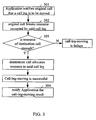
- Fig. 3 shows that the call-leg-moving interface implements the call leg move method with the following steps:
- the call-leg-moving method is as follow: break the voice channel resource occupied by the call leg in the original call, change messages related to the original call to messages related to the destination call, then allocate voice channel resource in the destination call to the call leg, which makes that the call leg can communicate with other call legs in the destination call.
- the call leg state and data in the original call are kept unchanged, and the call leg is in a suspended state in the original call so as to hold this call leg in original call.
- Step 302 it is informed to the user terminal corresponding to the call leg that the call leg will be moved to the destination call in order that the user terminal can understand its call environment in time.
- a multiparty chat service on a Web page is used to describe an application detail of the embodiment of the present invention.
- a Web multiparty chat service provides a Web page through which multiparty calls can be created and all current calls and the call parties in each call can be seen and managed.
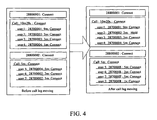
- Fig. 4 shows two calls with identifiers 28800001 and 28800002, respectively.
- the call 28800001 has continued 10 minutes and 20 seconds with four users: the user 1, 2, 3 and 4; each of them is one call party i.e. one call leg of the call.
- the call 28800002 has continued 5 minutes with three users: the user 5, 6 and 7.
- the user 2 in the call 28800001 is at a hold state and its call leg is suspended, so it cannot communicate with other three users in the call, but its call messages are kept unchanged in the call 28800001; the user 2 is connected to the call 28800002 and can communicate with the user 5, 6 or 7.
- the user 2 when the user 2 has finished the communication in the call 28800002, it can be returned to the call 28800001 and communicates with users 1, 3 or 4 continuously, since its call messages, such as the media type and the charging information, are kept unchanged during departure.
- Fig. 5 is a sequence diagram of a call leg move service based on the Fig. 3 call-leg-moving operation.
- Steps 1 to 17 is the voice channel resource.
Landscapes
- Engineering & Computer Science (AREA)
- Signal Processing (AREA)
- Computer Networks & Wireless Communication (AREA)
- Telephonic Communication Services (AREA)
- Data Exchanges In Wide-Area Networks (AREA)
Claims (11)
- Verfahren, das eine Anrufzweigbewegung implementiert, mit folgenden Schritten:Erzeugen (201) einer Anruf-Zweig-Bewegungs-Schnittstelle mit Bezugsparametern, die eine Identifizierung eines zu bewegenden Anrufzweigs und eine Identifizierung eines Zielanrufs sind;Aufrufen (202) der Anruf-Zweig-Bewegungs-Schnittstelle durch eine Anwendung mit einer Identifizierung eines zu bewegenden Anrufzweigs und einer Identifizierung eines Zielanrufs, zu dem der Anrufzweig zu bewegen ist, dadurchBewegen des Anrufzweigs von einem Ursprungsanruf zu dem Zielanruf,wobei der Schritt des Bewegens des Anrufzweigs folgende Schritte aufweist:Freigeben (302) der Sprachkanalressource, die durch den Anrufzweig bei dem Ursprungsanruf belegt ist, undZuteilen (303) von Sprachkanalressourcen des Zielanrufs zu dem Anrufzweig,wobei
der Zustand und die Daten des Anrufzweigs bei dem Ursprungsanruf unverändert gehalten werden. - Verfahren nach Anspruch 1, dadurch gekennzeichnet, dass der Schritt des Bewegens des Anrufzweigs folgende Schritte aufweist:Ändern einer Anrufidentifizierung des Anrufzweigs von einer Identifizierung des Ursprungsanrufs zu der Identifizierung des Zielanrufs durch Einstellen einer Nachricht des Anrufzweigs; undSenden (514) einer Anrufzweigbewegungs-Anfrage von dem Ursprungsanruf zu dem Zielanruf; undBestimmen durch den Zielanruf, nachdem derselbe die Anrufzweigbewegungs-Anfrage, die von dem Ursprungsanruf gesendet wurde, empfangen hat, ob die Ressource desselben ausreichend ist, und, wenn dieselbe ausreichend ist, Zuteilen einer Ressource zu dem Anrufzweig durch den Zielanruf, wobei die Anrufzweigbewegung erfolgreich ist, ansonsten fehlerhaft ist.
- Verfahren nach Anspruch 2, das ferner ein Benachrichtigen der Anwendung durch den Zielanruf über das Anrufzweigbewegungs-Resultat aufweist.
- Verfahren nach Anspruch 1, dadurch gekennzeichnet, dass der Schritt des Bewegens des Anrufzweigs ferner ein Benachrichtigen (511) eines Benutzerendgeräts, das dem zu bewegenden Anrufzweig entspricht, dass der Anrufzweig zu dem Zielanruf bewegt wird, aufweist.
- Verfahren nach Anspruch 1, dadurch gekennzeichnet, dass der Zustand und die Daten einen Medientyp, eine Abrechnungsverfahrensweise und Endgeräteinformationen aufweisen.
- Verfahren nach Anspruch 1, dadurch gekennzeichnet, dass der Ursprungsanruf und der Zielanruf jeweils ein Gruppenanruf sind.
- Verfahren nach Anspruch 1, dadurch gekennzeichnet, dass der Schritt des Bewegens des Anrufzweigs ferner ein Halten des Anrufzweigs in einem gesperrten Zustand bei dem Ursprungsanruf aufweist.
- Netzstruktur für eine Anrufzweigbewegung, die ein Telekommunikationsnetz, eine fähigkeitsabstrahierende Schicht und eine Anwendungsschicht aufweist; wobei die fähigkeitsabstrahierende Schicht Fähigkeiten des Telekommunikationsnetzes in unabhängige Funktionen abstrahiert, wobei jede unabhängige Funktion eine entsprechende Schnittstelle zu der Anwendungsschicht liefert; und wobei die Anwendungsschicht durch ein Aufrufen von Schnittstellen die Dienste, die durch die unabhängigen Funktionen implementiert sind, liefern kann;
und wobei
die fähigkeitsabstrahierende Schicht ferner eine Anruf-Zweig-Bewegungs-Funktion und eine Anruf-Zweig-Bewegungs-Schnittstelle, die zu der Anwendungsschicht vorgesehen ist, mit mindestens zwei Parametern, die eine Identifizierung eines zu bewegenden Anrufzweigs und eine Identifizierung eines Zielanrufs umfassen, aufweist,
wobei die Anwendungsschicht konfiguriert ist, um
die Anruf-Zweig-Bewegungs-Schnittstelle mit einer Identifizierung eines zu bewegenden Anrufzweigs und einer Identifizierung eines Zielanrufs, zu dem der Anrufzweig zu bewegen ist, aufzurufen (202), um durch Freigeben (302) der Sprachkanalressource, die durch den Anrufzweig bei einem Ursprungsanruf belegt ist, und Zuteilen (303) von Sprachkanalressourcen des Zielanrufs zu dem Anrufzweig den Anrufzweig von dem Ursprungsanruf zu dem Zielanruf zu bewegen,
wobei
der Zustand und die Daten des Anrufzweigs bei dem Ursprungsanruf unverändert gehalten werden. - Netzstruktur nach Anspruch 8, dadurch gekennzeichnet, dass die Anruf-Zweig-Bewegungs-Schnittstelle eine neu hinzugefügte Schnittstelle zu Parlay/OSA API ist.
- Netzstruktur nach Anspruch 8, dadurch gekennzeichnet, dass die Anruf-Zweig-Bewegungs-Schnittstelle eine neu hinzugefügte offene Schnittstelle ist.
- Netzstruktur nach Anspruch 8, dadurch gekennzeichnet, dass die Anruf-Zweig-Bewegungs-Schnittstelle ferner einen "Ausgabe"-Parameter zum Zeigen eines Anrufzweigbewegungs-Resultats als wahr oder falsch umfasst.
Applications Claiming Priority (2)
| Application Number | Priority Date | Filing Date | Title |
|---|---|---|---|
| CNB031374921A CN1276641C (zh) | 2003-06-25 | 2003-06-25 | 一种实现呼叫腿转移的方法 |
| PCT/CN2004/000515 WO2004114687A1 (fr) | 2003-06-25 | 2004-05-21 | Procede et structure de reseau pour module de transfert d'appel |
Publications (3)
| Publication Number | Publication Date |
|---|---|
| EP1638348A1 EP1638348A1 (de) | 2006-03-22 |
| EP1638348A4 EP1638348A4 (de) | 2006-07-12 |
| EP1638348B1 true EP1638348B1 (de) | 2007-07-18 |
Family
ID=33520377
Family Applications (1)
| Application Number | Title | Priority Date | Filing Date |
|---|---|---|---|
| EP04734207A Expired - Lifetime EP1638348B1 (de) | 2003-06-25 | 2004-05-21 | Verfahren und netzwerkstruktur zur bewegung von verbindungszweigen |
Country Status (8)
| Country | Link |
|---|---|
| US (1) | US7711099B2 (de) |
| EP (1) | EP1638348B1 (de) |
| CN (1) | CN1276641C (de) |
| AR (1) | AR044921A1 (de) |
| AT (1) | ATE367710T1 (de) |
| DE (1) | DE602004007659T2 (de) |
| PE (1) | PE20050547A1 (de) |
| WO (1) | WO2004114687A1 (de) |
Families Citing this family (3)
| Publication number | Priority date | Publication date | Assignee | Title |
|---|---|---|---|---|
| EP3264721B1 (de) * | 2005-03-17 | 2020-10-07 | Ericsson AB | Verfahren und vorrichtung für leitungsvermittelte und multimedia-subsystem basierte kontinuität der sprache |
| CN100452812C (zh) * | 2005-04-26 | 2009-01-14 | 华为技术有限公司 | 实现cs-2中连接可视状态的稳态m方视图的方法 |
| JP2009212606A (ja) * | 2008-02-29 | 2009-09-17 | Fujitsu Ltd | 音声呼通信切替システム |
Family Cites Families (9)
| Publication number | Priority date | Publication date | Assignee | Title |
|---|---|---|---|---|
| US4897866A (en) * | 1988-10-19 | 1990-01-30 | American Telephone And Telegraph Company, At&T Bell Laboratories | Telecommunication system with subscriber controlled feature modification |
| US5533110A (en) * | 1994-11-29 | 1996-07-02 | Mitel Corporation | Human machine interface for telephone feature invocation |
| US5940488A (en) * | 1996-11-15 | 1999-08-17 | Active Voice Corporation | Telecommunication management system and user interface |
| US6115461A (en) * | 1998-06-15 | 2000-09-05 | Lucent Technologies Inc. | Apparatus, method and system for providing information to a called party in multiple leg telecommunication sessions |
| US6111943A (en) * | 1998-09-29 | 2000-08-29 | Lucent Technologies Inc. | Rapid call set-up for multiple leg telecommunications sessions |
| US6574325B1 (en) * | 1999-07-09 | 2003-06-03 | Lucent Technologies Inc. | Apparatus method and system for providing call progress information for multiple leg telecommunication sessions for intelligent network services |
| US6996221B1 (en) * | 1999-12-07 | 2006-02-07 | Lucent Technologies Inc. | Apparatus, method and system for providing telecommunication conferencing services in a multiple leg telecommunication session |
| US7003086B1 (en) * | 2001-01-18 | 2006-02-21 | Cisco Technology, Inc. | Apparatus and method for allocating call resources during a conference call |
| GB2407737B (en) * | 2002-08-30 | 2006-05-17 | Ericsson Telefon Ab L M | Intelligent peripheral for speech recognition in networks |
-
2003
- 2003-06-25 CN CNB031374921A patent/CN1276641C/zh not_active Expired - Fee Related
-
2004
- 2004-05-21 WO PCT/CN2004/000515 patent/WO2004114687A1/zh not_active Ceased
- 2004-05-21 EP EP04734207A patent/EP1638348B1/de not_active Expired - Lifetime
- 2004-05-21 DE DE602004007659T patent/DE602004007659T2/de not_active Expired - Lifetime
- 2004-05-21 AT AT04734207T patent/ATE367710T1/de not_active IP Right Cessation
- 2004-06-22 PE PE2004000607A patent/PE20050547A1/es active IP Right Grant
- 2004-06-25 AR ARP040102246A patent/AR044921A1/es active IP Right Grant
-
2005
- 2005-12-22 US US11/315,435 patent/US7711099B2/en not_active Expired - Fee Related
Non-Patent Citations (1)
| Title |
|---|
| None * |
Also Published As
| Publication number | Publication date |
|---|---|
| US7711099B2 (en) | 2010-05-04 |
| DE602004007659D1 (de) | 2007-08-30 |
| EP1638348A4 (de) | 2006-07-12 |
| AR044921A1 (es) | 2005-10-12 |
| US20060140377A1 (en) | 2006-06-29 |
| CN1276641C (zh) | 2006-09-20 |
| ATE367710T1 (de) | 2007-08-15 |
| CN1567941A (zh) | 2005-01-19 |
| DE602004007659T2 (de) | 2008-06-05 |
| PE20050547A1 (es) | 2005-07-06 |
| WO2004114687A1 (fr) | 2004-12-29 |
| EP1638348A1 (de) | 2006-03-22 |
Similar Documents
| Publication | Publication Date | Title |
|---|---|---|
| CN111491313B (zh) | 一种通信方法及相关设备 | |
| Leung et al. | A software architecture for workstations supporting multimedia conferencing in packet switching networks | |
| CN108833181B (zh) | Ng-cn网络切片系统及网络切片选择方法 | |
| US7908322B2 (en) | Initiation and support of video conferencing using instant messaging | |
| KR20070039108A (ko) | 하이브리드 전기 통신 네트워크에서 세션 제어를 위한 방법및 장치 | |
| CN101253492A (zh) | 管理网络中通信会话的系统与方法 | |
| CN101491061A (zh) | 用于在网络中提供服务的方法和网络元素 | |
| CN101449523A (zh) | 智能网中的服务改变和服务回退 | |
| Heijenk et al. | Communication systems supporting multimedia multi-user applications | |
| US5491798A (en) | Method for network call management | |
| CN104079419A (zh) | 一种会议的发言控制的呈现方法与装置 | |
| WO2007005570A2 (en) | Push-to-talk communications in computing environments | |
| EP1638348A1 (de) | Verfahren und netzwerkstruktur zur bewegung von verbindungszweigen | |
| CN114172951B (zh) | Mec共享方法、通信装置及存储介质 | |
| CN111436162A (zh) | 一种处理方法及设备 | |
| US9374391B2 (en) | Composite endpoint mechanism | |
| CN115883668B (zh) | 一种话务调度平台 | |
| CN101170482A (zh) | Ason网络中通过控制平面实现spc激活/去激活的方法 | |
| EP1317123B1 (de) | Örtlich verteiltes Telekonferenzsystem | |
| JP2012156800A (ja) | サーバ装置およびその通信方法 | |
| Zibman et al. | An architectural approach to minimizing feature interactions in telecommunications | |
| CN101938363B (zh) | 基于Parlay网关实现会议电话的方法 | |
| CN113727285B (zh) | 呼叫业务切换方法、装置、系统及相关产品 | |
| JP4358214B2 (ja) | セッション管理システム、セッション管理サーバ装置、セッション管理方法 | |
| CN100420317C (zh) | 一种实现集群呼叫无关业务的方法及系统 |
Legal Events
| Date | Code | Title | Description |
|---|---|---|---|
| PUAI | Public reference made under article 153(3) epc to a published international application that has entered the european phase |
Free format text: ORIGINAL CODE: 0009012 |
|
| 17P | Request for examination filed |
Effective date: 20051219 |
|
| AK | Designated contracting states |
Kind code of ref document: A1 Designated state(s): AT BE BG CH CY CZ DE DK EE ES FI FR GB GR HU IE IT LI LU MC NL PL PT RO SE SI SK TR |
|
| RIC1 | Information provided on ipc code assigned before grant |
Ipc: H04M 3/56 20060101AFI20060531BHEP Ipc: H04Q 7/28 20060101ALN20060531BHEP |
|
| A4 | Supplementary search report drawn up and despatched |
Effective date: 20060614 |
|
| DAX | Request for extension of the european patent (deleted) | ||
| 17Q | First examination report despatched |
Effective date: 20060918 |
|
| GRAP | Despatch of communication of intention to grant a patent |
Free format text: ORIGINAL CODE: EPIDOSNIGR1 |
|
| RTI1 | Title (correction) |
Free format text: METHOD AND NETWORK STRUCTURE FOR MOVING A CALL-LEG |
|
| GRAS | Grant fee paid |
Free format text: ORIGINAL CODE: EPIDOSNIGR3 |
|
| GRAA | (expected) grant |
Free format text: ORIGINAL CODE: 0009210 |
|
| AK | Designated contracting states |
Kind code of ref document: B1 Designated state(s): AT BE BG CH CY CZ DE DK EE ES FI FR GB GR HU IE IT LI LU MC NL PL PT RO SE SI SK TR |
|
| REG | Reference to a national code |
Ref country code: GB Ref legal event code: FG4D |
|
| REG | Reference to a national code |
Ref country code: CH Ref legal event code: EP |
|
| REF | Corresponds to: |
Ref document number: 602004007659 Country of ref document: DE Date of ref document: 20070830 Kind code of ref document: P |
|
| REG | Reference to a national code |
Ref country code: IE Ref legal event code: FG4D |
|
| ET | Fr: translation filed | ||
| PG25 | Lapsed in a contracting state [announced via postgrant information from national office to epo] |
Ref country code: BG Free format text: LAPSE BECAUSE OF FAILURE TO SUBMIT A TRANSLATION OF THE DESCRIPTION OR TO PAY THE FEE WITHIN THE PRESCRIBED TIME-LIMIT Effective date: 20071018 Ref country code: ES Free format text: LAPSE BECAUSE OF FAILURE TO SUBMIT A TRANSLATION OF THE DESCRIPTION OR TO PAY THE FEE WITHIN THE PRESCRIBED TIME-LIMIT Effective date: 20071029 Ref country code: NL Free format text: LAPSE BECAUSE OF FAILURE TO SUBMIT A TRANSLATION OF THE DESCRIPTION OR TO PAY THE FEE WITHIN THE PRESCRIBED TIME-LIMIT Effective date: 20070718 Ref country code: FI Free format text: LAPSE BECAUSE OF FAILURE TO SUBMIT A TRANSLATION OF THE DESCRIPTION OR TO PAY THE FEE WITHIN THE PRESCRIBED TIME-LIMIT Effective date: 20070718 Ref country code: PT Free format text: LAPSE BECAUSE OF FAILURE TO SUBMIT A TRANSLATION OF THE DESCRIPTION OR TO PAY THE FEE WITHIN THE PRESCRIBED TIME-LIMIT Effective date: 20071218 |
|
| REG | Reference to a national code |
Ref country code: CH Ref legal event code: PL |
|
| NLV1 | Nl: lapsed or annulled due to failure to fulfill the requirements of art. 29p and 29m of the patents act | ||
| PG25 | Lapsed in a contracting state [announced via postgrant information from national office to epo] |
Ref country code: AT Free format text: LAPSE BECAUSE OF FAILURE TO SUBMIT A TRANSLATION OF THE DESCRIPTION OR TO PAY THE FEE WITHIN THE PRESCRIBED TIME-LIMIT Effective date: 20070718 Ref country code: LI Free format text: LAPSE BECAUSE OF FAILURE TO SUBMIT A TRANSLATION OF THE DESCRIPTION OR TO PAY THE FEE WITHIN THE PRESCRIBED TIME-LIMIT Effective date: 20070718 Ref country code: CH Free format text: LAPSE BECAUSE OF FAILURE TO SUBMIT A TRANSLATION OF THE DESCRIPTION OR TO PAY THE FEE WITHIN THE PRESCRIBED TIME-LIMIT Effective date: 20070718 Ref country code: PL Free format text: LAPSE BECAUSE OF FAILURE TO SUBMIT A TRANSLATION OF THE DESCRIPTION OR TO PAY THE FEE WITHIN THE PRESCRIBED TIME-LIMIT Effective date: 20070718 |
|
| PG25 | Lapsed in a contracting state [announced via postgrant information from national office to epo] |
Ref country code: BE Free format text: LAPSE BECAUSE OF FAILURE TO SUBMIT A TRANSLATION OF THE DESCRIPTION OR TO PAY THE FEE WITHIN THE PRESCRIBED TIME-LIMIT Effective date: 20070718 |
|
| PG25 | Lapsed in a contracting state [announced via postgrant information from national office to epo] |
Ref country code: GR Free format text: LAPSE BECAUSE OF FAILURE TO SUBMIT A TRANSLATION OF THE DESCRIPTION OR TO PAY THE FEE WITHIN THE PRESCRIBED TIME-LIMIT Effective date: 20071019 Ref country code: DK Free format text: LAPSE BECAUSE OF FAILURE TO SUBMIT A TRANSLATION OF THE DESCRIPTION OR TO PAY THE FEE WITHIN THE PRESCRIBED TIME-LIMIT Effective date: 20070718 |
|
| PLBE | No opposition filed within time limit |
Free format text: ORIGINAL CODE: 0009261 |
|
| STAA | Information on the status of an ep patent application or granted ep patent |
Free format text: STATUS: NO OPPOSITION FILED WITHIN TIME LIMIT |
|
| PG25 | Lapsed in a contracting state [announced via postgrant information from national office to epo] |
Ref country code: SK Free format text: LAPSE BECAUSE OF FAILURE TO SUBMIT A TRANSLATION OF THE DESCRIPTION OR TO PAY THE FEE WITHIN THE PRESCRIBED TIME-LIMIT Effective date: 20070718 Ref country code: CZ Free format text: LAPSE BECAUSE OF FAILURE TO SUBMIT A TRANSLATION OF THE DESCRIPTION OR TO PAY THE FEE WITHIN THE PRESCRIBED TIME-LIMIT Effective date: 20070718 |
|
| 26N | No opposition filed |
Effective date: 20080421 |
|
| PG25 | Lapsed in a contracting state [announced via postgrant information from national office to epo] |
Ref country code: RO Free format text: LAPSE BECAUSE OF FAILURE TO SUBMIT A TRANSLATION OF THE DESCRIPTION OR TO PAY THE FEE WITHIN THE PRESCRIBED TIME-LIMIT Effective date: 20070718 Ref country code: SE Free format text: LAPSE BECAUSE OF FAILURE TO SUBMIT A TRANSLATION OF THE DESCRIPTION OR TO PAY THE FEE WITHIN THE PRESCRIBED TIME-LIMIT Effective date: 20071018 |
|
| PG25 | Lapsed in a contracting state [announced via postgrant information from national office to epo] |
Ref country code: MC Free format text: LAPSE BECAUSE OF NON-PAYMENT OF DUE FEES Effective date: 20080531 |
|
| PG25 | Lapsed in a contracting state [announced via postgrant information from national office to epo] |
Ref country code: EE Free format text: LAPSE BECAUSE OF FAILURE TO SUBMIT A TRANSLATION OF THE DESCRIPTION OR TO PAY THE FEE WITHIN THE PRESCRIBED TIME-LIMIT Effective date: 20070718 Ref country code: IE Free format text: LAPSE BECAUSE OF NON-PAYMENT OF DUE FEES Effective date: 20080521 |
|
| PG25 | Lapsed in a contracting state [announced via postgrant information from national office to epo] |
Ref country code: SI Free format text: LAPSE BECAUSE OF FAILURE TO SUBMIT A TRANSLATION OF THE DESCRIPTION OR TO PAY THE FEE WITHIN THE PRESCRIBED TIME-LIMIT Effective date: 20070718 |
|
| PG25 | Lapsed in a contracting state [announced via postgrant information from national office to epo] |
Ref country code: CY Free format text: LAPSE BECAUSE OF FAILURE TO SUBMIT A TRANSLATION OF THE DESCRIPTION OR TO PAY THE FEE WITHIN THE PRESCRIBED TIME-LIMIT Effective date: 20070718 |
|
| PG25 | Lapsed in a contracting state [announced via postgrant information from national office to epo] |
Ref country code: LU Free format text: LAPSE BECAUSE OF NON-PAYMENT OF DUE FEES Effective date: 20080521 Ref country code: HU Free format text: LAPSE BECAUSE OF FAILURE TO SUBMIT A TRANSLATION OF THE DESCRIPTION OR TO PAY THE FEE WITHIN THE PRESCRIBED TIME-LIMIT Effective date: 20080119 |
|
| PG25 | Lapsed in a contracting state [announced via postgrant information from national office to epo] |
Ref country code: TR Free format text: LAPSE BECAUSE OF FAILURE TO SUBMIT A TRANSLATION OF THE DESCRIPTION OR TO PAY THE FEE WITHIN THE PRESCRIBED TIME-LIMIT Effective date: 20070718 |
|
| PG25 | Lapsed in a contracting state [announced via postgrant information from national office to epo] |
Ref country code: IT Free format text: LAPSE BECAUSE OF NON-PAYMENT OF DUE FEES Effective date: 20080531 |
|
| REG | Reference to a national code |
Ref country code: FR Ref legal event code: PLFP Year of fee payment: 13 |
|
| REG | Reference to a national code |
Ref country code: FR Ref legal event code: PLFP Year of fee payment: 14 |
|
| REG | Reference to a national code |
Ref country code: FR Ref legal event code: PLFP Year of fee payment: 15 |
|
| PGFP | Annual fee paid to national office [announced via postgrant information from national office to epo] |
Ref country code: DE Payment date: 20190508 Year of fee payment: 16 |
|
| PGFP | Annual fee paid to national office [announced via postgrant information from national office to epo] |
Ref country code: FR Payment date: 20190410 Year of fee payment: 16 |
|
| PGFP | Annual fee paid to national office [announced via postgrant information from national office to epo] |
Ref country code: GB Payment date: 20190515 Year of fee payment: 16 |
|
| REG | Reference to a national code |
Ref country code: DE Ref legal event code: R119 Ref document number: 602004007659 Country of ref document: DE |
|
| GBPC | Gb: european patent ceased through non-payment of renewal fee |
Effective date: 20200521 |
|
| PG25 | Lapsed in a contracting state [announced via postgrant information from national office to epo] |
Ref country code: FR Free format text: LAPSE BECAUSE OF NON-PAYMENT OF DUE FEES Effective date: 20200531 Ref country code: GB Free format text: LAPSE BECAUSE OF NON-PAYMENT OF DUE FEES Effective date: 20200521 |
|
| PG25 | Lapsed in a contracting state [announced via postgrant information from national office to epo] |
Ref country code: DE Free format text: LAPSE BECAUSE OF NON-PAYMENT OF DUE FEES Effective date: 20201201 |