EP1637339B1 - Thermal recording material - Google Patents
Thermal recording material Download PDFInfo
- Publication number
- EP1637339B1 EP1637339B1 EP20050020468 EP05020468A EP1637339B1 EP 1637339 B1 EP1637339 B1 EP 1637339B1 EP 20050020468 EP20050020468 EP 20050020468 EP 05020468 A EP05020468 A EP 05020468A EP 1637339 B1 EP1637339 B1 EP 1637339B1
- Authority
- EP
- European Patent Office
- Prior art keywords
- recording material
- thermal recording
- thermal
- group
- protective layer
- Prior art date
- Legal status (The legal status is an assumption and is not a legal conclusion. Google has not performed a legal analysis and makes no representation as to the accuracy of the status listed.)
- Expired - Lifetime
Links
Classifications
-
- B—PERFORMING OPERATIONS; TRANSPORTING
- B41—PRINTING; LINING MACHINES; TYPEWRITERS; STAMPS
- B41M—PRINTING, DUPLICATING, MARKING, OR COPYING PROCESSES; COLOUR PRINTING
- B41M5/00—Duplicating or marking methods; Sheet materials for use therein
- B41M5/26—Thermography ; Marking by high energetic means, e.g. laser otherwise than by burning, and characterised by the material used
- B41M5/40—Thermography ; Marking by high energetic means, e.g. laser otherwise than by burning, and characterised by the material used characterised by the base backcoat, intermediate, or covering layers, e.g. for thermal transfer dye-donor or dye-receiver sheets; Heat, radiation filtering or absorbing means or layers; combined with other image registration layers or compositions; Special originals for reproduction by thermography
- B41M5/42—Intermediate, backcoat, or covering layers
-
- B—PERFORMING OPERATIONS; TRANSPORTING
- B41—PRINTING; LINING MACHINES; TYPEWRITERS; STAMPS
- B41M—PRINTING, DUPLICATING, MARKING, OR COPYING PROCESSES; COLOUR PRINTING
- B41M2205/00—Printing methods or features related to printing methods; Location or type of the layers
- B41M2205/04—Direct thermal recording [DTR]
-
- B—PERFORMING OPERATIONS; TRANSPORTING
- B41—PRINTING; LINING MACHINES; TYPEWRITERS; STAMPS
- B41M—PRINTING, DUPLICATING, MARKING, OR COPYING PROCESSES; COLOUR PRINTING
- B41M5/00—Duplicating or marking methods; Sheet materials for use therein
- B41M5/26—Thermography ; Marking by high energetic means, e.g. laser otherwise than by burning, and characterised by the material used
- B41M5/30—Thermography ; Marking by high energetic means, e.g. laser otherwise than by burning, and characterised by the material used using chemical colour formers
- B41M5/333—Colour developing components therefor, e.g. acidic compounds
- B41M5/3333—Non-macromolecular compounds
- B41M5/3335—Compounds containing phenolic or carboxylic acid groups or metal salts thereof
-
- B—PERFORMING OPERATIONS; TRANSPORTING
- B41—PRINTING; LINING MACHINES; TYPEWRITERS; STAMPS
- B41M—PRINTING, DUPLICATING, MARKING, OR COPYING PROCESSES; COLOUR PRINTING
- B41M5/00—Duplicating or marking methods; Sheet materials for use therein
- B41M5/26—Thermography ; Marking by high energetic means, e.g. laser otherwise than by burning, and characterised by the material used
- B41M5/30—Thermography ; Marking by high energetic means, e.g. laser otherwise than by burning, and characterised by the material used using chemical colour formers
- B41M5/337—Additives; Binders
- B41M5/3372—Macromolecular compounds
-
- B—PERFORMING OPERATIONS; TRANSPORTING
- B41—PRINTING; LINING MACHINES; TYPEWRITERS; STAMPS
- B41M—PRINTING, DUPLICATING, MARKING, OR COPYING PROCESSES; COLOUR PRINTING
- B41M5/00—Duplicating or marking methods; Sheet materials for use therein
- B41M5/26—Thermography ; Marking by high energetic means, e.g. laser otherwise than by burning, and characterised by the material used
- B41M5/30—Thermography ; Marking by high energetic means, e.g. laser otherwise than by burning, and characterised by the material used using chemical colour formers
- B41M5/337—Additives; Binders
- B41M5/3377—Inorganic compounds, e.g. metal salts of organic acids
-
- B—PERFORMING OPERATIONS; TRANSPORTING
- B41—PRINTING; LINING MACHINES; TYPEWRITERS; STAMPS
- B41M—PRINTING, DUPLICATING, MARKING, OR COPYING PROCESSES; COLOUR PRINTING
- B41M5/00—Duplicating or marking methods; Sheet materials for use therein
- B41M5/26—Thermography ; Marking by high energetic means, e.g. laser otherwise than by burning, and characterised by the material used
- B41M5/40—Thermography ; Marking by high energetic means, e.g. laser otherwise than by burning, and characterised by the material used characterised by the base backcoat, intermediate, or covering layers, e.g. for thermal transfer dye-donor or dye-receiver sheets; Heat, radiation filtering or absorbing means or layers; combined with other image registration layers or compositions; Special originals for reproduction by thermography
- B41M5/42—Intermediate, backcoat, or covering layers
- B41M5/423—Intermediate, backcoat, or covering layers characterised by non-macromolecular compounds, e.g. waxes
-
- B—PERFORMING OPERATIONS; TRANSPORTING
- B41—PRINTING; LINING MACHINES; TYPEWRITERS; STAMPS
- B41M—PRINTING, DUPLICATING, MARKING, OR COPYING PROCESSES; COLOUR PRINTING
- B41M5/00—Duplicating or marking methods; Sheet materials for use therein
- B41M5/26—Thermography ; Marking by high energetic means, e.g. laser otherwise than by burning, and characterised by the material used
- B41M5/40—Thermography ; Marking by high energetic means, e.g. laser otherwise than by burning, and characterised by the material used characterised by the base backcoat, intermediate, or covering layers, e.g. for thermal transfer dye-donor or dye-receiver sheets; Heat, radiation filtering or absorbing means or layers; combined with other image registration layers or compositions; Special originals for reproduction by thermography
- B41M5/42—Intermediate, backcoat, or covering layers
- B41M5/426—Intermediate, backcoat, or covering layers characterised by inorganic compounds, e.g. metals, metal salts, metal complexes
-
- B—PERFORMING OPERATIONS; TRANSPORTING
- B41—PRINTING; LINING MACHINES; TYPEWRITERS; STAMPS
- B41M—PRINTING, DUPLICATING, MARKING, OR COPYING PROCESSES; COLOUR PRINTING
- B41M5/00—Duplicating or marking methods; Sheet materials for use therein
- B41M5/26—Thermography ; Marking by high energetic means, e.g. laser otherwise than by burning, and characterised by the material used
- B41M5/40—Thermography ; Marking by high energetic means, e.g. laser otherwise than by burning, and characterised by the material used characterised by the base backcoat, intermediate, or covering layers, e.g. for thermal transfer dye-donor or dye-receiver sheets; Heat, radiation filtering or absorbing means or layers; combined with other image registration layers or compositions; Special originals for reproduction by thermography
- B41M5/42—Intermediate, backcoat, or covering layers
- B41M5/44—Intermediate, backcoat, or covering layers characterised by the macromolecular compounds
-
- B—PERFORMING OPERATIONS; TRANSPORTING
- B41—PRINTING; LINING MACHINES; TYPEWRITERS; STAMPS
- B41M—PRINTING, DUPLICATING, MARKING, OR COPYING PROCESSES; COLOUR PRINTING
- B41M5/00—Duplicating or marking methods; Sheet materials for use therein
- B41M5/26—Thermography ; Marking by high energetic means, e.g. laser otherwise than by burning, and characterised by the material used
- B41M5/40—Thermography ; Marking by high energetic means, e.g. laser otherwise than by burning, and characterised by the material used characterised by the base backcoat, intermediate, or covering layers, e.g. for thermal transfer dye-donor or dye-receiver sheets; Heat, radiation filtering or absorbing means or layers; combined with other image registration layers or compositions; Special originals for reproduction by thermography
- B41M5/42—Intermediate, backcoat, or covering layers
- B41M5/44—Intermediate, backcoat, or covering layers characterised by the macromolecular compounds
- B41M5/443—Silicon-containing polymers, e.g. silicones, siloxanes
-
- Y—GENERAL TAGGING OF NEW TECHNOLOGICAL DEVELOPMENTS; GENERAL TAGGING OF CROSS-SECTIONAL TECHNOLOGIES SPANNING OVER SEVERAL SECTIONS OF THE IPC; TECHNICAL SUBJECTS COVERED BY FORMER USPC CROSS-REFERENCE ART COLLECTIONS [XRACs] AND DIGESTS
- Y02—TECHNOLOGIES OR APPLICATIONS FOR MITIGATION OR ADAPTATION AGAINST CLIMATE CHANGE
- Y02P—CLIMATE CHANGE MITIGATION TECHNOLOGIES IN THE PRODUCTION OR PROCESSING OF GOODS
- Y02P20/00—Technologies relating to chemical industry
- Y02P20/50—Improvements relating to the production of bulk chemicals
- Y02P20/582—Recycling of unreacted starting or intermediate materials
-
- Y—GENERAL TAGGING OF NEW TECHNOLOGICAL DEVELOPMENTS; GENERAL TAGGING OF CROSS-SECTIONAL TECHNOLOGIES SPANNING OVER SEVERAL SECTIONS OF THE IPC; TECHNICAL SUBJECTS COVERED BY FORMER USPC CROSS-REFERENCE ART COLLECTIONS [XRACs] AND DIGESTS
- Y10—TECHNICAL SUBJECTS COVERED BY FORMER USPC
- Y10T—TECHNICAL SUBJECTS COVERED BY FORMER US CLASSIFICATION
- Y10T428/00—Stock material or miscellaneous articles
- Y10T428/31504—Composite [nonstructural laminate]
- Y10T428/31652—Of asbestos
- Y10T428/31663—As siloxane, silicone or silane
Definitions
- the present invention relates to a thermal recording material for use in computer outputs, printers used in electronic calculators, recorders used in medical care, low-speed and high-speed facsimiles, automatic ticket machines, handy terminals, etc.
- thermal recording materials including a substrate such as a paper, a synthetic paper and a plastic film; and a thermal recording layer including an achromatic or a hypochromic leuco dye and a developer coloring the leuco dye when contacting thereto, located overlying the substrate, have been proposed. Since the thermal recording materials do not need complicated procedures such as development and fixing, comparatively a simple device can record information thereon in a short time, and the device makes less noise and is inexpensive, the thermal recording materials are widely used in copies of libraries and documents, electronic computers, facsimiles, ticketing machines, label printers, recorders, handy terminals, etc.
- thermal recording materials expand and more frequently used out of doors, and the thermal recording materials printable in a hard environment of low-temperature and low-humidity are demanded.
- the thermal recording materials are liable to stick and poorly transport in small label printers and handy terminal printers having a weak motor torque in an environment of low-temperature and low-humidity.
- Japanese Patent Publications Nos. 1-17478 , 4-30918 , 4-71716 and 4-77672 have disclosed a protective layer including a water-soluble resin, a pigment and a crosslinker as main components to improve water resistance and chemical resistance of the recorded image and to prevent adherence of an extraneous matter to a thermal head of the printer, abrasion thereof and sticking of the thermal recording material thereto.
- Japanese Patent Publication No. 4-22153 discloses use of a polyurethane resin emulsion.
- Japanese Laid-Open Patent Publications Nos. 1-198386 , 2-187388 and 3-002088 disclose a method of including a silicone compound in the protective layer to improve the transportability and sticking of the thermal recording material, however, the thermal recordingmaterial still sticks to thermal heads of small label printers and handy terminal printers having a weak motor torque in an environment of low-temperature and low-humidity because melted materials from the thermal layer and protective layer thereof. In addition, the recorded image density and stability deteriorate, and the extraneous matter adhered to the thermal head increases.
- Japanese Laid-Open Patent Publication No. 5-096854 discloses a method of including a particulate dimethyl silicone resin in the protective layer.
- the dimethyl silicone resin has an effect on the sticking, but does not work on the abrasion resistance of the thermal head.
- Japanese Patent Publication No. 5-62079 discloses a method of including a particulate silicone compound having the following formula in the protective layer: (CH 3 SiO 1.5 ) n wherein n is an integer of from 5 to 15.
- n is an integer of from 5 to 15.
- Recent developers having a high melting point such as a (poly) 4-hydroxybenzoic acid derivative and a diphenyl sulfonic acid derivative disclosed in Japanese Laid-Open Patent Publication No. 10-29969 , quickly become solidified after melting under conditions of low-temperature and low-humidity. Therefore, melted materials are liable to adhere to the thermal head and the sticking problem tends to occur.
- the thermal recording material is required to quickly develop images having high density, and to have tough developed images and background. Further, recently, a large amount thereof are used in a field wherein the recorded images need to have high reliability, and the recorded images are required to have high stability against plasticizers and oils and fats included in a organic polymer material used for package.
- a protective layer is formed on a thermal recording layer of the thermal recording material.
- PVA polyvinylalcohol
- modified PVA or a combination thereof with a water resistant agent is used in the protective layer.
- Japanese Laid-Open Patent Publication No. 8-151412 discloses a method of using PVA having a diacetone group and a hydrazine compound in a protective layer. However, a coating liquid including these develops becoming water resistant and increases its viscosity.
- Japanese Laid-Open Patent Publication No. 11-314457 discloses a method of including modified PVA having a diacetone group in a protective layer and a hydrazine compound in a thermal developing layer.
- the protective layer does not have sufficient water resistance, a coating liquid for the thermal developing layer increases its viscosity, and the hydrazine compound impairs development therein.
- 10-87936 discloses a method of including a copolymer including diacetone acrylamide as a monomer, a hydrazide compound and a water-soluble amine in a protective layer.
- the amine affects a thermal developing layer and causes background development, pH control with the amine of a coating liquid therefor is difficult, and the coating liquid occasionally increases its viscosity depending on an amount of the amine.
- Japanese Laid-Open Patent Publication No. 08-333329 discloses a polymer developer of a diphenyl sulfonic acid derivative.
- Patent No. WO99/51444 discloses a (poly)4-hydroxy benzoic acid derivative.
- Japanese Laid-Open Patent Publication No. 2000-143611 discloses a polymer urea urethane compound. These developers have high image stability against plasticizers and oils and fats, but has low developing sensitivity and developing density.
- Japanese Laid-Open Patent Publications Nos. 10-297089 and 10-297090 disclose a method of using a developer having a low melting point and a sensitizer to catch up with the developing sensitivity and the developing density of the polymer developer of a diphenyl sulfonic acid derivative.
- the developer having a low melting point and the sensitizer improve the apparent developing sensitivity and the apparent developing density, deterioration of the image density due to plasticizers is noticeable. This is because the developer having a low melting point loses its best advantage of chemical resistance due to the sensitizer. Namely, the polymer developer is required to have both higher developability and higher chemical resistance.
- the developer and sensitizer having a low melting point melt together with the leuco dye and the developer to decrease the melting point.
- the melting point decreases, the sensitivity improves.
- the developing temperature decreases, resulting in occurrence of background development at a low temperature.
- Japanese Laid-Open Patent Publication No. 2001-310561 discloses combinations of 4-hydroxy-4'-allyloxydiphenylsulfone and various polymer developers to balance the heat resistance, sensitivity and chemical resistance of a thermal recording material.
- an image survival rate is not 100% yet against chemicals, particularly plasticizers, and this needs further improvement.
- Other methods of improving the sensitivity include forming an adiathermic undercoat layer including empty particles to effectively use heat energy from the thermal heat, emulsifying a dispersion including the leuco dye so as to have a diameter of sub-micrometre, etc.
- the sensitivity is still insufficient and the background development occurs.
- thermostable preservability of the recorded images and abrading the thermal head less.
- JP 2002 240427 A describes a thermal recording material comprising a thermal colouring layer overlying a substrate, with a protective layer overlying the thermal colouring layer.
- An object of the present invention is to provide a thermal recording material having good high-humidity transportability, low-temperature sticking resistance, adaptability to a low-torque printer, chemical (plasticizer) resistance, high-sensitivity without background development, thermostable preservability of the recorded images, and abrading the thermal head less.
- a thermal recording material comprising:
- the spherical and particulate silicone compound preferably has a volume average particle diameter of from 1 to 4 ⁇ m.
- the present invention provides a thermal recording material having good high-humidity transportability, low-temperature sticking resistance, adaptability to a low-torque printer, chemical (plasticizer) resistance, high-sensitivity without background development, thermostable preservability of the recorded images, and abrading the thermal head less.
- the thermal recording material of the present invention comprising a substrate; a thermal coloring layer located overlying the substrate; and a protective layer located overlying the thermal coloring layer, comprising a binder resin; a crosslinker; a filler; and a release agent, wherein the release agent is a spherical and particulate silicone compound having the following formula: (CH 3 SiO 3/2 ) n wherein n represents an integer greater than 15 neither sticks to a thermal head in an environment of high-humidity nor sticks to a thermal head of a low-torque printer in an environment of low-temperature and low-humidity.
- the silicone compound of the present invention is not dissolved in an organic solvent to be emulsified, but is dispersed in the protective layer as a particulate solid.
- the spherical and particulate silicone compound has the shape of from a true sphere to a spheroid, and is insoluble in an organic solvent, having no melting point.
- the spherical and particulate silicone compound used in the present invention having the following formula: (CH 3 SiO 3/2 ) n wherein n represents an integer greater than 15 is different from (CH 3 SiO 1.5 ) n disclosed in Japanese Patent Publication No. 5-62079 , wherein n is an integer of from 5 to 15.
- the spherical and particulate silicone compound of the present invention having a larger molecular weight and a particle diameter, is proved to improve the transportability and low-temperature sticking resistance of the resultant thermal recording material.
- the spherical and particulate silicone compound of the present invention preferably has an average particle diameter of from 1 to 4 ⁇ m. When less than 1 ⁇ m, the resultant thermal recording material sticks to a thermal head in an environment of high-humidity. When greater than 4 ⁇ m, the thermal head abrades more.
- KMP-590 from Shin-Etsu Chemical co., Ltd., X-52-1621 therefrom, etc. are used as the spherical and particulate silicone compound, and the thermal recording material of the present invention neither sticks to a thermal head in an environment of high-humidity nor sticks to a thermal head of a low-torque printer in an environment of low-temperature and low-humidity.
- the spherical and particulate silicone compound When the spherical and particulate silicone compound is added to a protective layer coating liquid, it is preferable that the spherical and particulate silicone compound is uniformly dispersed in an aqueous solution of a surfactant first and then the dispersion is added thereto. In this way, the spherical and particulate silicone compound is uniformly dispersed therein, and the resultant thermal recording material less sticks to a thermal head in an environment of high-humidity and less sticks to a thermal head of a low-torque printer in an environment of low-temperature and low-humidity.
- the surfactant include an aqueous solution of alkylsulfosuccinate, 2,4,7,9-tetramethyl-5-decine-4,7-diol, mineral oils, etc. Particularly, the aqueous solution of alkylsulfosuccinate is most effectively used.
- the protective layer preferably includes a release agent in an amount of from 0.05 to 1.0 parts by weight based on total weight of the binder resin.
- the binder resin include polyvinylalcohol; amylum and its derivatives; cellulose derivatives such as methoxy cellulose, hydroxy ethyl cellulose and carboxy methyl cellulose; and water-soluble polymers such as polysodium acrylate, polyvinyl pyrrolidone, styrene/maleic acid anhydride copolymer alkali salt, isobutylene/maleic acid anhydride copolymer alkali salt, polyacrylamide, gelatin and casein.
- a heat resistant resin which is difficult to melt and soften with a heat to improve sticking resistance of the resultant thermal recording material. From that standpoint, polyvinylalcohol including a reactive carbonyl group is most preferably used.
- the polyvinylalcohol including a reactive carbonyl group can be prepared by known methods such as a method of copolymerizing a vinyl monomer including a reactive carbonyl group and a fatty acid vinyl ester to prepare a polymer; and saponifying the polymer.
- the vinyl monomer including a reactive carbonyl group includes a group including ester and a group including an acetone group, and a vinyl monomer having a diacetone group is preferably used. Specifically, diacetone acrylamide and methadiacetone acrylamide are preferably used.
- the fatty acid vinyl ester includes vinyl formate, vinyl acetate, vinyl propionate, etc., and vinyl acetate is preferably used.
- the polyvinylalcohol including a reactive carbonyl group for use in the present invention may be copolymerized with a vinyl monomer copolymerizable.
- the vinyl monomer copolymerizable include acrylic ester, butadiene, ethylene, propylene, acrylic acid, methacrylic acid, maleic acid, maleic acid anhydride, itaconic acid, etc.
- the polyvinylalcohol including a reactive carbonyl group preferably includes the reactive carbonyl group in an amount of 0.5 to 20 mol%, and more preferably from 2 to 10 mol% in terms of the water resistance of the resultant thermal recording material. When less than 2 mol%, the water resistance is practically insufficient. Even when greater than 10 mol%, which is uneconomical, the water resistance does not improve.
- the polyvinylalcohol including a reactive carbonyl group for use in the present invention preferably has a polymerization degree of from 300 to 3,000, and more preferably from 500 to 2,200.
- the polyvinylalcohol including a reactive carbonyl group preferably has a saponification degree not less than 80%.
- the crosslinker is advantageously included in the protective layer so as to make the binder resinmore heat resistant and difficult to melt and soften for improving the sticking resistance of the resultant thermal recording material.
- the crosslinker is preferably a hydrazide compound.
- the hydrazide crosslinker may be any crosslinkers having a hydrazide group. Specific examples thereof include, but are not limited to, carbohydrazide, hydrazide oxalate, hydrazide formate, hydrazide acetate, dihydrazide malonate, dihydrazide succinate, dihydrazide adipate, hydrazide azelate, dihydrazide sebacate, dihydrazide tridodecanoate, dihydrazide maleate, dihydrazide fumarate, dihydrazide itaconate, hydrazide benzoate, dihydrazide glutarate, hydrazide diglycolate, dihydrazide tartrate, dihydrazide malate, hydrazide isophthalate, dihydrazide terephthalate, 2,7-dihydrazide naphthoate, dihydrazide polyacrylate, etc.
- dihydrazide adipate is preferably used in terms of water resistance and security.
- the protective layer preferably includes the crosslinker in an amount of from 0.05 to 0.30 parts by weight per 1 part of the binder resin.
- the filler include, but are not limited to, fine powders of inorganic materials such as aluminum hydroxide, kaolin, calcium carbonate, silica, zinc oxide, titanium oxide, zinc hydroxide, barium sulfate, clay, talc, surface-treated calcium and silica; and fine powders of organic materials such as a urea formalin resin, a styrene/methacrylic acid copolymer and a polystyrene resin.
- inorganic materials such as aluminum hydroxide, kaolin, calcium carbonate, silica, zinc oxide, titanium oxide, zinc hydroxide, barium sulfate, clay, talc, surface-treated calcium and silica
- fine powders of organic materials such as a urea formalin resin, a styrene/methacrylic acid copolymer and a polystyrene resin.
- Aluminium hydroxide having a volume average particle diameter of from 0.2-0.5 ⁇ m, abrades the thermal headmuch less, and has good high- temperature transportability, low-temperature sticking resistance and low-torque printer suitability.
- the thermal head is further less abraded, but the high-temperature transportability, low-temperature sticking resistance and low-torque printer suitability thereof deteriorate.
- the protective layer preferably includes the filler in an amount of from 0.1 to 2.5 parts by weight per 1 part of the binder resin.
- the protective layer of the present invention may optionally include supplements such as a surfactant, a lubricant and a pressure coloring inhibitor conventionally used in the thermal recording material.
- fatty acids such as a montan ester wax, a stearic acid and behenic acid; fatty acid amides such as an amide stearate and an amide palmitate; zinc stearate; aluminum stearate; calcium stearate, etc. decrease the resistivity of the protective layer, and they are preferably included therein to improve the transportability and sticking resistance.
- the fillers included in the thermal coloring layer of the present invention include known inorganic and organic pigments such as calcium carbonate, zinc oxide, aluminum oxide, titanium oxide, silica, aluminum hydroxide, barium sulfate, talc, kaolin, alumina and clay.
- the acidic pigments such as silica, kaolin and alumina are preferably used.
- coloring density silica is preferably used.
- the acidic filler included in the thermal coloring layer can increase the water resistance of the resultant thermal recording material and shorten the time until being water resistant when the protective layer is formed thereon. This is considered to be because the acidic filler included in the thermal coloring layer accelerates the water resistant reaction when the protective layer coating liquid is coated thereon.
- binder resin for use in the thermal coloring layer include those used in the protective layer.
- the polyvinylalcohol including a reactive carbonyl group included therein can make the resultant thermal recording material water resistant without adding a crosslinker impairing colorization therein. This is considered to be because the crosslinker in the protective layer impregnates and contacts the thermal coloring layer.
- the thermal coloring layer includes an oligomer composition and a hindered amine derivative formed from a reaction between a multivalent isocyanate compound having three or more valences and the following formula (I) and an aromatic amine having the following formula (II), the chemical resistance, particularly the plasticizer resistance, of the resultant thermal recording material is noticeably improved, resulting in increase of image residual ratio.
- X represents an organic, aliphatic or aromatic group having three or more valences; a represents an integer not less than 3; b and c independently represent an integer of from 0 to 4, and b+c is an integer of from 1 to 4; Z represents a hydrogen atom, an alkyl group, an allyl group or an aryl group, and the aryl group may form a condensed ring; and d represents an integer of from 1 to 4, and b+c+d is an integer of from 2 to 5.
- the thermal coloring layer includes a diphenyl sulfonic acid derivative having the following formula (III), the chemical resistance thereof is further improved: wherein X and Y independently represent a straight chain or branched, saturated or unsaturated carbon radical having 1 to 12 carbon atoms which may have an ether bond, or represent or wherein R independently represents a methylene group or an ethylene group, and T represents a hydrogen atom and an alkyl group having 1 to 4 carbon atoms; R 1 to R 6 independently represent a halogen atom, an alkyl group having 1 to 6 carbon atoms, and an alkenyl group; m, n, p, q, r and t represent integers of from 0 to 4; and a represents an integer of from 0 to 10.
- X and Y independently represent a straight chain or branched, saturated or unsaturated carbon radical having 1 to 12 carbon atoms which may have an ether bond, or represent or wherein R independently represents a methylene group or an ethylene group,
- diphenyl sulfonic acidderivative having the formula (III) include D-90 from NIPPON SODA CO., LTD.
- developer for use in the present invention include known developers used in the thermal recording material, and 2,4'-bishydroxydiphenylsulfone and 4-hydroxy-4'-allyloxydiphenylsulfone are most effectively used for the resultant thermal recording material to have chemical resistance, high sensitivity and heat resistance.
- the other developers include 4-hydroxy-4'-isoproxydiphenylsulfone, 4,4'-isopropylidenebisphenol, 4,4'-isopropylidenebis(o-methyl phenol), 4,4'-secondary butylidene bisphenol, 4,4'-isopropylidenebis(2-tertiaey butyl phenol), 4,4'-methylenebis(oxyethylenethio)diphenol, p-nitrobenzoate zinc, 1,3,5-tris(4-tertiarybutyl-3-hydroxy-2, 6-dimethylbenzyl)isocyanuric acid, 2,2-(3,4'-dihydroxydiphenyl)propane, bis(4-hydroxy-3-methylphenyl)sulfide, 4- ⁇ -(p-methoxy phenoxy)ethoxy ⁇ salicylic acid, 1,7-bis(4-hydroxyphenylthio)-3,5-dioxaheptane, 1,5-bis(4-hydroxyphenyl
- the leuco dye for use in the thermal coloring layer of the present invention can be used alone or in combination. Specific examples thereof include any known leuco dyes used in the thermal recording material, such as triphenyl methane leuco dyes, fluoran leuco dyes, phenothiazine leuco dyes, auramine leuco dyes, spyropyrane leuco dyes and indolinophthalide leuco dyes.
- leuco dyes include 3,3-bis(p-dimethylaminophenyl)-phthalide, 3,3-bis(p-dimethylaminophenyl)-6-dimethyl-aminophthalide (known as crystal violet lactone), 3,3-bis(p-dimethylaminophenyl)-6-diethylaminophthalide, 3,3-bis(p-dimethylaminophenyl)-6-chlorphthalide, 3,3-bis(p-dibutylaminophenyl)phthalide, 3-cyclohexylamino-6-chlorfluoran, 3-dimethyl-amino-5,7-dimethyl-fluoran, 3-N-methyl-N-isobutyl-6-methyl-7-anilinofluoran, 3-N-ethyl-N-isoamile-6-methyl-7-anilinofluoran, 3-diethyl-amino-7-chlorofluoran, 3-diethyl-amin
- 3-dibutylamino-6-methyl-7-anilinofluoran, 3-di(n-pentyl)amino-6-methyl-7-anilinofluoran or 3-(N-ethyl-N-p-toluidino)-6-methyl-7-anilinofluoran is preferably used for the resultant thermal recoding material to have good plasticizer resistance, and high sensitivity and thermostability without background development.
- the thermal coloring layer of the present invention can optionally include an electron accepting hindered phenol compound and an electron accepting hindered amine compound having less colorability as a supplemental additive.
- an electron accepting hindered phenol compound and an electron accepting hindered amine compound having less colorability as a supplemental additive.
- Specific examples thereof include 2,2'-methylenebis(4-ethyl-6-tertiarybutylphenol), 4,4'-butylidenebis(6-tertiarybutyl-2-methylphenol), 1,1,3-tris(2-methyl-4-hydroxy-5-tertiarybutylphenyl)butane, 1,1,3-tris(2-methyl-4-hydroxy-5-cyclohexylphenyl)butane, 4,4'-thiobis(6-tertiarybutyl-2-methylphenol), tetrabromobisphenol A, tetrabromobisphenol S, 4,4'-thiobis(2-methylphenol), 4,4'-thiobis(2-chlor
- the substrate for use in the present invention includes a bond paper, a substrate including a recycle pulp in an amount not less than 50%, a synthetic paper, a polyethylene film, a laminated paper, etc.
- an intermediate layer may be formed between the substrate and the thermal coloring layer.
- the intermediate layer can include the binder resin and the filler used in the thermal coloring layer.
- a hollow particulate resin is preferably used in the intermediate layer as a filler because of being capable of improving the sensitivity of the resultant thermal recording layer with the adiathermancy.
- the hollow particulate resin for use in the present invention is a thermoplastic resin including air or other gas, a foamed microscopic hollow particulate material, and preferably has an average particle diameter of from 0.4 to 10 ⁇ m, and more preferably from 1.0 to 5.0 ⁇ m. When less than 0.4 ⁇ m, it is difficult for the hollow particulate resin to have a desired hollow rate.
- the hollow particulate resin preferably has a sharp particle diameter distribution.
- the microscopic hollow particulate material for use in the present invention preferably has a hollow rate not less than 30%, and more preferably not less than 70%.
- thermoplastic resin examples include polystyrene, polyvinylchloride, polyvinylidenechloride, polyvinylacetate, polyetseracrylate, polyacrylonitrile, polybutadiene, their copolymer resins, etc.
- a copolymer resin mainly including polyvinylidenechloride and polyacrylonitrile is preferably used.
- the hollow particulate material included in the intermediate layer between the thermal coloring layer and the substrate improves the coloring sensitivity of the resultant thermal recording material with the adiathermancy.
- thermal recording material of the present invention include, but are not limited to, heat pens, thermal heads and lasers.
- the thermal recording material of the present invention can be a thermal recording label having an adhesive layer on the backside, and a linerless thermal recording label having a thermal adhesive layer.
- Known adhesives can be used for the adhesive layer.
- images can be printed on the surface of the protective layer of the thermal recording material of the present invention with an UV cure ink.
- Dispersion A 20 Dispersion B 60 Filler (Table 1) 10 Aqueous solution of resin (Table 1) including a solid content in an amount of 10% 30 Aqueous solution of dioctylsulfosuccinic acid including a solid content in an amount of 5% 1
- Dispersion C 60 Release agent Table 1 Aqueous solution of resin (Table 1) including a solid content in an amount of 10% 100 Aqueous solution of crosslinker (Table 1) including a solid content in an amount of 10% 10 Aqueous solution of dioctylsulfosuccinic acid including a solid content in an amount of 5% 1 Additive (Table 1) 20
- an intermediate layer coating liquid (6)-1 The following constituents were mixed and dispersed to prepare an intermediate layer coating liquid (6)-1.
- an intermediate layer coating liquid (6)-2 Hollow particulate resin having a hollow rate of 90%, an average particle diameter of 3.5 ⁇ m and a solid content in an amount of 40% 25 Styrene/butadiene copolymer latex including a solid content in an amount of 47.5% 15 Water 60
- the intermediate layer coating liquid mentioned in Table 1 was coated on a paper having a weight of 60 g/m 2 to form an intermediate layer thereon, having a coated amount of 3.0 g/m 2 when dried.
- the thermal coloring layer coating liquid was coated on the intermediate layer to form a thermal coloring layer thereon, having a coated amount of 0.54 g/m 2 when dried.
- the protective layer coating liquid was coated on the thermal coloring layer to form a protective layer thereon, having a coated amount of 1.5 g/m 2 when dried. Then, the three-layer coated material was calendered to prepare each thermal recording material in Examples 1 to 17 and Comparative Examples 1 and 2 shown in Table 1.
- the average particle diameter was measured by the laser diffraction particle diameter distribution measurer LA-920 from Horiba, Ltd. Table 1 Intermediate Layer Thermal coloring layer Protective layer Developer Resin Filler Release agent Filler Particle Diameter of filler Resin Cross-linker Additive Com.
- Ex. 1 (6)-1 I-1 V-1 Nil III-1 IV-1 1.0 ⁇ m V-1 VI-1 Nil Com.
- Ex. 2 (6)-1 I-1 V-1 Nil III-2 IV-1 1.0 ⁇ m V-1 VI-1 Nil Ex. 1 (6)-1 I-1 V-1 Nil III-3 IV-1 1.0 ⁇ m V-1 VI-1 Nil Ex. 2 (6)-1 I-1 V-1 Nil III-4 IV-1 1.0 ⁇ m V-1 VI-1 Nil Ex.
- I-1 4-hydroxy-4'-isoproxydiphenaylsulfone 30
- I-2 4-hydroxy-4'-isoproxydiphenaylsulfone/an oligomer composition and a hindered amine derivative formed from a reaction between a multivalent isocyanate compound having three or more valences and the formula (I) and an aromatic amine having the formula (II) 30/3
- I-3 4-hydroxy-4'-isoproxydiphenaylsulfone/an oligomer composition and a hindered amine derivative formed from a reaction between a multivalent isocyanate compound having three or more valences and the formula (I) and an aromatic amine having the (II) /a diphenyl sulfonic acid derivative having the formula (III) 30/3/35 I-4: 2,4' -bishydroxysulfone/an oligomer composition and a hindered amine derivative formed from a reaction between multivalent isocyanate compound having three or more valence
- III-1 Silica III-2: Silicone oil emulsion 30 including a solid content of 30% (SH7036 from Dow Corning Toray Silicone Co. , Ltd.)
- III-3 Particulate silicone resin 9 having an average particle diameter of 5.0 ⁇ m (X-52-1621 from Shin-Etsu Chemical Co., Ltd.)
- III-4 Particulate silicone resin 9 having an average particle diameter of 2.0 ⁇ m (KMP-590 from Shin-Etsu Chemical Co., Ltd.)
- III-5 KMP-590 alkylsulfosuccinic acid salt solution including a solid content of 30%
- the thermal recording material was printed by the SM-90.
- the length of a printed image is a length thereof from the start to the end of printing the image when a specific image pattern is printed by the printer.
- the thermal recording material has good sticking resistance, the image pattern is precisely printed thereon.
- the sticking resistance is poor, the image is doubly printed or the thermal recording material snakes, resulting in shorter length thereof than the image precisely printed.
- the transportability was visually observed to classify the transportability to 8 grades.
- the transportability was visually observed to classify the transportability to 8 grades.
- the transportability was visually observed to classify the transportability to 8 grades.
- a test sample from each thermal recording material printed by an image simulator from Ohkura Electric Co., Ltd. was overlapped with 3 pieces of vinylchloride wrappers, and further overlapped with 10 pieces of bond papers. After a weight was placed on the overlapped sample so as to have a load about 200 g/cm 2 at 40°C for 24 h, the image density was measured by Macbeth densitometer RD-914.
- the background density of each thermal recording material left at 80°C and 90°C for 24 h was measured by Macbeth densitometer RD-914.
- thermal recording material calendered was printed by a thermal printing tester having a thin-film head from Matsushita Electronic Components co., Ltd. under conditions of head electric power at 0.45W/dot, recording time at 20 m s/line, scanning density at 8x385 dot/mm and at a pulse width 0.0 to 0.7 mm s per 1 m s.
- the image density was measured by Macbeth densitometer RD-914.
- the sensitivity magnification of the thermal recording material in Comparative Example 1 was a standard (1.00), and the sensitivity magnifications of the other thermal recording materials were determined as follows:
- the pulse width of the thermal recording material in Comparative Example 1/the pulse width of each of the other thermal recording materials. The larger, the more sensitive (heat responsible).
- An adhesive layer was formed on the backside of the thermal recording material prepared in Example 17 to prepare a thermal recording label.
- a thermal adhesive layer was formed on the backside of the thermal recording material prepared in Example 17 to prepare a thermally-adhesive thermal recording label.
- the protective layer of the thermal recording label prepared in Example 18 was printed with an UV cure ink RNC ink from T&K TOKA CO. , LTD. to prepare a pre-printed thermal recording label.
Landscapes
- Physics & Mathematics (AREA)
- Optics & Photonics (AREA)
- Heat Sensitive Colour Forming Recording (AREA)
Description
- The present invention relates to a thermal recording material for use in computer outputs, printers used in electronic calculators, recorders used in medical care, low-speed and high-speed facsimiles, automatic ticket machines, handy terminals, etc.
- Conventionally, various recording materials including a substrate such as a paper, a synthetic paper and a plastic film; and a thermal recording layer including an achromatic or a hypochromic leuco dye and a developer coloring the leuco dye when contacting thereto, located overlying the substrate, have been proposed. Since the thermal recording materials do not need complicated procedures such as development and fixing, comparatively a simple device can record information thereon in a short time, and the device makes less noise and is inexpensive, the thermal recording materials are widely used in copies of libraries and documents, electronic computers, facsimiles, ticketing machines, label printers, recorders, handy terminals, etc.
- The applications of the thermal recording materials expand and more frequently used out of doors, and the thermal recording materials printable in a hard environment of low-temperature and low-humidity are demanded.
- Particularly, the thermal recording materials are liable to stick and poorly transport in small label printers and handy terminal printers having a weak motor torque in an environment of low-temperature and low-humidity. For example,
Japanese Patent Publications Nos. 1-17478 4-30918 4-71716 4-77672 Japanese Patent Publication No. 4-22153 -
Japanese Laid-Open Patent Publications Nos. 1-198386 2-187388 3-002088 -
Japanese Laid-Open Patent Publication No. 5-096854 -
Japanese Patent Publication No. 5-62079
(CH3SiO1.5)n
wherein n is an integer of from 5 to 15.
However, the transportability at high-humidity and sticking resistance at low-temperature of the resultant thermal recording material are not satisfactory. - Recent developers having a high melting point, such as a (poly) 4-hydroxybenzoic acid derivative and a diphenyl sulfonic acid derivative disclosed in
Japanese Laid-Open Patent Publication No. 10-29969 - Accordingly, demands for thermal recording materials having sticking resistance without deterioration of recorded image density and stability are increasing.
- In addition, the thermal recording material is required to quickly develop images having high density, and to have tough developed images and background. Further, recently, a large amount thereof are used in a field wherein the recorded images need to have high reliability, and the recorded images are required to have high stability against plasticizers and oils and fats included in a organic polymer material used for package.
- In order to improve these, a protective layer is formed on a thermal recording layer of the thermal recording material. Particularly, it is suggested that polyvinylalcohol (PVA) or modified PVA, or a combination thereof with a water resistant agent is used in the protective layer.
- As a method of making the thermal recording material water-resistant,
Japanese Laid-Open Patent Publication No. 8-151412 Japanese Laid-Open Patent Publication No. 11-314457 Japanese Laid-Open Patent Publication No. 10-87936 - In addition, a polymer material is used as a developer having high image stability against plasticizers and oils and fats.
Japanese Laid-Open Patent Publication No. 08-333329 -
International Patent No. WO99/51444 Japanese Laid-Open Patent Publication No. 2000-143611 Japanese Laid-Open Patent Publications Nos. 10-297089 10-297090 - The developer and sensitizer having a low melting point melt together with the leuco dye and the developer to decrease the melting point. When the melting point decreases, the sensitivity improves. However, the developing temperature decreases, resulting in occurrence of background development at a low temperature.
-
Japanese Laid-Open Patent Publication No. 2001-310561 - Other methods of improving the sensitivity include forming an adiathermic undercoat layer including empty particles to effectively use heat energy from the thermal heat, emulsifying a dispersion including the leuco dye so as to have a diameter of sub-micrometre, etc. However, the sensitivity is still insufficient and the background development occurs.
- Because of these reasons, a need exists for a thermal recording material having good high-humidity transportability, low-temperature sticking resistance, adaptability to a low-torque printer, chemical (plasticizer) resistance, high-sensitivity without background development, thermostable preservability of the recorded images, and abrading the thermal head less.
-
JP 2002 240427 A - An object of the present invention is to provide a thermal recording material having good high-humidity transportability, low-temperature sticking resistance, adaptability to a low-torque printer, chemical (plasticizer) resistance, high-sensitivity without background development, thermostable preservability of the recorded images, and abrading the thermal head less.
- To achieve such objects, the present invention contemplates the provision of a thermal recording material, comprising:
- a substrate;
- a thermal coloring layer located overlying the substrate; and
- a protective layer located overlying the thermal coloring layer, comprising:
- a binder resin;
- a crosslinker;
- a filler; and
- a release agent,
- wherein the release agent is a spherical and particulate silicone compound having the following formula:
(CH3SiO3/2)n
- In addition, the spherical and particulate silicone compound preferably has a volume average particle diameter of from 1 to 4 µm.
- These and other objects, features and advantages of the present invention will become apparent upon consideration of the following description of the preferred embodiments of the present invention.
- Generally, the present invention provides a thermal recording material having good high-humidity transportability, low-temperature sticking resistance, adaptability to a low-torque printer, chemical (plasticizer) resistance, high-sensitivity without background development, thermostable preservability of the recorded images, and abrading the thermal head less.
- The thermal recording material of the present invention, comprising a substrate; a thermal coloring layer located overlying the substrate; anda protective layer located overlying the thermal coloring layer, comprising a binder resin; a crosslinker; a filler; and a release agent, wherein the release agent is a spherical and particulate silicone compound having the following formula:
(CH3SiO3/2)n
wherein n represents an integer greater than 15 neither sticks to a thermal head in an environment of high-humidity nor sticks to a thermal head of a low-torque printer in an environment of low-temperature and low-humidity. This is because the silicone compound of the present invention is not dissolved in an organic solvent to be emulsified, but is dispersed in the protective layer as a particulate solid. The spherical and particulate silicone compound has the shape of from a true sphere to a spheroid, and is insoluble in an organic solvent, having no melting point. - The spherical and particulate silicone compound used in the present invention, having the following formula:
(CH3SiO3/2)n
wherein n represents an integer greater than 15 is different from (CH3SiO1.5)n disclosed inJapanese Patent Publication No. 5-62079 - The spherical and particulate silicone compound of the present invention preferably has an average particle diameter of from 1 to 4 µm. When less than 1 µm, the resultant thermal recording material sticks to a thermal head in an environment of high-humidity. When greater than 4 µm, the thermal head abrades more. In the present invention, KMP-590 from Shin-Etsu Chemical co., Ltd., X-52-1621 therefrom, etc. are used as the spherical and particulate silicone compound, and the thermal recording material of the present invention neither sticks to a thermal head in an environment of high-humidity nor sticks to a thermal head of a low-torque printer in an environment of low-temperature and low-humidity.
- When the spherical and particulate silicone compound is added to a protective layer coating liquid, it is preferable that the spherical and particulate silicone compound is uniformly dispersed in an aqueous solution of a surfactant first and then the dispersion is added thereto. In this way, the spherical and particulate silicone compound is uniformly dispersed therein, and the resultant thermal recording material less sticks to a thermal head in an environment of high-humidity and less sticks to a thermal head of a low-torque printer in an environment of low-temperature and low-humidity.
- Specific examples of the surfactant include an aqueous solution of alkylsulfosuccinate, 2,4,7,9-tetramethyl-5-decine-4,7-diol, mineral oils, etc. Particularly, the aqueous solution of alkylsulfosuccinate is most effectively used.
- The protective layer preferably includes a release agent in an amount of from 0.05 to 1.0 parts by weight based on total weight of the binder resin.
- Specific examples of the binder resin include polyvinylalcohol; amylum and its derivatives; cellulose derivatives such as methoxy cellulose, hydroxy ethyl cellulose and carboxy methyl cellulose; and water-soluble polymers such as polysodium acrylate, polyvinyl pyrrolidone, styrene/maleic acid anhydride copolymer alkali salt, isobutylene/maleic acid anhydride copolymer alkali salt, polyacrylamide, gelatin and casein. Preferably, it is advantageous to use a heat resistant resin which is difficult to melt and soften with a heat to improve sticking resistance of the resultant thermal recording material. From that standpoint, polyvinylalcohol including a reactive carbonyl group is most preferably used.
- The polyvinylalcohol including a reactive carbonyl group can be prepared by known methods such as a method of copolymerizing a vinyl monomer including a reactive carbonyl group and a fatty acid vinyl ester to prepare a polymer; and saponifying the polymer. The vinyl monomer including a reactive carbonyl group includes a group including ester and a group including an acetone group, and a vinyl monomer having a diacetone group is preferably used. Specifically, diacetone acrylamide and methadiacetone acrylamide are preferably used. The fatty acid vinyl ester includes vinyl formate, vinyl acetate, vinyl propionate, etc., and vinyl acetate is preferably used. The polyvinylalcohol including a reactive carbonyl group for use in the present invention may be copolymerized with a vinyl monomer copolymerizable. Specific examples of the vinyl monomer copolymerizable include acrylic ester, butadiene, ethylene, propylene, acrylic acid, methacrylic acid, maleic acid, maleic acid anhydride, itaconic acid, etc. The polyvinylalcohol including a reactive carbonyl group preferably includes the reactive carbonyl group in an amount of 0.5 to 20 mol%, and more preferably from 2 to 10 mol% in terms of the water resistance of the resultant thermal recording material. When less than 2 mol%, the water resistance is practically insufficient. Even when greater than 10 mol%, which is uneconomical, the water resistance does not improve.
- The polyvinylalcohol including a reactive carbonyl group for use in the present invention preferably has a polymerization degree of from 300 to 3,000, and more preferably from 500 to 2,200. In addition, the polyvinylalcohol including a reactive carbonyl group preferably has a saponification degree not less than 80%.
- The crosslinker is advantageously included in the protective layer so as to make the binder resinmore heat resistant and difficult to melt and soften for improving the sticking resistance of the resultant thermal recording material. The crosslinker is preferably a hydrazide compound.
- The hydrazide crosslinker may be any crosslinkers having a hydrazide group. Specific examples thereof include, but are not limited to, carbohydrazide, hydrazide oxalate, hydrazide formate, hydrazide acetate, dihydrazide malonate, dihydrazide succinate, dihydrazide adipate, hydrazide azelate, dihydrazide sebacate, dihydrazide tridodecanoate, dihydrazide maleate, dihydrazide fumarate, dihydrazide itaconate, hydrazide benzoate, dihydrazide glutarate, hydrazide diglycolate, dihydrazide tartrate, dihydrazide malate, hydrazide isophthalate, dihydrazide terephthalate, 2,7-dihydrazide naphthoate, dihydrazide polyacrylate, etc. These can be used alone or in combination, and may be combined with other known crosslinkers provided the combinations do not impair the function as a crosslinker. Among these hydrazide compounds, dihydrazide adipate is preferably used in terms of water resistance and security.
- The protective layer preferably includes the crosslinker in an amount of from 0.05 to 0.30 parts by weight per 1 part of the binder resin.
- Specific examples of the filler include, but are not limited to, fine powders of inorganic materials such as aluminum hydroxide, kaolin, calcium carbonate, silica, zinc oxide, titanium oxide, zinc hydroxide, barium sulfate, clay, talc, surface-treated calcium and silica; and fine powders of organic materials such as a urea formalin resin, a styrene/methacrylic acid copolymer and a polystyrene resin.
- Particularly, aluminum hydroxide, kaolin and calcium carbonate abrade the thermal head less. Aluminium hydroxide having a volume average particle diameter of from 0.2-0.5 µm, abrades the thermal headmuch less, and has good high- temperature transportability, low-temperature sticking resistance and low-torque printer suitability. When less than 0.2 µm, the thermal head is further less abraded, but the high-temperature transportability, low-temperature sticking resistance and low-torque printer suitability thereof deteriorate.
- In the present invention, the protective layer preferably includes the filler in an amount of from 0.1 to 2.5 parts by weight per 1 part of the binder resin.
- Further, the protective layer of the present invention may optionally include supplements such as a surfactant, a lubricant and a pressure coloring inhibitor conventionally used in the thermal recording material.
- Particularly, fatty acids such as a montan ester wax, a stearic acid and behenic acid; fatty acid amides such as an amide stearate and an amide palmitate; zinc stearate; aluminum stearate; calcium stearate, etc. decrease the resistivity of the protective layer, and they are preferably included therein to improve the transportability and sticking resistance.
- Specific examples of the fillers included in the thermal coloring layer of the present invention include known inorganic and organic pigments such as calcium carbonate, zinc oxide, aluminum oxide, titanium oxide, silica, aluminum hydroxide, barium sulfate, talc, kaolin, alumina and clay. In terms of water resistance, the acidic pigments such as silica, kaolin and alumina are preferably used. In terms of coloring density, silica is preferably used. The acidic filler included in the thermal coloring layer can increase the water resistance of the resultant thermal recording material and shorten the time until being water resistant when the protective layer is formed thereon. This is considered to be because the acidic filler included in the thermal coloring layer accelerates the water resistant reaction when the protective layer coating liquid is coated thereon.
- Specific examples of the binder resin for use in the thermal coloring layer include those used in the protective layer. The polyvinylalcohol including a reactive carbonyl group included therein can make the resultant thermal recording material water resistant without adding a crosslinker impairing colorization therein. This is considered to be because the crosslinker in the protective layer impregnates and contacts the thermal coloring layer.
- When the thermal coloring layer includes an oligomer composition and a hindered amine derivative formed from a reaction between a multivalent isocyanate compound having three or more valences and the following formula (I) and an aromatic amine having the following formula (II), the chemical resistance, particularly the plasticizer resistance, of the resultant thermal recording material is noticeably improved, resulting in increase of image residual ratio.
X(NCO)a (I)

- Further, when the thermal coloring layer includes a diphenyl sulfonic acid derivative having the following formula (III), the chemical resistance thereof is further improved:

or represent
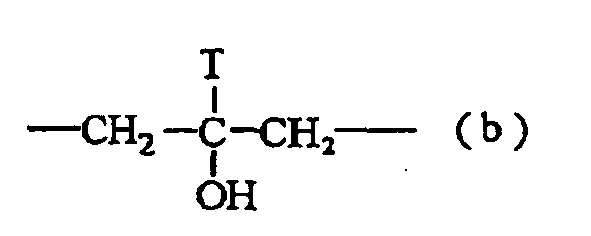
- Specific examples of the diphenyl sulfonic acidderivative having the formula (III) include D-90 from NIPPON SODA CO., LTD.
- Specific examples of the developer for use in the present invention include known developers used in the thermal recording material, and 2,4'-bishydroxydiphenylsulfone and 4-hydroxy-4'-allyloxydiphenylsulfone are most effectively used for the resultant thermal recording material to have chemical resistance, high sensitivity and heat resistance.
- Specific examples of the other developers include
4-hydroxy-4'-isoproxydiphenylsulfone,
4,4'-isopropylidenebisphenol,
4,4'-isopropylidenebis(o-methyl phenol), 4,4'-secondary butylidene bisphenol, 4,4'-isopropylidenebis(2-tertiaey butyl phenol), 4,4'-methylenebis(oxyethylenethio)diphenol,
p-nitrobenzoate zinc, 1,3,5-tris(4-tertiarybutyl-3-hydroxy-2, 6-dimethylbenzyl)isocyanuric acid,
2,2-(3,4'-dihydroxydiphenyl)propane,
bis(4-hydroxy-3-methylphenyl)sulfide, 4-{β-(p-methoxy phenoxy)ethoxy}salicylic acid,
1,7-bis(4-hydroxyphenylthio)-3,5-dioxaheptane, 1,5-bis(4-hydroxyphenylthio)-5-oxapentane, phthalic acid mono benzyl ester mono calcium salt, 4,4'-cyclohexylidenediphenol,
4,4'-isopropylidenebis(2-chlorophenol),
2,2'-methylenebis(4-methyl-6-tertiarybutylphenol),
4,4'-butylidenebis(6-tertiarybutyl-2-methyl)phenol,
1,1,3-tris(2-methyl-4-hydroxy-5-tertiarybutylphenyl)butane,
1,1,3-tris(2-methyl-4-hydroxy-5-cyclohexylphenyl)butane,
4,4-thiobis(6-tertiarybutyl-2-methyl)phenol,
4,4'-diphenolsulfone,
4-isopropoxy-4'-hydroxydiphenylsulfone,
4-benzyloxy-4'-hydroxydiphenylsulfone,
4,4'-diphenolsulfoxide, p-hydroxyisopropylbenzoate,
p-hydroxybenzylbenzoate, benzylprotocatechuate, stearyl gallate, lauryl gallate, octyl gallate,
1,3-bis(4-hydroxyphenylthio)propane, N,N-diphenylthiourea,
N,N'-di(m-chlorophenyl)thiourea, salicylanilide,
bis-(4-hydroxyphenyl)methyl acetate ester,
bis-(4-hydroxyphenyl)benzyl acetate ester,
1,3-bis(4-hydroxycumyl)benzene,
1,4-bis(4-hydroxycumyl)benzene,
2,2-diallyl-4,4'-diphenolsulfone,
3,4-dihydroxyphenyl-4'-methyldiphenylsulfone,
1-acetyloxy-2-zinc naphthoate, 2-acetyloxy-1-zinc naphthoate,
2-acetyloxy-3-zinc naphthoate,
α,α-bis(4-hydroxyphenyl)-α-methyltoluene, antipyrine complexes of zinc thiocyanate, tetrabromobisphenol A, tetrabromobisphenol S, 4,4'-thiobis(2-methylphenol),
4,4'-thiobis(2-chlorophenol), compounds having a sulfonyl amino carbonyl amide group, etc. - The leuco dye for use in the thermal coloring layer of the present invention can be used alone or in combination. Specific examples thereof include any known leuco dyes used in the thermal recording material, such as triphenyl methane leuco dyes, fluoran leuco dyes, phenothiazine leuco dyes, auramine leuco dyes, spyropyrane leuco dyes and indolinophthalide leuco dyes.
- Specific examples of the leuco dyes include
3,3-bis(p-dimethylaminophenyl)-phthalide,
3,3-bis(p-dimethylaminophenyl)-6-dimethyl-aminophthalide (known as crystal violet lactone),
3,3-bis(p-dimethylaminophenyl)-6-diethylaminophthalide,
3,3-bis(p-dimethylaminophenyl)-6-chlorphthalide,
3,3-bis(p-dibutylaminophenyl)phthalide,
3-cyclohexylamino-6-chlorfluoran, 3-dimethyl-amino-5,7-dimethyl-fluoran,
3-N-methyl-N-isobutyl-6-methyl-7-anilinofluoran,
3-N-ethyl-N-isoamile-6-methyl-7-anilinofluoran,
3-diethyl-amino-7-chlorofluoran,
3-diethyl-amino-7-methylfluoran,
3-diethyl-amino-7,8-benzfluoran,
3-diethyl-amino-6-methyl-7-chlorfluoran,
3-(N-p-tolyl-N-ethylamino-)-6-methyl-7-anilinofluoran,
3-pyrollidino-6-methyl-7-anilinofluoran,
2-{N-(3-trifluoromethyl-phenyl)amino}-1-6-diethylamino-fluo ran,
2-{3,6-bis(diethylamino)-9-(o-chloranilino)xanthyl lactam benzoate},
3-diethylamino-6-methyl-7-(m-trichloromethyl-anilino)fluora n, 3-diethylamino-7-(o-chloranilino)fluoran,
3-N-methyl-N-amileamino-6-methyl-7-anilinofluoran,
3-N-methyl-N-cycloehxylamino-6-methyl-7-anilinofluoran,
3-diethylamino-6-methyl-7-anilinofluoran,
3-diethylamino-6-methyl-7-(2',4'-dimethylanilino)fluoran,
3-(N,N-diethylamino)-5-methyl-7-(N,N-dibenzylamino)fluoran, benzoyl leuco methylene blue,
6'-chloro-8'-methoxy-benzoindolino-spiropyran,
6'-bromo-3'-methoxy- benzoindolino-spiropyran,
3-(2'-hydroxy-4'-dimethylaminophenyl)-3-(2'-methoxy-5'-chlo rphenyl)phthalide,
3-(2'-hydroxy-4'-dimethylaminophenyl)-3-(2'-methoxy-5'-nitr ophenyl)phthalide,
3-(2'-hydroxy-4'-diethylaminophenyl)-3-(2'-methoxy-5'-methy 1-phenyl)phthalide,
3-(2'-methoxy-4'-dimethyl-aminophenyl)-3-(2'-hydroxy-4'-chl or-5'-methyl-phenyl)phthalide,
3-morpholino-7-(N-propyl-trifluoromethylanilino)fluoran,
3-pyrollidino-7-trifluoromethyl-anilinofluoran,
3-diethylamino-5-chloro-7-(N-benzyltrifluoromethyl-anilino) fluoran,
3-pyrollidino-7-(di-p-chlorphenyl)methylaminofluoran,
3-diethylamino-5-chlor-7-(α-phenylethylamino)fluoran,
3-(N-ethyl-p-toluidino)-7-(α-phenylethylamino)fluoran,
3-diethylamino-7-(o-methoxycarbonylphenylamino)fluoran,
3-diethylamino-5-methyl-7-(α-phenylethylamino)fluoran,
3-diethylamino-7-pyperidinofluoran,
2-chloro-3-(N-methyltoluidino)-7-(p-n-butylanilino)fluoran,
3-(N-methyl-N-isopropylamino)-6-methyl-7-anilinoflupran,
3-dibutylamino-6-methyl-7-anilinofluoran,
3-diethylamino-6-ethyl-7-(3-methylanilino)fluoran,
3,6-bis(dimethylamino)fluorenespiro(9,3')-6'-dimethylaminop hthalide,
3-(N-benzyl-N-cyclohexylamino)-5,6-benzo-7-α-naphthylamino-4'-bromofluoran, 3-diethylamino-6-chlor-7-anilinofluoran,
3-N-ethyl-N-(2-ethoxypropyl)amino-6-methyl-7-anilinofluoran,
3-N-ethyl-N-tetrahydrofurfurylamino-6-methyl-7-anilnofluora n, 3-diethylamino-6-methyl-7-mesidino-4',5'-benzofluoran,
3-(p-dimethylaminophenyl)-3-{1,1-bis(p-dimethylaminophenyl) ethylene-2-yl}phthalide,
3-(p-dimethylaminophenyl)-3-{1,1-bis(p-dimethylaminophenyl) ethylene-2-yl}-6-dimethylaminophthalide,
3-(p-dimethylaminophenyl)-3-(1-p-dimethylaminophenyl-1-phen ylethylene-2-yl)phthalide,
3-(p-dimethylaminophenyl)-3-(1-p-dimethylaminophenyl-1-p-ch lorophenylethylene-2-yl)-6-dimethylaminophthalide,
3-(4'-dimethylaminp-2'-methoxy)-3-(1"-p-dimethylaminophenyl -1"-p-chlorophenyl-1",3"-butadiene-4"-yl)benzophthalide,
3-(4'-dimethyl-aminp-2' -benzyloxy)-3-(1"-p-dimethyl-amino-p henyl-1"-phenyl-1",3"-butadiene-yl)benzophthalide,
3-dimethylamino-6-dimethylaminofluorene-9-spiro-3' (6'-dimethyl-amino)phthalide,
3,3-bis12-(p-dimethylaminophenyl)-2-(p-methoxyphenyl)etenyl 1-4,5,6,7-tetrachlorophthalide,
3-bis{1,1-bis(4-pyrollidinophenyl)ethylene-2-yl}-5,6-dichlo ro-4,7-dibromophthalide,
bis(p-dimethylaminostyryl)-1-naphthalenesulfonylmethane,
bis(p- dimethylaminostyryl)4-p-tolylsulfonylmethane, etc.
Particularly, 3-dibutylamino-6-methyl-7-anilinofluoran,
3-di(n-pentyl)amino-6-methyl-7-anilinofluoran or
3-(N-ethyl-N-p-toluidino)-6-methyl-7-anilinofluoran is preferably used for the resultant thermal recoding material to have good plasticizer resistance, and high sensitivity and thermostability without background development. - The thermal coloring layer of the present invention can optionally include an electron accepting hindered phenol compound and an electron accepting hindered amine compound having less colorability as a supplemental additive. Specific examples thereof include
2,2'-methylenebis(4-ethyl-6-tertiarybutylphenol),
4,4'-butylidenebis(6-tertiarybutyl-2-methylphenol),
1,1,3-tris(2-methyl-4-hydroxy-5-tertiarybutylphenyl)butane,
1,1,3-tris(2-methyl-4-hydroxy-5-cyclohexylphenyl)butane,
4,4'-thiobis(6-tertiarybutyl-2-methylphenol),
tetrabromobisphenol A, tetrabromobisphenol S,
4,4'-thiobis(2-methylphenol), 4,4'-thiobis(2-chlorophenol),
tetrakis(1,2,2,6,6-pentamethyl-4-piperidyl)-1,2,3,4-butanet etracarboxylate,
tetrakis(1,2,2,6,6-tetramethyl-4-piperidyl)-1,2,3,4-butanet etracarboxylate, etc. - The substrate for use in the present invention includes a bond paper, a substrate including a recycle pulp in an amount not less than 50%, a synthetic paper, a polyethylene film, a laminated paper, etc.
- In addition, an intermediate layer may be formed between the substrate and the thermal coloring layer. The intermediate layer can include the binder resin and the filler used in the thermal coloring layer. A hollow particulate resin is preferably used in the intermediate layer as a filler because of being capable of improving the sensitivity of the resultant thermal recording layer with the adiathermancy. The hollow particulate resin for use in the present invention is a thermoplastic resin including air or other gas, a foamed microscopic hollow particulate material, and preferably has an average particle diameter of from 0.4 to 10 µm, and more preferably from 1.0 to 5.0 µm. When less than 0.4 µm, it is difficult for the hollow particulate resin to have a desired hollow rate. When greater than 10 µm, the surface smoothness decreases, resulting in deterioration of the sensitivity. Therefore, in addition to the above-mentioned range of the average particle diameter, the hollow particulate resin preferably has a sharp particle diameter distribution. Further, the microscopic hollow particulate material for use in the present invention preferably has a hollow rate not less than 30%, and more preferably not less than 70%. The hollow rate is a ratio of an inner diameter of the hollow particulate material to an outer diameter thereof as follows:

- Specific examples of the thermoplastic resin include polystyrene, polyvinylchloride, polyvinylidenechloride, polyvinylacetate, polyetseracrylate, polyacrylonitrile, polybutadiene, their copolymer resins, etc. Particularly, a copolymer resin mainly including polyvinylidenechloride and polyacrylonitrile is preferably used.
- The hollow particulate material included in the intermediate layer between the thermal coloring layer and the substrate improves the coloring sensitivity of the resultant thermal recording material with the adiathermancy.
- Specific examples of recording means of the thermal recording material of the present invention include, but are not limited to, heat pens, thermal heads and lasers.
- The thermal recording material of the present invention can be a thermal recording label having an adhesive layer on the backside, and a linerless thermal recording label having a thermal adhesive layer. Known adhesives can be used for the adhesive layer. In addition, images can be printed on the surface of the protective layer of the thermal recording material of the present invention with an UV cure ink.
- Having generally described this invention, further understanding can be obtained by reference to certain specific examples which are provided herein for the purpose of illustration only and are not intended to be limiting. In the descriptions in the following examples, the numbers represent weight ratios in parts and percent, unless otherwise specified.
- The following constituents were dispersed by a sand mill to have an average particle diameter of 0.5 µm.
3-dibutylamino-6-methyl-N-7-anilinofluoran 20 Aqueous solution including polyvinylalcohol in an amount of 10% 20 Water 60 - The following constituents were dispersed by a ball mill.
Developer Table 1 Inorganic filler Table 1 Aqueous solution including polyvinylalcohol in an amount of 10% 20 Water 40 - The following constituents were dispersed by a ball mill such that the filler has an average particle diameter mentioned in Table 1.
Filler (Table 1) 100 Aqueous solution including polyvinylalcohol in an amount of 10% 20 Water 40 - The following constituents were mixed to prepare a thermal coloring layer coating liquid.
Dispersion A 20 Dispersion B 60 Filler (Table 1) 10 Aqueous solution of resin (Table 1) including a solid content in an amount of 10% 30 Aqueous solution of dioctylsulfosuccinic acid including a solid content in an amount of 5% 1 - The following constituents were mixed to prepare a protective layer coating liquid.
Dispersion C 60 Release agent Table 1 Aqueous solution of resin (Table 1) including a solid content in an amount of 10% 100 Aqueous solution of crosslinker (Table 1) including a solid content in an amount of 10% 10 Aqueous solution of dioctylsulfosuccinic acid including a solid content in an amount of 5% 1 Additive (Table 1) 20 - The following constituents were mixed and dispersed to prepare an intermediate layer coating liquid (6)-1.
Calcined kaolin 20 Styrene/butadiene copolymer latex including a solid content in an amount of 47.5% 20 Water 60 - The following constituents were mixed and dispersed to prepare an intermediate layer coating liquid (6)-2.
Hollow particulate resin having a hollow rate of 90%, an average particle diameter of 3.5 µm and a solid content in an amount of 40% 25 Styrene/butadiene copolymer latex including a solid content in an amount of 47.5% 15 Water 60 - The intermediate layer coating liquid mentioned in Table 1 was coated on a paper having a weight of 60 g/m2 to form an intermediate layer thereon, having a coated amount of 3.0 g/m2 when dried. The thermal coloring layer coating liquid was coated on the intermediate layer to form a thermal coloring layer thereon, having a coated amount of 0.54 g/m2 when dried. Further, the protective layer coating liquid was coated on the thermal coloring layer to form a protective layer thereon, having a coated amount of 1.5 g/m2 when dried. Then, the three-layer coated material was calendered to prepare each thermal recording material in Examples 1 to 17 and Comparative Examples 1 and 2 shown in Table 1.
- The average particle diameter was measured by the laser diffraction particle diameter distribution measurer LA-920 from Horiba, Ltd.
Table 1 Intermediate Layer Thermal coloring layer Protective layer Developer Resin Filler Release agent Filler Particle Diameter of filler Resin Cross-linker Additive Com. Ex. 1 (6)-1 I-1 V-1 Nil III-1 IV-1 1.0 µm V-1 VI-1 Nil Com. Ex. 2 (6)-1 I-1 V-1 Nil III-2 IV-1 1.0 µm V-1 VI-1 Nil Ex. 1 (6)-1 I-1 V-1 Nil III-3 IV-1 1.0 µm V-1 VI-1 Nil Ex. 2 (6)-1 I-1 V-1 Nil III-4 IV-1 1.0 µm V-1 VI-1 Nil Ex. 3 (6)-1 I-1 V-1 Nil III-5 IV-1 1.0 µm V-1 VI-1 Nil Ex. 4 (6)-1 I-1 V-1 Nail III-5 IV-1 1.0 µm V-2 VI-2 Nil Ex. 5 (6)-1 I-1 V-1 Nil III-5 IV-1 1.0 µm V-2 VI-3 Nil Ex. 6 (6)-1 I-1 V-1 Nil III-5 IV-2 1.0 µm V-2 VI-3 Nil Ex. 7 (6)-1 I-1 V-1 Nil III-5 IV-3 1.0 µm V-2 VI-3 Nil Ex. 8 (6)-1 I-1 V-1 Nil III-5 IV-4 1.0 µm V-2 VI-3 Nil Ex. 9 (6)-1 I-1 V-1 Nil III-5 IV-4 1.0 µm V-2 VI-3 VII-1 Ex. 10 (6)-1 I-1 V-1 Nil III-5 IV-4 0.4 µm V-2 VI-3 VII-1 Ex. 11 (6)-1 I-1 V-1 II-1 III-5 IV-4 0.4 µm V-2 VI-3 VII-1 Ex. 12 (6)-1 I-1 V-1 II-2 III-5 IV-4 0.4 µm V-2 VI-3 VII-1 Ex. 13 (6)-1 I-1 V-2 II-2 III-5 IV-4 0.4 µm V-2 VI-3 VII-1 Ex. 14 (6)-1 I-2 V-2 II-2 III-5 IV-4 0.4 µm V-2 VI-3 VII-1 Ex. 15 (6)-1 I-3 V-2 II-2 III-5 IV-4 0.4 µm V-2 VI-3 VII-1 Ex. 16 (6)-1 I-4 V-2 II-2 III-5 IV-4 0.4 µm V-2 VI-3 VII-1 Ex. 17 (6)-2 I-1 V-2 II-2 III-5 IV-4 0.4 µm V-2 VI-3 VII-1 -
I-1: 4-hydroxy-4'-isoproxydiphenaylsulfone 30 I-2: 4-hydroxy-4'-isoproxydiphenaylsulfone/an oligomer composition and a hindered amine derivative formed from a reaction between a multivalent isocyanate compound having three or more valences and the formula (I) and an aromatic amine having the formula (II) 30/3 I-3: 4-hydroxy-4'-isoproxydiphenaylsulfone/an oligomer composition and a hindered amine derivative formed from a reaction between a multivalent isocyanate compound having three or more valences and the formula (I) and an aromatic amine having the (II) /a diphenyl sulfonic acid derivative having the formula (III) 30/3/35 I-4: 2,4' -bishydroxysulfone/an oligomer composition and a hindered amine derivative formed from a reaction between multivalent isocyanate compound having three or more valences and the formula (I) and an aromatic amine having the (II)/a diphenyl sulfonic acid derivative having the formula (III) 30/3/35 -
- II-1 : Calcined kaolin
- II-2: Silica
-
III-1: Silica III-2: Silicone oil emulsion 30 including a solid content of 30% (SH7036 from Dow Corning Toray Silicone Co. , Ltd.) III-3: Particulate silicone resin 9 having an average particle diameter of 5.0 µm (X-52-1621 from Shin-Etsu Chemical Co., Ltd.) III-4: Particulate silicone resin 9 having an average particle diameter of 2.0 µm (KMP-590 from Shin-Etsu Chemical Co., Ltd.) III-5: KMP-590 alkylsulfosuccinic acid salt solution including a solid content of 30% -
- IV-1: Silica
- IV-2: Calcium carbonate
- IV-3: Calcined kaolin
- IV-4: Aluminum hydroxide
-
- V-1: Polyvinylalcohol
- V-2: polyvinylalcohol solution
having a diacetone amide group
(including a solid content of 10%,
diacetone acrylic amide of 4 mol%, and
having a polymerization degree of 1,600 and a saponification of 98%) -
- VI-1: Sponge
- VI-2: Epichlorohydrin
- VI-3: Hydrazide adipate
-
- VII-1: Ester montanate emulsion
(from CHUKYO YUSHI CO., LTD.) - After each thermal recording material and a printer SM-90 from TERAOKA SEIKO CO., LTD. were left under an environment of high-temperature and humidity at 40°C and 90% RH for 1h, the thermal recording material was printed by the SM-90. The length of a printed image is a length thereof from the start to the end of printing the image when a specific image pattern is printed by the printer. When the thermal recording material has good sticking resistance, the image pattern is precisely printed thereon. When the sticking resistance is poor, the image is doubly printed or the thermal recording material snakes, resulting in shorter length thereof than the image precisely printed.
- The transportability was visually observed to classify the transportability to 8 grades.
- 8: Transportable without sticking
- .
- .
- .
- 1: Untransportable with sticking
- After each thermal recording material and a printer L'esprit R-12 from SATO CORPORATION were left under an environment of high-temperature and humidity at -5°C and 20% RH for 1h, the thermal recording material was printed by the L'esprit R-12.
- The transportability was visually observed to classify the transportability to 8 grades.
- 8: No sticking
- .
- .
- .
- 1: Sticking considerably occurs
- After each thermal recording material and a printer FHT205B from Fujitsu Limited were left under an environment of high-temperature and humidity at -5°C and 20% RH for 1h, the thermal recording material was printed by the FHT205B.
- The transportability was visually observed to classify the transportability to 8 grades.
- 8: No sticking
- .
- .
- .
- 1: Sticking considerably occurs
- After each thermal recording material was printed by a high-speed printer I-4308 from DATAMAX CO., LTD. at a printing speed of 8 ips for 100 Km at 22°C and 60% RH, the abraded amount of the thermal head was measured by using a laser microscope VK-8500 and VK-8510 from KEYENCE CORPORATION.
- A test sample from each thermal recording material printed by an image simulator from Ohkura Electric Co., Ltd. was overlapped with 3 pieces of vinylchloride wrappers, and further overlapped with 10 pieces of bond papers. After a weight was placed on the overlapped sample so as to have a load about 200 g/cm2 at 40°C for 24 h, the image density was measured by Macbeth densitometer RD-914.
- The background density of each thermal recording material left at 80°C and 90°C for 24 h was measured by Macbeth densitometer RD-914.
- Each thermal recording material calendered was printed by a thermal printing tester having a thin-film head from Matsushita Electronic Components co., Ltd. under conditions of head electric power at 0.45W/dot, recording time at 20 m s/line, scanning density at 8x385 dot/mm and at a pulse width 0.0 to 0.7 mm s per 1 m s. The image density was measured by Macbeth densitometer RD-914. The sensitivity magnification of the thermal recording material in Comparative Example 1 was a standard (1.00), and the sensitivity magnifications of the other thermal recording materials were determined as follows:
- The pulse width of the thermal recording material in Comparative Example 1/the pulse width of each of the other thermal recording materials. The larger, the more sensitive (heat responsible).
- The evaluation results are shown in Table 2.
Table 2 (1) (2) (3) (4) (5) (6) (7) (µm) 80°C 90°C Com. Ex. 1 2 2 2 12.0 0.52 0.10 0.35 1.00 Com. Ex. 2 1 1 1 6.0 0.52 0.10 0.35 1.00 Ex. 1 2 2 2 8.0 0.52 0.10 0.35 1.01 Ex. 2 2 2 3 6.0 0.52 0.10 0.35 1.01 Ex. 3 3 3 3 6.0 0.52 0.10 0.35 1.01 Ex. 4 4 4 3 6.0 0.52 0.10 0.35 1.02 Ex. 5 5 5 4 6.0 0.52 0.10 0.35 1.02 Ex. 6 5 5 4 4.5 0.52 0.10 0.35 1.03 Ex. 7 5 5 5 3.5 0.52 0.10 0.37 1.02 Ex. 8 5 5 5 3.0 0.52 0.10 0.38 1.02 Ex. 9 6 6 5 3.0 0.52 0.10 0.38 1.02 Ex. 10 6 6 5 0.7 0.52 0.10 0.38 1.02 Ex. 11 6 6 5 0.7 0.52 0.10 0.38 1.02 Ex. 12 7 7 6 0.7 0.52 0.10 0.38 1.02 Ex. 13 8 8 8 0.7 0.52 0.10 0.38 1.02 Ex. 14 8 8 8 0.7 0.89 0.10 0.38 1.02 Ex. 15 8 8 8 0.7 1.25 0.10 0.38 1.02 Ex. 16 8 8 8 0.7 1.26 0.09 0.10 1.09 Ex. 17 8 8 8 0.7 1.26 0.09 0.10 1.18 - An adhesive layer was formed on the backside of the thermal recording material prepared in Example 17 to prepare a thermal recording label.
- A thermal adhesive layer was formed on the backside of the thermal recording material prepared in Example 17 to prepare a thermally-adhesive thermal recording label.
- The protective layer of the thermal recording label prepared in Example 18 was printed with an UV cure ink RNC ink from T&K TOKA CO. , LTD. to prepare a pre-printed thermal recording label.
- The thermal recording label, thermally-adhesive thermal recording label and pre-printed thermal recording label prepared in Examples 18 to 20 respectively had the same properties as those of the thermal recording material prepare in Example 17.
Claims (18)
- A thermal recording material, comprising:a substrate;a thermal coloring layer located overlying the substrate; anda protective layer located overlying the thermal coloring layer, comprising:a binder resin;a crosslinker;a filler; anda release agent,wherein the release agent is a spherical and particulate silicone compound having the following formula:wherein n represents an integer greater than 15.
(CH3SiO3/2)n
- The thermal recording material of Claim 1, wherein the spherical and particulate silicone compound has a volume average particle diameter of from 1 to 4 µm.
- The thermal recording material of Claim 1 or 2, wherein the protective layer is formed by a method comprising:coating a protective layer coating liquid comprising the binder resin, crosslinker, filler and spherical and particulate silicone compound on the thermal coloring layer,wherein the protective layer coating liquid is prepared by a method comprising:uniformly dispersing the spherical and particulate silicone compound in a surfactant solution to prepare a release agent liquid; andadding the release agent liquid in the protective layer coating liquid.
- The thermal recording material of any one of Claims 1 to 3, wherein the binder resin is polyvinylalcohol including a reactive carbonyl group.
- The thermal recording material of any one of Claims 1 to 4, wherein the crosslinker is a hydrazide compound.
- The thermal recording material of any one of Claims 1 to 5, wherein the filler is a member selected from the group consisting of aluminum hydroxide, calcium carbonate and kaolin.
- The thermal recording material of Claim 6, wherein the aluminum hydroxide has a volume average particle diameter of from 0.2 to 0.5 µm.
- The thermal recording material of any one of Claims 1 to 7, further comprising a montan ester wax.
- The thermal recording material of any one of Claims 1 to 8, wherein the thermal coloring layer comprises an acidic filler.
- The thermal recording material of Claim 9, wherein the acidic filler is silica.
- The thermal recording material of any one of Claims 1 to 10, wherein the thermal coloring layer further comprises polyvinylalcohol including a reactive carbonyl group.
- The thermal recording material of any one of Claims 1 to 11, wherein the thermal coloring layer further comprises an oligomer composition and a hindered amine derivative formed from a reaction between a multivalent isocyanate compound having three or more valences and the following formula (I) and an aromatic amine having the following formula (II), the chemical resistance, particularly the plasticizer resistance, of the resultant thermal recording material is noticeably improved, resulting in increase of image residual ratio.
X(NCO)a (I)

- The thermal recording material of any one of Claims 1 to 12, wherein the thermal coloring layer further comprises a diphenyl sulfonic acid derivative having the following formula (III), the chemical resistance thereof is further improved:


- The thermal recording material of any one of Claims 1 to 13, wherein the thermal coloring layer further comprises 4-hydroxy-4'-allyloxydiphenylsulfone or
2,4'-bishydroxydiphenylsulfone as a developer. - The thermal recording material of any one of Claims 1 to 14, further comprising an intermediate layer comprising a thermoplastic hollow particulate resin between the substrate and the thermal coloring layer.
- The thermal recording material of any one of Claims 1 to 15, further comprising an adhesive layer on the backside thereof.
- The thermal recording material of Claim 16, wherein the adhesive layer is a thermal adhesive layer.
- The thermal recording material of any one of Claims 1 to 17, wherein the surface of the protective layer is printed with an UV cure ink.
Applications Claiming Priority (1)
| Application Number | Priority Date | Filing Date | Title |
|---|---|---|---|
| JP2004272964A JP4464232B2 (en) | 2004-09-21 | 2004-09-21 | Thermal recording material and thermal recording label |
Publications (2)
| Publication Number | Publication Date |
|---|---|
| EP1637339A1 EP1637339A1 (en) | 2006-03-22 |
| EP1637339B1 true EP1637339B1 (en) | 2007-11-07 |
Family
ID=35170055
Family Applications (1)
| Application Number | Title | Priority Date | Filing Date |
|---|---|---|---|
| EP20050020468 Expired - Lifetime EP1637339B1 (en) | 2004-09-21 | 2005-09-20 | Thermal recording material |
Country Status (5)
| Country | Link |
|---|---|
| US (1) | US7476643B2 (en) |
| EP (1) | EP1637339B1 (en) |
| JP (1) | JP4464232B2 (en) |
| CN (1) | CN1751891B (en) |
| DE (1) | DE602005003181T2 (en) |
Cited By (1)
| Publication number | Priority date | Publication date | Assignee | Title |
|---|---|---|---|---|
| EP3109059A1 (en) | 2015-06-24 | 2016-12-28 | Mitsubishi HiTec Paper Europe GmbH | Heat sensitive recording material |
Families Citing this family (23)
| Publication number | Priority date | Publication date | Assignee | Title |
|---|---|---|---|---|
| US7425522B2 (en) * | 2006-01-18 | 2008-09-16 | Ricoh Company, Ltd. | Thermosensitive recording material |
| US20070184978A1 (en) * | 2006-02-03 | 2007-08-09 | Shinji Takano | Thermosensitive recording material and method of producing the same |
| US20070225164A1 (en) * | 2006-03-16 | 2007-09-27 | Takeshi Kajikawa | Fluid dispersion, and thermosensitive recording material and method for preparing the same |
| JP4913491B2 (en) * | 2006-07-18 | 2012-04-11 | 株式会社リコー | Thermal recording material and thermal recording label printed with UV curable ink |
| US7906458B2 (en) | 2006-09-15 | 2011-03-15 | Ricoh Company, Ltd. | Heat-sensitive recording material and production method thereof |
| JP2008068580A (en) * | 2006-09-15 | 2008-03-27 | Ricoh Co Ltd | Thermal recording material |
| US8003568B2 (en) * | 2006-09-15 | 2011-08-23 | Ricoh Company, Ltd. | Thermosensitive recording material |
| JP2008254436A (en) * | 2007-03-13 | 2008-10-23 | Ricoh Co Ltd | Thermal recording material |
| JP5186962B2 (en) * | 2007-03-19 | 2013-04-24 | 株式会社リコー | Thermal recording material |
| US8010246B2 (en) * | 2008-02-14 | 2011-08-30 | New York Air Brake Corporation | Locomotive air/vacuum control system |
| JP5471208B2 (en) * | 2008-09-10 | 2014-04-16 | 株式会社リコー | Thermal recording material |
| JP5621388B2 (en) † | 2009-08-05 | 2014-11-12 | 株式会社リコー | Thermal recording material |
| JP5485749B2 (en) * | 2010-03-04 | 2014-05-07 | 三菱製紙株式会社 | Thermal recording material |
| CN101879819B (en) * | 2010-06-13 | 2011-11-09 | 高邮市卫星卷烟材料有限公司 | Production method of hot stamping foil |
| CN104103214B (en) * | 2014-07-21 | 2016-08-17 | 上海中商网络股份有限公司 | Variable wet sensitive information anti-fake labeling |
| JP6482787B2 (en) * | 2014-08-12 | 2019-03-13 | 松本油脂製薬株式会社 | Release agent for tire inner surface |
| EP3219507A1 (en) * | 2016-03-14 | 2017-09-20 | Papierfabrik August Koehler SE | Self-adhesive thermosensitive recording material |
| DE102017131276A1 (en) | 2017-12-22 | 2019-06-27 | Mitsubishi Hitec Paper Europe Gmbh | Recyclable release substrate |
| DE102021115909A1 (en) * | 2021-06-18 | 2022-12-22 | Koehler Innovation & Technology Gmbh | Heat-sensitive recording materials |
| DE102021133333A1 (en) | 2021-12-15 | 2023-06-15 | Koehler Innovation & Technology Gmbh | Heat-sensitive recording material in sheet form |
| CN121532291A (en) | 2023-07-14 | 2026-02-13 | 科勒创新科技有限公司 | Thermal recording materials |
| WO2025192713A1 (en) * | 2024-03-15 | 2025-09-18 | Ricoh Company, Ltd. | Thermosensitive recording medium for linerless label |
| WO2025242749A1 (en) | 2024-05-23 | 2025-11-27 | Koehler Innovation & Technology Gmbh | Heat-sensitive recording material |
Family Cites Families (34)
| Publication number | Priority date | Publication date | Assignee | Title |
|---|---|---|---|---|
| JPS59106995A (en) | 1982-12-11 | 1984-06-20 | Kanzaki Paper Mfg Co Ltd | Thermal recording body |
| JPS6019757U (en) | 1983-07-19 | 1985-02-09 | アイシン精機株式会社 | Diaphragm control valve |
| JPS62156990A (en) | 1985-12-28 | 1987-07-11 | Nippon Kayaku Co Ltd | Thermal recording material |
| JPS6417478A (en) | 1987-07-13 | 1989-01-20 | Casio Computer Co Ltd | Semiconductor storage cell |
| JPH0739214B2 (en) | 1987-08-13 | 1995-05-01 | 新王子製紙株式会社 | Thermal recording |
| JPH01198386A (en) | 1988-02-03 | 1989-08-09 | Ricoh Co Ltd | heat sensitive recording material |
| JPH02187388A (en) | 1989-01-13 | 1990-07-23 | Kanzaki Paper Mfg Co Ltd | Heat-sensitive recording body |
| JPH032088A (en) | 1989-05-31 | 1991-01-08 | Kanzaki Paper Mfg Co Ltd | Thermally sensitive recording medium |
| JPH0349986A (en) | 1989-07-18 | 1991-03-04 | Oji Paper Co Ltd | Thermal recording material |
| JPH0422153A (en) | 1990-05-17 | 1992-01-27 | Tokyo Electron Ltd | Electrostatic attraction equipment |
| JPH0430918A (en) | 1990-05-25 | 1992-02-03 | Brother Ind Ltd | Wire electrode supply device |
| JP2514458B2 (en) | 1990-07-13 | 1996-07-10 | 宇部興産株式会社 | Extrusion press equipment |
| JP2724237B2 (en) | 1990-07-20 | 1998-03-09 | 浜松ホトニクス株式会社 | Displacement detector |
| US5219821A (en) * | 1991-02-19 | 1993-06-15 | Nashua Corporation | Non-acidic barrier coating |
| JPH0562079A (en) | 1991-08-30 | 1993-03-12 | Matsushita Electric Works Ltd | P type disaster prevention receiver |
| JPH0596854A (en) | 1991-10-14 | 1993-04-20 | Ricoh Co Ltd | Thermal recording material |
| JP3717083B2 (en) | 1994-06-06 | 2005-11-16 | 日本曹達株式会社 | Diphenylsulfone derivative and recording material using the same |
| JP3084506B2 (en) | 1994-11-28 | 2000-09-04 | ユニチカケミカル株式会社 | Waterproofing method for polyvinyl alcohol resin |
| JP3913820B2 (en) | 1995-10-31 | 2007-05-09 | 日本曹達株式会社 | Diphenylsulfone cross-linking compound and recording material using the same |
| FR2742380B1 (en) * | 1995-12-15 | 1999-01-29 | Ricoh Kk | THERMOSENSITIVE RECORDING MEDIUM WITH PROTECTIVE LAYER |
| US5972836A (en) * | 1996-07-18 | 1999-10-26 | Ricoh Company, Ltd. | Thermosensitive recording medium |
| JPH1087936A (en) | 1996-09-18 | 1998-04-07 | Unitika Chem Kk | Polyvinyl alcohol-based resin composition, and paper coating agent consisting essentially of the same |
| JP3664840B2 (en) | 1997-04-23 | 2005-06-29 | 日本曹達株式会社 | Chromogenic recording material |
| JP3664839B2 (en) | 1997-04-23 | 2005-06-29 | 日本曹達株式会社 | Recording material |
| JP3783416B2 (en) | 1997-08-25 | 2006-06-07 | 王子製紙株式会社 | Thermal recording material |
| JP4016068B2 (en) * | 1998-04-02 | 2007-12-05 | 株式会社Adeka | Thermal recording material |
| JP2000143611A (en) | 1998-09-04 | 2000-05-26 | Asahi Chem Ind Co Ltd | New color former and recording material |
| JP3891463B2 (en) * | 1999-12-09 | 2007-03-14 | 株式会社リコー | Thermal recording composition and thermal recording material |
| JP3919151B2 (en) | 2000-04-28 | 2007-05-23 | 株式会社リコー | Thermal recording material |
| US6660688B2 (en) * | 2000-05-31 | 2003-12-09 | Ricoh Company Ltd. | Thermosensitive recording medium |
| JP2002240427A (en) | 2001-02-14 | 2002-08-28 | Nippon Kayaku Co Ltd | Thermal recording material |
| EP1243437B1 (en) * | 2001-03-23 | 2004-11-17 | Ricoh Company, Ltd. | Leuco dye dispersion liquid and thermosensitive recording material using the same |
| US6867168B2 (en) * | 2002-12-20 | 2005-03-15 | Eastman Kodak Company | Microbead and immiscible polymer voided polyester for thermal imaging medias |
| JP4070712B2 (en) * | 2003-02-28 | 2008-04-02 | 株式会社リコー | Thermal recording material |
-
2004
- 2004-09-21 JP JP2004272964A patent/JP4464232B2/en not_active Expired - Lifetime
-
2005
- 2005-09-09 US US11/222,636 patent/US7476643B2/en active Active
- 2005-09-20 EP EP20050020468 patent/EP1637339B1/en not_active Expired - Lifetime
- 2005-09-20 DE DE200560003181 patent/DE602005003181T2/en not_active Expired - Lifetime
- 2005-09-21 CN CN2005101097575A patent/CN1751891B/en not_active Expired - Lifetime
Cited By (3)
| Publication number | Priority date | Publication date | Assignee | Title |
|---|---|---|---|---|
| EP3109059A1 (en) | 2015-06-24 | 2016-12-28 | Mitsubishi HiTec Paper Europe GmbH | Heat sensitive recording material |
| WO2016207356A1 (en) | 2015-06-24 | 2016-12-29 | Mitsubishi Hitec Paper Europe Gmbh | Heat-sensitive recording material |
| DE202015009476U1 (en) | 2015-06-24 | 2017-12-07 | Mitsubishi Hitec Paper Europe Gmbh | Heat-sensitive recording material |
Also Published As
| Publication number | Publication date |
|---|---|
| US20060063013A1 (en) | 2006-03-23 |
| EP1637339A1 (en) | 2006-03-22 |
| JP4464232B2 (en) | 2010-05-19 |
| CN1751891B (en) | 2011-05-04 |
| US7476643B2 (en) | 2009-01-13 |
| CN1751891A (en) | 2006-03-29 |
| DE602005003181T2 (en) | 2008-08-28 |
| DE602005003181D1 (en) | 2007-12-20 |
| JP2006088348A (en) | 2006-04-06 |
Similar Documents
| Publication | Publication Date | Title |
|---|---|---|
| US7476643B2 (en) | Thermal recording material and thermal recording label | |
| EP1452334B1 (en) | Thermosensitive recording material | |
| EP2281694B1 (en) | Thermosensitive recording material | |
| KR101858327B1 (en) | Thermosensitive recording material | |
| EP2103444B1 (en) | Thermosensitive recording material | |
| US20070184978A1 (en) | Thermosensitive recording material and method of producing the same | |
| EP1900543A1 (en) | Thermosensitive recording material | |
| JP2008231171A (en) | Adhesive label for thermal recording | |
| JP4968833B2 (en) | Thermal recording material | |
| JPH02175281A (en) | heat sensitive recording material | |
| JP4986780B2 (en) | Thermal recording material | |
| US7989389B2 (en) | Heat-sensitive recording material | |
| JP2003025731A (en) | Thermal recording material | |
| JP3768954B2 (en) | Thermal recording material | |
| JP4368688B2 (en) | Thermal recording material | |
| JP2005007794A (en) | Thermal recording label | |
| JPH08310131A (en) | Thermal recording material | |
| JP2009066852A (en) | Thermal recording material | |
| JP2007245699A (en) | Thermal recording material | |
| JP2008073893A (en) | Composition and heat-sensitive recording material | |
| JP2008030275A (en) | Thermal recording material | |
| JPH07164748A (en) | Thermal recording material | |
| JPH0939393A (en) | Manufacturing method of thermal recording material | |
| JPH06305252A (en) | Thermosensitive recording material | |
| JP2002059665A (en) | Thermal recording composition and thermal recording material using the same |
Legal Events
| Date | Code | Title | Description |
|---|---|---|---|
| PUAI | Public reference made under article 153(3) epc to a published international application that has entered the european phase |
Free format text: ORIGINAL CODE: 0009012 |
|
| AK | Designated contracting states |
Kind code of ref document: A1 Designated state(s): AT BE BG CH CY CZ DE DK EE ES FI FR GB GR HU IE IS IT LI LT LU LV MC NL PL PT RO SE SI SK TR |
|
| AX | Request for extension of the european patent |
Extension state: AL BA HR MK YU |
|
| 17P | Request for examination filed |
Effective date: 20060809 |
|
| 17Q | First examination report despatched |
Effective date: 20061004 |
|
| AKX | Designation fees paid |
Designated state(s): DE FR GB |
|
| GRAP | Despatch of communication of intention to grant a patent |
Free format text: ORIGINAL CODE: EPIDOSNIGR1 |
|
| RIC1 | Information provided on ipc code assigned before grant |
Ipc: B41M 5/44 20060101AFI20070504BHEP |
|
| GRAS | Grant fee paid |
Free format text: ORIGINAL CODE: EPIDOSNIGR3 |
|
| GRAA | (expected) grant |
Free format text: ORIGINAL CODE: 0009210 |
|
| AK | Designated contracting states |
Kind code of ref document: B1 Designated state(s): DE FR GB |
|
| REG | Reference to a national code |
Ref country code: GB Ref legal event code: FG4D |
|
| REF | Corresponds to: |
Ref document number: 602005003181 Country of ref document: DE Date of ref document: 20071220 Kind code of ref document: P |
|
| ET | Fr: translation filed | ||
| PLBE | No opposition filed within time limit |
Free format text: ORIGINAL CODE: 0009261 |
|
| STAA | Information on the status of an ep patent application or granted ep patent |
Free format text: STATUS: NO OPPOSITION FILED WITHIN TIME LIMIT |
|
| 26N | No opposition filed |
Effective date: 20080808 |
|
| REG | Reference to a national code |
Ref country code: DE Ref legal event code: R082 Ref document number: 602005003181 Country of ref document: DE Representative=s name: MEISSNER BOLTE PATENTANWAELTE RECHTSANWAELTE P, DE Ref country code: DE Ref legal event code: R082 Ref document number: 602005003181 Country of ref document: DE Representative=s name: MEISSNER, BOLTE & PARTNER GBR, DE |
|
| REG | Reference to a national code |
Ref country code: DE Ref legal event code: R082 Ref document number: 602005003181 Country of ref document: DE Representative=s name: MEISSNER, BOLTE & PARTNER GBR, DE |
|
| REG | Reference to a national code |
Ref country code: FR Ref legal event code: PLFP Year of fee payment: 12 |
|
| REG | Reference to a national code |
Ref country code: FR Ref legal event code: PLFP Year of fee payment: 13 |
|
| REG | Reference to a national code |
Ref country code: FR Ref legal event code: PLFP Year of fee payment: 14 |
|
| P01 | Opt-out of the competence of the unified patent court (upc) registered |
Effective date: 20230522 |
|
| PGFP | Annual fee paid to national office [announced via postgrant information from national office to epo] |
Ref country code: DE Payment date: 20240918 Year of fee payment: 20 |
|
| PGFP | Annual fee paid to national office [announced via postgrant information from national office to epo] |
Ref country code: GB Payment date: 20240919 Year of fee payment: 20 |
|
| PGFP | Annual fee paid to national office [announced via postgrant information from national office to epo] |
Ref country code: FR Payment date: 20240924 Year of fee payment: 20 |
|
| REG | Reference to a national code |
Ref country code: DE Ref legal event code: R071 Ref document number: 602005003181 Country of ref document: DE |
|
| REG | Reference to a national code |
Ref country code: GB Ref legal event code: PE20 Expiry date: 20250919 |