EP1632983A2 - Kapillaren für Massenspektrometrie - Google Patents
Kapillaren für Massenspektrometrie Download PDFInfo
- Publication number
- EP1632983A2 EP1632983A2 EP05008565A EP05008565A EP1632983A2 EP 1632983 A2 EP1632983 A2 EP 1632983A2 EP 05008565 A EP05008565 A EP 05008565A EP 05008565 A EP05008565 A EP 05008565A EP 1632983 A2 EP1632983 A2 EP 1632983A2
- Authority
- EP
- European Patent Office
- Prior art keywords
- capillary
- electrode
- ion source
- carbon nanotube
- tip
- Prior art date
- Legal status (The legal status is an assumption and is not a legal conclusion. Google has not performed a legal analysis and makes no representation as to the accuracy of the status listed.)
- Withdrawn
Links
- 238000004949 mass spectrometry Methods 0.000 title claims abstract description 31
- 239000000463 material Substances 0.000 claims abstract description 81
- OKTJSMMVPCPJKN-UHFFFAOYSA-N Carbon Chemical compound [C] OKTJSMMVPCPJKN-UHFFFAOYSA-N 0.000 claims abstract description 55
- 239000002041 carbon nanotube Substances 0.000 claims abstract description 43
- 229910021393 carbon nanotube Inorganic materials 0.000 claims abstract description 43
- 230000005661 hydrophobic surface Effects 0.000 claims abstract description 9
- 150000002500 ions Chemical class 0.000 claims description 66
- 230000002209 hydrophobic effect Effects 0.000 claims description 35
- 239000007921 spray Substances 0.000 claims description 15
- XLYOFNOQVPJJNP-UHFFFAOYSA-N water Substances O XLYOFNOQVPJJNP-UHFFFAOYSA-N 0.000 claims description 10
- 239000011248 coating agent Substances 0.000 claims description 9
- 238000000576 coating method Methods 0.000 claims description 9
- 239000000758 substrate Substances 0.000 claims description 8
- 229910052799 carbon Inorganic materials 0.000 claims description 3
- 239000002071 nanotube Substances 0.000 description 19
- 239000002048 multi walled nanotube Substances 0.000 description 9
- 239000002109 single walled nanotube Substances 0.000 description 9
- 238000000034 method Methods 0.000 description 8
- 230000005684 electric field Effects 0.000 description 7
- 229910052751 metal Inorganic materials 0.000 description 6
- 239000002184 metal Substances 0.000 description 6
- 230000015572 biosynthetic process Effects 0.000 description 5
- 239000002904 solvent Substances 0.000 description 5
- 238000000132 electrospray ionisation Methods 0.000 description 4
- 238000000752 ionisation method Methods 0.000 description 4
- 239000000126 substance Substances 0.000 description 4
- 229910002601 GaN Inorganic materials 0.000 description 3
- JMASRVWKEDWRBT-UHFFFAOYSA-N Gallium nitride Chemical compound [Ga]#N JMASRVWKEDWRBT-UHFFFAOYSA-N 0.000 description 3
- 230000008901 benefit Effects 0.000 description 3
- 238000004128 high performance liquid chromatography Methods 0.000 description 3
- 230000007246 mechanism Effects 0.000 description 3
- 102000004169 proteins and genes Human genes 0.000 description 3
- 108090000623 proteins and genes Proteins 0.000 description 3
- 239000004020 conductor Substances 0.000 description 2
- 238000004807 desolvation Methods 0.000 description 2
- 238000010891 electric arc Methods 0.000 description 2
- 238000002330 electrospray ionisation mass spectrometry Methods 0.000 description 2
- 230000009123 feedback regulation Effects 0.000 description 2
- 239000012634 fragment Substances 0.000 description 2
- 239000007792 gaseous phase Substances 0.000 description 2
- 229910002804 graphite Inorganic materials 0.000 description 2
- 239000010439 graphite Substances 0.000 description 2
- 230000003993 interaction Effects 0.000 description 2
- 238000000608 laser ablation Methods 0.000 description 2
- 238000001182 laser chemical vapour deposition Methods 0.000 description 2
- 238000012986 modification Methods 0.000 description 2
- 230000004048 modification Effects 0.000 description 2
- 239000003973 paint Substances 0.000 description 2
- 238000011112 process operation Methods 0.000 description 2
- 230000035945 sensitivity Effects 0.000 description 2
- IJGRMHOSHXDMSA-UHFFFAOYSA-N Atomic nitrogen Chemical compound N#N IJGRMHOSHXDMSA-UHFFFAOYSA-N 0.000 description 1
- 230000009471 action Effects 0.000 description 1
- 230000002411 adverse Effects 0.000 description 1
- 230000003321 amplification Effects 0.000 description 1
- 239000011324 bead Substances 0.000 description 1
- 238000006243 chemical reaction Methods 0.000 description 1
- 238000004587 chromatography analysis Methods 0.000 description 1
- 230000002301 combined effect Effects 0.000 description 1
- 230000007547 defect Effects 0.000 description 1
- 238000013461 design Methods 0.000 description 1
- 229910001873 dinitrogen Inorganic materials 0.000 description 1
- 238000006073 displacement reaction Methods 0.000 description 1
- 238000001035 drying Methods 0.000 description 1
- 239000012530 fluid Substances 0.000 description 1
- 230000004907 flux Effects 0.000 description 1
- 239000007789 gas Substances 0.000 description 1
- 230000010354 integration Effects 0.000 description 1
- 230000002452 interceptive effect Effects 0.000 description 1
- 238000004895 liquid chromatography mass spectrometry Methods 0.000 description 1
- 239000007791 liquid phase Substances 0.000 description 1
- 239000000203 mixture Substances 0.000 description 1
- 238000003199 nucleic acid amplification method Methods 0.000 description 1
- 230000010355 oscillation Effects 0.000 description 1
- 238000002360 preparation method Methods 0.000 description 1
- 230000010349 pulsation Effects 0.000 description 1
- 238000011160 research Methods 0.000 description 1
- 238000012552 review Methods 0.000 description 1
- 238000005070 sampling Methods 0.000 description 1
- 238000000926 separation method Methods 0.000 description 1
- 229910052710 silicon Inorganic materials 0.000 description 1
- 239000010703 silicon Substances 0.000 description 1
- 238000005507 spraying Methods 0.000 description 1
- 230000007480 spreading Effects 0.000 description 1
- 238000003892 spreading Methods 0.000 description 1
- 230000001360 synchronised effect Effects 0.000 description 1
- 238000003786 synthesis reaction Methods 0.000 description 1
- 230000001052 transient effect Effects 0.000 description 1
Images

Classifications
-
- H—ELECTRICITY
- H01—ELECTRIC ELEMENTS
- H01J—ELECTRIC DISCHARGE TUBES OR DISCHARGE LAMPS
- H01J49/00—Particle spectrometers or separator tubes
- H01J49/02—Details
- H01J49/10—Ion sources; Ion guns
- H01J49/16—Ion sources; Ion guns using surface ionisation, e.g. field-, thermionic- or photo-emission
- H01J49/165—Electrospray ionisation
- H01J49/167—Capillaries and nozzles specially adapted therefor
-
- B—PERFORMING OPERATIONS; TRANSPORTING
- B82—NANOTECHNOLOGY
- B82Y—SPECIFIC USES OR APPLICATIONS OF NANOSTRUCTURES; MEASUREMENT OR ANALYSIS OF NANOSTRUCTURES; MANUFACTURE OR TREATMENT OF NANOSTRUCTURES
- B82Y10/00—Nanotechnology for information processing, storage or transmission, e.g. quantum computing or single electron logic
Definitions
- the technical field of the invention relates to analytical instruments and, in particular, to mass spectrometry.
- ESI Electrospray Ionization
- HPLC High Performance Liquid Chromatography
- ESI produces a spray of ions in a gaseous phase from a sample stream that is initially in a liquid phase.
- a sample stream is pumped through a metal capillary, while a relatively high electric field is applied between a tip of the metal capillary and an electrode that is positioned adjacent to the tip of the metal capillary.
- a relatively high electric field is applied between a tip of the metal capillary and an electrode that is positioned adjacent to the tip of the metal capillary.
- surface charges are produced in the sample stream, thus pulling the sample stream towards the electrode.
- the Taylor cone has a base positioned near the tip of the metal capillary and extends up to a certain distance away from the tip of the metal capillary, beyond which a spray of droplets is produced. As these droplets move towards the electrode, coulombic repulsive forces and desolvation lead to the formation of a spray of ions in a gaseous phase.
- characteristics of a Taylor cone can affect characteristics of a spray of ions, which, in turn, can affect results of mass spectrometric analysis. Accordingly, it is desirable to produce Taylor cones with certain reproducible characteristics, such that results of mass spectrometric analysis have a desired level of accuracy and reproducibility.
- the invention provides a mass spectrometry system.
- the mass spectrometry system comprises an ion source comprising a capillary configured to pass a sample stream.
- the capillary comprises a portion that is exposed to the sample stream when the sample stream passes through the capillary, and the portion of the capillary comprises a carbon nanotube material.
- the ion source also comprises an electrode positioned with respect to the capillary, wherein, when a voltage between the capillary and the electrode is applied, ions are produced from the sample stream and are directed towards the electrode.
- the mass spectrometry system also comprises a detector positioned with respect to the ion source to detect the ions.
- the invention also provides an ion source for a mass spectrometry system.
- the ion source comprises a capillary configured to produce a spray of ions and comprising a carbon nanotube material that is hydrophobic.
- the ion source comprises a capillary comprising a tip that comprises a hydrophobic material.
- the hydrophobic material comprises carbon and is substantially ordered.
- the ion source also comprises an electrode positioned adjacent to the capillary.
- the ion source further comprises a power source in electrical connection with the capillary and the electrode, and the power source is configured to apply a voltage between the capillary and the electrode.
- the invention further provides a capillary for a mass spectrometry system.
- the capillary comprises a channel and a tip, and at least one of the channel and the tip comprises a carbon nanotube material that provides a hydrophobic surface.
- embodiments of the invention allow Taylor cones to be produced with certain reproducible characteristics, such that results of mass spectrometric analysis have a desired level of accuracy and reproducibility.
- reproducibility of Taylor cones can be achieved by using certain materials that are highly hydrophobic, highly electrically conductive, highly robust, and substantially inert with respect to typical analytes.
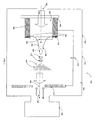
- FIG. I illustrates a mass spectrometry system implemented in accordance with an embodiment of the invention.
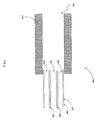
- FIG. 2 illustrates an electrospray capillary comprising a set of nanotubes, according to an embodiment of the invention.
- FIG. 3 illustrates an ion source comprising a feedback controller, according to an embodiment of the invention.
- a set of nanotubes can comprise a single nanotube or multiple nanotubes. Elements of a set can also be referred to as members of the set. Elements of a set can be the same or different. In some instances, elements of a set can share one or more common characteristics.
- the term "exposed" refers to being subject to possible interaction with the sample stream.
- a material can be exposed to a sample stream without being in actual or direct contact with the sample stream.
- a material can be exposed to a sample stream if the material is subject to possible interaction with a spray of droplets or a spray of ions produced from the sample stream in accordance with an ionization process.
- hydrophobic and hydrophobic refer to an affinity for water
- hydrophobic and hydroophobicity refer to a lack of affinity for water
- Hydrophobic materials typically correspond to those materials to which water has little or no tendency to adhere. As such, water on a surface of a hydrophobic material tends to bead up.
- One measure of hydrophobicity of a material is a contact angle between a surface of the material and a line tangent to a drop of water at a point of contact with the surface. Typically, the material is considered to be hydrophobic if the contact angle is greater than 90°.
- electrically conductive and “electrical conductivity” refer to an ability to transport an electric current. Electrically conductive materials typically correspond to those materials that exhibit little or no opposition to flow of an electric current. One measure of electrical conductivity of a material is its resistivity expressed in ⁇ cm. Typically, the material is considered to be electrically conductive if its resistivity is less than 0.1 ⁇ cm. The resistivity of a material can sometimes vary with temperature. Thus, unless otherwise specified, the resistivity of a material is defined at room temperature.
- the terms "robust” and “robustness” refer to a mechanical hardness or strength. Robust materials typically correspond to those materials that exhibit little or no tendency to fragment under typical operating conditions, such as typical operating conditions of the electrospray capillaries described herein.
- One measure of robustness of a material is its Vicker microhardness expressed in kg/mm. Typically, the material is considered to be robust if its Vicker microhardness is greater than 1,000 kg/mm.
- microstructure refers to a microscopic structure of a material and can encompass, for example, a lattice structure, crystallinity, dislocations, grain boundaries, and the like.
- a microstructure is a single-walled cylindrical structure, such as comprising a Single-Walled Carbon Nanotube ("SWCNT").
- SWCNT Single-Walled Carbon Nanotube
- MWCNT Multi-Walled Carbon Nanotube
- a further example of a microstructure is an array or arrangement of nanotubes.
- nanotube refers to an elongated, hollow structure. Examples of nanotubes comprise those formed from carbon, namely carbon nanotubes.
- a carbon nanotube can be formed as a SWCNT or a MWCNT.
- a SWCNT can be represented as a single graphite layer that is rolled into a cylindrical shape.
- a SWCNT typically has a cross-sectional diameter that is less than about 5 nm, such as from about 0.4 nm to about 4 nm.
- a MWCNT can be represented as multiple graphite layers that are rolled into concentric cylindrical shapes.
- a MWCNT typically has a cross-sectional diameter that is about 5 nm or greater, such as from about 5 nm to about 70 nm.
- Both a SWCNT and a MWCNT typically have lengths from about 0.1 ⁇ m to about 1 mm.
- a MWCNT can sometimes exhibit a greater level of electrical conductivity than a SWCNT and, thus, can be more desirable for certain implementations described herein.
- Other examples of nanotubes comprise those formed from silicon, gallium nitride, and the like.
- a nanotube, such as a SWCNT or a MWCNT typically comprises a substantially ordered array or arrangement of atoms and, thus, can be referred to as being substantially ordered or having a substantially ordered microstructure. It is contemplated that a nanotube can comprise a range of defects and can be doped or surface functionalized.
- a set of nanotubes can comprise nanotubes that are substantially aligned with respect to one another or with respect to a certain axis, plane, surface, or three-dimensional shape, and, thus, can be referred to as being substantially ordered or having a substantially ordered microstructure.
- Nanotubes can be formed using any of a wide variety of techniques, such as using arc-discharge, laser ablation, and chemical vapor deposition.
- ionization efficiency refers to a ratio of the number of ions formed in an ionization process and the number of electrons or photons used in the ionization process.
- FIG. 1 illustrates a mass spectrometry system 100 implemented in accordance with an embodiment of the invention.
- the mass spectrometry system 100 comprises an ion source 102, which operates to produce ions.
- the ion source 102 operates to produce ions using ESI.
- the mass spectrometry system 100 also comprises a detector 106, which is positioned with respect to the ion source 102 to receive ions. The detector 106 operates to detect ions as a function of mass and charge.
- the ion source 102 comprises an electrospray capillary 108 and an electrode 110, which is positioned adjacent to the electrospray capillary 108 and serves as a counter-electrode with respect to the electrospray capillary 108.
- the ion source 102 also comprises a power source 112, which is electrically connected to the electrospray capillary 108 and to the electrode 110.
- the power source 112 operates to apply a voltage to the electrospray capillary 108 and the electrode 110, thus producing an electric field between the electrospray capillary 108 and the electrode 110.
- the ion source 102 also comprises a housing 114, which defines an internal chamber 104 within which the electrospray capillary 108, the electrode 110, and the power source 112 are positioned.
- the electrospray capillary 108 comprises a channel 116 and a tip 118.
- the channel 116 defines an internal passageway 120 through which a sample stream 122 passes.
- the sample stream 122 comprises analytes to be analyzed by the mass spectrometry system 100.
- the sample stream 122 can comprise biomolecules that are dispersed in a suitable solvent, such as water.
- the positioning of the electrospray capillary 108 in the vicinity of the electrode 110 at a negative bias produces an electric field gradient at the tip 118 of the electrospray capillary 108.
- the Taylor cone 124 comprises a base 126 positioned near the tip 118 of the electrospray capillary 108.
- the Taylor cone 124 also comprises a tip 128, which extends into a filament 130.
- the electrode 110 comprises an aperture 136 near its center.
- the ions 134 pass through the electrode 110 via the aperture 136 and eventually reach the detector 106.
- a drying gas 138 such as a nitrogen gas, flows in a direction counter to the ions 134 to improve ionization efficiency and to restrain introduction of undesirable materials into the aperture 136.
- the electrode 110 is positioned in a longitudinal relationship with respect to the electrospray capillary 108. In other words, an angle defined by a central axis 140 of the internal passageway 120 and a central axis 142 of the aperture 136 is substantially at 0°.
- this angle can be adjusted to differ from 0°, such as from about 75° to about 105°.
- the electrode 110 can be positioned in an orthogonal relationship with respect to the electrospray capillary 108, such that this angle is substantially at 90°.
- Taylor cones can be produced with reproducible characteristics by controlling hydrophobicity of the electrospray capillary 108.
- the base 126 of the Taylor cone 124 can be restrained from spreading along the tip 118 of the electrospray capillary 108. In such manner, the base 126 of the Taylor cone 124 can be produced with a reproducible shape and size, which can correspond to a shape and size of the internal passageway 120 at the tip 118 of the electrospray capillary 108.
- the tip 118 of the electrospray capillary 108 comprises a hydrophobic material 144.
- the hydrophobic material 144 can form a coating that at least partly covers one end of the channel 116, which serves as a substrate.
- the hydrophobic material 144 can correspond to any of a wide variety of hydrophobic materials.
- Particularly useful hydrophobic materials correspond to those materials that exhibit a combination of desirable characteristics, comprising hydrophobicity, electrical conductivity, and robustness.
- particularly useful hydrophobic materials correspond to those materials that provide a hydrophobic surface, such that Taylor cones can be produced with a reproducible shape and size.
- the hydrophobic surface desirably exhibits a contact angle with respect to water that is greater than 90°, such as greater than about 100°, greater than about 105°, or greater than about 110°.
- particularly useful hydrophobic materials correspond to those materials that comprise a relatively low resistivity, such that an electric field can be properly applied between the tip 118 of the electrospray capillary 108 and the electrode 110.
- the resistivity is desirably less than 0.1 ⁇ cm, such as less than about 0.01 ⁇ cm, less than about 0.001 ⁇ cm, or less than about 0.0001 ⁇ cm.
- hydrophobic materials comprising a relatively low resistivity can avoid the need for an additional coating of an electrically conductive material, which additional coating can adversely affect hydrophobicity of the tip 118 of the electrospray capillary 108.
- particularly useful hydrophobic materials correspond to those materials that exhibit little or no tendency to fragment under typical operating conditions of the electrospray capillary 108, thus increasing operational lifetime of the electrospray capillary 108.
- the Vicker microhardness of those materials is desirably greater than 1,000 kg/mm, such as greater than about 2,000 kg/mm, greater than about 2,500 kg/mm, or greater than about 3,000 kg/mm.
- the Vicker microhardness is desirably from about 2,500 kg/mm to about 3,500 kg/mm.
- the hydrophobic material 144 desirably corresponds to a carbon nanotube material, which can comprise a set of carbon nanotubes.
- a carbon nanotube material which can comprise a set of carbon nanotubes.
- other types of nanotube materials such as those comprising nanotubes formed from gallium nitride, can be used in place of, or in combination, with the carbon nanotube material.
- the carbon nanotube material can exhibit a higher level of hydrophobicity, a higher level of electrical conductivity, and a higher level of robustness as compared with certain other types of hydrophobic materials.
- a further benefit of the carbon nanotube material is its substantial inertness with respect to typical analytes that can comprise the sample stream 122. Without wishing to be bound by a particular theory, it is believed that a substantially ordered microstructure of the carbon nanotube material contributes to at least some of its desirable and unusual characteristics.
- the carbon nanotube material can form a coating, which can be applied using any of a wide variety of techniques.
- the carbon nanotube material can be sprayed at high velocity onto a substrate, such that the carbon nanotube material mechanically adheres to the substrate.
- the carbon nanotube material can be dispersed in a suitable solvent to form a "paint," and this paint can be applied to the substrate.
- the solvent can be relatively inert.
- the solvent can facilitate chemical bonding between the carbon nanotube material and the substrate. Heat can be applied to evaporate the solvent or to promote chemical bonding.
- FIG. 1 illustrates the tip 118 of the electrospray capillary 108 as comprising the hydrophobic material 144
- other portions of the electrospray capillary 108 can comprise the hydrophobic material 144.
- any portion of the electrospray capillary 108 that is exposed to the sample stream 122 can comprise the hydrophobic material 144.
- the channel 116 can also comprise the hydrophobic material 144, which can form a coating that at least partly covers a surface surrounding the internal passageway 120.
- Such implementation can facilitate a flow of the sample stream 122 through the electrospray capillary 108, which, in turn, can allow Taylor cones to be produced with reproducible characteristics.
- different portions of the electrospray capillary 108 can comprise hydrophobic materials that are the same or different. It is also contemplated that the electrospray capillary 108 can be substantially formed of the hydrophobic material 144.
- FIG. 2 illustrates an electrospray capillary 208 implemented in accordance with another embodiment of the invention.
- the electrospray capillary 208 comprises a channel 216 and a tip 218.
- the channel 216 defines an internal passageway 220 through which a sample stream can pass.
- the tip 218 of the electrospray capillary 208 comprises a set of nanotubes, namely carbon nanotubes 246, 248, and 250.
- the carbon nanotubes 246, 248, and 250 are substantially aligned with respect to one another to form the tip 218 of the electrospray capillary 208. While three carbon nanotubes 246, 248, and 250 are illustrated in FIG.
- the carbon nanotubes 246, 248, and 250 define respective internal passageways 252, 254, and 256 through which the sample stream can exit the electrospray capillary 208. As the sample stream exits the tip 218 of the electrospray capillary 208, Taylor cones can be formed at respective ends of the carbon nanotubes 246, 248, and 250. In the illustrated embodiment, the carbon nanotubes 246, 248, and 250 can be selected to have cross-sectional diameters of sufficient size to allow a flow of certain analytes, such as biomolecules.
- the carbon nanotubes 246, 248, and 250 are desirably MWCNTs because of their typically larger cross-sectional diameters as compared with SWCNTs.
- the electrospray capillary 208 can be formed using any of a wide variety of techniques.
- the carbon nanotubes 246, 248, and 250 can be positioned with respect to the channel 216 using an Atomic Force Microscope ("AFM").
- the channel 216 can serve as a substrate, and the carbon nanotubes 246, 248, and 250 can be formed on the channel 216 using arc-discharge, laser ablation, or chemical vapor deposition. It is contemplated that other types of nanotubes, such as those formed from gallium nitride, can be used in place of, or in combination, with the carbon nanotubes 246, 248, and 250.
- FIG. 3 illustrates an ion source 302 comprising a feedback controller 358, in accordance with an embodiment of the invention.
- the feedback controller 358 operates to detect a modulation frequency of an ionization current I(t) between a tip 318 of an electrospray capillary 308 and a counter-electrode 310, which are positioned in a module 370. Based on this modulation frequency, the feedback controller 358 operates to provide feedback regulation of ESI characteristics by adjusting a voltage V cc between the tip 318 of the electrospray capillary 308 and the counter-electrode 310.
- the ionization current I(t) between the electrospray capillary 308 and the counter-electrode 310 can experience transient fluctuations in amplitude (i.e., can be modulated) depending on operating conditions of the ion source 302.
- modulation of the ionization current I(t) can have characteristics associated with one of a variety of ESI modes, comprising: (1) a pulsating mode with lower modulation frequencies ("mode I"); (2) a constant-amplitude oscillation mode with intermediate modulation frequencies (“mode II”); and (3) a continuous emission mode with higher modulation frequencies (“mode III”).
- mode II and mode III typically provide the most desirable ESI characteristics.
- a correlation between a magnitude of the modulation frequency and the different ESI modes allows the modulation frequency to be used as an indicator of a particular ESI mode under which the ion source 302 is currently operating.
- the voltage V cc can be adjusted until the modulation frequency has a magnitude associated with a desired ESI mode.
- the modulation frequency typically depends on characteristics of a Taylor cone that is produced, such as a size of a base of the Taylor cone. Accordingly, in order for the modulation frequency to be an accurate and reproducible indicator of a particular ESI mode, it is desirable to produce Taylor cones with reproducible characteristics.
- Taylor cones can be produced with reproducible characteristics by controlling hydrophobicity of the electrospray capillary 308 in a similar manner as described above.
- tip 318 of the electrospray capillary 308 is made sufficiently hydrophobic, Taylor cones can be produced with bases of a reproducible shape and size.
- the feedback controller 358 comprises a transimpedance amplifier 360, a DC de-coupler 362, a frequency-to-voltage converter 364, a controller 366, and a voltage-controlled high-voltage power supply 368.
- the transimpedance amplifier 360, the DC de-coupler 362, the frequency-to-voltage converter 364, the controller 366, and the voltage-controlled high-voltage power supply 368 comprise a closed feedback loop to provide feedback regulation of ESI characteristics.
- the transimpedance amplifier 360 operates to convert the ionization current I(t) into a voltage V(t).
- the transimpedance amplifier 360 desirably has a bandwidth of at least about 400 kHz and a gain of about 10 7 . Amplifiers with such specifications are commercially available.
- the transimpedance amplifier 360 can be implemented using a two-stage Op-Amp design, such as using a low noise transimpedance module for current to voltage conversion and a boost Op-Amp stage for further signal amplification.
- the DC de-coupler 362 operates to remove a Direct Current ("DC") component of the voltage V(t).
- the frequency-to-voltage converter 364 responds to an input frequency of the voltage V(t) and delivers to the controller 366 an input voltage V in that is linearly proportional to this input frequency.
- the transimpedance amplifier 360, the DC de-coupler 362, and the frequency-to-voltage converter 364 operate to convert frequency information in the ionization current I(t) into the input voltage V in .
- the controller 366 can be implemented using a microprocessor 372 that operates to produce an output voltage V out from the input voltage V in in accordance with a set of processor-executable instructions.
- the output voltage V out controls the voltage-controlled high-voltage power supply 368, which applies the voltage V cc between the tip 318 of the electrospray capillary 308 and the counter-electrode 310.
- the voltage V cc is proportional to the output voltage V out .
- the voltage V cc can be a DC voltage or a DC voltage with an Alternating Current ("AC") component.
- AC Alternating Current
- the DC voltage can be used to establish a highest possible electric field for which there is no ESI action.
- High-voltage AC pulses can be superimposed on the DC voltage to elicit on-demand droplet formation.
- the AC pulses can be produced using suitable high voltage amplifier circuits and can be, for example, sinusoidal, square-shaped, or triangular-shaped.
- a shape and a duty cycle of the AC pulses can be adjusted to control characteristics of a Taylor cone, thus creating a spray of ions with desired characteristics. It is contemplated that the AC pulses can be synchronized with respect to sampling electronics to provide for a desired level of sensitivity and repeatability.
- the voltage V cc is applied to the counter-electrode 310, while the transimpedance amplifier 360 is electrically connected to the electrospray capillary 308, which is grounded.
- the voltage V cc can be applied to the tip 318 of the electrospray capillary 308, and the ionization current I(t) can be detected at the tip 318 of the electrospray capillary 308 or at the counter-electrode 310.
- a voltage-controlled flow rate controller can be used in place of, or in conjunction with, the voltage-controlled high-voltage power supply 368.
- the voltage-controlled flow rate controller can operate to adjust a flow rate of a sample fluid passing through the electrospray capillary 308 based on the output voltage V out .
- the module 370 is shielded from interfering signals to improve a signal-to-noise ratio for the operations described above.
- Proper shielding can be achieved by, for example, using a grounded electrically conductive housing. Connections in and out of the housing can be implemented using coaxial cables.
Landscapes
- Engineering & Computer Science (AREA)
- Chemical & Material Sciences (AREA)
- Physics & Mathematics (AREA)
- Nanotechnology (AREA)
- Mathematical Physics (AREA)
- Theoretical Computer Science (AREA)
- Crystallography & Structural Chemistry (AREA)
- Plasma & Fusion (AREA)
- Analytical Chemistry (AREA)
- Other Investigation Or Analysis Of Materials By Electrical Means (AREA)
- Carbon And Carbon Compounds (AREA)
Applications Claiming Priority (1)
| Application Number | Priority Date | Filing Date | Title |
|---|---|---|---|
| US10/934,288 US7122791B2 (en) | 2004-09-03 | 2004-09-03 | Capillaries for mass spectrometry |
Publications (2)
| Publication Number | Publication Date |
|---|---|
| EP1632983A2 true EP1632983A2 (de) | 2006-03-08 |
| EP1632983A3 EP1632983A3 (de) | 2006-09-13 |
Family
ID=35482235
Family Applications (1)
| Application Number | Title | Priority Date | Filing Date |
|---|---|---|---|
| EP05008565A Withdrawn EP1632983A3 (de) | 2004-09-03 | 2005-04-19 | Kapillaren für Massenspektrometrie |
Country Status (2)
| Country | Link |
|---|---|
| US (1) | US7122791B2 (de) |
| EP (1) | EP1632983A3 (de) |
Cited By (1)
| Publication number | Priority date | Publication date | Assignee | Title |
|---|---|---|---|---|
| GB2456401A (en) * | 2007-02-16 | 2009-07-22 | Agilent Technologies Inc | Ion handling device |
Families Citing this family (15)
| Publication number | Priority date | Publication date | Assignee | Title |
|---|---|---|---|---|
| US7405416B2 (en) * | 2005-02-25 | 2008-07-29 | Cymer, Inc. | Method and apparatus for EUV plasma source target delivery |
| US7946982B2 (en) | 2002-10-25 | 2011-05-24 | K2M, Inc. | Minimal incision maximal access MIS spine instrumentation and method |
| US7173240B2 (en) * | 2004-11-05 | 2007-02-06 | Agilent Technologies, Inc. | Electrospray devices for mass spectrometry |
| US7022982B2 (en) * | 2004-02-12 | 2006-04-04 | Agilent Technologies, Inc. | Ion source frequency feedback device and method |
| US7078683B2 (en) * | 2004-10-22 | 2006-07-18 | Agilent Technologies, Inc. | Nanowire target support and method |
| DE102004053082A1 (de) * | 2004-11-03 | 2006-05-04 | Dr. Johannes Heidenhain Gmbh | Positionsmesssystem |
| US20060118712A1 (en) * | 2004-12-03 | 2006-06-08 | Dan-Hui Yang | Nanostructure sample supports for mass spectrometry |
| US20060180755A1 (en) * | 2005-02-15 | 2006-08-17 | Ying-Lan Chang | Patterned nanostructure sample supports for mass spectrometry and methods of forming thereof |
| WO2010014235A1 (en) * | 2008-08-01 | 2010-02-04 | Brown University | System and methods for determining molecules using mass spectrometry and related techniques |
| US8084735B2 (en) * | 2008-09-25 | 2011-12-27 | Ut-Battelle, Llc | Pulsed voltage electrospray ion source and method for preventing analyte electrolysis |
| WO2011146269A1 (en) | 2010-05-21 | 2011-11-24 | Waters Technologies Corporation | Techniques for automated parameter adjustment using ion signal intensity feedback |
| CN102479659A (zh) * | 2010-11-30 | 2012-05-30 | 中国科学院大连化学物理研究所 | 一种电离源及其在气溶胶检测中的应用 |
| CN110233094B (zh) * | 2019-07-11 | 2024-07-05 | 宁波大学 | 离子源及其工作方法、应用 |
| FR3101382B1 (fr) * | 2019-09-30 | 2021-09-24 | Centre Nat Rech Scient | Dispositif de propulsion ionique |
| CN119170480B (zh) * | 2024-08-20 | 2025-09-26 | 湖南大学 | 一种用于质谱、离子迁移谱仪器的离子传输装置 |
Family Cites Families (21)
| Publication number | Priority date | Publication date | Assignee | Title |
|---|---|---|---|---|
| US5624539A (en) * | 1995-06-19 | 1997-04-29 | The Penn State Research Foundation | Real time monitoring of electroosmotic flow in capillary electrophoresis |
| US6287765B1 (en) * | 1998-05-20 | 2001-09-11 | Molecular Machines, Inc. | Methods for detecting and identifying single molecules |
| US6600076B1 (en) * | 1999-04-05 | 2003-07-29 | The Regents Of The University Of California | Cleavable, water-soluble surfactants |
| WO2002066482A1 (en) * | 2001-01-17 | 2002-08-29 | Purdue Research Foundation | Method and associated compounds for forming nanotubes |
| US20030119193A1 (en) * | 2001-04-25 | 2003-06-26 | Robert Hess | System and method for high throughput screening of droplets |
| US6744046B2 (en) * | 2001-05-24 | 2004-06-01 | New Objective, Inc. | Method and apparatus for feedback controlled electrospray |
| US6974528B2 (en) * | 2001-07-24 | 2005-12-13 | Biomics, Inc. | High performance wide bore electrophoresis |
| US20030180965A1 (en) * | 2002-03-25 | 2003-09-25 | Levent Yobas | Micro-fluidic device and method of manufacturing and using the same |
| US7879621B2 (en) * | 2003-05-08 | 2011-02-01 | Phynexus, Inc. | Open channel solid phase extraction systems and methods |
| US7151167B2 (en) * | 2002-06-10 | 2006-12-19 | Phynexus, Inc. | Open channel solid phase extraction systems and methods |
| JP2005529335A (ja) * | 2002-06-10 | 2005-09-29 | フィネクサス, インク. | 開放チャンネルを使って生体分子を固体相として抽出するシステムと方法 |
| US7122640B2 (en) * | 2002-06-10 | 2006-10-17 | Phynexus, Inc. | Open channel solid phase extraction systems and methods |
| SE0300454D0 (sv) * | 2003-02-19 | 2003-02-19 | Aamic Ab | Nozzles for electrospray ionization and methods of fabricating them |
| JP2006524418A (ja) * | 2003-03-04 | 2006-10-26 | 博雅 東城 | 低表面エネルギー化合物でコーティングしたエレクトロスプレーエミッタ |
| US7007710B2 (en) * | 2003-04-21 | 2006-03-07 | Predicant Biosciences, Inc. | Microfluidic devices and methods |
| US20040224425A1 (en) * | 2003-05-08 | 2004-11-11 | Gjerde Douglas T. | Biomolecule open channel solid phase extraction systems and methods |
| US20040241721A1 (en) * | 2003-05-08 | 2004-12-02 | Gjerde Douglas T. | Open channel solid phase extraction systems and methods |
| DE10350614B4 (de) * | 2003-10-30 | 2007-11-29 | Bruker Daltonik Gmbh | Dispenser |
| US7232992B2 (en) * | 2004-05-21 | 2007-06-19 | Analytica Of Branford, Inc. | Charged droplet sprayers |
| US7141807B2 (en) * | 2004-10-22 | 2006-11-28 | Agilent Technologies, Inc. | Nanowire capillaries for mass spectrometry |
| US7060975B2 (en) * | 2004-11-05 | 2006-06-13 | Agilent Technologies, Inc. | Electrospray devices for mass spectrometry |
-
2004
- 2004-09-03 US US10/934,288 patent/US7122791B2/en not_active Expired - Fee Related
-
2005
- 2005-04-19 EP EP05008565A patent/EP1632983A3/de not_active Withdrawn
Cited By (3)
| Publication number | Priority date | Publication date | Assignee | Title |
|---|---|---|---|---|
| GB2456401A (en) * | 2007-02-16 | 2009-07-22 | Agilent Technologies Inc | Ion handling device |
| GB2456401A9 (en) * | 2007-02-16 | 2011-03-30 | Agilent Technologies Inc | Ion handling devices. |
| GB2456401B (en) * | 2007-02-16 | 2011-06-08 | Agilent Technologies Inc | Ion handling devices |
Also Published As
| Publication number | Publication date |
|---|---|
| EP1632983A3 (de) | 2006-09-13 |
| US7122791B2 (en) | 2006-10-17 |
| US20060049347A1 (en) | 2006-03-09 |
Similar Documents
| Publication | Publication Date | Title |
|---|---|---|
| US7141807B2 (en) | Nanowire capillaries for mass spectrometry | |
| US7122791B2 (en) | Capillaries for mass spectrometry | |
| US11469090B2 (en) | Ion focusing | |
| US7514676B1 (en) | Method and apparatus for selective filtering of ions | |
| JP5771458B2 (ja) | 質量分析装置及び質量分析方法 | |
| JP2020074265A (ja) | イオン生成と、不連続の大気インターフェースの周期との同期 | |
| JP6620896B2 (ja) | イオン化装置及び質量分析装置 | |
| Guo et al. | Online coupling of an electrochemically fabricated solid-phase microextraction probe and a miniature mass spectrometer for enrichment and analysis of chemical contaminants in infant drinks | |
| Perez-Martinez et al. | Ion field-evaporation from ionic liquids infusing carbon xerogel microtips | |
| JP2010530120A (ja) | イオントランスポートデバイスおよびその作動モード | |
| US20100078553A1 (en) | Atmospheric pressure ionization (api) interface structures for a mass spectrometer | |
| US7372023B2 (en) | Ion source frequency feedback device and method | |
| US7060975B2 (en) | Electrospray devices for mass spectrometry | |
| Fujiwara et al. | Component analysis of a mixed beam generated by vacuum electrospray of an ionic liquid | |
| US20060081775A1 (en) | Ionization chambers for mass spectrometry | |
| Kohigashi et al. | Reduced sampling size with nanopipette for tapping-mode scanning probe electrospray ionization mass spectrometry imaging | |
| US7535014B2 (en) | Integrally gated carbon nanotube field ionizer device and method of manufacture therefor | |
| US7173240B2 (en) | Electrospray devices for mass spectrometry | |
| CN105575755B (zh) | 一种基于导电纳米材料的电喷雾质谱装置及其实现电喷雾质谱分析的方法 | |
| JP2008053020A (ja) | 質量分析装置 | |
| Li | Spray Generated Ions: Principles, Processes, Pathways for Applications | |
| Luo et al. | Field ionization using densely spaced arrays of nickel-tipped carbon nanotubes | |
| Cavanaugh | The microionizer-A solid state ion source for high pressure mass spectrometry | |
| JP2003107054A (ja) | 液体クロマトグラフ質量分析装置 | |
| Smith | Design improvements for low flow electrospray mass spectrometry of biomolecules |
Legal Events
| Date | Code | Title | Description |
|---|---|---|---|
| PUAI | Public reference made under article 153(3) epc to a published international application that has entered the european phase |
Free format text: ORIGINAL CODE: 0009012 |
|
| AK | Designated contracting states |
Kind code of ref document: A2 Designated state(s): AT BE BG CH CY CZ DE DK EE ES FI FR GB GR HU IE IS IT LI LT LU MC NL PL PT RO SE SI SK TR |
|
| AX | Request for extension of the european patent |
Extension state: AL BA HR LV MK YU |
|
| PUAL | Search report despatched |
Free format text: ORIGINAL CODE: 0009013 |
|
| AK | Designated contracting states |
Kind code of ref document: A3 Designated state(s): AT BE BG CH CY CZ DE DK EE ES FI FR GB GR HU IE IS IT LI LT LU MC NL PL PT RO SE SI SK TR |
|
| AX | Request for extension of the european patent |
Extension state: AL BA HR LV MK YU |
|
| RAP1 | Party data changed (applicant data changed or rights of an application transferred) |
Owner name: AGILENT TECHNOLOGIES, INC. |
|
| AKX | Designation fees paid | ||
| STAA | Information on the status of an ep patent application or granted ep patent |
Free format text: STATUS: THE APPLICATION IS DEEMED TO BE WITHDRAWN |
|
| 18D | Application deemed to be withdrawn |
Effective date: 20070314 |
|
| REG | Reference to a national code |
Ref country code: DE Ref legal event code: 8566 |