EP1632289A1 - Catalyst for producing hydrocarbon from synthesis gas and method for producing catalyst - Google Patents
Catalyst for producing hydrocarbon from synthesis gas and method for producing catalyst Download PDFInfo
- Publication number
- EP1632289A1 EP1632289A1 EP04726307A EP04726307A EP1632289A1 EP 1632289 A1 EP1632289 A1 EP 1632289A1 EP 04726307 A EP04726307 A EP 04726307A EP 04726307 A EP04726307 A EP 04726307A EP 1632289 A1 EP1632289 A1 EP 1632289A1
- Authority
- EP
- European Patent Office
- Prior art keywords
- catalyst
- support
- mass
- hydrocarbon
- silica
- Prior art date
- Legal status (The legal status is an assumption and is not a legal conclusion. Google has not performed a legal analysis and makes no representation as to the accuracy of the status listed.)
- Ceased
Links
Images
Classifications
-
- C—CHEMISTRY; METALLURGY
- C10—PETROLEUM, GAS OR COKE INDUSTRIES; TECHNICAL GASES CONTAINING CARBON MONOXIDE; FUELS; LUBRICANTS; PEAT
- C10G—CRACKING HYDROCARBON OILS; PRODUCTION OF LIQUID HYDROCARBON MIXTURES, e.g. BY DESTRUCTIVE HYDROGENATION, OLIGOMERISATION, POLYMERISATION; RECOVERY OF HYDROCARBON OILS FROM OIL-SHALE, OIL-SAND, OR GASES; REFINING MIXTURES MAINLY CONSISTING OF HYDROCARBONS; REFORMING OF NAPHTHA; MINERAL WAXES
- C10G2/00—Production of liquid hydrocarbon mixtures of undefined composition from oxides of carbon
- C10G2/30—Production of liquid hydrocarbon mixtures of undefined composition from oxides of carbon from carbon monoxide with hydrogen
- C10G2/32—Production of liquid hydrocarbon mixtures of undefined composition from oxides of carbon from carbon monoxide with hydrogen with the use of catalysts
- C10G2/33—Production of liquid hydrocarbon mixtures of undefined composition from oxides of carbon from carbon monoxide with hydrogen with the use of catalysts characterised by the catalyst used
-
- B—PERFORMING OPERATIONS; TRANSPORTING
- B01—PHYSICAL OR CHEMICAL PROCESSES OR APPARATUS IN GENERAL
- B01J—CHEMICAL OR PHYSICAL PROCESSES, e.g. CATALYSIS OR COLLOID CHEMISTRY; THEIR RELEVANT APPARATUS
- B01J21/00—Catalysts comprising the elements, oxides, or hydroxides of magnesium, boron, aluminium, carbon, silicon, titanium, zirconium, or hafnium
- B01J21/06—Silicon, titanium, zirconium or hafnium; Oxides or hydroxides thereof
- B01J21/08—Silica
-
- B—PERFORMING OPERATIONS; TRANSPORTING
- B01—PHYSICAL OR CHEMICAL PROCESSES OR APPARATUS IN GENERAL
- B01J—CHEMICAL OR PHYSICAL PROCESSES, e.g. CATALYSIS OR COLLOID CHEMISTRY; THEIR RELEVANT APPARATUS
- B01J23/00—Catalysts comprising metals or metal oxides or hydroxides, not provided for in group B01J21/00
- B01J23/38—Catalysts comprising metals or metal oxides or hydroxides, not provided for in group B01J21/00 of noble metals
- B01J23/40—Catalysts comprising metals or metal oxides or hydroxides, not provided for in group B01J21/00 of noble metals of the platinum group metals
- B01J23/46—Ruthenium, rhodium, osmium or iridium
-
- B—PERFORMING OPERATIONS; TRANSPORTING
- B01—PHYSICAL OR CHEMICAL PROCESSES OR APPARATUS IN GENERAL
- B01J—CHEMICAL OR PHYSICAL PROCESSES, e.g. CATALYSIS OR COLLOID CHEMISTRY; THEIR RELEVANT APPARATUS
- B01J23/00—Catalysts comprising metals or metal oxides or hydroxides, not provided for in group B01J21/00
- B01J23/38—Catalysts comprising metals or metal oxides or hydroxides, not provided for in group B01J21/00 of noble metals
- B01J23/40—Catalysts comprising metals or metal oxides or hydroxides, not provided for in group B01J21/00 of noble metals of the platinum group metals
- B01J23/46—Ruthenium, rhodium, osmium or iridium
- B01J23/462—Ruthenium
-
- B—PERFORMING OPERATIONS; TRANSPORTING
- B01—PHYSICAL OR CHEMICAL PROCESSES OR APPARATUS IN GENERAL
- B01J—CHEMICAL OR PHYSICAL PROCESSES, e.g. CATALYSIS OR COLLOID CHEMISTRY; THEIR RELEVANT APPARATUS
- B01J23/00—Catalysts comprising metals or metal oxides or hydroxides, not provided for in group B01J21/00
- B01J23/70—Catalysts comprising metals or metal oxides or hydroxides, not provided for in group B01J21/00 of the iron group metals or copper
- B01J23/74—Iron group metals
-
- B—PERFORMING OPERATIONS; TRANSPORTING
- B01—PHYSICAL OR CHEMICAL PROCESSES OR APPARATUS IN GENERAL
- B01J—CHEMICAL OR PHYSICAL PROCESSES, e.g. CATALYSIS OR COLLOID CHEMISTRY; THEIR RELEVANT APPARATUS
- B01J23/00—Catalysts comprising metals or metal oxides or hydroxides, not provided for in group B01J21/00
- B01J23/70—Catalysts comprising metals or metal oxides or hydroxides, not provided for in group B01J21/00 of the iron group metals or copper
- B01J23/74—Iron group metals
- B01J23/75—Cobalt
-
- B—PERFORMING OPERATIONS; TRANSPORTING
- B01—PHYSICAL OR CHEMICAL PROCESSES OR APPARATUS IN GENERAL
- B01J—CHEMICAL OR PHYSICAL PROCESSES, e.g. CATALYSIS OR COLLOID CHEMISTRY; THEIR RELEVANT APPARATUS
- B01J37/00—Processes, in general, for preparing catalysts; Processes, in general, for activation of catalysts
- B01J37/06—Washing
-
- B—PERFORMING OPERATIONS; TRANSPORTING
- B01—PHYSICAL OR CHEMICAL PROCESSES OR APPARATUS IN GENERAL
- B01J—CHEMICAL OR PHYSICAL PROCESSES, e.g. CATALYSIS OR COLLOID CHEMISTRY; THEIR RELEVANT APPARATUS
- B01J37/00—Processes, in general, for preparing catalysts; Processes, in general, for activation of catalysts
- B01J37/34—Irradiation by, or application of, electric, magnetic or wave energy, e.g. ultrasonic waves ; Ionic sputtering; Flame or plasma spraying; Particle radiation
-
- B—PERFORMING OPERATIONS; TRANSPORTING
- B01—PHYSICAL OR CHEMICAL PROCESSES OR APPARATUS IN GENERAL
- B01J—CHEMICAL OR PHYSICAL PROCESSES, e.g. CATALYSIS OR COLLOID CHEMISTRY; THEIR RELEVANT APPARATUS
- B01J23/00—Catalysts comprising metals or metal oxides or hydroxides, not provided for in group B01J21/00
- B01J23/70—Catalysts comprising metals or metal oxides or hydroxides, not provided for in group B01J21/00 of the iron group metals or copper
- B01J23/76—Catalysts comprising metals or metal oxides or hydroxides, not provided for in group B01J21/00 of the iron group metals or copper combined with metals, oxides or hydroxides provided for in groups B01J23/02 - B01J23/36
- B01J23/78—Catalysts comprising metals or metal oxides or hydroxides, not provided for in group B01J21/00 of the iron group metals or copper combined with metals, oxides or hydroxides provided for in groups B01J23/02 - B01J23/36 with alkali- or alkaline earth metals
-
- B—PERFORMING OPERATIONS; TRANSPORTING
- B01—PHYSICAL OR CHEMICAL PROCESSES OR APPARATUS IN GENERAL
- B01J—CHEMICAL OR PHYSICAL PROCESSES, e.g. CATALYSIS OR COLLOID CHEMISTRY; THEIR RELEVANT APPARATUS
- B01J35/00—Catalysts, in general, characterised by their form or physical properties
- B01J35/40—Catalysts, in general, characterised by their form or physical properties characterised by dimensions, e.g. grain size
-
- B—PERFORMING OPERATIONS; TRANSPORTING
- B01—PHYSICAL OR CHEMICAL PROCESSES OR APPARATUS IN GENERAL
- B01J—CHEMICAL OR PHYSICAL PROCESSES, e.g. CATALYSIS OR COLLOID CHEMISTRY; THEIR RELEVANT APPARATUS
- B01J35/00—Catalysts, in general, characterised by their form or physical properties
- B01J35/60—Catalysts, in general, characterised by their form or physical properties characterised by their surface properties or porosity
- B01J35/61—Surface area
- B01J35/615—100-500 m2/g
-
- B—PERFORMING OPERATIONS; TRANSPORTING
- B01—PHYSICAL OR CHEMICAL PROCESSES OR APPARATUS IN GENERAL
- B01J—CHEMICAL OR PHYSICAL PROCESSES, e.g. CATALYSIS OR COLLOID CHEMISTRY; THEIR RELEVANT APPARATUS
- B01J35/00—Catalysts, in general, characterised by their form or physical properties
- B01J35/60—Catalysts, in general, characterised by their form or physical properties characterised by their surface properties or porosity
- B01J35/63—Pore volume
- B01J35/635—0.5-1.0 ml/g
-
- B—PERFORMING OPERATIONS; TRANSPORTING
- B01—PHYSICAL OR CHEMICAL PROCESSES OR APPARATUS IN GENERAL
- B01J—CHEMICAL OR PHYSICAL PROCESSES, e.g. CATALYSIS OR COLLOID CHEMISTRY; THEIR RELEVANT APPARATUS
- B01J35/00—Catalysts, in general, characterised by their form or physical properties
- B01J35/60—Catalysts, in general, characterised by their form or physical properties characterised by their surface properties or porosity
- B01J35/63—Pore volume
- B01J35/638—Pore volume more than 1.0 ml/g
Definitions
- the present invention relates to a catalyst for producing hydrocarbon from a syngas, which is suitable for a hydrogenation of carbon monoxide and a hydrocarbon production from carbon monoxide, a producing method of the catalyst, and a producing method of hydrocarbon using the catalyst.
- This Fischer-Tropsch synthesis reaction converting the syngas into hydrocarbon with a catalyst is an exothermic reaction, where it is extremely important to effectively remove reaction heat for a stable operation of the plant.
- time-proven reaction processes there are gas-phase synthesis processes (in a fixed bed, entrained bed, or fluid bed) and a liquid-phase synthesis process (in a slurry bed) having respective features.
- the liquid-phase synthesis process carried out in the slurry bed is gathering attentions and being researched and developed strenuously for the reason that it exhibits a higher heat removing efficiency but avoids the accumulation of generated high-boiling point hydrocarbon on the catalyst as well as a reactor tube plugging caused thereby.
- a higher catalytic activity is preferable, and especially, in the case of the slurry bed, there is a constraint that the concentration of slurry is needed to be a prescribed value or below so as to keep a favorable slurry state, so that the increase in the catalytic activity is an extremely important factor to increase a process design flexibility.
- the ever-reported catalytic activities of various types of catalysts for the Fischer- Tropsch synthesis are approximately 1 (kg - hydrocarbon/kg - catalyst ⁇ hour) at most in view of the production rate of liquid hydrocarbon of a carbon number of five or above, which cannot be said always enough from the above-described viewpoints (See Non-patent document 1).
- the particle diameter of the catalyst for the Fischer-Tropsch synthesis reaction is preferably small as practically as possible from the aspect of reducing a possibility in which the diffusions of heat and matters come to a rate-determining level.
- the Fischer-Tropsch synthesis reaction in the slurry bed out of the generated hydrocarbon, the high-boiling point hydrocarbon is accumulated in the reactor, inevitably requiring a solid-liquid separating operation for separating a product from the catalyst, so that there arises another problem that the catalyst of a too small particle diameter greatly reduces the efficiency of the separating operation.
- the catalyst for the slurry bed there should be an optimum particle diameter range, and generally, the range from about 20 ⁇ m to about 250 ⁇ m, or about 40 ⁇ m to about 150 ⁇ m as an average particle diameter, is considered to be desirable; however, as shown below, there may be a case where the catalyst is caused to be fractured and powdered to have a smaller particle diameter in the course of the reaction, requiring a caution.
- the operation is frequently performed at an extremely high material-gas superficial velocity (>0.1 m / second), so that the catalyst particles clash furiously with each other during the reaction to possibly reduce their particle diameters during the reaction when the physical strength and abrasion resistance (resistance to be powdered) are insufficient, causing an inconvenience sometimes in the separating operation.
- the current catalytic activity is not sufficient yet, and the catalyst with a higher catalytic activity has been demanded as a pressing need, also from a viewpoint of extending the design flexibility in the plant.
- the catalyst for the slurry bed is frequently put into practical use by being prepared through a size control by way of a grinding to have such an appropriate particle diameter as described above.
- a catalyst of a ground type frequently has a crack or sharp protrusion arisen originally and reveals a lesser mechanical strength and abrasion resistance, leaving a problem that the catalyst is forced to fracture to generate fine powders and makes it difficult to separate the generated high-boiling point hydrocarbon from the catalyst when used in the Fischer-Tropsch synthesis reaction in the slurry bed.
- An object of the present invention is to provide a catalyst for a Fischer-Tropsch synthesis, which brings a solution to the above-described problems and exhibits a high activity without deteriorating its catalytic strength and abrasion resistance; a producing method of the catalyst, and a producing method of hydrocarbon using the catalyst.
- the present invention relates to a catalyst for a Fischer-Tropsch synthesis exhibiting a high strength and activity, a producing method of the catalyst, and a producing method of hydrocarbon using the catalyst. More detail description will be presented hereinafter.
- the present inventors have found that a substantial increase in catalytic activity is possible by reducing the impurities, and that a catalyst with high strength and abrasive resistance can be produced without deteriorating the activity with the use of a specific support, to finally attain the present invention.
- a catalyst according to the present invention is not specifically limited to some one as long as the catalyst contains metal having an activity for a Fischer-Tropsch synthesis reaction, and those catalysts containing iron, cobalt, nickel, ruthenium and the like are acceptable, and as for a support, preferably, a selection is made from porous oxides or the like made of silica, alumina, titania and the like appropriately to use the selection for the catalyst support.
- a common impregnation method, an incipient wetness method, a precipitation method, an ion-exchange method and the like can be employed.
- a loading amount in that the amount changes depending on respective active metals in use, however, a range between a minimum amount exhibiting the activity or above and a loading amount, which causes a contribution efficiency down in a reaction due to a sharp drop in the dispersion of the active metal on a catalyst support, or below is acceptable.
- the amount when the cobalt is in use, the amount is in the range from 5 mass% to 50 mass%, and, preferably, from 10 mass% to 40 mass%. In the case of the amount below the range, enough activity cannot be obtained, and in the case of the amount above the range, the dispersion drops to lower utilization efficiency of the cobalt loaded on the catalyst support uneconomically, being unfavorable.
- the present inventors have found first that the reduction of impurities, which is other than the active metal and an element composing the support, in the catalyst to control the impurities to be within a certain range has a great effect to improve the activity.
- the silica in general, the silica frequently contains an alkali metal such as Na, an alkaline-earth metal such as Ca and Mg, and Fe, Al, and the like, as the impurities.
- the amount of impurities in the catalyst should be curbed to 0.15 mass% or below. If the impurity amount is above the range, the activity decreases largely, being extremely disadvantage. However, an excessive reduction of the impurities leads to diseconomy, so that a preferable impurity amount in the catalyst is 0.01 mass% or above. It is difficult to limit the impurity amount in the precursor of metallic compound, since it depends on the loading amount and the type of precursor, however, in order to reduce the impurity amount in the catalyst, it is effective to curb the impurity amount in the precursor of active metal, especially, the alkali metal content or the alkaline-earth metal content to 5 mass% or below.
- the alkali metal content or the alkaline-earth metal content in the support are preferably 0.1 mass% or below, and more preferably, they are 0.07 mass% or below, and most preferably, they are 0.04 mass% or below.
- the impurity content in the support comes to 0.15 mass% or above, the activity of the catalyst falls largely.
- an excessive reduction of the alkali metal content and alkali-earth metal content in the support leads to diseconomy, the alkali metal and alkali-earth metal may exist in the catalyst to the extent of their contents not affecting adversely the catalytic activity.
- the alkali metal content and alkaline-earth metal content in the support are reduced to 0.01 mass% or below, enough effect can be obtained, so that the alkali metal content and alkaline-earth metal content are preferably 0.01 mass% or above from a cost performance viewpoint.
- rinsing water For instance, generally, a large quantity of rinsing water is used when producing a support of silica, however, when rinsing water containing impurities such as industrial water is used, a large amount of impurities remains in the support, causing the catalytic activity to fall largely, being unfavorable. However, with the use of rinsing water of low impurity content or no impurity, a favorable support of silica of a lesser impurity content can be obtained.
- the alkali metal content or the alkaline-earth metal content in the rinsing water is favorably 0.06 mass% or below, and the content above 0.06 mass% leads to the increase in the impurity content in the support of silica, which causes a substantial down in the catalytic activity after the preparation, being unfavorable.
- the use of ion-exchanged water is favorable, in which the ion-exchanged water may be obtained by a production using an ion-exchange resin or the like, however, it may be obtained by a production through an ion exchange using a silica gel, for example, when employing a silica as the support, since the silica gel is generated in the silica production line as a substandard article.
- the silica captures the impurities in the rinsing water due to an ion exchange between hydrogen in a silanol on the surface of the silica and an impurity ion.
- an exchanged ion amount is in proportion to the amount of the rinsing water used, so that the reduction of the impurities in the silica can be realized by reducing the rinsing water, in other words, by increasing a usage efficiency of the water to the end of the water rinsing.
- Such a pretreatment may be the one appropriately using a water rinsing, an acid rinsing, an alkalis rinsing and the like, and, for example, when rinsing the support of silica, rinsing with an acid solution such as a nitric acid solution, a hydrochloric acid solution, an acetic acid solution or the like, and rinsing with an ion-exchanged water are effective. After the rinsing with these acids, when a partial acid remaining in the support comes to be an obstacle, further rinsing with clean water such as ion-exchanged water is effective.
- silica when preparing silica, calcination is frequently performed in an aim to improve particle strength, an activity of a surface-silanol group and the like.
- impurity elements are captured into a skeletal structure of the silica. Accordingly, even if rinse of the support of silica is performed to reduce the impurity content, it is difficult to make the reduction of the impurity content.
- the use of a silica gel without calcination is preferable.
- the present inventors have found that, as a support being an object of the present invention, that satisfying together a pore diameter in the range from 8 nm to 50 nm, a specific surface area in the range from 80 m 2 /g to 550 m 2 /g, and a pore volume in the range from 0.5 mL/g to 2.0 mL/g, as physical properties thereof, is extremely preferable.
- the pore diameter in the range from 8 nm to 30 nm More preferably, that satisfying together the pore diameter in the range from 8 nm to 30 nm, the specific surface area in the range from 150 m 2 /g to 450 m 2 /g, and the pore volume in the range from 0.6 mL/g to 1.5 mL/g; and most preferably, that satisfying together the pore diameter in the range from 8 nm to 20 nm, the specific surface area in the range from 200 m 2 /g to 400 m 2 /g, and the pore volume in the range from 0.8 mL/g to 1.2 mL/g.
- the specific surface area should be 80 m 2 /g or more. Under this specific surface area, the dispersion of the loaded metal decreases to lower the contribution efficiency to the reaction of the active metal, being unfavorable. Above the specific surface area of 550 m 2 /g, it is difficult that the pore volume and the pore diameter satisfy the previously-described ranges together, being unfavorable.
- the pore volume is in the range from 0.5 mL/g to 2.0 mL/g. Under 0.5 mL/g, it becomes difficult to satisfy the pore diameter and the specific surface area in the above-described ranges together; and above 2.0 mL/g, the strength deteriorates substantially, being unfavorable.
- the catalyst for the Fischer-Tropsch synthesis which is for the slurry bed, requires the abrasion resistance and strength. Further, in the Fischer-Tropsch synthesis reaction, a large amount of water is generated as a by-product, so that the use of a catalyst which is fractured into powders under the existence of water causes an inconvenience as described before, requiring a caution. Accordingly, it is preferable to use a support having a spherical shape rather than a support of a shattered structure potentially having cracks at high probability in which a sharp angle thereof tends to suffer a damage and removal.
- a granulation or spraying method is applicable, and specifically, when producing a spherical support of silica having a particle diameter of approximately 20 ⁇ m to 250 ⁇ m, the spraying method is appropriate, by which the spherical support of silica exhibiting excellent abrasion resistance and water resistance can be obtained.
- a producing method of such a support of silica will be described below.
- a silica sol is generated by mixing an alkali metal silicate solution and an acid solution under the condition from pH 2 to pH 10.5; the silica sol is sprayed into a gas medium or an organic solvent which the sol is insoluble to, so that the sol becomes to a gel; and the silica gel goes through an acid treatment, a water rinsing treatment, and a dry treatment.
- an alkali metal silicate solution a sodium silicate solution is desirable, in which, preferably, the mole ratio of Na 2 O : SiO 2 is 1:1 to 1:5, and the concentration of silica is 5 mass% to 30 mass%.
- a nitric acid, a hydrochloric acid, a sulfuric acid, an organic acid, or the like is applicable, whereas, the sulfuric acid is preferable from a viewpoint that the sulfuric acid is not corrosive to a container used in the production process and leaves no organic matter behind.
- the concentration of the acid is, preferably, in the range from 1 mol/L to 10 mol/L. Under the range, the progress of the gelation slows significantly, and above the range, the gelation progresses too fast to be difficult to be controlled so that a desired physical property value is difficult to be obtained, being unfavorable. Further, when adopting the method of spraying into the organic solvent, as an organic solvent, kerosene, paraffin, xylene, toluene or the like can be employed.
- the spherical support obtainable by the above-described producing method barely deteriorates by the crash between the catalysts, by the fracture due to water, and by the pulverization.
- There are various quantification methods for the fracture and pulverization out of which the present inventors employed an abrasion resistance test to perform an evaluation, in which an ultrasonic wave is emitted at a temperature in the range from a room temperature to 400 °C while dispersing the catalyst into water.
- a catalyst for a Fischer-Tropsch synthesis which exhibits higher activity without deteriorating strength and abrasion resistance of the catalyst, can be obtained.
- the catalyst for the Fischer-Tropsch synthesis according to the present invention, producing a product is enabled by the Fischer-Tropsch synthesis reaction with higher efficiency and lower costs.
- the Fischer-Tropsch synthesis reaction is carried out using the catalyst obtainable by the present invention, a selectivity of a liquid product having a carbon number of five or above as a main product is high, and the production rate of the liquid product per a catalyst unit mass (production rate of hydrocarbon) is extremely high.
- the catalyst is barely pulverized and catalyst activity decrease is very small when it is in use, so that the catalyst has a longer catalytic life, as a feature. With these features, the Fischer-Tropsch synthesis reaction can be carried out with higher efficiency at lower costs.
- CO ⁇ conversion ⁇ ( % ) ( Suplied ⁇ CO amount ⁇ ( mol ) ) ⁇ ( CO ⁇ amount ⁇ in ⁇ gas at ⁇ reactor ⁇ outlet ⁇ ( mol ) ) Supplied ⁇ CO ⁇ amount ⁇ ( mol ) ⁇ 100
- C H 4 ⁇ selectivity ⁇ ( % ) generated ⁇ C H 4 ⁇ amount ⁇ ( mol ) reacted ⁇ CO ⁇ amount ⁇ ( mol ) ⁇ 100
- C O 2 ⁇ selectivity ⁇ ( % ) generated ⁇ C O 2 ⁇ amount ⁇ ( mol ) reacted ⁇ C O ⁇ amount ⁇ ( mol ) ⁇ 100
- a support of silica having characteristics as shown in column G in Table 1 was rinsed with a hydrochloric acid solution and an ion-exchanged water to obtain a support of silica as shown in column C in Table 1.
- a 20 mass% of Co was loaded on the support of silica and a Fischer-Tropsch synthesis reaction was carried out and, as a result, the CO conversion was 74.1%, CH 4 selectivity was 4.8% and CO 2 selectivity was 1.0 %.
- an abrasion resistance test emitting a supersonic wave at the room temperature described before was carried out, and the fractured or pulverized rate was measured as a result, the mass ratio of particles of 20 um or below was 0.00%.
- the catalyst which had been subjected to the reaction for 1000 hours was collected, and a measurement was made for a particle size distribution. As a result, the mass ratio of particles of 20 ⁇ m or below was 0.00%.
- Example 3 The same reaction as in the Example 3 was carried out only by letting a 30 mass% of Co to be loaded on the support and letting W/F to be 1.5 (g.h/mol). As a result, the CO conversion was 74.7%, CH 4 selectivity was 3.7% and CO 2 selectivity was 0.6 %, and the production rate of the hydrocarbon having a carbon number of 5 or above was 2.1 (kg - hydrocarbon/kg - catalyst ⁇ hour)
- a catalyst for a Fischer-Tropsch synthesis which exhibits an extremely high activity, can be produced without deteriorating strength and abrasion resistance of the catalyst, and a Fischer-Tropsch synthesis reaction exhibiting a higher hydrocarbon production rate can be carried out with the catalyst.
Landscapes
- Chemical & Material Sciences (AREA)
- Engineering & Computer Science (AREA)
- Organic Chemistry (AREA)
- Chemical Kinetics & Catalysis (AREA)
- Materials Engineering (AREA)
- Oil, Petroleum & Natural Gas (AREA)
- General Chemical & Material Sciences (AREA)
- Physics & Mathematics (AREA)
- Health & Medical Sciences (AREA)
- Plasma & Fusion (AREA)
- Toxicology (AREA)
- Catalysts (AREA)
- Organic Low-Molecular-Weight Compounds And Preparation Thereof (AREA)
- Low-Molecular Organic Synthesis Reactions Using Catalysts (AREA)
Abstract
Description
- The present invention relates to a catalyst for producing hydrocarbon from a syngas, which is suitable for a hydrogenation of carbon monoxide and a hydrocarbon production from carbon monoxide, a producing method of the catalyst, and a producing method of hydrocarbon using the catalyst.
- In recent years, on the back of emerging environmental issues such as a global warming, a natural gas is becoming to be highly regarded again in that the natural gas exhibits a higher hydrogen/carbon ratio as compared to other hydrocarbon fuels, a coal or the like and thereby can abate emissions of carbon-dioxide being an causative agent of the global warming, and that the natural gas has abundant reserves, so that the demand for the natural gas is expected to increase more than ever in the future. Under such circumstances, there are great many small and middle gas fields found in the regions of Southeast Asia, Oceania and so forth, which however are still left undeveloped due to their locations of distant places having no infrastructure such as a pipeline and an LNG plant, requiring a huge amount of investment for the infrastructure being incomparable to their minable reserves, so that their developments have been desired to be processed. As one effective development means thereof, researches and developments for a technology, in which the natural gas is converted into a syngas and then the syngas is converted into a liquid hydrocarbon fuel such as kerosene and gas oil having excellent transportability and handling characteristics by making use of a Fischer-Tropsch synthesis reaction, are promoted aggressively in various places.
- This Fischer-Tropsch synthesis reaction converting the syngas into hydrocarbon with a catalyst is an exothermic reaction, where it is extremely important to effectively remove reaction heat for a stable operation of the plant. As time-proven reaction processes, there are gas-phase synthesis processes (in a fixed bed, entrained bed, or fluid bed) and a liquid-phase synthesis process (in a slurry bed) having respective features. In recent years, the liquid-phase synthesis process carried out in the slurry bed is gathering attentions and being researched and developed strenuously for the reason that it exhibits a higher heat removing efficiency but avoids the accumulation of generated high-boiling point hydrocarbon on the catalyst as well as a reactor tube plugging caused thereby.
- Generally, needless to say, a higher catalytic activity is preferable, and especially, in the case of the slurry bed, there is a constraint that the concentration of slurry is needed to be a prescribed value or below so as to keep a favorable slurry state, so that the increase in the catalytic activity is an extremely important factor to increase a process design flexibility. The ever-reported catalytic activities of various types of catalysts for the Fischer- Tropsch synthesis are approximately 1 (kg - hydrocarbon/kg - catalyst · hour) at most in view of the production rate of liquid hydrocarbon of a carbon number of five or above, which cannot be said always enough from the above-described viewpoints (See Non-patent document 1).
- As a method for improving the catalytic activity, there is a report saying that the reduction in sodium content in silica used as a support is effective (See Non-patent document 2), however, the comparison was made only between the silica of the sodium content below 0.01 mass% and that of the sodium content of approximately 0.3 mass%, and there is no specific description as to the highest sodium content level started to be effected.
- Further, generally, the particle diameter of the catalyst for the Fischer-Tropsch synthesis reaction is preferably small as practically as possible from the aspect of reducing a possibility in which the diffusions of heat and matters come to a rate-determining level. However, in the case of the Fischer-Tropsch synthesis reaction in the slurry bed, out of the generated hydrocarbon, the high-boiling point hydrocarbon is accumulated in the reactor, inevitably requiring a solid-liquid separating operation for separating a product from the catalyst, so that there arises another problem that the catalyst of a too small particle diameter greatly reduces the efficiency of the separating operation. Therefore, for the catalyst for the slurry bed, there should be an optimum particle diameter range, and generally, the range from about 20 µm to about 250 µm, or about 40 µm to about 150 µm as an average particle diameter, is considered to be desirable; however, as shown below, there may be a case where the catalyst is caused to be fractured and powdered to have a smaller particle diameter in the course of the reaction, requiring a caution.
- Specifically, in the Fischer-Tropsch synthesis reaction in the slurry bed, the operation is frequently performed at an extremely high material-gas superficial velocity (>0.1 m / second), so that the catalyst particles clash furiously with each other during the reaction to possibly reduce their particle diameters during the reaction when the physical strength and abrasion resistance (resistance to be powdered) are insufficient, causing an inconvenience sometimes in the separating operation. Further, in the Fischer-Tropsch synthesis reaction, volumes of water is generated as a by-product, however, in the case of using the catalyst with low water resistance, which deteriorates in strength to be fractured and powdered with ease due to water, the particle diameter of the catalyst is possibly reduced into a fine powder during the reaction, causing sometimes the inconvenience in the separating operation in the same manner as above.
- As described above, the current catalytic activity is not sufficient yet, and the catalyst with a higher catalytic activity has been demanded as a pressing need, also from a viewpoint of extending the design flexibility in the plant.
- Furthermore, generally, the catalyst for the slurry bed is frequently put into practical use by being prepared through a size control by way of a grinding to have such an appropriate particle diameter as described above. However, such a catalyst of a ground type frequently has a crack or sharp protrusion arisen originally and reveals a lesser mechanical strength and abrasion resistance, leaving a problem that the catalyst is forced to fracture to generate fine powders and makes it difficult to separate the generated high-boiling point hydrocarbon from the catalyst when used in the Fischer-Tropsch synthesis reaction in the slurry bed. Similarly, it is widely known that a relatively highly-active catalyst can be obtained when a porous silica is used as the catalyst support for the Fischer-Tropsch synthesis reaction, however, the size control based on the grinding also leads to the strength deterioration due to the previously-described reason and ,in addition to that, the silica has lesser water resistance and is frequently fractured into powders when water exists, easily causing problems especially in the case of the slurry bed.
- (Non-patent document 1) R. Oukaci, et al., Applied Catalysis A: General, 186 (1999) p.129-144
- (Non-patent document 2) J. Chen et al., Cuihua Xuebao, Vol.21 (2000) p.169-171
- An object of the present invention is to provide a catalyst for a Fischer-Tropsch synthesis, which brings a solution to the above-described problems and exhibits a high activity without deteriorating its catalytic strength and abrasion resistance; a producing method of the catalyst, and a producing method of hydrocarbon using the catalyst.
- The present invention relates to a catalyst for a Fischer-Tropsch synthesis exhibiting a high strength and activity, a producing method of the catalyst, and a producing method of hydrocarbon using the catalyst. More detail description will be presented hereinafter.
- (1) A catalyst for producing hydrocarbon from a syngas, including a catalyst support on which a metallic compound is loaded, in which an impurity content of the catalyst is in a range from 0.01 mass% to 0.15 mass%.
- (2) The catalyst according to (1), in which an alkali metal or an alkaline-earth metal content in the catalyst support is in a range from 0.01 mass% to 0.1 mass%.
- (3) The catalyst according to (1) or (2), in which the catalyst support satisfies a pore diameter in a range from 8 nm to 50 nm, a surface area in a range from 80 m2/g to 550 m2/g and a pore volume in a range from 0.5 mL/g to 2.0 mL/g, simultaneously.
- (4) The catalyst according to any one of (1) to (3), in which the catalyst support in use is one letting the catalyst have a fracturing or powering ratio of 10% or below when an ultrasonic wave is emitted for four hours at a room temperature to the catalyst dispersed in water.
- (5) The catalyst according to any one of (1) to (4), in which the catalyst support is silica of a spherical shape.
- (6) The catalyst according to any one of (1) to (5), in which the metallic compound contains at least one kind selected from a group consisting of iron, cobalt, nickel and ruthenium.
- (7) The catalyst according to (6), in which the metallic compound is made from a precursor of metallic compound of the alkali metal or alkaline-earth metal content of 5 mass% or below.
- (8) A producing method of the catalyst described in any one of (1) to (7), in which the catalyst is loaded on a catalyst support after a pretreatment to lower an impurity concentration of the catalyst support is performed to the catalyst support.
- (9) The production method of the catalyst according to (8), in which the pretreatment is rinsing using at least one of acid and an ion-exchanged water.
- (10) The production method of the catalyst according to (8) or (9), in which the catalyst is prepared using a catalyst support obtained using rinsing water of an alkali metal or alkaline-earth metal content of 0.06 mass% or below in the production step of the catalyst support.
- (11) The production method of the catalyst according to any one of (8) to (10), in which the catalyst support is of a spherical shape shaped by spraying method.
- (12) The production method of the catalyst according to any one of (8) to (11), in which the catalyst support is silica.
- (13) A producing method of hydrocarbon, in which the hydrocarbon is produced from a syngas using the catalyst described in any one of (1) to (7).
- According to the present invention, obviously, it is possible to produce a catalyst for a Fischer-Tropsch synthesis with extremely high activity without deteriorating strength and abrasion resistance of the catalyst, and to perform a Fischer-Tropsch synthesis reaction exhibiting a high hydrocarbon production rate backed by the catalyst.
-
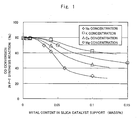
- Fig. 1 is a graph showing a relation between metal contents in a support of silica and a CO conversion.
- Hereinafter, a more detailed description will be given of the present invention.
- With a close look at impurities contained in a catalyst, the present inventors have found that a substantial increase in catalytic activity is possible by reducing the impurities, and that a catalyst with high strength and abrasive resistance can be produced without deteriorating the activity with the use of a specific support, to finally attain the present invention.
- A catalyst according to the present invention is not specifically limited to some one as long as the catalyst contains metal having an activity for a Fischer-Tropsch synthesis reaction, and those catalysts containing iron, cobalt, nickel, ruthenium and the like are acceptable, and as for a support, preferably, a selection is made from porous oxides or the like made of silica, alumina, titania and the like appropriately to use the selection for the catalyst support. For the preparation method of the catalyst, a common impregnation method, an incipient wetness method, a precipitation method, an ion-exchange method and the like can be employed. It is difficult to define a loading amount in that the amount changes depending on respective active metals in use, however, a range between a minimum amount exhibiting the activity or above and a loading amount, which causes a contribution efficiency down in a reaction due to a sharp drop in the dispersion of the active metal on a catalyst support, or below is acceptable. For instance, when the cobalt is in use, the amount is in the range from 5 mass% to 50 mass%, and, preferably, from 10 mass% to 40 mass%. In the case of the amount below the range, enough activity cannot be obtained, and in the case of the amount above the range, the dispersion drops to lower utilization efficiency of the cobalt loaded on the catalyst support uneconomically, being unfavorable.
- After a precursor of active metal is loaded on a catalyst support, calcination and/or reduction is/are performed as appropriate, so that a catalyst for the Fischer-Tropsch synthesis can be obtained.
- After due diligent efforts, the present inventors have found first that the reduction of impurities, which is other than the active metal and an element composing the support, in the catalyst to control the impurities to be within a certain range has a great effect to improve the activity. For instance, as an example, in the case of employing the silica as a support, in general, the silica frequently contains an alkali metal such as Na, an alkaline-earth metal such as Ca and Mg, and Fe, Al, and the like, as the impurities. The effect of these impurities are reviewed in detail using the cobalt as an active metal, and it is found that a large amount of the alkali metal and/or alkaline-earth metal causes a large activity down in the Fischer-Tropsch synthesis reaction. Among those, it is found together that the strongest effect can be seen when sodium is contained.
- In order to cause a desirable catalytic activity, the amount of impurities in the catalyst should be curbed to 0.15 mass% or below. If the impurity amount is above the range, the activity decreases largely, being extremely disadvantage. However, an excessive reduction of the impurities leads to diseconomy, so that a preferable impurity amount in the catalyst is 0.01 mass% or above. It is difficult to limit the impurity amount in the precursor of metallic compound, since it depends on the loading amount and the type of precursor, however, in order to reduce the impurity amount in the catalyst, it is effective to curb the impurity amount in the precursor of active metal, especially, the alkali metal content or the alkaline-earth metal content to 5 mass% or below.
- Further, as a result of due diligent efforts made by the present inventors, it is found that, out of the impurities of the catalyst, the elements causing the most negative impact with respect to the activity of the catalyst are the alkali metal and the alkaline-earth metal. Hence, a relation between the concentrations of these metals in a support of silica and a CO conversion used in a Fischer-Tropsch synthesis reaction, which becomes an indicator of the activity of the catalyst, was examined and the result is shown in Fig. 1. It is obvious from the drawing that, when the contents of these metals are in the range of 0.01 mass% or below, the alkali metal and the alkaline-earth metal affect little, however, when they are in the range over the 0.01 mass%, the activity lowers gradually. As a result of the above-described review, the alkali metal content or the alkaline-earth metal content in the support are preferably 0.1 mass% or below, and more preferably, they are 0.07 mass% or below, and most preferably, they are 0.04 mass% or below. When the impurity content in the support comes to 0.15 mass% or above, the activity of the catalyst falls largely. Also here, in the same manner as above, an excessive reduction of the alkali metal content and alkali-earth metal content in the support leads to diseconomy, the alkali metal and alkali-earth metal may exist in the catalyst to the extent of their contents not affecting adversely the catalytic activity. As described above, when the alkali metal content and alkaline-earth metal content in the support are reduced to 0.01 mass% or below, enough effect can be obtained, so that the alkali metal content and alkaline-earth metal content are preferably 0.01 mass% or above from a cost performance viewpoint.
- In the case of the support which can be produced without impurity contamination in the production process backed by a devisal, it is preferable to take such a devisal of not including the impurities in the production process.
- For instance, generally, a large quantity of rinsing water is used when producing a support of silica, however, when rinsing water containing impurities such as industrial water is used, a large amount of impurities remains in the support, causing the catalytic activity to fall largely, being unfavorable. However, with the use of rinsing water of low impurity content or no impurity, a favorable support of silica of a lesser impurity content can be obtained. In this case, the alkali metal content or the alkaline-earth metal content in the rinsing water is favorably 0.06 mass% or below, and the content above 0.06 mass% leads to the increase in the impurity content in the support of silica, which causes a substantial down in the catalytic activity after the preparation, being unfavorable. Ideally, the use of ion-exchanged water is favorable, in which the ion-exchanged water may be obtained by a production using an ion-exchange resin or the like, however, it may be obtained by a production through an ion exchange using a silica gel, for example, when employing a silica as the support, since the silica gel is generated in the silica production line as a substandard article. In theory, the silica captures the impurities in the rinsing water due to an ion exchange between hydrogen in a silanol on the surface of the silica and an impurity ion. Accordingly, even if it is the rinsing water containing impurities to a small extent, a capture of the impurities can be prevented to some extent by adjusting pH of the rinsing water to lower. Further, an exchanged ion amount (impurity contamination amount) is in proportion to the amount of the rinsing water used, so that the reduction of the impurities in the silica can be realized by reducing the rinsing water, in other words, by increasing a usage efficiency of the water to the end of the water rinsing.
- When it is possible to reduce the impurities in the support by performing a pretreatment without largely changing physical and chemical properties of the catalyst support, such a pretreatment is extremely effective for the improvement of the activity of the catalyst. Such a pretreatment may be the one appropriately using a water rinsing, an acid rinsing, an alkalis rinsing and the like, and, for example, when rinsing the support of silica, rinsing with an acid solution such as a nitric acid solution, a hydrochloric acid solution, an acetic acid solution or the like, and rinsing with an ion-exchanged water are effective. After the rinsing with these acids, when a partial acid remaining in the support comes to be an obstacle, further rinsing with clean water such as ion-exchanged water is effective.
- Further, when preparing silica, calcination is frequently performed in an aim to improve particle strength, an activity of a surface-silanol group and the like. However, when the calcination is performed in the state of containing relatively larger impurities, impurity elements are captured into a skeletal structure of the silica. Accordingly, even if rinse of the support of silica is performed to reduce the impurity content, it is difficult to make the reduction of the impurity content. Hence, when wishing to reduce the impurity content by rinsing the support of silica, the use of a silica gel without calcination is preferable.
- With the use of the catalyst as described above, it is possible to obtain a catalyst exhibiting an extremely high activity in the Fischer-Tropsch synthesis reaction. Specifically, the effect is remarkable when using cobalt as an active metal and silica as a support.
- In order to keep the metal dispersion higher to thereby improve contribution efficiency to the reaction of the active metal loaded, it is preferable to use a catalyst support having a large specific surface area. However, in order to increase the specific surface area, there are needs to decrease a pore diameter and to increase a pore volume, while the increase of these two factors leads to a reduction in the abrasion resistance and strength, being unfavorable. As a result of due diligent efforts, the present inventors have found that, as a support being an object of the present invention, that satisfying together a pore diameter in the range from 8 nm to 50 nm, a specific surface area in the range from 80 m2/g to 550 m2/g, and a pore volume in the range from 0.5 mL/g to 2.0 mL/g, as physical properties thereof, is extremely preferable. More preferably, that satisfying together the pore diameter in the range from 8 nm to 30 nm, the specific surface area in the range from 150 m2/g to 450 m2/g, and the pore volume in the range from 0.6 mL/g to 1.5 mL/g; and most preferably, that satisfying together the pore diameter in the range from 8 nm to 20 nm, the specific surface area in the range from 200 m2/g to 400 m2/g, and the pore volume in the range from 0.8 mL/g to 1.2 mL/g.
- In order to obtain a catalyst exhibiting enough activity in the Fischer-Tropsch synthesis reaction, the specific surface area should be 80 m2/g or more. Under this specific surface area, the dispersion of the loaded metal decreases to lower the contribution efficiency to the reaction of the active metal, being unfavorable. Above the specific surface area of 550 m2/g, it is difficult that the pore volume and the pore diameter satisfy the previously-described ranges together, being unfavorable.
- It is possible to increase the specific surface area as the pore diameter is decreased, however, when the pore diameter comes to below 8 nm, a large amount of light hydrocarbon such as methane, which can be said to be a by-product in the Fischer-Tropsch synthesis reaction, is generated in that the hydrogen and the carbon monoxide have different gaseous diffusion rates in the pore, and, as a result, the hydrogen has a higher partial pressure in the inner portion of the pore, being unfavorable. In addition, the diffusion rate of the generated hydrocarbon in the pore decreases and, as a result, a superficial reaction rate is caused to lower as well, being unfavorable. Further, above the pore diameter of 50 nm, it is difficult to increase the specific surface area, so that the dispersion of the active metal decreases, being unfavorable.
- Preferably, the pore volume is in the range from 0.5 mL/g to 2.0 mL/g. Under 0.5 mL/g, it becomes difficult to satisfy the pore diameter and the specific surface area in the above-described ranges together; and above 2.0 mL/g, the strength deteriorates substantially, being unfavorable.
- As described above, the catalyst for the Fischer-Tropsch synthesis, which is for the slurry bed, requires the abrasion resistance and strength. Further, in the Fischer-Tropsch synthesis reaction, a large amount of water is generated as a by-product, so that the use of a catalyst which is fractured into powders under the existence of water causes an inconvenience as described before, requiring a caution. Accordingly, it is preferable to use a support having a spherical shape rather than a support of a shattered structure potentially having cracks at high probability in which a sharp angle thereof tends to suffer a damage and removal. When producing the spherical support, a granulation or spraying method is applicable, and specifically, when producing a spherical support of silica having a particle diameter of approximately 20 µm to 250 µm, the spraying method is appropriate, by which the spherical support of silica exhibiting excellent abrasion resistance and water resistance can be obtained.
- A producing method of such a support of silica will be described below. A silica sol is generated by mixing an alkali metal silicate solution and an acid solution under the condition from pH 2 to pH 10.5; the silica sol is sprayed into a gas medium or an organic solvent which the sol is insoluble to, so that the sol becomes to a gel; and the silica gel goes through an acid treatment, a water rinsing treatment, and a dry treatment. Here, as an alkali metal silicate solution, a sodium silicate solution is desirable, in which, preferably, the mole ratio of Na2O : SiO2 is 1:1 to 1:5, and the concentration of silica is 5 mass% to 30 mass%. As an acid to be used, a nitric acid, a hydrochloric acid, a sulfuric acid, an organic acid, or the like is applicable, whereas, the sulfuric acid is preferable from a viewpoint that the sulfuric acid is not corrosive to a container used in the production process and leaves no organic matter behind. The concentration of the acid is, preferably, in the range from 1 mol/L to 10 mol/L. Under the range, the progress of the gelation slows significantly, and above the range, the gelation progresses too fast to be difficult to be controlled so that a desired physical property value is difficult to be obtained, being unfavorable. Further, when adopting the method of spraying into the organic solvent, as an organic solvent, kerosene, paraffin, xylene, toluene or the like can be employed.
- The spherical support obtainable by the above-described producing method barely deteriorates by the crash between the catalysts, by the fracture due to water, and by the pulverization. There are various quantification methods for the fracture and pulverization, out of which the present inventors employed an abrasion resistance test to perform an evaluation, in which an ultrasonic wave is emitted at a temperature in the range from a room temperature to 400 °C while dispersing the catalyst into water. As an ultrasonic generator, that of 47 kHz in frequency and 125 W in output power (manufacture: Branson Ultrasonics Corp., product name: BRANSONIC Model 2210J) is used, and 1 g of catalyst not containing particles below 20 µm is dispersed into 3 mL of pure water, the ultrasonic is emitted at a room temperature for four hours, and mass% of the particles below 20 µm in the entire sample is defined as a fractured or pulverized ratio. In this evaluation based on the method, it is confirmed that, when the fractured or pulverized ratio is 10 mass% or below, an actual use in the slurry bed causes no problem in view of the separation of generated high-boiling point hydrocarbon from the catalyst. In the case of a catalyst showing the fractured or pulverized ratio over the 10 mass%, the separation efficiency largely drops, being unfavorable.
- With the use of the composition, structure and producing method as described above, a catalyst for a Fischer-Tropsch synthesis, which exhibits higher activity without deteriorating strength and abrasion resistance of the catalyst, can be obtained.
- Further, with the use of the catalyst for the Fischer-Tropsch synthesis according to the present invention, producing a product is enabled by the Fischer-Tropsch synthesis reaction with higher efficiency and lower costs. Specifically, when the Fischer-Tropsch synthesis reaction is carried out using the catalyst obtainable by the present invention, a selectivity of a liquid product having a carbon number of five or above as a main product is high, and the production rate of the liquid product per a catalyst unit mass (production rate of hydrocarbon) is extremely high. Furthermore, the catalyst is barely pulverized and catalyst activity decrease is very small when it is in use, so that the catalyst has a longer catalytic life, as a feature. With these features, the Fischer-Tropsch synthesis reaction can be carried out with higher efficiency at lower costs.
- Hereinafter, further detailed description will be given of the present invention based on examples; however, the present invention is not limited to these examples.
- Using an autoclave of an internal volume of 300 mL, 2 g of Co/SiO2 catalyst (support of silica is manufactured by Fuji Silysia Chemical Ltd. and of a spherical shape having an average particle diameter of 100 µm, and Co loading amount is from 16 mass% to 30 mass%) and 50 mL of n-C16 (n-hexadecane) were charged thereinto, and after that a Fischer-Tropsch synthesis reaction was carried out under conditions of 230°C and 2.0 MPa-G while stirring an agitator at 800 rpm by introducing a syngas (H2/CO = 2) at a flow rate of W (catalyst mass) / F (syngas flow velocity) = 5 (g·h/mol) except as otherwise specifically provided. A CO conversion, a CH4 selectivity and a CO2 selectivity are calculated by the formulas shown below.


- Hereinafter, an effect of the present invention will be described with a review of the results of examples and a comparison example.
- A 20 mass% of Co was loaded on a support of silica having characteristics as shown in column A in Table 1 and a Fischer-Tropsch synthesis reaction was carried out. As a result, the CO conversion was 75.9%, CH4 selectivity was 5.3% and CO2 selectivity was 1.4 %.
- A 20 mass% of Co was loaded on a support of silica having characteristics as shown in column B in Table 1 and a Fischer-Tropsch synthesis reaction was carried out. As a result, the CO conversion was 75.8%, CH4 selectivity was 4.6% and CO2 selectivity was 1.0 %.
- A support of silica having characteristics as shown in column G in Table 1 was rinsed with a hydrochloric acid solution and an ion-exchanged water to obtain a support of silica as shown in column C in Table 1. A 20 mass% of Co was loaded on the support of silica and a Fischer-Tropsch synthesis reaction was carried out and, as a result, the CO conversion was 74.1%, CH4 selectivity was 4.8% and CO2 selectivity was 1.0 %. Further, an abrasion resistance test emitting a supersonic wave at the room temperature described before was carried out, and the fractured or pulverized rate was measured as a result, the mass ratio of particles of 20 um or below was 0.00%. Still further, the catalyst which had been subjected to the reaction for 1000 hours was collected, and a measurement was made for a particle size distribution. As a result, the mass ratio of particles of 20 µm or below was 0.00%.
- A 20 mass% of Co was loaded on a support of silica of a pore diameter of 30 nm as shown in column D in Table 1 and a Fischer-Tropsch synthesis reaction was carried out. As a result, the CO conversion was 46.4%, CH4 selectivity was 7.8% and CO2 selectivity was 1.0 %.
- The same reaction as in the Example 3 was carried out only by letting a 30 mass% of Co to be loaded on the support and letting W/F to be 1.5 (g.h/mol). As a result, the CO conversion was 74.7%, CH4 selectivity was 3.7% and CO2 selectivity was 0.6 %, and the production rate of the hydrocarbon having a carbon number of 5 or above was 2.1 (kg - hydrocarbon/kg - catalyst · hour)
- A 30 mass% of CO was loaded on a support of silica having physical properties as shown in column E in Table 1 and a Fischer-Tropsch synthesis reaction was carried out by setting the W/F to be 1.5. As a result, the CO conversion was 71.7%, CH4 selectivity was 4.4% and CO2 selectivity was 0.7 %, and the production rate of the hydrocarbon having a carbon number of 5 or above was 1.9 (kg - hydrocarbon/kg catalyst · hour)
- A 16 mass% of CO was loaded on a support of silica having physical properties as shown in column F in Table 1 and a Fischer-Tropsch synthesis reaction was carried out by setting the W/F to be 2. As a result, the CO conversion was 74.8%, CH4 selectivity was 4.9% and CO2 selectivity was 1.1 %, and the production rate of the hydrocarbon having a carbon number of 5 or above was 1.4 (kg - hydrocarbon/kg - catalyst hour)
- A 20 mass% of Co was loaded on a support of silica having a large amount of impurities as shown in column G in Table 1 and a Fischer-Tropsch synthesis reaction was carried out. As a result, the CO conversion was 24.0%, CH4 selectivity was 8.3% and CO2 selectivity was 0.84 %.
- As has been detailed in the above, according to the present invention, a catalyst for a Fischer-Tropsch synthesis, which exhibits an extremely high activity, can be produced without deteriorating strength and abrasion resistance of the catalyst, and a Fischer-Tropsch synthesis reaction exhibiting a higher hydrocarbon production rate can be carried out with the catalyst.
Table 1 mark A B C D E F G Pore diameter (nm) 10 10 10 30 10 8 10 Surface area (m2/g) 250 235 330 110 346 430 341 Pore volume (ml/g) (ml/g) 0.81 0.81 1.13 1.00 1.16 0.82 1.20 Na concentration in support (wt ppm) 120 105 110 180 176 316 1480 Ca concentration in support (wt ppm) 75 32 51 110 111 187 41 Mg concentration in support (wt ppm) 13 8 10 15 16 27 22 Fe concentration in support (wt ppm) 25 20 13 20 29 33 15 Al concentration in support (wt ppm) 94 62 42 34 92 103 50
Claims (13)
- A catalyst for producing hydrocarbon from a syngas, comprising a catalyst support on which a metallic compound is loaded,
wherein an impurity content of said catalyst is in a range from 0.01 mass% to 0.15 mass%. - The catalyst according to claim 1,
wherein an alkali metal or an alkaline-earth metal content in said catalyst support is in a range from 0.01 mass% to 0.1 mass%. - The catalyst according to claim 1 or 2,
wherein said catalyst support satisfies a pore diameter in a range from 8 nm to 50 nm, a surface area in a range from 80 m2/g to 550 m2/g and a pore volume in a range from 0.5 mL/g to 2.0 mL/g, simultaneously. - The catalyst according to any one of claims 1 to 3,
wherein said catalyst support in use is one letting said catalyst have a fracturing or powering ratio of 10% or below when an ultrasonic wave is emitted for four hours at a room temperature to said catalyst dispersed in water. - The catalyst according to any one of claims 1 to 4,
wherein said catalyst support is silica of a spherical shape. - The catalyst according to any one of claims 1 to 5,
wherein said metallic compound contains at least one kind selected from a group consisting of iron, cobalt, nickel and ruthenium. - The catalyst according to claim 6,
wherein said metallic compound is made from a precursor of metallic compound of the alkali metal or alkaline-earth metal content of 5 mass% or below. - A producing method of the catalyst described in any one of claims 1 to 7,
wherein the catalyst is loaded on a catalyst support after a pretreatment to lower an impurity concentration of the catalyst support is performed to the catalyst support. - The producing method of the catalyst according to claim 8,
wherein the pretreatment is rinsing using at least one of acid and an ion-exchange water. - The producing method of the catalyst according to claim 8 or 9,
wherein the catalyst is prepared using a catalyst support obtained using rinsing water of an alkali metal or alkaline-earth metal content of 0.06 mass% or below in said production step of the catalyst support. - The producing method of the catalyst according to any one of claims 8 to 10,
wherein the catalyst support is of a spherical shape shaped by spraying method. - The producing method of the catalyst according to any one of claims 8 to 11,
wherein the catalyst support is silica. - A producing method of hydrocarbon,
wherein the hydrocarbon is produced from a syngas using said catalyst described in any one of claims 1 to 7.
Applications Claiming Priority (2)
| Application Number | Priority Date | Filing Date | Title |
|---|---|---|---|
| JP2003103176 | 2003-04-07 | ||
| PCT/JP2004/005013 WO2004089540A1 (en) | 2003-04-07 | 2004-04-07 | Catalyst for producing hydrocarbon from synthesis gas and method for producing catalyst |
Publications (2)
| Publication Number | Publication Date |
|---|---|
| EP1632289A1 true EP1632289A1 (en) | 2006-03-08 |
| EP1632289A4 EP1632289A4 (en) | 2012-03-07 |
Family
ID=33156819
Family Applications (1)
| Application Number | Title | Priority Date | Filing Date |
|---|---|---|---|
| EP04726307A Ceased EP1632289A4 (en) | 2003-04-07 | 2004-04-07 | CATALYST FOR PRODUCING HYDROCARBON FROM SYNTHESIS GAS AND PROCESS FOR MANUFACTURING THE CATALYST |
Country Status (8)
| Country | Link |
|---|---|
| US (3) | US20060223693A1 (en) |
| EP (1) | EP1632289A4 (en) |
| JP (1) | JP4429063B2 (en) |
| KR (1) | KR101054604B1 (en) |
| CN (1) | CN100479917C (en) |
| AU (1) | AU2004228845B2 (en) |
| RU (1) | RU2311230C2 (en) |
| WO (1) | WO2004089540A1 (en) |
Cited By (5)
| Publication number | Priority date | Publication date | Assignee | Title |
|---|---|---|---|---|
| GB2475492A (en) * | 2009-11-18 | 2011-05-25 | Gtl F1 Ag | Fischer-Tropsch catalyst with an alkaline earth metal content of less than 2000 ppm |
| AU2007288693B2 (en) * | 2006-08-25 | 2011-10-13 | Nippon Steel Engineering Co., Ltd. | Catalyst for producing hydrocarbon from synthetic gas, method for producing catalyst, method for regenerating catalyst, and method for producing hydrocarbon from synthetic gas |
| US8969231B2 (en) | 2009-09-01 | 2015-03-03 | Gtl.Fi Ag | Fischer-Tropsch catalysts |
| DE102014203877A1 (en) | 2014-03-04 | 2015-09-10 | Wacker Chemie Ag | Catalyst for the Fischer-Tropsch synthesis and process for its preparation |
| US9242229B2 (en) | 2010-08-09 | 2016-01-26 | Gtl.F1 Ag | Fischer-tropsch catalysts |
Families Citing this family (23)
| Publication number | Priority date | Publication date | Assignee | Title |
|---|---|---|---|---|
| US20060223693A1 (en) | 2003-04-07 | 2006-10-05 | Kenichiro Fujimoto | Catalyst for producing hydrocarbon from synthsis gas and method for producing catalyst |
| GB2410449B (en) | 2004-01-28 | 2008-05-21 | Statoil Asa | Fischer-Tropsch catalysts |
| AU2005286263B2 (en) * | 2004-09-23 | 2010-07-08 | Petro Sa | Promoted Fischer-Tropsch catalysts |
| GB0506976D0 (en) * | 2005-04-06 | 2005-05-11 | Johnson Matthey Plc | Catalyst supports |
| JP4827432B2 (en) * | 2005-04-20 | 2011-11-30 | 新日本製鐵株式会社 | Catalyst for FT synthesis reaction |
| JP4698343B2 (en) * | 2005-09-01 | 2011-06-08 | 新日本製鐵株式会社 | Catalyst for producing hydrocarbons from synthesis gas, method for producing the catalyst, and method for producing hydrocarbons from synthesis gas using the catalyst |
| JP5100151B2 (en) * | 2006-02-28 | 2012-12-19 | 新日鐵住金株式会社 | Catalyst for producing hydrocarbons from synthesis gas, catalyst production method, method for producing hydrocarbons from synthesis gas, and catalyst regeneration method |
| JP4808688B2 (en) * | 2006-08-25 | 2011-11-02 | 新日本製鐵株式会社 | Catalyst for producing hydrocarbons from synthesis gas, catalyst production method, catalyst regeneration method, and method for producing hydrocarbons from synthesis gas |
| CN100493701C (en) * | 2007-05-08 | 2009-06-03 | 中科合成油技术有限公司 | Method for proceeding Feituo Synthesizing reaction and catalyst specially for the same |
| KR100998083B1 (en) * | 2008-09-25 | 2010-12-16 | 한국화학연구원 | Process for preparing liquid hydrocarbon compounds by slurry reaction for Fischer-Tropsch synthesis |
| EP2408554B1 (en) * | 2009-03-16 | 2016-12-14 | Basf Se | Catalyst carrier based on silica gel |
| JP5493928B2 (en) * | 2009-07-10 | 2014-05-14 | 三菱化学株式会社 | Process for producing hydrocarbons |
| JP5883791B2 (en) | 2009-09-30 | 2016-03-15 | サノフィ−アベンティス・ドイチュラント・ゲゼルシャフト・ミット・ベシュレンクテル・ハフツング | Drug delivery device, assembly for drug delivery device and method for setting up drug delivery device |
| JP5649849B2 (en) * | 2010-04-19 | 2015-01-07 | 日揮触媒化成株式会社 | Method for producing carbon monoxide reduction catalyst and carbon monoxide reduction catalyst |
| WO2012107718A2 (en) * | 2011-02-07 | 2012-08-16 | Oxford Catalysts Limited | Catalysts |
| WO2013041997A1 (en) * | 2011-09-21 | 2013-03-28 | Sasol Technology (Proprietary) Limited | Process for preparing a cobalt - containing fischer tropsch catalyst |
| KR101181954B1 (en) * | 2012-02-07 | 2012-09-11 | 한국과학기술원 | Manufacturing method of heterogeneous catalyst using space specificity |
| JP5919145B2 (en) * | 2012-09-03 | 2016-05-18 | 新日鉄住金エンジニアリング株式会社 | Method for producing catalyst for producing hydrocarbons from synthesis gas, method for producing hydrocarbons from synthesis gas, and method for regenerating catalyst |
| CN104624192B (en) * | 2015-01-23 | 2017-04-12 | 武汉凯迪工程技术研究总院有限公司 | Cobalt-based fischer-tropsch synthesis catalyst and preparation method and application |
| JP2016182544A (en) * | 2015-03-25 | 2016-10-20 | 東ソー株式会社 | Catalyst for hydrogenation reaction and method for producing alicyclic compound using the same |
| CN105032496B (en) * | 2015-06-16 | 2017-11-07 | 武汉凯迪工程技术研究总院有限公司 | Carrier and its catalyst and preparation method for synthesis gas selectivity synthesis high-quality kerosene distillate |
| JP6839602B2 (en) * | 2017-05-01 | 2021-03-10 | 日鉄エンジニアリング株式会社 | A method for producing a catalyst for producing a hydrocarbon from a synthetic gas, and a method for producing a hydrocarbon for producing a hydrocarbon from a synthetic gas. |
| JP7018754B2 (en) * | 2017-12-08 | 2022-02-14 | 日鉄エンジニアリング株式会社 | A catalyst for producing a hydrocarbon from syngas, a method for producing the catalyst, a method for producing a hydrocarbon from syngas, and a catalyst carrier. |
Family Cites Families (17)
| Publication number | Priority date | Publication date | Assignee | Title |
|---|---|---|---|---|
| US3969274A (en) * | 1974-03-14 | 1976-07-13 | National Distillers And Chemical Corporation | Fixed bed catalyst |
| US4154751A (en) * | 1978-03-01 | 1979-05-15 | Exxon Research & Engineering Co. | Preparation and use of supported potassium (or rubidium)-Group VIII-metal cluster catalysts in CO/H2 Fischer-Tropsch synthesis reactions |
| US4544674A (en) * | 1983-12-14 | 1985-10-01 | Exxon Research And Engineering Co. | Cobalt-promoted fischer-tropsch catalysts |
| GB8925979D0 (en) * | 1989-11-16 | 1990-01-04 | Shell Int Research | Process for the preparation of extrudates,extrudates,and use of the extrudates |
| GB9010076D0 (en) * | 1990-05-04 | 1990-06-27 | Shell Int Research | Process for the conversion of methanol into liquid hydrocarbons |
| GB9103417D0 (en) * | 1991-02-19 | 1991-04-03 | Shell Int Research | Washing treatment for catalysts and/or catalyst precursors |
| GB9117899D0 (en) | 1991-08-20 | 1991-10-09 | Shell Int Research | Process for the activation of a catalyst |
| US5604170A (en) * | 1993-02-23 | 1997-02-18 | Nippon Oil Company, Limited | Solid catalyst components for olefin polemerization and use thereof |
| DZ2013A1 (en) * | 1995-04-07 | 2002-10-23 | Sastech Ltd | Catalysts. |
| NO313086B1 (en) * | 1995-08-04 | 2002-08-12 | Inst Francais Du Petrole | Process for preparing a catalyst, catalyst obtainable therewith, catalyst mixture obtained thereby, and process for the synthesis of hydrocarbons |
| ZA9711090B (en) * | 1996-12-13 | 1998-06-15 | Shell Int Research | Process for the preparation of hydrocarbons. |
| KR20020010673A (en) | 1998-05-27 | 2002-02-04 | 에너지 인터내셔날 코포레이션 | Improved fischer-tropsch activity for 'non-promoted' cobalt-on-alumina catalysts |
| US6271432B2 (en) * | 1998-05-27 | 2001-08-07 | Energy International | Fischer-tropsch activity for non-promoted cobalt-on-alumina catalysts |
| US6191066B1 (en) * | 1998-05-27 | 2001-02-20 | Energy International Corporation | Fischer-Tropsch activity for non-promoted cobalt-on-alumina catalysts |
| CN1181105C (en) * | 2000-08-22 | 2004-12-22 | 中国石油化工股份有限公司 | High activity silica gel carrier catalyst component for ethylene polymerisation or copolymerisation and its catalyst and use of said catalyst |
| JP4911974B2 (en) | 2003-03-26 | 2012-04-04 | Jx日鉱日石エネルギー株式会社 | Fischer-Tropsch synthesis catalyst and hydrocarbon production process |
| US20060223693A1 (en) | 2003-04-07 | 2006-10-05 | Kenichiro Fujimoto | Catalyst for producing hydrocarbon from synthsis gas and method for producing catalyst |
-
2004
- 2004-04-07 US US10/552,234 patent/US20060223693A1/en not_active Abandoned
- 2004-04-07 JP JP2004113383A patent/JP4429063B2/en not_active Expired - Fee Related
- 2004-04-07 EP EP04726307A patent/EP1632289A4/en not_active Ceased
- 2004-04-07 AU AU2004228845A patent/AU2004228845B2/en not_active Ceased
- 2004-04-07 KR KR1020057018995A patent/KR101054604B1/en not_active Expired - Fee Related
- 2004-04-07 RU RU2005134237/04A patent/RU2311230C2/en not_active IP Right Cessation
- 2004-04-07 CN CNB2004800093138A patent/CN100479917C/en not_active Expired - Fee Related
- 2004-04-07 WO PCT/JP2004/005013 patent/WO2004089540A1/en not_active Ceased
-
2010
- 2010-03-30 US US12/750,451 patent/US8178589B2/en not_active Expired - Fee Related
-
2012
- 2012-04-12 US US13/445,484 patent/US8524788B2/en not_active Expired - Fee Related
Cited By (8)
| Publication number | Priority date | Publication date | Assignee | Title |
|---|---|---|---|---|
| AU2007288693B2 (en) * | 2006-08-25 | 2011-10-13 | Nippon Steel Engineering Co., Ltd. | Catalyst for producing hydrocarbon from synthetic gas, method for producing catalyst, method for regenerating catalyst, and method for producing hydrocarbon from synthetic gas |
| US8969231B2 (en) | 2009-09-01 | 2015-03-03 | Gtl.Fi Ag | Fischer-Tropsch catalysts |
| GB2475492A (en) * | 2009-11-18 | 2011-05-25 | Gtl F1 Ag | Fischer-Tropsch catalyst with an alkaline earth metal content of less than 2000 ppm |
| WO2011061484A3 (en) * | 2009-11-18 | 2011-07-07 | Gtl.F1 Ag | Fischer-tropsch catalyst comprising supported cobalt and low levels of alkaline earth metals, its preparation method and use for producing hydrocarbons |
| GB2475492B (en) * | 2009-11-18 | 2014-12-31 | Gtl F1 Ag | Fischer-Tropsch synthesis |
| US10040054B2 (en) | 2009-11-18 | 2018-08-07 | Gtl.Fi Ag | Fischer-Tropsch synthesis |
| US9242229B2 (en) | 2010-08-09 | 2016-01-26 | Gtl.F1 Ag | Fischer-tropsch catalysts |
| DE102014203877A1 (en) | 2014-03-04 | 2015-09-10 | Wacker Chemie Ag | Catalyst for the Fischer-Tropsch synthesis and process for its preparation |
Also Published As
| Publication number | Publication date |
|---|---|
| US20100184876A1 (en) | 2010-07-22 |
| WO2004089540A1 (en) | 2004-10-21 |
| EP1632289A4 (en) | 2012-03-07 |
| CN100479917C (en) | 2009-04-22 |
| RU2311230C2 (en) | 2007-11-27 |
| RU2005134237A (en) | 2007-05-20 |
| KR101054604B1 (en) | 2011-08-04 |
| AU2004228845B2 (en) | 2009-07-09 |
| US8178589B2 (en) | 2012-05-15 |
| CN1771086A (en) | 2006-05-10 |
| US20120289615A1 (en) | 2012-11-15 |
| US8524788B2 (en) | 2013-09-03 |
| JP2004322085A (en) | 2004-11-18 |
| US20060223693A1 (en) | 2006-10-05 |
| JP4429063B2 (en) | 2010-03-10 |
| KR20060007013A (en) | 2006-01-23 |
| AU2004228845A1 (en) | 2004-10-21 |
Similar Documents
| Publication | Publication Date | Title |
|---|---|---|
| US8178589B2 (en) | Catalyst for producing hydrocarbon from syngas and producing method of catalyst | |
| EP4223412B1 (en) | Ammonia decomposition catalyst | |
| KR101906620B1 (en) | Chabazite type zeolite and process for production thereof, copper-carrying low-silica zeolite, nox reductive elimination catalyst including said zeolite, and method for reductive elimination of nox employing said catalyst | |
| JP4677539B2 (en) | Fischer-Tropsch catalyst | |
| EP2055381A1 (en) | Catalyst for producing hydrocarbon from synthetic gas, method for producing catalyst, method for regenerating catalyst, and method for producing hydrocarbon from synthetic gas | |
| JP4808688B2 (en) | Catalyst for producing hydrocarbons from synthesis gas, catalyst production method, catalyst regeneration method, and method for producing hydrocarbons from synthesis gas | |
| CN116440898B (en) | Atomic-level dispersed Pd-Pt catalyst for dinitrotoluene hydrogenation reaction and preparation method and application thereof | |
| CN113145144A (en) | A kind of Ni3P/SiO2 catalyst and its preparation method and application | |
| WO2017208099A1 (en) | Catalysts made with manganese tungsten oxide for the oxidative coupling of methane | |
| CN109734601B (en) | Method for preparing 1, 3-propane diamine | |
| CN109621968B (en) | High-pressure low-sulfur-resistant shift catalyst and preparation method thereof | |
| JP5919145B2 (en) | Method for producing catalyst for producing hydrocarbons from synthesis gas, method for producing hydrocarbons from synthesis gas, and method for regenerating catalyst | |
| JP5100151B2 (en) | Catalyst for producing hydrocarbons from synthesis gas, catalyst production method, method for producing hydrocarbons from synthesis gas, and catalyst regeneration method | |
| KR101594901B1 (en) | Cokes oven gas reforming catalyst for manufacturing synthesis gas, method for preparing the same and method for manufacturing synthesis gas from cokes oven gas using the same | |
| WO2005030391A1 (en) | Catalyst and method for the generation of co-free hydrogen from methane | |
| CN104383935B (en) | A kind of preparation method of nickel-based catalyst for hydrogen production by cracking methanol | |
| CN111434382B (en) | Rh-based catalyst promoted by vanadium oxide supported by carrier, and preparation method and application thereof | |
| JP5649849B2 (en) | Method for producing carbon monoxide reduction catalyst and carbon monoxide reduction catalyst | |
| CN108620084B (en) | A kind of bulk nickel-molybdenum catalyst for aniline production by liquid-phase hydrogenation of nitrobenzene and preparation method thereof | |
| JP7018754B2 (en) | A catalyst for producing a hydrocarbon from syngas, a method for producing the catalyst, a method for producing a hydrocarbon from syngas, and a catalyst carrier. | |
| CN119215905B (en) | A hydrophobic catalyst for the hydrogenation of carbon dioxide to methanol and its preparation method | |
| US20260098023A1 (en) | Method for hydrogenation of furfural to bio-fuel | |
| WO2026105821A1 (en) | Catalyst body, method for producing catalyst body, method for producing fuel, and gas phase reaction device | |
| CN118807754A (en) | A dual-active metal dehydrogenation catalyst and its preparation method and application | |
| JP2006297273A (en) | Catalyst for FT synthesis reaction |
Legal Events
| Date | Code | Title | Description |
|---|---|---|---|
| PUAI | Public reference made under article 153(3) epc to a published international application that has entered the european phase |
Free format text: ORIGINAL CODE: 0009012 |
|
| 17P | Request for examination filed |
Effective date: 20051027 |
|
| AK | Designated contracting states |
Kind code of ref document: A1 Designated state(s): DE FR GB IT NL |
|
| DAX | Request for extension of the european patent (deleted) | ||
| RBV | Designated contracting states (corrected) |
Designated state(s): DE FR GB IT NL |
|
| A4 | Supplementary search report drawn up and despatched |
Effective date: 20120206 |
|
| RIC1 | Information provided on ipc code assigned before grant |
Ipc: B01J 37/02 20060101ALI20120131BHEP Ipc: B01J 23/74 20060101AFI20120131BHEP Ipc: B01J 35/08 20060101ALI20120131BHEP Ipc: C10G 2/00 20060101ALI20120131BHEP Ipc: B01J 35/10 20060101ALI20120131BHEP Ipc: B01J 35/02 20060101ALI20120131BHEP |
|
| 17Q | First examination report despatched |
Effective date: 20120921 |
|
| RAP1 | Party data changed (applicant data changed or rights of an application transferred) |
Owner name: JAPAN OIL GAS AND METALS NATIONAL CORPORATION Owner name: NIPPON STEEL & SUMITOMO METAL CORPORATION |
|
| RAP1 | Party data changed (applicant data changed or rights of an application transferred) |
Owner name: NIPPON STEEL CORPORATION Owner name: JAPAN OIL GAS AND METALS NATIONAL CORPORATION |
|
| REG | Reference to a national code |
Ref country code: DE Ref legal event code: R003 |
|
| STAA | Information on the status of an ep patent application or granted ep patent |
Free format text: STATUS: THE APPLICATION HAS BEEN REFUSED |
|
| 18R | Application refused |
Effective date: 20200903 |