EP1631699B1 - Passivierung der stahloberfläche für das verringern der formung von koks - Google Patents
Passivierung der stahloberfläche für das verringern der formung von koks Download PDFInfo
- Publication number
- EP1631699B1 EP1631699B1 EP04728143A EP04728143A EP1631699B1 EP 1631699 B1 EP1631699 B1 EP 1631699B1 EP 04728143 A EP04728143 A EP 04728143A EP 04728143 A EP04728143 A EP 04728143A EP 1631699 B1 EP1631699 B1 EP 1631699B1
- Authority
- EP
- European Patent Office
- Prior art keywords
- weight
- steam
- steel
- hours
- process according
- Prior art date
- Legal status (The legal status is an assumption and is not a legal conclusion. Google has not performed a legal analysis and makes no representation as to the accuracy of the status listed.)
- Expired - Lifetime
Links
- 229910000831 Steel Inorganic materials 0.000 title claims abstract description 45
- 239000010959 steel Substances 0.000 title claims abstract description 45
- 239000000571 coke Substances 0.000 title abstract description 53
- 230000015572 biosynthetic process Effects 0.000 title description 20
- 238000002161 passivation Methods 0.000 title description 6
- 238000000034 method Methods 0.000 claims abstract description 38
- 229930195733 hydrocarbon Natural products 0.000 claims abstract description 26
- 150000002430 hydrocarbons Chemical class 0.000 claims abstract description 26
- 239000000203 mixture Substances 0.000 claims abstract description 26
- 239000007789 gas Substances 0.000 claims description 26
- XKRFYHLGVUSROY-UHFFFAOYSA-N Argon Chemical compound [Ar] XKRFYHLGVUSROY-UHFFFAOYSA-N 0.000 claims description 16
- IJGRMHOSHXDMSA-UHFFFAOYSA-N Atomic nitrogen Chemical compound N#N IJGRMHOSHXDMSA-UHFFFAOYSA-N 0.000 claims description 16
- 239000004215 Carbon black (E152) Substances 0.000 claims description 15
- OTMSDBZUPAUEDD-UHFFFAOYSA-N Ethane Chemical compound CC OTMSDBZUPAUEDD-UHFFFAOYSA-N 0.000 claims description 15
- 239000011261 inert gas Substances 0.000 claims description 15
- WQOXQRCZOLPYPM-UHFFFAOYSA-N dimethyl disulfide Chemical compound CSSC WQOXQRCZOLPYPM-UHFFFAOYSA-N 0.000 claims description 12
- 238000004939 coking Methods 0.000 claims description 11
- 238000012546 transfer Methods 0.000 claims description 11
- 239000012159 carrier gas Substances 0.000 claims description 10
- 229910052786 argon Inorganic materials 0.000 claims description 8
- AUZONCFQVSMFAP-UHFFFAOYSA-N disulfiram Chemical compound CCN(CC)C(=S)SSC(=S)N(CC)CC AUZONCFQVSMFAP-UHFFFAOYSA-N 0.000 claims description 8
- 239000001257 hydrogen Substances 0.000 claims description 8
- 229910052739 hydrogen Inorganic materials 0.000 claims description 8
- 229910052757 nitrogen Inorganic materials 0.000 claims description 8
- 239000000126 substance Substances 0.000 claims description 7
- UFHFLCQGNIYNRP-UHFFFAOYSA-N Hydrogen Chemical compound [H][H] UFHFLCQGNIYNRP-UHFFFAOYSA-N 0.000 claims description 6
- ATUOYWHBWRKTHZ-UHFFFAOYSA-N Propane Chemical compound CCC ATUOYWHBWRKTHZ-UHFFFAOYSA-N 0.000 claims description 6
- 239000001307 helium Substances 0.000 claims description 6
- 229910052734 helium Inorganic materials 0.000 claims description 6
- SWQJXJOGLNCZEY-UHFFFAOYSA-N helium atom Chemical compound [He] SWQJXJOGLNCZEY-UHFFFAOYSA-N 0.000 claims description 6
- 229910052742 iron Inorganic materials 0.000 claims description 6
- 229920001021 polysulfide Polymers 0.000 claims description 6
- 239000005077 polysulfide Substances 0.000 claims description 6
- 150000008117 polysulfides Polymers 0.000 claims description 6
- LXXNWCFBZHKFPT-UHFFFAOYSA-N Ethyl 2-mercaptopropionate Chemical compound CCOC(=O)C(C)S LXXNWCFBZHKFPT-UHFFFAOYSA-N 0.000 claims description 4
- VONWDASPFIQPDY-UHFFFAOYSA-N dimethyl methylphosphonate Chemical compound COP(C)(=O)OC VONWDASPFIQPDY-UHFFFAOYSA-N 0.000 claims description 4
- 229960002563 disulfiram Drugs 0.000 claims description 4
- 239000003921 oil Substances 0.000 claims description 4
- JOBBTVPTPXRUBP-UHFFFAOYSA-N [3-(3-sulfanylpropanoyloxy)-2,2-bis(3-sulfanylpropanoyloxymethyl)propyl] 3-sulfanylpropanoate Chemical compound SCCC(=O)OCC(COC(=O)CCS)(COC(=O)CCS)COC(=O)CCS JOBBTVPTPXRUBP-UHFFFAOYSA-N 0.000 claims description 3
- 239000001273 butane Substances 0.000 claims description 3
- IJDNQMDRQITEOD-UHFFFAOYSA-N n-butane Chemical compound CCCC IJDNQMDRQITEOD-UHFFFAOYSA-N 0.000 claims description 3
- OFBQJSOFQDEBGM-UHFFFAOYSA-N n-pentane Natural products CCCCC OFBQJSOFQDEBGM-UHFFFAOYSA-N 0.000 claims description 3
- 239000001294 propane Substances 0.000 claims description 3
- 229910052799 carbon Inorganic materials 0.000 claims description 2
- 239000010779 crude oil Substances 0.000 claims description 2
- 150000001875 compounds Chemical class 0.000 abstract description 15
- 229910000975 Carbon steel Inorganic materials 0.000 abstract description 8
- 239000010962 carbon steel Substances 0.000 abstract description 5
- 238000006722 reduction reaction Methods 0.000 description 30
- 230000009467 reduction Effects 0.000 description 29
- XEEYBQQBJWHFJM-UHFFFAOYSA-N Iron Chemical compound [Fe] XEEYBQQBJWHFJM-UHFFFAOYSA-N 0.000 description 20
- 238000005755 formation reaction Methods 0.000 description 19
- 238000005336 cracking Methods 0.000 description 15
- SZVJSHCCFOBDDC-UHFFFAOYSA-N ferrosoferric oxide Chemical compound O=[Fe]O[Fe]O[Fe]=O SZVJSHCCFOBDDC-UHFFFAOYSA-N 0.000 description 14
- 238000011282 treatment Methods 0.000 description 11
- 239000003112 inhibitor Substances 0.000 description 10
- 238000002474 experimental method Methods 0.000 description 9
- 238000012360 testing method Methods 0.000 description 9
- 230000002401 inhibitory effect Effects 0.000 description 7
- 229910052751 metal Inorganic materials 0.000 description 6
- 239000002184 metal Substances 0.000 description 6
- 229910001220 stainless steel Inorganic materials 0.000 description 6
- 238000002347 injection Methods 0.000 description 5
- 239000007924 injection Substances 0.000 description 5
- JEIPFZHSYJVQDO-UHFFFAOYSA-N iron(III) oxide Inorganic materials O=[Fe]O[Fe]=O JEIPFZHSYJVQDO-UHFFFAOYSA-N 0.000 description 5
- 239000010935 stainless steel Substances 0.000 description 5
- 239000011651 chromium Substances 0.000 description 4
- 239000000843 powder Substances 0.000 description 4
- 239000000047 product Substances 0.000 description 4
- 238000010926 purge Methods 0.000 description 4
- 238000010791 quenching Methods 0.000 description 4
- 238000004230 steam cracking Methods 0.000 description 4
- 150000004763 sulfides Chemical class 0.000 description 4
- XLYOFNOQVPJJNP-UHFFFAOYSA-N water Chemical compound O XLYOFNOQVPJJNP-UHFFFAOYSA-N 0.000 description 4
- 238000004458 analytical method Methods 0.000 description 3
- 229910052804 chromium Inorganic materials 0.000 description 3
- 238000000354 decomposition reaction Methods 0.000 description 3
- UQSXHKLRYXJYBZ-UHFFFAOYSA-N iron oxide Inorganic materials [Fe]=O UQSXHKLRYXJYBZ-UHFFFAOYSA-N 0.000 description 3
- 230000003647 oxidation Effects 0.000 description 3
- 238000007254 oxidation reaction Methods 0.000 description 3
- 238000012545 processing Methods 0.000 description 3
- 239000010453 quartz Substances 0.000 description 3
- 230000000171 quenching effect Effects 0.000 description 3
- VYPSYNLAJGMNEJ-UHFFFAOYSA-N silicon dioxide Inorganic materials O=[Si]=O VYPSYNLAJGMNEJ-UHFFFAOYSA-N 0.000 description 3
- ZSAZGCBSZUURAX-UHFFFAOYSA-N 1-chloro-4-(diethoxyphosphorylsulfanylmethylsulfanyl)benzene Chemical compound CCOP(=O)(OCC)SCSC1=CC=C(Cl)C=C1 ZSAZGCBSZUURAX-UHFFFAOYSA-N 0.000 description 2
- VTBHBNXGFPTBJL-UHFFFAOYSA-N 4-tert-butyl-1-sulfanylidene-2,6,7-trioxa-1$l^{5}-phosphabicyclo[2.2.2]octane Chemical compound C1OP2(=S)OCC1(C(C)(C)C)CO2 VTBHBNXGFPTBJL-UHFFFAOYSA-N 0.000 description 2
- 229910000851 Alloy steel Inorganic materials 0.000 description 2
- CURLTUGMZLYLDI-UHFFFAOYSA-N Carbon dioxide Chemical class O=C=O CURLTUGMZLYLDI-UHFFFAOYSA-N 0.000 description 2
- VGGSQFUCUMXWEO-UHFFFAOYSA-N Ethene Chemical compound C=C VGGSQFUCUMXWEO-UHFFFAOYSA-N 0.000 description 2
- 239000005977 Ethylene Substances 0.000 description 2
- 229910005390 FeSO4-7H2O Inorganic materials 0.000 description 2
- 229910005444 FeSO4—7H2O Inorganic materials 0.000 description 2
- 101000574396 Homo sapiens Protein phosphatase 1K, mitochondrial Proteins 0.000 description 2
- 102100025799 Protein phosphatase 1K, mitochondrial Human genes 0.000 description 2
- 150000001335 aliphatic alkanes Chemical class 0.000 description 2
- 229910045601 alloy Inorganic materials 0.000 description 2
- 239000000956 alloy Substances 0.000 description 2
- 150000005840 aryl radicals Chemical class 0.000 description 2
- 229910002092 carbon dioxide Inorganic materials 0.000 description 2
- 238000006243 chemical reaction Methods 0.000 description 2
- VLXBWPOEOIIREY-UHFFFAOYSA-N dimethyl diselenide Natural products C[Se][Se]C VLXBWPOEOIIREY-UHFFFAOYSA-N 0.000 description 2
- 238000005516 engineering process Methods 0.000 description 2
- -1 hydrocarbyl radical Chemical class 0.000 description 2
- 150000002431 hydrogen Chemical class 0.000 description 2
- 229910052960 marcasite Inorganic materials 0.000 description 2
- VNWKTOKETHGBQD-UHFFFAOYSA-N methane Chemical compound C VNWKTOKETHGBQD-UHFFFAOYSA-N 0.000 description 2
- 239000003208 petroleum Substances 0.000 description 2
- NIFIFKQPDTWWGU-UHFFFAOYSA-N pyrite Chemical compound [Fe+2].[S-][S-] NIFIFKQPDTWWGU-UHFFFAOYSA-N 0.000 description 2
- 229910052683 pyrite Inorganic materials 0.000 description 2
- 150000003839 salts Chemical class 0.000 description 2
- ZOXJGFHDIHLPTG-UHFFFAOYSA-N Boron Chemical compound [B] ZOXJGFHDIHLPTG-UHFFFAOYSA-N 0.000 description 1
- OKTJSMMVPCPJKN-UHFFFAOYSA-N Carbon Chemical compound [C] OKTJSMMVPCPJKN-UHFFFAOYSA-N 0.000 description 1
- UGFAIRIUMAVXCW-UHFFFAOYSA-N Carbon monoxide Chemical class [O+]#[C-] UGFAIRIUMAVXCW-UHFFFAOYSA-N 0.000 description 1
- VYZAMTAEIAYCRO-UHFFFAOYSA-N Chromium Chemical compound [Cr] VYZAMTAEIAYCRO-UHFFFAOYSA-N 0.000 description 1
- GYHNNYVSQQEPJS-UHFFFAOYSA-N Gallium Chemical compound [Ga] GYHNNYVSQQEPJS-UHFFFAOYSA-N 0.000 description 1
- XUIMIQQOPSSXEZ-UHFFFAOYSA-N Silicon Chemical compound [Si] XUIMIQQOPSSXEZ-UHFFFAOYSA-N 0.000 description 1
- ATJFFYVFTNAWJD-UHFFFAOYSA-N Tin Chemical compound [Sn] ATJFFYVFTNAWJD-UHFFFAOYSA-N 0.000 description 1
- RTAQQCXQSZGOHL-UHFFFAOYSA-N Titanium Chemical compound [Ti] RTAQQCXQSZGOHL-UHFFFAOYSA-N 0.000 description 1
- 239000002253 acid Substances 0.000 description 1
- 229910052782 aluminium Inorganic materials 0.000 description 1
- XAGFODPZIPBFFR-UHFFFAOYSA-N aluminium Chemical compound [Al] XAGFODPZIPBFFR-UHFFFAOYSA-N 0.000 description 1
- PNEYBMLMFCGWSK-UHFFFAOYSA-N aluminium oxide Inorganic materials [O-2].[O-2].[O-2].[Al+3].[Al+3] PNEYBMLMFCGWSK-UHFFFAOYSA-N 0.000 description 1
- 150000001412 amines Chemical class 0.000 description 1
- 229910052787 antimony Inorganic materials 0.000 description 1
- WATWJIUSRGPENY-UHFFFAOYSA-N antimony atom Chemical compound [Sb] WATWJIUSRGPENY-UHFFFAOYSA-N 0.000 description 1
- 238000013459 approach Methods 0.000 description 1
- QVGXLLKOCUKJST-UHFFFAOYSA-N atomic oxygen Chemical compound [O] QVGXLLKOCUKJST-UHFFFAOYSA-N 0.000 description 1
- 238000000889 atomisation Methods 0.000 description 1
- 229910052796 boron Inorganic materials 0.000 description 1
- 125000004432 carbon atom Chemical group C* 0.000 description 1
- 229910002090 carbon oxide Inorganic materials 0.000 description 1
- 230000003197 catalytic effect Effects 0.000 description 1
- 238000009833 condensation Methods 0.000 description 1
- 230000005494 condensation Effects 0.000 description 1
- 238000001816 cooling Methods 0.000 description 1
- 238000005260 corrosion Methods 0.000 description 1
- 230000007797 corrosion Effects 0.000 description 1
- 238000011161 development Methods 0.000 description 1
- 238000001473 dynamic force microscopy Methods 0.000 description 1
- 230000000694 effects Effects 0.000 description 1
- 229910052733 gallium Inorganic materials 0.000 description 1
- 150000002429 hydrazines Chemical class 0.000 description 1
- 125000004435 hydrogen atom Chemical group [H]* 0.000 description 1
- 150000002443 hydroxylamines Chemical class 0.000 description 1
- 238000011065 in-situ storage Methods 0.000 description 1
- 239000013067 intermediate product Substances 0.000 description 1
- BAUYGSIQEAFULO-UHFFFAOYSA-L iron(2+) sulfate (anhydrous) Chemical compound [Fe+2].[O-]S([O-])(=O)=O BAUYGSIQEAFULO-UHFFFAOYSA-L 0.000 description 1
- 229910000359 iron(II) sulfate Inorganic materials 0.000 description 1
- 239000007788 liquid Substances 0.000 description 1
- 238000012423 maintenance Methods 0.000 description 1
- 229910052748 manganese Inorganic materials 0.000 description 1
- 238000004519 manufacturing process Methods 0.000 description 1
- 239000000463 material Substances 0.000 description 1
- 230000007246 mechanism Effects 0.000 description 1
- 150000002739 metals Chemical class 0.000 description 1
- 239000003607 modifier Substances 0.000 description 1
- 229910052759 nickel Inorganic materials 0.000 description 1
- 229910052758 niobium Inorganic materials 0.000 description 1
- 239000010955 niobium Substances 0.000 description 1
- GUCVJGMIXFAOAE-UHFFFAOYSA-N niobium atom Chemical compound [Nb] GUCVJGMIXFAOAE-UHFFFAOYSA-N 0.000 description 1
- 150000002903 organophosphorus compounds Chemical class 0.000 description 1
- 230000001590 oxidative effect Effects 0.000 description 1
- 239000001301 oxygen Substances 0.000 description 1
- 229910052760 oxygen Inorganic materials 0.000 description 1
- NFHFRUOZVGFOOS-UHFFFAOYSA-N palladium;triphenylphosphane Chemical compound [Pd].C1=CC=CC=C1P(C=1C=CC=CC=1)C1=CC=CC=C1.C1=CC=CC=C1P(C=1C=CC=CC=1)C1=CC=CC=C1.C1=CC=CC=C1P(C=1C=CC=CC=1)C1=CC=CC=C1.C1=CC=CC=C1P(C=1C=CC=CC=1)C1=CC=CC=C1 NFHFRUOZVGFOOS-UHFFFAOYSA-N 0.000 description 1
- 239000002245 particle Substances 0.000 description 1
- WXZMFSXDPGVJKK-UHFFFAOYSA-N pentaerythritol Chemical compound OCC(CO)(CO)CO WXZMFSXDPGVJKK-UHFFFAOYSA-N 0.000 description 1
- 238000011112 process operation Methods 0.000 description 1
- 230000001737 promoting effect Effects 0.000 description 1
- 238000000197 pyrolysis Methods 0.000 description 1
- 230000035484 reaction time Effects 0.000 description 1
- 229920006395 saturated elastomer Polymers 0.000 description 1
- 229910052710 silicon Inorganic materials 0.000 description 1
- 239000010703 silicon Substances 0.000 description 1
- 239000000243 solution Substances 0.000 description 1
- 230000003746 surface roughness Effects 0.000 description 1
- 238000004381 surface treatment Methods 0.000 description 1
- 150000003585 thioureas Chemical class 0.000 description 1
- KUAZQDVKQLNFPE-UHFFFAOYSA-N thiram Chemical compound CN(C)C(=S)SSC(=S)N(C)C KUAZQDVKQLNFPE-UHFFFAOYSA-N 0.000 description 1
- 229960002447 thiram Drugs 0.000 description 1
- 229910052718 tin Inorganic materials 0.000 description 1
- 229910052719 titanium Inorganic materials 0.000 description 1
- 239000010936 titanium Substances 0.000 description 1
- 238000013022 venting Methods 0.000 description 1
- 238000005303 weighing Methods 0.000 description 1
Images
Classifications
-
- C—CHEMISTRY; METALLURGY
- C10—PETROLEUM, GAS OR COKE INDUSTRIES; TECHNICAL GASES CONTAINING CARBON MONOXIDE; FUELS; LUBRICANTS; PEAT
- C10G—CRACKING HYDROCARBON OILS; PRODUCTION OF LIQUID HYDROCARBON MIXTURES, e.g. BY DESTRUCTIVE HYDROGENATION, OLIGOMERISATION, POLYMERISATION; RECOVERY OF HYDROCARBON OILS FROM OIL-SHALE, OIL-SAND, OR GASES; REFINING MIXTURES MAINLY CONSISTING OF HYDROCARBONS; REFORMING OF NAPHTHA; MINERAL WAXES
- C10G75/00—Inhibiting corrosion or fouling in apparatus for treatment or conversion of hydrocarbon oils, in general
-
- C—CHEMISTRY; METALLURGY
- C23—COATING METALLIC MATERIAL; COATING MATERIAL WITH METALLIC MATERIAL; CHEMICAL SURFACE TREATMENT; DIFFUSION TREATMENT OF METALLIC MATERIAL; COATING BY VACUUM EVAPORATION, BY SPUTTERING, BY ION IMPLANTATION OR BY CHEMICAL VAPOUR DEPOSITION, IN GENERAL; INHIBITING CORROSION OF METALLIC MATERIAL OR INCRUSTATION IN GENERAL
- C23C—COATING METALLIC MATERIAL; COATING MATERIAL WITH METALLIC MATERIAL; SURFACE TREATMENT OF METALLIC MATERIAL BY DIFFUSION INTO THE SURFACE, BY CHEMICAL CONVERSION OR SUBSTITUTION; COATING BY VACUUM EVAPORATION, BY SPUTTERING, BY ION IMPLANTATION OR BY CHEMICAL VAPOUR DEPOSITION, IN GENERAL
- C23C8/00—Solid state diffusion of only non-metal elements into metallic material surfaces; Chemical surface treatment of metallic material by reaction of the surface with a reactive gas, leaving reaction products of surface material in the coating, e.g. conversion coatings, passivation of metals
- C23C8/02—Pretreatment of the material to be coated
-
- C—CHEMISTRY; METALLURGY
- C23—COATING METALLIC MATERIAL; COATING MATERIAL WITH METALLIC MATERIAL; CHEMICAL SURFACE TREATMENT; DIFFUSION TREATMENT OF METALLIC MATERIAL; COATING BY VACUUM EVAPORATION, BY SPUTTERING, BY ION IMPLANTATION OR BY CHEMICAL VAPOUR DEPOSITION, IN GENERAL; INHIBITING CORROSION OF METALLIC MATERIAL OR INCRUSTATION IN GENERAL
- C23C—COATING METALLIC MATERIAL; COATING MATERIAL WITH METALLIC MATERIAL; SURFACE TREATMENT OF METALLIC MATERIAL BY DIFFUSION INTO THE SURFACE, BY CHEMICAL CONVERSION OR SUBSTITUTION; COATING BY VACUUM EVAPORATION, BY SPUTTERING, BY ION IMPLANTATION OR BY CHEMICAL VAPOUR DEPOSITION, IN GENERAL
- C23C8/00—Solid state diffusion of only non-metal elements into metallic material surfaces; Chemical surface treatment of metallic material by reaction of the surface with a reactive gas, leaving reaction products of surface material in the coating, e.g. conversion coatings, passivation of metals
- C23C8/06—Solid state diffusion of only non-metal elements into metallic material surfaces; Chemical surface treatment of metallic material by reaction of the surface with a reactive gas, leaving reaction products of surface material in the coating, e.g. conversion coatings, passivation of metals using gases
- C23C8/08—Solid state diffusion of only non-metal elements into metallic material surfaces; Chemical surface treatment of metallic material by reaction of the surface with a reactive gas, leaving reaction products of surface material in the coating, e.g. conversion coatings, passivation of metals using gases only one element being applied
- C23C8/10—Oxidising
- C23C8/16—Oxidising using oxygen-containing compounds, e.g. water, carbon dioxide
- C23C8/18—Oxidising of ferrous surfaces
-
- C—CHEMISTRY; METALLURGY
- C23—COATING METALLIC MATERIAL; COATING MATERIAL WITH METALLIC MATERIAL; CHEMICAL SURFACE TREATMENT; DIFFUSION TREATMENT OF METALLIC MATERIAL; COATING BY VACUUM EVAPORATION, BY SPUTTERING, BY ION IMPLANTATION OR BY CHEMICAL VAPOUR DEPOSITION, IN GENERAL; INHIBITING CORROSION OF METALLIC MATERIAL OR INCRUSTATION IN GENERAL
- C23C—COATING METALLIC MATERIAL; COATING MATERIAL WITH METALLIC MATERIAL; SURFACE TREATMENT OF METALLIC MATERIAL BY DIFFUSION INTO THE SURFACE, BY CHEMICAL CONVERSION OR SUBSTITUTION; COATING BY VACUUM EVAPORATION, BY SPUTTERING, BY ION IMPLANTATION OR BY CHEMICAL VAPOUR DEPOSITION, IN GENERAL
- C23C8/00—Solid state diffusion of only non-metal elements into metallic material surfaces; Chemical surface treatment of metallic material by reaction of the surface with a reactive gas, leaving reaction products of surface material in the coating, e.g. conversion coatings, passivation of metals
- C23C8/80—After-treatment
-
- C—CHEMISTRY; METALLURGY
- C10—PETROLEUM, GAS OR COKE INDUSTRIES; TECHNICAL GASES CONTAINING CARBON MONOXIDE; FUELS; LUBRICANTS; PEAT
- C10G—CRACKING HYDROCARBON OILS; PRODUCTION OF LIQUID HYDROCARBON MIXTURES, e.g. BY DESTRUCTIVE HYDROGENATION, OLIGOMERISATION, POLYMERISATION; RECOVERY OF HYDROCARBON OILS FROM OIL-SHALE, OIL-SAND, OR GASES; REFINING MIXTURES MAINLY CONSISTING OF HYDROCARBONS; REFORMING OF NAPHTHA; MINERAL WAXES
- C10G2300/00—Aspects relating to hydrocarbon processing covered by groups C10G1/00 - C10G99/00
- C10G2300/70—Catalyst aspects
- C10G2300/705—Passivation
-
- C—CHEMISTRY; METALLURGY
- C10—PETROLEUM, GAS OR COKE INDUSTRIES; TECHNICAL GASES CONTAINING CARBON MONOXIDE; FUELS; LUBRICANTS; PEAT
- C10G—CRACKING HYDROCARBON OILS; PRODUCTION OF LIQUID HYDROCARBON MIXTURES, e.g. BY DESTRUCTIVE HYDROGENATION, OLIGOMERISATION, POLYMERISATION; RECOVERY OF HYDROCARBON OILS FROM OIL-SHALE, OIL-SAND, OR GASES; REFINING MIXTURES MAINLY CONSISTING OF HYDROCARBONS; REFORMING OF NAPHTHA; MINERAL WAXES
- C10G2300/00—Aspects relating to hydrocarbon processing covered by groups C10G1/00 - C10G99/00
- C10G2300/70—Catalyst aspects
- C10G2300/708—Coking aspect, coke content and composition of deposits
Definitions
- the present invention relates to a process for treating steels to make them more resistant to coke formation in hydrocarbon processes.
- the method involves a surface treatment process for steels used in transfer line exchangers of steam crackers for ethylene production and in reactors and heat exchangers of refinery processes.
- such equipment in contact with hydrocarbon streams are operated at temperatures ranging from 200°C to 900°C.
- Coke formation on equipment surfaces could cause many problems for process operation.
- two often mentioned problems are the reduced (distorted) heat transfer across the equipment walls due to the build-up of coke deposits having poor thermal conductivity, and increased pressure drop due to the accumulated coke deposit which can substantially reduce the opening for the process stream and which also increases the surface roughness in contact with hydrocarbon stream. Both of these effects can affect the designed performance of a particular equipment.
- Other problems with coke formation in hydrocarbon processing equipment include loss of operation time and the required maintenance cost for coke removal using on-line or off-line methods.
- transfer line exchangers used for quenching the effluent stream from a steam cracker coke formation often becomes a major problem restricting furnace run length, especially for naphtha cracking. With emerging technologies for longer furnace run length, coke formation in the transfer line exchangers must be dealt with.
- United States Patent Application 20020029514 published March 14, 2002 assigned to Atofina Chemicals Inc. teaches treating a furnace, preferably co-injecting with steam and one or more compounds of the formula R-S x -R' where x is an integer from 1 to 5 and R and R' are selected from the group consisting of a hydrogen atom and a C 1-24 straight chain or branched aryl radicals, and one or more compounds of the formula: ' wherein R, R' and R" are selected from the group consisting of C 1-24 straight or branched aryl radicals.
- the present invention has not only eliminated the hydroxylamines, hydrazines and amine oxides required by the prior art, but also identified additional but essential steps to make the passivation of steel surface more stable.
- United States Patent 6,436,202 issued August 20, 2002 assigned to NOVA Chemicals teaches a process for treating stainless steel comprising from 13-50 weight % Cr, 20-50 weight % Ni and at least 0.2 weight % Mn in the presence of a low oxidizing atmosphere, which comprises from 0.5 to 1.5 weight % of steam, from 10 to 99.5 weight % of one or more gases selected from the group consisting of hydrogen, CO and CO2 and from 0 to 88 weight % of an inert gas selected from the group consisting nitrogen, argon and helium.
- a low oxidizing atmosphere which comprises from 0.5 to 1.5 weight % of steam, from 10 to 99.5 weight % of one or more gases selected from the group consisting of hydrogen, CO and CO2 and from 0 to 88 weight % of an inert gas selected from the group consisting nitrogen, argon and helium.
- the present invention seeks to provide an effective method of treating a steel, preferably but not limited to carbon steels, subject two conditions where coke is likely to form to reduce coke formation, respectively : a process for reducing coking on steel surfaces in contact with hot hydrocarbons and particularly in transfer line exchangers in cracking furnaces.
- the present invention provides a process for treating a steel comprising not less than 35 weight % Fe, comprising:
- the present invention relates to the treatment of steels, particularly but not limited to carbon steels, including steels with a Fe composition of at least 35 weight % (wt %) (i.e. from 35 to 100 wt % Fe), preferably 60 to 100 wt %, most preferably 80 to 100 wt % Fe.
- wt % weight %
- This will include HK, HP steel alloys, but not higher grade steel alloys.
- the classification and composition of such steels are known to those skilled in the art.
- One type of stainless steels which may be used in accordance with the present invention broadly comprises: from 10 to 45, preferably from 12 to 35 weight % of chromium and at least 0.2 weight %, up to 3 weight % preferably not more than 2 weight % of Mn; from 20 to 50, preferably from 25 to 48, weight % of Ni; from 0.3 to 2, preferably 0.5 to 1.5 weight % of Si; less than 5, typically less than 3 weight % of titanium, niobium and all other trace metals; and carbon in an amount of less than 0.75 weight %.
- the balance of the stainless steel is substantially iron.
- a complete treatment procedure consists of a preliminary reduction step of the steel surface, a passivation step involving the use of coke inhibiting compounds and their mixtures, and a curing period using steam and one or more of inert gases to stabilize the already passive steel surfaces.
- This treatment procedure may be carried out on the steel in situ (e.g. in a cracker or a reactor for a hydrocarbon process) as well as externally such as an off-site treatment.
- the steel is reduced typically using H 2 mixed with one or more gases selected from the group consisting of inert gases such as argon, nitrogen, helium etc., and steam and mixtures thereof.
- gas is steam.
- the steel surface is treated with hydrogen in steam alone or optionally together with some of the inert carrier gas such as argon, nitrogen, helium etc.
- the hydrogen may be present in the carrier gas in an amount from 0.001 to 4.9, preferably 0.01 to 2, most preferably 0.1 to 1 weight %.
- the treatment is carried out at temperatures from 200°C to 900°C preferably 300°C to 800°C, most preferably from 300°C to 700°C; and at pressures from 0.1 (0.689 kPa gage) to 500 psig (3.447x10 3 kPa gage), preferably from 0.1 to 300 psig (2.068x10 3 kPa gage), most preferably from 0.1 to 100 psig (6.89X10 2 kPa gage) for a time from 10 minutes to 10 hours, preferably from 30 minutes to 5 hours, most preferably from 1 to 3 hours.
- coke inhibiting compounds and mixtures thereof may be used to passivate the steel surface so that the treated steel has less of a tendency for coke formation.
- the composition of the coke inhibiting compounds used comprises:
- coke inhibiting compounds or mixture may be carried onto steel surface by a carrier medium selected from the group consisting of inert gases such as argon or nitrogen, or steam, or light hydrocarbons such as methane or ethane, or a mixture thereof, In an amount from 10 to 10,000 ppm (weight), at a temperature from 300°C to 850°C for a time from 10 minutes to 10 hours, preferably in an amount from 20 to 5,000 ppm (by weight), most preferably in an amount from 30 to 2,000 ppm (by weight (e.g. wppm) preferably at a temperature from 300 to 800°C for 30 minutes to 5 hours.
- a carrier medium selected from the group consisting of inert gases such as argon or nitrogen, or steam, or light hydrocarbons such as methane or ethane, or a mixture thereof, In an amount from 10 to 10,000 ppm (weight), at a temperature from 300°C to 850°C for a time from 10 minutes to 10 hours, preferably in an amount
- the resulting steel surface should be further treated by following a curing procedure, which may consist of passing steam alone or steam mixed with one or more Inert gases such as argon or nitrogen at a steam concentration no less than 2 wt %.
- This curing process may be carried out at a temperature between 200°C and 900°C, preferably 300°C to 800°C for a period of 0.1 to 50 hours, preferably 0.5 to 20 hours at steam partial pressures from 0.1 (0.689 kPa gage) to 100 psig (68.95 kPa gage), preferably from 0.1 to 60 psig (413.7 kPa gage), most preferably from 0.1 to 30 psig (206.8 kPa gage).
- the steels treated In accordance with the present Invention may be used in processing a number of types of hydrocarbons including lower C 1-8 alkanes such as ethane, propane, butane, naphtha, vacuum gas oil, atmospheric gas oil, and crude oil.
- the hydrocarbons will comprise a significant amount (e.g. greater than 60 wt %) of C 1-8 alkanes, most preferably selected from the group consisting of ethane, propane, butane and naphtha.
- the steel treated in accordance with the present invention may be used in a number of applications where a hydrocarbon will be exposed to the steel at relatively mild temperatures typically at temperatures from 300°C to 800°C.
- One use for the steels treated in accordance with the present invention is in the transfer line exchanger (TLE) at the outlet of a coil of a steam cracking furnace.
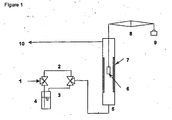
- thermogravimetric testing unit TGTU
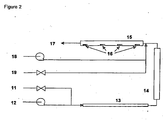
- TQR tubular cracking and quenching reactor
- thermogravimetric testing unit is illustrated in Figure 1 .
- a controlled flow of one of the feed gases C 2 H 6 , N 2 , H 2 or Air
- the wet route 3 consists of a water vapor saturator 4 which is maintained at about 60°C.
- the TGA is a commercial instrument from Setaram, France, which has the capability to heat samples up to 1200°C under various gases.
- the TGA furnace 5 is made of a 20 mm internal diameter alumina tube in the middle section 7 (homogenous temperature zone), while the housing is made of a heat resistance alloy which provides water cooling for temperature control.
- a sample of interest can be either placed in a quartz crucible 6 or simply as a metal coupon by itself 6, which was attached to one side of balance arms 8.
- the sample weight could be from 2 mg to 20 grams, counter balanced by a custom weight 9.
- a feed gas saturated with water vapor at 60°C passes through the cracking zone 7 and the cracked (or inert) gas is cooled in the upper section of the furnace tube before entering the vent line 10.
- the temperature profile of this upper furnace section was known based on calibrations under TGA operating conditions of interest. Therefore, it was also feasible to place a sample or a metal coupon at positions of various temperatures applicable to TLE operation.
- TCQR The schematic of TCQR is shown in Figure 2 where hydrocarbon feeds are introduced into the reactor through a flow control system 11.
- a metering pump 12 delivers the required water for steam generation in a preheater 13 operating at 250°C to 300°C.
- the vaporized hydrocarbon stream then enters a tubular quartz reactor tube 14 heated to either 900°C for ethane cracking or 850°C for naphtha cracking, where steam cracking of the hydrocarbon stream takes place to make pyrolysis products.
- the product stream then enters the quartz tube 15 which simulates the operation of a transfer line exchanger or quench cooler of industrial steam crackers. This transfer line exchanger was designed and calibrated in such a way that metal coupons 16 can be placed at exact locations where temperatures are known.
- such metal coupons are located at the positions where the temperature is 650°C, 550°C, 450°C and 350°C. Coupons are weighed before and after an experiment to determine the weight changes and the coupon surfaces can be examined by various instruments for morphology and surface composition.
- the process stream 17 enters a product knockout vessel where gas and liquid effluents can be collected for further analyses or venting.
- another metering pump 18 is used to deliver a coke inhibitor at precise flow rates and a gas control system 19 to atomize the coke inhibitor solution in such a way that an optimal atomization was achieved at the inlet of the transfer line exchanger 15.
- a series of sample powders of Fe containing compounds (listed in Table 1) were tested under simulated ethane cracking conditions at 840°C in the TGTU. Initially, the TGTU furnace was heated at a rate of 15°C/min in a flow of N 2 purge at 25 sccm (standard cubic centimeters per second). When the temperature reached 840°C, ethane was admitted via the wet route at 15 sccm and cracked in the cracking zone (7 of Figure 1 ). The coke formation rate of a powder sample (typically weighing about 20 mg, and having a particle size of about 200 ⁇ m), placed at the 600°C position in the upper section of the TGTU furnace tube, was then monitored for a period of 60 minutes.
- dimethyl disulfide vapour was carried in by purging N 2 at 50 sccm through the wet route for surface sulfiding of the coupon. Then ethane was introduced into the furnace for steam cracking for 1 hour to determine the coking rate. With the other coupon, an H 2 reduction step took place after the oxidation for 1 hour and a steam curing step took place after sulfiding for another hour. The results from both experiments are given in Table 3.
- Ethane steam cracking tests were carried out in the TCQR with A387F11 carbon steel coupons placed in the TLE section, at positions described previously. Ethane was steam cracked in the furnace at 900°C (wall temperature) with the residence time at about 1 second. The steam to hydrocarbon ratio was maintained at 0.3 (w/w) and the tests lasted for 10 hours. Based on product analyses from a gas chromatograph, ethane conversion was about 65 wt %, throughout the 10 hours experimentation period. A coke inhibitor consisting of 10 wt % DMDS, 70 wt % TBPS, 10 wt % PTMP and 10 wt % DMP was injected at the simulated TLE inlet at various concentration. The results are listed in Table 4. As a comparison, results from two baseline runs are also included.
- condensation coke is believed to form at low temperatures, such as 350°C, and the formation rate of such coke (or tar) is not sensitive to surface properties.
- coke is believed to form through catalytic mechanisms and therefore the formation rate is sensitive to surface properties, such as the presence of coke promoting oxides.
- inhibitor used for this test contained 5 wt % DSFM, 5 wt % DMP, 20 wt % DMDS, 50 wt % TBPS and 10 wt % PTMP.
Landscapes
- Chemical & Material Sciences (AREA)
- Engineering & Computer Science (AREA)
- Chemical Kinetics & Catalysis (AREA)
- Organic Chemistry (AREA)
- Materials Engineering (AREA)
- Mechanical Engineering (AREA)
- Metallurgy (AREA)
- Oil, Petroleum & Natural Gas (AREA)
- General Chemical & Material Sciences (AREA)
- Production Of Liquid Hydrocarbon Mixture For Refining Petroleum (AREA)
- Solid-Phase Diffusion Into Metallic Material Surfaces (AREA)
Claims (15)
- Verfahren zur Behandlung eines Stahls, der nicht weniger als 35 Gew.-% Eisen (Fe) umfasst, umfassend:(i) Verkleinern der Oberfläche des Stahls durch das Kontaktieren des Stahls mit einem Gemisch, das zwischen 0,001 und 4,9 Gew.-% H2 und zwischen 99,9 und 95,1 Gew.-% von einem oder mehreren Gasen, die aus der Gruppe ausgewählt sind, die aus Dampf und Inertgasen besteht, umfasst, bei einer Temperatur von 200 °C bis 900 °C und einem Druck von 0,1 bis 500 psig für eine Zeitspanne von 10 Minuten bis 10 Stunden;(ii) Behandeln der verkleinerten Stahloberfläche mit einer Zusammensetzung, umfassend:(a) 5 bis 80 Gew.-% Dimethyldisulfid;(b) 10 bis 70 Gew.-% Tetrabutylpolysulfid;(c) 2 bis 15 Gew.-% Pentaerythrittetrakis(3-mercaptopropionat);(d) gegebenenfalls 0 bis 10 Gew.-% Ethyl-2-mercaptopropionat;(e) 0,1 bis 10 Gew.-% Dimethylmethylphosphonat; und(f) 0,2 bis 5 Gew.-% Disulfiram,
wobei die Summe der Komponenten (a) bis (f) auf insgesamt 100 Gew.-% angepasst wird,
in einer Menge von 10 bis 10.000 ppm in einem Trägergas, das aus der Gruppe ausgewählt ist, die aus Dampf, Inertgasen und Kohlenwasserstoff besteht, bei einer Temperatur von 400 °C bis 850 °C für eine Zeitspanne von 10 Minuten bis 10 Stunden; und(iii) Aushärten der resultierenden Oberfläche in einem Trägergas, das aus der Gruppe ausgewählt ist, die aus Dampf, Inertgasen oder einem Gemisch davon besteht, für eine Zeitspanne von 0,1 bis 50 Stunden. - Verfahren nach Anspruch 1, worin der Stahl zumindest 50 Gew.-% Fe umfasst.
- Verfahren nach Anspruch 2, worin die Inertgase aus der Gruppe ausgewählt sind, die aus Argon, Stickstoff und Helium besteht.
- Verfahren nach Anspruch 3, worin in Schritt (i) das Verhältnis von Wasserstoff zu einem oder mehreren Gasen, die aus der Gruppe ausgewählt sind, die aus Dampf und Inertgasen besteht, 0,01 bis 2 Gew.-% H2 und dem Rest von einem oder mehreren Gasen beträgt; die Temperatur von 300 °C bis 800 °C beträgt; und der Druck von 0,1 psig bis 300 psig beträgt und die Zeitspanne von 30 Minuten bis 5 Stunden beträgt.
- Verfahren nach Anspruch 4, worin in Schritt (ii) der Kohlenwasserstoff aus der Gruppe ausgewählt ist, die aus Ethan, Propan, Butan, Naphtha, Vakuumgasöl, atmosphärischem Gasöl und Rohöl besteht.
- Verfahren nach Anspruch 5, worin in Schritt (ii) die Zusammensetzung in dem Trägergas in einer Menge von 20 bis 5.000 ppm vorhanden ist und der Schritt bei einer Temperatur von 300 C bis 850 °C für eine Zeitspanne von 30 Minuten bis 5 Stunden durchgeführt wird.
- Verfahren nach Anspruch 6, worin das Trägergas Dampf in einer Konzentration von nicht weniger als 2 Gew.-% und den Rest von einem oder mehreren Inertgasen umfasst, bei einer Temperatur zwischen 200 und 900 °C, bei Dampfpartialdrücken von 0,1 bis 100 psig, für eine Zeitspanne von 0,5 bis 20 Stunden.
- Verfahren nach Anspruch 7, worin in Schritt (ii) die Zusammensetzung Folgendes umfasst:(a) 25 bis 50 Gew.-% von Dimethyldisulfid;(b) 20 bis 40 Gew.-% Tetrabutylpolysulfid;(c) 5 bis 10 Gew.-% Pentaerythrittetrakis(3-mercaptopropionat);(d) 3 bis 8 Gew.-% Ethyl-2-mercaptopropionat;(e) 1 bis 5 Gew.-% Dimethylmethylphosphonat; und(f) 0,5 bis 1,5 Gew.-% Disulfiram,
wobei die Summe der Komponenten (a) bis (f) auf insgesamt 100 Gew.-% angepasst wird. - Verfahren nach Anspruch 8, worin in Schritt (i), worin das eine oder mehrere Gase, die aus der Gruppe ausgewählt sind, die aus Dampf und Inertgasen besteht, Dampf ist und das Wasserstoff-Dampf-Verhältnis 0,1 bis 1 Gew.-% H2 und dem Rest Dampf beträgt; die Temperatur von 300 °C bis 700 °C beträgt; und der Druck von 0,1 psig bis 100 psig beträgt und die Zeit von 1 bis 3 Stunden beträgt.
- Verfahren nach Anspruch 9, worin in Schritt (ii) die Zusammensetzung in dem Trägergas in einer Menge von 30 bis 2.000 ppm vorhanden ist und der Schritt bei einer Temperatur von 500 °C bis 700 °C für eine Zeitspanne von 1 bis 3 Stunden durchgeführt wird.
- Verfahren nach Anspruch 10, worin die Aushärtung für eine Zeitspanne von 1 bis 10 Stunden stattfindet.
- Verfahren nach Anspruch 11, worin der Stahl einen Fe-Gehalt von mehr als 60 Gew.-% aufweist.
- Niedrig verkokender Stahl, behandelt nach Anspruch 1.
- Transferleitungswärmetauscher, der unter Verwendung eines niedrig verkokenden Stahls nach Anspruch 13 hergestellt wurde.
- Chemisches Gefäß oder chemischer Reaktor, das/der unter Verwendung eines niedrig verkokenden Stahls nach Anspruch 13 hergestellt wurde.
Applications Claiming Priority (2)
| Application Number | Priority Date | Filing Date | Title |
|---|---|---|---|
| US10/425,544 US7056399B2 (en) | 2003-04-29 | 2003-04-29 | Passivation of steel surface to reduce coke formation |
| PCT/CA2004/000580 WO2004096953A2 (en) | 2003-04-29 | 2004-04-19 | Passivation of steel surface to reduce coke formation |
Publications (2)
| Publication Number | Publication Date |
|---|---|
| EP1631699A2 EP1631699A2 (de) | 2006-03-08 |
| EP1631699B1 true EP1631699B1 (de) | 2011-09-21 |
Family
ID=33309707
Family Applications (1)
| Application Number | Title | Priority Date | Filing Date |
|---|---|---|---|
| EP04728143A Expired - Lifetime EP1631699B1 (de) | 2003-04-29 | 2004-04-19 | Passivierung der stahloberfläche für das verringern der formung von koks |
Country Status (6)
| Country | Link |
|---|---|
| US (1) | US7056399B2 (de) |
| EP (1) | EP1631699B1 (de) |
| CA (1) | CA2532813C (de) |
| ES (1) | ES2374358T3 (de) |
| MY (1) | MY136565A (de) |
| WO (1) | WO2004096953A2 (de) |
Families Citing this family (10)
| Publication number | Priority date | Publication date | Assignee | Title |
|---|---|---|---|---|
| US8124822B2 (en) * | 2009-03-04 | 2012-02-28 | Uop Llc | Process for preventing metal catalyzed coking |
| US8092618B2 (en) * | 2009-10-21 | 2012-01-10 | Nalco Company | Surface passivation technique for reduction of fouling |
| US8747765B2 (en) | 2010-04-19 | 2014-06-10 | Exxonmobil Chemical Patents Inc. | Apparatus and methods for utilizing heat exchanger tubes |
| US20140323783A1 (en) | 2011-05-20 | 2014-10-30 | Exxonmobil Chemical Patents Inc. | Coke Gasification on Catalytically Active Surfaces |
| DE102014212602A1 (de) | 2013-07-02 | 2015-01-08 | Basf Se | Verfahren zur Herstellung eines Ketons aus einem Olefin |
| CN106185850B (zh) * | 2016-07-15 | 2018-09-14 | 合肥正帆电子材料有限公司 | 电子级砷化氢、磷化氢及其混合物气体钢瓶的钝化处理工艺 |
| CA2962667C (en) * | 2017-03-30 | 2024-03-19 | Nova Chemicals Corporation | Decoking process |
| CA3000277C (en) * | 2018-04-04 | 2025-08-05 | Nova Chemicals Corporation | REDUCED FOILING OF THE CONVECTION SECTION OF A CRACKER |
| CA3033604C (en) * | 2019-02-12 | 2022-12-13 | Michael KOSELEK | Decoking process |
| CN112725578B (zh) * | 2019-10-28 | 2022-12-13 | 中国石油化工股份有限公司 | 处理急冷锅炉炉管内表面的方法 |
Family Cites Families (16)
| Publication number | Priority date | Publication date | Assignee | Title |
|---|---|---|---|---|
| US3383347A (en) * | 1964-09-21 | 1968-05-14 | American Pipe & Constr Co | Epoxy emulsion coatings |
| US4636297A (en) * | 1984-08-16 | 1987-01-13 | Hakuto Chemical Co., Ltd. | Method for preventing coking in hydrocarbon treatment process |
| US4687567A (en) * | 1986-04-09 | 1987-08-18 | Phillips Petroleum Company | Antifoulants for thermal cracking processes |
| US4692234A (en) * | 1986-04-09 | 1987-09-08 | Phillips Petroleum Company | Antifoulants for thermal cracking processes |
| US4804487A (en) * | 1986-04-09 | 1989-02-14 | Phillips Petroleum Company | Antifoulants for thermal cracking processes |
| US5294265A (en) * | 1992-04-02 | 1994-03-15 | Ppg Industries, Inc. | Non-chrome passivation for metal substrates |
| US5360531A (en) * | 1992-12-10 | 1994-11-01 | Nalco Chemical Company | Phosphoric triamide coking inhibitors |
| US5354450A (en) * | 1993-04-07 | 1994-10-11 | Nalco Chemical Company | Phosphorothioate coking inhibitors |
| US5358626A (en) * | 1993-08-06 | 1994-10-25 | Tetra International, Inc. | Method for retarding corrosion and coke formation and deposition during pyrolytic hydrocarbon procssing |
| DE4334827C1 (de) * | 1993-10-08 | 1994-10-06 | Mannesmann Ag | Verfahren zur Verminderung der Verkokung von Wärmetauschflächen |
| US5779881A (en) * | 1994-02-03 | 1998-07-14 | Nalco/Exxon Energy Chemicals, L.P. | Phosphonate/thiophosphonate coking inhibitors |
| CA2164020C (en) * | 1995-02-13 | 2007-08-07 | Leslie Wilfred Benum | Treatment of furnace tubes |
| US5777188A (en) * | 1996-05-31 | 1998-07-07 | Phillips Petroleum Company | Thermal cracking process |
| US5954943A (en) * | 1997-09-17 | 1999-09-21 | Nalco/Exxon Energy Chemicals, L.P. | Method of inhibiting coke deposition in pyrolysis furnaces |
| US6673232B2 (en) * | 2000-07-28 | 2004-01-06 | Atofina Chemicals, Inc. | Compositions for mitigating coke formation in thermal cracking furnaces |
| US6436202B1 (en) * | 2000-09-12 | 2002-08-20 | Nova Chemicals (International) S.A. | Process of treating a stainless steel matrix |
-
2003
- 2003-04-29 US US10/425,544 patent/US7056399B2/en not_active Expired - Lifetime
-
2004
- 2004-04-19 EP EP04728143A patent/EP1631699B1/de not_active Expired - Lifetime
- 2004-04-19 ES ES04728143T patent/ES2374358T3/es not_active Expired - Lifetime
- 2004-04-19 CA CA2532813A patent/CA2532813C/en not_active Expired - Lifetime
- 2004-04-19 WO PCT/CA2004/000580 patent/WO2004096953A2/en not_active Ceased
- 2004-04-27 MY MYPI20041540A patent/MY136565A/en unknown
Also Published As
| Publication number | Publication date |
|---|---|
| WO2004096953A2 (en) | 2004-11-11 |
| US7056399B2 (en) | 2006-06-06 |
| WO2004096953A3 (en) | 2005-05-06 |
| US20040216815A1 (en) | 2004-11-04 |
| EP1631699A2 (de) | 2006-03-08 |
| ES2374358T3 (es) | 2012-02-16 |
| CA2532813C (en) | 2012-06-26 |
| MY136565A (en) | 2008-10-31 |
| CA2532813A1 (en) | 2004-11-11 |
Similar Documents
| Publication | Publication Date | Title |
|---|---|---|
| US4410418A (en) | Method for reducing carbon formation in a thermal cracking process | |
| US5298091A (en) | Inhibiting coke formation by heat treating in nitrogen atmosphere | |
| EP1631699B1 (de) | Passivierung der stahloberfläche für das verringern der formung von koks | |
| EP2103669A2 (de) | Zusammensetzungen zur Reduzierung der Verkokungsbildung beim Dampfbrechen von Kohlenwasserstoffen | |
| JPH0762134B2 (ja) | 炭化水素を含むガス流の熱分解方法 | |
| US6673232B2 (en) | Compositions for mitigating coke formation in thermal cracking furnaces | |
| WO2003006581A2 (en) | Method for inhibiting corrosion using certain phosphorus and sulfur-free aromatic compounds | |
| US7604730B1 (en) | Coking reduction in cracking reactors | |
| AU660867B2 (en) | Phosphorothioate coking inhibitors | |
| US5360531A (en) | Phosphoric triamide coking inhibitors | |
| KR100307155B1 (ko) | 열교환표면의코킹을감소시키는방법 | |
| US20120149962A1 (en) | In situ removal of iron complexes during cracking | |
| KR102746429B1 (ko) | 코킹 방지 기기, 이의 제조 방법 및 응용 | |
| EP0852256A1 (de) | Phosphonate/Thiophosphonate als Koksablagerungsinhibitoren | |
| US5254183A (en) | Gas turbine elements with coke resistant surfaces | |
| US11939544B2 (en) | Decoking process | |
| US10894276B2 (en) | Decoking process | |
| AU2005235761B2 (en) | Use of organic polysulfides against corrosion by acid crudes | |
| EP0601609B1 (de) | Der Einhalt der Koksbindung mit Phosphorsäure-Triamide | |
| AU2005219594A1 (en) | Method for corrosion control of refining units by acidic crudes | |
| CN111100666A (zh) | 减少裂解装置结焦的方法 |
Legal Events
| Date | Code | Title | Description |
|---|---|---|---|
| PUAI | Public reference made under article 153(3) epc to a published international application that has entered the european phase |
Free format text: ORIGINAL CODE: 0009012 |
|
| 17P | Request for examination filed |
Effective date: 20051021 |
|
| AK | Designated contracting states |
Kind code of ref document: A2 Designated state(s): DE ES FR GB IT NL |
|
| DAX | Request for extension of the european patent (deleted) | ||
| RBV | Designated contracting states (corrected) |
Designated state(s): DE ES FR GB IT NL |
|
| 17Q | First examination report despatched |
Effective date: 20101130 |
|
| GRAP | Despatch of communication of intention to grant a patent |
Free format text: ORIGINAL CODE: EPIDOSNIGR1 |
|
| GRAS | Grant fee paid |
Free format text: ORIGINAL CODE: EPIDOSNIGR3 |
|
| GRAA | (expected) grant |
Free format text: ORIGINAL CODE: 0009210 |
|
| AK | Designated contracting states |
Kind code of ref document: B1 Designated state(s): DE ES FR GB IT NL |
|
| REG | Reference to a national code |
Ref country code: GB Ref legal event code: FG4D |
|
| REG | Reference to a national code |
Ref country code: DE Ref legal event code: R096 Ref document number: 602004034439 Country of ref document: DE Effective date: 20111117 |
|
| REG | Reference to a national code |
Ref country code: NL Ref legal event code: T3 |
|
| REG | Reference to a national code |
Ref country code: ES Ref legal event code: FG2A Ref document number: 2374358 Country of ref document: ES Kind code of ref document: T3 Effective date: 20120216 |
|
| PLBE | No opposition filed within time limit |
Free format text: ORIGINAL CODE: 0009261 |
|
| STAA | Information on the status of an ep patent application or granted ep patent |
Free format text: STATUS: NO OPPOSITION FILED WITHIN TIME LIMIT |
|
| 26N | No opposition filed |
Effective date: 20120622 |
|
| REG | Reference to a national code |
Ref country code: DE Ref legal event code: R097 Ref document number: 602004034439 Country of ref document: DE Effective date: 20120622 |
|
| REG | Reference to a national code |
Ref country code: FR Ref legal event code: PLFP Year of fee payment: 13 |
|
| REG | Reference to a national code |
Ref country code: FR Ref legal event code: PLFP Year of fee payment: 14 |
|
| REG | Reference to a national code |
Ref country code: FR Ref legal event code: PLFP Year of fee payment: 15 |
|
| PGFP | Annual fee paid to national office [announced via postgrant information from national office to epo] |
Ref country code: FR Payment date: 20230321 Year of fee payment: 20 |
|
| PGFP | Annual fee paid to national office [announced via postgrant information from national office to epo] |
Ref country code: IT Payment date: 20230322 Year of fee payment: 20 Ref country code: GB Payment date: 20230322 Year of fee payment: 20 |
|
| PGFP | Annual fee paid to national office [announced via postgrant information from national office to epo] |
Ref country code: NL Payment date: 20230321 Year of fee payment: 20 |
|
| PGFP | Annual fee paid to national office [announced via postgrant information from national office to epo] |
Ref country code: ES Payment date: 20230502 Year of fee payment: 20 Ref country code: DE Payment date: 20230321 Year of fee payment: 20 |
|
| REG | Reference to a national code |
Ref country code: DE Ref legal event code: R071 Ref document number: 602004034439 Country of ref document: DE |
|
| REG | Reference to a national code |
Ref country code: NL Ref legal event code: MK Effective date: 20240418 |
|
| PG25 | Lapsed in a contracting state [announced via postgrant information from national office to epo] |
Ref country code: ES Free format text: LAPSE BECAUSE OF EXPIRATION OF PROTECTION Effective date: 20240420 |
|
| REG | Reference to a national code |
Ref country code: ES Ref legal event code: FD2A Effective date: 20240426 |
|
| PG25 | Lapsed in a contracting state [announced via postgrant information from national office to epo] |
Ref country code: ES Free format text: LAPSE BECAUSE OF EXPIRATION OF PROTECTION Effective date: 20240420 |
|
| REG | Reference to a national code |
Ref country code: GB Ref legal event code: PE20 Expiry date: 20240418 |
|
| PG25 | Lapsed in a contracting state [announced via postgrant information from national office to epo] |
Ref country code: GB Free format text: LAPSE BECAUSE OF EXPIRATION OF PROTECTION Effective date: 20240418 |
|
| PG25 | Lapsed in a contracting state [announced via postgrant information from national office to epo] |
Ref country code: GB Free format text: LAPSE BECAUSE OF EXPIRATION OF PROTECTION Effective date: 20240418 |