EP1631617B1 - Dispersionen steifkettiger, konjugierter polymere, verfahren zu deren herstellung und deren verwendung zur herstellung elektronischer bauelemente - Google Patents
Dispersionen steifkettiger, konjugierter polymere, verfahren zu deren herstellung und deren verwendung zur herstellung elektronischer bauelemente Download PDFInfo
- Publication number
- EP1631617B1 EP1631617B1 EP04731366A EP04731366A EP1631617B1 EP 1631617 B1 EP1631617 B1 EP 1631617B1 EP 04731366 A EP04731366 A EP 04731366A EP 04731366 A EP04731366 A EP 04731366A EP 1631617 B1 EP1631617 B1 EP 1631617B1
- Authority
- EP
- European Patent Office
- Prior art keywords
- polymer
- dispersion
- organic
- rigid
- aqueous
- Prior art date
- Legal status (The legal status is an assumption and is not a legal conclusion. Google has not performed a legal analysis and makes no representation as to the accuracy of the status listed.)
- Expired - Lifetime
Links
Images

Classifications
-
- C—CHEMISTRY; METALLURGY
- C08—ORGANIC MACROMOLECULAR COMPOUNDS; THEIR PREPARATION OR CHEMICAL WORKING-UP; COMPOSITIONS BASED THEREON
- C08L—COMPOSITIONS OF MACROMOLECULAR COMPOUNDS
- C08L79/00—Compositions of macromolecular compounds obtained by reactions forming in the main chain of the macromolecule a linkage containing nitrogen with or without oxygen or carbon only, not provided for in groups C08L61/00 - C08L77/00
- C08L79/04—Polycondensates having nitrogen-containing heterocyclic rings in the main chain; Polyhydrazides; Polyamide acids or similar polyimide precursors
- C08L79/06—Polyhydrazides; Polytriazoles; Polyamino-triazoles; Polyoxadiazoles
-
- C—CHEMISTRY; METALLURGY
- C08—ORGANIC MACROMOLECULAR COMPOUNDS; THEIR PREPARATION OR CHEMICAL WORKING-UP; COMPOSITIONS BASED THEREON
- C08J—WORKING-UP; GENERAL PROCESSES OF COMPOUNDING; AFTER-TREATMENT NOT COVERED BY SUBCLASSES C08B, C08C, C08F, C08G or C08H
- C08J3/00—Processes of treating or compounding macromolecular substances
- C08J3/02—Making solutions, dispersions, lattices or gels by other methods than by solution, emulsion or suspension polymerisation techniques
- C08J3/03—Making solutions, dispersions, lattices or gels by other methods than by solution, emulsion or suspension polymerisation techniques in aqueous media
- C08J3/07—Making solutions, dispersions, lattices or gels by other methods than by solution, emulsion or suspension polymerisation techniques in aqueous media from polymer solutions
-
- C—CHEMISTRY; METALLURGY
- C08—ORGANIC MACROMOLECULAR COMPOUNDS; THEIR PREPARATION OR CHEMICAL WORKING-UP; COMPOSITIONS BASED THEREON
- C08L—COMPOSITIONS OF MACROMOLECULAR COMPOUNDS
- C08L79/00—Compositions of macromolecular compounds obtained by reactions forming in the main chain of the macromolecule a linkage containing nitrogen with or without oxygen or carbon only, not provided for in groups C08L61/00 - C08L77/00
- C08L79/04—Polycondensates having nitrogen-containing heterocyclic rings in the main chain; Polyhydrazides; Polyamide acids or similar polyimide precursors
Definitions
- the present invention relates to dispersions of rigid-chain conjugated polymers, a process for their preparation and their use for the production of electronic components.
- the invention relates to the preparation of workable dispersions of such polymers whose particle size is in the nanometer range and which are useful in electronic devices, such as e.g. Field effect transistors, organic light-emitting diodes or photovoltaic cells can be used as active materials.
- electronic devices such as e.g. Field effect transistors, organic light-emitting diodes or photovoltaic cells can be used as active materials.
- Stiff-chain conjugated polymers are of particular interest as active materials for electronic devices, in particular because of their semiconducting properties. These include, among others, aromatic heterocyclic ladder polymers, such as e.g. Poly (benzobisimidazobenzo-phenanthroline) (BBL); Polyquinolines, polybenzothiazoles, polybenzimidazoles, polyheterodiazoles.
- aromatic heterocyclic ladder polymers such as e.g. Poly (benzobisimidazobenzo-phenanthroline) (BBL); Polyquinolines, polybenzothiazoles, polybenzimidazoles, polyheterodiazoles.
- Such polymers which ideally have a rod shape, are normally completely insoluble in customary organic solvents, as well as in water and in aqueous solvents or solvent mixtures.
- these have not been able to prevail for technically relevant products.
- concentrated acids such as sulfuric acid, methanesulfonic acid, or by complexation with Lewis acids (Nitroalkane / Lewis acid mixtures, SA Jenekhe, PO Johnson, Macromolecules 1990, 23, 4419-4429) are sufficiently soluble and processing from these solutions is not technically feasible.
- Solubility of the above-described rigid-chain, conjugated polymers in customary organic solvents may possibly be achieved by lateral substitution with, for example, alkyl, alkoxy or dialkylamino groups.
- lateral substitution with, for example, alkyl, alkoxy or dialkylamino groups.
- substitution is only possible to a limited extent (eg in the case of BBL).
- lateral substitutions can adversely affect the electronic properties.
- the solubilization of a rigid-chain conjugated polymer by introducing lateral substituents into the polymer structure is therefore generally not a practical or advantageous way to prepare processable solutions or dispersions of these materials.
- the invention was therefore based on the object to provide a method by which rigid-chain, conjugated polymers which are insoluble in organic solvents can be converted into a form in which they are practically processable and in particular for the preparation of thin films of these polymers suitable.
- a process for producing a dispersion of a rigid-chain, conjugated, insoluble in organic solvents polymer in an aqueous or organic or aqueous-organic dispersion medium comprising the steps: (a) preparing a solution of the polymer in a strong acid or in a liquid mixture containing a Lewis acid; and (b) introducing the solution prepared in step a) into an aqueous surfactant solution to form a dispersion of the polymer.
- this provides a dispersion of a rigid-chain, conjugated, insoluble in organic solvents polymer in an aqueous or organic or aqueous-organic dispersion medium, wherein the size of the dispersed polymer particles in the range of 10 to 800 nm.
- the invention encompasses the use of such a dispersion for producing a thin film of a rigid-chain, conjugated polymer and for producing an electronic component.
- the polymers used in the process according to the invention are rigid-chain, conjugated polymers which are insoluble in organic solvents, in particular in customary organic solvents such as chloroform, toluene or xylene.
- the rigid-chain conjugated polymers which can be used in the process according to the invention include, in particular, aromatic heterocyclic ladder polymers, polyquinolines, polybenzothiazoles, polybenzimidazoles, polyheterodiazoles and mixtures thereof.
- R ' is in each case a divalent aromatic or heteroaromatic radical;
- R is an aryl or aralkyl group;
- X is N-alkyl, N-aryl, O, S or SO 2 ; and
- Y is independently NH, N-alkyl, N-aryl, O or S.
- the process according to the invention is suitable for the preparation of dispersions of poly (benzobisimidazobenzo-phenanthroline) (BBL) whose structure is shown in the formula (IV).
- the polymers used in the process according to the invention typically have intrinsic viscosities in methanesulfonic acid at room temperature of 1.3 to 6 dl / g, preferably 1.5 to 3 dl / g.
- the dispersion medium of the dispersions prepared by the process according to the invention is an aqueous or organic or aqueous-organic dispersion medium.
- the dispersion medium consists essentially of water or an organic solvent, e.g. Chloroform, toluene, xylene, tetrahydrofuran (THF) or cyclohexanol.
- the dispersion medium may also consist of a mixture of water and a water-miscible organic solvent.
- the dispersion medium is substantially free of substances that make the processing of the dispersion, especially on an industrial scale, much more difficult. Such substances include in particular strong acids, highly corrosive substances or highly toxic substances. Accordingly, the dispersions prepared by the process according to the invention can be processed in particular in customary processes for producing thin polymer films.
- the polymer is dissolved in a strong acid or in a liquid mixture containing a Lewis acid.
- the strong acid is preferably methanesulfonic acid or concentrated sulfuric acid or a mixture thereof.
- the mixture containing a Lewis acid is preferably a mixture a Lewis acid with a nitroalkane or a nitroaromatic, such as nitromethane or nitrobenzene.
- the Lewis acid is preferably GaCl, AlCl 3 , FeCl 3 , or SbCl 3 .
- the content of the Lewis acid in the mixture is preferably 30 to 90% by weight.
- the concentration of the polymer in the solution prepared in the first step of the process according to the invention is typically from 0.1 to 5% by weight, preferably from 0.5 to 2% by weight.
- the solution prepared in the first stage is introduced into an aqueous surfactant solution. This is done so that the polymer forms a dispersion.
- the introduction of the solution of the polymer into the aqueous surfactant solution is preferably carried out under the action of ultrasound. Commercially available ultrasonic homogenizers are particularly suitable for this purpose.
- Suitable surfactants are ethoxylates and polyethylene glycols and in particular fatty amine-ethoxylates. These are basically basic.
- the dispersion of the rigid-chain, conjugated polymer obtained in the second stage of the process according to the invention contains the solvent used in the first stage (strong acid or liquid mixture containing a Lewis acid) only in highly diluted form. Nevertheless, it is generally preferred to subsequently carry out the following steps: separating the disperse polymer from the liquid phase of the dispersion obtained in the second stage; Washing the separated polymer and redispersing the washed polymer in an aqueous or organic surfactant solution.
- the separation of the dispersed polymer can be carried out in particular by centrifuging and decanting off the supernatant solution.
- the separated polymer (centrifugate) can then be taken up in water to wash it. This process (centrifugation and reuptake in water) is preferably repeated until the pH of the supernatant solution is neutral.
- the disperse polymer is redispersed in an aqueous or organic surfactant solution.
- This redispersion is preferably carried out under the action of ultrasound.
- a solution is suitable one of the aforementioned surfactants in water or in an organic solvent such as chloroform, toluene, tetrahydrofuran or cyclohexanone, or in a mixture of water and a water-soluble organic solvent such as tetrahydrofuran.
- concentration of the surfactant solutions used in the process according to the invention is preferably in each case from 0.01 to 5% by weight, more preferably from 0.05 to 2% by weight.
- the process according to the invention provides a dispersion of a rigid-chain, conjugated, organic-solvent-insoluble polymer in an aqueous or organic or aqueous-organic dispersion medium, the size of the dispersed polymer particles being in the range from 10 to 800 nm, preferably from 10 to 100 nm ,
- the dispersing medium consists, apart from the surfactants contained therein, essentially of water or an organic solvent, e.g. Chloroform, toluene, tetrahydrofuran or cyclohexanone, or a mixture of water and a water-miscible organic solvent, e.g. Tetrahydrofuran.
- the dispersion medium of the dispersions of the present invention is free of substances which substantially complicate the engineering of the dispersion for the preparation of thin films of rigid-chain conjugated polymers, e.g. strong acids.
- the stable dispersions according to the invention are particularly suitable for the production of thin layers by drop-casting or spin-coating processes.
- Such thin layers may be used, in particular, as active charge carrier layers in electronic devices, such as e.g. Field effect transistors, organic light emitting diodes or photovoltaic cells are used.
- a 1% (weight percent) BBL solution in methanesulfonic acid was prepared. 100 mg of the BBL were dissolved in 10 g of methanesulfonic acid.
- an aqueous 1% surfactant solution with T150 was realized.
- T150 is a surfactant gene (Hoechst) from the sebum fatty amine ethoxylate series with 15 molecules of ethylene oxide per molecule of tallow fatty amine.
- the sonicating with the ultrasonic homogenizer HD 2200 RF power 200 W, RF frequency 20 kHz
- maximum power within 4 min with a pipette slowly introduced the BBL methanesulfonic acid.
- the solution was sonicated for a further 4 min.
- the resulting dispersion was centrifuged (45 minutes, 4500 revolutions / minute).
- the centrifugate was decanted from the supernatant solution and repeatedly taken up in water and centrifuged again. This procedure was repeated until the pH of the washings was neutral (approximately 4-6 times).
- the centrifugate was redispersed in a water / surfactant solution (10 ml of a 1% or 0.1% solution of T150 in water) under ultrasound treatment with maximum power (4 min ultrasound). This results in stable dispersions having particle sizes in the range of 15 to 100 nm.
- the neutral washed centrifugate was redispersed in a tetrahydrofuran / surfactant solution (10 ml of a 0.1% solution of T150 in tetrahydrofuran) with ultrasound treatment (4 min of ultrasound, maximum power).
- a tetrahydrofuran / surfactant solution (10 ml of a 0.1% solution of T150 in tetrahydrofuran) with ultrasound treatment (4 min of ultrasound, maximum power).
- the average particle sizes were determined by ultracentrifuge and confirmed by scanning electron micrographs.
- the scanning electronical recordings were made with a JSM6330F device from Joel.
- Sample preparation was performed as follows: One slide was fitted with the appropriate one Sample was coated by dripping and then a 4 nm thick layer of platinum was sputtered on. The thus prepared sample was examined at an acceleration voltage of 5 kV.
- OFET organic field effect transistor
- Field-effect transistors in a bottom-gate structure have been constructed.
- the OFET structures used were characterized as follows: source-drain (aluminum) distance: 20 ⁇ m, W / L ratio: 360, gate layer thickness (SiO 2 ): 500 nm.
- aqueous 1% surfactant-containing dispersion having a solids content of 1% of poly (benzobisimidazobenzo-phenanthroline) (BBL) particles (Table 1, Sample No. 2) was dropped onto a transistor structure in a glove box and then removed to remove the Water tempered for 2 hours at 110 ° C.
Landscapes
- Chemical & Material Sciences (AREA)
- Health & Medical Sciences (AREA)
- Chemical Kinetics & Catalysis (AREA)
- Medicinal Chemistry (AREA)
- Polymers & Plastics (AREA)
- Organic Chemistry (AREA)
- Dispersion Chemistry (AREA)
- Thin Film Transistor (AREA)
- Electroluminescent Light Sources (AREA)
- Compositions Of Macromolecular Compounds (AREA)
Description
- Die vorliegende Erfindung betrifft Dispersionen steifkettiger, konjugierter Polymere, ein Verfahren zu deren Herstellung und deren Verwendung zur Herstellung elektronischer Bauelemente.
- Insbesondere betrifft die Erfindung die Herstellung verarbeitungsfähiger Dispersionen solcher Polymere, deren Teilchengröße im Nanometerbereich liegt und die in elektronischen Bauelementen, wie z.B. Feldeffekttransistoren, organischen Leuchtdioden oder photovoltaischen Zellen, als aktive Materialien verwendet werden können.
- Steifkettige, konjugierte Polymere sind insbesondere wegen ihrer halbleitenden Eigenschaften als aktive Materialien für elektronische Bauelemente von Interesse. Dazu zählen unter anderen aromatische heterocyclische Leiterpolymere, wie z.B. Poly(benzobis-imidazobenzo-phenanthrolin) (BBL); Polychinoline, Polybenzthiazole, Polybenzimidazole, Polyheterodiazole.
- Solche Polymere, die im Idealfall Stäbchengestalt aufweisen, sind normalerweise in üblichen organischen Lösemitteln, wie auch in Wasser und in wässrigen Lösemitteln bzw. Lösemittelgemischen, vollkommen unlöslich. Trotz ihrer interessanten mechanischen und elektrischen Eigenschaften, die sich aus der nahezu parallelen Anordnung der stäbchenförmigen, konjugierten Moleküle im Festkörper ableiten, wie ihrer hohen Thermostabilität, guten mechanischen Festigkeit und ihres halbleitenden Charakters, konnten sich diese bisher für technisch relevante Produkte nicht durchsetzen. Der Grund kann darin gesehen werden, dass sie nur in konzentrierten Säuren, wie z.B. Schwefelsäure, Methansulfonsäure, oder auch durch Komplexierung mit Lewis-Säuren (Nitroalkan/Lewis-Säure-Gemische; S. A. Jenekhe, P. O. Johnson, Macromolecules 1990, 23, 4419 - 4429) ausreichend löslich sind und eine Verarbeitung aus diesen Lösungen technisch nicht praktikabel ist.
- Es ist jedoch zu erwarten, dass diese steifkettigen, konjugierten Polymere aufgrund ihrer stäbchenförmigen Anordnung und ihrer halbleitenden Eigenschaften im Festkörper interessante elektronische Eigenschaften zeigen.
- Kürzlich publizierten Jenekhe et al. Ergebnisse zu einem Dünn-Schicht-Transistor, der als aktive Schicht das Leiterpolymer Poly(benzobisimidazobenzo-phenanthrolin) (BBL) enthielt (A. Babel, S. A. Jenekhe, Adv. Mater. 2002,14, 371-374). Es konnte nachgewiesen werden, dass es mit diesem Material möglich ist, erstmalig einen n-halbleitenden Polymertransistor mit Elektronenbeweglichkeiten bis zu 5 x 10⁻⁴ cm2/Vs herzustellen. Dieses ließ sich jedoch nur durch ein sehr aufwendiges, technisch wenig praktikables Schichtbildungsverfahren realisieren. Dabei wurde das steifkettige BBL in Methansulfonsäure gelöst, um daraus mittels Spin-coating dünne Schichten herzustellen. Erst durch komplizierte Waschvorgänge (Behandlung mit 10%-iger Triethylamin-Lösung in Ethanol, Waschen mit Wasser und Trocknen im Vakuum bei 60°C) lässt sich dann die erhaltene aktive Schicht verwenden. Im Labormaßstab ist diese Vorgehensweise noch praktikabel, nicht jedoch für technische Verfahren.
- Eine Löslichkeit der oben beschriebenen steifkettigen, konjugierten Polymere in üblichen organischen Lösemitteln, wie Chloroform, Toluen, Xylen u.a., kann ggf. zwar durch laterale Substitution mit z.B. Alkyl-, Alkoxy- oder Dialkylaminogruppen erreicht werden. Dafür ist jedoch in der überwiegenden Zahl der Polymersynthesen ein deutlich höherer Syntheseaufwand erforderlich. In vielen Fällen ist die Substitution auch nur eingeschränkt möglich (z.B. im Fall von BBL). Außerdem können laterale Substitutionen die elektronischen Eigenschaften negativ beeinflussen. Das Löslichmachen eines steifkettigen, konjugierten Polymers durch Einführung lateraler Substituenten in die Polymerstruktur stellt deshalb in der Regel keinen praktikablen oder vorteilhaften Weg zur Herstellung verarbeitungsfähiger Lösungen oder Dispersionen dieser Materialien dar.
- Der Erfindung lag daher die Aufgabe zu Grunde, ein Verfahren bereitzustellen, durch das steifkettige, konjugierte Polymere, die in organischen Lösemitteln unlöslich sind, in eine Form überführt werden können, in der sie praktisch verarbeitbar sind und die sich insbesondere zur Herstellung dünner Filme dieser Polymere eignet.
- Diese Aufgabe wird erfindungsgemäß gelöst durch ein Verfahren zur Herstellung einer Dispersion eines steifkettigen, konjugierten, in organischen Lösemitteln unlöslichen Polymers in einem wässrigen oder organischen oder wässrig-organischen Dispersionsmedium, umfassend die Stufen: (a) Herstellen einer Lösung des Polymers in einer starken Säure oder in einem flüssigen Gemisch, das eine Lewis-Säure enthält; und (b) Einbringen der in der Stufe a) hergestellten Lösung in eine wässrige Tensid-Lösung, so dass eine Dispersion des Polymers entsteht.
- Erfindungsgemäß wird dadurch eine Dispersion eines steifkettigen, konjugierten, in organischen Lösemitteln unlöslichen Polymers in einem wässrigen oder organischen oder wässrig-organischen Dispersionsmedium bereitgestellt, wobei die Größe der dispergierten Polymerteilchen im Bereich von 10 bis 800 nm liegt.
- Des Weiteren umfasst die Erfindung die Verwendung einer solchen Dispersion zur Herstellung eines dünnen Films eines steifkettigen, konjugierten Polymers und zur Herstellung eines elektronischen Bauelements.
-
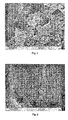
- Fig. 1 zeigt eine rasterelektronische Aufnahme eines dünnen Films aus BBL-Teilchen auf Al (BBL-Teilchen in 0,1%-iger Tensid/Wasserlösung, Feststoffgehalt 1%).
- Fig. 2 zeigt eine rasterelektronische Aufnahme eines dünnen Films aus BBL-Teilchen auf Al (BBL-Teilchen in 1%-iger Tensid/Wasserlösung, Feststoffgehalt 1%).
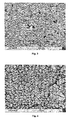
- Fig. 3 zeigt eine rasterelektronische Aufnahme eines dünnen Films aus BBL-Teilchen auf Al (BBL-Teilchen in 0,1%-iger Tensid/THF-Lösung, Feststoffgehalt 1%).
- Fig. 4 zeigt eine Aufnahme eines Films wie in Fig. 3 gezeigt in vergrößerter Darstellung.
- Fig. 5 zeigt die Kennlinien eines organischen Feldeffekttransistors (OFET), der unter Verwendung einer erfindungsgemäßen Dispersion von Poly(benzobisimidazobenzo-phenanthrolin) (BBL)-Teilchen hergestellt wurde.
- Bei den in dem erfindungsgemäßen Verfahren eingesetzten Polymeren handelt es sich um steifkettige, konjugierte Polymere, die in organischen Lösemitteln, insbesondere in üblichen organischen Lösemitteln, wie Chloroform, Toluen oder Xylen, unlöslich sind.
- Zu den in dem erfindungsgemäßen Verfahren einsetzbaren steifkettigen, konjugierten Polymeren gehören insbesondere aromatische heterocyclische Leiterpolymere, Polychinoline, Polybenzthiazole, Polybenzimidazole, Polyheterodiazole und Gemische davon.
- Die Strukturformeln typischer Polyheterodiazole (Formel (I)), Polychinoline (Formel (II)) und Polybenzthiazole bzw. Polybenzimidazole (Formel (III) sind nachfolgend dargestellt:


- Darin steht R' jeweils für einen zweiwertigen aromatischen oder heteroaromatischen Rest; R für eine Aryl- oder Aralkylgruppe; X für N-Alkyl, N-Aryl, O, S oder SO2; und Y unabhängig für N-H, N-Alkyl, N-Aryl, O oder S.
- Insbesondere eignet sich das erfindungsgemäße Verfahren zur Herstellung von Dispersionen von Poly(benzobisimidazbenzo-phenanthrolin) (BBL), dessen Struktur in der Formel (IV) gezeigt ist.

- Die in dem erfindungsgemäßen Verfahren eingesetzten Polymere besitzen bei Raumtemperatur typischerweise intrinsische Viskositäten in Methansulfonsäure von 1,3 bis 6 dl/g, bevorzugt 1,5 bis 3 dl/g.
- Das Dispersionsmedium der nach dem erfindungsgemäßen Verfahren hergestellten Dispersionen ist ein wässriges oder organisches oder wässrig-organisches Dispersionsmedium. Demnach besteht das Dispersionsmedium im Wesentlichen aus Wasser oder einem organischen Lösemittel, wie z.B. Chloroform, Toluen, Xylen, Tetrahydrofuran (THF) oder Cyklohexanol. Das Dispersionsmedium kann auch aus einem Gemisch aus Wasser und einem mit Wasser mischbaren organischen Lösemittel bestehen. Insbesondere ist das Dispersionsmedium im Wesentlichen frei von Substanzen, die die Verarbeitung der Dispersion, insbesondere im technischen Maßstab, wesentlich erschweren. Zu solchen Substanzen gehören insbesondere starke Säuren, stark korrosive Substanzen oder stark toxische Substanzen. Demgemäß sind die nach dem erfindungsgemäßen Verfahren hergestellten Dispersionen insbesondere in üblichen Verfahren zur Herstellung dünner Polymerfilme verarbeitbar.
- In der ersten Stufe des erfindungsgemäßen Verfahrens wird das Polymer in einer starken Säure oder in einem flüssigen Gemisch, das eine Lewis-Säure enthält, gelöst. Die starke Säure ist bevorzugt Methansulfonsäure oder konzentrierte Schwefelsäure oder ein Gemisch davon. Das Gemisch, das eine Lewis-Säure enthält, ist bevorzugt ein Gemisch einer Lewis-Säure mit einem Nitroalkan oder einem Nitroaromaten, wie Nitromethan oder Nitrobenzol. Die Lewis-Säure ist bevorzugt GaCl, AlCl3, FeCl3, oder SbCl3. Der Gehalt der Lewis-Säure in dem Gemisch beträgt bevorzugt 30 bis 90 Gew.-%.
- Die Konzentration des Polymers in der in der ersten Stufe des erfindungsgemäßen Verfahrens hergestellten Lösung beträgt typischerweise 0,1 bis 5 Gew.-%, bevorzugt 0,5 bis 2 Gew.-%.
- In der zweiten Stufe des erfindungsgemäßen Verfahrens wird die in der ersten Stufe hergestellte Lösung in eine wässrige Tensidlösung eingebracht. Dies geschieht so, dass das Polymer dabei eine Dispersion bildet. Zur Bildung einer stabilen Dispersion wird das Einbringen der Lösung des Polymers in die wässrige Tensidlösung bevorzugt unter Einwirkung von Ultraschall durchgeführt. Hierzu eignen sich insbesondere handelsübliche Ultraschallhomogenisatoren.
- Als Tenside eignen sich Ethoxylate und Polyethylenglykole und insbesondere Fettamin-Oxethylate. Diese sind grundsätzlich basischer Natur.
- Die in der zweiten Stufe des erfindungsgemäßen Verfahrens erhaltene Dispersion des steifkettigen, konjugierten Polymers enthält das in der ersten Stufe eingesetzte Lösemittel (starke Säure oder flüssiges Gemisch, das eine Lewis-Säure enthält) nur noch in stark verdünnter Form. Dennoch wird grundsätzlich bevorzugt, anschließend noch folgende Stufen durchzuführen: Abtrennen des dispersen Polymers von der flüssigen Phase der in der zweiten Stufe erhaltenen Dispersion; Waschen des abgetrennten Polymers und Redispergieren des gewaschenen Polymers in einer wässrigen oder organischen Tensidlösung.
- Das Abtrennen des dispersen Polymers kann insbesondere durch Zentrifugieren und Abdekantieren der überstehenden Lösung erfolgen. Das abgetrennte Polymer (Zentrifugat) kann dann in Wasser wiederaufgenommen werden, um es zu waschen. Dieser Vorgang (Zentrifugieren und Wiederaufnehmen in Wasser) wird bevorzugt so lange wiederholt, bis der pH-Wert der überstehenden Lösung neutral ist.
- Nach dem Waschen wird das disperse Polymer in einer wässrigen oder organischen Tensidlösung redispergiert. Auch dieses Redispergieren erfolgt bevorzugt unter Einwirkung von Ultraschall. Als Dispersionsmedium eignet sich insbesondere eine Lösung eines der voranstehend erwähnten Tenside in Wasser oder in einem organischen Lösemittel, wie Chloroform, Toluol, Tetrahydrofuran oder Cyklohexanon, oder in einem Gemisch aus Wasser und einem in Wasser löslichen organischen Lösemittel, wie Tetrahydrofuran. Die Konzentration der in dem erfindungsgemäßen Verfahren eingesetzten Tensidlösungen beträgt bevorzugt jeweils 0,01 bis 5 Gew.-%, mehr bevorzugt 0,05 bis 2 Gew.-%.
- Durch das erfindungsgemäße Verfahren wird eine Dispersion eines steifkettigen, konjugierten, in organischen Lösemitteln unlöslichen Polymers in einem wässrigen oder organischen oder wässrig-organischen Dispersionsmedium bereitgestellt, wobei die Größe der dispergierten Polymerteilchen im Bereich von 10 bis 800 nm, bevorzugt 10 bis 100 nm, liegt. Das Dispersionsmedium besteht dabei, abgesehen von darin enthaltenen Tensiden, im Wesentlichen aus Wasser oder einem organischen Lösemittel, wie z.B. Chloroform, Toluol, Tetrahydrofuran oder Cyklohexanon, oder aus einem Gemisch aus Wasser und einem mit Wasser mischbaren organischen Lösemittel, wie z.B. Tetrahydrofuran. Insbesondere ist das Dispersionsmedium der erfindungsgemäßen Dispersionen frei von Substanzen, die die technische Verarbeitung der Dispersion zur Herstellung dünner Filme steifkettiger, konjugierter Polymere wesentlich erschweren, wie z.B. starke Säuren.
- Die erfindungsgemäßen stabilen Dispersionen eignen sich demgemäß insbesondere zur Herstellung dünner Schichten durch Drop-casting oder Spin-coating Prozesse. Solche dünnen Schichten können insbesondere als aktive Ladungsträgerschichten in elektronischen Bauelementen, wie z.B. Feldeffekttransistoren, organischen Leuchtdioden oder photovoltaischen Zellen, eingesetzt werden.
- Nachfolgend wird die Erfindung anhand von Herstellungs- und Anwendungssbeispielen näher erläutert. Die Synthese des dabei eingesetzten Leiterpolymeren Poly(benzobis-imidazobenzo-phenanthrolin) (BBL) mit entsprechendem Endcapping erfolgte analog der Literaturvorschrift von Arnhold et al. (F. E. Arnold, R. L. van Deusen, Macromolecules 1969, 2, 497-502). Prozentangaben beziehen sich, soweit nichts anderes angegeben ist, auf Gewichtsprozente.
- Zunächst wurde eine 1 %-ige (Gewichtsprozent) BBL-Lösung in Methansulfonsäure hergestellt. Dazu wurden 100 mg des BBL in 10 g Methansulfonsäure gelöst. Außerdem wurde eine wässrige 1 %-ige Tensidlösung mit T150 realisiert. Bei T150 handelt es sich um ein grenzflächenaktives Genamin (Hoechst) aus der Reihe der Talgfettamin-Oxethylate mit 15 Molekülen Ethylenoxid je Molekül Talgfettamin. In 100 ml dieser Tensidlösung wurden dann unter Beschallung mit dem Ultaschall-Homogenisator HD 2200 (HF-Leistung 200 W; HF-Frequenz 20 kHz) mit maximaler Leistung innerhalb von 4 min mit einer Pipette langsam die BBL-Methansulfonsäurelösung eingebracht. Anschließend wurde die Lösung noch weitere 4 min beschallt. Die so erhaltene Dispersion wurde zentrifugiert (45 min; 4500 Umdrehungen/min). Das Zentrifugat wurde von der überstehenden Lösung abdekantiert und wiederholt in Wasser aufgenommen und wieder zentrifugiert. Dieses Verfahren wurde solange wiederholt, bis der pH-Wert der Waschlösungen neutral war (zirka 4 - 6 Mal). Das Zentrifugat wurde erneut in einer Wasser/Tensid-Lösung (10 ml einer 1 %-igen bzw. 0.1 %-igen Lösung von T150 in Wasser) unter Ultraschallbehandlung mit maximaler Leistung redispergiert (4 min Ultraschall). Daraus resultieren stabile Dispersionen mit Teilchengrößen im Bereich von 15 bis 100 nm.
- In diesem Fall wurde das neutral gewaschene Zentrifugat in einer Tetrahydrofuran/Tensid-Lösung (10 ml einer 0.1 %-igen Lösung von T150 in Tetrahydrofuran) unter Ultraschallbehandlung redispergiert (4 min Ultraschall, maximale Leistung). Daraus resultieren auch stabile organische Dispersionen mit Teilchengrößen im Bereich von < 100 nm.
- Die durchschnittlichen Teilchengrößen wurden mittels Ultrazentrifuge bestimmt und durch rasterelektronische Aufnahmen bestätigt. Die rasterelektronischen Aufnahmen erfolgten mit einem Gerät des Typs JSM6330F der Firma Joel. Die Probenpräparation wurde folgendermaßen durchgeführt: Ein Objektträger wurde mit der entsprechenden Probe durch Auftropfen beschichtet und anschließend wurde eine 4 nm dicke Schicht Platin aufgesputtert. Die so präparierte Probe wurde bei einer Beschleunigungsspannung von 5 kV untersucht.
- Die Ergebnisse für erfindungsgemäße Dispersionen in verschiedenen Dispersionsmedien sind in Tabelle 1 zusammengefasst.
Tabelle 1 Durchschnittliche Teilchengrößen für Proben erfindungsgemäßer Dispersionen von Poly(benzobisimidazobenzo-phenanthrolin) (BBL) in verschiedenen Dispersionsmedien (Feststoffgehalt jeweils 1%) Probe Nr. Dispersionsmedium durchschnittliche Teilchengröße siehe Figur(en) 1 0,1%-ige Tensid/Wasserlösung 25 - 50 nm 1 2 1%-ige Tensid/Wasserlösung 15 - 30 nm 2 3 0,1%-ige Tensid/THF-Lösung 25 - 50 nm 3,4 - Aktive Ladungsträgerschichten in elektronischen Bauelementen mit Schichtdicken von 800 bis 15 nm (begrenzt durch die Partikelgröße), wie z.B. in einem organischer Feldeffekttransistor (OFET), wurden durch Tropfen oder auch Spin-coating der stabilen wässrigen Dispersionen mit Feststoffgehalten von 10 bis 0,5 % sowie Tensidgehalten von 10 bis 0,05 % und anschließendem Trocknen der Schicht realisiert.
- Es wurden Feldeffekttransistoren in Bottom-Gate Struktur aufgebaut. Die verwendeten OFET-Strukturen waren wie folgt gekennzeichnet: Source-Drain (Aluminium) Abstand: 20 µm, W/L-Verhältnis: 360, Gateschichtdicke (SiO2): 500 nm.
- Die wässrige 1 %-ige tensidhaltige Dispersion mit einem Feststoffgehalt von 1 % an Poly(benzobisimidazobenzo-phenanthrolin) (BBL)-Teilchen (Tabelle 1, Probe Nr. 2) wurde in einer Glove-Box auf eine Transistorstruktur aufgetropft und anschließend zum Entfernen des Wassers 2 Stunden bei 110°C getempert.
- Die Kennlinien einer so erhaltenen OFET-Struktur mit Poly(benzobisimidazobenzophenanthrolin) (BBL)-Teilchen sind in Figur 5 gezeigt. Diese zeigen einen deutlichen Feldeffekt (Fig. 5) und ein Sättigungsverhalten, aus denen dann die Ladungsträgerbeweglichkeiten bestimmt wurden.
- Aus dem Kennlinienfeld des OFETs mit Poly(benzobisimidazobenzo-phenanthrolin) (BBL)-Teilchen wurde eine Ladungsträgermobilität von maximal 1,2 x 10⁻⁵ cm2/Vs berechnet.
Claims (16)
- Verfahren zur Herstellung einer Dispersion eines steifkettigen, konjugierten, in organischen Lösungsmitteln unlöslichen Polymers in einem wässrigen oder organischen oder wässrig-organischen Dispersionsmedium, umfassend die Stufen:a) Herstellen einer Lösung des Polymers in einer starken Säure oder in einem flüssigen Gemisch, das eine Lewis-Säure enthält; undb) Einbringen der in der Stufe a) hergestellten Lösung in eine wässrige Tensid-Lösung, so dass eine Dispersion des Polymers entsteht.
- Verfahren nach Anspruch 1, wobei nach der Stufe b) des Weiteren folgende Stufen durchgeführt werden:c) Abtrennen des dispersen Polymers von der flüssigen Phase der in der Stufe b) erhaltenen Dispersion;d) Waschen des abgetrennten Polymers;e) Redispergieren des gewaschenen Polymers in einer wässrigen oder organischen Tensid-Lösung.
- Verfahren nach einem der voran stehenden Ansprüche, wobei die Stufe b) und ggf. die Stufe e) unter Einwirkung von Ultraschall durchgeführt wird.
- Verfahren nach einem der voran stehenden Ansprüche, wobei das steifkettige, konjugierte Polymer ausgewählt ist aus der Gruppe bestehend aus aromatischen heterocyclischen Leiterpolymeren, Polychinolinen, Polybenzthiazolen, Polybenzimidazolen, Polyheterodiazolen und Gemischen davon.
- Verfahren nach einem der voran stehenden Ansprüche, wobei das steifkettige, konjugierte Polymer Poly(benzobisimidazobenzo-phenanthrolin) (BBL) ist.
- Verfahren nach einem der voran stehenden Ansprüche, wobei die in der Stufe a) eingesetzte starke Säure Methansulfonsäure oder konzentrierte Schwefelsäure ist.
- Verfahren nach einem der voran stehenden Ansprüche, wobei in der Stufe a) eine Lösung des Polymers in einem Nitroalkan/Lewis-Säure-Gemische hergestellt wird.
- Verfahren nach einem der voran stehenden Ansprüche, wobei das in der Stufe b) bzw. in der Stufe e) eingesetzte Tensid ausgewählt ist aus der Gruppe bestehend aus Ethoxylaten, Polyethylenglykolen und Fettamin-Oxethylaten.
- Verfahren nach einem der voran stehenden Ansprüche, wobei der Gehalt des Polymers in der in der Stufe a) hergestellten Lösung 0,1 bis 5 Gew.-% beträgt.
- Verfahren nach einem der voran stehenden Ansprüche, wobei der Tensidgehalt der in den Stufen (b) bzw. (e) eingesetzten Tensidlösung 0,01 bis 5 Gew.-% beträgt.
- Verfahren nach einem der voran stehenden Ansprüche, wobei die Größe der dispergierten Polymerteilchen in der hergestellten Dispersion im Bereich von 10 bis 800 nm liegt.
- Dispersion eines steifkettigen, konjugierten, in organischen Lösungsmitteln unlöslichen Polymers in einem wässrigen oder organischen oder wässrig-organischen Dispersionsmedium, wobei die Größe der dispergierten Polymerteilchen im Bereich von 10 bis 800 nm liegt.
- Dispersion nach Anspruch 12, wobei das Dispersionsmedium im Wesentlichen aus Wasser oder einer Mischung aus Wasser und einem mit Wasser mischbaren organischen Lösungsmittel besteht.
- Verwendung einer Dispersion nach einem der Ansprüche 12 oder 13 zur Herstellung eines dünnen Films eines steifkettigen, konjugierten Polymers.
- Verwendung einer Dispersion nach einem der Ansprüche 12 oder 13 zur Herstellung eines elektronischen Bauelements.
- Verwendung nach Anspruch 15, wobei das elektronische Bauelement ein Feldeffekttransistor, eine organische Leuchtdiode oder eine photovoltaische Zelle ist.
Applications Claiming Priority (2)
| Application Number | Priority Date | Filing Date | Title |
|---|---|---|---|
| DE10325102A DE10325102B3 (de) | 2003-06-03 | 2003-06-03 | Dispersionen steifkettiger, konjugierter Polymere, Verfahren zu deren Herstellung und deren Verwendung zur Herstellung elektronischer Bauelemente |
| PCT/EP2004/004839 WO2004106414A1 (de) | 2003-06-03 | 2004-05-06 | Dispersionen steifkettiger, konjugierter polymere, verfahren zu deren herstellung und deren verwendung zur herstellung elektronischer bauelemente |
Publications (2)
| Publication Number | Publication Date |
|---|---|
| EP1631617A1 EP1631617A1 (de) | 2006-03-08 |
| EP1631617B1 true EP1631617B1 (de) | 2007-01-10 |
Family
ID=32186018
Family Applications (1)
| Application Number | Title | Priority Date | Filing Date |
|---|---|---|---|
| EP04731366A Expired - Lifetime EP1631617B1 (de) | 2003-06-03 | 2004-05-06 | Dispersionen steifkettiger, konjugierter polymere, verfahren zu deren herstellung und deren verwendung zur herstellung elektronischer bauelemente |
Country Status (4)
| Country | Link |
|---|---|
| US (1) | US20060258802A1 (de) |
| EP (1) | EP1631617B1 (de) |
| DE (2) | DE10325102B3 (de) |
| WO (1) | WO2004106414A1 (de) |
Families Citing this family (3)
| Publication number | Priority date | Publication date | Assignee | Title |
|---|---|---|---|---|
| CN104364292B (zh) * | 2012-04-13 | 2018-02-02 | 韦克森林大学 | 低带隙结合聚合组合物及其应用 |
| US10955540B2 (en) | 2017-12-01 | 2021-03-23 | Aptiv Technologies Limited | Detection system |
| JP2023551410A (ja) * | 2020-11-20 | 2023-12-08 | エン-イーエンコー、アクチボラグ | 高分子ナノ粒子分散液およびn型導電性インクの取得方法 |
Family Cites Families (9)
| Publication number | Priority date | Publication date | Assignee | Title |
|---|---|---|---|---|
| US4945156A (en) * | 1988-12-29 | 1990-07-31 | Honeywell Inc. | Solution processing of rigid chain and ladder polymers |
| US5114610A (en) * | 1988-12-29 | 1992-05-19 | Honeywell Inc. | Solubilizing polymers with an organic solvent system |
| US4963616A (en) * | 1988-12-29 | 1990-10-16 | Honeywell Inc. | Complexation-mediated solubilization of polymers |
| DE4110263A1 (de) * | 1991-03-28 | 1992-10-01 | Hoechst Ag | Waessrige dispersion aus intrinsisch elektrisch leitfaehigen polyalkoxythiophenen, verfahren zu ihrer herstellung und ihre verwendung |
| US5378404A (en) * | 1991-04-22 | 1995-01-03 | Alliedsignal Inc. | Process for forming dispersions or solutions of electrically conductive conjugated polymers in a polymeric or liquid phase |
| US6605904B2 (en) * | 2000-01-31 | 2003-08-12 | University Of Rochester | Tunable multicolor electroluminescent device |
| US6429040B1 (en) * | 2000-04-06 | 2002-08-06 | Agere Systems Guardian Corp. | Device comprising a bipolar semi-conducting film |
| US6899829B2 (en) * | 2000-11-30 | 2005-05-31 | Shipley Company, L.L.C. | Conductive polymer colloidal compositions with selectivity for non-conductive surfaces |
| TWI302563B (en) * | 2002-09-24 | 2008-11-01 | Du Pont | Electrically conducting organic polymer/nanoparticle composites and methods for use thereof |
-
2003
- 2003-06-03 DE DE10325102A patent/DE10325102B3/de not_active Expired - Fee Related
-
2004
- 2004-05-06 EP EP04731366A patent/EP1631617B1/de not_active Expired - Lifetime
- 2004-05-06 WO PCT/EP2004/004839 patent/WO2004106414A1/de not_active Ceased
- 2004-05-06 DE DE502004002634T patent/DE502004002634D1/de not_active Expired - Lifetime
- 2004-05-06 US US10/559,437 patent/US20060258802A1/en not_active Abandoned
Also Published As
| Publication number | Publication date |
|---|---|
| DE502004002634D1 (de) | 2007-02-22 |
| WO2004106414A1 (de) | 2004-12-09 |
| DE10325102B3 (de) | 2004-05-27 |
| EP1631617A1 (de) | 2006-03-08 |
| US20060258802A1 (en) | 2006-11-16 |
Similar Documents
| Publication | Publication Date | Title |
|---|---|---|
| EP1716604B1 (de) | Lösungen organischer halbleiter | |
| DE10141624A1 (de) | Lösungen polymerer Halbleiter | |
| EP1370619A1 (de) | Lösung und dispersionen organischer halbleiter | |
| DE102004003784B4 (de) | Dispersion intrinsisch leitfähigen Polyanilins und deren Verwendung | |
| EP2904056A1 (de) | Graphen-haltige suspension, verfahren zu deren herstellung, graphenplättchen und verwendung | |
| DE60208649T2 (de) | Verwendung von Sulfon-, Phosphon- und Phosphor-Säuren als Dotierstoffe von Polyanilinen und aus Polyanilinen leitfähigen Verbundmaterialien | |
| DE102005010162A1 (de) | Leitfähige Polymere aus Teilchen mit anisotroper Morphologie | |
| DE112016002428T5 (de) | Gastrennmembran | |
| DE19637433B4 (de) | Metall-eingekapselte Fullerenverbindung und Verfahren zu deren Herstellung | |
| EP2749563A1 (de) | Zweikernige Metall(I)-Komplexe für optoelektronische Anwendungen | |
| DE112011104381T5 (de) | Halbleitermischung | |
| DE102012200896A1 (de) | Elektronisches Bauelement | |
| DE112014001248T5 (de) | Organische halbleitende Mischung | |
| DE10194816B4 (de) | Verfahren zur Herstellung einer Polyanilinsalzlösung und ihre Weiterverarbeitung zum Polyanilinsalz durch Ausfällung mit einem Nicht-Lösungsmittel | |
| DE202024100974U1 (de) | Ein System zur Synthese von MOFs-abgeleiteten CeO2 -Nanobars, modifizierten gC3N4 -basierten Nanokompositen für die photoelektrochemische Wasserspaltung | |
| DE10325102B3 (de) | Dispersionen steifkettiger, konjugierter Polymere, Verfahren zu deren Herstellung und deren Verwendung zur Herstellung elektronischer Bauelemente | |
| DE112019005620T5 (de) | Lösungsmittelanwendungen von Anhydro-Mevalonolacton | |
| DE102011087561B4 (de) | Verfahren zur Herstellung einer elektronischen Vorrichtung und dielektrische Zusammensetzungen | |
| DE602006000520T2 (de) | Verfahren zur Entfernung von Verunreinigungen aus Polythiophen | |
| DE60309096T2 (de) | Poly(5-aminoquinoxaline); deren Herstellung und Verwendung | |
| EP3877501B1 (de) | Gemusterte, dendrimere substratoberflächen sowie deren herstellung und verwendung | |
| DE10296747B4 (de) | Verfahren zur Herstellung eines Polyanilinsalzes, gelöst in organischen Lösungsmitteln | |
| DE10324533A1 (de) | Stabile Lösungen von organischen halbleitenden Verbindungen | |
| EP0432619A2 (de) | Schichtelement und Verfahren zu seiner Herstellung | |
| CN111391050A (zh) | 一种环保防腐剂及其制备方法 |
Legal Events
| Date | Code | Title | Description |
|---|---|---|---|
| PUAI | Public reference made under article 153(3) epc to a published international application that has entered the european phase |
Free format text: ORIGINAL CODE: 0009012 |
|
| 17P | Request for examination filed |
Effective date: 20051214 |
|
| AK | Designated contracting states |
Kind code of ref document: A1 Designated state(s): AT BE BG CH CY CZ DE DK EE ES FI FR GB GR HU IE IT LI LU MC NL PL PT RO SE SI SK TR |
|
| DAX | Request for extension of the european patent (deleted) | ||
| GRAP | Despatch of communication of intention to grant a patent |
Free format text: ORIGINAL CODE: EPIDOSNIGR1 |
|
| RAP1 | Party data changed (applicant data changed or rights of an application transferred) |
Owner name: FRAUNHOFER-GESELLSCHAFT ZUR FOERDERUNG DER ANGEWAN |
|
| GRAS | Grant fee paid |
Free format text: ORIGINAL CODE: EPIDOSNIGR3 |
|
| GRAA | (expected) grant |
Free format text: ORIGINAL CODE: 0009210 |
|
| AK | Designated contracting states |
Kind code of ref document: B1 Designated state(s): AT BE BG CH CY CZ DE DK EE ES FI FR GB GR HU IE IT LI LU MC NL PL PT RO SE SI SK TR |
|
| PG25 | Lapsed in a contracting state [announced via postgrant information from national office to epo] |
Ref country code: DK Free format text: LAPSE BECAUSE OF FAILURE TO SUBMIT A TRANSLATION OF THE DESCRIPTION OR TO PAY THE FEE WITHIN THE PRESCRIBED TIME-LIMIT Effective date: 20070110 Ref country code: FI Free format text: LAPSE BECAUSE OF FAILURE TO SUBMIT A TRANSLATION OF THE DESCRIPTION OR TO PAY THE FEE WITHIN THE PRESCRIBED TIME-LIMIT Effective date: 20070110 Ref country code: IE Free format text: LAPSE BECAUSE OF FAILURE TO SUBMIT A TRANSLATION OF THE DESCRIPTION OR TO PAY THE FEE WITHIN THE PRESCRIBED TIME-LIMIT Effective date: 20070110 Ref country code: PL Free format text: LAPSE BECAUSE OF FAILURE TO SUBMIT A TRANSLATION OF THE DESCRIPTION OR TO PAY THE FEE WITHIN THE PRESCRIBED TIME-LIMIT Effective date: 20070110 Ref country code: SI Free format text: LAPSE BECAUSE OF FAILURE TO SUBMIT A TRANSLATION OF THE DESCRIPTION OR TO PAY THE FEE WITHIN THE PRESCRIBED TIME-LIMIT Effective date: 20070110 |
|
| REG | Reference to a national code |
Ref country code: GB Ref legal event code: FG4D Free format text: NOT ENGLISH |
|
| GBT | Gb: translation of ep patent filed (gb section 77(6)(a)/1977) |
Effective date: 20070110 |
|
| REG | Reference to a national code |
Ref country code: IE Ref legal event code: FG4D Free format text: LANGUAGE OF EP DOCUMENT: GERMAN |
|
| REF | Corresponds to: |
Ref document number: 502004002634 Country of ref document: DE Date of ref document: 20070222 Kind code of ref document: P |
|
| PG25 | Lapsed in a contracting state [announced via postgrant information from national office to epo] |
Ref country code: SE Free format text: LAPSE BECAUSE OF FAILURE TO SUBMIT A TRANSLATION OF THE DESCRIPTION OR TO PAY THE FEE WITHIN THE PRESCRIBED TIME-LIMIT Effective date: 20070410 Ref country code: BG Free format text: LAPSE BECAUSE OF FAILURE TO SUBMIT A TRANSLATION OF THE DESCRIPTION OR TO PAY THE FEE WITHIN THE PRESCRIBED TIME-LIMIT Effective date: 20070410 |
|
| PG25 | Lapsed in a contracting state [announced via postgrant information from national office to epo] |
Ref country code: ES Free format text: LAPSE BECAUSE OF FAILURE TO SUBMIT A TRANSLATION OF THE DESCRIPTION OR TO PAY THE FEE WITHIN THE PRESCRIBED TIME-LIMIT Effective date: 20070421 |
|
| PG25 | Lapsed in a contracting state [announced via postgrant information from national office to epo] |
Ref country code: PT Free format text: LAPSE BECAUSE OF FAILURE TO SUBMIT A TRANSLATION OF THE DESCRIPTION OR TO PAY THE FEE WITHIN THE PRESCRIBED TIME-LIMIT Effective date: 20070611 |
|
| REG | Reference to a national code |
Ref country code: IE Ref legal event code: FD4D |
|
| EN | Fr: translation not filed | ||
| PLBE | No opposition filed within time limit |
Free format text: ORIGINAL CODE: 0009261 |
|
| STAA | Information on the status of an ep patent application or granted ep patent |
Free format text: STATUS: NO OPPOSITION FILED WITHIN TIME LIMIT |
|
| PG25 | Lapsed in a contracting state [announced via postgrant information from national office to epo] |
Ref country code: SK Free format text: LAPSE BECAUSE OF FAILURE TO SUBMIT A TRANSLATION OF THE DESCRIPTION OR TO PAY THE FEE WITHIN THE PRESCRIBED TIME-LIMIT Effective date: 20070110 |
|
| 26N | No opposition filed |
Effective date: 20071011 |
|
| BERE | Be: lapsed |
Owner name: FRAUNHOFER-GESELLSCHAFT ZUR FORDERUNG DER ANGEWAN Effective date: 20070531 |
|
| PG25 | Lapsed in a contracting state [announced via postgrant information from national office to epo] |
Ref country code: CZ Free format text: LAPSE BECAUSE OF FAILURE TO SUBMIT A TRANSLATION OF THE DESCRIPTION OR TO PAY THE FEE WITHIN THE PRESCRIBED TIME-LIMIT Effective date: 20070110 Ref country code: RO Free format text: LAPSE BECAUSE OF FAILURE TO SUBMIT A TRANSLATION OF THE DESCRIPTION OR TO PAY THE FEE WITHIN THE PRESCRIBED TIME-LIMIT Effective date: 20070110 |
|
| PG25 | Lapsed in a contracting state [announced via postgrant information from national office to epo] |
Ref country code: MC Free format text: LAPSE BECAUSE OF NON-PAYMENT OF DUE FEES Effective date: 20070531 |
|
| PG25 | Lapsed in a contracting state [announced via postgrant information from national office to epo] |
Ref country code: BE Free format text: LAPSE BECAUSE OF NON-PAYMENT OF DUE FEES Effective date: 20070531 |
|
| PG25 | Lapsed in a contracting state [announced via postgrant information from national office to epo] |
Ref country code: IT Free format text: LAPSE BECAUSE OF FAILURE TO SUBMIT A TRANSLATION OF THE DESCRIPTION OR TO PAY THE FEE WITHIN THE PRESCRIBED TIME-LIMIT Effective date: 20070110 Ref country code: GR Free format text: LAPSE BECAUSE OF FAILURE TO SUBMIT A TRANSLATION OF THE DESCRIPTION OR TO PAY THE FEE WITHIN THE PRESCRIBED TIME-LIMIT Effective date: 20070411 Ref country code: FR Free format text: LAPSE BECAUSE OF FAILURE TO SUBMIT A TRANSLATION OF THE DESCRIPTION OR TO PAY THE FEE WITHIN THE PRESCRIBED TIME-LIMIT Effective date: 20070831 |
|
| PGFP | Annual fee paid to national office [announced via postgrant information from national office to epo] |
Ref country code: CH Payment date: 20080523 Year of fee payment: 5 |
|
| PG25 | Lapsed in a contracting state [announced via postgrant information from national office to epo] |
Ref country code: AT Free format text: LAPSE BECAUSE OF NON-PAYMENT OF DUE FEES Effective date: 20070506 |
|
| REG | Reference to a national code |
Ref country code: CH Ref legal event code: PCAR Free format text: ALDO ROEMPLER PATENTANWALT;BRENDENWEG 11 POSTFACH 154;9424 RHEINECK (CH) |
|
| PGFP | Annual fee paid to national office [announced via postgrant information from national office to epo] |
Ref country code: NL Payment date: 20080523 Year of fee payment: 5 |
|
| PG25 | Lapsed in a contracting state [announced via postgrant information from national office to epo] |
Ref country code: FR Free format text: LAPSE BECAUSE OF FAILURE TO SUBMIT A TRANSLATION OF THE DESCRIPTION OR TO PAY THE FEE WITHIN THE PRESCRIBED TIME-LIMIT Effective date: 20070110 |
|
| PG25 | Lapsed in a contracting state [announced via postgrant information from national office to epo] |
Ref country code: EE Free format text: LAPSE BECAUSE OF FAILURE TO SUBMIT A TRANSLATION OF THE DESCRIPTION OR TO PAY THE FEE WITHIN THE PRESCRIBED TIME-LIMIT Effective date: 20070110 |
|
| PG25 | Lapsed in a contracting state [announced via postgrant information from national office to epo] |
Ref country code: CY Free format text: LAPSE BECAUSE OF FAILURE TO SUBMIT A TRANSLATION OF THE DESCRIPTION OR TO PAY THE FEE WITHIN THE PRESCRIBED TIME-LIMIT Effective date: 20070110 |
|
| PG25 | Lapsed in a contracting state [announced via postgrant information from national office to epo] |
Ref country code: LU Free format text: LAPSE BECAUSE OF NON-PAYMENT OF DUE FEES Effective date: 20070506 |
|
| PG25 | Lapsed in a contracting state [announced via postgrant information from national office to epo] |
Ref country code: TR Free format text: LAPSE BECAUSE OF FAILURE TO SUBMIT A TRANSLATION OF THE DESCRIPTION OR TO PAY THE FEE WITHIN THE PRESCRIBED TIME-LIMIT Effective date: 20070110 Ref country code: HU Free format text: LAPSE BECAUSE OF FAILURE TO SUBMIT A TRANSLATION OF THE DESCRIPTION OR TO PAY THE FEE WITHIN THE PRESCRIBED TIME-LIMIT Effective date: 20070711 |
|
| REG | Reference to a national code |
Ref country code: CH Ref legal event code: PL |
|
| PG25 | Lapsed in a contracting state [announced via postgrant information from national office to epo] |
Ref country code: CH Free format text: LAPSE BECAUSE OF NON-PAYMENT OF DUE FEES Effective date: 20090531 Ref country code: LI Free format text: LAPSE BECAUSE OF NON-PAYMENT OF DUE FEES Effective date: 20090531 |
|
| NLV4 | Nl: lapsed or anulled due to non-payment of the annual fee |
Effective date: 20091201 |
|
| PG25 | Lapsed in a contracting state [announced via postgrant information from national office to epo] |
Ref country code: NL Free format text: LAPSE BECAUSE OF NON-PAYMENT OF DUE FEES Effective date: 20091201 |
|
| PGFP | Annual fee paid to national office [announced via postgrant information from national office to epo] |
Ref country code: GB Payment date: 20140520 Year of fee payment: 11 |
|
| PGFP | Annual fee paid to national office [announced via postgrant information from national office to epo] |
Ref country code: DE Payment date: 20140521 Year of fee payment: 11 |
|
| REG | Reference to a national code |
Ref country code: DE Ref legal event code: R119 Ref document number: 502004002634 Country of ref document: DE |
|
| GBPC | Gb: european patent ceased through non-payment of renewal fee |
Effective date: 20150506 |
|
| PG25 | Lapsed in a contracting state [announced via postgrant information from national office to epo] |
Ref country code: DE Free format text: LAPSE BECAUSE OF NON-PAYMENT OF DUE FEES Effective date: 20151201 Ref country code: GB Free format text: LAPSE BECAUSE OF NON-PAYMENT OF DUE FEES Effective date: 20150506 |