EP1631020B1 - Erweitertes zellulares Telefonprotokoll - Google Patents
Erweitertes zellulares Telefonprotokoll Download PDFInfo
- Publication number
- EP1631020B1 EP1631020B1 EP05255105A EP05255105A EP1631020B1 EP 1631020 B1 EP1631020 B1 EP 1631020B1 EP 05255105 A EP05255105 A EP 05255105A EP 05255105 A EP05255105 A EP 05255105A EP 1631020 B1 EP1631020 B1 EP 1631020B1
- Authority
- EP
- European Patent Office
- Prior art keywords
- protocol
- cellular
- bluetooth
- block
- voice packet
- Prior art date
- Legal status (The legal status is an assumption and is not a legal conclusion. Google has not performed a legal analysis and makes no representation as to the accuracy of the status listed.)
- Expired - Lifetime
Links
Images

Classifications
-
- H—ELECTRICITY
- H04—ELECTRIC COMMUNICATION TECHNIQUE
- H04L—TRANSMISSION OF DIGITAL INFORMATION, e.g. TELEGRAPHIC COMMUNICATION
- H04L12/00—Data switching networks
- H04L12/28—Data switching networks characterised by path configuration, e.g. LAN [Local Area Networks] or WAN [Wide Area Networks]
-
- H—ELECTRICITY
- H04—ELECTRIC COMMUNICATION TECHNIQUE
- H04W—WIRELESS COMMUNICATION NETWORKS
- H04W4/00—Services specially adapted for wireless communication networks; Facilities therefor
- H04W4/18—Information format or content conversion, e.g. adaptation by the network of the transmitted or received information for the purpose of wireless delivery to users or terminals
-
- H—ELECTRICITY
- H04—ELECTRIC COMMUNICATION TECHNIQUE
- H04L—TRANSMISSION OF DIGITAL INFORMATION, e.g. TELEGRAPHIC COMMUNICATION
- H04L69/00—Network arrangements, protocols or services independent of the application payload and not provided for in the other groups of this subclass
- H04L69/30—Definitions, standards or architectural aspects of layered protocol stacks
- H04L69/32—Architecture of open systems interconnection [OSI] 7-layer type protocol stacks, e.g. the interfaces between the data link level and the physical level
-
- H—ELECTRICITY
- H04—ELECTRIC COMMUNICATION TECHNIQUE
- H04L—TRANSMISSION OF DIGITAL INFORMATION, e.g. TELEGRAPHIC COMMUNICATION
- H04L9/00—Cryptographic mechanisms or cryptographic arrangements for secret or secure communications; Network security protocols
- H04L9/40—Network security protocols
-
- H—ELECTRICITY
- H04—ELECTRIC COMMUNICATION TECHNIQUE
- H04M—TELEPHONIC COMMUNICATION
- H04M2250/00—Details of telephonic subscriber devices
- H04M2250/02—Details of telephonic subscriber devices including a Bluetooth interface
-
- H—ELECTRICITY
- H04—ELECTRIC COMMUNICATION TECHNIQUE
- H04W—WIRELESS COMMUNICATION NETWORKS
- H04W76/00—Connection management
- H04W76/10—Connection setup
-
- H—ELECTRICITY
- H04—ELECTRIC COMMUNICATION TECHNIQUE
- H04W—WIRELESS COMMUNICATION NETWORKS
- H04W88/00—Devices specially adapted for wireless communication networks, e.g. terminals, base stations or access point devices
- H04W88/02—Terminal devices
- H04W88/06—Terminal devices adapted for operation in multiple networks or having at least two operational modes, e.g. multi-mode terminals
Definitions
- This invention relates generally to telecommunication systems, and, more particularly, to wireless telecommunication systems.
- the list of devices that use wireless communication techniques, such as a cellular telephone system, to transmit voice and data signals has expanded dramatically in recent years to include, among other things, cell phones, personal data assistants, global positioning system receivers, laptop computers, and desktop computers. And the number of devices on the list, as well as the services they are likely to provide, is expected to continue to grow. The proliferation of wireless communication systems has led users to expect to access these systems at virtually any time and in virtually any place.
- Wireless telecommunication systems such as cellular telephone systems, typically include one or more base stations that can establish concurrent communication links with one or more mobile units in geographic areas, referred to hereinafter as cells, associated with the base stations.
- the range of a wireless communication link is limited by the transmission power of the base station and mobile units, the sensitivity of receivers in the base stations and mobile units, obstacles between the base station and mobile units, and the like.
- cellular telephone systems provide reasonably reliable service in open and/or outdoor environments, the quality and/or reliability of a cellular telephone connection between a base station and a mobile unit may be reduced when the mobile unit is used in or near structures such as office buildings, warehouses, and the like.
- cellular telephony may not be supported in every location.
- Bluetooth standard is commonly used to implement short distance wireless networks having a defined set of member devices, which are sometimes referred to as piconets.
- Bluetooth compatible devices transmit data and/or voice over an air interface, or wireless communication link, in the Industrial, Scientific, and Medical (ISM) frequency band at about 2.4 GHz using a frequency-hopping technique. Due in part to the frequency-hopping characteristics of the Bluetooth standard, the communication link formed according to the Bluetooth standard has a reasonable chance of maintaining link quality in the presence of interference.
- ISM Industrial, Scientific, and Medical
- the Bluetooth standard is well known to persons of ordinary skill in the art, and so, in the interest of clarity, only those aspects of the Bluetooth standard that are relevant to the present invention will be discussed herein.
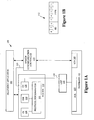
- FIG. 1A conceptually illustrates a K3 cordless telephony profile stack 100, which may be used by mobile units and/or base stations to form one or more wireless telecommunication links according to a conventional Bluetooth protocol.
- Voice packets are received by a telephony application 105, which provides the voice packets and other control signals to a Telephony Control protocol Specification Binary (TCS Bin) block 110.
- TCS Bin Telephony Control protocol Specification Binary
- the TCS Bin block 110 generally functions by enabling a connection-oriented link between a terminal (not shown) and a gateway (not shown). The link is unique to the gateway and enables the gateway to host multiple TCS bins. In this manner, signals transmitted between the TCS Bin blocks 110 associated with different users can be discriminated.
- a link identifier and an associated identifier (the SCO handle) identify the voice channel to the gateway.
- FIG. 1B shows a conventional TCS Bin header 112 that includes a three-bit protocol discriminator field (PD) for discriminating internal messaging.
- a protocol discriminator 111 uses the TCS Bin header 115, which is typically attached or appended to each voice packet, to determine how the voice packets provided to the TCS Bin 110 are handled.
- the Bluetooth standard has explicitly defined three values for the protocol discriminator field (PD).
- a value of 0x0 in the protocol discriminator field indicates that a call control (CC) block 120 should handle the message
- a value of 0x1 in the protocol discriminator field indicates that a group management (GM) block 122 should handle the message
- a value of 0x2 in the protocol discriminator field indicates that a connection-less (CL) block 124 should handle the message. All other values of the protocol discriminator are reserved in the Bluetooth standard.
- TYPE five-bit type field
- the functionality of the TCS Bin block 110 is determined by the call control (CC) block 120, which provides ITU-T Q.931 call control functionality that is common to most types of cellular and fixed line telephony.
- the call control (CC) block 120 manages a voice channel via an interface 125 with a speech synchronization controller 115 and an interface 130 with a link manager protocol (LMP) block 135.
- LMP link manager protocol
- the call control (CC) block 120 may connect and/or disconnect internal speech paths by providing signals to the speech synchronization controller 115 via the interface 125 and may establish and/or release voice synchronization control links by providing signals to the link manager protocol (LMP) block 135 via the interface 130.
- LMP link manager protocol
- the link manager protocol (LMP) block 135 is coupled to an asynchronous control block 137.
- the interfaces 125, 130 enable the speech synchronization controller 115 to directly control the voice path from the telephony application 105 to a synchronous controller 140 in a baseband 145.
- the telephony application 105 typically obtains guaranteed quality and/or delay characteristics.
- a growing number of mobile units such as cellular wireless telephones include both a conventional cellular telephone interface and a Bluetooth interface.
- a mobile unit may be able to place a wireless telephony call according to two protocols: a cellular voice protocol (such as UMTS, GSM, IS95, CDMA200, etc) and a Bluetooth protocol.
- a cellular voice protocol such as UMTS, GSM, IS95, CDMA200, etc
- a Bluetooth protocol Both the cellular voice protocol and the Bluetooth protocol provide inherent quality guarantees for the voice application and attempt to guarantee that the delay experienced by the voice traffic will remain below a predetermined level.
- the cellular voice protocol also allows a mobile unit to move from one cell to another.
- the Bluetooth protocol does not allow for mobility outside of the mobile unit's current piconet.
- the Bluetooth protocol typically relies on an outside network connection for onward guarantees of the delay and quality.
- the outside network include a public switched telephone network (PSTN) home base station, an Integrated Services Digital Network (ISDN) home base station, a GSM gateway, a satellite gateway, and an H.323 gateway.
- PSTN public switched telephone network
- ISDN Integrated Services Digital Network
- the present invention is directed to addressing the effects of one or more of the problems set forth above.
- the present invention is characterised over the disclosure of 2004/0120283 in that said modifying being so as to indicate that the voice packet may be handled by a cellular control stack block according to the Bluetooth protocol; using a cordless telephony protocol stack including the cellular control stack block to process the voice packet according to the Bluetooth protocol.
- FIG. 2 conceptually illustrates a wireless telecommunication system 200.
- the wireless telecommunications system 200 includes one or more base stations 205(1-2) that are communicatively coupled via a network 210.
- the network 210 may include a local area network, a wide area network, the World Wide Web, an Integrated Services Digital Network (ISDN) network, an Intranet, a Public Switched Telephone Network (PSTN), a plain old telephone service (POTS), a cellular telephone network, a satellite network, and the like.
- ISDN Integrated Services Digital Network
- PSTN Public Switched Telephone Network
- POTS plain old telephone service
- the base stations 205(1-2) may establish one or more concurrent wireless communication links with one or more mobile devices 215 deployed within a corresponding geographic area 220(1-2), referred to hereinafter as a cell 220(1-2).
- the base stations 205 (1-2) establish the one or more concurrent wireless telecommunication links according to a Universal Mobile Telephone System (UMTS) protocol.
- UMTS Universal Mobile Telephone System
- persons of ordinary skill in the art should appreciate that the present invention is not limited to the UMTS protocol.
- the concurrent wireless communication links may be established according to any desirable cellular telephony protocol including, but not limited to, a Global System for Mobile telecommunications (GSM) protocol, a Code Division Multiple Access (CDMA, CDMA-2000) protocol, an IS-95 protocol, a Personal Communication Services (PCS) protocol, and a Third Generation Partnership Project (3GPP, 3GPP2) protocol.
- GSM Global System for Mobile telecommunications
- CDMA Code Division Multiple Access
- CDMA-2000 Code Division Multiple Access
- IS-95 IS-95 protocol
- PCS Personal Communication Services
- 3GPP Third Generation Partnership Project
- the wireless telecommunications system 200 also includes at least one network 225 in which multiple devices belonging to a defined set communicate with each other according to a protocol.
- the network 225 is a piconet 225 including a master 230 that is configured to send and/or receive messages from devices in the piconet 225 according to a Bluetooth protocol.
- the network 225 is not limited to a piconet that operates according to the Bluetooth protocol and any desirable network 225 in which multiple devices belonging to a defined set communicate with each other according to any desirable protocol may be used.
- the piconet 225 is depicted as being entirely within the cell 220(1) and entirely outside of the cell 220(2). However, persons of ordinary skill in the art should appreciate that, in alternative embodiments, a portion of the piconet 225 may be outside of the cell 220(1) and a portion of the piconet 225 may be inside the cell 220(2).
- the mobile device 215 is configured to communicate with the master 230 according to the Bluetooth protocol and with one or more of the base stations 205(1-2) according to a cellular telephony protocol.
- the mobile device 215 and the master 230 include mobile telephony stacks that enable the mobile device 215 to roam between the piconet 225 and the cells 220(1-2), as indicated by the dashed lines 240, 245.
- the mobile device 215 may communicate with the master 230, which may then communicate with the base station 205(1) and/or a radio network controller (not shown) within the cellular network, usually over a fixed link.
- the mobile device 215 determines that the reliability and/or quality of communication with the master 230 is superior to the reliability and/or quality of communication with the base station 205(1).
- the master 230 and mobile device 215 communicate according to the Bluetooth protocol. However, if the mobile device 215 roams outside of the piconet 225, a vertical handoff may be performed so that the mobile device 215 communicates directly with the base station 205(1) according to the cellular telephony protocol.
- the mobile device 215, which implements the mobile telephony stack may also roam between the piconet 225 and the cell 220(2), which does not overlap with the piconet 225.
- a vertical handoff may be performed so that the mobile device 215, which may originally have been in communication with the base station 205(2) according to the cellular telephony protocol, communicates with the master device according to the Bluetooth protocol.
- a brief interruption in service may occur when the mobile device 215 roams between the piconet 225 and the cell 220(2). For example, a user may hear a click or a pop when the mobile device 215 roams between the piconet 225 and the cell 220(2).
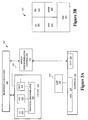
- FIG 3A conceptually illustrates one embodiment of a cordless telephony profile stack 300, which may be used to form one or more wireless telecommunication links according to a Bluetooth protocol and/or a cellular telephony protocol.
- a cordless telephony profile stack 300 which may be used to form one or more wireless telecommunication links according to a Bluetooth protocol and/or a cellular telephony protocol.
- voice packets are received by a telephony application 305, which provides the voice packets and other control signals to a Telephony Control protocol Specification Binary (TCS Bin) block 310.
- TCS Bin Telephony Control protocol Specification Binary
- the TCS Bin block 310 generally functions by enabling a connection-oriented link between a terminal (not shown) and a gateway (not shown).
- the link is unique to the gateway and enables the gateway to host multiple TCS bins. In this manner, signals transmitted between the TCS Bin blocks 310 associated with different users can be discriminated.
- a link identifier and an associated identifier identify the voice channel to the gateway.
- the TCS Bin block 315 includes a cellular control stack block 315.
- the cellular control stack block 315 is a Universal Mobile Telephone System (UMTS) block 315.
- UMTS Universal Mobile Telephone System
- the UMTS block 315 includes a call control (CC) block 316, a SM block 317, a Mobility Management (MM) block 318, a GPRS Mobility Management (GMM) block 319, and a Radio Resource Control (RRC) block 320.
- CC call control
- MM Mobility Management
- GMM GPRS Mobility Management
- RRC Radio Resource Control
- Figure 3B is merely one example of the UMTS block 315 and, in alternative embodiments, the UMTS block 315 may include more or fewer blocks of the same or different types.
- the UMTS block 315 manages a voice channel via an interface 322 with a speech synchronization controller 325 and an interface 330 with a link manager protocol (LMP) block 335.
- the UMTS block 315 may connect and/or disconnect internal speech paths by providing signals to the speech synchronization controller 325 via the interface 325 and may establish and/or release voice synchronization control links by providing signals to the link manager protocol (LMP) block 335 via the interface 330.
- the link manager protocol (LMP) block 335 is coupled to an asynchronous control block 337.
- the interfaces 325, 330 enable the speech synchronization controller 325 to directly control the voice path from the telephony application 305 to a synchronous controller 340 in a baseband 345.
- the telephony application 305 typically obtains guaranteed quality and/or delay characteristics.
- backward compatibility of the cordless telephony profile stack 300 is achieved by retaining the mechanisms and functions that are required to communicate over interfaces 322,330, as well as other interfaces not shown in Figure 3A .
- crucial aspects of the legacy signalling techniques are preserved without alteration. For example, techniques for set-up of control and voice channels over the Bluetooth air interface are preserved.
- a protocol discriminator 345 uses a three-bit protocol discriminator field (PD), which is typically attached or appended to each voice packet, to determine how the voice packets provided to the TCS Bin 310 are handled.
- the Bluetooth standard has explicitly defined three values for the protocol discriminator field (PD). For example, a value of 0x1 in the protocol discriminator field indicates that a group management (GM) block 350 should handle the message. For another example, a value of 0x2 in the protocol discriminator field indicates that a connection-less (CL) block 355 should handle the message. All other values of the protocol discriminator are reserved in the Bluetooth standard.
- the protocol discriminator 345 also uses the three-bit protocol discriminator field (PD) and/or the message type field to determine how cellular voice packets that are provided to the TCS Bin 310 are handled.
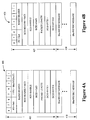
- Figure 4A conceptually illustrates a first exemplary embodiment of a voice packet 400, which includes a header 405 and a message body 410.
- the header 405 includes, among other conventional fields, a three-bit protocol discriminator (PD) field and a five-bit message type (TYPE) field that are used to indicate that the voice packet 400 conforms to the applicant protocol and, in the illustrated embodiment, a UMTS protocol.
- PD protocol discriminator
- TYPE message type
- the protocol discriminator block 345 determines that the voice packet 400 may be handled by the call control block 316 in the UMTS block 315 (shown in Figure 3A ) according to the UMTS protocol.
- the protocol discriminator block 345 determines that the voice packet 400 may also be handled by the UMTS block 315 according to the Bluetooth protocol.
- Figure 4B conceptually illustrates a second exemplary embodiment of a voice packet 420, which includes a header 425 and a message body 430.
- the header 425 of the second exemplary embodiment includes a three-bit protocol discriminator (PD) field and a five-bit radio bearer type.
- the protocol discriminator block 345 determines that the voice packet 420 may be handled by the call control block 316 in the UMTS block 315 (shown in Figure 3A ) according to the UMTS protocol and/or according to the Bluetooth protocol when the value of the protocol discriminator field is 0x4.
- the protocol discriminator block 345 determines that the voice packet 420 may be handled by the call control block 316 according to the Bluetooth protocol
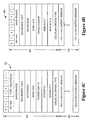
- Figures 4C and 4D conceptually illustrate third and fourth exemplary embodiments of the voice packet 440, 450, respectively.
- the headers 455, 460 and message bodies 465, 470 of the third and fourth exemplary embodiments are similar to the first and second exemplary embodiments, respectively.
- the third and fourth exemplary embodiments are not limited to the UMTS protocol.
- the headers 455, 460 of the third and fourth exemplary embodiments include a cellular control type field that may be used to indicate the appropriate cellular telephony protocol.
- the cellular control type field may include a value indicative of a Global System for Mobile telecommunications (GSM) protocol, a Code Division Multiple Access (CDMA, CDMA-2000) protocol, an IS-95 protocol, a Personal Communication Services (PCS) protocol, a Third Generation Partnership Project (3GPP, 3GPP2) protocol, and the like.
- GSM Global System for Mobile telecommunications
- CDMA Code Division Multiple Access
- CDMA-2000 Code Division Multiple Access
- IS-95 IS-95 protocol
- PCS Personal Communication Services
- 3GPP Third Generation Partnership Project
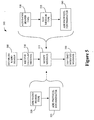
- Figure 5 illustrates one embodiment of a method 500 that may be used to transmit one or more messages using the Bluetooth protocol and a cellular telephony protocol.
- the present invention is not limited to the Bluetooth protocol and/or the cellular telephony protocol.
- the method 500 may be used to transmit messages over any desirable network in which multiple devices belonging to a defined set communicate with each other according to a first protocol and/or any desirable network in which multiple devices communicate with each other according to a second protocol, different from the first protocol.
- a radio bearer is established (at 505).
- a master device may establish (at 505) a radio bearer in the Industrial Scientific Medical frequency band for communicating with a slave device in a piconet.
- a message conforming to a cellular telephony protocol is then received (at 510).
- receiving (at 510) the message may include receiving a signal indicative of a user's voice, such as one or more voice packets that conform to a cellular telephony protocol.
- receiving (at 510) the message may include receiving one or more voice packets that conform to a cellular telephony protocol, such as a UMTS protocol.
- the message conforming to the cellular telephony protocol is modified (at 515).
- a voice packet may be modified (at 515) by appending a header to the voice packet.
- modifying (at 515) the message by appending the header comprises adding (at 520) a radio bearer type and adding (at 525) a protocol discriminator field.
- a protocol discriminator field value of 0x4 may be added (at 525).
- modifying (at 515) the message by appending the header comprises adding (at 530) a radio bearer type, adding (at 535) a message type field, and adding (at 540) a protocol discriminator field.
- a message type field having a value of 0x1F may be added (at 535) and a protocol discriminator field having a value of 0x0 may be added (at 540).
- the modified message is then transmitted (at 550) using, e.g.the radio bearer.
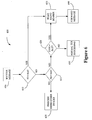
- Figure 6 illustrates one embodiment of a method 600 that may be used to receive one or more messages using a Bluetooth protocol and a cellular telephony protocol.
- UMTS protocol some specific parameter values defined by the UMTS protocol are used in the following description of the method 600.
- persons of ordinary skill in the art should appreciate that these parameter values are used for illustrative purposes only and are not intended to limit the present invention.
- the present invention is not limited to the UMTS protocol, the Bluetooth protocol, and/or any other particular wireless telecommunication protocol.
- the method 600 may be used to receive messages over any desirable network in which multiple devices belonging to a defined set communicate with each other according to a first protocol and/or any desirable network in which multiple devices communicate with each other according to a second protocol, different from the first protocol.
- a message is received (at 605).
- a master device in a piconet may receive a message from a slave device, such as a mobile unit configured for wireless communications using a Bluetooth protocol and/or a cellular telephony protocol. Whether or not the message conforms to the Bluetooth protocol and the cellular telephony protocol is determined. For example, in the UMTS protocol, the message may be determined (at 610) to conform to the Bluetooth protocol and the cellular telephony protocol if a value of a protocol discriminator field is determined (at 610) to be equal to 0x4.
- the message may be determined to conform to the Bluetooth protocol and the cellular telephony protocol if a value of a protocol discriminator field is determined (at 615) to be equal to 0x0 and a value of a message type field is determined (at 620) to be equal to 0x1F. If the value of the protocol discriminator field is determined (at 615) to not be equal to 0x0, then the message may be processed (at 625) using other stacks according to the Bluetooth profile.
- the protocol discriminator field is determined (at 615) to be equal to 0x0 but the value of a message type field is not determined (at 620) to be equal to 0x1F, in the message may be processed (at 630) using conventional TCS Bin processing.
- the message is read (at 635) from the radio bearer and forwarded (at 640) to an appropriate processing block. For example, if the message is received (at 605) by a mobile unit, then the message is forwarded (at 640) to an RRC block, such as the RRC block 320 shown in Figure 3B . For another example, if the message is received (at 605) by a base station, then the message is forwarded (at 640) to a mapper block.
- the method 600 is a de-multiplexing event.
- the method 600 is implemented in a receiver that can be made generic for both sides of the TCS Bin by including a receiver type field (not shown) which can be picked up on initial creation of the voice packet. Additional information may also be included in the header to identify the mobile-unit-to-base-station correspondence both in terms of UMTS signalling and for a voice traffic channel.
- method 600 may also provide the hooks for a Voice over Internet Protocol (VoIP) solution.
- VoIP Voice over Internet Protocol
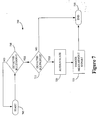
- Figure 7 illustrates a method 700 of forming a wireless telecommunications link between at least one mobile unit and a base station according to the Bluetooth protocol and the cellular telephony protocol.
- the method 700 may be used to translate a random access channel (RACH) onto a Bluetooth network that includes devices that can communicate according to both the Bluetooth protocol and the cellular telephony protocol, such as the mobile unit 215 shown in Figure 2 .
- RACH random access channel
- Each initial RACH across the air interface may occur independently of whether the mobile unit has a current cellular connection or not.
- the RACH is only performed to locate a mobile unit when no signaling connection exists (e.g., as the result of some paging action) or on an access request from the mobile unit to establish an initial radio signaling connection.
- a Bluetooth-enabled mobile unit is detected (at 710).
- a UMTS RACH may be sent across a UMTS air interface independently of the current UMTS activity to indicate the presence of the mobile unit.
- the UMTS RACH may also be used inform a UMTS system that the mobile unit has moved into a Bluetooth service area, such as a piconet, and that a handoff followed by a serving radio network subsystem (SRNS) may occur.
- SRNS serving radio network subsystem
- a TCS profile associated with the mobile unit is detected (at 715). For example, the mobile unit may page a gateway and a resulting master slave exchange may be used to detect (at 710) the TCS profile. If the TCS profile indicates that the mobile unit is capable of communicating according to both the Bluetooth protocol and the cellular telephony protocol, then the mobile unit is authenticated (at 720). For example, the mobile unit may be authenticated (at 720) by sending a UMTS RACH over the Bluetooth interface. For another example, the mobile unit may be authenticated (at 720) using a pre-authorization provided by the cellular network.
- a successful authentication (at 720), indicating that the RACH has been established, may trigger (at 725) a measurement report.
- the successful authentication (at 720) may also include informing the mobile unit of a cell ID and an equivalent cellular pilot channel (CPICH) value.
- the cell ID and the equivalent cellular pilot channel (CPICH) value may be used to set up a soft-handoff between the piconet and the cellular telephone network
- RNC Radio Network Controller
- method 700 may be used as a portion of a method of performing horizontal rather than vertical system handoffs, e.g. between Bluetooth and any other cellular system. The method 700 may then end (at 730).
- the cordless telephony profile stack 300 shown in Figure 3A and 3B allows for backward compatibility, as discussed above.
- the cordless telephony profile stack provides the UMTS (or generic cellular) control stack, such as the cellular control stack 315 shown in Figure 3B , access to the Bluetooth air interface.
- UMTS or generic cellular
- the mobile units can be controlled seamlessly as if they were part of the cellular system.
- the mobile unit may be handed-off vertically in a seamless manner between the Bluetooth and cellular network. Accordingly, the present invention may be efficiently implemented in 4G systems.
Landscapes
- Engineering & Computer Science (AREA)
- Computer Networks & Wireless Communication (AREA)
- Signal Processing (AREA)
- Computer Security & Cryptography (AREA)
- Mobile Radio Communication Systems (AREA)
- Telephonic Communication Services (AREA)
- Time-Division Multiplex Systems (AREA)
Claims (4)
- Verfahren für die Kommunikation eines Mobilteils (215), welches sich in einem Pico-Netzwerk (225), in dem Vorrichtungen (215, 230) gemäß einem Bluetooth-Protokoll miteinander kommunizieren, und einem zweiten Netzwerk (210), welches eine drahtlose Konnektivität gemäß einem zellularen Telefonprotokoll aufweist, bewegt, wobei die Mobileinheit (215) für den Betrieb gemäß dem Bluetooth-Protokoll und dem zellularen Telefonprotokoll ausgelegt ist, wobei das Verfahren umfasst:Einrichten (505) eines Funkträgers gemäß dem Bluetooth-Protokoll;Empfangen (510) mindestens eines Sprachpakets (400, 420, 440, 450) in einem dem zellularen Telefonprotokoll entsprechenden Format;Modifizieren (515) des mindestens einen Sprachpakets durch Anhängen eines Kopfteils; undÜbertragen (550) des mindestens einen modifizierten Sprachpakets (400, 420, 440, 450) unter Verwendung des besagten mindestens einen Funkträgers; wobei das Verfahren DADURCH GEKENNZEICHNET ist, dass das besagte Modifizieren derart erfolgt, dass angezeigt wird, dass das Sprachpaket von einem zellularen Steuerkellerblock (315) gemäß dem Bluetooth-Protokoll bearbeitet werden kann;Verwenden eines drahtlosen Protokollstapels der drahtlosen Telefonvorrichtung (300), welcher den zellularen Steuerkellerblock (315) enthält, um das Sprachpaket (315) gemäß dem Bluetooth-Protokoll zu verarbeiten.
- Das Verfahren nach Anspruch 1, wobei das Anhängen des Kopfteils an das mindestens eine Sprachpaket das Anhängen eines Kopfteils, welcher einen Funkträgertyp (520) und ein Protokoll-Diskriminatorfeld (525, 545) enthält, umfasst.
- Das Verfahren nach Anspruch 1, wobei das Anhängen des Kopfteils an das mindestens eine Sprachpaket das Anhängen eines Kopfteils, welcher einen Protokoll-Diskriminator, ein Nachrichtentyp-Kennzeichen und ein Funkträgertyp-Kennzeichen enthält, umfasst.
- Das Verfahren nach Anspruch 1, umfassend das Abbilden des Funkträgers auf eine drahtlose Kommunikationsverbindung, welcher dem zellularen Telefonprotokoll entspricht, basierend auf dem mindestens einen modifizierten Sprachpaket.
Applications Claiming Priority (1)
| Application Number | Priority Date | Filing Date | Title |
|---|---|---|---|
| US10/924,115 US8249106B2 (en) | 2004-08-23 | 2004-08-23 | Extended cellular telephony protocol |
Publications (2)
| Publication Number | Publication Date |
|---|---|
| EP1631020A1 EP1631020A1 (de) | 2006-03-01 |
| EP1631020B1 true EP1631020B1 (de) | 2011-01-26 |
Family
ID=35159745
Family Applications (1)
| Application Number | Title | Priority Date | Filing Date |
|---|---|---|---|
| EP05255105A Expired - Lifetime EP1631020B1 (de) | 2004-08-23 | 2005-08-18 | Erweitertes zellulares Telefonprotokoll |
Country Status (6)
| Country | Link |
|---|---|
| US (1) | US8249106B2 (de) |
| EP (1) | EP1631020B1 (de) |
| JP (1) | JP4813848B2 (de) |
| KR (1) | KR101212971B1 (de) |
| CN (1) | CN1741678B (de) |
| DE (1) | DE602005026086D1 (de) |
Families Citing this family (14)
| Publication number | Priority date | Publication date | Assignee | Title |
|---|---|---|---|---|
| US9049649B2 (en) * | 2008-05-09 | 2015-06-02 | Qualcomm Incorporated | Configuring consumption of service for electronic devices |
| KR101601270B1 (ko) * | 2009-07-17 | 2016-03-08 | 주식회사 쓰리디아이템즈 | 릴레이 기술을 이용한 패킷 데이터 전송 제어 방법 및 그 시스템 |
| DE102010004748A1 (de) * | 2010-01-14 | 2011-07-21 | Deutsche Telekom AG, 53113 | Verfahren zur Ressourcen- und Energieeinsparung bei mobilen Endgeräten |
| KR20130124732A (ko) * | 2012-05-07 | 2013-11-15 | 삼성전자주식회사 | 비연결형 메시징 방법, 기계로 읽을 수 있는 저장 매체 및 통신 단말 |
| US9066323B2 (en) * | 2012-11-15 | 2015-06-23 | Hewlett-Packard Development Company, L.P. | Ad Hoc network connection |
| US9134937B2 (en) | 2013-04-01 | 2015-09-15 | Hewlett-Packard Development Company, L.P. | Secure printing |
| US9020483B1 (en) | 2013-11-26 | 2015-04-28 | At&T Mobility Ii Llc | Setting voice and data priority using a registration message |
| US9083770B1 (en) * | 2013-11-26 | 2015-07-14 | Snapchat, Inc. | Method and system for integrating real time communication features in applications |
| KR101632861B1 (ko) * | 2016-03-02 | 2016-07-01 | 주식회사 쓰리디아이템즈 | 릴레이 기술을 이용한 패킷 데이터 전송 제어 방법 및 그 시스템 |
| US9854528B2 (en) | 2016-04-05 | 2017-12-26 | At&T Intellectual Property I, L.P. | Tuning networks and user equipment using a power profile |
| WO2017219289A1 (zh) * | 2016-06-22 | 2017-12-28 | 华为技术有限公司 | 一种通信路径变更方法及设备 |
| US10034407B2 (en) * | 2016-07-22 | 2018-07-24 | Intel Corporation | Storage sled for a data center |
| US11616850B1 (en) | 2019-08-23 | 2023-03-28 | Fitbit, Inc. | Connection management techniques |
| CN111885554B (zh) * | 2020-04-24 | 2023-09-12 | 珠海市杰理科技股份有限公司 | 基于双无线蓝牙通信的链路切换方法及相关设备 |
Family Cites Families (32)
| Publication number | Priority date | Publication date | Assignee | Title |
|---|---|---|---|---|
| US5953322A (en) * | 1997-01-31 | 1999-09-14 | Qualcomm Incorporated | Cellular internet telephone |
| JP2002539694A (ja) * | 1999-03-08 | 2002-11-19 | ノキア ネットワークス オサケ ユキチュア | ユーザ装置と無線ネットワークとの間に通信を確立する方法 |
| ATE418204T1 (de) * | 1999-09-29 | 2009-01-15 | Mobilian Corp | Verfahren und vorrichtungen für mehrfache drahtloskommunikationsprotokolle unter berücksichtigung der dienstequalität |
| US6909705B1 (en) * | 1999-11-02 | 2005-06-21 | Cello Partnership | Integrating wireless local loop networks with cellular networks |
| JP3715494B2 (ja) * | 1999-12-27 | 2005-11-09 | 株式会社東芝 | 情報転送方法並びに無線端末及び無線ゲートウェイ装置 |
| DE10013607B4 (de) | 2000-03-18 | 2015-02-26 | Ipcom Gmbh & Co. Kg | Funkgerät |
| US6430395B2 (en) * | 2000-04-07 | 2002-08-06 | Commil Ltd. | Wireless private branch exchange (WPBX) and communicating between mobile units and base stations |
| US7010300B1 (en) * | 2000-06-15 | 2006-03-07 | Sprint Spectrum L.P. | Method and system for intersystem wireless communications session hand-off |
| GB0019534D0 (en) * | 2000-08-10 | 2000-09-27 | Koninkl Philips Electronics Nv | Radio communication system |
| KR100403767B1 (ko) * | 2000-09-01 | 2003-11-01 | 주식회사 모리아테크놀로지 | 블루투스를 이용한 무선 멀티미디어 서비스 제공 시스템및 방법 |
| JP3776705B2 (ja) * | 2000-09-28 | 2006-05-17 | 株式会社東芝 | 通信システム、移動端末装置、ゲートウェイ装置及び通信制御方法 |
| US7035932B1 (en) * | 2000-10-27 | 2006-04-25 | Eric Morgan Dowling | Federated multiprotocol communication |
| AU7205300A (en) * | 2000-12-06 | 2002-06-13 | Alcatel | Versatile network termination unit and line interface |
| GB0102261D0 (en) * | 2001-01-29 | 2001-03-14 | Vtech Communications Ltd | Enhanced cordless telephone platform using bluetooth technology |
| US7577451B2 (en) * | 2001-04-04 | 2009-08-18 | Intel Corporation | Extending personal area networks |
| KR100390508B1 (ko) * | 2001-05-30 | 2003-07-07 | 엘지전자 주식회사 | 블루투스 단말을 이용한 직접 통화 방법 |
| CN1262143C (zh) * | 2001-08-07 | 2006-06-28 | 株式会社Ntt都科摩 | 控制站和控制方法 |
| FR2829650B1 (fr) * | 2001-09-13 | 2004-07-09 | Cit Alcatel | Passerelle inter-reseaux de transmission de signaux numeriques |
| US6970703B2 (en) * | 2002-01-23 | 2005-11-29 | Motorola, Inc. | Integrated personal communications system and method |
| US6879600B1 (en) * | 2002-06-03 | 2005-04-12 | Sprint Spectrum, L.P. | Method and system for intersystem wireless communication session arbitration |
| JP3712996B2 (ja) * | 2002-07-19 | 2005-11-02 | 松下電器産業株式会社 | 通信端末装置及びハンドオーバ方法 |
| US7050800B2 (en) | 2002-07-31 | 2006-05-23 | Interdigital Technology Corporation | Method and apparatus for WLAN-UMTS interworking employing UMTS air interface |
| US20040037314A1 (en) * | 2002-08-23 | 2004-02-26 | Spear Stephen L. | Method and communication network for cross coding between codecs |
| DE10253714A1 (de) * | 2002-11-18 | 2004-06-09 | Siemens Ag | Verfahren zum Verarbeiten von Datenpaketen in einem Datennetz mit Mobilitätsfunktion |
| US7197314B2 (en) * | 2002-12-05 | 2007-03-27 | Nokia Corporation | Communication system |
| US7573876B2 (en) * | 2002-12-05 | 2009-08-11 | Intel Corporation | Interconnecting network processors with heterogeneous fabrics |
| US7916715B2 (en) * | 2002-12-18 | 2011-03-29 | Qualcomm Incorporated | Hybrid protocol to support communications with multiple networks |
| WO2005004437A1 (en) * | 2003-06-25 | 2005-01-13 | Hotspot Wireless Devices, Inc. | Systems and metods using multiprotocol communication |
| US7266101B2 (en) * | 2003-06-30 | 2007-09-04 | Motorola, Inc. | Fast handover through proactive registration |
| US7440472B2 (en) * | 2003-08-28 | 2008-10-21 | Tekelec | Methods and systems for providing wireless local area network (WLAN)—base transceiver station (BTS) gateway |
| US8908699B2 (en) * | 2004-04-16 | 2014-12-09 | Broadcom Corporation | Providing automatic format conversion via an access gateway in a home |
| US7746846B2 (en) * | 2004-07-15 | 2010-06-29 | Broadcom Corporation | Method and system for a gigabit Ethernet IP telephone chip with integrated security module |
-
2004
- 2004-08-23 US US10/924,115 patent/US8249106B2/en active Active
-
2005
- 2005-08-18 EP EP05255105A patent/EP1631020B1/de not_active Expired - Lifetime
- 2005-08-18 DE DE602005026086T patent/DE602005026086D1/de not_active Expired - Lifetime
- 2005-08-23 CN CN2005100915800A patent/CN1741678B/zh not_active Expired - Fee Related
- 2005-08-23 KR KR1020050077388A patent/KR101212971B1/ko not_active Expired - Fee Related
- 2005-08-23 JP JP2005240844A patent/JP4813848B2/ja not_active Expired - Fee Related
Also Published As
| Publication number | Publication date |
|---|---|
| KR20060050575A (ko) | 2006-05-19 |
| CN1741678A (zh) | 2006-03-01 |
| US20060039349A1 (en) | 2006-02-23 |
| JP4813848B2 (ja) | 2011-11-09 |
| KR101212971B1 (ko) | 2012-12-17 |
| US8249106B2 (en) | 2012-08-21 |
| EP1631020A1 (de) | 2006-03-01 |
| CN1741678B (zh) | 2010-05-12 |
| JP2006074762A (ja) | 2006-03-16 |
| DE602005026086D1 (de) | 2011-03-10 |
Similar Documents
| Publication | Publication Date | Title |
|---|---|---|
| EP1935205B1 (de) | Von einem benutzerendgerät initiierte, harte übergabe von einem wlan zu einem mobilfunknetz | |
| KR101164805B1 (ko) | 무선 네트워크 무선 인터페이스 검출 | |
| CN100444680C (zh) | 用于软切换的方法和系统 | |
| CN1934884B (zh) | 对所有接入点使用单个标识符在蜂窝网和未许可无线电接入网之间切换 | |
| EP1631020B1 (de) | Erweitertes zellulares Telefonprotokoll | |
| EP1482686A2 (de) | Erhöhen der Mobilität eines drahtlosen Kopfhörers durch Nutzung von Zugangspunkten eines drahtlosen lokalen Netzwerks (WLAN) | |
| TW200931992A (en) | Wireless communication methods and components that implement handoff in wireless local area networks | |
| CA2643535A1 (en) | Location update method and inter core network entity handover method | |
| EP1631011A1 (de) | Vertikales sanftes Weiterreichen in drahtlosen Netzen | |
| WO2005099185A1 (en) | Mobile communication with unlicensed-radio access networks | |
| US7421280B2 (en) | Wireless network and wireless access terminals using enhanced SYNC—ID parameter | |
| EP2086246B1 (de) | Kommunikationssteuereinrichtung und kommunikationssteuerverfahren | |
| AU777183B2 (en) | System and method for switching media packets for packet-based communication in a mobile communications network | |
| Iqbal et al. | Performance Evoluation of vertical handover between UMTS and WLAN |
Legal Events
| Date | Code | Title | Description |
|---|---|---|---|
| PUAI | Public reference made under article 153(3) epc to a published international application that has entered the european phase |
Free format text: ORIGINAL CODE: 0009012 |
|
| 17P | Request for examination filed |
Effective date: 20050902 |
|
| AK | Designated contracting states |
Kind code of ref document: A1 Designated state(s): AT BE BG CH CY CZ DE DK EE ES FI FR GB GR HU IE IS IT LI LT LU LV MC NL PL PT RO SE SI SK TR |
|
| AX | Request for extension of the european patent |
Extension state: AL BA HR MK YU |
|
| AKX | Designation fees paid |
Designated state(s): DE FR GB |
|
| 17Q | First examination report despatched |
Effective date: 20060103 |
|
| RAP3 | Party data changed (applicant data changed or rights of an application transferred) |
Owner name: LUCENT TECHNOLOGIES INC. |
|
| GRAP | Despatch of communication of intention to grant a patent |
Free format text: ORIGINAL CODE: EPIDOSNIGR1 |
|
| RIC1 | Information provided on ipc code assigned before grant |
Ipc: H04W 76/02 20090101ALN20100812BHEP Ipc: H04W 4/18 20090101AFI20100812BHEP |
|
| RAP1 | Party data changed (applicant data changed or rights of an application transferred) |
Owner name: ALCATEL-LUCENT USA INC. |
|
| GRAS | Grant fee paid |
Free format text: ORIGINAL CODE: EPIDOSNIGR3 |
|
| GRAA | (expected) grant |
Free format text: ORIGINAL CODE: 0009210 |
|
| AK | Designated contracting states |
Kind code of ref document: B1 Designated state(s): DE FR GB |
|
| REG | Reference to a national code |
Ref country code: GB Ref legal event code: FG4D |
|
| REF | Corresponds to: |
Ref document number: 602005026086 Country of ref document: DE Date of ref document: 20110310 Kind code of ref document: P |
|
| REG | Reference to a national code |
Ref country code: DE Ref legal event code: R096 Ref document number: 602005026086 Country of ref document: DE Effective date: 20110310 |
|
| PLBE | No opposition filed within time limit |
Free format text: ORIGINAL CODE: 0009261 |
|
| STAA | Information on the status of an ep patent application or granted ep patent |
Free format text: STATUS: NO OPPOSITION FILED WITHIN TIME LIMIT |
|
| 26N | No opposition filed |
Effective date: 20111027 |
|
| REG | Reference to a national code |
Ref country code: DE Ref legal event code: R097 Ref document number: 602005026086 Country of ref document: DE Effective date: 20111027 |
|
| REG | Reference to a national code |
Ref country code: GB Ref legal event code: 732E Free format text: REGISTERED BETWEEN 20131024 AND 20131030 |
|
| REG | Reference to a national code |
Ref country code: FR Ref legal event code: GC Effective date: 20140715 |
|
| REG | Reference to a national code |
Ref country code: FR Ref legal event code: RG Effective date: 20141015 |
|
| REG | Reference to a national code |
Ref country code: FR Ref legal event code: PLFP Year of fee payment: 11 |
|
| REG | Reference to a national code |
Ref country code: FR Ref legal event code: PLFP Year of fee payment: 12 |
|
| REG | Reference to a national code |
Ref country code: FR Ref legal event code: PLFP Year of fee payment: 13 |
|
| REG | Reference to a national code |
Ref country code: DE Ref legal event code: R082 Ref document number: 602005026086 Country of ref document: DE Representative=s name: METACOM LEGAL RECHTSANWAELTE, DE Ref country code: DE Ref legal event code: R082 Ref document number: 602005026086 Country of ref document: DE Representative=s name: METACOM LEGAL, DE Ref country code: DE Ref legal event code: R082 Ref document number: 602005026086 Country of ref document: DE Representative=s name: BARKHOFF REIMANN VOSSIUS, DE Ref country code: DE Ref legal event code: R081 Ref document number: 602005026086 Country of ref document: DE Owner name: WSOU INVESTMENTS, LLC, LOS ANGELES, US Free format text: FORMER OWNER: ALCATEL-LUCENT USA INC., MURRAY HILL, N.J., US |
|
| REG | Reference to a national code |
Ref country code: DE Ref legal event code: R082 Ref document number: 602005026086 Country of ref document: DE Representative=s name: METACOM LEGAL RECHTSANWAELTE, DE Ref country code: DE Ref legal event code: R082 Ref document number: 602005026086 Country of ref document: DE Representative=s name: METACOM LEGAL, DE |
|
| P01 | Opt-out of the competence of the unified patent court (upc) registered |
Effective date: 20230606 |
|
| PGFP | Annual fee paid to national office [announced via postgrant information from national office to epo] |
Ref country code: GB Payment date: 20241227 Year of fee payment: 20 |
|
| PGFP | Annual fee paid to national office [announced via postgrant information from national office to epo] |
Ref country code: FR Payment date: 20241226 Year of fee payment: 20 |
|
| PGFP | Annual fee paid to national office [announced via postgrant information from national office to epo] |
Ref country code: DE Payment date: 20250129 Year of fee payment: 20 |
|
| REG | Reference to a national code |
Ref country code: DE Ref legal event code: R071 Ref document number: 602005026086 Country of ref document: DE |
|
| REG | Reference to a national code |
Ref country code: GB Ref legal event code: PE20 Expiry date: 20250817 |