EP1629640B1 - Verfahren zur handhabung von suspendierungsanforderungen für datenflüsse in einem kommunikationssystem - Google Patents
Verfahren zur handhabung von suspendierungsanforderungen für datenflüsse in einem kommunikationssystem Download PDFInfo
- Publication number
- EP1629640B1 EP1629640B1 EP04735579A EP04735579A EP1629640B1 EP 1629640 B1 EP1629640 B1 EP 1629640B1 EP 04735579 A EP04735579 A EP 04735579A EP 04735579 A EP04735579 A EP 04735579A EP 1629640 B1 EP1629640 B1 EP 1629640B1
- Authority
- EP
- European Patent Office
- Prior art keywords
- protocol entity
- request primitive
- sender
- protocol
- suspension
- Prior art date
- Legal status (The legal status is an assumption and is not a legal conclusion. Google has not performed a legal analysis and makes no representation as to the accuracy of the status listed.)
- Expired - Lifetime
Links
- 239000000725 suspension Substances 0.000 title claims description 81
- 238000000034 method Methods 0.000 title claims description 44
- 238000004891 communication Methods 0.000 title description 4
- 230000005540 biological transmission Effects 0.000 claims description 58
- 238000012546 transfer Methods 0.000 claims description 14
- 230000004044 response Effects 0.000 claims description 10
- 238000012545 processing Methods 0.000 claims description 9
- 230000000977 initiatory effect Effects 0.000 claims description 3
- 238000001914 filtration Methods 0.000 description 9
- 230000006870 function Effects 0.000 description 5
- 239000000872 buffer Substances 0.000 description 3
- 230000001419 dependent effect Effects 0.000 description 3
- 230000007246 mechanism Effects 0.000 description 3
- 238000004590 computer program Methods 0.000 description 2
- 230000011664 signaling Effects 0.000 description 2
- 241000282836 Camelus dromedarius Species 0.000 description 1
- 230000003139 buffering effect Effects 0.000 description 1
- 238000012937 correction Methods 0.000 description 1
- 238000005516 engineering process Methods 0.000 description 1
- 239000003999 initiator Substances 0.000 description 1
- 238000012423 maintenance Methods 0.000 description 1
- 230000011218 segmentation Effects 0.000 description 1
Images




Classifications
-
- H—ELECTRICITY
- H04—ELECTRIC COMMUNICATION TECHNIQUE
- H04L—TRANSMISSION OF DIGITAL INFORMATION, e.g. TELEGRAPHIC COMMUNICATION
- H04L47/00—Traffic control in data switching networks
- H04L47/10—Flow control; Congestion control
-
- H—ELECTRICITY
- H04—ELECTRIC COMMUNICATION TECHNIQUE
- H04L—TRANSMISSION OF DIGITAL INFORMATION, e.g. TELEGRAPHIC COMMUNICATION
- H04L47/00—Traffic control in data switching networks
- H04L47/10—Flow control; Congestion control
- H04L47/26—Flow control; Congestion control using explicit feedback to the source, e.g. choke packets
- H04L47/266—Stopping or restarting the source, e.g. X-on or X-off
Definitions
- the present invention relates to arranging data flow control, and more particularly to suspending and resuming data flows.
- the radio link level handles flow control, i.e. suspends and resumes the data flow.
- a sender either an internal application such as an MMS application (Multimedia Messaging Service) or an external dial-up device, e.g. a laptop
- MMS application Multimedia Messaging Service
- an external dial-up device e.g. a laptop
- an efficient flow control mechanism is needed for optimal data throughput.
- the lower layer protocol entity may send a suspension request primitive to the sender which then suspends data transmission. In response to a resume request, the data transmission is resumed.
- radio link layer In the 2 nd generation GSM/GPRS and in the 3 rd generation UMTS of 3GPP (3 rd Generation Partnership Project) system the radio links are mainly handled by a radio link layer (RLC) protocol.
- RLC radio link layer
- uplink flow control the sender cannot know which layer and why the data transmission is suspended or resumed, because the flow control primitives are the same regardless of the layer sending them.
- this suspension request primitive is routed via upper layers, i.e. logical link control (LLC), sub-network dependent convergence protocol (SNDCP) and some implementation specific layers to the sender. But there is no difference from the sender point of view if suspension is initiated from some other layer, e.g. SNDCP layer.
- LLC logical link control
- SNDCP sub-network dependent convergence protocol
- EP 0 905 950 discloses a solution where a data communication protocol is implemented to control data flow between a transport layer and a data link layer by informing the transport layer that the data link layer should suspend a packet transfer from the transport layer to the data link layer when a bucket buffer in the data link is likely to overflow, or by informing the transport layer of a packet transmission rate of the data link layer and transferring the packet from the transport layer at a rate lower than the informed packet transmission rate.
- An object of the present invention is thus to enhance data flow control such as to alleviate the above disadvantages.
- the objects of the invention are achieved by a method, a system, a data processing device and a software program product which are characterized by what is stated in the independent claims.
- the preferred embodiments of the invention are disclosed in the dependent claims.
- the invention is based on the idea of arranging intelligent filtering functionality for data flow control primitives.
- the originating protocol entity of a suspension request primitive for the sender is checked. Suspension is set as the data transmission status for the protocol entity that has originated a suspension request primitive.
- the originating protocol entity of a resume request primitive is checked before transmitting the resume request primitive for resuming data flow by the sender, i.e. before transmitting it to the sender or to another protocol entity before the sender.
- the data transmission status of at least one protocol entity other than said originating protocol entity of the resume request primitive is checked. Transmission of the resume request primitive is prevented if suspension is set for any other protocol entity than the originating protocol entity of the resume request primitive.
- the suspension status refers generally to any kind of information indicating that the protocol entity is not capable of data transfer for some reason.
- a protocol entity refers to a functional entity, typically implemented by software, which takes care of the tasks of a protocol layer and, among other things, controls the sending and receiving of primitives between protocol entities.
- the originating protocol entity may be the protocol entity implementing the method or another protocol entity, which is under the protocol entity implementing the method in the protocol stack of the system.
- the originating protocol entity does not necessarily refer to a protocol entity that has sent a primitive for the first time as the originating protocol entity is considered from the viewpoint of the protocol entity implementing the method which may not get any information on primitives sent between underlying protocol layers.
- the method is applied in each protocol entity, except in the lowest protocol entity, capable of initiating data flow control and underlying the sender in the protocol stack of the system. This makes it possible to completely avoid too early resumption of the uplink data transmission.
- a mobile system includes a core network CN and a UMTS terrestrial radio access network UTRAN, which constitute the fixed network of the mobile system, and a mobile station MS, also called user equipment UE.
- the interface between the CN and the UTRAN is called lu, and the air interface between the UTRAN and the MS is called Uu.
- the UTRAN is typically composed of several radio network subsystems RNS, the interface between which is called lur (not shown).
- the RNS is composed of a radio network controller RNC and one or more base stations BS, for which the term node B is also used.
- the interface between the RNC and the BS is called lub.
- the base station BS attends to implementing the radio path and the radio network controller RNC manages radio resources.
- a connection to the UMTS core network CN can also be set up via a GSM base station subsystem BSS or a GSM/EDGE radio access network (Enhanced Data rates for GSM Evolution) GERAN.
- GSM base station subsystem BSS or a GSM/EDGE radio access network (Enhanced Data rates for GSM Evolution) GERAN.
- the core network CN is composed of an infrastructure of a mobile system external to the UTRAN.
- a mobile services switching centre/visitor location register 3G-MSC/VLR attends to circuit-switched calls and communicates with a home subscriber server HSS.
- the connection to the serving GPRS support node SGSN of a packet radio system is set up via an interface Gs' and to the fixed telephone network PSTN/ISDN via a gateway MSC GMSC (not shown).
- the connection of both the mobile services switching centre 3G-MSC/VLR and the serving GPRS support node SGSN to the radio network UTRAN (UMTS Terrestrial Radio Access Network) is set up via the interface lu.
- the UMTS system thus also comprises a packet radio system, which is largely implemented in accordance with a GPRS system connected to a GSM network, which also accounts for the references to the GPRS system in the network element names.
- the packet radio system of the UMTS may comprise several gateway GPRS support nodes and serving GPRS support nodes, and typically several serving GPRS support nodes SGSN are connected to one gateway GPRS support node GGSN.
- the task of the serving GPRS support node SGSN is to detect mobile stations capable of packet radio connections within its service area, to transmit and receive data packets from said mobile stations and to monitor the location of the mobile stations within its service area.
- the serving GPRS support node SGSN communicates with the home subscriber server HSS via the interface Gr. Records including the content of subscriber-specific packet data protocols are also stored in the home subscriber server HSS.
- the gateway GPRS support node GGSN operates as a gateway between the packet radio system of the UMTS network and an external packet data network PDN.
- External data networks include for instance the UMTS or GPRS network of another network operator, the Internet or a private local area network.
- the gateway GPRS support node GGSN communicates with said data networks via an interface Gi.
- the data packets transferred between the gateway GPRS support node GGSN and the serving GPRS support node SGSN are always encapsulated in accordance with a gateway tunnelling protocol GTP.
- the gateway GPRS support node GGSN also comprises the addresses of PDP contexts (Packet Data Protocol) activated for the mobile stations and the routing information, i.e. for instance the SGSN addresses.
- PDP contexts Packet Data Protocol
- Routing information is thus used for linking data packets between an external data network and the serving GPRS support node SGSN.
- the network between the gateway GPRS support node GGSN and the serving GPRS support node SGSN is a network utilizing the IP communication protocol.
- a packet data system may also comprise many other functions, of which Figure 1 shows a control function SCF for intelligent network services, preferably CAMEL services, and a charging gateway CGF attending to charging. Of the elements of the IMS system, Figure 1 also illustrates a call session control function CSCF.
- FIG. 2 illustrates a 2G GPRS protocol stack which is used in the GSM/GPRS system and in the UMTS system when employing a BSS access network (A/Gb mode).
- Subnetwork Dependent Convergence Protocol (SNDCP) under the IP layer and application layer APP is employed between the MS and the SGSN to map network-level characteristics onto the characteristics of the underlying network.
- Logical Link Control (LLC) is also controlled by SGSN. LLC layer provides reliable ciphered logical link. Under LLC there is RLC/MAC layer providing GSM specific radio link control and medium access control functions.
- the Base Station System GPRS Protocol (BSSGP) layer conveys routing- and QoS-related information between the BSS and the SGSN.
- BSSGP Base Station System GPRS Protocol
- the UMTS packet data protocol architecture is divided into a user plane and a control plane.
- the control plane comprises UMTS-specific signalling protocols.
- Figure 3 illustrates the user plane, which delivers user data in protocol data units (PDU) between a mobile station and a GGSN.
- PDU protocol data units
- L1 At the interface Uu between the radio network UTRAN and a mobile station MS, lower-level data transfer at the physical layer L1 takes place in accordance with the WCDMA or the TD-CDMA protocol.
- the MAC layer on top of the physical layer, transfers data packets between the physical layer and the RLC layer (Radio Link Control), and the RLC layer attends to the management of the radio links of different logical connections.
- RLC layer Radio Link Control
- the functionalities of the RLC comprise for instance the segmentation of data to be transmitted into one or more RLC data packets. It is possible to compress the header fields comprised by the data packets of the PDCP layer (PDCP-PDU) on top of the RLC. The data packets are segmented and then transferred in RLC frames, to which address and checking information, vital to data transfer, is added.
- the RLC layer offers the capability of quality of service QoS definition to the PDCP layer and attends also to the retransmission of damaged frames in acknowledged transfer mode (other modes are transparent transfer and unacknowledged transfer), i.e. performs error correction.
- the PDCP, RLC and MAC constitute a transfer link layer.
- the serving GPRS support node SGSN attends to the routing of data packets incoming via the radio network RAN from the mobile station MS further to the correct gateway GPRS support node GGSN.
- This connection employs the tunnelling protocol GTP, which encapsulates and tunnels all user data and signalling forwarded via the core network.
- GTP tunnelling protocol
- the GTP protocol is run over the IP employed by the core network.
- the IP protocol can be used in a UMTS network for two different purposes.
- the upper IP layer is a so-called application layer IP, which is used between the MS and the GGSN and to a peer device in an external IP network.
- the TCP or UDP protocols, utilized by applications APP, can be executed on top of the upper IP layer.
- the application layer APP also has a SIP functionality, which is able to communicate with the CSCF. It is to be noted that applications APP and the upper IP stack can be located in a separate data terminal (TE; Terminal Equipment), a separate mobile terminal part MT acting as the communication device to the UMTS network.
- TE Terminal Equipment
- MT mobile terminal part
- An example of this kind of a wireless terminal is a combination of a portable computer and a UMTS card phone.
- a mobile station MS To obtain packet-switched services, a mobile station MS has to perform an attach procedure, making the location of the MS known at the serving GPRS support node SGSN. The MS is then able to receive short messages and calls from the serving GPRS support node SGSN. To receive and transmit packet-switched data, the MS has to activate at least one PDP context that makes the MS known at the gateway GPRS support node GGSN and creates a logical data transfer context at the mobile station MS, the serving GPRS support node SGSN and the gateway GPRS support node GGSN.
- a PDP address which could be an IPv4 or IPv6 address (when PDP type is IP), is defined for the MS.
- the PDP address is defined, in addition to other PDP context data, such as the negotiated QoS profile, in a context table maintained by the GGSN.
- intelligent filtering of flow control primitives is arranged in at least one protocol entity for which there is at least one underlying protocol layer.
- the filtering functionality can be implemented in any protocol layer under the sender, e.g. the TCP/IP-stack and capable of initiating data flow control.
- FIG. 4 illustrates a data flow control method according to a preferred embodiment of the invention, more particularly the handling of suspension request primitives for a data flow as carried out by a protocol entity implementing the filtering functionality.
- the method is initiated in step 401 when a new suspension request primitive for the data flow is originated for the sender.
- the suspension request primitive may be received from an underlying protocol layer or it may originate from the protocol entity applying the method in Figure 4 .
- the originating protocol entity of the suspension request primitive is checked 402.
- step 403 the data transmission statuses of the followed protocol entities are checked. This means that at least the status of at least one other protocol entity (which is not the originator of the current suspension request primitive) is checked.
- status information is maintained on at least one underlying protocol entity and the protocol entity applying the method.
- the data transmission status information preferably indicates whether the protocol entity has originated a suspension request primitive, i.e. has requested suspension. In this case the status for the protocol entity is suspension. As will be described in Figure 5 , the status may be changed by a resume request primitive.
- the status information may be arranged in many ways. For instance, each protocol layer is associated with indicator "OFF" when suspension has been requested and with indicator "ON" when suspension has not been requested or when resumption has been requested after suspension. Another example is to only maintain information about protocol entities that have suspension as their status.
- step 404 it is checked whether a suspension request primitive has already been sent to the sender. This can be found out from the data transmission statuses of the followed protocol entities, i.e. if the status of some protocol entity indicates suspension, the suspension request primitive has already been sent to the sender. In this case the current suspension request primitive can be filtered 405, i.e. prevented from being sent to the sender. Step 405 is preferable as it enables to reduce the amount of processed primitives. However, it is not necessary as the sender may ignore further suspension request primitives. If suspension has not been set for any protocol entity, the current suspension request primitive is the first one and is sent 406 to the sender. After receiving the suspension request primitive, the sender suspends the data flow.
- the status of the protocol entity originating the current resume request primitive is updated 407 to indicate capability to resume. For instance, this may be done simply by removing the suspension status.
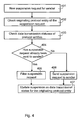
- Figure 5 illustrates the data flow control method according to a preferred embodiment of the invention, more particularly than handling of resume request primitives for a data flow.
- the method is initiated in step 501 when a new resume request primitive for the data flow is originated for the sender.
- the method is only initiated for a suspended data flow as resume request primitives are only sent if suspension request primitive has been sent earlier, and preferably the first suspension request primitive is always sent to the sender.
- the resume request primitive may be received from an underlying protocol layer or it may originate from the protocol entity applying the method in Figure 5 .
- the originating protocol entity of the suspension request primitive is checked 502.
- step 503 the data transmission status of at least one other followed protocol entity is checked.
- step 504 it is checked whether the statuses for other protocol entities indicate capability to resume. As already illustrated, there may be explicit status information indicating this capability or, if there is no suspension status for a protocol entity, the status is implicitly interpreted to indicate capability to resume (e.g. if the protocol entity has never sent a suspension request).
- a resume request primitive is sent 505 to the sender. As response to this primitive, the sender may then resume data transmission. If, based on the check 504, there is at least one protocol entity for which the status indicates non-capability to resume, e.g. the status is suspension, the resume request primitive is filtered in step 506. Step 506 is preferable, because it enables further reducing of the amount of processed primitives.
- the methods described in Figures 4 and 5 are preferably both applied in at least one protocol entity to provide intelligent filtering of flow control primitives.
- the filtering functionality for uplink data flow control is implemented at the highest possible layer under the sender as lower layers do not get any information about the primitives initiated by upper layers.
- the data transmission status information is maintained according to Figures 4 and 5 by the protocol entity applying the method.
- the data transmission status information is maintained, preferably according to Figures 4 and 5 , only on the protocol entity applying the present method and on the protocol entity underlying the protocol entity applying the method in the protocol stack of the system. In other words, the protocol entity applying the present method, maintains status information on it's own status and the status of the lower layer.
- protocol entities are the 'followed' protocol entities in view of steps 403 and 503.
- the protocol entity comprising the filtering functionality only checks the primitives originated from itself (either based on the need for the primitive or an already created primitive) and the primitives from one underlying protocol entity.
- This enables the filtering functionality and the maintenance of status information to be very simple. If the system comprises a first protocol entity and a second protocol entity, wherein the first protocol entity is serving the second protocol entity in the protocol stack of the system, the second protocol entity may thus be arranged to maintain status information only for the second protocol entity and the underlying first protocol entity irrespective of whether the primitive from the first protocol entity layer has been originated as a response to a primitive from some third protocol entity of a protocol layer underlying the first protocol layer.
- the second protocol entity implementing the method considers the first protocol entity as the originating protocol entity. It is also feasible to maintain status information of every protocol layer (under the sender) by one (or more) protocol entity, but this would necessitate that information of the original initiator of a primitive is associated with the primitive and transferred between the protocol entities.
- the present method is applied in each protocol entity, except in the lowest protocol entity, underlying the sender in the protocol stack of the system. This embodiment makes it possible to completely avoid too early resumption of the uplink data transmission.
- Layer 1 (the protocol entity of the layer 1) initiates suspension by sending a suspension request primitive, i.e. uplink flow indication for suspending data transmission (xx_flow_ind (XOFF)).
- the layers 2 and 3 both applying filtering functionality, deliver the suspension request forward so that is received by the sender which then suspends 601 the data flow.
- the layer 2 (L2) stores suspension (XOFF) as the status of the lower layer (L1) and the layer 3 (L3) stores suspension as the status of the lower layer (L2).
- the L2 initiates suspension, whereby the suspension request primitive is preferably according to step 405 in Figure 4 filtered by the L2 and the own status of the L2 is changed (in status information maintained by the L2) into suspension.
- the L3 initiates suspension, whereby the suspension request primitive is preferably filtered by the L3 and the own status of the L3 is changed (in status information maintained by the L3) into suspension.
- the L1 is again capable of transmitting data and sends a resume request primitive to the L2.
- the L2 filters the primitive and updates the status of the lower layer L1 to indicate the capability to resume.
- the L2 is capable of transmitting data and sends a resume request primitive to the L3 and updates it's own status.
- the L3 filters the primitive and updates the status of the lower layer L2.
- the L1 initiates suspension, and the suspension request primitive is forwarded by the L2 to the L3 (and the status of the lower layer L1 is changed in the L2 into suspension).
- the L3 filters the primitive as, according to the status information, suspension request primitive has already been sent to the sender.
- the L3 also updates the status of the lower layer L2.
- the L1 is again capable of transmitting data and sends a resume request primitive to the L2.
- the L2 sends the resume request primitive to the L3 and updates the status of the lower layer L1.
- the L3 filters the primitive and updates the status of the lower layer L2.
- the L3 is capable to resume data transmission, and as the status of the lower layer L2 also enables data transmission, the L3 sends a resume request primitive to the sender and updates the status of the L3.
- the sender resumes data transmission.
- the present data flow control method is employed in one or more of the standardized GPRS protocol entities SNDCP, LLC, or RLC.
- the method is applied in each one of the layers SNDCP, LLC, and RLC to completely avoid too early resumption of data transmission.
- the method may also be applied in one or more implementation specific layers (instead of or in addition to one or more standardized protocol layers).
- the present data flow control method is employed in one or more of the UMTS protocol entities PDCP, RLC.Preferably the method is applied in each on of the layers PDCP and RLC. Also in UMTS, the method may be applied in one or more implementation specific layers (instead of or in addition to one or more standardized protocol layers).
- the mobile stations comprise memory and a central processing unit comprising one or more processors.
- the mobile station can implement the inventive data flow control functionality, some embodiments of which are shown in Figures 4 and 5 .
- the computer programs may be obtained through a network and/or they may be stored in memory means, such as a disc, CD-ROM disc or other external memory means from which they can be loaded into the memory.
- Hardware solutions or a combination of hardware and software can also be used.
- a preferred embodiment of the invention for uplink data i.e. from mobile station MS to network, has been illustrated above.
- the same principle can be utilized also for data transfer in downlink direction.
- the data flow from the network can be suspended and again resumed internally in the mobile station. For instance, if the interface between a laptop (terminal equipment) and the mobile station (mobile termination) is slower than the air interface, downlink flow control can be utilized to decrease air interface speed into the level of terminal's data receiving capability. It is also feasible to apply the above illustrated embodiments in a network element such as a radio network controller.
Landscapes
- Engineering & Computer Science (AREA)
- Computer Networks & Wireless Communication (AREA)
- Signal Processing (AREA)
- Communication Control (AREA)
- Mobile Radio Communication Systems (AREA)
Claims (13)
- Verfahren zum Anordnen von Datenflusssteuerung in einem Datenübertragungssystem, einen Sender und mindestens zwei Protokolleinheiten umfassend, die zur Übertragung von Daten vom Sender dienen, wobei das Verfahren Folgendes umfasst:Prüfen (402) einer ein Dienstelement Suspendierungsanforderung erzeugenden Protokolleinheit, um eine Datenübertragung vom Sender zu suspendieren,Einstellen der Suspendierung als Datenübertragungsstatus für die Protokolleinheit, die das Dienstelement Suspendierungsanforderung erzeugt hat,Senden (406) des Dienstelements Suspendierungsanforderung an den Sender,Suspendieren der Datenübertragung durch den Sender in Reaktion auf das Dienstelement Suspendierungsanforderung,Prüfen (502) der ein Dienstelement Suspendierungsanforderung erzeugenden Protokolleinheit, bevor das Dienstelement Fortsetzungsanforderung zur Fortsetzung des Datenflusses durch den Sender übertragen wird,Prüfen (503) des Datenübertragungsstatus mindestens einer Protokolleinheit, die nicht die das Dienstelement Fortsetzungsanforderung erzeugende Protokolleinheit ist, undUnterbinden (506) der Übertragung des Dienstelements Fortsetzungsanforderung als Ergebnis des Prüfens (503) des Datenübertragungsstatus mindestens einer Protokolleinheit, die nicht die erzeugende Protokolleinheit ist, wenn die Suspendierung für eine beliebige andere Protokolleinheit als die das Dienstelement Fortsetzungsanforderung erzeugende Protokolleinheit eingestellt ist.
- Verfahren nach Anspruch 1, wobei die Datenübertragungsstatus-Information nur in der Protokolleinheit geführt wird, die das Verfahren ausführt, und in der Protokolleinheit, die unter der Protokolleinheit liegt, die das Verfahren im Protokollstapel des Systems ausführt.
- Verfahren nach Anspruch 1, wobei das Senden weiterer Dienstelemente Suspendierungsanforderung an den Sender unterbunden wird, nachdem das erste Dienstelement Suspendierungsanforderung an den Sender gesendet wurde.
- Verfahren nach Anspruch 1, wobei ein Dienstelement Fortsetzungsanforderung an eine höhere Protokollschicht gesendet wird, wenn die Statusinformation Suspendierung nur für die Protokolleinheit anzeigt, die das Dienstelement Fortsetzungsanforderung gesendet hat, und wobei die Datenübertragung in Reaktion auf das Dienstelement Fortsetzungsanforderung durch den Sender fortgesetzt wird.
- Verfahren nach Anspruch 1, wobei die Fähigkeit zur Fortsetzung als Datenübertragungsstatus für die Datenprotokolleinheit eingestellt wird, die ein Dienstelement Fortsetzungsanforderung erzeugt hat.
- Verfahren nach Anspruch 1, wobei das Verfahren in jeder Protokolleinheit ausgeführt wird, ausgenommen in einer untersten Protokollschicht in einem Protokollstapel des Datenübertragungssystems, die in der Lage ist, die Datenflusssteuerung auszulösen, und die im Protokollstapel des Systems unter dem Sender liegt.
- Verfahren nach Anspruch 1, wobei das Verfahren in einer oder mehreren GPRS-Protokolleinheiten ausgeführt wird.
- Verfahren nach Anspruch 1, wobei das Verfahren in einer oder mehreren UMTS-Protolsolleinheiten ausgeführt wird.
- Datenverarbeitungsgerät, wobei das Datenverarbeitungsgerät einen Sender und mindestens zwei Protokolleinheiten umfasst, die zur Übertragung von Daten vom Sender dienen, wobei
mindestens eine Protokolleinheit dafür konfiguriert ist, eine ein Dienstelement Suspendierungsanforderung erzeugende Protokolleinheit zum Suspendieren einer Datenübertragung vom Sender zu prüfen (402),
mindestens eine Protokolleinheit dafür konfiguriert ist, die Suspendierung als Datenübertragungsstatus für die Protokolleinheit, die das Dienstelement Suspendierungsanforderung erzeugt hat, einzustellen,
mindestens eine Protokolleinheit dafür konfiguriert ist, das Dienstelement Suspendierungsanforderung an den Sender zu senden (406),
der Sender dafür konfiguriert ist, die Datenübertragung durch den Sender in Reaktion auf das Dienstelement Suspendierungsanforderung zu suspendieren (601),
mindestens eine Protokolleinheit dafür konfiguriert ist, die ein Dienstelement Suspendierungsanforderung erzeugende Protokolleinheit zu prüfen (502), bevor das Dienstelement Fortsetzungsanforderung zur Fortsetzung des Datenflusses durch den Sender übertragen wird,
mindestens eine Protokolleinheit dafür konfiguriert ist, den Datenübertragungsstatus mindestens einer Protokolleinheit zu prüfen (503), die nicht die das Dienstelement Fortsetzungsanforderung erzeugende Protokolleinheit ist, und
mindestens eine Protokolleinheit dafür konfiguriert ist, die Übertragung des Dienstelements Fortsetzungsanforderung als Ergebnis des Prüfens (503) des Datenübertragungsstatus mindestens einer Protokolleinheit zu unterbinden (506), die nicht die erzeugende Protokolleinheit ist, wenn die Suspendierung für eine beliebige andere Protokolleinheit als die ein Dienstelement Suspendierungsanforderung erzeugende Protokolleinheit eingestellt ist. - Datenverarbeitungsgerät nach Anspruch 9, wobei die mindestens eine Protokolleinheit dafür konfiguriert ist, die Datenübertragungsstatus-Information nur in sich selbst und einer darunter liegenden Protokolleinheit zu führen, die unter der mindestens einen Protokolleinheit im Protokollstapel des Systems liegt.
- Datenverarbeitungsgerät nach Anspruch 9, wobei die mindestens eine Protokolleinheit dafür konfiguriert ist, ein Dienstelement Fortsetzungsanforderung an eine höhere Protokollschicht zu senden, wenn die Statusinformation Suspendierung nur für die Protokolleinheit anzeigt, die das Dienstelement Fortsetzungsanforderung gesendet hat, und
wobei der Sender dafür konfiguriert ist, die Datenübertragung in Reaktion auf das Dienstelement Fortsetzungsanforderung fortzusetzen. - Mobilfunksystem, Folgendes umfassend:ein Festnetz undeine Benutzerausrüstung, die das Datenverarbeitungsgerät nach einem der Ansprüche 9 bis 11 umfasst.
- Computersoftwareprodukt zum Steuern eines Datenverarbeitungsgerätes, einen Sender und mindestens zwei Protokolleinheiten umfassend, die der Übertragung von Daten vom Sender dienen, wobei das Computersoftwareprodukt Folgendes umfasst:einen Programmcode zum Prüfen (402) der ein Dienstelement Suspendierungsanforderung erzeugenden Protokolleinheit, um eine Datenübertragung vom Sender zu suspendieren,einen Programmcode zum Einstellen der Suspendierung als den Datenübertragungsstatus für die Protokolleinheit, die das Dienstelement Suspendierungsanforderung erzeugt hat,einen Programmcode zum Senden (406) mindestens eines Dienstelements Suspendierungsanforderung an den Sender,einen Programmcode zum Suspendieren (601) der Datenübertragung durch den Sender in Reaktion auf das Dienstelement Suspendierungsanforderung,einen Programmcode zum Prüfen (502) der ein Dienstelement Suspendierungsanforderung erzeugenden Protokolleinheit, bevor das Dienstelement Fortsetzungsanforderung zur Fortsetzung des Datenflusses durch den Sender übertragen wird, einen Programmcode zum Prüfen (503) des Datenübertragungsstatus mindestens einer Protokolleinheit, die nicht die das Dienstelement Fortsetzungsanforderung erzeugende Protokolleinheit ist, undeinen Programmcode zum Unterbinden (506) der Übertragung des Dienstelements Fortsetzungsanforderung als Ergebnis des Prüfens (503) des Datenübertragungsstatus mindestens einer Protokolleinheit, die nicht die erzeugende Protokolleinheit ist, wenn die Suspendierung für eine beliebige andere Protokolleinheit als die erzeugende Protokolleinheit des Dienstelements Fortsetzungsanforderung eingestellt ist.
Applications Claiming Priority (2)
| Application Number | Priority Date | Filing Date | Title |
|---|---|---|---|
| US10/454,964 US7266081B2 (en) | 2003-06-05 | 2003-06-05 | Method and system for arranging data flow control in a data transfer system |
| PCT/FI2004/000336 WO2004109991A1 (en) | 2003-06-05 | 2004-06-01 | Method for handling of suspension requests for data flows in a communication system |
Publications (2)
| Publication Number | Publication Date |
|---|---|
| EP1629640A1 EP1629640A1 (de) | 2006-03-01 |
| EP1629640B1 true EP1629640B1 (de) | 2012-10-31 |
Family
ID=33510404
Family Applications (1)
| Application Number | Title | Priority Date | Filing Date |
|---|---|---|---|
| EP04735579A Expired - Lifetime EP1629640B1 (de) | 2003-06-05 | 2004-06-01 | Verfahren zur handhabung von suspendierungsanforderungen für datenflüsse in einem kommunikationssystem |
Country Status (4)
| Country | Link |
|---|---|
| US (1) | US7266081B2 (de) |
| EP (1) | EP1629640B1 (de) |
| CN (1) | CN100444578C (de) |
| WO (1) | WO2004109991A1 (de) |
Families Citing this family (14)
| Publication number | Priority date | Publication date | Assignee | Title |
|---|---|---|---|---|
| CN100542320C (zh) * | 2003-08-15 | 2009-09-16 | 诺基亚公司 | 用于多层协议栈的数据流控制 |
| JP4572181B2 (ja) * | 2006-07-13 | 2010-10-27 | 株式会社日立製作所 | QoS制御システム |
| ATE513418T1 (de) * | 2006-08-17 | 2011-07-15 | Comverse Ltd | Netz-interoperabilität |
| US8763007B1 (en) * | 2006-08-29 | 2014-06-24 | At&T Intellectual Property Ii, L.P. | Open application interface for complex systems |
| US7933257B2 (en) * | 2006-09-20 | 2011-04-26 | Cisco Technology, Inc. | Using QoS tunnels for TCP latency optimization |
| US7792042B2 (en) * | 2007-03-29 | 2010-09-07 | Cisco Technology, Inc. | Classification of signaling protocol errors to trigger network connectivity troubleshooting |
| AR068651A1 (es) * | 2007-10-01 | 2009-11-25 | Inter Digital Patent Holding I | Metodo y aparato para mejorar varias operaciones pdcp y capa 2 |
| US8917598B2 (en) * | 2007-12-21 | 2014-12-23 | Qualcomm Incorporated | Downlink flow control |
| US8699487B2 (en) | 2008-02-04 | 2014-04-15 | Qualcomm Incorporated | Uplink delay budget feedback |
| US8656239B2 (en) | 2008-02-12 | 2014-02-18 | Qualcomm Incorporated | Control of data transmission based on HARQ in a wireless communication system |
| US8274914B2 (en) * | 2009-02-03 | 2012-09-25 | Broadcom Corporation | Switch and/or router node advertising |
| CN101702813B (zh) * | 2009-10-12 | 2014-12-10 | 中兴通讯股份有限公司 | 一种内存操作管理方法及装置 |
| KR101683292B1 (ko) * | 2010-06-18 | 2016-12-07 | 삼성전자주식회사 | Pn 라우팅 테이블을 이용한 개인 네트워크의 구성 장치 및 방법 |
| CN103024805B (zh) * | 2012-11-30 | 2015-06-10 | 大唐移动通信设备有限公司 | 一种基于业务量测量的数据控制方法和系统 |
Family Cites Families (11)
| Publication number | Priority date | Publication date | Assignee | Title |
|---|---|---|---|---|
| FI103548B1 (fi) * | 1996-03-25 | 1999-07-15 | Nokia Telecommunications Oy | Vuonvalvontamenetelmä |
| JP3413788B2 (ja) * | 1997-09-25 | 2003-06-09 | 日本電信電話株式会社 | 層間のフロー制御を行う通信プロトコルを持つ通信方法およびデータ通信端末 |
| US6198722B1 (en) * | 1998-02-27 | 2001-03-06 | National Semiconductor Corp. | Flow control method for networks |
| US6463035B1 (en) | 1998-12-30 | 2002-10-08 | At&T Corp | Method and apparatus for initiating an upward signaling control channel in a fast packet network |
| EP1102441A1 (de) | 1999-11-18 | 2001-05-23 | Telefonaktiebolaget Lm Ericsson | Verfahren und Vorrichtung zur Verbesserung eines Datendurchsatzes in einem Kommunikationssystem |
| FI20002320A7 (fi) | 2000-10-20 | 2002-04-21 | Nokia Corp | Eston hallinta langattomissa tietoliikenneverkoissa |
| US7054316B2 (en) * | 2001-04-25 | 2006-05-30 | Nokia Corporation | Method and system for interlayer control between re-sequencing and retransmission entities |
| US6798764B2 (en) * | 2001-07-04 | 2004-09-28 | Asustek Computer Inc. | Wireless communications device with a state model |
| US20030007642A1 (en) * | 2001-07-05 | 2003-01-09 | Jiang Sam Shiaw-Shiang | Local suspend function and reset procedure in a wireless communications system |
| US6904016B2 (en) * | 2001-11-16 | 2005-06-07 | Asustek Computer Inc. | Processing unexpected transmission interruptions in a wireless communications system |
| US7254143B2 (en) * | 2001-11-19 | 2007-08-07 | Innovative Sonic Limited | Local suspend scheme for wireless communication systems |
-
2003
- 2003-06-05 US US10/454,964 patent/US7266081B2/en not_active Expired - Lifetime
-
2004
- 2004-06-01 EP EP04735579A patent/EP1629640B1/de not_active Expired - Lifetime
- 2004-06-01 WO PCT/FI2004/000336 patent/WO2004109991A1/en not_active Ceased
- 2004-06-01 CN CNB2004800155295A patent/CN100444578C/zh not_active Expired - Fee Related
Also Published As
| Publication number | Publication date |
|---|---|
| US7266081B2 (en) | 2007-09-04 |
| CN1799231A (zh) | 2006-07-05 |
| US20050254425A1 (en) | 2005-11-17 |
| CN100444578C (zh) | 2008-12-17 |
| WO2004109991A1 (en) | 2004-12-16 |
| EP1629640A1 (de) | 2006-03-01 |
Similar Documents
| Publication | Publication Date | Title |
|---|---|---|
| CA2339825C (en) | Controlling quality of service in a mobile communications system | |
| US6728208B1 (en) | Method for controlling a quality of service in a mobile communications system | |
| CN1774890B (zh) | 用于网络中速率控制服务的系统和方法 | |
| JP3433186B2 (ja) | 移動通信網間のハンドオーバ | |
| EP2569914B1 (de) | Minimierung von protokoll-overhead bei einzelblock-paketzugangsverfahren | |
| US7266081B2 (en) | Method and system for arranging data flow control in a data transfer system | |
| JP4468986B2 (ja) | 移動体通信システムにおける圧縮パラメータの転送 | |
| US20040264368A1 (en) | Data transfer optimization in packet data networks | |
| CA2611158A1 (en) | System and method of providing service information to a carrier | |
| US9231874B2 (en) | Method and network node for handling TCP traffic | |
| JP2007520901A5 (de) | ||
| CN100450268C (zh) | 电信系统中的比特率控制手段 | |
| EP1472835B1 (de) | Verarbeiten von paketkopfteilen verschiedener grösse für einen auf paketen basierenden konversationsdienst in einem mobilkommunikationssystem | |
| KR20030072379A (ko) | 패킷들이 부분들로 분할되고 처리되는 패킷 교환 통신시스템에서 오류가 있는 데이터의 처리 방법 및 시스템 | |
| JP4426581B2 (ja) | 無線端末から送信された、異なるフローからのデータパケットのスケジューリング方法 | |
| AU2003216764B2 (en) | Transfer of packet data to wireless terminal | |
| KR20050037043A (ko) | Wcdma 패킷망에서 디폴트 접속점명(apn)에 대한서비스 품질 결정방법 |
Legal Events
| Date | Code | Title | Description |
|---|---|---|---|
| PUAI | Public reference made under article 153(3) epc to a published international application that has entered the european phase |
Free format text: ORIGINAL CODE: 0009012 |
|
| 17P | Request for examination filed |
Effective date: 20051130 |
|
| AK | Designated contracting states |
Kind code of ref document: A1 Designated state(s): AT BE BG CH CY CZ DE DK EE ES FI FR GB GR HU IE IT LI LU MC NL PL PT RO SE SI SK TR |
|
| DAX | Request for extension of the european patent (deleted) | ||
| 17Q | First examination report despatched |
Effective date: 20110608 |
|
| GRAP | Despatch of communication of intention to grant a patent |
Free format text: ORIGINAL CODE: EPIDOSNIGR1 |
|
| GRAS | Grant fee paid |
Free format text: ORIGINAL CODE: EPIDOSNIGR3 |
|
| GRAA | (expected) grant |
Free format text: ORIGINAL CODE: 0009210 |
|
| AK | Designated contracting states |
Kind code of ref document: B1 Designated state(s): AT BE BG CH CY CZ DE DK EE ES FI FR GB GR HU IE IT LI LU MC NL PL PT RO SE SI SK TR |
|
| REG | Reference to a national code |
Ref country code: GB Ref legal event code: FG4D Ref country code: CH Ref legal event code: EP Ref country code: DE Ref legal event code: R081 Ref document number: 602004039862 Country of ref document: DE Owner name: NOKIA TECHNOLOGIES OY, FI Free format text: FORMER OWNER: NOKIA CORP., 02610 ESPOO, FI |
|
| REG | Reference to a national code |
Ref country code: AT Ref legal event code: REF Ref document number: 582508 Country of ref document: AT Kind code of ref document: T Effective date: 20121115 |
|
| REG | Reference to a national code |
Ref country code: IE Ref legal event code: FG4D |
|
| REG | Reference to a national code |
Ref country code: DE Ref legal event code: R096 Ref document number: 602004039862 Country of ref document: DE Effective date: 20121227 |
|
| REG | Reference to a national code |
Ref country code: AT Ref legal event code: MK05 Ref document number: 582508 Country of ref document: AT Kind code of ref document: T Effective date: 20121031 |
|
| REG | Reference to a national code |
Ref country code: NL Ref legal event code: VDEP Effective date: 20121031 |
|
| PG25 | Lapsed in a contracting state [announced via postgrant information from national office to epo] |
Ref country code: NL Free format text: LAPSE BECAUSE OF FAILURE TO SUBMIT A TRANSLATION OF THE DESCRIPTION OR TO PAY THE FEE WITHIN THE PRESCRIBED TIME-LIMIT Effective date: 20121031 Ref country code: ES Free format text: LAPSE BECAUSE OF FAILURE TO SUBMIT A TRANSLATION OF THE DESCRIPTION OR TO PAY THE FEE WITHIN THE PRESCRIBED TIME-LIMIT Effective date: 20130211 Ref country code: FI Free format text: LAPSE BECAUSE OF FAILURE TO SUBMIT A TRANSLATION OF THE DESCRIPTION OR TO PAY THE FEE WITHIN THE PRESCRIBED TIME-LIMIT Effective date: 20121031 Ref country code: SE Free format text: LAPSE BECAUSE OF FAILURE TO SUBMIT A TRANSLATION OF THE DESCRIPTION OR TO PAY THE FEE WITHIN THE PRESCRIBED TIME-LIMIT Effective date: 20121031 |
|
| PG25 | Lapsed in a contracting state [announced via postgrant information from national office to epo] |
Ref country code: GR Free format text: LAPSE BECAUSE OF FAILURE TO SUBMIT A TRANSLATION OF THE DESCRIPTION OR TO PAY THE FEE WITHIN THE PRESCRIBED TIME-LIMIT Effective date: 20130201 Ref country code: PL Free format text: LAPSE BECAUSE OF FAILURE TO SUBMIT A TRANSLATION OF THE DESCRIPTION OR TO PAY THE FEE WITHIN THE PRESCRIBED TIME-LIMIT Effective date: 20121031 Ref country code: BE Free format text: LAPSE BECAUSE OF FAILURE TO SUBMIT A TRANSLATION OF THE DESCRIPTION OR TO PAY THE FEE WITHIN THE PRESCRIBED TIME-LIMIT Effective date: 20121031 Ref country code: CY Free format text: LAPSE BECAUSE OF FAILURE TO SUBMIT A TRANSLATION OF THE DESCRIPTION OR TO PAY THE FEE WITHIN THE PRESCRIBED TIME-LIMIT Effective date: 20121031 Ref country code: PT Free format text: LAPSE BECAUSE OF FAILURE TO SUBMIT A TRANSLATION OF THE DESCRIPTION OR TO PAY THE FEE WITHIN THE PRESCRIBED TIME-LIMIT Effective date: 20130228 Ref country code: SI Free format text: LAPSE BECAUSE OF FAILURE TO SUBMIT A TRANSLATION OF THE DESCRIPTION OR TO PAY THE FEE WITHIN THE PRESCRIBED TIME-LIMIT Effective date: 20121031 |
|
| PG25 | Lapsed in a contracting state [announced via postgrant information from national office to epo] |
Ref country code: AT Free format text: LAPSE BECAUSE OF FAILURE TO SUBMIT A TRANSLATION OF THE DESCRIPTION OR TO PAY THE FEE WITHIN THE PRESCRIBED TIME-LIMIT Effective date: 20121031 |
|
| PG25 | Lapsed in a contracting state [announced via postgrant information from national office to epo] |
Ref country code: BG Free format text: LAPSE BECAUSE OF FAILURE TO SUBMIT A TRANSLATION OF THE DESCRIPTION OR TO PAY THE FEE WITHIN THE PRESCRIBED TIME-LIMIT Effective date: 20130131 Ref country code: SK Free format text: LAPSE BECAUSE OF FAILURE TO SUBMIT A TRANSLATION OF THE DESCRIPTION OR TO PAY THE FEE WITHIN THE PRESCRIBED TIME-LIMIT Effective date: 20121031 Ref country code: DK Free format text: LAPSE BECAUSE OF FAILURE TO SUBMIT A TRANSLATION OF THE DESCRIPTION OR TO PAY THE FEE WITHIN THE PRESCRIBED TIME-LIMIT Effective date: 20121031 Ref country code: CZ Free format text: LAPSE BECAUSE OF FAILURE TO SUBMIT A TRANSLATION OF THE DESCRIPTION OR TO PAY THE FEE WITHIN THE PRESCRIBED TIME-LIMIT Effective date: 20121031 Ref country code: EE Free format text: LAPSE BECAUSE OF FAILURE TO SUBMIT A TRANSLATION OF THE DESCRIPTION OR TO PAY THE FEE WITHIN THE PRESCRIBED TIME-LIMIT Effective date: 20121031 |
|
| PG25 | Lapsed in a contracting state [announced via postgrant information from national office to epo] |
Ref country code: IT Free format text: LAPSE BECAUSE OF FAILURE TO SUBMIT A TRANSLATION OF THE DESCRIPTION OR TO PAY THE FEE WITHIN THE PRESCRIBED TIME-LIMIT Effective date: 20121031 Ref country code: RO Free format text: LAPSE BECAUSE OF FAILURE TO SUBMIT A TRANSLATION OF THE DESCRIPTION OR TO PAY THE FEE WITHIN THE PRESCRIBED TIME-LIMIT Effective date: 20121031 |
|
| PLBE | No opposition filed within time limit |
Free format text: ORIGINAL CODE: 0009261 |
|
| STAA | Information on the status of an ep patent application or granted ep patent |
Free format text: STATUS: NO OPPOSITION FILED WITHIN TIME LIMIT |
|
| 26N | No opposition filed |
Effective date: 20130801 |
|
| REG | Reference to a national code |
Ref country code: DE Ref legal event code: R097 Ref document number: 602004039862 Country of ref document: DE Effective date: 20130801 |
|
| PG25 | Lapsed in a contracting state [announced via postgrant information from national office to epo] |
Ref country code: MC Free format text: LAPSE BECAUSE OF FAILURE TO SUBMIT A TRANSLATION OF THE DESCRIPTION OR TO PAY THE FEE WITHIN THE PRESCRIBED TIME-LIMIT Effective date: 20121031 |
|
| REG | Reference to a national code |
Ref country code: CH Ref legal event code: PL |
|
| GBPC | Gb: european patent ceased through non-payment of renewal fee |
Effective date: 20130601 |
|
| REG | Reference to a national code |
Ref country code: IE Ref legal event code: MM4A |
|
| REG | Reference to a national code |
Ref country code: FR Ref legal event code: ST Effective date: 20140228 |
|
| PG25 | Lapsed in a contracting state [announced via postgrant information from national office to epo] |
Ref country code: GB Free format text: LAPSE BECAUSE OF NON-PAYMENT OF DUE FEES Effective date: 20130601 Ref country code: LI Free format text: LAPSE BECAUSE OF NON-PAYMENT OF DUE FEES Effective date: 20130630 Ref country code: IE Free format text: LAPSE BECAUSE OF NON-PAYMENT OF DUE FEES Effective date: 20130601 Ref country code: CH Free format text: LAPSE BECAUSE OF NON-PAYMENT OF DUE FEES Effective date: 20130630 |
|
| PG25 | Lapsed in a contracting state [announced via postgrant information from national office to epo] |
Ref country code: FR Free format text: LAPSE BECAUSE OF NON-PAYMENT OF DUE FEES Effective date: 20130701 |
|
| PG25 | Lapsed in a contracting state [announced via postgrant information from national office to epo] |
Ref country code: TR Free format text: LAPSE BECAUSE OF FAILURE TO SUBMIT A TRANSLATION OF THE DESCRIPTION OR TO PAY THE FEE WITHIN THE PRESCRIBED TIME-LIMIT Effective date: 20121031 |
|
| PG25 | Lapsed in a contracting state [announced via postgrant information from national office to epo] |
Ref country code: LU Free format text: LAPSE BECAUSE OF NON-PAYMENT OF DUE FEES Effective date: 20130601 Ref country code: HU Free format text: LAPSE BECAUSE OF FAILURE TO SUBMIT A TRANSLATION OF THE DESCRIPTION OR TO PAY THE FEE WITHIN THE PRESCRIBED TIME-LIMIT; INVALID AB INITIO Effective date: 20040601 |
|
| REG | Reference to a national code |
Ref country code: DE Ref legal event code: R081 Ref document number: 602004039862 Country of ref document: DE Owner name: NOKIA TECHNOLOGIES OY, FI Free format text: FORMER OWNER: NOKIA CORP., 02610 ESPOO, FI |
|
| PGFP | Annual fee paid to national office [announced via postgrant information from national office to epo] |
Ref country code: DE Payment date: 20210505 Year of fee payment: 18 |
|
| REG | Reference to a national code |
Ref country code: DE Ref legal event code: R119 Ref document number: 602004039862 Country of ref document: DE |
|
| PG25 | Lapsed in a contracting state [announced via postgrant information from national office to epo] |
Ref country code: DE Free format text: LAPSE BECAUSE OF NON-PAYMENT OF DUE FEES Effective date: 20230103 |