EP1622011A2 - Verfahren zum Auto-Exequetieren und Booten von Hostrechnern mittels Halbleiterspeicheranordnung - Google Patents
Verfahren zum Auto-Exequetieren und Booten von Hostrechnern mittels Halbleiterspeicheranordnung Download PDFInfo
- Publication number
- EP1622011A2 EP1622011A2 EP05016585A EP05016585A EP1622011A2 EP 1622011 A2 EP1622011 A2 EP 1622011A2 EP 05016585 A EP05016585 A EP 05016585A EP 05016585 A EP05016585 A EP 05016585A EP 1622011 A2 EP1622011 A2 EP 1622011A2
- Authority
- EP
- European Patent Office
- Prior art keywords
- host computer
- semiconductor storage
- storage device
- starting
- automatic executing
- Prior art date
- Legal status (The legal status is an assumption and is not a legal conclusion. Google has not performed a legal analysis and makes no representation as to the accuracy of the status listed.)
- Withdrawn
Links
Images

Classifications
-
- G—PHYSICS
- G06—COMPUTING OR CALCULATING; COUNTING
- G06F—ELECTRIC DIGITAL DATA PROCESSING
- G06F3/00—Input arrangements for transferring data to be processed into a form capable of being handled by the computer; Output arrangements for transferring data from processing unit to output unit, e.g. interface arrangements
- G06F3/06—Digital input from, or digital output to, record carriers, e.g. RAID, emulated record carriers or networked record carriers
- G06F3/0601—Interfaces specially adapted for storage systems
- G06F3/0628—Interfaces specially adapted for storage systems making use of a particular technique
- G06F3/0662—Virtualisation aspects
- G06F3/0664—Virtualisation aspects at device level, e.g. emulation of a storage device or system
-
- G—PHYSICS
- G06—COMPUTING OR CALCULATING; COUNTING
- G06F—ELECTRIC DIGITAL DATA PROCESSING
- G06F3/00—Input arrangements for transferring data to be processed into a form capable of being handled by the computer; Output arrangements for transferring data from processing unit to output unit, e.g. interface arrangements
- G06F3/06—Digital input from, or digital output to, record carriers, e.g. RAID, emulated record carriers or networked record carriers
- G06F3/0601—Interfaces specially adapted for storage systems
- G06F3/0602—Interfaces specially adapted for storage systems specifically adapted to achieve a particular effect
- G06F3/0604—Improving or facilitating administration, e.g. storage management
- G06F3/0605—Improving or facilitating administration, e.g. storage management by facilitating the interaction with a user or administrator
-
- G—PHYSICS
- G06—COMPUTING OR CALCULATING; COUNTING
- G06F—ELECTRIC DIGITAL DATA PROCESSING
- G06F3/00—Input arrangements for transferring data to be processed into a form capable of being handled by the computer; Output arrangements for transferring data from processing unit to output unit, e.g. interface arrangements
- G06F3/06—Digital input from, or digital output to, record carriers, e.g. RAID, emulated record carriers or networked record carriers
- G06F3/0601—Interfaces specially adapted for storage systems
- G06F3/0668—Interfaces specially adapted for storage systems adopting a particular infrastructure
- G06F3/0671—In-line storage system
- G06F3/0673—Single storage device
- G06F3/0679—Non-volatile semiconductor memory device, e.g. flash memory, one time programmable memory [OTP]
-
- G—PHYSICS
- G06—COMPUTING OR CALCULATING; COUNTING
- G06F—ELECTRIC DIGITAL DATA PROCESSING
- G06F9/00—Arrangements for program control, e.g. control units
- G06F9/06—Arrangements for program control, e.g. control units using stored programs, i.e. using an internal store of processing equipment to receive or retain programs
- G06F9/44—Arrangements for executing specific programs
- G06F9/4401—Bootstrapping
Definitions
- the present invention is in the field of data storage, and more particularly it relates to the field of management and control by means of a semiconductor storage device.
- semiconductor storage techniques provide various additional functions for semiconductor storage devices. However, parts of the additional functions are not compatible with each other. If a semiconductor storage device may realize some of the functions, it may not be able to realize other parts of the functions. This is not easy for user to use, and hereby limits the functions of the semiconductor storage devices.
- Chinese Patent No. ZL01114883.7 entitled “Multifunction Semiconductor Storage Device” discloses a method for having a semiconductor storage device to simulate a CD driver with an inserted CD to realize boosting host computer (hereinafter referred to as a method of boosting a host computer) by means of a semiconductor storage device through USB interface; and Chinese Patent Application No. 03146090.9, entitled “Method For Realizing Automatic Execution By Using Semiconductor Storage Device”, discloses a method for simulating a semiconductor storage device as a CD driver having CD inserted to realize automatic opening and execution of specific program files by means of a semiconductor storage device in an operating system (hereinafter referred to as a method of automatic execution).
- Both of the above mentioned methods have semiconductor storage device simulating CD driver having CD inserted.
- the two methods cannot be realized in the same semiconductor storage device, that is, if a semiconductor storage device can realize the function of starting host computer, it is unable to realize the function of automatic executing, and vice versa.
- the reason is because the function of automatic execution requires that semiconductor storage device reports the status of "CD medium inserted" to operating system within a period after CD driver device simulated by the semiconductor storage device has detected by the operating system to trigger the operating system to automatically execute specific program files.
- the starting will fail if semiconductor storage device reports the status of "CD medium inserted" during the process of starting host computer by using the semiconductor storage device.
- semiconductor storage device has incomplete functions, and is inconvenience for use.
- Problems to be resolved by the present invention are to correctly lead operating system of host computer by semiconductor storage device to complete the function of starting host computer, and to trigger the automatic executing means of the host computer when the host computer has been started and prepares automatic execution to complete the function of automatic execution.
- the present invention provides a method for realizing automatic executing and starting host computer by using semiconductor storage device, the semiconductor storage device is connected to host computer installed with operating system.
- the method includes the steps of (1) determining the characteristics of the operating system of the host computer, determining the type of the operating system of the host computer and/or the status of the host computer; (2) determining the time and/or condition invoking automatic executing function or starting host computer function; and (3) triggering the invoking of relevant functions according to the determined time and/or conditions.
- the characteristics of the operating system of the host computer in the step (1) include the characteristic of maximum number of logical device supported, and the characteristic of type and/or sequence of commands sent from host computer.
- the type and/or sequence of the commands sent from the host computer include if READ CAPACITY command has been sent by the host computer, if MODE SENSE (10) command has been send by the host computer, and/or the sequence of MODE SENSE (10) and READ CAPACITY commands.
- the process of determining the characteristics of the operating system of the host computer it may firstly determine the maximum number of logical device supported by the host computer, and then determine the type and/or the sequence of commands sent by the host computer; but it may also determine the type and/or the sequence of commands sent by the host computer at first, and then determine the maximum number of logical device supported by the host computer.
- the type of the operating system of the host computer and/or the status of the host computer include(s) the host computer not being started, the host computer being started, and/or whether having automatic executing condition.
- the starting host computer function of semiconductor storage device is invoked when the host computer has not been started up; and the automatic executing function of semiconductor storage device is invoked when the host computer has been started and has automatic executing condition.
- the connecting manners of the semiconductor storage device and the host computer include, but not limited to, connection via USB interface, UWB interface, Bluetooth interface, IrDA infrared interface, HomeRF interface, IEEE802.11 a interface and/or IEEE802.11b interface, or connection via IEEE1394 bus, IDE bus and/or USB bus, or connection via local area network (LAN) and/or wide area network.
- the methods of the present invention further include the steps that the semiconductor storage device simulates two or more logical devices, and the first logical device is a type of CD driver which includes, but not limited to, CD-ROM, CD-RW, DVD-ROM, DVD-RW, DVD-RAM, blue-light DVD, and/or red-light DVD.
- the method of the present invention realizes to correctly lead operating system to complete the function of starting host computer and, when the system has been started and prepares for automatic execution, the function of automatic execution in the same semiconductor storage device without assistance from user by managing and controlling the semiconductor storage device and determining the characteristics of operating system of host computer (the supported maximum number of logical device and the type of commands and/or sequence of commands sent by the host computer) to determine the type of the operating system of the host computer and the status of the host computer and further determine the time of invoking automatic executing function and starting host function.
- the present invention combines the traditional storage functions of the semiconductor storage device to enhance the application functions of the semiconductor storage devices and widen the application range of the semiconductor storage devices.
- the memory space of the semiconductor storage device has been divided into at least two partitions in which there are at least one CD partition and one disk partition.
- the CD partition may be used to store startup files necessary for automatically executing configuration files and/or starting host computer, and may simulate CD driver having CD inserted.
- the disk partition is used for user to access data and/or automatic executing configuration files.
- the semiconductor storage device in the embodiment is connected to a host computer installed with operating system.
- the operating system of the host computer sends inquiry command to the semiconductor storage device to acquire the type of the device being connected.
- the semiconductor device reports that it himself has two or more logical devices, and the type of the first logical device (LUNO) is CD driver for CD partition simulating a CD driver.
- LUNO first logical device
- the current operating system technology may determine the type of the operating system of the host computer and the status of the host computer based on two characteristics of the operating system.
- the first characteristic is the maximum number of logical device supported by the operating system, hereafter referred to as LUN (Logic Unit Number).
- LUN Logical Unit Number
- the maximum number of logical device means that there may be a plurality of parameters of the logical device in one and the same physical device.
- a keyboard with mouse may have two logical devices, one is a keyboard and another is a mouse.
- the host computer they are two devices, but they are only one device physically and need only one interface for communicating with the host computer.
- the present invention may divide the semiconductor storage device into two or more logical devices, wherein at least one logical device is a CD driver which is deemed as more than two devices by the host computer, but is only one device physically.
- BIOS Basic Input Output System
- BIOS Basic Input Output System
- BIOS Basic Input Output System
- the program space of BIOS is very small, so the host computer does not provide two logical devices for supporting when it detects the devices. Thus, it may use the commands sent by the operating system of the host computer to determine if the operating system of the host compute supports physical device with two or more logical devices.
- the semiconductor storage device simulates two or more logical devices, wherein the first logical device is CD driver, it may consider that the operating system supports the physical device having two or more logical devices if, within a period (generally about more than ten seconds), one of commands from the operating system is for second logical device or other logical devices, and it may also consider that the operating system doest not support the physical device having two or more logical devices if no one of commands from the operating system is for second logical device or other logical devices.
- the host computer may not be started, or it may be started but only supports single logical device, for example, the operation system of WINDOWS 2000, LINUX, MAC, etc. without SP3 patch. It is necessary to further determine the status of these host computers, which needs to analyze the second characteristic.
- the second characteristic is a sequence of commands from the host computer.
- the status of the host computer may be acquired by determining the sequence of the commands from the operating system of the host computer.
- the determining method has the steps as below: when the semiconductor storage device simulates two or more logical devices, wherein the first logical device is CD driver, it means that the host computer has finished starting process and it is not necessary for the semiconductor storage device to start the host computer if the first device does not receive MODE SENSE (10) command before receiving READ CAPACITY command from the host computer; on the other hand, it means that the host computer has not finished starting process and it is not necessary to invoke the starting host computer function of the semiconductor storage device if the first device does not receive READ CAPACITY command before receiving MODE SENSE (10) command from the host computer.
- MODE SENSE (10) and READ CAPACITY are all standard SCSI commands, and are used, respectively, to acquire certain necessary information when accessing the devices.
- READ CAPACITY is a command for reading capacity of the devices
- MODE SENSE is information for determining if devices have write protection, etc. It may not send out both of them, and it may send one of them. For example, in the operating system of WINDOWS 98, it may not send out READ CAPACITY command, but only sends out MODE SENSE (10) command.
- the method of the present invention does not focus on the detail of these two commands, but only concerns whether they are sent out and the sequence of sending out.
- the status of the host computer may be determined according to the sequence of the above two commands so long as to follow SCSI standard.
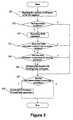
- Step 201 the operating system of the host computer searches and reads startup information in the CD partition of the semiconductor storage device, determines if the startup information in the semiconductor storage device meets the condition of starting the host computer, and determines if the semiconductor storage device has the starting host computer function (step 202).
- the 34 th page (2048 byte of each page) in each CD data is startup partition of the CD.
- the CD is the one with starting host computer function if there is startup identifier in the startup partition, and, otherwise, the CD is the one without starting host computer function.
- the host computer may determine whether the partition is provided with starting host computer function after detecting the information of the CD partition of the semiconductor storage device.
- step 207 it will perform step 207 if the semiconductor storage device does not have starting host computer function to determine whether the host computer and/or the semiconductor storage device have automatic executing function. If the semiconductor storage device has starting host computer function, it will perform step 203 to receive the SCSI command sent from the host computer.
- step 204 it performs step 204 to determine the first characteristic of the host computer, i.e., the maximum number of logical devices supported by the operating system, according to the received SCSI command. If the host computer supports two or more devices, it means that the host computer has finished startup process and performs step 207 to determine whether the host computer and/or the semiconductor storage device are provided with automatic executing function; If the host computer does not support two or more devices, according to the above principles, it is necessary to detect the second characteristic, i.e., the sequence of the commands sent out by the host computer.
- the first characteristic of the host computer i.e., the maximum number of logical devices supported by the operating system
- step 205 it performs step 205 to determine sequence of commands sent out by the host computer, and, according to the sequence of the commands, further analyze and determine if such kind of host computer that does not support two or more devices has finished startup process and only supports single device, or has not finished startup yet.
- step 207 determines if the host and/or semiconductor storage device have automatic executing condition; and if the host computer has not finished startup process, it will perform step 20,6 to invoke starting host computer function of the semiconductor storage device to boot and start the operating system of the host computer.
- step 207 After finishing the above startup process of the host computer, it goes into step 207 to judge if the host computer and/or the semiconductor storage device have automatic executing condition.
- the host computer and/or the semiconductor storage device determines whether having automatic executing condition by checking the type of the operating system of the host computer and automatic executing configuration files in the semiconductor storage device. If it has automatic executing condition, in step 208, it will invoke automatic executing function to perform automatic executing process, and after that to finish the whole flow; and if it dos not have automatic executing condition, it finishes the whole flow directly.
- the host computer may determine that the current host computer has not completed the startup process, and cannot invoke the automatic executing function but may invoke the starting host computer function to complete the operation of starting the host computer. Otherwise, it may deem that the host computer has completed the startup process in other conditions and should invoke the automatic executing function.
- the principles of the present invention are to determine the type of the operating system of the host computer and the status of the host computer and further determine the time of invoking the automatic executing function and starting host computer function by managing and controlling semiconductor storage device and judging the characteristics of the operating system of the host computer (the maximum number of supported logical devices and sequence of commands sent out by the host computer) so as to realize the file automatic executing function and starting host computer function in one and the same semiconductor storage device.
- the present invention enhances the application functions of semiconductor storage devices and widens the application ranges of semiconductor storage devices.
- the method of the present invention may be applied to various operating systems, interfaces, and semiconductor storage devices with storage media.
Landscapes
- Engineering & Computer Science (AREA)
- Theoretical Computer Science (AREA)
- Physics & Mathematics (AREA)
- General Engineering & Computer Science (AREA)
- General Physics & Mathematics (AREA)
- Human Computer Interaction (AREA)
- Software Systems (AREA)
- Computer Security & Cryptography (AREA)
- Stored Programmes (AREA)
Applications Claiming Priority (1)
| Application Number | Priority Date | Filing Date | Title |
|---|---|---|---|
| CN200410050953A CN100590594C (zh) | 2004-07-30 | 2004-07-30 | 一种利用半导体存储装置实现自动执行及启动主机的方法 |
Publications (2)
| Publication Number | Publication Date |
|---|---|
| EP1622011A2 true EP1622011A2 (de) | 2006-02-01 |
| EP1622011A3 EP1622011A3 (de) | 2008-03-19 |
Family
ID=35429146
Family Applications (1)
| Application Number | Title | Priority Date | Filing Date |
|---|---|---|---|
| EP05016585A Withdrawn EP1622011A3 (de) | 2004-07-30 | 2005-07-29 | Verfahren zum Auto-Exequetieren und Booten von Hostrechnern mittels Halbleiterspeicheranordnung |
Country Status (3)
| Country | Link |
|---|---|
| US (1) | US7421574B2 (de) |
| EP (1) | EP1622011A3 (de) |
| CN (1) | CN100590594C (de) |
Cited By (1)
| Publication number | Priority date | Publication date | Assignee | Title |
|---|---|---|---|---|
| EP2423825A1 (de) * | 2010-08-26 | 2012-02-29 | Huawei Device Co., Ltd. | Verfahren für eine Datenkarte zum Identifizieren des Betriebssystems und Vorrichtung und Kommunikationssystem dafür |
Families Citing this family (3)
| Publication number | Priority date | Publication date | Assignee | Title |
|---|---|---|---|---|
| TWI451250B (zh) * | 2011-03-28 | 2014-09-01 | Phison Electronics Corp | 記憶體組態方法、記憶體控制器與記憶體儲存裝置 |
| TWI454908B (zh) * | 2011-03-28 | 2014-10-01 | Phison Electronics Corp | 記憶體組態方法、記憶體控制器與記憶體儲存裝置 |
| CN110825443A (zh) * | 2018-08-13 | 2020-02-21 | 深圳市冠旭电子股份有限公司 | 一种智能音箱的信息交互方法及终端设备 |
Family Cites Families (8)
| Publication number | Priority date | Publication date | Assignee | Title |
|---|---|---|---|---|
| JP3253206B2 (ja) | 1994-01-14 | 2002-02-04 | キヤノン株式会社 | インク充填方法 |
| US6604152B1 (en) * | 1999-12-27 | 2003-08-05 | Intel Corporation | Executing program installed in computer slot in one of plural environments comprising a main operating system or small operating system or no operating system |
| CN1122281C (zh) | 2001-06-30 | 2003-09-24 | 深圳市朗科科技有限公司 | 一种多功能半导体存储装置 |
| US20030163610A1 (en) * | 2002-02-25 | 2003-08-28 | Stevens Curtis E. | Computer systems, software and methods for emulating a non-volatile removable media device using material on a mass storage device |
| US6986033B2 (en) * | 2002-09-10 | 2006-01-10 | Veritas Operating Corporation | System for automated boot from disk image |
| CN100383756C (zh) | 2003-07-22 | 2008-04-23 | 深圳市朗科科技有限公司 | 利用半导体存储装置实现自动执行的方法 |
| US20050081079A1 (en) * | 2003-10-10 | 2005-04-14 | International Business Machines Corporation | System and method for reducing trouble tickets and machine returns associated with computer failures |
| US20050138408A1 (en) * | 2003-12-22 | 2005-06-23 | International Business Machines Corporation | Autonomic self-configuring alternate operating system environment which includes personalization |
-
2004
- 2004-07-30 CN CN200410050953A patent/CN100590594C/zh not_active Expired - Lifetime
-
2005
- 2005-07-29 EP EP05016585A patent/EP1622011A3/de not_active Withdrawn
- 2005-07-29 US US11/192,694 patent/US7421574B2/en active Active
Cited By (2)
| Publication number | Priority date | Publication date | Assignee | Title |
|---|---|---|---|---|
| EP2423825A1 (de) * | 2010-08-26 | 2012-02-29 | Huawei Device Co., Ltd. | Verfahren für eine Datenkarte zum Identifizieren des Betriebssystems und Vorrichtung und Kommunikationssystem dafür |
| US8700812B2 (en) | 2010-08-26 | 2014-04-15 | Huawei Device Co., Ltd. | Methods, devices and communication systems for data card identification operating system |
Also Published As
| Publication number | Publication date |
|---|---|
| CN100590594C (zh) | 2010-02-17 |
| US20060036846A1 (en) | 2006-02-16 |
| EP1622011A3 (de) | 2008-03-19 |
| CN1728095A (zh) | 2006-02-01 |
| HK1087798A1 (zh) | 2006-10-20 |
| US7421574B2 (en) | 2008-09-02 |
Similar Documents
| Publication | Publication Date | Title |
|---|---|---|
| US7636799B2 (en) | Methods of autorun using semiconductor storage devices | |
| RU2434269C2 (ru) | Многопротокольное съемное запоминающее устройство | |
| US6874060B2 (en) | Distributed computer system including a virtual disk subsystem and method for providing a virtual local drive | |
| EP1271332B1 (de) | Multifunktionshalbleiterspeicheranordnung | |
| US6105130A (en) | Method for selectively booting from a desired peripheral device | |
| JP6409613B2 (ja) | 情報処理装置,マルチパス制御方法及びマルチパス制御プログラム | |
| US7395420B2 (en) | Using protected/hidden region of a magnetic media under firmware control | |
| EP1845449A2 (de) | System und Verfahren zur Verarbeitung einer Vielzahl von Ereignismarkierungen bei kontinuierlichem Datenschutz | |
| CN101166116A (zh) | 用于无磁盘计算平台上的操作系统安装的系统和方法 | |
| US9870162B2 (en) | Method to virtualize PCIe controllers to support boot/hibernation/crash-dump from a spanned virtual disk | |
| US20120117367A1 (en) | Electronic apparatus and booting method thereof | |
| US20070168470A1 (en) | Storage apparatus and control method for the same, and computer program product | |
| US20100180080A1 (en) | External storage device having a self-contained security function | |
| US8156380B2 (en) | Apparatus and method to configure, format, and test, a data storage subsystem product | |
| US7421574B2 (en) | Method for auto-executing and booting-host computer through semiconductor storage device | |
| US7809739B2 (en) | Application configuration in distributed storage systems | |
| US6813648B1 (en) | Method and apparatus for post boot-up domain validation | |
| CN114237957B (zh) | 异常磁盘分区的处理方法与装置 | |
| JP2006511889A (ja) | 自動化されたメディアライブラリ構成 | |
| HK1087798B (en) | Implementation method for automatic executing and starting up computer through using semiconductor storage device | |
| US12235719B1 (en) | Direct-attached storage device software raid crash dump system | |
| JP2013206001A (ja) | 制御プログラム、制御方法および記憶装置 | |
| JP2009266112A (ja) | 情報処理装置 | |
| JP2000099278A5 (ja) | Scsiインタフェースを搭載するアレイディスク装置の構成定義方法 | |
| HK1153832A (en) | Method for resetting and accessing semiconductor storage devices |
Legal Events
| Date | Code | Title | Description |
|---|---|---|---|
| PUAI | Public reference made under article 153(3) epc to a published international application that has entered the european phase |
Free format text: ORIGINAL CODE: 0009012 |
|
| AK | Designated contracting states |
Kind code of ref document: A2 Designated state(s): AT BE BG CH CY CZ DE DK EE ES FI FR GB GR HU IE IS IT LI LT LU LV MC NL PL PT RO SE SI SK TR |
|
| AX | Request for extension of the european patent |
Extension state: AL BA HR MK YU |
|
| PUAL | Search report despatched |
Free format text: ORIGINAL CODE: 0009013 |
|
| AK | Designated contracting states |
Kind code of ref document: A3 Designated state(s): AT BE BG CH CY CZ DE DK EE ES FI FR GB GR HU IE IS IT LI LT LU LV MC NL PL PT RO SE SI SK TR |
|
| AX | Request for extension of the european patent |
Extension state: AL BA HR MK YU |
|
| 17P | Request for examination filed |
Effective date: 20080520 |
|
| 17Q | First examination report despatched |
Effective date: 20080623 |
|
| AKX | Designation fees paid |
Designated state(s): AT BE BG CH CY CZ DE DK EE ES FI FR GB GR HU IE IS IT LI LT LU LV MC NL PL PT RO SE SI SK TR |
|
| STAA | Information on the status of an ep patent application or granted ep patent |
Free format text: STATUS: THE APPLICATION IS DEEMED TO BE WITHDRAWN |
|
| 18D | Application deemed to be withdrawn |
Effective date: 20090623 |