EP1619015B1 - Mehrlagiges Flächenprodukt - Google Patents
Mehrlagiges Flächenprodukt Download PDFInfo
- Publication number
- EP1619015B1 EP1619015B1 EP05011455A EP05011455A EP1619015B1 EP 1619015 B1 EP1619015 B1 EP 1619015B1 EP 05011455 A EP05011455 A EP 05011455A EP 05011455 A EP05011455 A EP 05011455A EP 1619015 B1 EP1619015 B1 EP 1619015B1
- Authority
- EP
- European Patent Office
- Prior art keywords
- embossing
- layer
- sheet product
- paper
- coloured
- Prior art date
- Legal status (The legal status is an assumption and is not a legal conclusion. Google has not performed a legal analysis and makes no representation as to the accuracy of the status listed.)
- Expired - Lifetime
Links
Images



Classifications
-
- B—PERFORMING OPERATIONS; TRANSPORTING
- B31—MAKING ARTICLES OF PAPER, CARDBOARD OR MATERIAL WORKED IN A MANNER ANALOGOUS TO PAPER; WORKING PAPER, CARDBOARD OR MATERIAL WORKED IN A MANNER ANALOGOUS TO PAPER
- B31F—MECHANICAL WORKING OR DEFORMATION OF PAPER, CARDBOARD OR MATERIAL WORKED IN A MANNER ANALOGOUS TO PAPER
- B31F1/00—Mechanical deformation without removing material, e.g. in combination with laminating
- B31F1/07—Embossing, i.e. producing impressions formed by locally deep-drawing, e.g. using rolls provided with complementary profiles
-
- A—HUMAN NECESSITIES
- A47—FURNITURE; DOMESTIC ARTICLES OR APPLIANCES; COFFEE MILLS; SPICE MILLS; SUCTION CLEANERS IN GENERAL
- A47K—SANITARY EQUIPMENT; ACCESSORIES THEREFOR, e.g. TOILET ACCESSORIES
- A47K10/00—Body-drying implements; Toilet paper; Holders therefor
- A47K10/16—Paper towels; Toilet paper; Holders therefor
-
- B—PERFORMING OPERATIONS; TRANSPORTING
- B32—LAYERED PRODUCTS
- B32B—LAYERED PRODUCTS, i.e. PRODUCTS BUILT-UP OF STRATA OF FLAT OR NON-FLAT, e.g. CELLULAR OR HONEYCOMB, FORM
- B32B29/00—Layered products comprising a layer of paper or cardboard
-
- B—PERFORMING OPERATIONS; TRANSPORTING
- B32—LAYERED PRODUCTS
- B32B—LAYERED PRODUCTS, i.e. PRODUCTS BUILT-UP OF STRATA OF FLAT OR NON-FLAT, e.g. CELLULAR OR HONEYCOMB, FORM
- B32B3/00—Layered products comprising a layer with external or internal discontinuities or unevennesses, or a layer of non-planar shape; Layered products comprising a layer having particular features of form
- B32B3/26—Layered products comprising a layer with external or internal discontinuities or unevennesses, or a layer of non-planar shape; Layered products comprising a layer having particular features of form characterised by a particular shape of the outline of the cross-section of a continuous layer; characterised by a layer with cavities or internal voids ; characterised by an apertured layer
- B32B3/28—Layered products comprising a layer with external or internal discontinuities or unevennesses, or a layer of non-planar shape; Layered products comprising a layer having particular features of form characterised by a particular shape of the outline of the cross-section of a continuous layer; characterised by a layer with cavities or internal voids ; characterised by an apertured layer characterised by a layer comprising a deformed thin sheet, i.e. the layer having its entire thickness deformed out of the plane, e.g. corrugated, crumpled
-
- B—PERFORMING OPERATIONS; TRANSPORTING
- B32—LAYERED PRODUCTS
- B32B—LAYERED PRODUCTS, i.e. PRODUCTS BUILT-UP OF STRATA OF FLAT OR NON-FLAT, e.g. CELLULAR OR HONEYCOMB, FORM
- B32B5/00—Layered products characterised by the non- homogeneity or physical structure, i.e. comprising a fibrous, filamentary, particulate or foam layer; Layered products characterised by having a layer differing constitutionally or physically in different parts
- B32B5/22—Layered products characterised by the non- homogeneity or physical structure, i.e. comprising a fibrous, filamentary, particulate or foam layer; Layered products characterised by having a layer differing constitutionally or physically in different parts characterised by the presence of two or more layers which are next to each other and are fibrous, filamentary, formed of particles or foamed
- B32B5/24—Layered products characterised by the non- homogeneity or physical structure, i.e. comprising a fibrous, filamentary, particulate or foam layer; Layered products characterised by having a layer differing constitutionally or physically in different parts characterised by the presence of two or more layers which are next to each other and are fibrous, filamentary, formed of particles or foamed one layer being a fibrous or filamentary layer
- B32B5/26—Layered products characterised by the non- homogeneity or physical structure, i.e. comprising a fibrous, filamentary, particulate or foam layer; Layered products characterised by having a layer differing constitutionally or physically in different parts characterised by the presence of two or more layers which are next to each other and are fibrous, filamentary, formed of particles or foamed one layer being a fibrous or filamentary layer another layer next to it also being fibrous or filamentary
-
- B—PERFORMING OPERATIONS; TRANSPORTING
- B32—LAYERED PRODUCTS
- B32B—LAYERED PRODUCTS, i.e. PRODUCTS BUILT-UP OF STRATA OF FLAT OR NON-FLAT, e.g. CELLULAR OR HONEYCOMB, FORM
- B32B7/00—Layered products characterised by the relation between layers; Layered products characterised by the relative orientation of features between layers, or by the relative values of a measurable parameter between layers, i.e. products comprising layers having different physical, chemical or physicochemical properties; Layered products characterised by the interconnection of layers
- B32B7/04—Interconnection of layers
- B32B7/12—Interconnection of layers using interposed adhesives or interposed materials with bonding properties
-
- D—TEXTILES; PAPER
- D04—BRAIDING; LACE-MAKING; KNITTING; TRIMMINGS; NON-WOVEN FABRICS
- D04H—MAKING TEXTILE FABRICS, e.g. FROM FIBRES OR FILAMENTARY MATERIAL; FABRICS MADE BY SUCH PROCESSES OR APPARATUS, e.g. FELTS, NON-WOVEN FABRICS; COTTON-WOOL; WADDING ; NON-WOVEN FABRICS FROM STAPLE FIBRES, FILAMENTS OR YARNS, BONDED WITH AT LEAST ONE WEB-LIKE MATERIAL DURING THEIR CONSOLIDATION
- D04H13/00—Other non-woven fabrics
-
- D—TEXTILES; PAPER
- D21—PAPER-MAKING; PRODUCTION OF CELLULOSE
- D21H—PULP COMPOSITIONS; PREPARATION THEREOF NOT COVERED BY SUBCLASSES D21C OR D21D; IMPREGNATING OR COATING OF PAPER; TREATMENT OF FINISHED PAPER NOT COVERED BY CLASS B31 OR SUBCLASS D21G; PAPER NOT OTHERWISE PROVIDED FOR
- D21H27/00—Special paper not otherwise provided for, e.g. made by multi-step processes
- D21H27/30—Multi-ply
- D21H27/32—Multi-ply with materials applied between the sheets
-
- B—PERFORMING OPERATIONS; TRANSPORTING
- B31—MAKING ARTICLES OF PAPER, CARDBOARD OR MATERIAL WORKED IN A MANNER ANALOGOUS TO PAPER; WORKING PAPER, CARDBOARD OR MATERIAL WORKED IN A MANNER ANALOGOUS TO PAPER
- B31F—MECHANICAL WORKING OR DEFORMATION OF PAPER, CARDBOARD OR MATERIAL WORKED IN A MANNER ANALOGOUS TO PAPER
- B31F2201/00—Mechanical deformation of paper or cardboard without removing material
- B31F2201/07—Embossing
- B31F2201/0707—Embossing by tools working continuously
- B31F2201/0715—The tools being rollers
- B31F2201/0723—Characteristics of the rollers
- B31F2201/0733—Pattern
-
- B—PERFORMING OPERATIONS; TRANSPORTING
- B31—MAKING ARTICLES OF PAPER, CARDBOARD OR MATERIAL WORKED IN A MANNER ANALOGOUS TO PAPER; WORKING PAPER, CARDBOARD OR MATERIAL WORKED IN A MANNER ANALOGOUS TO PAPER
- B31F—MECHANICAL WORKING OR DEFORMATION OF PAPER, CARDBOARD OR MATERIAL WORKED IN A MANNER ANALOGOUS TO PAPER
- B31F2201/00—Mechanical deformation of paper or cardboard without removing material
- B31F2201/07—Embossing
- B31F2201/0707—Embossing by tools working continuously
- B31F2201/0715—The tools being rollers
- B31F2201/0723—Characteristics of the rollers
- B31F2201/0738—Cross sectional profile of the embossments
-
- B—PERFORMING OPERATIONS; TRANSPORTING
- B31—MAKING ARTICLES OF PAPER, CARDBOARD OR MATERIAL WORKED IN A MANNER ANALOGOUS TO PAPER; WORKING PAPER, CARDBOARD OR MATERIAL WORKED IN A MANNER ANALOGOUS TO PAPER
- B31F—MECHANICAL WORKING OR DEFORMATION OF PAPER, CARDBOARD OR MATERIAL WORKED IN A MANNER ANALOGOUS TO PAPER
- B31F2201/00—Mechanical deformation of paper or cardboard without removing material
- B31F2201/07—Embossing
- B31F2201/0758—Characteristics of the embossed product
- B31F2201/0761—Multi-layered
-
- B—PERFORMING OPERATIONS; TRANSPORTING
- B31—MAKING ARTICLES OF PAPER, CARDBOARD OR MATERIAL WORKED IN A MANNER ANALOGOUS TO PAPER; WORKING PAPER, CARDBOARD OR MATERIAL WORKED IN A MANNER ANALOGOUS TO PAPER
- B31F—MECHANICAL WORKING OR DEFORMATION OF PAPER, CARDBOARD OR MATERIAL WORKED IN A MANNER ANALOGOUS TO PAPER
- B31F2201/00—Mechanical deformation of paper or cardboard without removing material
- B31F2201/07—Embossing
- B31F2201/0784—Auxiliary operations
- B31F2201/0787—Applying adhesive
-
- B—PERFORMING OPERATIONS; TRANSPORTING
- B31—MAKING ARTICLES OF PAPER, CARDBOARD OR MATERIAL WORKED IN A MANNER ANALOGOUS TO PAPER; WORKING PAPER, CARDBOARD OR MATERIAL WORKED IN A MANNER ANALOGOUS TO PAPER
- B31F—MECHANICAL WORKING OR DEFORMATION OF PAPER, CARDBOARD OR MATERIAL WORKED IN A MANNER ANALOGOUS TO PAPER
- B31F2201/00—Mechanical deformation of paper or cardboard without removing material
- B31F2201/07—Embossing
- B31F2201/0784—Auxiliary operations
- B31F2201/0792—Printing
-
- D—TEXTILES; PAPER
- D21—PAPER-MAKING; PRODUCTION OF CELLULOSE
- D21H—PULP COMPOSITIONS; PREPARATION THEREOF NOT COVERED BY SUBCLASSES D21C OR D21D; IMPREGNATING OR COATING OF PAPER; TREATMENT OF FINISHED PAPER NOT COVERED BY CLASS B31 OR SUBCLASS D21G; PAPER NOT OTHERWISE PROVIDED FOR
- D21H21/00—Non-fibrous material added to the pulp, characterised by its function, form or properties; Paper-impregnating or coating material, characterised by its function, form or properties
- D21H21/14—Non-fibrous material added to the pulp, characterised by its function, form or properties; Paper-impregnating or coating material, characterised by its function, form or properties characterised by function or properties in or on the paper
- D21H21/28—Colorants ; Pigments or opacifying agents
-
- D—TEXTILES; PAPER
- D21—PAPER-MAKING; PRODUCTION OF CELLULOSE
- D21H—PULP COMPOSITIONS; PREPARATION THEREOF NOT COVERED BY SUBCLASSES D21C OR D21D; IMPREGNATING OR COATING OF PAPER; TREATMENT OF FINISHED PAPER NOT COVERED BY CLASS B31 OR SUBCLASS D21G; PAPER NOT OTHERWISE PROVIDED FOR
- D21H27/00—Special paper not otherwise provided for, e.g. made by multi-step processes
- D21H27/02—Patterned paper
Definitions
- the invention relates to a multi-ply surface product of tissue paper or non-woven material, as toilet paper, kitchen paper, napkin, paper tissue or the like, with a pattern forming embossing, of the over the embossing knobs at least one embossing pattern by means of a colored adhesive layer adhesion between the layers, so that at least on the front or the back of the surface product, the corresponding embossing pattern appears colored, with the embossing pattern contrasting with the color of the layer on the front or back of the surface product stands out.
- a tissue paper is defined as a soft absorbent paper with a low basis weight.
- a basis weight of 8 to 30 g / m 2 , in particular 10 to 25 g / m 2 per layer is selected.
- the total basis weight of a multi-layered tissue product is preferably up to a maximum of 65 g / m 2 , more preferably up to a maximum of 50 g / m 2 .
- Its density is typically below 0.6 g / cm 3 , preferably below 0.30 g / cm 3, and more preferably between 0.08 and 0.20 g / cm 3 .
- tissue differs from papermaking due to the extremely low basis weight and the much higher tensile breaking index (see DIN EN 12625-4 and DIN EN 12625-5). Paper and tissue paper also generally differ in terms of modulus of elasticity, which characterizes the stress-strain properties of these planar products as material parameters.
- the high tensile rupture index comes from the outer or inner creping of the tissue.
- the former creping is performed by compressing the paper web on a dry cylinder as a result of the action of a creping doctor or, in the case of the latter creping, as a consequence of a speed difference between two fabrics ("fabrics"). This causes the still wet, plastically deformable web to be broken internally by compression and shear, making it more ductile under load than an uncreped paper.
- Wet tissue paper webs are usually dried by so-called Yankee drying, through air drying (TAD) or pulse drying.
- TAD through air drying
- pulse drying pulse drying
- the fibers contained in the tissue paper are mainly cellulose fibers such as chemical fiber pulp fibers (eg, kraft pulp and sulfate pulps), mechanical pulp (eg, groundwood), thermomechanical pulp, chemomechanical pulp, and / or chemo-thermo-mechanical pulp (CTMP). Fibers made of both hardwood and softwood can be used.
- the fibers may also be or contain recycled fibers containing any or all of the ingredients of the above category.
- the fibers can be treated with additives - for example fillers, plasticizers such as quaternary ammonium compounds and binders such as conventional dry strength agents or wet strength agents which are used to facilitate the original paper making and to adjust the properties thereof.
- the tissue paper may also include other types of fibers, such as regenerated cellulosic fibers or synthetic fibers, which eg increase the strength, absorbency, smoothness or softness of the paper.
- Tissue paper can be used in many ways e.g. by embossing or lamination into a multi-ply product, by rolling or folding into the final tissue product.
- non-woven ISO 90/92, DIN EN 29092
- nonwoven a variety of extremely diverse manufacturing processes are used, such as the air-laid and spun-laced techniques as well as wet-laid techniques.
- Nonwoven includes fiber felt, nonwovens, and end products formed therefrom.
- Nonwoven may also be referred to as a textile-like composite material that forms a flexible porous fabric that is not made by the classical methods of weaving warp and weft threads or by looping.
- nonwovens are made by entangling, cohesive or adhesive bonding of the fibers, or a combination thereof.
- the nonwoven material may be formed of natural fibers such as cellulose or cotton fibers, but may also be made of synthetic fibers such as polyethylene (PE), polypropylene (PP), polyurethane (PU), polyester, nylon or regenerated cellulose, or a blend of different fibers ,
- the fibers may be in the form of continuous filaments of prefabricated fibers of finite length, such as synthetic fibers made on the spot, or may be in the form of short fibers.
- the nonwovens according to the invention can thus consist of a mixture of synthetic material and cellulose fibers, eg natural plant fibers (see ISO 9092, DIN EN 29092).
- Such a product may be formed at least as a two-ply product, although of course, more layers, for example, three or four layers may be provided.
- the color of the paper layers is usually about white and the color of the adhesive is pink.
- A1 is a multi-layer surface product of tissue paper as toilet paper, kitchen paper, napkin, tissue paper or the like. known.
- a two-ply sheet of tissue paper has two embossed plies bonded together to form ply-adherence by colored adhesive applied to the embossing naps.
- the material is printed.
- the printing can also be done on an intermediate layer.
- the object of the present invention is to provide an improvement in that the colored embossing pattern settles more strongly on at least one side of the surface product, as is the case in the prior art. As far as possible, the embossing pattern need not be changed.
- the coloring of at least one of the layers results in a contrasting highlighting of the embossing pattern appearing colored by the adhesive. Apart from this coloring of the layer or layers, no further investment is required to achieve this effect.
- Fig. 1 is a sheet of toilet paper recognizable, which here according to Fig. 2 Eg consists of two layers L1 and L2.
- a micro embossed pattern MP is impressed, which in Fig. 1 is partially shown on the surface, but actually the entire surface is also present in the area of the macro-pattern MM.
- the macro pattern is formed here, for example in the form of a bird's feather.
- the corresponding impressions a), b), c) and d) are made Fig. 2 recognizable with the corresponding designations.
- this layer adhesion consists of adhesive K ( Fig. 2 ).
- This adhesive is colored, for example, pink or in another color, so that the macro-pattern MM in the form of a spring is preferably visible from the front side V, but optionally also on the back side R.
- the layer L2 or the layer L1 is colored in the same or a similar color, which causes a stronger contrasting highlighting of the pink translucent marrow pattern MM.
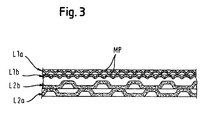
- Fig. 3 is a four-layer product shown.
- the layers L2a and L2b are provided here as a macro embossing pattern, which, however, is not to be confused with the macro-pattern MM in the form of a spring.
- a microprism pattern may also be provided in the layers L2a and L2b.
- the embossing of these patterns takes place between separate embossing rollers.
- Fig. 4 is the layer structure of Fig. 3 can be seen together with an embossing roll 1, on which the embossing nubs 2 are provided in the form of the bird's feather.
- the embossing roll 1 is also Fig. 5a and Fig. 5b refer to. Comparable to the illustration in Fig. 1 here embossing nubs 2a, 2b, 2c and 2d can be seen.
- Out Fig. 5b is also a counter-roller 3 removed.
- Out Fig. 5a and 5b Furthermore, it can be seen how the embossing knobs emboss embossing recesses in the layers L1a and L1b. On these impressions of the colored adhesive is applied, which in Fig. 5a is shown by the tube 5 shown schematically.
- the layers L1a, L1b and L2a, L2b are brought together by a so-called "marrying roll" 6, against a counter-roller 7, the roller 6 also having the pattern embossing nubs 2a, 2b, 2c and 2d is stamped, wherein the process is aligned so that these embossing nubs coincide exactly with the embossed recesses 4a, 4b, 4c and 4d.
- either the layer L1a or the layer L2a is colored and the corresponding other layer and the other layers are made of white tissue material.
Landscapes
- Engineering & Computer Science (AREA)
- Mechanical Engineering (AREA)
- Textile Engineering (AREA)
- Health & Medical Sciences (AREA)
- Public Health (AREA)
- Sanitary Thin Papers (AREA)
- Laminated Bodies (AREA)
- Paper (AREA)
- Fats And Perfumes (AREA)
Description
- Die Erfindung bezieht sich auf ein mehrlagiges Flächenprodukt aus Tissuepapier oder non-woven-Material, als Toilettenpapier, Küchenpapier, Serviette, Papiertaschentuch oder dergleichen, mit einer ein Muster bildenden Prägung, von der über die Prägenoppen mindestens eines Prägemusters mittels eines farbigen Klebstoffes eine Lagenhaftung zwischen den Lagen besteht, so dass zumindest auf der Vorderseite oder der Rückseite des Flächenproduktes das entsprechende Prägemuster farbig erscheint, wobei sich das Prägemuster kontrastmäßig von der Farbe der Lage an der Vorderseite bzw. Rückseite des Flächenproduktes abhebt.
- Ein Tissuepapier ist definiert als ein weiches absorbierendes Papier mit einem niedrigen Flächengewicht. Im allgemeinen wird ein Flächengewicht von 8 bis 30 g/m2, insbesondere 10 bis 25 g/m2 pro Lage gewählt. Das gesamte Basisgewicht eines mehrlagigen Tissueprodukts beträgt vorzugsweise bis zu maximal 65 g/m2, besonders bevorzugt bis maximal 50 g/m2. Seine Dichte liegt typischerweise unterhalb von 0,6 g/cm3, vorzugsweise unterhalb von 0,30 g/cm3 und mehr bevorzugt zwischen 0,08 und 0,20 g/cm3.
- Die Herstellung von Tissue unterscheidet sich von der Papierherstellung durch das extrem niedrige Flächengewicht und die viel höhere Zugzerreißarbeitskennzahl (siehe DIN EN 12625-4 und DIN EN 12625-5). Papier und Tissuepapier unterscheiden sich ferner im allgemeinen in Bezug auf den Elastizitätsmodul, der die Spannungsdehnungseigenschaften dieser planaren Produkte als Materialparameter charakterisiert.
- Die hohe Zugzerreißarbeitskennzahl kommt vom äußeren oder inneren Kreppen des Tissues. Das erstgenannte Kreppen wird durch Kompression der Papierbahn an einem trockenen Zylinder als Folge der Wirkung eines Kreppschabers oder im Falle des letztgenannten Kreppen als eine Folge eines Geschwindigkeitsunterschiedes zwischen zwei Sieben ("Stoffen") durchgeführt. Dies verursacht, dass die noch immer feuchte, plastisch verformbare Papierbahn intern durch Kompression und Scheren aufgebrochen wird, wodurch sie unter Last dehnbarer wird als ein ungekrepptes Papier.
- Feuchte Tissuepapierbahnen werden üblicherweise durch das sogenannte Yankee-Trocknen, das Durchlufttrocknen (TAD) oder das Impulstrockenverfahren getrocknet.
- Die in dem Tissuepapier enthaltenen Fasern sind hauptsächlich Zellulosefasern, wie beispielsweise Faserstofffasern aus chemischem Faserstoff (z.B. Kraftsulfit und Sulfatzellstoffe), mechanischem Faserstoff (z.B. gemahlenem Holz), thermomechanischem Faserstoff, chemomechanischem Faserstoff und/oder chemo-thermomechanischem Fasterstoff (CTMP). Faserstoffe die aus sowohl aus Laubholz (Hartholz) und Nadelholz (Weichholz) gebildet sind können verwendet werden. Die Fasern können auch recycelte Fasern sein oder diese enthalten, die einen beliebigen Bestandteil oder alle Bestandteile der obigen Kategorie enthalten. Die Fasern können mit Zusatzstoffen - beispielsweise Füllmitteln, Weichmachern, wie beispielsweise quaternären Armoniumverbindungen und Bindemitteln, wie beispielsweise herkömmlichen Trockenverfestigungsmitteln oder Nassverfestigungsmitteln, die verwendet werden um das ursprüngliche Papierbilden zu erleichtern und zum Einstellen der Eigenschaften davon verwendet werden - behandelt werden. Das Tissuepapier kann auch andere Fasertypen, z.B. regenerierte Zellulosefasern oder Kunstfasern beinhalten, die z.B. die Festigkeit, die Absorptionsfähigkeit, die Glattheit oder Weichheit des Papiers erhöhen.
- Tissuepapier kann auf viele Arten z.B. durch Prägen oder Laminieren zu einem Mehrlagenprodukt, durch Rollen oder Falten in das endgültige Tissueprodukt umgewandelt werden.
- Der Begriff Flies (non-woven) (ISO 90/92, DIN EN 29092) wird für eine Vielzahl an Produkten verwendet, deren Eigenschaften zwischen denen von Papier (siehe DIN 6730, Mai 1996) und Karton (DIN 6730) einerseits und Textilien andererseits angeordnet sind. In Bezug auf Vlies wird eine Vielzahl extrem unterschiedlicher Herstellungsvorgänge verwendet, wie beispielsweise die air-laid und spunlaced Techniken sowie wet-laid Techniken. Vlies umfasst Faserfilz, Vliesstoffe und Endprodukte, die daraus gebildet sind. Vlies kann ebenso als textilähnliches Verbundmaterial bezeichnet werden, das einen flexiblen porösen Stoff bildet, der nicht durch die klassischen Verfahren des Webens von Kett- und Schussfäden oder durch Schleifenbildung hergestellt wird. Tatsächlich werden Vliese durch Verschlingen, kohäsives oder adhesives Verbinden der Fasern oder eine Kombination davon hergestellt. Das Vliesmaterial kann aus Naturfasern, wie beispielsweise Zellulose- oder Baumwollfasern gebildet sein, kann jedoch auch aus Kunstfasern wie beispielsweise Polyethylen (PE), Polypropylen (PP), Polyuhrethan (PU), Polyester, Nylon oder regenerierter Zellulose, oder einer Mischung unterschiedlicher Fasern bestehen. Die Fasern können z.B. in der Form von Endlosfasern aus vorgefertigten Fasern einer endlichen Länge bestehen, wie beispielsweise Kunstfasern, die an Ort und Stelle hergestellt werden, oder sie können in der Form von Kurzfasern vorliegen. Die Vliese gemäß der Erfindung können somit aus einer Mischung aus synthetischem Material und Zellulosefasern, z.B. natürlichen Pflanzenfasern (siehe ISO 9092, DIN EN 29092) bestehen.
- Im Zusammenhang damit ist ein Toilettenpapier auf dem Markt, bei dem das Muster als Vogelfeder gestaltet ist. Ein solches Produkt kann zumindest als zweilagiges Produkt ausgebildet sein, obwohl natürlich auch mehr Lagen, beispielsweise drei oder vier Lagen vorgesehen sein können. Im Vergleich zum farbigen Klebstoff ist üblicherweise die Farbe der Papierlagen etwa weiß und die Farbe des Klebstoffes rosa.
- Aus der
US 2004/0028935 A1 ist ein mehrlagiges Flächenprodukt aus Tissue-Papier als Toilettenpapier, Küchenpapier, Serviette, Papiertaschentuch o.dgl. bekannt. Bei einem zweilagigen Flächenprodukt aus Tissue-Papier sind zwei geprägte Lagen vorhanden, die dadurch miteinander verbunden sind, dass die Lagenhaftung durch farbigen Klebstoff erzeugt wird, der auf den Prägenoppen aufgebracht wird. In den Prägevertiefungen zumindest einer Lage ist das Material bedruckt. Die Bedruckung kann auch auf einer Zwischenlage erfolgen. Durch diese Maßnahmen soll das Erscheinungsbild des Produktes verbessert werden, wozu zumindest eine äußere Lage transparent gestaltet ist, damit der farbige Klebstoff in Abwechselung mit dem Aufdruck nach außen in Erscheinung treten kann. Die mittlere Schicht und die äußeren Schichten können optional eine unterschiedliche Farbe haben als der Grundschatten, kann also eingefärbt sein. - Im Hinblick auf diesen Stand der Technik besteht die Aufgabe der vorliegenden Erfindung darin, eine Verbesserung dahingehend vorzunehmen, dass sich das farbige Prägemuster an zumindest einer Seite des Flächenproduktes stärker kontrastmäßig absetzt, als dies beim Stand der Technik der Fall ist. Dabei soll möglichst das Prägemuster nicht verändert werden müssen.
- Diese Aufgabe wird erfindungsgemäß durch die Merkmale des Patentanspruchs gelöst.
- Überraschenderweise ergibt sich bei der Einfärbung zumindest einer der Lagen eine kontrastmäßige Hervorhebung des durch den Klebstoff farbig erscheinenden Prägemusters. Außer dieser Einfärbung der Lage bzw. Lagen bedarf es keiner weiteren Investition, um diesen Effekt zu erzielen.
- Der Effekt verstärkt sich noch, wenn die Lageneinfärbung in etwa in der gleichen Farbe erfolgt wie der farbige Klebstoff.
- Die Erfindung wird nachfolgend anhand von in den Zeichnungen rein schematisch dargestellten Ausführungsbeispielen näher erläutert. Es zeigen:
- Fig. 1
- eine Draufsicht auf ein Flächenprodukt wie ein Toilettenpapier,
- Fig. 2
- eine vergrößerte Schnittansicht durch das Produkt entlang der Linie II; II in
Fig. 2 - Fig. 3
- die schematische Darstellung eines vierlagigen Produktes,
- Fig. 4
- die Darstellung des vierlagigen Produktes mit der räumlichen Trennung der beiden Lagen der Vorderseite und der beiden Lagen der Rückseite zusammen mit der perspektivischen Darstellung einer Musterprägewalze,
- Fig.5a+5b
- die Darstellung des Prägevorganges durch die Musterprägewalze sowie die Darstellung der Aufbringung des farbigen Klebstoffs und
- Fig. 6
- eine Darstellung des Zusammenbringens der Lagen über eine sogenannte "marrying roll" (Zusammenbringwalze).
- Aus
Fig. 1 ist ein Blatt eines Toilettenpapiers erkennbar, welches hier gemäßFig. 2 z.B. aus zwei Lagen L1 und L2 besteht. In die Lagen ist beispielsweise ein Mikroprägemuster MP eingeprägt, welches inFig. 1 teilweise auf der Oberfläche dargestellt ist, eigentlich aber die gesamte Oberfläche auch im Bereich des Makromusters MM vorhanden ist. Das Makromuster ist hier beispielsweise in Form einer Vogelfeder ausgebildet. Die entsprechenden Einprägungen a), b), c) und d) sind ausFig. 2 mit den entsprechenden Bezeichnungen erkennbar. - Beide Lagen sind durch Lagenhaftung miteinander verbunden. Hier besteht diese Lagenhaftung durch Klebstoff K (
Fig. 2 ). Dieser Klebstoff ist beispielsweise rosa oder in einer anderen Farbe eingefärbt, so dass das Makromuster MM in Form einer Feder bevorzugt von der Vorderseite V, gegebenenfalls aber auch auf der Rückseite R sichtbar ist. Bevorzugt ist in der selben oder einer ähnlichen Farbe die Lage L2 oder die Lage L1 eingefärbt, was ein stärkeres kontrastmäßiges Hervorheben des rosa durchscheinenden Markomusters MM bewirkt. - In
Fig. 3 ist ein vierlagiges Produkt dargestellt. Hier sind beispielsweise die beiden Lagen L1a und L1b mit einem Mirkoprägemuster MP versehen. Die Lagen L2a und L2b sind hier als ein Makroprägemuster vorgesehen, was allerdings nicht zu verwechseln ist mit dem Makromuster MM in Form einer Feder. Allerdings kann auch in den Lagen L2a und L2b ein Mirkoprägemuster vorgesehen sein. Üblicherweise erfolgt das Prägen dieser Muster zwischen gesonderten Prägewalzen. -
Fig. 4 ist der Lagenaufbau derFig. 3 zu entnehmen zusammen mit einer Prägewalze 1, auf der die Prägenoppen 2 in Gestalt der Vogelfeder vorgesehen sind. Die Prägewalze 1 ist auchFig. 5a und Fig. 5b zu entnehmen. Vergleichbar mit der Darstellung inFig. 1 sind hier auch Prägenoppen 2a, 2b, 2c und 2d erkennbar. AusFig. 5b ist auch eine Gegenwalze 3 entnehmbar. AusFig. 5a und 5b ist des Weiteren ersichtlich, wie die Prägenoppen Prägevertiefungen in den Lagen L1a und L1b prägen. Auf diese Einprägungen wird der farbige Klebstoff aufgebracht, was inFig. 5a durch die schematisch dargestellte Tube 5 dargestellt ist. - Entsprechend der Darstellung in
Fig. 6 werden nach dem Aufbringen des farbigen Klebstoffes die Lagen L1a, L1b und L2a, L2b durch eine sogenannte "marrying roll" (Zusammenbringwalze) 6 zusammengebracht, und zwar gegen eine Gegenwalze 7, wobei die Walze 6 ebenfalls die Musterprägenoppen 2a, 2b, 2c und 2d prägt, wobei der Ablauf so ausgerichtet ist, dass diese Prägenoppen genau mit den eingeprägten Vertiefungen 4a, 4b, 4c und 4d zusammenfallen. - Bevorzugt ist entweder die Lage L1a oder die Lage L2a eingefärbt und die entsprechende andere Lage sowie die übrigen Lagen bestehen aus weißem Tissuematerial.
Claims (1)
- Mehrlagiges Flächenprodukt aus Tissuepapier oder non-woven-Material, als Toilettenpapier, Küchenpapier, Serviette, Papiertaschentuch oder dergleichen, mit einer ein Muster bildenden Prägung, von der über Prägenoppen mindestens eines Prägemusters mittels eines farbigen Klebstoffes eine Lagenhaftung zwischen den Lagen besteht, so dass zumindest auf der Vorderseite oder der Rückseite des Flächenproduktes das entsprechende Prägemuster farbig erscheint, wobei sich das Prägemuster kontrastmäßig von der Farbe der Lage an der Vorderseite bzw. Rückseite des Flächenproduktes abhebt, und wobei das Material zumindest einer Lage (L1; L2) an der Rückseite oder Vorderseite des Flächenproduktes eingefärbt ist, dadurch gekennzeichnet, dass zumindest eine Lage (L1; L2)an der Rückseite bzw. Vorderseite des Flächenproduktes zur Kontrastverstärkung des farbigen Prägemusters gegenüber der die Vorderseite bzw. Rückseite des Flächenproduktes bildenden Lage ähnlich oder gleich eingefärbt ist wie der die Lagenhaftung vornehmende Klebstoff (K).
Priority Applications (1)
| Application Number | Priority Date | Filing Date | Title |
|---|---|---|---|
| PL05011455T PL1619015T3 (pl) | 2004-07-19 | 2005-05-27 | Wielowarstwowy wyrób płaski |
Applications Claiming Priority (1)
| Application Number | Priority Date | Filing Date | Title |
|---|---|---|---|
| DE202004011289U DE202004011289U1 (de) | 2004-07-19 | 2004-07-19 | Mehrlagiges Flächenprodukt |
Publications (3)
| Publication Number | Publication Date |
|---|---|
| EP1619015A2 EP1619015A2 (de) | 2006-01-25 |
| EP1619015A3 EP1619015A3 (de) | 2006-09-20 |
| EP1619015B1 true EP1619015B1 (de) | 2008-10-08 |
Family
ID=33442141
Family Applications (1)
| Application Number | Title | Priority Date | Filing Date |
|---|---|---|---|
| EP05011455A Expired - Lifetime EP1619015B1 (de) | 2004-07-19 | 2005-05-27 | Mehrlagiges Flächenprodukt |
Country Status (5)
| Country | Link |
|---|---|
| EP (1) | EP1619015B1 (de) |
| AT (1) | ATE410300T1 (de) |
| DE (2) | DE202004011289U1 (de) |
| ES (1) | ES2314516T3 (de) |
| PL (1) | PL1619015T3 (de) |
Cited By (1)
| Publication number | Priority date | Publication date | Assignee | Title |
|---|---|---|---|---|
| DE102014009320A1 (de) | 2014-06-27 | 2015-12-31 | Metsä Tissue Oyj | Vorrichtung zur Herstellung von Flächenprodukten |
Families Citing this family (9)
| Publication number | Priority date | Publication date | Assignee | Title |
|---|---|---|---|---|
| DE102007005977B4 (de) | 2007-02-07 | 2010-03-11 | Metsä Tissue Oyj | Vorrichtung zur Bedruckung von Flächenprodukten, Verfahren zur Herstellung von bedruckten Flächenprodukten als auch ein derartiges Flächenprodukt |
| US8475908B2 (en) | 2007-07-17 | 2013-07-02 | Sca Hygiene Products Gmbh | 3D embossing |
| US8470431B2 (en) | 2007-12-14 | 2013-06-25 | Kimberly Clark | Product with embossments having a decreasing line weight |
| IT1391733B1 (it) * | 2008-07-21 | 2012-01-27 | Futura Spa | Dispositivo e metodo per incollare tra loro due o piu' veli o nastri di materiale cartaceo |
| IT1392784B1 (it) * | 2008-07-21 | 2012-03-23 | Futura Spa | Dispositivo e metodo per realizzare l'unione di due o piu' veli di materiale cartaceo mediante incollaggio |
| DE202008016926U1 (de) * | 2008-12-23 | 2009-03-12 | Mcairlaid's Vliesstoffe Gmbh & Co. Kg | Zellstofftuch |
| IT1394506B1 (it) * | 2009-06-08 | 2012-07-05 | Delicarta Spa | Materiale cellulosico plurivelo goffrato |
| GR1008158B (el) * | 2011-11-25 | 2014-04-02 | Πλαστικα Ελλαδος Αβεε, | Ρολο χαρτιου υγειας διπλου χρωματος |
| GR1008157B (el) * | 2011-11-25 | 2014-04-02 | Πλαστικα Ελλαδος Αβεε, | Ρολο χαρτιου κουζινας διπλης χρησεως και χρωματος |
Family Cites Families (4)
| Publication number | Priority date | Publication date | Assignee | Title |
|---|---|---|---|---|
| GB2255745A (en) * | 1991-05-16 | 1992-11-18 | Kent Paper Products Limited | Paper or like laminate |
| AT410300B (de) | 2001-11-22 | 2003-03-25 | Pap Star Vertriebsgesellschaft | Papiertuch |
| US7282108B2 (en) * | 2002-09-27 | 2007-10-16 | Sca Hygiene Products Ab | Method for producing a multi-ply web of flexible material, such as paper and nonwoven |
| SE0203801D0 (sv) * | 2002-12-20 | 2002-12-20 | Sca Hygiene Prod Ab | Framställning av en infärgad mönstrad bana |
-
2004
- 2004-07-19 DE DE202004011289U patent/DE202004011289U1/de not_active Expired - Lifetime
-
2005
- 2005-05-27 ES ES05011455T patent/ES2314516T3/es not_active Expired - Lifetime
- 2005-05-27 PL PL05011455T patent/PL1619015T3/pl unknown
- 2005-05-27 DE DE502005005586T patent/DE502005005586D1/de not_active Expired - Lifetime
- 2005-05-27 AT AT05011455T patent/ATE410300T1/de not_active IP Right Cessation
- 2005-05-27 EP EP05011455A patent/EP1619015B1/de not_active Expired - Lifetime
Cited By (1)
| Publication number | Priority date | Publication date | Assignee | Title |
|---|---|---|---|---|
| DE102014009320A1 (de) | 2014-06-27 | 2015-12-31 | Metsä Tissue Oyj | Vorrichtung zur Herstellung von Flächenprodukten |
Also Published As
| Publication number | Publication date |
|---|---|
| ES2314516T3 (es) | 2009-03-16 |
| DE502005005586D1 (de) | 2008-11-20 |
| PL1619015T3 (pl) | 2009-03-31 |
| EP1619015A2 (de) | 2006-01-25 |
| DE202004011289U1 (de) | 2004-11-04 |
| ATE410300T1 (de) | 2008-10-15 |
| EP1619015A3 (de) | 2006-09-20 |
Similar Documents
| Publication | Publication Date | Title |
|---|---|---|
| DE69823523T2 (de) | Mehrschichtiger wischgegenstand | |
| DE3885691T2 (de) | Fester Vliesstoff. | |
| DE69107784T2 (de) | Papierhandtuch mit voluminöser Lage. | |
| DE1461271C3 (de) | Verfahren zur Herstellung von weichem, voluminösem und saugfähigem Papier | |
| DE60309237T2 (de) | Gekreppte Papierhand- und Papiertaschentücher mit ligninreichen, röhrenförmigen Fasern hoher Rauhigkeit und Verfahren zur Herstellung derselben | |
| US8951626B2 (en) | Hygiene or wiping product comprising at least one patterned ply and method for patterning the ply | |
| DE3390079C2 (de) | Mehrlagiges Wischtuch | |
| DE1055939B (de) | Verbundstoff aus weichen, hochflexiblen Faserstoffaussenlagen und einer verstaerkenden Zwischenlage | |
| DE112013002760T5 (de) | Faserstruktur und Verfahren zur Herstellung derselben | |
| DE2238005A1 (de) | Mehrschichtiges papiertuch und verfahren zu seiner herstellung | |
| DE102006010709A1 (de) | Prägevorrichtung für mindestens zweilagige Flächenprodukte wie Toilettenpapier, Taschentücher o. dgl. | |
| DE112014005901T5 (de) | Hygienepapierprodukte mit besserer Dehnbarkeit in Maschinenlaufrichtung und besseren Verkürzungseigenschaften und Verfahren zur Herstellung derselben | |
| DE69937884T2 (de) | Saugfähiges, mindestens dreilagiges Papierprodukt und Verfahren zu seiner Herstellung | |
| DE69014433T2 (de) | Verfahren zur Herstellung eines Doppelgewebes und eines Produktes aus einem Doppelgewebe. | |
| EP1619015A2 (de) | Mehrlagiges Flächenprodukt | |
| EP0851951B9 (de) | Verfahren zur herstellung eines mehrlagigen, bahnförmigen tissueproduktes | |
| DE2528311B2 (de) | Einlagiges laminares Papiertuch-Material und Verfahren zu dessen Herstellung | |
| DE69918055T2 (de) | Einweg-wischgegenstand und verfahren zu seiner herstellung | |
| DE19963827A1 (de) | Verfahren zur Applikation von Behandlungschemikalien auf ein flächiges Erzeugnis auf Faserbasis und damit hergestellte Produkte | |
| EP1226310B1 (de) | Tissue- und/oder tissueähnliches material zur herstellung von küchenpapier, toilettenpapier, taschentücher, saugeinlagen und ähnlichem | |
| EP1044098B1 (de) | Verfahren und vorrichtung zum erzeugen einer lagenhaftung zwischen lagen aus tissue-papier | |
| DE202004013598U1 (de) | Papierprodukt und Vorrichtung zum Prägen einer Papierbahn | |
| EP3160727A1 (de) | Vorrichtung und verfahren zur herstellung von flächenprodukten | |
| DE202005018311U1 (de) | Mehrlagiges Flächenprodukt | |
| DE102004024551B4 (de) | Kombiniertes Tissue/Airlaid-Produkt, Verwendung und Verfahren zu dessen Herstellung |
Legal Events
| Date | Code | Title | Description |
|---|---|---|---|
| PUAI | Public reference made under article 153(3) epc to a published international application that has entered the european phase |
Free format text: ORIGINAL CODE: 0009012 |
|
| AK | Designated contracting states |
Kind code of ref document: A2 Designated state(s): AT BE BG CH CY CZ DE DK EE ES FI FR GB GR HU IE IS IT LI LT LU MC NL PL PT RO SE SI SK TR |
|
| AX | Request for extension of the european patent |
Extension state: AL BA HR LV MK YU |
|
| PUAL | Search report despatched |
Free format text: ORIGINAL CODE: 0009013 |
|
| AK | Designated contracting states |
Kind code of ref document: A3 Designated state(s): AT BE BG CH CY CZ DE DK EE ES FI FR GB GR HU IE IS IT LI LT LU MC NL PL PT RO SE SI SK TR |
|
| AX | Request for extension of the european patent |
Extension state: AL BA HR LV MK YU |
|
| 17P | Request for examination filed |
Effective date: 20070118 |
|
| 17Q | First examination report despatched |
Effective date: 20070418 |
|
| AKX | Designation fees paid |
Designated state(s): AT BE BG CH CY CZ DE DK EE ES FI FR GB GR HU IE IS IT LI LT LU MC NL PL PT RO SE SI SK TR |
|
| GRAP | Despatch of communication of intention to grant a patent |
Free format text: ORIGINAL CODE: EPIDOSNIGR1 |
|
| GRAS | Grant fee paid |
Free format text: ORIGINAL CODE: EPIDOSNIGR3 |
|
| GRAA | (expected) grant |
Free format text: ORIGINAL CODE: 0009210 |
|
| AK | Designated contracting states |
Kind code of ref document: B1 Designated state(s): AT BE BG CH CY CZ DE DK EE ES FI FR GB GR HU IE IS IT LI LT LU MC NL PL PT RO SE SI SK TR |
|
| REG | Reference to a national code |
Ref country code: GB Ref legal event code: FG4D Free format text: NOT ENGLISH |
|
| REG | Reference to a national code |
Ref country code: CH Ref legal event code: EP |
|
| REG | Reference to a national code |
Ref country code: IE Ref legal event code: FG4D Free format text: LANGUAGE OF EP DOCUMENT: GERMAN |
|
| REF | Corresponds to: |
Ref document number: 502005005586 Country of ref document: DE Date of ref document: 20081120 Kind code of ref document: P |
|
| REG | Reference to a national code |
Ref country code: SE Ref legal event code: TRGR |
|
| PG25 | Lapsed in a contracting state [announced via postgrant information from national office to epo] |
Ref country code: SI Free format text: LAPSE BECAUSE OF FAILURE TO SUBMIT A TRANSLATION OF THE DESCRIPTION OR TO PAY THE FEE WITHIN THE PRESCRIBED TIME-LIMIT Effective date: 20081008 |
|
| REG | Reference to a national code |
Ref country code: ES Ref legal event code: FG2A Ref document number: 2314516 Country of ref document: ES Kind code of ref document: T3 |
|
| REG | Reference to a national code |
Ref country code: PL Ref legal event code: T3 |
|
| PG25 | Lapsed in a contracting state [announced via postgrant information from national office to epo] |
Ref country code: LT Free format text: LAPSE BECAUSE OF FAILURE TO SUBMIT A TRANSLATION OF THE DESCRIPTION OR TO PAY THE FEE WITHIN THE PRESCRIBED TIME-LIMIT Effective date: 20081008 Ref country code: BG Free format text: LAPSE BECAUSE OF FAILURE TO SUBMIT A TRANSLATION OF THE DESCRIPTION OR TO PAY THE FEE WITHIN THE PRESCRIBED TIME-LIMIT Effective date: 20090108 |
|
| PG25 | Lapsed in a contracting state [announced via postgrant information from national office to epo] |
Ref country code: IS Free format text: LAPSE BECAUSE OF FAILURE TO SUBMIT A TRANSLATION OF THE DESCRIPTION OR TO PAY THE FEE WITHIN THE PRESCRIBED TIME-LIMIT Effective date: 20090208 Ref country code: PT Free format text: LAPSE BECAUSE OF FAILURE TO SUBMIT A TRANSLATION OF THE DESCRIPTION OR TO PAY THE FEE WITHIN THE PRESCRIBED TIME-LIMIT Effective date: 20090218 |
|
| PLBI | Opposition filed |
Free format text: ORIGINAL CODE: 0009260 |
|
| REG | Reference to a national code |
Ref country code: IE Ref legal event code: FD4D |
|
| PG25 | Lapsed in a contracting state [announced via postgrant information from national office to epo] |
Ref country code: DK Free format text: LAPSE BECAUSE OF FAILURE TO SUBMIT A TRANSLATION OF THE DESCRIPTION OR TO PAY THE FEE WITHIN THE PRESCRIBED TIME-LIMIT Effective date: 20081008 Ref country code: RO Free format text: LAPSE BECAUSE OF FAILURE TO SUBMIT A TRANSLATION OF THE DESCRIPTION OR TO PAY THE FEE WITHIN THE PRESCRIBED TIME-LIMIT Effective date: 20081008 Ref country code: EE Free format text: LAPSE BECAUSE OF FAILURE TO SUBMIT A TRANSLATION OF THE DESCRIPTION OR TO PAY THE FEE WITHIN THE PRESCRIBED TIME-LIMIT Effective date: 20081008 Ref country code: IE Free format text: LAPSE BECAUSE OF FAILURE TO SUBMIT A TRANSLATION OF THE DESCRIPTION OR TO PAY THE FEE WITHIN THE PRESCRIBED TIME-LIMIT Effective date: 20081008 |
|
| PLAX | Notice of opposition and request to file observation + time limit sent |
Free format text: ORIGINAL CODE: EPIDOSNOBS2 |
|
| 26 | Opposition filed |
Opponent name: GEORGIA-PACIFIC FRANCE Effective date: 20090707 |
|
| PG25 | Lapsed in a contracting state [announced via postgrant information from national office to epo] |
Ref country code: CZ Free format text: LAPSE BECAUSE OF FAILURE TO SUBMIT A TRANSLATION OF THE DESCRIPTION OR TO PAY THE FEE WITHIN THE PRESCRIBED TIME-LIMIT Effective date: 20081008 |
|
| NLR1 | Nl: opposition has been filed with the epo |
Opponent name: GEORGIA-PACIFIC FRANCE |
|
| BERE | Be: lapsed |
Owner name: SCA HYGIENE PRODUCTS G.M.B.H. Effective date: 20090531 |
|
| PLAF | Information modified related to communication of a notice of opposition and request to file observations + time limit |
Free format text: ORIGINAL CODE: EPIDOSCOBS2 |
|
| PG25 | Lapsed in a contracting state [announced via postgrant information from national office to epo] |
Ref country code: MC Free format text: LAPSE BECAUSE OF NON-PAYMENT OF DUE FEES Effective date: 20090531 |
|
| REG | Reference to a national code |
Ref country code: CH Ref legal event code: PL |
|
| PG25 | Lapsed in a contracting state [announced via postgrant information from national office to epo] |
Ref country code: CH Free format text: LAPSE BECAUSE OF NON-PAYMENT OF DUE FEES Effective date: 20090531 Ref country code: LI Free format text: LAPSE BECAUSE OF NON-PAYMENT OF DUE FEES Effective date: 20090531 |
|
| PLBB | Reply of patent proprietor to notice(s) of opposition received |
Free format text: ORIGINAL CODE: EPIDOSNOBS3 |
|
| REG | Reference to a national code |
Ref country code: HU Ref legal event code: AG4A Ref document number: E006816 Country of ref document: HU |
|
| PG25 | Lapsed in a contracting state [announced via postgrant information from national office to epo] |
Ref country code: BE Free format text: LAPSE BECAUSE OF NON-PAYMENT OF DUE FEES Effective date: 20090531 |
|
| PLAB | Opposition data, opponent's data or that of the opponent's representative modified |
Free format text: ORIGINAL CODE: 0009299OPPO |
|
| PG25 | Lapsed in a contracting state [announced via postgrant information from national office to epo] |
Ref country code: AT Free format text: LAPSE BECAUSE OF NON-PAYMENT OF DUE FEES Effective date: 20090527 |
|
| R26 | Opposition filed (corrected) |
Opponent name: GEORGIA-PACIFIC FRANCE Effective date: 20090707 |
|
| PG25 | Lapsed in a contracting state [announced via postgrant information from national office to epo] |
Ref country code: GR Free format text: LAPSE BECAUSE OF FAILURE TO SUBMIT A TRANSLATION OF THE DESCRIPTION OR TO PAY THE FEE WITHIN THE PRESCRIBED TIME-LIMIT Effective date: 20090109 |
|
| PG25 | Lapsed in a contracting state [announced via postgrant information from national office to epo] |
Ref country code: LU Free format text: LAPSE BECAUSE OF NON-PAYMENT OF DUE FEES Effective date: 20090527 |
|
| PG25 | Lapsed in a contracting state [announced via postgrant information from national office to epo] |
Ref country code: TR Free format text: LAPSE BECAUSE OF FAILURE TO SUBMIT A TRANSLATION OF THE DESCRIPTION OR TO PAY THE FEE WITHIN THE PRESCRIBED TIME-LIMIT Effective date: 20081008 |
|
| PG25 | Lapsed in a contracting state [announced via postgrant information from national office to epo] |
Ref country code: CY Free format text: LAPSE BECAUSE OF FAILURE TO SUBMIT A TRANSLATION OF THE DESCRIPTION OR TO PAY THE FEE WITHIN THE PRESCRIBED TIME-LIMIT Effective date: 20081008 |
|
| PLAB | Opposition data, opponent's data or that of the opponent's representative modified |
Free format text: ORIGINAL CODE: 0009299OPPO |
|
| R26 | Opposition filed (corrected) |
Opponent name: GEORGIA-PACIFIC FRANCE Effective date: 20090707 |
|
| APBM | Appeal reference recorded |
Free format text: ORIGINAL CODE: EPIDOSNREFNO |
|
| APBP | Date of receipt of notice of appeal recorded |
Free format text: ORIGINAL CODE: EPIDOSNNOA2O |
|
| APAH | Appeal reference modified |
Free format text: ORIGINAL CODE: EPIDOSCREFNO |
|
| APBQ | Date of receipt of statement of grounds of appeal recorded |
Free format text: ORIGINAL CODE: EPIDOSNNOA3O |
|
| APBY | Invitation to file observations in appeal sent |
Free format text: ORIGINAL CODE: EPIDOSNOBA2O |
|
| APAR | Information on invitation to file observation in appeal modified |
Free format text: ORIGINAL CODE: EPIDOSCOBA2O |
|
| PLAB | Opposition data, opponent's data or that of the opponent's representative modified |
Free format text: ORIGINAL CODE: 0009299OPPO |
|
| R26 | Opposition filed (corrected) |
Opponent name: SCA TISSUE FRANCE Effective date: 20090707 |
|
| PGFP | Annual fee paid to national office [announced via postgrant information from national office to epo] |
Ref country code: SK Payment date: 20140521 Year of fee payment: 10 Ref country code: NL Payment date: 20140520 Year of fee payment: 10 Ref country code: SE Payment date: 20140519 Year of fee payment: 10 Ref country code: ES Payment date: 20140507 Year of fee payment: 10 Ref country code: FI Payment date: 20140526 Year of fee payment: 10 |
|
| PGFP | Annual fee paid to national office [announced via postgrant information from national office to epo] |
Ref country code: HU Payment date: 20140507 Year of fee payment: 10 Ref country code: PL Payment date: 20140502 Year of fee payment: 10 |
|
| REG | Reference to a national code |
Ref country code: FR Ref legal event code: PLFP Year of fee payment: 11 |
|
| APAR | Information on invitation to file observation in appeal modified |
Free format text: ORIGINAL CODE: EPIDOSCOBA2O |
|
| PLAB | Opposition data, opponent's data or that of the opponent's representative modified |
Free format text: ORIGINAL CODE: 0009299OPPO |
|
| R26 | Opposition filed (corrected) |
Opponent name: SCA TISSUE FRANCE Effective date: 20090707 |
|
| PG25 | Lapsed in a contracting state [announced via postgrant information from national office to epo] |
Ref country code: FI Free format text: LAPSE BECAUSE OF NON-PAYMENT OF DUE FEES Effective date: 20150527 |
|
| REG | Reference to a national code |
Ref country code: SK Ref legal event code: MM4A Ref document number: E 4611 Country of ref document: SK Effective date: 20150527 |
|
| REG | Reference to a national code |
Ref country code: NL Ref legal event code: MM Effective date: 20150601 |
|
| PG25 | Lapsed in a contracting state [announced via postgrant information from national office to epo] |
Ref country code: SE Free format text: LAPSE BECAUSE OF NON-PAYMENT OF DUE FEES Effective date: 20150528 Ref country code: SK Free format text: LAPSE BECAUSE OF NON-PAYMENT OF DUE FEES Effective date: 20150527 |
|
| REG | Reference to a national code |
Ref country code: DE Ref legal event code: R100 Ref document number: 502005005586 Country of ref document: DE |
|
| APBU | Appeal procedure closed |
Free format text: ORIGINAL CODE: EPIDOSNNOA9O |
|
| PG25 | Lapsed in a contracting state [announced via postgrant information from national office to epo] |
Ref country code: NL Free format text: LAPSE BECAUSE OF NON-PAYMENT OF DUE FEES Effective date: 20150601 |
|
| REG | Reference to a national code |
Ref country code: FR Ref legal event code: PLFP Year of fee payment: 12 |
|
| PG25 | Lapsed in a contracting state [announced via postgrant information from national office to epo] |
Ref country code: HU Free format text: LAPSE BECAUSE OF NON-PAYMENT OF DUE FEES Effective date: 20150528 |
|
| PLCK | Communication despatched that opposition was rejected |
Free format text: ORIGINAL CODE: EPIDOSNREJ1 |
|
| REG | Reference to a national code |
Ref country code: ES Ref legal event code: FD2A Effective date: 20160630 |
|
| PLBN | Opposition rejected |
Free format text: ORIGINAL CODE: 0009273 |
|
| STAA | Information on the status of an ep patent application or granted ep patent |
Free format text: STATUS: OPPOSITION REJECTED |
|
| PG25 | Lapsed in a contracting state [announced via postgrant information from national office to epo] |
Ref country code: ES Free format text: LAPSE BECAUSE OF NON-PAYMENT OF DUE FEES Effective date: 20150528 |
|
| 27O | Opposition rejected |
Effective date: 20160408 |
|
| PG25 | Lapsed in a contracting state [announced via postgrant information from national office to epo] |
Ref country code: PL Free format text: LAPSE BECAUSE OF NON-PAYMENT OF DUE FEES Effective date: 20150527 |
|
| REG | Reference to a national code |
Ref country code: FR Ref legal event code: PLFP Year of fee payment: 13 |
|
| REG | Reference to a national code |
Ref country code: FR Ref legal event code: PLFP Year of fee payment: 14 |
|
| REG | Reference to a national code |
Ref country code: DE Ref legal event code: R082 Ref document number: 502005005586 Country of ref document: DE Representative=s name: HOFFMANN - EITLE PATENT- UND RECHTSANWAELTE PA, DE Ref country code: DE Ref legal event code: R081 Ref document number: 502005005586 Country of ref document: DE Owner name: ESSITY OPERATIONS MANNHEIM GMBH, DE Free format text: FORMER OWNER: SCA HYGIENE PRODUCTS GMBH, 68305 MANNHEIM, DE |
|
| PGFP | Annual fee paid to national office [announced via postgrant information from national office to epo] |
Ref country code: DE Payment date: 20200512 Year of fee payment: 16 Ref country code: FR Payment date: 20200414 Year of fee payment: 16 |
|
| PGFP | Annual fee paid to national office [announced via postgrant information from national office to epo] |
Ref country code: GB Payment date: 20200520 Year of fee payment: 16 Ref country code: IT Payment date: 20200414 Year of fee payment: 16 |
|
| REG | Reference to a national code |
Ref country code: DE Ref legal event code: R119 Ref document number: 502005005586 Country of ref document: DE |
|
| GBPC | Gb: european patent ceased through non-payment of renewal fee |
Effective date: 20210527 |
|
| PG25 | Lapsed in a contracting state [announced via postgrant information from national office to epo] |
Ref country code: GB Free format text: LAPSE BECAUSE OF NON-PAYMENT OF DUE FEES Effective date: 20210527 Ref country code: DE Free format text: LAPSE BECAUSE OF NON-PAYMENT OF DUE FEES Effective date: 20211201 |
|
| PG25 | Lapsed in a contracting state [announced via postgrant information from national office to epo] |
Ref country code: FR Free format text: LAPSE BECAUSE OF NON-PAYMENT OF DUE FEES Effective date: 20210531 |
|
| PG25 | Lapsed in a contracting state [announced via postgrant information from national office to epo] |
Ref country code: IT Free format text: LAPSE BECAUSE OF NON-PAYMENT OF DUE FEES Effective date: 20200527 |
|
| PG25 | Lapsed in a contracting state [announced via postgrant information from national office to epo] |
Ref country code: IT Free format text: LAPSE BECAUSE OF NON-PAYMENT OF DUE FEES Effective date: 20210527 |